« True friends stab you in the front! » — Oscar Wilde
First, the update: we’re off to Belgium for a much-needed vacation… which is frankly incompatible with our usual Hallowe’en Countdown.
Surely you can still get into the spirit of the season by revisiting any of the eight previous editions.
We’ll still try to post as often as possible, and I promise you that the topics all will honour the mischievous spirit of All Hallows’ Eve.
To wit: a few years ago, George, exalted founder of trefology… and assiduous friend of WOT?, asked me to track down — and hopefully feature — an elusive story he recalled from his callow youth. He described the plot, which rang a bell… at least that’s what I said at the time. Last month, he gently reminded me of my mission and, this time, I’m seeing it through.
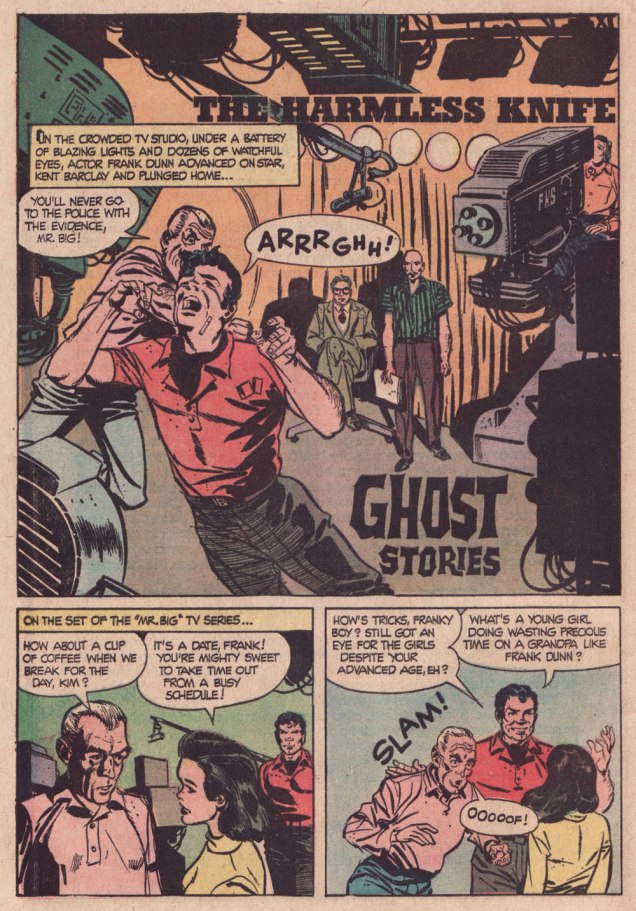
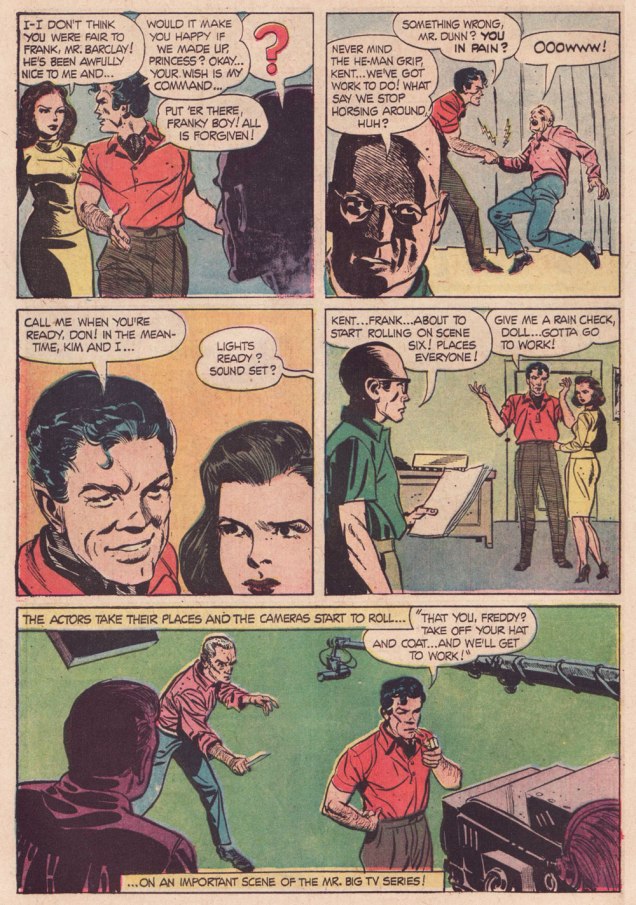
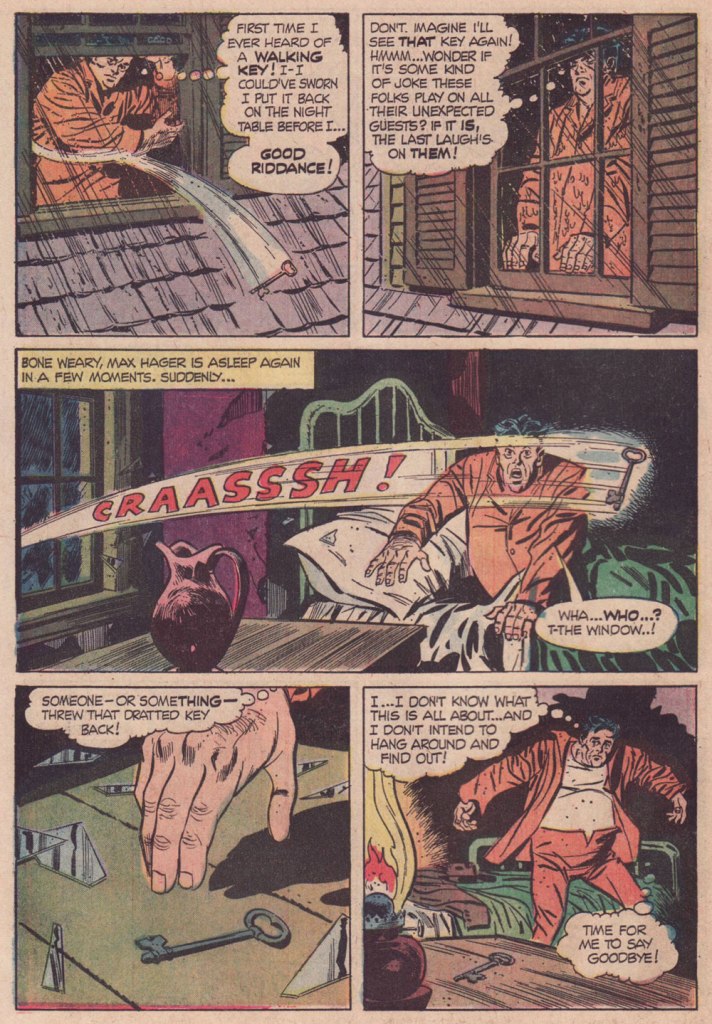
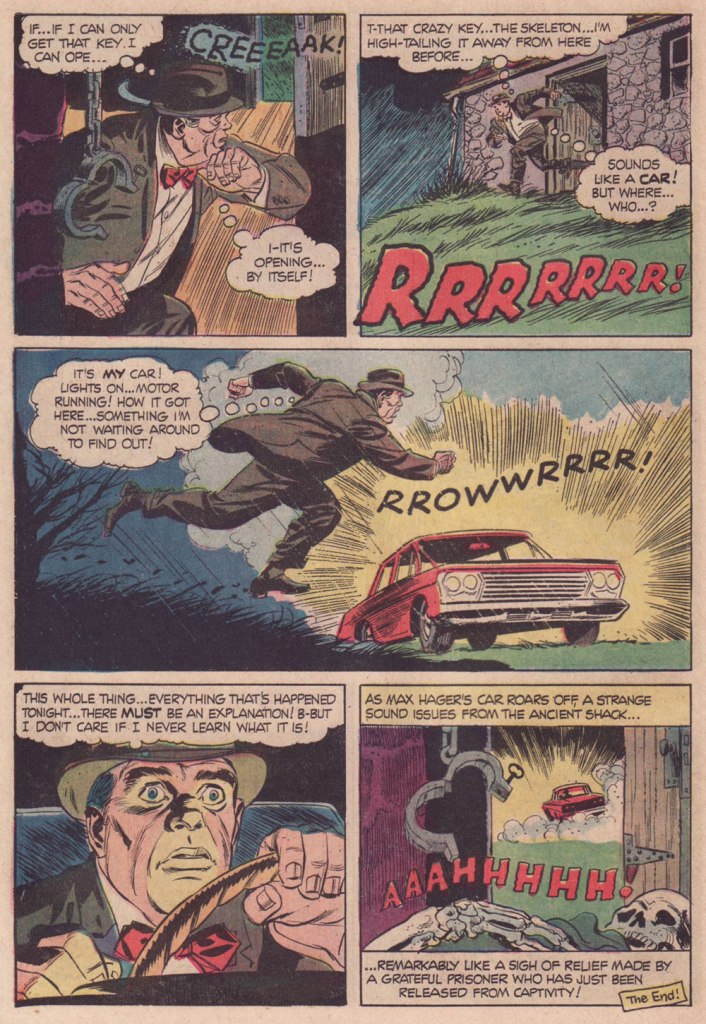
And so here’s The Harmless Knife from Ghost Stories no. 14 (June 1966, Dell), later reprinted in Ghost Stories no. 34 (Oct. 1972, Dell)… which is where George encountered it.
Here’s his reaction:
THAT’S IT! Ah, I remember it well.
I’m pretty sure I bought that comic at a little roadside grocery near Strawberry, CA. We usually spent most of the summer on the beach, and comic books were an essential part of my day.
My mom loved the area so much she eventually moved there (with all my comics in tow—so, in a manner of speaking, my Dell horror comic returned home).
As was generally the deplorable case with Dell, no credits. Therefore… writer unknown, but pencils and inks by Frank Springer (1929-2009).
.
.
.
.
.
Amusingly, I’d featured another story, A Room With a Dreadful Secret — from the very same issue! — a few years ago. Read it so I won’t have to repeat myself needlessly… thanks!
« Ghost stories … tell us about things that lie hidden within all of us, and which lurk outside all around us. » — Susan Hill
We’ve once before turned our attention upon Dell’s Ghost Stories, an anthology title with such an incredible first issue (written and directed by John Stanley) that all the subsequent ones whither in the long shadow it casts. In recent years, I’ve somewhat softened my stance on these sequels, taking into account that nothing could measure up to Stanley’s work on numero uno — and accordingly judging them on their own merits.
As a kid, I didn’t think too highly of Frank Springer (1929-2009), being primarily familiar with his inks over Frank Robbins on The Invaders (too sloppy, and no substitute for Robbins inking himself, which never happened at Marvel anyhow). Down the line, I ran into some of his earlier work (Phoebe Zeit-Geist, The Secret Six, The National Lampoon, Dial H for Hero and sundry items for Dell) and grew to appreciate his strengths.
Now, Ghost stories was interesting as a ‘horror’ (in the very limited Silver Age/Comics Code in full force sense) anthology, in that the vast majority of the stories were, after that peerless first issue, the work of one single artist (Gerald McCann, after contributing a couple of page to number one, handled issues 2-5, with a couple of filler pages thereafter, then Springer took over for 6-20, the rest of the run consisting of reprints, with the unexpected exception of no. 35).
Here then is what’s likely my favourite Springer Ghost Story: A Room with a Dreadful Secret.
This is Ghost Stories no. 14 (June 1966, Dell). Cover by Springer.
Some people automatically conflate “goofy” with “childish”, but goofiness comes in many guises: from the charmingly nonsensical to the playfully quirky, from the clearly brilliant but confusing to the fucking stupid. (It’s also a snow-boarding term – How do I tell if I’m Goofy or Regular?) Today’s Tentacle Tuesday is goofy, all right, but more in the category of seemingly drug-induced codswallop. Another word for Dial H for Hero is wacky; distinctly wacky, so wacky that (as co-admin RG put it) it’s hard to really dislike it.
Maybe I should backtrack for those in the audience who are not familiar with the concept of Dial H for Hero. Robby Reed, a lucky (?), plucky teenager with a propensity to shout “Sockamagee!” in moments of excitement, stumbles upon some sort of magical thingamajig in a cave that enables him to become a superhero at the drop of hat (well, a turn of a dial). The process has unpredictable and uncontrollable results, in the sense that Robby has no idea who he will become, or what powers will be at his fingertips.
I have nothing against the idea of a rotary phone cum magical dial – that idea is rather interesting, given that rotary phones are indeed mysterious objects to the current generation – but I find the stories a tad too random to be enjoyable. Yet that’s the aspect that some readers clearly relished. To quote a letter from House of Mystery no. 172 (January-February 1968) from Bethesda, MD’s Irene Vartanoff.
« One of the best things about DIAL H FOR HERO is the huge amount of imagination put into each story. When at least two new heroes with new powers, costumes, weaknesses, bodies, etc. have to appear in each story, it may make your writers rack their brains and work overtime, but the results are fantastic. »
Given all the transformations Robby has gone through and the many bad guys he has had the pleasure of defeating, it is unavoidable that he would 1) encounter some villains with tentacles 2) acquire some tentacles himself. Dial H for Highball on *your* old-fashioned phone, if you still have one gathering dust in the attic, and enjoy this gallery of fun nonsense.
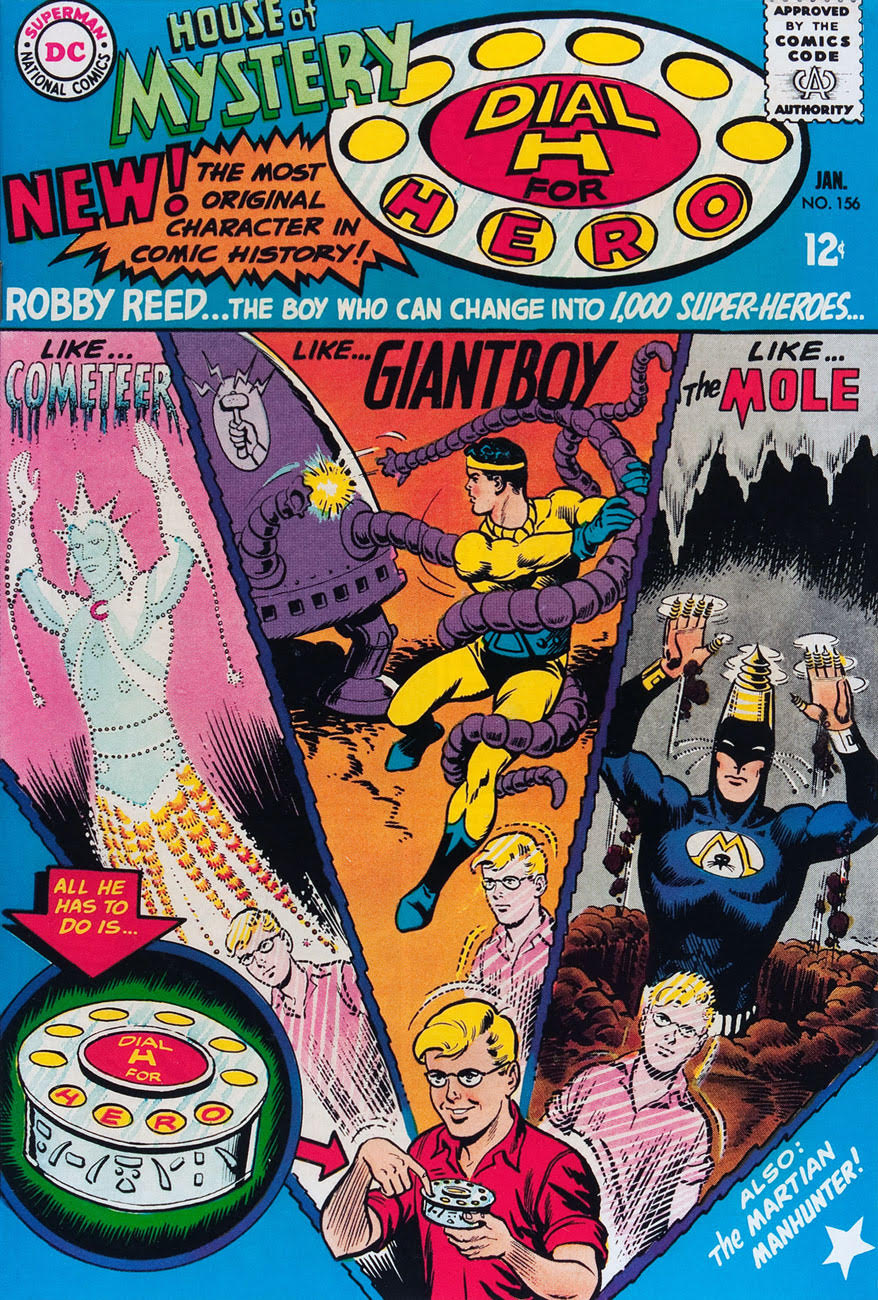
The very first appearance of Robby Reed and his magical dial, and already we have tentacles:
House of Mystery no. 156 (January 1966), cover by Jim Mooney. This is a good demonstration of how random some of the superheroes generated by the machine are.
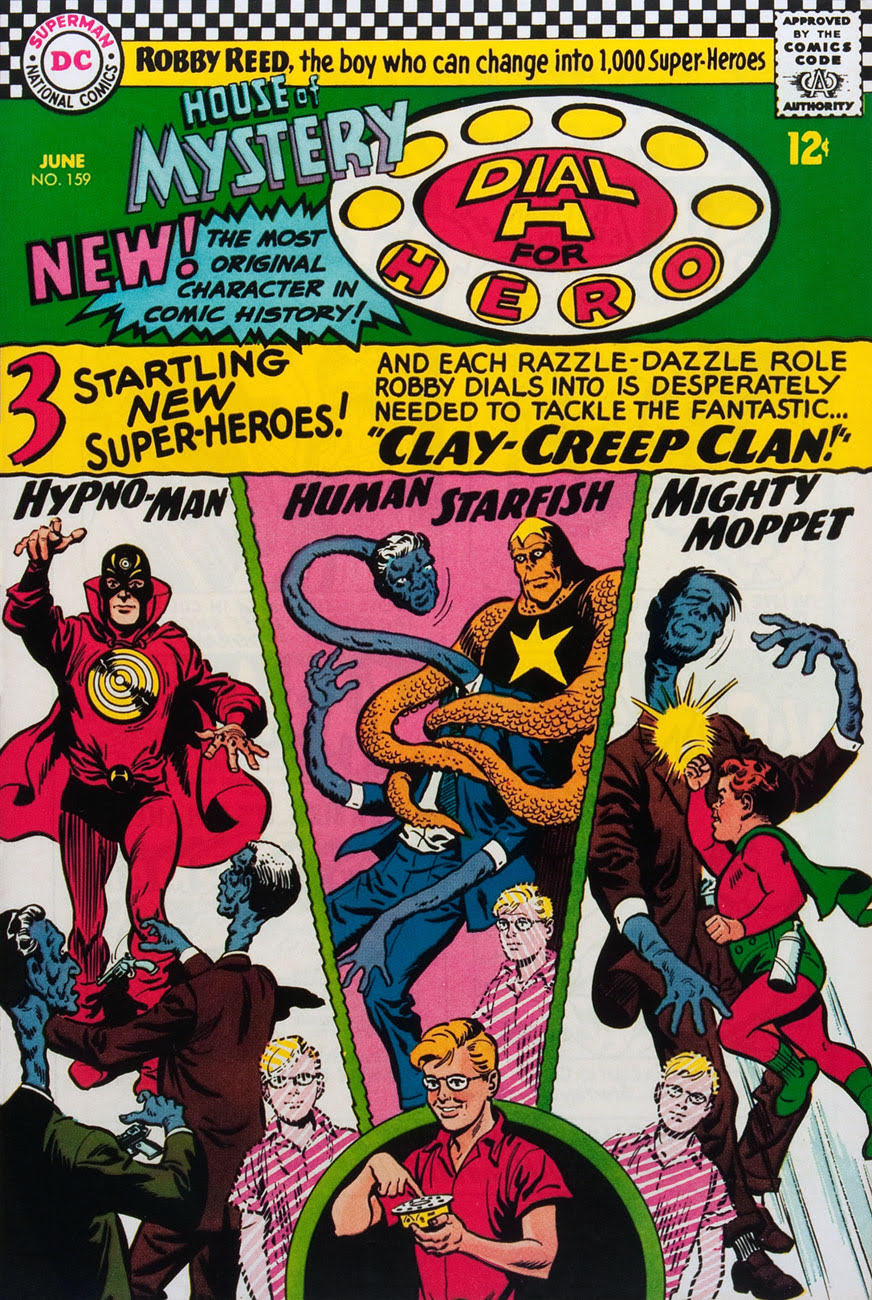
This is the first Dial H for Hero story, and as such it has no other title. Scripted by Dave Wood, drawn by Jim Mooney. [RG: panel three looks suspiciously like the work of George Tuska. Ghosting… or swiping? Hmm…]I mentioned that Robby himself sometimes sprouts tentacles. Here’s a good example:
House of Mystery no. 159 (June 1966), cover by Jim Mooney. Another issue, another gallery of improbable heroes and villains…
Human Starfish Robby Reed conveniently improves upon the concept of a normal starfish, developing prehensile appendages to capture a very stretchy criminal. The Clay-Creep Clan is written by Dave Wood, and drawn by Jim Mooney.
Jim Mooney was responsible for Dial H for Hero‘s art for many issues, from the onset of the series with House of Mysteryno. 156 (January 1966) to House of Mystery no. 170 (October 1967). Dial H for Hero lasted three more issues after Mooney’s departure. As luck would have it, no. 171 and no. 172 bring our most striking examples of tentacles yet. (The final DHFH issue, House of Mysteryno. 173, features a cover by Jack Sparling, with insides by Charles Nicholas and Sal Trapani.)
Arguably the prettiest cover of this post (my favourite, at any rate):
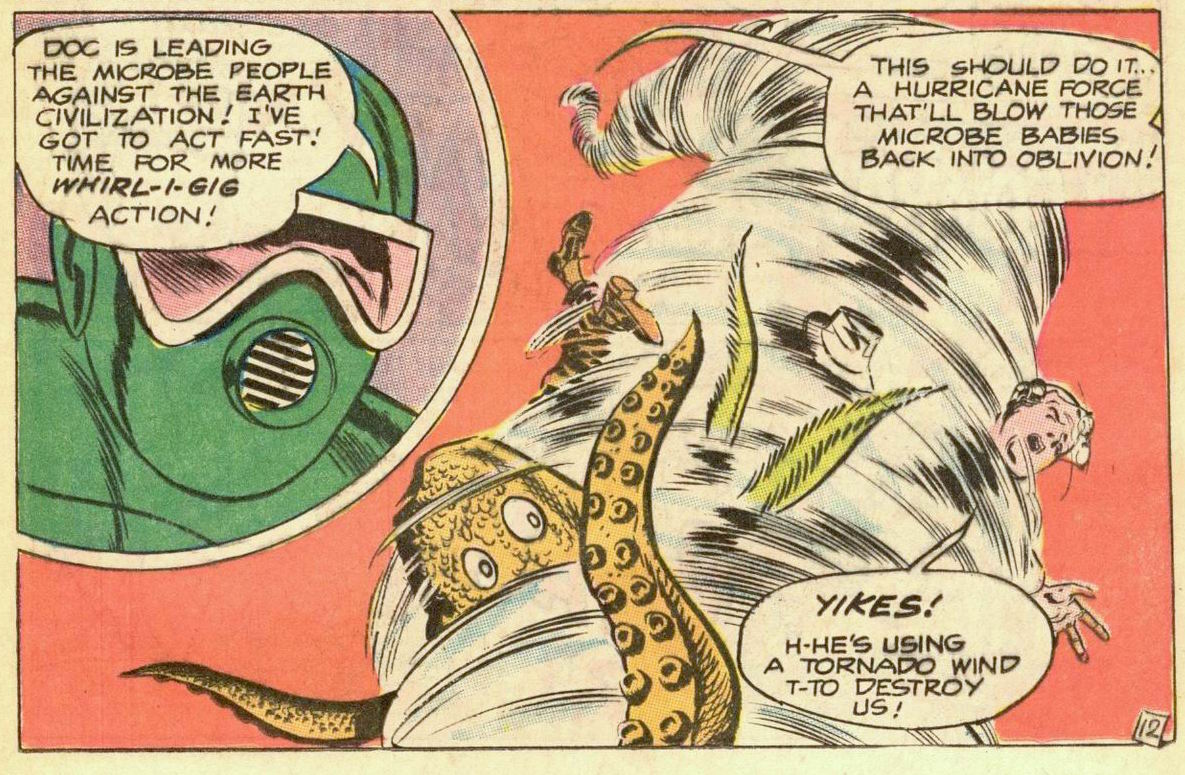
Back to fighting tentacles! House of Mystery no. 171 (December 1967), cover by Nick Cardy.
The Micro-Monsters! is written by Dick Wood and illustrated by Frank Springer.
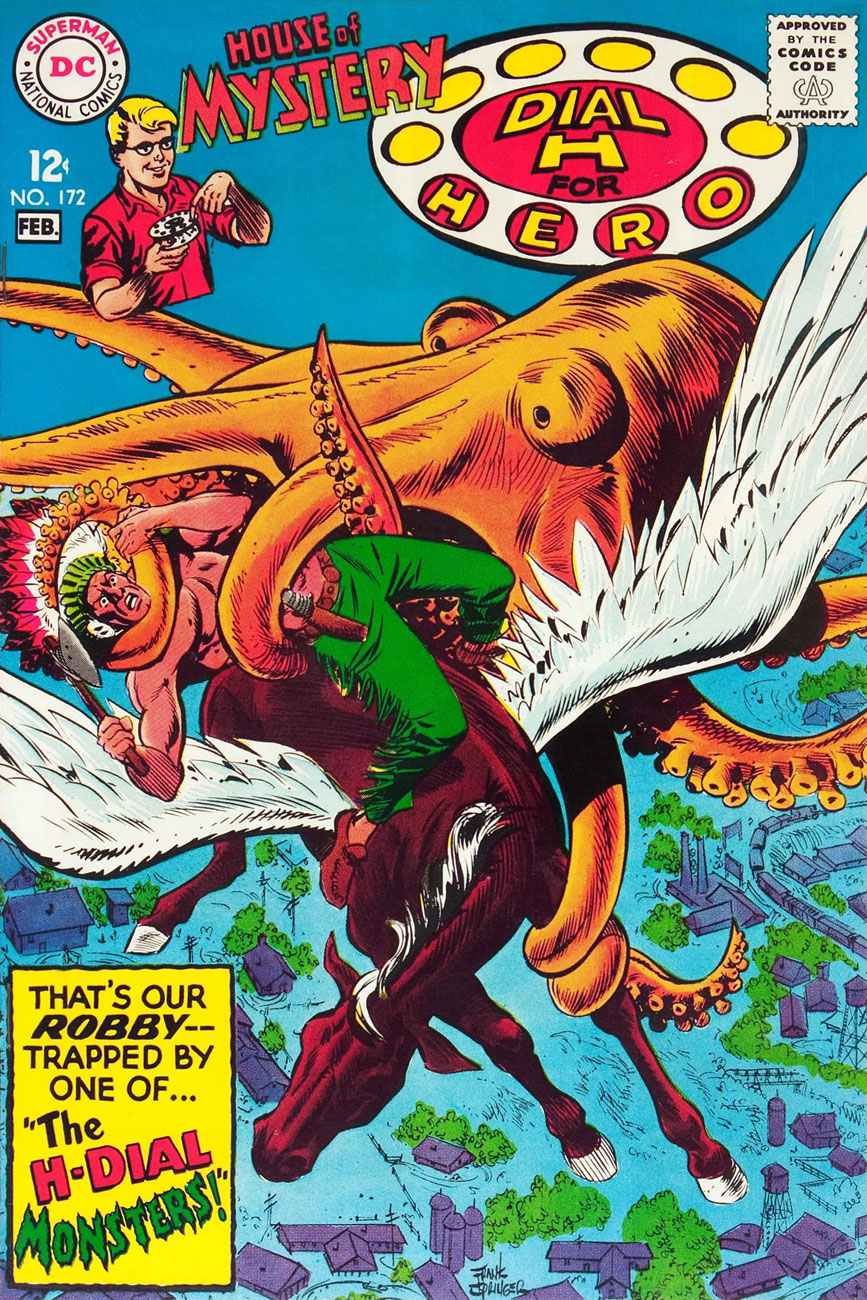
House of Mystery no. 172 (January-February 1668), cover by Frank Springer.
The Monsters From the H-Dial! is written by Dick Wood and illustrated by Frank Springer.
How does Chief Mighty Arrow defeat the flying octopus? Why, by shooting jet-propelled feathers from his headdress, of course.
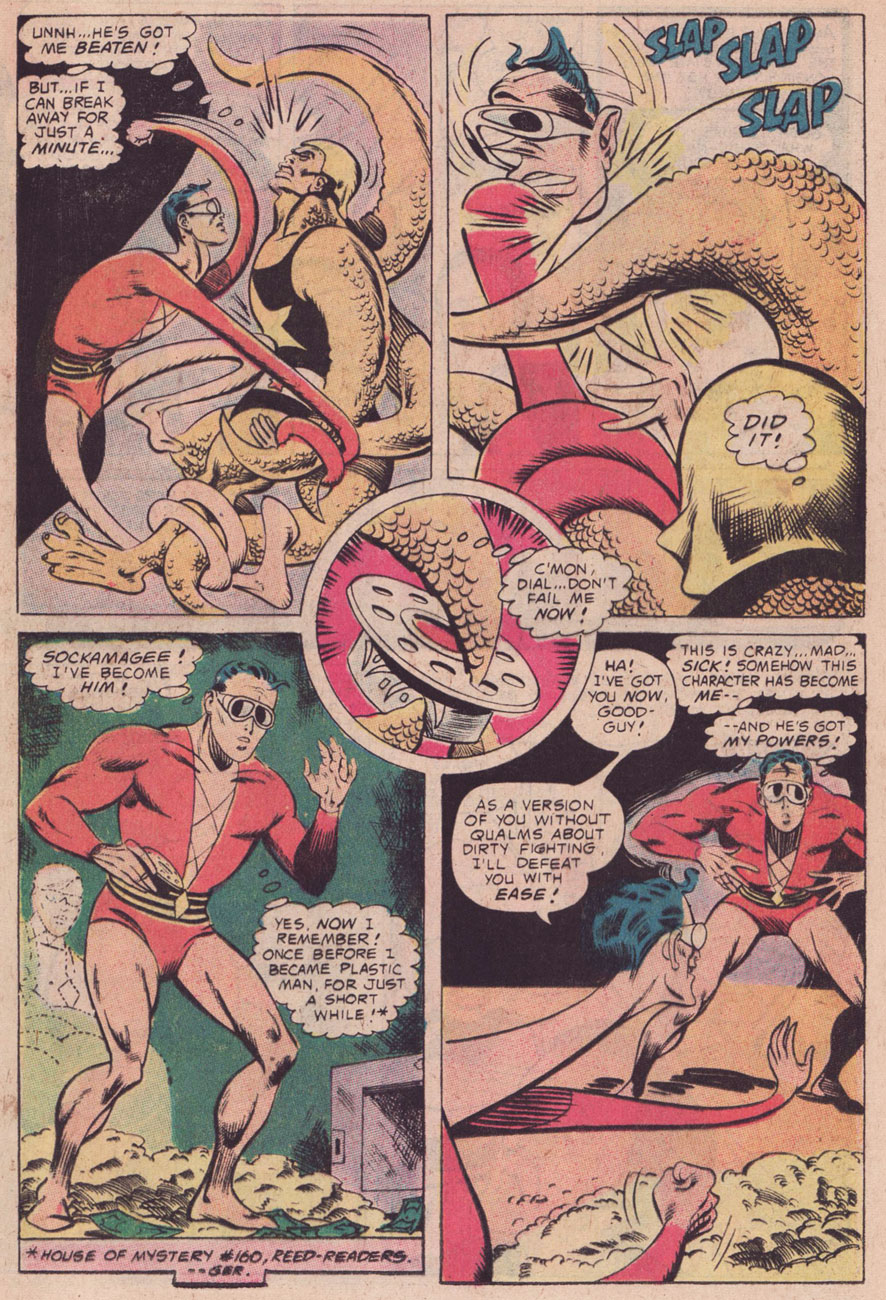
The last thing I’d like to mention is that my favourite Robby Reed appearance was in an issue of Plastic Man, of all places – to be more precise, in Plastic Man no. 13 (June-July 1976). In If I Kill Me, Will I Die? (read it here!), scripted by Steve Skeates, pencilled by Ramona Fradon and inked by Bob Smith, Reed not only gets to take on Plas (in more ways than one), but also falls deeply and magically in love with a professional hog-caller. Also, tentacles. Adorable *and* exciting!
« … it was a balled-up thing… like an empty wrapper thrown carelessly aside… but somehow still recognizable as having once been human… »
Dell’s Ghost Stories (1962-1973, with issues 21 to 37 lazily and straight-up reprinting numbers 1 to 16… with a single, perplexing exception, the all-new, surprisingly decent issue 35, late in 1972) were quite tame, trifling stuff, with one notorious bright spot: the première issue, entirely written by John Stanley (1914-1993) and comprising, amidst other excellent short pieces, what’s possibly the most nightmarish tale to see print up ’til then in American comics (particularly all-ages comics!), « The Monster of Dread End ». It represented the kind of material few comics publishers could have gotten away with at the time, save, ironically, one of the squeaky-clean stalwarts (Dell, Gilberton, Gold Key…) that opted out of the industry’s recently-instituted governing censorship board, the Comics Code Authority. Their reasoning was that, having never published anything objectionable to begin with, they were unlikely to head down that sordid path in the future.
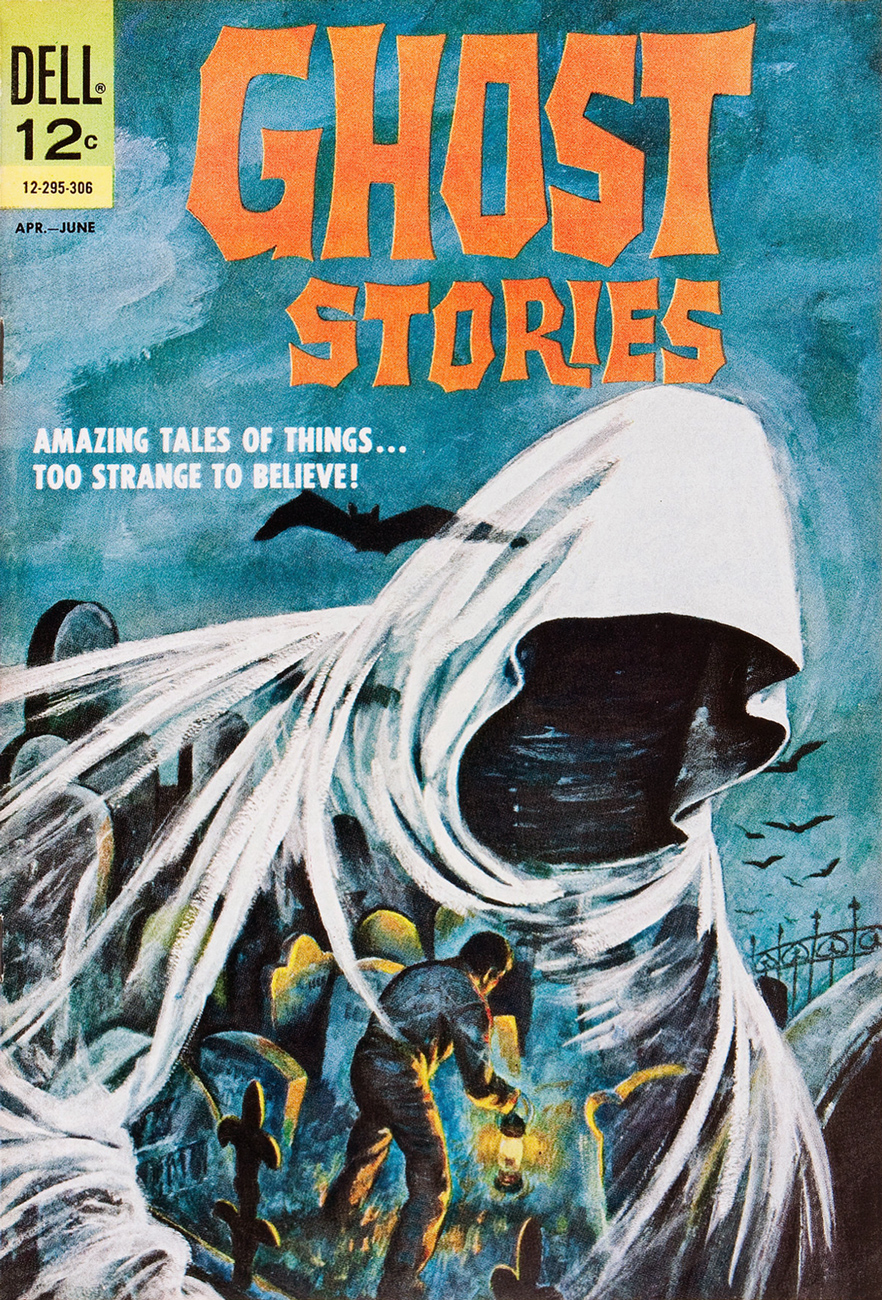
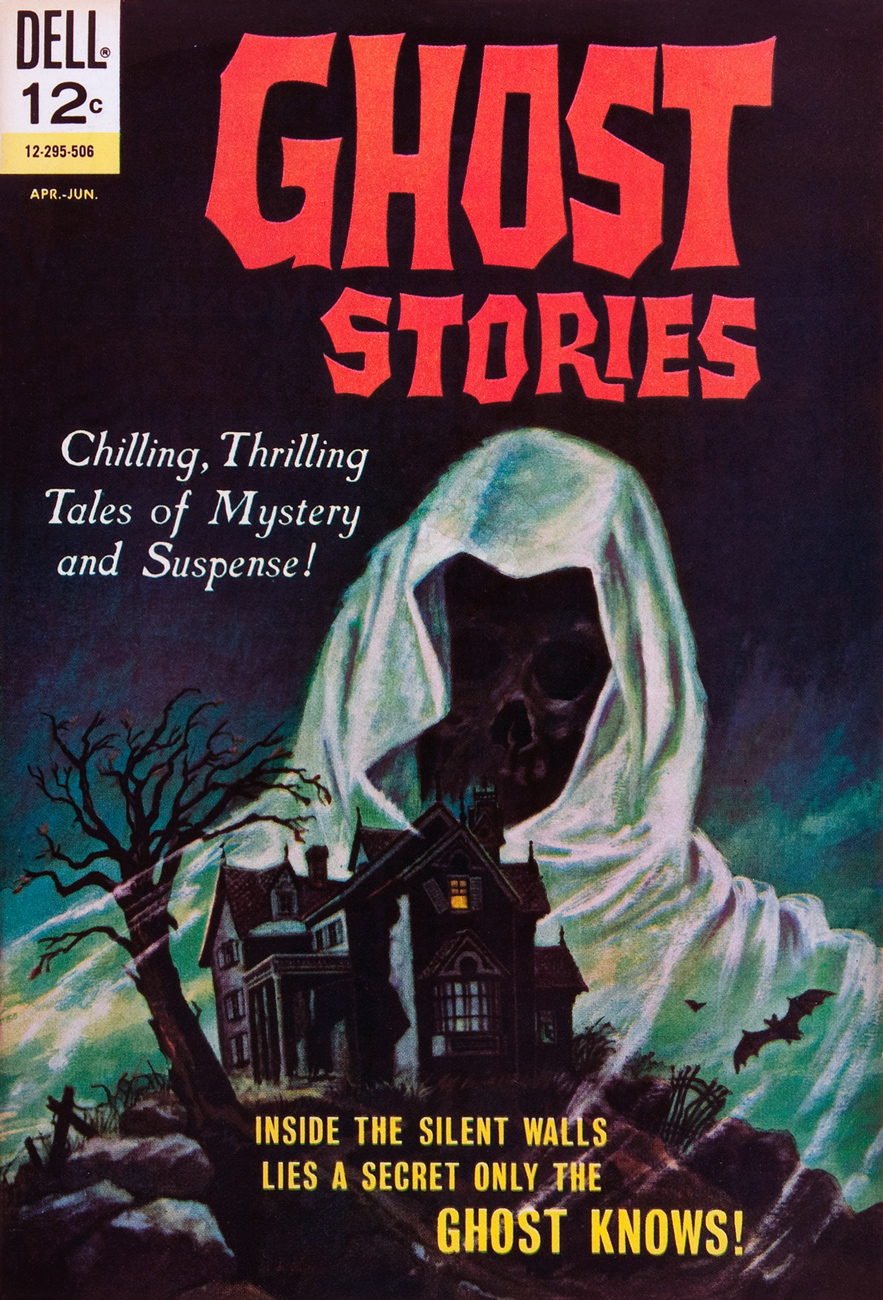
Journeyman cartoonist Frank Springer (1929-2009) provided some decent artwork through most of the book’s run, but as he didn’t have much to work with, script-wise (Carl Memling was no substitute for Mr. Stanley), the end result remains underwhelming. Looking at the bright side, he did provide a couple of quite alluring covers, the final, non-painted entries in our select little gallery.
If you haven’t already made its acquaintance, treat yourself to the nerve-tingling Number One, available gratis under the auspices of the fine folks at comicbookplus.com. Love the semi-woodcut technique used on the cover by the Unknown Artiste.
Ghost Stories no. 3 (April-June 1963). Cover artist unknown.
Ghost Stories no. 10 (April-June 1965). Cover artist unknown.
Ghost Stories no. 19 (August 1967). Cover and interiors by Frank Springer.
Ghost Stories no. 31 (January 1972). Cover and interiors by Frank Springer, price and indicia aside, a facsimile of issue 11 (July-September 1965). My own tepid introduction to the series.











 ~ ds
~ ds


 Who's Out There?