A Fading Presence of Lived Memories: Denys Wortman’s New York

« I can’t decide whether to give up peanut butter on account of its calories, or to eat it on account of its vitamines… »

When it comes to what Amazon loosely classifies as ‘literary graphic novels’ (very much a meaningless category), it’s rare for me to stumble across something completely unfamiliar on a bookstore shelf, unless of course it’s something hot off the press. Denys Wortman’s New York: Portrait of the City in the 30s and 40s (Drawn & Quarterly*, 2010), which I spotted in the well-stocked The Comic Hunter (Moncton, Canada), looked unfamiliar and intriguing. 

The edition I purchased is from 2010; I wasn’t able to find out when this one, with an arguably more striking cover, was published. This illustration had the caption of ‘If I have to come down to buy them, you’ll have to come down on your prices’, and was drawn on August 30th, 1948.

I’d never heard of Wortman, but just a quick skim through this volume showed that he clearly had an amazing ability to evoke a certain place and time, and fill it up with characters so real that one wouldn’t be surprised to run into them on the street. Nostalgia for a place one never experienced is a recurring feature of the human mind – Wortman’s New York is one I am familiar with from books and movies, and that faded away long before I was born. One would also be remiss in failing to express admiration for DW’s living, breathing linework. His attention to the minutest details are used to recreate scenes from lives of people who certainly didn’t have an easy time of it, yet still inspire a sort of familiar comfort almost a hundred years later.

To get some bibliographical stuff out of the way (for a full story, I shall direct you to the website maintained by Wortman’s eighth son), Denys Wortman was born in 1887 and died in 1958 at 71. Among other things, he also drew Metropolitan Movies, a comic strip that ran between 1924 and 1954 and is mostly remembered (if that’s the right term here) for two of its characters, a couple of cheerful vagrants named Mopey Dick and the Duke.  

It was a tad difficult to decide which pages to feature, so I tried to go for a variety of scenery. Wortman must have been a Gerald Kersh character to possess such an intimate knowledge of all these industries, markets, streets, and types of human beings… I invite you to a bit of time travel.
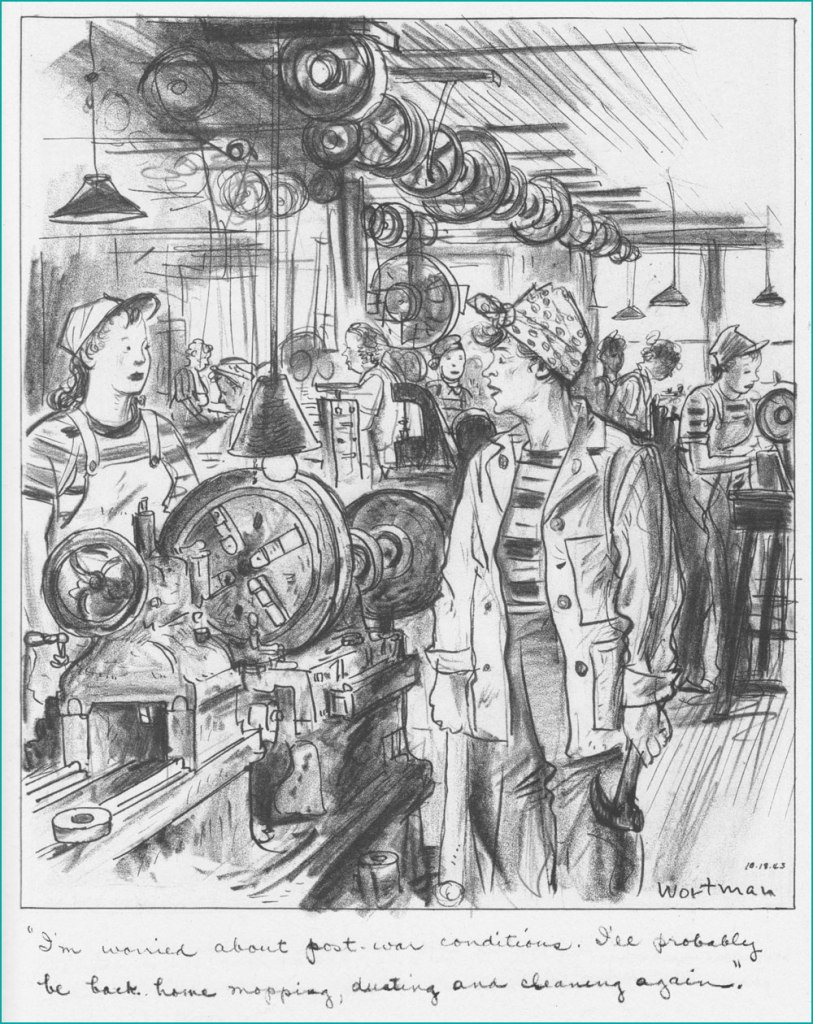
« In art school days there was much talk about “character,” but I feel there was a small amount of misapprehension mixed up with its interpretation. I could not see then and I can’t now why a man with a lot of whiskers has any more character than one who is clean-shaven. Nevertheless I would prefer to draw the former. And I would prefer to draw him after he has lived long enough for Experience to have etched lines in his face — the more the better. Because the more lines and markings he has in his face the more chance I have of finding ones that I can match with lines on my paper to help create the illusion that the face I am drawing has bones under the skin, that the eyes are seeing things, that the mouth is speaking, and that the man has a soul. »
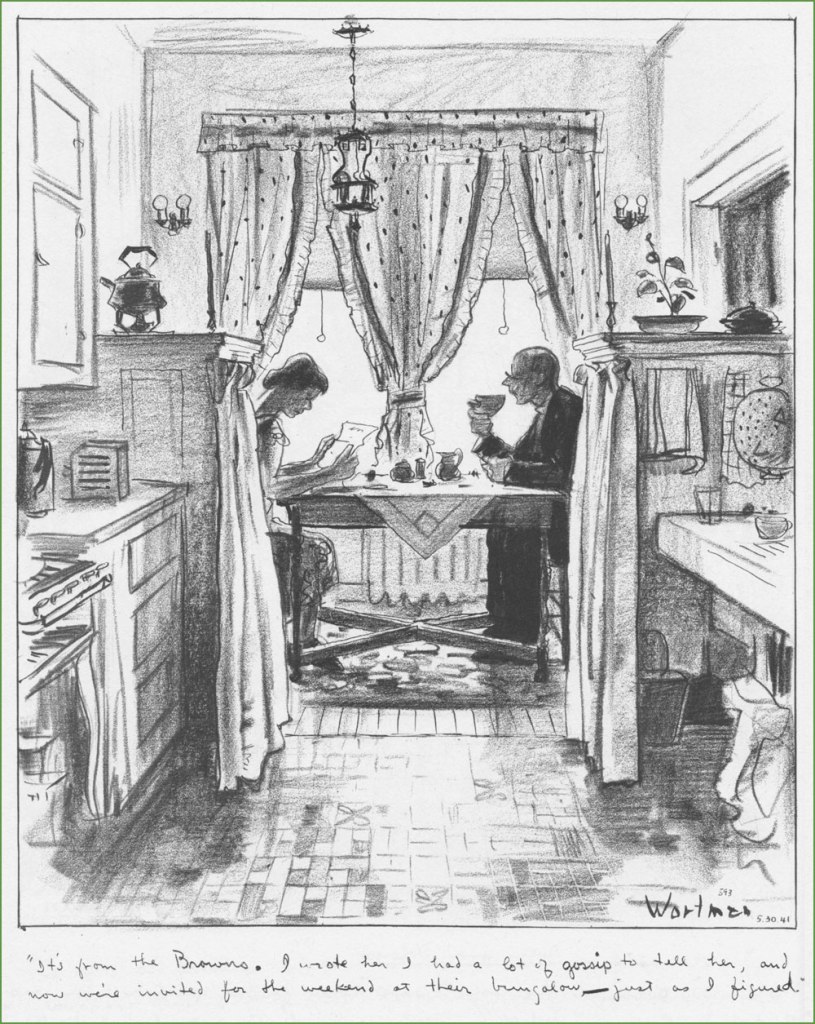
It must be mentioned that these drawings have been rescued from the mists of forgetful time by WOT favourite James Sturm (see Free Inside Package: James Sturm’s The Cereal Killings (1992-95)), who hunted down Wortman’s son and his astonishingly large, apparently languishing archive of his dad’s illustrations.

I’ll end this with a great quote from the foreword to Denys Wortman’s New York, written by Robert W. Snyder

« You can still see traces of Wortman’s New York in crowded Manhattan side streets, spirited New Deal Murals, and soaring skyscrapers**. Harder to find are the feelings and lived memories of this place. The sailors and their sweethearts who strolled the boardwalks of Coney Island are now, in their eighties, a fading presence. To understand them, and how they lived in a city that inspired hope and fear, idealism and wisecracks, solidarity and individuality, there is no better place to look than a Denys Wortman cartoon. »

~ ds

* I tend to not like what D&Q publishes, but this is another pleasant exception to the rule (here’s the original exception).

** This immediately comes to mind.

Adopting the Gauld Standard

« Quake in the presence of the stack of bedside books as it grows taller! Gnash your teeth at the ever-moving deadline that the writer never meets! Quail before the critic’s incisive dissection of the manuscript! And most important, seethe with envy at the paragon of creative productivity! »

I hesitated a bit about writing this post, as it seems to me that everybody already knows (and likes) Scottish cartoonist Tom Gauld and therefore it’s a bit like launching into a review of a Beatles album (vaguely embarrassing, and completely unnecessary). I have also previously talked about him in Tentacle Tuesday Masters: Tom Gauld (and you can head over that way, if you want some biographical details of his life). That being said, his art is not nearly as ubiquitous as it deserves to be.

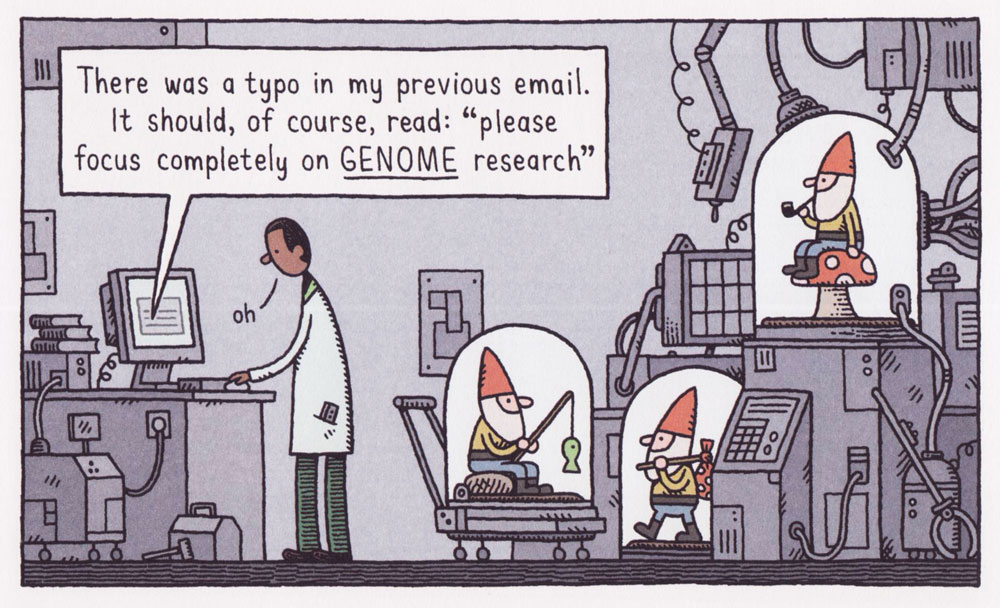
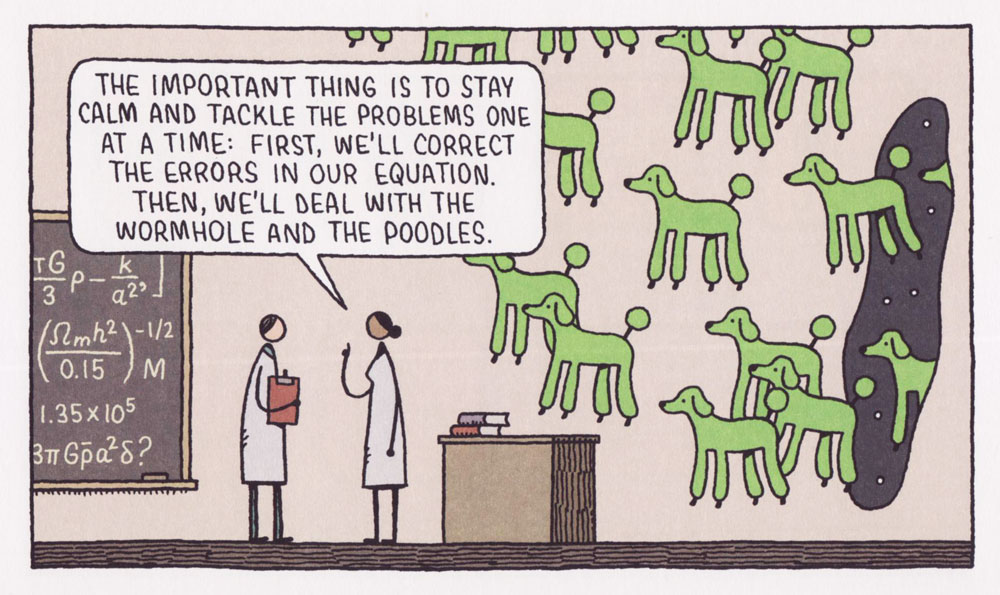
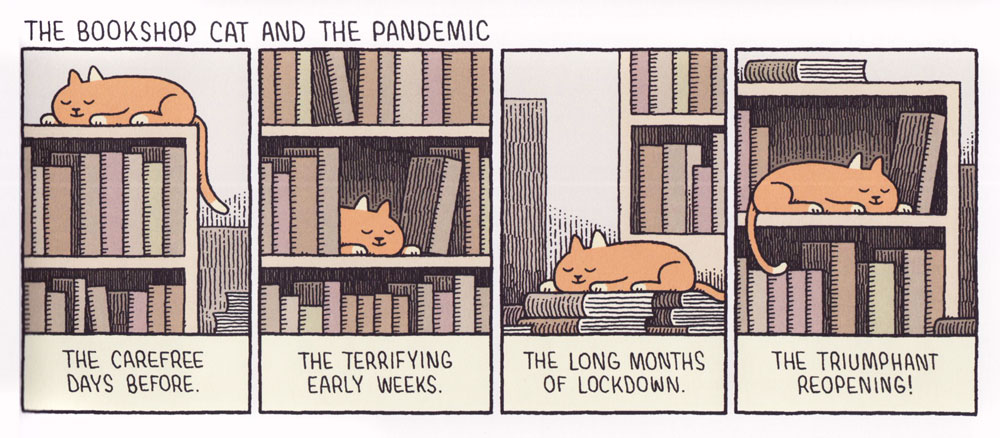
I happily received his latest book, Revenge of the Librarians* (2022, Drawn & Quarterly**), as a Christmas present, and I remain impressed by the scope of Gauld’s wit and his instantly recognisable style. He also has an impeccable sense of composition; each drawing is perfectly framed, often sneakily implying something happening almost out of sight, hinted at by a chunk of wall just at the edge of the panel, a partially seen open door, an alluring bit of tentacle. He’s funny but poignant. I can only imagine how many of his cartoons are pasted over the doors of professors in all fields and walks of research (it’s something people still do, right?) I can consume Gauld’s perfect little microcosms like semechki, but try to read only a few every day to prolong the enjoyment.

It was really difficult narrowing down today’s selection to ‘just’ 12 strips (I didn’t want to annoy my master-scanner co-admin RG too much). The following have been scanned from the aforementioned Revenge of the Librarians, as well as You’re All Just Jealous of My Jetpack (2013) and Department of Mind-Blowing Theories  (2020). Enjoy this sampling, whether you are already a Gauld convert or have never heard of him!

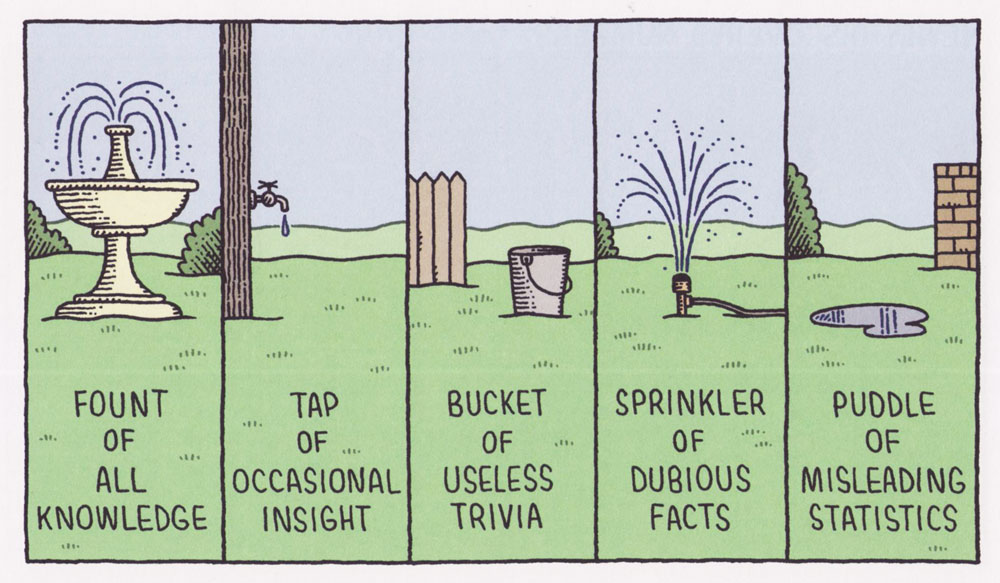
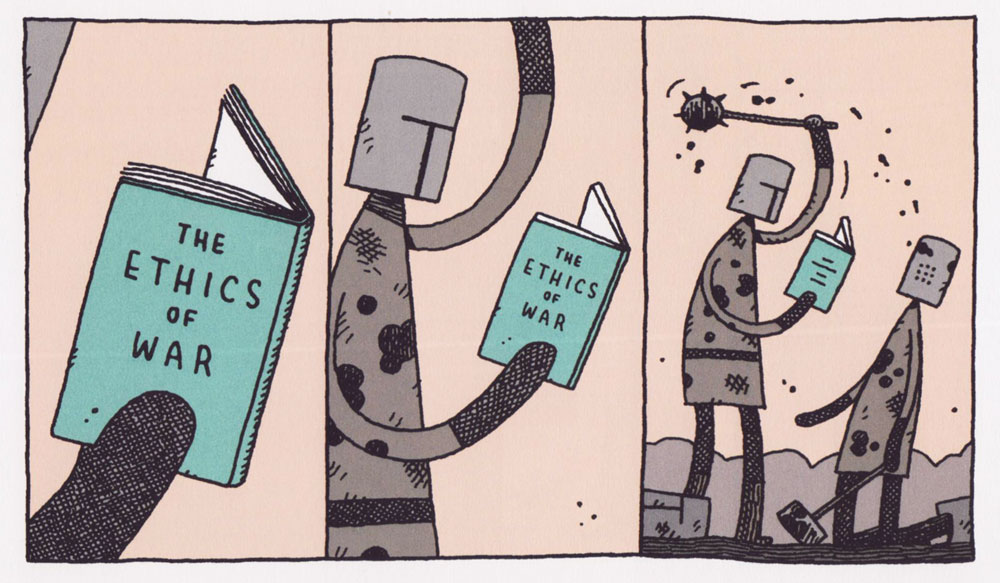
Po-tay, po-tah-toh…
One of my very favourite Gauld strips, though I couldn’t explain why.
A very typical Gauld strip, complete with many options of something that starts out grounded in real life and shoots off into funny social commentary.
There was no way I could skip over this one, given my mushroom leanings… Have I mentioned Gauld’s expert use of colour to highlight important details in an otherwise subdued palette?
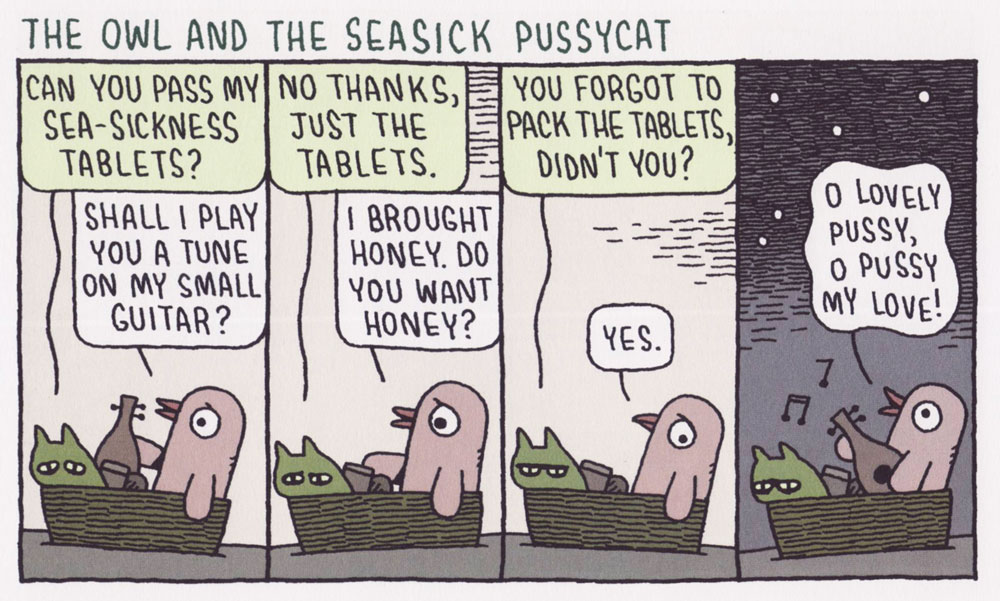
In case someone is unfamiliar with The Owl and the Pussy-Cat.
The first Gauld strip I became consciously aware of, after somebody shared it on Facebook.
Given the war in Ukraine, this one hits especially hard…

Want more? Head over to The Guardian.

~ ds

* French edition La revanche des bibliothécaires (from Editions Alto and Editions 2024) has been chosen for the 2023 Selection officielle of the Angoulême comics festival.

** That makes it two worthwhile things that Drawn & Quarterly has published… or is the process of publishing, the other being Tove Jansson’s Moomin stories.

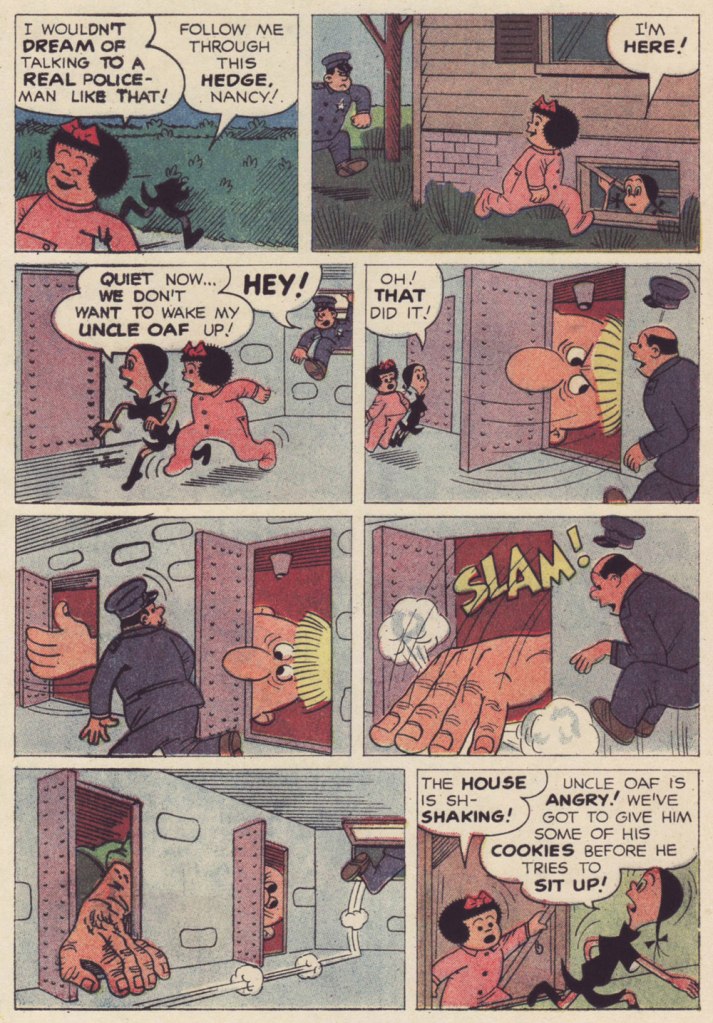
Hallowe’en Countdown V, Day 30

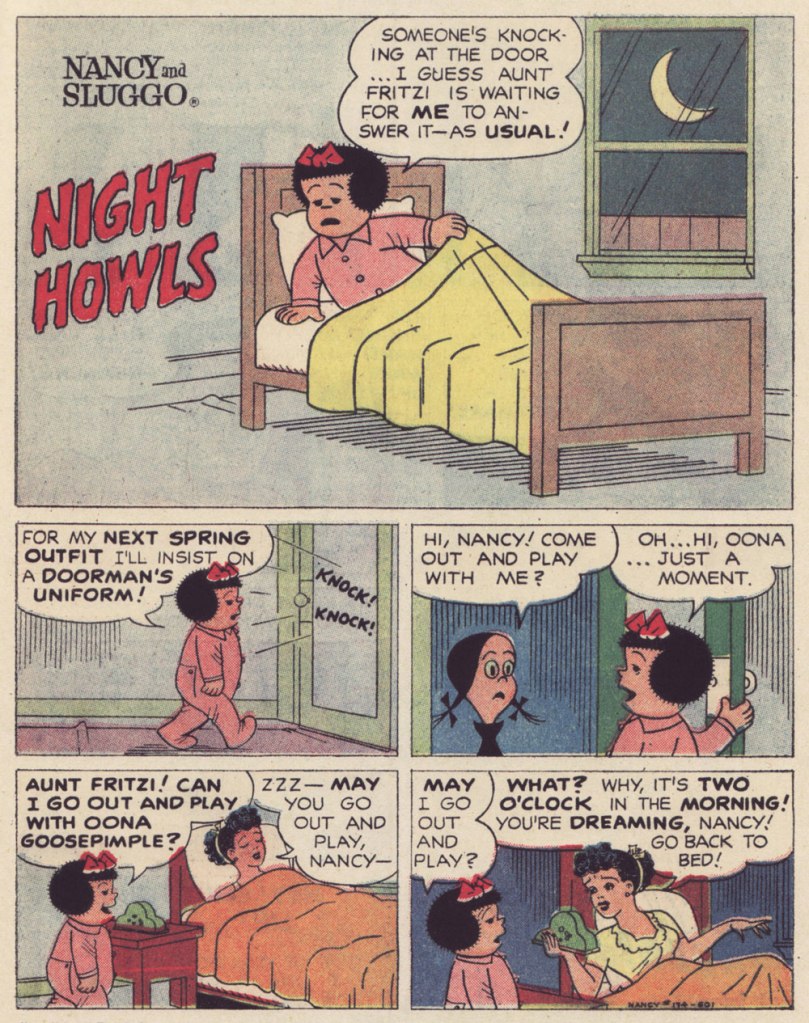
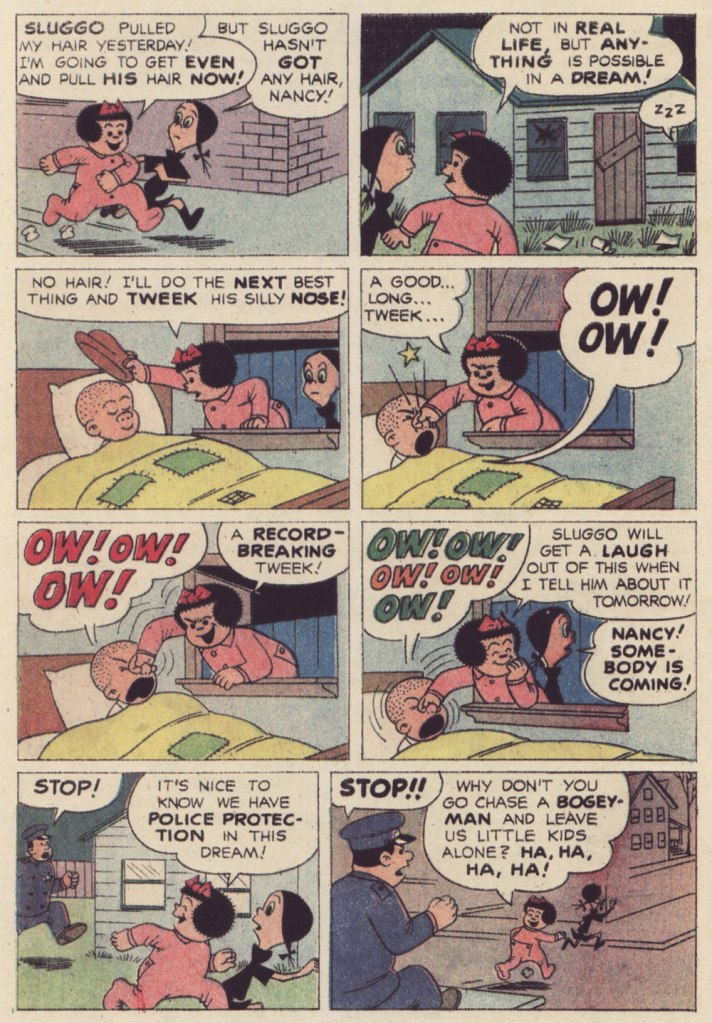
« Every time I go to Oona Goosepimple’s spooky old house something SCARY happens to me! » — Nancy

Back in the blog’s early days, my partner ds, wrapping up her tribute to John Stanley, stated:

« And I haven’t even mentioned Stanley’s Nancy, nor her friend (and my favourite character) Oona Goosepimple. Next time… »

Well, that time has come. Despite my deep and enduring love of John Stanley, I never could warm up to what’s generally considered the cornerstone of his œuvre, Little Lulu. It’s hardly Stanley’s fault: I just happen to dislike Lulu creator Marjorie ‘Marge’ Henderson Buell‘s visual conception of her characters.

On the other hand, I’ve always been in thrall to Ernie Bushmiller‘s world. Purists will, and surely have, objected to the bold liberties that John Stanley took with Nancy and Sluggo, but I don’t care a whit. This collision between the singular visions of a pair of cartooning geniuses is every bit as delightful as I might have hoped.

Night Howls first appeared in Nancy and Sluggo no. 174 (Jan.-Feb. 1960, Dell). It was reprinted in Nancy, Volume 4: The John Stanley Library (2013, Drawn & Quarterly). Script and layout by John Stanley, finished art by Dan Gormley.

One more short one?

The Ghost Story first appeared in Four Color no. 1034 – Nancy and Sluggo Summer Camp (Sept.-Nov. 1959, Dell). It was reprinted in Nancy, Volume 2: The John Stanley Library (2009, Drawn & Quarterly). Script and layout by John Stanley, finished art by Dan Gormley.
Fancy, uh? This is Nancy, Volume 2: The John Stanley Library (2009, Drawn & Quarterly); meticulous series design (and covers) by Gregory ‘Seth’ Gallant. Now if only D&Q would finish building the library, or at the very least give us Kookie and Dunc & Loo!
In 1975, when fandom movers and shakers Robert Overstreet and Donald Phelps visited Stanley in his home, « … he dug into a closet, and said, ‘I have something that might interest you.‘ He pulled out the roughs for the first Oona Goosepimple story for Nancy. Stanley told Phelps he could keep it. (Actually, it was the script for an unpublished story). » [ from the late Bill Schelly‘s illuminating Stanley bio, Giving Life to Little Lulu (2017, Fantagraphics). ]

-RG