Tentacle Tuesday: Superheroes Redux

As I pointed out during my initial foray into the tangled relationship between superheroes and tentacled creatures (Superheroes in Octopus Land), even heroic stock characters with extraordinary powers get bested by the occasional octopus, be it of oceanic, mystical, or outright intergalactic origins. Some of these monsters are aliens from proverbial outer space, some swam out from the depths of the sea for reasons they alone comprehend; some are plants, some are mammals – animal, mineral, or vegetable in form and content.

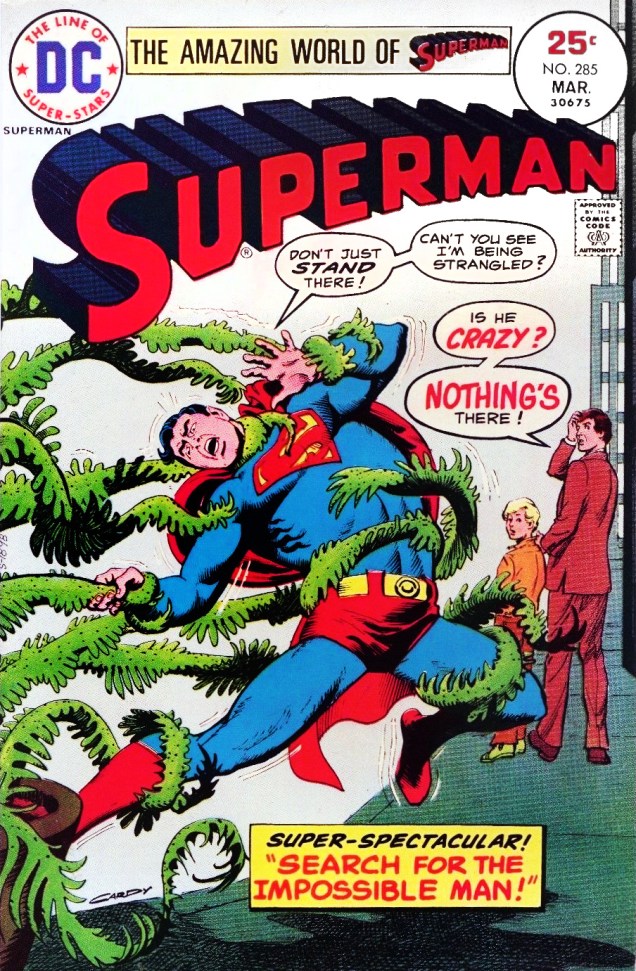
Our first entry is someone who’s faster than a speeding bullet… but requires a passerby’s help to get rid of some pesky plant tentacles. None too impressive for someone of his calibre, the first superhero that comes to mind for most.
Superman285
Superman no. 285 (March 1975). Cover by Nick Cardy.

That’s enough bumbling. I’ll move on to someone who can *really* handle tentacle problems!

TentacleTuesdayIcon

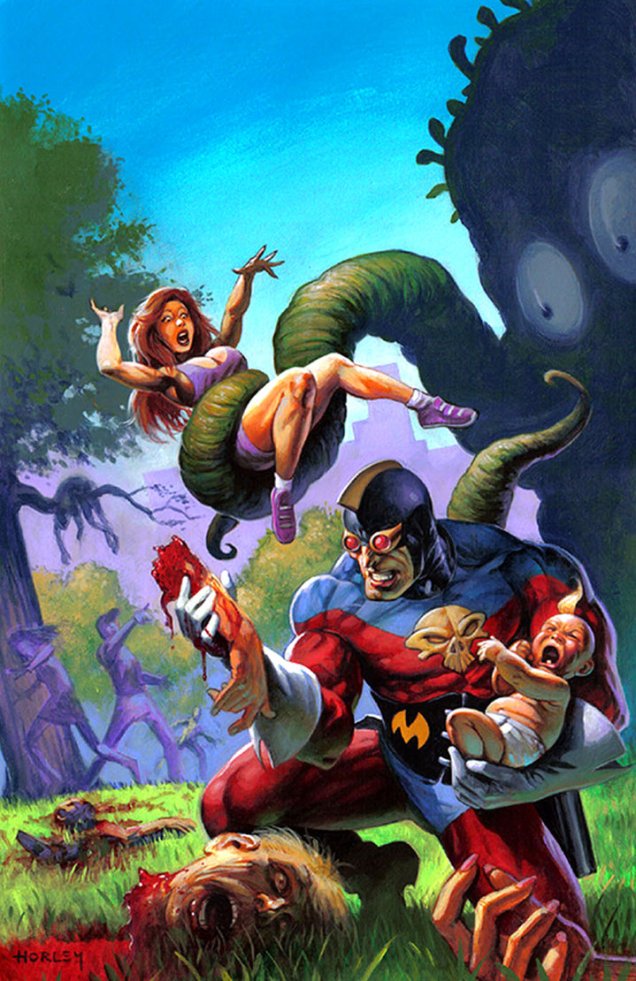
High atop Slaughter Mountain, where the rain never stops, stately Stearn Mansion stands silhouetted against the blood-red moon. This is the home of Dr. Strongfort Stearn, known throughout the world as … Mr. Monster!! From this lofty perch, Doc Stearn peers unflinchingly into the black abyss below. For it is Mr. Monster’s mission to search out evil — and destroy it!” Today Mr. Monster is fighting a cute octopus with googly eyes. Sometimes monsters look most innocuous, you know.
AlexHorley-Mr.Monster
Original art for Mr. Monster: Who Watches the Garbagemen? (2005). Cover by Alex Horley. As usual, the octopus has excellent taste in women.

And this is the way it was published:

Mr.Monster-WhoWatchestheGarbagemen
Mr. Monster: Who Watches the Garbagemen? (2005). Cover by Alex Horley.

TentacleTuesdayIcon

« Since the first simple life-form crawled from the pounding turf, the sea has been laced with legend! From the daring men who faced the raging waves in primitive wooden craft to those who probe the hidden depths today in devices of plastic and steel, fables have been passed, secrets whispered from father to son… » And where there’s sea legends and fables of raging depths, there’s tentacles, you can be sure of that. Can the mysterious Phantom Stranger cope with them?

PhantomStranger18-NealAdams
The Phantom Stranger no. 18, March-April 1972, with art by Neal Adams.

TentacleTuesdayIcon

Maybe saying that starfish have tentacles is stretching it a bit, but just look at the way their arms bend at the ends! Besides, they can “walk” using their tubed appendages, which look like tentacles to all but the most pedantic.

JusticeLeageofAmerica190-BrianBolland
Justice League of America no. 190 (May, 1981); cover by Brian Bolland, with colours by Anthony Tollin. This may not be a fashion statement, but think of all the money people would save on makeup and surgery!

Starro, a.k.a. Starro the Conqueror, was created by Gardner Fox and Mike Sekowsky in 1960. He’s a mean, stubborn alien lifeform with an idée fixe to enslave mankind, which he repeatedly tries to do by scattering his starfishy spores (which grow into clones of himself) over large cities. And, yes, he has prehensile extremities; it’d be difficult to wreak as much havoc without them.

TentacleTuesdayIcon
Technically, Medusa’s got hair, not tentacles, but she expressed the wish to be part of our Tentacle Tuesday line-up… and I am not going to argue with a woman with hair that can knock out an army.

Medusa-FantasticFourAnnual5-Kirby-Giacoia
Created by Jack Kirby, Medusa first appeared In Fantastic Four #36 (1965). This is a pin-up from Fantastic Four Annual #5, November 1967; pencils by Kirby, inks by Frank Giacoia.

TentacleTuesdayIcon

Catwoman-Tentacles-BatmanIncorporated1
A panel from Batman, Inc. no. 1 (January 2011), pencils by Yanick Paquette and inks by Michel Lacombe.

Does anybody have an answer for catty Ms. Kyle? I’ll see you next Tentacle Tuesday – until then, keep away from hungry and horny octopuses.

~ ds

Let’s All Go Down to the Catfights!

Catfight (noun): A vicious fight between two women that features biting & scratching and often involves clothes being ripped off.

To which I’ll add that if you put two women with different hair colours in one room, it’s like there’s a chemical reaction that makes them instantly aggressive. In comics, at least – and we all know that comics reflect real life accurately, right? The resulting combativeness is especially obvious when the encounter is between a blonde and a brunette. The women involved must also be beauties – presumably, plainer girls resort to verbal assaults when provoked, eschewing physical violence, unlike their flashier counterparts.

Or it could have something to do with the mostly-male audience who actively likes watching belles brawl. (Perhaps “ogle” would be a better description.) Let’s move on to the ogling bit, then!

Undercovergirl-catfight
Err, agreed on the “talking too much” bit. Manhunt no. 9 (Magazine Enterprises, June 1948). That art’s by Ogden Whitney.

“Jeepers! Baldy’s been skewered through the ticker! He’s defunct!” This charming scene with boob grabbery and skirt rippery (I know, don’t I have a way with words?) is from “Off Stage Kill”, a Dan Turner Hollywood Detective story from Crime Smashers no. 7 (Trojan Magazines, 1951).

CrimeSmashers7-DanTurnerHollywoodDetective
Script by Robert Leslie Bellem, pencils and inks by Adolphe Barreaux (who was also the editor). Read the issue here. In case you were wondering, Fifi and Brenda are just acting out a fight scene for a movie, although they do get a little carried away (and accidentally skewer Baldy in the process). How many women have a knife tucked away in their garter belt?

Skipping ahead ten years or so…

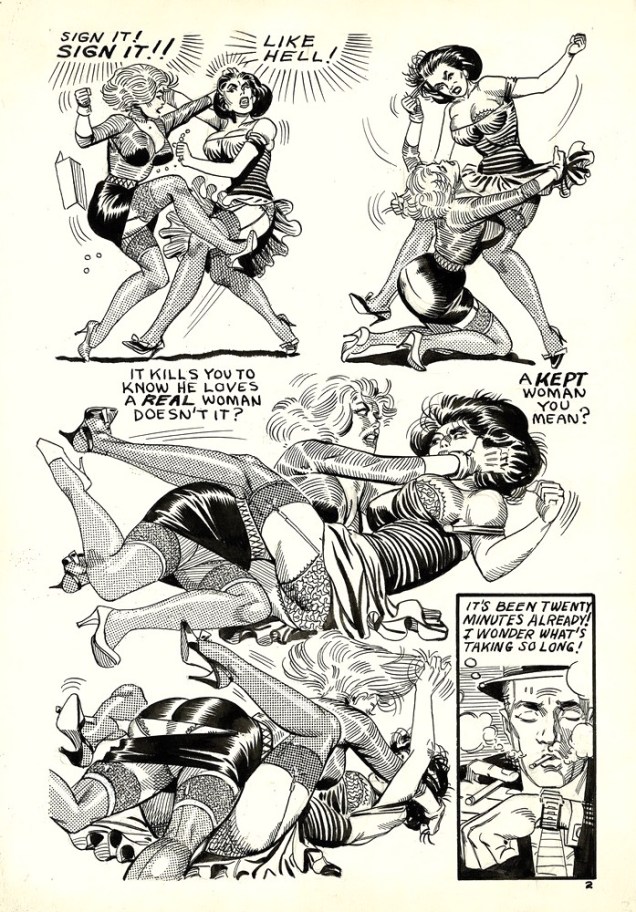
EricStanton-Steve Ditko-DivorceAgreement
Ditko shared a studio in NYC with artist Eric Stanton between 1958 and 1968, and they collaborated on some bondage comics (or at least it’s commonly assumed that they have – for more information on that, dive into a discussion on the Four Realities blog, or read this excerpt from Fantagraphics’ Dripping with Fear: the Steve Ditko Archives Vol. 5.) This page is from a story published in 1966 and entitled “Divorce Agreement”.

The clothes-shredding and breast-mauling (ouch) continues…

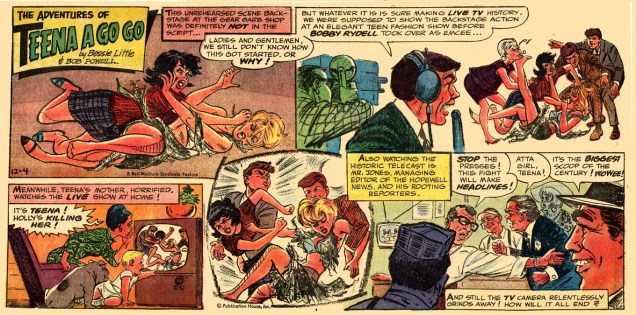
Teena-dailystrip-Dec4th-1966
Newspaper comics do it, too! This is Teena A Go Go from December 4th, 1966, written by Bessie Little and illustrated by Bob Powell.

Sometimes Betty and Veronica associations are hard to avoid. These girls also made sure to wear contrasting costumes while fighting, for maximum visual appeal, proving it’s possible to be fashion-conscious even in prehistoric times.

Anthro6A
Anthro (the happy teenager watching this scene, and normally a redhead) will marry the victorious maiden… but the fight is a draw, and so he has to marry both in this “The Marriage of Anthro” story. This is Anthro no. 6 (July-Aug. 1969). Pencils by Howard (Howie) Post (who created Anthro, the “first boy”, a Cro-Magnon born to Neanderthal parents) and inks by Wally Wood. Let it be mentioned that Anthro is an immensely fun series, and that I love Howie Post’s art with or without Wood’s beautifying influence.

Women of other cultures aren’t immune from this phenomenon, by the way. Witness Italian chicks fighting:

Maghella13-Averardo Ciriello.
Maghella no. 13 (Elvifrance, 1975), cover by Averardo Ciriello. ” The title is something like “a scalded pussy doesn’t fear cold water”, a play on “chat échaudé craint l’eau froide“, an idiom that means roughly “twice bitten, once shy” or “a burnt child dreads the fire” and translates literally to “a scalded cat fears cold water”.

Italian erotica can be so entertaining! Maghella means a “young witch” in Italian. “The girl is identified by two braids of black hair and giant breasts with unspecified powers“, reads Wikipedia… Odd, I would have thought that her breasts have very specified powers, indeed. 😉

Moving on to French damsels…

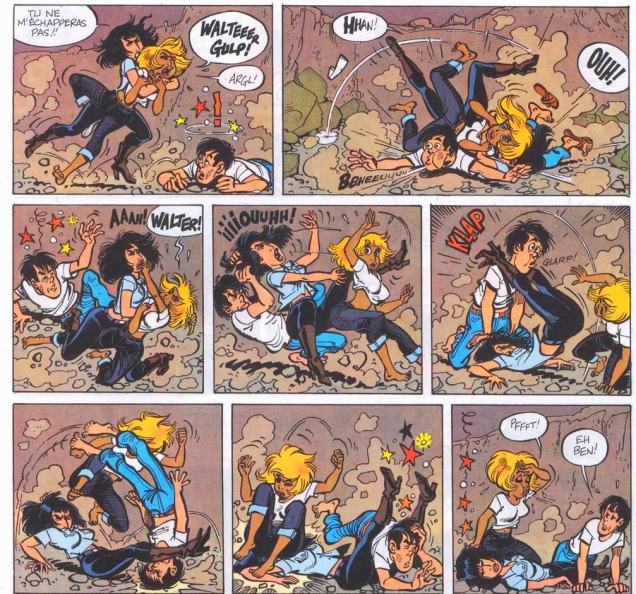
LeTreizièmeApôtre-NatachaHôtessedel_Air
Natacha (hôtesse de l’air) is a Franco-Belgian comics series, created by François Walthéry and Gos.  This page is from an adventure (one of the final stories scripted by the great Maurice Tillieux) called Le treizième apôtre (The Thirteenth Apostle), published in 1978. The blonde is Natacha, our heroïne.

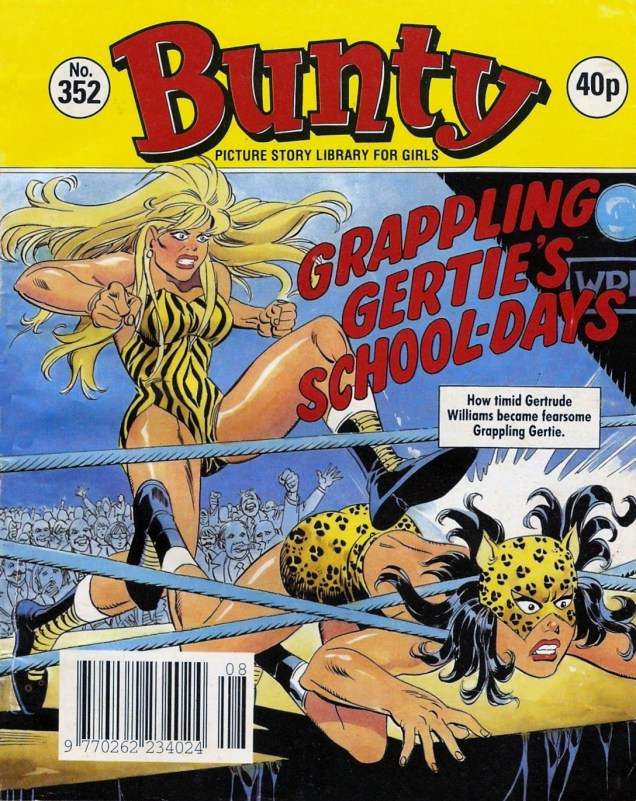
If you want to emphasize the catfight aspect, dress your girls in feline-motif outfits. Oh, I’m sorry – this is no quotidian quarrel, it’s professional wrestling!

Bunty352-WomenWrestlingComic
Bunty no. 352 (1992) – unfortunately, I don’t know who did the cover. British Picture Story Library was a 62 page a comic digest, published weekly. If you’d like to know how Leopard Lily overcame Tiger Tina, visit Assorted Thoughts from an Unsorted Mind.

I think we need one even more literal interpretation of “cat fight”:

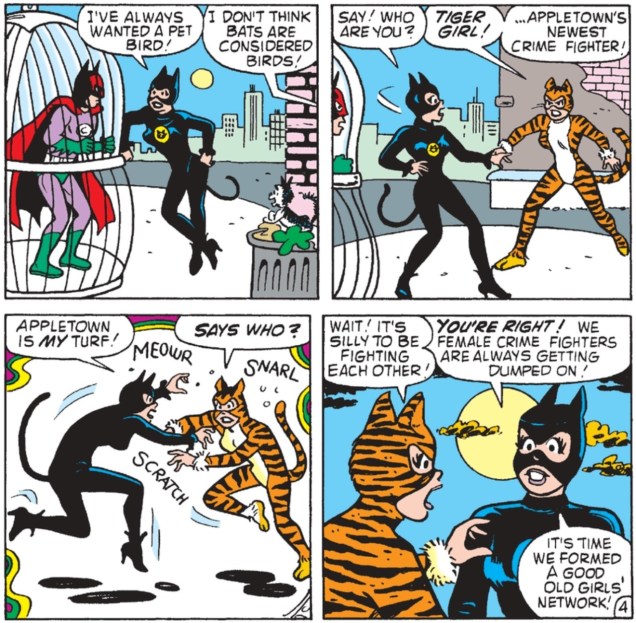
BettyandVeronica-TigerGirl-DandeCarlo
A snippet from “Meow Row”, published in Betty and Veronica no. 59 (January 1993). Script by George Gladir, pencils by Dan DeCarlo, inks by Alison Ford. Now guess who is who. (It’s obvious: Tiger Girl is Betty, and Veronica gets Meow Girl’s sexier costume.)

This is a fairly inexhaustible topic, but one must quit sometime. Cold shower, anyone?

~ ds

Update from January 2023 – now we also have Let’s All Go Down to the Catfights — Again!

Russ Heath and The War That Time Forgot

« Look! An undersea monster!
Spearing that torpedo like it
was a sardine! It’s a nightmare! »

Writer-editor Bob Kanigher, flanked by artists Ross Andru and Mike Esposito, drew first blood in « The War that Time Forgot », chronicled in DC’s Star Spangled War Stories beginning with issue 90 (May, 1960). The idea was scarily basic, but it was an irresistible premise, at least where young boys were concerned: let’s face it… soldiers vs dinosaurs. How might a T-Rex fare against a bazooka charge? Well…

The only time the series (what I’ve read of it… Andru and Esposito are no dream team of mine) did anything for me was a tale about two soldiers, one American and the other Japanese, stranded together on « Monster Island » and having to save each other’s sashimi. And this was before Lee and Toshirô got together on their own little slice of Hell in the Pacific, yet! I enjoyed the human interest aspect of the tale.

While I, like pretty much any other kid, was fascinated by dinosaurs early on, I quickly soured on inaccurate and fanciful depictions of the beasts. The War That Time Forgot is just one long, tedious dino-butchering exercise, be they harmless herbivores or kill-frenzied carnivores. Piss-poor palaeontology, that. Give me King Kirby‘s Devil Dinosaur any old time instead: that series runneth over with surreal, freewheeling fun, with nary a claim to accuracy in sight or in mind.

Ahem. The WTTF ran its course in SSWS until issue 137 (February-March, 1968), and was replaced by the far more nuanced Enemy Ace by Kanigher and Joe Kubert. Their all-time high, arguably in the case of Kubert, and without the faintest shadow of a doubt in Kanigher’s case.

So why am I writing about this series if I care so little about it? Well, when Andru (meh) or Kubert (great, true to form) weren’t handling cover duties, Russ Heath was. And while I’m fairly unmoved by Heath’s skill as a storyteller (too static, too measured), he was a first-rate cover artist, most strikingly for DC’s 1960s war books (and hey, Sea Devils) and Atlas’ 1950s westerns and horror titles.

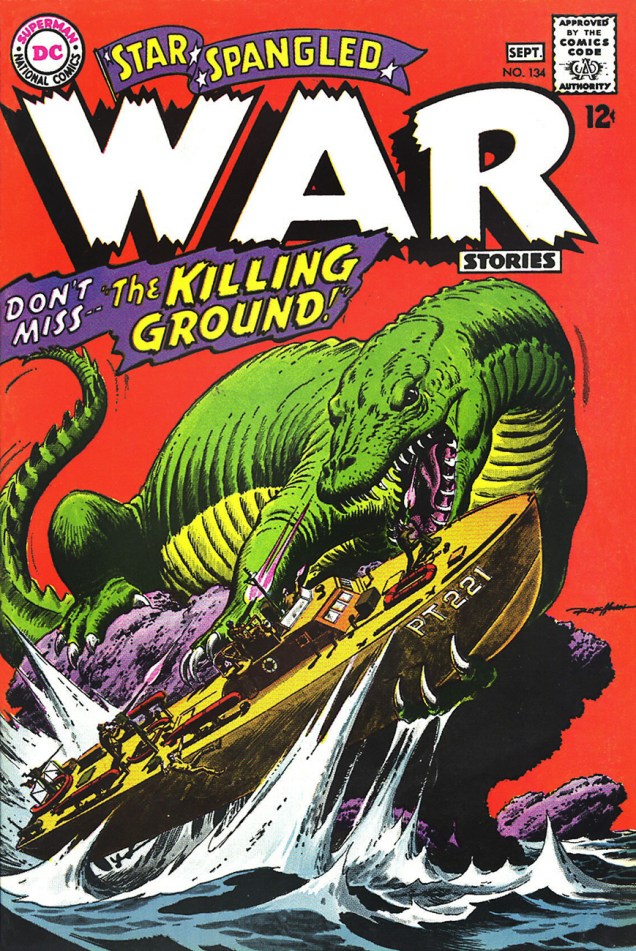
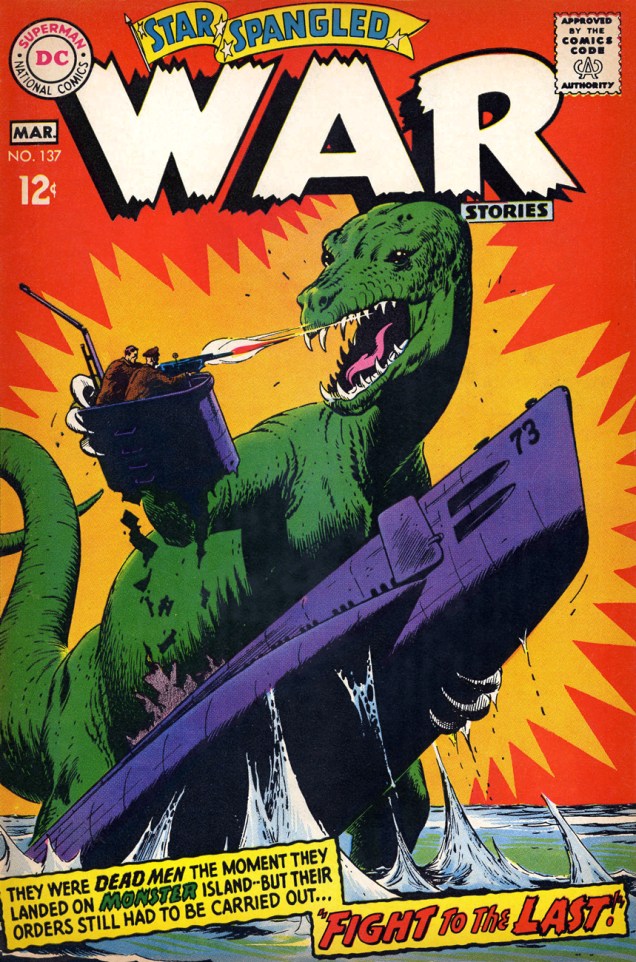
So, in fond remembrance of Mr. Heath, who left us last week at the age of ninety-one, here’s a gallery of his Star Spangled War Stories covers featuring The War That Time Forgot. Thank you, sir.

SSWS122A
Star Spangled War Stories no. 122 (Aug. – Sept. 1965). Grey toning and colour by Jack Adler.
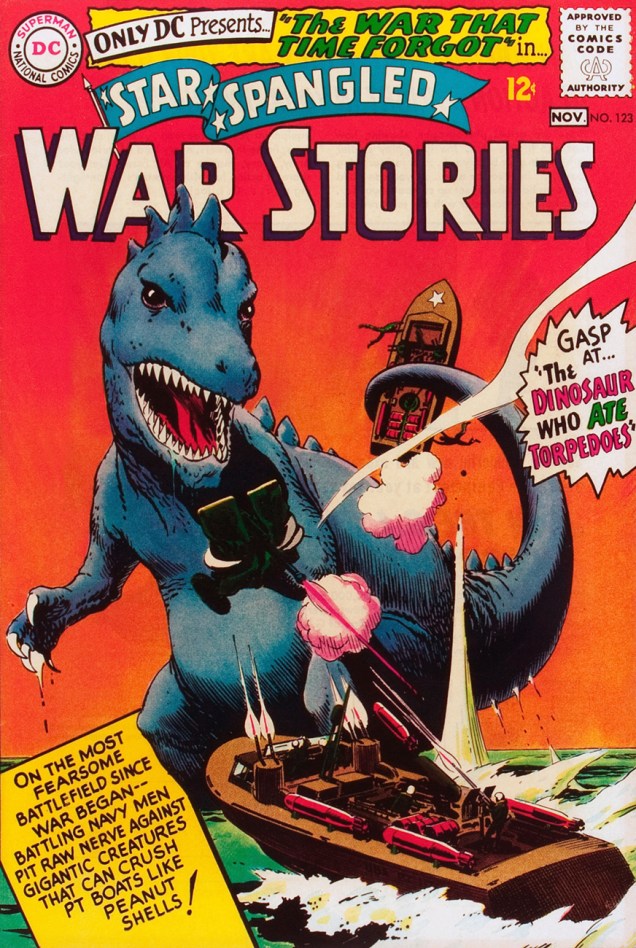
SSWS123A
Star Spangled War Stories no. 123 (Oct. – Nov. 1965). Dinosaurs love those orange skies, which set off their scales to fine advantage.
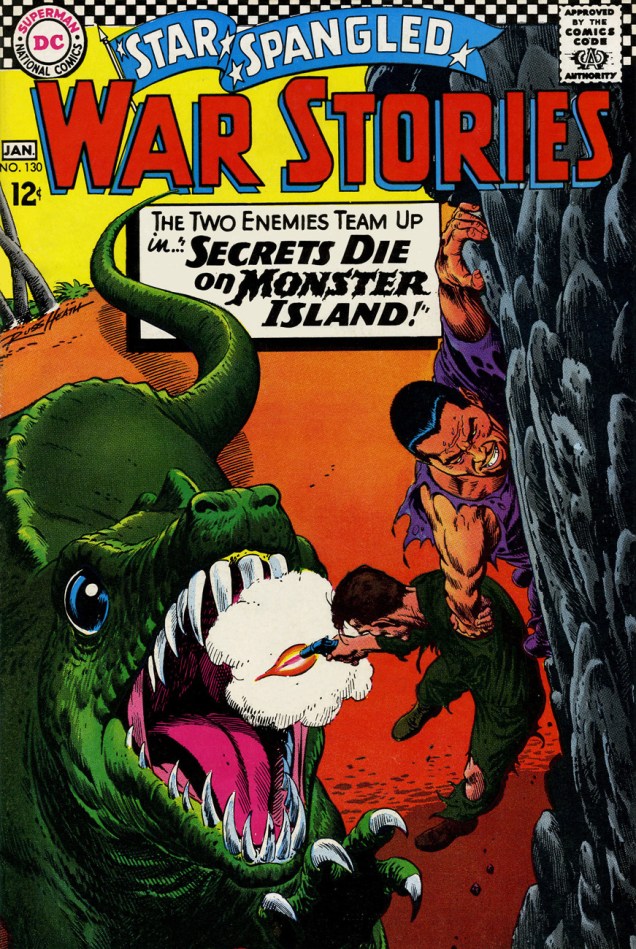
SSWS130A
Star Spangled War Stories no. 130 (Dec. 1966 – Jan. 1967). The first Japanese-American “Enemy Mine” team-up, but the Japanese guy gets no redemption before dying. Grey toning and colour by Jack Adler… probably my favourite cover of the lot.
SSWS131A
The Bird-Man provides a new wrinkle to bloodthirsty war criminal Curtis LeMay‘s « Bomb them back to the Stone Age » pronouncement. Star Spangled War Stories no. 131 (Feb. – Mar. 1967).
SSWS132A
Star Spangled War Stories no. 132 (Apr. -May 1967).
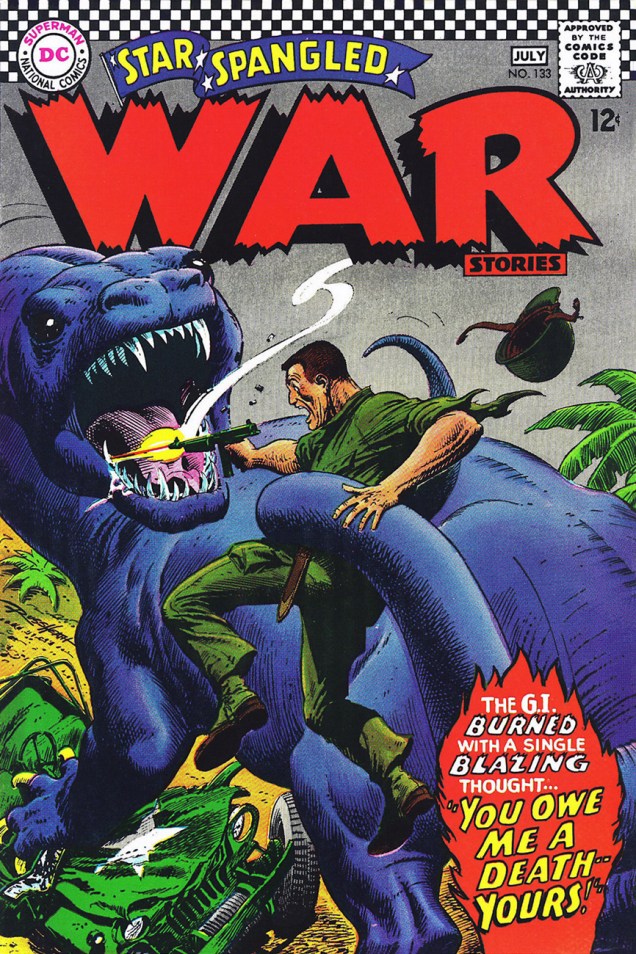
SSWS133A
Star Spangled War Stories no. 133 (June – July 1967).
SSWS134A
Star Spangled War Stories no. 134 (Aug. -Sept. 1967). Once more, grey toning and colour by the indispensable Mr. Adler.
SSWS135A
Star Spangled War Stories no. 135 (Oct. – Nov. 1967).
SSWS137A
Last call! Star Spangled War Stories no. 137 (Feb. -Mar. 1968).

Addendum to SSWS 131: apparently, « Bird-Man » started a trend, as everyone and his distant ancestor soon was riding a Pteranodon of his own. To wit: Tomahawk #109 (Mar. – Apr. 1967… just a month later).

Tomahawk109A
What do dinosaurs care about the American Revolutionary War? And yet the poor, noble Pteranodons all perish in the end… « for the cause » . Tomahawk no. 109 (March-April 1967), cover art by Bob Brown.

-RG

Tentacle Tuesday Masters: Joe Kubert

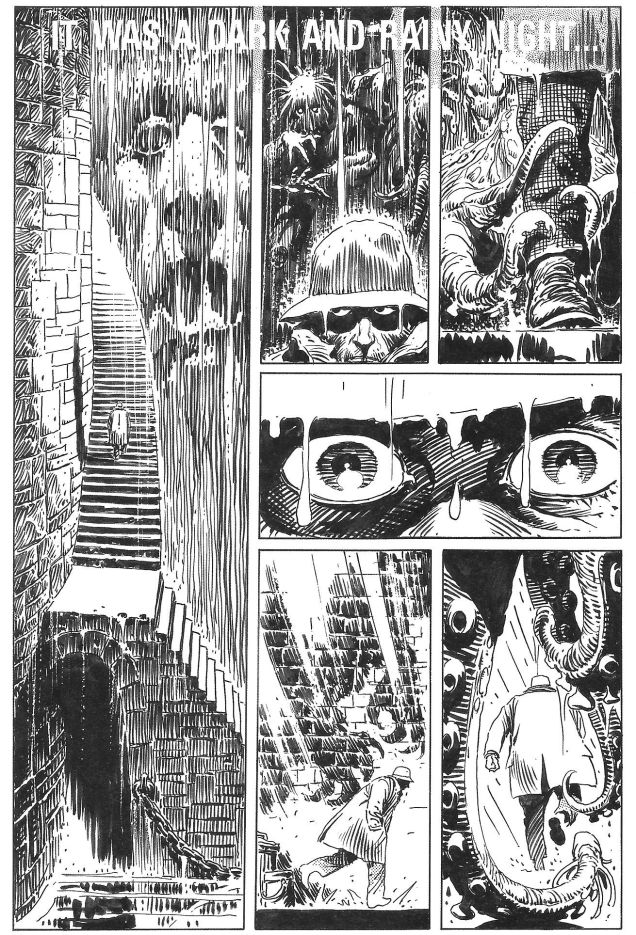
As Tentacle Tuesday lazily unfurls its slimy appendages yet again, we come face-to-face with one of the comic greats, Joe Kubert. And, as luck would have it, his ability to draw pretty much anything extends to depictions of cephalopods.

JoeKubert-HeavyMetalSpecialEditionvol11n2-1997
Page from “It Was a Dark and Heavy Night…”, published in Heavy Metal Special Edition Vol. 11, no. 2 – 20 Years (January 1997).

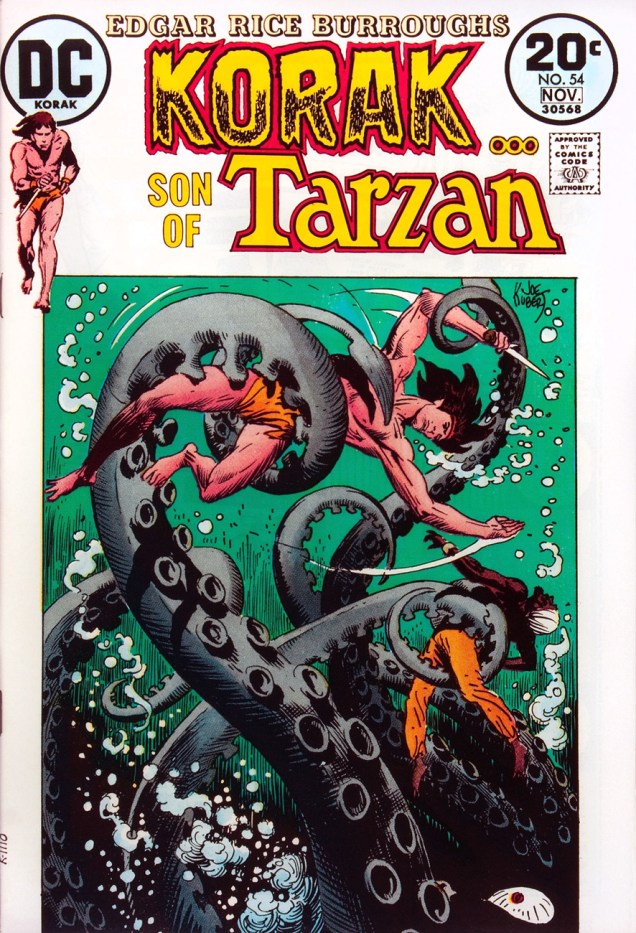
I’m less engrossed with Kubert’s work on prehistoric cavemen, archetypical feral youngsters or troglodyte adventurers (my interests lie more in the direction of Enemy Ace or Unknown Soldier, as well as Kubert’s solo projects like Abraham Stone). Nevertheless, Korak, his father Tarzan, and the unrelated Tor have all encountered tentacles in their eventful careers of dinosaur skirmishes and vine-swinging. (I also have to admit that if anybody could make me inquisitive about this sort of thing, it would be Kubert. I may yet reconsider, especially in the case of Tor, a comic Kubert both drew and plotted.)

JoeKubert-Tor3-1954
Page from Tor no. 3 (May 1954). Read the whole issue here. The adorable monkey Tor is talking to is Chee Chee, his pet gibbon.
JoeKubert-Korak54
See Korak wrestle tentacles on this aquatic Joe Kubert cover! Korak (the ape name for “Killer”) was created by Edgar Rice Burroughs for his Tarzan novels. (Korak was the hero of The Son of Tarzan from 1915; in other novels he was but a young boy, incidental to the plot). This is Korak, Son of Tarzan no. 54 (October-November 1973). This issue has Robert Kanigher and Murphy Anderson on the main story.

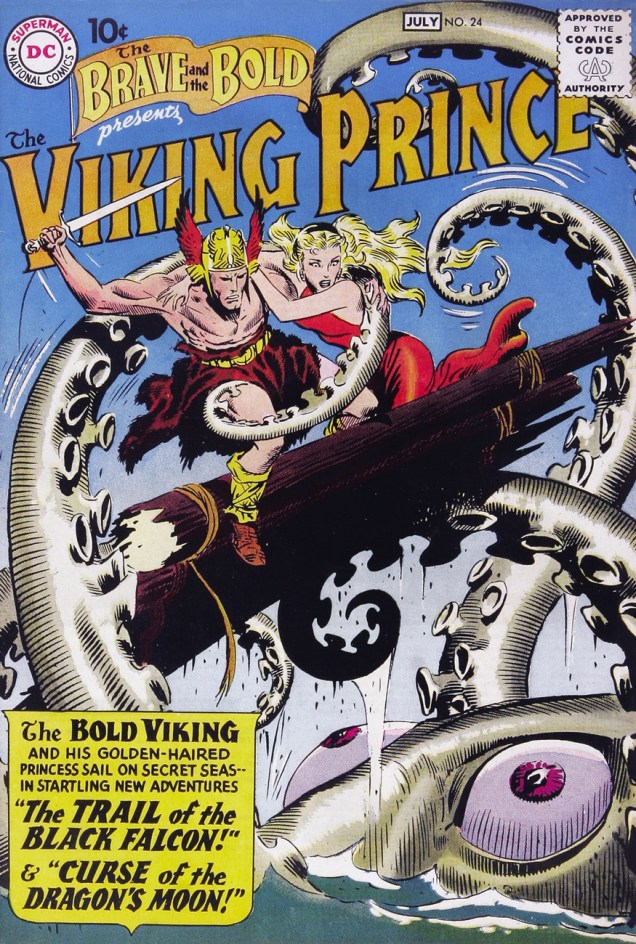
It’s not only prehistoric men who have to put up with tentacles – Scandinavian royalty has to deal with them, too.

JoeKubert-BraveandBold24
The Brave and the Bold no. 24 (June-July 1959). The main two stories, “The Trail of the Black Falcon” and “Curse of the Dragon’s Moon”, both scripted by Bob Haney and drawn by Kubert, are frankly silly.

Moving into a slightly different direction….

JoeKubert-MysteryinSpace115
Mystery in Space no. 115 (January 1981). In a Kubert illustration, even monsters have soulful, anguished eyes.
JoeKubert-WeirdWarTales77
Weird War Tales no. 77 (1979). Do all three dooms involve tentacles, by any chance?
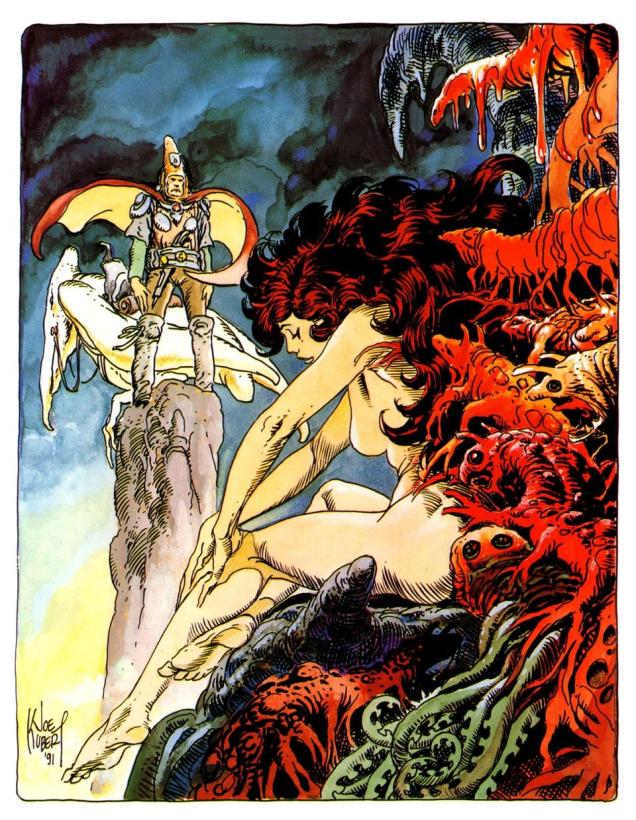
JoeKubert-Arzach-1991
Kubert’s tribute to Arzach, a comic series by Mœbius. Interesting to see Kubert sort-of imitating someone else’s style – however, the feet, hands and tentacles are obviously his.

~ ds
Treasured Stories: “Foo Goo” (1987)

« But observers say it is unlikely to slow down the consumption of fugu* »

DC’s Wasteland** (1987-89) was, to my mind, the publisher’s finest-ever horror anthology… for a handful of issues. While the experiment lasted but a couple of years, and it was mercifully, if a little late, put out to pasture.

To compensate for the usually uneven, often random nature of anthologies, the book was to be scripted by just two writers (John Ostrander and the fascinating Del Close) and illustrated by a carefully-picked skeleton crew of artists, namely George Freeman, David Lloyd, William Messner-Loebs and Don Simpson. Perhaps the vetting process wasn’t sufficiently thorough, though, because Freeman dropped out after a mere seven issues and one more cover, and Lloyd followed suit before the year was through. With proper bullpen substitutions, things might have run smoothly, but of all the ringers brought in, only Ty Templeton rose to the challenge, his sneakily clean-cut style providing ideal contrast and tension to issue 11’s nasty tale of Dissecting Mister Fleming, sadly the series’ final flash of brilliance… with seven dead horse issues left to flog.

But those early issues were, for the most part, quite glorious. Simpson and Lloyd landed the lion’s share of the very best tales, Simpson because he was most versatile, and Lloyd since he excelled at instilling the bleakest, most unsettling ambiances.

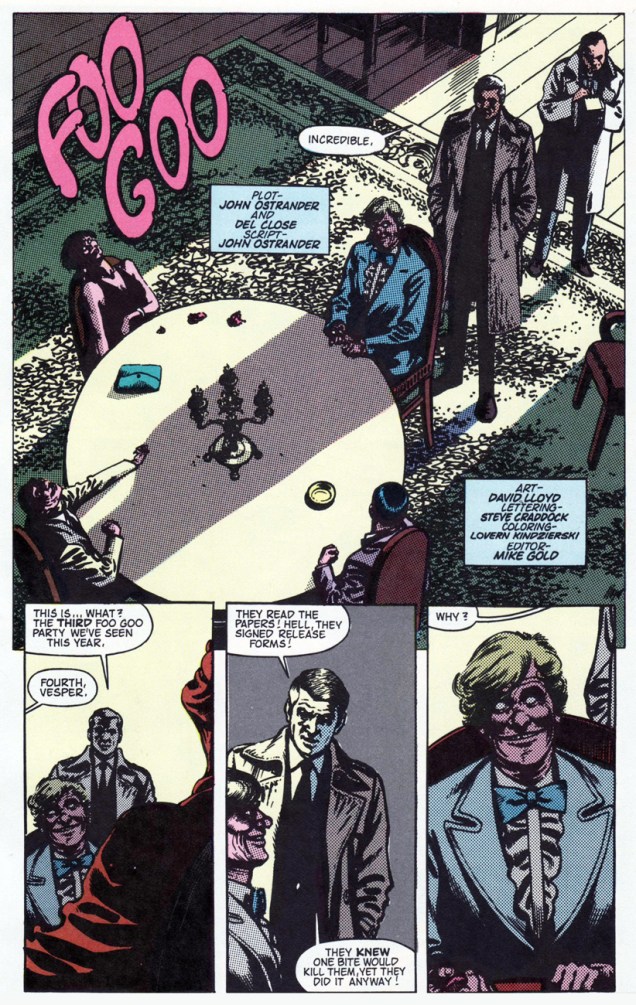
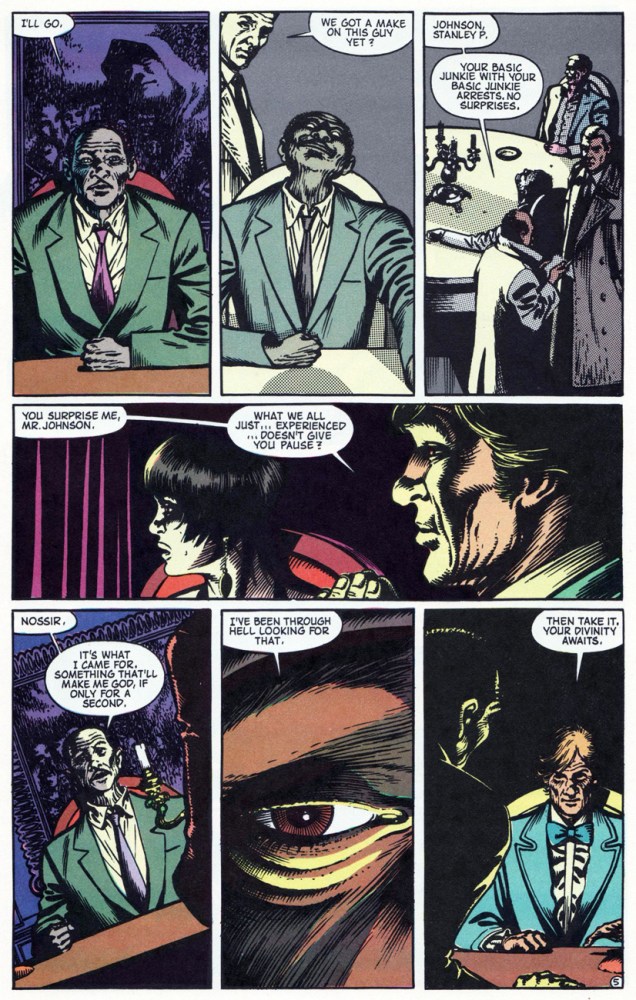
Today, we present Wasteland’s opening salvo, Foo Goo (Wasteland no.1, Dec. 1987, DC), by Ostrander, Close and Lloyd. Bon appétit!

FooGoo01AFooGoo02AFooGoo03AFooGoo04AFooGoo05AFooGoo06AFooGoo07AFooGoo08AFooGoo09A

The title, despite denoting a fictive species of fungus, is clearly a reference to the virulently-toxic liver of the globefish, pufferfish, or fugu… which is also, of course, a costly delicacy. It merely needs to be expertly prepared.

I first came upon this intriguing factoid in 1975, when a famous Kabuki performer, Bandō Mitsugorō VIII, presumed he could beat the odds. « In January 1975, Bandō visited a Kyoto restaurant with friends and ordered four portions of fugu kimo, the liver of the fugu fish, a dish whose sale was prohibited by local ordinances at the time. Claiming that he could survive the fish’s poison, he ate the livers and died after returning to his hotel room, after seven hours of paralysis and convulsions. »

-RG

*”Japanese Actor Poisoned“, The Leader-Post (Regina, SK), Jan. 20, 1975
**Not to be confused with the national capital of the United States of America

Happy birthday to Mr. Murphy Anderson

There’s an impressive parade of artists born in July. Of present concern is the birthday of one Murphy Anderson, who came into this world on July 9th, 1926 (and ceased to exist in 2015, at 89, no doubt moving into some parallel dimension).

His work on the Atomic Knights or Hawkman is fondly remembered…  but I’ll concentrate on some covers dear to my heart from DC’s science-fiction titles because sci-fi + great art = squeals of enjoyment. Anderson had no trouble portraying any number of far-fetched monsters or depicting incredible situations in his crisp, clean style that made his audience willingly suspend disbelief. Ah, okay, I called it “science-fiction”, but it often crosses the line into fantasy, or horror, with occasional detours into superhero, or just plain quirkiness. To follow the loopy logic of the stories contained in the pages of the following publications, one has to abandon the notion that A leads to B, and prepare oneself for a wild romp through the whole alphabet. Great art certainly facilitates this – the story may leave me scratching my head, but Murphy Anderson’s illustrating chops provide a firm ground to anchor to.

Without further ado, the great Murphy Anderson and some of his artwork!

For instance, take a look at some of the creatures featured in DC’s Strange Adventures through the decades. Anderson’s gallery of characters includes, but is not limited to, startled fishermen, anthropomorphized atomic clouds, and Middle-Age barbarians from another planet, all impeccably drawn.

StrangeAdventures21-MurphyAnderson
“But I tell you I actually hooked one on my line… THIS BIG!” It’s only fair. I guess you don’t even need to use bait for this type of fishing. Strange Adventures no. 21 (June 1952). Cover by Murphy Anderson.
StrangeAdventures143-MurphyAnderson
There’s no head-breaking over what title to give these stories… “The Face in the Atom Bomb Cloud” it is! Pencils and inks by Murphy Anderson, grey tones and colours by Jack Adler, lettering by Ira Schnapp. This is Strange Adventures no. 143 (August, 1962). Edited by Julius Schwartz.
StrangeAdventures160-MurphyAnderson
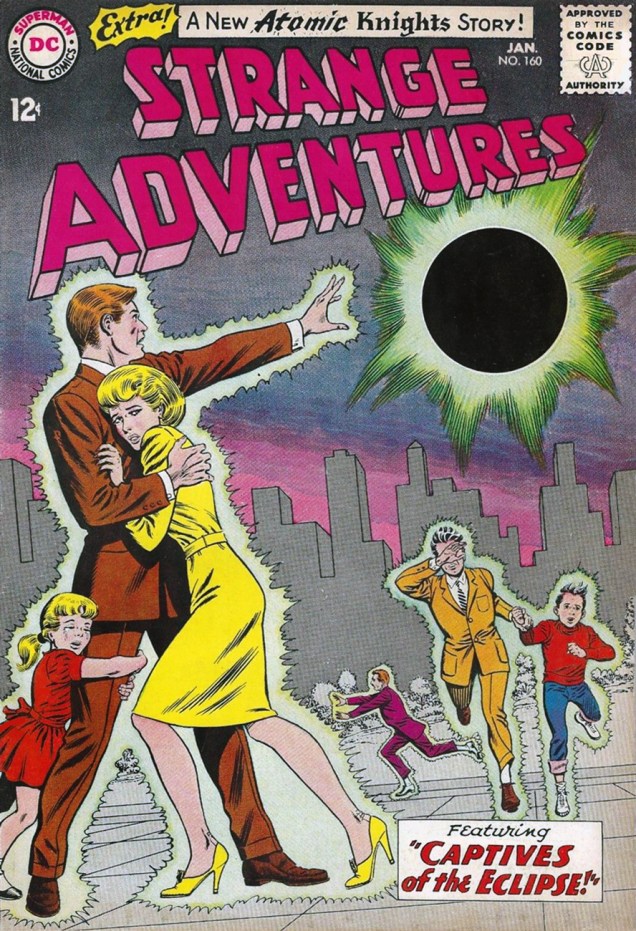
Strange Adventures no. 160 (January 1964), cover by Murphy Anderson. This issue is a treat, featuring two parts of an Atomic Knights story (“Here come the Wild Ones!”, written by John Broome and illustrated by Anderson).
StrangeAdventures222-MurphyAnderson
I promised barbarians, didn’t I? Strange Adventures no. 222 (Jan-Feb 1970), art by Murphy Anderson. I have a love/hate relationship with Adam Strange, often loving the art and hating the stories. It’s been a while – I have to re-read this stuff and see if I still find it indigestible.

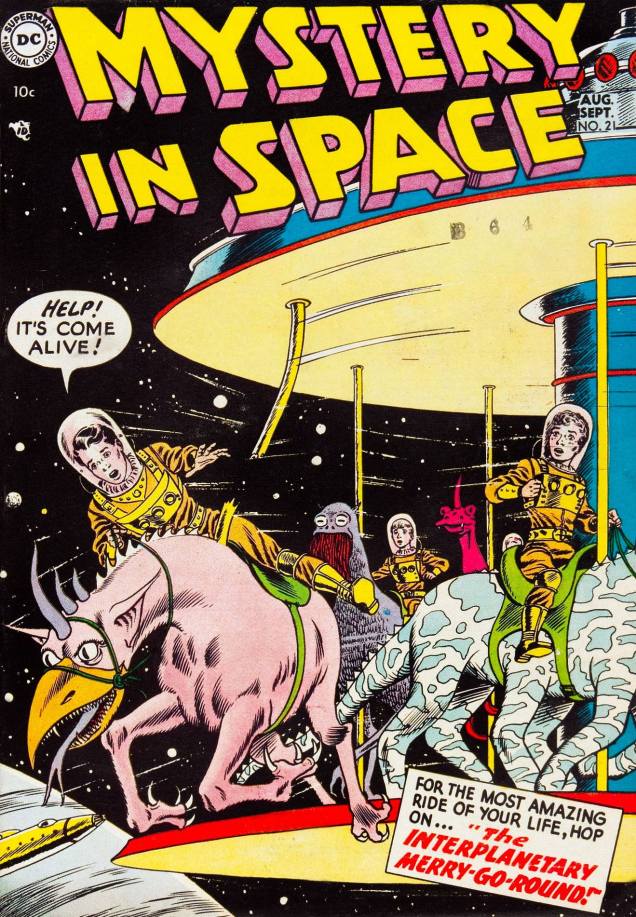
Another favourite series for its oft-striking covers is Mystery in Space. I love it when Anderson invents “space” animals composed of body parts from several Earth species. It’s indubitably fun, and children often have a great time inventing new creatures, but it takes chops to draw the result and make it work, anatomically and aesthetically.

MysteryinSpace21-MurphyAnderson
Damn, the safety regulations for those carousel things are really lax these (future) days.  It might not be science-fiction per se, but it sure is fun! Mystery in Space no. 21 (August-September 1954), with a cover by Mr. Anderson.

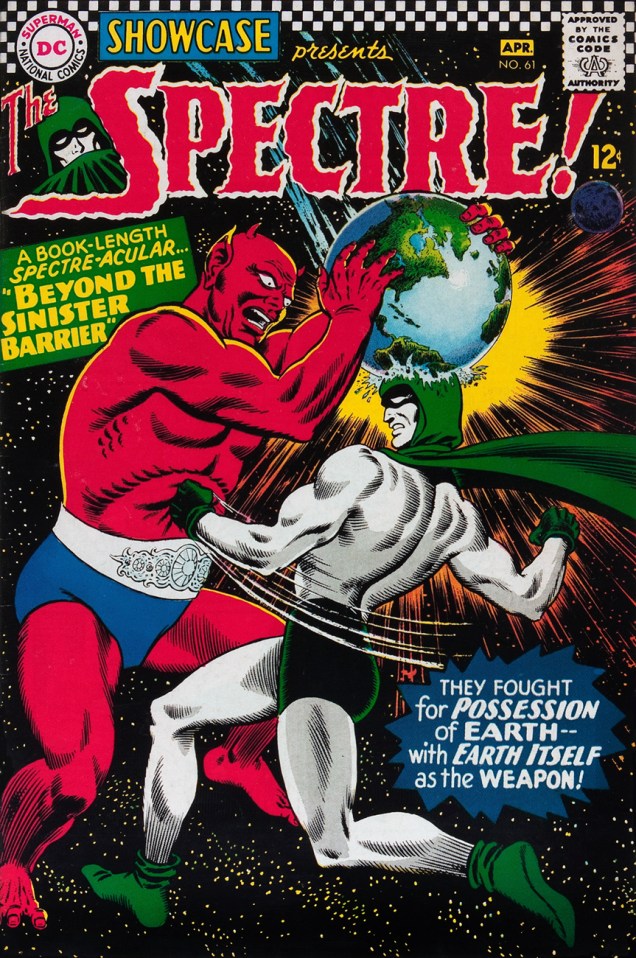
Despite my general resistance to superhero stuff, here’s a cover featuring the Spectre, whose classy costume is easy on the eyes.

Showcase61-MurphyAnderson
When you have to boink your arch-enemy on the head with a whole planet to knock him out and it still doesn’t work, you know you’re dealing with a pro. Showcase no. 61 (March-April 1966), cover by Murphy Anderson.

And one for the road…

TalesoftheUnexpected94-MurphyAnderson
Goofiness or social commentary? Frankly, the green “president” looks a lot friendlier than most current politicians. Tales of the Unexpected no. 94 (April-May, 1966). Cover by Murphy Anderson.

~ ds

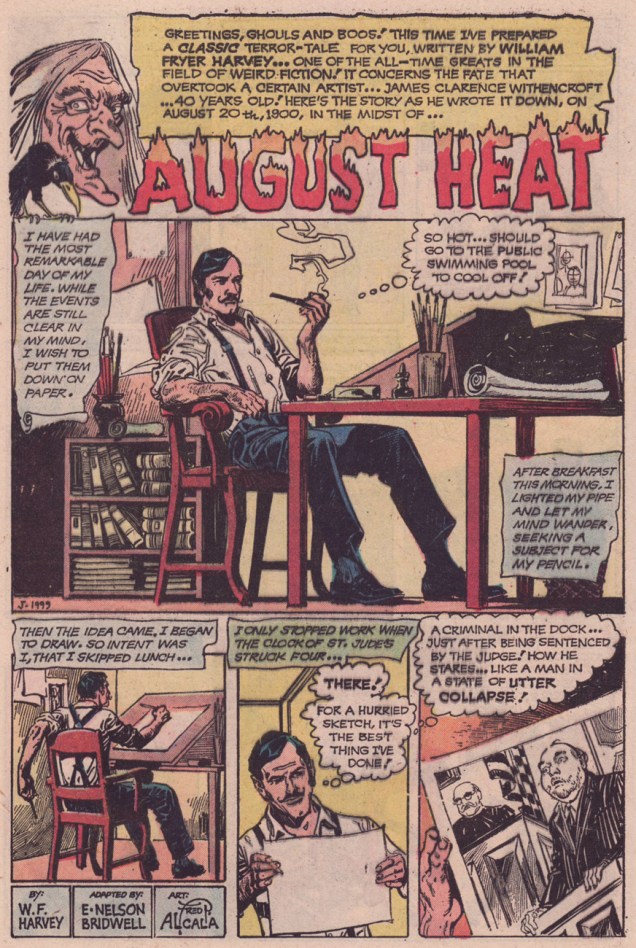
Treasured Stories: “August Heat” (1973)

« Neither of us had seen a ghost, but I knew what he meant. »

I had planned to feature quite another tale this week, but seeing as we are in the torrid grip of quite the heat wave, I opted in the end for something more topical I’d been saving on the back burner.

Edward Nelson Bridwell (1931–1987) is one of those scarcely noticed but greatly accomplished figures of American comics. At DC from the mid-1960s to the end of his life, he edited, wrote, packaged and compiled his heart out. Most impressive, in my view, were his erudition and discerning eye for a fine short story.

There’s always a blessed but mostly-powerless minority of comics creators that endeavours to improve the unwashed readership’s minds… nearly never at Marvel, most often at DC. In the mid-1970s, while working as Joe Orlando‘s editorial assistant, Bridwell adapted three excellent, but highly unconventional vintage spooky tales, as far afield as imaginable from the usual EC-by-homeopathy fare his boss favoured. These were William Fryer Harvey‘s August Heat (Secrets of Sinister House no. 12, July 1973), Ambrose Bierce‘s The Man and the Snake (Secrets of Sinister House 14, October 1973) and John Russell’s The Price of the Head (Weird Mystery Tales no. 14, Oct.-Nov. 1974); all three were splendidly brought to visual glory by WOT favourite Alfredo Alcala (1925-2000). All three are moody slow burners, with much introspection and little action.

On this scorching day (currently a sticky 35°C /95°F in Montréal, Canada) you’ll forgive me for not waiting until August to share this dark beauty with you.

AlcalaAugustHeat01AAlcalaAugustHeat02AAlcalaAugustHeat03AAlcalaAugustHeat04AAlcalaAugustHeat05AAlcalaAugustHeat06A

DominguezSOSH12A
August Heat was the issue’s cover feature. Illustration by Luis Domínguez.

As evidence of Mr. Bridwell’s skill as an adapter, feel free to read the full (yet quite brief) text of August Heat. Or listen to one its several fine radio adaptations, the choice is yours:

The 1945 version on Suspense, starring Ronald Colman (presented by the Roma Wine Company of Fresno, California). Suspense’s 1948 remake or the 1956 Sleep No More adaptation, recited by Nelson Olmsted.

Oh, and in case you’re curious, here’s a peek at the picturesque English resort of Clacton-on-Sea:

Clacton-on-Sea

– RG

Tentacle Tuesday: Plants Sometimes Have Tentacles, Too

The topic of today’s Tentacle Tuesday is based on a plant-based mishap. I was walking along an alley, minding my own business, when some sort of climbing plant with especially long and vicious tentacle-vines, swinging from from a nearby fence,  grabbed my arm. The result were scratches that felt like burns.*

So today’s gruesome offerings are mostly cousins of the Venus Flytrap, if the latter had tentacles to assist its quest for prey. (Let’s breathe a sigh of relief that it doesn’t.)

MidnightTales6-HowardWayne
Midnight Tales no. 6 (November 1973), cover by Wayne Howard. I am a big fan of Midnight Tales and its blend of humour and adventure. Note the “created by Wayne Howard” announcement on the cover, which wasn’t exactly typical for its time – comic book companies didn’t use to acknowledge the creators of their “content” so openly and insistently.

Midnight Tales often offer moments of “wait, how did that get through the Comics Code?” Arachne (Professor Coffin’s undeniably attractive niece) is frequently more sexually provocative than one would expect from a kid-appropriate comic, crimes committed are nastier than surmised, and the plots go from morbid to surreal… with some comedy thrown in. Oh, sure, there’s some terrible clunkers, as every issue has three or four stories linked by a common theme and illustrated by different artists, but overall the quality remains high throughout its 18-issue run.

I’ve seen people online saying that Howard shamelessly plagiarized Wally Wood’s style – perhaps people more erudite than I see that, but I don’t. “Influenced” is one thing – but one can build on those beginnings to create a recognizable style of one’s own, right? Those who like Wayne Howard frequently classify him as a “guilty pleasure”, and proceed to insult his art while they’re explaining why they like it. To quote, for instance, from Atomic Avenue, who follow the unspoken rule – just mentioning Charlton Comics warrants a condescending tone, and any acknowledgement of their quality has to be tempered by mockery. 

Creator Wayne Howard blatantly imitated the style of comic art great Wally Wood right down to his gothic signature, but at least he aimed high in his plagiarism. Consequently, Midnight Tales had the look of a seedy, off-register knock-off of an EC horror comic—putting it at the top of Charlton’s quality spectrum.

Another opinion from Cap’n’s Comics:

In my world of geek’n out over all this great art, Wayne Howard is one of my biggest guilty pleasures. He loves to draw like Wally Wood, but he’s no Wally Wood. His females usually look like Wally’s women after a really bad day, and his males are just plain fugly. His Wood machinery is close to the background machinery behind the awesome machinery, and everything shouts fan art VS pro art, but… Luvittopieces

Ah, well. I won’t be apologetic about liking Howard’s art, and Midnight Tales will be proudly presented as a favourite series on a need-to-know basis. Fortunately, there’s some nice articles about him, too – a sort of obituary for a great African-American artist who died at only 58.

TentacleTuesdayIcon

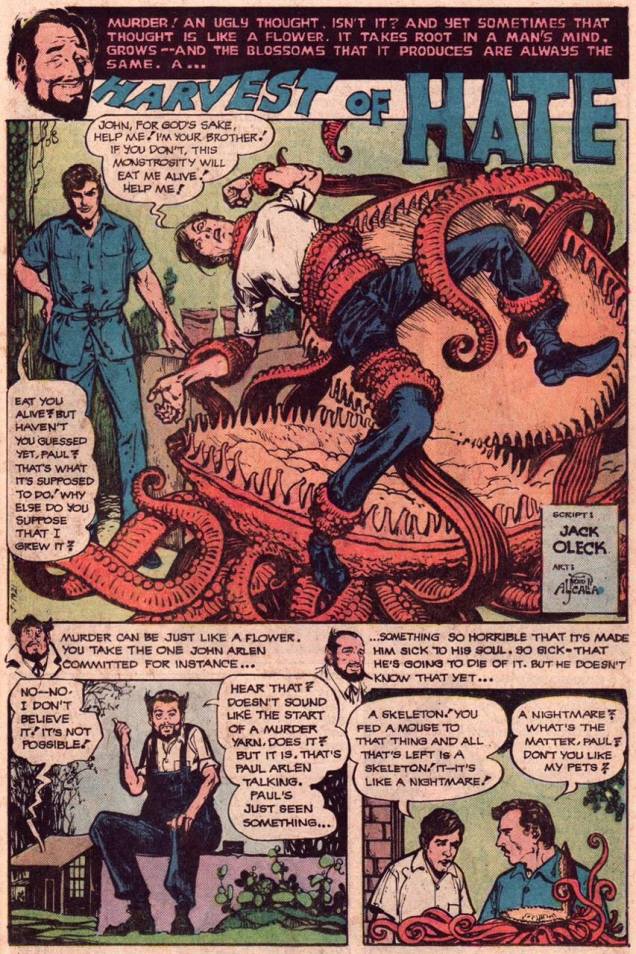
Another Flytrap for your enjoyment, in this tale of brotherly rivalry:

HouseofMystery251-HarvestofHate1
“Harvest of Hate” was scripted by Jack Oleck and drawn by Alfredo Alcala (speaking of whom, I still can’t get over how beautiful his signature is.) Page scanned from House of Mystery no. 251 (March-April 1977).
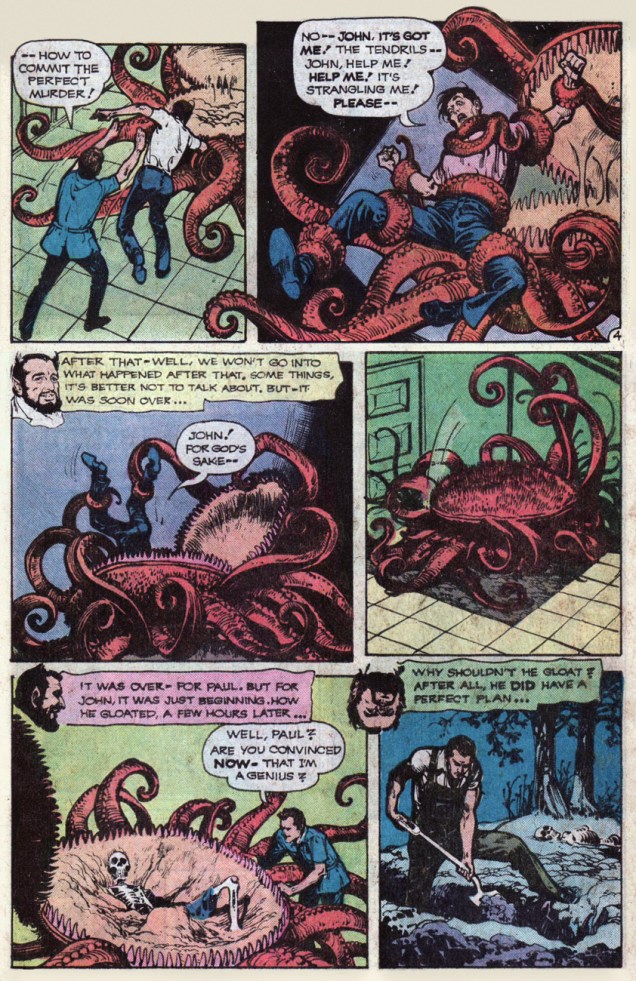
HouseofMystery251-HarvestofHate2
Don’t worry, the “gardener” who fed his brother to this man-devouring monstrosity gets his comeuppance, all right.

The cover of this issue of House of Mystery is also a good exhibit of plant tentacles, even if the children are a superfluous addition:

HouseofMystery251-NealAdams
House of Mystery no. 251 (March-April 1977), cover by Neal Adams.

TentacleTuesdayIcon

Here’s something more recent – published on some almost-thirty years ago, instead of forty – the tentacular adventures of Doctor Gorpon! I hope these guys count as plants (even if they’re slightly more mobile) – they’re the right shade of green!

DoctorGorpon#2-MarcHansen
Doctor Gorpon no. 2 (July 1991) by Marc Hansen. The little guy in the right bottom corner is extra-cute – if only all children looked at their parents with the same sense of admiration and awe! It’s “Ooze Me, Baby!”

I only finished reading this three-issue series today, and I must say, it was an exciting ride. Highly recommended (if you can find it, that is).

DoctorGorpon3-MarcHansen-Splash
A panel from the aptly-titled “Big Eyeballs!”, published in Doctor Gorpon no. 3 (August 1991).
Gorpon2-MarcHansen-Doofus
A page from “Big Eyeballs!”, published in Doctor Gorpon no. 3 (August 1991).

~ ds
*
Plantburns

The Expanding Ego Theory: Neal Adams at 77

« Now at this age, I look back and oh, Adams is probably one of the worst things that happened to the medium, when I look at it historically. » – Darwyn Cooke (2004)

On his 77th birthday, the legendary Neal Adams must surely look back on his storied career and radiantly beam (‘gloating’ is for lesser beings). Still, with all he’s accomplished (and with such brio!) in the fields of graphic storytelling, advertising, physics, the theatre and geology, who could find it in his heart to blame him? With so much to celebrate, let’s just stick to the highlights, shall we?

HeartThrobs120A
Why is the nasty little dude threatening the giantess? Why, Neal, why? Well, I suppose that is some people’s idea of romance. This is Heart Throbs no. 120 (June-July, 1969), edited by Joe Orlando.
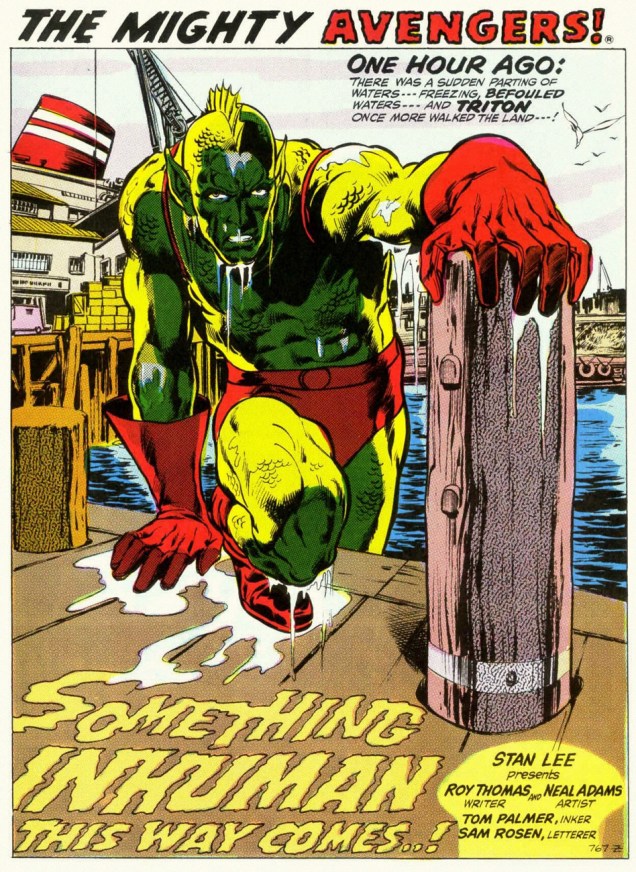
AdamsAvengers95SplashA
I don’t know if you’ve ever pulled yourself out of the water onto a dock, but that… is not the way to do it. One might argue that Triton is an Inhuman, and as such, gravity and anatomy are trifles unworthy of his kind. From Avengers no. 95 (Jan. 1972, Marvel), a chapter in the “Kree-Skrull War”, cobbled together by Roy Thomas from discarded Kirby plot effluvium and Jerome Bixby and Otto Klement’s Fantastic Voyage.
AdamsGL_Flash226A
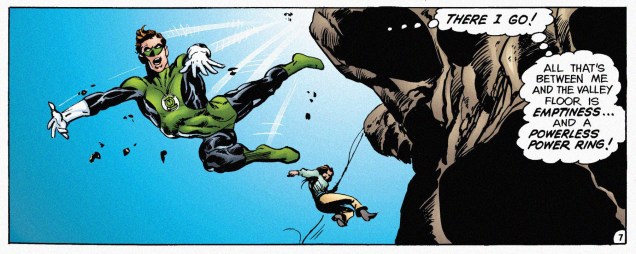
Ah, Neal Adams. He who brought naturalism and realism to comics. A panel from “The Powerless Power Ring!”, a Green Lantern backup strip from Flash no. 226 (March 1974, DC Comics.)
Jason-BrownA
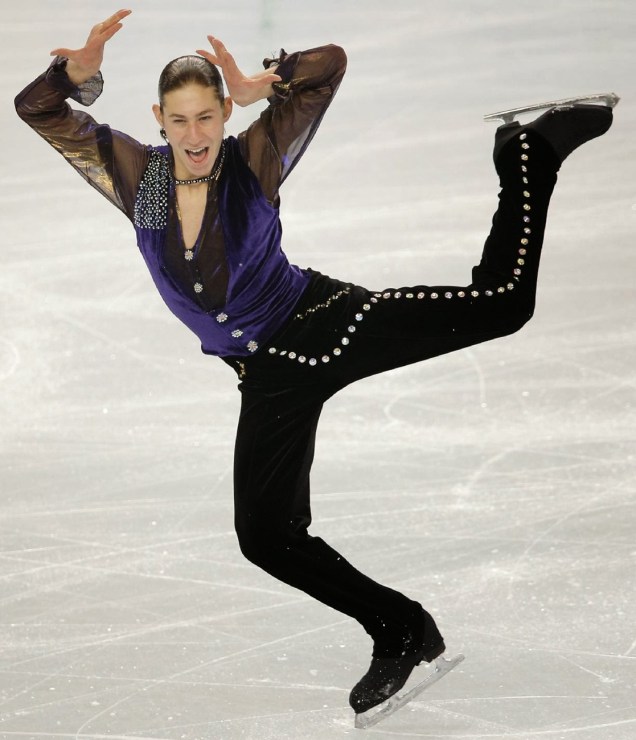
Neal’s influence can’t be overstated, and not only in the fields of comics and geology. Here’s US figure skater Jason Brown‘s poignant tribute to that very Green Lantern tale, presented to warm applause at the 2014 Winter Olympics in Sochi. As Neal is fond of saying to any cartoonist he encounters, « You are all my children! »*
AdamsGrandFunkA
A concert poster reproducing Our Neal’s gatefold art for Grand Funk‘s 1974 LP, All the Girls in the World Beware!!! (which incidentally features their finest original composition, imho, Bad Time) Despite the difficult assignment, Neal comes through with flailing biceps and chicken legs; thank goodness his caricature chops are equal to his grasp of earth sciences. Curiously, half the groupie throng seems to be cloned from a particularly manic Marsha Brady, and most of the rest from Carol Burnett.
Grand_Funk_Nude_1973
They’re an American Band. From left to right: Don Brewer (he of the competent drum work), Mark Farner (he of the wild, shirtless lyrics), keyboardist Craig Frost (Homer didn’t rate him), and of course Mel Schacher (he of the bong-rattling bass.) One may wonder just who those guys in the poster are supposed to be.
SuperHeroDigestA
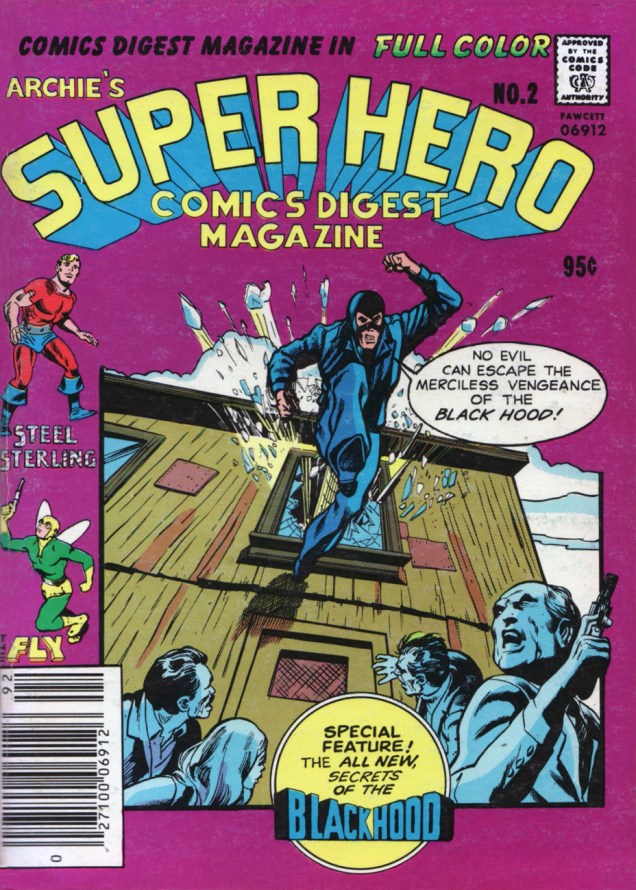
Faceplant time, or The perils of drawing comics whilst grabbing lunch, getting a massage on 52nd, or simply resting on your laurels. How does this cover make any sense? Just picture the scene from another angle, or if someone tried to build a model of it. Archie’s Super Hero Comics Digest Magazine no. 2 (1979 edition.)
Skateman1
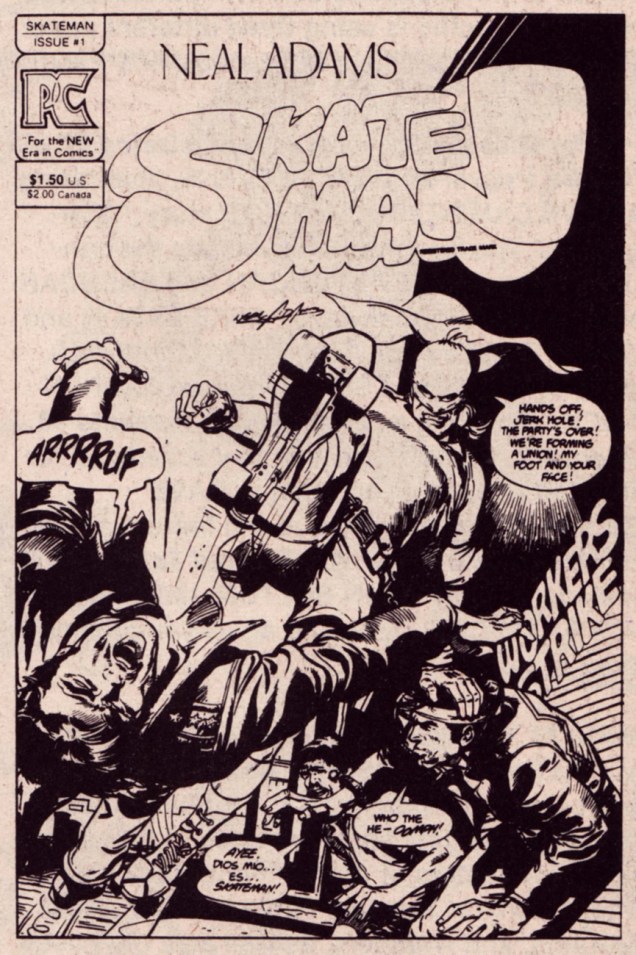
As legendary as his renditions of established characters are, it is with his own creations that Neal Adams’ true legendary status rests: fabled names, always spoken in hushed awe, such as Ms. Mystic, Samuree, Cyberad, Crazyman, Megalith, Valeria the She-Bat… and of course Skateman, Jason Brown’s childhood idol. Here’s his premiere (and dernière) issue, published in November 1983 by Pacific Comics.
SkatemanA
And here’s a mock-up of the same cover. I’ll go to my grave wondering why they chose to run the cover sans this piquant, vernacular-rich dialogue, which would have shown once and for all that Neal the writer was every bit the equal of Neal, the artiste. Eat your heart out, Noël Coward!
Crazyman1A
Neal applies his Midas touch to another original creation: Crazyman! Double bag several copies of this number one, someday it’ll put your kids through college. It even comes with an embossed cover! By then, Adams was drawing donkey teeth on everyone, evidently his shorthand for “hilarious”. April 1992, Continuity Comics. You know, “The other superhero company”!

– RG

*as recounted by Yanick Paquette

Happy Birthday, Charles Clarence Beck!

« It’s difficult to know just what to make of C.C. Beck. He’s crusty and curmudgeonly in the Cleveland Armory mold. He’s virulently opinionated, yet insists that he doesn’t take himself seriously. His aesthetics are inflexible if not reactionary, and not entirely consistent at that. He also happens to be one of the most endearing and original cartoonists ever to breathe life into a super-hero.“*

Charles Clarence Beck was born on June 8th, 1910 and left this world in 1989. The world is a stodgier place without him!

Tawny-CaptainMarvelAdventres79
My favourite of Otto Binder/C.C. Beck’s characters – Tawky Tawny, the well-mannered, reasonable, tweed-wearing tiger. Sweet Tawny first appeared in Captain Marvel Adventures #79 (December 1947), as a talking tiger who longed for a life as a normal, suit-wearing, polite member of society. He also really likes ice cream. This panel is from “Mr. Tawny’s Personality Peril”, a story by the Binder and Beck team, published in Captain Marvel Adventures #115 (December 1950).

Here are a few covers which showcase A) C.C. Beck’s stylish art B) the lovely goofiness of it all. To quote the man, « When Bill Parker and I went to work on Fawcett’s first comic book in late 1939, we both saw how poorly written and illustrated the superhero comic books were. We decided to give our reader a real comic book, drawn in comic-strip style and telling an imaginative story, based not on the hackneyed formulas of the pulp magazine, but going back to the old folk-tales and myths of classic times. » Well, to be honest, aside from the so-called Greek origins of Captain Marvel (“Shazam”, the catalyzing cry which allows ordinary Billy Batson to transform into his superhero alter-ego, stands for “Solomon, Hercules, Atlas, Zeus, Achilles, Mercury”), there’s little in these stories that evokes classic folk tales *or* mythology. I know the Ancient Greeks were into some kooky shit, but I don’t recall any myopic worms with a Napoleon complex nor talking tigers in suits. Ultimately, Captain Marvel comics are family fun. “Old-fashioned” values are the backbone of these stories: friendship, loyalty, kindness to those weaker (or stupider) than us. If that sounds boring, it isn’t. Beck had a cartoony style that make his stories fucking adorable, especially when coupled with the often surreal and delightfully wacky plots.

“Quote! Mr. Tawny is not a tiger – he’s a worm! Unquote!”

CaptainMarvelAdventures113
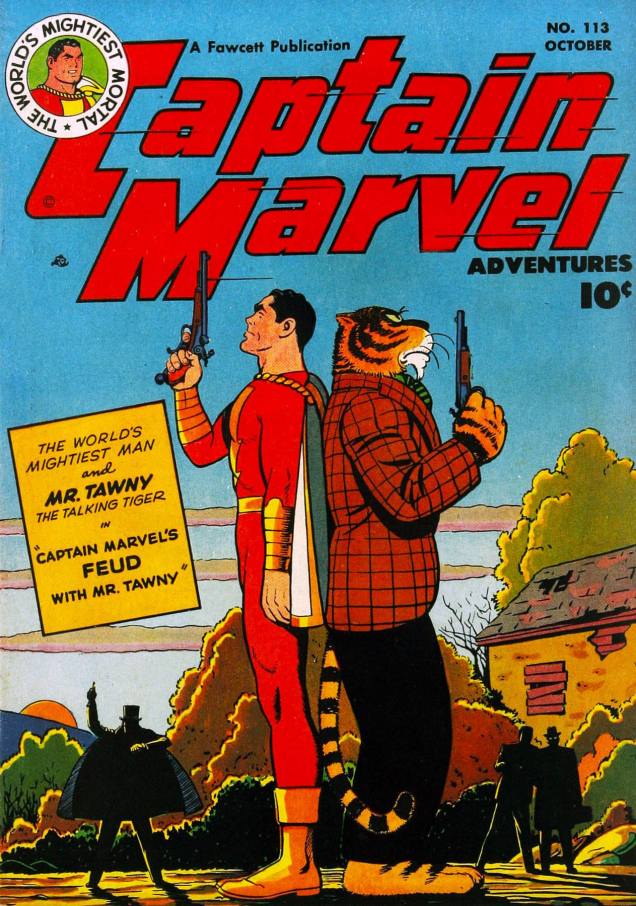
At first glance, this cover is celebrating the beauty of autumn; upon a closer inspection, it turns out that it has much darker overtones – two faceless guys in the background, clearly following some nefarious plan to break up Tawny and Captain Marvel’s friendship (how dare they!) and a creepy boarded-up house. This is Captain Marvel Adventures #113 (October, 1950), cover by C. C. Beck. Read “His Feud With Mr. Tawny” (scripted by Otto Binder, illustrated by C.C. Beck), which is finally not at all gruesome, just heart-warming, here.

C.C. Beck co-created Captain Marvel with writer Bill Parker in 1939. The Big Red Cheese made his first stellar appearance in Whiz Comics #2 (cover date February 1940), published in late 1939. Captain Marvel was a huge hit, and so Fawcett put out a number of spin-off comic books – as for Beck, he opened his own comic studio in 1941 that provided most of the artwork in the Marvel Family line of books.

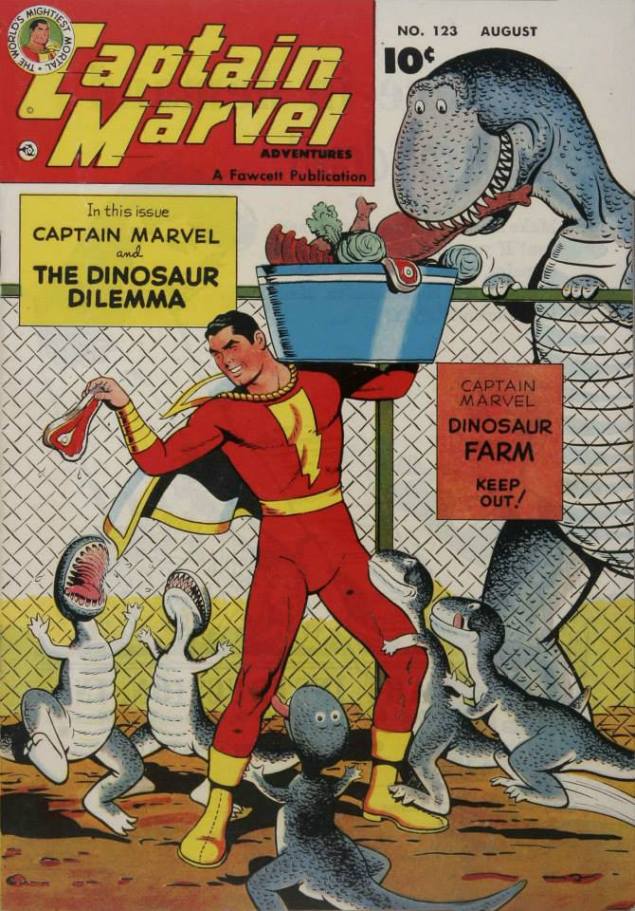
« Special! Baby dinosaurs! New! Different! Be the envy of your friends! »

CaptainMarvelAdventures123
Captain Marvel Adventures #123, 1951. Did you know that dinosaurs apparently wag their tails like dogs to express their affection? No? Head over here.

« Wait! This isn’t oil! It’s dense, black and real sticky! »

CaptainMarvelAdventures126
Don’t let go of that piglet, Captain Marvel! Pigs’ reputation for loving mud may be well deserved, but no self-respecting swine wants to be dropped into black, sticky goo. This is Captain Marvel Adventures #126 (November 1951), cover by C.C. Beck. The cautionary cover tale, Captain Marvel and the Creeping Horror, was written by Otto Binder and pencilled by C.C. Beck (with inks, tentatively, by Pete Costanza).

« Did you hear that, ma? We’re on another – uh – world! Ma, aren’t you scared? »
« Land sakes, pa, why get scared? At least my wash will dry nice and fast with two suns shining down! »

CaptainMarvelAdventures135
Captain Marvel Adventures #135 (August 1952); cover by C.C. Beck.

IGN ranked Captain Marvel as the 50th greatest comic book hero of all time. You know how they qualified it? “Times have changed, and allegiances with them, but Captain Marvel will always be an enduring reminder of a simpler time.” If there’s one thing I hate, it’s people who assume that generations before theirs were naïve or that the world was a “simpler” place (take a peep in any good history book and see if that was the case). This kind of condescension poisons any compliment.

C._C._Beck_1982
C.C. Beck in 1982. He kinda looks like my physics teacher from high school!
BillyBatson'sBadDream1982
Doctor Sivana comes out with his whole family to taunt Billy! Says Beck, “The publisher also once wanted to drop Sivana, claiming the old rascal was becoming a more interesting character than Captain Marvel. The editors paid no attention to so silly an order and kept him alive and cackling.”

There’s a beautifully conducted interview with Beck by Tom Heintjes, published in Hogan’s Alley. I highly recommend it. Heart-breakingly, Heintjes explains in the introduction that “when Beck died of renal failure on November 23, 1989, my inability to complete a book celebrating Beck’s life and career—to my mind, one of the most commercially and aesthetically successful in the entire history of comic books—was a source of acute regret.

~ ds

*Gary Groth’s introduction to an interview with C.C. Beck published in Comics Journal #95 (February 1985) and conducted in 1983.