Grimm’s Ghost Stories (60 issues, 1972-1982, Gold Key/Whitman) is a title I’ve been, in my usual fashion, lazily collecting for decades. I’ve always found in the Gold Key ambiance a soothing respite from the obsessive continuity and slam bam histrionics of DC and (the chief offender) Marvel.
While writer Arnold Drake‘s numerous credits at DC (and, to a lesser degree, Marvel) are well documented, his passage at Western/Gold Key in the mid-to-late 1970s is unjustly shrouded in obscurity. Let’s just say he — along with his young colleague Freff — brought complexity, warmth and wit to the publisher’s frankly formulaic fare.
.
.
.
.
.
.
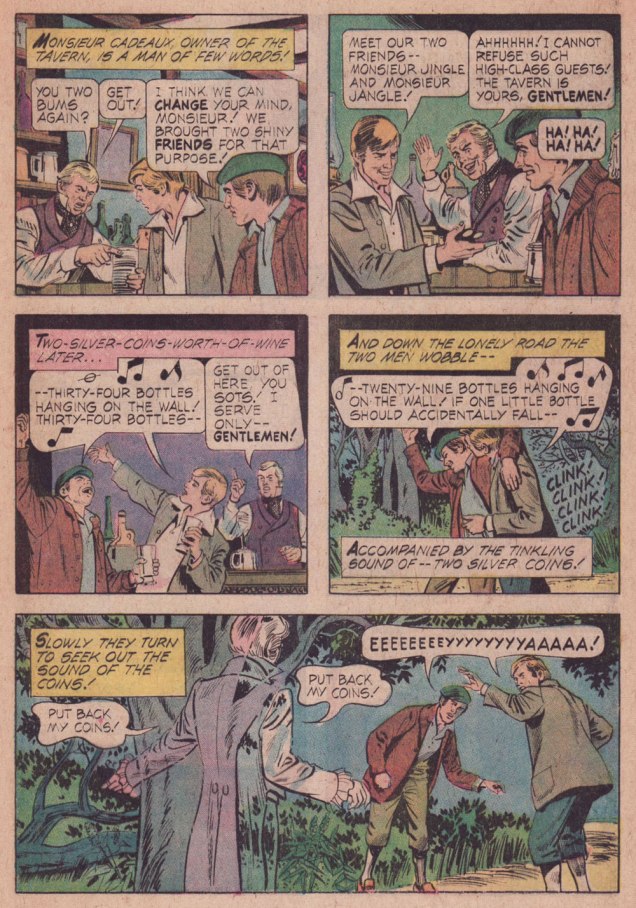
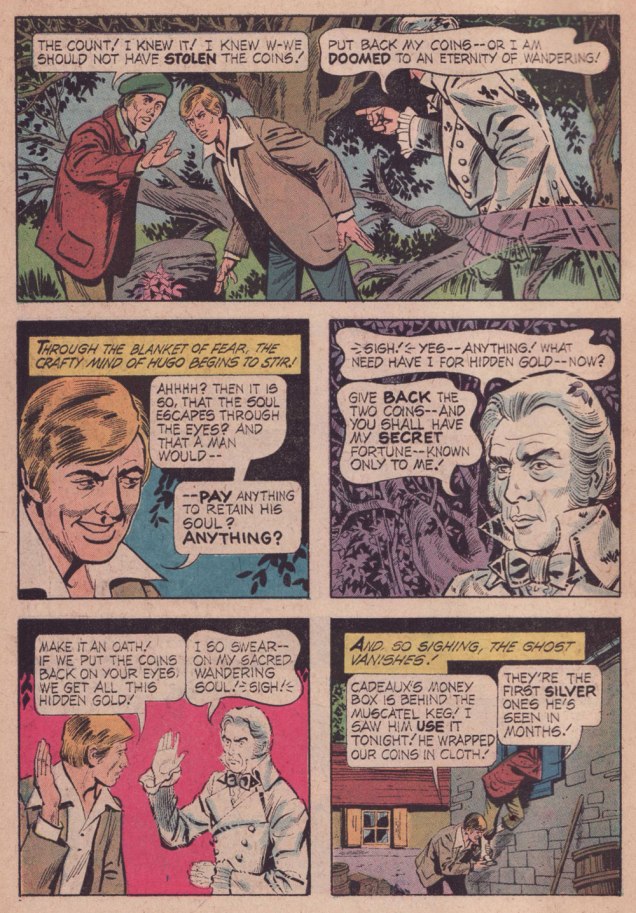
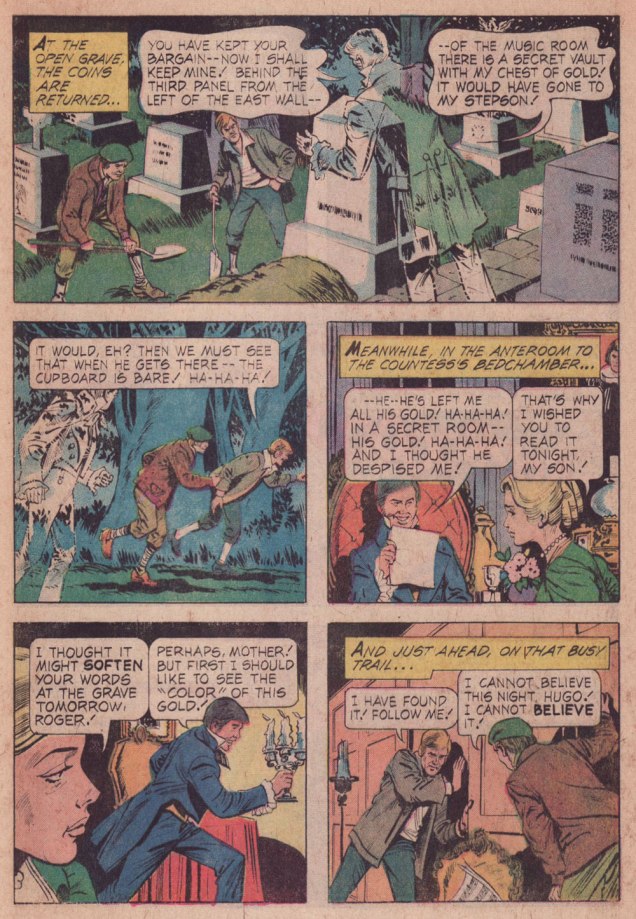
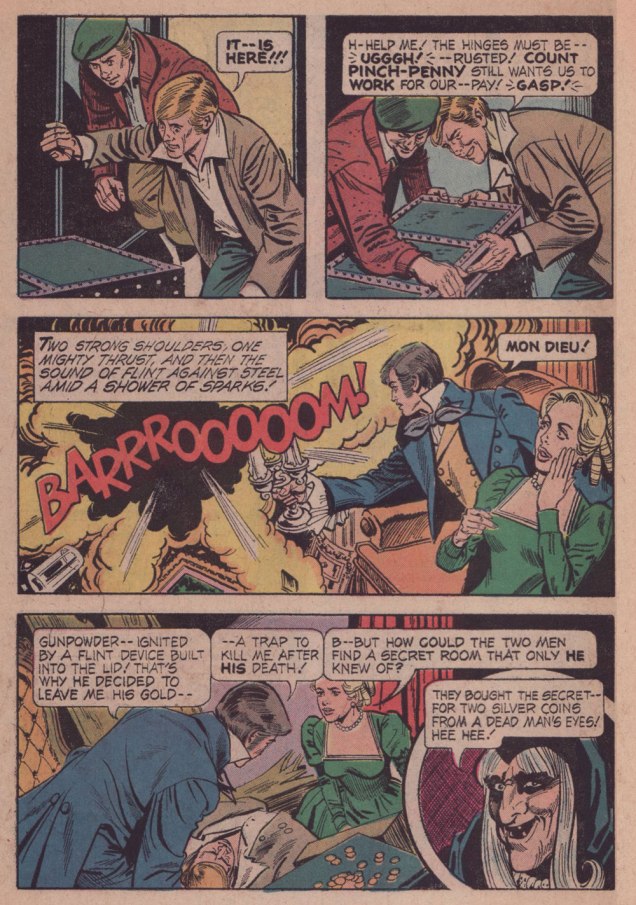
This isn’t the spookiest ghost story of them all, far from it, but that’s hardly the point, is it? Fun fact: the practice of putting coins on the deceased’s peepers was poetically called ‘Charon’s Obol‘.
I love the well-developed characters… despite the tale’s brevity. The willful stepson whose only sin is that of being a free thinker; the grave-robbers who can keep their wits about them in all circumstances; and the pragmatic miser’s spectre who’ll trade one act of revenge for another in a pinch.
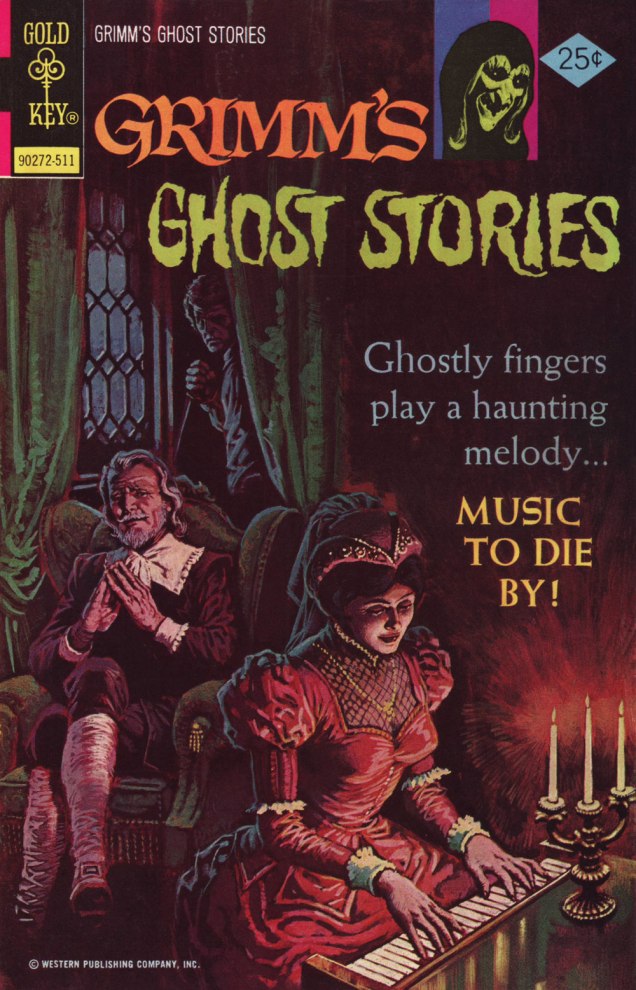
While ‘Silver’ wasn’t the cover-featured story, I wouldn’t pass up the chance to spotlight such a fine, understated Luis Domínguez painting. This is Grimm’s Ghost Stories no. 27 (Nov. 1975, Gold Key). For our gallery of this Argentine master’s finest, check out Luis Domínguez (1923-2020): A Farewell in Twelve Covers.
« I think people will believe anything about someone they haven’t seen for a while. » — Gabriel Kaplan
I’ve been meaning to do a Welcome Back, Kotter post for several years. But when I thought about it, I understood that hitching it to the show’s fiftieth anniversary made considerably more sense than, say, its forty-seventh. And while I adore William Johnston‘s sextet of tie-in novels, it would be quite a stretch for a comics blog to cover. Far closer to the mark lies Arnold Drake‘s trio of WBK storybooks, illustrated by Mel Crawford and Jack Sparling. But in the end, I bided my time and managed to get in touch with the scribe first assigned the Kotter Komic assignment, Elliot S! Maggin. And boy, am I glad I did. And so, fifty years to the day of the airing of its pilot episode*, let’s talk Kotter!
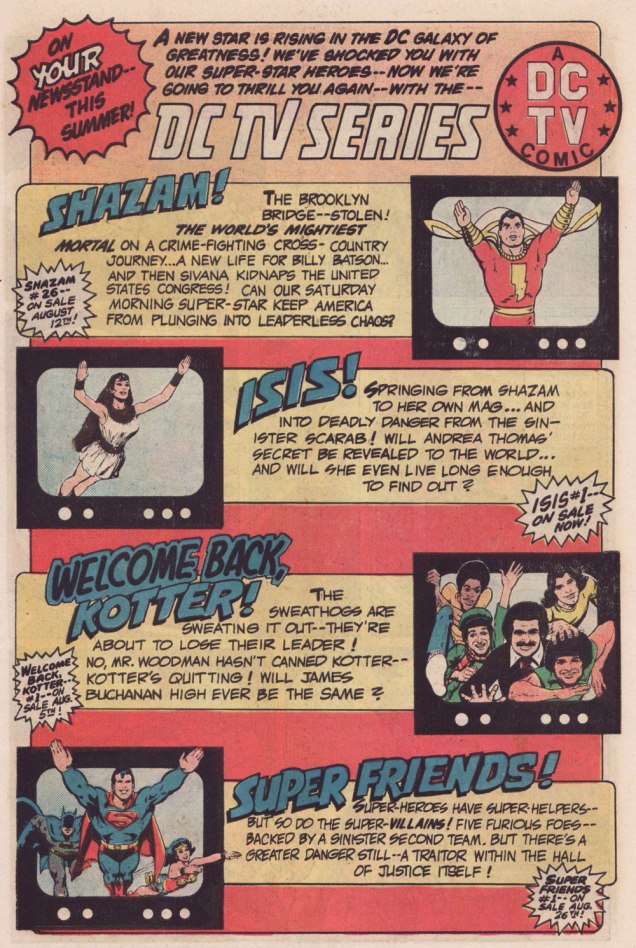
Remember the DC TV line? This ad ran in several DC titles over the summer of ’76.
WOT: First, a bit of context: correct me if I’m wrong, but in the early stages of your career writing comics, you always worked alongside editor Julius Schwartz. Then, in late ’75 or early ’76, something changed, and you began writing for other editors’ titles. What’s the story?
ES!M: Well, Julie was kind of proprietary about me for most of the time I was working with him.
WOT: A sideways sort of compliment.
ES!M: I guess. At some point, Dorothy Woolfolk was editing the Lois Lane book, and… he introduced me to her. She just came into his office for some reason. She said: « Oh, you know, you should write some stuff for me! » And he said « No, he’s very busy, go away! » And he chased her out of the office. And I’m thinking, « Oh, okay. That’s how we’re doing it. »
So I didn’t really go about… I didn’t really make friends with many of the other editors. I tried to make friends with Joe Orlando. You know, I’d have lunch with him once in a while, I guess.
This is Welcome Back, Kotter no. 1 (Nov. 1976, DC); cover by Bob Oksner.
ES!M: But around the time Kotter came out…
You know, people used to hang out outside of Julie’s office door, listening to us plot, because it was so loud. We would yell and scream at each other constantly. He was this Jewish boy from the Bronx, and I was this Jewish boy from Brooklyn, and once I got comfortable working with a guy thirty-five years older than me, we’d just fight all the time. And every once in a while, we’d get serious.
WOT: Serious fighting, or serious work?
ES!M: Yeah, yeah! The fighting was work.
WOT: Sometimes that line is dreadfully thin.
ES!M: I guess at that point, he got mad at me, and I didn’t get work for a couple of weeks. I went to Joe, and I said: « What ya got? », and he said he’s doing this Welcome Back, Kotter book, and I said « Great! I watch that show, that’s fun. » So I wrote the first issue, and that was fine.
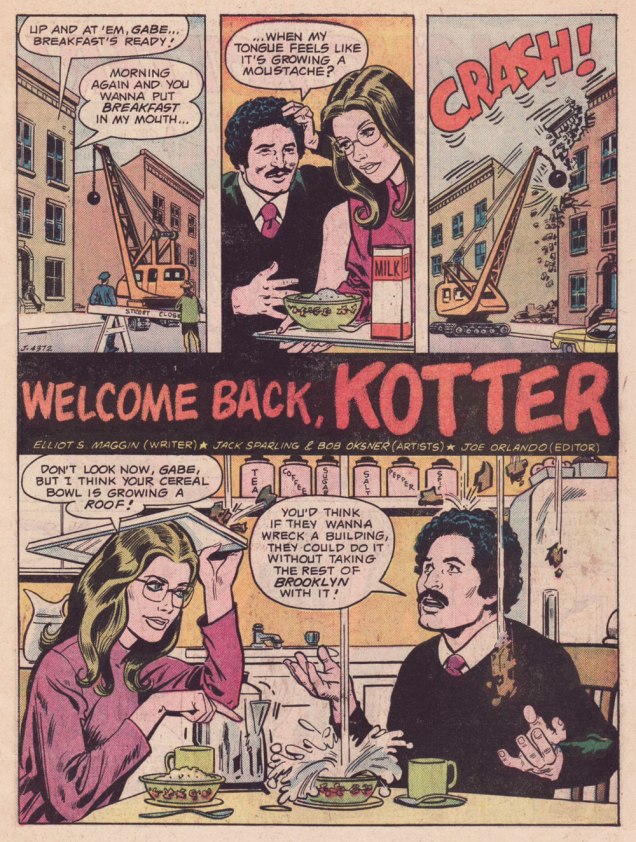
Here’s a quartet of pages from the première issue. Pencils by Sparling and finishes (and surely likenesses) by Oksner.
.
.
Aw, Maggin’s Mr. Pevey would have made a great addition to the TV show’s cast.
ES!M: They called me down in Carmine‘s office, to watch episodes of the show. It had been on maybe six weeks at that point. Episodes I had already seen, but I liked hanging out in Carmine’s office, because it was big, and he had a lot of toys around. So they set up this video tape… thing, and I watched the shows again, and I wrote the second issue.
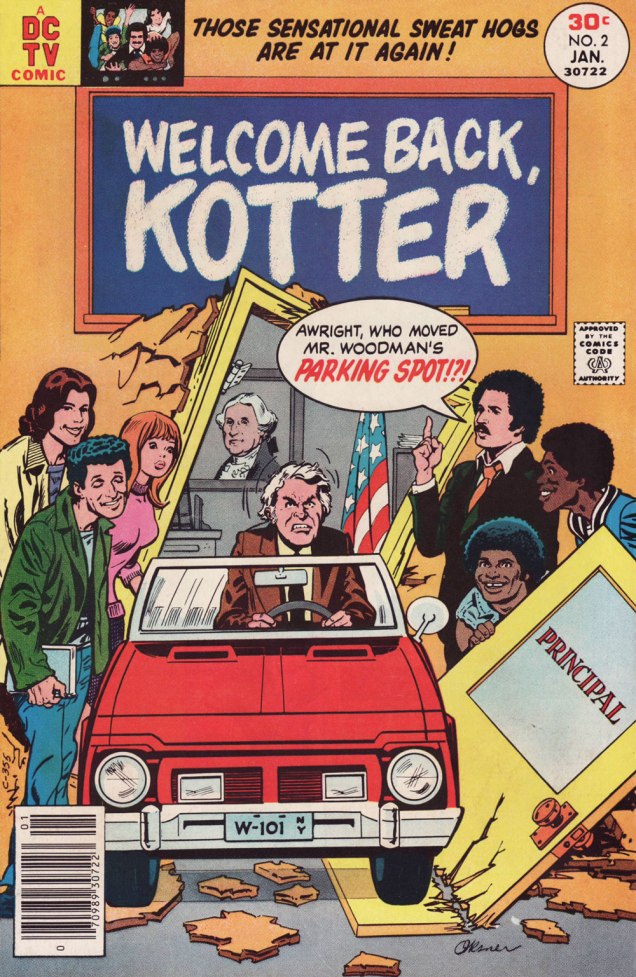
This is Welcome Back, Kotter no. 2 (Jan. 1977, DC); cover by Oksner.Art-wise, the second issue seemed comparatively rushed, and sans Oksner, likenesses pretty arbitrary. See what I mean? The GCD attributes the inks to Sparling, but I lean towards Frank Springer.
ES!M: I was living in an apartment complex on Long Island, and there were all these kids around… little kids. And I would work at home, mostly. So they would hang around with me, whenever they realized I was home. They would… shoot me through the window or… something. At some point, whenever I’d write a gag, I would…
WOT: … run it past them?
ES!M: Yeah! And they’d laugh, and run off and play some more. And I figured, as long as they laughed, it was okay. Because they were hearing the voice of Barbarino, or whoever. At some point Travolta would say, « Uh? », or « Duh », or « What d’you think? », something dull, that he delivered in a funny way. And the kids related what I wrote to what Travolta did on screen, so they were getting it. And at some point I realized that Joe [editor Orlando] didn’t watch the show.
WOT: Oops.
ES!M: And he would then object to my Barbarino bits, or Horshack bits, or whatever. So I told him « You’ve got to watch the show, you’ll get it! » But you know, after maybe… how many issues did I write, three, four?
WOT: Just two, I’m afraid. You wrote the first couple, then Tony Isabella did one, then Mark Evanier…
ES!M: I’m sure he (Evanier) watched the show — he watched everything.
WOT: He was even the show’s story editor for part of its second season. So… then Bob Toomey wrote four issues, Scott Edelman two, and there was a leftover story by Evanier that saw print in the WBK Collector’s Edition in 1978.
ES!M: But Joe did not. I mean, he didn’t have time, and he was madly in love with his wife, and he didn’t watch television at all (laughs). He wasn’t paying attention to the source material.
WOT: That happens. But it seems a pretty unfortunate blind spot for a book’s editor.
ES!M: I wrote two issues, and at some point, Joe said: « You can’t write! ». He said « No, you can’t write! » A blanket condemnation of everything I’d ever done.
WOT: Oooh.
ES!M: By that time, I’d made up with Julie, and I was writing more Superman stuff. After that, wherever any of my fights with Julie got serious, I’d go down the street to Marvel, and do something there. Then I would make up with Julie, and they’d never see me again… until I had another fight with Julie.
That was my experience writing Kotter.
And here’s what undoubtedly has to be the Guernica, if you will, of Kotter art: Bob Oksner‘s superlative cover for Limited Collectors’ Edition C-57, from 1978, DC’s final — and finest — WKB publication. Feel free to open it in another tab for a fuller view… I provided a larger image so you can fully take in the wealth of details.
WOT: In closing, how are you keeping busy these days?
ES!M: I just wrote a book called Lexcorp. A novel. Which you should probably plug.
WOT: Done!
ES!M: It’s a first-person story that Lex Luthor tells. And he identifies himself as an unreliable narrator, like… Huckleberry Finn. But it does tell the story of how he saves the world. Stuff like that.
I’m working on another book, working on a time travel story. And my ex-wife asked me to write an autobiography so my grandchildren know who I am.
I have all these people I know with Pulitzer Prizes; and at some point in the autobiography, I wrote: « I have about a dozen Pulitzers floating around through my life, and none of them are mine. This book is available for consideration. »
WOT: Mr. Maggin, thank you so much for taking the time to share these stories with us!
-RG
*the pilot episode, for some reason, was aired third, on September 23, 1975, while the show premiered on the 9th of September with ‘The Great Debate‘ (featuring a wonderfully smarmy James Woods).
« I’ve had great success being a total idiot. » — Jerry Lewis
Hey, it’s Bob Oksner‘s birthday! I hope you’ll forgive me for double-dipping into that particular well — he also illustrated our earlier Mary Marvel entry — but I still wanted to highlight the occasion, incorrigible Oksner booster that I am.
DC’s Jerry Lewis (or Bob Hope, or Dobie Gillis…) comics weren’t even remotely funny, but they sure boasted some spiffy covers. Here’s a gallery of the most Hallowe’en-appropriate, from the pencil and pen of Mr. Oksner.
This is The Adventures of Jerry Lewis no. 87 (Mar.-Apr. 1965, DC).This is The Adventures of Jerry Lewis no. 88 (May-June 1965, DC).
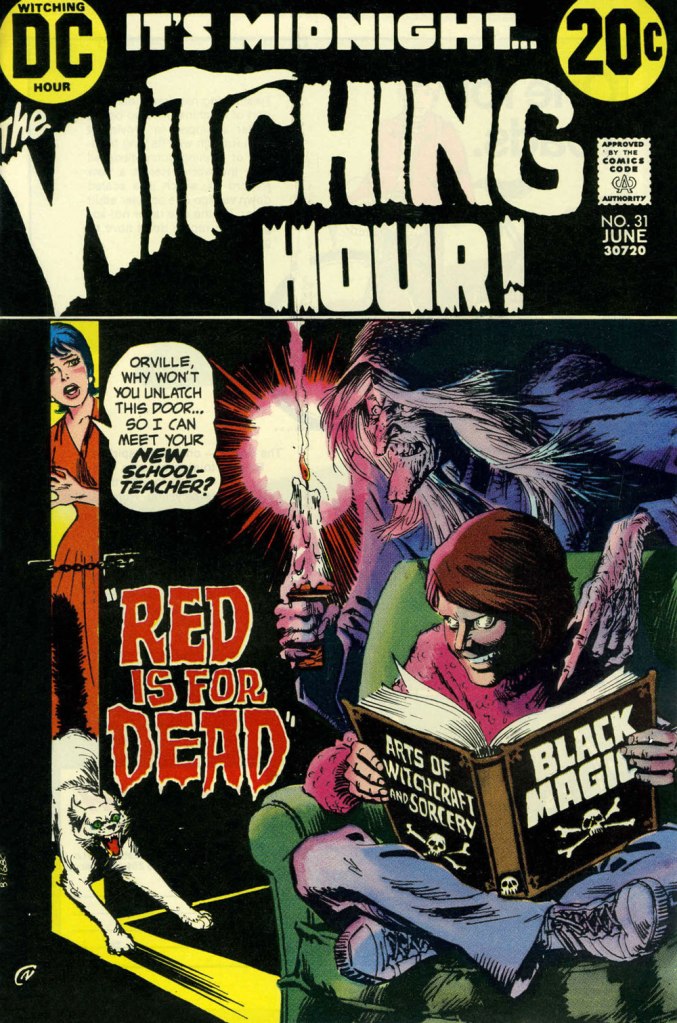
TAoJL editor Murray Boltinoff (1911-1994) had a soft sport for that particular cover concept, since he recycled it, eight years later and with a different tone, for another title he was overseeing:
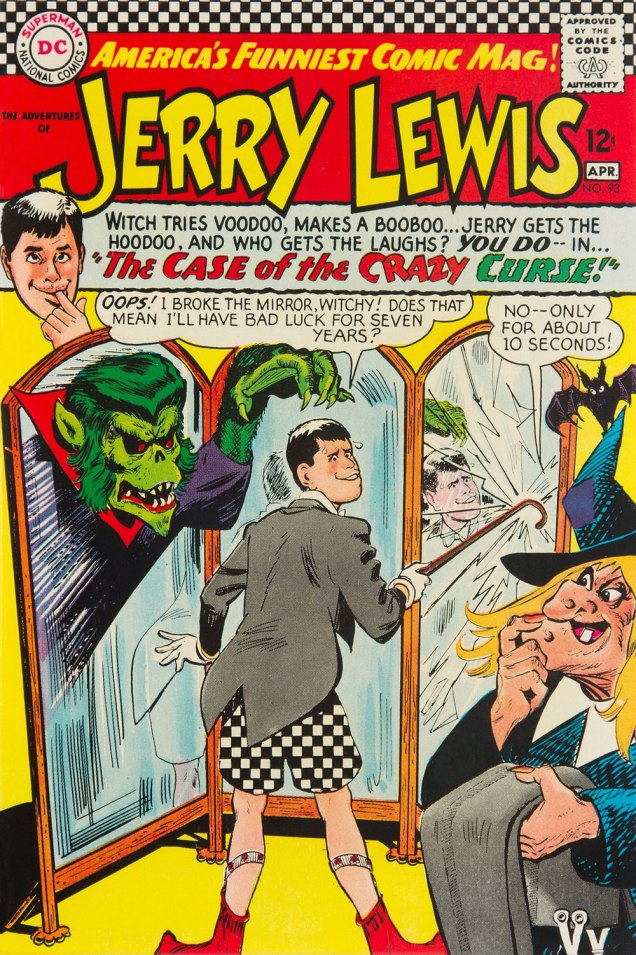
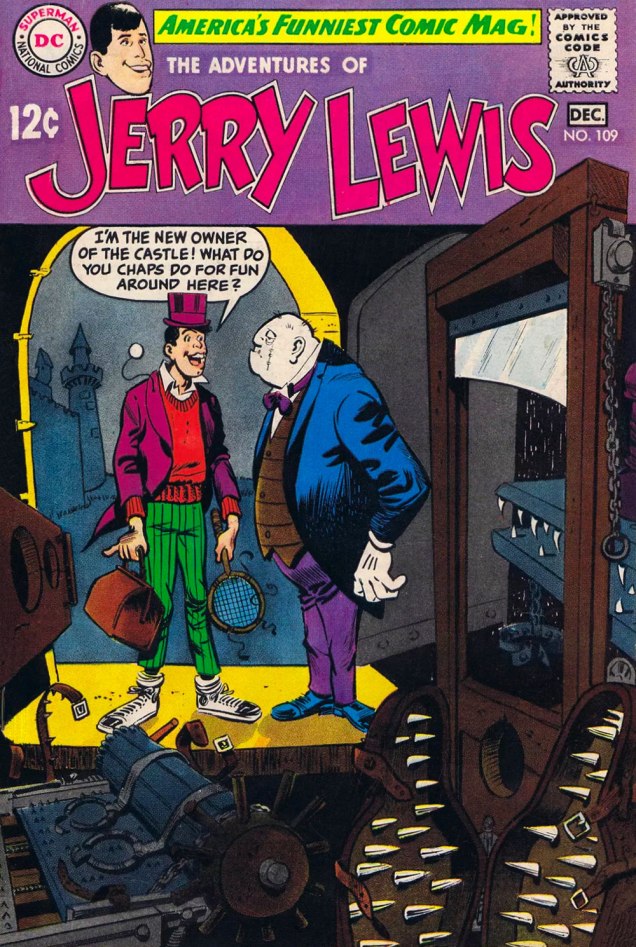
Here, for comparison, is It’s Midnight… the Witching Hour no. 31 (June 1973, DC). Art by Nick Cardy.This is The Adventures of Jerry Lewis no. 93 (Mar.-Apr. 1966, DC).This is The Adventures of Jerry Lewis no. 94 (May-June 1966, DC).This is The Adventures of Jerry Lewis no. 98 (Jan.-Feb. 1967, DC).And finally, The Adventures of Jerry Lewis no. 109 (Nov.-Dec. 1968, DC). This one’s another riff on a rather hoary theme.
Ah, the nineteen seventies… and their Satanic panic, in which we can recognize so closely the roots (or at least relatives) of today’s disinformation maelstrom, before the politicisation and weaponisation of septic paranoia and lies had become honed to such an anti-science. In a lot of sordid ways, Lawrence Pazder was an Andrew Wakefield of his day.
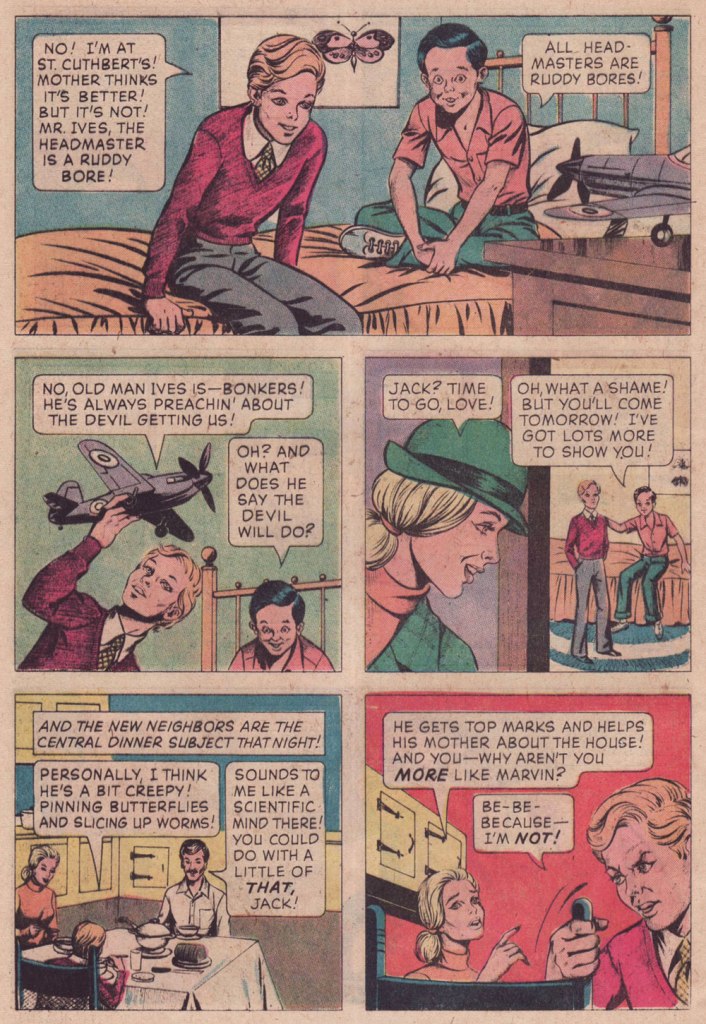
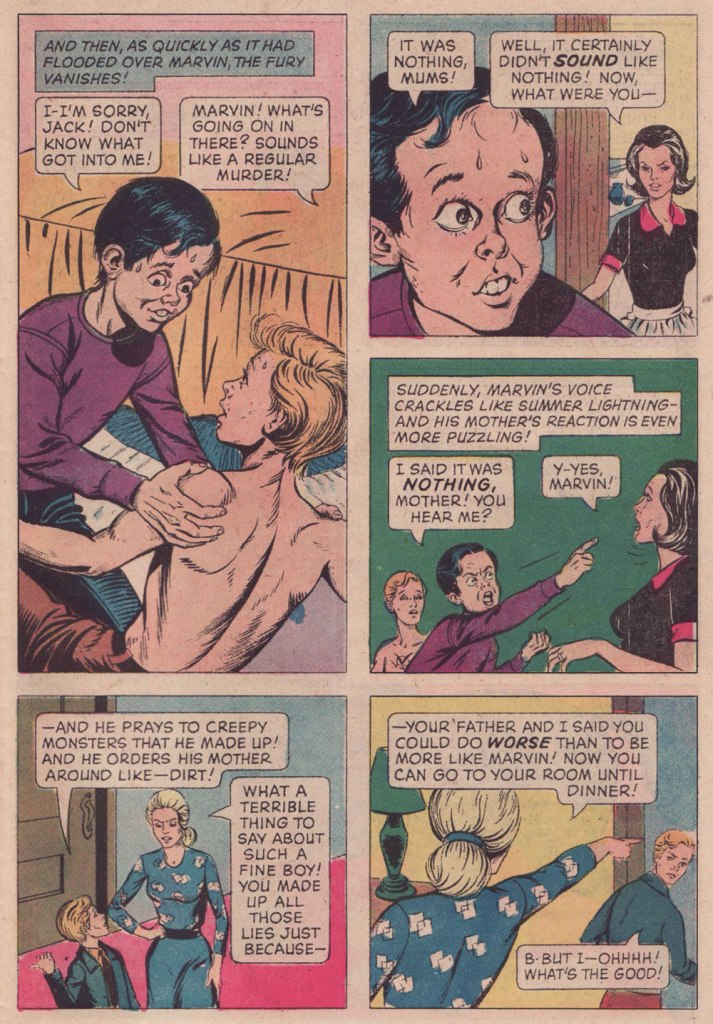
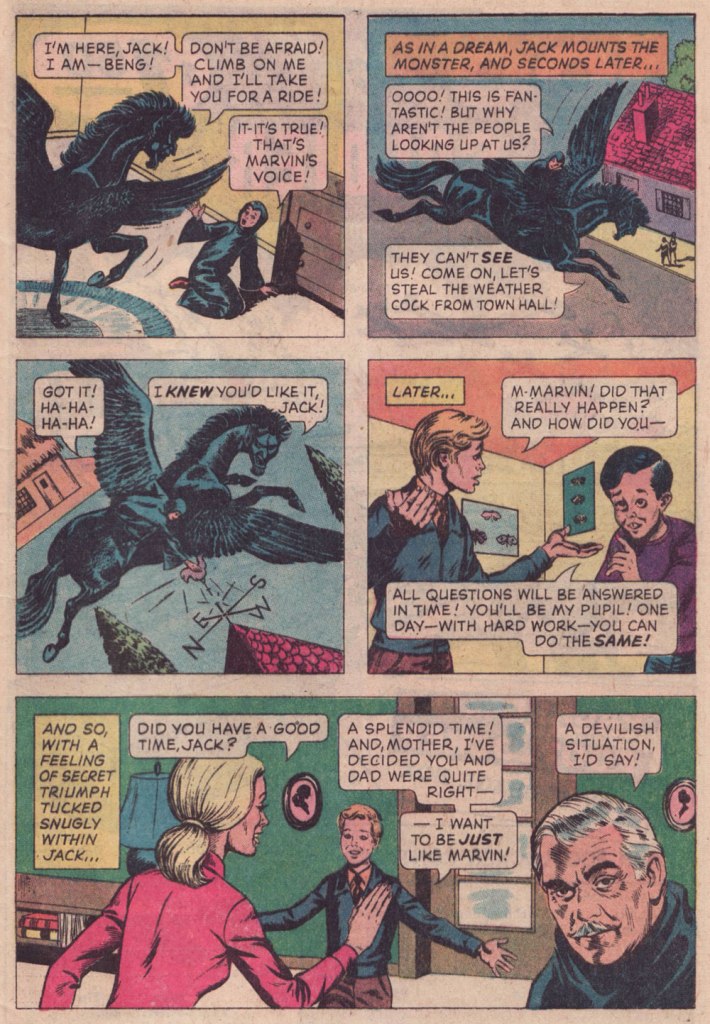
Here’s a story that I first encountered around the time of its release, remembered, but didn’t revisit until a couple of weeks ago, when a good friend (merci, Keith!) helpfully snapped up a copy for me. This deceptively dark tale was created by writer Arnold Drake (I surmise), penciller John Celardo and mysterious inker Wanda Ippolito, who may have a been a spouse or relative of Celardo’s. It’s odd to find someone else inking Celardo, as this was his chief, most enduring and distinctive strength. For comparison’s sake — and presumably, reading enjoyment — here’s another Drake-Celardo outing, The Anti-13!
I won’t make any claims that this is great art: by this time, Gold Key’s printing was shoddy, they barely bothered with the colouring (straight Magenta and Cyan and Yellow everywhere — how lazy can you get?)… but I treasure this one because of the story. Given its moral — what moral? — it’s hard to imagine The Comics Code Authority giving this one a pass, as it merrily violates several of its key precepts. I’ve got another such blasphemous entry in the pipeline… this one duly Code-Approved! Just you wait…
I had a childhood friend who was a lot like Marvin (minus the devil worship — for all I know)… he was incredibly talented, but also scarily unpredictable, and not in a good way. One day, he just disappeared.
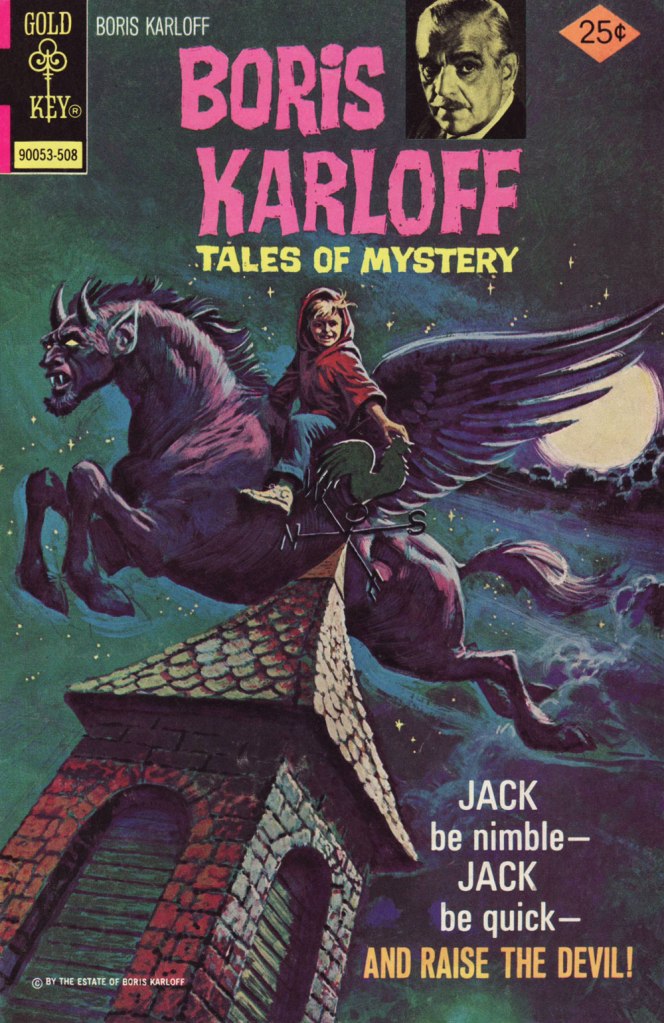
On the other hand, the accompanying cover is spectacular.
« Why Can’t You Be More Like Marvin? » originally appeared in Boris Karloff Tales of Mystery no. 63 (Aug. 1975, Gold Key), which bore this masterfully disquieting cover by Luis Domínguez. It would have made it into my Domínguez retrospective, Luis Domínguez (1923-2020): A Farewell in Twelve Covers but for the fact that I didn’t own a decent copy of the issue.
And as (nearly) always, a bonus for context: Celardo had a long and fruitful career, and I’m sure one of its highlights was to number among Fiction House’s elite cadre of cover artists. I’ve said it before, but despite their mind-numbing repetitiveness, FH covers were tops in the Golden Age in terms of draftsmanship and production values.
Aw, poor Ka’a’nga — always left at home to feed the jackals while Ann Mason goes off on escapades with her other boyfriends. And who insisted on adopting them in the first place? Ann, that’s who! This is Jungle Comics no. 98 (Feb. 1948, Fiction House). Judging from his ability in the jungle antics genre, it’s no wonder that Celardo was picked to illustrate the real thing (at least comics-wise): the Tarzan comic strip, from 1954 to 1968, between Bob Lubbers (another FH cover artiste!) and Russ Manning. And here’s one of Celardo’s Tarzan Sundays (March 27, 1954, United Feature Syndicate).
« Listen, Angel! If they’re out of bananas… I’ll meet you at the corner fruit stand! »
Today, let’s combine our general theme with a celebration of the birthday of one of comics’ great, yet perpetually underappreciated talents: Bob Oksner (October 14, 1916 – February 18, 2007), DC’s go-to humour and good girl art guy. Can you beat that? Didn’t think so.
Bob had a winning penchant for mixing monsters and babes, and for this, he’s earned our lifelong gratitude.
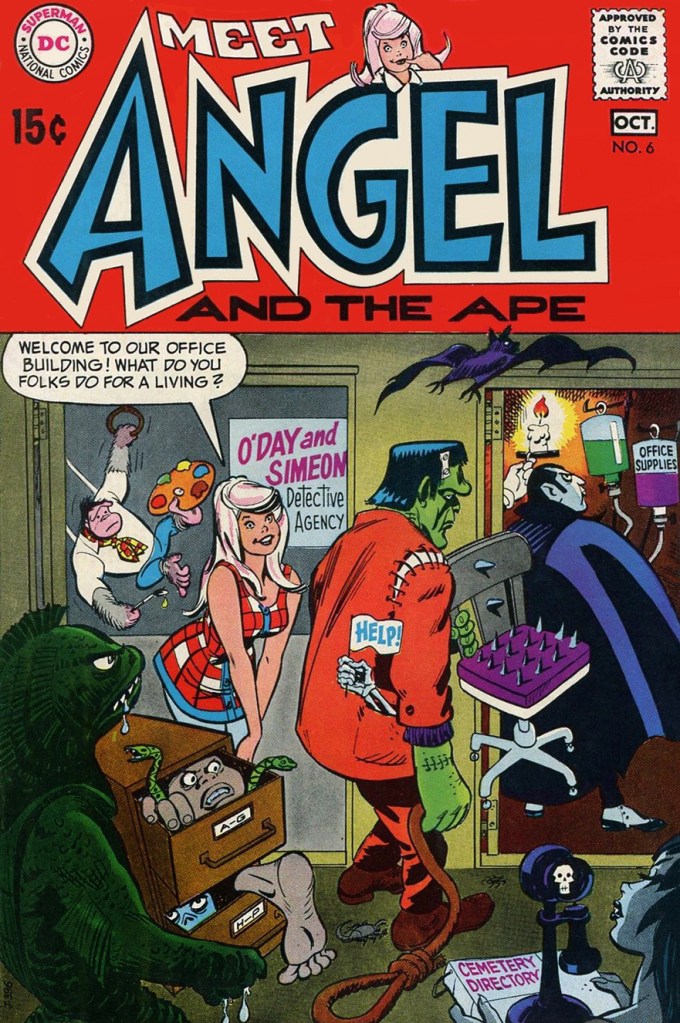
This is Angel and the Ape no. 6 (Sept.-Oct. 1969, DC), featuring The Robbing Robot and The Ape of 1,000 Disguises! (Would You Believe Four?), wittily written by John Albano, lusciously pencilled by Oksner, and creamily inked by Wallace “Wally” Wood. Truly swoon-inducing stuff. Edited by Joe Orlando (that explains all the monsters!), with a cover by Oksner.
You might say Angel and the Ape exist in an awkward sort of limbo: popular enough for the back issues to be kind of pricey, but not popular enough to have been reprinted (eight issues, including their Showcase appearance, ideal for a trade paperback, hint, hint).
So what else has Mr. Oksner cooked up over the years? Keeping to our theme, here are a few highlights, but first, a handy bio:
This piece appeared in The Adventures of Jerry Lewis no. 73 (Nov.-Dec. 1962, DC).
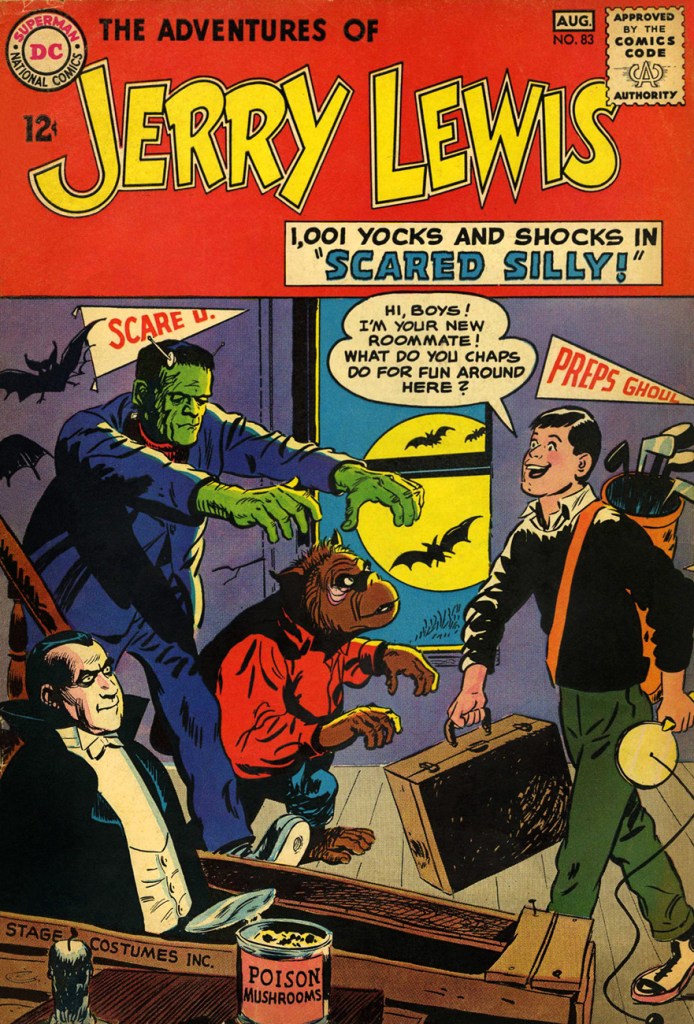
The is The Adventures of Jerry Lewis no. 83 (July.-Aug. 1964, DC). Formerly The Adventures of Dean Martin & Jerry Lewis… of course. The book (under both titles) featured some lovely artwork from Owen Fitzgerald, Mort Drucker and of course Oksner… but it was no Sugar and Spike. Still, it had its audience, long-lasting as it was (124 issues… Jerry wasn’t just big in France!)
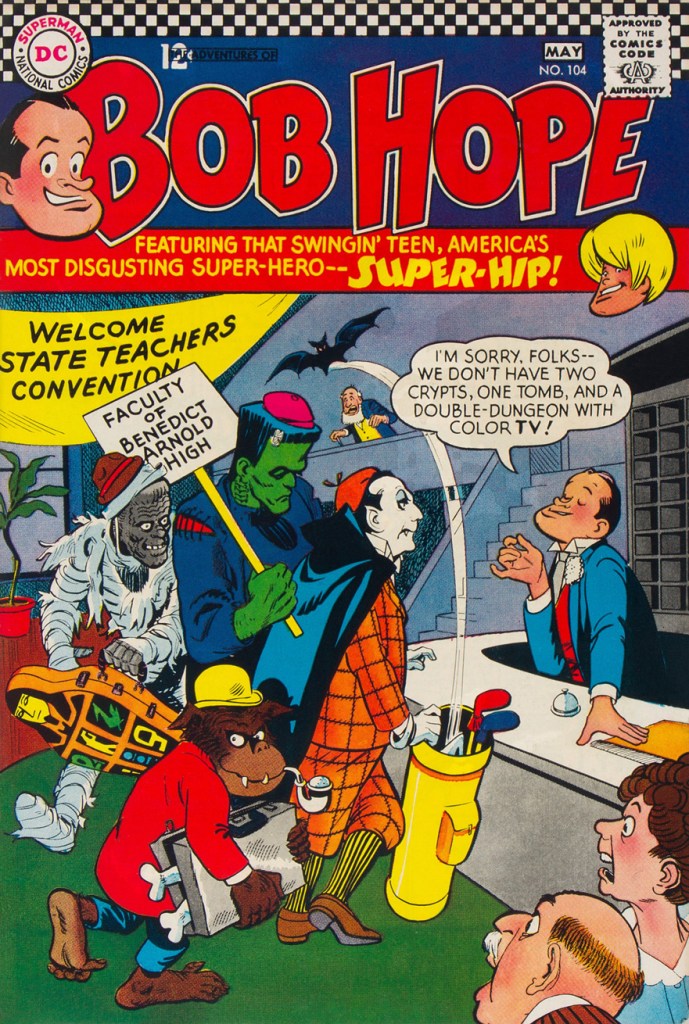
This is The Adventures of Bob Hopeno. 104 (Apr.-May 1967, DC). DC’s celebrity-licensed humour titles followed a parallel course: fading sales led to their nominal stars being more or less sidelined in their own book in favour of increasingly outlandish supporting casts.
An inside page from that issue. Good-looking comics… but they weren’t particularly witty, which can be a bit of a drawback. Arnold Drake was the writer, and while he could be pretty damn funny, it just didn’t work here. Still, you can bet that it was still more amusing than Milton Berle’s comic book.
1940s teenager Binky was pulled out of mothballs in the late 60s (ten years elapsed between issues 60 and 61). A moderate success (especially given it mostly consisted of slightly updated reprints), it returned to oblivion after another twenty-two issues, though the first seven boresome rather fine Oskner cheesecake covers. This is Leave It to Binky no. 67 (June-July 1969, DC).
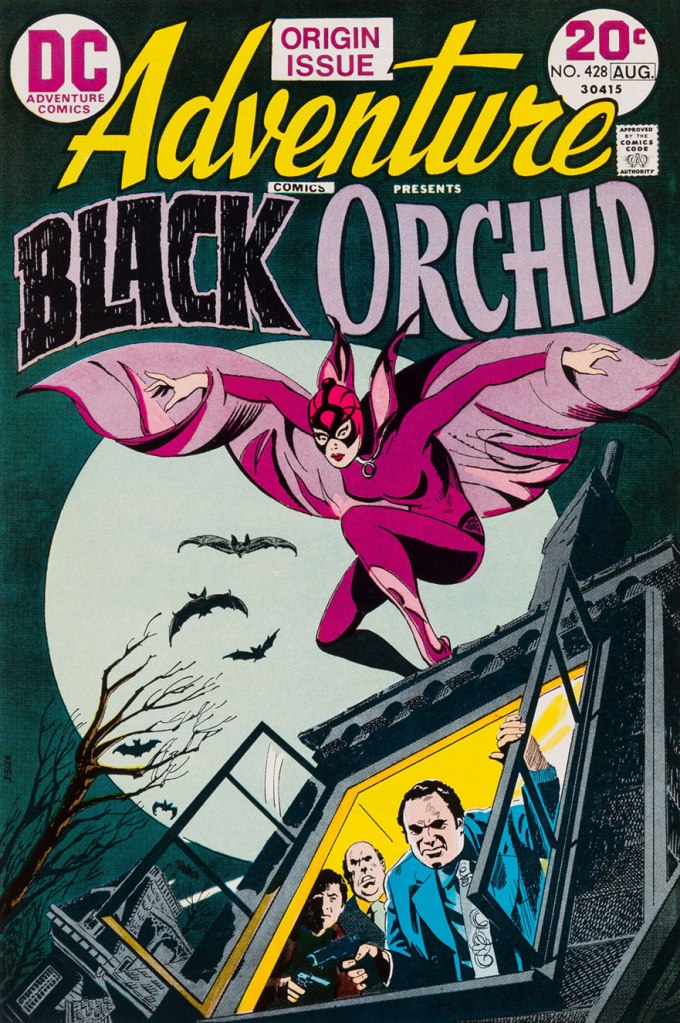
Finally, for a touch of the more ‘realistic’ Oksner style, here’s his cover introducing Sheldon Mayer‘s marvellously-mysterious Black Orchid. This is Adventure Comics no. 428 (July-Aug. 1973, DC). She deserved far more than a mere three-issue run!
Sea Devils no. 1 (September-October 1961). Cover by Russ Heath.
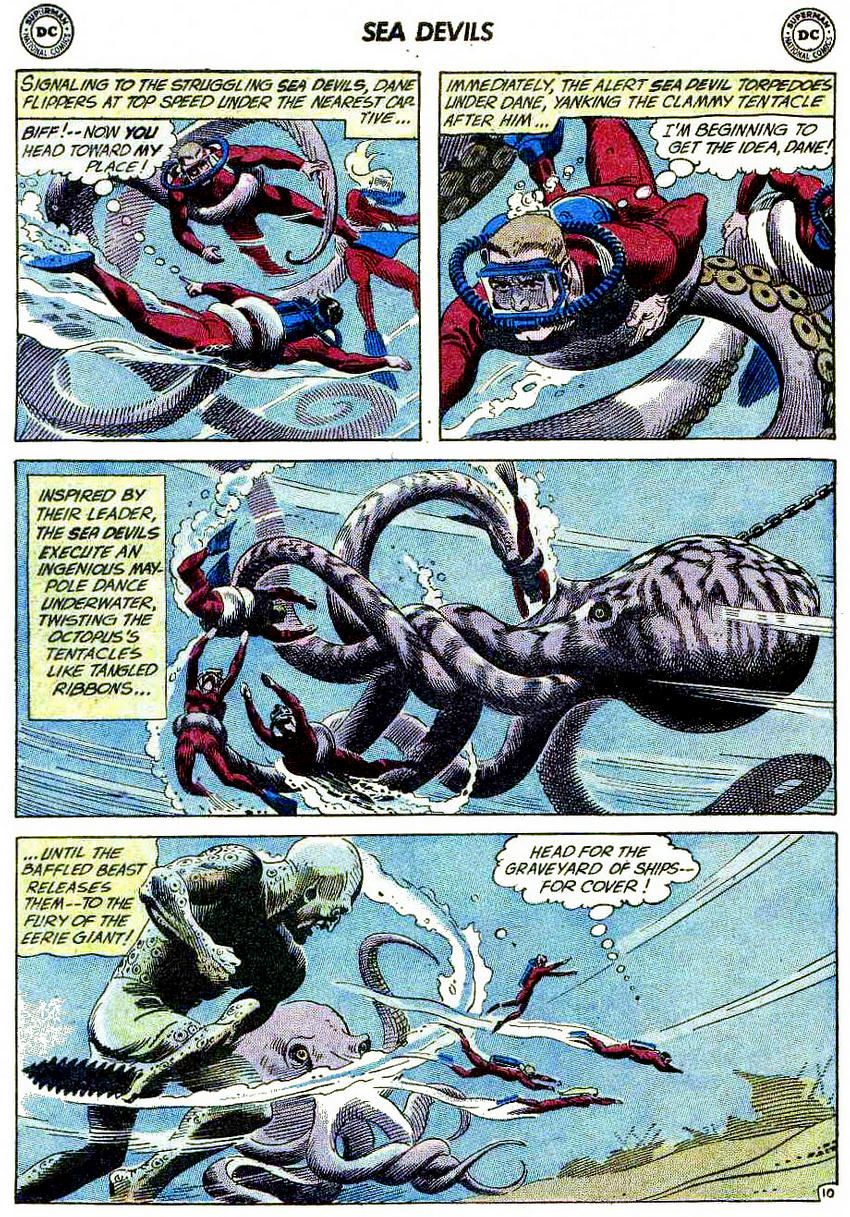
The Sea Devils vs. the Octopus Man! is scripted by Robert Kanigher and illustrated by Russ Heath.
The same team returns to tentacles with Sea Devils no. 6:
The Flame-Headed Watchman!, scripted by Robert Kanigher and drawn by Russ Heath, was published in Sea Devils no. 6 (July-August 1962).
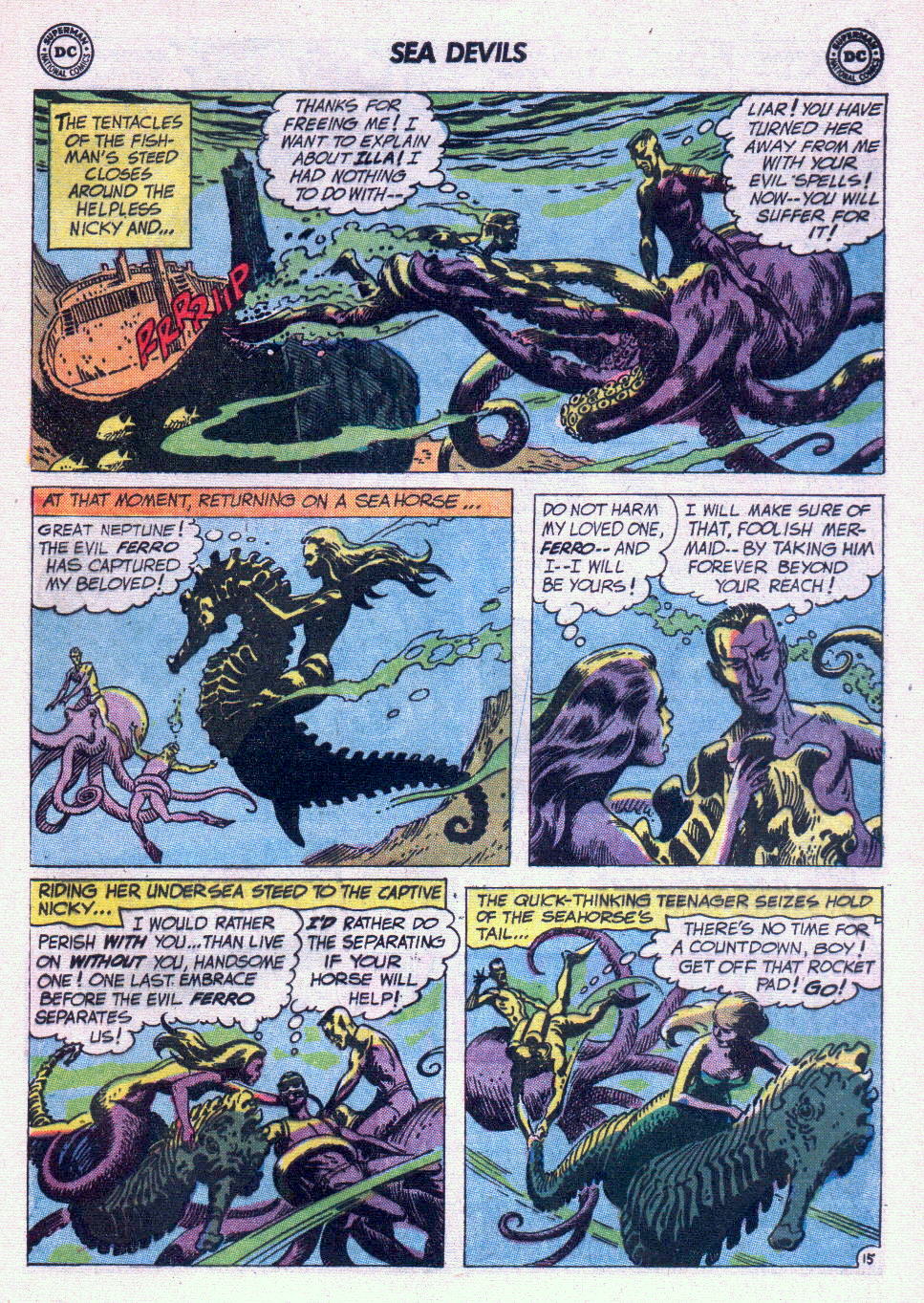
Now we unfortunately have to leave Heath behind and walk over to the territory of Howard Purcell, whose art is not nearly as striking, but still quite serviceable.
Sea Devils no. 17 (May-June 1964), cover by Howard Purcell.
The Impossible Maritime Menacesis scripted by Arnold Drake, penciled by Howard Purcell and inked by Sheldon Moldoff.
Sea Devils no. 19 (September-October 1964), cover by Howard Purcell. Is it just me or does the guy on the left look like a Ditko villain?
The Sea-Devil Robots is penciled by Howard Purcell and inked by Sheldon Moldoff.
Sea Devils no. 21 (January-February 1965), cover by Howard Purcell.
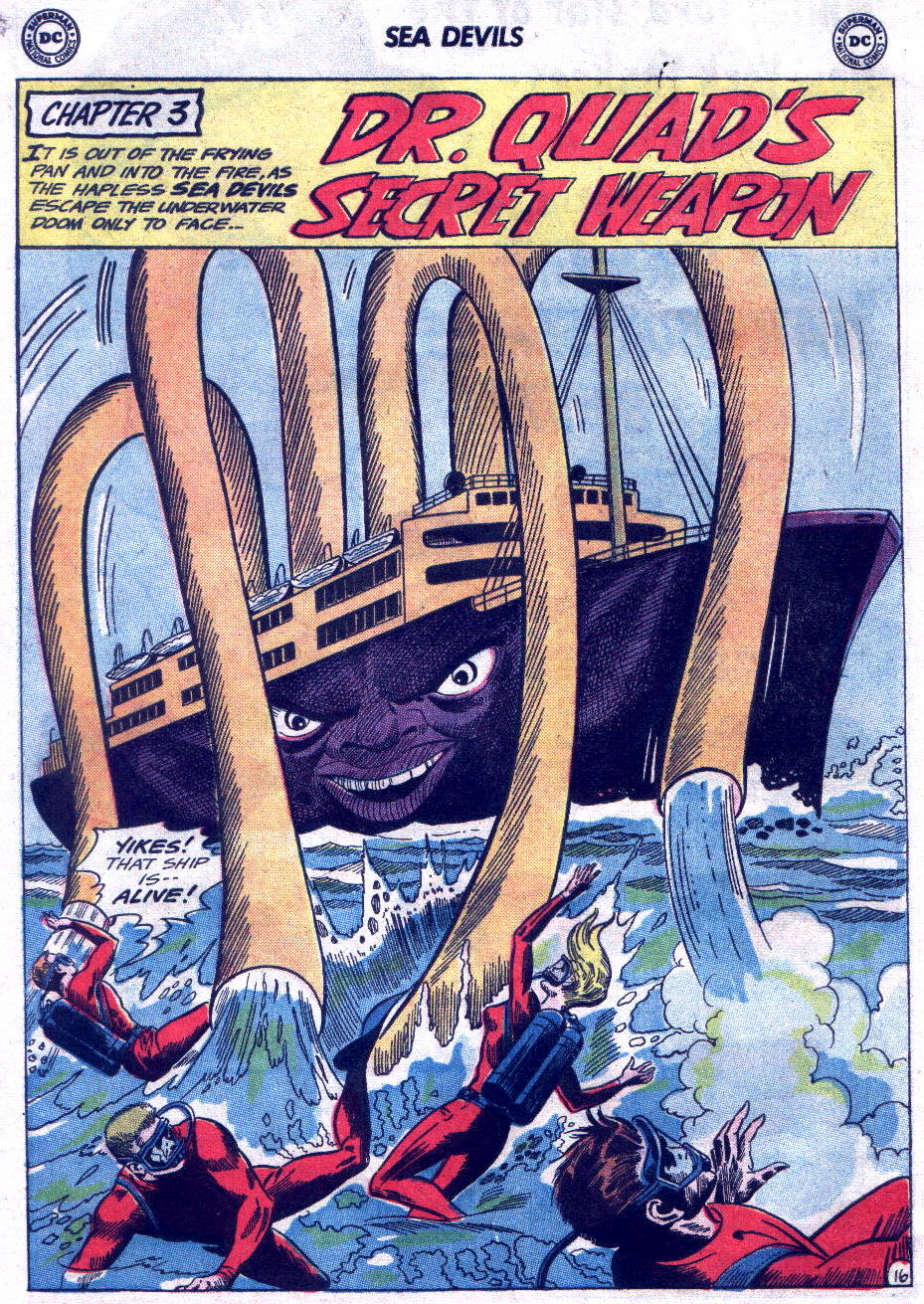
The Forty-Fathom Doom!, scripted by Jack Miller, penciled by Howard Purcell and inked by Sheldon Moldoff, boasts quite an assortment of tentacles:
Everybody is almost in identical position as on the cover – but the octopus has lost his baby blues and gained a pair of poached eggs.
And, in case you’re wondering where that quote at the top of this post comes from… The ‘heh, heh’-ing octopus is Dr. Quad.
« Knock it off, squiddo! You couldn’t make a class-B horror picture on earth — you’re not even good for a milk shudder! Better skeddadle, or I’ll tie your tentacles into a bow! »
Tentacles are no cause for levity, you say? Ha! Their place in all manner of spoofs and parodies (and other silliness) is ensured. Peppered with a barrage of puns (never undersell puns, please!), whimsical tentacular entanglements abound in literature… err, comic literature, at any rate, and that’s good enough for me.
I meant “entanglements” very literally. Story published in Not Brand Echh no. 11 (December 1968, Marvel); script by Arnold Drake, art by Marie Severin.
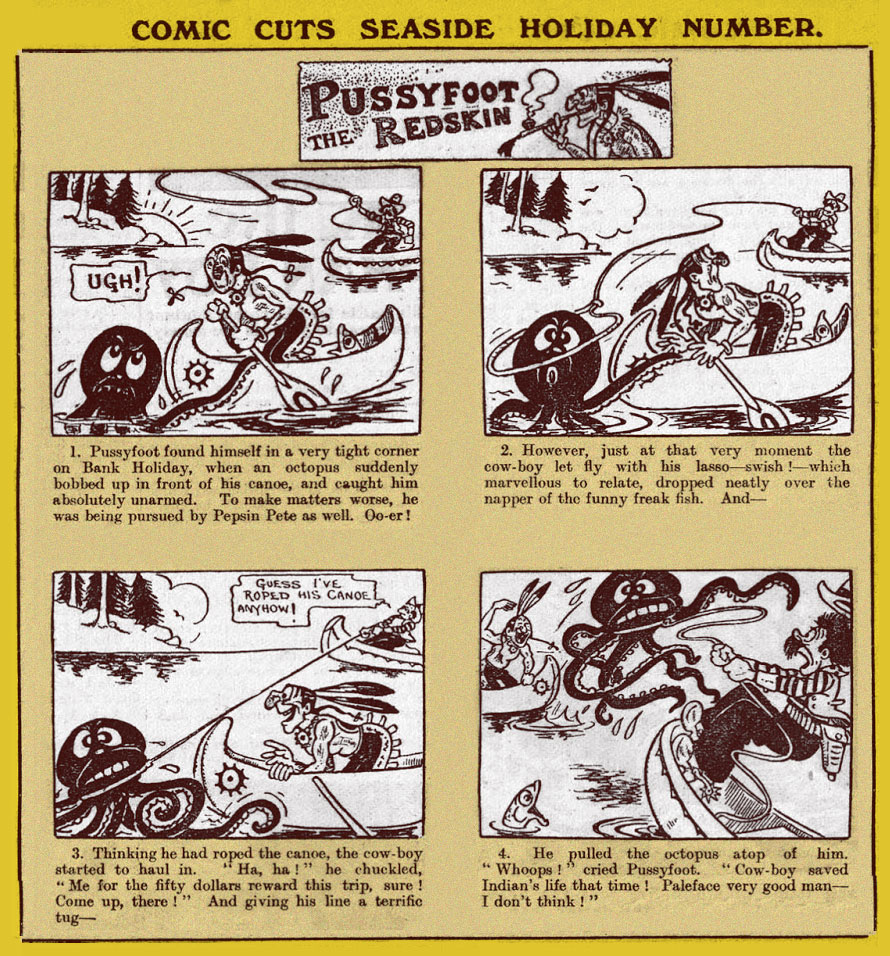
Even some 100 years ago (well, a little less), some unfortunate octopus could easily become a Figure of Fun if he wasn’t careful.
The story doesn’t say what happened to the freaking octopus, though. This edition of Pussyfoot the Redskin was printed in Comic Cuts no. 1735 (August 1923). Visit BLIMEY! The Blog of British Comics for more Comic Cuts.
I can’t mention équivoques and wordplay without mentioning Pogo, Walt Kelly‘s keenly intelligent comic strip. Sadly, this was the only appearance of Octopots, as far as I know (and I long to be corrected).
From Figmentality, from The Pogo Sunday Parade (1958). Art by Walt Kelly, of course!
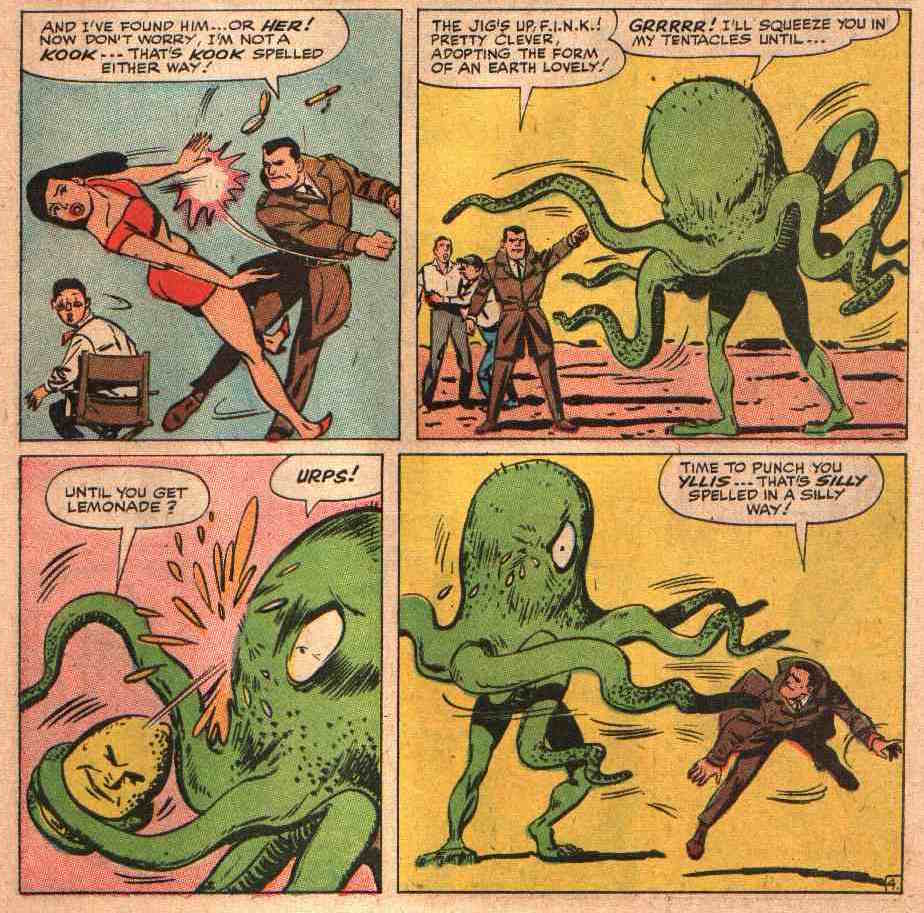
In the competitive world of jokes in bad taste, the man from SRAM probably takes the cake. It’s lucky that he has no qualms about hitting females, or the world would be doomed… although his mirthless monologue would probably kill the creature with sheer ennui.
Madhouse in Hollywood (Man from SRAM), scripted by Otto Binder and drawn by Carl Pfeufer, published in Jigsaw no. 2 (December 1966, Harvey).
On the other hand, Superman‘s creative insults can easily shame a thin-skinned Tentacled Terror (was his spaghetti-and-meatball crack some sort of early Flying Spaghetti Monster reference, even though the latter was only officially created in 2005?)
Superman no. 184 (February 1966). The story is The Demon Under the Red Sun!, scripted by Otto Binder (again; he clearly has some unhealthy attraction to tentacles, like the best of us) and drawn by Al Plastino. Figure out what’s going on in this story (or not, for there’s not a lot of logic to be found, anyway) at Mark’s Super Blog.
« Followers in death: Attendants and relatives who were killed so they could be buried in the tomb with the person (normally someone very important or wealthy) who had died. » — The British Museum
Let’s face it, Gold Key’s would-be-spooky comics rarely lived up to their habitually fine painted covers (mostly courtesy of hard-working George Wilson, with Vic Prezio, Luis Domínguez, Jesse Santos or Jack Sparling occasionally chipping in); as with most things, there were exceptions: I’ve raved earlier about a particular issue of the generally ho-hum Grimm’s Ghost Stories, namely issue 26, boasting, along with the usual Paul S. Newman sleep aids, two excellent yarns from the undervalued Arnold Drake (co-creator of The Doom Patrol, Deadman, and the original Guardians of the Galaxy).
Ah, but today, we’re celebrating Drake’s co-conspirator, the prolific Argentine master (yes, another one) Luis Ángel Domínguez, reportedly born ninety-five years ago to the day (Dec. 5, 1923), and still among the living… as far as we know. I like to envision him warmly surrounded by several generations of loved ones and well-wishers, an impish gleam in his eye.
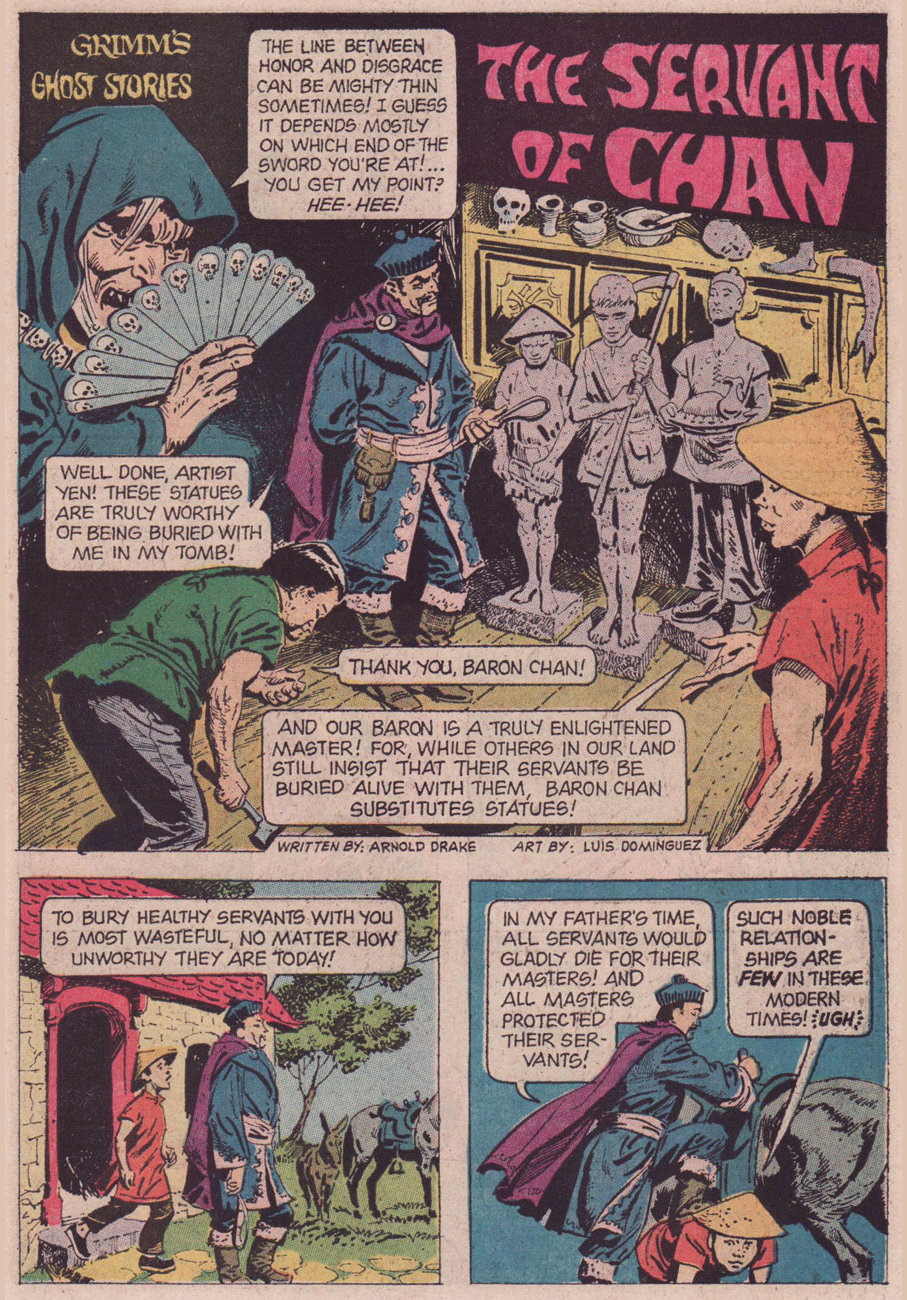
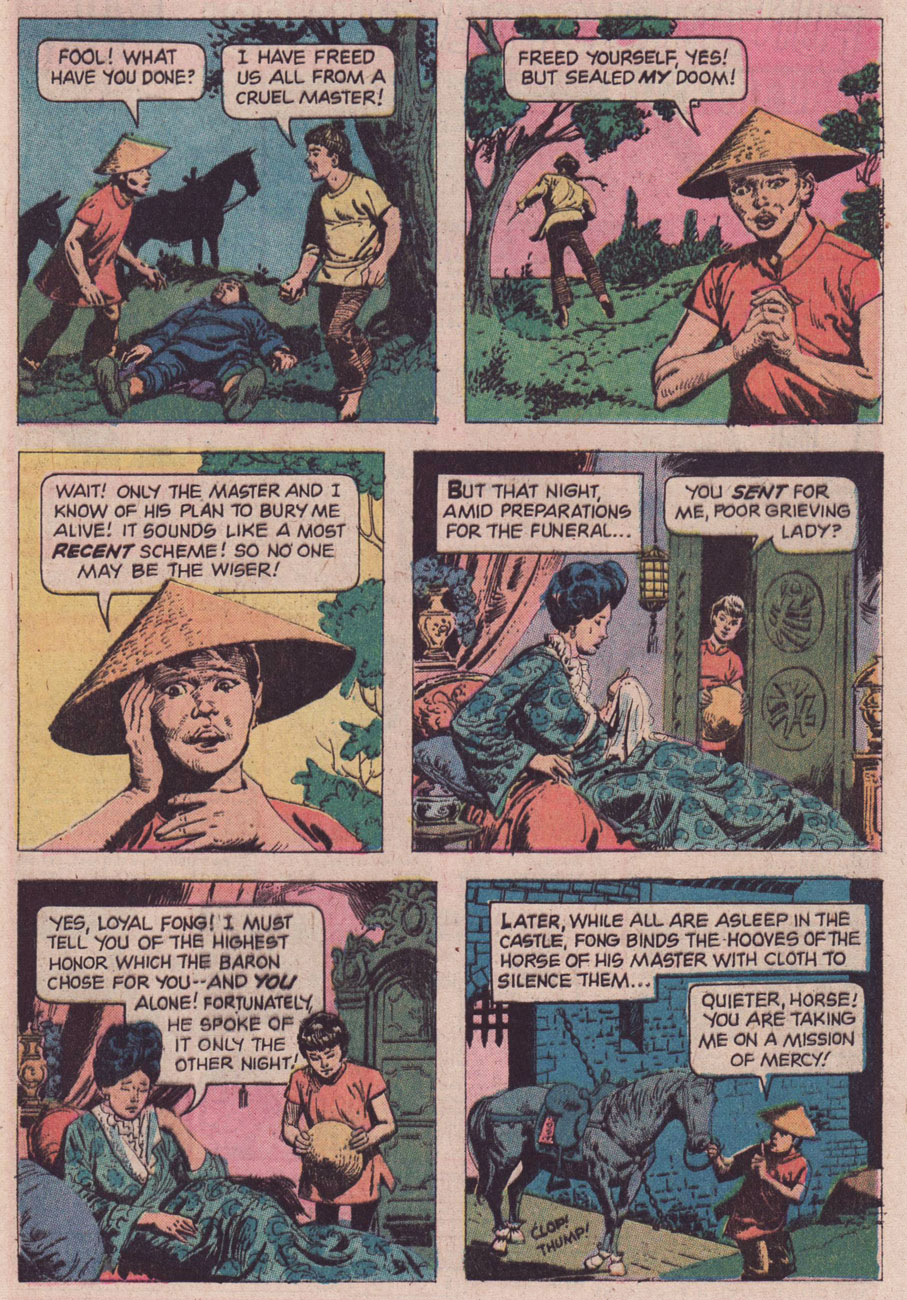
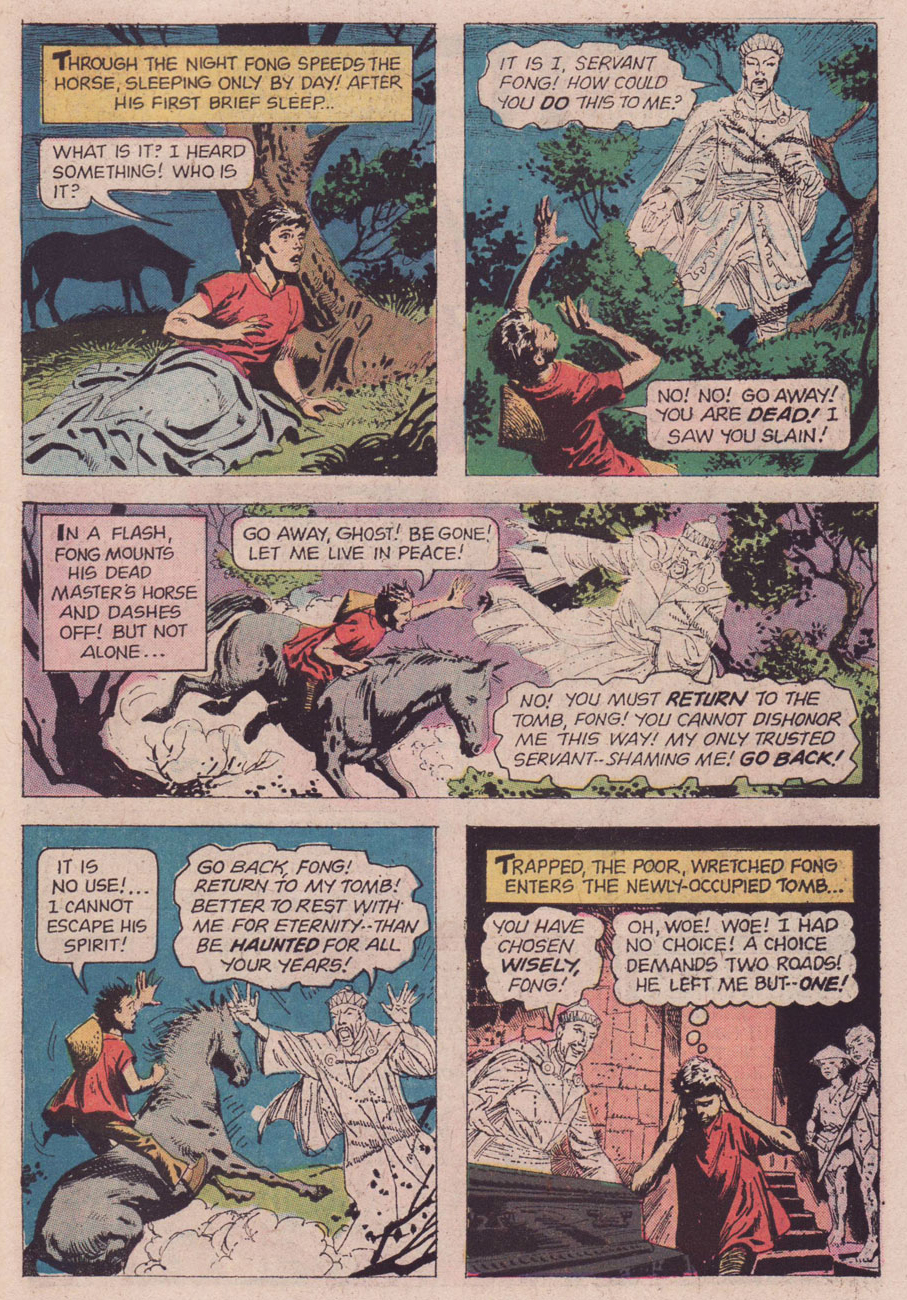
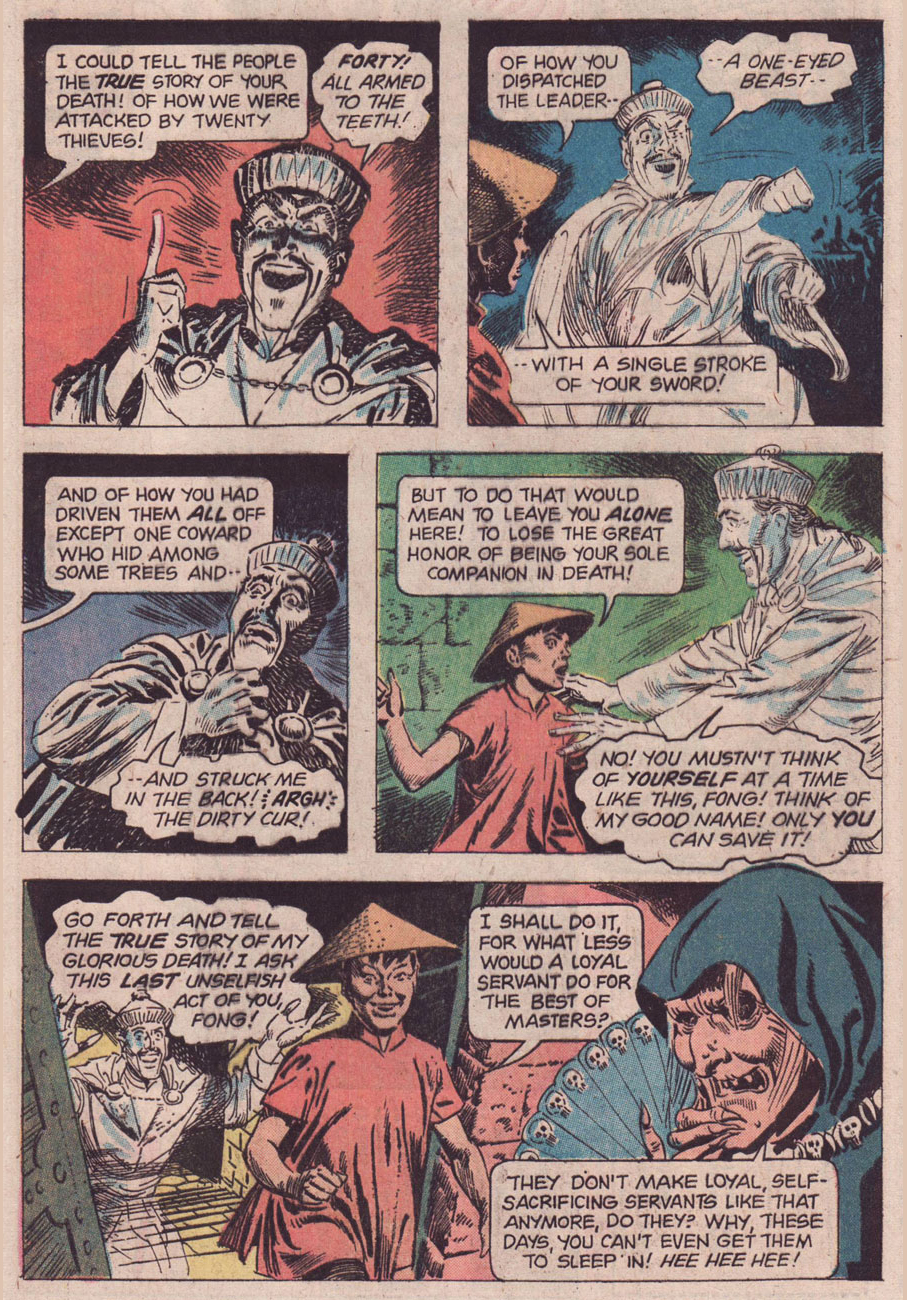
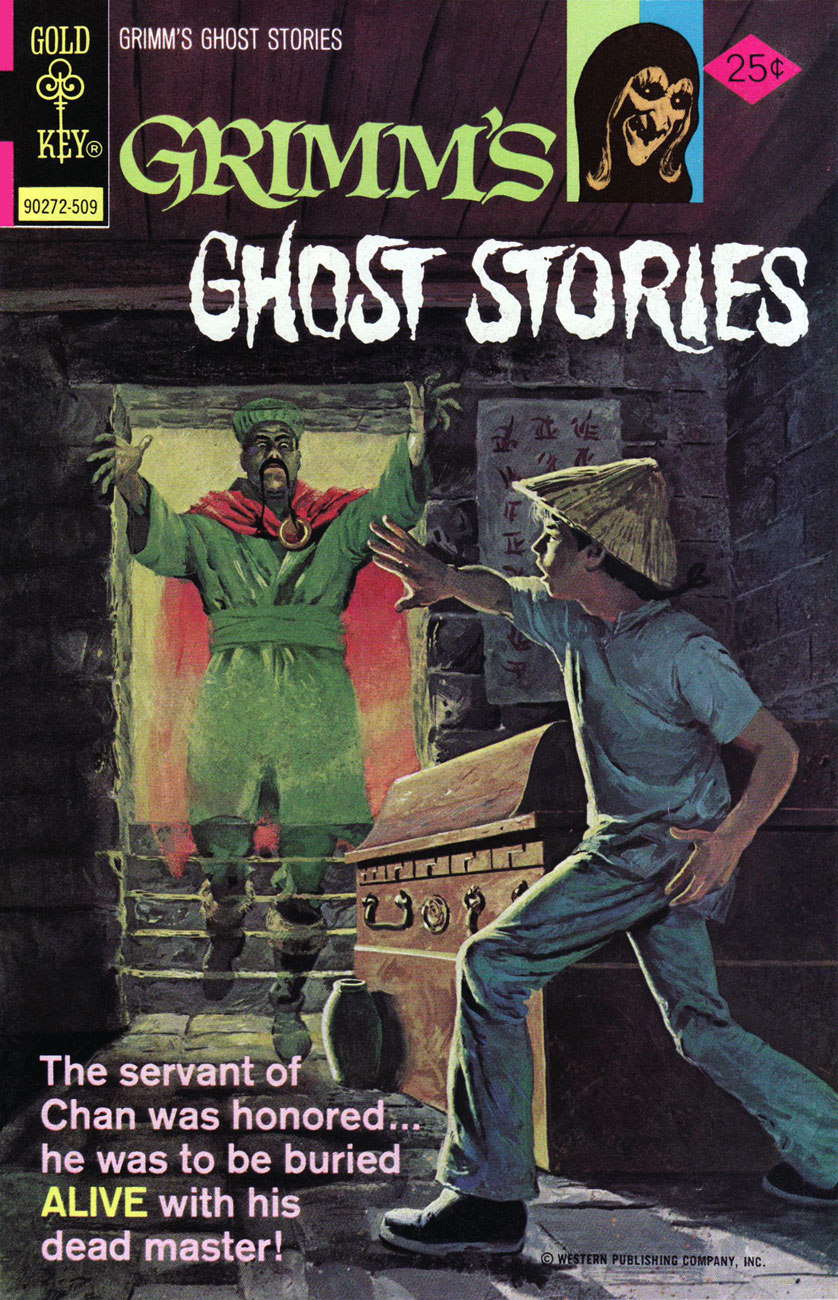
Without further foot-dragging, here’s a vintage tale of quick wits in ruling class hubris from beyond the grave, The Servant of Chan, by that dastardly duo, Drake and Domínguez.
George Wilson’s cover highlights a dramatic scene from our little story. This is Grimm’s Ghost Stories no. 26 (Sept. 1975, Gold Key).
« Slavery in ancient China was not a pleasant experience. The lives of slaves were filled with hardship. Many were abused. Many slaves were children.
Most people who were slaves worked in the fields, alongside of peasants. They did the same job, and had the same hours, and pretty much the same clothing and food, as free farmers. But they were not treated with the same respect given to farmers. Some slaves built roads. Some worked in government.
But slaves who worked for the emperor, the royal family, and sometimes the nobles, had the worst of it. They could only do what they were told to do. They were treated in any way that their master and his family felt like treating them. Many were treated with great cruelty. When their master died, they were killed, and buried with their master in his tomb, so they could continue to serve their master after his death. »
Brr. All the same, if you’ve enjoyed this yarn, check out Arnold Drake’s other contribution to this issue, The Anti-13, which we enthusiastically featured some time ago.
¡Feliz cumpleaños, Señor Domínguez… wherever you may be!
« It is Friday the 13th and you are right on time — ten minutes to midnight! »
The Anti-13 is that rarest of creatures: an unflinchingly skeptical tale published in the pages of a supernatural-themed comic book in the midst of the 1970s occult craze. Hats off, folks!
As the thirteenth fatefully falls on a Friday this month, I’m inspired to trot out a story from my very favourite issue of Gold Key’s Grimm’s Ghost Stories no. 26 (Sept. 1975). So what elevates this particular entry above its brethren? Admittedly, the competition from other issues is pretty tepid. Truth be told, though, all comers are swept out the door by a winning pair of yarns from the great Arnold Drake (1924 – 2007, co-creator of The Doom Patrol, Deadman and the original Guardians of the Galaxy): The Servant of Chan (illustrated by Luis Dominguez) and this one, the bracingly skeptical The Anti-13 (illustrated by John Celardo).






























 Who's Out There?