« Bicycles are pieces of art. You get that combination of kinetic engineering, but then, besides the welds, the paint jobs, the kind of the sculpture of it all is quite beautiful. Bikes have such great lines, and all different styles. » — Robin Williams
I’ve been cycling a lot more of late. I’d been using my bike less frequently in recent years, unnerved by the increasingly frantic (and distracted, not a good combo) vehicular traffic of the city. But with my wife taking an interest in the activity, I found myself with a reason to get back in the saddle. This spring, we found a newly opened bike shop, earthy, grimy and unpretentious, where we got our bikes expertly tuned up.
I’ve always loathed those cliquish hipster joints that, in addition to selling overpriced junk, also seem responsible for the ubiquity of those middle-aged, over-equipped, spandex-clad Sunday cyclists, who feel it their sacred duty to pass you, whatever the pace, weather or road conditions, looking for all the world like overstuffed sausages in their lycra casings. The sporting analogue, if you will, of the rich kid who ‘needs’ the most expensive guitar in the shop… never mind that he can’t play a note.
You hopefully will indulge me in this little exercise in nostalgia. I miss the days when our bikes got us around, granted us greater autonomy and kept us in shape. This lifestyle took a backseat in the 1980s, when the BMX craze began to overstate the extreme and the competitive facets of the sport. Now, it’s all ultimate sport this and boot-camp fitness that. Ah, whatever happened to plain old utilitarian fun?
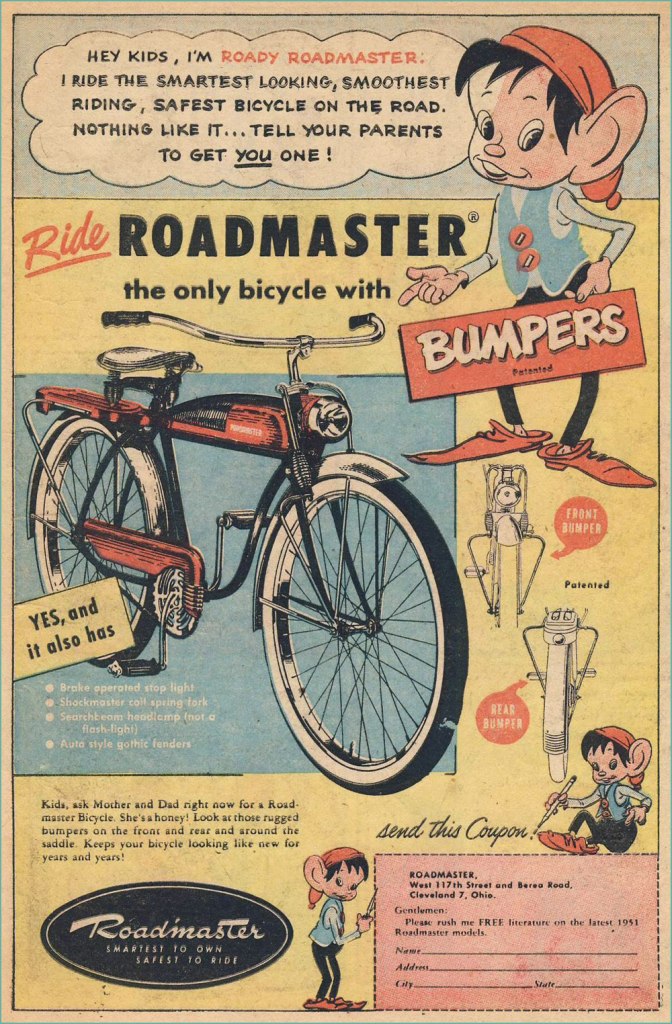
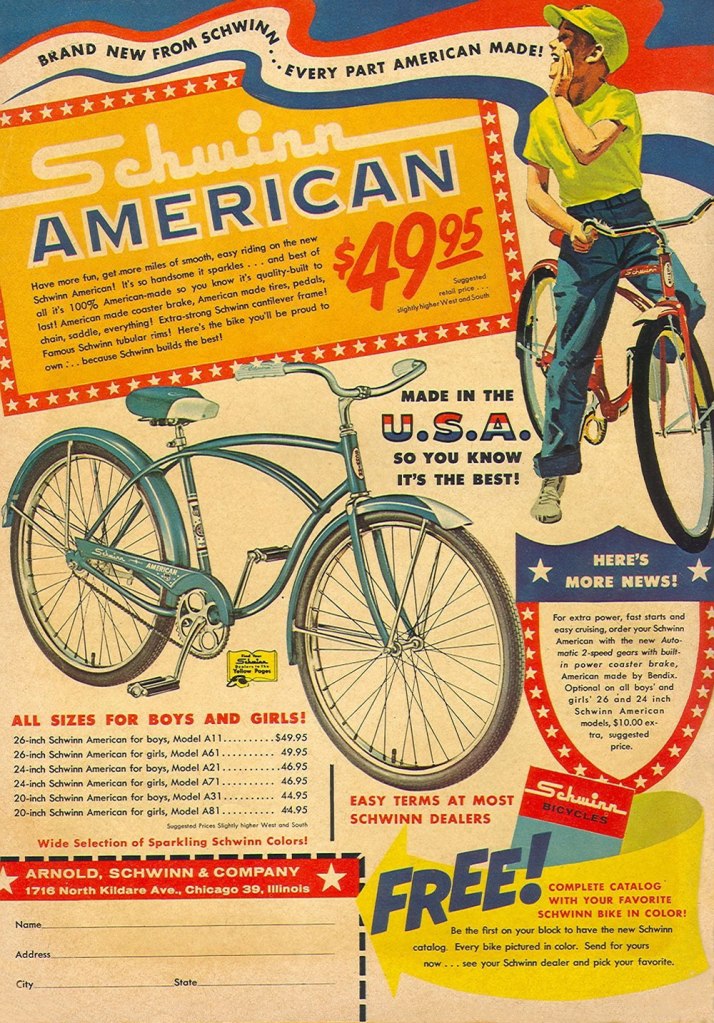
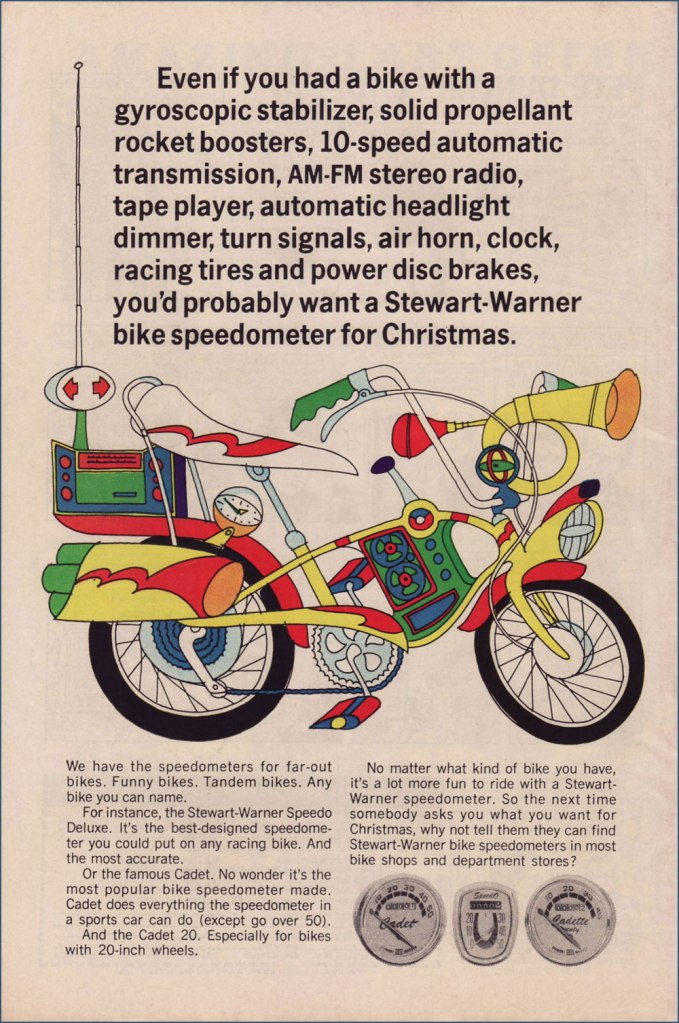
Judging from this ad (circa July, 1951), bicycle makers were trying to make their steeds mimic the clunky look of the era’s motorcycles. Aesthetics would soon improve. Here’s a fairly typical ad, circa 1961. Free catalogue, not to mention a healthy dollop of American jingoism, like it or lump it. Speaking of Schwinn, check out their well-produced promo comics Bicycle Book, from 1949.Ah, yes, the U.S. Royal twins, Roy and Al. In the tradition of the accidentally named Smith Brothers, “Trade” and “Mark”. Unsurprisingly, scouting magazine Boys’ Life was an ideal market for bike-themed ads. This one appeared in the May, 1966 issue. Artist unknown… anyone?You can tell how important the bicycle scene was: not only were manufacturers hawking bicycles, but there was also the ‘aftermarket’ trade of gizmos and doodads. I’ve long supposed ‘speedometer’ to be a dumbed-down term for a tachometer. Even after consulting this ‘helpful’ chart, I’m still not convinced it isn’t. To quote sometime Beach Boys lyricist, DJ and racing enthusiast Roger Christian: “Tach it up, tach it up / Buddy, gonna shut you down.“
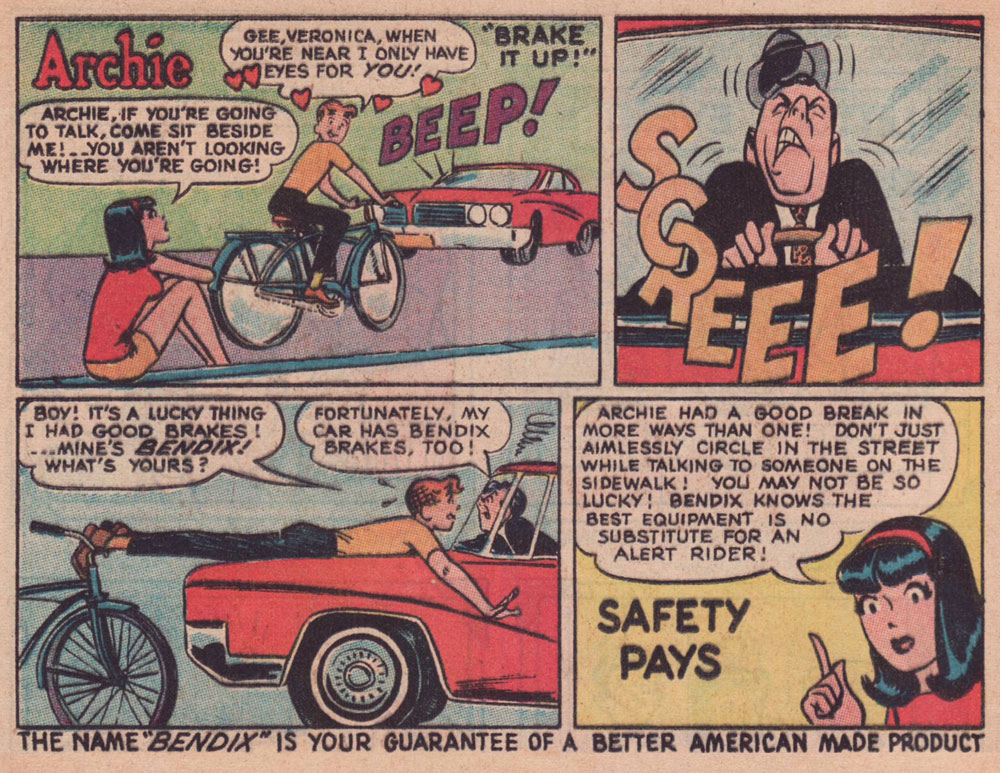
Through much of the 1960s, Bendix (the corporation, not Bill!) commissioned a long-running series of custom ads featuring the Riverdale Gang, illustrated by resident Archie artist Harry Lucey.
This one’s from April, 1965.Archie, the voice of reason? Only in ads and public service announcements. This one’s from October, 1966.This one’s from July, 1968.Ah, that’s more like the Archie Andrews we’re accustomed to. This one’s from August, 1968. I daresay we’ve all encountered too many such ‘cyclists’.An apt reminder that the rich kids always did boast the best, most up-to-date equipment, whatever the sport. Also, I can’t help but think that the cape and tiger tail are just kind of… reckless. Clearly, corporate shill Tigerboy is failing to heed the lessons of Isadora Duncan’s tragic death. Thanks to the ever-thrilling Jack Davis artwork, this is the unsurpassed classic among bicycle ads. It appeared in select DC and Archie titles cover-dated November, 1968. While banana seats may be considered in most quarters as retro kitsch, I earnestly hold that they were bold and cool. Aesthetic and structural experimentation had arrived at the forefront of the cycling industry. This ad appeared in comics cover-dated February, 1969. And here’s a look at a (flawlessly) surviving model. Man, the elegance of those lines!
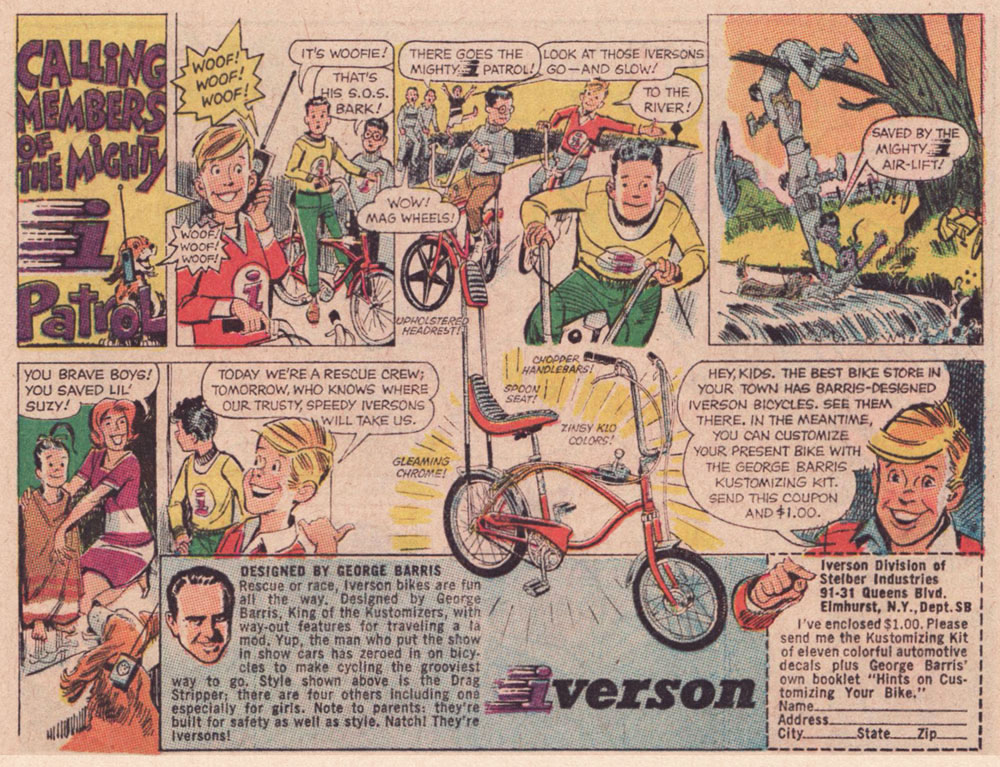
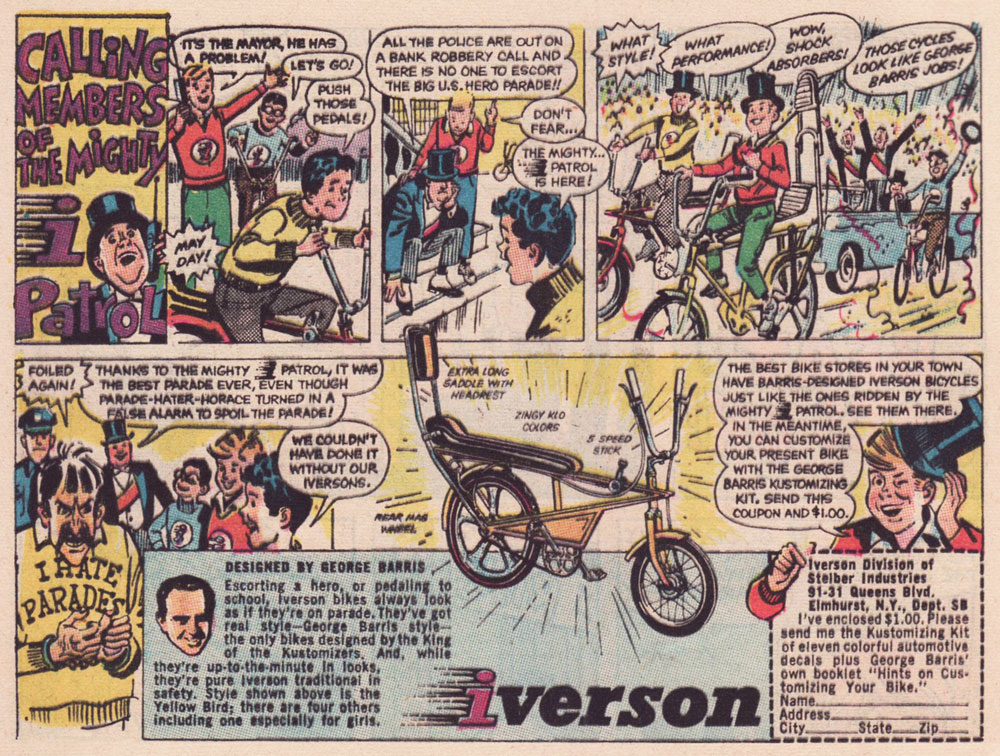
As the 1960s drew to a close, another series of custom comics ads appeared — just under the wire. They spotlight the creations of the famous ‘King of the Kustomizers’, George “Barris” Salapatas (1925-2015), very much in demand thanks to his recent triumph with the Batman tv show’s Batmobile.
This one appeared in various DC titles cover-dated November, 1969. If I had to take a stab at artistic attribution, I would go with the versatile Creig Flessel (1912-2008). Something tells me that in real life, the human chain stunt the Mighty i Patrol pulls would have led to four drowned kids instead of just one — but I’m sure Woofie would have dog-paddled his way to safety.This one appeared in DC titles cover-dated December, 1969. Read a gripping first-hand account of working on the assembly line at the Iverson bicycle factory, circa 1975!I’m assuming that the kid with the sombrero nicked it from Bazooka Joe’s kid brother Pesty. This final adventure saw print in DC titles cover-dated January, 1970.This, however, is the advert that really worked on me. When I got my first grown-up ten speed bike, a few years later, it was a Browning, which lasted me at least a quarter-century, until it snapped right at the load-bearing juncture of the rear fork… the one place where even welding wouldn’t help.
I switched to my backup, a hybrid bike I bought in 1987. It’s still running beautifully. In terms of value for money, a well-maintained bicycle is pretty unbeatable.
My well-thumbed copy of Adventure Cycling in Europe (1981). « Say, Uncle John, did Browning replace you with a pretty-boy model for your comic book ad? » « They sure did, but you know what’s even worse? » « I don’t know, Uncle John, what is? » « I don’t even have a nephew either! » All kidding aside, though it’s over forty years old, it’s still an insightful, entertaining and helpful book. When you go low-tech, change occurs at a slower, more forgiving pace.
I leave you with a song, whence comes the title of this article. It’s from a lesser-known but excellent Donovan album, Open Road, from 1970.
« Everything that happened to Archie happened to me in school, except that Archie always seemed to get out of it. » — Bob Montana
Despite the hundreds, if not thousands, of variably-abled hands that have toiled in the Archie Comics salt mines, the most important set of mitts devoted to the task was also the very first.
Archie creator Bob Montana* (1920-1975) knew what he was doing from the git-go. After all, he rubbed shoulders with the characters’ real-life counterparts from the Class of 1940: according to a 1989 Associated Press story, his buddy ‘Skinny’ Linehan became Jughead, football hero Arnold Daggett became Big Moose Mason; principal Earl MacLeod gave us Mr. Weatherbee and school librarian Elizabeth Tuck inspired Miss Grundy… and so on.
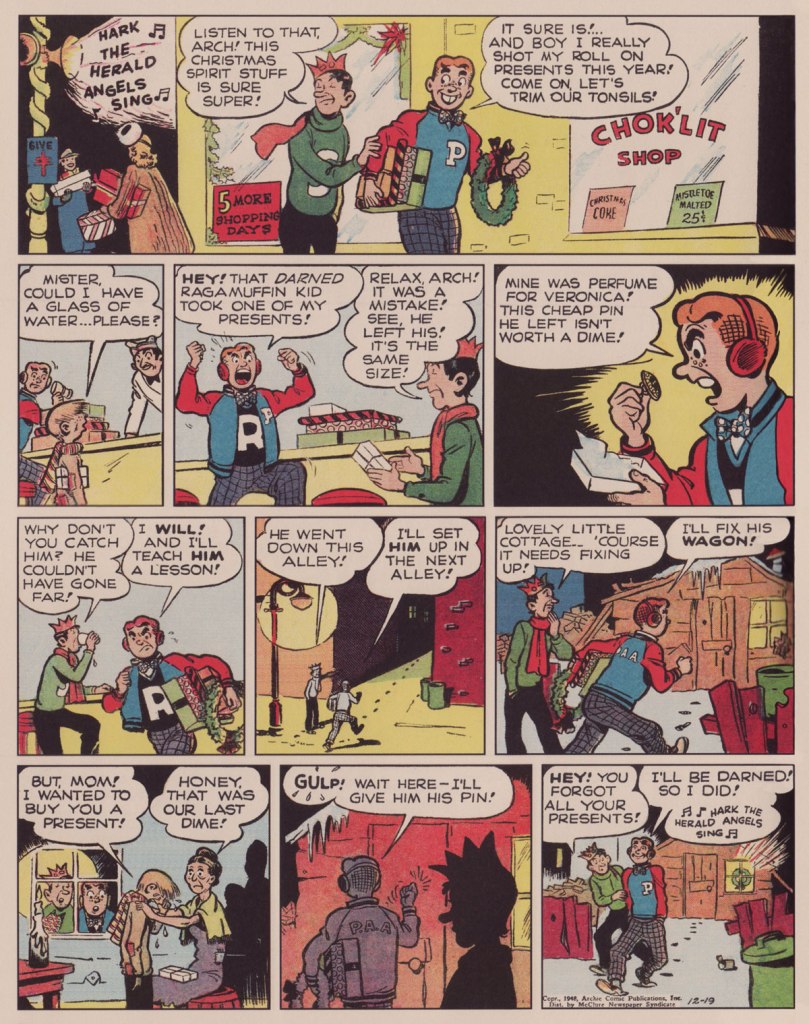
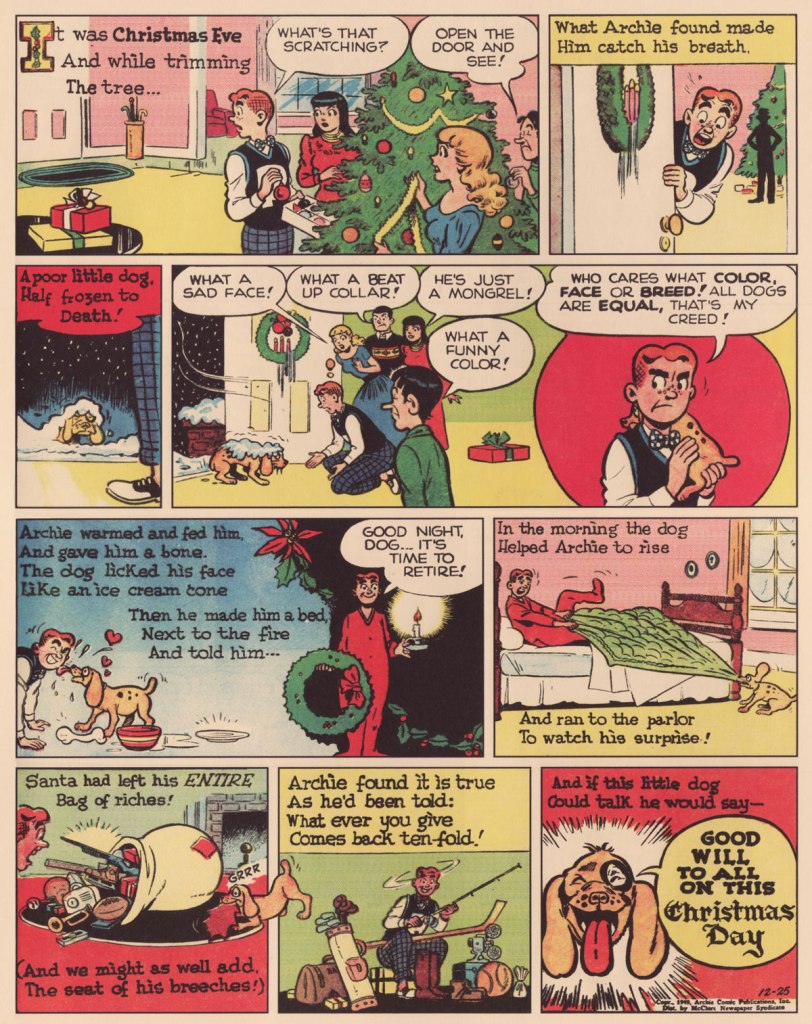
Montana was also that rare cog in the Archie machine: an autonomous writer-artist. This served him well in the newspaper strip world: he débuted the Archie feature in 1946 and remained in charge, dailies and Sundays, until his 1975 passing. I do prefer Samm Schwartz’s Jughead, but Montana drew the definitive version of every single other member of the Riverdale ensemble. In particular, as you’ll witness, Betty and Veronica were never slinkier.
The Sunday, December 22, 1946 strip.The Sunday, December 21, 1947 strip.The Sunday, December 19, 1948 strip.The Sunday, December 26, 1948 strip.The Sunday, December 25, 1949 strip.
And a bonus New Year’s-themed one for the road!
The Sunday, December 28, 1947 strip.
And with this… Merry Christmas, everyone!
-RG
*On the Archie plantation, as with the Harvey gulag, we can safely dismiss the founders’ specious and strident claims of having created their cash cows. In this case, Archie “creator” John Goldwater‘s original mandate to Montana was essentially to riff on popular radio show The Aldrich Family (1939-1953).
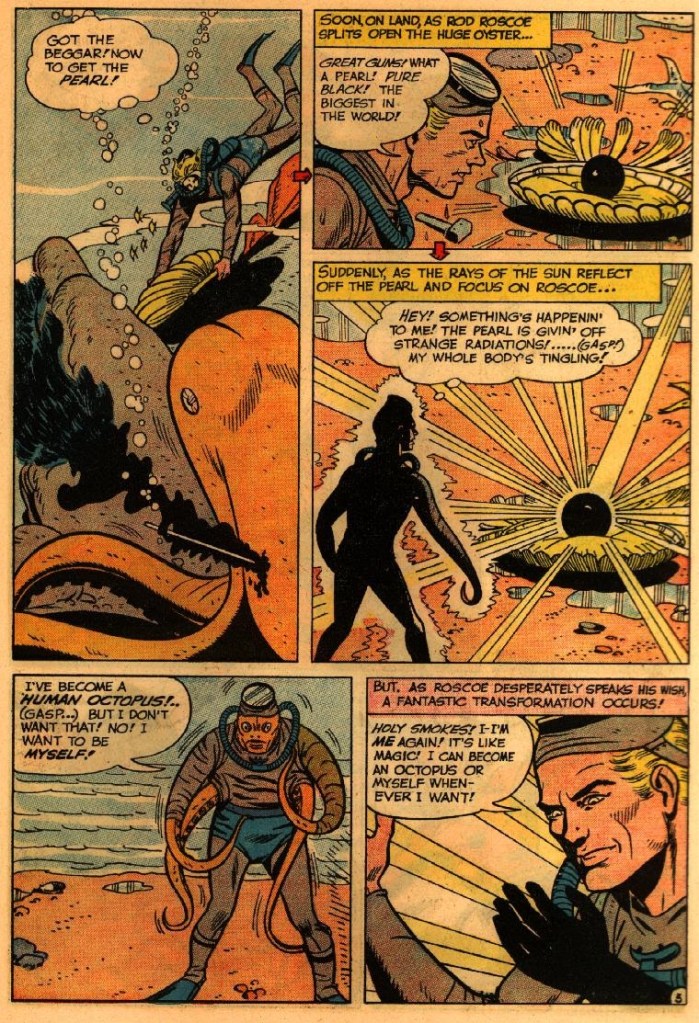
« Let’s just say you weren’t born to be an octopus… only a poor fish! »
Salutations on this most diverting day of the week, Tentacle Tuesday! Today, we take a little trip to the 60s… but perhaps not the 60s as you remember them, those who were around back then.
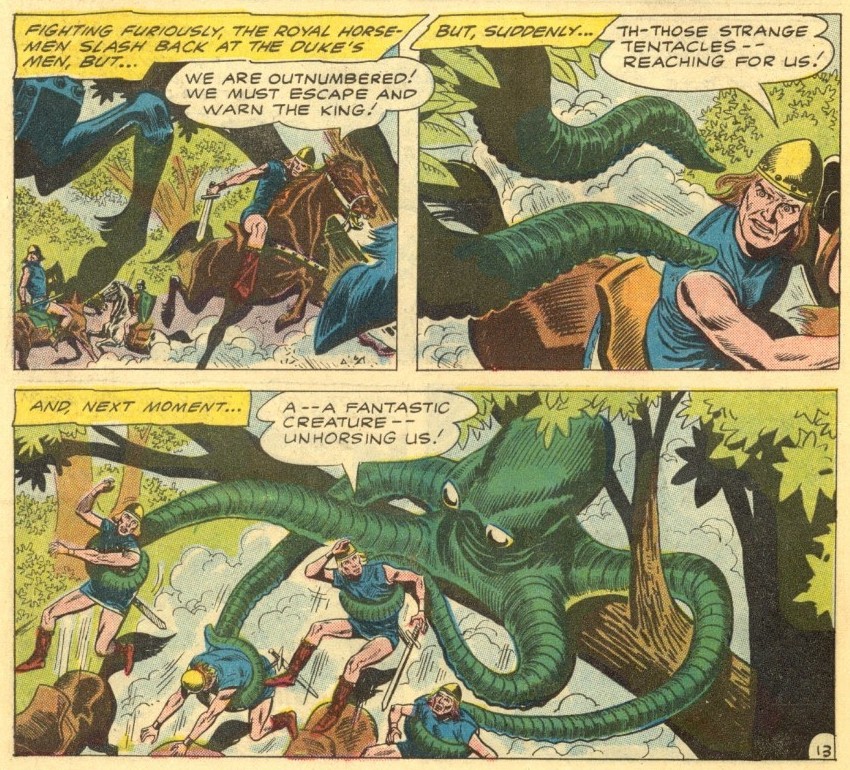
Rip Hunter… Time Master no. 3 (July-August 1961); pencils by Ross Andru, inks by Mike Esposito.
Rip Hunter was created by Jack Miller and Ruben Moreira – the “Time Master” part is explained by Hunter’s invention, the Time-Sphere, that allows him (obviously) to travel through time. Other characters in Rip’s world include his girlfriend, Bonnie Baxter, and Bonnie’s kid brother Corky (who’s being grabbed by a tentacle on this cover). Maybe Corky was spotted as an imposter because he’s wearing jeans instead of yellow pantaloons? Fashion can be quite goofy in some of these far-away, long-long-ago kingdoms…
Page from The Duke with the Creature Powers, scripted by Jack Miller, pencilled by Ross Andru and inked by Mike Esposito.
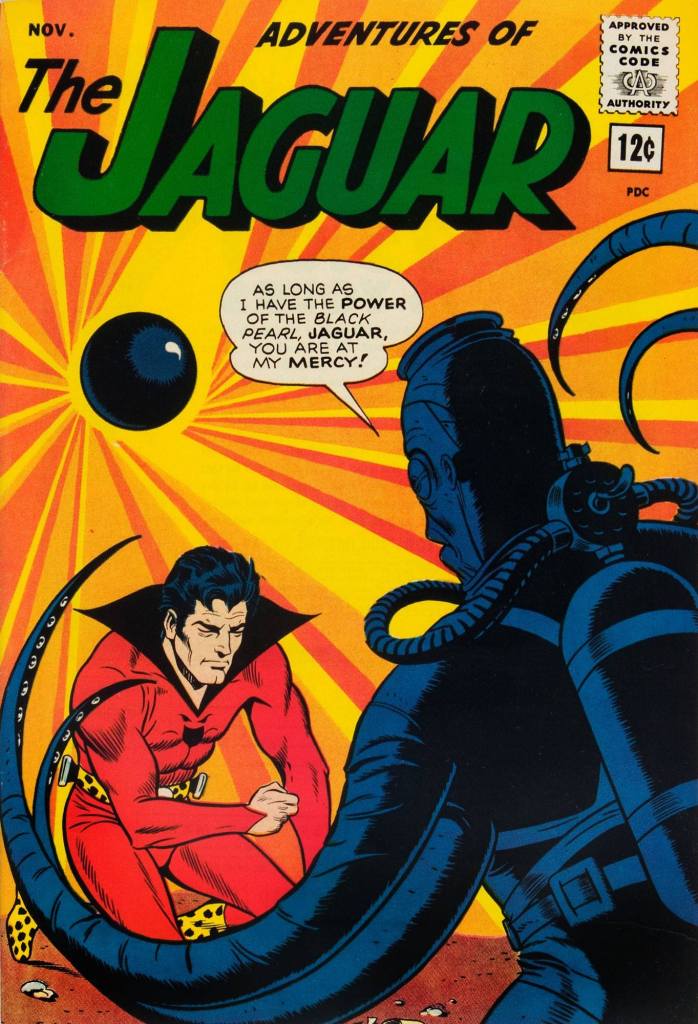
When The Jaguar gets into trouble with The Human Octopus, you know the Jag is going to come up trumps, mostly due to the fact that he has all powers of the animal kingdom at his disposal, whereas the Octopus has to make do with some unconvincing tentacles and an evil stare. The Jaguar (or zoologist Ralph Hardy, in his everyday life) was created by Robert Bernstein and John Rosenberger as part of Archie’s “Archie Adventure Series”.
This is the last issue of this series: Adventures of the Jaguar no. 15 (November 1963, Archie), with a cover by John Giunta.
Some fodder for your nightmares? Of course!
Who wouldn’t want to become a HUMAN OCTOPUS!…? The Jaguar versus the Human Octopus! was scripted by Robert Bernstein and illustrated by John Giunta.
I believe Hawkman needs no introduction (although I will mention that he was created by Gardner Fox and Dennis Neville!), and we don’t have time for one, anyway, seeing as he’s currently stuck between a dragon and some tentacled nest-creature.
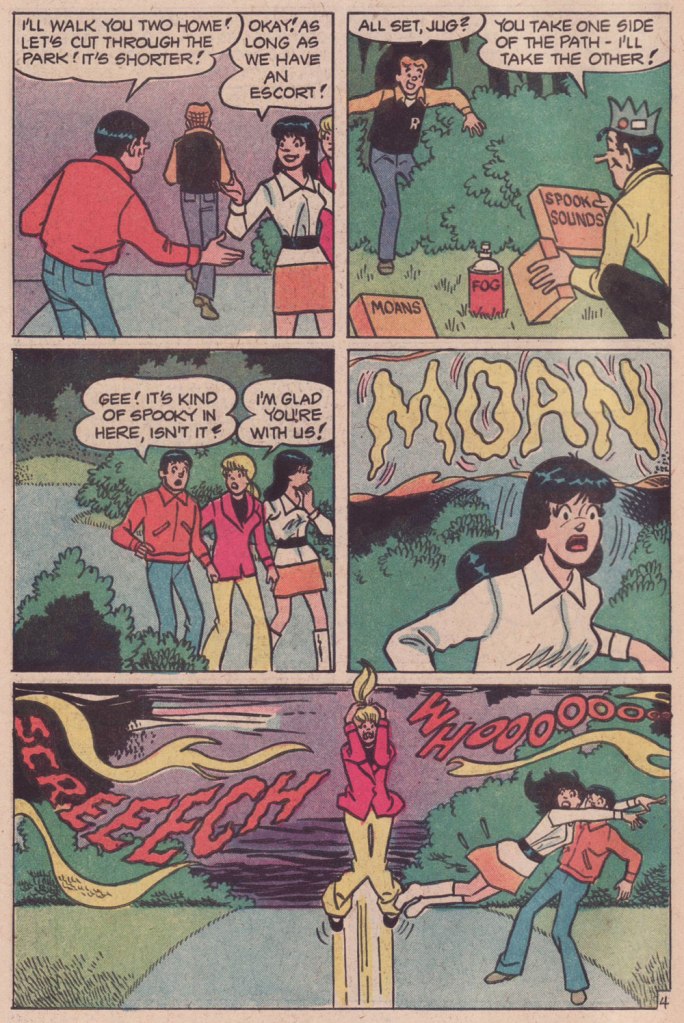
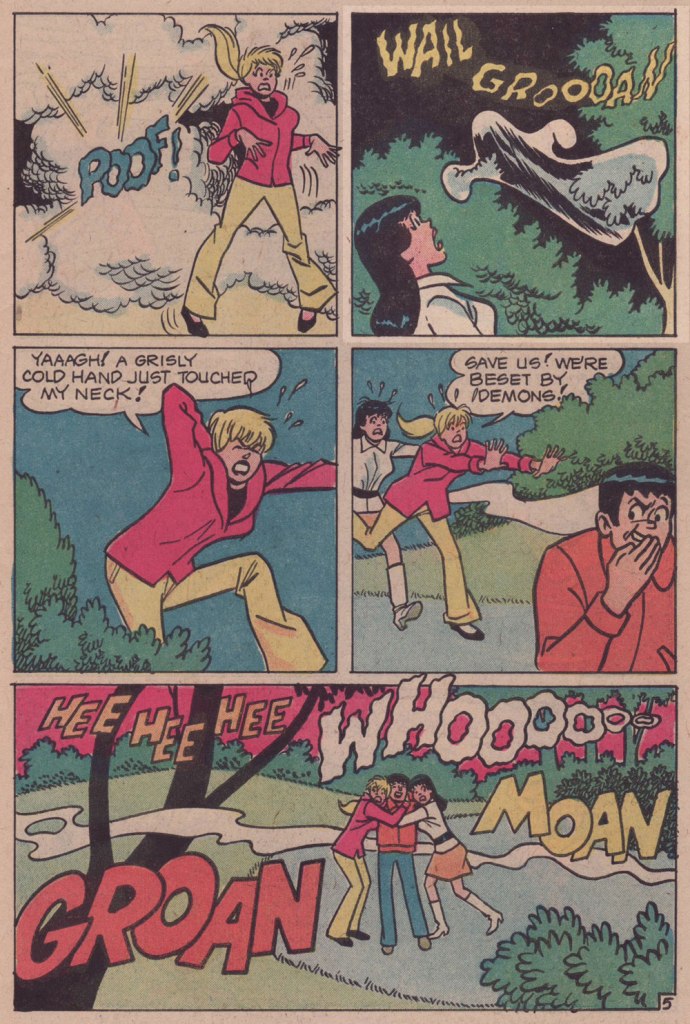
« How could you be so sure? … they could be real! » — Reggie Mantle, believer
Sure, it’s a hoary ol’ plot, used both to comedic and dramatic effect a gazillion times, but… as is often the case, the plot is more or less accessory. I always enjoy an Archie comics story that reminds us that these kids have known one another forever (from their perspective — not in the sense that they’ve been around since the 1940s, that’s too metatextual). With Archie for the most part being someone things happen to, as opposed to a catalyst — one who sets events into motion, I’m rather more interested in the adversarial (and sometimes collaborative) relationship between Reggie and Jughead… when it’s properly explored.
As with the previous Samm Schwartz story I spotlighted, Tee for Three, Dilton’s garage plays a key part. Intriguing…
Beasties of the Night originally appeared in Jughead no. 279 (Aug. 1978, Archie). It was scripted by Frank Doyle (1917-1996).
*No, I am not referring to the popular company that lets customers hire favourite ‘stars’ to record personalized videos; a month ago, I didn’t even know this existed, and my life has not been improved by this knowledge.
Sometimes an octopus stays politely in the background, waving hello shyly from behind a rock, or waiting for a dance invitation like a bashful kid at a high-school dance (do they still have these?) I never know where to use these covers; their tentacled nature is undeniable, but their octopuses are so peripheral to the main story that they tend to be overlooked when I am in search of a unifying theme for a post.
cam·e·o/ˈkamēˌō/
a small character part in a play or movie, played by a distinguished actor or a celebrity.
a piece of jewellery, typically oval in shape, consisting of a portrait in profile carved in relief on a background of a different colour.
I’m not sure this counts as a “portrait in profile”, but I will happily accept it as a cameo.
All right, on to the comics…
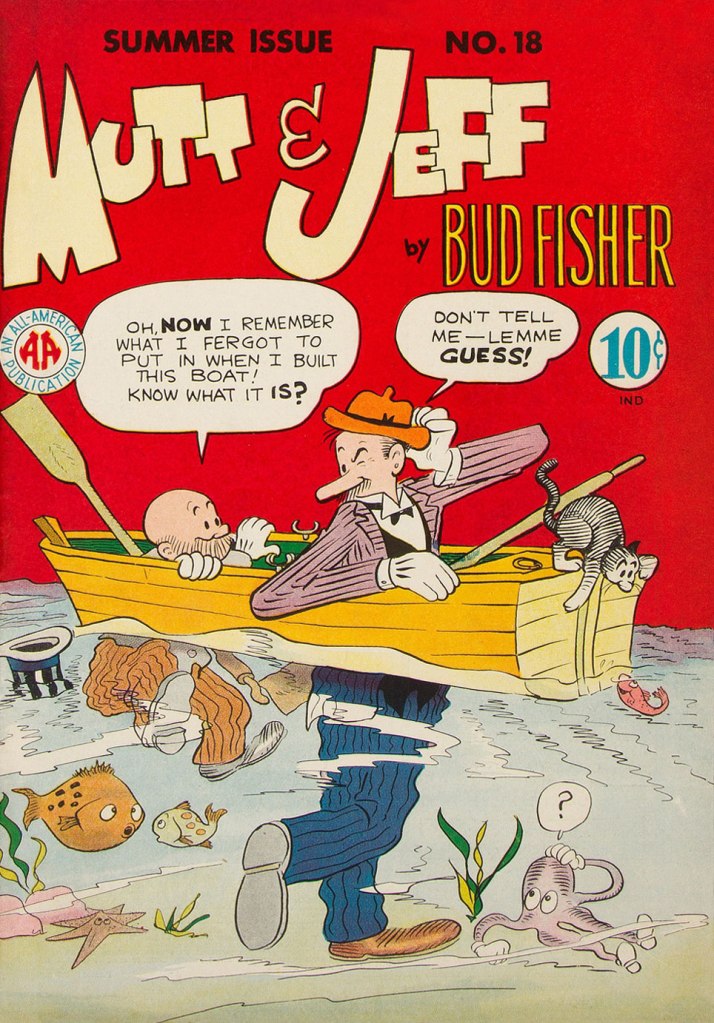
Mutt & Jeff no. 18 (Summer 1945, All-American). Cover is by Sheldon Mayer. So the octopus has only four tentacles, but he’s a cutie!
Treasure Chest vol. 22 no. 9 (December 1966, George A. Pflaum). Cover by Reed Crandall. This cover is of course dedicated to Jules Verne.
Treasure Chest, a long-running catholic publication we mention routinely though not too often (for details, see co-admin RG’s Hallowe’en Countdown IV, Day 24), runs the gamut from informative to fun, sometimes both at the same time. There are occasional clunkers (like the admittedly rather entertaining multi-part story I am currently reading about Godless Communism), but overall it’s well worth picking up, should some issue catch your eye.
Can you spot the octopus, right there in the window? He’s all set to escape, I think. Bonus: bats! As the top says, this is a strip from June 1970, scripted by Brant Parker and Johnny Hart, with art by Parker. These two have created The Wizard of Id in 1964, so this strip has been around for quite a while…
I originally had in mind happy, frolicking octopuses for this post, so here is one instance of just that. As a matter of fact, his smile is somewhat unnatural and more of a rictus, but I don’t want to be picky…
Bunny no. 14 (March 1970, Harvey). Cover by Hy Eisman. More (dubious) puns than one can shake a stick at… it’s almost like reading a Piers Anthony novel.
I’ll quote from Don Markstein’s excellent summary of this hare-brained comic series: « Bunny was aggressively, even obsessively trendy. Even at the time, it seemed to lay on the love beads and “psychedelic” display lettering a bit thick. […] But she owed her painfully discordant Sixties-ness to nobody. […] It’s as if her entire raison d’être was to parody the decade of student activism and radical youth fashions, even while living it. To make matters worse, this teenage girl comic was edited, written and drawn by middle-aged men who were probably, like most middle-aged men, unable to communicate with their own daughters. To vary the dialogue, in which everything that wasn’t “groovy” was “outasight”, they made up their own slang. Things could also be “zoovy” or “zoovers” or even, in extreme cases, “yvoorg” — which was obviously “groovy” spelled backward, but no hint was ever given as to how it might be pronounced. »
« Coming to play golf is not what I would consider to be an essential purpose. » — Nicola Sturgeon
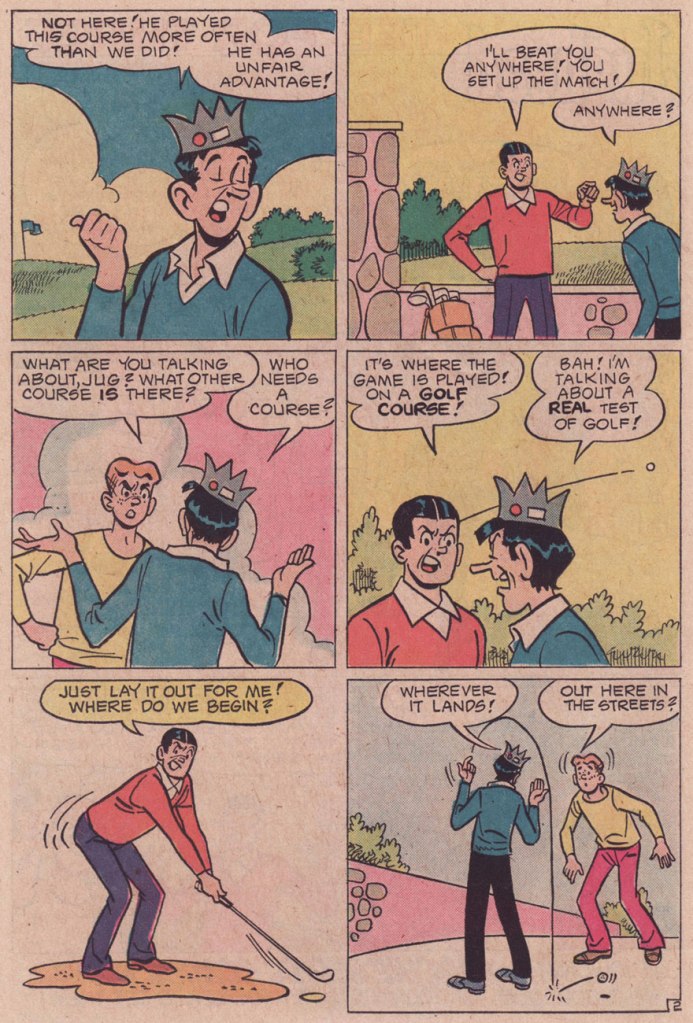
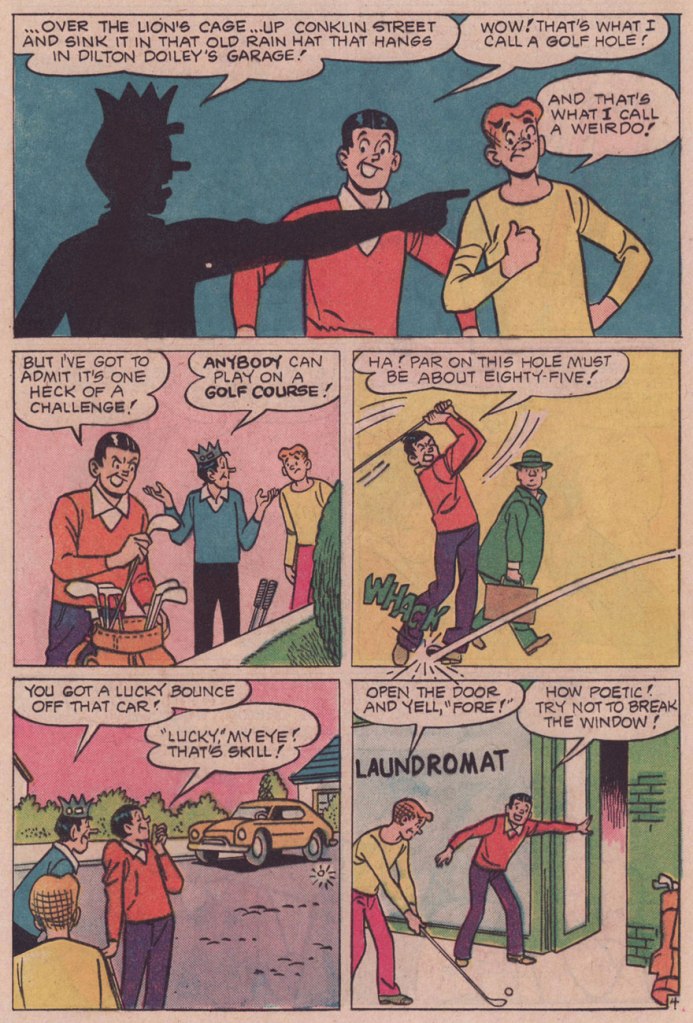
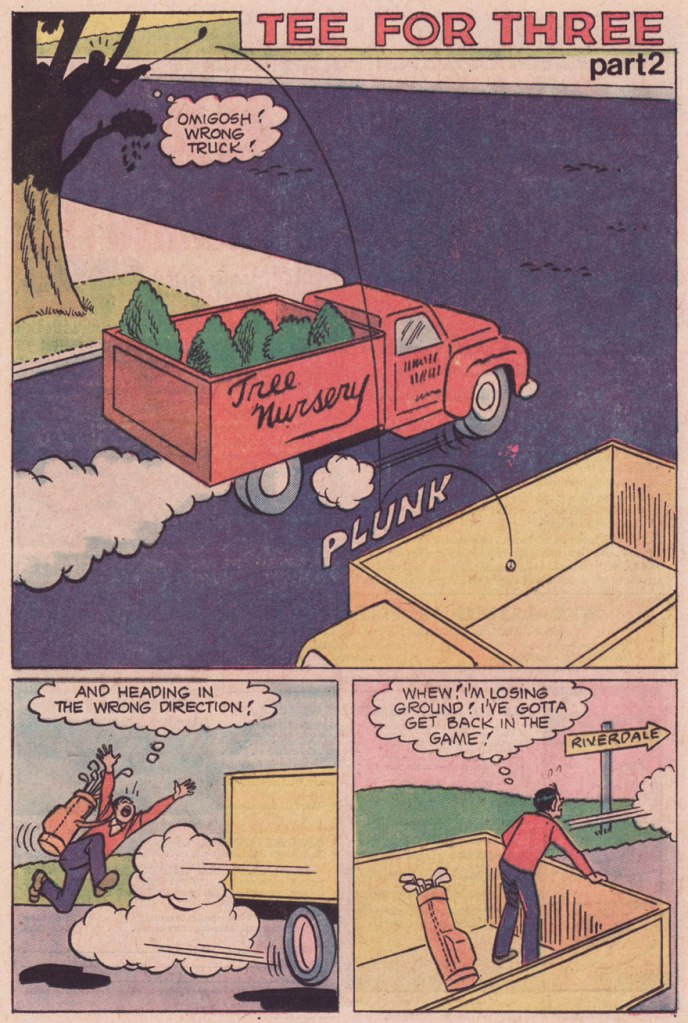
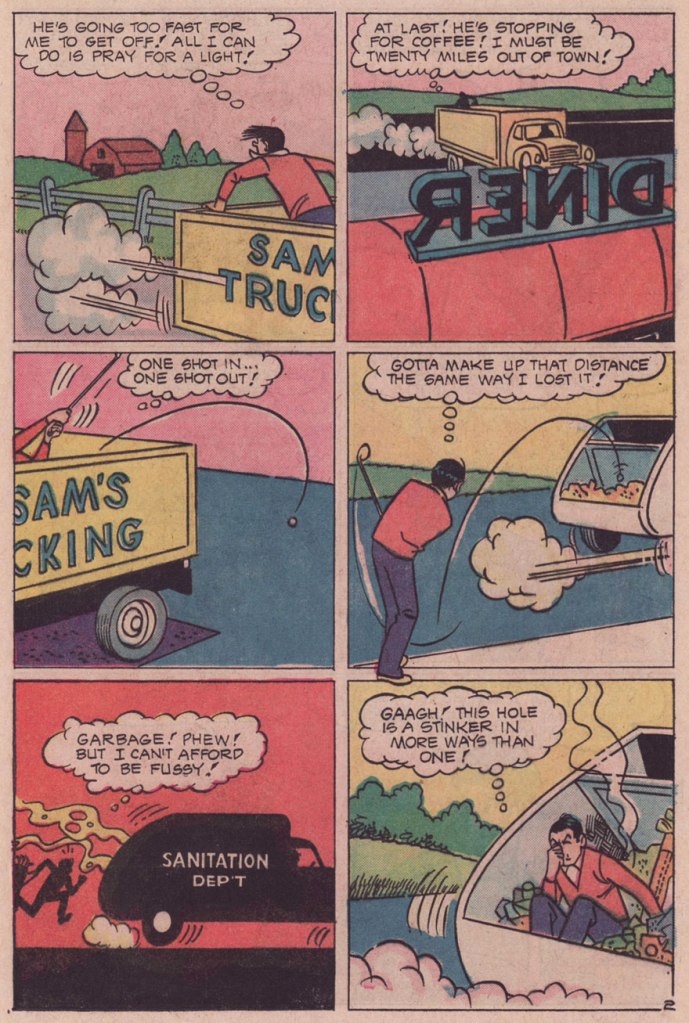
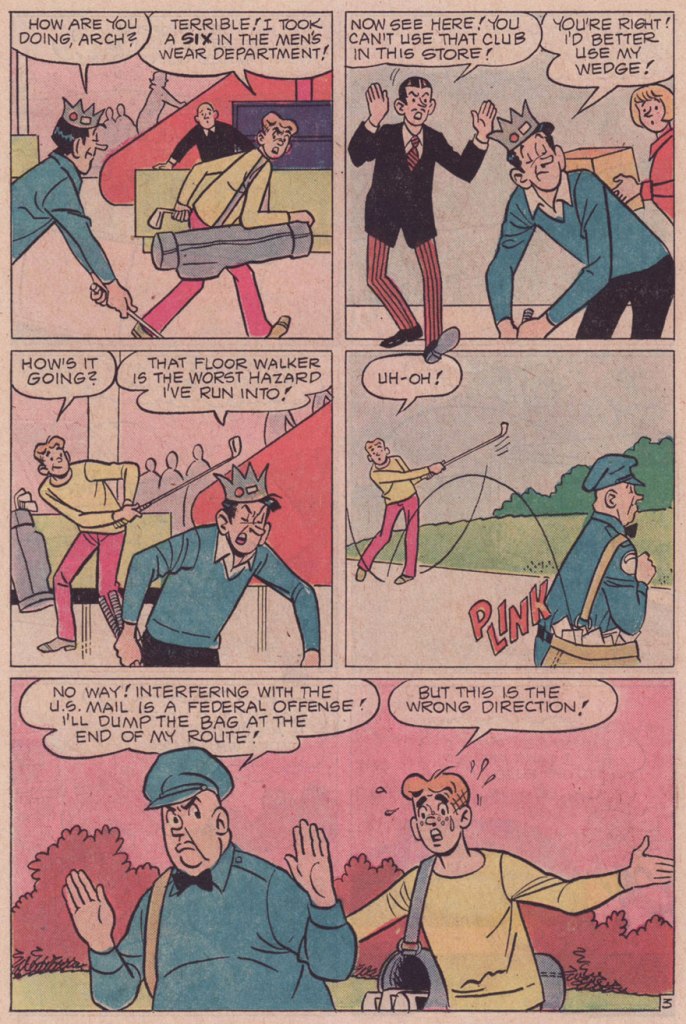
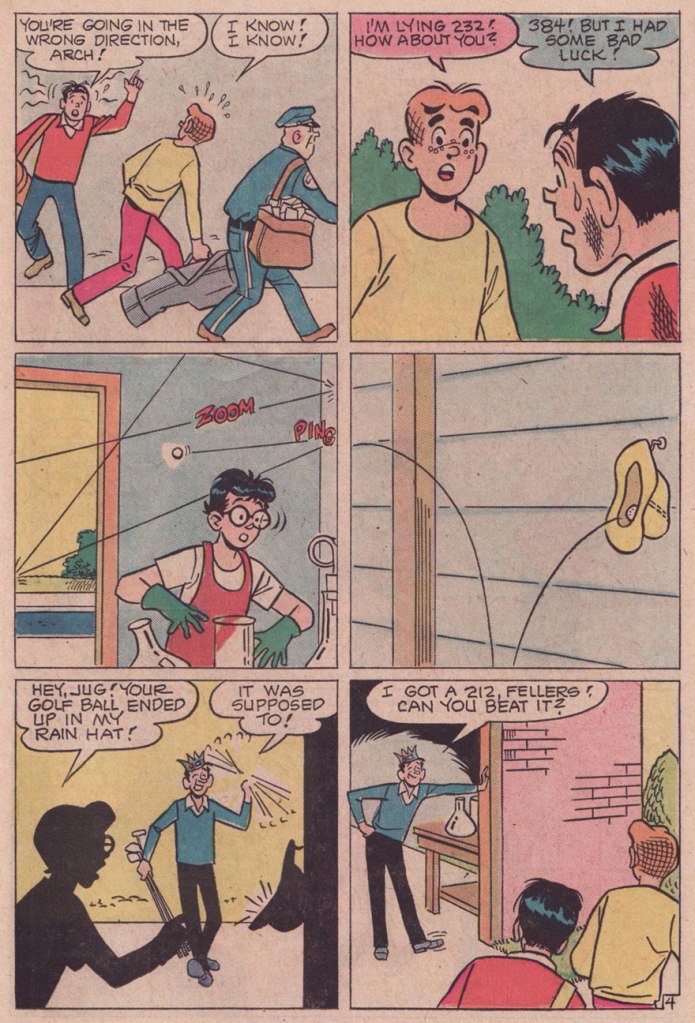
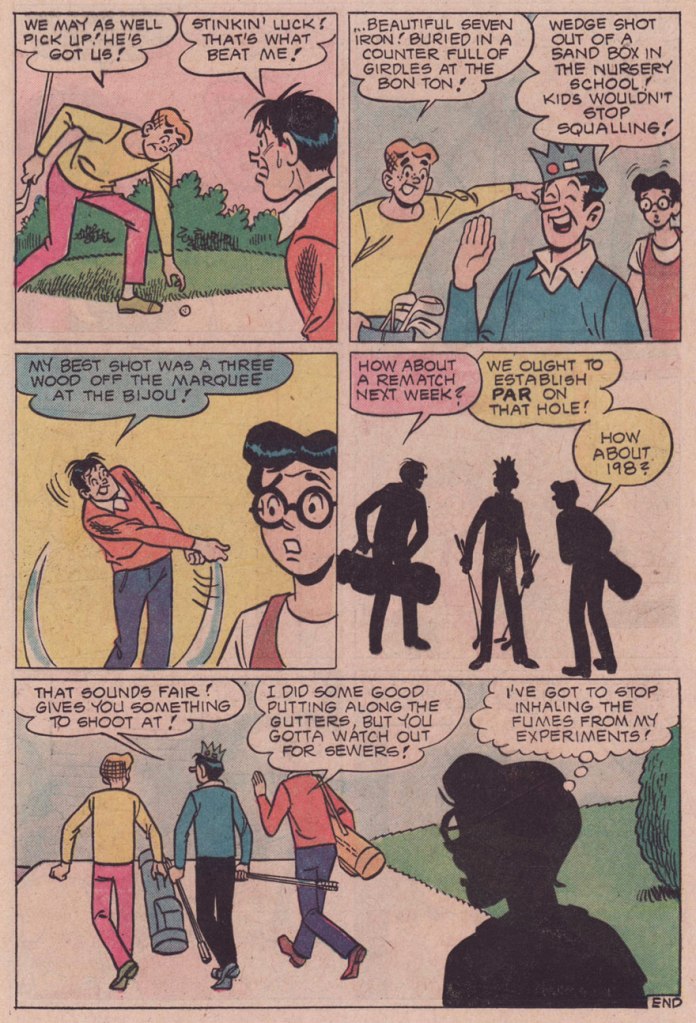
I’ve long wanted to showcase one of Samm Schwartz‘s Jughead stories on this blog, but always hit the same snag: which one? Not too long ago, while revisiting my trove of 1970s issues, I came upon just the specimen. Tee for Three appeared in Jughead no. 247 (Dec. 1975, Archie). I’ll spare you the hideous-as-usual Stan Goldberg cover.
While we know the story was illustrated by Samm Schwartz, the writer’s identity remains unknown. Schwartz usually took a hand in the scripting, but he didn’t really ever work alone. The likeliest miscreants are his usual accomplices, Frank Doyle and George Gladir.
Why this one among hundreds of others, then? For one thing, it’s longer; at eleven pages long, it’s a towering freak amidst the customary five-or-six pagers.
But that’s not all: Tee for Three also boasts an unconventional plot, one that cried out for (and received) a more leisurely deployment. Its tone is also surprising: it’s quite deadpan and sanguine in its absurdity.
For once, you can envision why these three, despite being frenemies or plain rivals, would actually hang out: they challenge and entertain one another. And even collaborate when the occasion calls for it. In this case, Jug, Archie and Reggie are so bonded in their good-natured folie à trois that the rest of the world doesn’t have a clue and hardly stands a chance.
While such a golf contest would surely result in much injury, property damage and litigation in the ‘real’ world, it sure seems like a rollicking bit of sport here, and isn’t that what good fiction is for(e)?
Today’s TT is like one of those 5$ grab bags: you don’t exactly know what you’re going to get, but there will at least one thing you’ll find amusing! Unless the store has cheapened out and stuffed it with nonsense nobody in their right mind would want. This offering, on the other had, is full of our favourite artists, and is not nearly as disparate as I first thought 😉
I don’t always have an over-arching idea for a post, inevitably ending up with plenty of odds and ends that don’t neatly fit into any one category. Actually, some of those “scraps” are the most enjoyable finds for me.
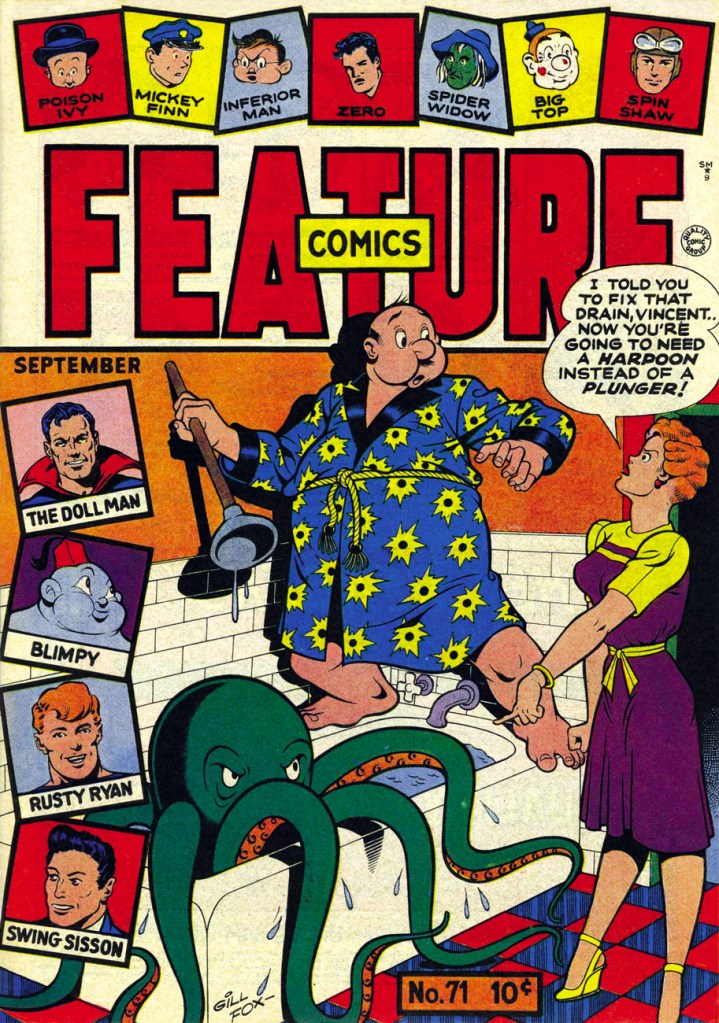
Feature Comics no. 71 (September 1943, Quality Comics). Cover by Gill Fox. The octopus-in-plumbing theme is an oldie-but-goodie; the undaunted housewife may yet regret her cavalier attitude towards the tentacled one, who probably wants to move in with his family.
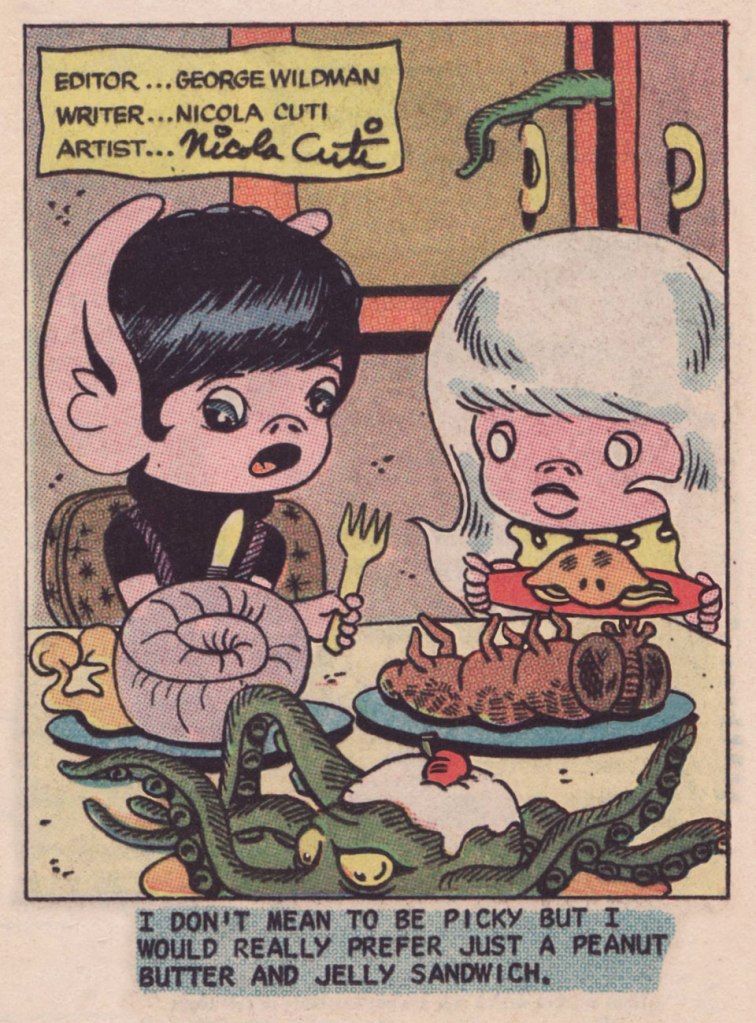
Nicola Cuti‘s Weirdlings was a charming little ‘filler’ gag page designed and drawn by him. This one was published in Haunted no. 14 (Sept. 1973, Charlton). I think the octopus, that appears to be still alive, would also prefer a good old PBJ sandwich.
Archie’s Pal Jughead no. 77 (October 1961). Cover by, dare I say legendary, Samm Schwartz; revisit (or discover!) some of the nicest covers he has drawn for Archie Comics in co-admin RG’s post.
« What is this ‘witch’s brew‘? Oh, that’s a special! It’s a squirt of everything! » — Pop Tate divulges one of his culinary secrets
A little while back (okay, quite a while back!), upon reading an article written by cartoonist Seth (John Stanley’s Teen Trilogy, The Comics Journal no. 238, Oct. 2001), this passage especially piqued my interest: « I have to admit right now that I like Archie comics quite a bit and I have hundreds of issues of Archie and its various spin-off titles. I can even tell you which years are the good years (1959 to ’65, incidentally) ».
As it happens, I’m in full agreement with the gallant Mister Gallant : this was when Archie’s Mad House and Tales Calculated to Drive You Bats came along, when Bob White (and Samm Schwartz, and Orlando Busino) were producing scads of wild and wooly covers featuring ghouls and bug-eyed critters, mole men and mad (though I’m told they prefer ‘eccentric’) scientists and sundry extraterrestrials and witches. The line’s cover layout was also nicely open, affording the artists plenty of latitude to indulge themselves. Here are some samples from the aforementioned creators at the peak of their formidable powers, before the end-of-recess bell rang and stifling homogeneity was henceforth imposed.
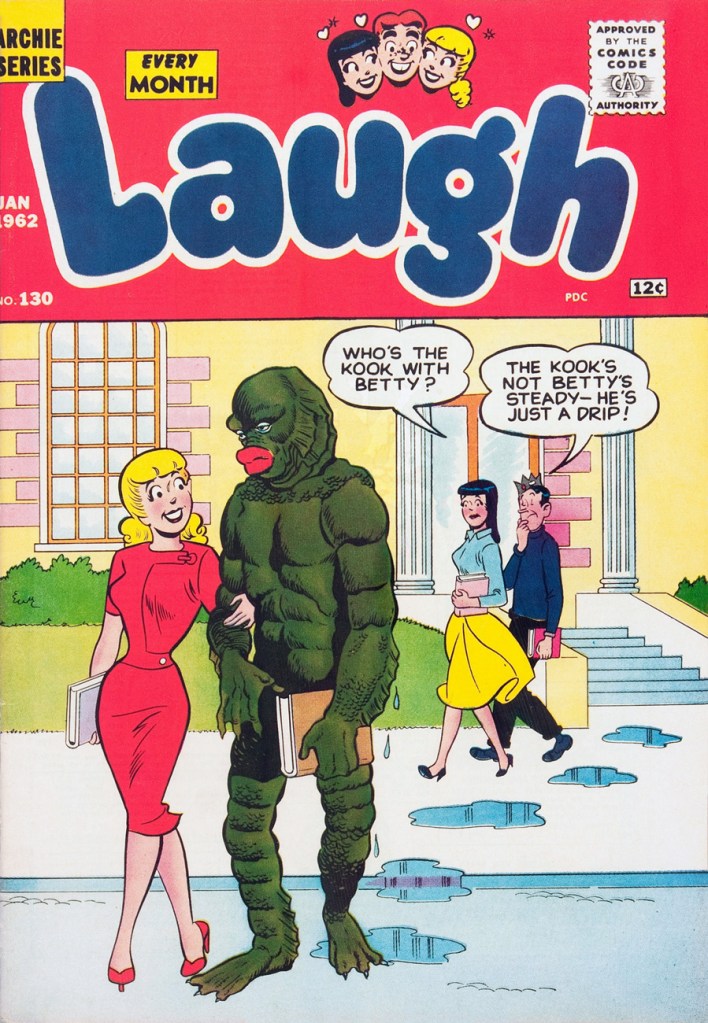
This is Laugh no. 130 (Jan. 1962, Archie); cover by Samm Schwartz. Looks like our friend Ricou Browning is slumming it in Riverdale, with Betty happily showing him the sights. Honestly, he’s more of a gentleman that Archie ever was.
This is Tales Calculated to Drive You Bats no. 2 (Jan. 1962, Archie); cover by the incomparable Orlando Busino, still with us and nearly 94 years young! I strongly suspect that these witchy younglings mean mystical business!
This is Archie no. 125 (Feb. 1962, Archie); cover by Harry Lucey, one of the crucial classic Archie artists. Regardless of what you’ve heard, look at the actual sales figures for 1969, with Lucey drawing every issue of Archie. Readers voted with their wallet.
Here’s a swell example: Pep Comics no. 158 (Oct. 1962). Spooky cover art by local favourite Bob White. I wouldn’t have pegged Archie as a skeptic, to be honest.
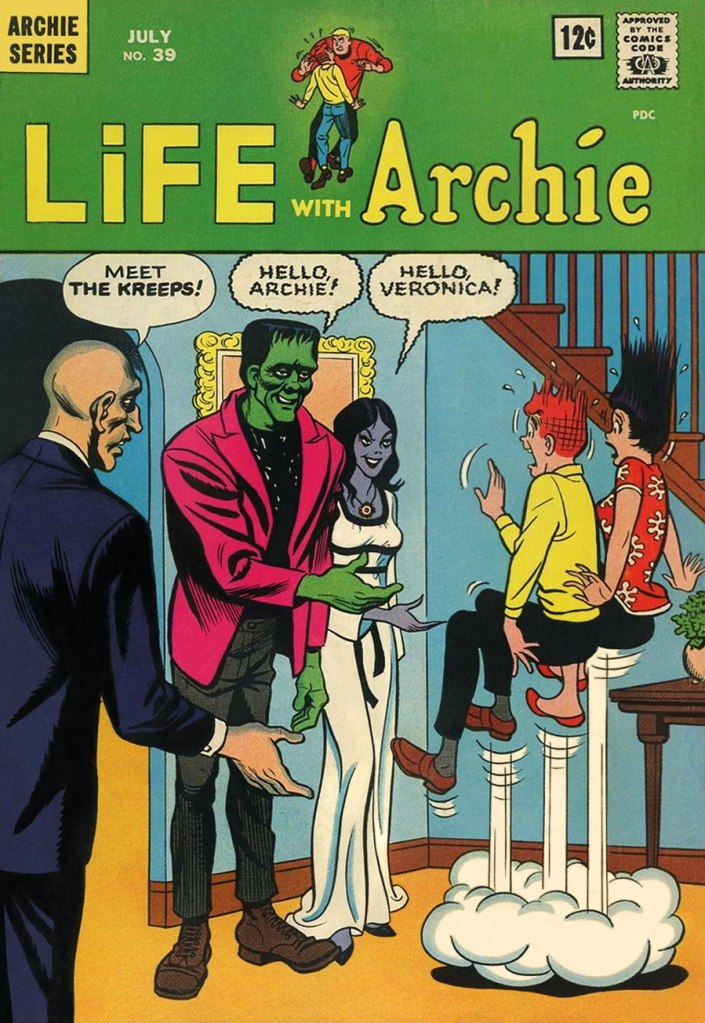
This is Life With Archie no. 39 (July 1965, Archie); cover, again, by Mr. White. The previous year had seen the TV arrival of The Addams Family and its imitators, The Munsters. So what’s one carbon copy more or less?
« Is it true your first concert is going to be at a cemetery? »
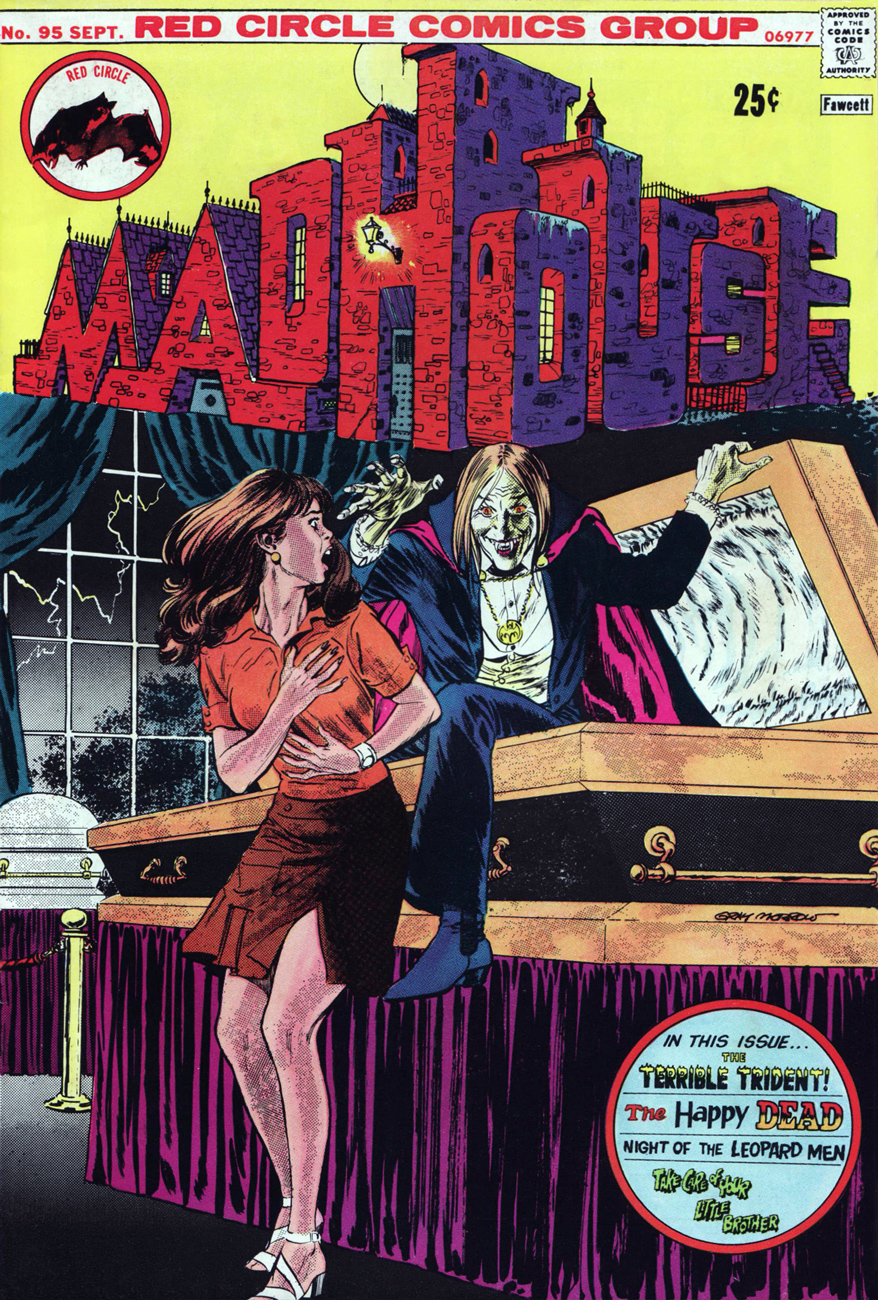
By the summer of ’74, the Archie brass was getting sick of those no-account Didit Brothers (You know, Dan, Dippy, Dick and Clyde) and their groupie Fran the Fan, so the Madhouse Glads were tossed out on their collective ear in favour of… a horror anthology. It made sense: in the 1970s, there was considerable overlap (largely female, but not exclusively) among readers of, say, The Witching Hour, Betty and Me, and Romantic Story.
The final fate of Fran the Fan? This is Mad House no. 95 (Sept. 1974, Archie); cover art by Gray Morrow. Read the issue here.
It’s fair to assume they were envisioning a companion title for their Chilling Adventures in Sorcery / Red Circle Sorcery. This was something different for Archie, all right: they sought out top talent, but in a fairly consistently sober visual style. Gray Morrow‘s photo-based approach was the baseline, and small wonder: he was the editor. The bulk of the stories was penned by Marvin Channing, and while the ‘twist’ endings weren’t exactly fresh, some of these tales were surprisingly nasty and nihilistic.
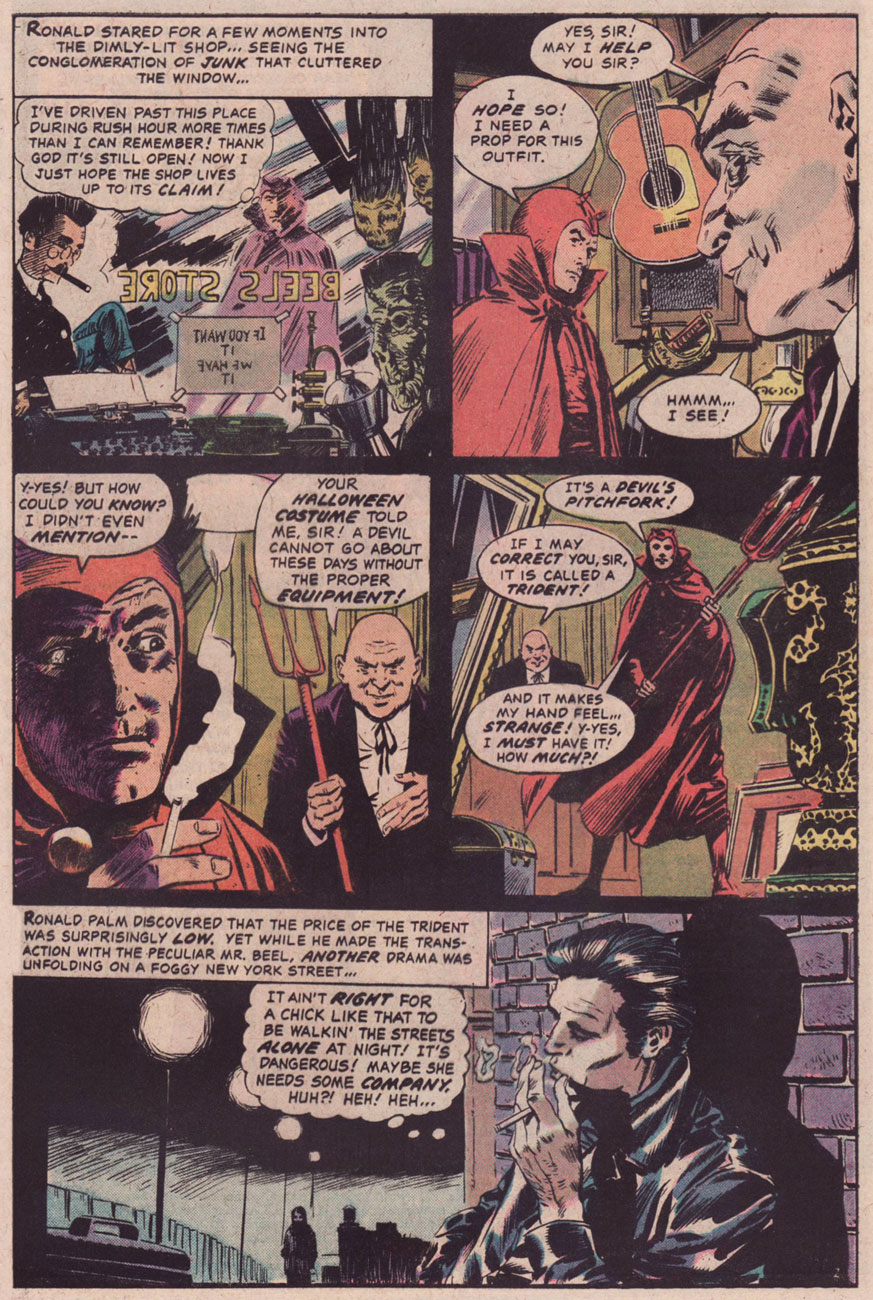
Page two from The Terrible Trident!, written by Don Glut and illustrated by Vicente Alcazar.
Page three from the cover story, The Happy Dead. Written by Marvin Channing and illustrated by Doug Wildey. Whoever handled the colouring here was smart and discerning.
However, this version of Madhouse lasted but three issues before the book was returned to its original, pre-Glads format. Sorcery endured for nine issues, the first three done in the Archie house style, with narration by Sabrina, the Teenage Witch. By the end of 1974 (with a book cover-dated February, 1975), the experiment was over. But these things come in cycles, don’t they? Witness the recent Afterlife With Archie… which incidentally reprinted much of this material.
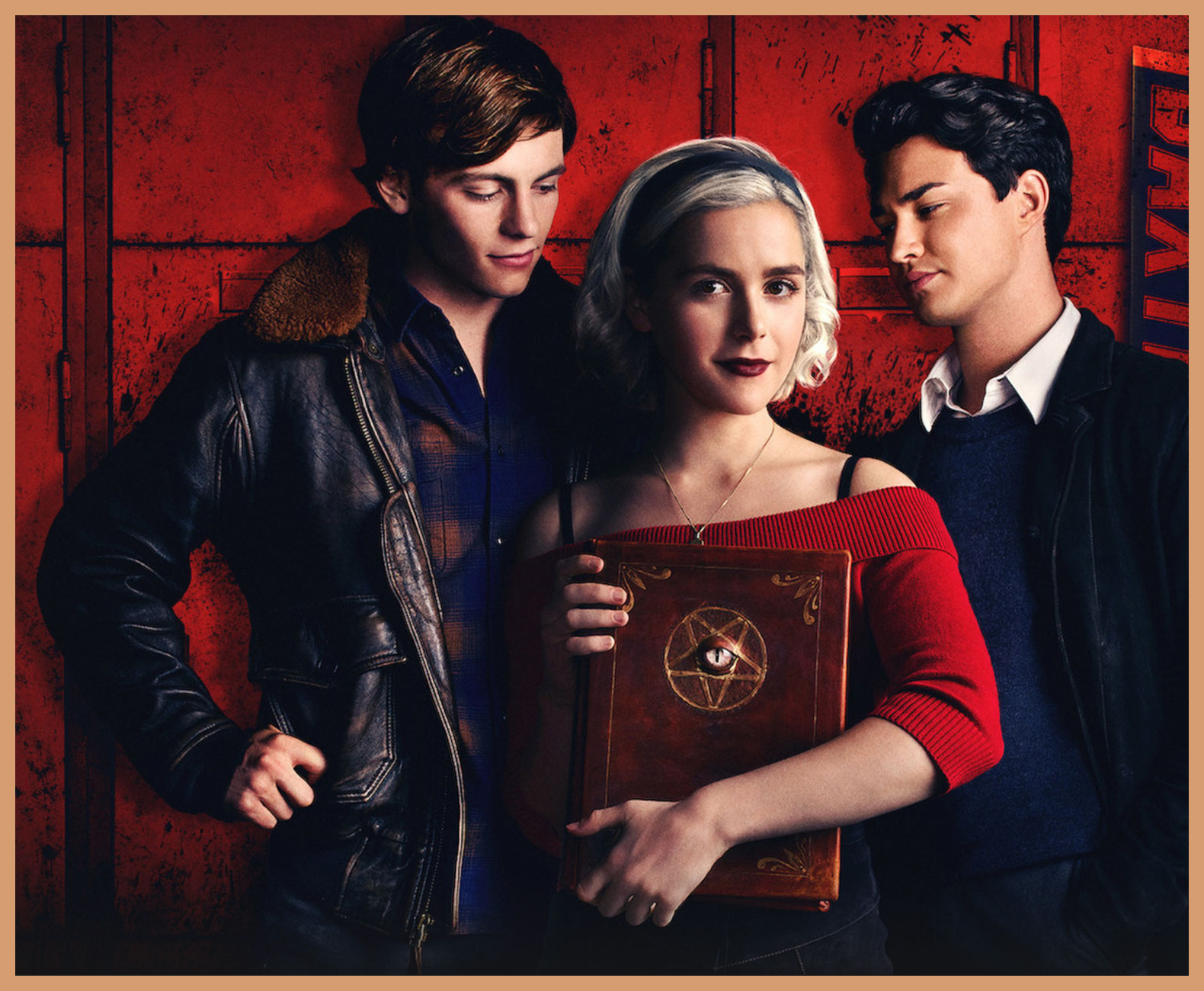
And in other media, amidst the current glut of Archie product, one finds a direct scion of a timid, decades-ago exploration, Netflix’s Chilling Adventures of Sabrina.
« The stranger’s face was entirely obscured by a broad-brimmed felt hat bent downward over his features; and the long, black coat looked almost like part of the thickening fog. » –Harry Vincent first encounters his future employer. (Shadow Magazine, April/June, 1931)
We note today the birth anniversary of Walter B. Gibson (September 12, 1897 – December 6, 1985), an extremely prolific writer and professional magician. Gibson is best known for developing the radio character of The Shadow, through nearly three hundred stories he wrote under the collective nom de plume of Maxwell Grant.
The Shadow’s had an interesting and varied career in comics, but Gibson’s novels (and the radio shows… Orson Welles!) are where it’s at. Still, let’s take a look around, shall we?
This is The Shadow Comics Vol. 3, no. 12 (March, 1944, Street and Smith); cover possibly by Vernon Greene. That Thade seems like a friendly sort, mayhap a tad overly so.
This is The Shadow Comics Vol. 7, no. 12 (March, 1948, Street and Smith); cover by Bob Powell.
Now why were Archie Comics allowed to take such ridiculous (though I’ll grant, perversely entertaining) liberties with The Shadow? Must have been a lull in the revival market, I suppose. This is The Shadow no. 1 (August, 1964, Archie), cover by Paul Reinman. You just wait until the subsequent issues…
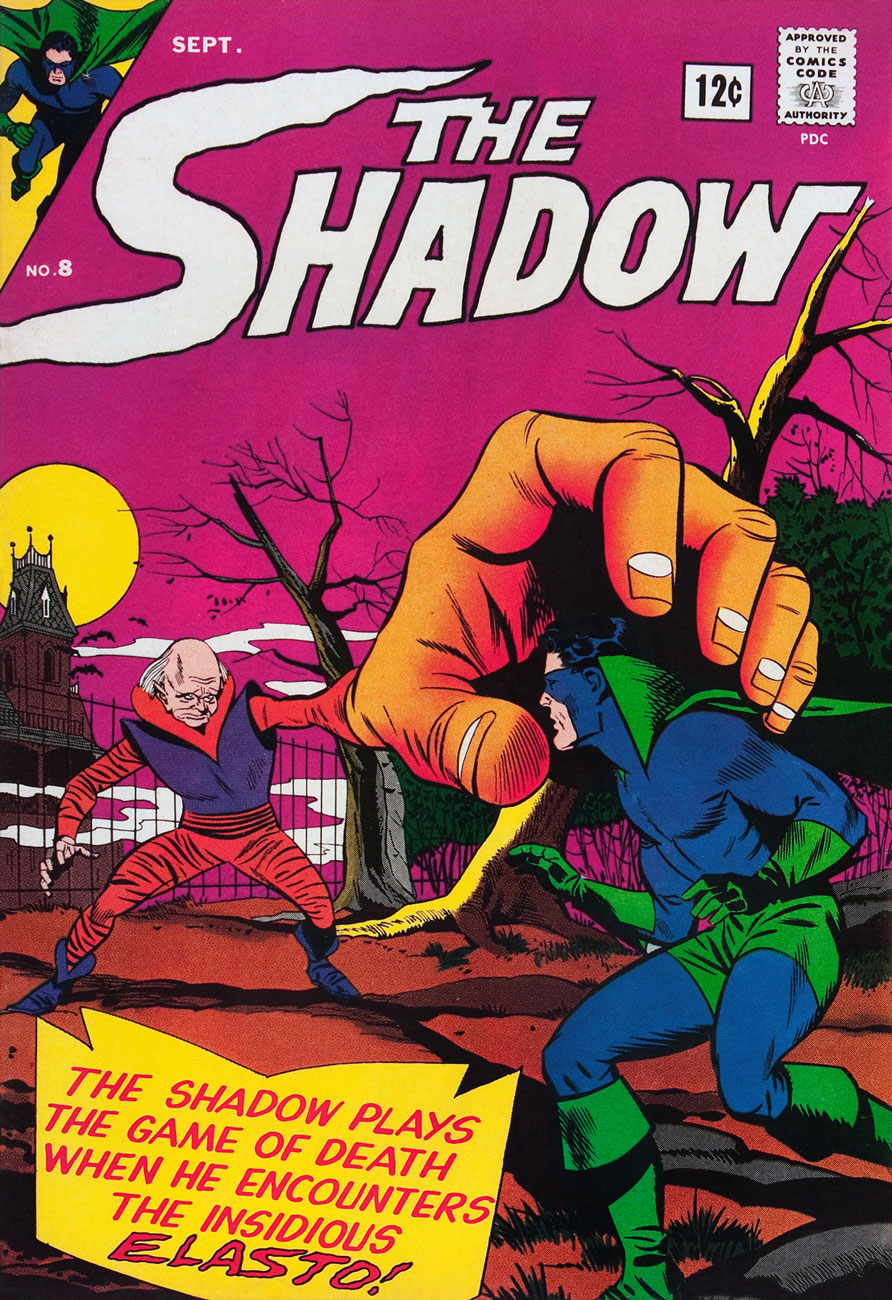
This, however, is not quite how Gibson envisioned and portrayed the mysterious Shadow. This off-model rendition hails from Archie Comics’ 8 issue, 1964-65 run, helmed by Superman co-creator Jerry Siegel and Golden Age journeyman Paul Reinman. This be The Shadow no.8 (September, 1965).
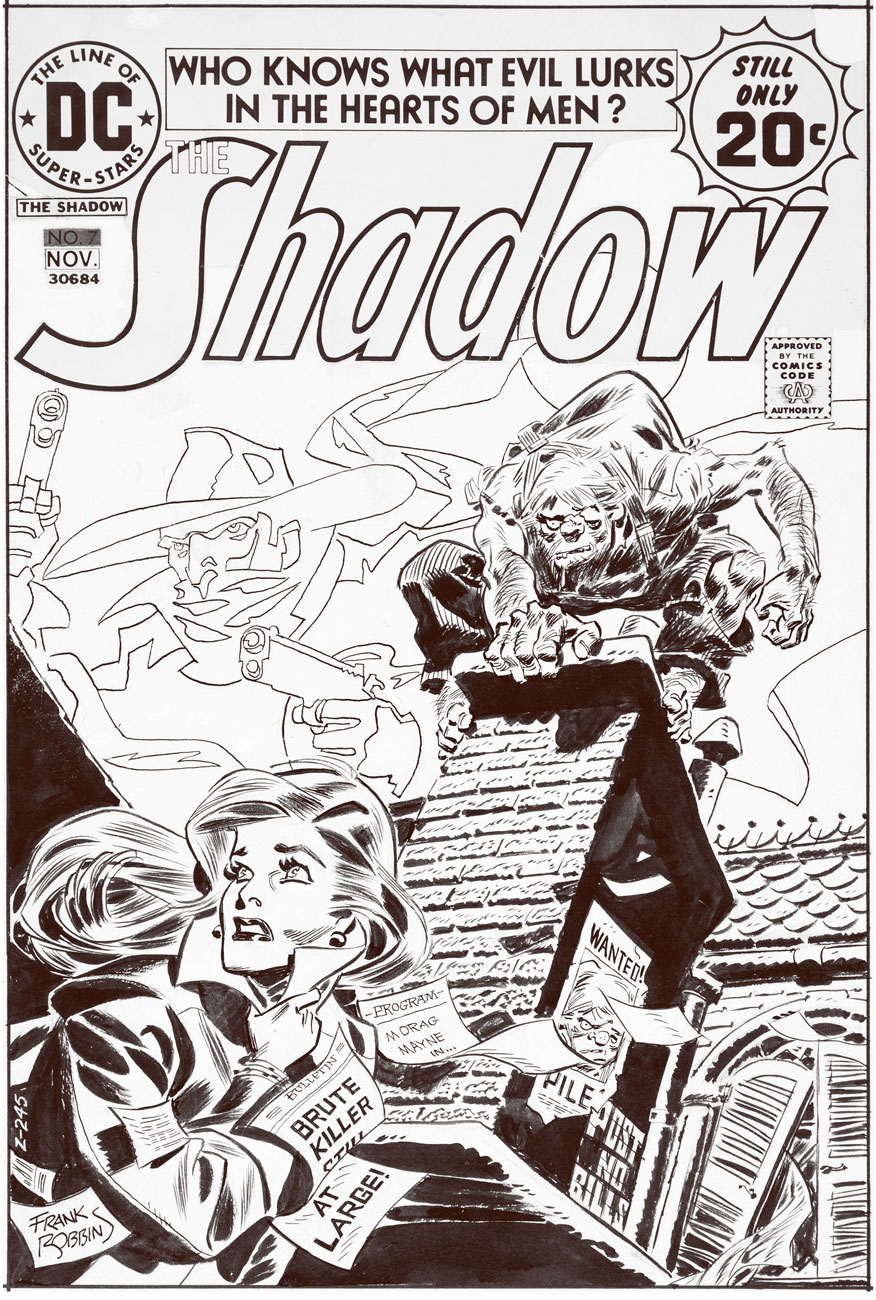
A privileged peek at Frank Robbins‘ original cover art for The Shadow no.7 (Nov. 1974), second of his four (or so) covers for DC, featuring Night of the Beast!, scripted by Denny O’Neil. Yummy… but too short.
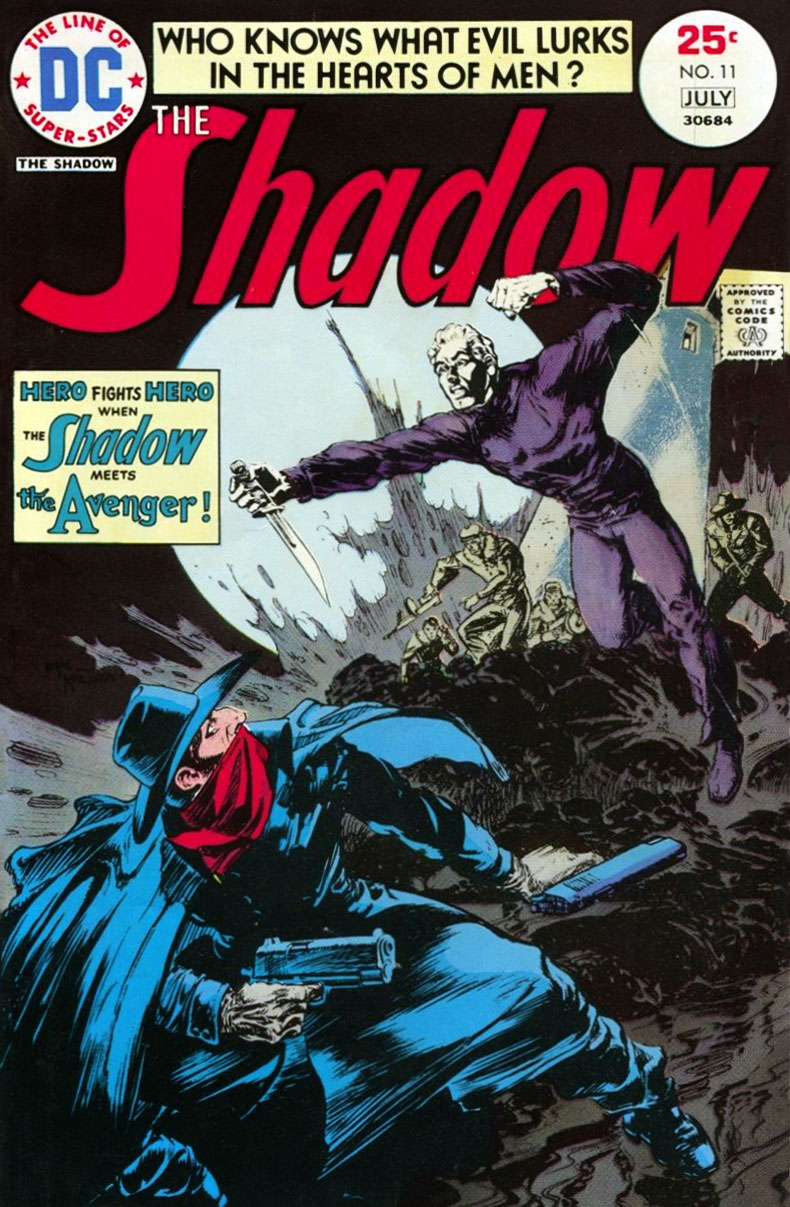
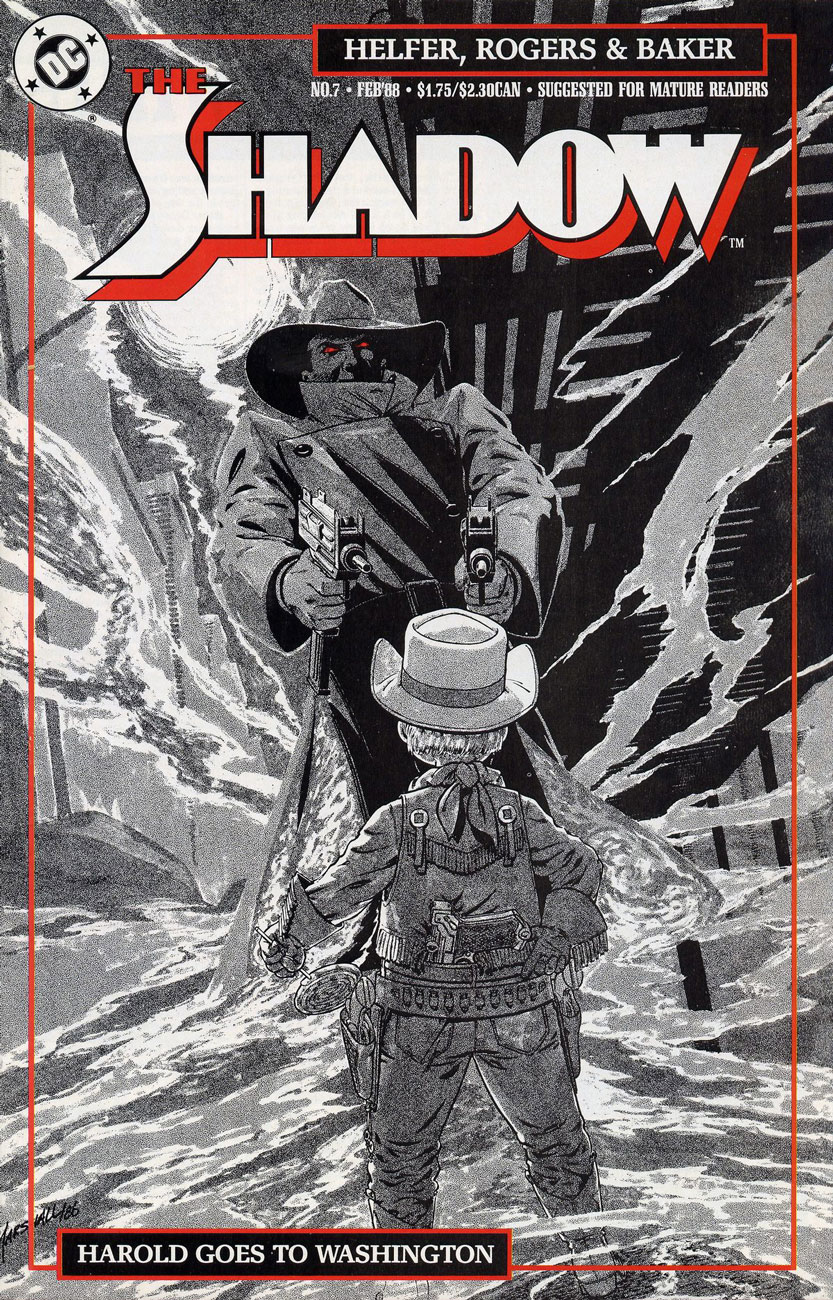
Two great Street & Smith pulp heroes face off! Mr. Kaluta takes some artistic license here, however, since Ike (as The Avenger calls his throwing knife), is supposed to be small and almost needle-like, not a freakin’ butcher knife. Come to think of it, the Shadow’s trusty automatics look like something a Rob Liefeld character would wield. One doesn’t encounter often the final three issues of DC’s initial run of The Shadow. Post-Kaluta (save the covers) and post-Robbins, the art was handled by Filipino artist E.R. Cruz, who did a commendable job, while series regular Denny O’Neil (who wrote all issues except for number 9 and 11, Michael Uslan ably filling in) stayed until the curtain was drawn.
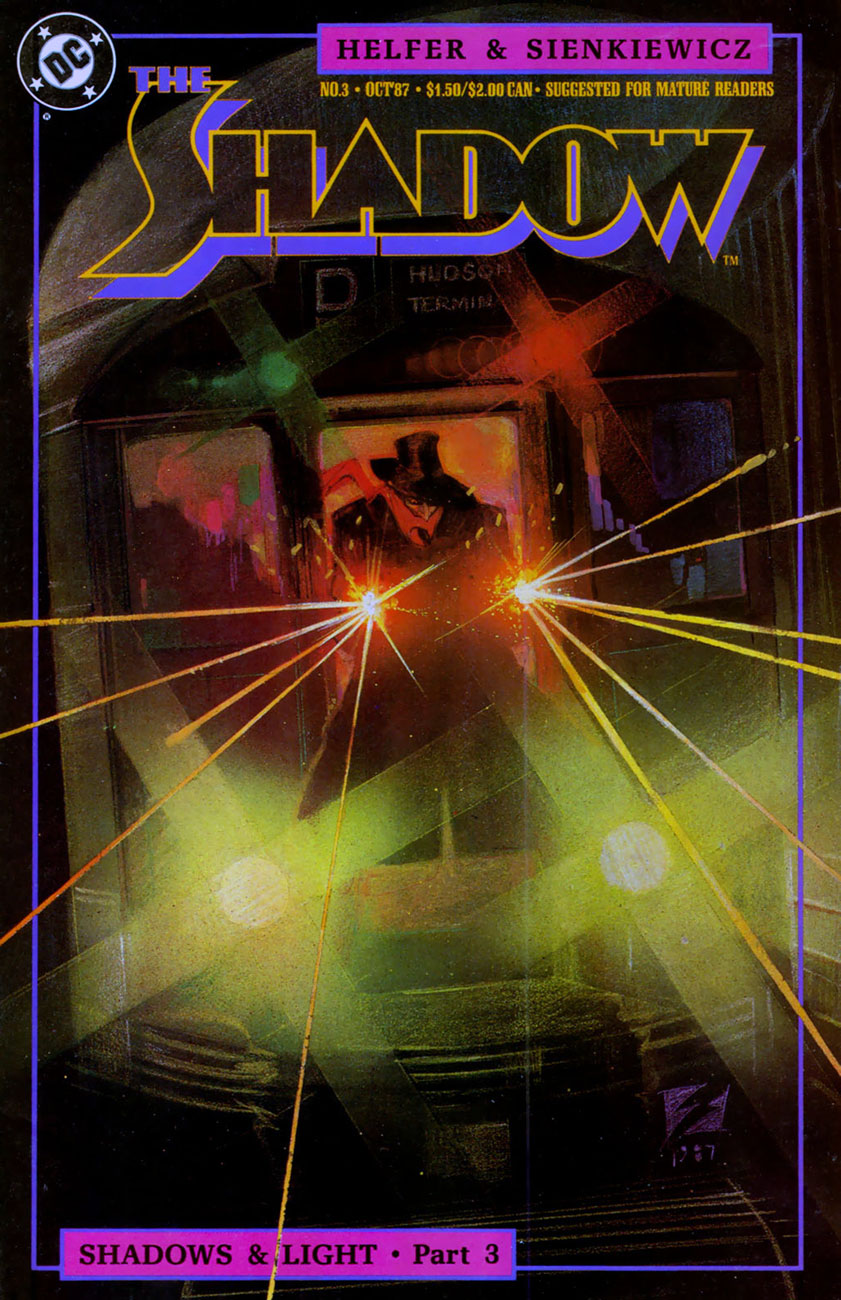
Skipping the heinous Howard Chaykin revival, in which he delighted in sadistically dispatching The Shadow’s aged former operatives in gruesome ways (why do these people always call themselves fans of the original series?), we move on to the Andrew Helfer-Bill Sienkiewicz regular book. Better, but still not great. This is The Shadow no. 3 (Oct. 1987). Cover by Bill Sienkiewicz.
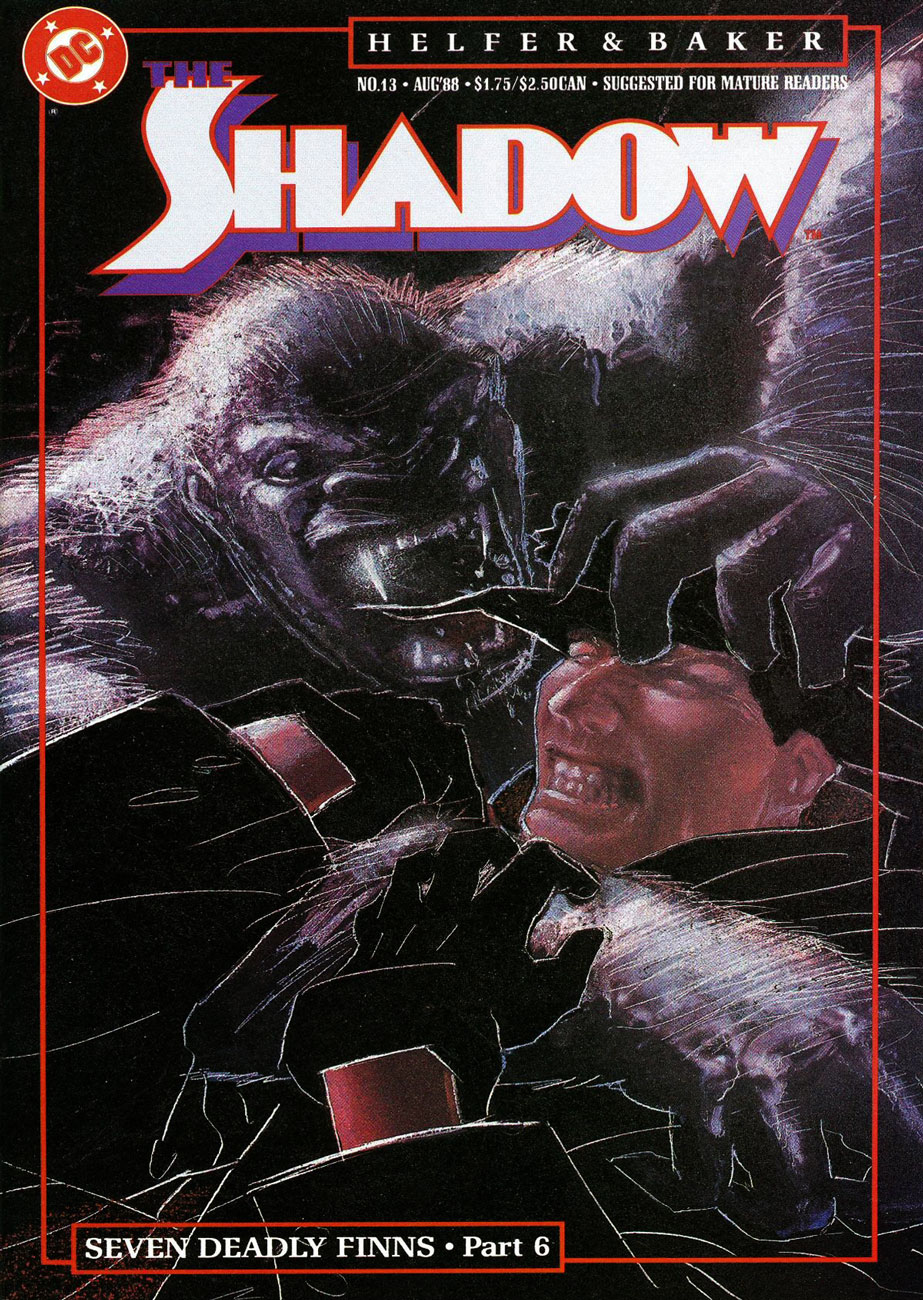
This is Kyle Baker’s cover for the finale of his and scripter Andrew Helfer’s thrilling and hilarious Seven Deadly Finns saga (no. 13, March 1988) that made The Shadow such a must-read title. To quote Kate Bush, « What made it special made it dangerous », and the folks at Condé Nast, who hold the rights to the classic Street & Smith characters (also including Doc Savage and The Avenger) reportedly got twitchy* at the reckless liberties the Helfer-Baker team were taking and pulled the plug after issue 19, where a beheaded Shadow gets a big action robot body. The Shadow was rebooted the following year in more obedient hands, with quite pedestrian results.
As a bonus, let’s slightly depart from comics proper and admire a couple of paperback reissues from the brush of noted fabulist James Steranko.
Steranko comes up with one of his subtlest, most unctuously moody covers for Pyramid’s 1974-78 series of Shadow paperbacks that introduced these classic pulp adventures to a new audience, picking up where its predecessors Belmont (1966-67) and Bantam (1869-70) had left off. Pyramid had one extra trick in its bag, though: Jim Steranko, who painted tantalizing covers for each of Pyramid/Jove’s twenty-three volumes. This particular case file, MOX, « from The Shadow’s annals as told to Maxwell Grant » originally appeared in The Shadow Magazine vol. 7, no. 6 (November, 1933).
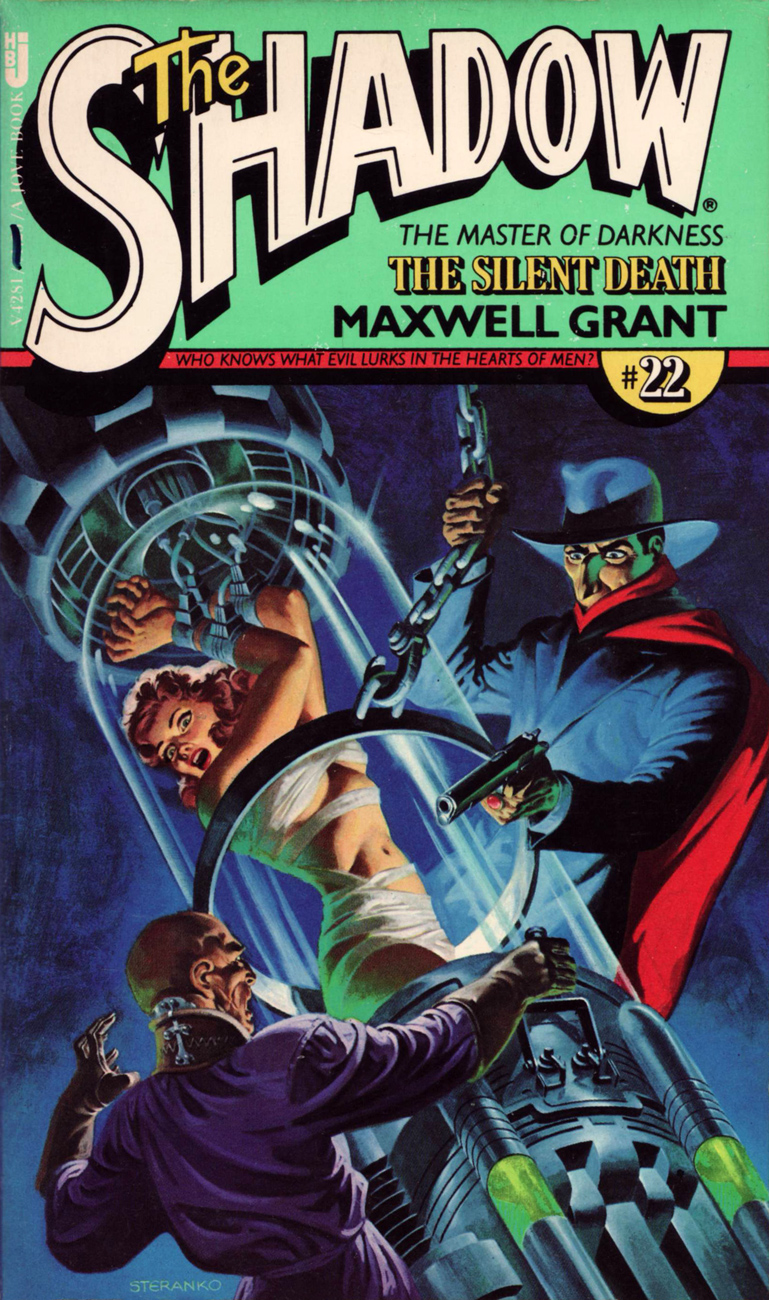
Natty dresser Jim Steranko has built up, over the years, quite a biography for himself. Of his numberless and prodigious accomplishments, my favourites are those that actually happened, such as a stunning series of cover paintings for Pyramid Books’ reprints of vintage Shadow pulps from the 30s and 40s. This one, twenty-second in a set of twenty-three, was published in March of 1978. The Silent Death initially saw print in The Shadow Magazine, Vol. 5, no. 3 (April 1, 1933.)






























 Who's Out There?
