« The mind loves the unknown. It loves images whose meaning is unknown, since the meaning of the mind itself is unknown. » — René Magritte
Last month, we flew off to explore the wonders of Belgium, most specifically Flanders. All other attractions aside, I thought I’d share with you some of the marvels of the country’s comics culture. Hop on!
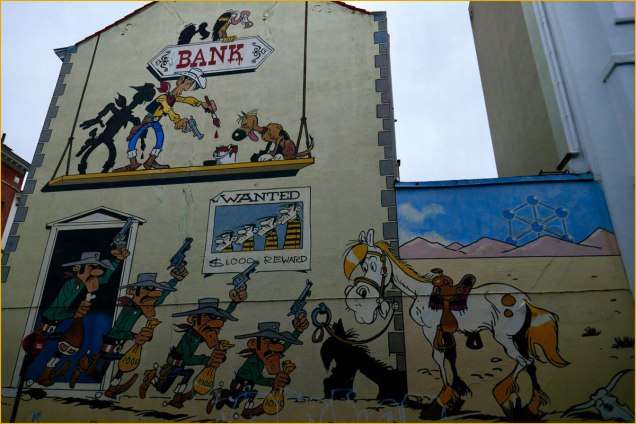
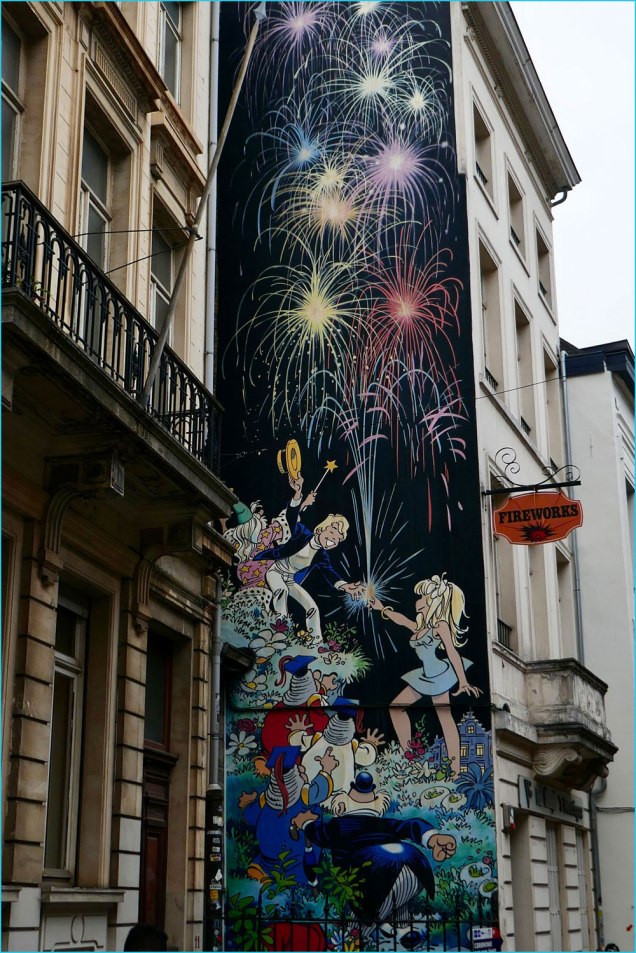
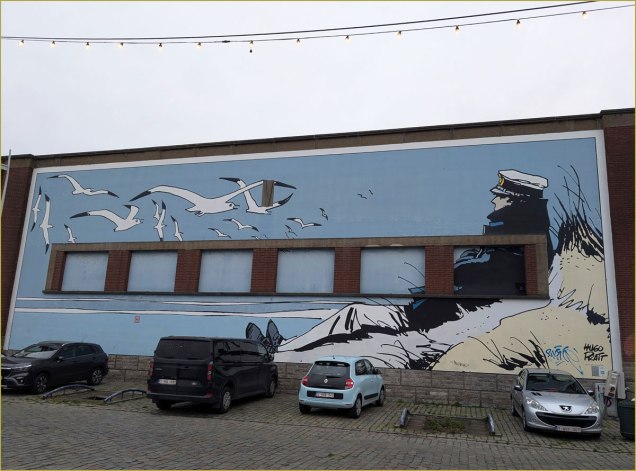
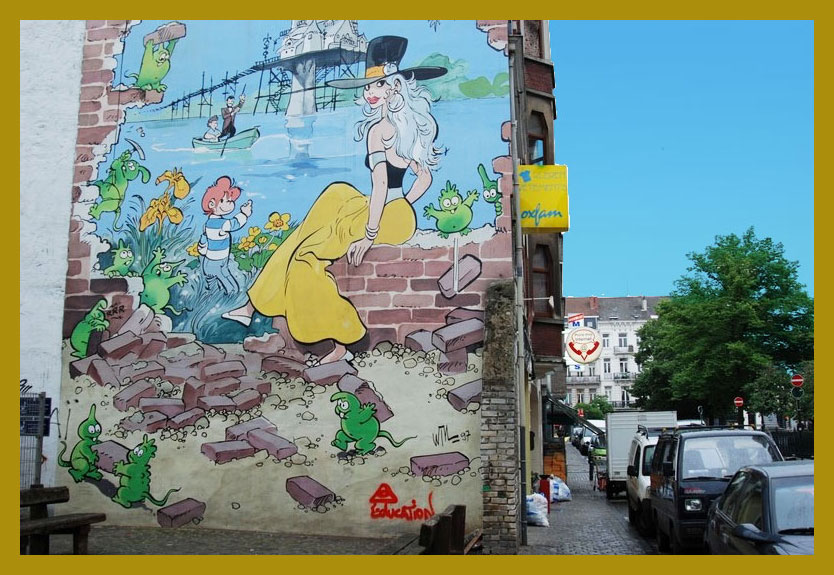
At Ostende’s cozy Le Touquet seaside restaurant, we were shown the shortest path to the loo by no less a personage than the legendary Cowboy Henk, touting local drink Blonde Kuif.This group scene from René Goscinny and Albert Uderzo‘s Astérix was appropriately located in a schoolyard, with kids eagerly playing ball just a few metres away.In a different range, this mural suitably pays homage to French ‘ligne claire‘ master Yves Chaland (1957-1990).It was nice to see the frescoes maintained. This one, located in Antwerp, celebrates Flemish cartoonist Jeff Nys‘ Jommeke: « It seems fitting that this wall by artist Jef Nys, the greatest Flemish cartoonist for children, is in an area surrounded by schools. His most popular comic was Jommeke, a story about a young boy, with a pet parrot named Flip, who goes on some crazy adventures along with his best friend Filiberke. Nys started Jommeke in 1955 and created close to 300 comic albums. They have sold over 51 million albums alone in Belgium, making Jommeke the second best-selling comic series in the country. » [ source ]I’ve no idea who these characters might be, but I raise my glass (of Belgian beer, naturally) to the vibrant creativity of the nation’s graffiti practitioners.Another lovely one saluting one of Belgium’s bédé superstars, Maurice de Bevere, alias ‘Morris’ (1923-2001).We found that Brussel’s streets were frequently adorned with striking mosaic markers, such as this one, featuring André Franquin‘s Marsupilami. I forget what thoroughfare this was, I’m afraid.This one captures Philippe Dupuy and Charles Berberian‘s Monsieur Jean and his presumed and entirely laudable and justified appreciation of Belgian beer, the world’s finest — you can keep your IPAs, thank you.A mural devoted to Michel Greg and Daniel ‘Dany‘ Henrotin’s Olivier Rameau, fittingly painted on the side of a Fireworks store at 9, rue du chêne, Brussels. Top to bottom: Ebouriffon, Olivier Rameau, Colombe Tiredaile, the 3 Ziroboudons, Alphonse Pertinent.Despite having no Belgian roots that I can figure, Hugo Pratt‘s Corto Maltese clearly is beloved in these parts. He landed no fewer than *four* murals, all neatly in a row. Here are my two favourites.A most unusual — and striking — composition.And now we come to my Holy Grail, Brussel’s Gil Jourdan mural… there are two more in Maurice Tillieux‘s hometown of Auderghem (here’s one, and the other, and yet another in the bédé-themed Janson metro station in Charleroi). The author appears for size comparison.Local graffiti artists come to the rescue: it seems inconceivable — to me, anyhow — that there isn’t a mural devoted to Willy ‘Will’ Maltaite‘s characters. There used to be a lovely « Isabelle » fresco in Brussels, but, citing damage, it was painted over in 2017. However, here’s an unofficial, and brilliant one featuring Tif et Tondu… and their archnemesis, Monsieur Choc. Take a bow!
« The first hundred years are the hardest. » — Wilson Mizner
Having just learned this morning that today marks a century since the birth of André Franquin (1924-1997), I again pushed my planned post to the back burner. So, instead of writing about a celebrated Belgian genius, I’ll write about *another* celebrated Belgian genius.
Spirou’s ‘Albums’ were a handy way to dispose of unsold copies of the weekly magazine by collecting a trimester’s worth of issues in an attractive hardcover format. This one’s from March 1948, just to give you an idea of Franquin’s early style.A panel from Le dictateur et le champignon (1953). The ripe banana-coloured critter with the long tail, if you don’t already know, is Le marsupilami, Franquin’s homage to Elzie Segar‘s Eugene the Jeep (introduced in 1935 and known as ‘Pilou-Pilou’ in French Europe).This panel took my breath away as a kid when I first saw it, and it still does. It’s from Spirou et Fantasio no. 8, La mauvaise tête (1954). How many contemporary artists could pull off such a scene — let alone the entire sequence, wherein Fantasio ends up winning the race cycling backwards — at all convincingly? I’ve been reading, for the first time, Franquin’s collected Modeste et Pompon (1955-59). After Franquin was tricked into surrendering his creation to Tintin magazine publisher Les Éditions du Lombard, M&P became just another long-running mediocre domestic strip in many successive pairs of (necessarily) lesser hands… but seeing Franquin bring it to life is a most refreshing pleasure.A dynamic Modeste et Pompon sample from near the end of Franquin’s run. During Franquin’s relatively brief passage at Tintin magazine, he set a new standard of graphic freedom, opening a breach for his successors that Georges “Hergé” Rémi himself did *not* welcome. Tintin’s papa, in fact, deemed Franquin’s supple and organic line ‘vulgar’. Album Spirou no. 70 (March 1959, Dupuis), gathering issues 1081 to 1091 and depicting a scene from Le Prisonnier du Bouddha.Album Spirou no. 96 (April 1965, Dupuis), collecting issues 1395 to 1407. Gaston Lagaffe*, like Le Marsupilami before him, was a minor character introduced by Franquin to relieve the tedium of setting down the adventures of Spirou et Fantasio. The popularity of both these would-be background creations wound up dwarfing that of the intended protagonists. Franquin’s original painted artwork for the cover of Album Spirou no. 100 — well, duh — (March 1966, Dupuis), containing issues 1447 to 1459.
In 1977, a depressed yet inspired Franquin, suffocating within the confines of his much-imitated (at his publisher’s clueless insistence) style, created — with kindred confederate Yvan Delporte — Idées noires (Black, or perhaps more fittingly Bleak notions) as an outlet. It first appeared in the short-lived* Spirou mag supplement Trombone illustré, then moved to the more welcoming pages of Fluide glacial. An English-language edition, entitled Die Laughing, was published by Fantagraphics in 2018. Check it out here.
Here are a couple of Idées noires punchlines, which should give you an idea of their tone.
Marcel Gotlib wittily hijacked/paraphrased Sacha Guitry‘s bon mot about Beethoven : « After reading a page of Idées noires by Franquin, we close our eyes, and the darkness that ensues is still Franquin’s. »In countless instances, Franquin even used his signature to expressive comic effect.
-RG
*These days, thinking about Gaston Lagaffe puts me in an ugly mood, I’m afraid. Franquin had expressly, and all along, requested that his creation be put to rest with him. But did his publisher – having built an empire upon Franquin’s creations — honour his wishes? No more than usual. Another arrogant slap — post-mortem this time — in the face of a genius exploited and mistreated his entire adult life. In this world, the interest of the characters… oops, pardon my French, ‘properties’ obviously trumps that of the flesh-and-blood creators. Every time. For there’s always some scab hack or other backstabber (and they *always* claim to be huuuge fans, as Miller said to Eisner, betraying him with a kiss) to aid and abet venal publishers. That’s how we got a pointless Sugar and Spike revival and all those Watchmen prequels. Hopefully, Monsieur Franquin’s daughter will prevail in her lawsuit against Dupuis to settle the matter in a just and fitting manner. [ Update: it didn’t end well. The suits won. ]
**« It is upon the publication of a Franquin article that the supplement is cancelled. In his piece, the fervently antimilitarist Franquin takes to task Thierry Martens, Spirou’s then editor-in-chief, for running articles about Nazi war plane models. » (translated quote from L’histoire de la bande dessinée pour les débutants by Frédéric Duprat, p. 131, Jan. 2011)
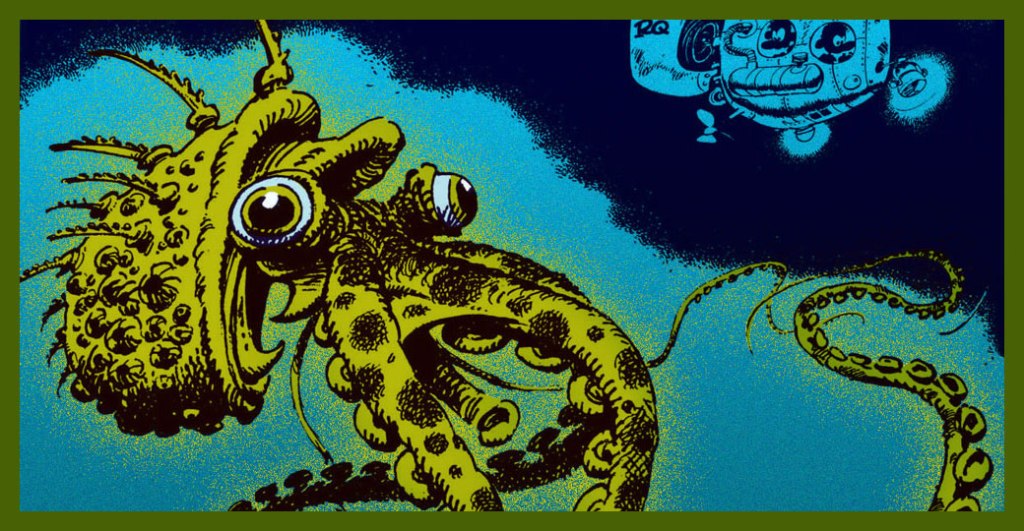
… in which we continue our exploration of tentacles slithering their way into Franco-Belgian comics!
In an orderly fashion, please.
The other day, a friend heartily recommended a certain movie to me, pointing out that it was ‘ancient’ and therefore probably available online for free. When I checked the year, it turned out to have been from 1995 which, excuse me, hardly qualifies as prehistoric. What can be considered ‘old’, then, people in their early thirties will ask? Why, this magazine cover, for instance.
Le Petit journal illustré (May 21st, 1922). The bottom says “a drama at the bottom of the sea”, with details of how a diver was attacked by an octopus and cannot get out his knife to fight against his repellent aggressor.
Skipping some thirty years ahead, I believe we’re still in “old” territory.
A page from « Zette reporter : Aventure en Pacifique », published in Lisette n° 38 (September 16th, 1956). Script by François Drall, illustration by Yvan Marié. The girls, after witnessing a fight between a giant shark and octopus, now seek to escape the clutches of the victor’s eight appendages.
Lisette was a comics magazine specifically aimed at female readership (to be more precise, it was marketed to girls between 7 and 15 years old). The interesting part is that it often featured articles about traditionally men-dominated careers, some of which had only been very recently accessible to women… for instance, an interview with Anne Chopinet (one of first women accepted in l’École polytechnique) and a reportage on women air pilots back when this was an almost exclusively man-only club.
Moving on to further, more energetic octopus-evading tactics… we have Bob Morane, originally a hero harking from adventure books written by prodigiously prolific Belgian novelist Henri Vernes, and published by Belgian éditeurMarabout. The number of adventures Morane has lived through is rather staggering: around 200 novels + about 80 comics albums. Now there’s a challenge for the serious collector!
Original art fromBob Morane et l’oiseau du feu(1960). Illustrated by Dino Attanasio.
Scripted by Antoine Raymond (a.k.a. Vicq), illustrated by Will, 1962.
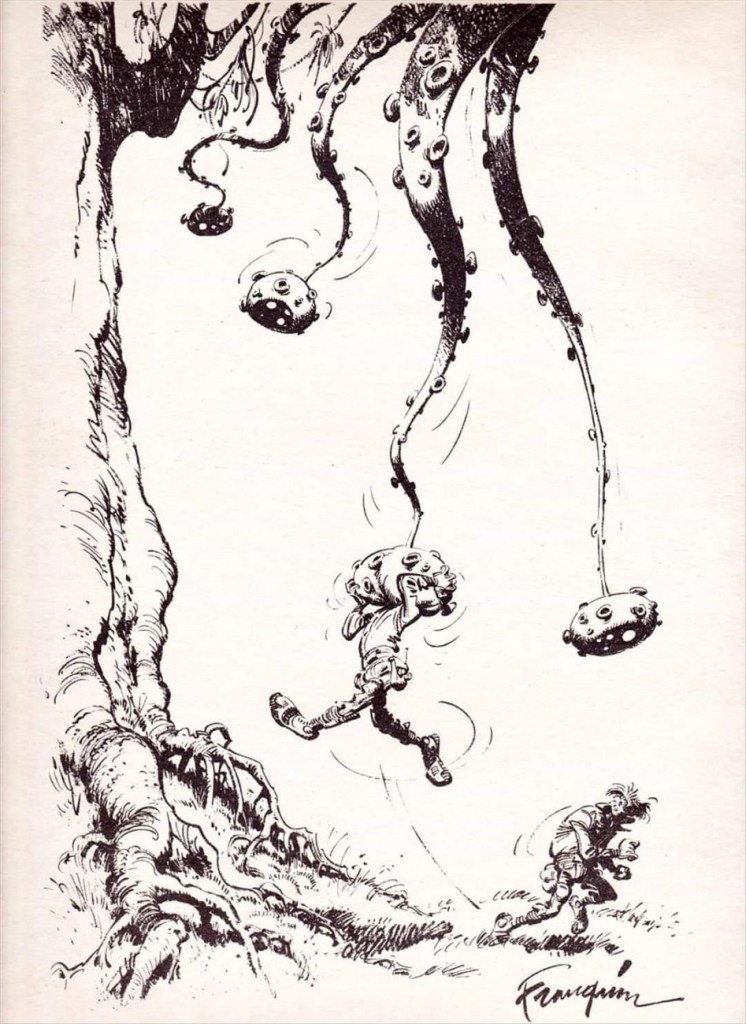
Co-admin RG called André Franquin‘s œuvre “an embarrassment of riches” in his Faites gaffe, monsieur Franquin! post. I thoroughly agree, and am very pleased to report (though this is in no way surprising) that tentacles are part of his vast répertoire.
Pages from what’s collectively known as Idées noires (Franquin’s Last Laugh in English). These dark strips and cartoons were Franquin’s « l’humour du désespoir », the humour of despair, and appeared in Le trombone illustré (Spirou’s magazine supplement) in 1977 and, with the discontinuation of the latter, moved to Fluide Glacial until 1983.
I’d better stop here. After all, I wouldn’t want to go as far as ‘modern’ times… say, from the 90s and onward, although it’s scary to think that was still 30 years ago!
« Feminism encourages women to leave their husbands, kill their children, practice witchcraft, destroy capitalism and become lesbians. » — Pat Robertson
Truly one of the crown jewels of Franco-Belgian comics, Isabelle (1969-1995) has quite a pedigree: it was conceived by scripters Yvan Delporte, Raymond Macherot and illustrator Willy Maltaite, alias Will. When Macherot took ill, the legendary André Franquin stepped in, and the series took on a slightly more sombre shade, and its characterisations gained further depth. The best of all possible worlds, truly.
Brimming with magic, poetic grace, wit and atmosphere, Isabelle gave us, for a change, a level-headed and resourceful little girl in a world of infinite possibilities. I can’t stress this point enough: unlike every other little girl character in supernatural fantasy tales I’ve ever encountered, Isabelle doesn’t trip over roots, gasp loudly or drop a glass at the wrong time; she doesn’t disobey solemn, life-or-death instructions against all common sense. And yet she’s just an ordinary little girl, not a secret ninja or a princess in hiding. Truly refreshing. After reading Isabelle, most of what passes for fantasy is shown for the formulaic, stock dreck that it is. This is the genuine article.
In the mid-90s, publisher Les Éditions Dupuis brought the series to an unceremonious end, judging its sales numbers insufficient. Ah, but Isabelle has its fans, and a tenacious lot they are. Dupuis’ rival, Les éditions du Lombard (home of Tintin, and now merged with Dargaud, home of Astérix et Obélix) collected the entire series in 2007, in three stunning volumes rife with priceless documentary extras. Absolute bande dessinée nirvana. Good luck getting copies these days, sadly.
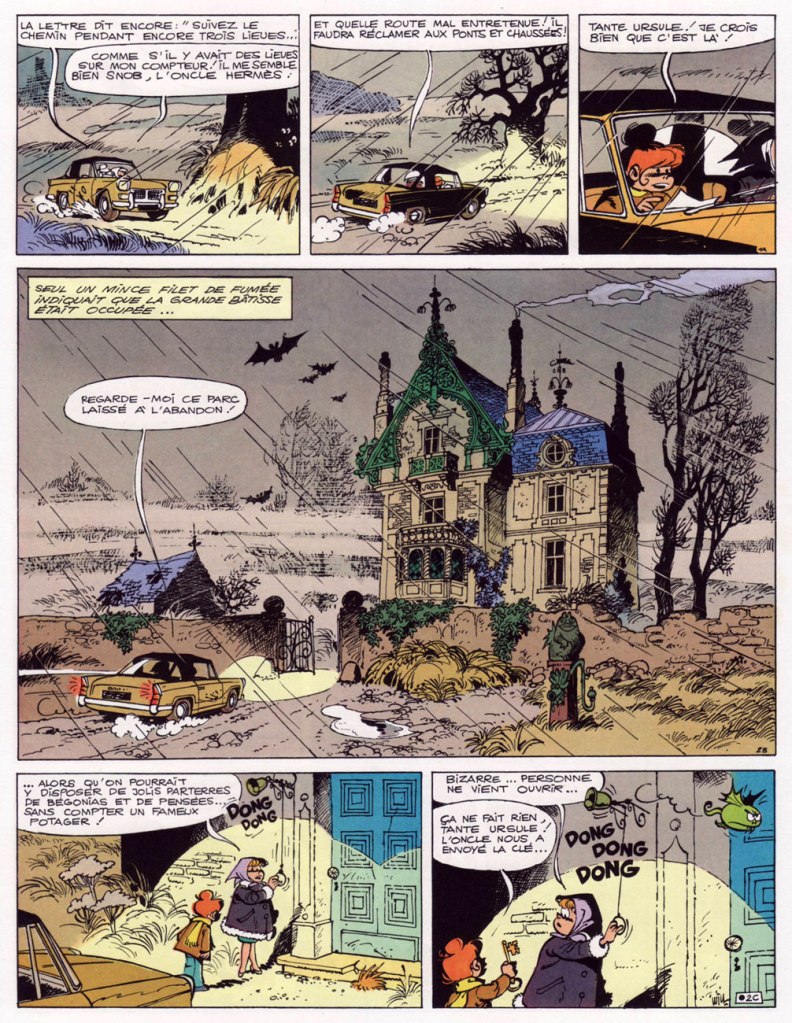
The cover of weekly Spirou no. 1929 (Apr. 3, 1975, Dupuis), beginning the serialization of the seventh Isabelle story (and her third album), Les maléfices de l’oncle Hermès (collected in book form in 1978). This is where two of the series’ pivotal characters, the titular Oncle Hermès and his eventual paramour, sexy witch Calendula, were introduced, not to mention her evil ancestress (the original) Calendula, the series’ archfiend.
The album in question, in its original edition (1978).
Page 2 of Les maléfices de l’oncle Hermès. During a long career shackled to characters he didn’t own (i.e. Tif et Tondu), Will was thrilled to work on a series of his own, one closer to his own interests and preoccupations. Dig that mood!
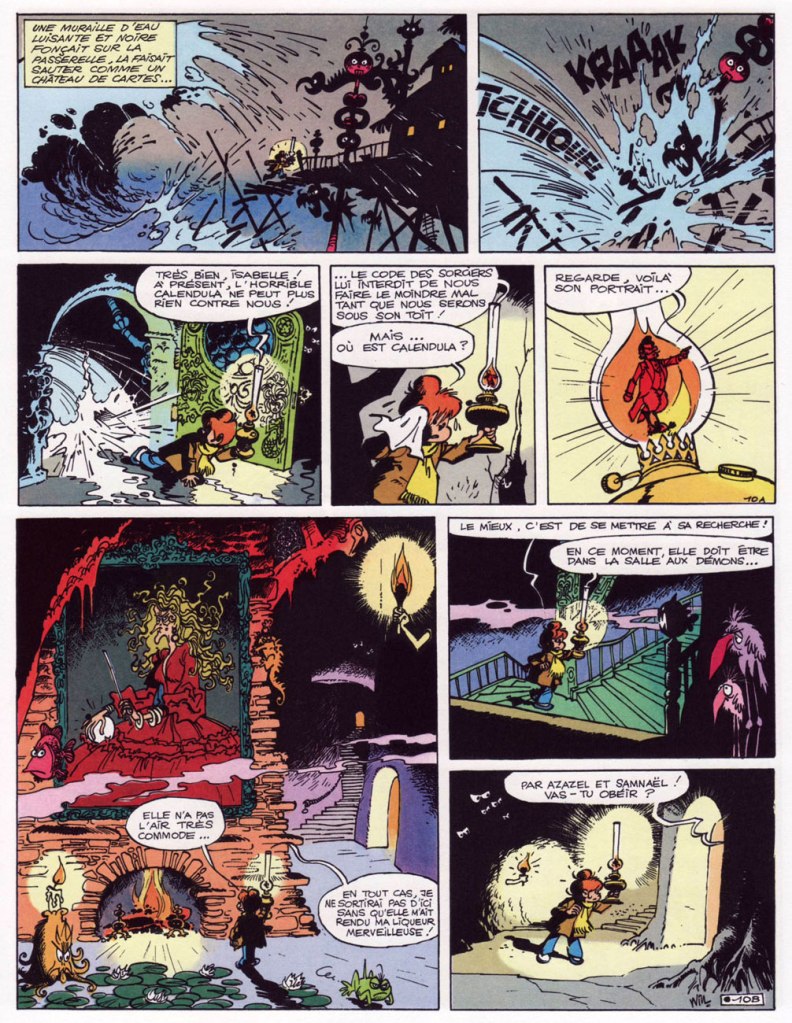
Page 10 of Les maléfices de l’oncle Hermès. Cloven-hoofed Oncle Hermès, the victim of a centuries-old curse, is trapped in a flame, and his great-great-great-great (etc.) niece Isabelle is endeavouring to set him free.
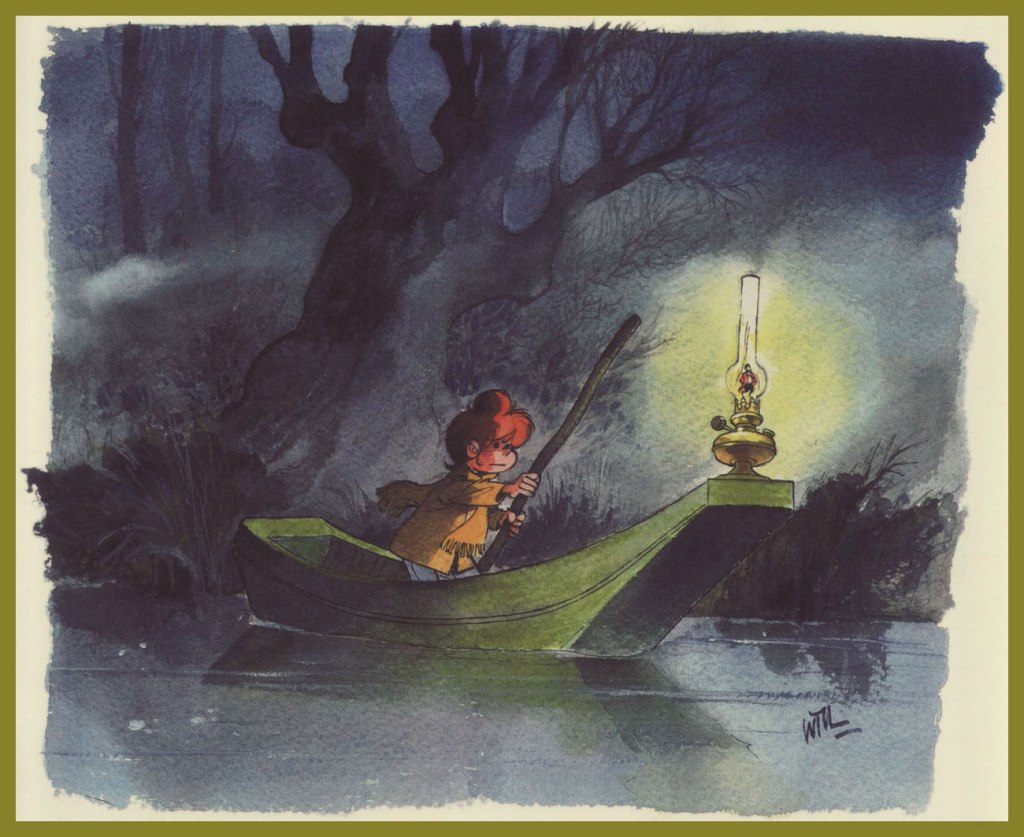
The journey is, of course, quite perilous… and the visuals gorgeous.
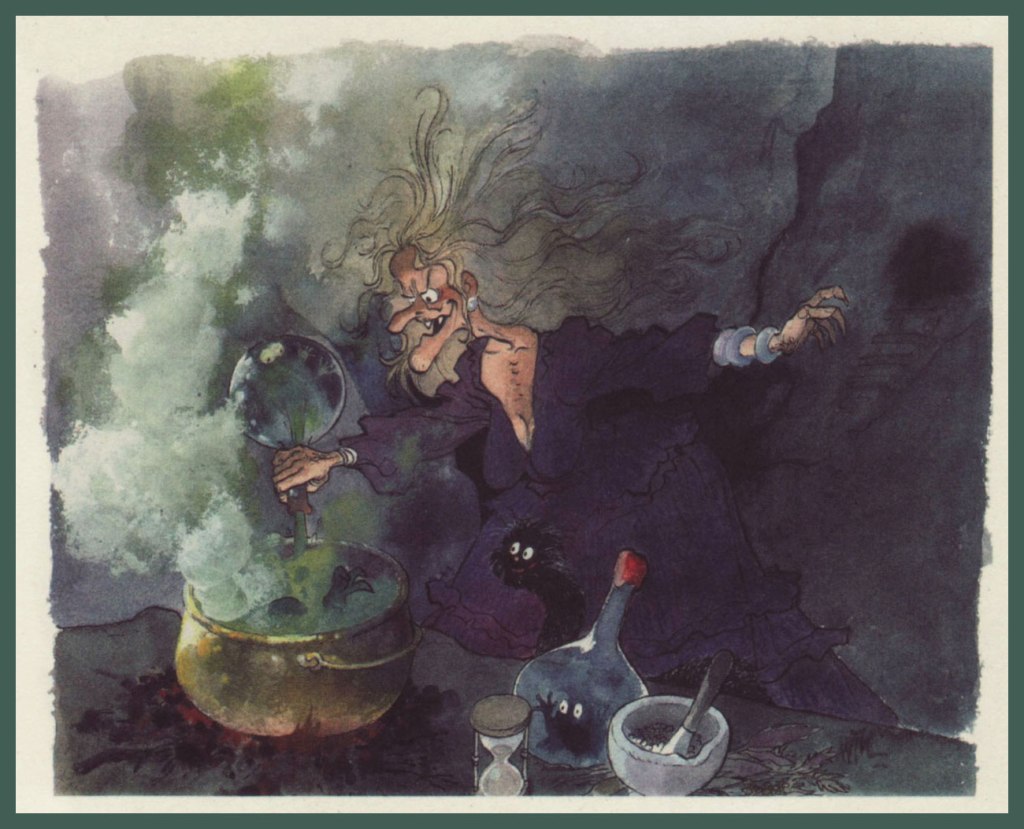
This is the original spell-caster, malevolent Calendula.
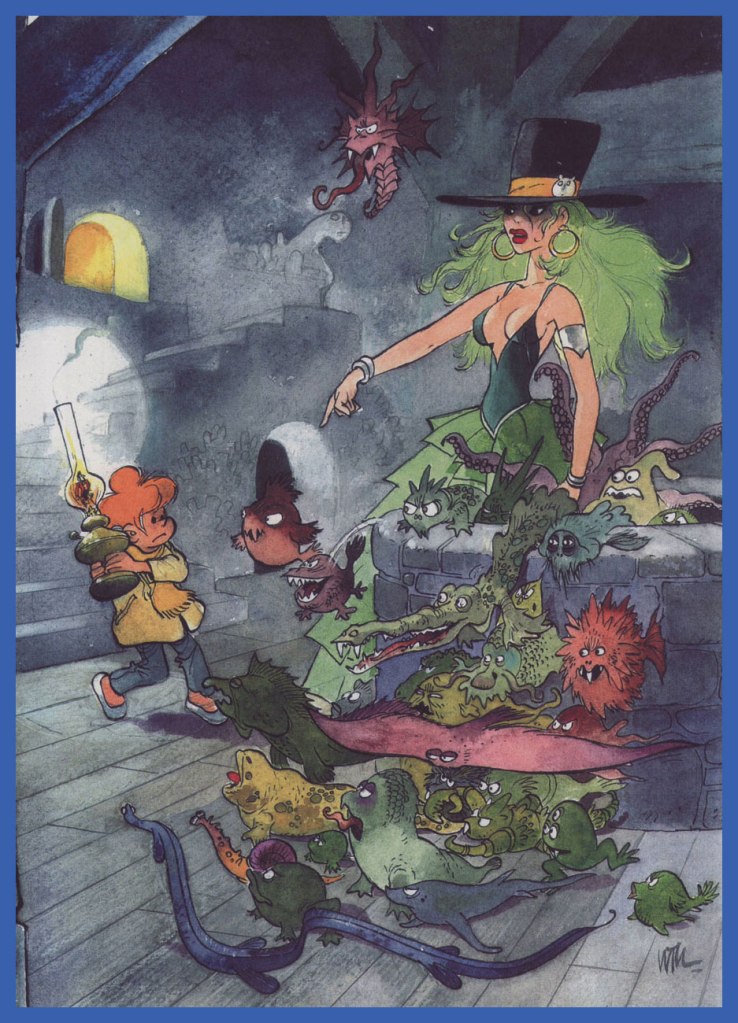
And this is her descendant of the same name, on the side of good, though she does have a temper.
Isabelle and Calendula (and friends) feature as part of Brussel’s delirious Parcours BD. Does your hometown appreciate its comics this effusively and concretely? (update: The Isabelle mural was painted over in 2016, I regret to say.)
« Flattery is like chewing gum. Enjoy it but don’t swallow it. » — Hank Ketcham
Going way back: When I was a wee lad (still in the single digits), my mother would accompany me to our area’s oldest and finest bookstore (Chicoutimi’s long-gone Librairie régionale). At the time, I had been purchasing bound collections of Belgian bédé publisher’s Spirou, the earlier the better. Even at that tender age, I held the conviction that things had already peaked.
A friendly employee ushered us into the restricted area of the bookstore’s top floor, a vast warehouse I never got a tour of… but it was immense! I was led to an aisle where, high above, dozens of older Spirou collections were kept, dating all the way back to 1962. I can afford to be specific, because I bought the oldest issue they had on hand (Album Spirou no. 84). At ten dollars a pop, they were reasonably-priced, but still costly for a child with a 1970s-scale allowance. For my parents, a reliable source of ideal birthday and Christmas gifts, however!
It was in their pages (no. 90, see below!) that, along with the established Spirou magazine series (Spirou et Fantasio, Boule et Bill, Buck Danny, Benoît Brisefer, Tif et Tondu, Gil Jourdan…), I encountered scads of unfamiliar entries. Of these, an early album caught mid-tale one that truly stuck with me through decades and therefore is the object of today’s post.
This is Album Spirou no. 90 (Sept. 1963, Dupuis), collecting the bédé weekly’s issues n° 1316 to 1328. Cover by André Franquin, depicting a scene from a Spirou adventure, the troubled production that was QRN sur Bretzelburg (under its original title, QRM sur Bretzelburg).
In short, though, here’s what’s relevant in this case: from 1949 to 1987 (with a pause between ’59 and ’63), Will illustrated the adventures of Tif et Tondu, characters owned by Éditions Dupuis, its publisher. Still, he longed to draw characters of his own, which wasn’t an idle whim, given that most of his colleagues and collaborators did just that, enjoying more latitude and far greater financial rewards. In 1962, he got the chance to try his hand at an original series, Éric et Artimon, conceived with versatile scripter-cartoonist Raymond Antoine, alias Vicq. And the result was outstandingly charming, light-hearted and hilarious.
The 1976 (and only, so far) edition of Toute la gomme. Still, I’m grateful for its existence: I was finally able to read the whole story, though without colour.
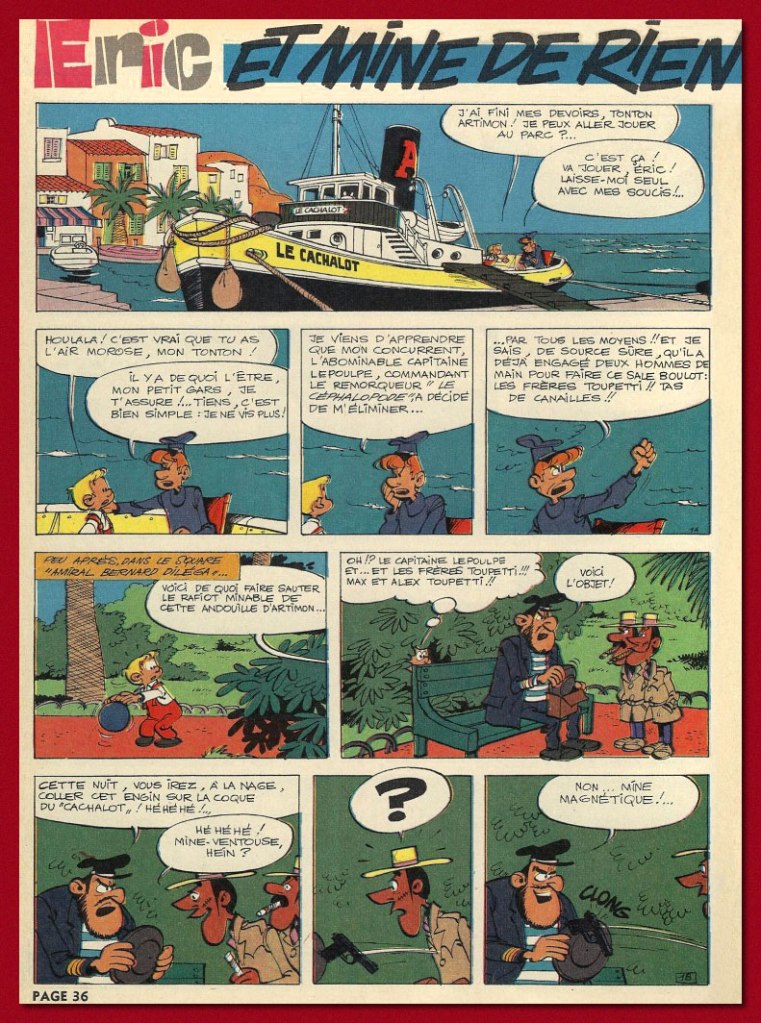
A mere two long adventures (44 pages each) were produced (Le tyran en acier chromé, 1962, and Toute la gomme, 1963, plus a six-pager, Et mine de rien, in 1967), and Dupuis never bothered to collect or reprint them. Instead, well down the pike, two separate, smaller publishers licensed the rights and issued small black and white runs of, respectively, Toute la gomme (Espace Édition, 1976) and Le tyran… (Magic Strip, 1983).
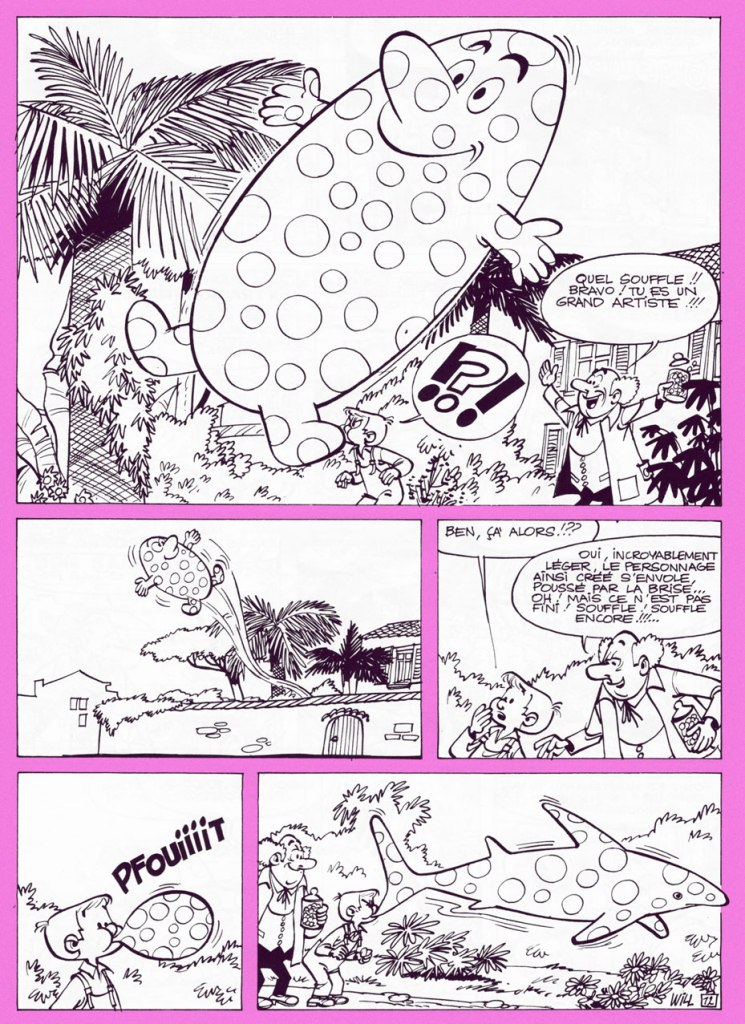
Candy aficionado Éric visits his main supplier, loveable eccentric Monsieur Grosoison, at his confiserie ‘Au bambin vorace’ (‘The Voracious Toddler’). The old man, also a brilliant inventor, shows off his new creation to his best and most loyal customer. The stuff’s not only downright magical, it’s also exquisitely delicious.
« Such lungs! Bravo! You are a great artist! »
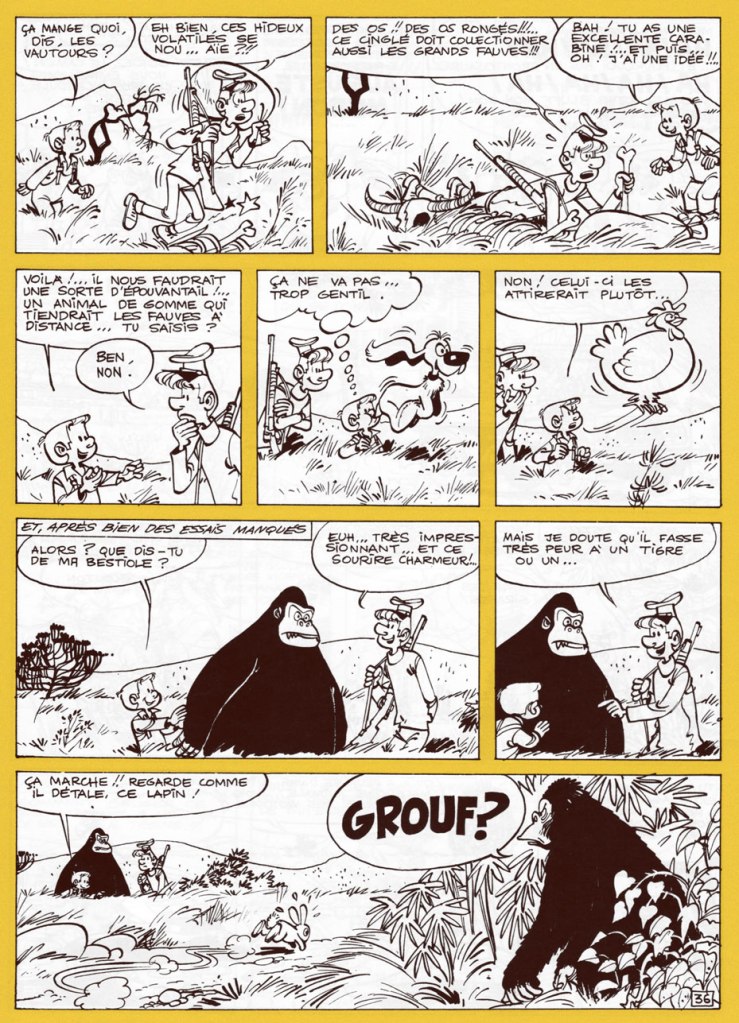
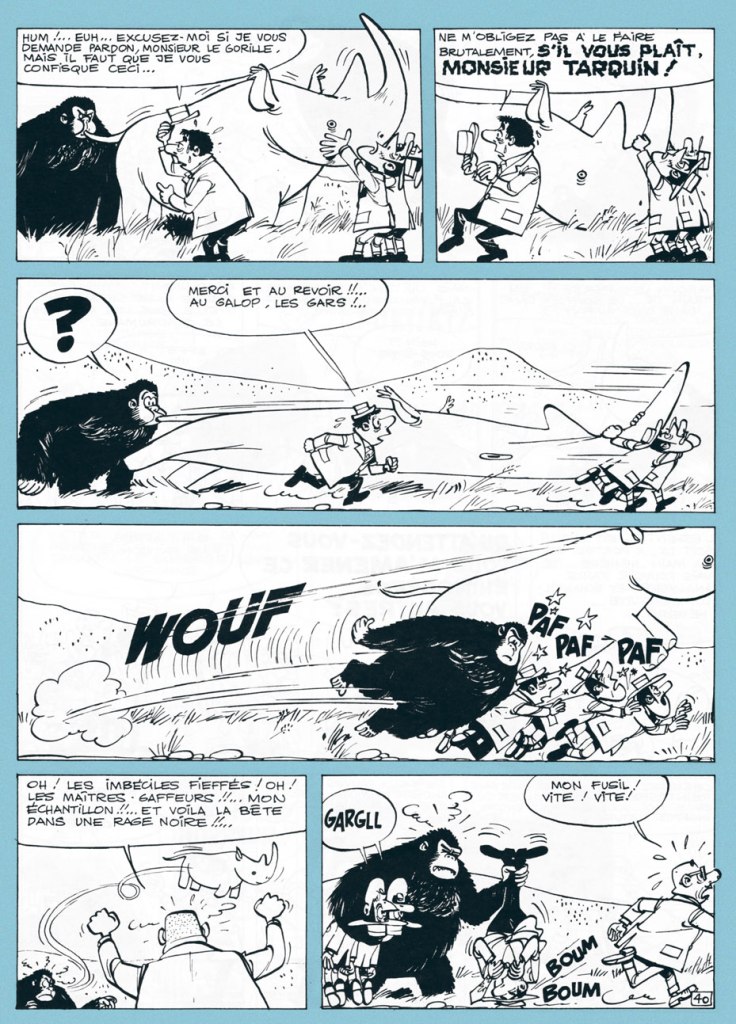
After an unscrupulous candy magnate has the inventor kidnapped by his henchmen (an uprarious pyromaniac and a pair of tiny twins afflicted with stiff necks from gaping at Éric’s balloon creations drifting overhead), and taken to his private island, he threatens to leave him in the hands of fearsome gorilla Tarquin the Superb. Meanwhile, Éric and Artimon encounter the ape, who turns out to be blessed with tremendous intelligence, a fine sense of humour, and a powerful set of lungs.
However, Tarquin doesn’t like his good-natured fun interrupted.The back cover of Espace’s Toute la gomme, wherein Éric employs ingenious means to escape a rooftop.
The opening page to the short concluding episode of the boy and the captain’s adventures, Et mine de rien (Spirou n° 1506, 1967).
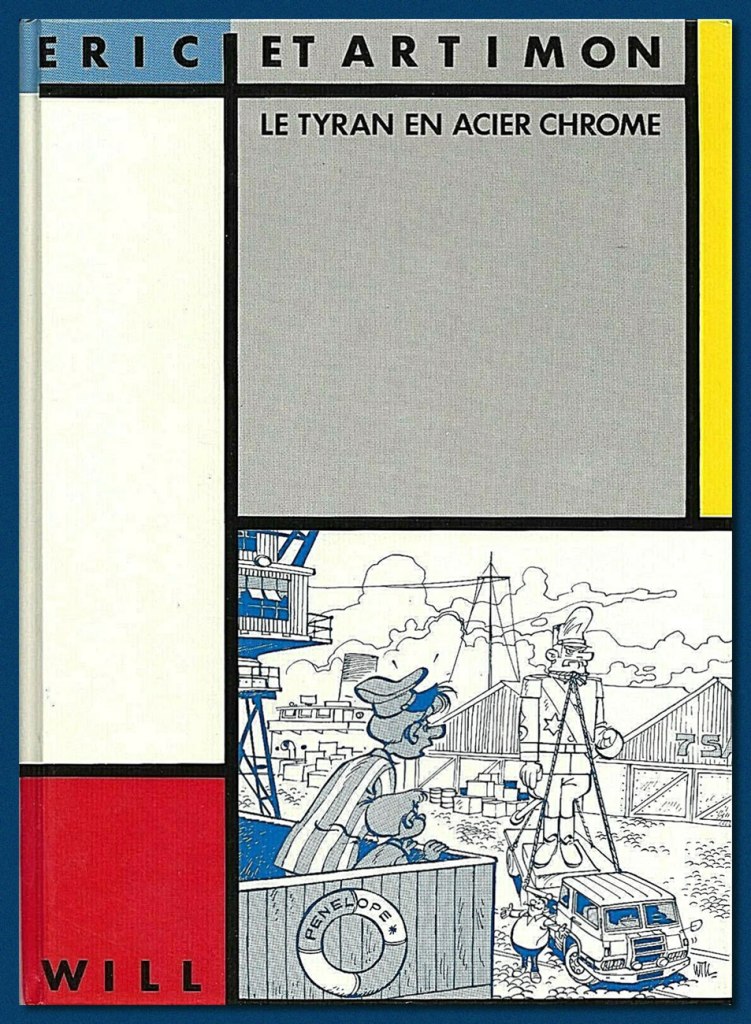
And here’s the fancy 1983 edition of Le tyran en acier chromé, scarce and fairly pricey nowadays, unlike Toute la gomme.
Thankfully, Éric et Artimon haven’t been entirely forgotten, despite the shabby treatment they received at the hands of their original publisher. Here’s a signed lithograph produced in the early 1990s by Belgian bookstore Chic-Bull. Note the fancy silver ink on the statue. Mine’s number 48!
I’ll be spotlighting Will’s other creator-owned series, Isabelle, at some point during this year’s Hallowe’en Countdown!
Ninety-three years ago today (January 3, 1924, that is), master bédéisteAndré Franquin was born in Etterbeek, Belgium.
His œuvre is an embarrassment of riches, but heck, here’s a diabolically ingenious Gaston Lagaffe strip whose mise-en-scène is so solid and visually limpid that the only dialogue needed to truly “get it” is the punchline: « Never seen such a tough nut… »
Originally published in Spirou no. 1599 (Dec. 5, 1968, Éditions Dupuis.)
It would be unfair and inaccurate to single anything out as André Franquin’s «masterpiece», given the consistently high calibre of his output. Let’s settle for stating that Gaston was in all likelihood his most popular creation, as luck would have it.
The legendary gaffeur first messed up in a two-panel cameo in the Spirou et Fantasio adventure Le voyageur du Mésozoïque in 1957. Later S&F tales were dotted with Gaston cameos, and the accident-prone office boy soon (crash-) landed his own half-page strip, which ran from the late 50s to the late 90s, though mostly consisted of reprints after the early 80s.
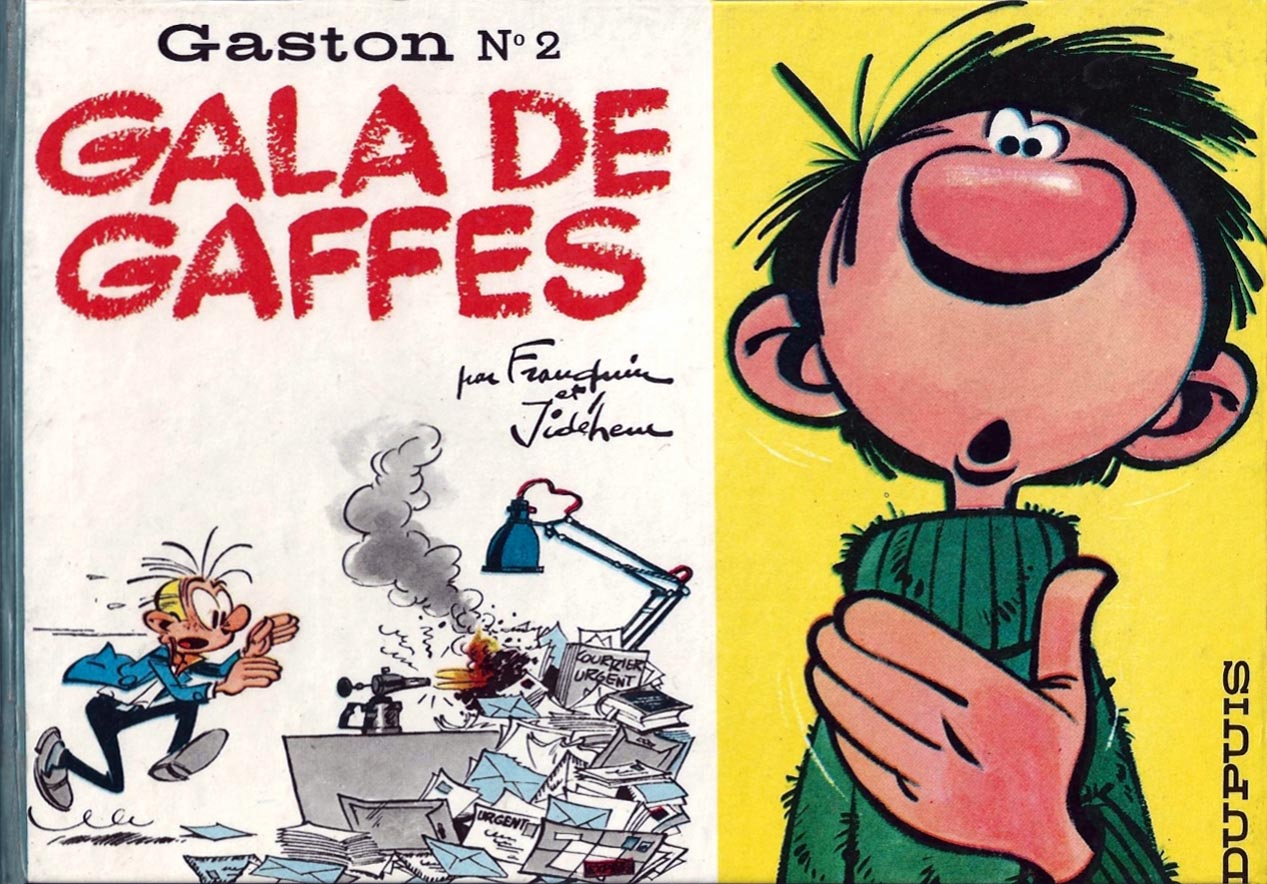
Gaston’s second strip collection, issued in 1963 in the original “landscape” format, deemed an oddity at the time.
As for translations, Gaston’s popular in a bevy of languages, but not, of course, in English. Fantagraphics’ Kim Thompson was a huge fan, and translated a handful of strips, which were published (as Gomer Goof) in issues of the anthologies Prime Cuts and Graphic Story Monthly.
Speaking of Gomer, Anglophone readers are in for a treat: UK publisher Cinebook has, just last October, issued a collection (only 48 pages, but you have to start somewhere… and perhaps small) entitled Mind the Goof! Check it out here.
















 Who's Out There?