« Spine-chilling tales of suspense, horror, and the supernatural—prepare yourself for Adventures into the Unknown! »
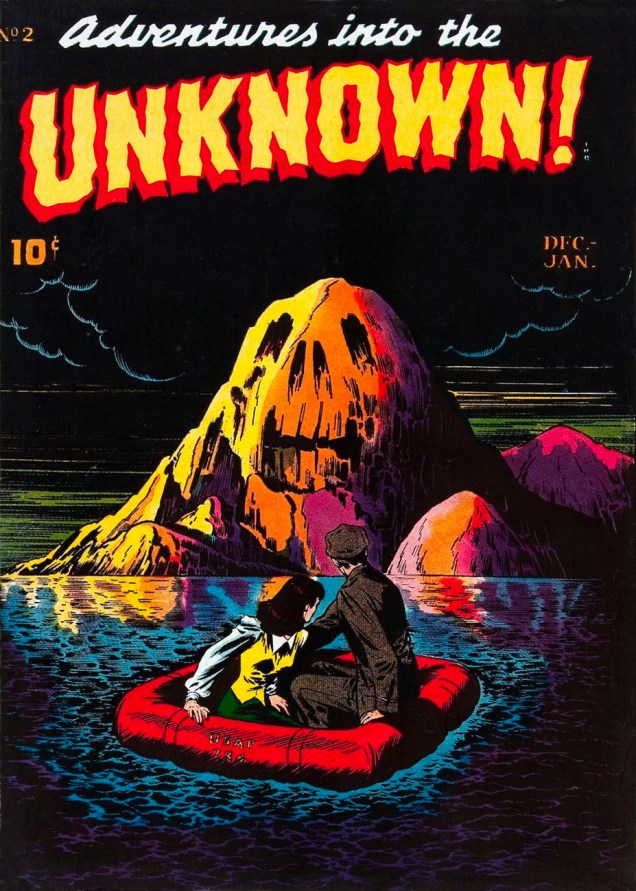
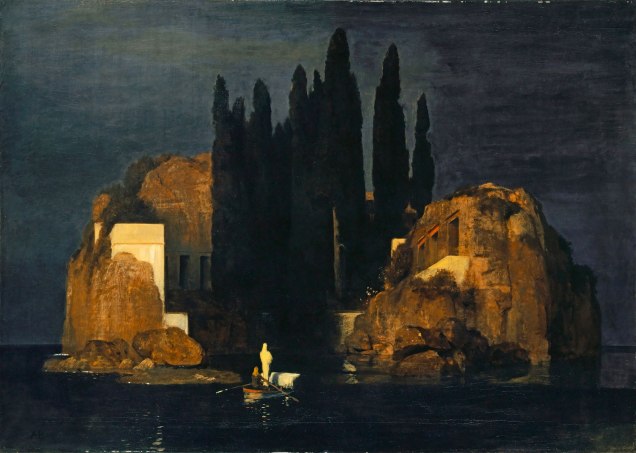
This American Comics Group (ACG) entry is generally considered the first title fully committed to the supernatural genre in the history of US comics. And this arresting, Isle of the Dead-styled tableau graces the cover of the title’s second issue (December, 1948). Art by Edvard Moritz. Most of the stories were scripted by horror legend and H.P. Lovecraft disciple Frank Belknap Long (read his The Hounds of Tindalos and forfeit your soul!) Speaking of which, the entire issue’s contingent of chills and thrills is available right here for your pleasure and leisure.
This is Adventures Into the Unknown! no. 2 (Dec. 1948 – Jan. 1949, ACG).As I was saying, Arnold Böcklin‘s Isle of the Dead painting, in its original version… of several.
«Men!! They are a worse menace than any octupus [sic] or shark that ever swam…»
Oh, poor octopuses. Authors use them as a (not very original) symbol of a terrifying, all-powerful force, and then get them (not very creatively) destroyed. An octopus is lucky to “just” get stabbed; everything seems to be fair play in this violent spree – dynamite, torpedoes, even freakin’ nuclear weapons. In most cases, the problem is definitely Man: man who enslaves sea creatures and makes them do his bidding with varied gadgets, man who intrudes on the octopus’ territory, man who sticks his nose where only tentacles should be.
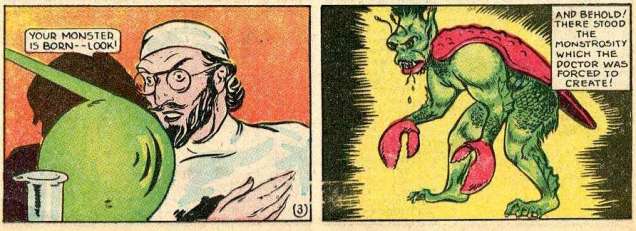
« I only have to give him the claws of the killer lobster… the teeth of the tiger shark… and the heart of the barracuda! That is all! » Because any normal doctor has this stuff just lying around his operating theatre, obviously.
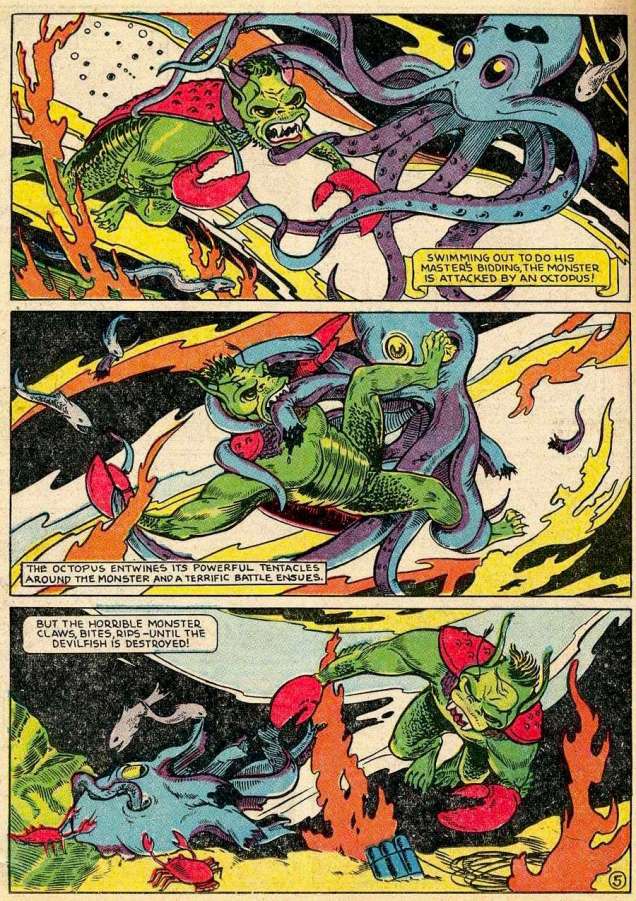
Spectacular, deadly monster created? Next thing to do is to rip an octopus to shreds, in a particularly gory eyeball-wrenching, tentacle-mincing scene.
Seriously, just look at that eyeball getting pulled out by toes… Page from “Devils of the Deep”, scripted by George Nagle and drawn by Edd Ashe, published in Blue Ribbon Comics no. 3 (January 1940).
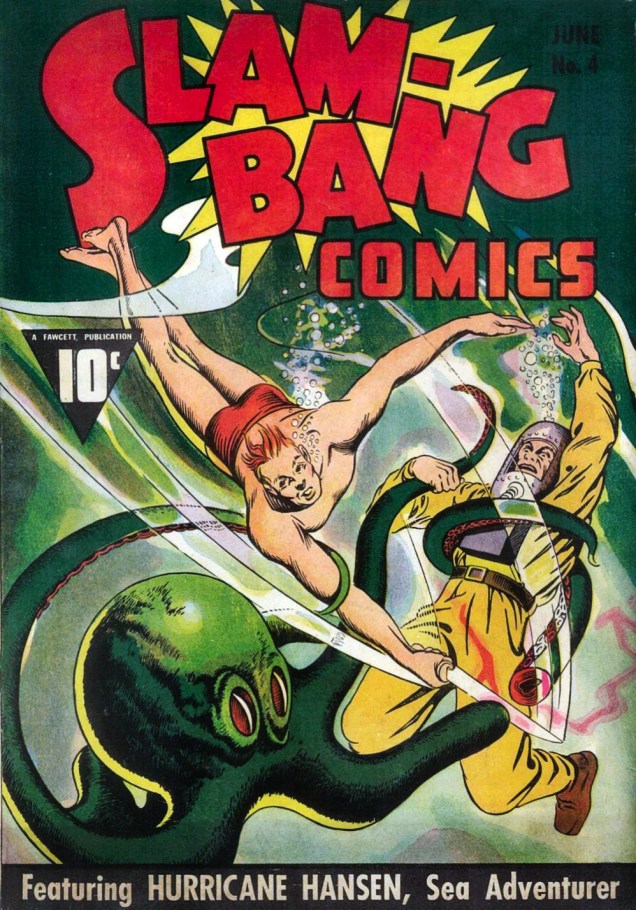
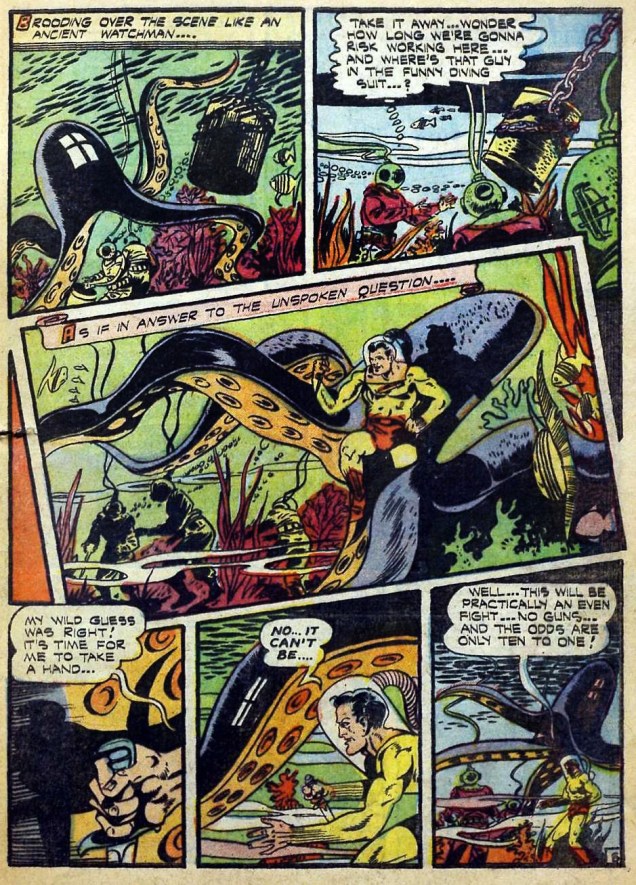
Next up, your standard slashing-at-tentacles-with-a-kitchen-cleaver. The guy must have been stashing it in his swimming trunks; there’s really no need for wearing an actual diving suit. That sap getting squeezed by a tentacle wore one… and look at all the good it did him.
Slam-Bang Comics no. 4 (June 1940), cover by Gus Ricca.Don Winslow of the Navy no. 36 (July 1946). Created by Lieutenant Commander Frank V. Martinek as a newspaper strip, Don Winslow was meant to underline Naval courage and inspire American youth to orient their career paths in that direction. I dunno, maybe this particular issue was responsible for a new generation of oceanographers.
I love the idea of an eight tentacled obstacle, and shall aspire to insert that phrase into completely irrelevant conversations.
The story is called “With the Marines”, artist unknown.
I have to admit that Don Winslow (not the author) is the kindest octopus handler we’ve seen today. It must be part of those Naval traditions and courage Martinek insisted on. (He was quoted as saying “Since Don Winslow of the Navy is approved by the Navy Department, I cannot allow him to do anything that is contrary to the ideals, traditions or motives of the Navy.“)
Blinding the beastie instead of stabbing – you go, Sir.
“It takes cold, raw courage to step up to… This is the grandfather of all octopus… or is it octopi…?” Only a true hero starts fretting about the properness of his English while in proximity to a giant octopus. Are you wondering why that octopus looks distinctly fake? He’s actually made out of rubber, as Don Wallace, a.k.a. Torpedo Man discovers when he punctures the counterfeit cephalopod.
Blue Bolt Weird Tales of Terror no. 112 (Feb 1952). This is a page from “Strange Tale of the Sea Monster”.
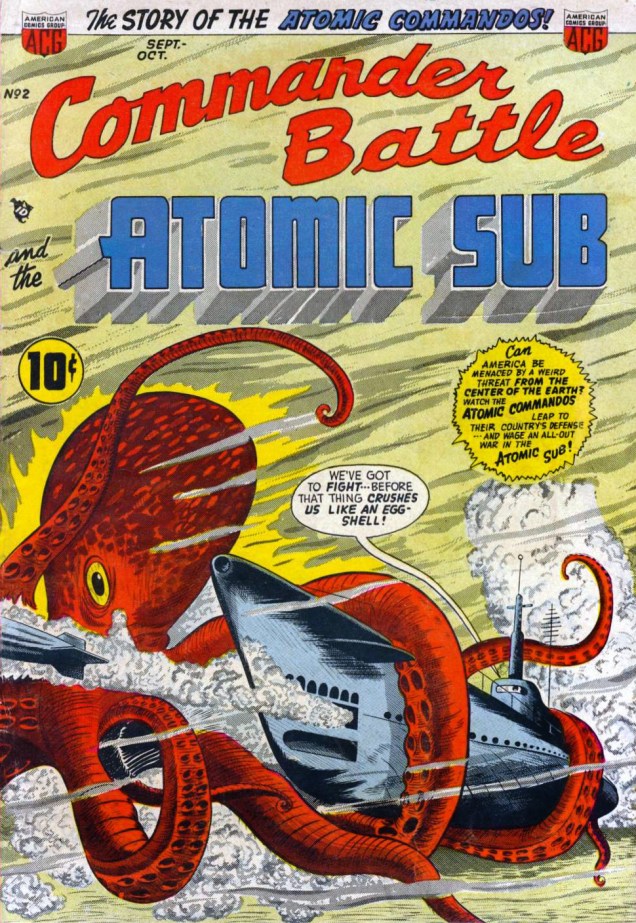
In the 1950s, “atomic” was distinctly a cool word, which clearly inspired the creation of this Atomic Submarine (nuclear powered, that is) and its Atomic Commandos… a crew of, like, four people. To quote Toonopedia, “The real atomic sub was apparently a bit more complex and challenging to deal with than the comic book one. Commander Battle’s got along with only four men aboard — Bill Battle (the boss), Champ Ruggles (“the most powerful man on the American continent”, and maybe even the other American continent as well), Doc Blake (the scientific genius) and Tony Gardello (only mildly ethnic).”
“The atomic commandos didn’t know that the way to the island was barred by an awful defender… by a gigantic nightmare creature that staggered the imagination! They didn’t see it as it rose from the depths behind them, flaring tentacles ready to pounce, clutch…” The octopus went from red to green – is that for better camouflage?
Panels from the rather lengthy, 2-part story titled “Fight for Survival!”, drawn by Sheldon Moldoff.
The weird threat from the center of the earth is actually a nation of sea-dwellers who demand humans cease using atomic weapons, threatening to burn Earth’s surface if this is not done (and unleashing their almost-indestructible octopus, as well). When Commander Battle triumphs at the end of the story, all the “giant attackers” die from a radioactive cloud. “And so it came to an end, this civilization of titans at the center of the earth… for now, not a single on was left alive! Let it be said that they were not evil! Destiny had willed it that they cross man’s path...” In today’s Tentacle Tuesday, this story takes the cake for its number of gratuitous deaths.
The Golden Age of comics proffered quite a lot of anthropomorphic animals to its readers. The stuff on offer ran the gamut of different definitions of humour, from inane slapstick to pleasant goofiness, all the way to batshit surrealism. There’s at least one common streak running through this zoological revelry – tentacles!
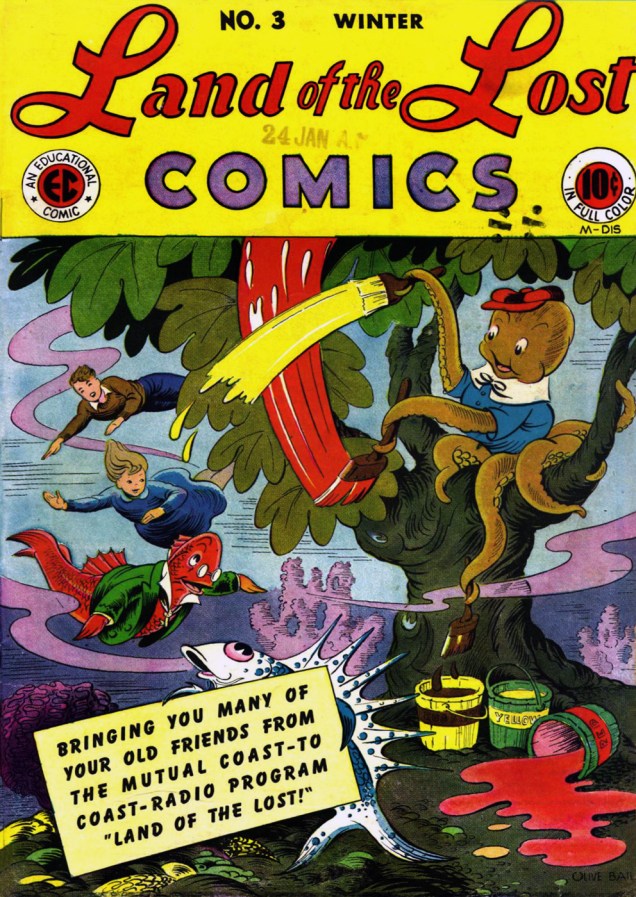
Our first exhibit is a charming comic from the 40s. Land of the Lost was a radio series broadcast from 1943 to 1948 on Mutual Broadcasting System and ABC, written, produced and narrated by Isabel Manning Hewson. Each episode started with the line « In that wonderful kingdom at the bottom of the sea… », and presented a new under-the-sea adventure of Isabel and Billy, two kids lucky enough to have an adorable avuncular fish for an underwater guide. (The fish was called Red Lantern, and was most notably voiced by Art Carney.) You can listen to an episode from 1945 here.
Coming back to our beloved cartoons: in 1946, EC Comics started publishing Land of the Lost Comics, a series that lasted for 9 issues. Hewson remained the writer, and the art was handled by Olive Bailey (not the Olive Bailey who helped crack Germans’ Enigma cipher machine in WWII.) The result was impressive: these comics are delectable, combining beautiful art with inventive plots that may be goofy, but have a solid internal logic. Hewson gave her sea-creatures vibrant personalities, and it’s so much fun to dive (not pun intended) into this world.
Land of the Lost Comics no. 3 (winter 1946), cover by Olive Bailey. Read the whole issue here… and then read other issues, too. Somebody needs to publish a collection of this stuff.
The following panels are from “Jack Frost“, scripted by Isabel Manning Hewson and drawn by Olive Bailey, published in Land of the Lost Comics no. 3.
Squidlet goes out of control, like all young octopuses are prone to doing.
Thank you, cool ladies, for all the fun!
Land of the Lost also became an animated cartoon as part of Famous Production Studios‘ Noveltoon series: Land of the Lost (1948), Land of the Lost Jewels (1950) and Land of Lost Watches (1951). I find the animation to be definitely subpar to the comics or the radio show, but I’ll let you judge for yourselves. (Jack Mercer is in it, albeit briefly!)
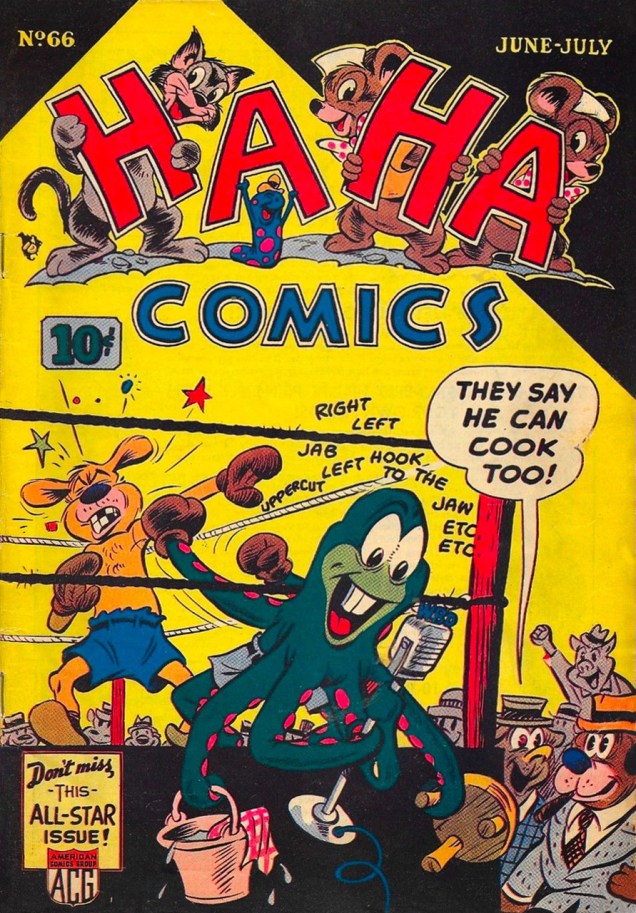
Did you know octopuses love to box? This implausible situation is definitely part of the lazy artist’s roster. To wit:
Ha Ha Comics no. 66 (June-July 1949), cover by Dan Gordon. It was really hard to find a scan of this issue in decent condition (thanks to co-admin RG), and comicbookplus doesn’t even have it in its database (you can read pretty much all the other issues of Ha Ha Comics, though).
Ha Ha Comics, a sister anthology of Giggle Comics, was published by ACG. (With issue #100, Ha Ha became Teepee Tim, going from animal hijinks to young Indian shenanigans for all of… three issues.) It’s quite a the playground of anything goes, but upon careful inspection, one easily finds good art shining among the dirt-pile of mediocrity, and diverting storytelling among hackneyed yarns.
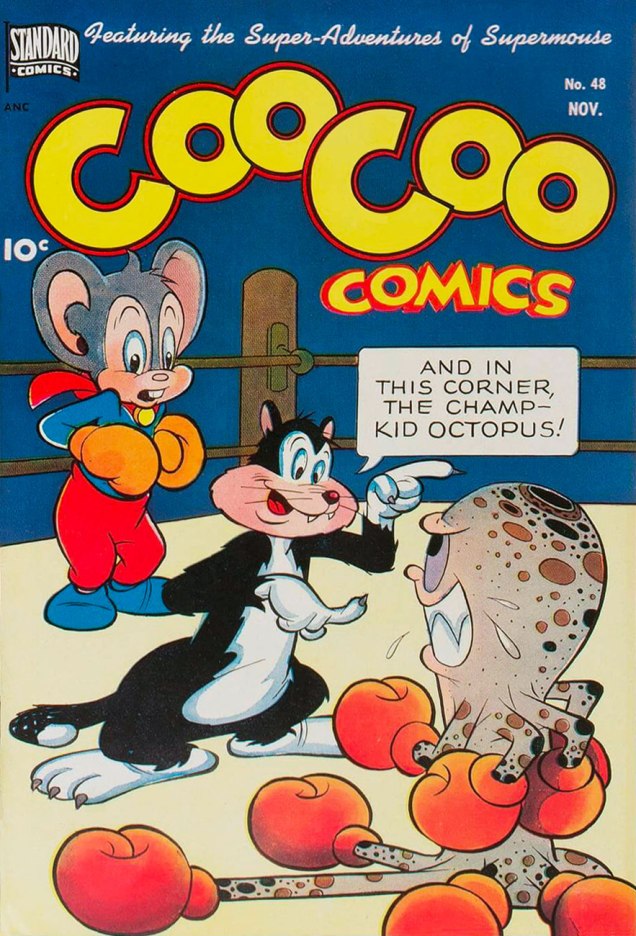
Coo Coo Comics no. 48 (November 1949), cover by Carl Wessler. Published by Standard Comics under the imprint of Pines (from Ned L. Pines, publisher). Read the issue here (no tentacles whatsoever, though).
How many arms does the fellow up above have, nine? I suppose that’s why he’s the champ!
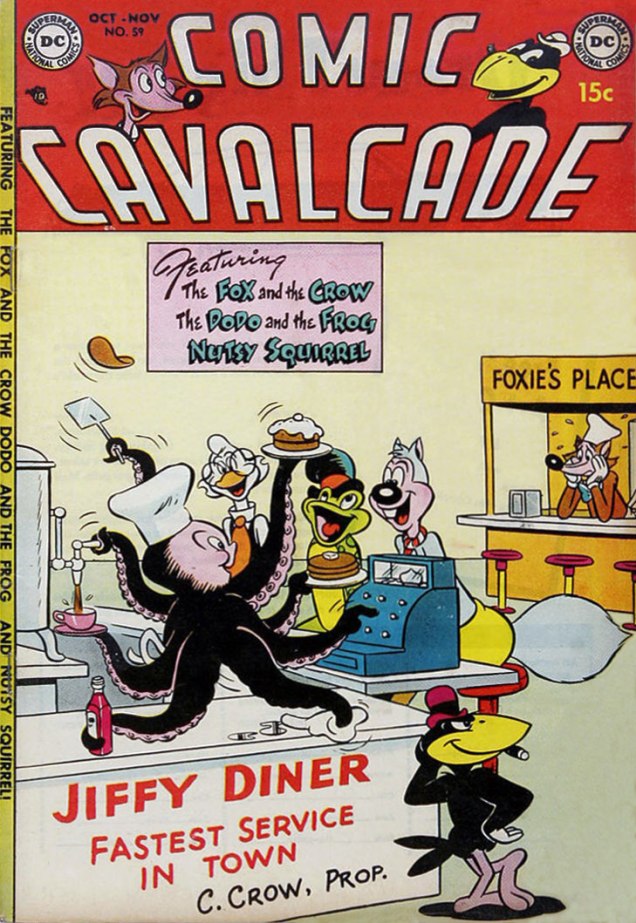
Comic Cavalcade went all funny-animals only with issue 30 (Dec-Jan 1948), when superheroes faded from popularity (oh man, that’s hard to imagine now, isn’t it?) It lasted until 1954, by which time it shrank from its original 96 pages to 76, however retaining its 15-cent cover price.
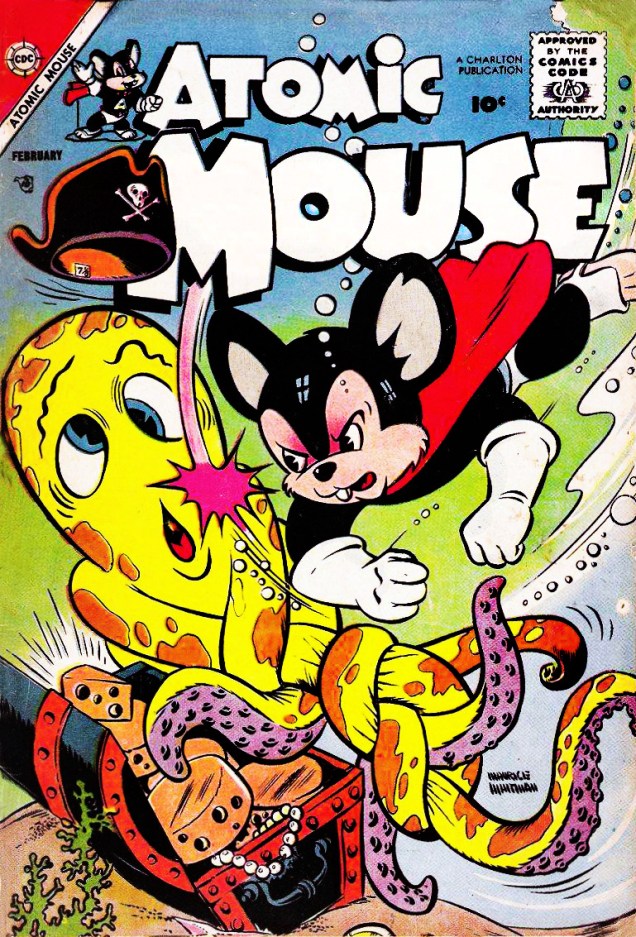
Comic Cavalcade no. 59 (Oct-Nov 1953), art probably by Rube Grossman. Read it here.Dinky Duck no. 10 (July 1954). WTF is a Dinky Duck? Terrytoons’ answer to Daffy Duck, says Toonopedia; or, tout simplement, a smaller-than-average duck. The poor duckling never caught on, but the cartoons did result in a comic series, published by Pines and then St. John.Atomic Mouse no. 25 (February 1958), cover by Maurice Whitman. Atomic Mouse was created in 1953 for Charlton Comics by Al Fago, their first animal superhero. The series was published for ten years (!), between 1953 and 1963, so it must have had at least a modicum of popularity.
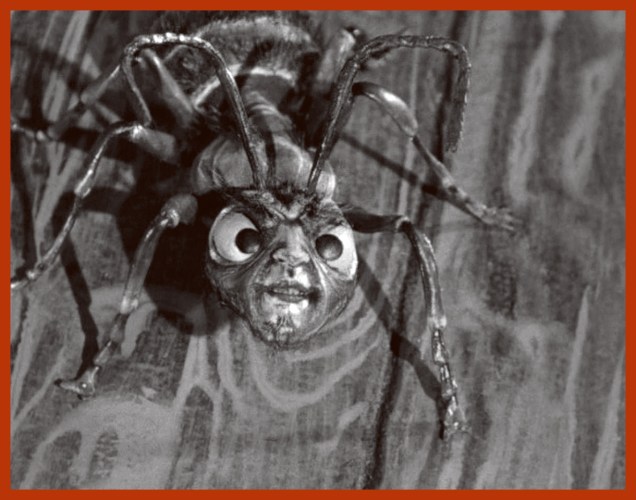
« I hate war, Steve! I hate the people who cause it and I hate them with very atom of my being! So I pretend to respect the enemy, even like him. I try to minimize him with love! » — Gen. Maximillian R. Hart, The Zanti Misfits
Feast your rheumy peepers on Bernard Baily‘s (co-creator, with Jerry Siegel, of The Spectre) famous cover for issue 4 of Gilmore Publications’ Weird Mysteries, April 1953. The cover’s creepy promise was squandered, since Baily’s friendly lil’ fella never appears within the issue.
This one also contains a classic, though rather thin, Basil Wolverton story, « The Man Who Never Smiled ».A few years ago, the cover’s original artwork was auctioned off for the tidily respectable sum of $33,460.00.
It fell to the American Comics Group (ACG) to follow up on the notion, about a year later in the pages of its Forbidden Worlds No.30 (June, 1954) and the cover-featured « The Thing on the Beach! » by the unknown scripter, and artist Harry Lazarus (not theHarry Lazarus, but one of the three Lazarus brothers working in the comics industry in the Golden Age.)
« It started with brutal murder… until nature decreed a weird revenge! »
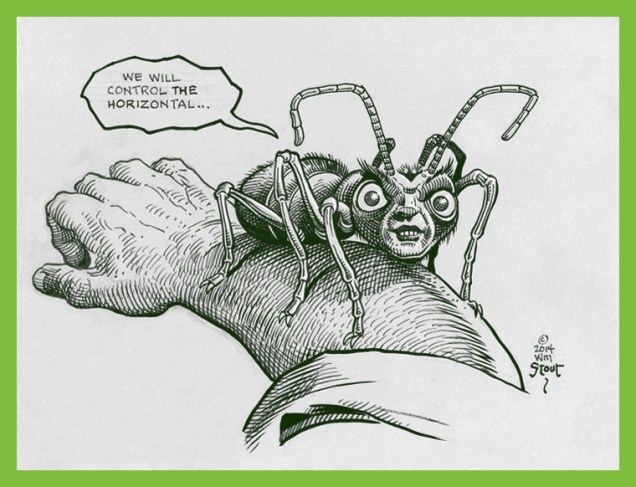
Rogers was a right mother from the start, but when his captain had his fill of his homicidal shenanigans, dropping him off on a remote island to cool him off, a funny thing happened. He found nothing in the place save ants, which had made short work of the unlucky goat population and the local flora. So what did the crazy bastard do? He gobbled ants. For weeks. And became a giant ant himself, it follows. You are what you eat, right?
Anyway, Rogers has got to be the most pragmatic villain ever, quite content, in the end, to be The Thing on the Beach!
Which brings me back to where I started: some say (okay, well, I do) that Baily’s WM4 cover may have inspired The Outer Limits’ ultra creepy The Zanti Misfits. Or maybe they’re just oddball products of the same era.
Today’s Tentacle Tuesday comes courtesy of American Comics Group, which delighted its readers with horror, satire and other strange offerings between 1943 to 1967.
ACG’s Adventures into the Unknown is now recognized as comics’ first continuing horror title. A good variety of horror tropes (though I imagine that back then, the clichés we’re painfully familiar with today weren’t quite as clichéd) , from the amusingly bizarre to the genuinely scary, could be found within its pages: killer puppets, homicidal ghosts, murderous mummies, vicious dinosaur relics, spooky skeletons… and tentacles, of course. Unlike many of its brethren, the series survived the fall-out of the 1954 comic book hearings that were started by the Senate Subcommittee on Juvenile Delinquency, but the title did drop its creepier storylines in favour of goofiness. Not a bad way to go, really, as long as the result is entertaining!
I’d like to welcome you to Tentacle Tuesday by kicking things off with this unnecessarily graphic cover in which somebody’s tentacle is getting lopped off. Note that the she-octopus also has vampire fangs. Beautiful? I wouldn’t go that far… or anywhere near it.
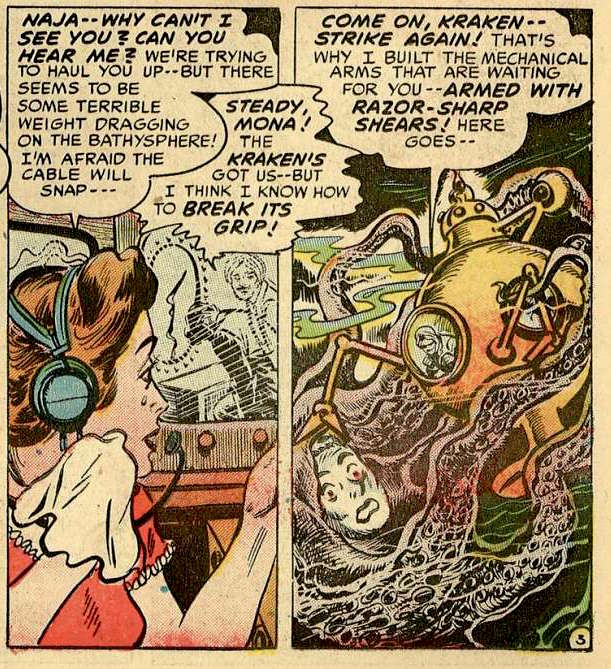
“…A monster which exists! I know — for I have met her face to face! Picture a face gigantic, beautiful — on a huge and monstrous body which reeks of evil — and death!” Adventures into the Unknown no. 49 (November 1953), cover by Ken Bald.A panel from « The Kraken », drawn by Jon Blummer. Geez, poor kraken. Later on, she (?) gets attacked with a “corrosive acid – with a nozzle activated from within “… Mona can’t bear to watch, and I agree.
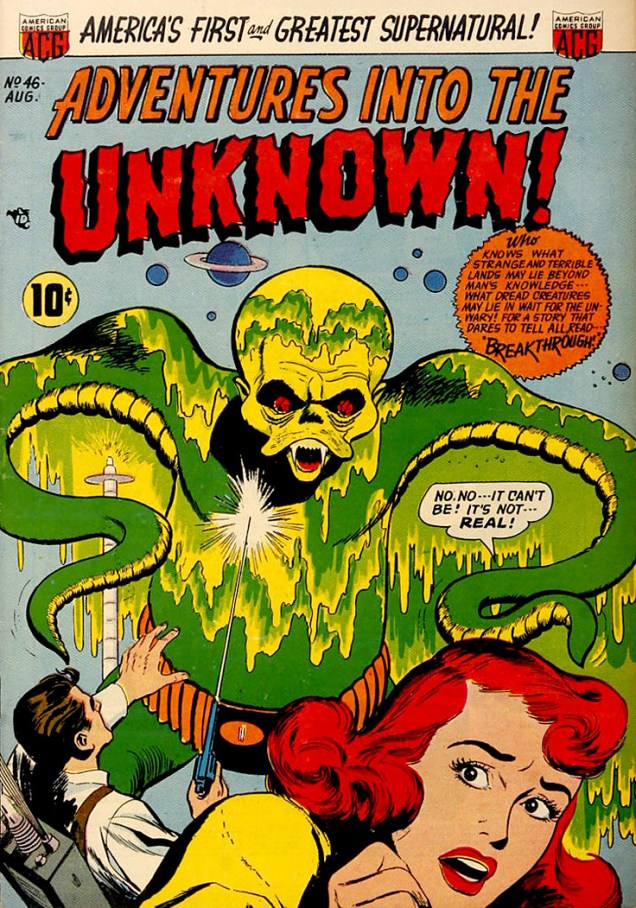
There are five Adventures in the Unknown covers that feature octopuses (or someone’s nightmarish and anatomically ridiculous idea of an octopus, at any rate). We’ve already featured no. 157 (revisit the past here – Nemesis is waiting for you!); the remaining four were published between August and November of 1953 and illustrated by Ken Bald (who drew the covers for issues 21 through to 50). Didn’t he get tired of drawing tentacles? Was it his idea? Did he have nightmares afterwards?
(A little aside: speaking of Mr. Bald, he’s been in the Guinness book of records for a couple of years now, for being the “oldest artist to illustrate a comic book cover”. The comic in question is Contest of Champions no. 2 (2015, Marvel Comics), which he drew at the age of 95.)
I’ll skip no. 48 for now, as its tentacles are plant-like in nature, but onward with the other two!
« Tale of Terror » from Adventures into the Unknown no. 46 (January 1953). Illustrated by Lin Streeter. It’s a well known fact that monsters on a diet are very irritable (and he’s still got a long way to go, judging by his chubby midsection).
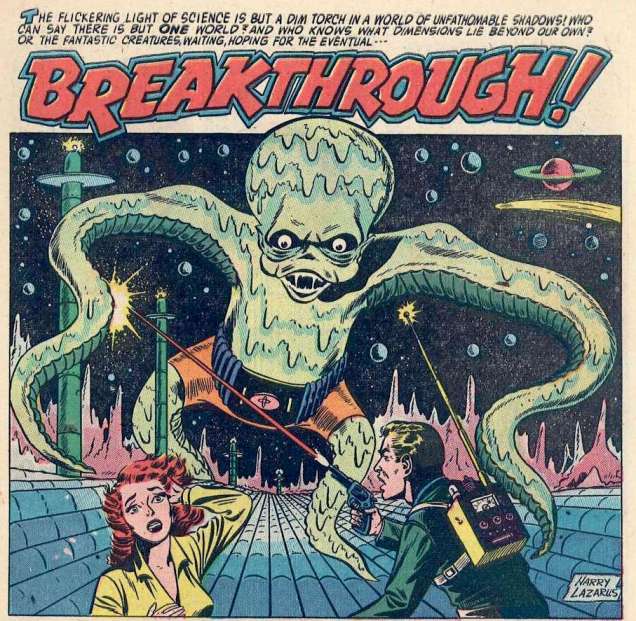
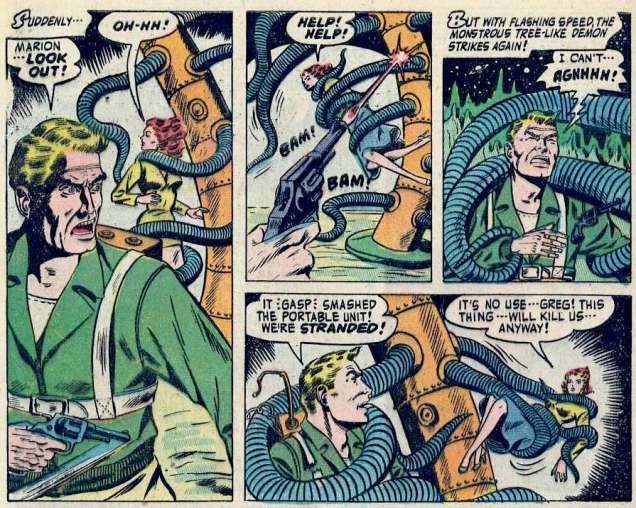
“Breakthrough!”, the title story, is beautifully illustrated by Harry Lazarus and brimming over with tentacles. Take a peek:
The main tenta-gonist of “Breakthrough!”, drawn by Harry Lazarus.In “Breakthrough!”, even cables have tentacles!
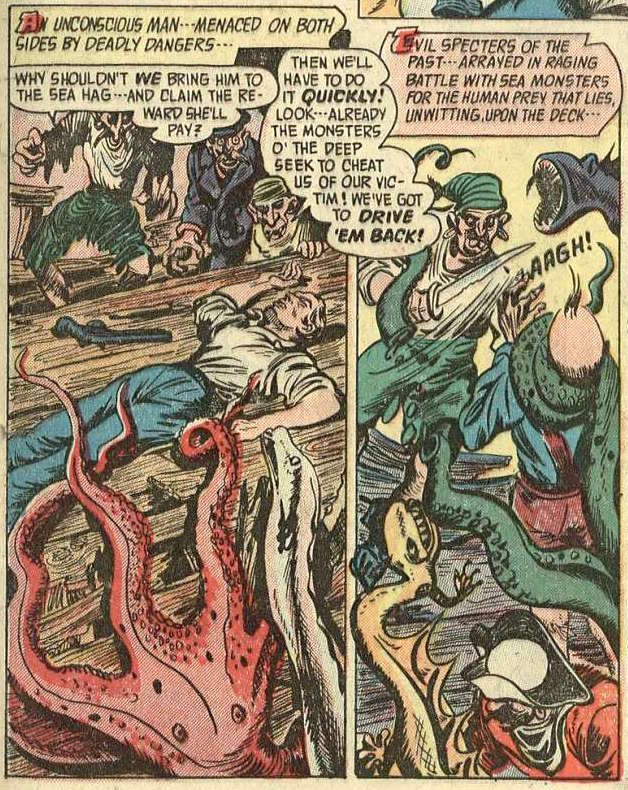
“It’s no use strugglin’ — not when ye’ll be the sea hag’s slaves forever!”Adventures into the Unknown no. 47 (September, 1953). Cover by Ken Bald.Ruthless pirates! A sea hag! Tentacles and “evil specters of the past!” All can be found in “The Derelict Fleet!”, illustrated by Jon Blummer in an interestingly fluid style.
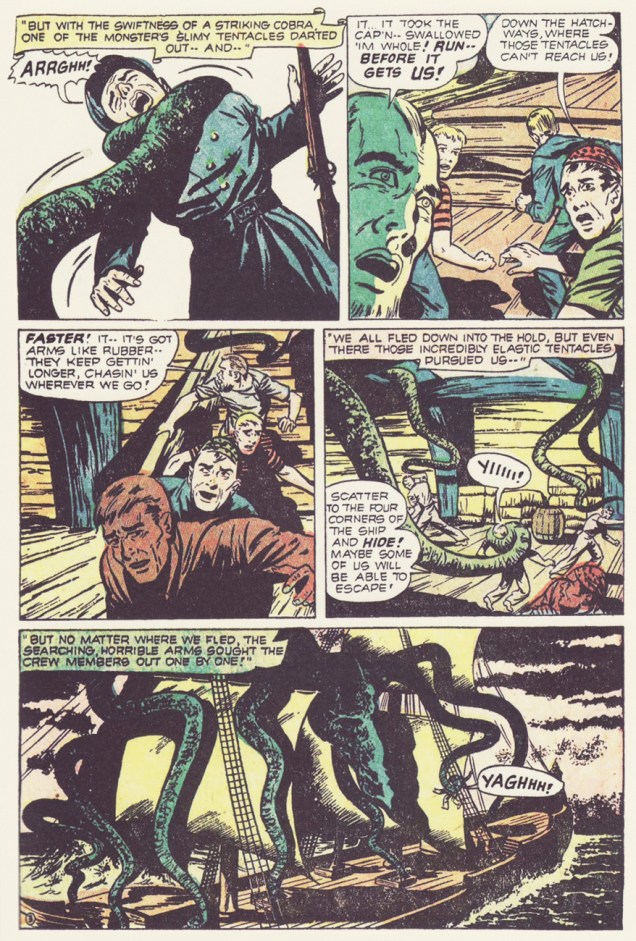
Naturally, there is some tentacle goodness *inside* some issues of Adventures into the Unknown, despite an utter lack of cephalopods on the cover. I’ll give two examples (gracefully scanned by co-admin RG from the collected Adventures into the Unknown: Volume 8, published by PS Artbooks in 2014).
A panel from « Tale of Terror », published in Adventures into the Unknown no. 39 (January 1953) and Illustrated by Lin Streeter. This panel was wisely used for the PS reprint tome’s front endpapers, to great effect.Page from « Mystery of the Marie Celeste », published in Adventures into the Unknown no. 41 (March 1953), pencilled by Al Camy and inked by Edvard Moritz. How (and why) did the octopus manage to climb atop a ship?
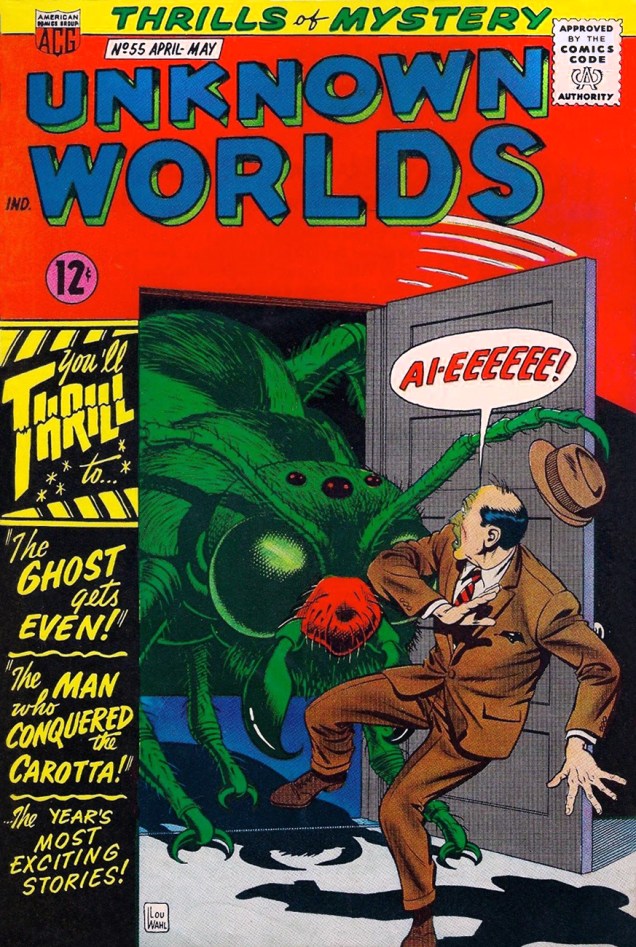
Surprise! Happy birthday to Lois Lane artist supreme Kurt Schaffenberger (December 15, 1920 – January 24, 2002), here working under the alias of Lou Wahl, (he was also Jay Kafka, which would have been fitting here!) a popular and entertaining practice at ACG and Marvel. The DC brass were presumably *not* amused by these moonlighting shenanigans. I’m looking at you, “Adam Austin”, “Mickey DeMeo” (aka Joe Gaudioso), “Jay Gavin” and “George Bell”…
This is Unknown Worlds no. 55 (April-May 1967, ACG), one of the final issues of this fine anthology title.
In case you were wondering: Adam Austin was Gene Colan‘s alias, Mickey DeMeo and Joe Gaudioso were Mike Esposito‘s nomsdeplume, and Jay Gavin and George Bell were pseudonyms respectively favoured by Werner Roth and George Roussos.
Greetings. Today’s theme: purple tentacles! (No, that’s not a euphemism.)
First up on our list is this beauty of an octopus, the Octo Rod.
This intrepid purple fella is part of Topps’ 1980 series, Weird Wheels, which had 55 cards in all. The credit for the gorgeous artwork is split between Norman Saunders and Gary Hallgren; nobody’s quite sure which artist worked on which card, and whether Saunders actually painted the images himself, or just retouched paintings by somebody else.
Sadly, Weird Wheels just didn’t sell all that well, so you can still purchase them for fairly cheap today. You can see the whole set here (and please do feast your eyes on them, they’re quite stunning).)
Octo Rod is no. 21, 1980. The art is by Gary Hallgren, at least according to David Saunders, Norman Saunders’ son.
Speaking of David Saunders and his dad, here’s a quote from “Norman Saunders” (a book written by David in 2009):
« In 1980, at the age of 73, with failing eyesight, cataracts, and advanced emphysema, Norman Saunders defied doctor’s orders and went back to work on one last card set. Weird Wheels are painted with full control of his creative powers, but with a morbid humor that reflects his attitude towards mortality. When reprimanded by his son for risking his life on low paying work, the artist said, ‘It’s fun! I gotta keep working! What the hell else am I gonna do?!‘ »
Saunders passed away in 1989, at 82, after a remarkably prolific and varied career.
Moving on, here’s a thrilling scene of purple tentacles vs Nemesis:
This is ACG’s Adventures Into the Unknown no. 157 (June-July 1965). The cover is by Kurt Schaffenberger (who signed as Jay Kafka here). “Case of the Tittering Texan” sounded intriguing – I figured that the Texan was being tickled by a tentacle – but no, he’s just a stuttering, crazy, power-hungry villain in a cowboy hat and spurs. Same old, same old…
I would also like to mention that Nemesis *is* wearing pants (well, shorts, at any rate), but his costume is still gosh-darned stupid. You try wearing a hood under water and see how far it gets you. I’m normally a fan of ACG‘s Adventures, but Nemesis is by no means a favourite character of mine.
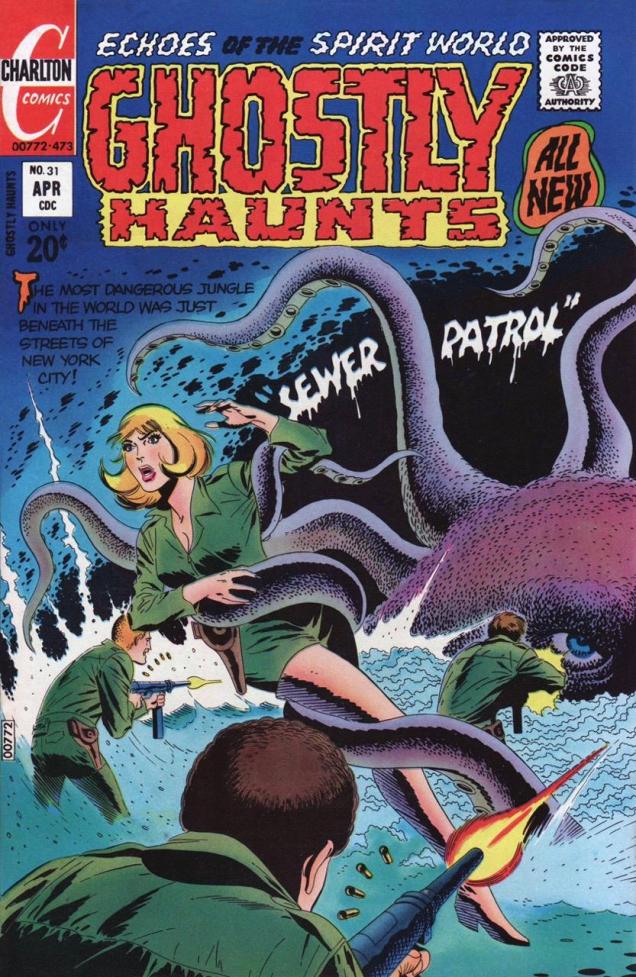
Further developing the theme of violaceous violence, here’s another:
« Giant squid, giant water rats! Are we in New York, or are we on Mars? Down here, it’s hard to tell! »Ghostly Haunts no. 31, April 1973, cover by Jack Abel.
“Sewer Patrol”, the cover story, is also illustrated by Abel, with an excellent script by Nicola Cuti – it’s a story about people who dump their pets (and still-alive food) when they don’t want them anymore… and where and how these pets end up. (The answer to that, of course, is “mutated, gigantic and in the sewers.”)
















 Who's Out There?