Today we talk about an artist who had an asteroid dedicated to him! (27178) Quino was discovered in 1999.
Quino is the nom de plume of Joaquín Salvador Lavado, an Argentine cartoonist born in 1932 and still with us today (currently 85 years old, for those in the audience who aren’t too good at mathematics). He’s best known for his character Mafalda (heroine of a self-titled comic strip), a lively and precocious 6-year old girl who sought to change the world for the better (but hated soup – how can anyone improve the world without soup?) This comic strip, which ran from 1964 to 1973, is said to have been influenced by Schulz’s Peanuts – for instance, Umberto Eco made that comparison in 1968 – but it makes me think more of Bushmiller’s Nancy. Comparisons aside, I heartily recommend it.
You won’t be surprised to find out that Quino wrote in Spanish – being Argentine and all – but some of his strips, notably Mafalda, have been translated into a variety of languages… by which I mean mostly French. I was harbouring the hope that this great artist had been able to reach many countries with his art, but it seems that his non-Mafalda cartoons (and he’s done quite a few after he quit Mafalda in 1973) aren’t really available in languages other than Spanish or French. As consolation, it seems that at least Mafalda was a big hit in not only Latin America, France and Québec, but also Asia, even meriting a translation into Chinese.
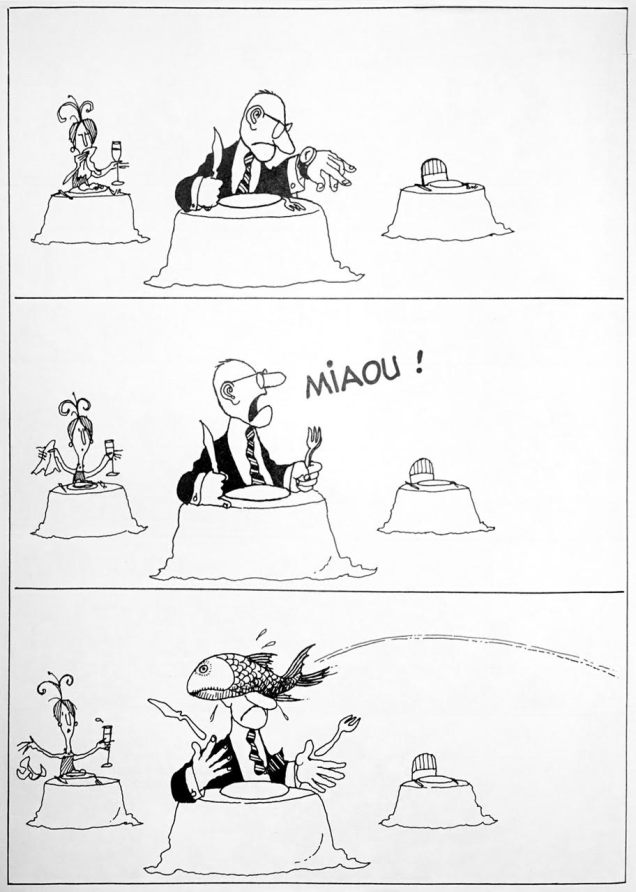
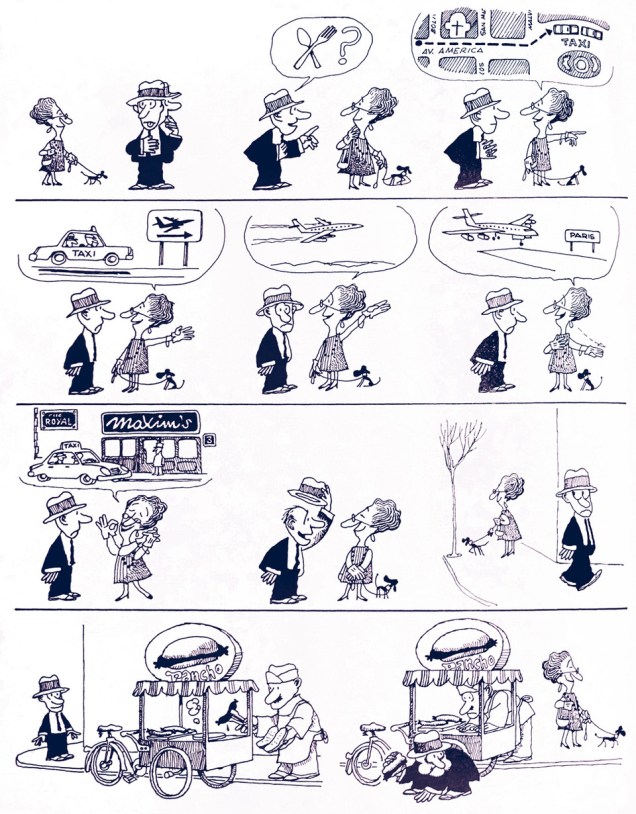
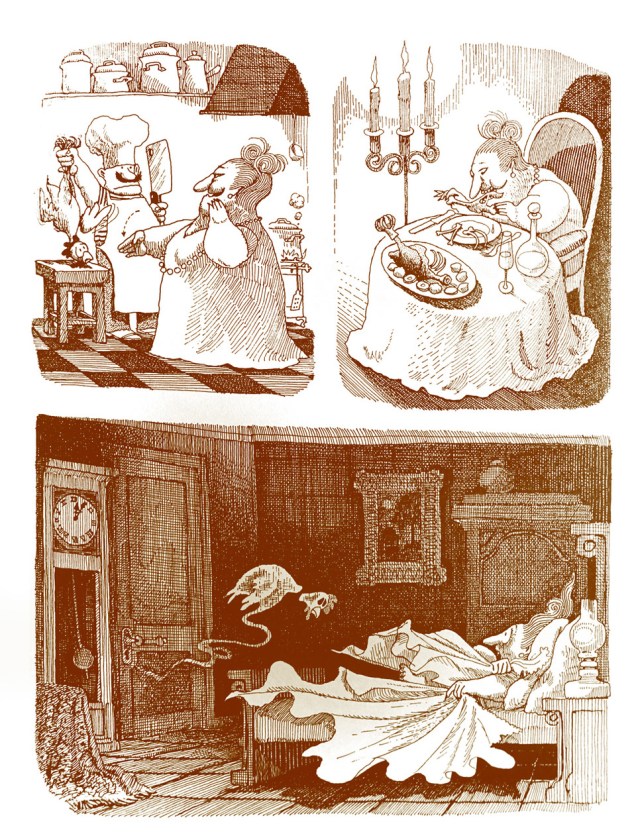
The following three comics were scanned from Manger, quelle aventure! (eating, what an adventure) published in 2016 by Glénat. I was looking for something mute but amusing to sidestep linguistic barriers, and I hope that these qualify. Check out Quino’s beautifully squiggly, decorative lines!
Today is birthday number ninety-five for Stanley Lieber, aka Stan Lee. He was hatched on December 28, 1922. Have a good one, Stan.
Jack Kirby recalls with fondness his former editor and his toady, in “Funky Flashman!” (Mister Miracle no. 6, January-February 1972, DC).
On this momentous occasion, let’s hear about Stan from some of his colleagues, who knew The Man and obviously loved the experience:
Wally Wood:
« Did I say Stanley had no smarts? Well, he DID come up with two sure fire ideas… the first one was ‘Why not let the artists WRITE the stories as well as draw them?’… And the second was … ‘ALWAYS SIGN YOUR NAME ON TOP… BIG’. And the rest is history… Stanley, of course became rich and famous … over the bodies of people like Bill [Everett] and Jack [Kirby]. Bill, who had created the character that had made his father rich wound up COLORING and doing odd jobs. »
EC legend Bernie Krigstein, who collaborated with Stan at Atlas, and whose « Suppressed Desire » is featured in Spellbound no. 17 (September 1953) , with a glorious cover by the above-mentioned Bill Everett.
In the course of a 1960s interview with comics scholar John Benson, Krigstein responded to Benson’s statement of « I guess you know that Stan Lee has been the spearhead of the so-called current revitalization of comics »:
« I’m delighted to learn that. Twenty years of unrelenting editorial effort to suppress the artistic effort, encourage miserable taste, flood the field with degraded imitations and non-stories have certainly qualified him for this respected position. »
Then Gil Kane, who was Marvel’s principal cover artist for much of the 70s, and who collaborated with Lee on The Amazing Spider-Man in some of its most popular years, including the infamous, comics-code unapproved “drug” issues (nos. 96-97, May-June 1971), on the respective creative roles of Stan and Jack Kirby:
« On each page, from 1964 – 1970 next to every single panel Jack wrote extensive margin notes explaining to Lee what was taking place in the story. It took Jack about 2 weeks to do a single story, it may have taken Lee as little as 4 hours to add text to Jack’s art. »
And Steve Ditko, in a letter to the editor of Comic Book Marketplace, published in the magazine’s 63rd issue in 1998, on his and Stan’s respective roles in crafting an issue of Spider-Man:
« The fact is we had no story or idea discussion about Spider-Man books even before issue no. 26 up to when I left the book. Stan never knew what was in my plotted stories until I took in the penciled story, the cover, my script and Sol Brodsky took the material from me and took it all into Stan’s office, so I had to leave without seeing or talking to Stan. »
Most of us may be in a winter holidays kind of mood, but tentacles don’t take holidays, especially not on the last Tentacle Tuesday of the year. While you lounge around in front of a roaring fire (or, more likely, in front of a TV screen), the tentacles continue their arduous work… of grabbing (and possibly disrobing) women.
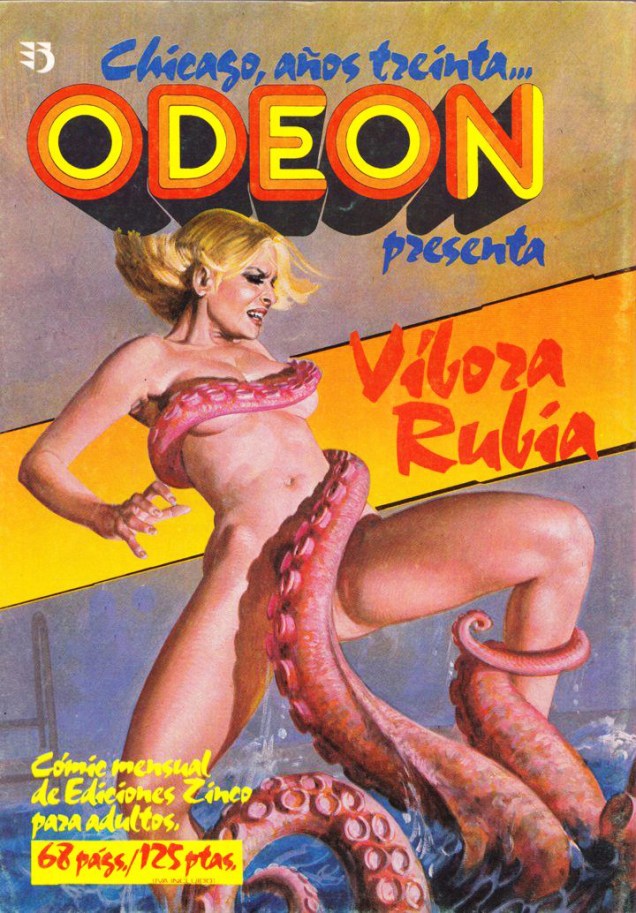
However good they may be at undressing their victims, did you know that octopuses take the utmost care to hide indecent lady-parts from the audience? Case in point (it would have been much more efficient to grab her by the neck or midsection):
« Víbora Rubia » means « blonde viper » in Spanish, and « Chicago, anos treinta » is pretty self-explanatory – Chicago in the thirties. Víbora Rubia (or Vipera Bionda in Italian), is the heroine of an Italian erotic comic series that was regularly printed in Italian comics magazine Odeon and occasionally translated into Spanish. This is one such Spanish edition, 1978, cover painted by Emanuele Taglietti. No, I have no idea what Chicago has to do with a quasi-nude chick in an octopus’ embrace.
As far as I can figure out (Italian not necessarily being my forte), « Odeon » was an Italian comics anthology for adults published from 1977 to 1988. While the earlier issues proudly displayed the enticing warning « for 18 years and older! », later issues modestly called themselves « relatos gráficos para adultos », which loosely translates to « graphical records for adults ». Ironically, the relatively staid covers of early issues became progressively smuttier and more risqué, with bare breasts galore and more rape and bondage scenes than you can shake a stick at, the whole thing veering more than just a little bit into over-the-top ridiculousness. Frankly, I don’t even know why the octopus is bothering to hide the blonde’s nipples.
You can see a gallery of Odean covers here. NSFW, obviously.
Continuing the march into tentacular extravagance, here’s a couple of panels from a comic called « La mort amoureuse » (either “Death in love” or “romantic death”, depending on how one interprets it). It’s a rather violent story of Death (personified as a lusty though decrepit female), her equally prurient servant Destiny, her two semi-amphibian lovers (a torero and a rock singer kidnapped from the world of the living), and a beautiful woman in a capsule fished out of the sea.
A page from « La mort amoureuse » by OXO, a Spanish artist whose name is Eusebio Perdices… which is all I’ve been able to find out about him. Published by Les Humanoïdes Associés, 1987. The lads are polite enough to thank Miss Octopus for her help.
I found this comic to be charmingly over the top, proving that digging through stacks of haphazardly piled up comics in the back of a comic store sometimes pays off. It opens with the story of a lesbian mermaid who dies of a broken heart when her lover callously betrays her, and merrily makes its way through all sorts of sexy shenanigans, amputations and transplants (as well as one decapitation), with dangling eyeballs and dream sequences cheerfully peppering the plot. The sex scenes aren’t explicit (although they’re “suggestive as hell”, as one of my friends would put it, and everyone is quite sex-starved), but the dialogue is equal parts titillating and gross, which elicited quite a few disgusted nose-crinkles and chuckles from me.
Here are two quotes, picked from two randomly selected pages, with quick (and rather literal) translations into English so you can get a feel for OXO’s poetic style. Memorize these in French and you can impress your lover during your next tryst – don’t forget to thank me later.
« Laisse-moi sucer, pour tuer le temps, et pour trouver l’oubli, la moëlle amère de tes os! » (Let me suck, to kill time and find oblivion, the bitter marrow of your bones!)
« Je suis au parfum: la passion est biodégradable! Amour et chair se putréfient également! Laisse-moi plutôt rêver de ton puissant gourdin… ta queue, tendre et primesautière, qui me défonce et défroisse un peu plus les plis de mon vagin flétri. » (I’m well aware: passion is biodegradable! Love and flesh both putrefy! Rather let me dream of your powerful cudgel… your tail, tender and impulsive, which shatters and smooths the folds of my withered vagina!)
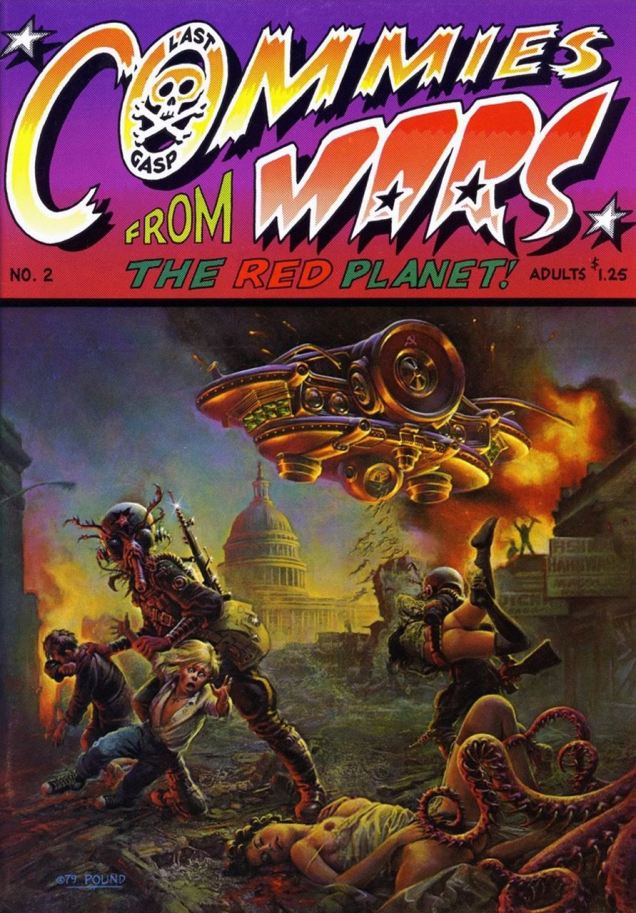
And for our last entry, here’s a cornucopia of fun: Communists! Tentacles! Aliens with good taste in girls! Uncensored nipples! (Actually, the nipples *were* censored on my scan of this cover, but co-admin RG restored them to their former glory with a bit of Photoshop. Thanks, partner.)
Commies From Mars no. 2 (Last Gasp, December 1979). The cover is by John Pound. The fallen gal seems to be enjoying herself more than her still-conscious friends… but those spikes, ouch. Once again, the tentacled beast makes sure to modestly cover its victim’s privates from prying eyes.
Actually, I’ll be a generous little communist sympathizer and give you a two-for-one: here’s another issue of the same series, also with tentacles. Why break a formula that works?
Commies From Mars no. 3 (Last Gasp, February 1981). Cover also by John Pound, a man equally at ease drawing hot babes and mean tentacles.
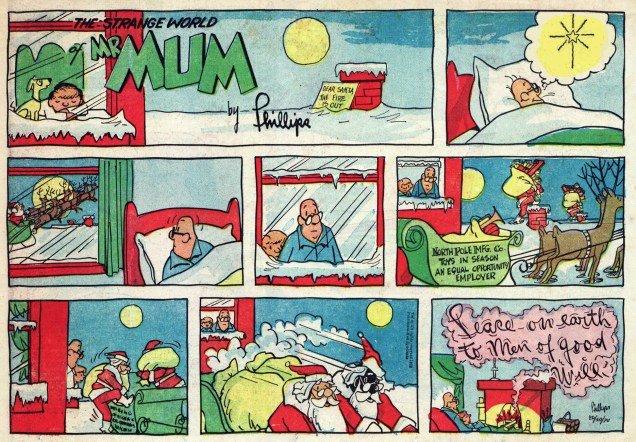
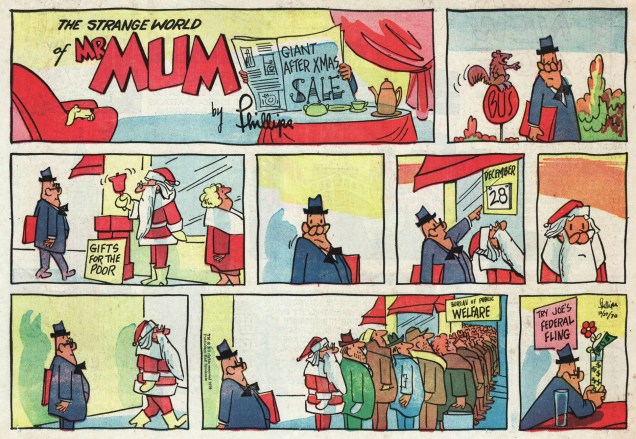
Irving Phillips (1904-2000)…« has been an actor, a violinist, a Hollywood script writer, the Humor Editor of ‘Esquire’ magazine, a playwright, as well as a very successful syndicated cartoonist.* »
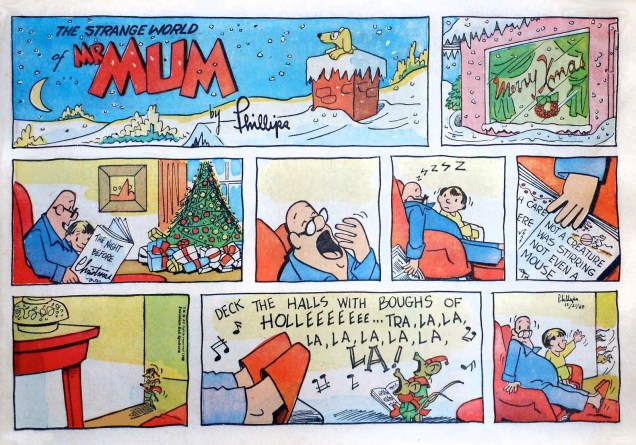
He was most notably the creator of The Strange World of Mr. Mum, which was published from 1958 to 1974 (the Sunday edition began in 1961); at its peak, the strip appeared in 180 newspapers.
Mr. Mum, as his name suggests, is the silent observer of various strange happenings. Anything can, and does, happen in Mum’s world, and much of it is delightfully surreal.
Today, as befits the season, we propose a handful of Christmas (and post-holiday) themed Mr. Mum Sundays.
Originally appeared on December 21, 1969.Originally appeared on January 4, 1970.Originally appeared on December 20, 1970.Originally appeared on December 27, 1970.
As Mr. Mum himself might say, were he ever inclined to chime in: « Have a Merry Christmas! » May you find some good comics in your holiday stash. And try Joe’s Federal Fling… it’s tastier than eggnog.
Craving more Mr. Mum? Then scoot over to Ger Apeldoorn’s The Fabulous Fifties blog, where a veritable Mum trove awaits !
– RG / ds
*quoted from a interview with Mr. Phillips in Cartoonist Profiles no. 4, (November, 1969).
It’s kind of sobering to chance across some regional comics… sometimes they’re of such high quality that I tend to wonder at, and regret, the vast bounty cast aside and left in the dust. How much more similarly fine stuff is out there is anyone’s guess. It makes me long for the days of greater cultural variety on a smaller scale, of humble local stations, local stardom and the unpredictable crazy quilt of regional popularity.
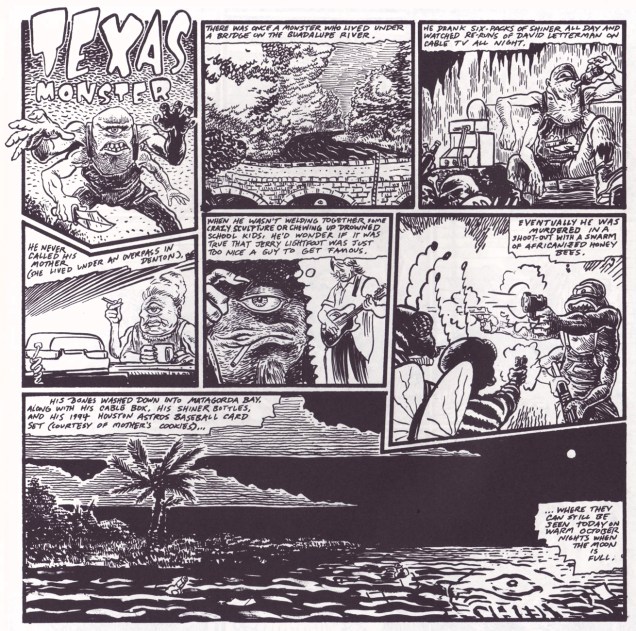
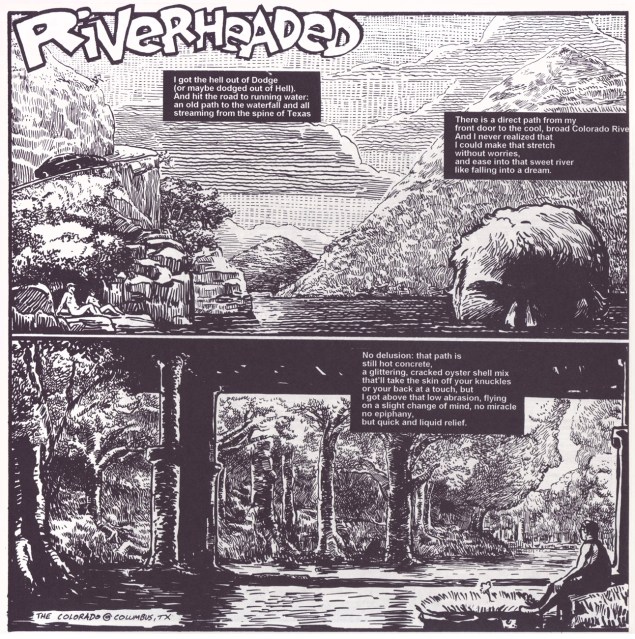
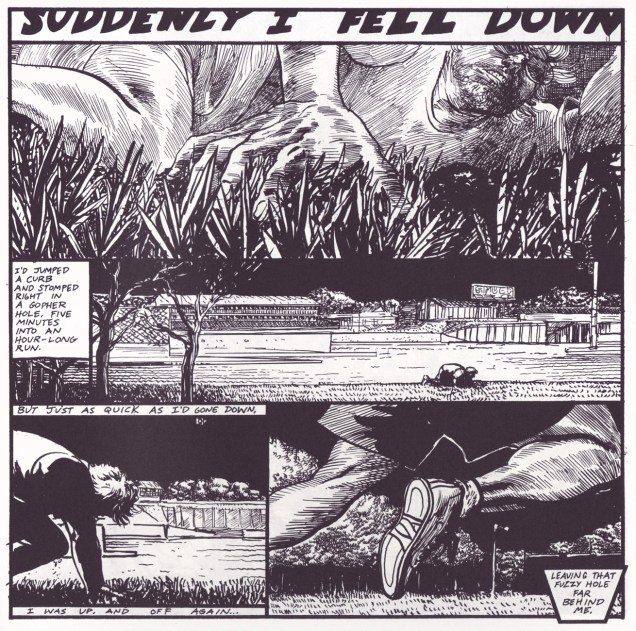
Houston, Texas’ Scott A. Gilbert is a prime example. If not for his being awarded a Xeric Grant in 1995, which financed the publication of It’s All True!, a concise 52-page collection of his favourite True Artist Tales, even fewer of us would have been exposed to his freewheeling talent. Without further ado, here are some of my picks from the booklet.
A Whiff of Hypocrisy (1992)One Art History (1993)Texas Monster (1994)Riverheaded (1994)I Fell (1994)
Gilbert’s True Artist Tales was published in rival alternative weeklies Public News (1988-97), and Houston Press (1997-2000). To answer our opening question, Gilbert got $25 a strip at Public News and $30 at Houston Press.
And for a bit more context, here’s an illuminating presentation that former Comics Journal managing editor Robert Boyd gave last year during a retrospective of Gilbert’s art Boyd was curating (now there’s something you don’t often see these days: the use of “curating” in its proper context!)
What better way to start Tentacle Tuesday than with the Big Pop-Up Book of Giant Squids? Sensitive people may want to skip this one.
« Dirk Dragonslapper », other than making me giggle every time, sounds like an actual character from some fantasy trilogy, which may be a comment on the state of fantasy these days (hint: it’s not fantastical). I’ll go with the cephalopods, thanks!
Incidentally, there’s a lot of dreadful fantasy covers out there (and that’s quite out of the scope of this blog, anyway), but I can’t resist sharing this one with you.
Poor Fritz Leiber! An octopus holding a bunch of swords at completely ridiculous angles, a squat muscle-bound freak with a bare ass and some booby green-and-purple women floating a distance away. Thanks, Peter Elson.
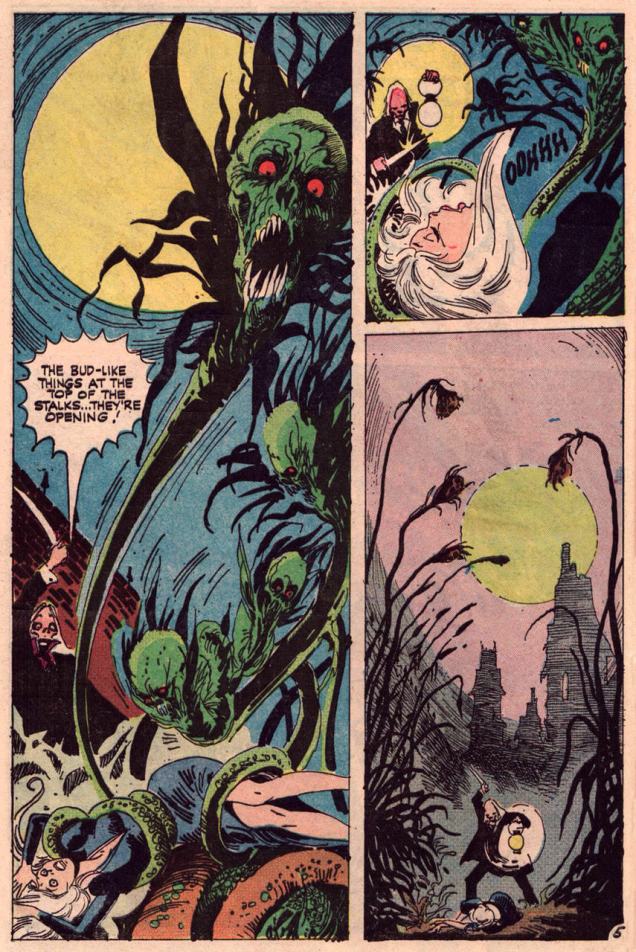
Let’s take a break from cuteness. Next up is some serious cause for alarm from Tom Sutton, who’s excellent at psychological horror. His weird art is full of details one can sink into; his sketchiness and sweeping lines leave one with the disquieting impression of being inextricably pulled into a distorted, nightmarish world.
Damsel in distress from « Budding Evil », Hauntedno. 17 (July 1974, Charlton), both scripted and drawn by Tom Sutton. Tell me you can look at the girl’s face as she’s getting strangled by tentacles and not get goosebumps.The meat-eating flowers have seriously disturbing “buds”… the best of us would have fainted!
There’s an inspired essay about Sutton here which I heartily recommend! I’ll take the liberty of borrowing a great Sutton quote from it (itself taken from a 2000 interview by Jon B. Cooke for Comic Book Artistno. 12). Voilà:
« They published weird stuff, and I have always been fascinated by weird stuff, and the weirder the better…. I do owe a certain amount to Charlton, because they allowed me to write a lot of ditties of my own, to paint a lot of horrible covers, and they never, ever, ever remarked on my technique. »
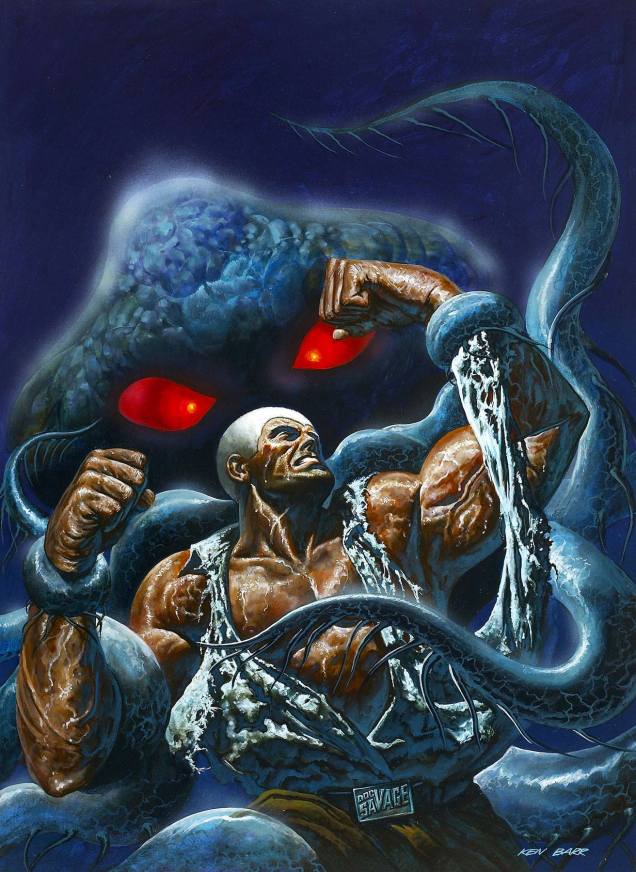
Brr. I think we need an example of straightforward macho heroism to counter-act the icky impression left by the creeping horror glimpsed above. Here’s Doc Savage to the rescue, as usual. Watch the epic struggle between muscled man and malevolent tentacled beast!
Original cover art for Doc Savageno. 8 (Marvel, Spring 1977) by illustrator Ken Barr. And no, I don’t have the answer as to why Doc Savage’s normally bronze hair looks like a white bathing cap here. However, Barr seems to have enjoyed painting it – just look at that glistening musculature!
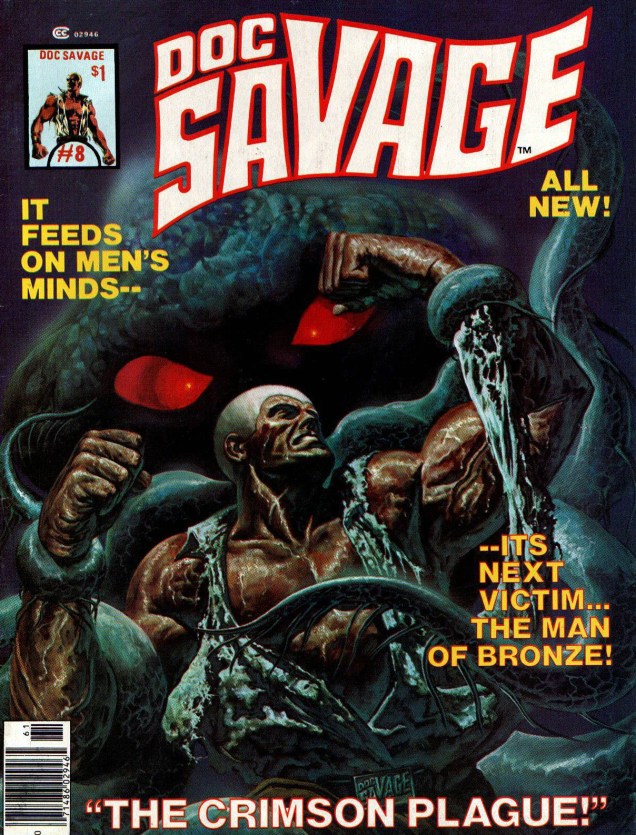
Let’s see the cover as it was published:
A bit too much text, guys. C’mon, you have a tentacled monstrosity with indubitably evil eyes, a man with rippling muscles and bulging veins… We’ve figured out that Doc is its next victim (just as surely as we know that he will come to no real harm).
Interestingly, upon opening the magazine, the first thing one sees is a Tom Sutton illustration. Small world! The cover story, « The Crimson Plague », is an adaptation of a novella published in Doc Savage Magazine in September 1939, and most likely written by Lester Dent (as Kenneth Robeson), who’s responsible for most of the classic Doc Savage epics. It’s an « adventure in which Doc Savage and his team deal with kidnapped scientists, captured comrades, and the deadly secret of the Octo-Brain » (sounds exciting, doesn’t it?) and is illustrated by Ernie Chan.
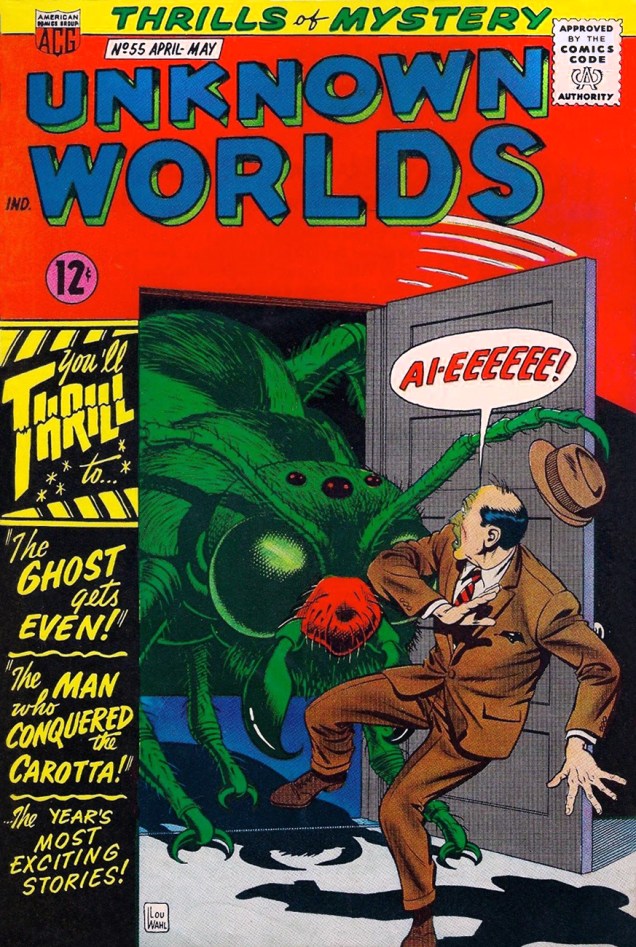
Surprise! Happy birthday to Lois Lane artist supreme Kurt Schaffenberger (December 15, 1920 – January 24, 2002), here working under the alias of Lou Wahl, (he was also Jay Kafka, which would have been fitting here!) a popular and entertaining practice at ACG and Marvel. The DC brass were presumably *not* amused by these moonlighting shenanigans. I’m looking at you, “Adam Austin”, “Mickey DeMeo” (aka Joe Gaudioso), “Jay Gavin” and “George Bell”…
This is Unknown Worlds no. 55 (April-May 1967, ACG), one of the final issues of this fine anthology title.
In case you were wondering: Adam Austin was Gene Colan‘s alias, Mickey DeMeo and Joe Gaudioso were Mike Esposito‘s nomsdeplume, and Jay Gavin and George Bell were pseudonyms respectively favoured by Werner Roth and George Roussos.
« What are you mumbling about? »
« Oh, nuthin’! … just that my false teeth get loose an’ make a lot of noise! »
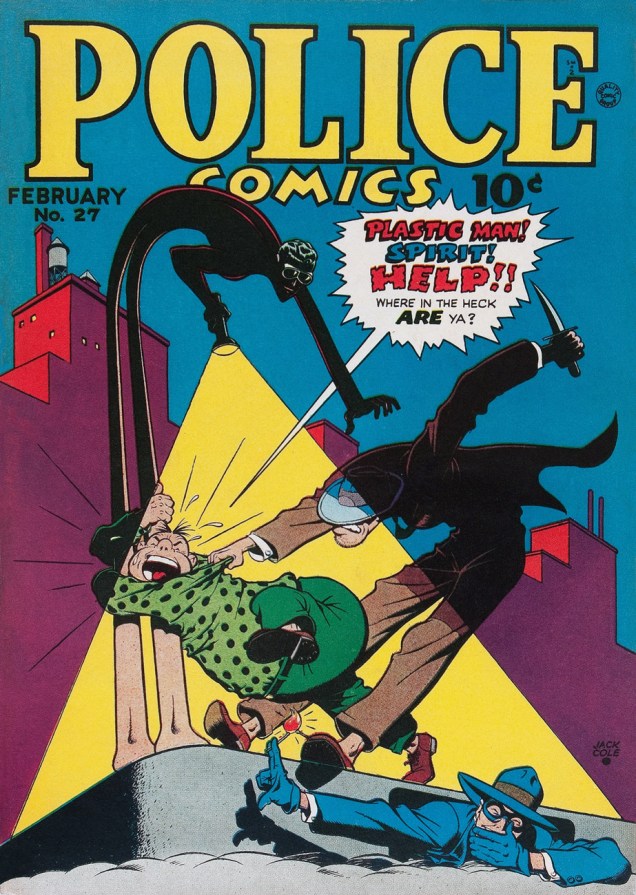
Today marks the one hundred and third anniversary of the enigmatic Jack Cole (December 14, 1914 – August 13, 1958) a man embodying, in equal parts, hilarity, talent and torment. Just when everything seemed to be going his way, he took his own life in 1958, for reasons still surmised about. His widow was the only one to know, and she took her secret to the grave.
Let’s move past this morbid stuff and concentrate on the man’s creative legacy, shall we?
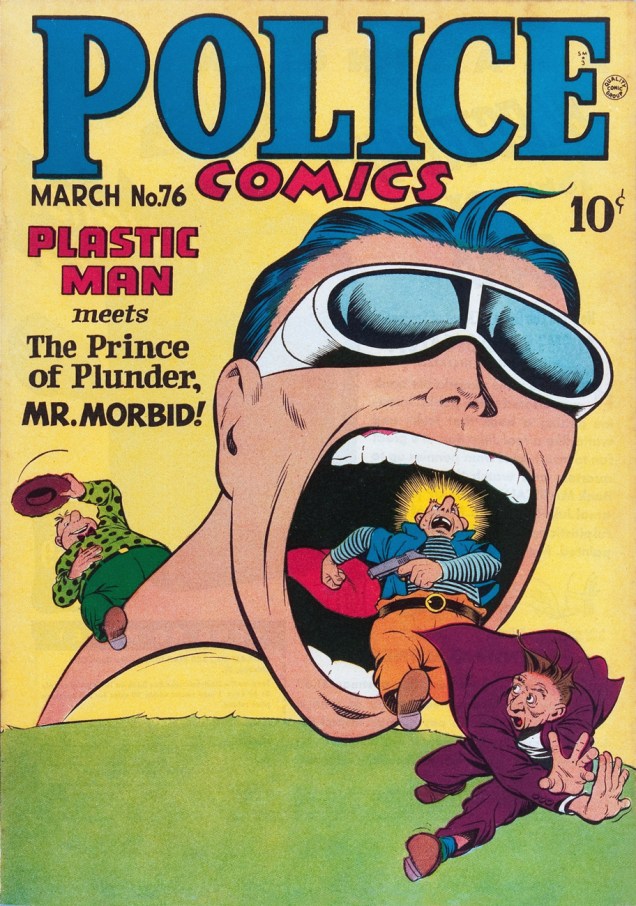
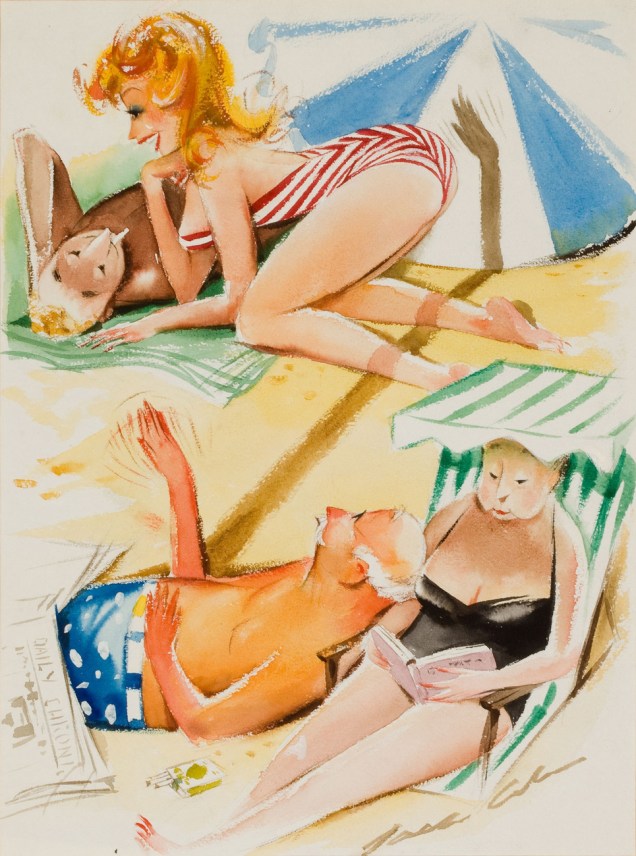
Cole’s cover for his Plastic Man story « The Rare Edition Murders » (originally called « The Bookstore Mystery », judging from the cover art) cleverly ties in the mag’s other features. And they do need to be mentioned: Flatfoot Burns by Harvey Kurtzman, The Darson Twins by Jack Keller, The Spirit by Will Eisner (or his talented ghosts), Manhunter by Reed Crandall… This is Police Comics no. 25 (December 1943, Quality).Routine, the same old grind… another issue of Police Comics, another splendid Jack Cole cover. This is Police Comics no. 27 (February, 1944), featuring Plastic Man in « Woozy Winks, Juror », and tales of Dewey Drip, Flatfoot Burns, Destiny, Manhunter, Dick Mace, The Human Bomb, Burp the Twerp (by Cole), and of course The Spirit. Sounds potentially entertaining? Read it here, then: http://comicbookplus.com/?dlid=37421Cole’s Plastic Man, one of the timeless wonders of comics’ Golden Age, a character only his creator truly knew how to handle properly. This is Police Comics no. 72 (November 1947, Quality).Another vivid (what else?) example of Mr. Cole’s boundless inventiveness, featuring his flagship creation, Plastic Man (and rotund sidekick Woozy Winks). This is Police Comics (1941-1953, 127 issues) no. 76 (March 1948, Quality).« You mean this guy had nine slugs in his chest and still choked the other one to death? » Web of Evil no. 5 (July 1953, Quality).Web of Evil no. 6 (September 1953, Quality).This lovely watercolour ran in Playboy Magazine‘s August, 1955 issue. It’s titled « The Elongated Hand ».« Like they say in the travel folders, Miss Duncan – ‘Getting there is half the fun’ ». Playboy Magazine, August, 1956.
There’s only two Tentacle Tuesdays left in the year after today. Well, let’s not bashfully bury our tentacles in snow and get on with it.
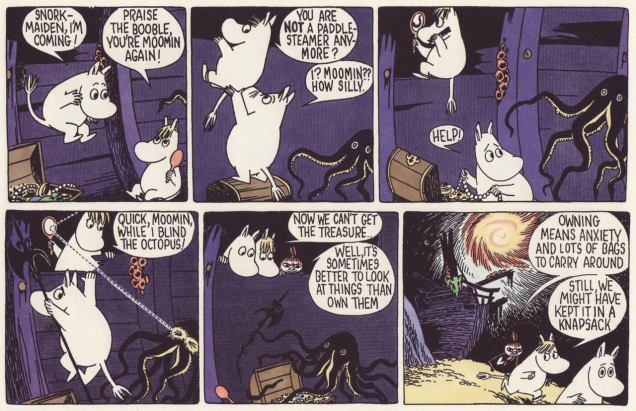
I don’t think Tove Marika Jansson, Swedish novelist, painter, illustrator and of course comic strip artist, needs much in the way of introduction. Merely one word is necessary, and that word (more of an exclamation, really) is “Moomin!” But did you know Snork-Maiden and Moomin-Troll once had to grapple with an octopus?
Montréal’s Drawn and Quarterly is currently « reworking classic Moomin stories in full colour, with a kid-proof but kid-friendly size, price, and format » (to quote their website) for their Enfant collection. « Enfant » means « child », but I think any adult with a sense of humour and just a pinch of childlike innocence will enjoy these stories.
This page is from « Moomin and the Comet » (although I prefer to call it « Muumipeikko ja pyrstötähti »… if I could only pronounce it!) by Tove Jansson and and Lars Jansson, her brother and writer and occasional illustrator of the Moomin comic strip. Published in July 2013 by Drawn & Quarterly, originally published on April 9th, 1958 in London’s The Evening News.
Incidentally, isn’t this photograph of Tove Jansson lovely?
So far, there’s something like 12 books published, and D&Q are releasing one or two additions to the collection every year. It’s the only thing I consistently buy from them (well, pretty much the only thing they publish that interests me). Highly recommended if you have any children in your life… and even more if you don’t!
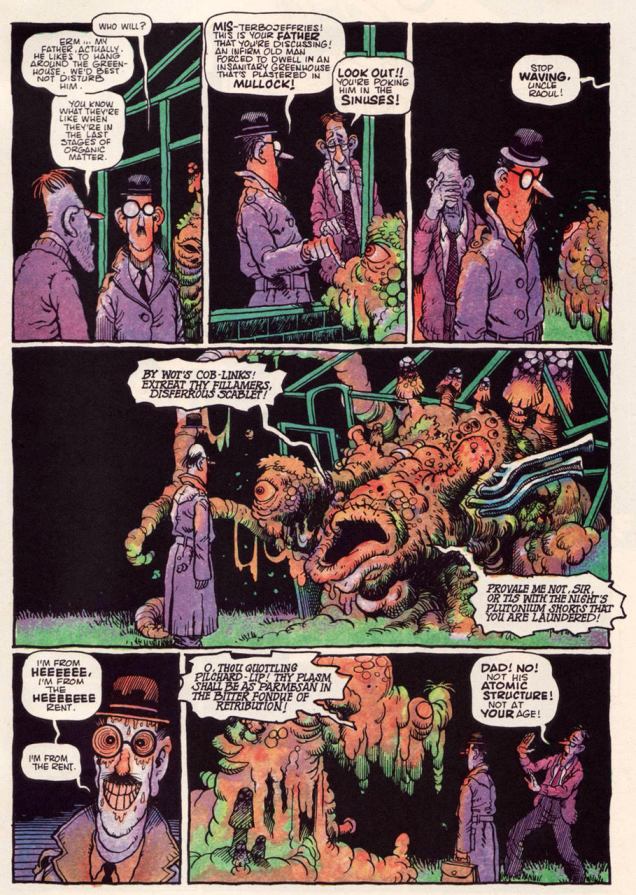
The Bojeffries Saga (written by Alan Moore and drawn by Steve Parkhouse) concerns itself with a loosely-tied group of relatives all of whom are supernatural and/or insane and some of whom have vaguely Slavic names, for added hilarity. The family consists of the two uncles Zlüdotny (a werewolf and a vampire); a nuclear baby (whatever that means); the close-knit trio of father, daughter and son, respectively Jobremus, Ginda, and Reth Bojeffries; and last but not least, grandpa Podlasp, whose tentacles you can admire below. Not, it’s not “Podslap”, although he does slap people on occasion.
The first Bojeffries tale, « The Rentman Cometh », appeared in black and white in British Quality Communications anthology Warrior, to be more precise Warrior no. 12, August 1983. Here you have it in glorious (and appropriately stomach-churning) colour thanks to a reformatted & coloured (by Kenneth Smith) reprint in Flesh & Bones no. 2, 1986 (Fantagraphics).
The main… err, hero… of this tale is Trevor Inchmale, a fastidious pain-in-the-ass bureaucrat, who, whilst day-dreaming of glory, accidentally discovers the existence of a tenant who owes the council £32,000 in rent arrears. Guess who the tenant is? And guess what happens to Inchmale? (Hint: a flower pot is involved.)
The back cover of Flesh & Bones no. 2, 1986 (Fantagraphics). Getting to spend a little time with Dalgoda (Jan Strnad and Dennis Fujitake) and then visiting with the Bojeffries? Yes, please!
I have The Bojeffries Saga collection issued in 2014 by Topshelf Productions in collaboration with Knockabout Comics. Mr. Parkhouse calls it « the complete and final edition », so who am I to argue with that? He also says, in his introduction, that « throughout its entire run the Bojeffries has been sheer, unmitigated fun. It’s been tough, it’s been demanding – but the end result has always made me laugh. »
Let’s end on a properly horrible (or at least horripilating) note.
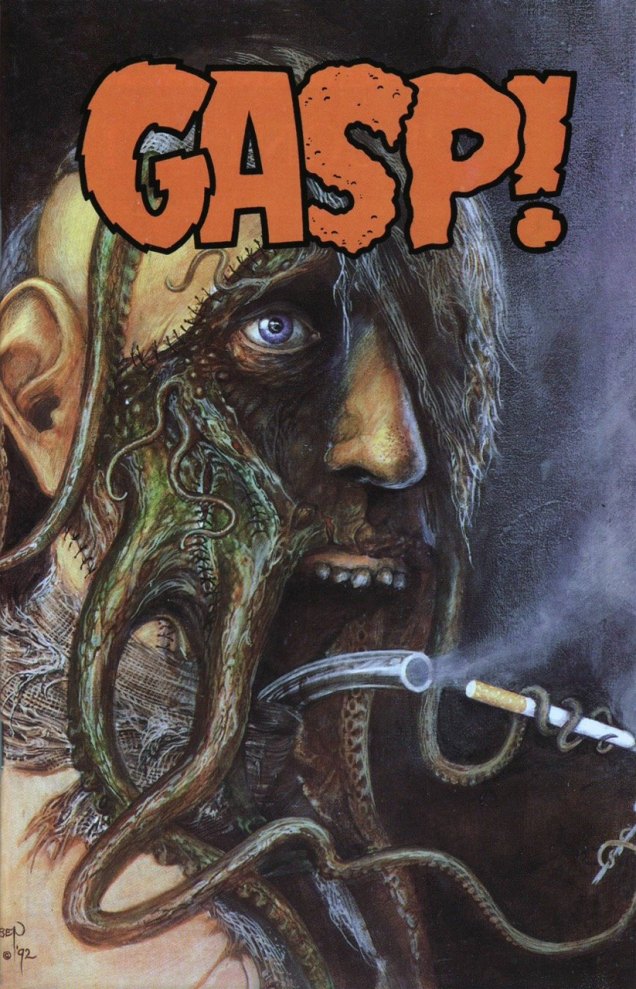
This could be part of a pretty convincing anti-smoking campaign. Gasp!, 1994; cover by John Totleben (a recycled painting of his from 1992, actually).
In 1994, Quebecor Printing sponsored Gasp!, a sampler of some independent titles (and not necessarily anything to do with horror, despite what the cover suggests). Its contents are a bit of a hodge-podge, with some highlights and some clunkers. You can get more information about the authors and stories within here.
A group of octopuses, by the way, is called “consortium”, although “octoposse” would perhaps make more sense.
« Comics! If you wanna read, read a newspaper like normal people. »
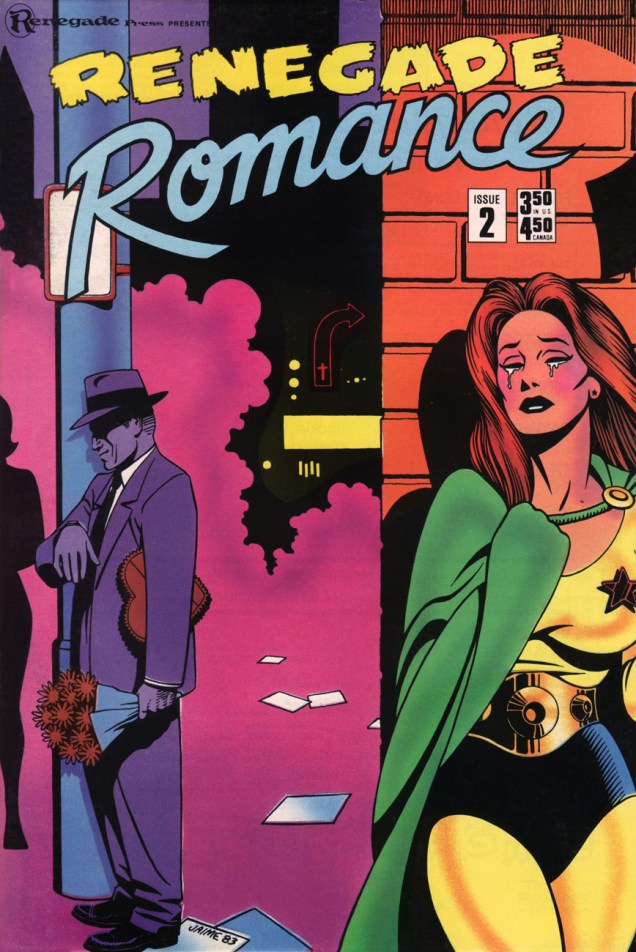
In the late 1980s, Deni Loubert’s Renegade Press published two issues of this neo-romance anthology. While the results were perhaps a smidge uneven, it was a worthy enterprise, a refreshing change from the often out of touch romance titles from earlier decades… RR’s feminine perspective wasn’t a token one and the boys were, for once, in the minority. Among the contributors: Lee Binswanger, Angela Bocage, Jackie Estrada, Colleen Doran, Krystine Kryttre, Cynthia Martin, Barb Rausch, Mary Wilshire… and some guys.
 ~ ds
~ ds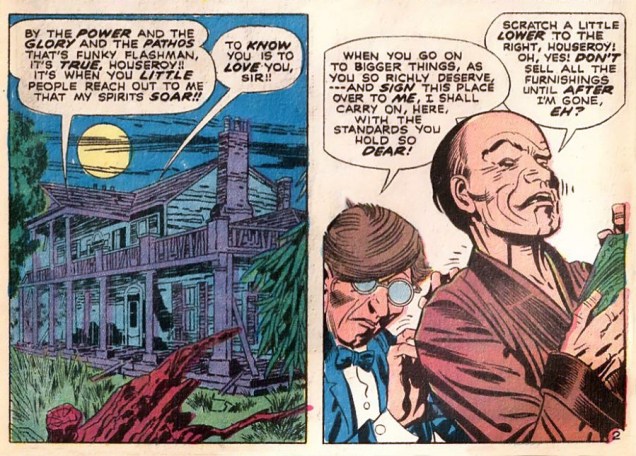







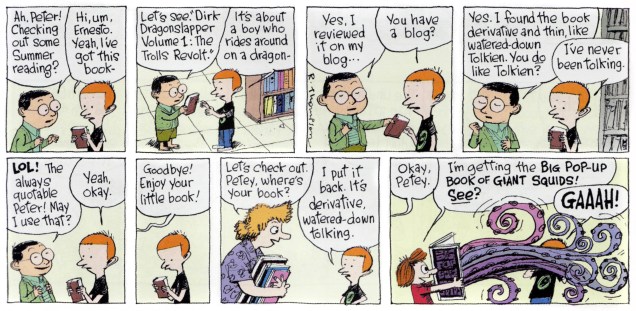 « Dirk Dragonslapper », other than making me giggle every time, sounds like an actual character from some fantasy trilogy, which may be a comment on the state of fantasy these days (hint: it’s not fantastical). I’ll go with the cephalopods, thanks!










 Who's Out There?