Spending Some Quality Time With Barbara Shermund’s ‘New Woman’

Although it’s tempting (but lazy) to assume so, men didn’t *altogether* corner the risqué cartoon niche.

It would be quite an injustice to count out the magnificent Barbara Shermund (1899-1978), prolific contributor to The New Yorker (including eight covers) and Esquire magazines, and so much more.

Far too little is known about this pioneering artist, but here’s an insightful piece aiming to rectify the situation, at least a little, written by Caitlin McGurk:

https://library.osu.edu/blogs/cartoons/2012/03/27/womens-history-month-barbara-shermund-1899-1978/

ShermundVersatile
Nothing new under the sun! Frankly, that situation hasn’t gained a wrinkle since this cartoon’s appearance in The New Yorker‘s July 21, 1928 edition.
NewYorker1935A
One of Ms. Shermund’s aforementioned New Yorker covers, from the June 29, 1935 edition.
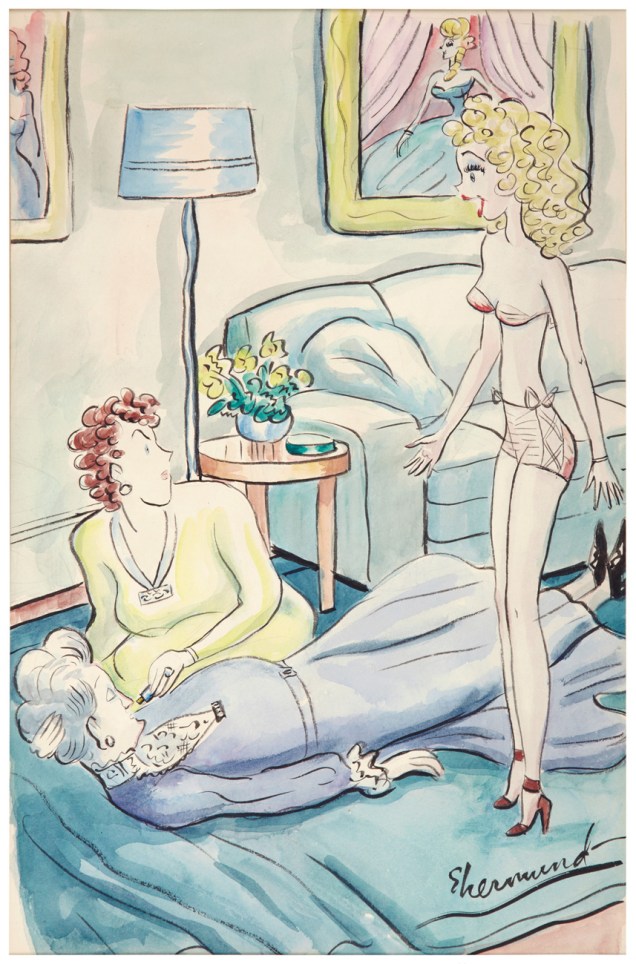
ShermundGrannyFaintA
« All I said was, ‘Granny, how do you like my new bathing suit?’ » Undated piece in ink and watercolour.
ShermundLostA
« She’s lost! » Esquire, 1944. Ink and watercolour.
ShermundTunnelA
« Mr. Dillon, I’d like to ask your daughter’s hand in marriage. » (1953, ink and watercolour.)
ShermundApeA
« Who was that fellow I saw you with at Ciro’s last nite? » (Cheering Section, 1955. Ink and watercolour.)
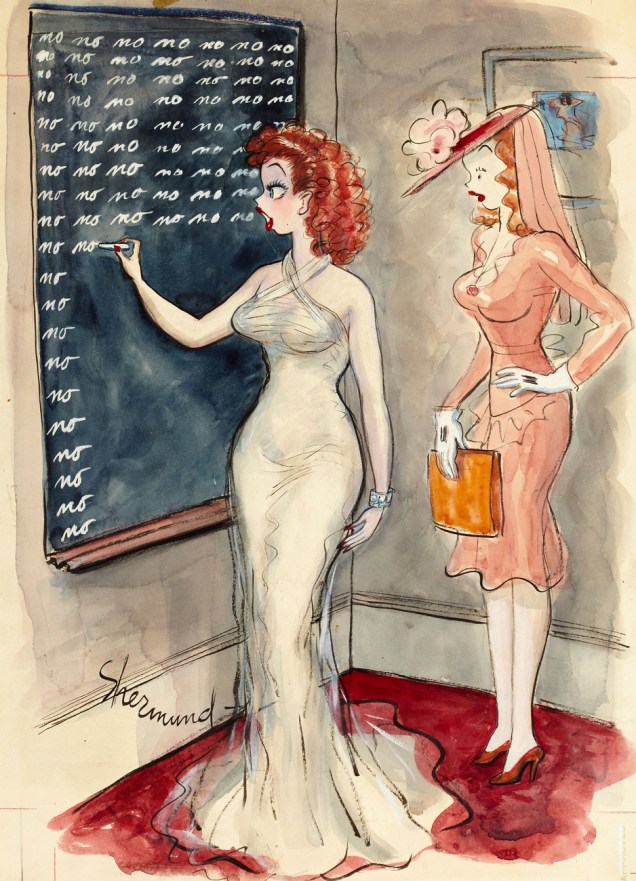
BarbShermundNoA
« Mother always makes me write it five hundred times before I go out with Mr. Parker » Esquire, publication date unknown, ink and watercolour.
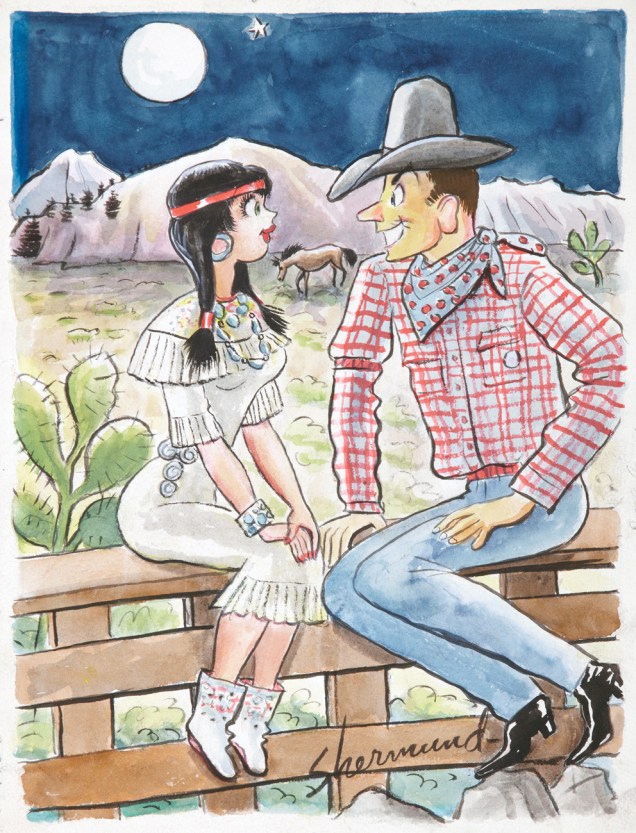
ShermundCowboyIndianA
« Let’s play cowboy and indian! » (Cheering Section, 1959. Ink and watercolour.)

I can’t help but be reminded, by that final piece, of Jack Cole‘s rather more trenchant take on a similar power imbalance, published a year earlier.

ColeUncleSamMaidenA
« Well, there’s history repeating itself. » (Jack Cole, from Playboy, January, 1958.)

A postscript: in March, 2022, Ms. Shermund was the subject of an article in the New York Times’ ‘Overlooked No More’ series, comprising belated obituaries for notable folks whose departure flew under the radar, so to speak. In this case, we learned that:

« Shermund lived out her last years drawing at her home in Sea Bright, N.J., and swimming at a beach nearby. She died on Sept. 9, 1978, at a nursing home in Middletown, N.J.

In 2011, a niece, Amanda Gormley, decided to research her family’s history and was surprised to find that Shermund’s ashes had been left unclaimed in a New Jersey funeral home since 1978.

In May 2019, Gormley raised money through a GoFundMe campaign and, with the contributions of many artists and cartoonists, saw to it that Shermund’s ashes were buried alongside her mother’s grave in San Francisco. »

– RG

Tentacle Tuesday: Tentacles That Get in Your Face (literally)

Tentacles gleefully probing various orifices, that’s what my mind is on this Tentacle Tuesday. We well know that octopuses not only tend to strangle their victims, but also get close up and personal with their anatomy.

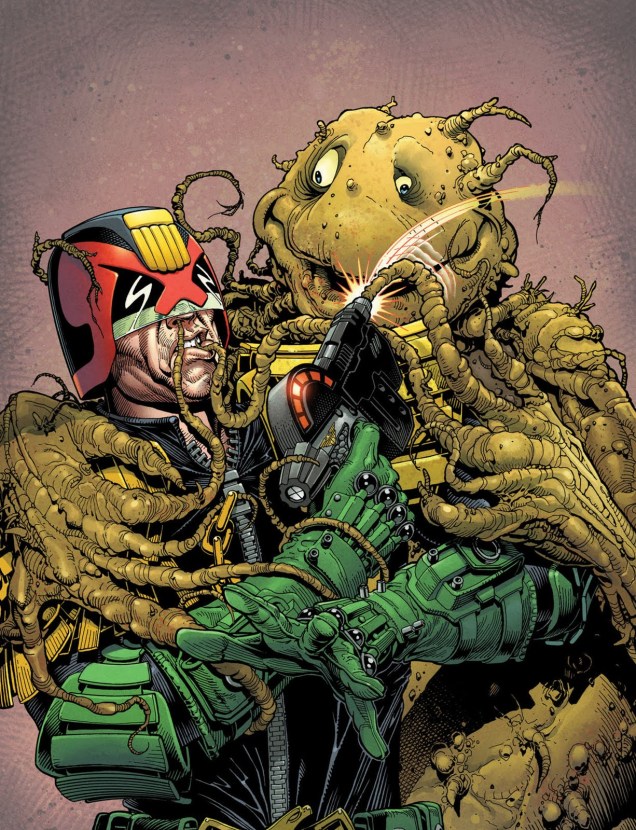
Just look at this adorable (did I say “adorable”? Maybe I meant “horrifyingly ugly”? I always get these two mixed up) cutie wrap Judge Dredd in his affectionate embrace.

Couch Potato Cover Line _art flat
I’ll let Pete Wells, owner of the « 200 A.D. Covers Uncovered » blog, explain the Couch Potatoes: « Behold, the god-like Cliff Robinson’s fantastic cover for Prog 1726, which features the welcome return of the Couch Potatoes. Another crazy Mega-City fad, the couch potatoes were lovable humanoid/vegetable lifeforms that sat in front of the Tri-D, repeating common phrases to its owner – think of a Little Britain fan and you’ll get the idea. The creatures were outlawed by the Justice Department when it transpired that they were super-evolving and feeding on their owners! »

Head over to Wells’ blog to watch this cover evolve from a preliminary sketch into a full-blown vision of tentacular glory.

TentacleTuesdayIcon

Heavy Metal magazine, in the special issue Son of Heavy MetalMay 1984paolo-serpieri-children-of-the-future-excerpt
A page from « Children of the Future », drawn by Paolo Eleuteri Serpieri, published in a special edition of Heavy Metal called « Son of Heavy Metal », May 1984.  Looks like the children of the future shall be some unholy octopus-human breed. Amusingly, the lecherous multi-tentacled sleazeball is still named Octo despite having many, many more appendages than just 8.

Serpieri is an Italian comic book writer and artist whose main interest is erotica. (His style is not really my thing, but hey, tentacles unite all.) He’s quite well-known for Druuna, a sci-fi/fantasy comic, which is more like an excuse to draw as many accouplements as possible.

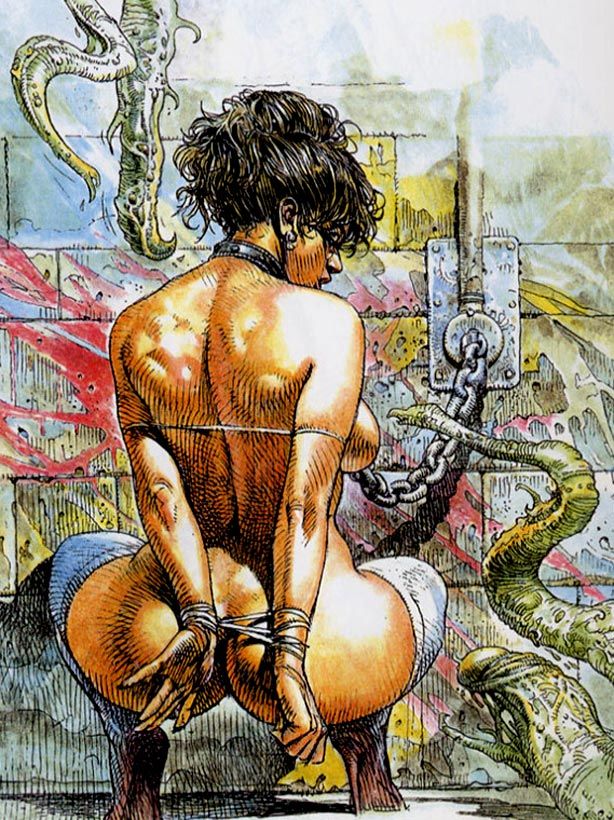
DruunaSerpieri
Bonus image: Druuna and tentacles! Art by Paolo Eleuteri Serpieri. At least this ass-and-boob shot makes *some* anatomical sense – Druuna’s spine is still in place.

Lambiek Encyclopedia laconically notes that “Serpieri’s highly detailed portrayals of well-endowed heroines have earned him the undisputed title of “Master of the Ass”. Now Serpieri clearly has a huge interest in women’s asses, and he draws them lovingly, but so do a lot of other artists. Undisputed by whom? History is silent on this topic.

You can see more of his stuff here, which is definitely NSFW, unless you work in a brothel.

TentacleTuesdayIcon

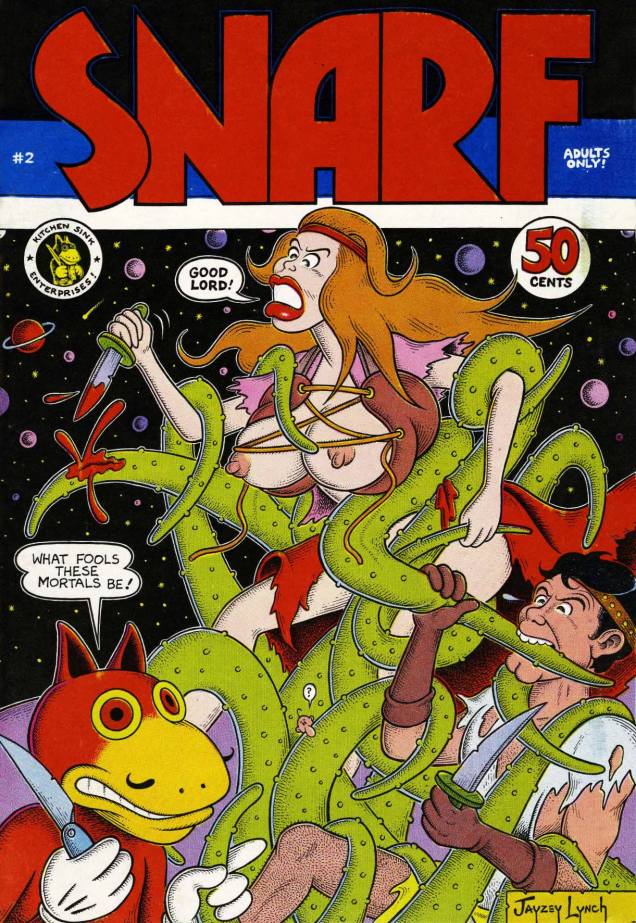
Snarf2JayLynch
Sometimes you’re just minding your own business, and suddenly something green and scabrous sticks itself into your mouth. Jayzey Lynch is of course Jay Lynch, the artist of this cover (Snarf no. 2, August 1972). “Good lord!”, indeed.

M. Steven Fox of Comix Joint wrote a riveting (as usual) review of Snarf no. 2. Read it here.

~ ds

From off the streets of Cleveland comes…

« What kind of people are these?
Where do they come from,
what do they do? What’s in a name? »

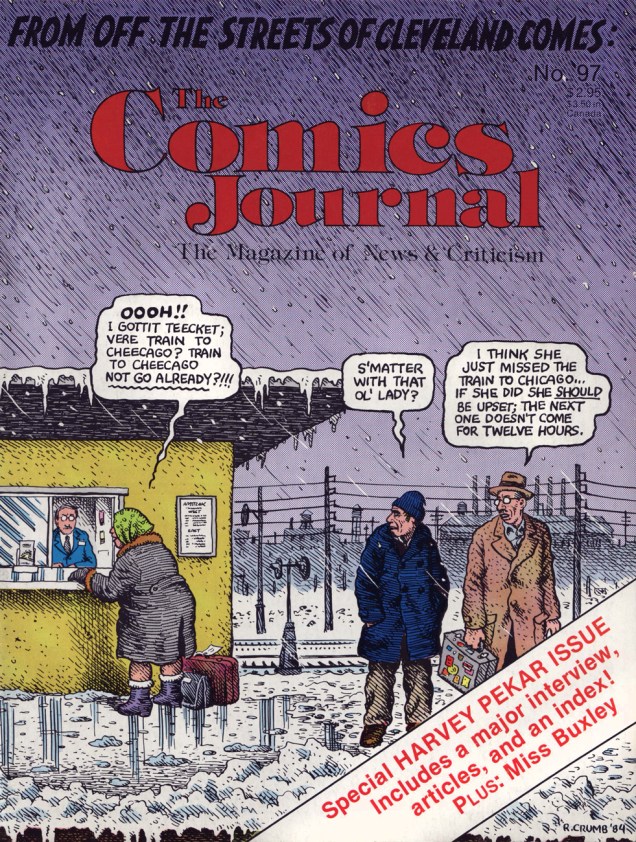
Coming out of nowhere (well, “From off the streets of Cleveland“, as it happens) in 1976, Harvey Pekar’s American Splendor was one of comics’ truest and most bracing alternatives. It wasn’t part of the Underground Comix movement, despite the participation of Pekar’s old friend and fellow record collector Robert Crumb, and it wasn’t like anything pushed out by the mainstream comics industry.

JournalPekarA
This is The Comics Journal no. 97 (April, 1985). Cover by Crumb and Pekar.

Crumb’s introduction to Doubleday/Dolphin’s 1986 anthology of early AS strips describes Pekar’s appeal better than anyone else is likely to:

« Yeah, Harvey is an ego-maniac; a classic case… a driven, compulsive, mad Jew… it’s something to see. But how else could he have gotten all those comics published, with almost no money; in total isolation from any comic-publishing ‘scene’ such as exists here in California, or in New York; constantly brow-beating artists to illustrate his stories; handling the distribution himself… only an ego-maniac would persist in the face of such odds. »

« The subject matter of these stories is so staggeringly mundane, it verges on the exotic! It is very disorienting at first, but after awhile you get with it. Myself, I love it… Pekar has proven once and for all that even the most seemingly dreary and monotonous of lives is filled with poignancy and heroic struggle. All it takes is someone with an eye to see, an ear to hear, and a demented, desperate Jewish mind to get it down on paper… there is drama in the most ordinary and routine of days, but it’s a subtle thing that gets lost in the shuffle… our personal struggles seem dull and drab compared with the thrilling, suspense-filled, action-packed lives of the characters who are pushed on us all the time in movies, tv shows, adventure novels and… those *other* comicbooks.

What Pekar does is certainly new to the comicbook medium. There’s never been anything even approaching this kind of stark realism. It’s hard enough to find it in literature, impossible in the movies and tv. It takes chutspah to tell it exactly the way it happened, with no adornment, no great wrap-up, no bizarre twist, nothing. Pekar’s genius is that he pulls this off, and does it with humor, pathos, all the drama you could ever want… and in a comic book yet! »

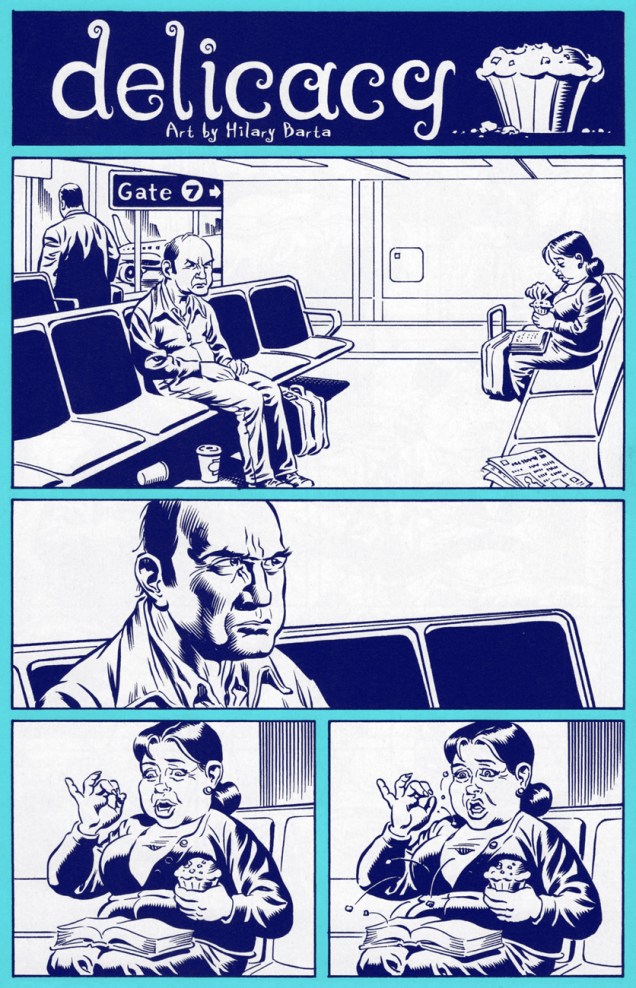
And here’s an atypical example of Mr. Pekar’s storytelling art, a rare but eloquent pantomime vignette. It originally saw print in DC Comics’ run of American Splendor comic books (no. 1, Nov. 2006, published under the Vertigo imprint and edited by Jonathan Vankin.) The symbiosis at play here between writer and artist makes ‘Delicacy’ my very favourite story by Hilary Barta, who somehow never gets matched with a script worthy of his tremendous talent, even when he’s working with Alan Moore (Moore can be very funny, but superhero parodies, even his, seldom are… and Splash Brannigan wasn’t exactly side-splitting). This is a wonderful oddity, one of two times that Barta and Pekar collaborated. Bon appétit!

PekarDaVinci1APekarDaVinci2A-RG

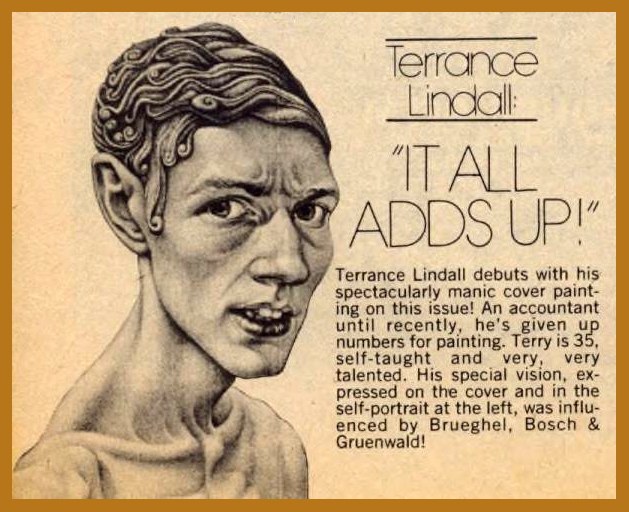
Blink-and-you-miss-it: Terrance Lindall, Warren cover artiste

« How do I get myself in these situations? »

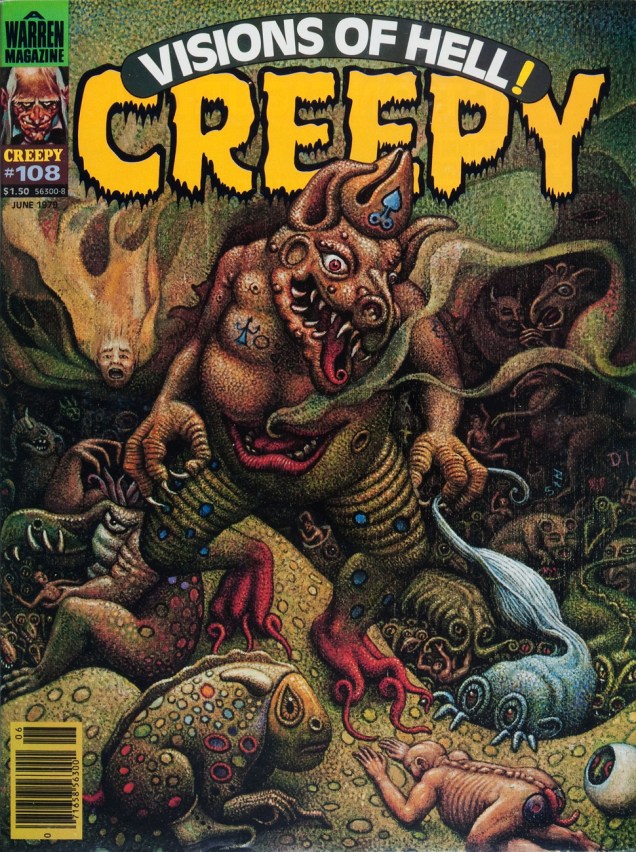
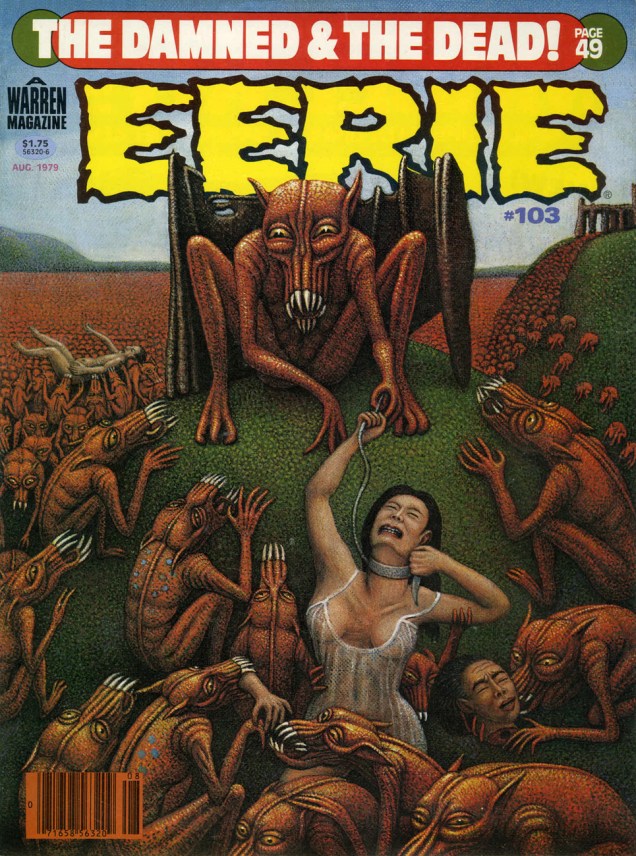
As the close of the 1970s neared, James Warren‘s magazine empire was inexorably crumbling. I like to imagine that it was decided, in desperation, that a little fiddling was in order… just a smidgen. Some enlightened soul (my pick is new editor Chris Adames) got the notion to bring on board Terrance Lindall (1944-) to produce some covers for the magazines. He painted a mere five, but made each one memorable, to say the least, evoking justified comparisons to Matt Fox, Lee Brown Coye, sans oublier the venerable Hiëronymus Bosch.

Well, then, let us bask in the comforting, bucolic visions of Terry Lindall at Warren, in their order of publication. Makes you want to pack a picnic lunch and go for a leisurely ramble through the countryside with your faithful Hound of Tindalos.

Creepy108A
Creepy no. 108 (June, 1979.)
Eerie103A
Eerie no. 103 (August, 1979.)
Creepy116A
Creepy no. 116 (March, 1980.)
Vampi86A
What do you know? Terrance Lindall actually manages to make perennial fanboy wankbait Vampi look downright classy. This is Vampirella no. 86 (April, 1980.)
Creepy127A
And all too soon, it’s over, with Creepy no. 127 (May, 1981.)

Oh, how Creepy’s long-time readers must have wailed and moaned at these singular, quease-inducing mise-en-scènes! “Bring back Boris Vallejo!”

Nowadays, Lindall earns his keep as co-director and chief administrator of the Williamsburg Art and Historical Center in Brooklyn, New York. Doesn’t he just perfectly look the part?

Terrance_Lindall

LindallBio
The new kid’s mini-bio, as it appeared in Creepy 108 (June, 1979).

If you’re craving more Lindall visions, who am I to discourage you? Slide on over to http://www.escapeintolife.com/artist-watch/terrance-lindall/

-RG

Tentacle Tuesday: Spunky Skirmishes

Tentacle Tuesday! The name of the game this time: epic battles (It’s the end of January, and I’m in a belligerent mood.)

First, I’d like to share these wonderfully weird and colourful Hindi comic covers that I’ve been reserving for a while.

ChitraBhartiKathamala8
Chitra Bharti Kathamala was a popular Indian comic book publication during the early 1980s. This is Chitra Bharti Kathamala #8, although I wasn’t able to find out more information about it – Hindi presents a formidable language barrier. It’s rather charming that the artist seems to have never seen an octopus in his life.

Apparently India’s love (hate? senseless violence?) affair with octopuses has been going on for a while, because here’s another tentacled cover:

VijayKadamRajComics
The cover was painted by Vijay Kadam… and will haunt my nightmares. As far as I could suss out, this is published by Raj Comics. Kadam’s son, Harshvardhan Kadam, is a mural artist (see some of his murals here.)

My (somewhat) educated guess is that these covers are from the late 80s, early 90s. If you’d like to see more, hoist your sails over to the Monster Brains blog over here.

Incidentally, while attempting to glean more information about this, I stumbled upon some hilarious, more modern Indian comic covers, namely these three:

Tentacles1205705-spcl_0071_e
Nagraj no. 44, Jan 1995. What the fucking fuck is going on here, and how does it make any sense anatomically?
Tentacles1205706-spcl_0075_h
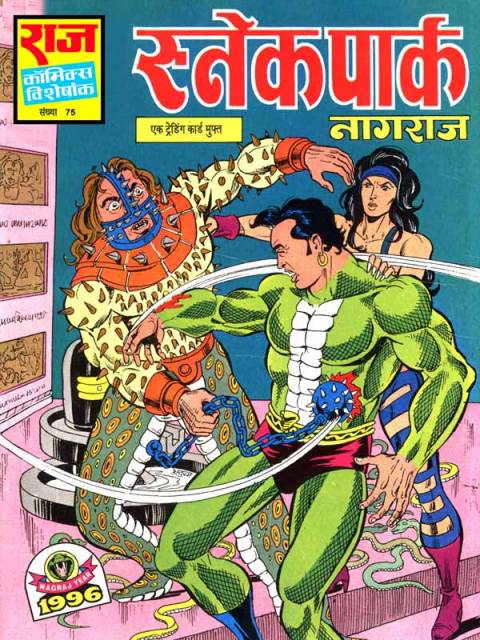
More tentacles – unless the spiky guy’s legs are actually alligator’s tails… Nagraj no. 50, Jan 1996.
Tentacles1213078-spcl_0435_h
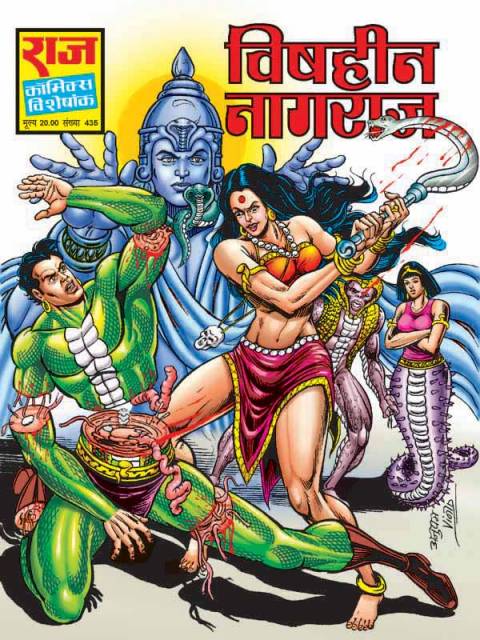
Nagraj no. 75, Jan 2003. No tentacles but I couldn’t resist the adorable gore. Once one’s gaze pulls away from the spaghetti entrails, one notices that the woman hacking Nagraj to pieces seems to be having the time of her life… and that the female creature in the background has a completely improbable lower torso.

TentacleTuesdayIcon

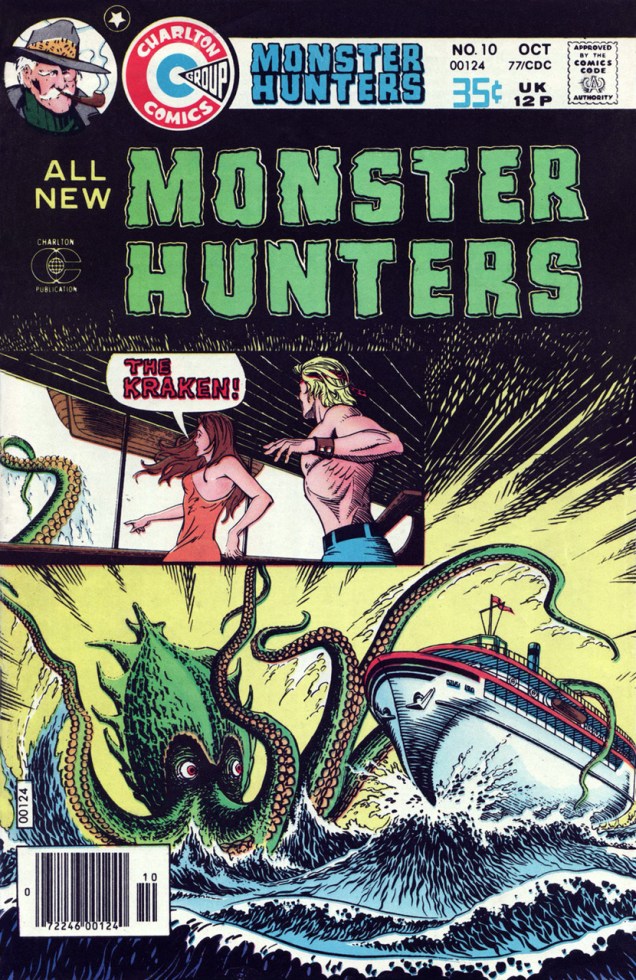
For our next heroic skirmish, a scene with dramatic waves, a half-naked damsel, a hot guy, and an an intense octopus with a Rasputin-esque furrowing of the brow. Basically, the glorious pen of Enrique Nieto was guaranteeing eye candy for everyone, whatever their pervy proclivities.

MonsterHunters10A
Monster Hunters no. 10, October 1977. The cover is by the glamorous Enrique Nieto!
NietoKrakenA
The original art for an inside page from « Night of the Kraken! » Script by Nicola Cuti, art by Enrique Nieto.

Speaking of octopuses laying eggs (and they do), do you know how these creatures reproduce? Once the male octopus places a sac of sperm into the female’s body cavity with his « mating arm» (yes, he has a dedicated arm just for that purpose), the female lays her eggs, and spends the rest of her time protecting them and keeping them clean. Both the male and female octopuses stop eating after mating, the male drifting around aimlessly, the females dedicating all their energy to safeguarding their offspring. Both die soon after of either starvation or predation. Given these conditions, anybody seeking to destroy the last living female octopus is a fucking asshole – don’t the poor things have it hard enough already?!

TentacleTuesdayIcon

I’ll wrap up with a little cozy scene in which male friendship prevails over the evil tentacles of a sinister, swirly-eyed creature. Aw, you guys…

AventurasdelFBI
Aventuras del FBI no. 32: El Triunfo del Bien, 1970, published by Rollán. Drawn by Luis Bermejo and Manuel López Blanco.

« Aventuras del FBI» was a Spanish comic published Rollán Editorials, published in little stapled black-and-white books with colour covers. Auto-translating an article about Aventuras gave me this little gem: « Adventure series of an FBI agent named Jack Hope, who is accompanied on his missions by a young man named Bill Boy and a man steeped in meat and joke, Sam. » I don’t know what a man “steeped in meat and joke” is, but it sounds promising!

~ ds

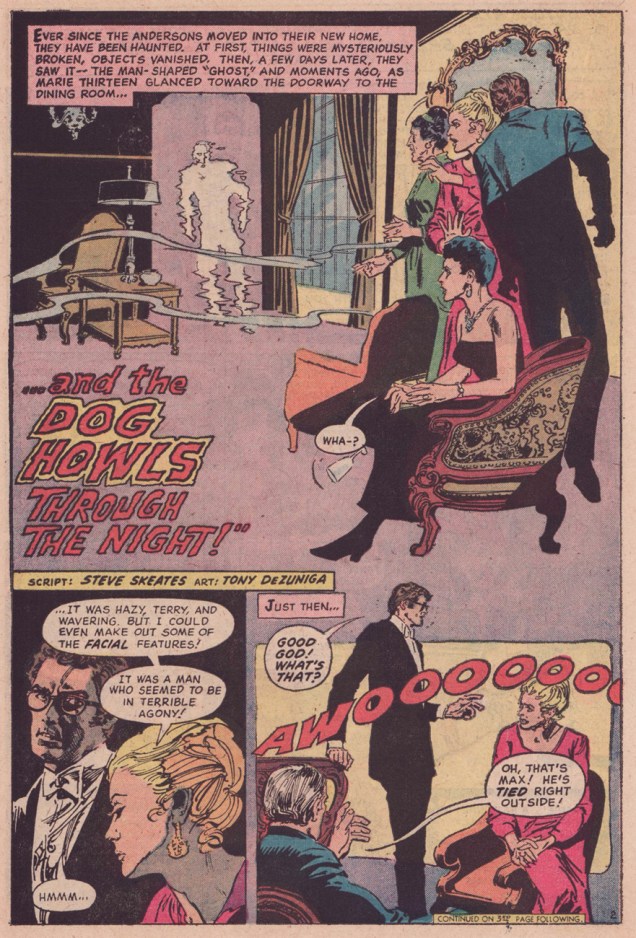
Steve Skeates’ “… and the Dog Howls Through the Night!” (1974)

« Who’d ever believe a story like that? »

On this fine day, we pay tribute to shifty scribe Chester P. Hazel (who sometimes goes by the unlikely nom de plume of Steve Skeates). It is whispered that Stephen, along with his nefarious twin Warren Savin, first invaded this plane of existence on January 29, 1943. That would make him/them/it seventy-five earthly rotations old, should these windblown tattles hold any credence.

Happily, in this case, picking out a Skeates favourite to share was no ordeal: I’d been meaning for some time to shine a light on one of his neglected gems, one that salt-rubbingly ran without proper attribution in The Phantom Stranger no. 34 (Dec. 1974-Jan. 1975, DC Comics.)

The cases of Dr. Terrance Thirteen, ghost breaker, must have been easier to write back in the 1950’s, when DC Comics’ default setting in its mystery titles was to explain away the supernatural element before the curtain call. DC’s resident skeptic first shared his insights in Star Spangled Comics, his feature lasting from issue 122 (November, 1951) to issue 130 (July, 1952). He then moved to The House of Mystery for a handful of appearances, then faded away. He returned to action, along with his also long-dormant colleague  and foil The Phantom Stranger, in 1969’s Showcase no. 80. In the Supernatural Seventies, all poor Dr. Thirteen could do is vainly and stubbornly play the cards of reason and logic against a house deck stacked to inevitably favour the uncanny and the unreal. He was doomed to be a comic book version of The X-Files’ Dana Scully, Fritz Leiber‘s Norman Saylor (Conjure Wife, 1943) or Night of the Demon‘s Dr. John Holden, all skeptics coming off as hopelessly obdurate and clueless in light of the “facts”.

Sounds like today’s so-called post-fact world… in which we need true skeptics (as opposed to deniers) and cool, rational minds more than ever.

Anyway, it wasn’t the first time wily Skeates had faced such a storytelling impasse: he’d had to ring the changes on pacifist character Dove (of Steve Ditko’s eternally squabbling Hawk & Dove) within a universe of hard-slugging super vigilantes.

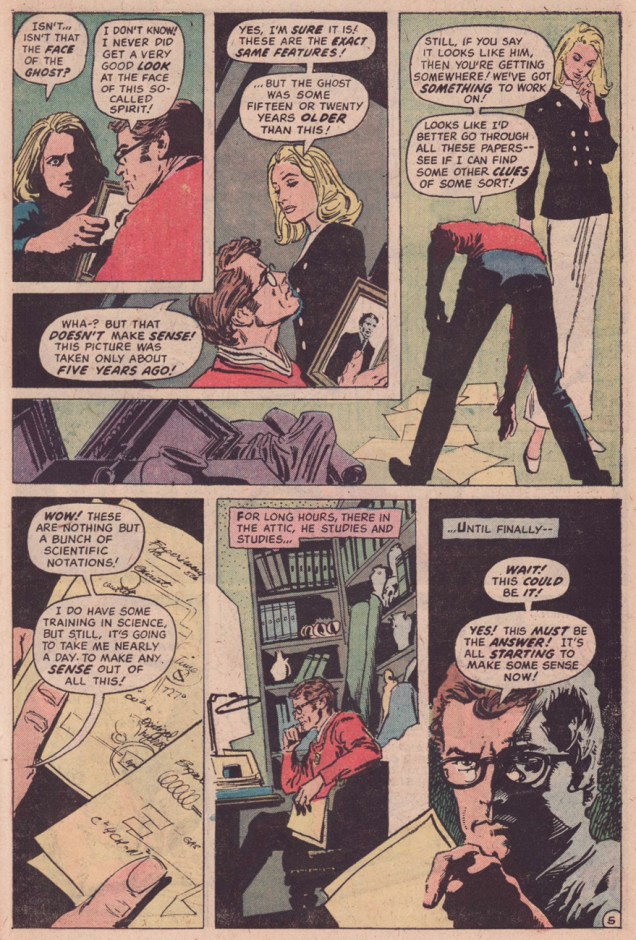
Dr. Thirteen bounced around various DC titles in the early-to-mid 70s. This is the series’ last bow in the back pages of The Phantom Stranger, and ironically its finest hour, alongside the penultimate entry, The Ghosts on the Glasses, which ran in Adventure Comics no. 428 (August, 1973.) In both cases, the inspired artwork is that of Filipino master Tony DeZuñiga (1932 – 2012), who was clearly in his element.

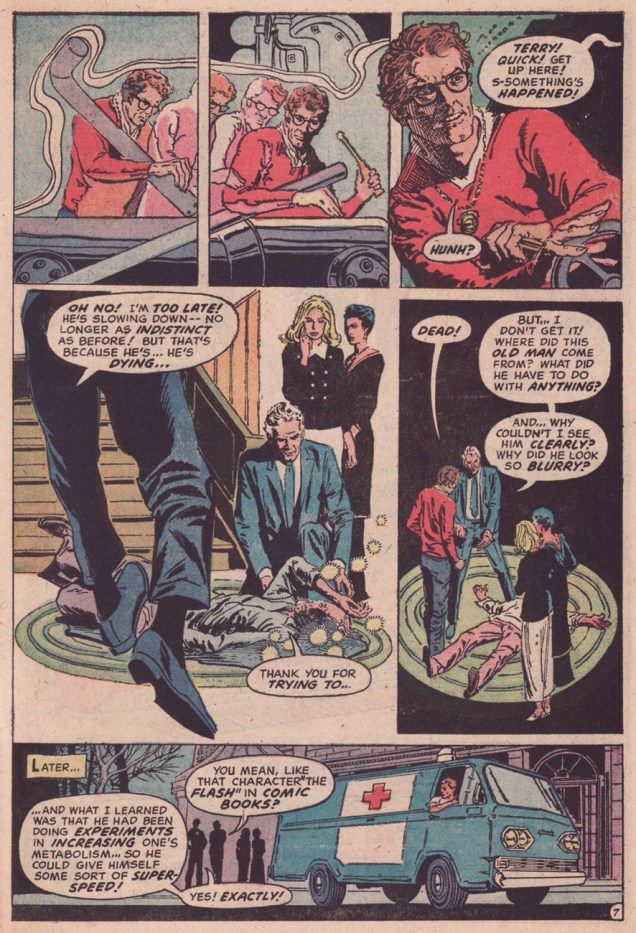
DrThirteen1ADrThirteen2ADrThirteen3ADrThirteen4ADrThirteen5ADrThirteen6ADrThirteen7ADrThirteen8A

A character likens the dead scientist’s ill-fated velocity experiments to comic book character The Flash… but it’s a cinch that what the impish* Mr. Skeates really had in mind was Virgil “Guy” Gilbert, aka Lightning, whose début, The Deadly Dust! he had scripted back in 1965 (T.H.U.N.D.E.R. Agents no. 4, April 1966). Here’s a relevant excerpt, featuring art by Mike Sekowsky and Frank Giacoia.

LightningA

In closing, a biographical blurb from DC’s T.H.U.N.D.E.R. Agents Archives, circa 2002: « A native and longtime resident of the Empire State, Steve Skeates began his work in comics as an assistant editor at Marvel Comics in 1965 – a job which he quickly abandoned in favor of writing comics as a full-time freelancer. Over the next twenty years he did work for nearly every major comics publisher, including DC, Marvel, Charlton, Tower, Warren, and Gold Key. Since leaving mainstream comics in the mid-1980s, he has worked as a reporter, bartender, and Zamboni operator, as well as publishing his own comics titles, which he continues to do from his home base in Fairport, New York. »

Happy birthday, Mr. Skeates, and thanks for everything!

-RG

*I mean to refer to Mr. Skeates’ undisputed status as King of the unofficial inter-company crossover. Naughty!

Jules Feiffer’s Triumph

It’s Jules Feiffer’s birthday! Break out the bubbly (not the cheap stuff)!*

Born on January 26th, 1929, today he turns a respectable 89. He’s still releasing new books, so let’s wish him many more happy and productive years.

If a book with no pictures has no use (according to Lewis Carroll’s Alice), I figure a blog post with no pictures is equally devoid of purpose, so here’s a few fun Feiffer bagatelles.

FeifferABC

Explainers: The Complete Village Voice Strips” was supposed to collect everything in four handy volumes, but unfortunately so far there’s only been one (published in 2008) and no mention of others to come. Still, it’s well worth seeking out. Check out an excellent review of it here, tempting you to it with this pithy quote:

« Explainers is a ‘dipping book’. It’s not something to storm your way through but something to return to over and again. Feiffer’s thoughts and language, his observations and questions are fearsomely eternal. Best of all, Feiffer’s expressive drawing is a masterclass in style and economy all by itself. »

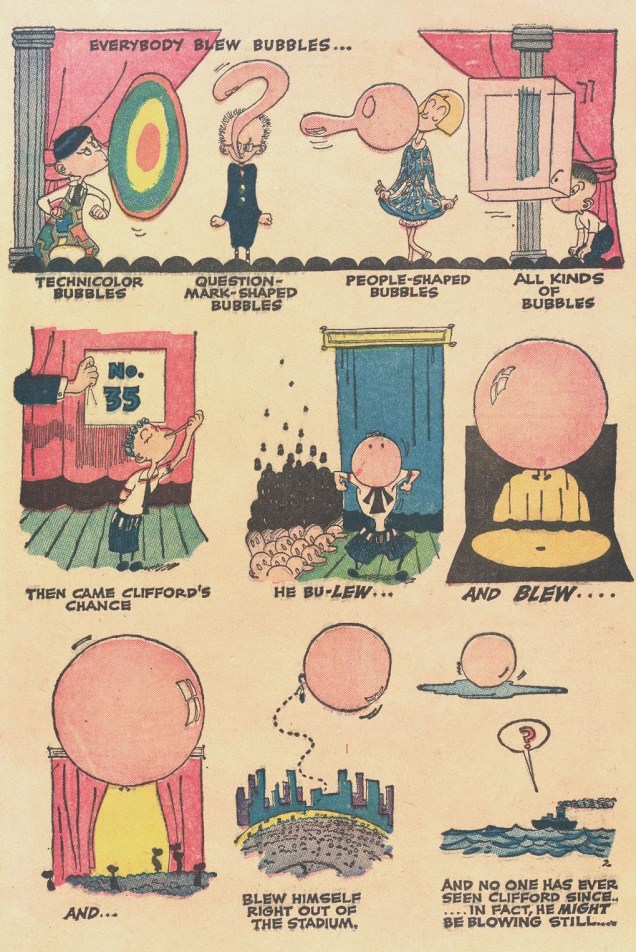
In his earlier years, Feiffer’s excitable, skittish pen was a little more subdued. Case in point: Clifford, Feiffer’s first published strip.

CliffordJulesFeiffer
Kewpies #1, spring 1949.

CliffordJulesFeiffer2

Clifford first appeared in Kewpies #1 (spring 1949), published by Will Eisner, when Feiffer was but 20. In « Out of Line : the Art of Jules Feiffer » (2015), Martha Fay explains that Feiffer had the style of Walt Kelly’s Pogo in mind when he created Clifford.

FeifferCliffordDarkA
Robert Boyd writes: « From 1949 to 1951, Jules Feiffer drew Clifford, which appeared in Will Eisner’s The Spirit Section, an eight-page comic book insert syndicated to newspapers. » This particular strip first saw print in the January 14, 1951 section.
FeifferBoyGirl
Feiffer’s lively cover to his 1961 strip collection Boy, Girl, Boy, Girl (Random House)

Nowadays, Feiffer is writing and illustrating children’s books. In an interview with Gary Groth, he explained that « They represent the gentler, sweeter world that, as we grow older, we go about corrupting first chance we get. No, that’s too cynical. Second and third chance we get. » They may be intended for children, but they are, for the most part, every bit as clever and multi-layered as the Feiffer-for-adults.

JulesFeifferBarrelofLaughs
1995, Harper Collins.

What kind of plot would a Feiffer-book-for-children have, you ask?

« Prince Roger sets out eagerly on a quest and finds a few adventures, a lot of friends, a damsel or two in distress (not!) and himself, in the end. A ‘carrier of joy’ whose mere presence causes everyone to laugh uncontrollably, Roger finds cruelty and kindness equally amusing, and expects his quest to be a lark. It’s anything but: As Roger passes through the Forever Forest, nearly starves at the Dastardly Divide, sees people at their worst in the Valley of Vengeance, and temporarily despairs in the Mountains of Malice, he sobers up, learns to care for others, becomes an expert peacemaker, does Good Deeds, and falls in love with Lady Sadie, who says what she thinks as she repeatedly saves his bacon. »

Read an excellent (though 10 year-old) article from New York Times about Feiffer here.

~ ds / RG

*A triumphant return to the home town
Treated with love and respect
A special school assembly
Before they would have broken my neck
My favourite colour
An E-type Jag
Roll out the red carpet
A glass of champagne – Not the cheap stuff!

(Black Box Recorder, « Being Number One »)

Buon compleanno, Gianni De Luca!

« Though this be madness, yet there is method in’t. »

On the ninety-first anniversary of his birth, we take the opportunity to salute fumetti gran maestro Gianni De Luca (b. January 25, 1927; d. June 6, 1991)… and to share some of the striking images he crafted. In comics, the term « innovative » has been applied far too liberally, all too often in ignorance. In the case of of Mr. De Luca, no hyperbole is involved, I assure you.

I first came upon his work in the mid-70s, through my parent-sponsored subscription to the québécois catholic youth magazine Vidéo-Presse (1971-1995), which was kind of didactic, I suppose, but still quite fun. The publisher had licensed much of its comics content from Italy, and it was definitely high-toned stuff, such as adaptations of Jules Verne novels. I recall « L’Île mystérieuse » being among them. Accustomed as I was to the madcap and hyperkinetic tone of the dominant Franco-Belgian and American schools, the Verne stuff, while clearly well-executed, seemed a bit languid and wan.

However, this feature was followed by, as fate would have it, the bane of any schoolboy*, Shakespeare adaptations. But wait… these were MIND-BLOWING. Decades later, I became fast friends with another cartoonist roughly my age, and he’d had the very same epiphany with De Luca’s Hamlet. Other than that, I’ve never really met anyone familiar with the work. Even locating a copy was a bit of an ordeal, but I managed to snag, a few years ago, a handsome volume gathering Hamlet and La tempête (The Tempest), published by Les Humanoïdes Associés in 1980.

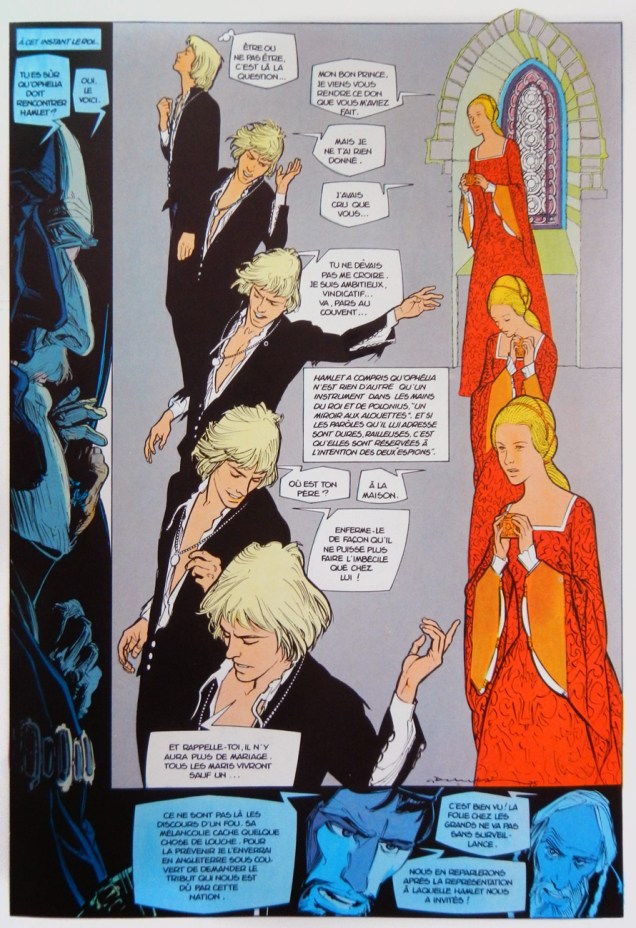
Hamlet19A
Hamlet, page eighteen. Adaptation by Barbara Graille and lettering by Roberto Roquemartine. Colours presumably by De Luca himself, as the credits are mute on that point.
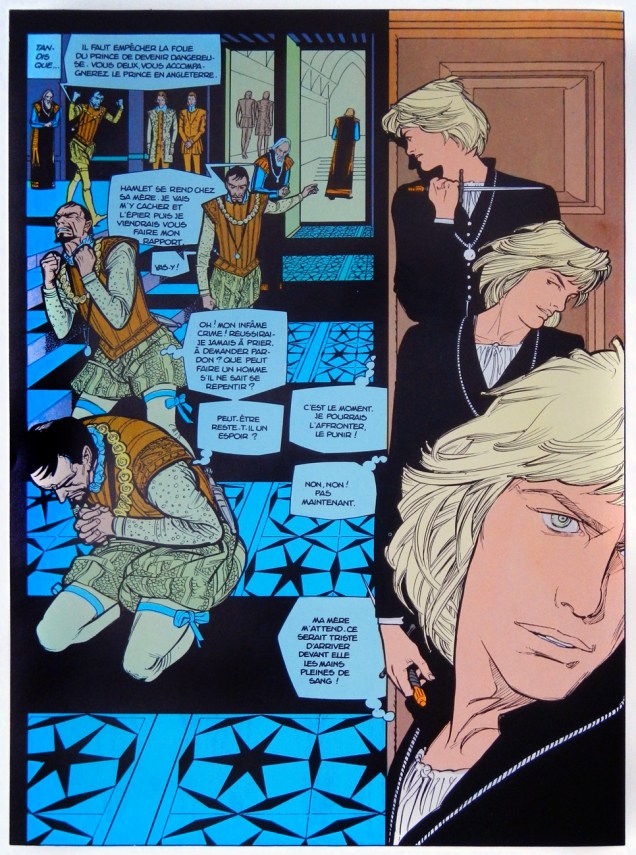
Hamlet22A
Hamlet, page twenty-three.
Tempête57A
La tempête, page five.
Tempête64A
La tempête, page twelve.

I don’t believe there’s any De Luca out there in the English language… save for one happy exception: UK publisher Running PressThe Mammoth Book of Crime Comics, discerningly edited by critic Paul Gravett**, contains « Strada », a superior entry in writer Gian Luigi Gonano and De Luca’s ‘Il Commissario Spada‘ series (1970-1982). « The series was groundbreaking in many ways, since it introduced subjects like violence, organized crime, satanic sects, terrorists and murderers to the pages of a Catholic magazine for young readers, that was at the time mainly distributed in parishes. »

*To be fair, we never studied Shakespeare in school.

**Speaking of Mr. Gravett, he happened to write an illuminating essay on De Luca’s Hamlet: http://www.paulgravett.com/articles/article/gianni_de_luca_hamlet

-RG

Tentacle Tuesday: Your Basic Contemporary Tentacle

Today’s Tentacle Tuesday veers away from more traditional tentacles and such, straying into more current territory where normal octopuses fear to tread. In a battle between a member of the Octopoda and a Lovecraftian horror, the latter would indubitably win…

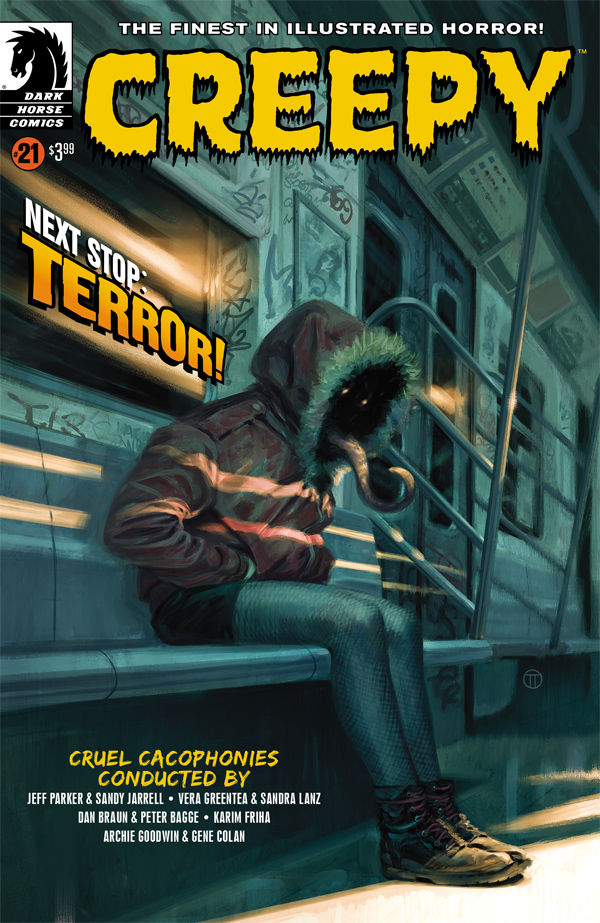
Exhibit no. 1: a painting by Julián Totino Tedesco that uses the classic combination of sexy and frightening. It was used as the cover of Creepy no. 21 (Dark Horse Comics, August, 2015)…

JulianTotinoTedescoCreepy21

And here’s the actual cover:

Creepy21
I think adding « NEXT STOP: TERROR » was a tad unnecessary, not to mention cheesy. Isn’t a girl with a tentacle coming out of her face terrifying enough? Dark Horse pompously describes this issue as « featuring spooky sequential storytelling from graphic greats », promising we’ll be « sweating with sickening satisfaction », proving that there *is* such a thing as too much alliteration.

TentacleTuesdayIcon

Next up is a charming bibliophile, who looks mournful rather than scary.

providence-raulo-cover-04-greatrace_copy
« Stop interrupting while I’m trying to write! » Providence no. 11 (December 2016). Century Variant art by Raulo Caceres, a Spanish comic artist.

No-one will be surprised to find out that Providence (12 issues published from 2015 to 2017), written by Alan Moore and illustrated by Jacen Burrows, is meant to be considered as belonging to Lovecraft’s Cthulhu Mythos. In his 2013 interview with Pádraig Ó Méalóid, Moore had pointed out that Providence required a staggering amount of research on his part, and that he had been « living and breathing » Lovecraft while writing it. The following exchange illustrates this research-focused approach:

AM: I’m even trying to check out what the weather was like, which is difficult to establish other than in broad generalities, but I can at least sort out what the sky looked like, and what the phases of the moon were – which is something that Lovecraft used to take pains to do, so I feel that I should as well.

PÓM: Find out if the moon was gibbous, or something like that?

AM: Yes, that was it, he used to – yeah, gibbous, the gibbous moon, which is nearly, what, three-quarters full, waxing or waning?

PÓM: Yeah, three-quarters full. It’s a wonderfully Lovecraftian word.

AM: In one of his stories he changed all the dates in it because he found out that a gibbous moon hadn’t happened on the day that he said it had. He said, ‘this is a lesson for all aspiring writers of fiction.’ And I’ve taken that to heart.

TentacleTuesdayIcon

Finally, we have another Dark Horse entry:

Hellboy2ActualCover
Hellboy: Seed of Destruction no. 2 (1994).

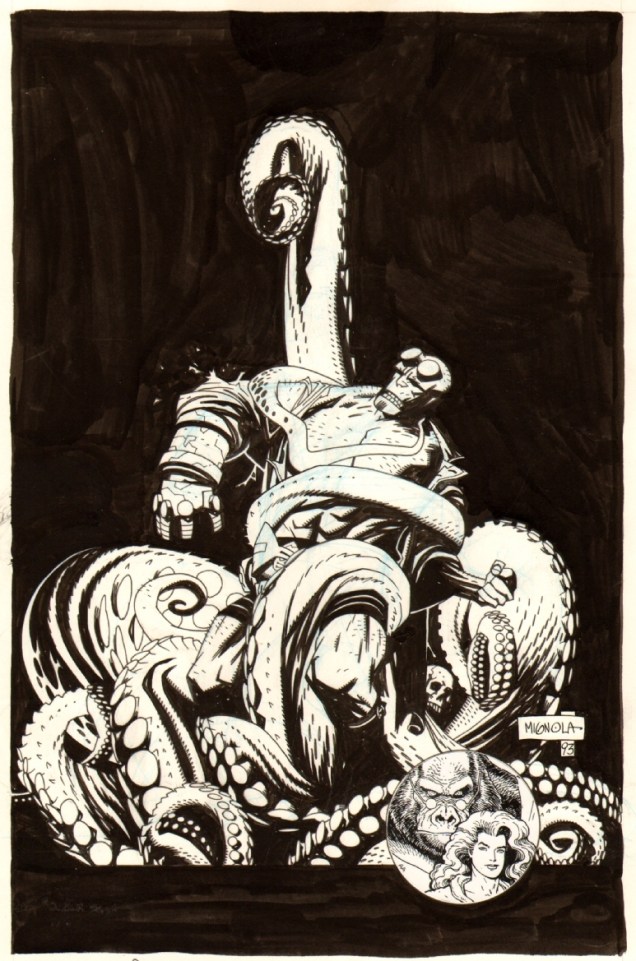
The sketch for the cover (1993):

MignolaHellboyTentaclesSketch
Now we know what’s behind the hand-and-sword symbol!

Hellboy: Seed of Destruction, the first Hellboy mini-series (4 issues, March-June 1994), was plotted/illustrated by Mike Mignola and scripted by John Byrne. (It was also the basis for 2004’s Hellboy movie, which you can safely ignore, IMHO.) You can read the whole thing here. The individual issues were collected in a paperback in 1994, which also contains a couple of bonus stories from various sources.

The insides have sufficient tentacles to please even the pickiest, most tentacle-crazed reader:

HellboySeedsofDestruction2

HellboyTentacles1

~ ds


Happy Birthday, by Crom!

« Whatever got Juan is coming for me, too! »

It’s birthday number one hundred and twelve for pulp wordsmith Robert Ervin Howard (January 22, 1906 – June 11, 1936) who, in his tragically short lifespan, yet found time to unleash upon the world Conan the Barbarian, Solomon Kane, Kull of Atlantis and, more significantly for this reader, the chilling classic Pigeons From Hell, a short story posthumously published in Weird Tales’ May, 1938 issue.

ChillsBrunner

Howard’s The Horror From the Mound, originally published in the May, 1932 issue of Weird Tales Magazine, presumably had its title sanitized here because the H-word was still verboten in the early 1970s. Hailing from the second issue of Marvel’s Chamber of Chills (January, 1973), it was reprinted in glorious black and white in 1975’s Masters of Terror no. 1 (original title restored, hurrah!)

MastersTerror1A
And here it be. Seems a bit inaccurate to refer to a group of mostly pulp writers (some long dead) from the 30s to 50s as “Modern-Day Masters of Terror”, but I suppose it depends on one’s definition of “Modern-Day”. Cover illustration by Gray Morrow from a drawing by noted fabulist, fervent Trump supporter and fellow Hair Club for Men habitué Jim Steranko.

Gardner Fox and Brunner give it their all, but the story could have used more pages to truly do justice to Howard’s moody proto-weird western.

Read the full adaptation here:
http://thehorrorsofitall.blogspot.ca/2009/02/monster-from-mound.html

Better yet, read Howard’s tale:
http://gutenberg.net.au/ebooks06/0601761h.html

And Pigeons From Hell, while you’re at it:
http://gutenberg.net.au/ebooks06/0600721h.html

-RG