« Modern technology has tripled the life expectancy of the professional insulter »
It was forty-eight years ago today, which is to say Thursday, April the 20th, 1970, when a certain short, dumpy, cheap-cigar-chomping 1500-year-old green witch first crash-landed into the funny pages, though we wouldn’t know she was green until that Sunday.
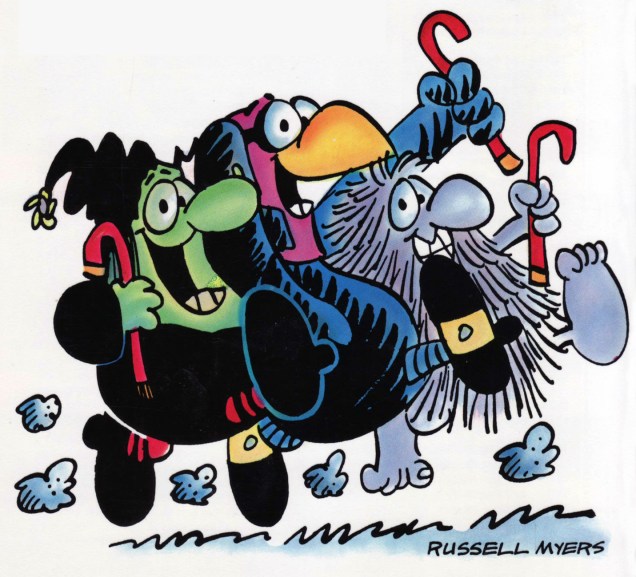
The cast’s principal players: Broom-Hilda, Gaylord Buzzard and Irwin Troll. Colour by Barbara Marker.
Russell Myers‘ (born October 9, 1938 in Pittsburg, Kansas, and still with us) Broom-Hilda has been easy to take for granted… it’s never been a trendy strip, but it’s always had its adherents, a somewhat enlightened, or at least less dim than average, passel of loonies, to which I proudly belong.
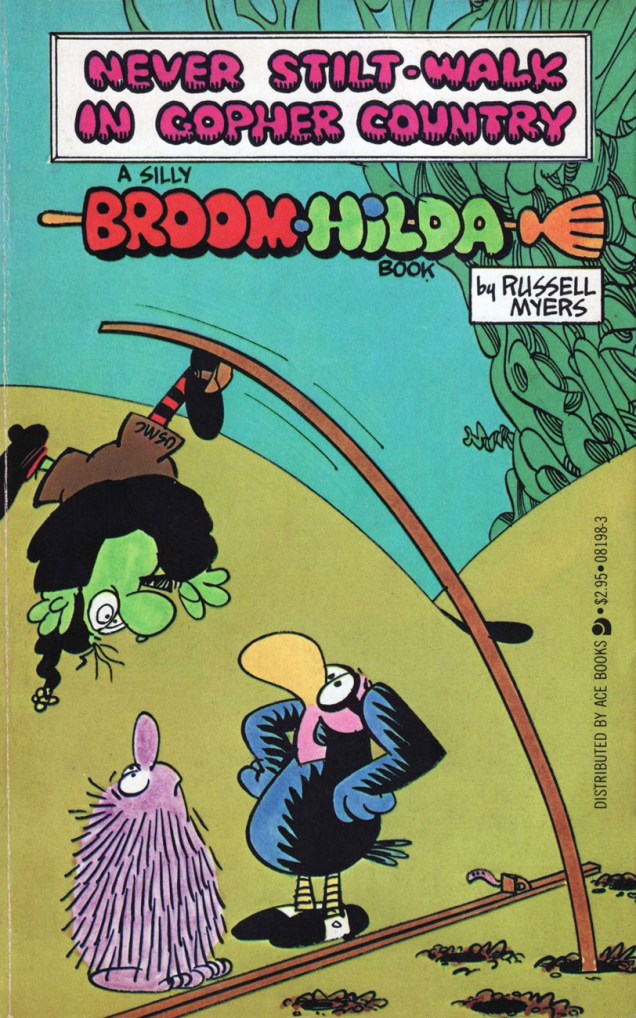
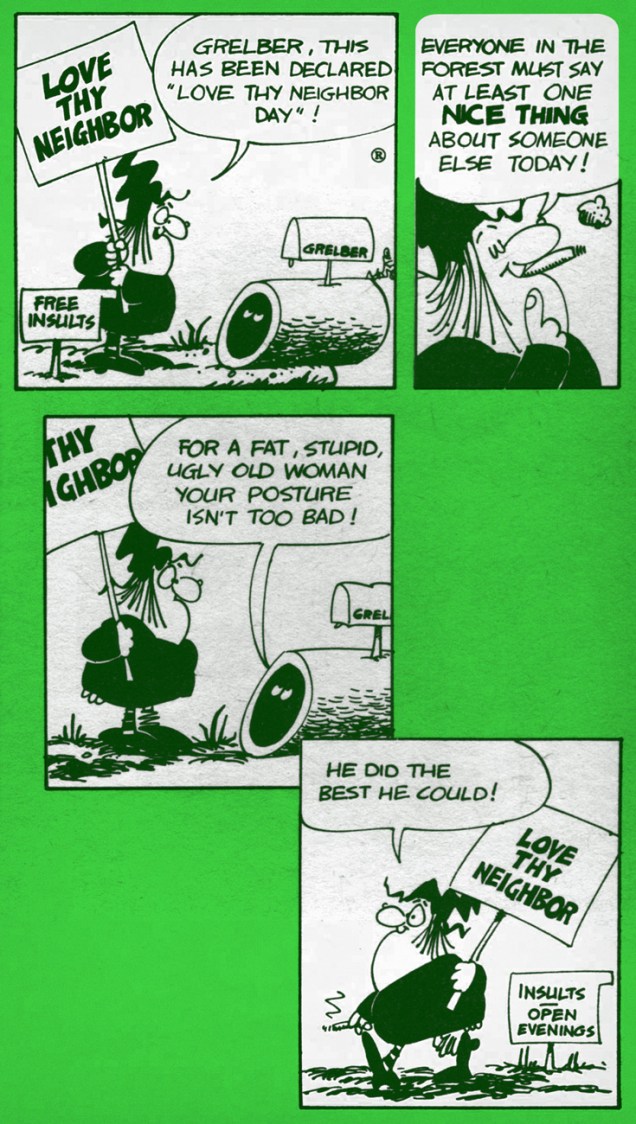
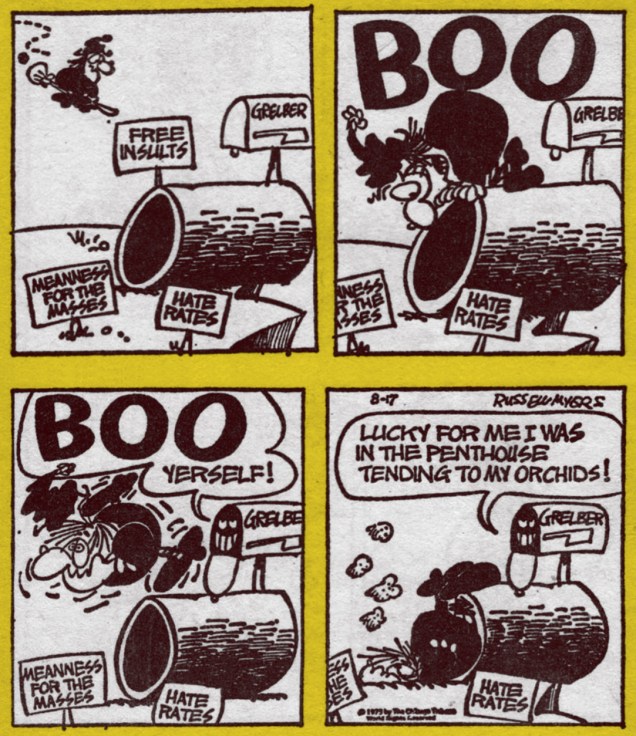
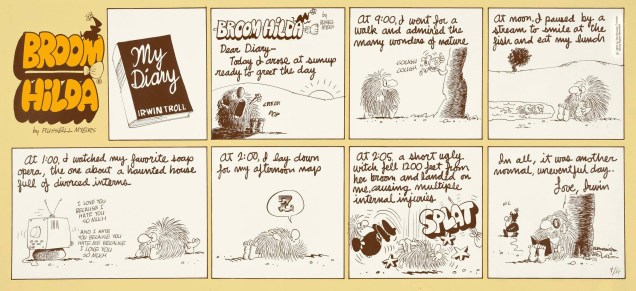
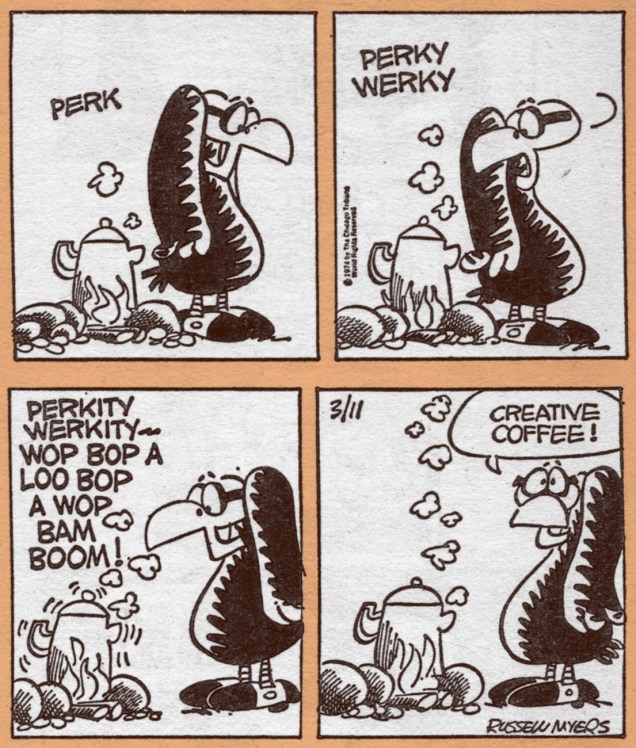
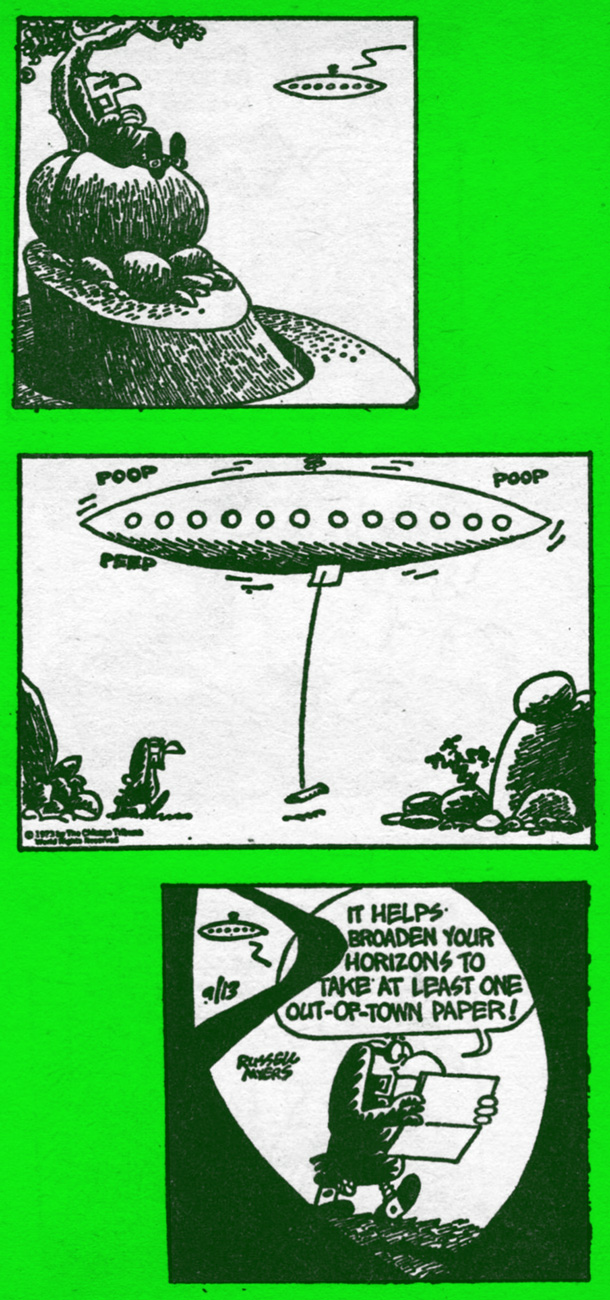
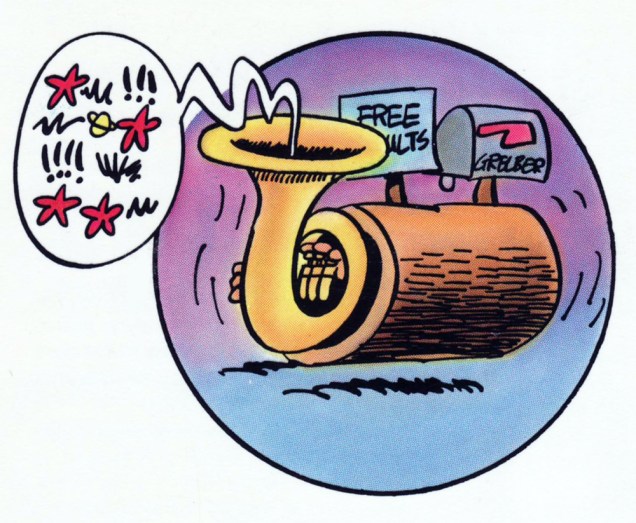
One of my favourite B-H collections… an oversize one-shot issued in 1978. And don’t let the subtitle throw you: *all* Broom-Hilda books are profoundly silly.An undated strip from 1970.Grelber always gets the last laugh. August 17, 1973. Bet you never knew that Grelber shared a genteel hobby with Nero Wolfe.This Sunday strip comes from just about a year into the run, April 4, 1971, back when Broomie still was allowed to enjoy all of her little hobbies. A day in the life of the resilient Irwin Troll, Mother Nature’s Personal Friend.Low-key and surreal, the March 11, 1974 strip. Pour me a cup of that jaunty java!Wise words from the strip’s resident intellectual, Gaylord Buzzard (Sept. 13, 1973)
Over the long years, the changing times and the powers-that-be had Broomie clean up her act, stripping her of her beloved vices one after the other. Well, she’s held on to her gluttony and lust, but no longer indulges her passion for third-rate tobacco and beer. Still, since there was so much more in the strip’s DNA, the eschewing of Broomie’s low-down habits was not fatal.
The author as he appeared in 1985’s Broom-Hilda Book One (and only), in the “Blackthorne’s Comic-Strip Preserves” series. « To retain this standard of madness requires a good deal of sane and sensible methods. The gags don’t just occur to Russell; he creates them. Like all humorists, he observes where others only look. Others see a man going through a revolving door, Russell sees a man stuck in a revolving door. Perverse, perhaps, but perversity is the trigger of humor. Why else do we laugh at a man stepping into a manhole? »
Today’s Tentacle Tuesday comes courtesy of American Comics Group, which delighted its readers with horror, satire and other strange offerings between 1943 to 1967.
ACG’s Adventures into the Unknown is now recognized as comics’ first continuing horror title. A good variety of horror tropes (though I imagine that back then, the clichés we’re painfully familiar with today weren’t quite as clichéd) , from the amusingly bizarre to the genuinely scary, could be found within its pages: killer puppets, homicidal ghosts, murderous mummies, vicious dinosaur relics, spooky skeletons… and tentacles, of course. Unlike many of its brethren, the series survived the fall-out of the 1954 comic book hearings that were started by the Senate Subcommittee on Juvenile Delinquency, but the title did drop its creepier storylines in favour of goofiness. Not a bad way to go, really, as long as the result is entertaining!
I’d like to welcome you to Tentacle Tuesday by kicking things off with this unnecessarily graphic cover in which somebody’s tentacle is getting lopped off. Note that the she-octopus also has vampire fangs. Beautiful? I wouldn’t go that far… or anywhere near it.
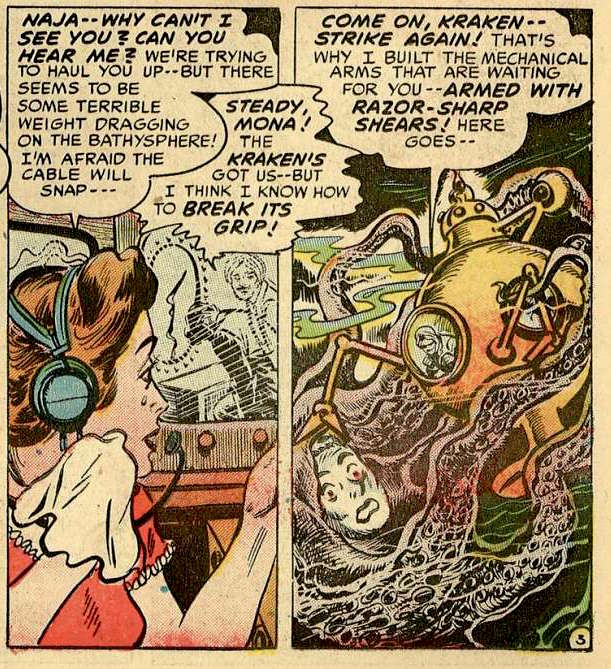
“…A monster which exists! I know — for I have met her face to face! Picture a face gigantic, beautiful — on a huge and monstrous body which reeks of evil — and death!” Adventures into the Unknown no. 49 (November 1953), cover by Ken Bald.A panel from « The Kraken », drawn by Jon Blummer. Geez, poor kraken. Later on, she (?) gets attacked with a “corrosive acid – with a nozzle activated from within “… Mona can’t bear to watch, and I agree.
There are five Adventures in the Unknown covers that feature octopuses (or someone’s nightmarish and anatomically ridiculous idea of an octopus, at any rate). We’ve already featured no. 157 (revisit the past here – Nemesis is waiting for you!); the remaining four were published between August and November of 1953 and illustrated by Ken Bald (who drew the covers for issues 21 through to 50). Didn’t he get tired of drawing tentacles? Was it his idea? Did he have nightmares afterwards?
(A little aside: speaking of Mr. Bald, he’s been in the Guinness book of records for a couple of years now, for being the “oldest artist to illustrate a comic book cover”. The comic in question is Contest of Champions no. 2 (2015, Marvel Comics), which he drew at the age of 95.)
I’ll skip no. 48 for now, as its tentacles are plant-like in nature, but onward with the other two!
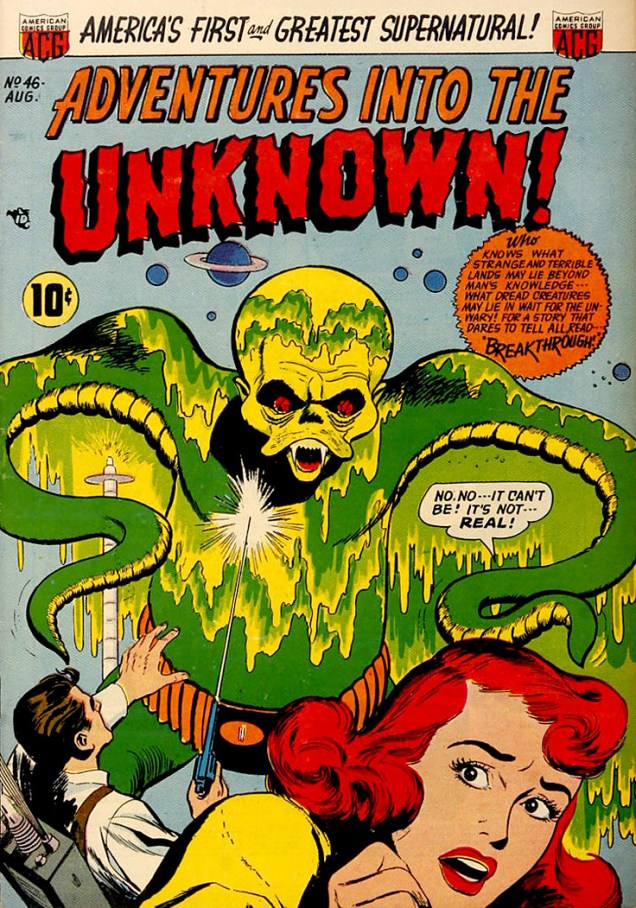
« Tale of Terror » from Adventures into the Unknown no. 46 (January 1953). Illustrated by Lin Streeter. It’s a well known fact that monsters on a diet are very irritable (and he’s still got a long way to go, judging by his chubby midsection).
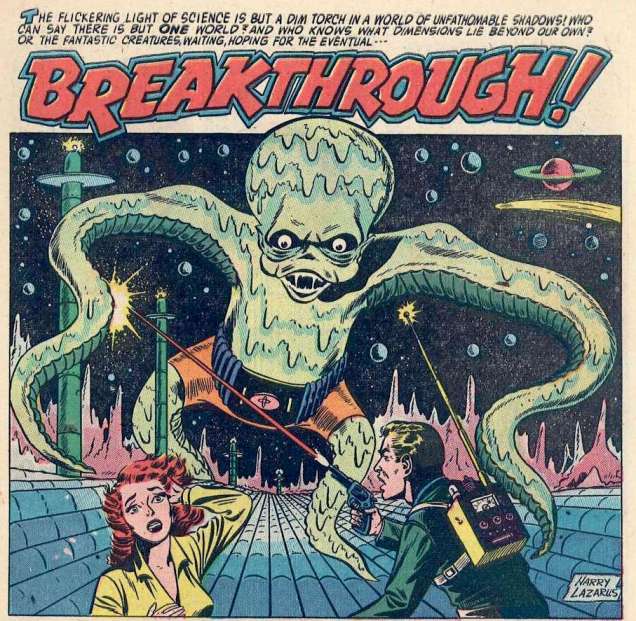
“Breakthrough!”, the title story, is beautifully illustrated by Harry Lazarus and brimming over with tentacles. Take a peek:
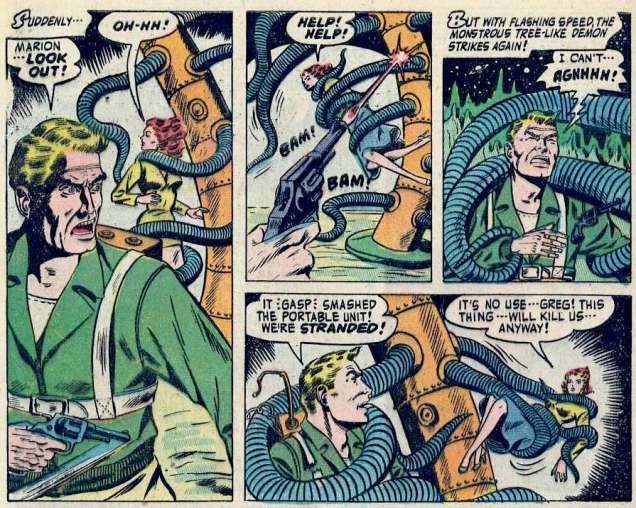
The main tenta-gonist of “Breakthrough!”, drawn by Harry Lazarus.In “Breakthrough!”, even cables have tentacles!
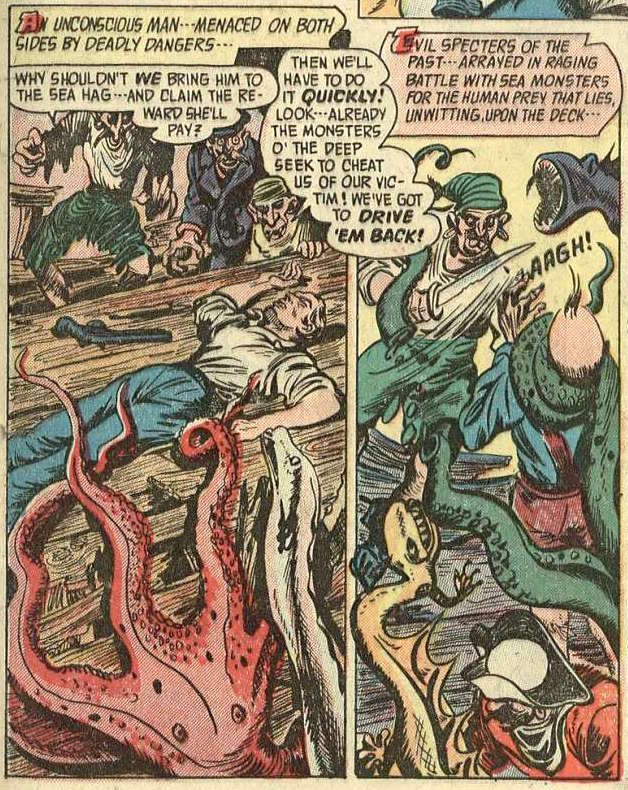
“It’s no use strugglin’ — not when ye’ll be the sea hag’s slaves forever!”Adventures into the Unknown no. 47 (September, 1953). Cover by Ken Bald.Ruthless pirates! A sea hag! Tentacles and “evil specters of the past!” All can be found in “The Derelict Fleet!”, illustrated by Jon Blummer in an interestingly fluid style.
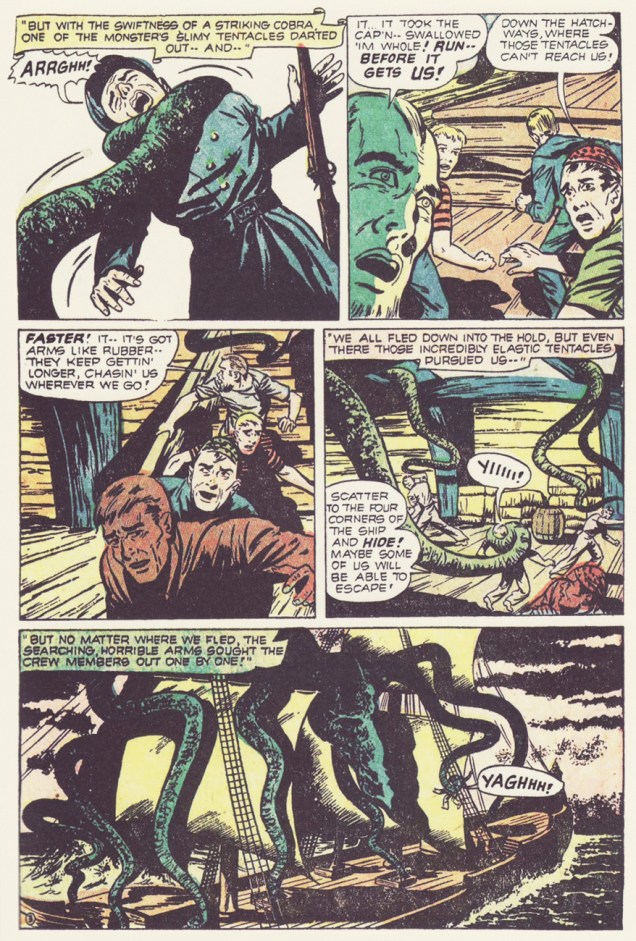
Naturally, there is some tentacle goodness *inside* some issues of Adventures into the Unknown, despite an utter lack of cephalopods on the cover. I’ll give two examples (gracefully scanned by co-admin RG from the collected Adventures into the Unknown: Volume 8, published by PS Artbooks in 2014).
A panel from « Tale of Terror », published in Adventures into the Unknown no. 39 (January 1953) and Illustrated by Lin Streeter. This panel was wisely used for the PS reprint tome’s front endpapers, to great effect.Page from « Mystery of the Marie Celeste », published in Adventures into the Unknown no. 41 (March 1953), pencilled by Al Camy and inked by Edvard Moritz. How (and why) did the octopus manage to climb atop a ship?
« Once there was a fellow and his name was Buzz He was just a rookie cop, just a baby Fuzz He patrolled the Sunset Strip in the land of the free and the home of the hip He protected you and me until he met a girl called Alice D
Alice was the girl that all the hippies dread And they called her Sweet Alice the Head Alice it was plain to see was full of pot and STD She’d attract a great big crowd because her inner peace was much too loud »
Biff Rose, “Buzz the Fuzz” (1968)
This day in history: On April 16, 1943, the hallucinogenic effects of LSD were discovered.
Here’s an account of the event, from the folks at History.com:
In Basel, Switzerland, Albert Hofmann, a Swiss chemist working at the Sandoz pharmaceutical research laboratory, accidentally consumes LSD-25, a synthetic drug he had created in 1938 as part of his research into the medicinal value of lysergic acid compounds. After taking the drug, formally known as lysergic acid diethylamide, Dr. Hofmann was disturbed by unusual sensations and hallucinations. In his notes, he related the experience:
« Last Friday, April 16, 1943, I was forced to interrupt my work in the laboratory in the middle of the afternoon and proceed home, being affected by a remarkable restlessness, combined with a slight dizziness. At home I lay down and sank into a not unpleasant, intoxicated-like condition characterized by an extremely stimulated imagination. In a dreamlike state, with eyes closed (I found the daylight to be unpleasantly glaring), I perceived an uninterrupted stream of fantastic pictures, extraordinary shapes with intense, kaleidoscopic play of colours. After some two hours this condition faded away. »
After intentionally taking the drug again to confirm that it had caused this strange physical and mental state, Dr. Hofmann published a report announcing his discovery, and so LSD made its entry into the world as a hallucinogenic drug. Widespread use of the so-called « mind-expanding » drug did not begin until the 1960s, when counterculture figures such as Albert M. Hubbard, Timothy Leary and Ken Kesey publicly expounded on the benefits of using LSD as a recreational drug. The manufacture, sale, possession, and use of LSD, known to cause negative reactions in some of those who take it, were made illegal in the United States in 1965.
The genial Dr. Hofmann.
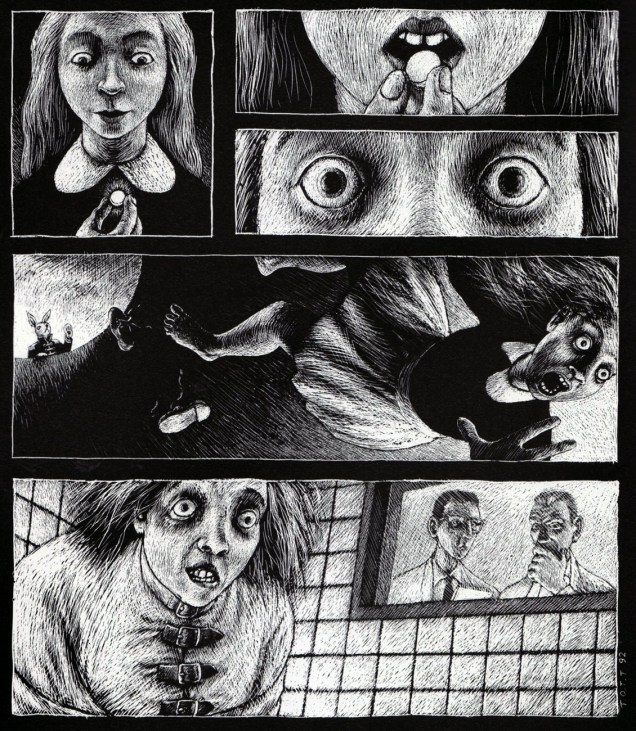
As a little digestif for the history lesson, here’s a poisoned bonbon from Thomas Ott (b. 1966, Zurich… a mere 76 km from Basel!), a proven meister of both comics storytelling and of the singularly exacting technique of scratchboard. This is Ott’s highly condensed and updated version of Lewis Carroll’s Alice’s Adventures in Wonderland, “Alice”, from 1992. I wouldn’t advise its use in preparing a book report.
Just this once, inquisitive English-speakers won’t be left out in the cold or reaching for their translation dictionaries, as Ott’s work is mostly mute, the only text appearing incidentally on newspapers, signs and assorted objects, and in English at that.
Ott’s chosen milieu is the perpetual nighttime of American film noir (which in turn comes from the French roman noir, a term first used in the 1700s to describe British gothics, becoming synonymous, in the 20th century, with bleak crime novels), so the headlines and billboards are in Inglés. In addition to the classic noir recipe, the Swiss artisan injects a discreet but usually lethal dose of his quite sardonic wit.
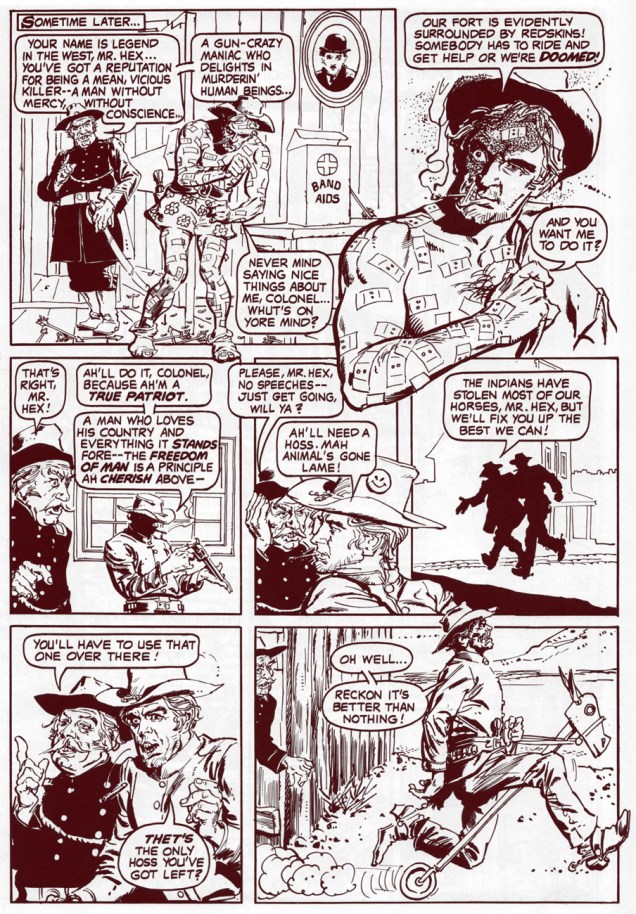
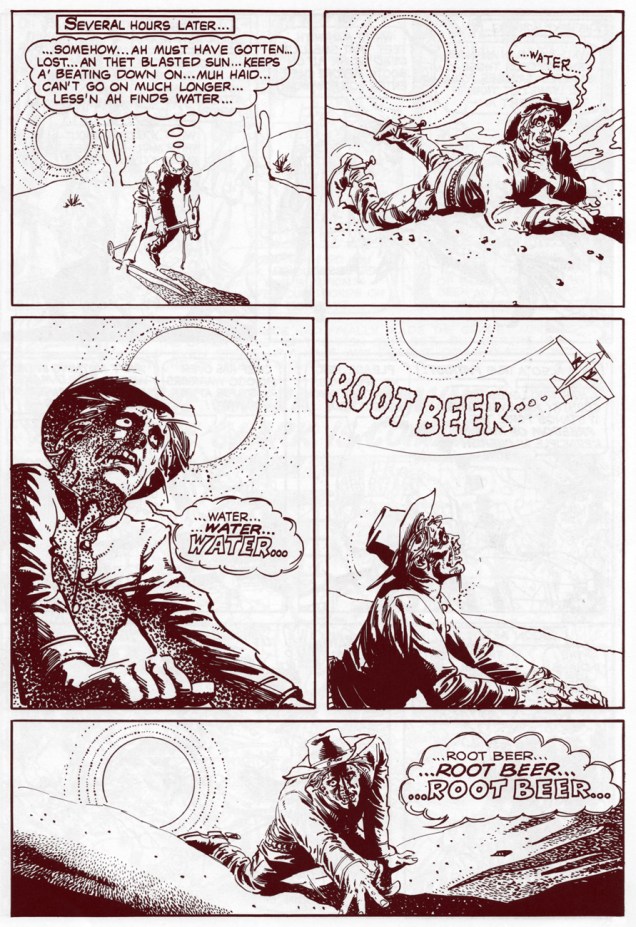
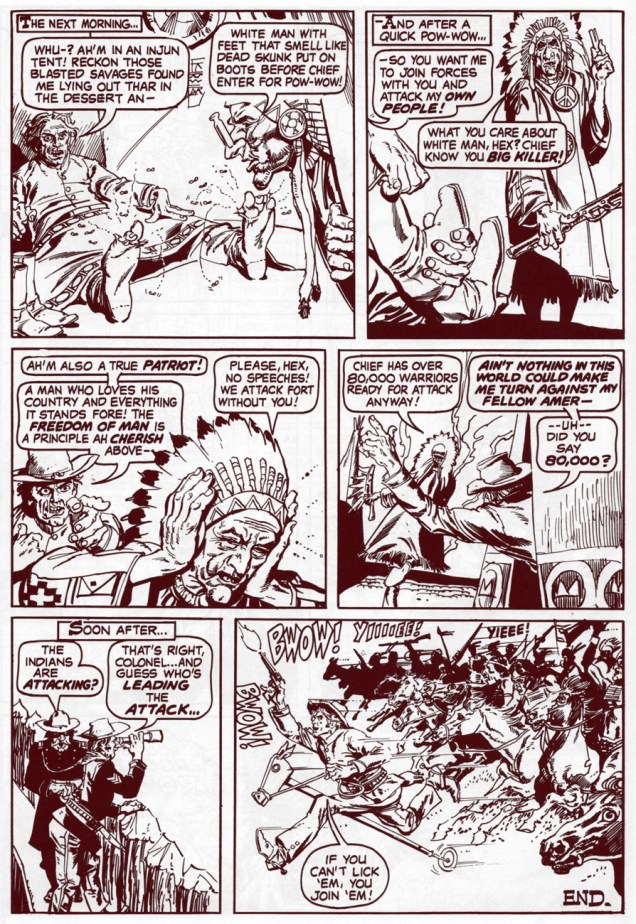
Jonah Hex originators John Albano (1922-2005) and Tony DeZuniga (1941-2012) take the piss out of their boy in a little tale that was, according to Paul Levitz, intended for a (self) parody title provisionally titled Zany (having cycled through the tentative monikers Black Humor and Weird Humor), and that never saw the light of day… This feature was the only one completed for the abortive endeavour, and it saw print in the Plop!-themed issue of The Amazing World of DC Comics (October, 1976), its thirteenth, of course. Incidentally, Plop!’s own cancellation was announced in that very issue of AWODCC. Bummer.
Why, yes… now that you mention it, an ice-cold root beer *would* be nice.« Lying out in the ‘dessert‘ », Jonah? That was either a root-beer float mirage or a careless letterer’s oversight.
I would be earning myself a sound flogging if I didn’t share Sergio Aragonés‘ adroitly-done cover, so here it is.
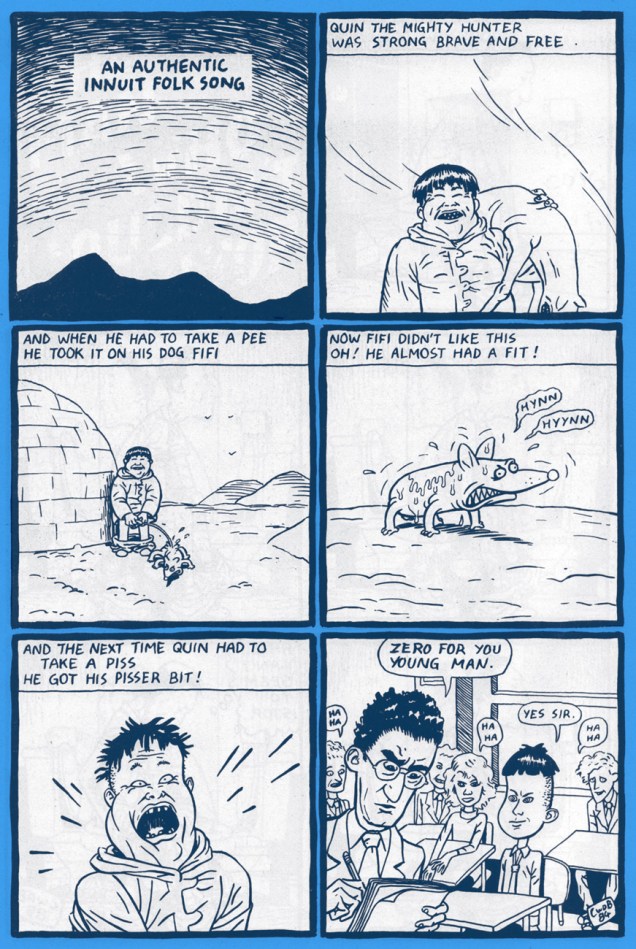
The punchline to the EC story “Pleasant Screams!”, written by the usual Bill Gaines / Al Feldstein combo, with art by Joe Orlando. From Tales From the Cryptno. 37 (August, 1953) Can anyone in the class tell me where this panel was swiped and quoted (to hilarious effect) in the eighties? The answer follows…
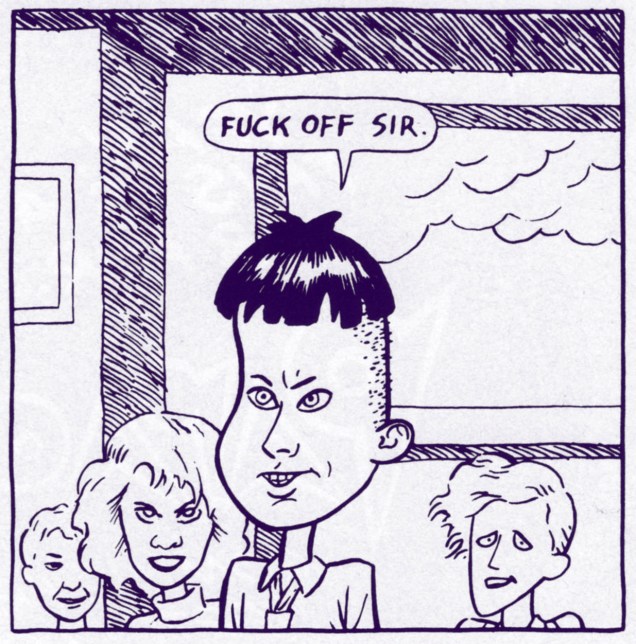
Here it comes… pencils down, everyone!
Poor Fifi. He hardly seems to be the right breed of pooch for the Canadian Arctic, not to mention its special precipitations. Reprinted several times since, this edifying tale of poetic justice first saw print in the final issue of the Yummy Fur mini-comic (no. 7, Sept. 1985, Tortured Canoe).Chester’s closing argument in the case.
Ah, for a return to the days when we didn’t know way too much about Chester Brown, when he was a mysterious, self-published cartooning genius and Châteauguay‘s finest son. I remember how awestruck I was upon encountering his brilliant Yummy Fur minis, available at Toronto’s gone-but-not-forgotten Dragon Lady comic book store in the early-to-mid 1980s. What a surreal breath of fresh air they were!
A cat’s meow and a cow’s moo
I can recite ’em all Just tell me where it hurts yuh, honey
and I’ll tell you who to call Nobody can get no sleep There’s someone on ev’ryone’s toes But when Quinn the Eskimo gets here
everybody’s gonna wanna doze.
The source of Bobby Zimmerman‘s inspiration: Anthony Quinn as “Inuk” in The Savage Innocents (1960). Back then, people dressed like this where and when it was actually cold; nowadays, it may be sunny and well above freezing, but those fierce, dauntless Polar explorers roam the streets in great numbers, clad in their fashionable down-filled, fur-lined hooded coats…
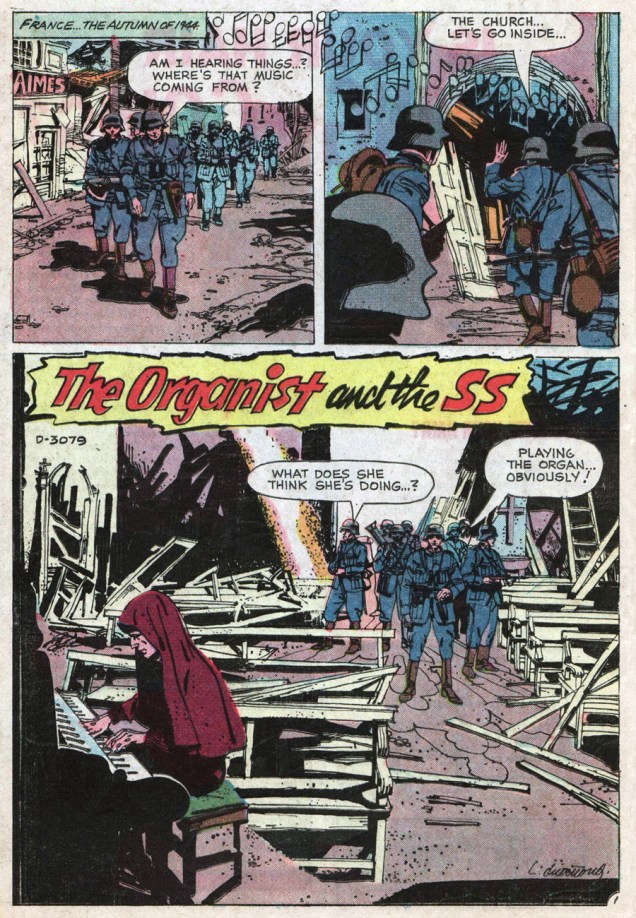
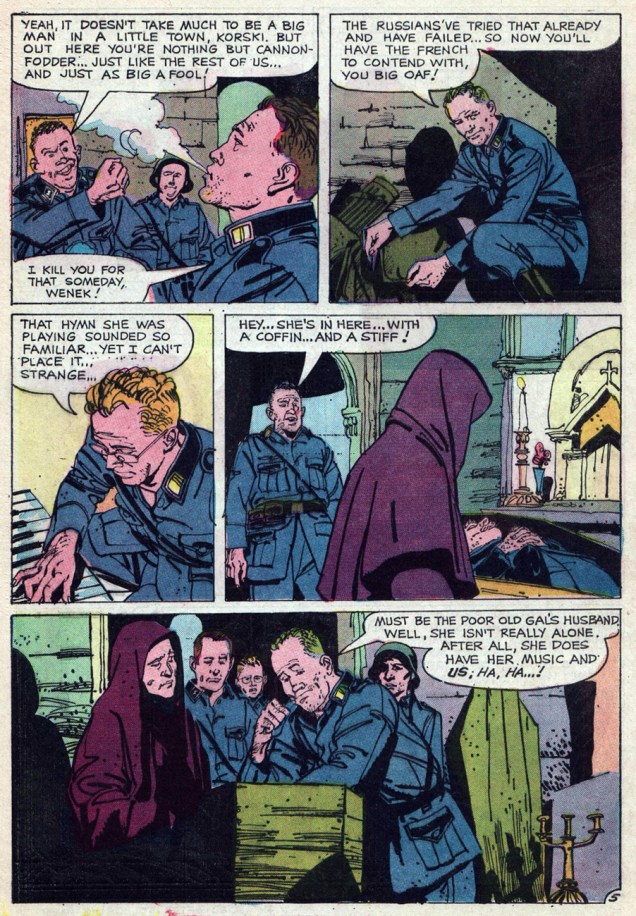
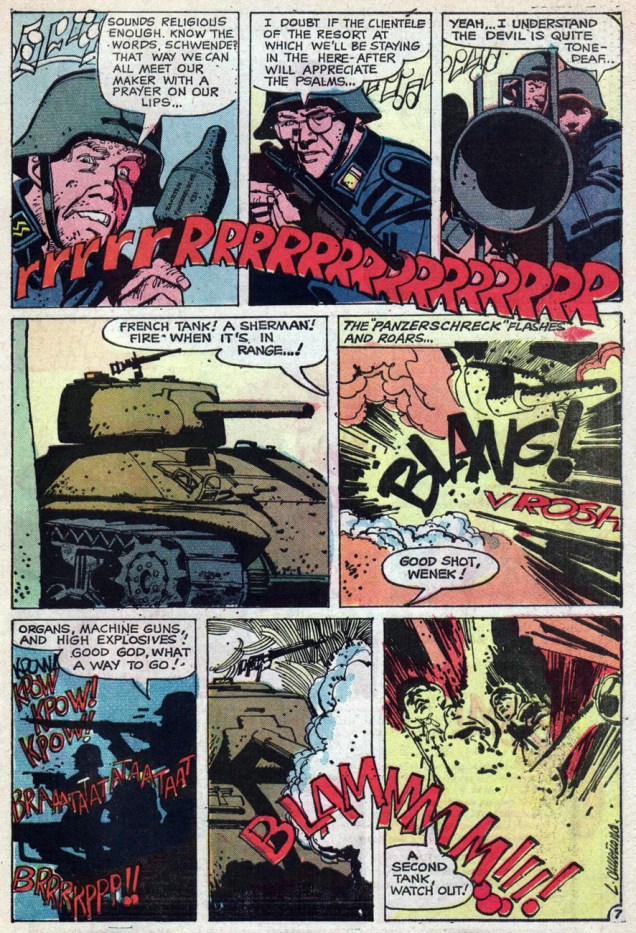
« They were bitter, war-weary men and the old woman’s music was comforting — perhaps too comforting… »
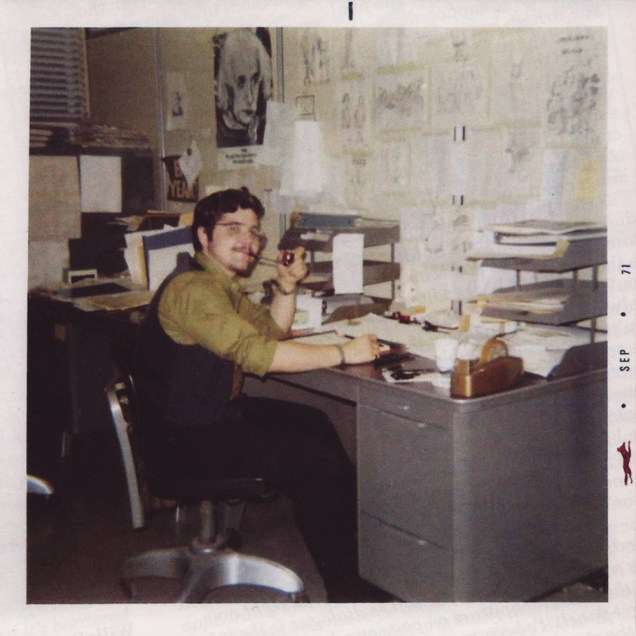
Writer and occasional penciller William ‘Willi’ Franz (born 1950) broke into the comics industry at the tender age of 15, selling his first script to Charlton editor Dick Giordano in 1966.
Will Franz, September 1971. A photo « …taken at the Manhattan insurance company where I worked as an accounting technician. My wall is covered with cartoons I made of various office friends and personnel. » Source: Will Franz and Charlton Spotlight.
While best known for his fruitful collaborations with his mentor, the great Sam Glanzman (1924-2017), namely The Iron Corporal, The Devil’s Brigade and most enduringly The Lonely War of Willy Schultz, Franz also scattered a few gems that the light has mostly missed.
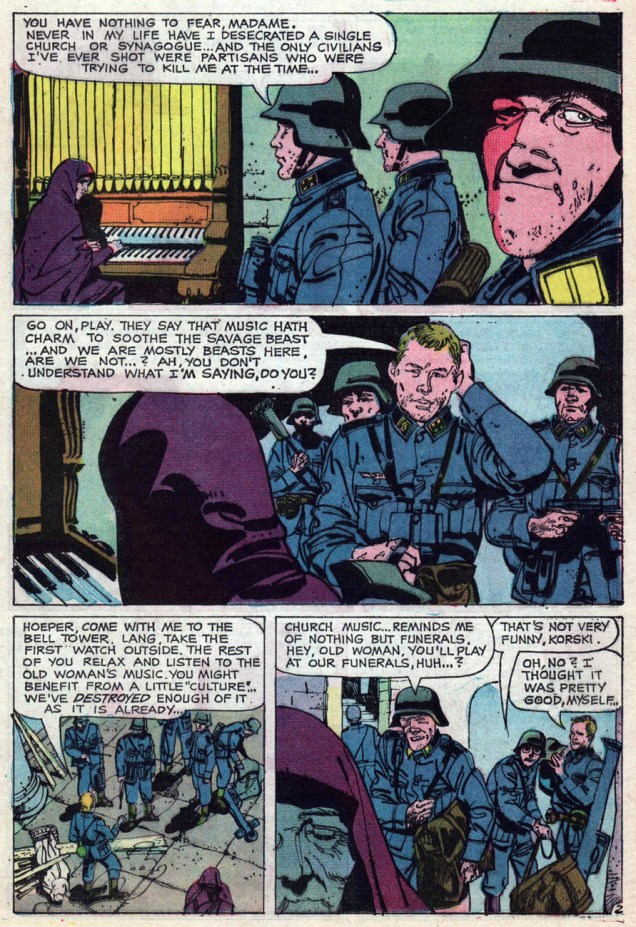
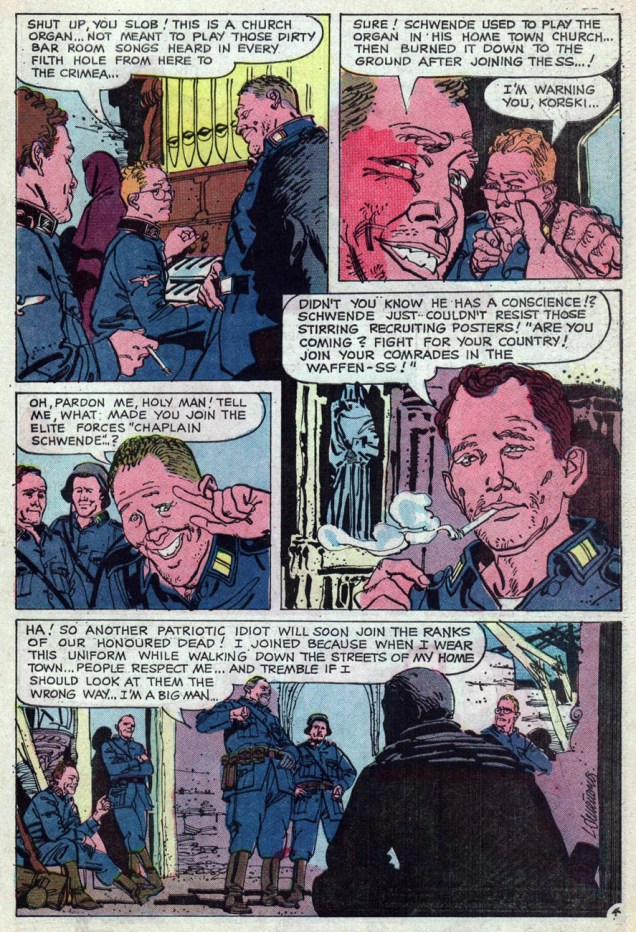
My favourite among these has to be his final story for Charlton, The Organist and the SS, published in Attackno. 8 (Nov. 1972). Franz’s bleak, nuanced and markedly pacifist tales had drawn the military’s ire, back in the late ’60s, and this somber little piece of doom might have, too, if anyone had been paying attention.
As Franz recalls in a 2015 interview with Richard Arndt, published in Charlton Spotlight no. 9 (Winter-Spring 2015-2016):
« I was told that a lot of Charlton sales were on military bases. They were a staple on Army bases. I, and my stories, were dropped in 1969, out of the blue. Things were heating up in Vietnam.
I was blacklisted at Charlton because a guy had put my name and stories down as one of the reasons he registered as a conscientious objector. I found out other people were throwing my name around. Someone in the army apparently said that my stuff, maybe like [Archie] Goodwin’s stuff, was too blood and guts. It was going to make soldiers *not* want to kill the gooks. The army can’t have that! »
Well, evidently Charlton (presumably managing editor George Wildman, bless his heart) let Will sneak back into the fold, if briefly, after the heat was off, otherwise I’d be writing about some other topic entirely.
Without further preamble, please savour this pitch-black, existentialist play of war and death, but mind the thorns.
Will’s layout for the opening splash of our story. It’s always a treat to see what liberties the illustrator takes… or doesn’t.
This issue is chock-full of arrivals and departures: it opens with a story from new recruit Warren Sattler, trying his hand at a few short mystery and war stories before he found his niche in excellent collaborations with Joe Gill on Billy the Kid and Yang; next up is Jack Keller, who was winding up his comics career, what with Charlton’s remaining pair of hot rod books, Drag ‘n’ Wheels and Hot Rods and Racing Cars, soon to be scrapped. He would move, appropriately enough, to making a living selling cars. Finally, Argentine ace Leo Duranoña (b. 1938) was just passing through Charlton, crafting a handful of finely-hewn tales before moving on to DC and Warren… among others.
Some people would shudder at the idea of having « literary » and horror and / or science-fiction within the same sentence, but I firmly believe that some of this oft-despised « genre » oeuvre is worthy of that (somewhat pompous, anyway) moniker.
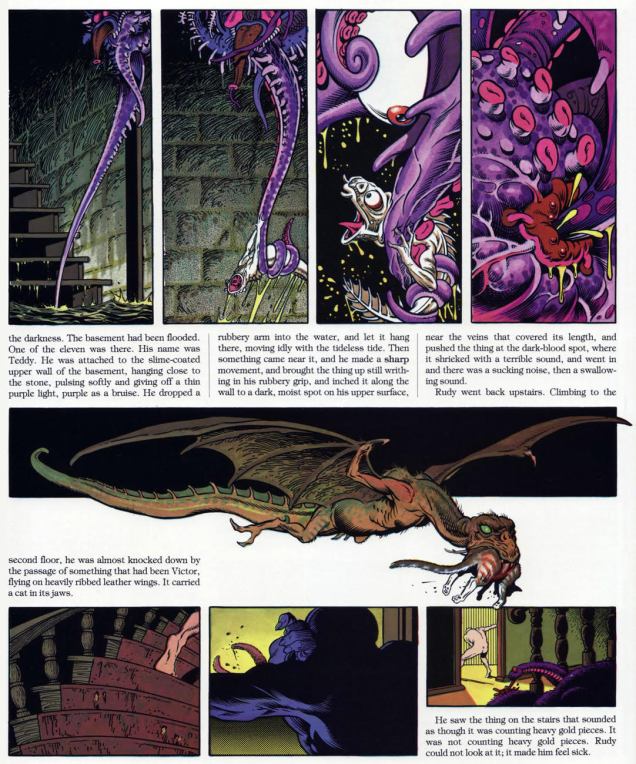
To open the proceedings, here’s a page from a graphic adaptation of « Shattered Like a Glass Goblin », written by the venerable Harlan Ellison in 1968 (and first published in 1975, in Deathbird Stories: A Pantheon of Modern Gods.) One of the showier pieces featured in the anthology The Illustrated Harlan Ellison(1978), it is drawn by William Stout, who does a great job translating the story into no-longer-just-mental images – and sneaking in a tentacle or two in the process (if you think that’s just a tail, shhh, don’t ruin it for the rest of us). People who dislike a vivid palette, beware: the bright, vivid colours just emphasize the terror felt by the main character (and the readers, if said readers have any imagination to speak of).
Apparently, poor high-school kids are often forced to analyze « Shattered Like a Glass Goblin », because upon Googling it to check the year of its creation, I stumbled upon a bevy of study resources that explain what the story is about and what techniques Ellison used to make this point. Yawn, and yuck. There’s nothing that ruins a good time like having to dissect it.
Page from the graphic adaptation of Shattered Like a Glass Goblin, written by Harlan Ellison and illustrated by William Stout, published in The Illustrated Harlan Ellison (1978). Stout cleverly refrains from showing everything, instead suggesting the unimaginably horrifying in a series of fleeting, clipped images.
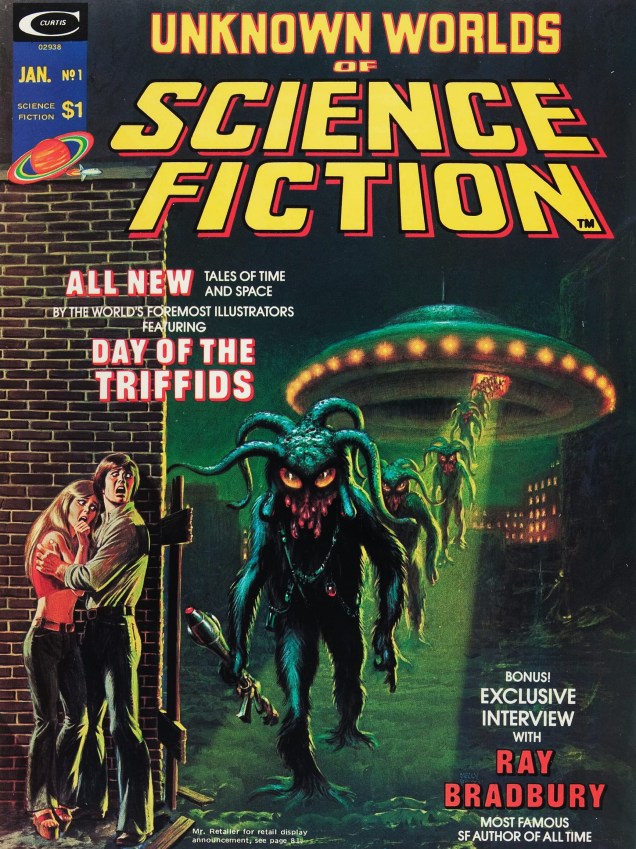
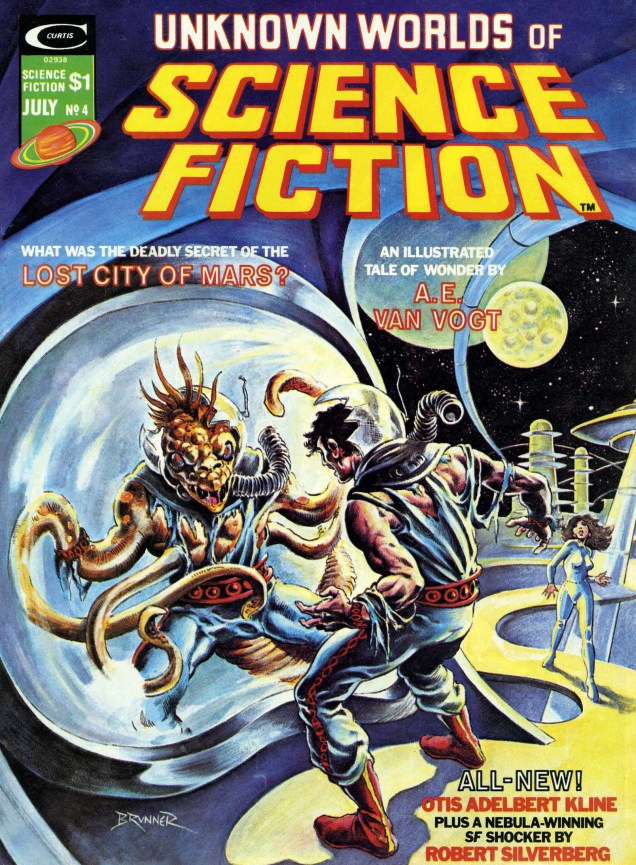
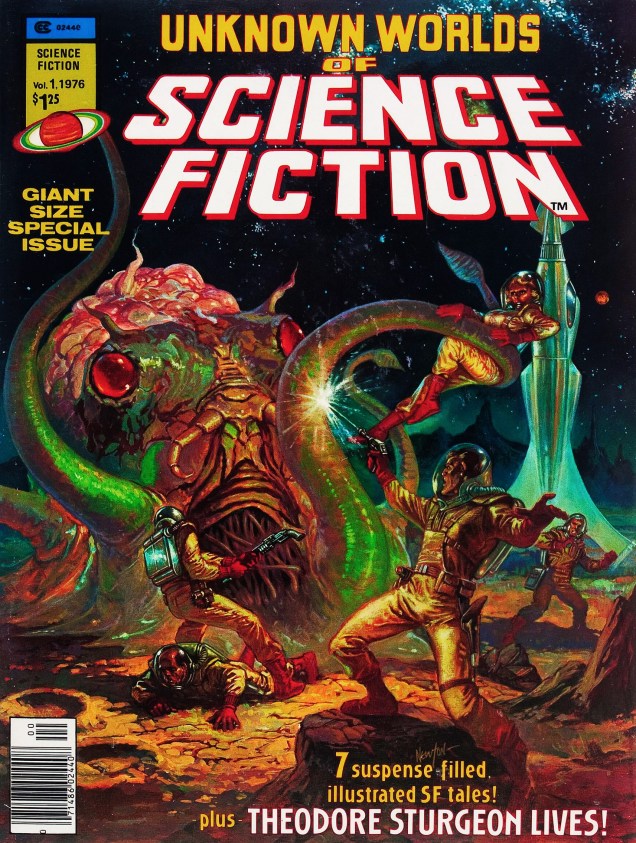
Now we come to Marvel’s short-lived Unknown Worlds of Science Fiction series, which often published adaptations of short stories and novels by well-known writers into a comic format (Mostly with lacklustre results, as far as I’m concerned, but then I’ve always preferred to stick with the original medium of things.)
Unknown Worlds of Science Fiction no. 1 (Marvel, January 1975). The cover is by Frank Kelly Freas. It has nothing to do with either the Day of the Triffids nor with Ray Bradbury (is he *really* the ‘most famous SF author of all time’?) but it features aliens with stylish tentacle-hair (how much hairspray did it require to hold, I wonder?)Unknown Worlds of Science Fiction no. 4, (Marvel, July 1975). Cover by Frank Brunner. I say the guy looks much handsomer with a mess of tentacles sprouting randomly from his torso! Bonus: a newly-materialized, huge tail that no doubt ripped his pants apart, even if the artist demurely decided not to draw attention to this fact.Unknown Worlds of Science Fiction Giant Size Special no. 1 (Marvel, 1976). Cover by Don Newton. Number 1 it may be, but this was the final bow of Unknown Worlds. Note that the tentacles sought out the woman first! (Coincidence, you say? I think not.)
Since I’m talking about tentacles and literature, I am contractually obliged to include something Lovecraftian as part of this post.
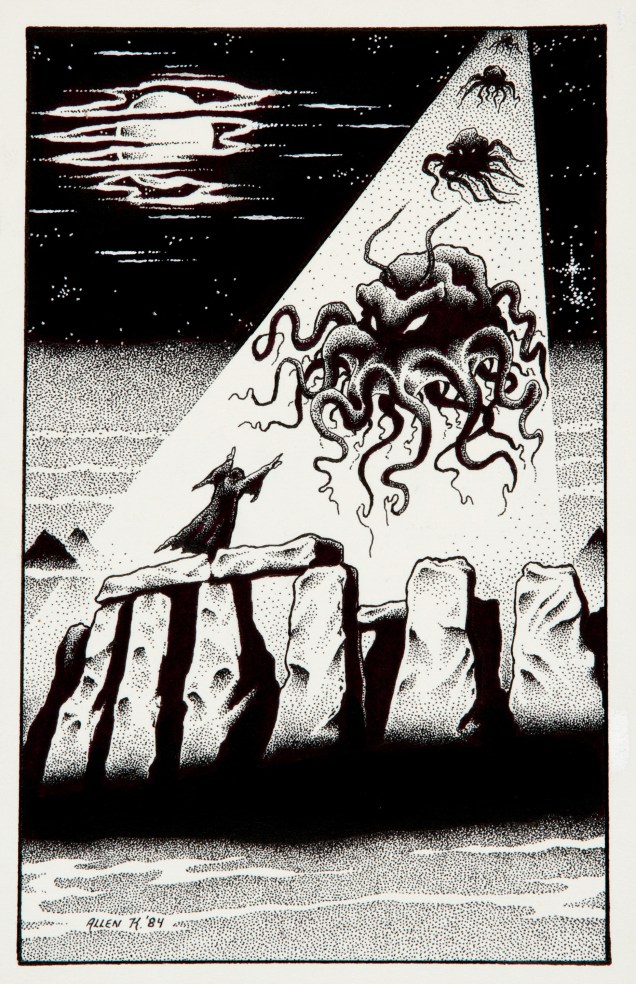
My colleague R.G. has already talked about the H.P. Lovecraft edition of the anthology Graphic Classics (head over here to check it out ), but I’d like to share two illustrations from the inside. Both are by Allen Koszowski, whose work is a feast of tentacled beasts and Lovecraftian horrors.
Illustration by Allen Koszowski of « Fungi from Yuggoth ». Published in Graphic Classics: H.P. Lovecraft, Volume 4, 2002.A portrait of Mr. Lovecraft himself, in all his striking glory, accompanied by some of this unholy creations. Illustration (also by Allen Koszowski, which was accidental on my part) from Graphic Classics: H.P. Lovecraft, Volume 4, 2002.
Koszowski got the similarity down pat: Lovecraft was mighty weird-looking (in a stately kind of way) – which seems quite appropriate. Maybe I’m reading too much into it, but he certainly looks like he’s just seen something terrible just behind his interlocutor’s back, but he was half-expecting it, so he’s not too startled, even though someone’s probably about to get gobbled up.
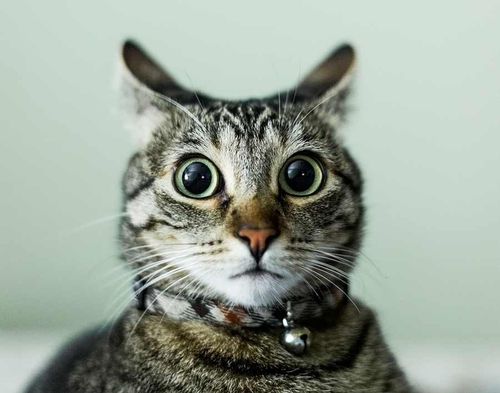
(Cats have that look periodically, too, down to the dilated pupils.)
Incidentally, I said that Koszowski’s art was full of tentacles, so here’s one more taste of his proclivities:
Cards on the table time: I never did much like Tintin. While there’s no denying the technical virtuosity and high imagination on display in Hergé’s work*, as a child, his overly-meticulous line and storytelling struck me as flat, sterile and remote. I thought I was just about alone in this view.
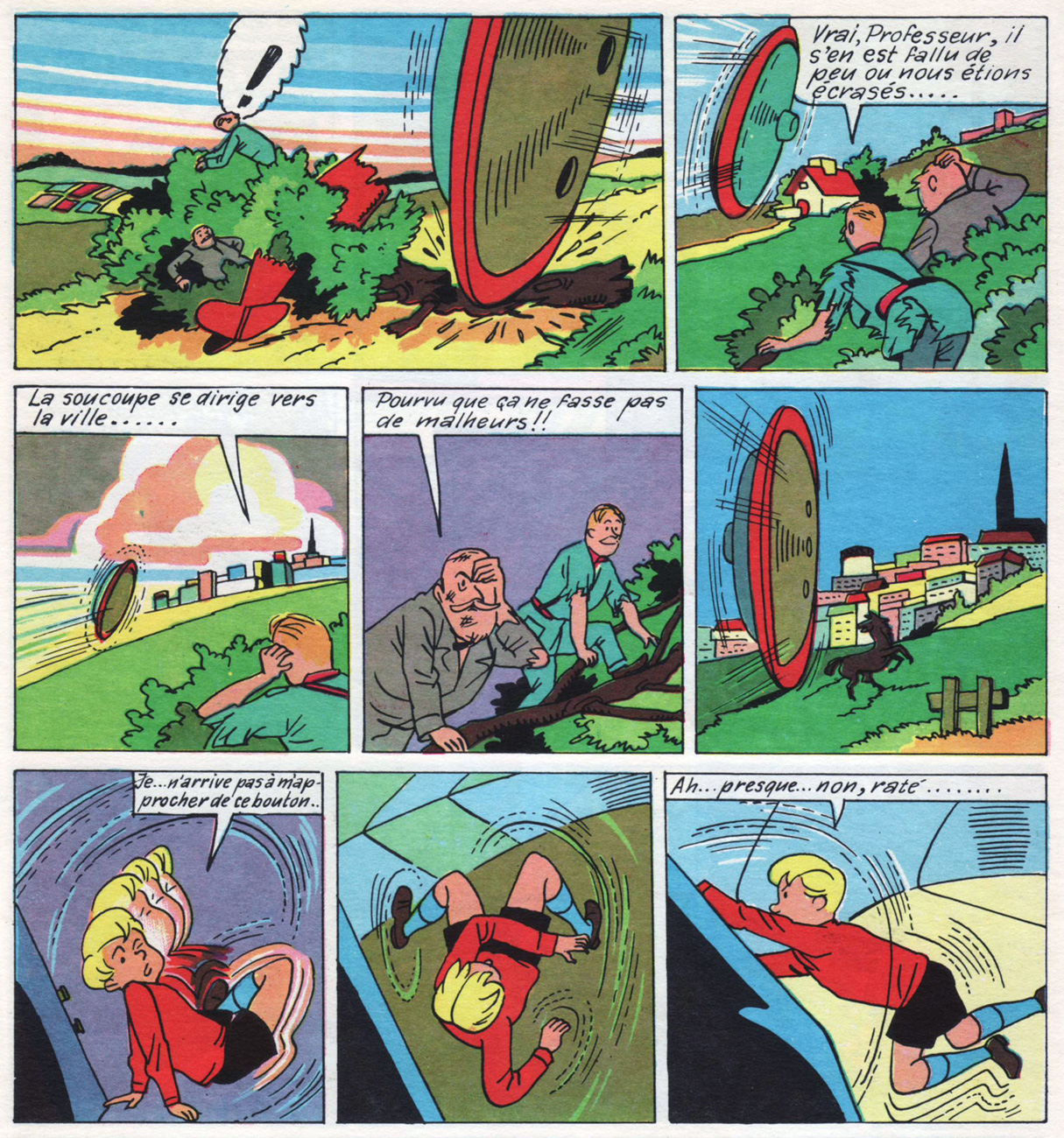
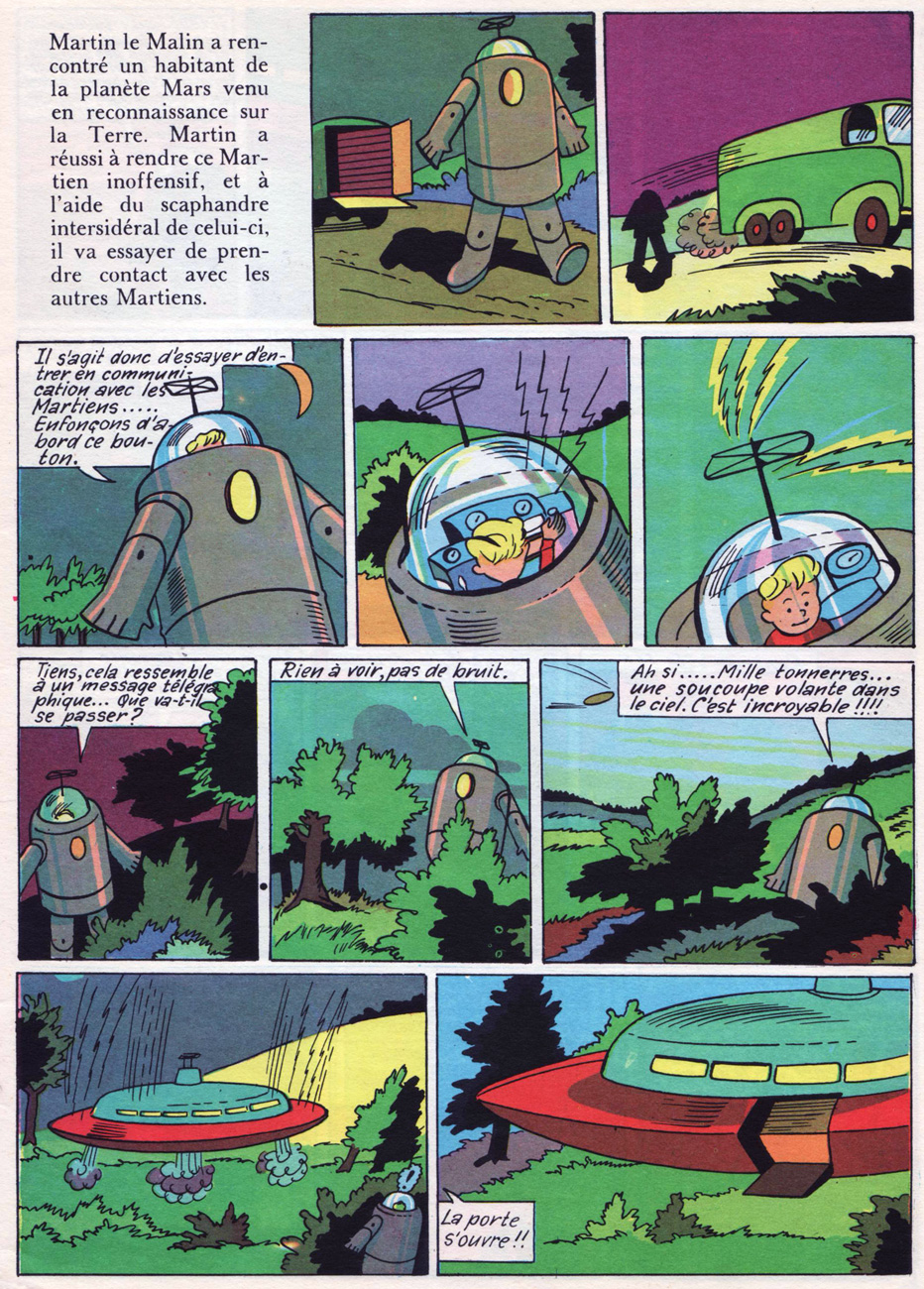
There was a Tintin-esque series I did delight in, and that was Martin le Malin, a translation of the Dutch « De Avonturen van Pinkie Pienter ». While much derided and nearly forgotten today, Pinkie remains, in my view, a misunderstood and under-appreciated work.
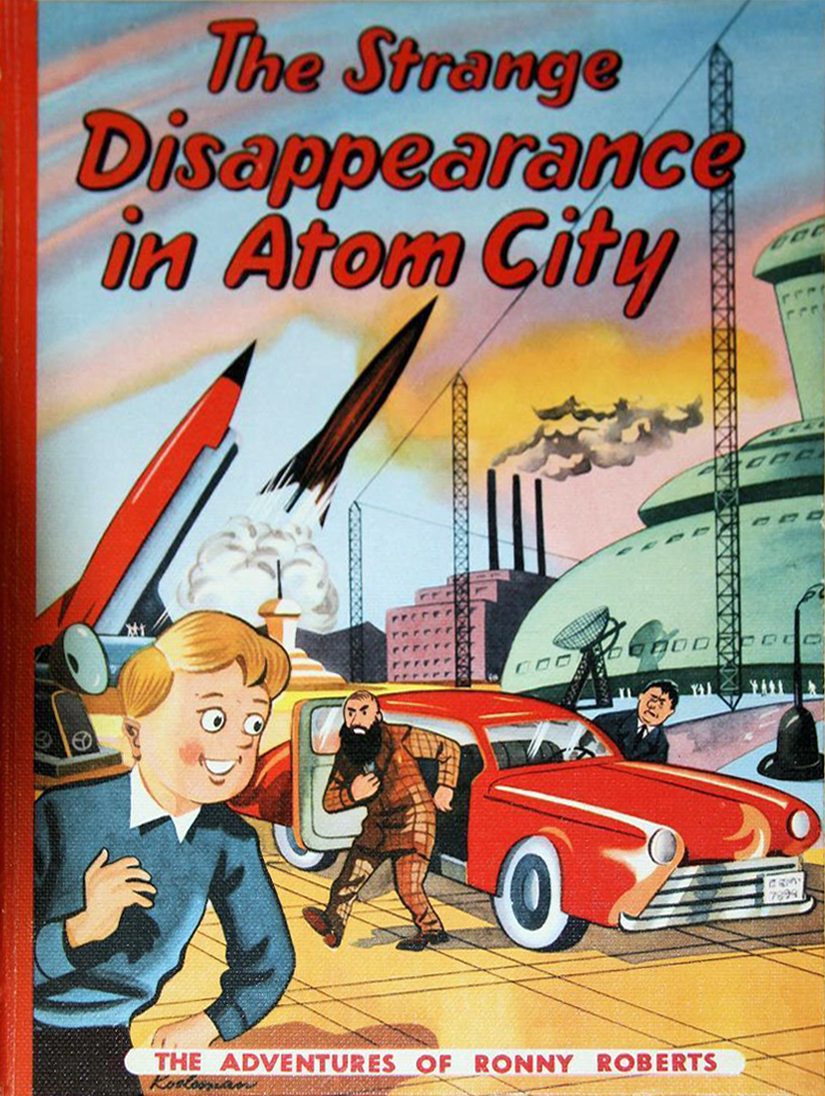
I was to learn, decades later, that the series was in fact created in response to the very aspects of Tintin that left me cold. In 1951, Dutch painter J.H. Koeleman (born October 30, 1926), while visiting his brother, learned from his young nephews that they were somewhat frustrated with and repelled by Tintin, finding the stories too complicated and the artwork too fastidious. From this incident, Uncle J.H. hit upon the idea of creating a series using a deliberately naïve and relatively primitive style, something closer in tone and essence to what a talented and imaginative child would craft for himself.
Koeleman produced and self-published a pair of albums, which were met with critical praise but disappointing sales. However, in early 1953, established publisher Mulder & Zoon came knocking and offered the man a deal: they would, using the greater resources at their disposal, republish and distribute his early efforts. The joint venture worked splendidly… at least for a time. In total, Koeleman wrote and drew twelve Pinkie Pienter albums between 1953 and 1958. These were also published in softcover 16-page colour instalments, which is the format I encountered them in. In my youth, they were everywhere: (long gone) supermarkets, department stores… and at 39 cents apiece, they offered a fine deal.
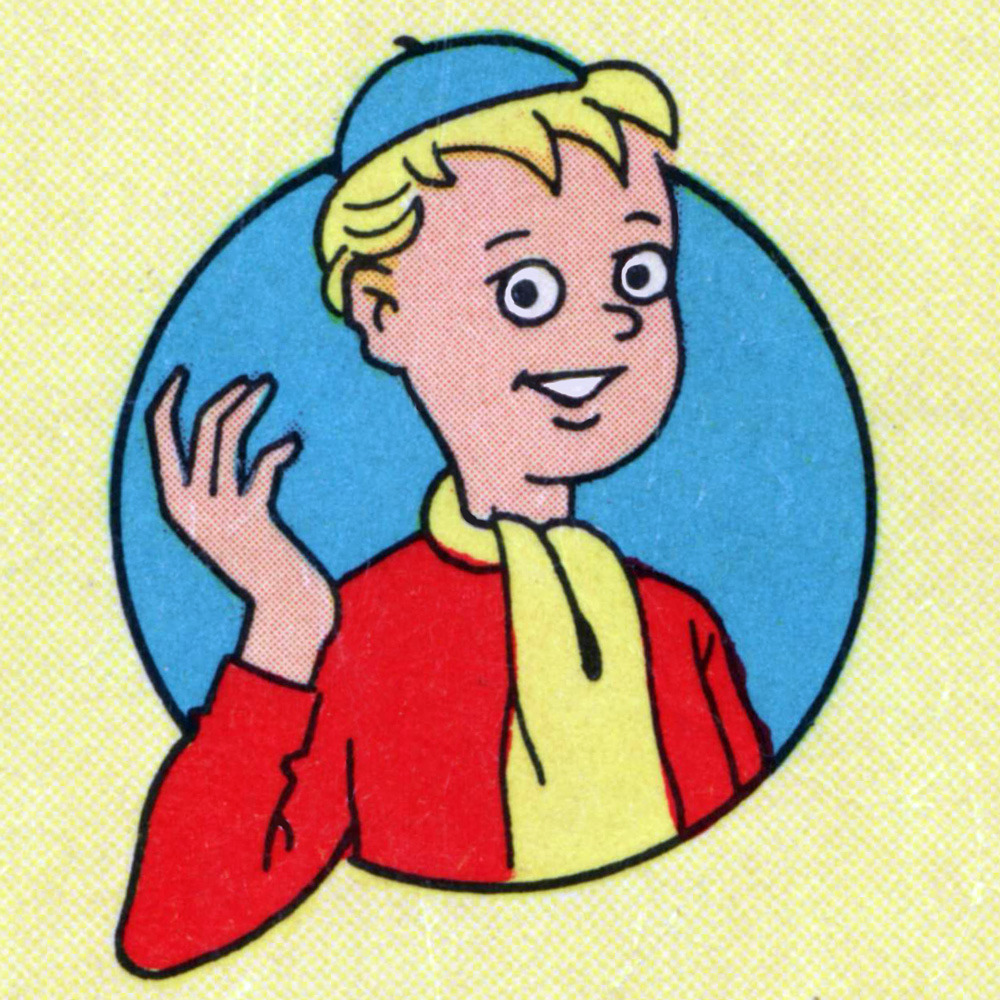
However, during Expo 58 (aka the Brussels World’s Fair), long-simmering tensions came to a head between the author and his publisher. Koeleman walked out, and the less said about his successors, the better. For it is in the later Martin le Malin albums that we can plainly witness the difference between intentional simplicity and economy… and sheer incompetence.
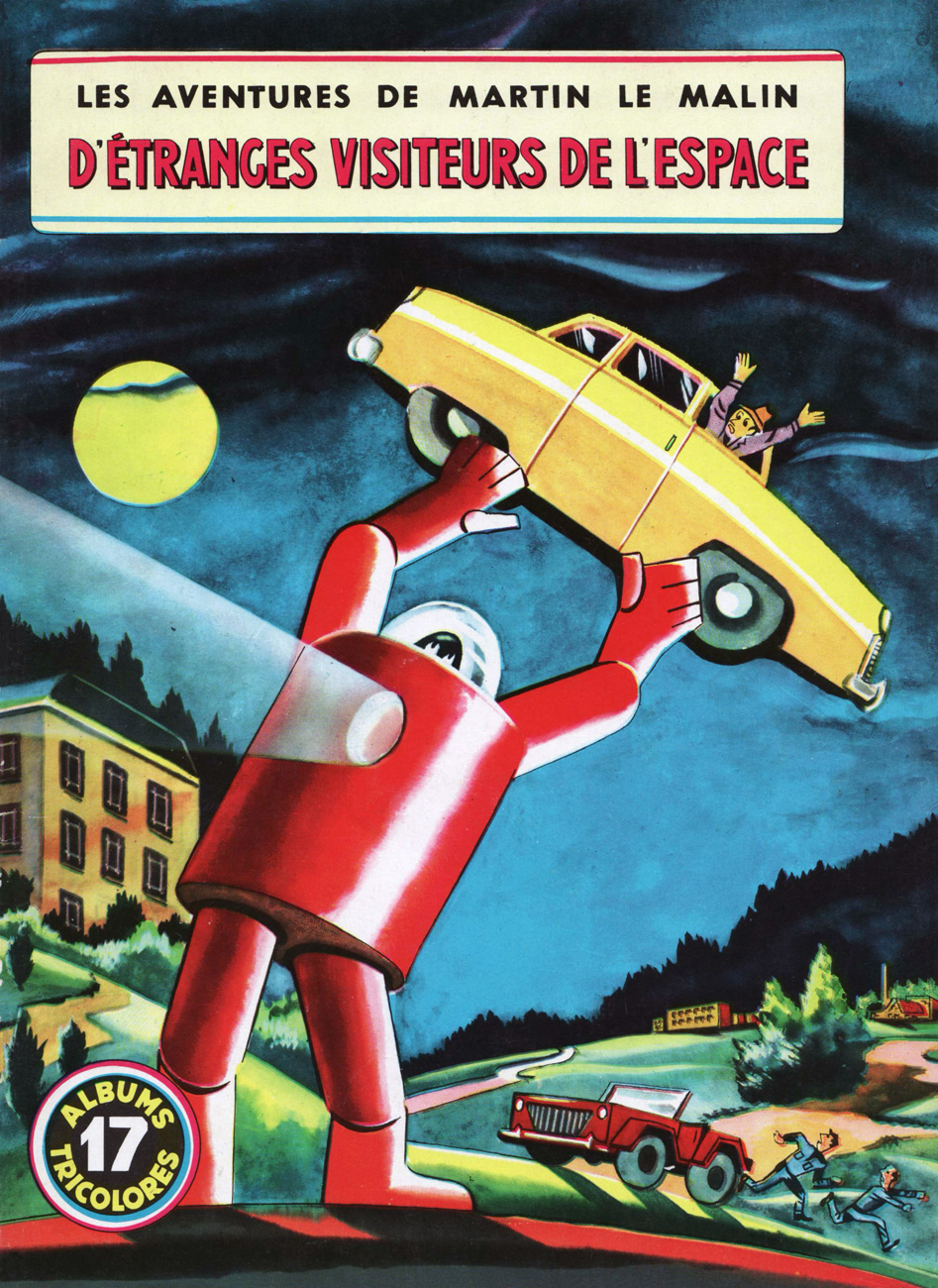
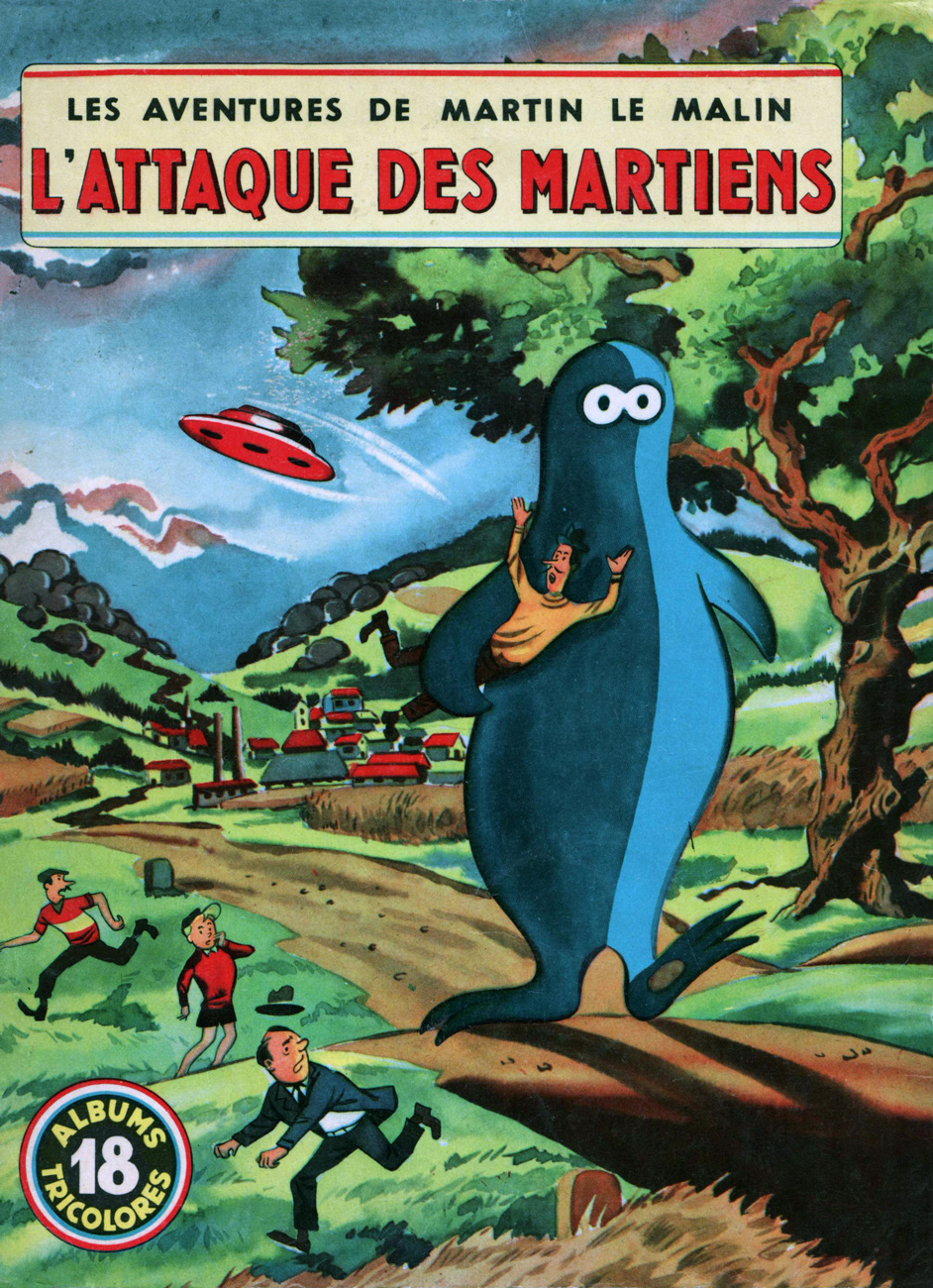
Today, I’ll focus on my favourite saga, « Les Martiens atterrissent » (Number 6 in the series, and serialized in « La soucoupe volante », « D’étranges visiteurs de l’espace » and « L’attaque des Martiens »).
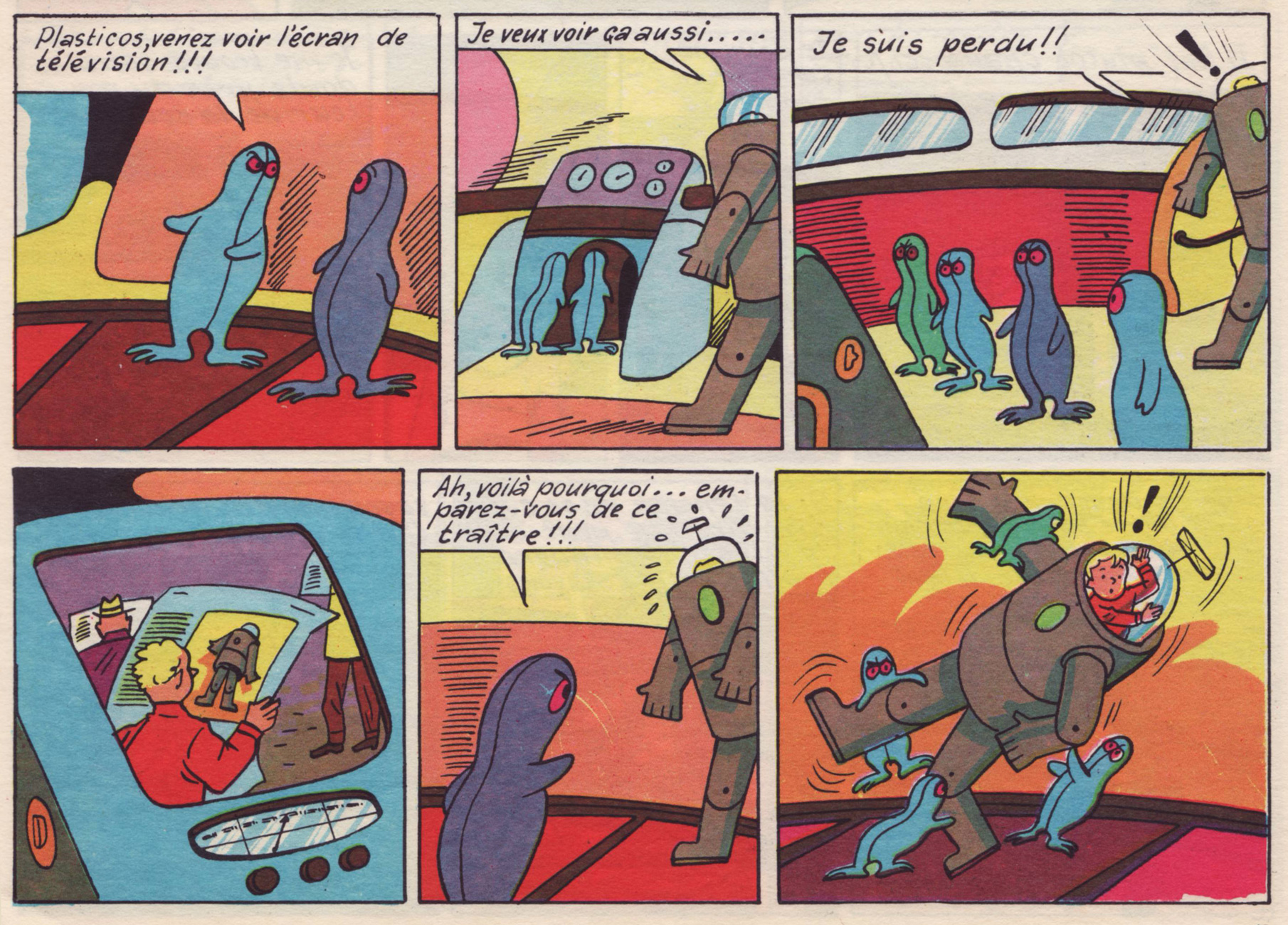
In the actual story, Martin’s bumbling sidekick, Floris Fidel (Floris Fiedel in the original) has been shrunk by Martian leader Plasticos (isn’t he just adorable?), but on the cover, while their size ratio remains constant, it’s Plastico who’s grown gigantic.
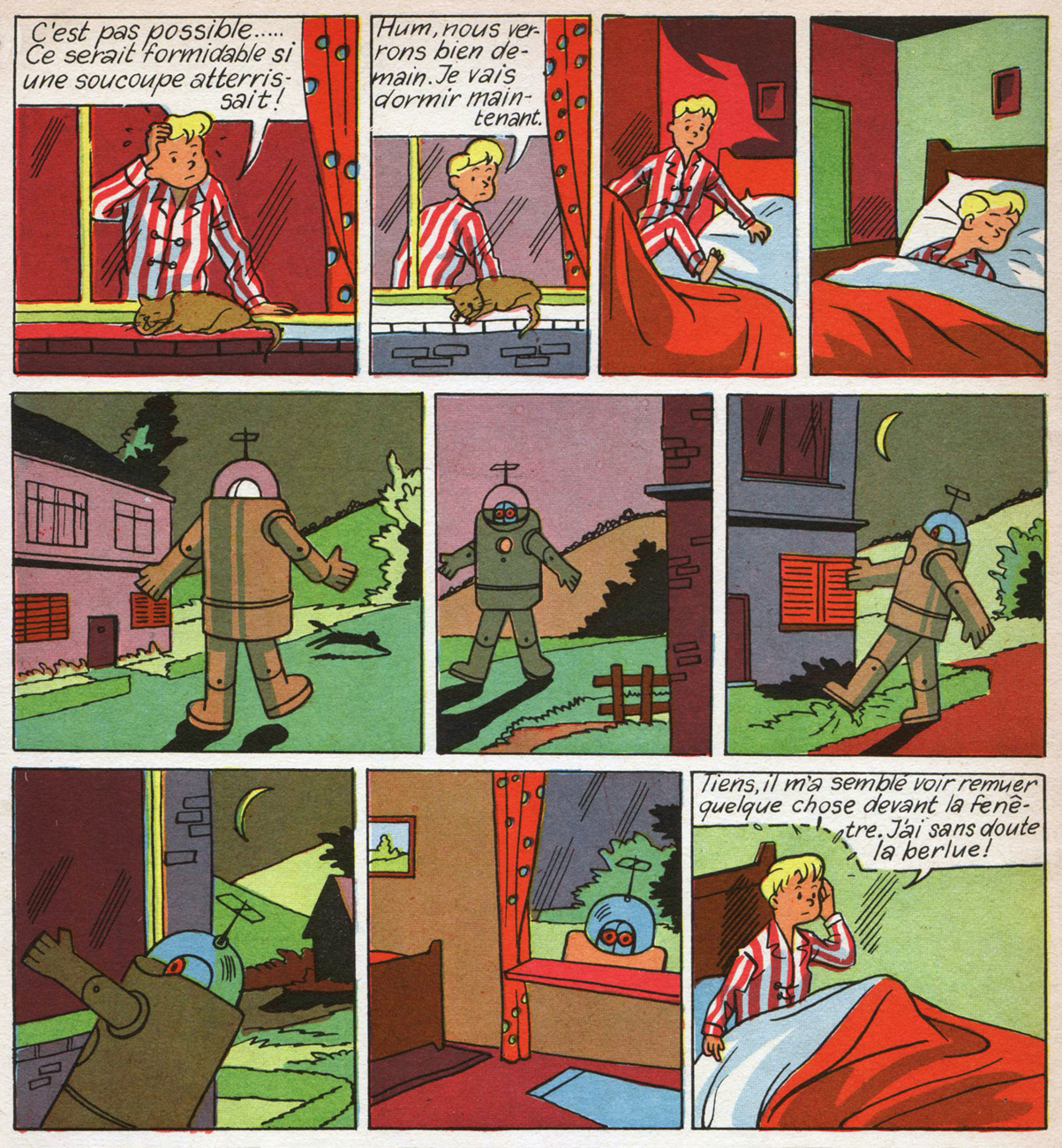
You go to bed quietly, and the next thing you know, Martians are trampling your hedgerows and peeking in your window. Next time, draw the curtains. Love the way the cat runs for it in panel 5.
Martin finds that piloting unfamiliar spacecraft is not something you pick up on the fly.
Having captured Martian Aluminicus’ spacesuit, Martin tries, and fails, to infiltrate the invaders’ ranks.
Oops. Another one of Floris’ screwups lands Martin in hot water.
I only learned today, while researching this post, that Pinkie/Martin was also published in English! Is anyone familiar with this edition?
The copies I’ve seen for sale are listed in far-flung Australia. Curiouser and curiouser…
The Martin cameo, as it appeared on the back of the first edition albums.
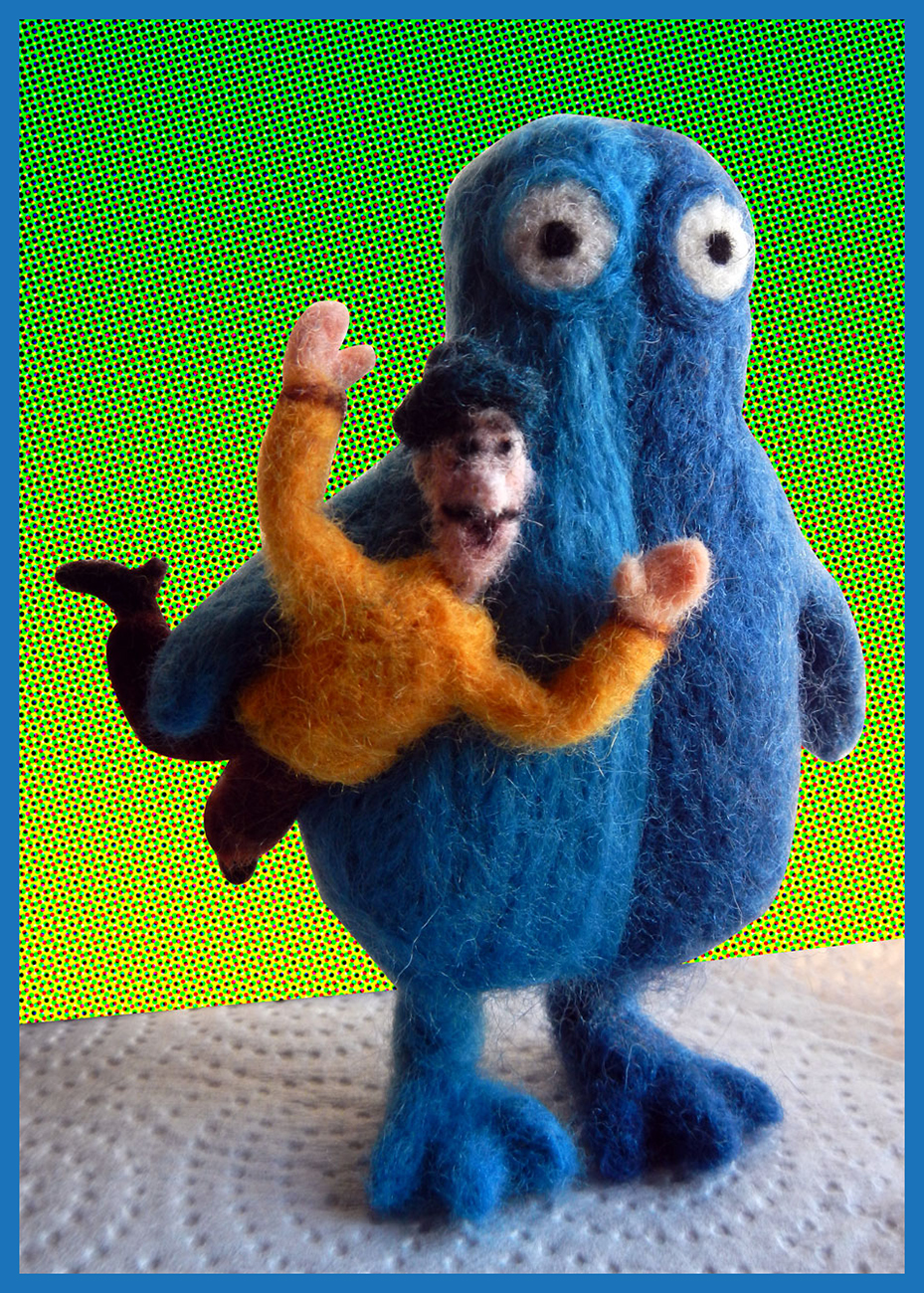
And here’s a custom-made Plastico (with Florisse in tow) needle-felted by WOT’s own multitalented ds.
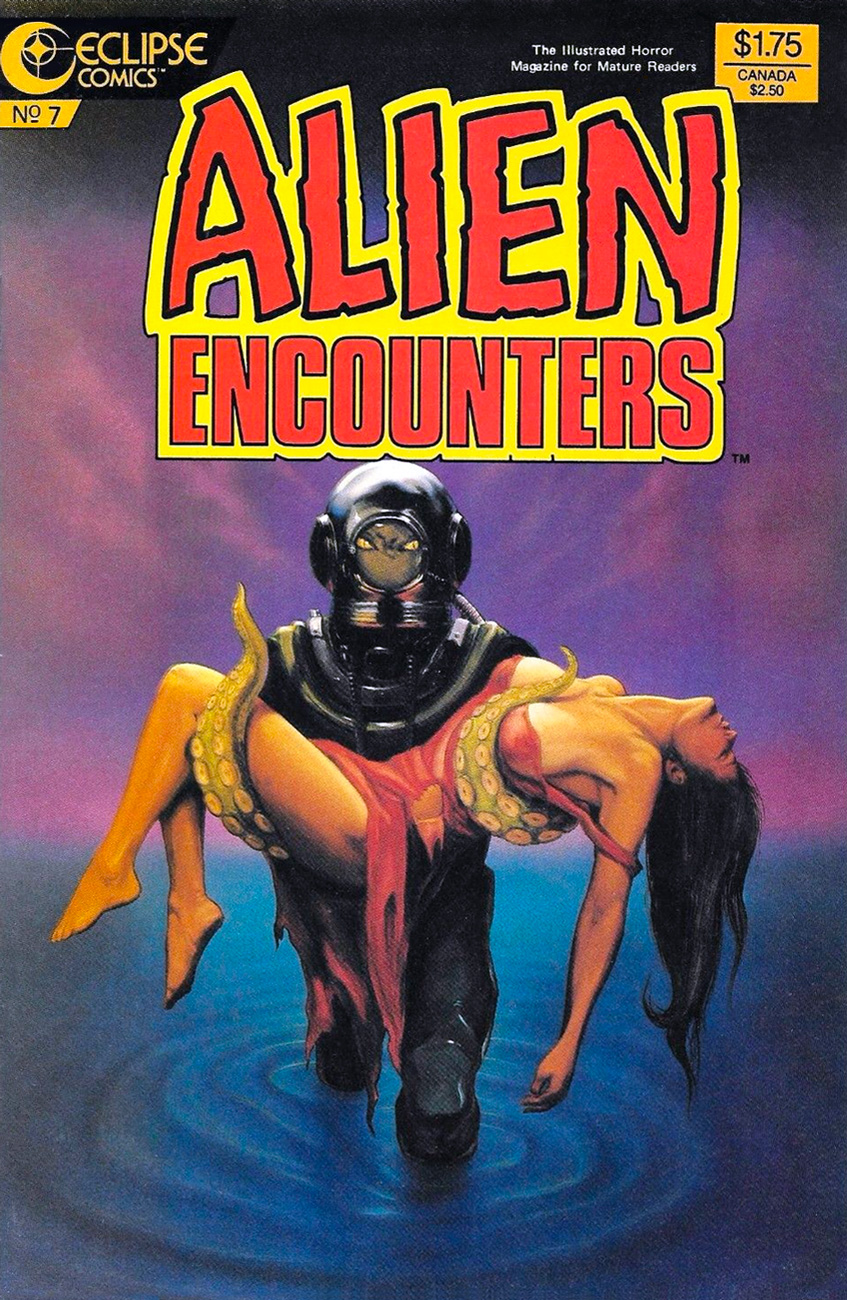
You’ve likely noticed it already, but people getting attacked by tentacles tend to be dressed in red. Now, red will not make a bull enraged (as a matter of fact, bulls are colour-blind to red – there, you learned something new today), but what effect would it have on an octopus? None at all, as it turns out, as red light does not reach ocean depths. One might want to wear red to become near-impossible to spot at a depth of a hundred metres or more, but that doesn’t explain why tentacles would persistently seek out red targets. Crap, there goes my theory.
Nevermind; we can still feast our eyes on some fetching mam’zelles and monsieurs clad in red, theories be damned.
Music aficionados will notice that this cover is a tribute to something quite outside the comic field, namely this album art:
Cover of 10cc’s Deceptive Bendsalbum, designed by Hipgnosis, 1977. Where are the tentacles?! The girl’s dress is also somewhat more demure (though not by much).
After Alien Encounters, we naturally move on to Alien Worlds. Admire the, err, tentacles on this cover:
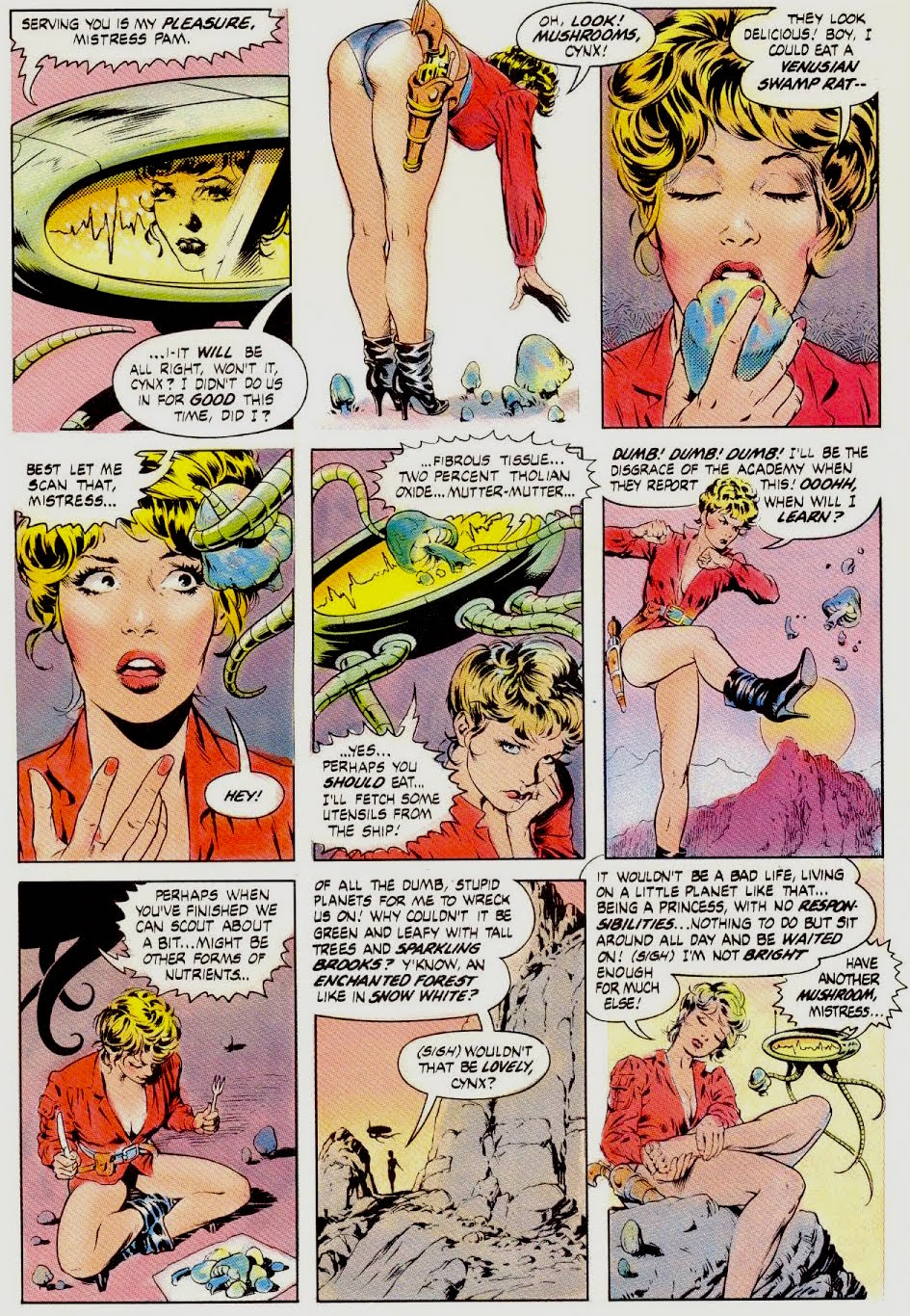
“If he had been watching his mistress as usual, if he had been at the controls instead of giving himself a lube job, the accident might have been prevented.” Moral of the story: no lube jobs at the wheel! That tentacled thing behind Princess Pam is actually Cynx, her guardian. The science-fiction comic anthology Alien Worlds, first published by Pacific Comics and then by Eclipse after Pacific went bankrupt, was edited by Bruce Jones, who wrote the bulk of the stories, and April Campbell. This is Alien Worlds no. 4 (Pacific Comics, September 1983), cover by Dave Stevens, with colours by Joe Chiodo.
Mushrooms *and* tentacles *and* some pretty gams? Sensory overload! At first glance, the story (scripted and pencilled by Bruce Jones, inked by Dave Stevens, coloured by Joe Chiodo and lettered by Carrie McCarthy) is nothing but gratuitous cheesecake – a pretty, half-naked girl wandering around with her robotic servant – but it’s actually surprisingly touching. Check it out here. Fittingly, mushrooms save the day.
It’s not just women who like to sport flashy red outfits, by the way. The men’s costumes might cover considerably more skin, but the vermilion remains!
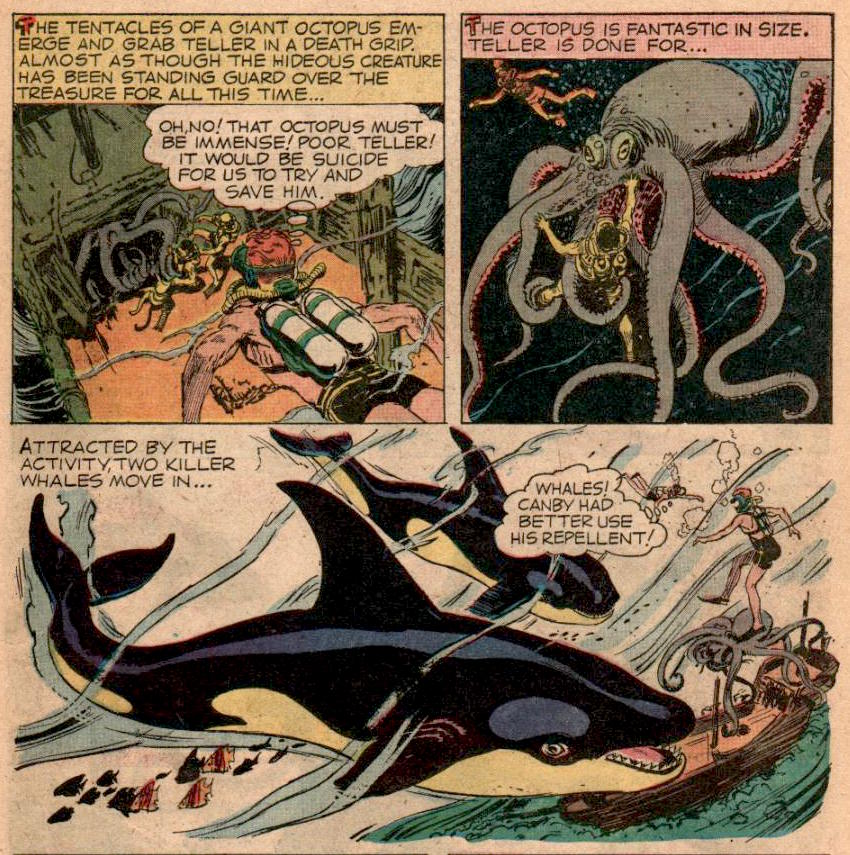
« The tentacles of a giant octopus emerge and grab him in a death grip. Almost as though the hideous creature has been standing guard over the treasure for all this time… » Of course it has! Any self-respecting octopus takes his job seriously. The Frogmen no. 2 (May-July 1962); the cover is by Vic Prezio, and the sumptuous inside art is by George Evans.
There’s (also) an epic battle between a killer whale and the octopus in this issue (witness the aforementioned George Evans art).
Of course he wants you, silly – who can resist a man in red swimming trunks? Nor octopus nor man. I retract my comment about men being more covered up. Do they have to tell their families, though?
One more for the road and I’ll conclude this vernissage…
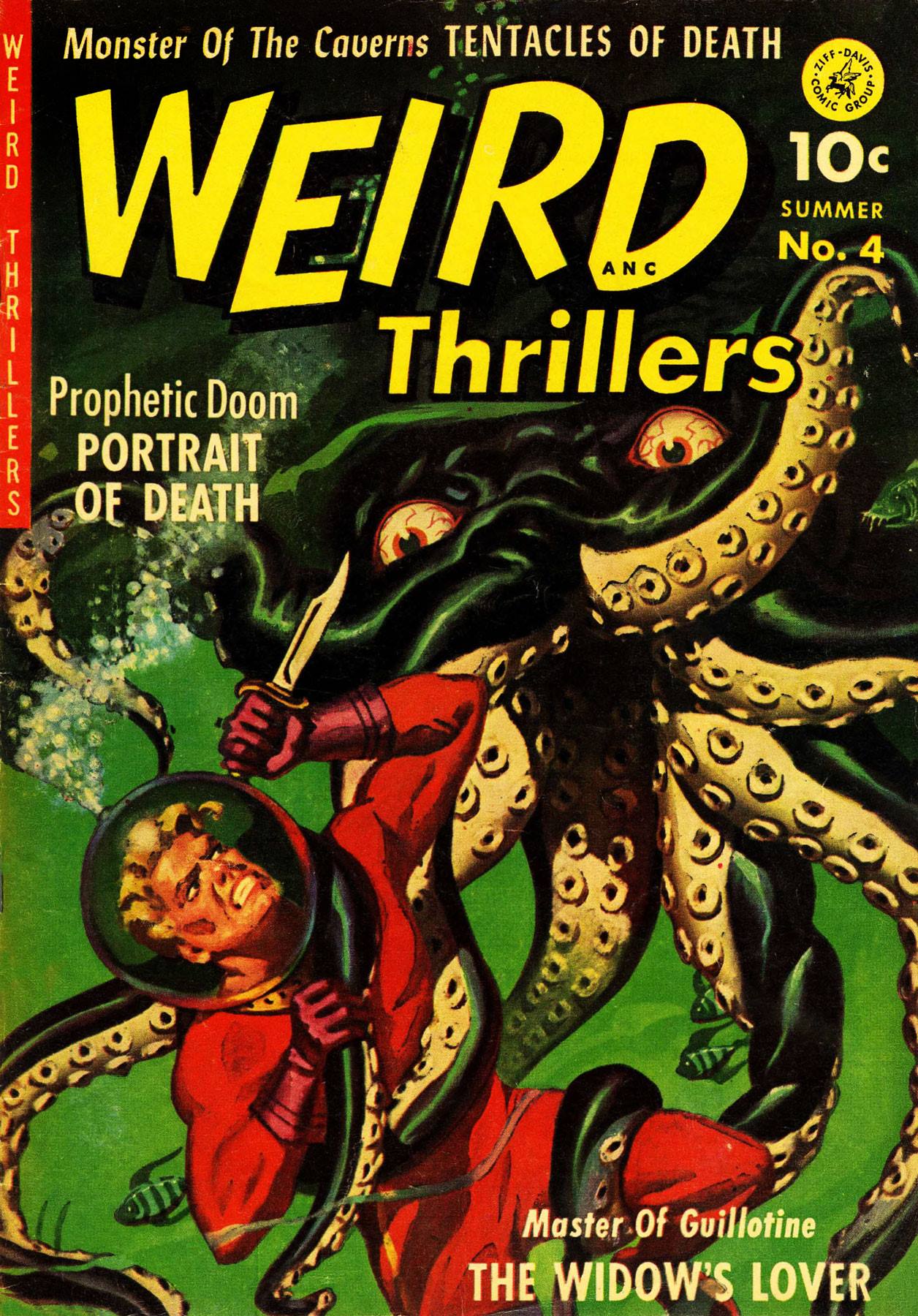
“The bolts of current are merely absorbed by the rubber flesh of the octeel, which is part octopus and part electric eel!” Oh, for the love of puns. Weird Thrillers no. 4 (summer 1952, published by Ziff-Davis), with painted cover by Norman Saunders.
You’ll no doubt want to see what an electric octopus looks like, so here you go:
“Tentacles of Death”? Sign me up, please! The gruesome cover story is drawn by George Tuska.
Brooding pretty boy (is that you, Brian Setzer?) is about to get a pleasant shock in this Dave Stevens (1955-2008) cover featuring a “punk rocker” in the well-scrubbed tradition of, say, Lea Thompson in the infamous Howard the Duck movie. Still, it’s a dazzler, as you’d be right to expect from Mr. Stevens.
























 Who's Out There?