« He’s back from the dead / the telegram read / If you get on a flight / You could catch him tonight / You’ll find Commissar / He’s at the Munich Hilton Bar » — B.A. Robertson
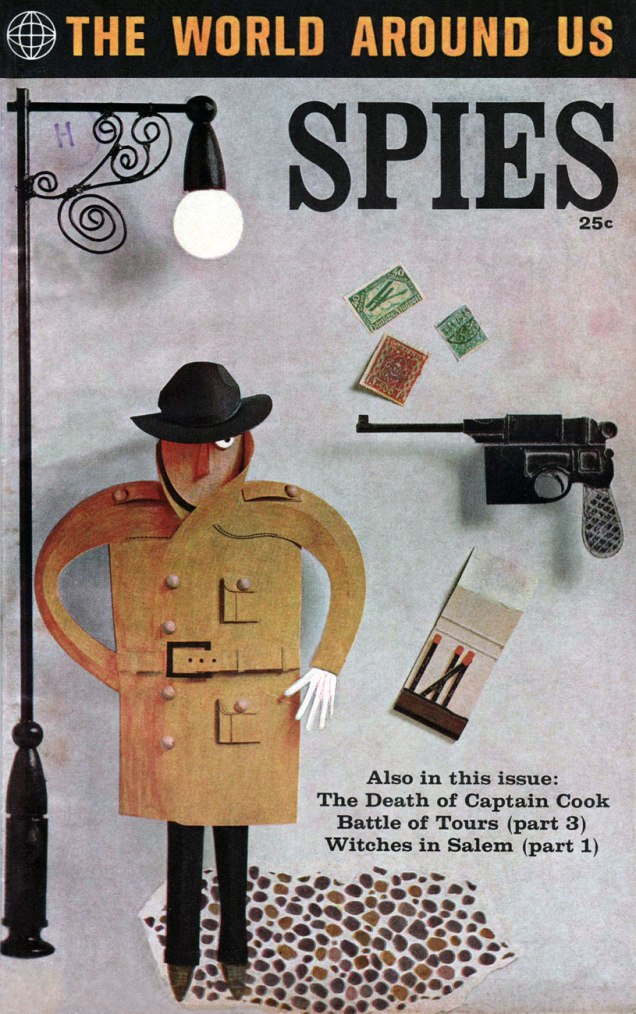
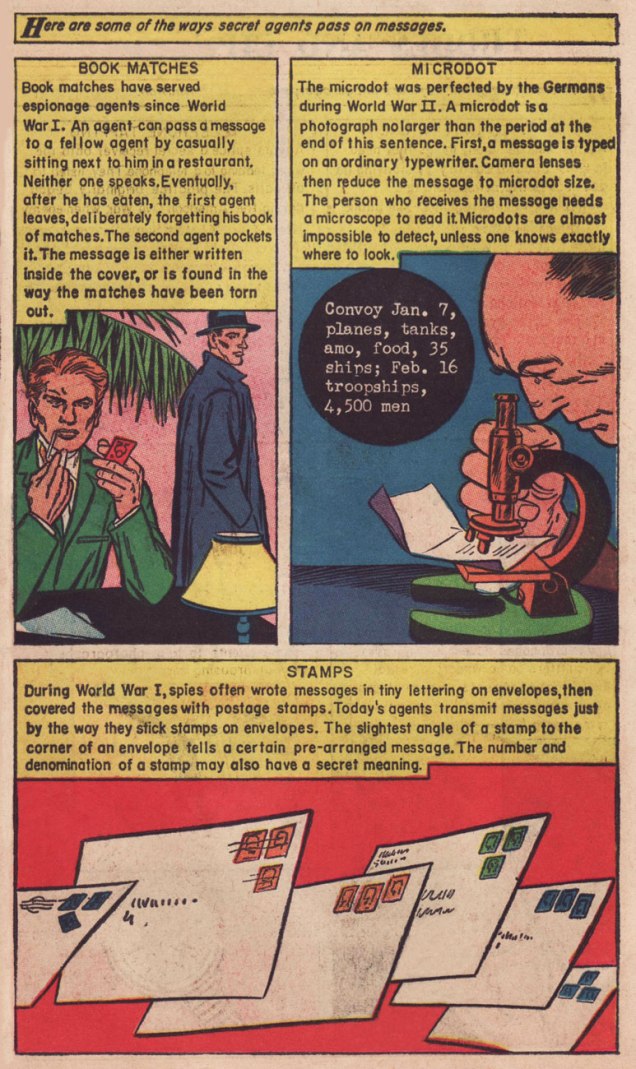
In 1958, Classics Illustrated publisher Gilberton tried something a bit different: a mostly non-fiction documentary title on various topics entitled The World Around Us, and featuring The Illustrated History of… Dogs, Space, Pirates, Great Explorers… depending on your area of interest, these could mean unrelenting tedium or sheer bliss. I haven’t encountered many issues, but the two I own, Ghosts and Spies, count among my prized paper possessions.
This is The World Around Us no. 35 (August, 1961), featuring this lovely mixed media piece by The Unknown Artist, whose cover remains defiantly unblown. On the inside, some fine company: George Evans, Norman Nodel, Edd Ashe, Jo Albistur… and Jack Kirby (inked by Dick Ayers)… the most beaten-down, anonymous, excitement-dialed-down-to-one Kirby you’re ever likely to see. Oh, he could do the job just fine, but the job, and the publisher, were not making anything of his regal strengths*. He would recall that this was « … the worst paying job of my entire life, including times I worked for free. »
Those early post-Code years were difficult ones for the diminished comics industry, and Kirby’s situation wasn’t exactly rosy: he’d been blacklisted at DC, thanks to the Jack Schiff / Sky Masters imbroglio, and his work at Harvey Comics had dried up. So what was a prolific artist to do, but pick up whatever bits of freelancing were available, here and there…
Quoting from Paul Gravett‘s review of Classics Illustrated: A Cultural History, we find this telling statement: « The most demanding editor was Roberta Strauss, a stickler for detail, who would count soldiers’ buttons or pleats in skirts and even called an editorial meeting in her hospital room only days after her son’s birth. » Give me Harvey Kurtzman‘s editorship** any old day!
**« Kurtzman’s editing approach to Two-Fisted Tales and Frontline Combat was a stark contrast to EC editor Al Feldstein‘s style. Whereas Feldstein allowed his artists to draw the story in any manner they desired, Kurtzman developed detailed layouts for each story and required his artists to follow them exactly. »
I’ve always been fond of this oddball little ad, which appeared in mid-70s comic books (in this case, a late 1974 DC 100-pager). It certainly demonstrates the considerable influence that pioneers such as Thimble Theatre creator Elzie Segar had on many an underground cartoonist.
If the advertised products had been iron-ons (à laRoach Studios*) instead of finished t-shirts, they’d be easier to find today. The Mickey Rat shirt is still being produced these days, though likely a grey market item… same as it ever was. On the other hand, I can find neither hide nor hair of the Hebrew Shazam shirt. Anyone? (2025 update: it’s available again here! A grateful tip of the hat to eagle-eyed reader Michael C. Rookard,)
A bountiful spread from The Natural Trading Company’s Mail-Order Catalog, which proposed T-Shirts – Posters – Art Prints – Buttons – Records – Comics… count me in!« Pinball Wizzard, you say? »
Here’s a bit of background on the Crazy World shirt, designed by (or swiped from) John Van Hamersveld, the genius behind the unforgettable The Endless Summermovie poster: « The face emblazoned across the chest of Mick Jagger in a 1972 New Musical Express feature on the Rolling Stones had a rich history according to its creator. The iconic image was the product of a mescaline and marijuana jag, after which Van Hamersveld was left with the enduring image of a man’s face with a big, toothy, wide smile. From a portrait of Jimi Hendrix he had made in 1968, Van Hamersveld came up with the Johnny Face logo the following year, which he used for promoting his own work. »
And there’s Mick, just like the man said.One of the current offerings. Oh, definitely a bootleg.
For me at least, it’s hard to look at Johnny Face without seeing in it echoes of The Face of Steeplechase, Coney Island’s widely-grinning mascot.
Trivia time: can you name the infamous individual behind the 1966 demolition of the beloved Steeplechase amusement park? Find the answer here.
As for the artist who crafted the Natural Trading Company ad, I was drawing a blank until a few years ago, when the wonderful Jay Lynch (1945-2017) kindly lifted the veil on that particular mystery: Jerry Kay was the stylish culprit. Much appreciated, Mr. Lynch!
– RG
*not to be confused with the originalRoach Studios, of course…
One of the oft-recurring themes of tentacles-in-comics-land is one of aggressive invasion. No, I don’t mean body cavity invasions, you creepos! I mean the large-scale kind: cephalopodian aliens who insidiously infiltrate human ranks, hypnotize or control people’s minds with all sorts of high-tech hanky panky, or just plain deploy their far-out weapons and open martial festivities without as much as a how-do-you-do. Their goal is, naturally, full dominion and control of planet Earth. Sometimes it’s because our planet has something they want (water, minerals, or just plain real estate), occasionally they want to feed on us… or they just got out on the wrong side of the bed and are cranky and territorial.
Let’s see a few case scenarios on this installment of Tentacle Tuesday!
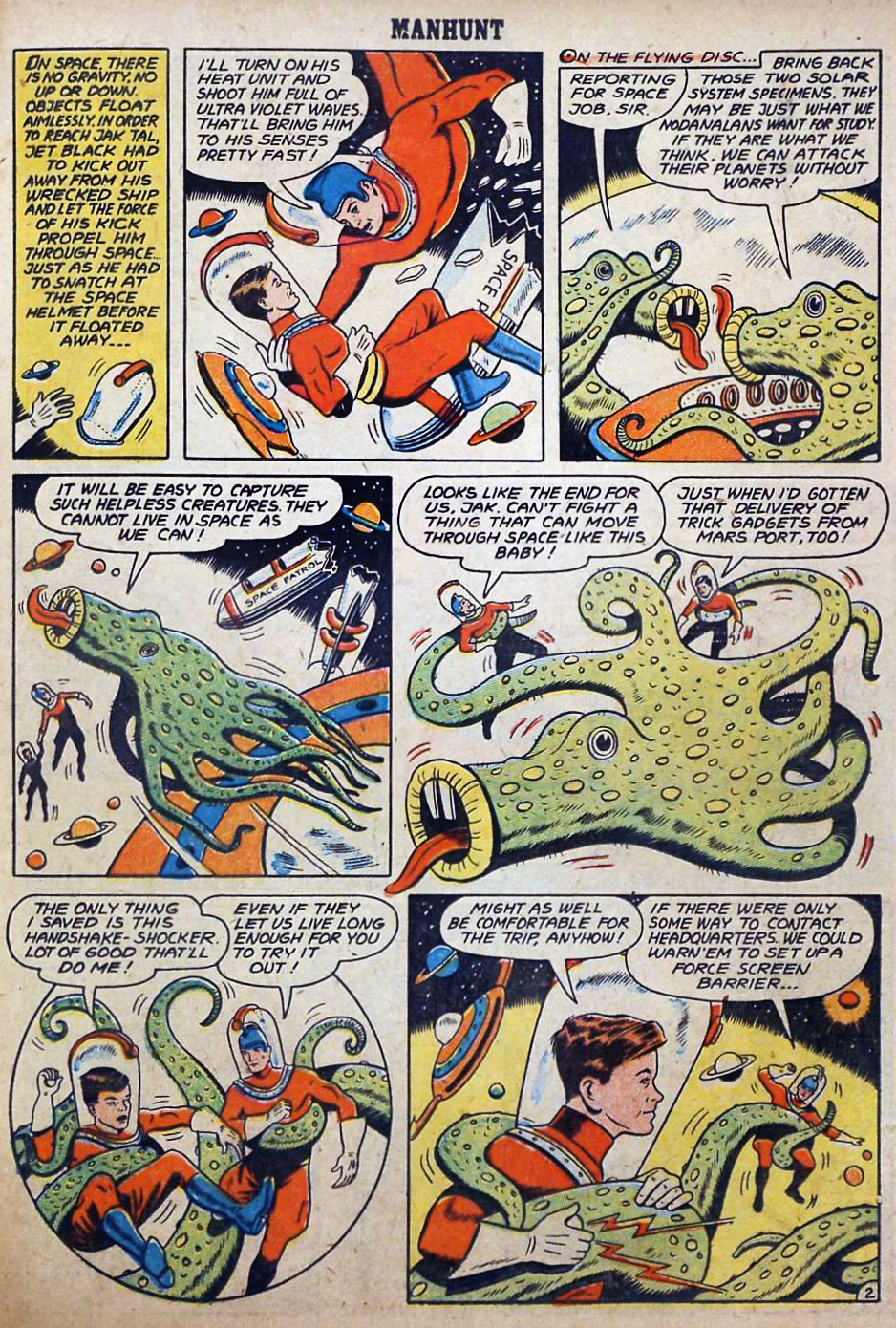
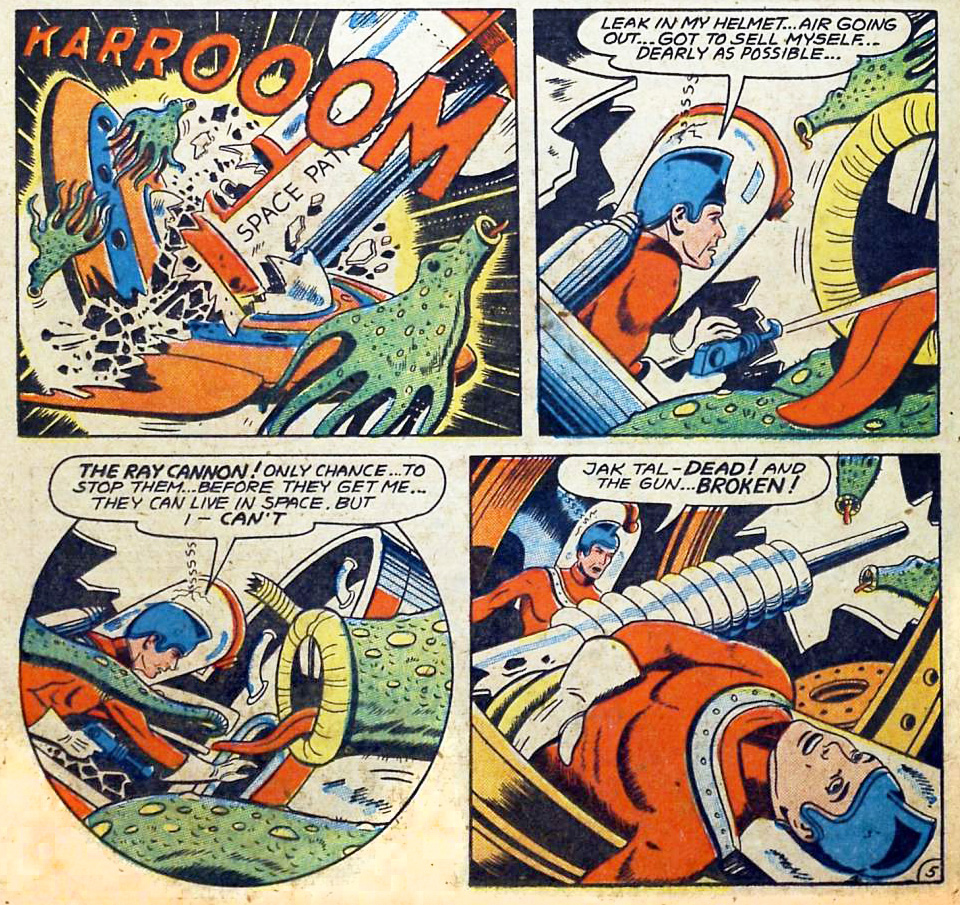
Our first story doesn’t explain why the aliens want to attack the planet or capture humans, but their nefarious scheme threatens life as we know it! Jet Black and Jak Tal, patrolmen of the 21st century, encounter some space-dwelling aliens who are up no good at all. Though they’re cute as can be, it can’t be too practical to have one’s tongue hanging out all the time… The Men from Deep Space, illustrated by Fred Guardineer, was published in Manhunt no. 6 (March 1948).
In example number two, the tentacled Organus is after humans because he has the munchies. Well, I suppose that’s as good a reason as any to propel your tongue towards somebody else’s face in the middle of a conversation. The Soul-Thief from the Stars, scripted by Paul Levitz, pencilled by Pat Broderick and inked by Bruce Patterson, was published in The Legion of Super-Heroes no. 284 (February 1982).
Get a room, you two.
Let’s move on to the next instance of grabby critters wanting supremacy over humans, shall we?
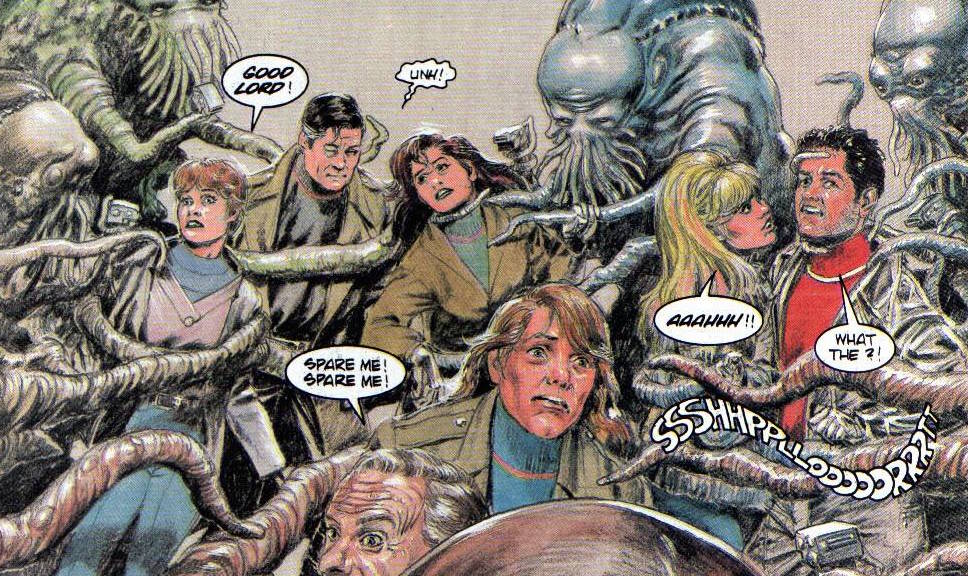
One long-winded, epic story of tentacled ones began in 1993, with Lost in Space: Voyage to the Bottom of the Soul. The story has everything that makes one of those invasion yarns entertaining – cruel cephalopod captors, barbaric vivisection experiments, computer codes assigned to every prisoner for better monitoring…. The bulk of this happens in the pages of Lost in Space: Voyage to the Bottom of the Soul no. 13 (August 1993) and Lost in Space: Voyage to the Bottom of the Soul no. 14 (September 1993), scripted by Bill Mumy (the original Will Robinson himself) and illustrated by by Michal Dutkiewicz.
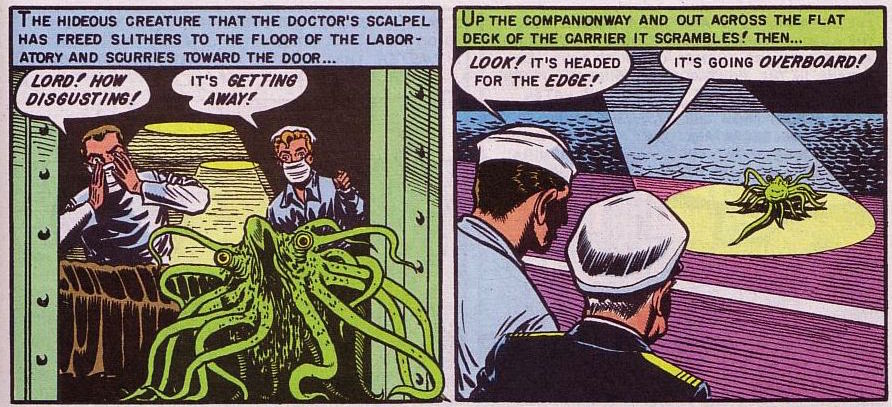
Oh yeah, I also mentioned insidious infiltration, a sly, Machiavellian approach to alien invasion. The Seeds of Jupiter, written and drawn by Al Feldstein and published in Weird Science no. 8 (July-August 1951), fits *that* particular bill.
By the way, apparently the following scene inspired the “alien bursting out of some poor sod’s chest” sequence in the 1979 movie Alien.
What? You don’t believe that it’s truly an invasion? You say the seeds ended up on earth by accident? Well, listen to the man with funny hair*. He does not lie.
Death Race 2020 managed to be a pretty good series… for three issues (read ’em here!) The original creative combo was aces, three veterans from Brit SF institution 2000 AD, namely Pat Mills and Tony Skinner hatching the plots and Kevin O’Neill conveying them to visual glory. O’Neill scampered off after three issues (returning only to craft the series’ final cover), and things just weren’t the same without his sordid, madcap touch. It takes a special talent to depict compellingly *and* with a finely-tuned, subversive tone, this level of carnage and mayhem. Such talent, obviously, is ever in short, and possibly dwindling, supply.
But… we’re not here for the main feature. Buried in the back pages amidst the ads (mostly touting the alt-rock of the day) was a regular one-page hi-concept feature crafted by a succession of young (or young-ish) artistic iconoclasts. I suspect it was the fevered brainchild of former The Comics Journal managing editor Robert Boyd (1989-1990), also the editor of Death Race 2020. If this were Facebook, I’d show you my favourite example and move on to the next pretty shiny bauble. But through the pixie magic of blogging, I can afford to be utterly profligate and fling the whole delirious jumble your way. And so…
Story and art by Dave Cooper, from Death Race 2020 no. 1 (April, 1995).
Story and art by Pat Moriarty, from Death Race 2020 no. 2 (May, 1995).
Story and art by Bob Fingerman, from Death Race 2020 no. 3 (June, 1995).
Story and art by Jay Stephens, from Death Race 2020 no. 5 (August, 1995).
Story and art by Fábio Zimbres, from Death Race 2020 no. 6 (September, 1995). In these troubled days, I imagine many a Brazilian pines for the halcyon days of JK, faced with the reality of JB.
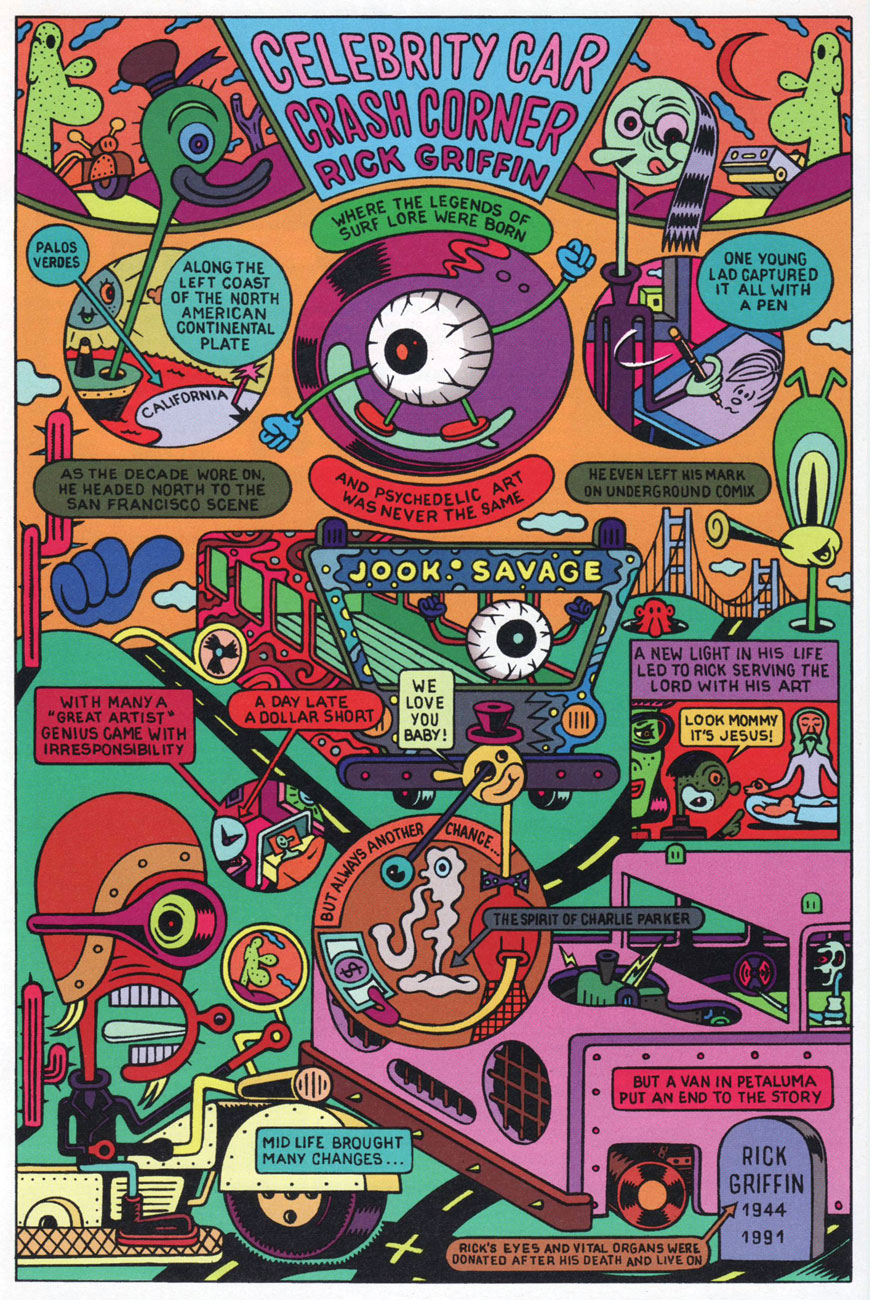
Story and art by Jaca Weiss and Robert Weiss, from Death Race 2020 no. 7 (October, 1995). For a look at some actual Rick Griffin art, look no further than here.
Story and art by Matthew Guest, from Death Race 2020 no. 8 (November, 1995).
To wit… a prime example of the aforementioned. By now, I’d like to think that most people have come to realize that the gendered driver question is a complex and fraught one. Here are some relevant statistics, if that’s your thing. You guessed it, things aren’t fair.
Drive safe, folks, and keep your eyes and mind on the road. The rest of us will appreciate it.
« Technology is constantly improving our lives. Look at the cellular telephone. Just ten years ago, virtually nobody was able to get into a car crash caused by trying to steer and dial at the same time; today, people do this all the time. » — Dave Barry
With a jump and a start, we realized that we haven’t written a proper post about Virgil Partch. Not even one lousy little post! How embarrassing.
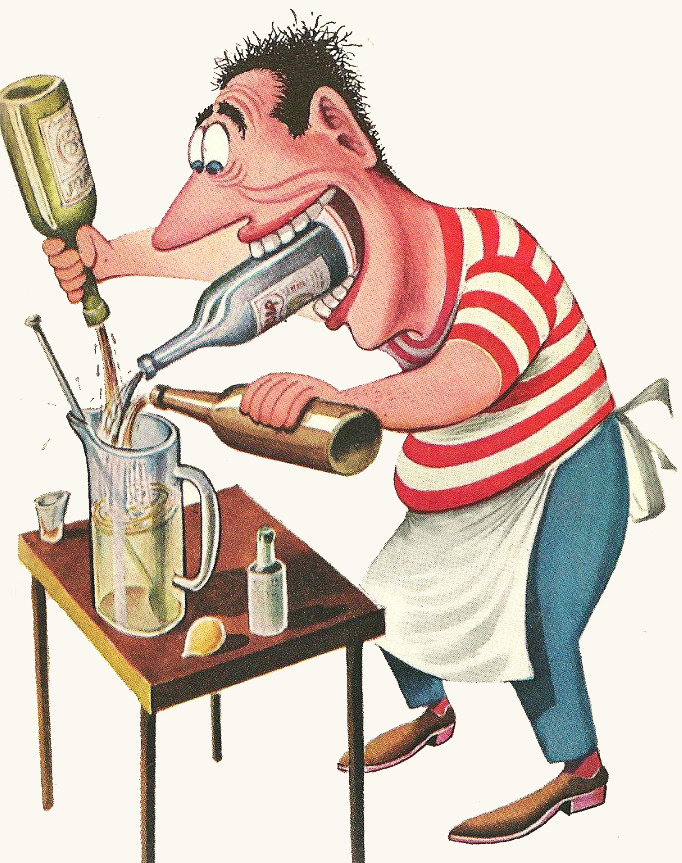
Virgil Franklin Partch (1916-1984), mostly known as VIP, is legendary, and I’m not one to use this description lightly. One can spot his work a mile away by his surreal sense of humour and a kinetic, unhinged-yet-clean style. He was also prodigiously prolific, thegag-man of his day. VIP not only wrote and drew tons of cartoons for magazines in the 40s and 50s (Collier’s Magazine, True, the Man’s Magazine, The New Yorker, Playboy…) but also provided glorious art for LP covers; illustrated other people’s books, as well as releasing collections of his own cartoons with invariably entertaining titles (The Wild, Wild Women; Cork High and Bottle Deep; Relations in Strange Locations, etc.). His doodles also adorned merchandise – my favourite being, of course, cocktail glasses!
Detail from cover of the True Magazine Bar Guide paperback (1950). « Flinging himself into the study of this challenging matter, Vip left no glass unturned, no drink unbottled, no bottle undrunk, etc. Leaving statistics to the statisticians, analysis to the analysts, facts to the factories, data to the dataist, Vip went straight to the sources. Often he worked until the wee small hours of the night, crawling home exhausted from his studies, numb with the impact of startling discoveries, quivering and all but incoherent with surmise… » Quote from the introduction to Bottle Fatigue (1950).
« Almost at once, wherever his cartoons appeared, Partch’s manic artwork inspired alarm because of his nonchalance about ordinary anatomy. He may have been among the first to discard such niceties almost entirely, striving instead for approximations of the human figure that served his comedic purposes and no other. A frequent objection was made to his unabashed disregard of the number of fingers that are customarily issued with each human hand. With the giddy abandon of footloose youth, Vip produced hands with fistfuls of fingers—five, six, seven, however many fell, uncounted, from his pen or brush. To those who carped about his anatomical irresponsibility, Partch reposited patiently: “I draw a stock hand when it is doing something, such as pointing, but when the hand is hanging by some guy’s side, those old fingers go in by the dozens. And why not? At Disney’s studio, I spent four years drawing three fingers and a thumb. I’m just making up for that anatomical crime.”» (excerpt from Making the World Safe From Insanity by Bob Harvey)
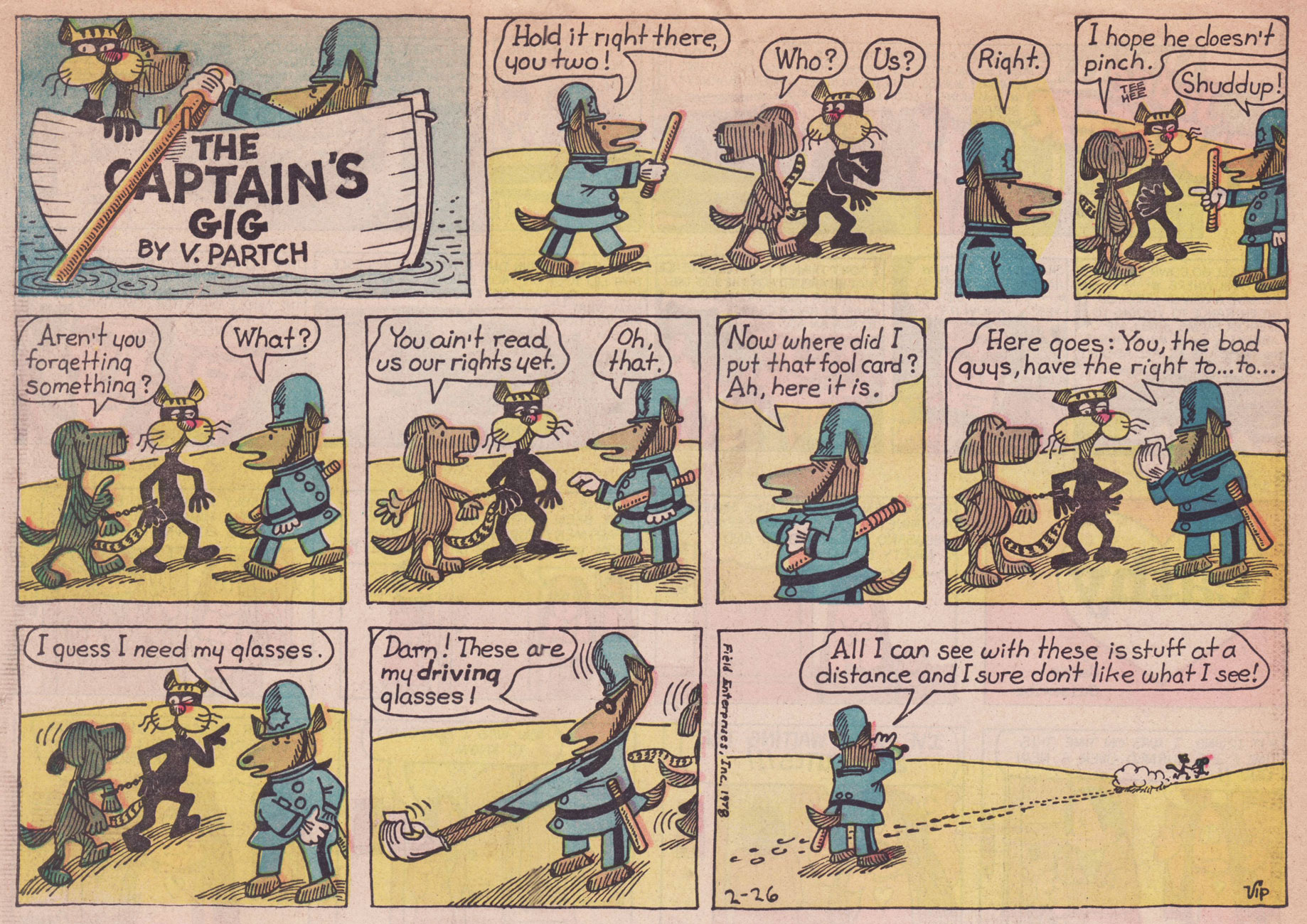
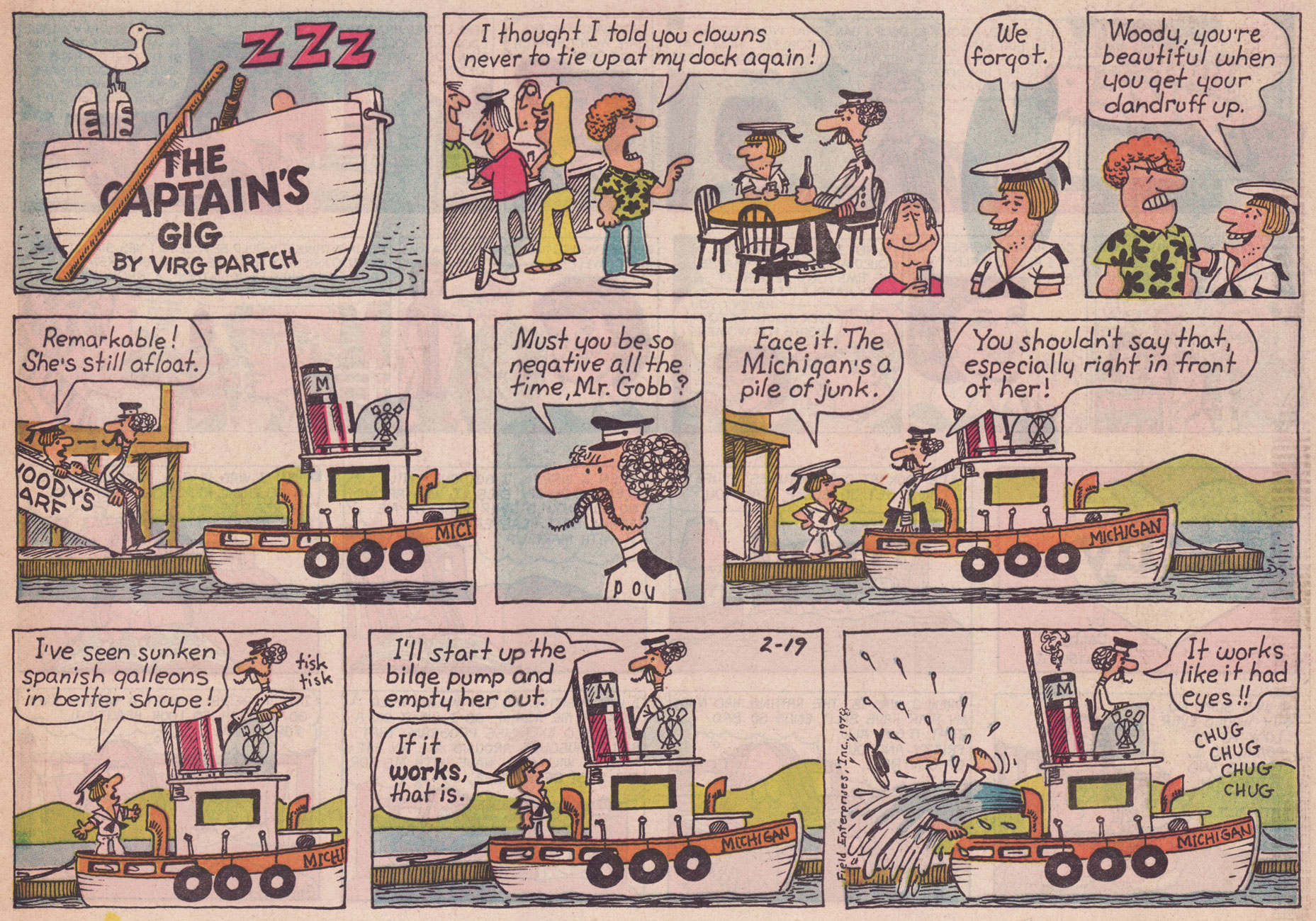
Aside from his magazine work, Partch also tried his hand at newspaper strips (after his friend Denis Ketcham, creator of Dennis the Menace, suggested it, I might add). I could launch into an examination of Big George, the successful syndicated comic strip about an average American husband-and-father and his daily struggles with neighbours and family. But this blog (as you’ve probably noticed) likes to tantalize its readers with the obscure, so today’s post is about Captain’s Gig, another syndicated (also by Field Enterprises, like Big George) strip that never got much traction and is nearly forgotten by now. VIP clearly toned down his oddness down a bit for Big George… he even started drawing people with five fingers! Captain’s Gig, on the other hand, is considerably weirder and more surreal. No, it’s not on par of VIP’s height of glory in the days of magazine cartoons – but this strip definitely has its charms.
I never thought I’d become the type of person who actually purchases old newspaper pages to get some comic, but what is a girl to do when this stuff hasn’t been reprinted at all? However, I only have a few of Captain’s Gig (and quite a bit more of Big George) – it seems that people mostly didn’t feel it was worth saving – so this post has both scans of the newspaper pages I have as well as some original art found online (and cleaned up).
« Virgil Partch burst onto the scene in the nation’s magazines with his zany, sometimes surreal but always hilarious cartoons. Known to millions by his signature, “Vip,” this comedic genius was unlike anything the world had seen before. His unique brand of humor and trendsetting approach to cartooning ushering in a new era of the gag cartoon and pioneered a standard of madcap humor across the spectrum of comedy that was reflected in the cutting-edge sensibilities of comedians and the trailblazing pages of Mad magazine. Inspiring a new breed of cartoonists, Vip became the more sought-after cartoonist of his generation, as well as one of the most prolific and influential cartoonists of his era. » (introduction from Fantagraphics’ VIP: The Mad World of Virgil Partch )
It appears no-one caught the typo in the *title*; well, the “Captan” bears an awfully smug expression, so perhaps he did.
An ad for for Captain’s Gig from March 1977, just shortly before the strip’s launch. It sang its death song and went down in December 1979, according to Stripper’s Guide.
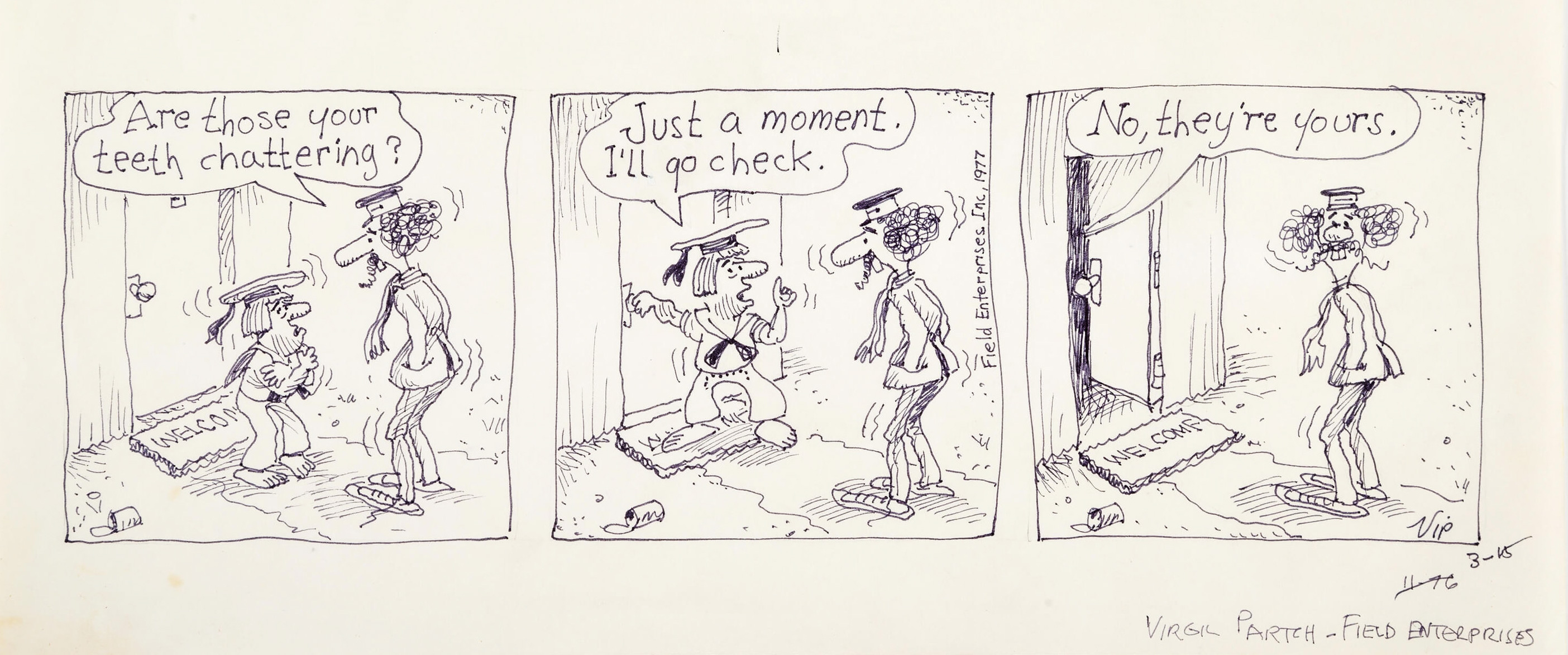
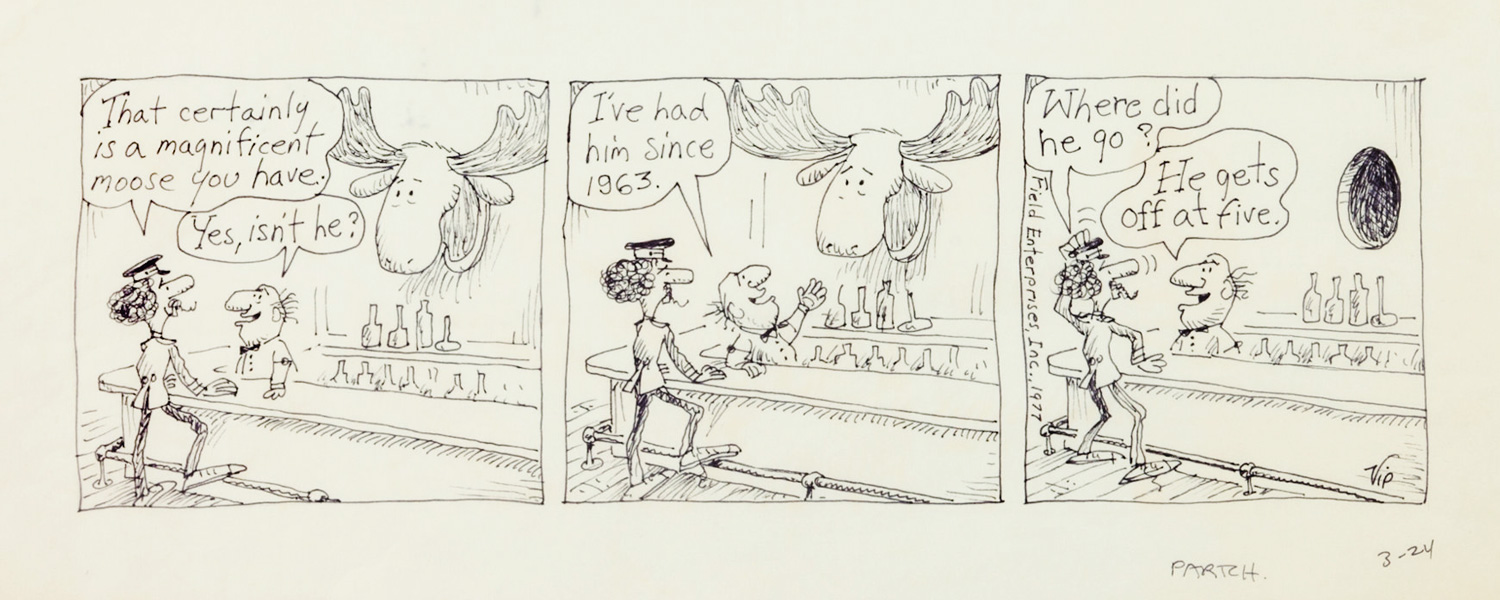
And now for some scans of original art (not owned, O woe!, by me):
Ger Apeldoorn, who has been doing the purchasing-and-scanning-newpaper-pages thing for longer than just about anyone, has a nice selection of strips over at his blog, The Fabulous Fifties. That being said, I hope to be forgiven for including two strips scanned and posted by him, both because they illustrate the point about VIP’s surreal sense of humour and because they made me laugh out loud.
« Gary Groth: You did — God help you — you did an Alice Cooper comic in ’79. Were you out of it or what?
Tom Sutton: I listen to Mozart. I don’t know. I guess Alice Cooper was a musician. Some kind of giant snake or some damn thing.
Gary Groth: So why the hell didn’t you do a Mozart comic?
Tom Sutton: Nobody asked me to. »
When I wrote Tentacle Tuesday: a Treasure Trove of Charlton Tentacles, I skipped Tom Sutton, vowing to return to him at a later date. If there was anyone deserving the title of Tentacle Tuesday Master (applause, please!), it is him. I don’t know what the appropriate cluster term for tentacles is, but Sutton has surely brought a, um, pandemonium (a terror? a trepidation?) of tentacles to Charlton‘s pages.
Even outside of his tentacles, Sutton is a truly interesting artist. I highly recommend An Odd Man Out: Tom Sutton,Gary Groth’s interview with him for The Comics Journal. Just read Groth’s introduction, if nothing else – he does an excellent job of summarizing Sutton’s singular career and the conflicting influences that shaped it. The interview is 11 web-browser pages long, and throughout Groth and Sutton’s conversation, one gets the distinct impression that Sutton is a witty, self-deprecating man, the kind you want to take to a bar or something to listen to his stories. At some point he mentions that the tape (to record the interview) is probably running out, and Groth responds with «There’s not enough tape in the world for you, Tom», which is, I think, a good example of their easy banter as well as obvious camaraderie.
Anyway, back to the topic at hand – the art and writing is by Tom Sutton, unless indicated otherwise. You know those over-the-top Russian buffets, where food is overflowing from the table? This post is like that, but with tentacles.
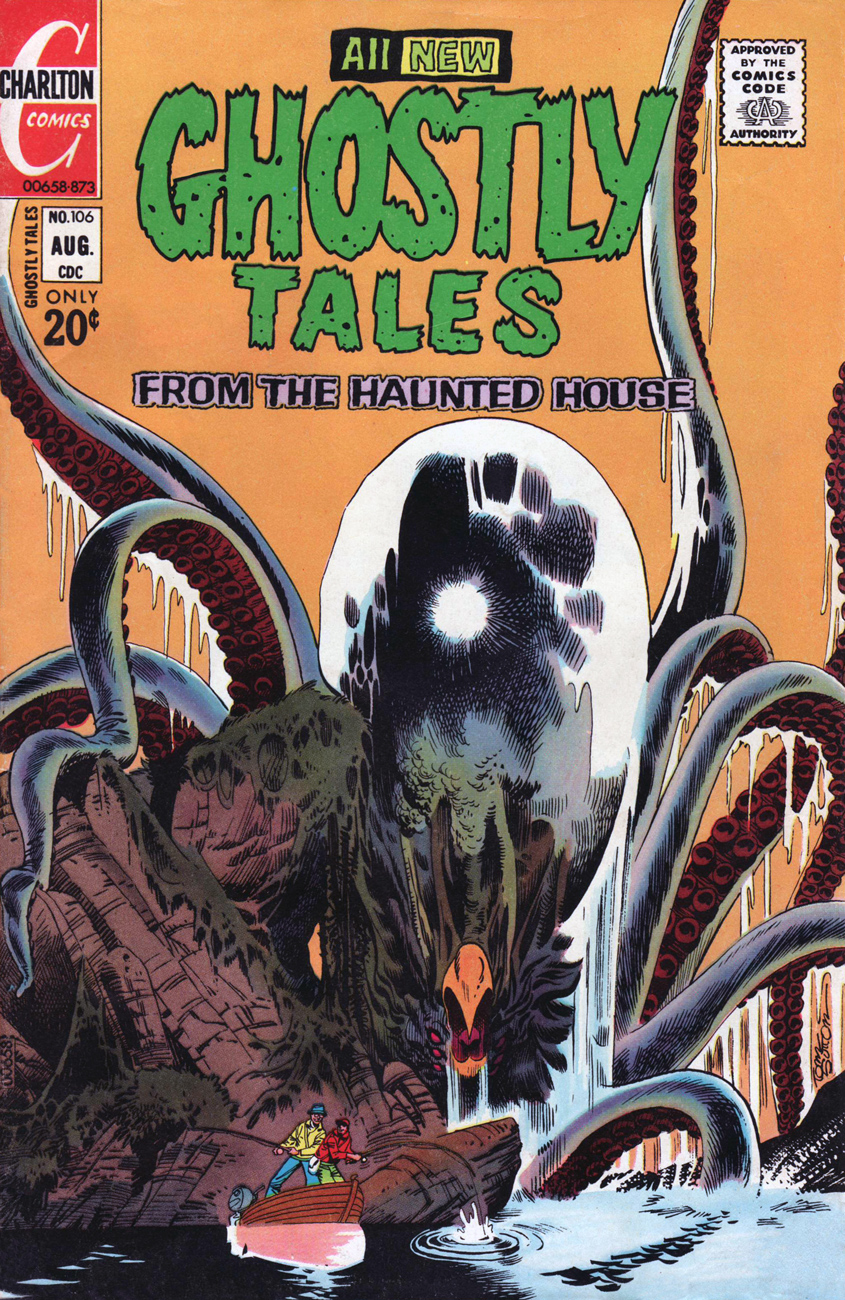
Ghostly Tales no. 106 (August 1973).
This story, titled simply (and à propos) Those Tentacles!, scripted by Nicola Cuti and illustrated by Sutton, has already been mentioned in Tentacle Tuesday: Domesticated Octopus Seeks Soulmate, but I’ve never posted this page. Dang, gave away the ending.
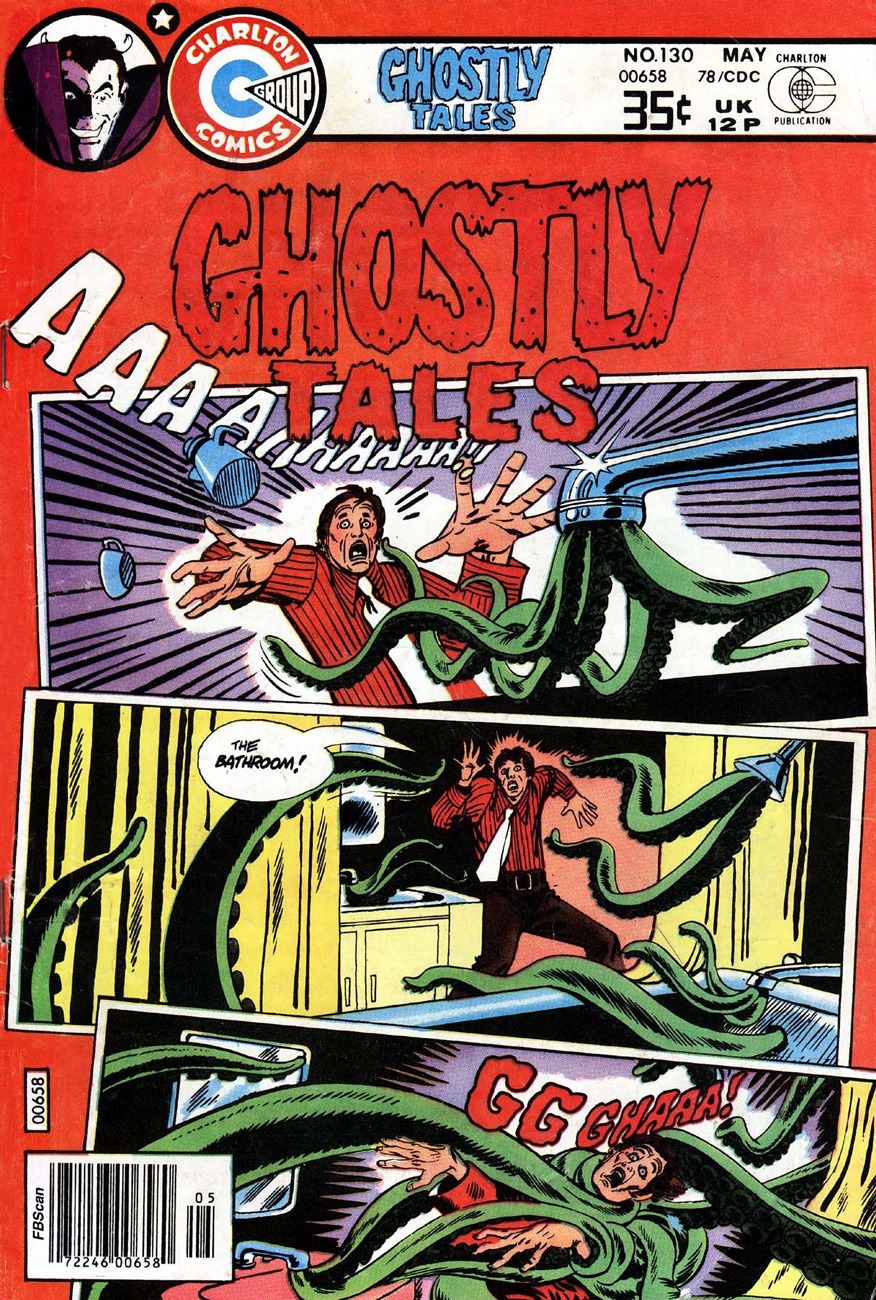
This story was repurposed as a cover for Ghostly Tales no. 130 (May 1978):
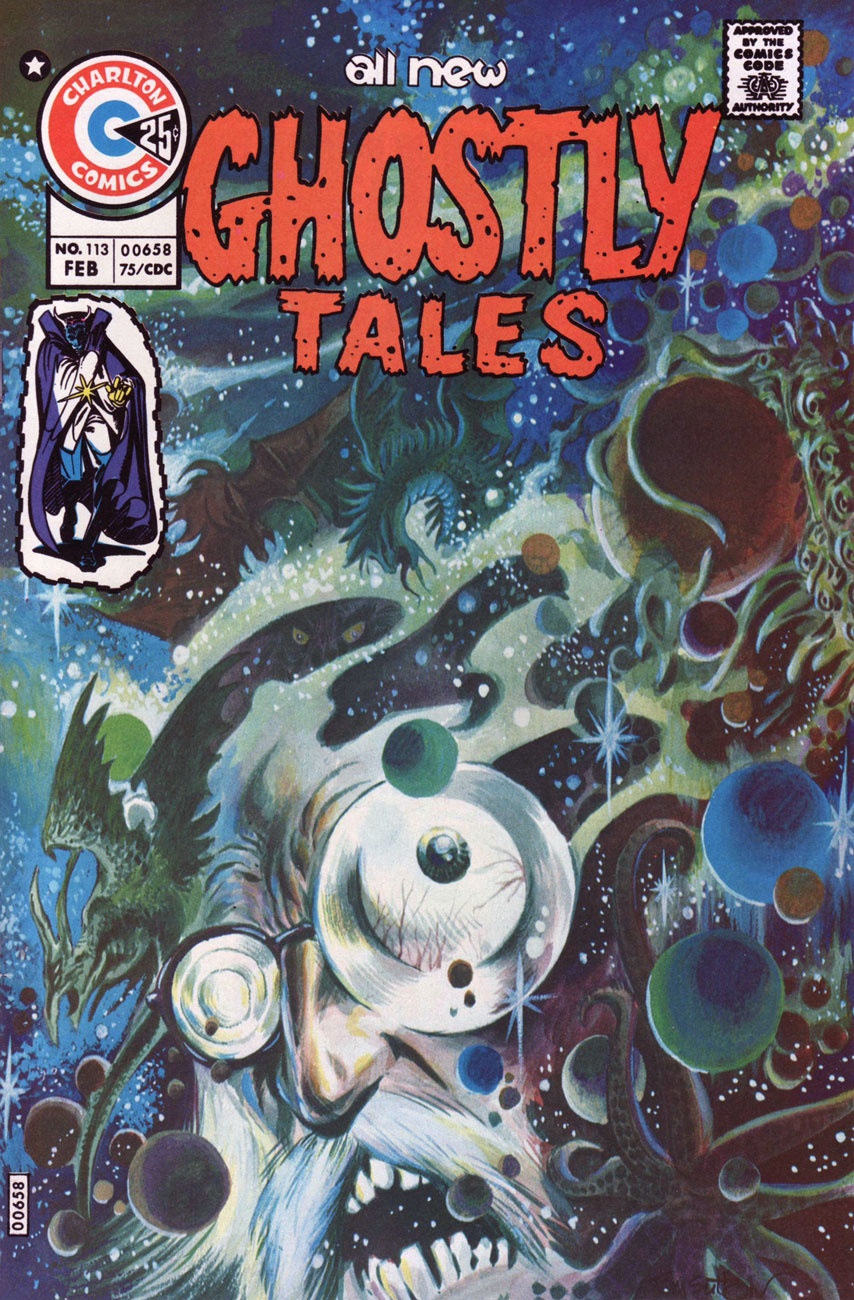
Ghostly Tales no. 113 (February 1975). Isn’t it a beautiful cover?
Page from Through a Glass Darkly, the (surprisingly, black and white; Sutton evidently knew it wasn’t feasibly colourable… and his publisher respected his wishes! As opposed to…) cover story of Ghostly Tales no. 113. Good thing we we treated to all those eye-pleasing blues and greens on the cover!
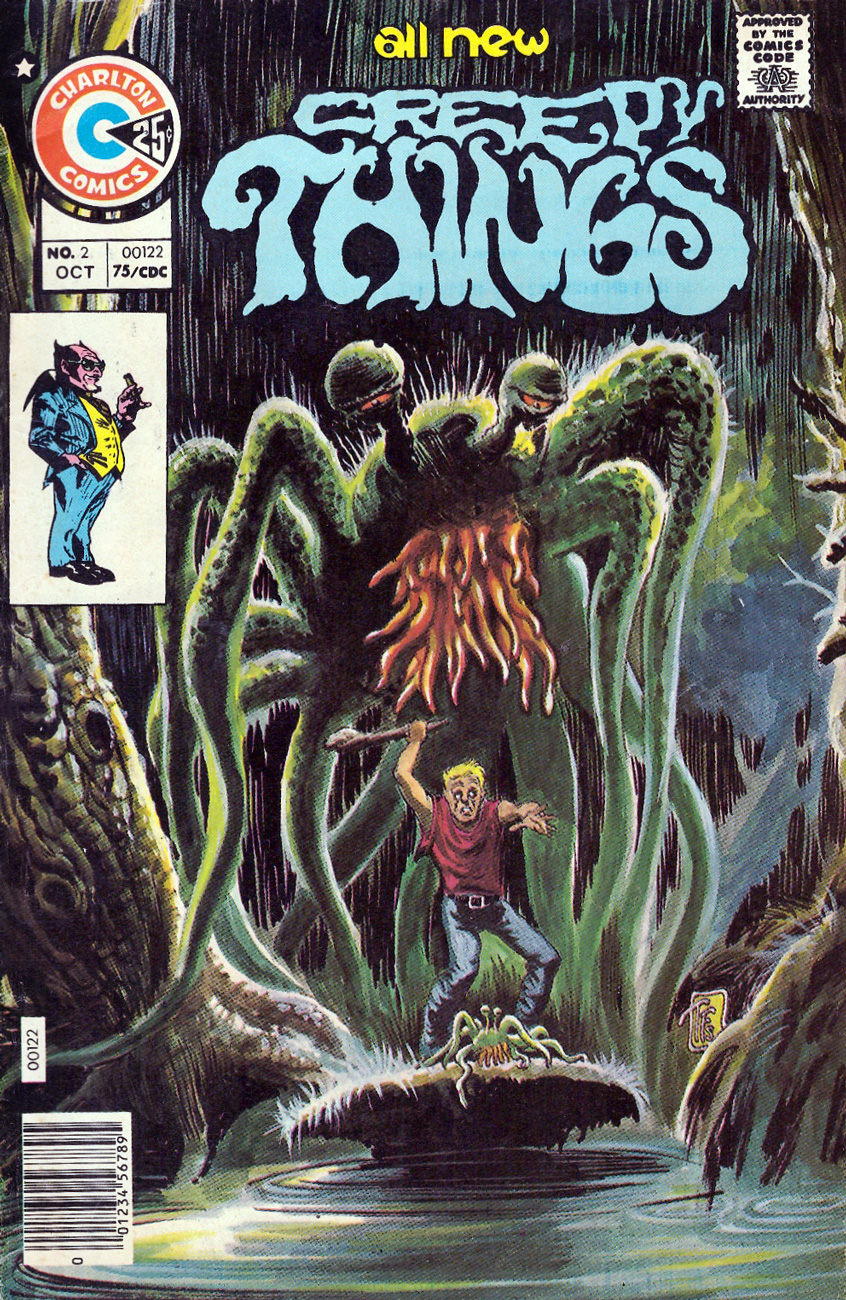
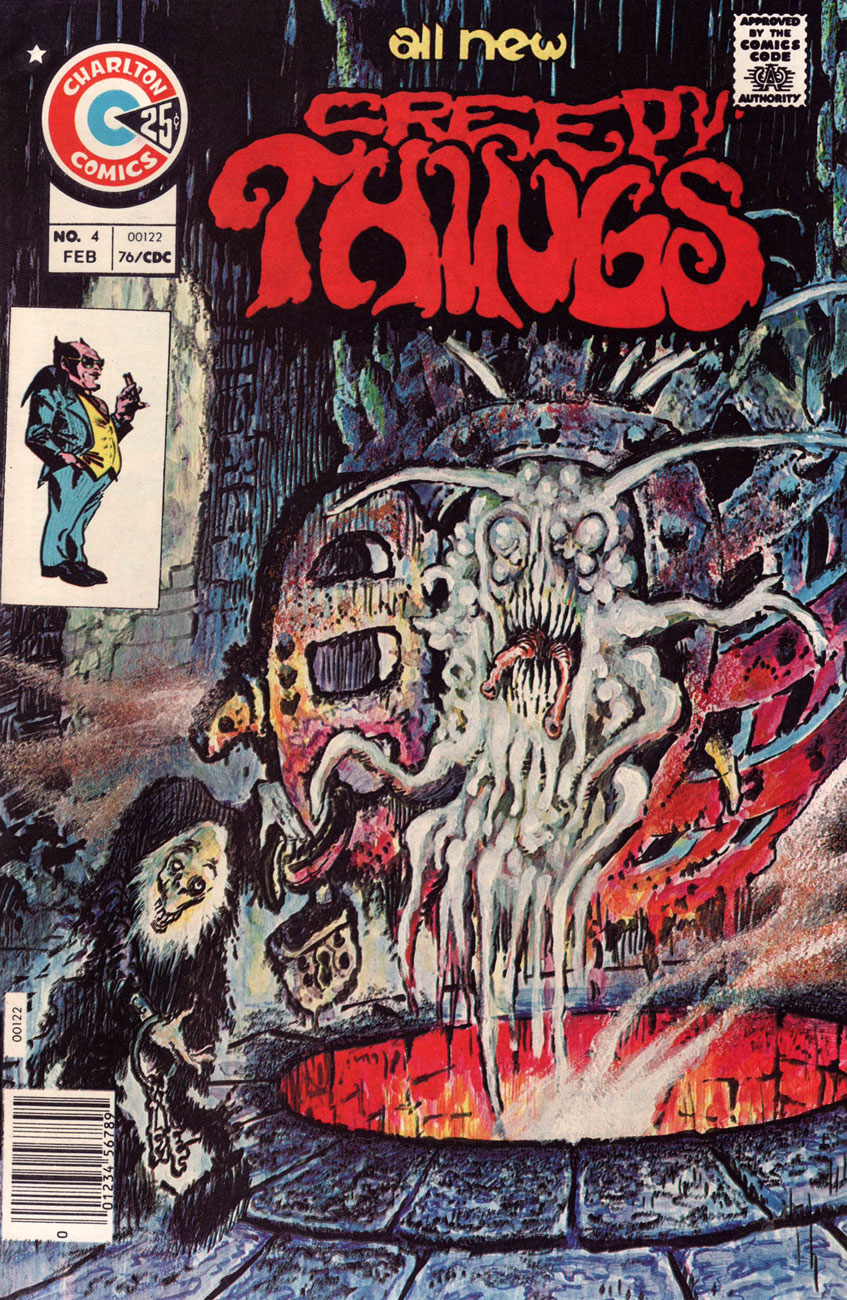
Creepy Things no. 2 (October 1975). You can read the full issue here. This is my favourite cover of this lot, both for the parent creature’s sad, slightly sleepy expression, and for the crispness of greens against black.
Creepy Things no. 4 (February 1976). I’ll bet that slug-thing glows in the dark.
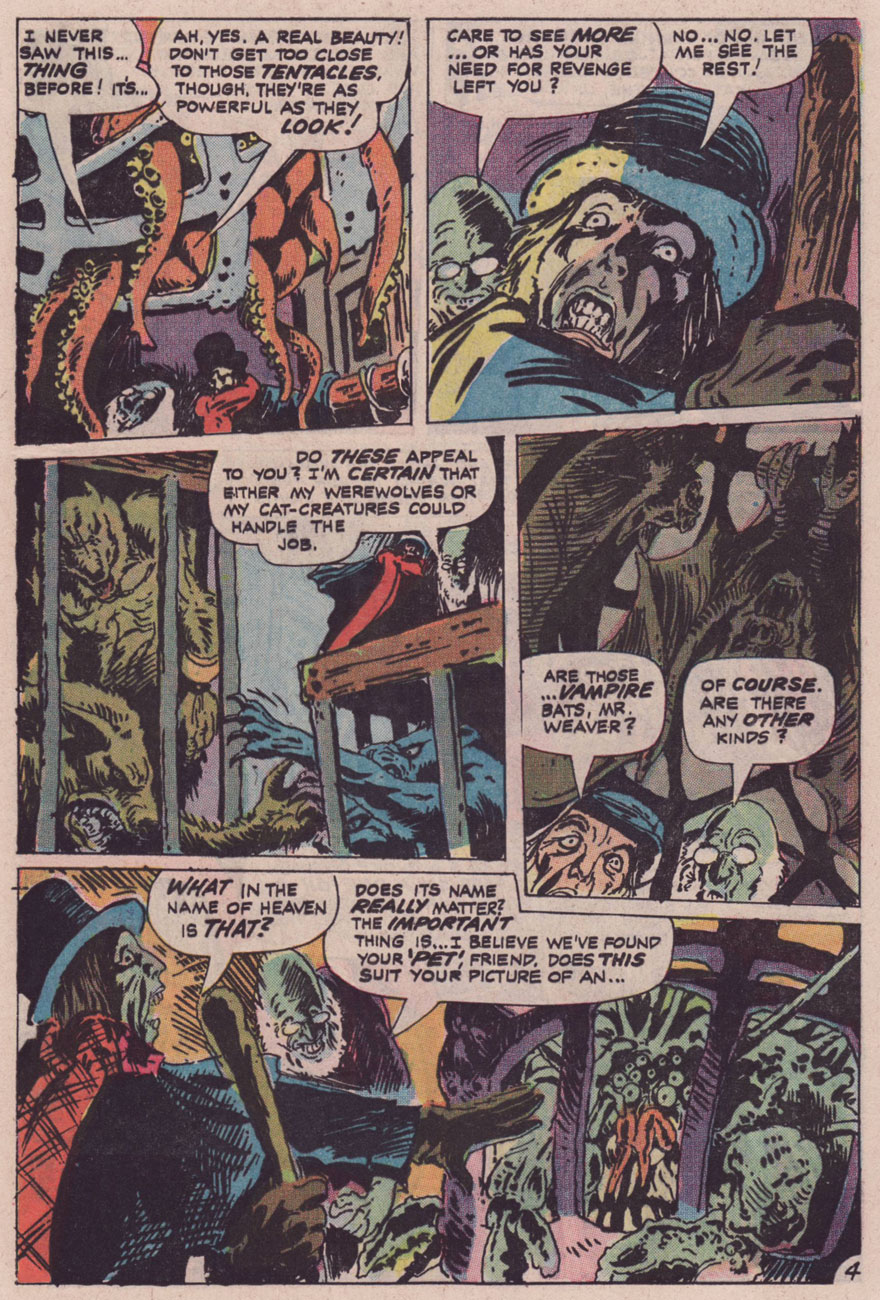
Page from Man’s Best Fiend, scripted by Joe Gill (as Tom Tuna) and illustrated by Sutton, printed in Creepy Things no. 4.
Ghost Manor no. 27 (January 1976)
Scary Tales no. 4 (February 1976). Scary Tales hostess Countess Von Bludd tackles tentacles! Now you can’t say this post doesn’t have any cleavage.
Haunted no. 20 (February 1975). My second favourite cover, for the completely horrified, totally Sutton-esque faces of the creature’s victims. I also like the way his signature is hiding at the foot of the tentacles.
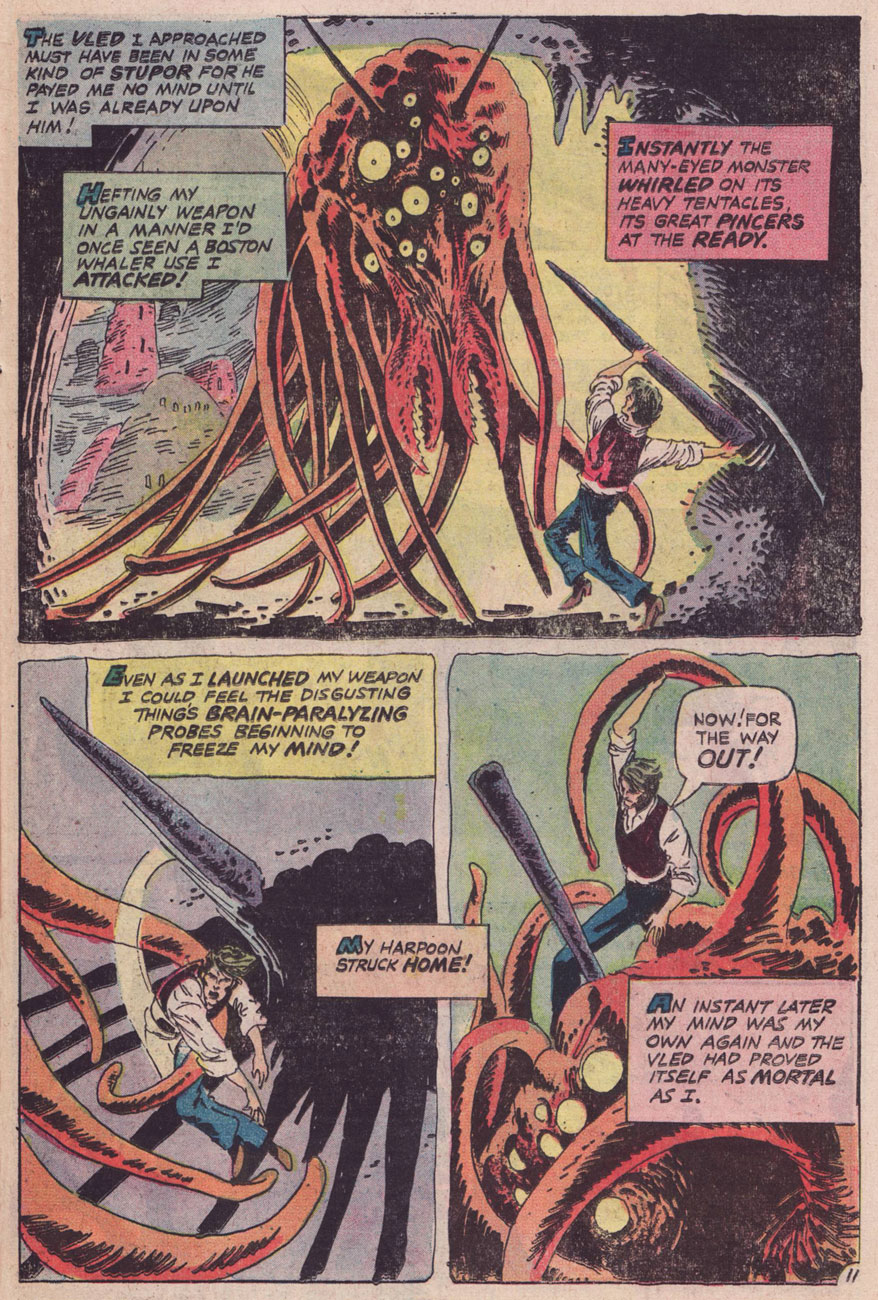
Pages from Mountain of Fear, published in Haunted no. 20. This is likely the most Lovecraftian (and epic) of Sutton’s Charlton tales.
Page from Out of the Deep, published in Haunted no. 21 (April 1975). This panel was later used as the cover for Haunted no. 55 (May 1981). Read the full story here.
Page from Fear Has a Name!, scripted by Nicola Cuti and illustrated by Tom Sutton, published in Haunted no. 22 (June 1975).
Page from The Thing in the Hole, published in Ghostly Tales no. 111 (September 1974). Read the whole issue here.
For more Tom Sutton, head over to the great blog The Horrors of It All, where a fellow admirer has posted a bunch of his stories. I’m happy to say that Sutton aficionados are legion and they’re fairly rabid, so to speak.
Furthermore, you can read co-admin RG’s Mind the Quirks and Glitches: Petrucha & Sutton’s Squalor for one more, more modern, facet of Sutton’s varied career. And if you’d like a little piquant in your life, his post even includes links to Sutton’s erotic comics!
« I speak ten languages– all of them in Yiddish. » — Charles Rappaport
Like many a non-New-Yorker comics-loving goyim, my earliest encounters with Yiddish parlance came through Mad Magazine (furshlugginer, potzrebie, farshimmelt…), a practice initiated by its creator, Harvey Kurtzman, and carried on by his disciples and successors; unlike most of my ilk, however, my interest didn’t flag there, so I followed up Mad with Leo Rosten’s masterful The Joys of Yiddish.
As Art Spiegelman reminded us recently, in his controversial essay about the early American comic book industry, « the pioneers behind this embryonic medium based in New York were predominantly Jewish and from ethnic minority backgrounds. » Much like Mr. Spiegelman, I largely eschewed superheroes, unless nothing else was around. Of course, the trick to a varied diet is to stay alert to every possibility. Newspapers, naturally (it helps to live in or near a large metropolitan centre, though), random magazines, second-hand book stores, public and private libraries. Fluency in more than one language is a great asset, of course.
With the new possibilities opened up by the internet, I’ve grown quite fond of investigating obscure publications advertised or reviewed in old magazines. Case in point: a few years ago, I was flipping through The New Yorker‘s annual Cartoon Issue (another tip o’ the hat to Mr. Spieg) of 2001, and came upon this tiny, intriguing advertisement in its back pages.
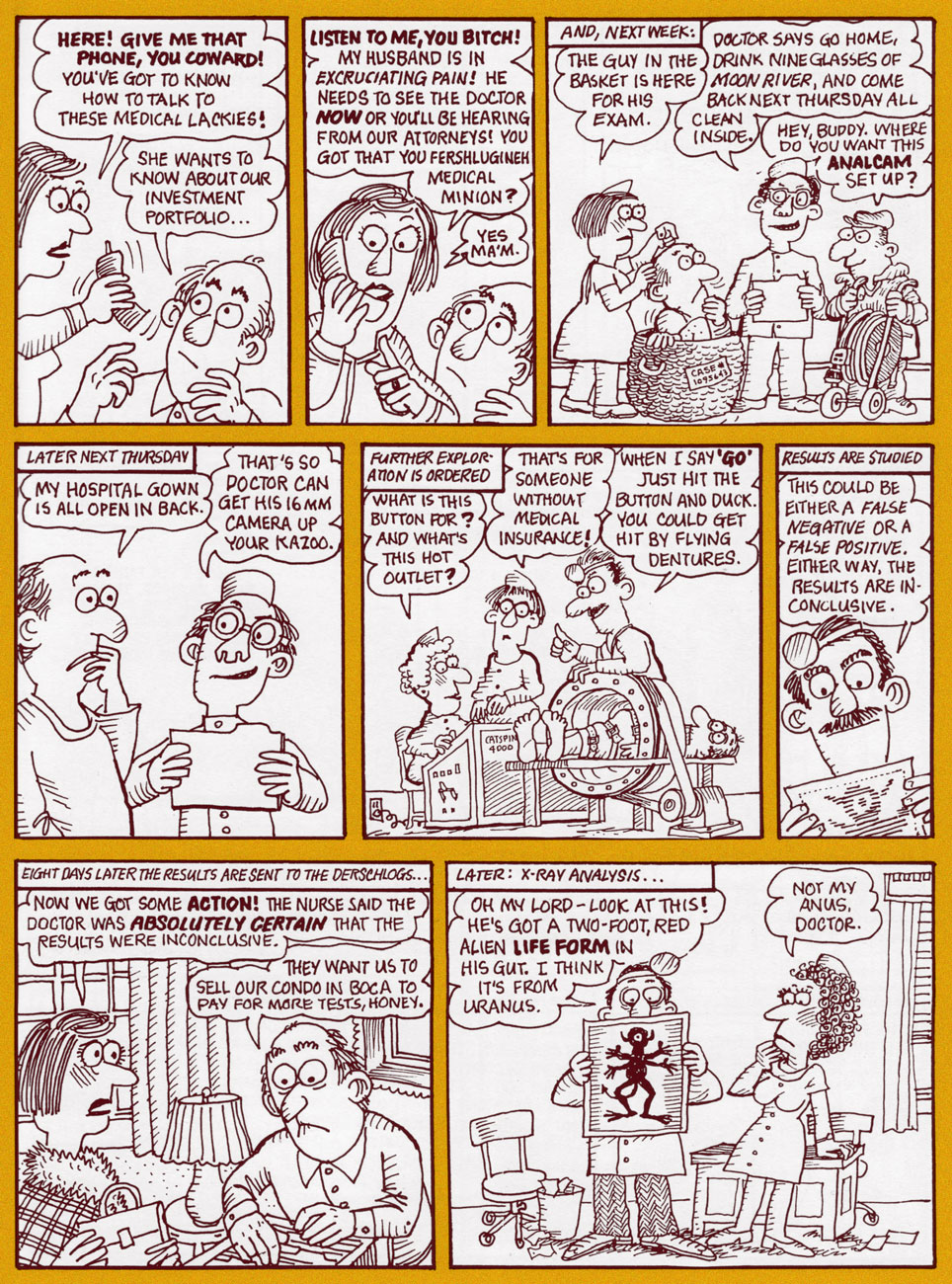
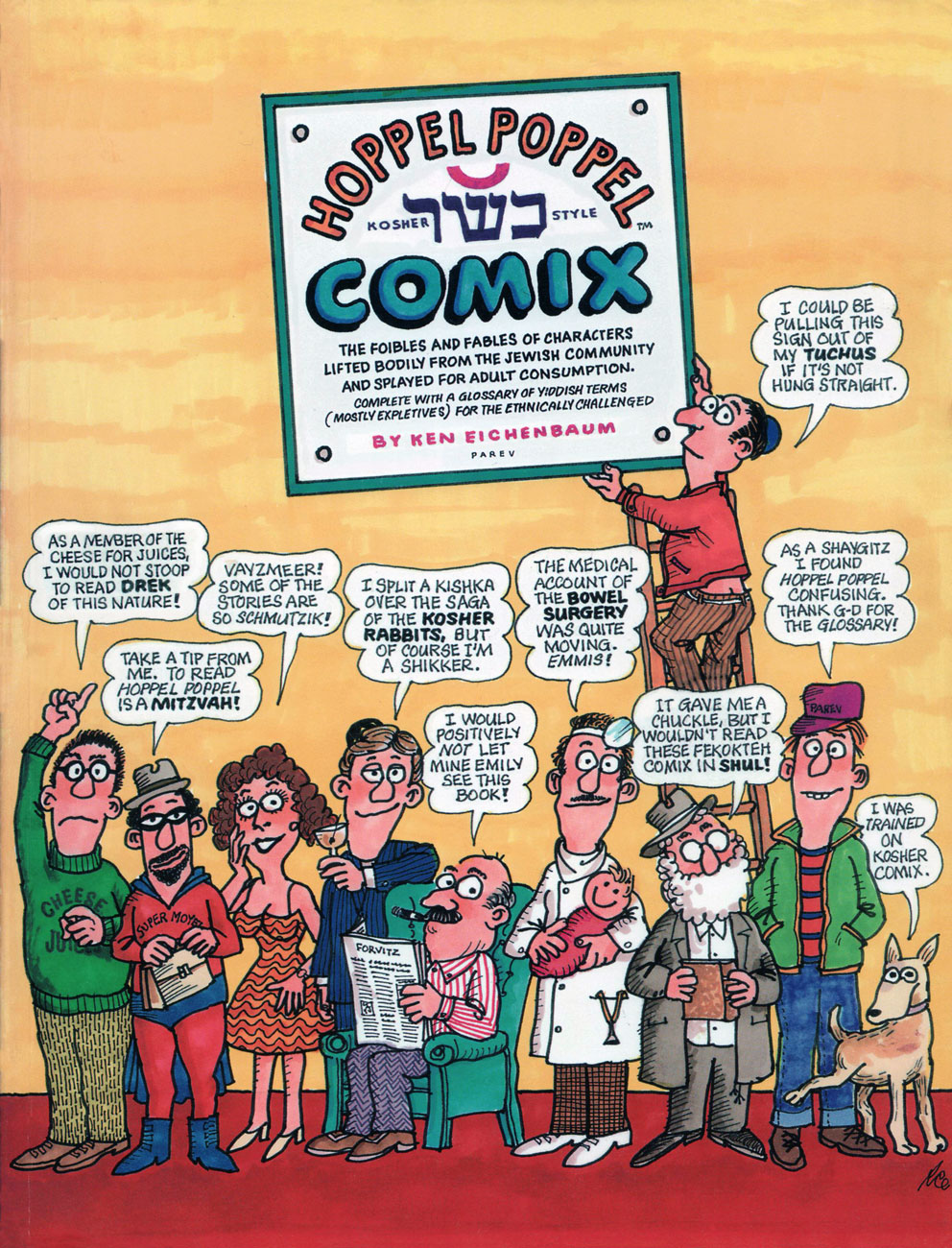
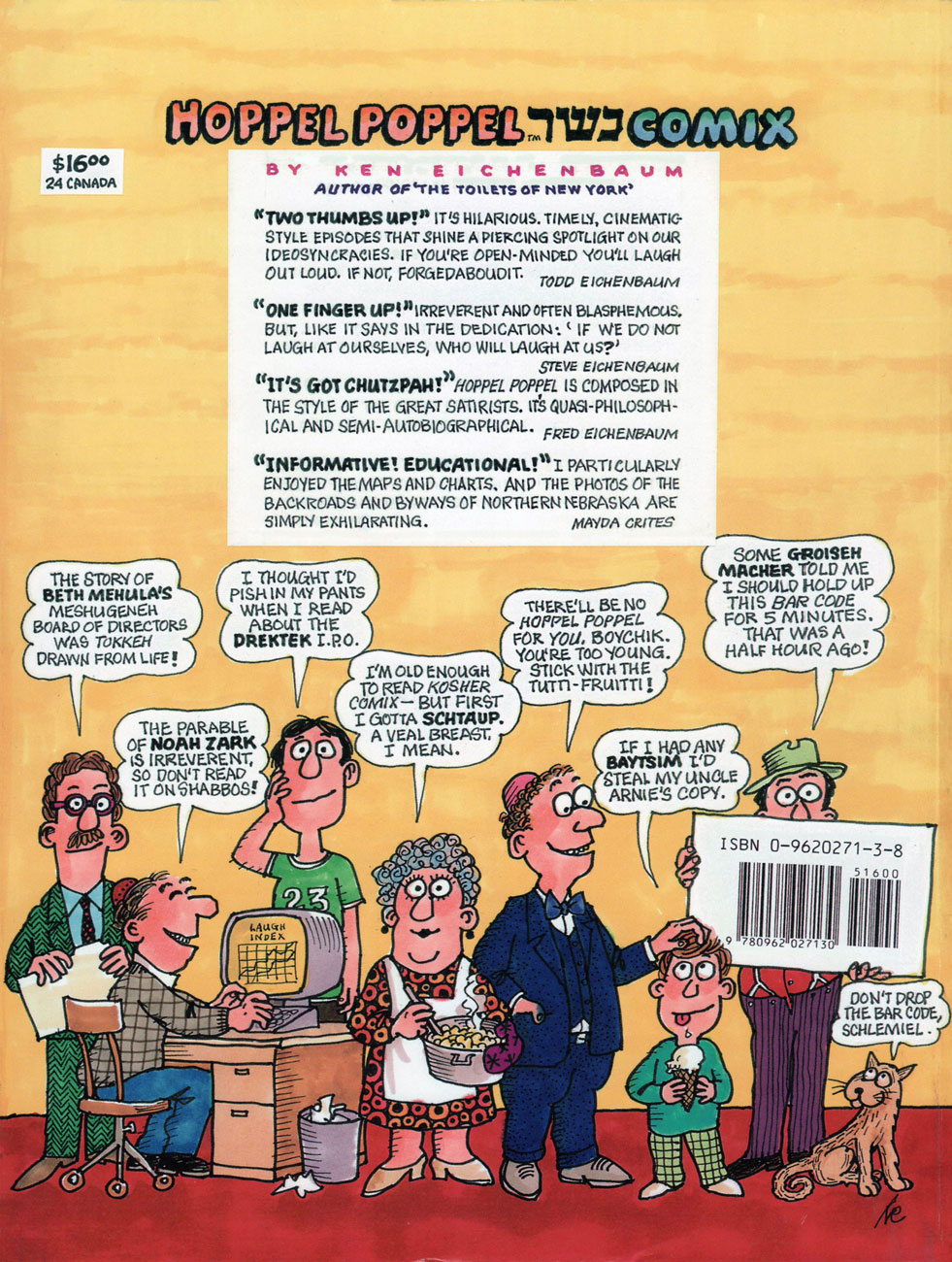
Drek(rhymes with wreck): Dirt, shit, or inferior merchandise; Ferbissoner (fur-biss’-n-er): Someone who clenches their teeth all the time; a hard-ass; Bissel (biss-l): a little bit; Schmutzik (shmoot’ [as in book] – tzik): dirty; Tokkeh (tock’-eh): actually, or really.Obviously, I looked up Hoppel Poppel Comix online, found a copy, ordered it, loved it… and here we are. My pick, The Medical Journal of B.M. Derschlog, turns out to have been the first story produced, and the impetus for the rest of the collection.
« Ken Eichenbaum’s comic book for adults began as cancer therapy. In 1999, Eichenbaum was diagnosed with colon cancer. While undergoing treatment, he began to come up with a 16-page thank-you card for those who had helped him through the ordeal. He was so encouraged by the response to that story, ‘The Medical Journal of B.M. Derschlog‘ — which lampoons his experience with the medical establishment — that he decided to write more illustrated tales. ‘I would lie in bed and there would be this shadow of illness. And I would come up with things that would make me chuckle to myself,’ says Eichenbaum, 70, who’s hesitant to talk about his cancer for fear of being seen as looking for sympathy. The result is a ‘graphic novel‘ — as these booklong comics are called — filled with sometimes funny, sometimes bawdy tales. Eichenbaum considers cartoonists Art Spiegelman and Ben Katchor to be two of his models, but ‘Hoppel Poppel‘ is less heart-wrenching than Spiegelman’s ‘Maus‘ and more slapstick than Katchor’s elliptical humor. » [source]
Mr. Eichenbaum was also clearly at ease with short-form gag strip (of these, the author coyly states: «… single-strip episodes, some of which may have previously appeared in Jewish community newspapers around the U.S. »). Some evidence:
Cheese for juices : Jews for Jesus. Mitzvah (mitz’-Vah): A good deed, a commandment; Vayzmeer (vayz’-meer): A little prayer, like ‘help me’; Kishka (kish’-keh): Stuffed intestine, regarded by many as a delicacy; Shikker (shik’-ker): an inebriated person; the state of being drunk; Emmis (em’-miss; rhymes with tennis): truth!; Fekokteh (feh-kok’-teh): shitty; Shul (shul): a temple, as school; Tuchus(tuch’-es; rhymes with ruckus): buttocks– offensive; Shaygitz (shay’-gitz): a non-Jewish male.
… and the back.
Well, it looks like a lovely day out there, so I’m off to pick up some potato knishes (like Mr. Kotter, I simply can’t kick that particular addiction)!
« The precious hours seemed to hurtle by, as if we were in some kind of vicious time machine! »
Today’s birthday number seventy-six for one of Charlton Comics’ most singular and hardest-working artistes, namely Enrique Nieto Nadal (born August 15, 1943, in Tangiers, Morocco, to Spanish parents), who injected some edgy excitement into the Charlton Comics line, handling with equal aplomb and virtuosity tales of romance, horror, war, adventure… and every combination thereof.
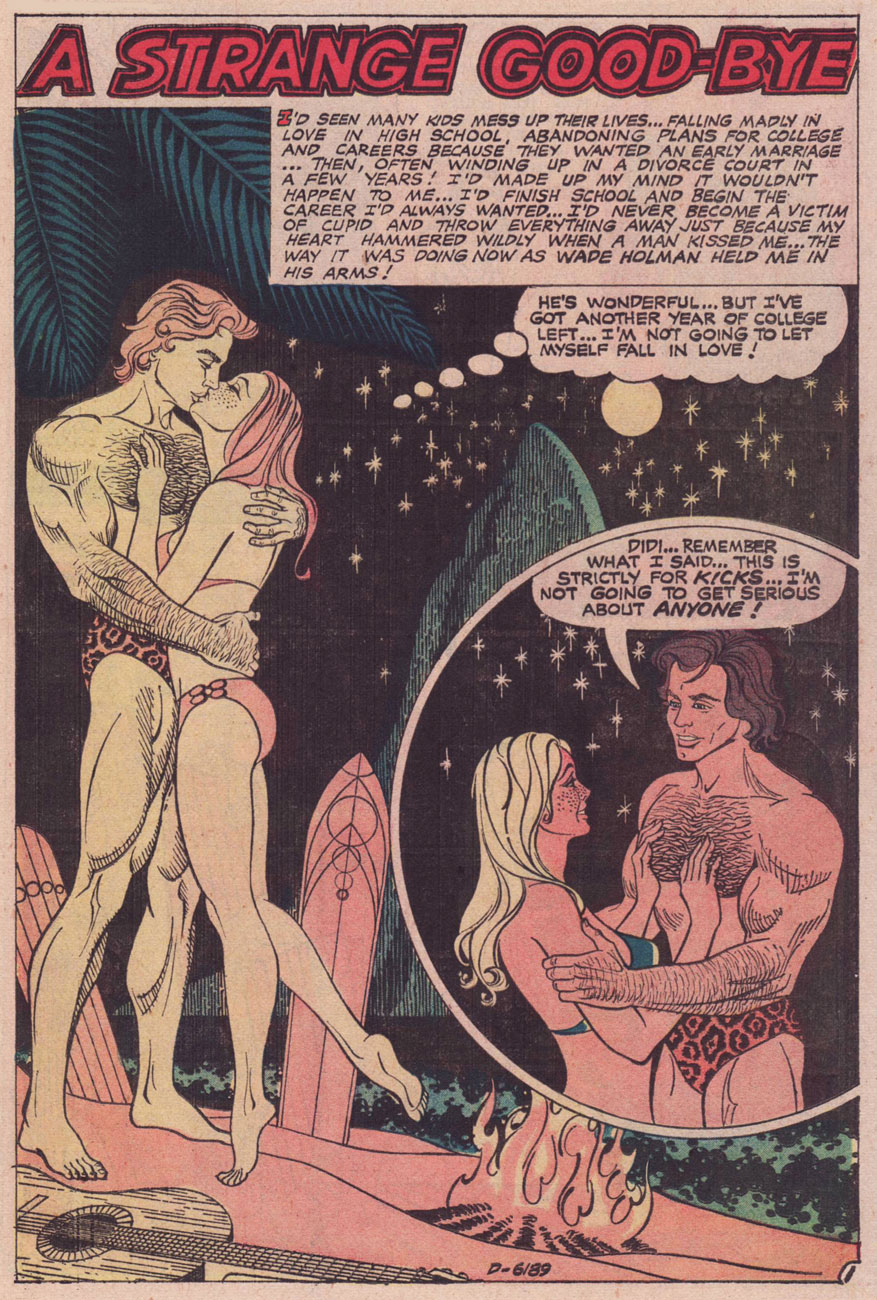
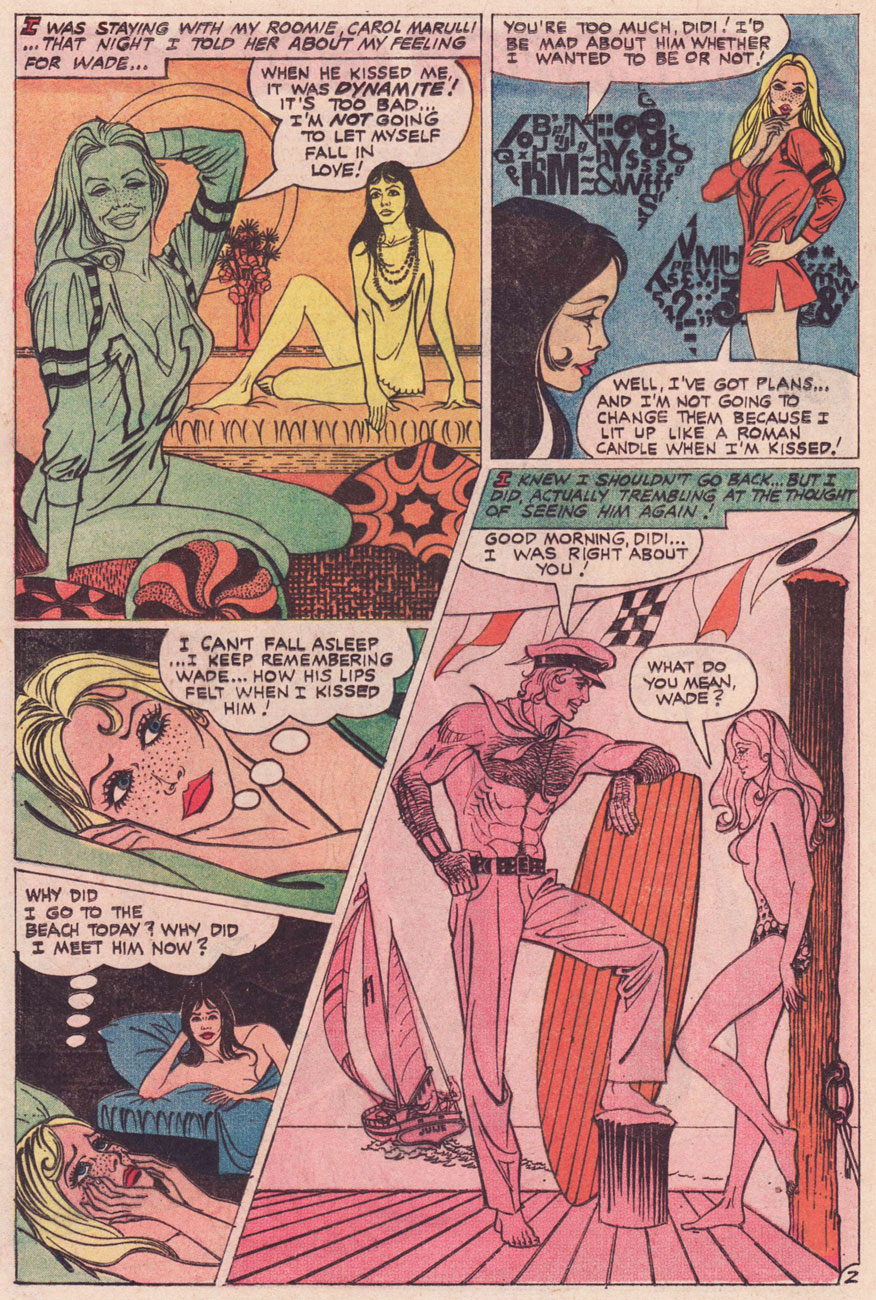
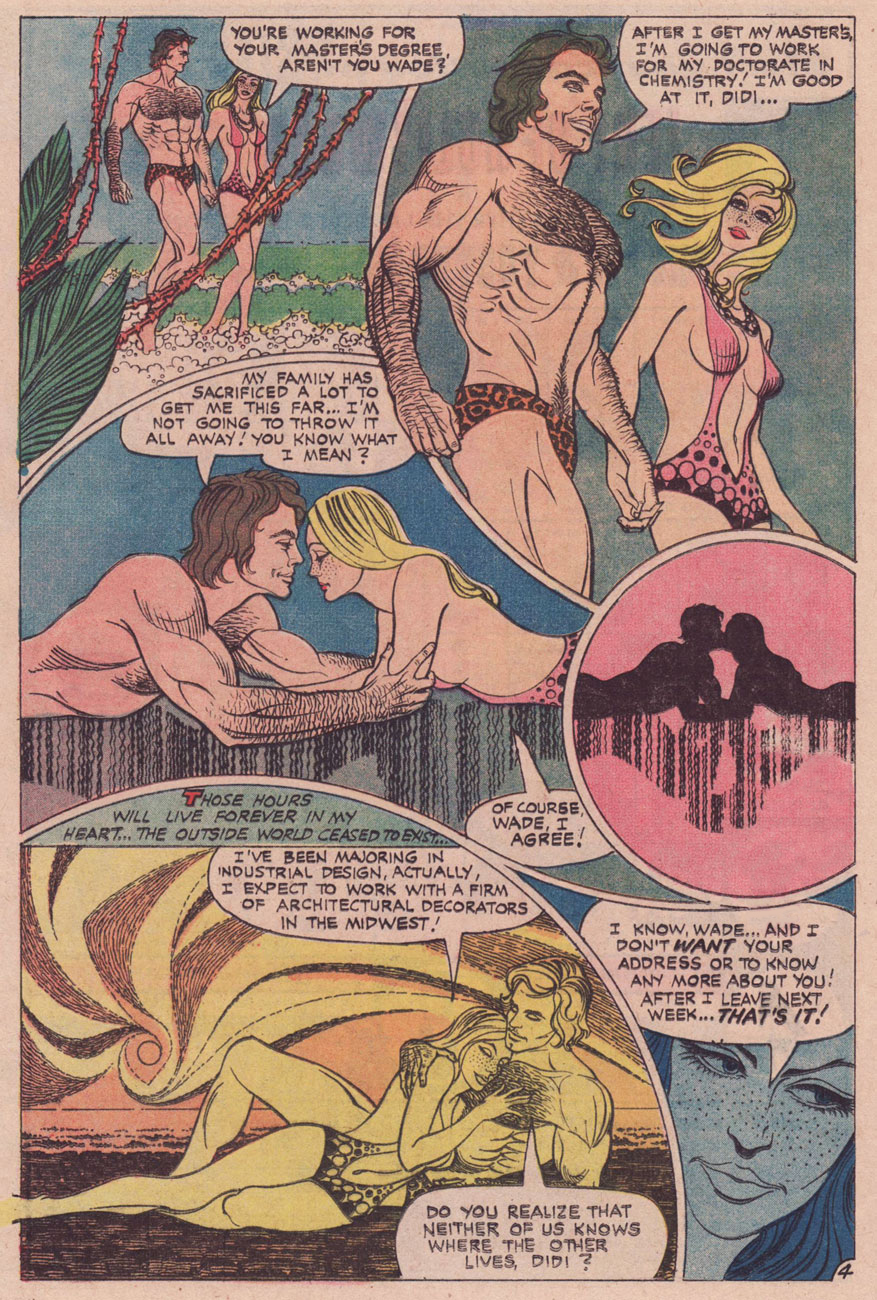
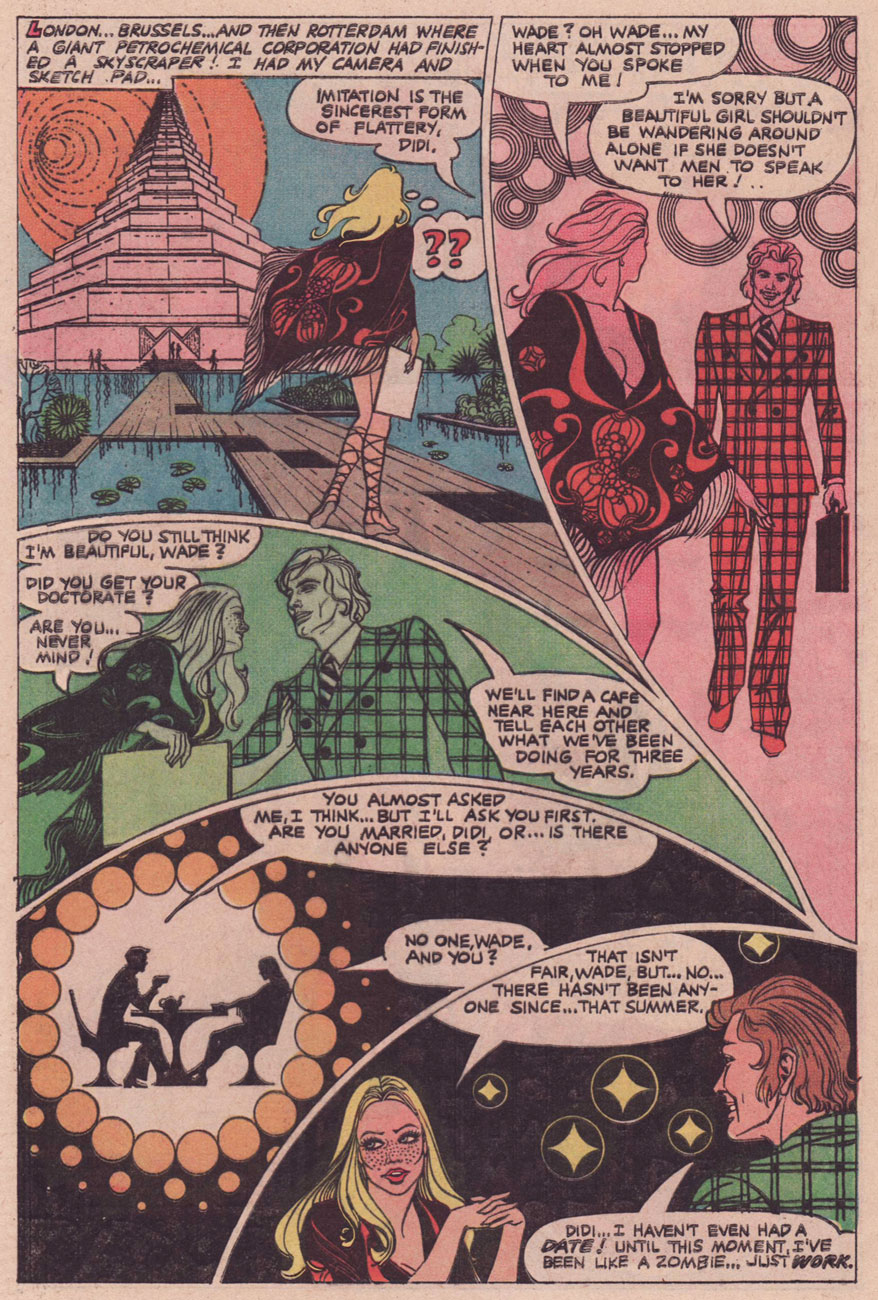
To mark this special occasion, I’ve picked out the lovely tale of A Strange Good-Bye from Love and Romance no. 20 (January, 1975); it provides a sterling showcase for his remarkable design chops and, as my dearest co-admin ds has earlier pointed out, Enrique’s tales provide, as a rule, beefcake and cheesecake in equally generous shares. Is anyone else that fair-minded?
I’m particularly fond of this yarn because of its unusual avoidance of most romance clichés: there are no scheming rivals, no duplicitous so-called friends, no disapproving parents, no melodrama… just two serious-minded, intelligent young people who are *really* into each other, but don’t lose their heads over it. And they may be yuppies, but success wasn’t just handed to them. Call me a sap, but I can’t help but sincerely root for Wade and Didi.
Oh, and let’s face it, can you think of any other US romance comics that pack such an erotic charge? It may be subjective, but I’ve rarely seen such convincing depictions of tenderness and affection, physical and otherwise, between two characters… and in mainstream, comics-code approved funnybooks yet. Full marks to Mr. Nieto and his masterful understanding and depiction of body language… male and female.
While he’s not credited, it’s still obvious to me that Joe Gill is the writer; my favourite facet of his romance tales is how he grounds what could be stock situations in the everyday, endowing his characters with actual, credible occupations, as opposed to soap opera ones. When a character describes a business deal or an industrial process, it makes perfect sense. I suspect this to be a by-product of Gill’s authorship of a 1973 series of promotional career-choice Popeye-branded comic books. The research clearly fed his subsequent work, which is just as it should be.
A Strange Good-bye was the cover feature of Love and Romance no. 20 (Jan. 1975). Blast that puzzle page!
Some people automatically conflate “goofy” with “childish”, but goofiness comes in many guises: from the charmingly nonsensical to the playfully quirky, from the clearly brilliant but confusing to the fucking stupid. (It’s also a snow-boarding term – How do I tell if I’m Goofy or Regular?) Today’s Tentacle Tuesday is goofy, all right, but more in the category of seemingly drug-induced codswallop. Another word for Dial H for Hero is wacky; distinctly wacky, so wacky that (as co-admin RG put it) it’s hard to really dislike it.
Maybe I should backtrack for those in the audience who are not familiar with the concept of Dial H for Hero. Robby Reed, a lucky (?), plucky teenager with a propensity to shout “Sockamagee!” in moments of excitement, stumbles upon some sort of magical thingamajig in a cave that enables him to become a superhero at the drop of hat (well, a turn of a dial). The process has unpredictable and uncontrollable results, in the sense that Robby has no idea who he will become, or what powers will be at his fingertips.
I have nothing against the idea of a rotary phone cum magical dial – that idea is rather interesting, given that rotary phones are indeed mysterious objects to the current generation – but I find the stories a tad too random to be enjoyable. Yet that’s the aspect that some readers clearly relished. To quote a letter from House of Mystery no. 172 (January-February 1968) from Bethesda, MD’s Irene Vartanoff.
« One of the best things about DIAL H FOR HERO is the huge amount of imagination put into each story. When at least two new heroes with new powers, costumes, weaknesses, bodies, etc. have to appear in each story, it may make your writers rack their brains and work overtime, but the results are fantastic. »
Given all the transformations Robby has gone through and the many bad guys he has had the pleasure of defeating, it is unavoidable that he would 1) encounter some villains with tentacles 2) acquire some tentacles himself. Dial H for Highball on *your* old-fashioned phone, if you still have one gathering dust in the attic, and enjoy this gallery of fun nonsense.
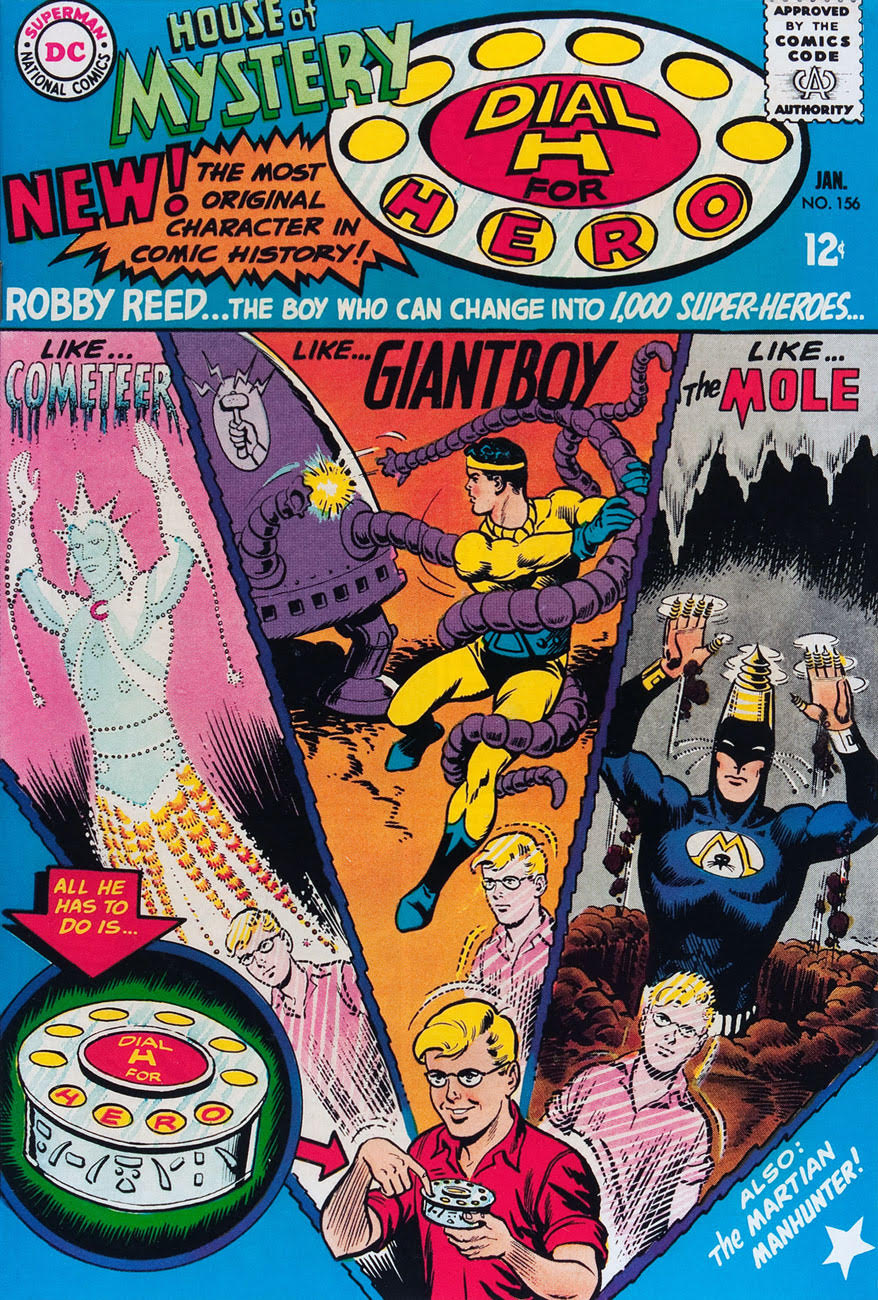
The very first appearance of Robby Reed and his magical dial, and already we have tentacles:
House of Mystery no. 156 (January 1966), cover by Jim Mooney. This is a good demonstration of how random some of the superheroes generated by the machine are.
This is the first Dial H for Hero story, and as such it has no other title. Scripted by Dave Wood, drawn by Jim Mooney. [RG: panel three looks suspiciously like the work of George Tuska. Ghosting… or swiping? Hmm…]I mentioned that Robby himself sometimes sprouts tentacles. Here’s a good example:
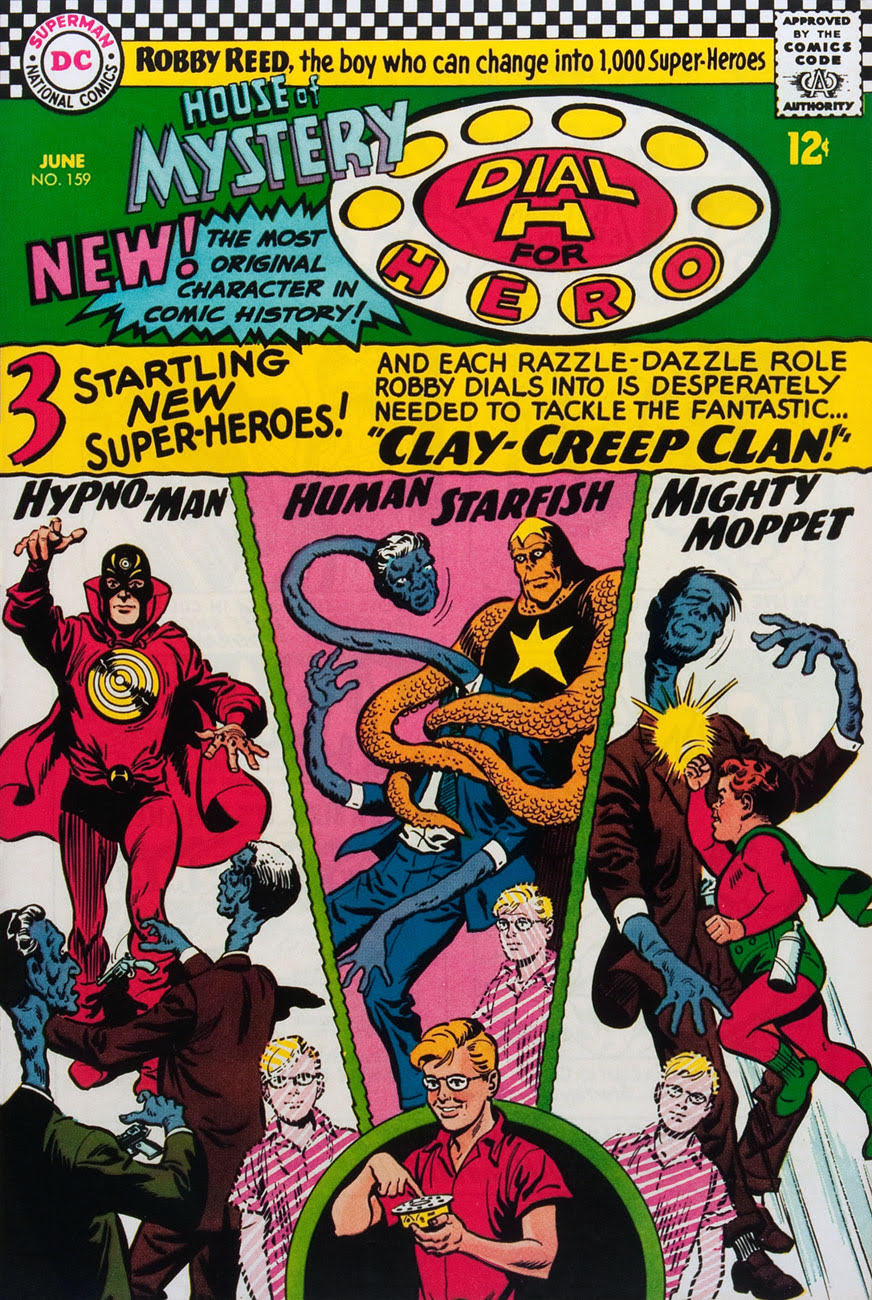
House of Mystery no. 159 (June 1966), cover by Jim Mooney. Another issue, another gallery of improbable heroes and villains…
Human Starfish Robby Reed conveniently improves upon the concept of a normal starfish, developing prehensile appendages to capture a very stretchy criminal. The Clay-Creep Clan is written by Dave Wood, and drawn by Jim Mooney.
Jim Mooney was responsible for Dial H for Hero‘s art for many issues, from the onset of the series with House of Mysteryno. 156 (January 1966) to House of Mystery no. 170 (October 1967). Dial H for Hero lasted three more issues after Mooney’s departure. As luck would have it, no. 171 and no. 172 bring our most striking examples of tentacles yet. (The final DHFH issue, House of Mysteryno. 173, features a cover by Jack Sparling, with insides by Charles Nicholas and Sal Trapani.)
Arguably the prettiest cover of this post (my favourite, at any rate):
Back to fighting tentacles! House of Mystery no. 171 (December 1967), cover by Nick Cardy.
The Micro-Monsters! is written by Dick Wood and illustrated by Frank Springer.
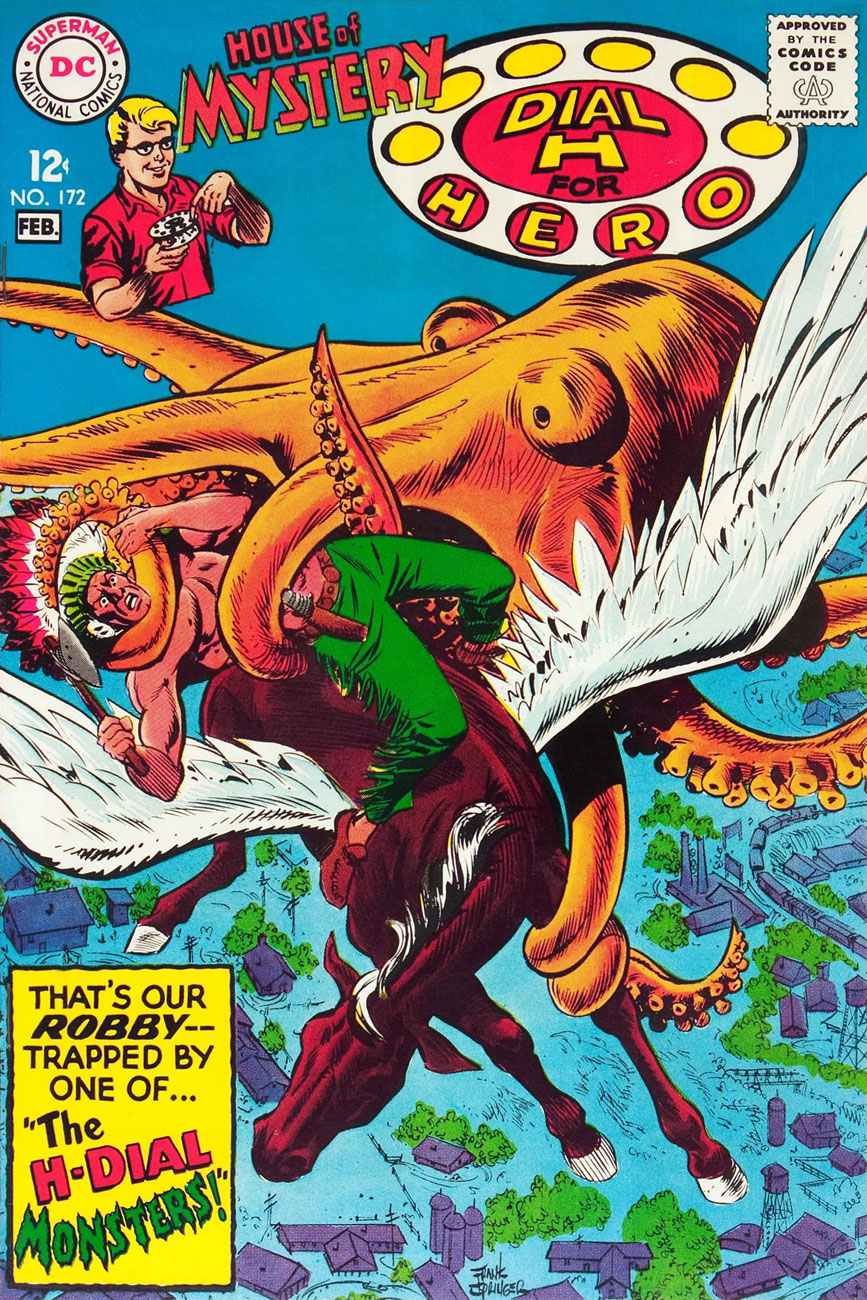
House of Mystery no. 172 (January-February 1668), cover by Frank Springer.
The Monsters From the H-Dial! is written by Dick Wood and illustrated by Frank Springer.
How does Chief Mighty Arrow defeat the flying octopus? Why, by shooting jet-propelled feathers from his headdress, of course.
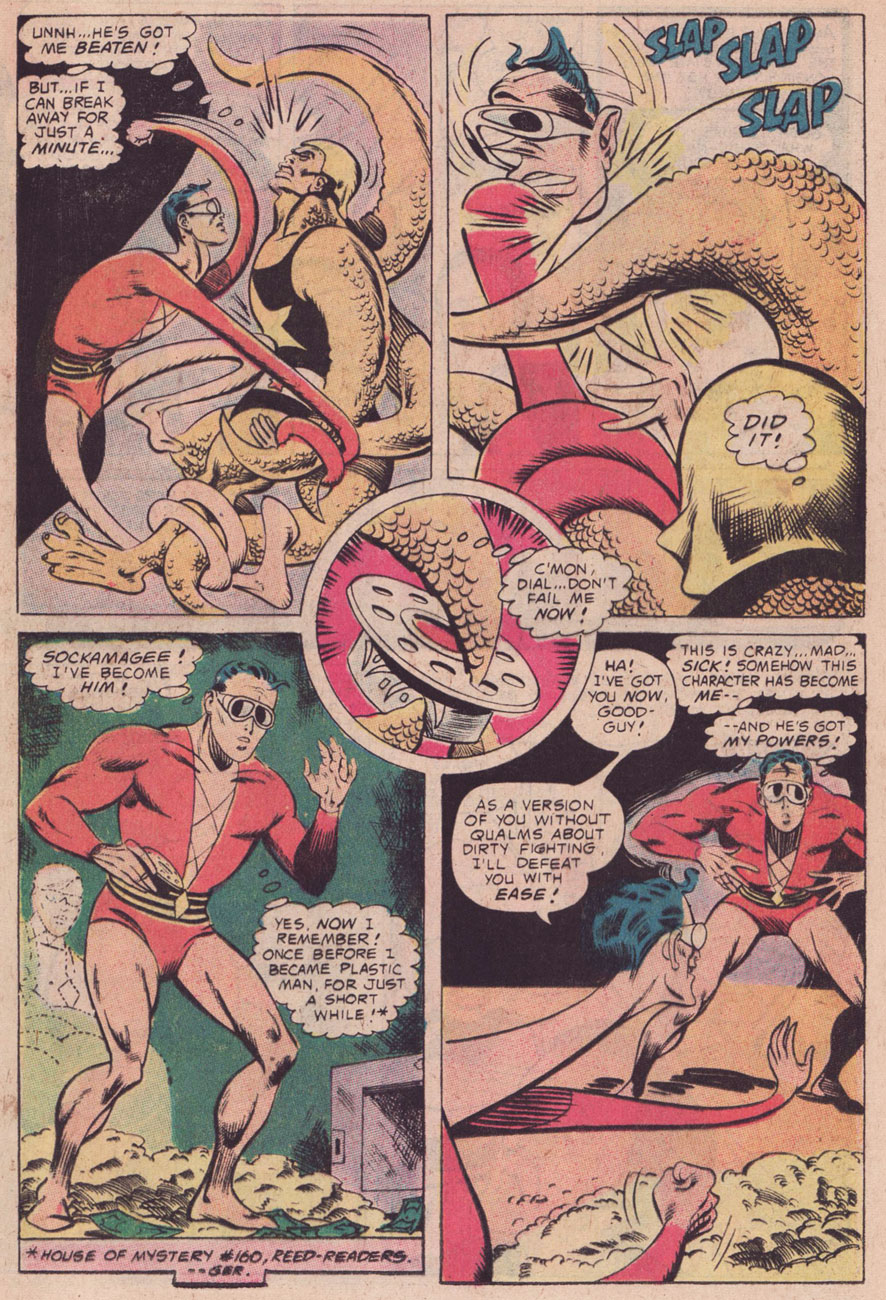
The last thing I’d like to mention is that my favourite Robby Reed appearance was in an issue of Plastic Man, of all places – to be more precise, in Plastic Man no. 13 (June-July 1976). In If I Kill Me, Will I Die? (read it here!), scripted by Steve Skeates, pencilled by Ramona Fradon and inked by Bob Smith, Reed not only gets to take on Plas (in more ways than one), but also falls deeply and magically in love with a professional hog-caller. Also, tentacles. Adorable *and* exciting!
« And they sure seem to understand each other! Listen to them jabber away! » « Oh, come on — you know that’s only baby-talk! It doesn’t mean anything! »
If you were to ask me (make that *us*; we’re unanimous on that point) what was the most consistently excellent American comics series of the Silver Age, the response would be Sheldon Mayer’s Sugar and Spike. « Say what? », I expect most of you will say. Look at it this way: S&S ran for 98 issues from 1956 to 1971, the entire series crafted by a single creator-writer-artist, whose commitment and level of quality never flagged. Unlike, say, Fantastic Four (the most likely pick, I expect), it didn’t take several issues to find its legs, it didn’t suffer from mediocre to dreadful inkers for half of its run, nor, well, the glory-hogging participation of Stan Lee. At Marvel, I’d be more inclined to propose Steve Ditko‘s (and dialoguists Stan Lee, Don Rico, Roy Thomas and Dennis O’Neil’s) run on Doctor Strange (1963-66)… but we again run into the snag of the directionless twaddle that followed Ditko’s departure. In terms of superheroes, my vote would go to Arnold Drake, Bob Haney and Bruno Premiani‘s Doom Patrol (1963-68). Yet my overall number two would have to be Carl Barks‘ Uncle Scrooge* (1952-66). There as well, lesser hands took over once Barks stepped away. It’s an industry, after all.
Speaking of lesser hands, « The Sugar and Spike tales flowed exclusively from Mayer, who had a contract stating no other artist or writer could produce stories featuring his toddler characters. That’s a rare sort of deal to cut (then or now) for a property that the publisher owns outright, but Sheldon Mayer had more than earned his place at DC as a prolific writer, artist and editor for many years. » Of course, that covenant was pointlessly broken by DC after Mayer’s passing. Shame on you, Keith Giffen. Mayer had also asked that his wonderful 1970s creation, The Black Orchid, never be given an origin or have her mystery dispelled. But of course, in 1988, that trust was pointlessly broken by DC. Shame on you, Neil Gaiman (« Well, Alan made the Swamp Thing a vegetable, I’ll make the Black Orchid a plant… he’ll be so proud of me! »)
It’s no exaggeration to claim that Sheldon Mayer (1917-1991) was one of the essential architects of the US comics industry. Without him, DC would have passed on Superman, and without the Man of Steel, it’s a cinch our culture would be in a vastly different state, pour le meilleur et pour le pire. But that’s just one of his many contributions, direct and indirect. Much praise has been heaped on Mr. Mayer, justifiably so. His work is inspired, lively, absolutely hilarious, and life-affirming. He truly was a versatile giant. Check out Ron Goulart’s recollections of his friendship with Mr. Mayer, for instance.
This is Sugar and Spike no. 36 (Aug.-Sept. 1961). In case you’re wondering, the NCS after Sheldon’s signature indicates his membership (in good standing!) in the National Cartoonists’ Society.
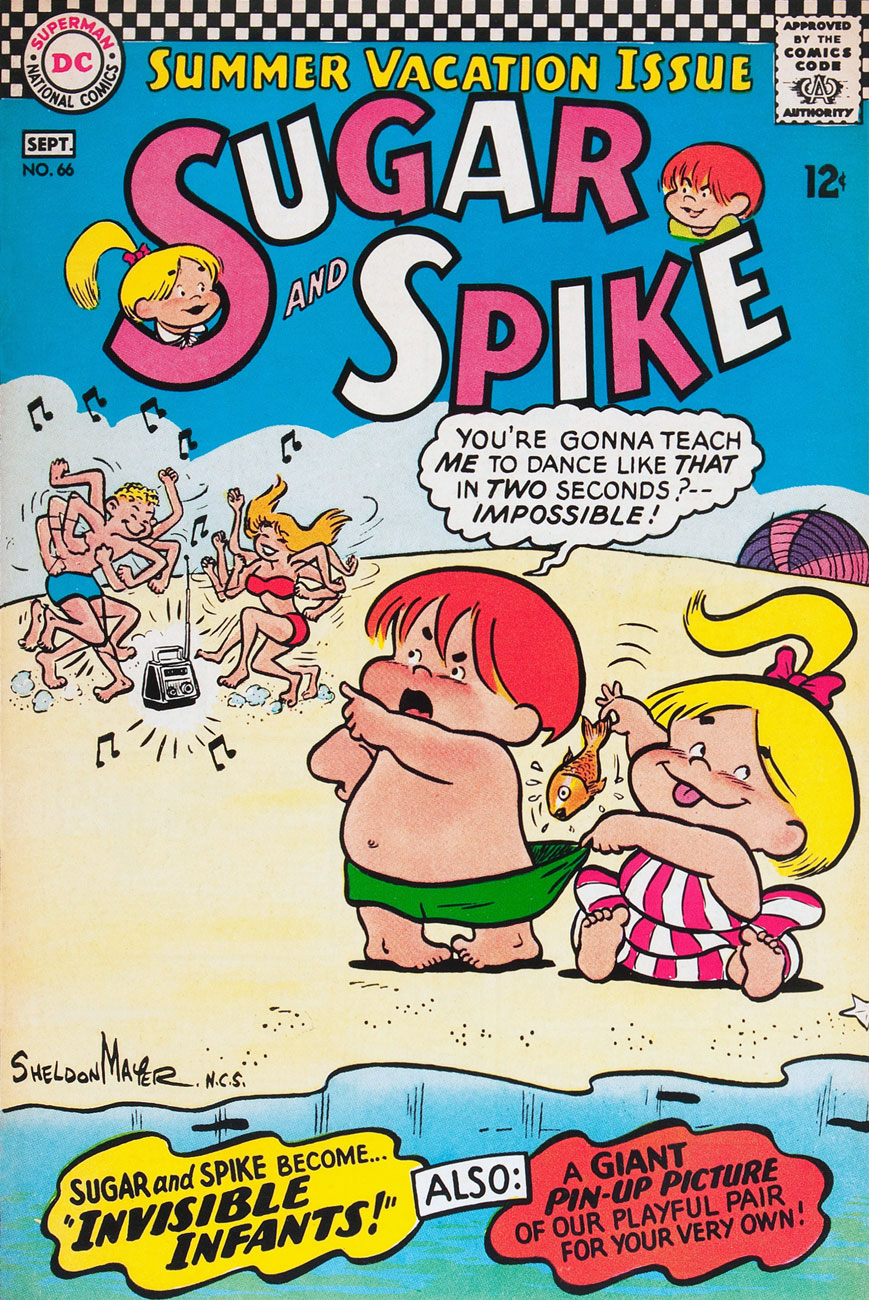
This is Sugar and Spike no. 66 (Aug.-Sept. 1966).
This is Sugar and Spike no. 79 (Oct.-Nov. 1968).
This is Sugar and Spike no. 80 (Dec. 1968-Jan. 1969).
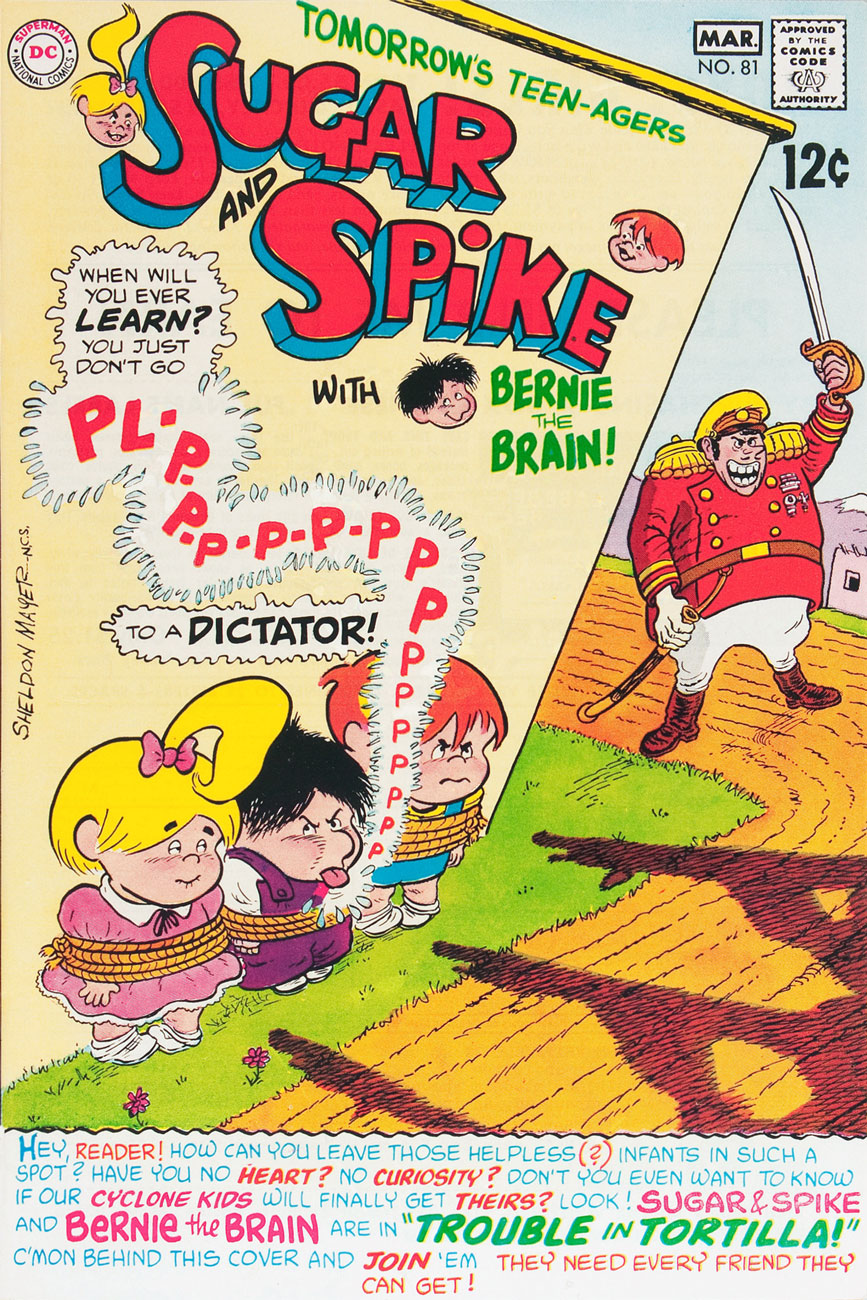
This is Sugar and Spike no. 81 (Feb.-Mar. 1969).
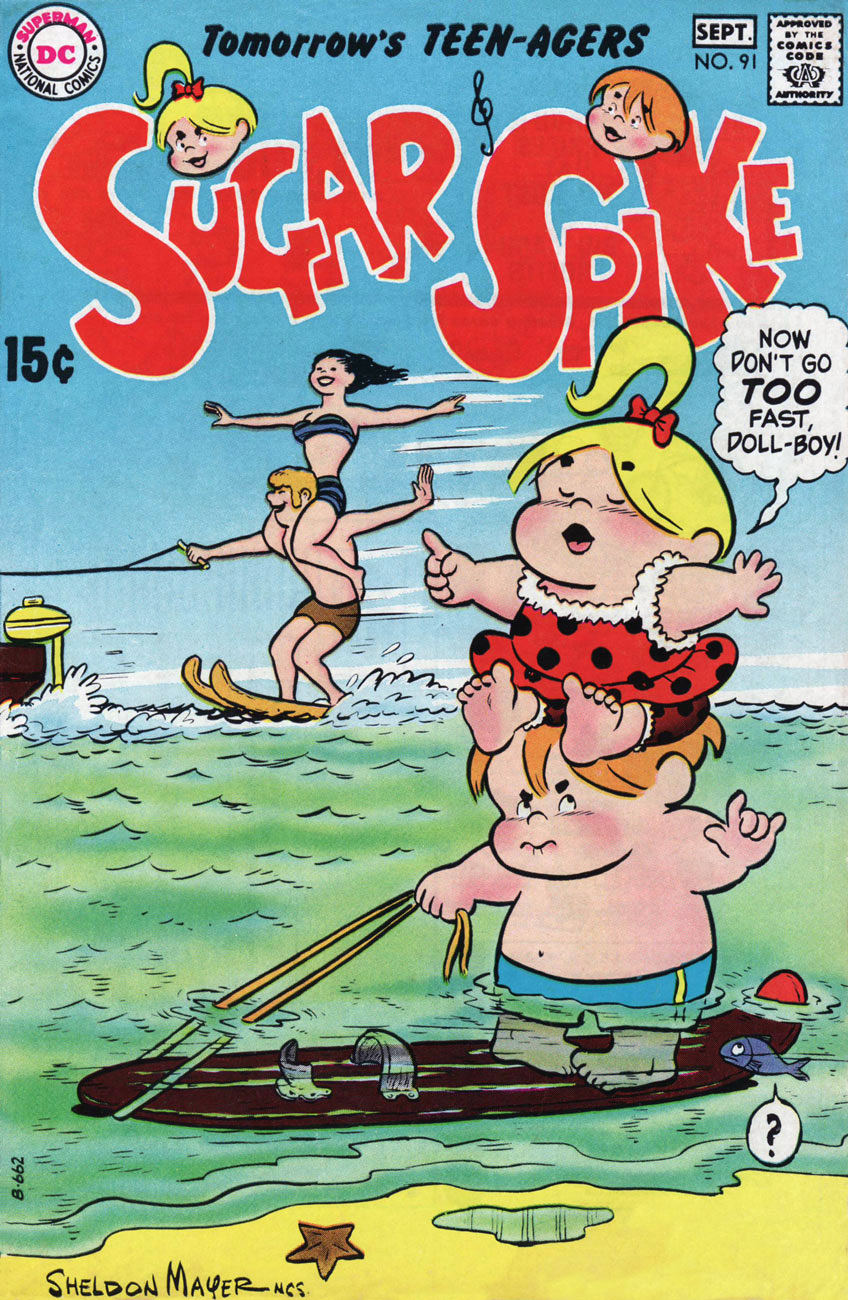
This is Sugar and Spike no. 91 (Aug.-Sept. 1970).
This is Sugar and Spike no. 96 (June-Jul. 1971).
This is Sugar and Spike no. 97 (Aug.-Sept. 1971). You’ll notice we’re featuring a lot of beach scenes… well, it’s seasonal!
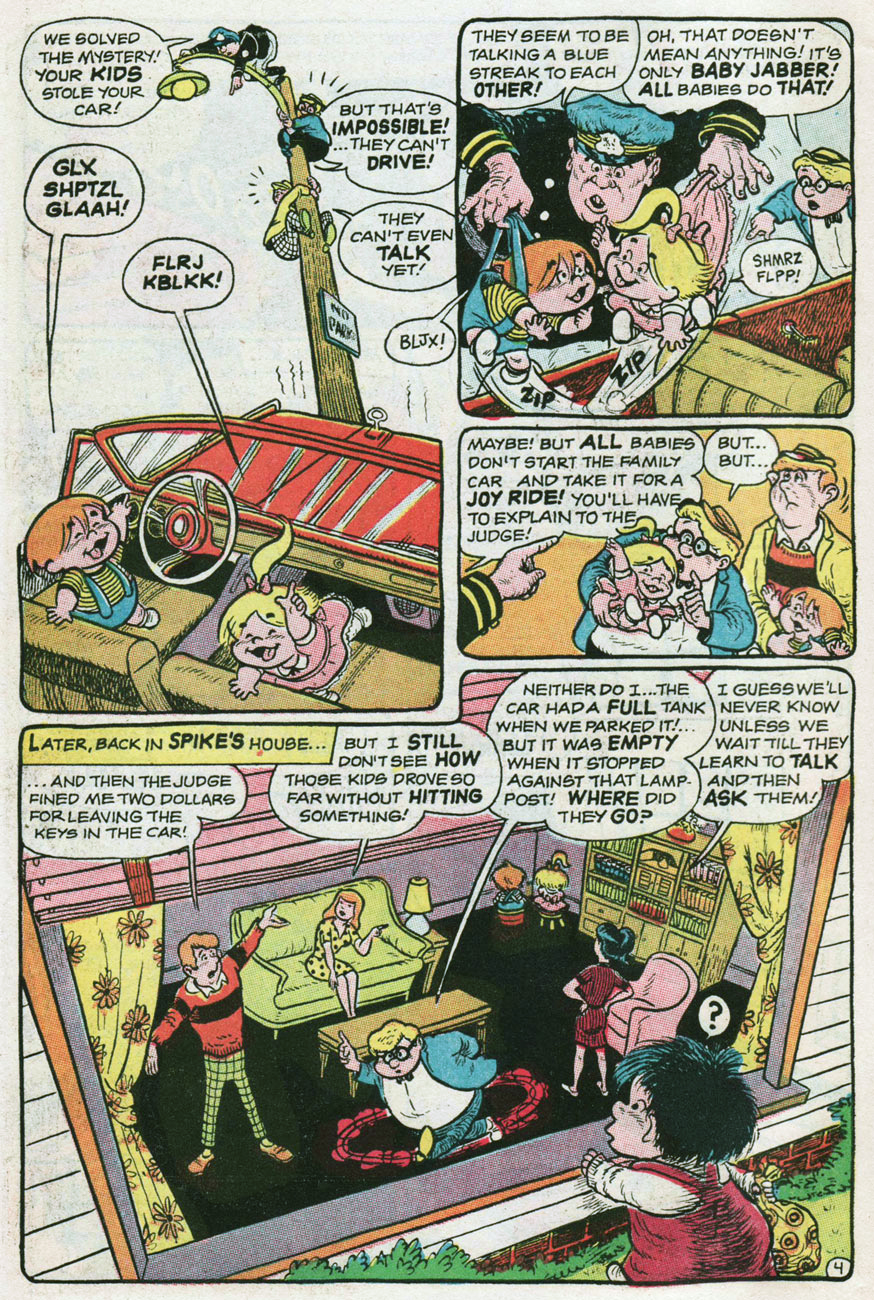
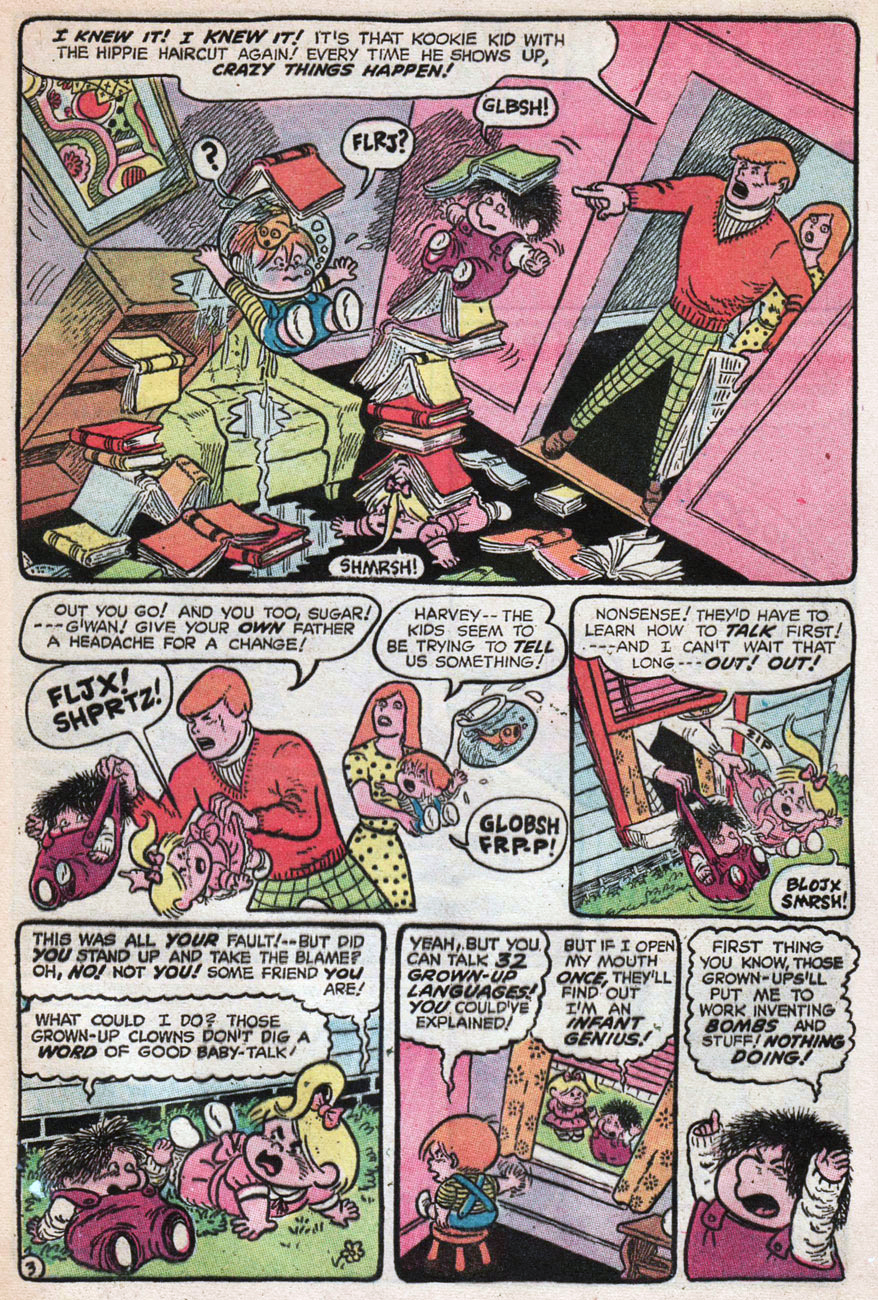
In what I imagine to be another benefit of Carmine Infantino‘s editorial ascent, Mayer’s work took a wild turn with issue 72 of S&S. A fine new character, Bernie the Brain, was introduced, Mayer’s layouts suddenly adopted extreme and distorted perspectives and his inking grew more florid and detailed. Honestly, Mayer’s work at that point was the closest DC ever came in style to that of Underground Comix. These changes gradually ebbed, and by issue 90, things were more-or-less back to the old standard. The cause? failing eyesight (cataracts, to be exact), which led to the book’s cancellation, rather than the more banal dropping sales. Don’t worry, Mayer underwent successful eye surgery and intermittently returned to the drawing board. But he mostly wrote… beautifully. We’ll return to that soon.
Here are a few examples (show, don’t tell!) of the wild ‘n’ wooly Sugar & Spike:
Page 15 from Sugar & Spike no. 79‘s The Mystery of the Swiped Sea-Turtle (Oct.-Nov. 1968)
Page 4 from Sugar & Spike no. 80‘s Adventure Inside a Monster! (Dec. 1968-Jan. 1969)
Page 3 from Sugar & Spike no. 84‘s Bernie the Brain’s Biggest Blunder! (Aug.-Sept. 1969)
Unfortunately, Sugar and Spike falls in that select category of comics series that aren’t popular enough to be fully reprinted (DC issued one volume in its Archive Editions series, usefully reprinting S&S nos. 1 to 10) and too popular to be truly affordable (Angel and the Ape is another). In addition, since the series sold well, but to a broader audience than the traditional fanboy collector set, the books are mighty hard to come by in decent condition, not to mention *complete*. The reason? Paper dolls. They enjoyed, for quite some time, great popularity. Sugar and Spike’s regular Pint-Size Pin-Ups frequently ran on the back of story pages (often the conclusion!), so their absence is a real collector’s bugaboo. Besides, they were quite charming, so why do without them?
Pint-Size Pin-Ups from Sugar and Spike no. 78 (Aug.-Sept. 1968). I should also point out that Mr. Mayer kept a sincere, attentive, unpatronizing relationship with his readers.









































 ~ ds
~ ds





 Who's Out There?