« She’s a haunted house / and her windows are broken. » — Scott Walker, “Big Louise” (1969)
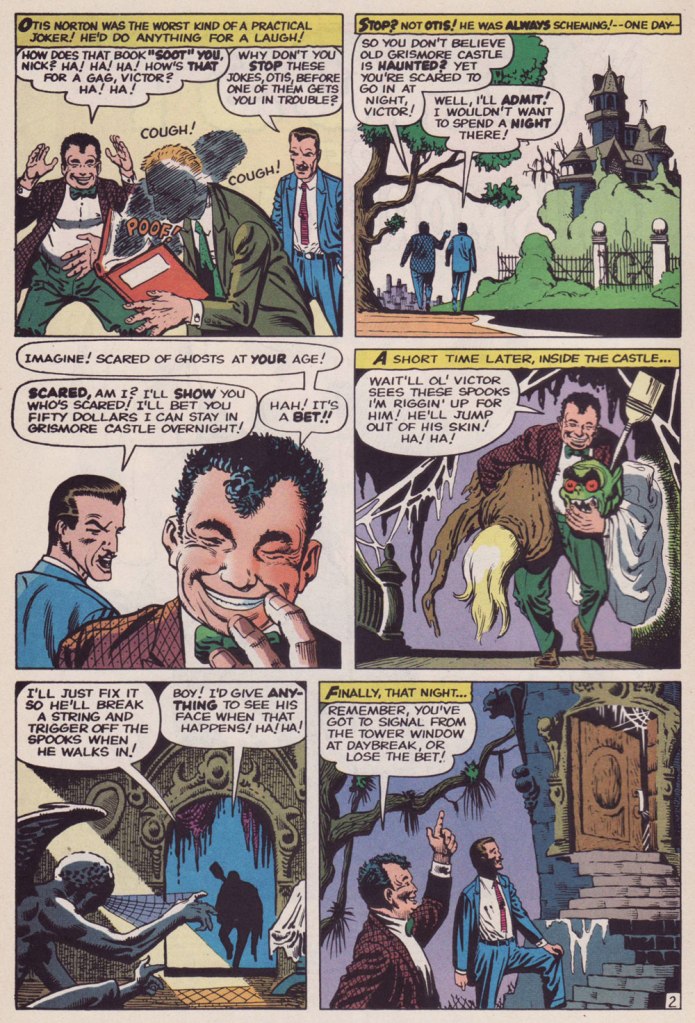
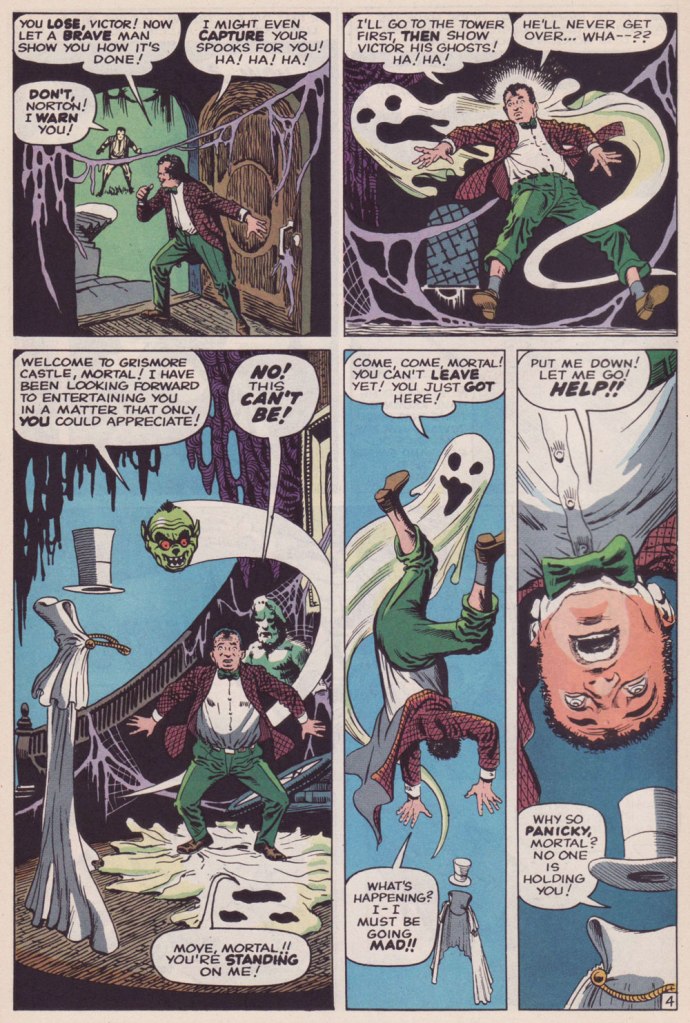
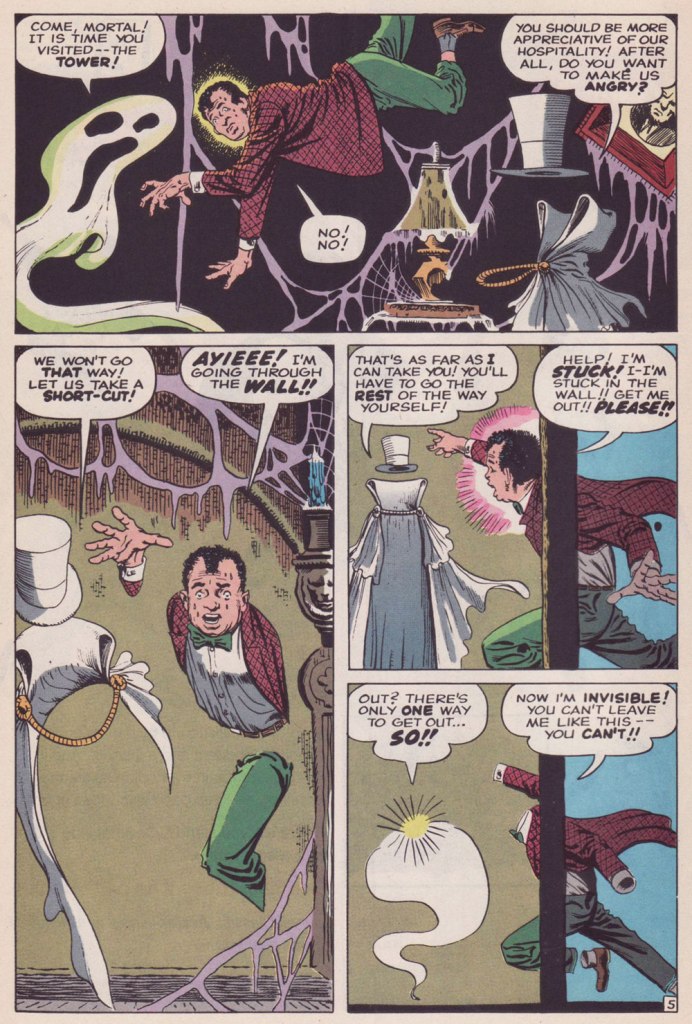
I’ve been wanting to share one of the all-time most beautiful art jobs Steve Ditko ever wittled, 1960’s The Ghost of Grismore Castle! (published in Strange Tales no. 79), but I don’t have that book. I do, however, own a 70’s reprint of it, in Vault of Evil no. 14 (October 1974), but the colouring and reproduction were so bland and washed-out that I knew that justice wouldn’t be done to this meritorious piece.
Then it hit me: I *had* seen a lovingly reconstructed presentation of the tale — has it nearly been… 30 years ago? Yikes!
It was reprinted with brio in the redoubtable Mort Todd‘s Curse of the Weird (no. 2, January 1994), a flawlessly-assembled anthology title he somehow conned Marvel into publishing in the early 90s.
So my gratitude goes out to Mr. Todd and, once more, my admiration to Mr. Ditko.
« We shot it from the original stats I dug out of the Marvel vault, rather than reprint VoE #14, and lovingly recolored it! Thanks for noticing! »
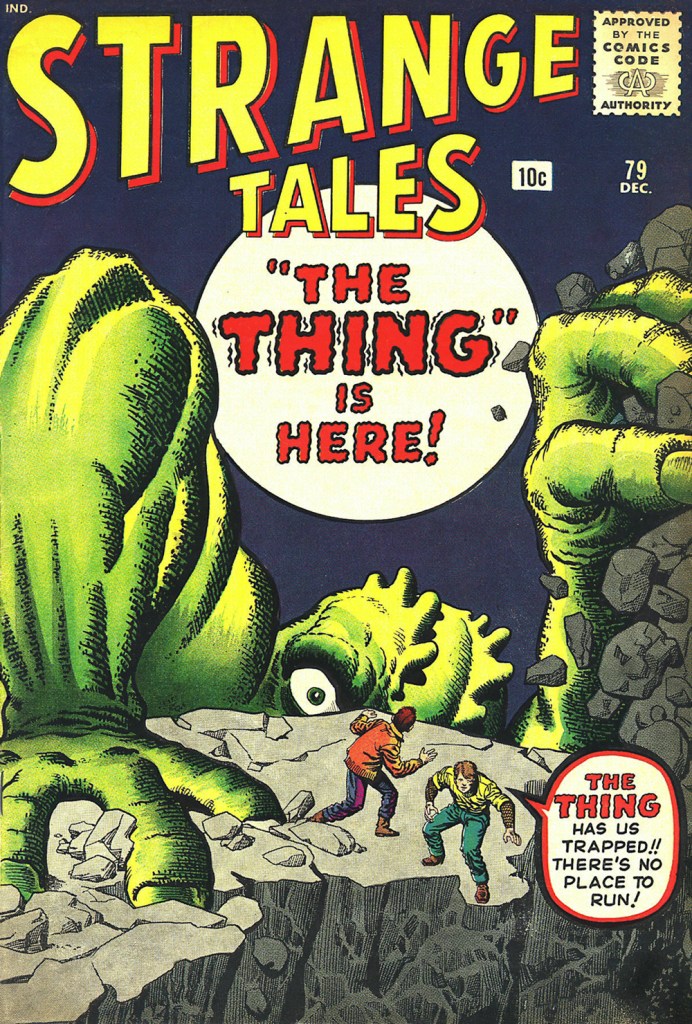
Oh, and as bonus, here’s the cover, one of those absurdly lush Kirby-Ditko collaborations. As usual with Marvel, all captions are de trop.
This is Strange Tales no. 79 (Dec. 1960, Marvel), pencils by Jack Kirby, inks by Steve Ditko. And duh, *obviously*, “The Thing” is here, Stan. Show, don’t tell.
The very 70’s update. This is Vault of Evil no. 14 (Oct. 1974, Marvel); cover pencils by Larry Lieber, inks by Frank Giacoia.
« Changing from the ghosts of faith to the spectres of reason is just changing cells. » — Fernando Pessoa
Today, let’s transport ourselves to the foggy, boggy British Isles, where every crumbling castle holds its lot of revenants and spectres within its mouldering walls.
The great cartoonist, tinkerer and beloved eccentric Frederick Rowland Emett (1906 – 1990) was evidently quite at ease within this spooky world, as you shall see. He first came to prominence as a prolific Punch cartoonist, beginning in the late 30s. In the 1950s, though at the height of his powers, he found himself struggling with waning eyesight (an exacting style was his!), so he brilliantly shifted his creative focus to building what he had hitherto been drawing. You may have encountered some of these creations in the 1968 film Chitty Chitty Bang Bang (Emett andRoald Dahl… fancy that!).
Scores of his cherished kinetic sculptures — trains (“Far Tottering and Oyster Creek Branch Railway“), flying machines (“Featherstone-Kite Openwork Basketweave Mark Two Gentleman’s Flying Machine“), mechanical computers (“The Forget-Me-Not Computer“), musical hydraulic clocks (“Aqua Horological Tintinnabulator“), musical instruments and nonpareil assemblages… are scattered far and wide across the world’s museums, many of these works restored and in fine functioning order. For instance, Toronto’s Ontario Science Centre owns ten or so (see them in action here!), and the Smithsonian’s National Air and Space Museum possesses a choice few.
Obviously, there is much to discuss about this astonishing creative soul (watch him at work!). In the spirit of manageable narrow focus, I’ve kept it to three of his spookiest Punch cartoons from the late 40s-early 50s. Just consider it an amuse-gueule, an opening salvo. We shall return with a more panoramic view, you just wait.
« But Sir Bedivere always walks the battlements at this hour. Can’t think what’s keeping him. »
« Some say it’s haunted by the First Earl AND the Ninth Earl… I wonder how they’d get on together… ? »
« Go on! You ask Him!… Ask him if he’s on essential business ». This magnificent scratchboard creation was completed in 1947.
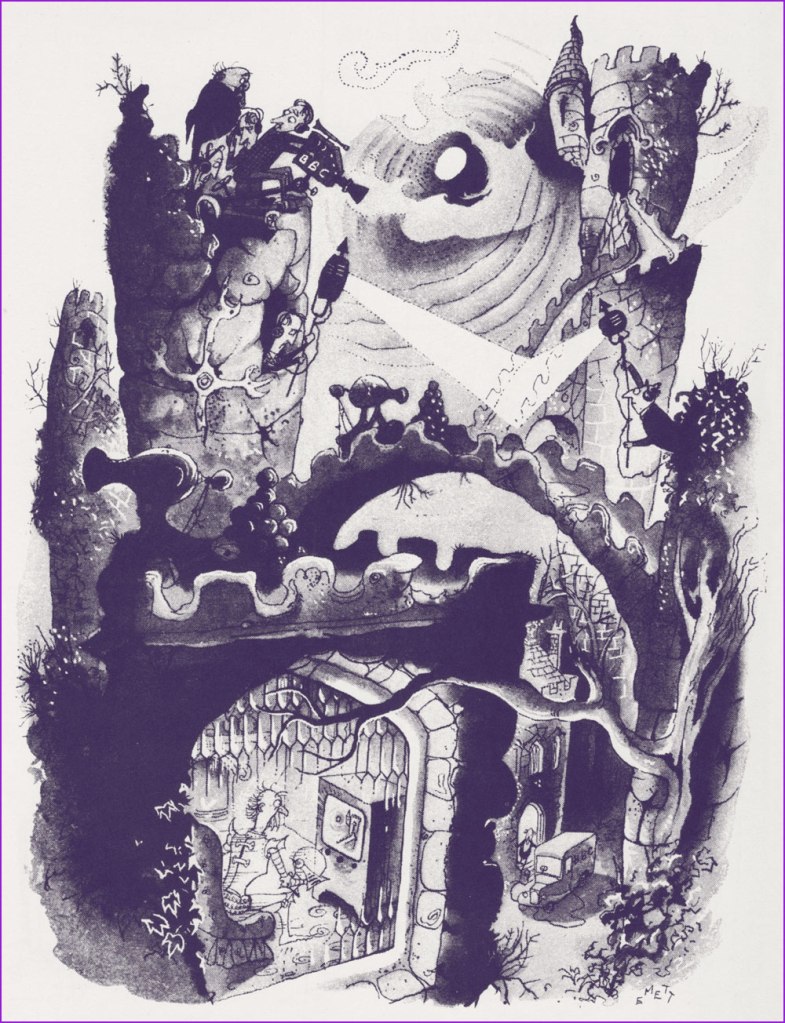
In a similar mood, here’s an excerpt or, as the Brits would say, an extract, from Far Twittering or The Annals of a Branch Line, being Some Interesting and Unusual Aspects of the Far Twittering and Oysterperch Railway Presented by Emett (1949, Faber and Faber, London). The caption tells us: « Locomotive No. 3 (Hector) at Mrs. Bristow’s Folly, now used as a water-tower. »
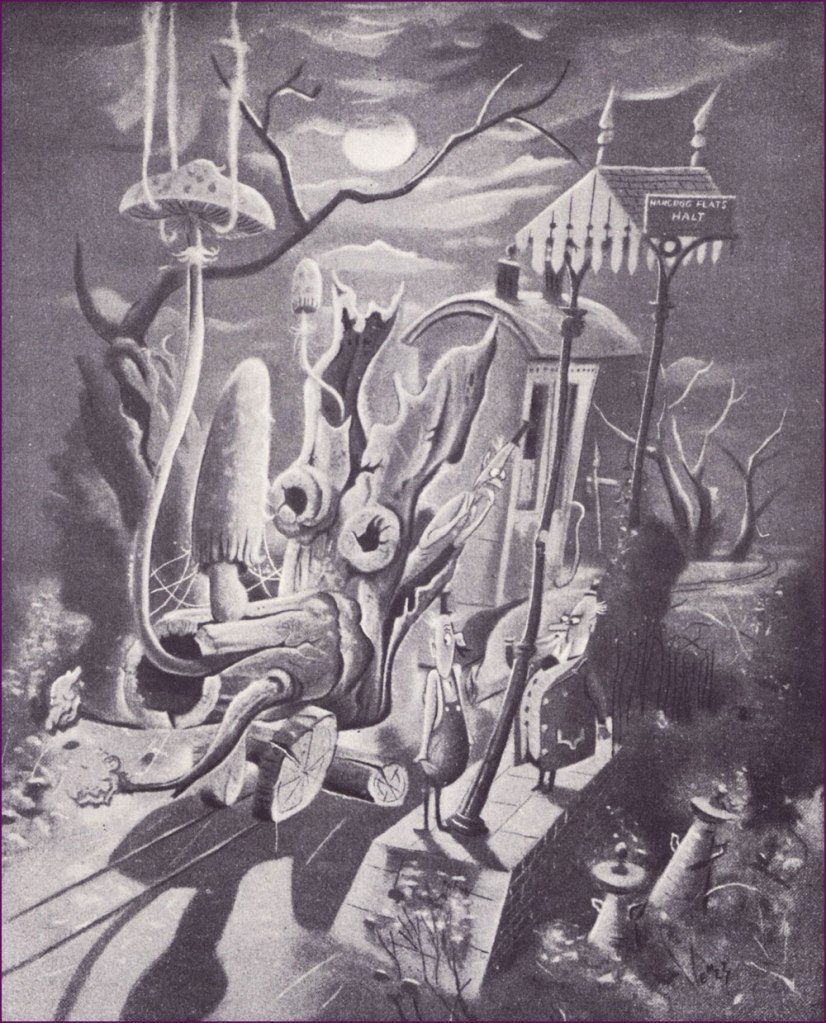
« I TOLD you never to take the 11:50 round by the Witch Hollow loop… ! »
A portrait of the artist, circa the mid-1950’s. Oh, he’s a wily one, all right.
« It is a well known fact that all inventors get their first ideas on the back of an envelope. I take slight exception to this, I use the front so that I can include the stamp and then the design is already half done. » — Rowland Emett
« Every scarecrow has a secret ambition to terrorize. » — Stanisław Jerzy Lec
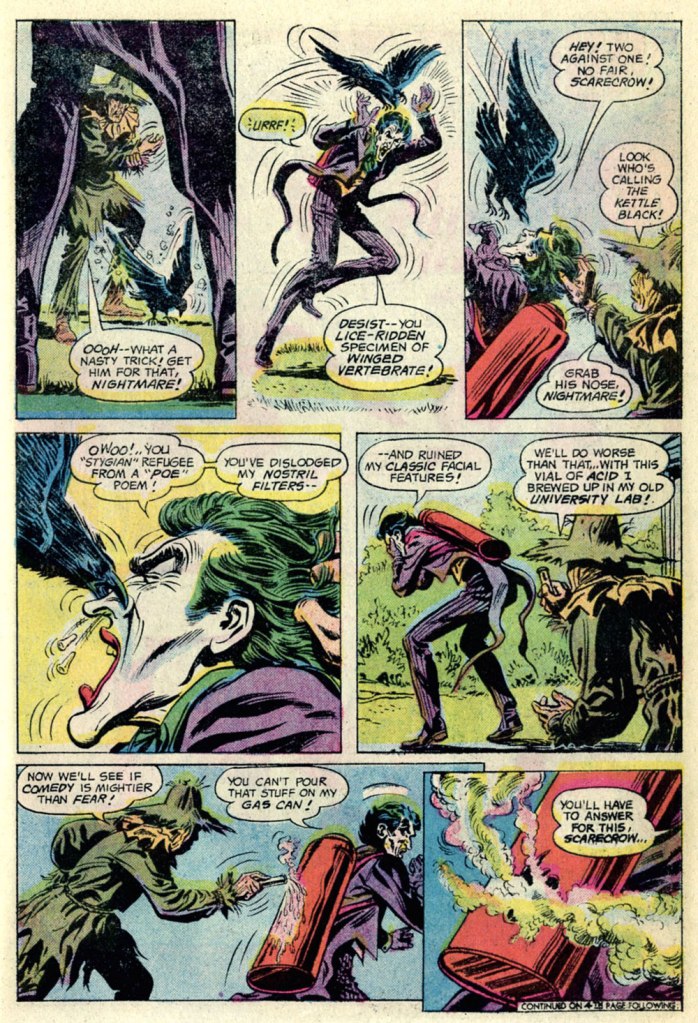
I can’t help but feel that a villain who makes time in his nefarious schedule for taking his, er, pooch for regular walks can’t be *all* bad. Likewise for a rogue who appreciates the cleverness and joie de vivre of a raven.
This is The Joker no. 8 (July-August 1976), featuring The Scarecrow’s Fearsome Face-Off!, which was edited by Julius Schwartz (in case the alliterative title hadn’t tipped you off), scripted by Elliot S! Maggin, pencilled by the always-solid Irv Novick and inked by Tex Blaisdell. Cover by Ernie Chan (as Ernie Chua).
In the mid-70s, The Clown Prince of Crime held his own book for ten issues (nine of which appeared at the time… the tenth only seeing print in… 2019!), and its stories chiefly (and rather winningly) focussed on his squabbles with other members of The Batman’s rogues’ gallery (certainly the finest in comics). I haven’t followed the dodgy shenanigans of the back issue marketplace in decades, but I was amused and bemused by the lofty prices that this otherwise-innocuous little series commands. Overflow from his cinematic popularity, perhaps?
I like the way Professor Crane works. Over these past couple of years, this last two panel sequence has probably come to pass in real life more often than one would care to count.
The Joker adopting a hyena as a companion was but a cruel cover dodge, but The Scarecrow‘s pet raven, Nightmare, is present and accounted for, superbly crafty and most efficient, just like the genuine article!
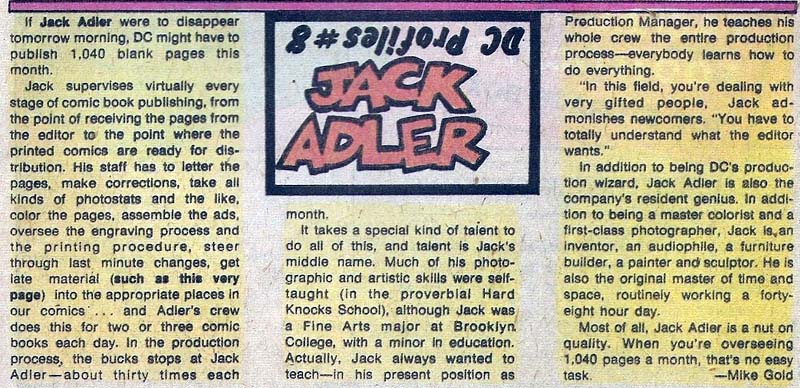
The same page, from the original printing. In closing, a slight editorial note: It’s easy to forget that, unless you kept close tabs on the printer’s work, most mainstream comics were quite badly printed… it’s especially easy to forget since much of the more popular work has since been reprinted from the original art or photostats, and digitally coloured-and-printed. Conversely, when it comes to the work of defunct publishers, and if the original artwork, or quality photostats of same, is no longer in existence or otherwise unavailable, reprinters have to make do with a flawed, not to mention secondary, sources — at best. For instance, the printing of my original edition of this Joker issue is dreadfully out of register. In the wings, things were quickly shifting at DC: as of late ’75, Carmine Infantino (publisher, etc.) and Nick Cardy (art director, etc.) were out, and an absolutely crucial production technician, Jack Adler, was being sidelined. He would retire a few years later. Long story short, Sturgeon’s Law in action, and why I went with the digital colour job. After toning down the contrast a bit. A guy’s got to have standards.
« Dennis the Menace was probably the most realistic comic book ever done. No space aliens ever invaded! » — Gilbert Hernandez
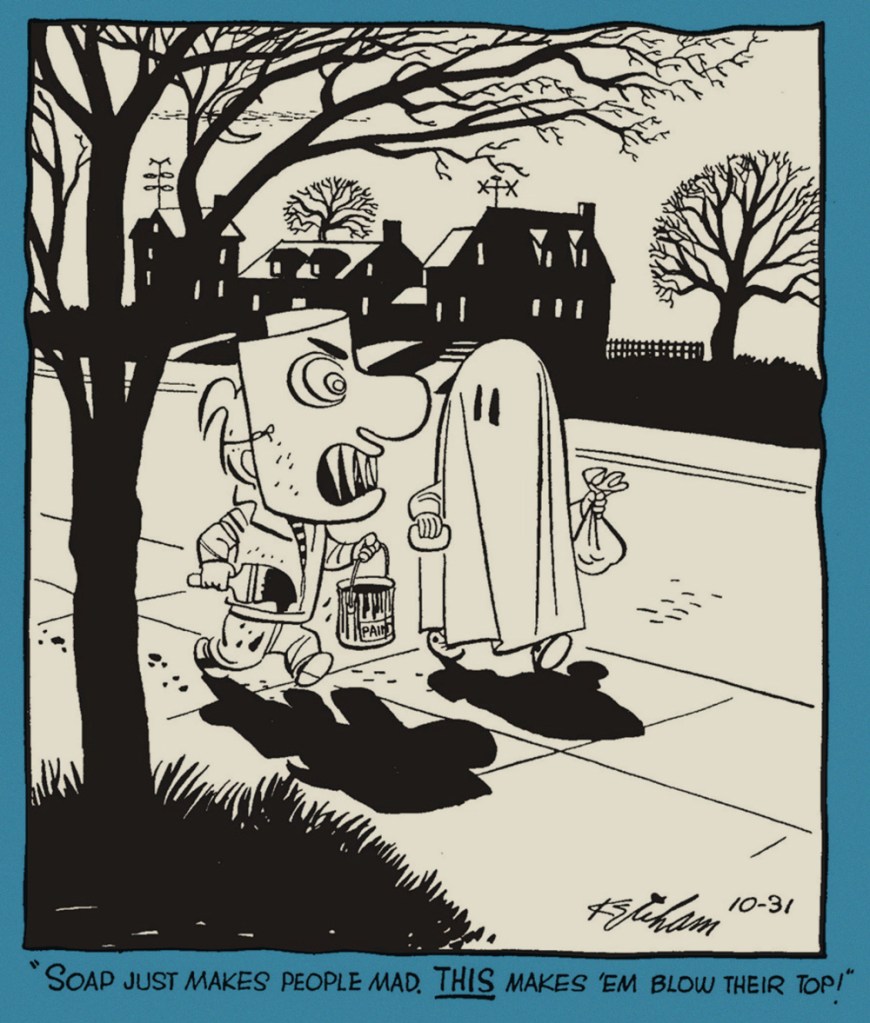
Is it already October? So it is. Well, here we go again with our annual Hallowe’en Countdown. We’ll kick this edition off by featuring that pint-sized bundle of toxic toddler masculinity, Dennis the Menace (I can’t help but think that his French name, Denis la Malice, is a far more accurate description of his sociopathic essence).
Here at WOT?, we’re both (amble over to ds’ earlier DTM spotlight) huge fans of Hank Ketcham’s cartooning finesse… I mean, these are beautiful! But… drawing skill aside, the stuff is hard to take is large doses. To quote one frazzled babysitter to Dennis’ parents: « how can you stand it? »
Dennis’ first Hallowe’en, from Oct. 31, 1951, the strip’s inaugural year.
October 30, 1952.
Just put yourself in Dennis’ parents’ shoes, and you get a better sense of the sheer magnitude of his malevolence. His poor folks don’t seem to have done anything to deserve being forever trapped in this relentless cycle of humiliation and injury. October 31, 1952.
The old lady didn’t think it was so silly. October 31, 1953.
This is Dennis the Menace Bonus Magazine Series no. 155 (July, 1976, Fawcett).
And a look inside…
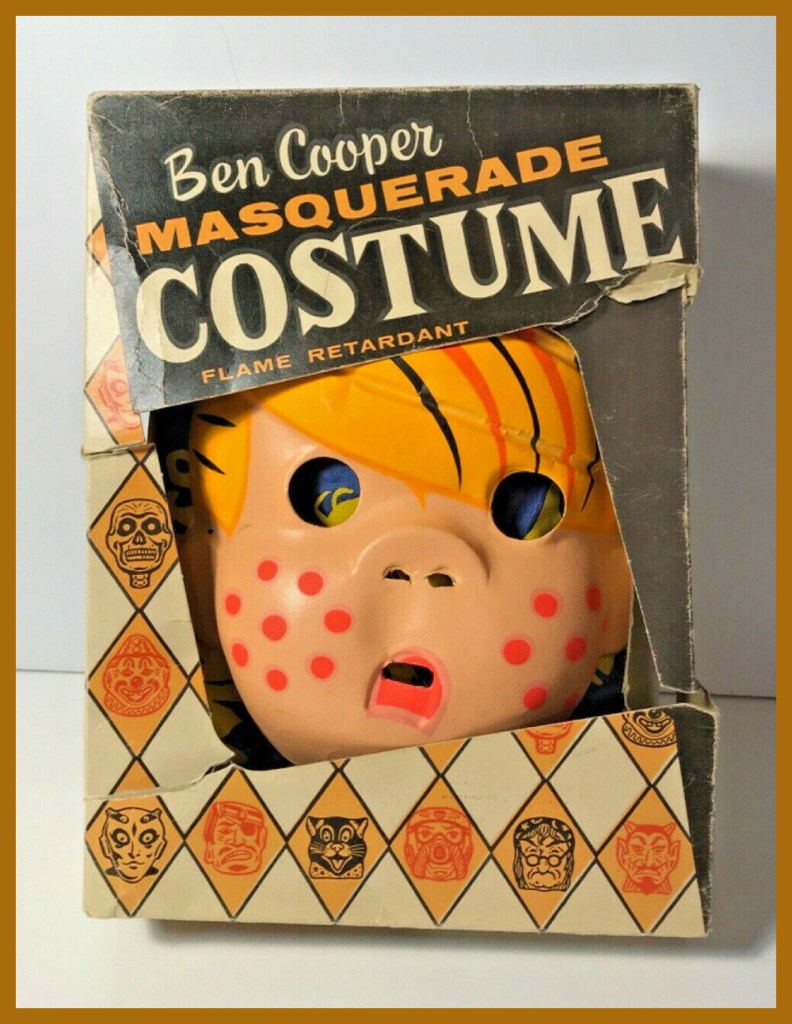
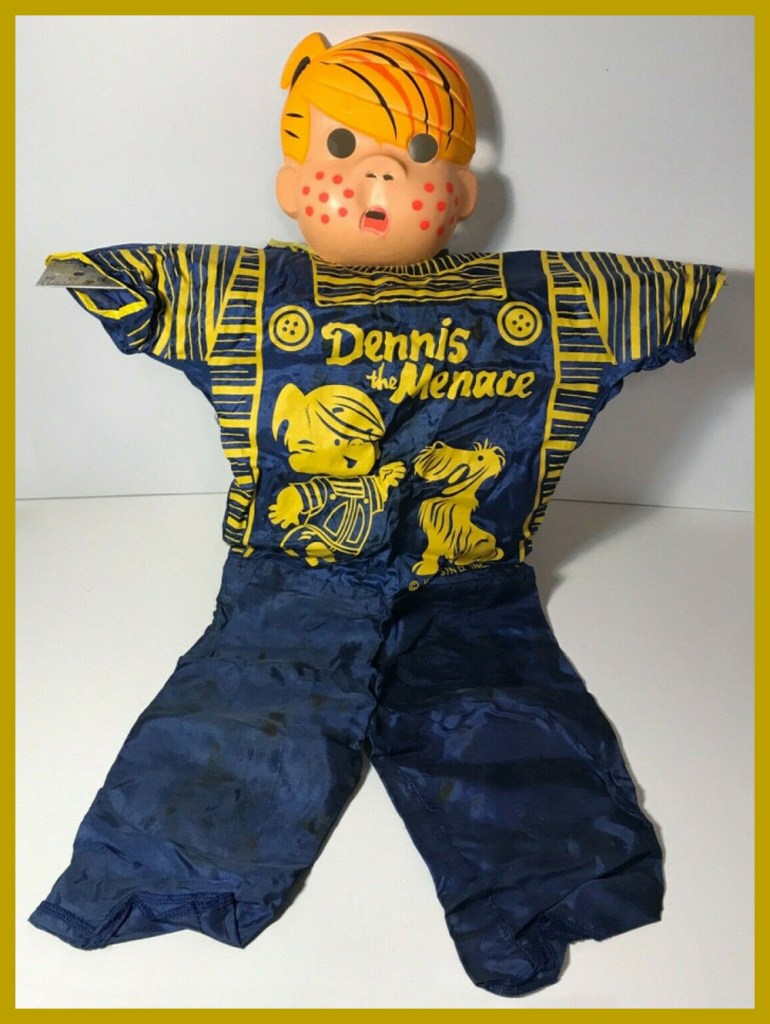
Back in the day, you could *be* Dennis (more or less) for trick or treating, thanks to that fondly-remembered purveyor of cut-rate (but cool in their way) costumes, Ben Cooper, Inc.
A fuller look at the Dennis ensemble. And do check out this bit of Ben Cooper history!
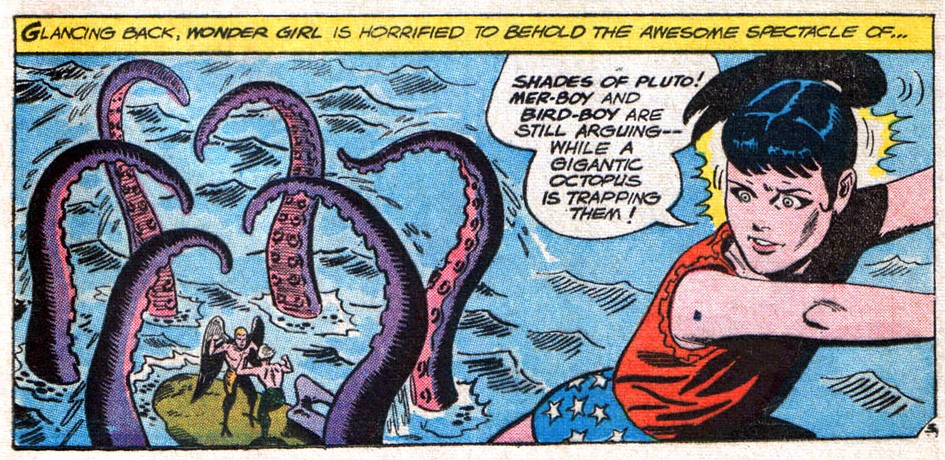
We begin with a page (and a panel) of The Phantom Fisher-Bird!, published in Wonder Woman no. 150 (November 1964):
I’ve never heard of an octopus using its tentacles by sticking them out of the water and forming a cage, but I suppose that’s the least of our worries.
I say, let ’em die! At least the octopus won’t have to decide whether to have fish or fowl for dinner.
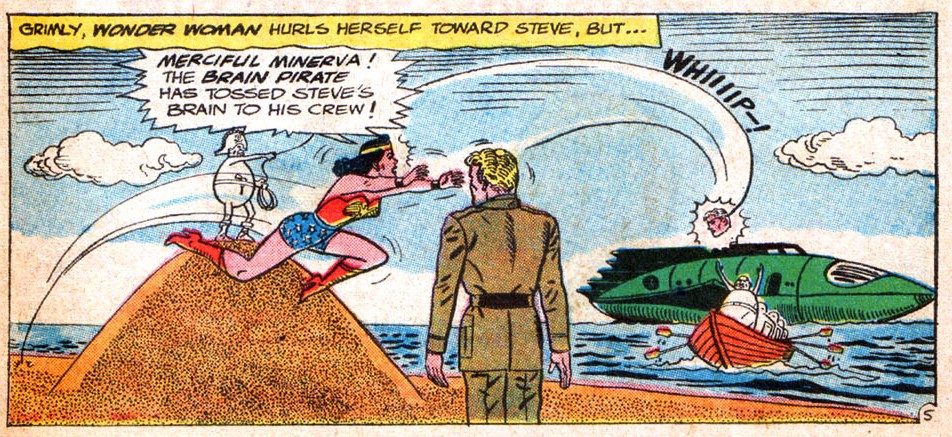
Two panels from Battle of the Boiling Man, published in Wonder Woman no. 154 (May 1965):
This octopus is incidental, but handsome!
That’s ‘Gesundheit’ with an S, thank you.
Page from I Married a Monster, published in Wonder Woman no. 155 (July 1965):
I really enjoy the madcap world of Golden Age funny animal comics, and they’ve often made it into various Tentacle Tuesdays. Yet not everything fits into the somewhat narrow scope of tentacles (shocking, I know!), so I am pleased to take this fun gallop through some favourite covers that are quite devoid of cephalopods. Doing so involves going back some seventy, eighty years… a difficult to grasp concept for those of us who were not around back then.
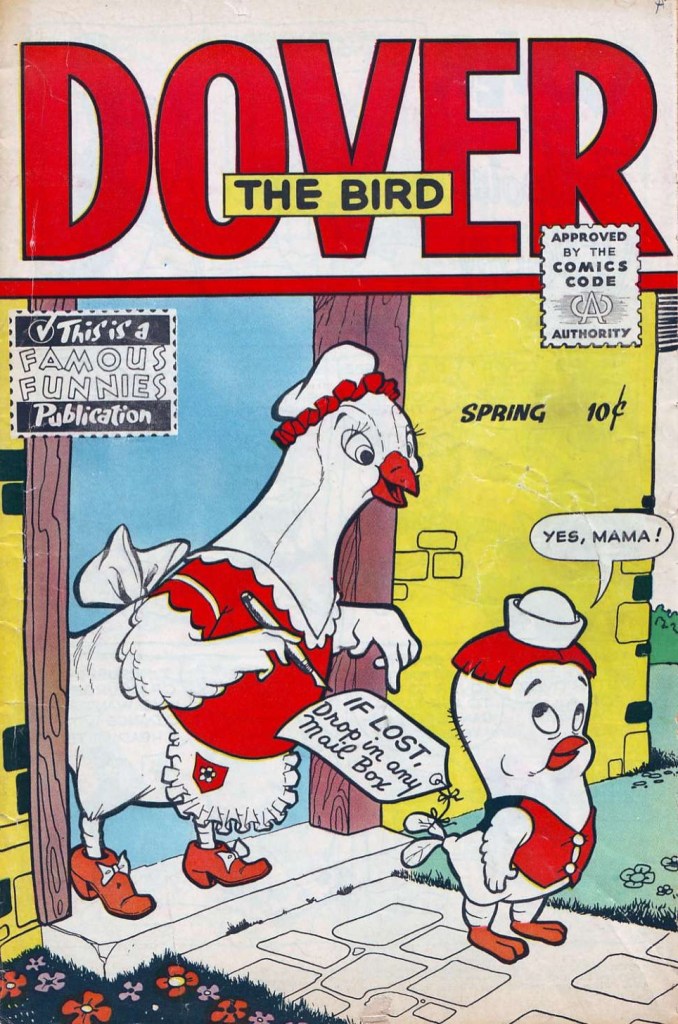
This one-shot comic from Famous Funnies featuring a sweet cover by Dave Tendlar may not be-laugh-out-loud funny, but makes up with charming innocence what it lacks in the hilarity department. This is Dover the Bird no. 1 (Spring 1955, Eastern Color Printing).
My thirty-something colleagues consider movies from the late 90s to be ‘ancient’, so I can just imagine what their reaction would be to a comic from, say, 1942! Yet I feel emotionally close to these covers (whether artistically accomplished, entertainingly weird or just plain drugged-out) – humanity has not changed nearly as much as we tend to assume, and albeit some sources of humour require an historian’s explanation, others are every bit as funny and entertaining now as they were back then. As for talking animals, that goes back to the dawn of human history (Aesop’s fables readily come to mind, and Aesop was surely not the inventor of this concept!)
One could dedicate a whole lifetime to digging through this particular slice of history – I’ve tried to go for some variety in this post, but of course I am (happily) constrained by my own tastes in the matter. Here, then, are some Golden Age covers featuring funny animals that have amused, entertained or puzzled me.
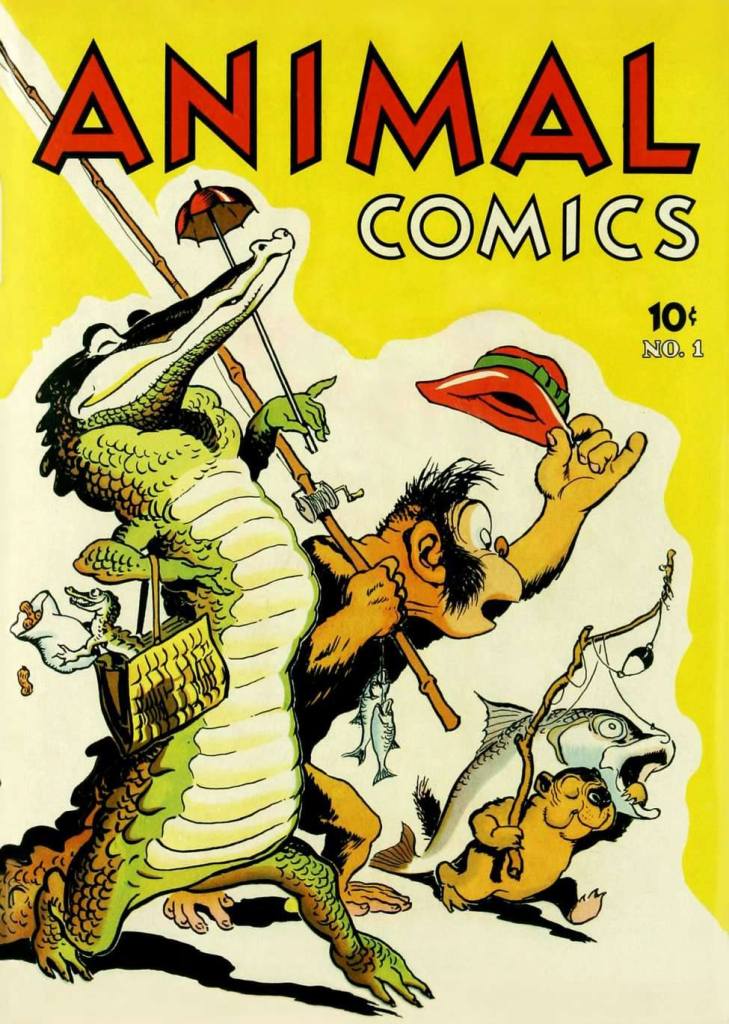
Animal Comics no. 1 (December 1942, Dell), with a cover by H.R. McBride, is an amalgam of details both adorable and creepy – the harrowing expression of the fish contrasts wildly with Madame Crocodile’s peanuts-pilfering offspring and her flirty cocktail parasol, while her crocodile-skin purse makes me think of Disney’s Three Little Pigs cartoon (1933, Silly Symphonies). In case you’ve never noticed it, the third pig, the one with the brick house, has family pictures on his wall… for example, a string of sausages labelled “Father”. Black humour, indeed. Animal funnies are often dusted with a good sprinkling of the gruesome, as when a talking duck eats chicken legs for dinner.
The insides have two Walt Kelly stories, including the first appearance of Pogo Possum and his friends!
Fast forwarding four years, we fall into pleasantly loopy territory of Fox Features’ Nuttylife no. 2 (Summer 1946, Fox Comics). Despite it being number two, this is technically the only issue, issue number 1 having appeared as Krazy Life, and issue number 3 and onward becoming Wotalife Comics. I can’t find credits for the cover, but the insides contain Pat Adams with Ellis Chambers (“One day a little goil went to her Grandma’s joint…”), Tim Howe and Cy King. Ellis Chambers by himself definitely deserves a separate post – take a glimpse at Eddie Elephant – 1946 Hallucinogenic Funny Animal Comix by Ellis Holly Chambers, for example.
I couldn’t very well leave Felix the Cat out of this post! I won’t go into the complex history of this character, but suffice it to say that this is one gorgeous cover. Clearly I’m not the only one to admire this image, as it was used for the cover of Craig Yoe‘s wonderful anthology Felix the Cat – Greatest Comic Book Tails (2011, IDW), which I highly recommend. This is Four Color no. 135 (February 1947, Dell Comics), with a cover by Otto Messmer.
The American Comics Group is responsible for many a goofy plot, source of my long-lasting affection for some of their titles (see Tentacle Tuesday: ACG’s Adventures Into the Tentacles). ACG’s Ha Ha Comics are a riot, all right, but I have two favourites among the 88 issues released. The first is Ha Ha Comics no. 11 (August 1944), with a cover by Ken Hultgren. A joke doesn’t have to be elaborate to be funny – something about the expression of the indignant man-eating lion and his wild mop of hair cracks me up!
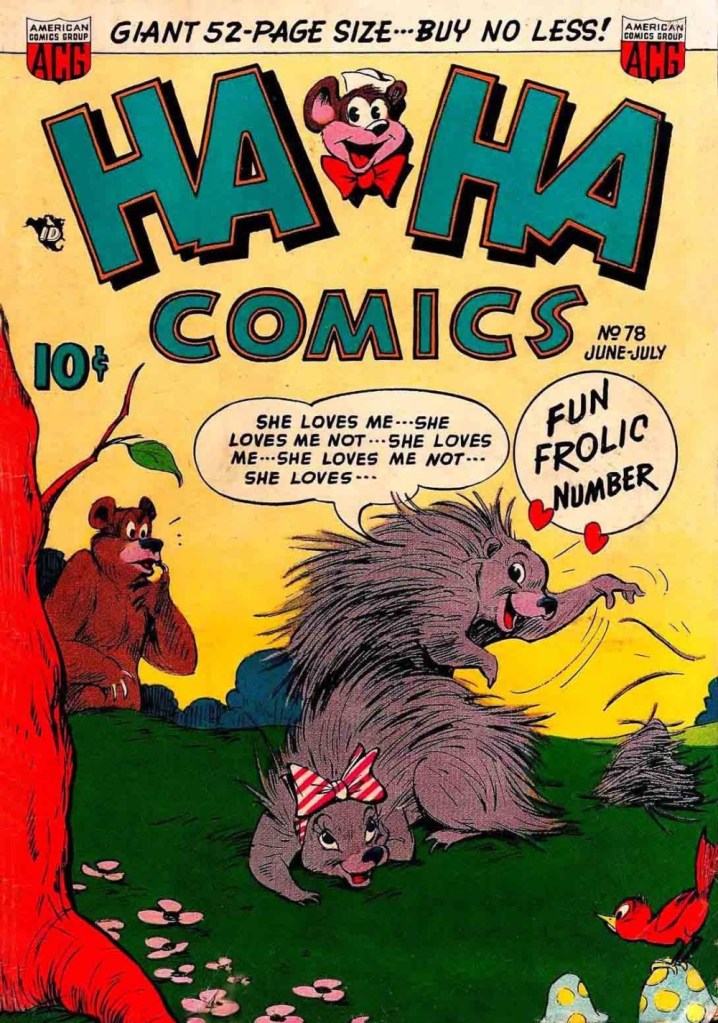
The second is Ha Ha Comics no. 78 (Dec-Jan 1951), cover artist unknown. I like porcupines in general, but here we are presented with a truly bizarre situation – a porcupine who tears out his sweetheart’s quills one by one to figure out whether she loves him… (unless she’s just a friend helping out, and he’s in love with some other porcupine). Kinky, whichever way you look at it.
Going a few years back, we take a little inter-planetary voyage with Coo Coo Comics no. 38 (March 1948, Pines/Standard Comics), with a cover by (possibly)Vince Fago. I am very fond of this purple-green monster who looks like he’s suffering from a bad hangover (or terminal cretinism). Coo Coo Comics is credited with having introduced the first funny animal superhero (in its very first issue, published in October 1942). That little guy was Supermouse…
The insides contain some Frank Frazetta stories, in case anybody is interested.
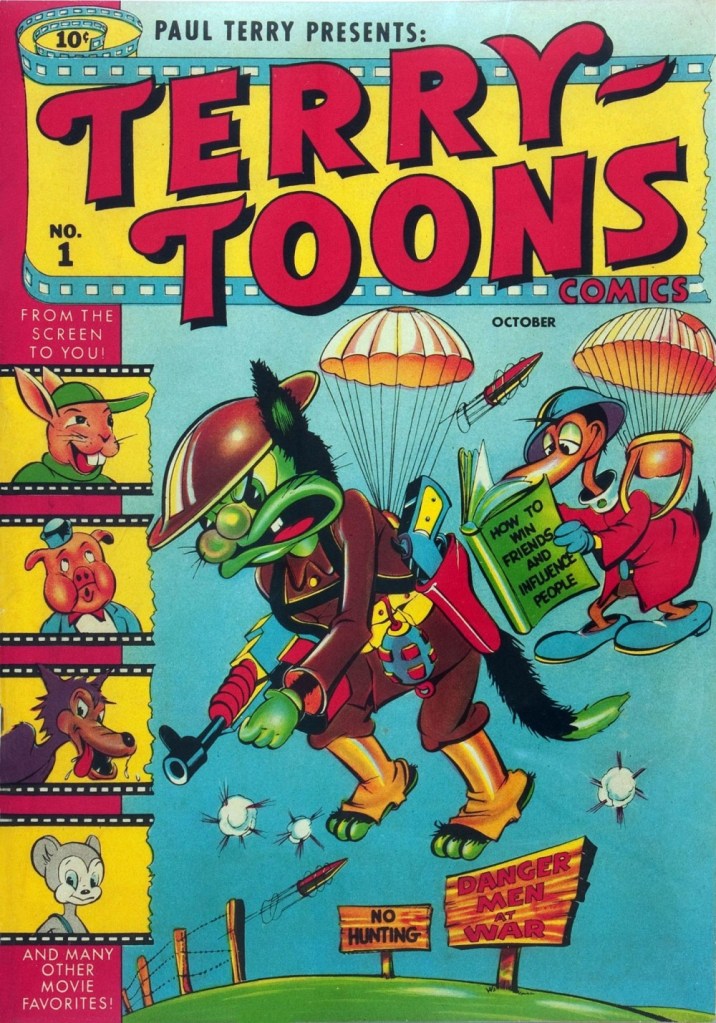
… but the other contender for this title was Terrytoons’ Mighty Mouse, also introduced in October 1942 (under the name of ‘Super Mouse’) in the theatrical short The Mouse of Tomorrow. That’s enough to get anybody confused in all these mice! This is Terry-Toons Comics no. 1 (October 1942), with an Ernie Hart cover that hints at the influence that funny animal comics had on the underground comix artists:
Today’s Tentacle Tuesday is a really fun one, given that its focus is the snazzy art of Richard Sala (1954-2020), deceased, alas, far too soon at 65, when he was about to launch a new webcomic.
Granted, perhaps the plots of his stories often don’t make that much sense. But! they’re awash in half-naked damsels, sad-eyed defeateds, vampires and ghouls of all kinds, a mad scientist or two, dark alleys and schoolgirl academies and strangely ominous museums and… all of this drawn in Sala’s easily recognizable, deliciously scary style. Peculia is definitely involved in this post (see co-admin RG’s Hallowe’en Countdown IV, Day 17), but so is Judy Drood, girl detective, plucky heroine and first-rate fighter… and a host of other characters! So follow me as I kick things off with some beautifully painted Evil Eye covers (and backs!) – Sala had an impeccable sense of colour.
Back cover of Evil Eye no. 2 (October 1998). An actual octopus and reasonable-cause-for-belief plant tentacles!
Evil Eye no. 4 (August 1999, Fantagraphics). Perhaps it’s a bit of a stretch to call these arms ’embracing’ Peculia tentacles, yet there’s always room for poetic licence.
The back cover of Evil Eye no. 8 (September 2001, Fantagraphics).
Back cover of Evil Eye no. 9 (July 2002, Fantagraphics). Judy is caught between a rock and a hard place, as usual, but fear not! She’ll bash her way out, sooner or later.
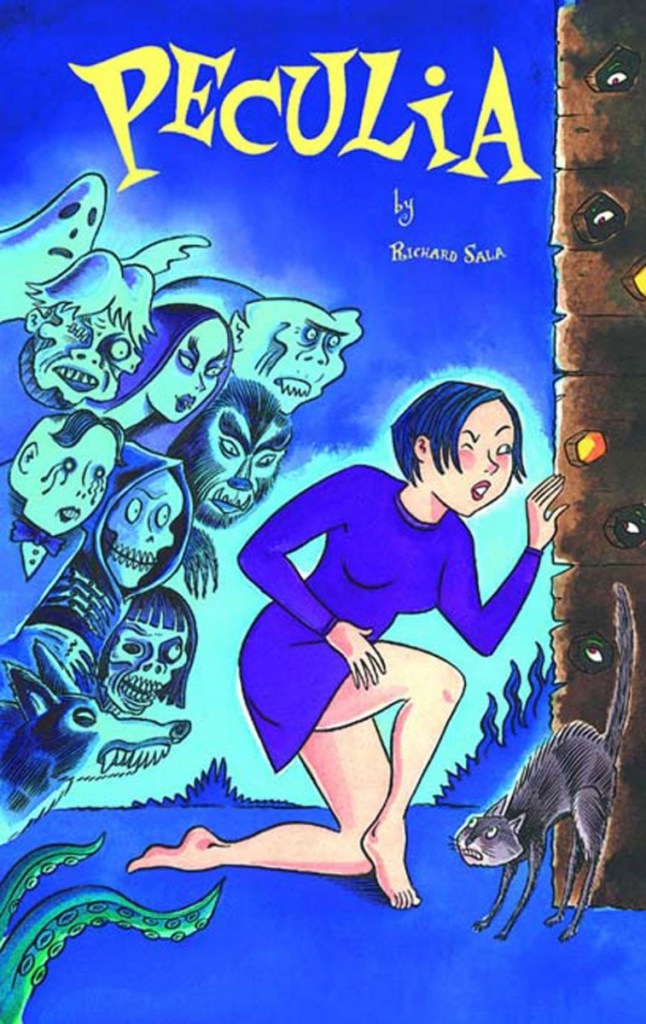
Peculia, a 2002 collection of the titular heroine’s strips (published by Fantagraphics, as usual).
I complimented Sala’s beautiful colour work earlier (and hopefully demonstrated this point!), but Sala’s black-and-white work is equally satisfying. Shall we have a look-see?
Some plant tentacles make an appearance in Peculia and the Groon Grove Vampires (2013, Fantagraphics):
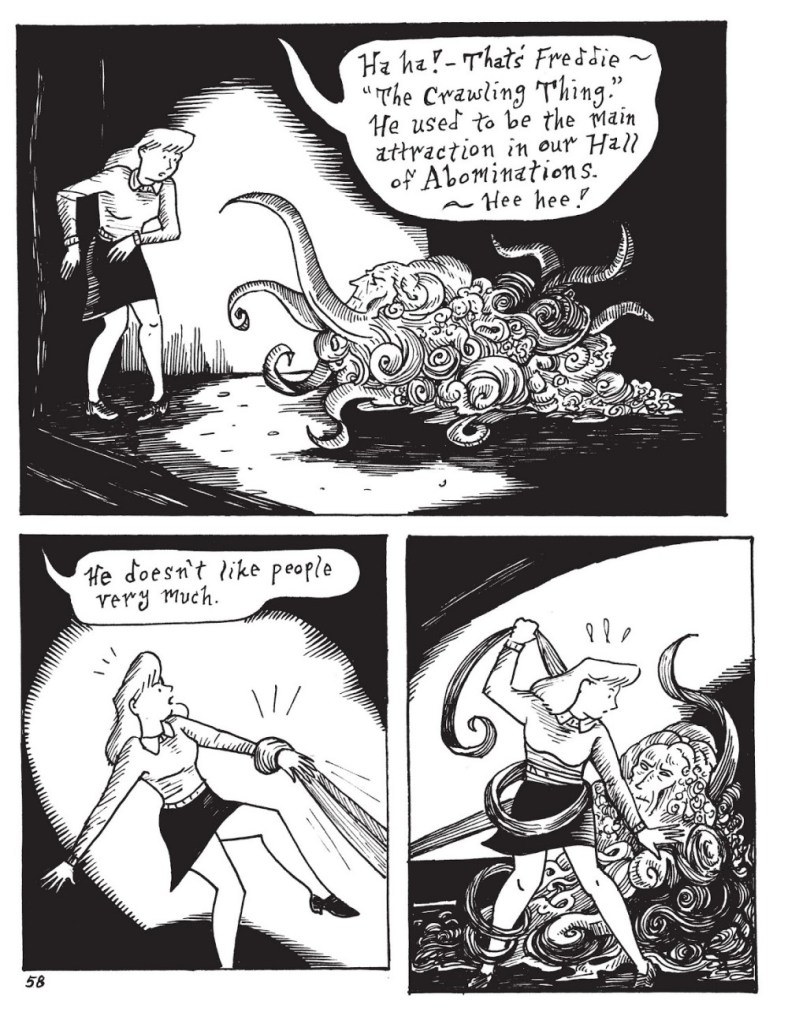
The Grave Robber’s Daughter (2007, Fantagraphics) spins the yarn of what happens when Judy Dredd is stranded in a strangely empty town… empty until the clowns come out, that is. I really enjoyed this 96-page tale (read it here), with its quick-paced, cohesive plot, top-notch art and of course a good dose of Coulrophobia. I don’t like clowns, either. Here are two pages highlighting Freddie, ‘the Crawling Thing’, and his manifold tentacles:
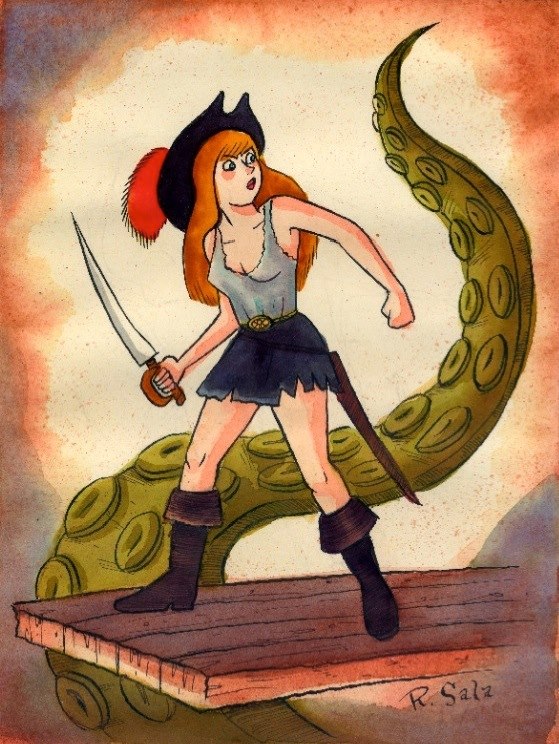
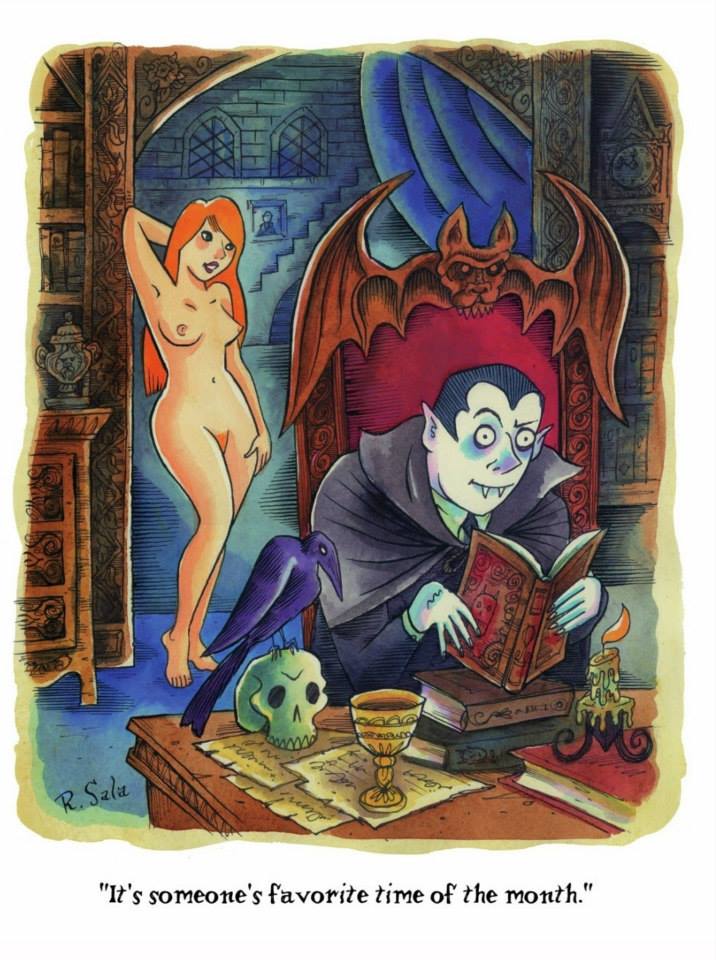
Finally, as a little bonus, I am including a pin-up that doesn’t have any tentacles to recommend it, but is otherwise perfectly appropriate to this not-quite-end-of-September. Co-admin RG has plenty up his sleeve with his upcoming Hallowe’en count-down, but I am allowing myself just one furtive foray into vampire territory…
This sweet, lovingly-coloured gag cartoon was created in 2013 and intended for Playboy (but unfortunately never published).
Sala explains: « According to the editor, I was one of only a few of the cartoonists asked to submit ideas whose submissions were ‘sex positive’. That is, according to him, most of the submissions by younger cartoonists were more in line with the kind of scatological, angry, ‘gross-out’, excretion-happy humor more typical of today, or focused on the adversarial relationship between men and women. My somewhat sweet oral sex joke seems pretty quaint in comparison, I guess. »
« Like its politicians and its wars, society has the teenagers it deserves. » — J. B. Priestley
Here at WOT central, we’re both massive Bob Oksner (1916-2007) fans, and it’s not generally for the writing. For a long time, his multi-faceted talent was used to great effect all over the DC Comics line, but he rarely received the acclaim he so richly deserved.
After DC sent up a trial balloon with Showcase no. 70 a year prior, Binky returns after a decade’s sabbatical (an eternity in the teen world!). This is Leave It to Binky no. 61 (June-July 1968, DC). The product was slightly updated (fashions and hairdos) dusty reprints with fabulous new covers.
This is Leave It to Binky no. 62 (Aug.-Sept. 1968, DC). For the record, Peggy is Binky’s blonde girlfriend. Let’s face it, she’s the true star of this book.
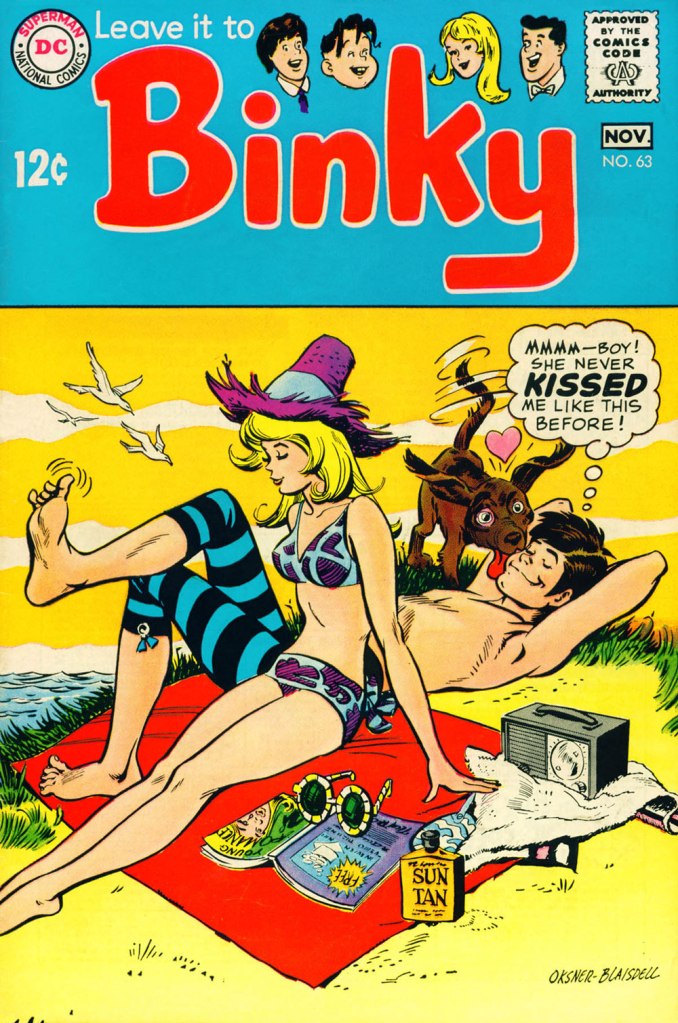
This is Leave It to Binky no. 63 (Oct.-Nov. 1968, DC). Lovely inks provided by fellow Golden Age veteran Tex Blaisdell (1920-1999).
This is Leave It to Binky no. 64 (Dec. 1968-Jan. 1969, DC).
This is Leave It to Binky no. 65 (Feb.-Mar. 1969, DC).
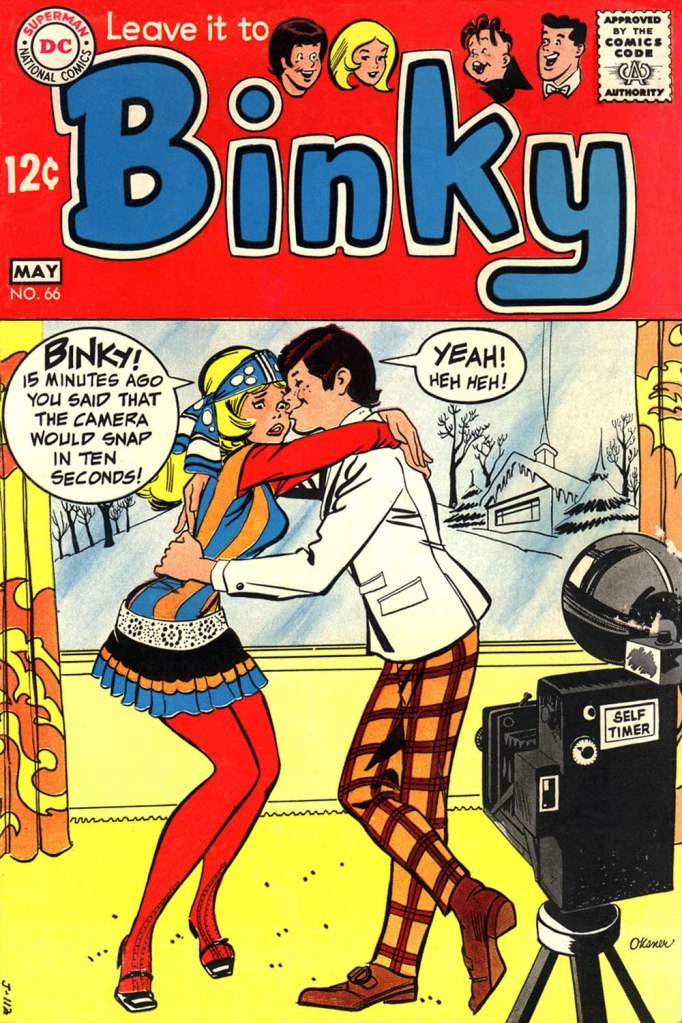
This is Leave It to Binky no. 66 (Apr.-May 1969, DC).
During last year’s Hallowe’en Countdown, I spotlighted Mr. Oksner’s fine work on DC’s long-running licenced Bob Hope and Jerry Lewis titles, but also featured his holiday-appropriate Binky cover. For thoroughness’ sake, here it is again: this is Leave It to Binky no. 67 (June-July 1969, DC).
And one more: this is DC Special no. 2 (Jan.-Mar. 1969, DC). Hard to fathom why this one came out at all, its great cover aside.
And then it was over, in this visual idiom anyway: with the following issue (LITB68), DC brought in well-traveled Henry Scarpelli to handle the covers and create the impression that Binky was just one more Archie clone. Over the subsequent four issues, a handful of (pretty good) new stories were mixed in with the reprints. Then came a change of title and a new logo. The book, now simply called Binky, was a full-on Archie ersatz, and lasted another ten issues into 1971… with one final special popping out of nowhere in the summer of ’77. For ol’ Binky, par for the course!
Hello, cephalopod aficionados! I have some lovely tentacles for you today, all wrapped around voluptuous women (my favourite kind of cephalopod content, I admit). There is a lot of ‘that kind of thing’ going on in the rivers of the comic kingdom, but most of it, alas, is distinctly ugly. I have accumulated a few covers not suffering from that particular scourge (quite by accident, most of them use a green-and-red palette), and I invite you to enjoy them with me!
The first is a Judge Dredd cover that had somehow previously escaped my attention, despite WOT’s affection for the former and my personal affection for Judge Anderson (lackaday, ill-handled once out of the hands of creator John Wagner and writer Alan Grant – and preferably drawn by Brian Bolland, of course).
Judge Dredd no. 28 (February 1986, Eagle Comics). Cover by Brian Bolland, a Tentacle Tuesday master. Note that in Bolland’s care, she looks like a determined, intelligent woman in full possession of her faculties, as opposed to this sort of nonsense.
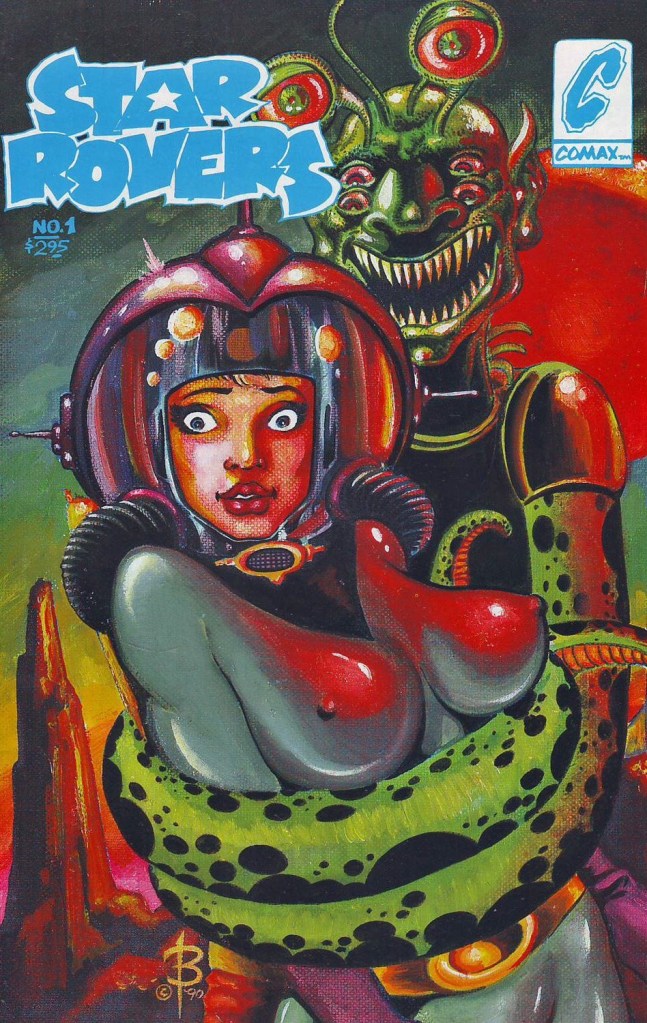
The following cover presumably has something to do with DC’s Star Rovers series, which ran between 1961 and 1964, but I wasn’t able to find more about this particular comic, the company that published it (Comax), or the equally mysterious cover artist, Butch Burcham. A comic-savvy friend described the latter as ‘a low rent Frazetta knock-off artist‘. I have no opinion about that part, but I do like this cover and its lushly coloured maiden with her completely impractical suit.
Star Rovers no. 1 (1990, Comax). Cover by Butch Burcham.
Next up a contribution from Dan Brereton, whose work has already been part of several previous Tentacle Tuesdays.
L.E.G.I.O.N. ’92 no. 41 ( July 1992, DC). Cover by Dan Brereton.
In a ‘something completely different‘ vein, I’d much rather get Red Sonja drawn in a very cartoony style, rather than in a ‘realistic’, trying-to-show-boobs-and-ass-simultaneously one. (I dig voluptuous women, but not. ones.with.a.spine.deformation.) For instance…
Red Sonja no. 12 (September 2014, Dynamite). This variant cover is by Stephanie Buscema, an American illustrator specializing in Hallowe’en art.
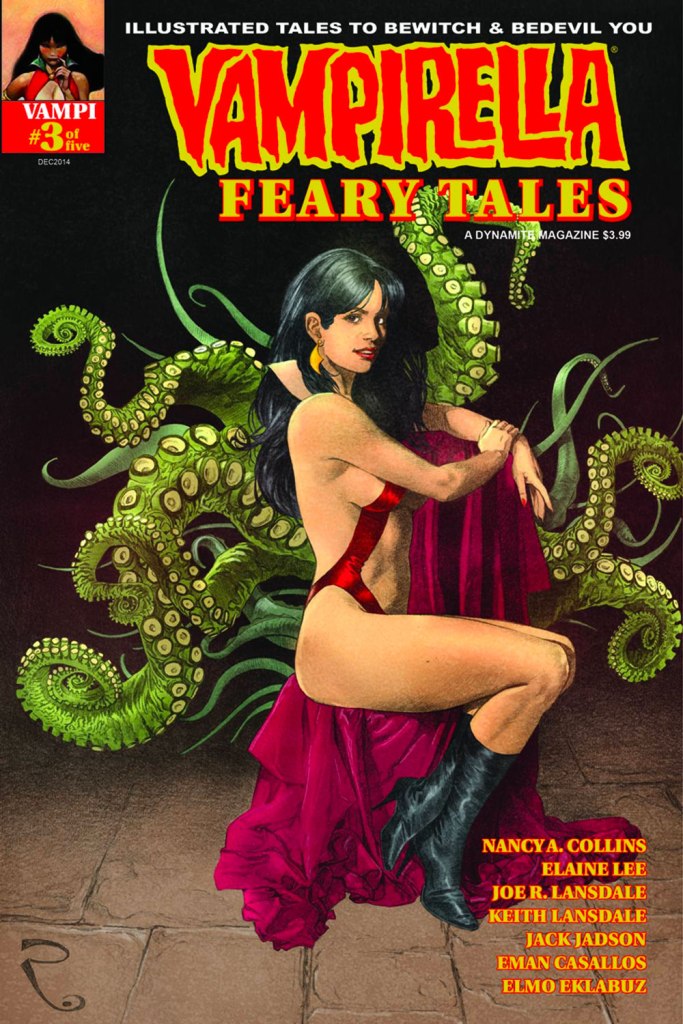
Finally, we have a surprisingly tasteful (albeit a bit stiff – so would you be, barely perching at the very edge of a chair like that), girl-next-door Vampi cover. And look, she actually has enough space for internal organs! I like that the tentacles seem like a friendly presence, almost guarding her (as opposed to getting a quick grope in). In case you want more Vampirella, head over to Tentacle Tuesday: Warren and Its Many Tentacles, Part II.
Vampirella: Feary Tales no. 3 (December 2014, Dynamite). Variant cover by David Roach.
Pip pip cheerio and toodle-loo, and see you next week!
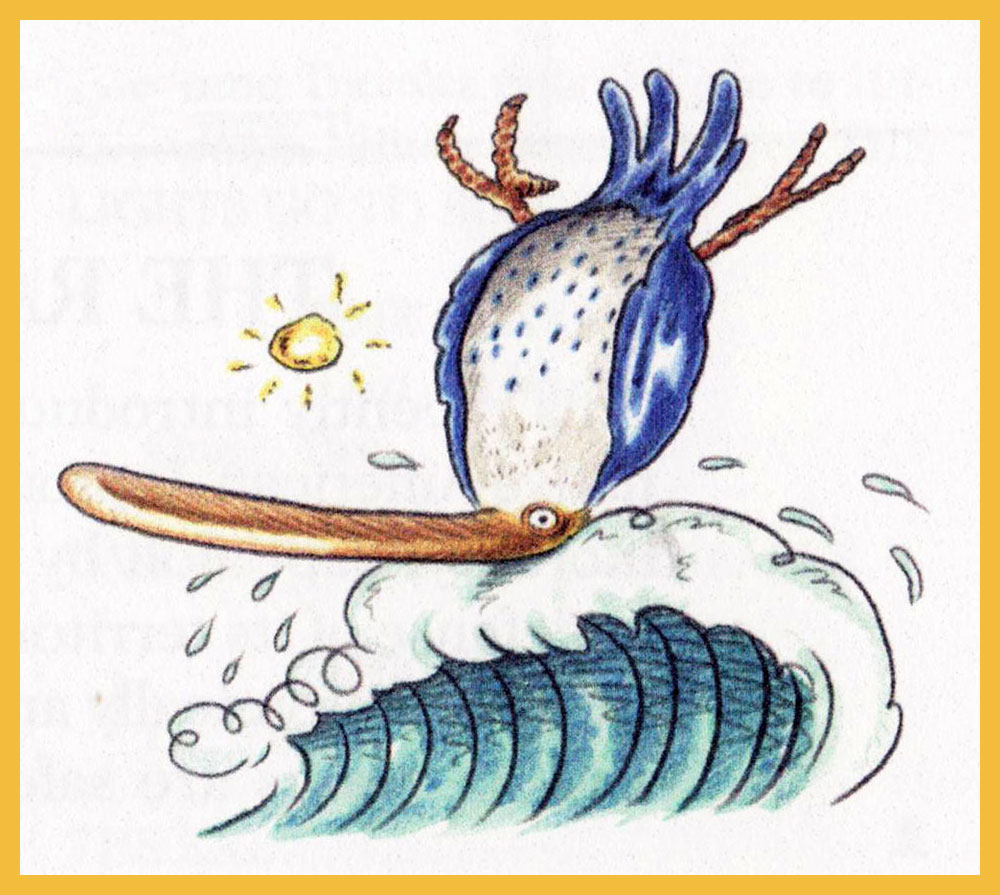
In 1973, he gave us Birds of Israel (included at the end of this post); farther along, he (with his frequent collaborator, Montréal-born writer Sean Kelly) gave us a look at The Birds of Summer, (2007, The New York Times). And in 2016, these ardent but irreverent crypto-ornithologists were at it again with Odd Birds, which added in excess of one hundred and fifty fascinating new species to the tally. However, Meyerowitz only illustrated a handful (but such a handful!), which I present to you here. Still, how I would love to behold his depictions of, for instance: The Three-Day Lark; the Venomous Spite; the Oblivious Walking Jay; the Perpetual Jackhammer; the Yellow-Bellied Stool Pigeon; the Groveling Wince; the Hoodwinked Bagholder; the Celibate Tot-Fondler; Zimmerman’s Cryptic Drone; the Barecheeked Thongbird; the Bald-Faced Lyre; the Fact-Spinning Mockingbird; the Screaming Scarlet Manager; the Gulf Coast Petrel Dumper; Oscar’s Pink-Bottomed Boychick; the Crapulous Binge; the Free-Screech Owl… or the Swaggering Gut-Sucker! Man, this project needs to go the full book route.
THE RAVING HOMELAND JINGO: « This recently introduced European species is often mistaken (by itself) for native American. It proudly displays its red neck, white knuckles, and bluenosed morality, kept aloft by drafts of hot air. The Jingo emits gruesome shrieks in defense of its territory against the occasional Left-Winged News Hawk. The Jingo is anatomically anomalous, in that its testicles are located in its cranium, and its brains are safely secured behind and exceptionally tight sphincter. »
« The all-too-common Back Lot Goose, with its natural prey, the Wide-eyed Chippy. »
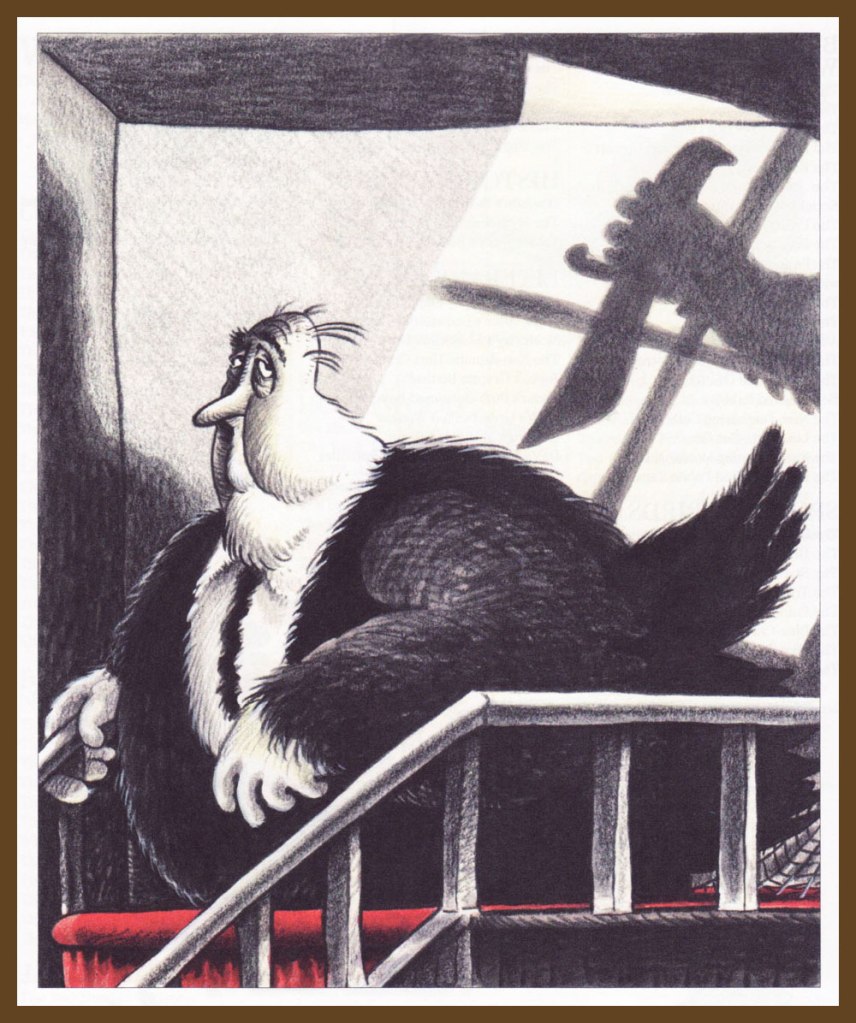
Meet HITCHCOCK’S MacGUFFIN — « An Old World species, introduced to California: a plump, lugubrious bird given to stealthy silences, sudden shrieks, and terrifying displays. Its diet consists of red herrings and snakes in the grass. Despite its reputation, has laid the occasional egg. Sometimes mistaken for Hammett’s Maltese Falcon; not to be confused with any of Spielberg’s Mawkish Cliff Hangers. »
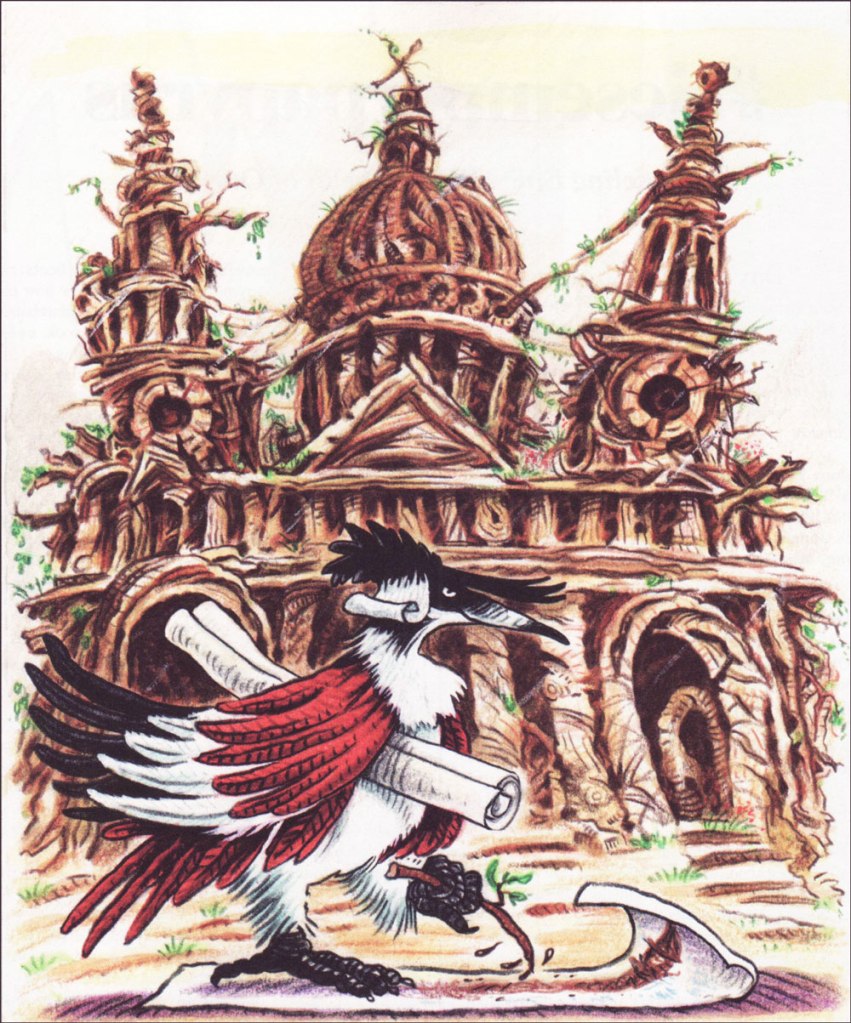
THE CHRISTOPHER WREN: « Like the Francis Drake, the Dean Swift and the Florence Nightingale, this bird prefers a cold, damp, dreary environment such as the city of London, England, in which the Christopher Wren constructs nests of preposterous design, monumental size, and no apparent use. (This species is not related to the similarly named Christopher Robin, native to the Hundred Acre Wood in East Sussex.) »
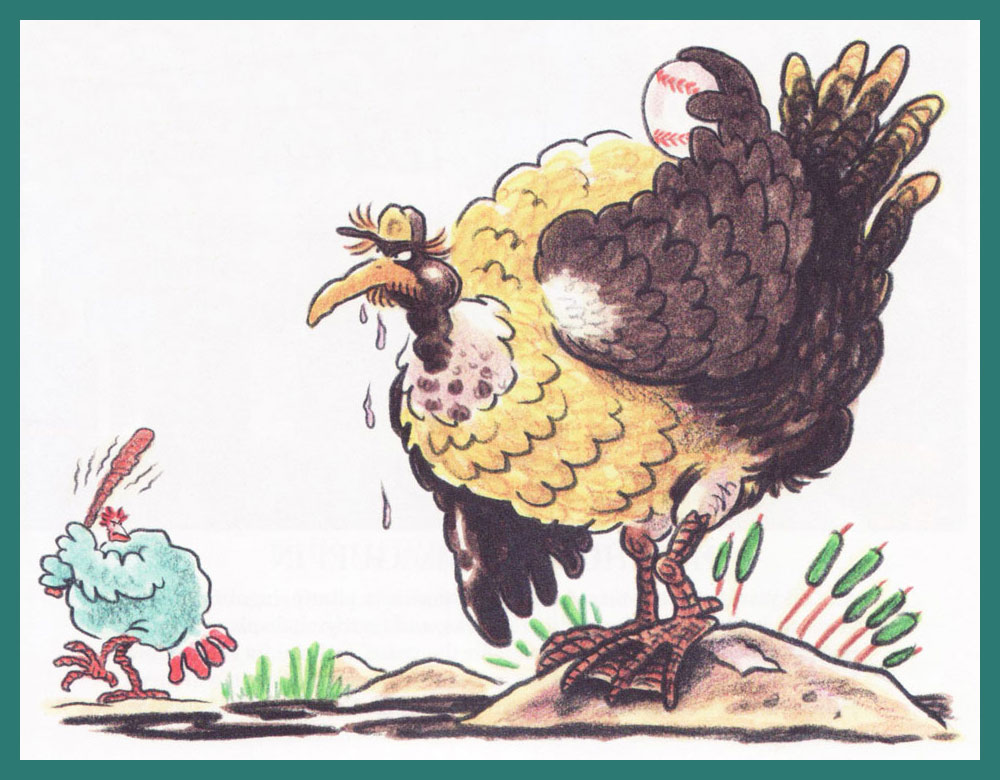
« A grizzled Hoary-Headed Junk Chucker faces down a Stat-Grubbing Peckerhead. »
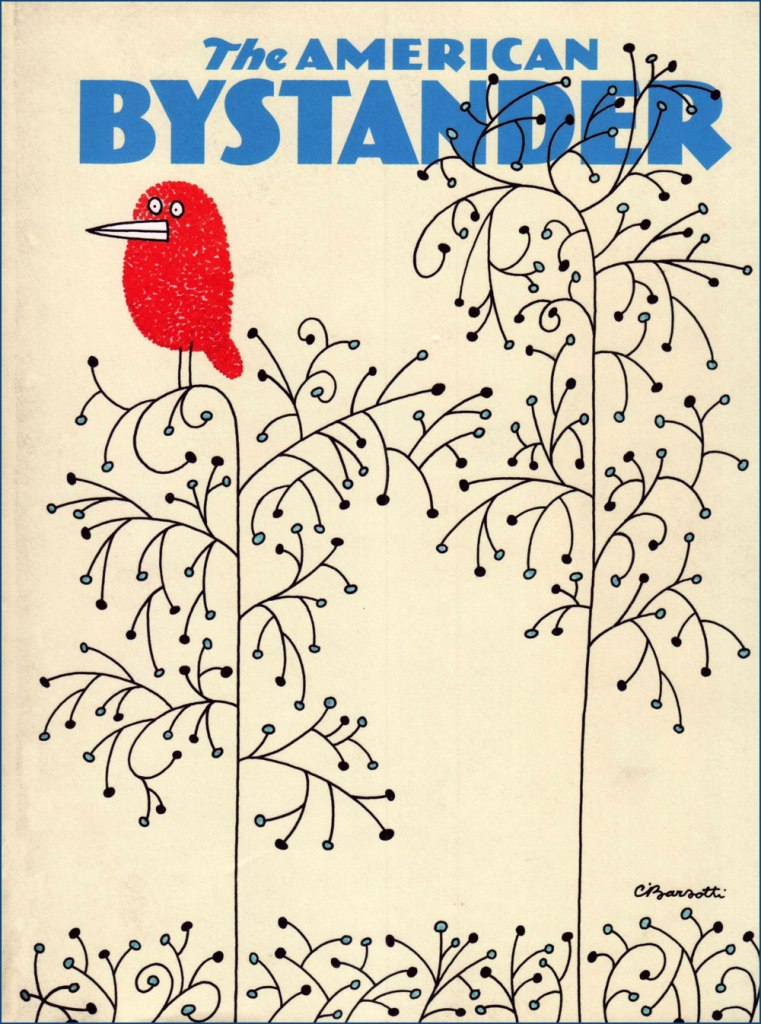
These cartoons appeared within the pages of The American Bystanderno. 2 (Spring 2016), bearing this soothing cover by the esteemed Charles Barsotti (1933-2014). Do check out and lend your support to the Bystander, which has most deservedly been deemed “The last great humor magazine“.
Where the good Mr. Meyerowitz seems to have first hatched his theme: Birds of Israel, from The National Lampoon Encyclopedia of Humor (1973, edited by Michael O’Donoghue).

































 Who's Out There?