« Everybody’s a mad scientist, and life is their lab. We’re all trying to experiment to find a way to live, to solve problems, to fend off madness and chaos. » — David Cronenberg
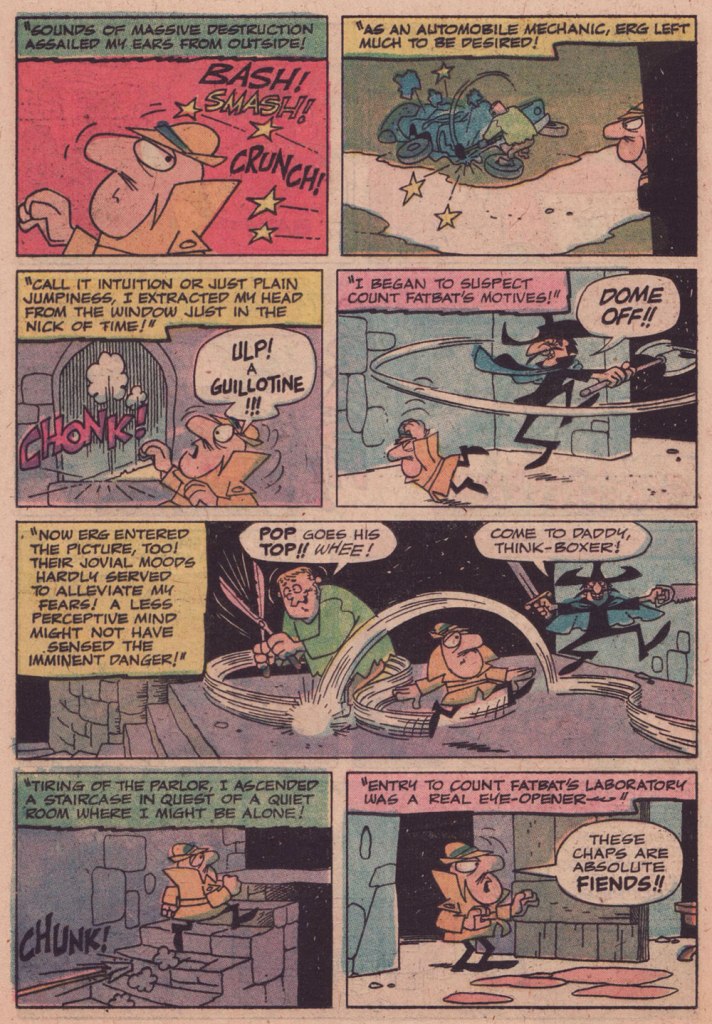
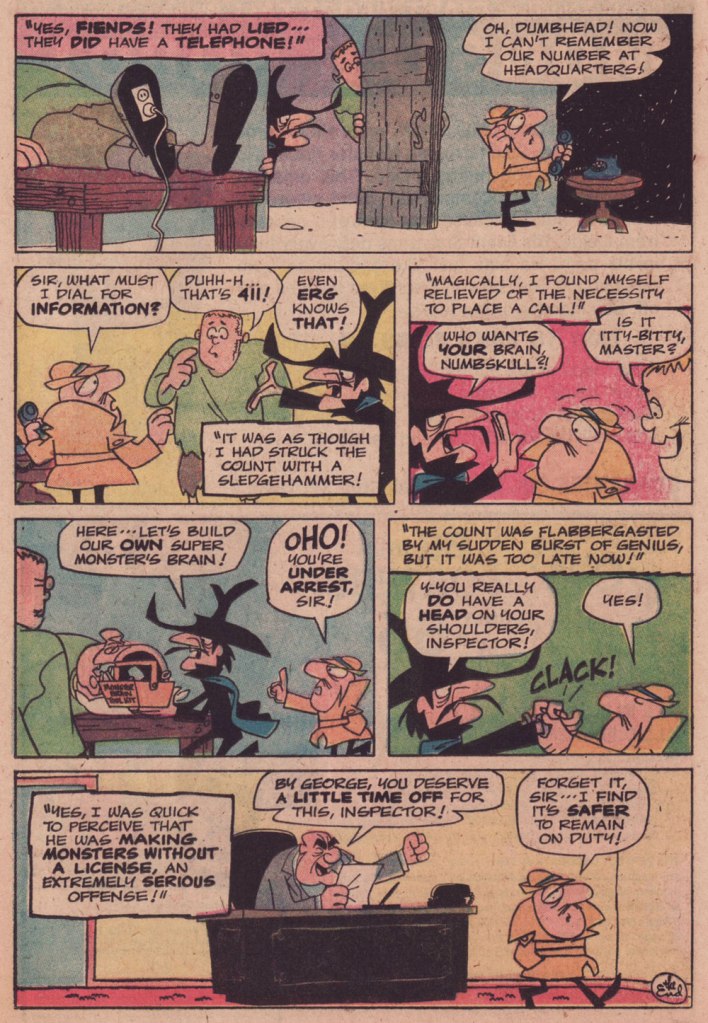
I take it that Monsieur Jacques Clouseau, aka The Inspector needs no introduction around these parts. So here he is:
Case of: The Great Brain Bait, along with a trio of Pink Panther adventures, was featured in this, The Pink Panther no. 23 (Nov. 1974, Gold Key). Cover art attributed to Phil De Lara, though if it was indeed his work, it was published posthumously, De Lara having passed on to the Old Animators’ Home in the Sky in 1973.
While Gold Key’s Pink Panther and Inspector comics were fairly competently written and drawn (The Pink Panther didn’t last eighty-four issues for nothing) they could not hold a candle to Mirisch Films‘ mid-1960s Inspector shorts. In fact, this particular Inspector tale is a retelling/adaptation of one of these, 1968’s Transylvania Mania. Watch it for comparison (and enjoyment) — they’ll be six rather well-spent minutes of your time!
« If you will die for me, I will die for you and our graves will be like two lovers washing their clothes together in a laundromat. If you will bring the soap I will bring the bleach. » — Richard Brautigan
Many, many creators, some pretty high profile, have turned their hand at writing the character of John Constantine. And several were inspired to excellence. I haven’t really been keeping up, but I was quite keen on the plots and portrayals deployed by co-creator (with Stephen Bissette, Rick Veitch and John Totleben) Alan Moore, then by the underrated Jamie Delano, but also on brief-but-intriguing turns by Eddie Campbell and… John Smith*. John who? The Grand Comics Database (GCD) lists Mr. Smith as born in 1967 and having been “Managing editor on IPC nursery titles. Editor at IPC. Writer for various titles.” That’s the sum of it.
Flashback to 1992: I had recently quit buying Hellblazer when Garth Ennis, Will Simpson and various hands took over as the art aggregation. By issue 49, the Preacher “Dream Team” of Ennis and Steve Dillon had been assembled: from then on, it would be paper-thin elongated faces and bad teeth all the way. Uh, no thanks.
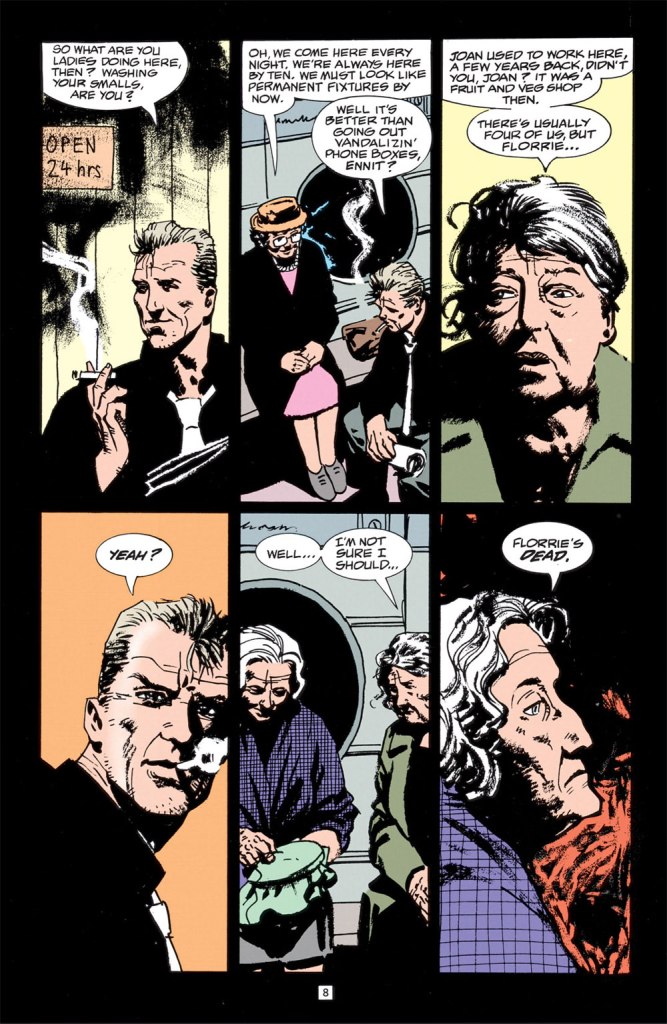
But ah, there was the briefest of respites for those of us paying close attention: a singular gem of an issue, masterfully scripted, terrifying mood piece in which very little is seen (or even glimpsed) but much is suggested. And the art duties were handled by the very good Sean Phillips, who’s since been squandering his talent on Ed Brubaker‘s derivative “I watch a lot of cable TV” witless fake noir tripe. But hey, people like that stuff, so who am I to criticise?
Anyway, I don’t have it in me to spoil the plot… not that it’s very much about the plot of this very special issue. Here are some choice excerpts, and perhaps you’ll catch a glimpse of what I see in it.
This is John Constantine Hellblazer no. 51 (March 1992, DC/Vertigo). Art by Sean Phillips.
Understated, quotidian horror. A job well done.
-RG
*I also really enjoy the pulpy adventures of Wyatt Blassingame‘s diminutive gumshoe John Smith, but that’s another set of prints.
In these dark days of superhero media dominance, it’s nice to look back at a time when the übermensch were in the throes of a cyclical decline and had to borrow a page or two from the dominant horror genre to extend their lifetime a bit. By the early 1950’s, superhero comics were in a slump and horror was ascendant in the land. Some of the main players went largely unaffected and presumably unconcerned, but some of the jobbers had to move quickly to preserve their day gig. The world wound up with such aberrations as Captain America’s Weird Tales.
We’ve previously noted the changes wrought upon Quality’s Plastic Man, and now we turn to ‘The World’s Mightiest Mite‘, Doll Man (a bit of back-handed compliment, wouldn’t you say?)
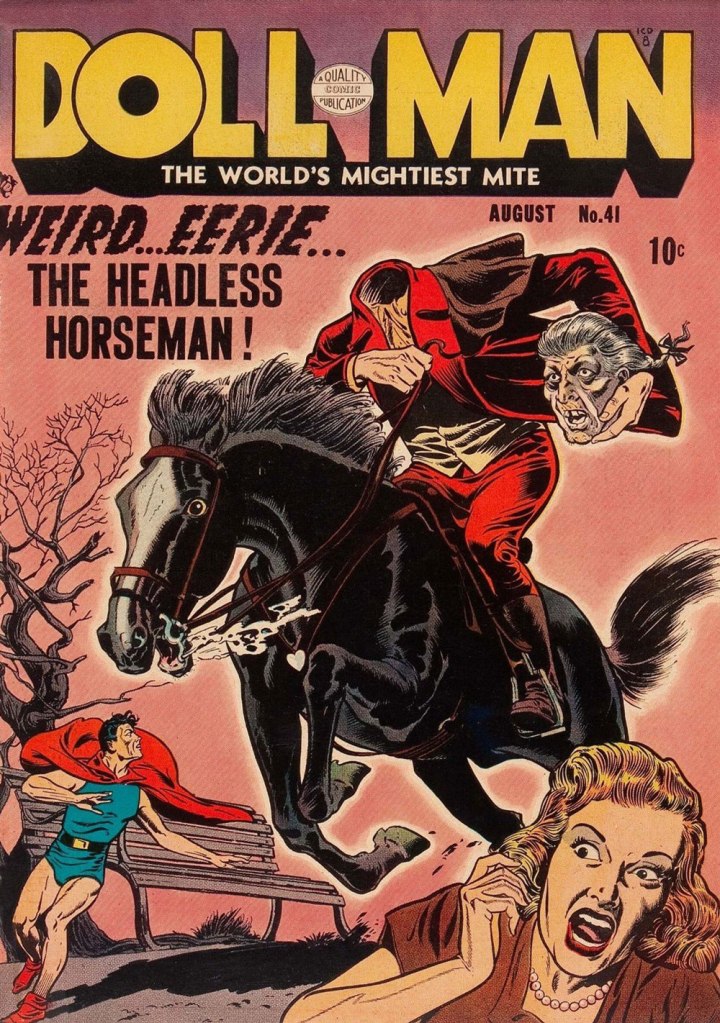
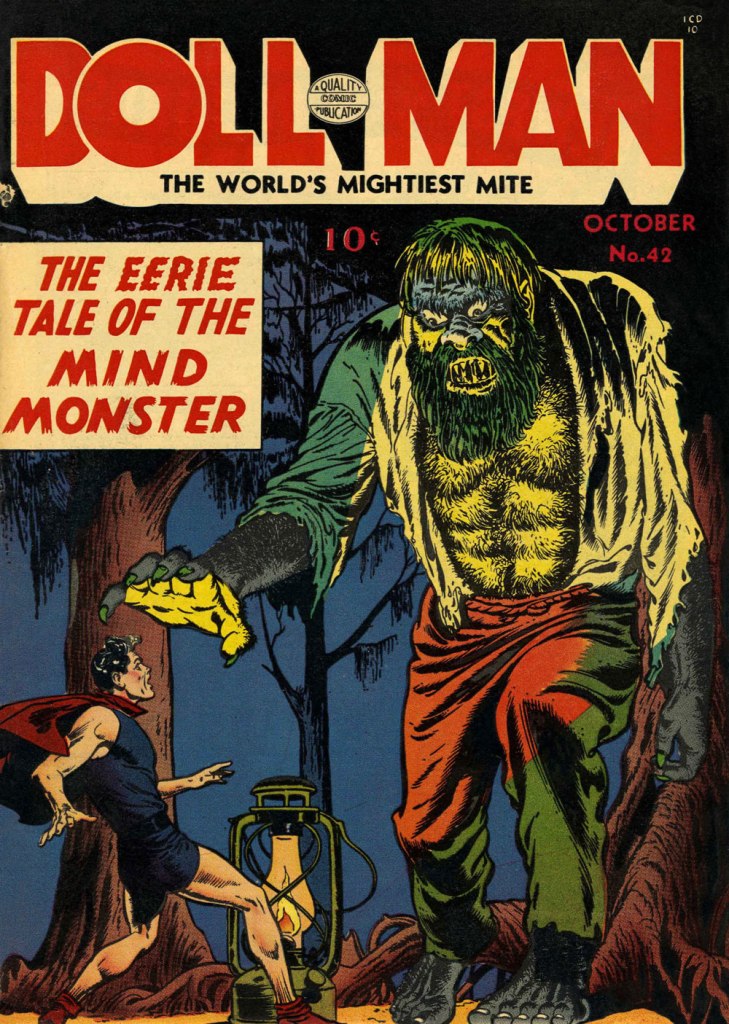
Quality always boasted a superb bullpen, and so some of these covers were crafted by the most excellent Reed Crandall (and check out our spotlight from last year). Natural cover artists are a true rarity, yet Crandall certainly fit the bill.
This is Doll Man no. 40 (June 1952, Quality). Read it here! Cover by Reed Crandall. Read it here! Once again, a reminder that spiders aren’t insects. This tale preceded the great Richard Matheson‘s novel The Shrinking Man by four years, and its classic film adaptation (add ‘Incredible‘) by five. Just sayin’…Dipping into the classics of American literature, this is Doll Man no. 41 (Aug. 1952, Quality). Cover by Mr. Crandall. Read it here!This is Doll Man no. 42 (Oct. 1952, Quality). Another Crandall cover. I know *I* wouldn’t have passed this one up on the newsstand, whatever the competition! Read it here!This is Doll Man no. 43 (Dec. 1952, Quality) cover tentatively attributed to the many-pseudonymed Dan Zolnerowich. Read it here!This is the series’ swan song, Doll Man no. 47 (Oct. 1953, Quality), quite a scarce issue. Read it here!
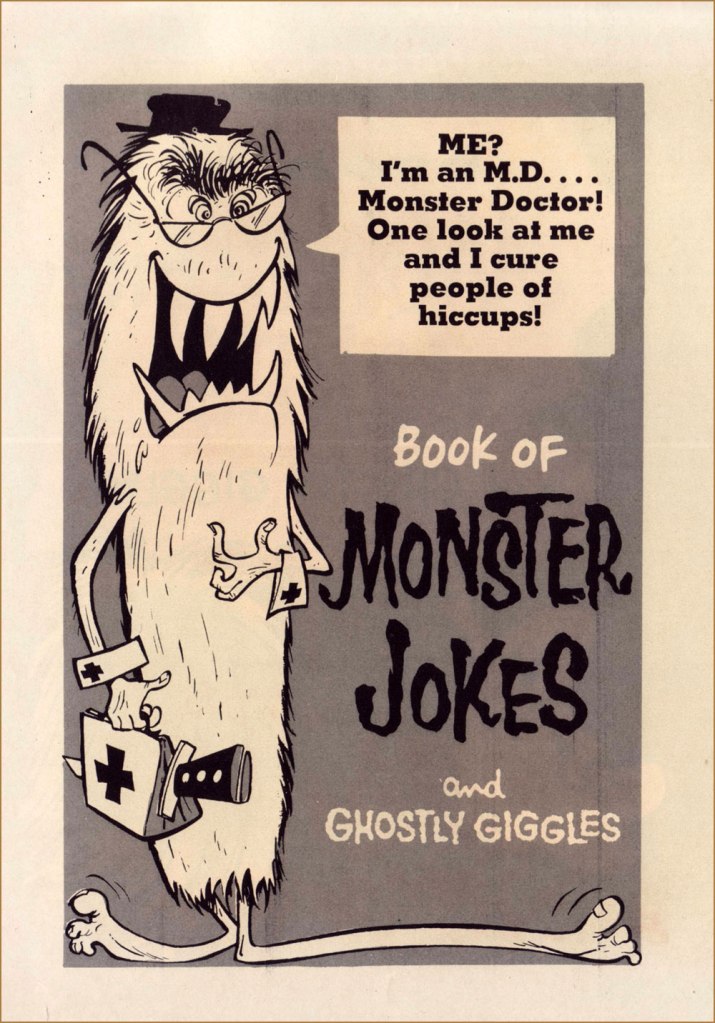
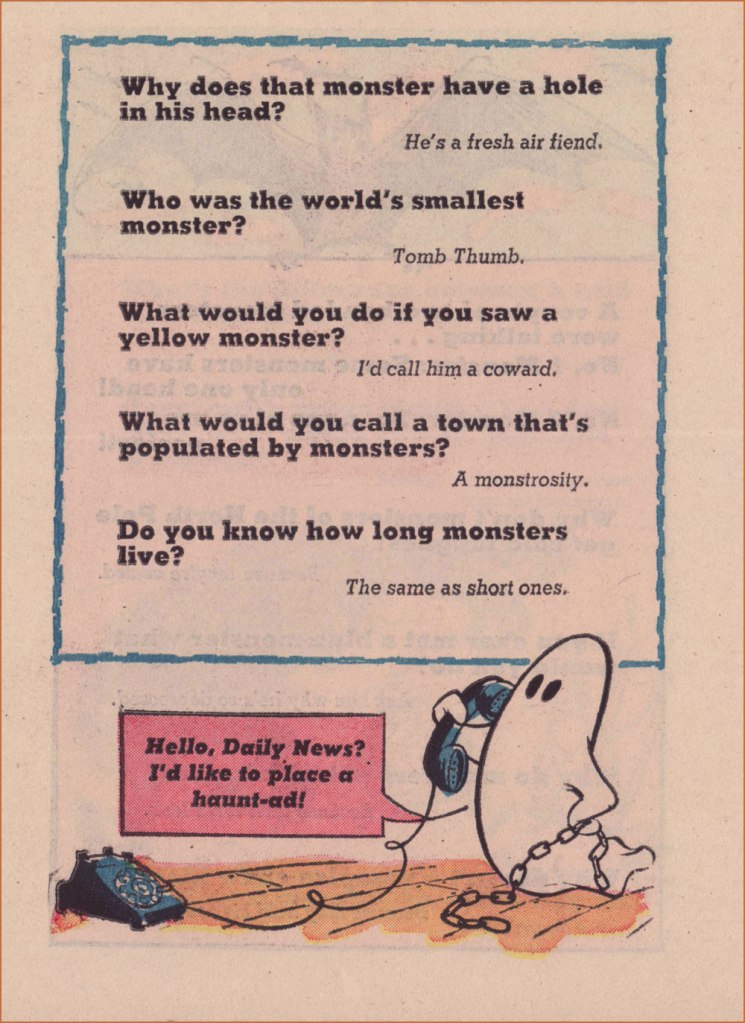
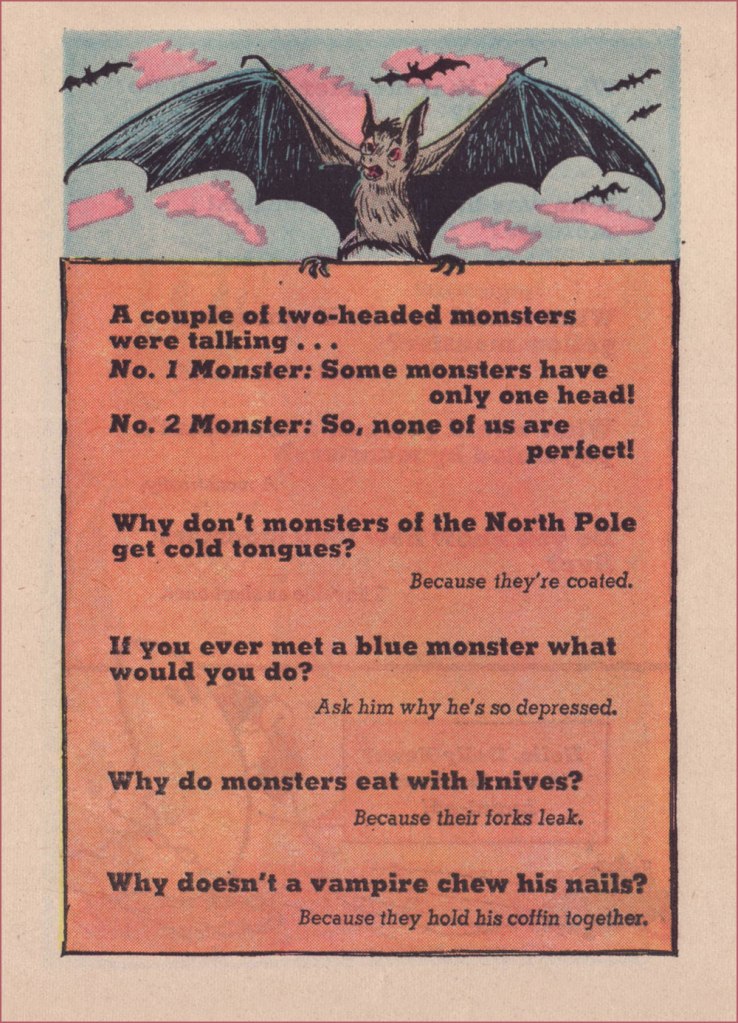
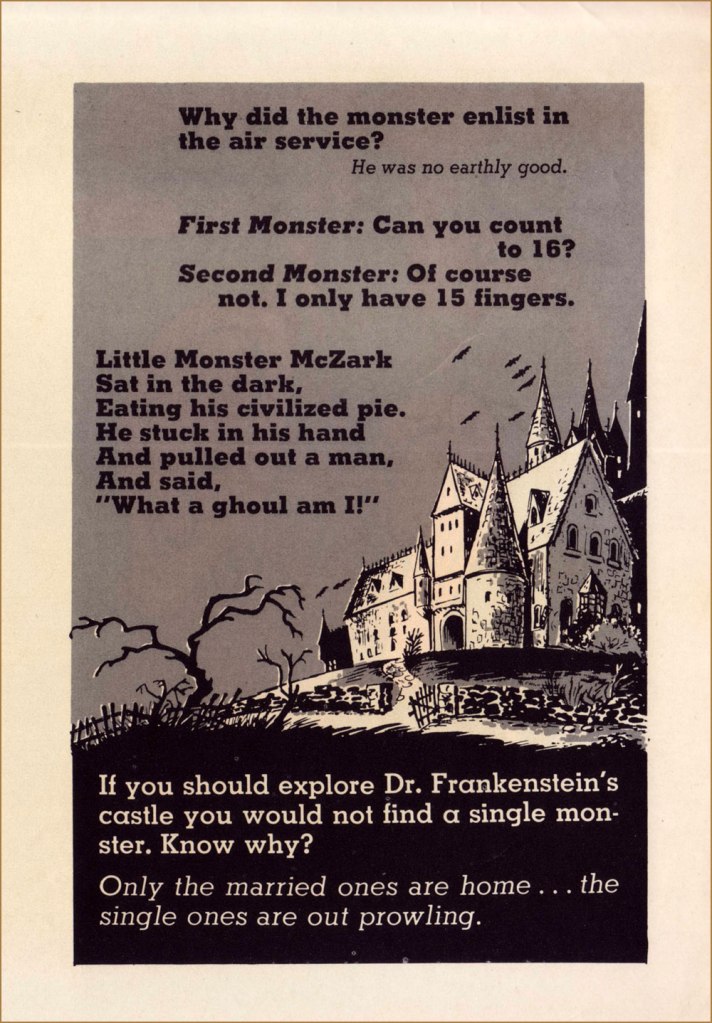
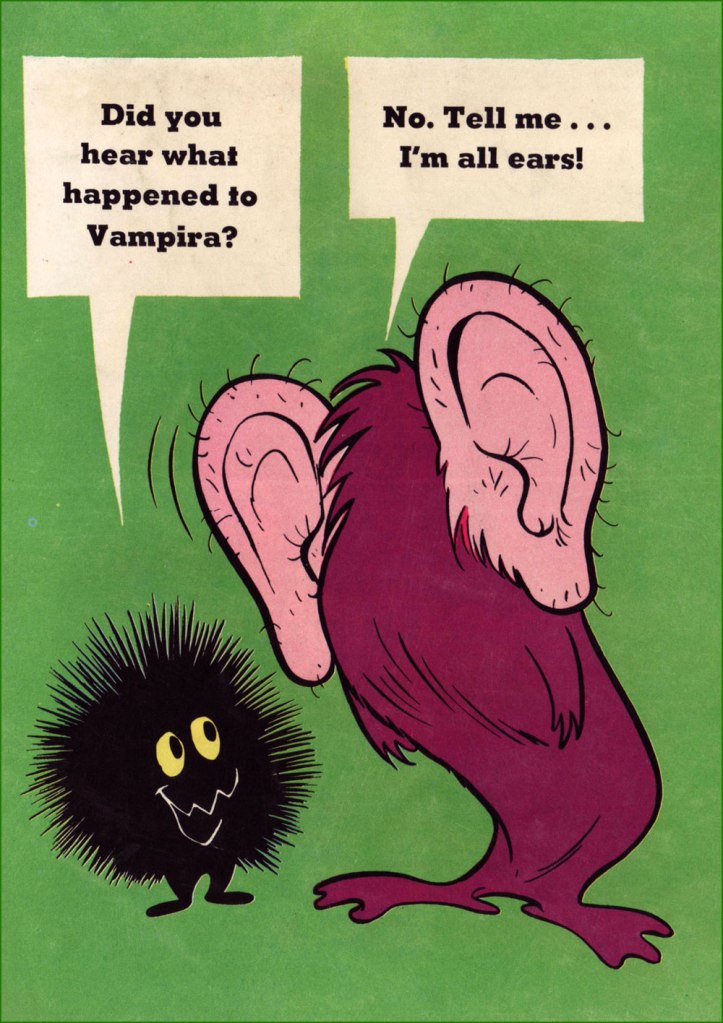
I’ve always had a soft spot for Gold Key’s The Little Monsters, who dwell within a cleverly designed and unaccountably comforting, topsy-turvy world; we’ve featured them back in the third edition of this countdown. This entry, however, isn’t strictly a return visit: I’ll be focussing on the back pages of ‘Orrible Orvie and Awful Annie’s antics. Last year, I picked up an issue I’d been missing, and was delighted with a surprise section, which I’ll happily share with our readers.
This is The Little Monsters no. 5 (July, 1966, Gold Key). Cover artist unknown, sigh.
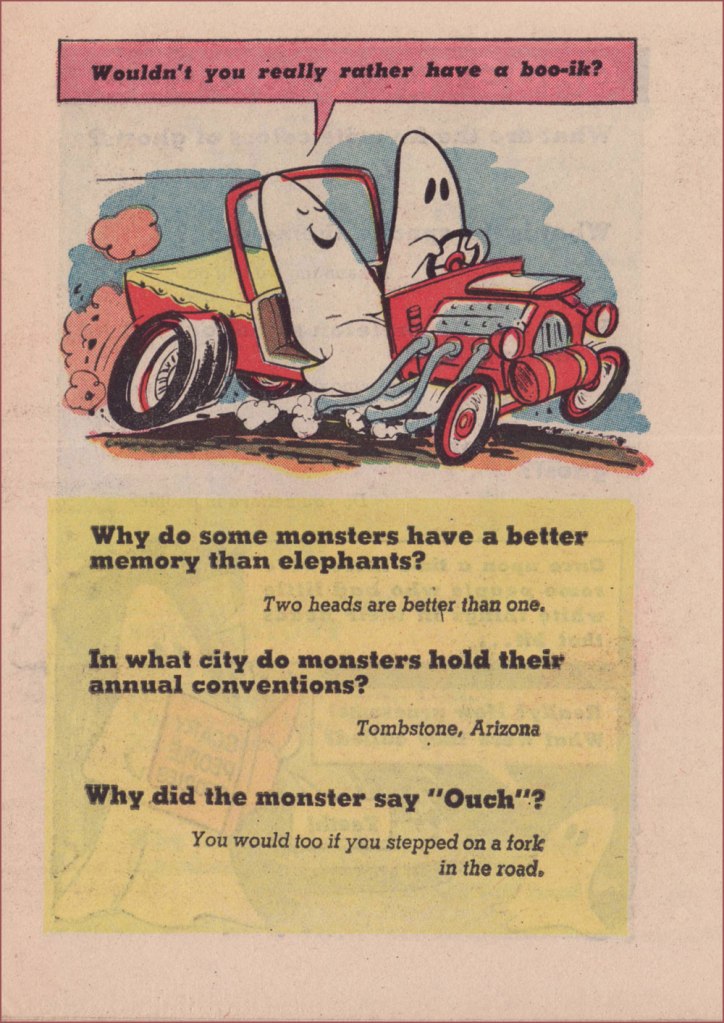
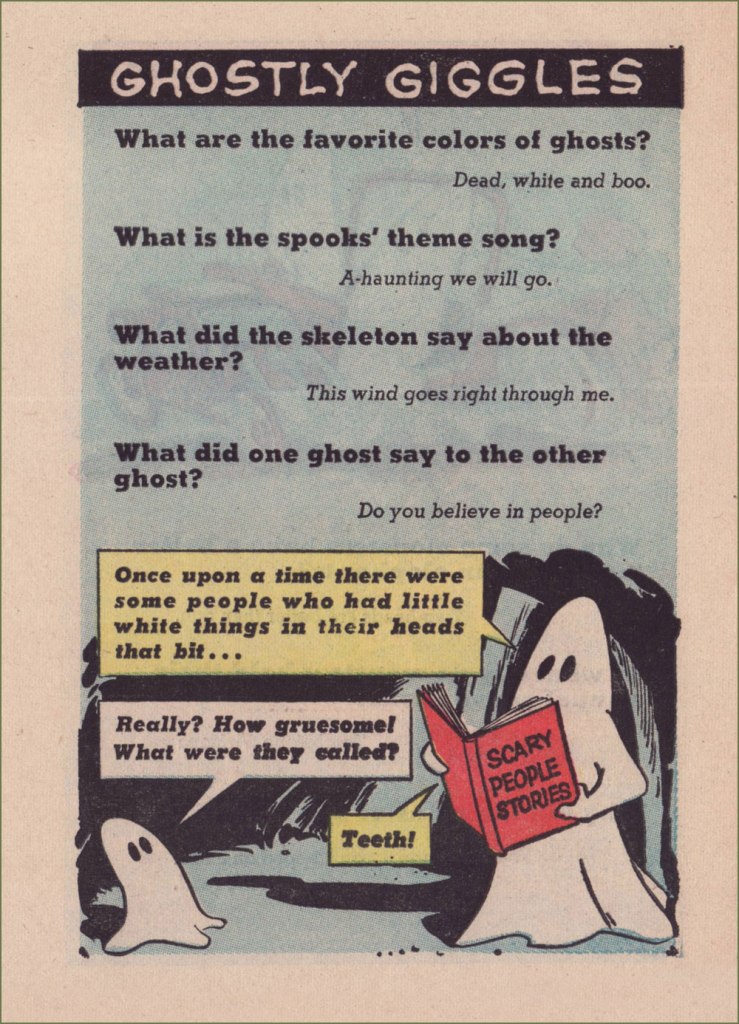
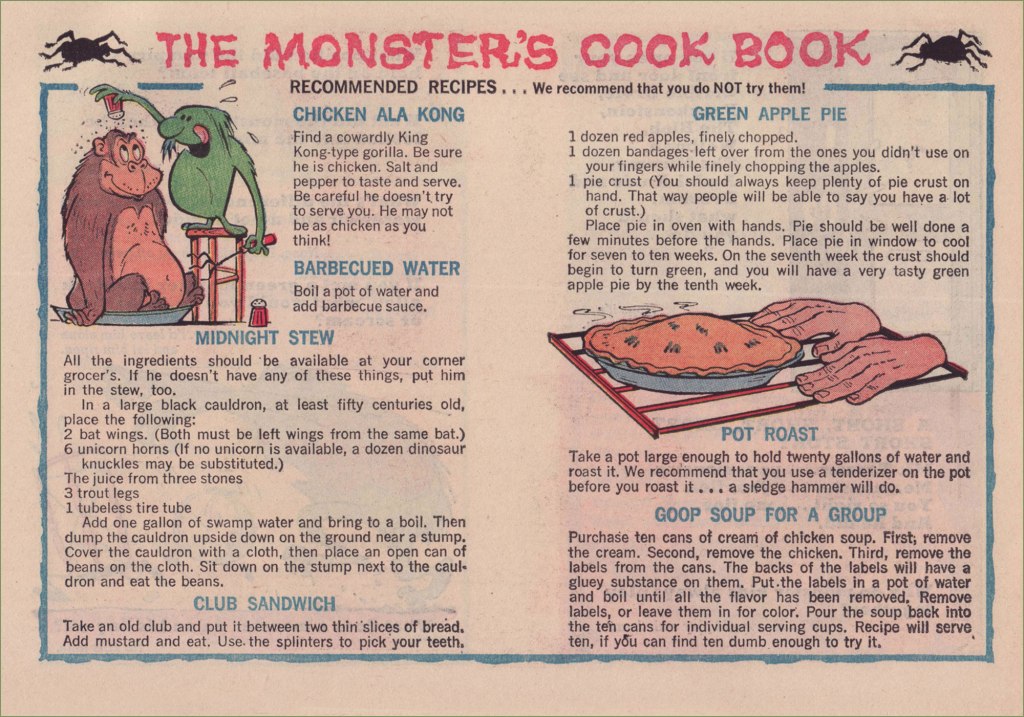
What do you say we take a peek at that Extra Bonus Book of Monster Jokes?
Another uncredited, unacknowledged and unknown artist. Why, thank you, Gold Key!
… and there you have it, and you didn’t even have to destroy a comic book (preferably someone else’s) to assemble it. The jokes are corny — what did you expect? — but I can’t help but find the whole thing quite adorable. Sometimes that’s precisely what one needs.
As a bonus, here I am holding the piece of Little Monsters original art (Page 2 from issue no. 12’s ‘Stormy Weather‘) I was fortunate enough to get my mitts on. Back in the day, comic book artists worked *large*!
« I love you more than anybody in the world… I love you for millions and millions of things, clocks and vampires and dirty nails and squiggly paintings and lovely hair and being dizzy and falling dreams. » — Dylan Thomas
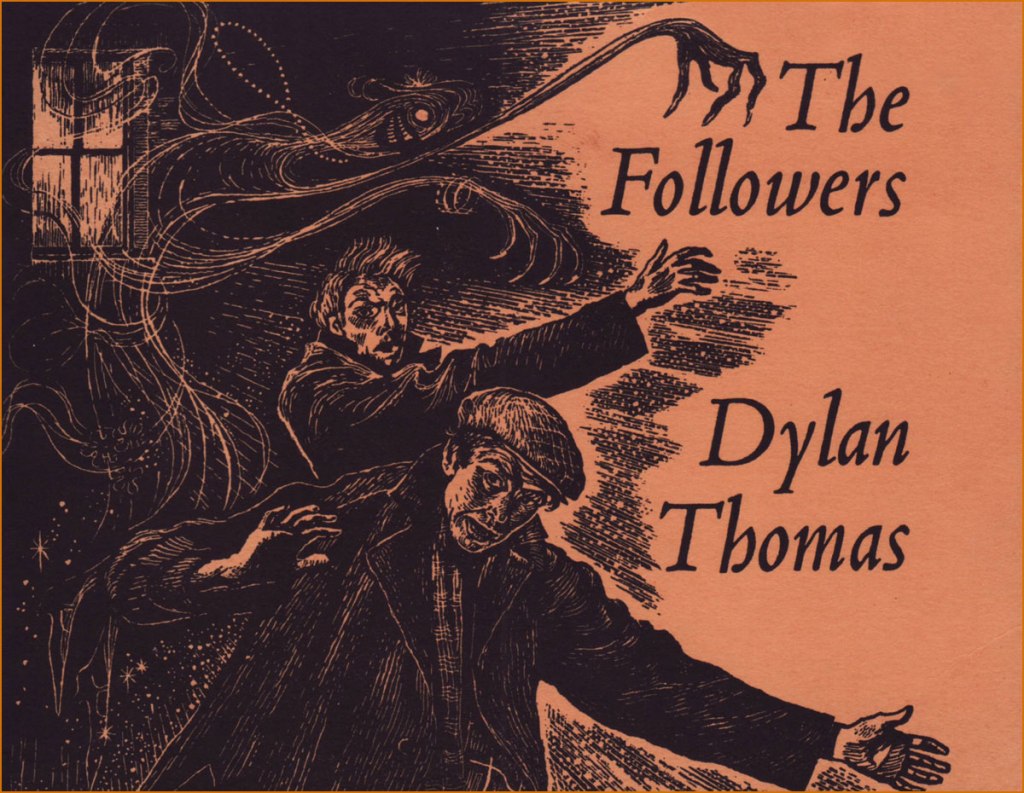
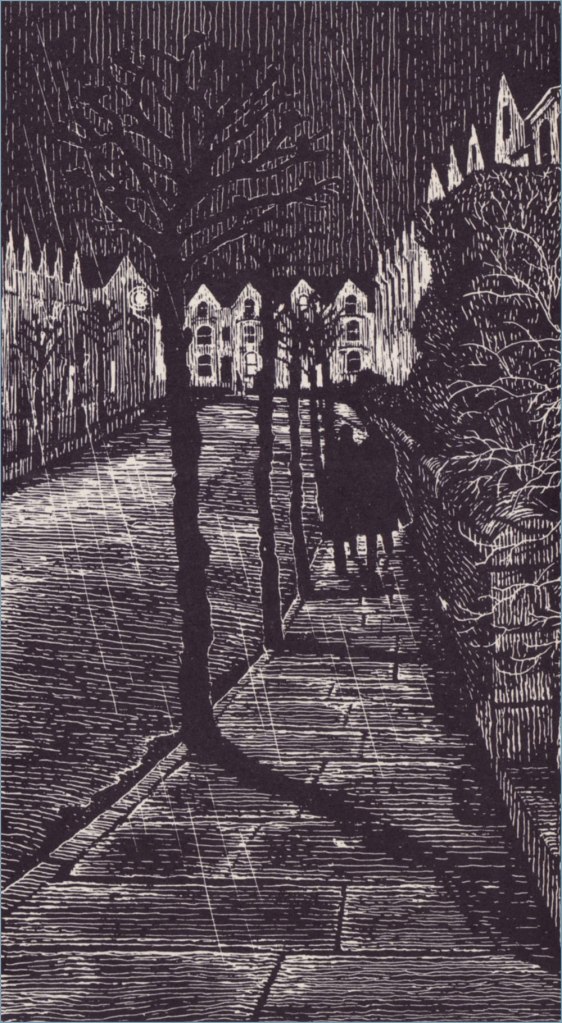
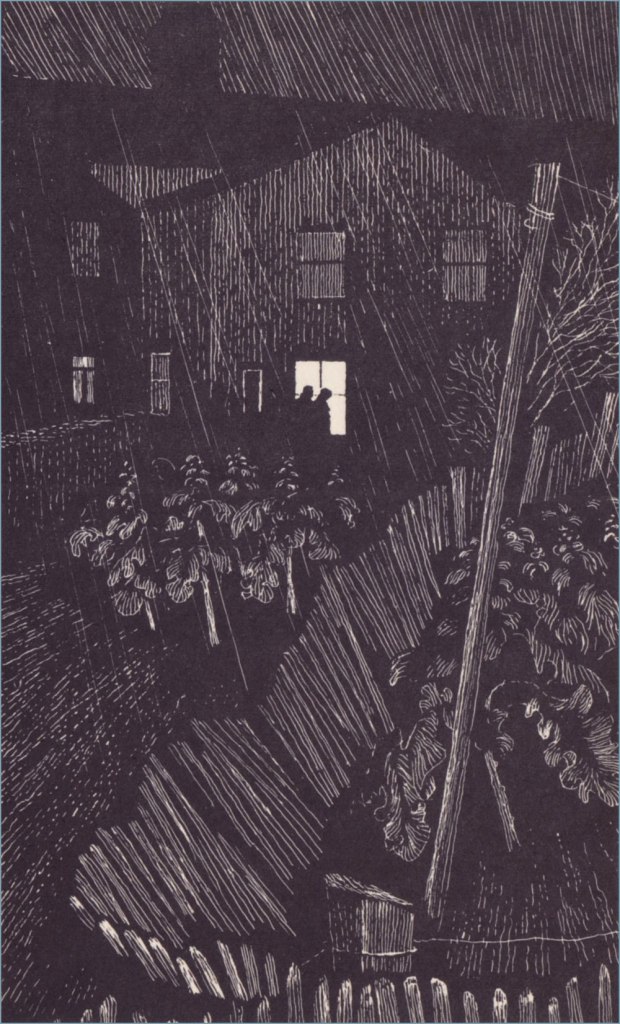
We’ve just had quite a nocturnal downpour over here, and so it seemed entirely à propos to feature that finest of all rainy night ghostly tales, Dylan Thomas’ The Followers, a late-career short story written in 1952. I would have loved to direct you to the full text of it, but can’t seem to find anything of the sort online.
« It was snowing. It was always snowing at Christmas. December, in my memory, is white as Lapland, though there were no reindeers. But there were cats. Patient, cold and callous, our hands wrapped in socks, we waited to snowball the cats. »
I’ve long been fascinated by English publisher J.M. Dent’s ‘series’ of Dylan Thomas illustrated booklets. First came the highly successful ‘A Child’s Christmas in Wales‘, in 1959, which kick-started the storied career of Ellen Raskin: « A Child’s Christmas in Wales by Dylan Thomas was the book that Raskin first printed herself to show as a sample to publishers in an effort to become a free-lance illustrator, a project that set her on her way to success in the field. Though the Christmas poem had been illustrated often, this was a memorable edition. »
A Child’s Christmas in Wales was followed — striking the iron while it was hot — by The Outing in 1971(!), then by Holiday Memory the following year. Then, finally, in 1976 came the final, and possibly finest, entry: The Followers. These last three were superbly illustrated by Meg Stevens.
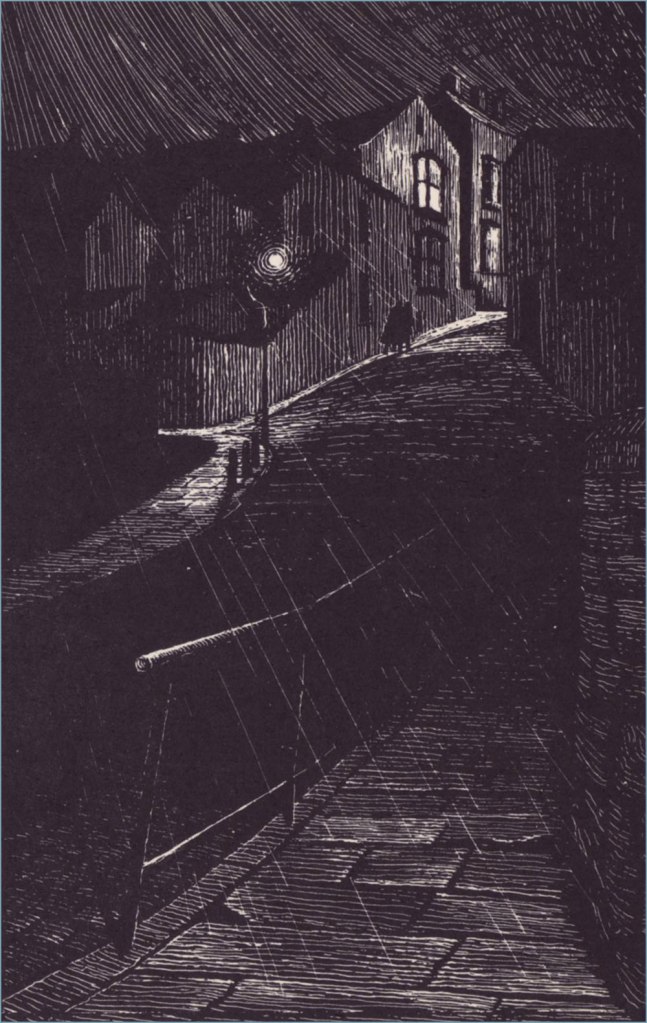
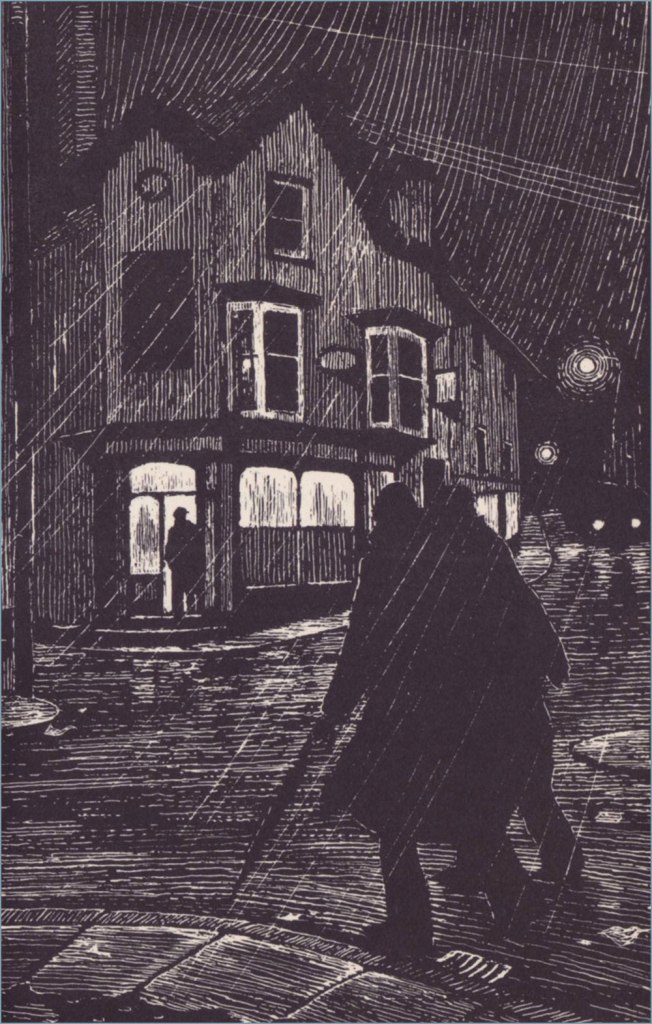
Miss Stevens demonstrated her mastery of the scratchboard medium through her three Thomas adaptations.
« It was six o’clock on a winter’s evening. Thin, dingy rain spat and drizzled past the lighted street lamps. The pavements shone long and yellow. »
« A silent man and woman, dressed in black, carried the wreaths from the front of their flower shop into the scented deadly darkness behind the window lights. Then the lights went out. »
« We walked towards the Marlborough, dodging umbrella spokes, smacked by our windy macs, stained by steaming lamplight, seeing the sodden, blown scourings and street-wash of the town, papers, rags, dregs, rinds, fag-ends, balls of fur, flap, float, and cringe along the gutters, hearing the sneeze and rattle of the bony trams and a ship hoot like a fog-ditched owl in the bay… »
« We walked on heavily, with wilful feet, splashing the passers-by. »
« “I wonder what’s the point of following people”, Leslie said, “it’s kind of daft. It never gets you anywhere. All you do is follow them home and then try to look through the window and see what they’re doing and mostly there’s curtains anyway. I bet nobody else does things like that.” »
« “Doesn’t anything happen anywhere?” I said “in the whole wide world? I think the News of the World is all made up. Nobody murders no one. There isn’t any sin any more, or love, or death, or pearls or divorces and mink-coats or anything, or putting arsenic in the cocoa…” »
« “Good night, old man,” Leslie said. “Good night,” I said. And we went our different ways. »
Regrettably, in the absence of a full text of the story, I can’t convey to you the supernatural component of the story. But I assure you, it’s well worth the looking up, and I dare hope that the palpable mood of Mr. Thomas’ prose and Ms. Stevens’ sublime scratchboard renderings were sufficient to put you in the proper, receptive frame of mind.
« To me, freedom entitles you to do something, not to not do something. » — Shel Silverstein
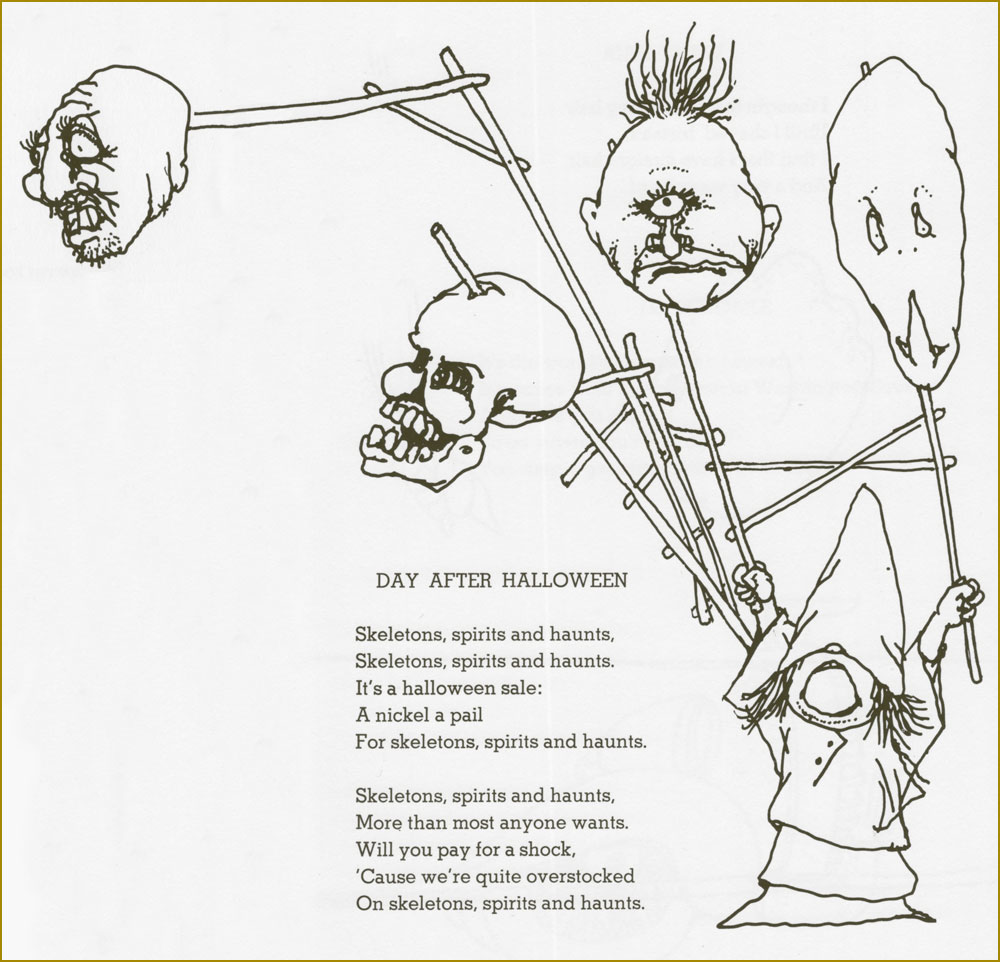
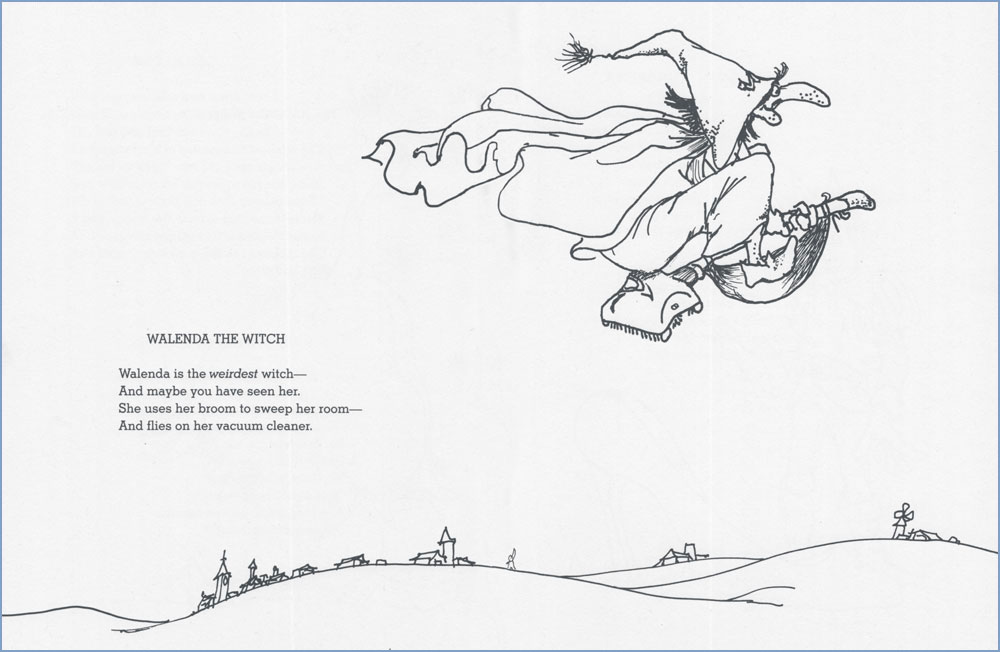
If you’re a regular reader of this blog, you’re likely to be aware of the warm place in our flinty hearts that we reserve for the wonderfully subversive and multi-talented Shel Silverstein! If not, check out Shel Silverstein: Without Borders or Take Ten With Shel Silverstein and you’ll get our drift.
This time, we turn our attention to Shel’s wildly successful illustrated poetry for kids (of all ages). Our first three selections hail from 1974’s Where the Sidewalk Ends.
ENTER THIS DESERTED HOUSE But please walk softly as you do Frogs dwell here and crickets too.
Ain’t no ceiling, only blue Jays dwell here and sunbeams too.
Floors are flowers — take a few. Ferns grow here and daisies too.
Whoosh, swoosh — too-whit, too-woo, Bats dwell here and hoot owls too.
Ha-ha-ha, hee-hee, hoo-hoooo, Gnomes dwell here and goblins too.
And my child, I thought you knew I dwell here… and so do you.
THE WORST When singing songs of scariness, Of bloodiness and hairyness, I feel obligated at this moment to remind you Of the most ferocious beast of all: Three thousand pounds and nine feet tall — The Glurpy Slurpy Skagagrall — Who’s standing right behind you.
The following trio come from 1981’s A Light in the Attic. A bit of controversy eventually ensued: « Attempts have been made to ban the book from some libraries in the United States, parents claiming that the poem “How Not to Have to Dry the Dishes” encourages messiness and disobedience. The poem “Little Abigail and the Beautiful Pony” resulted in criticism for describing the death of a little girl whose parents refuse to buy her a pony. This resulted in the book being banned by the Fruitland Park Elementary School in Lake County, Florida. The decision, however, was later reversed by an advisory committee of parents and teachers. » Ah, good old reliable Florida. [ source ]
It’s too early, and too sad, to think of November the 1st.
Here’s a couple from 1996’s Falling Up:
ROTTEN CONVENTION They had a Rotten Convention And everyone was there: Hamburger Face and Gruesome Grace And the Skull with the slimy hair.
There was Mr. Mud and the Creepin’ Crud And the Drooler and Belchin’ Bob, There was Three-Headed Ann — she was holdin’ hands With the Whimperin’ Simperin’ Slob.
The Unpronounceable Name, he came, And so did Saw-Nose Dan And Poopin’ Pete and Smelly Feet And the Half-Invisible Man.
There was Sudden Death and Sweat-Sock Breath, Big Barf and the Deadly Bore, And Killin’ Dillon and other villains We’d never seen before.
And we all sat around and told bad tales Of the rottenest people we knew, And everybody there kept askin’… Where were you?
HAUNTED I dare you all to go into The Haunted House on Howlin’ Hill Where squiggly things with yellow eyes Peek past the wormy window sill. We’ll creep into the moonlit yard, Where weeds reach out like fingers, And through the rotted old front door A-squeakin’ on its hinges, Down the dark and whisperin’ hall, Past the musty study, Up the windin’ staircase — Don’t step on the step that’s bloody — Through the secret panel To the bedroom where we’ll slide in To the ragged cobweb dusty bed Ten people must have died in. And the bats will screech, And the spirits will scream, And the thunder will crash Like a horrible dream, And we’ll sing with the zombies And dance with the dead, And howl at the ghost With the axe in his head, And — come to think of it what do you say We go get some ice cream instead?
And finally, this one’s from the posthumously published Every Thing On It (2011).
Thanks for everything, dear Mr. Silverstein! You’re an unceasing source of inspiration and wonder.
« Special effects are characters. Special effects are essential elements. Just because you can’t see them doesn’t mean they aren’t there. » — Laurence Fishburne
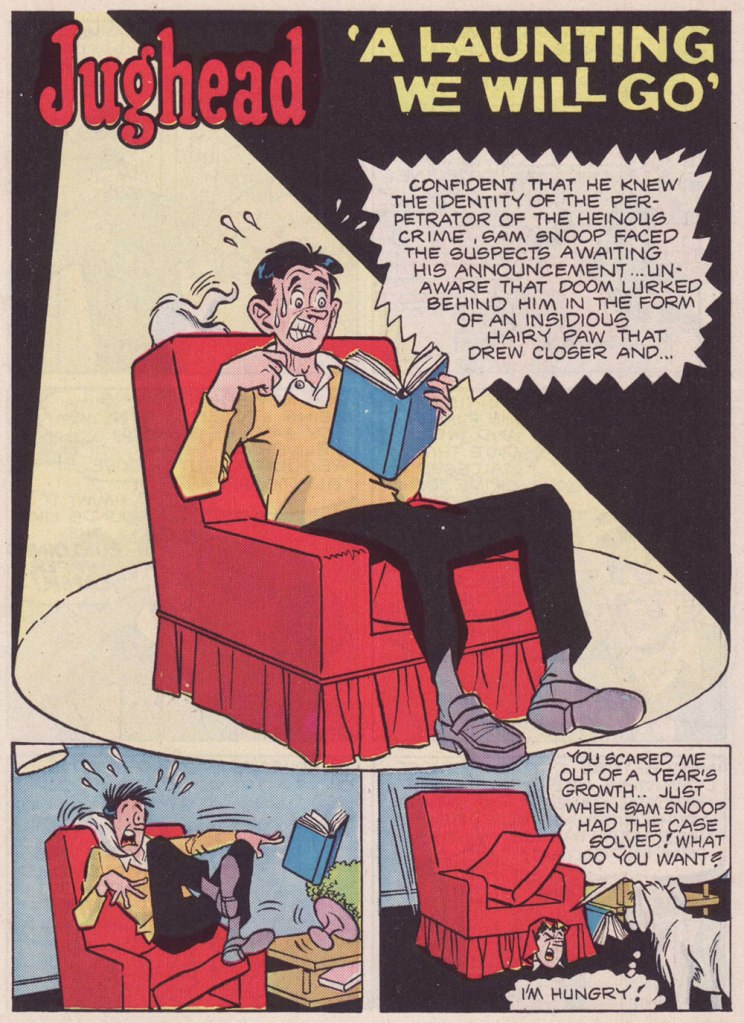
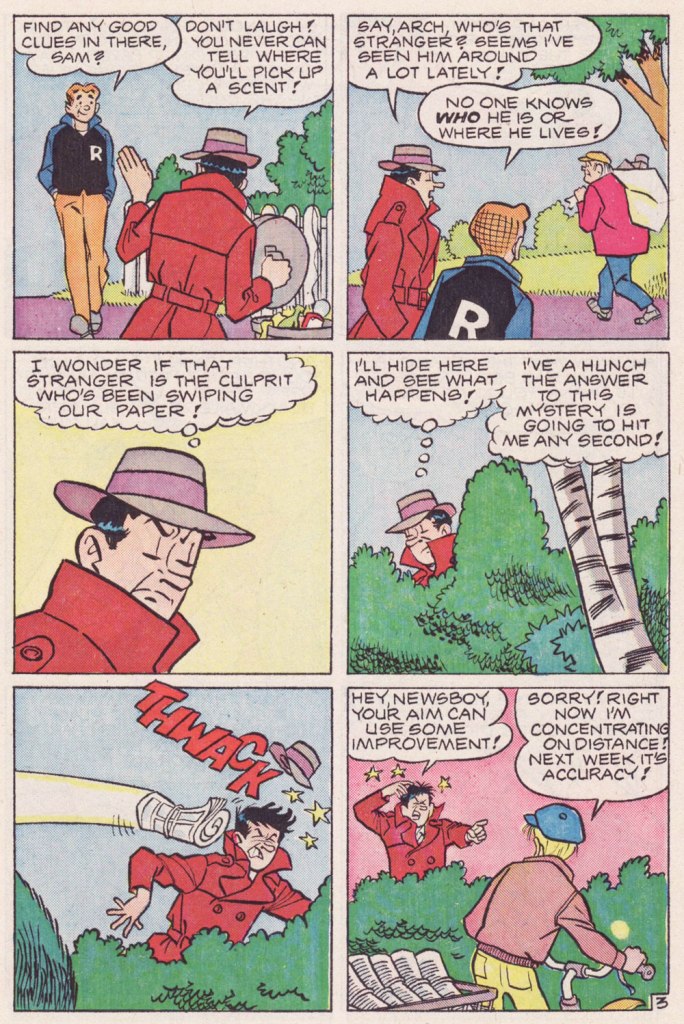
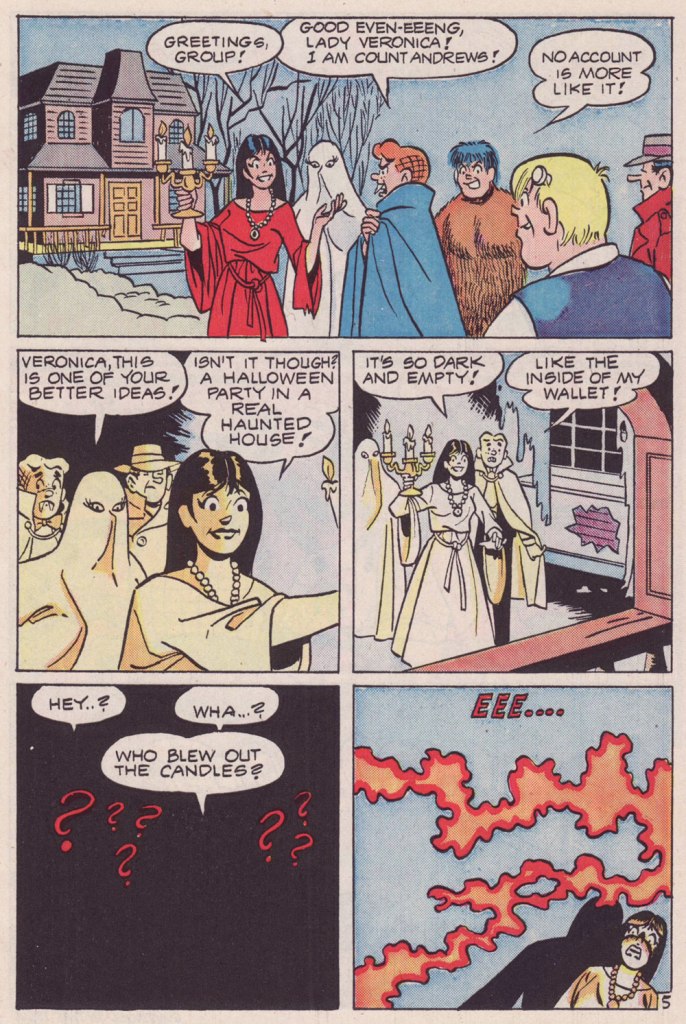
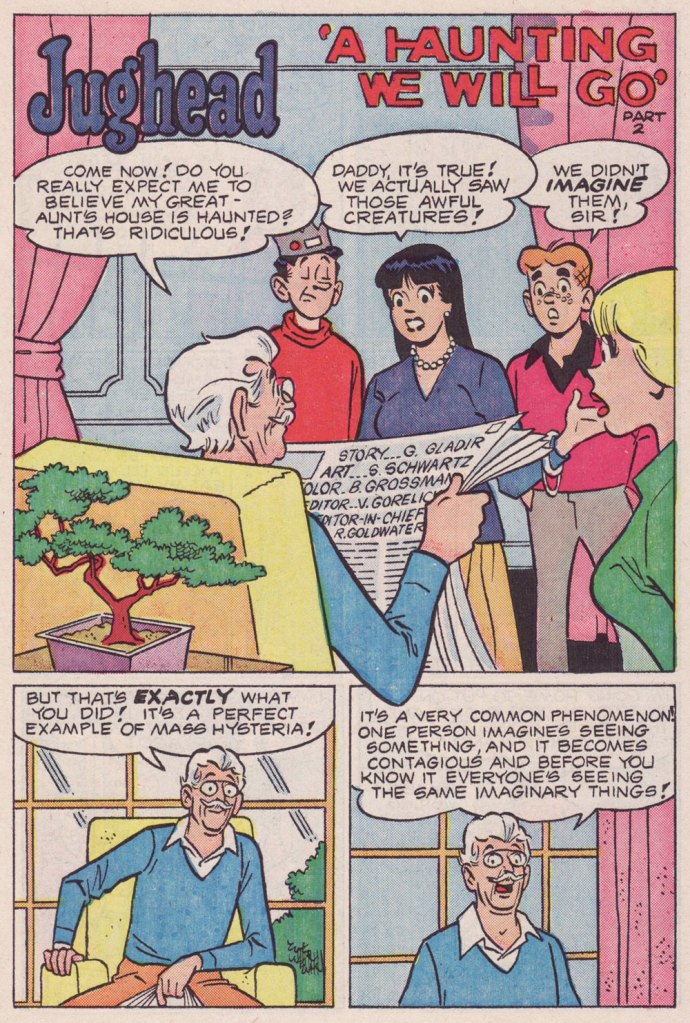
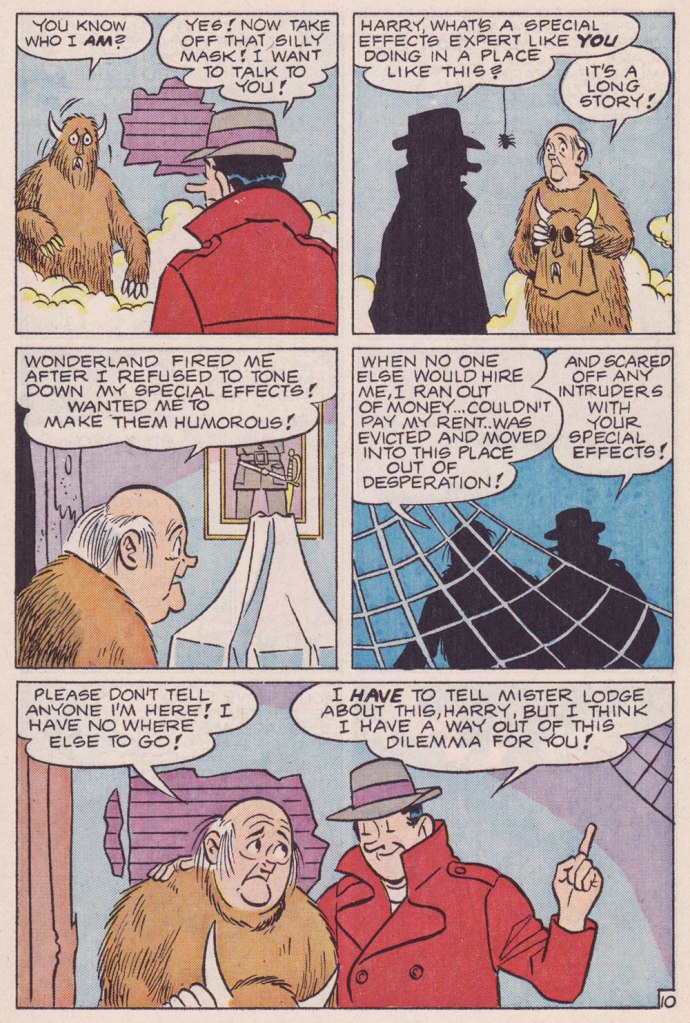
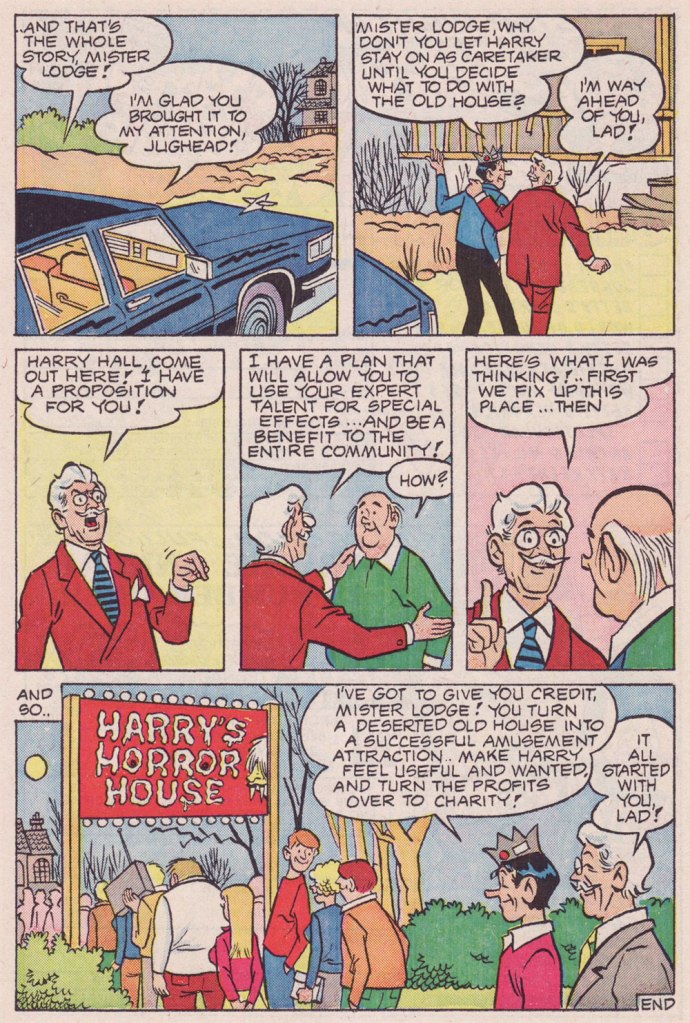
Spookiness is afoot in Riverdale! Here’s a lovely George Gladir (script) & Samm Schwartz (pencils, inks and letters) saga to suit the season. I love those longer tales, which in this case allows for a larger-than-usual cast and a more leisurely pace.
‘A Haunting We Will Go’ was originally published in Archie Giant Series Magazine no. 564 / The World of Jughead (Sept. 1986, Archie). Oh, and colours by Barry Grossman.
« There is never enough horsepower… just not enough traction. » — Carroll Shelby
While my co-admin ds has already touched upon the circumstances of Topps’ Weird Wheels in her Purple Tentacle Tuesday post, she was of course thematically constrained there… while I’m free to drill down deeper into the set’s considerable riches. I won’t recount the set’s history, as that haunted ground has long ago been exhaustively explored and trod upon by the mighty Kurt Kuersteiner, monster gum card historian and also owner, operator and distinguished curator of the Jack T. Chick Museum of Fine Art. Peruse at your peril his fine account of what went down when Weird Wheels came down.
No one can claim this didn’t constitute an attractive package!
And now, on to the cards… my favourites, anyway. From what’s known, the art duties were shared by Norman Saunders and Gary Hallgren.
Card no. 1. Note the belfry engine.Card no. 4.Card no. 9.Card no. 17.Card no. 18. Held together, of course, by surgical stitching.Card no. 22.Card no. 23. This one, without question, was painted by Gary Hallgren… note the licence plate.Card no. 26.Card no. 27.Card no. 45. Here’s the ideal soundtrack for this scene.Card no. 54. I love that this heap isn’t going anywhere: it’s on bricks.
« I lived on a houseboat in Amsterdam for a year. It was intense, and it’s possible that I even had a few blackouts. » — Wolfgang Beltracchi
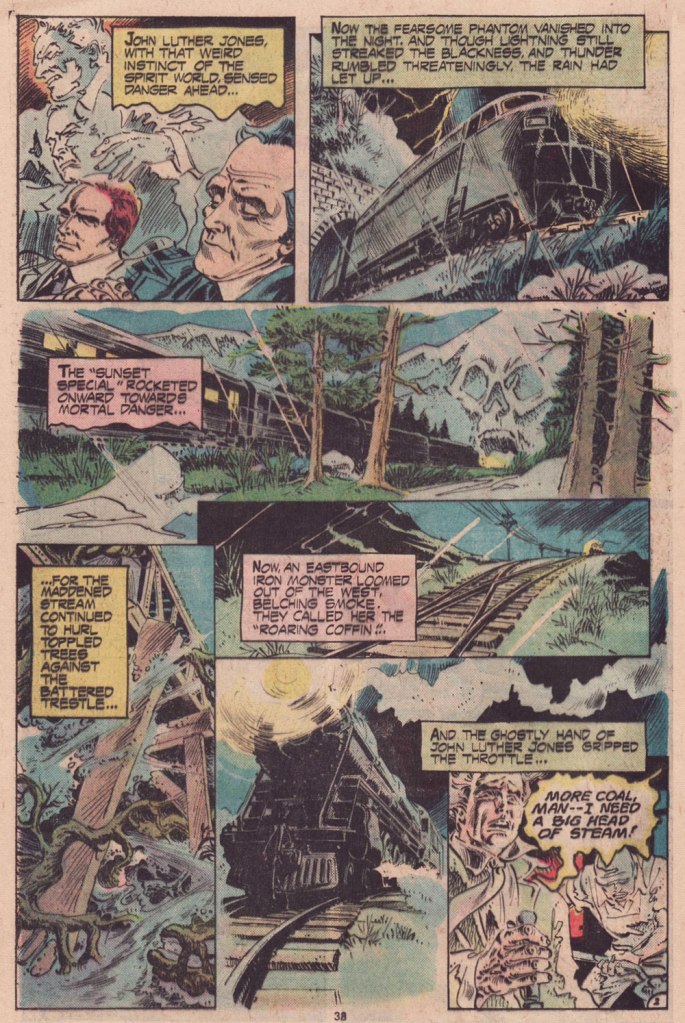
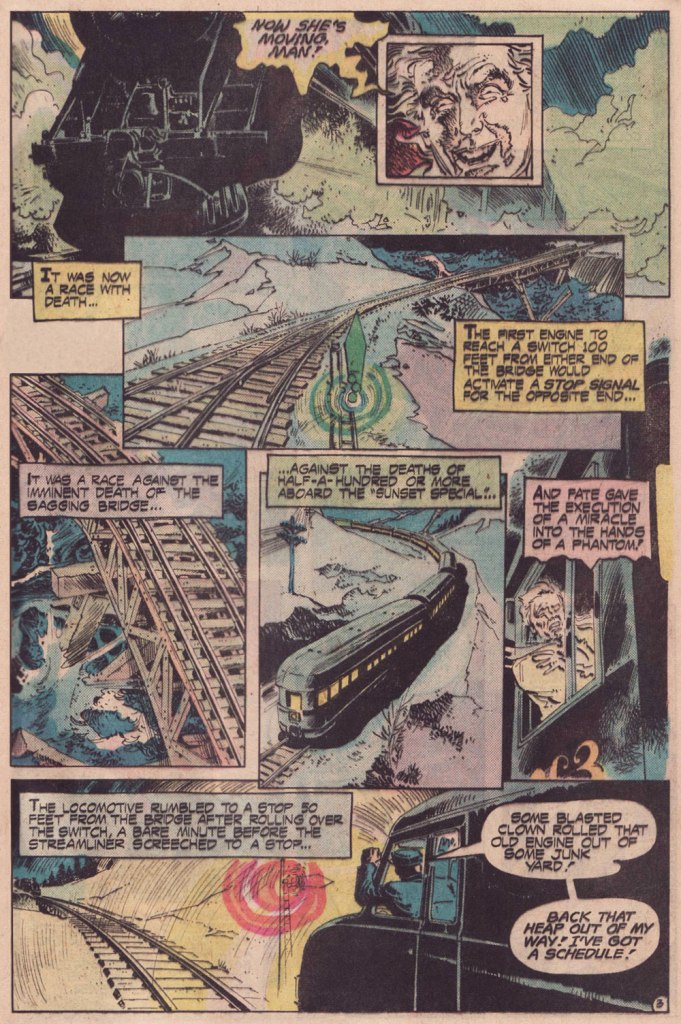
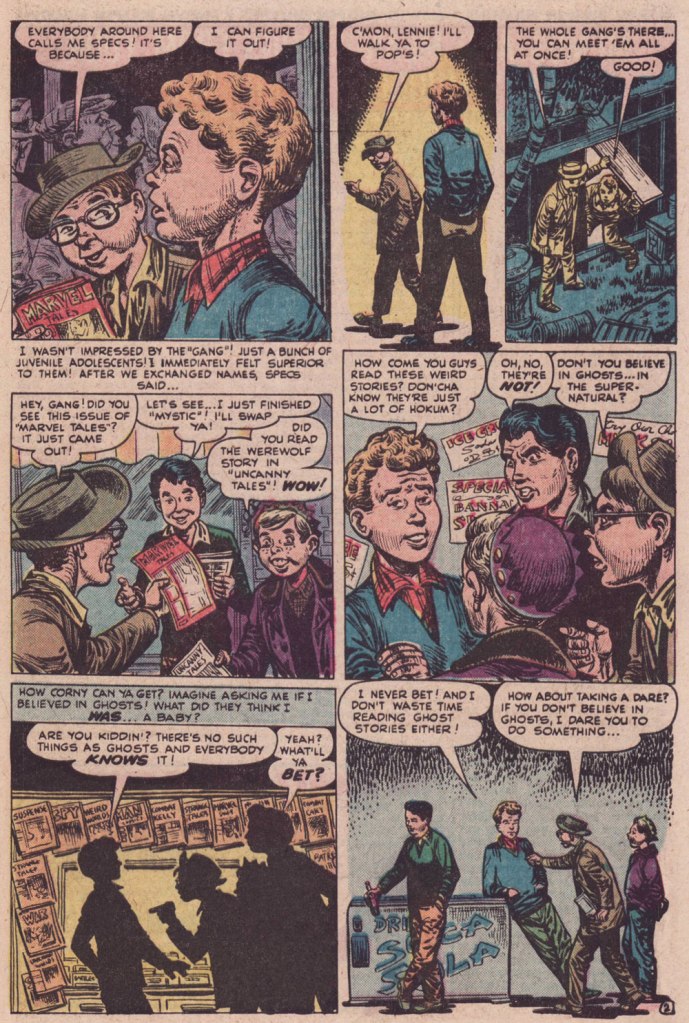
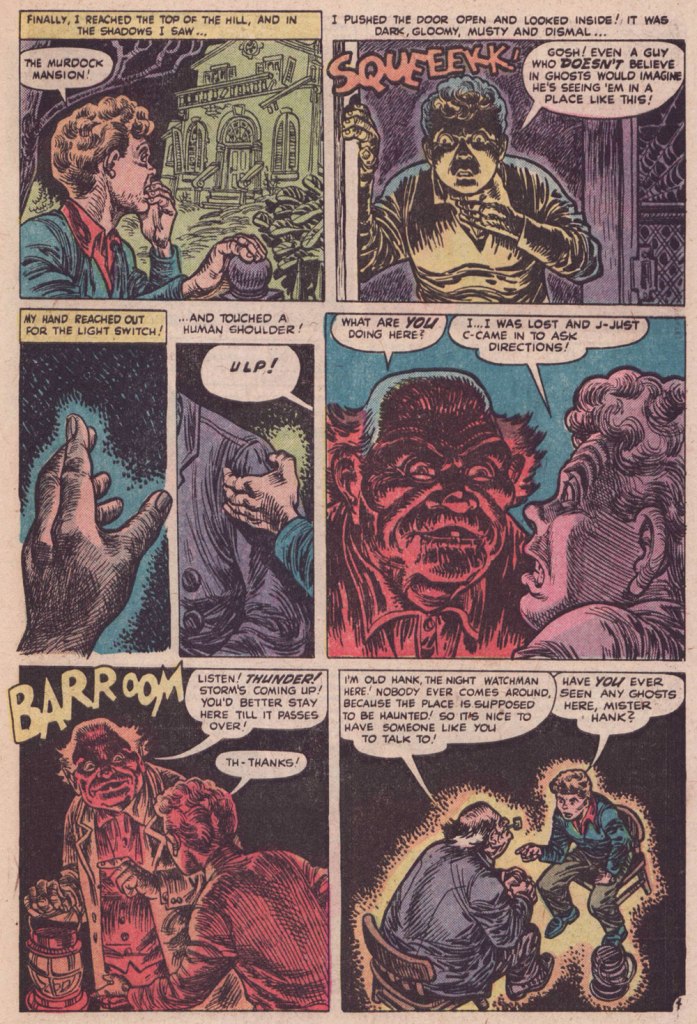
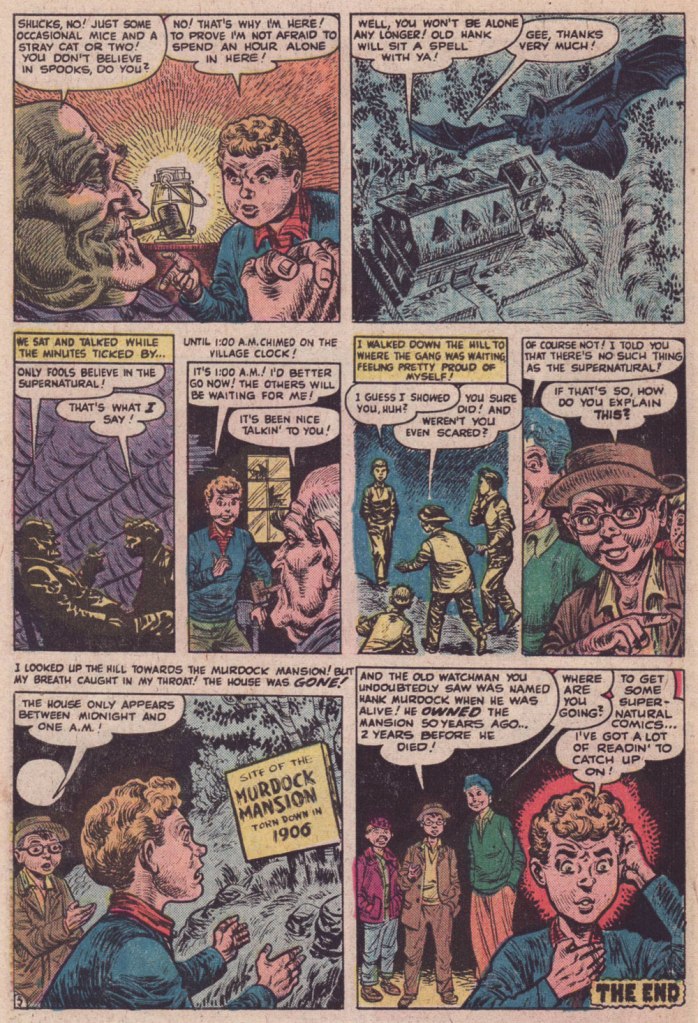
Today’s featured tale is an old favourite illustrated by one of American comics’ perennial mal-aimés, the much-maligned Jack Sparling (1916-1997), a prolific, reliable, distinctive stylist who toiled for just about every publisher on the block. Of course, he’s persona non grata with the superhero set (a compliment in my book!) but his chief strengths lay just about everywhere else, in humour, horror, crime and adventure… you name it.
I love how cosy — that pervasive, foggy ambience! — yet harrowing this tale is. Nice to see one of those insufferable, know-it-all ‘ghost busters’ get his bitter requital. And who knew that some witches were so neat, so domestically inclined? Work that mop, boy!
The writer’s uncredited, and that’s a shame, because this is anything but formulaic — and DC’s mystery books were formulaic to a fault, especially under Joe Orlando‘s guidance. I suspect the author to be editor Murray Boltinoff — he often pitched in, under sundry bynames.This is It’s Midnight… The Witching Hour!no. 21 (June-July 1972, DC), edited by Murray Boltinoff and with cover art by Nick Cardy.
What’s that? You’re not familiar with Mr. Crawford’s name? Well, perhaps his work will ring a bell. Take a look at some of his œuvre through this fine overview by historian Ivan Kocmarek.
In this case, Crawford was obviously instructed to hew closely to the style of Richard Scarry (my very first artistic hero!), who’d illustrated the earliest editions of the Golden Calendar.
For some sense of Crawford’s range, here’s an episode of Professor Harbinger, a speculative ‘science’ backup feature that regularly appeared in Doctor Solar, Man of the Atom. This, the inaugural vignette, saw print in the magazine’s second issue (Dec. 1962, Gold Key). It was scripted by the prolific Dick Wood; Crawford must have enjoyed the feature, as he stuck around to illustrate its first dozen or so instalments. He was succeeded by fellow Ontarian Win Mortimer.
It’s what’s happening, all right, but not for the stated reason.