Don Flowers, Sadly Neglected Cartoonist

« …the finest line ever to be bequeathed to a cartoonist. It dances; it snaps gracefully back and forth. » (Coulton Waugh in “The Comics”, 1947)

That description was written à propos of Don Flowers (1908 – 1968) and his art. Some of you may remember seeing Glamor Girls in your favourite gazette – at the height of its popularity, this syndicated strip ran in about three hundred newspapers. This story goes thus: Flowers, working for AP Newsfeatures, created a few strips, namely Oh, Diana!, Puffy the Pig, and Modest Maidens. The first two achieved very modest success, but the third one was a huge hit, so much so that newspaper magnate William Randolph Hearst (displaying his usual impeccable taste in comics) offered Flowers double salary if he came to work for Hearst’s King Features. Since AP owned the rights to Modest Maidens, the strip was renamed into Glamor Girls. Flowers drew Glamor Girls, both dailies and Sundays, until his death by emphysema in 1968.

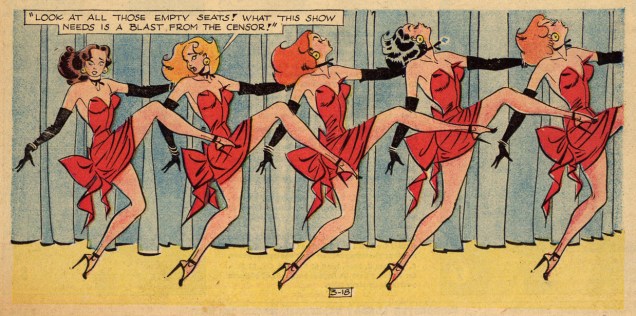
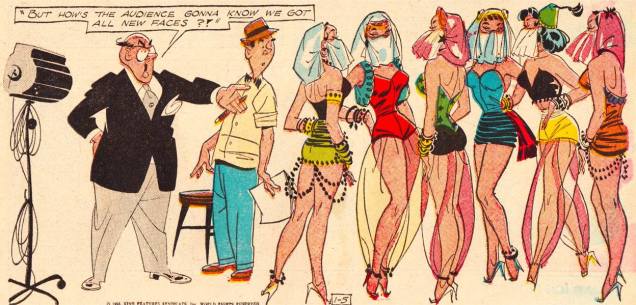
His art is quite lovely – but I don’t expect you to take my word for it. Here are some examples. (All strips below have been published by King Features syndicate between 1958 and 1963.)

DonFLowers-GlamorGirls-Cancan

« That Flowers is not better known is both a pity and a surprise, especially given his technical expertise and the recent renaissance in the popularity of the pin-up genre. Whether blondes or brunettes, showgirls or housewives, Flowers rendered them flawlessly and elegantly, and always with equal aplomb. » (Alex Chun in Glamor Girls of Don Flowers, Fantagraphics, 2006).

Don-Flowers-GlamorGirls-DumbBlonde

«…There are things that never change, especially the early foundations. For better or worse they become part of your style. And as I continue to draw, every time I look at a page I think to myself, that nose is an Oski nose, that body is a VIP body, and every time I draw a beautiful woman, I think – no, I wish – she is as beautiful as a woman drawn by Don Flowers. » (Sergio Aragonés in his introduction to Glamor Girls of Don Flowers, Fantagraphics, 2006)

DonFlowers-GlamorGirls-Cigarettes

DonFlowers-GlamorGirls-Casting

Flowers’ art looks as good, if not better, in old-fashioned black-and-white, which is often the case with artists who have a fluid inking line. The original art for some Glamor Girls strips allows us to admire details:

DonFlowers-GlamorGirls-5-26-1956

DonFlowers-GlamorGirls-21

DonFlowers_GlamorGirl_WriterGag079_8-27-1963

After his death, Flowers’ son self-published Standing on Ceremony, a collection of marriage-themed cartoons plucked from his vast collection of his father’s original art. You can see some of them here.

~ ds

Happy Birthday to Eldon Dedini

Amidst all the (justified) doom and gloom that this week has brought us, there is one bright spot that comes just in time to save this week from being a complete downer. It’s Eldon Dedini’s birthday! (He was born in 1921, on June 29th.) Yes, I know that he died in 2006… but his joyous, delightfully hedonistic art lives on. As a Russian whose father once started a rowdy party because it was Mozart’s birthday, I claim the privilege of celebrating Dedini’s jour de naissance by raising my glass of rosé (satyr-approved, of course) in his honour.

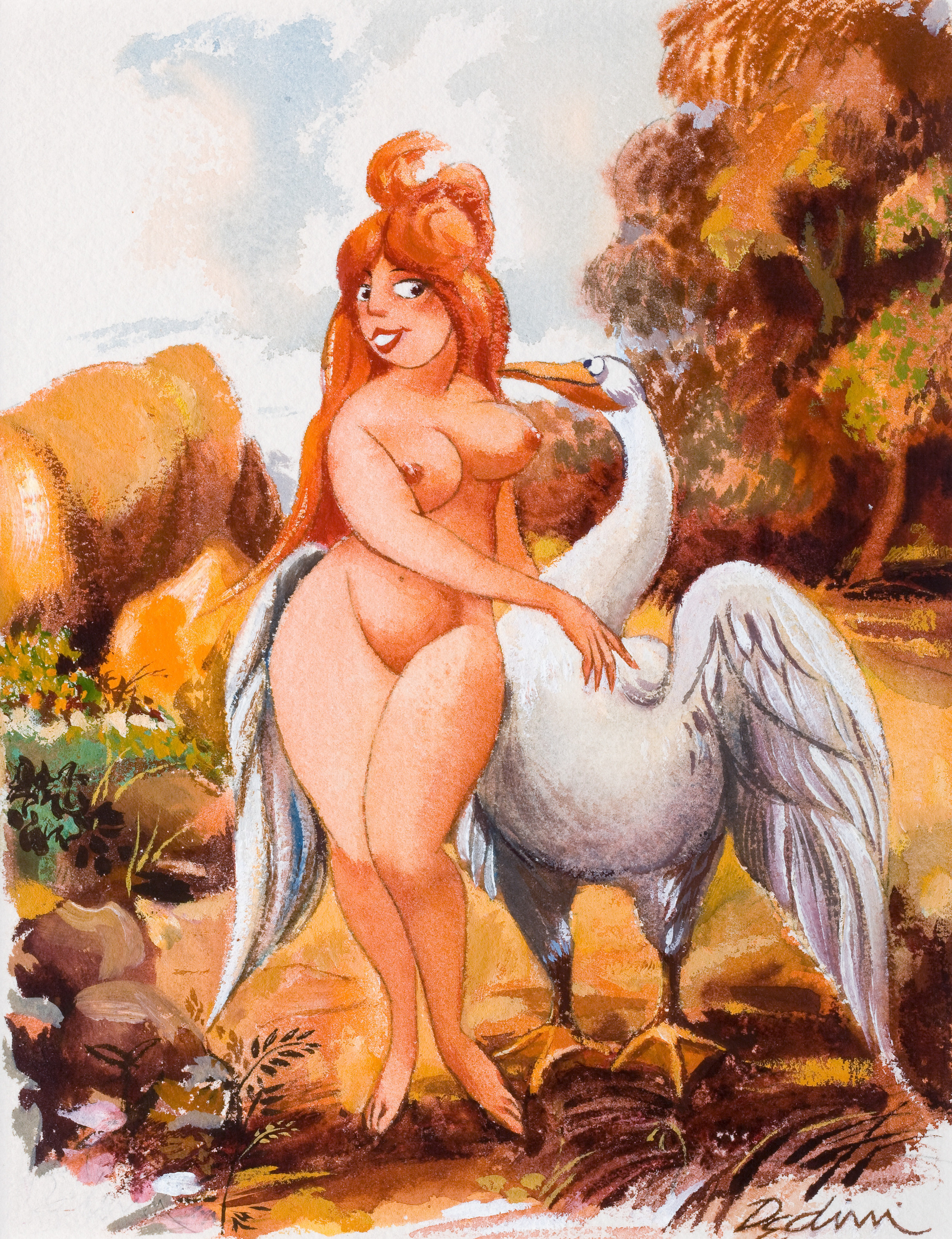
Dedini-Swan
“That’s all very well for you, but I’m the one who’ll have to sit on the eggs”.

He was one of Gus Arriola’s closest friends. To quote Arriola, «calling Eldon a cartoonist just christens the tip of an impressive iceberg. Beneath the surface is a superb painter, a remarkably inventive illustrator, philosopher, and humorist—a keen observer, revealing life’s little truths with his unerring brush. His chief reward was the viewer’s invariable burst of laughter. He was a walking repository of eclectic knowledge about art, history, jazz, wine—you name it. I gave up using my encyclopedia on a subject search: it was faster to pick up the phone and call Eldon.» By the way, I pulled this quote out of a R.C. Harvey article published in the Comics Journal titled “Viewing Life Through a Twinkle”, which gives you an idea of what a fun read it is.

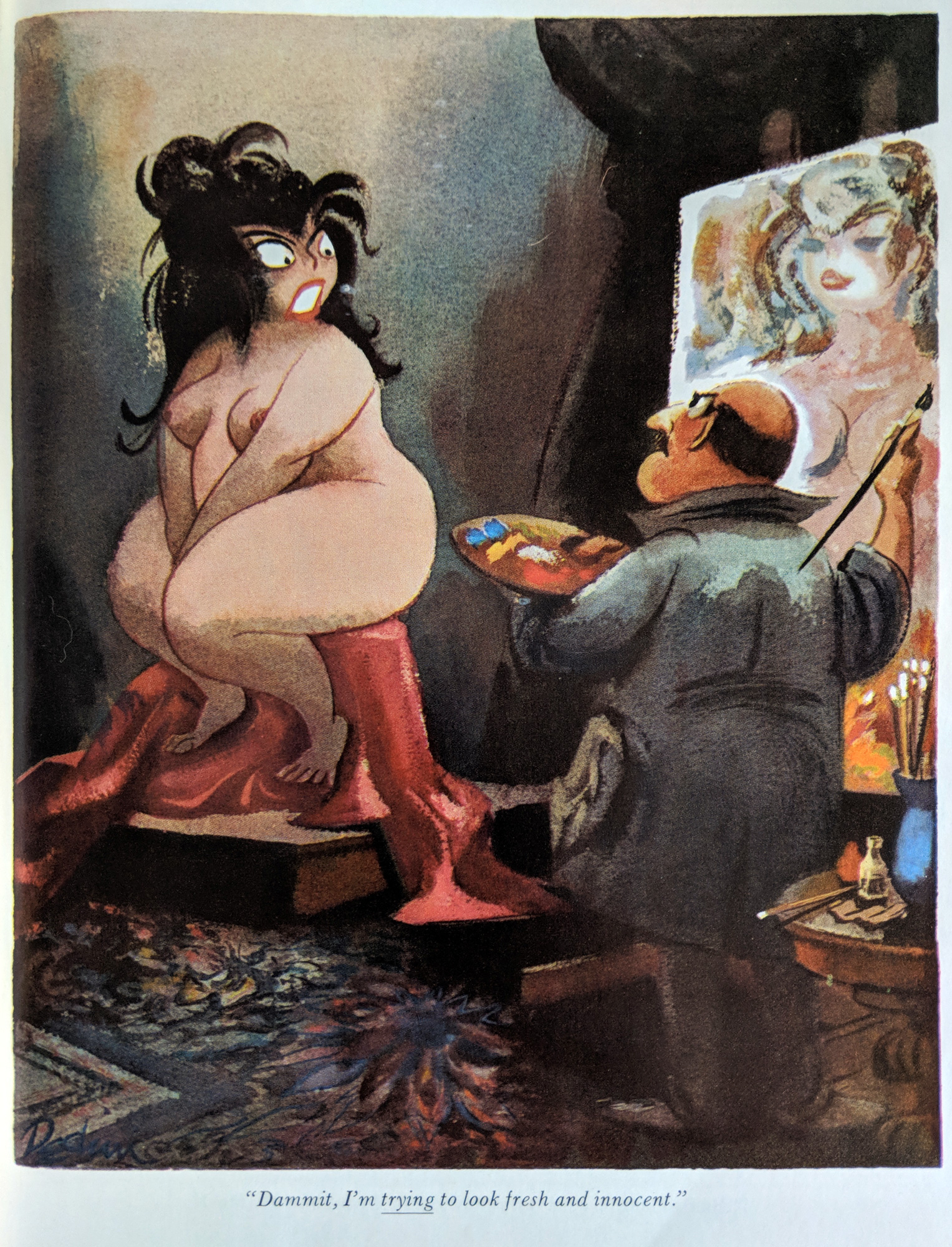
The first thing that comes to mind when one thinks of Dedini is merrily frolicking satyrs, closely followed (or preceded) by unapologetically buxom women, all of this merry crowd looking to have some fun of the most basic kind. It’s not all randy woodland gods, though; there’s also room for lascivious gnomes, salacious wolves and whatever other lechery comes to mind. (Most of these were published in Playboy Magazine.)

Dedini-Satyr-Balzac
« Remember what Balzac said – ‘it is easier to be a lover than a husband for the simple reason that it is more difficult to be witty every day than to say pretty things from time to time.‘ »
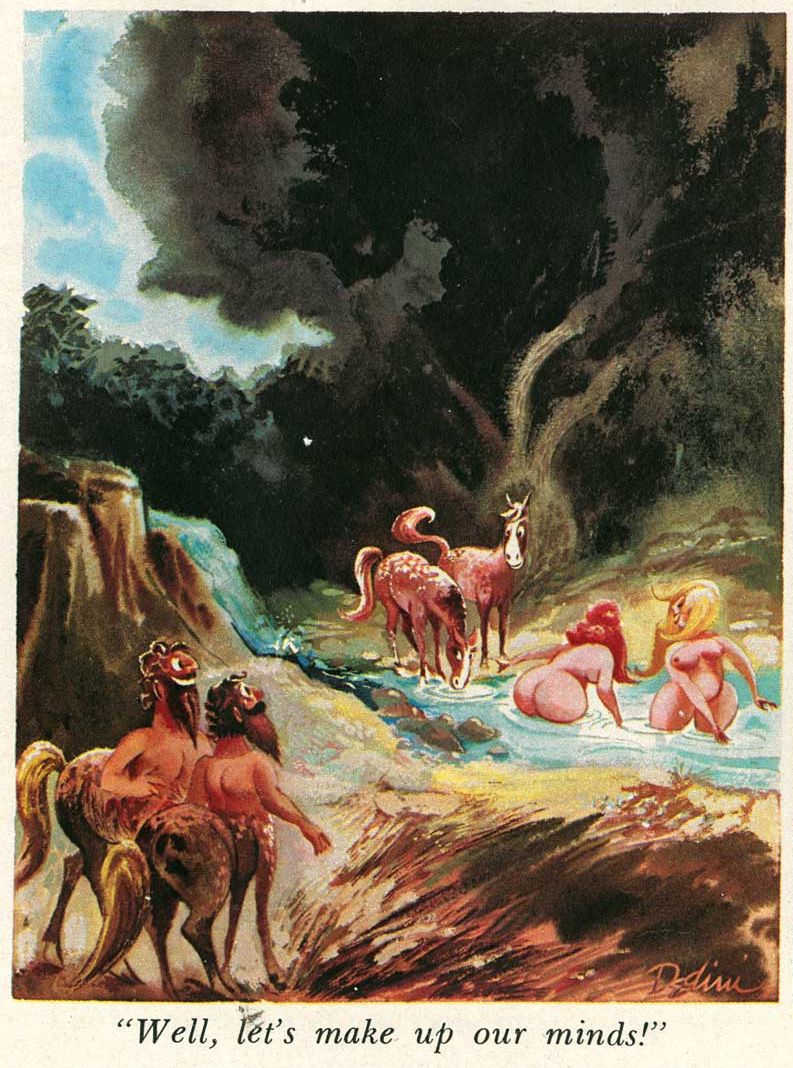
Dedini-MakeUpOurMinds
Ooh, tough choice.
Dedini-MushroomScene
« Either we start pushing birth control or we’re going to be up to our asses in little people. »

DediniWolfA« But will you love me when I’m old and gray? » From Playboy’s August, 1971 issue.
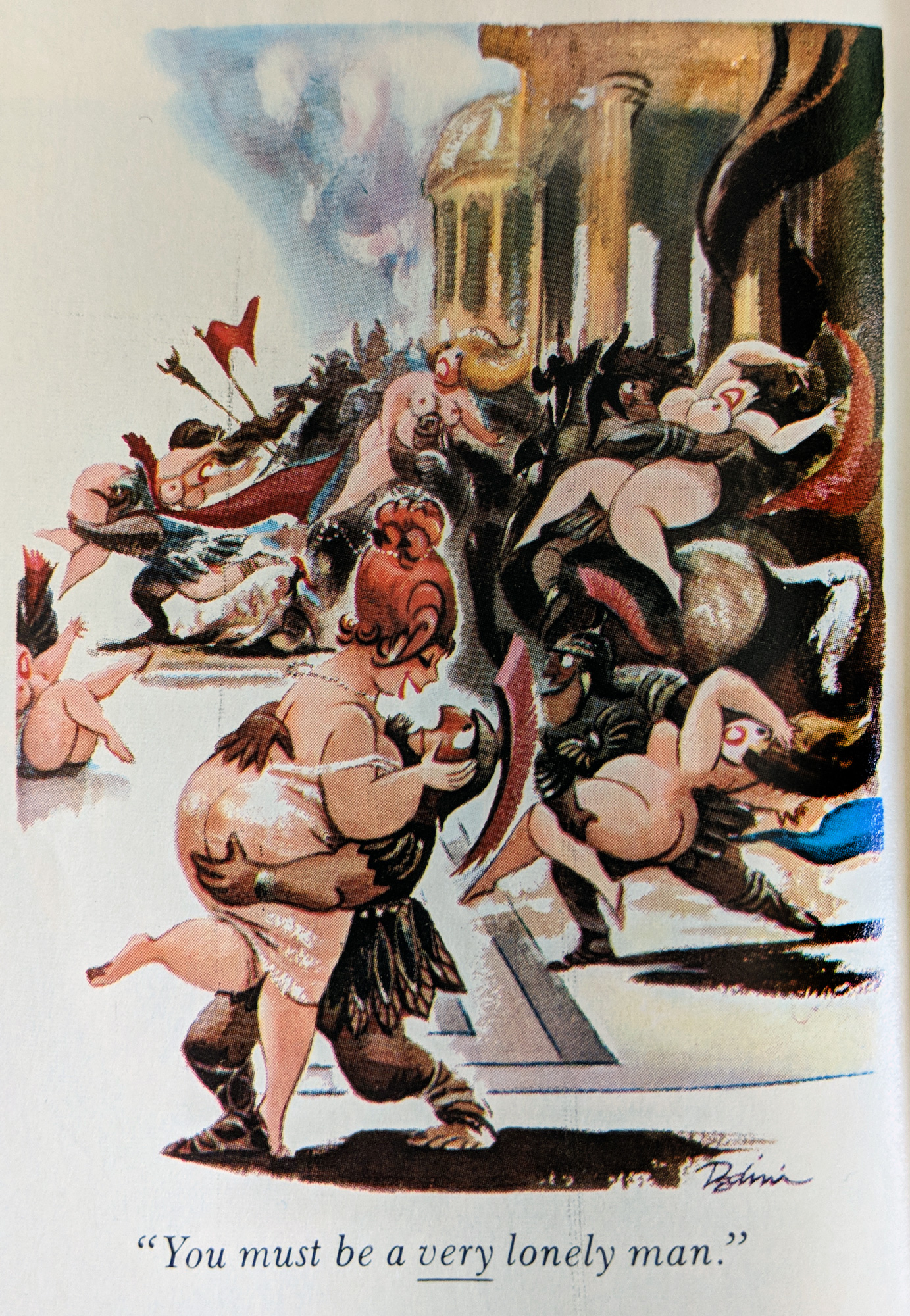
Dedini-LonelyMan
Nothing like taking the proactive role, huh?

Although it’s easy to be blown away by Dedini’s take on Grecian and Roman mythology – I think fabled creatures gave him an easy outlet for his joie de vivre – he could seemingly draw anything he wanted to, stunning forest landscapes or historical costumes, capturing carpet textures, clothing accessories or musical instruments with equal ease.

Dedini-FreshandInnocent

Dedini-ThunderWoman

Dedini-RockBand
« Well, I guess it goes to prove that not all God’s children got rhythm. » Note the name of the band, which made me snort into my tea.


Dedini-Religion
Whatever religion *that* is, I want to join it!

To wrap up, here’s a sweet anecdote from the aforementioned Viewing Life Through a Twinkle:

During an intermission at one year’s Festival, Dedini and some other PBL members went up on stage to have their photograph taken. Duke Ellington was still on stage, seated at the piano, putting eye drops in his eyes. When Dedini was introduced as “a cartoonist who sometimes draws jazz cartoons,” Ellington got up and, without saying a word, pulled out his wallet and started looking through it as he meandered, aimlessly, around the platform. Finally, he found what he was looking for, a folded up magazine clipping. He carefully unfolded it and spread it out on the piano: it was a cartoon Dedini had done for Collier’s. The cartoon depicted two Russians in Red Square, one of whom is obviously a dealer in blackmarket phonograph records: he has opened his coat to show the other fellow the record that he has tucked inside, saying, “ … Cootie Williams, trumpet; Johnny Hodges, alto sax; Barney Bigard, clarinet; Harry Carney, baritone sax; Duke Ellington, piano …” Said Dedini: “Ellington loved that cartoon because when he toured Russia the people of Russia loved his music, but they couldn’t buy the records.” For years thereafter, Ellington sent Dedini a Christmas card. “I have about twenty,” Dedini said. “He sends them in June.”

~ ds

Spending Some Quality Time With Barbara Shermund’s ‘New Woman’

Although it’s tempting (but lazy) to assume so, men didn’t *altogether* corner the risqué cartoon niche.

It would be quite an injustice to count out the magnificent Barbara Shermund (1899-1978), prolific contributor to The New Yorker (including eight covers) and Esquire magazines, and so much more.

Far too little is known about this pioneering artist, but here’s an insightful piece aiming to rectify the situation, at least a little, written by Caitlin McGurk:

https://library.osu.edu/blogs/cartoons/2012/03/27/womens-history-month-barbara-shermund-1899-1978/

ShermundVersatile
Nothing new under the sun! Frankly, that situation hasn’t gained a wrinkle since this cartoon’s appearance in The New Yorker‘s July 21, 1928 edition.

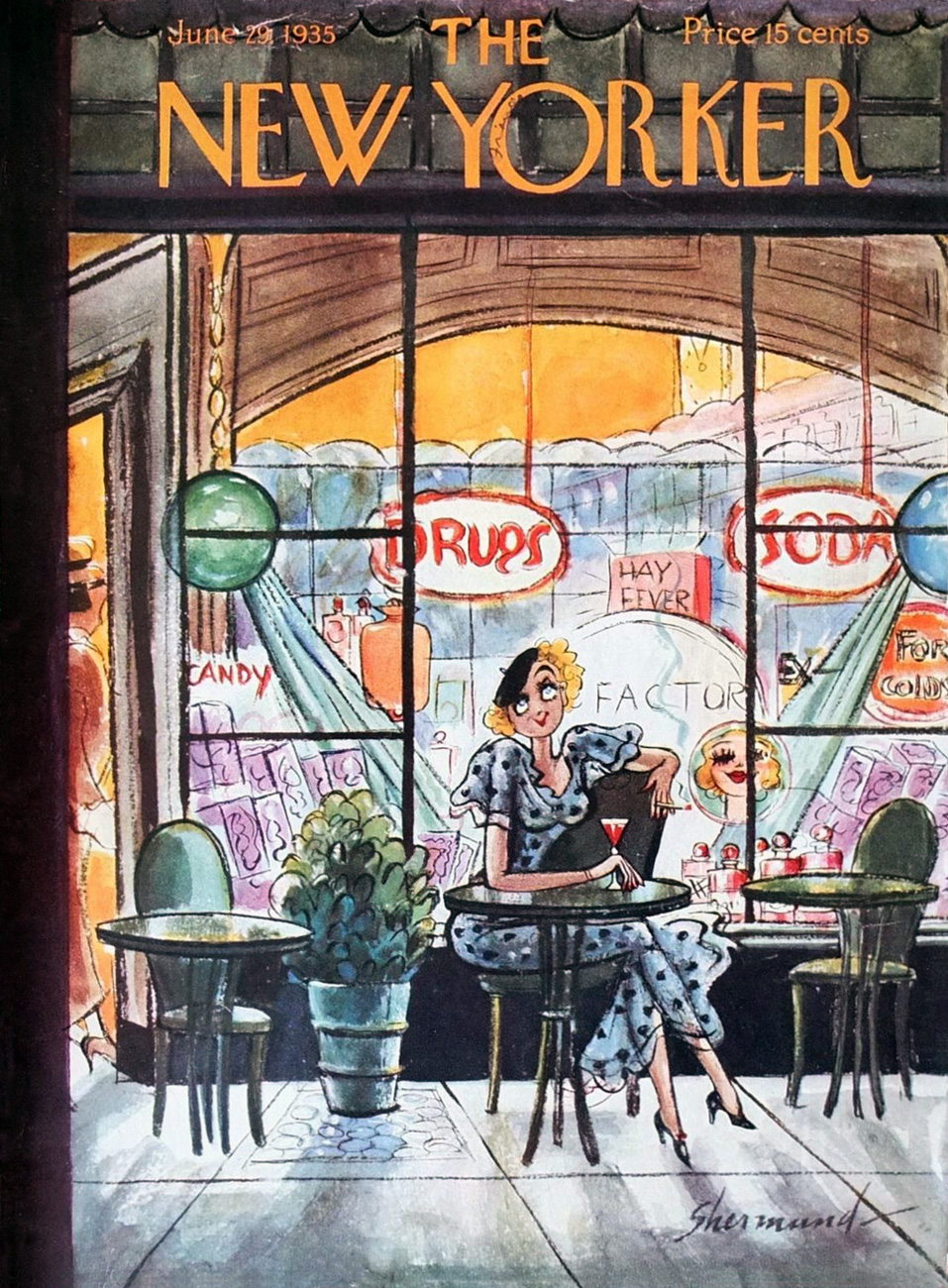
NewYorker1935A
One of Ms. Shermund’s aforementioned New Yorker covers, from the June 29, 1935 edition.

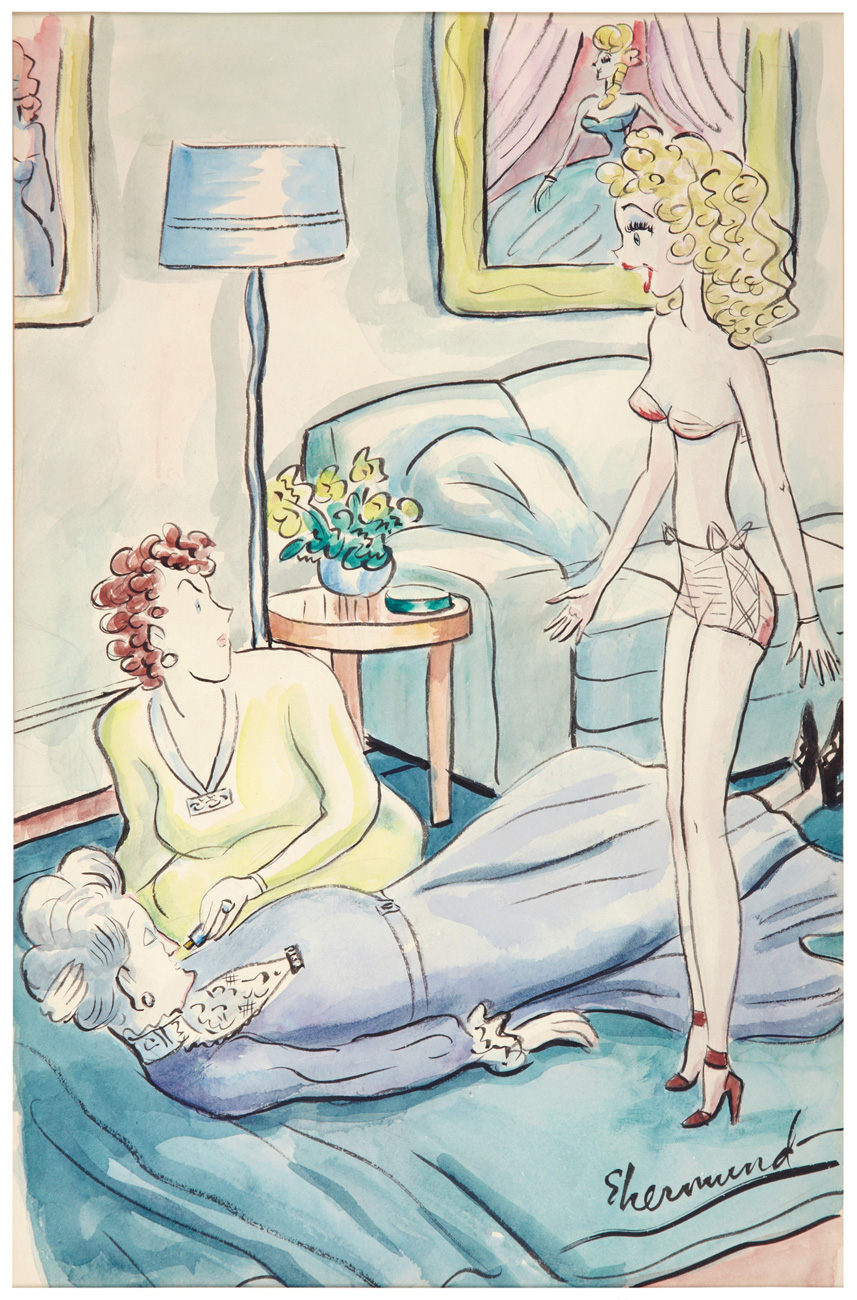
ShermundGrannyFaintA
« All I said was, ‘Granny, how do you like my new bathing suit?’ » Undated piece in ink and watercolour.

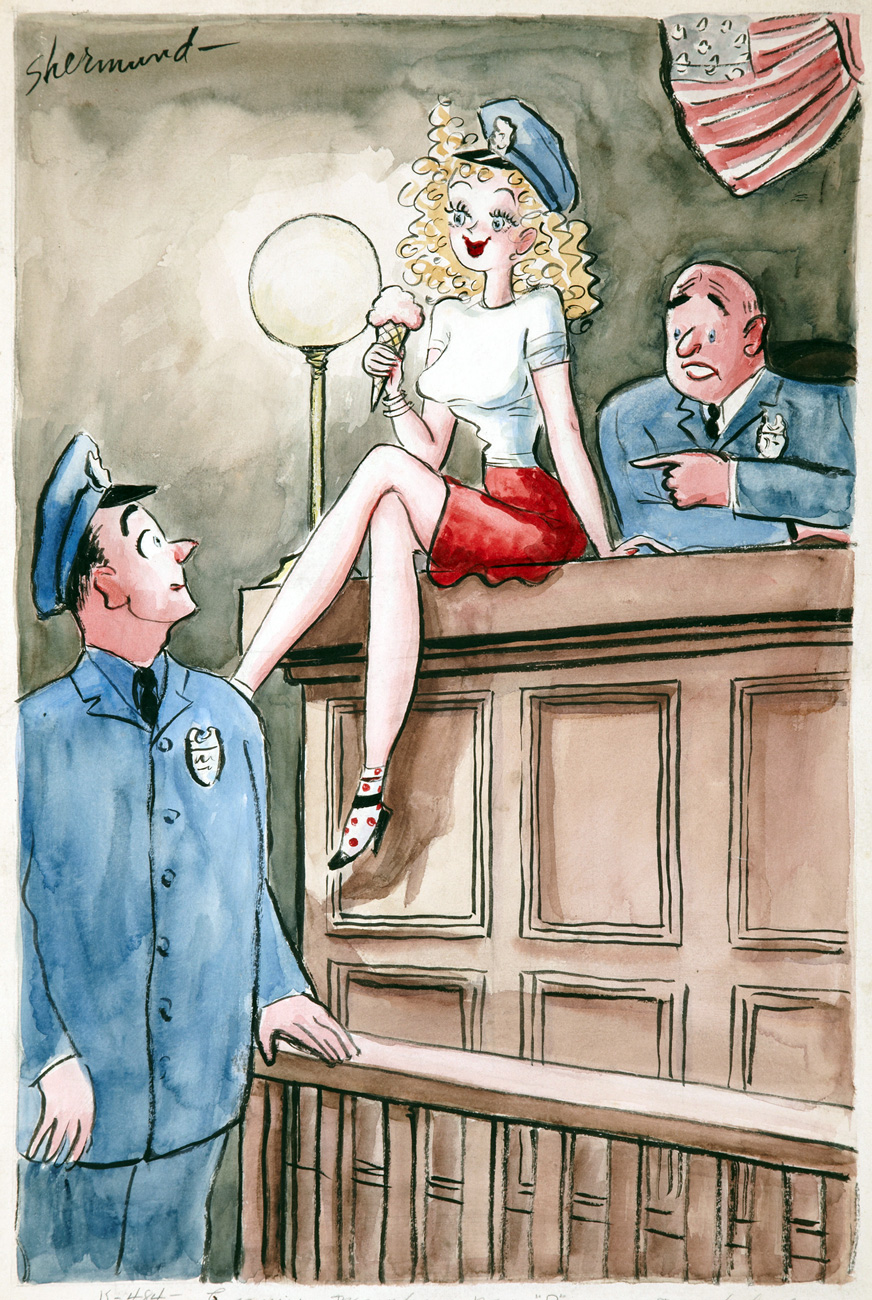
ShermundLostA
« She’s lost! » Esquire, 1944. Ink and watercolour.

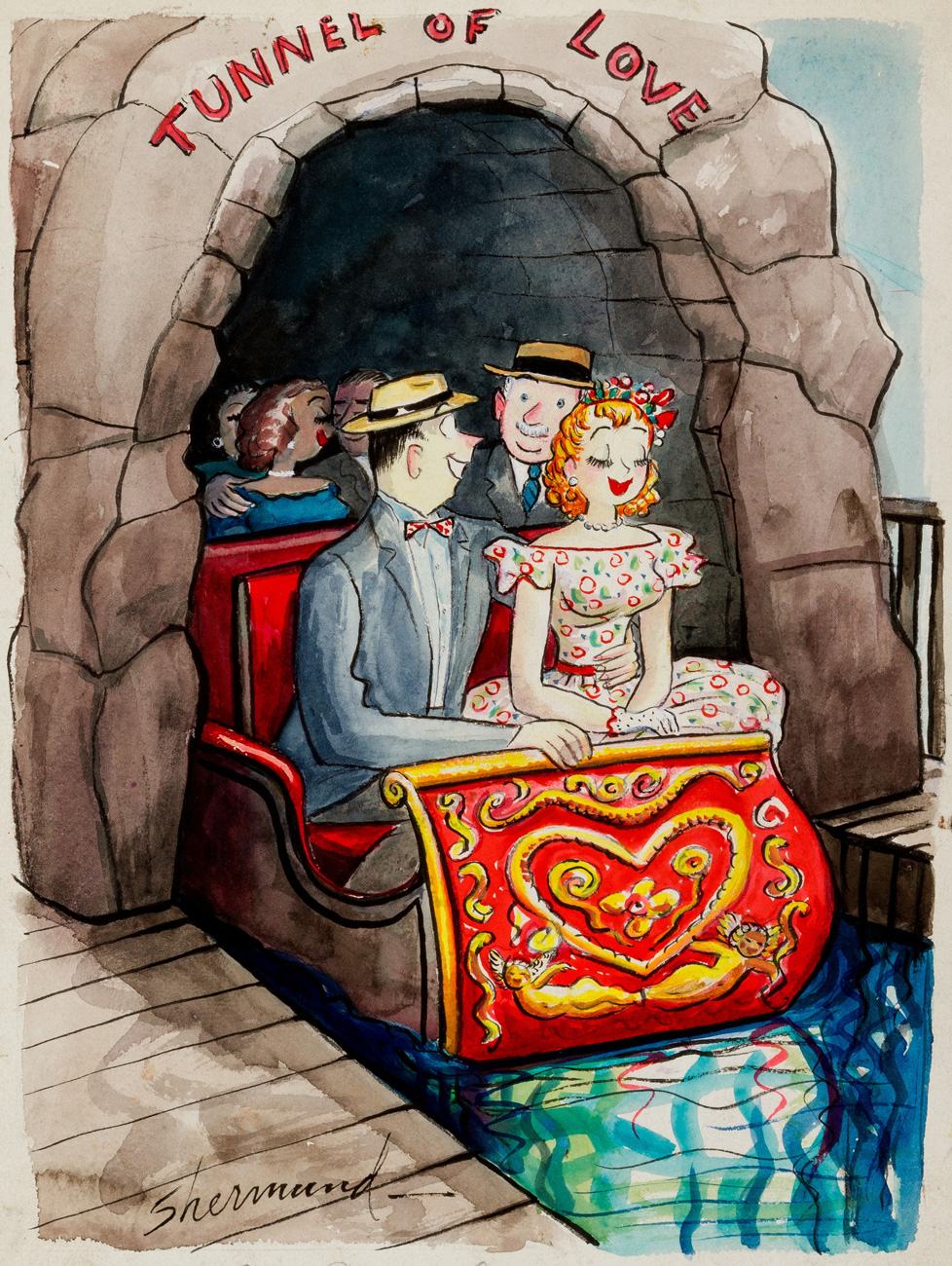
ShermundTunnelA
« Mr. Dillon, I’d like to ask your daughter’s hand in marriage. » (1953, ink and watercolour.)

ShermundApeA
« Who was that fellow I saw you with at Ciro’s last nite? » (Cheering Section, 1955. Ink and watercolour.)

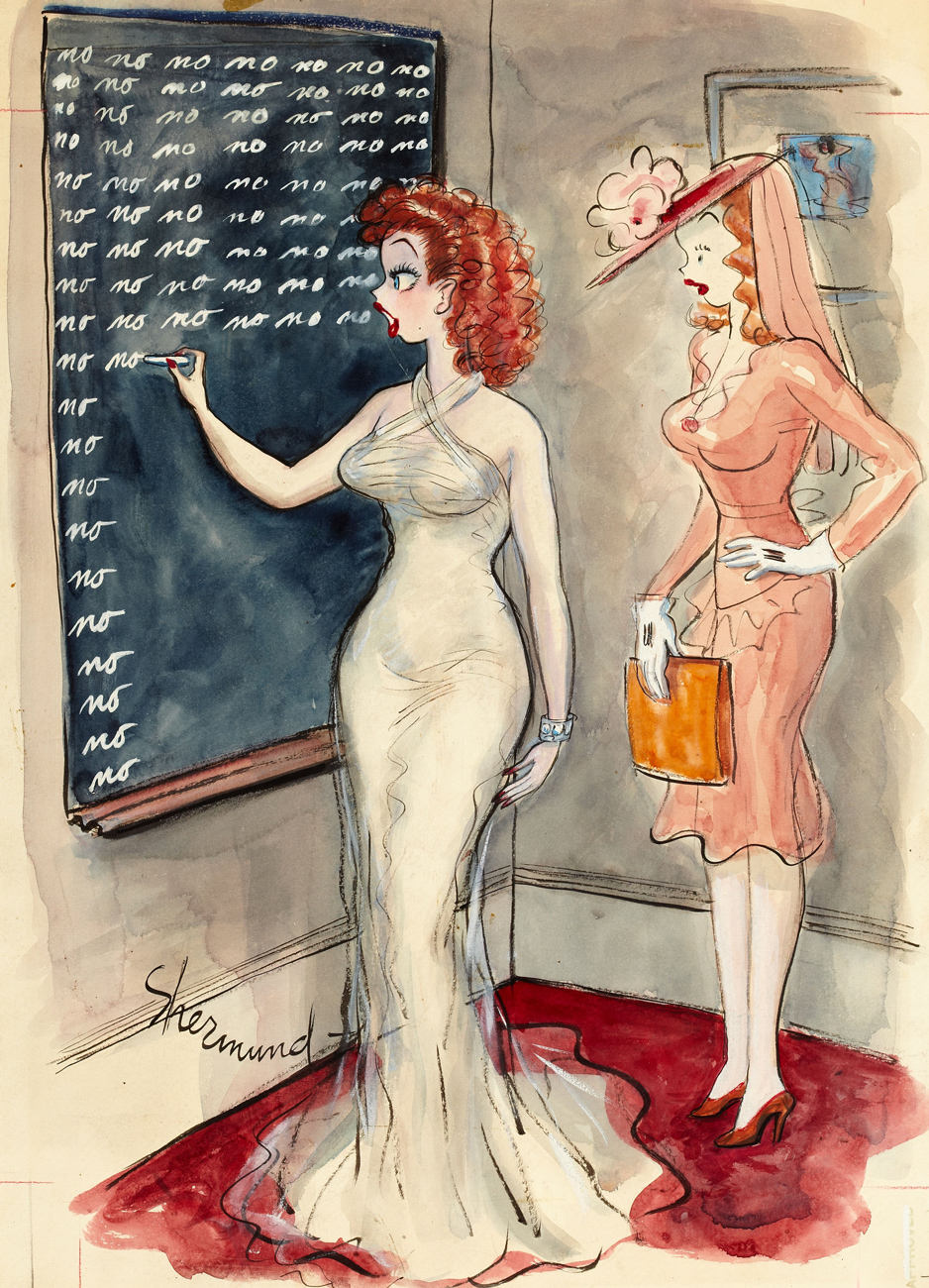
BarbShermundNoA
« Mother always makes me write it five hundred times before I go out with Mr. Parker » Esquire, publication date unknown, ink and watercolour.

ShermundCowboyIndianA
« Let’s play cowboy and indian! » (Cheering Section, 1959. Ink and watercolour.)

I can’t help but be reminded, by that final piece, of Jack Cole‘s rather more trenchant take on a similar power imbalance, published a year earlier.

ColeUncleSamMaidenA
« Well, there’s history repeating itself. » (Jack Cole, from Playboy, January, 1958.)

A postscript: in March, 2022, Ms. Shermund was the subject of an article in the New York Times’ ‘Overlooked No More’ series, comprising belated obituaries for notable folks whose departure flew under the radar, so to speak. In this case, we learned that:

« Shermund lived out her last years drawing at her home in Sea Bright, N.J., and swimming at a beach nearby. She died on Sept. 9, 1978, at a nursing home in Middletown, N.J.

In 2011, a niece, Amanda Gormley, decided to research her family’s history and was surprised to find that Shermund’s ashes had been left unclaimed in a New Jersey funeral home since 1978.

In May 2019, Gormley raised money through a GoFundMe campaign and, with the contributions of many artists and cartoonists, saw to it that Shermund’s ashes were buried alongside her mother’s grave in San Francisco. »

– RG

The Unforgettable Jack Cole

« What are you mumbling about? »
« Oh, nuthin’! … just that 
my false teeth get loose 
an’ make a lot of noise! »

Today marks the one hundred and third anniversary of the enigmatic Jack Cole (December 14, 1914 – August 13, 1958) a man embodying, in equal parts, hilarity, talent and torment. Just when everything seemed to be going his way, he took his own life in 1958, for reasons still surmised about. His widow was the only one to know, and she took her secret to the grave.

Let’s move past this morbid stuff and concentrate on the man’s creative legacy, shall we?

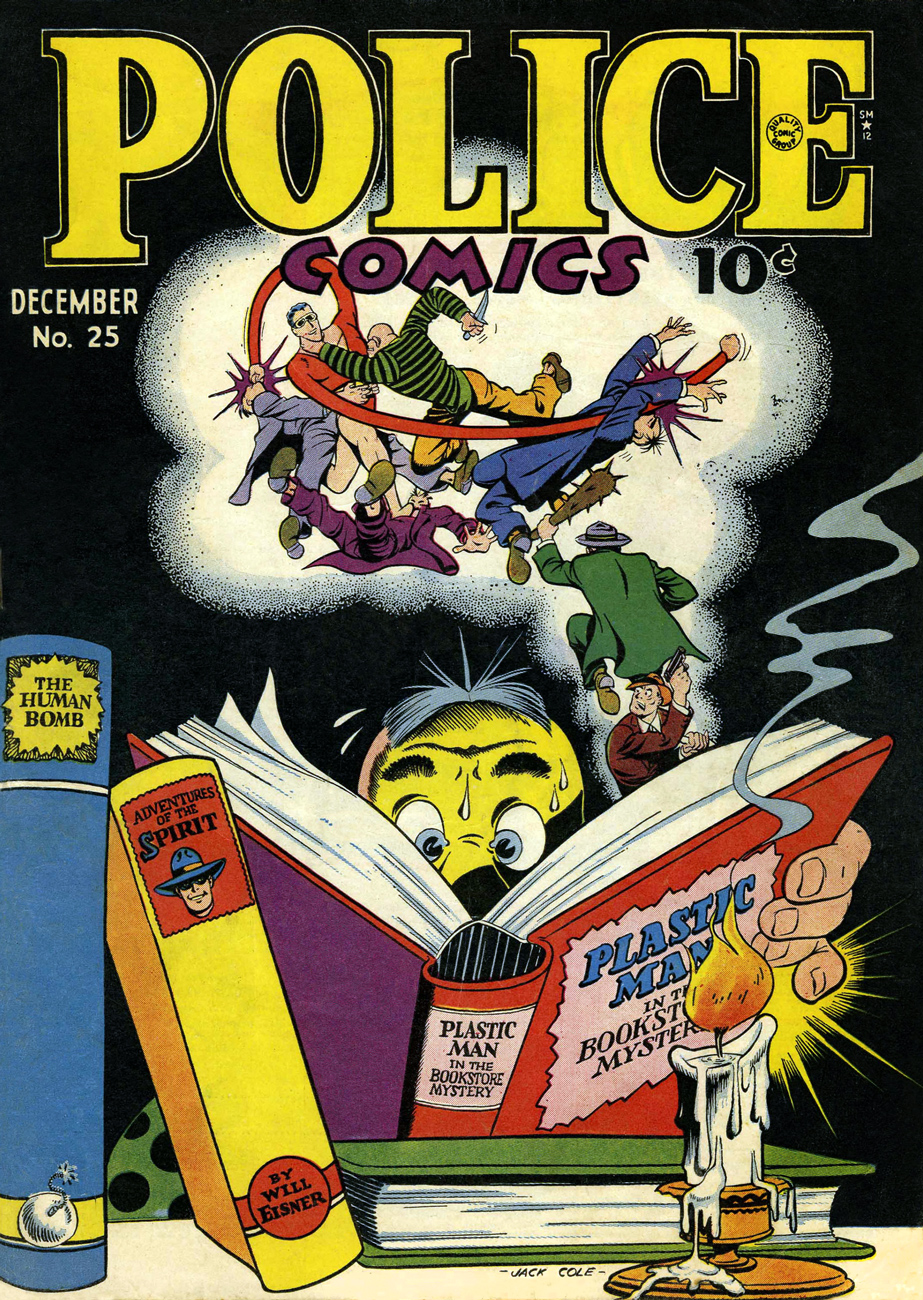
Police25A
Cole’s cover for his Plastic Man story « The Rare Edition Murders » (originally called « The Bookstore Mystery », judging from the cover art) cleverly ties in the mag’s other features. And they do need to be mentioned: Flatfoot Burns by Harvey Kurtzman, The Darson Twins by Jack Keller, The Spirit by Will Eisner (or his talented ghosts), Manhunter by Reed Crandall… This is Police Comics no. 25 (December 1943, Quality).

Police27A
Routine, the same old grind… another issue of Police Comics, another splendid Jack Cole cover. This is Police Comics no. 27 (February, 1944), featuring Plastic Man in « Woozy Winks, Juror », and tales of Dewey Drip, Flatfoot Burns, Destiny, Manhunter, Dick Mace, The Human Bomb, Burp the Twerp (by Cole), and of course The Spirit. Sounds potentially entertaining? Read it here, then: http://comicbookplus.com/?dlid=37421

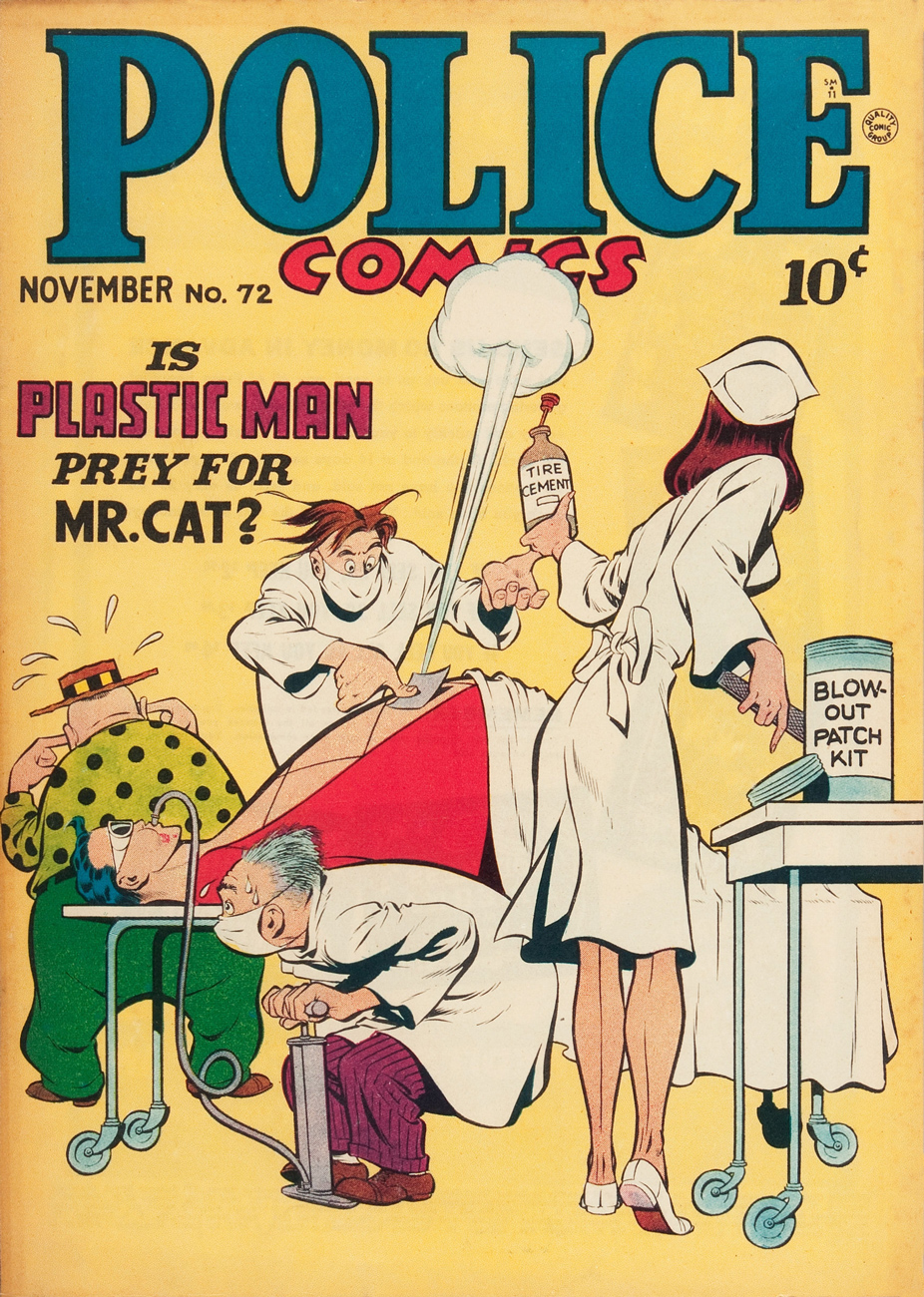
Police72A
Cole’s Plastic Man, one of the timeless wonders of comics’ Golden Age, a character only his creator truly knew how to handle properly. This is Police Comics no. 72 (November 1947, Quality).

Police76A
Another vivid (what else?) example of Mr. Cole’s boundless inventiveness, featuring his flagship creation, Plastic Man (and rotund sidekick Woozy Winks). This is Police Comics (1941-1953, 127 issues) no. 76 (March 1948, Quality).

Web-of-Evil5A
« You mean this guy had nine slugs in his chest and still choked the other one to death? » Web of Evil no. 5 (July 1953, Quality).

WebofEvil6A
Web of Evil no. 6 (September 1953, Quality).

ColeElongatedHandA
This lovely watercolour ran in Playboy Magazine‘s August, 1955 issue. It’s titled « The Elongated Hand ».

JackColeCabinA
« Like they say in the travel folders, Miss Duncan – ‘Getting there is half the fun’ ».
Playboy Magazine, August, 1956.

Versatile, wasn’t he?

– RG

Life is too short to be living somebody else’s dream.

A quick post in salute of Hugh Hefner (1926-2017), who truly was a lot of things to a lot of people, but to me, he remains, chief among these, one rare and precious thing: a steadfast, lifelong friend and patron to great cartoonists, a man of taste, at least in that particular area.

Here are a few relevant pieces. Mere drops in the bottomless bucket. All in good time, we’ll return to this topic.

BenDenisonCorvetteA
« I’ve been thrilled by the dazzling breakaway of your four-speed, close-ratio, synchromesh, manual transmission, and the lusty surge of your 315-horsepower, fuel-injection, high-lift cam engine… »

It’s astonishing how much toil an artist will put in, just to sell a simple gag. It doesn’t hurt if he’s recompensed decently, of course. Case in point: Ben Denison, for Playboy Magazine’s November, 1961 issue. Hugh Hefner has always known the value of his contributors, bless his great big heart.

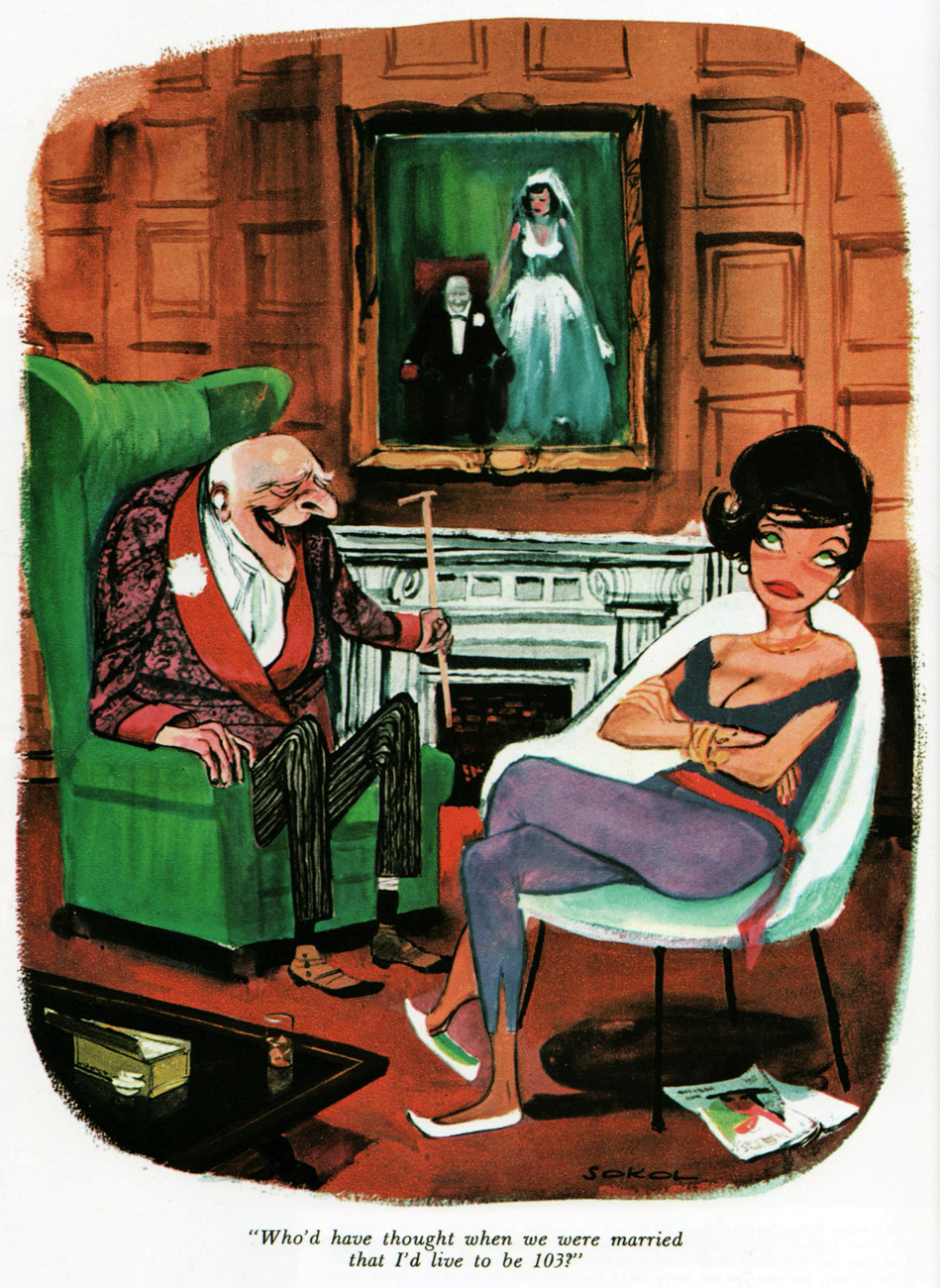
Sokol103A
Erich Sokol (b. Vienna, 1933 – d. Mödling, 2003), originally published in Playboy’s September, 1960 issue.

DinkAliensA
« This is nothing, wait until you see the women. »

Dink Siegel (1910-2003), from Playboy’s May, 1968 issue.

Happy trails, dear Mr. Hefner!

– RG