Random fact of the day: in Mandarin Chinese, secret is “mimi”, whereas in French “mimi” means something like “cute”. Today’s post is not cute, but it is very much about secrets – DC secrets, to be more precise.
Secrets of Haunted House no. 14 (Oct-Nov 1978). Cover by Mike Kaluta.
The original art for this cover feels a little less cluttered:
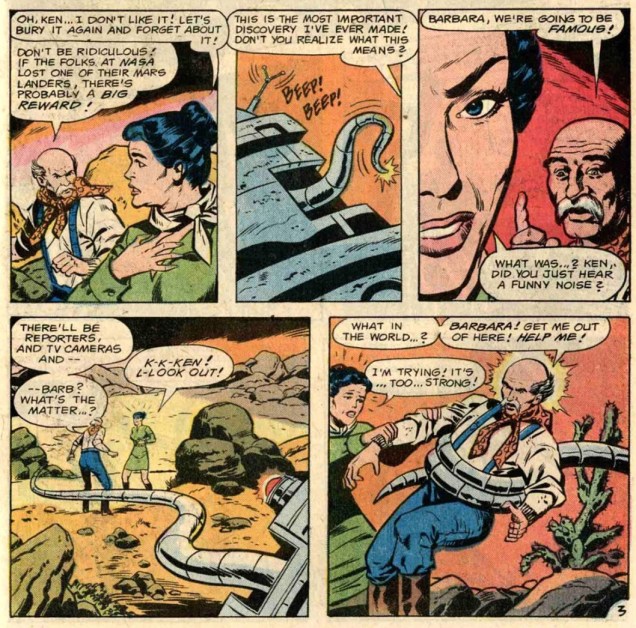
Taking a peek at the insides, we will find that they have little to do with the cover, but tentacles are still present. The Discovery is scripted by Jay L. Zilber, pencilled by Juan Ortiz, and inked by Vince Colletta:
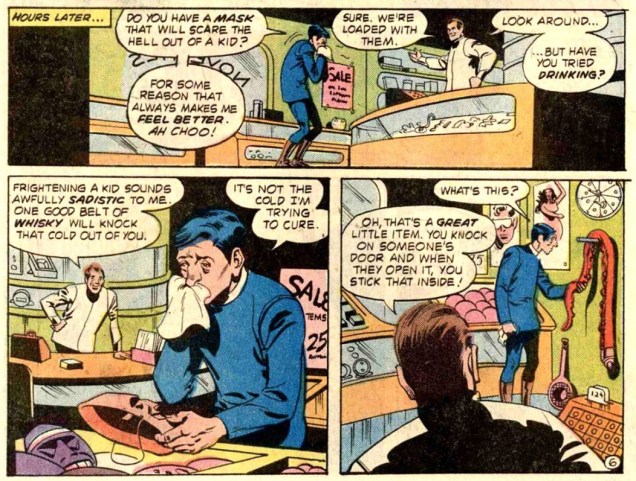
Tentacles also rudely intrude in Selina, a story scripted by Nicola Cuti and elegantly illustrated by Ramona Fradon and Bob Smith —
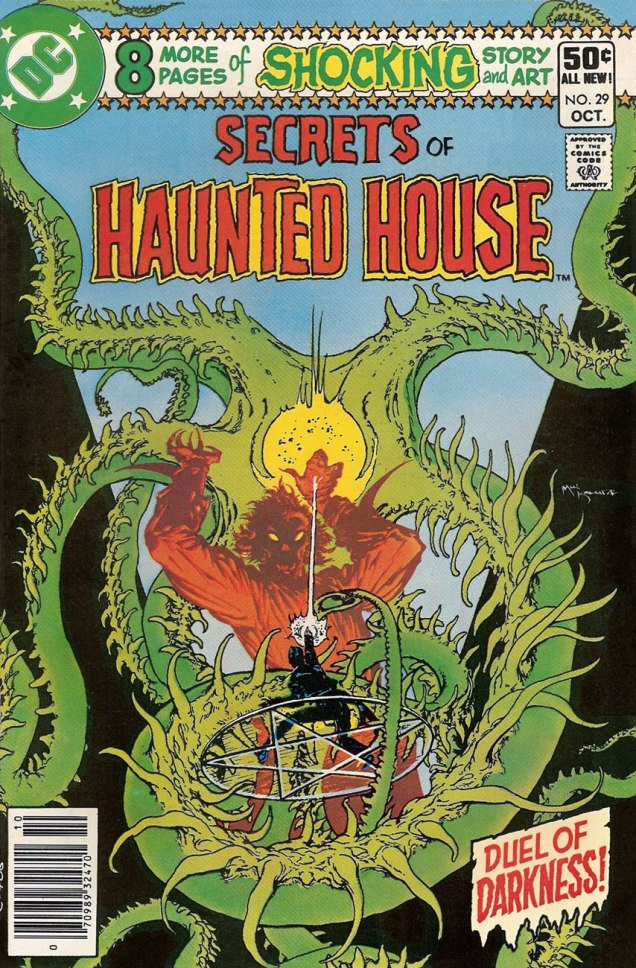
The thing about masks was too topical to not include.Secrets of Haunted House no. 29 (October 1980), cover by Mike Kaluta.Secrets of Haunted House no. 36 (May 1981), cover pencilled by Rich Buckler and inked by Dick Giordano.
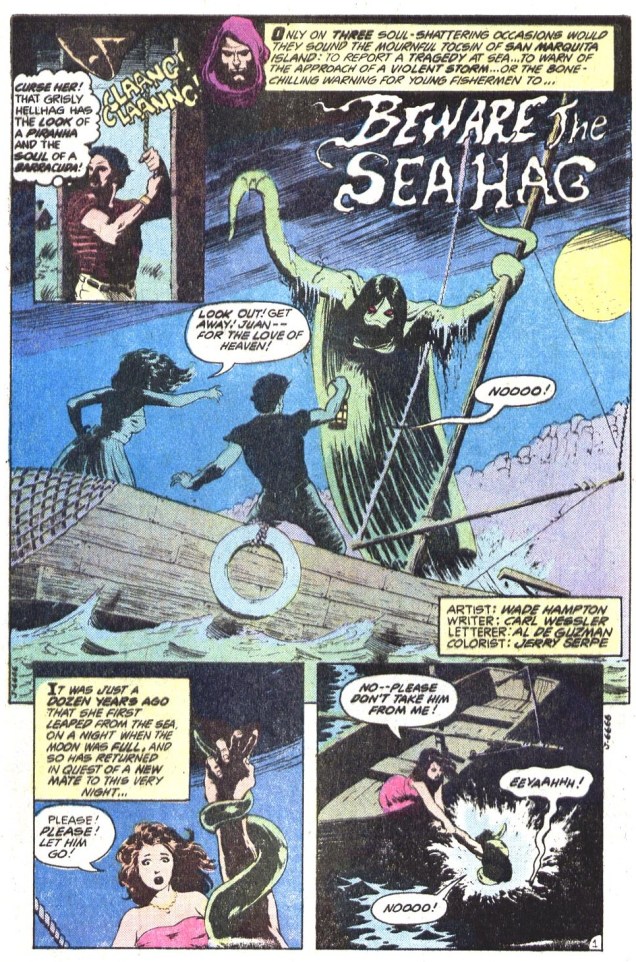
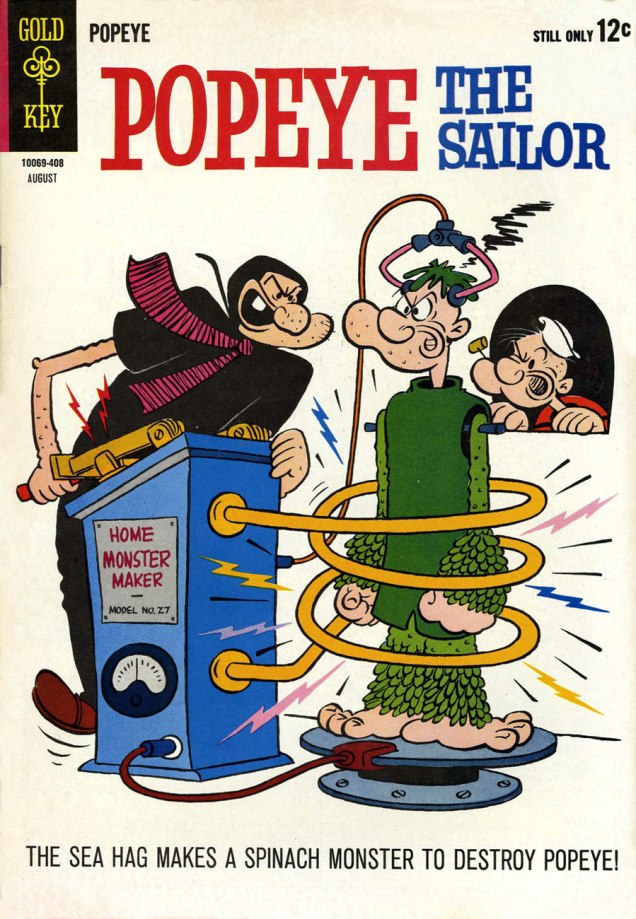
Beware the Sea Hag, the cover story, is scripted by Carl Wessler and drawn by Wade Hampton:
But, wait, this is not what the Sea Hag normally looks like! This is more like it:
Popeye the Sailor no. 73 (August 1964), cover by Bud Sagendorf. I wonder if the Sea Hag realises how much spinach reduces under heat.
Shifting to another sort of secrets (these are sinister rather than haunted), we have another tentacle apparition —
The Monster of Death Island is scripted by Maxene Fabe and drawn by Ruben Yandoc (i.e. Rubeny). It was published in Secrets of Sinister House no. 11 (April 1973).
This story, a sort of take on Bluebeard, is well worth reading, for the plot as well as the stunning art. I don’t want to reveal spoilers – you can read it here.
Since we’re discussing secrets, I might as well throw in TheHouse of Secrets… I will willingly admit that I have the hardest time keeping track of which is which.
House of Secrets no. 101 (October 1972), cover by Mike Kaluta. This could have been a Mike Kaluta Tentacle Tuesday!From House of Secrets no. 100 (September 1972). This page of Abel’s Fables is by Lore Shoberg.Cain & Abelby Sergio Aragonés, printed in House of Secrets no. 103 (December 1972).
« Naturally there was quite a ruckus when everyone found out who… and what Rah was. But there wasn’t any rules concernin’ the eligibility of a mummy to play ball, so the Jets’ victory stood… » — from Roger McKenzie’s The Return of Rah
Carrying on with our irregular survey of significant Warren cover artists whose names and reputations are somewhat less inextricably linked with the publisher than the usual suspects, and thereby sometimes overlooked. Fresh out of art school, and on his way to a truly remarkable, award-peppered career, Don Maitz (born 1953, Plainville, CT) graced a brace of Warren Mags with some of his earliest professional imaginings, which I’ve gathered here.
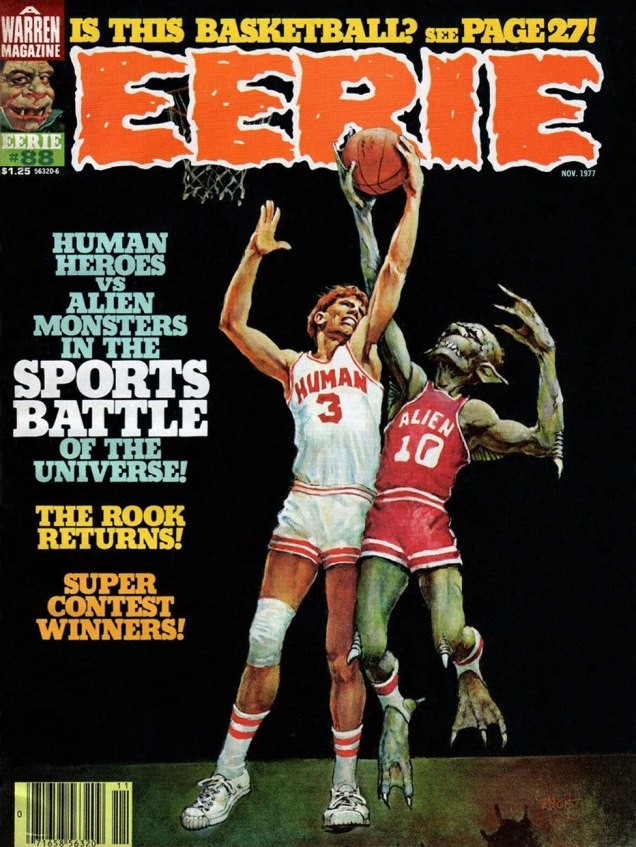
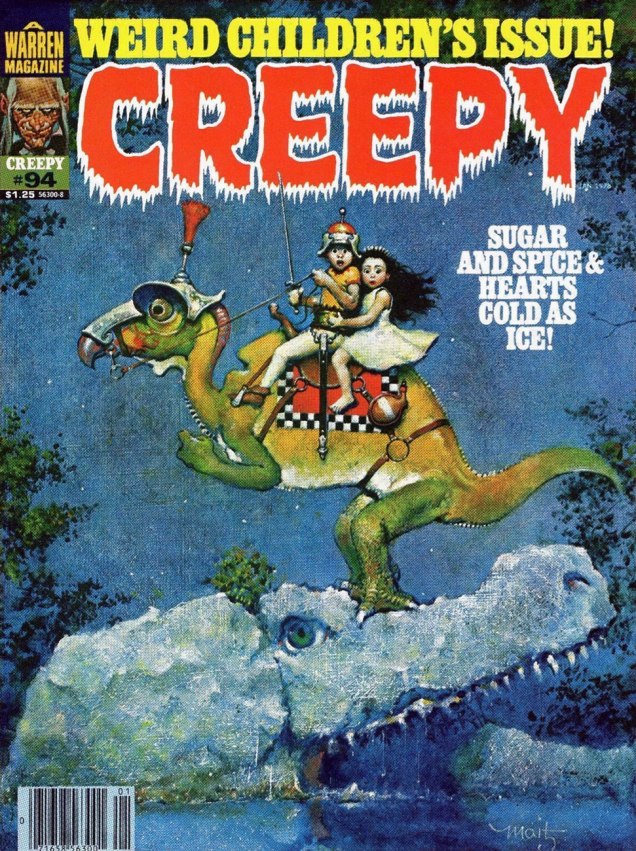
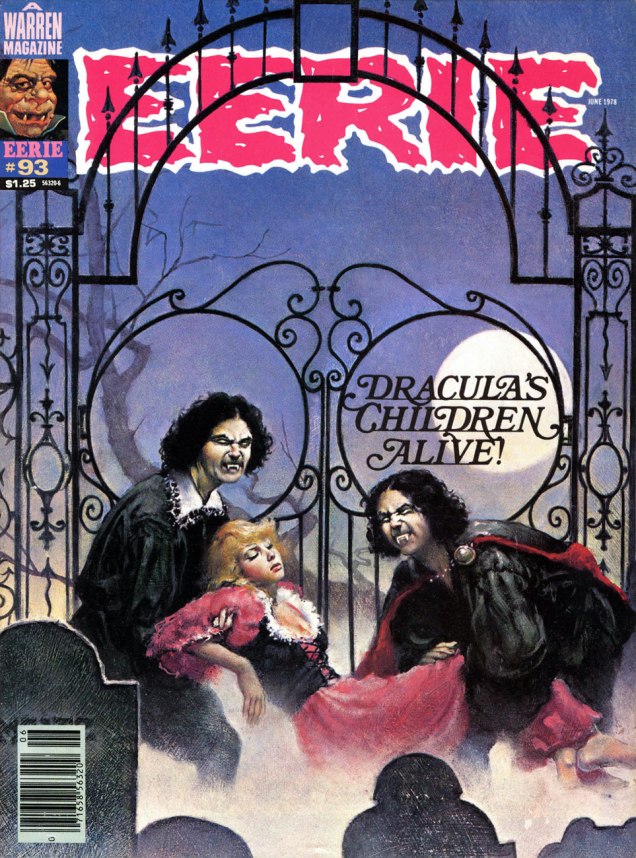
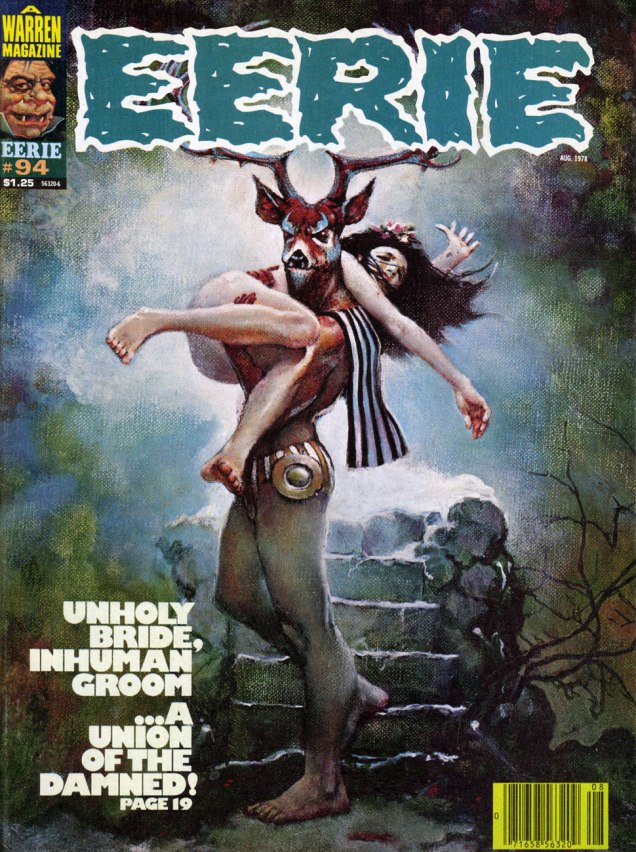
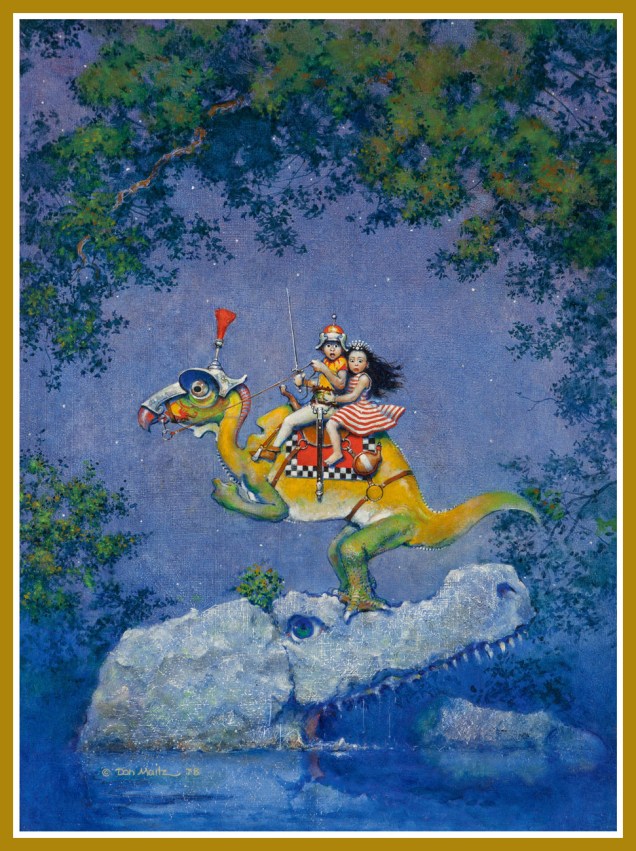
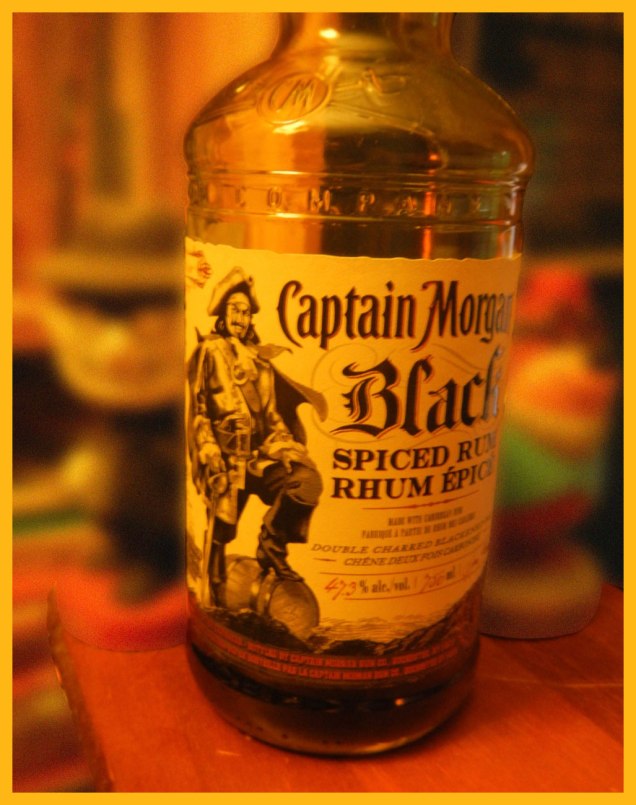
A lot of people apparently don’t much care for Warren’s late 70s sports-themed issues, but I like ’em, given that they feature a trove of gorgeous Carmine Infantino artwork, when he was experimentally-paired with a dizzying assortment of inkers (in this issue, John Severin, Alfredo Alcala, Alex Niño… and, well, Dick Giordano). At their best, the sports issues allowed him to revisit with more latitude (though less ingenuity, I’d argue) the Strange Sports Stories format he’d initiated in 1962 with writer Gardner Fox and editor Julius Schwartz. This is Creepy no. 93 (Nov. 1977, Warren). Senior editor Louise Simonson* (née Mary Louise Alexander) was commendably trying to spice up what had become a stale formula, but it turned out that there just wasn’t sufficient overlap between Warren readers and sports fans. A more staggered release programme might have cushioned the blow: as it was, Warren readers got two sports-centric issues in November 1976, then another pair in November 1977.I hope that headline was meant ironically, because (spoiler alert), the humans are the monsters and the aliens… aren’t, in Bill Mohalley and Nicola Cuti’s Deathball 2100 A.D., a sordid, derivative (Rollerball + Death Race 2000, geez) and heavy-handed tale made uglier by Dick Giordano’s usual stiff, graceless visuals. Nice cover, though. This is Eerie no. 88 (Nov. 1977, Warren).Well, now! This marvellous vision, marking quite a tonal break from the usual Warren diet, corresponds to no particular tale within this ‘bad seed’ issue, yet teems and brims with story, with nary malice… but so much wonder. A bold move on the part of editors Simonson and Nick Cuti. This is Creepy no. 94 (Jan. 1978, Warren).This handsome simian trio deserves better than their association with Cary Bates and Esteban Maroto‘s rather juvenile, Lord Greystoke-slandering Murder on the Vine. You’ve done better, boys. This is Creepy no. 95 (Feb. 1978, Warren), a cover bearing more than a mere whiff of Frazetta.The probability of violent demise aside, isn’t this just the most unctuously idyllic autumnal scene? This is Eerie no. 91 (March 1978, Warren).Though this one is to my mind the lesser entry in the parade, I must concede that it’s presented in exemplary fashion: the colour choices, the placement of the type, even the integration of that unholy blight, the bar code. This is Eerie no. 93 (June 1978, Warren).Young master Maitz’s final Warren cover (chronologically speaking): this is Eerie no. 94 (Aug. 1978, Warren), illustrating Nicola Cuti and Leo Durañona‘s Honor and Blood. « Can the child born out of an unholy union between man and vampire grow up to lead a ‘normal’ life? You can’t escape the sins of your parents. Their errors ripple faintly down the generations! » “Er, what’s with the deer head?”, you may ask. The answer, from the story: « The bride was never to see the weak, corrupted face of her human husband. She wedded the Elk, symbol of the Beast. »« A lowly elk, “symbol of the Beast”?Maaa, you’re just making shit up, Nick. » The feeling on that point seems, in fact, quite unanimous.And here’s a privileged peek at Mr. Maitz’s Creepy 94 cover painting original (Mixed media on Masonite, 24” x 18”), which, as it turns out, is entitled Unsafe Footing, which makes me love it even more.As a rum enthusiast, I am naturally aware of the Captain Morgan brand… whose mascot (circa 1982) is, as it happens, Maitz’s most familiar creation… to date. Prost!
« Challenge Merlin and be a fool! — Challenge a demon — and be destroyed! »
Suddenly having so much time on my hands (courtesy of COVID-19) is an eerie, though by no means unpleasant, experience. While I could crochet mini couches for my cats or enrol my partner’s help to re-create some favourite classic paintings, I prefer to catch up on books I’ve been meaning to read for a while. Case in point: in April, I’ve been joyously absorbing Jack Kirby’s Fourth World saga, reprinted in a handsome 4-tome omnibus (and to which I have easy access, thanks to co-admin RG’s vast library). That ended all too soon, and I moved on to a collection of Etrigan the Demon. It was a somewhat underwhelming experience, especially given the epic scope of Fourth World, but of course still worth a read.
The red-eyed, yellow-skinned creature called Etrigan came into existence in 1972. Mark Evanier, in his introduction to Jack Kirby’s The Demon, explains: « There was, at the time, a feeling around DC that perhaps superheroes were on the way out again. Ghost and mystery comics like House of Mystery and Phantom Stranger seemed to be selling, and some in the office felt the next trend was what Joe Orlando, who edited most of them, dubbed “weird adventure” comics. A few weeks later, [Carmine] Infantino asked Jack to whip up something in that category… »
Kirby accepted the challenge and, despite his lack of interest in horror, created The Demon, patterning his face on a a detail from Hal Foster‘s Prince Valiant strip as an inside joke.
As great a storyteller Kirby is, I think being asked to write about a subject he wasn’t particularly into had its repercussions. Although he clearly tried to give Etrigan a stimulating playground of supernatural rogues of varying degrees of viciousness to bat around, the overall result is rather underwhelming by Kirby standards. I’ve seen quite a few people in comic forums expressing their undying love for the Demon – if you’re one of them, I’m open to being convinced!
I actually first encountered Etrigan the Demon in a Swamp Thing issue written by Alan Moore. He first made an appearance in Swamp Thing no. 26 (July 1984) and then came back for the 14-issue storyline American Gothic that ran from June 1985 to July 1986. In Moore’s hands, Etrigan cut a dashing, mysterious figure, and he spoke in rhyme, which was a really nice touch. I admit I was disheartened to find out that he really wasn’t that exciting in his original form.
However, he *did* encounter tentacles, and more than once!
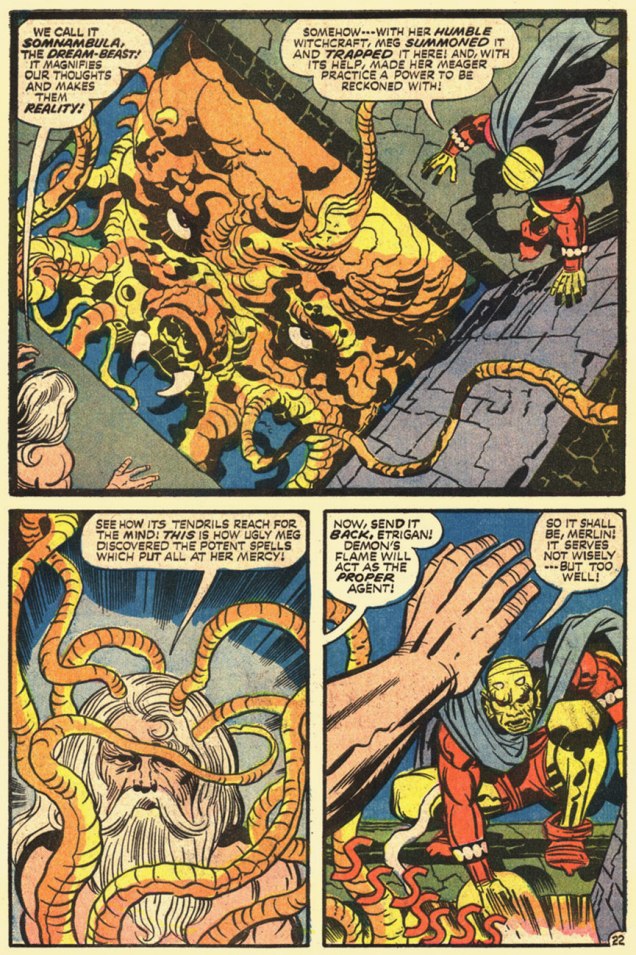
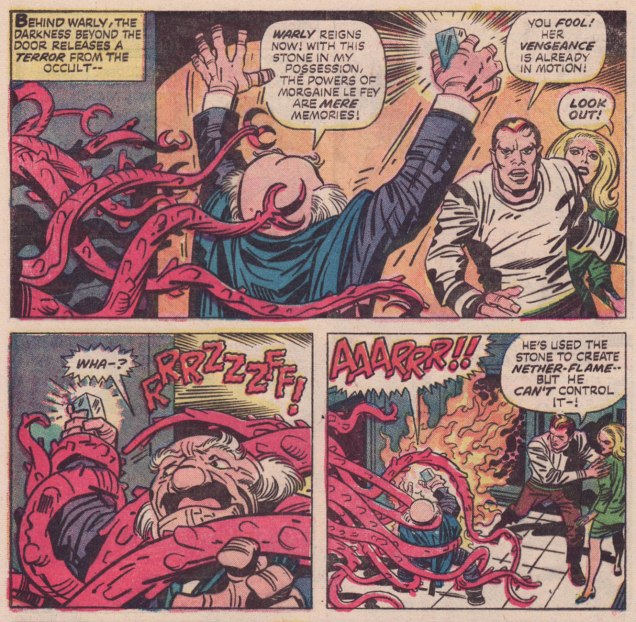
I was rather hoping the Somnambula would stick around, but it came and went in one page. Merlin’s Word… Demon’s Wrath! was published in The Demon no. 5, January 1973.The spoiled and malicious brat Klarion and his cat/pussycat-princess Teekl are my favourite characters of the series. The One Who Vanished!! was published in The Demon no. 15 (December 1973), the penultimate issue. This scene is reminiscent of a sequence from the 1961 movie Night Tide.In the following (and final) issue, tentacles reared their grabby suckers yet again. Immortal Enemy! was published in Demon no.16 (January 1974). One more complaint from me – Kirby’s use of the philosopher stone (which Warly is clutching on this page) as a sort of Deus ex machina, that can be used for accomplishing pretty much everything (some examples: it produces the ultimate cold or demon flame, shields the owner from thousand-volt electricity or brings people back form the dead, turns people into vultures or an Egyptian mummy or a chair into flowers, randomly makes objects levitate, etc.) This makes one wonder why Jason bothers running around at all, instead of elegantly waving the stone about and solving all problems instantly.
The three pages above are Etrigan’s encounters with actual tentacles, but we have an honorary mention of almost-tentacles-but-not-quite, which I wanted to include in the spirit of thoroughness.
Can the following creature’s beard tentacles be used to grab anything? We never learn if they’re prehensile or not, because the fear-monster doesn’t stick around long enough.
The Demon no. 3 (November 1972). This little baby is one of my favourite monsters of the series, despite just being part of Jason Blood/Etrigan’s nightmare – one can really felt its crushing weight. Besides, it’s probably a preview of the Kamara, a creature that becomes what the person fears most, and an awe-inspiring enemy.A panel from Reincarnators.
In case anyone is interested, I am currently re-reading Kamandi: the Last Boy on Earth, which was my first exposure to Kirby.
« … drawn by a terrible hypnotic fascination, the gangster peers deep into Jim’s dark eyes and glimpses — DEATH! » — “The Spectre”, More Fun Comics no. 52 (Feb. 1940)
Today, we salute Bernard Baily (April 5, 1916 – January 19, 1996), recalled nowadays as co-creator of The Spectre (with Jerry Siegel) and Hourman (with Ken Fitch) and conjurer of many of the 1950s most notorious comics covers… but there’s much more. Let’s take a look, shall we?
More Fun Comics no. 64 (Feb.1941, DC); It’s curious that the Golden Age’s arguably most merciless avenger would wind up in the pages of “More Fun”. « The Spectre… was notable in the character’s original run for imposing violent retribution against evildoers. In Siegel and Baily’s first story, Jim Corrigan, upon being introduced, is immediately killed by being encased in cement and thrown into a river. A God-like figure intervenes and returns Corrigan to Earth to combat evil as The Spectre. In that first outing, The Spectre uses the power of his mind to skin an assassin alive, leaving only a skeleton. » [ source ] Read The Spectre’s nasty origin tale!To my knowledge, there aren’t a lot of Golden Age superheroes whose costumes were so perfectly designed in the first place that no change whatsoever has been required over time. The Spectre has to be exhibit number one in that case.
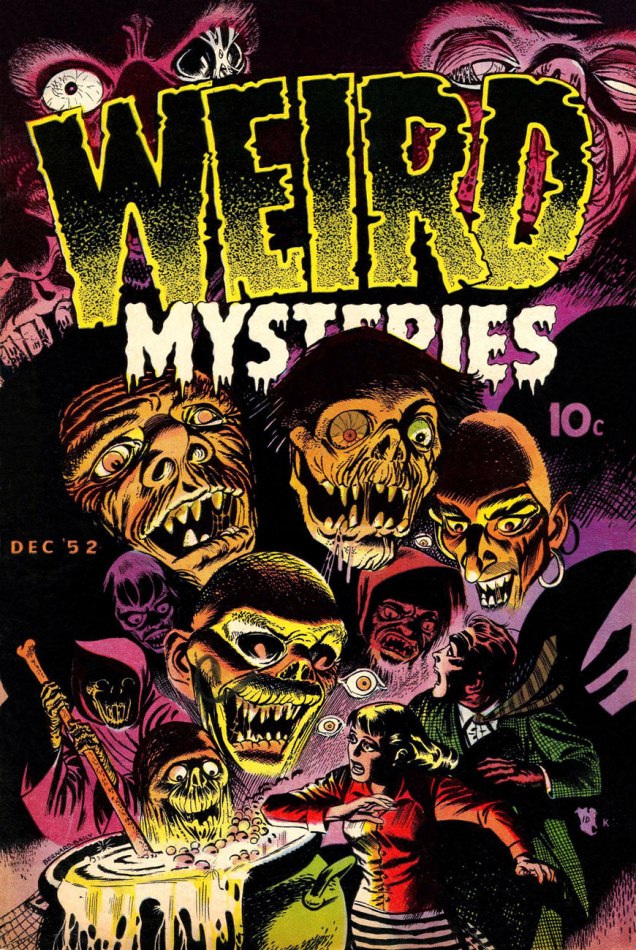
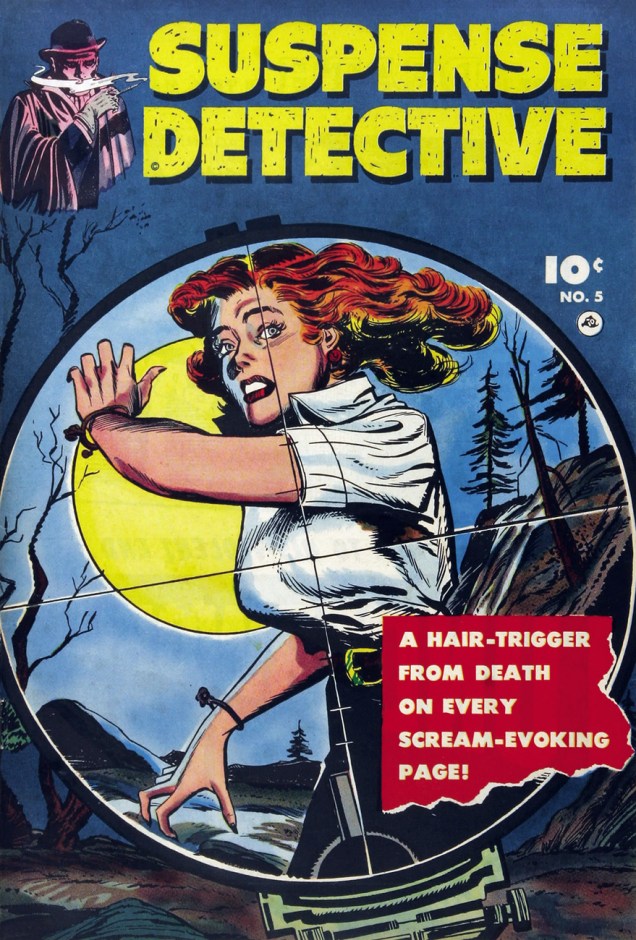
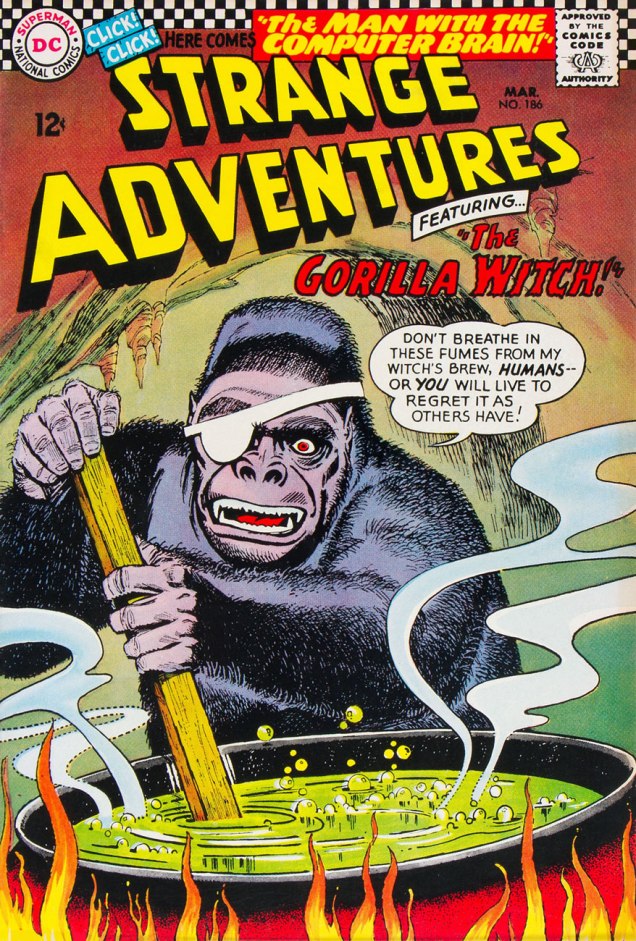
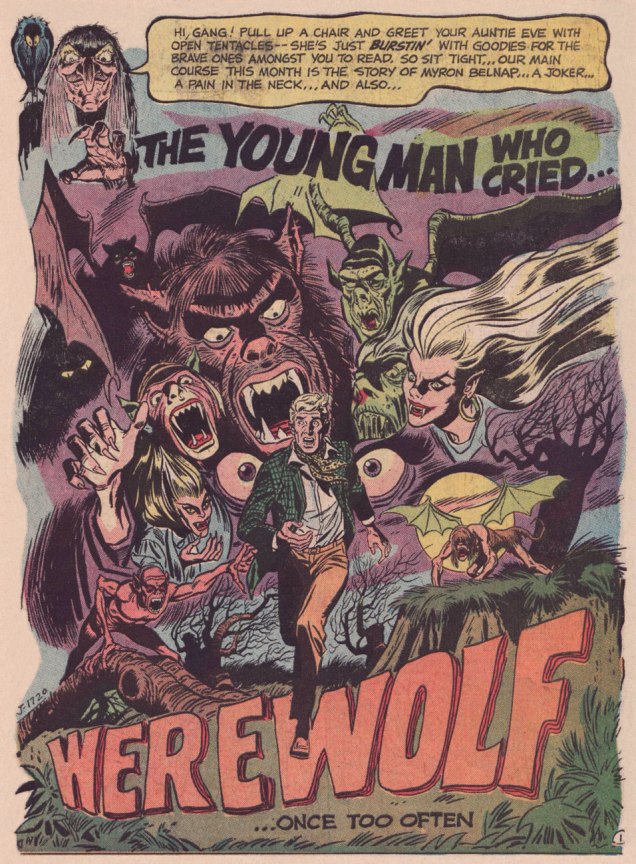
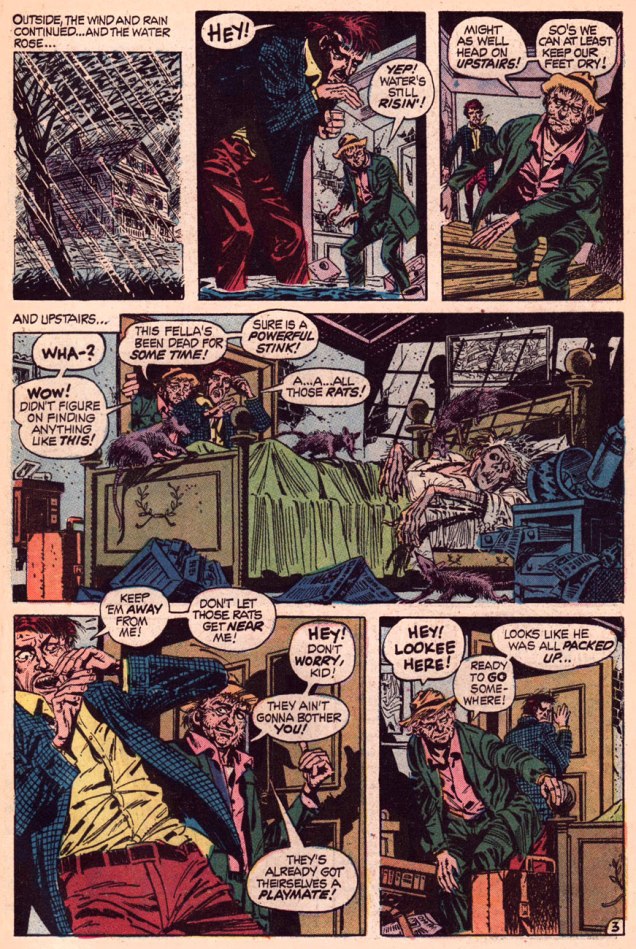
This is Weird Mysteries no. 2 (Dec. 1952, Stanley Morse); Read it here!« Be assured that the death certificate will read… death from natural causes! Yes — hah hah, natural causes! » Baily provides a strikingly modern cover for the final issue of Fawcett’s Suspense Detective, no. 5 (March, 1953). The insides are also top-notch, with thrillers by Baily and Mike Sekowsky. Read it here!Here’s Weird Tales of the Future no. 7 (May 1953, Stanley Morse); The stench is palpable, Bernie.One of the images that most undermined the comics industry’s case during the 1950’s furor over horror comics, this is Baily’s eye-searing cover for Mister Mystery no. 12 (July 1953, Stanley Morse). Injury-to-eye motif, the censors (or was it the collectors?) termed it. « Don’t worry, Mac, the sharp stick’s hot to make sure yer peeper don’t get infected. Now hold still! »Behold Mister Mystery no. 14 (Nov. 1953, Stanley Morse); this one rarely turns up in any condition. Hey, tentacles!In the Silver Age, Baily was back at DC, but straight superheroics weren’t his thing; here’s a rare exception. I must say, his Flash looks great, with the appropriate runner’s physique. This is The Brave and the Bold no. 56 (Oct.-Nov. 1964, DC), featuring Raid of the Mutant Marauders, scripted by Bob Haney and illustrated by Baily. George Kashdan, editor.Baily’s bread-and-butter during the Silver Age was SF and fantasy stories for DC’s anthology titles. Utter balderdash, but often highly entertaining, thanks to that very ‘anything goes’ approach and a solid cadre of artists. This is Strange Adventures no. 186 (Mar. 1966, DC); read it here, you’ll see what I mean.Whither National Brotherhood Week? Baily was also editor Jack Schiff‘s go-to guy for a series of public service ads that ran throughout the DC line during the Silver Age. This one, What’s Your B. Q.*? (*Brotherhood Quotient) appeared in books dated April and May 1966); Love those control questions.By the 1970’s, Baily’s work was seen as quaint and outmoded. Editors sometimes experimented with inkers, in this case Bill Draut, whose own style, while out of vogue, produced interesting results when paired with DC’s most outré pencillers (e.g. Jerry Grandenetti, Ric Estrada…) This Baily-Draut splash appeared in Secrets of Sinister House no. 8 (Dec. 1972, DC); lettering by Ben Oda, ‘Auntie’ Eve and her birdie by Michael Kaluta.« Lousy, filthy, stinking hobo! He’s no better than the rats themselves! He’s in a class with them! » Grizzled Baily showed fine form in this late-career corker published in House of Secrets no. 107 (April, 1973, DC). Evidently inspired by Stephen Skeates‘ squalid tale of a rising flood, greed, murder and musophobia, the veteran artist lovingly rendered the precarious, musty milieu of Winner Take All!. In fact, the entire issue sets a high water mark for HOS: beyond a so-so Berni Wrightson cover, the book unusually contains two Alfredo Alcala yarns, one rendered in his realistic style and written by Jack Oleck, the other drawn in his delicious cartoony fashion and scripted by Arnold Drake. Read the issue here! « Whew! A lot more going on back then than even I realized! », commented Mr. Skeates upon being reminded of this story, a few years ago.Another lovely late-period job was A Night in a Madhouse; it appeared in The Unexpected no. 148 (July 1973, DC), scripted by Carl Wessler. Read it here!
« Once you’ve lived the inside-out world of espionage, you never shed it. It’s a mentality, a double standard of existence. » — John le Carré (1931-)
Here I go again, featuring yet another 1970s Alfredo Alcala story. This time, Fate, writ large, has forced my hand, and it’s unofficially Contagion Week here on WOT?
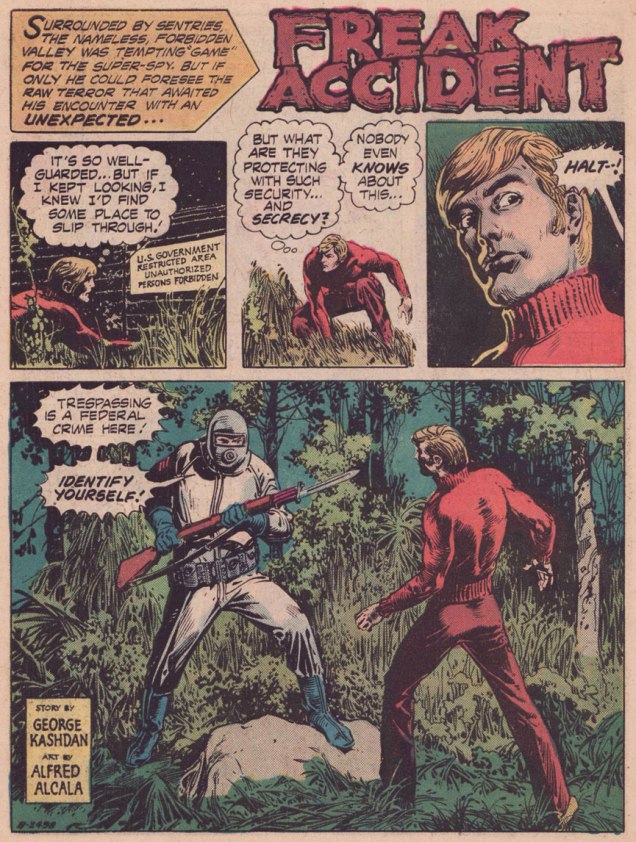
I’ve always had a soft spot for writer-editor George Kashdan (1928 – 2006). While he wasn’t what you’d term an outstanding writer, he was the most consistent bright spot of DC’s mystery books in the late ’60 to early ’80s. As opposed to the other workhorses in the stable, one still found trace amounts of passion and personal quirks in his work. His recurring themes for simply more fun than his colleagues’: he loved Sinister gentlemen’s clubs, wild conspiracies, strange carnivals, pre-ordained, thematically-twisted deaths (think of those Final Destination movies)…
In a thoughtful obituary, Mark Evanier tells us: « In 1968, as part of a program of editorial restructuring, Kashdan was let go by DC. Several people who worked with him said it was because he was “too nice” and had occasionally clashed with management in arguing that freelancers should be paid and treated better. » Ah, another victim of the anti-union purge of ’68*.
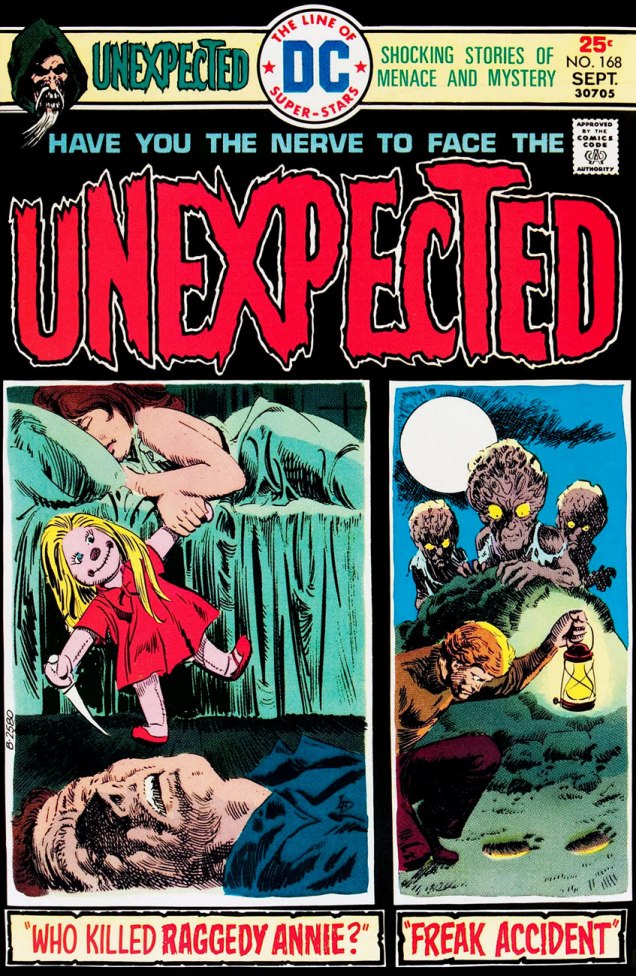
This is The Unexpected no. 168 (Sept. 1975, DC Comics; edited by Murray Boltinoff), cover art by Luis Dominguez. Aside from the six hundred-pagers (issues 157 to 162), this seems to be the only time a multi-panel cover was used, and little wonder: it doesn’t really work, and would fare even worse with the intrusion (five issues away) of the dreaded bar code.
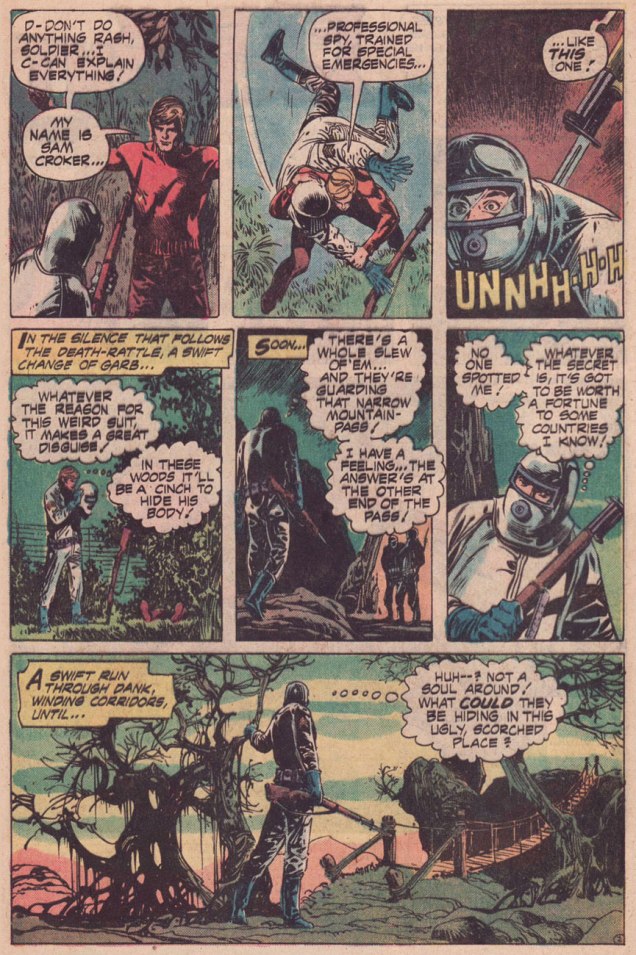
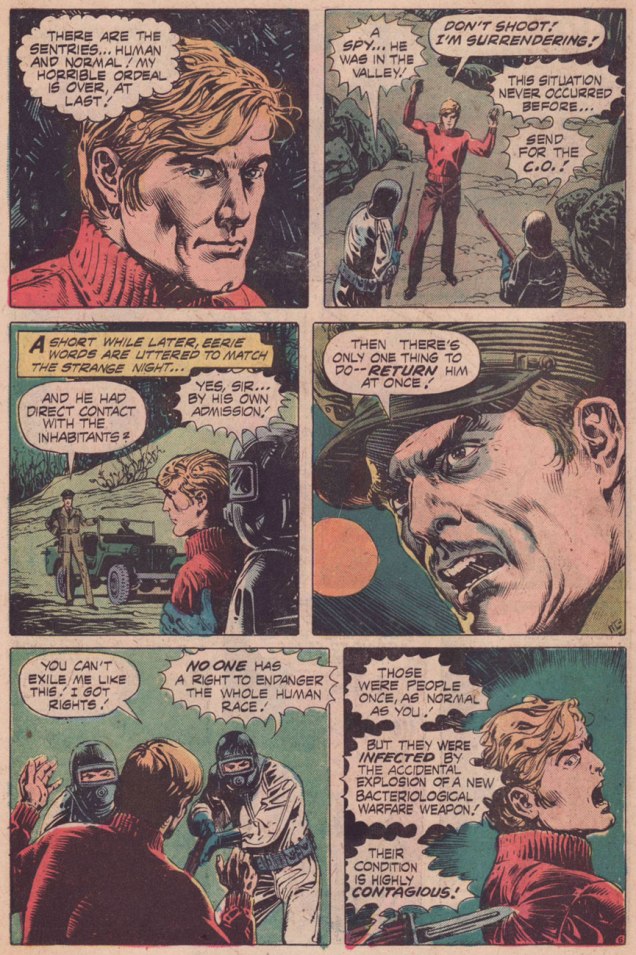
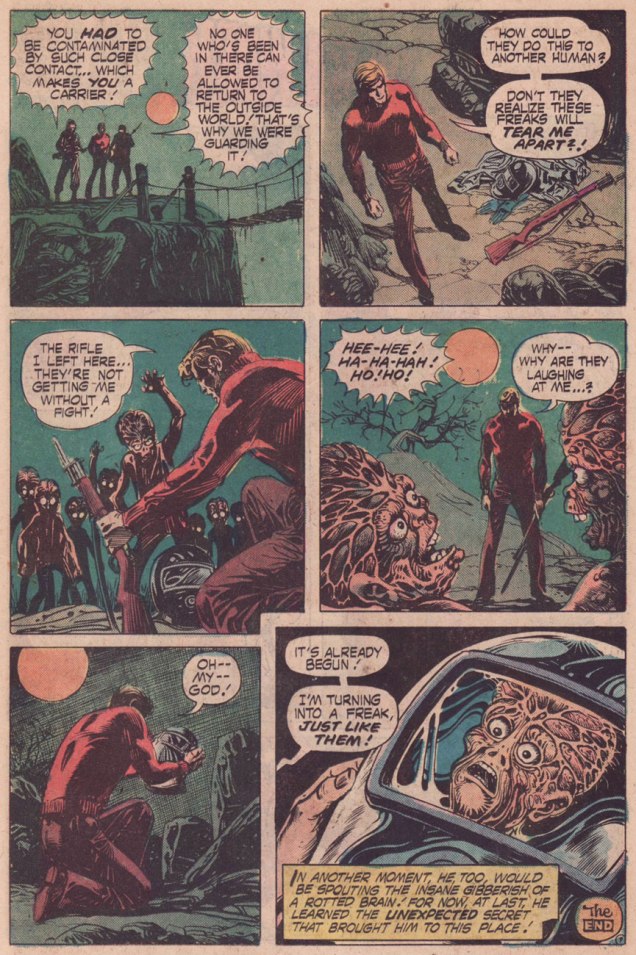
No-one comes off particularly well in this one, really: Croker the spy is an impenitent, petulant slime bucket right to the finish, and the military, for their part, have been conducting sloppy biochemical experiments… for purely defensive purposes, I’m sure.
While the Geneva Protocol has prohibited the use of such barbaric means of warfare since 1925, the US didn’t sign on until… 1975, just before the fall of Saigon, marking the end of the Vietnam War. Let’s not ever forget the US Armed Forces’ generous and indiscriminate dispersion of Napalm and Agent Orange upon troops and civilians during the course of that conflict.
Given the timing, perhaps that bit of news inspired Kashdan to pen this sour little parable.
The guard’s high moral stance, « No one has the right to endanger the whole human race! » may ring a bit hollow and ironic given the circumstances, but he’s still right.
On a smaller, but no less tragic scale, consider the real-life story of what happened when a fan broke quarantine to catch a public appearance of her idol, actress Gene Tierney.
One simply can’t afford to mess around when it comes to quarantines and contagion.
Incidentally, Alcala really seemed to have a yen for those flay-headed mutants of his. To wit, here’s the opening page of The Children of the Bomb, Part 5, from Planet of the Apes no. 10 (July 1975, Marvel), written by Doug Moench and illustrated by Alcala.
-RG
* « [In 1968] Fox had joined other comics writers like Otto Binder, John Broome, Arnold Drake, Bill Finger and Bob Haney, signing a petition to ask DC for more financial benefits, particularly regarding health insurance. Since the company regarded writers as expendable people they were all fired without mercy and replaced by more obedient newcomers. » [ source ]
« Hugs can do great amounts of good, especially for children. » — Diana, Princess of Wales
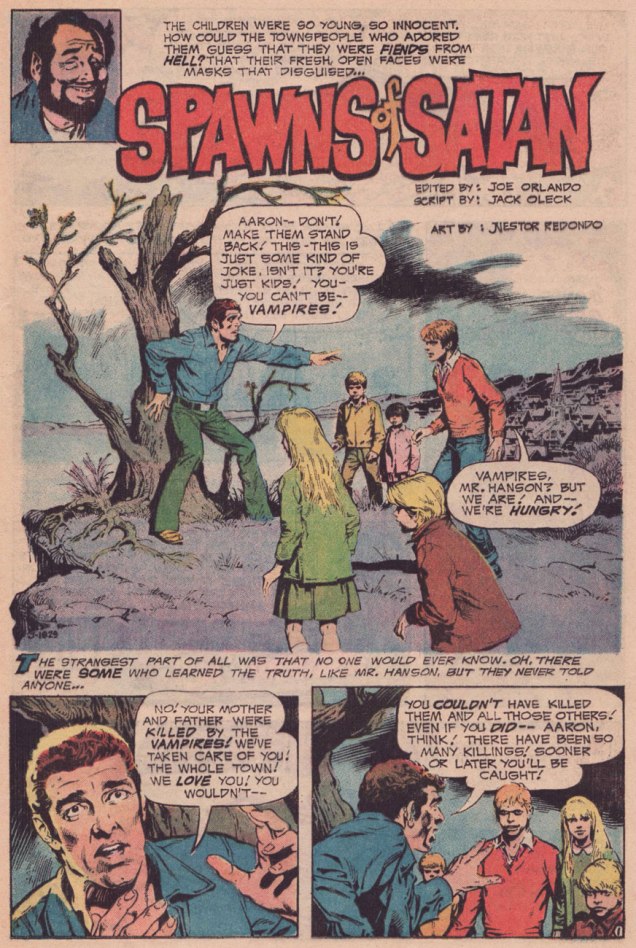
Today’s entry is a tale of vampirism from the typewriter of Jack Oleck (1914-1981). In the late 1940’s Mr. Oleck’s career in comics began promisingly with his brother-in-law Joe Simon and his partner Jack Kirby‘s Prize (Young Romance, Strange Worlds of Your Dreams, Black Magic and other anthologies), followed by a stint with EC late in the publisher’s classic, pre-Mad Magazine-only run (Crime SuspenStories, Shock SuspenStories, Vault of Horror, Incredible Science-Fiction, et al), along with assignments with Hillman, Atlas, Charlton and Harvey… among others.
Finding the décor of the Code-regimented funnybook industry a bit austere to his taste, he devoted the years of 1957 to 1969 to publishing and editing the magazine Decorator News and authoring the odd novel.
In 1969, he sauntered over to DC, where he cranked out quite a caboodle of scripts over the following decade-or-so, mostly in the horror (as it couldn’t be and shouldn’t be called under The Code) genre (“Mystery”, they called it), but also the occasional bit of romance, science-fiction and adventure. I’d like to say he was great, but frankly, he was pretty much a page-filling hack.
This is probably his finest script from this most prolific period, and it’s still full of plot holes and other inconsistencies. But that’s market reality for you: Oleck was consistently readable, he was fairly competent, he turned in his work on time, and he got along with the editors. Sometimes that’s all you need.
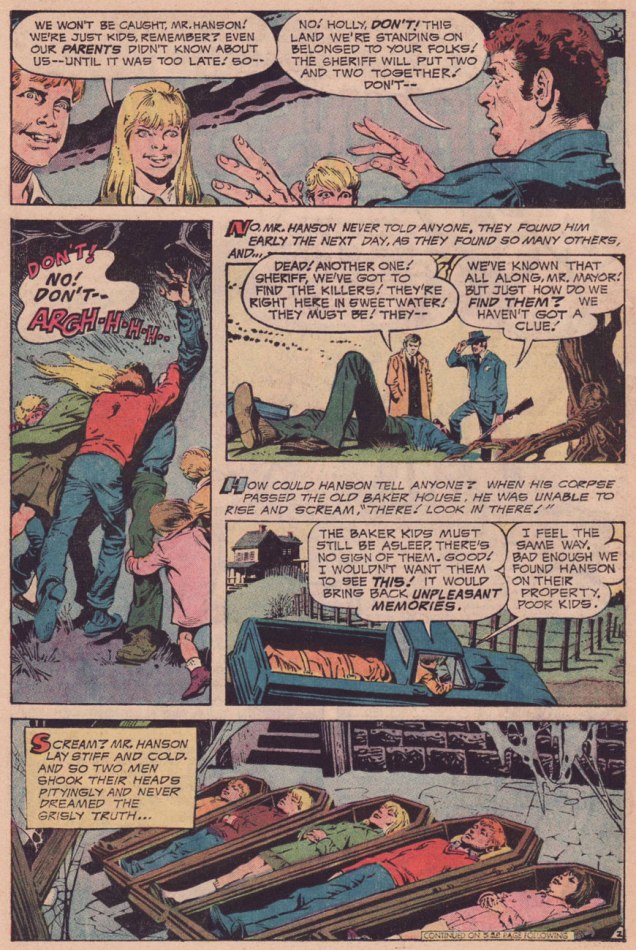
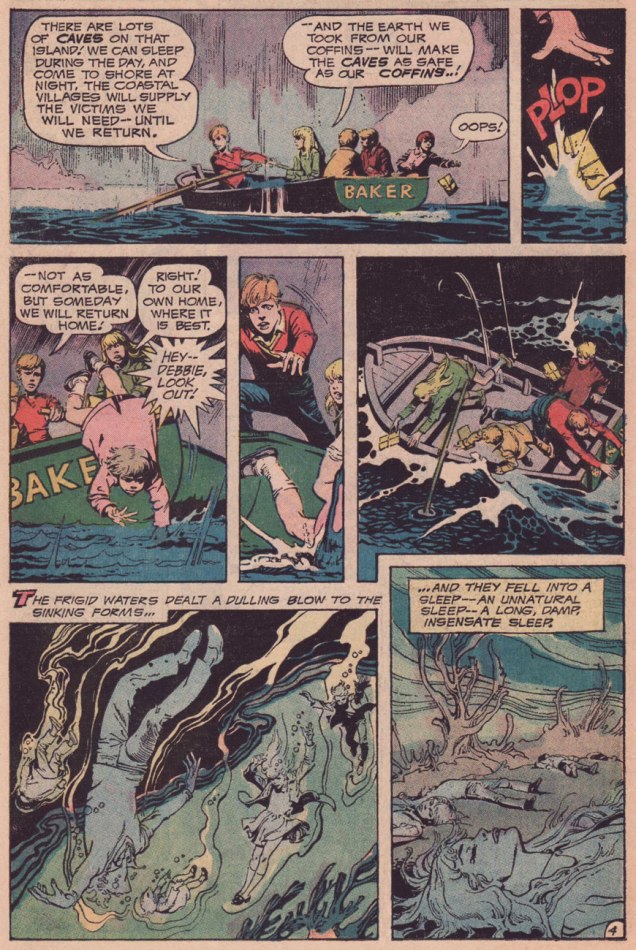
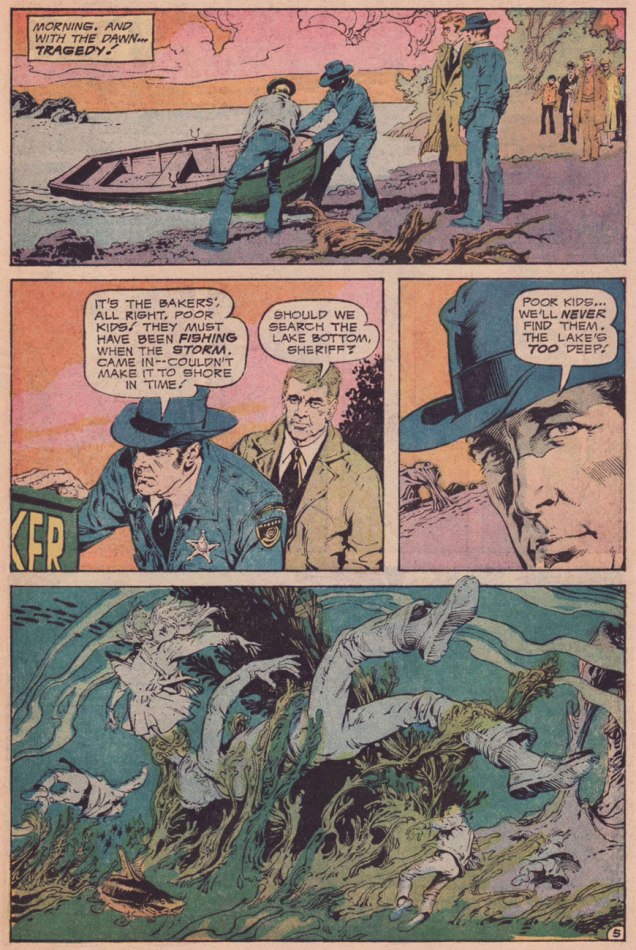
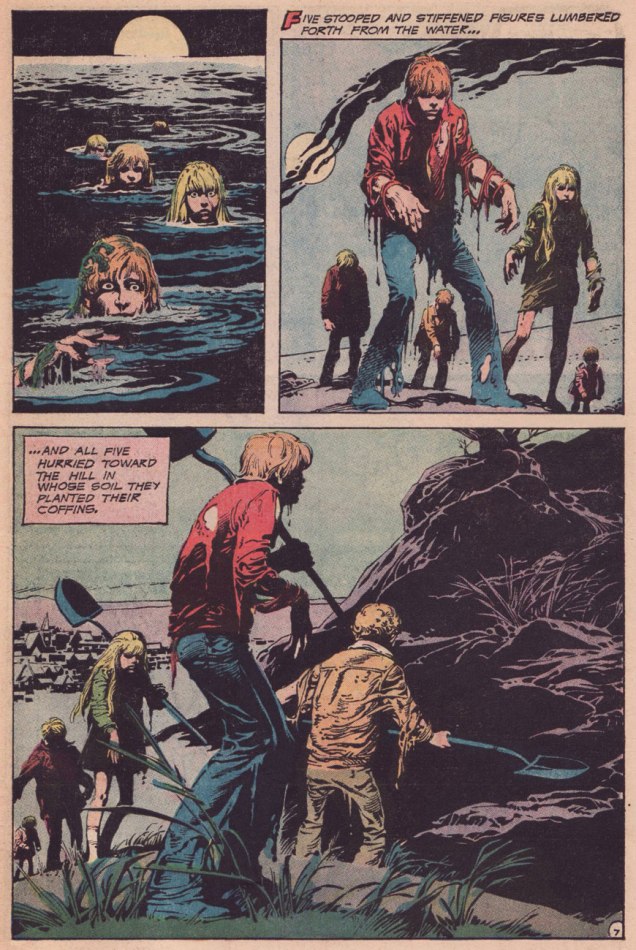
So why am I featuring Spawns of Satan if I seem to think so little of it? Well, obviously, there’s the luxurious grace of Nestor Redondo‘s art, granted here a specially generous setting to display its virtues. The middle act of the story is virtually mute, and all the more effective for it.
Read it first, then I’ll tell you more.
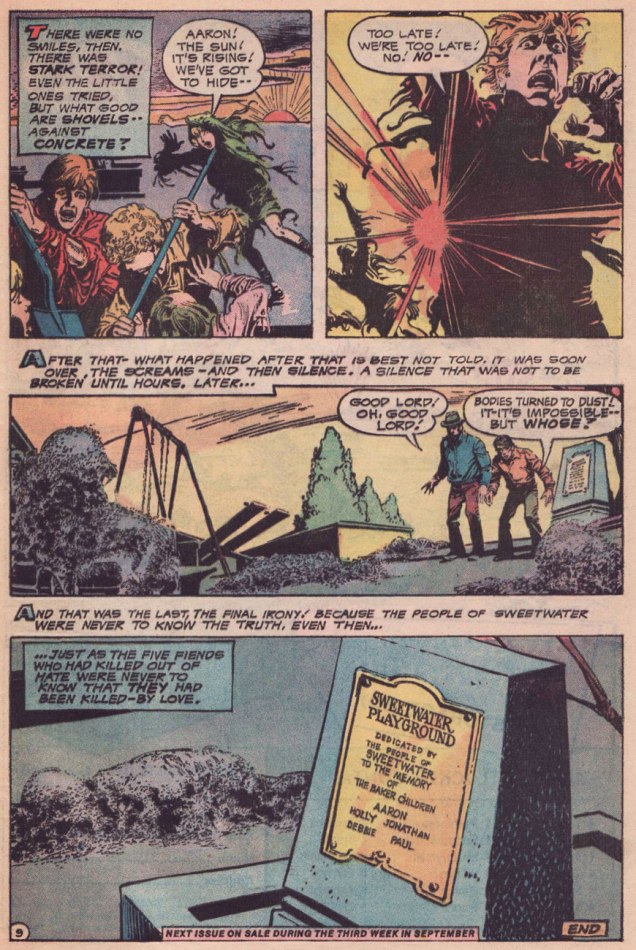
Okay, if the town’s taken care of them, how come no-one’s found it unusual that the kids aren’t around during the daytime? Doesn’t anyone go to school?It certainly tips the scale in the miscreants’ favour that the sheriff just shrugs and admits he hasn’t a clue. I guess it just wasn’t an election year.Wait… kids (with one or two tackling most of the grunt work) burying five coffins on grassy ground, and “not a sign that the ground’s been disturbed“? Mighty vampire powers, I say! And can you imagine the torment and frustration of the little ones, knowing they’ll never grow up, never get to take charge or be taken seriously? This story is just honeycombed with potential avenues of exploration.One slight problem: hypothermia should not affect undead creatures without a beating heart nor, necessarily, blood circulation. A little too convenient, Mr. Oleck. But fine, you’ve got them to the bottom of the lake.
For me, one of the tale’s chief assets had been Aaron’s characterization. Now how is it that suddenly, this cool-headed and calculating leader just loses his shit and gives up*? As depicted earlier, Aaron would have ordered a retreat to the lake and formulated another plan. But no, there had to be a ‘sting in the tail’. Also, if the town knew full well they were dealing with vampires, why do bodies turned to dust suddenly seem “impossible”? Finally, did you get the impression that the Baker kids killed out of hate (well, except for Holly; that girl had a bad attitude), as stated in the final panel? I think not: the clan was portrayed as a predator pack, who merely killed to survive, no sentiment allowed.
SOS is otherwise mainly notable in its introduction of themes and ideas that would be brought to full miasmic flowering by (of course) Alan Moore in issues 38 and 39 of Swamp Thing (July and August, 1985), namely the family unit of underwater vampires. Moore’s set of toothsome nasties was more-or-less introduced, but not fully-fleshed out, by his predecessor, Martin Pasko, in July, 1982’s Saga of the Swamp Thing no. 3‘s A Town Has Turned to Blood. Moore’s keen eye caught the spark of potential and set the hills ablaze. However, it seems unlikely that Moore’s research hadn’t trailed back a few years to the lacustrine lair of the parasitical Baker brood.
Speaking of editors, I’ve long suspected that this particular issue of House of Secrets was the dumping ground of an aborted experiment by its editor, Joe Orlando. Orlando had clearly been trying to shake things up a bit, running two longer, less compressed stories per issue instead of the usual three… as DC’s available story page count had dropped from 24 to 20 (and would reach a woeful 17 by 1976!); the two-story practice lasted but a few issues. After no. 117, it was jettisoned. It would appear that at least one of House of Secrets 113’s stories had been scheduled and delayed: eight months earlier, Jack Sparling’s grey-tone lovely cover for House of Secrets no. 105 (Feb. 1973) was a perfect illustration for Doug Moench‘s, Mike Sekowsky and Nick Cardy‘s fascinating ‘Not So Loud– I’m Blind’… which finally turned up in this issue as the lead story. Sombre and rambling, Moench’s likely first sale to DC lacks the usual forced twist ending, opting instead to trail off into darkness. In fact, when I first read it, I thought my copy was missing a page.
Moench went off to be arguably (well, he’s my pick) Marvel’s most consistent writer of the 1970s, and only returned to DC in the ensuing decade.
« Polar exploration is at once the cleanest and most isolated way of having a bad time which has been devised. » ― Apsley Cherry-Garrard, The Worst Journey in the World (1922)
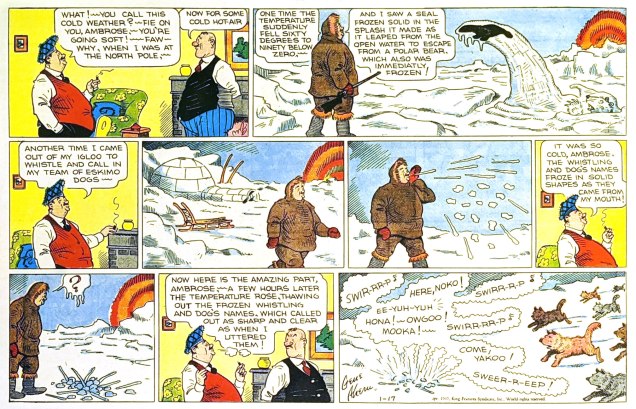
Gene Ahern‘s Room and Board (March 17, 1937, King Features).
Of course, it’s all piffle and bunk, but it brought to mind a passage from a favourite article on weather peculiarities in Siberia, Marcel Theroux‘s The Very, Very, Very Big Chill(published in Travel & Leisure in 2000):
« Local people told me that at minus 60 and below, a dense fog settles in the streets, and pedestrians leave recognizable outlines bored into the mist behind them. A drunkard’s tunnel will meander and then end abruptly over a prone body. At minus 72, the vapor in your breath freezes instantly and makes a tinkling sound called ‘the whisper of angels.’ »
Then I thought: « all very nice, but that makes for a rather meagre post »… so I decided to toss in a few bonus images featuring that venerable recurring motif… and got carried away.
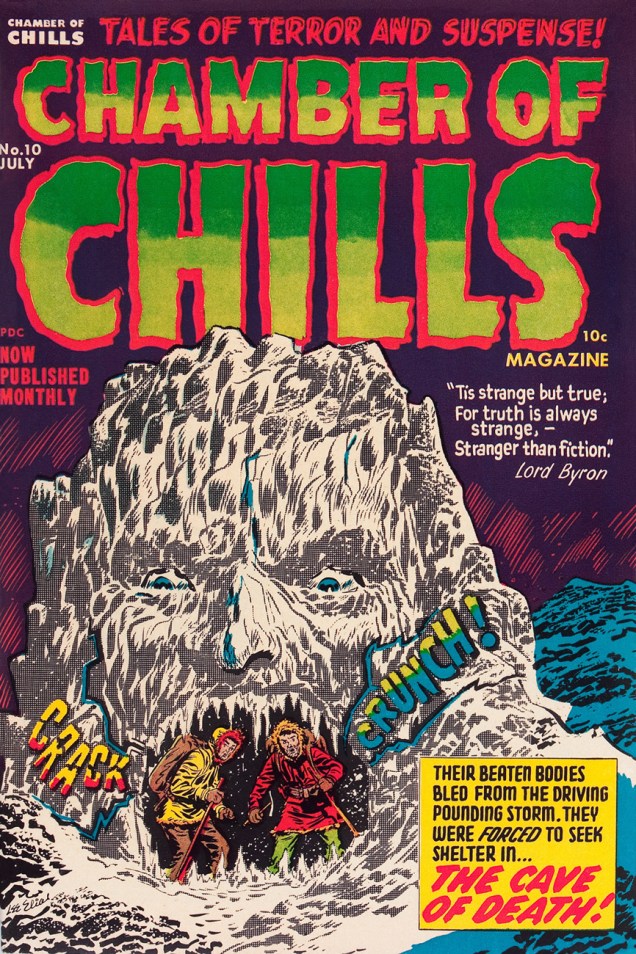
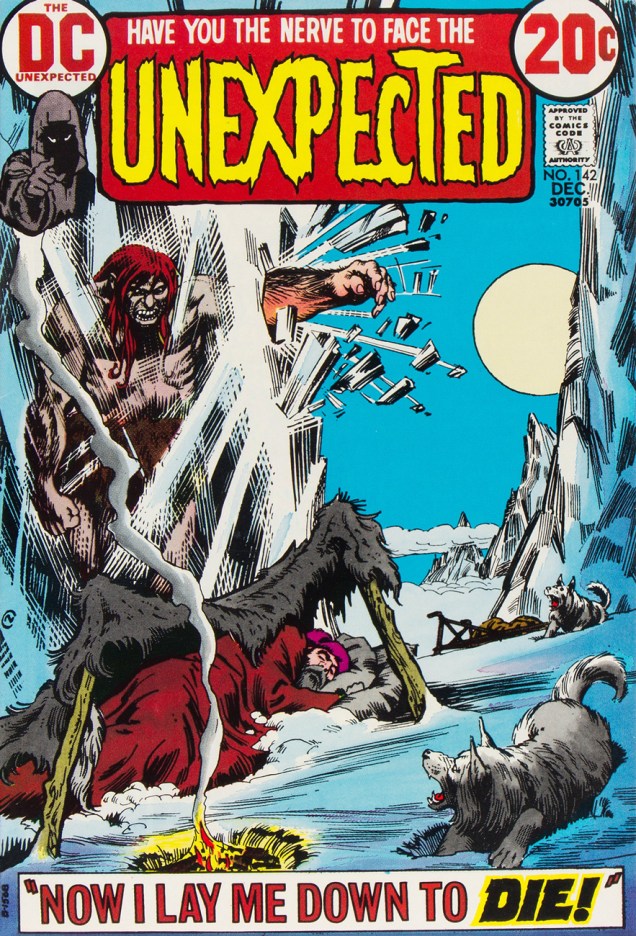
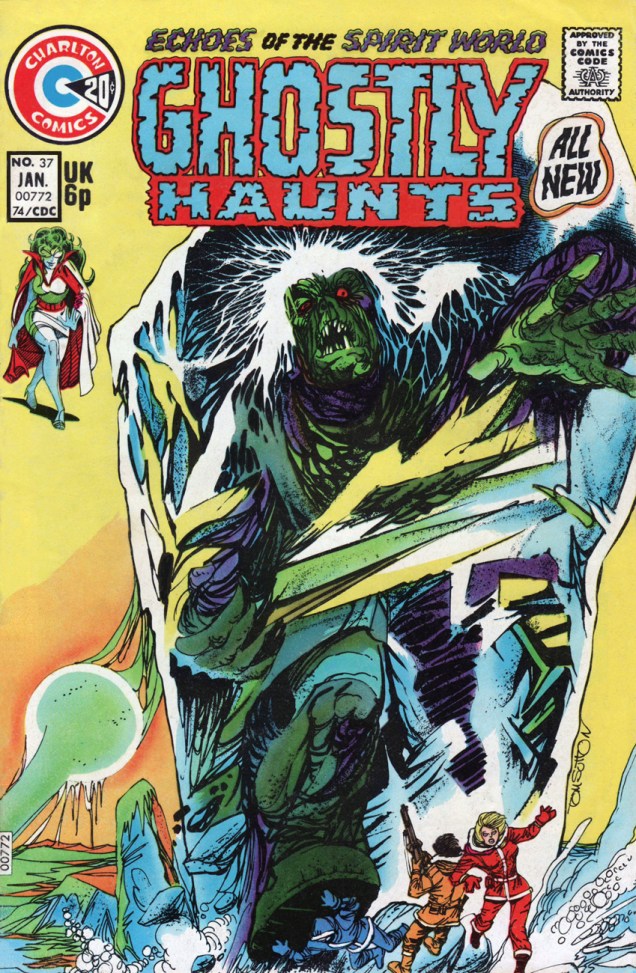
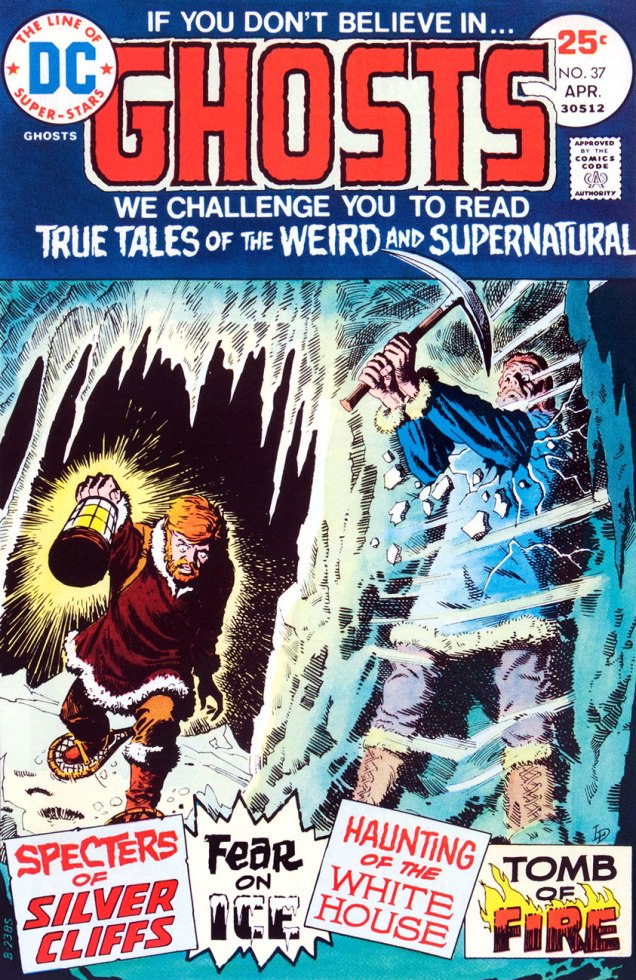
This is Astonishing no. 36 (Dec. 1954, Atlas), the title’s penultimate pre-Code issue… not that Atlas ever crossed the line into gruesome. The cover-featured yarn is The Man Who Melted!, an amusing load of utter rubbish you can read here. Cover art by Carl Burgos.This is Chamber of Chills no. 10 (May, 1974, Marvel), and most everything’s the same, save for the colour palette and the now-hostile expression on the caveman’s mug.And this is alsoChamber of Chills no. 10 (July, 1952, Harvey)… the original, whose title Harvey Comics left curbside for Marvel to recycle when they went all kid-friendly in the Comics-code-ruled Silver Age. Cover designed and art-directed by Warren Kremer and illustrated by Lee Elias. For some insight into these collaborators’ working methods on the horror titles, here’s our post on that very topic. Incidentally, what’s up with the hifalutin Lord Byron quote, Harvey folks? This wacky fare is quite plainly fiction… what’s your point? [Read it here.]This is Tales of The Unexpected no. 101 (June-July 1968, DC). Layout and pencils by Carmine Infantino, inks by George Roussos. Infantino, promoted the previous year to editorial director (he would soon rise to the rank of publisher), brought in the versatile Nick Cardy to serve as his right-hand man on the artistic front; together, they designed all of DC’s covers until both men stepped down in 1975.This is House of Mystery no. 199 (February, 1972, DC), illustrating Sno’ Fun! a rare (possibly unique, really) collaboration between Sergio Aragonés (script) and Wally Wood (pencils and inks). Cover designed by Infantino and Nick Cardy, pencilled and inked by Neal Adams and coloured by Jack Adler.This is Unexpected no. 142 (Dec. 1972, DC); cover art by Nick Cardy.This is Unexpected no. 147 (June, 1973, DC); cover art by Nick Cardy.This is Unexpected no. 150 (Sept., 1973, DC); cover art by Nick Cardy.« Hey, look! The critter is frozen whole… it’s in pretty good shape! » Tom Sutton vibrantly sells Joe Gill and Steve Ditko‘s cautionary tale of arctic drilling gone awry, The Ancient Mine. Also in this issue: Steve and Pete Morisi‘s Surprise!, and Gill and Fred Himes’ touching Pipe Dream. This is Haunted no. 37, (Jan., 1974, Charlton), presented by the publisher’s blue-skinned, green-haired answer to Nana Mouskouri, Winnie the Witch.« … that face haunts me… was it a man or a beast? » Ah, the Seventies. Left dazed and frazzled by his whirlwind life of slow-mo violence, glamorous excess and substance abuse, not to mention radiation poisoning, the inevitable occurs: The Hulk wanders onto the wrong set, as well as the wrong publisher’s! Against all odds, he handles the rôle with aplomb and commendable gravitas. A page from Gill and Ditko’s The Ancient Mine. Read it here!This is Ghosts no. 37 (April, 1975, DC), featuring Luis Dominguez‘s first (or many) cover for the title, a passing of the torch from Nick Cardy, who’d handled nearly every one of the preceding three dozen…. minus two: number 7’s cover was the work of Michael Kaluta and number 16‘s that of Jack Sparling.
Oh, and since I wouldn’t want any of you superhero aficionados to think I’m freezing you out, here’s another demonstration of Mr. Infantino‘s “encased in ice” idée fixe.
Mr. Freeze, who first popped up in Batman no. 121 in 1959, initially known as, er… Mr. Zero (Celsius, Fahrenheit or Kelvin?) before being revamped and renamed for the mid-60s Batman TV show, a makeover that carried over to the comics, but tragically didn’t include his outfit. This is Detective Comics no. 373 (March, 1968, DC); layout by Infantino, finishes by Irv Novick. [ read it here!]… and I can just about hear the « but what about Cap? » troops tromping down the hall, so…
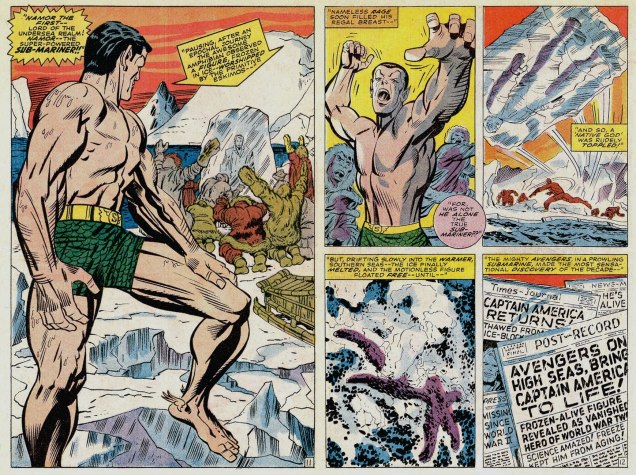
Namor goes all First Commandment on some poor Inuits (surely they’ve seen frozen bodies before?), displaying an unseemly level of insecurity for someone of his standing. This recap hails from King Kirby’s sensational feat of deadline rescue on the behalf of a tardy Jim Steranko (to be fair, it was worth the wait). George Tuska‘s inks are a surprisingly good fit! This is Captain America no. 112, Lest We Forget! (April 1969, Marvel). [ read it here!]My co-admin ds was just telling me yesterday about a client who, upon remarking to a succession of winter-kvetchers that actually, we’d had a pretty mild January, was invariably met with goggling bafflement, as if he’d just then grown a second head. In related news, it was just announced that said month of January was, indeed, the planet’s warmest on record. There is, naturally, an xkcd strip about this sort of circular denialism.
« Man’s constitution is so peculiar that his health is purely a negative matter. No sooner is the rage of hunger appeased than it becomes difficult to comprehend the meaning of starvation. It is only when you suffer that you really understand. » — Jules Verne
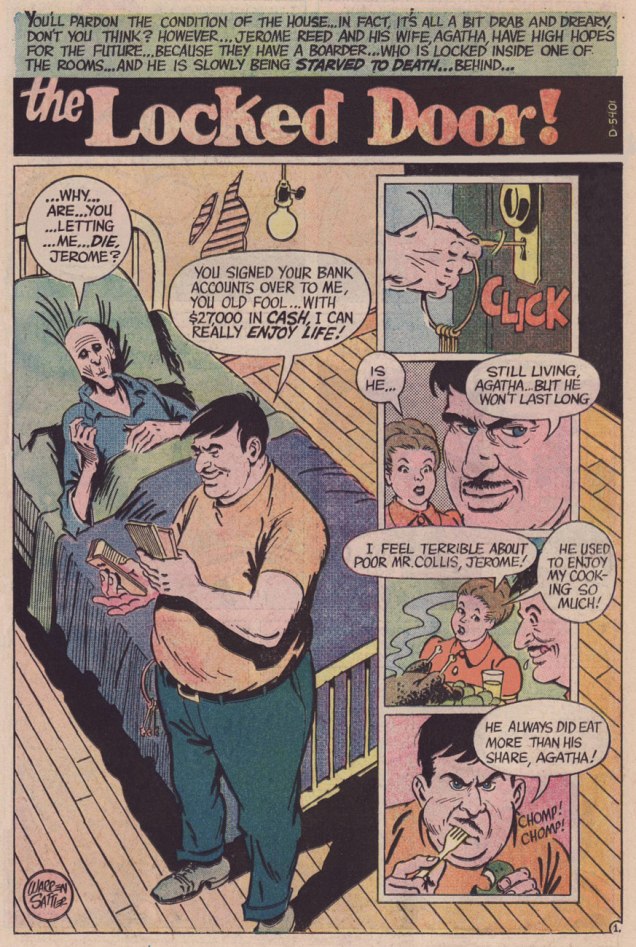
For my final post of the year (my co-admin ds yet holds one more Tentacle Tuesday instalment), I turn to crusty Joe Gill and a surprisingly cheerful tale of elder abuse (one of his pet topics, see The Night Dancer! for another example). Herein, a quite horrifying situation is leavened by Gill and his Billy the Kid acolyteWarren Sattler‘s graceful, humorous handling… with the moral still clear. This is one of Sattler’s few forays into the spooky at Charlton, and I hope you’ll agree it’s worth the detour.
Despite the mere six pages allotted, The Locked Room! features a lot of story. Joe Gill typically wrote pages comprising five panels, which would translate to 30 panels for a six-pager. Sattler breaks down the script into 43 panels, so it could have been far longer. A jewel of elegant compression!Tom Sutton’s humdinger of a cover gives away the plot, but no matter — it’s a striking, beautifully-coloured image. The rest of the issue’s nothing special: Joe Gill, Charles Nicholas and Vince Alascia’s The Truth in the Fire is yet another spin of the stale greedy-explorer-versus-native-god plot; Gill and Wayne Howard‘s Bury Me Deep! is saved by its light tone; Gill and Steve Ditko‘s Let the Buyer Beware, despite featuring Ditko in full-on goofy mode, is more-or-less standard voodoo stuff; but the humdrum outing is largely redeemed, in the end, by the cover tale. This is Ghost Manor no. 17 (January 1974, Charlton).
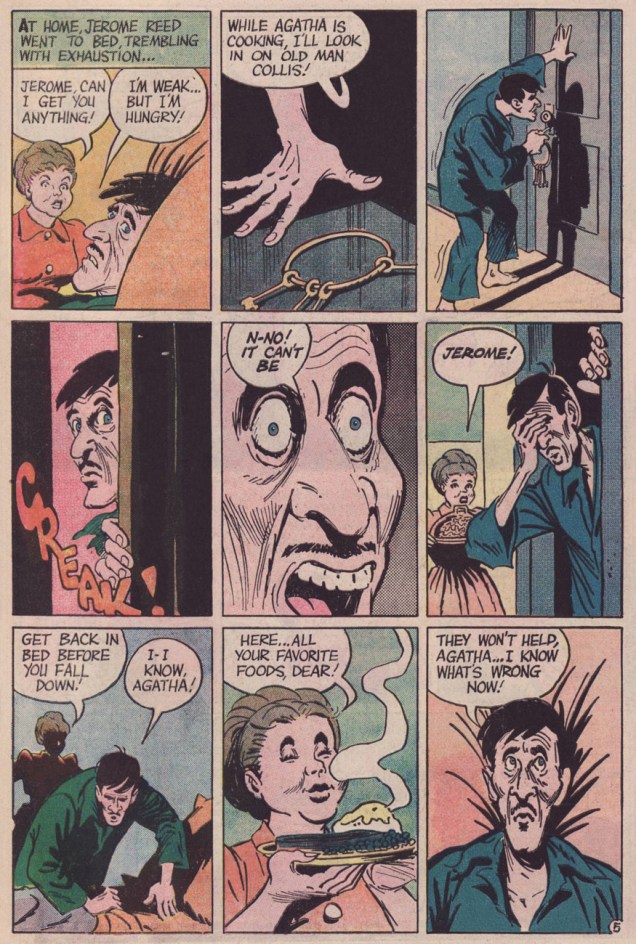
I love Gill’s use of the principle of communicating vessels as a means of poetic retribution. Or is it a feedback loop? I’m also very fond of Agatha’s characterization: she’s hardly the picture of evil, blandly accepting each new bend in the road as if morals never entered into the equation. But you just know that, once Jerome is laid to rest, she’ll simply find another man to feed and breezily carry on. In a sense, she’s the main character: doesn’t the whole thing hinge on her fine cooking?
« Our dried voices, when we whisper together are quiet and meaningless as wind in dry grass or rats’ feet over broken glass in our dry cellar. » — T.S. Eliot, The Hollow Men(1925)
It’s with a bittersweet little shiver that I wrap up this year’s WOT Hallowe’en countdown. In light of my fond feelings for the holiday, I didn’t want to go out with a massive fireworks display of a post, but opted instead for a quiet, succinct coda.
Nick Cardy‘s illustration impeccably epitomizes the spirit of Hallowe’en. No, it’s not about the candy collection ritual nor about the motley, garish masquerade… truly, it’s much as Ray Bradbury summed it up in his preface to his The October Country, « … that country where it is always turning late in the year. That country where the hills are fog and the rivers are mist; where noons go quickly, dusks and twilights linger, and midnights stay. That country composed in the main of cellars, sub-cellars, coal bins, closets, attics, and pantries faced away from the sun. That country whose people are autumn people, thinking only autumn thoughts. Whose people passing at night on the empty walks sound like rain… »
You can practically hear the echoes of sinister cackling drifting on the chill October breeze.
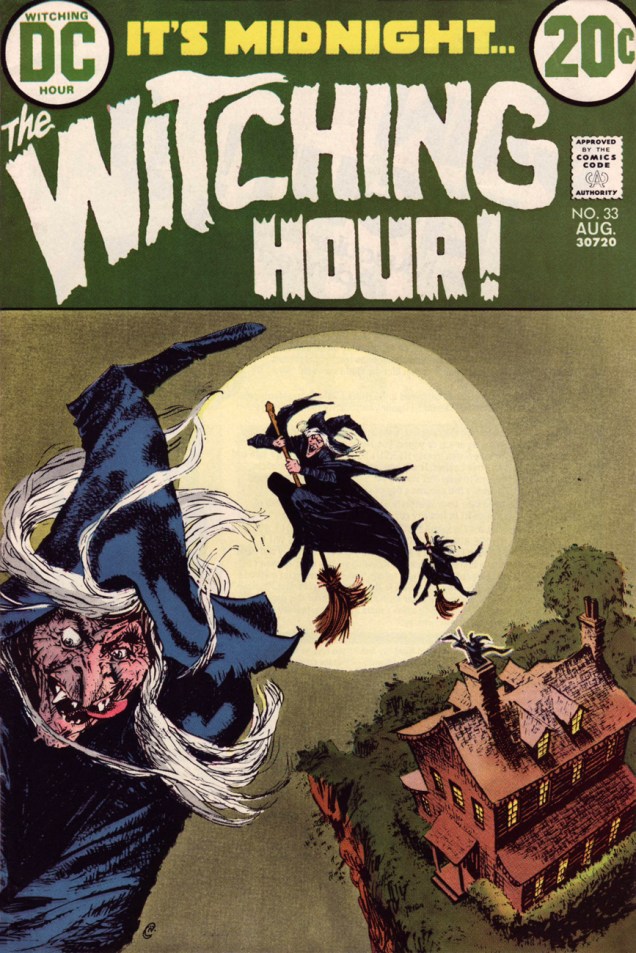
How’s this for perfectly-composed, uncluttered graphic majesty? A wisely understated palette, from top-to-bottom, holds it all together. One has to understand that this sort of soft-sell, muted grace could not make it to market without a tremendous amount of trust, cooperation and… no second-guessing. This is It’s Midnight… The Witching Hour! no. 33 (Aug. 1973, DC), edited by Murray Boltinoff. That lead witch looks quite… lusty. Where’s she off to, and why is the Comics Code Authority not stepping in?
This seldom-seen Nick Cardy cover graces quite an issue, by my reckoning: the blackly ironic Four Funerals, drawn by Ruben Yandoc and probably written by editor Boltinoff; George Kashdan‘s cynical Cold Ashes — Hot Rage, drawn by Alfredo Alcala (what, him again?); and Carl Wessler‘s convoluted A Choice Seat for… Doomsday!, illustrated by the mighty Jerry Grandenetti. Read it right here!
… and Happy Hallowe’en, one and all!
-RG
p.s. before I forget: how cool is it that the witches exit through the chimney?
« If it wasn’t for baseball, I’d be in either the penitentiary or the cemetery. » — Babe Ruth
Since the (so-called) World Series is still going on, this seems all the more appropriate.
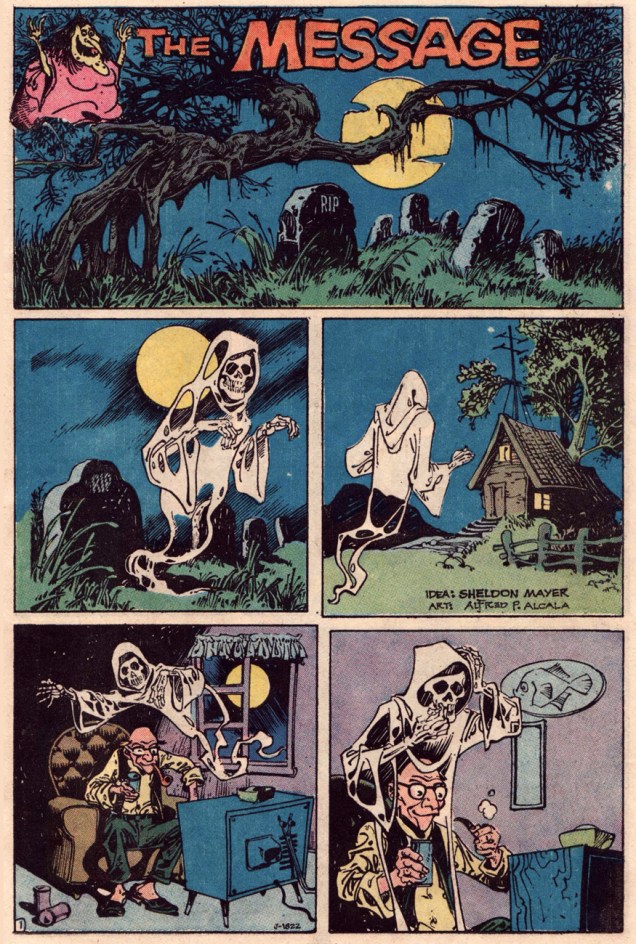
It was with this piece that I first began to grasp just how gifted and versatile Filipino giant Alfredo P. Alcala (1925-2000) was. He’s inarguably a grandmaster of eerie moods, but hardly bereft of a fun side. This brief piece, a dream collaboration between Sheldon Mayer and Alcala, was published in Plop! no. 1 (Sept.-Oct. 1973, DC). And what an issue that was, gathering such talents as Basil Wolverton, Sergio Aragonés, Mayer and Alcala, Frank Robbins, George Evans, John Albano, Stephen Skeates and Berni Wrightson… yikes! (read it here!)
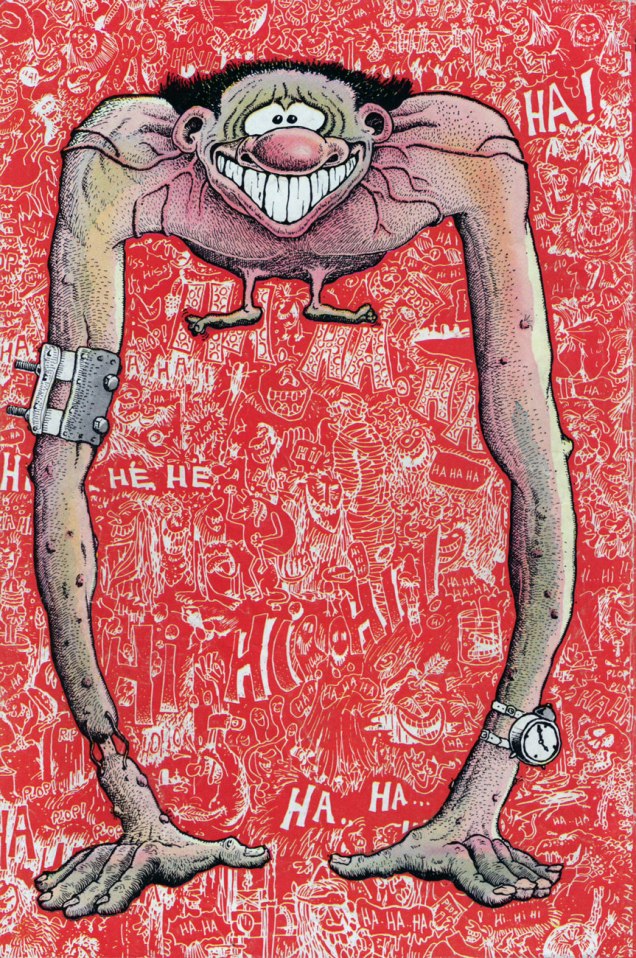
As a bonus, here’s the *back* cover of Plop! no. 1, featuring Wolverton’s cover boy “Arms” Armstrong. Which provides me with the opportunity to inform you that this very week has seen the long-delayed publication of Greg Sadowsky’s Brain Bats of Venus: The Life and Comics of Basil Wolverton Vol. 2 (1942–1952), his definitive biography of that singular and fascinating man. Read all about it here!





































 Who's Out There?