« Gosh! I never knew you had a school for monsters! »
« There are a lot of things about Transylvania that you American tourists do not know! »
Archie Comics’ earliest foray into monster humour was its long-running, in one form or another*, Mad House series (1959-82).
It doesn’t get any better than Samm Schwartz‘s cover for Archie’s Mad House no. 16 (December, 1961). The early issues featured Archie and the gang in slightly more surreal settings than usual, then they were phased out, with the noteworthy exception of Sabrina the Teenage Witch, who was introduced in AMH 22 (October, 1962). The title was a fine showcase for Archie’s best and most idiosyncratic stylists, Schwartz, Orlando Busino and Bob White in particular.
An idea they liked so well they used it (at least) twice. Bonus points for bothering to redraw it! This was Archie’s Mad House Annual no. 4 (1966-67), cover art by the aforementioned Bob White.
-RG
*It was called Archie’s Mad House (issues 1-60), then simply Mad House (61-65), then Madhouse Ma-ad Jokes (66-70), Mad House Ma-ad Freak-Out (71-72), The Mad House Glads (73-94), Madhouse (in a non-cartoony horror format, featuring the likes of Gray Morrow and Vicente Alcazar, 95-97), then finally Mad House Comics (95-130).
Of course, you can take that ‘forgotten artist’ notion with a grain of salt: most Archie artists aren’t forgotten, because they were rarely acknowledged in the first place. There are cases such as that of Scrooge McDuck creator Carl Barks, aka the Good Duck Artist, whose identity latterly became known through the efforts of a handful of devoted fans… but such fortuitous events are rare as Gladstone Gander’s off days.
No such luck for Robert “Bob” White (1928-2005), who got the short end of the stick despite being the Archie line’s signature artist during its peak period* (pretty squarely 1959 to 1965) and crafting uncluttered, expertly-designed covers and stories. Of course, these years coincide with most of the classic Archie bullpen hitting its stride, bookmarked at one end by the ascent of White (who’d arrived at Archie around 1954, but details are scant) and at the other by Samm Schwartz‘s departure for greener, but sadly ephemeral (1965-69) pastures, an art director post with Tower Comics.
Archie’s illiberal response to a guy simply, and wisely, trying to avoid putting all his eggs in one basket was typical of the publisher, and of the reactionary comics industry in general, but it’s to White’s credit that, unlike Dan DeCarlo and Samm Schwartz (who at least made a break for it), he didn’t just fold, kiss their ring and take their abuse. Who’s to say? Perhaps that principled departure really stuck in their craw.
There are simply too many outstanding White covers to feature in one go; I suppose I’ll have to return to the well a couple of times. Still, these ought to give you a sense of the man’s style.
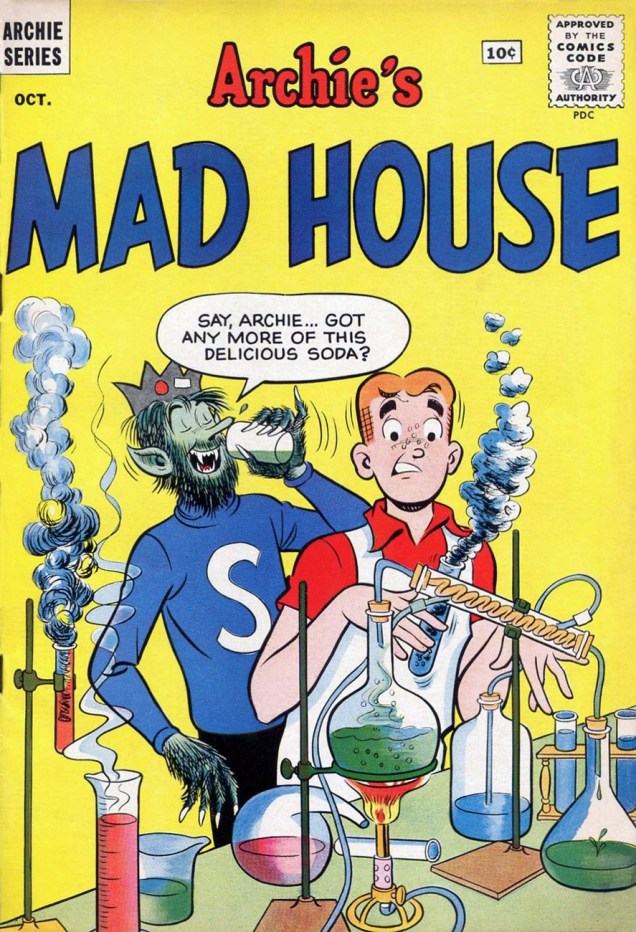
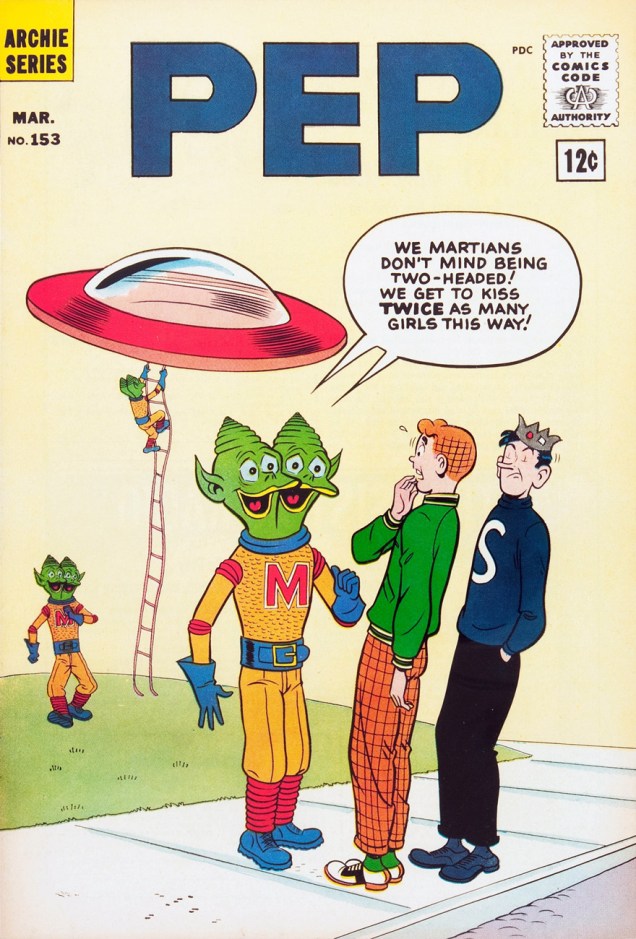
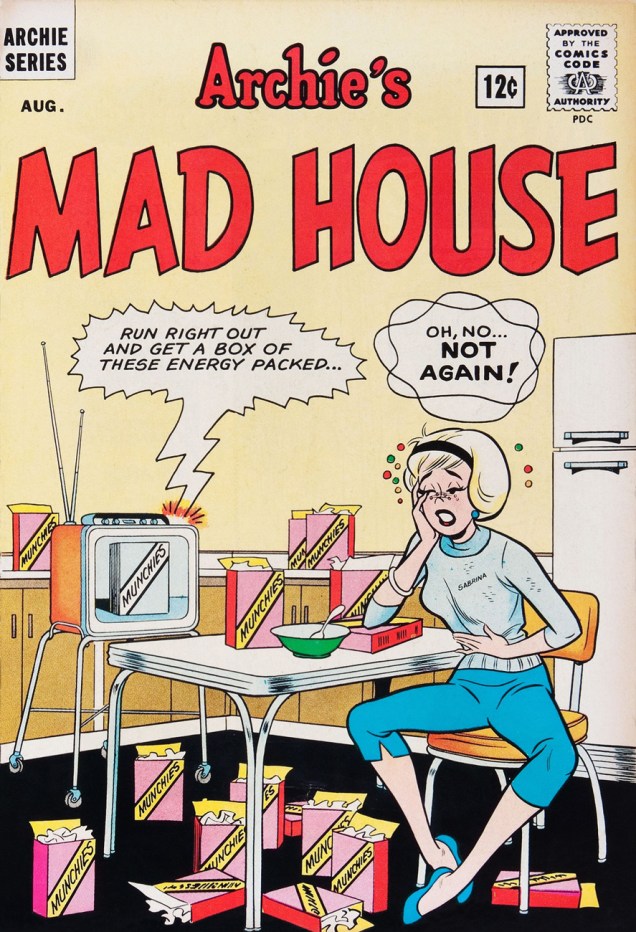
Before Afterlife With Archie, there was… Life With Archie, which « was a comic book published from 1958 to 1991. It featured Archie Andrews in adventure stories that were more dramatic than the standard Archie tales. » This is Life With Archie no. 5 (November, 1960.)« As I looked there came, I thought a change – he seemed to swell – his face became suddenly black and the features seemed to melt and alter… » ― Robert Louis Stevenson, The Strange Case of Dr. Jekyll and Mr. Hyde ‘Delicious’ is a good start, but what about the side effects? This is Archie’s Mad House no. 15 (Oct. 1961).Hey, the Macabre Trio’s in town! This is Laugh no. 129 (December 1961). Cool ghoul Bob White is truly in his element here. Also, do bear in mind that the word “Horror” was banned by the Comics Code Authority, yet they approved this cover. Asleep at the switch!This is Life With Archie no. 12 (January, 1962.) Correctly acknowledging the facts of evolution? Obviously, Al Hartley hadn’t made the scene yet.I’m especially fond of the period when you get a sense from the covers (chiefly those produced by White and Schwartz) that Riverdale was built over the Hellmouth or an ancient burial ground, as monsters and aliens routinely ask for directions or take Betty out for a soda. This is Pep no. 153 (March, 1962).Ah, there’s some of that “more dramatic” stuff. Life With Archie no. 16 (September, 1962.)« So don’t be persistent / Please keep your distance / You know my resistance is low » It would appear that Madison Avenue’s brand of wizardry is more than a match for Sabrina’s. This is Archie’s Mad House no. 27 (August, 1963).
– RG
*I’m in complete agreement with cartoonist-connaisseur Gregory Gallant, aka Seth, when he writes, in his introduction to John Stanley‘s Thirteen ‘Going on Eighteen’ (Drawn & Quarterly, 2009… where’s volume 2 at?) that « I like Archie comics quite a bit and own hundreds of issues of Archie and its various spin off titles. I can even tell you which years are the good years (1959 to ’65, incidentally) »
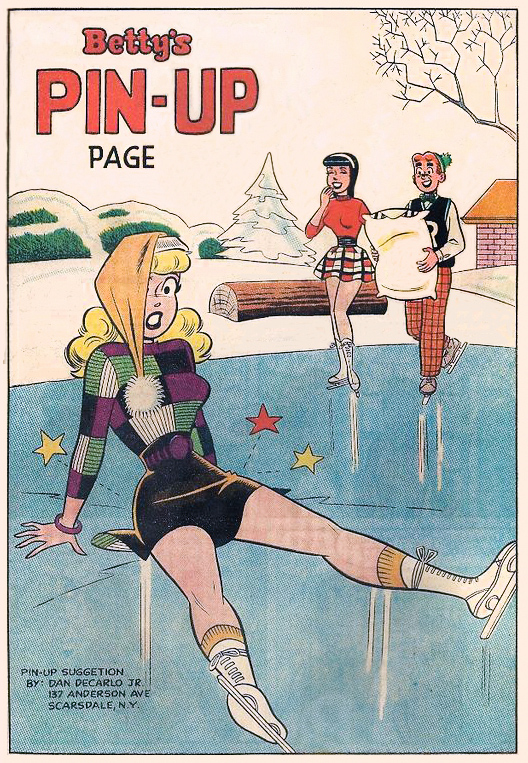
This splendid Bob White cover brings to mind science-fiction satirist Douglas Adams‘ prescription for achieving flight: « … all one must do is simply miss the ground. »
Judging from the distribution of stars, it would appear that Archie’s left cheek took more of a hit.
Betty gets her turn: This pin-up theme was sugge(s)ted to Dan DeCarlo by his son, Dan Jr., who grew up assisting his father on Betty and Veronica stories and later (early 80s) became one of the feature’s main artists. Originally published in Archie Giant Series no. 10 (Archie’s Christmas Stocking, 1961.)
Let’s start with something hair-raising. Well, not really – we’re a blasé audience, and it takes something special to truly scare us. Yet can you deny the foul-smelling, palpable sense of foreboding, the billowing and swirling nightmare that beckons from the elegant inks of this page?
« She boiled up out of the sea that hellish night — a monstrous hideous creature, she was, with the craggy face of an evil eyed witch! » Giant-Size Chillers no. 1 (February 1975). The cover promises a « frightful, fearful first issue! » Does it deliver? Eh, not really. Here’s a page of the best story in it, The Gravesend Gorgon, scripted by Carl Wessler and pencilled + inked by Alfredo Alcala.
Gravesend is an ancient town in northwest Kent, England; as for the gorgon part, it’s not entirely accurate, but it’s clear that comic writers cannot resist an alliteration.
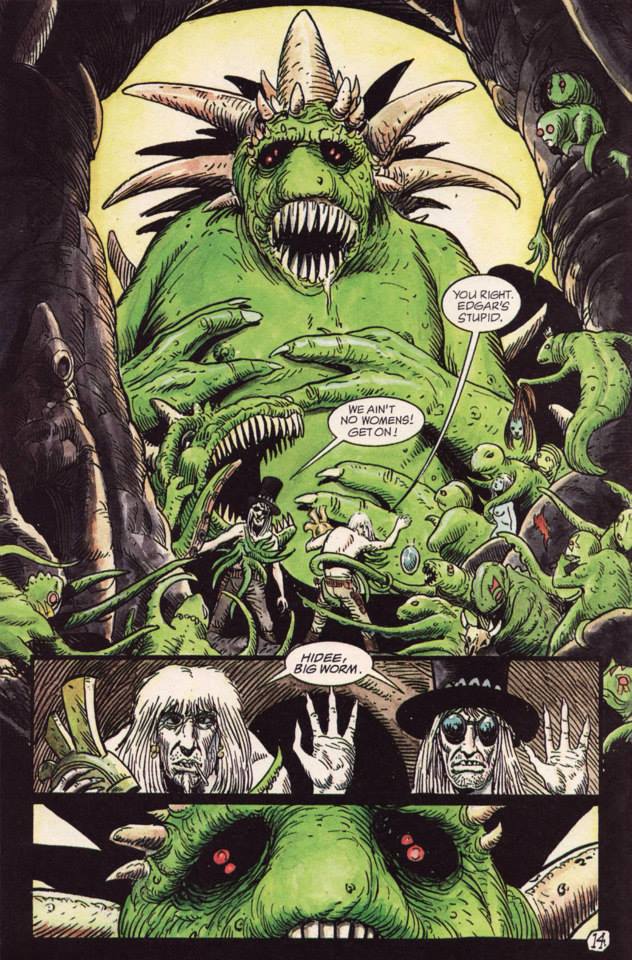
On a slightly more humorous front (unless one is directly involved with this green monstrosity, in which case the situation would quickly lose its humour), here’s a page that hails from Jonah Hex: Riders of the Worm and Such no. 4, (June 1995). The story features the half-worm, half-human albino Autumn Brothers, whom you can see here greeting the big worm-momma. Texas blues rockers Johnny and Edgar Winter attempted to sue, but the suit was dismissed after a judge begrudgingly ruled that « the First Amendment dictates that the right to parody, lampoon and make other expressive uses of the celebrity image must be given broad scope. » Thank you, Los Angeles court. Frankly, it seems that the brothers are more remembered for the lawsuit than their music.
« Sure like to make big worm happy, whatever she want. Not care much for tentacle down throat. » Jonah Hex: Riders of the Worm and Such no. 4, June 1995. Scripted by Joe R. Lansdale, pencils by Timothy Truman, inks by Sam Glanzman.
Jonah Woodson Hex, created by writer John Albano and artist Tony DeZuniga in 1971, curmudgeonly and disfigured but bound by a personal code of honour, is a favourite character of mine, although I only like the way he is written for DC’s Weird Western Tales. Well, with one exception, this one! I most tentacularily recommend Jonah Hex: Shadows West, a collection of the three Vertigo-published mini-series scripted by Lansdale and illustrated by Tim Truman and Sam Glanzman, containing the stories Two-Gun Mojo, Shadows West and Riders of The Worm and Such.
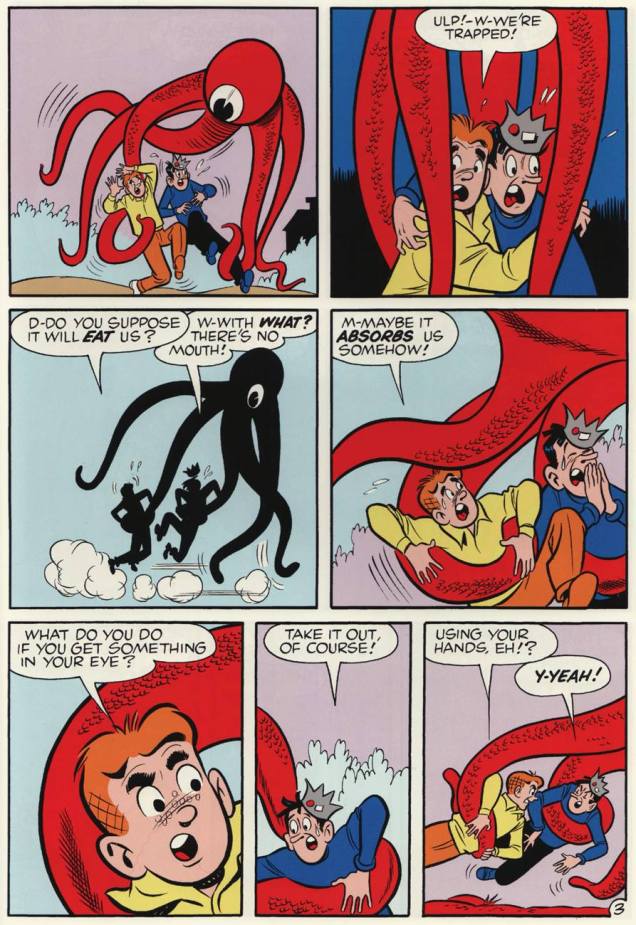
And to wrap this up, on an even goofier note, here’s Jughead getting into yet another weird situation, which is pretty standard for him.
This page from The Eyes Have It comes from Jughead no. 77 (October 1961). Script by George Gladir, pencils by Samm Schwartz, inks by Marty Epp. Schwartz is absolutely the best Archie artist to draw tentacles; most everybody else would have made a mess of it.
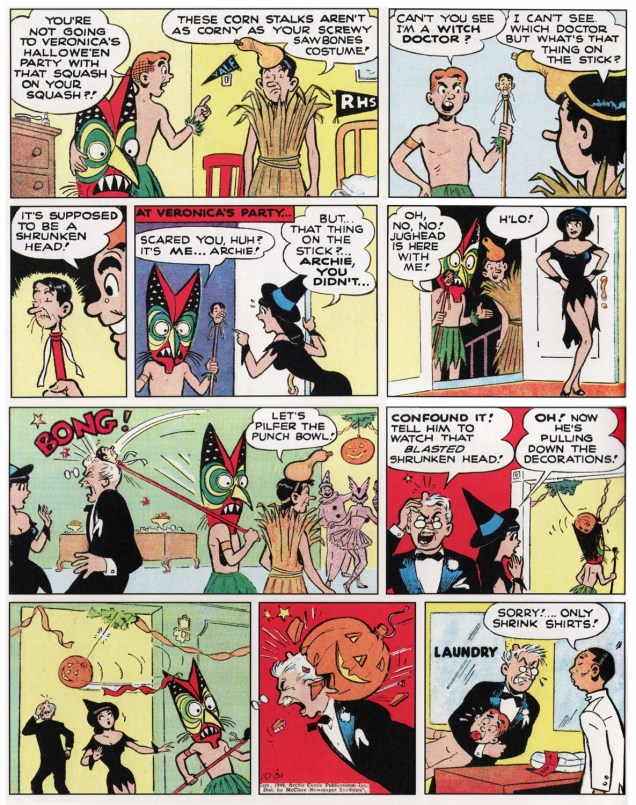
Here’s a seasonal Sunday strip from Archie creator* Bob Montana (October 23, 1920 – January 4, 1975), from October 31, 1948. Do note (or try not to) how sultrily Veronica is portrayed in comparison to her more restrained depictions in subsequent, supposedly less prudish decades.
*You can safely ignore the outlandish claims of the Goldwater family on that. They may run the company, but they ain’t created squat, despite their long tradition of shoe-horning themselves into the credits. And of screwing over the actual creators of their flock of golden geese.

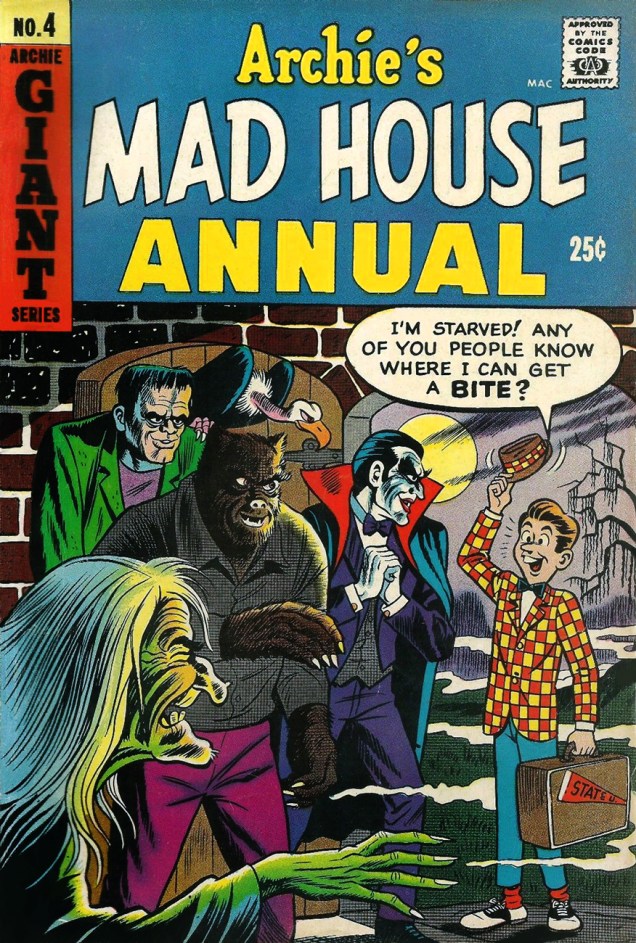 An idea they liked so well they used it (at least) twice. Bonus points for bothering to redraw it! This was Archie’s Mad House Annual no. 4 (1966-67), cover art by the aforementioned Bob White.







 Who's Out There?