I’m always happy to revisit Wonder Woman in her glorious young days of being depicted by H. G. Peter, whose expressive, dynamic art I just can’t get enough of. The stories are none too shabby, either! In my earlier post, Tentacle Tuesday: H.G. Peter and Wonder Woman lend a hand, I overlooked a few choice cuts. Well, having spent a few delightful hours going through WW stories originally published in Wonder Woman, Sensation Comics or Comic Cavalcade, it is my pleasure to remedy my previous oversight, and I can possibly even claim that these two posts are a pretty definitive list of Wonder Woman’s tentacular entanglements.
Do you have a few hours to waste – pardon – dedicate to research, too? Here you can read the entirety of DC’s Wonder Woman: Golden Age multiple-volume omnibus. Personally I think the graphic designers responsible overamped the contrast when they cleaned up the images, and much prefer reading these stories in their original colour… but nothing beats having all of this stuff on one website for convenience.
All stories are written by William Moulton Marston with art by Harry G. Peter.
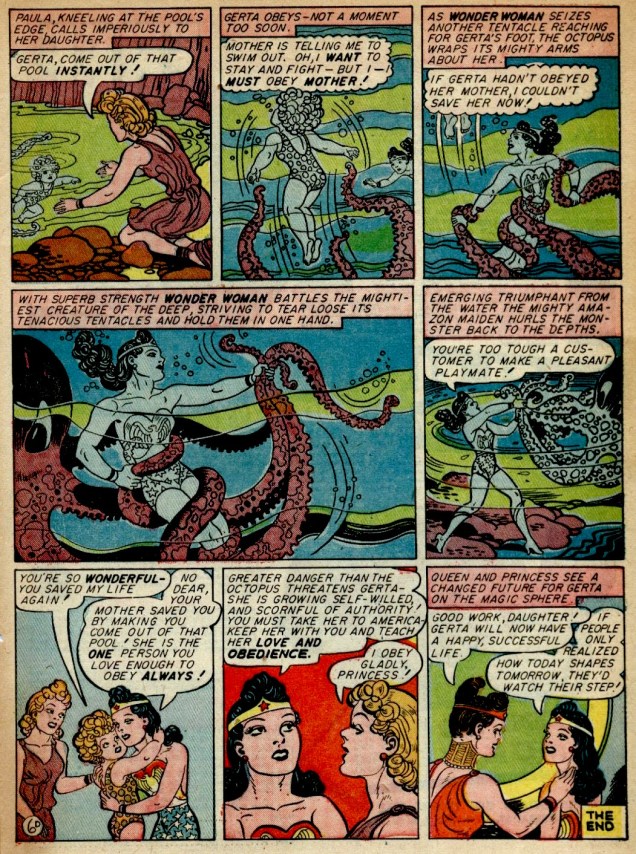
Demon of the Depths, printed in Wonder Woman no. 7 (winter 1943):
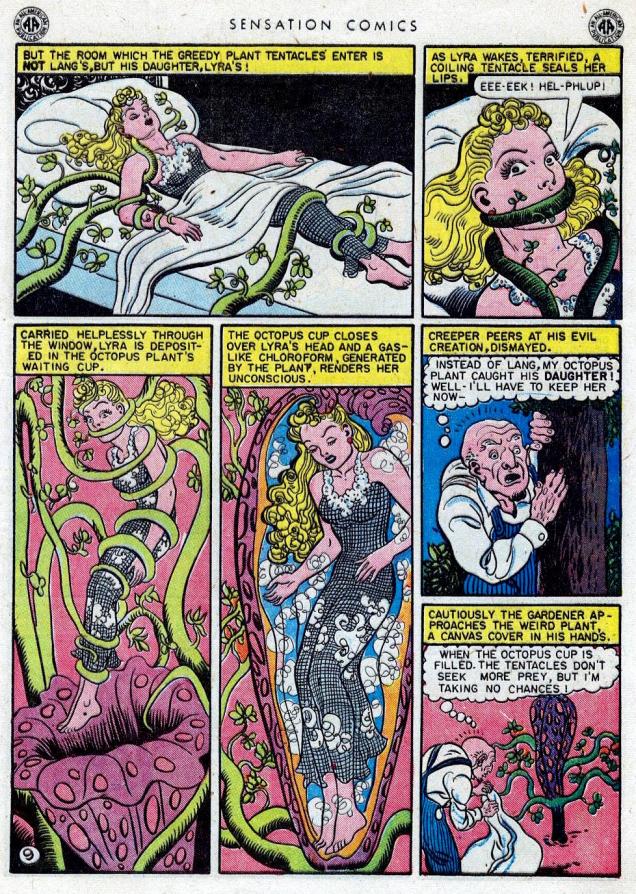
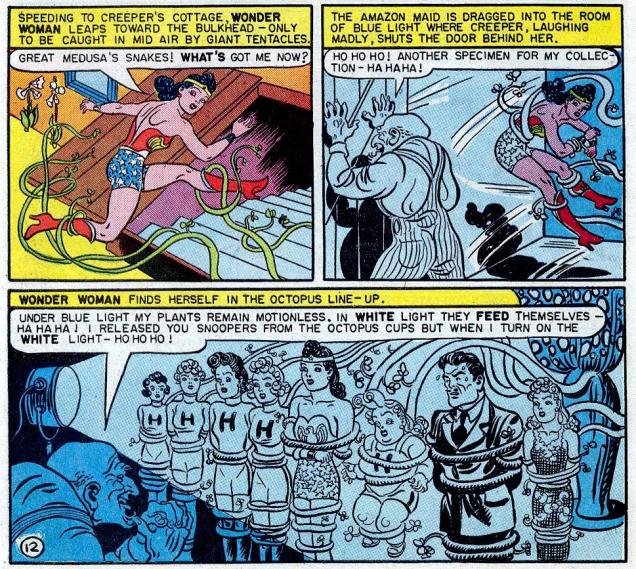
The Adventure of the Octopus Plant!, printed in Sensation Comics no. 41 (May 1945):
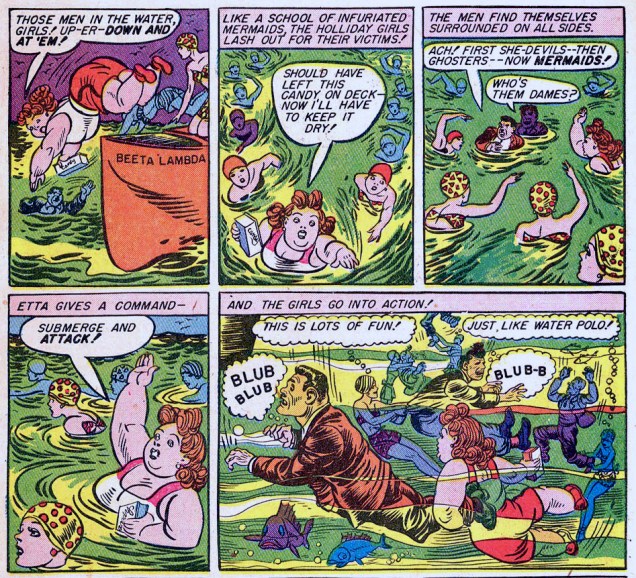
This is not strictly tentacle-related, but I would also like to share a few choice panels that I’ve stumbled upon while looking for tentacles. Gorgeously weird, they remind us just how strange, inventive and subversive Wonder Woman was in her glory days of yore!
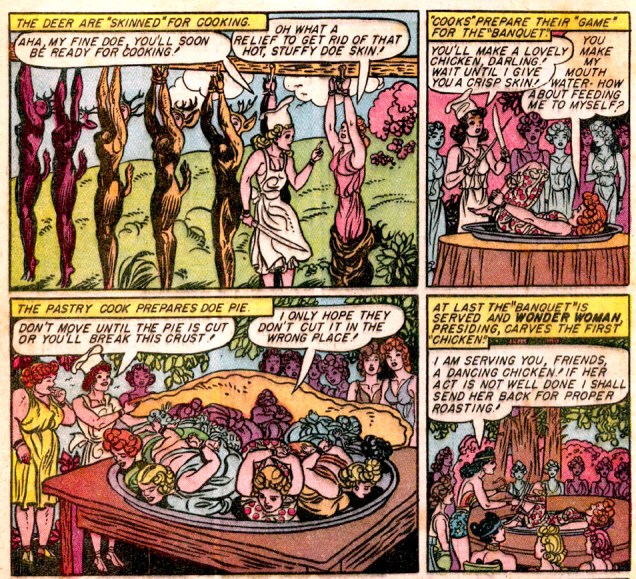
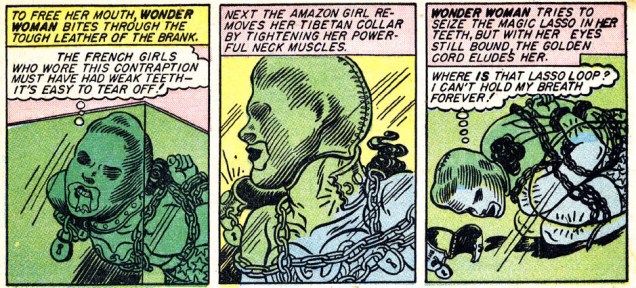
Etta is my favourite character, and this is a great showcase for her sense of humour! Sensation Comics no. 5 (May 1942)This is apparently a standard Amazonian ceremony – the girls dress as deer, are hunted and captured, and then cooked and consumed. Wonder Woman no. 3 (February-March 1943)I had to use at least one scene of bondage, right? I was mostly amused by the quip about French girls. Wonder Woman no. 6 (Fall 1943).Sensation Comics no. 41 (May 1945)
And voilà! But don’t fret, we will see Wonder Woman in the tender embrace of an octopus again… this time in the 60s, Robert Kanigher and all.
Wonder Woman versus the Saboteurs, printed in Sensation Comics no. 5 (May 1942)
« It is a mistake to fancy that horror is associated inextricably with darkness, silence, and solitude. » ― H.P. Lovecraft
I’ve actually had a friend tell me that he sees tentacles wherever he goes because of my Tentacle Tuesdays. Hey, I’m not making this up – tentacles *are* everywhere. Whether you’re in a well-lit room, with reassuring noises of the city filtering through the windows, or in a city centre, cushioned from harm by the comforting presence of a crowd… repairing a TV set, kissing a date, heading over to the pub for a well-deserved drink… some cephalopod horror is but a blink away. Fie, fie, foul apparition!
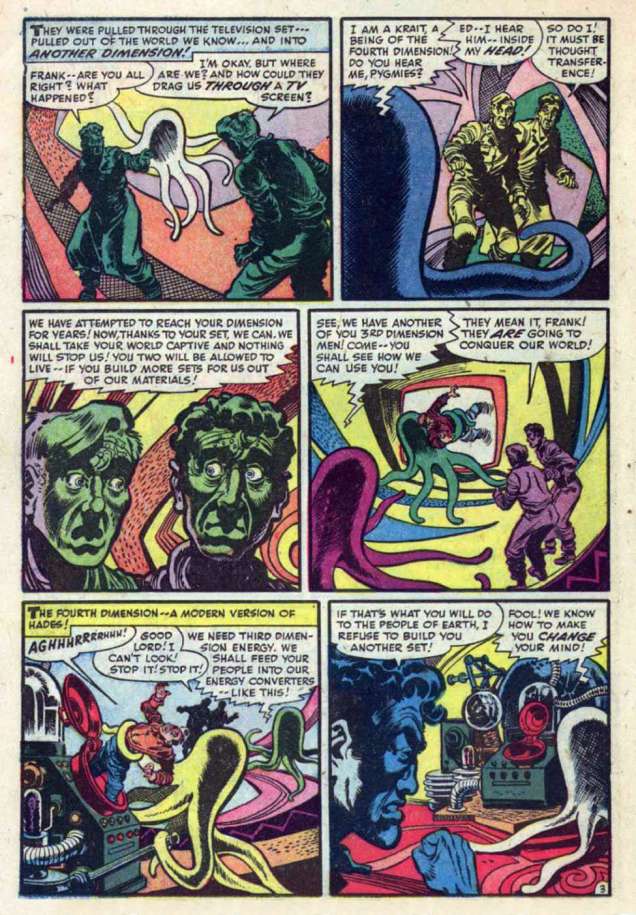
What better beginning to this post than… TERROR VISION!!! (“Aiiieeee!“, to quote the man.)
A page from Terrorvision, with very nice art (and possibly plot) by Howard Nostrand, printed in Chamber of Chills Magazine no. 19 (September 1953, Harvey).
Things go from bad to worse for our repairman…
Normally I wouldn’t post yet another page from the same story, but I like the art so much that I have to share.
I’ve already mentioned German horror comics in the shape Spuk Geschichten (see Tentacle Tuesday: A Torrent of Teutonic Tentacles). Its mother publication, Gespenster Geschichten, also has its share of tentacles. For now, I will limit myself to this one cover:
It’s a cruel thing to do to a man who was just thirsting for one piddling stein of cool beer. I hope they all got better acquainted and are clinking glasses together in the next scene… but I doubt it. Gespenster Geschichten no. 545.
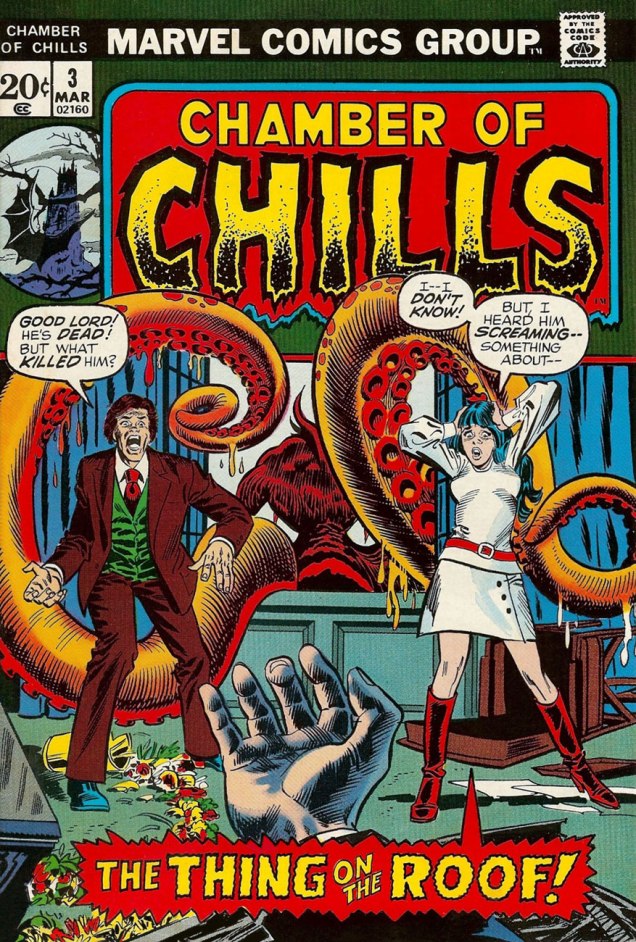
One would be justified in thinking that roofs are generally quite octopus-proof, but nope, this one is either a talented climber or just unimaginably huge.
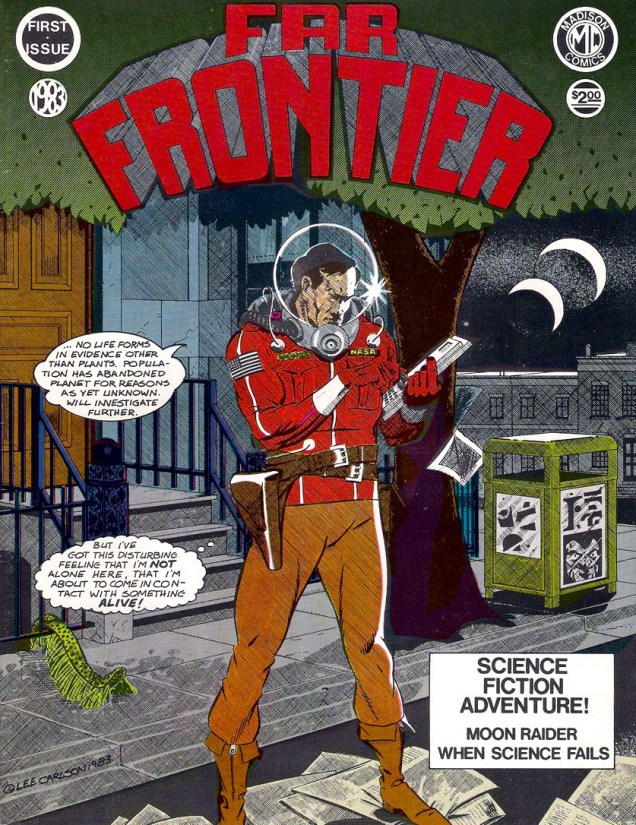
Chamber of Chills no. 3 (March 1973), pencilled by Alan Weiss and inked by Frank Giacoia.A street may look peaceful and quiet, but that doesn’t mean a shag rug tentacle isn’t stealthily creeping towards your leg. Far Frontier no. 1 (1984), drawn by Lee Carlson.
As a bit of an aside, there’s a really fun account of one collector’s quest for John Jacobs stories written for Madison Comics over at Kirby Your Enthusiasm (link: Finding John Jacobs). Far Frontier no. 1 has a few of those, and apparently they’re quite perverse and brain-melting. An excerpt of the essay in question to whet your appetite:
« I first became aware of [John Jacobs] through a review by noted comics writer Jan Strnad in The Comics Journal #94 of Dr Peculiar #1. I read and re-read it dozens of times and marveled at the samples of his primitive pencilled art. My mind tried to absorb a comic that had heavy religious overtones plus a healthy dose of T&A (with a monster rape/cannibal fetish). The reviewer theorized that John Jacobs’ mind must be like a bowl of maggots. »
As an editorial aside, I am inclined to trust Strnad on this, both because I really like his writing and because Kirby Your Enthusiasm‘s summary of Jacobs’ plots confirms the maggots theory.
Voyage to the Bottom of the Sea no. 2 (July 1965). Cover by George Wilson.
Todd Franklin of Neato Coolville has actually transformed this cover into a groovy wallpaper (go to his website to download the high-res version).
Voyage to the Bottom of the Sea no. 13 (August 1968). Cover by George Wilson.Brothers of the Spear no. 7 (December 1973), cover by George Wilson.
That previous cover has borderline tentacles, I agree, but the completist in me insisted on its inclusion. Also, it’s entertaining.
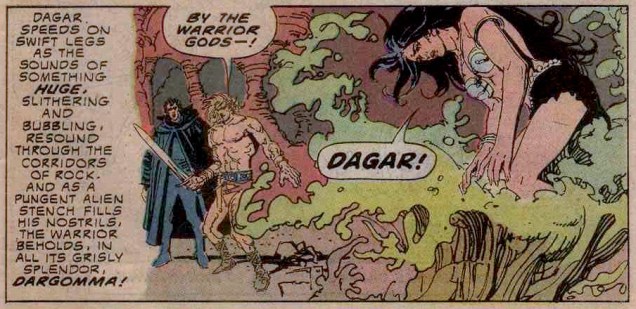
The Tree That Walks is illustrated by Jesse Santos. The story tags as detailed by GCD are «chariots; draft elands; giant carnivorous plants; human skeletons; leopard; rock slides; saddle elands». I had to look up “elands” (it’s an antelope). How much more entertaining can one get?Tales of Sword and Sorcery Dagar the Invincible no. 11 (April 1975). Cover by the underappreciated Luis Dominguez.
A beautiful cover this may be, but the insides are distinctly underwhelming. The title story, It Lurks by Moonlight, is scripted by Don Glut and illustrated by Filipino artist Jesse Santos, who seemed like a likable artist with a wide-ranging career… but his art is not my cup of tea.
Today’s post may step a bit outside my usual purview, which is to say that the octopuses I am introducing do not come from the pages of comics per se. They’re used for mercantile purposes, to attract public to a concert, sell a book or deliver a message. But though they are octopuses in advertising, their artists still clearly have their hearts (and fingers) in the cartooning world.
Exhibit A is this cover for Centipede Press’ edition of Masters of Science Fiction: Fritz Leiber. This edition was limited to 500 numbered copies, so it will surprise no-one when I state that it’s quite sold out (See? Tentacles sell.) The cover is by Jim & Ruth Keegan, a wife-and-husband team, also the authors of the comic The Adventures of Two-Gun Bob.
Next, we have two music-related scenes, both from the Spanish side of things. ¡Fíjate!
The Roctopus Tea Party Festival takes place in Toledo, Spain. (Due to language constraints, I’m not exactly sure how many editions of it there have been.) Each poster features an octopus, but this is my favourite of the lot.
Whoever designed the festival’s logo knew how to harness the power of a lone octopus eye.
This Mardid “lunch box restaurant & tiki room” (now sadly defunct) held a series of “Galician lunches with DJ” splendidly named Día del Tentáculo. With a little Google Translate magic, I came up with this description: « Imagine a restaurant where you can eat hamburger with shiitake and jalapeños, drink the mythical Mai Tai cocktail or enjoy Tentacle Day with the best Galician octopus. And all while listening to good music in an environment inspired by the 50’s America. Sounds like an explosive mix, right? » The hamburger sounds good, but it’s really the Galician octopus that draws one in!
As the Spanish artist Roberto Argüelles held a few exhibitions of his art at Lunch Box, I’m going to assume this is his artwork.
This one I spotted plastered over some other poster in my neighbourhood. It states something like « Ultimatum: provide wages for all internships at all levels, or we go on strike. »
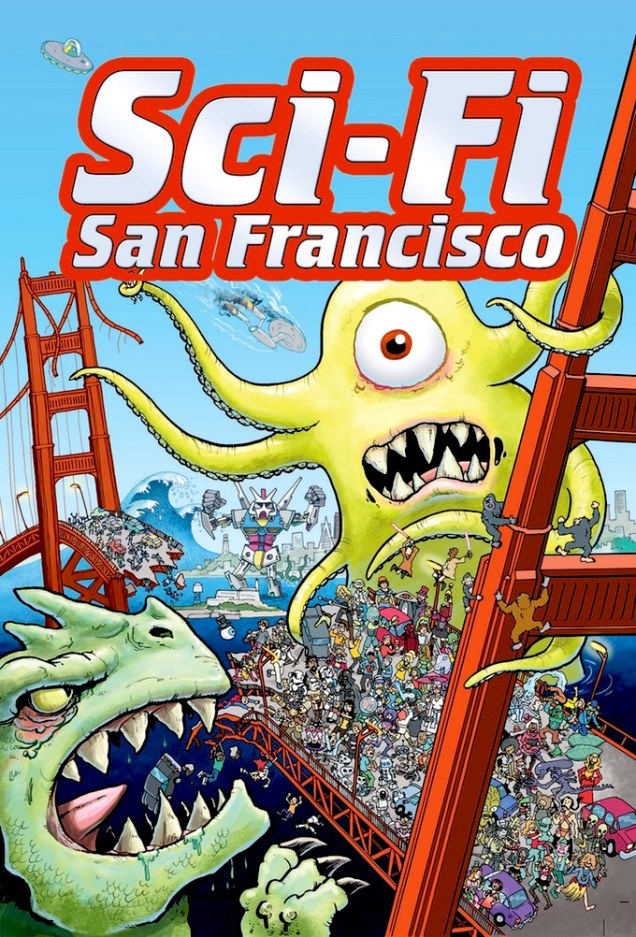
At first I assumed this was poster for a sci-fi convention in San Francisco, but it turned out to be the cover of a comics anthology published by Skodaman Press.
A favourite trope of tentacular obsession in comics is populating stories with monsters boasting exceptionally long arms (sometimes more than one pair) that they can wind around stuff with ease. In other words, monsters with tentacle forelimbs. You’d have to abstain from comics altogether to never encounter that of which I speak (or stick to slice-of-life comics, I guess). A little demonstration is in order.
Here’s a trick question: what kind of being lives on planet Octo? Duh: Octo-men! The following Flip Falcon story, illustrated by Don Rico (and not “Orville Wells”, despite claims to the contrary), was printed in Fantastic Comics no. 17 (April 1941).
Interesting that “dog” is used as a slur even on planet Octo, despite there clearly being no canines around.Nasty little brutes, aren’t they?
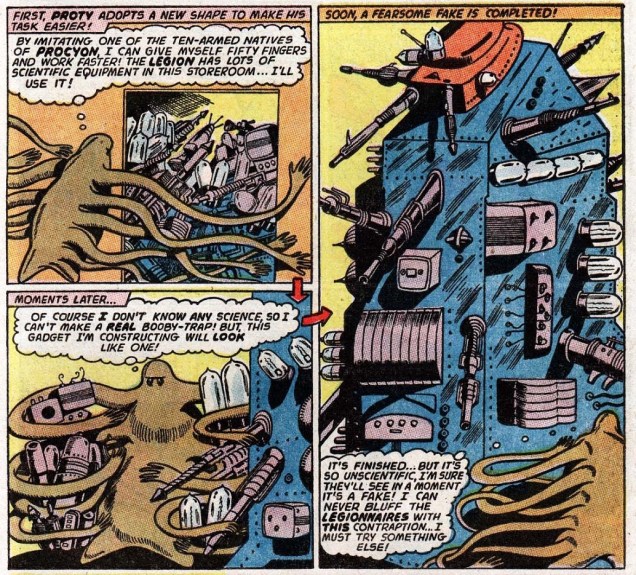
The Super-Tests of the Super-Pets! (scripted by Edmond Hamilton, penciled by John Forte and inked by Sheldon Moldoff) is every bit as goofy as it sounds. I actually enjoyed reading it, much to my own amazement. Anyway, while Proty II (Chameleon Boy’s pet) transforms into quite a few creatures to pass the super-test, he clearly favours tentacular forms (and who could blame him?) This was published in Adventure Comics no. 322 (July 1964).
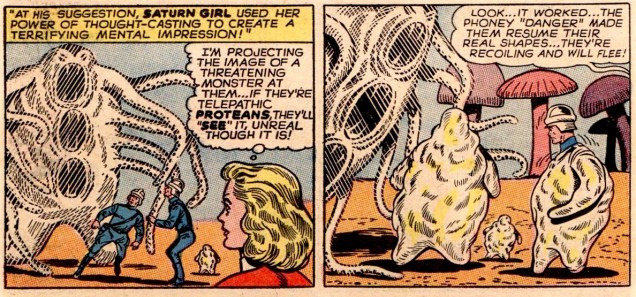
Speaking of Proty II and ectoplasm, a dozen issues later, the Legion decides to visit his home planet, which is just full of these jello-marshmallow doughboys, Protean citizens all. Part I: The Unknown Legionnaire and Part II: The Secret of Unknown Boy! (both parts scripted by Edmond Hamilton, penciled by John Forte and inked by Sheldon Moldoff) were published in Adventure Comics no. 334 (July 1965).
To terrify Proteans, whose appendages are borderline tentacles, Saturn Girl decides to conjure up a… monster with tentacles.In case you didn’t believe me that Proteans have “tentacles”.The shape-shifting Proteans turn into more streamlined versions of themselves, with more pronounced tentacles. I swear, everyone is obsessed.
Next, I’d like to regale you with a fight scene illustrated by Murphy Anderson (yum!): Scourge of the Human Race!, scripted by Gardner Fox and published in Hawkman no. 15 (August-September 1966).
Isn’t it a lovely last panel?
If I Can’t Be Clark Kent… Nobody Can!, published in Action Comics no. 524 (October 1981), scripted by Martin Pasko, penciled by Curt Swan and inked by Frank Chiaramonte, offers us a nice helping of tentacles.
If I should see an octopus Lift its arms out of the sea Or see its shadow rising up Cross the rooftops above the streets I’d follow those dancing limbs To the spinning edge of the sky Where all the boats fall off the world Into the octopus’s eye
Sea Devils no. 1 (September-October 1961). Cover by Russ Heath.The Sea Devils vs. the Octopus Man! is scripted by Robert Kanigher and illustrated by Russ Heath.
The same team returns to tentacles with Sea Devils no. 6:
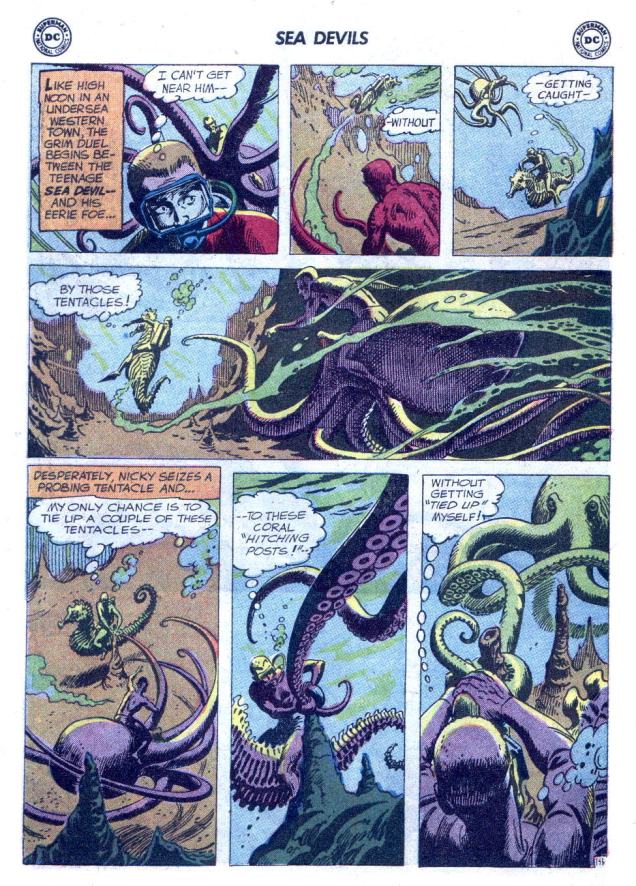
The Flame-Headed Watchman!, scripted by Robert Kanigher and drawn by Russ Heath, was published in Sea Devils no. 6 (July-August 1962).
Now we unfortunately have to leave Heath behind and walk over to the territory of Howard Purcell, whose art is not nearly as striking, but still quite serviceable.
Sea Devils no. 17 (May-June 1964), cover by Howard Purcell.The Impossible Maritime Menacesis scripted by Arnold Drake, penciled by Howard Purcell and inked by Sheldon Moldoff.Sea Devils no. 19 (September-October 1964), cover by Howard Purcell. Is it just me or does the guy on the left look like a Ditko villain?The Sea-Devil Robots is penciled by Howard Purcell and inked by Sheldon Moldoff.Sea Devils no. 21 (January-February 1965), cover by Howard Purcell.
The Forty-Fathom Doom!, scripted by Jack Miller, penciled by Howard Purcell and inked by Sheldon Moldoff, boasts quite an assortment of tentacles:
Everybody is almost in identical position as on the cover – but the octopus has lost his baby blues and gained a pair of poached eggs.
And, in case you’re wondering where that quote at the top of this post comes from… The ‘heh, heh’-ing octopus is Dr. Quad.
Behold! I return to a topic close to my heart, as close as tentacles are close to human flesh in this post! Namely, PG manifestations of shokushu goukan. But I wouldn’t like you to think that I’m one-track minded: today’s crop has its share of fantasy scenes, scantily-clad women who are about to be even further undressed, but! it also includes panoramas of serious (and unsexy) struggle, tongue-in-cheek héroïnes quite nonplussed by their predicament, tentacles overpowering female protagonists despite their superpowers, etc.
Without further ado, I give you… damsels in tentacular distress.
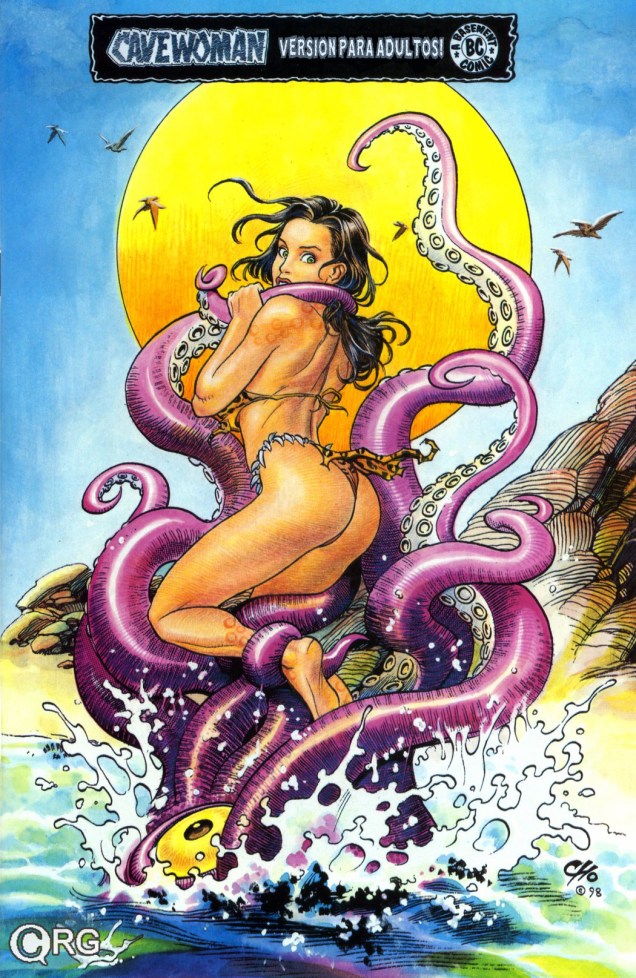
Cover painted by Bernie Wrightson for Nightmare Theater no. 3 (Chaos Comics, 1997).Cover from Pangaean Sea no. 4 (Basement Comics, 2000); art by Budd Root, the owner of this publishing company.Another one from Basement Comics: Jungle Tales of Cavewoman no. 1 (1998), variant cover by Frank Cho. It will come as a surprise to no-one that Cavewoman was created by the aforementioned Budd Root. Cavewoman is Meriem Cooper (I suppose calling her Myriam was too staid). I stumbled upon this amusing quote from Root recently, who said that Meriem was « patterned after pretty much all the women I really respect. She’s got a body with kind of a Little Annie Fannie face with Danni Ashe’s boobs and Nina Hartley’s butt. » No comment.
The maiden doesn’t always need to be rescued, nor does she necessarily *want* to be ravished – here’s a look at some heroines standing their ground against tentacular invasion.
Page from Wonder Woman: The True Amazon (DC, 2016) by Jill Thompson. I wasn’t much impressed by this graphic novel, but I loved Beasts of Burden, a collaboration between Thompson and writer Evan Dorkin.My Greatest Adventure no. 81 (August 1963), art by Bruno Premiani.Or you can resort to other, more… creative… means for getting out of the octopus’ embrace. Pages from Lorna: Heaven is Here (Treize Étrange, 2006) by Brüno.
I promised you superheroines, and by Jove, you shall get some!
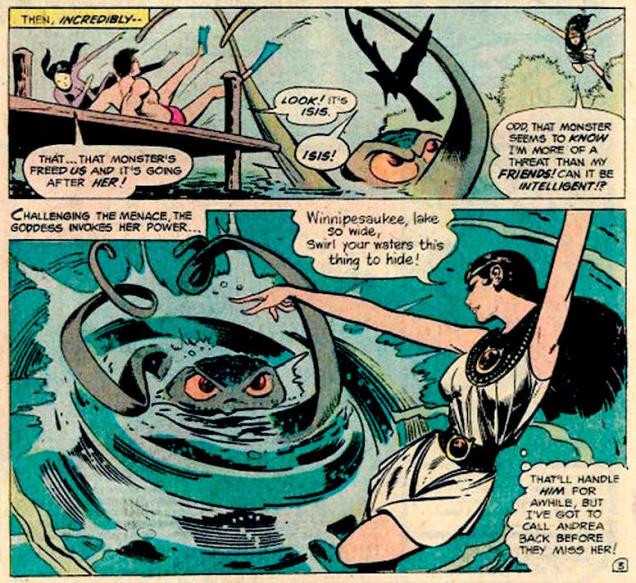
Isis no. 4 (April-May 1977), pencilled by Mike Vosburg and inked by Dick Giordano. Isis clearly used to be a ballerina…. or the artists have a knack for awkward anatomy.Treasure of Lost Lake is scripted by Jack C. Harris, pencilled by Mike Vosburg and inked by Vince Colletta. I honestly can’t recommend this story to you – the art is about as good as the storytelling, which is not a compliment to either.Page from Ferra Naturae, scripted by Bill Mantlo, penciled by Al Milgrom and inked by Jim Mooney, published in Spectacular Spider-Man no. 75 (February 1983). Obviously many have grappled with Dr. Octopus’ tentacles… but I think this particular scene is worthy of inclusion in this post.
Greetings! Today we take another foray (I started with Tentacle Tuesday: the Many-Armed Tentacle Strip) into (modern) newspaper strips. It’s easy to assume that everything published in your paper’s comics page is drivel, but there’s some reassuring exceptions to this rule.
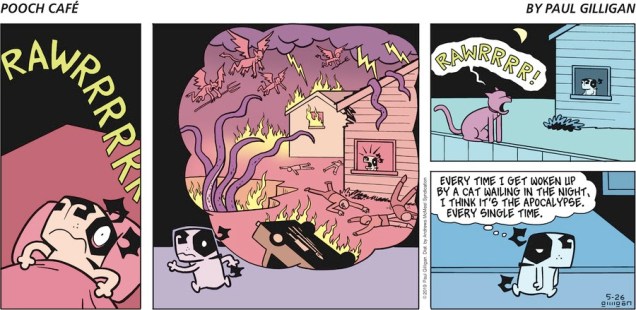
First, we have Canadian Pooch Café, around since 2000. One wouldn’t think that a strip about a dog (Poncho, the terror of the neighbourhood) and its owners and friends would have tentacles in it, but it does, much to my delight.
The fish in the bowl (named Fish) is a recurring character, cohabiting (and occasionally having his life and safety threatened by) Poncho.All cats in this strip are purple and are indistinguishable one from another.
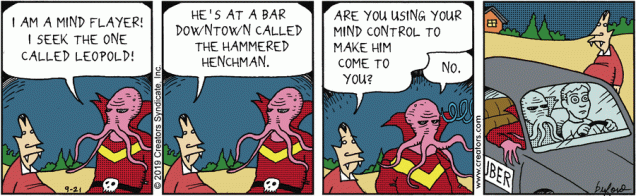
Scary Gary, by Mark Buford, follows the everyday tribulations of a 700-hundred year old vampire who’s gone quite soft and suburban. The most excitement he can hope for is purchasing a new bag of chips… on the other hand, his henchman Leopold’s life is a whirl of nefarious, villainous schemes and ploys.
In case you didn’t know what a mind flayer is, it’s the same thing as an illithid 😉
My colleague has talked in detail about a certain crotchety witch in Growing Old Gracelessly With Broom-Hilda, so I’ll just leave this one strip here (and politely inquire why Broomie thinks that the octopus isn’t good enough to cuddle with, huh, HUH??)
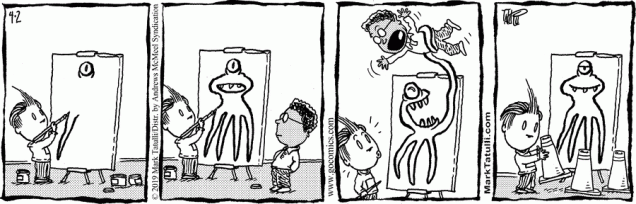
Mark Tatulli’s Lio is a riot of tentacles, given that Lio’s best friend is a giant squid. All of it is pretty fun, but once in a while I’m so charmed that I save the strip to my computer. Here are some of those saved, favourite strips:
No doubt Dr. Zoidberg would rush towards the seafood buffet offer with similar speed. Or is Ishmael just angry for friends of his that have been fried?
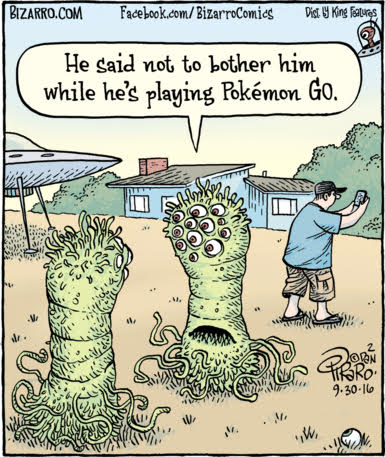
Bizarro – ah, to be able to rely on something that’s still good some thirty-plus years later -, has already had a Tentacle Tuesday of its own (see Let’s Get Bizarro), but since then I’ve accumulated a few extra strips.
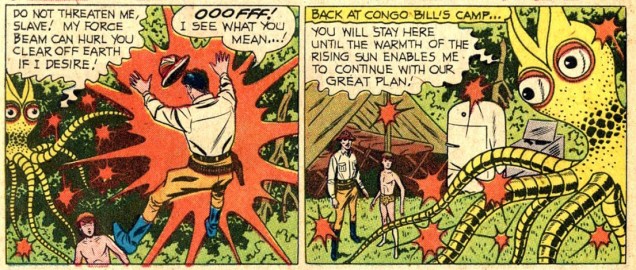
Sometimes I stumble upon a comic with a fight-to-the-death scene in which something-or-other- with-tentacles plays the role of a lethal enemy for our hero – but upon closer inspection, in turns out that the ferocious creature is… gosh-darned cute. I mean, how can you kill anything that has adorable whiskers, or tufted eyebrows like Oscar the Grouch?
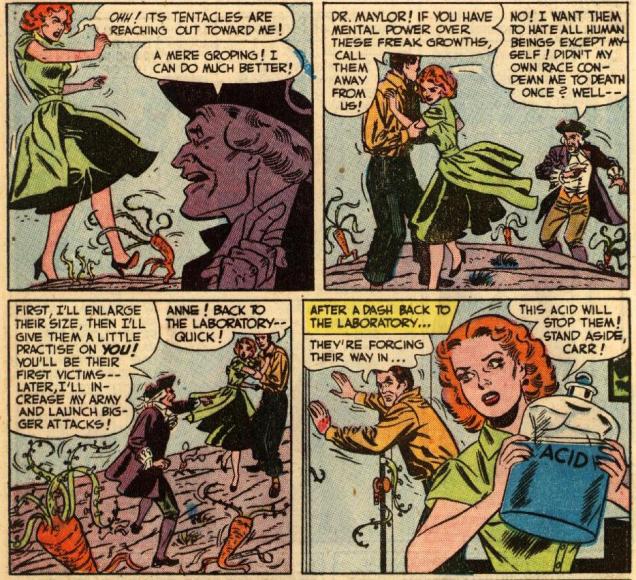
When your attackers are carrots with tentacles, and they really get on your nerves (although I think Ann is safer with them than with Dr. Maylor), I’d suggest throwing them into a nice big pot of soup, maybe… but if you please, do consider abstaining from flinging acid at them.
I do believe that prehensile vegetables fit into the category of “cute” – just look at their precious little root-legs! Page from Heroes Out of Time!, scripted by Manly Wade Wellman (hey, cool!), with some very stylish art by Bob Oksner on pencils and Bernard Sachs on inks, printed in Mystery in Space no. 3 (August-September 1951).
While we’re on that topic: things get delightfully wacky and madcap (not much) later in the story. Namely, Napoleon Bonaparte and Benjamin Franklin are summoned for help against the tentacled carrot-horde.
The Flaming Carrot would not be pleased by this massacre. If only to admire the art, you can read Heroes Out of Time!here.
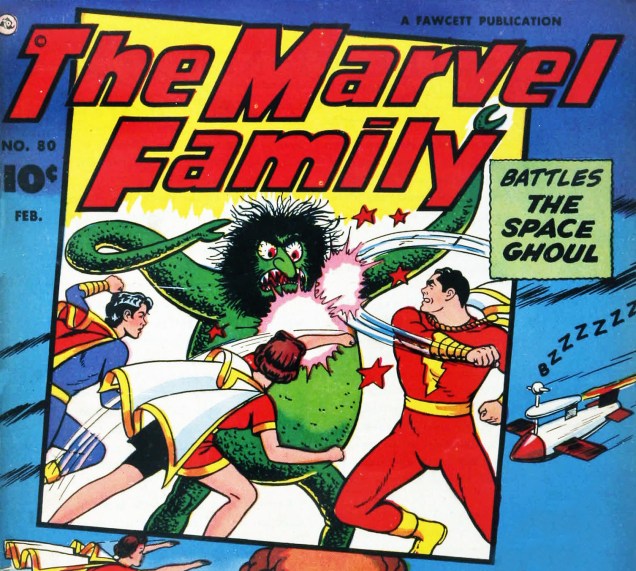
Thank you kindly for suppressing your urge to sock the creature sporting a unibrow and bloodshot eyes worthy of Christopher Lee; it’s also not his fault he got lumbered with such a shaggy wig.
Detail from the cover of The Marvel Family no. 80 (February 1953), pencils by C. C. Beck and inks by Pete Costanza.
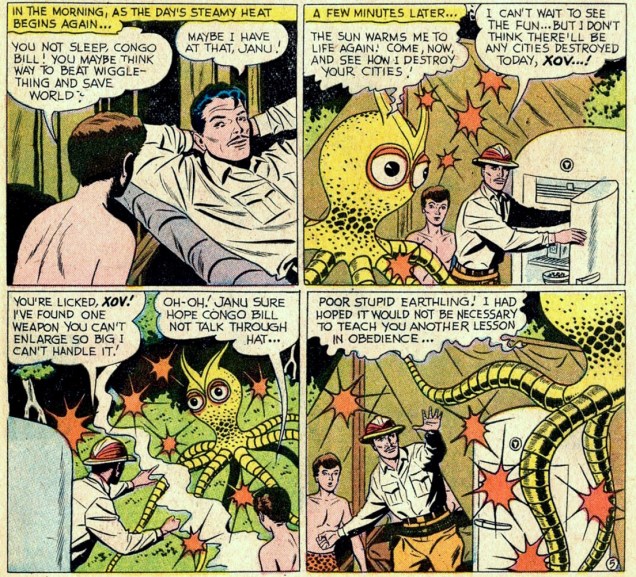
Have the goodness to think twice before pitching lethal ice cubes at an owl, even if it somehow grows metal tentacles and threatens to make mince-meat of humanity, because owls are the very cutest.
Panels from The Man-Ape Skin Diver!, scripted by Robert Bernstein and drawn by Howard Sherman, published in Action Comics no. 257 (October 1959).“Wiggle-thing”? Excuse me?
Pray, don’t kill anything that looks like it’s wearing a dragon wearing a really bad disguise, including a moustache that looks like a pile of hay.
A panel from Fate is the Killer (a preview of a Masters of the Universe story), scripted by Paul Kupperberg, pencilled by Curt Swan and inked by Dave Hunt, published as a promotional bonus in several DC titles cover-dated November, 1982.
If you would be so good as to spare the creature that looks like a mashup of a seal and a mole, especially if it gazes at you mournfully with world-weary sadness.
Masters of the Universe: The Vengeance of Skeletor! (1982), cover by Alfredo Alcala.
« It is not Frank Hampson’s original creation from the 1950’s Eagle, far from it. This is a different beast, featuring a harder man in a harsher world, a long way from the good-natured stoicism and stalwart, stiff upper lip of the original… »
(Garth Ennis in his introduction to Dan Dare: The 2000 AD Years)
Dan Dare, sort of the British answer to Buck Rogers, took his earliest space flight in the pages of the very first issue of Eagle, a now legendary British children’s comics periodical. He was created by illustrator Frank Hampson. From the day of its inception, Eagle was meant to perch on a high moral ground. Its founder, reverend John Marcus Harston Morris, an Anglican vicar, devised the Eagle in collaboration with Hampson (one of his parishioners, and a budding artist seeking fulfilling work) with a specific purpose in mind: a magazine that would hold itself to high standards of art and printing, but would stay away from violence and depravity, instead offering children wholesome characters they could use as role models. Aligned with that vision, Hampson’s Dan Dare stories were meticulously researched, based on a wealth of models (space ships, suits, and even a complete space station) and reference materials, including the services of Arthur C. Clarke as a science and plot advisor in the early days of the strip. Dan Dare‘s complex plots, witty dialogue and full-colour art guarantee that British children who lived through the 50s cherish their memories of this character.
1959 was the year of change – Morris resigned from the editor’s seat after bitter disputes with the bean-counters from Hulton Press (Eagle’s publisher at the time). Shortly after, the Eagle was taken over by Odhams Press, with the new owners objecting to the complexity of Dan Dare stories as well as the cost of Hampson’s studio. Hampson could not compromise his lofty standards and pursuit of perfection, and left. Things were never the same after that, with Dan Dare strips varying in format and quality until the series ended in 1967.
Fast forward to 1976. « A punk who has always written outrageously violent, scabrous satirical and often hilariously funny attacks on authority and the establishment» – which is to say, Pat Mills, a British freelance writer and editor – set out to create a science-fiction themed weekly publication, 2000 AD. With the aid of John Wagner as script advisor, presided over by John Sanders, the publisher, he decided to 1. develop a horror strip, which later became Judge Dredd; 2. revive Dan Dare, so that at least something about 2000 AD would have immediate public recognition. Oh, there were plenty of other strips in there, too, but that’s a topic for another conversation.
« 1976. I realize that the science fiction comic I’m creating, 2000 AD, needs a space hero. I think about bringing back Dan Dare – the publisher, John Sanders, is agreeable, he tells me not to worry about the original fans. I study the bound Eagle volumes. Artist Belardinelli submits a wild version on spec. At least it’s exciting and eye-catching and – most important – helps us over the poor quality paper. 2000 AD appears, it’s a success and Dan Dare is popular – about 3rd or 4th in the popularity charts. I don’t recall any critical letters apart from things along the lines of « my dad doesn’t like it, but I do ». And, sometimes, « my dad likes it, too ». Lots of criticism in the press, however, but we don’t care about annoying them. In fact we quite like it. » (From an article by Pat Mills, published in Spaceship Away: the Dan Dare Fan Magazine)
Okay, now that we have the backstory over with, on with the tentacled show!
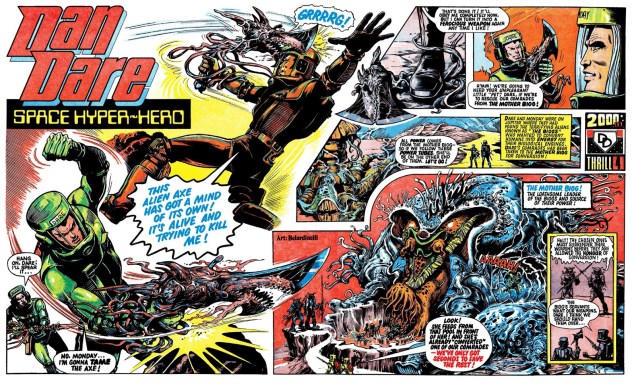
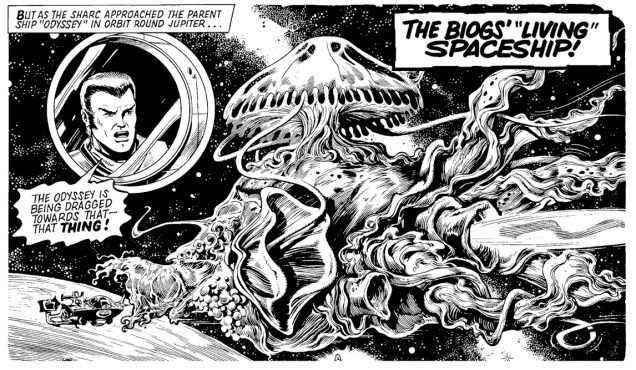
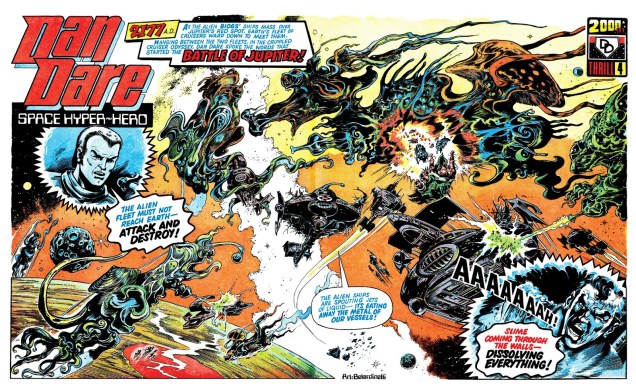
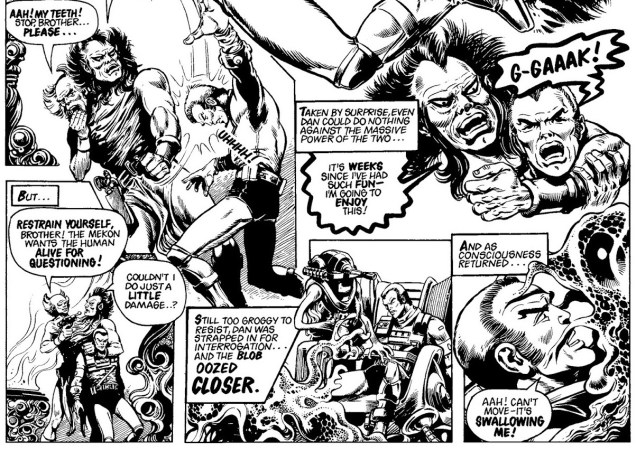
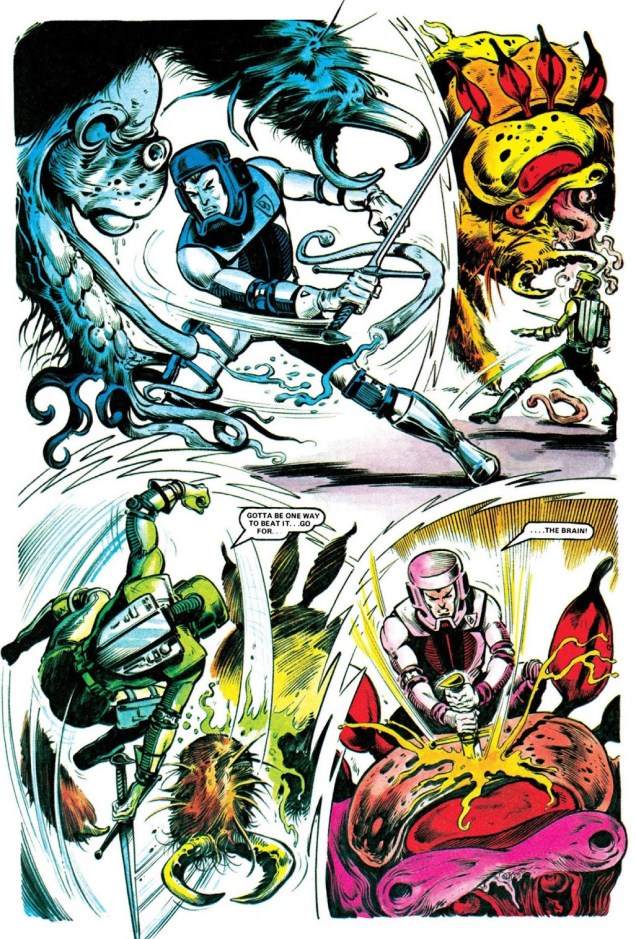
Dan Dare’s early 2000 AD adventures were drawn by Massimo Bellardinelli, who seems to take great delight in adding tentacles hither and thither. Are we expected to believe that every alien and every alien’s ship is be covered in them? Yes? Ah, okay. Please carry on.
The first, self-titled story, published in Programmes 1 to 11. Scripted by Ken Armstrong, Pat Mills and Kelvin Gosnell, and drawn by Massimo Belardinelli.
Hollow World, scripted by Steve Moore with art by Massimo Belardinelli, published in Programmes 12 to 23.
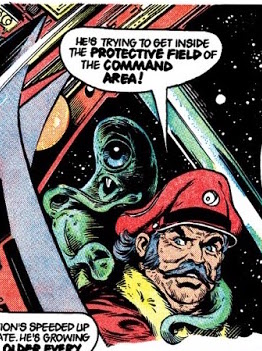
This cutie from Hollow World also wished to say “tally-ho!”:
Belardinelli’s style is often described as “hallucinatory”. Despite Pat Mills’ portrayal of his art as “eye-catching” (although even Mills thought that he made “the hero look awful”), his work on Dan Dare was not very popular. It’s also possible that readers were still sore about Dare’s sacrilegious resuscitation. All I can state with certainty is that it’s not really *my* cup of tea – I prefer my cuppa strong and dark, without excessive flourishes or hallucinations, thank you kindly. For those of you who agree, more… grounded times were coming: with Programme 28, Belardinelli switching over to drawing Harlem Heroes while Dave Gibbons took over Dan Dare, with an occasional hand from Brian Bolland.
Greenworld, scripted by Gerry Finley-Day, art by Dave Gibbons and Brian Bolland., published in Programmes 34 and 35.
A little trek into the past, back to the hallucinatory tentacles: The Curse of Mytax, drawn by Massimo Belardinelli, published in 2000 AD annual 1978.
Oh Dan, where is your moral compass now? While I love the guys from 2000 AD to bits, I have to grudgingly admit that taking someone else’s character and modifying his raison d’être beyond all recognition is a tad uncouth (and certainly anti-authoritarian, which is, after all, Pat Mills’ leitmotif). Can you imagine how this trigger-happy Dan Dare apparition, some 25 years later, ruffled the feathers of readers who take their heroes seriously? (If we have any readers who have lived through this themselves, please chime in!)
« Indeed, the reader may be forgiven for thinking that the Lost Worlds sector is soon going to be a very quiet sector indeed, just because there’s not going to be much left of it. The frequency with each our heroes resort to violence – sudden, crushing, all-consuming, high-velocity violence that utterly obliterates whatever it’s unleashed upon – – is really quite spectacular. Unidentified species of dodgy appearance? Play safe, fry ’em. Giant-sized aquatic life form? Got to be worth a torpedo or two. Alien intruder? Give it loads. If things get sticky, just do the whole ecosystem. And you know those planet-busters we’ve got in the tail-fins…? »
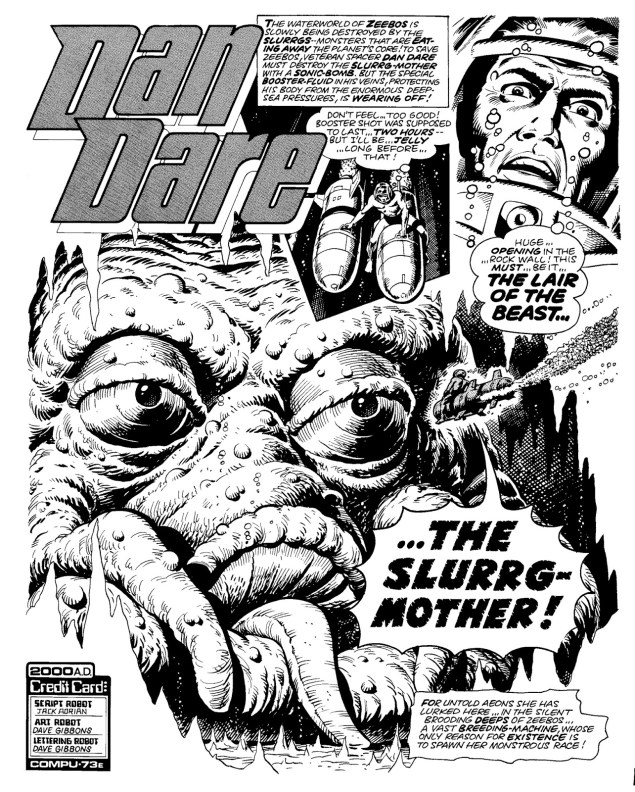
Waterworld, scripted by Chris Lowder (as Jack Adrian), with art by Dave Gibbons. Originally published in Programmes 56 to 60.
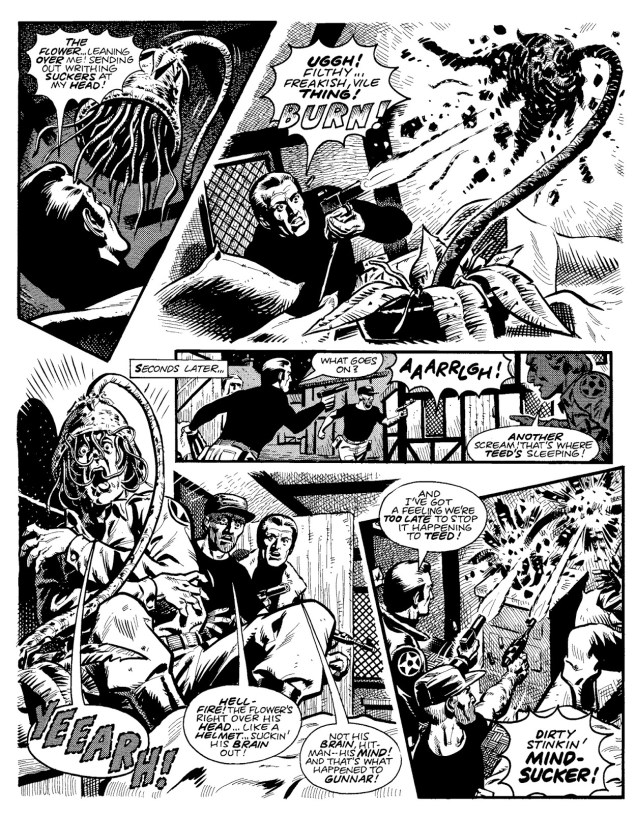
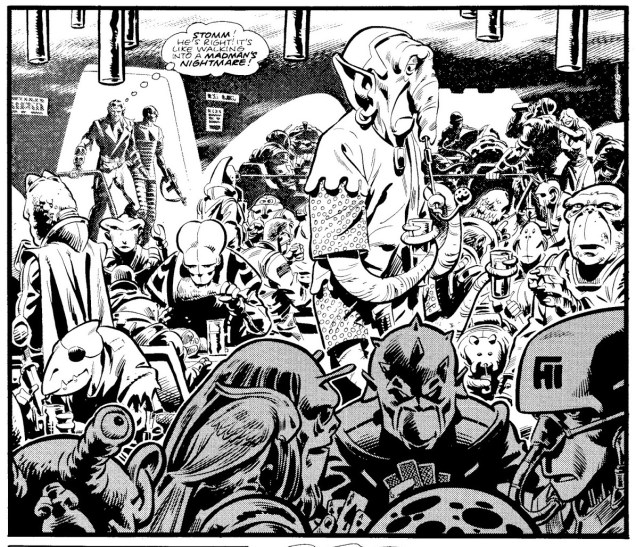
Does the Slurrg-Mother have tentacles? Such a silly question…Nightmare Planet, scripted by Chris Lowder (as Jack Adrian), art by Brian Lewis, published in Programmes 61 to 63.Ice Planet – they were really running the gauntlet of planets – is scripted by Gerry Finley-Day, with art by Dave Gibbons. Published in Programmes 64 to 66.Aww, freedom for the tentacled cutie!Garden of Eden is scripted by Chris Lowder with art by Dave Gibbons. Published in Programmes 67 to 72. Naturally, one doesn’t expect anything decent or god-fearing to come out of the Garden of Eden… and nothing does.
The sprawling Servant of Evil (scripted by Tom Tully and drawn by Dave Gibbons, published in Programmes 100 to 126) was the last Dan Dare story, one that wasn’t even finished. Was it too complex or morally ambiguous for readers of 2000 AD, or simply too rambling? Dan Dare’s exit was probably caused by the confluence of several factors – Dave Gibbons was leaving the strip to work on UK Marvel’s Dr. Who Weekly; the failing comic Tornado needed a new home within an established title, so 2000 AD needed to make room for it by pushing something else out; and let’s face it, Servant of Evil was dragging on, even though fans still bemoan the lack of closure from having all those plotline threads severed so abruptly.
Do you have a couple of hours to spare? You can actually read the full collection of 2000 AD Dan Dare strips here.






































 Who's Out There?