Virgil Partch’s Captain’s Gig

With a jump and a start, we realized that we haven’t written a proper post about Virgil Partch. Not even one lousy little post! How embarrassing.

Virgil Franklin Partch (1916-1984), mostly known as VIP, is legendary, and I’m not one to use this description lightly. One can spot his work a mile away by his surreal sense of humour and a kinetic, unhinged-yet-clean style. He was also prodigiously prolific, the gag-man of his day. VIP not only wrote and drew tons of cartoons for magazines in the 40s and 50s (Collier’s Magazine, True, the Man’s Magazine, The New Yorker, Playboy…) but also provided glorious art for LP covers; illustrated other people’s books, as well as releasing collections of his own cartoons with invariably entertaining titles (The Wild, Wild Women; Cork High and Bottle Deep; Relations in Strange Locations, etc.). His doodles also adorned merchandise – my favourite being, of course, cocktail glasses!
VirgilPartch-BarGuide
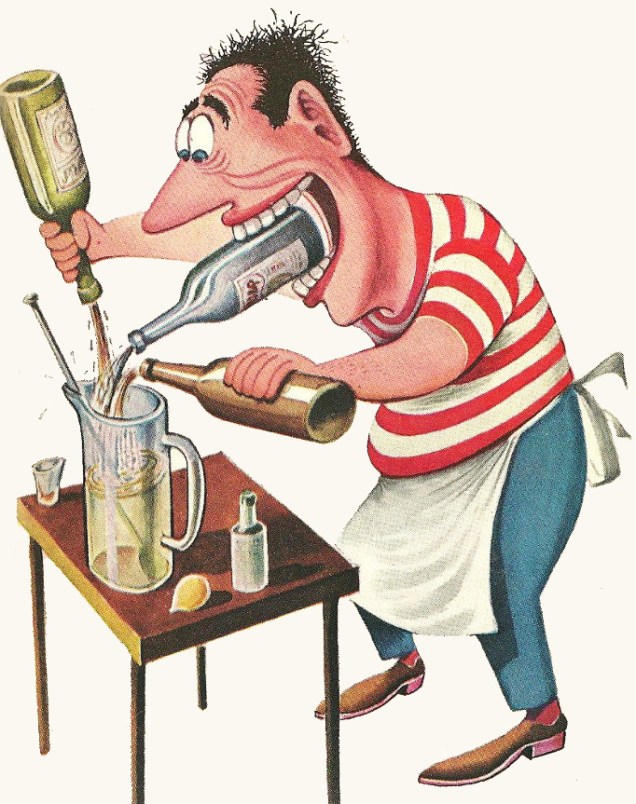
Detail from cover of the True Magazine Bar Guide paperback (1950). « Flinging himself into the study of this challenging matter, Vip left no glass unturned, no drink unbottled, no bottle undrunk, etc. Leaving statistics to the statisticians, analysis to the analysts, facts to the factories, data to the dataist, Vip went straight to the sources. Often he worked until the wee small hours of the night, crawling home exhausted from his studies, numb with the impact of startling discoveries, quivering and all but incoherent with surmise… » Quote from the introduction to Bottle Fatigue (1950).

« Almost at once, wherever his cartoons appeared, Partch’s manic artwork inspired alarm because of his nonchalance about ordinary anatomy. He may have been among the first to discard such niceties almost entirely, striving instead for approximations of the human figure that served his comedic purposes and no other. A frequent objection was made to his unabashed disregard of the number of fingers that are customarily issued with each human hand.  With the giddy abandon of footloose youth, Vip produced hands with fistfuls of fingers—five, six, seven, however many fell, uncounted, from his pen or brush. To those who carped about his anatomical irresponsibility, Partch reposited patiently: “I draw a stock hand when it is doing something, such as pointing, but when the hand is hanging by some guy’s side, those old fingers go in by the dozens.  And why not?  At Disney’s studio, I spent four years drawing three fingers and a thumb.  I’m just making up for that anatomical crime.”» (excerpt from Making the World Safe From Insanity by Bob Harvey)

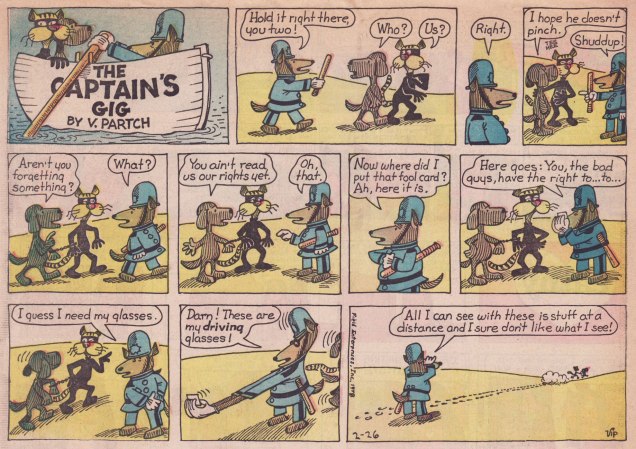
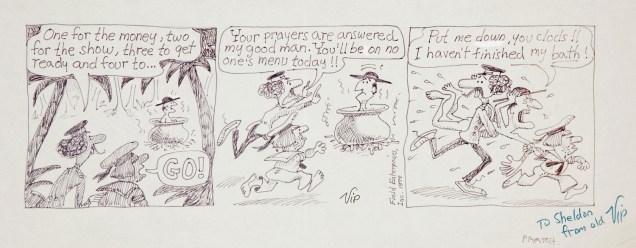
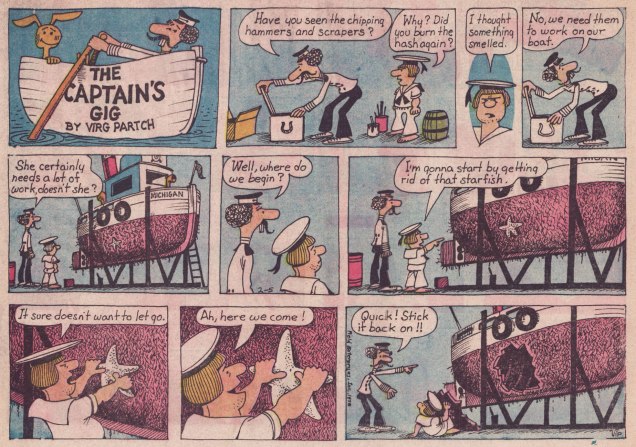
Aside from his magazine work, Partch also tried his hand at newspaper strips (after his friend Denis Ketcham, creator of Dennis the Menace, suggested it, I might add). I could launch into an examination of Big George, the successful syndicated comic strip about an average American husband-and-father and his daily struggles with neighbours and family. But this blog (as you’ve probably noticed) likes to tantalize its readers with the obscure, so today’s post is about Captain’s Gig, another syndicated (also by Field Enterprises, like Big George) strip that never got much traction and is nearly forgotten by now. VIP clearly toned down his oddness down a bit for Big George… he even started drawing people with five fingers! Captain’s Gig, on the other hand, is considerably  weirder and more surreal. No, it’s not on par of VIP’s height of glory in the days of magazine cartoons – but this strip definitely has its charms.

I never thought I’d become the type of person who actually purchases old newspaper pages to get some comic, but what is a girl to do when this stuff hasn’t been reprinted at all? However, I only have a few of Captain’s Gig (and quite a bit more of Big George) – it seems that people mostly didn’t feel it was worth saving – so this post has both scans of the newspaper pages I have as well as some original art found online (and cleaned up).
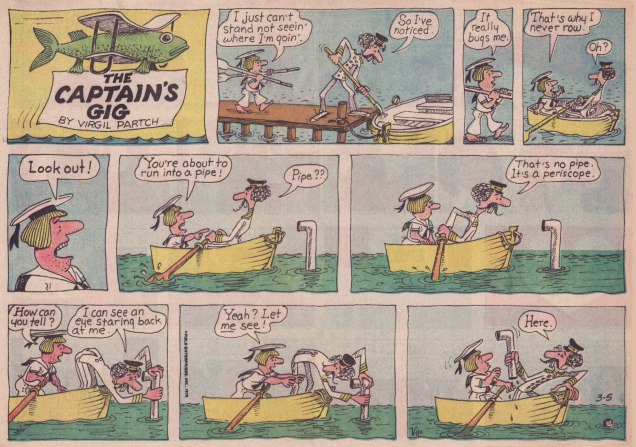
VIPGig03A

VIPGig04A

VIPGig05A

« Virgil Partch burst onto the scene in the nation’s magazines with his zany, sometimes surreal but always hilarious cartoons. Known to millions by his signature, “Vip,” this comedic genius was unlike anything the world had seen before. His unique brand of humor and trendsetting approach to cartooning ushering in a new era of the gag cartoon and pioneered a standard of madcap humor across the spectrum of comedy that was reflected in the cutting-edge sensibilities of comedians and the trailblazing pages of Mad magazine. Inspiring a new breed of cartoonists, Vip became the more sought-after cartoonist of his generation, as well as one of the most prolific and influential cartoonists of his era. » (introduction from Fantagraphics’ VIP: The Mad World of Virgil Partch )
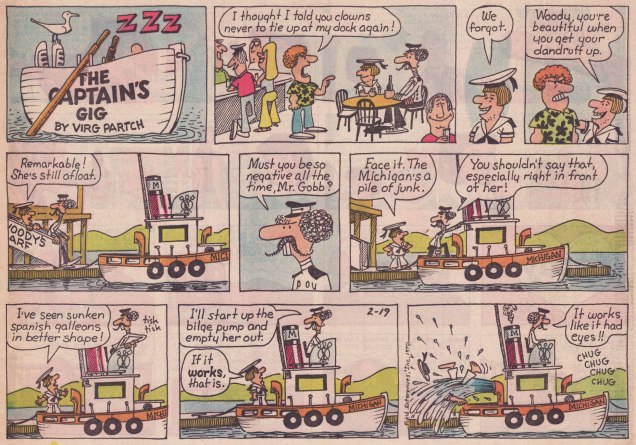
VIPGig02A

VIPGig01A
It appears no-one caught the typo in the *title*; well, the “Captan” bears an awfully smug expression, so perhaps he did.
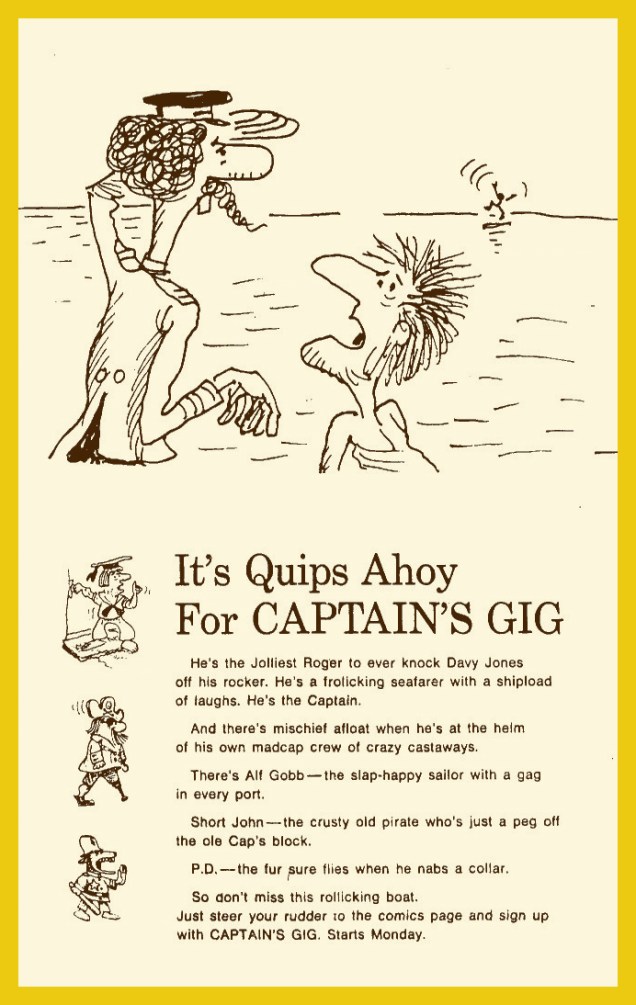
Captain'sGigAd
An ad for for Captain’s Gig from March 1977, just shortly before the strip’s launch. It sang its death song and went down in December 1979, according to Stripper’s Guide.

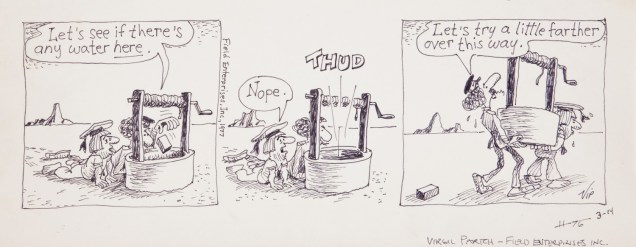
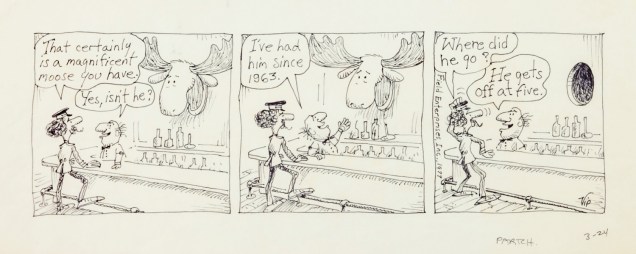
And now for some scans of original art (not owned, O woe!, by me):
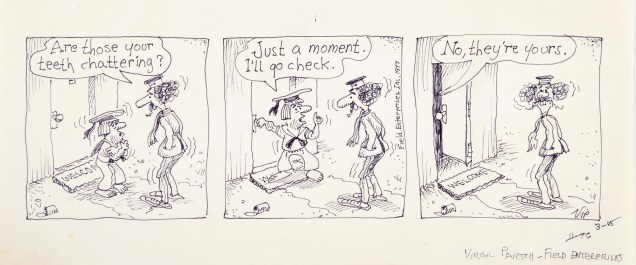
VirgilPartch-Captain's-Gig-1977

VirgilPartch-Captain's-Gig-1977-VIP-well

VirgilPartch-Captain's-Gig-1977-VIP-moose

VirgilPartch-Captain's-Gig-1977-fishing

VirgilPartch-Captain's-Gig-1977-boiling

Ger Apeldoorn, who has been doing the purchasing-and-scanning-newpaper-pages thing for longer than just about anyone, has a nice selection of strips over at his blog, The Fabulous Fifties. That being said, I hope to be forgiven for including two strips scanned and posted by him, both because they illustrate the point about VIP’s surreal sense of humour and because they made me laugh out loud.
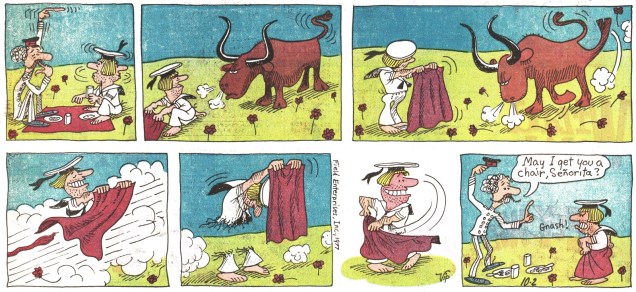
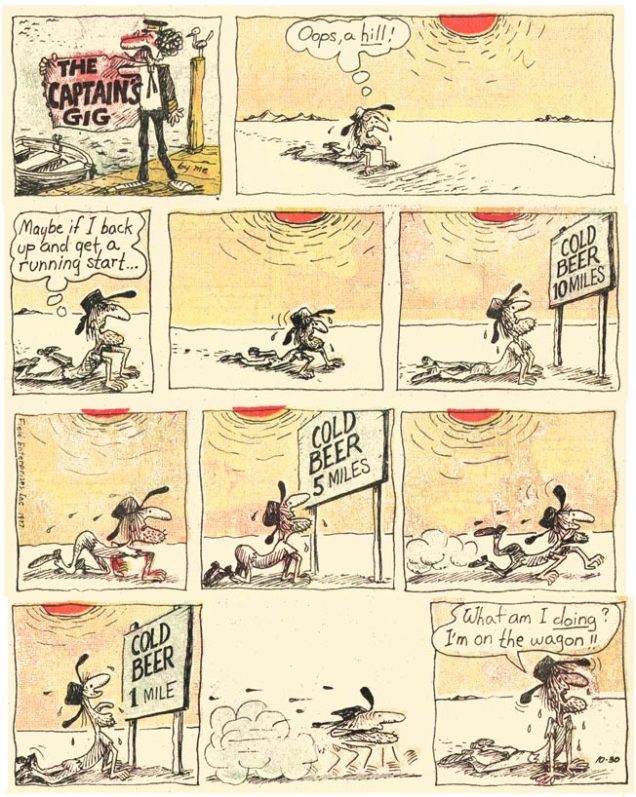
Captain's-Gig-1977-10-02

Captain's-Gig-1977-10-30

~ ds

Will Eisner’s The Spirit at Kitchen Sink (pt. 2)

« Three A.M. The radiators in Commissioner Dolan’s office had long ago conked out… and those of us who could not go home waited… tried in various ways to ignore the damp cold made even more unbearable by the January rain. » — The Spirit, Jan. 8, 1950

Welcome back! Today, we wrap up Kitchen Sink Press’ experimental continuation of Warren Magazines’ run of The Spirit. By now, Denis Kitchen was probably coming to terms with the fact that building upon Warren’s non-system of random Spirit reprints was not only a dead end, but one with mercilessly diminishing returns, even with so deep and rewarding an archive as Will Eisner’s.

Still, don’t worry, we’re hardly running out of dazzling visuals to tickle your eyeballs with.

Spirit29A
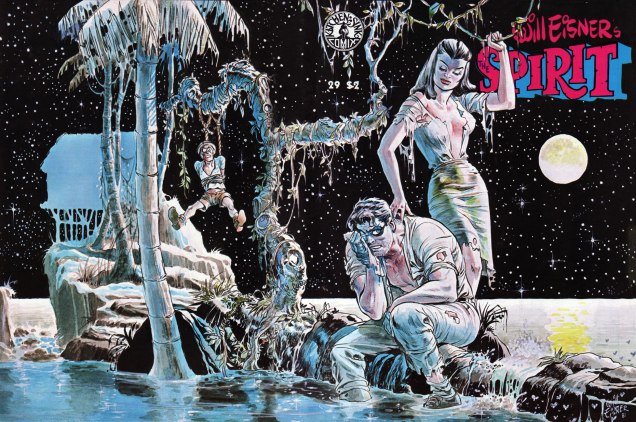
This is The Spirit no. 29 (June, 1981), featuring a mere four Spirit tales, namely: “Framed” ((Nov. 24, 1940); “Sasha’s Sax” (June. 28th, 1942); “Blood of the Earth” (Feb. 26, 1950); cover-featured “The Island” (March 26, 1950) , as well as plenty of fine new material by Eisner.
Spirit31A
This is The Spirit no. 31 (Oct. 1981), featuring four Spirit tales: “Wanted for Murder” (Feb. 5, 1942); “The Siberian Dagger” (Jan. 27, 1946); “Just One Word Made Me a Man!” (Jan. 18, 1948); “The Barber” (Oct. 22, 1950), some new Eisner material and the second instalment of “Shop Talk”, in which Eisner interviews one of his peers. This time out: Harvey Kurtzman.
Spirit33A
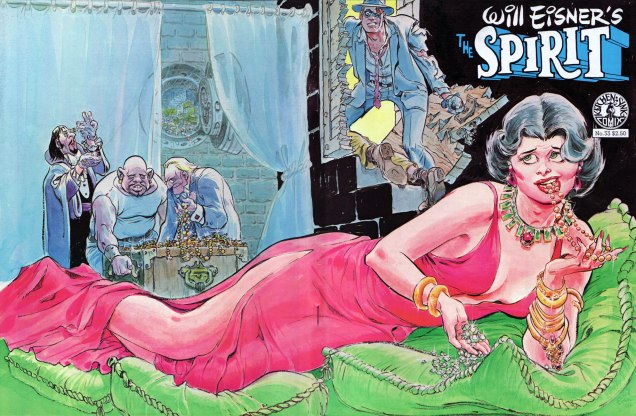
This is The Spirit no. 33 (Oct. 1981), featuring a quartet of Spirit tales: “The Haunted House” (Dec. 8, 1940); “Slim Pickens” (Dec. 15, 1940); “The Portier Fortune” (Dec. 1, 1946); “Dolan Walks a ‘Beat’!” (Apr. 17, 1949), an Eisner tutorial and a look at Eisner’s P*S Years.
Spirit39A
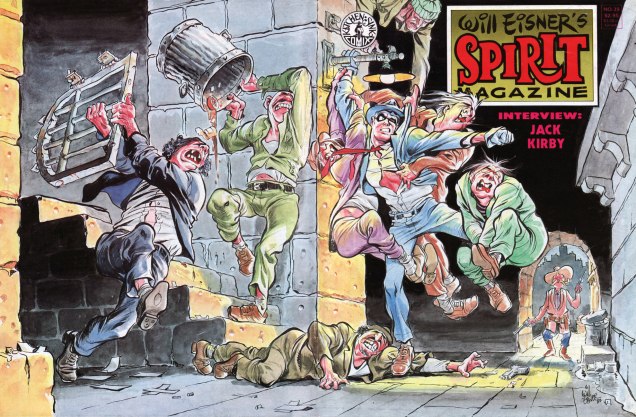
This is The Spirit no. 39 (Feb. 1983), featuring five Spirit adventures: “Dead Duck Dolan” (Mar. 2, 1941); “Tarnation” (Mar. 3, 1946); “Voodoo in Manhattan” (June 23, 1940); “The Van Gaull Diamonds” (Dec. 15, 1946), “Veta Barra” (July 29, 1951), and a 12-page Shop Talk with Jack Kirby!
Spirit30A
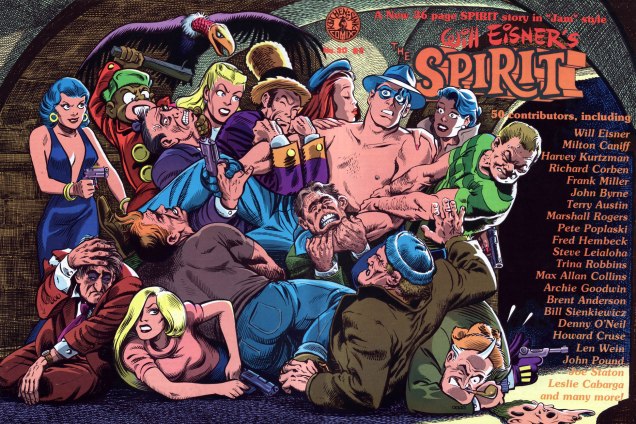
As a bonus, here’s the cover of The Spirit no. 30 (July, 1981), which features an amusing, but understandably uneven brand-new 36-page Spirit jam calling upon a whopping fifty pairs of paws. If only this had been the only time Frank Miller tried his hand at Will’s creation… The issue also features pair of vintage yarns: “Army Operas No. 1” (Dec. 21, 1941) and “Beagle’s Second Chance” (Nov. 3, 1946). Can you identify all the cover jam contributors? Beware, though: that Pete Poplaski is a redoubtable stylistic chameleon.
SpiritJamKeyA
Here’s the key.

After 25 issues of The Spirit magazine (on top of Warren’s run), Denis Kitchen and Will Eisner would press the reset button and begin again in the comic book format. In part three, we’ll see how that endeavour fared.

If you’ve just joined us mid-programme, fret not: simply rewind to our earlier instalments, if you will:

… or simply click on its general category, That’s THE SPIRIT!, and find yourself with everything at your purple-gloved fingertips (don’t think you fooled us, Octopus!)

-RG

Poise and Prudence: Tove Jansson’s The Moomins

I think it safe to surmise that pretty much everyone is familiar with the light-coloured, pleasantly plump creatures collectively referred to as the Moomins. Even if you’ve never heard of Tove Marika Jansson, their creator, you’ve surely glimpsed a Moomintroll mug, a Snork Maiden tote, or a Little My t-shirt.

Tove Jansson (1914-2001) was a multi-faceted soul: comic strip artist, of course, but also novelist, painter and illustrator (one might argue that these all are related: point taken). She published her first Moomin book in 1945 (The Moomins and the Great Flood) to (eventual) great success; the eight books that followed were equally popular. All have been translated into forty-four languages. The Moomin comic strip, first designed for publication in the children’s section of Swedish newspaper Ny Tid, ran from 1947 to 1975, and was syndicated in 120 countries. (Here’s a detailed timeline of Moomins’ creation and development.) To Anglophone audiences, the strip is known thanks to The London Evening News, which picked it up in 1954.

The commercialization of the Moomin family, the ubiquity of Moomin merchandise overshadow the rest of Jansson’s career – but also cheapen the darling Moomins. (I should talk; I have two favourite Moomin mugs from which I drink kefir.) As with the best writing for children, Moomin stories are fun and easy to follow on the surface – but beneath that cheerful and cute exterior, complex themes are tackled, moral dilemmas remain unresolved, and the world is a confusing, unfair place.

Montréal’s Drawn and Quarterly is currently « reworking classic Moomin stories in full colour, with a kid-proof but kid-friendly size, price, and format » (to quote from their website) for their Enfant collection. « Enfant » means « child », but I think any adult with a sense of humour and just a pinch of childlike innocence will enjoy these stories. Drawn and Quarterly have heretofore published collections of London Evening News strips in black and white; and though the art is beautiful, I really like the way the strips came out in colour.

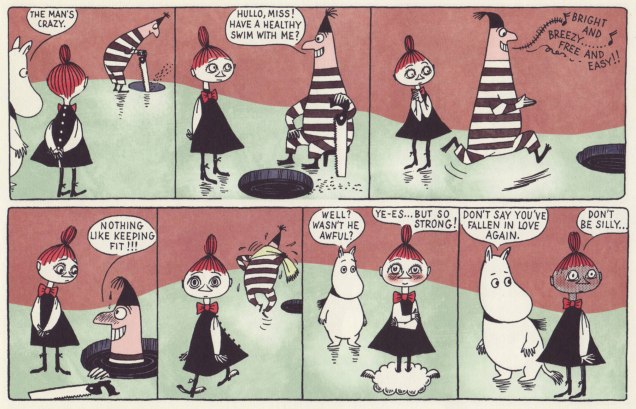
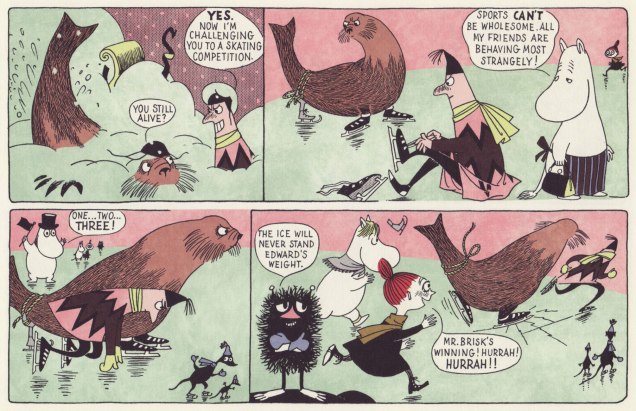
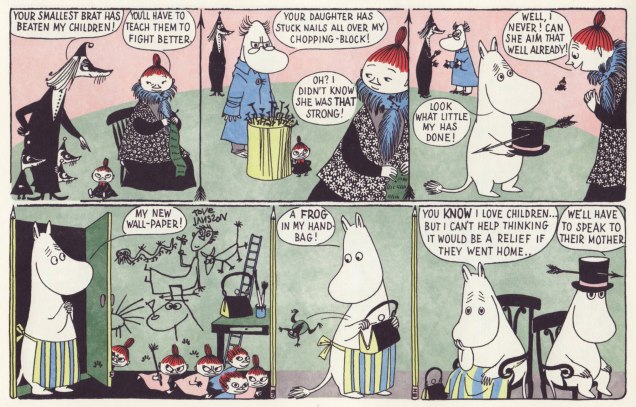
As little of this stuff is findable online, I’ve selected a few (well, quite a few) favourite pages to whet your appetite – a selection of goofy characters, hard life lessons and good old madcap fun.

MoominWinter01A
Pages from Moomin’s Winter Follies

MoominWinter02A

MoominHouseA
Moomin Builds a House. Little My makes her first appearance in this story. Some parenting advice from Elder Mymble, the mother of this red-haired hoarde: « I don’t like to keep scolding them. I just… pour some water over them. …Or lemonade. »

« Born in 1914, at the onset of World War I, Tove’s childhood and early adulthood took place in a time of intense political upheaval. Artists themselves, her parents were a part of the Swedish-speaking minority in Finland and in those first few years, when the world was at war, Tove and her mother stayed in Stockholm while her father remained in Finland, going on to fight in the Finnish civil war in 1918. That experience, some literary analysts say, is reflected in the missing Moominpappa, who appears only as an allusion in the first chapters of the first book. » (How Tove Jansson’s Moomins conquered readers’ hearts)

ToveJansson-MoominontheRiviera-1
« As springtime dawns in Moominvalley and the first northern crocus opens, Moominpappa and Snorkmaiden, glamorized by the prospects of movie stars and gambling, insist the whole family take a trip down to the Riviera. Reluctantly Moomin and Moominmamma agree to go along, and the Moomins set off on a grand adventure, complete with butlers, luxury shops, indoor swimming pools, and duels at dawn. » Pages from Moomin on the Riviera.

ToveJansson-MoominontheRiviera-2

« Following art school and travels abroad, Jansson drew cartoons for different outlets, including, for fifteen years, the satirical political paper Garm. (“Do as you like,” the editor told her. “Just make sure you hit them in the mouth.”) This is where the Moomins first surfaced publicly. Originally meaner-looking and troll-like creatures called Snorks, they began mostly as marginalia, a kind of signature, and might even be found loitering in a cartoon about the German Army’s evacuation of Lapland. » (The Hands That Made the Moomins)

MoominSeaA
Page from Moomin and the Sea.
MoominMaid01A
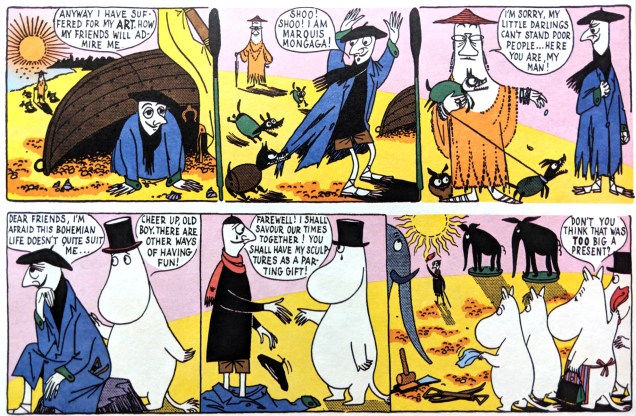
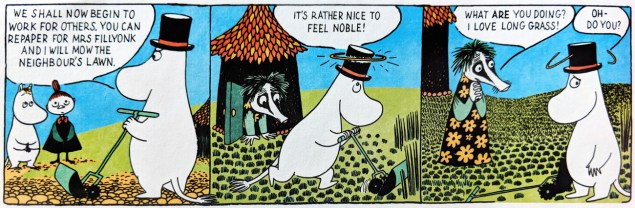
Misabel the maid is, as her name suggests, miserable. Afraid of any kind of non-conformist behaviour, scared of enjoying anything, she is anathema to Moomins’ approach to life. Pages from Moominmamma’s Maid.

MoominMaid02A

« Tove’s entire life was filled with bold decisions: selling satirical cartoons mocking Hitler; opposing war; choosing not to marry or have children; and turning down Walt Disney’s offer to buy the Moomin brand. She was the writer, illustrator, designer and controlled the business side of her creation, not trusting anyone else to do it justice. » (Tove Jansson’s Feminist Legacy)

ToveJansson-MoominandtheMartians-1
This sequence with a somewhat indignant cow is one of my favourite moments. Pages from Moomin and the Martians.

ToveJansson-MoominandtheMartians-2

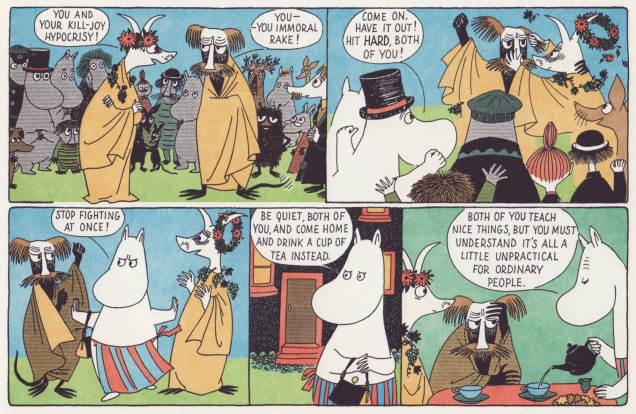
« In like spirit, Moomin hospitality excludes no one—except those prone to electrify the furniture or freeze Moominmamma’s roses. Guests include shrewish Fillyjonks addicted to cleaning; large graceless Hemulens obsessed with classifying and organising; and a philosophical Muskrat who believes only in the pointlessness of everything. » (Tove Jansson, Queen of the Moomins)

MoominNewLife01A
« When a charismatic prophet comes to town, the residents of Moominvalley are easily convinced to follow his doctrine for true happiness. Intrigued by their friends and neighbors’ lifestyle changes, the impressionable Moomins find themselves attempting to adopt the teachings of their new spiritual leader. But the freer they get, the more miserable they feel. Moominvalley’s state of divine chaos is further complicated by the prophet’s well-intentioned decree to free all of the jail’s inmates. » Moomin Begins a New Life.

ToveJansson-MoominStartsaNewLife-2

MoominNewLife02A« Over time, Jansson came to feel exhausted by the Moomins and that their success had obscured her other ambitions as an artist. In 1978, she satirized her situation in a short story titled “The Cartoonist” about a man called Stein contracted to produce a daily strip, Blubby, which has generated a Moomin-like universe of commercial paraphernalia—“Blubby curtains, Blubby jelly, Blubby clocks and Blubby socks, Blubby shirts and Blubby shorts.” “Tell me something,” another cartoonist asks Stein. “Are you one of those people who are prevented from doing Great Art because they draw comic strips?” Stein denies it, but that was precisely Jansson’s fear. » (Tove Jansson: Beyond the Moomins)
ToveJansson-MoominandtheBrigands-1
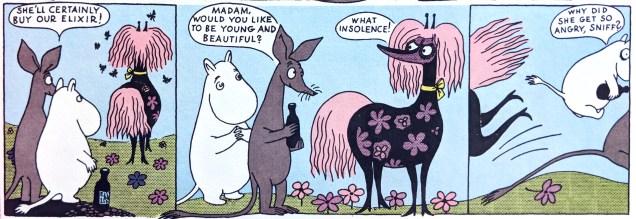
« Moomin’s pushy relations have come to stay, and in the process of getting them out, he unwittingly embarks on a quest for fame and fortune with his sly friend Sniff. But it’s much harder to get rich than either of them expects, whether it’s through selling rare creatures to the zoo, using a fortune-teller to find treasures, or making modern art. » Moomin and the Brigands.

The only (other) thing I’ll add is that Tove Jansson was a lesbian, which tends to get glossed over by (bad) biographies of her. You can read an excellent essay about Jansson and her lifelong partner Tuulikki Pietilä here.

ToveJansson
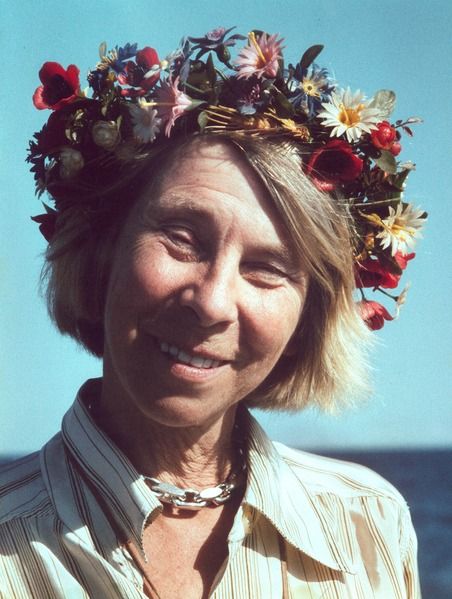
Tove Jansson photographed by her brother Per Olov.
ToveJansson-partner
Jansson and Pietilä. Sweet!

~ ds

A Garrulous Dilettante and Her Pals: Tom Hachtman’s Gertrude’s Follies

« Everybody thinks that this civilization has lasted a very long time but it really does take very few grandfathers’ granddaughters to take us back to the dark ages. » — Gertrude Stein

Several years ago, while browsing in the comics section of a rather lousy bookstore (by which I mean a book shop in which none of the employees know a thing about books, let alone are actual readers… I suspect that this is becoming more common, with predictable results), I stumbled upon an oddball item, a faded-looking, obscure comic strip collection lost amidst the monotonous stacks of DC ‘n’ Marvel superhero fare and the perennial dusty Garfield and Doonesbury paperbacks.

This was Fun City (1985), the second recueil of Tom Hachtman‘s newspaper strip Gertrude’s Follies, which at the peak of its circulation appeared in… well, one paper, but a good one, at least. That was the SoHo Weekly News (1973-82). After the weekly’s demise, a handful of episodes appeared in the fast-fading National Lampoon. Much, much later (which is to say currently) the strip lives on within the pages of American Bystander, an astonishingly well-staffed humour magazine. I smell doom.

Anyway, here’s Hachtman’s recollection of the strip’s genesis, from a 1980 interview conducted by Maxine Fisher for Funnyworld no. 22 (”The world of Animated Films and Comic Art”):

MF: What was your inspiration for a strip about Gertrude Stein and her companion, Alice B. Toklas?

TH: I knew of them, but I didn’t know much about them. And then I saw a photograph of them [by none other than Man Ray] sitting in a room at the home on the rue de Fleurus in Paris. I looked at this famous lesbian couple sitting across from one another — so far apart– and I thought: ”Look at that! One of them is fat, and the other one’s skinny. That’s funny. They’re just like a comedy routine. I wonder if they had any fun.” It didn’t look like they were having any fun in that picture; they just looked like they were posing for a picture. But I thought: ”maybe they ran around and had lots of fun.” So I started drawing pictures of them, and drawing pictures of their friend Pabs, and looking at pictures of them, and looking at pictures of Picasso.

Anyway, I started drawing Gertrude and Alice and Pabs and Hemingway and putting them into situations in my sketchbook.

Basically, I was doing Abbott and Costello or I Love Lucy starring Gertrude, Alice, and their friends.

I knew if would make a nice comic strip in a newspaper. And that narrowed it down. Here was a comic strip about a lesbian couple and all their artist friends. There weren’t too many newspapers that were going to publish this. In fact, I thought, there’s only one. And I started to watch the SoHo News, wondering where it would fit. Where would they put this thing? Would they give me a whole page to do a comic strip?

More juicy details from another interview, this one conducted in 2018 by Martin Kozlowski:

MK: One of the unique features of the strip is the blending of Jazz Age Paris and Punk Rock New York. Was that a deliberate strategy or did it naturally evolve?

TH: I was living in NYC in the 1970s. I only know Paris from movies and books. That’s right; I have never been to Paris. So, when I draw a mailbox I am too lazy to research what a mailbox looks like in Jazz Age Paris. I just draw a mailbox as I know it. I have been told that my readers in Paris find this very amusing. So, the blending happens — naturally.

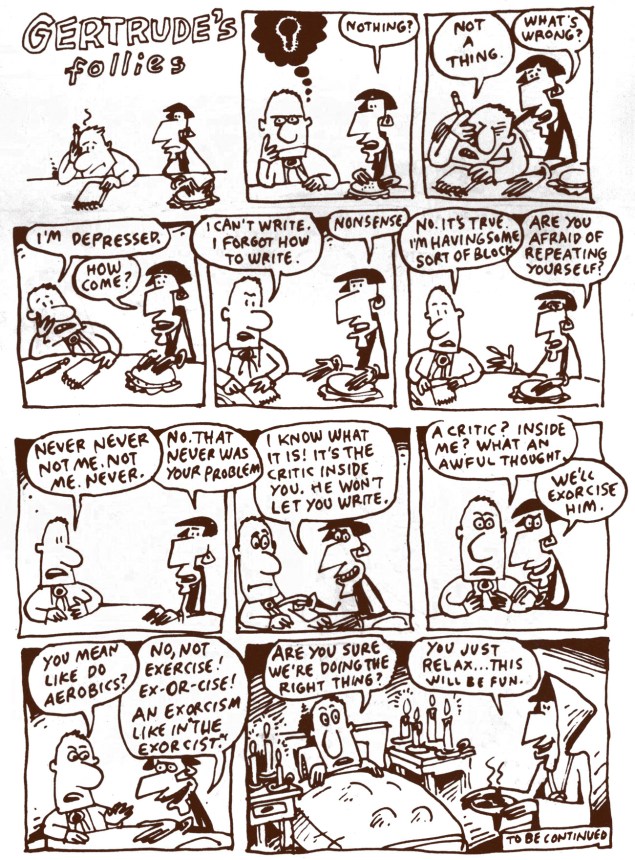
GertrudeFollies02A

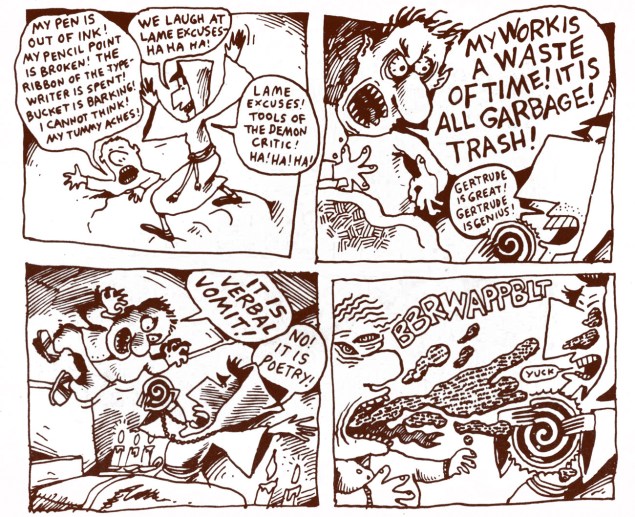
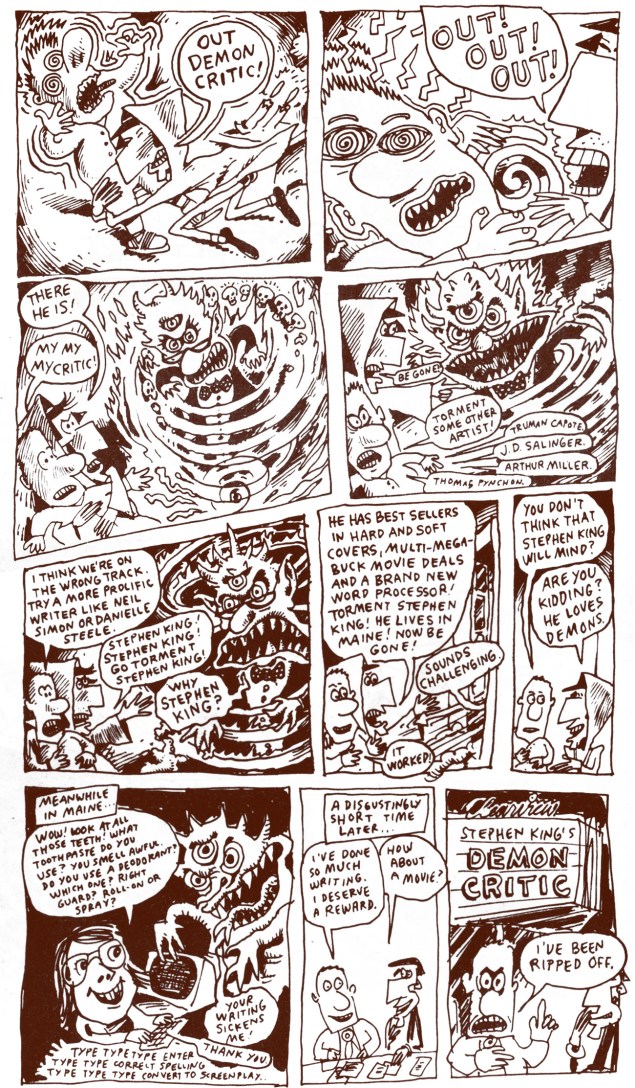
GertrudeExorcism02AGertrudeExorcism04AGertrudeExorcism05A

GertrudeExorcism07A
However, something that Stephen King does mind

GertrudeFollies01AGertrudeFollies03A

GertrudeBrideA
Oh, I’ll bet dear old Dr. Pretorius would be right chuffed with this Alice Bride. « To a new world of gods and monsters! », as the good doc famously exclaimed.
GertBucketAliceA
Our heroines in a more (or less) realistic vein. In the usual order: Gertrude, Bucket, Alice.
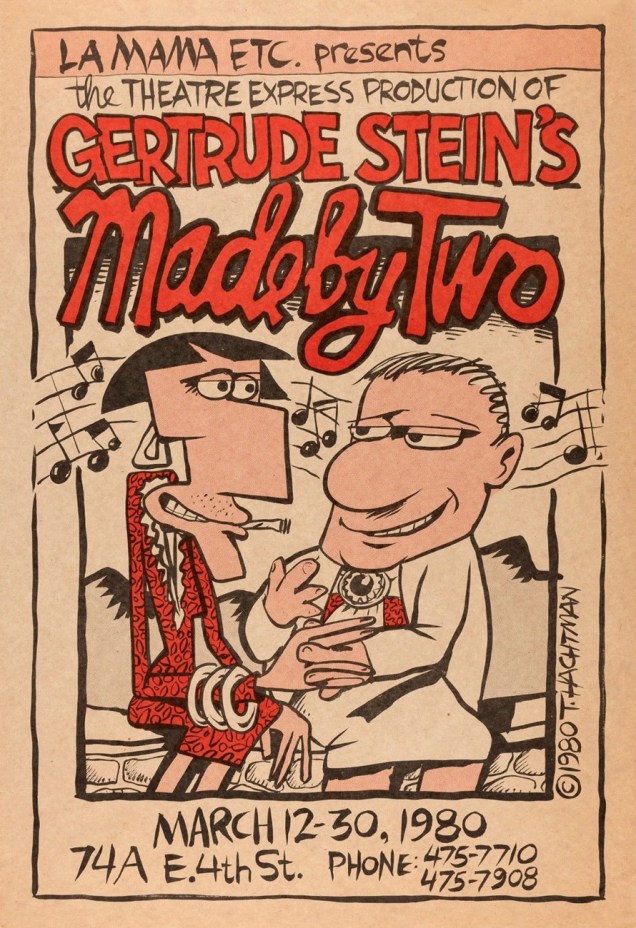
HachtmanCafeLaMamaPosterA
Despite, or perhaps because of the liberties he takes with these semi-sacred historical figures, Hachtman’s Gertrude appears to be rather beloved of the keepers of Gert and Alice’s mad flame. For example: « I look at the cover of the soon-to-be-reborn Follies several times a day and have a laugh each time. Too funny, Hemingway’s teeth, silly Picasso avec crayon, Basket’s slobbering excitement and Alice’s cigarette charm!! And Gert, yes sir, she is fierce!!! Rose flying like arrow ready to hit Alice’s nose. This can’t get any better! I hear the brooch ringing… Bravo! » –– Stein scholar Renate Stendahl
HachtmanPortraitA
The auteur, circa the late 70s. Say, what’s that he’s sporting?
GertrudeFolliesSunA
Un mini-parasol, une ombrelle. For shade, not protection from the rain. Hachtman was fond of road-testing some of the props employed by his players. Gives the strip that je ne sais quoi of authenticity, don’t you know.

If  you like what you see, you may rejoice in the fact that Gertrude’s Follies has lately become more widely available (whilst retaining its elusive cachet) thanks to the efforts of Now What Media. Amble over to their website, where they provide a generous sampling of strips and biographical information, not to mention the possibility of acquiring the collections.

Oh, and do check out Alice’s unusual, lasting contribution to popular culture.

« I love you, Alice B. Toklas, and so does Gertrude Stein… »

-RG

Tentacle Tuesday: Let’s Get Bizarro

Dan Piraro‘s Bizarro is a ubiquitous newspaper comic that usually doesn’t need much in the way of introduction. Favourite strips are widely shared by fans – cut out or photocopied from newspapers (or, more recently, printed from a website) to be pasted on office doors, cubicle walls and school binders. As a matter of fact, that’s where I spotted my first Bizarro strip: scotch-taped to the office door of my college English teacher. Oh, I’ve seen them before, of course, but this was the first time I consciously noticed one of them. Teachers of all stripes seem to have a thing for Bizarro – I had a university psychology professor once who actually collaborated with Piraro on some strips, an achievement of which he was justifiably proud.

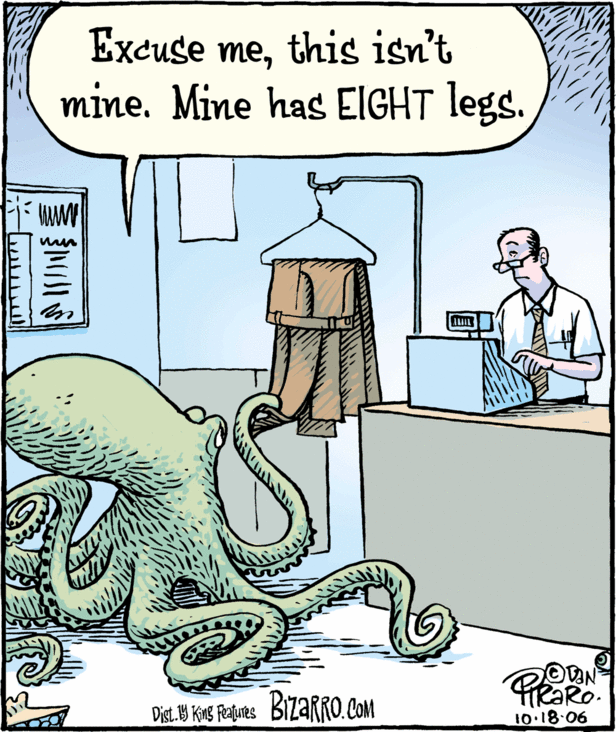
Bizarro-DanPiraro-p.20161015

As usual, one can rely on the intrepid Tom Heintjes of Hogan’s Alley to conduct a worthwhile interview with whichever artist one is interested in. Read it here: Mondo Bizarro: The Dan Piraro Interview. I’m not going to compete with Heintjes’ ability to summarize, so I’ll just quote:

« Since Bizarro’s January 22, 1986, debut, Piraro has taken his panel in directions simultaneously surreal and topical. In a comic universe where world-weary talking dogs exist alongside nihilistic housewives, Piraro gives his cartoons heft by skewering his own bêtes noires: wasteful consumerism, environmental destruction, corporate greed and sheeplike people, to name a few.  Though his humor is never didactic, Piraro’s work is remarkable in its unwillingness to pander, even when the occasional panel borders on the inscrutable. For example, he once used the Etruscans as a punchline; if you skipped history class that day, tough. Since sustained excellence like Bizarro‘s is rare in any medium, his willingness to shepherd his panel into its third decade is great news for comics fans and for the more than 200 papers that carry the strip. Though Piraro maintains that Bizarro is a comic strip for people who don’t read comic strips, we all know better: Bizarro is a comic strip for people who love comic strips. »

Bizarro-supportanimal-DanPiraro.jpeg

Piraro is not the only cartoonist spoofing social conventions, endowing animals with the gift of human speech or forging surreal situations out of everyday occurrences… but he does it consistently well. His easily recognizable, flowing art style is the frosting on the cake, and very nice frosting it is, too. Yet who can grasp the scope of such prodigious output? Bizarro collections (there have been thirteen of them – fitting number, isn’t it?-, all quite out of print) generally end up in the discount bin of bookstores (often neighbours to disheveled anthologies of Gary Larson‘s The Far Side, another omnipresent yet somehow underappreciated strip). For all my affection for Piraro’s goofy world, I only own Bizarro and Other Strange Manifestations of the Art of Dan Piraro (Harry N. Abrams Publisher, 2006). Some of the strips in this post have been scanned from it (others were found in the trackless depths of the Internet.)

Pleasantly, Piraro wears his politics, heart and sympathies on his (rather accommodatingly large) sleeve:

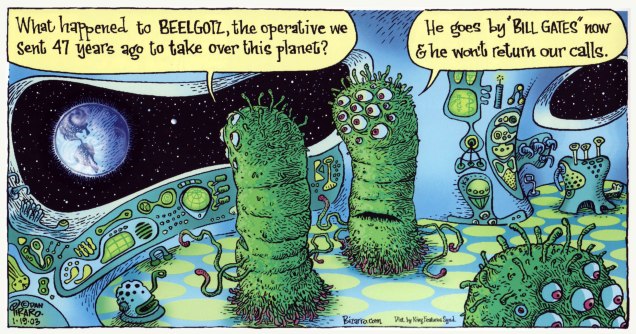
BizarroAliens02A

BizarroAliens01A

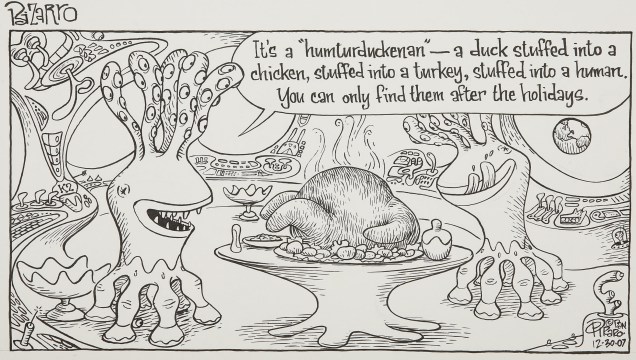
Bizarro-DanPiraro-Stuffed

Most Bizarro cartoons feature a recurring object or creature (added value for a comic strip that’s already rich in detail). Some of my favourites: the Eyeball of Observation, the Pie of Opportunity (a piece of pie – blueberry, I think), the Dynamite of Unintended Consequences, or Firecracker of Pop (a dynamite stick), the Fish of Humility (or at least its tail), and my very favourite, the Bunny of Exuberance. One can just tell that Piraro enjoys his work. What kind of jerk still enjoys drawing the same strip after 30 years*?!

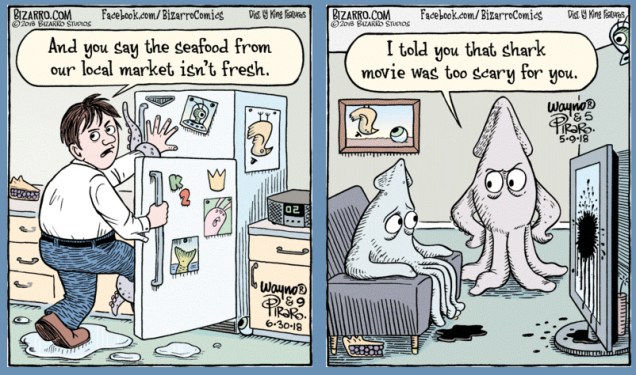
Bizarro-Freshfood

bizarrooc18-2006

Don’t forget to visit Bizarro’s official website!

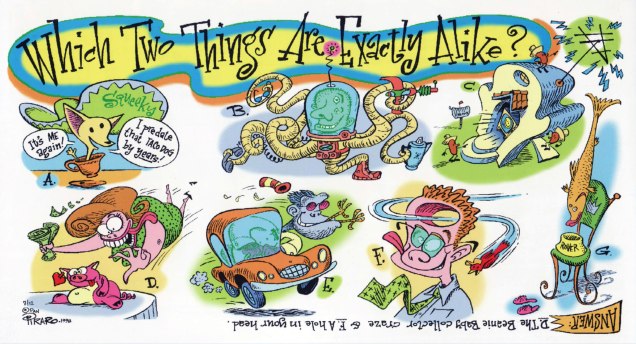
BizarroTwoThingsAlikeA

~ ds

*Since 2018, Piraro’s pal Wayno has been drawing the dailies, with Piraro keeping the Sundays all to himself.

Nicole Hollander’s Sylvia: Wit, Wisdom and Cats

« America’s top-flight intellectuals will one day hold entire conferences and seminars devoted to Sylviology. They will deconstruct her frame by frame with straight edge and compass, attempting to identify each tiny object as an Artifact of Our Time and a clue to our condition. They will bring in leading neurologists, phrenologists and psychoanalysts to study the blabbermouth pets, the thimble-sized martinis, the neurotic superheroes, to answer the inescapable question: What kind of a mind…? » \from the introduction to Planet Sylvia by Barbara Ehrenreich|

Many years ago, I was perching on a sofa in the corner of a cozy records store (the excellent Death of Vinyl in Montreal, in case anyone is wondering) when I noticed a stack of comics in a nearby bin. Something dishevelled and coverless, pages barely holding together, attracted my attention with its idiosyncratic drawing style and strangely articulated cats. There was also a big-nosed lady with giant earrings and a typewriter. I was hooked and purchased the book immediately, though I wasn’t even sure whether it was for sale or just placed there as reading material. (I located the cover, after all, albeit in a different bin.)

The book was The Whole Enchilada (A Spicy Collection of Sylvia’s Best) by Nicole Hollander, and as it turned out, it the best introduction to her world. (You can purchase it for $1.99 or so on Amazon. I highly recommend it.)

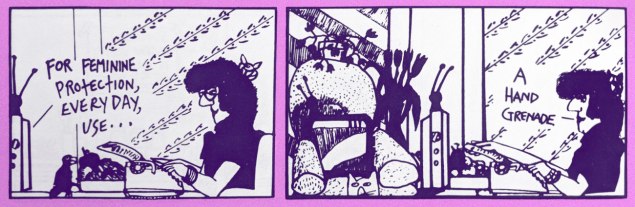
NicoleHollander-Sylvia-handgrenade

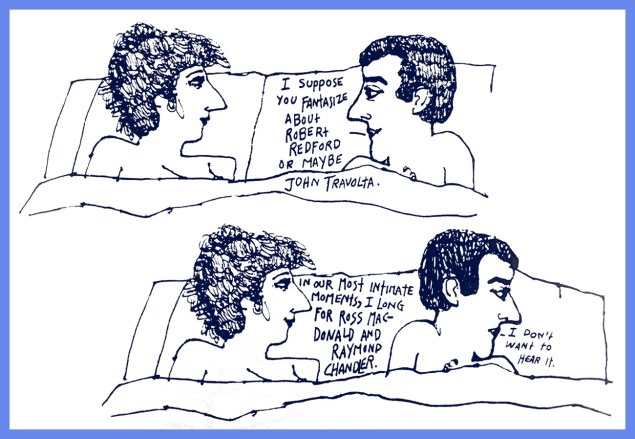
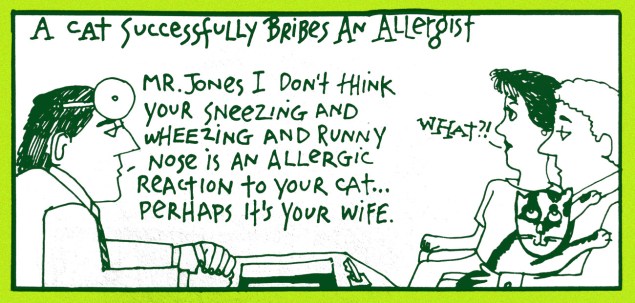
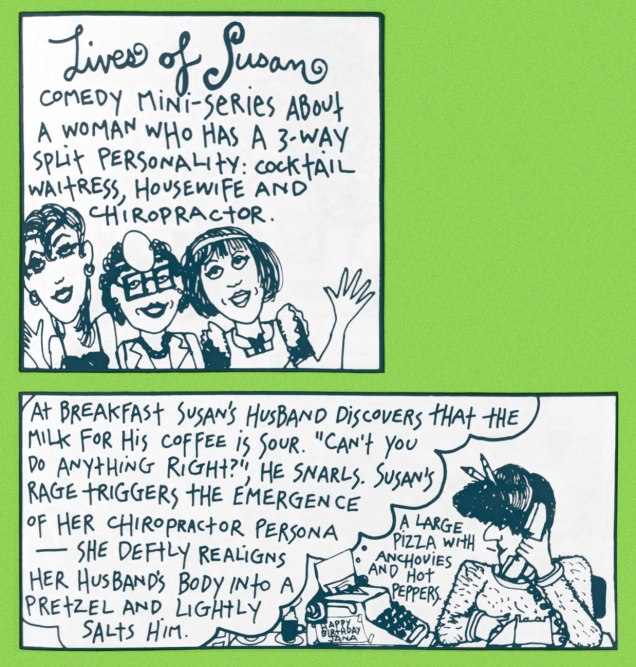
Sylvia is a more-than-slightly cantankerous woman with a wonderfully acerbic sense of humour. Sometimes she doles out social commentary from the bathtub, sometimes a local café serves as her headquarters — or she stays in her living room, dispensing wisecracks at yet another inane TV ad, or bestows advice to lost souls (typed on an honest-to-god typewriter). She’s clearly a feminist, and equally clearly fluent with clichés of womanhood, such a certain obsession with dieting and a definite obsession with cats. She embodies many tropes – she’s the crazy cat lady, an Apron Matron (albeit with a flowery hat instead of an apron), a Dear Abby-type adviser – and puts her peculiar tilt on them all. Extravagant earrings and the odd flamboyant hat (all the articles about Sylvia seem to overstate the presence of hats, yet Sylvia’s handsome head often boasts nought but big hair adorned with a hairnet or bow) are just the cherry on the cake.

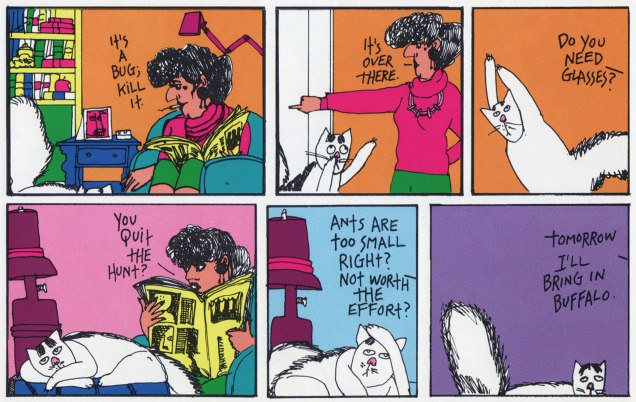
NicoleHollander-SylviaBuffaloA

As for Nicole Hollander, she is a Chicago native and brought forth something like 30 years of Sylvia. Born as a series of cartoons for the feminist magazine The Spokeswoman, it was syndicated in 1981 and continued until March 26th, 2012, upon which date Hollander declared that Sylvia was retiring.

NicoleHollander-Sylvia-IntimateMomentsA

« In the old days, the disconcerting feel of the strip as well as Sylvia’s middle-aged ‘dame’ image and her biting humour gave the artist problems. After St. Martin’s had started publishing Sylvia, even the big syndicates were forced to sit up and take note of her. But they did so in a grudging, good-old-boy sort of way, taking away with one hand what they gave with the other. After Field Enterprises took Hollander on in 1981, a rep would intermittently call Nicole to shake a finger at her – for instance, the week on Sylvia cartoon mentioned hemorrhoids, and another mentioned Lightday pantyliners. “They said, It’s your life, but you’re ruining it. If you leave stuff like this in, a lot of papers will pull the strip. I gave up the hemorrhoids, but not the Lightdays. There was this voice in my head that said, You must take a stand. So I said, I will take my stand for Lightdays, and threw hemorrhoids to the dogs.”» |From Don’t Throw That Old Diaphragm Away! by Ellen Cantarow, published in Mother Jones (June/July 1987)|

In case you’re wondering what *can* you do with a diaphragm, this handy illustration might help:

NicoleHollander-Sylvia-Don't-Throw-That-Old-Diaphgram-Away

For all its popularity, there aren’t a lot of Sylvia strips available online, let alone in decent resolution. Oh, sure, you can go to GoComics and read a whole bunch of them, but that seems to be just the strips from the 2000s. Somebody got started on a documentary about Hollander in 2015, but I get the impression that that was abandoned somewhere along the way, probably for lack of funds. Even Hollander’s website, Bad Girl Chats, doesn’t seem to exist anymore. Speaking of that, please watch this adorable video in which Nicole explains what sort of things she posts on her website.

(On the brighter side, in 2018, Fantagraphics released Hollander’s autobiography-slash-graphic-novel, We Ate Wonder Bread.) I aim to remedy this situation at least a little bit, by showcasing some of my favourite strips (scanned from The Whole Enchilada, 1986 and also from Planet Sylvia, 1990; the black and white strips were “colourized” by co-admin RG, who abhors lousy greying paper.)

NicoleHollander-Sylvia-AuntSybil
As Hollander points out, her mother had a whole network of witty women friends who liked to discuss events of the day over a cup of coffee. Auntie Sybil was surely one of them.

NicoleHollander-Sylvia-VentriloquistCats

SylviaAllergyBribeA

NicoleHollander-Sylvia-TossingManejpg
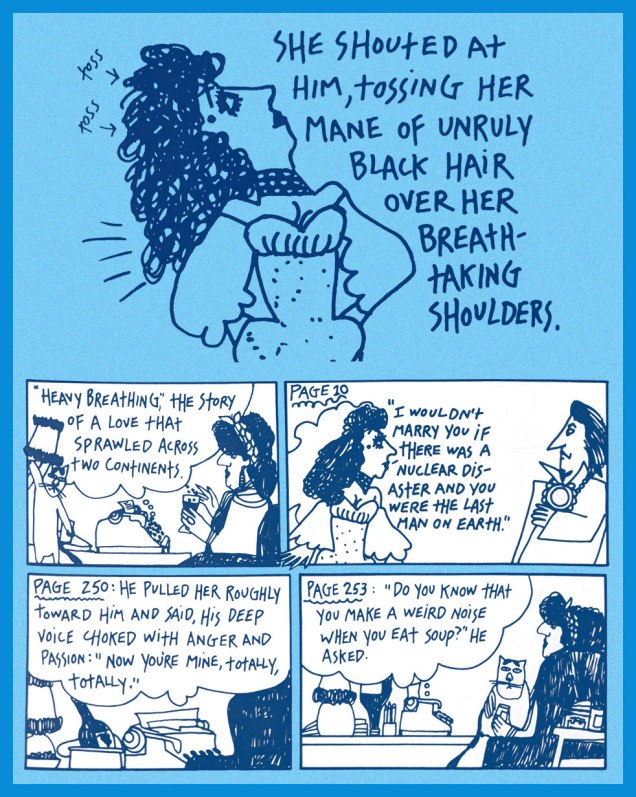
Occasionally, Sylvia ventures into writing romance novels, which do a delightful job of mocking common clichés of what passionate love is supposed to be like.

NicoleHollander-Sylvia-LivesofSusan

SylviaTonyBennettA
Waitress Beth Ann is every bit as sardonic as Sylvia, but with more of a food-centric accent.
NicoleHollander-Sylvia-Gernif
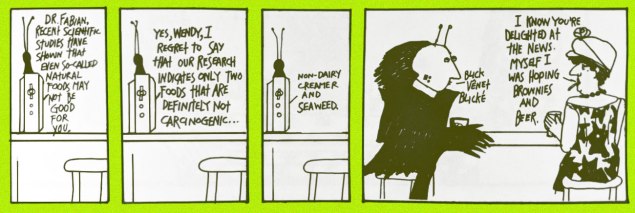
Gernif often shares a cup of… non-dairy creamer, I guess… with Sylvia. I wonder if she, like Broom-Hilda, stopped drinking and smoking when the proverbial Powers-that-be decreed that syndicated newspaper strips couldn’t feature characters indulging in sinful hobbies.

« When we sat down Hollander began talking about how she and her friends used to sit silent and wide-eared at a table in the deli while their mothers gabbed. I didn’t appreciate how vital a memory this is until I opened Wonder Bread and spotted a sketch of the women yakking, another of young Nicole sitting primly before a corned beef sandwich and a jar of dill pickles as the grownups dish. “We were avid listeners,” says the text, filling in details you sense from the art, “fearful of interfering with their talk, hoping they wouldn’t notice us so they would keep on talking. They were all witty women, fiercely loyal to their friendship, to the specialness of every woman in the group.”» |Life After Sylvia: Cartoonist Nicole Hollander publishes a memoir|

NicoleHollander-TalesfromPlanetSylvia
The cover for Planet Sylvia (St. Martin’s Griffin, 1990). « For all we know, there is a Planet Sylvia. We know that it is a place where cats write passable fiction, where ham has no cholesterol, where women are free to go out of doors without eyeliner and eat large portions of fries in public. Its atmosphere is not only breathable, but induces a delirious sense of lucidity, unknown to our own dank orb, except to the mystically enlightened and abusers of nitrous oxide. » (from the introduction)

SylviaPolkaA

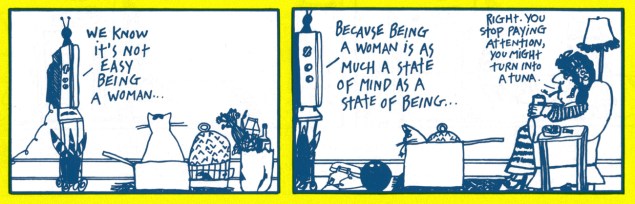
SylviaTunaA

SylviaPoltergeistA

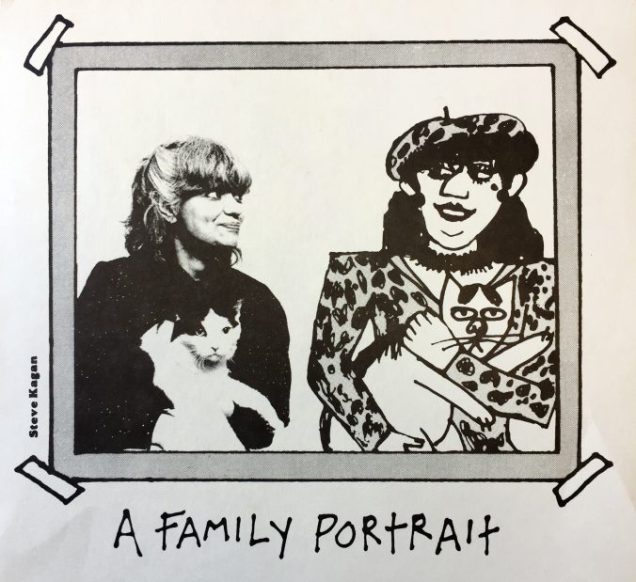
NicoleHollander-familyportrait
I took this picture from Spotlight on the Nicole Hollander Collection, an article about the Billy Ireland Cartoon Library & Museum’s archival collection of Hollander strips and odd and ends.
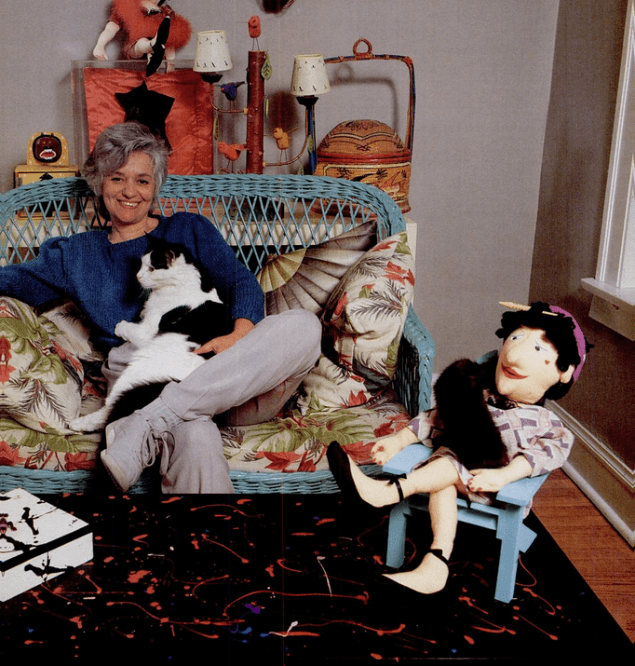
NicoleHollander-1987
Nicole Hollander in 1987. I’d like to point out that even today it is highly controversial for a woman in her late 40s NOT to dye her hair grey. She’s one awesome lady.

One last tidbit: on 2012, Nicole Hollander’s “unique collection of condom packages and sex toys” entered the collection of the Kinsey Institute for Research in Sex, Gender, and Reproduction. That raises more questions than it answers, doesn’t it?

NicoleHollander-MedicalSchoolA

~ ds

Will Eisner’s The Spirit at Kitchen Sink (pt. 1)

« Hello… Times? … I want to place an ad in your Situation Wanted column! Wanted… dangerous assignment… will go anyplace, anywhere, anytime… contact The Spirit, Box 35! » – The Spirit, Apr. 30, 1950

If you’ve followed our series dogging the steps of The Spirit, you won’t be in the least surprised that, after a sixteen (plus colour special) residency with Warren Publishing (Apr. 1974 – Oct. 1976), the late Dennis Colt found himself, after a year’s break, updating his mailing address once more. As returning publisher (and later, also Eisner’s agent) Denis Kitchen put it Kitchen Sink’s inaugural magazine issue (no. 17, Winter 1977):

« Welcome back, SPIRIT fans! Several years ago, we launched an experiment, publishing Will Eisner’s SPIRIT in ‘underground’ format. The experiment was so successful that Eisner arranged for Warren Magazines to publish his stories in a larger format, distributed on a national scale. 

Seventeen issues later, we once again have the rights to THE SPIRIT. We will continue publishing stories never before reprinted, on a quarterly basis. In addition, we are adding new features, virtually eliminating the ad pages, and upgrading the quality of the paper. We hope you like the difference and will continue to support THE SPIRIT. »

Well, the first issue was all right, but looked a bit shoddy, a surprise, given the usually-solid production hand of KS’s peerless production man, Pete Poplaski. With the following, er… quarterly issue (five months later), all the kinks had been worked out, and every subsequent entry looks sharp and terrific.

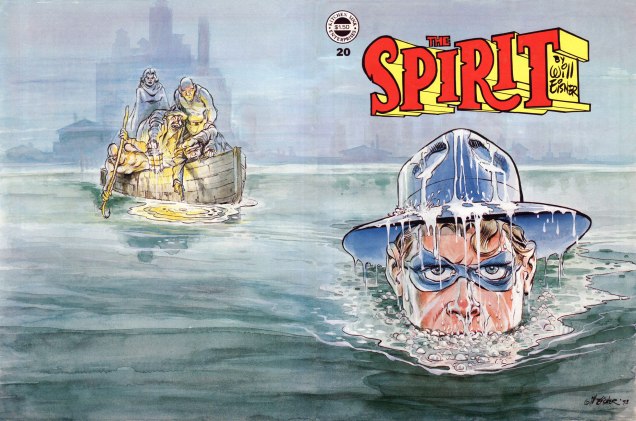
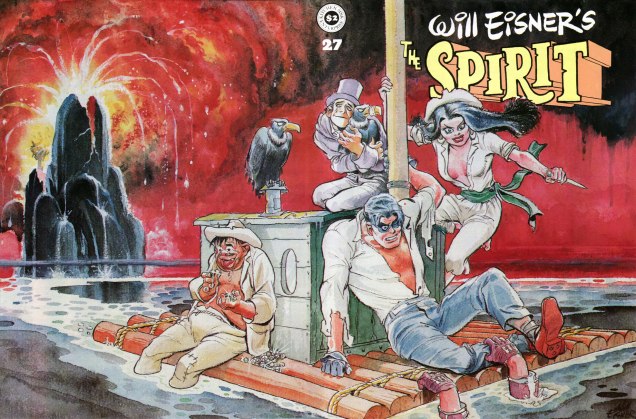
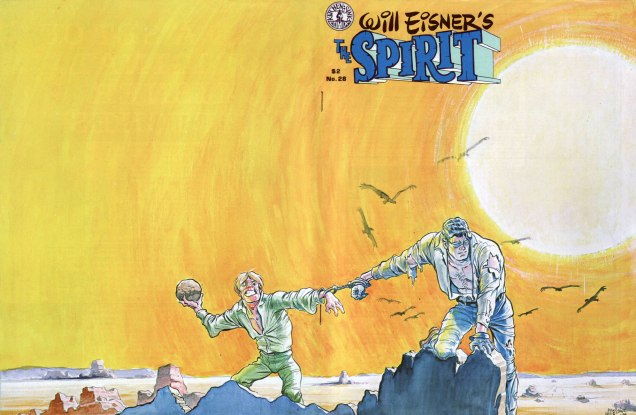
Ah, but there’s the rub: Kitchen Sink’s magazine ran for 25 issues, most of them boasting spectacular, brand-new wraparound watercolour paintings by Eisner. Some brutal excisions had to be made, to say nothing of the backbreaking process of smoothly collating the front and back halves (we have standards!). Hence the necessity of “pt. 1”. Will you settle for my dozen picks of the twenty-five? I’m afraid you’ll have to.

Spirit18A
This is The Spirit no. 18 (May, 1978), featuring a half-dozen Spirit tales, namely: “The Seventh Husband” (May 20, 1951); “Thanksgiving Spirit” (Nov. 20th, 1949); “Future Death” (Jan. 21, 1951); “Barkarolle” (July 18th, 1948); “Mad Moes” (Feb. 9, 1947); “Fan Mail” (Jan. 1, 1950), as well as some vintage Clifford one-pagers by Jules Feiffer.
Spirit19A
This is The Spirit no. 19 (Oct. 1978), featuring five Spirit tales, namely: “Money, Money” (Nov. 23, 1947); “April Fool” (Mar. 30 1947); “Gold” (Oct. 10, 1948); “The Chapparell Lode” (Nov. 14, 1948); “Halloween” (Oct. 31, 1948), as well a pair of Clifford one-pagers by Jules Feiffer, a Lady Luck four-pager by Klaus Nordling, and part one of Eisner’s brand-new, hard-hitting serial, Life on Another Planet (eventually coloured and collected as Signal From Space).
Spirit20A
This is The Spirit no. 20 (Mar. 1979), featuring five Spirit tales, namely: “Quirte” (Nov. 21, 1948); “Cromlech Was a Nature Boy!” (July 4, 1948); “War Brides” (Mar. 14, 1948); “Time Bomb” (Apr. 15, 1951); “Census ’50” (June 25, 1950); and “[Mission… the Moon]” (Aug. 3, 1952), plus part two of Eisner’s Life on Another Planet and some informative articles.
Spirit24A
This is The Spirit no. 24 (May 1980), featuring five Spirit tales, namely: “Boombershlag” (Mar. 23, 1941); “Beauty” (June 9, 1946); “Cargo Octopus” (July 14, 1946); “A River of Crime” (Nov. 30, 1947); “Rescue” (Aug. 24, 1952), plus a chapter of Life on Another Planet and a host of other features, including a Spirit checklist
Spirit27A
This is The Spirit no. 27 (Feb. 1981), featuring six Spirit tales, namely: “The Devil’s Shoes” (Feb. 1, 1942); “M.U.R.D.E.R.” (July 19, 1942); “Montabaldo” (Jan. 25, 1948); “Rife” (Jan. 14, 1951); “The Amulet of Osiris” (Nov. 28, 1948), “The Return” (Sept. 21, 1952), plus a new Eisner ‘Big City’ nine-pager, “The Treasure of Avenue ‘C‘”… and more.
Spirit29A
This is The Spirit no. 28 (Apr. 1981), featuring six Spirit tales, namely: “Sphinx & Satin” (Oct. 5, 1941); “Professor Pinx” (Aug. 2, 1942, with Lou Fine); “Survivor” (July 16, 1950); “Deadline” (Dec. 31, 1950); “Return From the Moon” (Sept. 28, 1952), “The Martian” (Oct. 10, 1952), plus a Feiffer Clifford one-pager, a ‘Shop Talk’ discussion between Eisner and Gil Kane, and so forth.

If you’ve just joined us mid-programme, fret not: simply rewind to our earlier instalments, if you will:

… or simply click on its general category, That’s THE SPIRIT!, and find yourself with everything at your blue-gloved fingertips.

-RG

Le Printemps and Its Perils

« It’s spring fever. That is what the name of it is. And when you’ve got it, you want—oh, you don’t quite know what it is you do want, but it just fairly makes your heart ache, you want it so! » — Mark Twain

André Montpetit (1943-2012) was a prodigiously talented québécois cartoonist and illustrator who, after wowing the public and his peers in the late 1960s and early 1970s, essentially turned on his heels and walked away from it all. Was it fear of success, fear of failure, self-loathing, self-respect or something else that prompted his slow fade? Hard to tell.

In the meantime, here’s a seasonally sardonic piece he produced in 1971. It saw print in the March 20, 1971 issue of Perspectives, a supplement bundled with each Saturday edition of Québec’s Le Soleil daily newspaper from 1959 to 1982.

MontpetitPrintemps01A
The sun appears… the birds return… the flowers grow back… the beasts awaken… the city has an air of joy… it’s the season of love. « Let us go contemplate the marvels of nature! »
MontpetitPrintemps02A
« Oh, the beautiful pigeon! » « Oh, such a pretty flower! » « Oh! A small, limpid puddle! » « I’ve had enough! I’m going home!!! »  « You’re right. It’s going to rain! » IN GENERAL, PEOPLE WATCH THE SPRING ON TELEVISION. IT’S LESS DANGEROUS.

In recent years, writer-director Saël Lacroix endeavoured to put together a documentary to assemble and organize the known facts and to fill in some of the blanks of Montpetit’s troubled career and existence. The result, Sur les traces d’Arthur (aka Tracing Arthur) was released in 2016. Watch the trailer here.

-RG

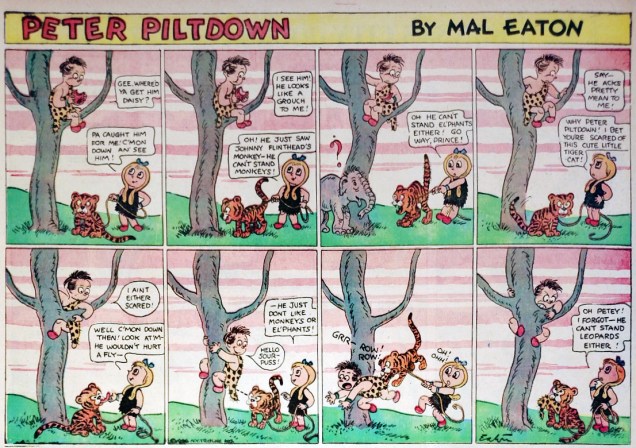
Mal Eaton’s Peter Piltdown

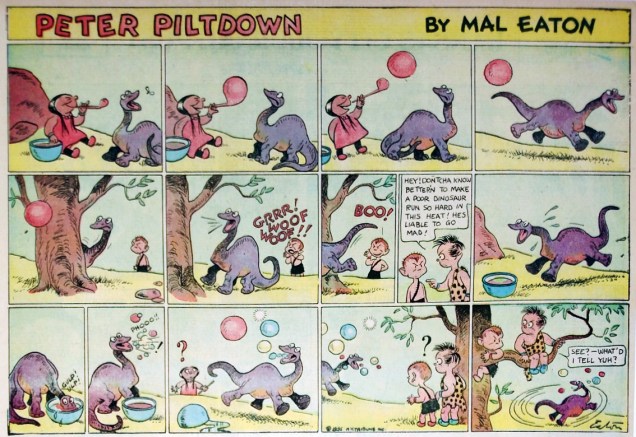
Newspaper strip Peter Piltdown was created by Mal Eaton (1902-1974) and debuted as a Sunday page on August 4th, 1935. Featuring a mischievous boy getting into trouble in some sort of prehistoric world (with a lot of indispensable modern conveniences – like earmuffs!), the strip seems to have lasted for quite a while, until the late 1960s. The reason I say “seems” is because not much is known about Eaton *or* the strip. With some difficulty I managed to find out that Malcolm Eaton was based in New York.

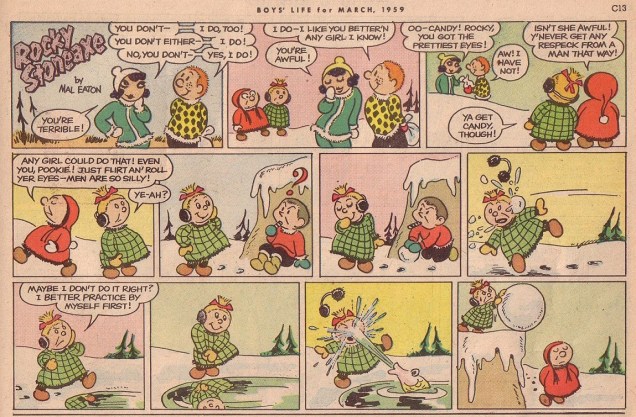
It doesn’t help that the strip changed titles several times. Starting out as Peter Piltdown, syndicated by Miller Services (a small Canadian newspaper syndicate that has since then been renamed into Canadian Artists Syndicate), it appeared as Pookie (Peter’s younger brother, whose antics had taken over the strip) in 1947 and 1948, and then migrated to the pages of Boys’ Life magazine as Rocky Stoneaxe.

Some comics are buried by the collective memory through sheer bad luck, some are rightly forgotten because they weren’t that good. It’s always exciting to unearth something obscure, but one has to ask if this excitement is justified, or whether whatever artifact of the past one has dug up is thrilling only because of a “I know what you don’t!” kind of show-off-manship. I do think Peter Piltdown is genuinely good.  The art is manic – and dynamic – in a way that’s spontaneous and appealing. Eaton clearly liked to draw animals; they’re often a big part of the punch line, and they’re drawn lovingly, with great attention to detail and body language. Anyway, you be the judge!

From the small sample that’s findable online, I’d say that the period around the 1940s is the best; the art gets simpler later on. Here’s a selection of strips that I’ve succeeded in finding (and cleaned up somewhat) – they are in chronological order starting from 1943 and going up to 1959. Most of these are original art: three images are from the collection of gallery owner Rob Stolzer (the first two, as well as the Sunday strip in colour); the rest have been found on Heritage Auctions. The last three are scans from a newspaper.

MalEaton-PeterPiltdown-1

MalEaton-PeterPiltdown-2

MalEaton-PeterPiltdown-3

MalEaton-PeterPiltdown-4

MalEaton-PeterPiltdown-5

MalEaton-PeterPiltdown-6

MalEaton-PeterPiltdown7

MalEaton-PeterPiltdow-8

MalEaton-RockyStoneaxe

~ ds

Will Eisner’s The Spirit at Warren

« According to statistics, millions of Americans read millions of the most carefully written crime and crime detection stories in the world! Expertly told… and prepared, after exhaustive research — the best of these are, in effect, lessons in crime and criminal psychology! Yet could you, sitting in the trolley or bus or subway at night, pick out the killer sitting opposite you? » — The Killer (Dec. 8, 1946)

Welcome to the fourth entry in our chronicle of the variegated ambulations of the former Denny Colt. Begin if you will, as we did, with his time at Quality, then follow his path through Fiction House, then on to Harvey, Super and Kitchen Sink; at that point, you’ll be all caught up.

Okay, now that we’re all here, let’s pose and answer the next burning question: how did The Spirit come to make landfall at Warren Magazines? Thankfully, we’re spared the motions of idle speculation in this case, since Jim Warren himself revealed all in the course of an interview with Jon B. Cooke, published in The Warren Companion (2001):

JW: « I would have mortgaged everything I owned to publish Will Eisner — to be involved in anything Will Eisner was doing. I called Will and said, ‘Mr. Eisner, I’d like to take you out to lunch.

I knew Will was talking to Stan Lee about The Spirit and that DC was interested in his company, American Visuals. I also knew that Harvey Comics had done a couple of Spirit reprints and that they might be interested again. I had to move fast.

So I took him out to lunch, sat him down, and said, ‘There’s no possible way that I’m going to let the great Will Eisner escape. You are someone I have revered since 1940, when I saw the very first Spirit section in the Philadelphia Record with that splash page that changed my life. Do you think I’m going to let you go to Stan Lee, whom I ‘hate’ and ‘despise’ as a competitor? Do you think I’m going to lose you to that unrepentant sociopath? You’re just going to be a computer number to Marvel; they have a factory, where they cookie-cut comics, turning out 400* titles a month!’

And I saw the expression in Will’s face — he had his pipe in his mouth at the time, just like Commissioner Dolan — and I could see that I had him. »

WhoThereLogotype

Let’s have a look at some covers. Most of the sixteen (plus the colour Special) are terrific, but I skipped a few of the lesser ones: issue one is a not-quite successful Eisner-Basil Gogos painted collaboration, and issue two is just okay. Issue 11 is another Ken Kelly painting over Eisner pencils, and 12 to 16 are composites using inside panels. Fine, but facultative. And now, on to the gems!

warrenspirit3a
This is The Spirit no. 3 (Aug. 1974), reprinting eight post-WWII stories: Black Alley (June 5, 1949), Fox at Bay (Oct. 23, 1949), Surgery… (Nov. 13, 1949), Foul Play (March 27, 1949), The Strange Case of Mrs. Paraffin (March 7, 1948), The Embezzler (Nov. 27, 1949), The Last Hand (May 16, 1948) and Lonesome Cool (Dec. 18, 1949). Cover pencils and inks by Eisner, colours by Richard Corben.
warrenspirit4a
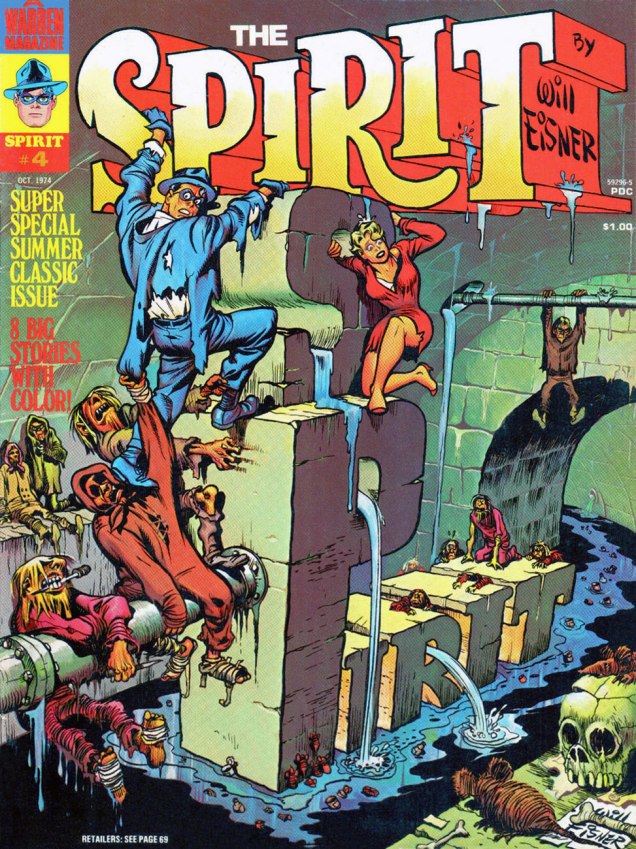
This is The Spirit no. 4 (Oct. 1974), reprinting eight post-WWII stories: Life Below (Feb. 22, 1948), Mr. McDool (Oct. 12, 1947), The Emerald of Rajahpoor (May 30, 1948), Ye Olde Spirit of ’76 (July 3, 1949), The Elevator (June 26, 1949; in colour), The Return of Vino Red (Sept. 25, 1949), The Guilty Gun… (June 6, 1948), and Flaxen Weaver (Dec. 11, 1949). Cover colours by Ken Kelly.
warrenspirit5a
This is The Spirit no. 5 (Dec. 1974), reprinting eight post-WWII stories: The Return (Aug. 14, 1949), The Spirit Now Deputy (Apr. 24, 1949), The Hunted (May 1st, 1949), The Prediction (June 19, 1949), The Deadly Comic Book (Feb. 27, 1949; in colour), Death, Taxes and… The Spirit (Mar. 13, 1949), Hamid Jebru (May 18, 1949), and Ice (Jan. 2, 1949). Cover colours by Ken Kelly.
warrenspirit6a
« You cannot stop me now… I am at the threshold of immortality… Yowch! »
This is The Spirit no. 6 (Feb. 1975), featuring seven black & white (and one full-colour) presentations of tales from the 1940s: Showdown (Aug. 24, 1947), The Wedding (May 2, 1948), The Job (May 9, 1948), The Lamp (July 27, 1947), Glob (March 6, 1949; in colour), The Winnah! (Dec. 3, 1950, This is ‘Wild’ Rice (Apr. 4, 1948) and Taxes and the Spirit (Apr. 16, 1950). Cover colours by Ken Kelly.
warrenspirit7a
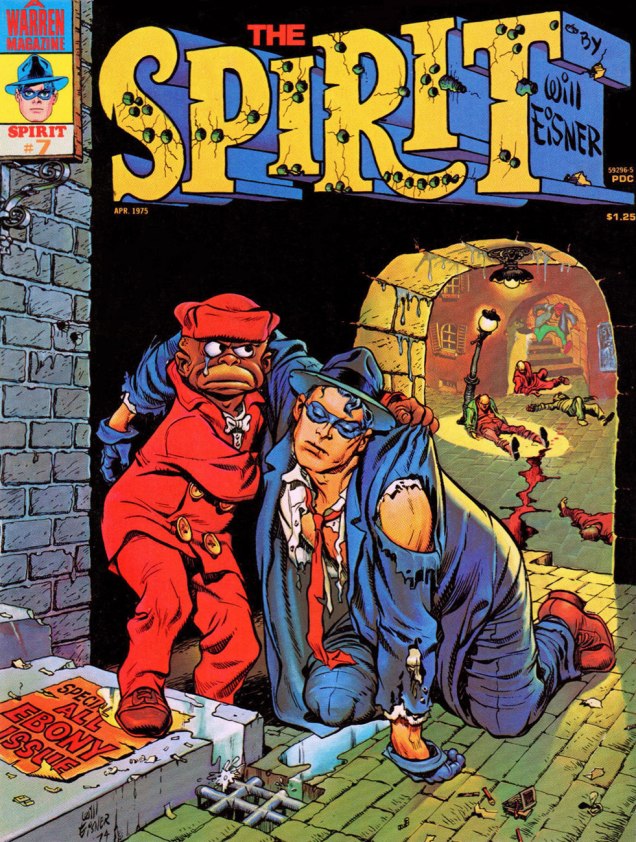
This is The Spirit no. 7 (Apr. 1975), reprinting eight post-WWII stories: The Big Sneeze Caper (Feb. 6, 1949), Hoagy the Yogi (Pt. I) (Mar. 16, 1947), Hoagy the Yogi (Pt. II) (Mar. 23, 1947), Cheap Is Cheap (June 13, 1948), Young Dr. Ebony (May 29, 1949; coloured by John Laney); A Moment of Destiny (Dec. 29, 1946); The Explorer (Jan. 16, 1949); and A Prisoner of Love (Jan. 9, 1949). Cover colours by Ken Kelly.
warrenspirit8a
This is The Spirit no. 8 (Apr. 1975), reprinting eight post-WWII stories: “Sand Saref” (Jan. 8, 1950), “Bring In Sand Saref…” (Jan. 15, 1950), “Thorne Strand” (Jan. 23, 1949), “A Slow Ship to Shanghai” (Jan. 30, 1949), “Assignment: Paris” (May 23, 1948; coloured by Michelle Brand), “A Pot of Gold” (Apr. 3, 1949), “Satin” (June 12, 1949), and “Visitor” (Feb. 13, 1949). Cover colours by Ken Kelly.
warrenspirit9a
This is The Spirit no. 9 (Aug. 1975), reprinting eight post-WWII stories: The Candidate (Aug. 21, 1949); White Cloud (Aug. 28, 1949); Stop the Plot! (Dec. 5, 1948); Lovely Looie (Apr. 10, 1949); The Space Sniper (May 22, 1949; in colour); The Vernal Equinox (Mar. 20, 1949); Black Gold (June 15, 1947); and Two Lives (Dec. 12, 1948). Cover colours by Ken Kelly.
warrenspirit10a
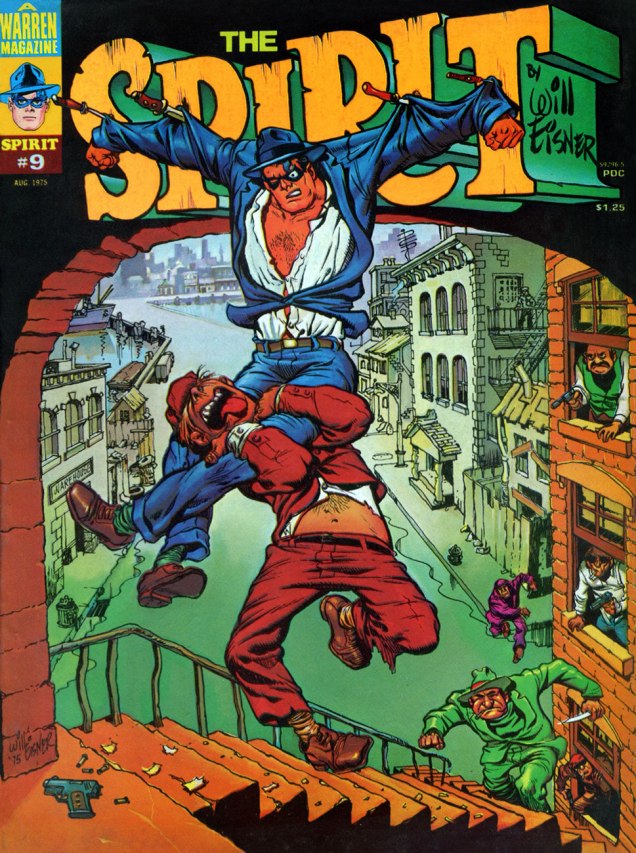
« The Octopus is at it again. This time his thugs have the Spirit cornered. Has his incredible luck finally run out? A tense moment captured by Will Eisner and Ken Kelly. » Evidently, Warren’s readership wasn’t content with line art covers, fancily wrought and gorgeous as they were; so Ken Kelly was brought in to slap some paint over a tight Eisner layout et voilà! An interesting hybrid, but I’m not quite convinced of its necessity. This is The Spirit no. 10 (Oct. 1975), reprinting a whopping ten post-WWII stories: Heat (July 15, 1951); Quiet! (July 22, 1951); Death Is My Destiny (March 4, 1951); Help Wanted (April 29, 1951); The Origin of the Spirit (From Harvey’s The Spirit No. 1; in colour); Sound (Sept. 24, 1950); A Time-Stop! (Jan. 7, 1951); The Octopus Is Back (Feb. 11, 1951); Hobart (Apr. 22, 1951) and The Meanest Man in the World (Jan. 28, 1951).
eisnerspiritoa
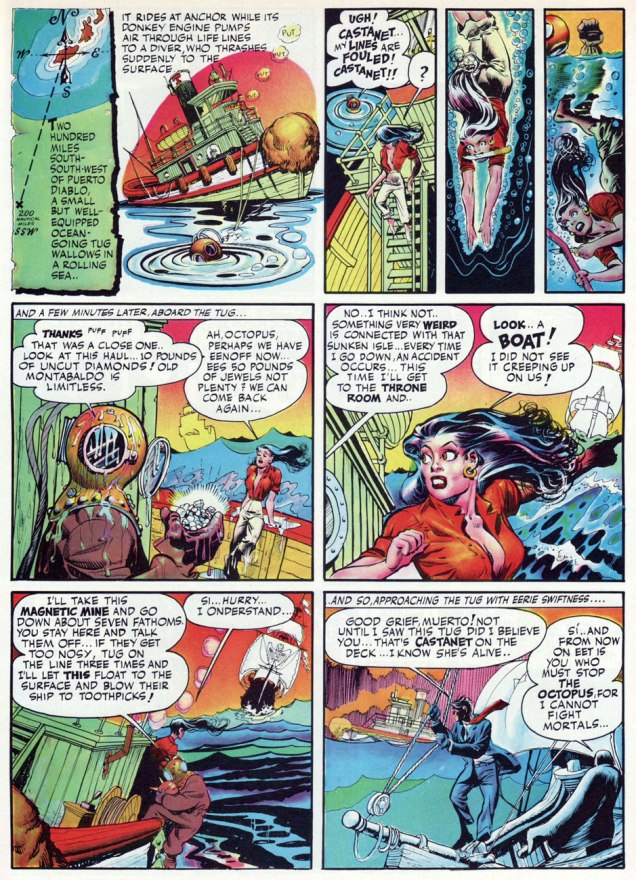
Among my favourite features of the Spirit’s Warren run are the single, well-selected, lushly-coloured story appearing in each of the first ten issues. This, from no. 1, is page 4 of El Spirito (Feb. 1st, 1948). The Octopus’ buxom accomplice is Castanet. While I’m strictly underwhelmed by Rich Corben’s interchangeable tales of bald, lumpy, donkey-donged bodybuilders roaming the land and forever risking ritual castration at the hands of amazon tribes, his colour work here is simply sublime.
thespiritspeciala
As you can see, the panel montages were extremely well-done; The Spirit Special (1975) handily gathered in one place the colour stories from issues one to ten. According to the GCD: « Available through mail purchase only, just over 1500 are thought to have been printed. »

In closing, this final, telling exchange from the Jim Warren interview:

Jon Cooke: Do you recall dealing with Denis Kitchen about The Spirit?
Jim Warren: Will had given his word — and his word is his bond — for Denis to reprint The Spirit (this was before Will and I negotiated a deal). Denis had spent money on preparing the reprints. Will said to me, « It would be a nice gesture if you would reimburse Denis, who is a good guy, for the material he’s already prepared. » I think Will looked on me kindly when I said « Absolutely. » (What Will doesn’t know if that if he had asked for me to give Denis a Rolls-Royce, I would have driven it to Wisconsin myself!)

*an exaggeration, of course, but a pointed one. At the time, Marvel *was* doing its worst to flood the market in order to starve its competitors.

-RG