“How Much You Gettin’ Paid for This Gig?” Scott A. Gilbert’s True Artist Tales

« I have moss for brains, so I can keep my cool »

It’s kind of sobering to chance across some regional comics… sometimes they’re of such high quality that I tend to wonder at, and regret, the vast bounty cast aside and left in the dust. How much more similarly fine stuff is out there is anyone’s guess. It makes me long for the days of greater cultural variety on a smaller scale, of humble local stations, local stardom and the unpredictable crazy quilt of regional popularity.

Houston, Texas’ Scott A. Gilbert is a prime example. If not for his being awarded a Xeric Grant in 1995, which financed the publication of It’s All True!, a concise 52-page collection of his favourite True Artist Tales, even fewer of us would have been exposed to his freewheeling talent. Without further ado, here are some of my picks from the booklet.

GilbertStenchA
A Whiff of Hypocrisy (1992)
GilbertArtHistoryA
One Art History (1993)
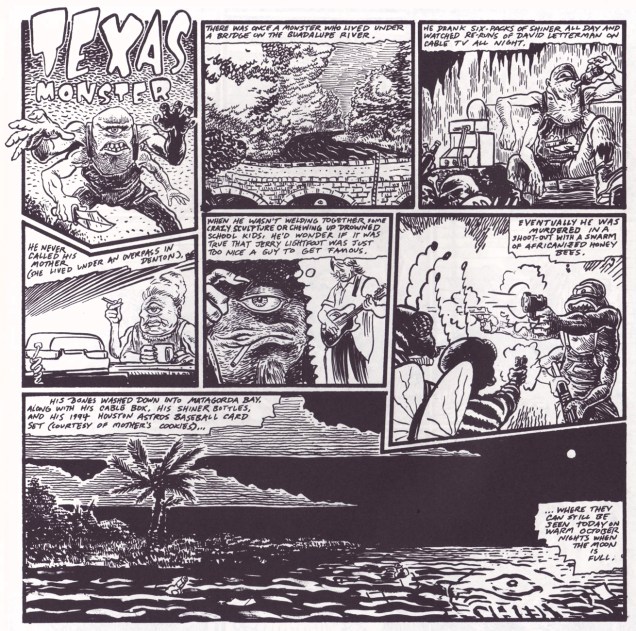
GilbertTexasMonsterA
Texas Monster (1994)
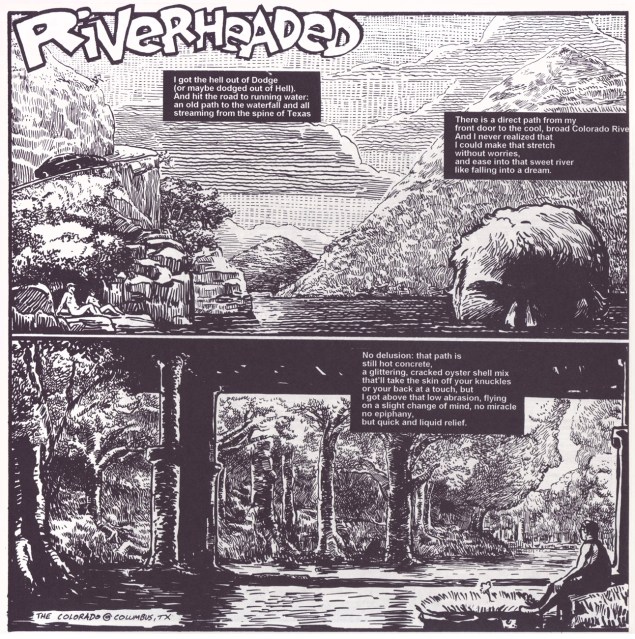
GilbertRieverheadedA
Riverheaded (1994)
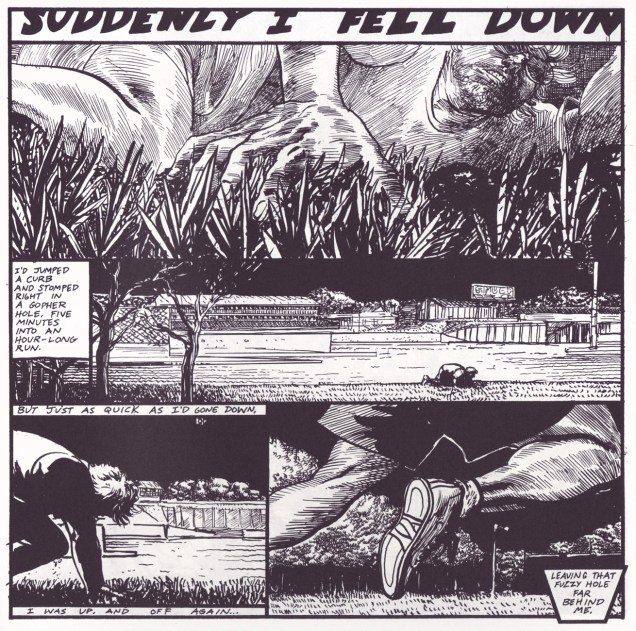
GilbertGopherA
I Fell (1994)

Gilbert’s True Artist Tales was published in rival alternative weeklies Public News (1988-97), and Houston Press (1997-2000). To answer our opening question, Gilbert got $25 a strip at Public News and $30 at Houston Press.

And for a bit more context, here’s an illuminating presentation that former Comics Journal managing editor Robert Boyd gave last year during a retrospective of Gilbert’s art Boyd was curating (now there’s something you don’t often see these days: the use of “curating” in its proper context!)

http://www.thegreatgodpanisdead.com/2016/11/true-artist-tales-talk.html

-RG

Well, blow me down: it’s E.C. Segar’s birthday!

« I know what’s the matter with your comic artists, they’re all crazy. »
« Of course they’re crazy, they wouldn’t be worth a whoop if they weren’t crazy. »

Today we commemorate the birthday of Popeye creator Elzie Crisler Segar (December 8, 1894 – October 13, 1938). The man succumbed to leukaemia and liver disease at the distressingly early age of 43… but not before making his everlasting mark on the world of cartooning and the world at large.

SegarPantsA
In this Popeye Sunday strip dated August 14, 1938, J. Wellington Wimpy ably demonstrates his solid-gold mooching wiles.

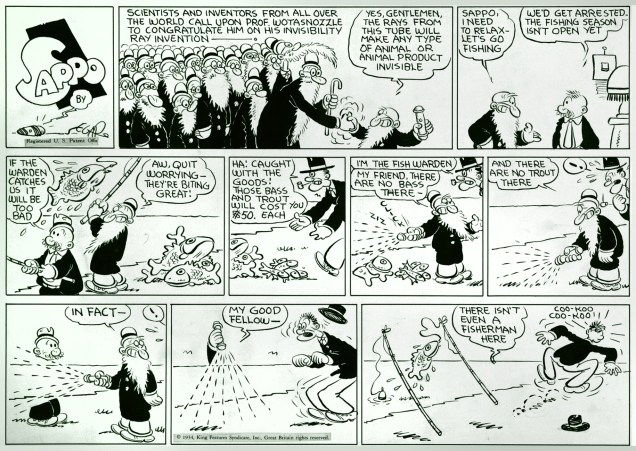
And for dessert, have a chaser of Segar’s even more endearing (in my opinion) companion strip, Sappo, featuring his delightfully bonkers Professor O. G. Wotasnozzle.

SappoA
Sappo appeared as Thimble Theatre / Popeye’s “topper” on Sundays. This out of sight entry appeared on April 8, 1934.

Happy Birthday and bon appétit, Mr. Segar, wherever you are!

– RG


Louie Reads Some Ghastly Comics

In the heart of every grown-up tyrannized, exploited, henpecked cringing little milksop lives an enthusiastic kid. (Or at least I hope so.)

Mild-spoken, well-mannered, and easily intimidated, Louie was created by British cartoonist Harry Hanan (who, it is told, rather resembled his creation). Louie was a perpetual victim of life’s vexations – bullied by a towering wife, mocked by colleagues, abused by neighbours, bitten by pets, let down by uncooperative furniture… Hanan described his character as “the anti-Superman”.

LouieHarryHananComicBook
For once, poor Louie gets to have some fun. March 19th, 1972. Note the ever-so-slight smile on his face in the last panel… sweet.

However, Louie (and his creator) clearly had a sense of humour, if buried under layers of cowardice and mouse-like timidity. That’s what makes the strip so endearing, these occasional flashes of spirit and naughtiness. Hanan confessed to a having a « mischievous streak » in a 1952 interview with Erwin Knoll, admitting that « whenever he saw women with feathered hats he had to suppress the urge to snip the feathers off ».

This pantomime strip, syndicated by Chicago Tribune Syndicate, debuted in 1947 in The People (a London weekly tabloid). H.R. Wishengrad, head of Press Features, decided to export it to the United States and that’s how the strip crossed the ocean. Since it was silent and so needed no translation, it also appeared in more than 100 publications in 23 countries, including Turkey and Japan.

~ ds


Add Vice for Children

« It’s kind of like a spider web, only sweeter, and also it’s more pink »

Today would have been the 91st birthday of the great Jack Mendelsohn (1926-2017), who passed away last January, leaving behind a life well-lived and a sumptuous, if often unsung or anonymous, legacy.

Yet Mendelsohn will be no stranger to those accustomed to reading the small print and staying for the credits crawl: he co-wrote Yellow Submarine (the film, and got credit for it, unlike Donovan for the song), episodes of Laugh-In, The Carol Burnett Show, then decades of soul-killing animation scripting, not to mention, er… Three’s Company.

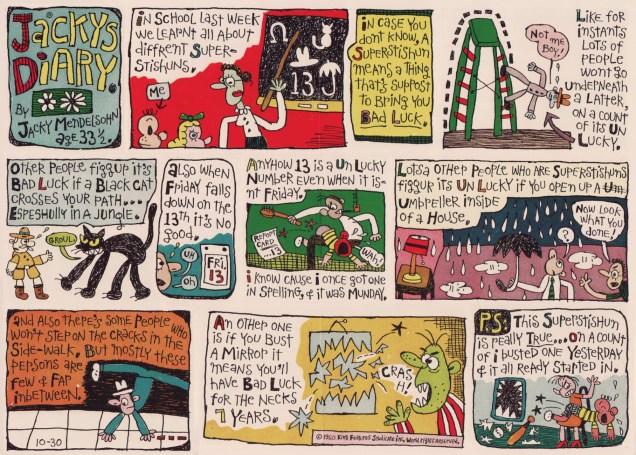
Ah, but today we salute him for his greatest triumph, though probably not the one his fans brought up when they met him*: the short-lived Sunday-only King Features comic strip Jackys Diary** (1959-61). In 1960, Dell Comics (were good comics, so they said) in a fit of mad inspiration, issued a one-shot (Four Color 1091, April-June 1960) drawing from the strip’s run… a flashback to the early practices of the comic book industry, when its product consisted of repackaged comic strip reprints.

JackysProverbsA
Jackys Diary, October 30, 1960.

For a more comprehensive sample, hunt down the comic book, or Dan Nadel’s excellent Art Out of Time (2006, Abrams), which may just turn you on to further neglected but worthy visions. Or get thee hence swiftly to Sam Henderson‘s wonderful blog, The Magic Whistle. Sam saved me a lot of work (and stole my thunder) by graciously providing top-quality scans of the entire Dell comic book.

Then, if you’re good and hooked, you’ll be chuffed to hear that a complete collection of the strip’s run was miraculously assembled and published a few years ago, and finer than even the most fervent optimist could have envisioned. Once again, international treasures Craig Yoe & Clizia Gussoni and their crack production team have delivered a dream.

Produced with utmost attention to detail, as well as the full and clearly enthusiastic coöperation of the auteur himself, this handsome tome boasts, in addition to the full complement of excellently-reproduced strips, a fascinating and richly-illustrated retrospective article by Mendelsohn and a fondly witty foreword and backword by colleagues and accomplices Mort Walker (then 90 1/2) and Mell Lazarus (then 86 1/2). As they say, get yours now!

JackysSuperstitionA
Jackys Diary, August 6, 1961.

*On that very topic, from his interview with John Province, published in Hogan’s Alley no. 10 (2002): « What fans? I have no fans! Why do you think I’m clinging to you? »

**that’s how it was intentionally spelled, for effect. Unlike spelling nowadays…

-RG

Borborygmi phobia

Yes, “borborygmi” is actually a word.
Borborygmi [bawr-buh-rig-mahy]
a rumbling or gurgling sound caused by the movement of gas in the intestines. Did you know you could have a whole conversation in borborygmese? But don’t take my word for it:
PoisChichesClaireBretecher
This page, entitled “Les pois chiches” (Chickpeas), comes from a comics collection called “Tourista”, published in 1984, about, what else? Tourists and their behaviour in foreign climes.

Claire Bretécher is a socio-satirical cartoonist from France, best known for her comics dealing with women and gender-related issues (Les frustrés, Aggripine…) Lots of them have been translated into English. A quick rundown of her career: her work has been published in Spirou and Pilote in 1972, and she co-founded the Franco-Belgian comics magazine “L’écho des savanes” (Echoes of the Savannah) together with Marcel Gotlib and Nikita Mandryka. She also has a pretty good handle on Weird Body Things and how people react to them.

And speaking of odd stomach noises, this pertinent little gem comes to mind:

cds090203
From Cul de Sac, an awesome comic strip (February 3, 2009) by the tragically deceased and much-missed Richard Thompson (1957-2016).

~ ds


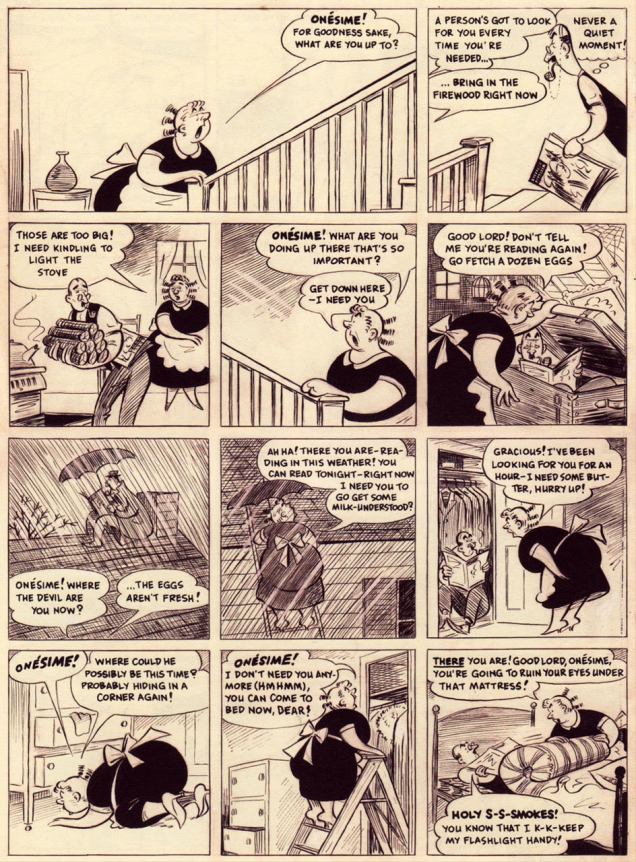
“You’re going to ruin your eyes under that mattress!”

In 1943, Albert Chartier, a French-Canadian cartoonist and illustrator (and commonly accepted as the father of Québec’s “bande dessinée“), was offered the chance of creating his own comic strip for the “Bulletin des agriculteurs” (Farmers’ Bulletin). Thus began Onésime, Chartier’s most popular and enduring œuvre.

Onésime was the perfect strip for the Bulletin’s audience: inspired by life in rural areas of Québec (in particular, picturesque Saint-Jean-de-Matha), it was a charming chronicle of the countryside. It lasted all the way until 2002 (it is said that four generations of Québecois learned to read with Onésime!), and reflected the changes in Quebec’s social landscape, making it a priceless historical document as well an as excellent comic.

AlbertChartierOnesime

This strip (originally published in November 1959) was scanned from Drawn & Quarterly #5 (August 2003). As far as I know, D&Q’s 47 pages of “Albert Chartier – a Retrospective” is the only existing English version of Onésime (the French-to-English translation is credited to Helge Dascher; the redrawn letters, to Dirk Rehm).

While Onésime is Chartier’s best known work, here’s something that’s even harder to come by for your enjoyment – a strip in which Kiki gets carried away. You can meet Kiki in “Une piquante petite brunette” (roughly translated to “a spicy little brunette”), a beautifully done, quite entertaining collection of previously unpublished Chartier strips about a young woman’s adventures (Les 400 coups, 2008).

ALbertChartierKiki.jpg

~ ds

The perils of ice-cream (with fudge sauce)

Gluyas Williams (1888-1982) was an American cartoonist whose work was published in The New Yorker, Life, Collier’s, etc. His charming one-page cartoons show a keen understanding of human nature; sometimes there’s a recurring topic – for instance, “The World At Its Worst” and “Snapshots Of…”*.

So here’s “Snapshots of a woman eating a sundae” (1926) for your enjoyment, but please don’t blame the subsequent weight gain due to ice cream cravings on me.

GluyasWilliamsSundae.jpg

If you want a catalogue of little annoyances, petty vexations and funny paradoxes of life that will make you chuckle in embarrassment of recognition, you can watch some George Carlin sketches… or read some Williams cartoons, a good selection of which is available here: http://www.gluyaswilliams.com/dailies01.htm (No, this type of humour wasn’t born yesterday, and although technology marches on, the basic stuff stays if not the same, then similar.)


*Somehow I’m reminded of Sergio Aragones’ “Who Knows What Evil Lurks in the Hearts of Men? The Shadow Knows” leitmotif).

~ ds

Who Needs Glasses?

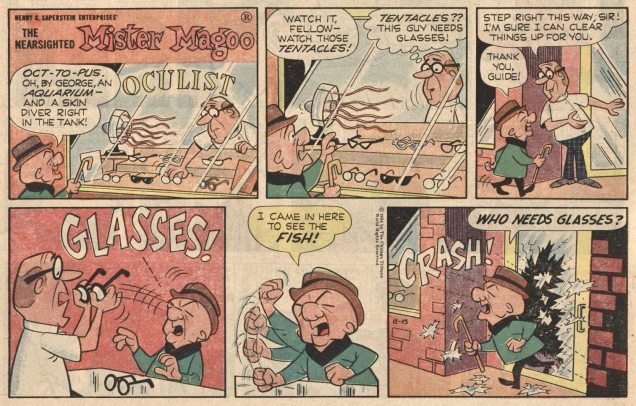
Mr. (Quincy) Magoo was born in 1949 in the United Productions of America (UPA) animation studio. His creation was a collaborative effort – in other words, no-one really knows who came up with the idea, although we can mention Millard Kaufman, who wrote the script for Magoo’s first outing in a cartoon titled “The Ragtime Bear”, director John Hubley, and of course Jim Backus, the actor who voiced Magoo and was encouraged to ad-lib and generally jazz up the dialogue in any way he wanted. He became a comic book character in 1952, and appeared in Dell Comics for a dozen issues or so.

Mr.Magoo.jpg

In case you’re not already familiar with him, Mr. Magoo is wealthy, short, and nearly (and catastrophically) blind, which he stubbornly refuses to acknowledge. Needless to say, Magoo’s immoderate myopia leads to many madcap adventures and increasingly improbable situations; as far as I am concerned, the zanier, the better!

In 1964, the Chicago Tribune syndicated a Mister Magoo comic strip that was drawn by Pete Alvarado and written by Don Sheppard. Here’s one of them, a Sunday strip in (glorious, right?) colour, 1964.

 
~ ds