¡Feliz cumpleaños, Señor Arriola!

We’d like to wish a happy birthday to Mexican cartoonist and animator Gustavo “Gus” Arriola, creator of beautiful, experimental, charming (am I running out of superlatives yet?) comic strip Gordo, published for an impressive some-forty-odd years (between 1941 and 1985, to be exact). Arriola was born on July 17th, 1917 and died in 2008, when he was 90 years old.

Gordo was designed to be a Mexican version of Li’l Abner, but Arriola quickly realized that his strip was relying on stereotypes of Mexican culture as seen through American eyes. He strove to make it truer to his mother culture, making Gordo (the main character – his real name being Perfecto Salazar Lopez, with his nickname more or less translating to « Fatso ») “an accidental ambassador” for Mexican mores.
Maker:S,Date:2017-8-29,Ver:6,Lens:Kan03,Act:Lar02,E-Y

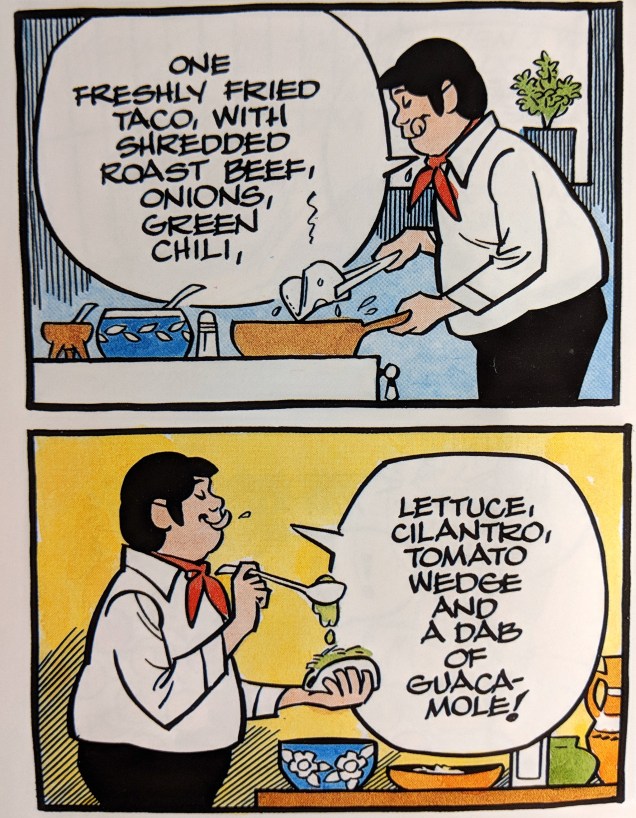
The strip featured a lot of animals, and its plotlines often pivoted around concerns about the environment. It also regularly included recipes. For instance, Gordo’s beans and cheese recipe from a strip in 1948 got the comic strip into 60 extra newspapers. And, significantly, Gordo also had gorgeous, inventive art!
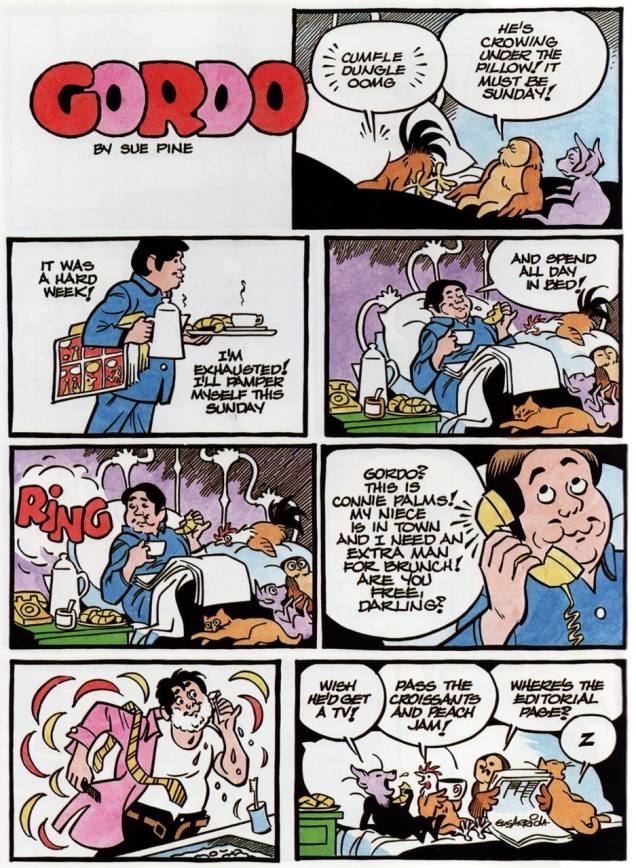
Gordo'sCritters-GusArriola
This sweet strip was scanned from a collection of Gus Arriola strips, “Gordo’s Critters: The Collected Cartoons”, published in 1989 and sadly out of print. Gus Arriola had a wonderful drawing style and a bouncy imagination, but it’s his sense of humour I like best: gently philosophical, hilarious but always kind to its characters.
GusArriola-Gordo-Jazz
Sunday strip from January 25th, 1959.

Aside from being a music aficionado, Gus Arriola was also a great connaisseur of art. R.C. Harvey, the editor/writer of “Accidental Ambassador Gordo: The Comics Strip Art of Gus Arriola” mentions Arriola’s love for jazz: “[he] finally [settled] in Carmel, where he met his life-long friend and fellow cartoonist, Eldon Dedini, and they both became fixtures at Doc’s Lab, where Hank Ketcham and other habitués of the place met weekly to admire jazz and tell stories.” Read the rest of his lovely article here.
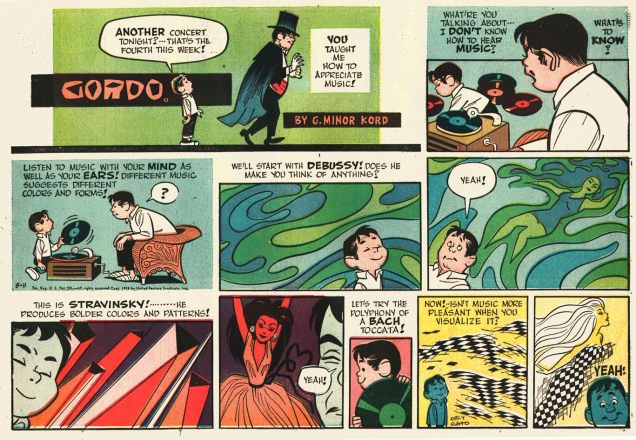
GusArriola-Gordo-1958
Sunday from June 11th, 1958.

In 1999, Arriola was interviewed by John Province for Hogan’s Alley no. 6 – it’s well worth a read if you’ve got some spare quality time! You can read the interview here.

GusArriola-1958-butterfly
Sunday from 1958.

Want to see more? Head over to the Fabulous Fifites blog, where many scans of Sundays strips are available for perusal. (Ger Apeldoorn, the blog’s author, did a monumental job of scanning newspaper strips for our enjoyment.)

GusArriola

~ ds
Richard Thompson’s Far-from-poor Almanac

Richard Thompson*, cartoonist extraordinaire and an exceptionally kind and talented man, tragically passed away in 2016 – and I don’t like to throw the word “tragically” about without good cause. His was a rare combination of wit, imagination, and style – think of how often one comes across an excellent writer whose material suffers from his poor drawing ability, or an artist whose beautiful art is like en empty shell, with nary a story nor convincing characterization in sight. Thompson had ideas, tons of ideas, and he was able to translate them into visuals with a dynamic pen-line and elegant watercolours.

His first truly successful strip was Richard’s Poor Almanac, which ran in the Washington Post for seven years or so from 1997. These little gems have been collected in “Richard’s Poor Almanac: 12 Months of Misinformation in Handy Cartoon Form” in 2004, but sadly this wonderful volume is quite out of print. You can get your fix from GoComics, however, as they’re re-running the whole thing here.

*not the musician.

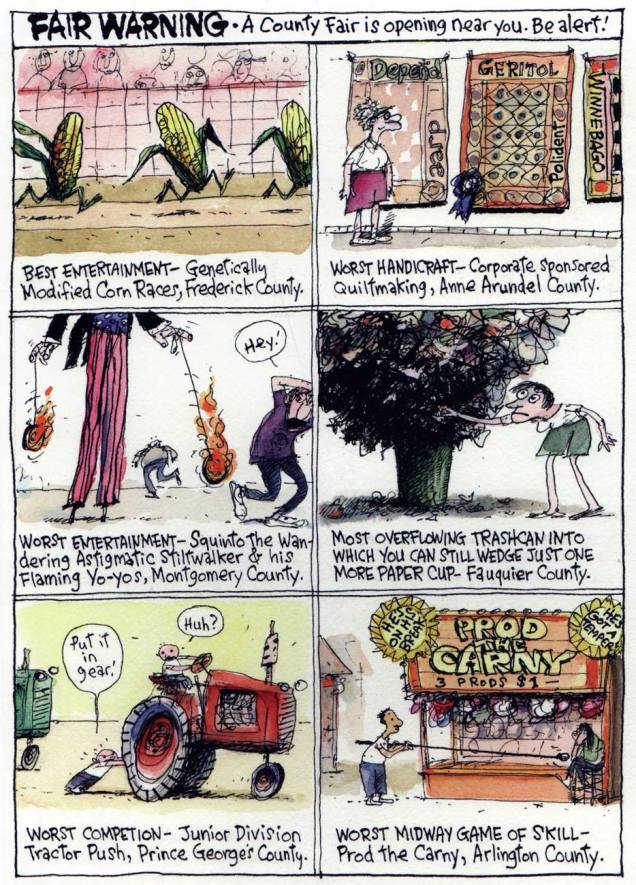
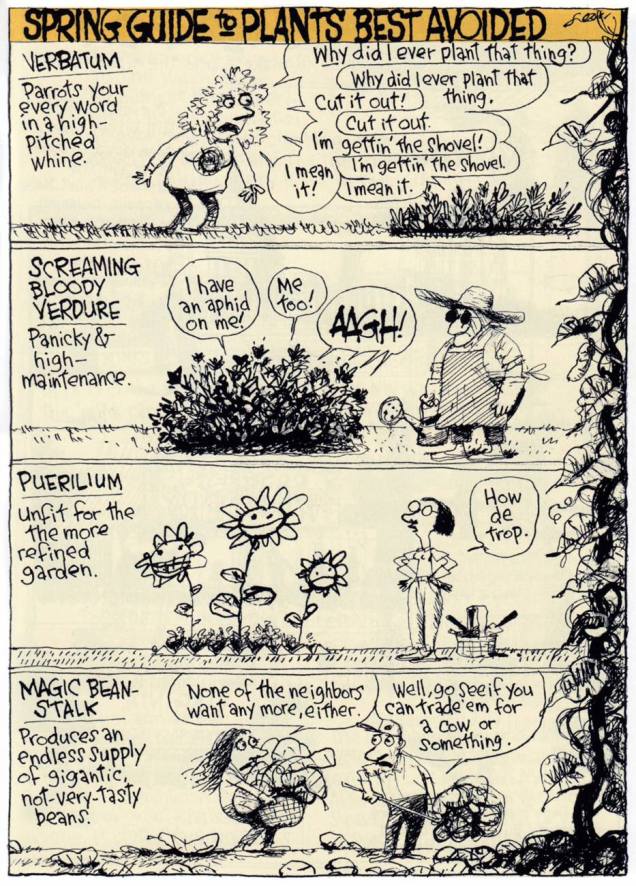
Here’s a few strips from Richard’s Poor Almanac that always make me chuckle, no matter how many times I see them.

RichardThompson-HotNHumid

The sprawling, madcap Almanac presented “misinformation in handy cartoon form” on subjects ranging from traditional almanac fodder like weather phenomena and local fauna to entertainment and political news. “The ideal cartoon for the Almanac was made up off the top of my head with no research, with only its own comic logic holding it together,” noted the artist in The Art of Richard Thompson. (Andrew Farago for the Comics Journal.)

RichardThompson-CarTrip

RichardThompson-CountyFair

RichardThompson-SpringGuide
It may not be spring anymore, but this is still perfectly relevant. Just trade “magic bean-stalk” for “zucchini”.

You may have heard about the Almanac thanks to the fame of “Make the Pie Higher”.

«Upon learning that George W. Bush had opted not to invite an official poet to his inauguration ceremony in January 2001, Thompson composed his own poem from Bush malapropisms, and assembled them into a free-form verse entitled “Make the Pie Higher”. The cartoon was widely circulated online over the next year, was set to music by multiple composers, and earned its own entry on the fact-checking website Snopes.com. » (source)

RichardThompson-makethepiehigher

~ ds
The Observant Ambulations of Julius Knipl, Real Estate Photographer

« This peephole was smeared when I moved in »

CheapNoveltiesCoverA
« A RAW One-Shot » (1991, Penguin Books)

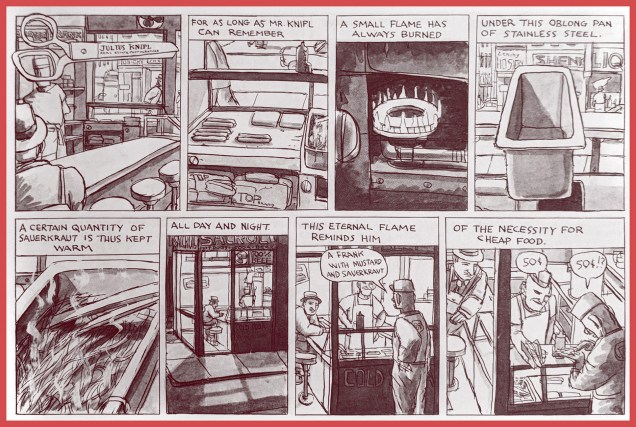
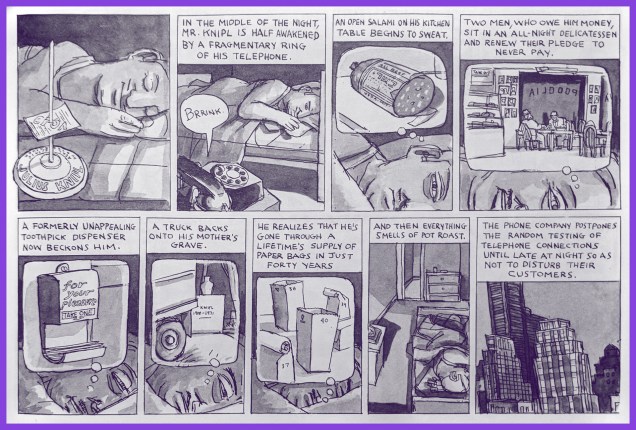
Originally appearing in alternative weekly The New York Press in the late 1980s, Ben Katchor’s Julius Knipl, Real Estate Photographer belongs to that most exotic breed of comic strips, those that suddenly awake the mind to the medium’s grand possibilities. Said experience can be abrupt and dizzying, but in this particular instance, it’s soothing and bittersweet, full of rightful yearning for things that possibly were or surely should have been, glimpsed in a daydream by the low flame of the fantastic mundane.

Mr. Katchor (born November 19, 1951 in Brooklyn, New York) is blessed with a vision of startling depth and singularity. By its nature and scope, it’s not everyone’s thing, but the rest of us likely wind up as lifelong admirers, and isn’t that just the ideal audience?

Much has been written elsewhere, often brilliantly, about Mr. Katchor and his œuvre; it’s work of a calibre to inspire theses, dissertations and papers, so I’ll mostly stick to presenting some samples. The passionate plaudits these strips have inspired tend to obscure the fact that most people just haven’t had the pleasure, or at least the opportunity, of encountering such rich material.

These vignettes were collected in 1991 as Cheap Novelties: The Pleasures of Urban Decay. Oddly enough, it was the only one of Katchor’s books to go out of print… the situation was remedied in 2016 by Montréal’s Drawn & Quarterly, who brought it back in a lovely hardcover edition.

KatchorCheapNovelties031A
While on vacation, my accountant fell in love with a hot sauce manufactured on the small Caribbean island of Dominica. He’s since devoted considerable energy to renewing his stock of the stuff, which has involved much international horse trading.
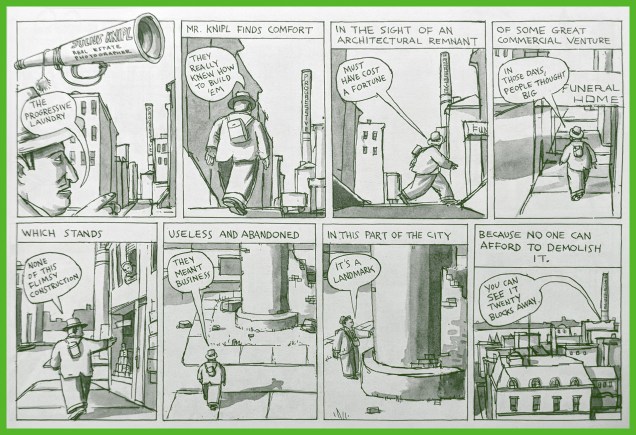
KatchorCheapNovelties043A
Montréal has its share of architectural remnants of bygone commercial enterprise; arguably, the most famous is the “Giant Milk Bottle“, but no, it isn’t full of milk.
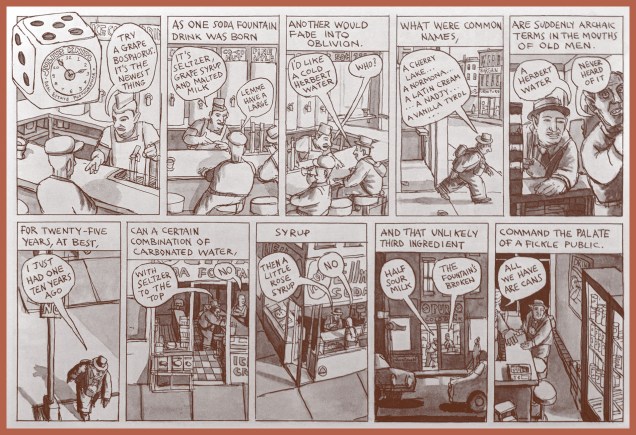
KatchorCheapNovelties051A
This melancholy vignette ties in quite nicely with a recent piece from Atlas Obscura noting the fading lingo and diminishing rôle of the soda jerks of New York City. Read it over a mug of murk with a choker hole.

KatchorCheapNovelties063AKatchorCheapNovelties073AKatchorCheapNovelties079A

From the collection’s back cover blurb: « In a vast and shadowy city of old skyscrapers, neglected warehouses, juice stands, and coffee shops, Julius Knipl, a rumpled, middle-aged man in a suit and hat, wanders the streets photographing buildings and pondering the details: the scent of the past that seeps into the present; the ghosts of other values and culture embedded in the urban landscape; people and behaviors almost gone that linger on. He sees what others overlook, a Borscht-belt Buster Keaton. »

Ben-Katchor
The esteemed Mr. Katchor.

-RG

Tentacle Tuesday: Popeye, the Sailor Man

Since Popeye’s a sailor, one would expect him to run into a lot of octopuses during his adventures. It doesn’t happen nearly as often as one would think, actually, but there’s still enough encounters for a decent-sized tentacle journey. Here we go!

PopeyeDangerAhoyA
Popeye: Danger, Ahoy! Big Little Book no. 5768 (Whitman, 1969). Does anybody know who painted this cover?

TentacleTuesdayIcon

Popeye-Roger-Langridge
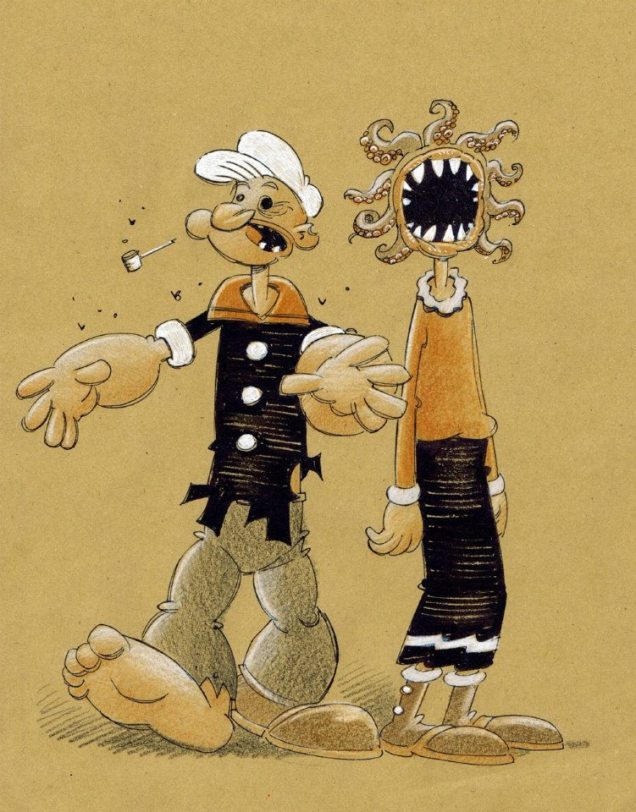
« Zombie Popeye » (and, more importantly for our current topic of discussion, Chtulhu-Olive!) by the talented Roger Langridge. He posted this so-called sketch (how detailed can a drawing be before it stops being a sketch?) on his website on September 2014… and the original is still for sale, I believe! Go here. This isn’t the first time Langridge tentacles slither into a blog post – for instance, go visit « Tentacle Tuesday: pirates and treasure, oh my».

TentacleTuesdayIcon

PopeyeClassicComics48
A variant cover for Popeye Classics no. 48, July 2016. These Craig Yoe reprints of Bud Sagendorf’s Popeye are great fun, by the way, and I highly recommend them for the proverbial children-at-heart.

TentacleTuesdayIcon

Sunday-1958Popeye-Octopus
Original art for a Popeye Sunday, published on July 9th, 1958. The art is by Bela (Bill) Zaboly, who worked on Thimble Theater starting from 1939 and until Bud Sagendorf took over in 1959.

TentacleTuesdayIcon

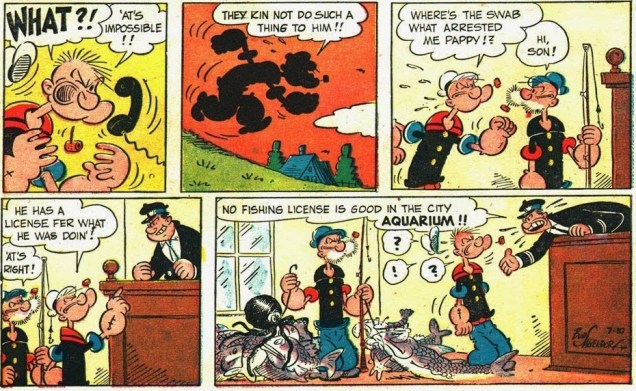
Popeye-1960-07-10
A chunk of story in which an octopus makes a very minor appearance… from a strip by Bug Sagendorf published on October 7th, 1960.

TentacleTuesdayIcon

Popeye19-JanMar1952
A panel from “Hitchhikers!” by Bug Sagendorf, published in Popeye Comics no. 19 (January-March 1952). Read the full zany story here. (Technically, this is a Sherm story, but let’s not split hairs.) I’m not surprised the octopus looks like a spy, wearing a hairpiece like that. Or is it just a nest for the birdies?

– ds

Tentacle Tuesday: the Many-Armed Comic Strip

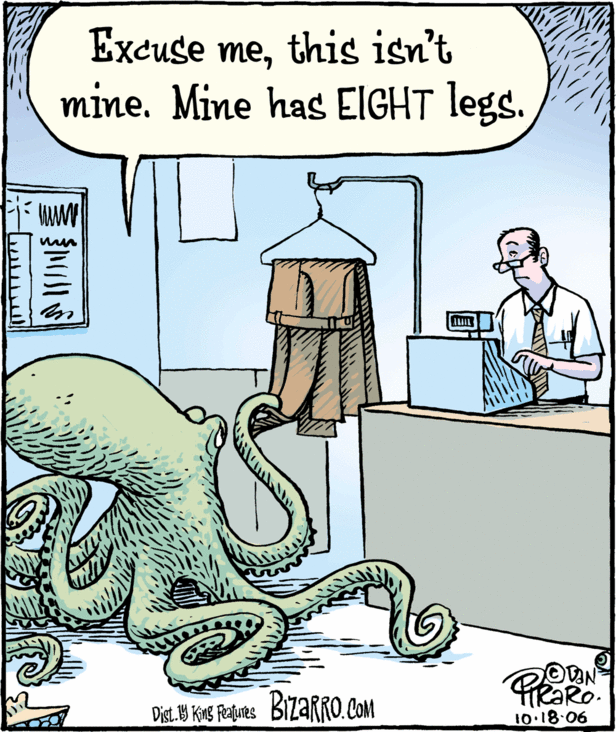
Today’s Tentacle Tuesday is home to that conventional, oft-seen beast, the comic strip. Without getting into the complexities of defining this term, I use “comic strip” here to refer specifically to the (syndicated) newspaper comic strip, although by now the newer ones may have never seen print in a newspaper, only online.

BizarroOc18-2006
There’s one that doesn’t need an introduction. Go visit his website, though!

Most of these are available for perusal on one of the comics-clustering websites, such as gocomics.com, or sometimes directly on a strip’s own website (in which case it also becomes a webcomic strip, I guess). I’ve provided the links in the description.

Overboard_By_Chip_Dunham_July_3__2010_201709271341
Overboard by Chip Dunham, July 3rd, 2010. Overboard’s been around for almost 30 years.
Brevity_By_Dan_Thompson_Mar_27__2011_201709271339
Brevity, March 27th, 2011. This strip was created by by Guy Endore-Kaiser and Rodd Perry, and for the first couple of years (it’s been around since 2005), it was plotted and drawn by them. Dan Thompson took over at some point… around 2012 or something like it (I can’t find any hard and fast information online). The strip has a home here, but frankly it’s not really worth visiting (terrible art, dumb jokes).
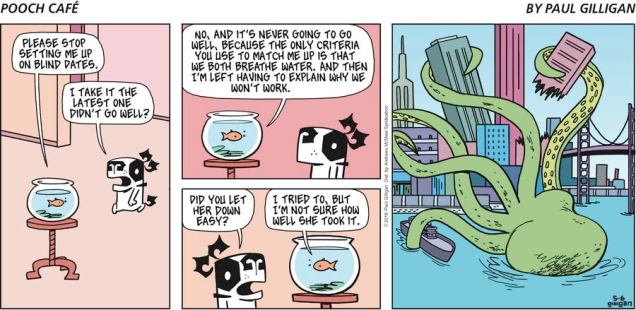
Pooch Café
Once again, Poncho gets his fishy friend into trouble. Pooch Café, May 6th, 2018. I hate Poncho and think his owners should have kicked him out a long time ago, but there’s enough characters and surreal situations to tolerate his presence in this fun strip.
Sherman'sLagoonApril20-2016
Sherman’s Lagoon by Jim Toomey, 20th April 2016, also around for almost thirty years (it made its debut in 1991).
Calvin_and_Hobbes_By_Bill_Watterson_Jan_29__1986_201709271340
Not to forget our classics! One of the nice things about Calvin and Hobbes is that it was never ghost-written – when Bill Watterson quit it in 1995, that was it. However, you can catch re-runs in many places, for instance here.
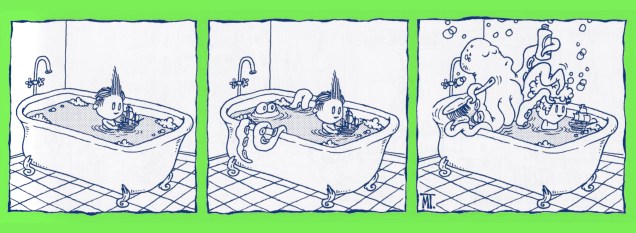
LioOctoBath
Liō (not forgetting the accent!) by Mark Tatulli and distributed by the Universal Press Syndicate since 2006. This is the first appearance of Ishmael, Liō’s cephalopod best friend. Tatulli says that he at first wanted to make Ishmael into a mother figure for motherless Liō, but that’s not the way things worked out.
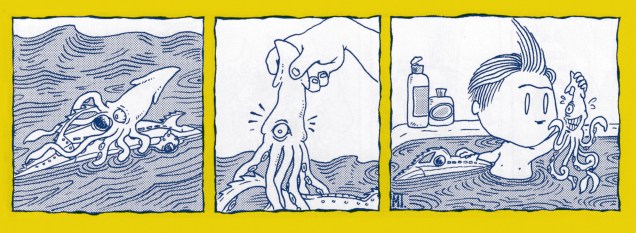
LioSquidBath
Liō routinely encounters tentacles, so it would be a long list indeed, but here’s another favourite. Both strips were plucked from the collection Liō’s Astonishing Tales: From the Haunted Crypt of Unknown Horrors, 2009.

We started on a Bizarro note, so let’s wrap things up with another.

Bizarro-04-06-14-WEB

~ ds
Growing Old Gracelessly With Broom-Hilda

« Modern technology has tripled the life expectancy of the professional insulter »

It was forty-eight years ago today, which is to say Thursday, April the 20th, 1970, when a certain short, dumpy, cheap-cigar-chomping 1500-year-old green witch first crash-landed into the funny pages, though we wouldn’t know she was green until that Sunday.

BroomHildaCastA
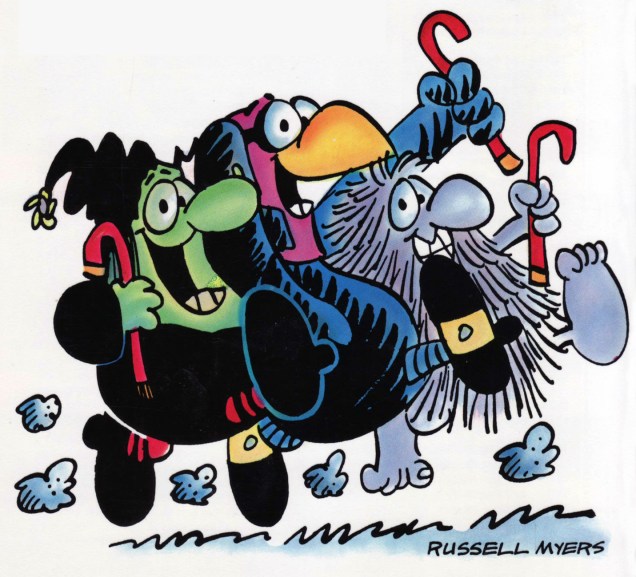
The cast’s principal players: Broom-Hilda, Gaylord Buzzard and Irwin Troll. Colour by Barbara Marker.

Russell Myers‘ (born October 9, 1938 in Pittsburg, Kansas, and still with us) Broom-Hilda has been easy to take for granted… it’s never been a trendy strip, but it’s always had its adherents, a somewhat enlightened, or at least less dim than average, passel of loonies, to which I proudly belong.

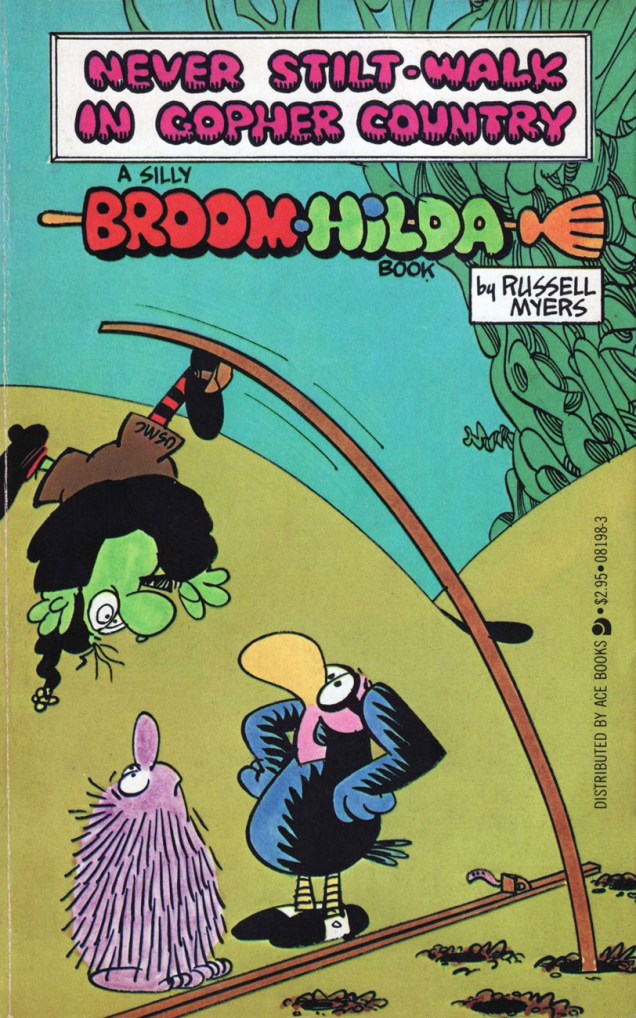
BroomHildaGopherA
One of my favourite B-H collections… an oversize one-shot issued in 1978. And don’t let the subtitle throw you: *all* Broom-Hilda books are profoundly silly.
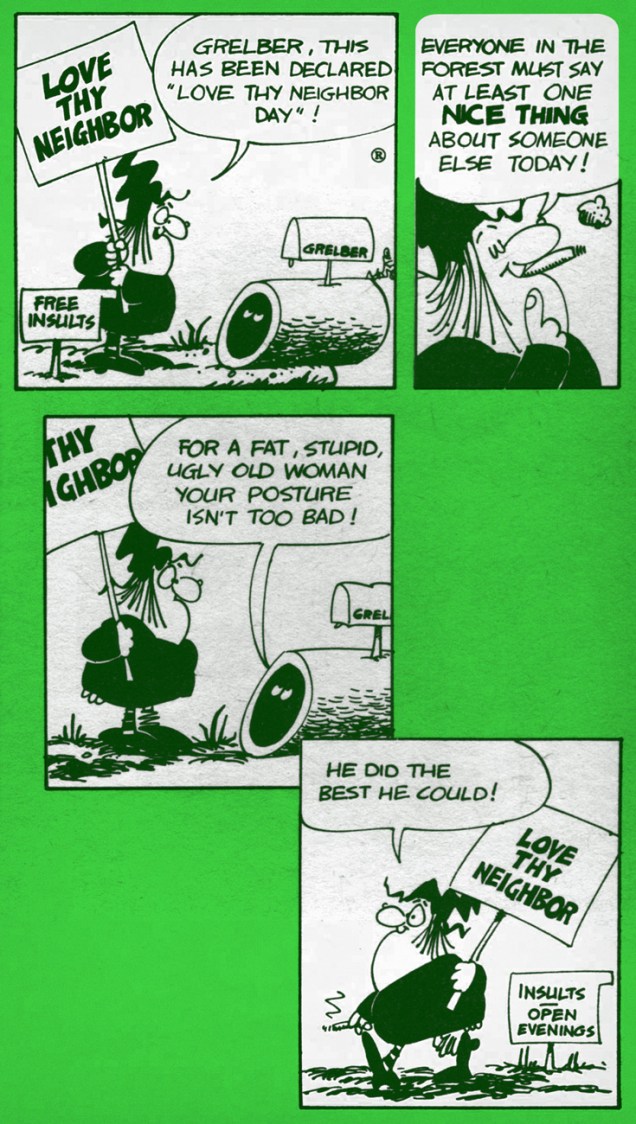
BroomHildaNeighborA
An undated strip from 1970.
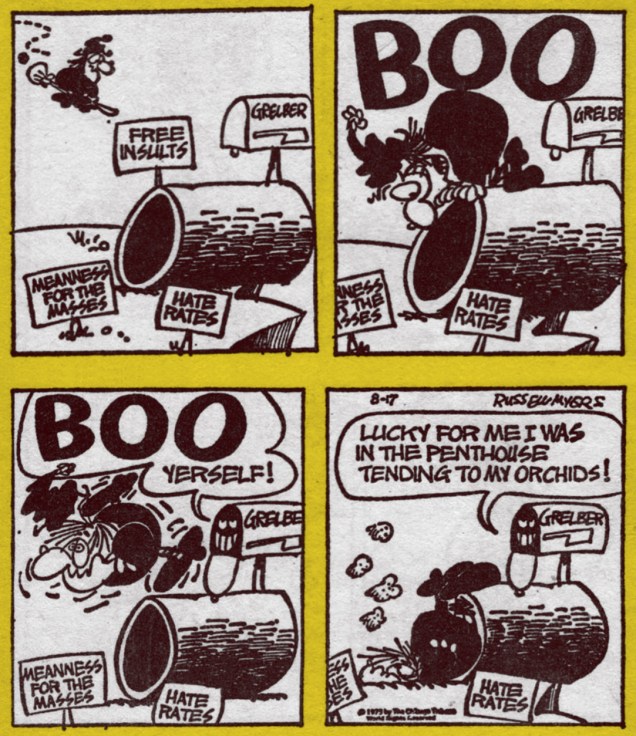
BroomHildaOrchidsA
Grelber always gets the last laugh. August 17, 1973. Bet you never knew that Grelber shared a genteel hobby with Nero Wolfe.
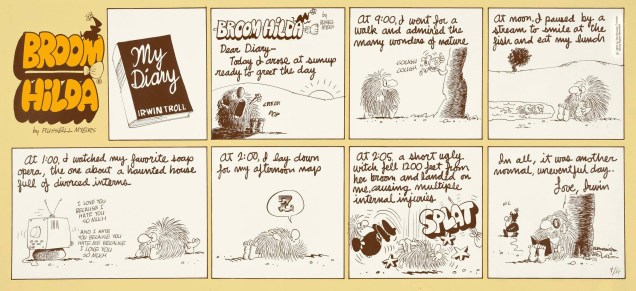
IrwinTrollDiary
This Sunday strip comes from just about a year into the run, April 4, 1971, back when Broomie still was allowed to enjoy all of her little hobbies. A day in the life of the resilient Irwin Troll, Mother Nature’s Personal Friend.
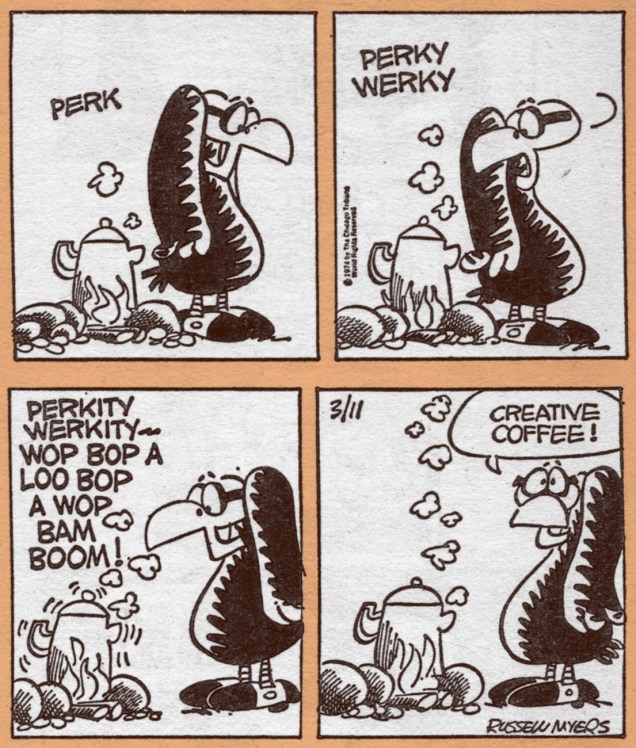
BroomHildaCoffeeA
Low-key and surreal, the March 11, 1974 strip. Pour me a cup of that jaunty java!
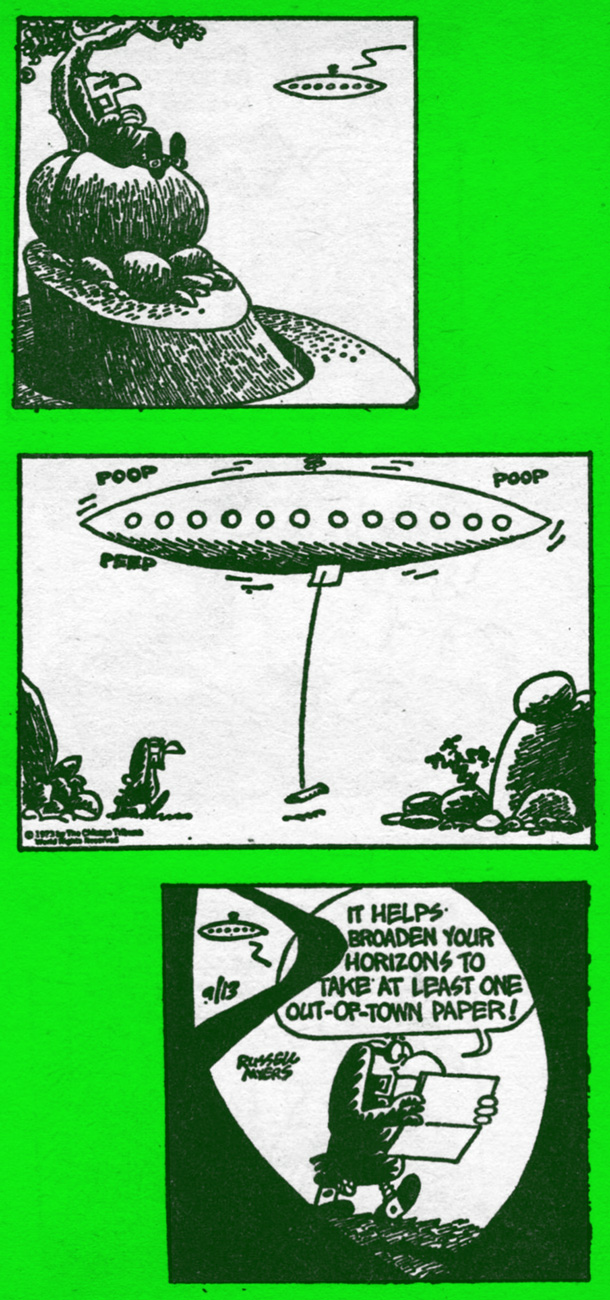
BroomHildaNewspaperA
Wise words from the strip’s resident intellectual, Gaylord Buzzard (Sept. 13, 1973)

Over the long years, the changing times and the powers-that-be had Broomie clean up her act, stripping her of her beloved vices one after the other. Well, she’s held on to her gluttony and lust, but no longer indulges her passion for third-rate tobacco and beer. Still, since there was so much more in the strip’s DNA, the eschewing of Broomie’s low-down habits was not fatal.

RussellMyersA
The author as he appeared in 1985’s Broom-Hilda Book One (and only), in the “Blackthorne’s Comic-Strip Preserves” series. « To retain this standard of madness requires a good deal of sane and sensible methods. The gags don’t just occur to Russell; he creates them. Like all humorists, he observes where others only look. Others see a man going through a revolving door, Russell sees a man stuck in a revolving door. Perverse, perhaps, but perversity is the trigger of humor. Why else do we laugh at a man stepping into a manhole? »

But how I miss that nasty no-goodnik Grebler!

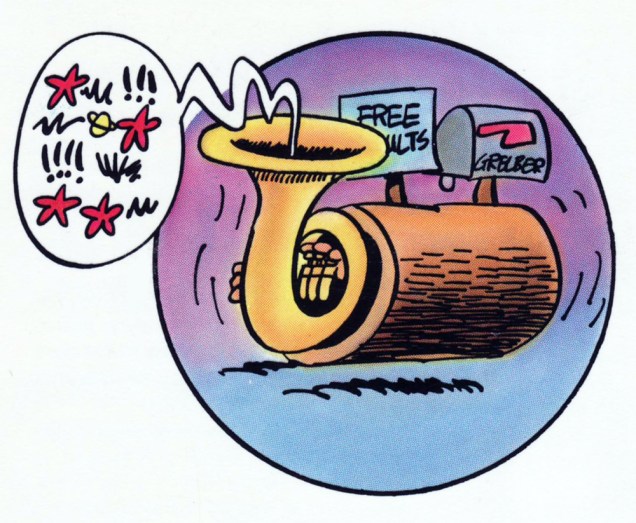
Grelber
Music has its charms, even Grelber music.

Keep up with the current state of Broom-Hilda: https://www.seattlepi.com/comics-and-games/fun/Broom_Hilda/ 

-RG

Jules Feiffer’s Triumph

It’s Jules Feiffer’s birthday! Break out the bubbly (not the cheap stuff)!*

Born on January 26th, 1929, today he turns a respectable 89. He’s still releasing new books, so let’s wish him many more happy and productive years.

If a book with no pictures has no use (according to Lewis Carroll’s Alice), I figure a blog post with no pictures is equally devoid of purpose, so here’s a few fun Feiffer bagatelles.

FeifferABC

Explainers: The Complete Village Voice Strips” was supposed to collect everything in four handy volumes, but unfortunately so far there’s only been one (published in 2008) and no mention of others to come. Still, it’s well worth seeking out. Check out an excellent review of it here, tempting you to it with this pithy quote:

« Explainers is a ‘dipping book’. It’s not something to storm your way through but something to return to over and again. Feiffer’s thoughts and language, his observations and questions are fearsomely eternal. Best of all, Feiffer’s expressive drawing is a masterclass in style and economy all by itself. »

In his earlier years, Feiffer’s excitable, skittish pen was a little more subdued. Case in point: Clifford, Feiffer’s first published strip.

CliffordJulesFeiffer
Kewpies #1, spring 1949.

CliffordJulesFeiffer2

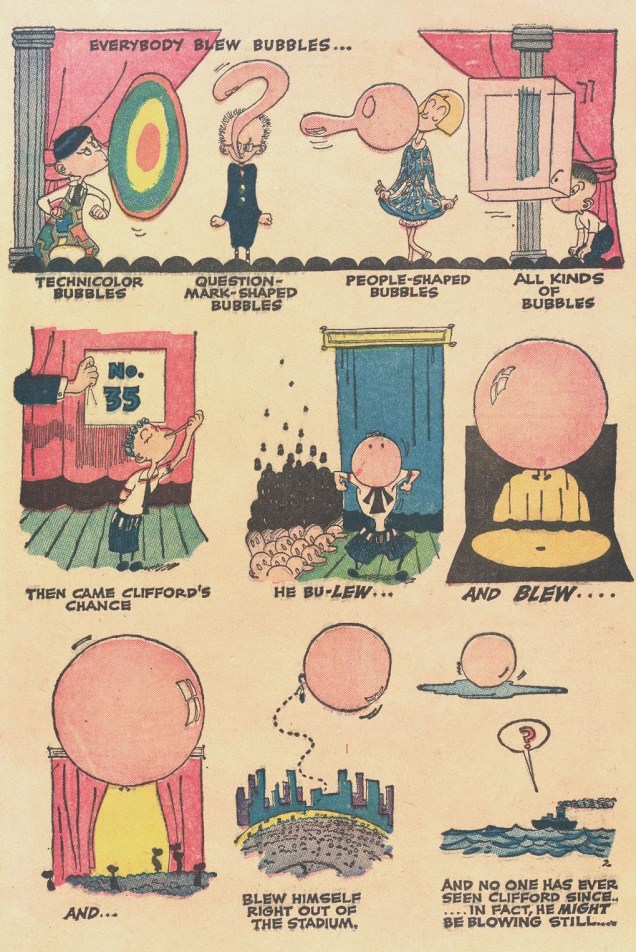
Clifford first appeared in Kewpies #1 (spring 1949), published by Will Eisner, when Feiffer was but 20. In « Out of Line : the Art of Jules Feiffer » (2015), Martha Fay explains that Feiffer had the style of Walt Kelly’s Pogo in mind when he created Clifford.

FeifferCliffordDarkA
Robert Boyd writes: « From 1949 to 1951, Jules Feiffer drew Clifford, which appeared in Will Eisner’s The Spirit Section, an eight-page comic book insert syndicated to newspapers. » This particular strip first saw print in the January 14, 1951 section.
FeifferBoyGirl
Feiffer’s lively cover to his 1961 strip collection Boy, Girl, Boy, Girl (Random House)

Nowadays, Feiffer is writing and illustrating children’s books. In an interview with Gary Groth, he explained that « They represent the gentler, sweeter world that, as we grow older, we go about corrupting first chance we get. No, that’s too cynical. Second and third chance we get. » They may be intended for children, but they are, for the most part, every bit as clever and multi-layered as the Feiffer-for-adults.

JulesFeifferBarrelofLaughs
1995, Harper Collins.

What kind of plot would a Feiffer-book-for-children have, you ask?

« Prince Roger sets out eagerly on a quest and finds a few adventures, a lot of friends, a damsel or two in distress (not!) and himself, in the end. A ‘carrier of joy’ whose mere presence causes everyone to laugh uncontrollably, Roger finds cruelty and kindness equally amusing, and expects his quest to be a lark. It’s anything but: As Roger passes through the Forever Forest, nearly starves at the Dastardly Divide, sees people at their worst in the Valley of Vengeance, and temporarily despairs in the Mountains of Malice, he sobers up, learns to care for others, becomes an expert peacemaker, does Good Deeds, and falls in love with Lady Sadie, who says what she thinks as she repeatedly saves his bacon. »

Read an excellent (though 10 year-old) article from New York Times about Feiffer here.

~ ds / RG
*A triumphant return to the home town
Treated with love and respect
A special school assembly
Before they would have broken my neck
My favourite colour
An E-type Jag
Roll out the red carpet
A glass of champagne – Not the cheap stuff!

(Black Box Recorder, « Being Number One »)

“He sure is my heap hep dream beam!”* In praise of Bob Lubbers (1922-2017)

Mr. Lubbers (pronounced LEW-bers) , born January 10, 1922, left us last summer at the venerable age of ninety-five. As it happens, he also left us some fine, fine artwork.

My initial encounter with Bob Lubbers‘ work came in 1978, when he provided a handful of covers and a couple of issues to Marvel’s Human Fly, a book about masked Canadian stuntman Rick Rojatt, whose real-life, non-funnybook story is a gripping read**. Anyway, the series was usually pencilled either by Lee Elias*** or by the mighty Frank Robbins; by the time Lubbers came along, Robbins had rightly had his fill, given the comics industry the one-finger salute and decamped to México to retire and paint in peace. Wise man.

HumanFly16A
Lubbers’ fourth and final The Human Fly cover (no. 16, Dec. 1978, Marvel). Inks by Bob McLeod. Inside, “Niagara Nightmare!” is written by Bill Mantlo, with art by Lubbers and Ricardo Villamonte.

I then became aware of Mr. Lubbers as one of the Golden Age’s primo ‘good girl’ cover artists, with Fiction House, no less. That’s what I’ll chiefly focus on here. Can you honestly blame me? Unlike some of his peers (hello, Bill Ward), he wasn’t just good at, and interested in, the saucy depiction of lightly-clad sirens: he could draw anything with finesse and brio.

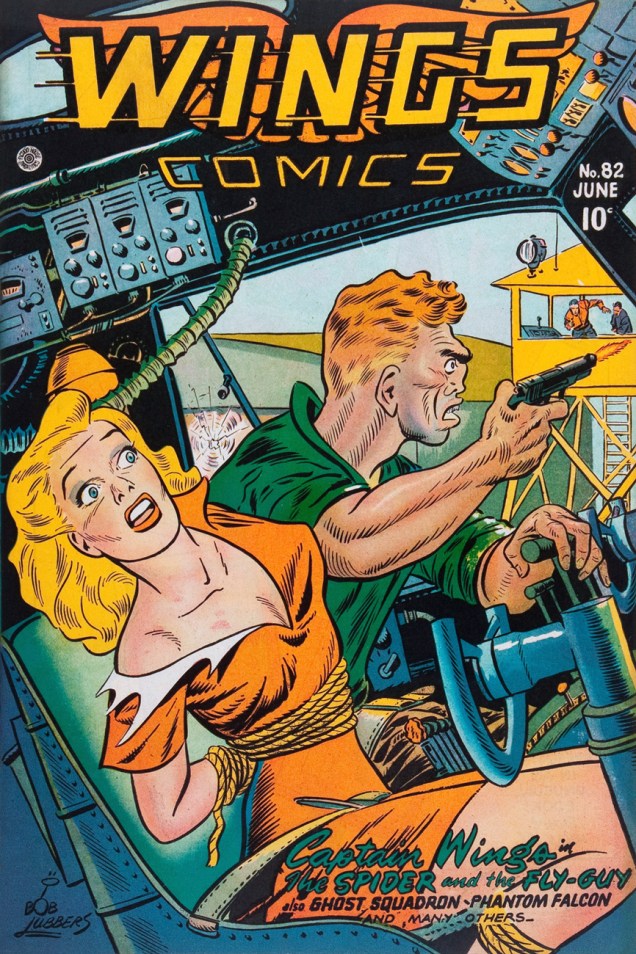
Wings82A
Mouth-breathing, slope-browed… I guess he’s not the hero in this one. Wings Comics no. 82 (June 1947, Fiction House.)
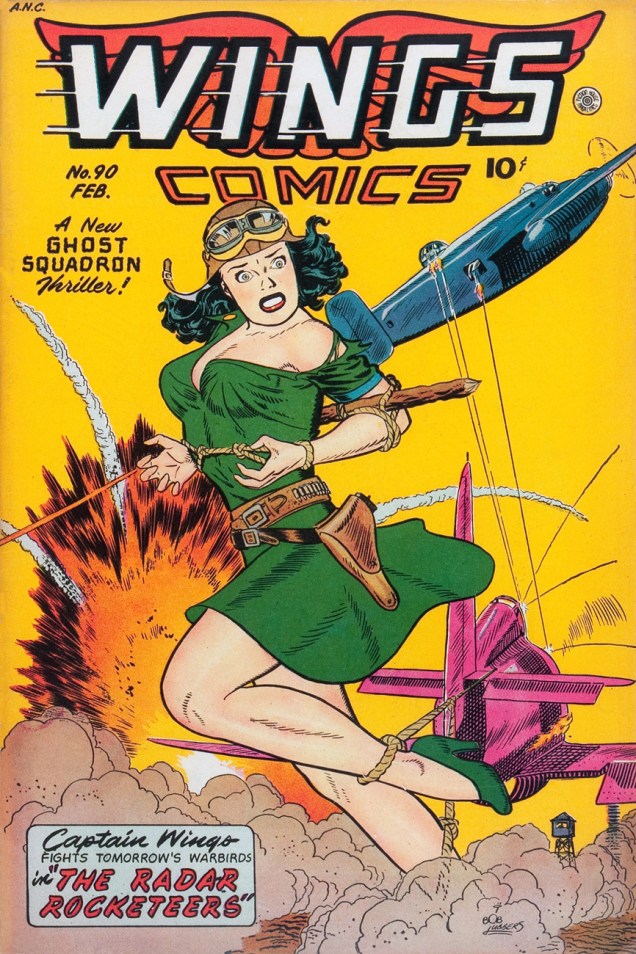
Wings90A
Arguably the most (in)famous of Lubbers’ Wings covers. “Classic bondage and headlights cover!”, cry the ancient fanboys. Wings Comics no. 90 (Feb. 1948, Fiction House.)
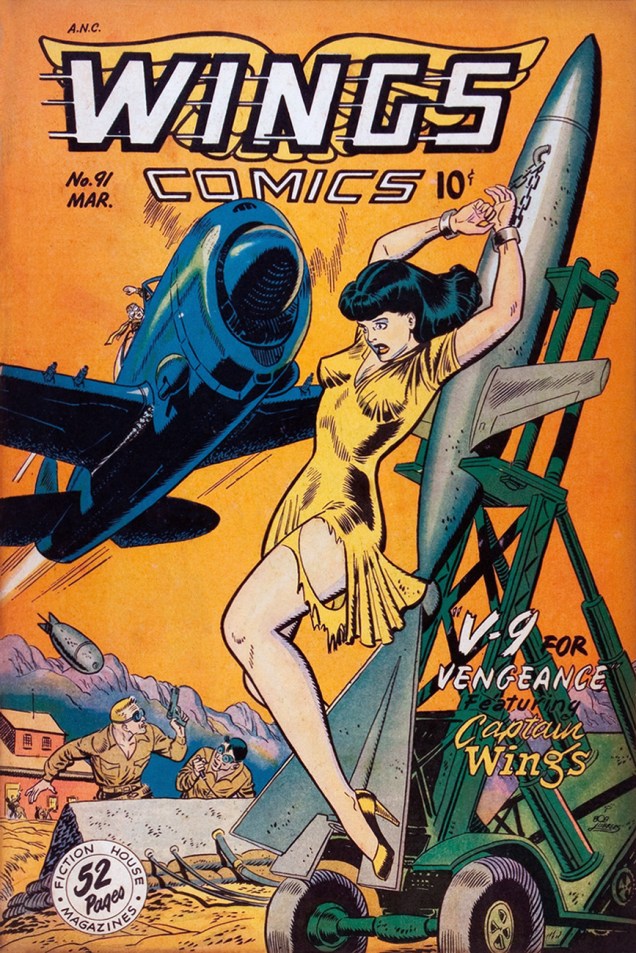
Wings91A
If our man of the hour had rescue in mind for the imperilled damsel, dropping a payload (you heard me!) a hundred feet away from her is likely to… make the situation a bit messy. Wings Comics no. 91 (March 1948, Fiction House.)
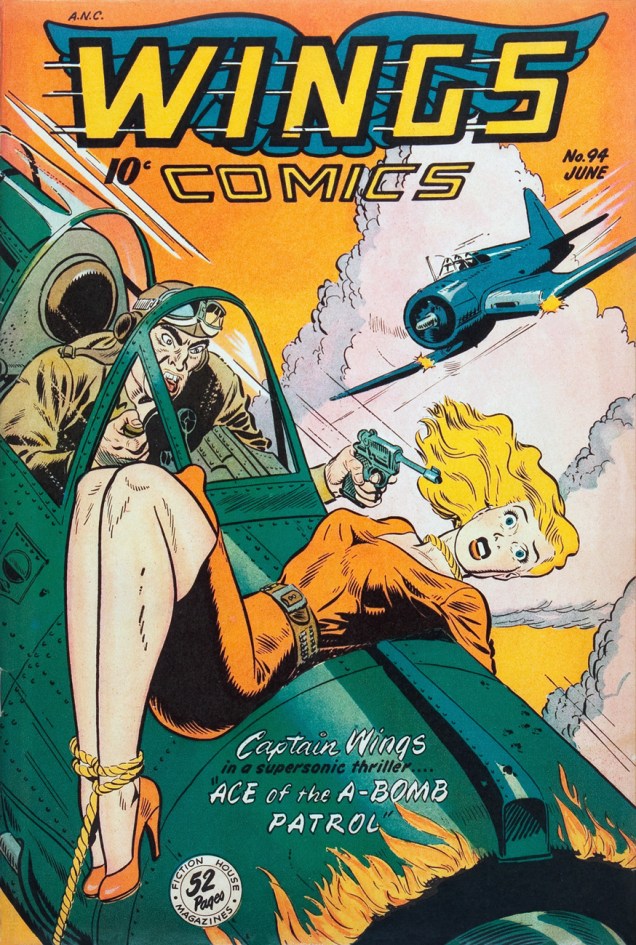
Wings94A
« Seriously? The engine is on fire, we’re being strafed, I’m hogtied and helpless, and he’s still going to threaten me with a gun? » Wings Comics no. 94 (June 1948, Fiction House.)
Wings98A
The life of a crocodile dentist isn’t an easy one, but the satisfaction of a job well done is its own reward. Wings Comics no. 98 (Oct. 1948, Fiction House.)
Wings100A
Here comes the mother of all rope burns, sister. You’re supposed to grab the loop! Wings Comics no. 100 (Dec. 1948, Fiction House.)
AuthenticPolice5A
The exception to the Fiction House Wings set: Authentic Police Cases no. 5 (Oct. 1948, St. John.) The babes never could resist a bad boy.

Yet farther along, I would learn of his large and distinguished body of comic strip work: Long Sam, Secret Agent X-9, Tarzan, The Saint, Lil’ Abner, and best of all, his most personal work, Robin Malone (1967-70). On the latter, I can’t praise enough Tom Heintjes‘ definitive article (Hogan’s Alley no. 19, 2014), here’s a version of it: www.hoganmag.com/blog/the-life-and-death-of-robin-bob-lubbers-robin-malone

… and don’t forget to scroll down, down, down so you can sample (though it’s never enough!) the article’s lavish bounty Robin Malone Sunday strips.

*From the Captain Wings adventure « The Spider and the Fly-Guy » (Wings Comics no. 82) Read it right here (or pick from a generous selection of Wings Comics issues at Comicbookplus.com)

**speaking of which, check out this fine piece about The Human Fly’s rocket bike and the stunt that ended his career: http://kymichaelson.us/human-fly. You have to admit that jumping over 27 buses is a tad ambitious… and he was originally going to try for 36!

***likely picked for the job due to his fine work on another masked stuntperson character, Harvey’s The Black Cat.

– RG

Hey, Easy With the Jackhammer!

I understand that this image has to do with the tradition of greeting the new year by banging on pots and pans and generally making a racket, but I presume that both sailor-garbed primate and pneumatic drill were optional, particularly in times of scarcity.

FamousFunnies138A

Art by Stephen Douglas, from Famous Funnies no. 138 (January, 1946). FF number one (July, 1934) was likely the second comic book issued, and the first one *sold*. It was published by Eastern Color / Dell Comics.

Read the issue here: http://comicbookplus.com/?dlid=35200

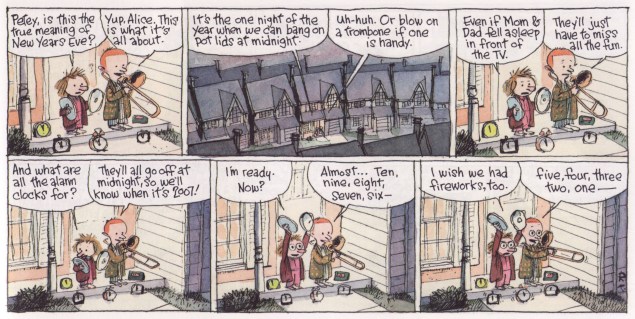
And while we’re on the subject of ushering in the New Year by making a hellacious din, let’s treat ourselves to a couple of relevant Cul de sac pieces. The first returns us to the strip’s formative, water-coloured years, when it appeared weekly (2004-2007) in The Washington Post‘s weekly magazine section.

CuldeSacNewYearsA
The Washington Post Magazine, Dec. 31st, 2006. Richard Thompson: « From when Petey played the trombone, and I found it too hard to draw. »
CuldeSacNewYears2008-09
The master tackled the theme again in this brief sequence from Dec. 31, 2008- Jan. 1st, 2009.

Nothing left to do now but to wish a joyful 2018 to all you monkeys and assorted critters!

– RG

A Silent (what else?) Night With Mr. Mum

Irving Phillips (1904-2000)…« has been an actor, a violinist, a Hollywood script writer, the Humor Editor of ‘Esquire’ magazine, a playwright, as well as a very successful syndicated cartoonist.* »

He was most notably the creator of The Strange World of Mr. Mum, which was published from 1958 to 1974 (the Sunday edition began in 1961); at its peak, the strip appeared in 180 newspapers.

Mr. Mum, as his name suggests, is the silent observer of various strange happenings. Anything can, and does, happen in Mum’s world, and much of it is delightfully surreal.

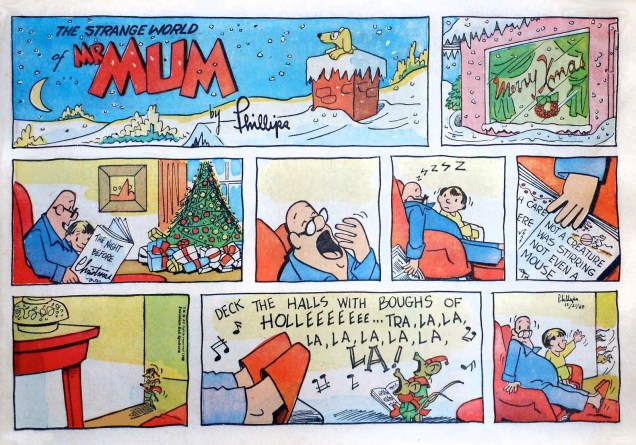
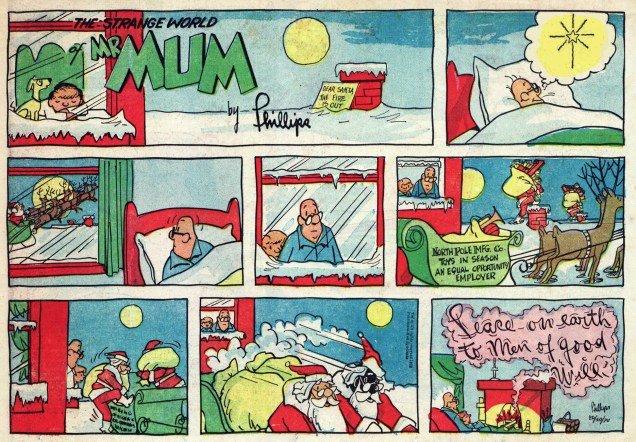
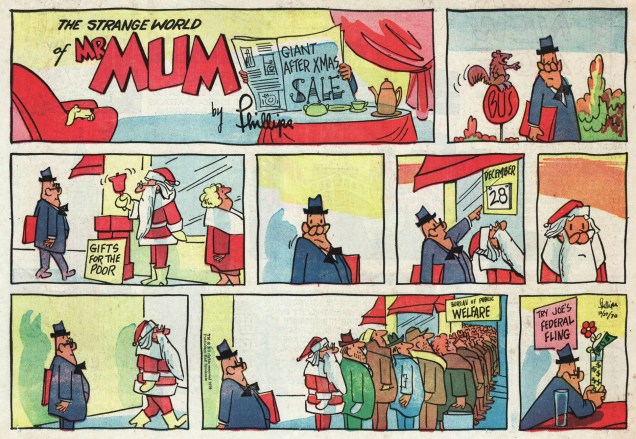
Today, as befits the season, we propose a handful of Christmas (and post-holiday) themed Mr. Mum Sundays.

MrMum211269
Originally appeared on December 21, 1969.
MrMum040170A
Originally appeared on January 4, 1970.
MrMum201270
Originally appeared on December 20, 1970.
MrMum271270A
Originally appeared on December 27, 1970.

As Mr. Mum himself might say, were he ever inclined to chime in: « Have a Merry Christmas! » May you find some good comics in your holiday stash. And try Joe’s Federal Fling… it’s tastier than eggnog.

Craving more Mr. Mum? Then scoot over to Ger Apeldoorn’s The Fabulous Fifties blog, where a veritable Mum trove awaits !

– RG / ds
*quoted from a interview with Mr. Phillips in Cartoonist Profiles no. 4, (November, 1969).