« Whoever digs Stine is out of his mind! Just how disturbed can Stine be? And who the heck understands his stuff? Not me. » — H.C., Hollywood (not an understanding sort)
I must open this post with a thank-you note to my past self, for picking up, decades ago and who knows where and on a whim, a somewhat pricey book by a cartoonist I’d never heard of, Richard Stine. Obviously, just because he was unknown to me doesn’t mean he’s not a known quantity. Let’s just say he has his devoted fans, and I quite understand their passion.
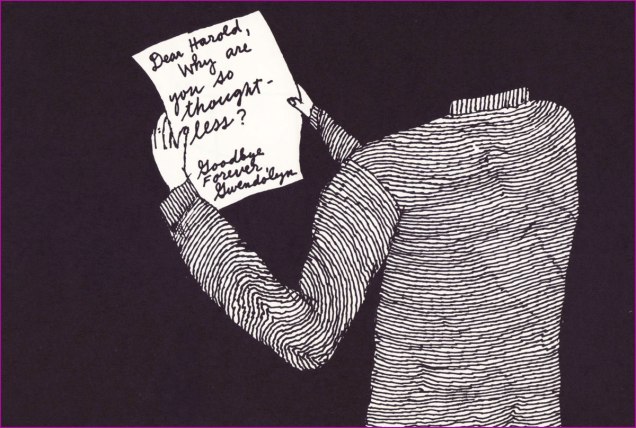
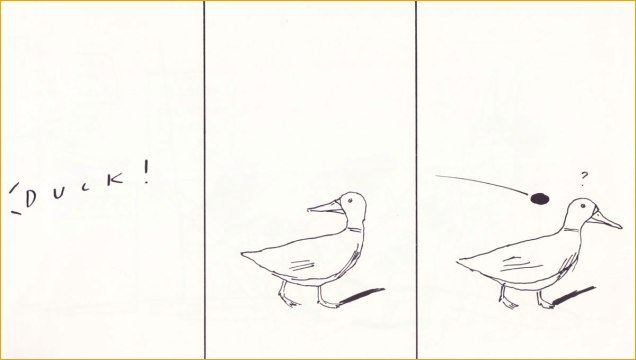
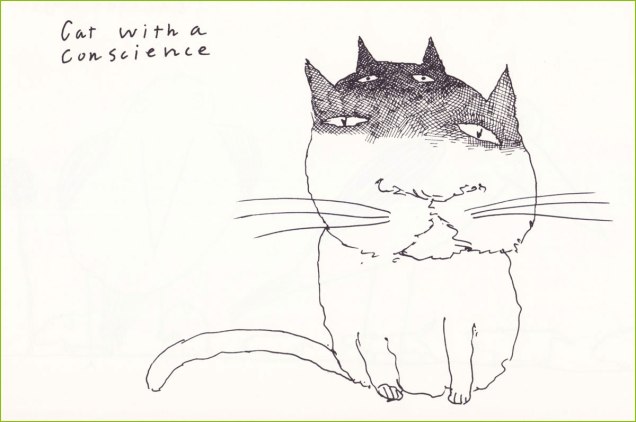
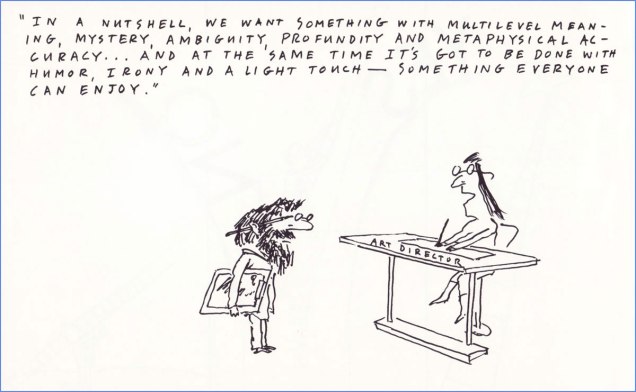
This is the book in question, Sparks by Stine (1982). It seems to have been intended for self-promotion (in the sense of seeking assignments, that is), given the inscription it bears: « THIS PORTFOLIO IS NUMBER ___ OF A SPECIAL FIRST EDITION PUBLISHED BY THE ARTIST ». Mine’s number 433, and the date of November 15, 1982 appears below Mr. Stine’s signature. I believe a paperback edition of Sparks — with a different, full-colour cover — was published a few years later. That one’s easier to get.Excerpts from letters to the Los Angeles Herald Examiner, where most of the drawings in this book first appeared: « … just wonder in what kindergarten “Stine” studied drawing? And how much marijuana he smokes before dreaming up his alleged “cartoons”? » — R.K., ArkadiaA zinger of a riposte: « Even my children, aged five and three, understand Stine. Their reactions aren’t vehement, they enjoy the simple drawings. And they don’t even smoke marijuana! » — M.H., San Diego« … it is stupid, insipid, has no rhyme nor reason, and so very disgusting. His humor is indicative of a thoughtless mind. By the way — what DOES he use for brains? » — Ms. R., Los Angeles « … Stine’s drawings do mean something — he shouldn’t have dropped out of art school in his first year. » — P.H., Hollywood« I demand you review Stine’s employment, comparing his productivity with the detrimental effects of his abusive creations. » — R.W., staff writer, UCLA Daily Bruin« … while you have one of the best, if not THE best cartoonist in the country, namely Karl Hubenthal, you also have one of the lousiest, if not THE lousiest cartoonist in the country, namely Stine. » — C.H., Glendale« … will you PLEASE provide us with ” A key to the understanding of Stine” in the same way that the Rosetta Stone enabled us to “read” the Egyptian hieroglyphics. » — Mr. and Mrs. L.C., Los Angeles « You’re wonderful! Only those living in ignorance fear your “message.” It’s like getting nasty for the first time: once you go through the one-way door, you’ll never be “nasty” again! I adore you. » — K.I., Venice
I won’t try to dig too deep into Stine’s oeuvre, as others — fellow blogger Ann Canright, for one — have already done a splendid job of it. What I have learned by now is that he was, circa « … a former cartoonist for the now-defunct Los Angeles Herald Examiner*, publisher of cards and author of two books… [ then ] became a full-time painter. »
And thereby hangs a tale, as the saying goes:
« Five years ago I decided to go back to painting. I started really small because I was used to working that way for publishing », Stine said. « I was working with magnifying glasses on my head and thought, ‘I need to get up and breathe and walk.‘ »
He pushed away the 3-inch-by-3-inch canvases and liberated himself size-wise, design-wise and attitude-wise. He stretched a canvas that « was bigger and taller than me », he said, and immediately felt free. [ source ]
He had by then moved from California to Bainbridge Island, in Washington state. And then… on to New Zealand, homeland of his wife Margaret. « Richard, now in his 80’s is still experimenting, exploring and creating and boy does it show in his playful spirit. » [ source ]
-RG
*Do read the history of the LA Herald Examiner if you get the chance… gripping stuff, imho.
« Well, that was the silliest tea party I ever went to! I am never going back there again! » — Lewis Carroll
One more item unearthed while rummaging through my unsorted boxes: a couple of back issues of The Funny Times, one from 2010, the other 2013. The former held a fascinating exercice by Herblock prize winning cartoonist Ward Sutton, skewering and subverting the conservative ‘mindset’ from within. Not an easy trick to pull off convincingly, I would think; yet it’s one of Sutton’s specialties, having honed it to perfection — of a sort — as The Onion‘s longtime political cartoonist (since 2006), fictive curmudgeon “Stan Kelly”. Here’s a trove of Kelly pieces, which The New Yorker deemed “brilliantly terrible”.
Remember the Tea Party? Of course, B.P. barely feels like parody, given B.C. creator’s Johnny Hart mesolithic views. A couple of samples from a 1999 interview: « Jews and Muslims who don’t accept Jesus will burn in hell », « Homosexuality is the handiwork of Satan ». [ source ]Ah, yes — that nonsense about Obama’s birth certificate, another MacGuffin in a seemingly endless parade of conservative bugaboos.By most accounts, Herbert Hoover was a pretty lousy president, though everything’s relative. Another fine myth, that of a liberally-biased media. Teanuts goes right back to the first Peanuts strip (Oct. 2, 1950) for its inspiration (though not its aspect ratio, for some reason).Here’s a pearl: « simply, homosexuality can be healed. That is, a homosexual can become a heterosexual; the homosexual orientation can be changed through prayer for inner healing and the power of the Holy Spirit. ». [ source ]Again, Diligent-Bert hews so close to its model that it might easily pass for an actual Dilbert strip.
The feature was accompanied by this deadpan caveat: « EDITOR’S NOTE: Ward Sutton, an elitist who lives in the elitist New York area, is a cartoonist, illustrator, animator and painter who has recently been lurking about the back of Tea Party gatherings, stuffing his pockets with American flag cookies, and brochures for camouflage underwear and mail-order ammo. Superpatriot and regular guy cartoonist Joe Smith disavows any knowledge of Mr. Sutton and his ilk. Need I say more? »
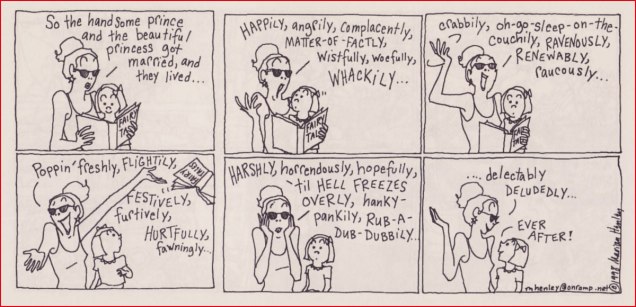
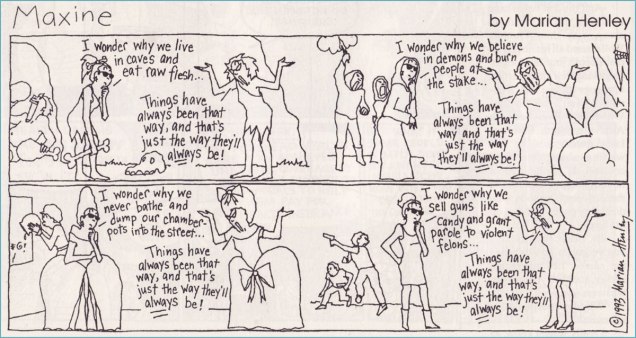
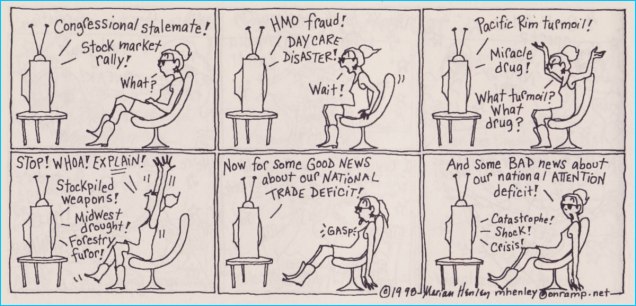
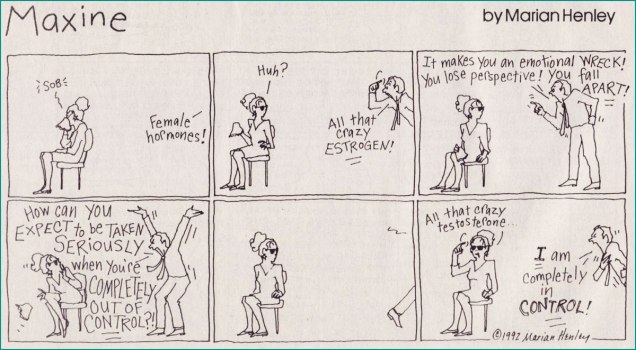
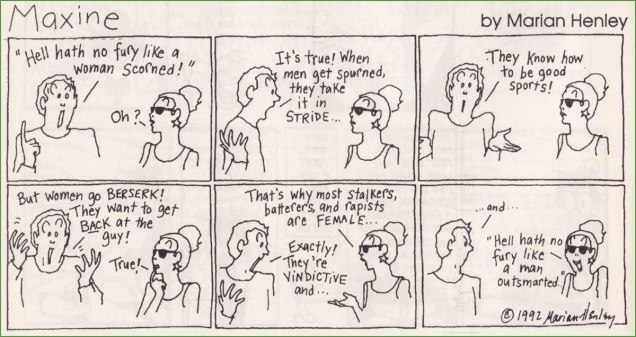
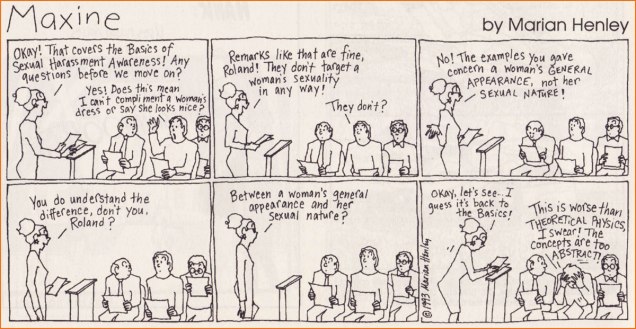
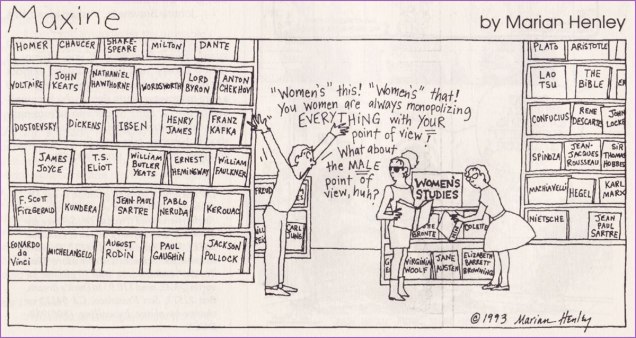
« From October 1981 until December 2002, Maxine appeared in a head-scratching combination of publications such as San Francisco Chronicle, Heavy Metal, MS, Glamour, Austin Chronicle, LA Weekly, Utne Reader, Asbury Park Press, MAD, Funny Times, and even a newsletter for Hawaiian polygamists. »
Marian Henley‘s Maxine naturally brings Nicole Hollander’s Sylvia to mind – two contemporary women cartoonists and their outspoken alter egos, both drawn in an idiosyncratic style that I imagine some found too sketchy, or too much of an acquired taste… to these imaginary straw men I’d recommend taking a closer look – Henley’s anatomy is impeccable, every character imbued with dynamic movement. Where Sylvia is a sort of seer, always at somewhat of a remove from emotional entanglements, Maxine is right in the middle of them like a cat tangled up in yarn, muddling through life’s chaos on her own terms (though sometimes dispensing advice to friends — ‘do as I say, not as I do!’)
A ‘Best Of’ collection of Maxine, published in 2002 by Taylor Trade Publishing. Hilariously, some have confused it with John Wagner’s Maxine, with much disappointment resulting. I guess these two target audiences have very little overlap. I also found myself counting Henley’s fingers — I think semi-unconscious defenses against AI are kicking in.
Maxine is a recent visitor to my brainscape – co-admin RG dragged out stacks of Comic Relief (‘The lighter side of life. Fewer calories than a newspaper, more laughs per pound.’, a monthly magazine published by Page One Publishers & Bookworks in California) from the 90s to look for something else, and that’s where the lovely choppiness of Henley’s art was pointed out to me. Sylvia is in too, incidentally. Here are some selections from 1991-1998. Crazy to contemplate that this was some 30+ years ago, yet the concerns expressed could have easily been a reaction to any recent morning’s news. Plus ça change, plus c’est la même chose….
« I find vocabulary to be a great drawback. » — Elizabeth Taylor
I think most of us will concur — sorry, Liz — that a rich vocabulary is a useful asset on multiple levels. And in riding with that particular train of thought, if a new year brings new goals and resolutions to achieve them, what could be more judicious and feasible than picking up a handful of new words… and their proper meaning?
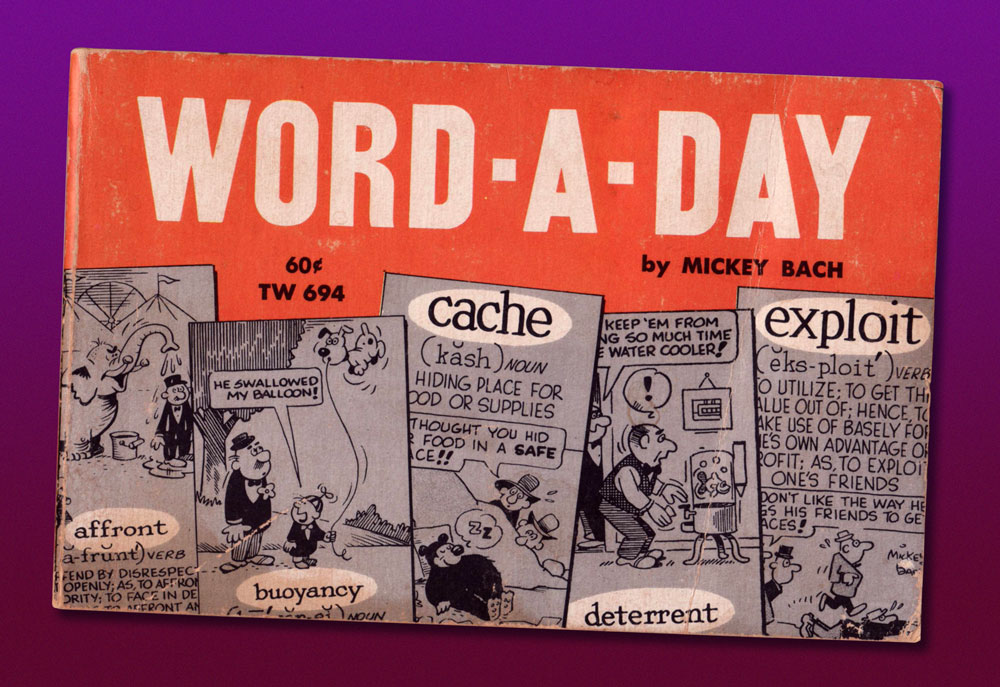
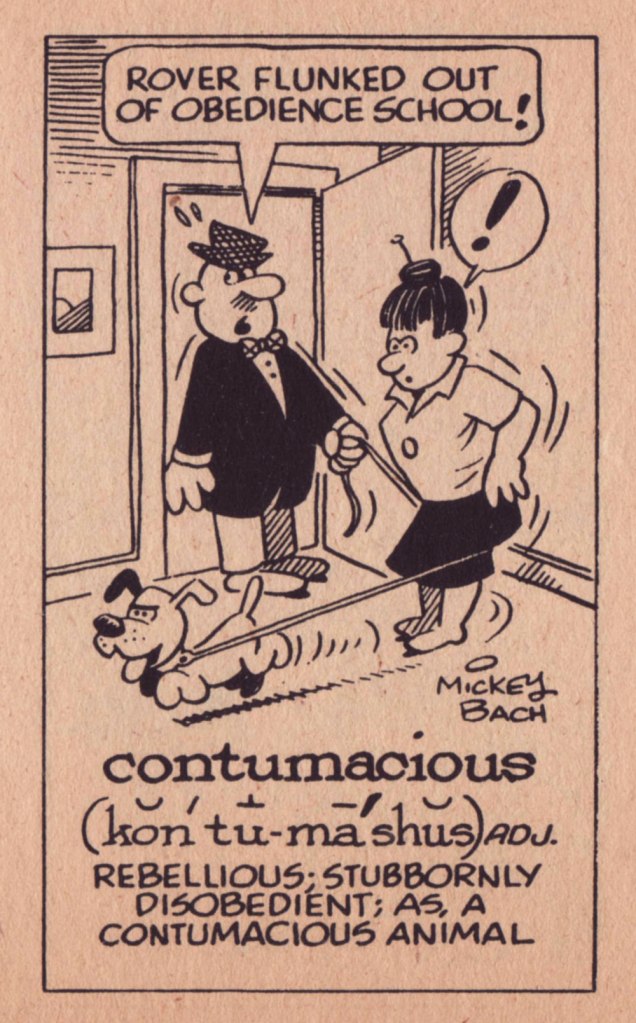
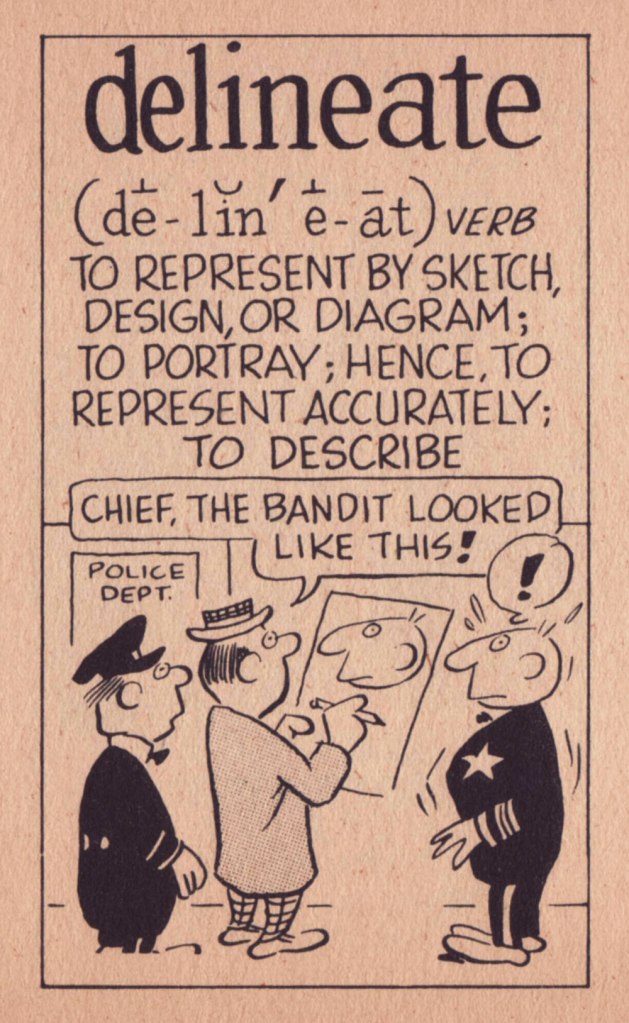
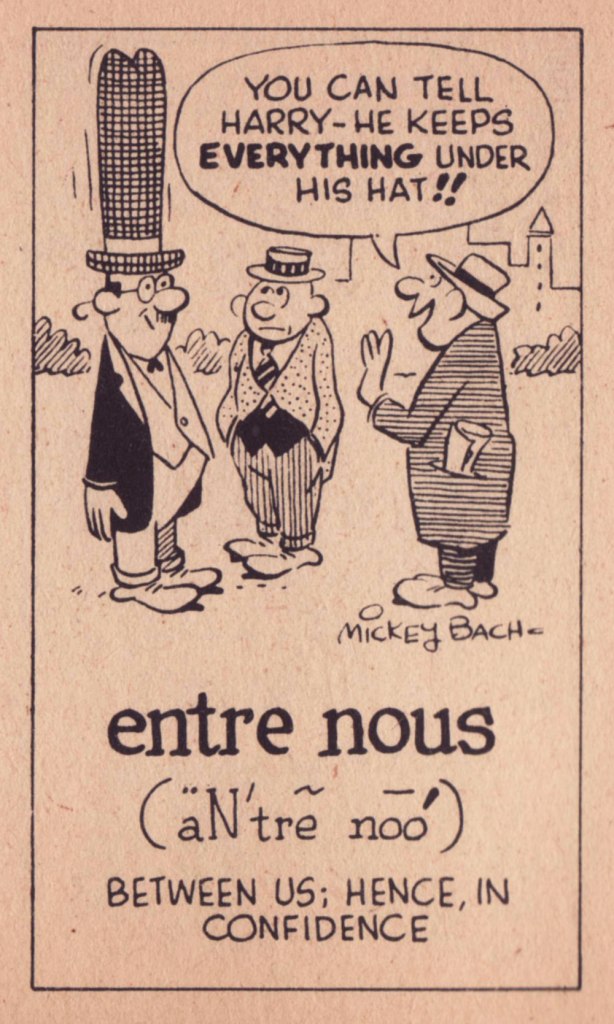
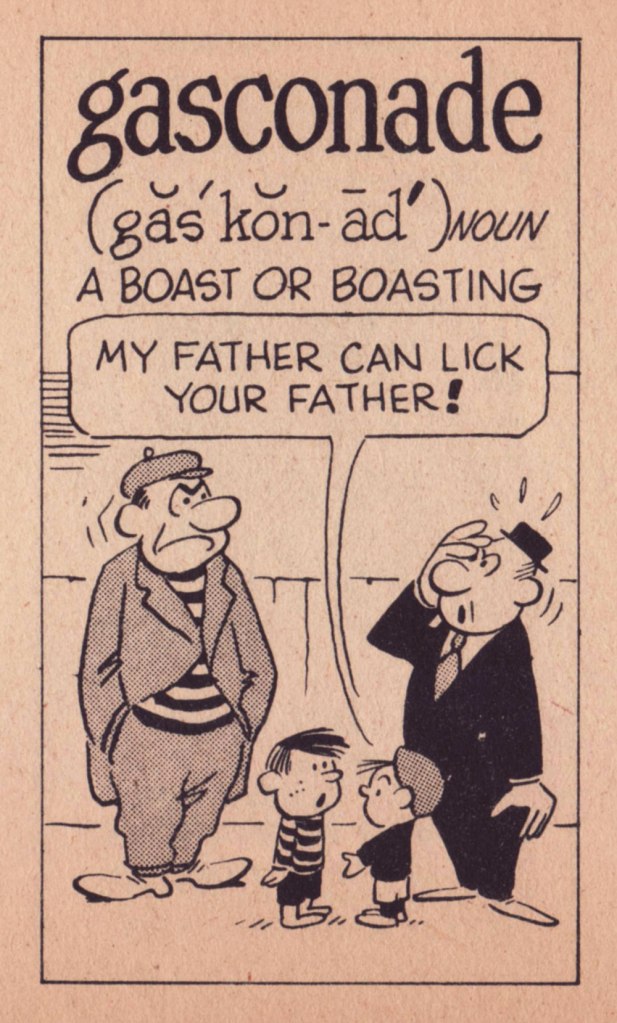
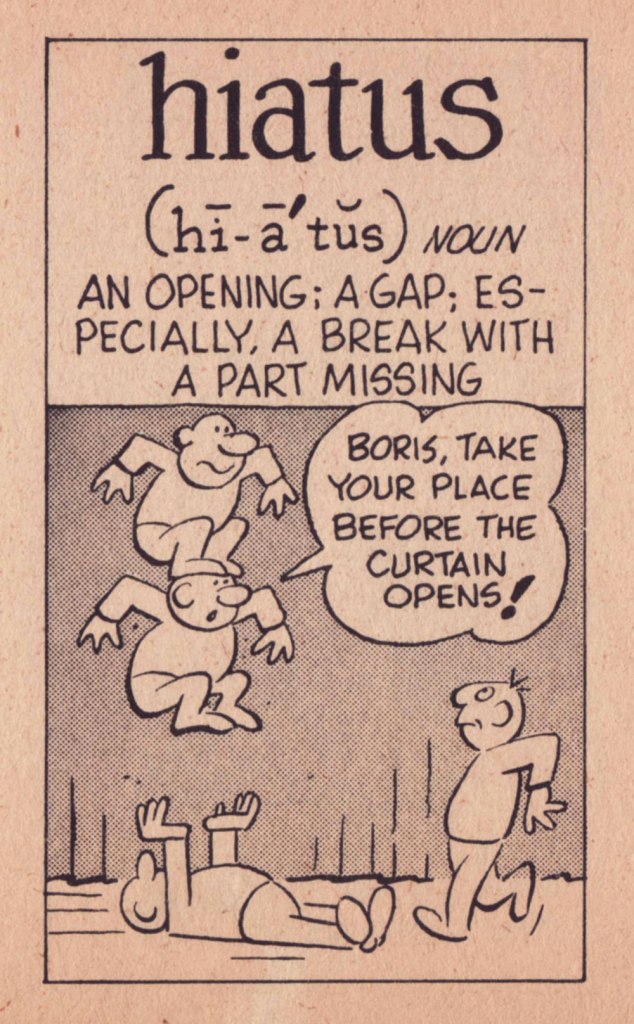
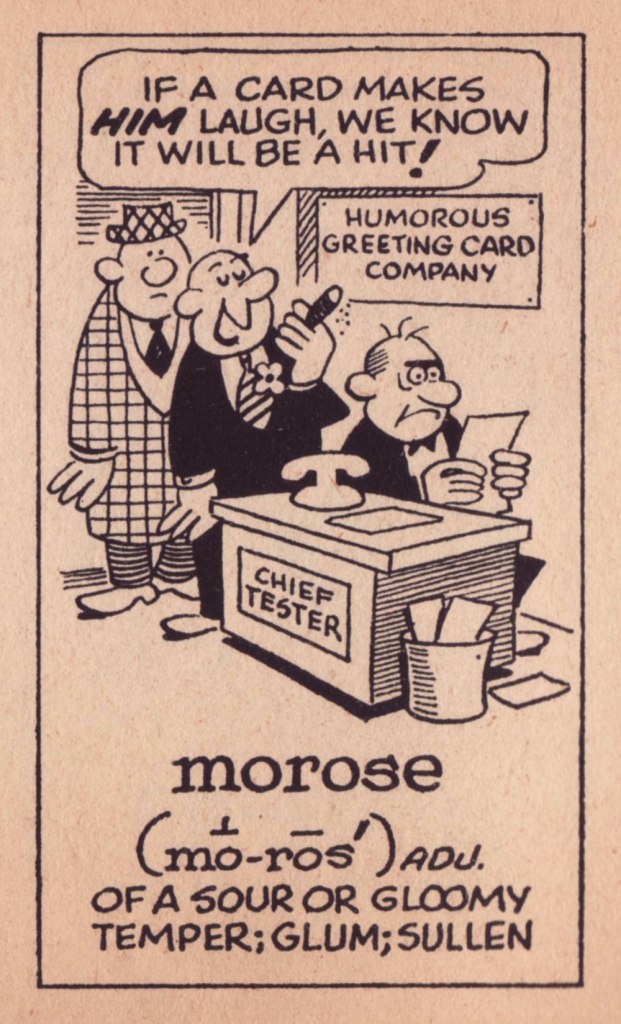
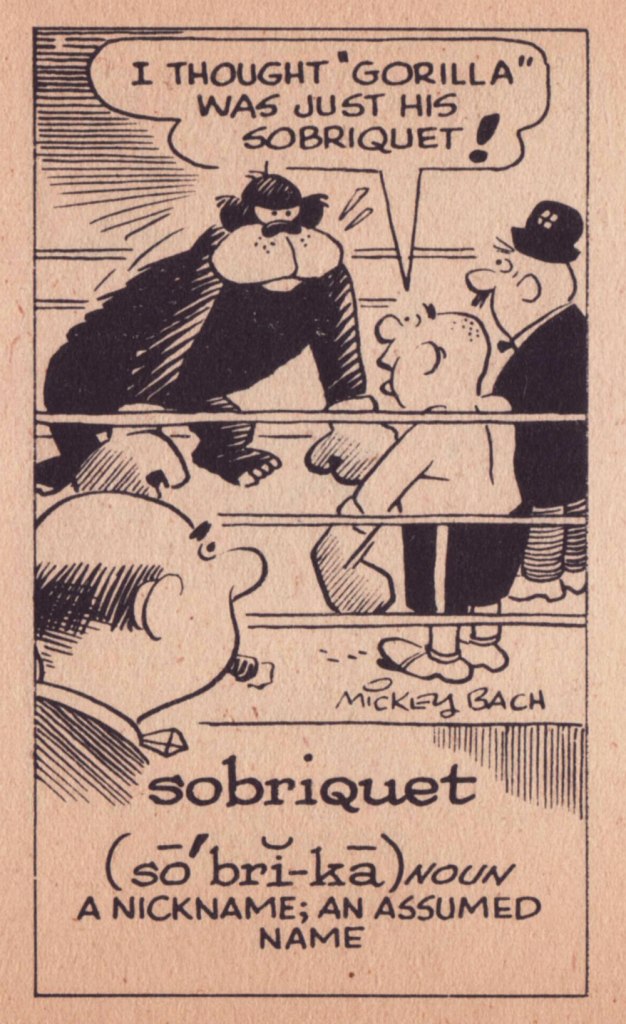
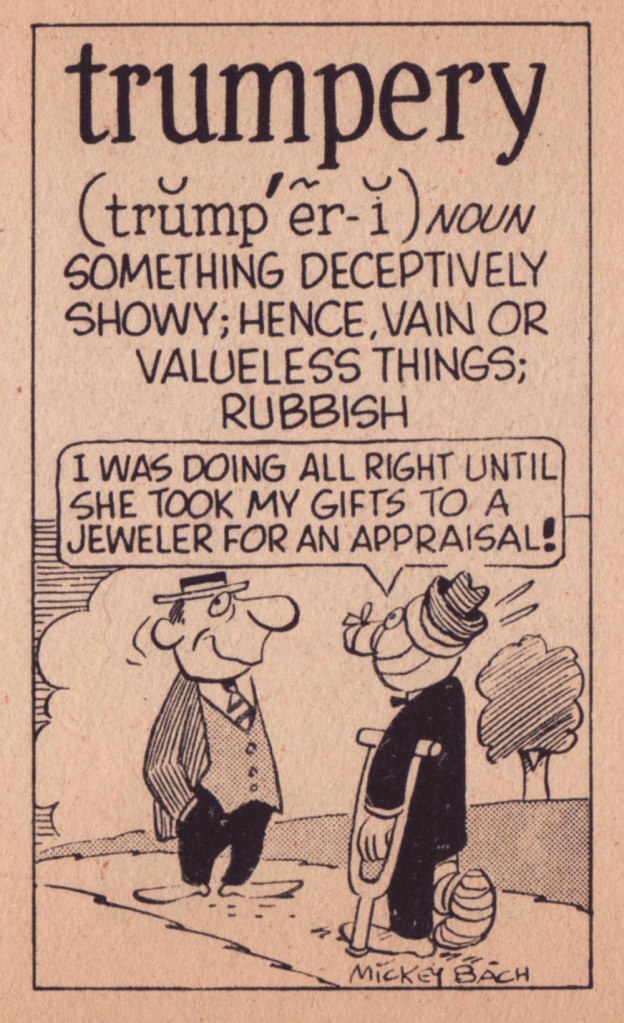
Cartoonist Mickey Bach (1909-1994) made it his mission to help the newspaper-reading masses bone up on unusual vocables. While he’s never ranked among the cartooning greats, the premise of his feature, Word-a-Day, was a rock-solid one, granting the panel a healthy run from 1946 to 1979, first with the Publishers Syndicate until 1967, when it merged with the Hall Syndicate*.
It’s also worth noting that, for a feature that’s been officially defunct for some forty-five years, it’s a pretty lively one: an admirably devoted and industrious fan has kept the Word-a-Day flame alive with the Word A Day Revisited Index. Kudos!
As far as I can tell, there was only one Word-a-Day collection published, but it was a successful one. First published by Scholastic Book Services in 1965 and comprising selections from 1960 to 1963, it received at least four printings through 1972, this being the fourth, from April of that year.
Let’s see what lies within, shall we?
Part of the nostalgic fun in these images is their reliable repertory company of cartooning archetypes such as sandwich men, hobos, boxers, cranky bosses, talent agents, bearskin rugs, door-to-door salesmen, masked burglars, beret-sporting artistes…Ah, yes: that nagging feeling that we, as a society, are somehow regressing rather than progressing.Bach had a somewhat generic, but pleasant and competent cartoon style, wherein I detect the great Bill Holman as a principal influence. Bach clearly was a man of discernment.Don’t be that boorish chump: here’s a handy guide to tipping étiquette from no less an authority than Emily Post (not to be confused with Emily Ghost). This one’s a particular favourite of mine, having had to correct its misuse time and again; apparently, some people have surmised (without checking, naturally) that ‘fulsome’ means, ‘full’, only more so and in a fancier way. No, guys, ‘a fulsome investigation will be conducted‘ does not signify what you think it does. Derived from the French ‘Gasconnade’, which refers pejoratively to the speech of denizens of the Gascony region. « Speaking with the Gascon accent, which is to say accentuating silent ‘e’s, and letting ring out several final consonants that the French leave silent. »I find this one particularly clever.This one’s considered archaic nowadays — when it is considered at all — though its close relative, insipid, endures. Not to be confused with its homophone, incipience, which refers to the beginning of something.Sadly, Gorilla will likely pound the erudition out of that unfortunate pugilist.Here’s a sentiment most reasonable the world over are currently experiencing, to their chagrin.
« There could be no jealousy/over my poetry/it’s my weakest quality/no vocabulary » — Todd Rundgren, Chapter and Verse
From both of us at WOT?, thanks for your continued support and interest, and may the coming year bring you as little as possible of what you’re dreading.
In 1967, Field Enterprises acquired Robert M. Hall‘s New York-based Hall Syndicate, merging it with Publishers to form the Publishers-Hall Syndicate. » Phew.
« If Freud had worn a kilt in the prescribed Highland manner he might have had a very different attitude to genitals. » — Woodrow Wilson
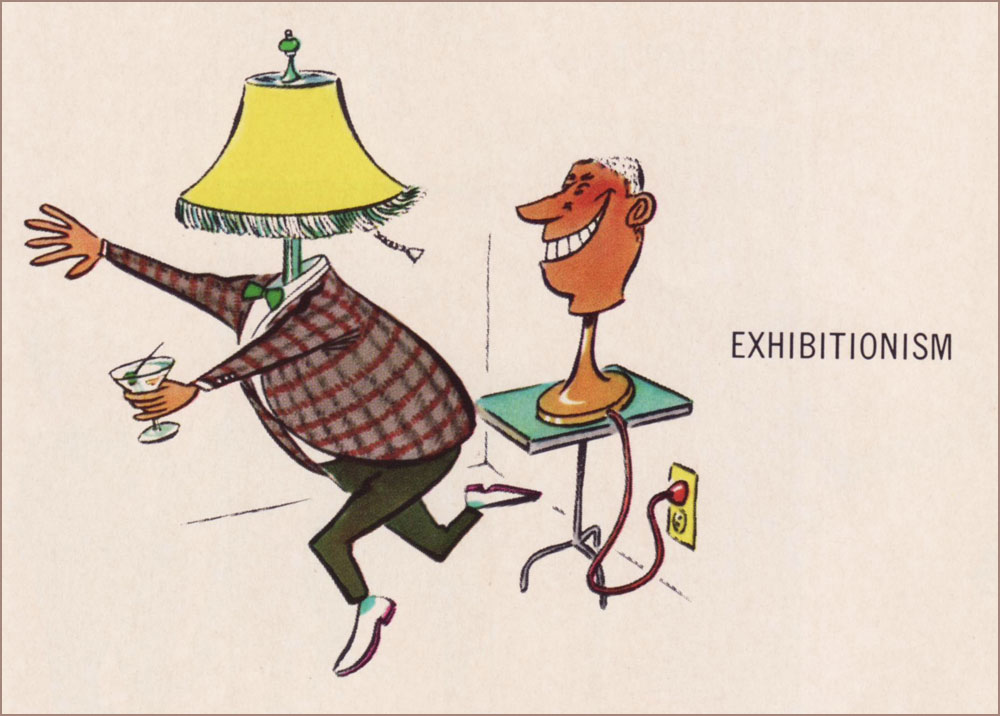
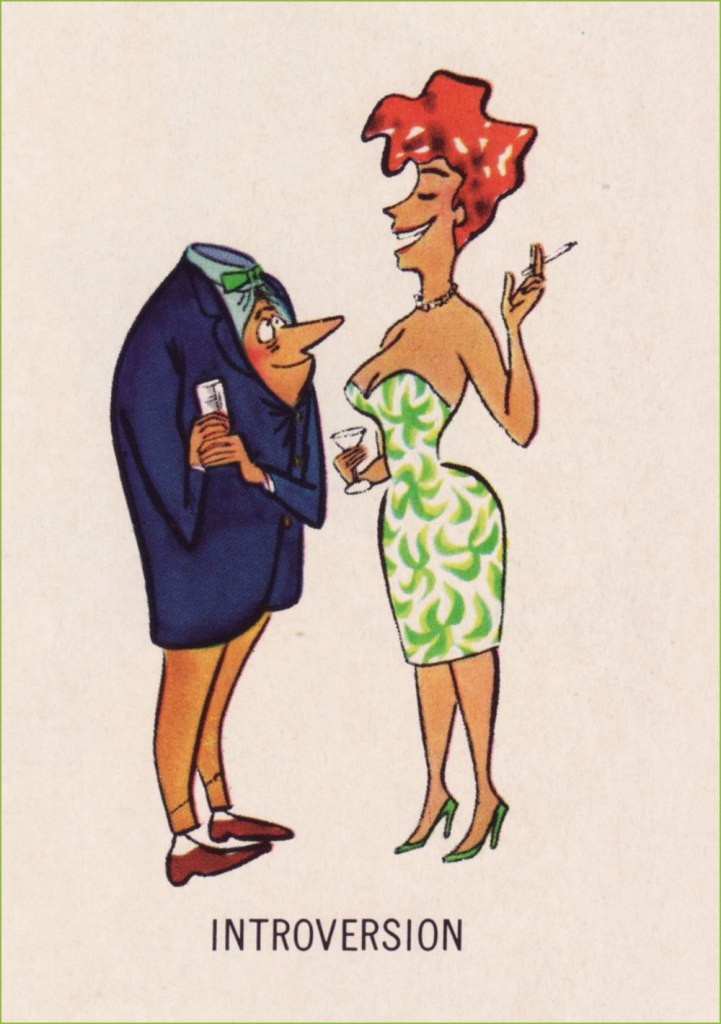
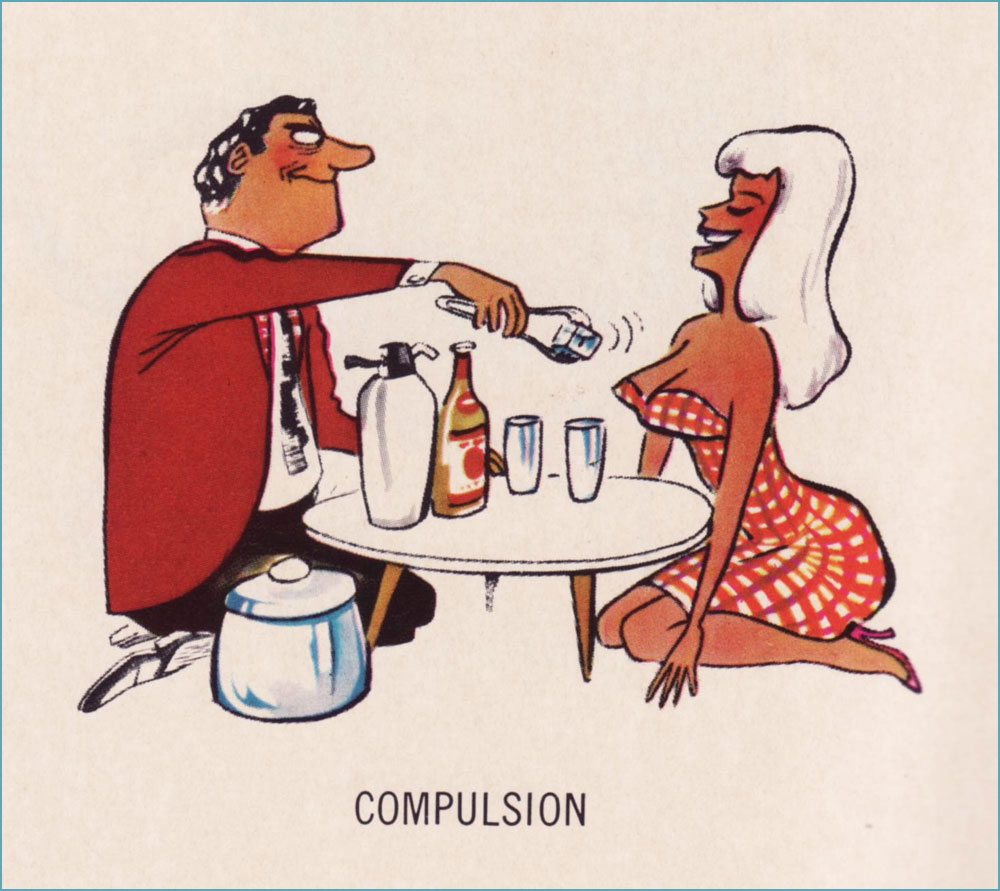
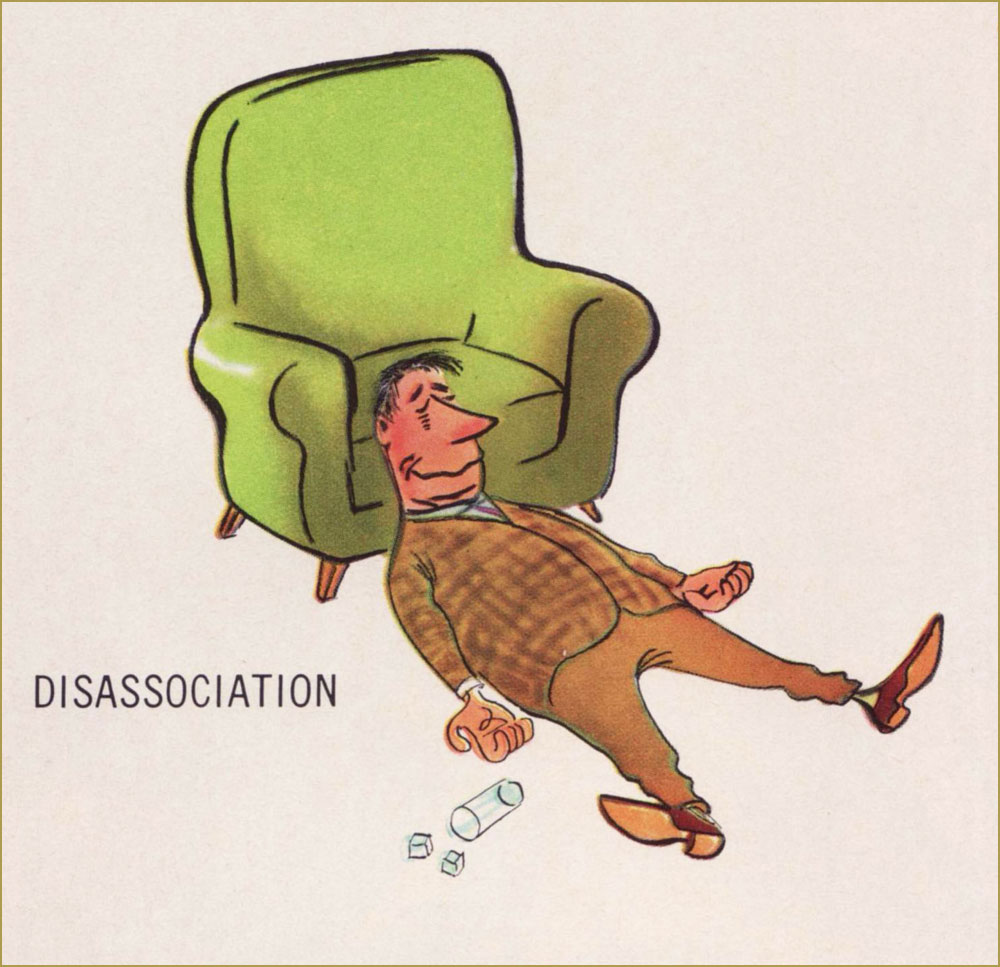
Let’s talk about your drinking.
Aw, just kidding: that’s your business and none of mine. There’s certainly no shortage of reasons — or might these be excuses? — for it nowadays. Speaking of which, here’s the recipe for the Freudian Slip Cocktail, which is presumably what ol’ Sigmund is shown energetically mixing up below. Cul sec, friends!
Virgil Partch‘s « Sigmund Freud’s Cocktail Party » originally appeared in Playboy Magazine’s August, 1962 issue.
« Dick’s Monster was something to behold. Whatever possessed him to put the creature’s nose up on the forehead is beyond us — but it worked, making it possibly the weirdest Frankenstein Monster ever done. » — Ray Funk and Al Dellinges, 2005
Golden Age cartoonist Richard “Dick” Briefer (1915-1980) had a special fondness for Dr. Frankenstein’s creation. Between 1940 and 1954, he wrote and illustrated scores of the Monster’s further adventures, both as tragedy and as farce… with equal aplomb.
This is Frankenstein no. 7 (May-June 1947, Prize), the lighter version.In a darker vein, this is Frankenstein no. 27 (Oct.-Nov. 1953, Prize), the darker one.
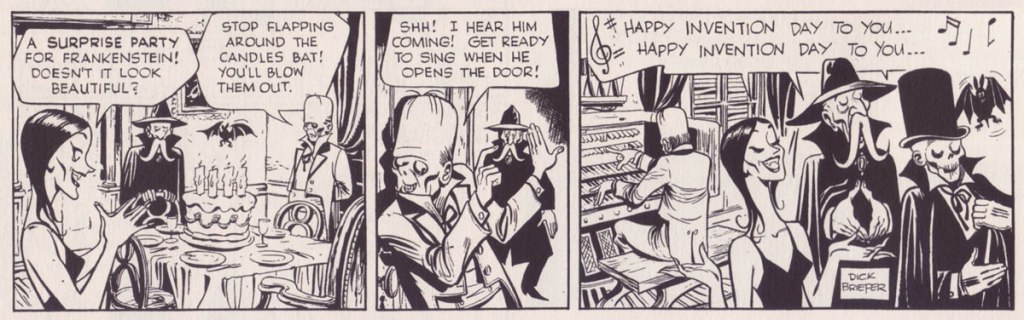
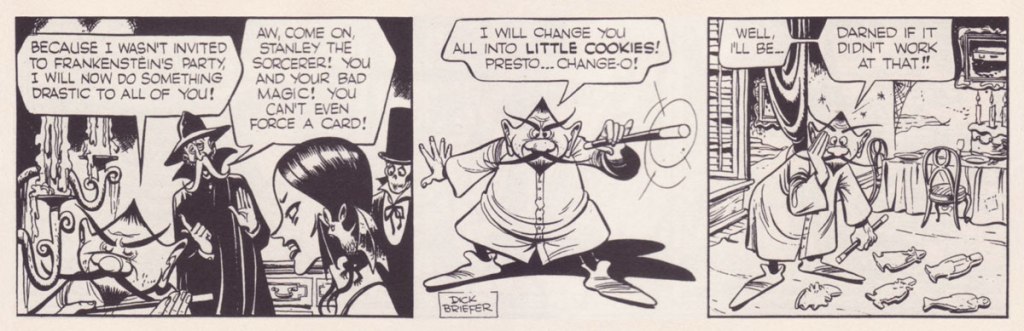
Having left the troubled comics industry after its censor-imposed purge in the mid-50s, Briefer put together an exquisite proposal for a daily newspaper strip featuring the Creature and his pals, thirty-six strips in all. Here’s a handful of them. Don’t you wish comic strips were half as well written and drawn nowadays?
In a 1979 letter to Al Dellinges, Briefer recalled « Frankenstein, the comic version, was always a joy, and I have some superb samples of a projected daily strip that had been turned down by syndicates in the past. At this stage in my life, even though ‘horror’ is ‘in’, I’m too lazy to start sending it out again. »
For further reading on this subject, do seek out the inaugural volume in Craig Yoe’s ‘Chilling Archives of Horror’ series, Dick Briefer’s Frankenstein (2010, IDW).
The Moomins* never had a ‘proper’ Hallowe’en, as this celebration didn’t exist in Finland in Tove Jansson’s lifetime. The closest thing was Pyhäinpäivä , a sort of ‘Saints’ Day’ dedicated to lamented loved ones, whose memory is honoured with lit candles on their graves.
That being said, Moomins’ myriad adventures include many costumes and surreal moments that would qualify in a skipped heartbeat as good fodder for the end of October — who needs a specific holiday for sinister goings-on? Tove Jansson knew how to temper the spine-chilling with good humour. Her cast of characters is rich in spooky creatures rejected and misunderstood just because they live by different rules, some of which are, most appropriately to this post, ghosts.
The Hattifatteners (first appearing in The Moomins and the Great Flood, 1945), described as ‘…the little white creatures who are forever wandering restlessly from place to place, in their aimless quest for nobody knows what’ (Comet in Moominland, 1946) certainly qualify as a kind of ghost, with their whitish colour and the soft flexibility of mushrooms on thin stalks.
Hemulen (looking a bit Slavic there) and the Hattifatteners, whose appendages (appropriately) make them look like a bunch of crosses at a graveyard.
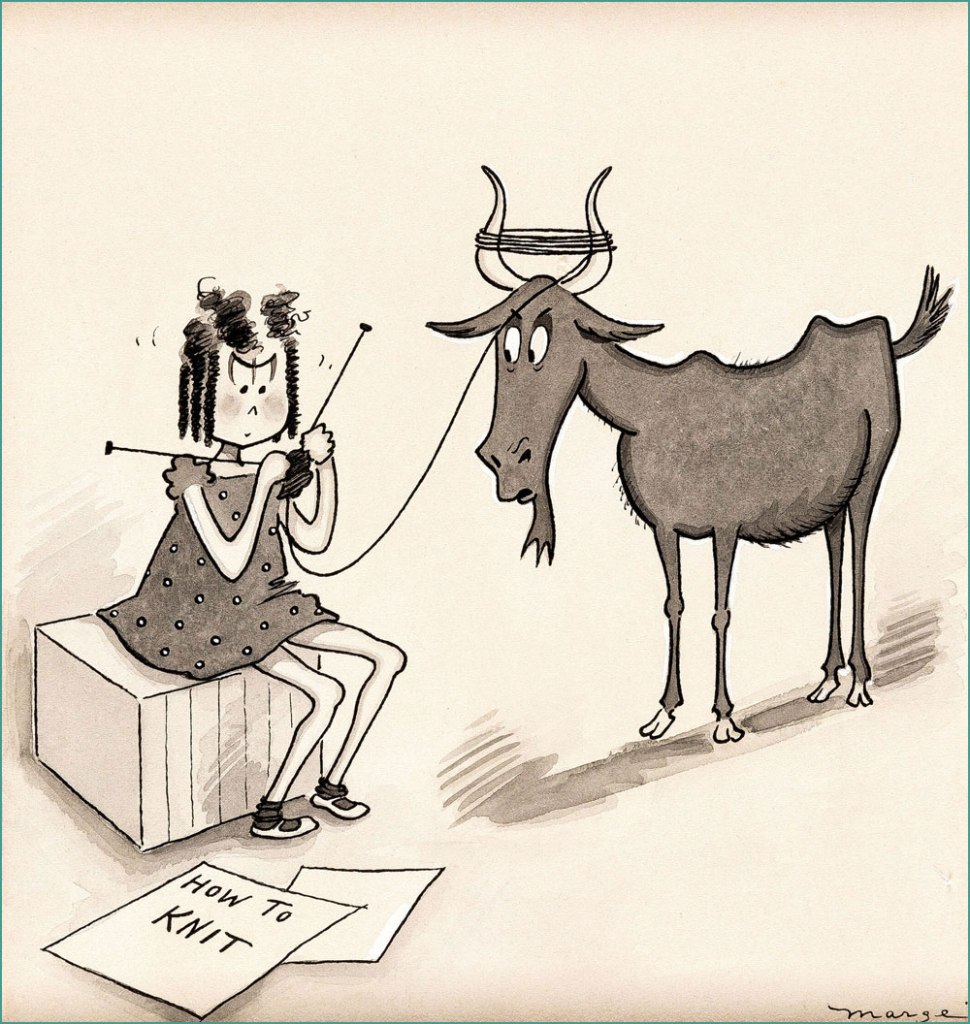
The Moomin lore includes actual ghosts, too. One example is the Island Ghost, featured in The Exploits of Moominpappa (written in 1950, and that can be read in its 1968 revised version here). In typical Jansson fashion, he can’t actually haunt very well, and is prone to random bouts of sneezing. He also likes knitting. That description fits me well, actually, so perhaps I’m a ghost, too.
« The room had suddenly grown cold with an icy draught, and the ghost sneezed. I don’t know how you’d have felt, but for my part I immediately lost much of my respect. So I crawled out from under the bed and said: ‘Cold night, sir!’ ‘Yes,’ replied the ghost in an annoyed tone. ‘A bleak night of fate resounding with the horrible wails of the phantoms of the gorge!’ ‘What can I do for you?’ I asked politely. ‘On a night of fate like this,’ the ghost continued stubbornly, ‘the forgotten bones are rattling on the silent beach!’ ‘Whose bones?’ I asked (still very politely). ‘The forgotten bones,’ said the ghost, ‘Pale horror grins over the damned island! Mortal, beware!’ The ghost uncurled, gave me a terrible look and floated back towards the half-open door. The back of his head met the door-jamb with a resounding bang. ‘Oops!’ said the ghost… »
The Moomins (1983) S01E45 – Island Ghost
This is not the only time the Moomins tried living on an island or encountered a ghost. Moominpappa at Sea (a story published in the daily strip in 1957, and similar to, but not entirely the same, as the novel from 1965), in which the Moominpappa becomes a lighthouse keeper, features another timid spook who does such a rattle-up job terrifying Moomintroll that he gets banned from haunting by the stern Moominmomma. Given this story’s mostly nocturnal setting, lonesome lighthouse and clanging chains galore, it’s highly appropriate to this October. The following version has been ‘reworked’ in colour by Drawn&Quarterly:
Tove’s brother Lars Jansson, who took over the writing (and eventually the illustration as well) of the Moomin comic strip in 1958, also has something to contribute to this Hallowe’en post. As an honourable mention, I offer you his Moomin and the Vampire (1964). One can argue that his stories lacked the soul (and artistic ability) of his sister — I’m not here to discuss that, just to take a peek at the little vampire bat escaped from a zoo.
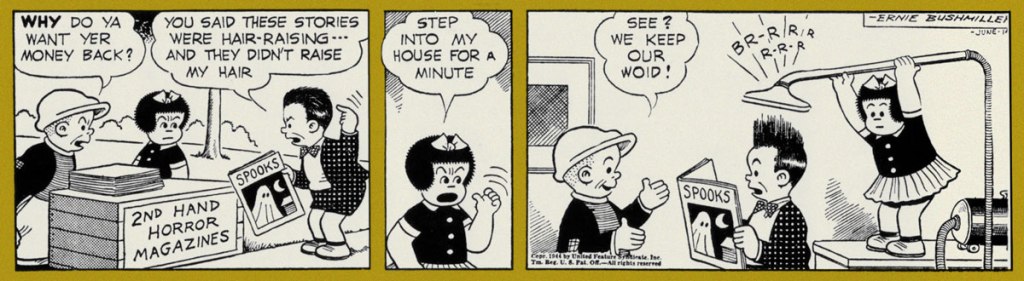
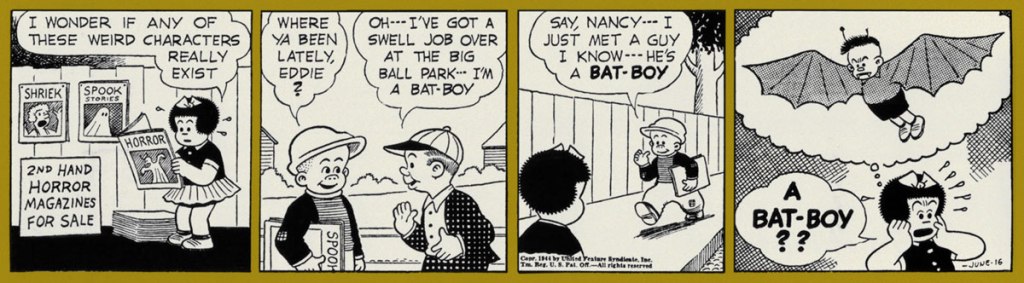
We’ve featured Nancy in a previous Hallowe’en Countdown, but it doesn’t quite count, as that was the mind-bending John Stanley mutation of Nancy — not that I adore one any less than the other. This time, we’ve gone with the real deal… which is still plenty odd, thank you.
June 12, 1944 Nancy daily.June 13, 1944 daily.June 14, 1944 daily.June 15, 1944 daily.June 16, 1944 daily.June 17, 1944 daily.And, skipping nearly a decade ahead… July 15, 1953 daily.
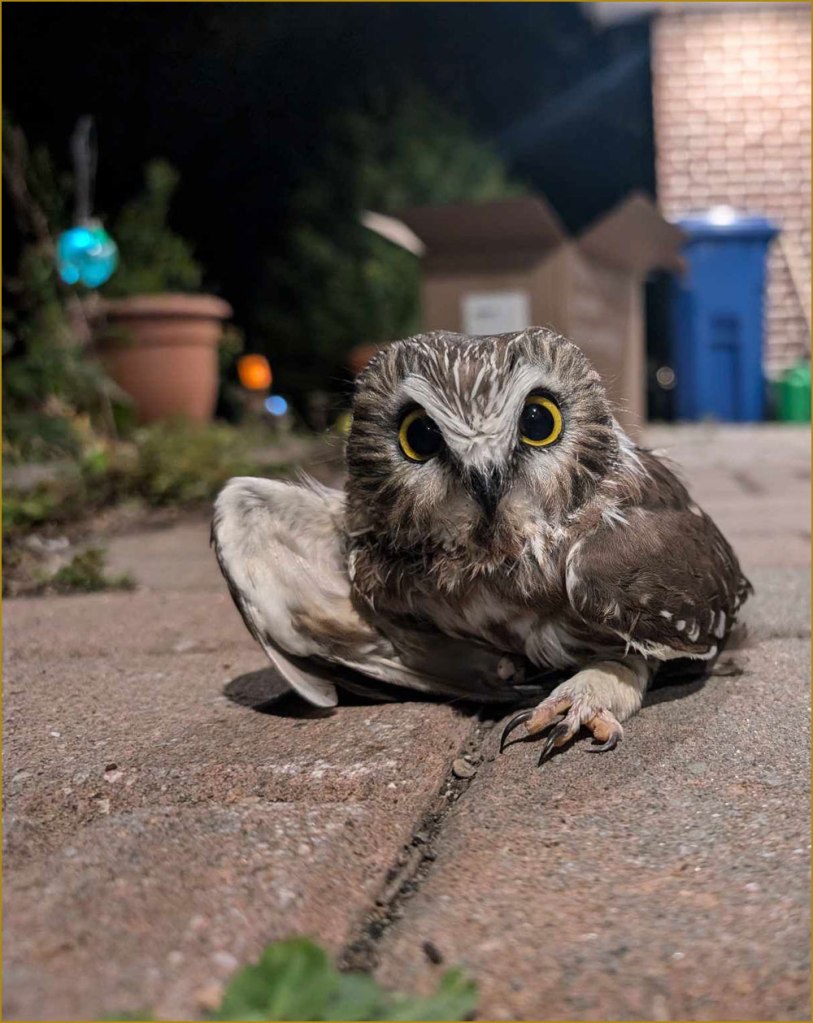
Speaking of owls: the other night, we were surprised (to put it mildly) to discover that one of our cats had brought home a feathered guest.
This is a Northern saw-whet owl, one of the smallest species of owls. Seeing she likely had a broken wing, we quickly called the local animal shelter, and the injured bird was picked up by the local wildlife authorities in the morning. She’ll be in good, caring hands.
« You can bring Pearl, she’s a darn nice girl, But don’t bring Lulu! You can bring Rose with the turned-up nose, But don’t bring Lulu! She’s the kind of smarty who breaks up every party, Hullabaloo loo, don’t bring Lulu, I’ll bring her myself! »
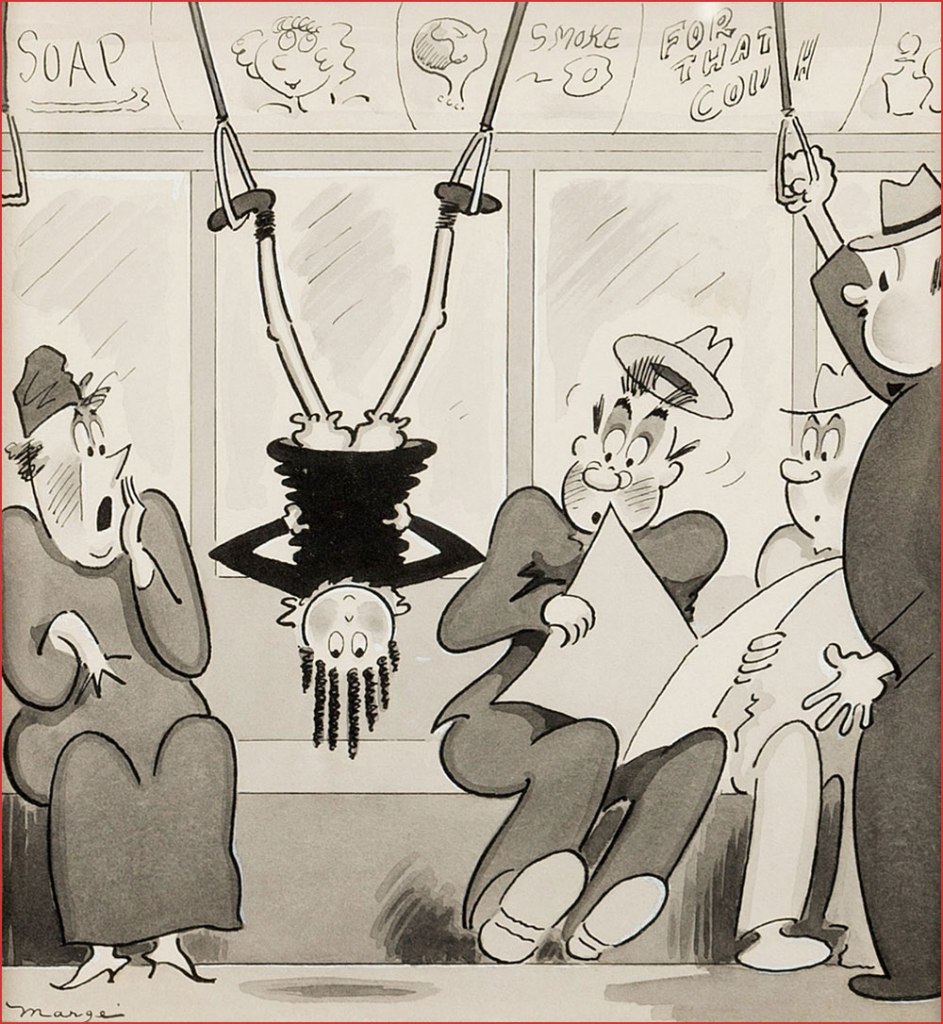
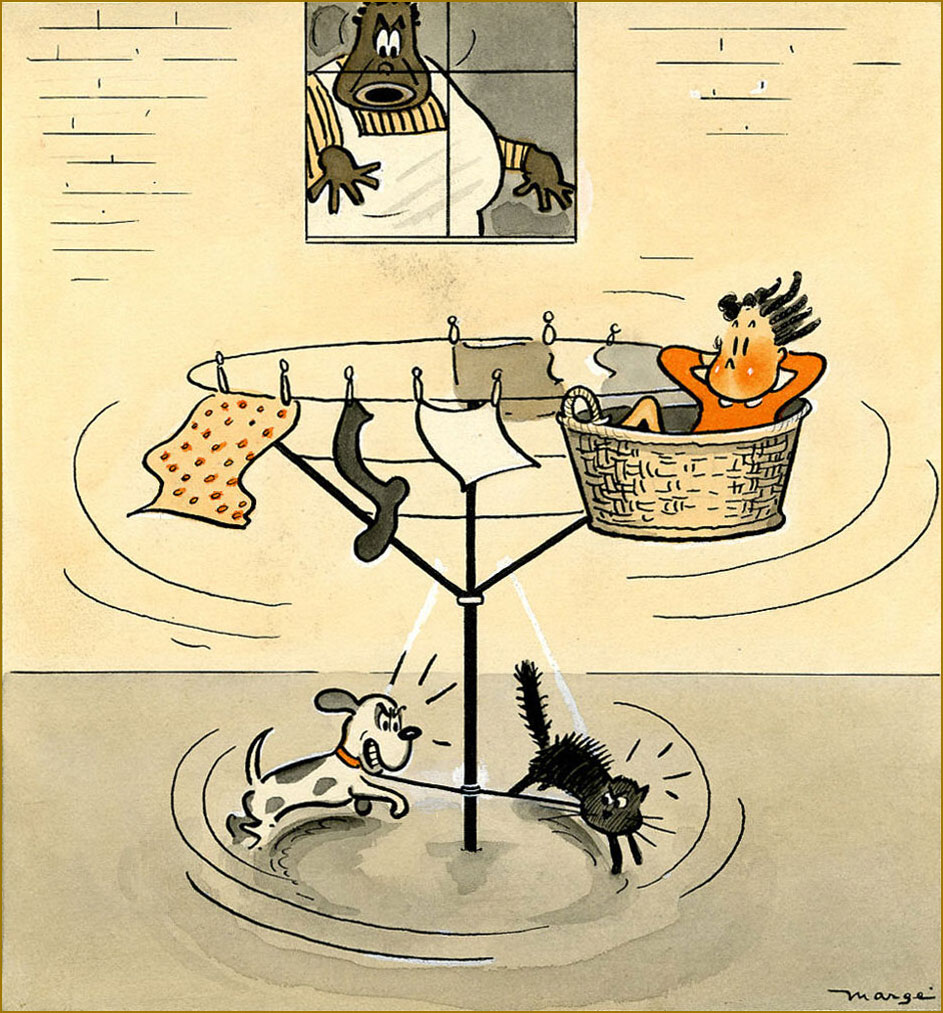
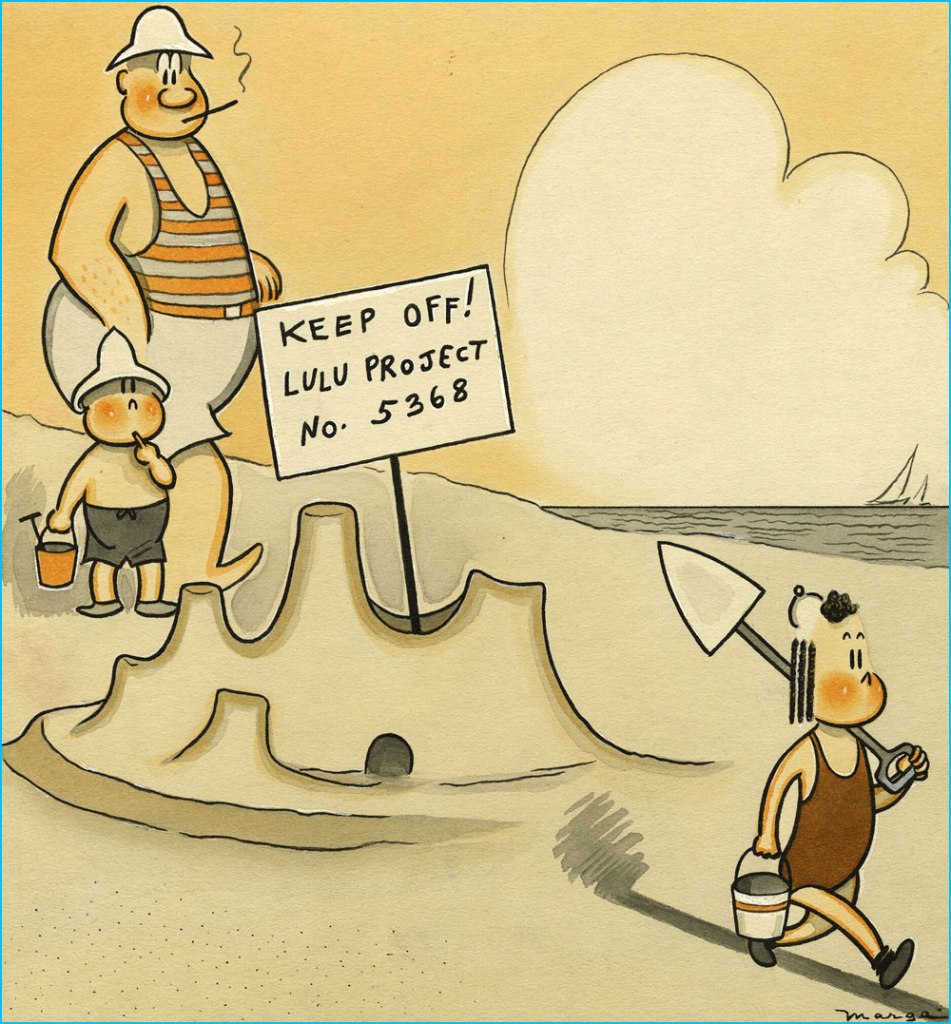
À propos of the comic strip Little Lulu (running from 1935 to 1944 in The Saturday Evening Post), co-admin RG indicated in his Hallowe’en Countdown V, Day 30 that he ‘just happens to dislike Lulu creator Marjorie ‘Marge’ Henderson Buell‘s visual conception of her characters‘. Entirely fair enough, but I happen to appreciate Little Lulu for her unremitting dedication to horsing around (and Buell for her subtle use of watercolours).
Going through a bunch of strips in search of ones to feature here confirmed my previous impression that Lulu can be quite the brat, à laDennis The Menace. It can be argued that all kids have the capacity to be destructive with a considerable amount of enthusiasm, though from my current adult perspective, destroying plants (something Lulu seems to do a fair bit of) is an idiotic act, whoever one is trying to piss off. While sharing a doigté for outfoxing (and occasionally literally thwacking) boys, Lulu was wilder and meaner than Bushmiller’s Nancy, the latter tending to be a helpful, earnest kid despite her share of shenanigans. You won’t really notice this from this post, as I distinctly prefer sweet over abrasive.
From a modern perspective one would be tempted to lump Lulu in with other feminist cartoon icons, given that Buell clearly enjoyed depicting her independent streak. John Harvith (involved in a retrospective of Buell’s work in 1982) is quoted as saying ‘[Lulu] was a pioneer in presenting a girl cartoon character who was resourceful, courageous and who regularly beat out the boys‘. As to her creator, Buell is credited as ‘the first female cartoonist in the United States to achieve worldwide success‘ (source: Little Lulu comes to Harvard). *
While she is cited as resisting the ‘feminist’ label when it came to her work, I think it was more out of a dislike for pigeonholing her material. ‘Marge [did not] welcome the idea of introducing feminist themes into the cartoon. She preferred to let the character’s actions speak for themselves. She created this feisty little girl character who held her own against the guys and frequently outwitted them, but she didn’t want to turn the cartoon into a message. She agreed with Samuel Goldwyn’s slogan, ‘If you want to send a message, try Western Union.'”
In her personal life, Buell demonstrated an enviable degree of wisdom in her marriage to ensure that both their careers would progress without breaking the family apart (her husband agreed to turn down promotions that would force them to relocate, and she agreed to keep Lulu in check in order to spend time with her children).
If you need another reason to like Little Lulu, The Little Lulu Show, running from 1995 to 1999, featured the voice of Tracey Ullman as the protagonist during the first season.
~ ds
* These days it’s mostly John Stanley’s Little Lulu that grabs the affection spotlight in people’s memories.
In the spirit of saluting our heroes while they’re still around to get a boost from it…
A few weeks ago, I got wind of a delightful bit of news: that local favourite Russell Kommer Myers now holds, according to Guinness, the world record for Longest running daily cartoon strip by a single author. Perhaps because of his chug-along consistency, the prodigious Myers is generally taken for granted. Well — I’m happy to say — not in these parts: see our tribute post from a while back, Growing Old Gracelessly With Broom-Hilda, for further, abundantly illustrated praise.
Here’s some of what the folks at Guinness (not the Dublin ones) had to say:
« The longest running daily cartoon strip by a single author is “Broom-Hilda” by Russell Myers (USA), which has been in continuous publication for 53 years 292 days since first published by the Chicago Tribune Syndicate on 19 April 1970, as of 5 February 2024.
Russell was born “BT” (before television) and fell in love with comics and cartooning as a child. He started a collection of over 2,000 comic books, which he still has.
After years of having other comic strips rejected, Russell sold “Broom-Hilda,” which became an overnight success. He is a “one-man shop,” writing and drawing every strip himself, over 19,710 as of the 54th anniversary. »
For a little perspective, here’s what Lambiek had to say on the subject:
« He leaves previous record holders behind, like Frank Dickens (‘Bristow’, 51 years), Charles M. Schulz (‘Peanuts’, 49 years) and Marc Sleen (‘Nero’, 45 years). Yet Myers is still behind Ed Payne (‘Billy the Boy Artist’, 56 years), Fred Lasswell (‘Barney Google & Snuffy Smith’, 59 years), Jim Russell (‘The Potts’, 62 years) and Russ Johnson (‘Mr. Oswald’, 62 years, though this was a monthly comic). » Honestly, one is inclined to gently bring up the touchy, controversial issue of, ahem… assistants.
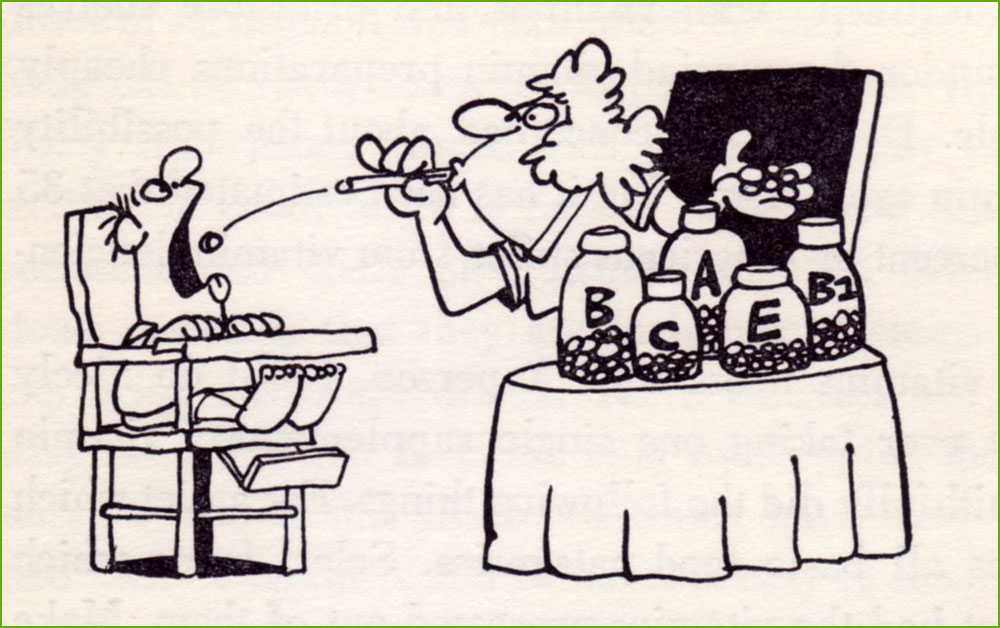
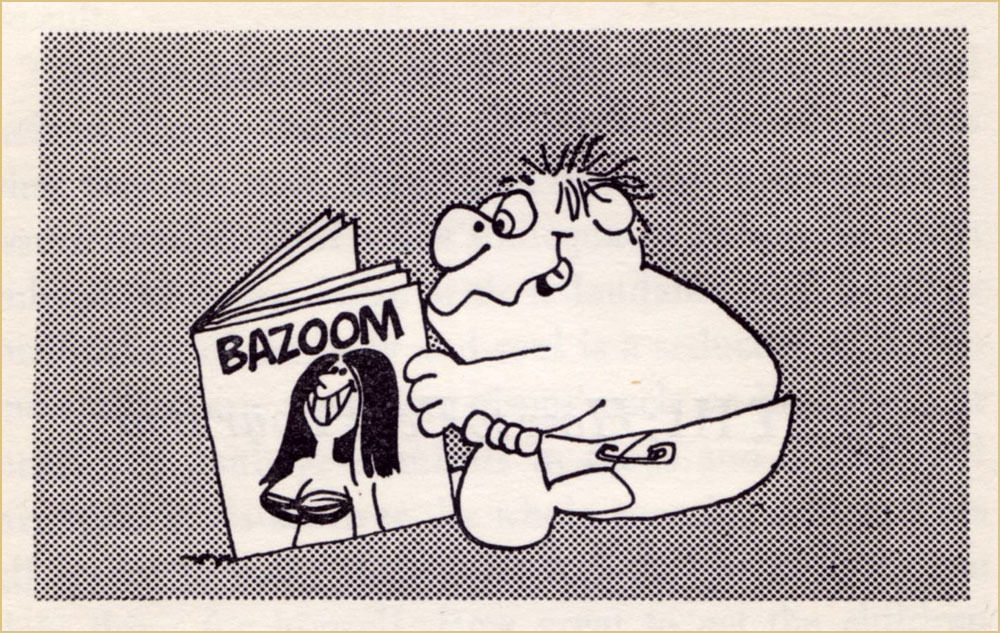
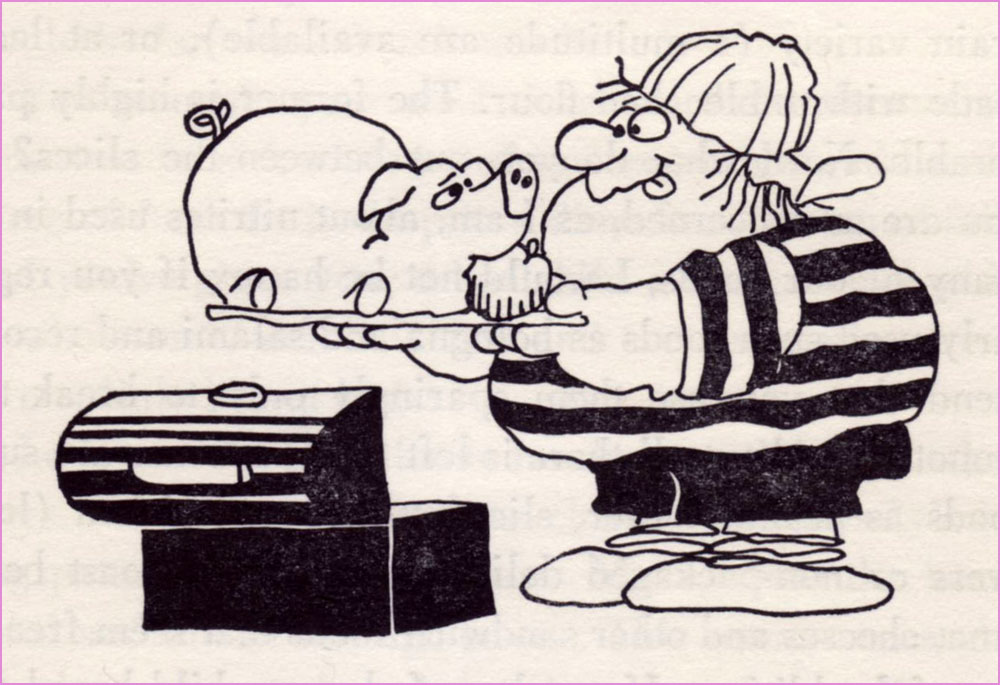
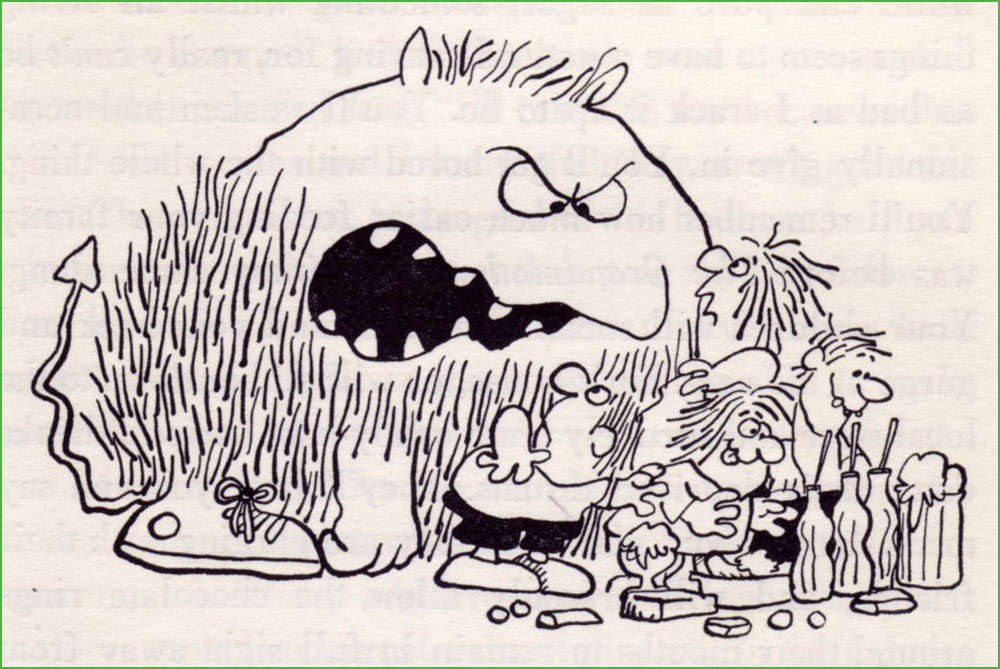
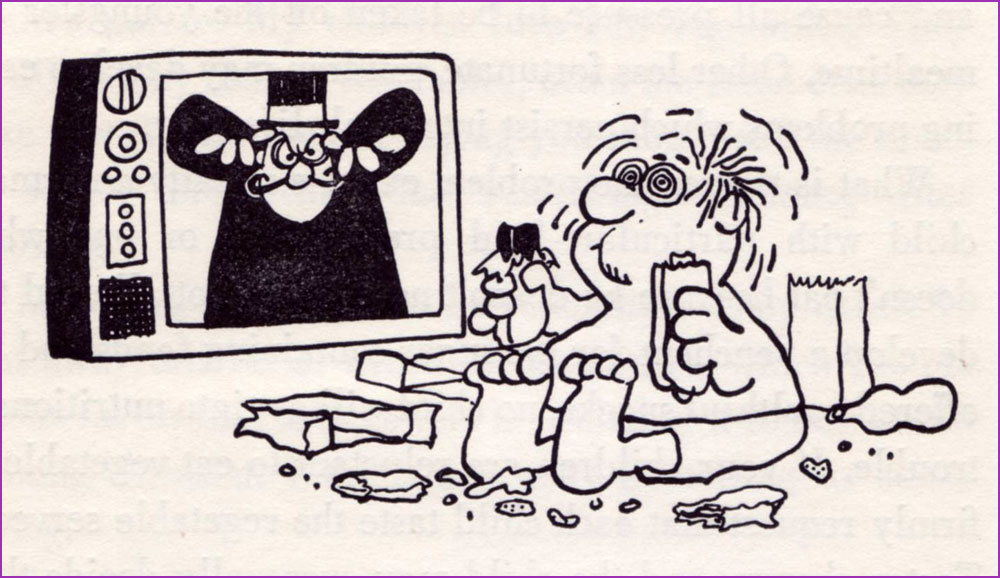
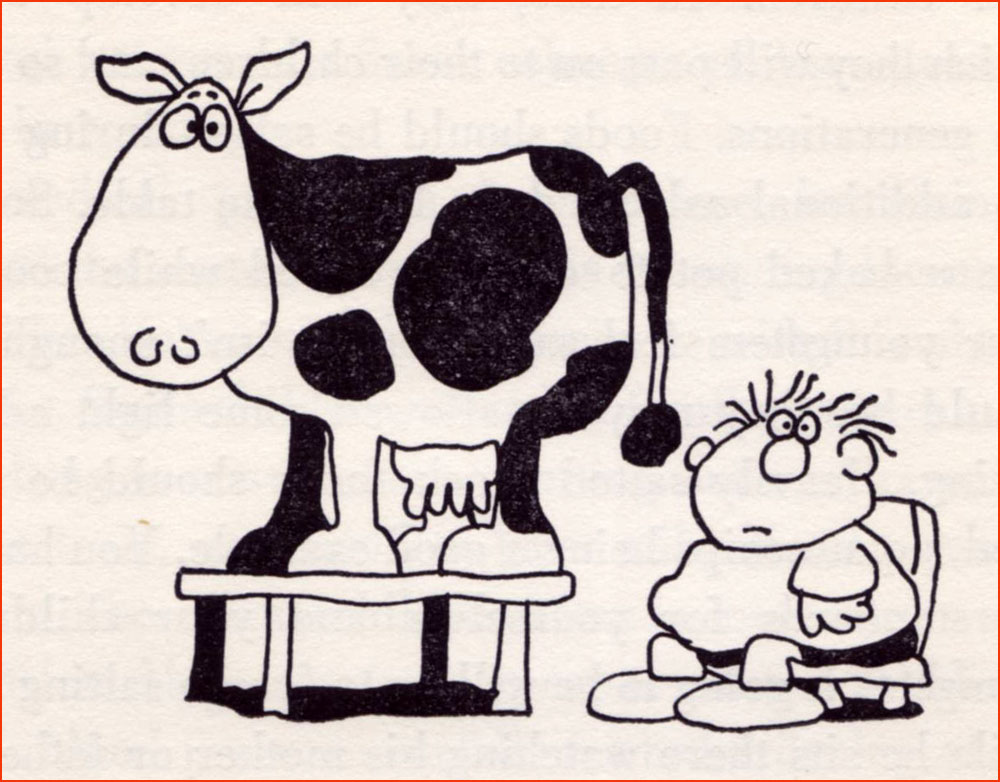
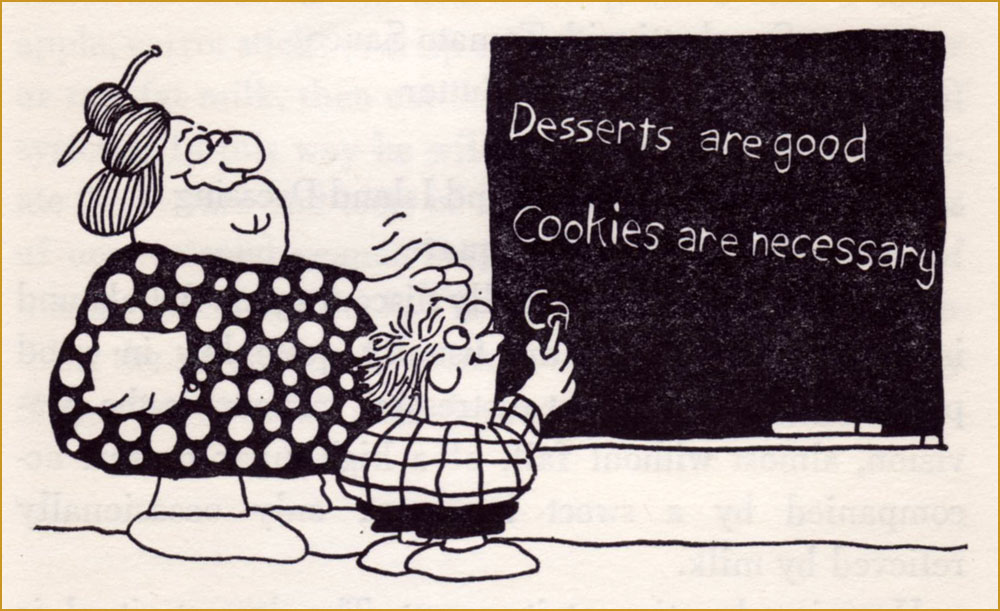
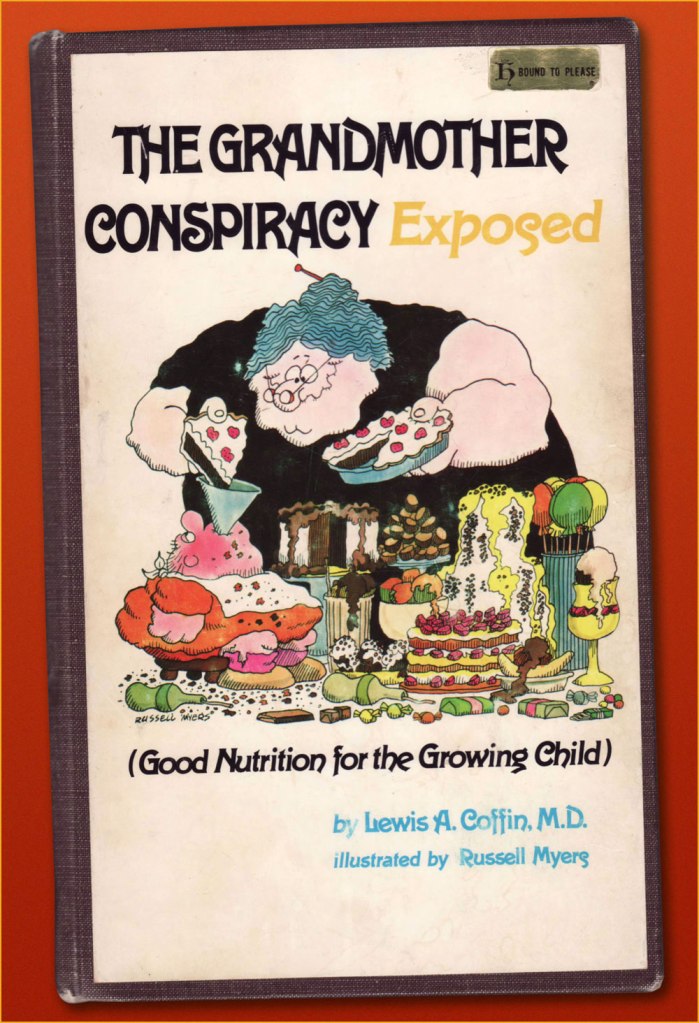
Having already dealt with Broom Hilda, let’s dig a little deeper. In 1974, early in his strip’s run, he contributed illustrations to California paediatrician Lewis A. Coffin’s book, The Grandmother Conspiracy Exposed (Good Nutrition for the Growing Child)… and did a lovely job. Given the ever-fickle nature of the dietary business — to say nearly nothing of its oft-political ramifications — Coffin’s book now seems of its time and place, but he was pretty progressive, and put forth a lot of sound notions. Here are some of Mr. Myers’ fun chapter illustrations:
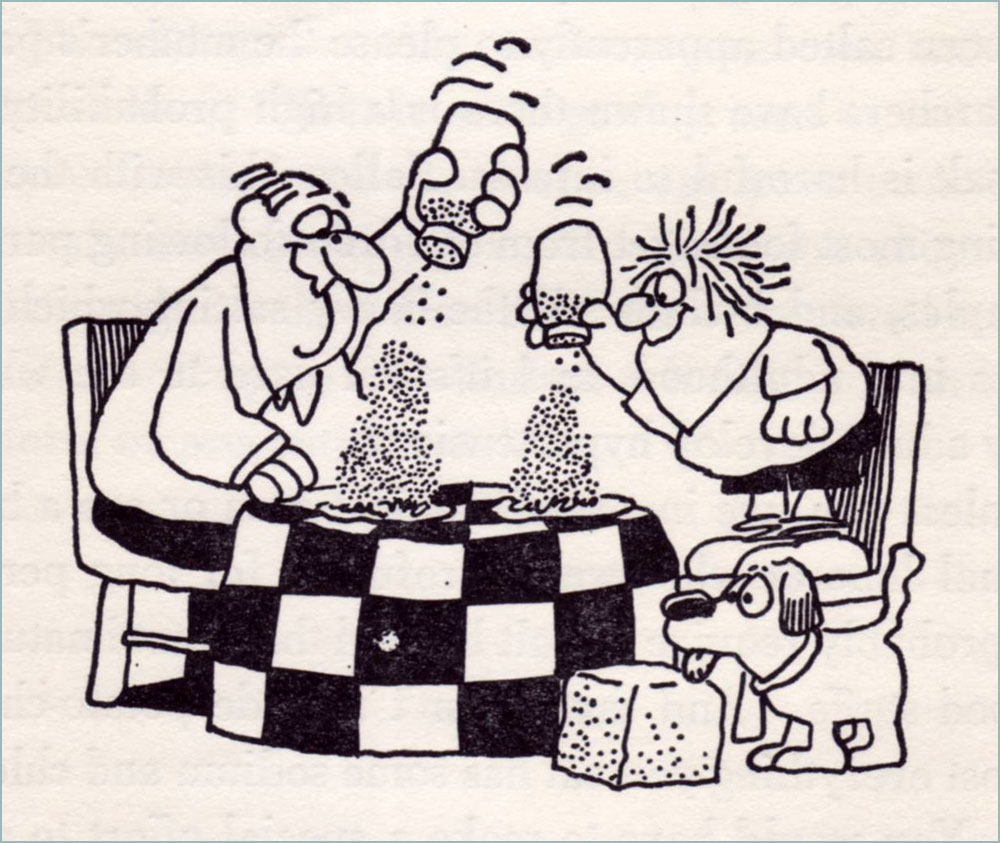
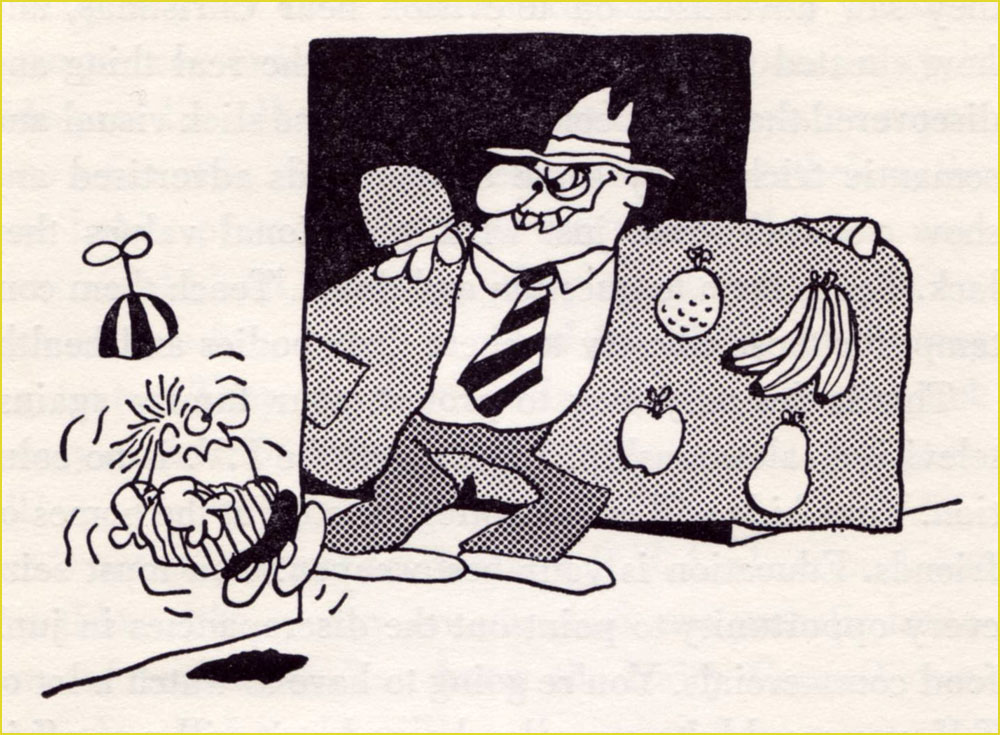
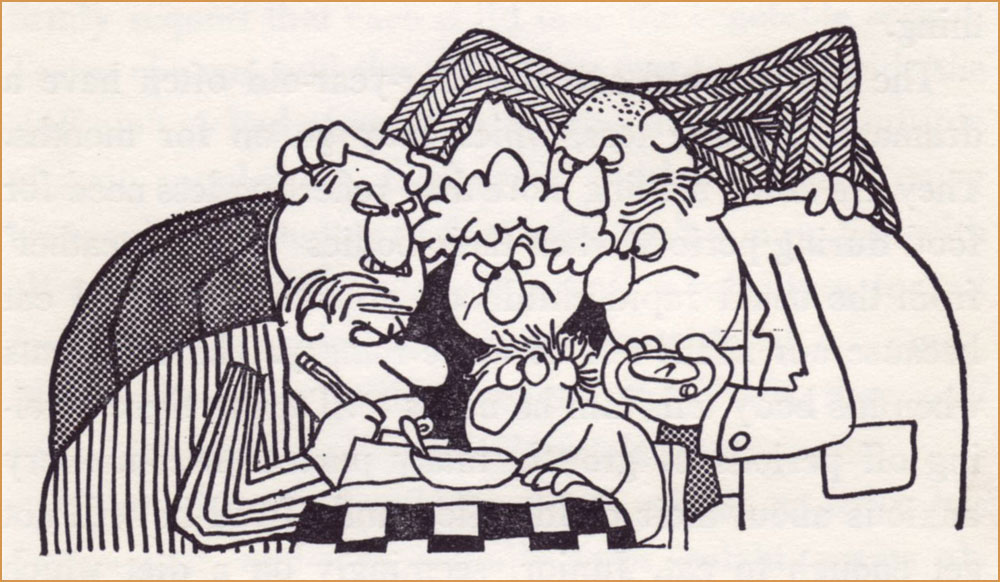
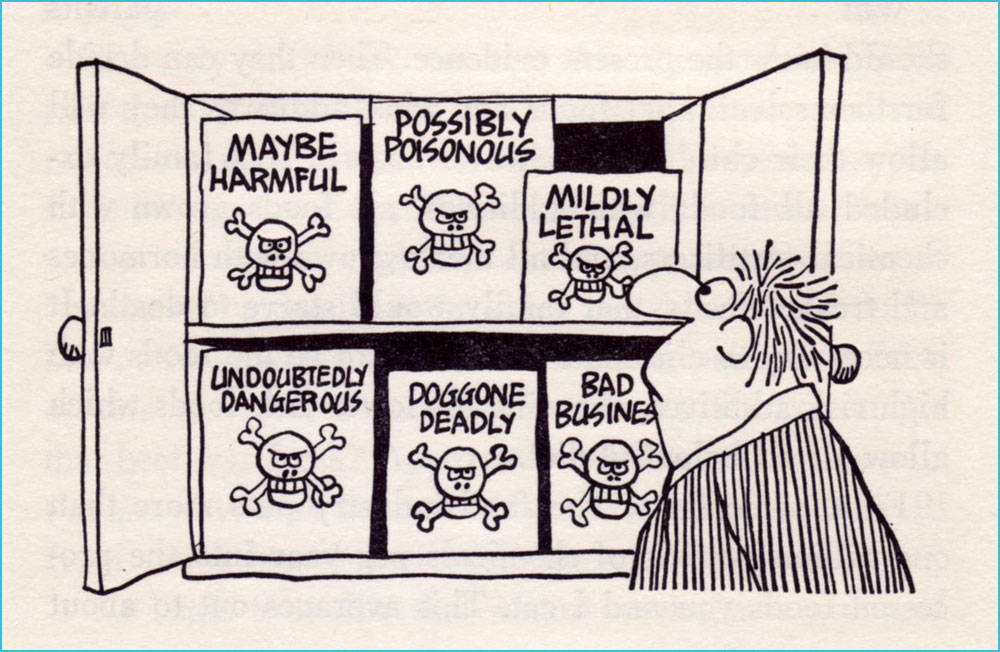
« The best way to get vitamins is to eat foods which contain them. »« The advantages of breast feeding are well known: lack of preparation, sterility, natural warmth, ready availability, proper nutritional balance of ingredients, prevention of anemia, attractiveness of container design, transfer of protective factors against disease, apparent lower incidence of allergic disease, relative absence of intolerance to milk, and all the emotional gain for both mother and child. » « Unless you live in a semi-tropical area or are a heavy manual labourer who sweats profusely for long periods, you probably require no salt beyond that found naturally in food stuffs. »« I believe that a person who has felt a sun-warmed, firm but ripe tomato in his hand, lifted it up to his nose and savoured the deep, earthy aroma, and tasted the full, tart-sweet taste, juice and seeds dripping down his chin, will never forget the look, feel, smell or taste of that real tomato, and will know how to pick out the best tomatoes in the supermarket, because he will have that supreme standard to measure them against. »« My children love raw vegetables. They dislike many cooked vegetables, often the same ones they like raw. While I’m not saying you should sell the stove, it seems they sense that something’s missing after cooking. » « For many years Americans felt secure in the belief that the government and, more specifically, the Food and Drug Administration was constantly screening all processed food for harmful additives. It has finally become evident that this is not the case. » « Most school systems have completely abdicated the responsibility for nutritional education and have totally misused their most potent teaching tool, example, in the name of economy. » « Your children will sneak around your back and gorge at the neighbour’s house, or will slither down to the local store and furtively cram candy-bars and soft-drinks down their deprived throats. »« It wasn’t until television came along that the finely honed art of brain-washing children came to full flower. »« … we know that the majority of peoples in the world not only don’t drink milk, but they would be quite ill if they did. »« You would naturally assume that your local school’s lunch program was nutritionally a good one. »And here’s my durably bound copy of this lovely tome, discarded early this century from the library of Alma College, a private Presbyterian liberal arts college in Alma, Michigan.
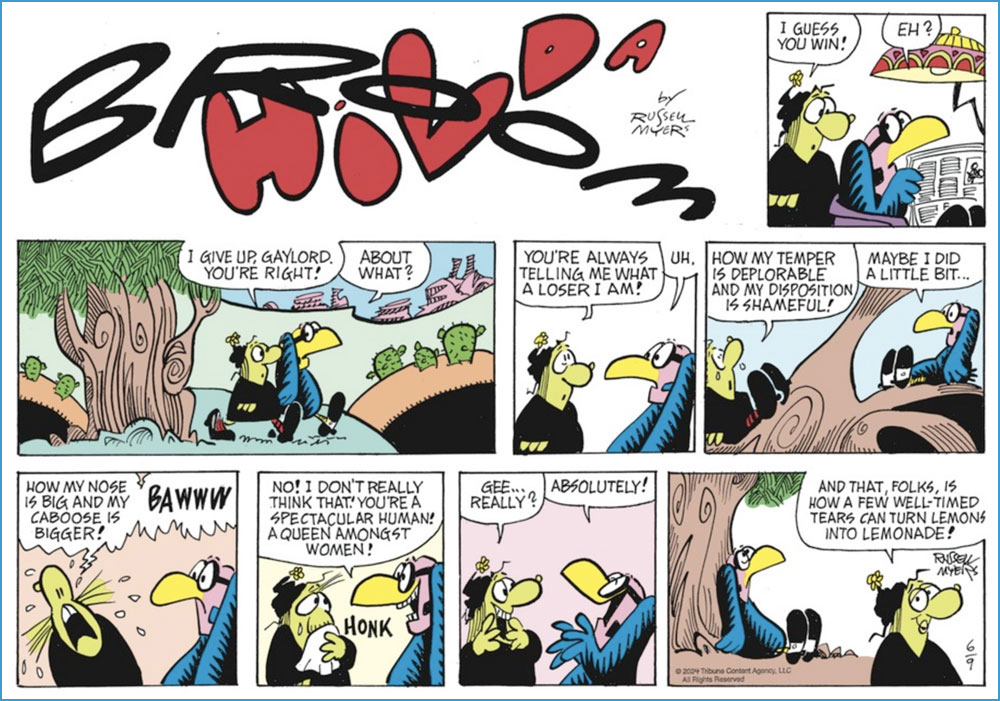
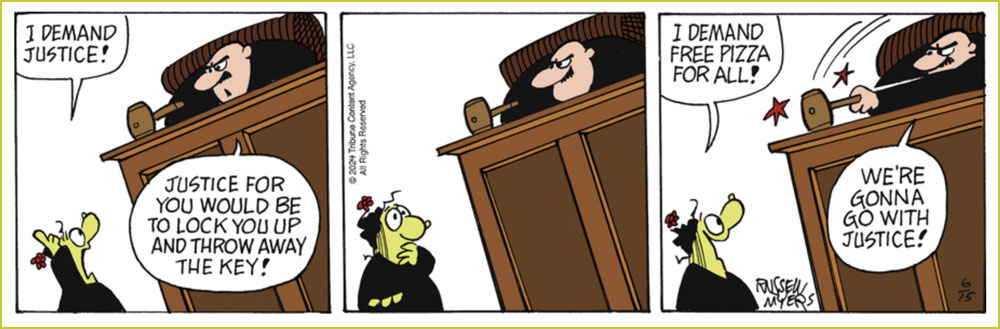
And since I’ve touched upon Mr. Myers’ Broom Hilda achievement, I would be remiss in not giving our readers a look at what he’s been up to lately. After all, an endurance record means little if the work itself has scant remaining merit. If you ask me, his timeless charm has weathered the years admirably well.
A Sunday strip from June 9, 2024.And a daily from June 15, 2024. Pretty sharp for a guy in his mid-eighties!




































 Who's Out There?