Yesterday’s Tomorrow’s Teenagers: Sheldon Mayer’s Sugar and Spike

« And they sure seem to understand each other! Listen to them jabber away! » « Oh, come on — you know that’s only baby-talk! It doesn’t mean anything! »

If you were to ask me (make that *us*; we’re unanimous on that point) what was the most consistently excellent American comics series of the Silver Age, the response would be Sheldon Mayer’s Sugar and Spike. « Say what? », I expect most of you will say. Look at it this way: S&S ran for 98 issues from 1956 to 1971, the entire series crafted by a single creator-writer-artist, whose commitment and level of quality never flagged. Unlike, say, Fantastic Four (the most likely pick, I expect), it didn’t take several issues to find its legs, it didn’t suffer from mediocre to dreadful inkers for half of its run, nor, well, the glory-hogging participation of Stan Lee. At Marvel, I’d be more inclined to propose Steve Ditko‘s (and dialoguists Stan Lee, Don Rico, Roy Thomas and Dennis O’Neil’s) run on Doctor Strange (1963-66)… but we again run into the snag of the directionless twaddle that followed Ditko’s departure. In terms of superheroes, my vote would go to Arnold Drake, Bob Haney and Bruno Premiani‘s Doom Patrol (1963-68). Yet my overall number two would have to be Carl Barks‘ Uncle Scrooge* (1952-66). There as well, lesser hands took over once Barks stepped away. It’s an industry, after all.

Speaking of lesser hands, « The Sugar and Spike tales flowed exclusively from Mayer, who had a contract stating no other artist or writer could produce stories featuring his toddler characters. That’s a rare sort of deal to cut (then or now) for a property that the publisher owns outright, but Sheldon Mayer had more than earned his place at DC as a prolific writer, artist and editor for many years. » Of course, that covenant was pointlessly broken by DC after Mayer’s passing. Shame on you, Keith Giffen. Mayer had also asked that his wonderful 1970s creation, The Black Orchid, never be given an origin or have her mystery dispelled. But of course, in 1988, that trust was pointlessly broken by DC. Shame on you, Neil Gaiman (« Well, Alan made the Swamp Thing a vegetable, I’ll make the Black Orchid a plant… he’ll be so proud of me! »)

It’s no exaggeration to claim that Sheldon Mayer (1917-1991) was one of the essential architects of the US comics industry. Without him, DC would have passed on Superman, and without the Man of Steel, it’s a cinch our culture would be in a vastly different state, pour le meilleur et pour le pire. But that’s just one of his many contributions, direct and indirect. Much praise has been heaped on Mr. Mayer, justifiably so. His work is inspired, lively, absolutely hilarious, and life-affirming. He truly was a versatile giant. Check out Ron Goulart’s recollections of his friendship with Mr. Mayer, for instance.

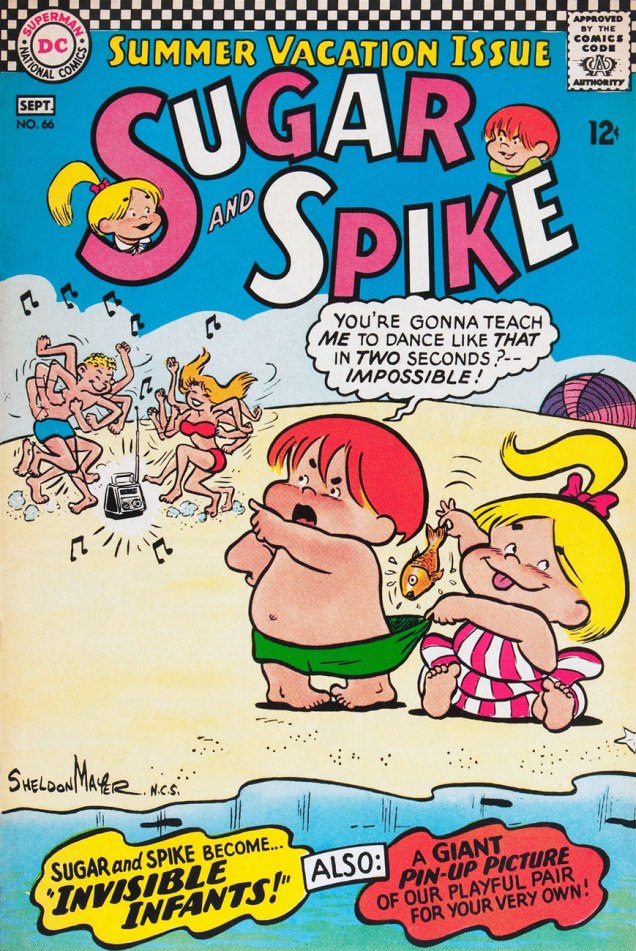
SugarSpike36A
This is Sugar and Spike no. 36 (Aug.-Sept. 1961). In case you’re wondering, the NCS after Sheldon’s signature indicates his membership (in good standing!) in the National Cartoonists’ Society.
SugarSpike66A
This is Sugar and Spike no. 66 (Aug.-Sept. 1966).
SugarSpike79A
This is Sugar and Spike no. 79 (Oct.-Nov. 1968).
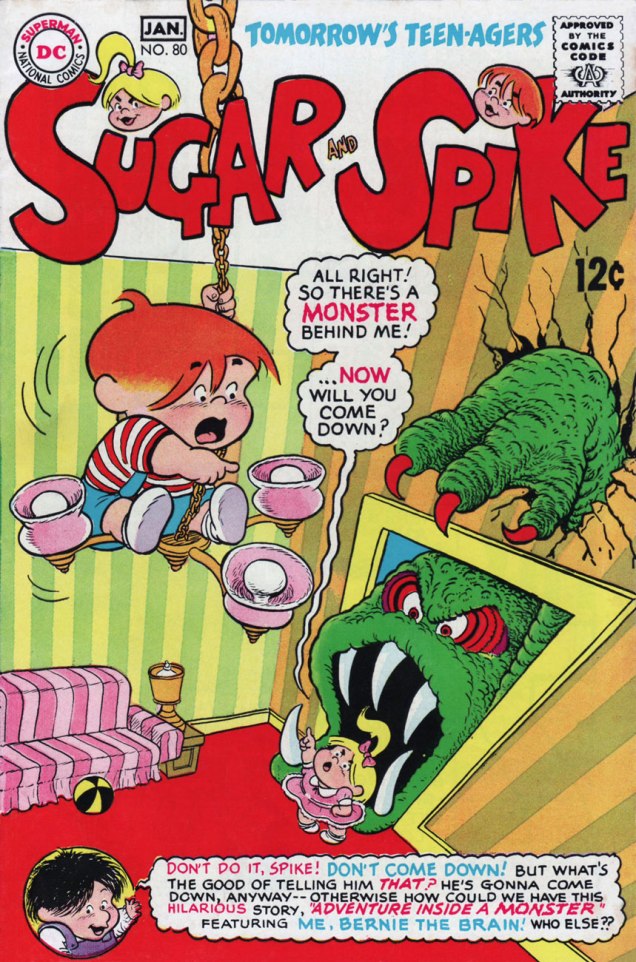
SugarSpike80A
This is Sugar and Spike no. 80 (Dec. 1968-Jan. 1969).
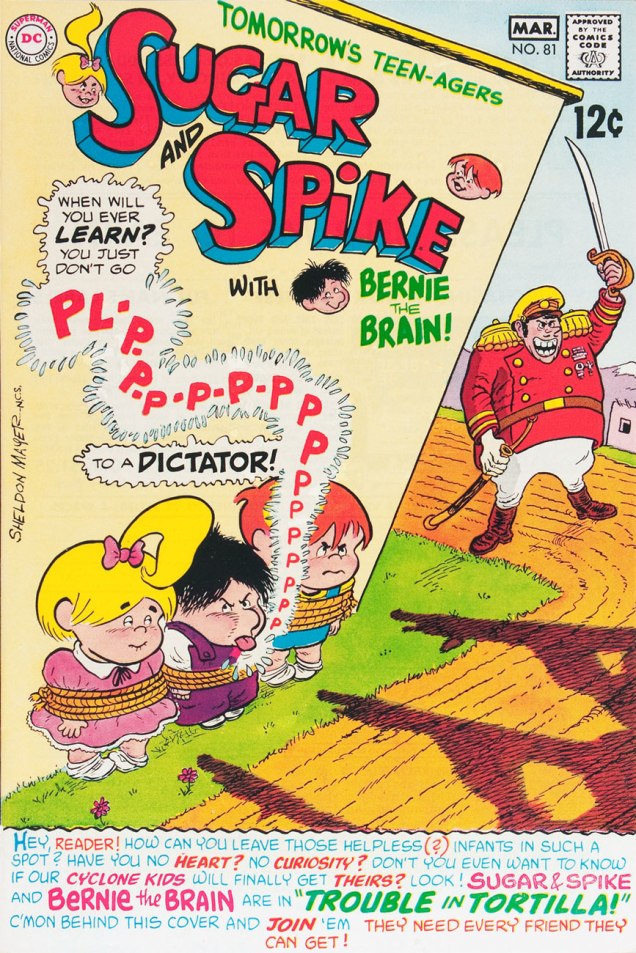
SugarSpike81A
This is Sugar and Spike no. 81 (Feb.-Mar. 1969).
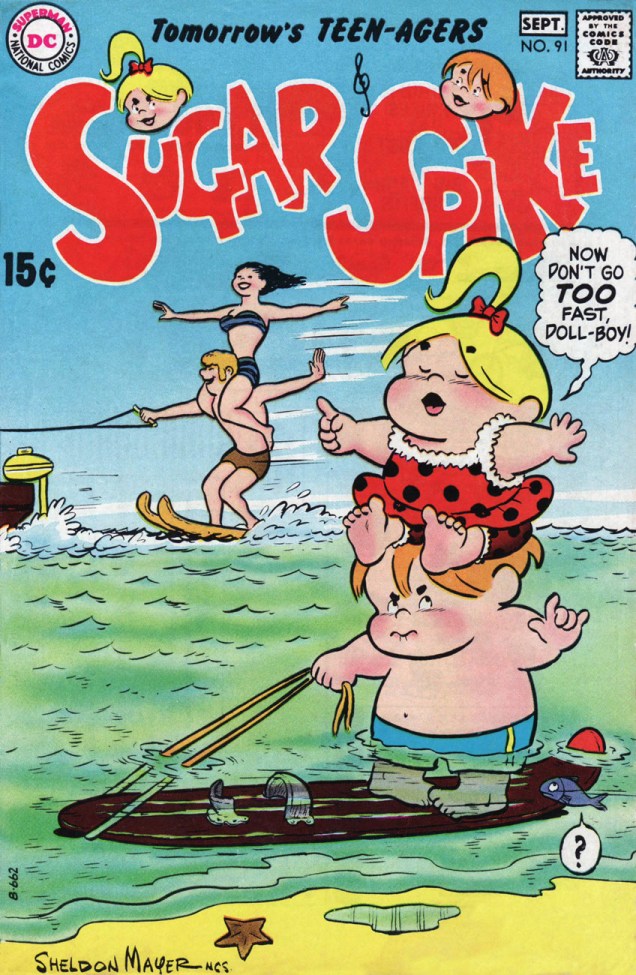
SugarSpike91A
This is Sugar and Spike no. 91 (Aug.-Sept. 1970).
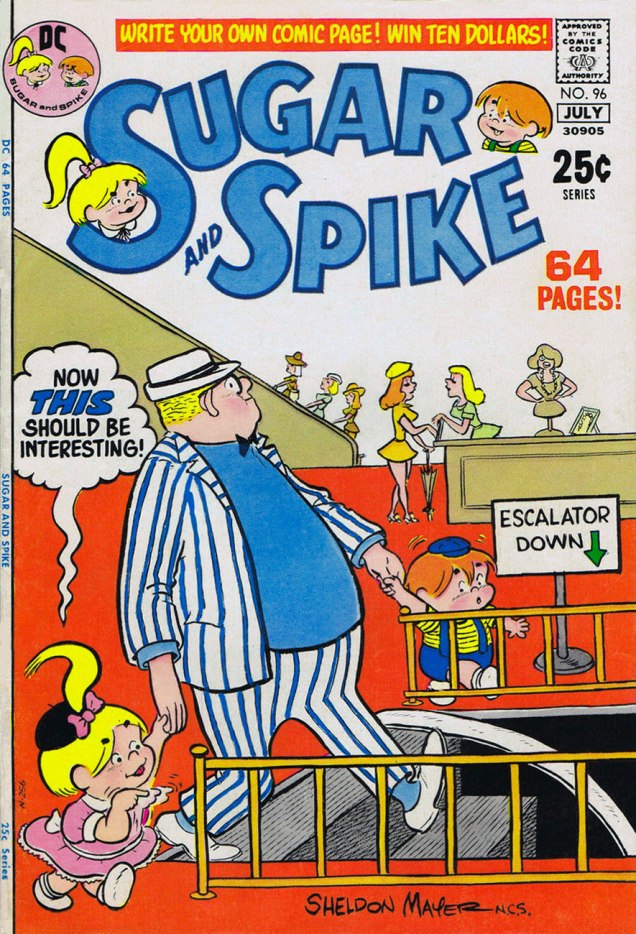
SugarSpike96A
This is Sugar and Spike no. 96 (June-Jul. 1971).
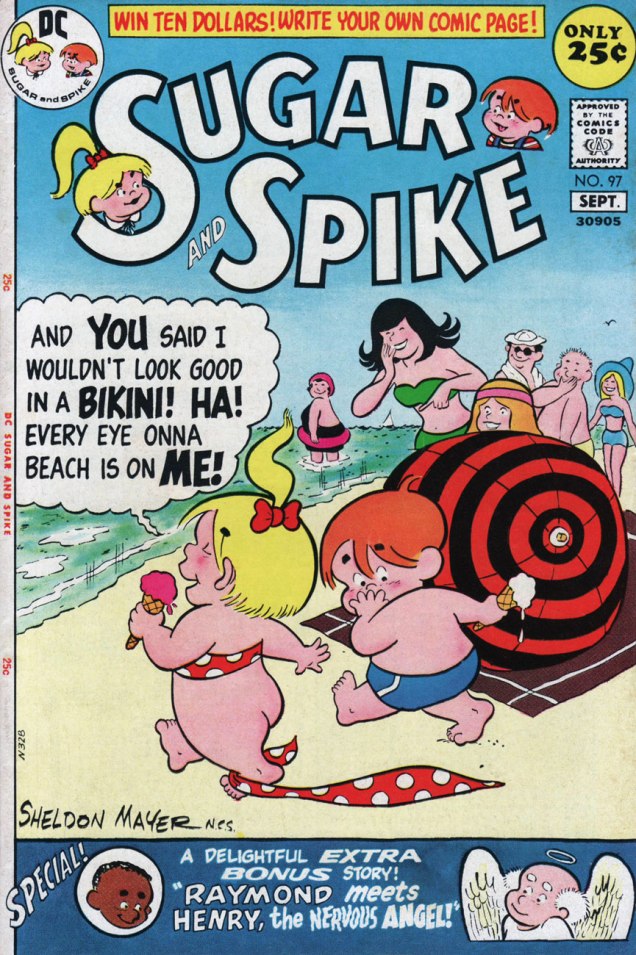
SugarSpike97A
This is Sugar and Spike no. 97 (Aug.-Sept. 1971). You’ll notice we’re featuring a lot of beach scenes… well, it’s seasonal!

In what I imagine to be another benefit of Carmine Infantino‘s editorial ascent, Mayer’s work took a wild turn with issue 72 of S&S. A fine new character, Bernie the Brain, was introduced, Mayer’s layouts suddenly adopted extreme and distorted perspectives and his inking grew more florid and detailed. Honestly, Mayer’s work at that point was the closest DC ever came in style to that of Underground Comix. These changes gradually ebbed, and by issue 90, things were more-or-less back to the old standard. The cause? failing eyesight (cataracts, to be exact), which led to the book’s cancellation, rather than the more banal dropping sales. Don’t worry, Mayer underwent successful eye surgery and intermittently returned to the drawing board. But he mostly wrote… beautifully. We’ll return to that soon.

Here are a few examples (show, don’t tell!) of the wild ‘n’ wooly Sugar & Spike:

SugarSpike79P15A
Page 15 from Sugar & Spike no. 79‘s The Mystery of the Swiped Sea-Turtle (Oct.-Nov. 1968)
SugarSpike80Page04A
Page 4 from Sugar & Spike no. 80‘s Adventure Inside a Monster! (Dec. 1968-Jan. 1969)
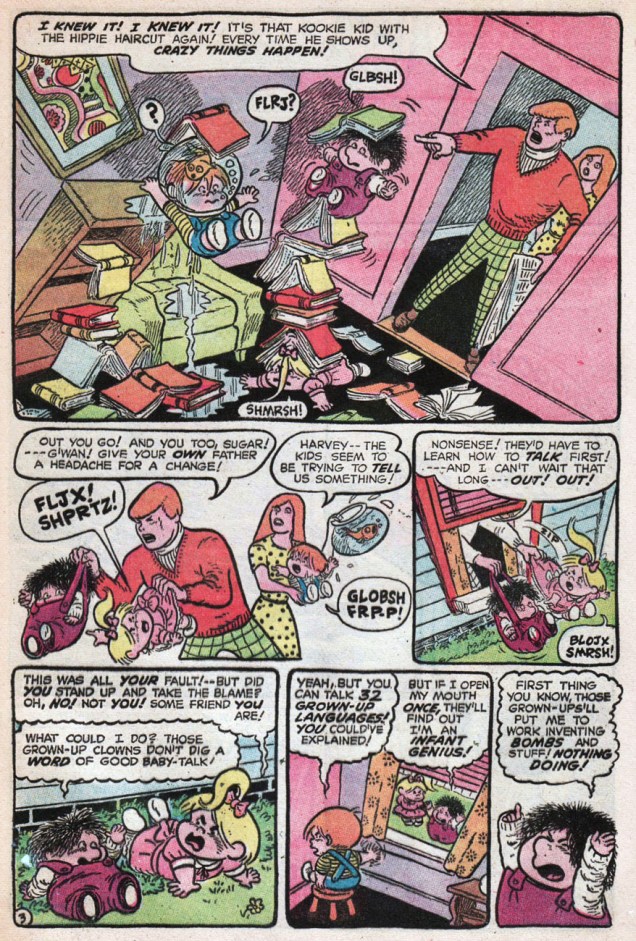
SugarSpike84p3A
Page 3 from Sugar & Spike no. 84‘s Bernie the Brain’s Biggest Blunder! (Aug.-Sept. 1969)

Unfortunately, Sugar and Spike falls in that select category of comics series that aren’t popular enough to be fully reprinted (DC issued one volume in its Archive Editions series, usefully reprinting S&S nos. 1 to 10) and too popular to be truly affordable (Angel and the Ape is another). In addition, since the series sold well, but to a broader audience than the traditional fanboy collector set, the books are mighty hard to come by in decent condition, not to mention *complete*. The reason? Paper dolls. They enjoyed, for quite some time, great popularity. Sugar and Spike’s regular Pint-Size Pin-Ups frequently ran on the back of story pages (often the conclusion!), so their absence is a real collector’s bugaboo. Besides, they were quite charming, so why do without them?

S&SPintSize87A
Pint-Size Pin-Ups from Sugar and Spike no. 78 (Aug.-Sept. 1968). I should also point out that Mr. Mayer kept a sincere, attentive, unpatronizing relationship with his readers.

-RG

*my favourite Uncle Scrooge story: issue 60’s The Phantom of Notre Duck (Nov. 1965).

Mal Eaton’s Peter Piltdown

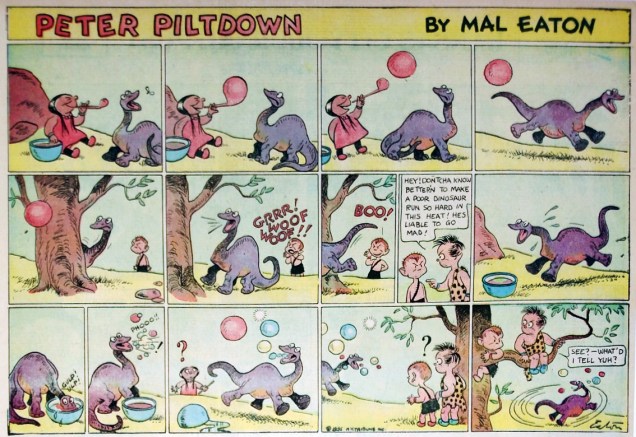
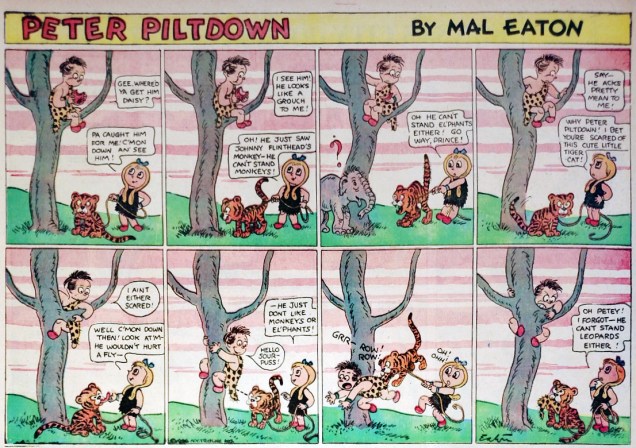
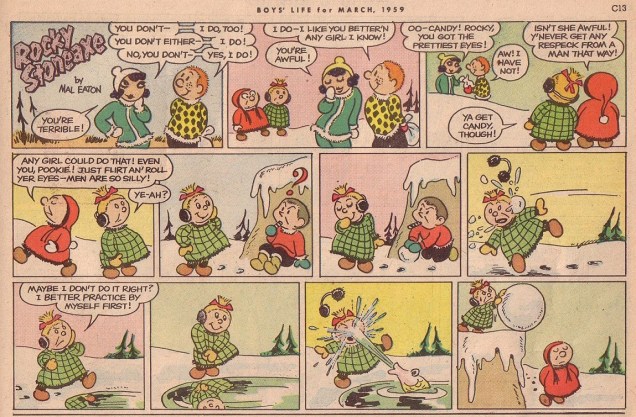
Newspaper strip Peter Piltdown was created by Mal Eaton (1902-1974) and debuted as a Sunday page on August 4th, 1935. Featuring a mischievous boy getting into trouble in some sort of prehistoric world (with a lot of indispensable modern conveniences – like earmuffs!), the strip seems to have lasted for quite a while, until the late 1960s. The reason I say “seems” is because not much is known about Eaton *or* the strip. With some difficulty I managed to find out that Malcolm Eaton was based in New York.

It doesn’t help that the strip changed titles several times. Starting out as Peter Piltdown, syndicated by Miller Services (a small Canadian newspaper syndicate that has since then been renamed into Canadian Artists Syndicate), it appeared as Pookie (Peter’s younger brother, whose antics had taken over the strip) in 1947 and 1948, and then migrated to the pages of Boys’ Life magazine as Rocky Stoneaxe.

Some comics are buried by the collective memory through sheer bad luck, some are rightly forgotten because they weren’t that good. It’s always exciting to unearth something obscure, but one has to ask if this excitement is justified, or whether whatever artifact of the past one has dug up is thrilling only because of a “I know what you don’t!” kind of show-off-manship. I do think Peter Piltdown is genuinely good.  The art is manic – and dynamic – in a way that’s spontaneous and appealing. Eaton clearly liked to draw animals; they’re often a big part of the punch line, and they’re drawn lovingly, with great attention to detail and body language. Anyway, you be the judge!

From the small sample that’s findable online, I’d say that the period around the 1940s is the best; the art gets simpler later on. Here’s a selection of strips that I’ve succeeded in finding (and cleaned up somewhat) – they are in chronological order starting from 1943 and going up to 1959. Most of these are original art: three images are from the collection of gallery owner Rob Stolzer (the first two, as well as the Sunday strip in colour); the rest have been found on Heritage Auctions. The last three are scans from a newspaper.

MalEaton-PeterPiltdown-1

MalEaton-PeterPiltdown-2

MalEaton-PeterPiltdown-3

MalEaton-PeterPiltdown-4

MalEaton-PeterPiltdown-5

MalEaton-PeterPiltdown-6

MalEaton-PeterPiltdown7

MalEaton-PeterPiltdow-8

MalEaton-RockyStoneaxe

~ ds

Well, blow me down: it’s E.C. Segar’s birthday!

« I know what’s the matter with your comic artists, they’re all crazy. »
« Of course they’re crazy, they wouldn’t be worth a whoop if they weren’t crazy. »

Today we commemorate the birthday of Popeye creator Elzie Crisler Segar (December 8, 1894 – October 13, 1938). The man succumbed to leukaemia and liver disease at the distressingly early age of 43… but not before making his everlasting mark on the world of cartooning and the world at large.

SegarPantsA
In this Popeye Sunday strip dated August 14, 1938, J. Wellington Wimpy ably demonstrates his solid-gold mooching wiles.

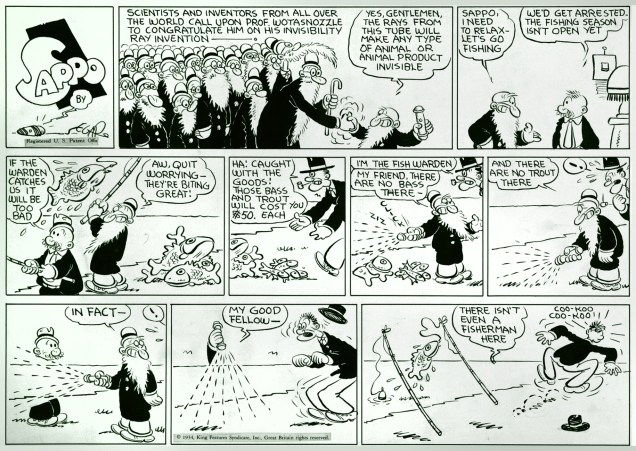
And for dessert, have a chaser of Segar’s even more endearing (in my opinion) companion strip, Sappo, featuring his delightfully bonkers Professor O. G. Wotasnozzle.

SappoA
Sappo appeared as Thimble Theatre / Popeye’s “topper” on Sundays. This out of sight entry appeared on April 8, 1934.

Happy Birthday and bon appétit, Mr. Segar, wherever you are!

– RG


The perils of ice-cream (with fudge sauce)

Gluyas Williams (1888-1982) was an American cartoonist whose work was published in The New Yorker, Life, Collier’s, etc. His charming one-page cartoons show a keen understanding of human nature; sometimes there’s a recurring topic – for instance, “The World At Its Worst” and “Snapshots Of…”*.

So here’s “Snapshots of a woman eating a sundae” (1926) for your enjoyment, but please don’t blame the subsequent weight gain due to ice cream cravings on me.

GluyasWilliamsSundae.jpg

If you want a catalogue of little annoyances, petty vexations and funny paradoxes of life that will make you chuckle in embarrassment of recognition, you can watch some George Carlin sketches… or read some Williams cartoons, a good selection of which is available here: http://www.gluyaswilliams.com/dailies01.htm (No, this type of humour wasn’t born yesterday, and although technology marches on, the basic stuff stays if not the same, then similar.)


*Somehow I’m reminded of Sergio Aragones’ “Who Knows What Evil Lurks in the Hearts of Men? The Shadow Knows” leitmotif).

~ ds

Hallowe’en Countdown, Day 4

« There’s lots of heads that would be improved by removing the brains and stuffing them with punkin! »

Here’s one from early in the funnybook game. Eastern Color’s anthology title Famous Funnies (July, 1934 – July, 1955, 218 issues), is generally held to be the first true American comic book. This is October, 1939’s issue 63, with a cover by Victor E. Pazmiño (1899-1970), who often initialed his work VEP (not to be confused with Virgil Partch’s VIP). Our featured protagonists are Sam Smithers and his tormentor, Pigtails.

FamousFunnies63A

Should you have a little time on your hands, you can read this issue, and many others in the series, right here, through the auspices of the fine folks at comicbookplus.com.

-RG