Tentacle Tuesday: Tangles with Adam Strange

« The menacing tentacles came probing down out of the sky in a fantastic quest for the secret of life! »

To celebrate Tentacle Tuesday, I’ve planned a visit to the mysterious planet Rann, as seen through the eyes of Adam Strange, that intrepid, quick-witted, teleporting archeologist. (First, a little context: Adam Strange was created by Julius Schwartz, with a costume designed by Murphy Anderson. He first appeared in Showcase #17 (November 1958). At first, Gardner Fox’s scripts were penciled by Mike Sekowsky, but this task was assigned to Carmine Infantino once the character moved to Mystery in Space, with Murphy Anderson inking most of the stories. As much as I like the Infantino + Anderson team, today’s contributions mostly involve other inkers.)
MysteryinSpace60
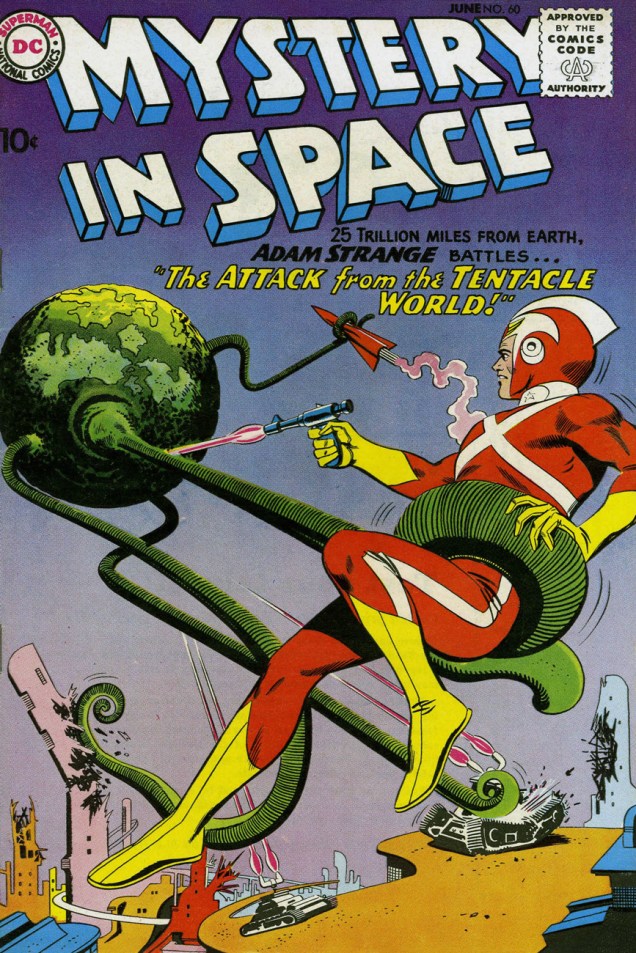
Mystery in Space no. 60 (June 1960). Cover inked by Carmine Infantino and inked by Joe Giella. “The Attack of the Tentacle World!” is scripted by Garner Fox, pencilled by Infantino and inked by Bernard Sachs.

That green thing? That’s Yggardis, a sentient planet that (who?) craves companionship. Here’s its highfalutin explanation, in that pompous English that Enemies of Mankind use when detailing their raison d’être to their victims: “For uncounted centuries, I have roamed the universe, raiding other worlds for their life-forms, lifting them in my tentacles! Unfortunately no form of living thing which I stole from other planets could live on me more than 24 hours!” The solution to that is (obviously) to steal even more animals for its private, deadly zoo, which is what it proceeds to do on Rann.

Mysteryinspace60-TentacleWorldA

Yggardis’ problem is solved when Adam blows it into carefully calculated smithereens, thus separating its radiation-producing mind from the rest of its inert body. A comparison is made to human surgeons removing deadly tissues and organs from an ailing patient. Uh, yes, surgeons regularly use explosives to sever their patients’ brains from their bodies, thus eliminating the need for expensive medication and such.

MysteryinSpace65
Mystery in Space no. 65 (February 1962), artwork also by Infantino and Giella.

The Mechanimen are anthropoid robots hellbent on protecting humans on Rann, destroying all their weapons on the principle that “weapons breed mistrust! mistrust breeds wars!” When the Mechanimen, while attempting to repel a sneak attack by some hostile aliens, run out of power (they “mechanically never gave a thought to renewing their power” – what?), Adam has to save the day, much like he has to avert disaster every time he sets foot on Rann. How did Rannians ever survive without him around?
AdamStrange-MysteryinSpace65
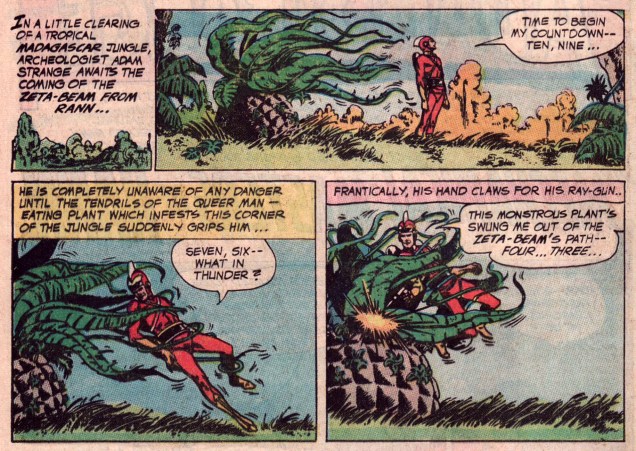
Adam doesn’t only have to confront mechanical tentacles in this issue: he’s also almost swallowed up by plant tendrils. “The Mechanical Masters of Rann” is scripted by Gardner Fox, pencilled by Infantino and inked by Murphy Anderson (ah, finally).

As you’ve probably noticed, Adam Strange stories tend to have gonzo plots. I *like* goofy stories, but these leave me frustrated: they’re far too far-fetched to make any kind of sense, yet they’re not wacky enough to be properly entertaining. The stories toss around “futuristic” terms like sky-radiation and zeta-beams and altered molecular structures, and provide “scientific” explanations that are supposed to make the plot plausible, except that the plot’s still ridiculous, all the more so after these attempts to shoehorn logic into it. It wouldn’t be so bad if Strange wasn’t over-explaining everything – he’s like your best friend’s pedantic dad, droning on about something while everyone feigns interest, sucking out the joy from topics that would otherwise be fascinating.

The other interesting aspect of Adam Strange is the sexual tension – basically, Adam’s zeta-beam wears off every time he and Alanna share an embrace. (That sends him back to Earth until he catches the next beam and gets teleported back to Rann.) That’s an original way of keeping them apart, I have to admit.

AdamStrangeByeAHe’ll be back soon, he says – as will I, with another Tentacle Tuesday.

~ ds

Happy birthday to Mr. Murphy Anderson

There’s an impressive parade of artists born in July. Of present concern is the birthday of one Murphy Anderson, who came into this world on July 9th, 1926 (and ceased to exist in 2015, at 89, no doubt moving into some parallel dimension).

His work on the Atomic Knights or Hawkman is fondly remembered…  but I’ll concentrate on some covers dear to my heart from DC’s science-fiction titles because sci-fi + great art = squeals of enjoyment. Anderson had no trouble portraying any number of far-fetched monsters or depicting incredible situations in his crisp, clean style that made his audience willingly suspend disbelief. Ah, okay, I called it “science-fiction”, but it often crosses the line into fantasy, or horror, with occasional detours into superhero, or just plain quirkiness. To follow the loopy logic of the stories contained in the pages of the following publications, one has to abandon the notion that A leads to B, and prepare oneself for a wild romp through the whole alphabet. Great art certainly facilitates this – the story may leave me scratching my head, but Murphy Anderson’s illustrating chops provide a firm ground to anchor to.

Without further ado, the great Murphy Anderson and some of his artwork!

For instance, take a look at some of the creatures featured in DC’s Strange Adventures through the decades. Anderson’s gallery of characters includes, but is not limited to, startled fishermen, anthropomorphized atomic clouds, and Middle-Age barbarians from another planet, all impeccably drawn.

StrangeAdventures21-MurphyAnderson
“But I tell you I actually hooked one on my line… THIS BIG!” It’s only fair. I guess you don’t even need to use bait for this type of fishing. Strange Adventures no. 21 (June 1952). Cover by Murphy Anderson.
StrangeAdventures143-MurphyAnderson
There’s no head-breaking over what title to give these stories… “The Face in the Atom Bomb Cloud” it is! Pencils and inks by Murphy Anderson, grey tones and colours by Jack Adler, lettering by Ira Schnapp. This is Strange Adventures no. 143 (August, 1962). Edited by Julius Schwartz.
StrangeAdventures160-MurphyAnderson
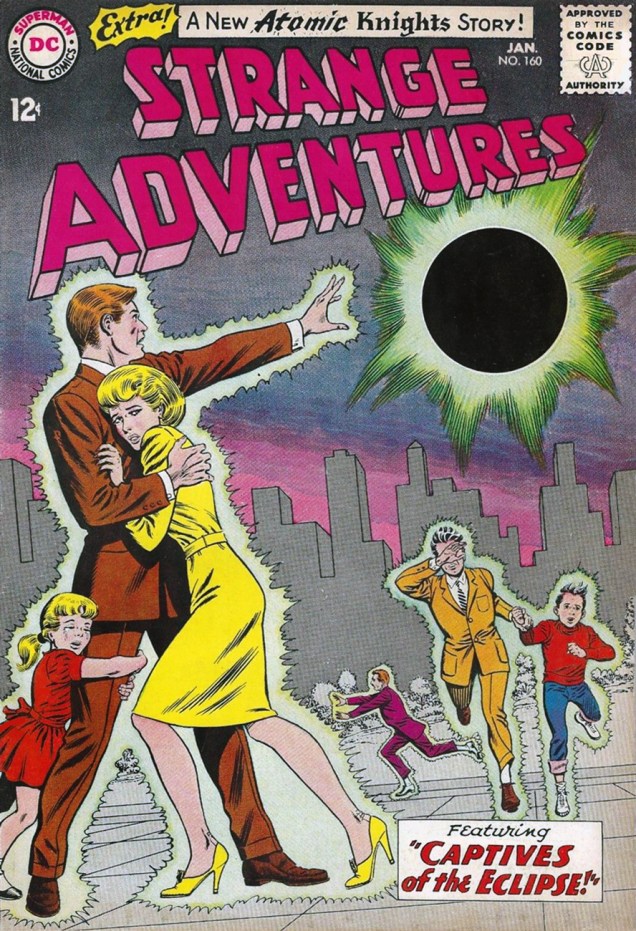
Strange Adventures no. 160 (January 1964), cover by Murphy Anderson. This issue is a treat, featuring two parts of an Atomic Knights story (“Here come the Wild Ones!”, written by John Broome and illustrated by Anderson).
StrangeAdventures222-MurphyAnderson
I promised barbarians, didn’t I? Strange Adventures no. 222 (Jan-Feb 1970), art by Murphy Anderson. I have a love/hate relationship with Adam Strange, often loving the art and hating the stories. It’s been a while – I have to re-read this stuff and see if I still find it indigestible.

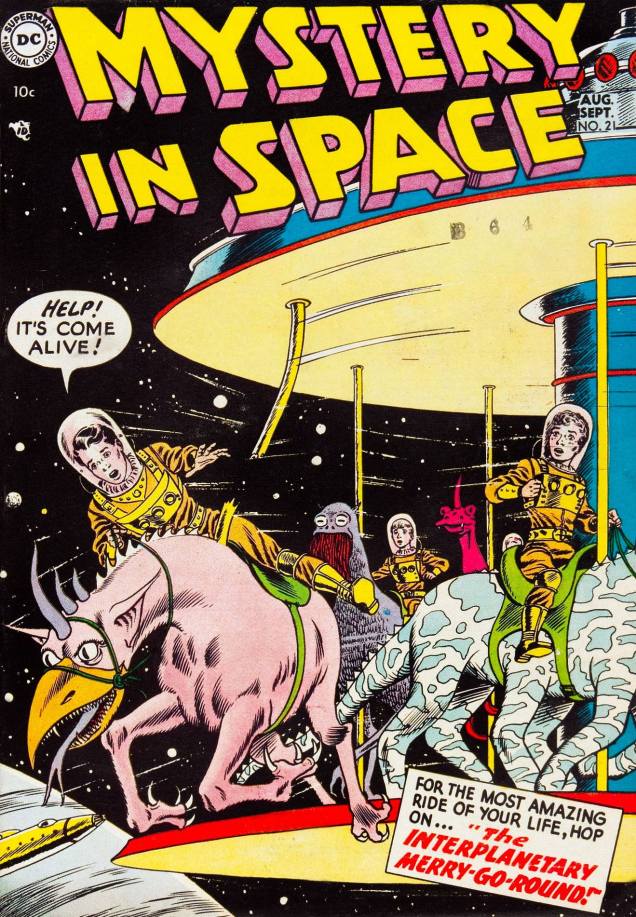
Another favourite series for its oft-striking covers is Mystery in Space. I love it when Anderson invents “space” animals composed of body parts from several Earth species. It’s indubitably fun, and children often have a great time inventing new creatures, but it takes chops to draw the result and make it work, anatomically and aesthetically.

MysteryinSpace21-MurphyAnderson
Damn, the safety regulations for those carousel things are really lax these (future) days.  It might not be science-fiction per se, but it sure is fun! Mystery in Space no. 21 (August-September 1954), with a cover by Mr. Anderson.

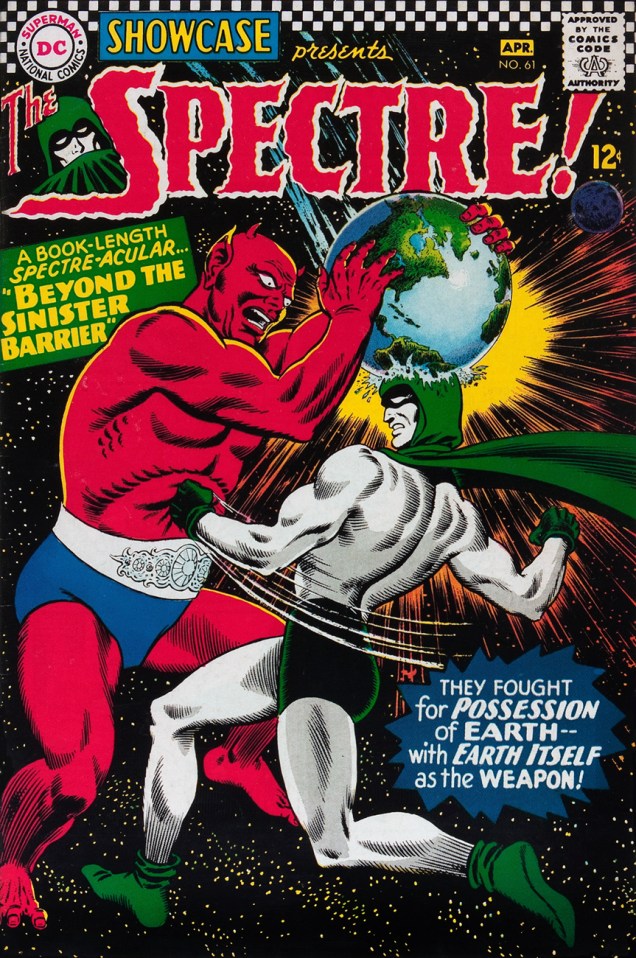
Despite my general resistance to superhero stuff, here’s a cover featuring the Spectre, whose classy costume is easy on the eyes.

Showcase61-MurphyAnderson
When you have to boink your arch-enemy on the head with a whole planet to knock him out and it still doesn’t work, you know you’re dealing with a pro. Showcase no. 61 (March-April 1966), cover by Murphy Anderson.

And one for the road…

TalesoftheUnexpected94-MurphyAnderson
Goofiness or social commentary? Frankly, the green “president” looks a lot friendlier than most current politicians. Tales of the Unexpected no. 94 (April-May, 1966). Cover by Murphy Anderson.

~ ds

Philippe Caza’s Surreal Suburbia

C’est un fou qui repeint son plafond et un autre fou arrive et lui dit: « Accroche-toi au pinceau, j’enlève l’échelle!

CazaDetritusA
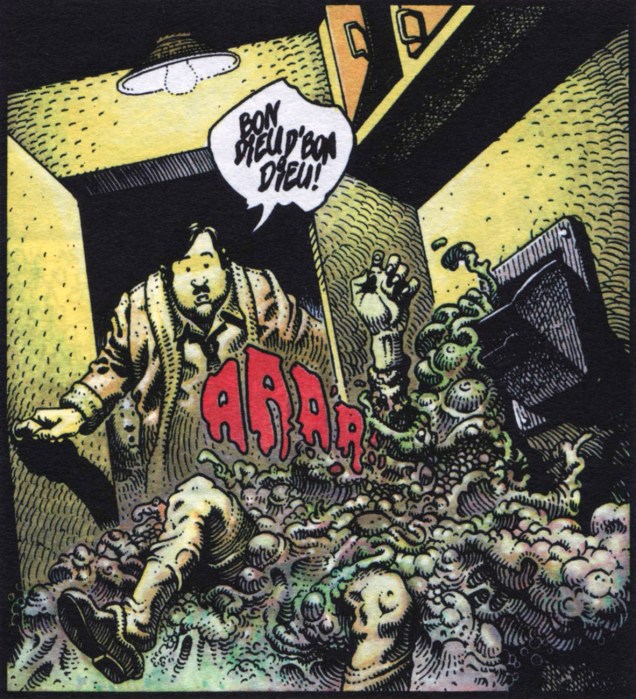
Marcel (and the hapless Yvonne) meet the Homo-Detritus. From Pilote no. 47-bis (April, 1978)

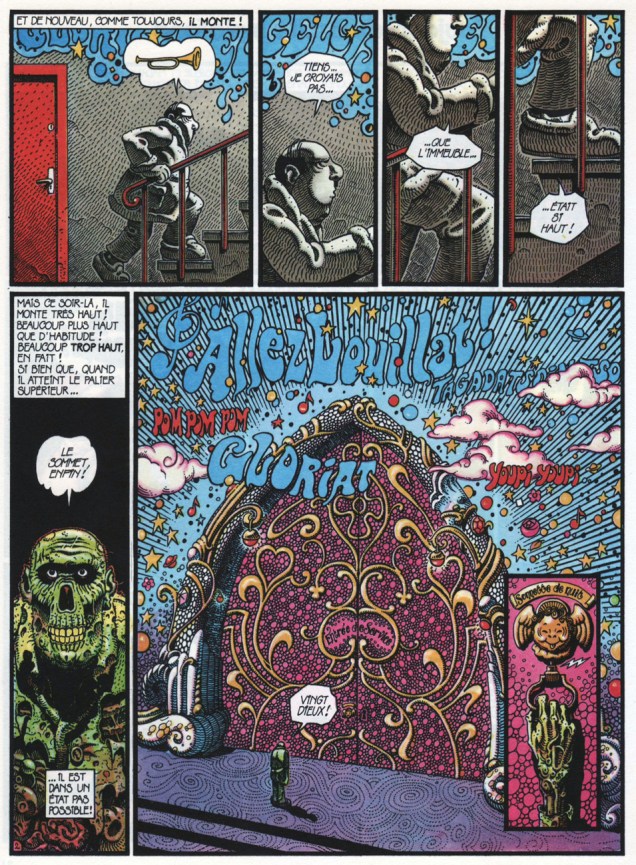
Poor Marcel Miquelon: a simple suburban nobody, he merely wants to get a good night’s sleep, but it’s never in the cards. When he and his Yvonne go to bed, each night at 10, some din from above invariably keeps him awake and frustrated. So what can he do but seize his faithful broom by the handle and bang on the ceiling to manifest his discontent? And dreadful things happen, in increasingly byzantine shades of dreadfulness.

These loosely-connected vignettes appeared sporadically from 1975 to 1979, under the portmanteau heading of Scènes de la vie de banlieue in the French monthly Pilote (1974-1989). They were the brainchild of Philippe Cazaumayou, alias Caza (b. November 14, 1941, Paris), also a renowned science-fiction illustrator, which should certainly surprise no-one.

CazaPlafond01ACazaPlafond02ACazaPlafond03ACazaPlafond04AThis episode is titled Toujours du bruit au plafond (« Still some noise on the ceiling »); it originally saw print in Pilote Mensuel no. 34 (March, 1977). It’s the rare (possibly the only) one that ends peacefully for Marcel, perhaps because he didn’t bother with the broom. Better St. Peter than… well, everything else.

*One of the hoariest French jokes, everyone’s heard it, and its appeal has whirled countless times around the bend, deep into irony and meta-subtext. Thankfully, though, it’s actually translatable, at least verbally: A lunatic is painting the ceiling. Another madman comes along and says: « Hold on to the brush, I’m borrowing the ladder! »

BalaiDargaud1982A
A ‘Scènes de la vie de banlieue’ collection (Dargaud, 1982). I agree: for all he’s gone through, Marcel Miquelon does deserve his own statue.
ScenesBanlieue_CouvA
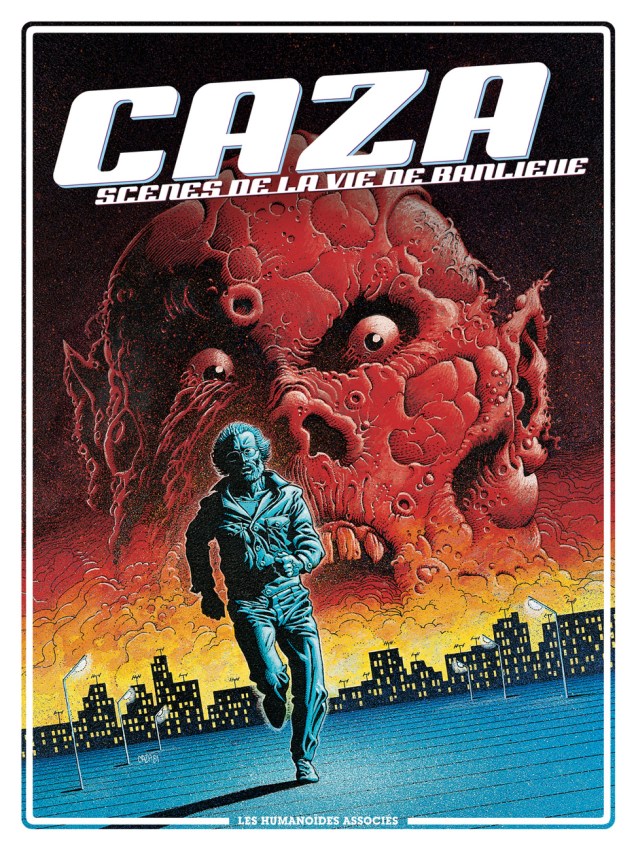
The collected works (Les Humanoïdes associés, 2017)

-RG

Tentacle Tuesday Masters: Basil Wolverton – Part 1

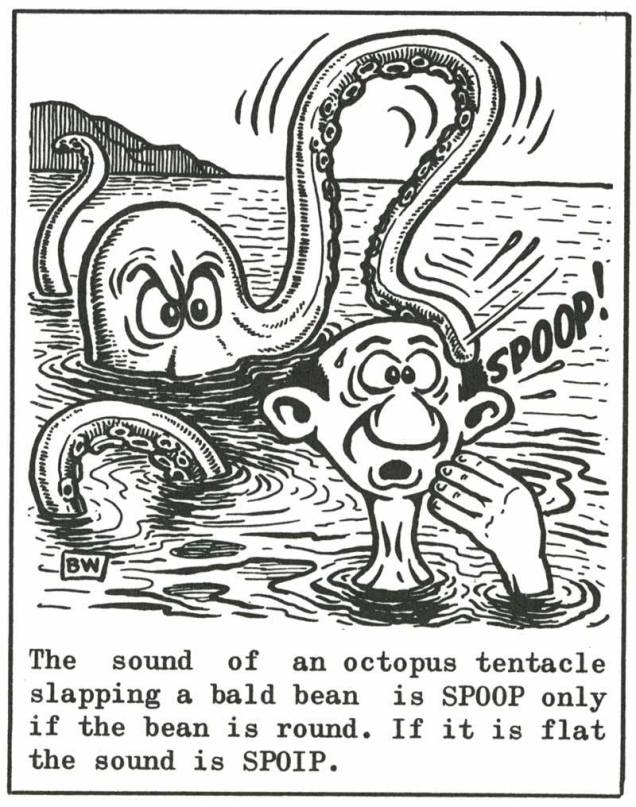
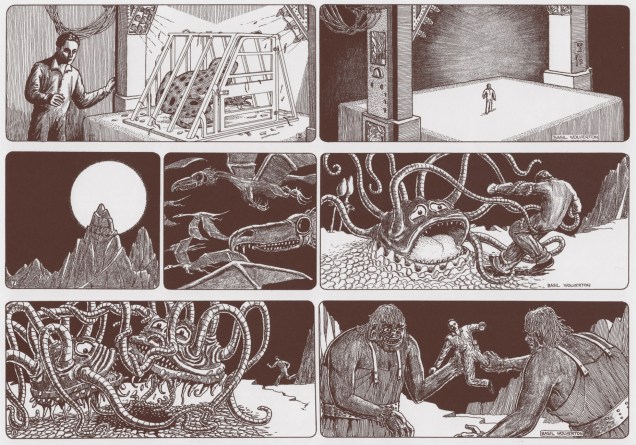
SPOOP! And a happy Tentacle Tuesday to you, too. Today’s feature is devoted to Basil Wolverton. A lot could be said about his sense of semi-slapstick, semi-surreal comedy and his unhinged-yet-meticulous drawing style, his delightful work in the realm of humour comics or his genuinely scary contribution to horror-in-pictures… but as I have a one-track mind, I’ll focus on his love of tentacles. No matter what sort of thing he was drawing, tentacles somehow managed to slip into it… and that’s understandable, for tentacles are both hilarious and fearsome. Without further ado, here’s your master of ceremonies and cephalopods… Basil Wolverton!

BasilWolvertonSpoop

Here’s some more sounds you might like to know about, to be used indiscriminately to spice up humdrum conversations around the water cooler:

Hungry cannibal filing eyetooth: FWATCH!
Man with calloused feet crossing rough linoleum: SKIRP! SKIRP!
Thumb gouging eye: SPOP!
Hot lava speweing on WCTU convention: FOOSK!
Hot lava spewing on Elks’ convention: SSSCRISH!
Person skidding on hot stove in bare feet: SCREESH!
Beaver biting into wooden leg: CRASP!
Car crashing into large vat of frogs’ eggs: SKWORP!
False teeth falling through skylight: TWUNK!
Sock in the face with Sears Roebuck catalog: PWOSH!
Sock in the face with Montgomery Ward catalog: PWASH!

This mirth-inducing stuff is from an article that Basil Wolverton wrote for the Daily Oregon in 1948 called “Acoustics in Comics”. Here’s another excerpt of that article (which is definitely worth reading in its entirety, and is fortunately easily found online… here, for instance):

« ‘I want realism!’ he (my publisher) had bellowed. ‘No more of this wild imaginative stuff that’s causing some people to want to ban our comic books! From now on, get that realism in there, and your strips will be horribly funny! Then the readers will go into hysterics and laugh like crazy, and our books will be acclaimed the most laugh provoking on the stands!’ That meant that an imaginative word like CRANCH was taboo. It was up to me to get the real sound word. »

And, hoppin’ horse hocks, he did.

TentacleTuesdayIcon

Enough of the rib-splitting stuff: this is a serious blog that discusses serious horror. *ahem*

UnpublishedWolvertonA
Page from Ethan Downing (1935), an early endeavour by Wolverton – unpublished.
AmazingMysteryFunniesv.2-12
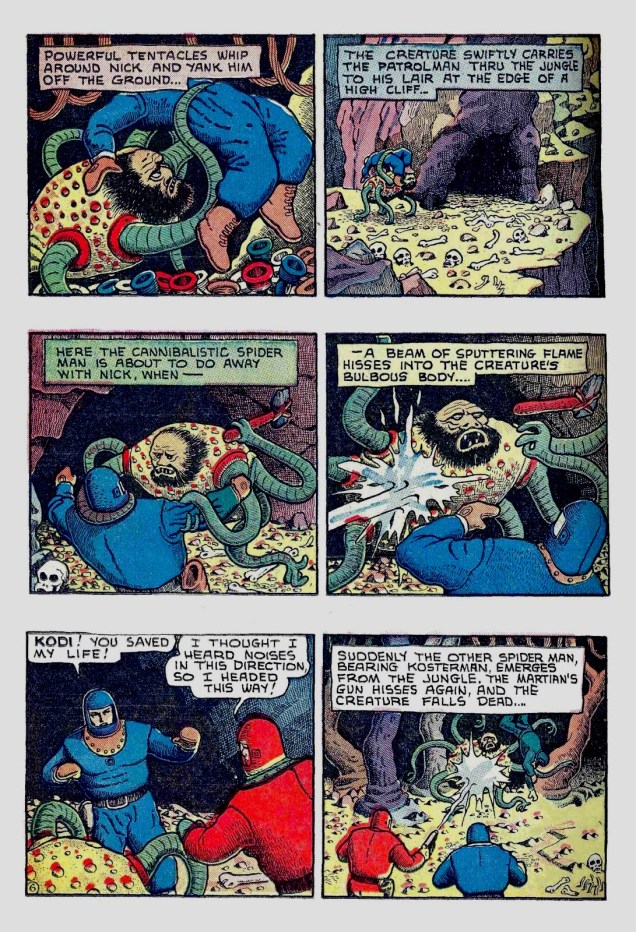
Amazing Mystery Funnies vol. 2 no. 12, December 1939. You may with to point out that this bandit is a cannibalistic spider, *not* a tentacled creature, but look at how he’s using his appendages, look me straight in the eye, and tell me that those aren’t tentacles. Besides, spiders have 8 legs, not 6, and this guy is definitely a 6-leg wonder… and they get called « tentacles », right from panel one.

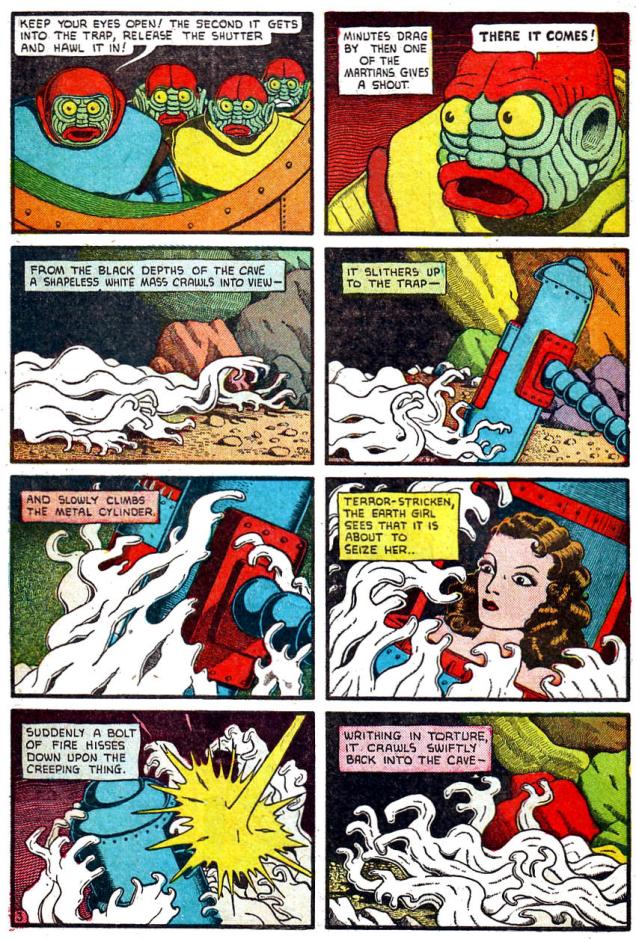
No inventory of Wolverton tentacles would be complete without the classic « Creeping Death from Neptune », first published in Target Comics vol. 1 no. 5 (June 1940), and reprinted many a time since, nearly as often the amazing Brain Bats of Venus (also quite heavy in quasi-tentacles. If aren’t familiar with it already, do yourself a favour and read it in full here.)

BasilWolveronTheCreepingDeath fromNeptune
A page from Creeping Death from Neptune, first published in Target Comics vol. 1 no. 5 (June 1940). The earth-girl is interestingly deadpan about being consumed alive by some sort of slithering weirdness.
BasilWolvertonTheCreepingDeathfromNeptunePanel
This story also has « tentacle-like » metal arms. I’m telling you, pretty much everything’s a tentacle where Wolverton is concerned.
MeteorMarlinA
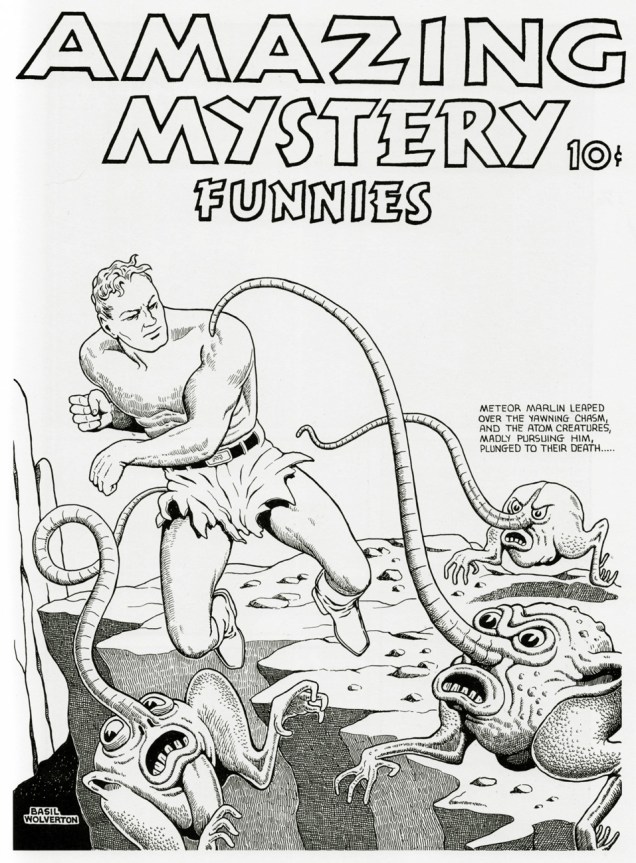
Meteor Marlin, cover illustration for episode one, April 4th, 1940… never published. In this one, noses are tentacles!
BasilWolvertonNightmareWorld
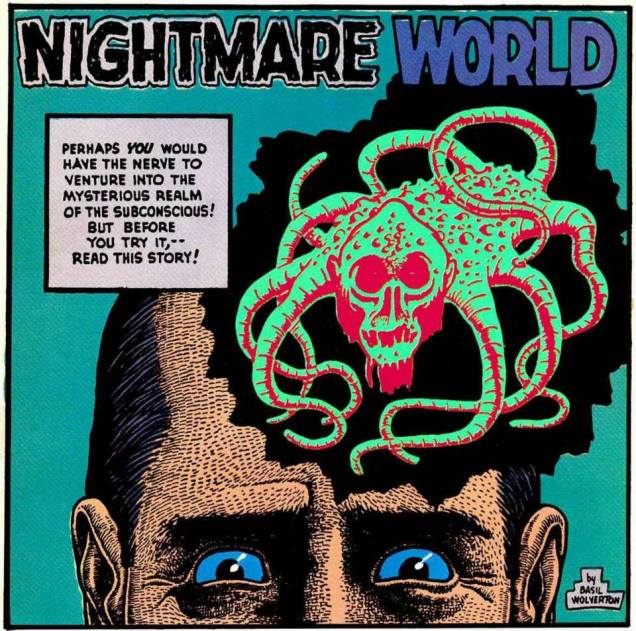
A panel from Nightmare World by Basil Wolverton that originally appeared in Weird Tales of the Future no. 3, 1952. This is a reprint from Mr. Monster’s Super Duper Special no. 8, 1987, re-coloured by Jeff Bonivert.

TentacleTuesdayIcon

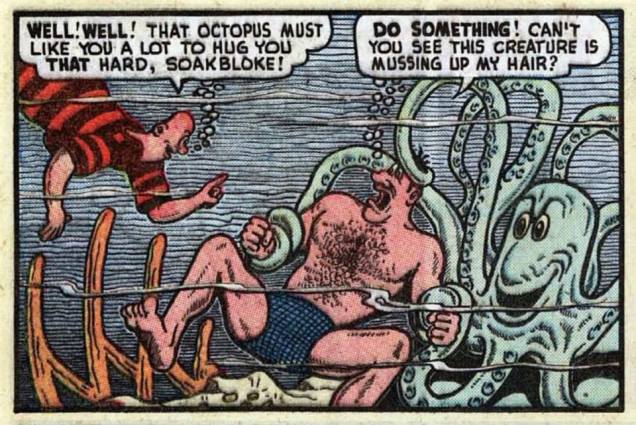
Phew! I’ll end this on a humorous note: octopuses evidently make fabulous hairdressers.

BasilWolvertonPowerhousePepperTentacles
This is a panel from a Powerhouse Pepper story that doesn’t really have a title, being referred to as “Haw! Haw! Grab a good gander…” instead. Originally published in Tessie the Typist Comics no. 9, April 1947.

Sadly, Wolverton’s weirdly frightening villains did not always find favour with the powers-that-be. Back in 1940, Jim Fitzsimmons, assistant editor at Centaur, publisher of Amazing Mystery Funnies, wrote:

« Though the fantastic and weird are the essential selling point of this feature, we would advise that you keep away from the use of revolting characters such as Brain-Men. Some of these characters you have developed have actually sent shudders down my otherwise unconcerned vertebrae. »

Reading The Life and Comics of Basil Wolverton, Volume 1: 1909-1941 written by Greg Sadowski (2014, Fantagraphics), one gets the impression this brilliant master of spaghetti-and-meatballs* comics spent his artistic life trying to fit his imagination into the narrow guidelines imposed by editors, heads-of-companies and other pundits. He died in 1978, aged 69, but was active in the comics field until 1973 («Plop!») I’ll leave it for people more erudite than I to debate his success (or lack thereof) in the comics field…. I’m just happy to witness a resurgence of interest in this great artist, and enjoying the treasure-trove of material that’s available.

~ ds

*Basil Wolverton, whom Life magazine once described as being from “the spaghetti and meatball” school of design.

“Cartography of a nowhere-land”: Patrick Woodroffe at Warren

« That minuscule ogre on the throne
must be the King. What a peculiar little man. »

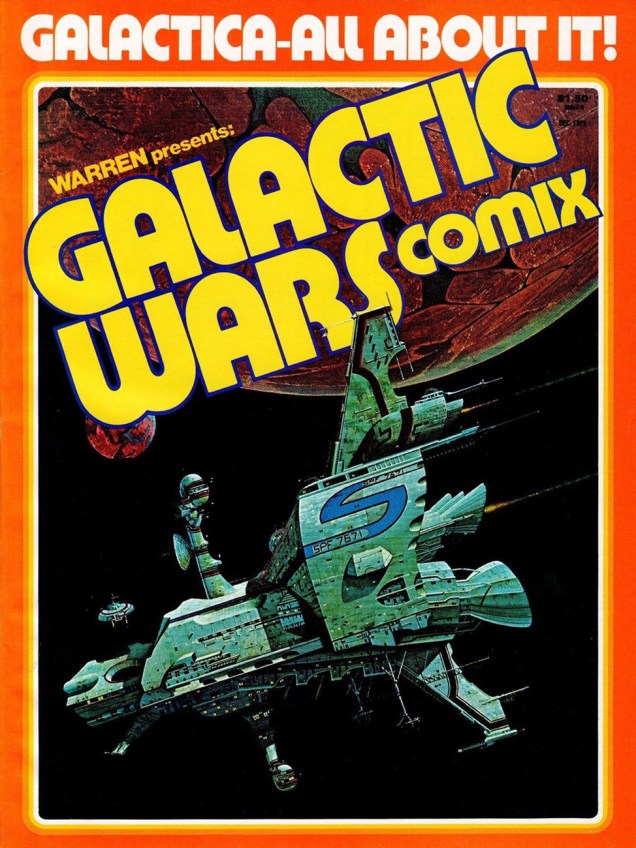
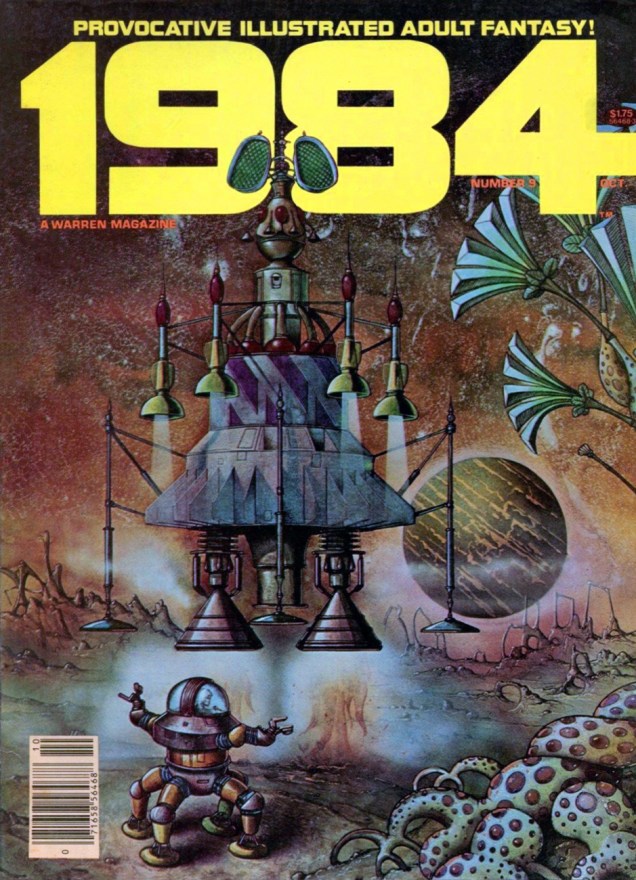
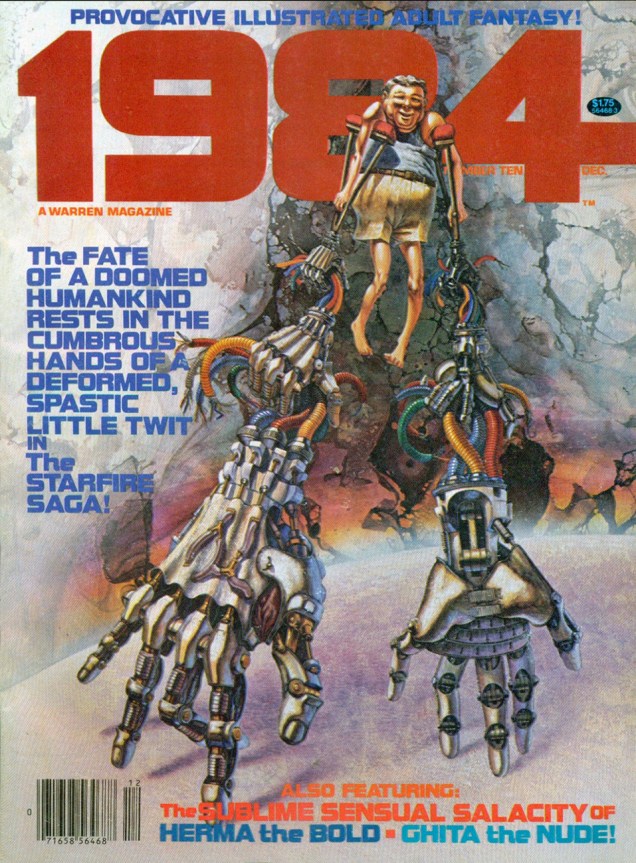
In 1978-79, the rightly-celebrated English fantasy artist Patrick James Woodroffe (b. Halifax, West Yorkshire, on October 27, 1940; d. May 10, 2014), fresh from his high-profile paperback (much Moorcock!) and album cover assignments (including Judas Priest’s splendid Sad Wings of Destiny), hired out his talented brush with Warren Publishing long enough to produce ten covers, a varied, eye-catching and often unusual lot. Let’s make the rounds, shall we?

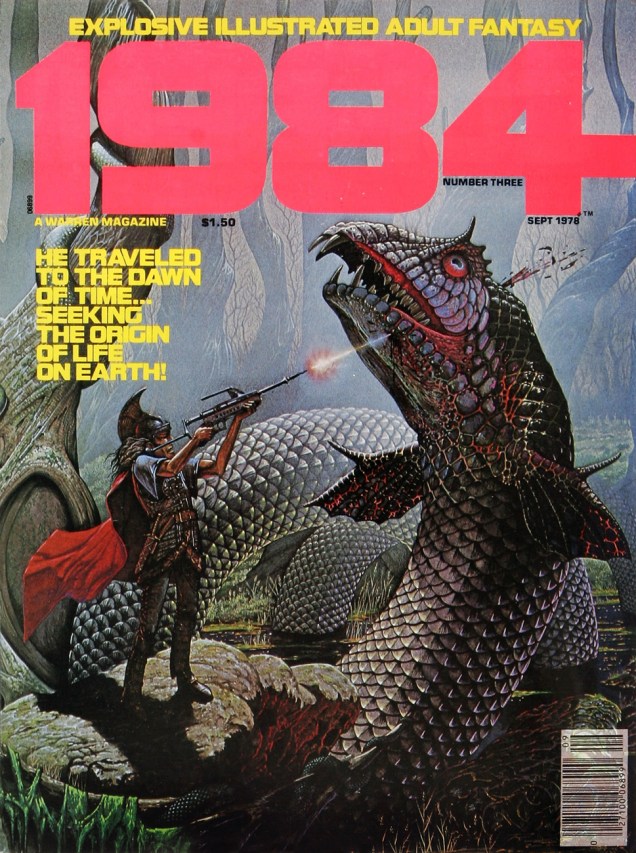
1984_3A
« He isn’t a *bad* sort. He just lets his temperamental gonads get the best of him! » Using a laser rifle on a dragon? Hardly seems sporting, does it?

1984_4A

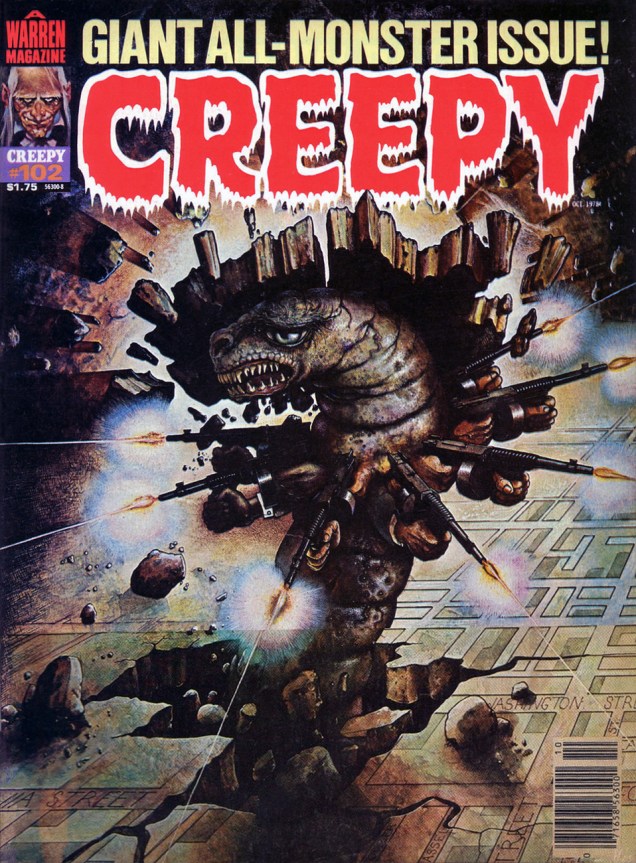
Creepy102A
Here we make the acquaintance of a memorably omnidextrous lepidopteran gunner. This is Creepy no. 102 (October, 1978). Read the entire issue here: https://archive.org/stream/warrencreepy-102/Creepy_102#page/n91/mode/2up
Galactic-Wars-ComixA
One of Warren’s post-Star Wars, all-reprint cash grabs of the era… but it’s got a Woodroffe cover.
Eerie98A
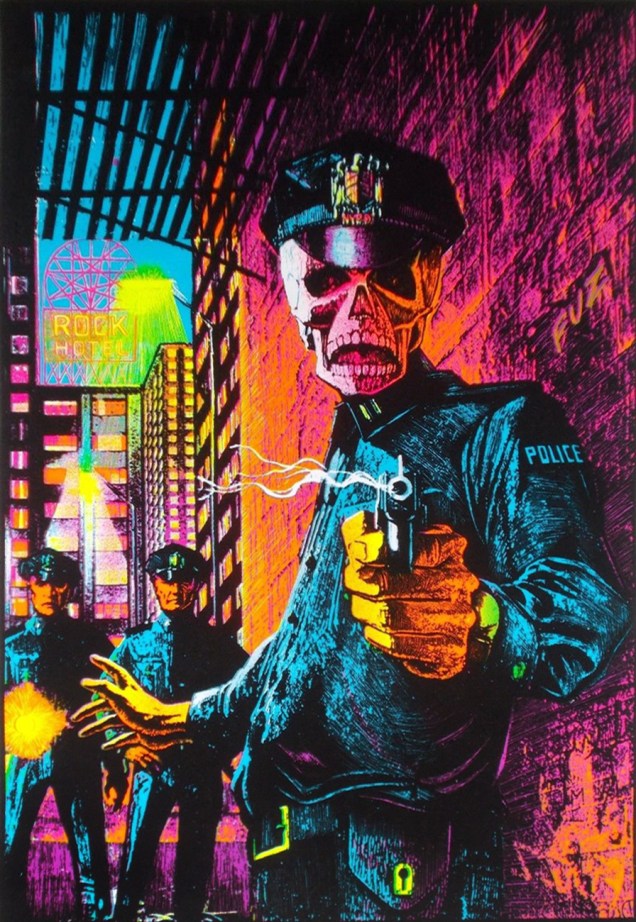
Eerie no. 98 (January, 1979) Likely the darkest of the set in terms of subject matter. Visually, it certainly brings to mind the visual vibe of John Carpenter’s They Live, still nearly a decade away.
BlacklightWoodroffeA
Interestingly, the piece has also made the rounds, in a modified version (flipped, for one thing), as a “black light” poster titled  « In the Name of the Law ». Speaking of the law, was the artist duly compensated?
1984_5A
Don’t mess with the Surly Smurf! This dusky scene is dated 1975, so it’s safe to assume it wasn’t created expressly for this publication. This is Warren’s 1984 no. 5 (February, 1979.) Aside from the usual sex fantasies and space operetta from the usual suspects, the issue holds a single nonpareil gem, Nicola Cuti’s  « I Wonder Who’s Squeezing Her Now? », gorgeously brought to life by Ernie Colón and Wally Wood. Bear with me, we’ll return to it in due time.
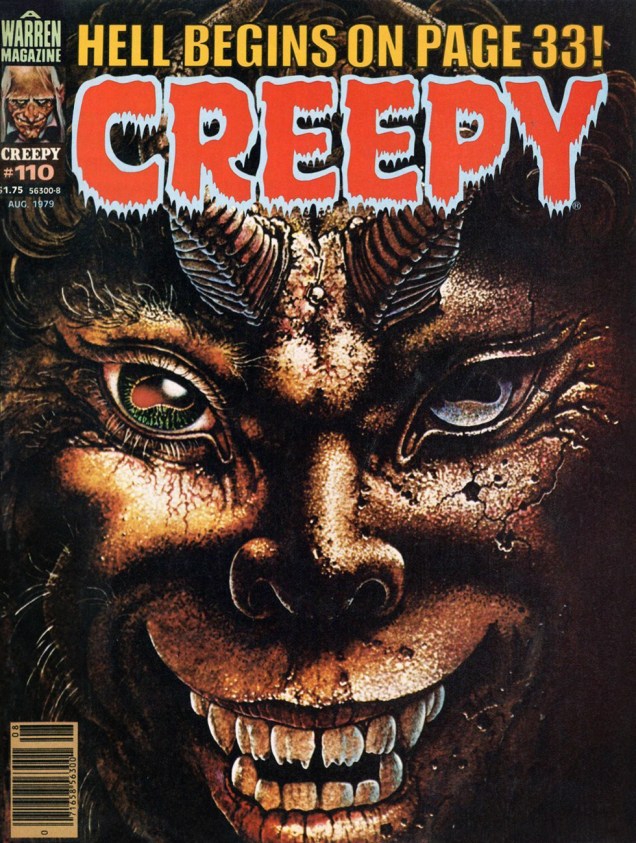
Creepy110A
« You may think this all strange nonsense; it may be strange, but it is true, and the ancients knew what lifting the veil means. They called it seeing the god Pan. »  — Arthur Machen
With his second and final Creepy cover (no. 110, August, 1979), Woodroffe lifts the veil, and how, on a troubling closeup of a gleefully sinister Greek God of the Wild.
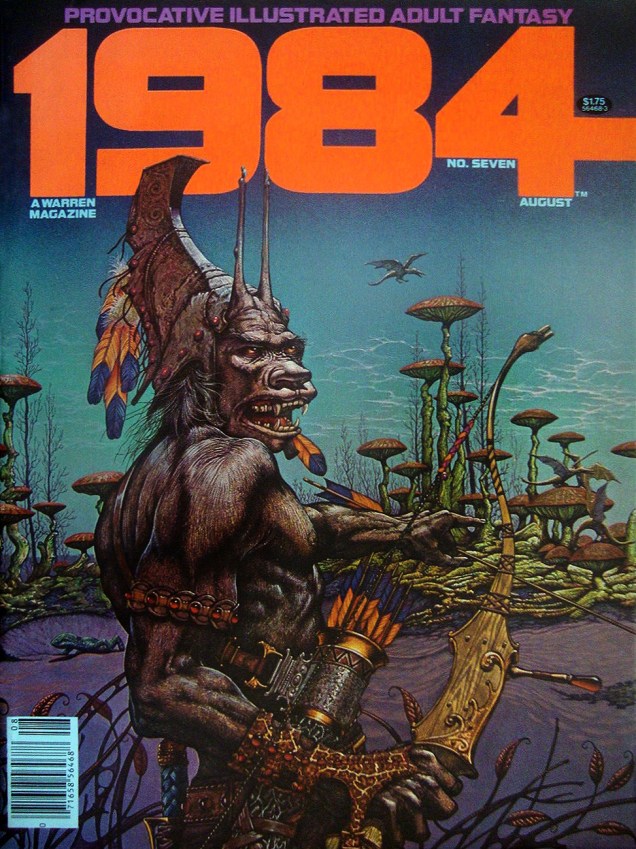
1984_7A
« Well, if that ain’t about the unfriendliest thing I’ve ever heard of… » 1984 no. 7 (August, 1979.)
1984_9A
Aw, missed your ride home. This is 1984 no. 9 (October, 1979.)
1984_10A
As it turns out, one couldn’t have picked a better artist to depict « the cumbrous hands of a deformed, spastic little twit », though he seems like a sweetheart, really. On this whimsical note ends our survey of Mr. Woodroffe’s Warren covers. This is also the last issue of 1984 under that title; it would leap a decade ahead to “1994” and carry on for another nineteen issues.

-RG

Tentacle Tuesday: Literary Grapplings

Some people would shudder at the idea of having « literary » and horror and / or science-fiction within the same sentence, but I firmly believe that some of this oft-despised « genre » oeuvre is worthy of that (somewhat pompous, anyway) moniker.

To open the proceedings, here’s a page from a graphic adaptation of « Shattered Like a Glass Goblin », written by the venerable Harlan Ellison in 1968 (and first published in 1975, in Deathbird Stories: A Pantheon of Modern Gods.) One of the showier pieces featured in the anthology The Illustrated Harlan Ellison (1978), it is drawn by William Stout, who does a great job translating the story into no-longer-just-mental images – and sneaking in a tentacle or two in the process (if you think that’s just a tail, shhh, don’t ruin it for the rest of us). People who dislike a vivid palette, beware:  the bright, vivid colours just emphasize the terror felt by the main character (and the readers, if said readers have any imagination to speak of).

Apparently, poor high-school kids are often forced to analyze « Shattered Like a Glass Goblin », because upon Googling it to check the year of its creation, I stumbled upon a bevy of study resources that explain what the story is about and what techniques Ellison used to make this point. Yawn, and yuck. There’s nothing that ruins a good time like having to dissect it.

TheIllustratedHarlanEllison
Page from the graphic adaptation of Shattered Like a Glass Goblin, written by Harlan Ellison and illustrated by William Stout, published in The Illustrated Harlan Ellison (1978). Stout cleverly refrains from showing everything, instead suggesting the unimaginably horrifying in a series of fleeting, clipped images.

TentacleTuesdayIcon

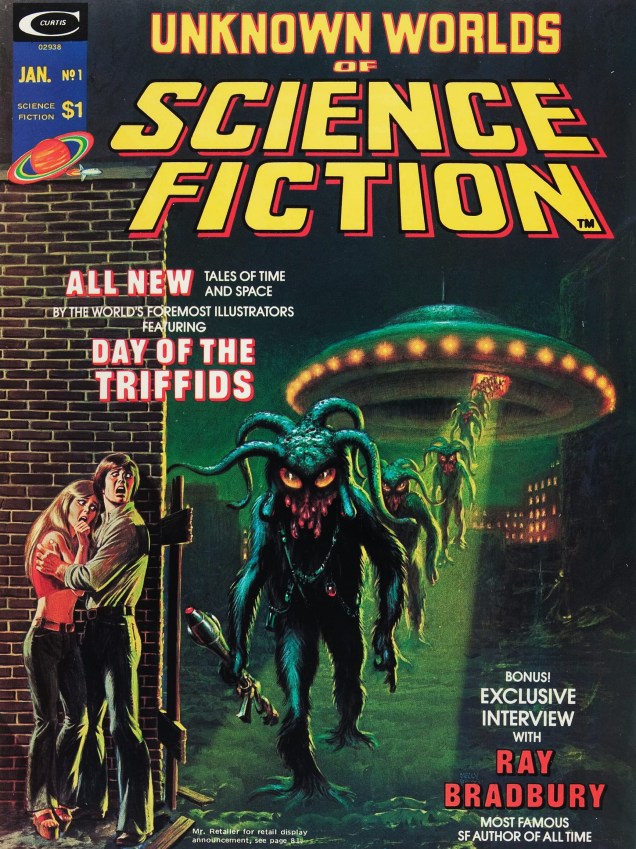
Now we come to Marvel’s short-lived Unknown Worlds of Science Fiction series, which often published adaptations of short stories and novels by well-known writers into a comic format (Mostly with lacklustre results, as far as I’m concerned, but then I’ve always preferred to stick with the original medium of things.)

UnknownWorldsofScienceFiction1
Unknown Worlds of Science Fiction no. 1 (Marvel, January 1975). The cover is by Frank Kelly Freas. It has nothing to do with either the Day of the Triffids nor with Ray Bradbury (is he *really* the ‘most famous SF author of all time’?) but it features aliens with stylish tentacle-hair (how much hairspray did it require to hold, I wonder?)
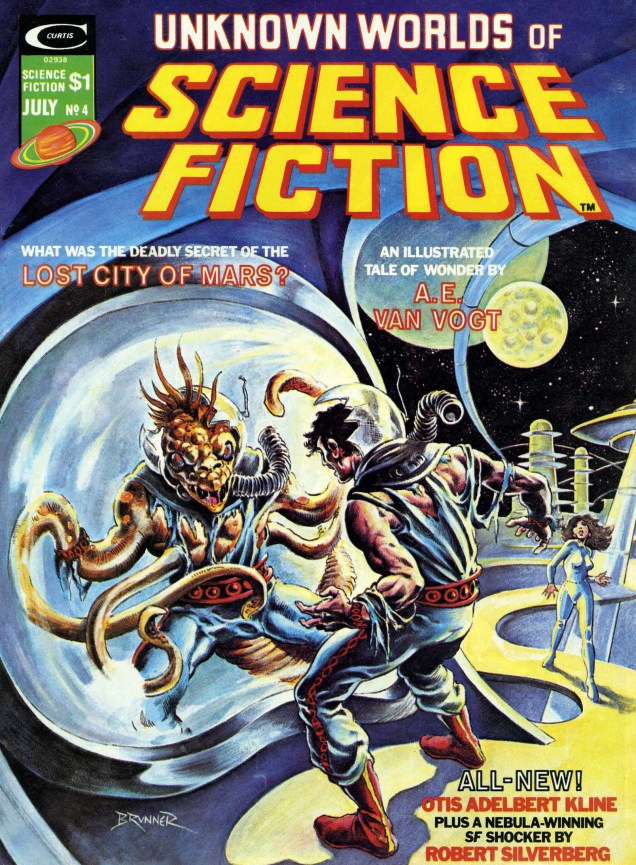
UnknownWorldsofScienceFiction4
Unknown Worlds of Science Fiction no. 4, (Marvel, July 1975). Cover by Frank Brunner. I say the guy looks much handsomer with a mess of tentacles sprouting randomly from his torso! Bonus: a newly-materialized, huge tail that no doubt ripped his pants apart, even if the artist demurely decided not to draw attention to this fact.
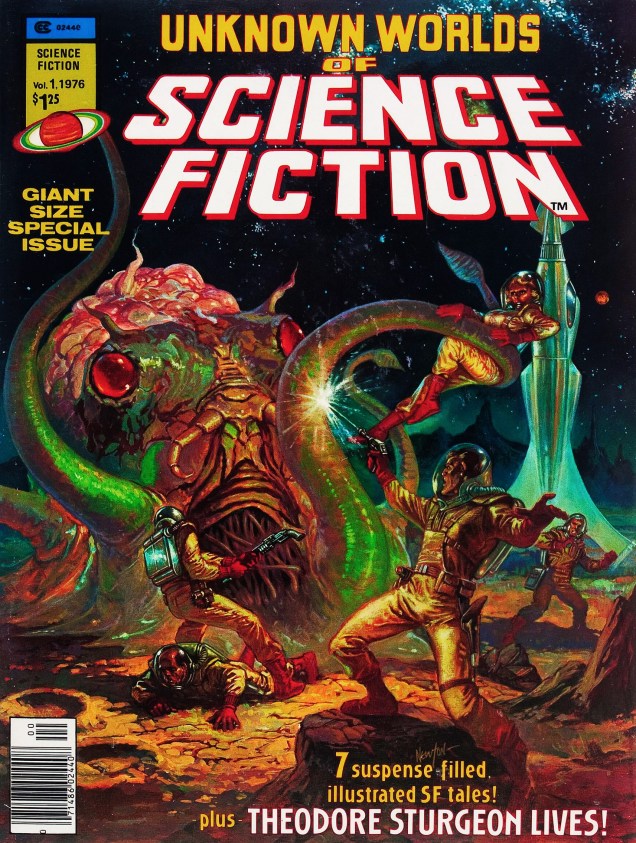
UnknownWorldsofScienceFictionSpecial1
Unknown Worlds of Science Fiction Giant Size Special no. 1 (Marvel, 1976). Cover by Don Newton. Number 1 it may be, but this was the final bow of Unknown Worlds. Note that the tentacles sought out the woman first! (Coincidence, you say? I think not.)

TentacleTuesdayIcon

Since I’m talking about  tentacles and literature, I am contractually obliged to include  something Lovecraftian as part of this post.

My colleague R.G. has already talked about the H.P. Lovecraft edition of the anthology Graphic Classics (head over here to check it out ), but I’d like to share two illustrations from the inside. Both are by Allen Koszowski, whose work is a feast of tentacled beasts and Lovecraftian horrors.

FungiYuggothA
Illustration by Allen Koszowski of « Fungi from Yuggoth ». Published in Graphic Classics: H.P. Lovecraft, Volume 4, 2002.
LovecraftPortraitA
A portrait of Mr. Lovecraft himself, in all his striking glory, accompanied by some of this unholy creations. Illustration (also by Allen Koszowski, which was accidental on my part) from Graphic Classics: H.P. Lovecraft, Volume 4, 2002.

Koszowski got the similarity down pat: Lovecraft was mighty weird-looking (in a stately kind of way) – which seems quite appropriate. Maybe I’m reading too much into it, but he certainly looks like he’s just seen something terrible just behind his interlocutor’s back, but he was half-expecting it, so he’s not too startled, even though someone’s probably about to get gobbled up.

HPLovecraftPhoto

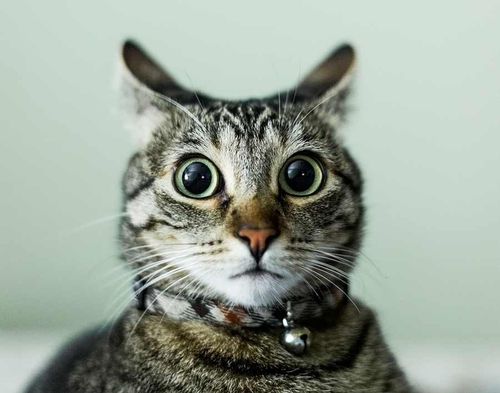
(Cats have that look periodically, too, down to the dilated pupils.)

ScaredCat


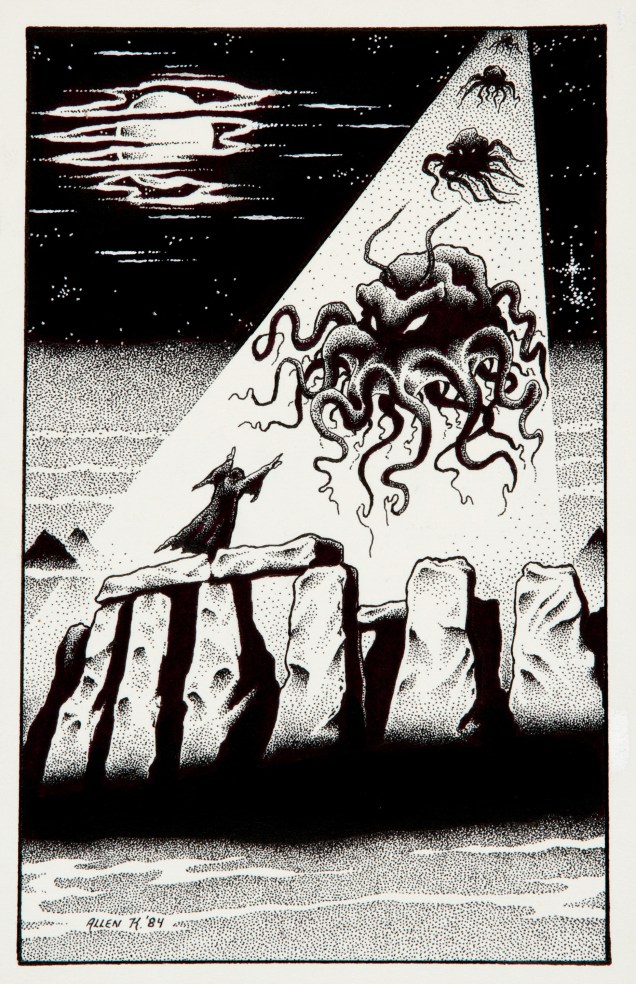
Incidentally, I said that Koszowski’s art was full of tentacles, so here’s one more taste of his proclivities:

AliensatStonehengeAllenKoszowski
Aliens at Stonehenge” (1984) by Allen Koszowski.

~ ds


Tentacle Tuesday: Carmine, Scarlet, Crimson Red

You’ve likely noticed it already, but people getting attacked by tentacles tend to be dressed in red. Now, red will not make a bull enraged (as a matter of fact, bulls are colour-blind to red – there, you learned something new today), but what effect would it have on an octopus? None at all, as it turns out, as red light does not reach ocean depths. One might want to wear red to become near-impossible to spot at a depth of a hundred metres or more, but that doesn’t explain why tentacles would persistently seek out red targets. Crap, there goes my theory.
Nevermind; we can still feast our eyes on some fetching mam’zelles and monsieurs clad in red, theories be damned.

AlienEncounters7B
Alien Encounters no. 7 (June 1986, Eclipse Comics). Painted Cover by Corey Wolfe.

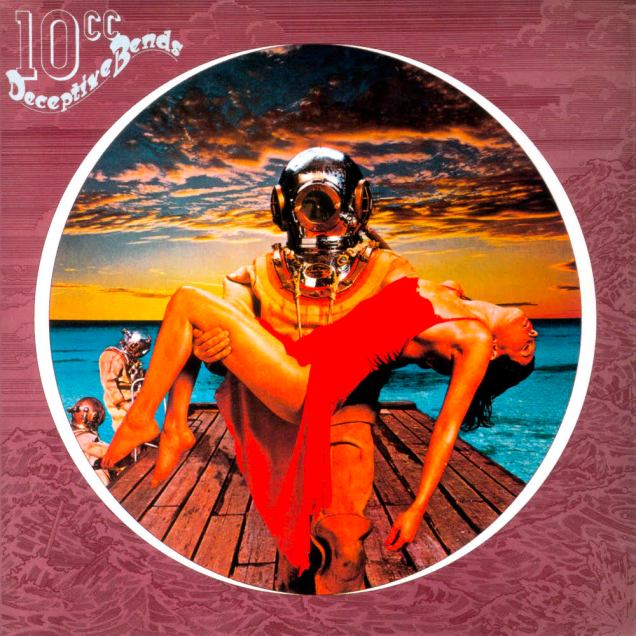
Music aficionados will notice that this cover is a tribute to something quite outside the comic field, namely this album art:

10ccDeceptiveBends
Cover of 10cc’s Deceptive Bends album, designed by Hipgnosis, 1977. Where are the tentacles?! The girl’s dress is also somewhat more demure (though not by much).

TentacleTuesdayIcon

After Alien Encounters, we naturally move on to Alien Worlds. Admire the, err, tentacles on this cover:

AlienWorlds4
“If he had been watching his mistress as usual, if he had been at the controls instead of giving himself a lube job, the accident might have been prevented.” Moral of the story: no lube jobs at the wheel! That tentacled thing behind Princess Pam is actually Cynx, her guardian. The science-fiction comic anthology Alien Worlds, first published by Pacific Comics and then by Eclipse after Pacific went bankrupt, was edited by Bruce Jones, who wrote the bulk of the stories, and April Campbell. This is Alien Worlds no. 4 (Pacific Comics, September 1983), cover by Dave Stevens, with colours by Joe Chiodo.
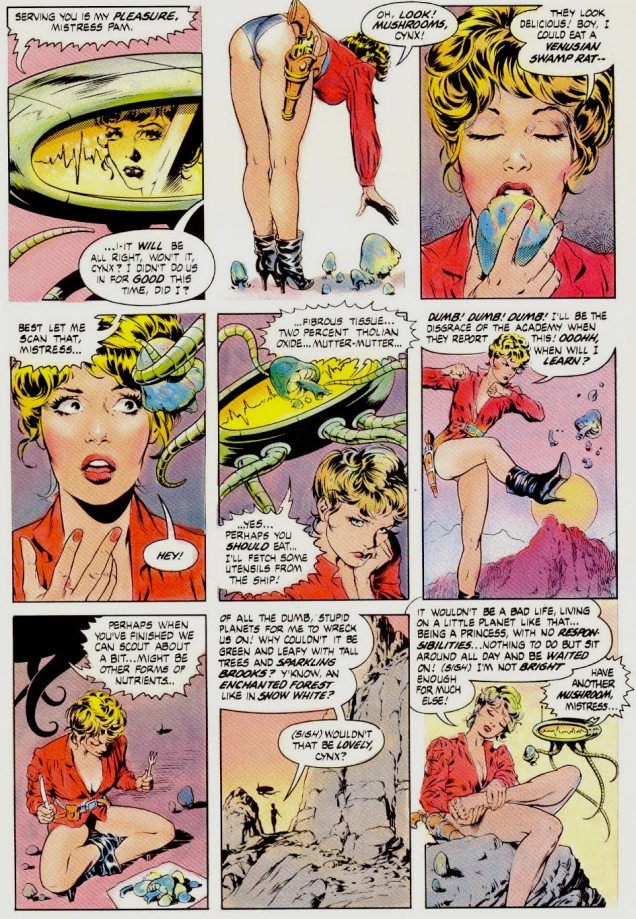
AlienWorlds4Page
Mushrooms *and* tentacles *and* some pretty gams? Sensory overload! At first glance, the story (scripted and pencilled by Bruce Jones, inked by Dave Stevens, coloured by Joe Chiodo and lettered by Carrie McCarthy) is nothing but gratuitous cheesecake – a pretty, half-naked girl wandering around with her robotic servant – but it’s actually surprisingly touching. Check it out here. Fittingly, mushrooms save the day.

TentacleTuesdayIcon

It’s not just women who like to sport flashy red outfits, by the way. The men’s costumes might cover considerably more skin, but the vermilion remains!

Frogmen2
« The tentacles of a giant octopus emerge and grab him in a death grip. Almost as though the hideous creature has been standing guard over the treasure for all this time… » Of course it has! Any self-respecting octopus takes his job seriously. The Frogmen no. 2 (May-July 1962); the cover is by Vic Prezio, and the sumptuous inside art is by George Evans.
Frogmen2Panel
There’s (also) an epic battle between a killer whale and the octopus in this issue (witness the aforementioned George Evans art).
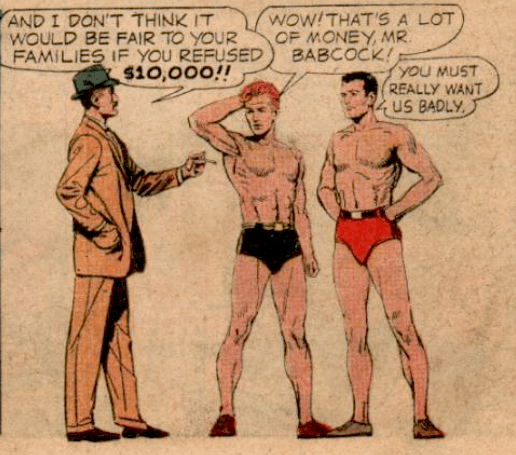
Frogmen2RedUnderwear
Of course he wants you, silly – who can resist a man in red swimming trunks? Nor octopus nor man. I retract my comment about men being more covered up. Do they have to tell their families, though?

TentacleTuesdayIcon

One more for the road and I’ll conclude this vernissage…

WeirdThrillers4
“The bolts of current are merely absorbed by the rubber flesh of the octeel, which is part octopus and part electric eel!” Oh, for the love of puns. Weird Thrillers no. 4 (summer 1952, published by Ziff-Davis), with painted cover by Norman Saunders.

You’ll no doubt want to see what an electric octopus looks like, so here you go:

WeirdThrillers4Page
“Tentacles of Death”? Sign me up, please! The gruesome cover story is drawn by George Tuska.

~ ds

Water Is Life: OMAC versus The Ocean Stealers (1975)

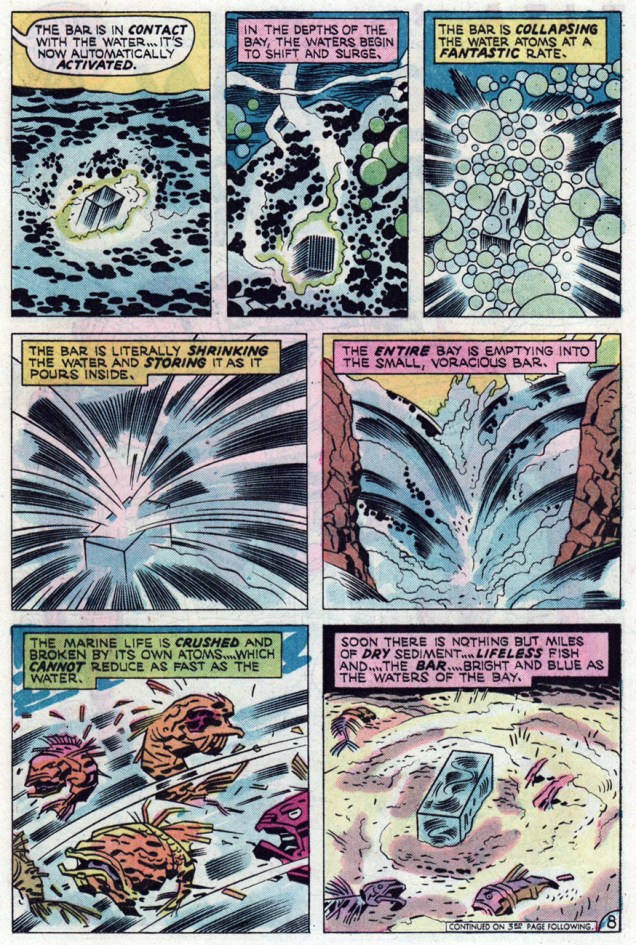
« The marine life is crushed and broken
by its own atoms — which cannot reduce
as fast as the water. »

I’ve been sitting on this particular entry awhile, having realized that the most opportune time to share it would be today, March 22, which happens to be World Water Day*.

In comics, few if any creators have generated so many explosive, pulse-pounding images as did Jack Kirby (1917-1994). And yet… this solemn, understated scene has likely haunted me most of all. The visuals are splendid, sure, but it’s the nature of the situation, the conceptual ramifications of the thing, that make it stick.

Omac7A

This splash appeared near the opening of OMAC’s final adventure, one that pitted him against Sandor Skuba, a rogue genius seizing and hoarding the planet’s water in view of controlling humanity. Threat-wise, all the adversaries that the One Man Army Corps had tangled with were mere preludes to this impressive madman. As Kirby left DC before he could wrap up the storyline as he intended, no-one walks away from this skirmish**, notwithstanding the final panel, subsequent revivals and reboots and corruptions of Kirby’s ideas by (inevitably) lesser hands and minds (and conversely bigger egos).

Omac7CoverA
This is OMAC no. 7 (Sept.-Oct. 1975) and « The Ocean Stealers! », scripted, pencilled and edited by Jack Kirby, inked and lettered by D. Bruce Berry.
Omac7Page1A
Could that unseen appendage be Adam Smith‘s « invisible hand of the market » ?
Omac7Page7A
And here’s how it’s done.
Omac7Page8A
In light of the current practices of certain corporations, notably the Swiss transnational Nestlé, Kirby was sadly prescient and clear-eyed again. As evidenced by recent events, given the technological means, today’s robber barons would not hesitate.
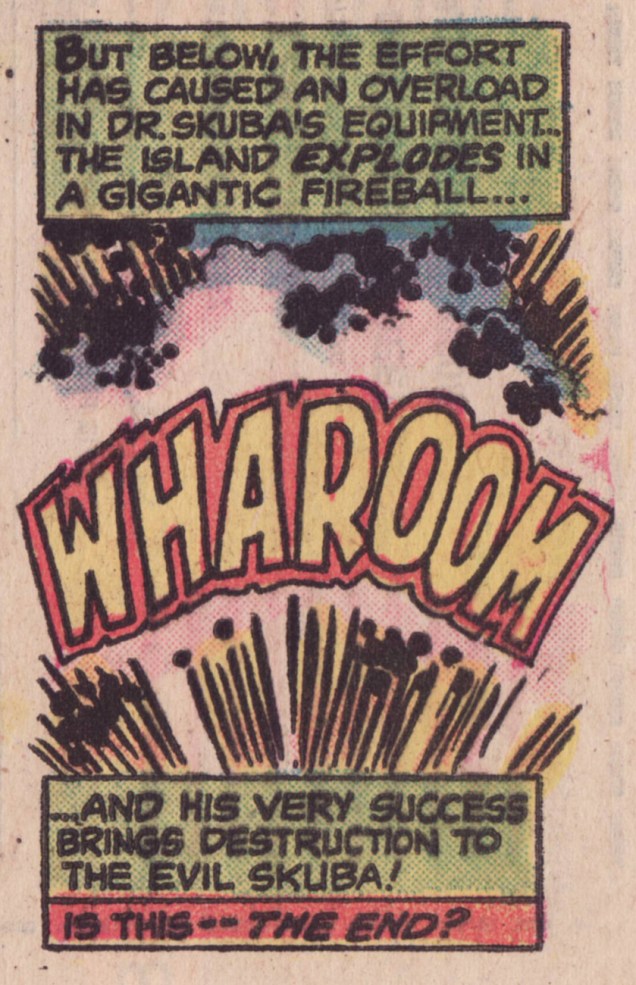
OmacWharoomA
Writer and comics historian Mark Evanier, who spent some years as Kirby’s assistant in the ’70s, writes, in his foreword to the DC’s exemplary reprint collection Jack Kirby’s OMAC: One Man Army Corps (2008): « So consider this fair warning: the last issue comes to a whiplash-inducing sudden stop. Jack had been setting up something big for number 9, but since he was gone and there wasn’t going to be a number 9, a new last panel (not by Kirby) was inserted to remove the immediate cliffhanger.» … a panel created, at that, with the finesse of 10-year-old unburdened by a sense of pacing. “Wharoom” to you too.

-RG

*Don’t buy the duplicitous hype, though! A perfect example of the fox guarding the henhouse.

**more accurately, everyone is stranded in limbo.

Tentacle Tuesday: Space Adventures

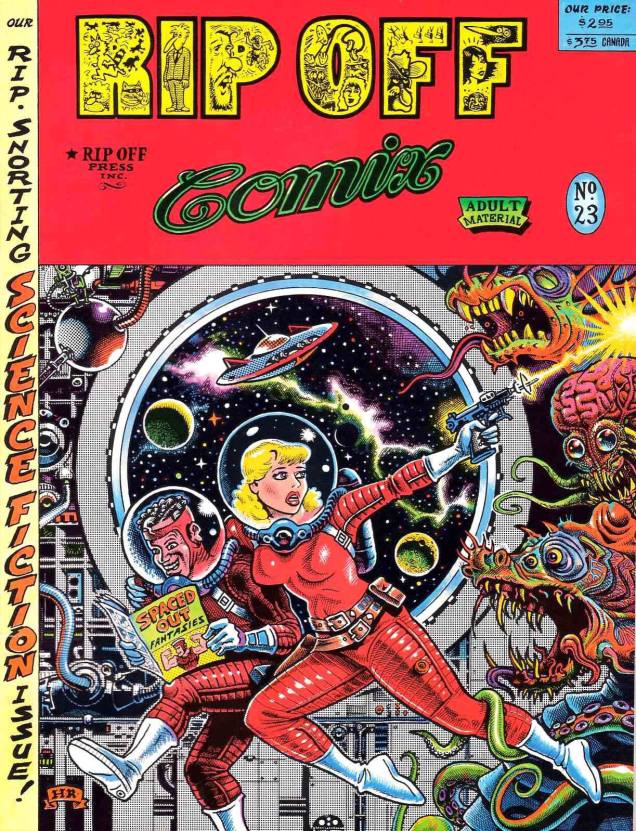
Let’s commence Tentacle Tuesday on a ticklish note (tentacles are itchy, you know, especially when they’re crawling up one’s leg) with Rip Off Comics no. 23, “the rip-snorting science fiction issue!”

RipOffComics#23
Typical: the good-looking gal has to defend herself and her goofy-looking idiot of a partner from tentacles, claws, fangs, and other typical dangers of deep space. Rip Off Comics no. 23 (summer 1989), cover by Hal S. Robins, with colours by Guy Colwell. Look closely at the tiny drawings hiding inside “Rip Off”, and you’ll see Fat Freddy’s cat bouncing around merrily! Actually, you’ll see pretty much the whole cast of Furry Freak Brothers, and then some.

TentacleTuesdayIcon

If a tentacle creeps out from the pages of a book you’re reading to gently prod you, you know you’ve made the right choice of reading material.

WackyPackages14Tentacles
This Wacky Packages card (from the 14th series, released in April/June 1975) is painted by Norman Saunders from a concept by Jay Lynch (which looks like this). Given that the moon is grinning at them, I think these two are high on something (I’m willing to accept tentacles in space, but I draw the line at anthropomorphized satellites).

TentacleTuesdayIcon

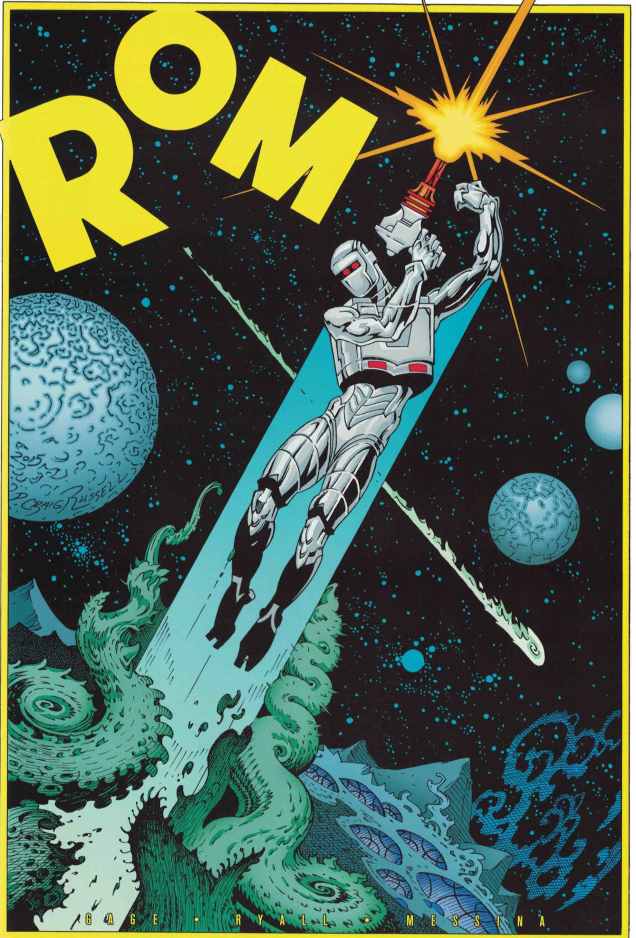
Sometimes tentacles masquerade as waves, but we know better! Dunno why some sea god would want a cyborg chunk of metal, though.

Rom1IDW2016
Rom no. 1, July 2016 (IDW), a variant cover from something called « Retailer Incentive ». Art by the ever-decorative and undeniably stylish P. Craig Russell, who unfortunately seems to mostly have squandered his talents on operatic and fairy tale adaptations (not counting a few marvelous short stories). Some people’s thing, no doubt, but not mine!

Rom the Spaceknight was a toy created by three men (Scott Dankman, Richard C. Levy and Bryan L. McCoy) in 1979. His creators called him COBOL (a programming language), but he was renamed into ROM (« read only memory ») by the executives of Parker Brothers, the company that bought rights to the this « beeping, thinking toy » (which Time predicted would « end up among the dust balls under the playroom sofa »). As part of a promotional effort, Parker Brothers promptly licensed him to Marvel. Rom the toy was a commercial failure, but Rom the comic book went on to last 75 issues, beeping its last bleep in 1986 (not counting the comic’s revival by IDW in 2016).

The comic may have passed from Marvel’s hands into IDW’s, but the description still seems to have been written by a hyper-ventilating lummox flinging spit everywhere as he croaks: “WE’VE BEEN INVADED AND ONLY A SPACE KNIGHT CAN SAVE US! Now the ongoing tale of ROM begins in earnest! Christos Gage, Chris Ryall, and David Messina kick off the wildest new series of the year as Rom’s war with the DIRE WRAITHS hits close to home in ‘Earthfall, part 1!’ ‘The long-beloved and even longer absent space hero returns at long last! First, we brought back MICRONAUTS! And Now… ROM! As if Rom’s return wasn’t enough, wait’ll you see how this one ends!” Brr.

TentacleTuesdayIcon

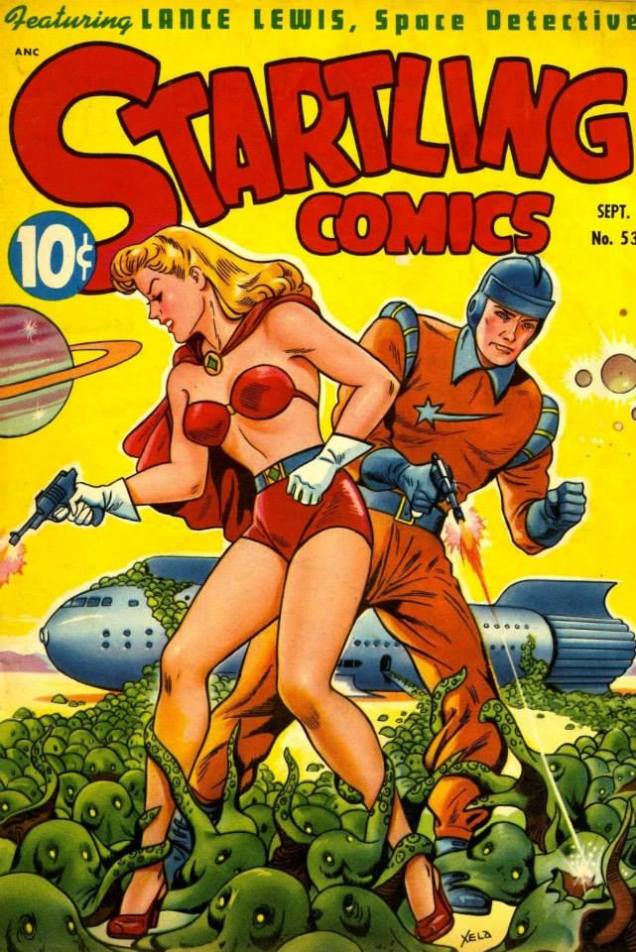
So far, the tentacles featured have been rather on the tame side. Let’s have something properly terrifying…

StartlingComics53
Lance Lewis (Space Detective) and his girlfriend Marna may be in a tight spot… but I’m sorry, I’m having trouble imagining the terror of being overcome by these teeny-tiny octopuses. They’re just too dang cute, clinging to Marna’s legs like puppies begging for food. Startling Comics no. 53, 1948, the last issue of this series. Cover by Alex Schomburg (1905-1998), a prolific Puerto Rican artist (this is signed as Xela).

Oh well, terror petered out today. I guess this Tentacle Tuesday is not going to scare anybody witless. There’s always next time!

Adorably yours,

~ ds

Cuteoctopus
“Squee!”

Visionary Meets Mundane: Richard Powers at Western Publishing

« Are all your projects this dangerous, Dr. Solar? »

Dateline: 1962. Printer-packager Western Publishing had just dealt its biggest client, Dell Comics, its slow death sentence (by mutual agreement, it is diplomatically claimed), though Dell should have seen it coming: for decades, Western Publishing Co. had « secured the rights, created the comics, printed them and shipped them out for Dell. Dell acted as the publisher and distributor and did the billing and paid Western for its creatively manufactured products*. » In 1962, Western cut out the middleman and launched its Gold Key imprint (1962-1984.)

Enter, briefly, revolutionary illustrator Richard M. Powers (1921-1996), who successfully wed representational and abstract art for his paperback covers of the 50s and 60s, bringing science-fiction visuals an unprecedented visual maturity. Don’t merely take my word for it: treat your peepers to a gander at his work. You may well find that you know it already.

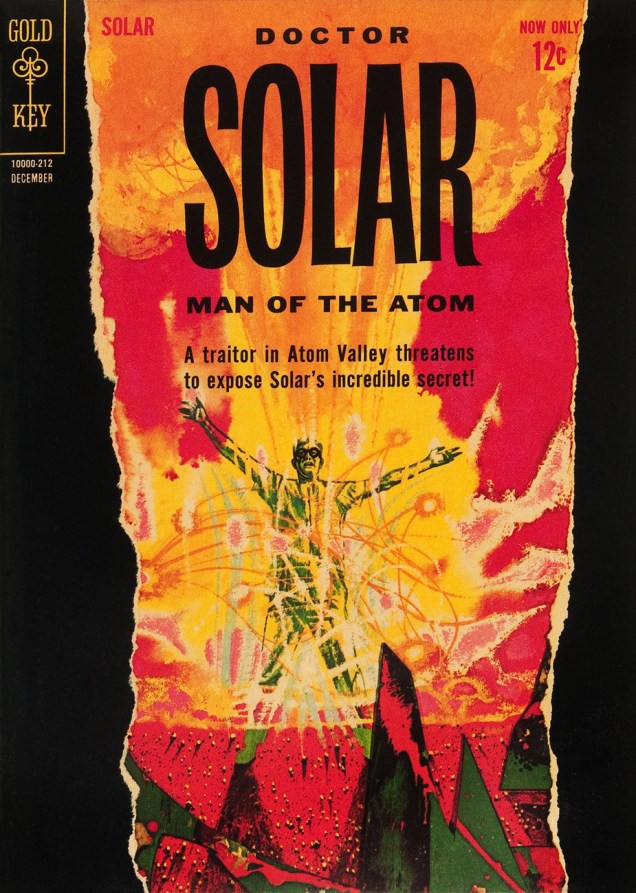
What with a Cold War on, in the early 60s, atom-powered heroes were understandably in vogue. Charlton even had two: after Al Fago‘s 1955 creation Atomic Rabbit, came Joe Gill & Steve Ditko‘s Captain Atom. In 1962, the newly-founded Gold Key threw their hat into the nuclear furnace with the advent of Doctor Solar, Man of the Atom. He was created by writer Paul S. Newman and editor Matt Murphy.

PowersSolar1A
Doctor Solar, Man of the Atom no. 1 (October, 1962)
PowersSolar2A
Doctor Solar, Man of the Atom no. 2 (December, 1962)

So far so good, right? And then… we may never know exactly what transpired, but I assume that some art director at Western Publishing chose to second-guess Mr. Powers… smothering the tonal and compositional balance of his painting (« can’t… bear… negative space! »), and likely depriving the outfit of Powers’ further services. He was at his peak, was being offered assignments than he could hope to fulfill, assignments surely more lucrative and friction-free. He wisely scooted along.

The printed version:

KarloffThriller2A
Boris Karloff Thriller no. 2 (January, 1963.) It was decades before I realized that this ho-hum comic book cover was the work of Richard Powers. In truth, the scales only fell from my eyes when I caught a peek of the original art. The printed version is so tame, so drained of its power(s) that the issue didn’t even appear in Jane Frank’s checklist of book covers in her fine The Art of Richard Powers (Paper Tiger, 2001).
PowersThriller2A
See? Now *that* is clearly Powers. « Just slap a 60% cyan overlay over the dang thing, Gertrude. It’s too effin’ artsy! »

And the tale might have ended there, but here’s the curveball: in the mid-to-late Seventies, Powers provided the fading publisher with a pair of gorgeous, but seldom-seen cover paintings.

Starstream1PowersA
A lovely Rorschach blot of a cover for the inaugural issue of Starstream, issued in 1976 under Western’s Whitman imprint. Starstream‘s four issue-run offered sober adaptations of smartly-chosen science-fiction short stories by the exalted likes of Theodore Sturgeon, Robert Bloch, A.E. Van Vogt, Robert Silverberg, Isaac Asimov, Larry Niven, Jack Williamson, et al.
UFOOuterSpace17A
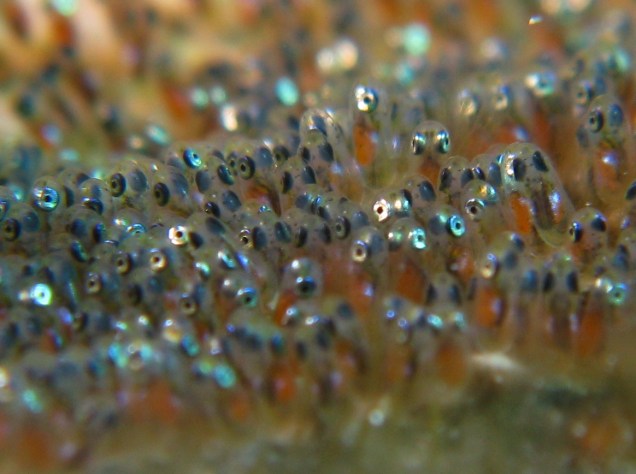
Let’s hear it for unearthly-looking extraterrestrials. With their translucent skin, these guys remind me of unhatched fish. The fifth and final cover created by Richard M. Powers, this is UFO & Outer Space no. 17 (continued from UFO Flying Saucers), published in September, 1978.

See what I mean?

Anemone_Fish_Eggs

If memory serves, my own Powers epiphany took place in the autumn of 1982, in Lennoxville, a small college town in the Eastern Townships of Québec. There was this little bookstore… and its fine selection of 60s horror and science-fiction paperbacks, priced in the 35-to-50-cents range. The kind of place book lovers dream about stumbling upon, and wake up dismayed to find themselves in the real world… empty-handed.

My favourite (inside and out) of the lot I picked up that day? Fritz Leiber’s (despite the name being misspelled on the cover) Night’s Black Agents (June 1961, Ballantine Books). If you’ve had a similar thrill of discovery with Powers’ art, please do tell us about it!

NBALeiber

-RG

*quoted from an interview with Gold Key’s Matt Murphy.