Behind the Scenes, Back in the Day

« Television is like the invention of indoor plumbing. It didn’t change people’s habits. It just kept them inside the house. » — Alfred Hitchcock

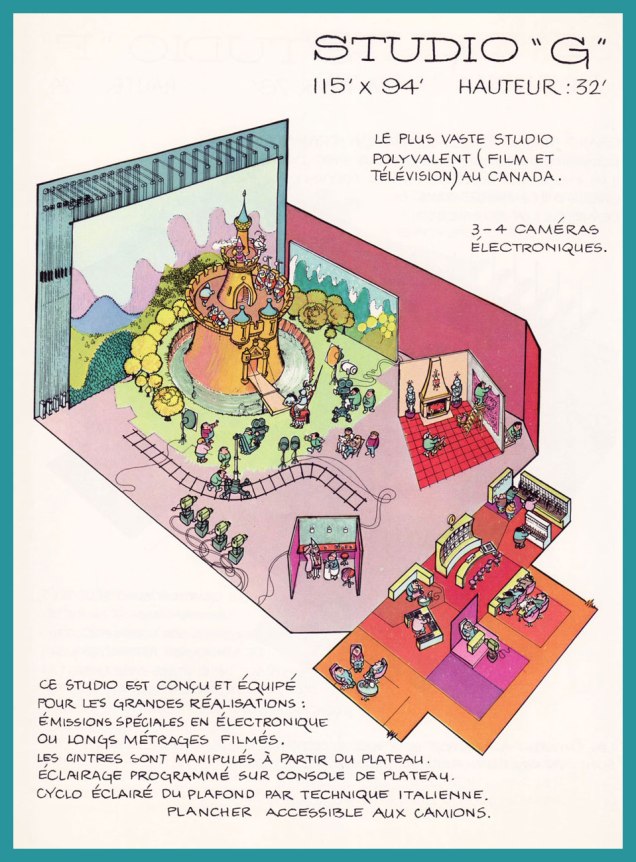
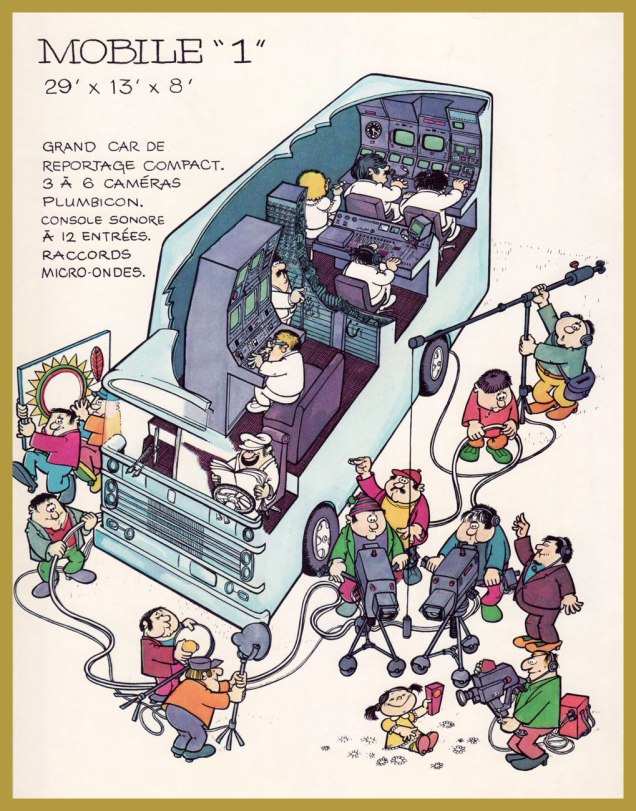
A little while back, I chanced upon a handsome, lavishly-illustrated brochure (undated, but from 1976 or so) promoting the services of a Montréal television production company, which leads into this little history lesson.

JPL Productions Inc. was a subsidiary of Télé-Métropole*, Canada’s first private French-language television network. In 1965, France-Film president and Télé-Métropole founder Joseph-Alexandre DeSève sagely ensconced political cartoonist, illustrator, art director, television director, watercolourist… and even co-star of a timeless, Oscar-winning Norman McLaren short film, Jean-Paul Ladouceur (1921-1992) at the head of the newly-constituted ad production arm of his television operation. This was an era in which you might actually find bonafide creatives in positions of influence, before the age of financial ‘diversification’ and conglomerates** unleashed its full toxic bloom and creatives were henceforth sidelined and supplanted by bean counters.

Over time, JPL expanded the scope and range of its activities. I hardly need to go into details: that is precisely this publication’s purpose.
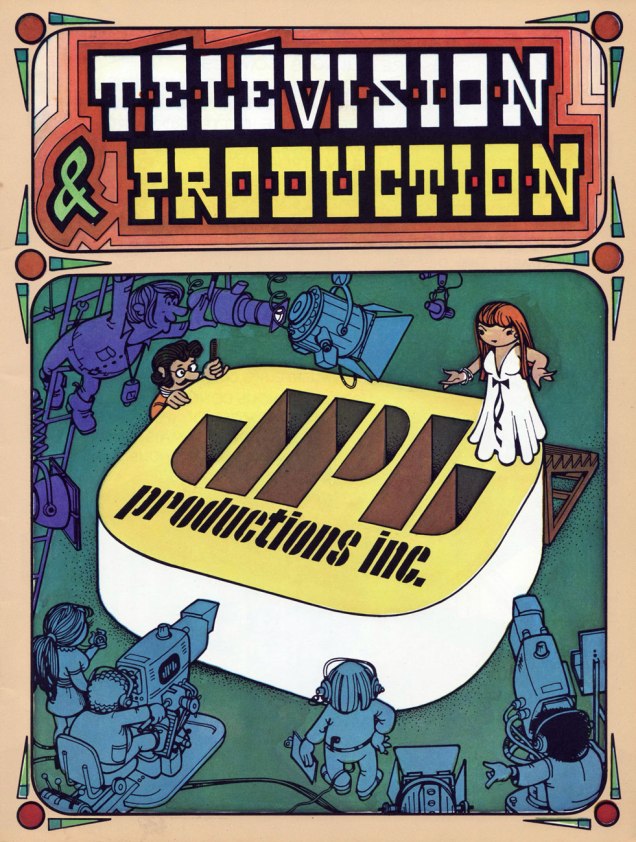
JPLFrontispiceA
The front cover. All artwork (uncredited… for shame!) by Bernard Groz.
JPLPrésenteA
JPL himself provides the introduction: « To tell you about us, to speak of our people, our accomplishments, our equipment, we told ourselves: “it can’t be done without images”. And so, this illustrated brochure. JPL Productions Inc. is a subsidiary of Télé-Métropole Inc., the largest private enterprise television station in America. We produce advertisements, documentaries, industrial films, feature films, slideshows, soundtracks, printed matter, soundtracks, etc.. We hope that the following pages will give you a sense of the scope of our business. Our illustrator could not include each member of our personnel in his drawings. He had to leave out 250 of them. When we speak of ourselves, we say that we are producers, designers, publicists, advertisers, creators, communicators, propagandists, persuaders, as well as a whole range of ‘-lists’ and ‘-ers’. Without doubt and without false pride we are right. But we… prefer to think of ourselves, first and foremost as makers of amazement. » Phew!

JPLStudioG_A

JPLStudioHA
An elephant running a vacuum cleaner? I’d like to see that commercial.

JPLMobile1AJPLMobile2A

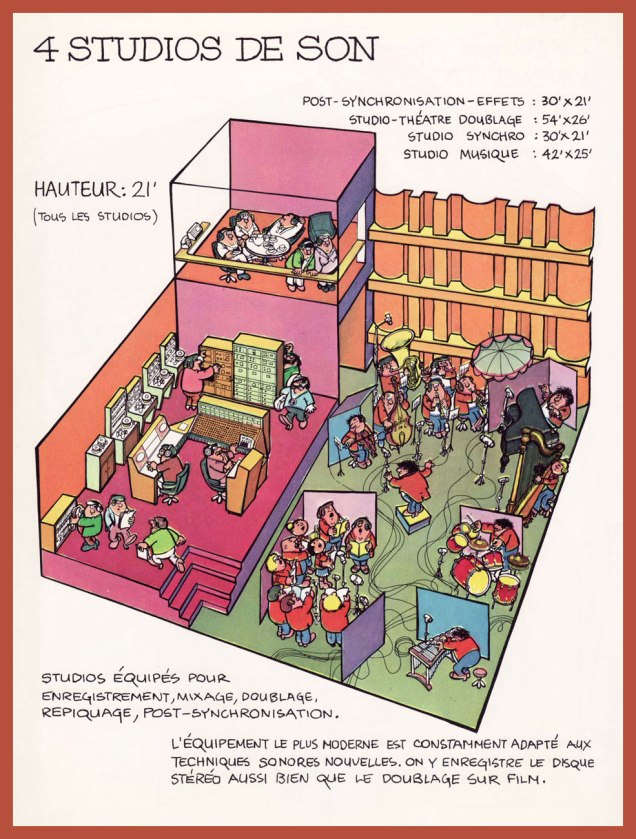
JPLStudiosSonA
Four Sound Studios. Here and there, Groz threw in recognizable figures. In this one, the pianist (and the bandleader) are the talented Georges Tremblay, who composed and performed many a memorable (and often surprisingly elaborate) theme for Télé-Métropole’s émissions. To wit, the network released an LP’s worth of them, Les thèmes du 10. Here’s one, La couleur du temps, written for… the weather bulletin.
JPLScéniqueA
Stage Services: workshops, studios, salons.
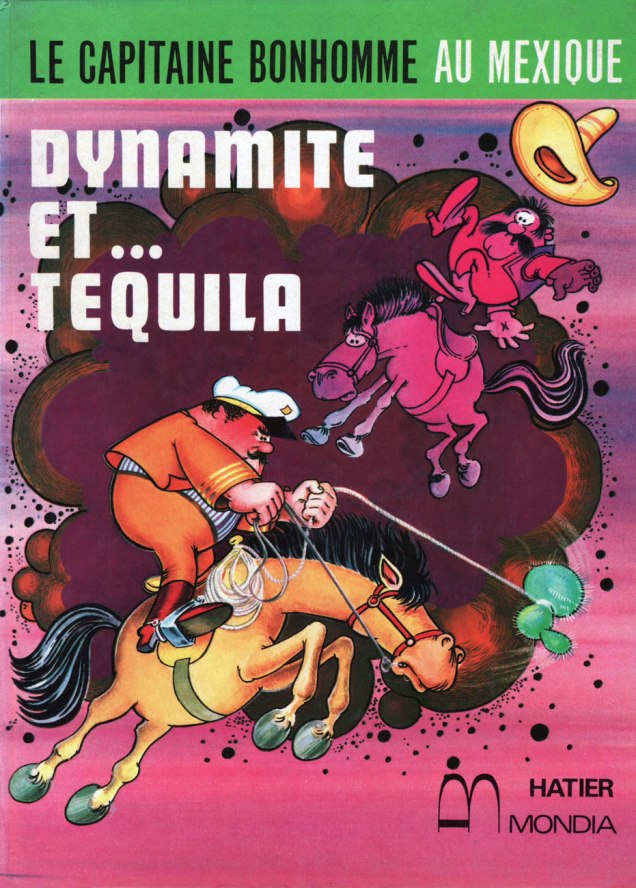
CapitaineBonhommeA
Front cover of Le Capitaine Bonhomme au Mexique: Dynamite et… Tequila (1973, Hatier/Mondia); scripted by the Capitaine himself, ace raconteur Michel Noël (1922-1993) and illustrated by Bernard Groz. How much of Renaissance man was the Capitaine? Here’s his astounding biography (in French).
CapitaineMexique01A
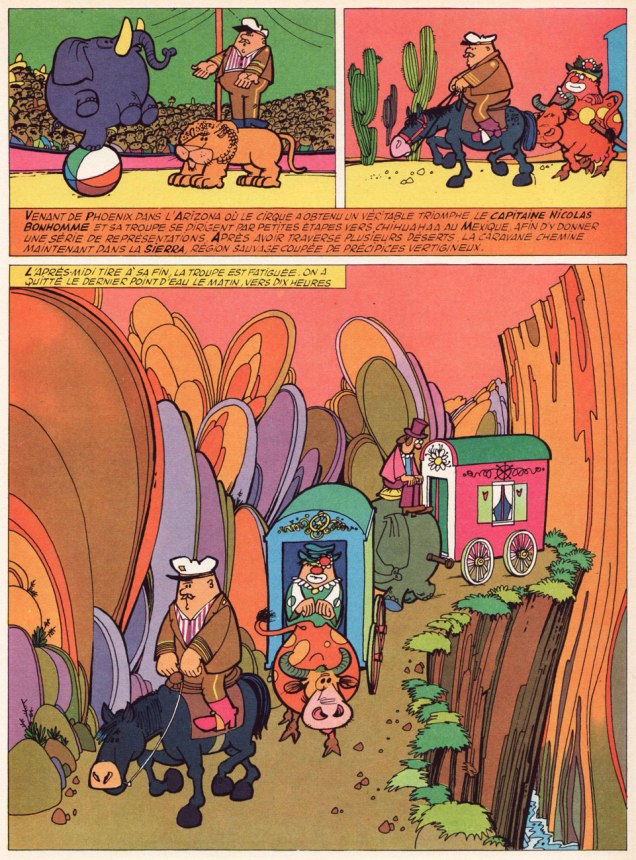
Dynamite et Tequila‘s opening page. The beloved Capitaine Bonhomme, a Télé-Métropole fixture introduced in 1962, would follow his creator throughout his life. He was yarn-spinner in the grand old Münchausen / McBragg tradition, and his wide-ranging popularity in Québec has endured largely because he never patronized his audience and, as with much of the richest grade of humour, his wooly accounts were sprinkled with witticisms and allusions whose meaning(s) suited both juvenile and adult sensibilities. Here he is during a 1988 talk show appearance.

-RG

*« Present at the February 19, 1961 inauguration were Montréal’s Archbishop, Paul-Émile Léger, the city’s mayor, Jean Drapeau, and the Prime Minister of Québec, Jean Lesage, who declared that television has « great power, and therefore great responsibility. » Chew on that, Stan Lee fans!

**After mobster and parking lot maven Emmanuel “Manny” Kimmel inherited the assets of his partner Abner “Longie” Zwillman (“the Al Capone of New Jersey“) upon the latter’s death, he continued his plans for legitimization and diversification. After The Kinney Parking Corporation acquired a chain of funeral homes, Kimmel soon entrusted the business dealings to a canny young undertaker named Steve Ross. « Ross diversified into businesses that had no visible connection to the already odd marriage of caskets and parking spaces. He bought office cleaning services, DC Comics (publishers of Superman), MAD Magazine, and a talent agency. In 1969 Ross made a daring bid for Warner Brothers, the film studio and record company. » « Kinney acquired Warner for $400 million. » Quotes from William Poundstone‘s captivating Fortune’s Formula (2005).

And that, children, is how The Mob bought DC Comics. I always chuckle when fanboys claim, without a shred of evidence, that Charlton Comics (owned by the Santangelo family) were ‘mobbed up’. I guess to some people, it’s only the Mob if it’s eye-talian.

Phew, That Was Close!

« Death smiles at us all, all a man can do is smile back. » — Marcus Aurelius

The other day, I chanced upon a Rick Geary piece about tangos with the Angel of death, which returned my mind to a time, when I was but six years of age, and that my parents had gone holidaying, leaving me in the care of some old friends. At their home, I recall perusing some back issues of that evergreen Reader’s Digest (the French-Canadian edition, called Sélection du Reader’s Digest), wherein I encountered some memorable articles, including one about the miraculous survival of people who tumbled from great heights*, unencumbered with parachutes, and another that grimly recounted the calamitous landslide that one night engulfed a village, Saint-Jean-Vianney, just a few kilometres from my hometown.

Ah, but human memory is notoriously fallible and self-deceiving. So I deemed it prudent to inquire whether the events were truly as recollected. A quick call to my folks confirmed that yes, they did toddle off to Europe for three weeks in November of that year (I think my parents are delighted when I quiz them about such matters). The landslide took place in May, so that fits too.

As the close shave lends itself well to comics, I’ve gathered a potpourri of short pieces on the topic. Tighten your seatbelts, we’re in for a rough ride!

Salt01A

Salt02A
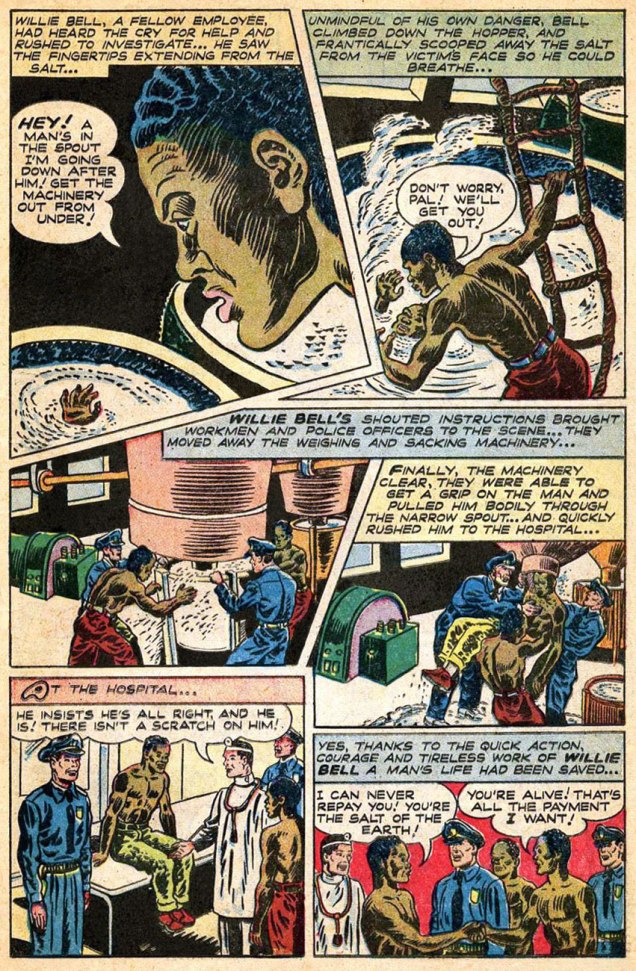
A presumably factual two-pager from New Heroic Comics no. 70 (Jan. 1952, Famous Funnies), featuring artwork by no less an eminence than the great Harry Peter (according to Ger Apeldoorn, which is good enough for me). The whole ‘salt of the earth’ thing rings pretty hokey, but one has to appreciate that this account of selfless heroism wasn’t whitewashed.
GearyNearDeath01AGearyNearDeath02AGearyNearDeath03A

GearyNearDeath04A
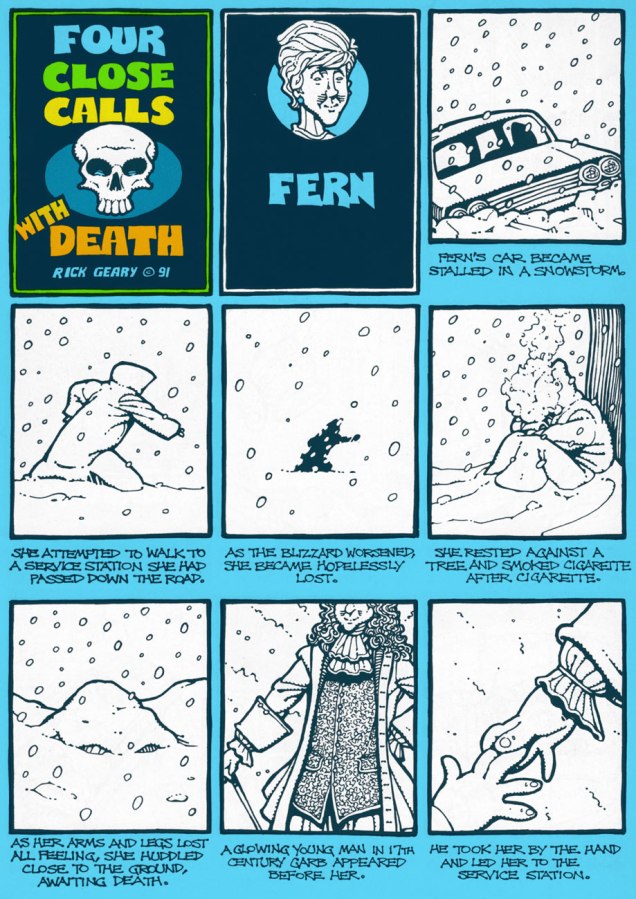
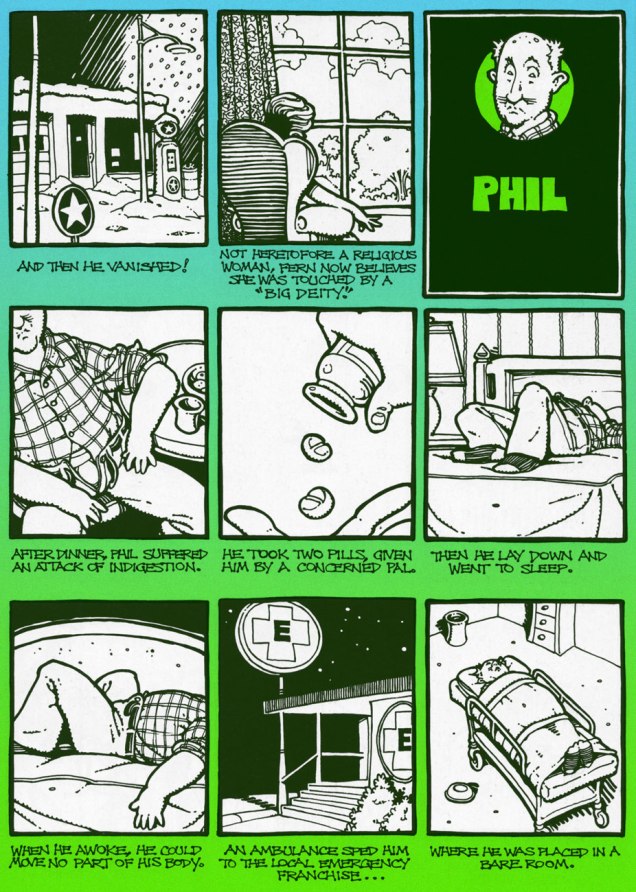
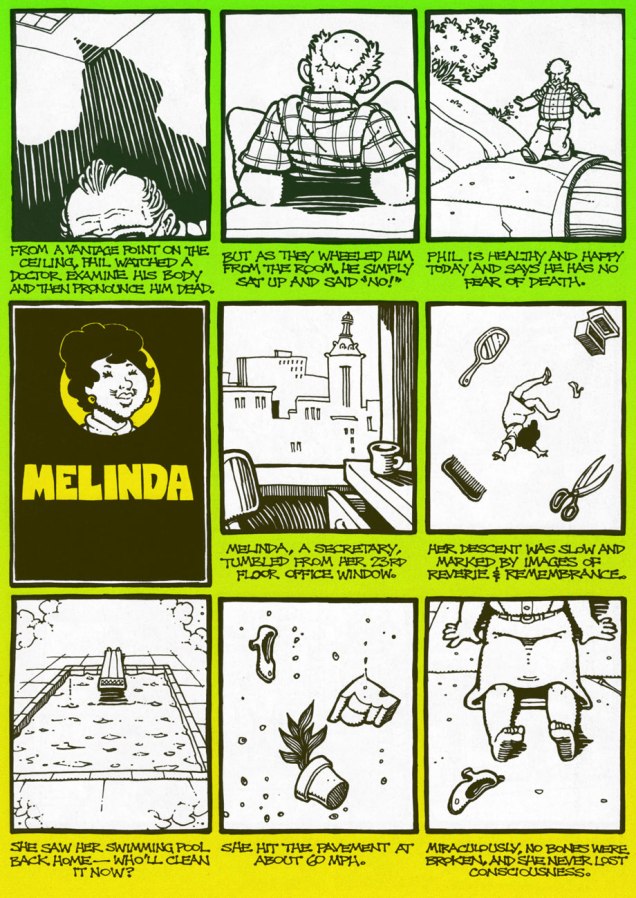
This post’s springboard, originally published in Dark Horse Presents no. 82 (Feb. 1994, Dark Horse). From Heavy Metal to National Lampoon, with High Times and The American Bystander in between,  I’ve yet to encounter a publication wherein Mr. Geary’s work failed to rise to the very top with its patented palette of fanciful perspective, sunny understatement and psychological verisimilitude. 
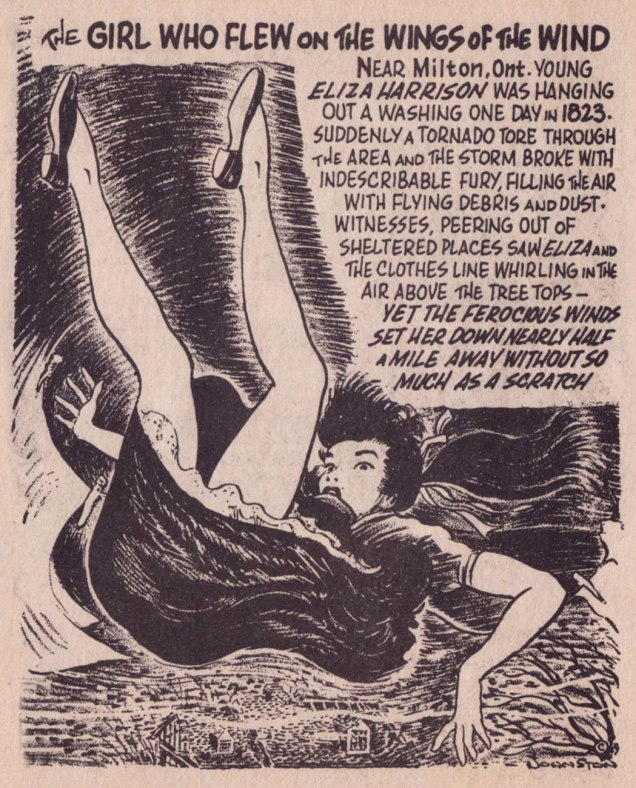
GirlFlewA
An airborne entry from Gordon Johnston‘s Ripley’s Believe It or Not-style syndicated strip ‘It Happened in Canada‘ (1967-81). However, the Wikipedia listing of historical tornadoes in Canada fails to turn up one such whirlwind in 1823. Perhaps it happened in Kansas instead.

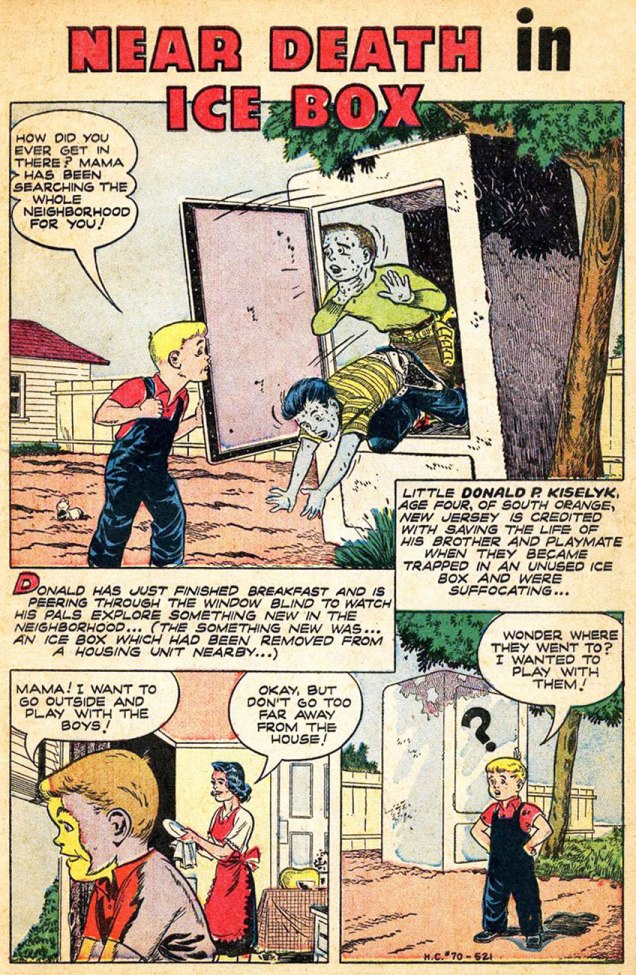
Icebox01A

Icebox02A
Pesty baby brother saves the day! Another entry from New Heroic Comics no. 70 (Jan. 1952, Famous Funnies), artist unknown. Astoundingly, a little research (I wouldn’t want to pry further) indicates that a Donald P. Kiselyk, now 73, still resides in New Jersey. Doing the math, he would have been born in 1947, which fits perfectly). I wonder whether he recollects his hour of four-colour glory…
BuriedAliveA
Another It Happened in Canada entry. Looks legit, too, though it seems Johnston didn’t nail the spelling: the resilient gent’s moniker is Myllyla. According to Wikipedia, « At 9:57 in the morning, an avalanche of snow buried the Leduc Camp in British Columbia, killing 27 copper miners working for the Newmont Mining Corporation workers and destroying several buildings. Another 42 of the 68 people buried were rescued on the same day, while a carpenter, Einar Myllyla, was saved three days later from the ruins of a collapsed building. “To their everlasting credit”, author Jay Robert Nash would write later, “rescuers refused to abandon their search until every man in the camp had been accounted for. »
FarSideBrushA
Obviously, I couldn’t leave out this Gary Larson classic.

Keep your arms and legs in the vehicle, don’t tease the wild animals, wear your life jacket, look to both sides before crossing the road, and don’t forget to floss. Oh, and call your mother more often; she misses you.

-RG

*the fellow whose tale stayed with me was most likely Lt. I.M. Chisov, « … a Russian airman whose Ilyushin IL-4 bomber was attacked by German fighters in January of 1942. Falling nearly 22,000 feet, he hit the edge of a snow-covered ravine and rolled to the bottom. He was badly hurt but survived. »

Some content on this page was disabled on June 30, 2022 as a result of a DMCA takedown notice from Gary Larson. You can learn more about the DMCA here:

https://wordpress.com/support/copyright-and-the-dmca/

Stan Mack and the Delicate Art of Eavesdropping

« There’s nothing like eavesdropping to show you that the world outside your head is different from the world inside your head. » — Thornton Wilder

I’ve always been drawn to the more observational areas of cartooning, and Stan Mack (b. May 13, 1936) surely counts among the preeminent practitioners of the form, thanks to his long-running strip (in the pages of The Village Voice for a couple of decades!), Stan Mack’s Real Life Funnies.

Therein was to be found the cartoonist’s bold pledge: « Guarantee: All Dialogue Reported Verbatim ». Oh, it might seem easy, but I’m quite convinced it was anything but.

In point of fact, here’s some insight on Mr. Mack’s modus operandi, from the horse’s mouth:

« Carry a little pad and pencil. Dress to blend in quietly. Get to the destination with enough time to case the joint. It helps to be not too tall, not too short, not too dark, not too handsome, not too ugly, not too old and not too young.

When I arrive, if I find that everybody knows each other, I make a quick exit and forget it. Otherwise, the system continues: smile and keep your ears open. Find the men’s room (always good for a line), find coffee and food, which is very helpful unless you are trying to take notes. Look for a few convenient corners in which to hide. Learn to walk backwards in order to get closer to groups. Learn to stand in the middle of a mob and like it. And, finally, learn to change direction suddenly in order to follow a good line floating by.

Appear preoccupied. If you are engaged in conversation, pay no attention to what you are saying. Say anything. Fake it. You can’t listen and think at the same time. Float through the event. Each has its own particular current. Professional wrestlers and East Side gallery-hoppers move at different speeds.

When I start to draw a strip, I sit with my deadline approaching and a pad full of quotes and doodles. I try to draw the kind of people who actually said the lines.

I don’t know why some comments seem important and others dull, but I know that it isn’t until I begin to edit that material that the story emerges. It’s often a surprise.

It’s the unexpected that makes it work. Therefore it helps to approach everything with an open mind and no preconceptions, whether it involves policemen or transsexuals or frisbee addicts. »

« I hear words I couldn’t make up. I think, ”that’s something I would never have thought of. I’ll just write it down.” I work out of other people’s heads. »

StanMackDivorceA
Stan Mack’s Real Life Funnies, The Divorce (March, 1977, The Village Voice).
StanMackSuburbiaA
Stan Mack’s Real Life Funnies, An Art Sale in Suburbia (April, 1977, The Village Voice).
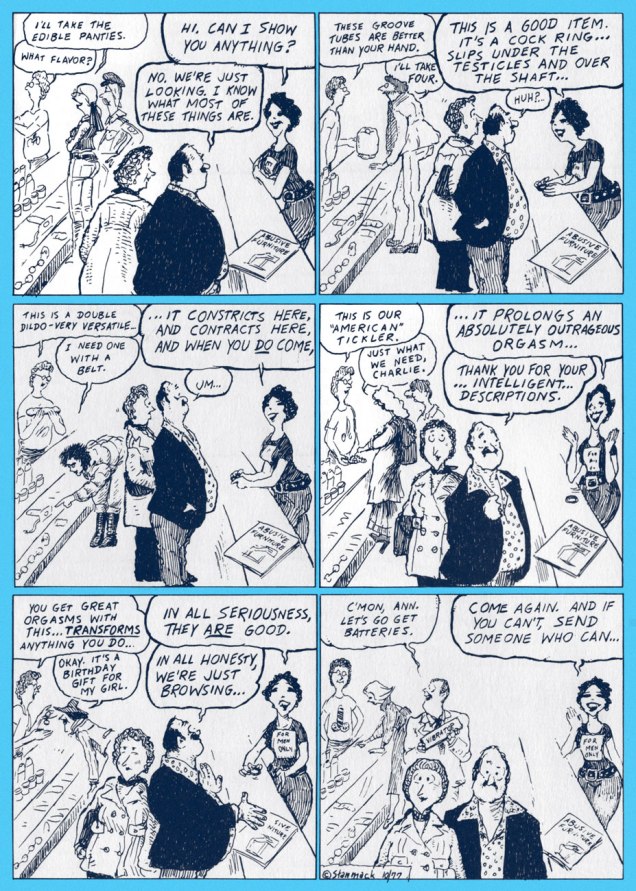
StanMackAccessoriesA
Stan Mack’s Real Life Funnies, Sex Accessories (October, 1977, The Village Voice).
StanMackAlbanianA
Stan Mack’s Outtakes, The Sting (Adweek, 1983)
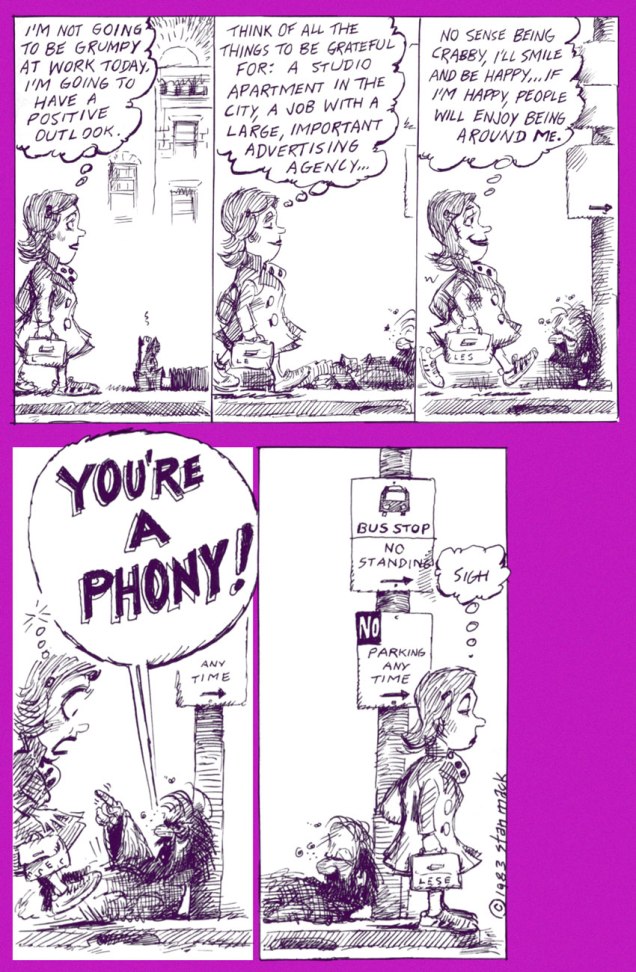
StanMackPhonyA
Stan Mack’s Outtakes, What a Bummer (Adweek, 1983)

« So, what’s he done lately? », you may ask. Well, you will nowadays find him in the pages of The American Bystander, where the cream of America’s extant cartooning geniuses gather to keep warm. Rick Geary, R.O. Blechman, Sam Gross, Drew Friedman, P.S. Mueller, Tom Hachtman, M.K. Brown… and these are just some of *my* favourites. Do them (and yourself) a favour, check it out!

StanMackAlleyA
Stan Mack’s Chronicles, Up His Alley (The American Bystander no. 7, Winter 2017).

Astute Mack-o-philes (and I’ve every reason to believe that they are astute) might point out that I neglected to bring up the artist’s splendidly surreal early ’70s National Lampoon feature, Mule’s Diner; fear not, its time in the limelight will soon(ish) be at hand, so stay tuned.

-RG

The King in Exile: Spies (1961)

« He’s back from the dead / the telegram read / If you get on a flight / You could catch him tonight / You’ll find Commissar / He’s at the Munich Hilton Bar » — B.A. Robertson

In 1958, Classics Illustrated publisher Gilberton tried something a bit different: a mostly non-fiction documentary title on various topics entitled The World Around Us, and featuring The Illustrated History of… Dogs, Space, Pirates, Great Explorers… depending on your area of interest, these could mean unrelenting tedium or sheer bliss. I haven’t encountered many issues, but the two I own, Ghosts and Spies, count among my prized paper possessions.

WorldAroundUsSpiesA

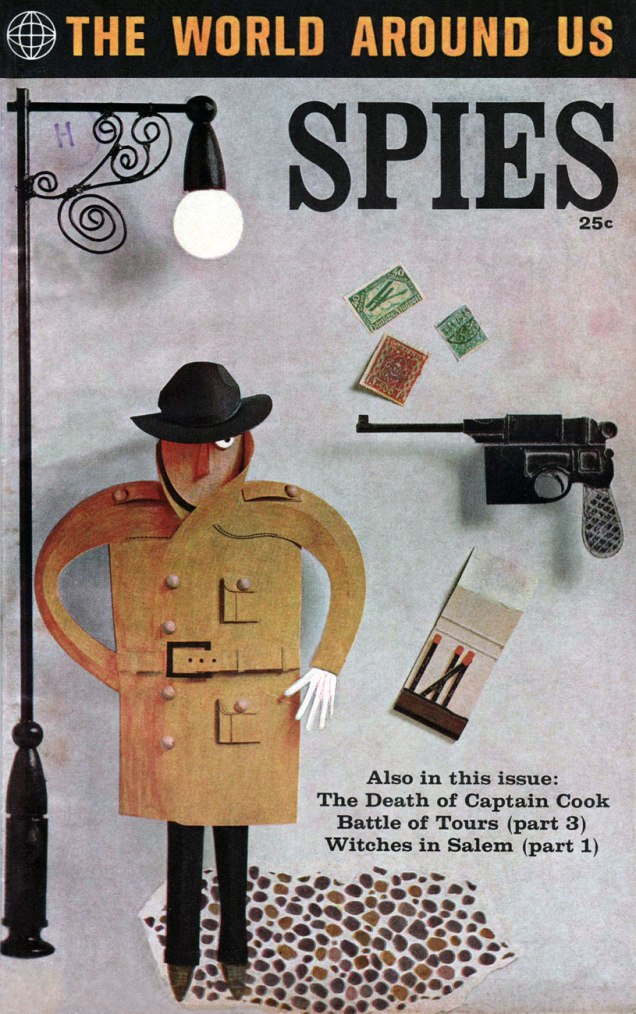
This is The World Around Us no. 35 (August, 1961), featuring this lovely mixed media piece by The Unknown Artist, whose cover remains defiantly unblown. On the inside, some fine company: George Evans, Norman Nodel, Edd Ashe, Jo Albistur… and Jack Kirby (inked by Dick Ayers)… the most beaten-down, anonymous, excitement-dialed-down-to-one Kirby you’re ever likely to see. Oh, he could do the job just fine, but the job, and the publisher, were not making anything of his regal strengths*. He would recall that this was « … the worst paying job of my entire life, including times I worked for free. »

Those early post-Code years were difficult ones for the diminished comics industry, and Kirby’s situation wasn’t exactly rosy: he’d been blacklisted at DC, thanks to the Jack Schiff / Sky Masters imbroglio, and his work at Harvey Comics had dried up. So what was a prolific artist to do, but pick up whatever bits of freelancing were available, here and there…

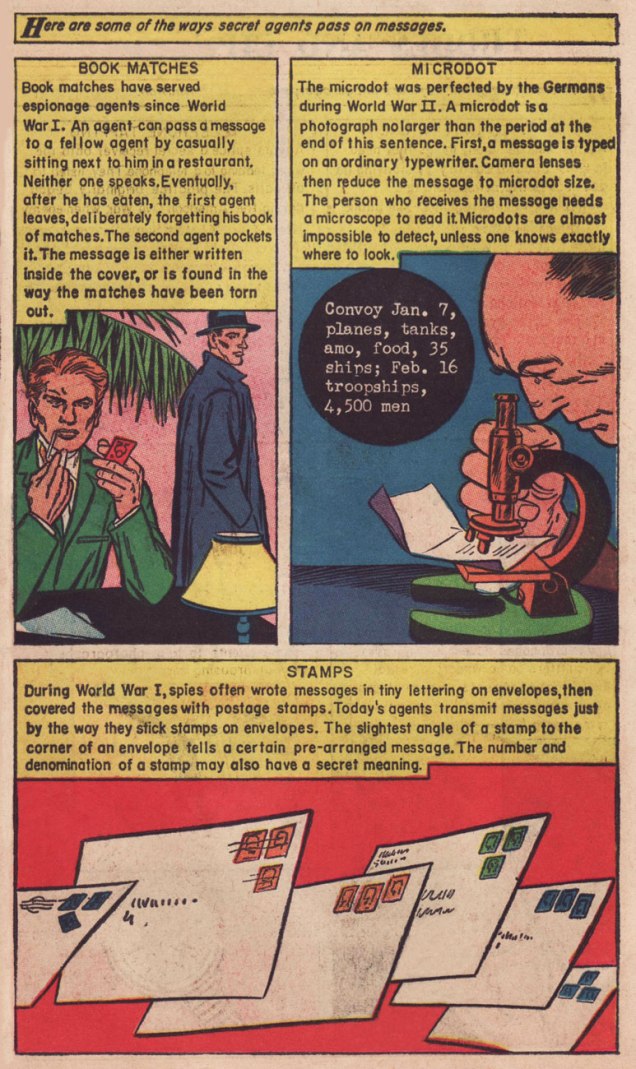
KirbySpiesSkySpies01AKirbySpiesSkySpies02AKirbySpiesBusiness01AKirbySpiesTricks01AKirbySpiesTricks02A

Quoting from Paul Gravett‘s review of Classics Illustrated: A Cultural History, we find this telling statement: « The most demanding editor was Roberta Strauss, a stickler for detail, who would count soldiers’ buttons or pleats in skirts and even called an editorial meeting in her hospital room only days after her son’s birth. » Give me Harvey Kurtzman‘s editorship** any old day!

-RG

*not so very unlike animation studio Ruby-Spears which, despite having at its disposal, in the 1980s, the combined talents of Kirby, Alex Toth, Gil Kane, Doug Wildey, Jim Woodring… and then I started working at Ruby-Spears, working on the most egregious shit the world has ever seen, the crappiest, most horrible cartoons. », Russ Heath, Bill Wray… yielded, let’s just say… underwhelming product. But it paid better than Gilberton.

**« Kurtzman’s editing approach to Two-Fisted Tales and Frontline Combat was a stark contrast to EC editor Al Feldstein‘s style. Whereas Feldstein allowed his artists to draw the story in any manner they desired, Kurtzman developed detailed layouts for each story and required his artists to follow them exactly. »

Celebrity Car Crash Corner!

« You gave me so many problems
You made me crash in my car
I’ll have a martini cocktail
And then we’ll see where we are… » — OMD, Bloc Bloc Bloc

In the year 1995, crafty budget movie maven Roger Corman somehow wound up with a comics line bearing his name, Roger Corman’s Cosmic Comics. Around 20 issues of various titles saw print, consisting of graphic adaptations of current (Caged Heat 3000, Bram Stoker’s Burial of the Rats) or classic (Rock ‘n’ Roll High School, Little Shop of Horrors) Corman-directed-or-produced films… and one sequel (Death Race 2020, after Death Race 2000), which is the one that concerns us today, after a fashion.

Death Race 2020 managed to be a pretty good series… for three issues (read ’em here!) The original creative combo was aces, three veterans from Brit SF institution 2000 AD, namely Pat Mills and Tony Skinner hatching the plots and Kevin O’Neill conveying them to visual glory. O’Neill scampered off after three issues (returning only to craft the series’ final cover), and things just weren’t the same without his sordid, madcap touch. It takes a special talent to depict compellingly *and* with a finely-tuned, subversive tone, this level of carnage and mayhem. Such talent, obviously, is ever in short, and possibly dwindling, supply.

But… we’re not here for the main feature. Buried in the back pages amidst the ads (mostly touting the alt-rock of the day) was a regular one-page hi-concept feature crafted by a succession of young (or young-ish) artistic iconoclasts. I suspect it was the fevered brainchild of former The Comics Journal managing editor Robert Boyd (1989-1990), also the editor of Death Race 2020. If this were Facebook, I’d show you my favourite example and move on to the next pretty shiny bauble. But through the pixie magic of blogging, I can afford to be utterly profligate and fling the whole delirious jumble your way. And so…

CelebCarCrash01A
Story and art by Dave Cooper, from Death Race 2020 no. 1 (April, 1995).
CelebCarCrash02A
Story and art by Pat Moriarty, from Death Race 2020 no. 2 (May, 1995).
CelebCarCrash03A
Story and art by Bob Fingerman, from Death Race 2020 no. 3 (June, 1995).
CelebCarCrash04A
Story and art by Shane Oakley, from Death Race 2020 no. 4 (July, 1995). As everyone… used to know, the Girl Can’t Help It.
CelebCarCrash05A
Story and art by Jay Stephens, from Death Race 2020 no. 5 (August, 1995).
CelebCarCrash06A
Story and art by Fábio Zimbres, from Death Race 2020 no. 6 (September, 1995). In these troubled days, I imagine many a Brazilian pines for the halcyon days of JK, faced with the reality of JB.
CelebCarCrash07A
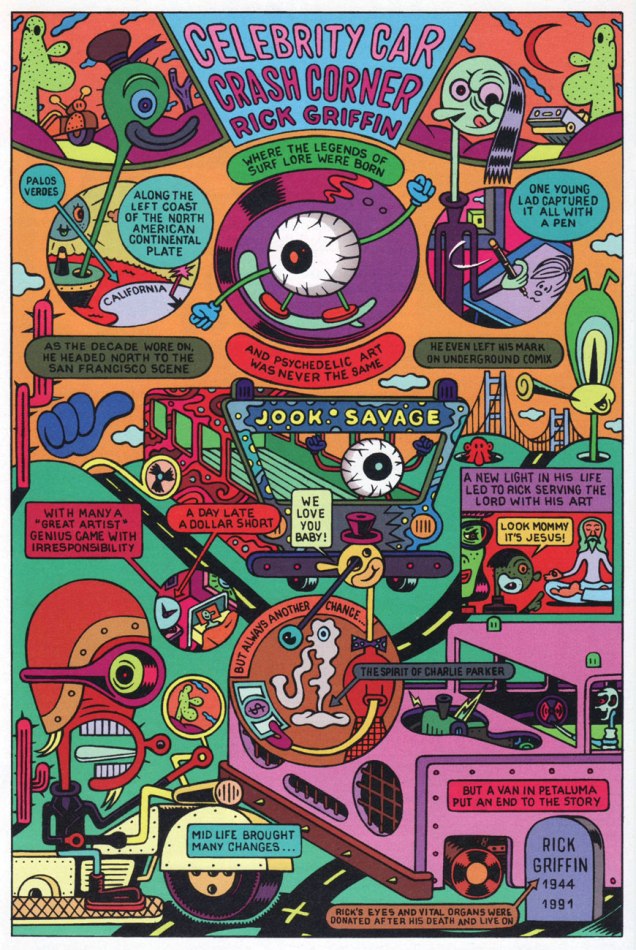
Story and art by Jaca Weiss and Robert Weiss, from Death Race 2020 no. 7 (October, 1995). For a look at some actual Rick Griffin art, look no further than here.
CelebCarCrash08A
Story and art by Matthew Guest, from Death Race 2020 no. 8 (November, 1995).
VIPWomanDriverA
To wit… a prime example of the aforementioned. By now, I’d like to think that most people have come to realize that the gendered driver question is a complex and fraught one. Here are some relevant statistics, if that’s your thing. You guessed it, things aren’t fair.

Drive safe, folks, and keep your eyes and mind on the road. The rest of us will appreciate it.

« Technology is constantly improving our lives. Look at the cellular telephone. Just ten years ago, virtually nobody was able to get into a car crash caused by trying to steer and dial at the same time; today, people do this all the time. » — Dave Barry

-RG

Earth Day With Jim Woodring and Friends

« Oh Beautiful for smoggy skies, insecticided grain,
For strip-mined mountain’s majesty above the asphalt plain.
America, America, man sheds his waste on thee,
And hides the pines with billboard signs, from sea to oily sea. » ― George Carlin

On this day, the forty-ninth edition of Earth Day, we feature some little-seen work (by his usual audience, at any rate) by Jim Woodring and his collaborator Scott Deschaine*. Given the current political climate, an increasingly dire state of affairs, I’ll (mostly) skip the chit-chat and make with the visual riches.

WoodringGreenTreeA
Among the Woodring / Deschaine collaborations, One Green Tree (1990) is the masterpiece, and the only full-on Woodring, visually-speaking, with its expressive inks, unsimplified art and lush palette.
WoodringTreeЗ5A
An interior (in more than one sense) page from One Green Tree, a sixteen-pager. Full marks to Deschaine, a science popularizer of the first order, and a cartoonist himself, which goes a long way in explaining the success of these collaborations.
WoodringUnderwoodA
Incidentally, Woodring drew himself into the story as the friendly guide, Mr. Underwood.
WoodringElephantLifeA
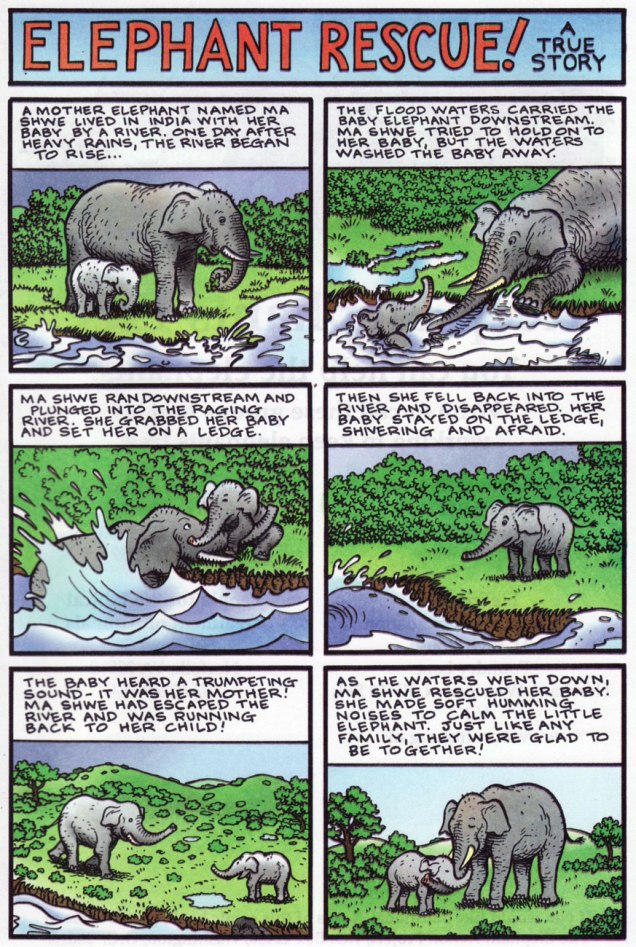
As it happens, Earth Day 2019’s theme is « Protect Our Species », and few species need more protection than the gentle elephant.
WoodringElephantsA
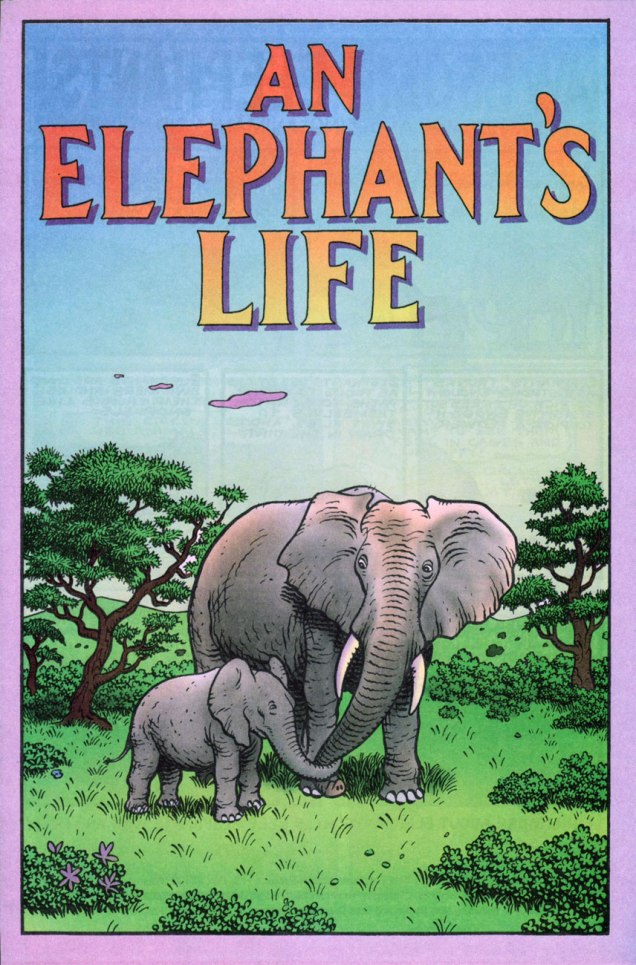
An excerpt from An Elephant’s Life (1999), written by Mike Benton and Scott Deschaine, illustrated by Woodring.
WoodringSoil_A
Search for Soil (2000, Discovery Comics) features Woodring in a simpler style, but it’s still gorgeous and effective. And hey, a Tiny Perfect Mole!
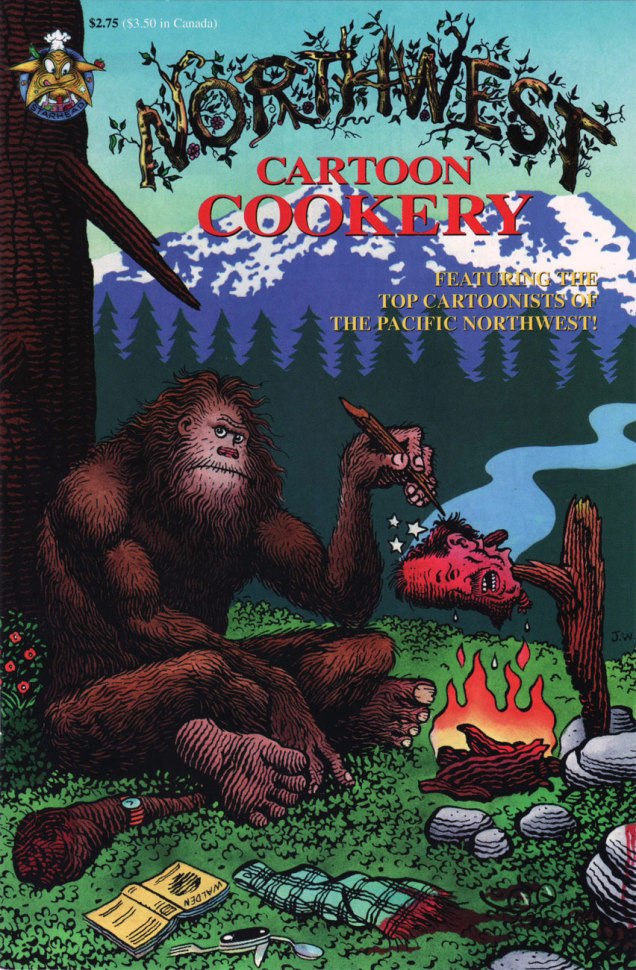
WoodringNorthwestA
And for those of you who may find this all too earnest, cute and family-friendly, I’ve saved a Woodring piece to soothe your savage brow. This is the one-shot Northwest Cartoon Cookery (1995, Starhead Comix), also featuring fine work by J.R. Williams, Donna Barr, Ellen Forney, Roberta Gregory, Michael Dougan, Mark Zingarelli… and a couple of pages of Ed Brubaker’s dismal artwork.

« What we are doing to the forests of the world is but a mirror reflection of what we are doing to ourselves and to one another. » ― Chris Maser, Forest Primeval: The Natural History of an Ancient Forest

-RG

*French family names, after spending some time in English-speaking lands, tend to distort in interesting ways: “Deschaine” makes no grammatical sense. It likely started out as “Deschaînes” (of the chains), or its homonym, Deschênes ou Duchêne (of the Oaks or the Oak). Sometimes, the name gets so badly distorted that it’s quite unpronounceable: Shia LaBeouf  (Leboeuf, the ox) or Cara Delevingne (Delavigne, of the vine)… not that I’d want to utter these names, save perhaps as curses.

Treasured Stories: «Tex’s Bad Dream or ‘The Egg Lady’s Revenge’» (1988)

« You really saw that things were not at all what was portrayed in the mass media… at least not in our neighborhood. It was just a conclusion that most of the kids of that age came to, that things were extremely corrupt. » — Spain Rodriguez

While plenty of cartoonists trod the path of autobiography before him, it took Manuel ‘Spain’ Rodriguez (1940-2012) to truly show how it should be done: here at last was a genuine full-blooded practitioner, hardly content to merely observe from the sidelines, blending with the wallpaper. Lover, brawler, consummate graphic storyteller: a scarce combination indeed.

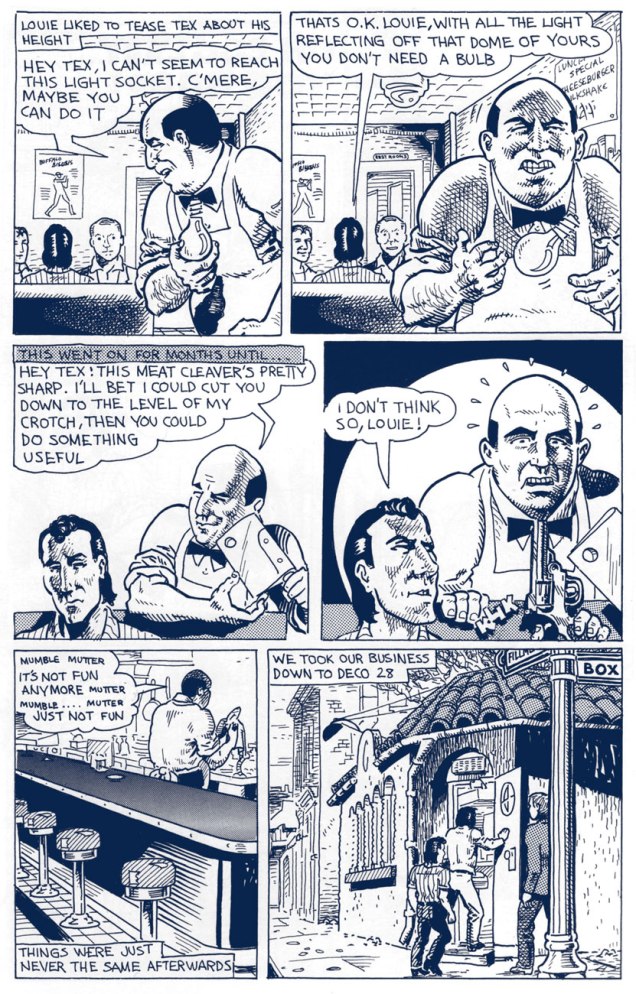
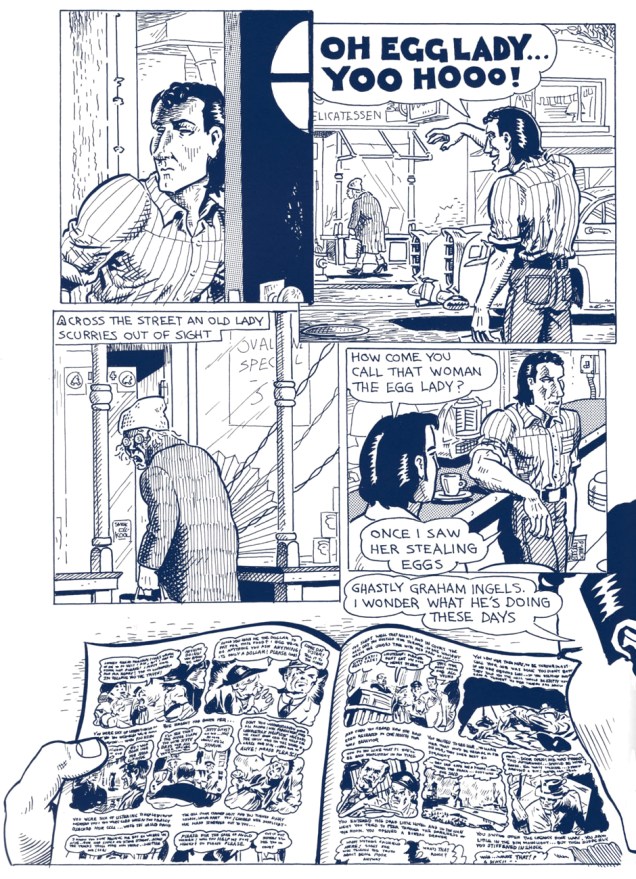
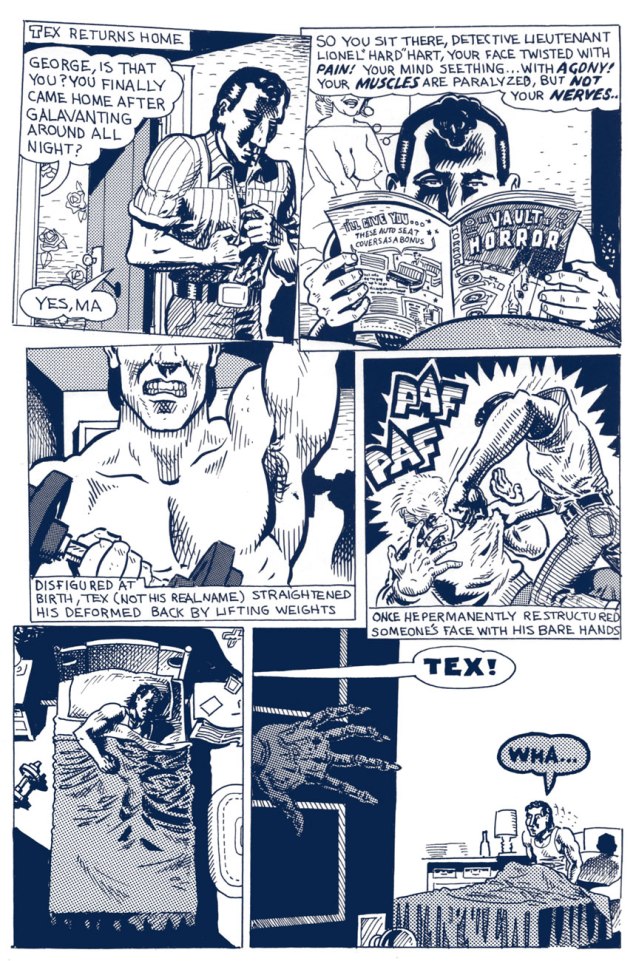
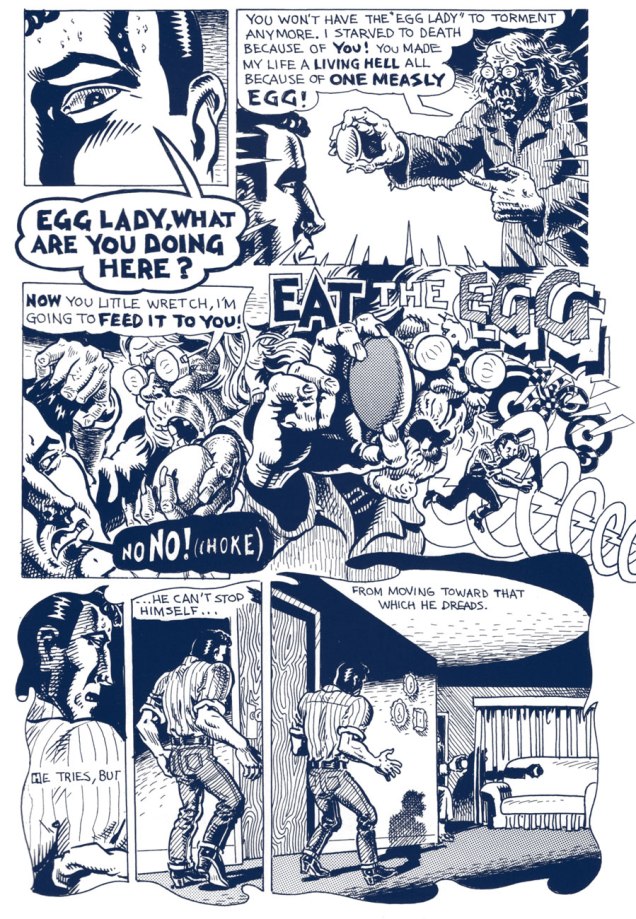
The following tale belongs to a cycle recounting the exploits and insights of The North Fillmore Intelligentsia, Spain’s closest compadres in Buffalo of the 1950s. Tex’s Bad Dream… originally appeared in Blab! No. 3 (Sept. 1988, Kitchen Sink Press); indeed, Spain’s recollections became, over time, the sole reason to purchase the once-excellent Blab! Mercifully, most of these were collected, in their usual exemplary fashion, by Fantagraphics, as Cruisin’ With the Hound (2012). You’ll still be lacking the mysteriously-omitted, quite essential « How I Almost Got Stomped to the “Still of the Night” by the “Five Satins » (Prime Cuts No. 2, Mar. 1987, Fantagraphics), which you can find in another Spain anthology, My True Story (1994, Fanta again).

In the meantime, enjoy, with my compliments, this true-life tale of original EC Fan-Addicts, facial restructuring, cautionary dreams, isometrics and pork sandwiches.

spainegg01aspainegg02aspainegg03aspainegg04aspainegg05aspainegg06aspainegg07aspainegg08a

-RG

The Old Year’s Final Boarding Call

« On New Year’s Eve the whole world celebrates the fact that a date changes. Let us celebrate the dates on which we change the world. » — Akilnathan Logeswaran

Earlier this month, as we showcased Justin Green’s Musical Legends, I mentioned that I was reserving one of the strips for a special occasion, and it has come.

JustinGreenLastTrainA
Originally published in the December, 2001 issue of Pulse!

« Shedding light on past and present musicians — and there are countless possibilities — is  a real challenge. But when it works, the comic vision can change the listening experience. » Justin Green, from his Authoroonist Acknowledgements & Apologies (2004).

This entry stands out from its brethren in that the artist was personally involved in, or more precisely a witness to, the events depicted. In addition, no famous or semi-famous musical figure occupies the spotlight; instead, we get a gentle, low-key, soulful anecdote.

Who’s Out There has had a good year, and so we thank all of you readers around the world (and I do mean around the world: according to WordPress’ statistics, comics fans visited us from a whopping eighty-three countries these past twelve months) and wish each of you a wonderful, or at the very least better, year 2019.

-RG

Justin Green’s Musical Legends

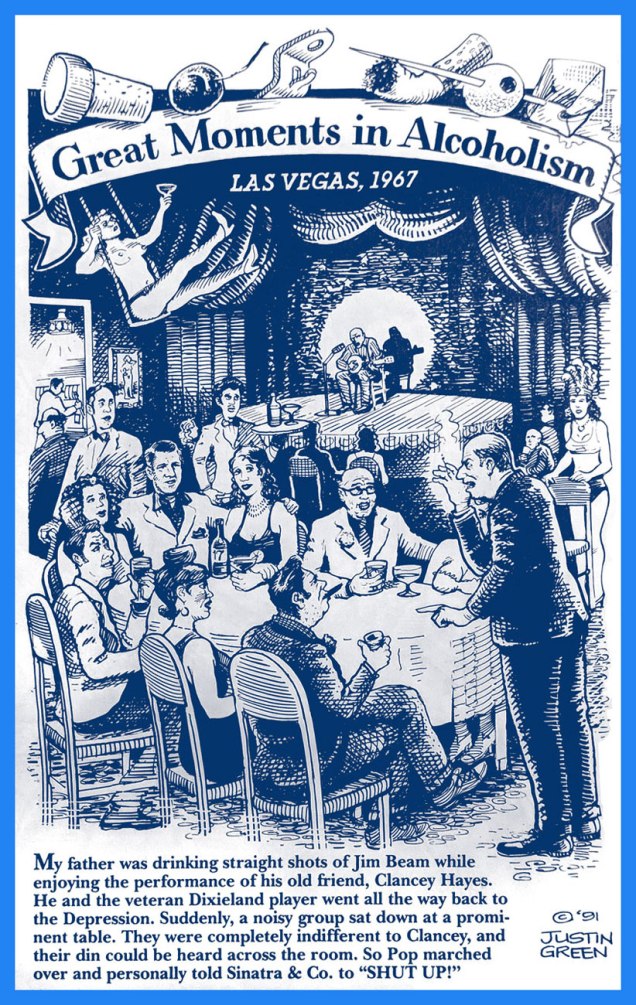
« My father had a lifelong interest in helping musicians. I even encountered his presence when reading the autobiography of Anita O’Day. She said that there was a real estate man in Chicago who always made sure her band had a place to stay. That was Pop. » – Justin Green

How did Justin Green, one of the Founding Fathers of the Underground Comix movement, wind up holding down a regular feature for a decade (1992-2002) in Tower Records‘ in-house magazine, Pulse!? The whole chain of events began with a strip about his dad’s drinking. Of course.

GreatMomentsA
« It was my father’s spirit that instigated this cartoon project…. this was ’91 (Blab No.6, Summer 1991, Kitchen Sink Press), and I was living in Sacramento. Mark Weidenbaum was then an editor at Pulse! Magazine, published and distributed by Tower Records, which had its headquarters in West Sacramento. He had just seen the piece when he found out I lived nearby. He wanted to explore the idea of an ongoing musical biography cartoon feature. »
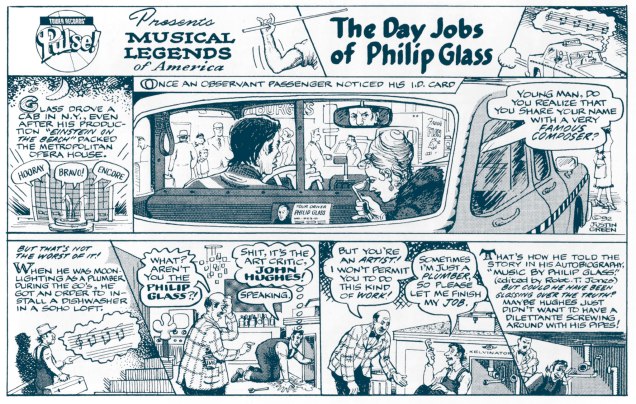
MusicalLegendsGlassA
The second instalment (April, 1992). A little Einstein on the Beach, anyone?
MusicalLegendElvisA
August, 1992. Elvis certainly had his faults, but racism or ingratitude were not among these.
MusicalLegendsGaryA
My own introduction to the Reverend’s music came, as it surely came to many others, through Jackson Browne‘s fine cover of his Cocaine (Running on Empty, 1977). « I was talking to my doctor down at the hospital. He said, ‘Son, it says here you’re twenty-seven, but that’s impossible — you look like you could be forty-five’. »
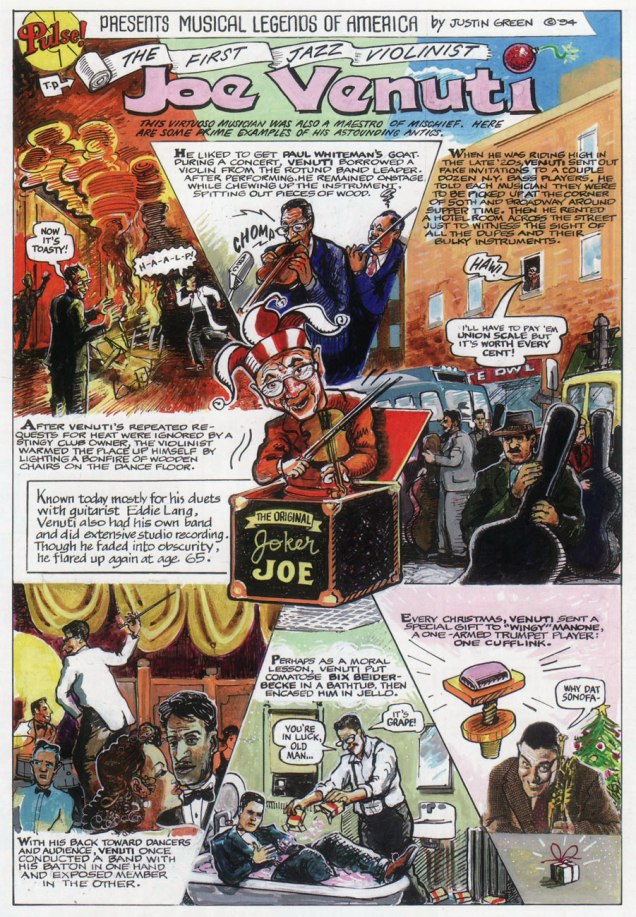
MusicalLegendsVenutiA
The strip frequently appeared in colour. Here’s my favourite example, from April, 1994. And here’s a fine Venuti performance. No, he wasn’t *always* joking.
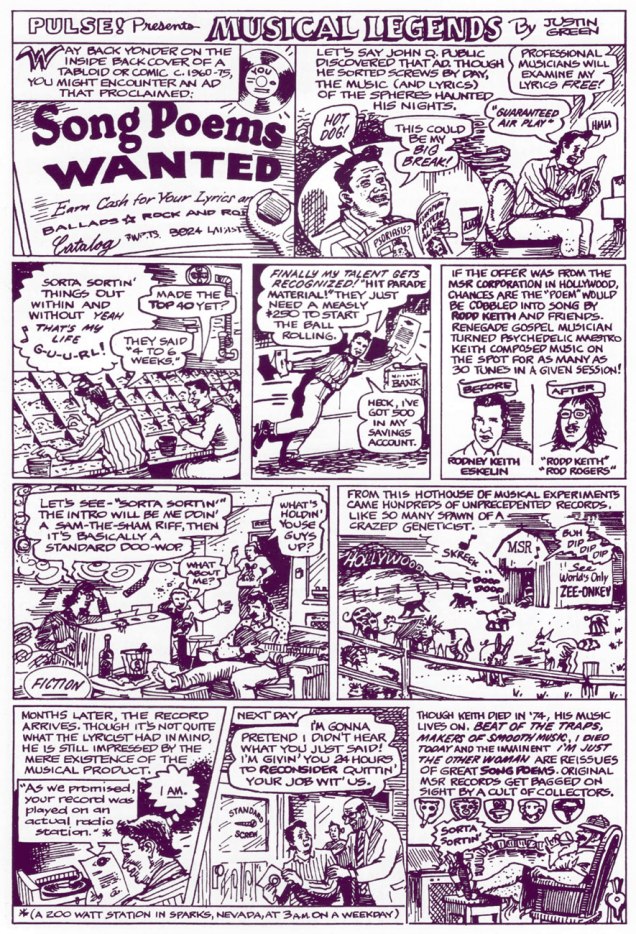
MusicalLegendsRoddA
Ah, Rodd Keith, the main man behind those infamous Song Poems ads, comic book fixtures in the 1970s. The weren’t a scam… not in the traditional sense. November, 1996. Lend your ear to his Ecstasy to Frenzy.

While Green isn’t a native virtuoso draftsman like, say, R. Crumb or Rick Griffin, and he’s only fair-to-middling when it comes to likenesses, he *is* a born storyteller, and that’s really what’s most needed for an endeavour of this nature. Compressing a lifetime, or at least a career, into a single-page strip (two at the most!) is remarkably tricky and demanding, and if it looks deceptively easy here, he’s succeeded.

In selecting strips for this post, I didn’t lean towards my own favourite musicians, opting instead for what I felt were the strongest pieces, regardless of topic. However, I’m reserving my very favourite for a special New Year’s Eve post. Hope you enjoyed these musical time capsules! If you did, you’ll be happy to learn that the fine folks at Last Gasp collected the set in 2003.

-RG

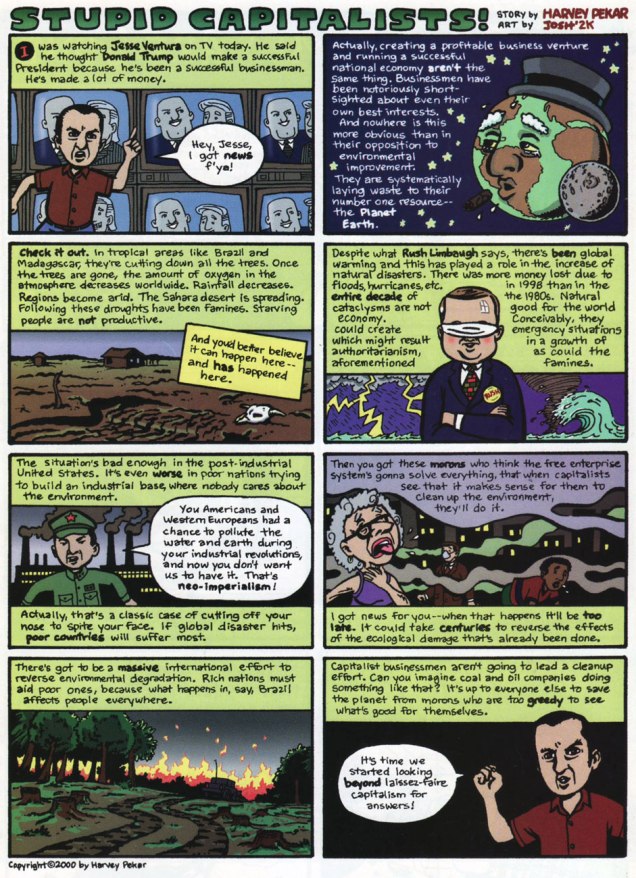
An Inconvenient Prescience: Harvey Pekar’s “Stupid Capitalists!” (2000)

« And it’s worse when I try to remember
When I think about then and now
I’d rather see it on the news at eleven
Sit back, and watch it run straight down »
Warren Zevon, Run Straight Down (1989)

Just a brief little post today, with a thought to our friends in the USA who have an important opportunity coming up tomorrow.

Despite the vividness of his ‘cranky old man’ image, Harvey Pekar (1939-2010) wasn’t some coot screaming at the kids to get off his lonke or ranting about aliens in the drinking water. He was a keen-eyed observer with astounding perspective. Witness this unnervingly accurate and oh-so timely piece from eighteen years ago. Illustrated by Josh Neufeld, it was published as the back cover of the one-shot American Splendor: Bedtime Stories (2000, Dark Horse, edited by Diana Schutz).

PekarCapitalistsAHigh time for a muzzling of a certain tiny fingered, Cheeto-faced, ferret wearing shitgibbon, wouldn’t you say? Make America Splendid again… do it for old Harv, do it for yourselves.

-RG