« You cannot work with men who won’t work with you. » — John Harvey Kellogg
Before he created his justly celebrated The Golem’s Mighty Swing, wrote the mini-series Fantastic Four: Unstable Molecules, or co-founded The Center for Cartoon Studies, James Sturm (b. 1965) committed to paper and ink a mind-expanding, if little-noticed, saga entitled The Cereal Killings, complete in eight issues and published by Fantagraphics between 1992 and 1995. Sturm valiantly struggled through ocular problems during that period, undergoing no less than three retinal operations, leaving him with one good eye.
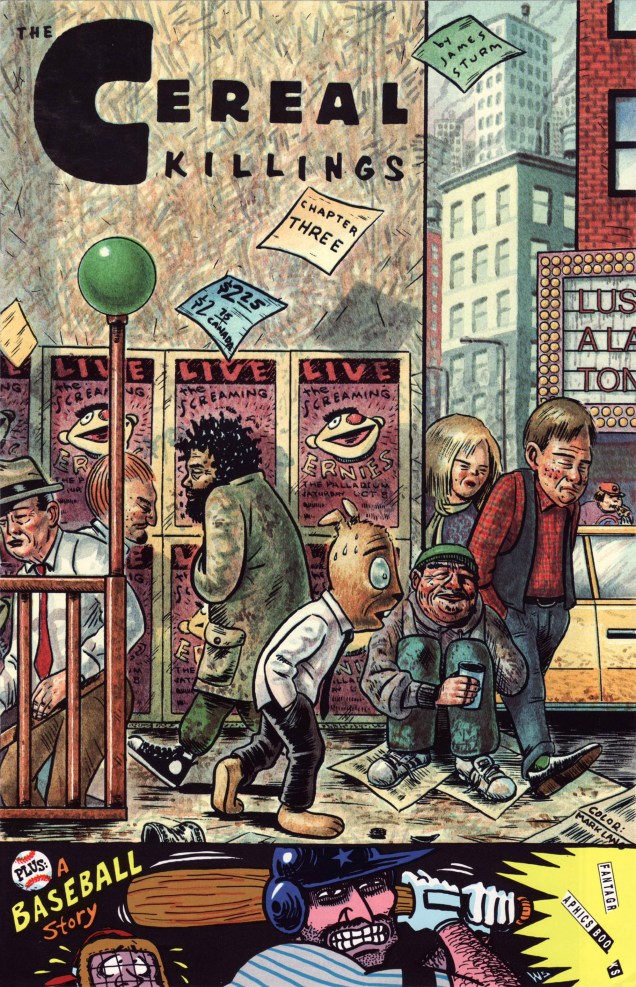
The Cereal Killings no. 3 (Sept. 1992), colours by Mark Lang. Hey, I’d pay good money to see The Screaming Ernies perform. I’d settle for a t-shirt!
Sturm dug well beyond the shallow pun of the title and implacably hauled it to its logical conclusion. TCK has been likened to a Watchmen with a cast of funny animal cereal mascots, and that’s not that far off the mark. But beyond its conceptual debt to Alan Moore’s superhero deconstruction, Sturm’s story actually takes aim at more adult concerns and issues, made all the more harrowing and poignant by how psychologically credible his cast of cereal pitchmen and acolytes is. Corporate malfeasance, petty theft, betrayal, bitterness, grandiloquence, blind ambition, dementia, remorse… and wisdom. You name it, it’s all there, in a gripping, kaleidoscopic and haunting narrative.
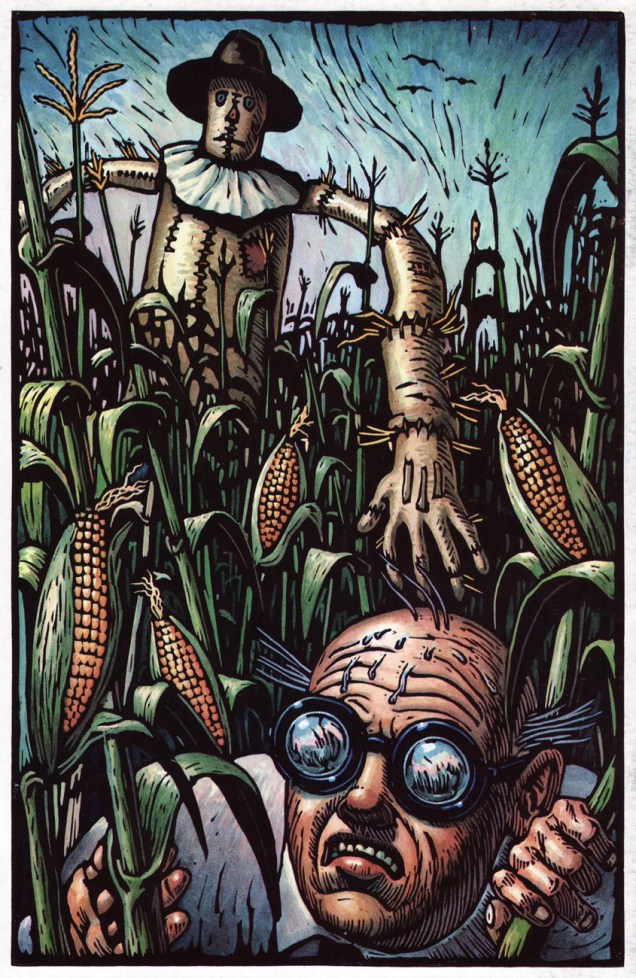
Sturm, Fantagraphics & Co. made splendid use of the entire, (actual) ad-free magazine to flesh out the concept. This is Mark Lang’s gorgeous depiction of The Scarecrow and Carbunkle. These are our good guys, appearances notwithstanding.Issue 3’s back cover provides a helpful look at our cast of characters.This is the cover of TSK no. 4, featuring Schmedly the Elephant, who wishes he *could* forget. Colour by Mark Lang.
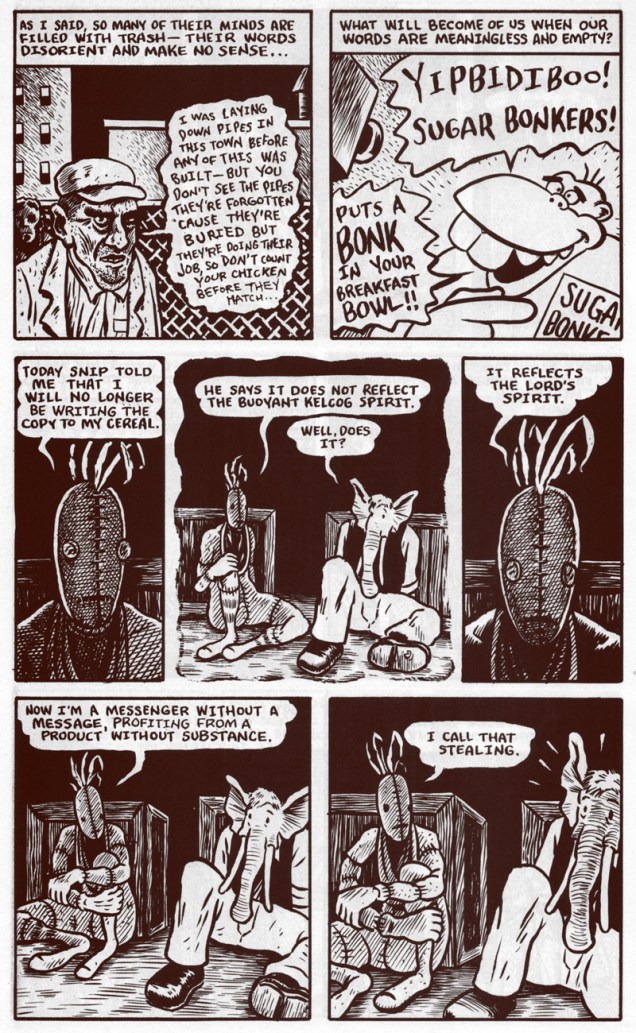
A crucial flashback scene from the eighth, and ultimate, issue (Jan. 1995). It would appear that The Scarecrow is a stand-in for cereal giant Kellogg’s founder, John Harvey Kellogg.
« It’s the present! It’s nostalgia! It’s a crispy non-sweetened comix story that doesn’t get soggy in milk! And remember — product is sold by weight, not volume. Some unsettling may occur. »
The series has never been collected or reprinted, so you’ll have to do the work… I think I noticed a torrent file somewhere. Sturm at one point intended to issue a revised collected edition, but has apparently changed his mind since. That’s no way to treat one’s masterwork, neglected as it may be.
Where there be pirates, there be treasure; where there be treasure, there be a displeased octopus, irritable after being roused by some foolish fortune-hunter. I’d like to dedicate this Tentacle Tuesday to the murderous marauders who, in bold search for immeasurable treasure, have to tackle tentacles (and survive, hopefully).
Weird Terror no. 2, November 1952. Cover by H.C. Kiefer. Note the dead pirate’s hook embedded in the diver’s shoulder, while the former’s other hand is severing his umbilical cable… I think the octopus is the least of this treasure-hunter’s worries. By Weird Terror standards, this cover is actually pretty tame; this green octopus is not responsible for Fredric Wertham‘s nightmares.
Any octopus action inside, you may ask? Just two panels.
AAAGH-BLUB! Panels from « Wrath of Satan », pencilled by John Belcastro and inked by Joe Galotti.
I never thought I’d be posting something Garfield-related, but in Roger Langridge‘s hands, even the insipid orange cat acquires some charm.
A panel from « Pirate Cat », written by Scott Nickel and illustrated+lettered by Roger Langridge, published in Garfield no. 34: His 9 Lives Part 2, (KaBOOM!, February 2015).
Melvin the Menacing Sea Monster isn’t just a pretty eye; he’s got at least one excellent pitching arm, too.
All this proves is that there’s a simple solution to an inane plot and pedestrian characters: hire Langridge to illustrate your story, and it will magically transform into a fun yarn.
Our next selection doesn’t technically feature pirates, but it features sailors, Spanish smugglers, swindlers and cheats, as well an epic battle with an octopus and stolen treasure buried at the bottom of the sea, so it damn well qualifies.
Classics Illustrated no. 56, February 1949; cover by August M. Froelich. For one thing, I never knew Victor Hugo had written anything squid-related. As it turns out, Toilers of the Sea (French: Les travailleurs de la mer) is a novel from 1866. How educational! Classics Illustrated was created by Russian-born Albert Kanter (1897-1973), who wanted to use the power of comics to introduce young readers to “great literature” that they might not otherwise have deigned to read. “Classic Comics” began publication in 1941, with the name of the series changed to “Classics Illustrated” in 1947. The series lasted until 1971 for a total of 169 issues; various other companies reprinted its titles. I don’t know whether this series really made a difference in the edification of youth, but many of its issues are highly collectible, anyway.
As a little bonus, here’s a cover that’s somewhat lacking in swashbucklers, but boasts some decent treasure and (quintessential ingredient) some tentacles.
If Rex the Wonder Dog (created by Robert Kanigher and Alex Toth) can ride horses, show off as an expert bullfighter, use cameras, defeat a Tyrannosaurus Rex and swing on ropes (among his many other accomplishments), I don’t see why he wouldn’t be able to effortlessly fend off some pink tentacles. This is The Adventures of Rex the Wonder Dog no. 42 (Nov.-Dec. 1958). The cover is by Gil Kane on pencils, Bernard Sachs on inks, and Jack Adler on tones and colours.
It pays to be kind to your cat, particularly if said feline happens to be more than your match. Between dimwit Fat Freddy Freekowtski and F. Frederick Skitty, esq., it’s clearly no contest.
This electrifyin’ strip first saw print in Rip Off Comixno. 23 (Rip Off Press, Summer 1989). Script and art by Gilbert Shelton.
A closer look at the wily furball, cover detail from The Fabulous Furry Freak Brothers no. 6 (Rip Off Press, 1980)
I’m in the mood for a light-hearted Tentacle Tuesday, an octopus-as-gentle-companion kind of mood.
Without further ado, I invite you to take a peek at the lives of those who opted for a slightly unorthodox pet!
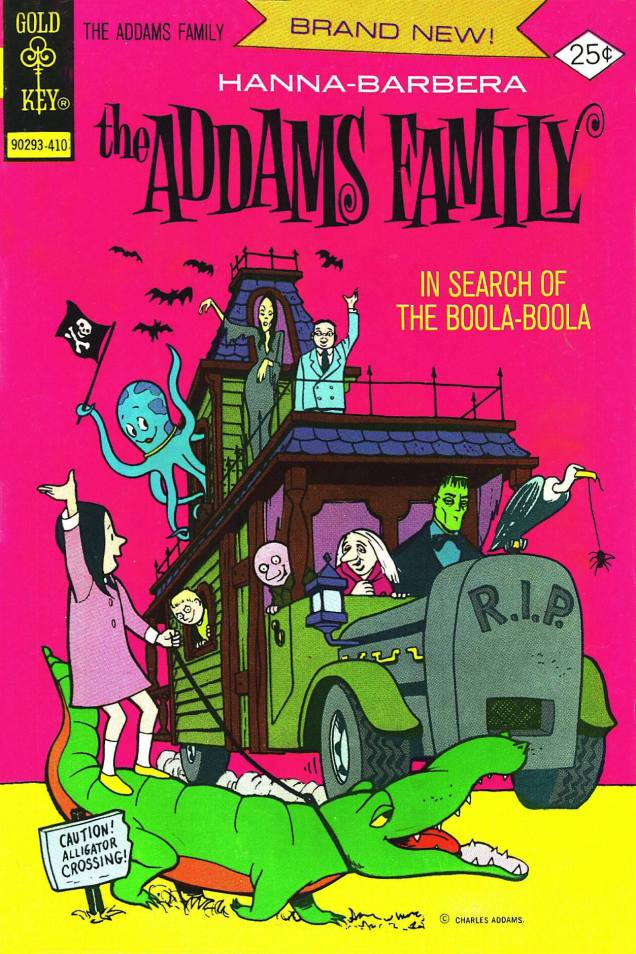
Here’s our first friendly fellow. Ocho the octopus may be a minor player on this cover, but I’d like to think that he can still be part of our Tentacular Tuesday line-up (I couldn’t resist his puppy eyes).
The Addams Family no. 1, October 1974. Cover by Bill Ziegler.
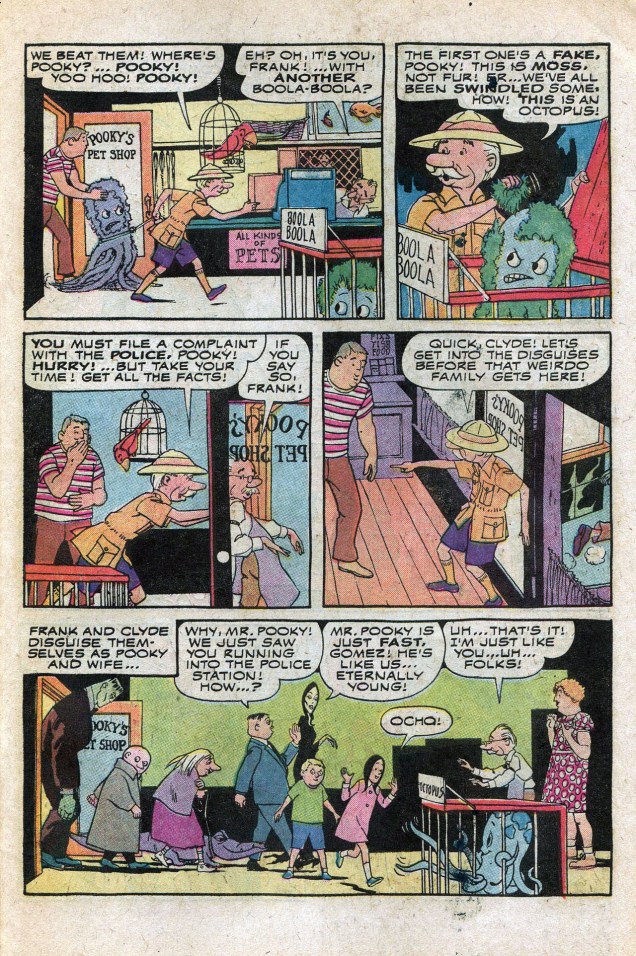
AF#1 not only features Ocho, but also a creature called Boola-Boola, basically a shaggy, colour-changing octopus – so you get double the tentacular pleasure in one issue!
Art also by Bill Ziegler.
You can read the whole story here. Interestingly enough, the website that has beautiful scans of all three Addams Family Gold Key issues seems to be dedicated to teaching young people’s English, or to quote from the horse’s mouth, “Improve your English through Reading Comic with Fun”.
Next up are Victoria and Otto, a nattily-dressed Victorian girl and her pet (confidant, friend, butler…) octopus.
Given the style of these comico-illustrations, I don’t think it will astonish anyone to learn that Brian Kesinger is a Walt Disney Studios alumnus. Apparently, Otto and Victoria’s popularity has taken him by surprise, though it seems rather obvious that a curvy steampunkette and a friendly octopus would be a hit with a lot of people. This may be overly cute, but how can you resist the chronicles of two dear friends (though they may be of different species), especially when they regularly drop everything for a tea or reading break?
Ice bucket challenge!
Otto and Victoria (with some involvement from Kesinger, I imagine!) have three books to their name – Walking Your Octopus: A Guidebook to the Domesticated Cephalopod (2013), Coloring With Your Octopus: A Coloring Book For Domesticated Cephalopods (2014) and Traveling With Your Octopus (2015), all three published by Baby Tattoo Books.
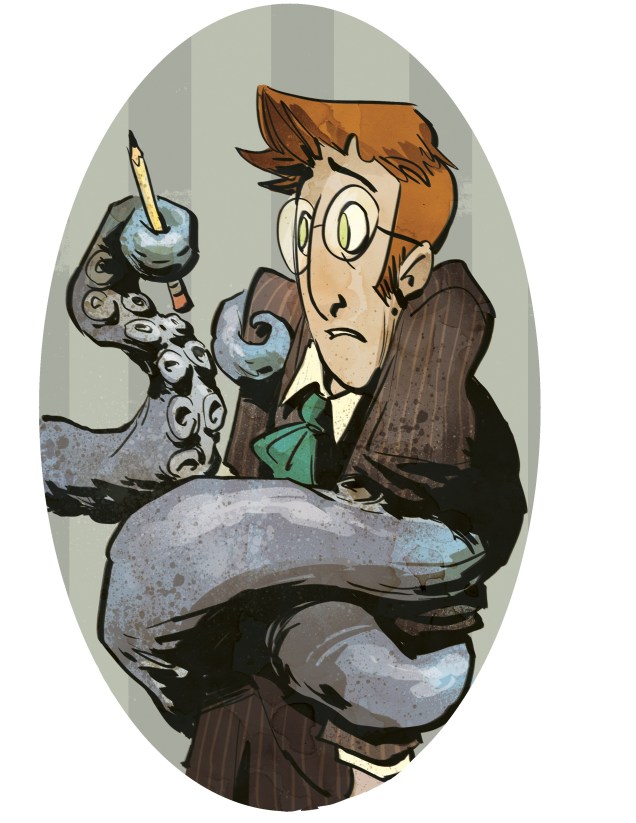
Here’s a self-portrait of the artist as a tentacle man:
I think he’s stuck drawing tentacles for the rest of his life, now that Otto & Victoria merchandise is selling well. Careful what you wish for!
Now you see this brand new razor I had it sharpened just today I’m comin’ in there with my own rules That you must follow when you play Hey kid, keep your hands up there While you’re givin’ them out, please Stop puttin’ them wildies Down there ‘tween your knees***
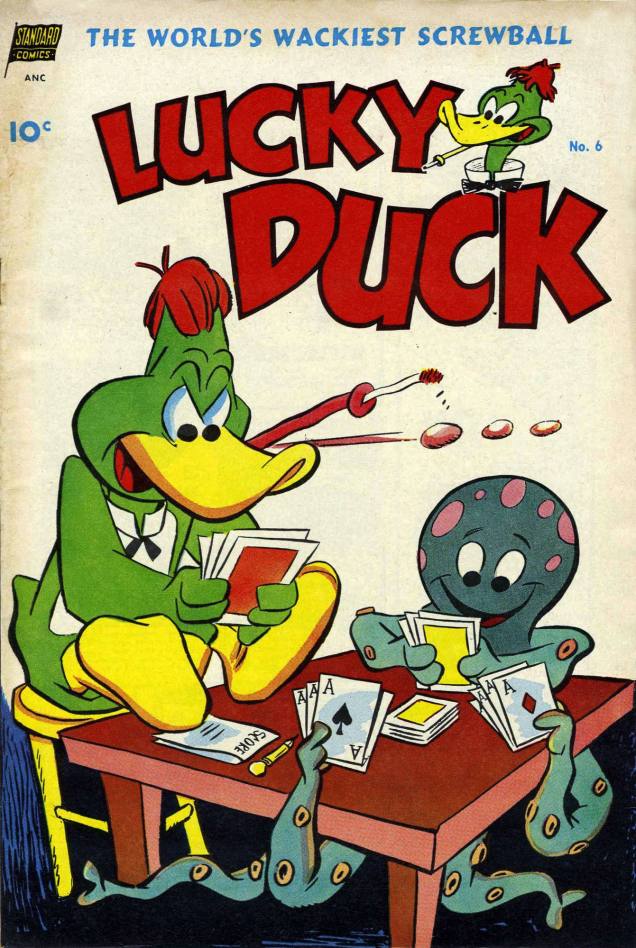
Lucky Duck #6 (May 1953), art by Irv Spector, (1914-1977), whose career was mostly in animation, though he left behind some lovely comic work as well. The madcap energy of his stories certainly makes it look like the characters are actually in motion!
The inside stories are also by Irv Spector. His son, Paul Spector, hosts a wonderful blog about his father’s work, and you can find many Lucky Duck stories for your enjoyment on its online pages for a dose of the sort of ebullient zaniness one only finds in animal funnies of the 1950s.
As a little bonus, a peek at Gary Larson’s view of octopuses as pets.
The local fauna is gathered in this splash from Destroyer Duck no. 1 (Eclipse, 1982). In case you didn’t know, “the book was published as a way to help [Steve] Gerber raise funds for a lawsuit he was embroiled in at the time, in which he was battling industry giant Marvel Comics over the ownership of the character Howard the Duck, which Gerber created for the company in 1973.” It was an alarming account of the (not-fictional-enough) Godcorp conglomerate’s incalculable greed, its unchecked power, and how « It’s Got the Whole World… in Its Hand! », which, as true as it was then, is discouragingly even truer now.
« You all right in there, Walt? … say, what happened to all my beer? »
Today’s Tentacle Tuesday comes to us courtesy of France and its long-suffering neighbour, Belgium. There’s an easy joke one could make about the reputation Frenchmen possess of having hands like grabby tentacles, but instead I’ll concentrate on their wonderful comic writers and artists and the classic bande dessinée. Let’s gracefully step over all the obscene connotations of a “French edition” and delve into exhibit A:
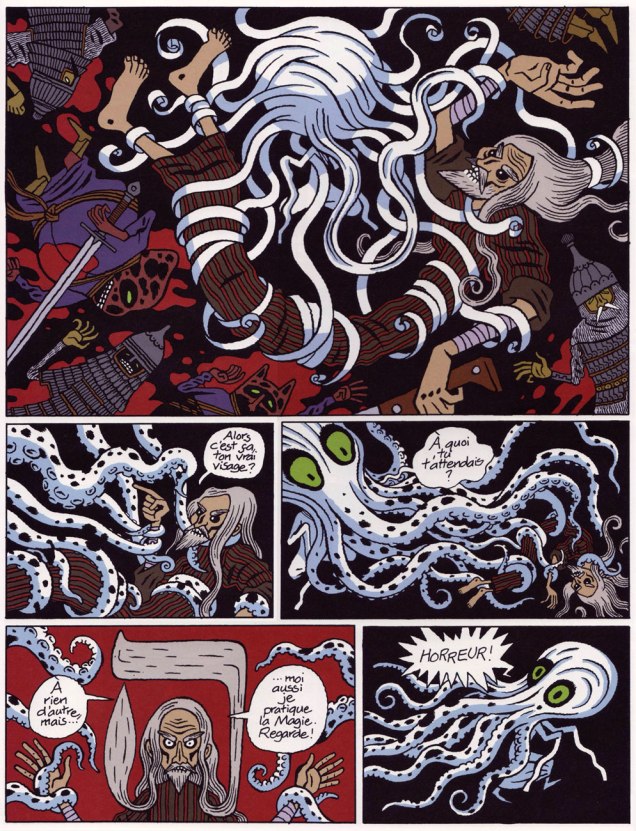
“So that’s it, your real face?” asks the old man. “What were you expecting?” asks the emerald-eyed cephalopod. This is a page from Les chercheurs de trésor, volume 2: La ville froide, David B. (2004, Dargaud).
David B. is the nom de plume of Pierre-François David Beauchard. Non-Francophone audiences might know him from Epileptic, an autobiographical graphic novel that won accolades and awards from an international audience. And yet it’s not his most interesting œuvre, as far as I’m concerned. Although Epileptic is full of imagery and allegories, it’s when David B. lets his imagination soar without the constraints of real life that he creates his most dazzling worlds and astonishing stories. He’s one of those rare comic artists whose art is as accomplished as their storytelling.
Here’s a bonus “tentacle” from Monsieur B.:
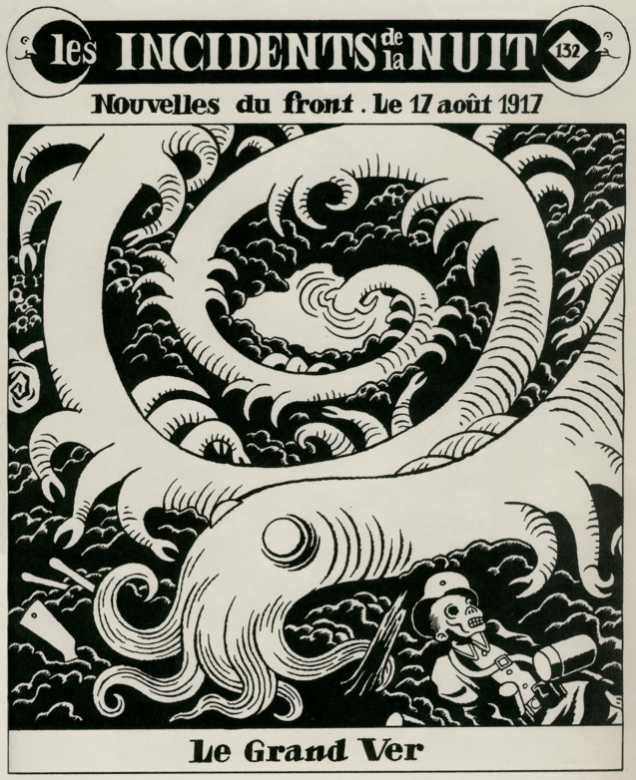
La lecture des ruines was published by Dupuis in 2001. (It loosely translates to “reading the ruins”, “study of the wreckage”.) It’s the story of a mad scholar who tries to find a mathematical equation for violence in the decayed rubble that war has left behind. Excerpted material from an imaginary periodical is appended, Les incidents de la nuit (Incidents of the Night). This tentacled worm – Le Grand Ver, the Great Worm – is one of the creatures that lurk within…
Give a hand of applause, ladies and gentlemen, to David B., and let’s move to our next topic.
“Sorti des abîmes” translates to something like “Risen from the abyss” – and what sort of thing rises from an abyss? Why, tentacles, of course!
Tif et Tondu: Sorti des abîmes (1972)
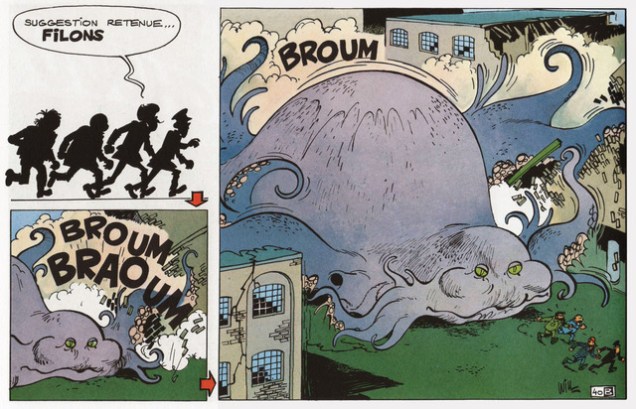
Tif and Tondu, an intrepid team of private investigators, were originally created by Fernand Dineur, but their most popular incarnation is by writer Maurice Tillieux and artist Willy Maltaite (who mostly went by the nickname Will), which is what you’re currently admiring. The strip saw birth in 1938 in journal Spirou and lasted a whopping number of years, ending in 1997, one year short of its 60th birthday.
Things are a bit tricky with the numbering, because Tif et Tondu are popular enough to have been anthologized several times. Sorti des abîmes appeared as the series’ 19th entry (1972), after being serialized in Spirou no. 1746 (September, 1971) to no. 1764 (February, 1972).
A closer look at the creature from the abyss: not exactly an octopus, but in distinct possession of tentacles. “Armed and dangerous”, as they say! The poor thing is dissolved at the end of the story by some infrared rays.
Incidentally, “Tif” is slang for hair in French, and “Tondu” means “shaven, sheared”. Naturally, Tif is the bald guy, and Tondu is the hairy one.
Now that we’ve had our fill of scary, destructive tentacles, I’ll move on to something friendlier.
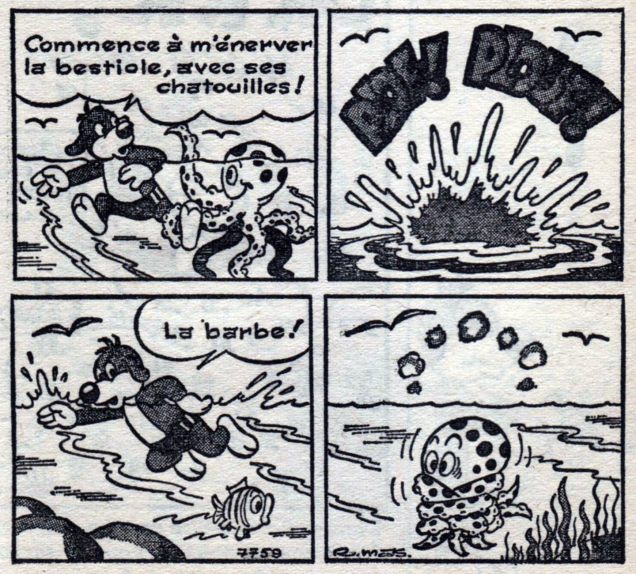
Pif Pocheno.72 (Aug. 1971) The last panel says “Paws off… Don’t touch! You’ve got cold hands!”Pif Poche no.72 (Aug. 1971) “This creature is starting to annoy me with its tickling!”
Pif the dog was the mascot of the kid’s magazine Pif Gadget (« gadget » referred to the fact that each issue of the magazine was accompanied by some thingamabob to amuse the youngsters). Pif Poche were pocket-sized collections of short Pif strips, as well as jokes, games and such. The character was created by José Cabrero Arnal in 1948, who gradually abandoned the strip by the 1960s while other artists took over.
Pif Pocheno.72 (Aug. 1971) “Even in a can… I adore seafood! Ripoff… it’s octopus!” Story and art by Arnal’s immediate and worthiest successor, the prolific Roger Mas (1924-2010)
Tuesdays sure roll around quickly, but that’s okay – another week, another fresh batch of prehensile, slimy tentacles for our enjoyment. I’ll open Tentacle Tuesday with an “oldie but goodie”. (Speaking of that, I have an irrational pet peeve: comic shop owners who, upon seeing a customer carefully clutching a stack of 70s comics he meticulously unearthed from a grimy comic box stashed in the darkest corner of the store, say, with a slightly condescending grin, “oh, you’ve found some oldies!” The comment is no doubt well-intentioned, but there are nicer ways to start the conversation.)
And a-one
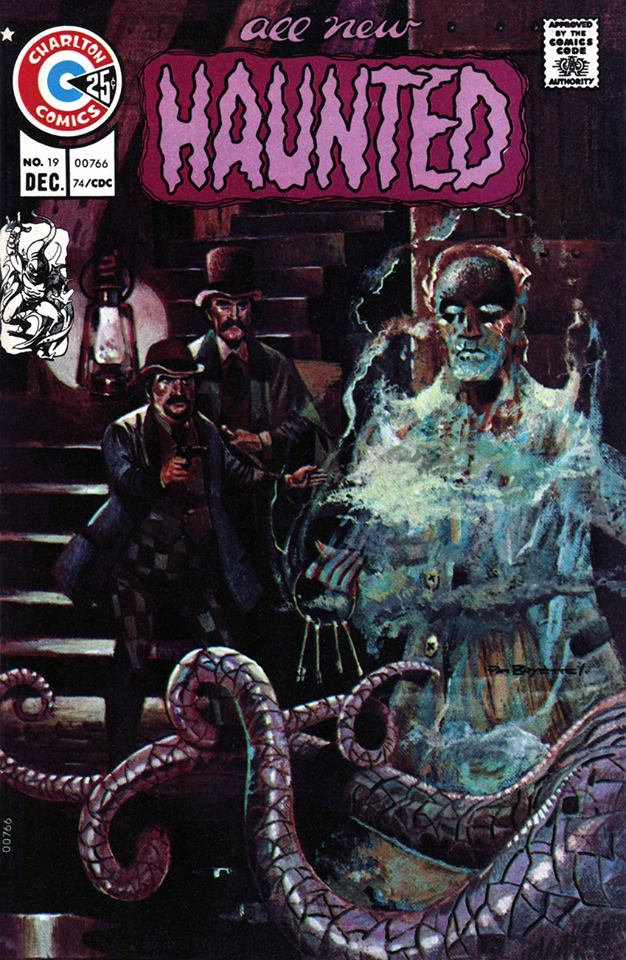
First on the list for today is this painted beauty by Pat Boyette, from Haunted no. 19, December 1974. Just look at those shiny, healthy tentacles – just the kind to gently grab your ankle and drag you into murky waters. Their diaphanous keeper doesn’t exactly inspire confidence, either.
This issue is worth picking up for more than its cover. It remains excellent when one opens its pages: there are three stories, and they’re all worthwhile – the beautiful “The Unholy!” by Pete Morisi (PAM! PAII!) (written by his son, Steve Morisi, and therefore unfortunately not making a lick of sense), the moody “There Ain’t No Hell!” by Sanho Kim and Joe Gill, and, the cherry on the cake (and story on the cover), the quietly-elegant-but-with-tentacles “The Keeper”, illustrated by Boyette (and also written by Joe Gill).
“You bawled me out many a time for not feeding your pets, your lordship… this time, they’ll feast!”
And a-two
Just like octopuses (who eat small crabs and scallops, as well as snails, fish, turtles, crustaceans, and of course other octopuses), I like a little variety in my diet, so number 2 is humorous rather than scary. How did this octopus manage to figure out which of its tentacles to stick into shorts? Who’s the happy little slug with chickenpox holding up letter “A”? Why does an octopus have beaver teeth?
This is Ha Ha Comics no. 66 (Jun – Jul 1949), published by American Comics Group, or more technically Creston, an imprint of ACG. This seems to be a rather rare issue, unavailable on Comic Book Plus although they have pretty much every other issue of Ha Ha. Thanks to an Ebayer selling this comic, however, I can state with some degree of certainly that this issue features – as advertised – an all-star cast, featuring not only the habitués Izzy and Dizzy (a pair of trouble-prone mice), but also Anthony & Cleopatra, the Impulsive Imps, Robespierre, Hard-Hearted Hannah, Wigglin’ Willie the Worm and Shilly and Shally. Doesn’t it all sound like some sort of battle of the bands? As for the artist of the cover, it’s Dan Gordon, storyboard artist and film director mostly known for his work at Famous Studios and Hanna-Barbera Productions – he did quite a few “funny animals” titles for ACG.
And a-three!
T.T. number 3 is colourful. It also leads to the question “vegetable, mineral or animal?” These tentacles seem to be rather plant-like… if plants had eyeballs attached by blood vessels.
Judging by the adventures of Space Family Robinson, most planets are inhabited by aliens with tentacles. One would think that they’d be very well prepared for this eventuality (not to mention kind of bored by it), but no, the tentacles always take them by surprise.
Apart from tentacles, this has some of my other favourite things: a pterodactyl (or at least some creature approximating a pterodactyl), a vibrant sunset, and eyeballs.
This is the back cover of Space Family Robinson no. 9 (Gold Key/Western, August 1964), which is just like the front cover minus the text. Painted by George Wilson, who has a nice sense of colour. (Hurray for saturated colours in this sepia-and-grey or orange-and-teal world.)
In the beginning, oh, long before that. When light was deciding who should be in and who should be out of the spectrum, Yellow was in trouble. Even then it seems that green, you know how green can be, didn’t want yellow in. Some silly primal envy I suppose, but for whatever cause, the effect was bad on yellow. And caused yellow to weep yellow tears for several eternals, before there were years. Until blue heard what was up between green and yellow and took green aside for a serious talk, in which blue pointed out that if yellow and blue were to get together, not that they would, but if they did (a gentle threat), they could make their own green. “Ooh”, said green with some understanding. Naturally, by a sudden change of hue, green saw the light and yellow got in. Worked out fine, yellow got lemons and green got limes.*

















 Who's Out There?