« Theodor Geisel spent his workdays ensconced in his private studio, the walls lined with sketches and drawings, in a bell-tower outside his La Jolla, California, house. Geisel was a much more quiet man than his jocular rhymes suggest. He rarely ventured out in public to meet his young readership, fretting that kids would expect a merry, outspoken, Cat in the Hat-like figure, and would be disappointed with his reserved personality. » — Susan Cain
Today, we honour Theodor Seuss Geisel (1904-1991), born one hundred and eighteen years ago and better known under his nom de plume of Dr. Seuss (one of several, such as Dr. Theophrastus Seuss, Dr. Theodophilus Seuss, Theo LeSieg, L. Pasteur, D.G. Rossetti, and Rosetta Stone. The man loved a good pseudonym.) And no, he wasn’t actually a doctor, though he contributed to more people’s well-being than most physicians could dream of. His alma mater, Dartmouth College, did bestow upon him an honorary doctorate, in 1956. Furthermore, it renamed, in 2012, its medical school (fourth oldest in the United States, founded in 1797) Geisel School of Medicine at Dartmouth in recognition of the good man’s financial contributions over the years. Cool, uh?
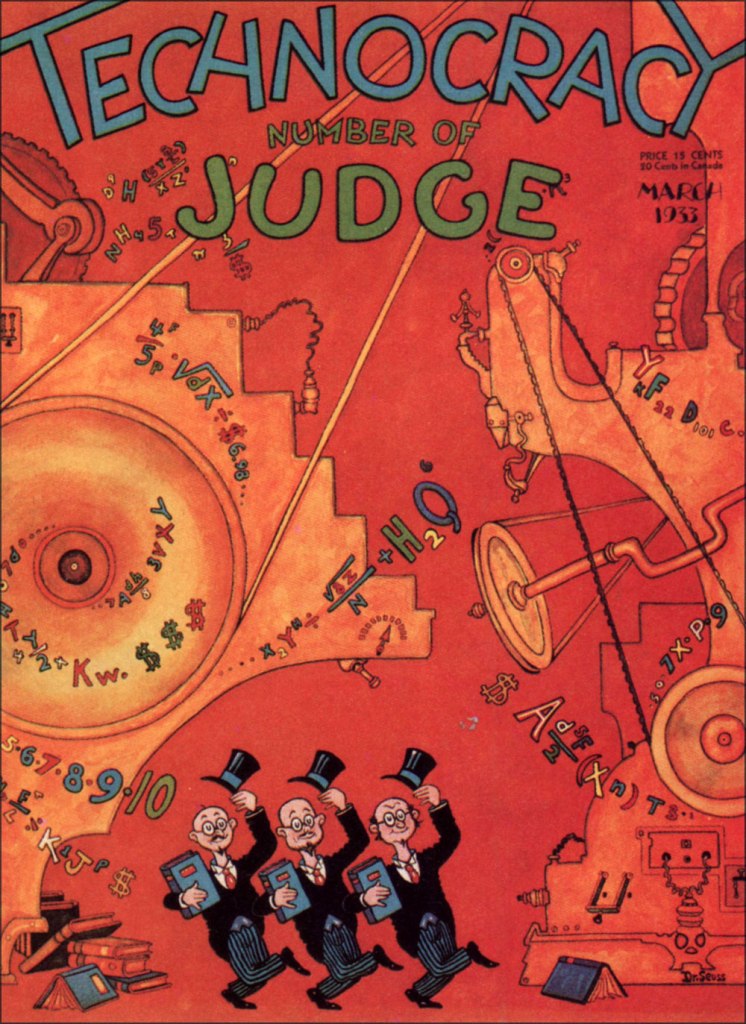
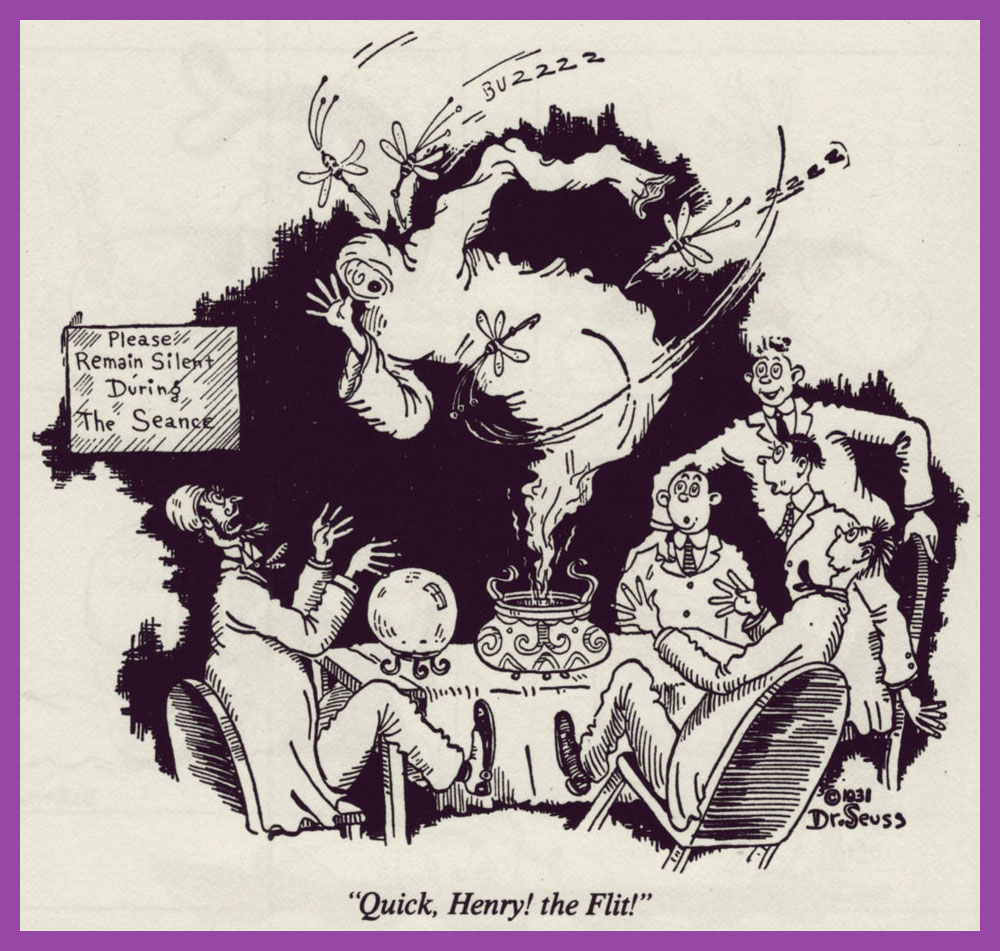
It certainly did in my case — when I wanted to learn English as a kid, his books were the ones I reached for. Results!Geisel’s cover for Judge‘s March, 1933 issue. A sample of his 1930’s magazine work. Dang — now I can’t get that song out of my head.And another. Teetotallers may not know (or they may know too well, hence the abstinence) that DT stands for the latin delirium tremens, or alcohol withdrawal-induced delirium. As for these beasts, you’ll have cause to worry if you should See Them Everywhere, and not merely aboard Goah’s Ark.« Long before his success as Dr. Seuss, Theodore Geisel (Dartmouth Class of 1925), designed advertisements for Flit, Standard Oil Company’s wildly popular spray-pump insecticide which later contained DDT. Over the course of 17 years, Geisel’s humorous advertisements helped make Flit a household name throughout the 1930s and 1940s. At the time, liberal spraying of pesticides around people, animals, and crops was highly encouraged with little regard to potential environmental impacts. » [ source ]. This particular ad hails from 1930. Given the scope of Geisel’s genius and the length of the ad campaign, there are many, many highlights. More like ‘Bug Game Hunter’!
Over the years, these ads came in every format.
A 1941 poster for Flit. The casual, harum-scarum use of dangerous chemicals may seem quaint to our jaded modern eye, but it goes on, all right. Personally, I cringe when I encounter ads for Procter and Gamble’s Febreze, for instance. Seems a tad irresponsible to me, given the risks.
This is the opening installment of Hejji, Geisel’s very short-lived (April 7 to June 23, 1935, twelve episodes in all — read them all here) Sunday comic strip, the man’s sole entry into the syndicated comic strip arena, preceding by a couple of years the publication of his first book, And to Think That I Saw It on Mulberry Street (1937). Hejji was oh-so-briefly published by William Randolph Hearst’s King Features Syndicate. Fickle, fickle!
« In these pages Dr. Seuss was already introducing us to his wonderful talent for creating unusual and delightful creatures. Hejji and his master “The Mighty One” would meet many an odd creature like Bearded Bees, Wombats, and the great Pitzu bird. All of these would be encountered in the attempt to impress the object of “Mighty One’s love, “The Fair One”. Unfortunately, as the legend goes, Seuss was let go during great depression job cuts by William Randolph Hearst. Of course Seuss would later go on to create his extraordinary children’s books including Cat in the Hat, and The Grinch that stole Christmas. Hejji pages are some of the rarest and most sought-after on the comic-strip market. Printed exclusively as Tabs and only carried in a few newspapers, their rarity is as great as the popularity of their creator. As a result, each and every page carries the highest premium. » [ source ]
In 1982, Darmouth College commissioned none other than Everett Raymond Kinstler to paint this portrait (oil on canvas) of his esteemed colleague.
What are you doing givin’ a raccoon a sugar cube? / What are you doing? What are you doing? How rude. / Cuz you can’t tell me you don’t know what he does with his food. ~ The Sugar Cube Blues
I learned a long time ago that there is little connection between the popularity of something and its quality. An author well remembered is not necessarily more talented than one whose work has been buried under the monolith of time (squish!), and what manages to claw its way into the public consciousness, much like a raccoon out of a trash can, is often more of a question of luck than some sort of intrinsic worthiness.
Mad Racoons no. 1 (July 1991, MU Press)
Occasionally, I feel like casting a spotlight on comics long forgotten… assuming that there was some memory to be forgotten in the first place, which is often not even the case. American comics artist and illustrator Cathy Hill set loose seven issues of her charming series Mad Raccoons between 1991 and 1997, but how many have made friends with these raccoons? Her absence on Wikipedia (surely today’s litmus test for fame?) underlines the obscurity of her work. I located a link to a Cathy Hill art exhibition… which seemed promising, as I know that Hill was predominantly a painter who has also drawn covers for SF novels as well as posters for a wide variety of events. Well, it was the wrong Cathy Hill – this one was British. So the cookie crumbles.
Mad Raccoons has a cast of highly entertaining characters. Virgil, for example, is a rambunctious racoon, liable to burst into poetic soliloquies as befits his name. He’s also subject to random temper tantrums (especially when somebody mentions cousin Oddfuzz, with whom he is perpetually at war), that typically end in a total melt-down accompanied by his trademark EEAAIIIEE!! scream.
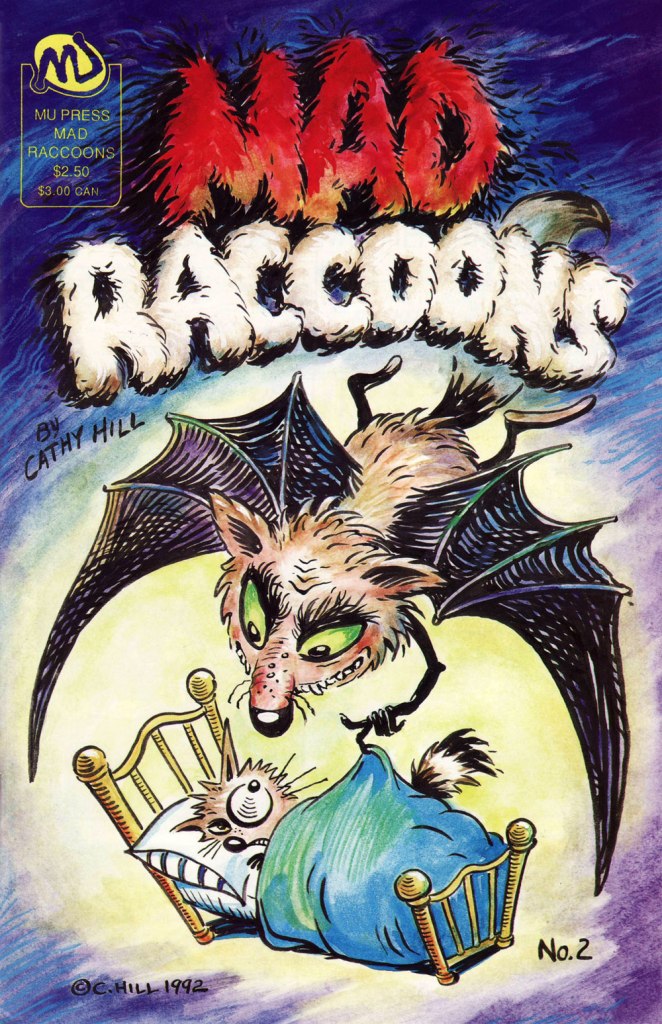
Mad Raccoons no. 2 (September 1992, Mu Press).
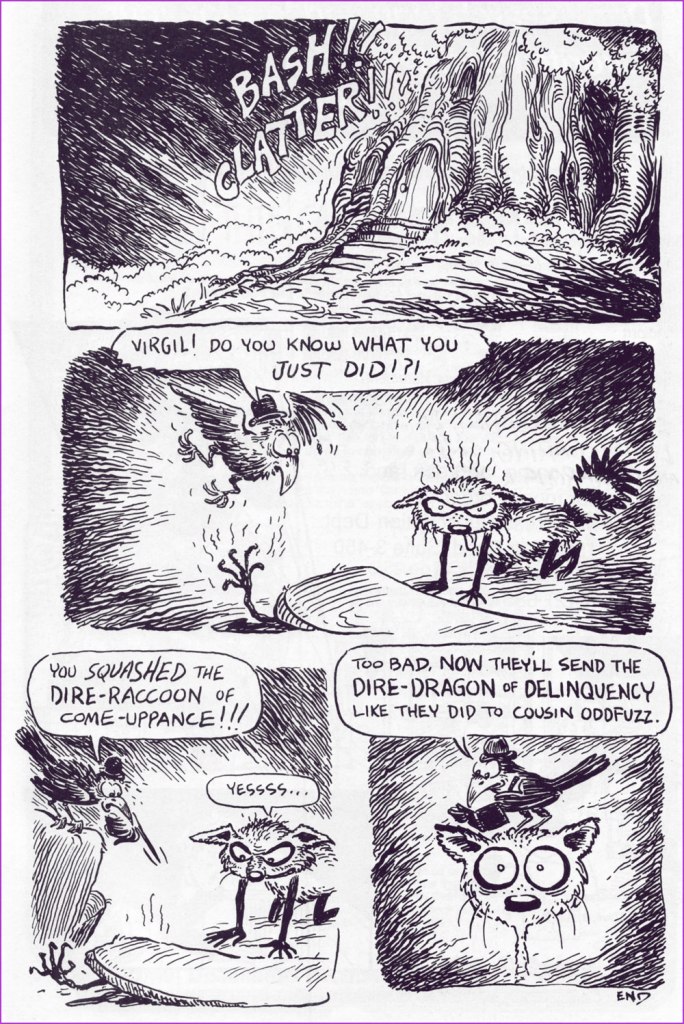
Speaking of tantrums – here are the concluding three pages of Virgil’s Visitor, in which Virgil is visited by the dire-raccoon of comeuppance (published in Mad Raccoons no. 2):
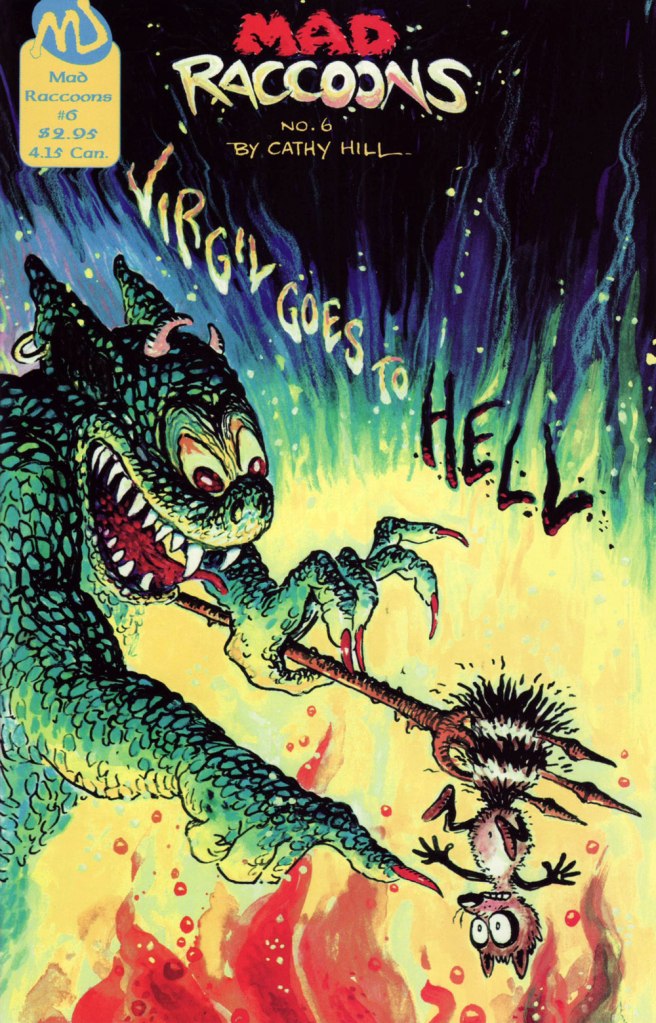
And he does indeed have to endure the cruel games of the dire-dragon of delinquency, three issues later:
Mad Raccoons no. 6 (July 1996Mu Press).
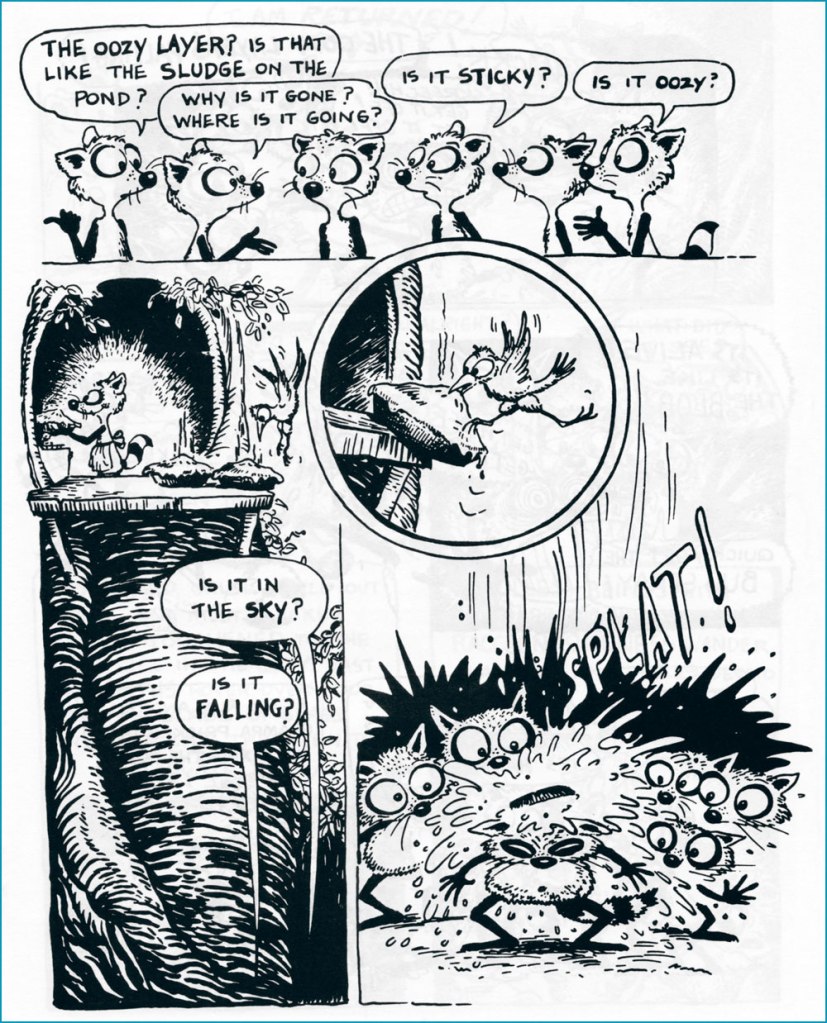
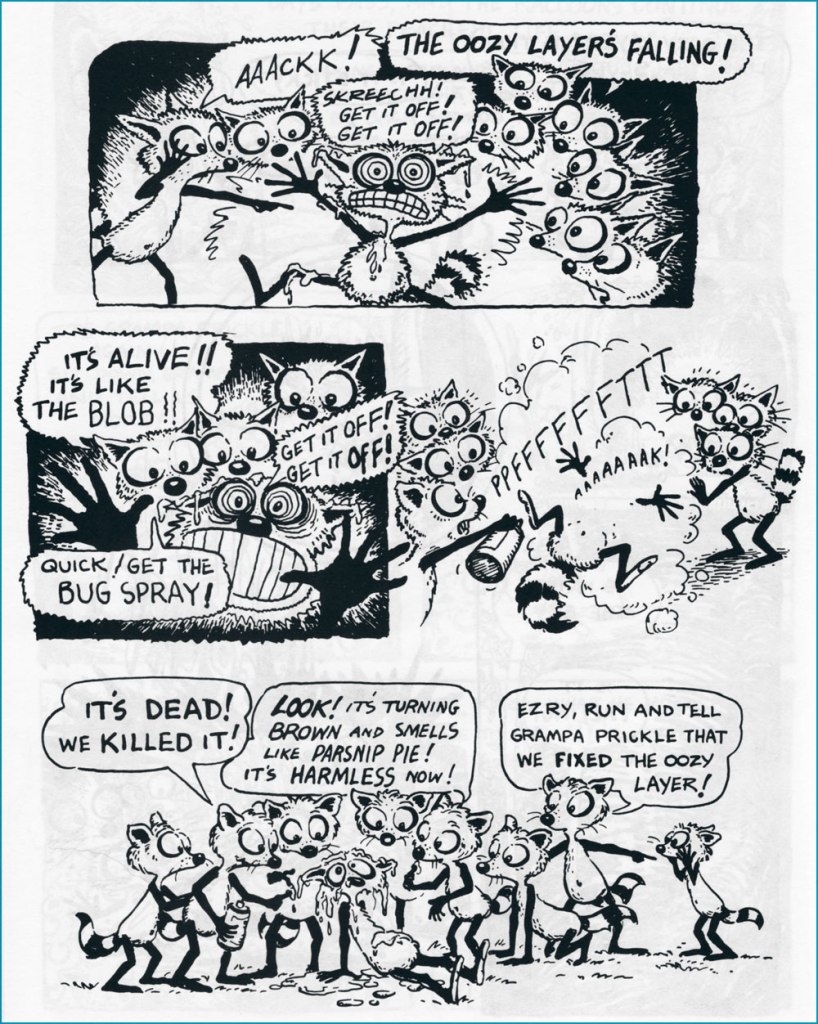
As entertaining as Virgil’s outbursts can be, I prefer to bask in glimpses of the world he inhabits, peopled (raccooned?) by characters young and old. The Natural Raccoon (published in no. 1), featuring Grandpa Prickle (which I tend to call Grandpa Pickle) and nursery of youngsters, makes for a choice example.
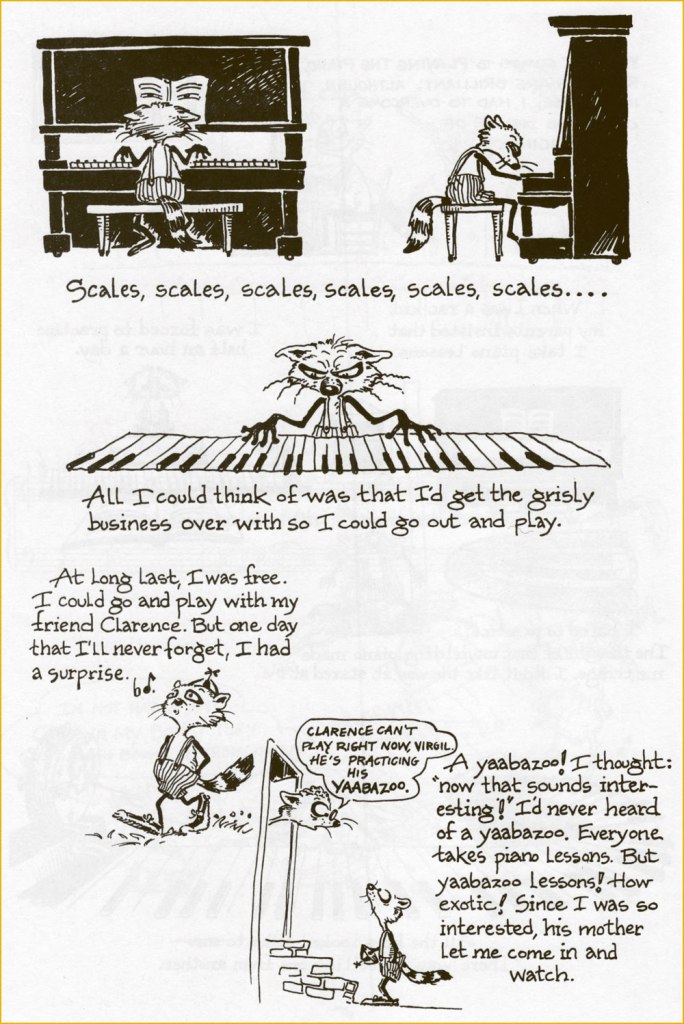
As someone who has very much a chicken scrawl of a handwriting, I reserve special admiration for folks with a steady hand and patience enough for calligraphy. Hill’s lettering is an important part of the dynamic art of her stories, and the following pages from Raccoons and Music (published in no. 2) allow one to really admire a fancier version of it:
A keen eye may note that 1988 appears at the bottom of the last page, whereas no. 2 was published in 1992. Indeed, Hill’s original idea was for a series of humorously informative stories about raccoons (such as Raccoons in Music, Raccoons in Art, Raccoons in Literature…), all of which were to be published in The Raccoon Booke. That never came to pass, but at least all (as far as I know) of these stories landed between the pages of Mad Raccoons. This earlier material has a different (although still recognizably Hill’s) art style; I would be hard-pressed indeed to decide which I like better.
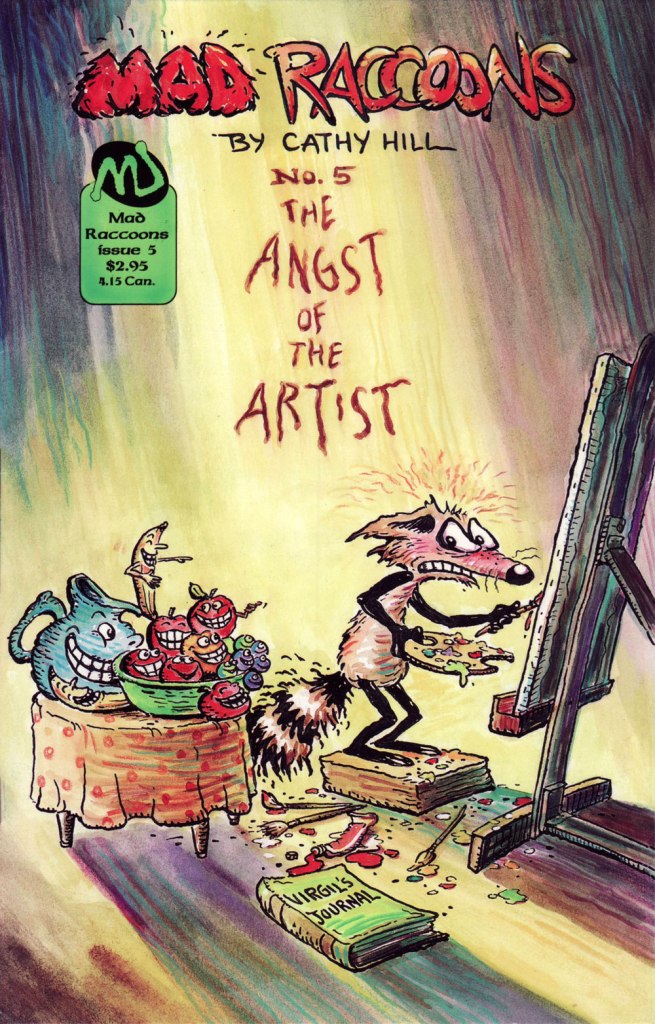
Mad Raccoons no. 5 (August 1995, Mu Press). Virgil lives in perpetual fear of being mocked (or at least not taken seriously). He’s clearly one of Hill’s favourite characters, and so frequently rates the cover feature.
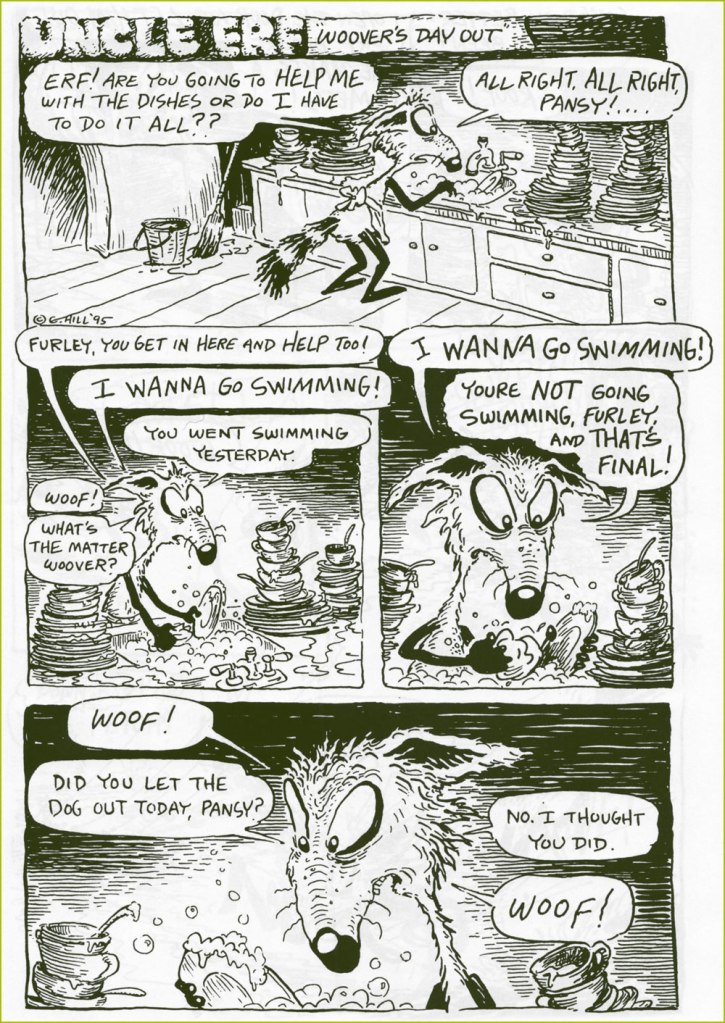
There’s also my favourite, Uncle Erf, who’s also his own wife Pansy and his son Furley, depending on which personality has control at any given moment – and things can shift pretty damn fast. This poor tormented beast is more than just the butt of jokes – Erf/Pansy/Furley is a walking repository of all human foibles, but with something really vulnerable and innocent peeking through the endless ‘family’ conflicts. In Woover’s Day Out (published in no. 5), a new member of the family, a dog named Woover, joins the team. Poor raccoon!
Thanks to the intercession of a friend, aside from having the individual seven issues, I am the proud guardian of The Mad Racoons Collection (signed, yet!), which gathers issues 1 to 4, the preface to which is probably the only place one can glean some information about the series and its author. I’d like to think that Cathy Hill is still out there somewhere, with friendly raccoons continuing their adventures inside her mind.
Greetings to all! In this New Year, like an alcoholic in remission, I will abstain myself from tentacles (for at least a few months) while I catch up on other things I want to talk about. The first installment of this non-Tentacle Tuesday starts with an M, so it seemed appropriate to run it on Monday.
Massimo Mattioli (1943-2019) may be the second best-known Italian cartoonist abroad, at least according to Lambiek Comiclopedia (the first being Benito Jacovitti, another post in the making). However, an anglophone audience is likely to associate him with uncomfortable levels of violence, as only his 80s-and-onward strips have been translated to English. Case in point: his most notorious creation was Squeak the Mouse, serialized in underground Italian comics magazine Frigidaire in the early 80s. When this strip was imported into the United States, the customs agents seized the lot, as the work was deemed to be obscene and pornographic.
« Laying full-on slasher horror onto wacky cartoon violence, Mattioli’s characters embark on a sadistic bloodthirsty rampage, leaving a trail of mangled corpses and pools of blood in their wake. And the comic’s gratuitous bloodshed is not to be overshadowed by its crude humor and over-the-top sexcapades. In sum, a tour de force of unrelenting transgression, rendered in clean line art and dazzling pastel colors. » [source]
But this isn’t today’s topic. For this post I’d like to go back further in time, to a gentler and arguably more inventive Mattioli, since I don’t believe that over-the-top violence necessarily requires that much imagination. We go back to 1968 and the magical (and I try not to throw this word around lightly) M le magicien. Co-admin RG and I have our separate libraries, but since our tastes overlap by a large margin, we try to keep the number of duplicates to a minimum. Suffice it to say we both have a copy of the collected M le magicien strips (published by L’Association in 2003), and neither of us is parting with ours.
In 1968, 25-year-old Mattioli had moved from his native Rome to Paris, France, and there joined the illustrious ranks of artists revelling in absurdity and tongue-in-cheek humour (for example, Nikita Mandryka and his Le concombre masqué) working for communist magazine Vaillant, which was renamed Pif Gadget a year later. Mattioli’s first long-term project, M le magicien debuted in issue no. 1227 (December 1968), and continued its run until 1973.
It’s not really clear why the series ended – the introduction to L’Association collection just mentions that Mattioli decided to return to Rome. However, it seems likely that the strip was ousted by pressure exerted by Claude Compeyron, président-directeur général (CEO) of Vaillant – obsessed by commercial success and marketing schemes, he saw no point in publishing ‘lesser’ strips that were more difficult to absorb (Hugo Pratt‘s Corto Maltese, Les pionniers de l’espérance) or not immediately appealing to children. Compeyron’s approach to selling magazines (‘a magazine is like any product you sell or buy, like a pair of shoes‘) led to rédacteur en chef (editor-in-chief) Richard Medioni resigning in 1973. Medioni’s departure marked the end of what was arguably Pif Gadget’s golden, ‘red’, period; from that point onward, the editors had to learn to kowtow to the marketing department, and commercialism reigned supreme.*
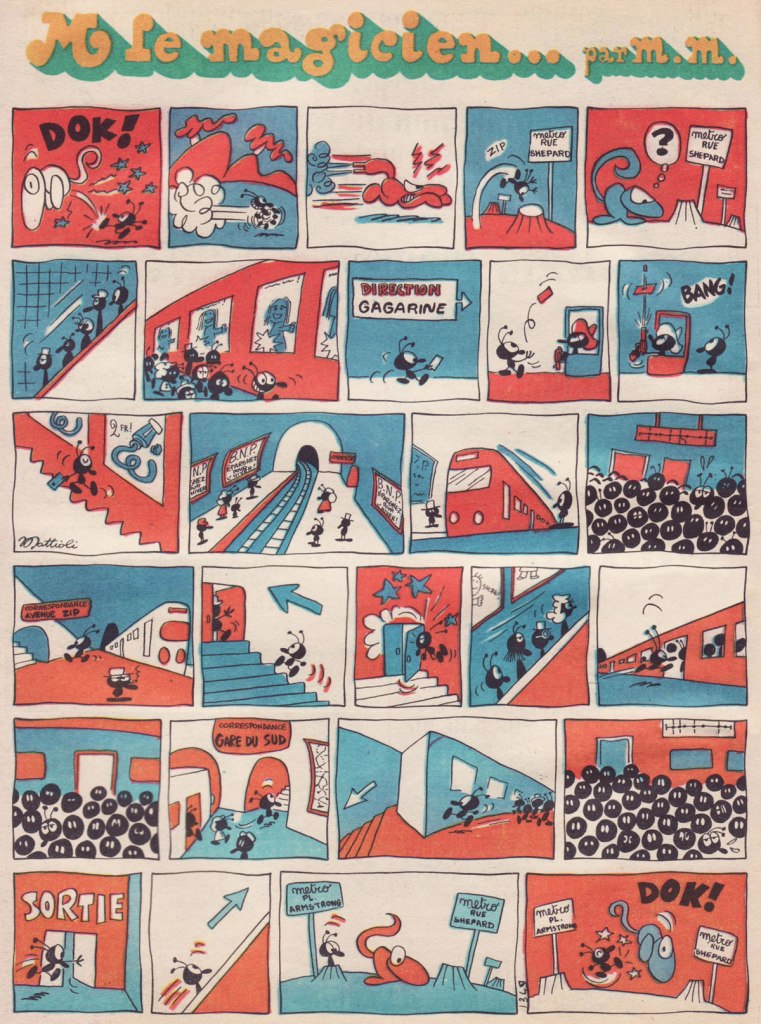
The cast of M le magicien is relatively succinct: the protagonist, your fairly standard magician, his talking magic wand, and a couple of chameleons (who periodically mlem the magician, mistaking him for an insect), two Martians bent on world destruction (or just magician’s castle destruction), a few insects of various shapes and genders, and some talking flowers and mushrooms. The characters are free to roam across pages, consume the backgrounds when they get hungry, and address the reader directly. Mattioli was not confident about his French, so he availed himself of visual humour with fairly simple (sometimes slightly unhinged) dialogues, which added to the charming atmosphere of absurdity.
While (as mentioned previously) we are the proud owners of two copies of the collected M le magicien, I had no wish to destroy either book by attempting to scan pages from it. Luckily, RG put quite a few Pif Gadget issues at my disposal, and I chose my favourites from this lot.
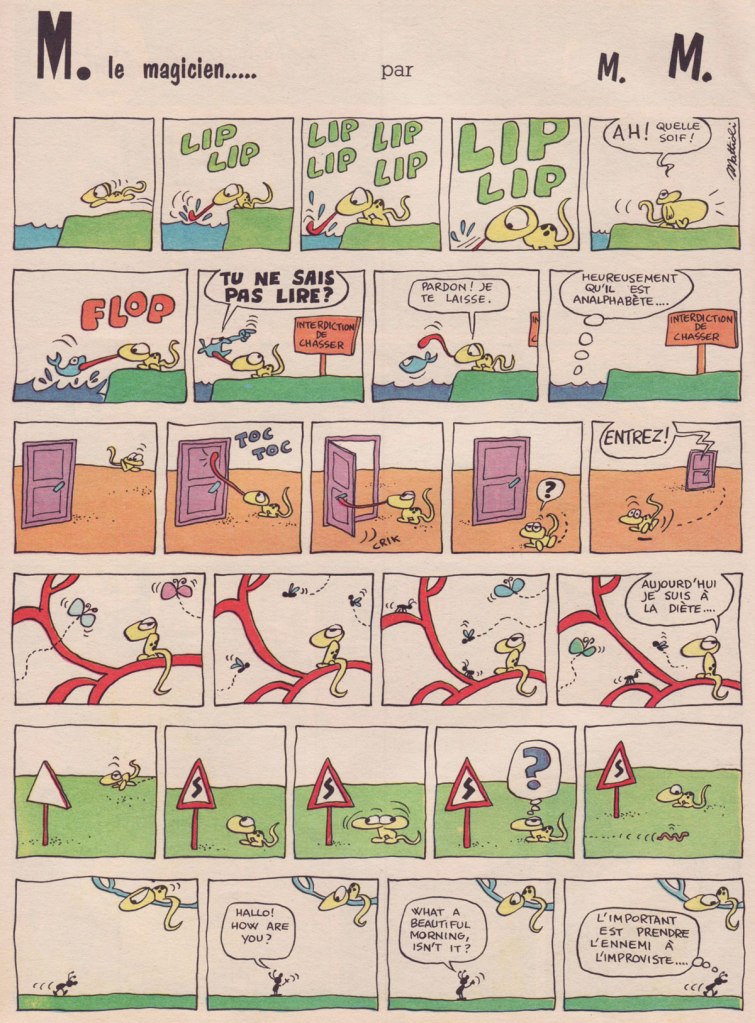
In the early days, Mattioli often stuck to one theme for his page, but tackled it from many angles in each self-contained strip of five panels. The following page vaguely concerns itself with the yellow chameleon’s insatiable appetite, a recurring joke:
From Pif Gadget no. 31 (September 1969). The first sequence of panels ends with ‘what a thirst!‘ In the second, the fish passes the ‘no hunting’ sign for a ‘no fishing‘ one, since the chameleon is fortunately illiterate. In the third, he’s dieting. Finally, in the fifth, the ant switching to English unexpectedly confuses the chameleon so that he forgets to eat it.
FromPif Gadget no. 53 (February 1970). The snow-averse flower wants somebody to lend it its fur, then complains to the heavens that nobody likes snow (to which the heavens answer, ‘but it’s free!’). Defeated by the snow, the flower concludes with ‘I surrender!’
From Pif Gadget no. 111 (April 1971). I love that the ants have an elaborate underground city – and use it to their advantage. Note that by now M le magicien has an official (and lovely) logo!
From Pif Gadget no. 144 (November 1971). A self-explanatory sequence of head swaps!
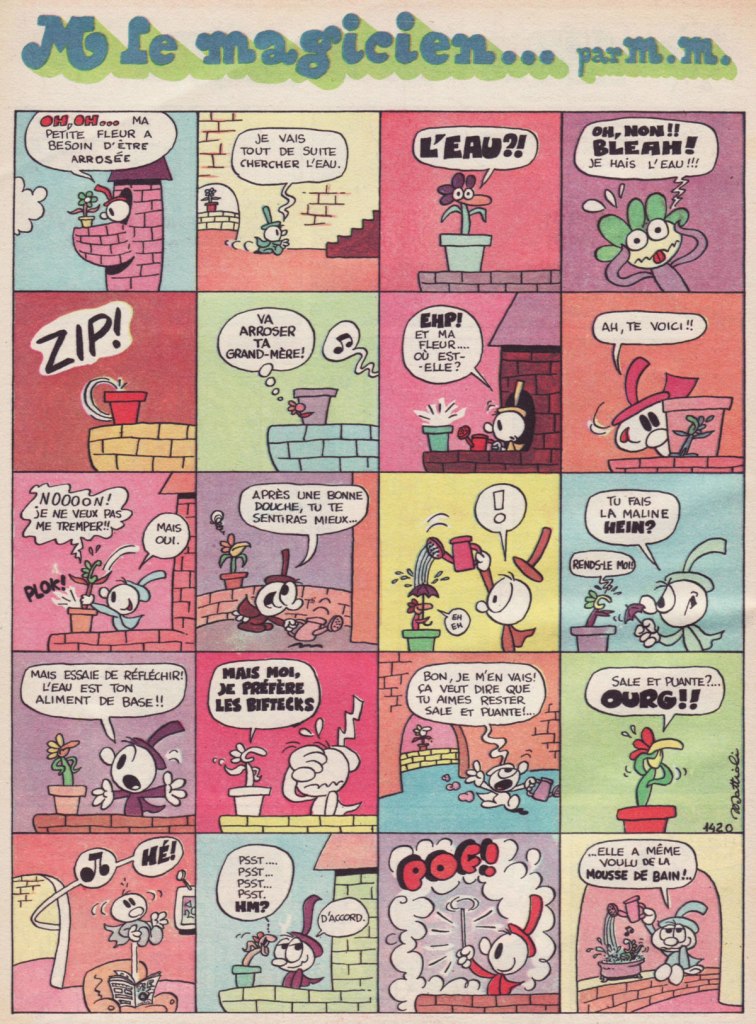
From Pif Gadget no. 182 (August 1972). The flower that hates water (and would rather eat steak) refuses to be watered until the magician mentions that it’s free to remain dirty and smelly if it wants to – then the flower opts for a bubble bath.
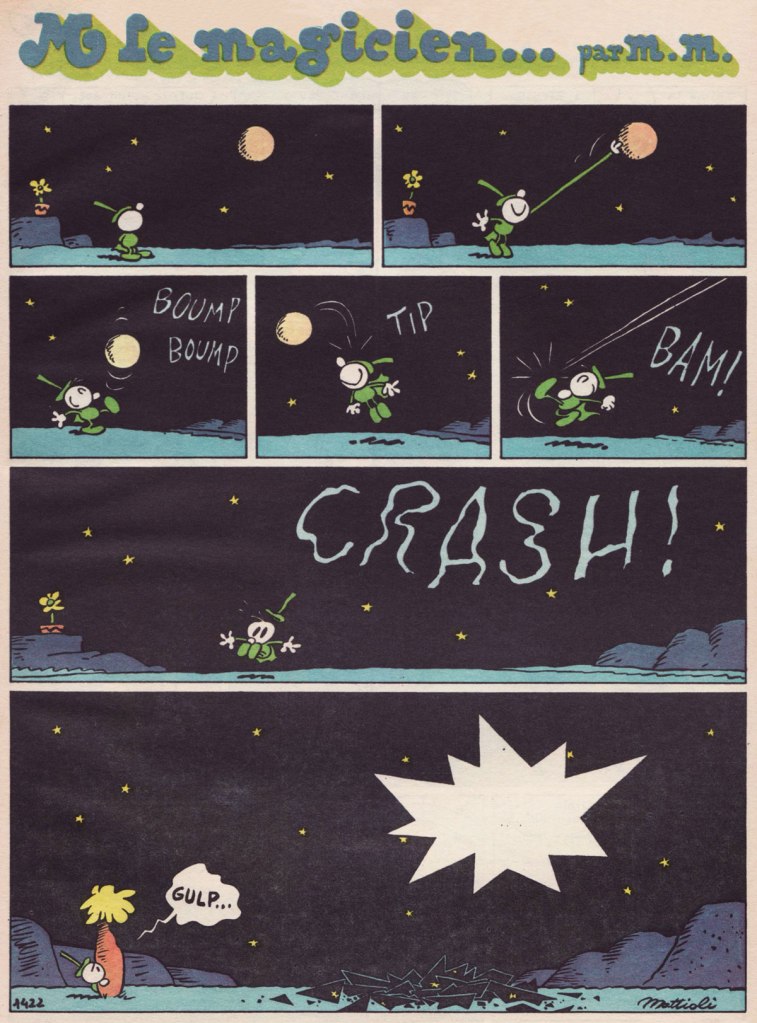
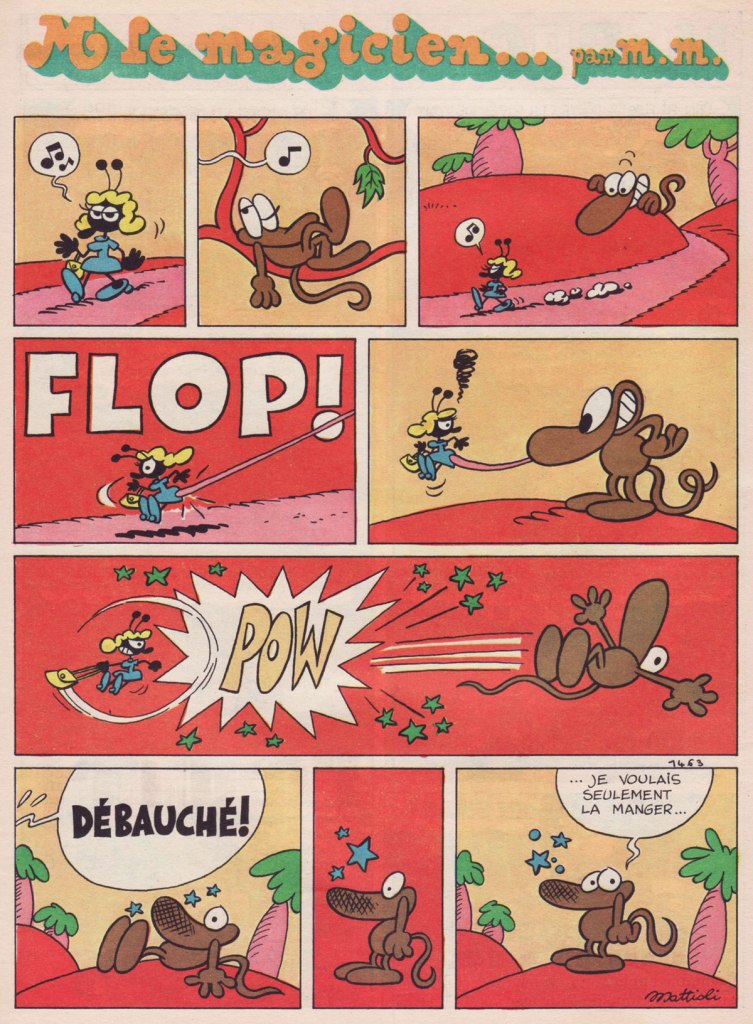
In later issues, Mattioli went for more ambitious, visually stunning but more spare one-page stories, often paying an obvious hommage to Krazy Kat.
From Pif Gadget no. 184 (September 1972).
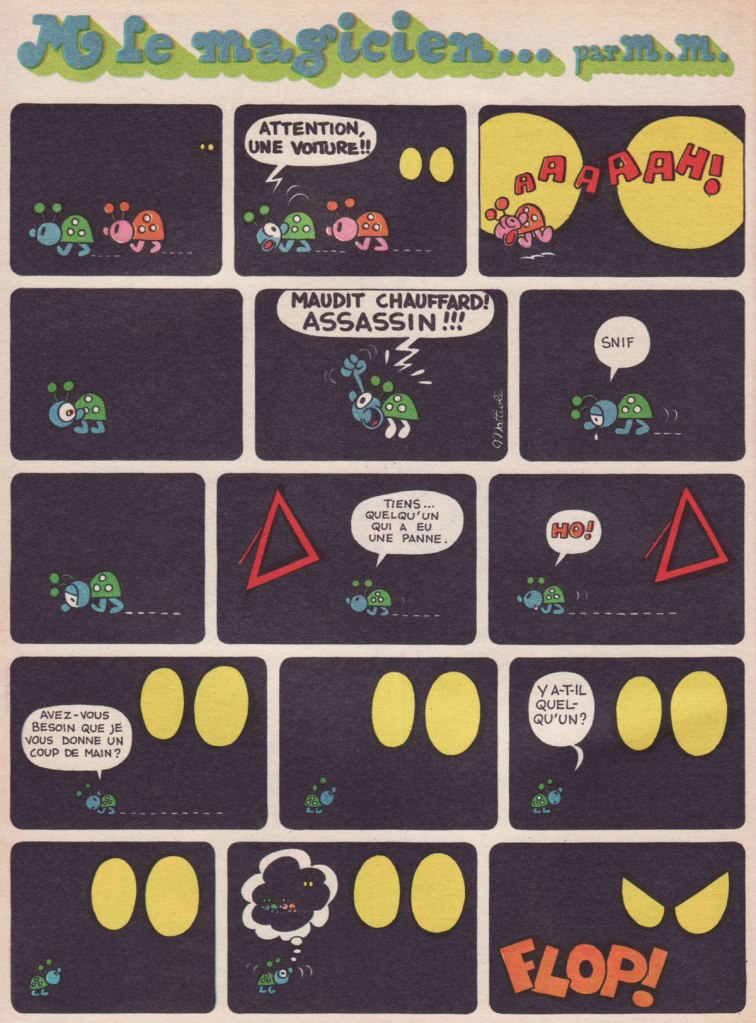
From Pif Gadget no. 185 (September 1972). Starting with a ‘look out, car!‘ warning, this page uses headlights as camouflage for the chameleon, betrayed by the characteristic FLOP sound he makes when gobbling up the remaining bug in the final panel.
From Pif Gadget no. 189 (October 1972). Another Herriman-esque page… with a classic banana gag, to boot (or to slide).
From Pif Gadget no. 225 (June 1973). ‘Pervert!‘, exclaims the indignant ant – to which the chameleon responds with ‘… but I only wanted to eat her…‘
And there we have it, a quick gallop through but a few strips of this masterpiece of humour and poetry. I highly recommend seeking out the omnibus if you speak at least un petit peufrançais.
Looking up meta-humour while I was writing this post, I came across a few choice jokes that made me crack up. While they’re not wholly related to M le magicien, their lovely absurdity fits right in with its spirit.
A dyslexic man walks into a bra.
A non sequitur walks into a bar. In a strong wind, even turkeys can fly.
A guy walks into a bar and says “ouch!”
What do you get when you cross a joke with a rhetorical question?
A dangling participle walks into a bar. Enjoying a cocktail and chatting with the bartender, the evening passes pleasantly.
~ ds
*Which is a (depressing) conversation for another day, but in the meantime, we highly recommend getting it from the horse’s mouth, so to speak, by reading Mon Camarade, Vaillant, Pif Gadget: l’histoire complète 1901-1994 by Richard Medioni.
« The working class is revolutionary or it is nothing. » — Karl Marx
Pif le chien was introduced to the world on March 26, 1948, in the French Communist daily L’Humanité. His strip was intended to replace that of Felix the Cat, who was deemed too bourgeois, what with his magic bag and invisible means of financial support. On the other paw, Pif, early on, was even a stray, homeless and starving. In time, he was taken in by a humble working-class family (as late as 1957, it was the outhouse and public baths), and that’s when the elements clicked into place.
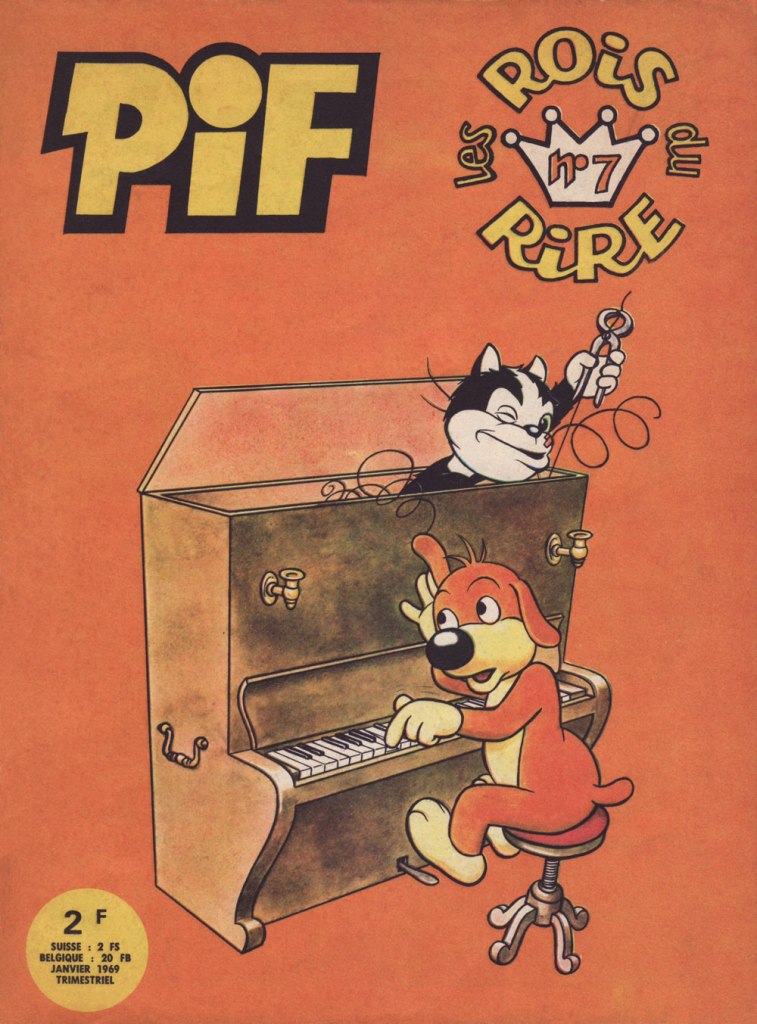
This is Les rois du rire no. 7 (Jan. 1969, Vaillant), a rotating anthology title gathering, in this case, two-pager Pif strips from the pages of Vaillant. Cover art by Pif’s creator, José Cabrero Arnal (1909-1982).
While I greatly admire and enjoy the work of Pif pater José Cabrero Arnal — and trust me, his is a story worth the telling: fought the Fascists in Spain, spent four years in a Nazi Stalag in Austria before being liberated by the Soviets, never quite recovered from the ordeal of his captivity, and remained fragile for the rest of his days. Consequently, in 1953, he handed Pif’s leash over to the truly indefatigable Roger Masmonteil (1924-2010).
Of Masmonteil (who signed R. Mas.), historian Hervé Cultru writes, in his Vaillant, 1942-1969 : La Véritable histoire d’un journal mythique (2006, Vaillant Collector):
« The problem is that, once he got his finger caught in the gears of the freelancing engine, he couldn’t just yank it out! Because giving life to the Césarin family is practically a vocation: one must provide the daily strip, six a week. Over thirty years, Masmonteil, aka Mas, crafted over eleven thousand of them. There are also the Sunday strips, the pages for Vaillant, solo Pifou stories, Léo, created for Pif Gadget. It never ceased. By his career’s end, he had racked up some 45,000 gags or so. »
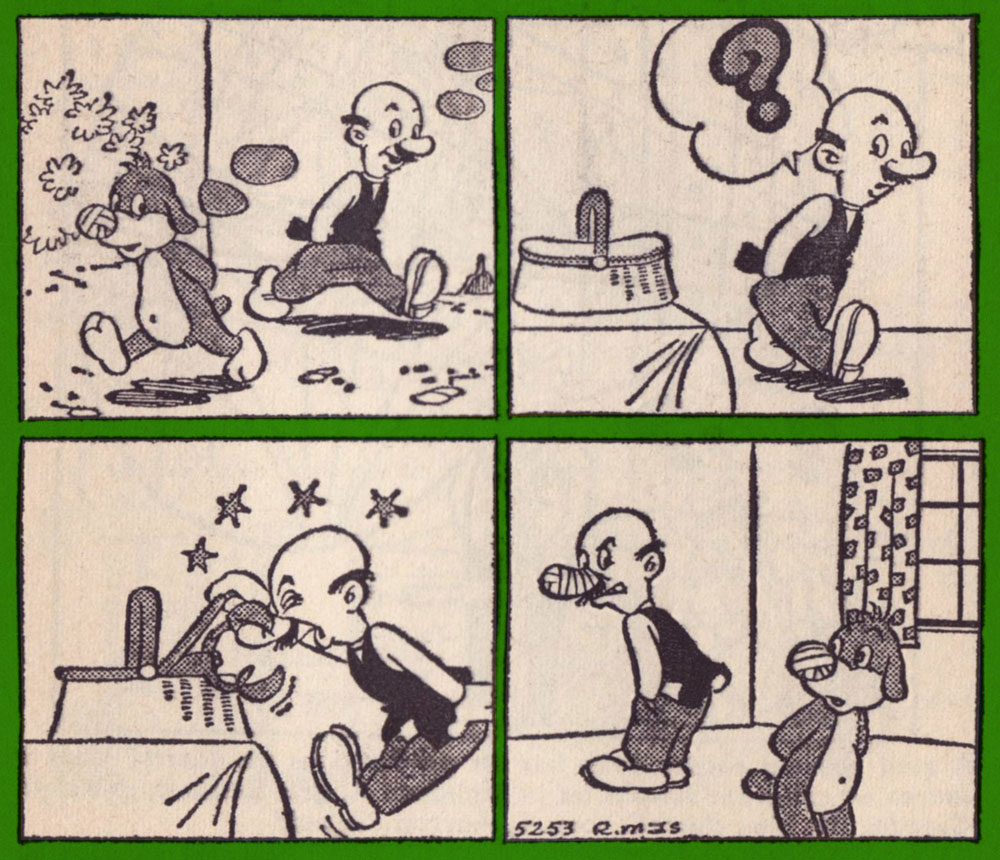
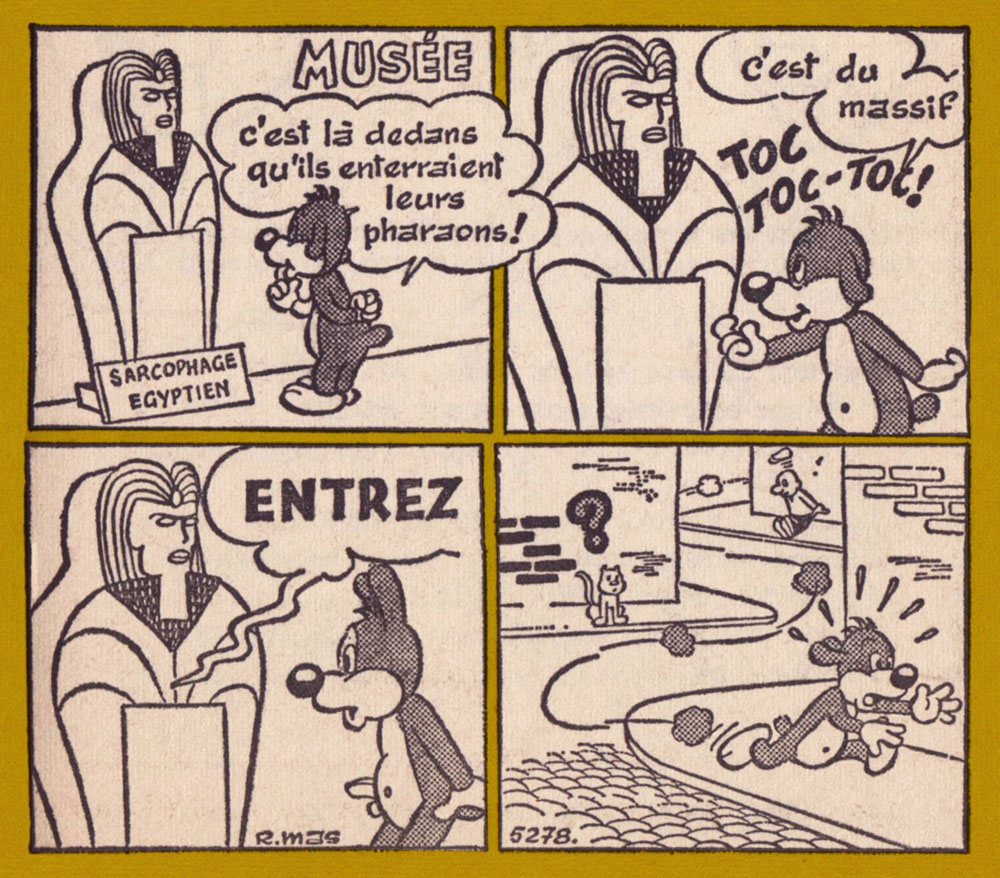
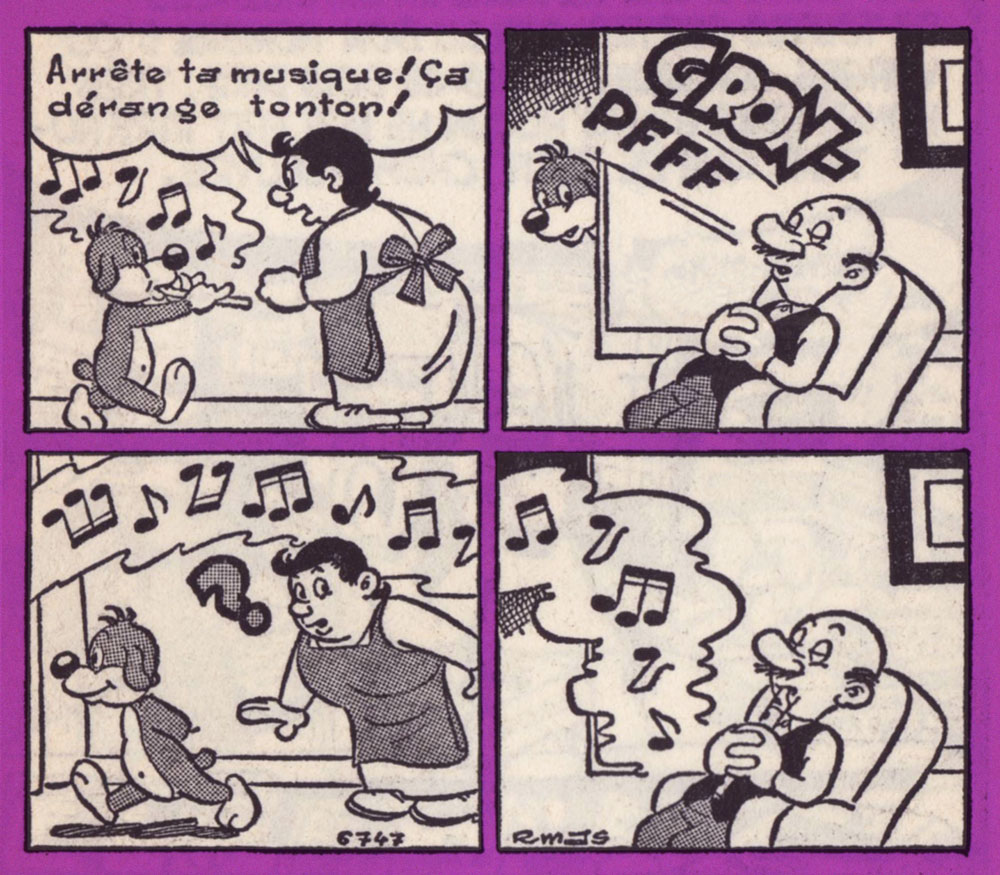
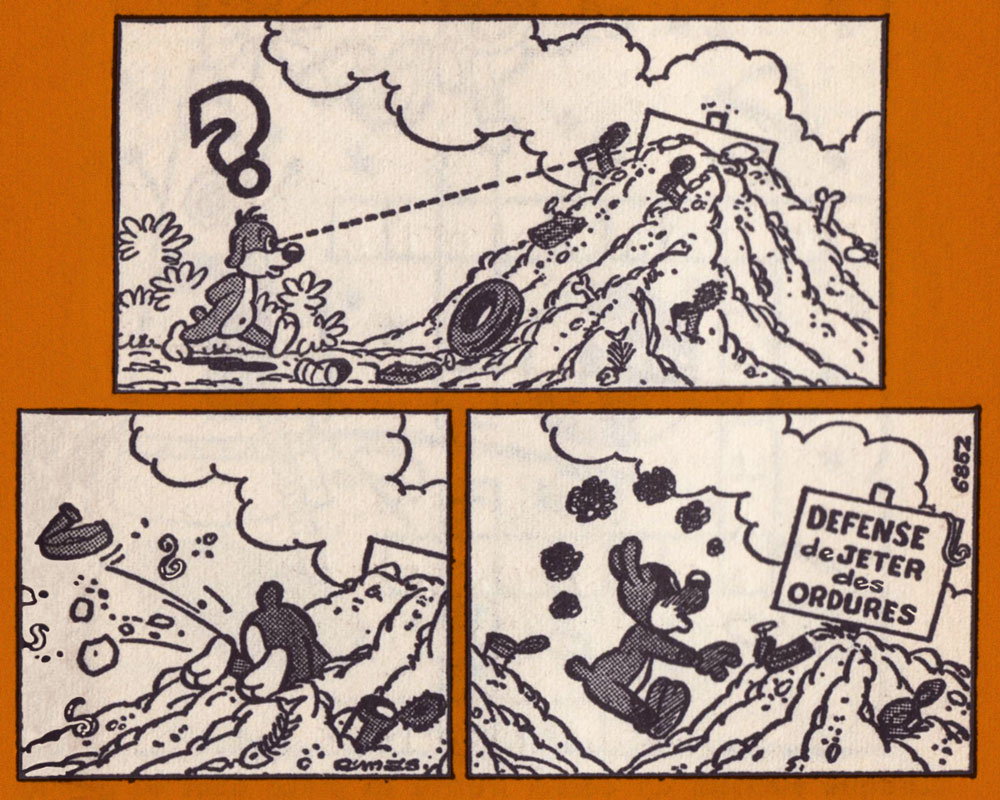
« Unlucky me, I’ve smashed the vase! » « Out of sight, out of mind! » « Bleh! What a revolting aroma! » « I’m found out! »« When the sea is too far, one makes do with a little corner of the Seine! » « I’m the back-float king ! » “Sur mer” (“On-Sea” would be the English equivalent) is a popular suffix to denote a town or resort’s coastal location. The Seine’s toxicity borders on the legendary, but things have actually improved in recent decades.I love a good pantomime gag. And every look is a sideway glance, which makes it even more special.« It’s in these things that they buried their pharaohs! » « That’s solid stuff! » « COME IN ». What most impresses me here is the final panel, with its expert use of a tiny space to convey depth, distance and setting. That’s the cartoonist’s art!« Quit your music! It bothers tonton! ».« And a-one! » « Brr! Doesn’t it cause him pain when you remove the hook? » « Not at all… it’s designed not to hurt… » « Next! » « Quiet! It’s designed not to! » Up yours, René Descartes!A slice (ouch!) of politico-historical guillotine humour.A dollop of social criticism. The sign says, naturally, « No Littering ».Pif’s archenemy, Hercule, at work. « Who’s going to get a good soaking? The Pif, that’s who! » « Failed! »
I’m inclined to admire Mas for the same reasons I hold Nancy’s Ernie Bushmiller in the highest regard: the uncanny ability to find humour in any and every place or situation, to distill and express it in a pared-down visual language made all the more potent by its universal simplicity. But it’s hard work, even if geniuses make it look easy. As Hervé Cultru explains, in Mas’ case:
« … Pif gets the last word in: at night, he haunts Mas’ dreams. The point at which he’s about to doze off is actually one of intense creativity. He constantly keeps a notepad and pencil at his bedside, to jot down ideas straight away, because if he neglects this precaution, all is forgotten by morning. »
An ad from L’Humanité, circa the late 1950s.Our cast: Tante ‘Tata’ Agathe and Oncle César ‘Tonton’ Césarin, Doudou, Pif, Hercule, and Pif’s son, Pifou. This is my copy of Album Vaillant no. 8— 4th series (comprising issues 952 to 960, August to October 1963), its rather fragile spine helpfully reinforced by a previous proprietor. I long wondered why on earth the French call wrestling ‘catch’. Turns out it’s their shorthand version of the forgotten 19th century appellation of the sport as ‘catch-as-catch-can‘.
In April 1967, Mas walks away from the Pif feature in Vaillant (four pages a week!), maintaining the daily in l’Humanité and Pifou’s solo strip. Pif returns briefly to Arnal, who still can’t handle the workload; Pif then passes into other, and decidedly far lesser hands.
Mr. Cultru, again:
« In 1968, the team takes umbrage with the repetitive and by far too ‘domestic’ character of the adventures.It feels that the working class household, typical of certain post-war values, that serves as a setting, has become obsolete, if not grotesque, and that it no longer fits the social context of the times. »
So they methodically excised everything that made Mas’ Pif special, and turned him into another Mickey Mouse, which is to say the familiar mascot or standard-bearer of a company, but one whose adventures nobody reads or truly gives a hoot about. Oh well — you still had a good run, Pif!
Eventually I accumulate enough material that posts bleed into other posts, sort of like a melting blueberry puddle gradually makes it way into the nooks and crannies of every object in its path on the counter (that happened recently, thus the very specific analogy). In this case, the blueberry juice is Uncle Scrooge et al., who have already appeared in Tentacle Tuesday: Duck Feathers!. Today our emphasis is more on Mickey Mouse, but I can’t promise other Disney characters won’t wander in for a cup of tea (or a quick tussle with an octopus).
As a matter of fact, my usual habit of arranging images in chronological order starts this post on a distinctly un-Mickey-like note…
The following sequence is from Ghost of the Grotto (written and illustrated by Carl Barks), published in Four Color no. 159 – Donald Duck in The Ghost of the Grotto (August 1947, Dell). You can read the full issue here.
Okay, I promised Mickey Mouse, so I’d better get back on topic!
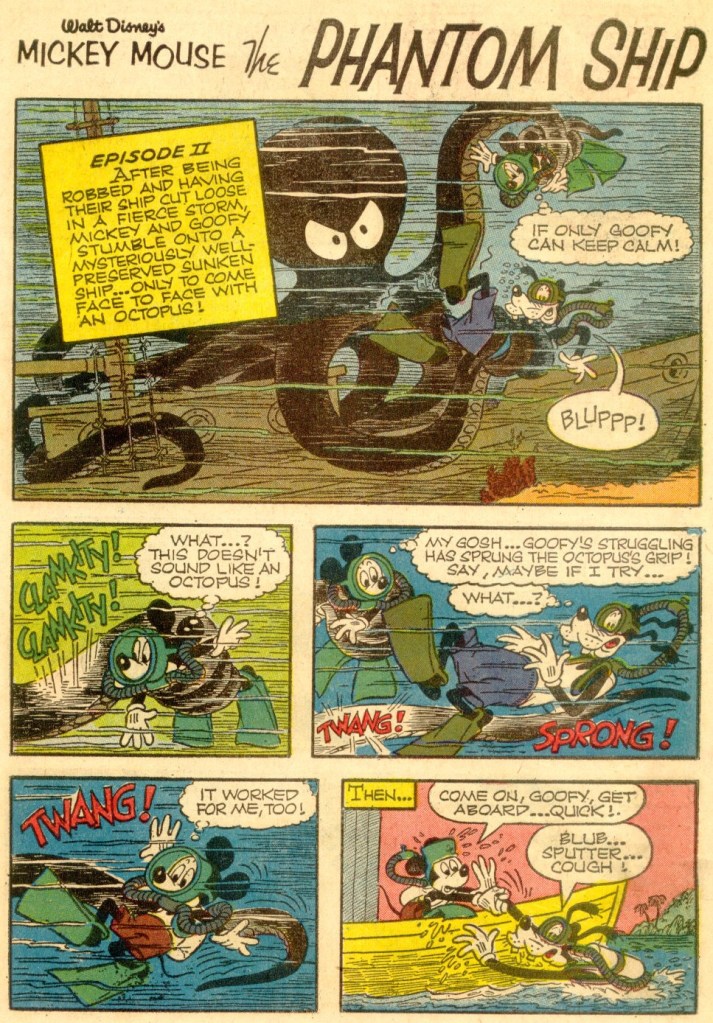
Page from The Phantom Ship, scripted by Carl Fallberg and illustrated by Paul Murry; it was published in Walt Disney’s Comics and Stories vol. 25 no. 3 (December 1964, Gold Key).
Speaking of the aforementioned Paul Murry – I bet you have never seen an octopus adorned with quite so many bracelets.
Mickey Mouse no. 159 (October 1975, Gold Key). The cover is by Paul Murry.
Now we step into the dubious territory of European Disney comics – don’t forget to read about co-admin RG’s enjoyably scathing views on the subject here.
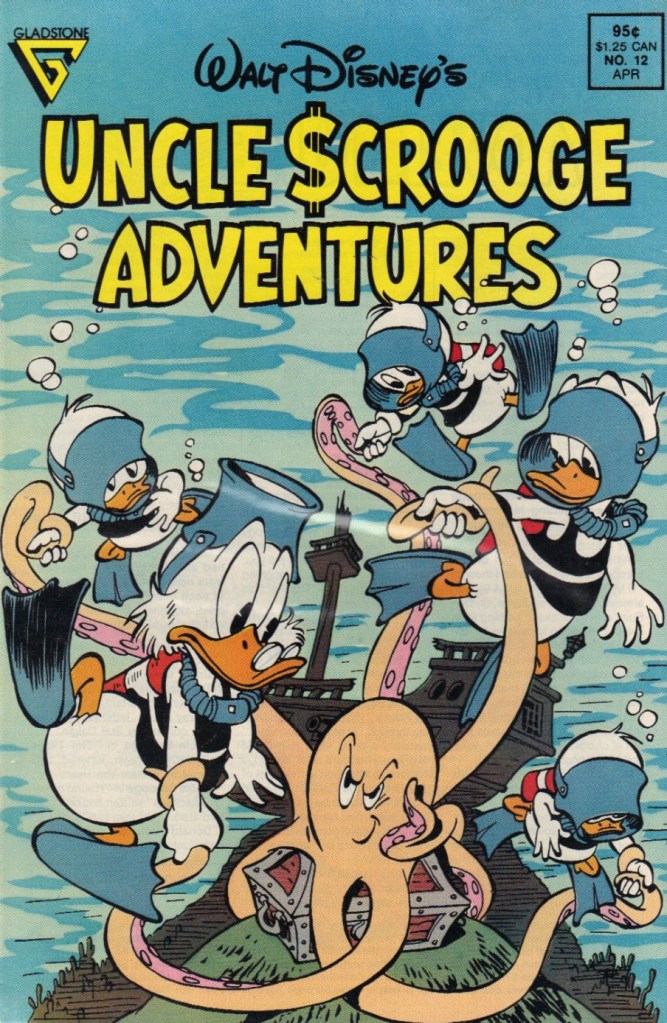
Walt Disney’s Uncle Scrooge Adventures no. 12 (April 1989, Gladstone). Does anybody recognize the cover artist?
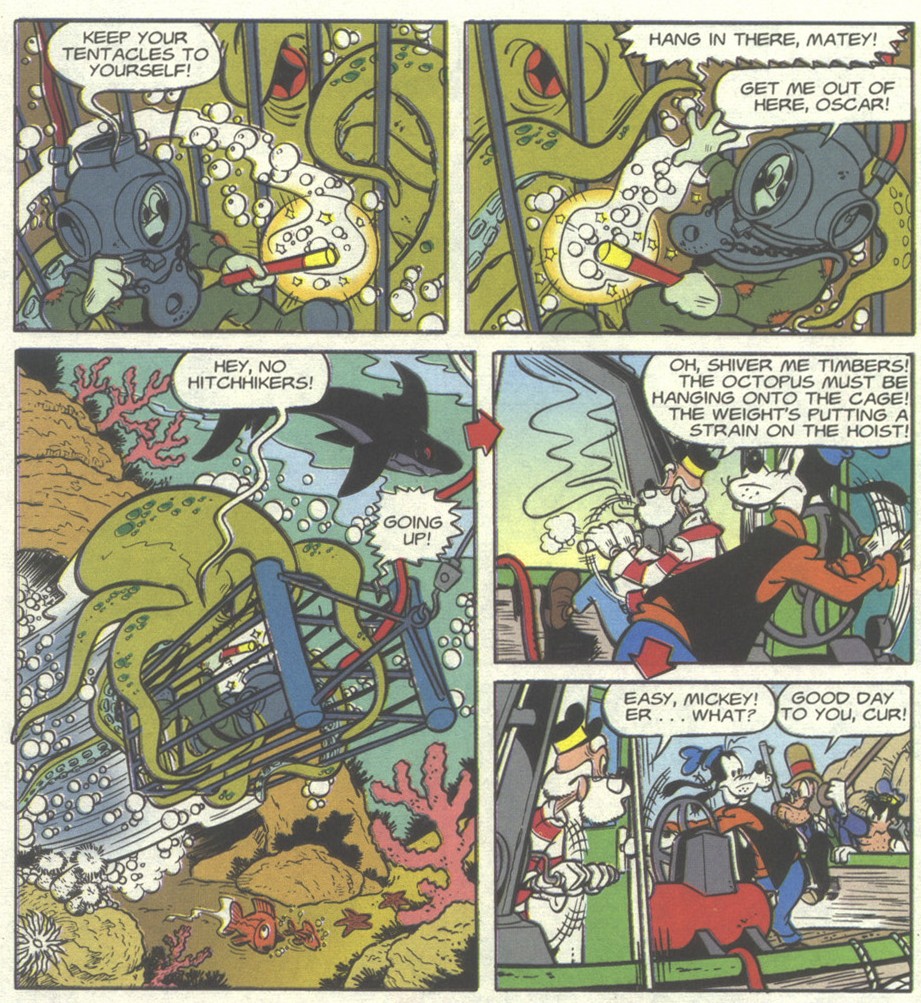
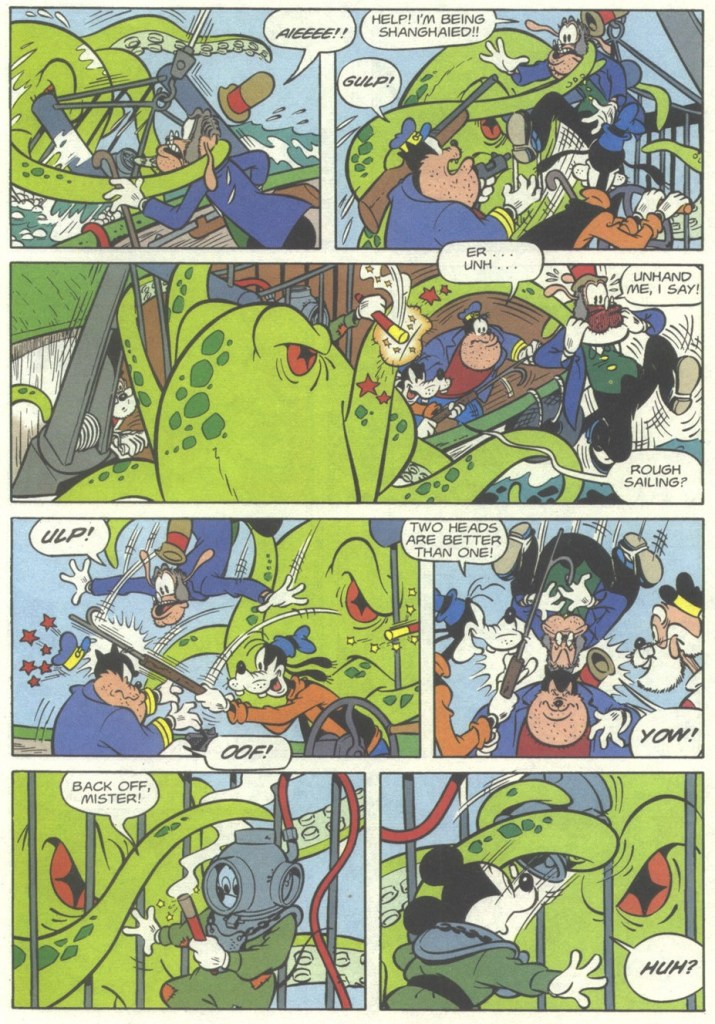
The following story, credited as ‘story and art: the Egmont Group, script: John Cochran, colour: Scott Rockwell’, was published in Walt Disney’s Donald Duck and Mickey Mouse no. 4 (March 1996, Gladstone). You can read the full issue here.
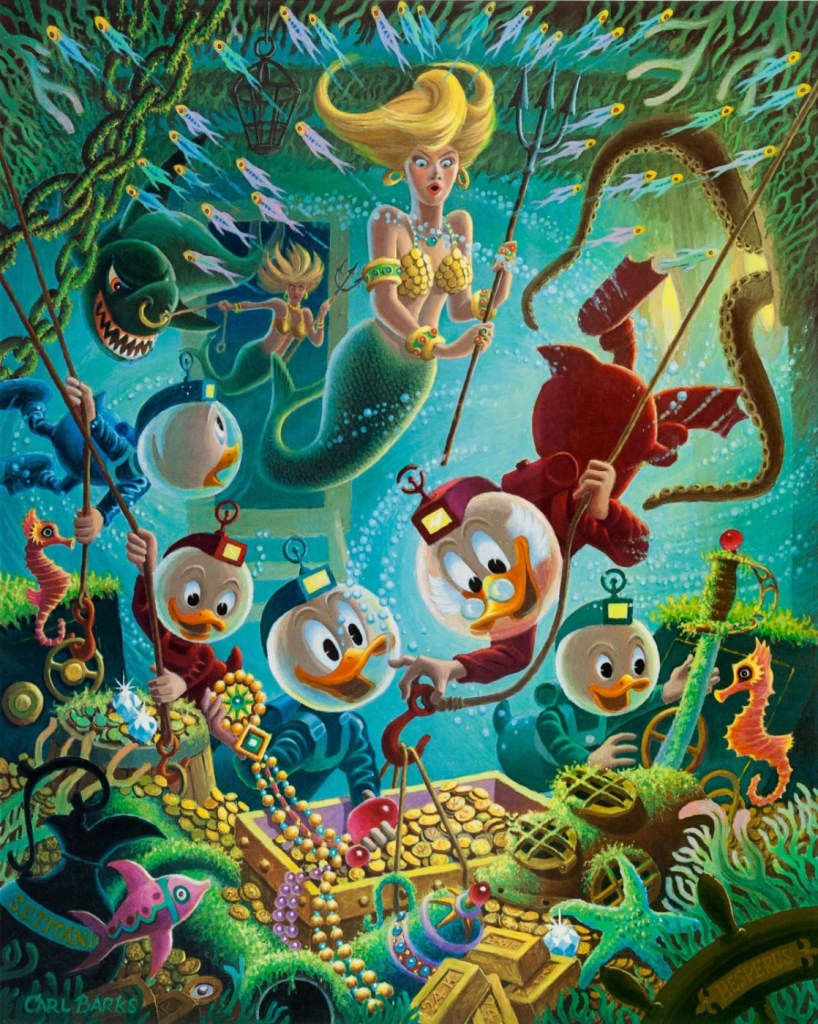
I’ll wrap up by going back to the top, which is to say finishing on as high a note as this post started on. Carl Barks, ladies and gentlemen!
« Only the knife knows what goes on in the heart of a pumpkin. » — Simone Schwarz-Bart
Today, for a change, here’s a gallery of light-hearted Golden Age funnies… if not directly on the theme of Hallowe’en, then at least full of spooky fun and spirit. Some of these babies are unbelievably rare items… hence, at least in part, the sketchy credits.
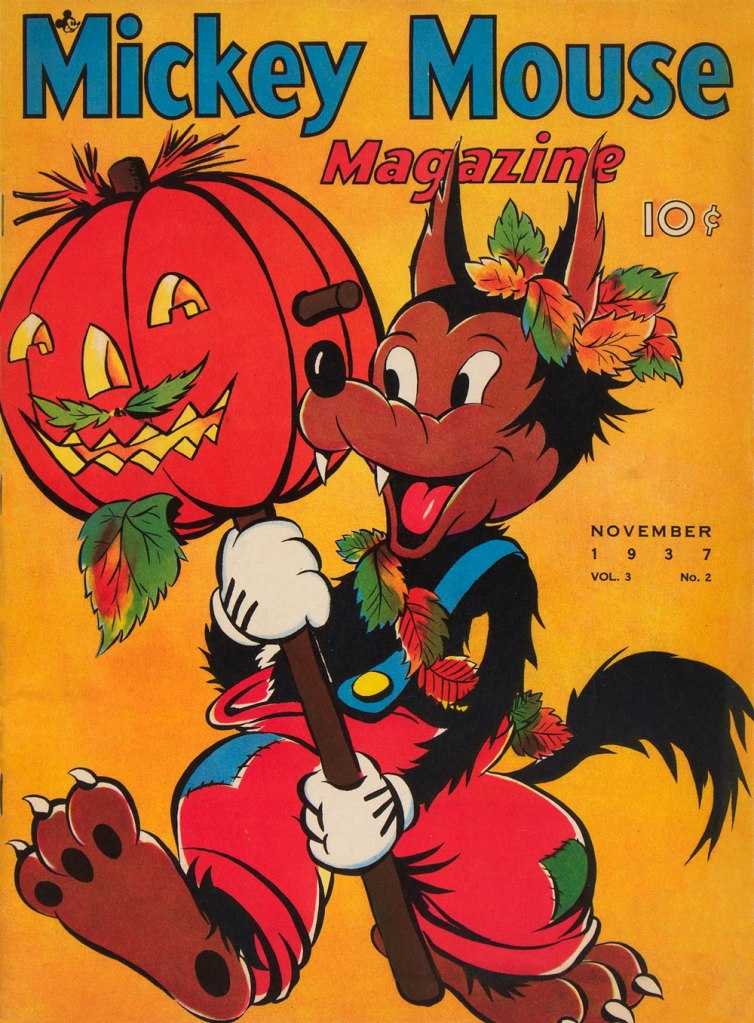
This is Mickey Mouse Magazine vol. 3 no. 2 [26] (Nov. 1937, Western); cover artist unknown.
This is Famous Funnies no. 75 (Oct. 1940, Eastern Color); cover by Victor Pazmiño, featuring Uncle Elby and Sam Smithers. Read it here!
This is Ribtickler no. 3 (July-Aug. 1946, Ace); cover artist unknown.
This is Hap Hazard Comics no. 4 (Spring 1945, Ace); cover by Sam Singer, who mostly worked in animation.
This is Spooky Mysteries no. 1 (1946, Lev Gleason); cover art by the Jason Comic Art Studio. G’wan, read it here!
This is Jo-Jo Comics no. 4 (Dec. 1946-Jan. 1947, Ace); you guessed it: cover artist… unknown.
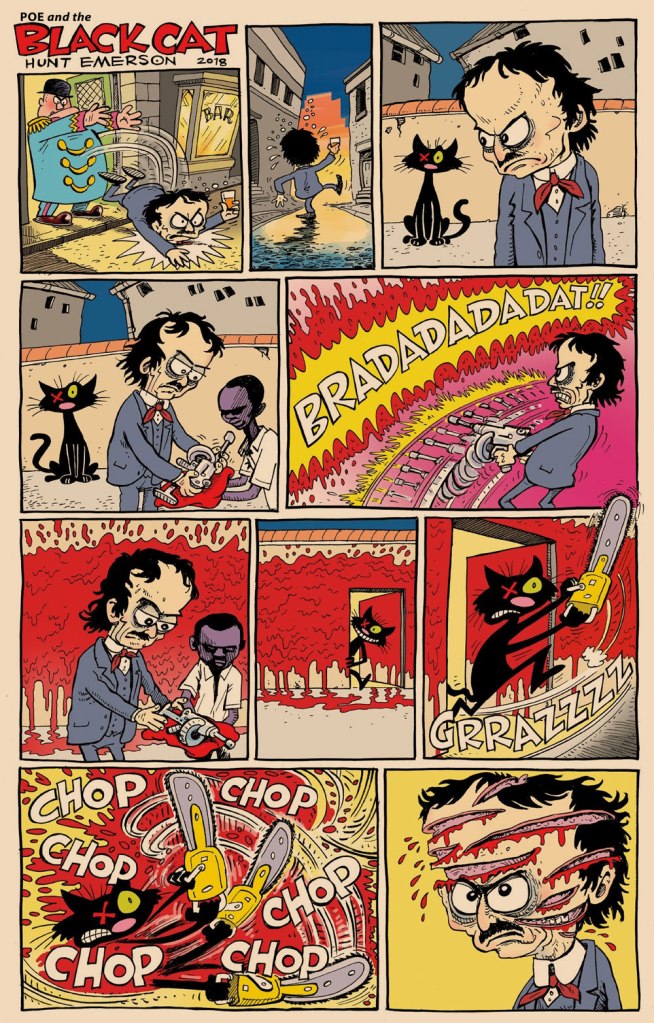
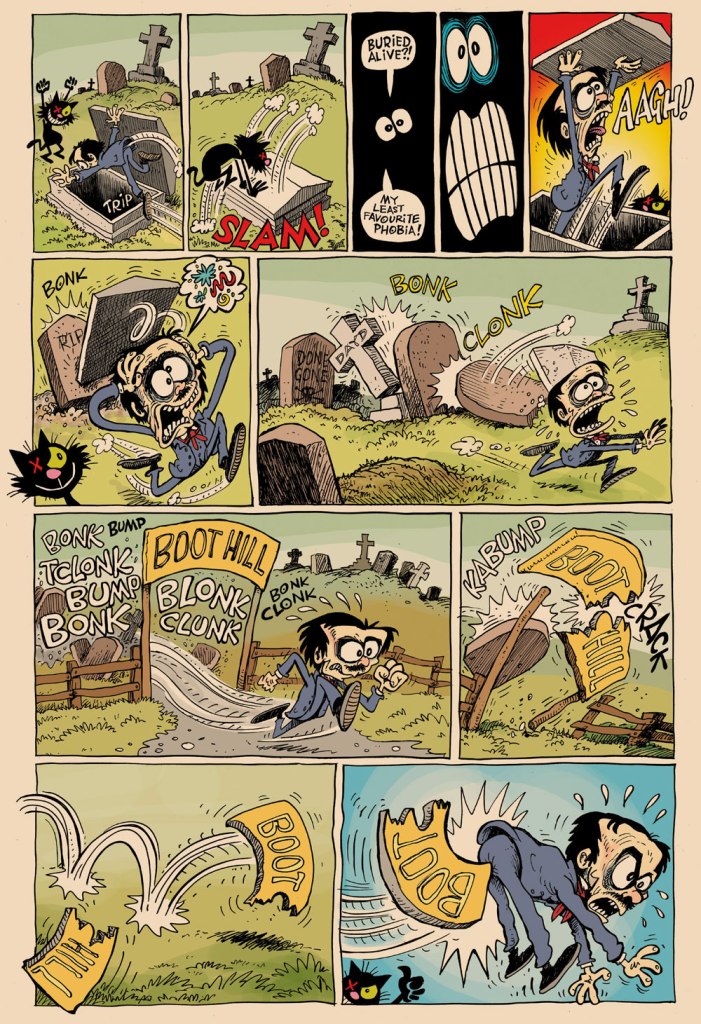
« Upon its head, with red extended mouth and solitary eye of fire, sat the hideous beast whose craft had seduced me into murder, and whose informing voice had consigned me to the hangman. » — The Black Cat (1845)
What can I tell you about the legendary English cartoonist and bon vivantHunt Emerson — born in 1952 in Newcastle and still devilishly active these days — that he can’t tell you in his own words?
Originally published in Edgar Allan Poe’s Snifter of Terror no. 2 (Nov. 2018, Ahoy).
Originally published in Edgar Allan Poe’s Snifter of Terror no. 4 (Jan. 2019, Ahoy).
Originally published in Edgar Allan Poe’s Snifter of Terror no. 5 (Feb. 2019, Ahoy).
You’ll get all these, and plenty more besides, in Edgar Allan Poe’s Snifter of Terror Volume 1 (Oct. 2019, Ahoy), collecting the title’s first six issues. Cover art by Richard Williams, with a title logo by Todd Klein.
-RG
* not, by a long shot, Mattioli’s best work. *That* would be, without question, his nonpareil M le magicien (1968-73).
I really enjoy the madcap world of Golden Age funny animal comics, and they’ve often made it into various Tentacle Tuesdays. Yet not everything fits into the somewhat narrow scope of tentacles (shocking, I know!), so I am pleased to take this fun gallop through some favourite covers that are quite devoid of cephalopods. Doing so involves going back some seventy, eighty years… a difficult to grasp concept for those of us who were not around back then.
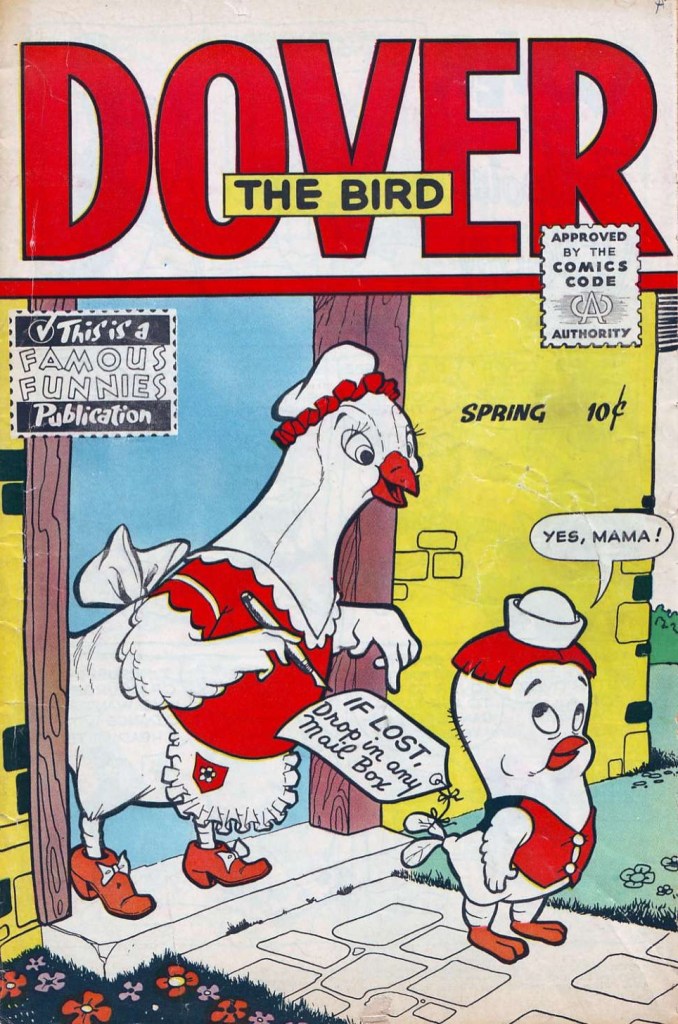
This one-shot comic from Famous Funnies featuring a sweet cover by Dave Tendlar may not be-laugh-out-loud funny, but makes up with charming innocence what it lacks in the hilarity department. This is Dover the Bird no. 1 (Spring 1955, Eastern Color Printing).
My thirty-something colleagues consider movies from the late 90s to be ‘ancient’, so I can just imagine what their reaction would be to a comic from, say, 1942! Yet I feel emotionally close to these covers (whether artistically accomplished, entertainingly weird or just plain drugged-out) – humanity has not changed nearly as much as we tend to assume, and albeit some sources of humour require an historian’s explanation, others are every bit as funny and entertaining now as they were back then. As for talking animals, that goes back to the dawn of human history (Aesop’s fables readily come to mind, and Aesop was surely not the inventor of this concept!)
One could dedicate a whole lifetime to digging through this particular slice of history – I’ve tried to go for some variety in this post, but of course I am (happily) constrained by my own tastes in the matter. Here, then, are some Golden Age covers featuring funny animals that have amused, entertained or puzzled me.
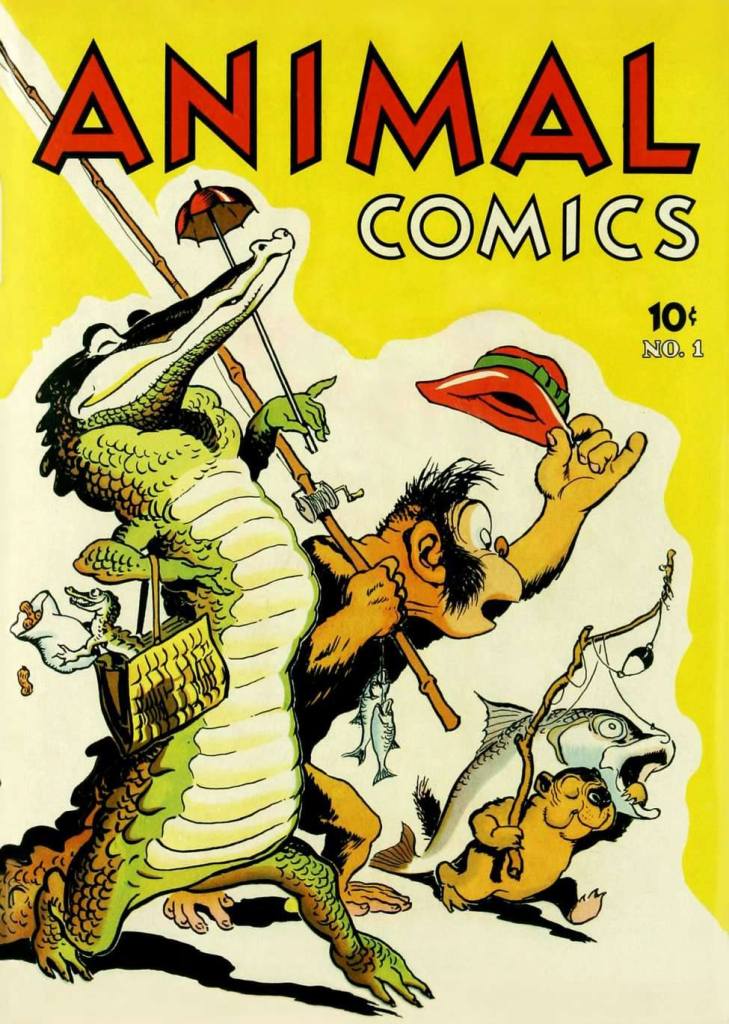
Animal Comics no. 1 (December 1942, Dell), with a cover by H.R. McBride, is an amalgam of details both adorable and creepy – the harrowing expression of the fish contrasts wildly with Madame Crocodile’s peanuts-pilfering offspring and her flirty cocktail parasol, while her crocodile-skin purse makes me think of Disney’s Three Little Pigs cartoon (1933, Silly Symphonies). In case you’ve never noticed it, the third pig, the one with the brick house, has family pictures on his wall… for example, a string of sausages labelled “Father”. Black humour, indeed. Animal funnies are often dusted with a good sprinkling of the gruesome, as when a talking duck eats chicken legs for dinner.
The insides have two Walt Kelly stories, including the first appearance of Pogo Possum and his friends!
Fast forwarding four years, we fall into pleasantly loopy territory of Fox Features’ Nuttylife no. 2 (Summer 1946, Fox Comics). Despite it being number two, this is technically the only issue, issue number 1 having appeared as Krazy Life, and issue number 3 and onward becoming Wotalife Comics. I can’t find credits for the cover, but the insides contain Pat Adams with Ellis Chambers (“One day a little goil went to her Grandma’s joint…”), Tim Howe and Cy King. Ellis Chambers by himself definitely deserves a separate post – take a glimpse at Eddie Elephant – 1946 Hallucinogenic Funny Animal Comix by Ellis Holly Chambers, for example.
I couldn’t very well leave Felix the Cat out of this post! I won’t go into the complex history of this character, but suffice it to say that this is one gorgeous cover. Clearly I’m not the only one to admire this image, as it was used for the cover of Craig Yoe‘s wonderful anthology Felix the Cat – Greatest Comic Book Tails (2011, IDW), which I highly recommend. This is Four Color no. 135 (February 1947, Dell Comics), with a cover by Otto Messmer.
The American Comics Group is responsible for many a goofy plot, source of my long-lasting affection for some of their titles (see Tentacle Tuesday: ACG’s Adventures Into the Tentacles). ACG’s Ha Ha Comics are a riot, all right, but I have two favourites among the 88 issues released. The first is Ha Ha Comics no. 11 (August 1944), with a cover by Ken Hultgren. A joke doesn’t have to be elaborate to be funny – something about the expression of the indignant man-eating lion and his wild mop of hair cracks me up!
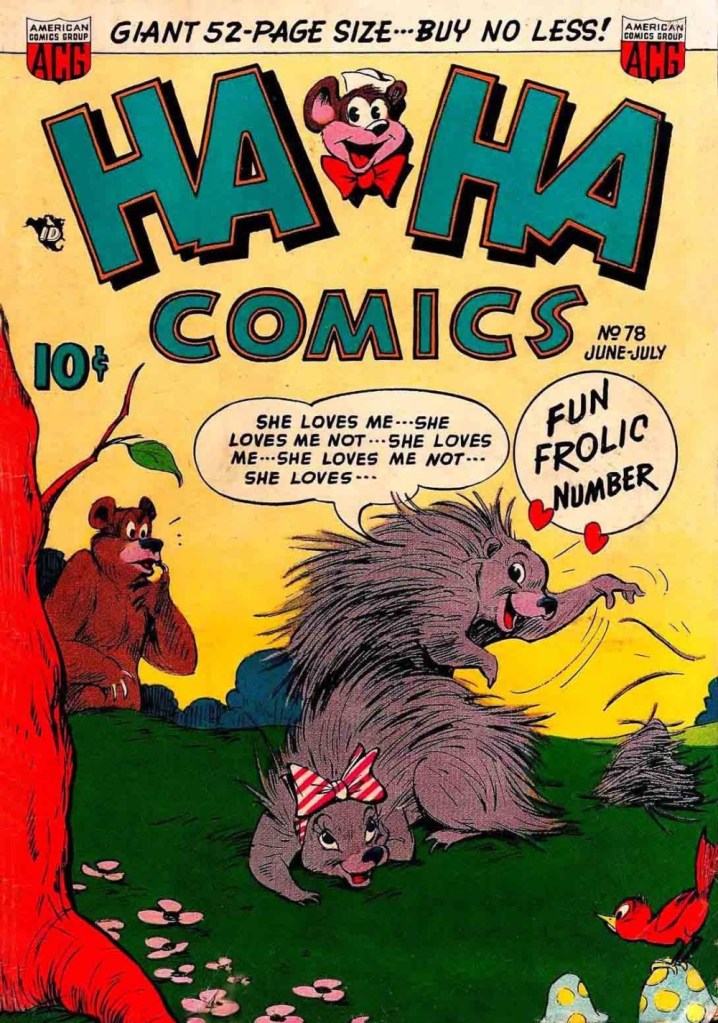
The second is Ha Ha Comics no. 78 (Dec-Jan 1951), cover artist unknown. I like porcupines in general, but here we are presented with a truly bizarre situation – a porcupine who tears out his sweetheart’s quills one by one to figure out whether she loves him… (unless she’s just a friend helping out, and he’s in love with some other porcupine). Kinky, whichever way you look at it.
Going a few years back, we take a little inter-planetary voyage with Coo Coo Comics no. 38 (March 1948, Pines/Standard Comics), with a cover by (possibly)Vince Fago. I am very fond of this purple-green monster who looks like he’s suffering from a bad hangover (or terminal cretinism). Coo Coo Comics is credited with having introduced the first funny animal superhero (in its very first issue, published in October 1942). That little guy was Supermouse…
The insides contain some Frank Frazetta stories, in case anybody is interested.
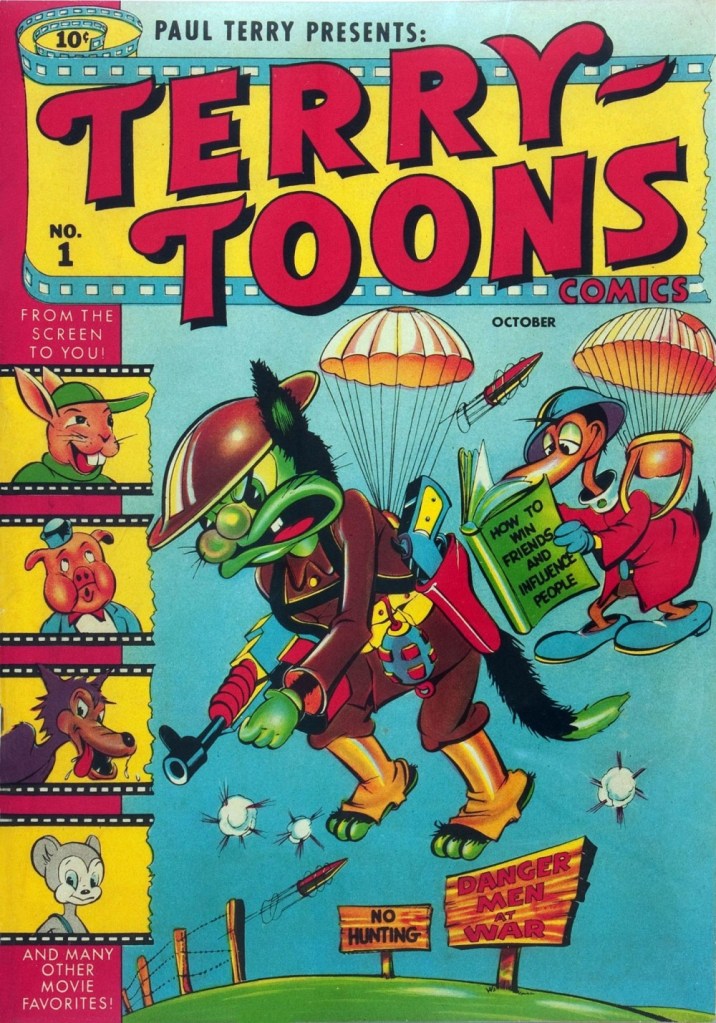
… but the other contender for this title was Terrytoons’ Mighty Mouse, also introduced in October 1942 (under the name of ‘Super Mouse’) in the theatrical short The Mouse of Tomorrow. That’s enough to get anybody confused in all these mice! This is Terry-Toons Comics no. 1 (October 1942), with an Ernie Hart cover that hints at the influence that funny animal comics had on the underground comix artists:
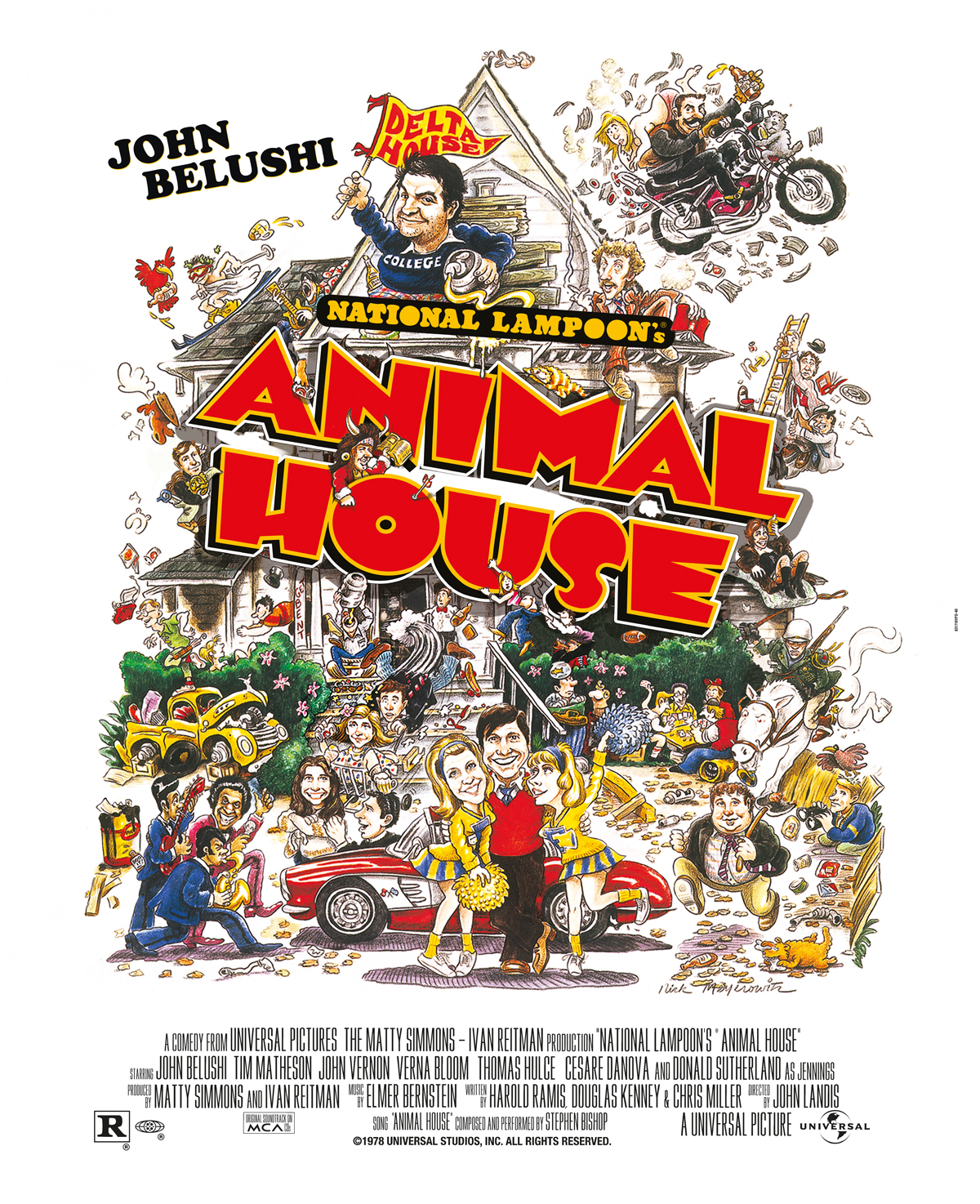
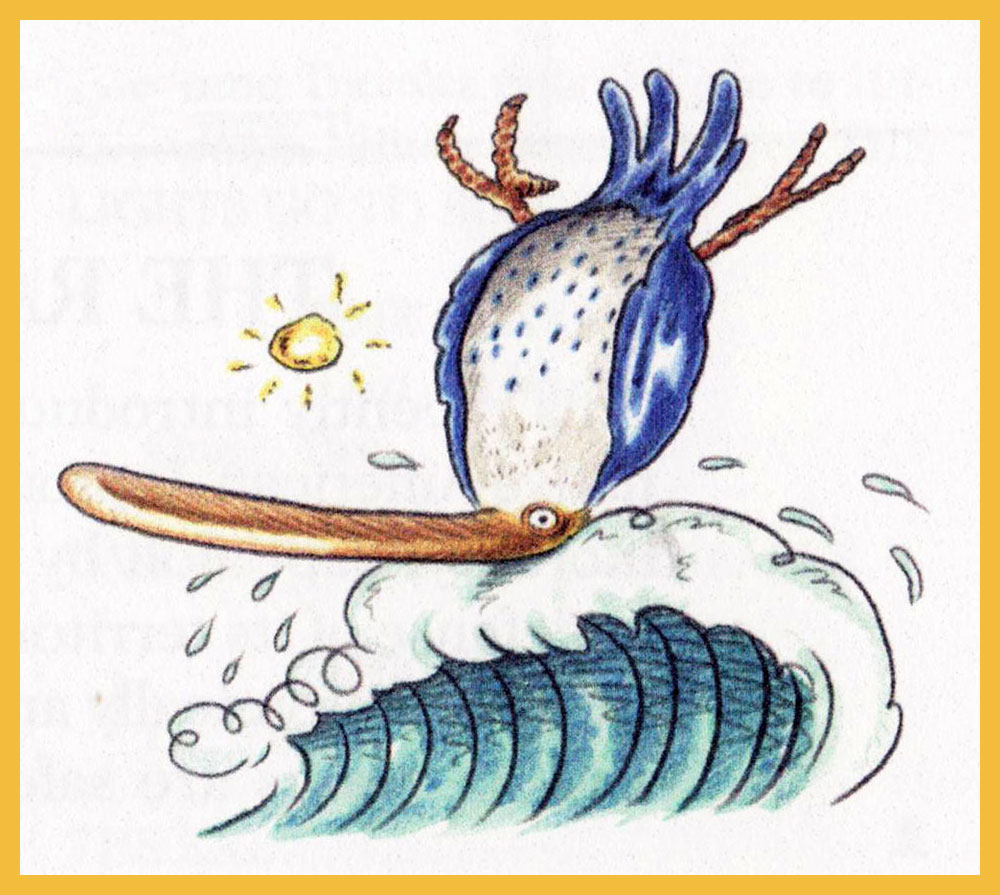
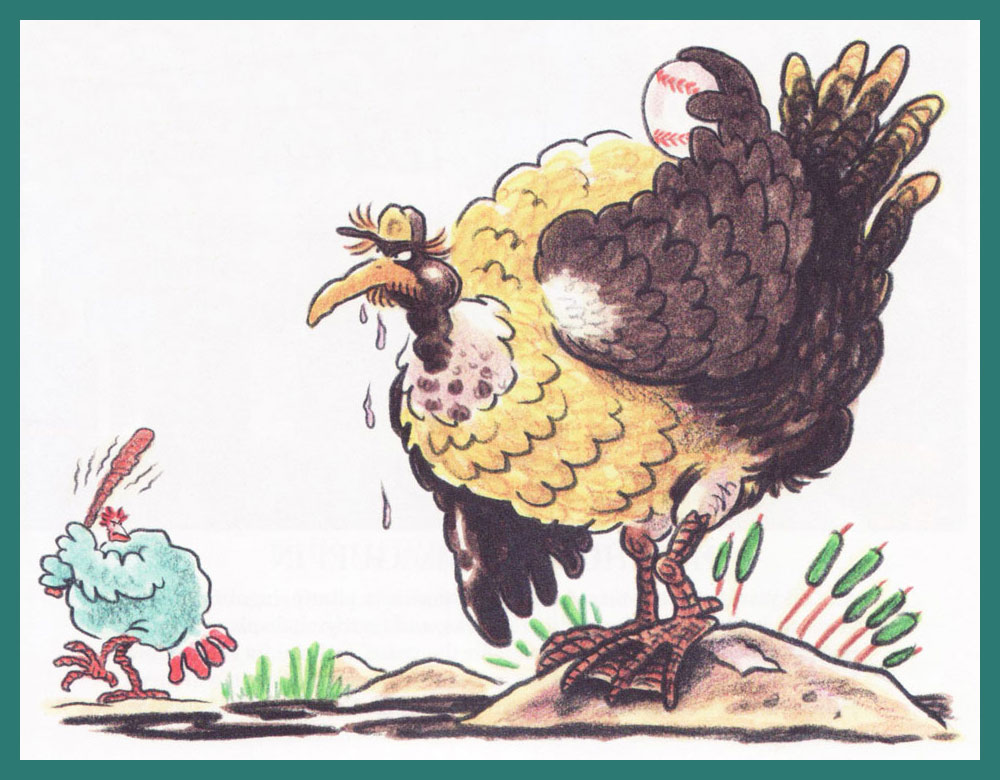
In 1973, he gave us Birds of Israel (included at the end of this post); farther along, he (with his frequent collaborator, Montréal-born writer Sean Kelly) gave us a look at The Birds of Summer, (2007, The New York Times). And in 2016, these ardent but irreverent crypto-ornithologists were at it again with Odd Birds, which added in excess of one hundred and fifty fascinating new species to the tally. However, Meyerowitz only illustrated a handful (but such a handful!), which I present to you here. Still, how I would love to behold his depictions of, for instance: The Three-Day Lark; the Venomous Spite; the Oblivious Walking Jay; the Perpetual Jackhammer; the Yellow-Bellied Stool Pigeon; the Groveling Wince; the Hoodwinked Bagholder; the Celibate Tot-Fondler; Zimmerman’s Cryptic Drone; the Barecheeked Thongbird; the Bald-Faced Lyre; the Fact-Spinning Mockingbird; the Screaming Scarlet Manager; the Gulf Coast Petrel Dumper; Oscar’s Pink-Bottomed Boychick; the Crapulous Binge; the Free-Screech Owl… or the Swaggering Gut-Sucker! Man, this project needs to go the full book route.
THE RAVING HOMELAND JINGO: « This recently introduced European species is often mistaken (by itself) for native American. It proudly displays its red neck, white knuckles, and bluenosed morality, kept aloft by drafts of hot air. The Jingo emits gruesome shrieks in defense of its territory against the occasional Left-Winged News Hawk. The Jingo is anatomically anomalous, in that its testicles are located in its cranium, and its brains are safely secured behind and exceptionally tight sphincter. »
« The all-too-common Back Lot Goose, with its natural prey, the Wide-eyed Chippy. »
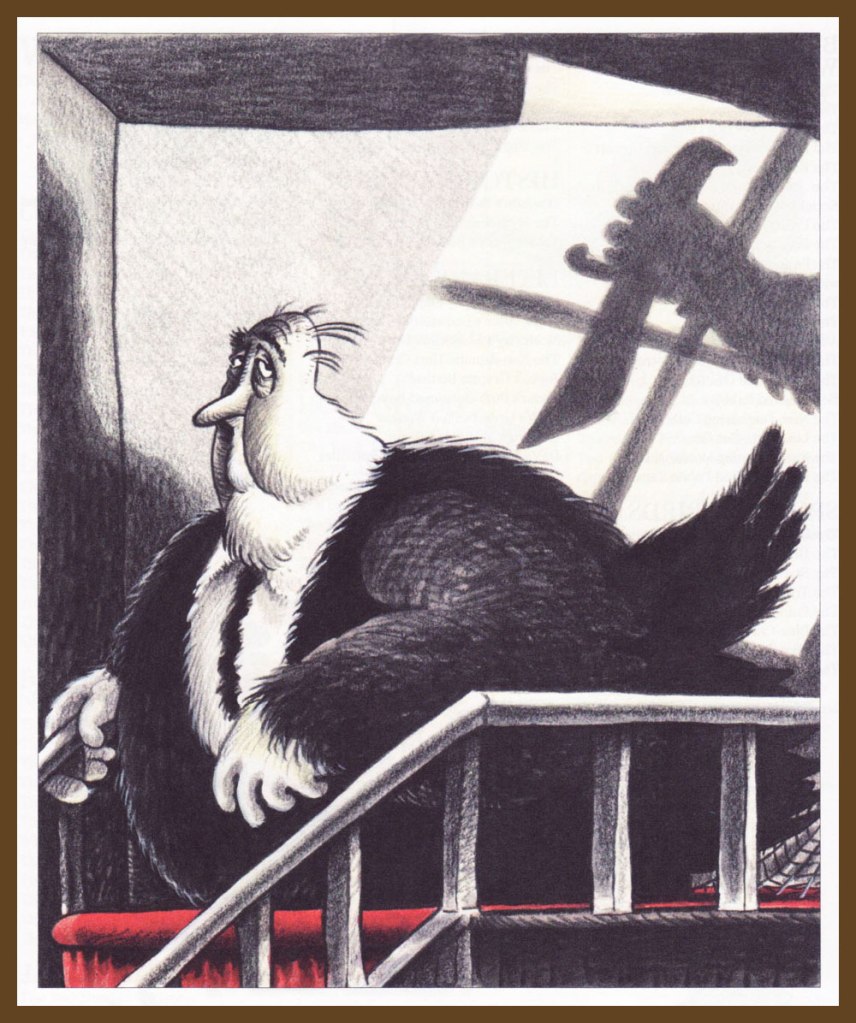
Meet HITCHCOCK’S MacGUFFIN — « An Old World species, introduced to California: a plump, lugubrious bird given to stealthy silences, sudden shrieks, and terrifying displays. Its diet consists of red herrings and snakes in the grass. Despite its reputation, has laid the occasional egg. Sometimes mistaken for Hammett’s Maltese Falcon; not to be confused with any of Spielberg’s Mawkish Cliff Hangers. »
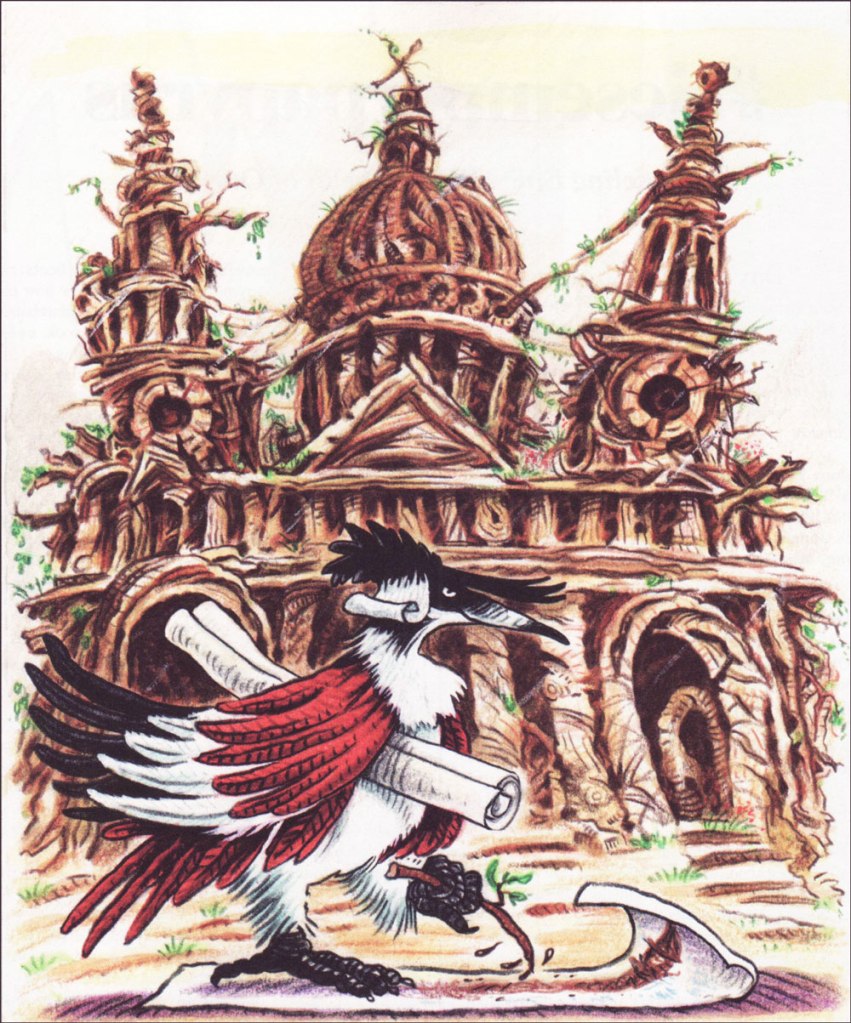
THE CHRISTOPHER WREN: « Like the Francis Drake, the Dean Swift and the Florence Nightingale, this bird prefers a cold, damp, dreary environment such as the city of London, England, in which the Christopher Wren constructs nests of preposterous design, monumental size, and no apparent use. (This species is not related to the similarly named Christopher Robin, native to the Hundred Acre Wood in East Sussex.) »
« A grizzled Hoary-Headed Junk Chucker faces down a Stat-Grubbing Peckerhead. »
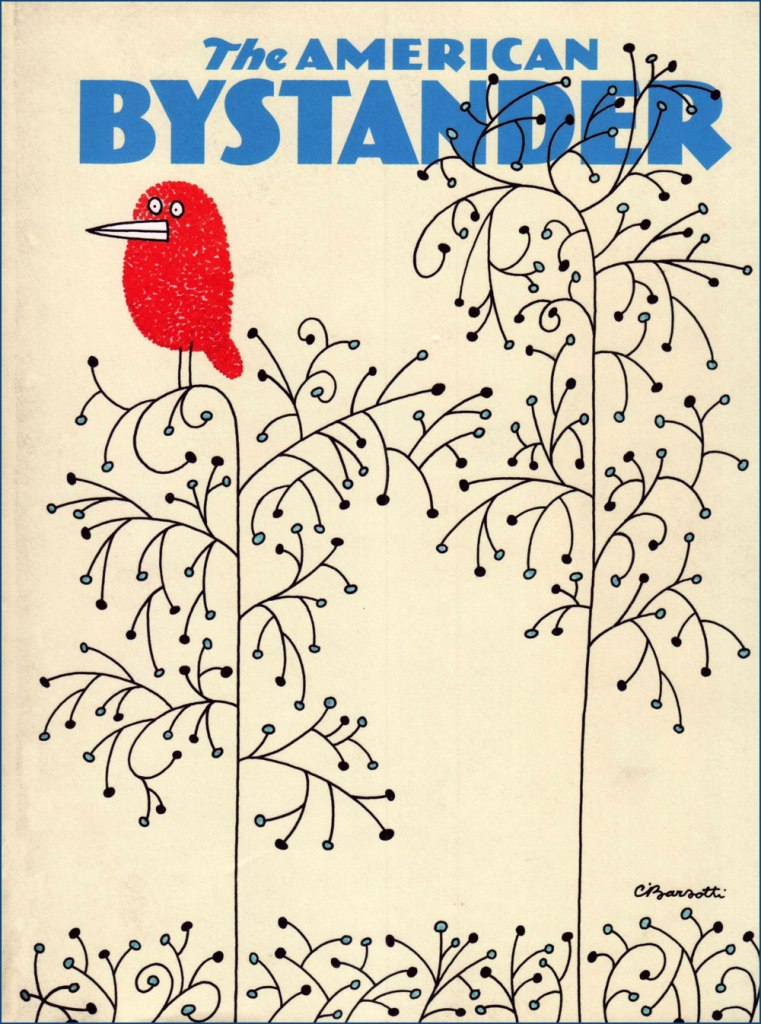
These cartoons appeared within the pages of The American Bystanderno. 2 (Spring 2016), bearing this soothing cover by the esteemed Charles Barsotti (1933-2014). Do check out and lend your support to the Bystander, which has most deservedly been deemed “The last great humor magazine“.
Where the good Mr. Meyerowitz seems to have first hatched his theme: Birds of Israel, from The National Lampoon Encyclopedia of Humor (1973, edited by Michael O’Donoghue).
I was startled to discover that after several years of WOT blogging, we still have no post dedicated to Sergio Aragonés. Perhaps this is in part because his art is ubiquitous – throughout his long career, he has contributed manifold pages to various DC publications, created an enduring barbarian parody, scripted and drawn (mostly solo but also in collaboration) an impressive number of mini-series published by Fantagraphics, Dark Horse and Bongo Comics, produced various comic-con paraphernalia, etc. And this is not to mention his lasting contributions to Mad Magazine (which I did discuss, though not at length, in A MAD dash… inside) – something in the magnitude of twelve thousand gags spread over 57 years and 491 issues of Mad.
A sequence from A Mad Look at Sharks from Mad no. 180 (January 1976, EC).
He’s also a charming, universally-liked man whose bigger-than-life persona has ensured that his participation in anything is always surrounded by fun anecdotes. It is my great pleasure to share this abridged compendium of Aragonés tentacles, of which there are many, as he enthusiastically added them into doodles and margins with great glee (and, as we know, « he has quite literally drawn more cartoons on napkins in restaurants than most cartoonists draw in their entire careers *», so just imagine how many tentacles are scattered throughout his work).
Room 13 one-pager, scripted (and edited) by Joe Orlando. This was published in House of Mystery no. 190 (Jan-Feb 1971, DC).
Incredibly, we still haven’t written a post dedicated to the great Plop! (this post is starting to sound like a to-do-in-the-nearest-future list), though Hallowe’en Countdown III, Day 30 did include a story from number 1. Plop!, “The New Magazine of Weird Humor!“, certainly included a lot of cephalopods in its 24 issues and I will doubtlessly get around them one of these days. In the meantime, here’s a very appropriate page from Plop! no. 16:
This closing page of Plop! no. 16 (September 1975, DC) was scripted by Steve Skeates.
Galloping forward through some twenty years, we briefly land at Marvel, namely these two pages from Groo the Wanderer no. 98 (February 1993, Marvel), co-plotted and scripted by Mark Evanier.
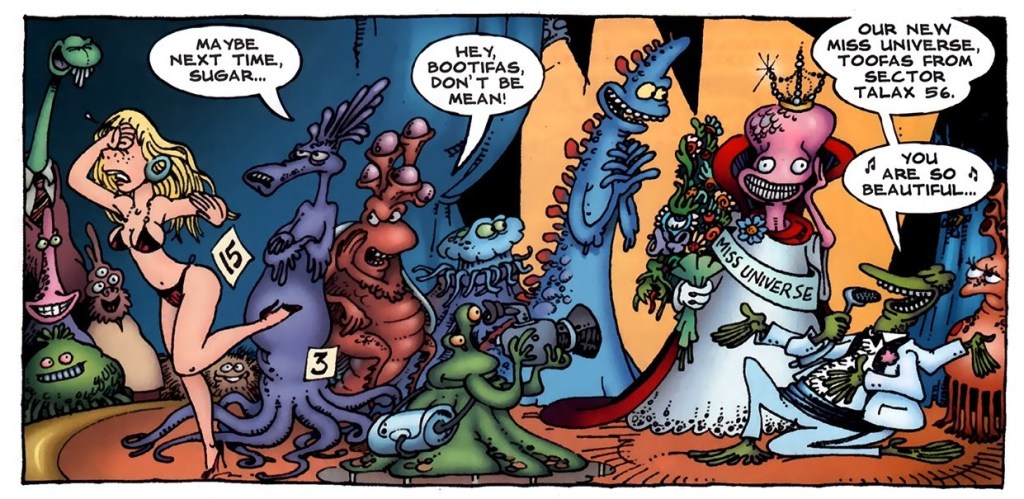
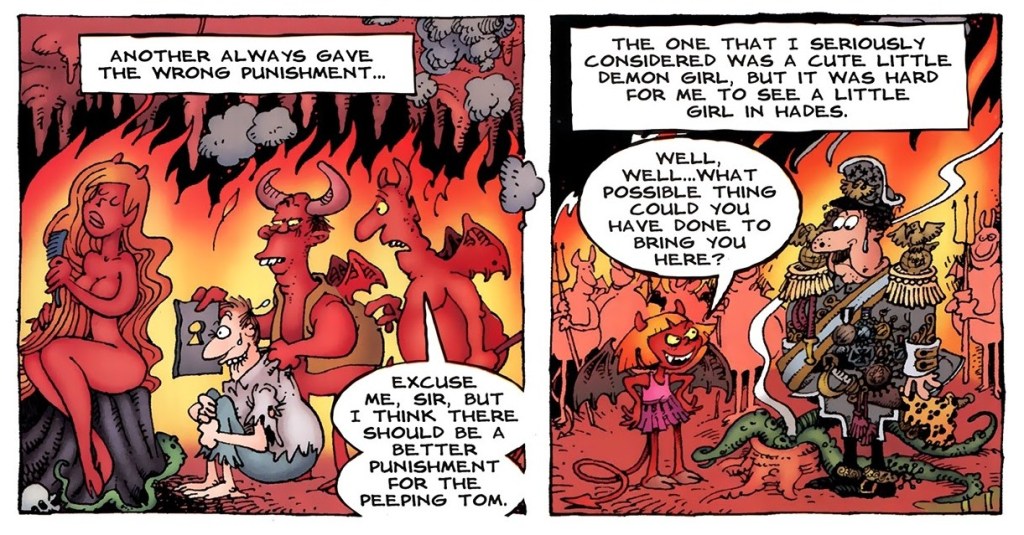
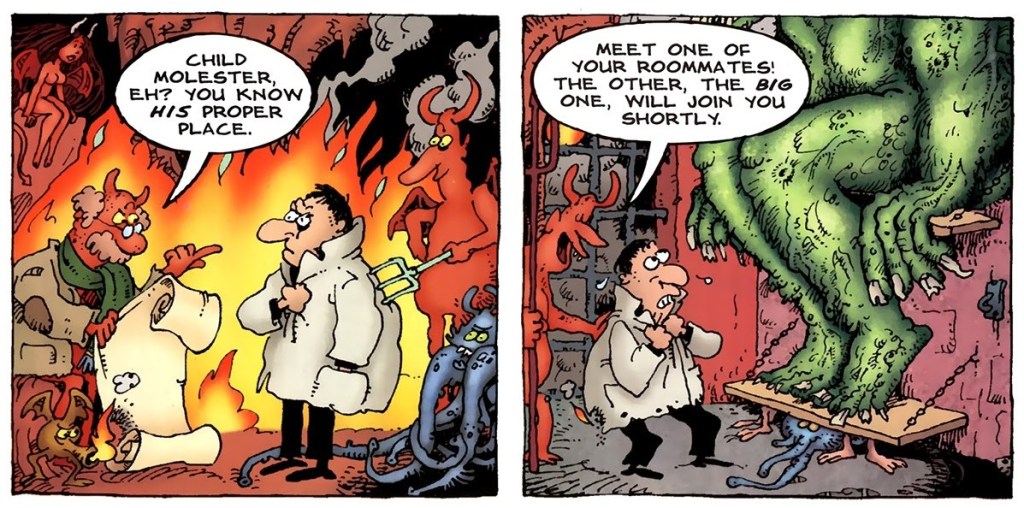
Sergio Aragonés Funnies, published between 2011 and 2014 by Bongo Comics, boast 12 issues of really enjoyable, remarkably varied material. For those who may think that Aragonés is one-trick pony who can only do ‘silly’ humour, this series offers many auto-biographical stories, some of them surprisingly poignant and heart-felt. Not to say that it’s not devoid of humour – the more serious stuff (including social criticism in the form of animal parables) is nestled among pages of slap-stick humour and imaginative goofiness, from one-pagers to longer stories that take most of an issue to develop. Aragonés also shares some background on his approach to stories, allowing us to peek into his imagination and possibly answer that hackneyed question that plagues all manner of writers, ‘where do you get your ideas from?’ If an anthology of Funnies is ever published, I’ll happily purchase it.
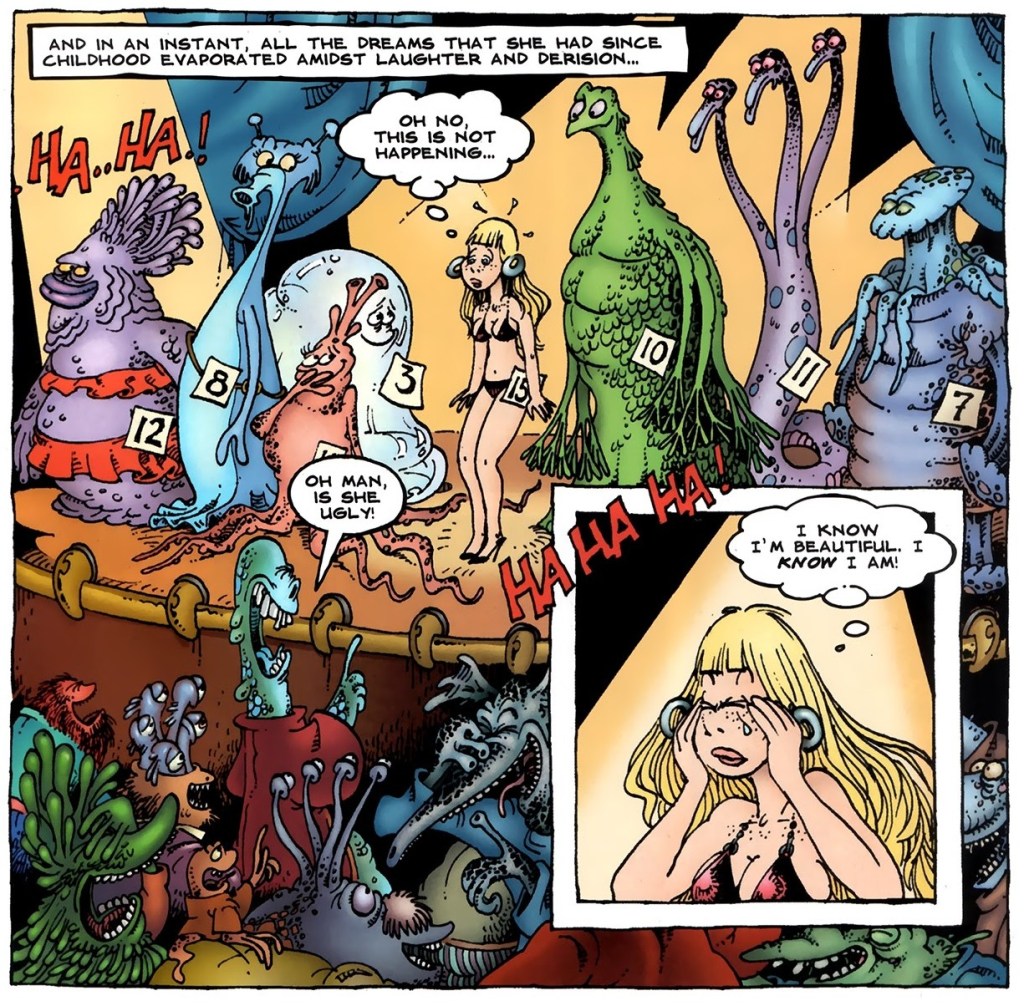
Excerpts from Kira and the Beauty Contest, published in Sergio Aragonés Funnies no. 2 (August 2011, Bongo Comics):
Panels from Sergio’s Inferno, published in Sergio Aragonés Funnies no. 3 (September 2011, Bongo Comics):
Finally, a panel from the back cover of Sergio Aragonés Funnies no. 10 (October 2013, Bongo Comics). Nevermind what the joke is, I just really like that octopus (as well as his other sea friends).
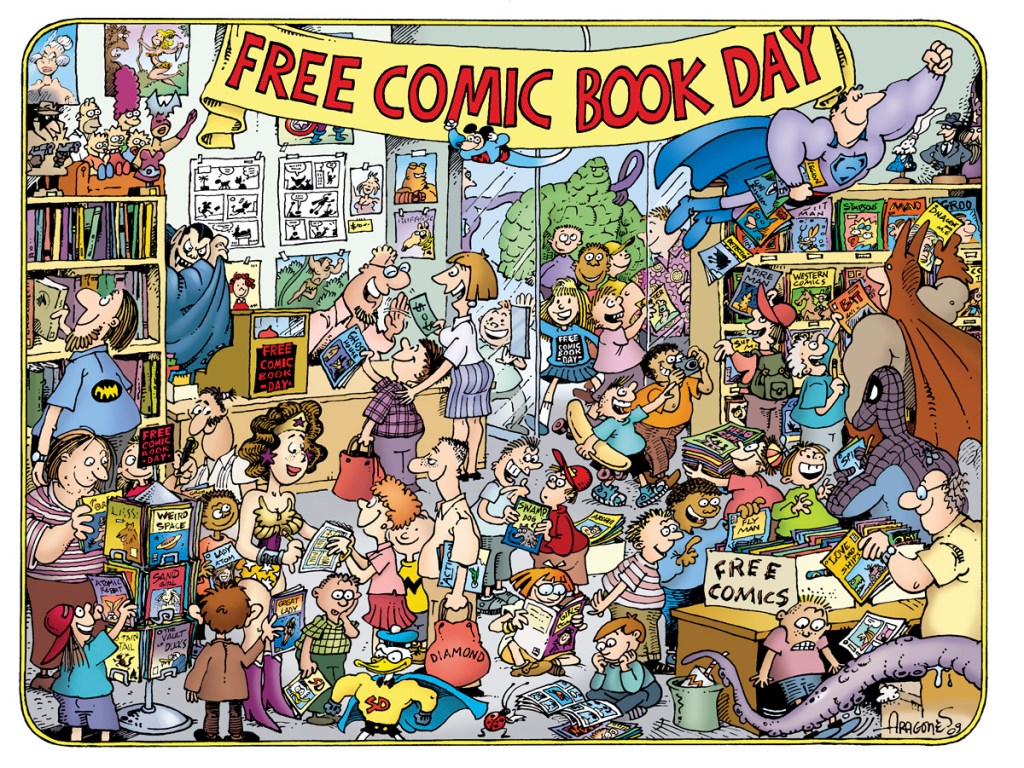
I mentioned materials related to Comic-Cons, so I would be amiss to not include at least one image of something vaguely related!
This design was created for the ‘Free Comic Book Day Commemorative Artist T-shirt’ in 2010.
I’ll end this post with a classic Aragonés anecdote, as told by Mark Evanier. This happened while these two were participating in filming The Half-Hour Comedy Hour television show for NBC in 1983, on which the model Jayne Kennedy was a guest. [source]
« This was one of the most beautiful women in the world. And she wore this dress that was very revealing, so much so the censors wouldn’t let us put her on the air in it without adding some material. So we’re all talking to her, the writers and whoever, just in awe of this woman. And Sergio comes walking in looking like a homeless person, carrying his portfolio. And Jayne sees him and she shouts, ‘Sergio!’ and she runs over and starts kissing him passionately.
They’d worked together before, it turned out. But Johnny Carson comes walking out into the hallway and he thinks Jayne Kennedy is being sexually assaulted by a homeless person in the NBC hallways. He came over to make sure she was okay. She said it was fine, that she knew him, and I said, ‘It’s okay, he’s a cartoonist.’
So Johnny gives that classic look and he says, ‘I knew I should have taken up drawing.’ »



































 Who's Out There?