A Secret, Silken World: Max Andersson’s “Lolita’s Adventures” (1995)

« Most of us will still take nihilism over neanderthalism. » — David Foster Wallace

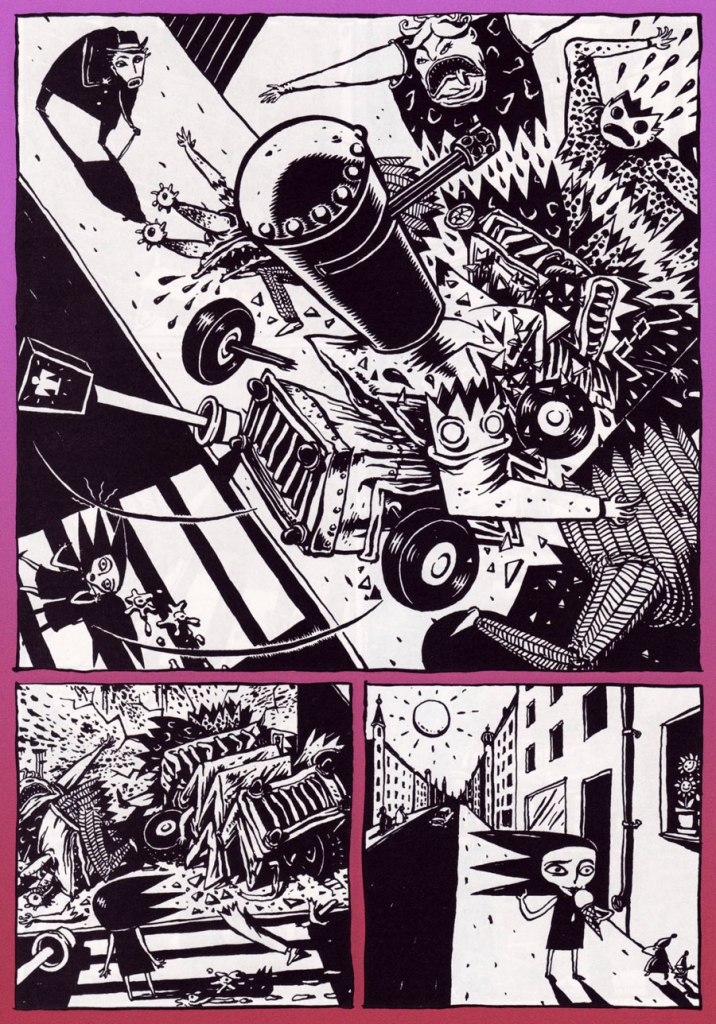
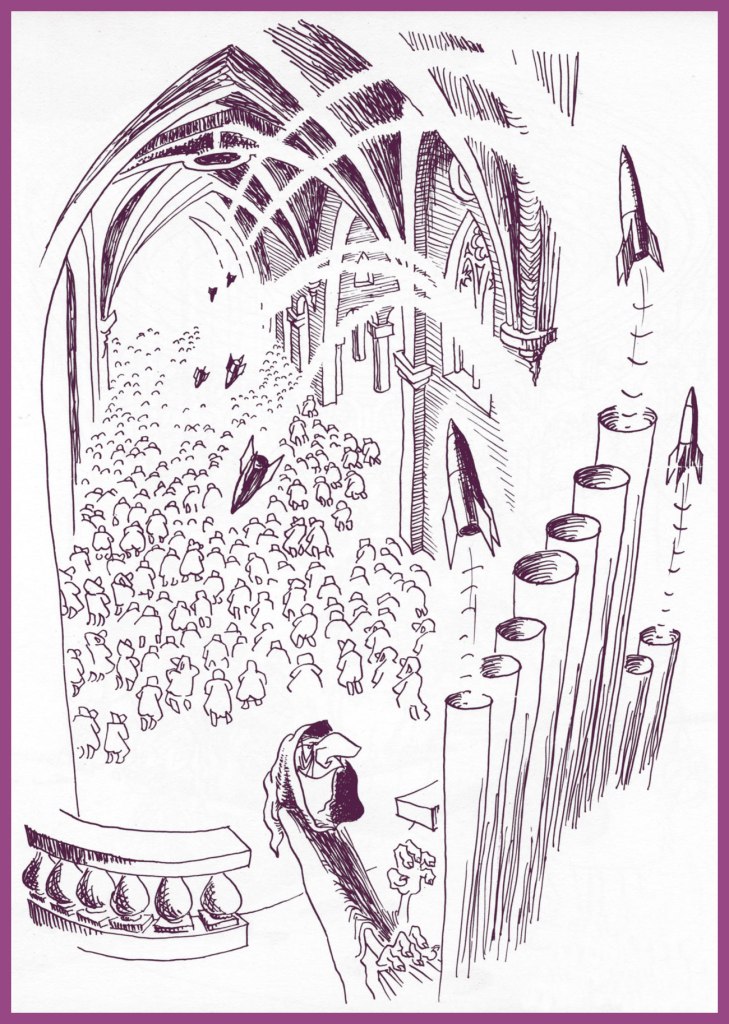
It’s become so quiet” “Yes“; from Galago no. 40 (1994, Atlantic Förlags AB)

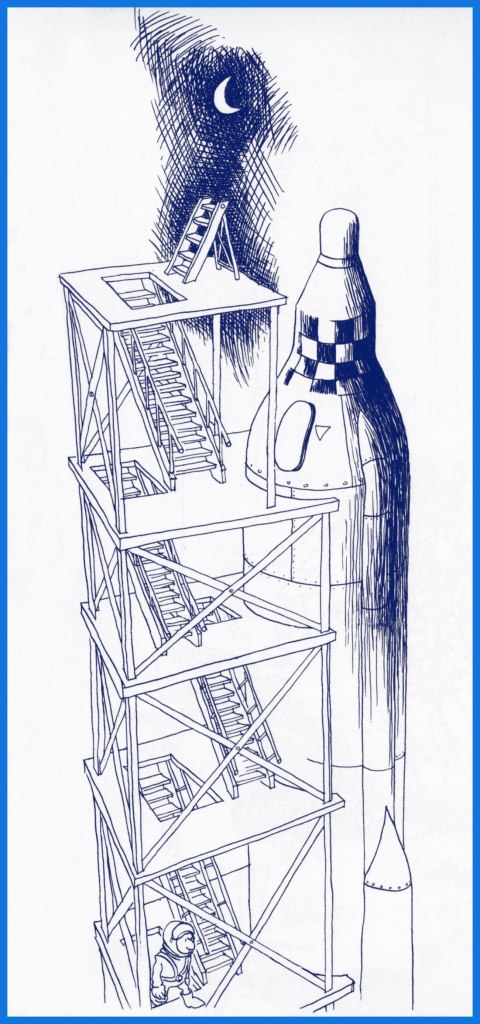
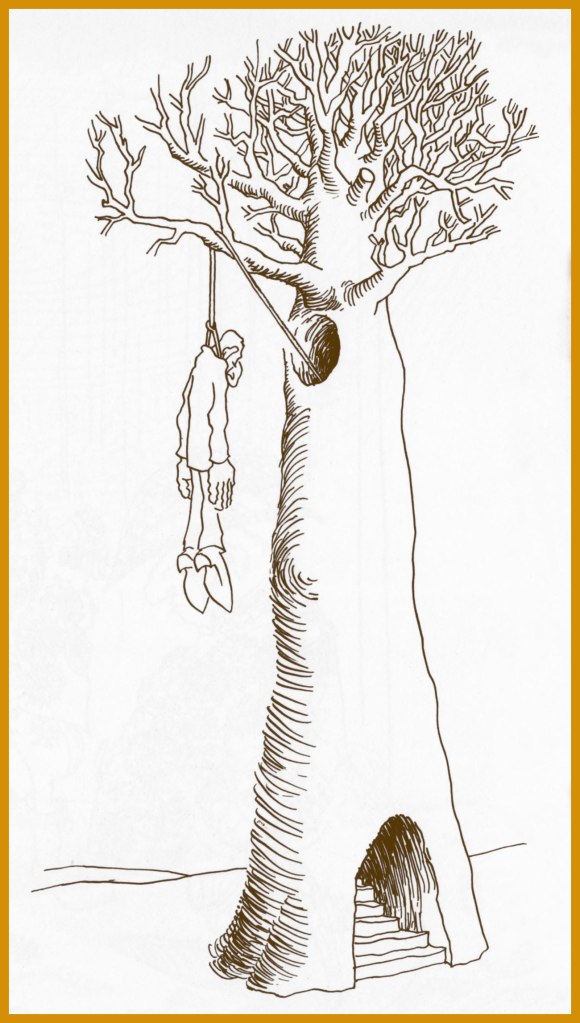
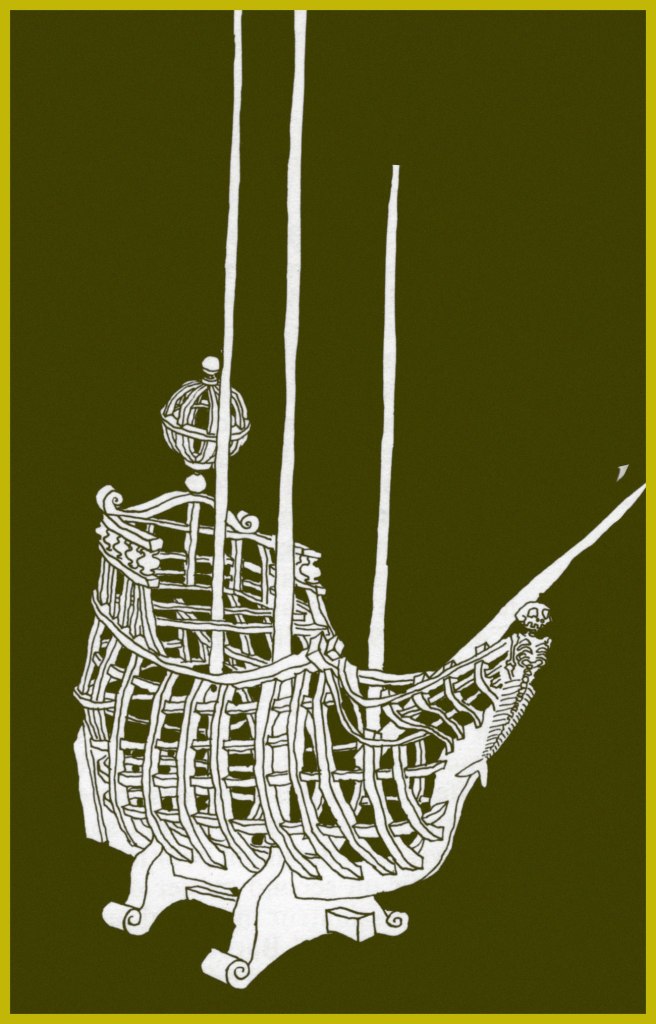
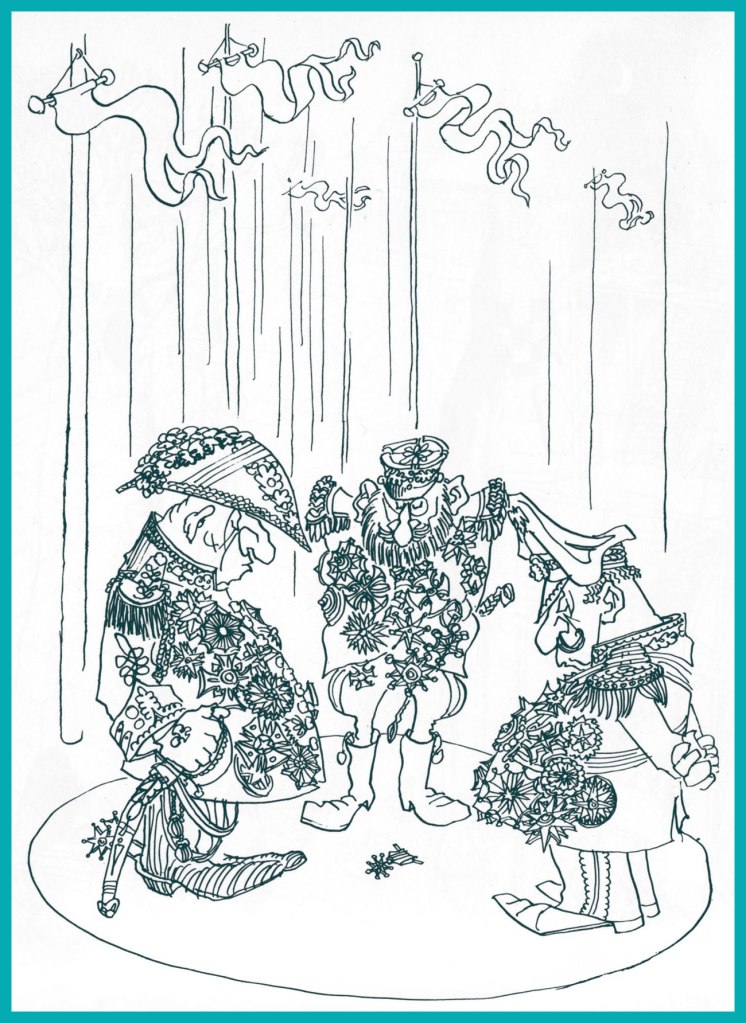
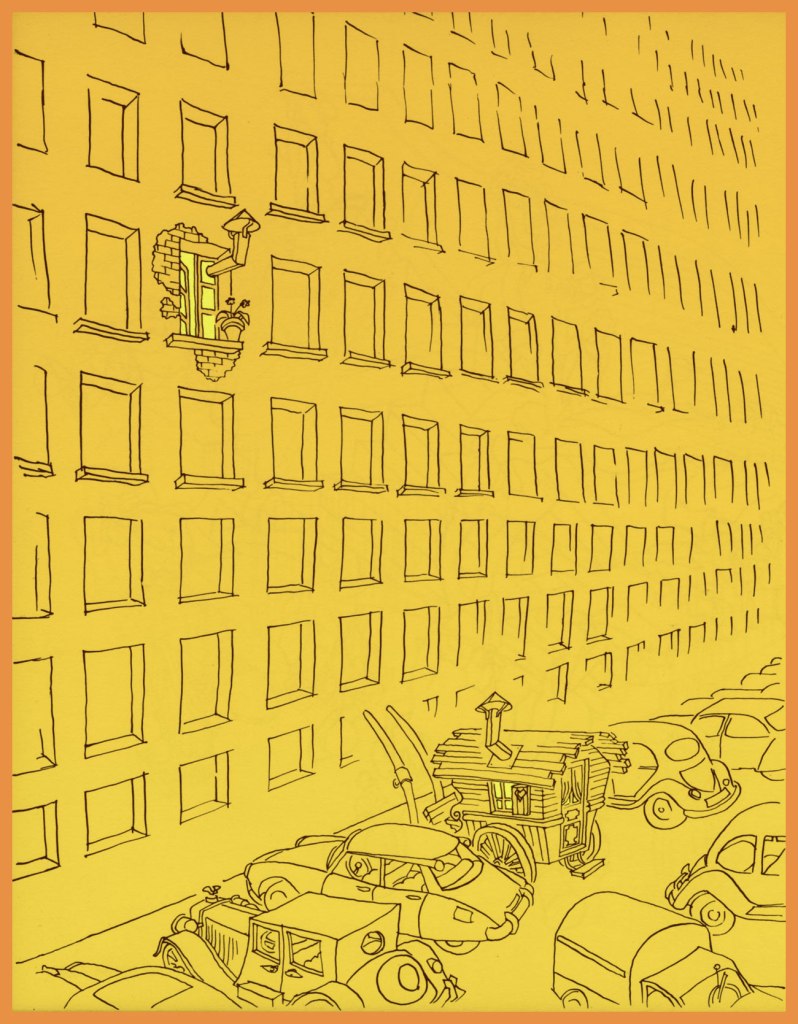
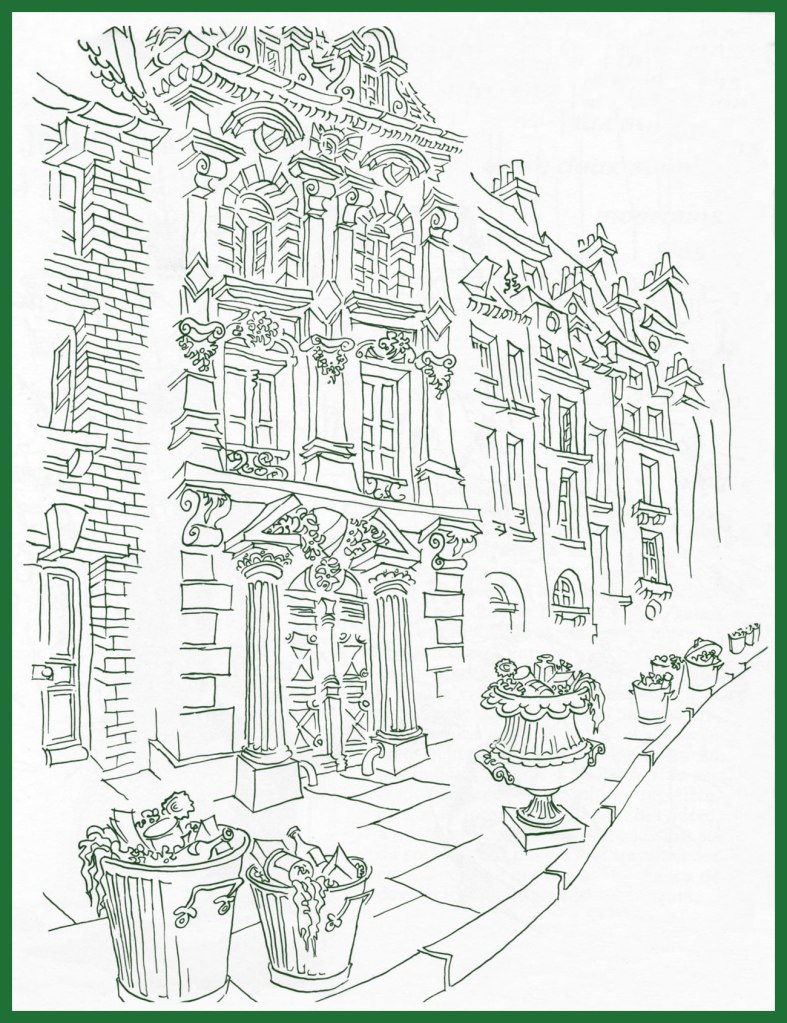
Today, let’s dip a toe (at the risk of losing it) into the midnight domain of Swedish cartoonist and filmmaker Max Andersson (b. 1962). It’s a relentlessly-perilous scene, but like Kaz’s Underworld comic strip or Arnt Jensen‘s Limbo video game, I find it unexpectedly comforting in spite of (and thanks to) all the darkness, both thematic and in density of ink. In Andersson’s case, might it be owing to the author’s kindness to his protagonists? That’s a factor with odds I rather favour.

I don’t doubt that certain readers of a more sensitive cast will differ, but I posit that the cheerful lack of clemency the artist affords the callous, the cruel and the pernicious makes Andersson’s universe a profoundly moral one. Contrary to, say, your average American action blockbuster, such a purge of the villainous doesn’t restore the status quo… because here, malevolence is the status quo. Andersson’s put-upon little people are true outsiders, and his stories feel like Kafka, but blessed with dénouements far merrier yet merited.

Jolly carnage! Lolita’s Adventures appeared in the third issue (July, 1995) of Fantagraphics’ outstanding anthology title Zero Zero (27 issues, 1995-2000).

See? A happy ending and all, and even a rare glimpse of daylight.

Soon after he began to publish his work, Gary Groth spoke with Andersson (The Comics Journal no. 174 (Feb. 1995, Fantagraphics):

Groth: What would you point to as your defining influences? How did you develop this approach, style and point of view?

Andersson: What I always have in my backbone is the style of classic comics, the stuff I read when I was a kid.

G: I don’t see much Tintin.

A: No, but it’s there if you look closely. The basic technique of how to tell a story well. I try to do that because I want the storytelling to work, to be easy to read.

G: Were you influenced by sources outside of comics — film, literature?

A: Yeah, more of those than comics. The German Expressionist movies of the ’20s, Nosferatu; and artists from the period, like George Grosz.

And don’t leave out old cartoons! Andersson’s thoroughly animist way dovetails neatly with early animation’s unhinged, anything-can-happen mode. By which I mean that anything and everything possessed motion and sentience, be they boulders or pebbles, thunderclouds, petals or creepers, sparks or flames, pantaloons or braces, blunderbusses or bassoons…

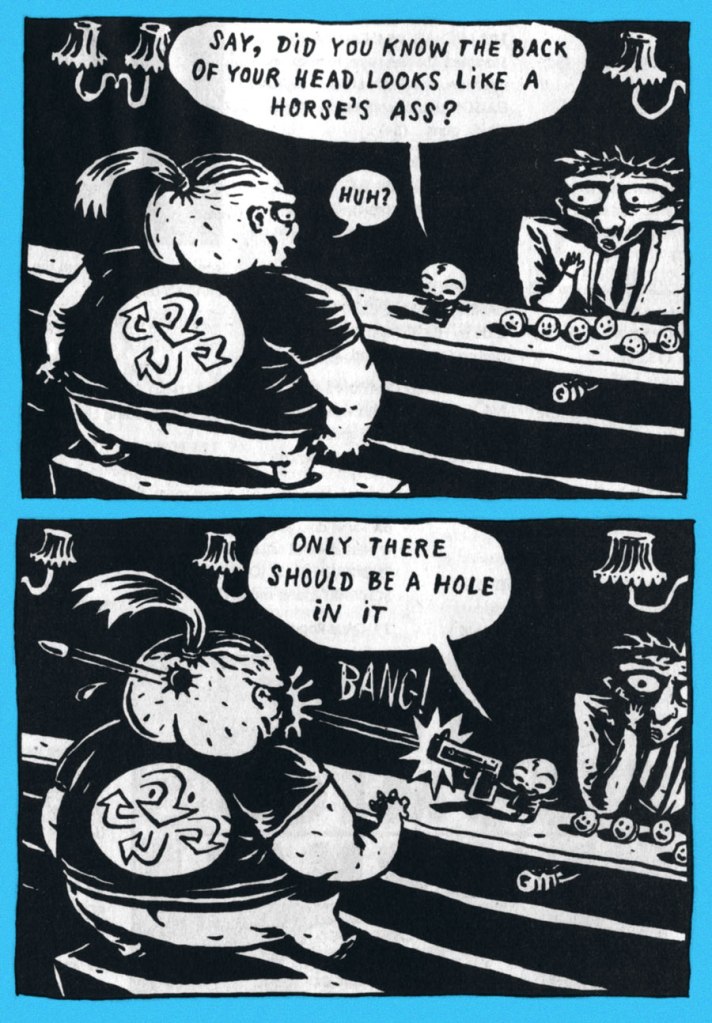
As a bonus, a sequence from Andersson’s breakthrough work, Pixy (1993). The title character is the fœtus with a pistol, and the happy little fellows on the counter are units of money. Highly recommended, and likely available in the language of your choice.

About Pixy, fellow dweller-in-darkness Charles Burns exulted: « So you think it’s a cold, creepy, world out there, huh? Hah! Just wait’ll you get a load of Max Andersson’s Pixy… safe sex suits, buildings that eat people, drunken fœtuses with bazookas, money that shits on you, recyclable bodies… hey, wait a minute, that’s not creepy, that’s fun. MY kind of fun. »

For more dope on this important creator’s endeavours, do sidle over to his official website!

-RG

Off to the Isle of Cats — and Back by Teatime!

« It’s no good trying to teach people who need to be taught. » — Aleister Crowley

You may have happened across our earlier post on that astounding but tragically short-lived touche-à-tout, Gerard Hoffnung (1925-59). Well, here’s a look at another facet of the man’s work, crafted this time in tandem with, of all people, the definitive-but ambivalent biographer of opprobrious occultist and Ozzy song subject Aleister Crowley, namely the intriguing John Symonds (1914-2006). Come to think of it, the affiliation makes impeccable sense, and it proceeds swimmingly.

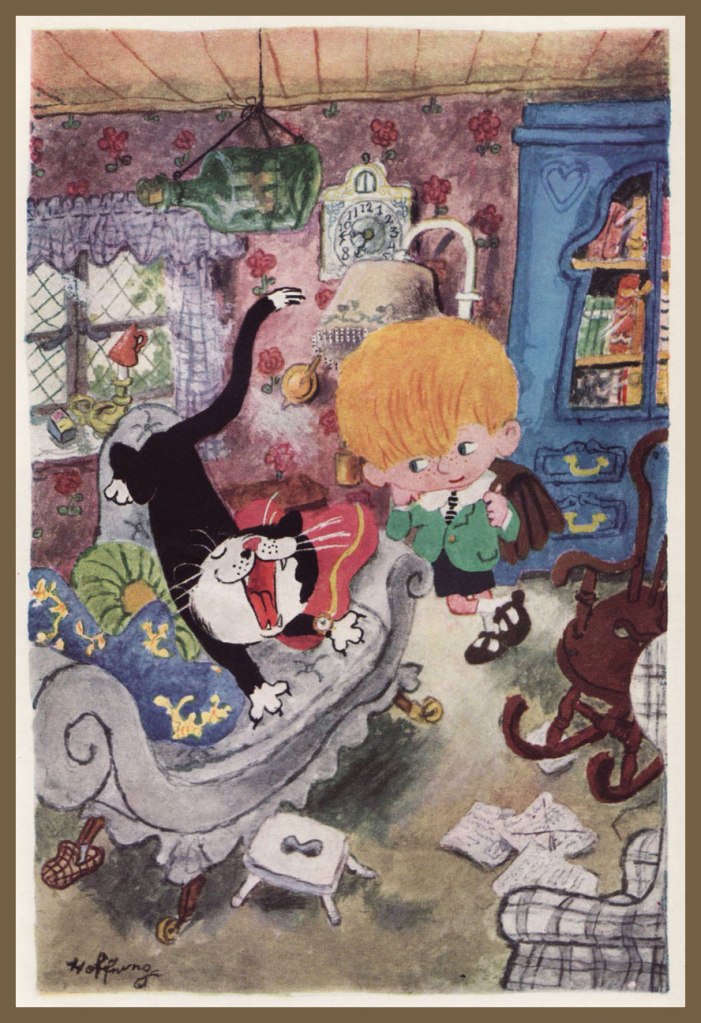
In an era where it often seems that those rare adults who yet read do so at toddler-ish levels, it’s easy to forget how many so-called children’s books of yore had plenty to offer the refined adult mind. Here, then, are some highlights from Messrs. Hoffnung and Symonds’ 1955 opus, The Isle of Cats.

« He closed his eyes, yawned, arched his back and began to dig his claws in and out of the sofa. Uncle Tom was no ordinary cat, for he could tell the time, look through a telescope (keeping one paw over the other eye, of course), beat up an egg, steer a raft, smoke a pipe and do many other things. »
« He’s the Mayor, » whispered Uncle Tom to Gabby, « so be nice to him. »
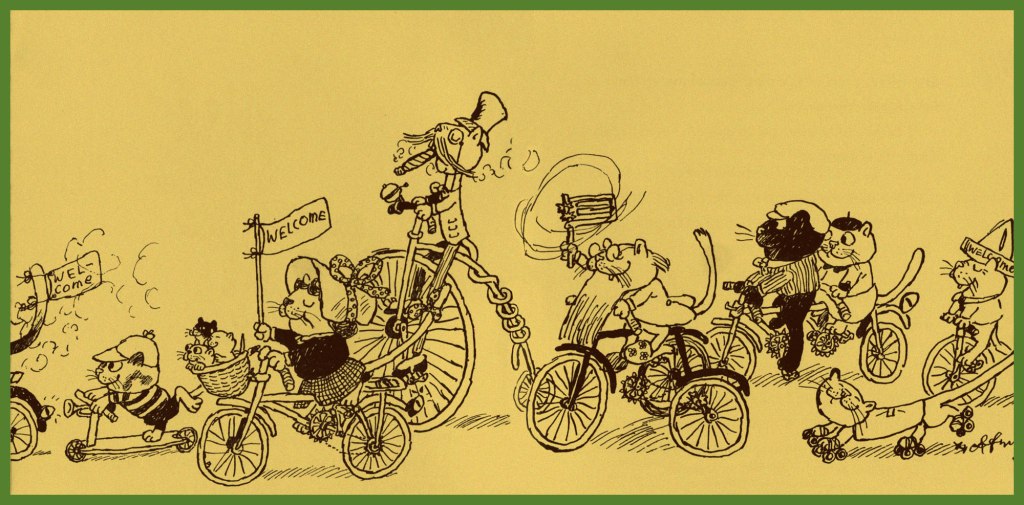
« He was still saying thank you as he and Uncle Tom were being driven away in the Mayor’s car, followed by various cats on bicycles, tricycles and penny-farthings. »
The wrestling bout pitting Tim the Terror (left) against The Furry Fury (right). Things end with a crash when Tim lets go.
« The Hall of Fame contained the portraits of the island’s most celebrated cats. »
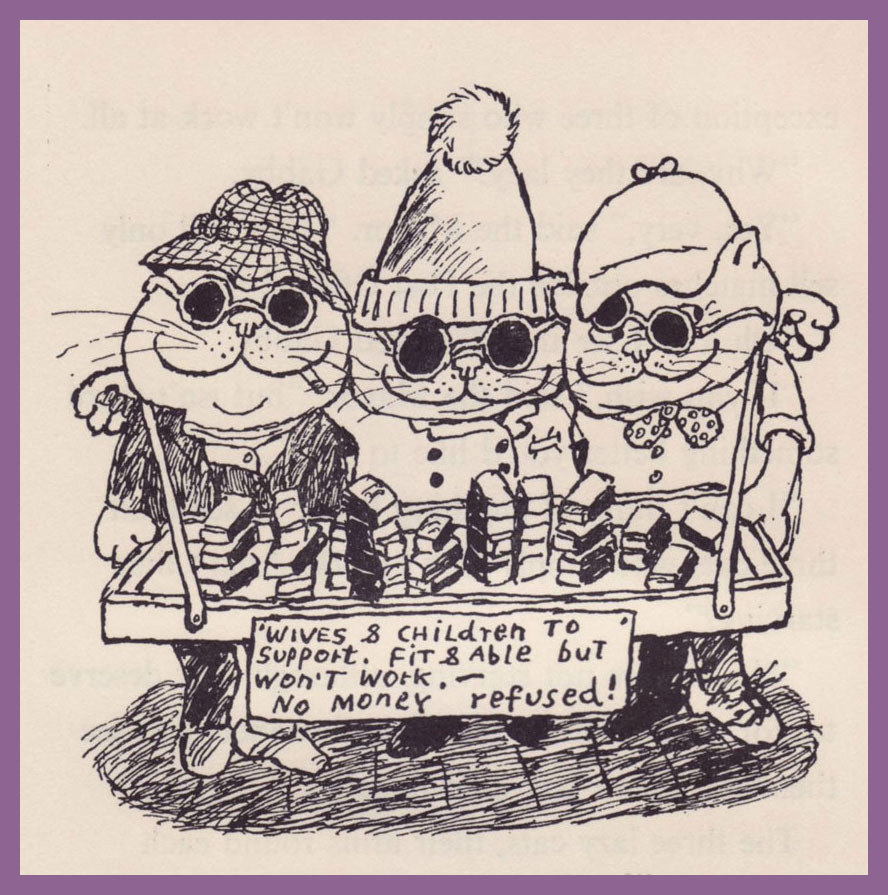
« There were portraits of lots of other famous cats, including Martha who had seven hundred and forty nine children, six hundred and eighty three of whom survived, and were now working hard as tram-drivers, crossing-sweepers, lamp-lighters, pastry-cooks and so forth, with the exception of three who simply won’t work at all. »
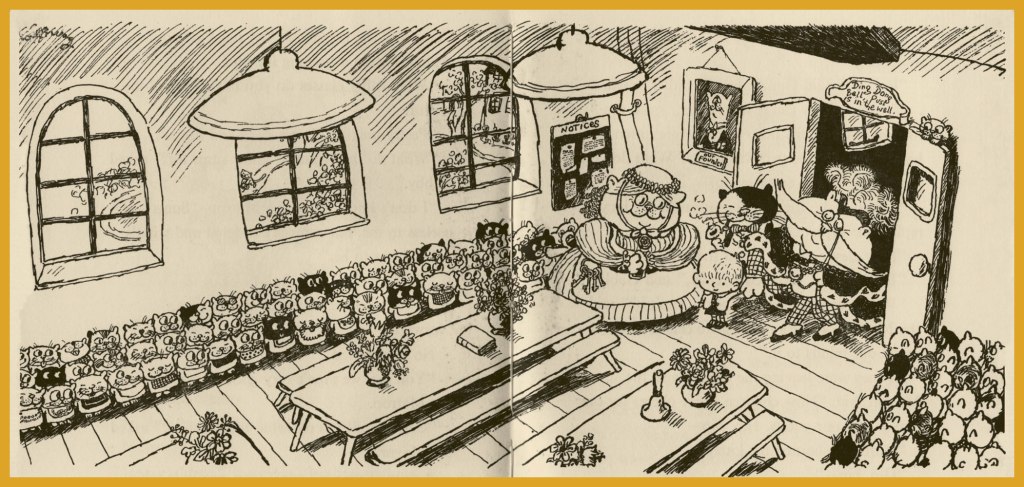
« At the Orphanage, all the kittens were lined up on either side of the Great Hall, looking as good as gold, their hankerchiefs sewn to their shirts, close enough to their noses to blow into them. »
« Just then they sailed over the madhouse and saw some cats standing on their heads, waving their legs in the air. »
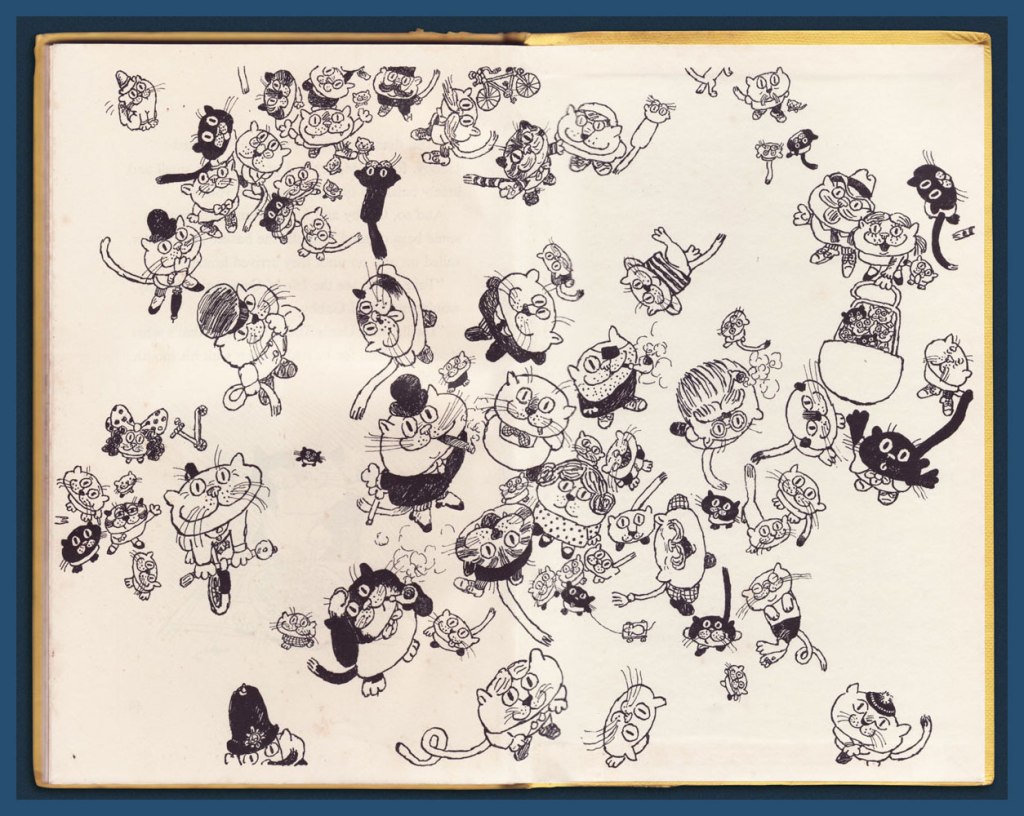
The book’s endpapers illustration, granting the reader a lofty view from the Mayor’s hot air (of course) balloon.

As a bonus, for the finale, here’s the poster Hoffnung was commissioned to illustrate for the classic, Brexit-anticipating 1949 Ealing Studios comedy Passport to Pimlico. [ watch the trailer! ]

Hoffnung’s loving widow, Annetta, wrote, in her 1988 biography of Gerard: « As he sat at his drawing board, increasingly involved and complicated fantasies tumbled from Gerard’s pen onto the paper. In 1949 came perhaps the most intricate of all, a drawing for the poster advertising a popular film of the day, Passport to Pimlico. I do not have the original design but it is unlikely to have been larger than 12″ x 15″, and to squeeze so much into so little space is no mean achievement. » I couldn’t find a trace of this image online, so I’m providing a nice ‘n’ large scan for you. Eat your heart out, Will Elder!

-RG

Tentacle Tuesday Masters: Kellie Strøm

One might call the illustrator and comics artist Kellie Strøm a bit of a cosmopolitan –  born in Denmark, he grew up in Ireland and, in adulthood, made London his place of residence. He has accomplished much, but seemingly obtained little recognition for it – his graphic novel (The Acid Bath Case, 1992, published by Kitchen Sink), a collaboration with Stephen Walsh, seems to have been lost in the rivers of time, despite being a striking showcase of Strøm’s black-and-white, precise-yet-graceful style. He also has a great eye for colour, as becomes evident from a quick glance at Star Wars comics he’s illustrated (but does anybody read Star Wars comics?), or, in a much more pleasant and hopefully longer-lasting and farther-reaching vein, his paintings for children’s books. 

A panel from The Acid Bath Case (1992, Kitchen Sink). These may not be tentacles per se, but as far as I’m concerned, they qualify!

Personally, I have a soft spot for his illustrations in glorious full colour – I believe that it’s a rare skill to be able to use a full rainbow palette and not end up with gaudy or downright ugly results. Let’s have a look!

That thing is soon growing up to be a tentacled monstrosity, but right now it’s all pretty colours!

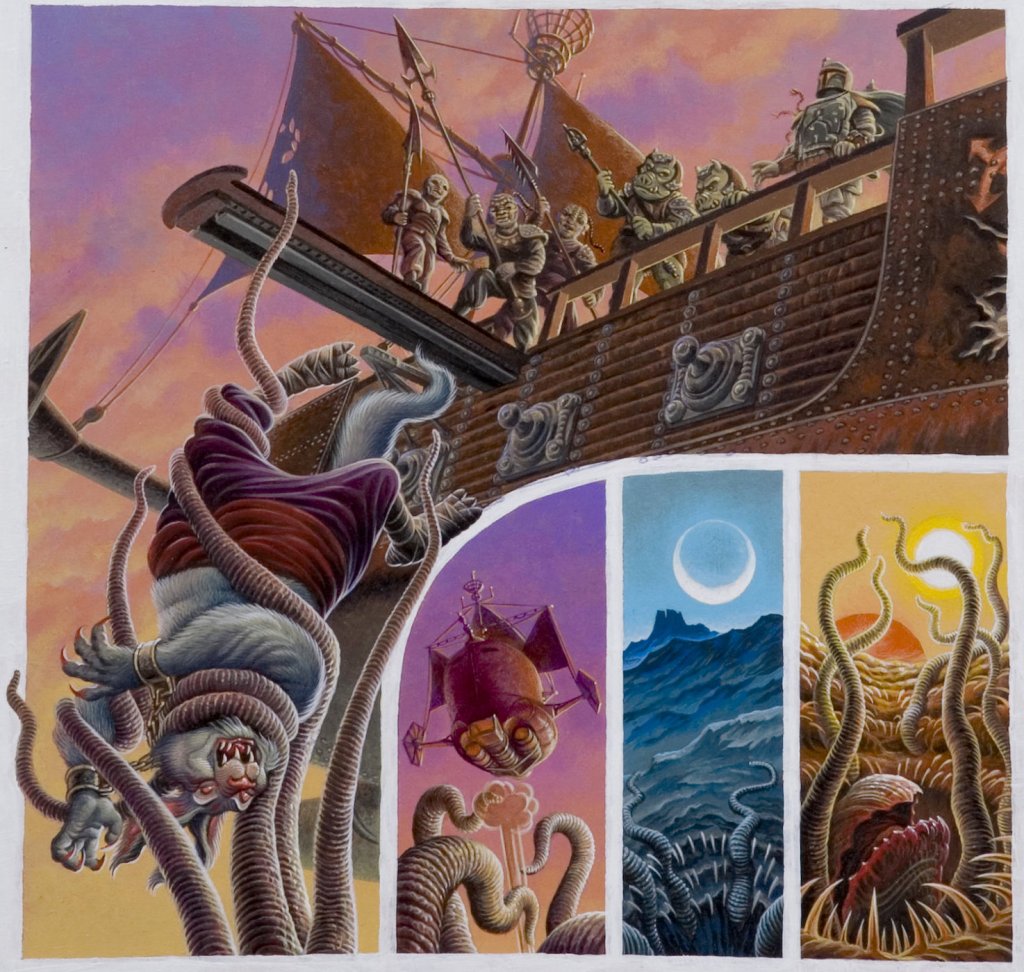
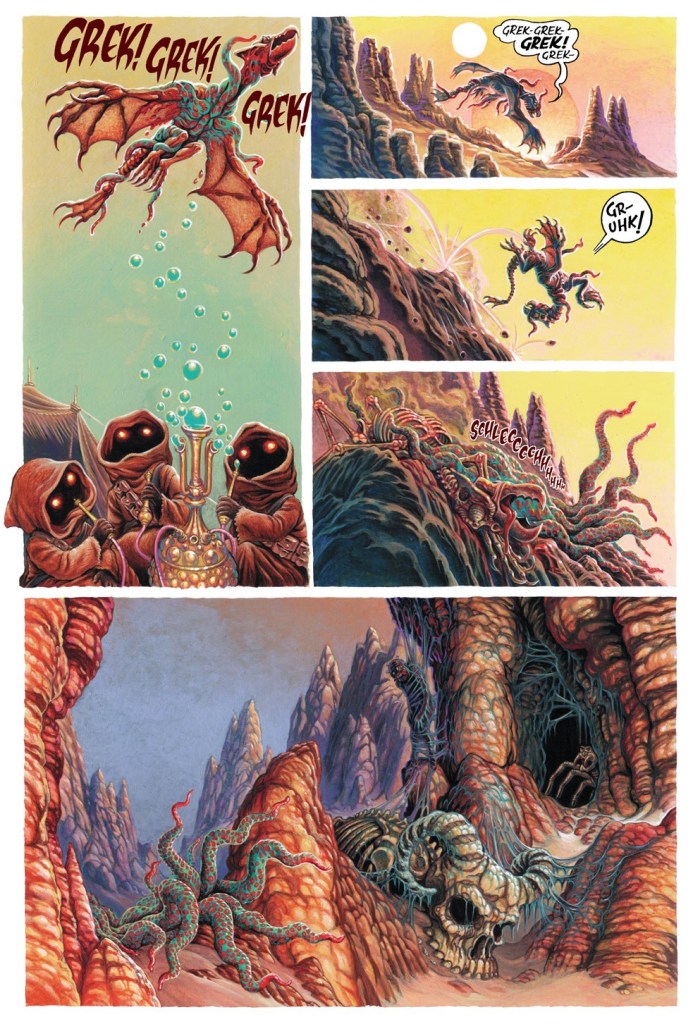
The following are pages from Fortune, Fate, and the Natural History of the Sarlacc, written by Mark Schultz and published in Star Wars Tales no. 6 (2000, Dark Horse). Watch an unfortunate victim plunge into the gullet of a merciless tentacled beast!

For comparison purposes: this is the original art…

And the following are pages from the printed comic:

I also mentioned Strøm’s career as an illustrator in children books. The results are beautiful, and, I sincerely hope, well-remunerated.

Panels from Het Zeemans – ABC (2008, Rubinstein Publishing) – or, in other words, Sailors’ ABC:

I didn’t have the heart to remove the copyright from this image! Visit Strøm’s website here. Look how many delightful tentacles one can squish into one panel!

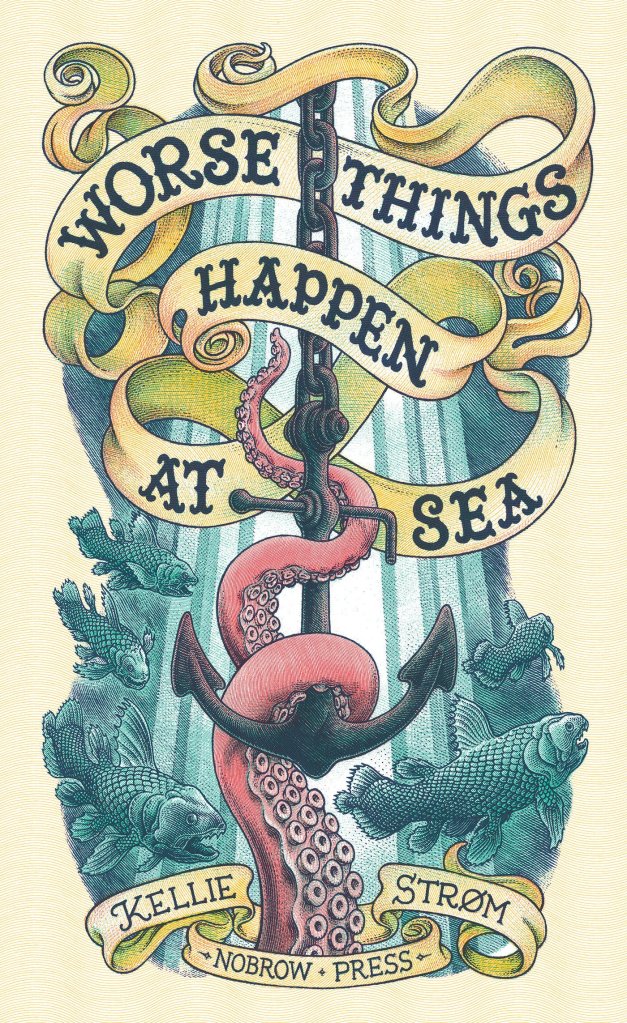
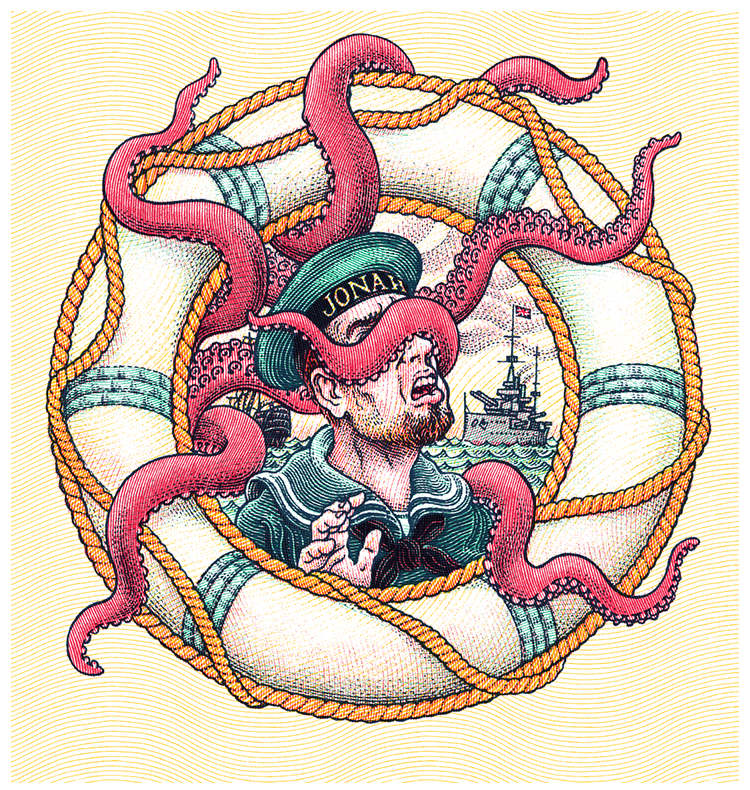
2014 saw the release of the tentacle-wealthy Worse Things Happen at Sea (Nobrow Press), in which « historical ships are attacked, enveloped and engorged by monstrous sea creatures surfacing from the deepest depths of the darkest oceans. » Must be Strøm’s Nordic roots re-surfacing, though apparently he cannot swim!

~ ds

Tentacle Tuesday: Perdonate il mio tentacolo!

I’d like to thank my Italian collega for making sure this title was in impeccable Italian, and for not backing away slowly when I asked her, completely out of the blue and without context, how to say “pardon my tentacle”. Most people would have run.

Welcome to our Latin Tentacle Tuesday! Poor Italy is the brunt of quite a few jokes, and even most positive articles about it are nothing but shallow fluff designed to sell airplane tickets and inspirational posters about food and love. All I can say is that Italians love their tentacles as much as any other hot-blooded nation. 😉

Più was a comics magazine licensed from Pif Gadget in 1982. Just like its fountainhead, Più offered a gadget with every issue, which, as I understand from nostalgic posts about it on various blogs, was a prime selling point among its young and enthusiastic clientele. As for comics, reprints of some French comics straight from Pif’s pages were rounded out with fresh Italian material. Given that Pif was publishing quite a few Italian artists at that time, this only seems fair! And on the subject of the latter, co-admin RG, whom I may call a Pif historian with no fear of controversy, has written a number of posts about the writers and artists featured within Pif Gadget’s pages during its heyday… a good place to start digging in is my favourite of these posts, Jean Cézard and Arthur le fantôme.

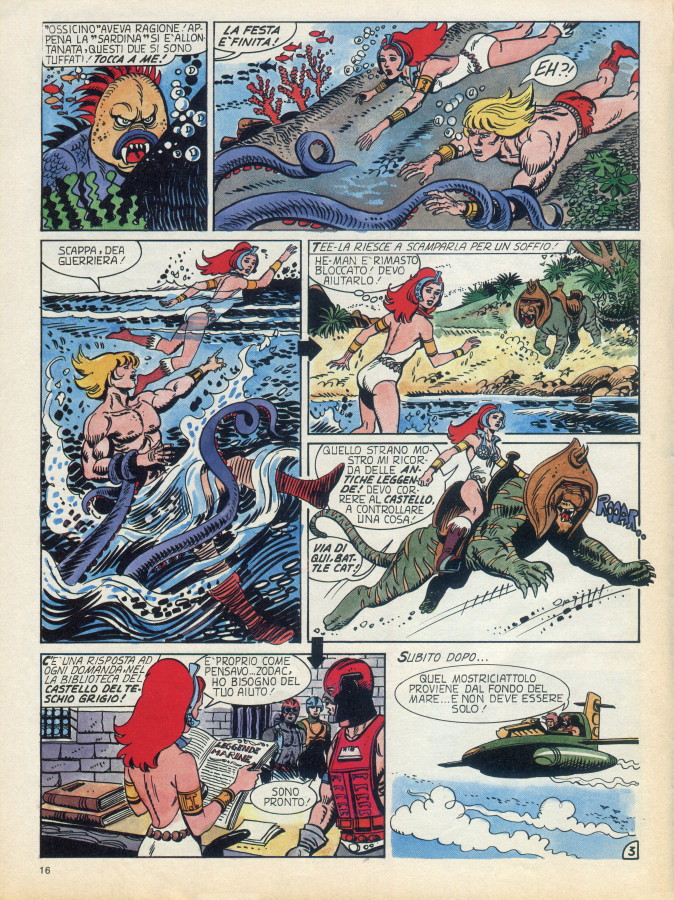
Moving on: the following Masters of the Universe pages are from Negli Oceani di Eternia, published in Più no. 76 (March 1984, Editoriale Domus).

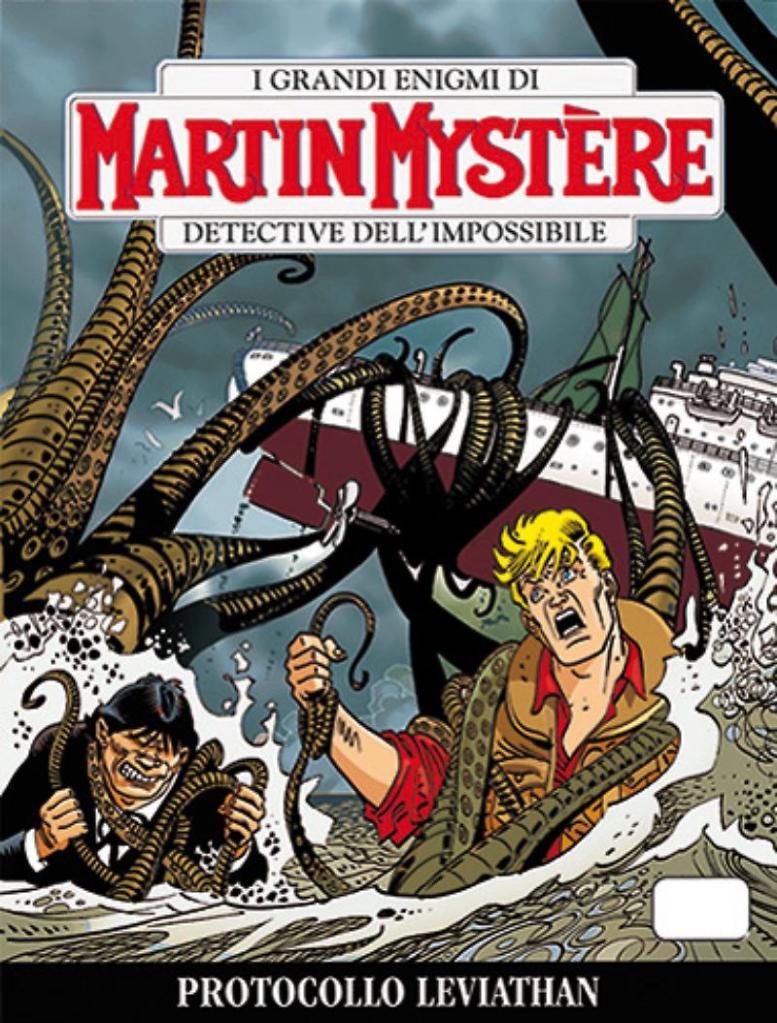
Created by writer Alfredo Castelli and artist Giancarlo Alessandrini, Martin Mystère is an exceedingly popular comic book series (as a matter of fact, the best selling comic book in Italy – in case you’re wondering what that means, around 20 thousand copies a month)*. Its title comes from the eponymous main character, Martin Jacques Mystère, the usual walking collection of tropes: good looking art historian, archaeologist-anthropologist à la Indiana Jones, collector of rare objects, and so on. No self-respecting adventurer goes around without a sidekick, and Mystère’s assistant is Java, an amazingly strong, quite mute Neanderthal man (speaking of tropes, that one is a doozy). One might also say that he’s quite international: an Italian-created American character with a French name who lives in New York City and frequently helps its finest to elucidate crimes…

*I stand corrected by one of our readers, who pointed out that Italy’s most popular comics series is Tex, which sells around 200 thousand copies a month (compared to Martin Mystère’s 20 thousand). Thanks, Darko!

Martin Mystère no. 103 (October 1990). Cover by Giancarlo Alessandrini.
Martin Mystère no. 328 (August 2013). Cover by Giancarlo Allesandrini.

This series started in 1982, and is still around, so you can just imagine how many tentacles Martin has tangled with in some 378-odd issues. Yet high-res images are scarce online, so I asked co-admin RG to whip up this nifty collage of some of his tentacular exploits:

Issues no. 163, no. 181, no. 237 and no. 297, with covers by Giancarlo Allesandrini.

Our next (and last stop) is another very popular series, Zagor. Its beginnings go all the way to 1962 (ancient, no doubt), when editor/writer Sergio Bonelli and artist Gallieno Ferri banded together to concoct a comic book series.

Its protagonist Zagor, or Patrick Wilding, is another American. If Martin Mystère represented the suave, erudite adventurer-about-town, Zagor is a kind of avenger-slash-protector, of the “be peaceful or I’ll beat the crap out of you” school. His origin story makes for rather uncomfortable reading: after tracking down massacring a whole family branch of Abenaki Indians to avenge his parents’ death and realizing that he made a boo-boo (by finding evidence that his father was a murdering, power-abusing sadist who was killed purely in retribution for his criminal acts… which is another can of worms), he decides to redeem his sins by ensuring peace between different Indian tribes and trappers by whatever means necessary.

Zagor no. 42 (December 1968), illustrated by Gallieno Ferri and written by Guido Nolitta (Sergio Bonelli’s nom de plume).
Inside art from Zagor no. 42, illustrated by Gallieno Ferri and written by Guido Nolitta.

His sidekick? Chico, a walking stereotype down to his full name (Chico Felipe Cayetano Lopez Martinez y Gonzales) whose presence is played for some mean laughs. «He is short, fat, extremely clumsy and voracious, corrupt, boastful, but also likeable.» Um, yeah, that sounds likeable, all right. If you’re thinking that Chico is also obsessed by food (he’s Mexican and fat, right?) and that it gets him into all sorts of stupid peril, you are perfectly correct. Gordo, this is not.

Interestingly, Zagor is most popular outside of his native Italy. Specifically, he retains popularity in the former Yugoslavian republics (Bosnia, Herzegovina, Slovenia, Croatia, Serbia…) and Turkey. Stories continue to be published in Italian up until this day, but from what I’ve been able to gather, the books sell at a much brisker pace once they’re translated to languages spoken by inhabitants of the aforementioned countries.

Zagor no. 626 (September 2017). Cover by Alessandro Piccinelli. Okay, so those are not tentacles per se, but it says TENTACOLI! right on the cover, so I’m not arguing.
Zagor no. 662 (September 2020). Cover by Alessandro Piccinelli.

~ ds

Tentacle Tuesday: dans la galère tentaculaire…

… in which we continue our exploration of tentacles slithering their way into Franco-Belgian comics!

In an orderly fashion, please.

The other day, a friend heartily recommended a certain movie to me, pointing out that it was ‘ancient’ and therefore probably available online for free. When I checked the year, it turned out to have been from 1995 which, excuse me, hardly qualifies as prehistoric. What can be considered ‘old’, then, people in their early thirties will ask? Why, this magazine cover, for instance.

Le Petit journal illustré (May 21st, 1922). The bottom says “a drama at the bottom of the sea”, with details of how a diver was attacked by an octopus and cannot get out his knife to fight against his repellent aggressor.

Skipping some thirty years ahead, I believe we’re still in “old” territory.

A page from « Zette reporter : Aventure en Pacifique », published in Lisette n° 38 (September 16th, 1956). Script by François Drall, illustration by Yvan Marié. The girls, after witnessing a fight between a giant shark and octopus, now seek to escape the clutches of the victor’s eight appendages.

Lisette was a comics magazine specifically aimed at female readership (to be more precise, it was marketed to girls between 7 and 15 years old). The interesting part is that it often featured articles about traditionally men-dominated careers, some of which had only been very recently accessible to women… for instance, an interview with Anne Chopinet (one of first women accepted in l’École polytechnique) and a reportage on women air pilots back when this was an almost exclusively man-only club.

Moving on to further, more energetic octopus-evading tactics… we have Bob Morane, originally a hero harking from adventure books written by prodigiously prolific Belgian novelist Henri Vernes, and published by Belgian éditeur Marabout. The number of adventures Morane has lived through is rather staggering: around 200 novels + about 80 comics albums. Now there’s a challenge for the serious collector!

Original art from Bob Morane et l’oiseau du feu (1960). Illustrated by Dino Attanasio.

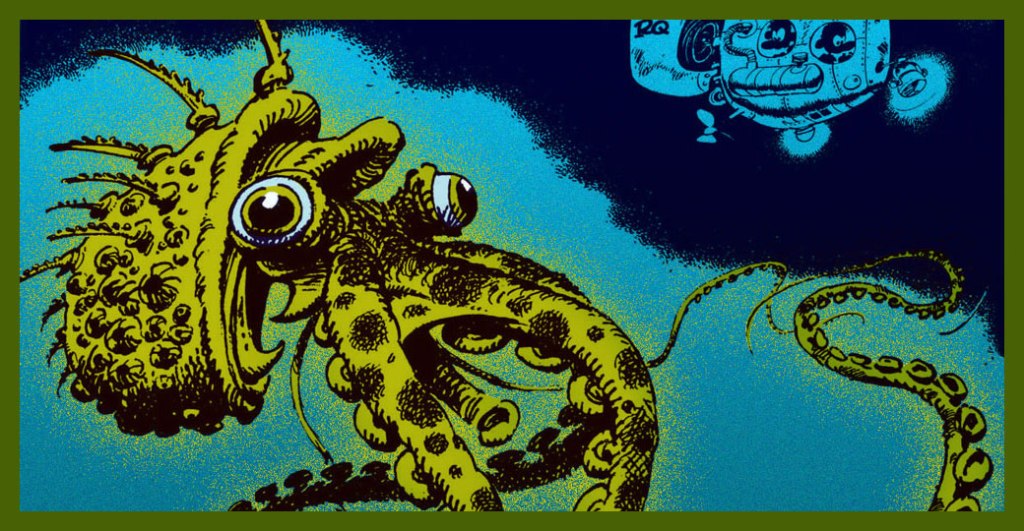
Co-admin RG has already spoken about Toute la gomme, but he kindly held back this terrific tentacular page for my TT feature!

Scripted by Antoine Raymond (a.k.a. Vicq), illustrated by Will, 1962.

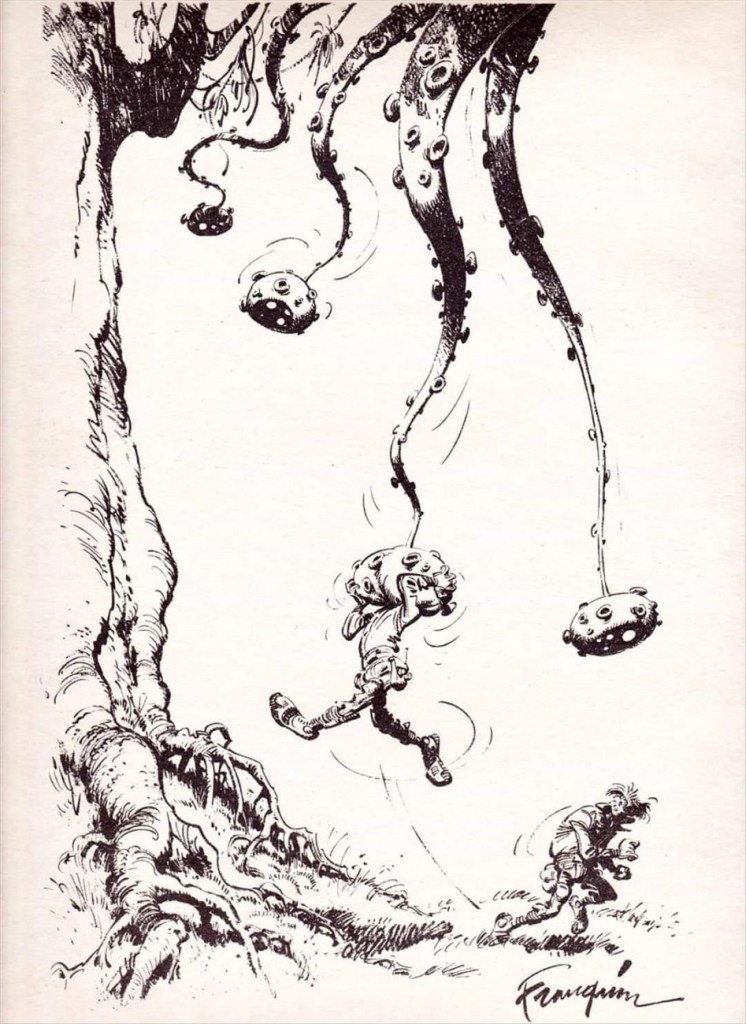
Co-admin RG called André Franquin‘s œuvre “an embarrassment of riches” in his Faites gaffe, monsieur Franquin! post. I thoroughly agree, and am very pleased to report (though this is in no way surprising) that tentacles are part of his vast répertoire.

Pages from what’s collectively known as Idées noires (Franquin’s Last Laugh in English). These dark strips and cartoons were Franquin’s « l’humour du désespoir », the humour of despair, and appeared in Le trombone illustré (Spirou’s magazine supplement) in 1977 and, with the discontinuation of the latter, moved to Fluide Glacial until 1983.

I’d better stop here. After all, I wouldn’t want to go as far as ‘modern’ times… say, from the 90s and onward, although it’s scary to think that was still 30 years ago!

~ ds

Lovely colours (by co-admin RG), aren’t they?

Jean Barbe, Architect of the Absurd*

« In my youth I thought of writing a satire on mankind! but now in my age I think I should write an apology for them. » — Horace

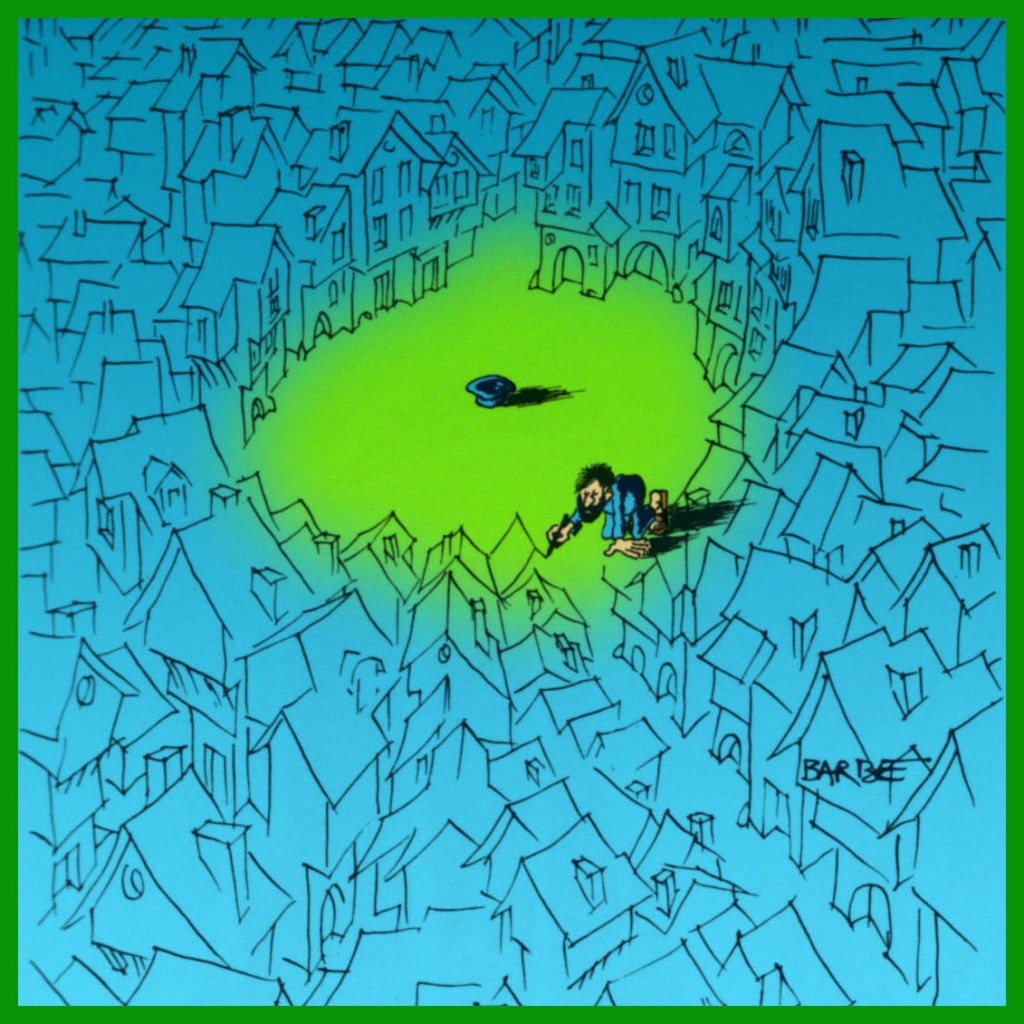
Cartoonist and illustrator André-François Barbe (1936-2014) was born in Nîmes, France.

After an abortive stint in the French air force, he spent a few years fiddling around in Air France’s employ. His earliest professional drawings saw print in the venerable Le Rire (1894-1971) in 1958. After a few years of tentative, but increasingly encouraging results, he finally made his decisive move in 1965, joining the shaky ranks of full-time cartoonists.

Fittingly, Barbe was an unabashedly chatty man in person… while his work scarcely required words.

While frequently satirical in subject, Barbe’s approach never stoops to easy mockery or gratuitous acerbity. Instead, one finds grace and lyrical elegance… now and then flavoured with a tangy venom chaser. In this finespun register, I’d place him in a class with the likes of Saul Steinberg, Jean-Jacques Sempé, Jean-Michel Folon, Jean-Claude Suares, Guillermo Mordillo, Shel Silverstein, Joaquín ‘Quino‘ Lavado and Maurice Henry.

A self-portrait of the bewhiskered (of course!) young artiste at his easel.
Remember how deep our television sets used to be?
This one anticipates a similar concept later mined by his Argentine contemporary, Guillermo Mordillo. To wit, check out co-admin ds’ Mordillo gallery… you’ll know just which cartoon I mean.
Like Gerard Hoffnung before him, Barbe was a connaisseur of classical music. He would frequently return to this theme.
M.C. Escher meets the bourgeois promeneurs!
He takes on the Army…
… and the Clergy…
… and the bourgeoisie.

By the early 1970s, Barbe was increasingly devoting his pen and his interest to erotic subjects, and that’s the work he’s most associated with. Though that material held greater commercial clout, the work remained flawlessly executed and formally explorative… at least at first. Then, I’d argue that it became a bit of a cul-de-sac. Personally, I’ve always found it a bit chilly in its execution, quite a liability for erotica. Your kilométrage may vary.

Speaking of distances, Barbe was always a bit of a routard, an adventurous traveller. Here’s one instance of particular interest:

In the 1980s, on the initiative of his brother Michel Barbe, a history and geography teacher in Marseille, he took part in a conference given by Haroun Tazieff on the subject of volcanism. Owing to the quality of his drawing skill, he was allowed to accompany, in 1982, an exploratory scientific journey to the volcanic region of the Djibouti Rift. This expedition, led by Lucy co-discoverer Maurice Taieb, enlisted 32 professors who explored the basalt flows in the Assal Lake depression.

-RG

*a handy description I’ve rifled from the ever-erudite Jacques Sternberg.

Hallowe’en Countdown IV, Day 28

« The world dies over and over again, but the skeleton always gets up and walks. » — Henry Miller

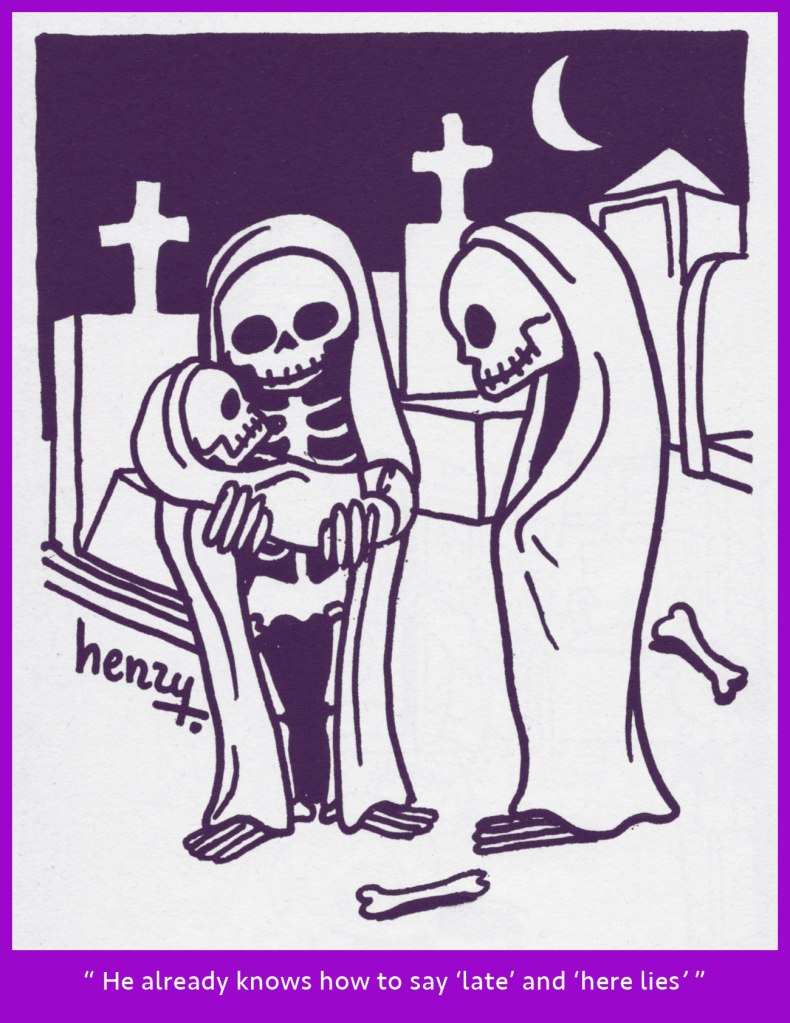
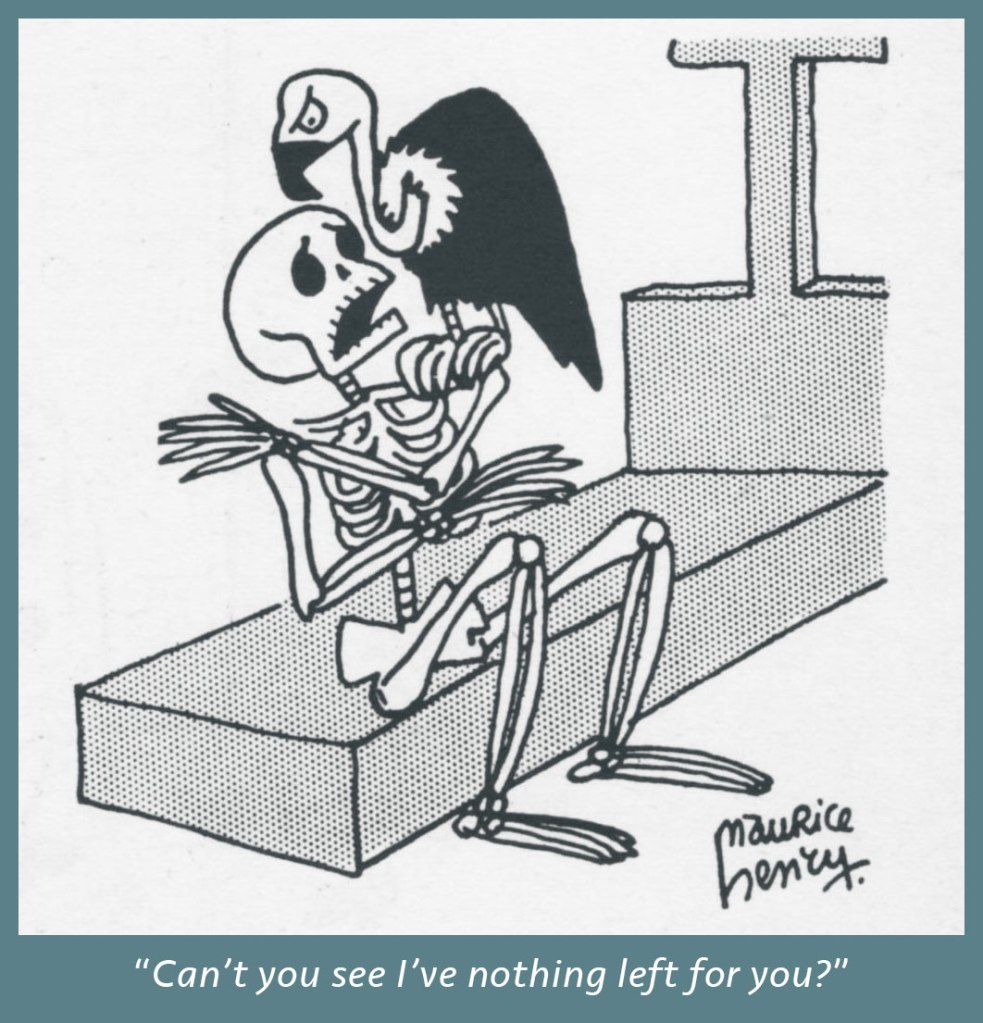
A few months back, while assembling a post about polymorphic French surrealist Maurice Henry (1907-1984), I marvelled and chuckled at his multitude of skeleton-themed cartoons. I made a mental note to devote a Hallowe’en post to them… and that memo only floated to the top of my consciousness a couple of days ago. Just in time!

(1935)
(1936)
(1938)
(1940)
(1941)
(1947)
(1950)
(1950)
(1958)
This one doesn’t feature skeletons, but I had to include it, given how stunningly *dark* it is for its (or any) era… can you imagine something like this published in the USA in… 1935? For more context, here’s the Bluebeard ditty.
In closing, and just for kicks: sixteen faces of the playfully photogenic Monsieur Henry. This one-man assembly featured on the back cover of Maurice Henry 1930-1960 (1961, Jean-Jacques Pauvert), a remarkable collection.

Trust me, I’m only scratching the surface of this man’s genius. If you’ll bear with me, we’re not done with him.

-RG

Hallowe’en Countdown IV, Day 23

« A detective sees death in all the various forms at least five times a week. » — Salvatore Albert Lombino, aka Ed McBain, aka Evan Hunter

Spanning nearly a full century since yesterday’s instalment, we now move ahead to a recent work from my favourite European bédéiste of the past quarter-century, David Beauchard, better known as David B. (b. 1959).

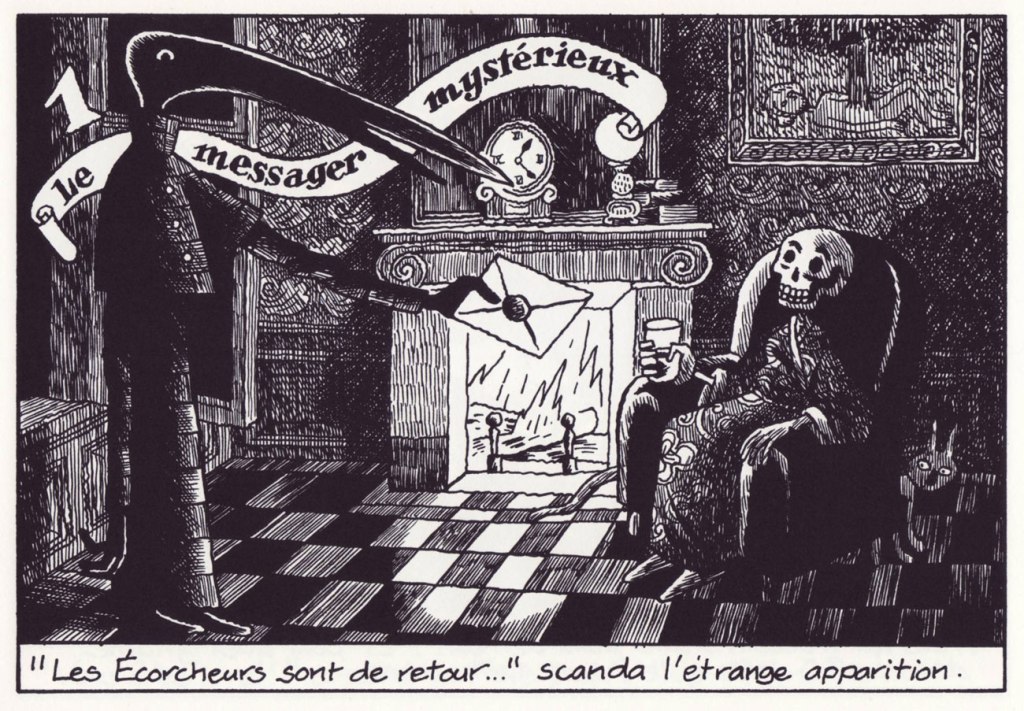
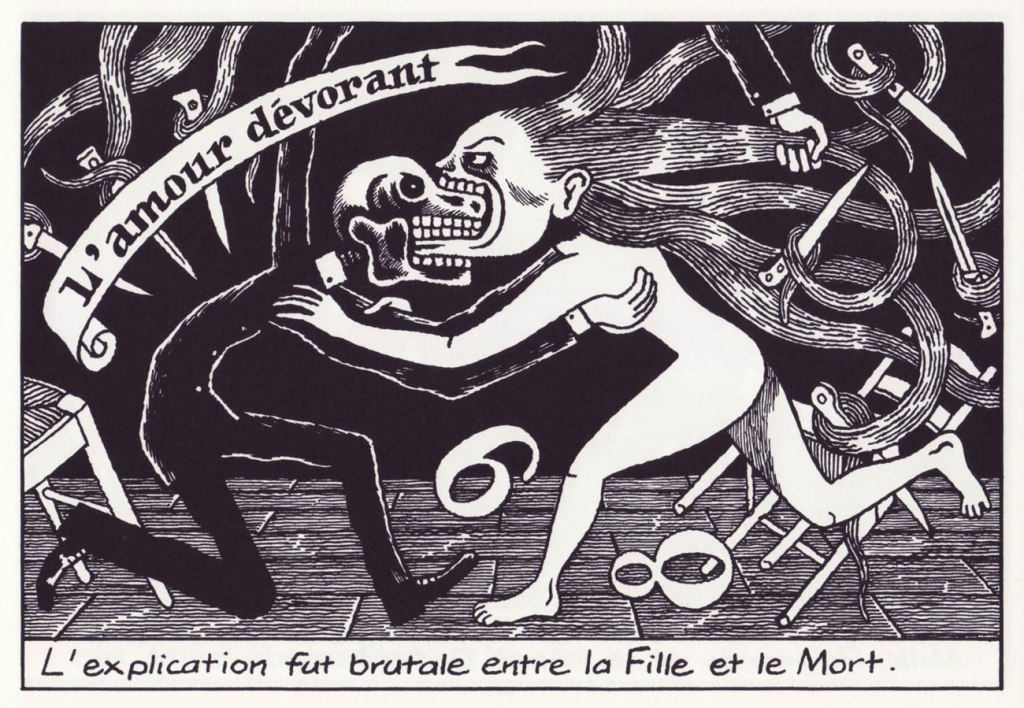
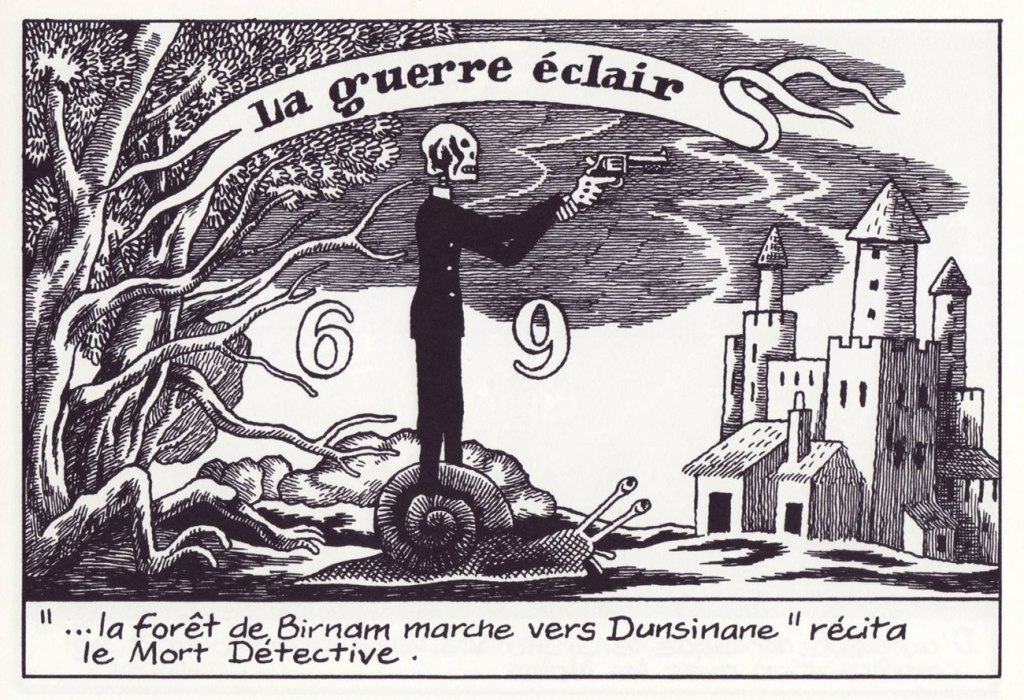
Among the traits I most admire in Monsieur Beauchard are his artistic integrity and his explorative drive. To wit, here he evokes the grimy spirit of late 19th century feuilleton serials, providing a narrative consisting of illustrated chapter headings… devoid of the main text. The reader is left to fill in the narrative gaps, enlisted in a bold compact with the artist and required to draw upon his own imagination.

A few choice excerpts (I left out the bits with tentacles… it’s not my department, after all!):

Le mort détective was issued just last year (yes, roughly an eternity ago) by rightly-celebrated French publisher L’Association.
So it begins… with the title page, naturally.
1 – The mysterious messenger: “The Flayers have returned…‘ chanted the strange apparition”.
2 – The skinned dwarf: “But who needs a dwarf’s skin… and to what ignoble purpose?“, panted the Dead Detective…
6 – The dwarf-skin coat: “The Great Old Man is a priest of the Yellow Dwarf God‘, murmured the Dead Detective to the Girl of a Thousand Daggers…”
10- The macabre post: “The Bad Postman distributes mysterious mailings.”
11- The word from the Hereafter: “The severed head exhaled a terrifying prophecy.”
22- The mass grave: “The Girl of a Thousand Daggers has sent a bouquet.“, he said in a dying voice.
41 – “The altar of fear: “Let’s flee!‘, exclaimed the Girl of a Thousand Daggers.”
68 – “The Devouring Love: Explanations were brutal between the Girl and the Dead One.”
69 – “The Flash War: … ‘Birnam Forest walks towards Dunsinane‘, recited the Dead Detective.”

-RG

Hallowe’en Countdown IV, Day 18

« Feminism encourages women to leave their husbands, kill their children, practice witchcraft, destroy capitalism and become lesbians. » — Pat Robertson

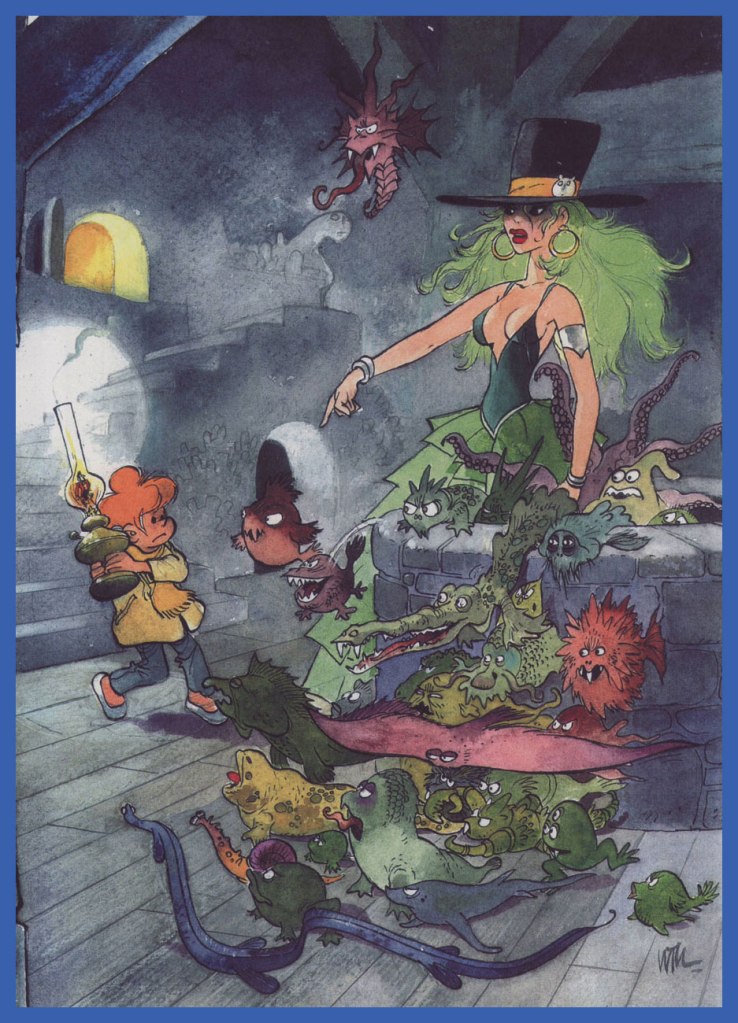
Truly one of the crown jewels of Franco-Belgian comics, Isabelle (1969-1995) has quite a pedigree: it was conceived by scripters Yvan Delporte, Raymond Macherot and illustrator Willy Maltaite, alias Will. When Macherot took ill, the legendary André Franquin stepped in, and the series took on a slightly more sombre shade, and its characterisations gained further depth. The best of all possible worlds, truly.

Brimming with magic, poetic grace, wit and atmosphere, Isabelle gave us, for a change, a level-headed and resourceful little girl in a world of infinite possibilities. I can’t stress this point enough: unlike every other little girl character in supernatural fantasy tales I’ve ever encountered, Isabelle doesn’t trip over roots, gasp loudly or drop a glass at the wrong time; she doesn’t disobey solemn, life-or-death instructions against all common sense. And yet she’s just an ordinary little girl, not a secret ninja or a princess in hiding. Truly refreshing. After reading Isabelle, most of what passes for fantasy is shown for the formulaic, stock dreck that it is. This is the genuine article.

In the mid-90s, publisher Les Éditions Dupuis brought the series to an unceremonious end, judging its sales numbers insufficient. Ah, but Isabelle has its fans, and a tenacious lot they are. Dupuis’ rival, Les éditions du Lombard (home of Tintin, and now merged with Dargaud, home of Astérix et Obélix) collected the entire series in 2007, in three stunning volumes rife with priceless documentary extras. Absolute bande dessinée nirvana. Good luck getting copies these days, sadly.

The cover of weekly Spirou no. 1929 (Apr. 3, 1975, Dupuis), beginning the serialization of the seventh Isabelle story (and her third album), Les maléfices de l’oncle Hermès (collected in book form in 1978). This is where two of the series’ pivotal characters, the titular Oncle Hermès and his eventual paramour, sexy witch Calendula, were introduced, not to mention her evil ancestress (the original) Calendula, the series’ archfiend.

The album in question, in its original edition (1978).
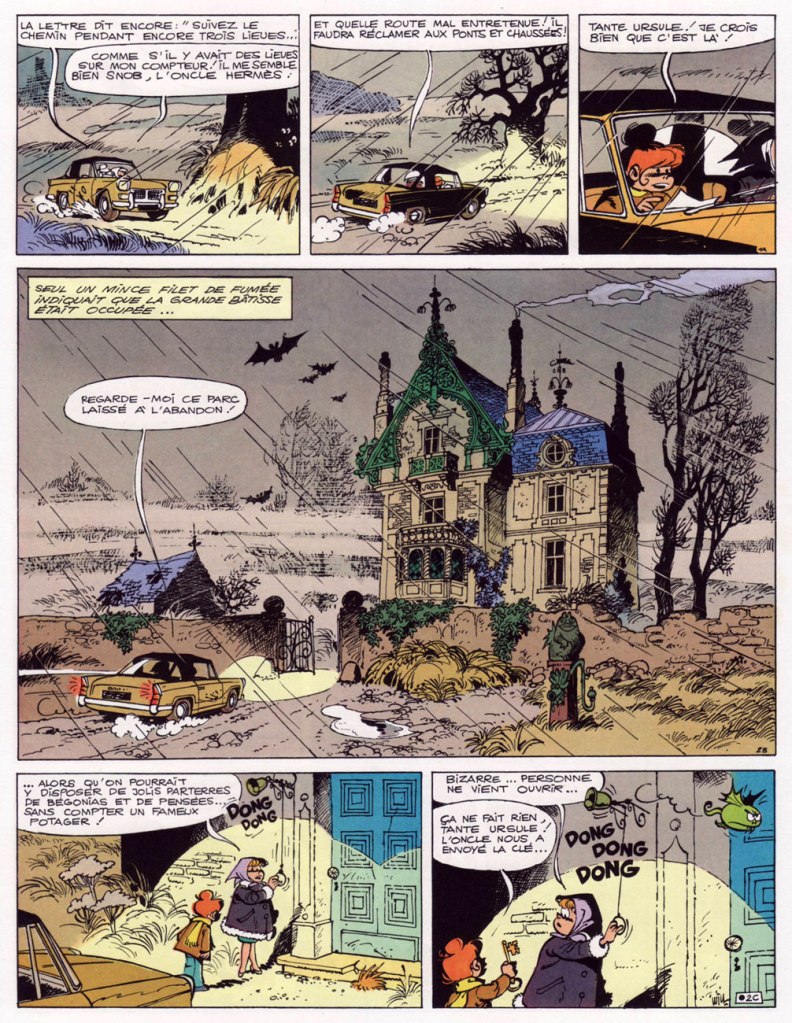
Page 2 of Les maléfices de l’oncle Hermès. During a long career shackled to characters he didn’t own (i.e. Tif et Tondu), Will was thrilled to work on a series of his own, one closer to his own interests and preoccupations. Dig that mood!
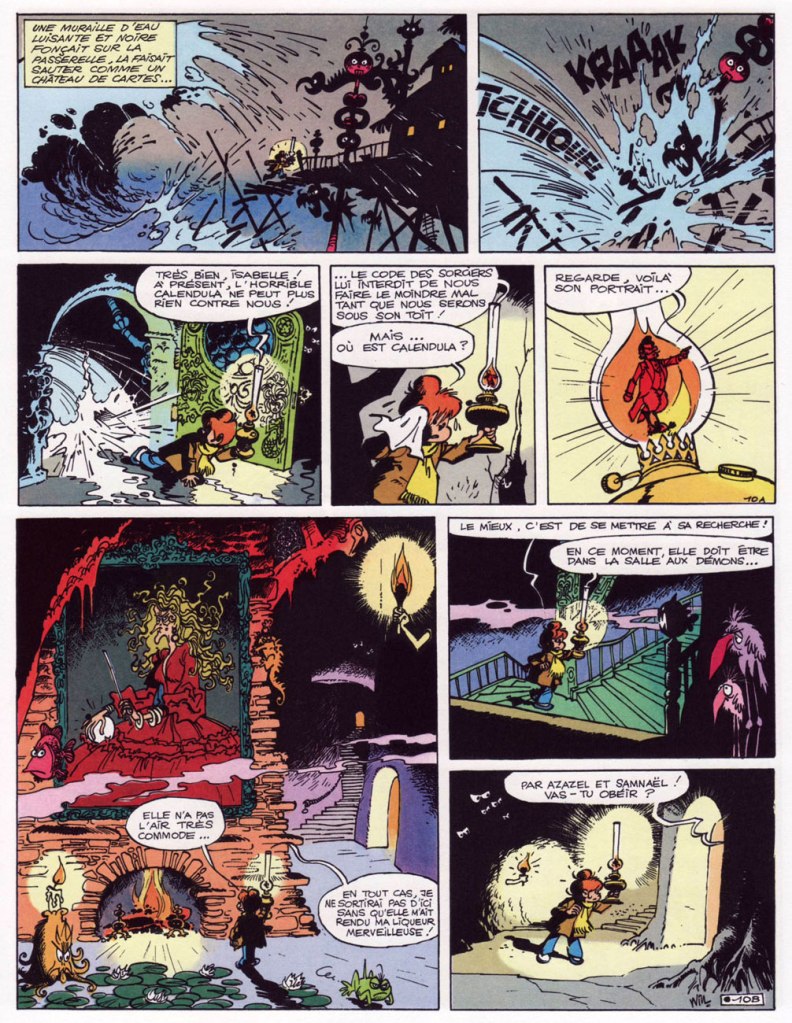
Page 10 of Les maléfices de l’oncle Hermès. Cloven-hoofed Oncle Hermès, the victim of a centuries-old curse, is trapped in a flame, and his great-great-great-great (etc.) niece Isabelle is endeavouring to set him free.
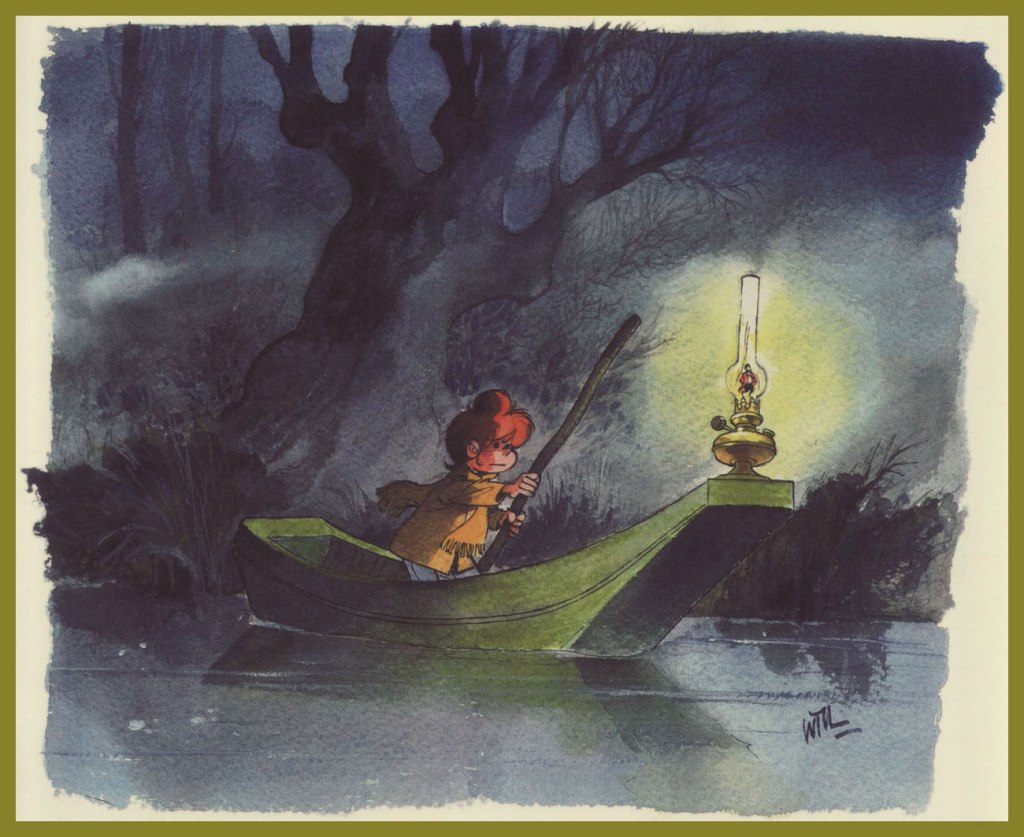
The journey is, of course, quite perilous… and the visuals gorgeous.
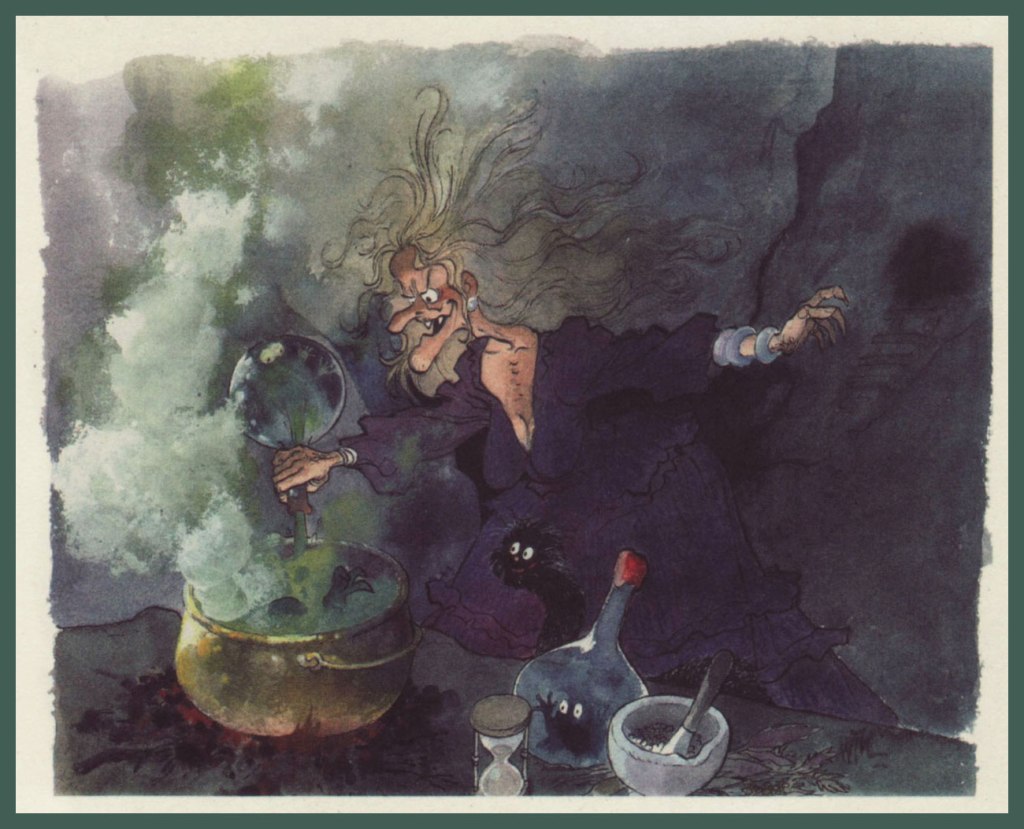
This is the original spell-caster, malevolent Calendula.
And this is her descendant of the same name, on the side of good, though she does have a temper.
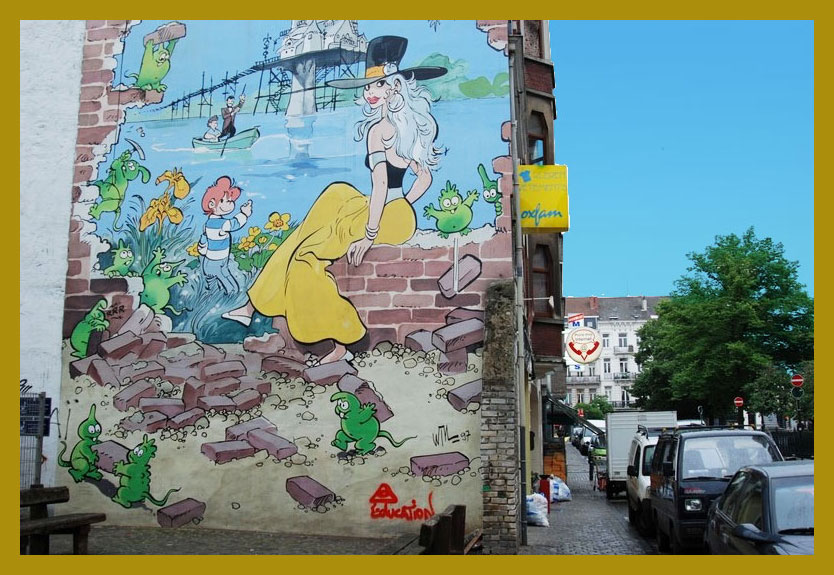
Isabelle and Calendula (and friends) feature as part of Brussel’s delirious Parcours BD. Does your hometown appreciate its comics this effusively and concretely? (update: The Isabelle mural was painted over in 2016, I regret to say.)

-RG

Éric et Artimon: Some Choice Bubblegum!

« Flattery is like chewing gum. Enjoy it but don’t swallow it. » — Hank Ketcham

Going way back: When I was a wee lad (still in the single digits), my mother would accompany me to our area’s oldest and finest bookstore (Chicoutimi’s long-gone Librairie régionale). At the time, I had been purchasing bound collections of Belgian bédé publisher’s Spirou, the earlier the better. Even at that tender age, I held the conviction that things had already peaked.

A friendly employee ushered us into the restricted area of the bookstore’s top floor, a vast warehouse I never got a tour of… but it was immense! I was led to an aisle where, high above, dozens of older Spirou collections were kept, dating all the way back to 1962. I can afford to be specific, because I bought the oldest issue they had on hand (Album Spirou no. 84). At ten dollars a pop, they were reasonably-priced, but still costly for a child with a 1970s-scale allowance. For my parents, a reliable source of ideal birthday and Christmas gifts, however!

It was in their pages (no. 90, see below!) that, along with the established Spirou magazine series (Spirou et Fantasio, Boule et Bill, Buck Danny, Benoît Brisefer, Tif et Tondu, Gil Jourdan…), I encountered scads of unfamiliar entries. Of these, an early album caught mid-tale one that truly stuck with me through decades and therefore is the object of today’s post.

This is Album Spirou no. 90 (Sept. 1963, Dupuis), collecting the bédé weekly’s issues n° 1316 to 1328. Cover by André Franquin, depicting a scene from a Spirou adventure, the troubled production that was QRN sur Bretzelburg (under its original title, QRM sur Bretzelburg).

I’d be squandering time and space to retrace Belgian master Willy ‘Will’ Maltaite‘s biography, as Lambiek covers the topic in great detail and with the requisite visual profusion.

In short, though, here’s what’s relevant in this case: from 1949 to 1987 (with a pause between ’59 and ’63), Will illustrated the adventures of Tif et Tondu, characters owned by Éditions Dupuis, its publisher. Still, he longed to draw characters of his own, which wasn’t an idle whim, given that most of his colleagues and collaborators did just that, enjoying more latitude and far greater financial rewards. In 1962, he got the chance to try his hand at an original series, Éric et Artimon, conceived with versatile scripter-cartoonist Raymond Antoine, alias Vicq. And the result was outstandingly charming, light-hearted and hilarious.

The 1976 (and only, so far) edition of Toute la gomme. Still, I'm grateful for its existence: I was finally able to read the whole story, though without colour.
The 1976 (and only, so far) edition of Toute la gomme. Still, I’m grateful for its existence: I was finally able to read the whole story, though without colour.

A mere two long adventures (44 pages each) were produced (Le tyran en acier chromé, 1962, and Toute la gomme, 1963, plus a six-pager, Et mine de rien, in 1967), and Dupuis never bothered to collect or reprint them. Instead, well down the pike, two separate, smaller publishers licensed the rights and issued small black and white runs of, respectively, Toute la gomme (Espace Édition, 1976) and Le tyran… (Magic Strip, 1983).

Candy aficionado Éric visits his main supplier, loveable eccentric Monsieur Grosoison, at his confiserie ‘Au bambin vorace’ (‘The Voracious Toddler’). The old man, also a brilliant inventor, shows off his new creation to his best and most loyal customer. The stuff’s not only downright magical, it’s also exquisitely delicious.
« Such lungs! Bravo! You are a great artist! »
However, Tarquin doesn’t like his good-natured fun interrupted.
The back cover of Espace’s Toute la gomme, wherein Éric employs ingenious means to escape a rooftop.
The opening page to the short concluding episode of the boy and the captain’s adventures, Et mine de rien (Spirou n° 1506, 1967).
And here’s the fancy 1983 edition of Le tyran en acier chromé, scarce and fairly pricey nowadays, unlike Toute la gomme.
Thankfully, Éric et Artimon haven’t been entirely forgotten, despite the shabby treatment they received at the hands of their original publisher. Here’s a signed lithograph produced in the early 1990s by Belgian bookstore Chic-Bull. Note the fancy silver ink on the statue. Mine’s number 48!

I’ll be spotlighting Will’s other creator-owned series, Isabelle, at some point during this year’s Hallowe’en Countdown!

-RG