Panning the murky old print stream for the odd glimmering nugget
By the Light of the Silver Age
We know when the Silver Age begins, but when exactly does it come to a close? Since it’s just arbitrary retrofitting, a bunch of events and dates have been posited, mostly from the early 1970s: Kirby leaving the Fantastic Four and Marvel, the “relevance” of Green Lantern/Green Arrow… The cut-off points of decades have been pretty misleading in the past while the middles have often been more pivotal: for instance, the years 1955 to 1965 are more of a piece than 1950-60, for instance. Same goes for 1965 to 1975. I therefore deem the end of the Silver Age to be the end of 1975, when Carmine Infantino stepped down as DC publisher, along with his brilliant art director Nick Cardy. Replace them with inexperienced Jenette Kahn* and the legendary (but not in a good way) Vince Colletta as art director, and you have a pretty massive sea change. Compared to that, comics from 1969 are virtually identical to releases from 1970. *creating Dynamite Magazine for Scholastic is what got Kahn the job. She only stayed for four issues, and Jane and Bob “R.L.” Stine likely did most of the heavy lifting, since the magazine only improved following Kahn’s departure. – RG
« True friends stab you in the front! » — Oscar Wilde
First, the update: we’re off to Belgium for a much-needed vacation… which is frankly incompatible with our usual Hallowe’en Countdown.
Surely you can still get into the spirit of the season by revisiting any of the eight previous editions.
We’ll still try to post as often as possible, and I promise you that the topics all will honour the mischievous spirit of All Hallows’ Eve.
To wit: a few years ago, George, exalted founder of trefology… and assiduous friend of WOT?, asked me to track down — and hopefully feature — an elusive story he recalled from his callow youth. He described the plot, which rang a bell… at least that’s what I said at the time. Last month, he gently reminded me of my mission and, this time, I’m seeing it through.
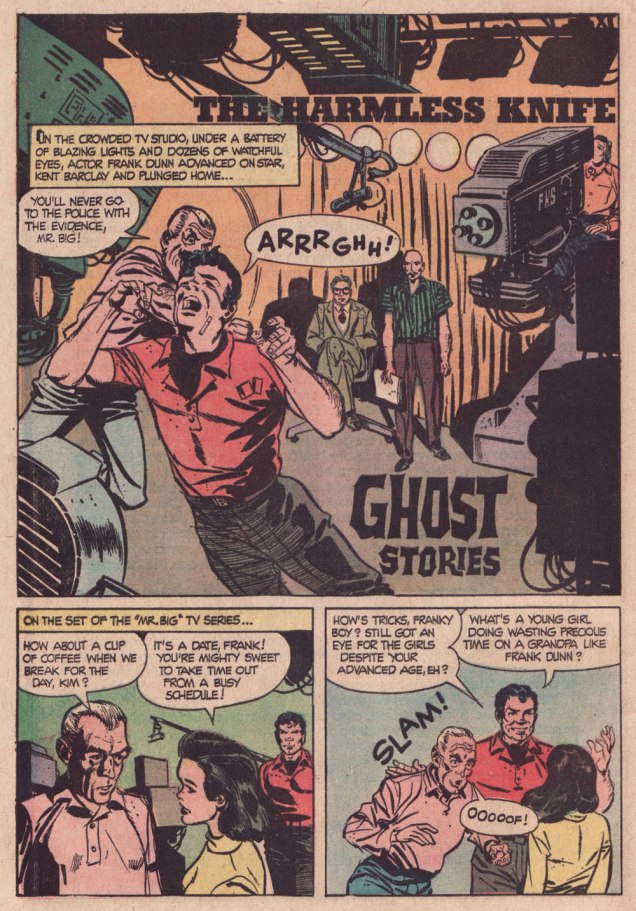
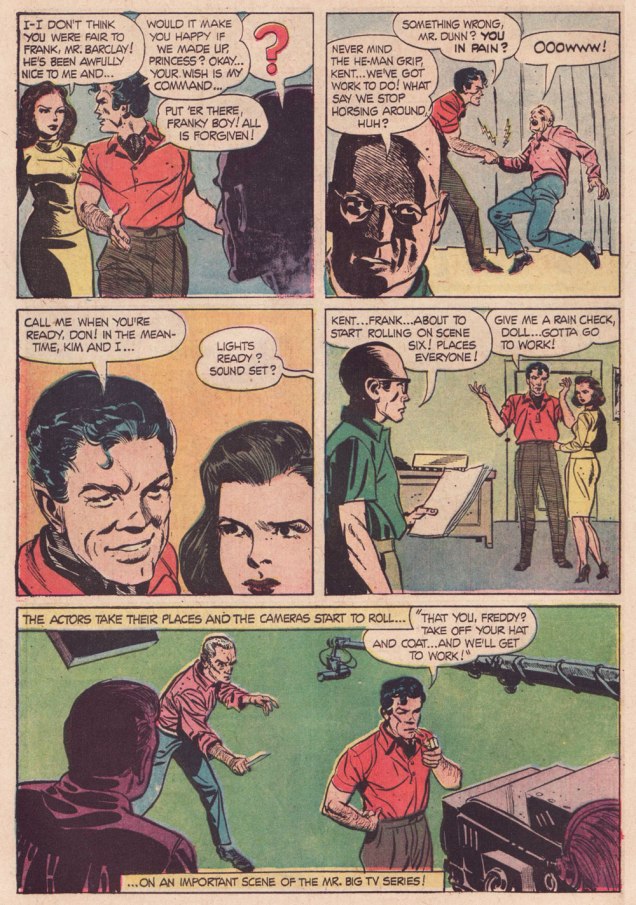
And so here’s The Harmless Knife from Ghost Stories no. 14 (June 1966, Dell), later reprinted in Ghost Stories no. 34 (Oct. 1972, Dell)… which is where George encountered it.
Here’s his reaction:
THAT’S IT! Ah, I remember it well.
I’m pretty sure I bought that comic at a little roadside grocery near Strawberry, CA. We usually spent most of the summer on the beach, and comic books were an essential part of my day.
My mom loved the area so much she eventually moved there (with all my comics in tow—so, in a manner of speaking, my Dell horror comic returned home).
As was generally the deplorable case with Dell, no credits. Therefore… writer unknown, but pencils and inks by Frank Springer (1929-2009).
.
.
.
.
.
Amusingly, I’d featured another story, A Room With a Dreadful Secret — from the very same issue! — a few years ago. Read it so I won’t have to repeat myself needlessly… thanks!
« My collection of criminal creeps will get a real charge of hokey hassle of heroes! » — The Collector
Just last week, I read the bittersweet news that after half a century or so*, the evergreen, once-ubiquitous Archie Comics Digests are kaput… which brings us, in the usual roundabout fashion, to today’s post.
Though it’s been nearly three years since our big move, I expect to carry on practicing box archeology for a good long while, if not indefinitely. A couple of months ago, I dug out an Archie Digest I had picked up at my local newsstand back in 1981… and quite possibly never read. Until this year.
I’ve mentioned before that comics distribution was extremely spotty in my neck of the woods, so I often found myself glaring and wincing at the racks in desperation and taking home some ungainly specimen*. This was such a case, obviously.
This is Captain Hero Comics Digest Magazine no. 1 (1981, Archie). Stan Goldberg’s cover is unspectacular, but better than his usual. Earlier this week, I got a good chuckle out of someone stating online that Goldberg “could do a damn good Dan DeCarlo“. I’d have to agree: Goldberg, at his peak, was nearly on the level of DeCarlo at his worst. Think I’m kidding? Here’s an example.
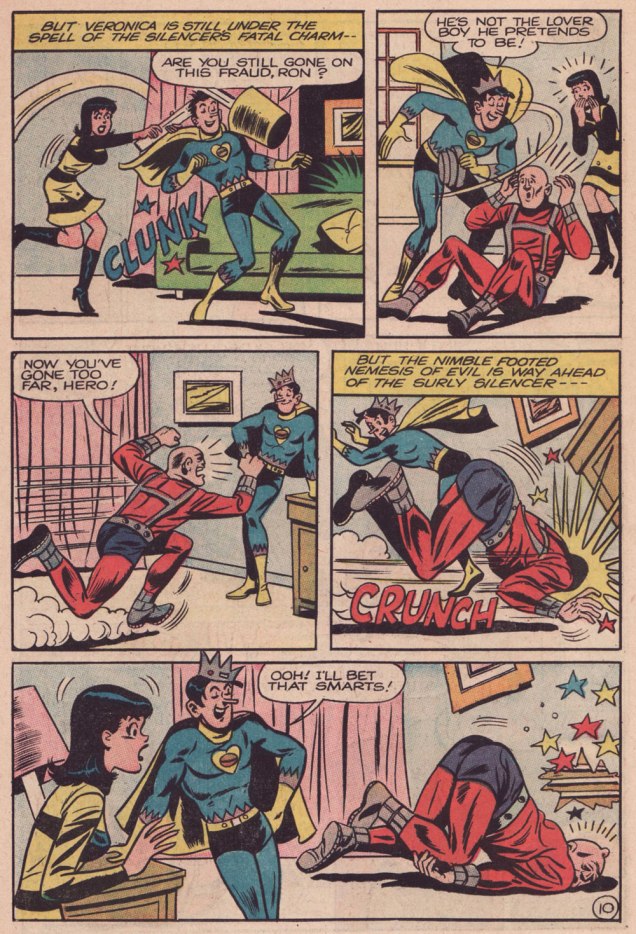
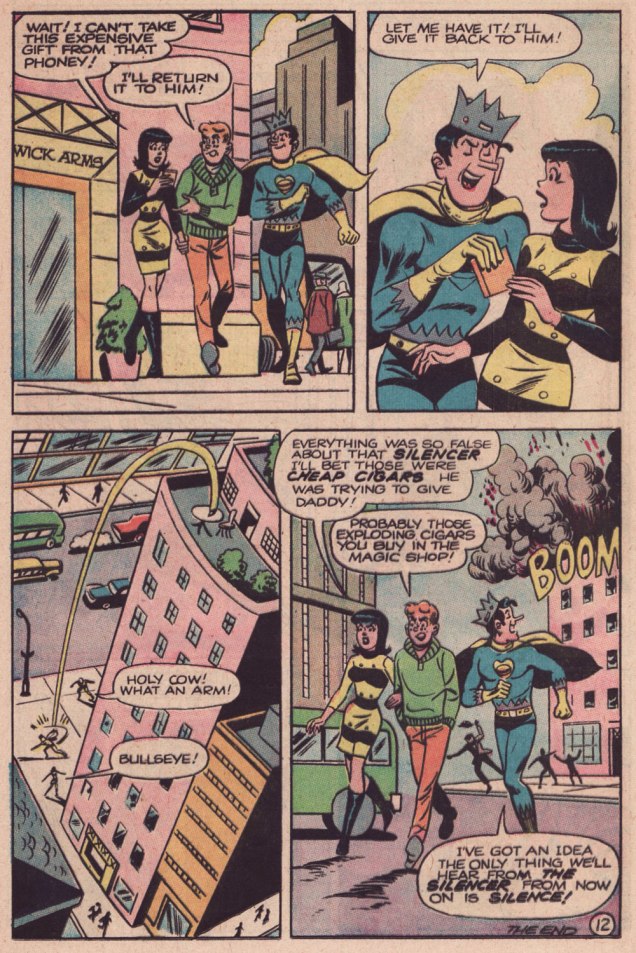
The Riverdale-Gang-as-Superheroes of the mid-1960s, just another bit of trend chasing** by the Archie brass, has never elicited much beyond a shrug from me. It certainly was intended as a cynical, junky cash grab by the higher-ups, but… sometimes it rose above the brief.
Bart Beaty wrote, in his 12 Cent Archie (2015, Rutgers University Press), that « On the whole, while the Pureheart material is remembered — and collected in contemporary trade editions — for its novelty within the Archie universe, it is clear that the innovation was not a particular success. The combination of Archie sensibilities and superheroes paid few dividends. »
Well, innovation wouldn’t quite be the term I’d opt for, but while the Pureheart stories are as underwhelming as surmised, but since Jughead, Reggie (as Evilheart) and Betty (as Superteen) are more interesting characters than plain ol’ Arch, it is fitting that their exploits are more compelling.
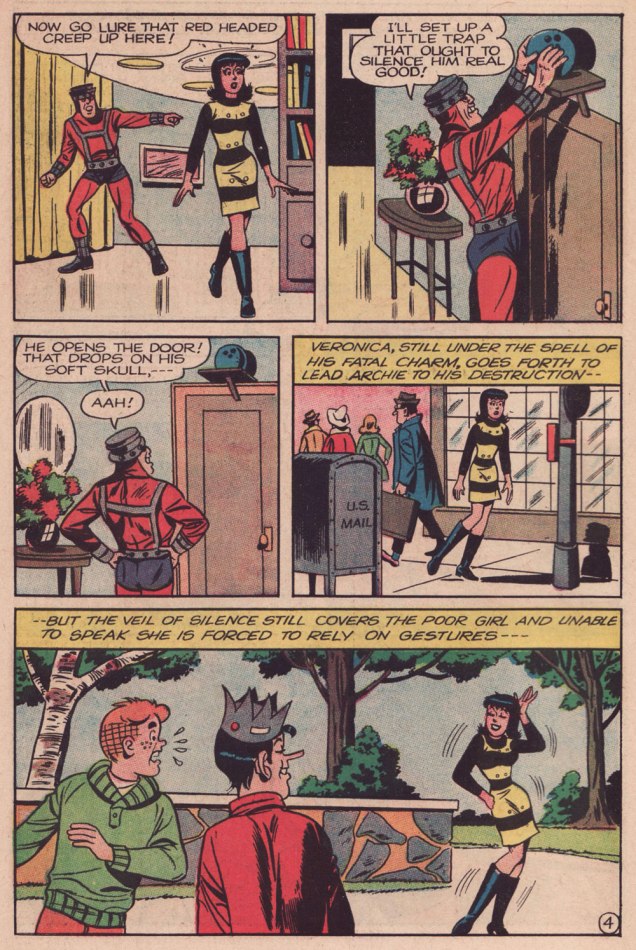
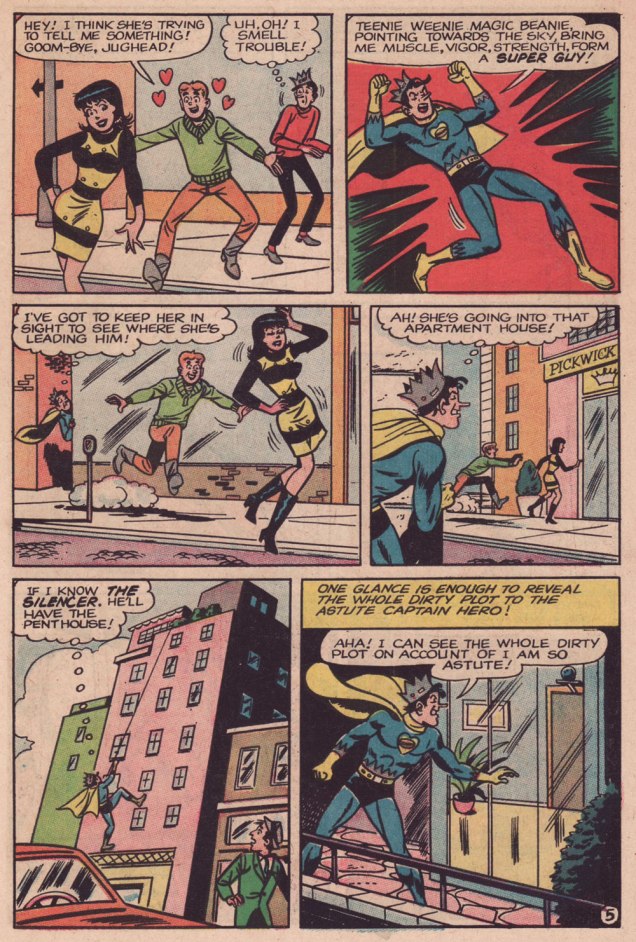
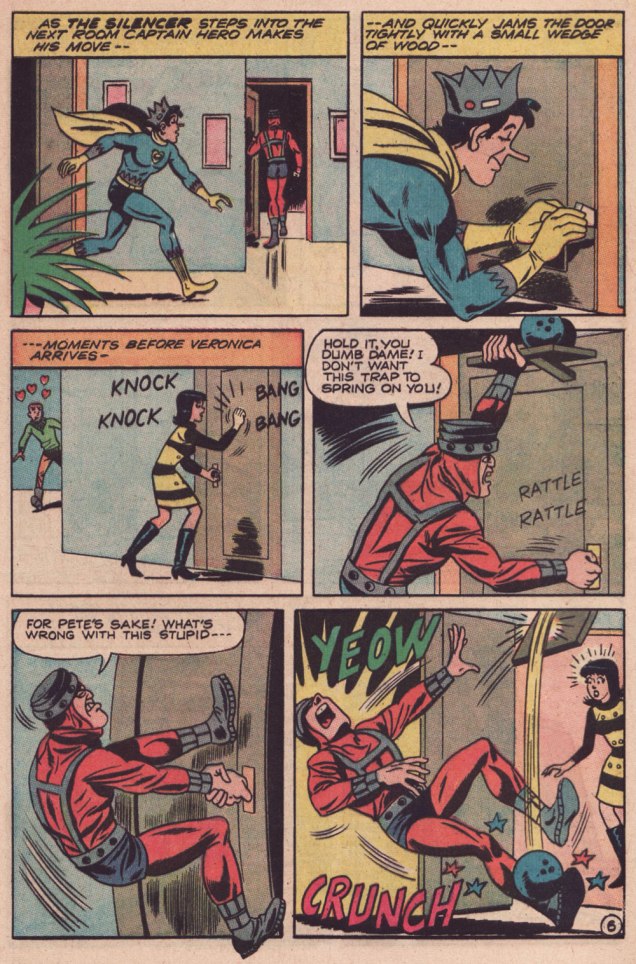
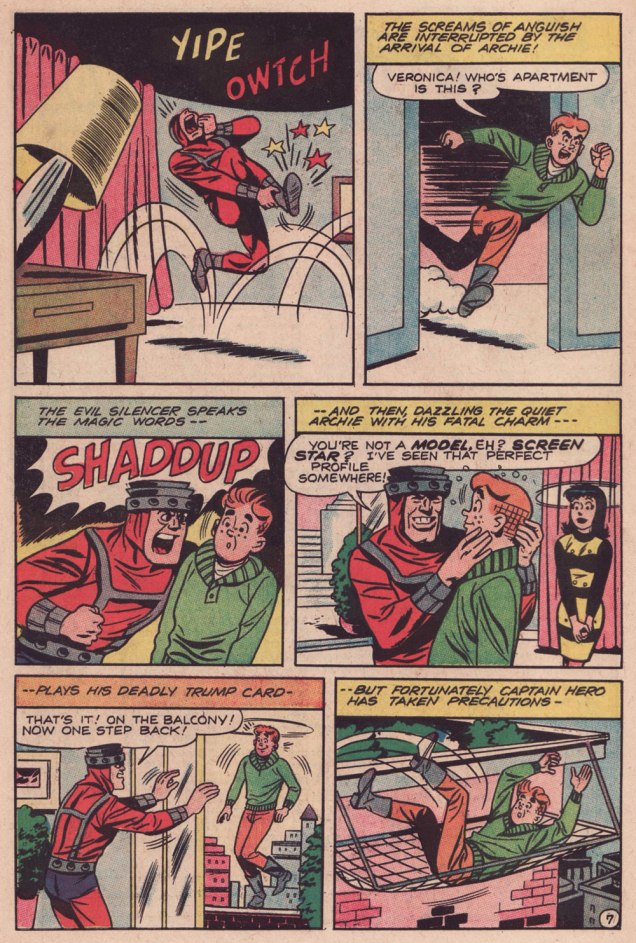
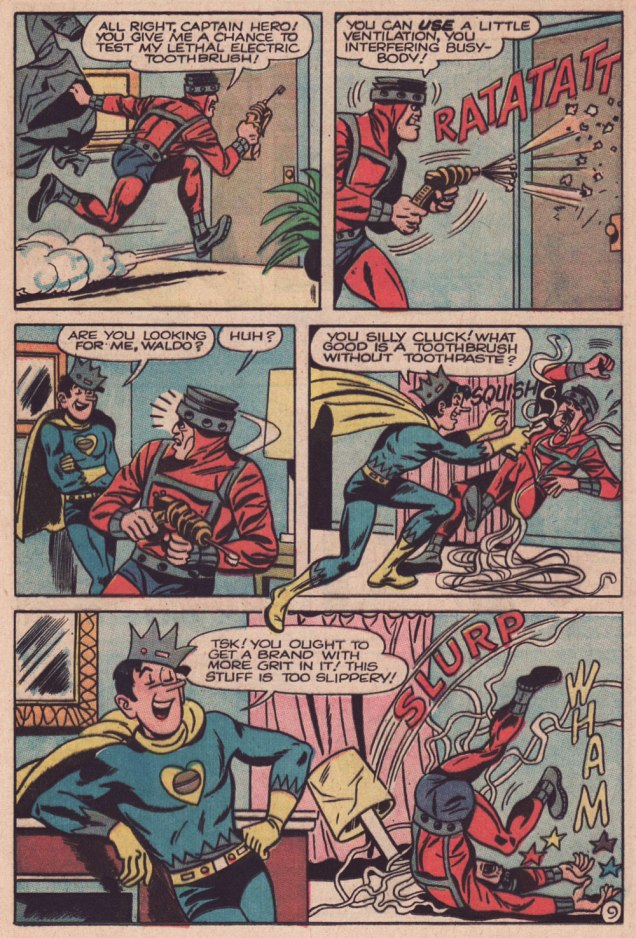
Here’s The Silencer Strikes, originally presented in Jughead as Captain Hero no. 5 (June 1967, Archie). The uncredited creators are presumably Frank Doyle, scripter; Bill Vigoda, pencils.
.
.
.
.
.
.
.
.
.
.
.
While Bill Vigoda (1920-1973) is hardly anyone’s favourite Archie artist, he does a creditable job here; he’s having more fun with this material than he did on the regular Jughead title, where he had the unenviable task of replacing (ha!) Samm Schwartz.
I certainly wasn’t going to use the digest for scanning, as the format’s production values weren’t much of a consideration: this was disposable entertainment, period. But I found an affordable — and in glorious condition — copy of the issue I wanted, and the printing didn’t let me down. My thanks to Keith for bringing it home!
**namely the rise of Marvel’s superheroes and the success of the campy Batman tv show, if you must know.
***Though they reaped the most bountiful rewards from the format, Archie were tardy — as usual — in adopting the digest: for instance, Gold Key had tried it out in 1968 with some Disney reprints, followed by collections of their mystery titles. DC had issued a one-shot Tarzan Digest in 1972. Marvel issued its own — slightly larger — digest in 1973, The Haunt of Horror, but it wasn’t comics, but a doomed attempt at reviving the moribund ‘Pulp’ format; finally, Archie entered the fray two months later, with Archie Comics Digest no. 1. Only Harvey lagged behind; unless I’m mistaken, it wasn’t until 1977 that some Richie Rich digests hit the glutted market.
« All realities, all dimensions are open to me! » — Prince
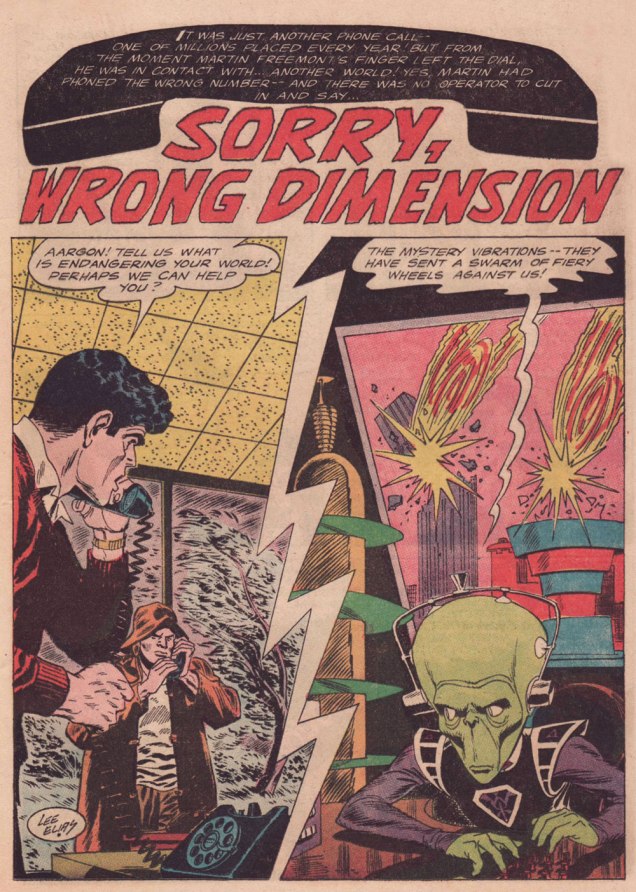
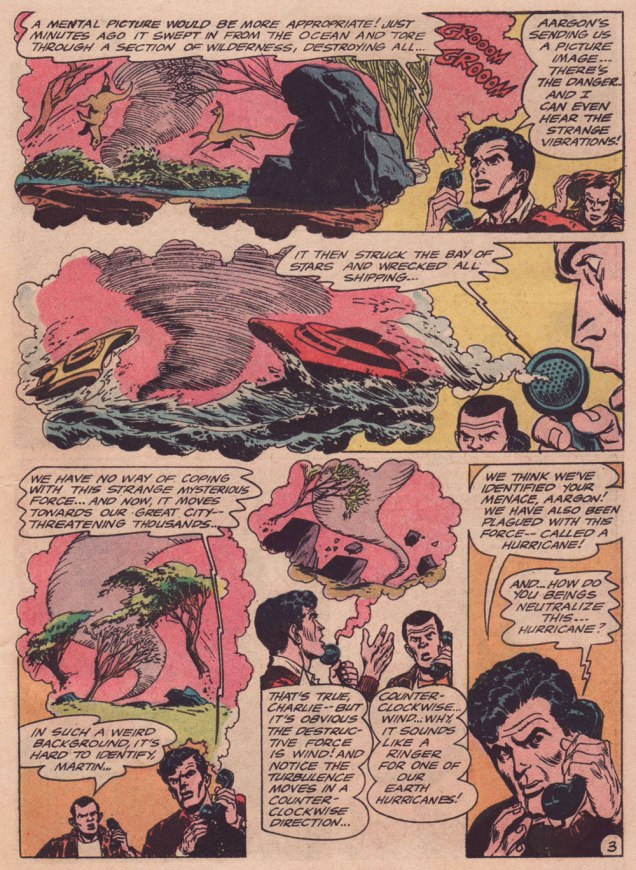
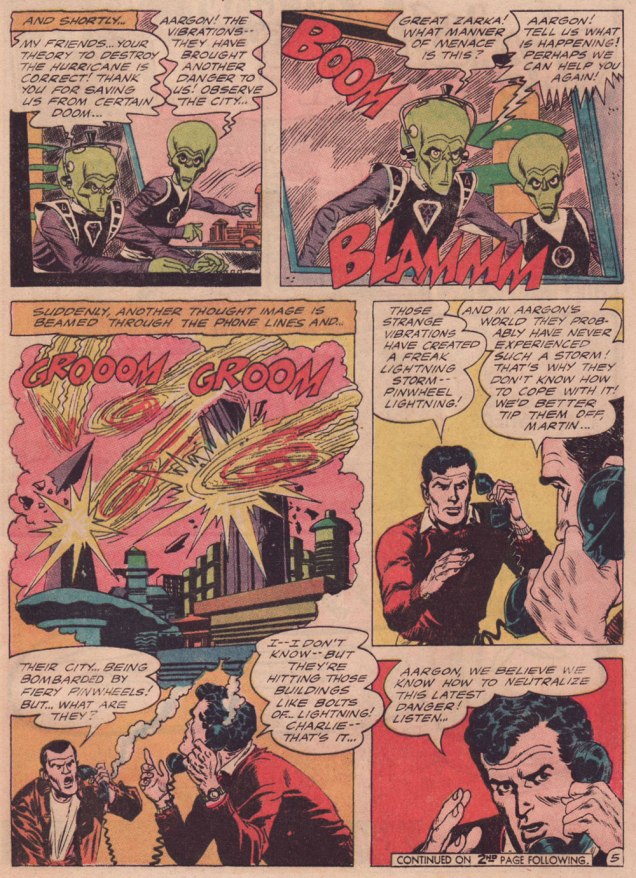
Growing up, Lee Elias (1920-1998) never was a particular favourite of mine. A handful of stories in DC’s mystery titles aside — and I’ve grown to love those — I probably came across his work for Marvel’s Human Fly series, and I was always disappointed when Elias, not my beloved Frank Robbins, turned up in the credits. For the record, Elias drew ten of the nineteen HF issues, and Robbins drew six, plus five covers.
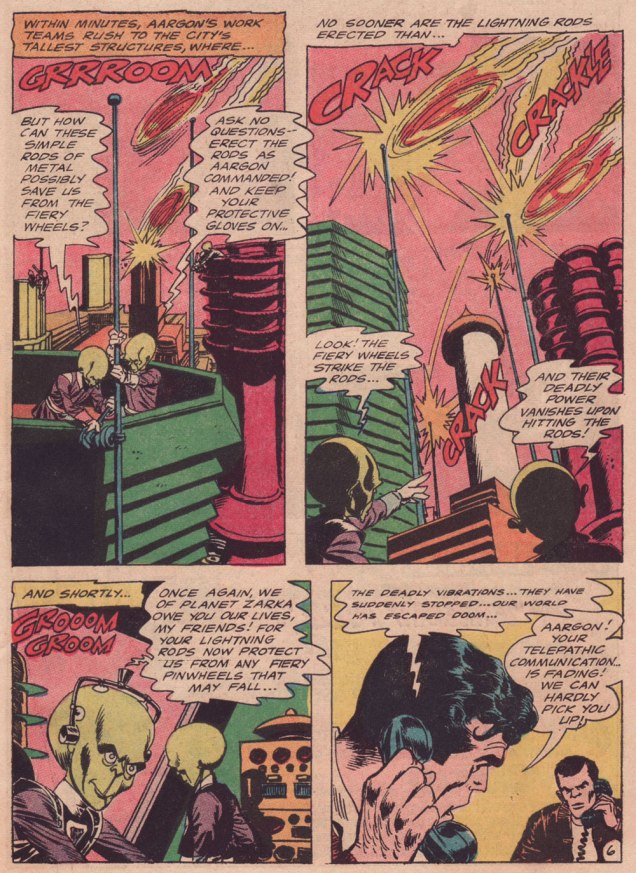
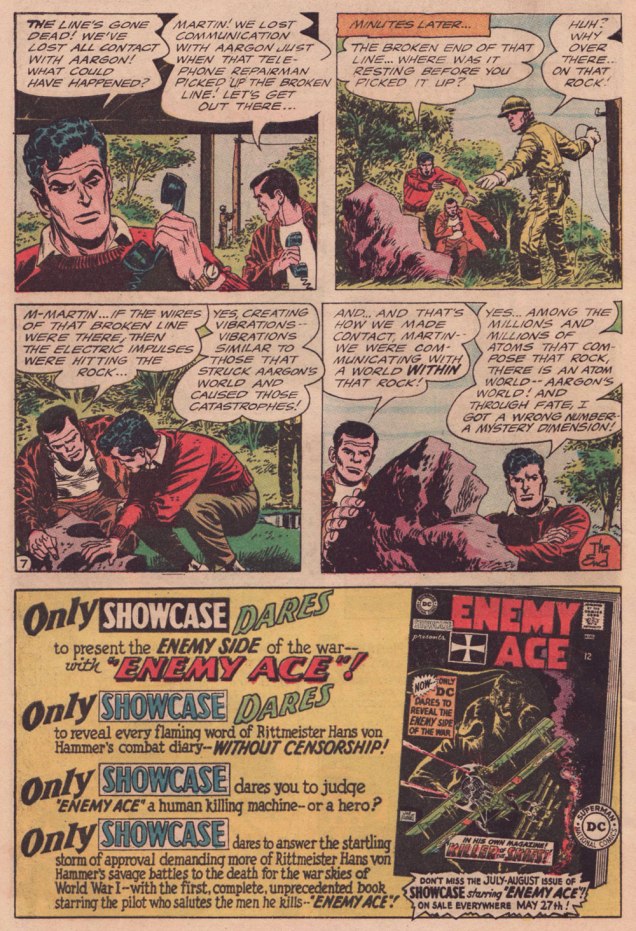
Over time, I noticed his gloriously gruesome cover work with art director-designer Warren Kremer for Harvey’s Pre-Code Horror titles of the early 1950s. His work on DC’s Adam Strange in the mid-1960s is best forgotten — there is only one Adam Strange, and it’s Carmine Infantino‘s (with trusty inker Murphy Anderson along for the Zeta Beam ride, of course). However, I adore Elias’ brief run (with writer Dave Wood) on Ultra the Multi-Alien, the splendidly wacky feature that replaced Adam Strange in Mystery in Space (issues 103 to 110, 1965-66).
Why am I so fond of this particular story? It’s the little things: for once, a story in a Jack Schiff-edited title makes some semblance of adhering to scientific — or at least science-fictional — principles; here, Elias designed an alien race that, given their grumpy, unprepossessing mugs, would typically have been cast as villains, but instead turn out perfectly honourable; the story’s human protagonists give aid to strangers in need, never asking for a thing in return: no Zarkan mineral rights, no salacious dirt on J’onn J’onzz, just selfless dedication to doing the right thing and the satisfaction of averting a crisis. How refreshingly old-fashioned, a cooling balm for these harrowing times.
-RG
p.s. my partner ds should return to our blog soon… she’s at present battling a mild case of writer’s block, so I’m filling in.
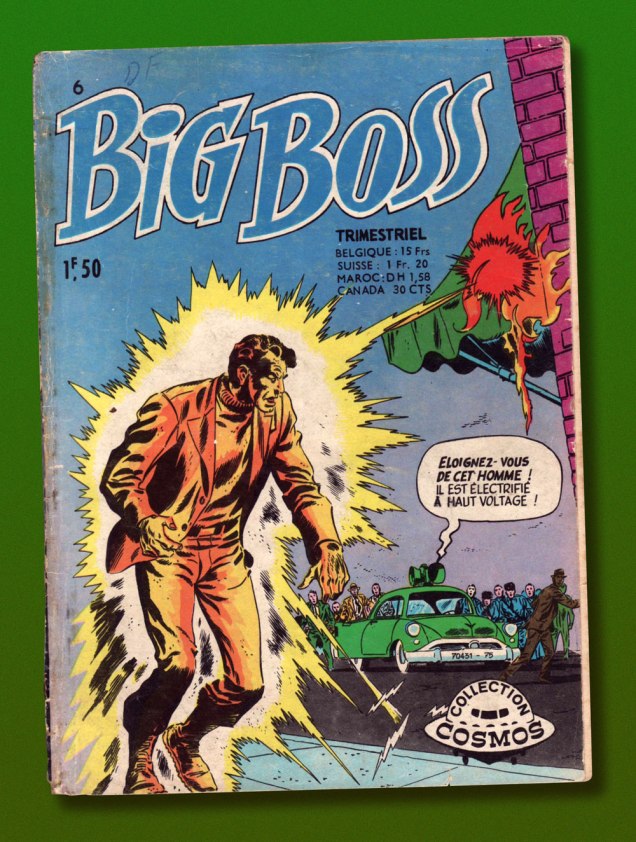
This is Big Boss no. 6 (Oct. 1971, Arédit-Artima); cover by Ruben Moreira.
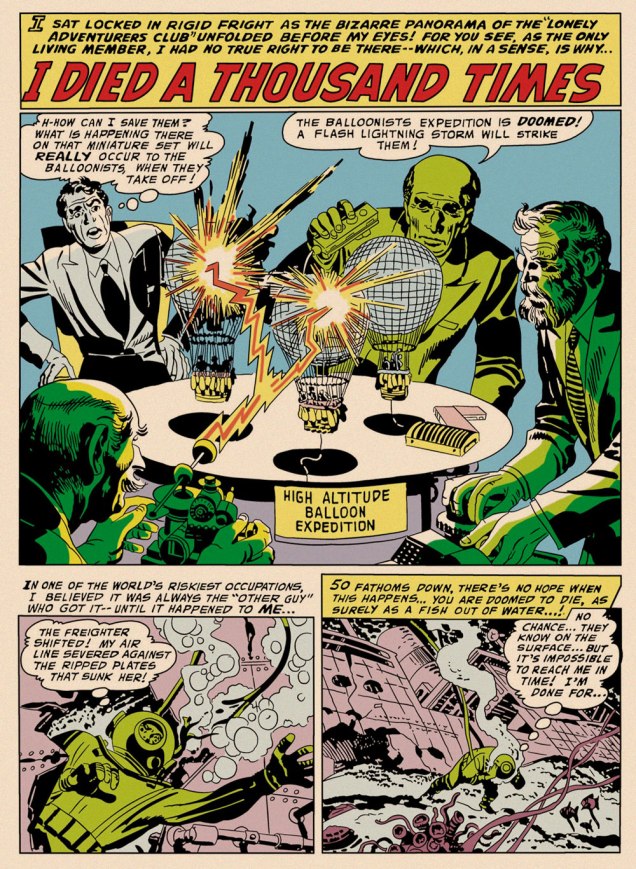
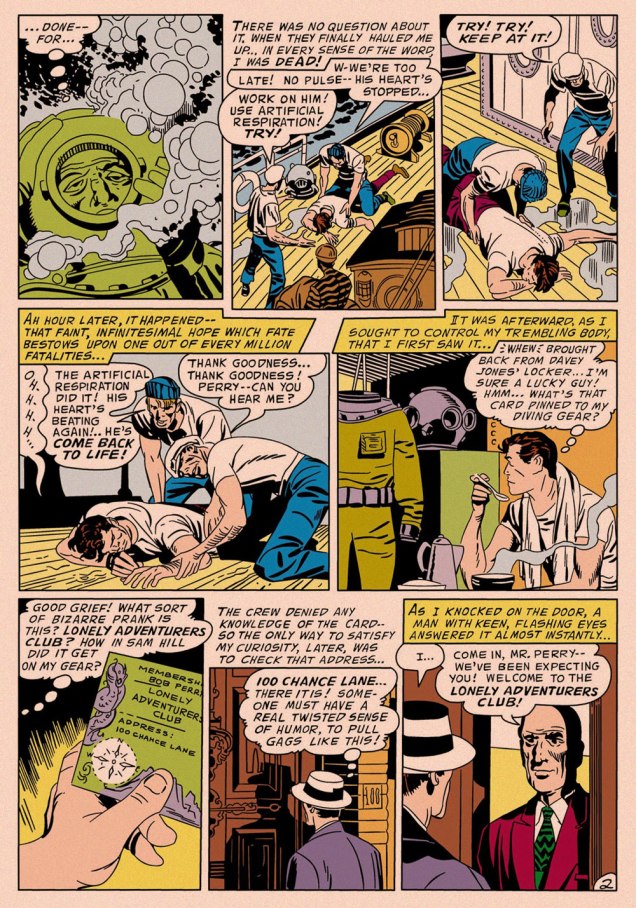
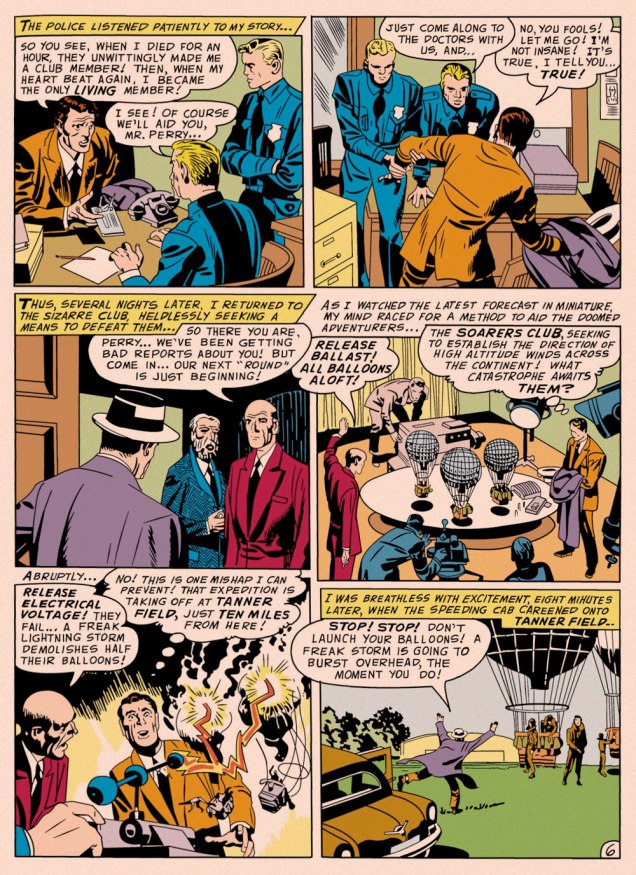
One might be inclined to say that, with its themes of adventurers cheating death or living on borrowed time, I Died a Thousand Times inspired Kirby’s Challengers of the Unknown, except that Ace, Rocky, Prof and Red had burst into print a few months earlier. Suffice it to say that they sprang from the same fertile well. It’s always intriguing to observe how the particular seed of an idea can be grown in a myriad of directions.
If you’ll forgive me the intrusion, this is how the opening panel appeared in the Big Boss reprint. In order to make things more readable in the digest format — and in black and white — Arédit‘s in-house art department routinely reframed and even augmented the artwork, with varying degrees of competence and success. This is one of the more accomplished efforts. The story’s writer is unknown (though it features a most Kirbyesque plot); it was pencilled and likely inked by King Kirby, and originally appeared in My Greatest Adventure no. 16 (July-Aug. 1957, DC); edited by Whitney Ellsworth; Jack Schiff; Murray Boltinoff and George Kashdan… let’s just say DC *was* a tad heavy on the management side in those days.
Though Kirby’s standalone short stories of this period are as charming and inventive as you’d expect, this modest trove of material has by and large been neglected. While a handful of these tales (The Thief of Thoughts; The Creatures from Nowhere!; The Cats Who Knew Too Much!; The Man Who Betrayed Earth; The Negative Man; and The Stone Sentinels of Giant Island) were semi-randomly reprinted in the early 1970s when DC had lots of pages to fill, this one didn’t resurface in North America until 2011’s pricey-then-and-pricier-now hardcover Jack Kirby Omnibus no. 1.
« In World War One, they called it shell shock. Second time around, they called it battle fatigue. After ‘nam, it was post-traumatic stress disorder. » — Jan Karon
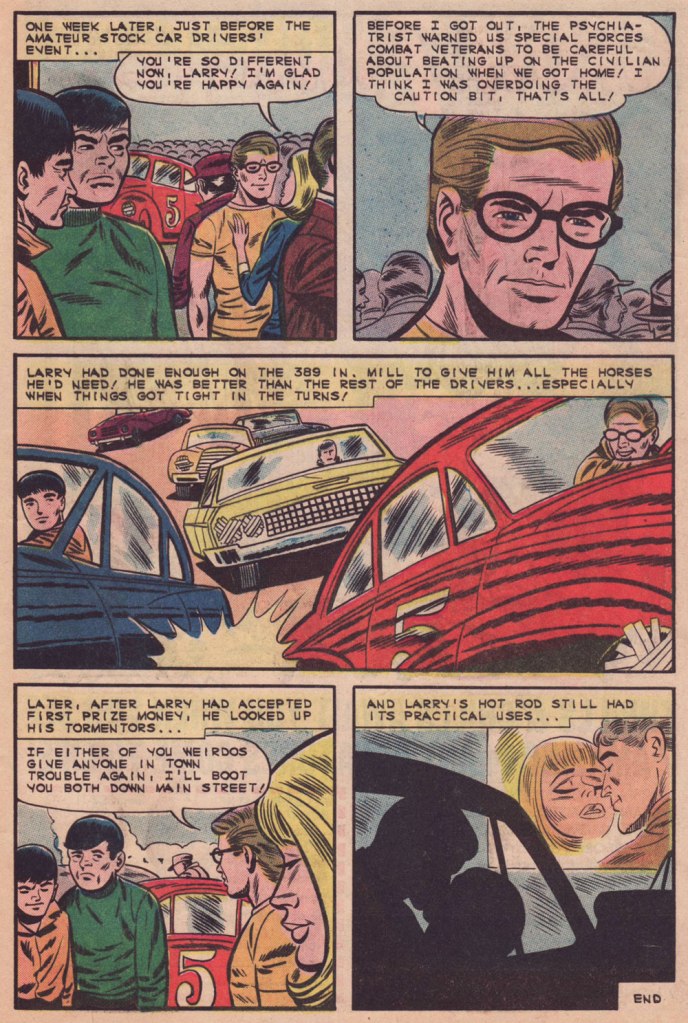
Jerry Grandenetti‘s whirlwind passage through the halls of Charlton (circa early 1966) was barely noticed, let alone commented upon. Ah, but it nonetheless was interesting. Grandenetti, frustrated with his limited prospects in illustrating war scripts for Bob Kanigher at DC, was in the middle of trying to expand his client base and break away from the obvious constraints of dealing with a petty tyrant. He was also eager to let his style evolve naturally, which certainly wasn’t going to happen in the pages of Star-Spangled War Stories.
And so, in 1966, Grandenetti, while keeping active at DC, passed through Tower (Fight the Enemy), Gold Key (The Twilight Zone), Marvel (Tales to Astonish: both The Hulk and Namor), Warren (Creepy and Eerie), though much of that work was ghosted for Joe Orlando and only revealed to be Jerry’s own… well after the fact.
For my money — and it won’t surprise anyone — the most unhampered and noteworthy art he created over that year was at Charlton. Here’s a sample!
.
.
.
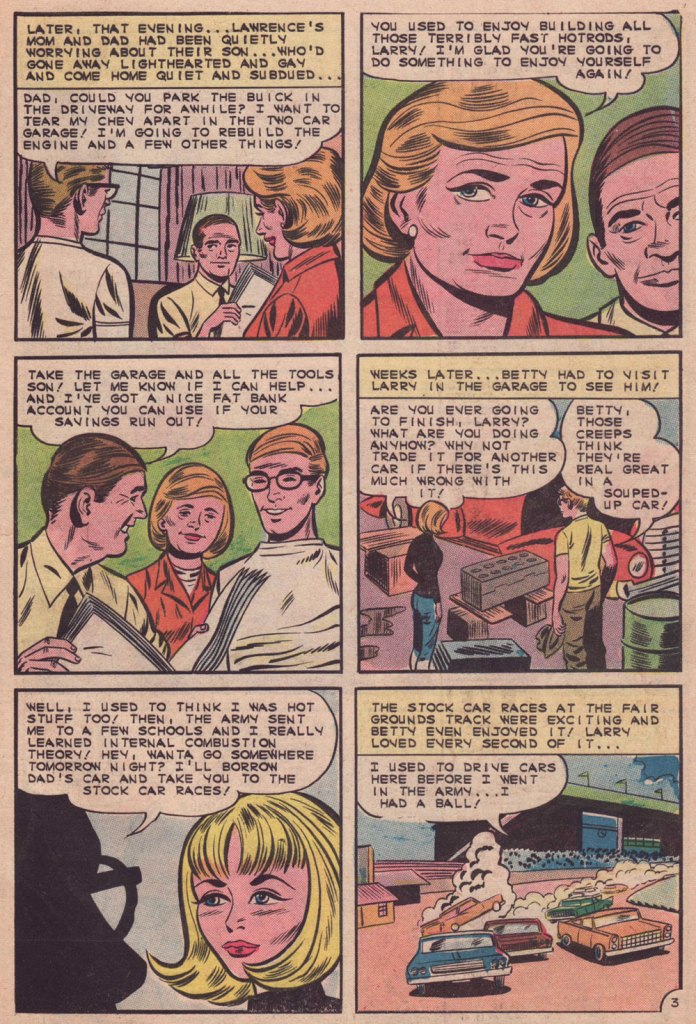
« Leadfoot Larry » was written by Joe Gill and inked by Jon D’Agostino.
While I prefer Grandenetti’s own inks (unless Wally Wood or Murphy Anderson are on the table!) over his pencils, future Archie stalwart Jon D’Agostino (1929-2010) performs a slick job that doesn’t smother Jerry’s pencils. A pair of romance stories saw him unfortunately saddled with indifferent Vince Alascia, but a teaming with Rocco Mastroserio proved attractive. The crown jewel of the ’60s Grandenetti Charltons was a sixteen-pager purporting to tell « The True Story of Jesse James! », wherein JG got to ink himself.
For me, what sets « Leadfoot Larry » apart is that it’s a character piece, the hot rodding taking a back seat to the — often underlying — themes of PTSD, sound reason pitted against blind rage, trust, maturity and responsibility facing callowness and cowardly chaos… with the sobering conclusion that you just can’t reason with some people. In typical Joe Gill fashion, most of the issues are circumstantial… they don’t explode into melodramatics. It’s not a perfect world, nor should it be, but one I’d rather inhabit, given the choice.
.
Here’s the issue it’s from, Hot Rod Racers no. 8 (Apr.-May 1966, Charlton). Despite being cobbled together from interior art, the cover manages to be pretty striking. Pat Masulli, editor.
« A gentleman does not boast about his junk. » — Emily Post*
Good manners… where have they gone, along with the other social niceties?
To prepare some of you for this satire, you need to be aware of who 19th century débutante and eventual étiquette authority Emily Post (1872-1960) was. The author of Etiquette in Society, in Business, in Politics, and at Home (1922… and updated to this day) was among the earliest American self-proclaimed experts on good manners. « Today, of course, you can barely dig up a débutante, let alone a ladies’ maid. And yet from the great beyond Emily Post continues to offer counsel. “Etiquette,” revised and edited by her great-granddaughter-in-law, a former flight attendant, is now in its seventeenth edition. » [ source ]
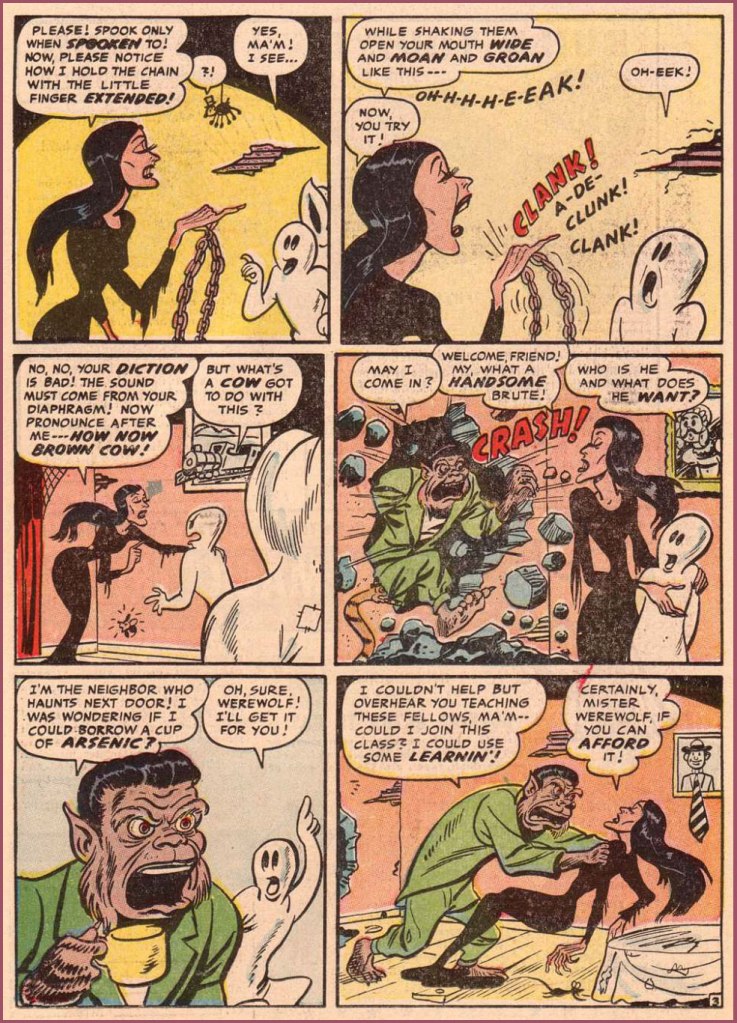
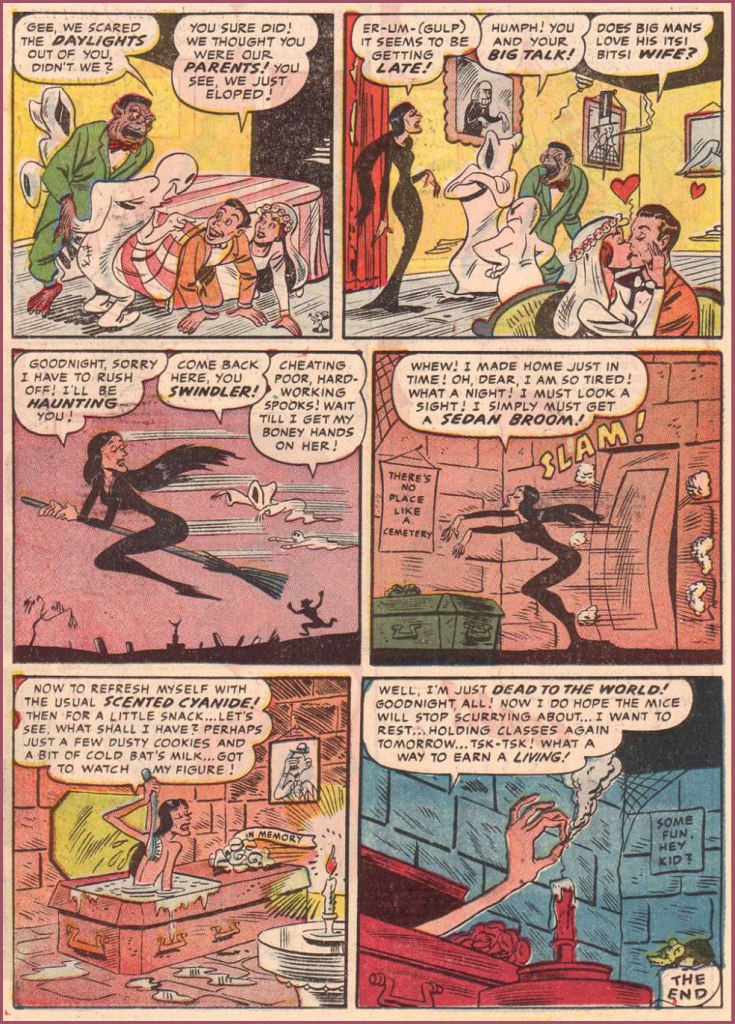
Well, that should suffice. Here’s a fun little parody from the early Silver Age. Both writer and artist are unknown, appropriately enough — it would be gauche to draw attention to oneself, don’t you know?
Don’t Be a Stumbling Spook! originally appeared — well concealed — in the back pages of Dark Shadows no. 2 (Jan. 1958, Farrell). An obscure story from an obscure title from an obscure publisher — the trifecta!
This is the one! The entire issue is available for free perusal right here.
I leave the esteemed Ms. Post to deliver the closing words, as I presume a gentleman should: « The only occasion when the traditions of courtesy permit a hostess to help herself before a woman guest is when she has reason to believe the food is poisoned. »
-RG
* That purported quote was too cute to pass up, apocryphal as it may be. Or is it a case of meaning drift? MIght ‘junk’ actually refer to bric-a-brac or — miraculously — a Chinese ship?
« With pen and ink, I can achieve a scratchy, foggy effect that is appropriate. It was a continual process of learning. » — Nick Cardy
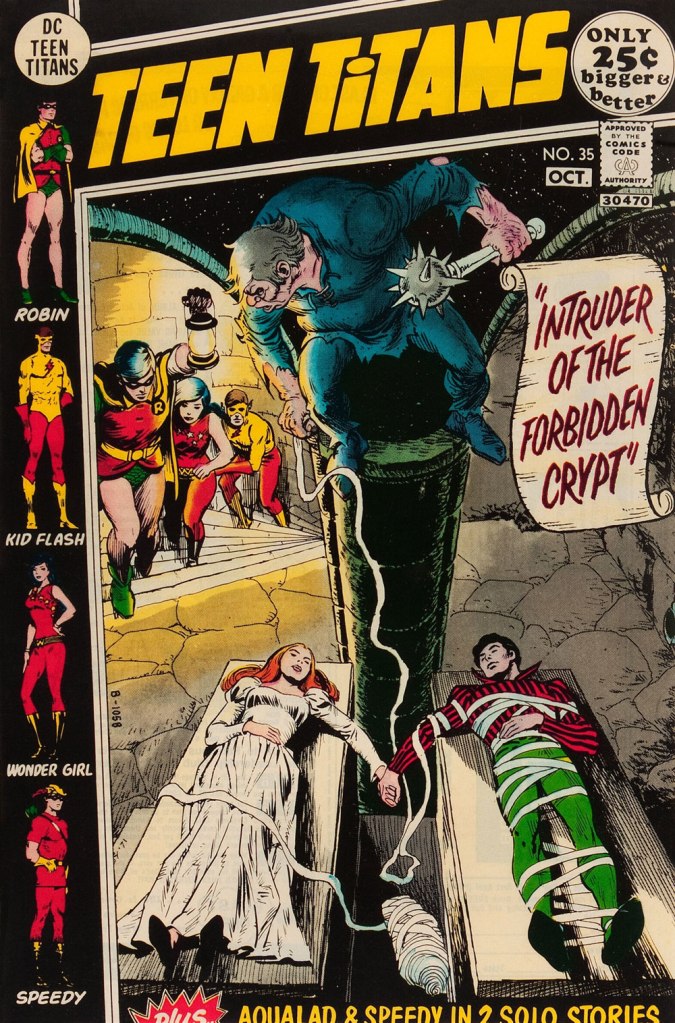
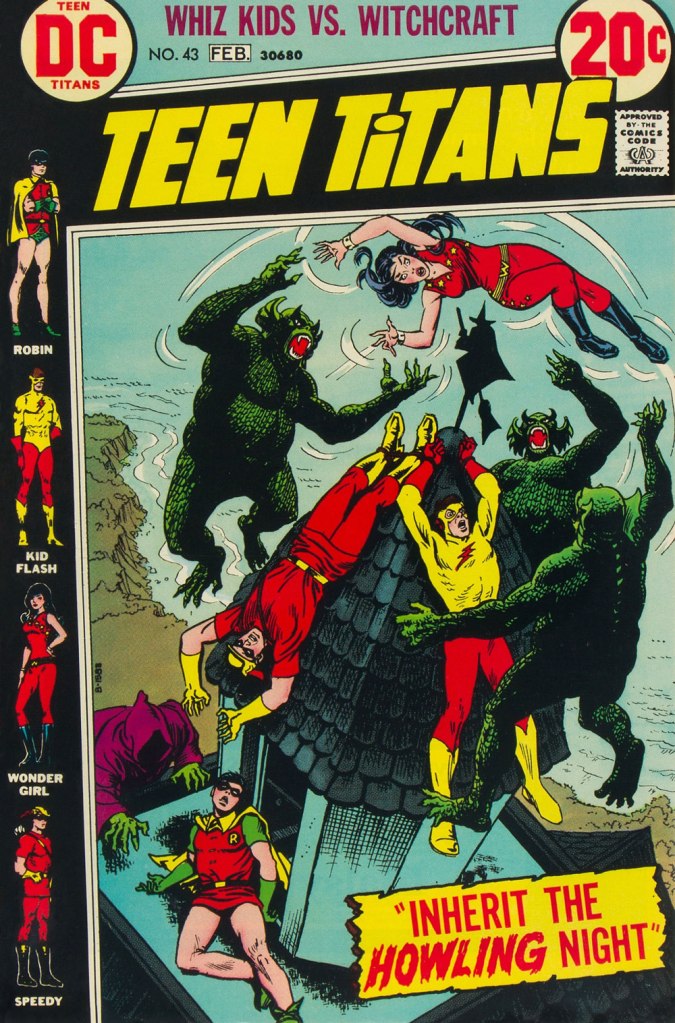
While WOT? favourite Nick Cardy (1920-2013) — who would turn one hundred and four years old today! — spent a lot of time chronicling the undersea adventures of Aquaman, his lingering true love, despite his busy schedule as DC’s premier cover artist, was the Teen Titans — he contributed, either as penciller, inker… or cover artist — to all forty-three issues of the original series.
And what I loved most about editor Murray Boltinoff‘s books is that they were packaged as horror books even when they nominally featured superheroes, a welcome respite. The costumes seemed an afterthought, a most unusual and refreshing attitude. Here, then, is a gallery of Mr. Cardy’s moodiest, most sinister Teen Titans cover artwork.
This is Teen Titans no. 33 (May-June 1971, DC). This is Teen Titans no. 34 (July-Aug. 1971, DC). Lettering by Ben Oda.This is Teen Titans no. 35 (Sept.-Oct. 1971, DC).This is Teen Titans no. 36 (Nov.-Dec. 1971, DC).This is Teen Titans no. 41 (Sept.-Oct. 1972, DC).This is Teen Titans no. 42 (Nov.-Dec. 1972, DC).This is Teen Titans no. 43 (Jan.-Feb. 1973, DC).
« Well, as everyone knows, once witchcraft gets started, there’s no stopping it. » — Mikhail Bulgakov
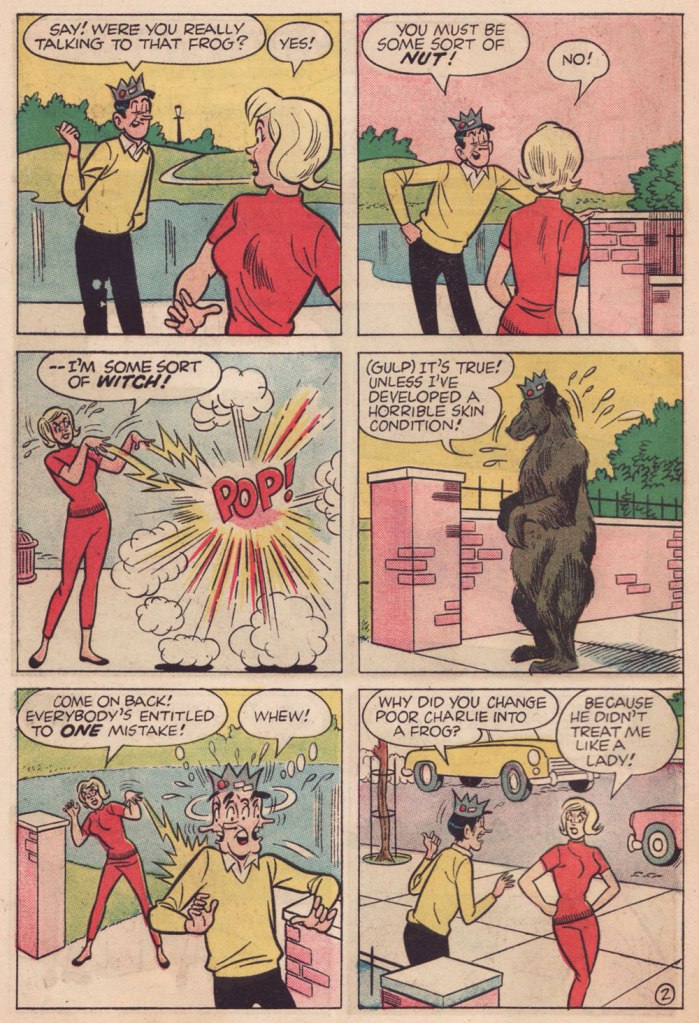
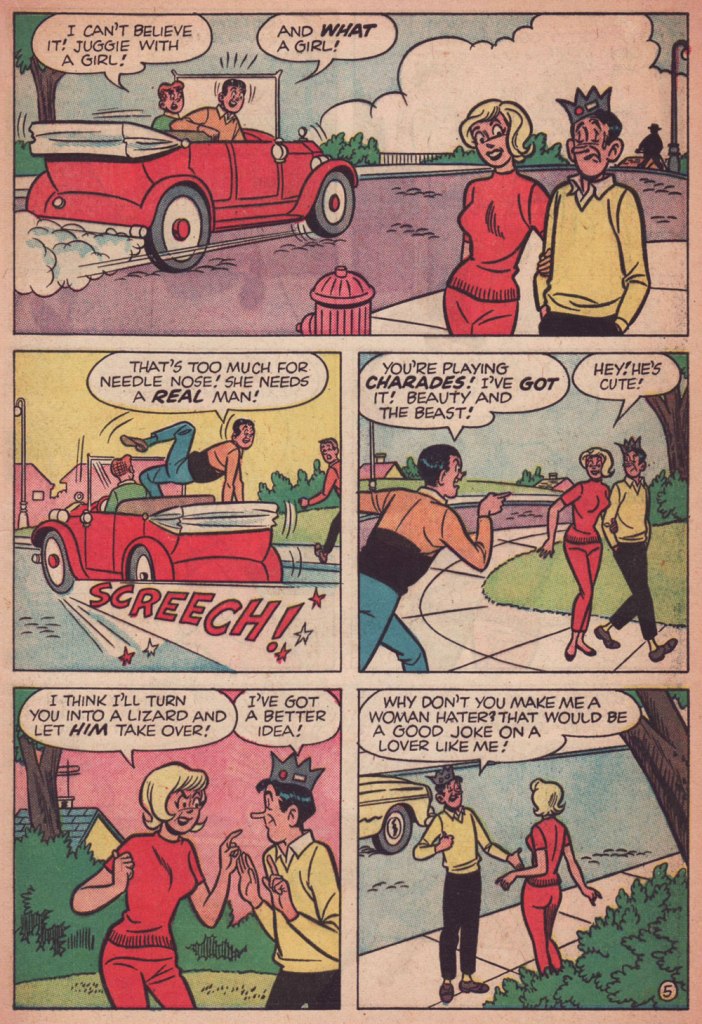
Another, day, birthday post? Well, it’s still a mighty special occasion, as we’re celebrating the one-hundred and fourth birth anniversary of our beloved Samm Schwartz (1920-1997).
One year ago to the day, we gave you Love in Broom, first of a loosely connected two-parter (‘loosely connected’ is the strongest dose of ‘continuity’ one could expect from the Archie folks in those days).
Of course, the now-named Samantha the witch — and the rest of the cast, notably Jughead and Reggie — appear to have forgotten all about their earlier encounter… but that’s just fine: the burden of continuity is one I’m glad to see sloughed. The chief constant is that our witch has quite a yen for Jug.
Switch Witch first appeared in Archie’s Pal Jughead no. 123 (Aug. 1965, Archie). It was presumably scripted by George Gladir (not coincidentally co-creator of Sabrina the Teenage Witch a couple of years earlier), and unmistakably illustrated by Mr. Schwartz. Of Mr. Gladir, Mark Evanier wrote: « Even when they had no credits, you could generally spot a George Gladir script. They were a little wackier, a little sillier, a little more human in their humor. And oh, yes — they were usually fresher than the ones crafted by younger writers. » This certainly fits the bill.
I had to buy three different copies of this issue to get a complete one… and it’s still a brittle mess. But hey, my ordeal, your benefit!
« I’ve had great success being a total idiot. » — Jerry Lewis
Hey, it’s Bob Oksner‘s birthday! I hope you’ll forgive me for double-dipping into that particular well — he also illustrated our earlier Mary Marvel entry — but I still wanted to highlight the occasion, incorrigible Oksner booster that I am.
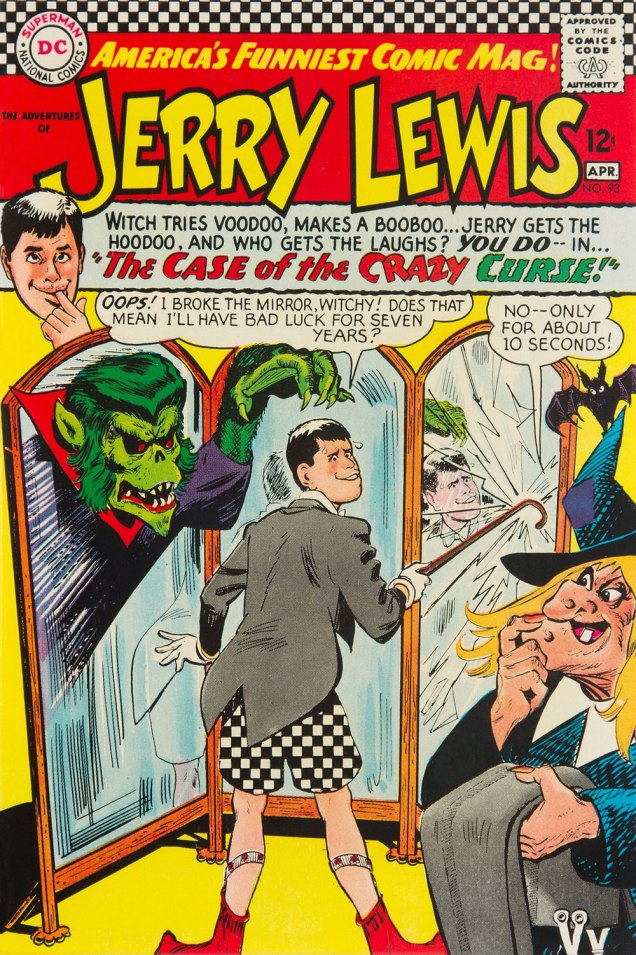
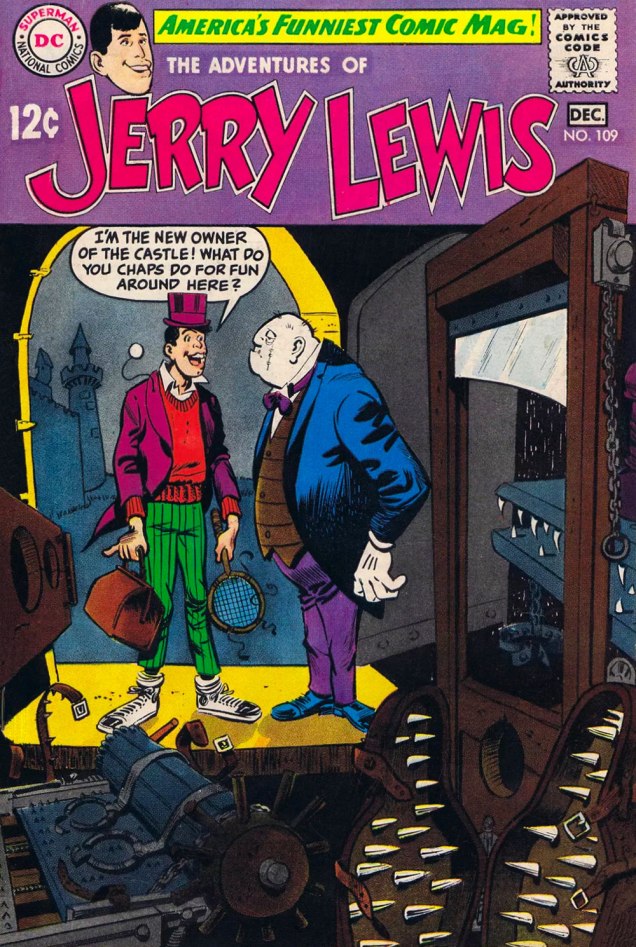
DC’s Jerry Lewis (or Bob Hope, or Dobie Gillis…) comics weren’t even remotely funny, but they sure boasted some spiffy covers. Here’s a gallery of the most Hallowe’en-appropriate, from the pencil and pen of Mr. Oksner.
This is The Adventures of Jerry Lewis no. 87 (Mar.-Apr. 1965, DC).This is The Adventures of Jerry Lewis no. 88 (May-June 1965, DC).
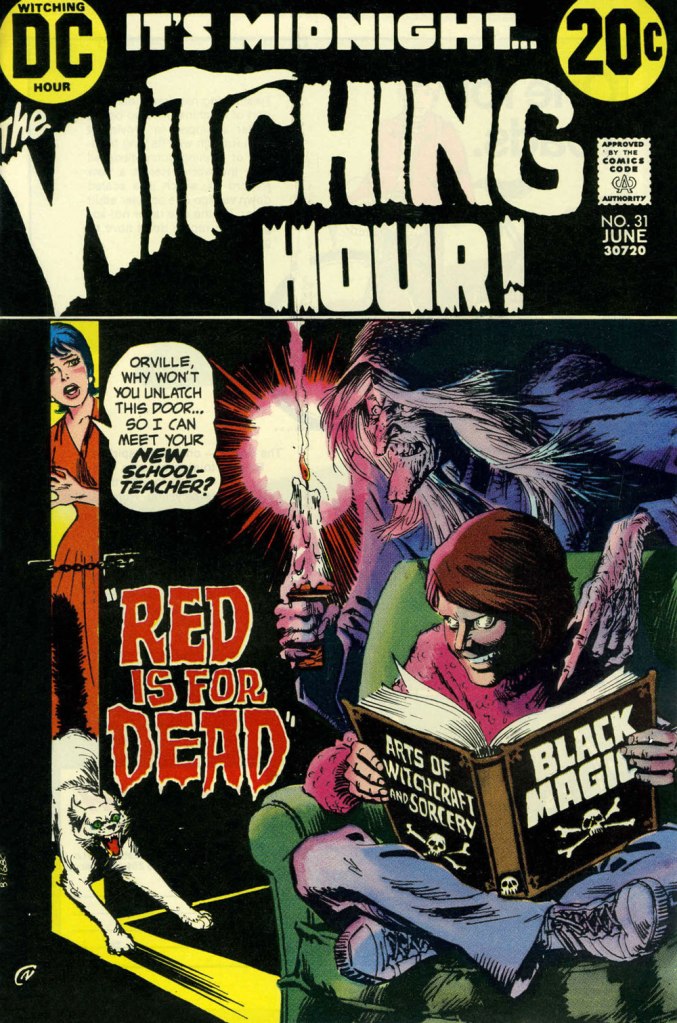
TAoJL editor Murray Boltinoff (1911-1994) had a soft sport for that particular cover concept, since he recycled it, eight years later and with a different tone, for another title he was overseeing:
Here, for comparison, is It’s Midnight… the Witching Hour no. 31 (June 1973, DC). Art by Nick Cardy.This is The Adventures of Jerry Lewis no. 93 (Mar.-Apr. 1966, DC).This is The Adventures of Jerry Lewis no. 94 (May-June 1966, DC).This is The Adventures of Jerry Lewis no. 98 (Jan.-Feb. 1967, DC).And finally, The Adventures of Jerry Lewis no. 109 (Nov.-Dec. 1968, DC). This one’s another riff on a rather hoary theme.
I was recently asked to feature some more Archie artists (other, that is, than my perpetual favourites Samm Schwartz and Bobs Montana and White); while I suppose Orlando Busino (1926-2022) is perhaps an oddball choice to fulfill such a request, it’s his birthday today — he would be ninety-eight years old… but hey, ninety-five is still a pretty good run.
Mr. Busino passed but briefly — but oh so memorably — through the halls of Archie: from 1960 to 1962, before he understandably went off to greater success and better-paying gigs: The Saturday Evening Post, Reader’s Digest (I can confirm that they paid really good rates), McCalls, Good Housekeeping, Boys’ Life… you name it.
Mark Evanier recalls fondly that short Archie stint, where Busino was among the few artists allowed to work outside of the house style and march to his own tune: « I first became familiar with his work, as did my pal Scott Shaw!, during a brief period when Busino worked for the Archie people. His work appeared in Archie’s Madhouse and a wonderful, not-sufficiently-recognized comic book called Tales Calculated to Drive You…BATS. It was kind of like “What if Charles Addams had produced MAD?” Scott and I both remember exactly which newsstand we were patronizing in December of 1961 when we glimpsed the cover of Bats #3 and grabbed up our respective copies. » [ source ]
Signor Busino’s lovely cover for the first issue of Tales Calculated to Drive You Bats (Nov. 1961, Archie).
However, our featured tales hails from Tales Calculated to Drive You Bats no. 3 (Mar. 1962, Archie):
And here’s a little something extra from Archie’s Madhouse no. 14 (Aug. 1961, Archie).
Painting your nose the right shade of dill pickle green would also work.