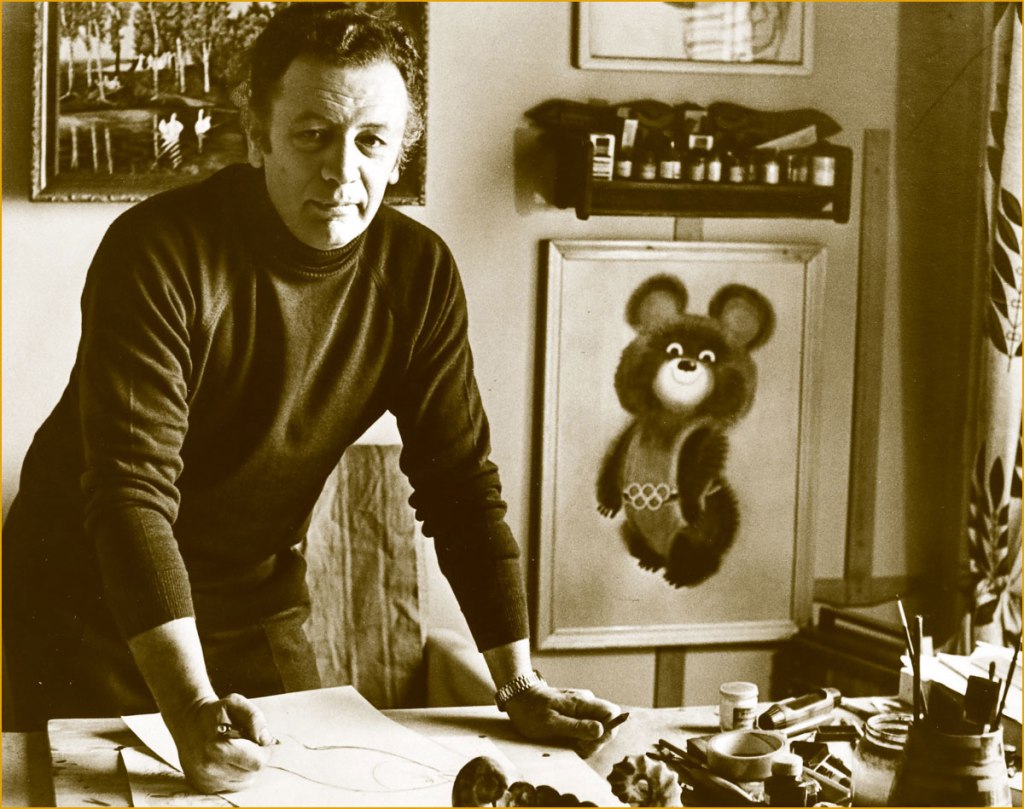
I grew up on the illustrations of Soviet illustrator/cartoonist Victor Chizhikov (1935-2020). I’m not sure whether I’m from the last generation that remembers his work this well — on a similar topic of ‘boy, we’re old’, older non-Slavic readers might be familiar with Misha, the mascot that Chizhikov designed for the 1980 Moscow Olympic Games.
Chizhikov with his creation Misha (both a nickname for Mikhail, and a contraction of ‘bear’).
In 1955, Chizhikov started contributing illustrations and caricatures to Krokodil, a publication I was born too late to be personally familiar with (though I did write a post about it). While he has definitely drawn a number of ‘adult’ cartoons in his life, it’s his cheerful anthropomorphic animals, mushroom-studded landscapes and gently roguish children that linger in people’s minds, and those appeared from 1956 and onwards, frolicking through the pages of Весёлые картинки (Merry pictures), a publication aimed at children between 4 and 11. In 1958, Chizhikov also joined the staff of Мурзилка* (Murzilka), a magazine for the 7 to 13 year old crowd. I had subscriptions to both as a child. My grandfather was especially keen on giving me a well-rounded education, though he needn’t have worried, as I come from a family where nearly everybody was a voracious reader, albeit occasionally disagreeing on genre. I used to have a stack of Весёлые картинки somewhere, but I got rid of it at some point with the impetuousness of a young adult, alas.
An issue of «Мурзилка» from 1968.
A page from a 1965 issue of «Мурзилка» depicting scenes made up of palindromes.
Original art for an illustration created for a 1975 issue of «Мурзилка».
Page from a 1966 issue of «Весёлые картинки» — ‘Petrushka in the land of fairytales‘ was a recurring feature. Chizhikov had a most fluid line when needed.
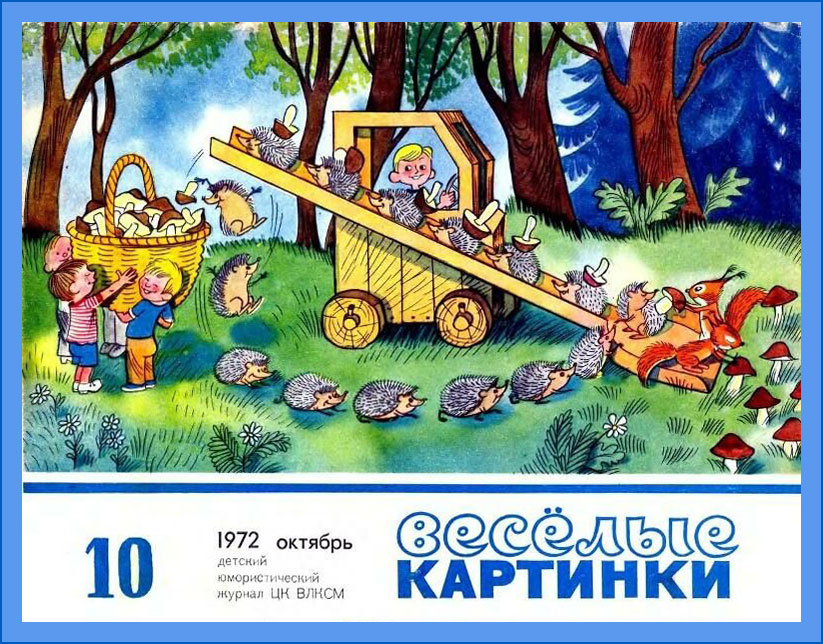
The October page from a 1972 calendar published in «Весёлые картинки».
An issue of «Весёлые картинки» from 1982.
Interestingly, Chizhikov was daltonic, something one would never be able to guess from his illustrations. It is said that his wife would label pots of paint and pencils to help him out, but I don’t know what variant of colour blindness he was stricken with. A critic once described his characters as having a ‘mischievous squint, as if they live in an eternal summer in the bright sun‘ — maybe they were just squinting trying to discern the nuances between colours?
‘The Lamplighter Ant’
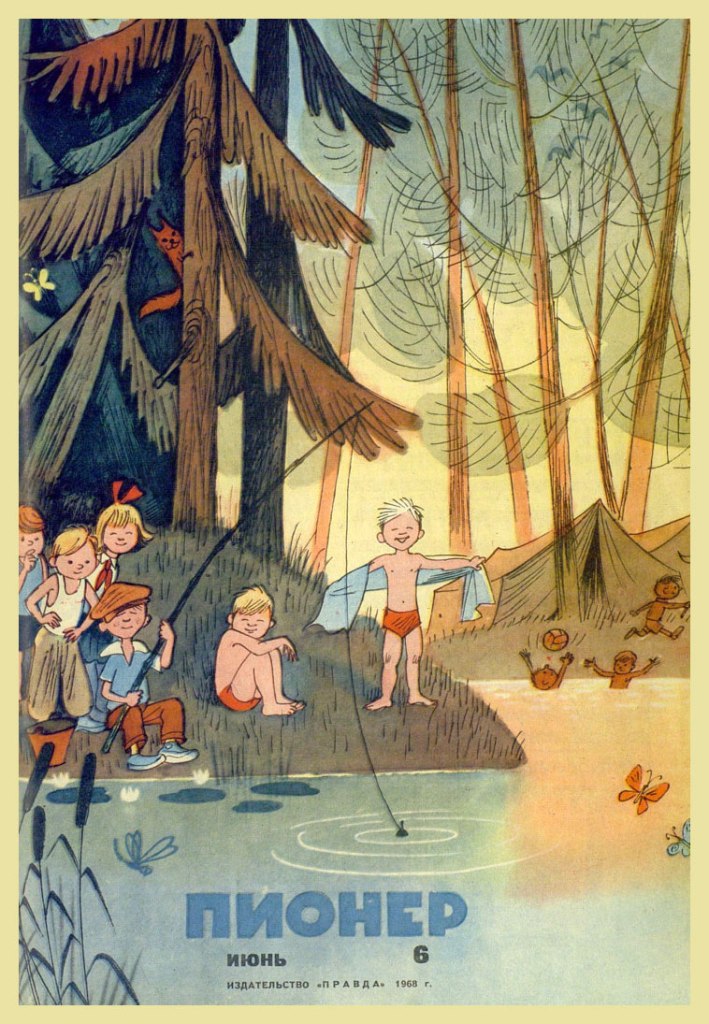
Issue of «Пионер» from 1958 — this was a magazine for 10 to 14 year-olds, but I don’t remember ever encountering any issues in the wild (possibly because my family objected to buying something called ‘Pioneer‘).
I owe this trip down memory lane to a friend who gave me a 1971 edition of 25 загадок — 25 отгадок (25 riddles — 25 answers) written by the immensely energetic and thus ubiquitous Korney Chukovsky** and illustrated by Chizhikov. Many thanks, Drew!
« Two stallions I have, they carry me on water. The water is tough, as if it were a stone. »
« If pine trees knew how to run and jump, they would flee from me to never cross my path again, because I am very steely, mean and toothy. »
« Small houses are running down the street, carrying little girls and boys. »
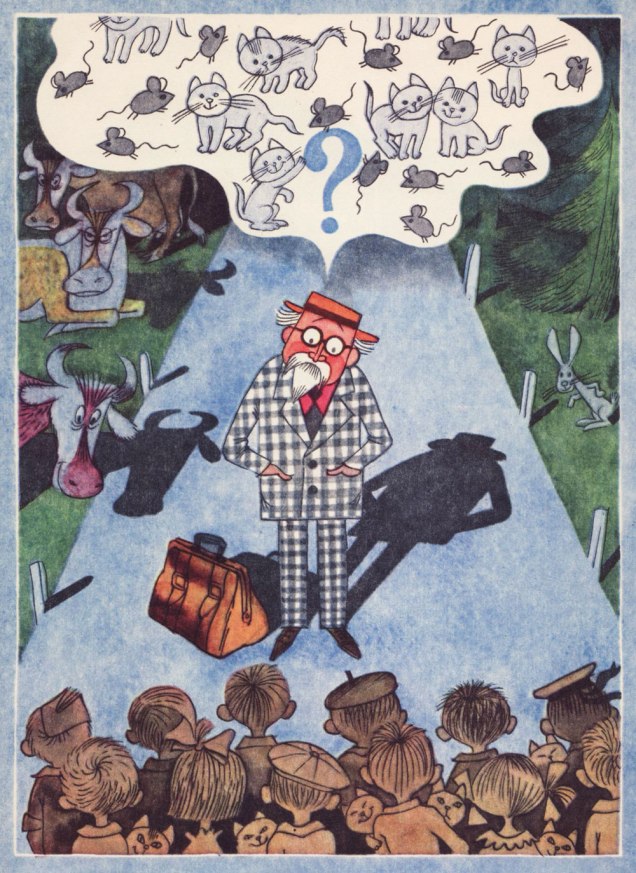
« Kondrat was walking to Leningrad, and coming towards him were twelve kids, each with three baskets, with a cat in each basket, and each cat having 12 kittens, each kitten holding four little mice. How many kittens and mice are the kids carrying to Leningrad? »
Cover of another book by Chukovsky, the ever-popular Doctor Aybolit, whose name translates literally to something like ‘Doctor Ouchithurts’. This character was loosely based on Hugh Lofting’s Doctor Dolittle, as well as Chukovsky’s friend Zemach Shabad, known for treating not only sick children, but also the equally ailing animals the children would bring along to their appointments.
~ ds
*Мурзилка is still around today, and given that it began publication in 1924, it is now listed in Guinness Worlds Records as the longest running children’s magazine in the world.
** 1882-1969, author of innumerable absurd ditties, rhymes and poems so well remembered and loved that many got incorporated into Russian as idioms; brilliant translator of English novels, stories and poems, making them accessible to a Russian-speaking audience for the first time; dissenter of governments, be it Soviet or Russian.
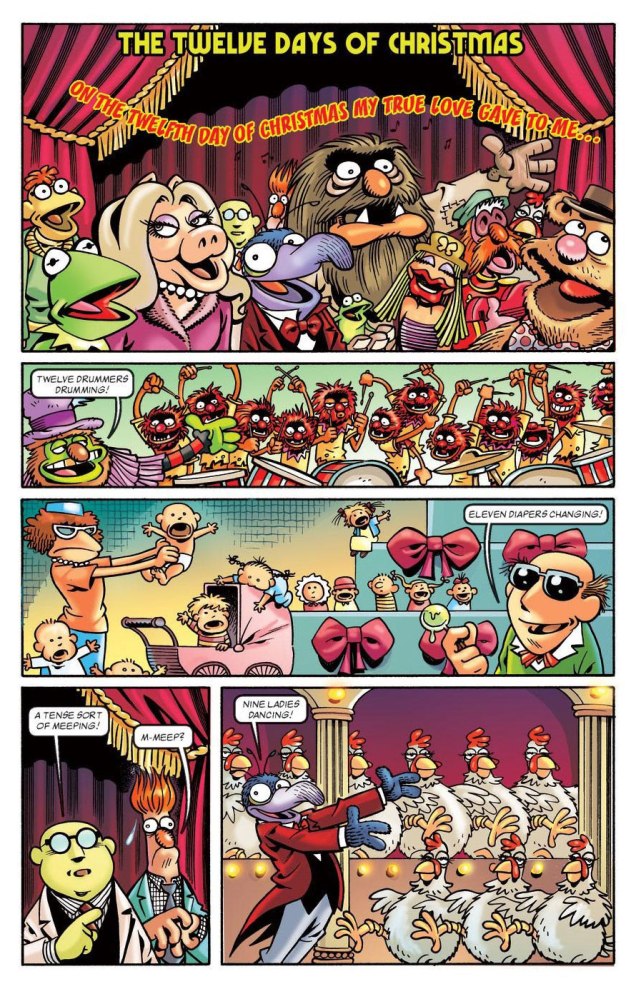
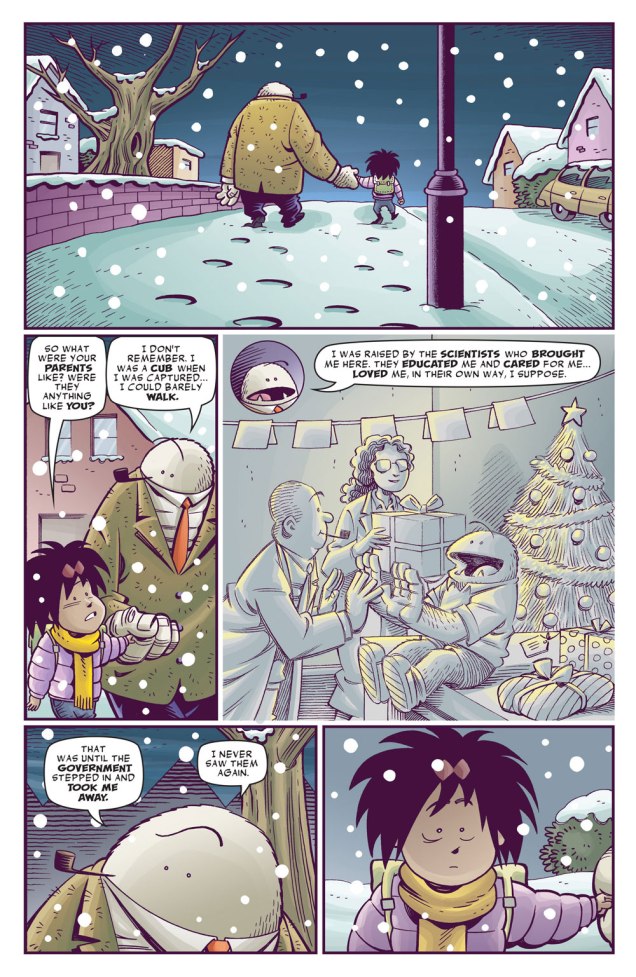
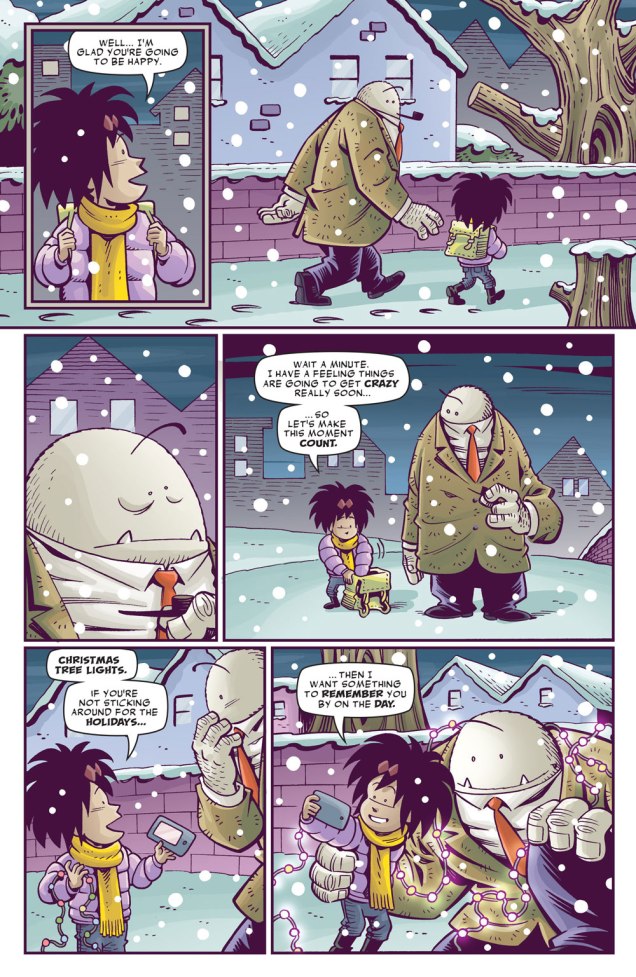
Speaking of festive mayhem, there is none better than penned (imagined, executed!) by Roger Langridge. Over the scope of his long (and ongoing!) career, the whole ‘rocking around the Christmas tree’ thing has shown up at least a couple of times — you may not have snow where you live, but take a gander at these and watch your holiday spirits soar (especially if bolstered by a bit o’ tipple).
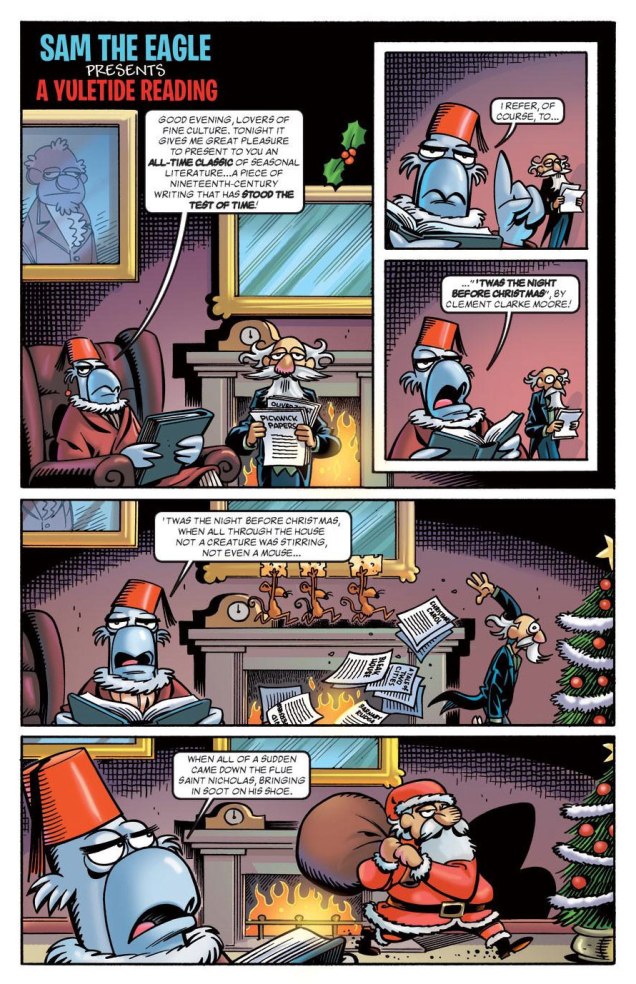
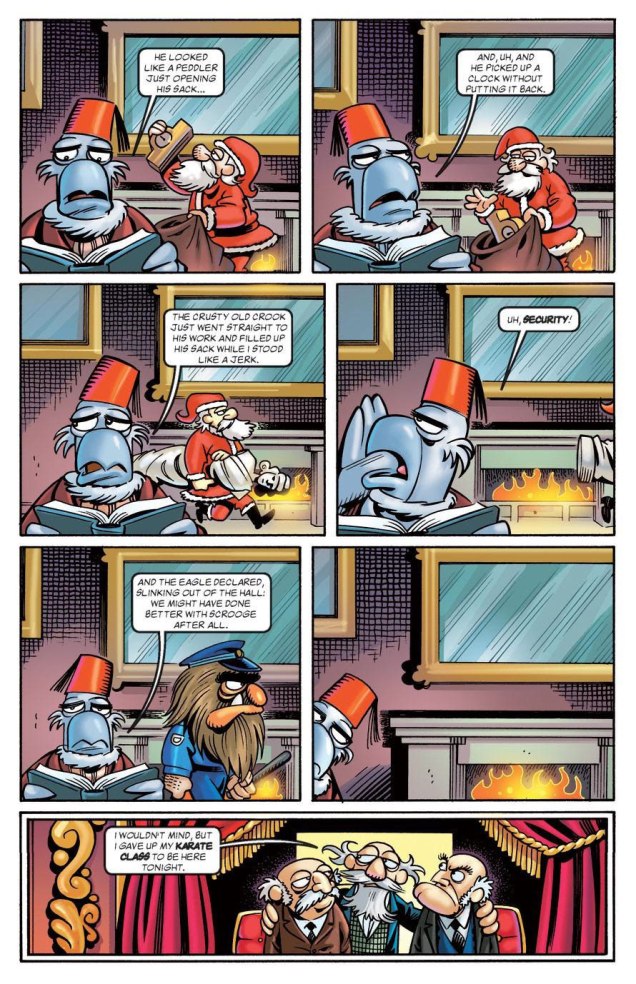
Here’s are some merry excerpts taken from The Four Seasons: Winter storyline printed in Muppets: The Four Seasons (2012, Marvel) for your enjoyment:
From the same issue, in this two-page digression (though what is The Muppets if not a series of glorious digressions), Sam narrates Dickens’ magnum opus… oh, nevermind.
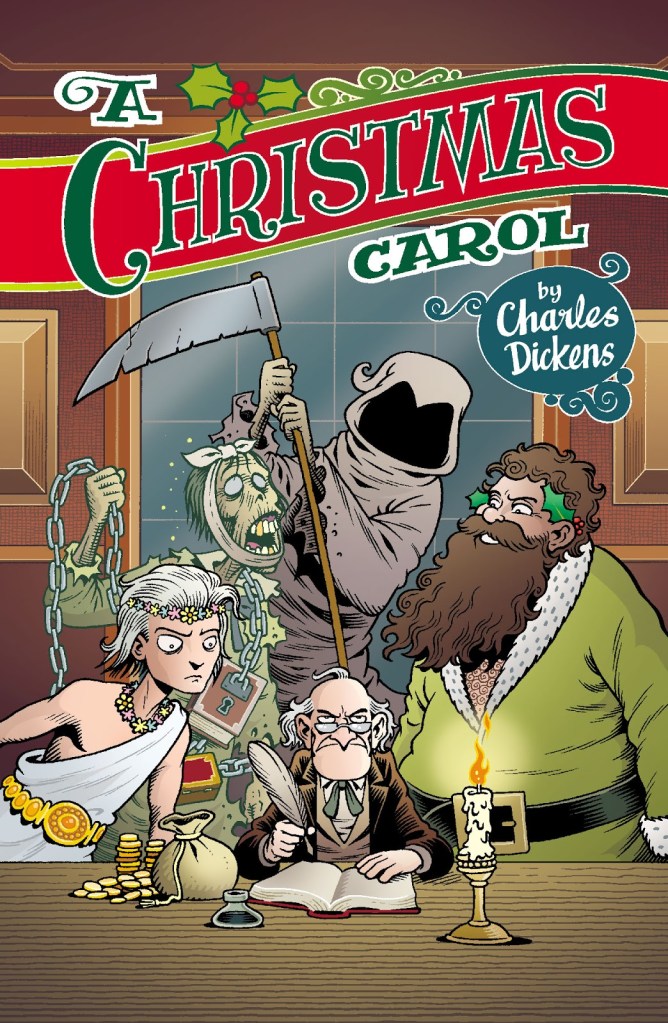
Speaking of Dickens, though, he did not go un-Langridged, happily:
A Christmas Carol (2013, St Mark’s Press)
To further your cheer, a few more pages from Langridge’s Abigail & The Snowman (2016, KaBOOM!). This decade sure is a depressing one for all artistic professions — current active cartoonists seem to be mostly doomed to juggling thankless jobs for corporate giants such as Disney-slash-Marvel while defending their right to be (and to own their work) from AI pilfering (although ‘pilfering’ is too cute a word for it). Even such pundits as RL can rarely afford to work on what’s actually dear to their hearts. In that context, the sweet (and thoughtful) story of Abigail and her snowman friend was a very welcome addition to Langridge’s career, lodged as it was between two extremely underwhelming Dynamite-published affairs where he acted as the writer, namely King: Mandrake the Magician (2015) and Betty Boop (2017). I’m now convinced that Langridge’s art can save a poor script (thanks to jokes and beautifully non-sequitur asides inserted into the art), whereas a flat artist can ruin a plot faster than you can shout ‘Gisele Lagacé‘.
Langridge has been drawing daily cartoons based on his life for around 5 years now. This is the strip’s final week, as he has decided that it’s time to move on to something else, so I wanted to mention it before it’s too late — especially since it’s perfectly relevant to the season.
Strip from December 21, 2023
And a merry Christmas to all! We’ll see you again before the New Year.
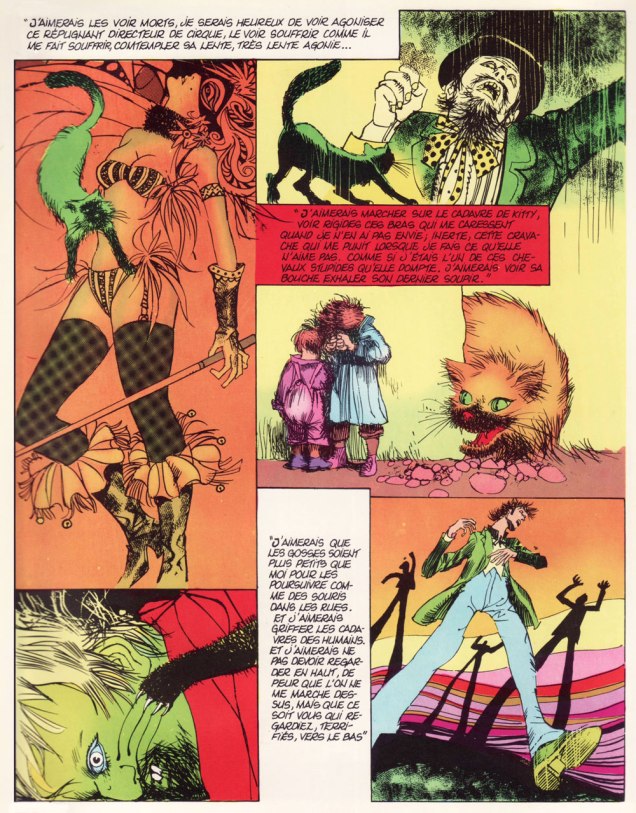
Today’s offering features plenty of colour… which in my humble opinion does not detract in the slightest from a sombre, autumnal atmosphere with chills as palpable as thick mist. While you would not be amiss in deciding that this art comes from a European hand, it’s not a French one, despite the language most of the following pages are in.
Josep Maria Beà i Font, usually shortened to and credited as José Beá, is a Spanish comics artist — born in 1942 — who’s happily still with us. Fans of Warren-published comics may recognize his distinctive style, as he wrote *and* illustrated quite a few (around thirty) stories published in Vampirella, Creepy and Eerie, starting with The Silver Thief and the Pharoah’s Daughter published in Vampirella no. 13 (Sept. 1971). It seems that he is another of those love-’em-or-hate-’em artists, as while doing some research for this post, I stumbled upon more than one instance of opinions such as ‘my least favourite Warren artist‘ or ‘passable art‘. This is fortunately balanced out by those who seek out Beà’s stories, going as far as delving into Spanish comics while not being able to speak the language.
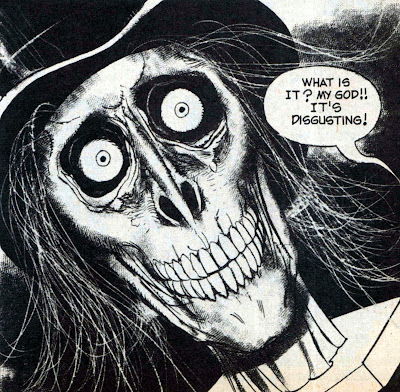
A panel from the terrifically gruesome story Head Shop, illustrated by Beá and written by Don Glut and published in Eerie no. 39 (April 1972)
Beá’s collaboration with Spanish publishing house Buru Lan Ediciones starting in 1970 marked his return to comics after a 8-year break taken to focus on his painting. Specifically, it’s within the pages of its anthology Dráculathat Beá started first scripting his own stories. These became available to an anglophone audience when The New English Library reprinted a number of its issues under the name Dracula(now there’s an easy translation).
The cover of a Dracula Annual from 1973, published by The New English Library. I found this image on the lovely When Churchyards Yawn blog, go pay their post a visit! The illustration is by Esteban Maroto, a frequent face at Warren in the 1970s.
« New English Library issued 12 English-language versions of the publication, which was originally produced by Buru Lan in Spain. The New English Library publication ended after 12 issues, although it continued for many issues afterwards in Spain. Only the first 6 issues were included in the Dracula book produced by Warren, but one can probably track down the remaining 6 English language issues if they try hard enough. »
The following pages are taken from a French-reprint collection title Les nuits de l’épouvante, published by Dargaud in 1973 (I stumbled upon it years ago in a used bookshop, and instantly took to the art despite having no idea who Beá was). The dates I provide for their publication in English are from The New English Library’s Dracula, not the Spanish Drácula.
The following two pages are taken from Le serpent (written by Beà and Sadko*, illustrated by Beà), or The Snake, originally published in Dracula no. 3 (Oct. 1972):
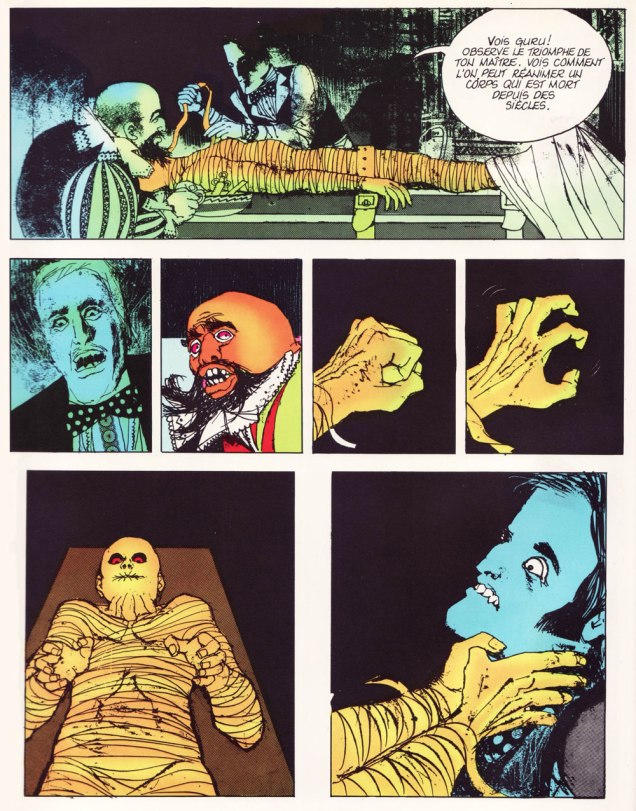
La momie (written by Maroto, illustrated by Beà), or The Mummy, published in Dracula no. 4 (Nov. 1972) features some more memorable strangling scenes:
Finally, I would be remiss not to include some pages from Beà’s Sir Leo series, originally created for Drácula. Handsome Sir Leo is an English aristocrat who, in typical fashion, has walked away from his birthright… and walked into the arms of the supernatural, many dangerous adventures ensuing. The following two pages are from Sir Leo – le chat (written by Luis Vigil, illustrated by Beà), or The Cat, originally published in Dracula no. 8 (Dec. 1972). Read it here.
« Sooner or later we all sit down to the banquet of consequences. » — Robert W. Frank, paraphrasing Robert Louis Stevenson
Today, we ask: who was Peter Randa? I’m asking because I read one of his books at random — actually, the comics adaptation, and was deeply impressed with its quality. Randa, né André Duquesne (1911-1979) in Marcinelle, Belgium, wrote some 300 hundred novels in various genres over a mind bogglingly productive quarter-century under a myriad of pseudonyms, namely Jean-Jacques Alain, Urbain Farrel, Herbert Ghilen, Jules Hardouin, Jim Hendrix (!), Henri Lern, André Ollivier, H.T. Perkins, F.M. Roucayrol, Diego Suarez, Jehan Van Rhyn and Percy Williams. There may be others. He dealt in the genres of science-fiction, horror, espionage, crime, and erotica (with over fifty novels written in the early 1970s).
Two more covers (respectively 1955 and 1973) painted by the also miraculously prolific French illustrator Michel Gourdon. Here’s a segment from a French TV show touching upon the scope of his career, on the occasion of the auctioning of his vast trove of original art. Hope it all found good homes.
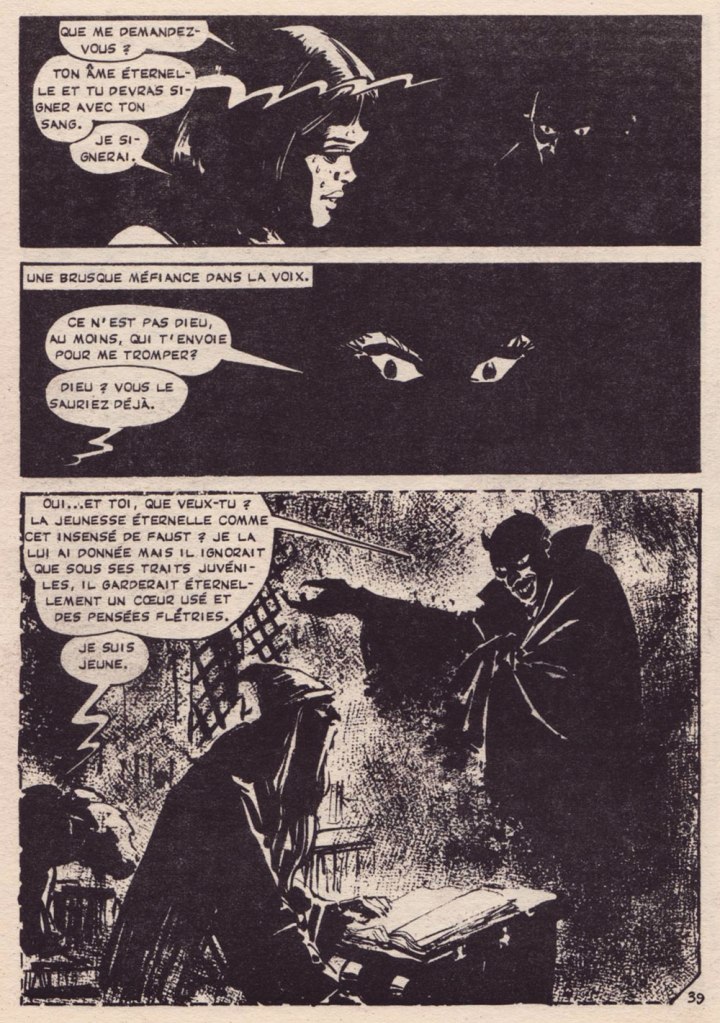
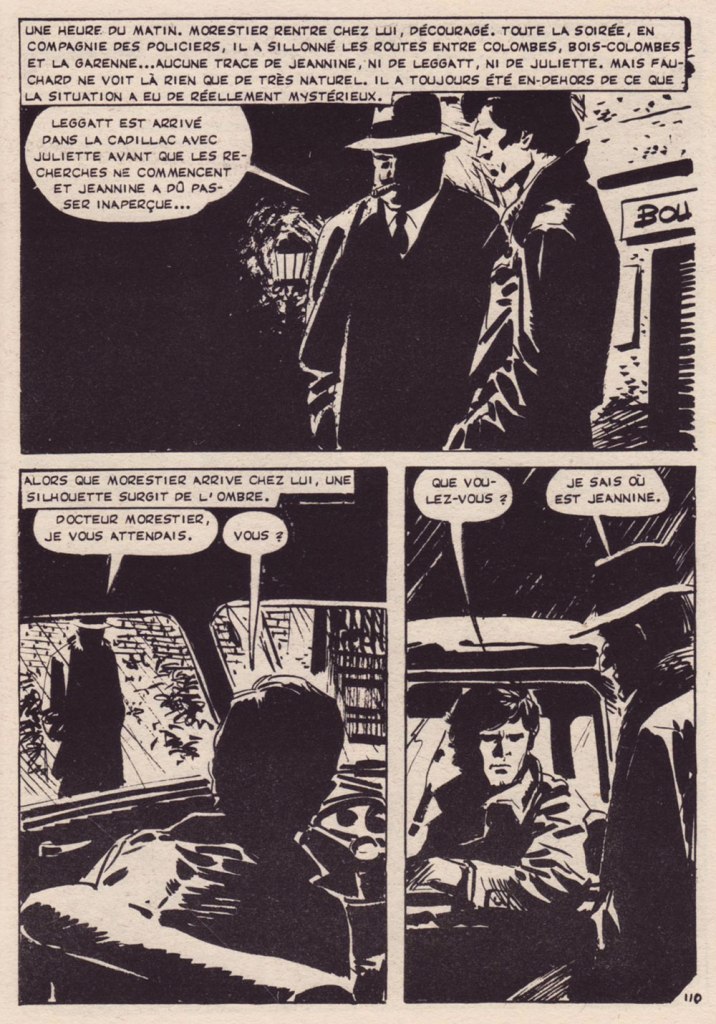
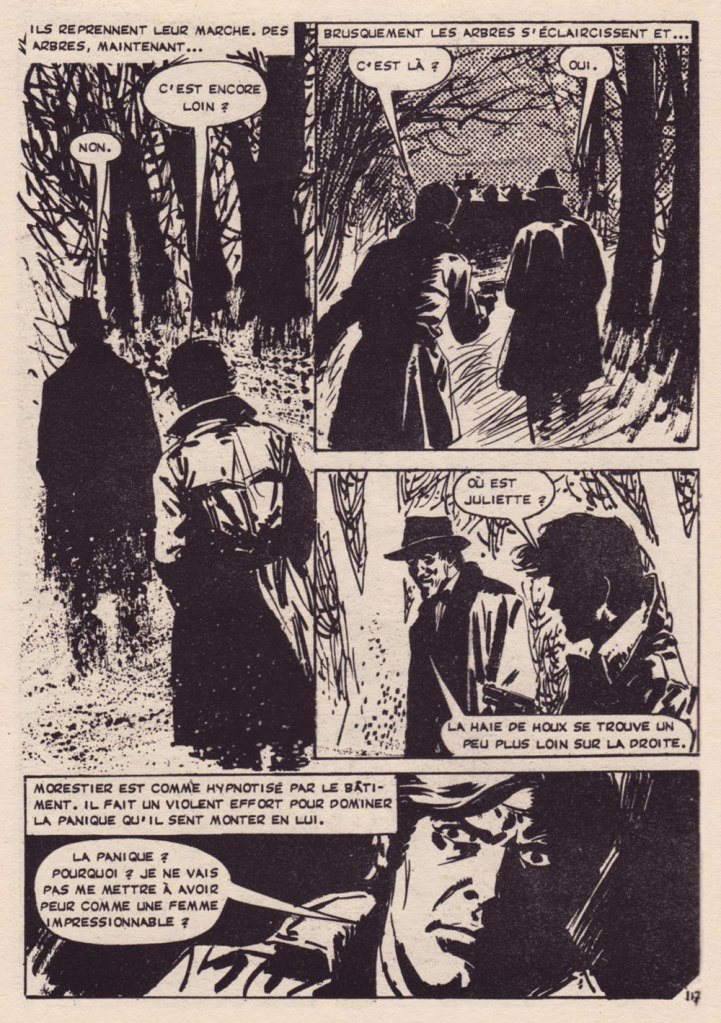
Well, here’s the basic plot, taken from the current e-book edition (which I’m grateful exists at all, as even outstanding work often languishes in utter obscurity or downright oblivion): « Archie Leggatt is a madman, a real one. He believes himself the Devil, had kidnapped three young women and terrorised a fourth. A run-of-the-mill serial killer? Perhaps… but when such an un assassin boasts supernatural powers and leaves more than the scent of brimstone behind, physicians and investigators begin to wonder and ask themselves questions with terrifying implications. Can one truly hope to put Satan behind bars? »
Illustrator unknown, wouldn’t you know it? Given his skill, style and stamina, I’m guessing he’s Spanish, but beyond that, I’m drawing a blank. Still, kudos to this anonymous artistic practitioner.I know, I know: it’s Warren’s Uncle Creepy with a pencil moustache. Jeannine agrees to the Faustian deal Leggatt proposes.A handsome doctor thinks he can save the woman he loves. Randa sets up the usual scenario, all the better to kick the reader’s legs out from under him. Le banquet des ténèbres — the bédé adaptation — saw print in Eclipso no. 30 (June 1973, Arédit). Amusingly, mycomicshop.com’s archivist describes Eclipso as ‘French publication reprinting comics from various Marvel properties.’ Well, not exactly. The title should clue you in: the anthology started out reprinting DC series such as Eclipso, Deadman, Mark Merlin, Challengers of the Unknown, Hawkman, Doom Patrol… while also dipping into Tower’s T.H.U.N.D.E.R. Agents, for instance. Marvel got stirred into the mix in the early 1970s, then came a period of French novel adaptations, then back to US comics, mostly from Marvel. The ride ended in 1983.
What fascinated me about Le banquet is its steady ambiguity between possible mental aberration, hypnotic suggestion, and the outright supernatural. This precarious balance — and slow-burning tension — is maintained right to the end, which is no mean feat. Is Leggatt just a regular madman, a consummate mesmerist, or a temporary, occasional shell for Old Nick? I’m reminded of a similar exploit accomplished by Arturo Pérez-Reverte in his 1993 novel El Club Dumas (The Club Dumas), wherein one didn’t know for certain whether there was anything actually uncanny going on… until the conclusion. Sadly, Roman Polanski fumbled his cinematic adaptation (as The Ninth Gate), starting with the absurd casting of Johnny Depp as the presumably intelligent book detective protagonist. When Polanski’s wife starts flying, the jig is up, I’m afraid.
You see, there were these two competing comics publishers…
… which is to say DC Thomson and the dystopian-monikered International Publishing Corporation (IPC); between them, they dominated the UK comics market. By the late 1970s, said market had surpassed circulation of ten million copies, its rosiest sales outlook ever.
To be perfectly cynical, the rival publishers’ editorial vision was mostly to copy one another’s successes. Same mouldy old dough.
In 1977, « Freelance writer Pat Mills had an idea for a girls’ horror comic* that would use his 2000 AD approach — longer stories, bigger visuals, with adaptations of stories from big name writers… Misty was about to be born. »
This, of course, is the Stan Lee version of an ‘idea’, for what IPC was commissioning, and Mills was providing, was a copy of DC Thomson’s existing Spellbound. However, since Mills was asking for a piece of the pie, he was sacked before the new magazine’s launch, and replaced with a perhaps more pliable sancho.
In terms of timing, Spellbound happened to cease publication (after 69 issues) just a few weeks before its clone’s launch. For its part, Misty lasted 101 issues before being folded** into the more reliably successful Tammy; a common practice in England for underperforming magazines that still have a following. After all, Spellbound, upon its own cancellation, had been whisked into Debbie.
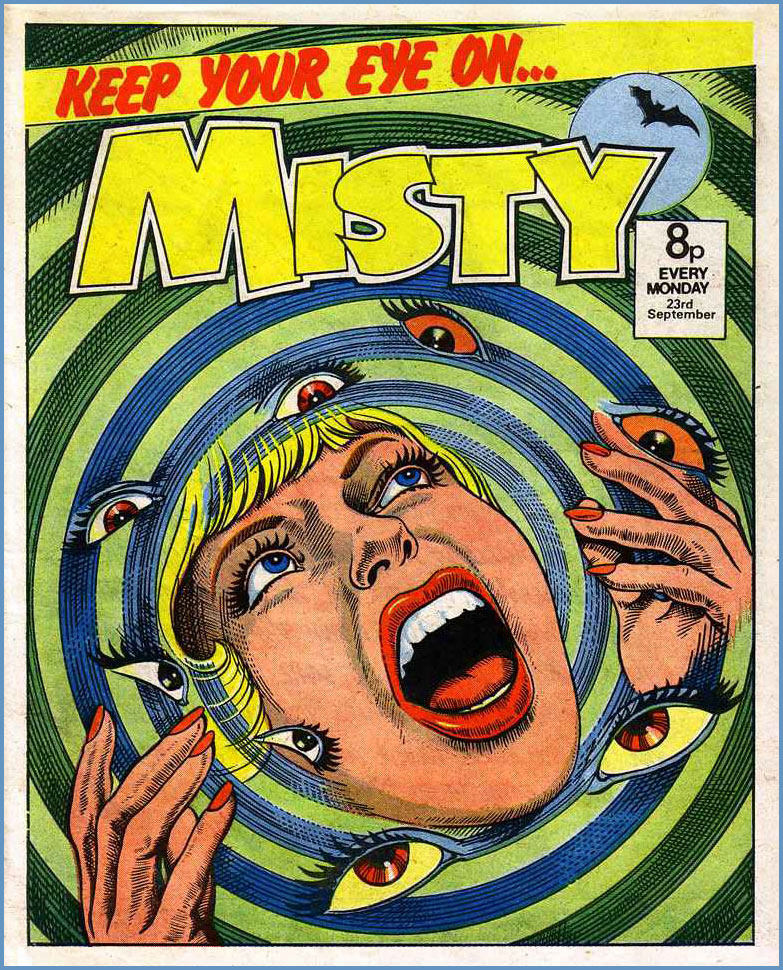
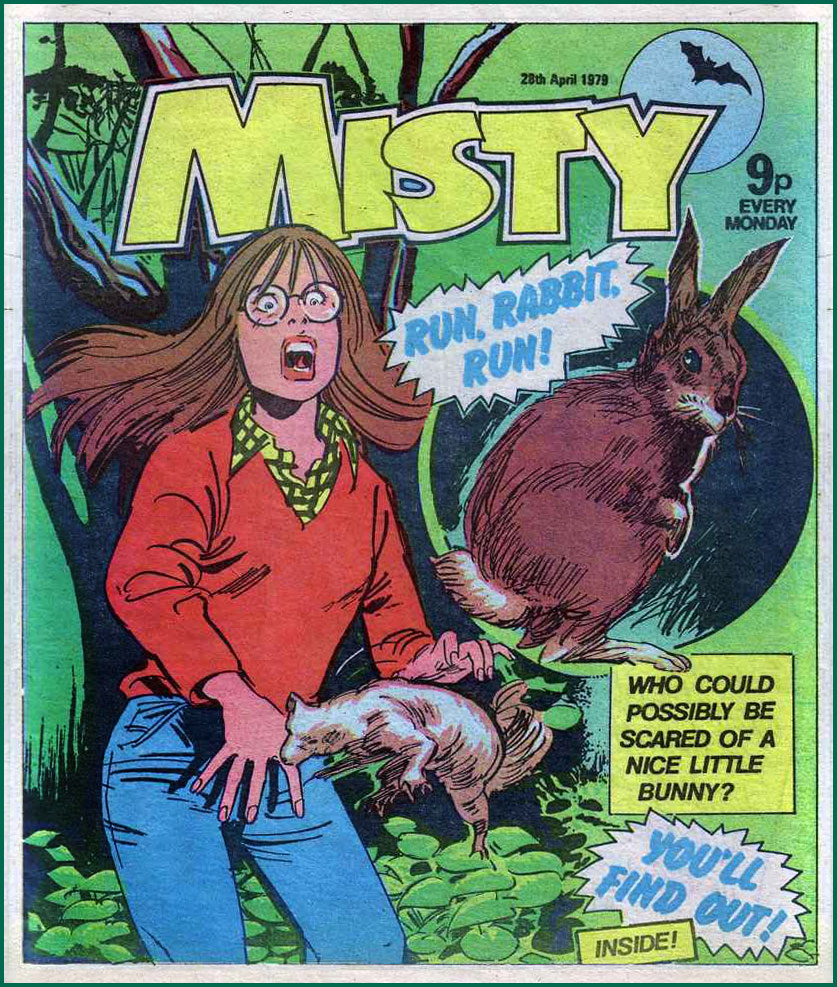
This is Misty No. 22 (July 1st 1978, IPC). This one I can credit: Jordi Badía Romero (1958-1984).This is Misty No. 28 (Aug. 12 1978, IPC).This is Misty No. 34 (Sept. 23 1978, IPC).This is Misty No. 64 (Apr. 28 1979, IPC).This is Misty No. 94 (Nov. 24 1979, IPC).
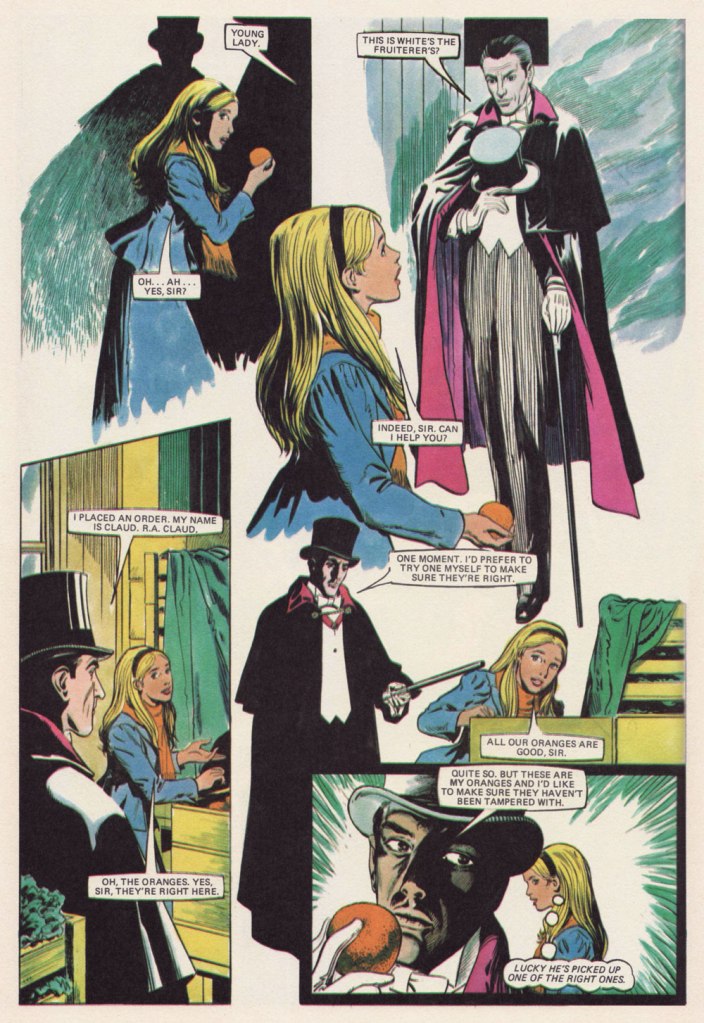
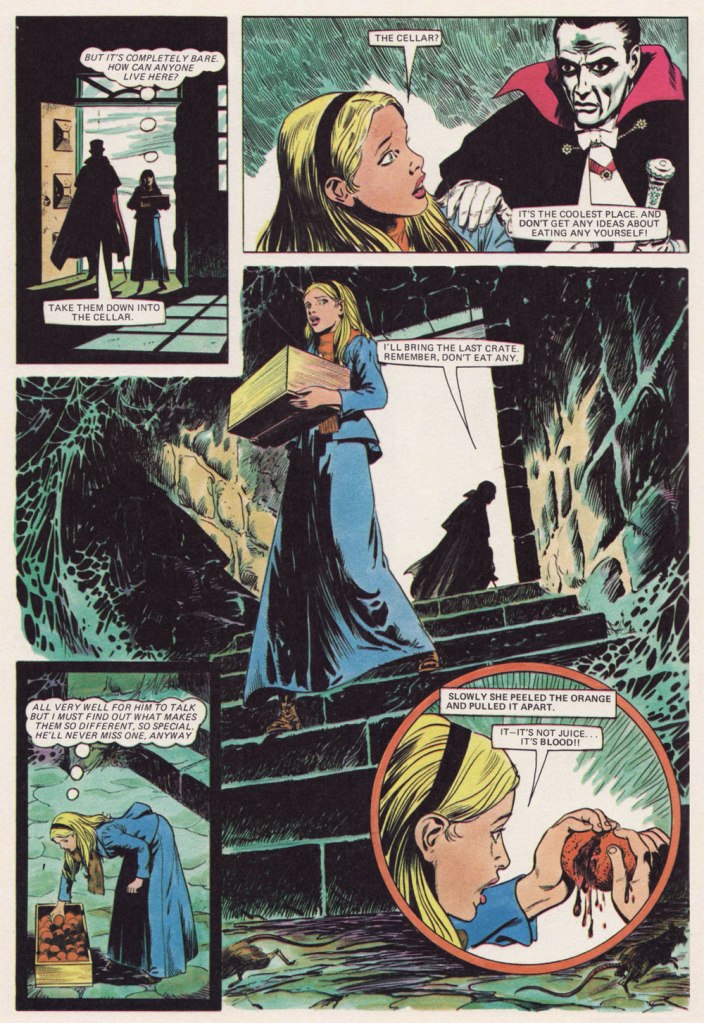
And here’s a short story.
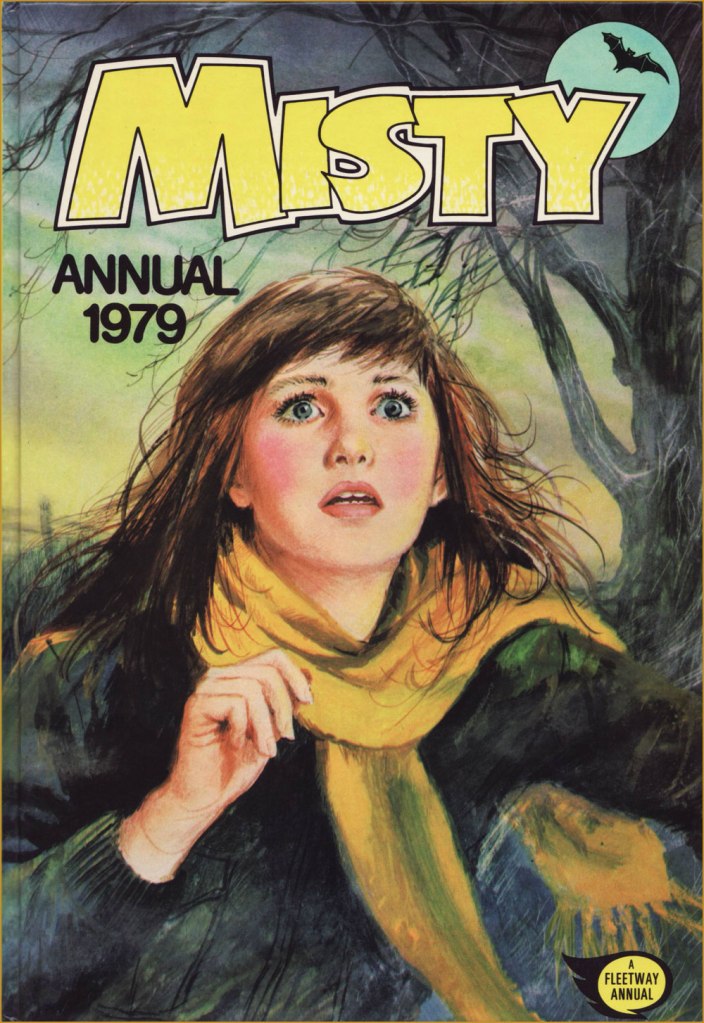
Dr. Julia Round recalls, in her foreword to Misty: 45 Years of Fear (2023, Rebellion): « Misty is perhaps best remembered for its one-shot stories, which were vicious cautionary tales in which characters would be brutally punished for a mistake or misdeed. There was a strong sense of dramatic irony in these stories — wishes backfire, magical items that are gained dishonestly turn on the owner, and unkindness to animals or nature sees girls transformed into bugs or plants. » This particular example is gentler, obviously.
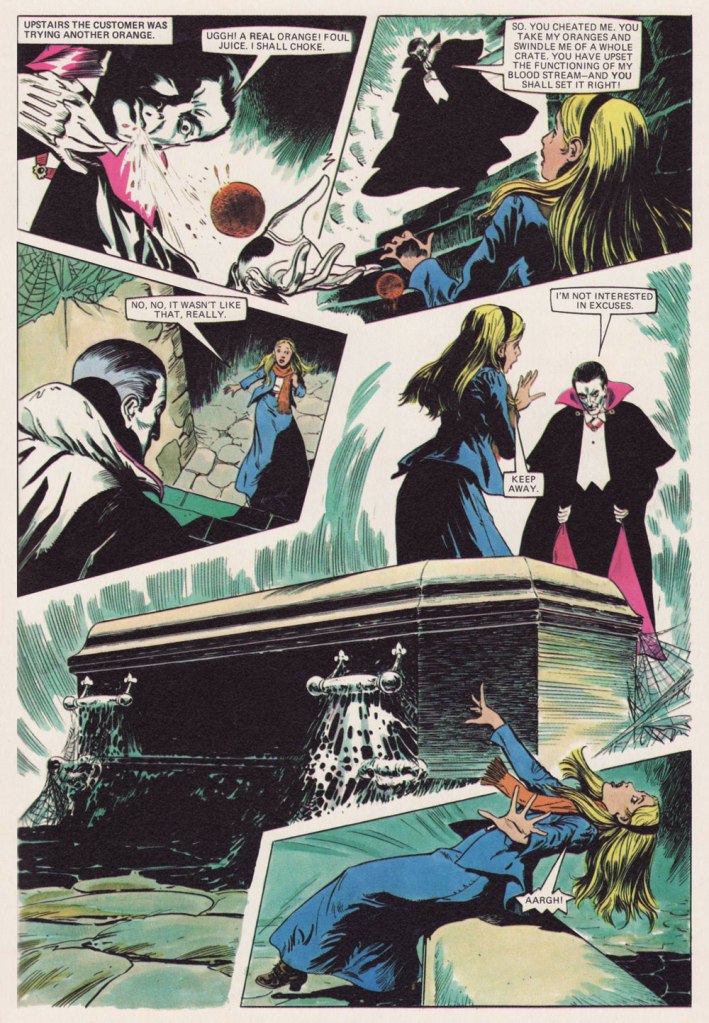
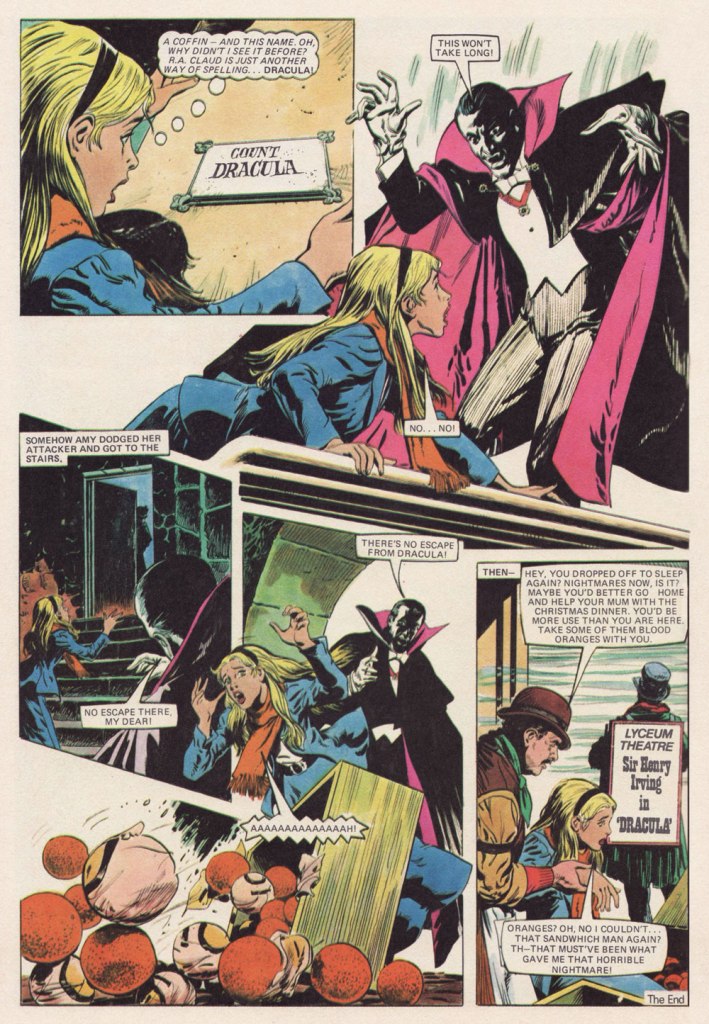
Blood Orange was published in Misty Annual 1979. No credits whatsoever, thank you very much.
-RG
*It’s worth noting — with a shudder — that UK comics were both stringently gender *and* genre specific.
** « Most titles were folded when they got down to about 200,000 sales. They said is was not viable, but can you imagine now, having a circulation of 200,000? » — Wilf Prigmore
The Moomins* never had a ‘proper’ Hallowe’en, as this celebration didn’t exist in Finland in Tove Jansson’s lifetime. The closest thing was Pyhäinpäivä , a sort of ‘Saints’ Day’ dedicated to lamented loved ones, whose memory is honoured with lit candles on their graves.
That being said, Moomins’ myriad adventures include many costumes and surreal moments that would qualify in a skipped heartbeat as good fodder for the end of October — who needs a specific holiday for sinister goings-on? Tove Jansson knew how to temper the spine-chilling with good humour. Her cast of characters is rich in spooky creatures rejected and misunderstood just because they live by different rules, some of which are, most appropriately to this post, ghosts.
The Hattifatteners (first appearing in The Moomins and the Great Flood, 1945), described as ‘…the little white creatures who are forever wandering restlessly from place to place, in their aimless quest for nobody knows what’ (Comet in Moominland, 1946) certainly qualify as a kind of ghost, with their whitish colour and the soft flexibility of mushrooms on thin stalks.
Hemulen (looking a bit Slavic there) and the Hattifatteners, whose appendages (appropriately) make them look like a bunch of crosses at a graveyard.
The Moomin lore includes actual ghosts, too. One example is the Island Ghost, featured in The Exploits of Moominpappa (written in 1950, and that can be read in its 1968 revised version here). In typical Jansson fashion, he can’t actually haunt very well, and is prone to random bouts of sneezing. He also likes knitting. That description fits me well, actually, so perhaps I’m a ghost, too.
« The room had suddenly grown cold with an icy draught, and the ghost sneezed. I don’t know how you’d have felt, but for my part I immediately lost much of my respect. So I crawled out from under the bed and said: ‘Cold night, sir!’ ‘Yes,’ replied the ghost in an annoyed tone. ‘A bleak night of fate resounding with the horrible wails of the phantoms of the gorge!’ ‘What can I do for you?’ I asked politely. ‘On a night of fate like this,’ the ghost continued stubbornly, ‘the forgotten bones are rattling on the silent beach!’ ‘Whose bones?’ I asked (still very politely). ‘The forgotten bones,’ said the ghost, ‘Pale horror grins over the damned island! Mortal, beware!’ The ghost uncurled, gave me a terrible look and floated back towards the half-open door. The back of his head met the door-jamb with a resounding bang. ‘Oops!’ said the ghost… »
The Moomins (1983) S01E45 – Island Ghost
This is not the only time the Moomins tried living on an island or encountered a ghost. Moominpappa at Sea (a story published in the daily strip in 1957, and similar to, but not entirely the same, as the novel from 1965), in which the Moominpappa becomes a lighthouse keeper, features another timid spook who does such a rattle-up job terrifying Moomintroll that he gets banned from haunting by the stern Moominmomma. Given this story’s mostly nocturnal setting, lonesome lighthouse and clanging chains galore, it’s highly appropriate to this October. The following version has been ‘reworked’ in colour by Drawn&Quarterly:
Tove’s brother Lars Jansson, who took over the writing (and eventually the illustration as well) of the Moomin comic strip in 1958, also has something to contribute to this Hallowe’en post. As an honourable mention, I offer you his Moomin and the Vampire (1964). One can argue that his stories lacked the soul (and artistic ability) of his sister — I’m not here to discuss that, just to take a peek at the little vampire bat escaped from a zoo.
«… devolving into a downright National Socialist muck of murderous paranoïa, a Lord of the Flies for our new century…»
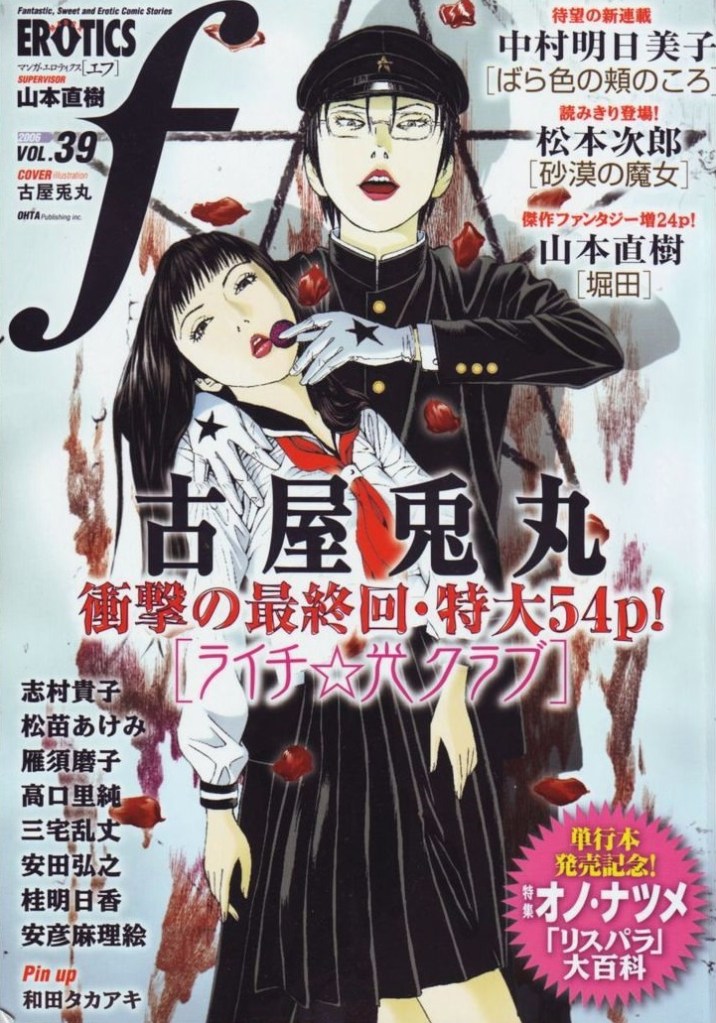
Lychee Light Club, aka Litchi Jirai Club (ライチ☆光クラブ), is a manga written and illustrated by Usamaru Furuya, who was smitten by a theatre play of the same name after watching it in 1985 as a high school student. Years later, he recreated it in manga form, albeit with a somewhat modified plot. It was serialized in Ohta Publishing’s Manga Erotics F* (May 7, 2005 – May 3, 2006). As for the play, it was directed by Norimizu Ameya** for the theatrical group Tokyo Grand Guignol (it’s funny to see the French ‘guignol‘ in this context).
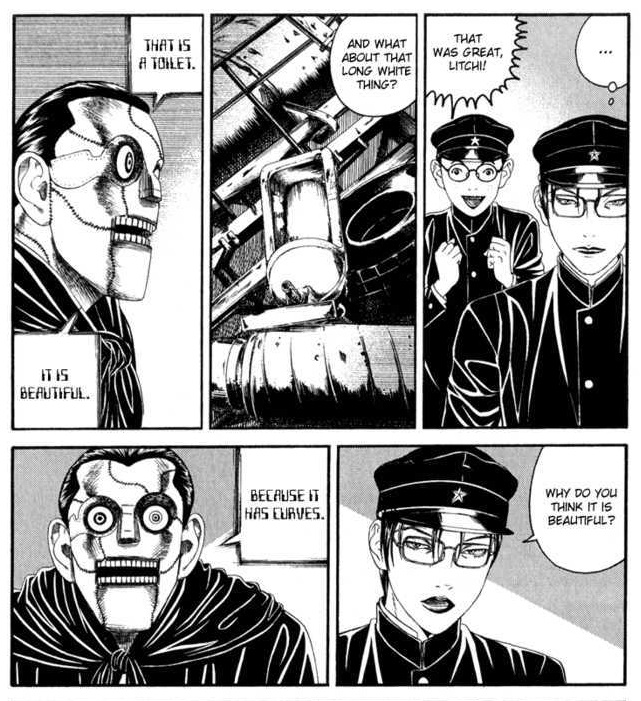
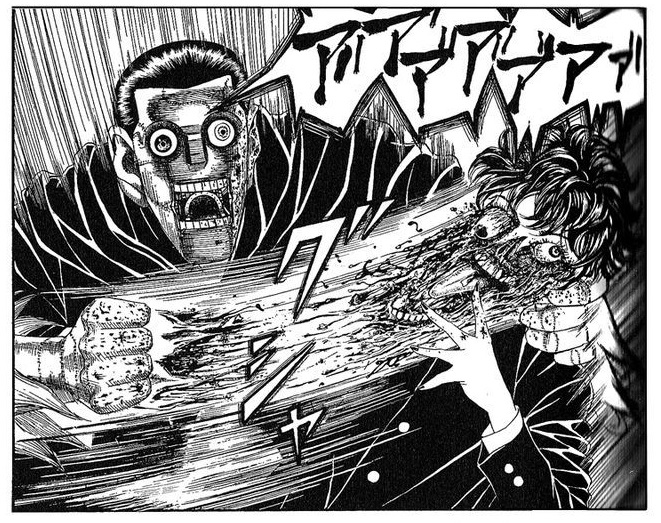
Lychee Light Club‘s over-the-top violence elicits the occasional chuckle (one of its characters dies from somebody pitching a toilet through his midsection), and more than one wince of discomfort, too, as its schoolkids maim, bash and burn their way through the story. The premise is simple – Lychee Light club (more of a cult, really) consists of eight barely-teenage boys who worship youth as the ultimate symbol of beauty (and, consequently, hate all things adult). They have nice digs where they spend all their time after school – an abandoned factory with plenty of dumped implements useful in their pursuit of the sadistic. They are led by the charismatic and cunning ‘Zera’ (actually, Tsunekawa from class 2), whose charm and fine features inspire blind devotion from his gang, not to mention occasional sexual favours.
To pursue their vision of eternal youth and a universal, if unfocused, lust for power, the posse builds a mostly robotic ‘thinking’ machine-cum-Frankenstein-monster, all metallic parts except for a human eye ‘borrowed’ from Zera’s number Eins, Niko. Zera informs his crew that he planted lychee seeds in a landfill three years ago… and now they have a forest of trees heavy with fruit at their disposal as fuel for Lychee, their mechanical prodigy. Apparently Zera is also a brilliant agriculturist, for lychee trees are notoriously slow to bear fruit, and three years later he’d have a forest of greenery at best. ***
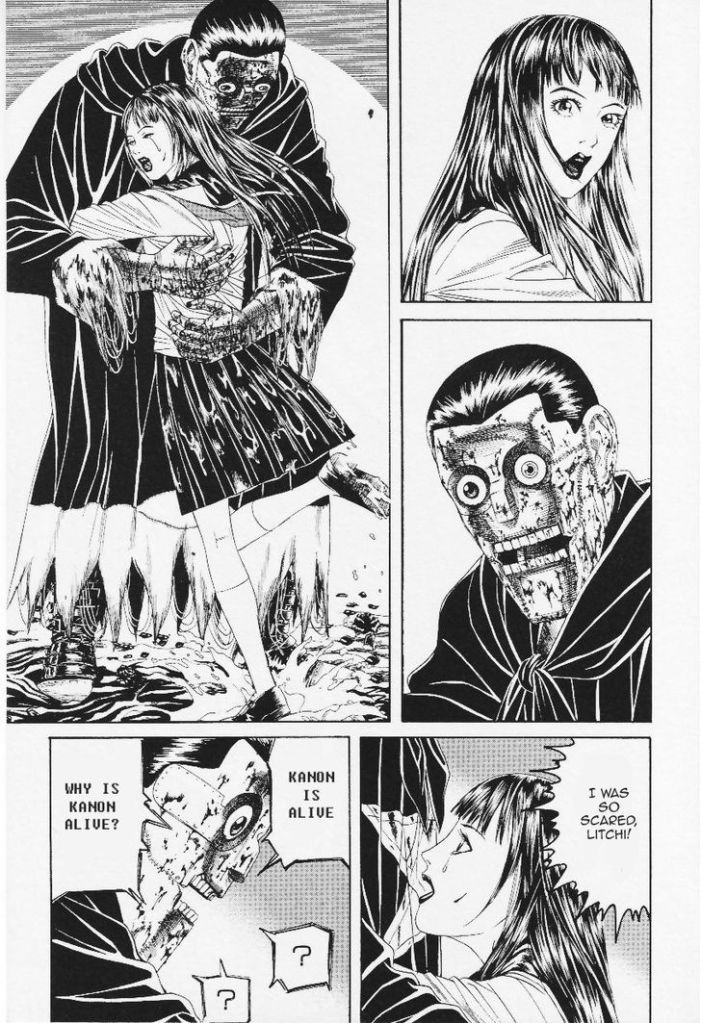
Lychee awakens! When questioned about why he is born, Lychee’s computer algorithm spits out that its mission is ‘to capture a girl’, so off he goes to kidnap many until he finds one beautiful enough to be their ray of light, eventually bringing Kanon, the female protagonist.
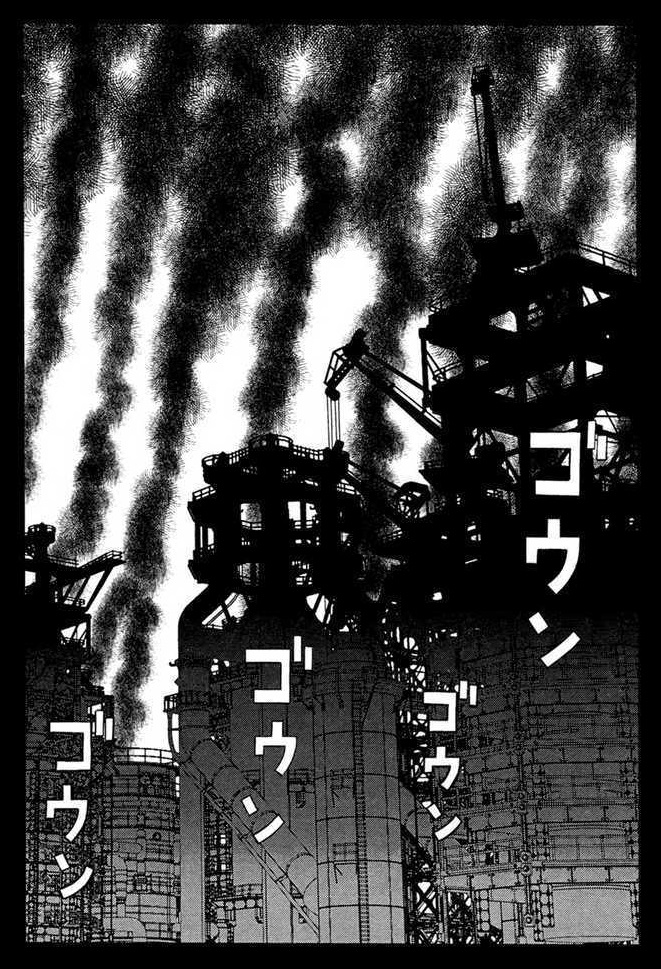
The story’s settings immediately plunge the reader into a kind of claustrophobia – filthy streets, a sooty factory, trashed cars — clearly an industrial town which doesn’t offer much hope for a better future. The boys’ lives outside the club are barely discussed, but the story hints that they all come from an uncomfortable family situation, though apparently they’re all ‘good kids’, as their maths professor incredulously notes before she is gleefully tortured and murdered.
Don’t forget to read right to left! Much later, in a fit of poetic justice, Zera gets killed by a toilet with (doubtlessly) beautiful curves.
There is a strong current of body dysphoria running through Lychee Light Club, fitting for a set of characters so fixated by ‘beauty’. The megalomaniac Zera is obsessed with Elagabalus, a Roman teenage emperor known for his sexual decadence (apparently to the point of standing out for his outlandish vices among other Roman emperors centuries later, which is surely a feat of some kind, given what some of them got up to).
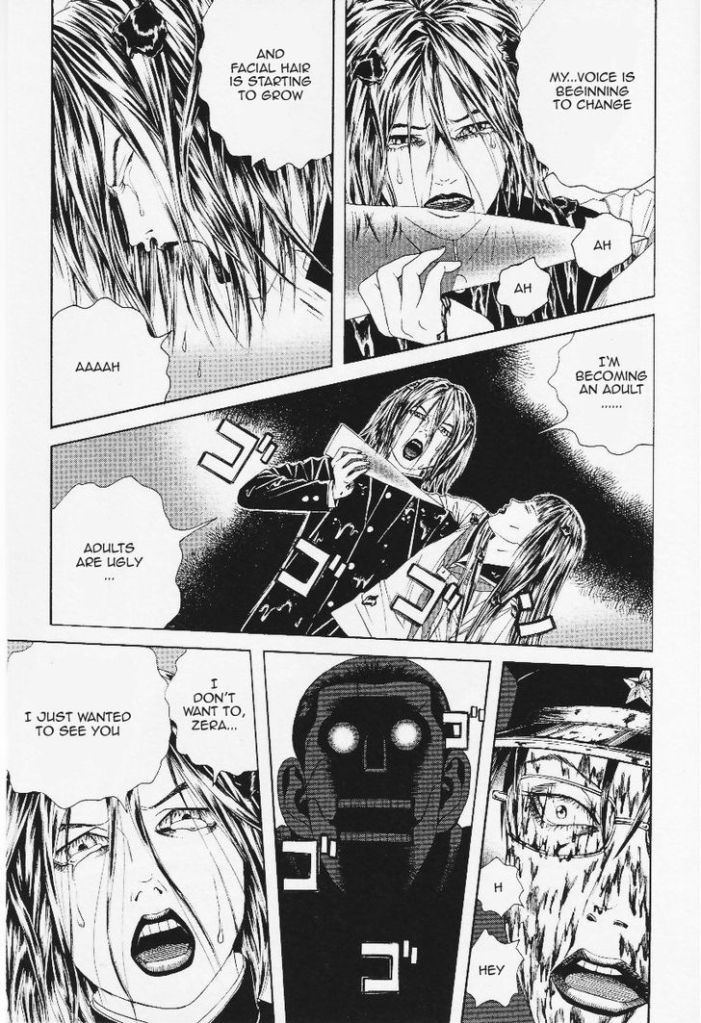
In a sort of Peter Pan/Neverland situation, the boys are nauseated by the sight of an adult woman’s body (her breasts are qualified as ‘repulsive, swollen lumps of fat’), and horrified by her ‘ugly’ innards, wondering whether their own organs are ugly, too (plot spoiler: they are, indeed). They obsess over Kanon, the eventual heroine of the story, because she’s soft and beautiful (but hasn’t turned into a woman yet). Kanon herself doesn’t want to grow up because she’s worried Lychee (at that point ‘humanized’ by her love) will reject her adult self.
All of them need to urgently get to therapy, but instead of that eyeballs are ripped out, innards (not to mention semen) are spilled, and the whole thing ends in an utter bloodbath, leaving the only ‘innocent’, Kanon, mourning Lychee, who is now more ‘human’ than the members of the Lychee Light club because he understands that murder is wrong. Reading this manga is a bit like observing a train wreck. Nothing in this story is nearly as profound as it pretends to be, and plot holes bloom much like lychee flowers — and yet its mostly naïve characters stick in one’s mind. Poor, poor children.
« …a mere plaything, having feelings! »
~ ds
* Speaking of the erotic… a quick perusal of blurbs quickly yields ‘Shocking, sexy and innovative, the Lychee Light Club is at the pinnacle of modern day Japanese seinen manga (young adult comics)‘, with which advertisement I have several bones to pick. ‘Sexy’ is an uncomfortable description of a manga with sadistic violence and heavily underage protagonists, though eroguro fans probably lap the former up. As for the ‘young adult comics’ bit, I’d like to submit a petition to stop assuming that stories about teenagers are meant to be necessarily read by teenagers. Should ‘old’ people read exclusively about the elderly? One can argue that adults aren’t so interested in reading about to-be-adults (my case in point, Wheel of Time book one, which I recently read, and whose adolescent protagonists were intensely annoying), but that speaks more to a lack of storytelling ability.
** Who’s had a wild enough (perhaps ‘unhinged’ would be a better description) life that he would merit an entire article by himself (see a summary here).
*** As far-fetched as this plot is is, the anime by the same name (loosely based on the manga) is hilariously goofy where the manga was highfalutin. Take the plot of episode number 6, in which ‘Some members of the club wonder if Lychee really only runs at lychee fruit and then offer him a peach. As he accepts it, they give various other foods and eventually Lychee develops culinary skills.’
« I prefer hallucinations ’cause they tend to make more sense than experience. » — Todd Rundgren
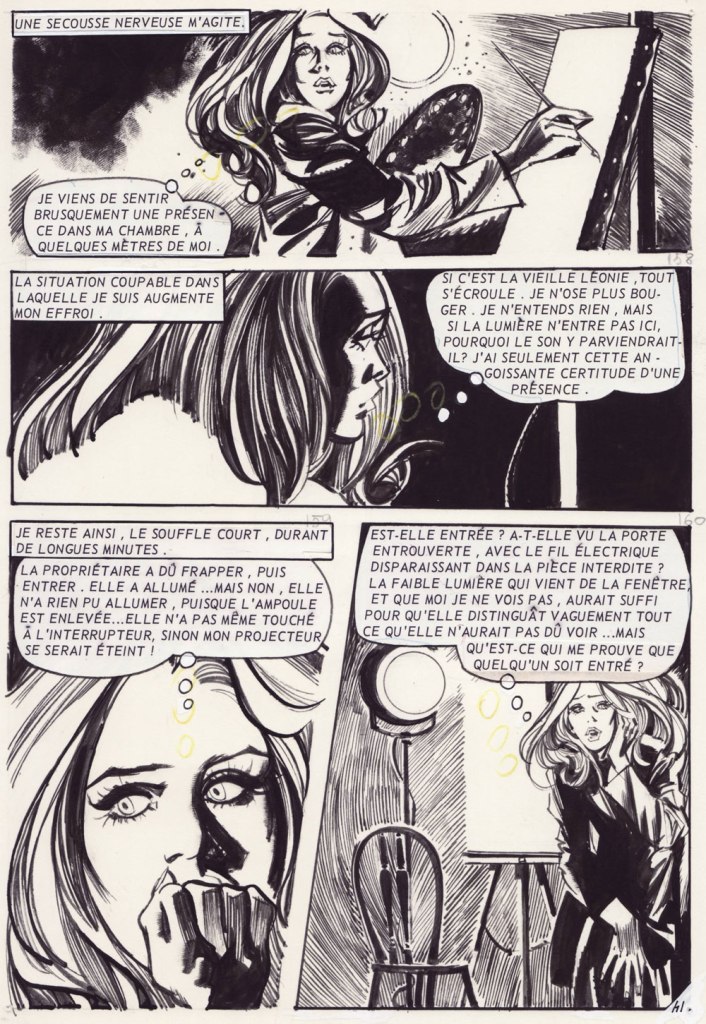
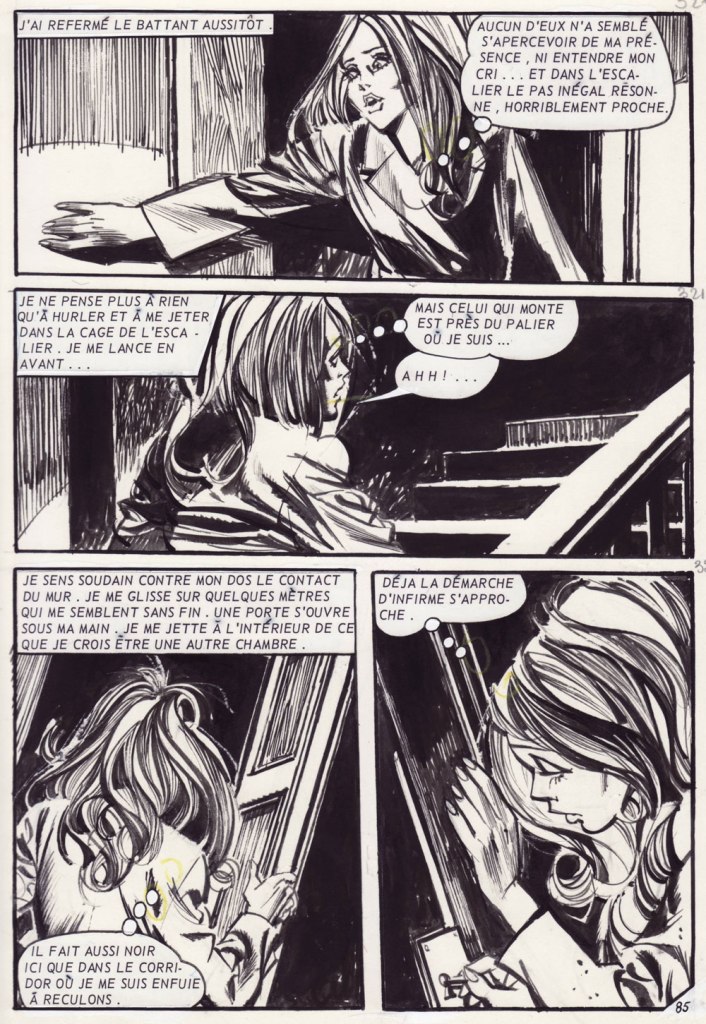
Today, I’m mixing things up a bit and heading over to Europe. We’ll be looking at various versions of « Le seuil du vide » (Threshold of the Void) a story by André Ruellan (1922-2016), aka Kurt Steiner.
At left, the original novel, published in 1956; at right, the comics adaptation, published in 1973. Believe it or not , both covers are the work of the same man, the prolific Michel Gourdon (1925-2011). He had a predilection for a palette of green and blue hues.
The plot, in a few broad strokes: Young painter Wanda Leibovitz comes to Paris, hoping to forget a romance gone wrong. At the train station, upon her arrival in town, Wanda encounters a mysterious old lady offering to rent her a room, but under certain conditions…
Basically, it’s the ‘New Bodies for Old’ plot, and it ends as bleakly as you might imagine. Ruellan/Steiner wasn’t the least bit afraid to probe the darkness. The victim’s innocence was no protection against the forces besieging her, to put it mildly.
Here are a few interior pages from the Arédit adaptation, featuring art by Cándido Ruiz Pueyo.
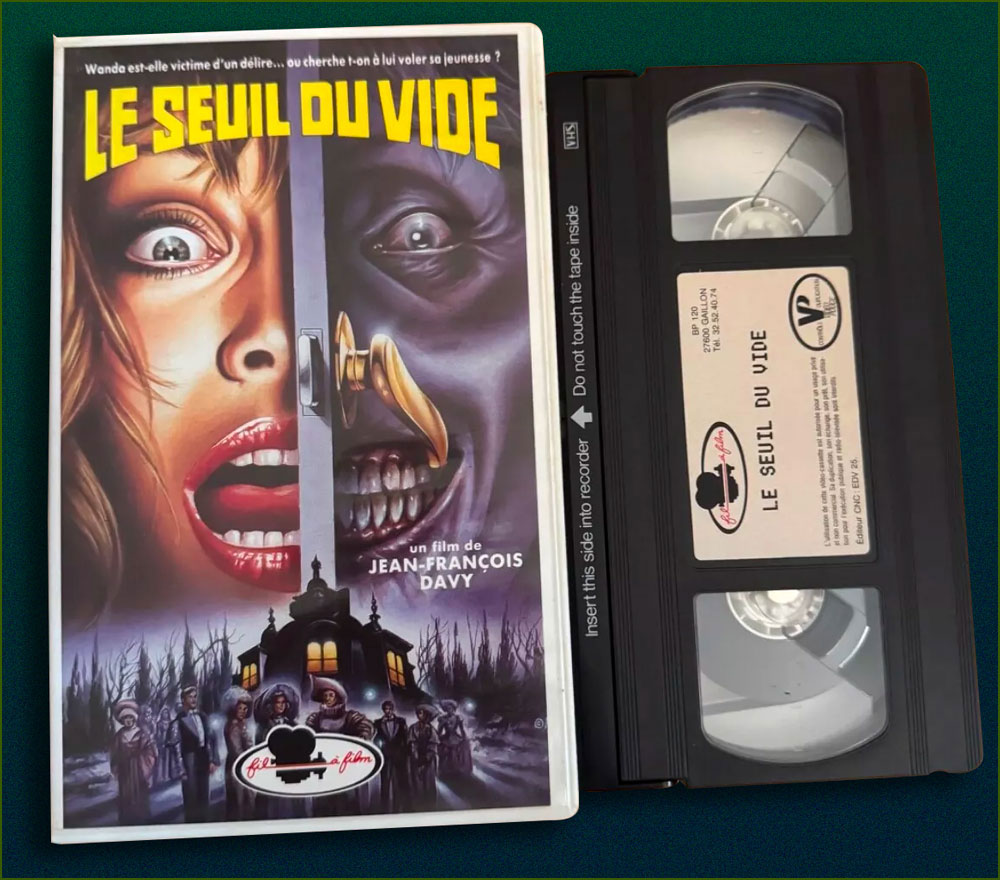
There was also a movie adaptation by an ambitious young filmmaker by the name of Jean-François Davy. This was his third try at getting a project off the ground and into cinemas, and his only horror film. They just weren’t making such films in France in those days — the iconoclastic Jean Rollin being the notable exception — in Belgium, sure, but not in France. It took some doing to get the project (barely) financed, lensed and distributed, and its director wound up turning to porn for the rest of his career — hilariously titled porn, to be fair.
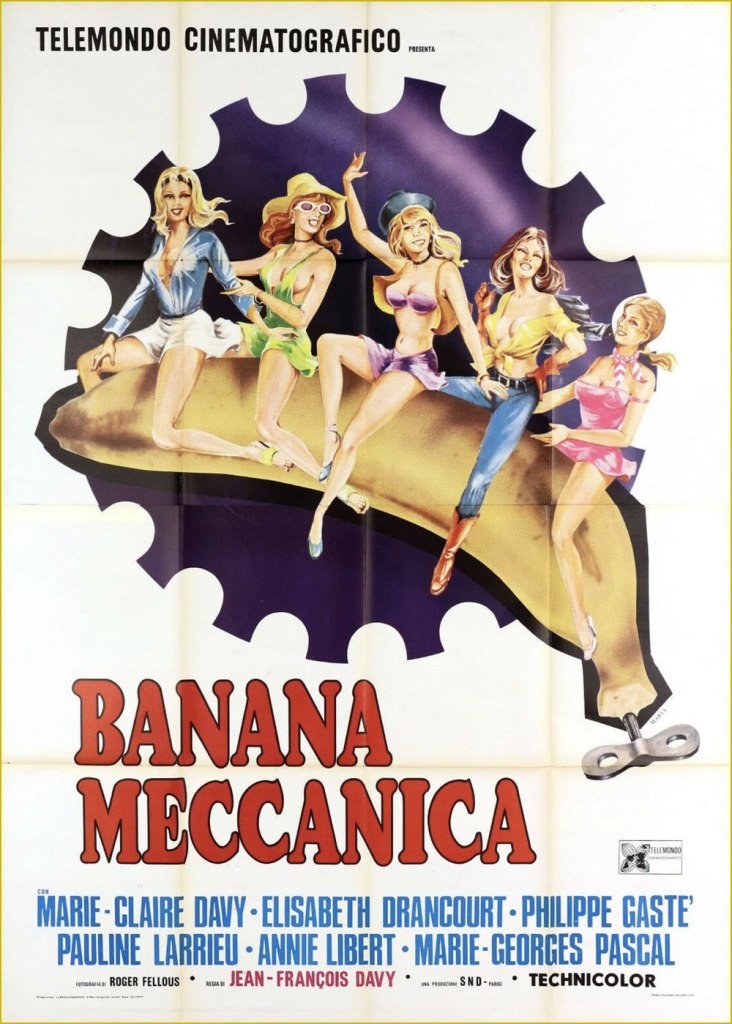
The film features such luminaries as Rififi‘s unforgettable Jean Servais, along with a non-coincidental cameo by (yet to be filmed) The Tenant author Roland Topor. Davy soon attained greater commercial success with his Bananes mécaniques, nominally a Clockwork Orange parody.
And here’s the VHS release, featuring the film’s original poster. Airbrush!
« Daddy had an argument on Friday night, with a man from outer space. Daddy said, ‘I don’t care where you’re from, you’re in my parking space!’ » — Colin McNaughton
Here we are, against all odds, at the beginning of yet another edition of WOT?’s annual Hallowe’en Countdown… hope you enjoy the bumpy — that’s the spirit! — ride.
This time, our opening salvo comes courtesy of British illustrator-poet Colin McNaughton (born 1951). Though I’ve been known to haunt used bookstores whenever the occasion arises, I’ve but once encountered a single one of Mr. McNaughton’s productions, a couple of decades ago at that… which is odd, given his rather prodigious output: over seventy books! That said, my mama having raised no fool (my brother notwithstanding), I unerringly grabbed it.
As it happens, Wikipedia claims — though without any context or evidence — that « His most notable book is perhaps There’s an Awful Lot of Weirdos in Our Neighbourhood »… but I’ll accept it unless a stronger claim comes along. It’s a truly splendid tome.
Oh, and here’s the requisite snatch of (auto?) biography: « Growing up in his native England, the young Colin McNaughton had little indication that he would one day become an author-illustrator. There were no books at all in his parents’ home, he recalls, but there were always comics. These were his formative literature, and their slapstick humor has been a lasting influence. “I’ve been talking about the comic format for years,” he says. “It’s the modern way of telling stories for today’s children; it’s about movement, the step between film and the book.” »
I can live with that. enjoy!
There’s an awful lot of weirdos in our neighbourhood! Yes, there’s an awful lot of weirdos in our neighbourhood!I know this physical wreck, who has a bolt through his neck! There’s an awful lot of weirdos in our neighbourhood!And in an upstairs room, an old lady rides a broom! There’s an awful lot of weirdos in our neighbourhood.A man lives on the square, when he’s in he isn’t there! There’s an awful lot of weirdos in our neighbourhood.And that woman down the block, whose snaky hair’s a shock! There’s an awful lot of weirdos in our neighbourhood.We’ve a strange old feller, with horns, down in the cellar! There’s an awful lot of weirdos in our neighbourhood.There’s a guy who’s green and scaly, has webbed feet and sells fish daily! There’s an awful lot of weirdos in our neighbourhood.And someone near the dairy, when the moon is out gets hairy! There’s an awful lot of weirdos in our neighbourhood.Think I’ll leave this miscellanea, and return to Transylvania, ’cause there’s an awful lot of weirdos in our neighbourhood!
How about one more? One more it is!
Mum! The garden’s full of witches! Come quick and see the witches. There’s a full moon out, and they’re flying about, come on! You’ll miss the witches.
Oh, Mum! You’re missing the witches. You have never seen so many witches. They are casting spells! There are horrible smells! Come on! You’ll miss the witches.
Mum, hurry! Come look at the witches. The shrubbery’s bursting with witches. They’ve turned our Joan into a garden gnome. Come on! You’ll miss the witches.
Oh no! You’ll miss the witches. The garden’s black with witches. Come on! Come on! Too late! They’ve gone. Oh, you always miss the witches.
« Better to have a lousy character than no character at all. » — Alain Delon (Nov. 8, 1935 – Aug. 18, 2024)
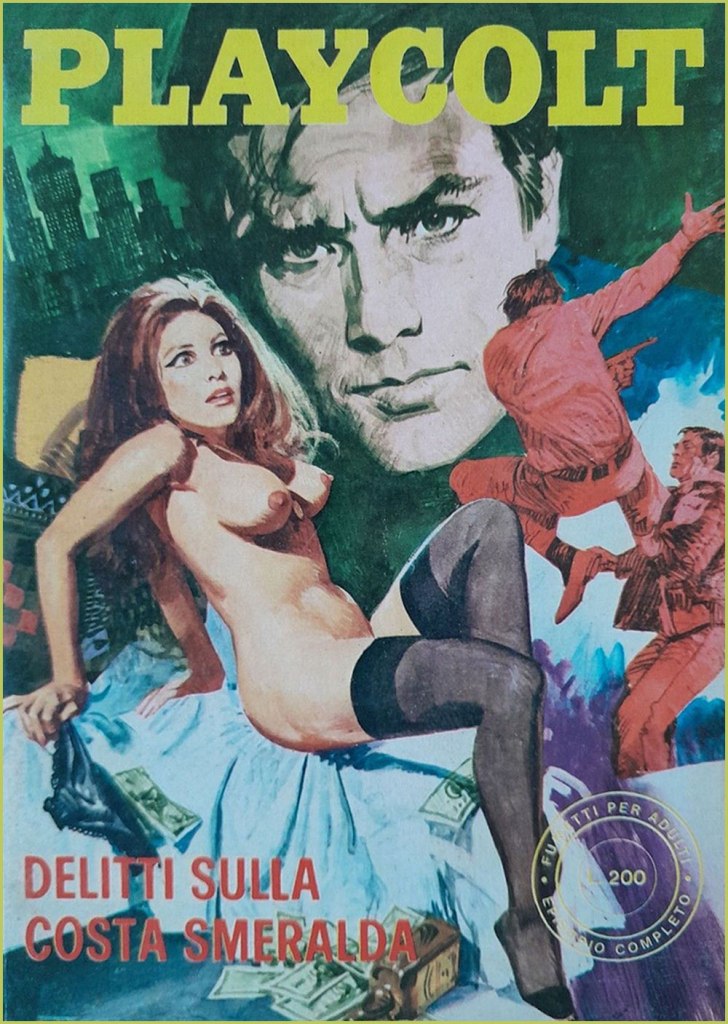
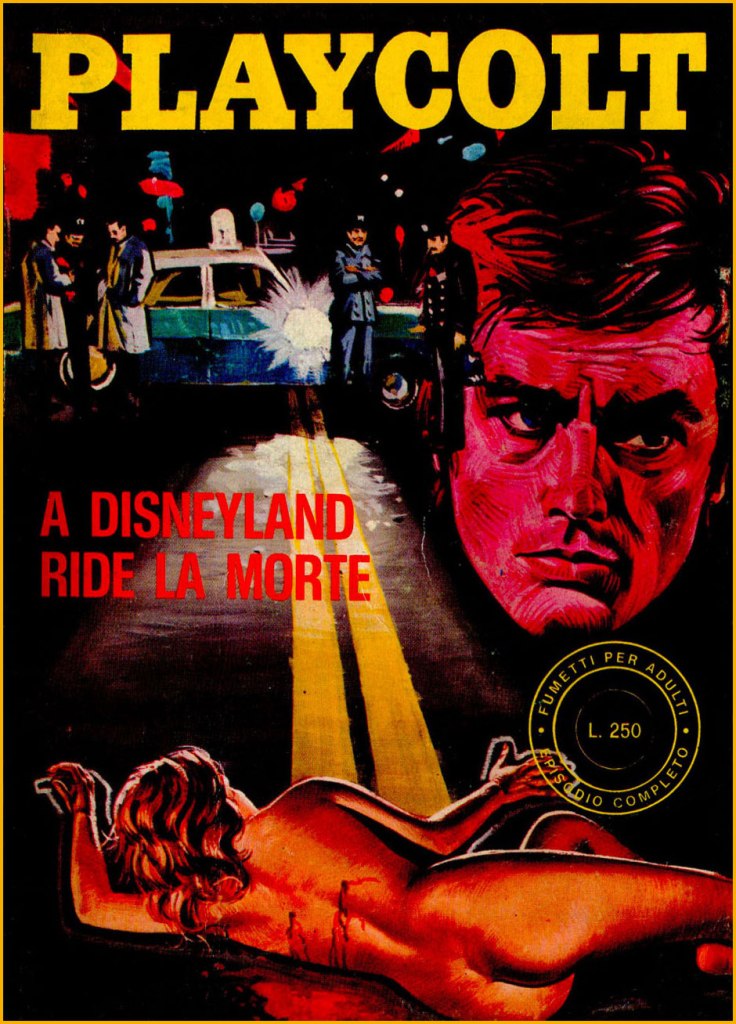
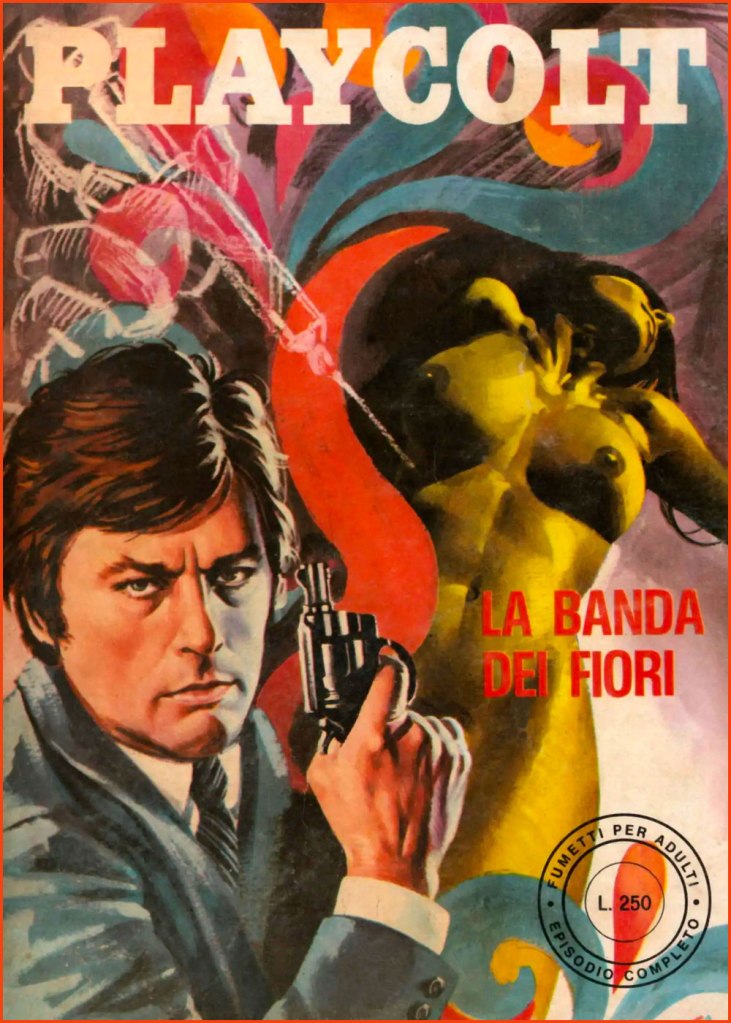
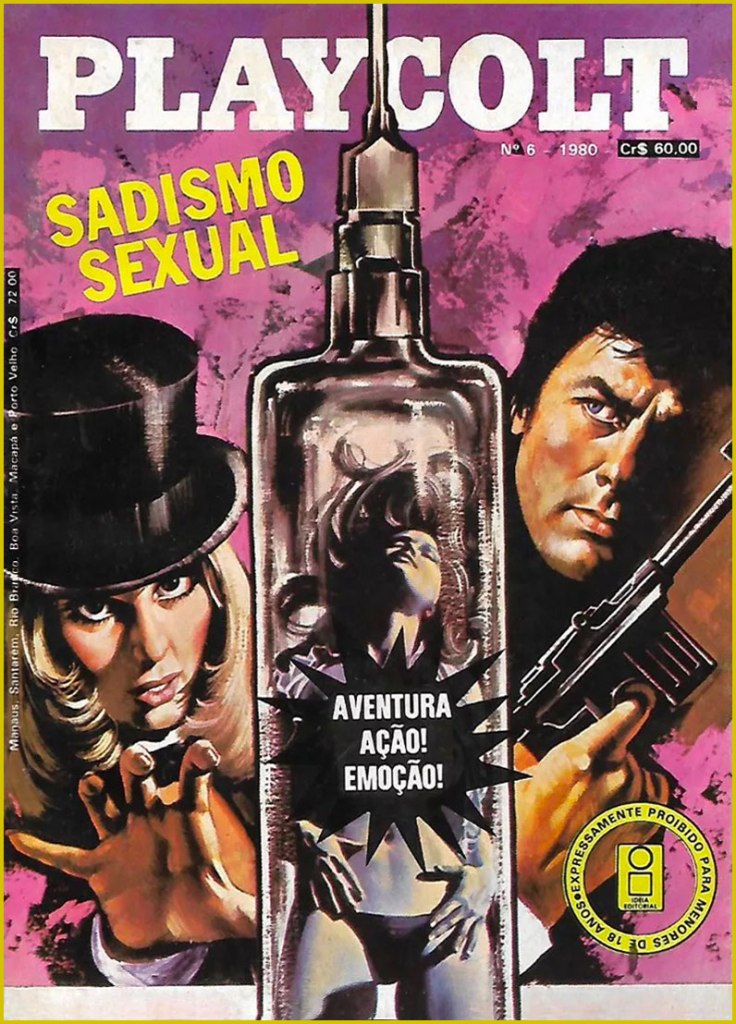
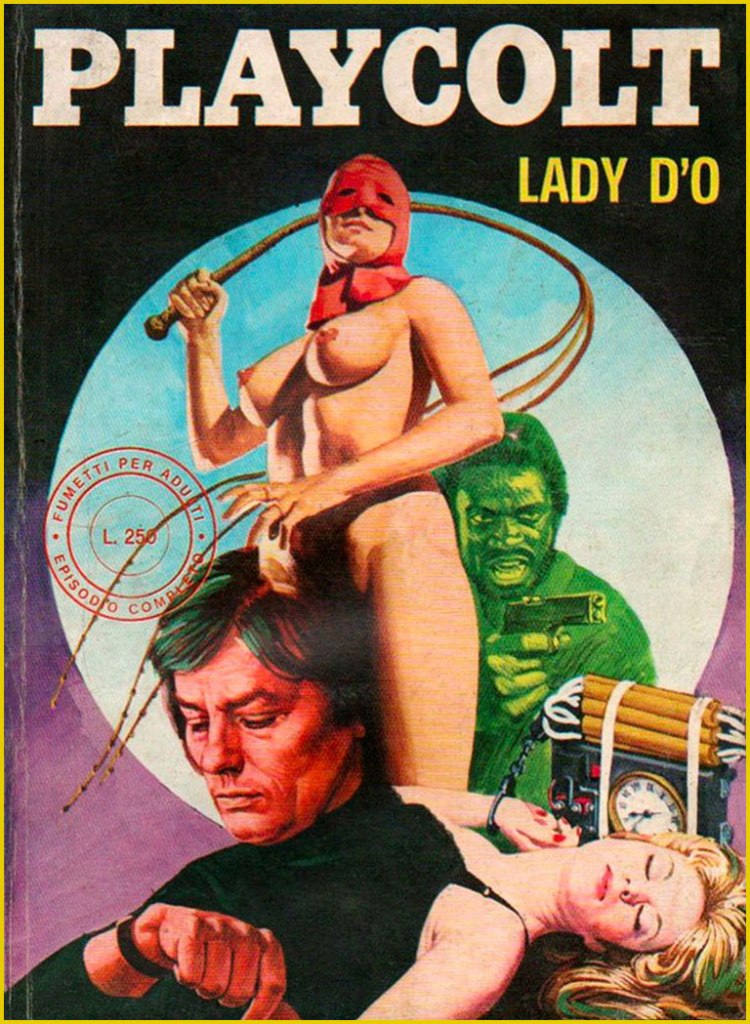
Quite recently, we lost monstre sacréAlain Delon. He was a complicated man, a bit of a prickly bastard, but he sure made a lot of great movies*. But comics, you ask? Well, I’m sure he never asked for it, but like many a celebrity (Jean-Paul Belmondo, Ornella Muti…) his famous countenance was appropriated by those incorrigible rascals at Edifumetto and Ediperiodici.
So Alain Delon became… « Alain Velon, a billionaire playboy who lives on an island “a 3-hour flight from New York“. He spends his private life conquering women in a continuous stream even if he is already engaged to the film actress Lizzy Scarlett, but “due to his innate sense of justice” he periodically transforms into Playcolt, a sort of superhero. His enemy is Linda Darnel, also a billionaire: sadistic and fetishist, she turns into the anti-heroine Za the Dead. Another historical rival is the always sadistic but lesbian Mandrakka. »
Now don’t get me wrong: these are virtually unreadable, poorly drawn, sadistic, illogical, reactionary misogynistic claptrap. But the covers are fascinating in their gonzo way, randomly cobbling together purloined bits from famous likenesses to established logos. You’d think this brazen wave of wholesale filching would have led to swift and decisive legal action from several stars’ solicitors, not to mention Hugh Hefner’s… but it seems not. This was, after all, the Italy that gave us Silvio Berlusconi.
« To the Sound of Punches »; this is Playcolt Series II no. 9 (Nov. 1973, Edifumetto). Cover art by Carlo Jacono, a nice piece, but celebrity likenesses evidently weren’t among his strong suits.« Crimes on the Emerald Coast »; this is Playcolt Series II no. 14 (Aug. 1973, Edifumetto). This one’s *possibly* the work of Alessandro Biffignandi… or his studio.« The Golden Rain » (ahem); this is Playcolt Series II no. 23 (Dec. 1973, Edifumetto). Another Jacono, another botched likeness.« The Divine Sadist »; this is Playcolt Series III no. 1 (July 1974, Edifumetto). « Death laughs in Disneyland »; this is Playcolt Series III no. 11 (June 1974, Edifumetto). « There’s a mess in the middle of the sea »; a 1980 Brazilian edition reprinting Playcolt Series III no. 18 (Sept. 1974) in Portuguese. « The Flower Gang »; this is Playcolt Series III no. 22 (Nov. 1974, Edifumetto). I have no concrete evidence, but the technique displayed here reminds me strongly of British illustrator-cartoonist Ron Embleton (1930-1988), co-creator of Oh, Wicked Wanda! and illustrator of the immortal Captain Scarlet closing credits.No need for a translation, is there? A 1980 Brazilian edition reprinting Playcolt Series IV no. 1 (Jan. 1975) in Portuguese. « Operation Puzzle »; this is Playcolt Series IV no. 12 (Nov. 1975, Edifumetto). Cover painted by the prolific Emanuele Taglietti, who handled quite a few covers in this series. Here’s an impressive gallery of these.« The White Shark »; this is Playcolt Series IV no. 35 (May 1976, Edifumetto). Sharks were all the rage that year.« To Love a Hole »; a 1980 Brazilian edition reprinting Playcolt Series IV no. 2 (Jan. 1975). Dig that strategic blurb placement; the Italian edition was not so coy. Clearly a reference to the previous year’s hit ‘erotic’ film, L’histoire d’O; this is Playcolt Series IV no. 27 (Jan. 1976, Edifumetto). It’s funny how the Delon photos used span his career up to that point, which yields visual whiplash when you go from the Delon of Plein Soleil to the jaded, grizzled one of, say, Monsieur Klein or La mort d’un pourri from one issue to the next.« Terror in California »; this is Playcolt Series IV no. 44 (Oct. 1976, Edifumetto). The obligatory Jaws cash-in. Say what you will, those Italians didn’t miss a trick.
There was, concurrently, another Delon homage in Jean Ollivier and Raffaele Carlo Marcello‘s successful Docteur Justice, a humane but hard-hitting series about a physician and expert judoka who roams the globe’s trouble spots for the World Health Organization. There was even a film adaptation in 1975, with John Phillip Law essaying the title role… and co-starring Delon’s ex — and only — wife, Nathalie. Among Pif Gadget’s adventure series, it was only bested in popularity by the prehistoric blond heartthrob Rahan. I’ll tell you more about it one of these days.
-RG
*So claims the Russian pop song entitled Взгляд с экрана, and who are we to doubt it?







































 Who's Out There?