« There is nothing new under the sun but there are lots of old things we don’t know. » — Ambrose Bierce
Here’s an unusual specimen: a two-headed, twin-gendered Australian cartoonist. Beryl Antonia Yeoman (1912-1970, b. Brisbane, Queensland) formed, in 1937, a cartooning partnership with her brother, Harold Underwood Thompson (1911-1996, b. West Kirby, Cheshire) when they adopted the nom de plume of Anton.
From the sound of it, Beryl was the power behind the throne, as she produced the Anton cartoons on her own during Harold’s active duty in the Royal Navy during WWII. The pair reconvened after the war and created wonderful cartoons for such publications as Punch, Lilliput, Men Only (ha!), Tatler, The Evening Standard (solo Harold!) and Private Eye. Beryl was the only female member of Punch’s exclusive Toby Club.
Today, a charming bistro named in honour of the artful siblings still operates in Wells, Somerset; it features Anton’s art on its walls. How’s that for posterity?
This slyly cozy cartoon made the cut for the splendid 1952 anthology The Best Cartoons From Punch.
And while we’re on the subject of ghostly radio stories, give one of these a try.
« Each time I enter this fog, it feels as though icy fingers were clutching at me! »
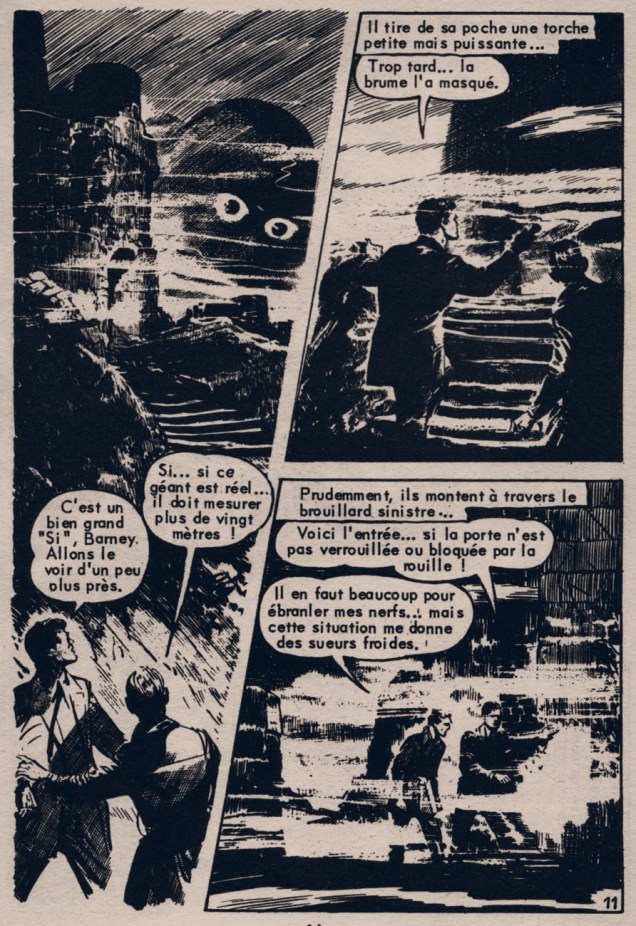
Étrange aventures, a squarebound quarterly digest (roughly 5 x 7 inches, 164 pages), was one of many titles published in France by Arédit / Artima between 1966 and 1984 through its Comics Pocket imprint. Étranges aventures was one of the collection’s flagship titles, with a healthy run of 79 issues from July, 1966 to March, 1984. Its contents were mostly repackaged and reformatted translations of various DC and Marvel (and the odd Charlton) comics in black and white, but with fun painted recreations of the original covers for the twenty-or-so issues. At under fifty cents a pop, they presented a bargain to the cash-strapped aficionado, thrifty access to scarce and/or pricey items.
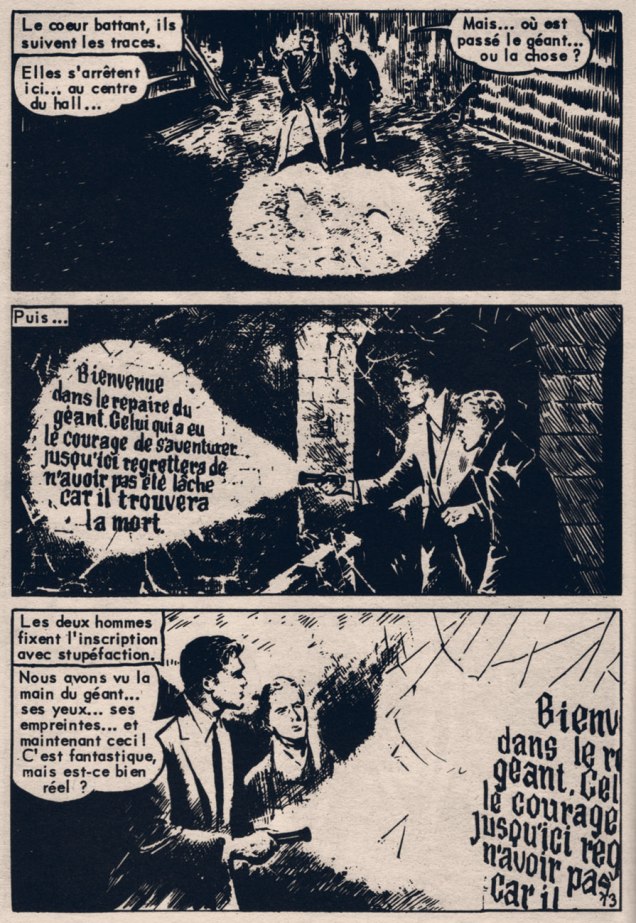
This issue was a relative exception, cover-featuring an original work (or at least not an American one), the sort of material the publisher usually reserved for its more “serious” titles. These were often comics adaptations of horror or suspense novels issued earlier by mother company Les Presses de la Cité under its Fleuve Noir imprint. Graphic novels? Exactly.
« If… if this giant is real…it must stand over twenty meters high! » « That’s a mighty big ‘If’, Barney. Let’s take a closer look at him. » He pulls from his pocket a small but powerful flashlight… « Too late… the mist has hidden him. » Cautiously, they climb through the sinister fog… « Here’s the entrance… if the door isn’t locked or blocked by rust! » « It takes quite a bit to frazzle my nerves… but this situation has given me cold sweats! »« Welcome to the giant’s lair. He who has had the courage to venture this far will regret not having been cowardly, for he will find death. »Prosaically, the whole affair turns out to be the work of unscrupulous special effects experts, vulgarly after some jewels. All this imaginative and diabolically elaborate work and expense for some shiny baubles! Still, it’s all about mood.
Writer and artist unknown. And nationality, for that matter. In places, the artwork has clearly been resized and adjusted, and switches back and forth between halftone and line art reproduction. So the lasting mystery lies not in the story, but in its provenance.
« J’fais dans la bande dessinée, qu’est bien plus pop que le ciné!* » — J.C. Forest (Une chanson, 1973)
On the eighty-ninth anniversary of his birth, let’s salute in passing one of the great pioneers of French comics, namely Jean-Claude Forest (Sept. 11, 1930 – Dec. 29, 1998), Barbarella’s creator, the man who, in the early 1960s, ushered strictly-for-kids bandes dessinées into decidedly more risqué and adult realms of eroticism, fantasy and fun.
Born on September 11, 1930 in the Parisian suburb of Le Perreux-sur-Marne, he passed away in 1998 at the age of 68, but not before leaving behind a body of work of breathtaking depth and variety. Barbarella aside (sorry, miss): Le Copyright (the springboard for Nikita Mandryka‘s Le Concombre masqué), Hypocrite, Mystérieuse matin midi et soir (his wild riff on Jules Verne’s L’île mystérieuse), Bébé Cyanure, Les Naufragés du temps (illustrated by Paul Gillon), Enfants c’est l’Hydragon qui passe… « et j’en passe », as they say.
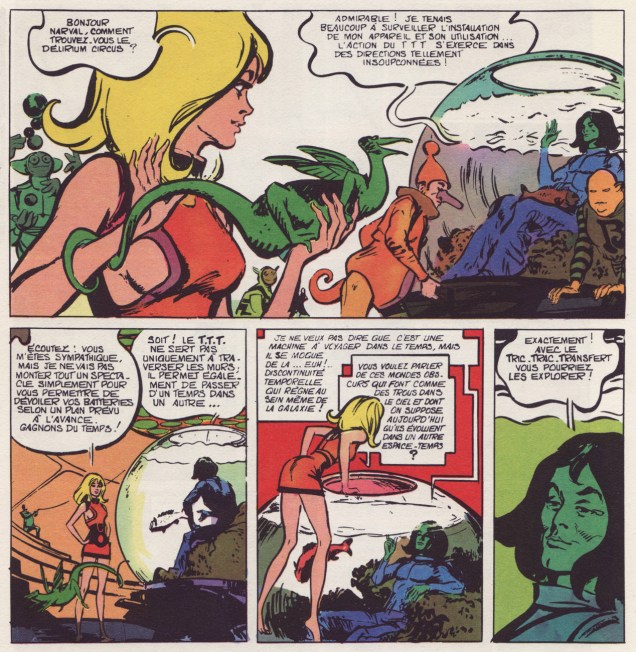
Here are a few highlights to give you a sense of the man’s imagination, versatility and tremendous draftsmanship, in chronological order.
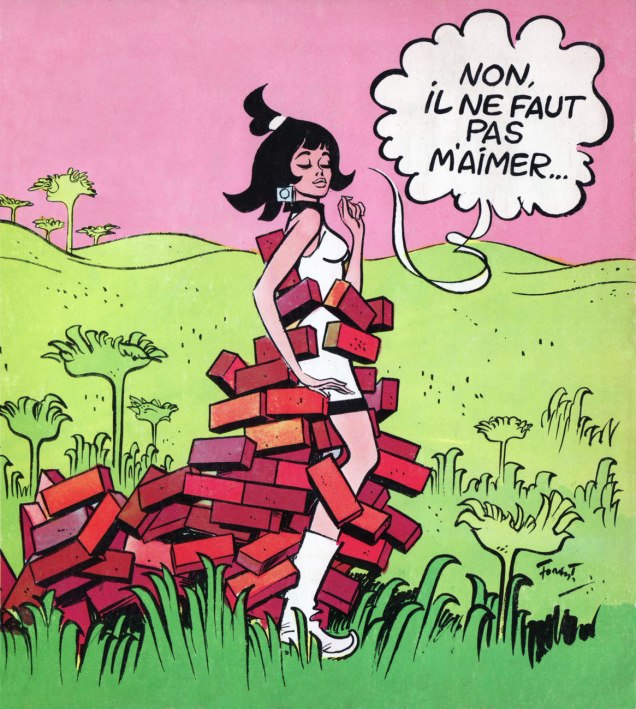
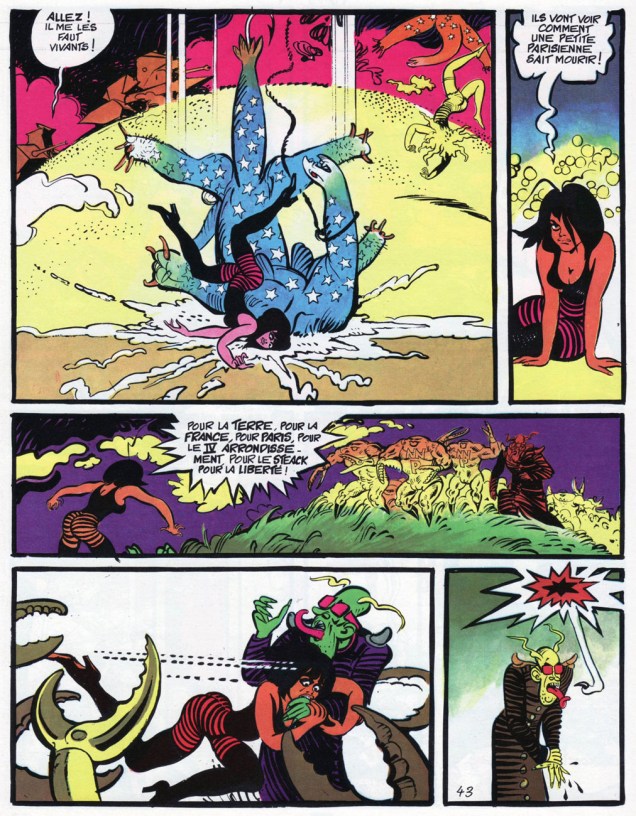
An excerpt is from Les colères du mange-minutes (1965-66), the second volume of Barbarella’s adventures. Yes, there was a film adaptation, but it’s, well, pretty vapid. Director Roger Vadim was kind of the Gallic John Derek; both were fair-to-middling directors whose chief talent was womanizing. Though one has to admit it *was* quite a talent.« No, you mustn’t love me… » Detail from the cover of giff wiff, revue de la bande dessinée no.22 (Dec. 1966), previewing its article on Forest’s 1965 experimental tv cartoon Marie Mathématique, which you can watch here. It features the dulcet tones of Le beau Serge, certainly one of the most overrated artistes of the 20th century. Too much competition to call the race to the bottom, though. 😉Born out of a misunderstanding between the editorial team of Pif Gadget and Forest, Mystérieuse matin midi et soir proved too labyrinthine for the magazine’s young readership, cost the publishers a bundle, and only two of its three parts appeared in Pif. Fear not, it was collected in album form the following year. This is a page from part 1, which saw print in Pif Gadget no. 111 (April, 1971).
A sequence from the rollicking N’importe quoi de cheval…, featuring Hypocrite, another of Forest’s spunky heroïnes. From Pilote Mensuel no. 6 (Dargaud, Nov. 1974).
A pair of pages from the melancholy, elegiac Enfants, c’est l’Hydragon qui passe « Children, there goes the Hydragon » (Casterman, 1984).
I’m sure it’s mere coincidence, but the boy, Jules, seems to be modelled after yet another Gainsbourg “muse”, pop nymphette Vanessa Paradis.
« If you don’t want to be idolized by the masses, you don’t become an author, you become a plumber-welder! » — Entretien avec Mandryka, Les cahiers de la bande dessinées no. 28 (1975), conducted by Numa Sadoul
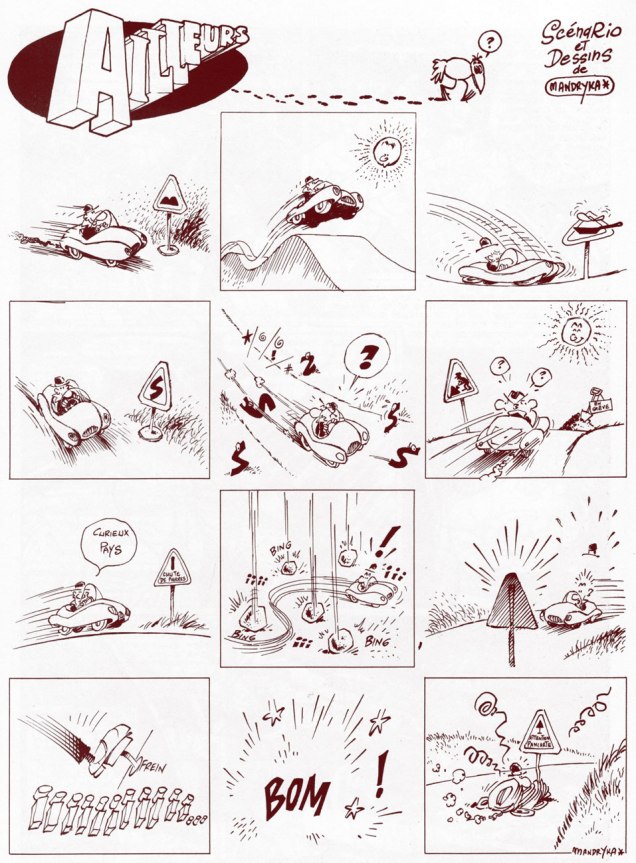
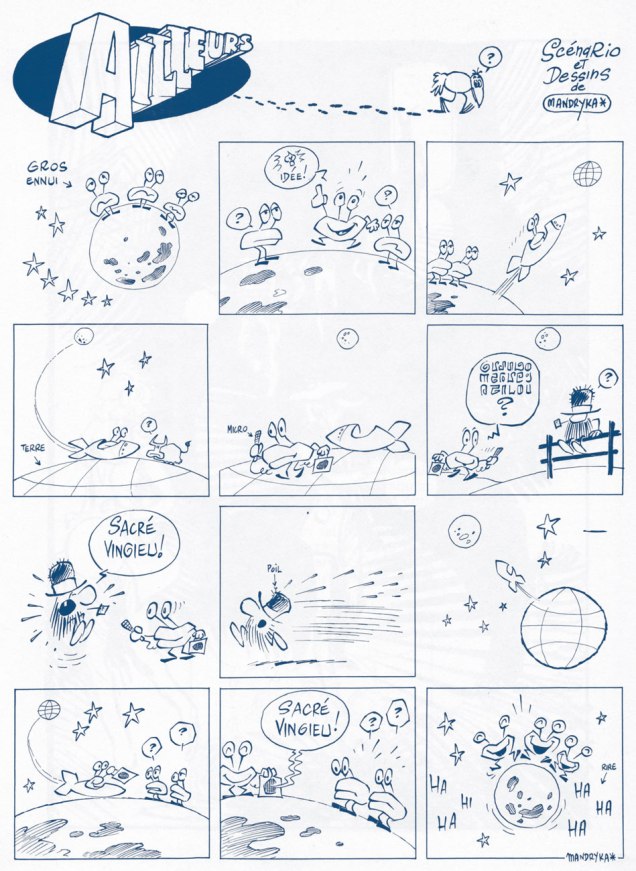
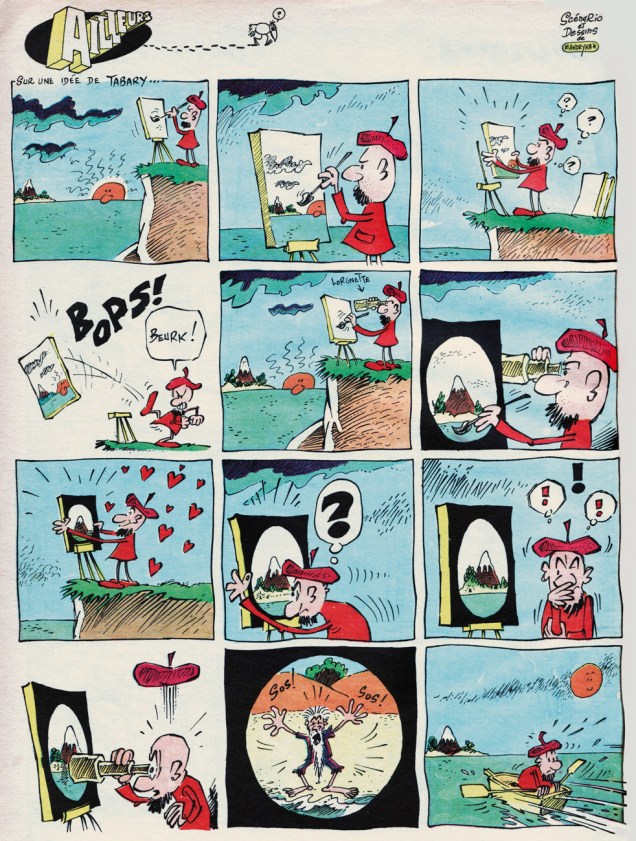
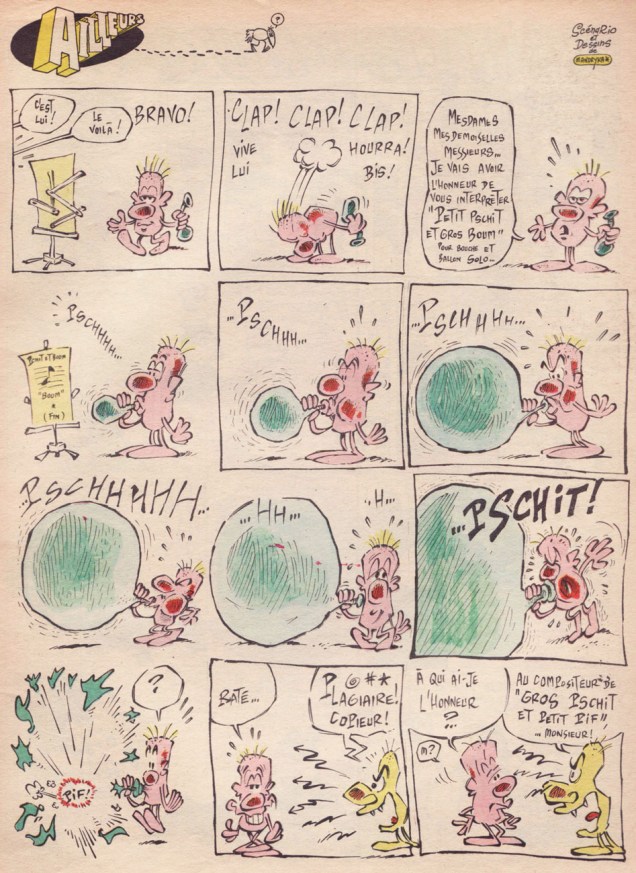
Nikita Mandryka was born October 1940 in Bizerte, Tunisia, to Russian émigré parents. His grandfather had fled the Russian Revolution in 1921 aboard a warship he was commanding. Nikita’s first professional strip appeared late in 1964 in Vaillant (Boff, in Vaillant no. 1024, Dec. 27, 1964), soon renamed Vaillant, le journal de Pif , then Pif Gadget in 1969. While he’s best known for his loquacious, dominoed cucurbit, Le Concombre Masqué, today we’re going to harvest the riches of his somewhat less familiar, but equally absurdist creation, the free-form strip Ailleurs (“Elsewhere”). The feature debuted with the inaugural issue of Pif Gadget and made its bow with issue 35, a few months down the line.
Mandryka left Pif Gadget on good terms (and returned over the years), and with a solid reason: while Pif’s editorial team rightly adored his work, its left-field humour left the majority of Pif’s young readership quite baffled, and sometimes infuriated. Mandryka’s place in the magazine may have been secure, but he yearned for an audience that actually understood him. This he would find at Pilote, with its teenage readership, and all the more so with L’Écho des Savanes (which he cofounded, in 1972, with Claire Bretécher and Marcel Gotlib).
Pif’s was an unusual case: its most singular, daring, arguably most valuable strips were those least appreciated by the kids. And that slice of the readership, you’ll have guessed it, tends to express its opinions more freely and vehemently than their elders, who did love (but more quietly) the somewhat abstract, second degré (offbeat, ironic) features, such as Marcel Gotlib and Henri Dufranne‘s Gai-Luron*, the recently-departed Massimo Mattioli‘s M. Le Magicien or Henri Crespi‘s Nestor. Still, the savvy editorial team, who after all had made the magazine a massive hit, keenly grasped the import of editorial balance and trusted its collective taste and instinct over the “wisdom” of the accountants and marketers… who, at the height of the magazine’s popularity, pulled a mutiny and… sank the ship. So, in hindsight, Mandryka was right to leave.
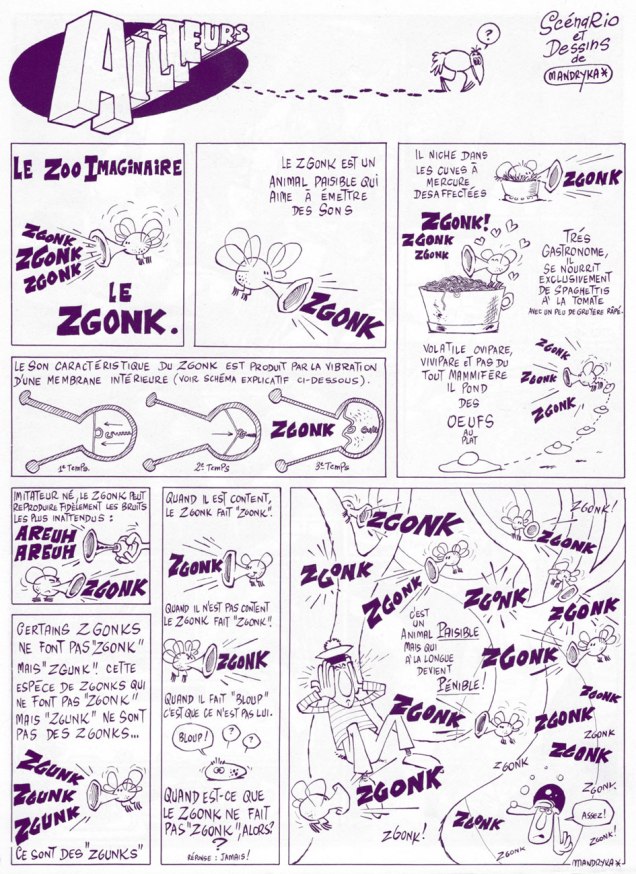
Ailleurs‘ début, from the inaugural issue of Pif gadget / Vaillant no. 1239 (March 1st, 1969); If it goes “zgunk”, it’s not a zgonk, it’s a zgunk.
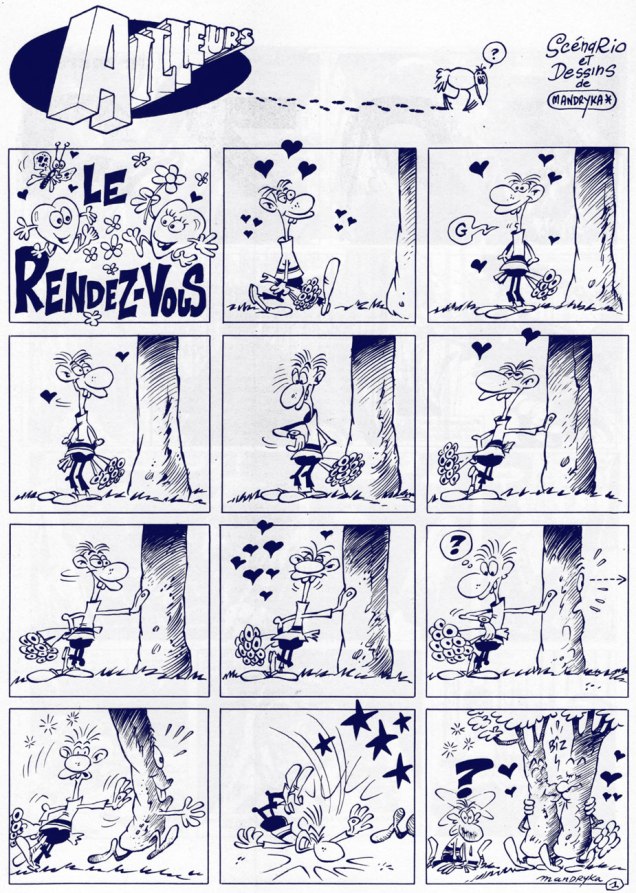
As an english equivalent to « Sacré vingieu! », I propose « Dagnabit! »Ends with a sarcastic « Glory to the ten millionth discoverer of our planet! »« An original solution to the parking problem. »From Pif gadget no. 23 / Vaillant no. 1261 (July 1969); now you know what the legendarily stoic members of The Queen’s Guard do whilst at leisure.From Pif gadget no. 33 / Vaillant no. 1271 (Oct. 1969); idea provided by Tabary (Jean or his brother/ghost Jacques? We may never know).The final Ailleurs strip, from Pif gadget no. 35 / Vaillant no. 1273 (Oct. 1969). This would have made a great skit for Jacques Tati‘s peerless Mr. Hulot.Nikita’s just heard a really good one during this photoshoot for a L’Écho des Savanes advert.
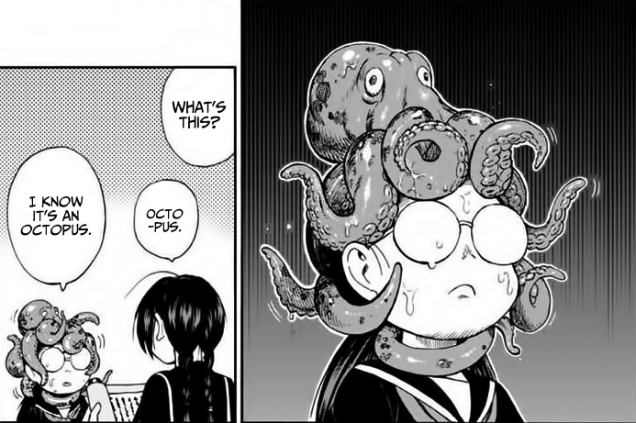
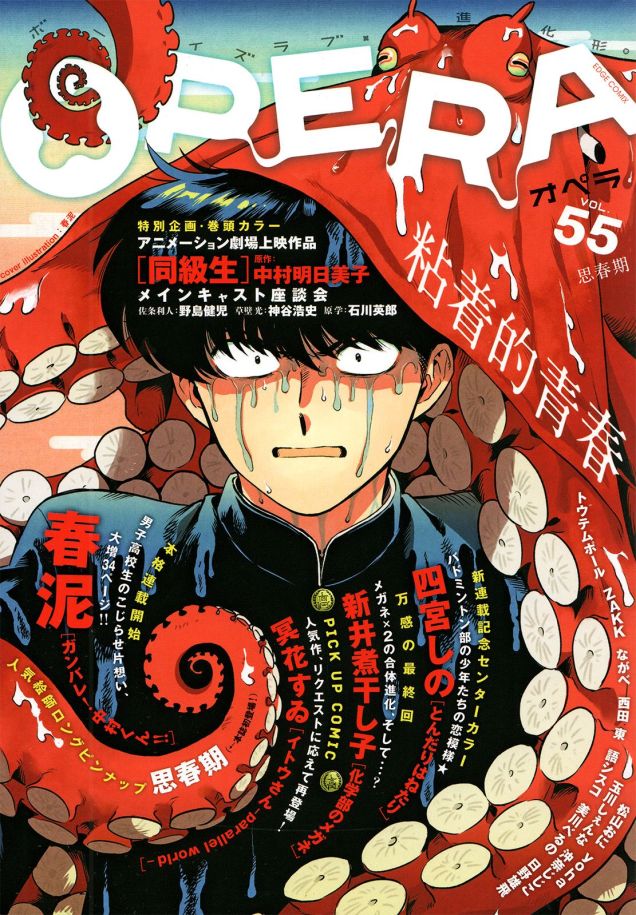
Last night, an octopus materialized into my office and reproached me for neglecting manga during my Tentacle Tuesday forays. I vowed to do better! As octopuses are impatient fellows, I decided not to tarry and complied immediately.
Panels from Shinobuna! Chiyo-chan, a comic by Kiyoto Shitara. Begun in 2017, it is still going and is being published by Tokyo-based Kadokawa Shoten. Read it here.
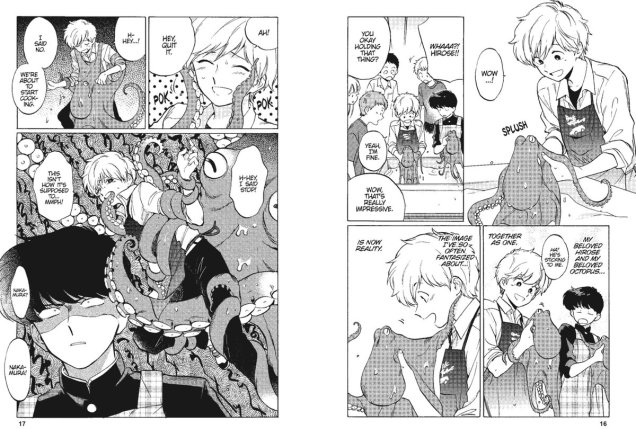
While the previous manga is about a schoolgirl trying to get her classmate’s attention (she’s also a ninja, not that it simplifies matters), the following concerns itself with a shy boy who falls instantly in love with a (male) student from his class and spends the rest of the story trying to get closer to him.
Go For It, Nakamura!, started in 2014, is written and illustrated by Syundei and published by Akane Shinsha.That’s Nakamura’s pet octopus, Icchan. « Octopi like to go into crevices, don’t they?! Wow, look at how squishy it is! »
Adventures in Poor Taste’s Trevor Richardson wrote a slightly extravagant review of Go for It, Nakamura! that delves deep into this manga’s the cephalopod imagery. Just for the fun of all the octopus metaphors, I’ll quote:
« As a queer person, I couldn’t help but identify with that queer young man who doesn’t yet know how to use all the extra arms that queerness grants him. Who doesn’t yet know how to push his tentacles up against the metal lid of self-doubt and oppression and twist it off. Who isn’t yet able to expel all that confusion and rejection like a cloud of black ink and surge down to trenches where straight people never dare drift to join his fellow otherworldly, queer creatures in the dark. »
To those who aren’t into high school romance but prefer their manga on the side of the macabre and the bizarre, I propose Octopus Girl by Toru Yamazaki (1990), though the events still mostly take place at a school. Takoko, our main character, is bullied by her classmates and nearly killed by them when they decide to semi-drown her and then force her to eat a live octopus (to which, the story specifies, she is allergic, because eating a live octopus isn’t horrifying enough as it is). As a response to this ordeal, she turns into an octopus (with a girl’s head) and exacts terrible revenge on her bullies!
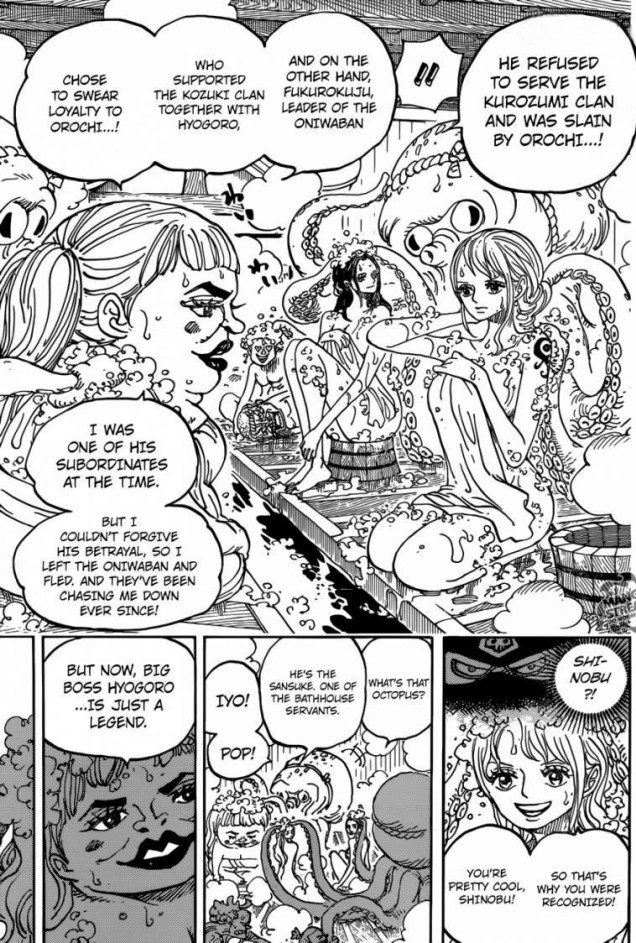
The English publisher describes it as “delightfully disturbing” – at any rate, I certainly agree with the “disturbing” part. Here, Takoko eats her own appendages for sustenance (don’t forget to read from right to left.)« Teenage monsters lose their hearts and heads in a relentlessly gory collection of dark humor and horror! Carving a comical niche in modern horror manga, Toru Yamazaki’s Octopus Girl serves up the most disgusting dishes of heartbreak and revenge found on land or at sea. Have a side order of nervous laughter with your main course of bloodcurdling fear, some gore with your teen angst, and some killer instincts with your kawaii! These shocking vignettes will hypnotize fans of the macabre and the absurd, as intestines, eyeballs, and fluids of all sorts shoot enthusiastically across Yamazaki’s pages! »Page from One Piece, a humorous manga series by Eiichiro Oda, serialized in Shueisha‘s Weekly Shōnen Jump magazine since 1997. Read it here if you’re so inclined – in terms of posting copyrighted content, otakus seem every bit as bad as Russians. « The story follows the adventures of Monkey D. Luffy, a boy whose body gained the properties of rubber after unintentionally eating a Devil Fruit. With his crew of pirates, named the Straw Hat Pirates, Luffy explores the Grand Line in search of the world’s ultimate treasure known as “One Piece” in order to become the next Pirate King. »
Moving on to proper horror – in the sense of it being devoid of comedy -, two pages from Junji Ito’s Gyo Ugomeku Bukimi (Fish: Ghastly Squirming), published as a series between 2001 and 2002 in the Japanese weekly manga magazine Big Comic Spirits. I’m enough of an aficiona-Ito to own most of his work that’s been translated into English, and though a lot of his stories are rather hit-and-miss, Gyo is one of the genuinely gruesome ones.
Ito is quite adept at conjuring up quite far-fetched yet terrifying plots, with events spinning faster and faster out of control until… until he doesn’t quite know how to tie up the story. Having gone so deep into the utter destruction of the world, there’s no elegant dénouement available but sheer Armageddon. That is definitely a weakness, so I tend to prefer his short stories, where the conclusions are fast and hard-hitting. That being said, I definitely recommend reading Gyo (read it here, but remember to support the artist by purchasing!) and Uzumaki (another terrifying read likely to leave you with a phobia of spirals). For an excellent discussion of Junji Ito’s appeal, please consider the excellently written The Horrifying Appeal of Junji Ito.
Okay, a couple more horror comics!
Page from Devilman, written and illustrated by Go Nagai, published from 1972 to 1973 in Shōnen Magazine. This has very typical manga art, which is to say, art that doesn’t appeal to me. But a vicious female demon with tentacles *everywhere*? I wasn’t going to say no to that.
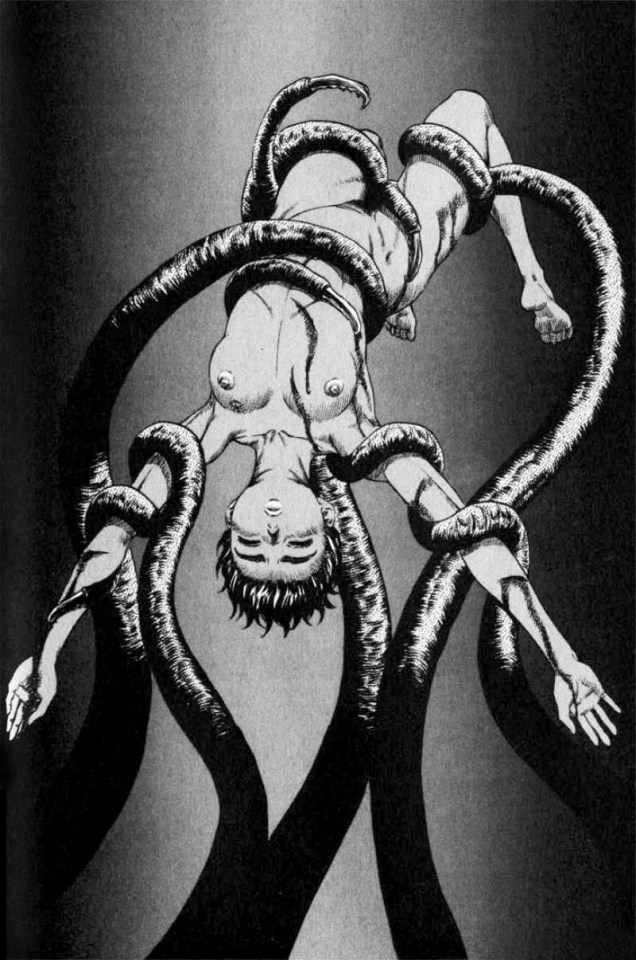
I’ll leave off on a somewhat… sexualized… note with two pages from the dark world of Berserk by Kentaro Miura, first published in 1988 and still going on. It’s been called one of the greatest literary works in all of manga… well, I can’t vouch for that, as I haven’t read much of it, but it does seem complex, at any rate.
Oh, as long as we’re on the topic of probing tentacles, I’ll wrap up with some Toshio Maeda, an erotic manga artist and pioneer of hentai. His best known work is Urotsukidōji: Legend of the Overfiend which been credited with popularizing the trope of tentacle rape. Fellow tentacle lovers, are you for or against such a use of tentacles? Please let us know in the comments.
Urotsukidōji: Legend of the Overfiend by Toshio Maeda, serialized in Manga Erotopia from 1986 to 1989. Were nipples verboten, one may wonder, or is this just a demon of some kind?Panel from Urotsukidōji: Legend of the Overfiend by Toshio Maeda. If you’re in the mood for further tentacles, visit The Tentacle Lounge, an aptly-named blog devoted to Maeda.
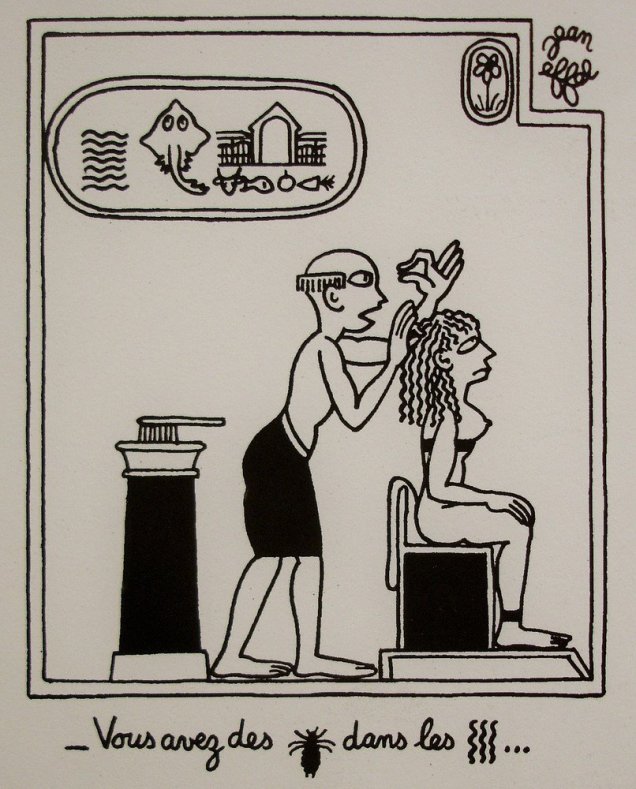
Despite his father’s insistence on a commercial career, French illustrator Jean Effel (1908-1982) pursued studies in music, art and philosophy. When his attempts to become a theatrical writer failed, he switched gears and started working as a caricaturist for newspapers in the 1930s. By the 1940s, his work was widely known and widely published, mostly in socialist/communist newspapers sponsored by the French Communist Party. After the second World War, he also branched out into book illustration (his work on Fables de la Fontaine is quite charming). Today, he’s mostly remembered (if barely) for his La création du monde (The Creation of the World).
I learned about Jean Effel (a nom de plume; François Lejeune was his true name) from a couple of books my parents had lying around when I was growing up. He was, I believe, my first exposure to cartoons, and the warm place his work holds in my heart is partly dictated by nostalgia. Only in part, however; few would deny that Effel’s animals and humans, his God, his Devil and his various angels are charming in that plump, childlike way that young animals are irresistibly cute. Some grouchy contrarians might get annoyed by that cuteness; the rest of us will enjoy his kind world. Oh, vexations and sarcasm are part of its tapestry, but nobody stays angry for long, pranks are witty but inoffensive, and problems are creatively resolved. Effel was an atheist, but his God was so kind and paternal that even priests didn’t object to their parishioners reading his work.
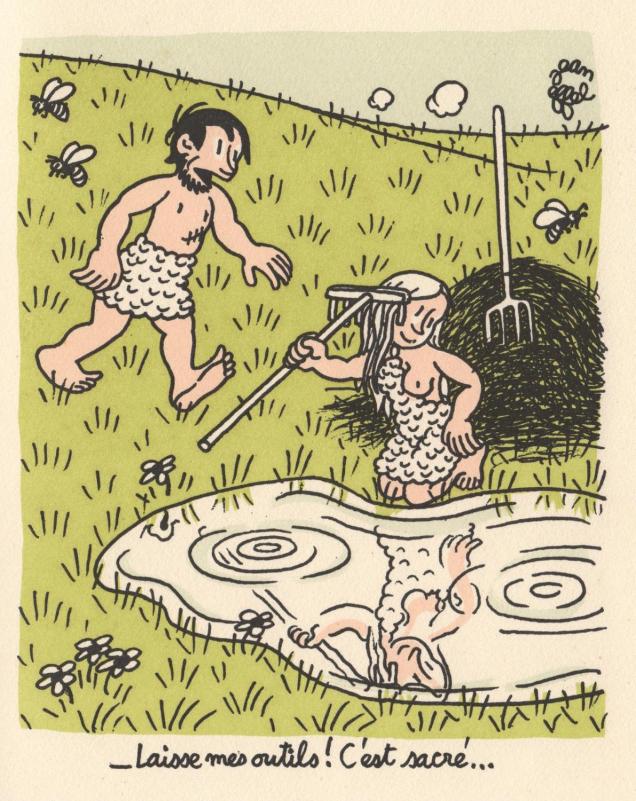
“How was it?” “Divine!” Even Effel’s handwriting/lettering is adorably rounded, childlike.“Leave my tools alone! It’s a sacred thing…” Note Adam’s scar, mute testimony to his missing rib.
To come back to my childhood, the twist in the story is that the books were in Russian: Soviet translations from French. The main collection of Jean Effel’s work was published in 1963 by the Hermitage Museum’s publishing press. The introduction calls him a « sincere friend of the Soviet Union », pointing out that Effel even learned to use Russian letters. In 1967, he was awarded the Lenin Peace Prize, which was mostly reserved for non-Soviets, foreign prominent Communists and supporters of the Soviet Union (Nelson Mandela also had one, as did Linus Pauling and Pablo Picasso).
Jean Effel’s present to the U.S.S.R.: a detailed map of France, with a hand-lettered dedication – “to my Soviet friends, with all my heart”.
It’s odd, but I can’t give you the exact date of the conception or publication of The Creation of the World: the Soviet book mentions that it was begun in 1950, English Wiki gives the date as 1945, French Wiki says 1953, Encyclopaedia Universalis (a French site) posits 1937, etc. Rather absurdly, there are a lot more detailed articles about Effel in Russian than in French, so for once I actually tend to trust the Russian side of things. It was clear that Effel genuinely liked Russians, and admired what he saw on his many visits to the U.S.S.R. I assume he only saw what he wanted to see (or what he was shown by his tour guides); still, he was clearly an idealist, a kind and gentle man by all accounts who believed in pacifism and loved animals.
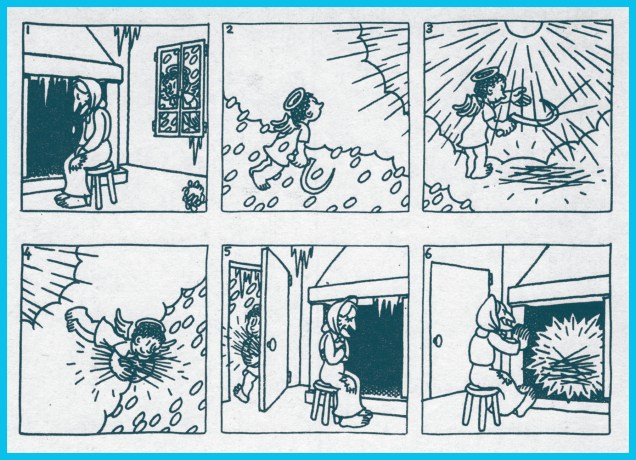
A few pages from my 1963 Soviet edition:
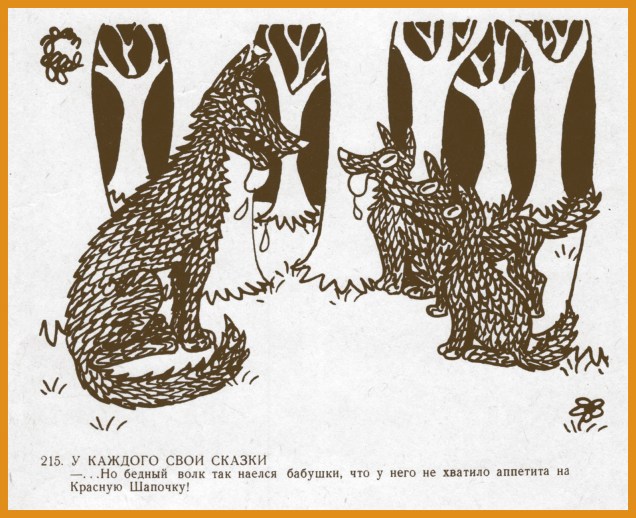
Dog meteorology: “He’s raising his paw: now water will pour down…”To each his own fairy tale: “But the poor wolf was so stuffed after eating grandmother that he had no appetite left for Red Riding Hood!”
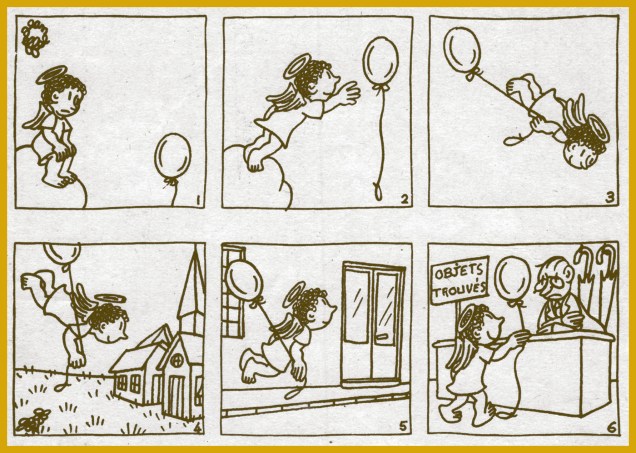
The desk caption says “found objects”.141: “He’s making projects for something…” 143: “How hilarious! If this keeps up, I’ll lose a rib from laughing too hard…” 144: “This is but a sketch. Just wait ’til you see the 3D version…”
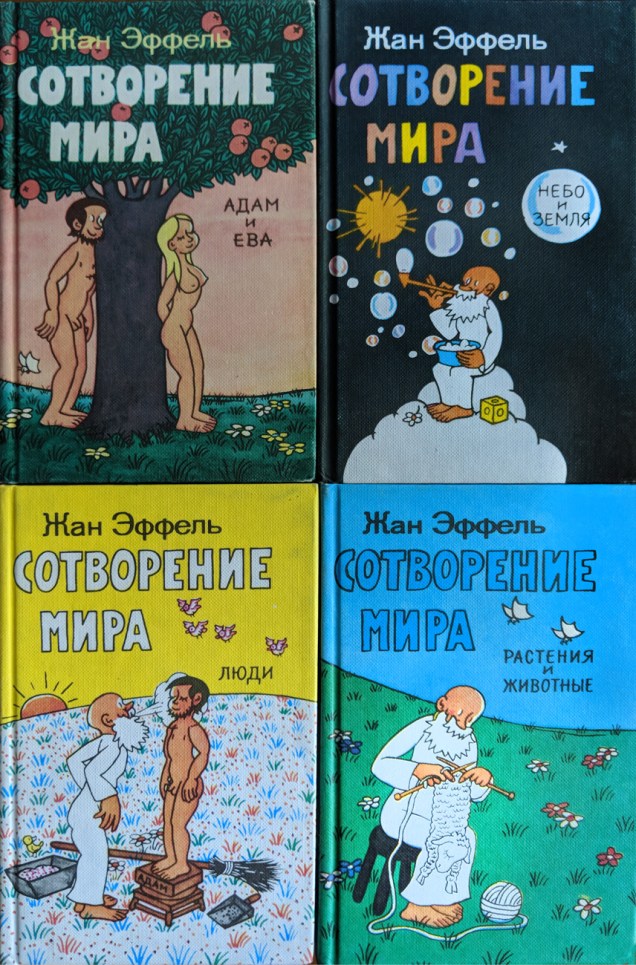
A few years ago, I found another Russian edition in some Canadian (how books travel..) second hand bookstore, a collection in four volumes:
Clockwise, left to right: Adam and Eve, Sky and Earth, Plants and Animals, and People.
The back covers are also worth a look:
Oddly, Animals and Plants is marked as costing 75 kopecks, and the other three are 80 kopecks each, though this was clearly sold as a set with a slipcase.
There can be no god without a devil! The charming Lucifer is probably my favourite character. This is a page from the Russian-Estonian edition. 173: “He likes us: he’s wagging his tail!” 174: “My name is Lucifer, but you can simply call me Lulu!” 175: “Oh, Mister Lucifer! You’re just the devil!” 176: “Perhaps I can tempt you with an apple?”The most recent edition of La création de l’homme, published in 1997.
A few other odds and ends from Effel’s multi-faceted career…
Sylvain is inviting you… to visit the PROTECTION OF NATURE exhibit at the Paris Fair.
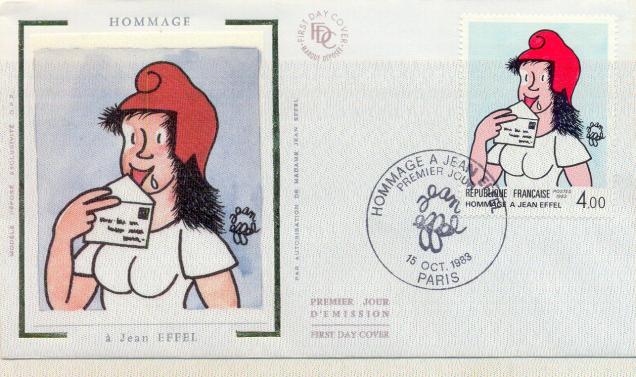
The French Postal Service issued a stamp in 1983 to celebrate Jean Effel and his sweet version of Marianne, a cheerful young woman with a red cap who symbolized the new French Republic.
I think it safe to surmise that pretty much everyone is familiar with the light-coloured, pleasantly plump creatures collectively referred to as the Moomins. Even if you’ve never heard of Tove Marika Jansson, their creator, you’ve surely glimpsed a Moomintroll mug, a Snork Maiden tote, or a Little My t-shirt.
Tove Jansson (1914-2001) was a multi-faceted soul: comic strip artist, of course, but also novelist, painter and illustrator (one might argue that these all are related: point taken). She published her first Moomin book in 1945 (The Moomins and the Great Flood) to (eventual) great success; the eight books that followed were equally popular. All have been translated into forty-four languages. The Moomin comic strip, first designed for publication in the children’s section of Swedish newspaper Ny Tid, ran from 1947 to 1975, and was syndicated in 120 countries. (Here’s a detailed timeline of Moomins’ creation and development.) To Anglophone audiences, the strip is known thanks to The London Evening News, which picked it up in 1954.
The commercialization of the Moomin family, the ubiquity of Moomin merchandise overshadow the rest of Jansson’s career – but also cheapen the darling Moomins. (I should talk; I have two favourite Moomin mugs from which I drink kefir.) As with the best writing for children, Moomin stories are fun and easy to follow on the surface – but beneath that cheerful and cute exterior, complex themes are tackled, moral dilemmas remain unresolved, and the world is a confusing, unfair place.
Montréal’s Drawn and Quarterly is currently « reworking classic Moomin stories in full colour, with a kid-proof but kid-friendly size, price, and format » (to quote from their website) for their Enfant collection. « Enfant » means « child », but I think any adult with a sense of humour and just a pinch of childlike innocence will enjoy these stories. Drawn and Quarterly have heretofore published collections of London Evening News strips in black and white; and though the art is beautiful, I really like the way the strips came out in colour.
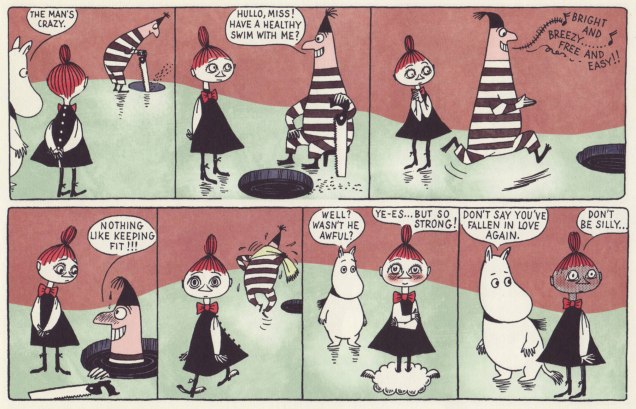
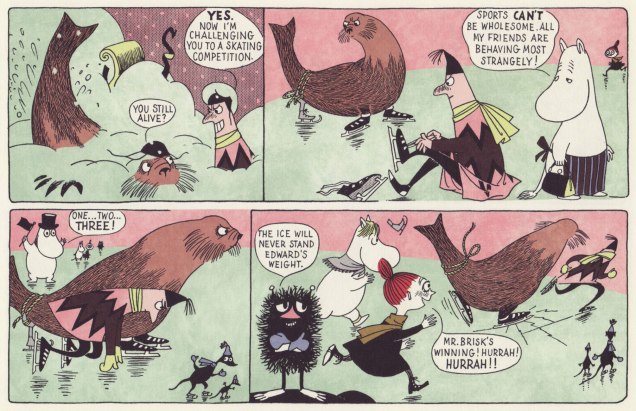
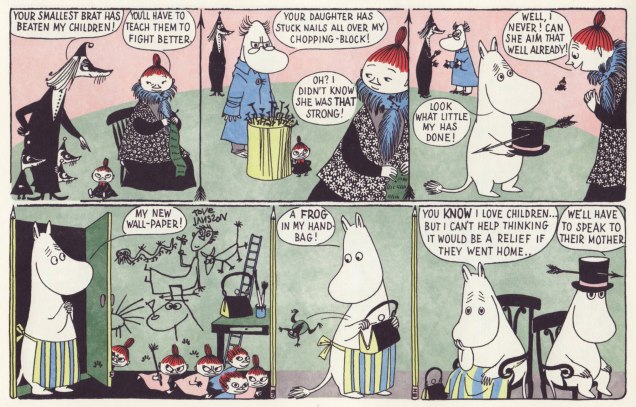
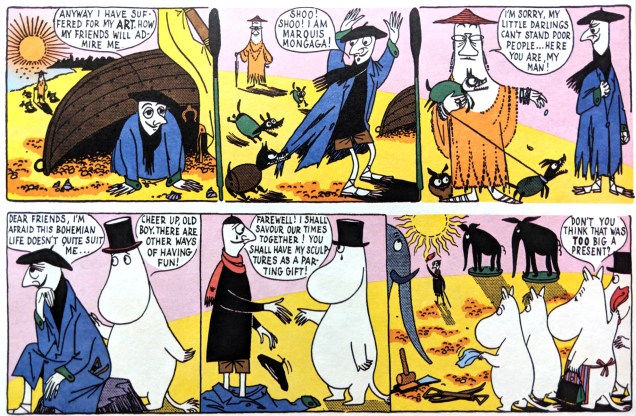
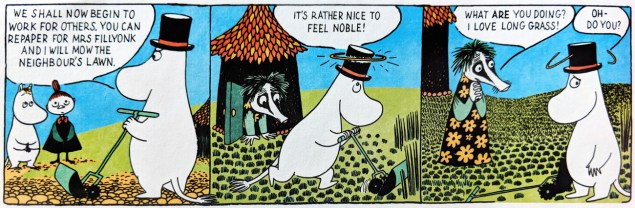
As little of this stuff is findable online, I’ve selected a few (well, quite a few) favourite pages to whet your appetite – a selection of goofy characters, hard life lessons and good old madcap fun.
Pages from Moomin’s Winter Follies
Moomin Builds a House. Little My makes her first appearance in this story. Some parenting advice from Elder Mymble, the mother of this red-haired hoarde: « I don’t like to keep scolding them. I just… pour some water over them. …Or lemonade. »
« Born in 1914, at the onset of World War I, Tove’s childhood and early adulthood took place in a time of intense political upheaval. Artists themselves, her parents were a part of the Swedish-speaking minority in Finland and in those first few years, when the world was at war, Tove and her mother stayed in Stockholm while her father remained in Finland, going on to fight in the Finnish civil war in 1918. That experience, some literary analysts say, is reflected in the missing Moominpappa, who appears only as an allusion in the first chapters of the first book. » (How Tove Jansson’s Moomins conquered readers’ hearts)
« As springtime dawns in Moominvalley and the first northern crocus opens, Moominpappa and Snorkmaiden, glamorized by the prospects of movie stars and gambling, insist the whole family take a trip down to the Riviera. Reluctantly Moomin and Moominmamma agree to go along, and the Moomins set off on a grand adventure, complete with butlers, luxury shops, indoor swimming pools, and duels at dawn. » Pages from Moomin on the Riviera.
« Following art school and travels abroad, Jansson drew cartoons for different outlets, including, for fifteen years, the satirical political paper Garm. (“Do as you like,” the editor told her. “Just make sure you hit them in the mouth.”) This is where the Moomins first surfaced publicly. Originally meaner-looking and troll-like creatures called Snorks, they began mostly as marginalia, a kind of signature, and might even be found loitering in a cartoon about the German Army’s evacuation of Lapland. » (The Hands That Made the Moomins)
Page from Moomin and the Sea.Misabel the maid is, as her name suggests, miserable. Afraid of any kind of non-conformist behaviour, scared of enjoying anything, she is anathema to Moomins’ approach to life. Pages from Moominmamma’s Maid.
« Tove’s entire life was filled with bold decisions: selling satirical cartoons mocking Hitler; opposing war; choosing not to marry or have children; and turning down Walt Disney’s offer to buy the Moomin brand. She was the writer, illustrator, designer and controlled the business side of her creation, not trusting anyone else to do it justice. » (Tove Jansson’s Feminist Legacy)
This sequence with a somewhat indignant cow is one of my favourite moments. Pages from Moomin and the Martians.
« In like spirit, Moomin hospitality excludes no one—except those prone to electrify the furniture or freeze Moominmamma’s roses. Guests include shrewish Fillyjonks addicted to cleaning; large graceless Hemulens obsessed with classifying and organising; and a philosophical Muskrat who believes only in the pointlessness of everything. » (Tove Jansson, Queen of the Moomins)
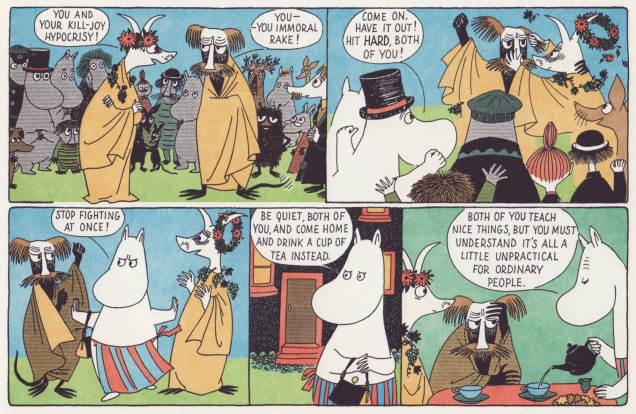
« When a charismatic prophet comes to town, the residents of Moominvalley are easily convinced to follow his doctrine for true happiness. Intrigued by their friends and neighbors’ lifestyle changes, the impressionable Moomins find themselves attempting to adopt the teachings of their new spiritual leader. But the freer they get, the more miserable they feel. Moominvalley’s state of divine chaos is further complicated by the prophet’s well-intentioned decree to free all of the jail’s inmates. » Moomin Begins a New Life.
« Over time, Jansson came to feel exhausted by the Moomins and that their success had obscured her other ambitions as an artist. In 1978, she satirized her situation in a short story titled “The Cartoonist” about a man called Stein contracted to produce a daily strip, Blubby, which has generated a Moomin-like universe of commercial paraphernalia—“Blubby curtains, Blubby jelly, Blubby clocks and Blubby socks, Blubby shirts and Blubby shorts.” “Tell me something,” another cartoonist asks Stein. “Are you one of those people who are prevented from doing Great Art because they draw comic strips?” Stein denies it, but that was precisely Jansson’s fear. » (Tove Jansson: Beyond the Moomins)
« Moomin’s pushy relations have come to stay, and in the process of getting them out, he unwittingly embarks on a quest for fame and fortune with his sly friend Sniff. But it’s much harder to get rich than either of them expects, whether it’s through selling rare creatures to the zoo, using a fortune-teller to find treasures, or making modern art. » Moomin and the Brigands.
The only (other) thing I’ll add is that Tove Jansson was a lesbian, which tends to get glossed over by (bad) biographies of her. You can read an excellent essay about Jansson and her lifelong partner Tuulikki Pietilä here.
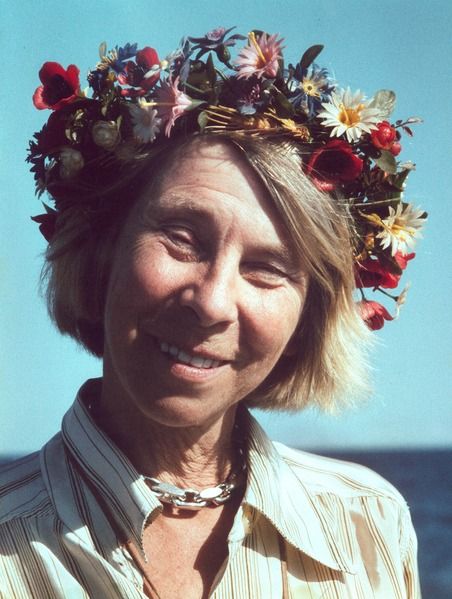
Tove Jansson photographed by her brother Per Olov.Jansson and Pietilä. Sweet!
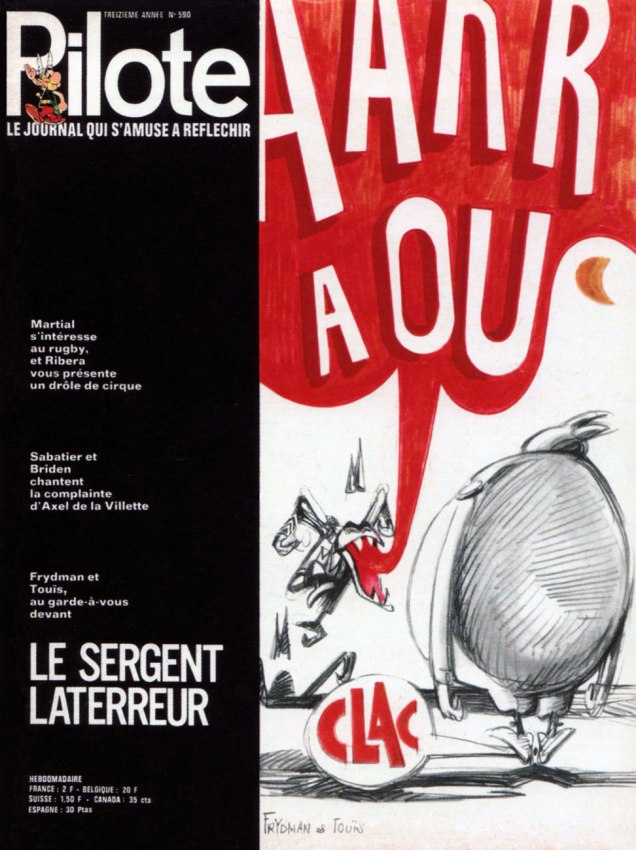
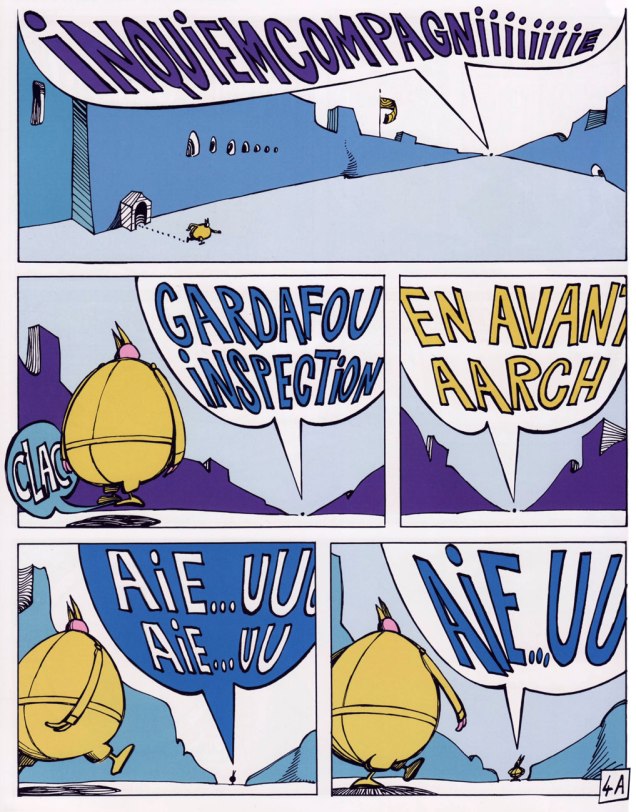
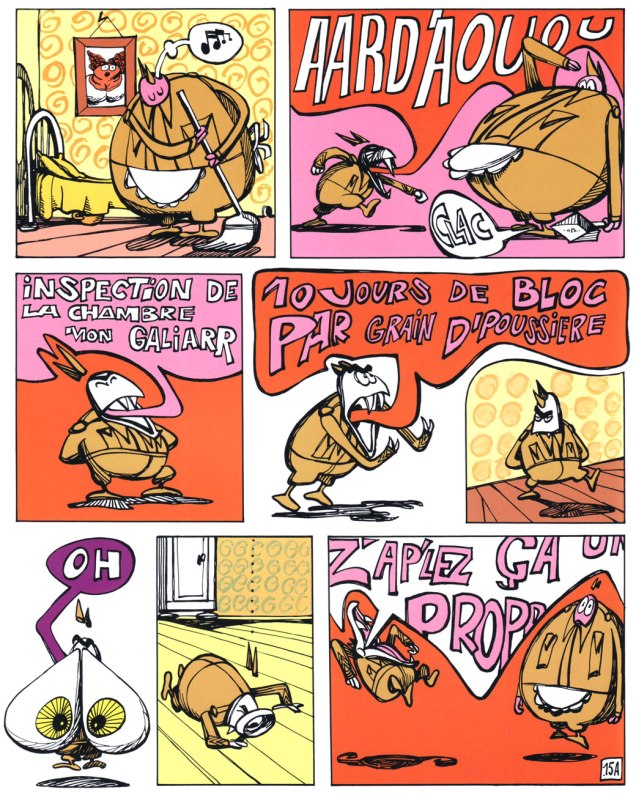
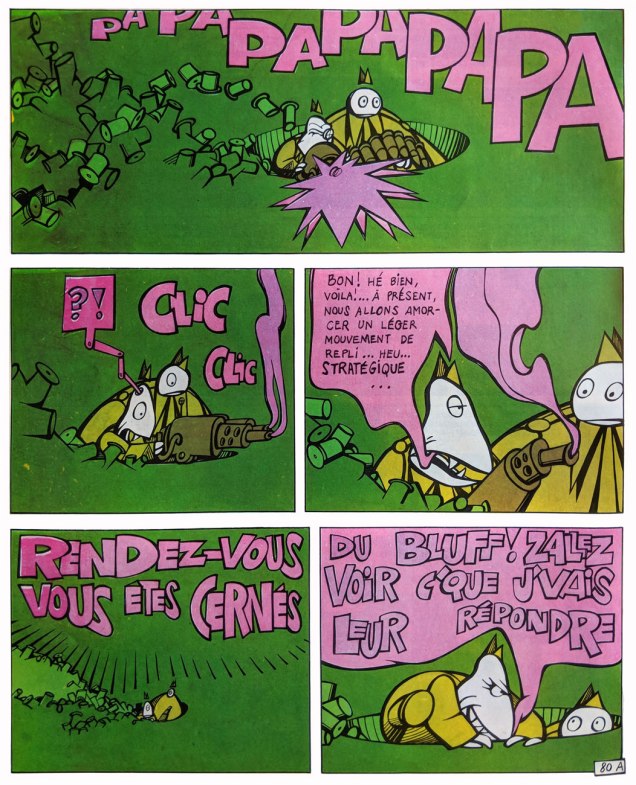
« Le sergent Laterreur resembles no-one. It’s impossible for anyone to be so ignoble, so sinister, so cruel. One feels that the two poor bastards that created him are exacting their revenge for all the humiliations suffered at the hands of the strong. One wouldn’t have been surprised to discover that the authors of Sergent Laterreur were Jewish, Black, Irish or Czech. They’re Belgian. » — Georges Wolinski
“Le Sergent Laterreur” is a strip that ran in the fabled bédé weekly Pilote from February 1971 to December 1973.
This vitriolic lampoon of military life (no Beetle Bailey this) was the brainchild of Belgians Touïs (né Vivian Miessen, b. 1940) and Gérald Frydman (b. 1942).
Pilote no. 590 (February 21, 1971, Dargaud), the Sergent’s third appearance in the magazine and his first (of two) on the cover.
Episode 4: Flower Power
Episode 15: « Et tu retourneras les poussières ». The Sergent’s immortal maxim: « Don’t forget that dirt is our worst enemy! »
Episode 80: Les mots historiques. Laterreur thought the enemy was bluffing.
Miessen produced a few more comics during the 70s, and made a notable comeback contribution to L’Association‘s massive anthology Comix 2000, but he chiefly worked in animation. Frydman mostly pursued projects in photography and film, directing several short subjects.
Laterreur’s full effect is best experienced in massive doses, and L’Association, fully cognizant of that fact, issued a splendid Le Sergent Laterreur omnibus in 2006. An obscure creation, it remains obscure, but at least it’s available if you seek it out.
Episode 85: Du gâteau. A fitting way for a dotty old general to blow out his birthday candles.
The finale, Episode 108: Tapage nocturne. Now you know how it goes down, so to speak.
« Les artistes, c’est comme les pieuvres: ils crachent de l’encre pour se cacher. » — Julos Beaucarne*
It is time (again) for some French tentacles! (Upon closer inspection, a lot of these actually prove to be Belgian, but my point still holds.) We have all kinds in today’s post: tentacles merry and frightening, realistic or cartoony. There’s even an octopus in a bra (but don’t skip ahead)!
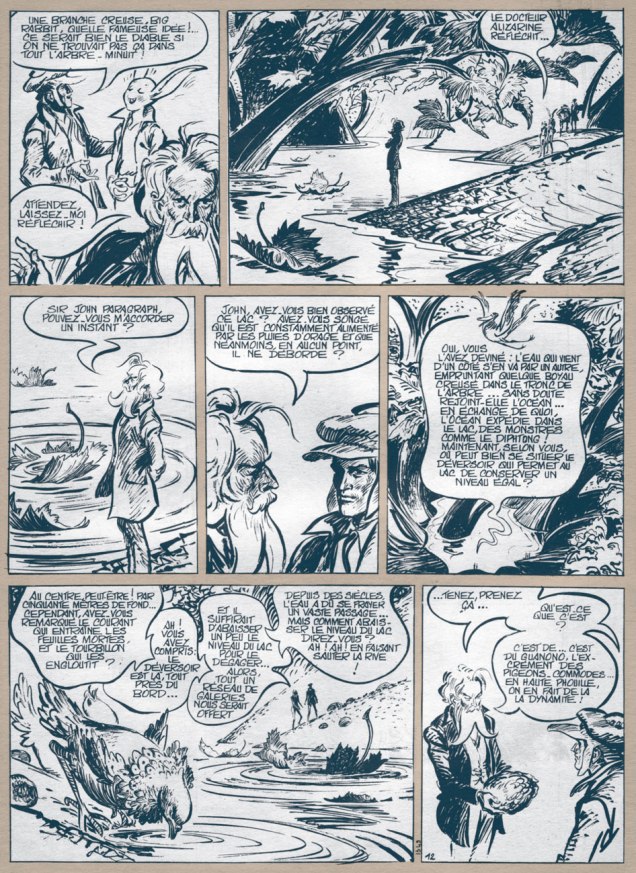
Created for Le journal de Tintin in 1963 by Raymond Reding, Vincent Larcher was a professional football player who often used his athletic prowess to defeat evil guys (he also occasionally played football). The first Vincent Larcher story had no supernatural elements, and didn’t seem to make much of a ripple amidst Tintin’s audience. After a 4-year hiatus, Reding re-introduced Vincent Larcher, this time throwing him into a three-part tale with a mad scientist (as usual, hellbent on world domination) and scary aliens. This was later christened the Olympio Trilogy in honour of Olympio, Larcher’s telepathically gifted friend, who was an important figure in these stories. The pages below are from Le zoo du Dr. Ketzal, part three of the aforementioned trilogy, published in Tintin Magazine issues 1039 to 1059 (1969).
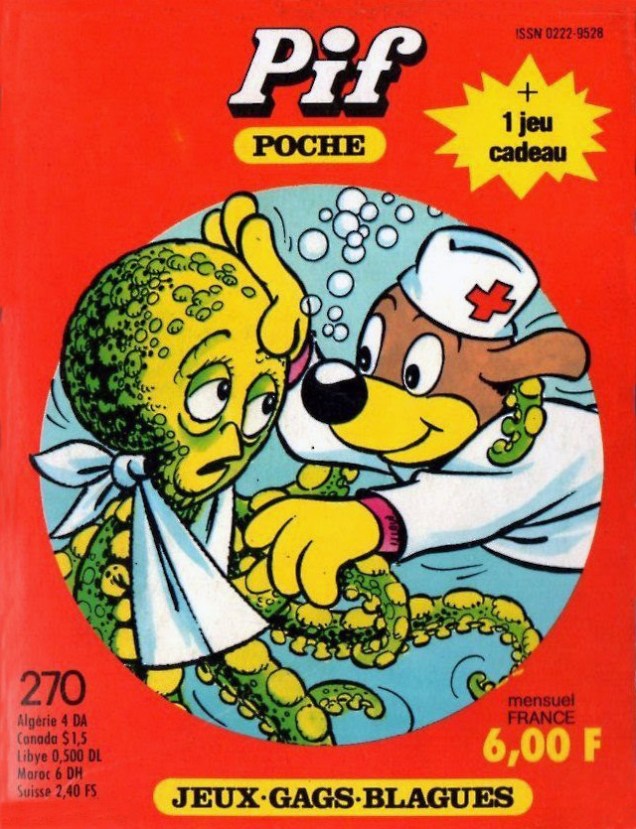
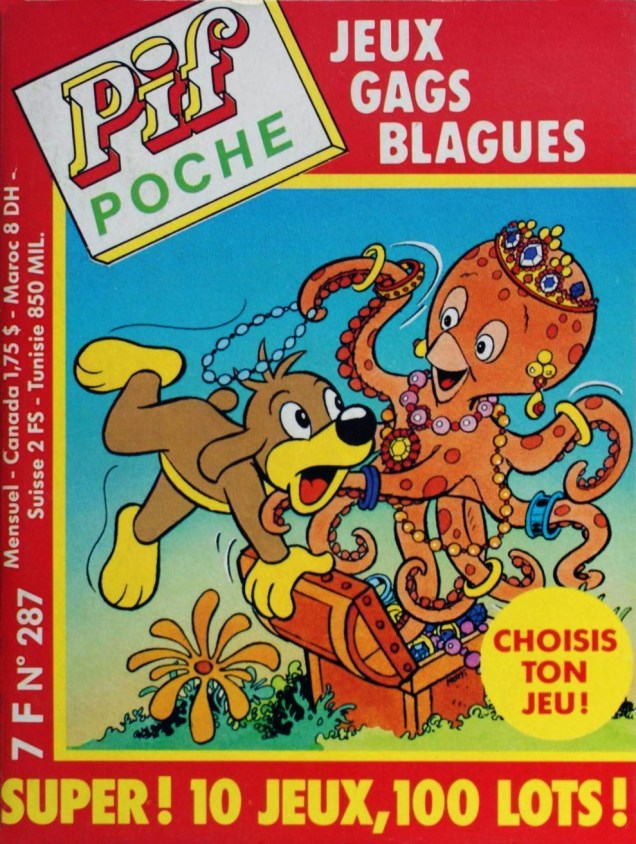
The friendly pooch fraternizing with octopuses is Pif, the mascot of Pif Gadget (« gadget » referred to the fact that each issue of the magazine was accompanied by some thingamajig to amuse the youngsters). Pif Poche were pocket-sized collections of short Pif strips (“poche” means pocket in French), meant to be easily carried to trips, picnics, and probably school as well. Pif was created by José Cabrero Arnal in 1948, who gradually abandoned the strip by the 1960s while other artists took over.
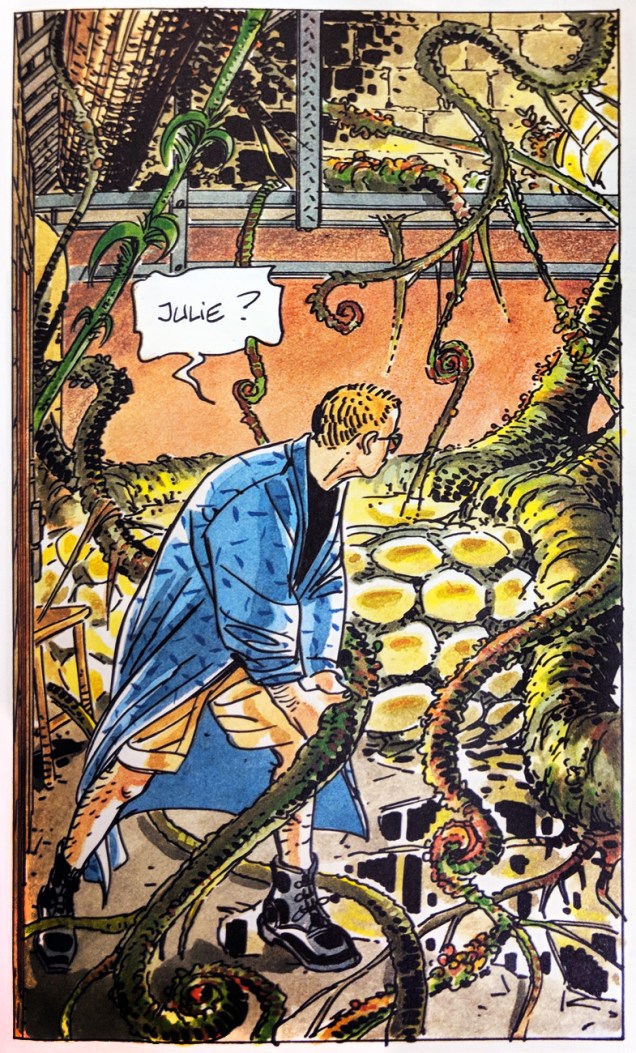
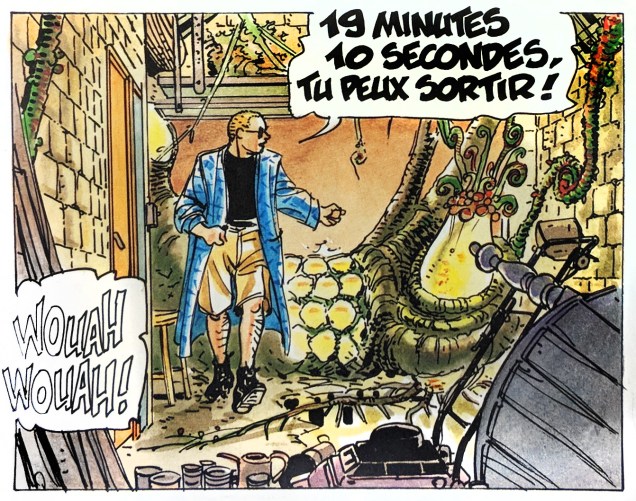
The following panels are from the series Tropique des étoiles by Christian Lamquet, more precisely from volume 4, Le réveil des poussières (1996, Claude Lefrancq).
« 19 minutes, 10 seconds, you can come out! » Experiments performed on a young woman seldom turn out as intended.
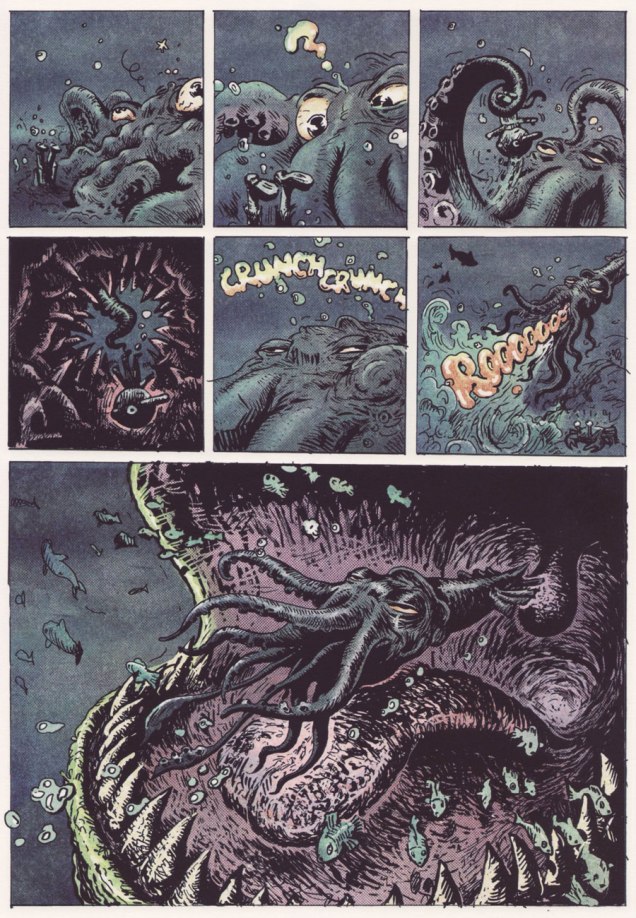
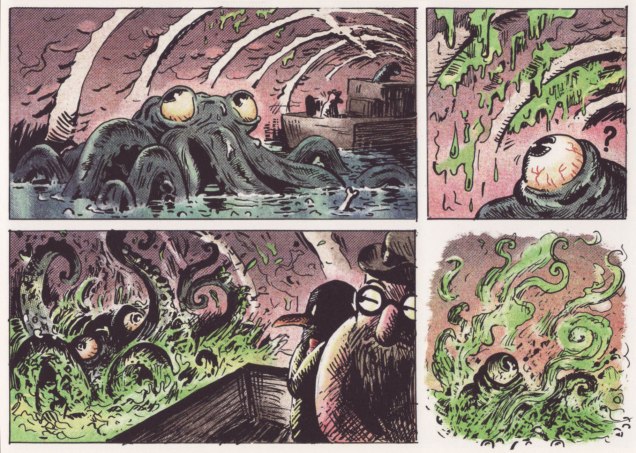
My next peace offering to the cephalopod gods comes in the form of a very loose interpretation of Carlo Collodi‘s Pinocchio, imagined by French artist Winschluss (real name Vincent Paronnaud) and executed with the help of some friends, most notably Cizo on colours. Winschluss’ art can be quite nice, but it gets a massive boost from the first-rate colouring job, so I’d like to emphasize that Cizo deserves a lot of credit for that (the tentacle pages are actually rather dark, as the action occurs undersea, but just take my word for it).
This graphic novel received a few prizes and has been lauded by many parties, but somehow I’ve managed to be quite unaware of its existence until recently. (Frankly, I am somewhat tired of picking up comics that are supposed to be superb and end up being just mediocre, so I don’t tend to pay much attention to awards and other plaudits.) A friendly comic book store clerk pointed it out to me, explaining that it was brought in by an older gentleman whose granddaughter had presented the book to him as a gift, but it wasn’t his thing at all. I was quickly won over by the art, and the story, well… it’s not for the faint-hearted or easily offended, but it’s a good one.
Winschluss’ Pinocchio was originally published in 2008 by Les Requins Marteaux, but has been reprinted several times in French (in increasingly fancier editions) as well as translated into English in 2011.
« French comics artist Winshluss leaves his robot child hanging beneath a giant lollipop on a hill for a good quarter of his largely dialogue-free adaptation, as regimes fall, fake prophets rise and a pizza delivery girl is saved from torture at the hands of seven dwarves. It’s a grim, puerile and rather brilliant update, combining chaotic, inked panels and gorgeous full-colour paintwork to great effect. Pinocchio, designed as a killing machine, is plunged from crisis to crisis by a series of greedy men and women, his story interrupted by a tortured detective, a grieving couple and Jiminy the cockroach. » |source|
Actually, don’t take my word for anything, you can admire the colours in this preview:
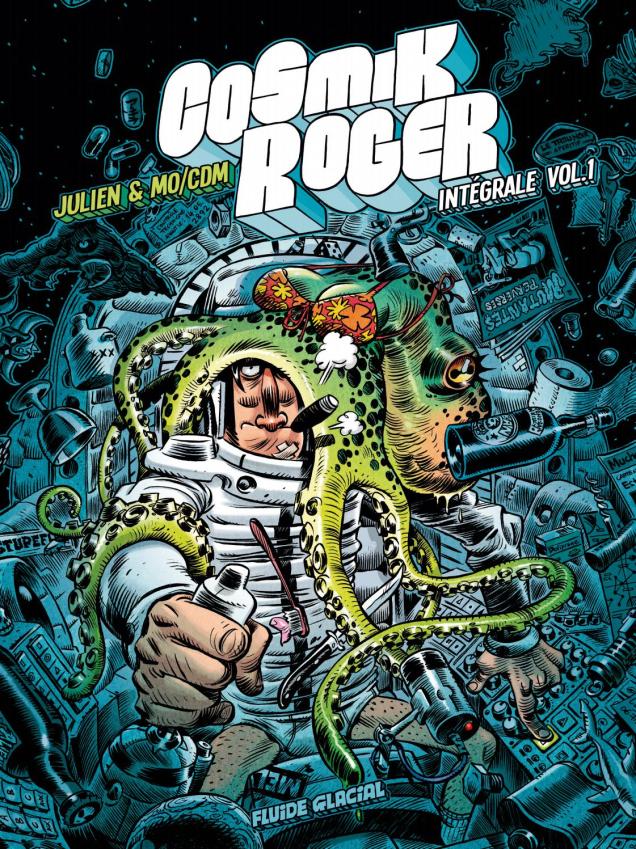
Cosmik Roger is a sci-fi/humour comic series scripted by mo/CDM (no, seriously, that’s his nom de plume, and no, I don’t know what it stands for) and drawn by Julien/CDM (real name Julien Solé – they used to go to school together, which apparently led them to adopting the same stupid monicker). This is the cover of the collected Cosmik Roger (volume 1), published in 2018 by Fluide Glacial.
« We all have our time machines. Some take us back, they’re called memories. Some take us forward, they’re called dreams. » — Jeremy Irons
Today, we note the birth anniversary of the powerful French bédéistePaul Gillon (May 11, 1926- May 21, 2011). Working in a classical, realistic style, he began his career in comics with the weekly Vaillant. For daily newspaper France-Soir, he co-created the daily soap opera strip 13, rue de l’Espoir (1959-1962, scripted by Jacques Gall and François Gall), strongly inspired by Elliot Caplin and Stan Drake’s The Heart of Juliet Jones, but set in Paris.
Then, in 1964, for the short-lived bédé newspaper Chouchou (an eight-pager published for a mere 14 issues, a tragedy!), Gillon co-created, with scripter J.C. Valherbe (alias Jean-Claude Forest, of Barbarella fame), one of the great classics of French science-fiction comics, Les naufragés du temps (“Castaways of Time”). Several wonderful features (for instance, Georges Pichard‘s Ténébrax) were left stranded by Chouchou’s demise, including (literally) Les naufragés.
Fortunately, its authors deemed its premise too worthy to let the matter drop forever. Nearly a decade on, Gillon tweaked the saga’s opening pages and resumed the narrative, which France-Soir published. Forest scripted the first four collections (1974-76), then Gillon took full command of the strip, which found a warm new home in Métal hurlant from 1977 right to the end of the series with Le cryptomère (The Cryptomeria), collected in 1989.
Les naufragés’ premise is this: In 1990, a man (Chris) and a woman (Valérie) are placed into suspended animation. A thousand years hence, the man is picked up and woken. Where’s the woman?, he wants to know. A futuristic bout of cherchez la femme ensues, to make a long story short.
Forest, wrote, in 1967, of his original plans for the saga: « Chris was searching for an image. After many adventures, he manages to find Valérie only to realize that this image no longer fitted that of his dream. »
The sequence presented here comprise the second, third and fourth pages of the first tale, as they appeared in Chouchou in 1964. Say, that cool metal creature reminds me of one of the most ridiculous Marvel super-baddies of the 1960s, disgruntled government employee Alexander Gentry, aka… (see below for the answer).
The first album in the series, L’étoile endormie (The Sleeping Star) – 1974The fourth album in the series, L’univers cannibale (The Cannibal Universe) – 1976The fifth album in the series, Tendre chimère (Sweet Illusion) – 1977
A peek at a page of original art from album 3, Labyrinthes (1976):
Stan Lee and Don Heck‘s The ‘Dreaded’ (ha!) Porcupine, or what happens when neither Steve Ditko nor Jack Kirby are on hand to design your costume (and ghost-write your story). Incidentally, Stan, porcupines don’t project their quills. Here he is depicted by Kirby, from the cover of his inaugural appearance, in Tales to Astonish no. 48 (October, 1963).























 « Over time, Jansson came to feel exhausted by the Moomins and that their success had obscured her other ambitions as an artist. In 1978, she satirized her situation in a short story titled “The Cartoonist” about a man called Stein contracted to produce a daily strip, Blubby, which has generated a Moomin-like universe of commercial paraphernalia—“Blubby curtains, Blubby jelly, Blubby clocks and Blubby socks, Blubby shirts and Blubby shorts.” “Tell me something,” another cartoonist asks Stein. “Are you one of those people who are prevented from doing Great Art because they draw comic strips?” Stein denies it, but that was precisely Jansson’s fear. » (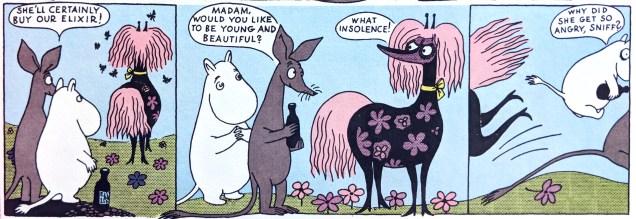










 Who's Out There?