« We do not stop playing because we grow old. We grow old because we stop playing. » — G. Stanley Hall
Despite the ubiquity of his work over several decades, very little is known of Robert Gring, at least online. Ah, but thankfully, ‘one reads books‘… and so I turned to Richard Medioni‘s indispensable ouvrage on the history of Mon camarade, Vaillant and Pif Gadget, L’histoire complète 1901-1994. About Mr. Gring (likely born in 1922 and died in 1995), we discover that he was for several years a press illustrator for centrist daily newspaper France-Soir, that he spent some time in a work camp during WW2, that, post-war, his work appeared in L’Almanach Vermot, Paris Match, Télé 7 Jours, La vie parisienne… and so forth.
That he was a reserved, bashful man who treasured his work above all else. And most admirably, that he was a man of great personal integrity and principles, as evidenced by the following anecdote, recounted by Mr. Medioni: « In parallel to his intensive work with (Pif-Vaillant), he occasionally works for Le journal de Mickey, but it ends on a sour note! In 1980, it is gently brought to his notice that his collaboration to a periodical associated with the French communist party is incompatible with his presence within the pages of Mickey. He must choose! Gring, who does not appreciate this type of pressure and has lofty ideas of honour, does not dither the slightest bit: he opts for fidelity. » I’m strongly reminded of Howard Prince’s valiant words to the House Un-American Activities Committee in The Front (1976).
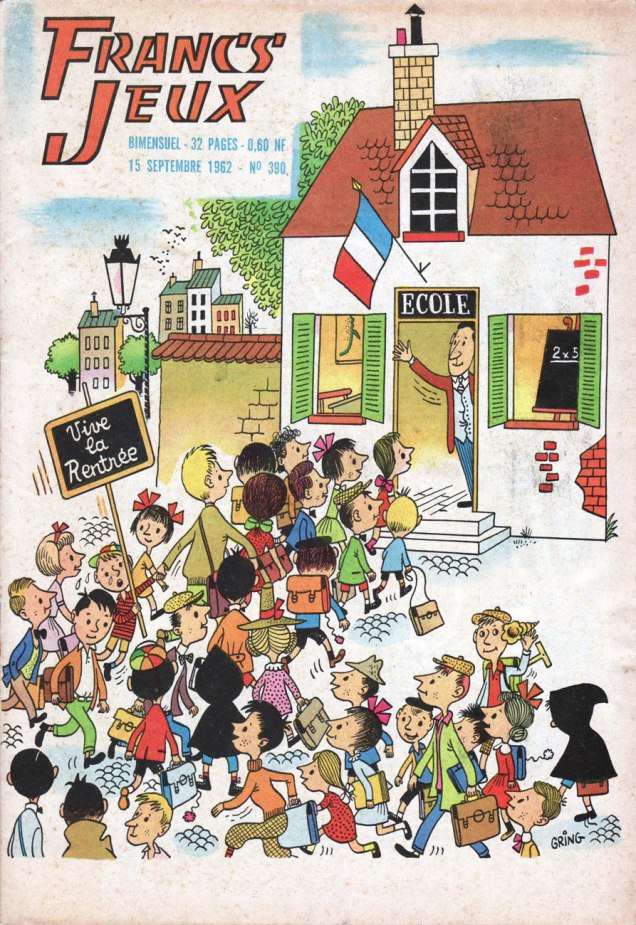
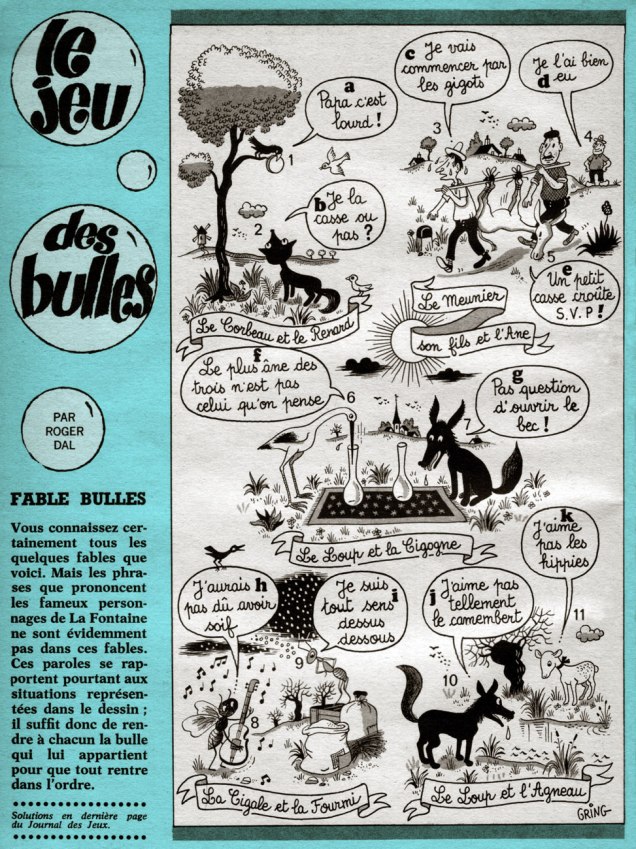
Francs-Jeux was a long-lived kids’ magazine published from 1946 to 1979… 777 issues!), and Gring provided a number of its covers and several interior illustrations and strips. This is Francs-Jeux no. 390 (Sept. 15, 1962). See: even then, you had a couple of kids in black hoodies skulking to class.This is Francs-Jeux no. 393 (Nov. 1st, 1962). The title feature, Le coucou qui ne voulait plus dire ‘coucou’ is the touching tale of a clock birdie who decides to make a dash for freedom, only to discover that life on the outside is intolerably uncertain and perilous. This is a France straight out of Jacques Tati‘s Mon oncle.Another Gring specialty: Le jeu des bulles, wherein errant word balloons must be restored to their proper speaker. If you must know: 1-g, 2-j, 3-a, 4-f, 5-i, 6-d, 7-b, 8-e, 9-k, 10-c, 11-h; Published in Pif gadget no. 33 (Oct. 1969, Vaillant). Plots from the fables of Jean de la Fontaine, script by Roger Dal.Gring could always be counted on to compose and depict complex but lucid crowd settings, and this is a fine example. It’s also a 5-in-1 game: 1) Find the five anomalies; 2) Find the hidden umbrella; 3) Spot the five differences between the nearly-identical Durant Père and Durant Fils boutiques; 4) Four objects appear three times apiece. Find them; and 5) To whom does the stopwatch on the pavement belong? Published in Pif gadget no. 71 (June 1970, Vaillant); game conceived by Odette-Aimée Grandjean.No customers! « The café is deserted and the barman leans forlornly on his bar counter. This is abnormal, of course, but certains things are even more abnormal. » During our current state of all-around home confinement, it seemed sadly à propos. From Pif gadget no 143 (Nov. 1971, Vaillant).From Pif gadget no. 185 (Sept. 1972, Vaillant). You wouldn’t see this sort of thing in an American kids’ publication, that’s for certain. The object of the game: find the anomalies.« But he would attain fame in most unexpected fashion. In order to enliven the austere pages of the Méthode Assimil, he is called upon to illustrate a variety of idioms for the manuals. Not only does his drawing prove itself effective for the learning of English, German or Spanish, but it makes these volumes funny and user-friendly. » This undated gouache illustration Gring created for Assimil is scanned from the original, a prized part of my collection.
Here, then, are some excerpts from a couple of Assimil guides from my shelves:
1) « No smoking is allowed in here. » 2) « Personally, I’m really not hungry at all. » 3) « I love him, he loves me, and that’s what matters most. » 4) « All streets are exactly alike in these parts. » 5) « We’d always rather be where we’re not. » — from Le russe sans peine (1971, Assimil) and 6) « We’re headed to Dubrovnik by way of Zagreb. » — from Le serbo-croate sans peine (1972, Assimil). Thanks to Darko Macan for confirming that last translation!
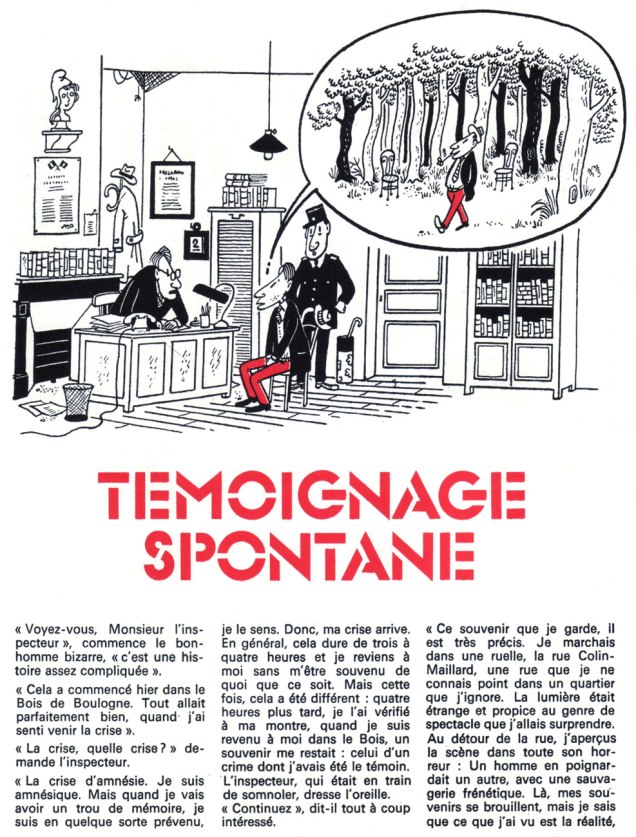
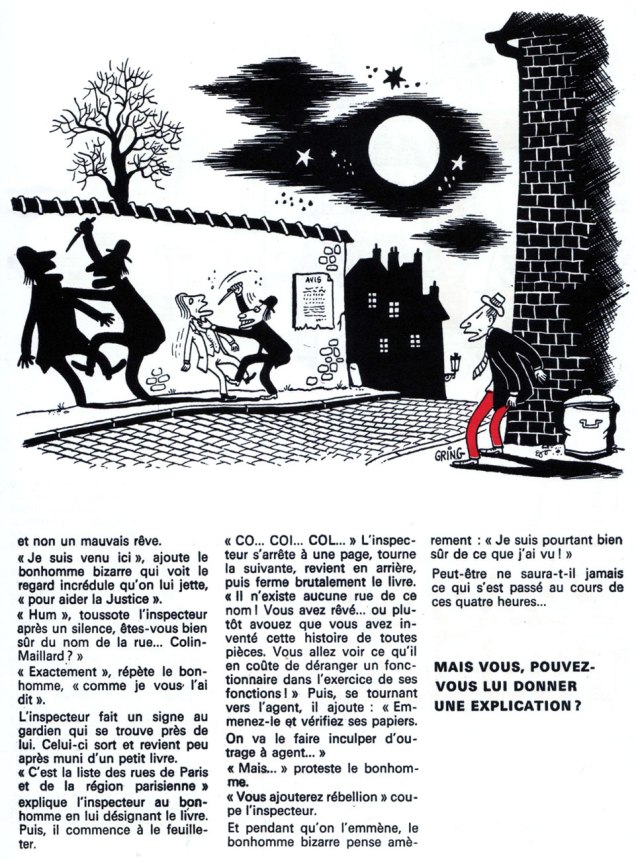
Gring was also a regular contributor to Ludo, Le journal des amateurs d’énigmes. If you can read this, here’s the solution, which I’m afraid requires prior knowledge of Paris in the 1970s: « Pendant sa crise, le bonhomme a sans doute marché jusqu’aux studios de Boulogne. La scène qu’il a surprise se déroulait dans les décors de cinéma. » Incidentally, a quality hardbound collection of this material was published in 2013 by Les Éditions Taupinambour. under the title of Les énigmes de Snark & autres mystères.In the 1960s, Gring illustrated a popular series of keychains for Norman dairy company Virlux, featuring the signs of the Zodiac. I’m still missing Taurus, Aquarius, and Cancer (thanks, Matt!) as you can see.A rare photograph of Monsieur Gring (left), and one of his writing partner, Roger ‘Dal’ Dalméras, date unknown.
« Once you’ve lived the inside-out world of espionage, you never shed it. It’s a mentality, a double standard of existence. » — John le Carré (1931-)
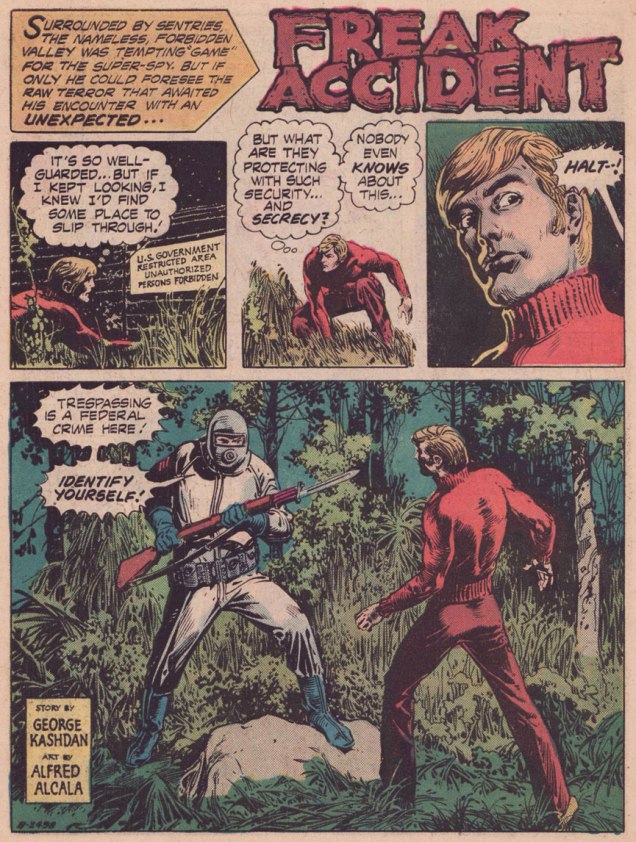
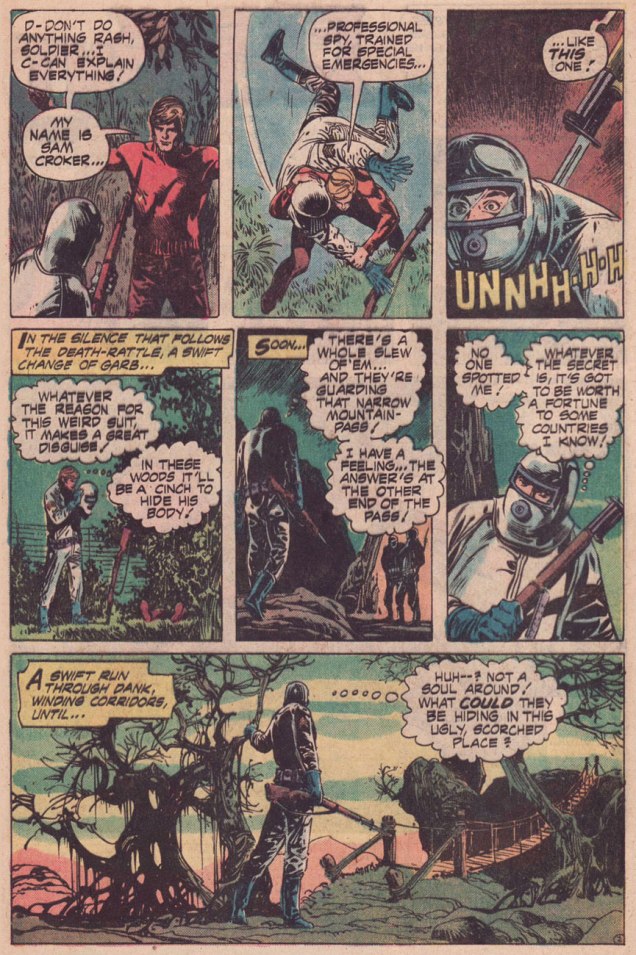
Here I go again, featuring yet another 1970s Alfredo Alcala story. This time, Fate, writ large, has forced my hand, and it’s unofficially Contagion Week here on WOT?
I’ve always had a soft spot for writer-editor George Kashdan (1928 – 2006). While he wasn’t what you’d term an outstanding writer, he was the most consistent bright spot of DC’s mystery books in the late ’60 to early ’80s. As opposed to the other workhorses in the stable, one still found trace amounts of passion and personal quirks in his work. His recurring themes for simply more fun than his colleagues’: he loved Sinister gentlemen’s clubs, wild conspiracies, strange carnivals, pre-ordained, thematically-twisted deaths (think of those Final Destination movies)…
In a thoughtful obituary, Mark Evanier tells us: « In 1968, as part of a program of editorial restructuring, Kashdan was let go by DC. Several people who worked with him said it was because he was “too nice” and had occasionally clashed with management in arguing that freelancers should be paid and treated better. » Ah, another victim of the anti-union purge of ’68*.
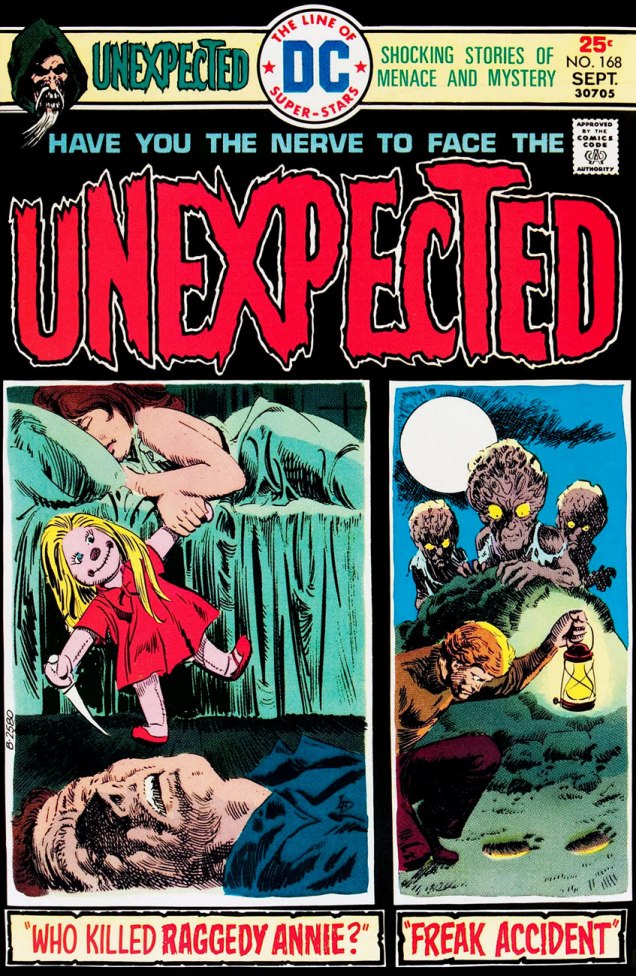
This is The Unexpected no. 168 (Sept. 1975, DC Comics; edited by Murray Boltinoff), cover art by Luis Dominguez. Aside from the six hundred-pagers (issues 157 to 162), this seems to be the only time a multi-panel cover was used, and little wonder: it doesn’t really work, and would fare even worse with the intrusion (five issues away) of the dreaded bar code.
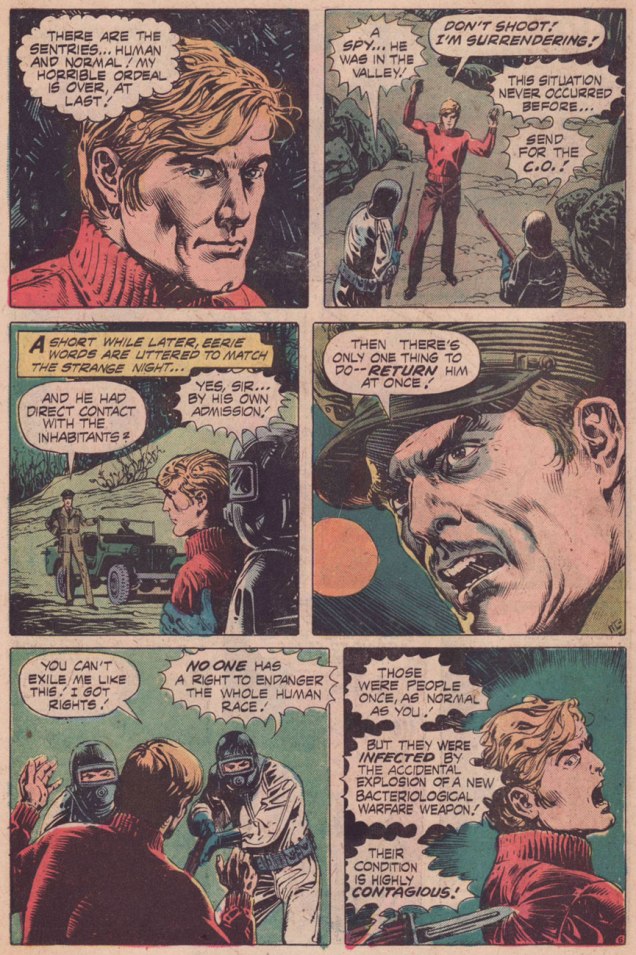
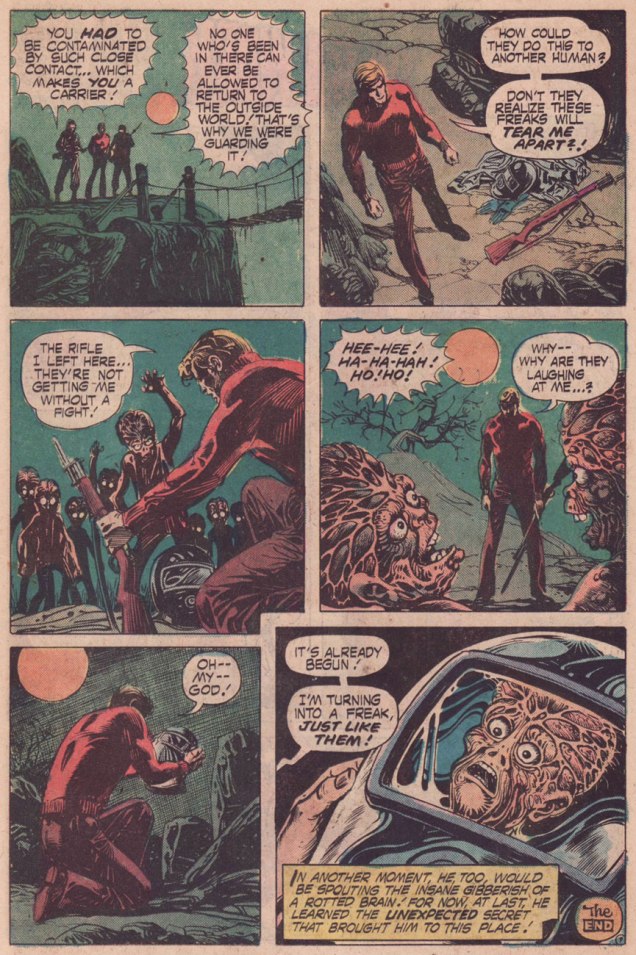
No-one comes off particularly well in this one, really: Croker the spy is an impenitent, petulant slime bucket right to the finish, and the military, for their part, have been conducting sloppy biochemical experiments… for purely defensive purposes, I’m sure.
While the Geneva Protocol has prohibited the use of such barbaric means of warfare since 1925, the US didn’t sign on until… 1975, just before the fall of Saigon, marking the end of the Vietnam War. Let’s not ever forget the US Armed Forces’ generous and indiscriminate dispersion of Napalm and Agent Orange upon troops and civilians during the course of that conflict.
Given the timing, perhaps that bit of news inspired Kashdan to pen this sour little parable.
The guard’s high moral stance, « No one has the right to endanger the whole human race! » may ring a bit hollow and ironic given the circumstances, but he’s still right.
On a smaller, but no less tragic scale, consider the real-life story of what happened when a fan broke quarantine to catch a public appearance of her idol, actress Gene Tierney.
One simply can’t afford to mess around when it comes to quarantines and contagion.
Incidentally, Alcala really seemed to have a yen for those flay-headed mutants of his. To wit, here’s the opening page of The Children of the Bomb, Part 5, from Planet of the Apes no. 10 (July 1975, Marvel), written by Doug Moench and illustrated by Alcala.
-RG
* « [In 1968] Fox had joined other comics writers like Otto Binder, John Broome, Arnold Drake, Bill Finger and Bob Haney, signing a petition to ask DC for more financial benefits, particularly regarding health insurance. Since the company regarded writers as expendable people they were all fired without mercy and replaced by more obedient newcomers. » [ source ]
Much like fish painstakingly climbed out of the water and became mammals aeons ago, humorous representations of life, artists’ flights of whimsical fancy or taut fight scenes from centuries gone by morphed, over time, into something that resembled more and more what everyone now recognizes as comics. Me, I like blurred lines, the point at which several trees become a forest. What fun is it to live in a world where everything is well-defined, sorted into tidy little piles? Today’s Tentacle Tuesday stretches this blog’s comics-bound raison d’être just a teensy-weeny little bit. But I believe that the kinetic energy hidden within the following illustrations, the jump-off-the-page personality of these octopuses makes them close cousins to their more modern counterparts who dwell in the seas of sequential panels and images.
Just mentally add a speech bubble or two, if you must!
First of all, I have three woodblock prints, all three from the Edo period (Edo being the old name for Tokyo). The latter term refers to the period between 1603 and 1868 in the history of Japan, and is of interest because it was characterized, among other things, by a flourishing interest in culture, be it music, poetry, theatre, or, more relevantly to the current post, art. That famous woodblock print, the Dream of the Fisherman’s Wife, which I have no need to include because of its ubiquity, was not the first painting featuring a woman in the embrace of an octopus. Yet it’s probably the most influential one, precursor of the hentai now so entrenched in popular culture…. and it was created during the aforementioned Edo era by Katsushika Hokusai (who, incidentally, also brought into existence the ever-popular The Great Wave off Kanagawa, ensuring the relative immortality of his art.)
Collectively, the work crafted during the Edo era (not necessarily woodblock prints, although these seemed to predominate, but also paintings) is referred to as Ukiyo-e, which in Japanese vaguely means something like “images of a floating world”. Poetic as usual, the Japanese.
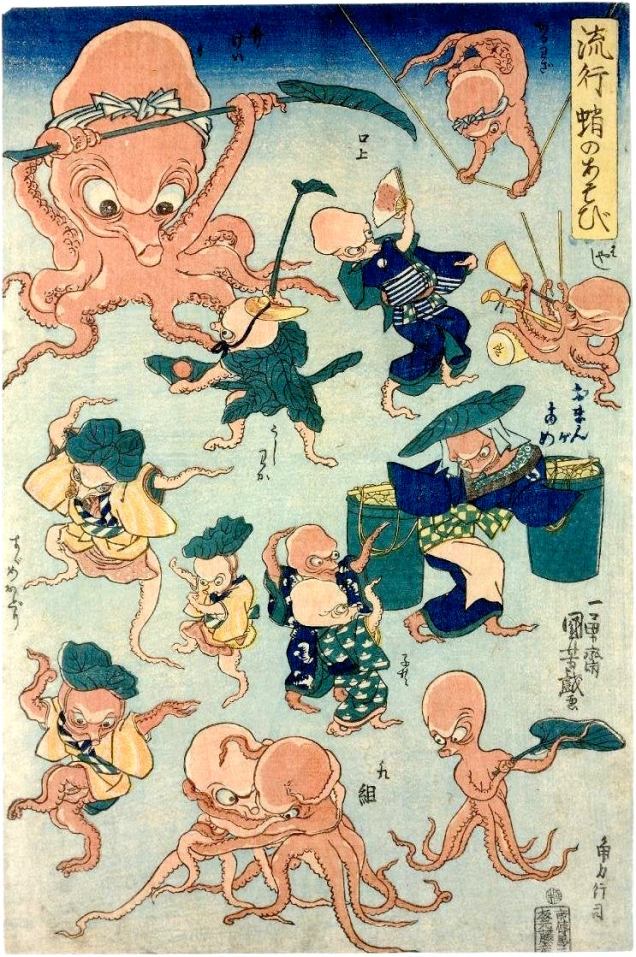
The fist woodblock print is entitled “Ryuko tako no asobi“, or The Fashionable Octopus Games. The British Museum (which seems to currently own this piece) describes it as « Octopuses re-enacting human amusements, such as the fight between Ushiwakamaru and Benkei on Gojo Bridge (top left) and sumo wrestling (bottom centre), dance, sword play, music, acrobatics, and other activities. » The artist is Utagawa Kuniyoshi.
The second one, a triptych, is called One Hundred Turns of the Rosary and belongs to the One Hundred Wildernesses series, which shows « a procession of demons who appear throughout the night, offering a spectacular visual encyclopedia of supernatural creatures of premodern Japanese folklore » (description from the website of The Metropolitan Museum of Art). The artist is Kawanabe Kyosai.
My favourite is the following woodblock print by Utagawa Kuniyoshi, who had a great fondness for cats and inserted them seemingly everywhere. Visit this gallery of his cat-themed art over at the Great Cat blog, from which I’ll quote a paragraph for those who aren’t inclined to follow links:
« Utagawa Kuniyoshi was a great cat lover, and it was said that his studio was full of them. Often he could be seen working with a kitten snuggled up in his kimono. An apprentice, Yoshimune, reported that when one of Kuniyoshi’s cats died, he would have it sent to a nearby temple, and a Buddhist altar for his deceased cats was erected in his home. There he kept tablets with the cats’ Buddhist names on the altar. Kuniyoshi’s love of his felines spilled over into his art. Cats fill many of his compositions and he even began to give Kabuki actors cat faces. Kuniyoshi’s Ume no haru gjusantsugi was performed in 1835. A cat has shape-shifted into an old woman while a cat wearing a napkin dances while a cat licks the lamp. The cloth on the cat’s head represents the folk belief that cats would steal napkins and would dance together and howl “Neko ja!” (We are cats!). Cats often times licked Japanese lamps of the period because they were fueled with fish oil. »
I’ll doubtlessly howl “Neko ja!” at the next available opportunity.
Moving on, we have two illustrations from Japanese matchboxes.
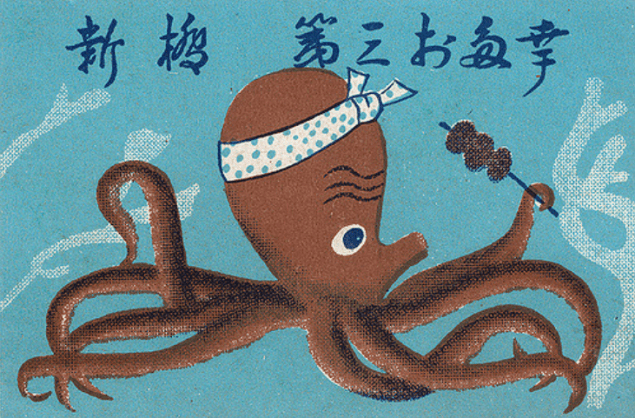
First, a Japanese matchbox from around 1920s-40s. This little guy comes from a collection posted by Jane McDevitt, who’s passionate about matchbox art. I also really enjoyed her Eastern European matchbox label collection, which you can admire here.
Of further interest on this topic is this comic strip by Roz Chast about her predilection for collecting matchbox art, published in the April 4, 2016 issue of New Yorker Magazine. As it turns out, Chast rejects the hassle of actually owning them, preferring to keep her collection as digital files. I suppose I am a collector, for I definitely prefer “owning” the physical version of things that interest me, but to each her own!
« Hugs can do great amounts of good, especially for children. » — Diana, Princess of Wales
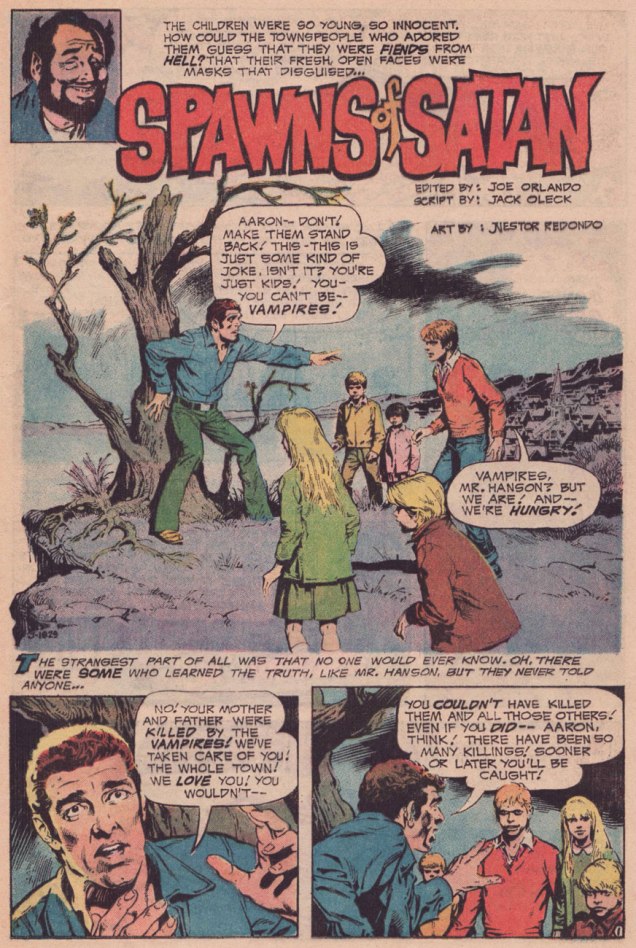
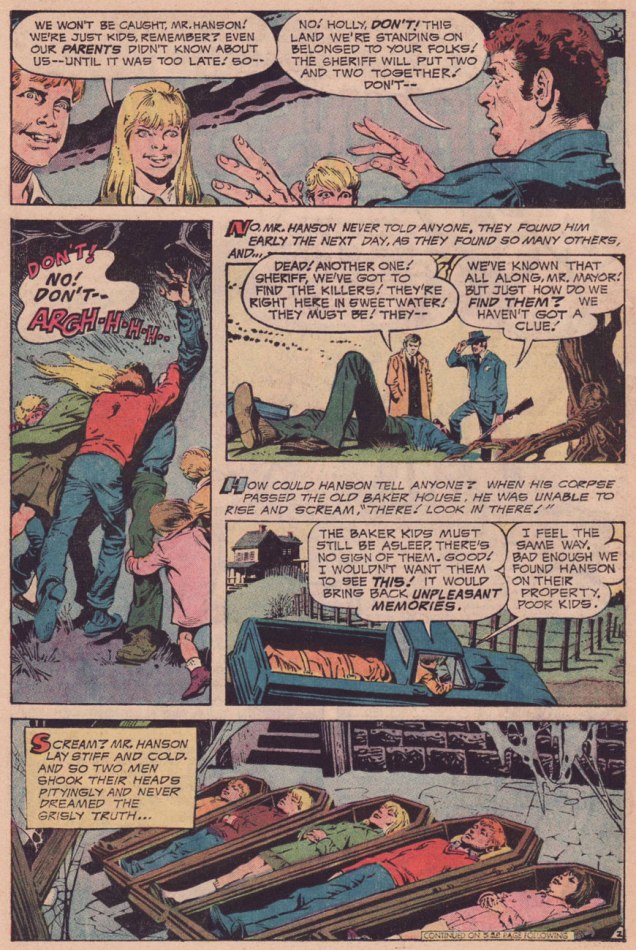
Today’s entry is a tale of vampirism from the typewriter of Jack Oleck (1914-1981). In the late 1940’s Mr. Oleck’s career in comics began promisingly with his brother-in-law Joe Simon and his partner Jack Kirby‘s Prize (Young Romance, Strange Worlds of Your Dreams, Black Magic and other anthologies), followed by a stint with EC late in the publisher’s classic, pre-Mad Magazine-only run (Crime SuspenStories, Shock SuspenStories, Vault of Horror, Incredible Science-Fiction, et al), along with assignments with Hillman, Atlas, Charlton and Harvey… among others.
Finding the décor of the Code-regimented funnybook industry a bit austere to his taste, he devoted the years of 1957 to 1969 to publishing and editing the magazine Decorator News and authoring the odd novel.
In 1969, he sauntered over to DC, where he cranked out quite a caboodle of scripts over the following decade-or-so, mostly in the horror (as it couldn’t be and shouldn’t be called under The Code) genre (“Mystery”, they called it), but also the occasional bit of romance, science-fiction and adventure. I’d like to say he was great, but frankly, he was pretty much a page-filling hack.
This is probably his finest script from this most prolific period, and it’s still full of plot holes and other inconsistencies. But that’s market reality for you: Oleck was consistently readable, he was fairly competent, he turned in his work on time, and he got along with the editors. Sometimes that’s all you need.
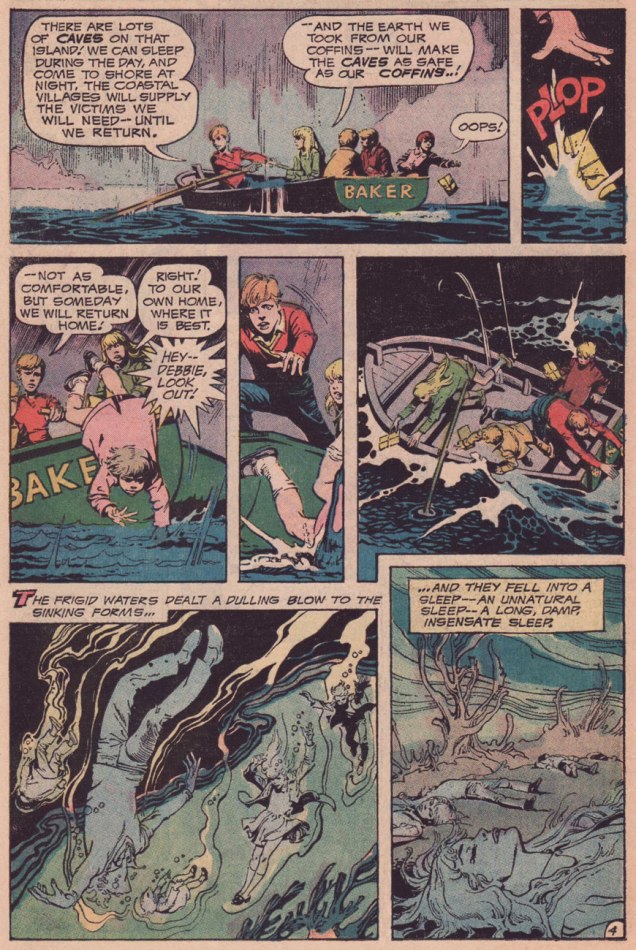
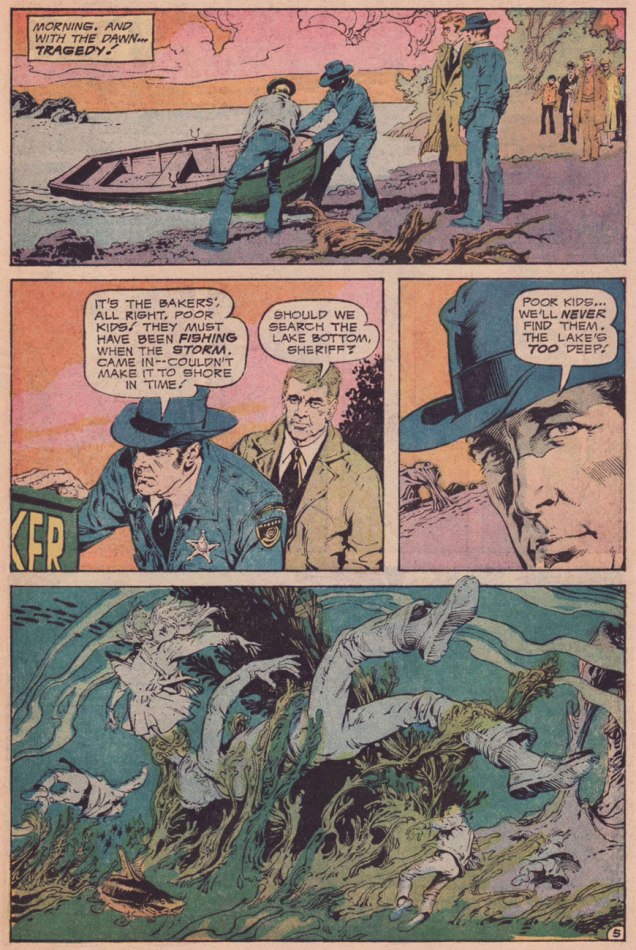
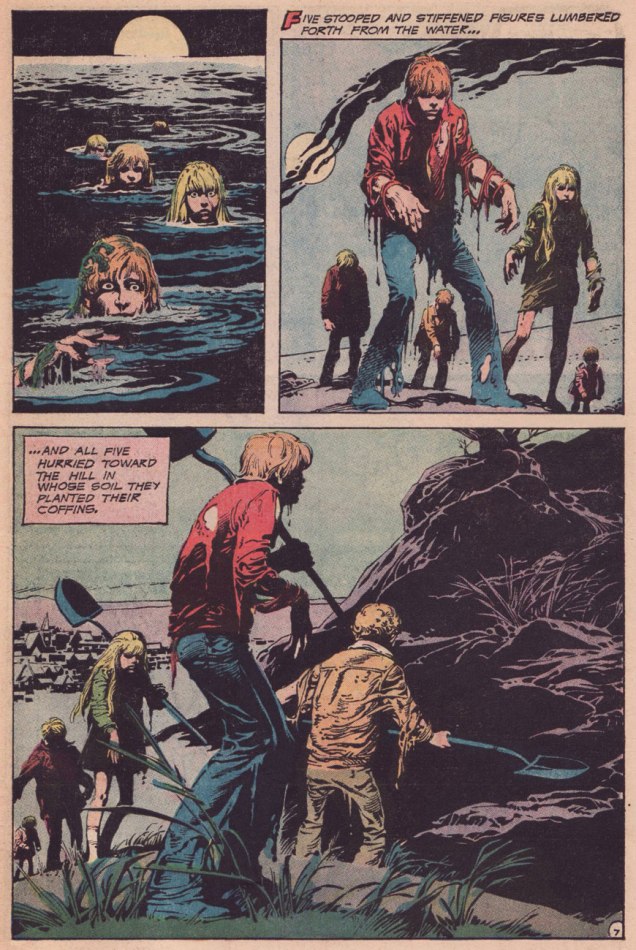
So why am I featuring Spawns of Satan if I seem to think so little of it? Well, obviously, there’s the luxurious grace of Nestor Redondo‘s art, granted here a specially generous setting to display its virtues. The middle act of the story is virtually mute, and all the more effective for it.
Read it first, then I’ll tell you more.
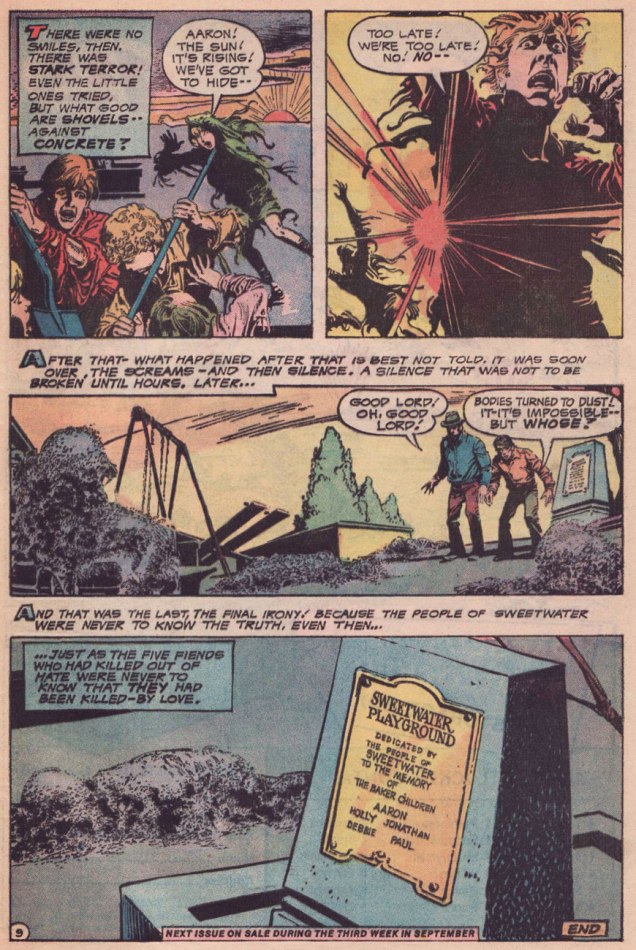
Okay, if the town’s taken care of them, how come no-one’s found it unusual that the kids aren’t around during the daytime? Doesn’t anyone go to school?It certainly tips the scale in the miscreants’ favour that the sheriff just shrugs and admits he hasn’t a clue. I guess it just wasn’t an election year.Wait… kids (with one or two tackling most of the grunt work) burying five coffins on grassy ground, and “not a sign that the ground’s been disturbed“? Mighty vampire powers, I say! And can you imagine the torment and frustration of the little ones, knowing they’ll never grow up, never get to take charge or be taken seriously? This story is just honeycombed with potential avenues of exploration.One slight problem: hypothermia should not affect undead creatures without a beating heart nor, necessarily, blood circulation. A little too convenient, Mr. Oleck. But fine, you’ve got them to the bottom of the lake.
For me, one of the tale’s chief assets had been Aaron’s characterization. Now how is it that suddenly, this cool-headed and calculating leader just loses his shit and gives up*? As depicted earlier, Aaron would have ordered a retreat to the lake and formulated another plan. But no, there had to be a ‘sting in the tail’. Also, if the town knew full well they were dealing with vampires, why do bodies turned to dust suddenly seem “impossible”? Finally, did you get the impression that the Baker kids killed out of hate (well, except for Holly; that girl had a bad attitude), as stated in the final panel? I think not: the clan was portrayed as a predator pack, who merely killed to survive, no sentiment allowed.
SOS is otherwise mainly notable in its introduction of themes and ideas that would be brought to full miasmic flowering by (of course) Alan Moore in issues 38 and 39 of Swamp Thing (July and August, 1985), namely the family unit of underwater vampires. Moore’s set of toothsome nasties was more-or-less introduced, but not fully-fleshed out, by his predecessor, Martin Pasko, in July, 1982’s Saga of the Swamp Thing no. 3‘s A Town Has Turned to Blood. Moore’s keen eye caught the spark of potential and set the hills ablaze. However, it seems unlikely that Moore’s research hadn’t trailed back a few years to the lacustrine lair of the parasitical Baker brood.
Speaking of editors, I’ve long suspected that this particular issue of House of Secrets was the dumping ground of an aborted experiment by its editor, Joe Orlando. Orlando had clearly been trying to shake things up a bit, running two longer, less compressed stories per issue instead of the usual three… as DC’s available story page count had dropped from 24 to 20 (and would reach a woeful 17 by 1976!); the two-story practice lasted but a few issues. After no. 117, it was jettisoned. It would appear that at least one of House of Secrets 113’s stories had been scheduled and delayed: eight months earlier, Jack Sparling’s grey-tone lovely cover for House of Secrets no. 105 (Feb. 1973) was a perfect illustration for Doug Moench‘s, Mike Sekowsky and Nick Cardy‘s fascinating ‘Not So Loud– I’m Blind’… which finally turned up in this issue as the lead story. Sombre and rambling, Moench’s likely first sale to DC lacks the usual forced twist ending, opting instead to trail off into darkness. In fact, when I first read it, I thought my copy was missing a page.
Moench went off to be arguably (well, he’s my pick) Marvel’s most consistent writer of the 1970s, and only returned to DC in the ensuing decade.
« … Out behind a tree there jumped a great bighungry wolf
‘Pardon me’, he said, real cool ‘Why make the scene alone? A crazy chick like you should have a handsome chaperone’ » — Ridin’ Hood (The Coasters, 1962)
It could be quite convincingly claimed that Jean Ache (1923-1985, né Jean-Baptiste Huet in Le Havre, France) was the most versatile, chameleonic artist of his generation. Not only was he able to accurately adopt any style he chose, “high” or “low”, but he also wielded a panoply of styles of his own devising. To support my claim, take a peek at noted historian Henri Filippini‘s comprehensive survey of Ache’s career (in French), which includes a generous gallery of his multifaceted art. [ Part One ] and [ Part Two ]
From 1971 to 1973, near the end of René Goscinny‘s enlightened regime (his Astérix compèreAlbert Uderzo ably serving as art director), French bédé periodical Pilote featured a high-calibre series of “high art” pastiches. It was entitled Le Musée Pilote.
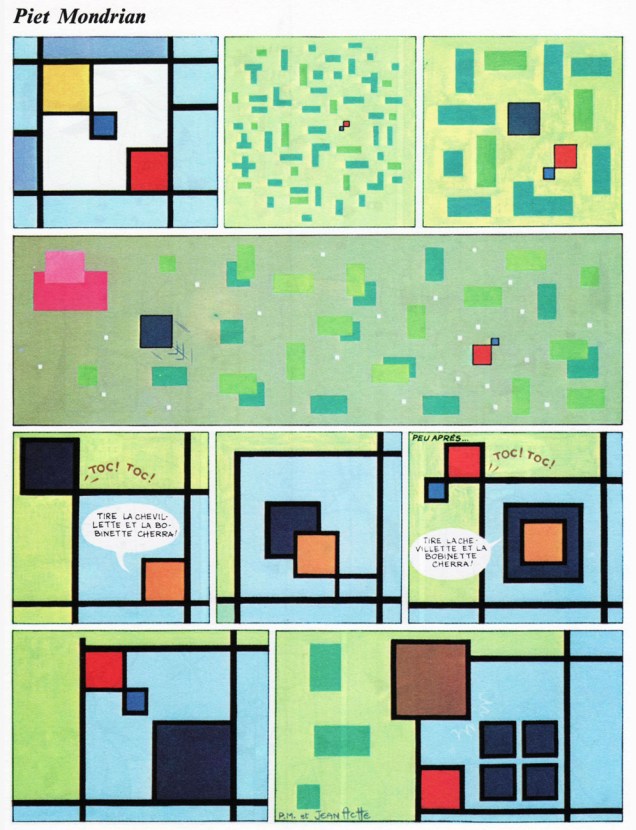
The pages of 1973’s PiloteAnnuel revealed an Ache tour de force, wherein he retold the classic tale of Little Red Riding Hood in comics format *and* in the style of a number (seven, to be exact… but not *the* Group of Seven) of famous painters. The set bore the following cheeky introduction: « Within the scope of the Musée Pilote, we came to realise that numerous artists had never tried their hand at comics. Thanks to our friend Jean Ache, it is now a done deal, and we are pleased to present the tryout pages crafted by these illustrious beginners. It is for you to decide whether these attempts are conclusive, and if these young people’s efforts should be encouraged. »
Here we go!
After Henri Rousseau (French, 1944-1910). Incidentally, « Tire la chevillette, la bobinette cherra » means « Pull the bobbin, and the latch will go up. »After Fernand Léger (French, 1881-1955).After Bernard Buffet (French, 1928-1999).After Pablo Picasso (Spanish, 1881-1973).After Giorgio de Chirico (Italian, 1888-1978).After Joan Miró (Spanish, 1893-1983). My first encounter with Miró came through this item; if I’d been hipper, it might have been this instead… but I was only six years old at the time.After Piet Mondrian (Dutch, 1872-1944).And here’s the cover. This is PiloteAnnuel 74 (no. 731 bis, Nov. 1973). It comprised, in roughly equal measure, a selection of the past year’s best work and new material.
My initial brush with Ache came in the early 1970s and his short-lived Pastec (1968-70, 9 issues, plus one album). I only ever got my hands the album (« L’Agent secret chante à minuit », 1971), but I never forgot. Like many a childhood fascination, it came out of nowhere, then vanished.
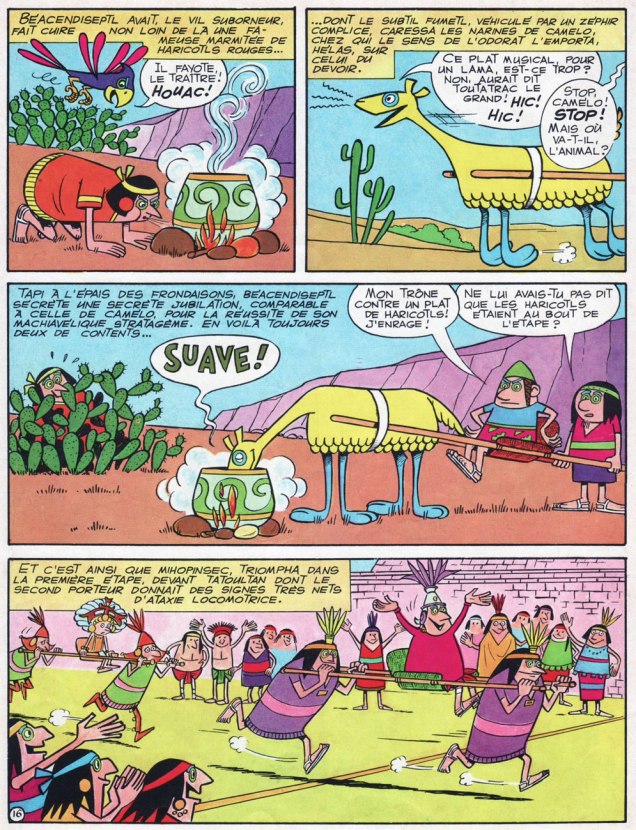
A sample from Pastec no. 4 (January 1969, Société française de presse illustrée). The birdie is Psitti, Pastec’s loyal Ara; the Llama is Camélo; and Pastec himself is the displeased fellow with the green hat in the middle tier.
I honestly hadn’t planned to write two consecutive posts about nearly-forgotten French artists named Jean, but something else fell through… and here we are. Sorry!
« A good puzzle, it’s a fair thing. Nobody is lying. It’s very clear, and the problem depends just on you. » — Erno Rubik
Jean Mad… now who’s he? A once-popular and prolific French cartoonist and illustrator, largely forgotten today, in part because his body of work appeared, frequently unsigned, in ephemeral periodicals… and hardly any of it was ever collected or reprinted. So he isn’t a household name, if he ever was, but his distinctive style will ring a bell among francophone readers of a certain age.
Now for a little context: in 1959, Belgian publisher Marabout launched a wildly popular series (nearly 500 titles between 1959 and 1984!) of pocket books called Marabout Flash, and the little tomes’ handy format (11,5 x 11,5 cm) and low cost “inspired” French publisher Vaillant, in 1962, to borrow the idea (at a size of 11,5 x 12 cm… to sidestep legal repercussions) for cheap reprint collections of José Cabrero Arnal‘s Pif le chien strips, which had been running in communist newspaper L’humanité since 1948. The format decided upon was 100 gags – 100 jeux (« 100 gags – 100 games »). It was an instant hit (quickly reaching 150 000 copies sold per issue), and soon generated numerous spinoffs. But the games half of the equation was, for a long time, rather shoddily-illustrated. By the turn of the decade, though, thanks to several judicious additions (Jean-Claude Poirier, Jean Marcellin and Henri Crespi, to name but a few) to the production staff, the product looked pretty spiffy. Which brings us to Mr. Mad, who first turned up in 1969… and came and went throughout the 1970s.
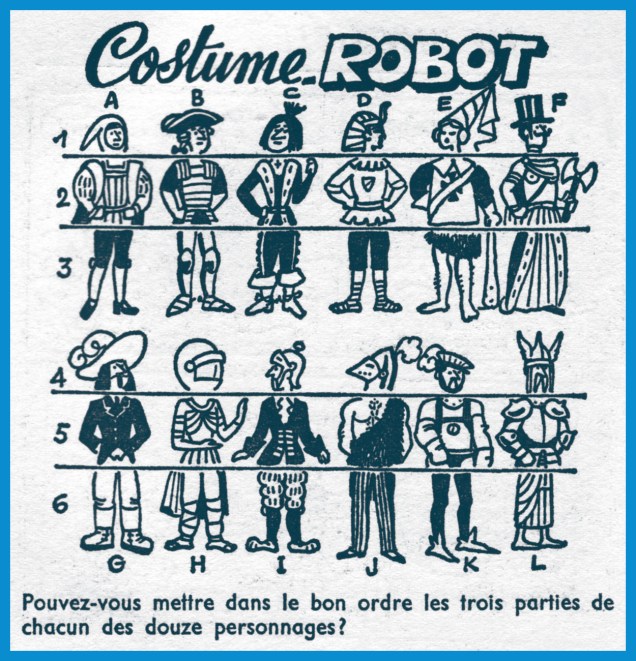
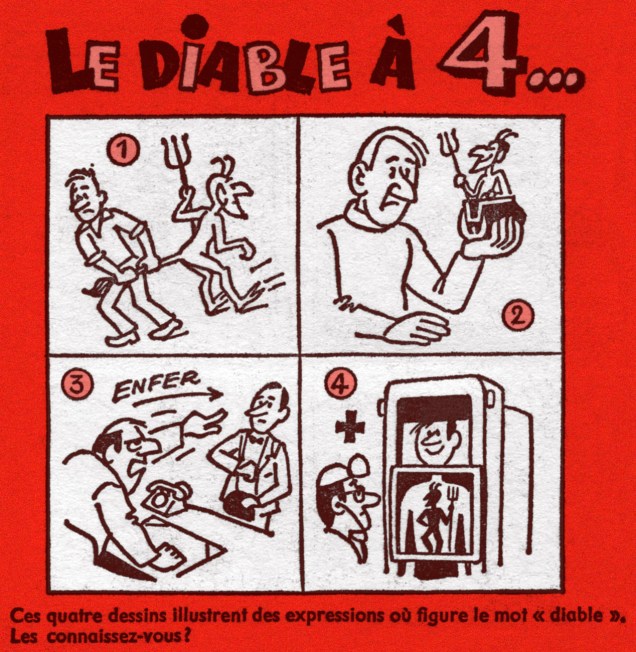
True or False? 1) The beaver only fells small trees 2) A newborn bear cup weighs a mere 200 g; its mother weighs 200 kg; An antelope can approach a lion without fear; A giraffe can reach foliage beyond the reach of an elephant. (1)-False: beavers have to known to drop trees up to 30 m high and 2 m in diameter; (2)-True; (3) True, when he’s full; (4) False: an elephant can just lean against a tree, bending it to reach the foliage it seeks.) From Pif Poche no. 71 (July, 1971, Vaillant).Mad was a master of historical detail. A1-D2-R6 (Middle Ages); B1-I5-A3 (Louis XV); C1-J5-E3 (Prehistory); D1-H5-L6 (Ancient Egypt); E1-C2-F3 (Lady of the manor); F1-G5-J6 (1900); G4-E2-C3 (Musketeer); H4-R5-G6 (Cosmonaut); I4-B2-D3 (Roman); J4-L5-B3 (Knight); S4-A2-I6 (Renaissance); L4-F2-H6 (Gaul). From Pif Poche no. 71 (July, 1971, Vaillant).Mad’s economical, chiaroscuro style came to mind when I later encountered Joseph Mugnaini‘s classic illustrations for Ray Bradbury’s The October Country. In this one, you have to find the hidden crow from Aesop’s timeless fable. From Pif Poche no. 70 (June, 1971, Vaillant).« While observing these odd guests, try to find the six idioms that each one evokes and that all have to do with the table. » (1) Manger son pain blanc le premier; (2) Mettre de l’eau dans son vin; (3) Mettre les pieds dans le plat; (4) Mettre les bouchées doubles; (5) Tourner la cuillère autour du pot (“beat around the bush”); (6) Couper la poire en deux; From Pif Poche no. 70 (June, 1971, Vaillant).« These four drawings illustrate idioms featuring the word ‘devil’. Do you know them? » (1) Tirer le diable par la queue; (2) Loger le diable dans sa bourse; (3) Envoyer quelqu’un au diable; (4) Avoir le diable au corps. From Pif Poche no. 68 (April, 1971, Vaillant).A cute demonstration of Mr. Mad’s versatility, from Ludo, le journal des amateurs d’énigmes no. 3 (Oct. 1973, Vaillant). « These four drawings are excerpted from different strips, but all have one detail in common. Which one? » The solution was to be provided in the following issue, which I only acquired decades later… but I’m sure you can suss out the answer to this one.Prior to encountering this piece in Ludo, le journal des amateurs d’énigmes no. 1 (Feb. 1973, Vaillant), I had no clue as to the identity of the mystery artiste. I guess this piece was large and elaborate enough to warrant a signature.«A car at last! » « Where? » A bit of a cheat, that one. How was I to know, at age six, that a “DS” was a French car, even one as lovely and classic as the Citroën DS? We didn’t have those around where I grew up, and that’s a shame. From Pif Poche no. 70 (June, 1971, Vaillant).A surprisingly adult situation, given the audience. Catch the gaffe!: The man of the house, having queried his spouse: « At what time are those two drips due to drop in? », what should be her reply, to salvage the situation? « They had to cancel. But our friends, X… have just arrived. » From Pif Poche no. 71 (July, 1971, Vaillant).An artist who can not only draw steeds, but depict various equine types and personalities… now, that’s skill. From Totoche Poche no. 20 (March, 1971, Vaillant). Name Their Cavalier: (1) Don Quixote; « I am called Rossinante » (2) Alexander the Great; « Bucephalus is my name » (3) Attila the Hun; « The grass never grew back where I trod » (4) Henri IV (Henri de Navarre); « I am white, as is his panache ».Child Prodigies: (1) « My word, he’s rediscovered geometry! » (Little Blaise Pascal) (2) « Later on, with my machine, I’ll be making the pot boil. » (Little Denis Papin) (3) « The harpsichord? Child’s play! » (Little Wolfgang Amadeus Mozart). From Pif Poche no. 68 (April, 1971, Vaillant).
I suppose I didn’t think twice about it when I was a kid, but it seems to me, in hindsight, that kids in those days were expected to possess quite a baggage of eclectic knowledge pertaining to history, geography, language, architecture, logic, observation… As an omnivorous, voracious reader, that state of affairs suited me to a T, and so these dense little volumes nourished me considerably at a time when I was most receptive to such gleanings. Inevitably, both the comics and the puzzles were soon dumbed down, but I had moved on by then.
This feels like a portentous occasion: the last Tentacle Tuesday of 2019. The mind boggles at the sheer number of tentacles we have released into the wild this year! As far as the splendour of this moment is concerned, there’s no reason for me to fight this feeling. Yet my general tendency at the year’s end – to throw in a lot of women fighting off tentacles (witness last year’s TT – “Foul as Sewer Slime!”) – is slightly one-track-minded, and it’s probably going to be my new year resolution to curtail that. Nah, just kidding.
Still: what *is* good is saying goodbye to the year in colour. So enjoy these not-quite-good, garishly coloured tentacle fiestas, and Happy New Year!
A painting by Esteban Maroto, a Spanish comic book artist whom you might know for his large body of work for Warren Publishing. He drew a hundred-and-one (presumably because that sounded good!) stories for Creepy, Eerie and Vampirella, which is a record only beaten by José Ortiz, another Spanish illustrator.Another one by Esteban Maroto. Are either of these fetching lads Dax the Warrior? I honestly have no clue. Anyone? (I’m told it’s the Masters of the Universe’s He-Man)
You know how I said, earlier, that I was one-track-minded? I’m not the only one. Yikes. This is a tame image, but the… wilder… ones were in black and white, and I had to stick to my theme. See the sacrifices I make?
Do visit Maroto’s website, tentacles abound (generally revolving around naked women).
Is it redundant to have yet another illustration by Nestor Redondo? (I featured one in last week’s Tentacle Tuesday). Perhaps. But it has many intriguing details: the octopus is both scarily human and quite alien (also, in bad need of braces!), the young maiden looks far too young to be subjected to the lascivious caress of a tentacle, and the old witch’s breasts are… a strange combination of realistic and anatomically suspect.Illustration by Manuel Sanjulián, a Spanish painter and fellow Warren alumnus. Hey, this is shaping up into some sort of celebration of Spanish art. That’s all right with me.Cover for Robot 13 no. 1 (cover variant B), July 2009, art by Jeff Slemons.
While we’re at it, from the same artist, here’s his Elvis‘n’tentacles:
Distinctly in the category of “why the hell not?”A Frazetta-ish painting titled Rocket Girls by Don Marquez, in which, as per the official description, “the girls meet the Tentacle Thing!” The Tentacle Thing has a bloodshot eye because he’s had too much bloody champagne.
…. preceded by “The Rocket Girls run into a thing that is all tentacles and eyeballs.”
The girls all look like clones… except for varying bust sizes. Marquez really went overboard with the one on the left, if you ask me – I’m surprised she can hold up a gun at all. The gals seem to be consumed in increasing order of bra size… that monster is a connaisseur.
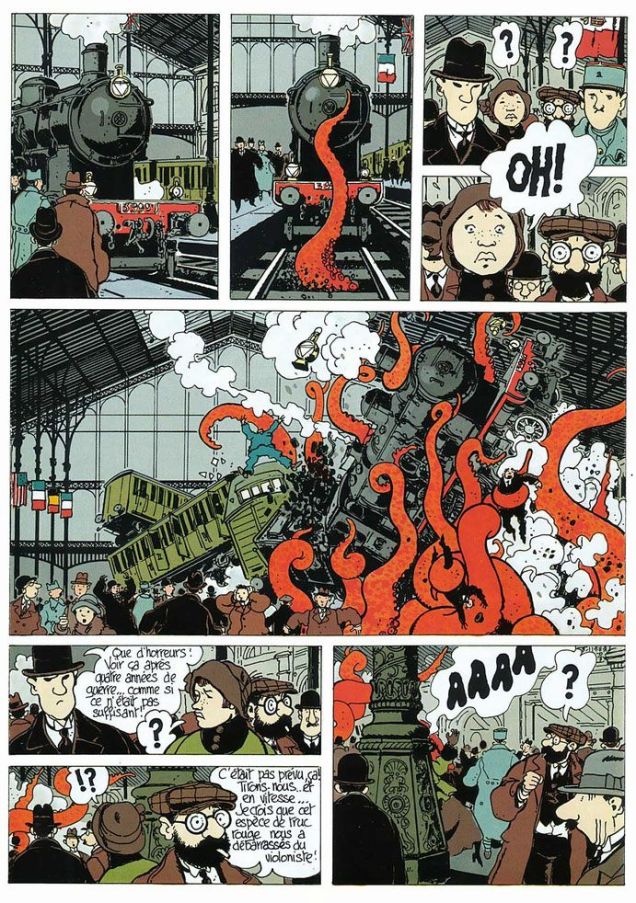
In my ceaseless quest for tentacles, once in a while, I return to a previous theme – in this case, the Franco-Belgian tradition of comics. To start at the beginning, visit Tentacle Tuesday, Franco-Belgian edition parts 1 and 2, and Tentacle Tuesday: Tentacules à la mode.
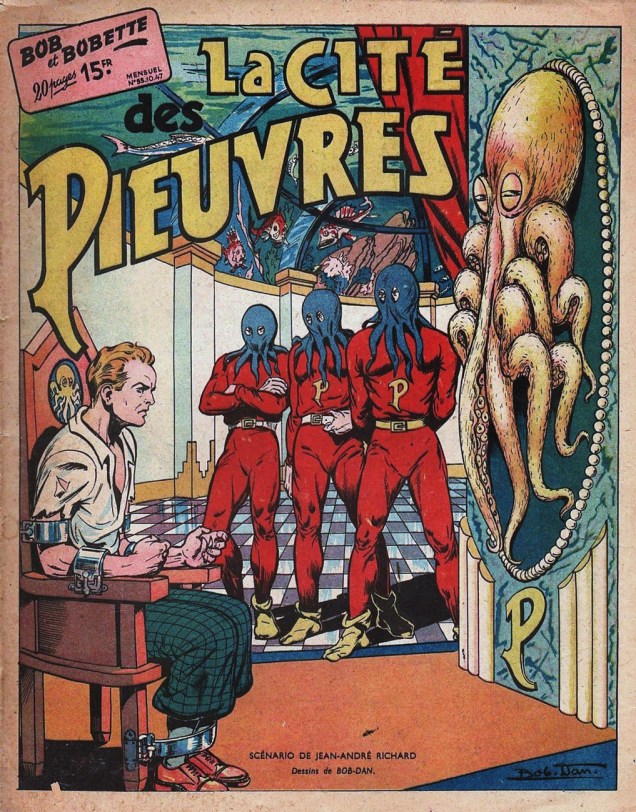
We start some 70-some years ago, with an issue of Bob et Bobette, a Belgian feature created by Willy Vandersteen in 1945. Well, to be more precise, the latter created Suske en Wiske — when the strip became popular in its native De Standaard (a Flemish daily newspaper), it was picked up by Tintin magazine, after Vandersteen agreed to modify it somewhat according to Hergé (who was the magazine’s artistic director) and his Ligne claire guidelines. The main characters were renamed – far from the last time that happened: in Britain, they were known as Spike and Suzy, and as Willy and Wanda in the United States.
Bob et Bobette no. 55: La cité des pieuvres (1947). Scripted by Jean-André Richard and illustrated by Robert Dansler, who was often known as Bob Dan. That lovely sepia paper… I can just smell it.
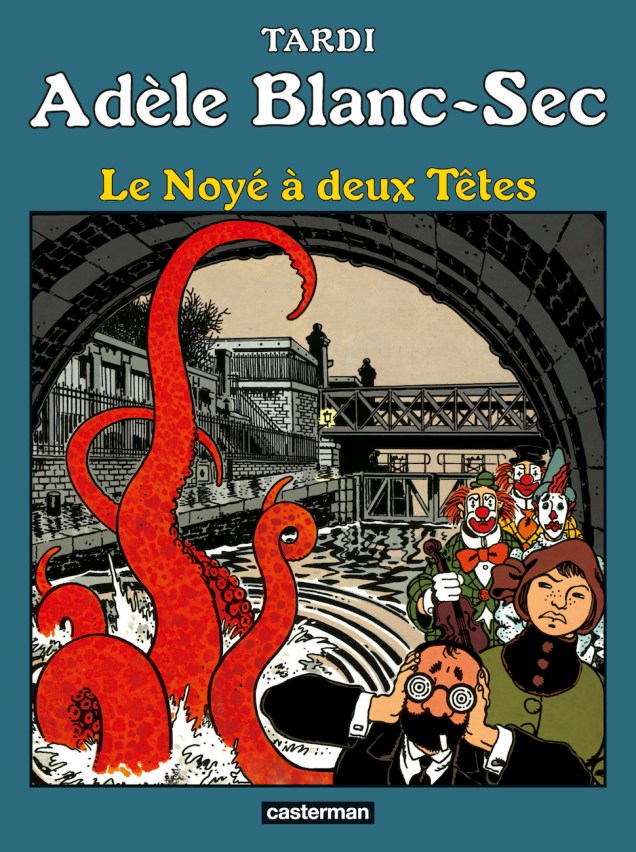
I’ve never read a whole album of The Extraordinary Adventures of Adèle Blanc-Sec, though I like its premise (an intrepid, independent héroïne? yes, please) and Jacques Tardi‘s art (depending; sometimes I love it, sometimes I’m indifferent, but it’s certainly good enough for purposes of following a story). Chalk it down to something I never got around to, I guess. Irritatingly, in 2010 we have been *ahem* ‘blessed’ with a movie based on this comic, directed by the ever sharp-witted Luc Besson (who royally fucked up a movie adaptation of Valérian et Laureline in 2017, so he seems to be making this into a specialty).
Le Noyé à deux têtes is the sixth volume of LesAventures extraordinaires d’Adèle Blanc-Sec, a series by Jacques Tardi. In 1984, it was serialised in À suivre, a Franco-Belgian magazine, and collected as an album a year later (both by Casterman).A peek at the tentacles within.
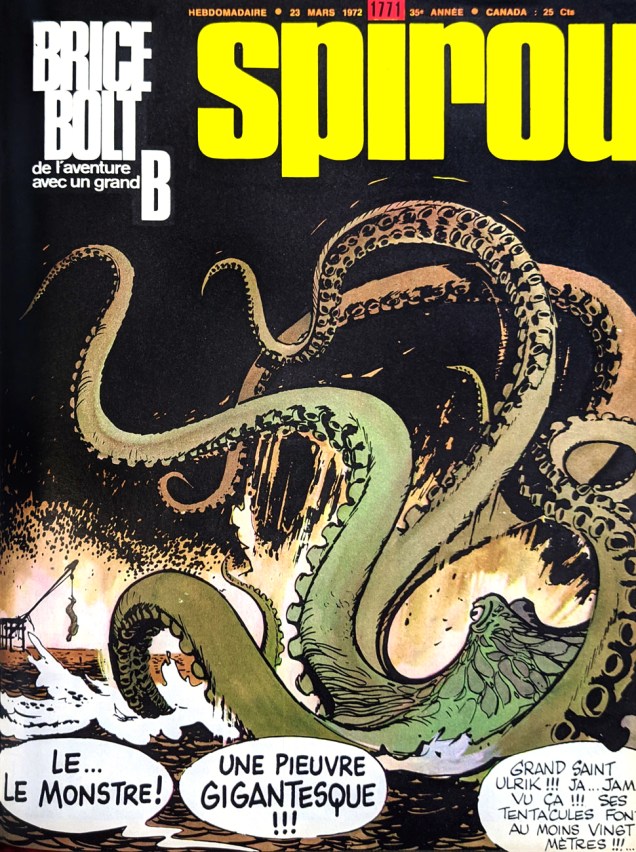
I mentioned the comics magazine Le journal Tintin earlier – here’s a cover from its competitor, Spirou (Le journal de Spirou), published by Éditions Dupuis since 1938. The respective publishers (Raymond Leblanc for Tintin, and Charles Dupuis for Spirou) of these magazines had a gentleman’s agreement: an artist’s work could only be published in one or the other, never both. Incidentally, there was an interesting exception in the case of André Franquin, who moved his wares from Spirou to Tintin after a quarrel with its editor – and, contractually obligated to work for Tintin for five years, simultaneously continued to provide Spirou with stories.
Spirou no. 1771 (march 23rd, 1972), art by Puig.Brice Bolt, a feature launched in 1970, was soon abandoned after but two episodes (although to be fair, they were lengthy – the strip lasted until 1972)… from the sound of it, for being a little too modern for its time. After the publication of the first chapters, letters came in complaining that the story was too scary, the animals too monstrous, the illustration style too realistic. The “monstrous animals” included an army of giant crabs, a behemoth squid (just up our street!), colossal vampire bats, and ginormous Komodo dragons.
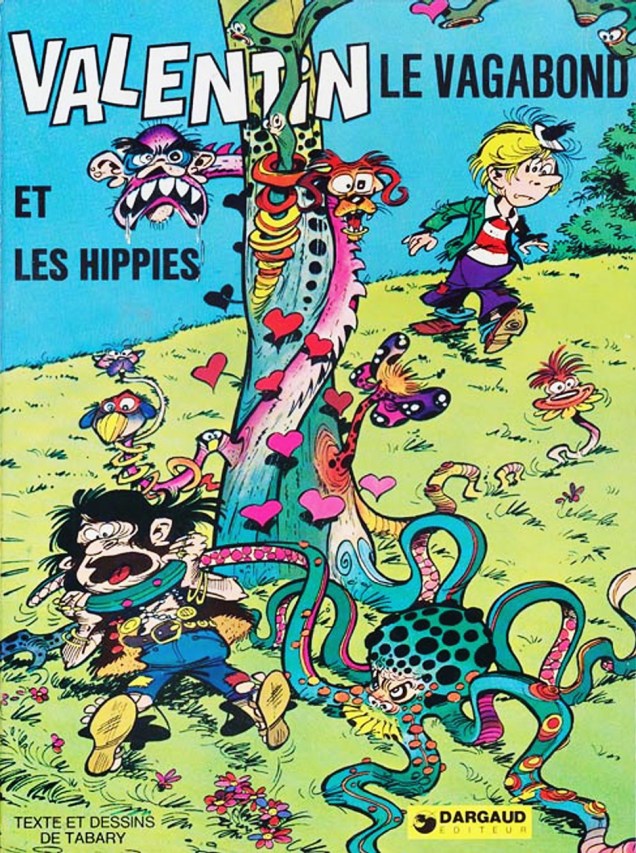
Valentin le vagabond was created by René Goscinny et Jean Tabary in 1962 for publication in Pilote. After 1963, Tabary carried on alone, scripting and illustrating all by his lonesome, Goscinny having his hands full with other projects. Valentin le vagabond et les hippies is the final story of this series, originally serialised in issues 709 to 719 in 1973.
Valentin le vagabond: Valentin et les hippies (Dargaud, 1974). Story and art by Jean Tabary.An excerpt from Pilote no. 719 (1973). The tree is a hippie tree, as it was treated with LSD… now it’s got tentacles. Naturally.
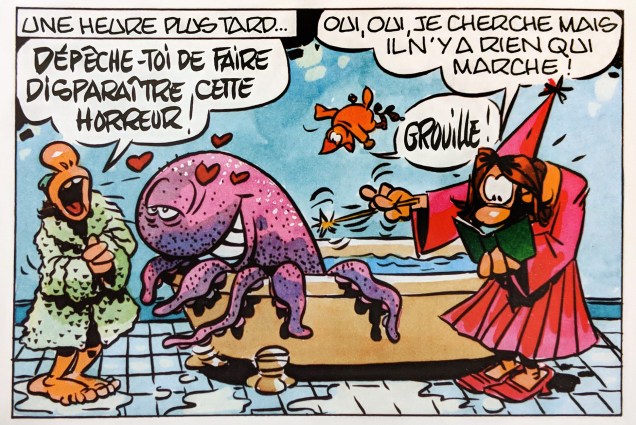
The French are surely not immune from scatological humour. The Kaca fairy (I’ll give you three guesses for what “kaca” means in French) is a rather inept witch. She accidentally conjures up an octopus who’s a little too intent on being liked, and the rest of the comic deals with the attempts to whisk him away again.
« Hurry up and make this monstrosity disappear! » « Yes, yes, I’m looking, but nothing works! » Panels from La fée Kaca (Humanoïdes Associés, 2007) by Florence Cestac.The octopus tries to convince everybody that they should allow him to stick (ha, ha) around – « for instance, I stick myself to the wall and leave you with all the room you need! ».
« I guess I look like a rock quarry that someone has dynamited. » — Charles Bronson
Welcome to our 400th post! I suppose a Steve Ditko birthday post would have been more momentous, but I did that already a couple of years ago, while he still drew breath.
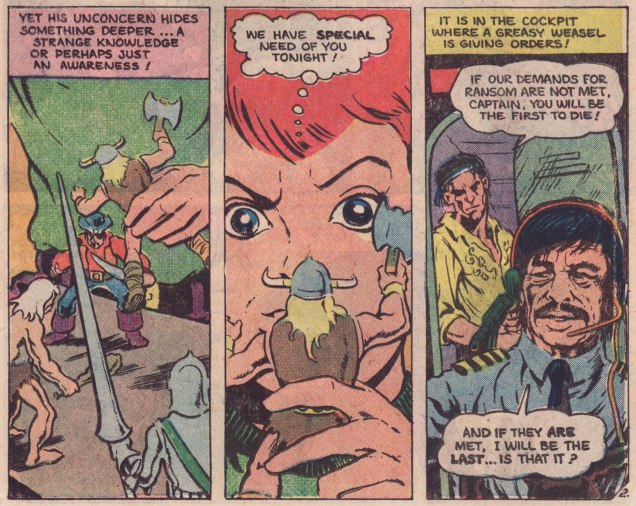
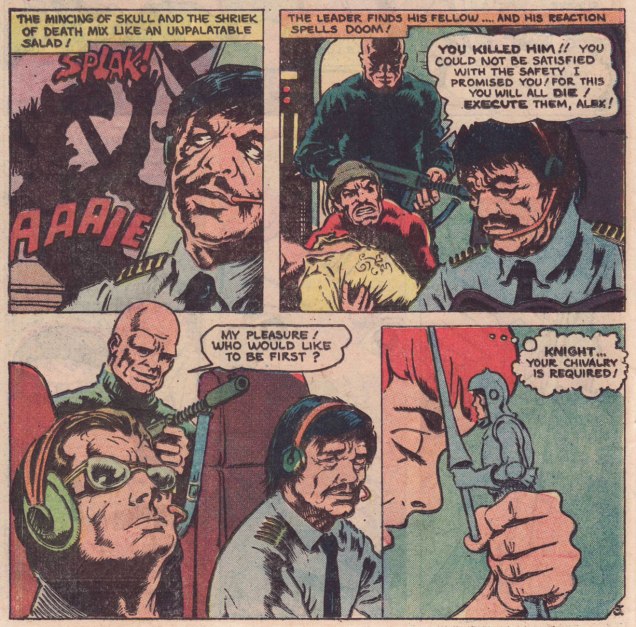
Today, our man Charles Dennis Buchinsky, aka Charles Bronson (1921 – 2003… he would have turned 98 today — picture that!) squeezes in a rather routine bit part (merely credited as « The Pilot ») in Joe Molloy and Mike Zeck’s nonsensical hijacking melodrama Only a Toy. Heck, read it here if you don’t believe me.
Oddly enough, this expanded cameo came about just a year after Bronson’s megahit Death Wish, as Bronson reached the pinnacle of his earning power (in inverse proportion to the quality of his output, thanks to his long association with the shady Cannon Group). Presumably, he was just doing a favour for his old pal Zeck.
« Like an unpalatable salad » indeed; a word salad. Published in Charlton’s Scary Tales no. 2 (October, 1975). Edited by George Wildman.
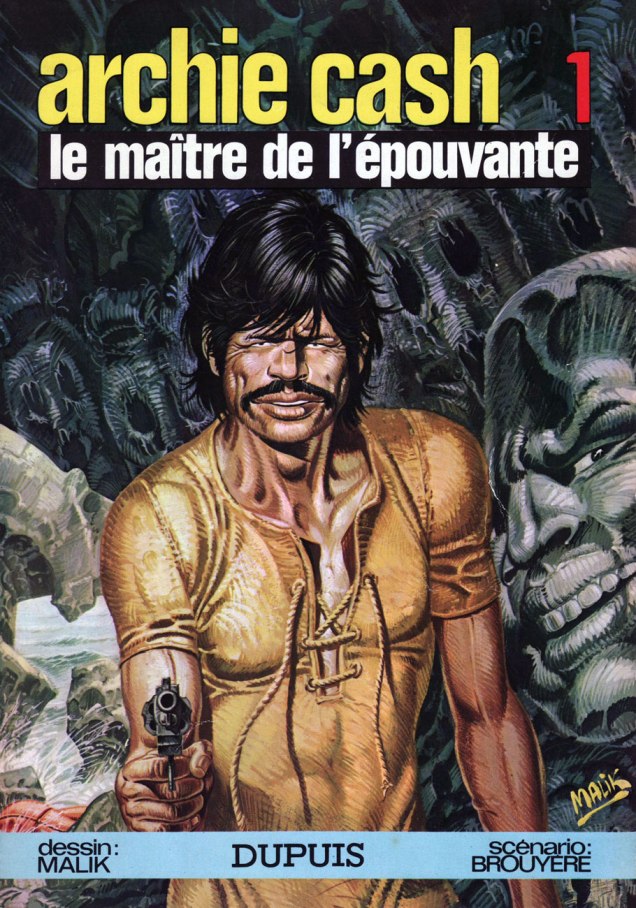
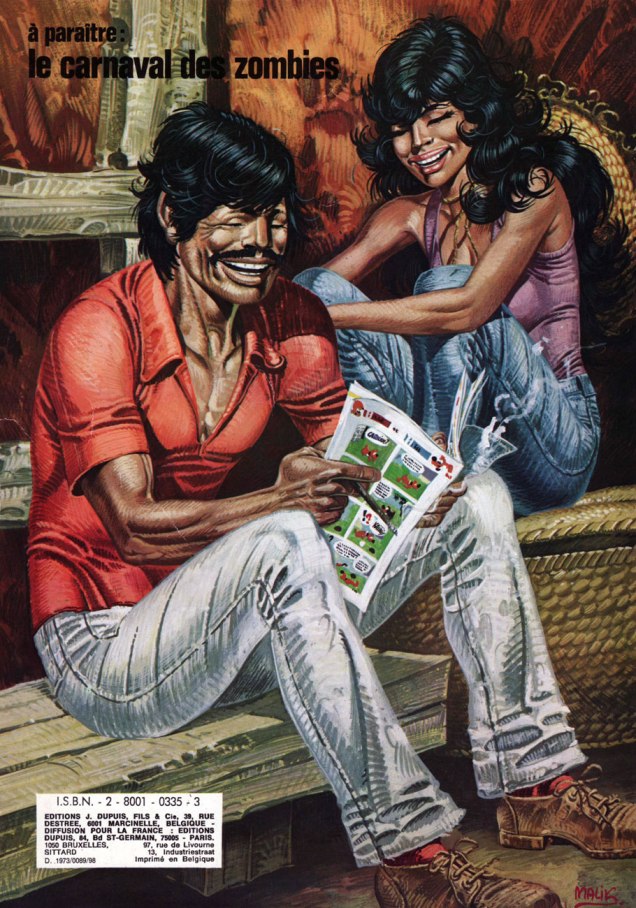
Ah, but this wasn’t the first time cartoonists had paid such tribute to Bronson: in 1971, writer Jean-Marie Brouyère and artist William Tai (aka Malik) created the South-America set Archie Cash series for Belgian bédé weekly Spirou. The series had a healthy run of 15 albums (what one would call a graphic novel over in North America) between 1973 and 1988.
Front and back covers of Archie’s début, Le maître de l’épouvante (1973).And to give you a sense of the series’ narrative texture, page five from Le maître de l’épouvante; when it debuted in the fall of 1971, the series brought a welcome griminess and ethno-social realism to the squeaky-pristine pages of Spirou.
The Italians would then follow suit, “borrowing” Jean-Paul Belmondo‘s likeness for their Goldrake series around 1972, followed by Alain Delon‘s looks for Playcolt, and more exploitively, Ornella Muti‘s charms for Sukia. Mind you, all these liberties with celebrity likenesses don’t make Brian Hitch‘s laziness and lack of imagination any less reprehensible.
Anyway, back to our birthday boy: if you want to see Bronson at his finest, I recommend his early, pre-moustache TV showcase Man With a Camera (1958)… the 29-episode boxed set’ll cost you peanuts and it’s great value. Then, from his European period, you can’t go wrong with 1968’s Adieu l’ami (Farewell, Friend), co-starring the aforementioned Mr. Delon; 1970’s gloriously weird Le passager de la pluie (Rider on the Rain), 1971 winner of the Golden Globe for Best Foreign Film, and co-starring creepy Eva Green‘s mom (or should that be “mum”?), Marlène Jobert. And of course 1971’s Soleil rouge (Red Sun), co-starring, this time not only Delon, but none other than Toshirô Mifune!
« If it wasn’t for baseball, I’d be in either the penitentiary or the cemetery. » — Babe Ruth
Since the (so-called) World Series is still going on, this seems all the more appropriate.
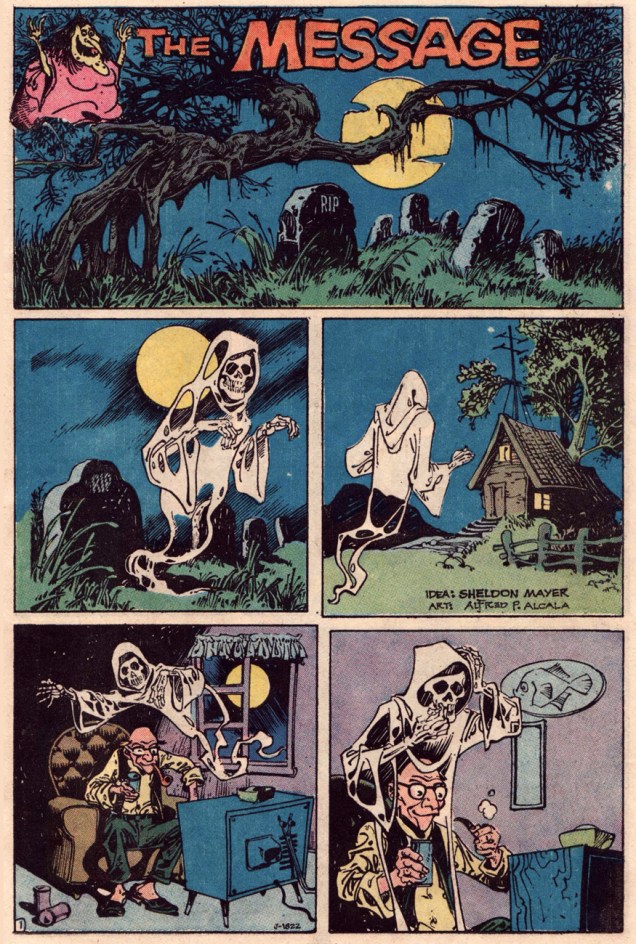
It was with this piece that I first began to grasp just how gifted and versatile Filipino giant Alfredo P. Alcala (1925-2000) was. He’s inarguably a grandmaster of eerie moods, but hardly bereft of a fun side. This brief piece, a dream collaboration between Sheldon Mayer and Alcala, was published in Plop! no. 1 (Sept.-Oct. 1973, DC). And what an issue that was, gathering such talents as Basil Wolverton, Sergio Aragonés, Mayer and Alcala, Frank Robbins, George Evans, John Albano, Stephen Skeates and Berni Wrightson… yikes! (read it here!)
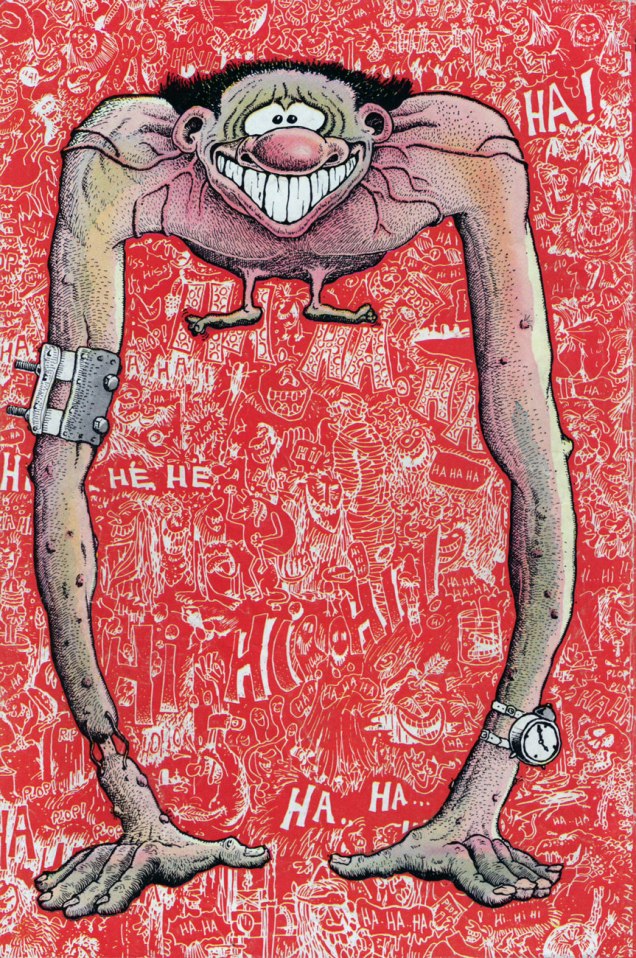
As a bonus, here’s the *back* cover of Plop! no. 1, featuring Wolverton’s cover boy “Arms” Armstrong. Which provides me with the opportunity to inform you that this very week has seen the long-delayed publication of Greg Sadowsky’s Brain Bats of Venus: The Life and Comics of Basil Wolverton Vol. 2 (1942–1952), his definitive biography of that singular and fascinating man. Read all about it here!


























 Who's Out There?