Where there be pirates, there be treasure; where there be treasure, there be a displeased octopus, irritable after being roused by some foolish fortune-hunter. I’d like to dedicate this Tentacle Tuesday to the murderous marauders who, in bold search for immeasurable treasure, have to tackle tentacles (and survive, hopefully).
Weird Terror no. 2, November 1952. Cover by H.C. Kiefer. Note the dead pirate’s hook embedded in the diver’s shoulder, while the former’s other hand is severing his umbilical cable… I think the octopus is the least of this treasure-hunter’s worries. By Weird Terror standards, this cover is actually pretty tame; this green octopus is not responsible for Fredric Wertham‘s nightmares.
Any octopus action inside, you may ask? Just two panels.
AAAGH-BLUB! Panels from « Wrath of Satan », pencilled by John Belcastro and inked by Joe Galotti.
I never thought I’d be posting something Garfield-related, but in Roger Langridge‘s hands, even the insipid orange cat acquires some charm.
A panel from « Pirate Cat », written by Scott Nickel and illustrated+lettered by Roger Langridge, published in Garfield no. 34: His 9 Lives Part 2, (KaBOOM!, February 2015).
Melvin the Menacing Sea Monster isn’t just a pretty eye; he’s got at least one excellent pitching arm, too.
All this proves is that there’s a simple solution to an inane plot and pedestrian characters: hire Langridge to illustrate your story, and it will magically transform into a fun yarn.
Our next selection doesn’t technically feature pirates, but it features sailors, Spanish smugglers, swindlers and cheats, as well an epic battle with an octopus and stolen treasure buried at the bottom of the sea, so it damn well qualifies.
Classics Illustrated no. 56, February 1949; cover by August M. Froelich. For one thing, I never knew Victor Hugo had written anything squid-related. As it turns out, Toilers of the Sea (French: Les travailleurs de la mer) is a novel from 1866. How educational! Classics Illustrated was created by Russian-born Albert Kanter (1897-1973), who wanted to use the power of comics to introduce young readers to “great literature” that they might not otherwise have deigned to read. “Classic Comics” began publication in 1941, with the name of the series changed to “Classics Illustrated” in 1947. The series lasted until 1971 for a total of 169 issues; various other companies reprinted its titles. I don’t know whether this series really made a difference in the edification of youth, but many of its issues are highly collectible, anyway.
As a little bonus, here’s a cover that’s somewhat lacking in swashbucklers, but boasts some decent treasure and (quintessential ingredient) some tentacles.
If Rex the Wonder Dog (created by Robert Kanigher and Alex Toth) can ride horses, show off as an expert bullfighter, use cameras, defeat a Tyrannosaurus Rex and swing on ropes (among his many other accomplishments), I don’t see why he wouldn’t be able to effortlessly fend off some pink tentacles. This is The Adventures of Rex the Wonder Dog no. 42 (Nov.-Dec. 1958). The cover is by Gil Kane on pencils, Bernard Sachs on inks, and Jack Adler on tones and colours.
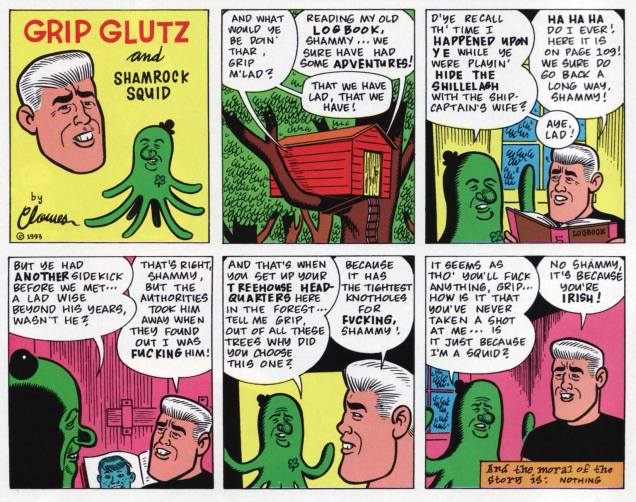
I’d like to interrupt the regularly scheduled Tentacle Tuesday with the double whammy of tentacles and kiss-me-I’m-Irish:
It’s Grip Glutz and Shamrock Squid! Originally published in Eightball no. 10 (February 1993.) Story and art by Daniel Clowes, of course. I love stories with no moral.
Shamrock Squid, created by Clowes, is an “open source” character, which is to say that other cartoonists have official permission to use him in their work.
« While Shamrock Squid was originally featured in Clowes’s comic book Eightball as a comic companion to “Grip Glutz” in a one-page ‘gag’, he has also made surprise or cameo appearances in other alternative comics such as Peter Bagge’s Hate and Rick Altergott’s Doofus. The most detailed, epic and perhaps final use of Shamrock Squid was done by Adrian Tomine and Peter Bagge in a 7 page piece in Hate #28 entitled “Shamrock Squid: Autobiographical Cartoonist”, which lampooned autobiographical alternative comics, teen angst, and fandom. It would seem that the gag has gone as far as it can. » (source)
I’m not sure what is implied by “the gag has gone as far as it can”, but since Adrian Tomine is involved, I’ll happily agree that enough is enough.
So if you’re planning to booze your woes away this Saturday on St-Patrick’s, happy drinking!
Moving on to the goofiness promised, here’s Tentacle Tuesday in all its glory.
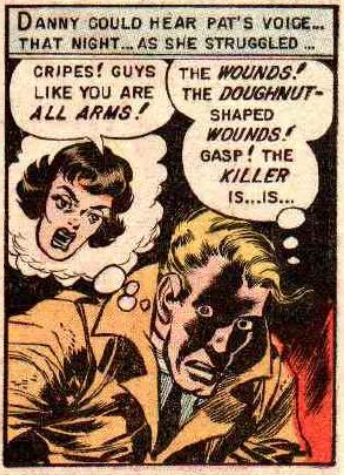
Many women get killed. Their corpses are covered in doughnut-shaped marks. A killer in a trench-coat sporting a wide-brimmed hat has been spotted retreating into the city’s aquarium after his crime. “Who Doughnut?”, the story’s title asks, and it is indeed a stumper.
The intrepid detective follows the killer! His mind struggles with the vital question of who or what could have possibly left such bizarre marks on his victims…
… and comes up with the answer! It’s…. (drumroll, please)…
Well, duh. Everyone knows octopuses suck blood (and have a weakness for stylish hats). « Who Doughnut? », written by Al Feldstein and drawn by Jack Davis, was published in Vault of Horror no. 30, April-May 1953. The art is glorious, and the story – while preposterous – is moody as hell, so do yourself a favour and read it here. As a matter of fact, it’s so well drawn that one forgets the farcical plot and shudders along with the protagonist.
The composition just pulls you in, doesn’t it? Although you might wanna watch that… lest you come face-to-face with a vampire octopus.
Quite on a different note, meet an alien lifeform with an appetite for self-destruction. Which is to say: it likes to be eaten.
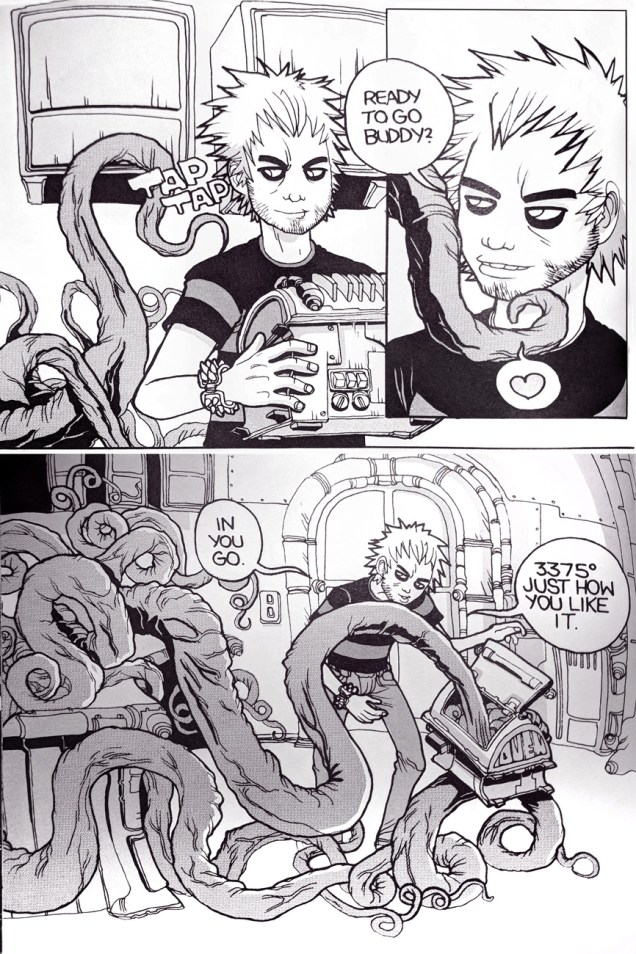
« The CXL spice paste is made up of millions of hive-minded micro-organisms whose sole purpose in life is to be eaten in a delicious meal. If the lettuce is too thick and chunky, the CXL will realise they are being prepared wrong and will strangle the chef responsible. » Snippet from James Stokoe’s Wonton Soup, published by Oni Press in 2014. Thanks to RG for putting together my hasty photographs of this page from a completely unscannable, thick and tightly-bound book.
Canadian Stokoe is probably best known for his take on Godzilla, which comic left me frankly underwhelmed. However, I heartily recommend the unfortunately unfinished Orc Stain. As for Wonton Soup, it was loads of fun to read. Here’s a summary from Publisher’s Weekly: « Stokoe’s wittily vulgar debut graphic novel follows former-cook–turned–space trucker Johnny Boyo as he fights off space ninjas, returns to the planet of his ex-girlfriend Citrus Watts, and finally faces a cook-off duel with a pair of alien twins who’ll stop at nothing to achieve culinary victory. » That covers the gist of part 1; to which I’ll add that part 2 of Wonton Soup concerns itself largely with Johnny’s buddy Deac’s reminiscences about his mad escapades with a sex bear, which are not for the squeamish.
Let’s end this cephalopod festival not with a bang but with a whimper… the whimper of a wife who’s getting carried off by tentacles, that is.
“Sorry, dear.” Cartoon by Gahan Wilson, who can always be relied on to resort to tentacles whenever possible.
In this installment of Tentacle Tuesday, we shall bear witness to a somewhat surprising facet of superhero life: superheroes sometimes struggle with tentacles, too.
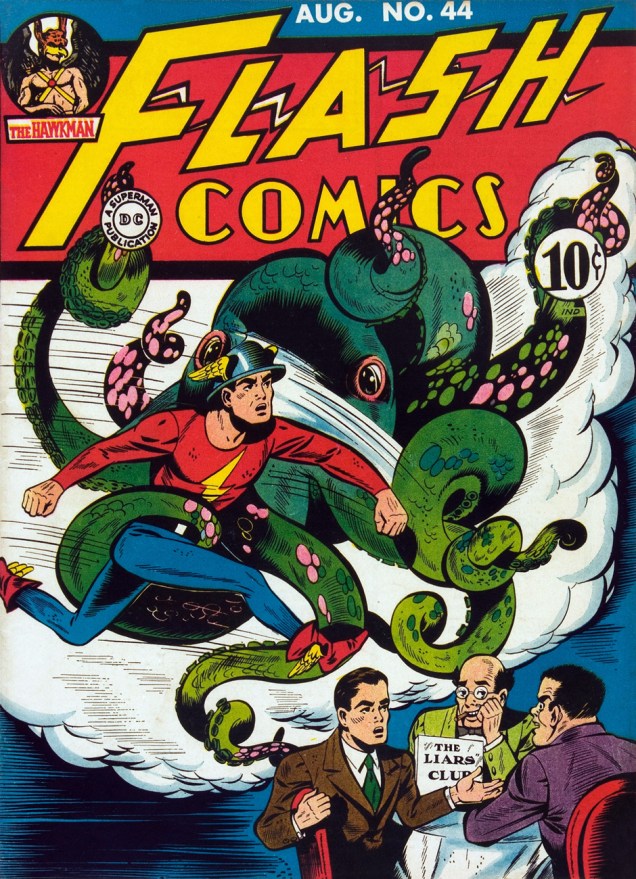
To kick off the festivities (and to respect a chronological order of creation and publication), here’s The Flash narrating a story of woe, his almost-deadly encounter with a green monstrosity (Judging by its coquettish pink tentacles, the monster wanted to woo him, not snuff him out.)
Flash Comics no. 44, 1943. Cover by Lou Ferstadt (1900-1954), and here’s a bit of trivia: in addition to being a comics artist, he was a muralist, creating works for the RCA buildings and the 8th Street Subway station in NYC.
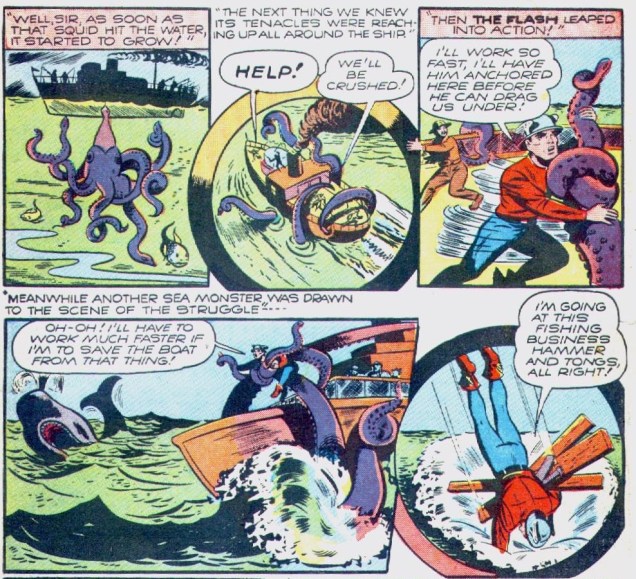
« The Liar’s Club », scripted by Gardner Fox and drawn by Lou Ferstadt, concerns itself with three men (one of whom is Jay Garrick, secretly The Flash) holding a fibbing contest to determine who can tell the biggest Flash-whopper.
Sadly, this tale was not the winner in the contest.
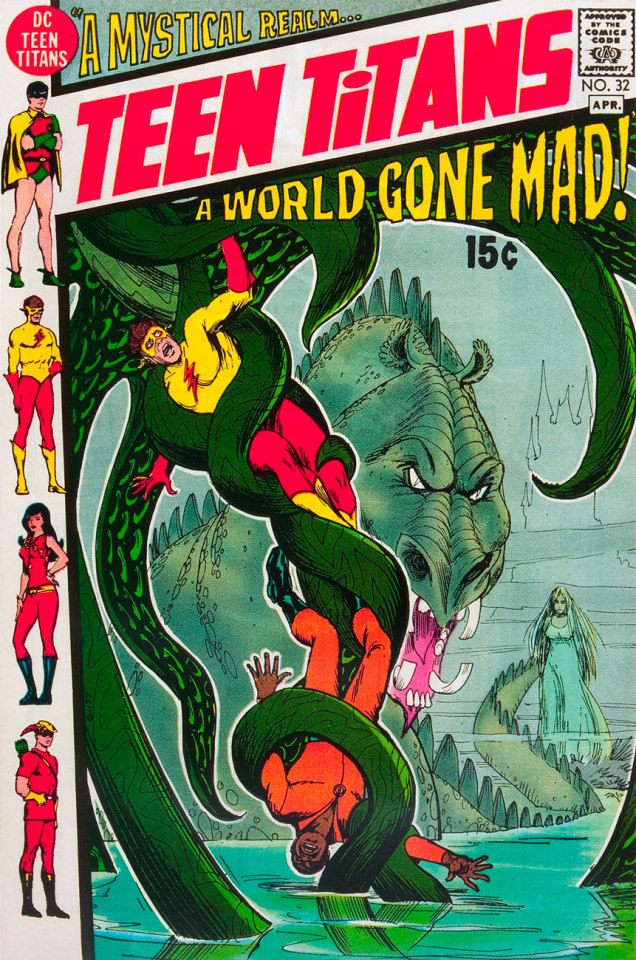
The Flash may have been embroiled in some purely imaginary tentacles, but his Earth-One counterpart’s teenage sidekick (it’s complicated), Kid Flash, encountered the real deal.
Teen Titans no. 32, March-April 1971. Drawn by Nick Cardy.
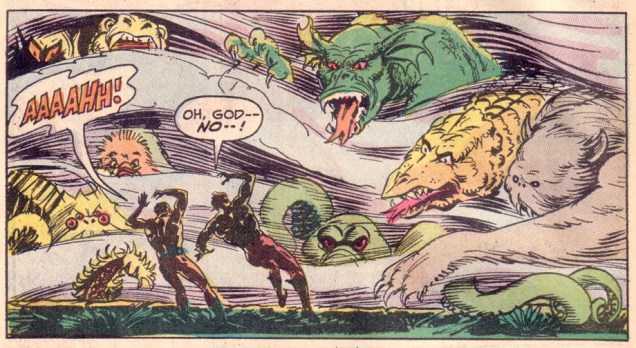
« A Mystical Realm, A World Gone Mad », scripted by Steve Skeates and drawn by Nick Cardy, is actually a pretty good read (with good art!), and I don’t even like superheroes. Just check out the beautiful results of a time travel experiment going wrong (when does one ever go right?), including the evil red eyes of a glaring octopus:
If we throw a whole bevy of superheroes at a tentacled monster, are they going to fare any better?
Fantastic Four no. 88, 1969. Pencils by Jack Kirby, inks by Joe Sinnott, letters by Sam Rosen. However… A house there was. Tentacles there weren’t.
This cover promises lots of tentacular fun. Instead of that, the Fantastic Four (and an infant) go looking for a new residence, something quiet and secluded – and the house that’s offered to them by a real estate agent appears to be haunted. At the very least, it causes migraines, gradually makes its inhabitants go blind, and shoots stun bolts out of its walls. The usual crap. I don’t want to tell you which super-villain is behind this mischief, but I will, however, point out that the bastard doesn’t have tentacles. Not even one. And neither does his lousy house.
The Flash is small fry, the Fantastic Four are mincemeat, but let’s see how Superman, the most superhero-like superhero of them all, fares when confronted with tentacles.
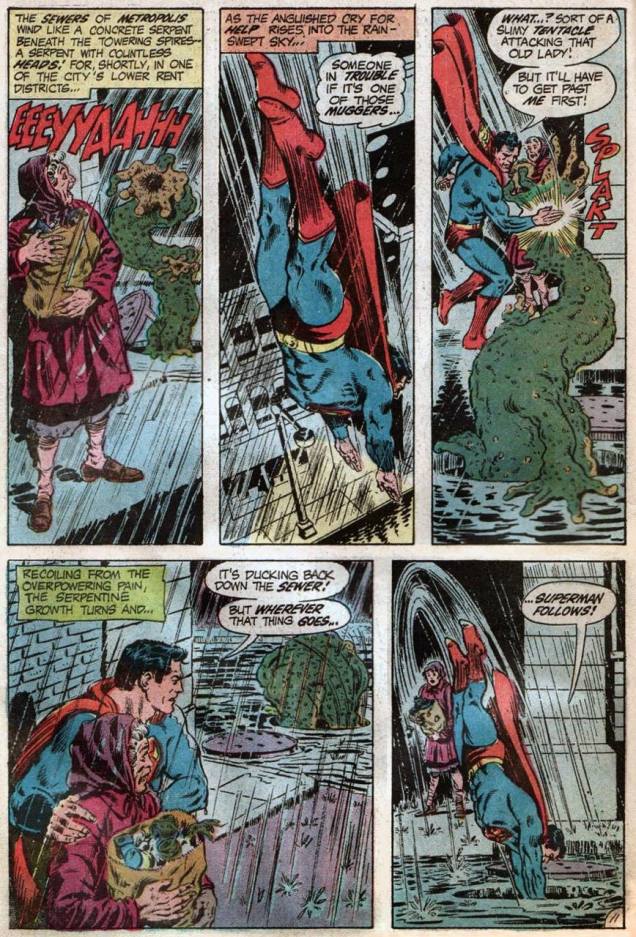
In “Danger — Monster at Work!”, the villain is a protoplasmic glob: some algae mutates after a lab accident and becomes an out-of-control, garbage-devouring, tentacled monster. Now, trash disposal is important, but when Superman realizes that everything on earth is impure to some degree, he has to stop the seaweed monstrosity before “it cleans Metropolis right off the map!”
This story was published in Superman no. 246 (December 1971), with a script by Len Wein, pencils by Curt Swan and inks by Murphy Anderson.
Incidentally, there *is* actually an algae farm that’s suspended over a highway in Geneva, Switzerland that gobbles up CO2 produced by car engines. I hope they’re keeping a close eye on it…
Tentacles? Well, “grasping appendages” anyway – let’s be generous. Superman no. 246, December 1971; pencilled by Curt Swan, inked by Murphy Anderson.
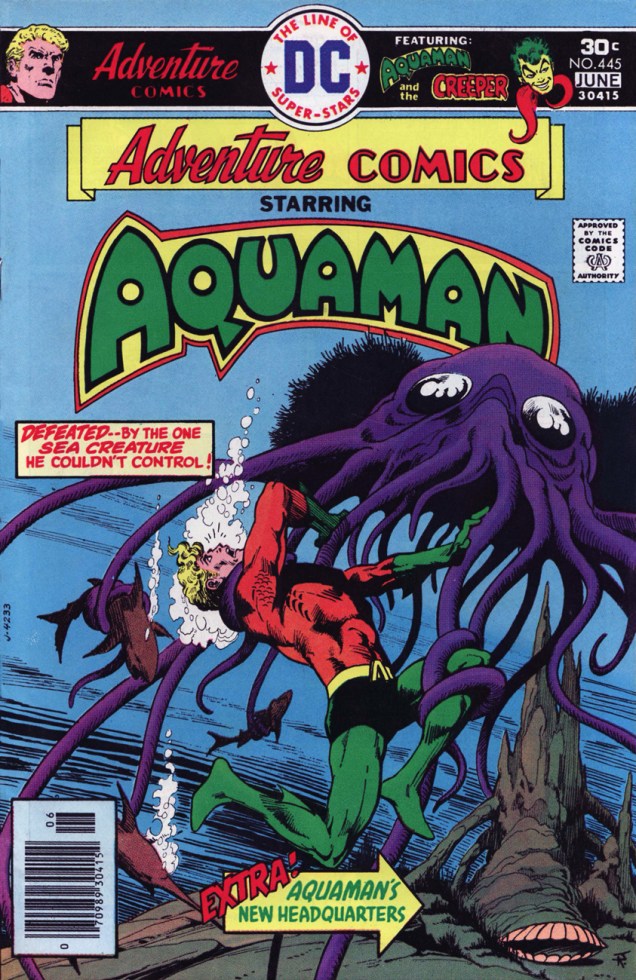
How about if we take a superhero who’s quite at ease with water, who can breathe H2O and communicate with sea life?
“Nope, sorry, still gonna gobble you.”
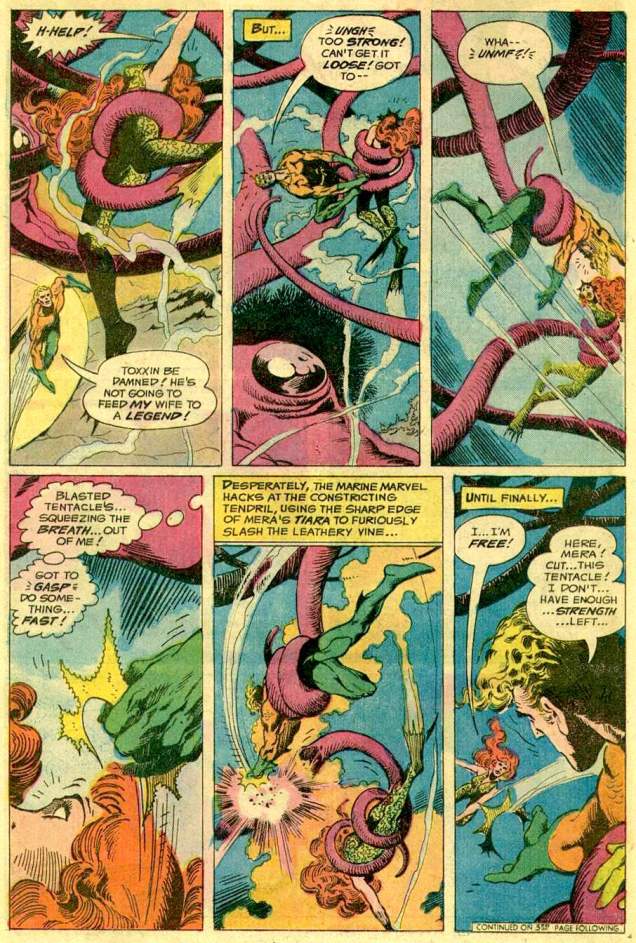
Adventure Comics no. 445 (May 1976). Cover by Jim Aparo, with colours by Tatjana Wood.This imposing figure of an octopus (even though he’s referred to as a “plant-thing” by Aquaman) is Krakor, the tentacled antagonist from “Toxxin’s Raiders” – the cover story written by Paul Levitz & David Michelinie and drawn by Jim Aparo.
Oh, no! What is our hero going to do? Why, dispatch the octopus in the most far-fetched manner possible, of course!
In conclusion, no superhero is immune from a harrowing encounter with a tentacled creature… but sadly, the latter is more often than not annihilated in the struggle. Next time, I’ll make sure to present you with some material in which the octopus gets the upper hand, so to speak!
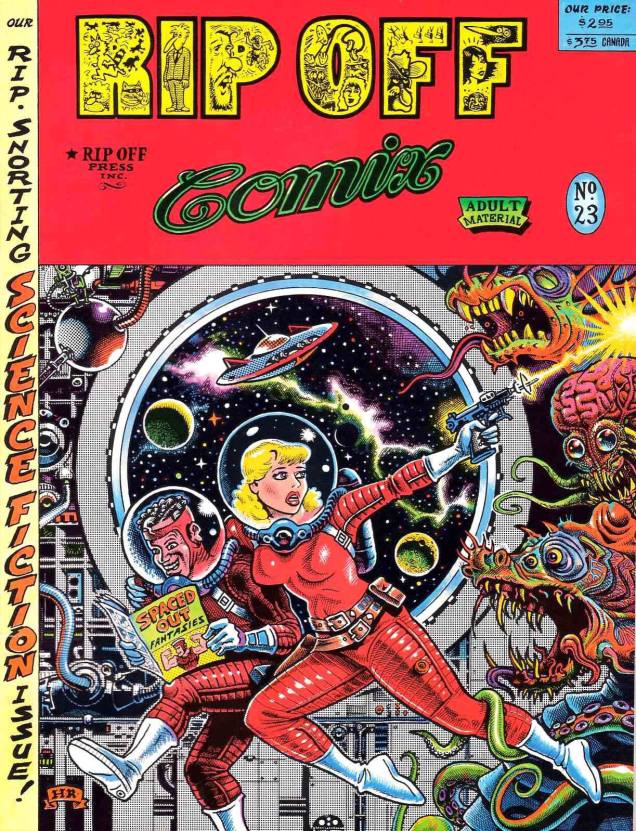
Let’s commence Tentacle Tuesday on a ticklish note (tentacles are itchy, you know, especially when they’re crawling up one’s leg) with Rip Off Comics no. 23, “the rip-snorting science fiction issue!”
Typical: the good-looking gal has to defend herself and her goofy-looking idiot of a partner from tentacles, claws, fangs, and other typical dangers of deep space. Rip Off Comics no. 23 (summer 1989), cover by Hal S. Robins, with colours by Guy Colwell. Look closely at the tiny drawings hiding inside “Rip Off”, and you’ll see Fat Freddy’s cat bouncing around merrily! Actually, you’ll see pretty much the whole cast of Furry Freak Brothers, and then some.
If a tentacle creeps out from the pages of a book you’re reading to gently prod you, you know you’ve made the right choice of reading material.
This Wacky Packages card (from the 14th series, released in April/June 1975) is painted by Norman Saunders from a concept by Jay Lynch (which looks like this). Given that the moon is grinning at them, I think these two are high on something (I’m willing to accept tentacles in space, but I draw the line at anthropomorphized satellites).
Sometimes tentacles masquerade as waves, but we know better! Dunno why some sea god would want a cyborg chunk of metal, though.
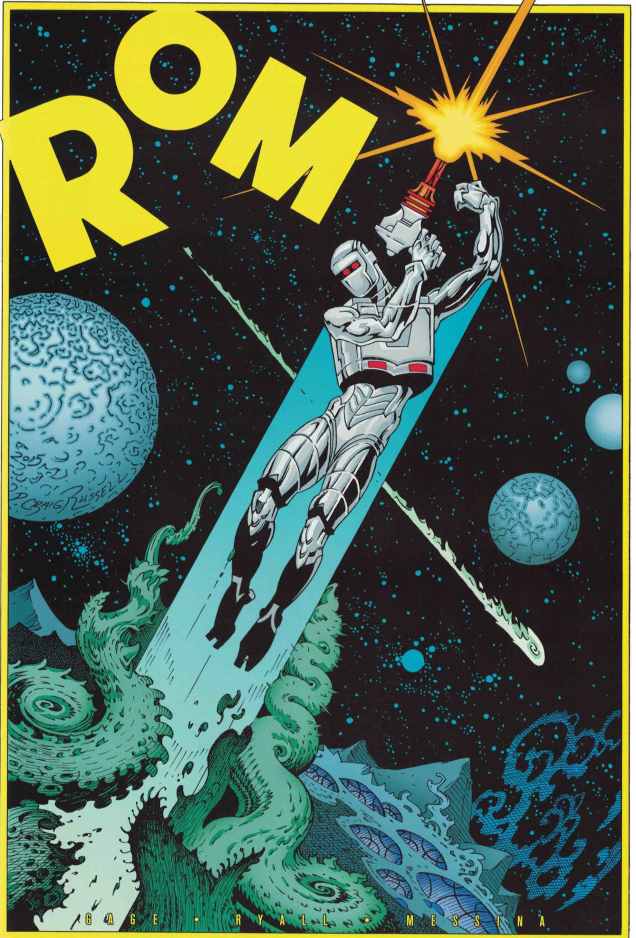
Rom no. 1, July 2016 (IDW), a variant cover from something called « Retailer Incentive ». Art by the ever-decorative and undeniably stylish P. Craig Russell, who unfortunately seems to mostly have squandered his talents on operatic and fairy tale adaptations (not counting a few marvelous short stories). Some people’s thing, no doubt, but not mine!
Rom the Spaceknight was a toy created by three men (Scott Dankman, Richard C. Levy and Bryan L. McCoy) in 1979. His creators called him COBOL (a programming language), but he was renamed into ROM (« read only memory ») by the executives of Parker Brothers, the company that bought rights to the this « beeping, thinking toy » (which Time predicted would « end up among the dust balls under the playroom sofa »). As part of a promotional effort, Parker Brothers promptly licensed him to Marvel. Rom the toy was a commercial failure, but Rom the comic book went on to last 75 issues, beeping its last bleep in 1986 (not counting the comic’s revival by IDW in 2016).
The comic may have passed from Marvel’s hands into IDW’s, but the description still seems to have been written by a hyper-ventilating lummox flinging spit everywhere as he croaks: “WE’VE BEEN INVADED AND ONLY A SPACE KNIGHT CAN SAVE US! Now the ongoing tale of ROM begins in earnest! Christos Gage, Chris Ryall, and David Messina kick off the wildest new series of the year as Rom’s war with the DIRE WRAITHS hits close to home in ‘Earthfall, part 1!’ ‘The long-beloved and even longer absent space hero returns at long last! First, we brought back MICRONAUTS! And Now… ROM! As if Rom’s return wasn’t enough, wait’ll you see how this one ends!” Brr.
So far, the tentacles featured have been rather on the tame side. Let’s have something properly terrifying…
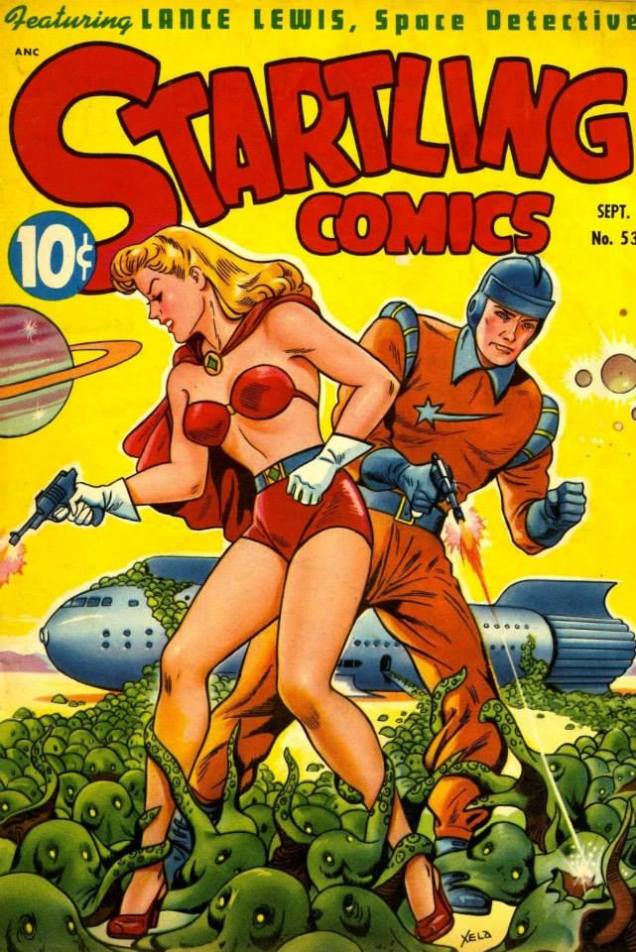
Lance Lewis (Space Detective) and his girlfriend Marna may be in a tight spot… but I’m sorry, I’m having trouble imagining the terror of being overcome by these teeny-tiny octopuses. They’re just too dang cute, clinging to Marna’s legs like puppies begging for food. Startling Comics no. 53, 1948, the last issue of this series. Cover by Alex Schomburg (1905-1998), a prolific Puerto Rican artist (this is signed as Xela).
Oh well, terror petered out today. I guess this Tentacle Tuesday is not going to scare anybody witless. There’s always next time!
« Krokodil » («Крокодил» in Russian, a crocodile) was a Soviet satirical magazine founded in 1922 and that outlasted the Soviet Union by a number of years. In 2000, it was driven to its deathbed by a general lack of interest and failing finances – no longer being relevant to the modern age, alas! – and though weak attempts were made to breathe life into it in the 2000s, it finally croaked altogether, wheezing its very last in 2008.
Right from the beginning, The Crocodile (personified by a pipe-chomping red crocodile, holding a pitchfork) featured quite a lot of satirical drawings, which were basically panel cartoons, and sometimes even actual comics. The magazine’s modus operandi was to viciously skewer various enemies of the State and the People, such as bureaucrats, alcoholics, bribe-takers, church-goers, various delinquents, ne’er-do-wells and anti-Soviet villains. Institutions were also attacked, sometimes gleefully and sometimes sternly, and that list was long, too: American imperialism and capitalism, German Nazism, colonialism, and more other -isms that you could shake a stick at.
“There were pickpockets, dope peddlers, murderers and thieves Card shark gamblers with aces up their sleeves Bank robbers, burglars, boosters and pimps Prostitutes and call girls and all kinds of nymphs Loan sharks, swindlers, counterfeiters and fences Crooked politicians spending campaign expenses Hijackers, arsonists, bookies and the mob And anybody else who ever killed, cheated or robbed” Hustler Groove, Apollo 440
I would not like to leave you with the impression that Mr. Crocodile was an unsympathetic fellow, however; in its gentler moments, Krokodil’s tongue-in-cheek humour could be a delight, and its savage attacks sometimes masked a subversive anti-Soviet streak. Many prominent writers and artists worked for the magazine, and some of them started their careers within its pages. Aside from a plethora of cartoons, the magazine also featured news, stories, aphorisms, epigrams, and reviews of books, films and theatrical plays, etc.
June 1927, cover by Hrapkovskoy.
Mr. Crocodile came with an extensive family. He had a wife, the Big Krokodila, who lost her marbles in the 1930s, and two twin children, who acquired hilariously caricatural careers in 1990 – Totosha went into management and Kokosha moved to the U.S. to design men’s magazines. These (and other recurring) characters marked several generations of Soviet citizens, and many of their catchphrases have become an everyday part of the Russian language.
Without further ado, here’s a few Krokodil cartoons on very Slavic topics, like drunkenness, and general debauchery and bureaucracy, including the disappointing lack of goods (and poor quality control of actually available goods). In no particular order…
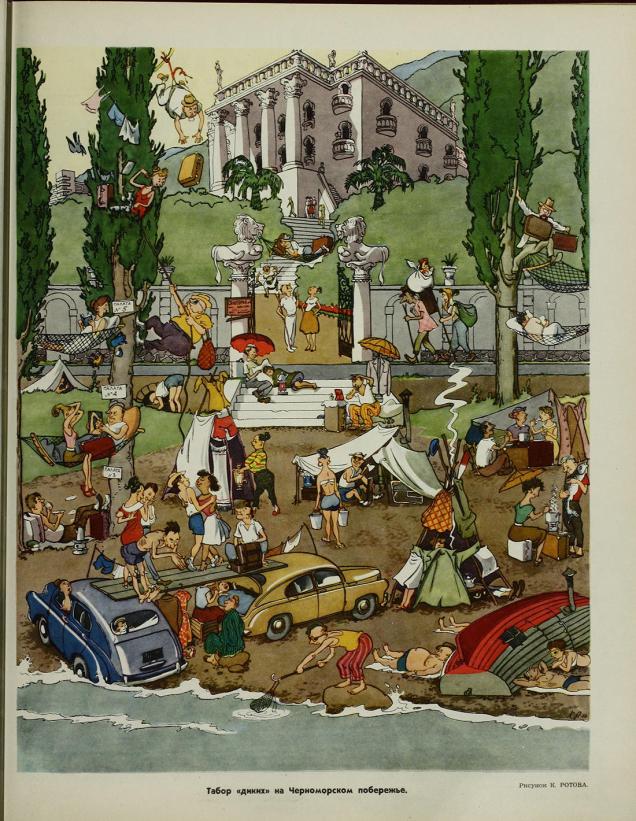
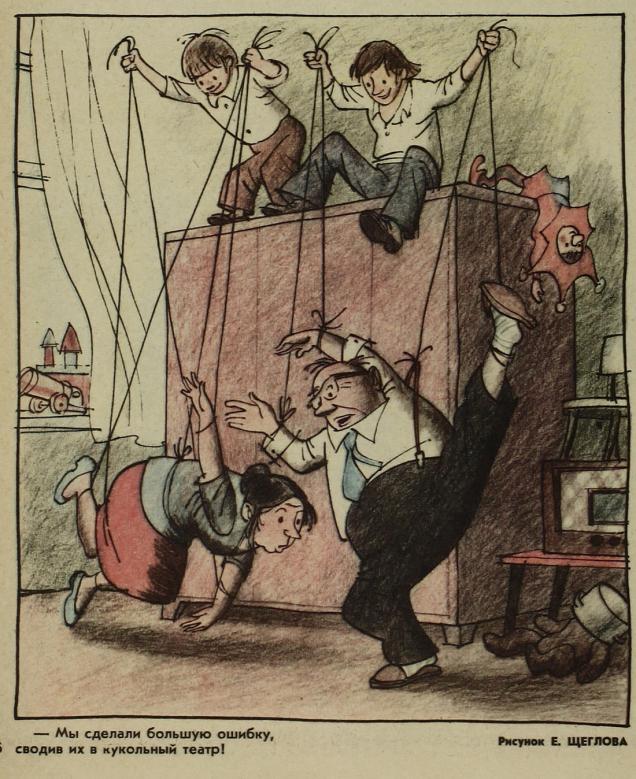
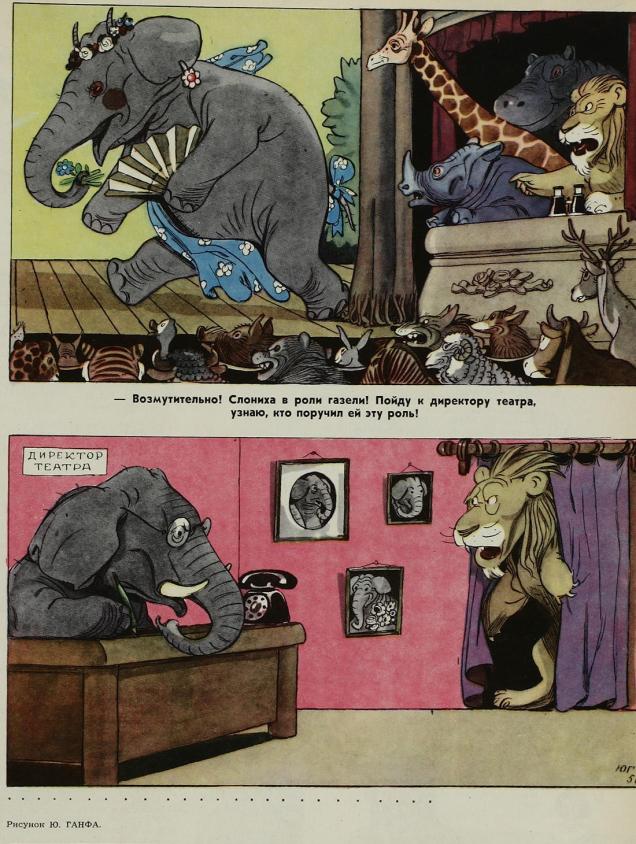
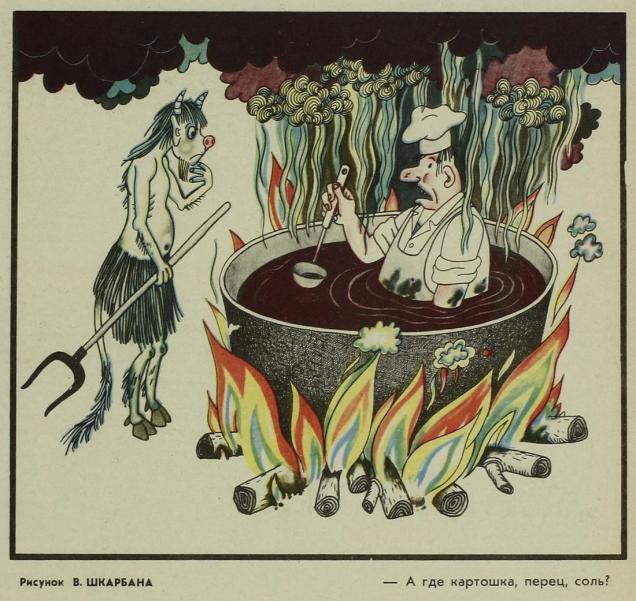
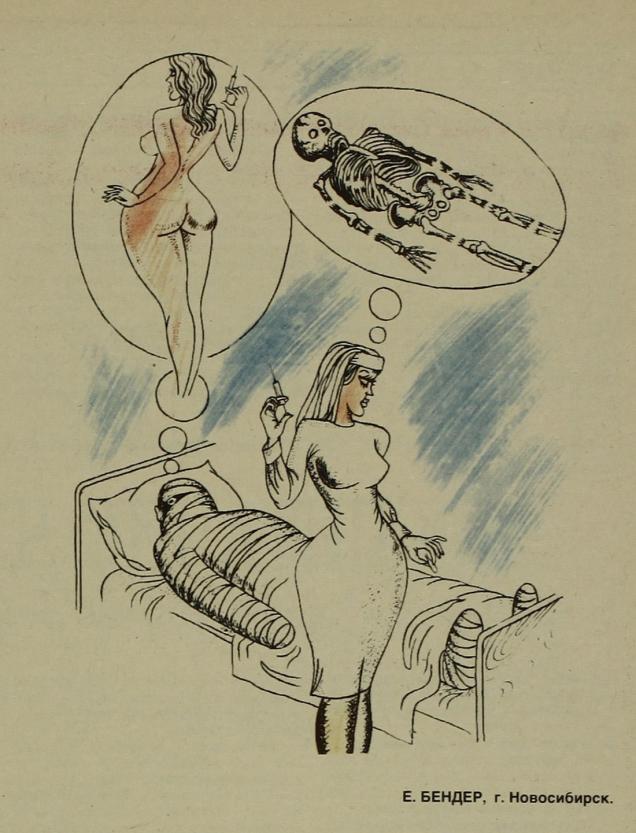
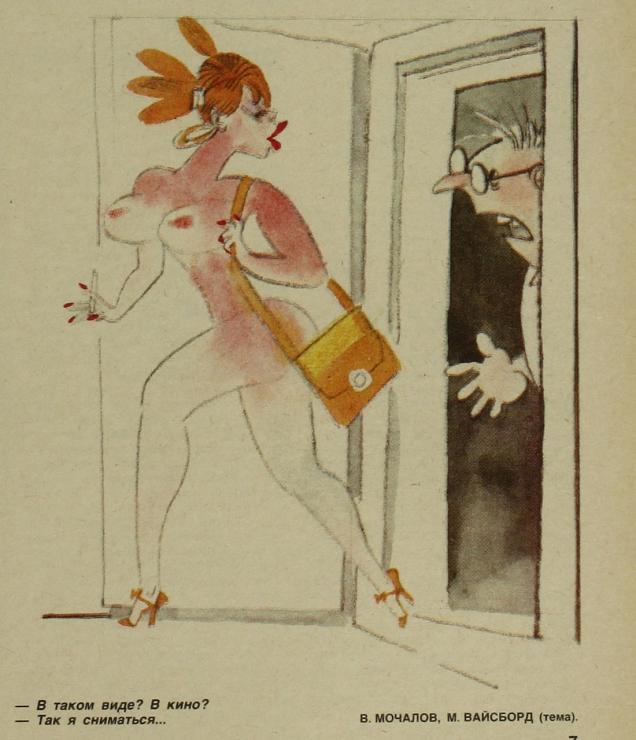
“Fritz in Hell”, 1942. Illustration by Y. Ganf. “Fritz” is used as a moniker for any of your average, humdrum Nazi.“Tribe of wild ones at the seashore”, 1956. Illustration by I. Rotov.“We made a big mistake when we brought them to the puppet show!” 1978.“THE MAN WITH THE SUITCASE IS INDIGNANT: What the hell is happening!… There’s so many prostitutes… One doesn’t know… which one to pick!” Illustration by I. Yang, 1929.1987. Illustration by L. Nasirov. Nearly 50 years later, prostitutes are still around, but their goods are a little more on show. You couldn’t really be an above-board pin-up artist in the USSR, but some people clearly had, shall we say, proclivities for depicting the female form.The lion says in the first panel: “It’s disgusting! An elephantess in the role of a gazelle! I’ll go to the theatre manager and find out who gave her this role!” 1956, illustration by Y. Ganf.A charming case of bribery: “And here, dearie, is some evidence for your examination!” Perhaps this requires some context: this charming granny makes moonshine at home, and she hopes to soothe off the irate-looking policeman with an offering of a glass of vodka and a pickle (traditional accompaniment to vodka – highly recommended, perhaps with some mushrooms. I’m getting distracted, sorry.) Illustration by G. Ogorodnikov.“It’s a good omen: first let a cat walk into a new apartment!” 1975, cover by G. Andrianov.“And where are the potatoes, the pepper, the salt?” Illustration by V. Shkarban, 1979.1989, illustration by E. Bender. I think somebody wanted an excuse to draw voluptuous women!“Dressed like that? To the cinema?’ “– I’m going over there to be filmed…” Illustration by V. Mochalov, idea by M. Vaisbord, 1989.“Now just watch it: oink the way I taught you to!” Illustration by S. Kuzmin, 1963. What happened to the missing pigs? They were most likely sold off to finance the kolhoz foreman’s drinking and gluttony. A kolhoz was basically a sort of collective farm or production cooperative, but corruption and negligence ran rampant.“Same thing as in the vegetable patch: old horseradish next to a young potato.” Illustration by I. Semenov, 1945.“Where are all the Red Riding Hoods going?” “–To grandma’s. She decided to write a will for her country house.” Illustration by G. Yasinkiy, 1984.“In honour of the International Women’s Day, the dance of the Little Swans will be performed by the stage crew workers!” The 8th of March was a big deal in the U.S.S.R., and not only for one’s mothers and grandmothers; if I recall correctly, even students were supposed to bring in flowers for their female teachers. Illustration by I. Sichev, 1975.
Compared to their bodies, octopuses have fairly small eyes. Yet in comics they often sport saucer-sized peepers, and like villains in a bad Broadway production, they love to glare menacingly at their potential victims from under their impressively wrinkled brows.
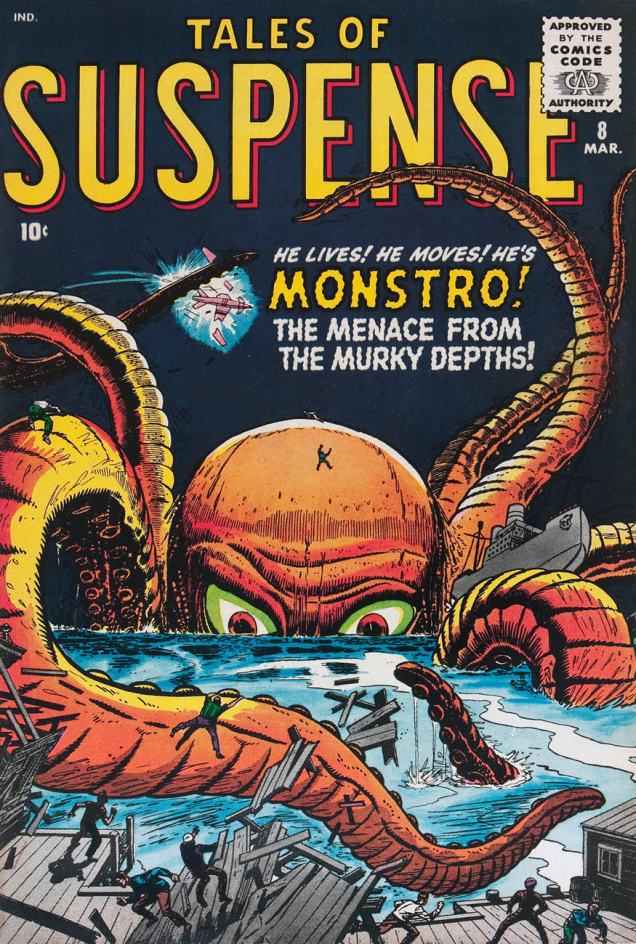
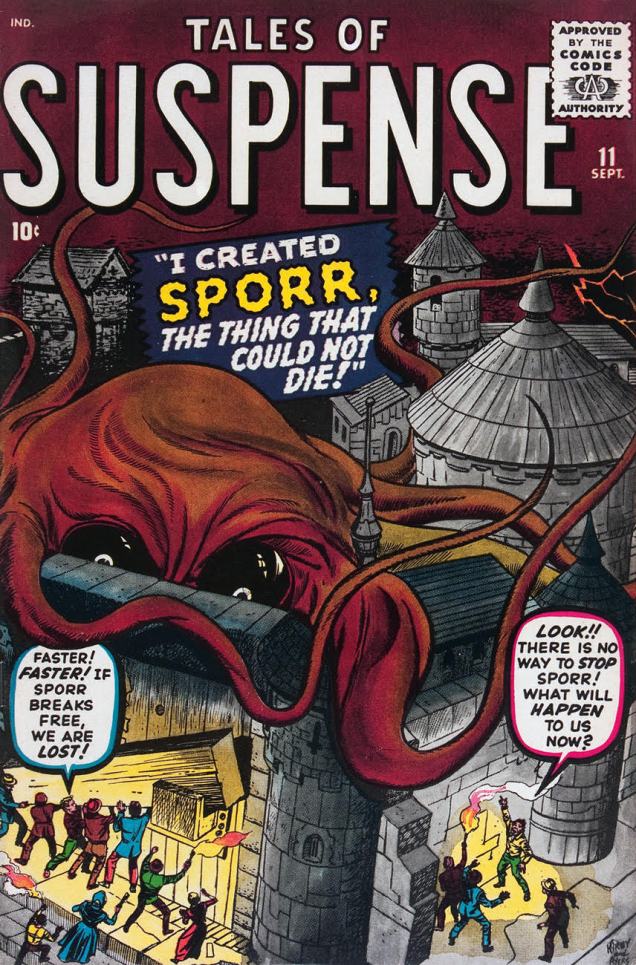
Case in point, these two Tales of Suspense covers, close cousins despite the change of scenery. They’re both from 1960, both penciled by Jack Kirby and inked by Dick Ayers. Both monsters promptly acquire loving nicknames from people you would think have more important things to think of, like not getting eaten and/or crushed. Meet Monstro and Sporr!
Tales of Suspense #8, March 1960. An octopus who was minding his own business gets temporarily but dramatically enlarged by radioactivity from nuclear tests (*communist* nuclear tests). “He lives! He moves!” – I fail to see why that’s amazing more than, oh, say “this thing’s gigantic on a scale heretofore unknown to man”.
Tales of Suspense #11, September 1960. A well-intentioned but overly enthusiastic scientist exposes an amoeba to an « experimental death ray » and the poor thing grows into this.
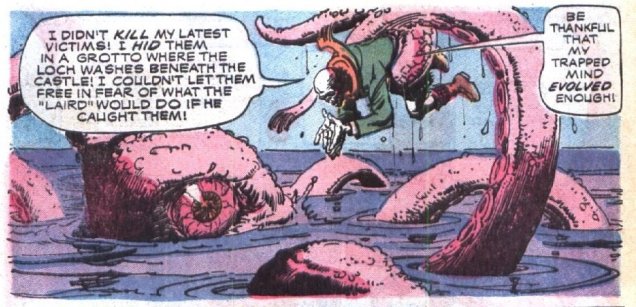
Not all puppy-eyed octopuses have two baby blues; unlucky cephalopods end up with Cyclopean anatomy and a bad case of suffering the wrath of grapes – a cherry in a glass of buttermilk, anyone?*
The original art for the cover of The Occult Files of Dr. Spektor #19 (Gold Key, April 1976). It was painted by Filipino artist Jesse Santos. Dr. Spektor is our protagonist, yet he looks particularly baleful here, hunchbacked and grinning, nothing like the kind of dashing hero who’d rescue a drowning maiden.A panel from « Loch of the Leviathan », also drawn by Jesse Santos, and written by Don Glut. I just love this panel – the gentle curve of tentacles, the skeleton and his pleading gesture…
I highly recommend the issue, certainly because of the art, but equally the story. You won’t find a straightforward man-finds-monster, man-kills-monster plot-line here; and there’s also bikini babes for your viewing pleasure.
* Your eyes look like two cherries in a glass of buttermilk
Don’t roll those bloodshot eyes at me
I can see you’ve been out on a spree (Wynonie Harris, Bloodshot Eyes)
Sometimes octopuses have big eyeballs *and* a vocabulary all their own.
Octopus language is the biggest mystery after “what does the fox say?” I bet you never knew that octopuses go “LURK LURK?!”
Akim was an Italian comic, published from 1950 to 1983, and translated into several languages, most notably French. Drawn by Augusto Pedrazza and wrtten by Roberto Renzi, Akim was a « tarzanide », which is to say heavily “inspired” by Tarzan, if not directly ripped off from it.
The LURK LURKs in panel above were no one-time occurrence. The octopuses in this story keep saying it again and again, and with different intonations, which I find hilarious. Turns out, a whole range of emotions can be expressed with this small four-letter word! My thanks go to co-admin and partner RG, who noticed this unpromising, poor-excuse-for-a-comic in a store and pointed out why we should pick it up after I had scoffed at it.
I can’t help but feel that the octopus is trying to say something important, but all its mouth (?) can form is a piteous luuurrrkk.
I’d like to wish a loud and boisterous (or quiet and dignified, depending on what he prefers) birthday to Roger Langridge, who’s a jolly good fellow (which nobody can, or will, deny). If you’re looking for a reason to celebrate something on the 14th of February, but hate the Cheez Whiz of Valentine’s Day, this could be it!
Here are some of my favourite Langridge moments, by no means an exhaustive list, but hopefully a fun one.
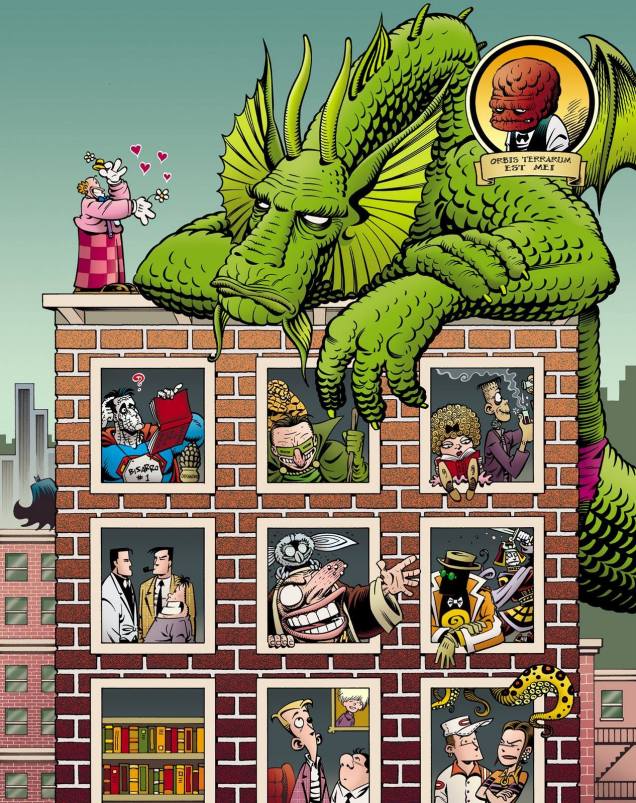
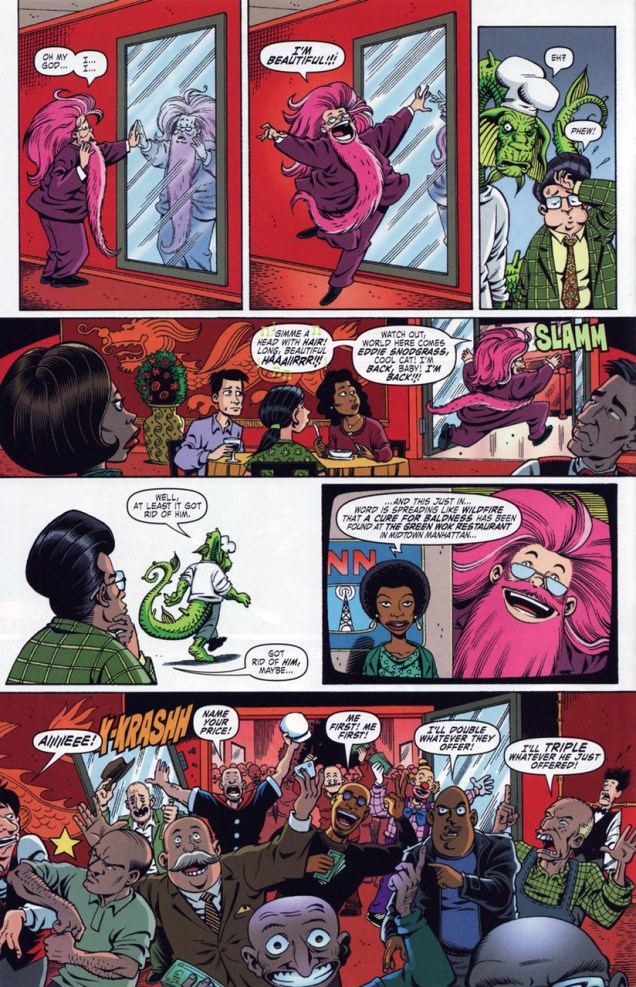
The cover Roger Langridge created for The Comics Journal no. 284, July 2007. Orbis terrarum est mei! (Which, as far as I can figure it out, means “the world is mine”.) A bored-looking Fin Fang Foom (he must not like flowers) presides over assorted Langridge characters frolicking in the windows below. Note the malevolent nun (Knuckles!) in the middle window.From « The Bald Truth » by Scott Gray and Roger Langridge, published in Fin Fang Four Return (Marvel, 2009), a hilarious – yet heart-warming – one-shot comic. “There was a time when giants walked the Earth! Monstrous creatures! Products of science gone mad!!! FIN FANG FOOM! ELEKTRO! GOOGAM! GORGILLA! Once they were great and terrible, and all trembled in their wake! Now, reduced to human size, they must live in the modern world and earn a buck. So what happens when the freakish foursome tries to play nice?” You can ignore the typical over-the-top Marvel description with lots of exclamation marks; this comic is surprisingly subtle. In 2012, Langridge decided he didn’t want to do work for Marvel anymore.« The Bald Truth » by Scott Gray and Roger Langridge, published in Fin Fang Four Return (Marvel, 2009). The moral of the story, as summarized by Fin himself: « Men need to grow brains, not hair. »
Our man of the hour has also written and drawn quite a few stories for « children », most of them published by KaBoom!, or their tot-friendly division, Boom!. I think there should be a special category for books that are fun for children, but even more entertaining for their parents (or the nulliparous amongst us). For instance, are the Muppets purely child-fare? Sure, little ones enjoy their madcap, sometimes surreal humour, but adults are often as smitten by it, if not more. I think it takes a special talent and superior intelligence to write stories that appeal to youngsters, but are complex enough to give their older relatives something to chew on. Throw a spirited sense of humour into the mix, and you’re all set.
Roger Langridge’s wonderful sense of humour is particularly suited for the comic book version of The Muppet Show, which he wrote and illustrated for BOOM! Studios starting in 2009 for a total of 15 (magnificent, by the way) issues.
To quote a perceptive review by Ryan Dosier (read it here),
« Once again, Langridge has beautifully captured the unhinged feeling that each of us enjoyed watching on the original Muppet Show. Zaniness reigns supreme, random Muppets hang out backstage, and we can once again feel like the show never ended. Roger Langridge has captured the Muppet spirit of writing in a way that is more than reminiscent of the Jerry Juhl days of The Muppet Show. He has a complete grasp on every character. Everything in the comic works, and it’s because of the quality of the writing that this is true. When there are, not one, but five chances for Fozzie to deliver a pun-filled monologue (each in a different comedic style) and hit each one out of the park (relatively speaking), you know the writing is top-notch. »
I don’t normally buy Disney products – Disney bought the Muppets intellectual properties from the Jim Henson company in 2004, but I made an exception and purchased The Muppet Show Omnibus (2014), and I am not regretting this decision.
This wasn’t the last time Langridge worked with the Muppets.
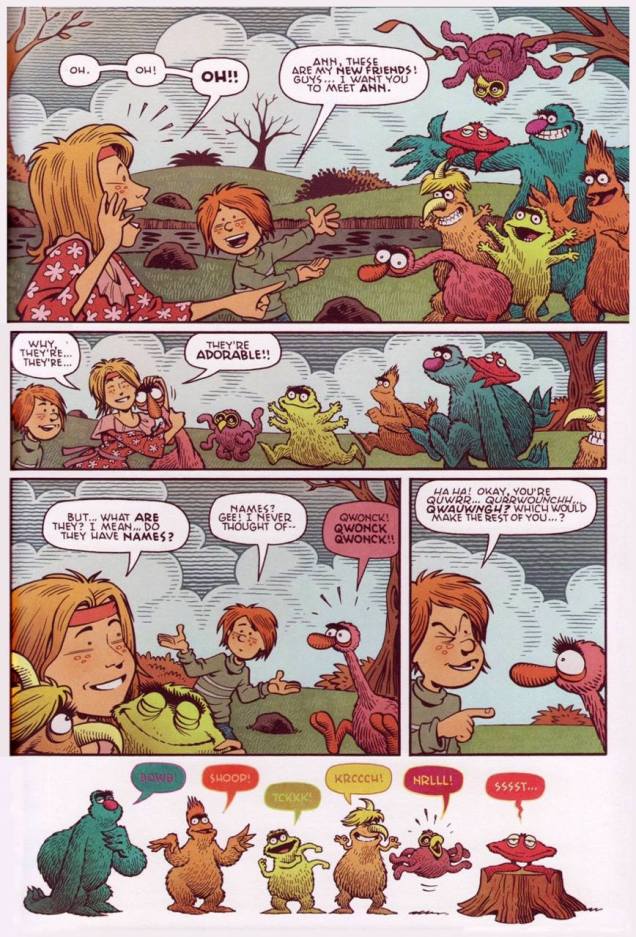
Jim Henson’s The Musical Monsters of Turkey Hollow, October 2014, published by Archaia. This is based on a lost television special originally written by Jim Henson and Jerry Juhl (respectively, producer and head writer of The Muppet Show) and (lovingly) adapted by Langridge for comic book form. Henson and Juhl wrote the script in 1968 (Henson was inspired by some footage he had taken of his daughters scampering through some trees during what must have been a particularly magical October), but nobody was interested in actually filming it, and so the story languished in the Jim Henson Company Archives until now. Langridge was a natural fit for this project, given that he had been the writer and main illustrator of Boom! Studios’ excellent The Muppet Show comics between 2009 and 2012.
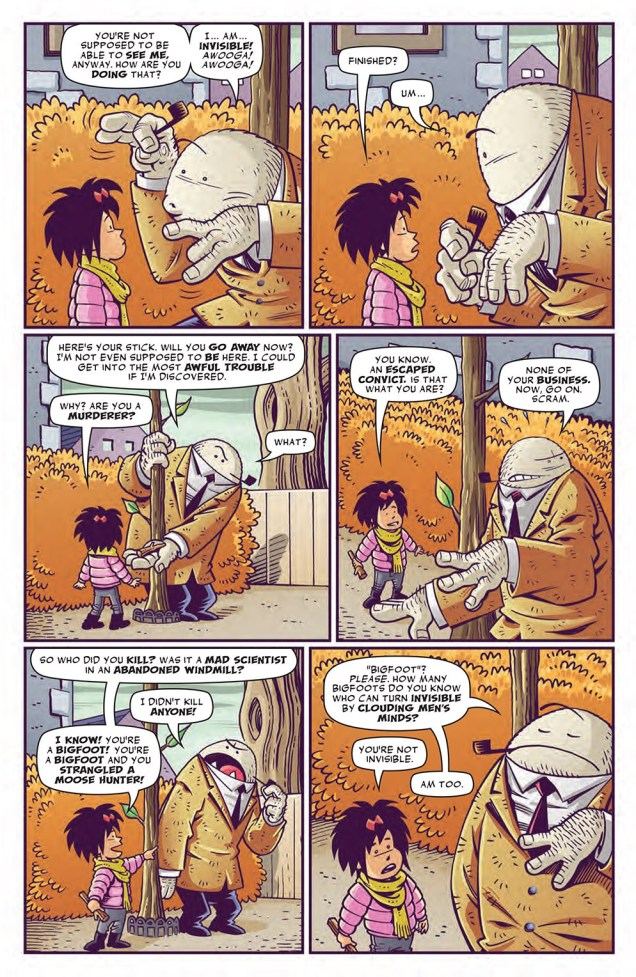
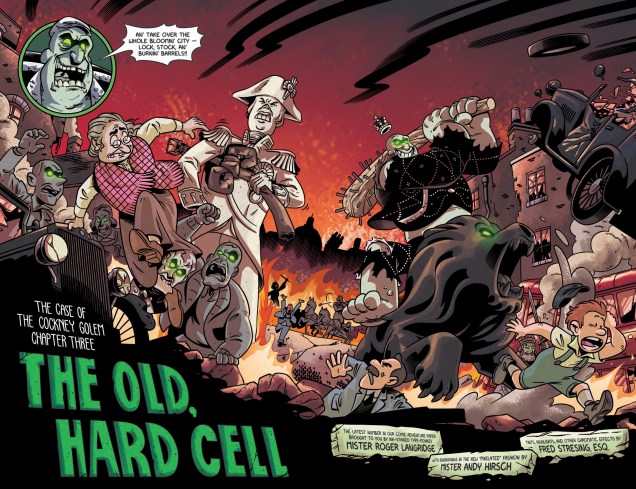
Among more recent adventures undertaken by Mr. Langridge and his lucky readers is Snarked!, his take on Lewis Carroll’s topsy-turvy world, Abigail & the Snowman, and the Baker Street Peculiars, written by him but illustrated by someone else. All of the aforementioned comics are life-affirming *and* vocabulary-expanding.
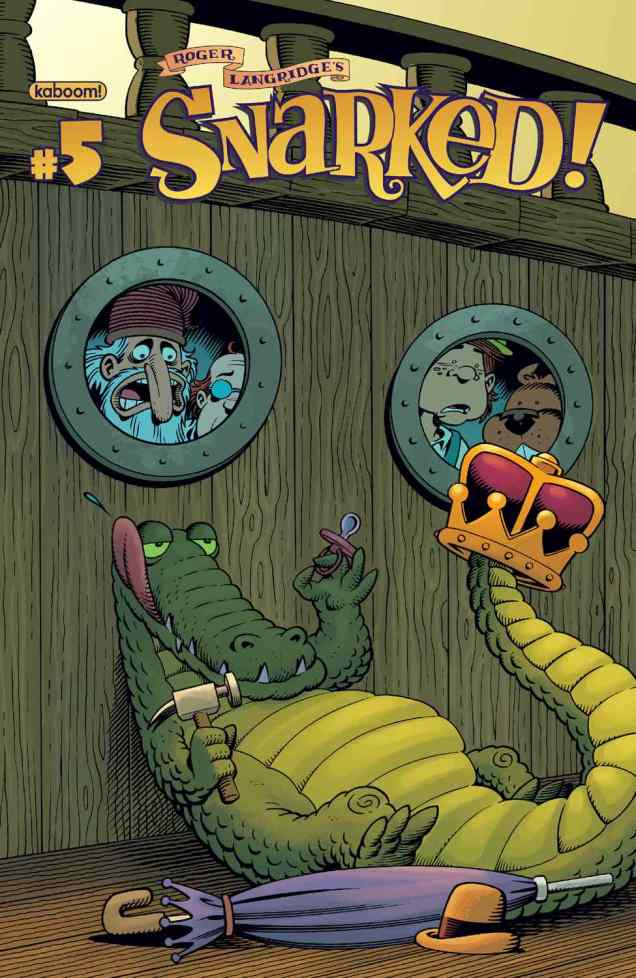
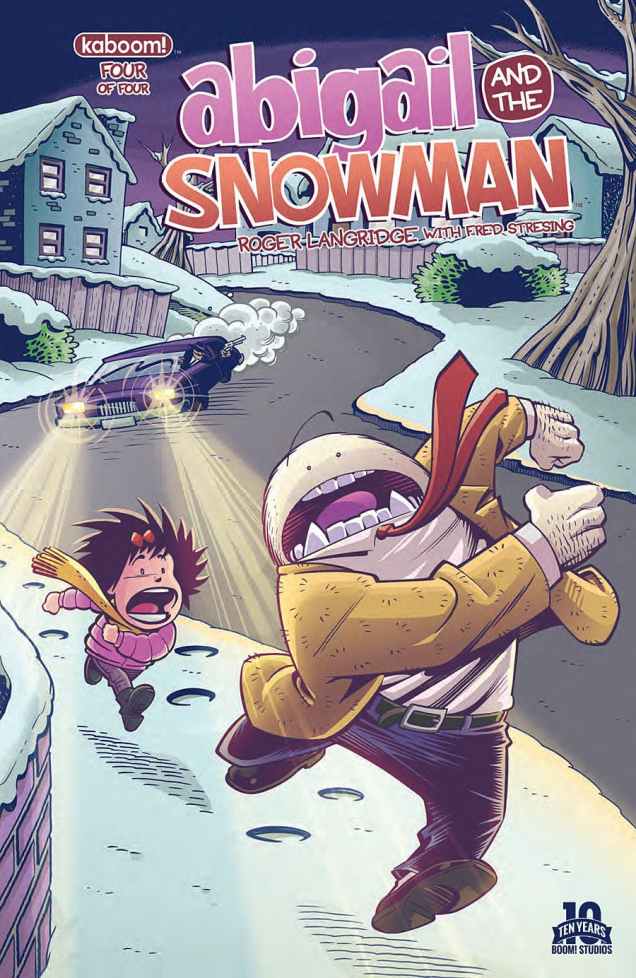
Snarked! no. 5, February 2012. « Presenting a fresh and incredibly modern “Langridge” spin on an already-warped classic, SNARKED starts here in an epic adventure featuring the Red Queen’s children, Princess Scarlett and her baby brother Rusty, as they set out in search of the missing Red King. And who better to help guide the way than the Walrus and the Carpenter from THROUGH THE LOOKING GLASS. » (description from publisher) Snarked! is also published by Kaboom.From Snarked! no. 11, August 2012. Would a child be able to appreciate the concept of “Aunt Fanny’s Leather Euphonium”? I don’t think so. An euphonium is a musical instrument, by the way, similar to a tuba in appearance.Page from Abigail and the Snowman no. 1, December 2014, published by KaBoom!. Claude is an erudite yeti on the run from evil scientists who want to continue experimenting on him.Abigail and the Snowman no. 4, March 2015. Yetis run better without shoes, that’s why the car is gaining on them.A splash page The Baker Street Peculiars no. 3, May 2016. Written by Langridge and illustrated by Andy Hirsch, with colours by Fred Stresing. Langridge-the-writer sometimes get paired with people who couldn’t draw if their life depended on it, and it’s a hideous waste of talent. Hirsch’s art is not quite as distinctive, but it fits the story well.
Wishing Mr. Langridge many happy returns, many productive collaborations, and above all the time and financial support he needs to pursue his solo projects.
In today’s Tentacle Tuesday, I’d like to demonstrate that Planet Comics, a sci-fi comic series published by Fiction House from 1940 to 1953, liked to tantalize its rapt audience by featuring tentacled monsters as often as basic decency permitted. Not to say that they limited their cheap pandering to tentacles; other tropes reared their ugly head, too. Faithful to its pulp magazine roots (Planet Comics was a Planet Stories’ spinoff), there’s always some stunning damsel in distress on the cover, and often some dashing muscle-head to rescue her. Mike Benton summarized Planet Comics’ raison d’être beautifully, if somewhat cruelly, in his Science Fiction Comics: The Illustrated History (1992) as «the barest smattering of sense and substance».
In its defence, P.C. also often ran stories in which female protagonists saved their friends’ bacon. How oddly progressive: the gals were clearly dressed to impress, but their skills and smarts repeatedly allowed them to overcome the odds while the big hunks stood helpless. Between that and all the tentacles, there’s a warm spot in my heart for Planet Comics.
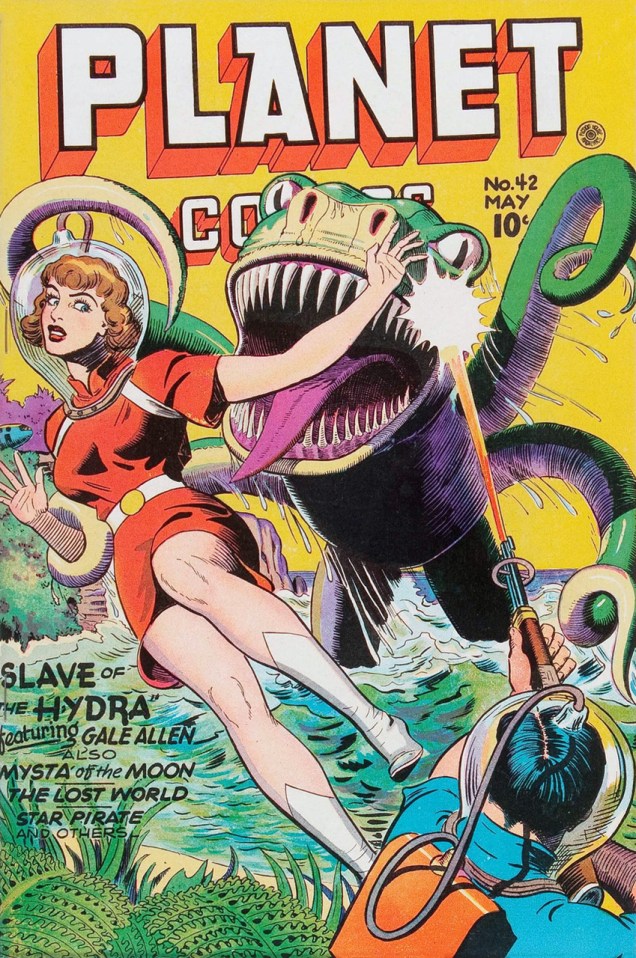
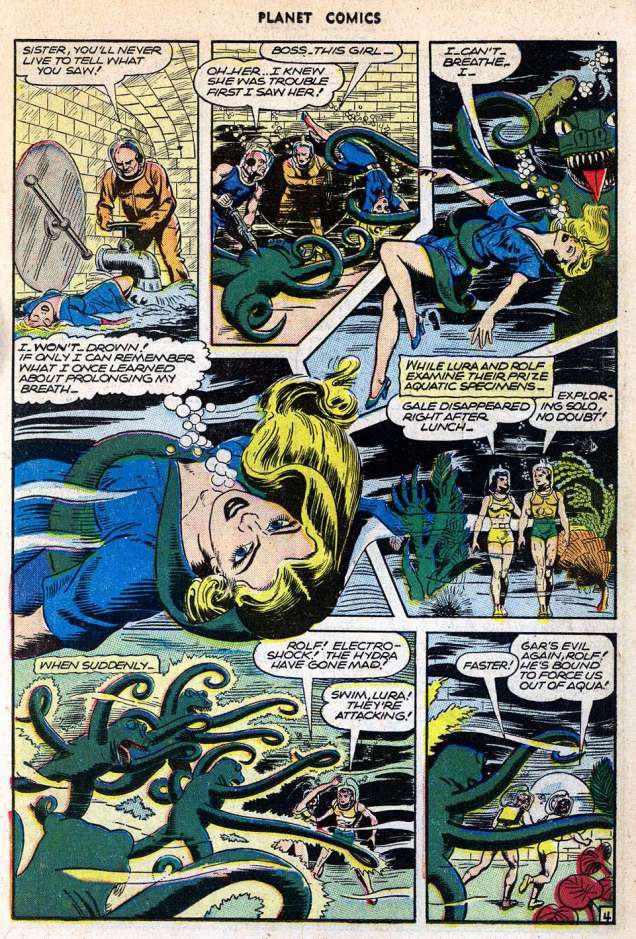
Let’s start with no. 42, which features Gale Allen, a Venusian princess with a knack for getting into trouble and the courage for getting herself out of it. Her Girl Squadron, comprising female pilots and soldiers, may have been an excuse for drawing yet more pretty girls, yet in the stories the squadron was still a force to be reckoned with, by friend or foe.
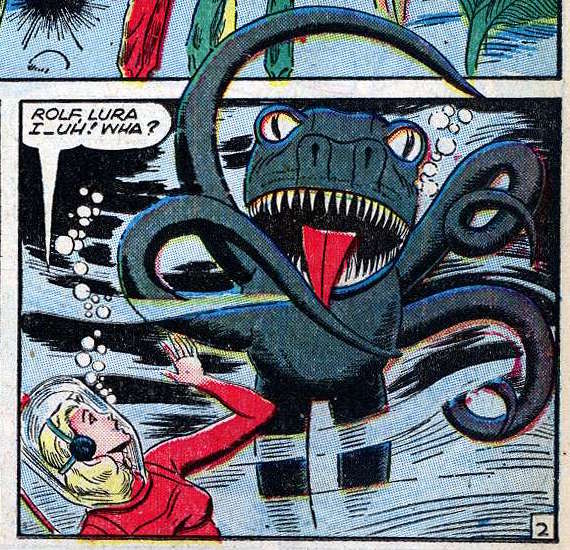
Planet Comics no. 42, May 1946. Cover by Joe Doolin, adept at depicting the female form in an aesthetically pleasing way. Here Gale is being rescued by some dark-haired stud with a laser gun (who cares about him?), but let’s peek inside…This is what Gale has to deal with in « Slave of the Hydra », also drawn by Doolin. This toothy beast is supposed to be a Hydra. Hydra of the Hydridae family, or the Greek many-headed serpent? Neither supposition makes sense.Our plucky heroine manages to save the day by escaping a certain drowning! It’s a little known fact that girls can actually store extra oxygen in their boobs. Kidding aside, I can understand why Planet Comics had a female readership that must have enjoyed reading about women who don’t crumble under pressure, and sometimes even kick monster tush.
Moving on to the next cover, an odd one even by Golden Age sci-fi standards:
Planet Comics no. 44 (September 1946), cover by Joe Doolin. She’s a generic damsel-in-distress, I get that, but the alien is strange – even for an alien. I imagine that the artist’s internal conversation went something like this: “okay, I’ll give him arms that double as tentacled snouts, and snail eyeball stalks. Oh, and I’ll make him a cyclops while I’m at it. And he’ll be drooling. And I’ll make him look black because that’s more exotic.” Yikes.
A glimpse at the stories inside quickly proves that the cover has nothing to do with Mysta of the Moon, or any of the “many others” advertised on the cover. There is, however, an octopus in the Futura story. Futura was another recurring heroine, an ordinary girl abducted by Brain-Lords of Cymradia and “improved” into a stronger, smarter version of her old self. Smart, resourceful and a damn good fighter, Futura is fun to watch in action. Especially when tentacles are involved! Take a look:
Officially signed by John Douglas; pencils and inks by Chester Martin. I feel oddly sorry for the crocodile.
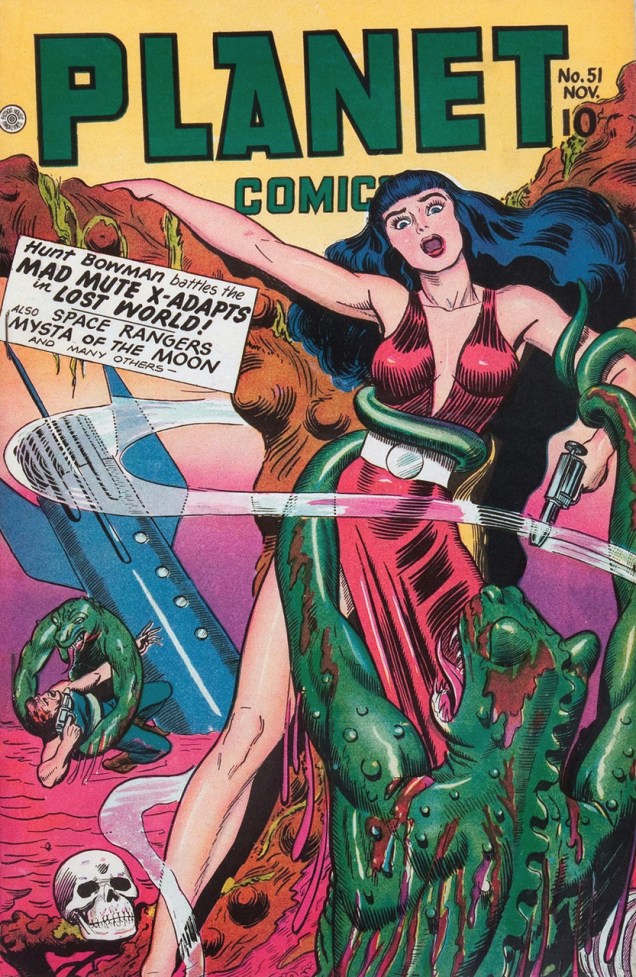
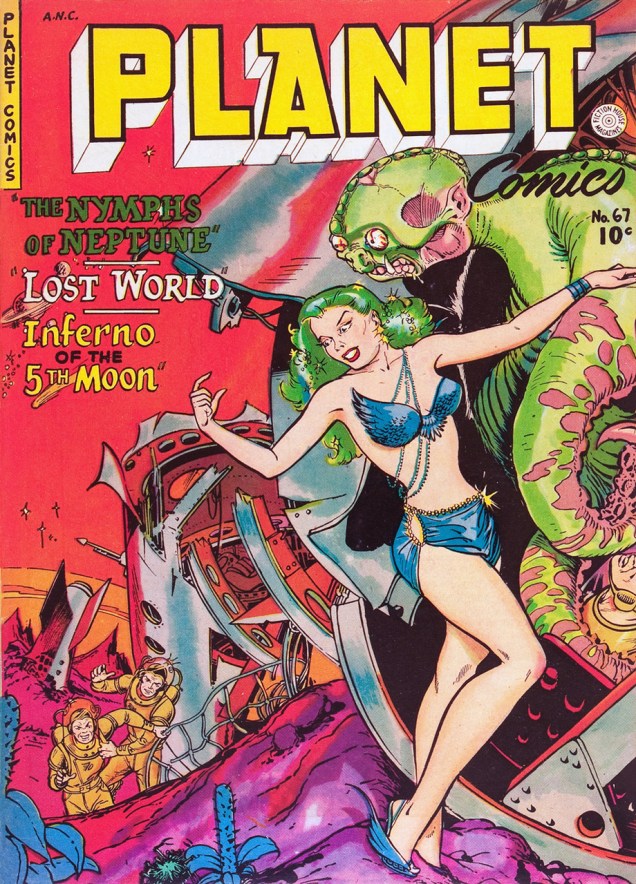
Let’s have a look at several covers where tentacles are actually used as the good lord has intended, i.e. for grabbing pretty girls:
Ah, yes, the old “reptiles with tentacles” scare. Planet Comics no. 51, November 1947. Cover by Joe Doolin (again). Man, his girls are pretty delectable.Planet Comics no. 67, summer 1952. Cover by Maurice Whitman. There are absolutely no tentacles in any of the stories. Boo, I say.Planet Comics no. 70 (spring 1953), cover by Maurice Whitman. I like the alien’s get-up in general: his flappy ears, the motorcycle helmet, the hip lip piercings… He’s one cool cat. I am equally impressed by how he’s managing to fire a gun when he doesn’t have opposable thumbs (maybe the pistol is specially tentacle-adapted; instead of a trigger, some sort of squeeze sensor). Disappointingly, the insides of this issue don’t have any tentacles whatsoever, although there are some dinosaurs and giant man-eating spiders (and most of us will be happy to settle for that).
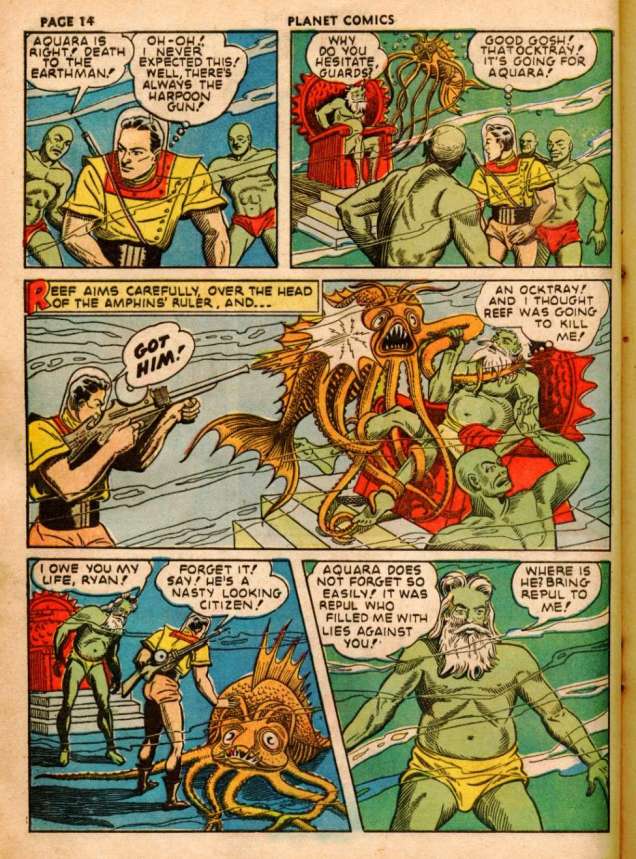
Oh, perhaps I have been neglecting burly heroes a tad. Those of us who prefer muscle to curve deserve some eye candy, too! So here’s good old Reef – and some green men in Speedos.
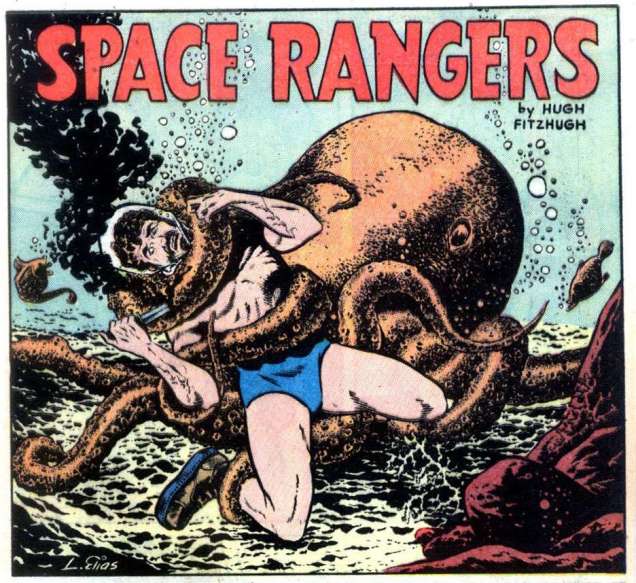
Planet Comics no. 17, March 1942. A Reef Ryan story, possibly pencilled by George Appel and inked by Al Gabriele, though it’s credited to Hugh Fitzhugh, a funky nom-de-plume for parties unknown.
And men get grabbed by tentacles, too:
Planet Comics no. 32, September 1944. Art by Lee Elias.
There’s about 10 more Planet Comics covers with tentacles left, and quite a few more interior pages showcasing the beauty of the octopus, or tentacled alien, or cephalopod reptile, or whatever else the kooky minds writing and drawing for Fiction House have dreamed up… but that’s enough for now. There’s only so much probing appendage the human mind can take in one go, so I’ll say Auf Wiedersehen.
Until the next time our paths (and tentacles) cross again!
Tentacles gleefully probing various orifices, that’s what my mind is on this Tentacle Tuesday. We well know that octopuses not only tend to strangle their victims, but also get close up and personal with their anatomy.
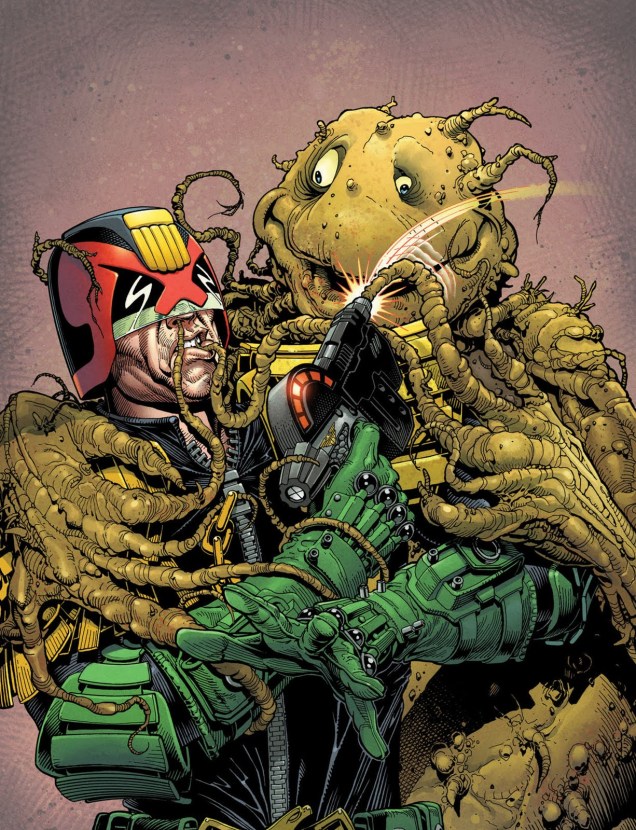
Just look at this adorable (did I say “adorable”? Maybe I meant “horrifyingly ugly”? I always get these two mixed up) cutie wrap Judge Dredd in his affectionate embrace.
I’ll let Pete Wells, owner of the « 200 A.D. Covers Uncovered » blog, explain the Couch Potatoes: « Behold, the god-like Cliff Robinson’s fantastic cover for Prog 1726, which features the welcome return of the Couch Potatoes. Another crazy Mega-City fad, the couch potatoes were lovable humanoid/vegetable lifeforms that sat in front of the Tri-D, repeating common phrases to its owner – think of a Little Britain fan and you’ll get the idea. The creatures were outlawed by the Justice Department when it transpired that they were super-evolving and feeding on their owners! »
Head over to Wells’ blog to watch this cover evolve from a preliminary sketch into a full-blown vision of tentacular glory.
A page from « Children of the Future », drawn by Paolo Eleuteri Serpieri, published in a special edition of Heavy Metal called « Son of Heavy Metal », May 1984. Looks like the children of the future shall be some unholy octopus-human breed. Amusingly, the lecherous multi-tentacled sleazeball is still named Octo despite having many, many more appendages than just 8.
Serpieri is an Italian comic book writer and artist whose main interest is erotica. (His style is not really my thing, but hey, tentacles unite all.) He’s quite well-known for Druuna, a sci-fi/fantasy comic, which is more like an excuse to draw as many accouplements as possible.
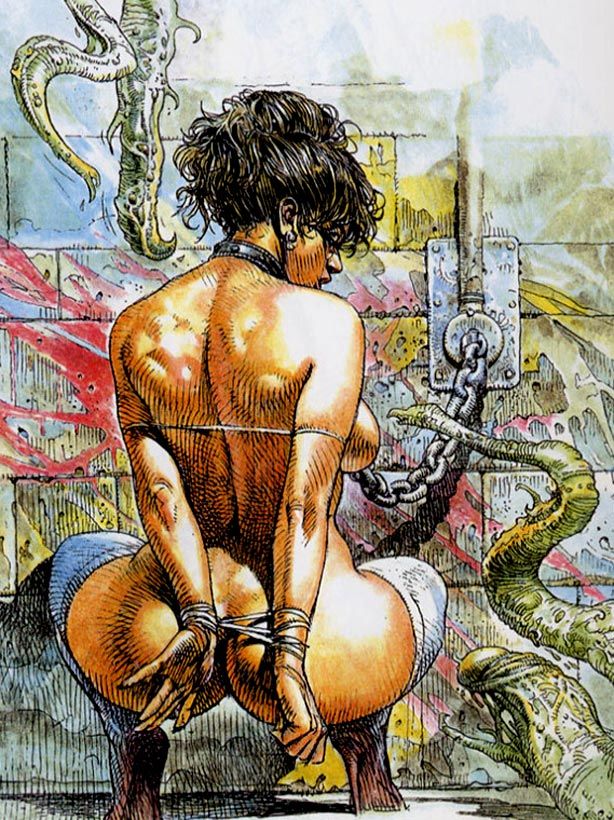
Bonus image: Druuna and tentacles! Art by Paolo Eleuteri Serpieri. At least this ass-and-boob shot makes *some* anatomical sense – Druuna’s spine is still in place.
Lambiek Encyclopedia laconically notes that “Serpieri’s highly detailed portrayals of well-endowed heroines have earned him the undisputed title of “Master of the Ass”. Now Serpieri clearly has a huge interest in women’s asses, and he draws them lovingly, but so do a lot of other artists. Undisputed by whom? History is silent on this topic.
You can see more of his stuff here, which is definitely NSFW, unless you work in a brothel.
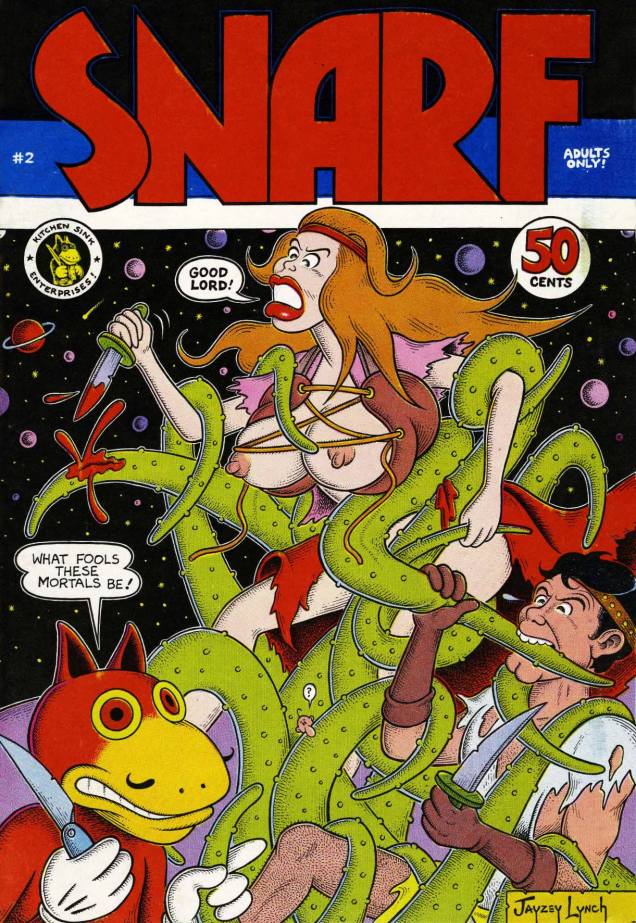
Sometimes you’re just minding your own business, and suddenly something green and scabrous sticks itself into your mouth. Jayzey Lynch is of course Jay Lynch, the artist of this cover (Snarf no. 2, August 1972). “Good lord!”, indeed.
M. Steven Fox of Comix Joint wrote a riveting (as usual) review of Snarf no. 2. Read it here.
Tentacle Tuesday! The name of the game this time: epic battles (It’s the end of January, and I’m in a belligerent mood.)
First, I’d like to share these wonderfully weird and colourful Hindi comic covers that I’ve been reserving for a while.
Chitra Bharti Kathamala was a popular Indian comic book publication during the early 1980s. This is Chitra Bharti Kathamala #8, although I wasn’t able to find out more information about it – Hindi presents a formidable language barrier. It’s rather charming that the artist seems to have never seen an octopus in his life.
Apparently India’s love (hate? senseless violence?) affair with octopuses has been going on for a while, because here’s another tentacled cover:
The cover was painted by Vijay Kadam… and will haunt my nightmares. As far as I could suss out, this is published by Raj Comics. Kadam’s son, Harshvardhan Kadam, is a mural artist (see some of his murals here.)
My (somewhat) educated guess is that these covers are from the late 80s, early 90s. If you’d like to see more, hoist your sails over to the Monster Brains blog over here.
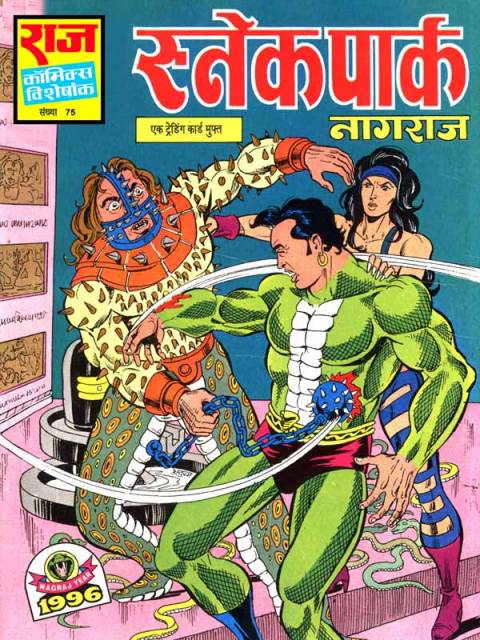
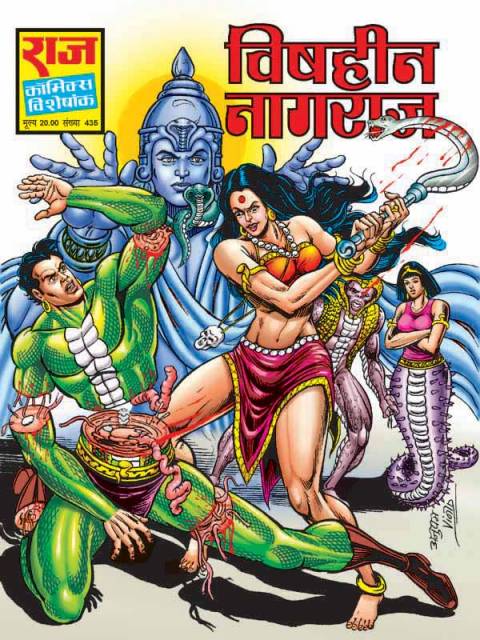
Incidentally, while attempting to glean more information about this, I stumbled upon some hilarious, more modern Indian comic covers, namely these three:
Nagraj no. 44, Jan 1995. What the fucking fuck is going on here, and how does it make any sense anatomically?More tentacles – unless the spiky guy’s legs are actually alligator’s tails… Nagraj no. 50, Jan 1996.Nagraj no. 75, Jan 2003. No tentacles but I couldn’t resist the adorable gore. Once one’s gaze pulls away from the spaghetti entrails, one notices that the woman hacking Nagraj to pieces seems to be having the time of her life… and that the female creature in the background has a completely improbable lower torso.
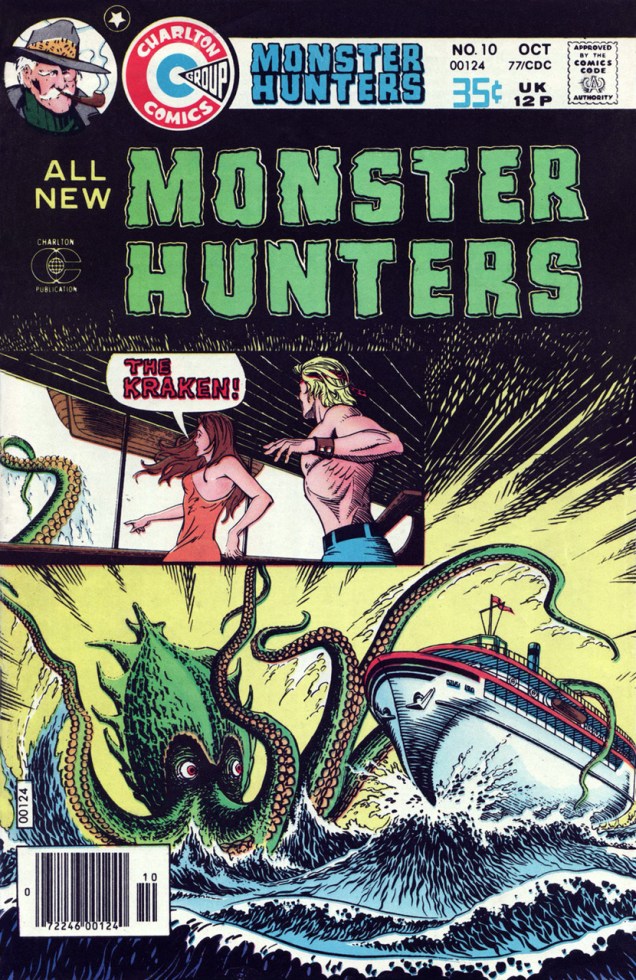
For our next heroic skirmish, a scene with dramatic waves, a half-naked damsel, a hot guy, and an an intense octopus with a Rasputin-esque furrowing of the brow. Basically, the glorious pen of Enrique Nieto was guaranteeing eye candy for everyone, whatever their pervy proclivities.
Monster Hunters no. 10, October 1977. The cover is by the glamorous Enrique Nieto!The original art for an inside page from « Night of the Kraken! » Script by Nicola Cuti, art by Enrique Nieto.
Speaking of octopuses laying eggs (and they do), do you know how these creatures reproduce? Once the male octopus places a sac of sperm into the female’s body cavity with his « mating arm» (yes, he has a dedicated arm just for that purpose), the female lays her eggs, and spends the rest of her time protecting them and keeping them clean. Both the male and female octopuses stop eating after mating, the male drifting around aimlessly, the females dedicating all their energy to safeguarding their offspring. Both die soon after of either starvation or predation. Given these conditions, anybody seeking to destroy the last living female octopus is a fucking asshole – don’t the poor things have it hard enough already?!
I’ll wrap up with a little cozy scene in which male friendship prevails over the evil tentacles of a sinister, swirly-eyed creature. Aw, you guys…
« Aventuras del FBI» was a Spanish comic published Rollán Editorials, published in little stapled black-and-white books with colour covers. Auto-translating an article about Aventuras gave me this little gem: « Adventure series of an FBI agent named Jack Hope, who is accompanied on his missions by a young man named Bill Boy and a man steeped in meat and joke, Sam. » I don’t know what a man “steeped in meat and joke” is, but it sounds promising!












































 Who's Out There?