Greetings! I am on vacation this week – on vacation from work, that is, but never from tentacles! Stowed away on a tropical island (with a WiFi connection, ça va de soi), hoping to glimpse an octopus going about his business in the ocean, enjoying the tropical foliage… Speaking of the latter, some of the plants that grow around here are distinctly tentacular in nature.
So you see, I really had very little choice in regards to the topic of today’s Tentacle Tuesday installment! I’ve decided to stick to the 40s and 50s, as there are really many more cannibal plants out there than one could possibly shake a stick at.
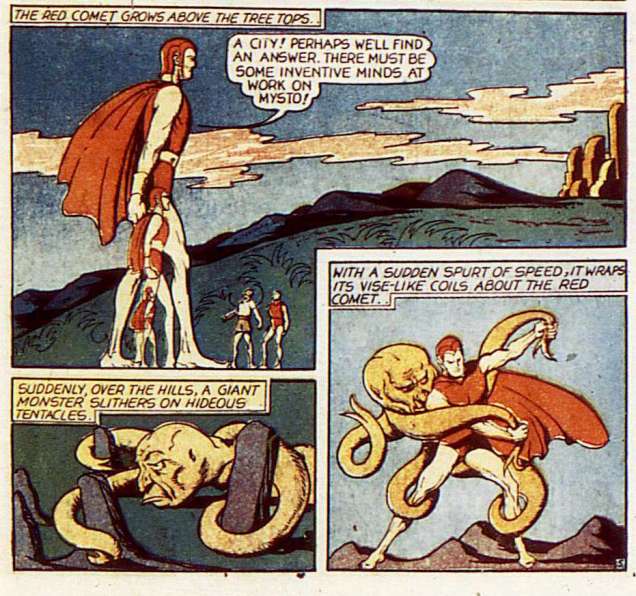
This installment of Red Comet is illustrated by Joe Doolin, and published in Planet Comics no. 14 (September 1941). Frankly, these things seem a little too bulky to carry about with you. Just imagine if somebody tried to walk around carrying a triffid.I believe the Red Comet had the ability to explode things with his mind, but clearly there were some restrictions.A page from an installment of Gale Allen and the Girl Squadron, illustrated by Fran Hopper. Gasp, a woman comics artist! A rare thing indeed, back in the Golden Age. Published in Planet Comics no. 28 (January 1944). Gale Allen ends up in this very position quite often, though tentacles aren’t always involved.
Incidentally, may I just point out that the Girl Squadron’s costumes (as they go on their intergalactic, dangerous missions) wouldn’t be out of place in a modern music video? Fran Hopper could draw cute girls with no trouble at all – and she also seemed aware that breasts are affected by gravity (but just a little bit, one wouldn’t want to be *too* realistic).
The ruler of Carnivoria not only has poor taste in titles (most lands are governed by meat-eaters of one kind or another – in that sense, Canada could be called Carnivoria with the same degree of accuracy), but also poor taste in clothing: is that goofy hat supposed to be regal?
For a chuckle, visit the post about Gale Allen And Her Girl Squadron on the Stupid Comics blog, featuring fun images like this one:
From the usual team: written by Douglas McKee and illustrated by Fran Hopper.
Eye candy for men *and* women readers! 😉
Back to tentacles… and on to Fred Guardineer, who also drew cuties of both sexes:
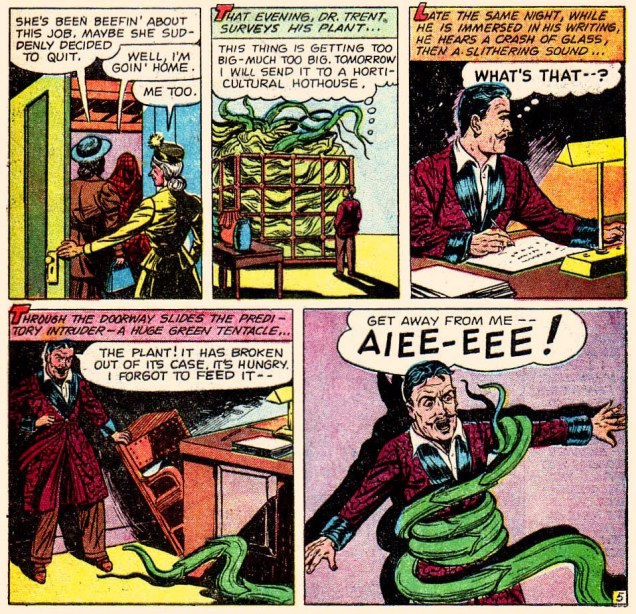
The Harp of Death! is illustrated by Fred Guardineer. Printed in Manthunt no. 7 (April 1948).Evil Guy has the body of an eagle (with hands and feet, though), and raises deadly cannibal plants that respond to whistling. Does that seem a tad… random to you?A page from Appetite for Death, drawn by Henry Kiefer. Published in Beware no. 12 (November 1954).There’s something distinctly wrong with the guy’s anatomy.
As Tentacle Tuesday creeps by once again, we found ourselves knee-deep in ghosts and devils – adorable, baby-featured ones. As a matter of fact, if you’re the kind who breaks out in hives when exposed to an overdose of cuteness, I would suggest skipping this week’s installment.
The best-known titles published by Harvey Comics, whether comic book adaptations of an animated cartoon (for instance, Casper the Friendly Ghost or Baby Huey, both adapted from Paramount’s Famous Studios cartoons) or original series, are certainly no passion of mine for the simple reason that the stories are, for the most part, quite boring. Their strained slapstick elicits, at best, a semi-chuckle: each character is so tied to a shtick that the whole thing becomes predictable very quickly. Hot Stuff, the little devil with temperature regulation problems, constantly burns through and/or melts stuff. Little Dot draws polka dots on everything – or hangs out with giraffes. Little Lotta demolishes all food in sight à la Garfield. Richie Rich swims in money, eats money, inhales money. Wendy the Good Little Witch is nauseatingly boring (I disagree with that being a viable definition of “good”).
All of these characters have redeeming features – their heart is in the right place and they enthusiastically come to the aid of friends and animals. The Harvey Girls, as they’re called (Little Lotta, Little Dot and Little Audrey) are clever and enterprising, if spoiled and headstrong, which is a pleasant change from females in need of rescuing. I wouldn’t go as far as calling their antics “proto-feminist”, notwithstanding the lofty claim made to that effect in the introduction to the Dark Horse Harvey Girls anthology.
One can hem and haw about it all day, but there is one redeeming and indisputably striking feature, and it’s one to contend with: the covers are beautiful! Lovingly designed, gorgeously coloured, they’re pure eye candy.
We have artist and art editor Warren Kremer, who worked at Harvey for some 35-odd years starting in 1948, to thank for that. See my colleague’s Little Dot’s Playful Obsession and his spotlight on Spooky the Tuff Little Ghost for more details. Me? I shall simply concentrate on tentacles.
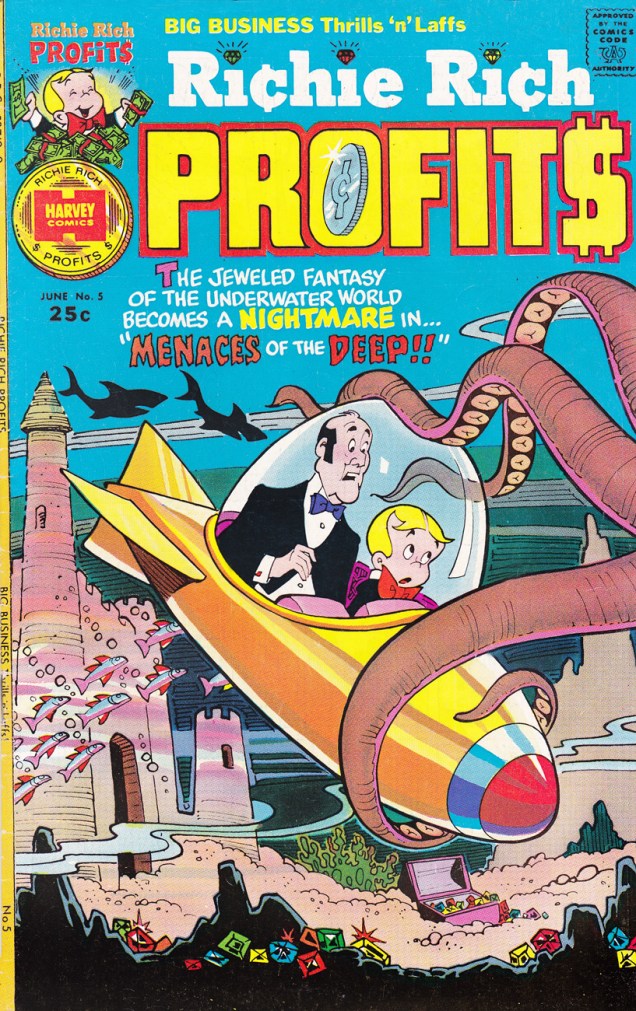
Casper & Nightmare no. 21 (1968). Casper the Friendly Ghost was adapted from Famous Studios‘ animated cartoon, and soon gave birth, so to speak, to a score of spinoffs, such as Spooky the Tuff Little Ghost and Wendy the Good Little Witch.Richie Rich no. 128 (September 1974). Richie Rich, yet another Warren Kremer character, debuted in Little Dot. Don’t you just love the super-bashful octopus?Devil Kids Starring Hot Stuff no. 67 (December 1974). Hot Stuff the Little Devil is another Kremer character.Richie Rich Profits no. 5 (June 1975)Casper Digest no. 2 (December 1986). This would be a far nicer image sans all the page-cluttering copy (and bar code)!
Some folks seem to display a knee-jerk reaction to the legacy left behind by men and women who lived decades ago: that of condescension. Surely, if it was something that our grandparents believed in, something that made their imaginations soar or intrigued them, by now it’s no longer relevant or just utterly jejune. Frankly, I’d poo-poo this repulsive straw-man I’ve just erected, if it wasn’t for the fact that these narrow-minded airheads actually do live among us. “I’ll listen to music from before my time when today’s musicians stop releasing such excellent music”, somebody daft once opined, and the same (ahem) logic seems to be apply to other forms of culture. If TV shows from two years ago are ancient (overheard at a restaurant), what can we possibly think of comics from 70, 80 years ago?
As you probably noticed, this blog suffers from no such delusions: there’s plenty of intelligent, touching, excellent-all-around material to be dug up from (in this instance) the Golden Age.
Sorry about the varying quality of the images; some of these stories have been reprinted in recent years (and thus, thoroughly cleaned up, or even lovingly restored from original art); and some of them are only available in the original form, which is to say shoddily printed, dubiously coloured, and not all that well preserved. The Golden Age was, as I noted previously, a long time ago…
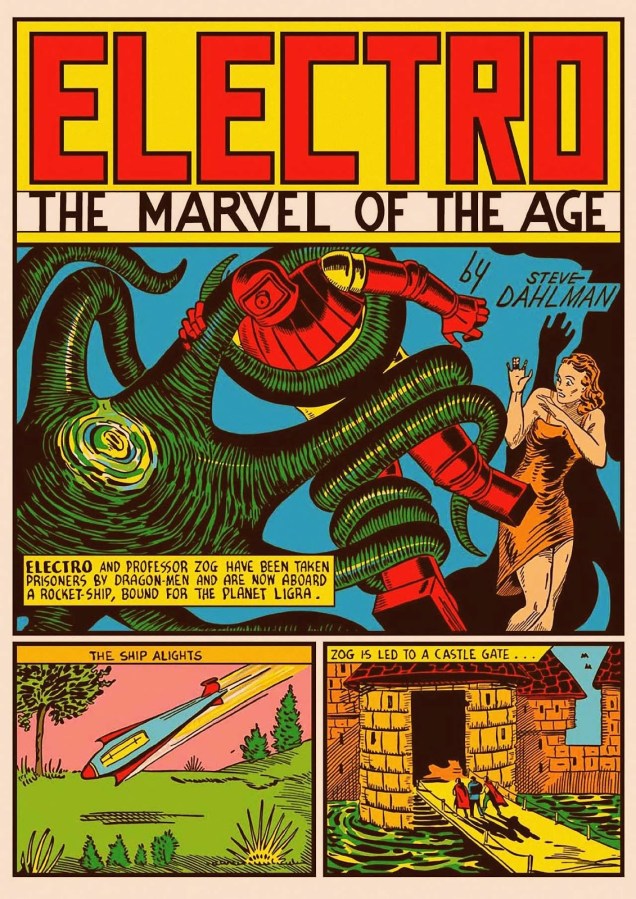
All right, let’s begin! I have a few favourites in this post, and our first story is one of them. I had access to a pristine, cleaned up, painfully white-papered version of it from Golden Age Marvel Comics Omnibus no. 1 (2009), but I by far prefer the following version, which keeps the colours, shall we say… less blinding? This is On the Planet Ligra, originally published in Marvel Mystery Comics no. 9 (Marvel, July 1940). It is scripted by Steve Dahlman, who did a very nice job of it, too. It’s worth a read in its entirety; find it here.
The next few pages demonstrate the dodgy printing I was referring to earlier…
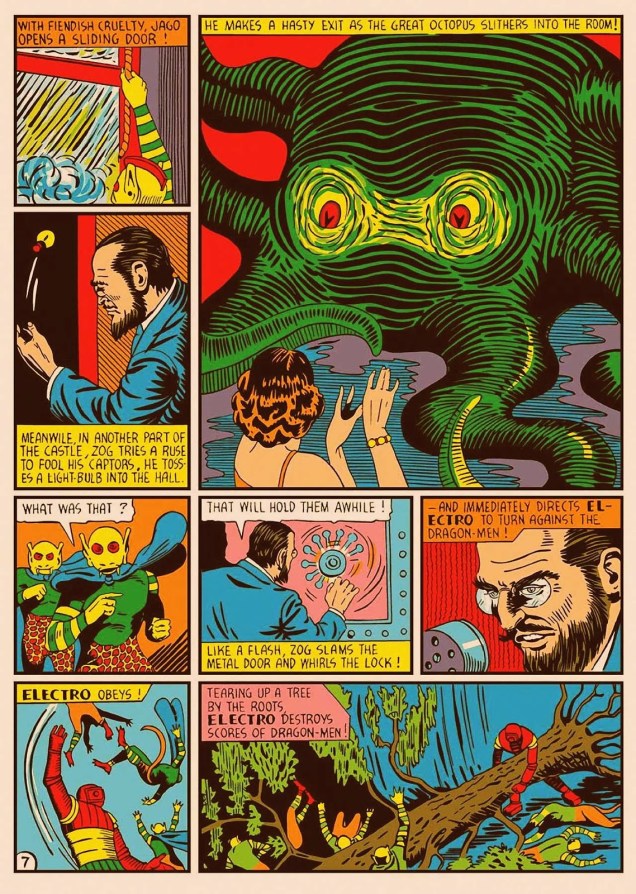
Slave Planet is scripted by Herman Bolstein (as Starr Gayza; what a nom de plume!), and illustrated by Arthur Peddy, possibly with some help by Will Eisner on inks. Published in Planet Comics no. 4 (Fiction House, April 1940). Incidentally, we have a whole bevy of Fiction House Tentacles at Tentacle Tuesday: Planet of Tentacles, courtesy of Fiction House.Mystery of the Vanishing Men, published in The Red Comet no. 8 (Fiction House, September 1940), is illustrated by Alex Blum.Another page from Mystery of the Vanishing Men.
This next part I like a lot, because I’m quite fond of Henry Fletcher, Barclay Flagg and perhaps even Hank Christy. These are all the same person, of course: Fletcher Hanks, The Most Bonkers Comic Book Creator of All-Time, according to Mark Peters. For now, let’s just look at some tentacles, although I will doubtlessly return to this theme at some later juncture.
Because of Fletcher Hanks’ relative cachet, comic scholars and restorers seem to have paid a little more attention to his work of late, and at a result, we can admire the two following pages in all their mighty crispness.
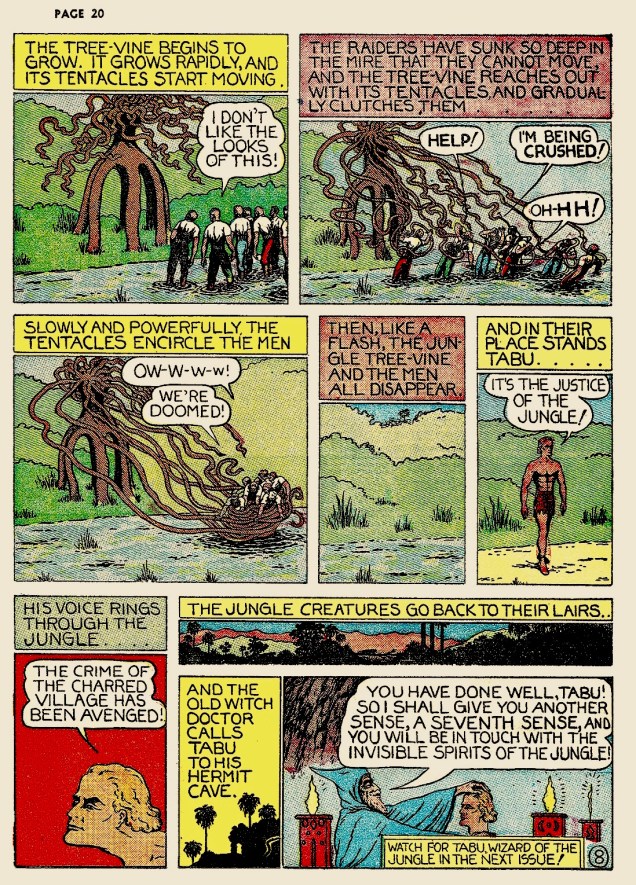
A page from Stardust « featuring the Octopus of Gold!», published in Fantastic Comics no. 16 (Fox, March 1941), scripted and illustrated by Fletcher Hanks. The Slave Raiders is scripted and illustrated by Fletcher Hanks. It was originally published in Jungle Comics no. 1 (Fiction House, January 1940).
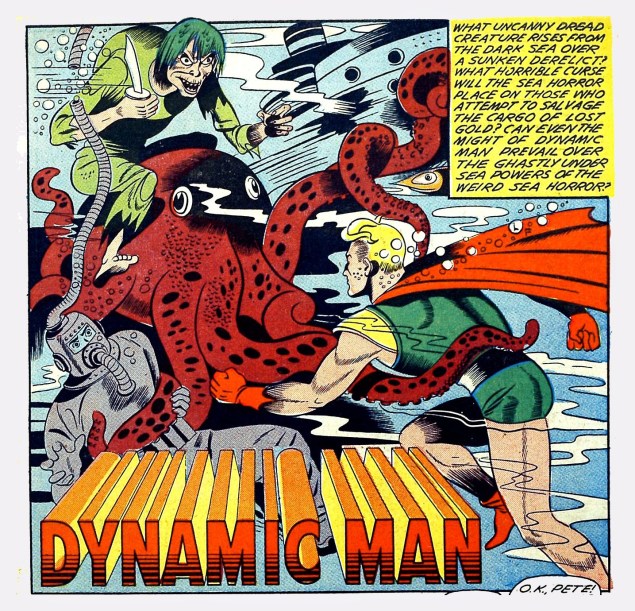
Getting off the Hanks bandwagon, we move into nonetheless enjoyable territory with Dynamic Man. These panels are from an unnamed story (with matching unknown artist ) published in Dynamic Comics no. 9 (Chesler/Dynamic, 1944).
This has no tentacles, but I enjoyed these two panels far too much to not share: the guys’ New Yawk accents, and the witch’s demented rictus (not to mention that it’s all happening underwater).How many more rhetorical questions are you going to ask us?
Last but not least, as boring people say, is my second favourite of today’s post, both because I love the art and because the story gave me something to sink my teeth into. .
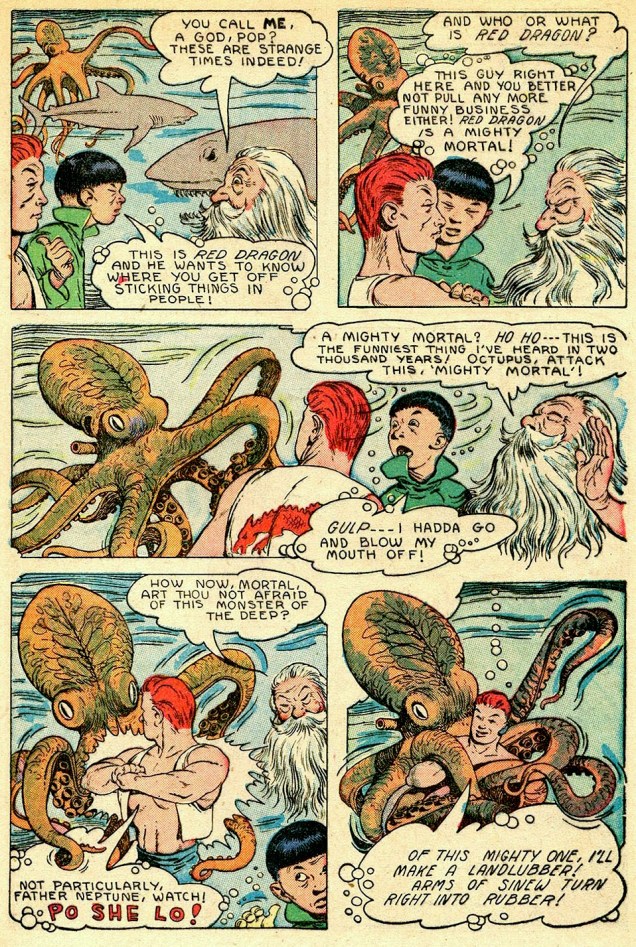
Super-Magician Comics vol. 5 no. 8 (Feb-March 1947), cover by Edd Cartier. Dig the guy’s dopey, sneezy expression… contrasted with the octopus’ hypnotic stare.
Twilight of the Gods, the cover story, is also illustrated by Edd Cartier. It’s surprisingly nuanced, doesn’t fall into horrible stereotypes despite the presence of several Chinese characters, and even has an interesting moral. Read it here.
Next week, I’ll return to my usual diet of the Latest Published Thing as well as superhero crossovers! Just kiddin’.
Today’s installment of Tentacle Tuesday provides us with another healthy dose of tentacles of a vegetal nature. With my co-admin RG’s blessing, I decided to be a little unorthodox and instead of my usual piecemeal approach, share one single story.
I must admit to having no rapport whatsoever with Star Trek – I did not watch the show as a child (or as an adult), and haven’t even managed to pick up characters, plot lines or cultural references from the surrounding atmosphere, aside from the stuff *everybody* knows.
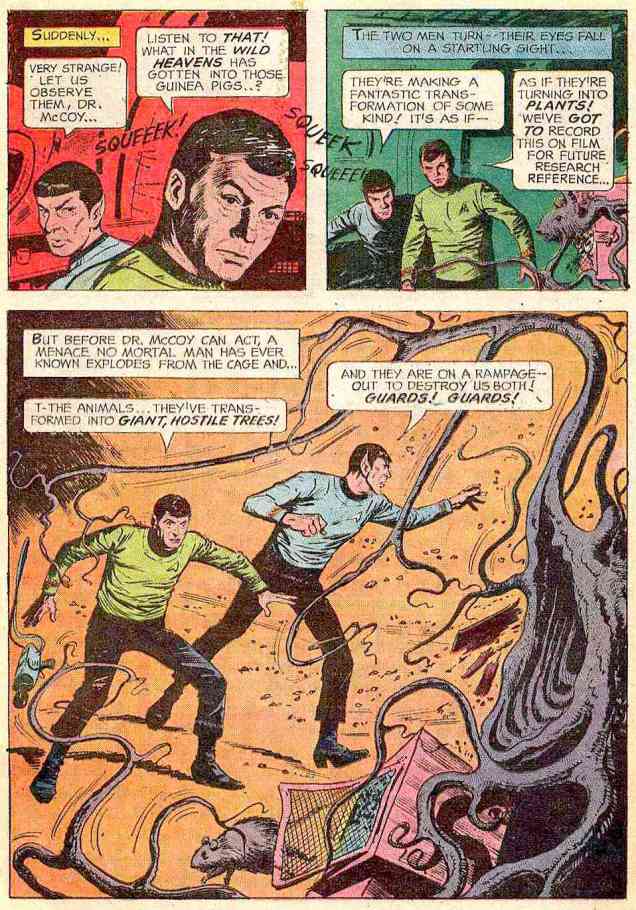
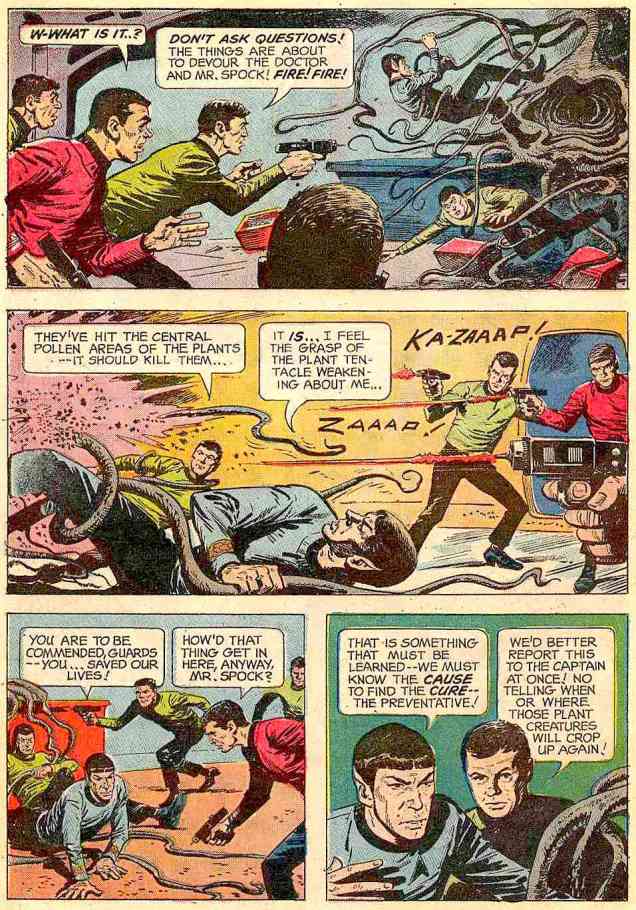
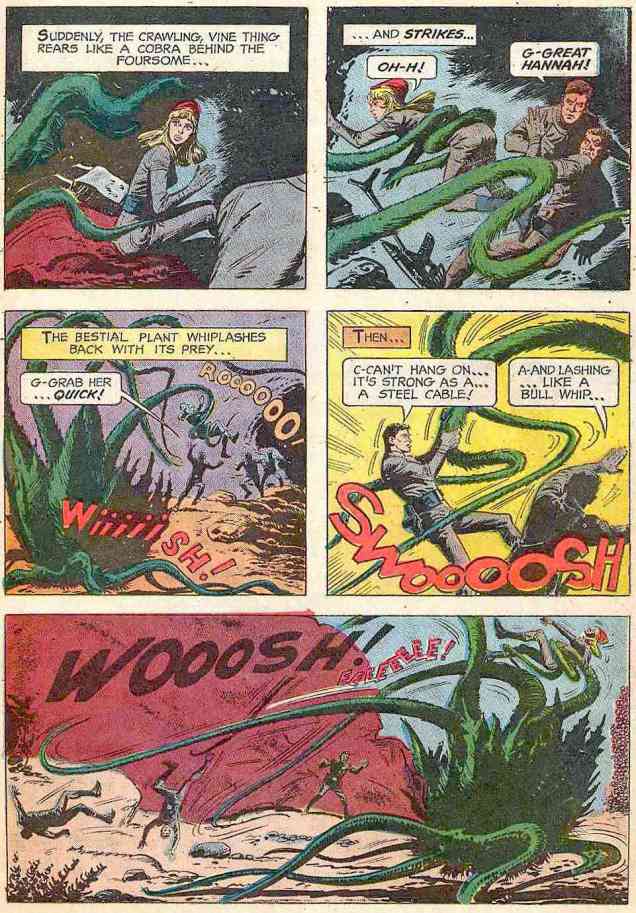
But The Planet of No Return (published in Star Trek no. 1 (October 1967, Gold Key), scripted by Dick Wood and illustrated by Nevio Zeccara) is a delight for any keen child who’s ever been mesmerized by the notion of a carnivorous plant and has carried that love through the years into adulthood. I’ll hold my hand up there! It’s also right in the sweet spot of a Venn diagram, the riveting intersection of “interested in Venus flytrap plants” and “fascinated with tentacles”. I’m not featuring the full story (you can read it here), preferring to tantalize my audience with the many tentacle-laden panels of grabby, aggressive human-devouring plants.
Incidentally, “cannibal plant” is a misnomer (shame on you, Pavel Chekov!) – cannibals involve individuals consuming individuals of the same species.
It all starts with some strange plant spores sucked in through the ship’s ventilation system while it’s drifting next to an unexplored planet…
The ship gets teleported to the planet to pursue their original exploration mission as planned… and get almost eaten by a tentacled “cannibal” (once again, not actually a cannibal) plant. A “giant plant tree”, strangely mobile, saves them from this worse-than-death fate… and turns out to have been Hunt, one of their teammates transformed into plant life by spores. No, I don’t know who Hunt is, either – he’s certainly not on the official Star Trek character list, introduced seemingly to be promptly killed after performing his heroic deed.
Well, okay, if the plant tried to eat a tree, maybe it is, technically, a cannibal.
The now four-people team (the fifth one, Hunt the tree, dies after his epic battle with the Cannibal Plant) continue further into the wilderness… and stumble across a village of sentient plants, who don’t take kindly to intruders. Geez, can you blame them?
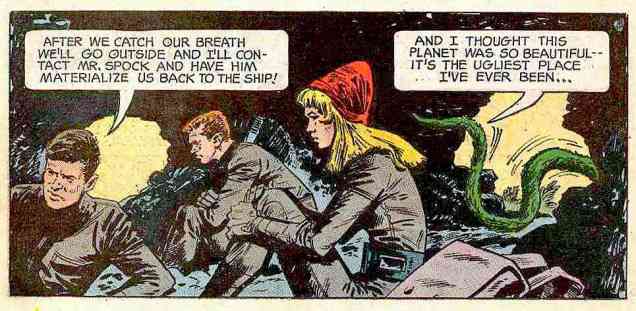
After shooting at (and presumably maiming) various denizens of the plant village, the humans retreat to a cave and conclude that this planet is ugly. Sentient plant life is not amazing enough for them, apparently. I suppose being part of Star Trek makes one really blasé about such things.
Janice Rand has it coming for being annoying and whiny…
At this point, we’re more or less done with tentacles, but I can’t leave you on this cliffhanger (especially if you don’t have some time to waste reading a comic of questionable taste).
Here’s how it ends:
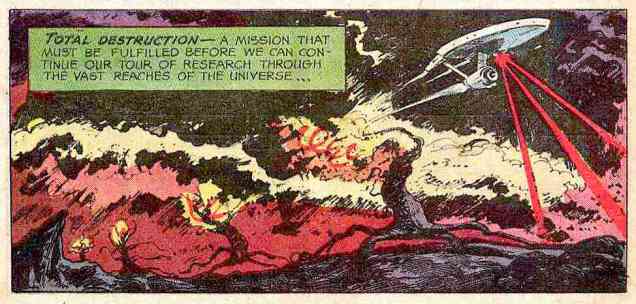
What does this “bestial plant” want with Janice? It wants to put her into a cattle pen, of course! Aiming to rescue her from its clutches, our intrepid explorers break into the pen, and, observing the landscape, conclude that the plants are raising dinosaur-like creatures who consume vegetable-type plants. «The lower plant life on their social scale are used as fodder… food for the beast creatures! Vegetable food!» Oh, and «The vegetables are alive – they’re making sounds also!» So sentient plants are farming animals whom they feed on other sentient plants. (At this point, I was muttering “what is wrong with this comic?”) It turns out that the superior plants eat the animals, who eat the inferior plants, and Janice is now one of the cattle, about to be sent into the giant trees-cum-slaughter-houses to be transformed into food. During the climax of the story, the slaughterhouse trees are blown to smithereens by Mister Spock and his laser beam destruct ray (it’s automatic, it’s systematic, it’s hydromatic), and everybody is teleported back into the relative safety of the ship. The surface of the planet (a.k.a. “hideous little globe”) is then obliterated by laser beams – just in case.
So how come only Hunt got transformed into a tree? Are we to assume that the other members of the team are immune?
By now, we have surely established that in the compendium of made-up monsters, tentacles are an artistic short-cut for evoking an especially terrifying creature. As it turns out, if there’s one way to make an already spine-chilling abomination even scarier, it’s to equip its gaping maw with teeth. Be it fangs borrowed from some unfortunate vampire, the implausibly symmetrical dentures of a TV show host, or clearly carnivorous, sharkish chompers, artists have been inserting teeth where no teeth should be long before you or I were born.
« But Grandmother! What big teeth you have! », once quipped Little Red Riding Hood in the 19th century, and this fear of teeth has clearly followed us into the Modern Age.Take a look —
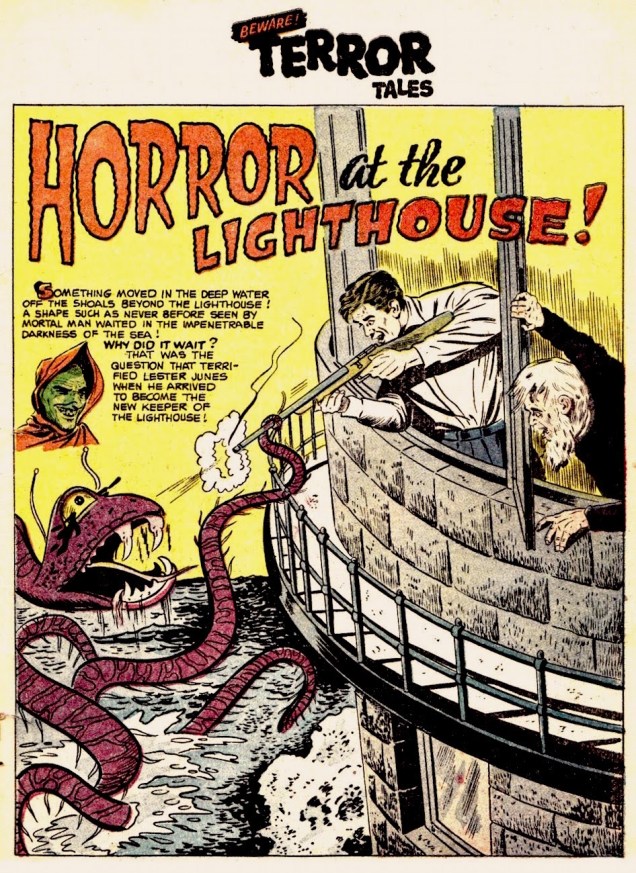
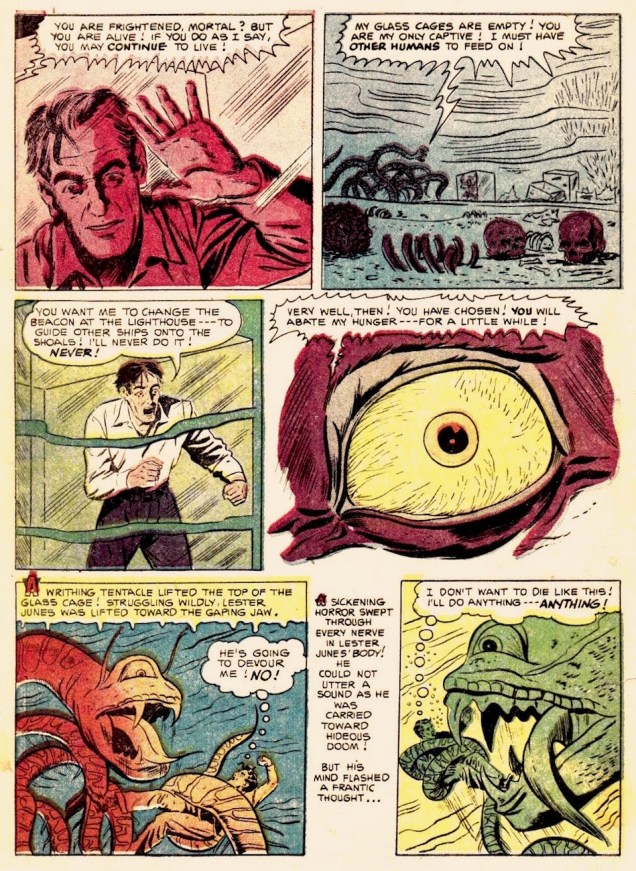
Sheldon Moldoff was probably thinking of a snake’s fangs when he came up with this cutie:
A page from Horror at the Lighthouse!, published in Beware! Terror Tales no. 6 (Fawcett Comics, March 1953). Scripted by Bill Woolfolk, drawn by Sheldon Moldoff. Read the full story at The Horrors of It All.
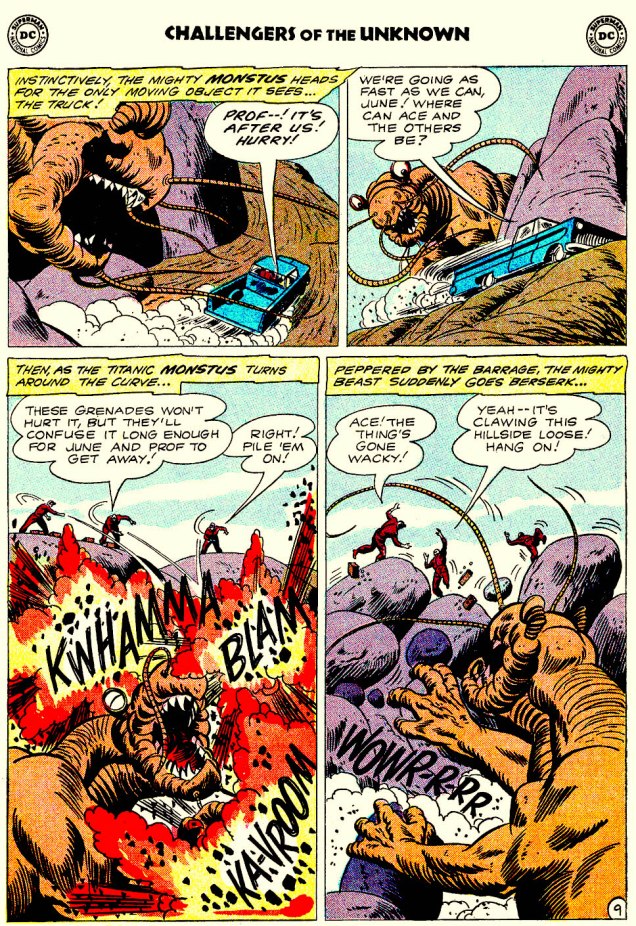
This cross between a dinosaur and a mole (or is that more of an ant?) boasts an enviable set of sparklingly white dentition:
Challengers of the Unknown no. 22 (Oct-Nov 1961), cover by Bob Brown.Aw. You’d go “wacky”, too, if some jerk piled on grenades on you.
One thing you can say about tentacled monsters, it’s that they sure keep their denticulations (yes, it’s a word) impeccably clean. Maybe they choose their victims based on that, like cats gleefully enjoying the crunch of a good teeth-cleaning croquette?
Holy crap, look at those white chompers (that are about to get a little marred with blood, gristle and whatnot)! Weird Mystery Tales no. 9 (Dec 1973 – Jan 1974), cover by Luis Dominguez.
On the other hand, some monsters could have used a set of braces (this one is an orphan, which is why it had to make do with a British set of teeth).
Eerie no. 131 (June 1982), cover by Rudy Nebres. Can you imagine trying to chew anything with such a set?!
A somewhat similar (but a lot less overcrowded) set of ivories for gnawing and gnashing can be spotted in water:
A collectible card (from sometime in the 2000s) by illustrator Chet Phillips.Here you can admire his series about Japanese monsters, or visit his website, chetart.com.
This toothy post is now at its end – happy brushing (and flossing — it’s important!) to all, and ’til next Tentacle Tuesday!
~ ds
p.s. Not particularly related to comics, but I found this photograph distinctly on the side of scary:
Captioned « Women in London sit down for express teeth whitening ». I think they’re about to be transformed into aliens, or contaminated with some deadly germ, or perhaps just burnt to a crisp by some mysterious rays. Have I been reading too many comics?
When digging through comics in quest for tentacled material, one soon notices that Gil Kane‘s name tends to crop up again and again. Despite this seeming ubiquity, I’ve never specifically concentrated on his art, though he certainly has appeared in Tentacle Tuesdays before (quite a lot in Tentacle Tuesday: Conan-O-Rama, for instance).
I can’t quite put my finger on it, but one of the things that seems to bug me is that Kane, whose real name was Eli Katz and who was born in Latvia, threw himself with such vigour into American culture. It’s an unfair reproach, I realize – one can hardly expect a four-year old child to hang on to a quickly-receding memory of his parents’ motherland to the detriment of whatever culture he’s growing up in, not to mention that this would be unhealthy.
The crux of the matter is that I don’t grasp that je-ne-sais-quoi that people seem to find appealing about Kane’s art. Where others see “dynamic storytelling, emotionally charged characters, and innovative [sic] staged fight scenes“, I see overly busy, hard-to-parse scenes and stiff anatomy. It doesn’t help that the bulk of his oeuvre is concerned with a subgenre of comics I have strong misgivings about, namely superheroes.
To answer the question of what is it that makes Kane so special, I have naturally turned to Gary Groth:
That is certainly well argued, but I’ve read a few Kane interviews and his intellectualism is just clearly not on my wavelength at all. There’s no doubt that he was the analytical kind (this interview with him published in Alter Ego no. 10 (1969) calls him « the comics’ most articulate artist »), but what he says often strikes me as stilted (much like his art). Take this, for instance: « Craft is merely the springboard. It’s the ability to give wings to your expression; otherwise your expression bangs around in an inarticulate way and comes out thick and untutored; you’re just throwing away range and scope. » Let’s just say that Kane was a very opinionated man, which does him credit. Yet I get the impression that his inclination to pick at himself veered towards self-destructiveness, as if he were ever striving for some lofty heights he was aware he would never reach.
In that process of self-improvement (let’s call it that), he often slagged other artists who were operating on a different level from his. Even as he flattered them, his compliments felt incredibly back-handed, bringing to mind those people who never smile, trying to get their atrophied mouth muscles to do the job and achieving merely a sort of pained rictus. For instance, I’m a little sore about his description of Will Eisner, who « did little morality stories, which were very moving, but they had the quality of reading a children’s picture book; he could be quite dramatic, but always on a kind of innocent level. He never had complex, subtle characterizations…» or, again, « Eisner is a writer until you start talking about literature, and talking about the great writers of literature. Then Eisner is only a cartoonist. »
All this being said, I do like *most* of today’s crop… save for the last two Kull the Destroyer covers, instances of the messy, rigid mises en scène I was carping about earlier. The best cover (imho) is inked by Tom Palmer, not so coincidentally. Co-admin RG has been heard to posit that Gil Kane should never have been allowed to ink himself.
And now I’d better stop displaying my ignorance and move on to the tentacles!
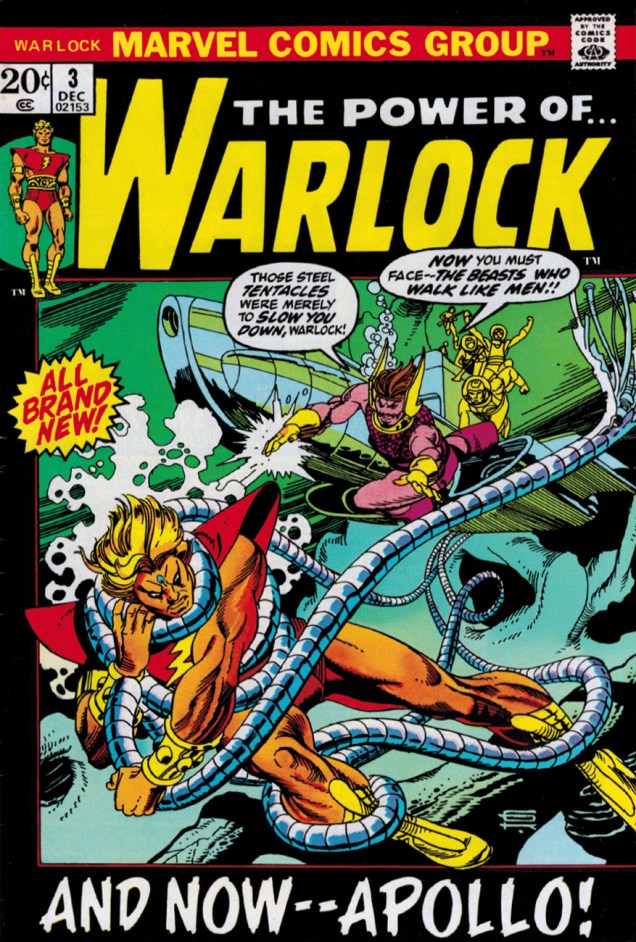
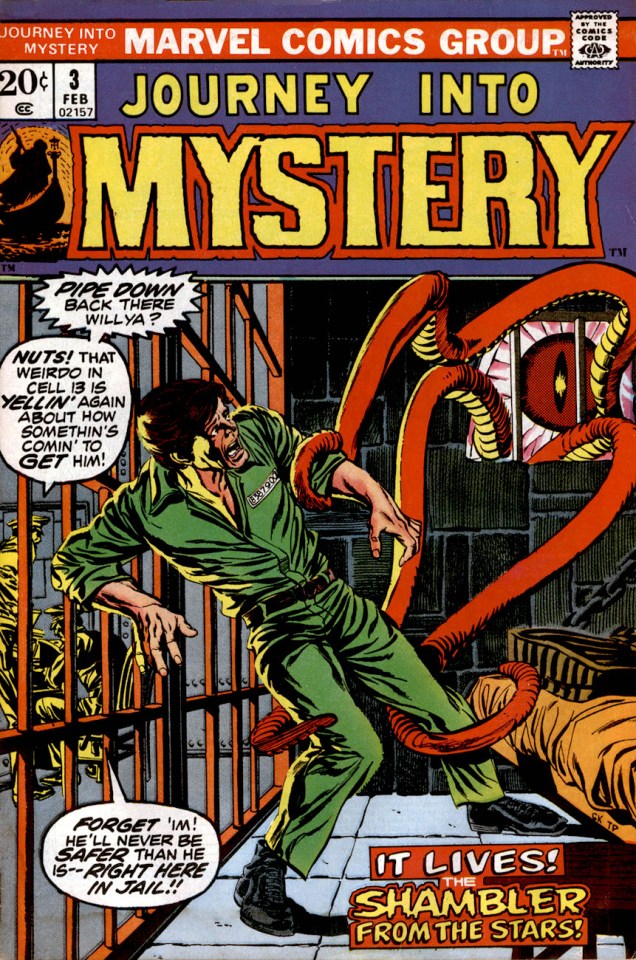
Warlock no. 3 (December 1972). Cover by Gil Kane.Journey into Mystery no. 3 (February 1973). Pencils by Gil Kane, inks by Tom Palmer.
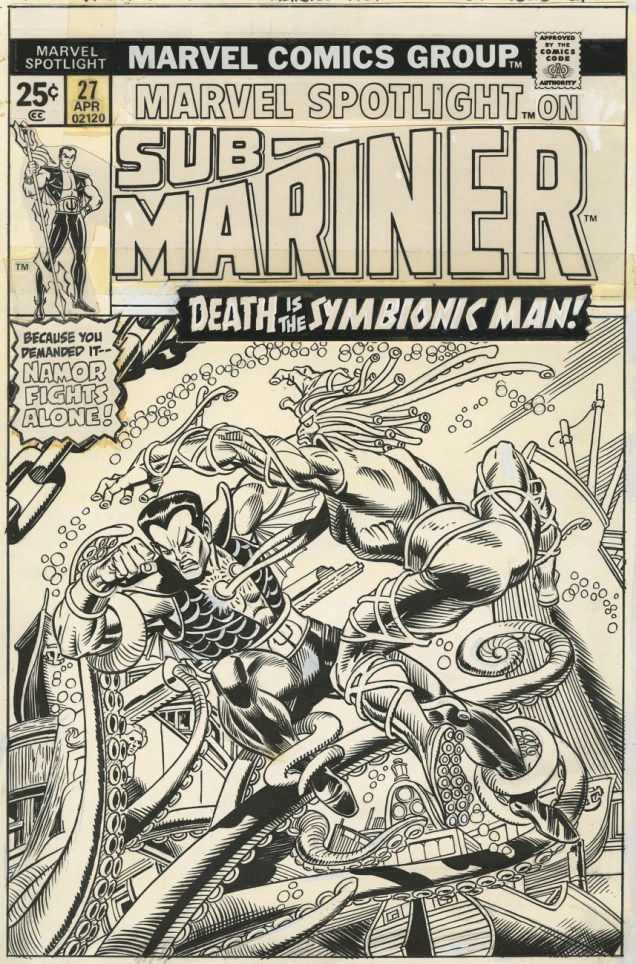
The original art for Marvel Spotlight no. 27 (April 1976). Pencils by Gil Kane, inks by Frank Giacoia.
Kull the Destroyer no. 17 (October 1976). Pencils by Gil Kane, inks by Klaus Janson.Kull the Destroyer no. 21 (June 1977), cover by Gil Kane.
« I read some of my stories recently and thought, ‘How in the hell did I get away with that?’ I had some really raw cynicism in some of them… » – Carl Barks
Like so many kids, I owe a lot of my interest in comics to Carl Barks, even though at the time I had no idea who he was – embarrassingly, up until today I’m not great at spotting his art. So much depends on what is available when one is growing up – and I used to enthusiastically dig through discarded piles of books at garage sales and whatnot, in quest for (among other things) for issues of Super Picsou Géant. Picsou is Uncle Scrooge’s French name, meaning something like “penny pincher”. These (true to their name) giant anthologies, just like pocket-book sized Archie compendiums, offered their readers pêle-mêle reprints of comic book stories both relatively new and also quite old, mixing prime Barks material with shitty European knock-offs with offerings by decent Barks disciples (see co-admin RG’s take on the latter).
Just like a Picsou Géant, this post has a few Barks covers and stories, and a few submissions by other folk… all viewed through my usual tentacle-specific lens. Dive in!
Donald Duck no. 109 (September 1966), cover by Larry Mayer. Minimal tentacles, but that clock was just too cute not to share.Uncle Scrooge no. 68 (March 1967), cover by Carl Barks.Hall of the Mermaid Queenis by Carl Barks.
Somewhat off topic, but I was quite amused by the ending of this story. Is this was Barks meant when he talked about raw cynicism? 😉
Uncle Scrooge no. 70 (July 1967), cover by Carl Barks.The Doom Diamond, the cover story, is also by Carl Barks.
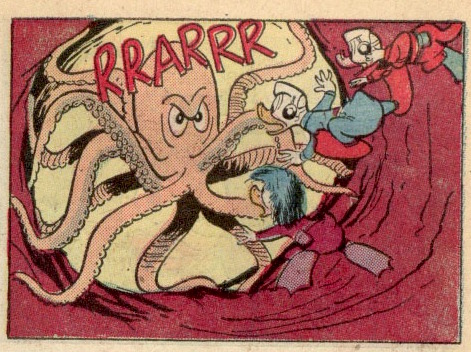
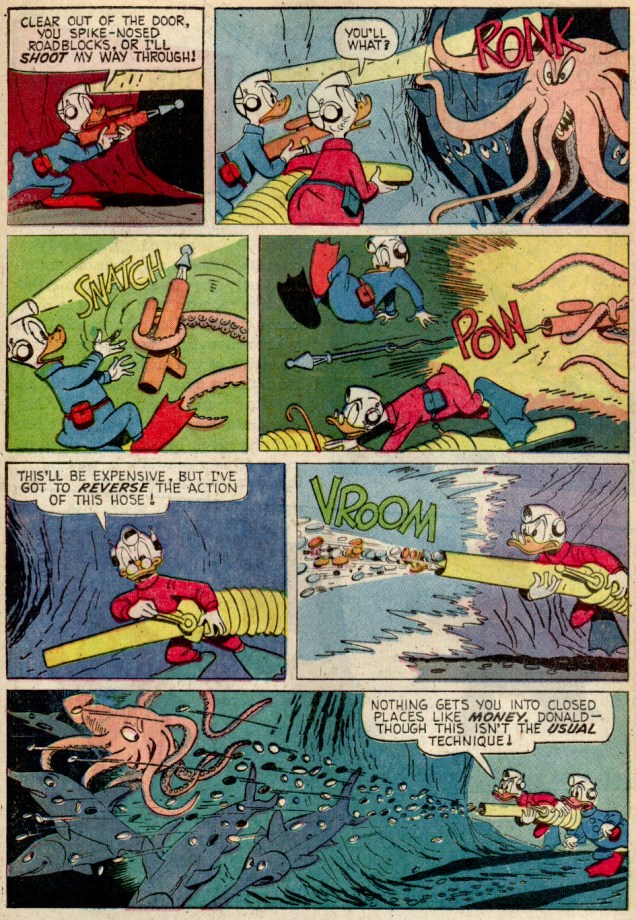
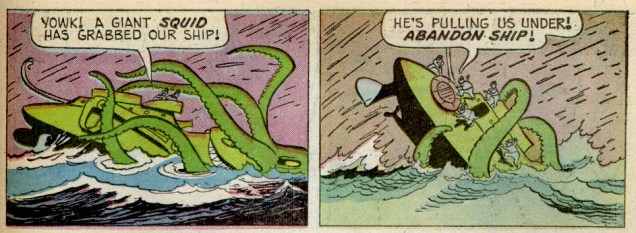
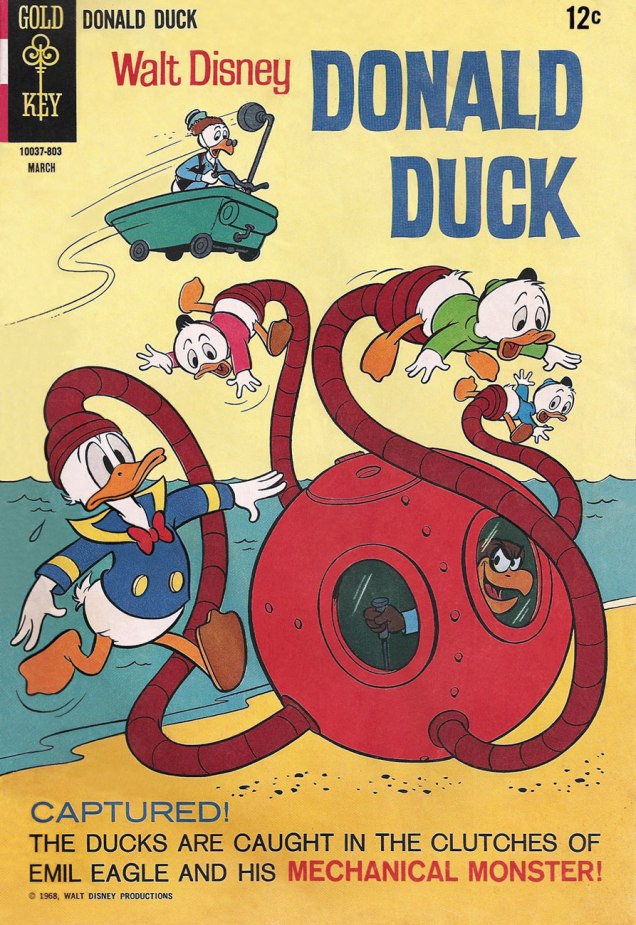
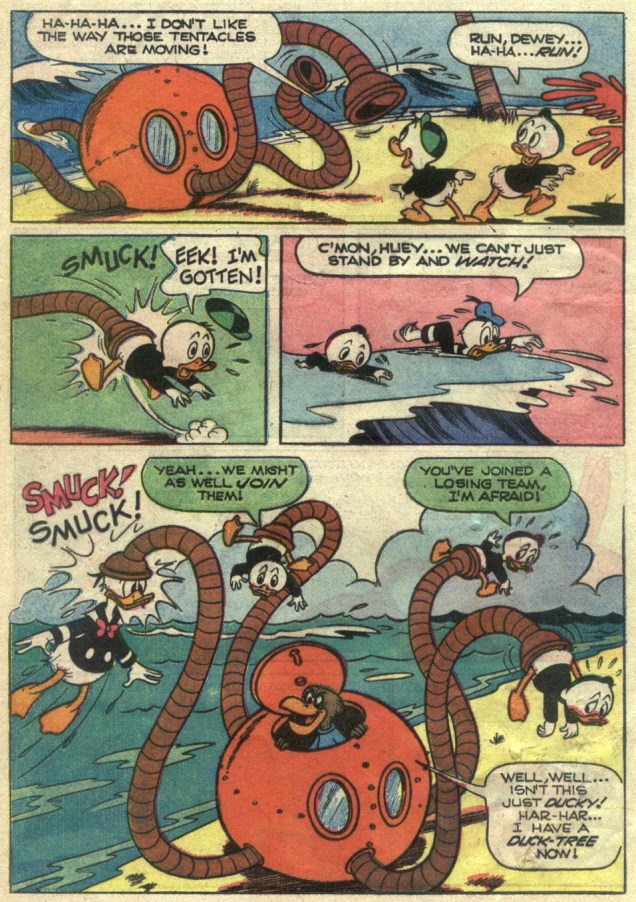
Donald Duck no. 118 (March 1968), cover by Tony Strobl on pencils and Larry Mayer on inks.The Mechanical Monster is scripted by Vic Lockman, which is almost an iron-clad guarantee of inventive goofiness. Penciled by Tony Strobl and inked by Steve Steere.
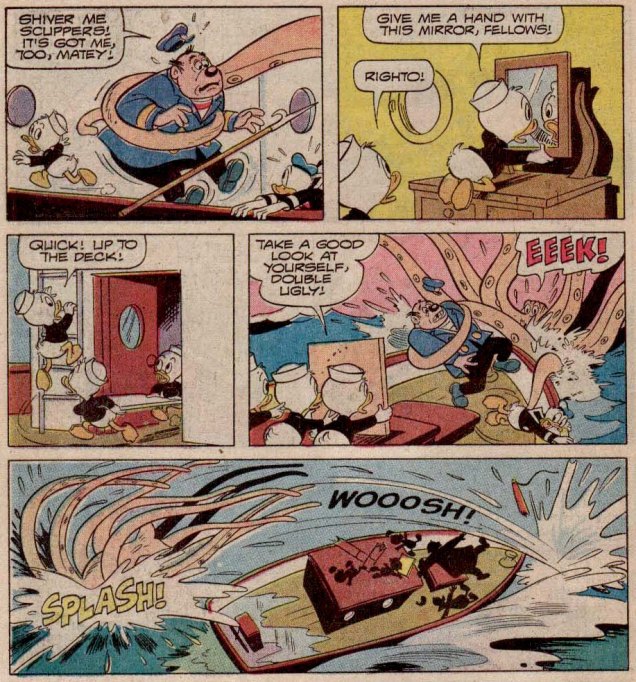
Donald Duck no. 141 (January 1972), cover by Larry Mayer.The Tall-Tale Trail is penciled by Tony Strobl and inked by Larry Mayer.
For this post, I wanted to concentrate on Gold Key publications, but at a later date there will be a follow-up post covering some other material.
I say, the year’s first Tentacle Tuesday is a big responsibility! That’s why I’d like to start with some slimy or furry, squirming or pitter-pattering, whimsical or gnarled, skittish or spine-chilling, drooly woolly creepy crawlies with toupees and bloodshot eyes. After all, the 2020s decade is sadly guaranteed to be full of ’em… but of a significantly less cute variety than the lot that I’m featuring today.
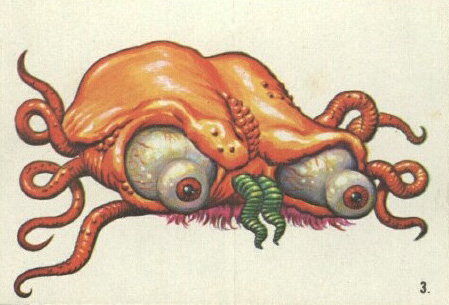
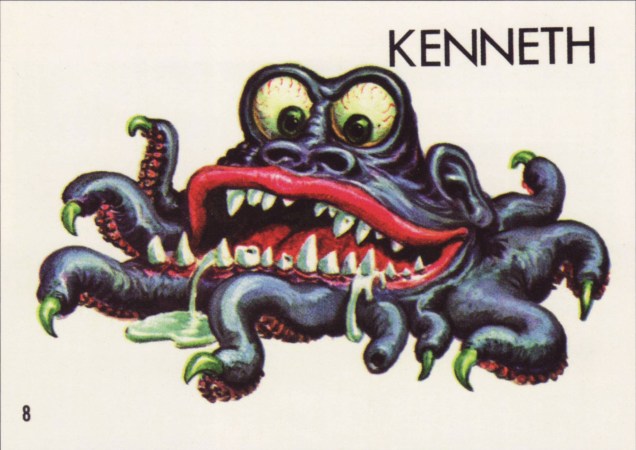
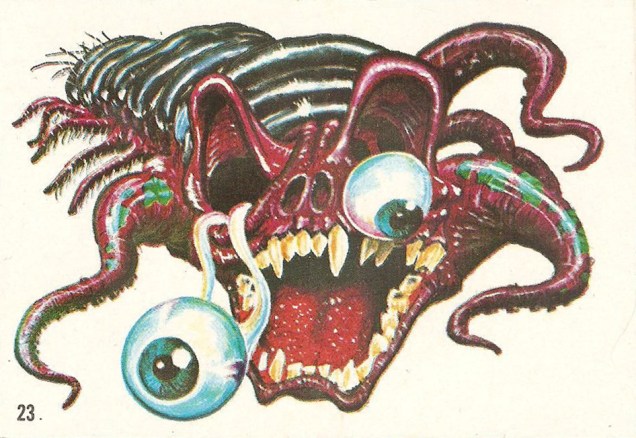
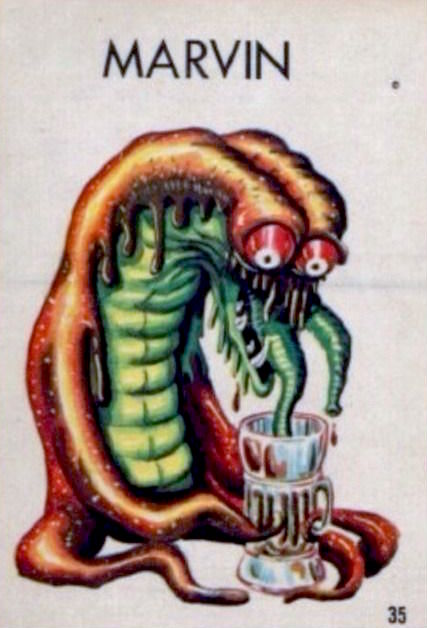
Topps‘ Ugly Stickers have a lot going for them: excellently drawn, tongue-in-cheek monsters in various states of putrefaction. If there’s one commonality between them, it’s that most of them showcase teeth any dentist would be thrilled to drill through. Many of them have far more appendages that a regular creature needs… and a lot of these appendages are distinctly tentacular, which is of course where we come in! And they’re all cute as a button.
David Saunders, Norman Saunders’ son, explains in the latter’s biography (Illustrated, 2009):
«In 1965 Topps released Ugly Stickers. This set was initially based on the grotesque drawings of Basil Wolverton, but when he demanded copyright control, he was paid off for his first twelve images and then fired. The rest of the creatures in the set were designed by Norman Saunders and Wally Wood.
The creatures that appear on the display box, the wax wrapper, and the giant twelve-piece puzzle were all designed by Saunders. He also painted all 44 Ugly Stickers. These were so popular they were reissued in four later versions and even spawned a line of rubbery toys called Teacher’s Pets.»
So what’s the break-down? Out of the original 44 stickers, Wolverton designed 10. The rest were the handiwork of WallyWood and Norman Saunders. The total set numbers 164. Not all cards were repeated in the re-runs, which is why the numbers don’t compute, for those of you who multiplied 44 cards by 4 versions and obtained 176, not 164; there were 4 groups of 40 cards + 4 non-repeated cards.
A page from Monster Mash: The Creepy, Kooky Monster Craze In America, 1957-1972 (Two Morrows Publishing, 2015), which you can read here.
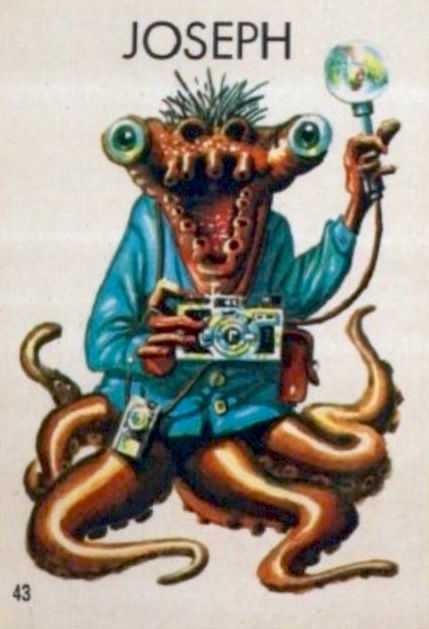
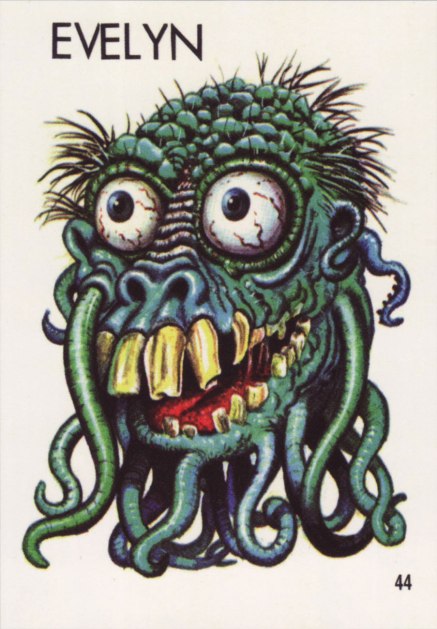
In some print runs, the creatures did not have names, doubtlessly leaving that part to the reader’s imagination. Most cards, however, do have names, with genders shamelessly swapped, making guys into gals and back into guys again. Take a peek at the full list of name changes over at this very instructive website, Bubble Gum Cards.
Does s/he look like a Jacqueline to you? Or maybe an Edward? I vote for the former; such an elegant name for a bug-eyed, displeased brain-thing, Just look at the flair with which she wears that pink tuft of fur underneath.
Joseph and Evelyn (or Stanley and Renée, or…) were previously used by my co-admin RG in his Hallowe’en Countdown III, Day 24 post, but they distinctly have tentacles, so I believe it’s worth running them again.
As a little bonus, here’s a lady from Topps’ 1966 Ugly Name Stickers series who asked to be included. Her name was… Donald, Sylvia, Angelo, Phyllis, Barney, or Rosemary. “Barney” is really pushing it!
A little friendly critter from the Teacher’s Pets series (probably…. these things are veiled in a shroud of mystery), which was a rubbery spin-off from Ugly Stickers.
This feels like a portentous occasion: the last Tentacle Tuesday of 2019. The mind boggles at the sheer number of tentacles we have released into the wild this year! As far as the splendour of this moment is concerned, there’s no reason for me to fight this feeling. Yet my general tendency at the year’s end – to throw in a lot of women fighting off tentacles (witness last year’s TT – “Foul as Sewer Slime!”) – is slightly one-track-minded, and it’s probably going to be my new year resolution to curtail that. Nah, just kidding.
Still: what *is* good is saying goodbye to the year in colour. So enjoy these not-quite-good, garishly coloured tentacle fiestas, and Happy New Year!
A painting by Esteban Maroto, a Spanish comic book artist whom you might know for his large body of work for Warren Publishing. He drew a hundred-and-one (presumably because that sounded good!) stories for Creepy, Eerie and Vampirella, which is a record only beaten by José Ortiz, another Spanish illustrator.Another one by Esteban Maroto. Are either of these fetching lads Dax the Warrior? I honestly have no clue. Anyone? (I’m told it’s the Masters of the Universe’s He-Man)
You know how I said, earlier, that I was one-track-minded? I’m not the only one. Yikes. This is a tame image, but the… wilder… ones were in black and white, and I had to stick to my theme. See the sacrifices I make?
Do visit Maroto’s website, tentacles abound (generally revolving around naked women).
Is it redundant to have yet another illustration by Nestor Redondo? (I featured one in last week’s Tentacle Tuesday). Perhaps. But it has many intriguing details: the octopus is both scarily human and quite alien (also, in bad need of braces!), the young maiden looks far too young to be subjected to the lascivious caress of a tentacle, and the old witch’s breasts are… a strange combination of realistic and anatomically suspect.Illustration by Manuel Sanjulián, a Spanish painter and fellow Warren alumnus. Hey, this is shaping up into some sort of celebration of Spanish art. That’s all right with me.Cover for Robot 13 no. 1 (cover variant B), July 2009, art by Jeff Slemons.
While we’re at it, from the same artist, here’s his Elvis‘n’tentacles:
Distinctly in the category of “why the hell not?”A Frazetta-ish painting titled Rocket Girls by Don Marquez, in which, as per the official description, “the girls meet the Tentacle Thing!” The Tentacle Thing has a bloodshot eye because he’s had too much bloody champagne.
…. preceded by “The Rocket Girls run into a thing that is all tentacles and eyeballs.”
The girls all look like clones… except for varying bust sizes. Marquez really went overboard with the one on the left, if you ask me – I’m surprised she can hold up a gun at all. The gals seem to be consumed in increasing order of bra size… that monster is a connaisseur.
It’s not every day that Tentacle Tuesday lands on Christmas Eve! I hope you have pleasant plans for the night, if not involving an epic Christmas tree and impeccably-wrapped presents, then at least a lot of booze. In the meantime… I present you with this short and sweet gallery of classy black and white images by some quite well-known illustrators (with one foot, or more, in the comic world, this being, after all, a blog about comics).
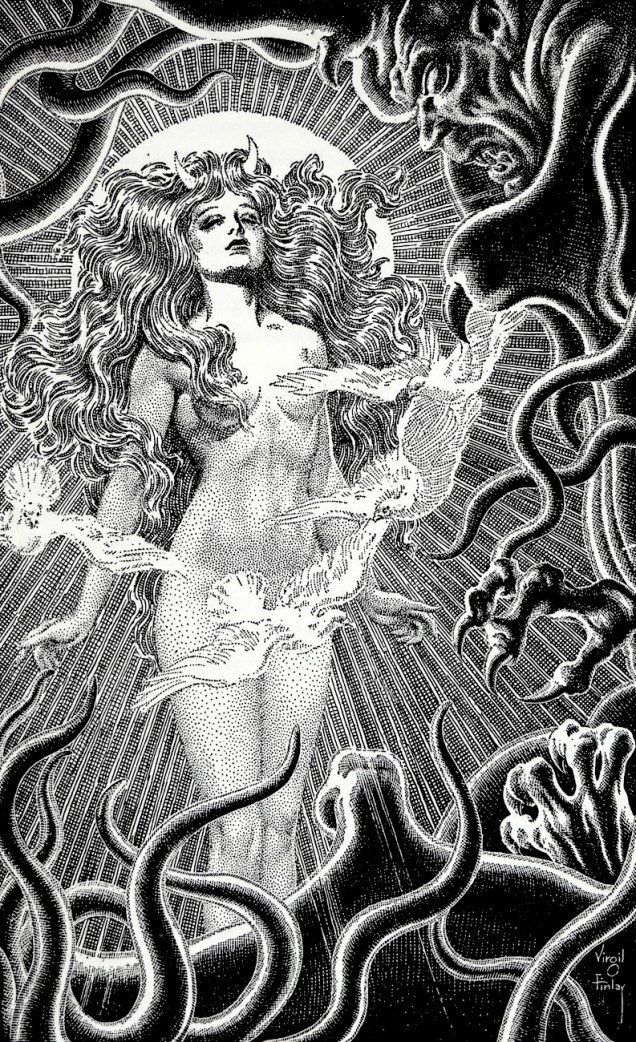
Bruce Timm‘s portrayal of Red Sonja. Has he made her into a blonde? It’s possible. Blondes do have more fun… grappling with tentacles.Illustration from The Art of Nestor Redondo (Auad Books, 2016). I can’t guarantee that these are indeed tentacles, and not sea serpents or something… but hopefully the spirit of festive generosity will ensure my audience forgives me.Including a Virgil Finlay damsel-with-tentacles in this post isn’t as much of a stretch as one could think – he has done *a few* comic stories, and besides surely influenced more than a generation of cartoonists and illustrators. This is a vision he created for the 1949 memorial edition of Abraham Merritt’s The Ship of Ishtar.Another Virgil Finlay illustration with adorable octopuses (whose gills make them look rather like mushrooms with tentacles – not unheard of; this link, though awesome, is not for the faint-hearted*).Zakarella, a comics magazine launched in 1976 in Portugal, mostly re-published choice stories from Warren’s Creepy. Zakarella herself was the Portuguese version of Vampirella, but considerably more twisted… or, rather, put into some rather fucked up situations and subjected to the perverted sexual whims of monsters from Hell and whatnot. Her stories were drawn by Roussado Pinto (under Ross Pynn) and illustrated by Carlos Alberto Santos. Please visit the blog Almanak Silva for a wittily-written history of Zakarella… or, if you don’t read Italian (personally, I used Google translate), just ogle the images. This is a panel from Luxúria no Fundo do Mar, published in Zakarella no. 7 (June 1976).
~ ds
*The article I linked to also contains this not entirely tentacle-related, but amazing (especially if, at heart, you’re a kid who’s into creepy things) explanation:
Dog Vomit Slime Mold: This creature isn’t technically a plant or a fungus, but it is one of the most fascinating creepy-looking things in nature. “It’s basically a giant amoeba,” Hodge says. “Usually, you can’t see an amoeba with the naked eye. But the dog-vomit is the size of a dessert plate.” She adds that she gets a lot of phone calls about the dog vomit slime mold, which often turns up in people’s garden mulch. “They look weird, and they freak people out.” she says. Even creepier, this huge single-celled blob can crawl. “They ooze around for a while, and then they convert themselves into spores,” Hodge says. “Although it’s not really a spore,” she adds, “because it hatches like an egg and a little amoeba crawls out.” That’s the point when I almost dropped the phone. But Hodge was nonplussed. She teaches a summer course about fungi, and she gives her students slime molds to take home and raise. “You can watch them just cruising around on the petri dish, eating oats.” Some of the students really bond with their slimy little pets, she says: “It’s my campaign to convert people to lovers of stinkhorns and slime molds.”




































 Who's Out There?