Hallowe’en Countdown VIII, Day 17

The Moomins* never had a ‘proper’ Hallowe’en, as this celebration didn’t exist in Finland in Tove Jansson’s lifetime. The closest thing was Pyhäinpäivä , a sort of ‘Saints’ Day’ dedicated to lamented loved ones, whose memory is honoured with lit candles on their graves.

That being said, Moomins’ myriad adventures include many costumes and surreal moments that would qualify in a skipped heartbeat as good fodder for the end of October — who needs a specific holiday for sinister goings-on? Tove Jansson knew how to temper the spine-chilling with good humour. Her cast of characters is rich in spooky creatures rejected and misunderstood just because they live by different rules, some of which are, most appropriately to this post, ghosts.

The Hattifatteners (first appearing in The Moomins and the Great Flood, 1945), described as ‘…the little white creatures who are forever wandering restlessly from place to place, in their aimless quest for nobody knows what’ (Comet in Moominland, 1946) certainly qualify as a kind of ghost, with their whitish colour and the soft flexibility of mushrooms on thin stalks.

Hemulen (looking a bit Slavic there) and the Hattifatteners, whose appendages (appropriately) make them look like a bunch of crosses at a graveyard.

The Moomin lore includes actual ghosts, too. One example is the Island Ghost, featured in The Exploits of Moominpappa (written in 1950, and that can be read in its 1968 revised version here). In typical Jansson fashion, he can’t actually haunt very well, and is prone to random bouts of sneezing. He also likes knitting. That description fits me well, actually, so perhaps I’m a ghost, too.

« The room had suddenly grown cold with an icy draught, and the ghost sneezed. I don’t know how you’d have felt, but for my part I immediately lost much of my respect. So I crawled out from under the bed and said: ‘Cold night, sir!’
‘Yes,’ replied the ghost in an annoyed tone. ‘A bleak night of fate resounding with the horrible wails of the phantoms of the gorge!’
‘What can I do for you?’ I asked politely.
‘On a night of fate like this,’ the ghost continued stubbornly, ‘the forgotten bones are rattling on the silent beach!’
‘Whose bones?’ I asked (still very politely).
‘The forgotten bones,’ said the ghost, ‘Pale horror grins over the damned island! Mortal, beware!’ The ghost uncurled, gave me a terrible look and floated back towards the half-open door. The back of his head met the door-jamb with a resounding bang.
‘Oops!’ said the ghost…
»

The Moomins (1983) S01E45 – Island Ghost

This is not the only time the Moomins tried living on an island or encountered a ghost. Moominpappa at Sea (a story published in the daily strip in 1957, and similar to, but not entirely the same, as the novel from 1965), in which the Moominpappa becomes a lighthouse keeper, features another timid spook who does such a rattle-up job terrifying Moomintroll that he gets banned from haunting by the stern Moominmomma. Given this story’s mostly nocturnal setting, lonesome lighthouse and clanging chains galore, it’s highly appropriate to this October. The following version has been ‘reworked’ in colour by Drawn&Quarterly:

Tove’s brother Lars Jansson, who took over the writing (and eventually the illustration as well) of the Moomin comic strip in 1958, also has something to contribute to this Hallowe’en post. As an honourable mention, I offer you his Moomin and the Vampire (1964). One can argue that his stories lacked the soul (and artistic ability) of his sister — I’m not here to discuss that, just to take a peek at the little vampire bat escaped from a zoo.

~ ds

* Not sure who The Moomins are? Visit Poise and Prudence: Tove Jansson’s The Moomins.

Hallowe’en Countdown VIII, Day 11

« … devolving into a downright National Socialist muck of murderous paranoïa, a Lord of the Flies for our new century… »

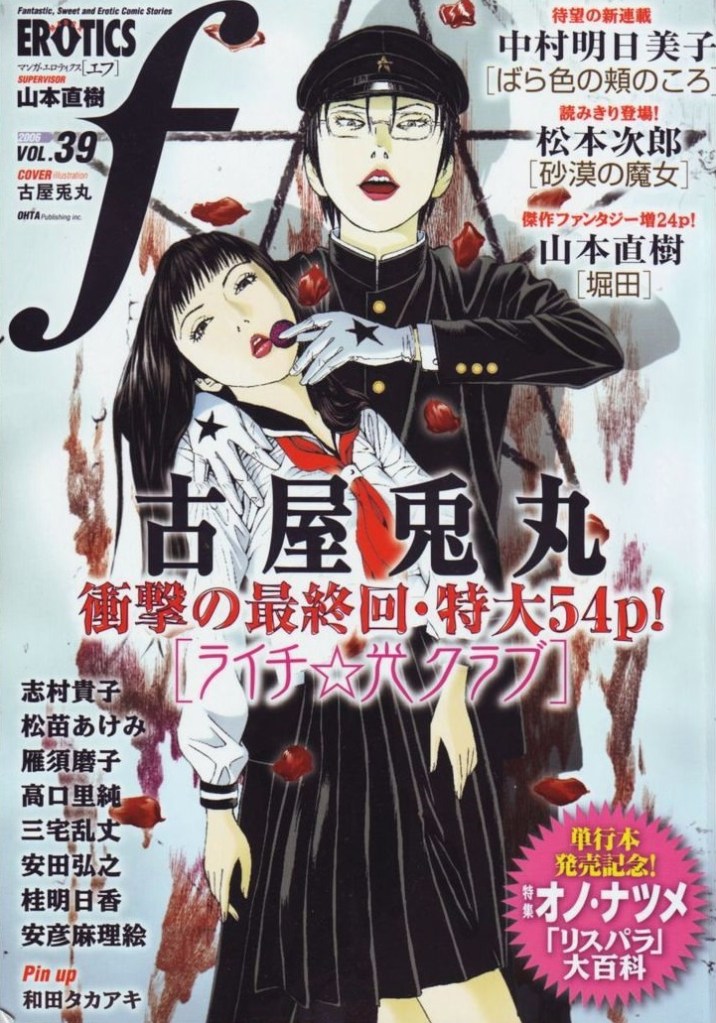
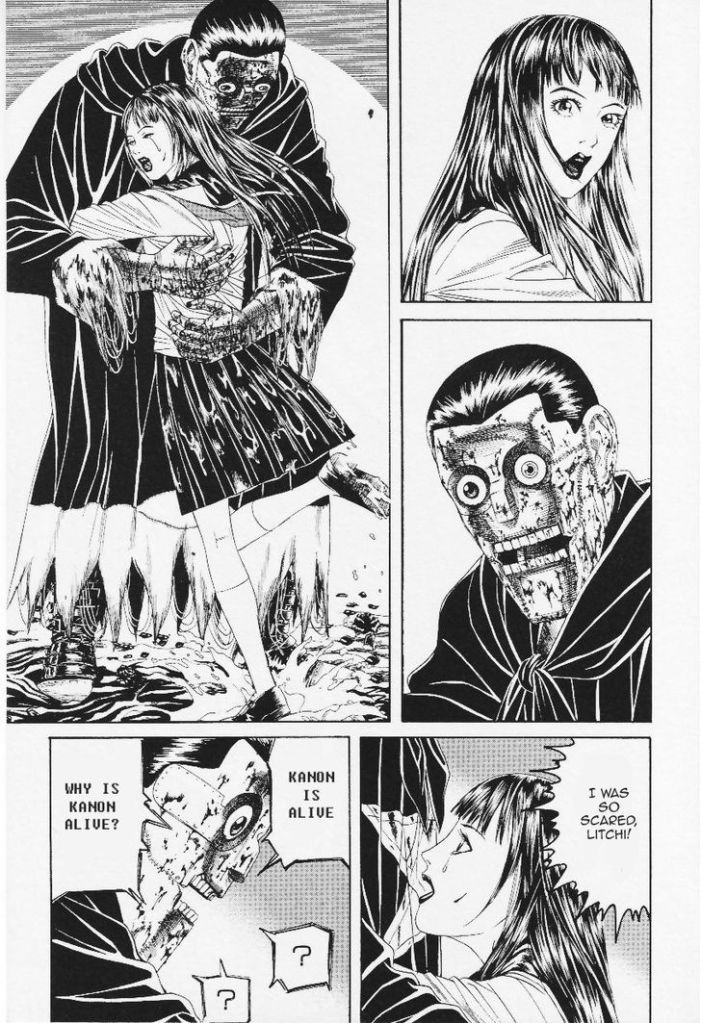
Lychee Light Club, aka Litchi Jirai Club (ライチ☆光クラブ), is a manga written and illustrated by Usamaru Furuya, who was smitten by a theatre play of the same name after watching it in 1985 as a high school student. Years later, he recreated it in manga form, albeit with a somewhat modified plot. It was serialized in Ohta Publishing’s Manga Erotics F* (May 7, 2005 – May 3, 2006). As for the play, it was directed by Norimizu Ameya** for the theatrical group Tokyo Grand Guignol (it’s funny to see the French ‘guignol‘ in this context).

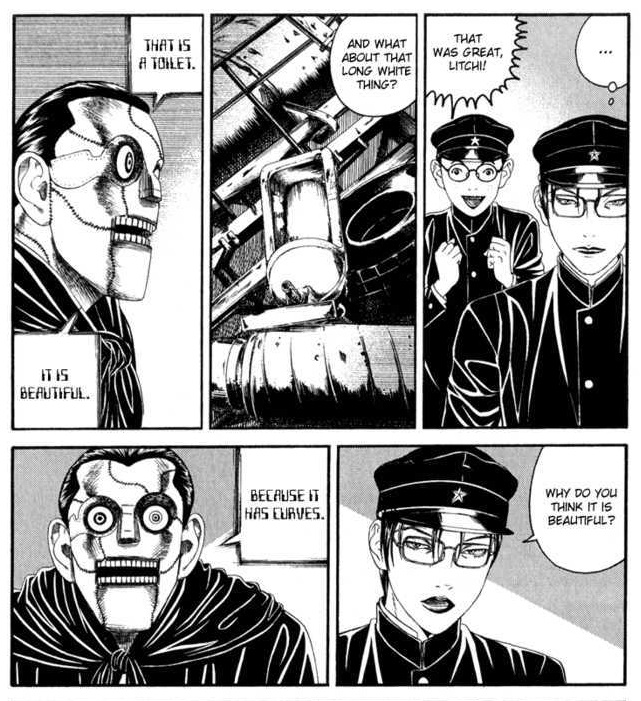
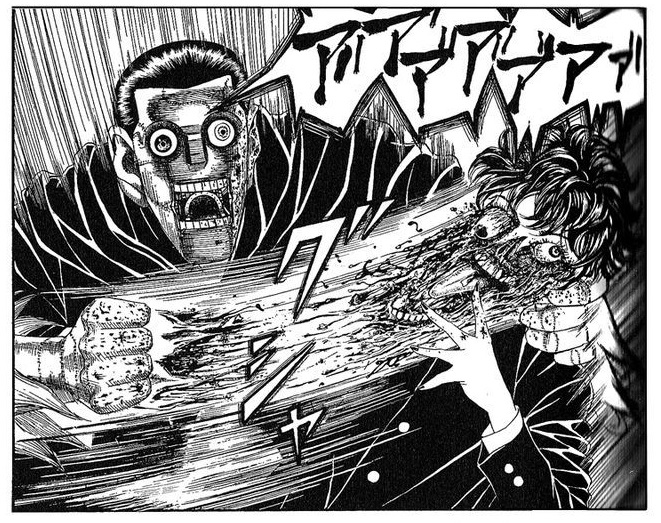
Lychee Light Club‘s over-the-top violence elicits the occasional chuckle (one of its characters dies from somebody pitching a toilet through his midsection), and more than one wince of discomfort, too, as its schoolkids maim, bash and burn their way through the story. The premise is simple – Lychee Light club (more of a cult, really) consists of eight barely-teenage boys who worship youth as the ultimate symbol of beauty (and, consequently, hate all things adult). They have nice digs where they spend all their time after school – an abandoned factory with plenty of dumped implements useful in their pursuit of the sadistic. They are led by the charismatic and cunning ‘Zera’ (actually, Tsunekawa from class 2), whose charm and fine features inspire blind devotion from his gang, not to mention occasional sexual favours.

To pursue their vision of eternal youth and a universal, if unfocused, lust for power, the posse builds a mostly robotic ‘thinking’ machine-cum-Frankenstein-monster, all metallic parts except for a human eye ‘borrowed’ from Zera’s number Eins, Niko. Zera informs his crew that he planted lychee seeds in a landfill three years ago… and now they have a forest of trees heavy with fruit at their disposal as fuel for Lychee, their mechanical prodigy. Apparently Zera is also a brilliant agriculturist, for lychee trees are notoriously slow to bear fruit, and three years later he’d have a forest of greenery at best. ***

Lychee awakens! When questioned about why he is born, Lychee’s computer algorithm spits out that its mission is ‘to capture a girl’, so off he goes to kidnap many until he finds one beautiful enough to be their ray of light, eventually bringing Kanon, the female protagonist.

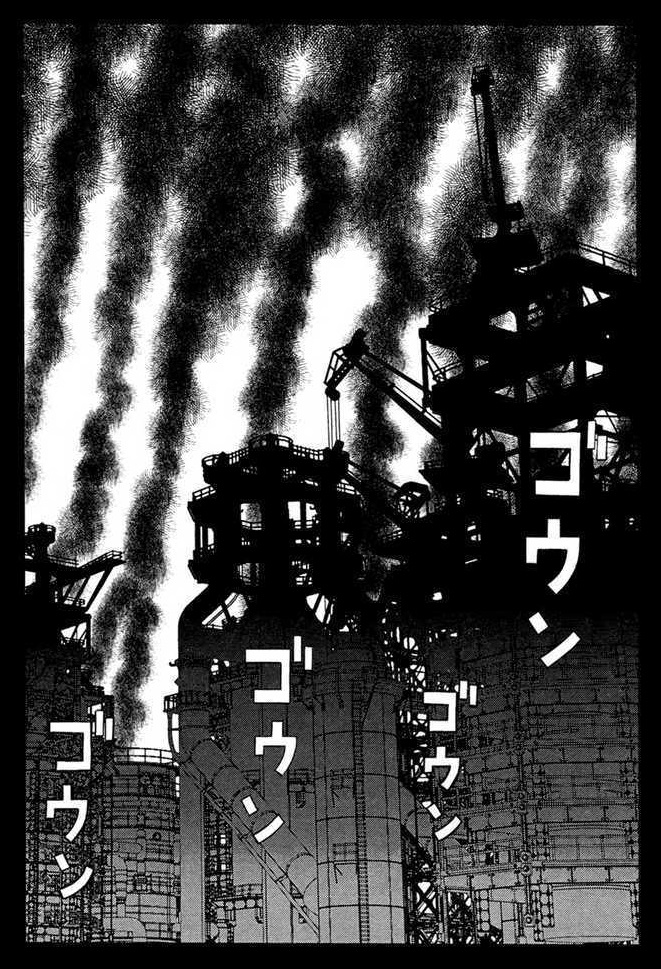
The story’s settings immediately plunge the reader into a kind of claustrophobia – filthy streets, a sooty factory, trashed cars — clearly an industrial town which doesn’t offer much hope for a better future. The boys’ lives outside the club are barely discussed, but the story hints that they all come from an uncomfortable family situation, though apparently they’re all ‘good kids’, as their maths professor incredulously notes before she is gleefully tortured and murdered.

Don’t forget to read right to left! Much later, in a fit of poetic justice, Zera gets killed by a toilet with (doubtlessly) beautiful curves.

There is a strong current of body dysphoria running through Lychee Light Club, fitting for a set of characters so fixated by ‘beauty’. The megalomaniac Zera is obsessed with Elagabalus, a Roman teenage emperor known for his sexual decadence (apparently to the point of standing out for his outlandish vices among other Roman emperors centuries later, which is surely a feat of some kind, given what some of them got up to). 

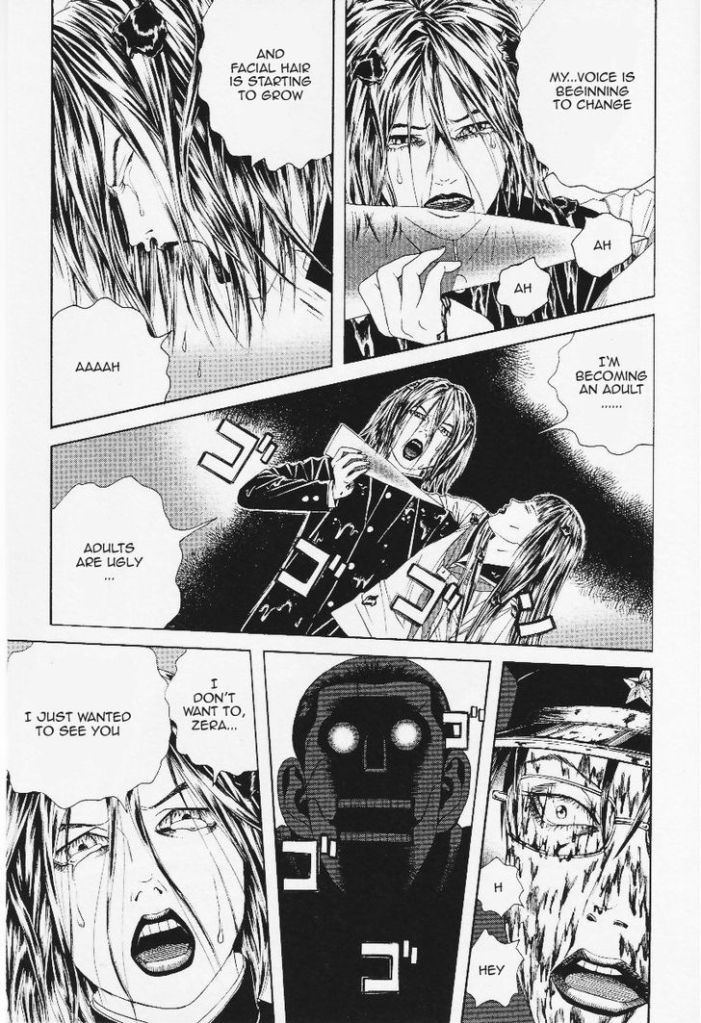
In a sort of Peter Pan/Neverland situation, the boys are nauseated by the sight of an adult woman’s body (her breasts are qualified as ‘repulsive, swollen lumps of fat’), and horrified by her ‘ugly’ innards, wondering whether their own organs are ugly, too (plot spoiler: they are, indeed). They obsess over Kanon, the eventual heroine of the story, because she’s soft and beautiful (but hasn’t turned into a woman yet). Kanon herself doesn’t want to grow up because she’s worried Lychee (at that point ‘humanized’ by her love) will reject her adult self. 

All of them need to urgently get to therapy, but instead of that eyeballs are ripped out, innards (not to mention semen) are spilled, and the whole thing ends in an utter bloodbath, leaving the only ‘innocent’, Kanon, mourning Lychee, who is now more ‘human’ than the members of the Lychee Light club because he understands that murder is wrong. Reading this manga is a bit like observing a train wreck. Nothing in this story is nearly as profound as it pretends to be, and plot holes bloom much like lychee flowers — and yet its mostly naïve characters stick in one’s mind. Poor, poor children.

« …a mere plaything, having feelings! »

~ ds

* Speaking of the erotic… a quick perusal of blurbs quickly yields ‘Shocking, sexy and innovative, the Lychee Light Club is at the pinnacle of modern day Japanese seinen manga (young adult comics)‘, with which advertisement I have several bones to pick. ‘Sexy’ is an uncomfortable description of a manga with sadistic violence and heavily underage protagonists, though eroguro fans probably lap the former up. As for the ‘young adult comics’ bit, I’d like to submit a petition to stop assuming that stories about teenagers are meant to be necessarily read by teenagers. Should ‘old’ people read exclusively about the elderly? One can argue that adults aren’t so interested in reading about to-be-adults (my case in point, Wheel of Time book one, which I recently read, and whose adolescent protagonists were intensely annoying), but that speaks more to a lack of storytelling ability.

** Who’s had a wild enough (perhaps ‘unhinged’ would be a better description) life that he would merit an entire article by himself (see a summary here).

*** As far-fetched as this plot is is, the anime by the same name (loosely based on the manga) is hilariously goofy where the manga was highfalutin. Take the plot of episode number 6, in which ‘Some members of the club wonder if Lychee really only runs at lychee fruit and then offer him a peach. As he accepts it, they give various other foods and eventually Lychee develops culinary skills.’

Hallowe’en Countdown VIII, Day 3

« If men had wings and bore black feathers, few of them would be clever enough to be crows. » (source)

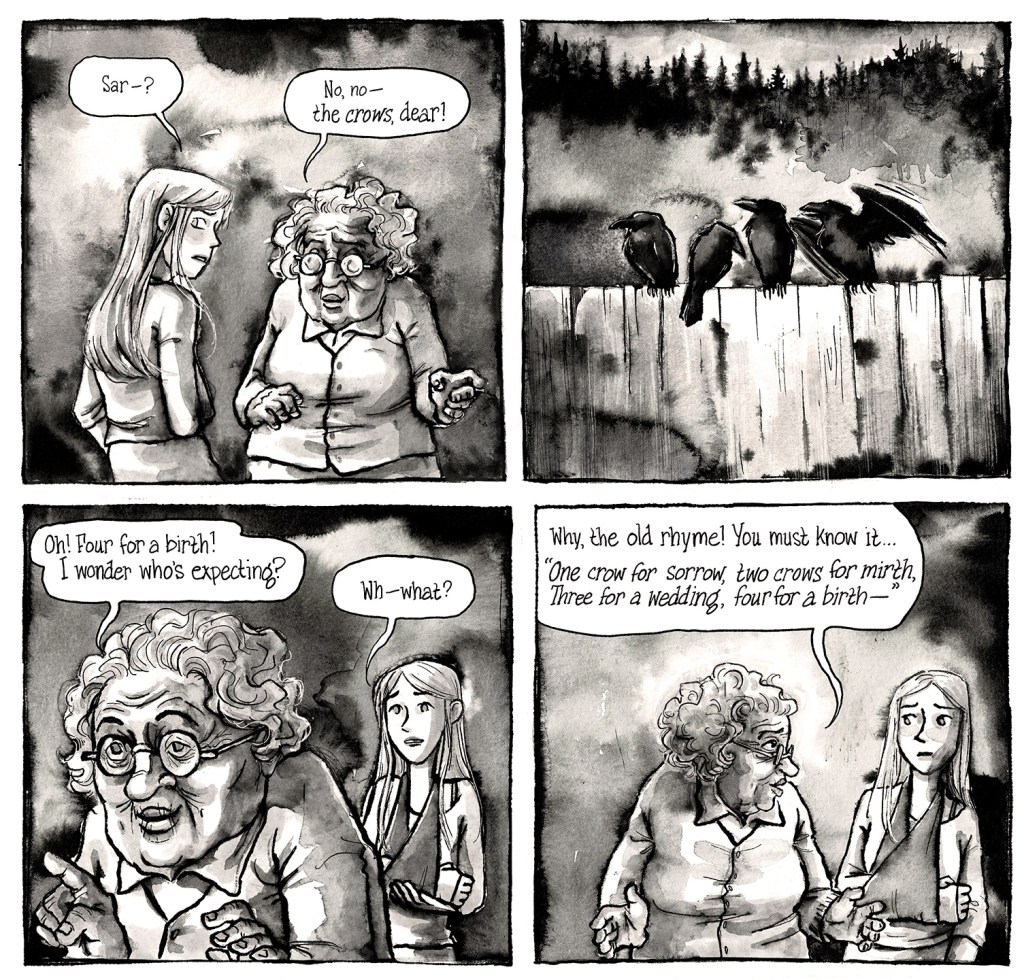
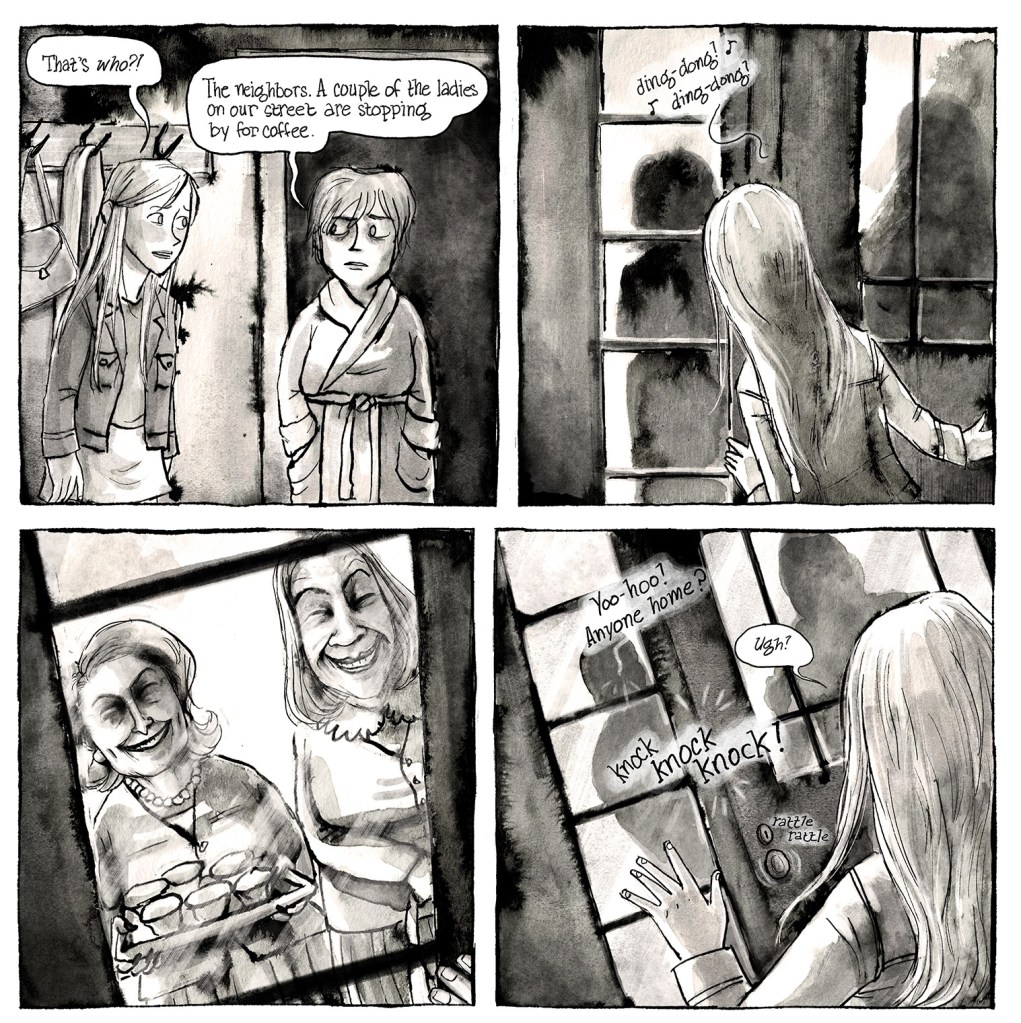
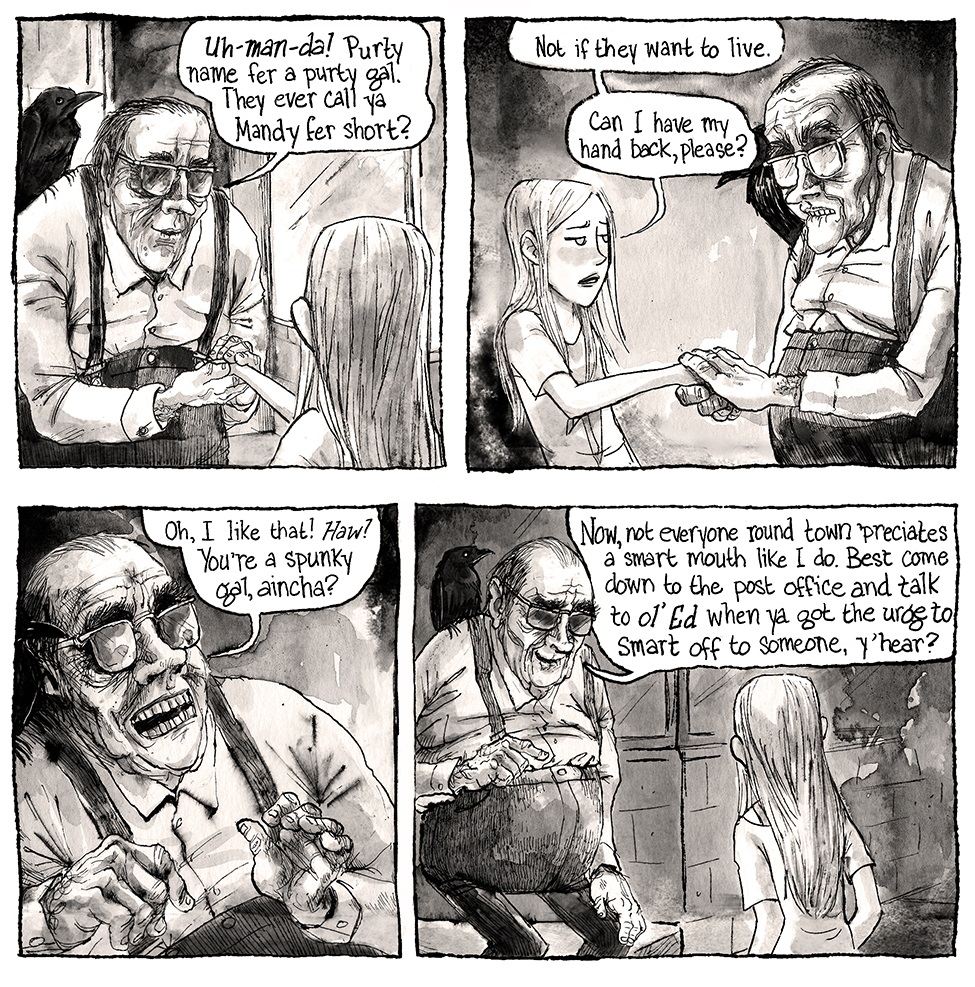
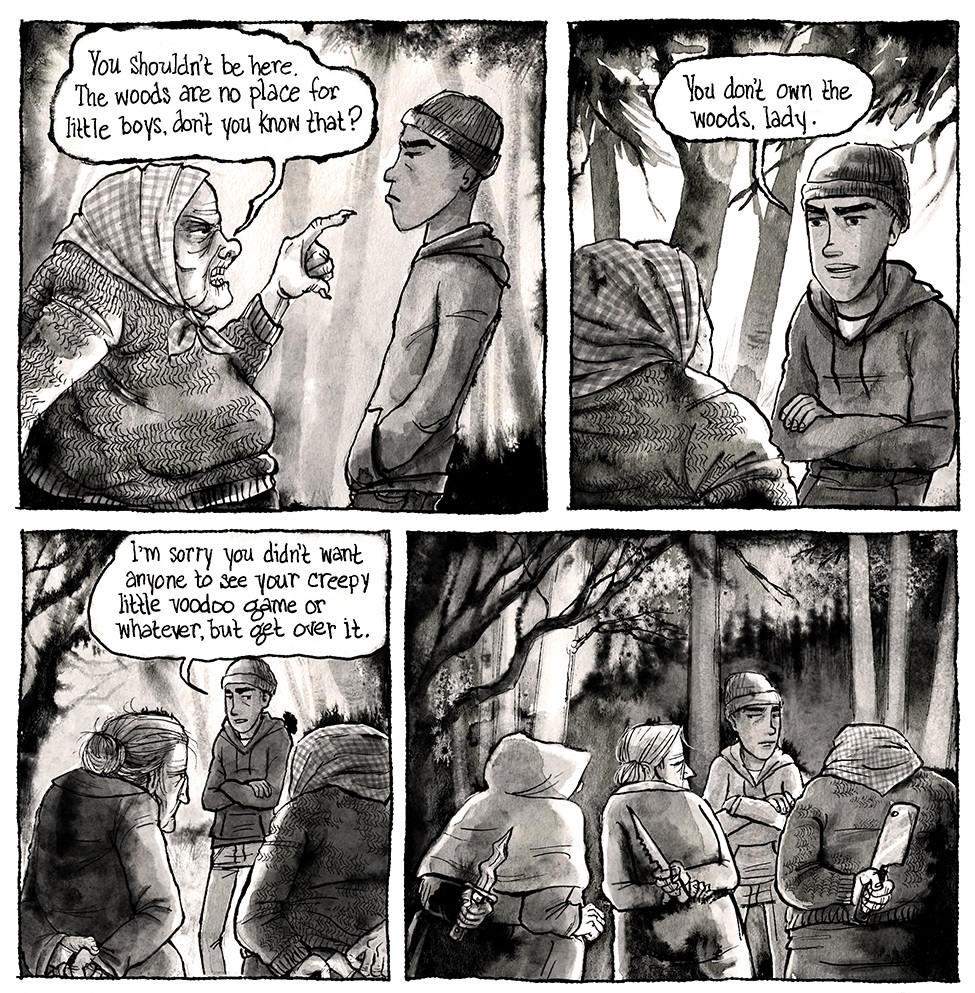
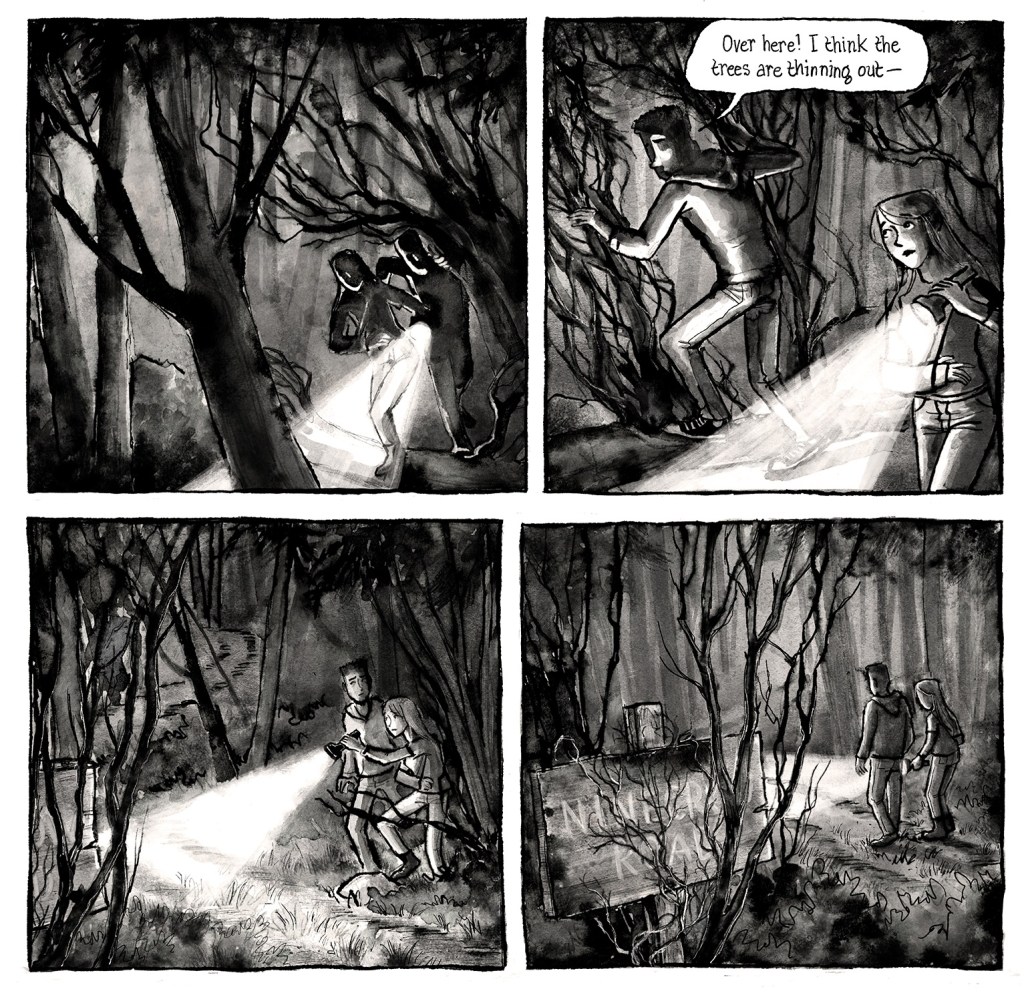
Today’s titillating offering deals in tropes that horror devotees will readily recognize – a Town with a Dark Secret ensnaring The Plucky Girl in its mysteries and underlying violence. Mysterious disappearances, the proverbial ageing small-town creep whose smile hides uncomfortable truths, oblivious locals… it’s been surely done before, yet the graphic novel Ninecrow by Dora M. Mitchell , initially posted as a biweekly webcomic that ran from 2020 to 2022, succeeds in creating an unnerving story out of these readily available narrative blocks.

Amanda, a teenager whose divorced mom relocates them to a town in the middle of nowhere (shades of Eerie Indiana et al.), does her best to adapt to her new life, but her new place of residence is, well… alarming in a number of ways.

Lovingly drawn in mostly black-and-white watercolours, Ninecrow offers the reader plenty of visual enjoyment peppered with hair-raising details faintly glimpsed in shadowy corners. The hand-lettering is also worth a mention, especially given that modern graphic novels often dispense with this element in favour of a computer-generated font. Both art and letters remind me of the tragically departed Patrick Dean, especially some of his work like Underwhelming Lovecraft Monsters.

Aside from its crow population, the town is also abundantly stocked with disquieting old people in various stages of brain fog. Aside from Amanda and a couple of others, everybody seems to be middle-aged going on ‘soon dead’, and not of the pleasant fluffy-grandparent variety, either.

I bought the print version of Ninecrow on Kickstarter because I much prefer reading books in a physical format (you can still buy the deluxe version on the publisher’s Etsy page), but you can still read the full thing story online on the website: https://ninecrowcomic.com/

Enjoy the traipse through the woods!

~ ds

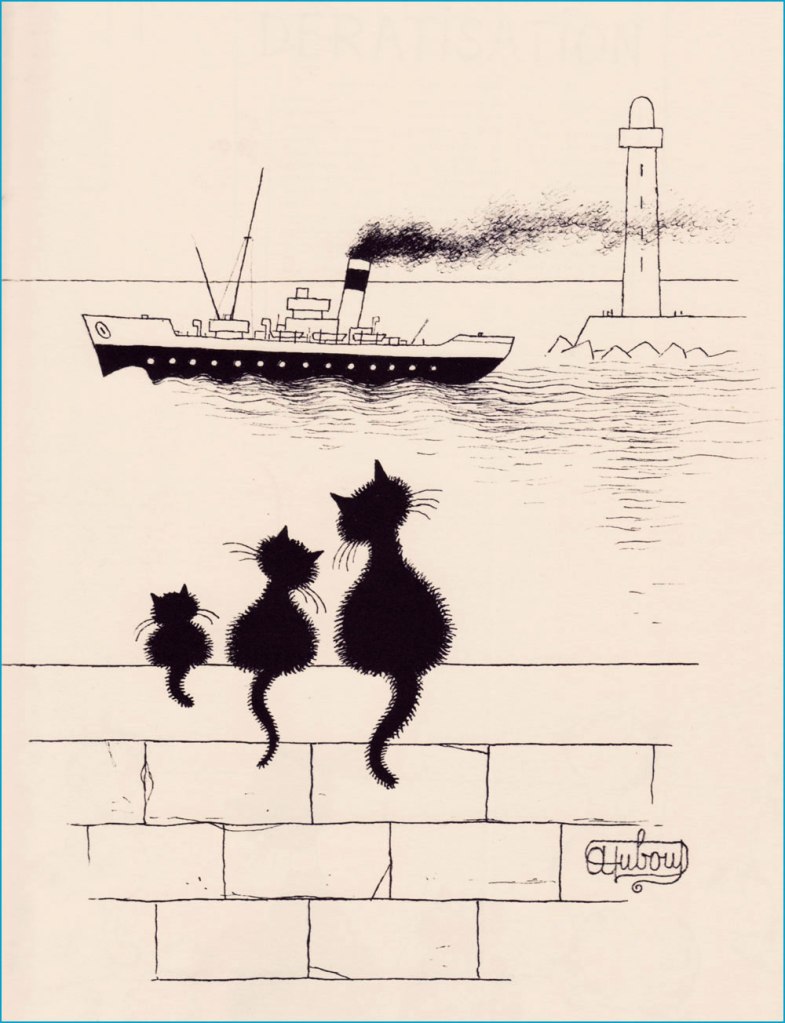
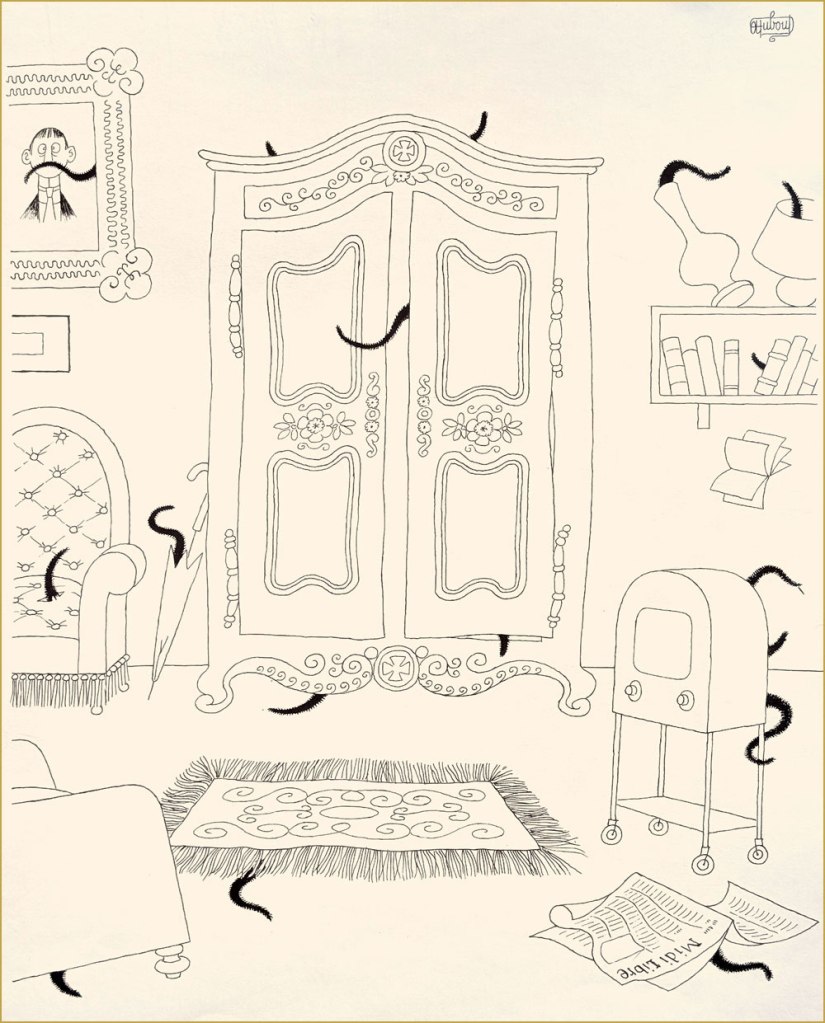
Espiègles, impétueux: Dubout’s Impish Cats

« One cat just leads to another. » [source*]

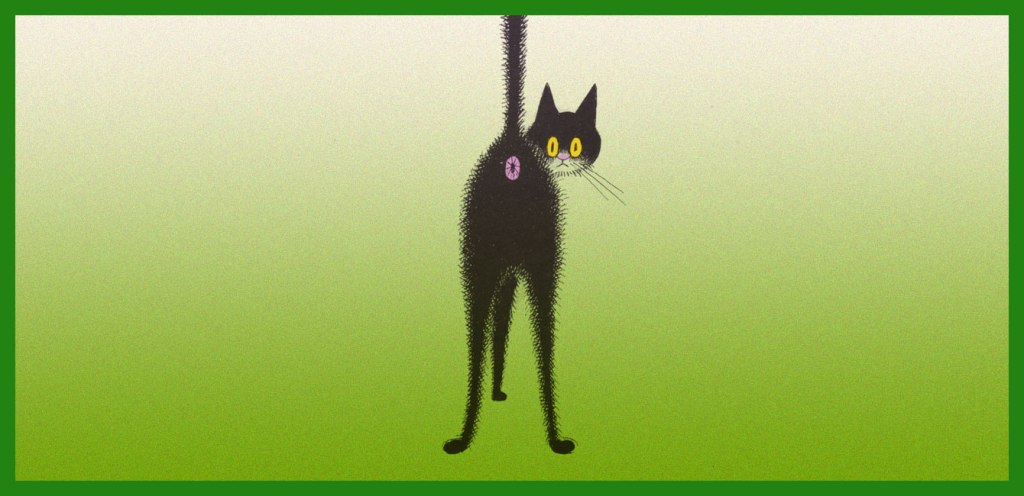
Kitty butts are the ordre du jour.
Back of Bob Foster’s Myron Moose no. 1 (Myron Moose Comic Book Works, 1971); this art print was also released years later, as can be seen by the date on it.

We are technically a three-cat household — that’s how many cats we had decided we could comfortably handle. For a while we stuck to this number, and when one cat departed, another one would come to take his place. Then number four walked through the door — he was sort of a part-time cat, until he became decidedly one of ours. Well, four isn’t that much more work than three. When number five appeared, bedraggled, underfed and with a perpetually sad expression (‘he had that look you very rarely find — the haunting, hunted kind‘, to quote Tim Rice), we wanted to give him to a rescue society… and of course ended up keeping him.

Albert Dubout (born as lbert Dubout, 1905-1976), was primarily an illustrator of books (notably, his amical collaboration with French writer San-Antonio, many of whose novels proudly bore Dubout’s covers and inside illustrations), and, with equal talent, a cartoonist and poster designer (check out some of his film posters here), not to mention a calligrapher with a number of delightfully mellifluous signatures. His official website can be found here, in case you want to take a peek.

The following excerpts have been scanned from Les chats (Editions Hoebeke, 1999).

Although the topic is obviously inexhaustible, for some more fun cats, visit Off to the Isle of Cats — and Back by Teatime!, Commence by Drawing the Ears: Louis Wain’s Cats, Q: What’s Michael? A: Kobayashi’s Most Special Cat or Steig Swoops In: The ‘Epic in Jazz’ Cat Sextet.

This cover was published posthumouslyEdward Gorey submitted it in 1992, but another of his drawings was selected instead. Gorey, who died in 2000, was of course another one of those famous cat persons.

~ ds

*I don’t like Hemingway at all, but I do have a certain grudging respect for a man who kept some 40+ cats. Rhetorical question: are cats living at that high a density within one house really having a good time?

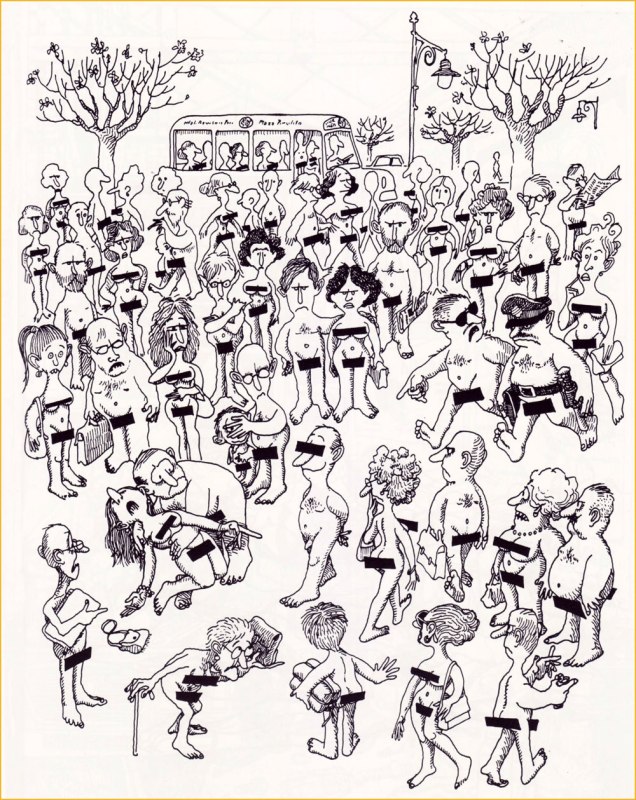
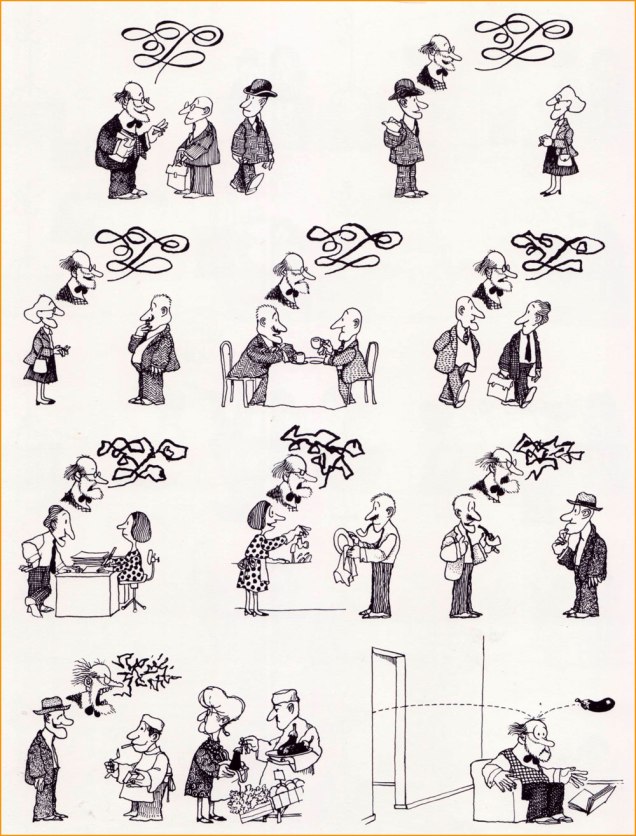
‘It’s not that big of a deal’: Quino

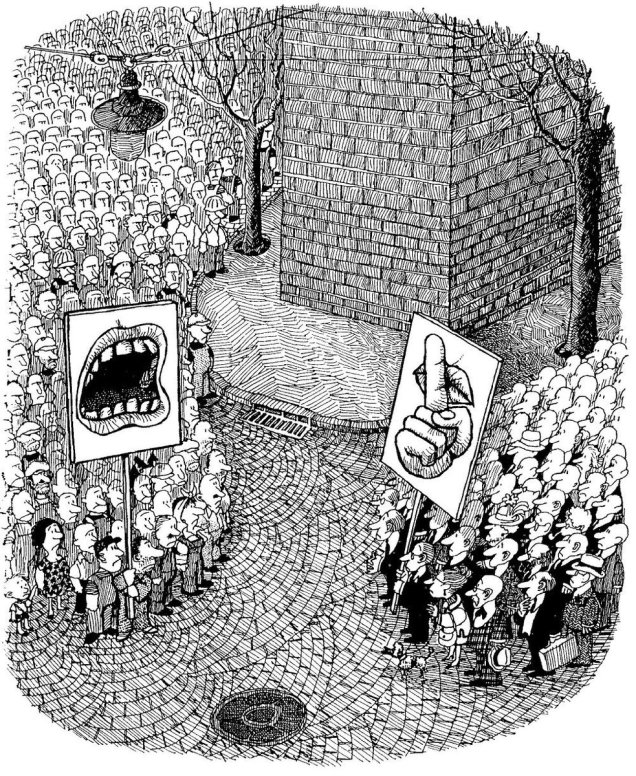
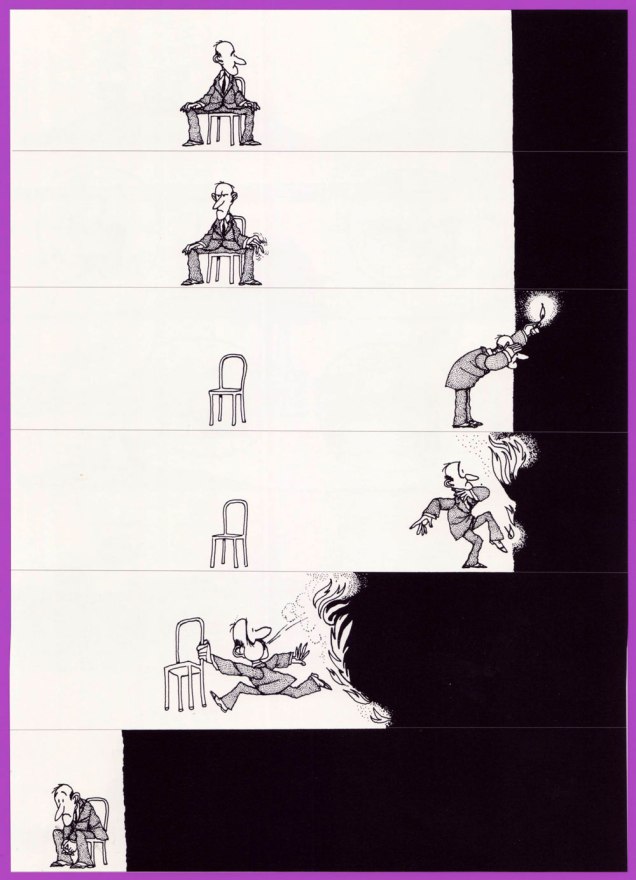
In the early days of WOT, before I got used to the blog format (as opposed to posting-on-Facebook format), sometimes my posts only contained a few images. Idly looking through my library the other day, I concluded that it’s a pity Argentine cartoonist Quino is only represented by three selections from a collection specifically about food (the aforementioned post — from 2017, what children we were then! –is (27178) Quino*).

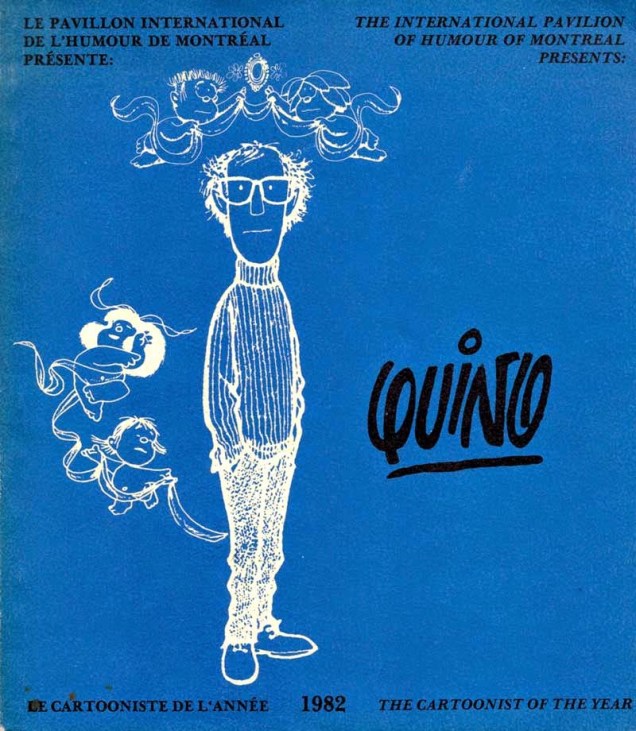
Joaquín Salvador Lavado Tejón was alive in 2017, but now he is dead. He died in 2020 in Argentina, having returned to his place of birth after a long exile, after the National Reorganization Process was dismantled and democracy restored, in 1983. He did not live to see the election of bedlamite right-wing Javier Milei in 2023, which is probably just as well.

This is definitely not the place for provocative political discussions, but how offensive can a few smooth ink lines on paper be? Interpret the following as you will.

For a fervently written eulogy, head over to TCJ: QUINO: 1932 – 2020

« “Violence is everywhere,” stated Quino, in Pergolini’s 2014 interview. He was talking about ants. The ants he used to watch and move around in his childhood home. His cartooning, adored even by his always-quoted Umberto Eco, feels like an echo of that idea: Violence is everywhere. But, at least in his work, genius is also everywhere, as well as his heartfelt indignation, fueling one of the brightest of 20th-century takes on humanity. »

~ ds

P.S. While looking up stuff for this post, I stumbled across a « Quino AI Art Style Inspiration » (which has very little to do with Quino’s style or raison d’être). No comment needed.

Marge’s Feisty Little Lulu

« You can bring Pearl, she’s a darn nice girl,
But don’t bring Lulu!
You can bring Rose with the turned-up nose,
But don’t bring Lulu!
She’s the kind of smarty

who breaks up every party,
Hullabaloo loo, don’t bring Lulu,
I’ll bring her myself!
»

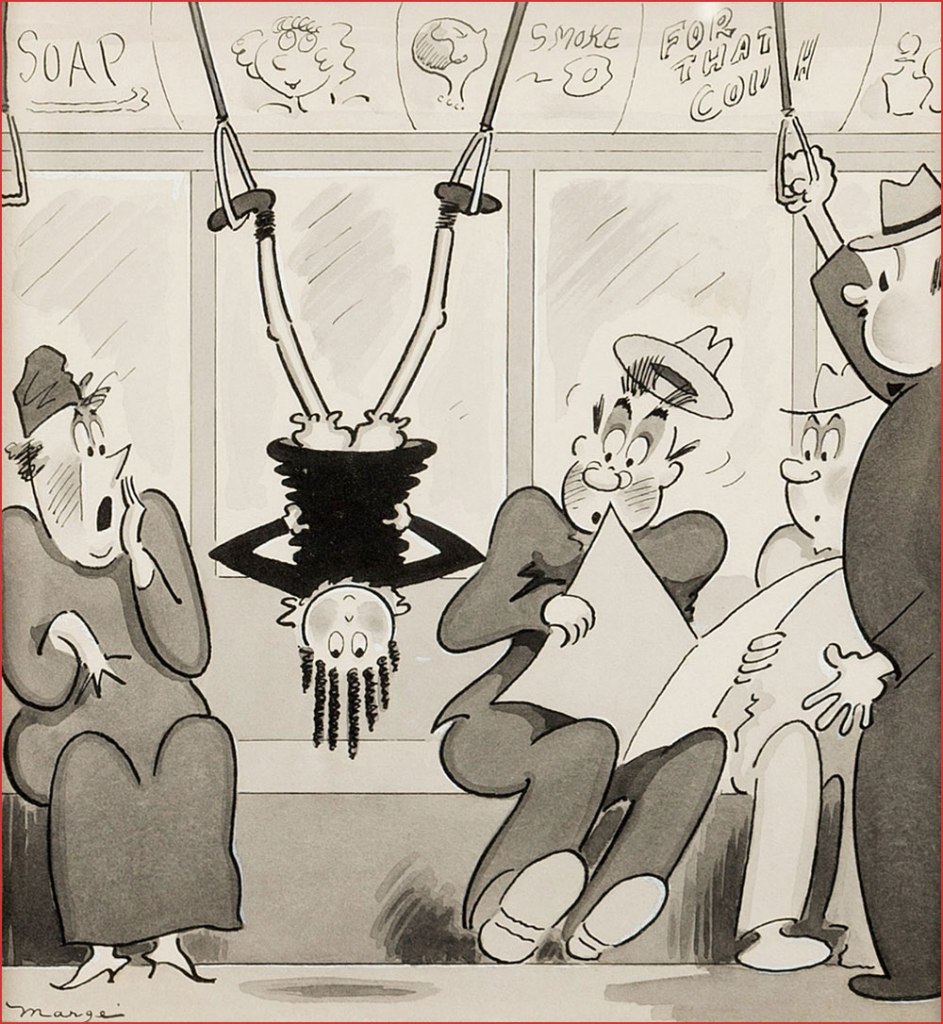
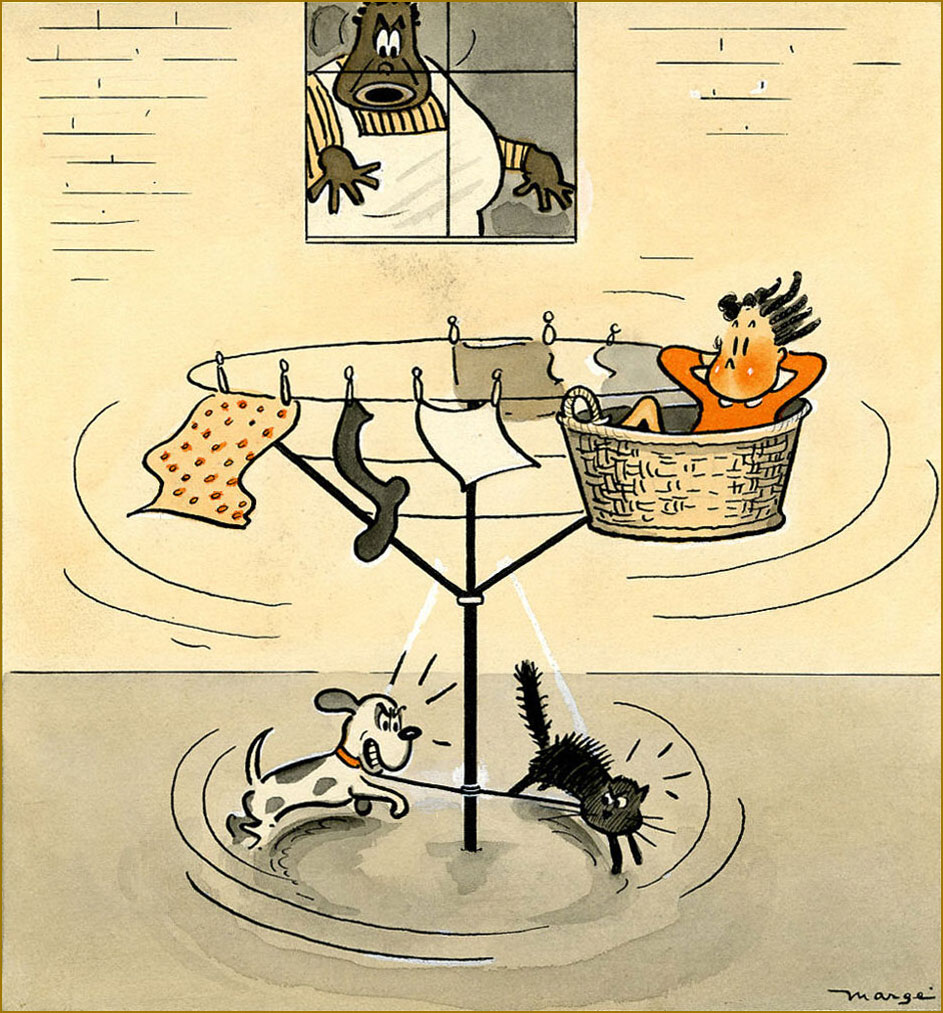
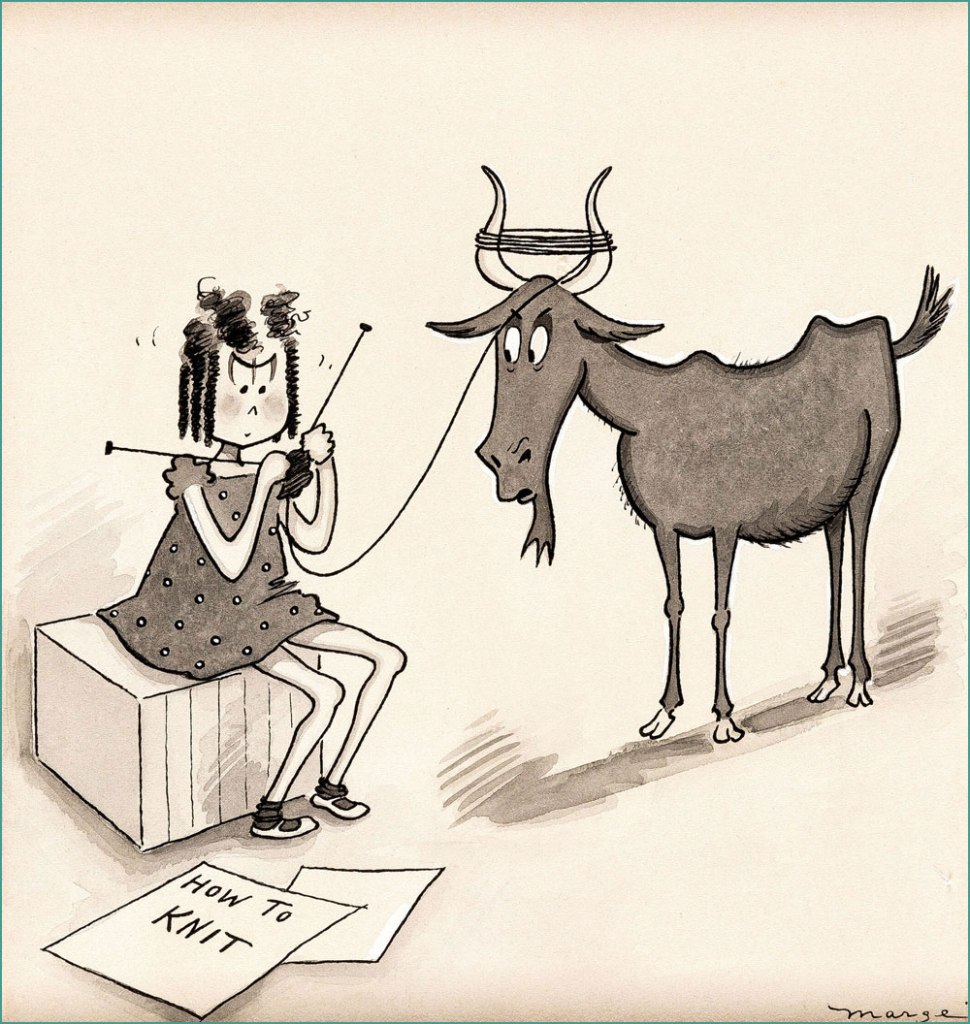
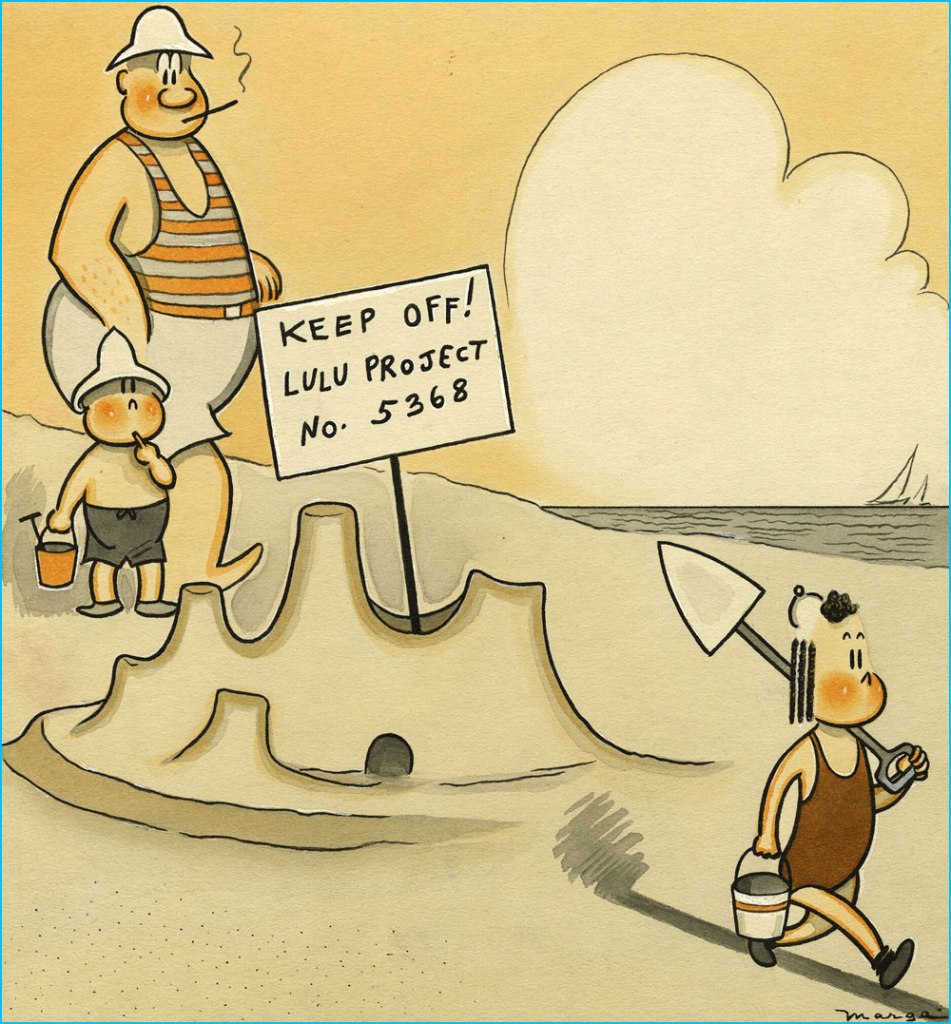
À propos of the comic strip Little Lulu (running from 1935 to 1944 in The Saturday Evening Post), co-admin RG indicated in his Hallowe’en Countdown V, Day 30 that he ‘just happens to dislike Lulu creator Marjorie ‘Marge’ Henderson Buell‘s visual conception of her characters‘. Entirely fair enough, but I happen to appreciate Little Lulu for her unremitting dedication to horsing around (and Buell for her subtle use of watercolours).

Going through a bunch of strips in search of ones to feature here confirmed my previous impression that Lulu can be quite the brat, à la Dennis The Menace. It can be argued that all kids have the capacity to be destructive with a considerable amount of enthusiasm, though from my current adult perspective, destroying plants (something Lulu seems to do a fair bit of) is an idiotic act, whoever one is trying to piss off. While sharing a doigté for outfoxing (and occasionally literally thwacking) boys, Lulu was wilder and meaner than Bushmiller’s Nancy, the latter tending to be a helpful, earnest kid despite her share of shenanigans. You won’t really notice this from this post, as I distinctly prefer sweet over abrasive.

From a modern perspective one would be tempted to lump Lulu in with other feminist cartoon icons, given that Buell clearly enjoyed depicting her independent streak. John Harvith (involved in a retrospective of Buell’s work in 1982) is quoted as saying ‘[Lulu] was a pioneer in presenting a girl cartoon character who was resourceful, courageous and who regularly beat out the boys‘. As to her creator, Buell is credited as ‘the first female cartoonist in the United States to achieve worldwide success‘ (source: Little Lulu comes to Harvard). *

While she is cited as resisting the ‘feminist’ label when it came to her work, I think it was more out of a dislike for pigeonholing her material. ‘Marge [did not] welcome the idea of introducing feminist themes into the cartoon. She preferred to let the character’s actions speak for themselves. She created this feisty little girl character who held her own against the guys and frequently outwitted them, but she didn’t want to turn the cartoon into a message. She agreed with Samuel Goldwyn’s slogan, ‘If you want to send a message, try Western Union.'”

In her personal life, Buell demonstrated an enviable degree of wisdom in her marriage to ensure that both their careers would progress without breaking the family apart (her husband agreed to turn down promotions that would force them to relocate, and she agreed to keep Lulu in check in order to spend time with her children).

If you need another reason to like Little Lulu, The Little Lulu Show, running from 1995 to 1999, featured the voice of Tracey Ullman as the protagonist during the first season.

~ ds

* These days it’s mostly John Stanley’s Little Lulu that grabs the affection spotlight in people’s memories.

Orange Tomcats of Vasya Lozhkin: Darkness Descends

Despite the online abundance of all manner of cat cartoons, the work of Russian artist Vasya Lozhkin (the nom de plume of Alexei Kudelin, born in 1976, lawyer by profession) stands out. Passed around on social media with equal enthusiasm by housewives looking for a giggle, journalists foraging for a satirical cartoon to supplement an article, and art lovers with a penchant for the feline, his paintings run the gamut from wistfully sentimental to quite scary, often in some combination thereof.

One can argue whether Lozhkin is actually an Artist or not (capital A intended) — he himself says that he loves painting, but is no painter. As far as I’m concerned, his eye for colour and striking compositions compensate for whatever deficiency may exist in terms of actual drawing talent. He’s unabashedly prolific, returning again and again to the same themes, populating his world with an addictive medley of orange tomcats, grannies of a threatening disposition, sad Slavic bears and grey bureaucrats of ill intent… as well as good sprinkle of ‘ordinary’ people gone mad, with or without the presence of alcohol. There’s a lot of alcohol.

I’m an artist! I have a certificate!’ The author posing next to one of his paintings.

It is Lozhkin’s cats that mostly grab the public’s fickle heart, thus providing their creator with what must be a fairly steady income from knick-knacks of all kinds, à la Kliban*. I’m glad. If it didn’t involve ordering stuff from Russia, I’d be first in line for, say, a mug or two. He has produced something like five thousand paintings so far, exhibiting no shyness whatsoever about recreating particularly successful canvases. He notes that ‘I like cats, but so does my audience. Since my job is to feed my family, I feed it with cats.’ His pragmatism strikes one as being almost defensive.

« Life is a merry carnival »
« Smile, and this world will smile back at you! »

« Talking about the ideas behind Lozhkin’s paintings is like explaining a joke — the explanation will not make it funnier or clearer. His metaphysical world is a sort of peculiar successor to the classic Lubok, where a highly amusing image with a straightforward caption is filled with philosophical meaning. Grotesque buffoonery is aimed to the public exposure of a man’s self, his hidden aspirations and his dreams. The Skomorokh makes an absurd mockery of events, turns the innermost self inside out, so that Man can see his soul — see it and laugh at the absurdity of its ideals. » [source in Russian]

« Stuffing your face while Motherland is sleeping? »
« Improving the marketable appearance »
« Freemasons invent rock’n’roll in order to wreck USSR »

« Each sees what he wants to see. And hears what he wants to hear. But with the sense of smell, this trick does not work: if one early morning you go stand in the middle of a field, knee-deep in manure, squint your eyes and take a sniff, you’re certainly not going to smell violets. » On the topic of sweet violets

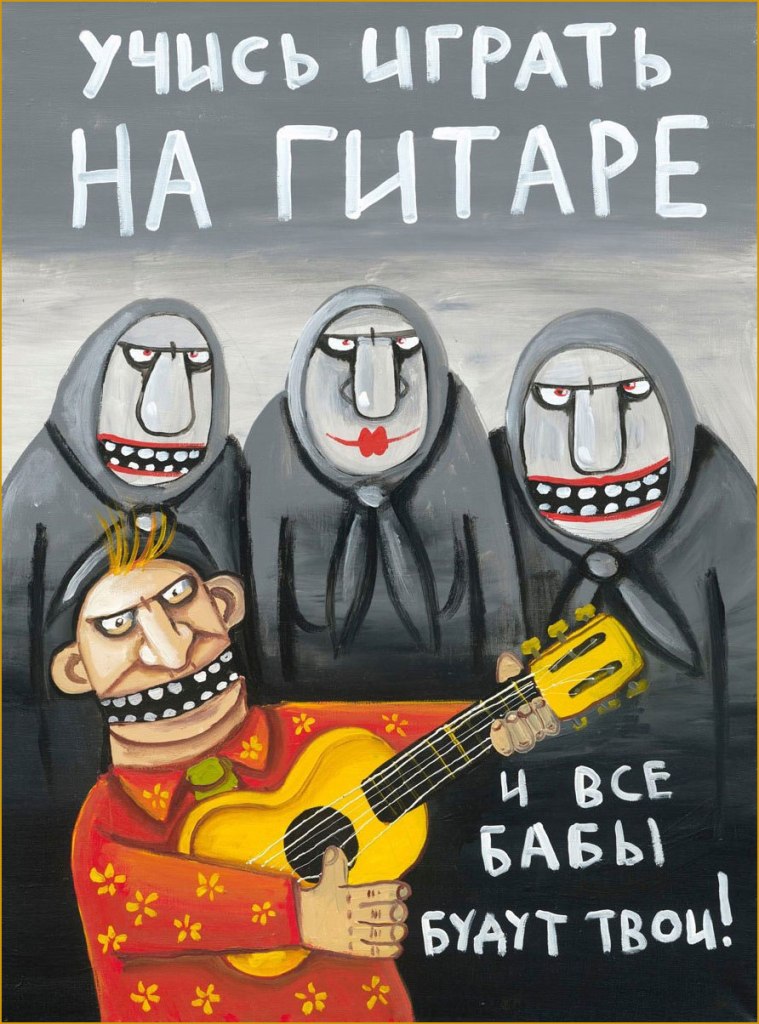
« Learn to play guitar, and all broads will be yours! »
« Get down, fool! »
« Glamour cockroaches got into Petrovich’s head by accident »

Cockroaches in the head‘ is a popular idiom, meaning somebody’s mind is messy or full of idiomatic eccentricities. Do professional art critics ignore Lozhkin’s cats et al because this isn’t high art, or because they’re perplexed? Occasional exhibitions, if not very well attended, are distinctly enthusiastically attended by ‘people with cockroaches in their heads’.

« A soul’s suffering will be healed with love »

Komsomolskaya Pravda (the ‘Komsomol truth’) included Lozhkin in its series of ‘Best Contemporary Artists’, dedicating its 15th volume to his art. On one hand, he is now amusingly rubbing elbows with Edvard Munch (volume 6) or Salvador Dali (volume 30)…. currently the series is up to 34 (Pablo Picasso, and no, I don’t understand which logic these choices are governed by, either). Lozhkin was amused by this, apparently. From this end of the world, having anything to do with a pro-Putin newspaper** with Soviet roots is disturbing, but then again… I don’t have to survive in that climate.

Veer to the right towards the traditional Slavic bear family for ‘Motherland’, stray to the left for ‘Abroad’, with its circus of horrors and immoralities. Internet denizens are scarily divided about this painting – is this satire, or brainwashing? I’ll let the reader decide, based on the rest of Lozhkin’s oeuvre as glimpsed in this post.

In an interview, Lozhkin said that the fairy tales he creates always have a happy ending, despite heavy elements of psychosis. He also mentioned that lately he’s been trying to accentuate on the positive, to evoke pleasant emotions from his audience. I admire the motive, but I’m not sure he believes in it himself — there is little doubt that the darkness deepens.

« Each one of us, if you look carefully, has this bottomless depth; everything is in there, the icy horror, this hopeless darkness, gray hopelessness and green melancholy, as well as terrible laughter, pandemonium, devils, animals, cockroaches… »

Visit his site for a look at paintings classified by year here.

A series of statuettes depicting the vengeful and vigilant grandma attempting to shield her favourite cat from harsh reality.


~ ds

* B. Kliban’s cats were also very much like people, prone to the same excesses and weaknesses of spirit.

** When editor Vladimir Romanenko posted some articles critical of the Ukraine war, they were removed in under 10 minutes.

Nature Always Wears the Colours of the Spirit: Roy Raymonde

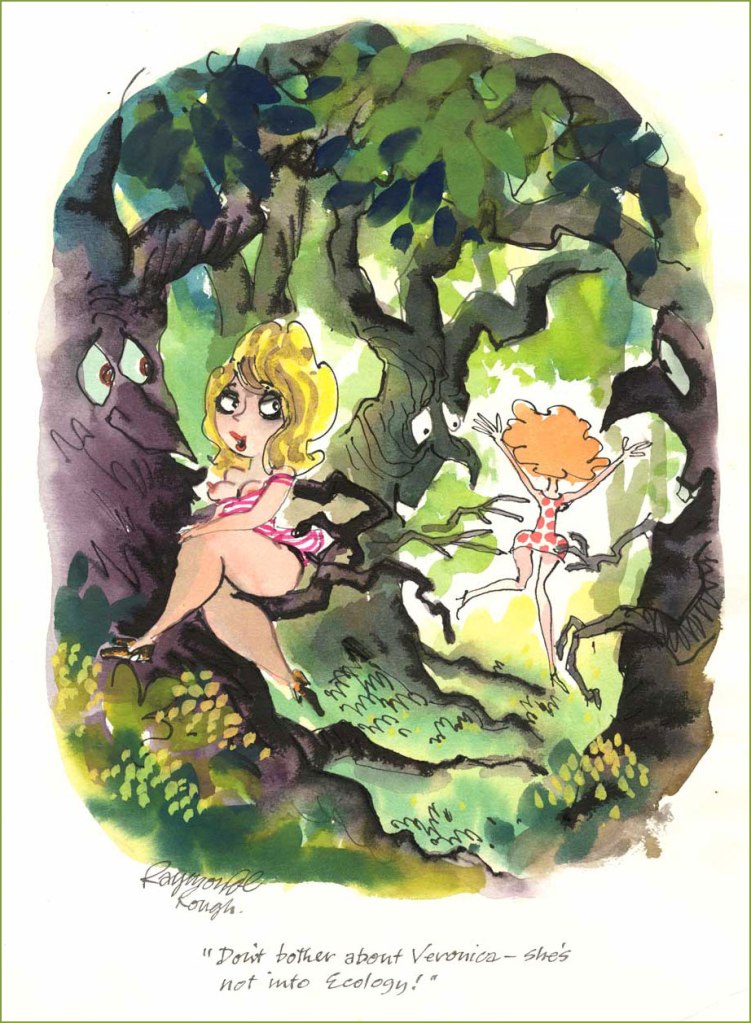
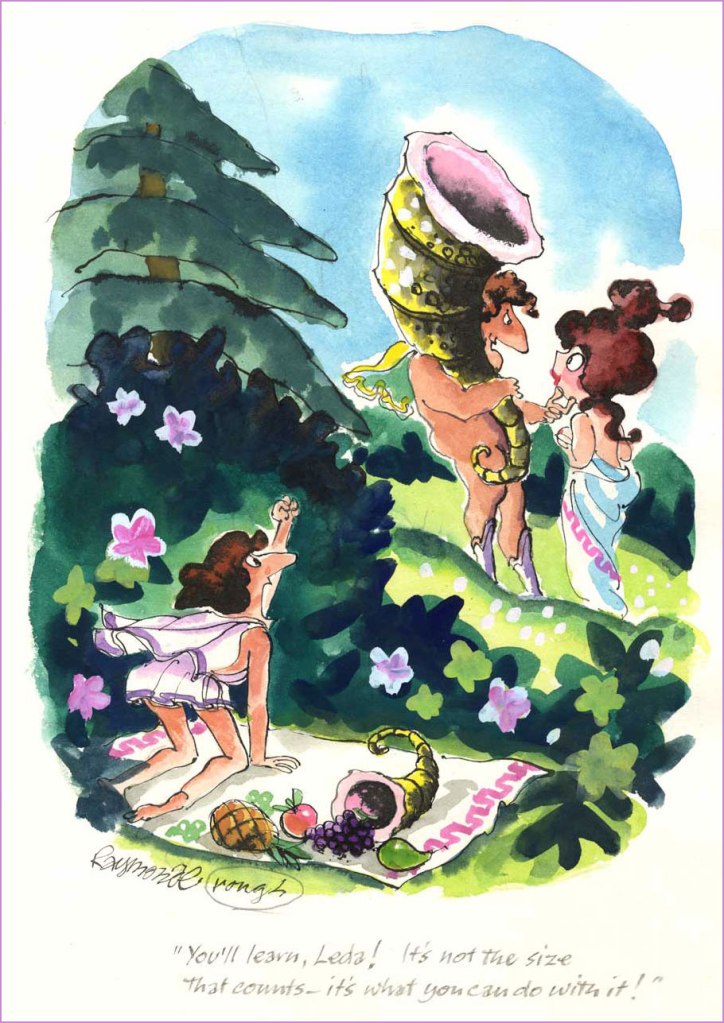
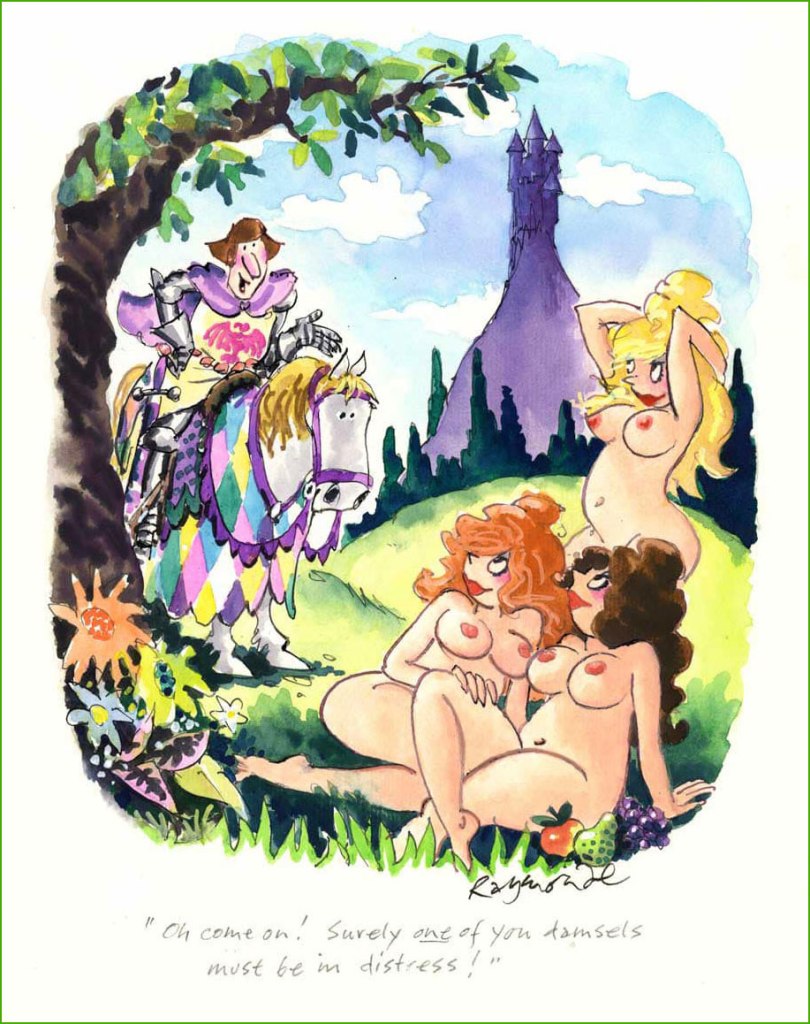
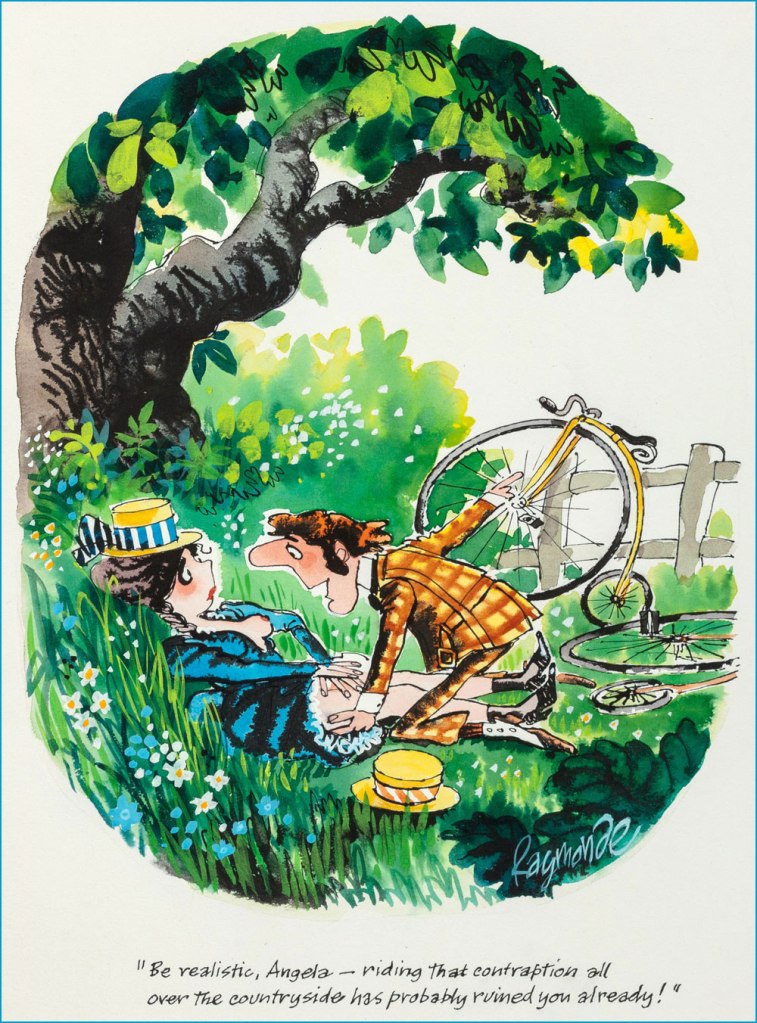
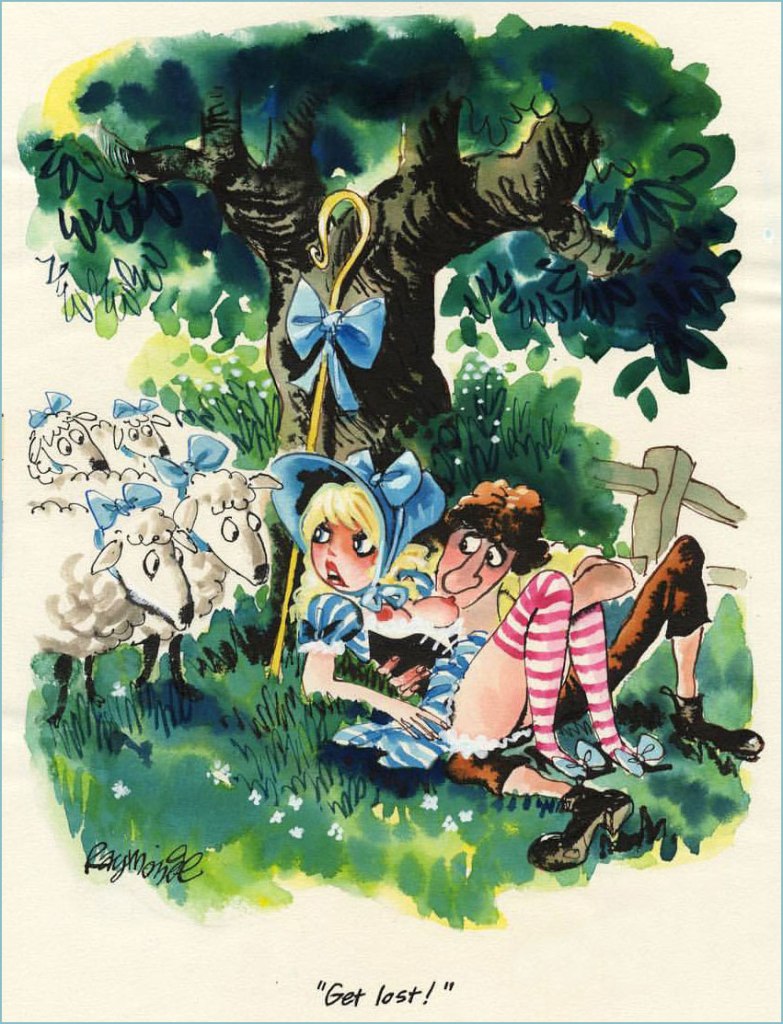
British cartoonist Roy Stuart Raymonde, who died in 2009 at 79 years old, first intrigued me with vivid watercolours and episodes oftimes set in mushroomy forests or secluded glens dotted with babbling brooks. Our anglophilically-minded readers may recall his work for Punch Magazine, and the rest of us will recognize him from the pages of Playboy, to which he contributed a monthly full-colour page for some 30 years.

The rambunctious Raymonde started out in advertising, cushioning his finances by freelancing as a cartoonist, mostly notably for Tit-Bits, a British tabloid-type magazine with an amusing name which reminds me of this George Carlton sketch. By 1960, Raymonde had amassed enough contacts to become a full-time cartoonist.

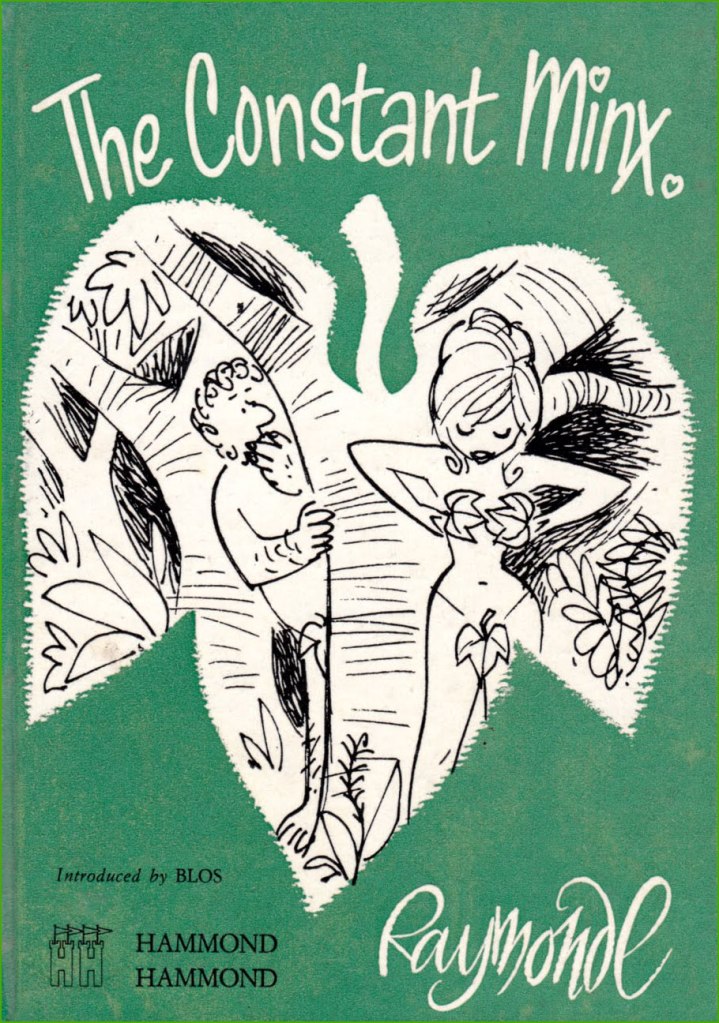
A collection of Raymonde cartoons published in 1961. Head over here to see some of the insides.
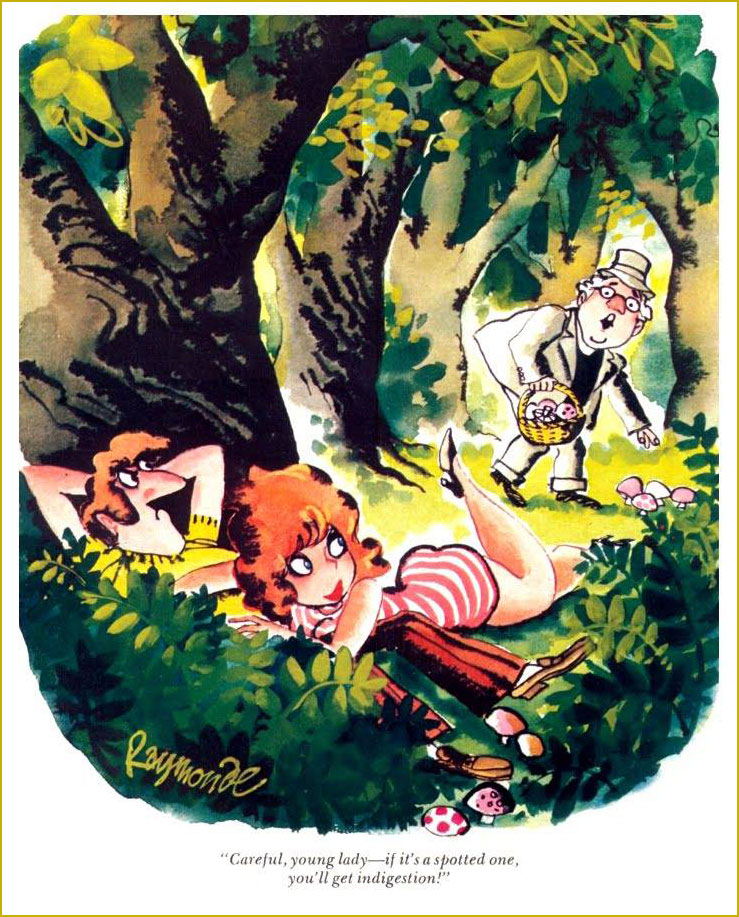
July 1974. This is the cartoon that first attracted my attention… with mushrooms, naturally.

I didn’t know this until writing this post, but delightfully Raymonde was friends with WOT favourite Gerard Hoffnung (see co-admin RG’s posts Gerard Hoffnung’s Constant Readers and Off to the Isle of Cats — and Back by Teatime!), whom he met at the Harrow School of Art (a subdivision of University of Westminster) in 1944, when RR was but 15. The two became lifelong friends, with Hoffnung, then a junior tutor (on his way to becoming a schoolmaster) a mere four years his senior, playing the role of Raymonde’s mentor. This friendship was cut abruptly short by Hoffnung’s premature death, so they were not able to re-enact Simon & Garfunkel’s Bookends, alas. I wasn’t able to find the exact source of this quote, as various websites just parrot the same paragraph over and over, but it seems that Raymonde was nearly expelled after adding funny captions to one of Hoffnung’s instructional drawings, a story hopefully as true as it is hilarious. Hoffnung (never bereft of a sense of humour) came to his defense and argued that this act was a sign of talent.

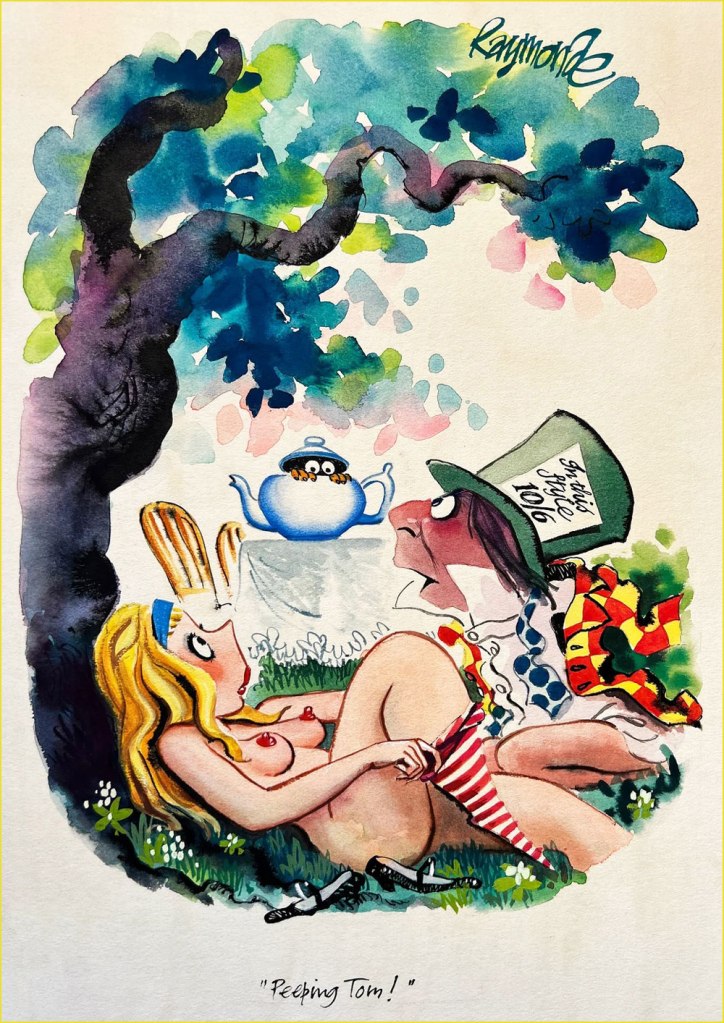
September 1972. What kind of Brit cartoonist worth his Yorkshire Pudding hasn’t spoofed Alice in Wonderland?
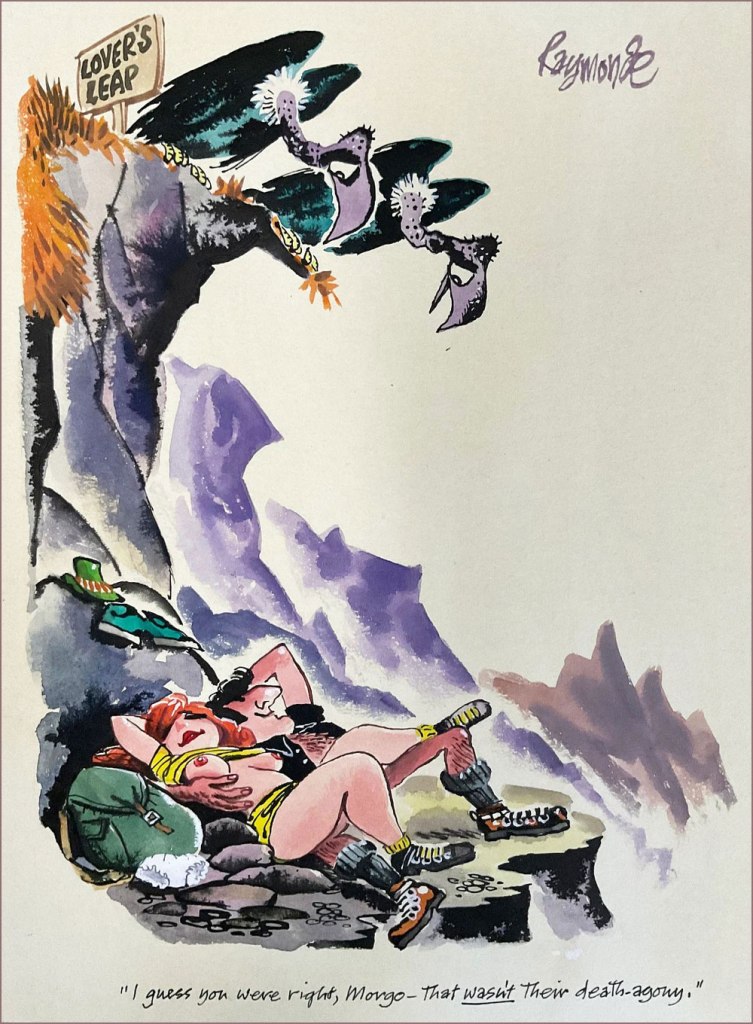
1973.
Preliminary sketch of unknown vintage.
Another preliminary sketch.

Given his evident love for the outdoors, I wasn’t surprised to find out that Raymonde bought a thatched cottage at the age of 34 and lived there for the rest of his life, voyages to Japan (where his work was very appreciated, to the point of winning the Gold Prize at the Kyoto International Cartoon Festival in 1996) and such notwithstanding.

1997.
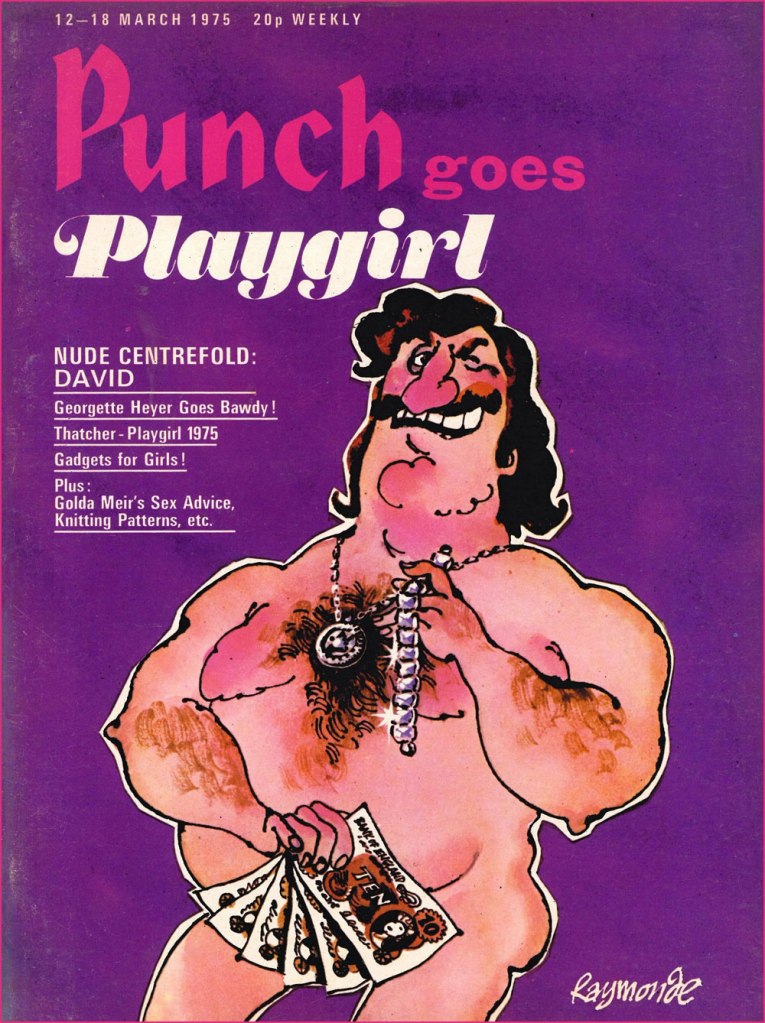
Punch Does Playgirl, March 1975. Raymonde created quite a few covers for Punch… as to the guy depicted, he’s like something out of a Charles Rodrigues sketchbook (see Charles Rodrigues’ Pantheon of Scabrous Humour).
July 1974.
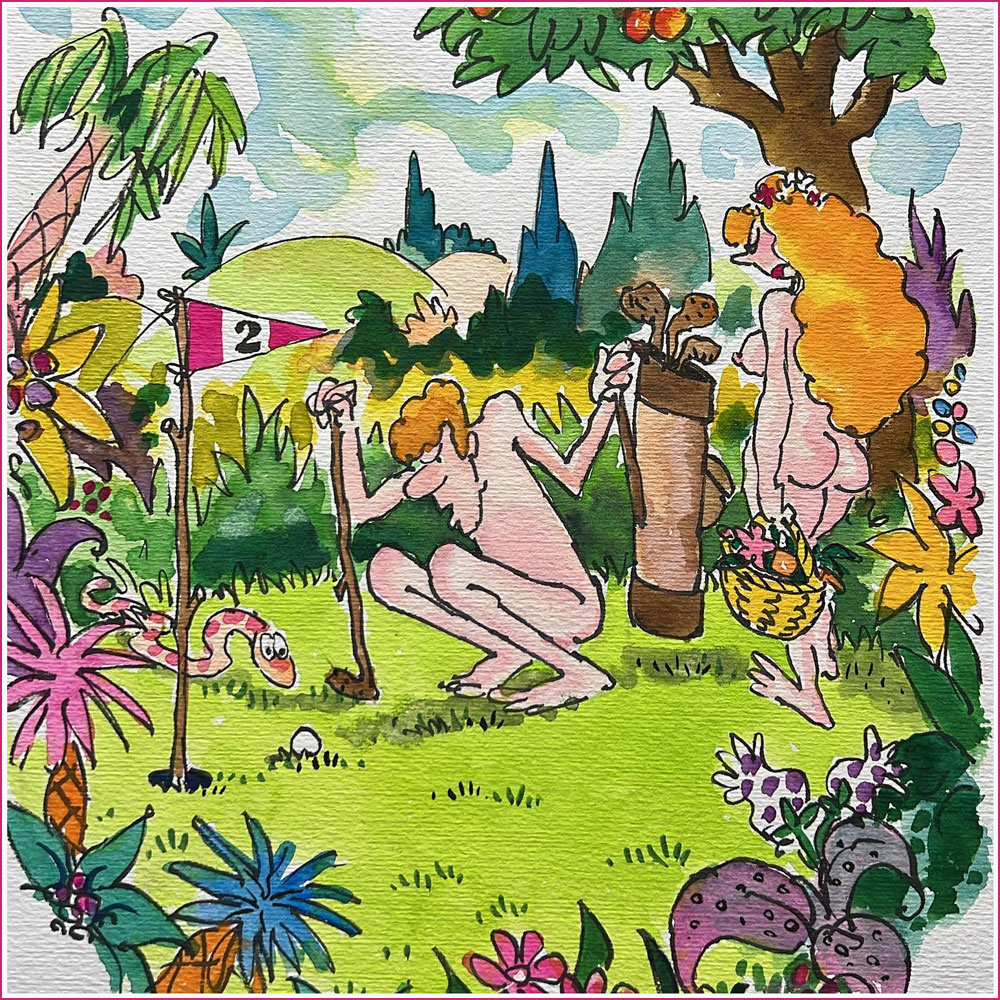
A cartoon used in Fore Play: The Very Best of Playboy’s Classic Golf Humor Paperback (January 1, 1995).

Want to see more? Head over here… and don’t forget to rest your weary head in some spring grass while you’re at it (perhaps with a friendly companion).

~ ds

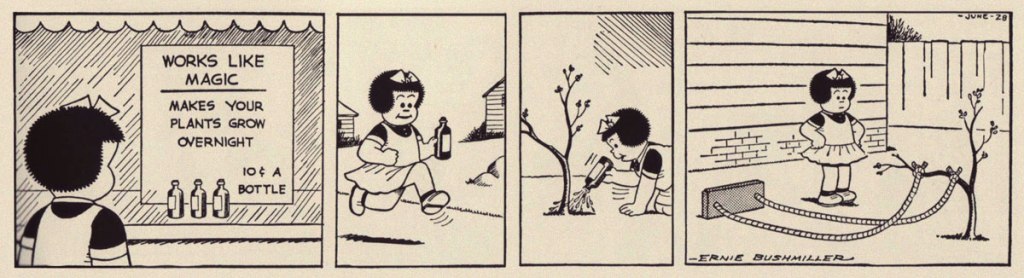
Gardening for Victory With Nancy and Sluggo

This time of the year is special (and harried) for would-be gardeners – plants carefully nurtured from seed are carefully hardened off (or being plonked into the outdoors soil, for those in the warmer regions), which involves a lot of running back and forth clutching pots and bags of soil, and brandishing favourite raking and digging implements.

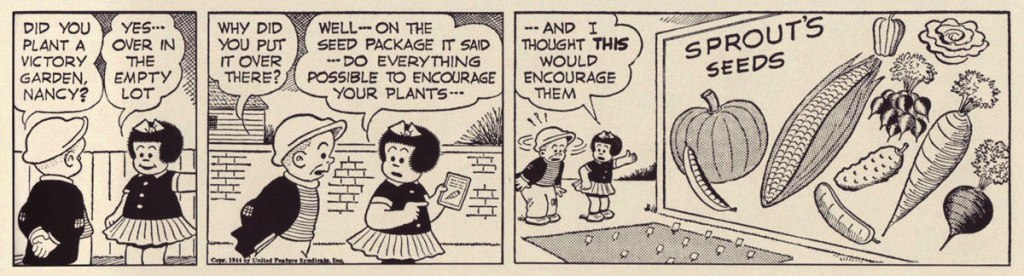
I was spoiled for choice when it comes to strips featuring gardening front and centre, so this theme shall be broken up into several installments. Part I: Nancy! We’ve mentioned Nancy a few times… sort of — see here, except that this John Stanley’s Nancy, and here, a post about an unexpected gem co-admin RG dug up from Nancy creator Ernie Bushmiller. Speaking of co-admins, thanks to the aforementioned RG for locating and scanning these strips. Frankly, my arms are elbow-deep in soil and I’m (w)ra(c)king my brain trying to remember what I planted and where, so mental capacity is sorely depleted.

Strip from May 17th, 1944.

In case the term is new to you, victory gardens were encouraged by the government during wartime — to supplement rations, but mostly boost civilian morale. While the intention was a bit manipulative, surely most would agree that growing one’s own food is immensely rewarding, which reminds me of this meme:

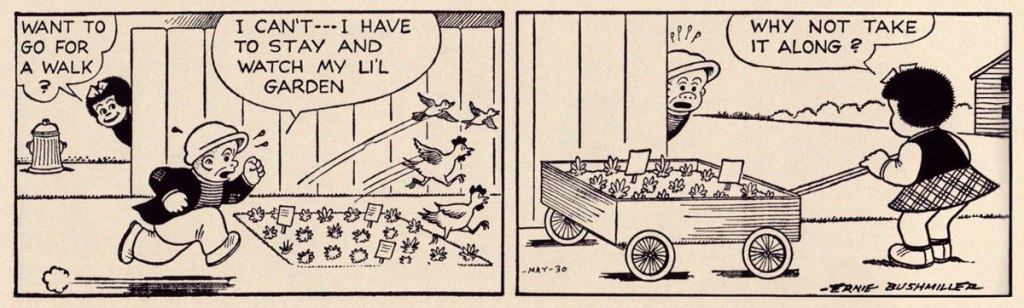
Strip from May 30th, 1950. Given concerns about going away for even a few days (‘who’s going to mind the plants?!’), Nancy’s plan sounds good to me.
Strip from June 15th, 1951.
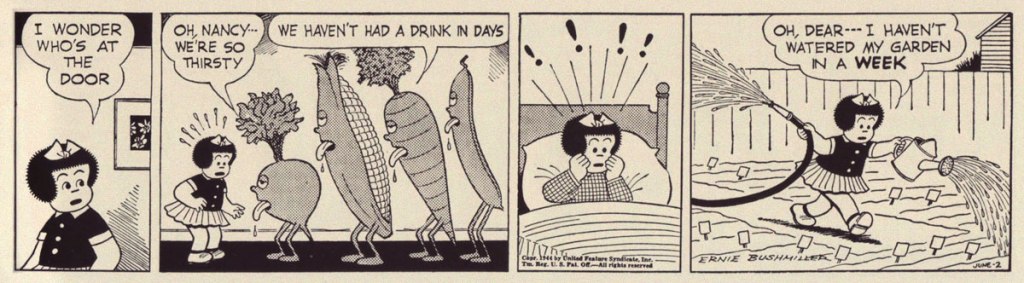
Strip from June 2th, 1944. I wondered why Nancy was planting sausages in her garden, when I realized that’s probably a green bean…
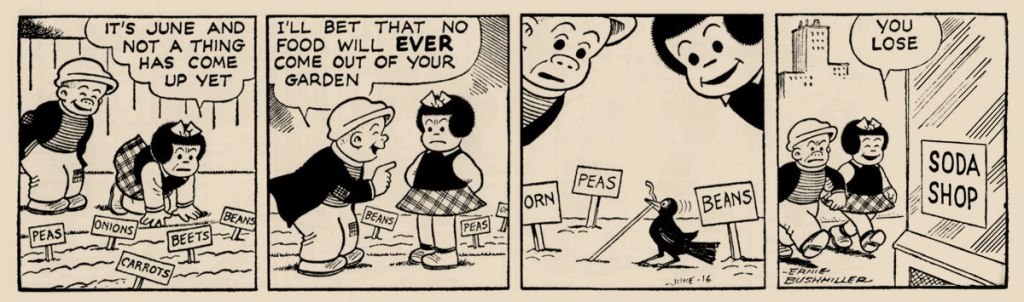
Strip from June 16th, 1948.
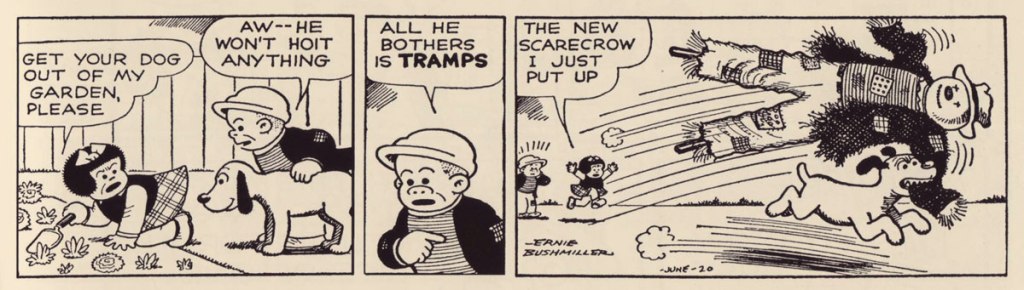
Strip from June 20th, 1951.
Strip from June 28th, 1943.
Strip from July 2nd, 1945. The size of the foliage does not hint at the size of the carrot 😉

May your seedlings grow strong!

~ ds

Alexey Gorbut’s Kommie Krackle

Contemporary Russian cartoonist (and colourist) Alexey Gorbut, born in Yekaterinburg, had been drawing (by his own admission) since babyhood. When asked in an interview to describe his work in three words, he said ‘I’m always drawing’. As clearly seen from his art, he is a great fan of Golden and Silver age comics, an devotee of old horror comics (he specifically mentions Chamber of Chills* and Tales from the Crypt as favourite anthologies in this interview), with a special affection for Steve Ditko and Alex Raymond. While he wears these influences on his sleeve, his work still boasts plenty of Slavic trimmings, which makes for a really fun blend of styles and perspectives.

Gorbut mostly self-published his stories until 2016. Alexey Volkov spotted his work while looking for an illustrator for a project requiring a Kirby-esque hand, and, smitten with Gorbut’s style and his proclivity for drawing on paper instead of a tablet, offered him to collaborate on a book to be published by Jellyfish Jam. The Alexeys’ first book together was «Победители невозможного » (2017), a sort of Metal Men seen through the lens of Soviet sci-fi. A team comprising four members who possess fantastical powers, two men, one woman and an android, is on the search — to exact revenge — for their creator, a mysterious time traveller.

The cover of «Победители невозможного » (2017), which translates to something like ‘Vanquishers of the impossible’. “Krackle” notwithstanding, the result actually did not come out Kirby-esque at all — you can see some inside page samples here.

Their next significant collaboration was «Вор теней» (Thief of Shadows), plotted by Volkov and Kirill Kutuzov, who were old childhood friends and partners in comic crimes. The first four issues were published in 2019 by aforementioned Jellyfish Jam, with publishing rights picked up by Bubble Comics on issue 5 and onwards. The series is still going strong, and the Kutuzov, Gorbut and Volkov trio became such a steady team in readers’ minds that they were even assigned an unofficial acronym, KGV (which of course brings to mind ‘KGB’).

Page from Вор теней no. 1: Вор теней и час волка (May 2019, Jellyfish Jam).
Вор теней no. 2: Вор теней против бандитов-футуристов (July 2019, Jellyfish Jam).
The cover of the first collection gathering the first five issues, published in 2020 by Bubble Comics.

« Майор Гром 1939 » (‘Major Thunder 1939’), a seven-story collection, came into being in 2019, a successful stab at recreating a golden age comic with ‘old-school’ storytelling and wackiness.. and far more interesting than Bubble’s Major Grom franchise it sprang from, if you ask me. Volkov and Gorbut took the main series’ characters and transferred their raison d’être to the Soviet era, cooking up a delirious blend of parody with a heavy sprinkling of American comic influences defused by Soviet lifestyle snippets. Titillating details abound, like corrupt billionaire Plague Doctor becoming the Plague Physician, a child of noblemen murdered by the Bolsheviks.

Майор Гром 1939 no. 1… October 1939, I mean 2019, published by Bubble Comics.
Alternate cover for no. 1. If it looks familiar…

… it’s because it should!

Detective Comics no. 31 (September 1939), cover by — or at least credited to — Bob Kane.

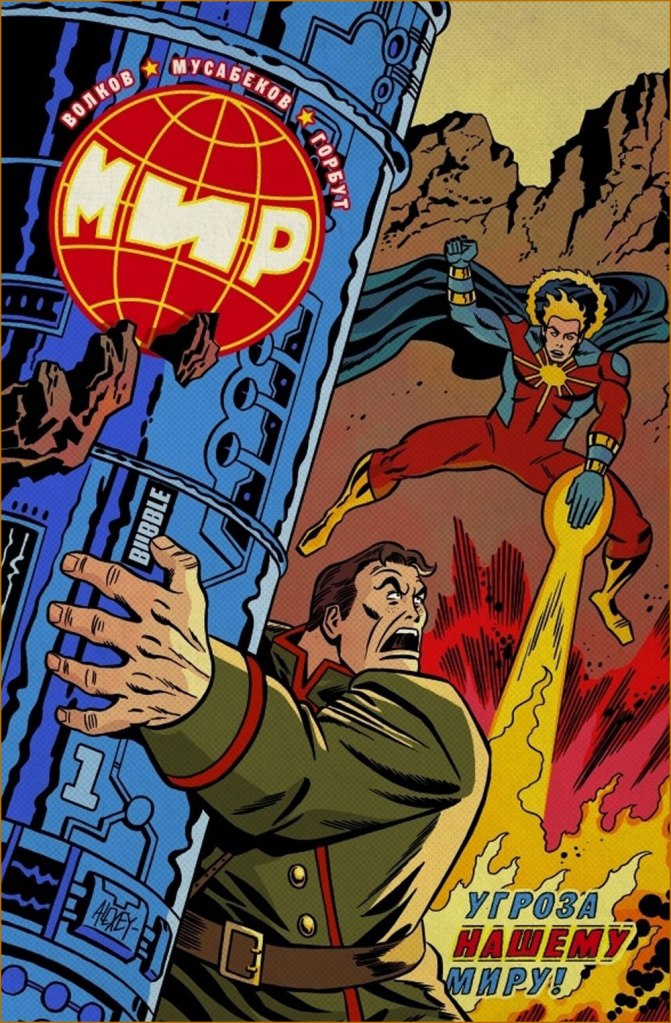
Superhero/sci-fi series «МИР» (2020 and ongoing) is written by Volkov and illustrated by Madibek Musabekov, with the former drawing “real-life” action and the latter, dream sequences and such. Musabekov has a perfectly ordinary, dull, tablet-drawn style devoid of any personality, and he also draws all the covers so that’s one series I’m not going to touch… but Gorbut’s alternate covers can be nice.

МИР no. 1 (August 2020, Bubble Comics)… on the other hand, now ‘Kirby-esque’ has caught up.

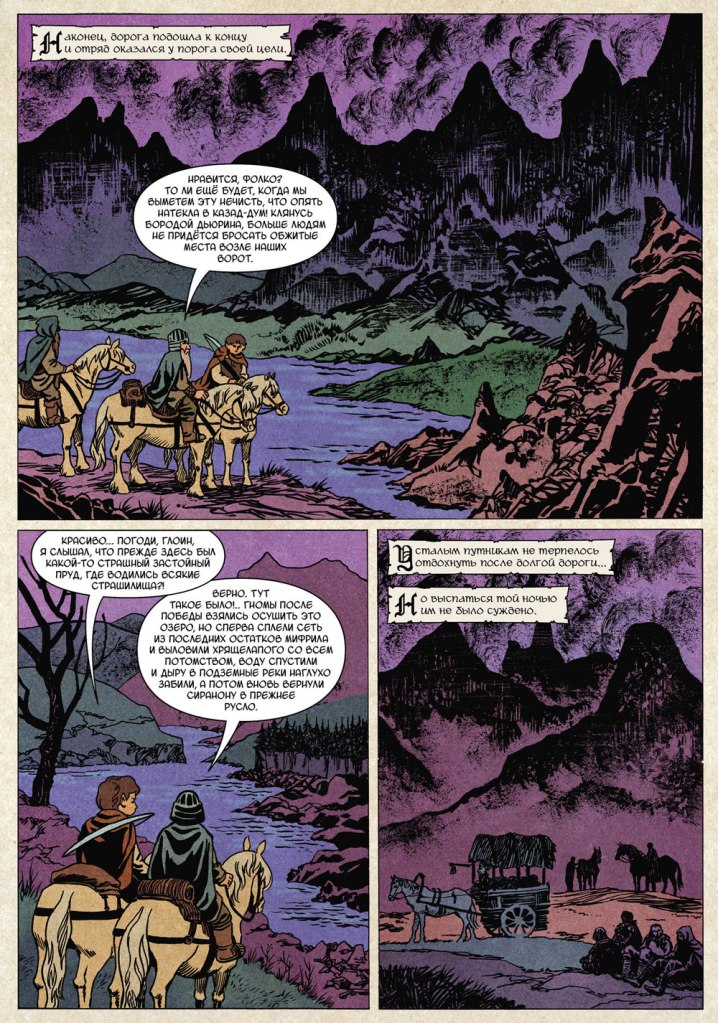
More recently Gorbut has adapted Nick Perumov‘s «Кольцо Тьмы» (The Ring of Darkness) fantasy novel series. If it looks like a Lord of the Rings rip-off, that’s because it’s purposefully set in Tolkien’s word, with a hobbit protagonist (not that it makes it less of a rip-off, mind). As it happens, I recently read a novel (from another fantasy cycle) by Perumov, and co-admin RG can confirm that I kept swearing at its prose throughout, though I still finished it out of a sort of morbid fascination. Gorbut’s art is nothing to sneer at, just too bad it’s tied to something so trite. Here is the cover of Volume 1, « Кольцо Тьмы: Эльфийский клинок » (2022, Alpaca), as well as some inside pages:

Those trees in the background are rather Bilibin-esque, which I really like.

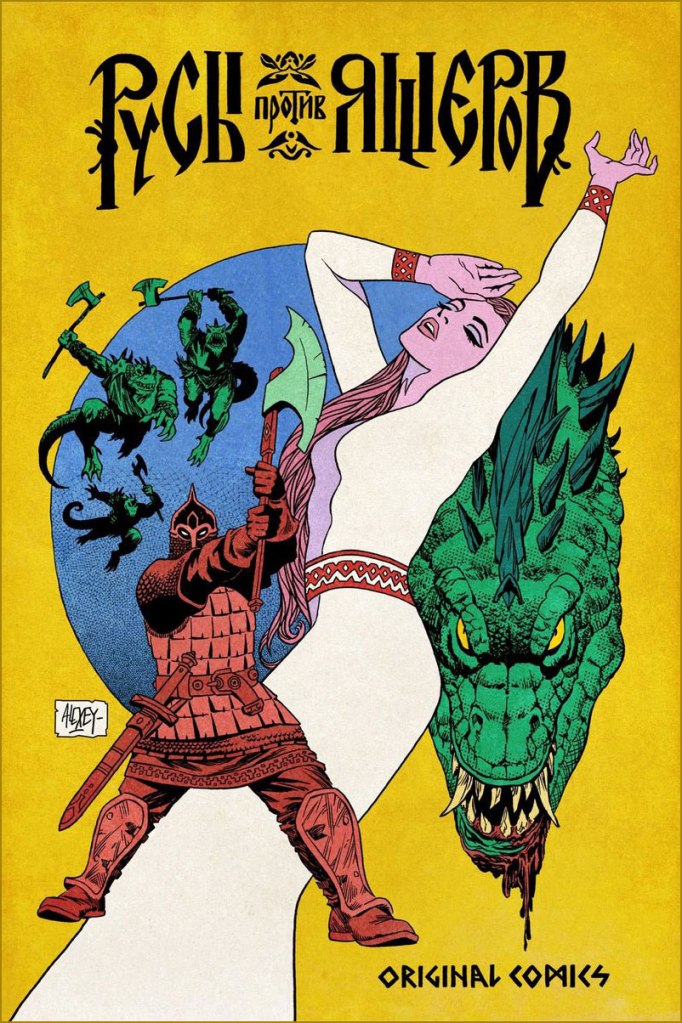
Finally, for more of a Slavic effect (though not devoid of certain European influence!), here are two comics covers created for « Русы против Ящеров » (Lizards Must Die), a videogame released in 2023.

~ ds

* While from the context it’s clear he meant the 1950s Harvey anthology, I think it’s safe to assume he’s equally fond of the 1970s Marvel one.