Tentacle Tuesday: Justice League of America

JLA’s roster has rotated throughout the years, but for the sake of this post, only the seven original members will get cephalopod tussling privileges! Here they are, with the conspicuous absence of Batman and Superman who are no doubt rushing behind the scenes to rescue everybody (but don’t worry, we’ll get to them as well):

The Brave and Bold no. 28 (February-March 1960, DC). Cover pencilled by Mike Sekowsky and inked by Murphy Anderson.

I’ll start with Superman, otherwise he’ll get offended – you know how susceptible he can be. Rather, a double whammy of Superman and Flash, who stumble upon some rather adorable (aside from their propensity to eating people) tentacled aliens. Of course our superheroes decide to make a race out of it, because concentrating on saving some planet or other is clearly not exciting enough – and Batman just happened to be hanging around to give the starting signal. Some afternoons are just that quiet. Race to Save the Universe!, scripted by Denny O’Neil, pencilled by Dick Dillin and inked by Joe Giella, was published in World’s Finest Comics no. 198 (November 1970, DC).

Nevertheless, this dynamic duo does allow itself to get distracted from its marathon, just long enough to defeat this green cutie:

Don’t underestimate kittens.

Incidentally, Superman already has a Tentacle Tuesday all to himself (Tentacle Tuesday: It’s a Bird! It’s a Plane! It’s a Tentacle!) Still, here he is collaborating (more like ‘rescuing’) Jimmy Olsen from an intriguing green (why must they always be green?) monstrosity with worm-like tentacles. Ugh, not the most appealing. These pages are from The Voyage of the Mary Celeste II!, scripted by Jerry Siegel, pencilled by Curt Swan and inked by George Klein and published in Superman’s Pal, Jimmy Olsen no. 75 (March 1964, DC).

DC’s “Big Three” – its most iconic and popular – are of course Superman, Batman and Wonder-Woman. As far as the latter is concerned, as much as I love this character, seeing as we already have two Tentacle Tuesdays posts in her honour – Tentacle Tuesday: H.G. Peter and Wonder Woman lend a hand and Tentacle Tuesday: More Golden Age Wonder Woman Wonders! – I think I’ve said everything I had to say on the subject. Thus, we move on to Batman, albeit briefly because there is also Tentacle Tuesday: All Aboard the Batmarine! to peruse. He’ll have to share the stage with Superman, but I’m sure he’ll be a good sport about it.

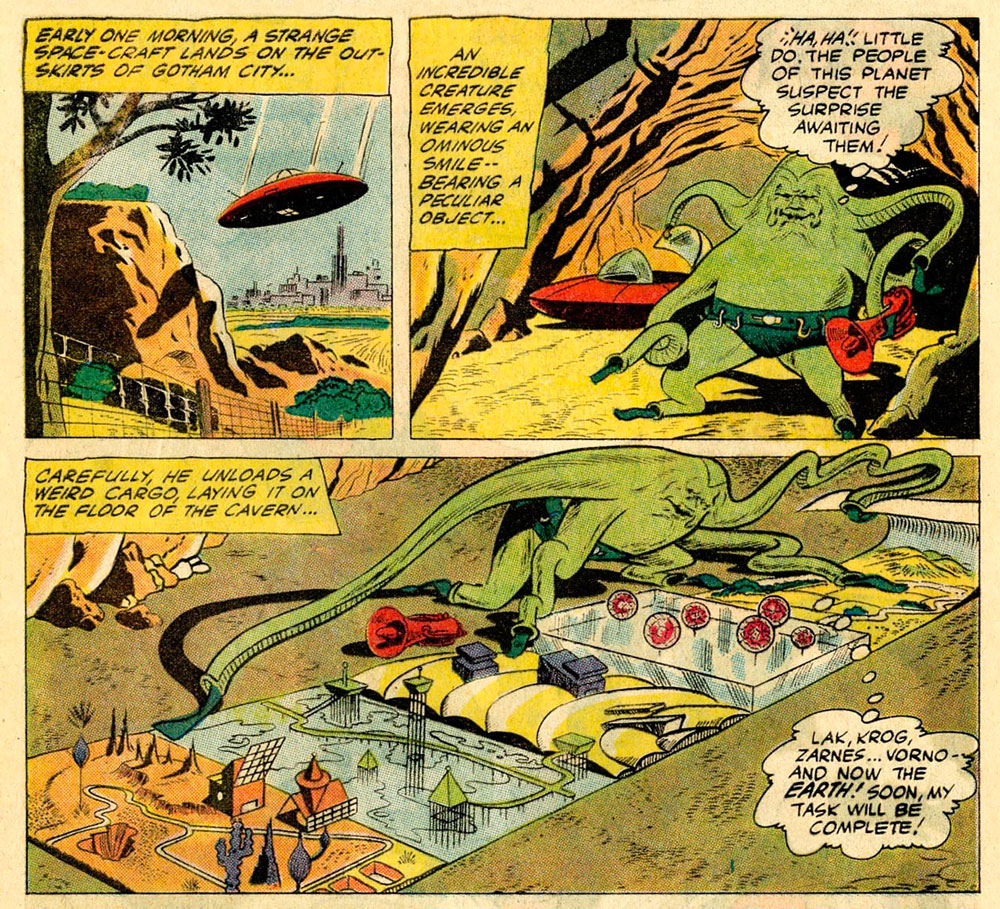
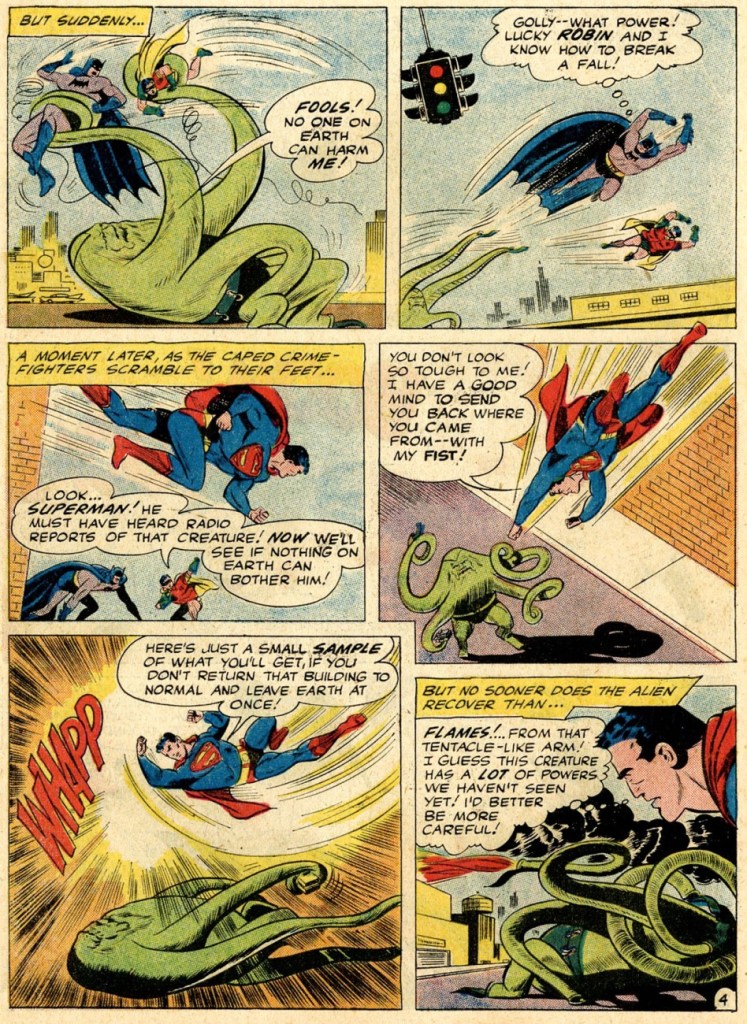
World’s Finest Comics no. 110 (June 1960, DC). Pencilled by Curt Swan and inked by Sheldon Moldoff.

The cover story is The Alien Who Doomed Robin, scripted by Jerry Coleman and inked by Sheldon Moldoff.
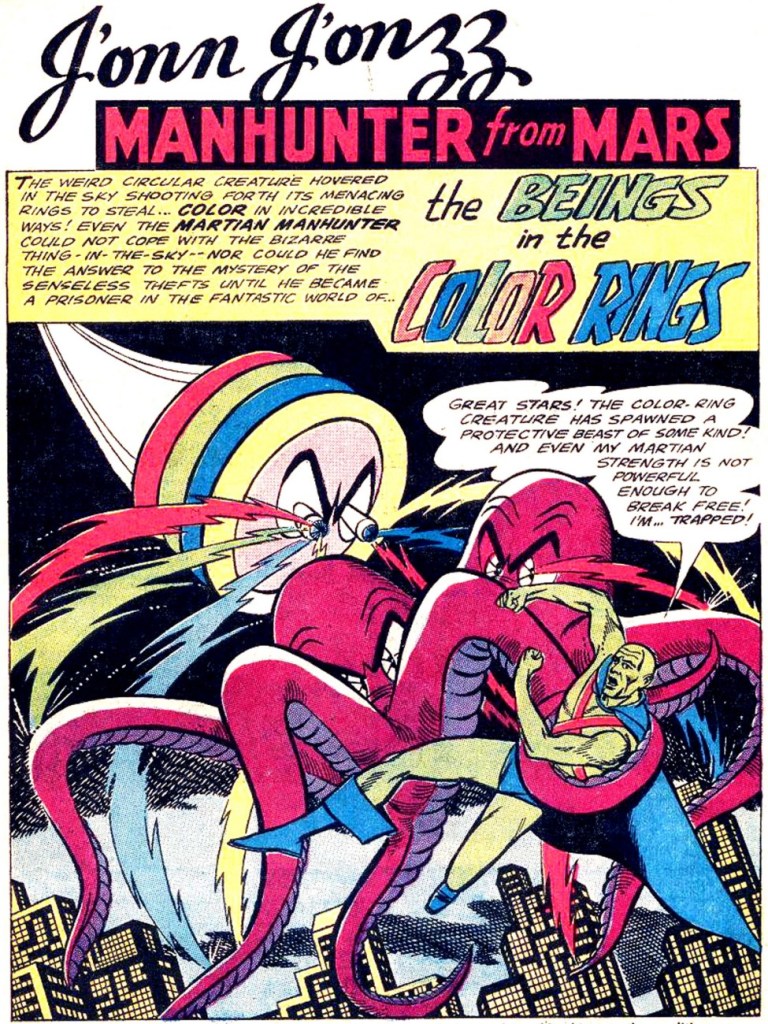
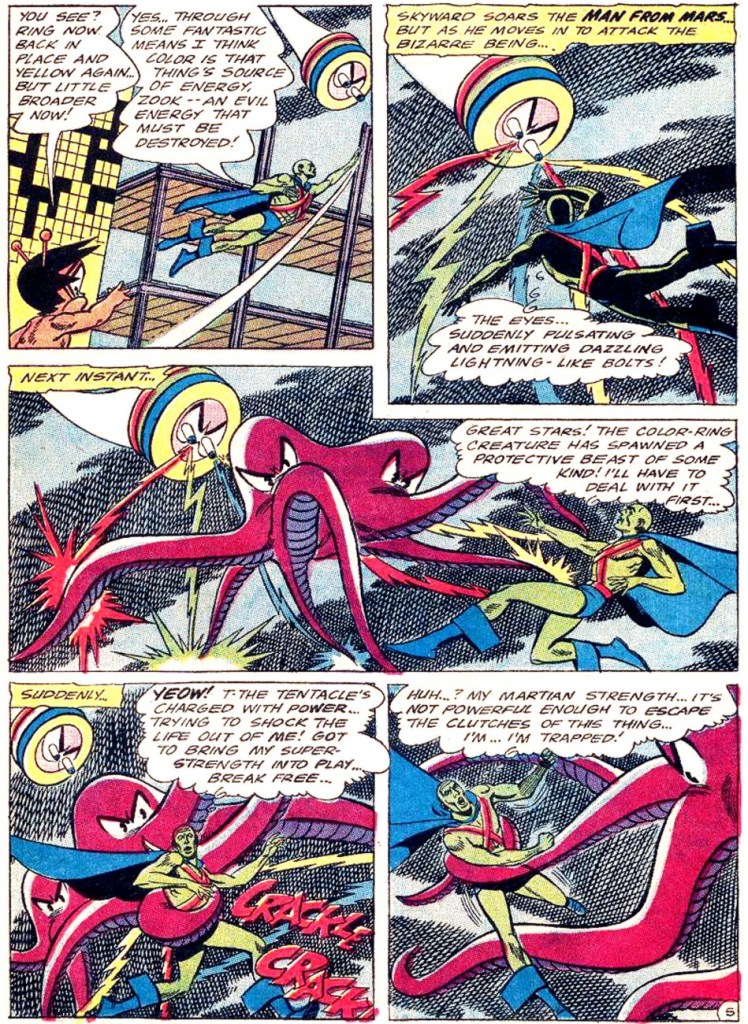
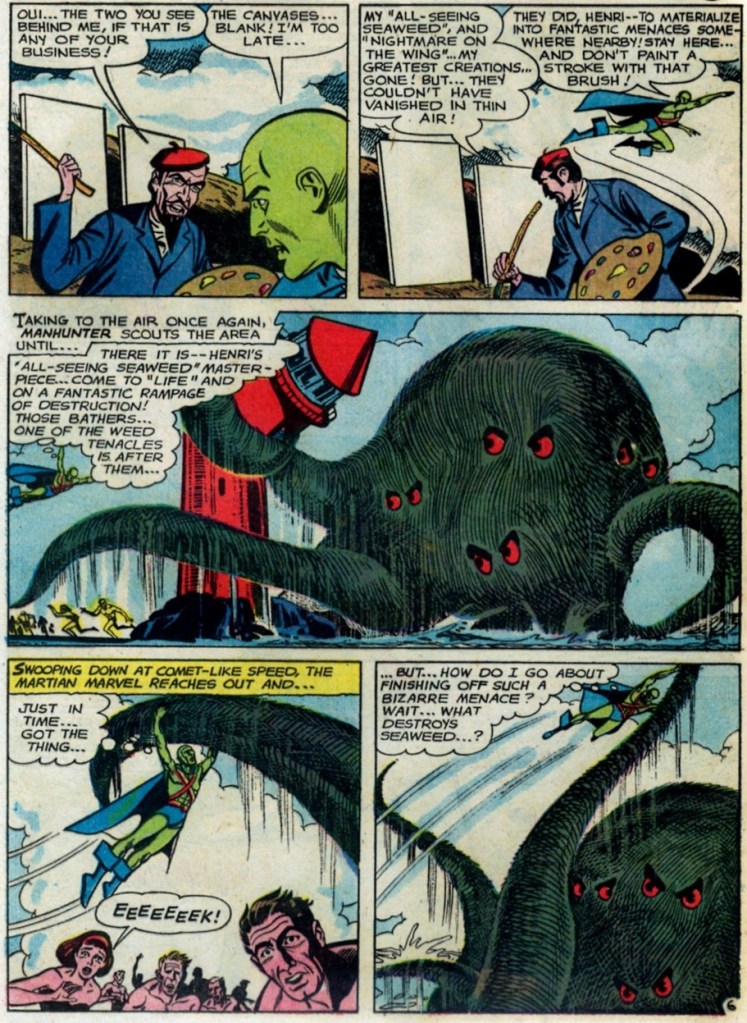
Our next JLA member is the Martian Manhunter, whom I have a strange soft spot for. It’s well known that girls just can’t resist green skin! In honour of this bias, here are not one, but two excerpts from stories featuring tentacles front and centre.

First, two pages from The Beings in the Color Rings, scripted by Dave Wood and illustrated by Joe Certa, published in House of Mystery no. 148 (January 1965, DC).
And for dessert, a page from The Supernatural Masterpieces!, scripted by Dave Wood and illustrated by Joe Certa, published in House of Mystery no. 150 (April 1965, DC).
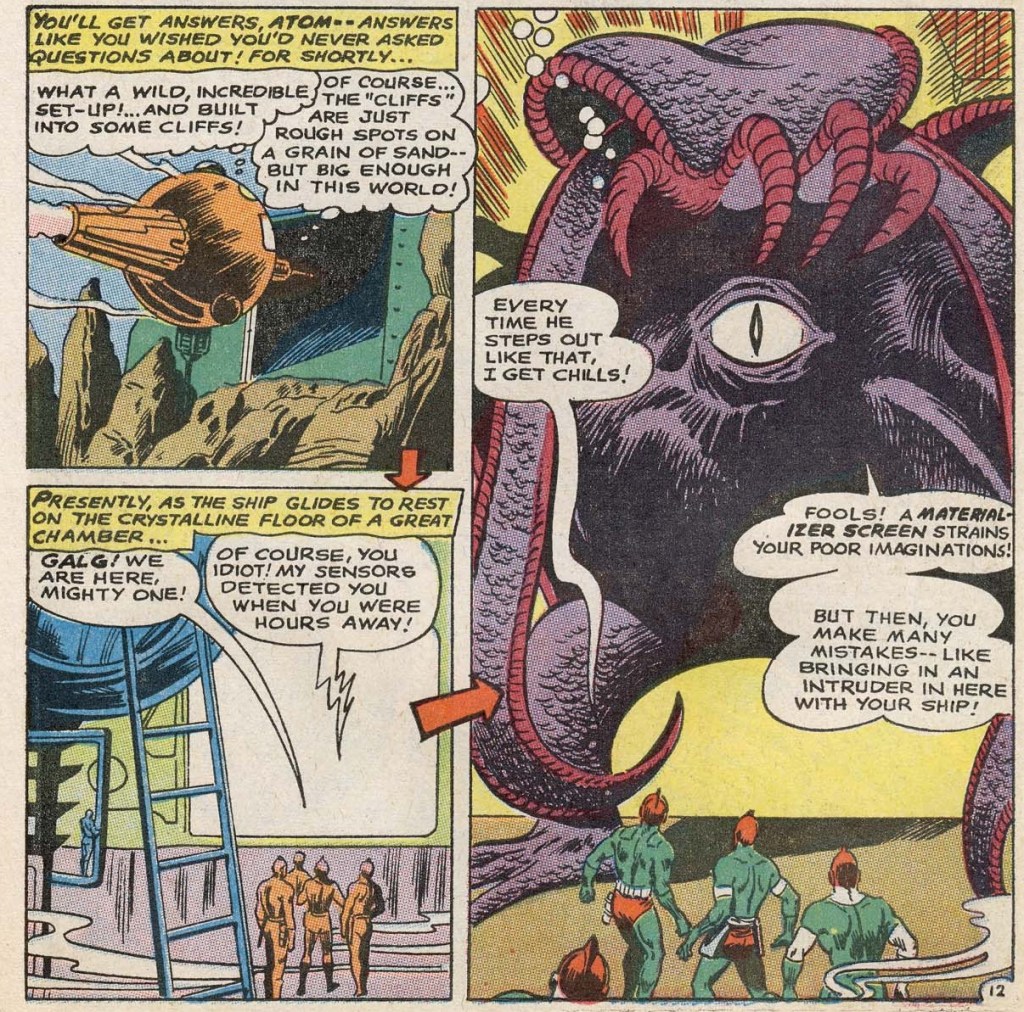
Naturally, Aquaman has encountered more than a handful of octopuses in his long undersea career – I went on about that in some length in Tentacle Tuesday: Aquaman and his Octopus Sidekicks. I have plenty more where that came from, so there surely be a part II to that particular tale… in the meantime, here is a rather striking cover that didn’t make it into that post.

The Brave and the Bold no. 73 (August-September 1967, DC). Cover pencilled by Carmine Infantino and inked by Charles Cuidera.

The cover story is Glag the Destroyer, scripted by Bob Haney, pencilled by Howard Purcell and inked by Sal Trapani.
Last… and maybe least, because I could never warm up to him… is Green Lantern. The following pages are from a story pencilled by Gil Kane, who doesn’t generally get glowing reviews from WOT. Nevertheless co-admin RG wrote an ingenious post combining our common dubiousness about Kane and percolated it through specifically Green Lantern covers – the result is Hot Streak: Gil Kane’s Green Lantern, which impressed, if not quite convinced, me.

Funny Thing Happened on the Way to Earth!, scripted by John Broome, pencilled by Gil Kane and inked by Vince Colletta, was published in Green Lantern no. 70 (July 1969, DC).

I hope you enjoyed this overview of the Justice League of America as filtered through the rather eccentric lens of tentacles.

~ ds

Tentacle Tuesday: Dive Right In, Boys and Girls!

Being in the throes of a heatwave is no fun. Given that I currently feel like my brain is melting, I shall keep this post to a minimum of text and a maximum of visual thrills. Luckily, today’s little collection of pretty forgotten comic book covers is quite fun, with covers that tantalize and mystify. Some of them also involve a lot of splashing around, which is a distinctly enjoyable thought right now. Let’s dive in, shall we?

Detective Eye no. 2 (December 1940, Centaur). Cover by Frank Thomas. It’s anything, and everything, goes on this cover! A lively party, indeed.
Funny Pages no. 36 (April 1940, Centaur). Cover by Harold DeLay. Note how the woman’s traditional, yet strangely tight and semi-transparent garb highlights her figure.
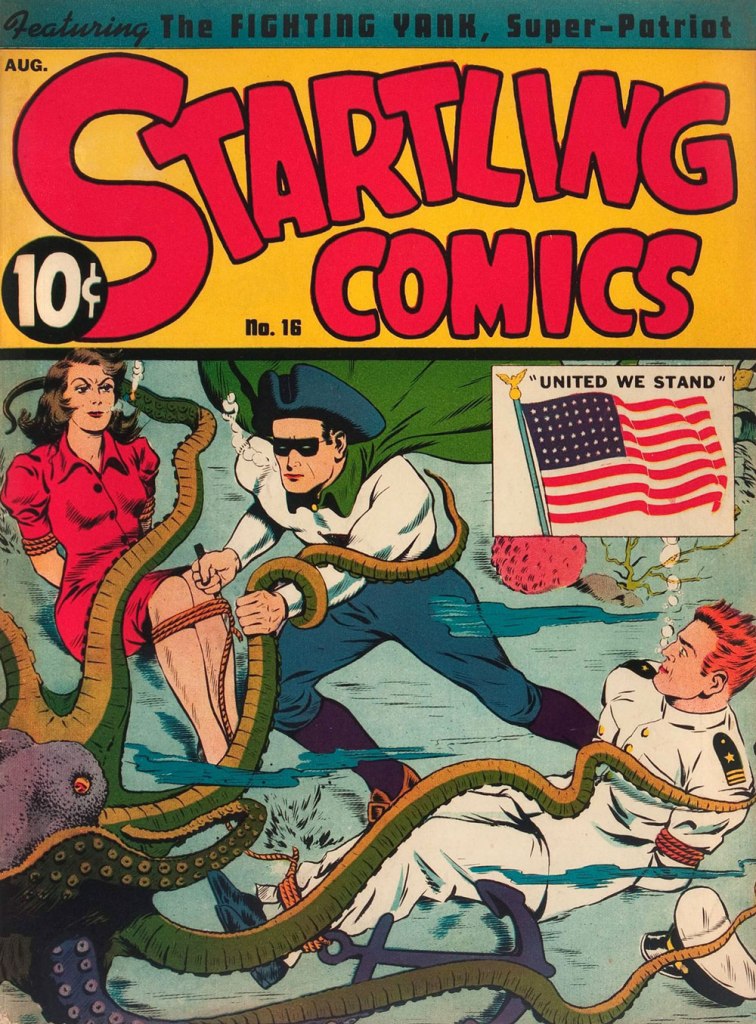
Startling Comics no. 16 (August 1942, Pines). Cover by Jack Binder. The woman is clearly fed up with all this silly boy nonsense and this is the last time she goes anywhere with these two.
Sparkler Comics no. 47 (September 1945, United Feature). Cover by Burne Hogarth. I always wonder about these tight leopard shorts – made out of leopard skin with some elastane mixed in, no doubt!
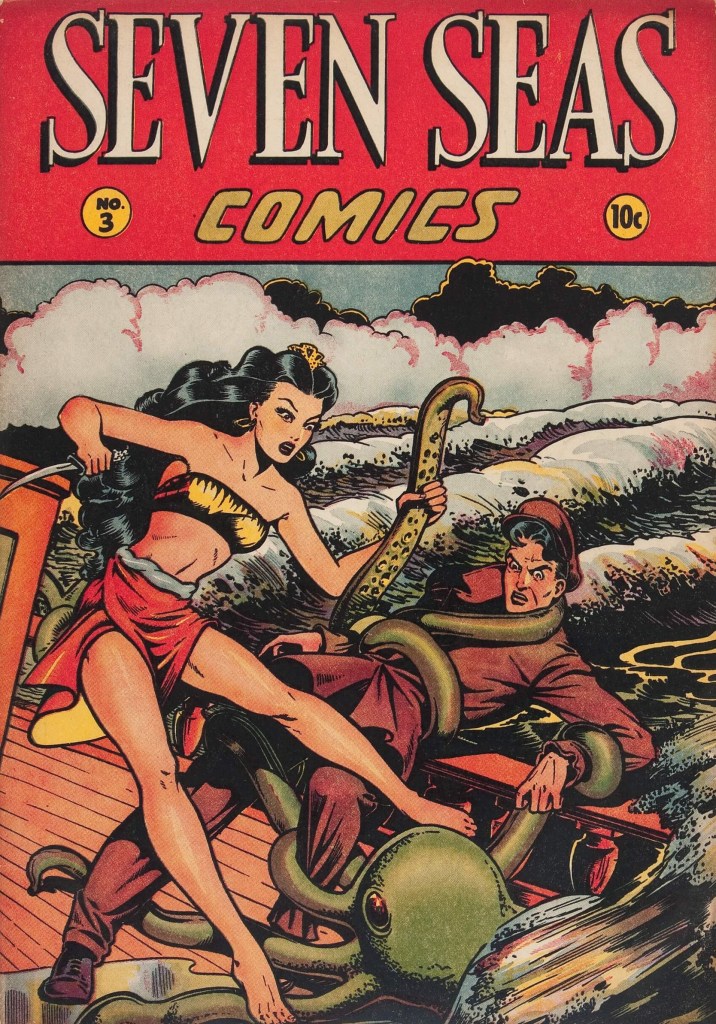
Seven Seas of Comics no. 3 (1947, Iger). Cover by Matt Baker. It is highly unusual for the octopus to grab the man instead of the woman; it must have something specific in mind.

More tentacular covers from the 40s can be seen in Tentacle Tuesday: Golden Age Superheroics, Tentacle Tuesday: The Golden Age of Grabbery or even Tentacle Tuesday: These Were Your Grandparents’ Tentacles.

~ ds
Tentacle Tuesday: Leaps and Bounds

Today’s Tentacle Tuesday doesn’t have an over-arching theme, other than featuring some bits and bobs I’ve accumulated – from something drawn in 1942 to a cartoon created by computer in 2020. In a sense, this way of proceeding is much closer to the way my brain works, jumping from theme to theme and adding brackets within brackets. This is somewhat off topic, but incidentally, if that’s the way your brain works, too, I highly recommend David Foster Wallace‘s non-fiction material (read 27 of his articles and essays here!) and The Good Soldier Švejk and His Fortunes in the World War by Jaroslav Hašek for a deliciously rambling approach to story telling and arguments.

If you’re not already following WOT’s favourite cartoonist Roger Langridge on Instagram, I highly recommend doing so: his daily slice-of-life strips provide an interesting glimpse into the author’s family life, inner dialogue, and artistic endeavours. You can also support him on Patreon (he has a measly 54 supporters right now – compare that to the thousands of subscribers boasted by some considerably less talented comics artists, who shall remain nameless). The following daily from December, 2020 features the aforementioned introspection, a glimpse at the artistic process, Garfield and tentacles.

Speaking of Garfield, I recommend Garfield Minus Garfield, if you haven’t come across it already.

Texan cartoonist Sam Hurt is the creator of Eyebeam, and I say that with a similar reverence that one would employ in talking about some deity that has concocted a self-governing universe. It is a strange, a bitter-sweet, topsy-turvy place with its own impeccable logic, to which our world remains criminally indifferent. Tackling the problem of talking about Eyebeam, which is both the name of the protagonist and the title of the comic strip, is something we haven’t yet had the courage of doing on this blog. Still, co-admin RG bravely dipped his toe in these waters and talked about a connected comic series – read his All Hail Peaches, Queen of the Universe! and admire his courage. I will also add that Sam Hurt is a great painter, and that I am lucky to have one of this paintings hanging on my office wall (best Christmas gift, ever).

A blushing octopus in a hat? Won’t somebody introduce us, please?

From its humble beginnings around 1978, Eyebeam has grown and survived (with some interruptions) to this day! Strips from 1996 until now are available on GoComics. Someday, fortified with some Dutch courage, we will do a proper post about it, we promise.

I’ve never actually read Usagi Yojimbo, the eminently popular rōnin comic book epic by Stan Sakai. Rolling Stones’ slapdash list of best graphic novels, insultingly titled The 50 Best Non-Superhero Graphic Novels (which immediately makes one feel that they consider non-superhero comics somehow inferior), places it at 43. I will doubtlessly get around to at least reading one volume or two at some point – Sakai is definitely a talented artist, and I have nothing against anthropomorphic animals when they’re well-drawn. However, a dedication to reading the whole series is not for the faint-hearted: there are 35 books in total, which have been collected into nine omnibus volumes in more recent years, a considerable time commitment.

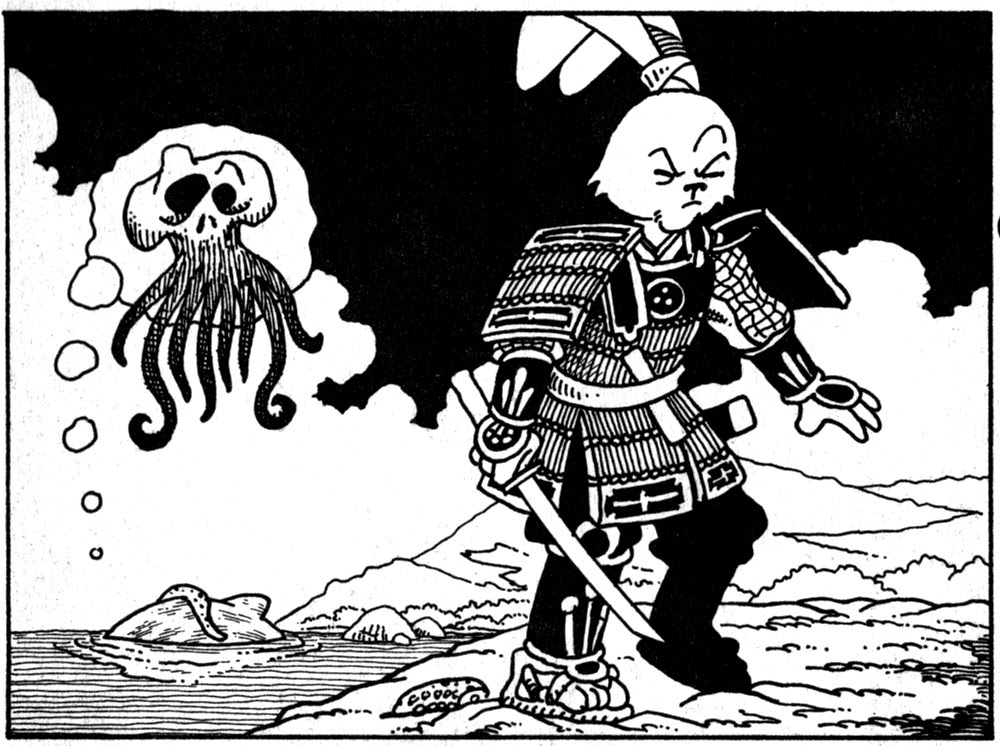
‘Usagi Yojimbo’ literally means something like ‘rabbit bodyguard’, which is what the main character, Miyamoto Usagi, is. Here he is fighting an octopus or two!

Usagi Yojimbo no. 27 (March 1991, Fantagraphics). Cover by Stan Sakai, with colours by Tom Luth.
Panel from My Lord’s Daughter, published in Usagi Yojimbo no. 27 (March 1991, Fantagraphics).
This was drawn by Sakai during the Lucca Comics and Games Convention (2015) for a fan.

Theodor Seuss Geisel, far better known under the pen name of Dr. Seuss, was not only the author of famous books for children, but also a perceptive political cartoonist. Between 1941 and 1943, he was working for PM, a New York daily newspaper, and this is when he produced a series of satirical cartoons about the Policy of Appeasement, the British policy makers’ attempt at avoiding a war with Germany by conceding to some of Hitler’s demands.

I hope you enjoyed this somewhat random stroll through years and styles! For dessert, I would suggest The Cooking Cartoonist: Guilt-Free Ways to Prepare Octopus by Farley Katz. A bite-sized preview:

~ ds

Tentacle Tuesday: SpongeBob Goes Squish!

That SpongeBob would encounter a lot of tentacles in his day-to-day life is not at all surprising – he’s a sea sponge. What still surprises me, however, by is how much fun SpongeBob comics can be. Between 2011 and 2018, a respectable 85 issues were published by Stephen Hillenburg‘s production company, United Plankton Pictures (what a great title) and distributed by Bongo Comics.

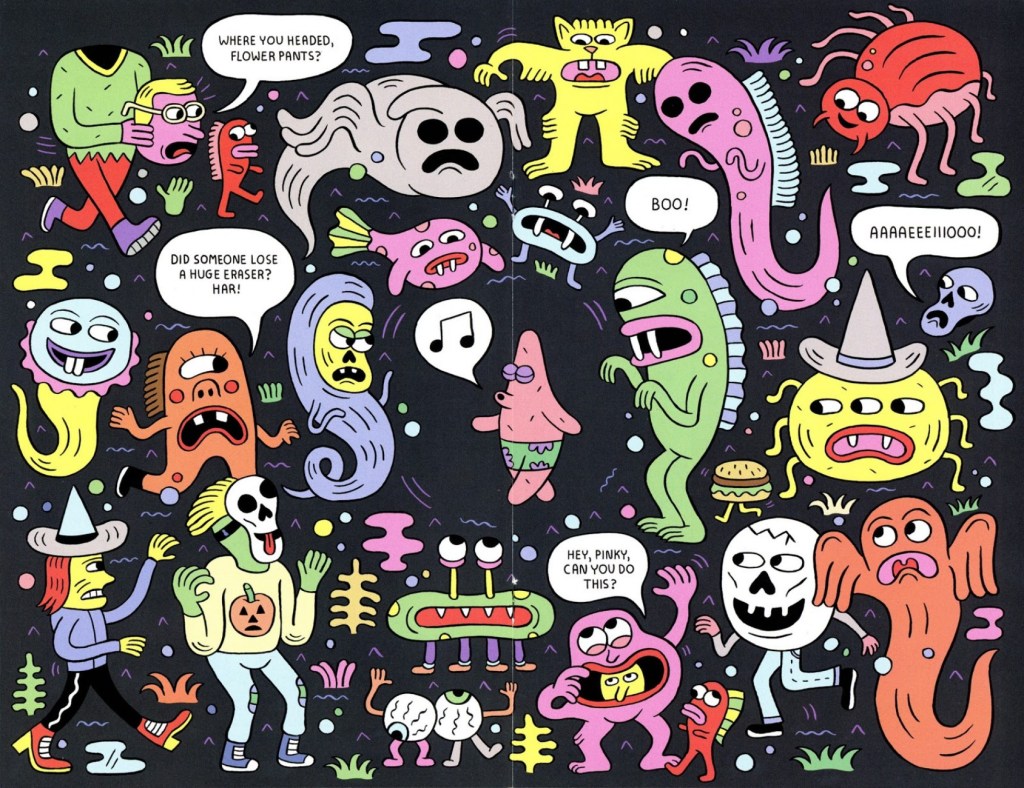
No tentacles yet, but I couldn’t resist sharing this colourful, spook-tastic spread from SpongeBob Comics No. 25 (October 2013). Art by Andy Rementer.

The formula was similar to Simpsons Comics spin-off Treehouse of Horror: plenty of famous (and talented!) cartoonists having fun with the characters. Between the roster for the regular comics and the special-themed supersized issues, quite a few artists who participated are WOT favourites, and some are Tentacle Tuesday masters, to boot: Hilary Barta, Tony Millionaire, Al Jaffee, Ramona Fradon, Michael T. Gilbert… in 2017, Stephen R. Bissette even broke up out of retirement to work on a special Hallowe’en issue. I think this post is a decent sampler of the different styles and storytelling techniques involved – I’ve concentrated on prominent tentacles, and ignored all the trimmings (the recurring jellyfish tentacles, pumpkins sprouting grabby vines, etc.)

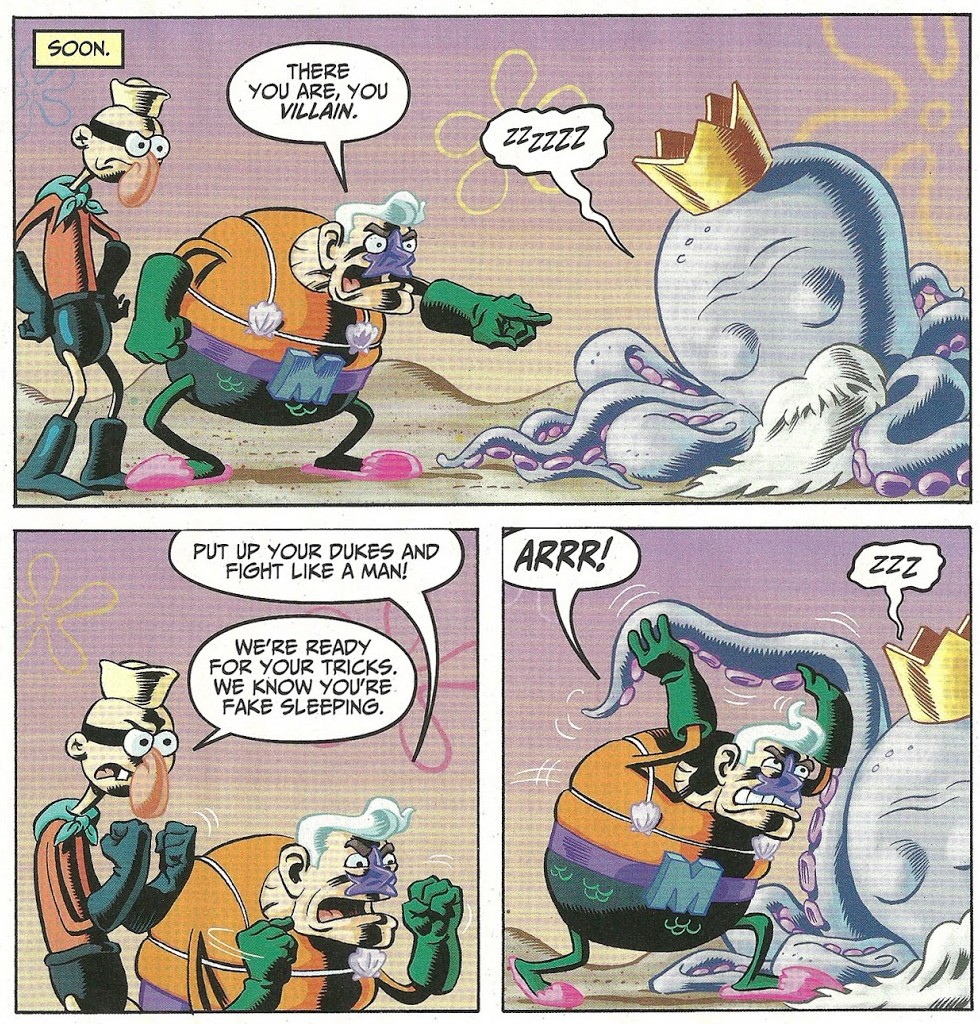
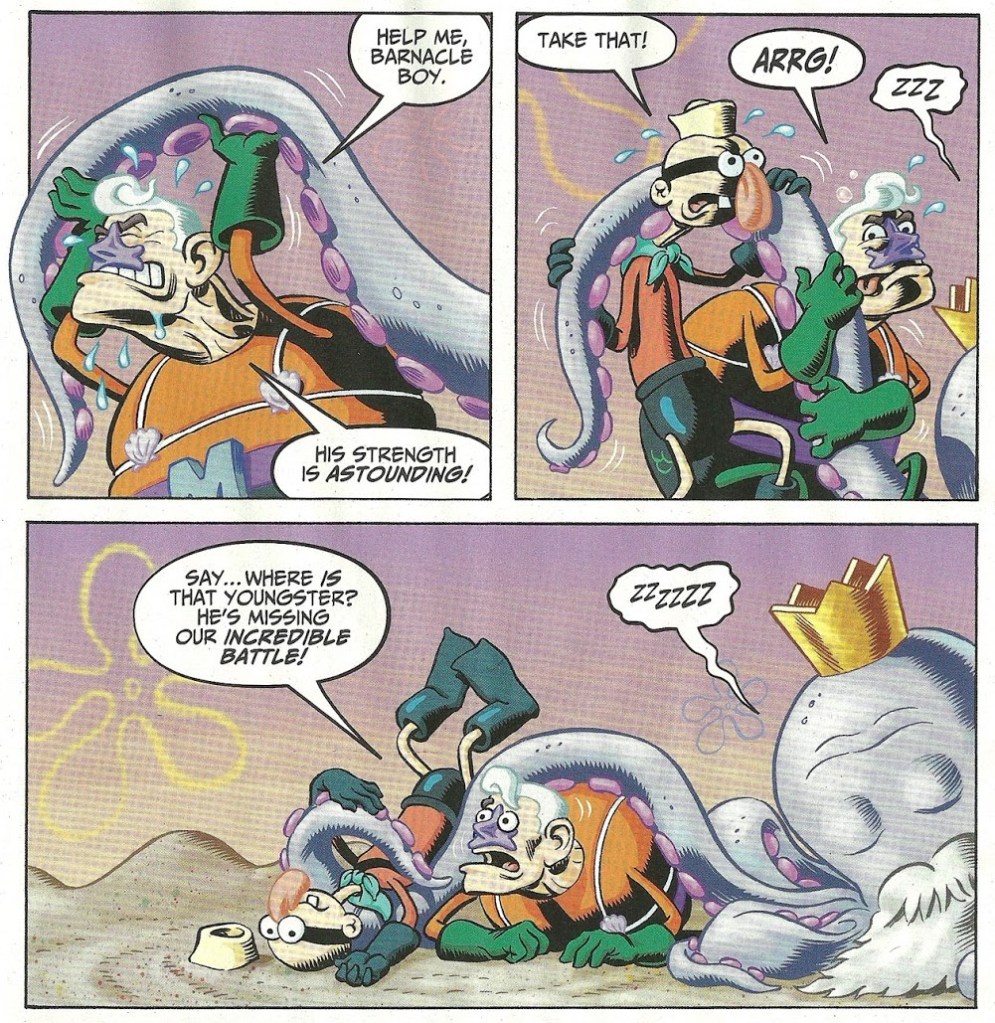
The tentacle fun starts right off with the first issue! Mermaid Man and Barnacle Boy vs. the Octopus King, written by James Kochalka and illustrated by Hilary Barta, was published in SpongeBob Comics No. 1 (February 2011):

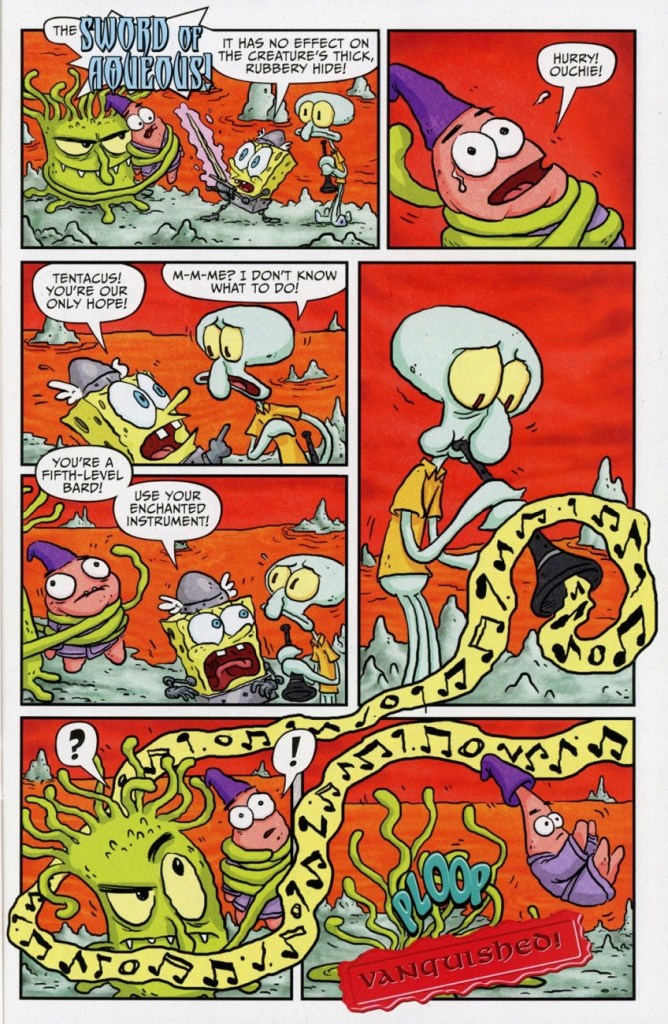
A page from Serpents & Sealords, written and illustrated by Corey Barba and published in SpongeBob Comics no. 51 (December 2015).

The following glorious illustration at the tail end of SpongeBob Comics no. 50 (November 2015) is by Jim Woodring:

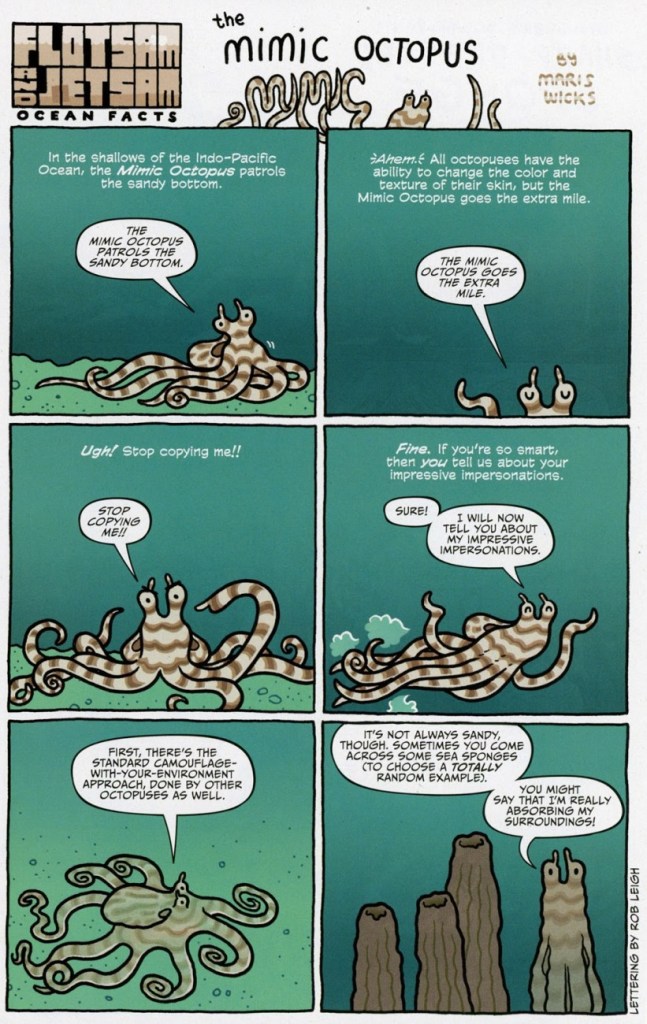
Given that Stephen Hillenburg (the creator of SpongeBob) was a marine scientist and teacher, it does not come as a surprise that the recurring feature Flotsam and Jetsam was used to talk about all manner of nautical critters and their habits. Here are a few:

Flotsam and Jetsam: Ocean Facts – The Mimic Octopus, written and illustrated by Maris Wicks and published in SpongeBob Comics no. 52 (January 2016).
Flotsam Fables: Legends of the Deep – The Kraken, written by Karen Sneider and illustrated by Vanessa Davis), was published in SpongeBob Comics  no. 62 (November 2016).
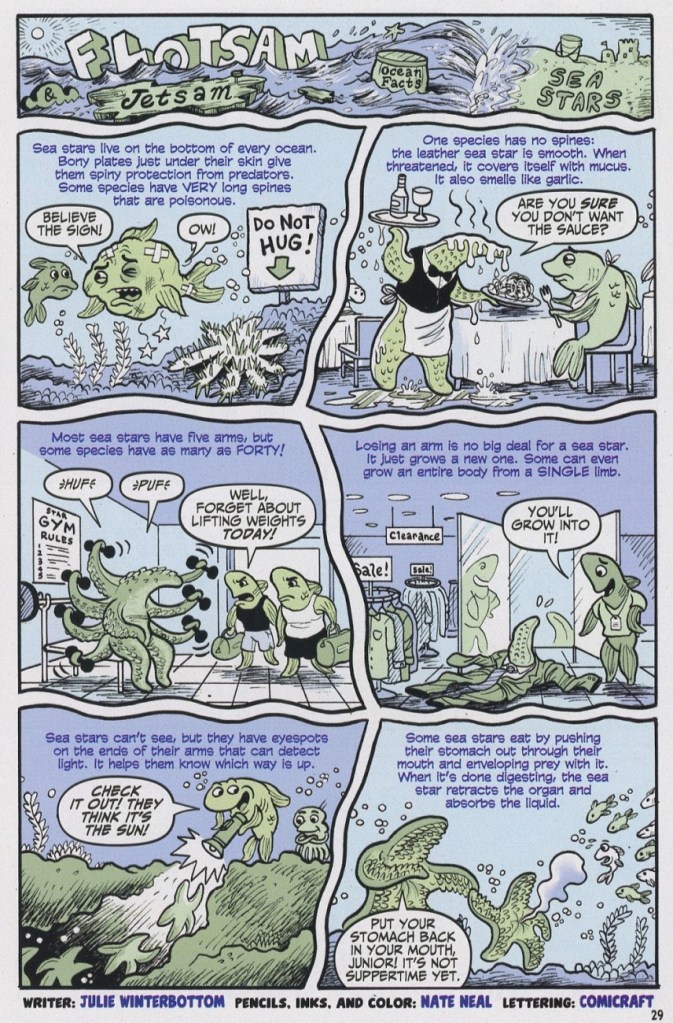
Flotsam & Jetsam – Ocean Facts: Sea Stars, written by Julie Winterbottom and illustrated by Nate Neal, published in SpongeBob Comics no. 71 (August 2017).

~ ds
Tentacle Tuesday: Into the Cephalopodic Underground

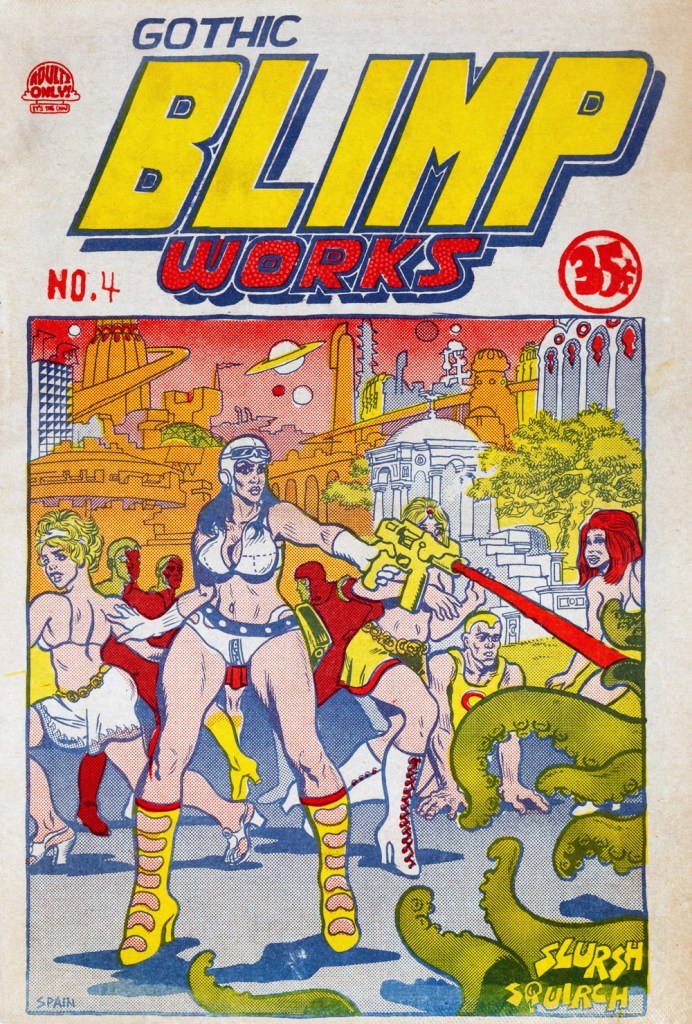
 « Slursh squirch! »

Greetings to saddle sniffers, subterranean dwellers and lovers of nasty fun! Today we take a little trip into the underground, where tentacles squirm in anticipation! Through some quirk, all of today’s covers involve aliens and spaceships – underground artists clearly also liked to speculate about the possibilities of inter-planetary travel.

If you’re a fan of those wild years of cartooning, visit out MEANWHILE, IN THE UNDERGROUND category!

Tentacle Tuesday opens up with a Nicola Cuti cover, whose cutesy style, albeit not particularly original, is pretty recognizable (for example, take a look at his Weirdlings, which has really grown on me over the years). His big-breasted, doe-eyed « intergalaxtic nymph » was not devoid of charm, although she only appeared in three issues (and issue no. 3 had a print run of a hundred copies, so I don’t think many people have seen it…) For more details about Moonchild Comics, consult the ever-useful Comixjoint.

Moonchild Comics no. 1 (1968, Moonchild Productions). Cover by Nicola Cuti.

Next up this lively cover by Spain Rodriguez, a WOT favourite. We haven’t posted that much about him, but co-admin RG did a lovely post about a surprisingly touching story from SR’s youth in Treasured Stories: «Tex’s Bad Dream or ‘The Egg Lady’s Revenge’» (1988).

Gothic Blimp Works no. 4 (Spring 1969, East Village Other). Cover by Spain Rodriguez.

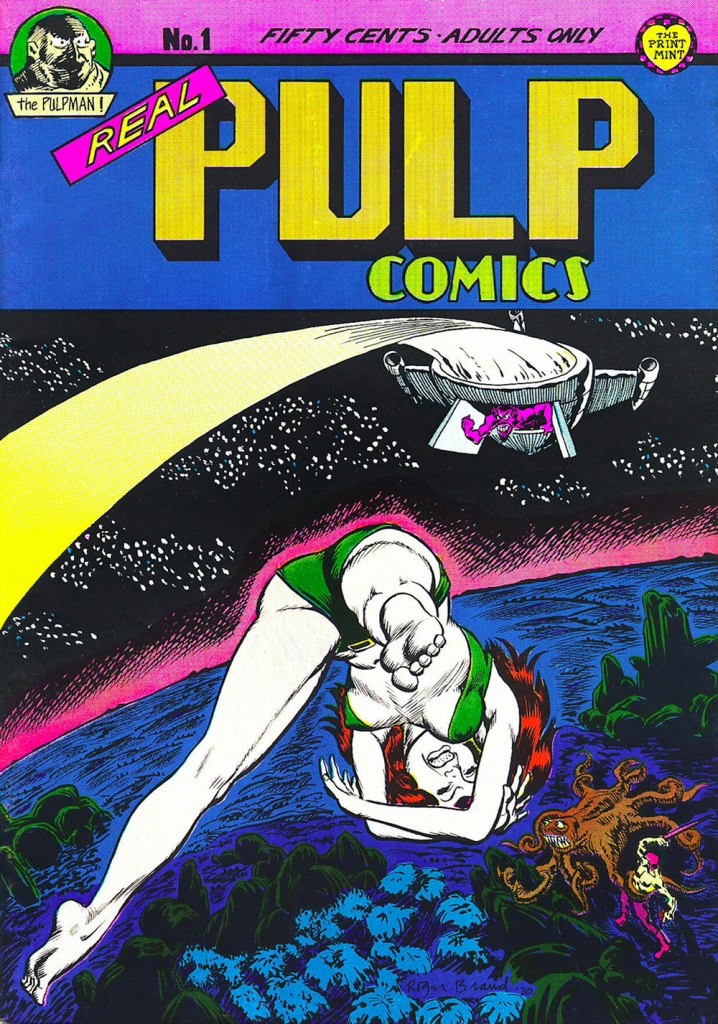
The next cover is on a similar theme: mostly naked female, tentacled alien, the shaboodle, with an interesting choice of perspective to boot. And by “to boot” I mostly mean that it looks like somebody gave her a good kick on the shapely derrière.

Real Pulp Comics no. 1 (January 1971, The Print Mint). Cover by Roger Brand, who tragically died at 42 – read a heartfelt panegyric from Kim Deitch in A Lousy Week for Woods (Remembering Roger Brand).

Staying with the same publishing house (The Print Mint was a major publisher/distributor of underground comix in their heyday in the San Francisco Bay Area!) and the same theme, another damsel in the clutches of a (pretty cute, actually) alien. She’s wearing red, which of course is the traditional colour for cephalopod attacks.

Yellow Dog no. 20 (July 1971, The Print Mint). Cover by Trina Robbins, who designed the original Vampirella costume.

~ ds

Tentacle Tuesday: Gardening Woes

This year, since I am currently working from home and spending a lot of time on the balcony, I decided to take another crack at planting a few things in containers and taking a chance with the local squirrels’ tendency to root through soil and munch on whatever’s planted. Still, for all my adorable-yet-annoying rodent problems, I have to admit that I have it much better than some folks: there are no tentacles in this garden, thank you very much.

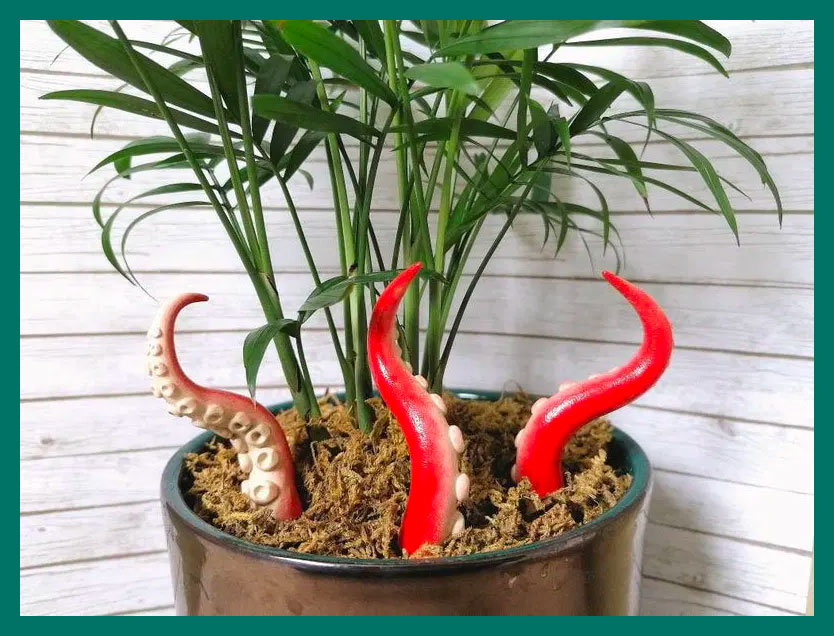
If you should ever see something of this sort emerging from the pot, run the other way!

ACG’s Adventures into the Unknown can always be relied upon for an octopus or two (or ten) – just see Tentacle Tuesday: ACG’s Adventures Into the Tentacles, for example. Tentacles of the plant variety also make a frequent appearance, of all shapes and sizes and degrees of grabbiness.

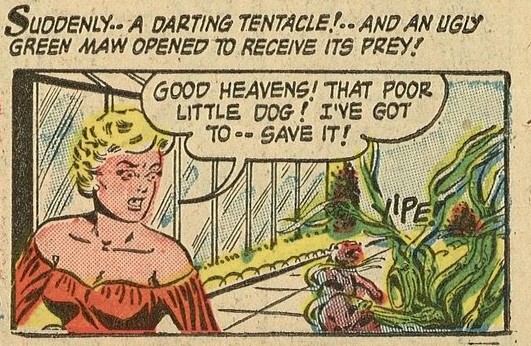
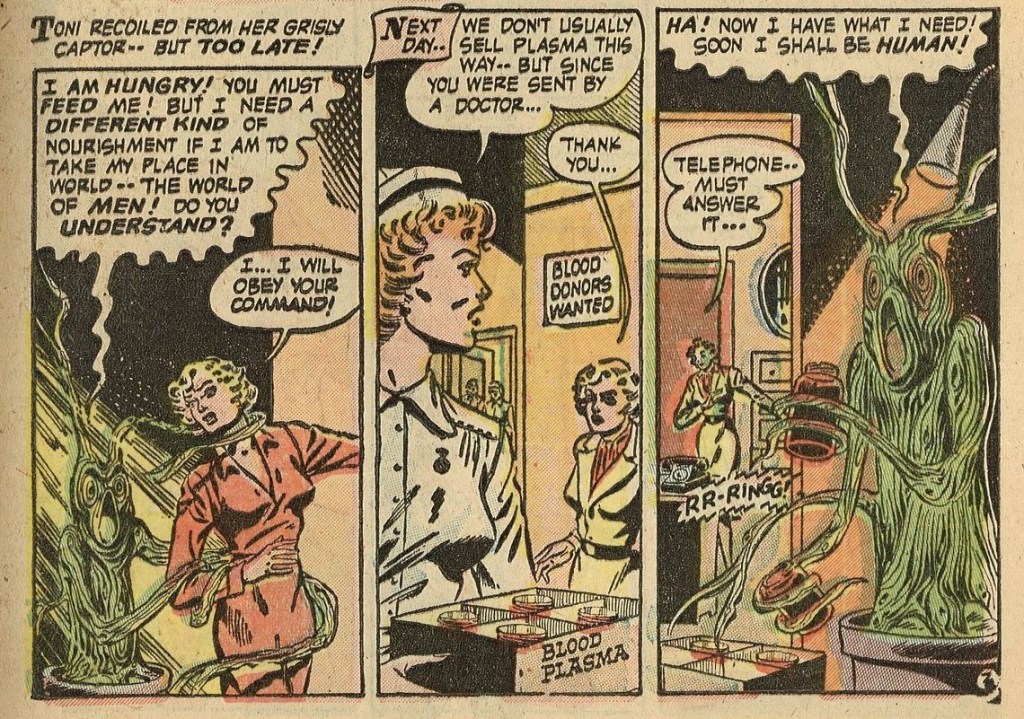
The Plant That Lived, illustrated by Harry Lazarus, was published in Adventures into the Unknown no. 38 (December 1952, KenACG). What happens when a young woman is forced to tend to a plant’s roots against her will?

It all starts with a dog in a botanical garden.

An interesting plot point, revealed at the end of the story, is that the plant’s fervent desire to become human is explained by his love for Phil Benson, the young botanist. I kind of want to see a follow-up story about that couple and the problems a plant-man pairing would be confronted with. And the classy blonde? She can find somebody else to hang out with.

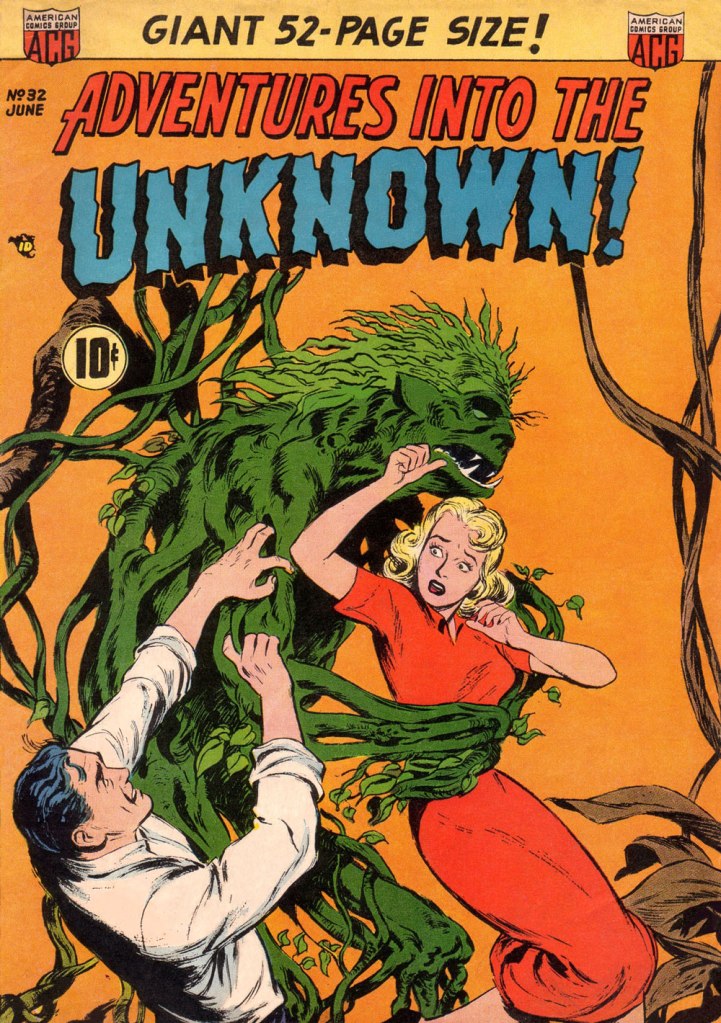
A very similar blonde in a red dress was featured on the cover of an earlier issue, Adventures into the Unknown no. 32 (June 1952, ACG). It may not explicitly feature tentacles, but it is close enough in spirit for me to happily welcome it to the fold!

Cover illustrated by Ken Bald.

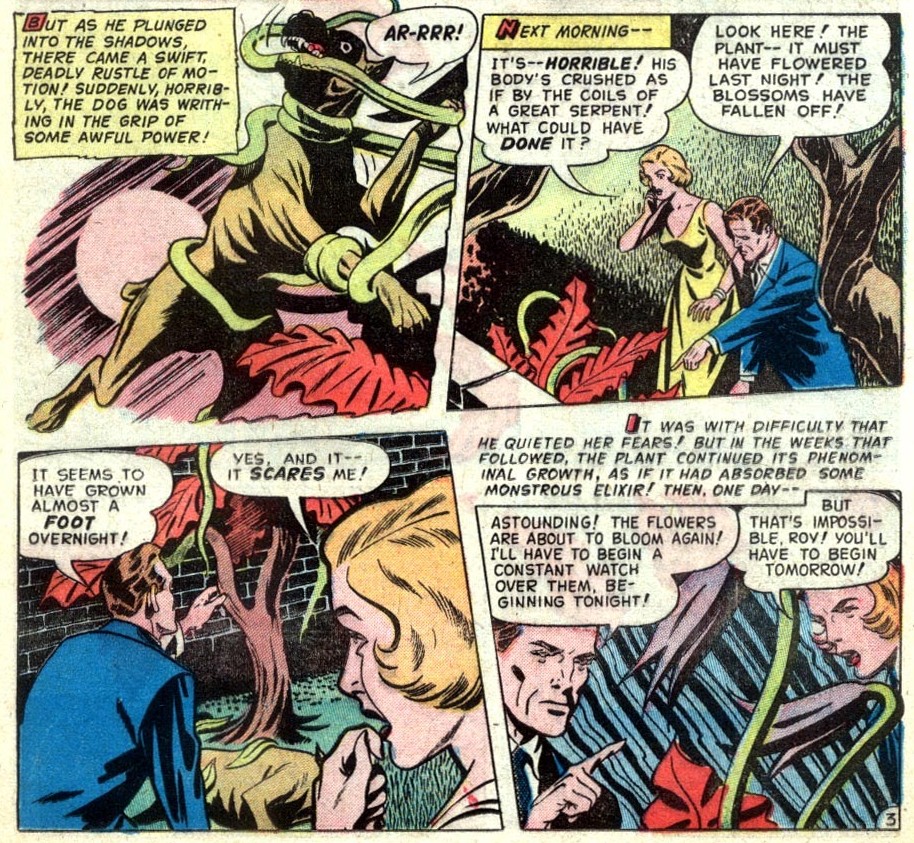
Another plant-tentacle offering from ACG comes from The Garden of Horror, illustrated by Lin Streeter, published in Adventures into the Unknown no. 48 (October 1953, ACG). This somewhat wordytale concerns itself with an archeologist who comes upon some strange seeds in a ruined temple in an unspecified ‘remote corner of Africa’. Arriving home, he plants them, and – surprise, surprise! – gets a little more than he bargained for. A dog is also involved, though this time it does not escape unscathed.

Carla gives her unscientifically-minded beau (strangely unconcerned with the killed dog, and later in the story, a similarly-dispatched burglar) an ultimatum: either he destroys this evil plant, or it’s all over between them! He chooses the plant – what the hell, she was a nag, anyway.

A subsection of mansplaining is giving directions that are not needed – I think Carla had the idea of ‘cutting the coils’ long before Roy told her to.

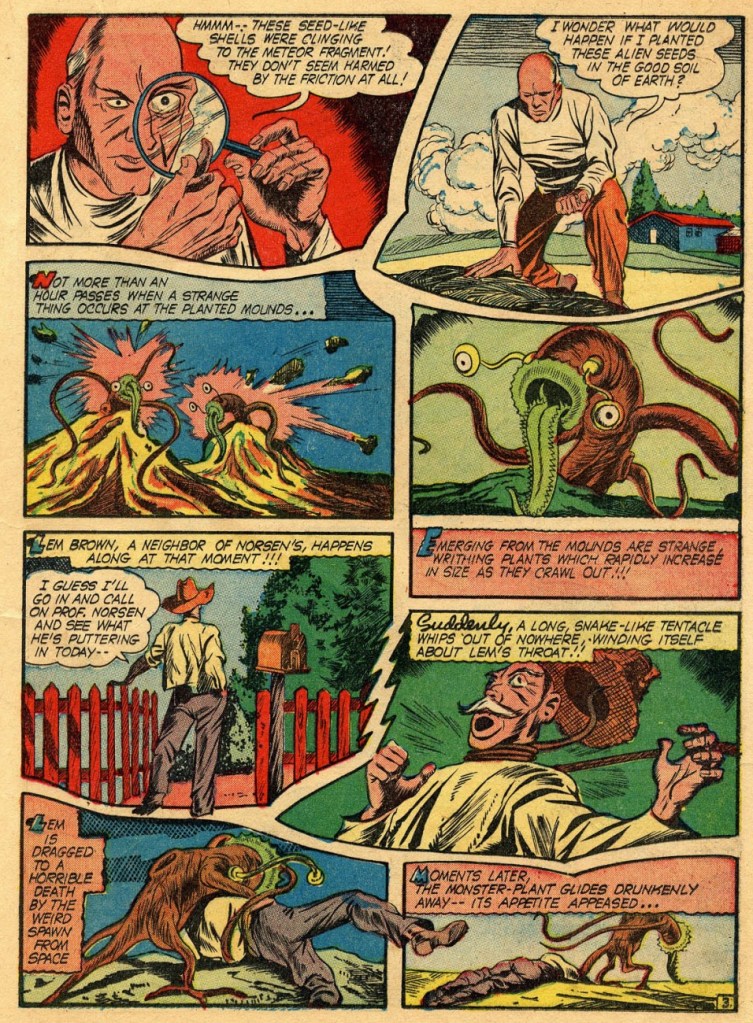
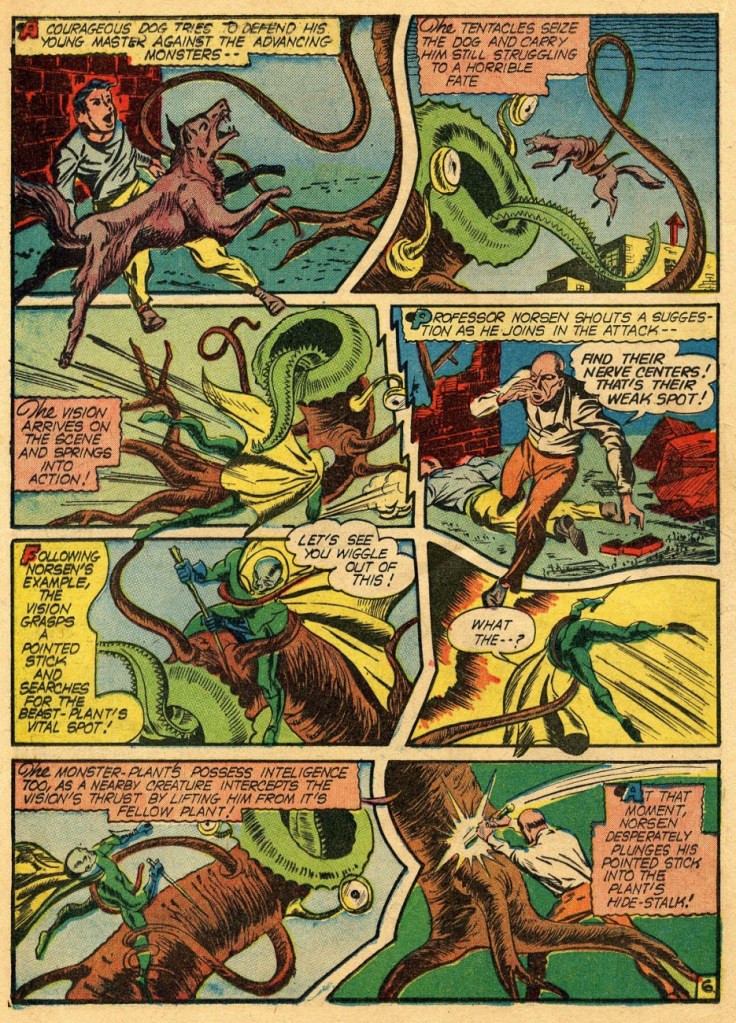
Continuing the theme of the strangulated man and the tentacle-throttled dog, we have two pages from a The Vision story (without a title) published in Marvel Mystery Comics no. 26 (December 1941, Marvel). A scientist finds some strange seeds and plants them. Does that sound familiar?

The tentacled creatures look like they’ve just woken up after a long night of partying with a terrible hangover. I love it!

Fortunately, the brave doggo that gets trapped by tentacles is saved in the nick of time by the Vision. Aarkus, aka The Vision, was created by Joe Simon and Jack Kirby (much like all roads once led to Rome, sometimes it seems that the latter has had a hand in creating nearly everything), as an alien enforcement officer from a dimension called Smokeworld. I stand by the side of any alien who saves braves doggos from a ‘horrible fate’!

This is neither here nor there, but The Vision has been repurposed by Roy Thomas in the late 1970s as part of the Avengers. I quote: « A great fan of Golden Age heroes, [Roy Thomas] first thought to bring back Aarkus, a 1940s hero who had been called the Vision due to his spectral appearance and smoke-based abilities. He discussed the matter with Marvel editor Stan Lee, who enjoyed the idea of a new member, but didn’t want it to be an alien or visitor from another dimension. After he suggested creating a new character entirely and that it could be an android instead, Thomas compromised by creating a new android character who resembled Aarkus and also called himself Vision. » Err, how is using the same name/moniker and a differently-coloured, but otherwise very similar costume considered “creating a new character”?

Glancing at some previous Tentacle Tuesdays, I realize I’ve actually built up a healthy nursery of plant instalments. If you’re still in a horticultural mood, here are some of them:

Tentacle Tuesday: Tender Tendrils of Vernal Bloom

Tentacle Tuesday: A Child’s Garden of Carnivorous Plants

Tentacle Tuesday: Plants Sometimes Have Tentacles, Too

Tentacle Tuesday: Spring Has Sprung… Its Snare!

Tentacle Tuesday: Tropical Foliage!

Tentacle Tuesday: The Hungry Greenery

~ ds
Tentacle Tuesday: Don’t Miss the Boat!

« Don’t change your tack when the timbers crack
On the dark and the rolling sea…
» *

I am relatively indifferent to tales of adventure, but the siren song of the ocean sometimes prompts me to venture into reading tales about ruthless pirates or valorous seafarers and the perilous voyages they undertake on ships big and small, magnificent or modest. Who hasn’t felt a thrill at spotting a handsome vessel on the water, even if that water is but a canal running through the city? The other point of interest of this discussion is that where there’s an ocean and a ship upon it, there is a (preferably) giant octopus somewhere nearby, only waiting to shred the ship’s hull to smithereens and voraciously gobble up its shipmates.

I’ve talked about consumed shipmates before (see Tentacle Tuesday: Seafaring octopuses and the men they have shamelessly devoured), so today let’s focus on some nautical vessels!

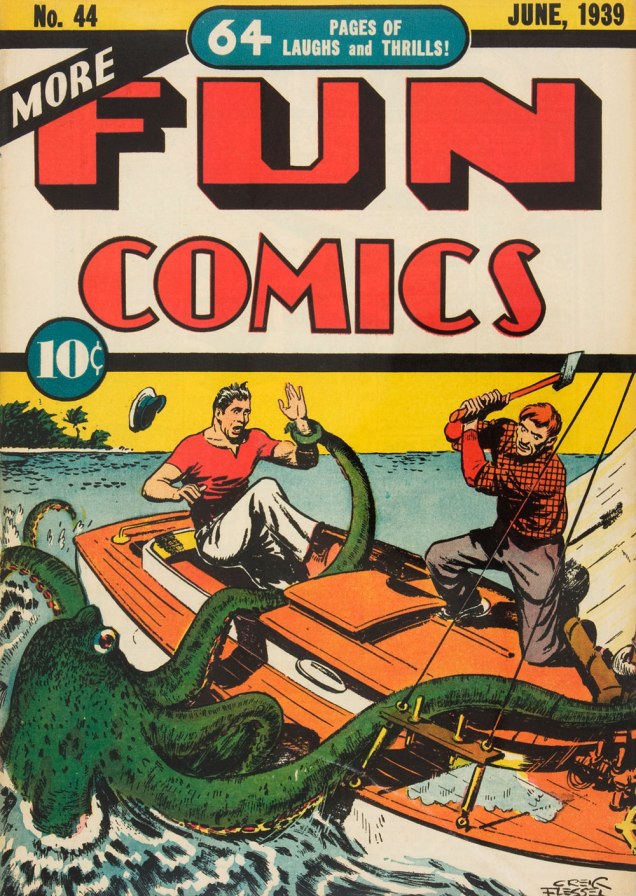
Here is a modestly-sized yet utilitarian boat with a handsome octopus in tow. Maybe he just wanted to climb on deck to rest a while, like this otter?

More Fun Comics no. 44 (June 1939). Cover by Creig Flessel.

A similar boat (I don’t know whether it’s my profound lack of knowledge of boats that makes it seem that way) was attacked by a bigger, scarier – downright malevolent! – octopus some twenty years later. See Kyle “Ace” Morgan, Matthew “Red” Ryan, Leslie “Rocky” Davis and Walter Mark “Prof” Haley scramble for safety while an enraged octopus seeks to devour them! Oh, sorry, I’m being melodramatic.

Challengers of the Unknown no. 77 (Dec. 1970 – Jan. 1971, DC). Pencilled by Jack Kirby, inked by Jack and Rosalind (Roz) Kirby.

This cover has actually been recycled from Showcase no. 12 (Jan.-Feb. 1958, DC), where the background was yellow and the water a more normal shade of blue-white. I do like how the octopus stands out against a black background, however (and the multi-coloured water really sets off his beady, evilly-glowing green eyes!)

Of course these encounters also take place within the stories, as opposed to on the cover.

Page from The Outcasts of the Seven Seas, scripted by Bob Haney, pencilled by Howard Purcell, and inked by Sheldon Moldoff, was published in Sea Devils no. 23 (May-June 1965).

Time to move underwater, a very natural setting for an octopus attack. Here we have a submarine tenderly wrapped in tentacles:

Page from The Human Torch in the Clutches of the Puppet Master!, (over)scripted by Stan Lee, pencilled by Dick Ayers and inked by George Roussos. This story was published in Strange Tales no. 116 (Jan. 1964, Marvel).

Last but not least, I’ve kept this neat little submarine until the end:

Voyage to the Deep (IDW Publishing, 2019), a collection of Dell Comics’ short-lived, four-issue series published from 1962 to 1964 and illustrated by Sam Glanzman. Note the introduction by WOT favourite Stephen Bissette!

Glanzman is also a favourite of ours, though we haven’t talked about him much (yet). In case you’re wondering what the insides of one of those issues looked like – good, they looked really good! Note the octopus proudly perched in the middle of the page.

Page from Voyage to the Deep no. 1 (September-November 1962, Dell). Art by Sam Glanzman.

~ ds

Tentacle Tuesday: Do Send Us a Postcard, Luv!

I don’t know about you, but for me postcards are an intense evocation of nostalgia – so ubiquitous in the last century, and just a pale shadow of their former glorious selves in this day and age. Fortunately, a lot of them have survived through the years, and collectors have taken care to preserve these snippets of the past, whether crass or elegant, stunningly illustrated or just the barest sketch of an idea.

We’ll start with the oldest postcards of today’s post from quite a long time ago – the beginning of the 20th century in France.

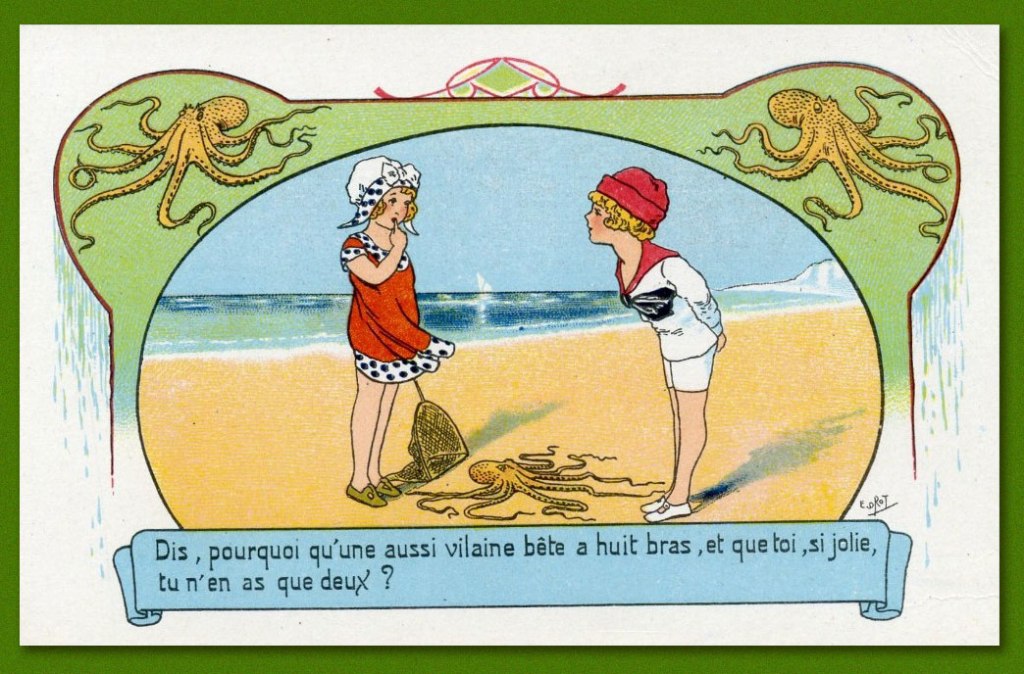
These following two French postcards from 1910 are signed by “E. Orot”, though I wasn’t able to find out whose nom de plume that was. The back of the cards says “près des grands flots bleus” (near the great blue waves) which was the name of the seaside-themed series by this mysterious artist.

The poem is something like “Why don’t I have, like this octopus, eight long arms to embrace you, for I would, without getting weary, make my kisses into true masterpieces”.
“Say, why does such a nasty beast have eight arms, and you, so pretty, have only two?”

The following postcard is French, part of a series of images depicting France in the year 2000 as seen by artists in the early 20th century. These were first published as inserts in cigar boxes, and later given second life as postcards. This one is painted by Jean-Marc Côté. « There are at least 87 cards known that were authored by various French artists, the first series being produced for the 1900 World Exhibition in Paris. Due to financial difficulties the cards by Jean-Marc Côté were never actually distributed and only came to light many years later after the science-fiction author Isaac Asimov chanced upon a set and published them in 1986, with accompanying commentary, in the book Futuredays: A Nineteenth Century Vision of the Year 2000. » To see more of these cards, visit A 19th-Century Vision of the Year 2000, which is also where that quote is taken from.

Moving on to France’s “historic rival“, Britain.

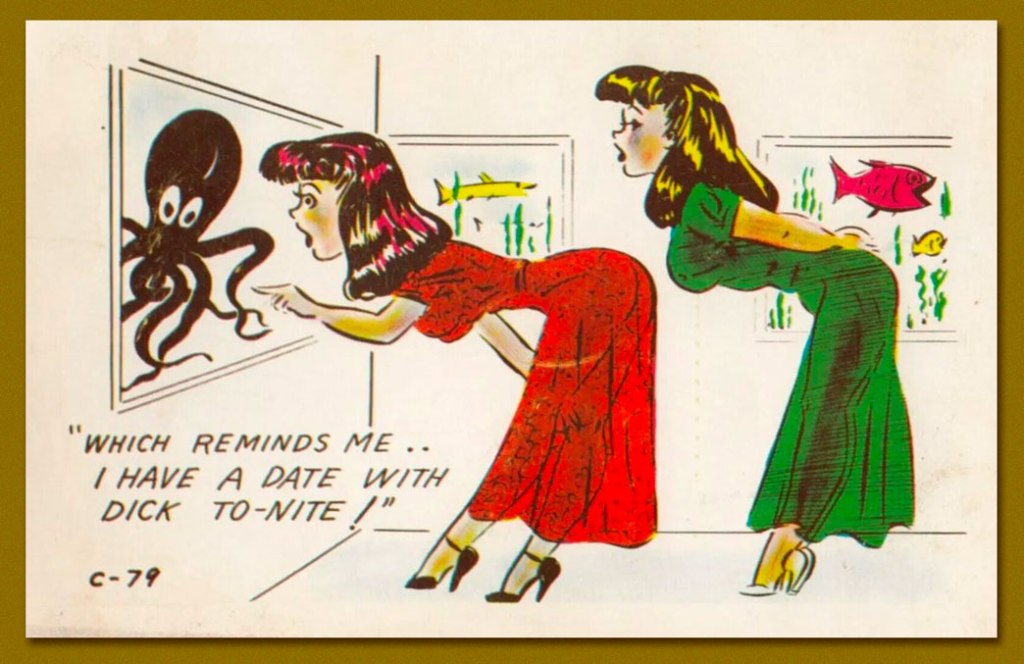
All I was able to ascertain is that this postcard is British, from the 40s or possibly 50s. Are these women giantesses, or is this aquarium exhibit meant for children or possibly dwarves? We will never know.

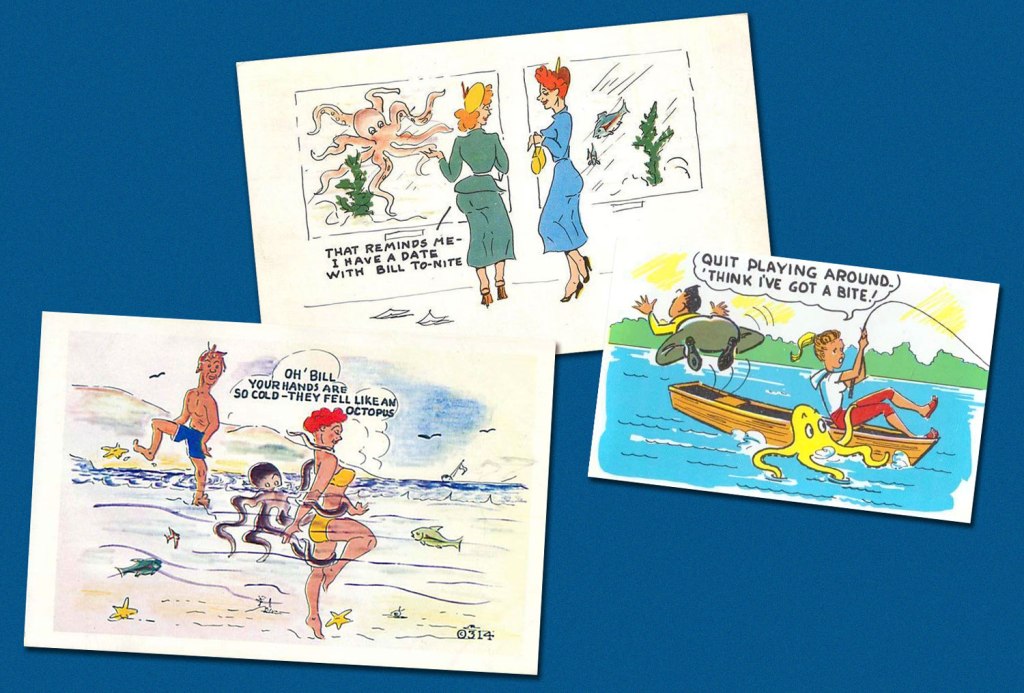
The three following postcards are British, but from varying decades. The Bill going on a date is from the 1950s. Bill’s cold, octopus-like hands (is it the same Bill, some twenty years on?!) are from the late 70s, published by Kromekolor, which seems to have had a chunk of the British market, though very little information is available online. And the nameless guy playing around with a fishing girlfriend is from sometime in the late 60s, and I would not at all be surprised if his name was William.

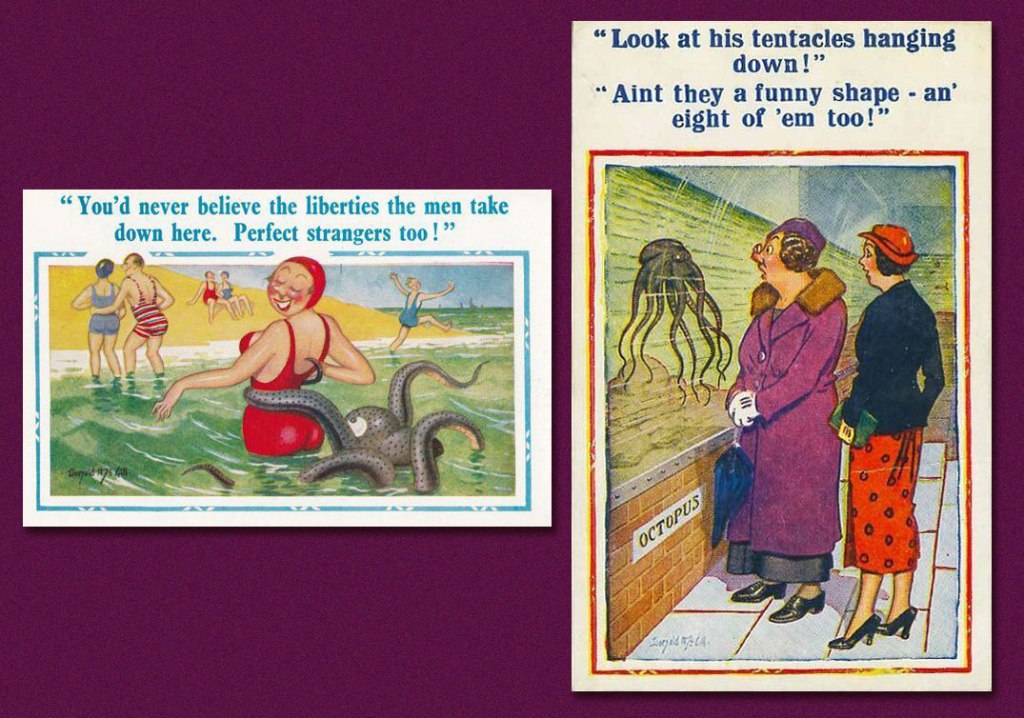
We have talked about Donald McGill, the king of comic postcards (take a look here) before. I was delighted to find two tentacular offerings from the vast collection of postcards he has drawn.

Continuing in a British vein, this postcard is part of the Seaside Spooners collection by Tom Browne, (another extremely prolific British artist and very much a contemporary of McGill) and is entitled The Lovers’ Seat.

Moving on the good ole U.S. of A. – here’s a pair of American postcards from the 50s, with rather similar jokes.

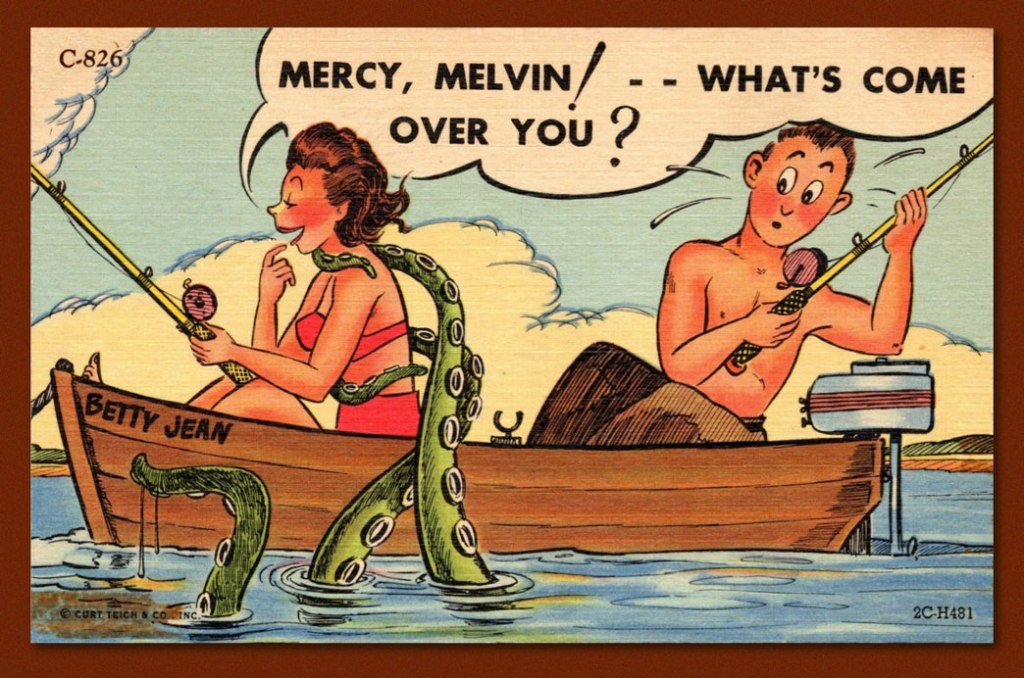
It’s not very clear why Horace is being propelled out of the boat like that. Is he perhaps terrified of octopuses? Note that it is exactly the same “gag” as in a British postcard featuring William.

And another postcard from 1954. Unfortunately, I don’t know who the illustrator is in either case. I like how Melvin looks puzzled, not scared, by this cephalopod intrusion.

I hope you enjoyed this little voyage! Until next Tuesday…

~ ds

Tentacle Tuesday: Tentacles Aren’t So Bad, My Old Fruit*

« The land of embarrassment and breakfast. » Julian Barnes

Ah, yes, it’s time to paddle once again to British shores, after fortifying myself with a few dainty tea sandwiches. In rough chronological order…

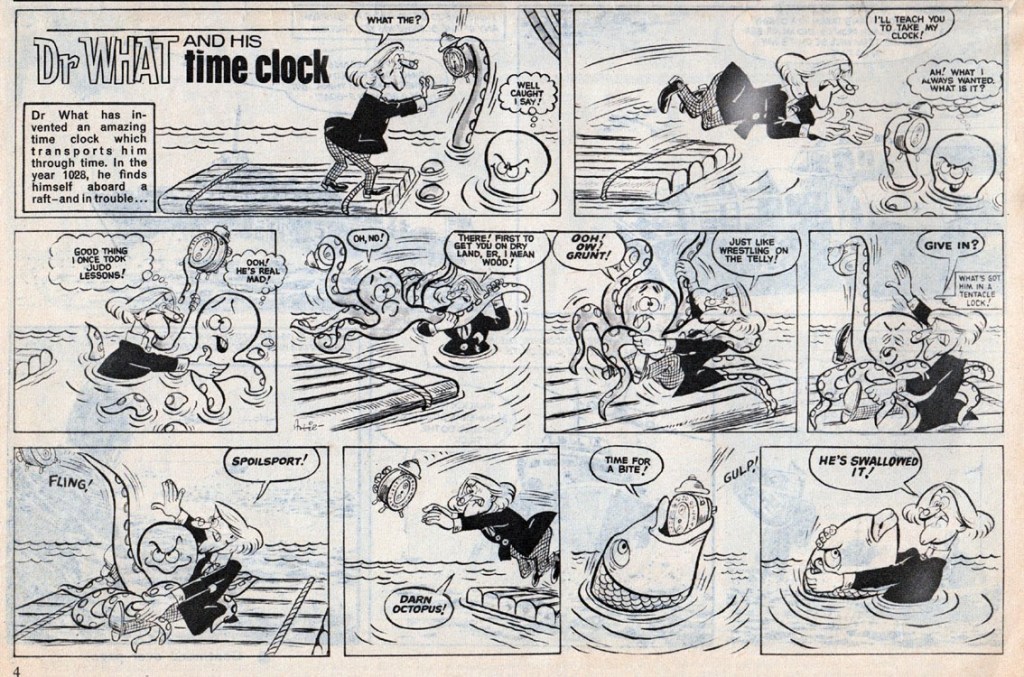
Here is a Dr What and His Time Clock strip I found on the excellent Blimey! The Blog of British Comics. I’ll quote Lew Stringer, its author, who is a lot more knowledgeable about British comics than I’ll ever be: «... a weekly humour-adventure serial that ran in Boys’ World in 1964, published by Odhams. The hairstyle and clothing of the character is obviously based on that of the first Doctor as portrayed by William Hartnell. Here’s the episode from Boys’ World Vol. 2 No. 33, dated 15th August 1964. The art is by Artie Jackson, who later drew Danger Mouse (preceding the TV cartoon of the same name/concept) for Smash! in 1966. Jackson also drew many of the Danny Dare strips for Wham! »

Dr What and His Time Clock strip from August 1964, drawn by Artie Jackson.

In case you didn’t know, a beano is British slang for a noisy festive celebration, or, in other words, some sort of a party. Biffo the Bear is not my favourite character from this very long-running publication (started in 1938, still ongoing), but I really like the way this octopus is drawn.

Beano no. 1435 (January 17th, 1970, D.C. Thomson). Cover by David Sutherland.
Chips from March 10th, 1973. The cover is drawn by Mike Lacey, son of adventure strip artist Bill Lacey.

Scream Inn, written and illustrated by Brian Walker, was a beautifully-drawn strip published in Shiver and Shake (and, later, Whoopee!). The location: a hotel run by ghosts. The premise: these ghosts delighted in playing pranks on humans, and offered a million pounds to anybody who would manage to stay at their hotel for an entire night. Readers were invited to suggest what type of person could make it through the night (and were granted a one quid reward if their suggestion made it into a story).

In this one, a friendly octopus is borrowed to terrify a clown:

Scream Inn page published in Whoopee! from June 4th, 1977.

Cookie’s many-tentacled friend Olly makes another appearance a month later, this time used to spook “Jake the Peg with an extra leg”.

Scream Inn detail published in Whoopee! from July 16th, 1977.

Incidentally, isn’t this a nice header?

Elephant on the Run ran in Cheekly Weekly and was drawn mostly by Robert Nixon, with some other artists occasionally filling in. This strip boasted a pleasantly surreal premise: the elephant, Walter, is being relentlessly pursued by a mysterious man in a plastic mac… and suffering from a bad case of amnesia after an unfortunate circus act mishap, he has no idea why he’s being hunted, or what the man wants from him. Still, he runs! Both of them donning a range of improbable costumes to fake each other out – as in the following strip, in which Walter dresses, among other things, as a one legged pirate to elude detection. This sort of wackiness is why I love British comics.

This instalment of Elephant on the Run was published in Cheeky Weekly of November 25th, 1978 and is drawn by Robert Nixon. Look inside this issue here.

I hope you enjoyed this foray into British tentacles! There are plenty more of that stuff in our archives – or go rummaging through the whole British category in THE SUN NEVER SETS ON THE BRITISH EMPIRE!

~ ds

*paraphrasing from ‘Pimlico’ by David Devant & His Spirit Wife. Here are these joyous goofballs:

Tentacle Tuesday: Planet of Tentacles, part II

It was high time to finish what I started! Here is part two of Tentacle Tuesday: Planet of Tentacles, courtesy of Fiction House. I doubt I will exhaust Planet Comics’ source of tentacles when it comes to inside stories, but at least we’ll be able to say that we’ve completed our tour of its tentacle-bearing covers.

Planet Comics no. 2 (February 1940). Cover by, believe it or not, Will Eisner, a mere 23 at the time. If it’s meant to be scary, it is! Though perhaps the garish colours have something to do with it.
Planet Comics no. 15 (November 1941). Cover by Dan Zolnerowich, under his nom de plume Zolne Rowich.
Planet Comics no. 52 (January 1948). Cover by Joe Doolin.

Honestly, I wasn’t quite sure whether these were tentacles or what, but one look at the cover story dispelled my doubts. Does anybody care that the monsters inside look nothing like the ones on the cover? Naaah.

Mystery of the Time Chamber! was scripted by Ross Gallun and illustrated by Maurice Whitman.
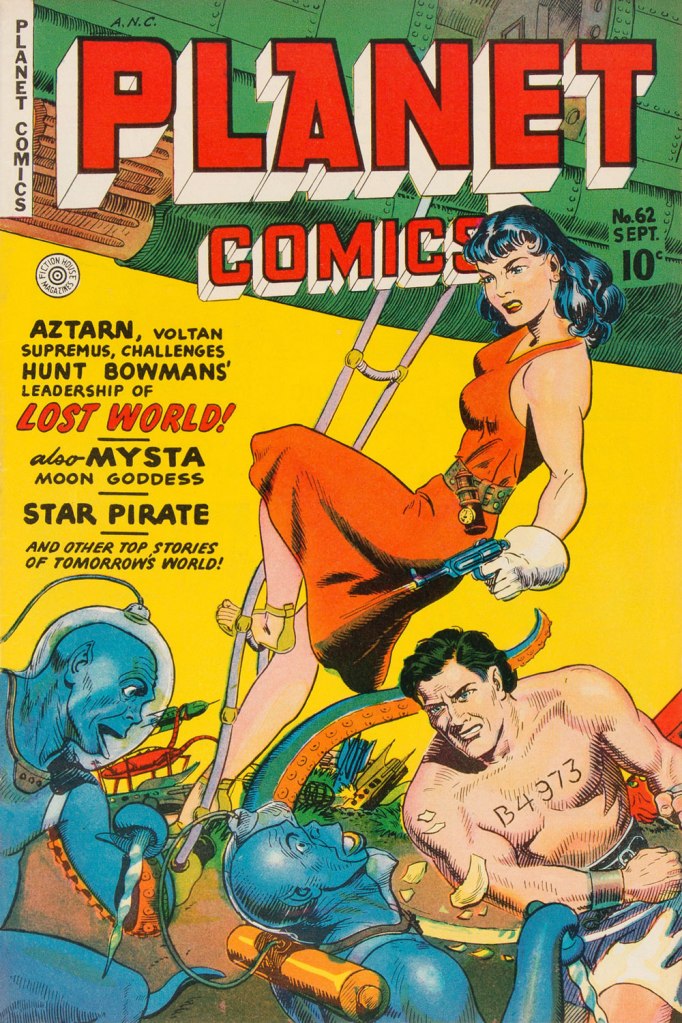
Planet Comics no. 62 (September 1949). Cover pencilled by Joe Doolin and inked by John Celardo.

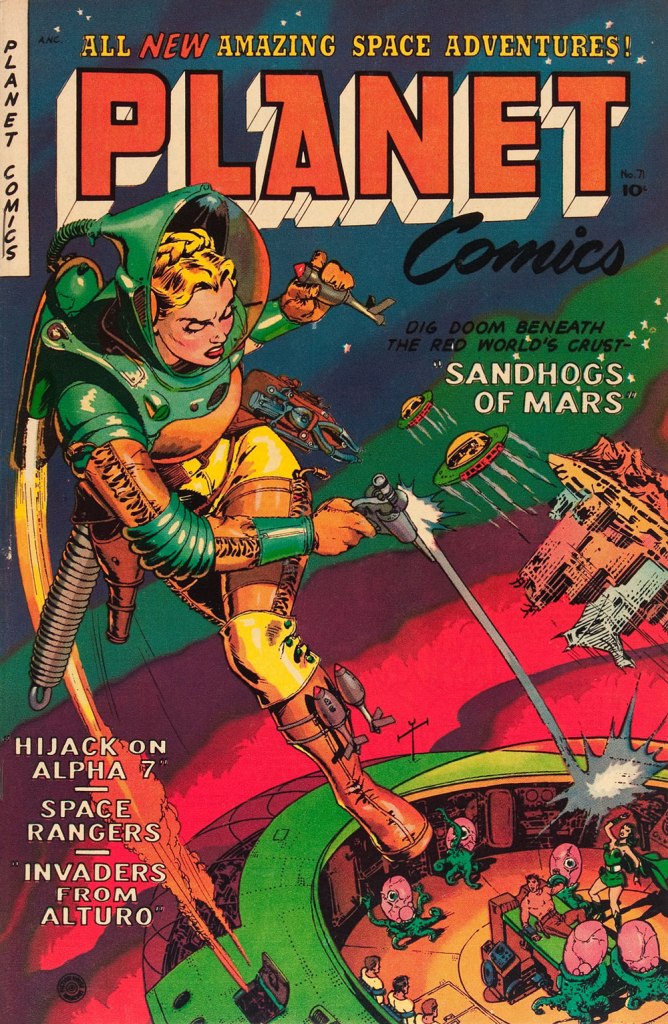
And, last but not least, look at these baby cephalopods! So cute.

Planet Comics no. 71 (Summer 1953). Cover by Maurice Whitman. Speaking of which, visit Ectoplasm-bedeviled pulchritude: Maurice Whitman’s Ghost Comics for more lovely art!

~ ds