« Every Goblinko product is a seed of a better world. Better because it is built to last – built for relevance – built for survival – built for buttermilk – built for speed – built for living the chaos – built for you! Everything else sucks! Go Goblinko! »
My path to discovering Sean Äaberg‘s art was rather tortuous.
On one hand, I’ve liked Goblinko t-shirt designs for a while – co-admin RG is a big fan, and given my love for pickles, so am I. Somehow I was not aware of those was creating these designs, however.
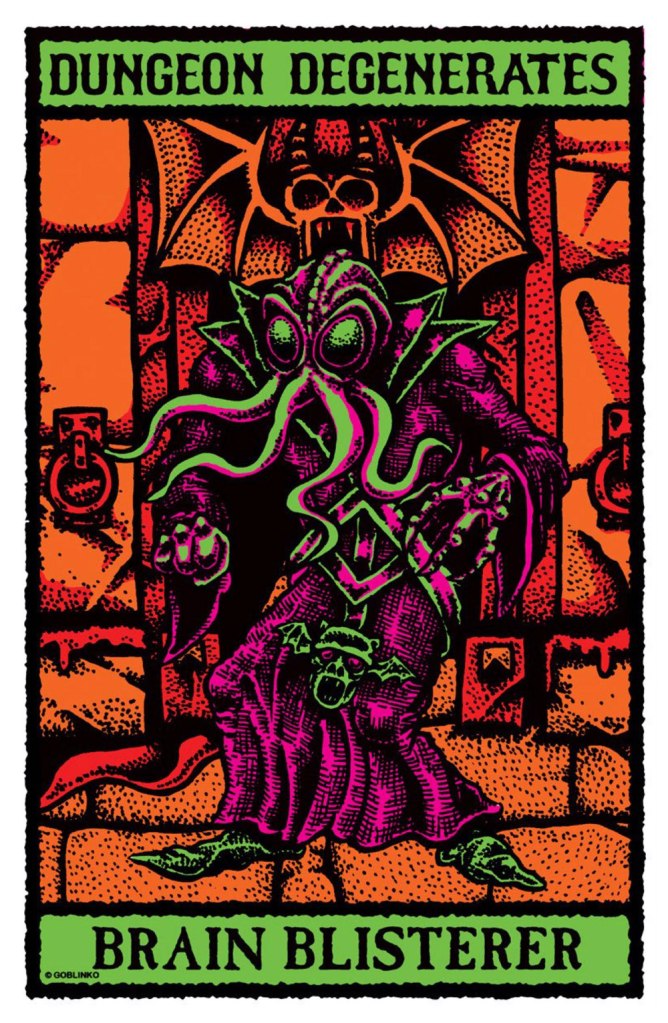
As for Äaberg art, it all began when I saw some very striking Tarot cards on some forum discussion – I have no interest in Tarot, but these were hitting all the right buttons, with their super bright green-magenta-yellow colour scheme and lush artwork. I looked up the artist, and landed on his Dungeon Degenerates on the wonderful Monster Brains blog.
As I am one of those silly people who want to own stuff on paper, I looked for a book and found Acid Vomit! The Art of Sean Äaberg on Kickstarter. When I received this (glorious, by the way) compendium, something clicked into place and suddenly I realized that Sean Äaberg = Goblinko!! (Well, to be fair, Sean’s wife Katie is part of it, too.) Nothing like one of those ‘well, that should have been obvious a long time ago…’ realizations to put one into a philosophical mood.
Another Kickstarter campaign is currently taking place, this time for a Halloween book (which this household is of course supporting, given that Halloween is our favourite holiday!) Please lend a much-needed (financial) hand to this worthwhile project!
« Crammed to the gills with real Street Rocker junk scraped from the mean streets of Porkland. » This is Pork no. 20. It was, indeed, free as the cover promises – you can admire the covers of other issues here. Yes, the tentacles are subtle, but they’re nevertheless lurking!
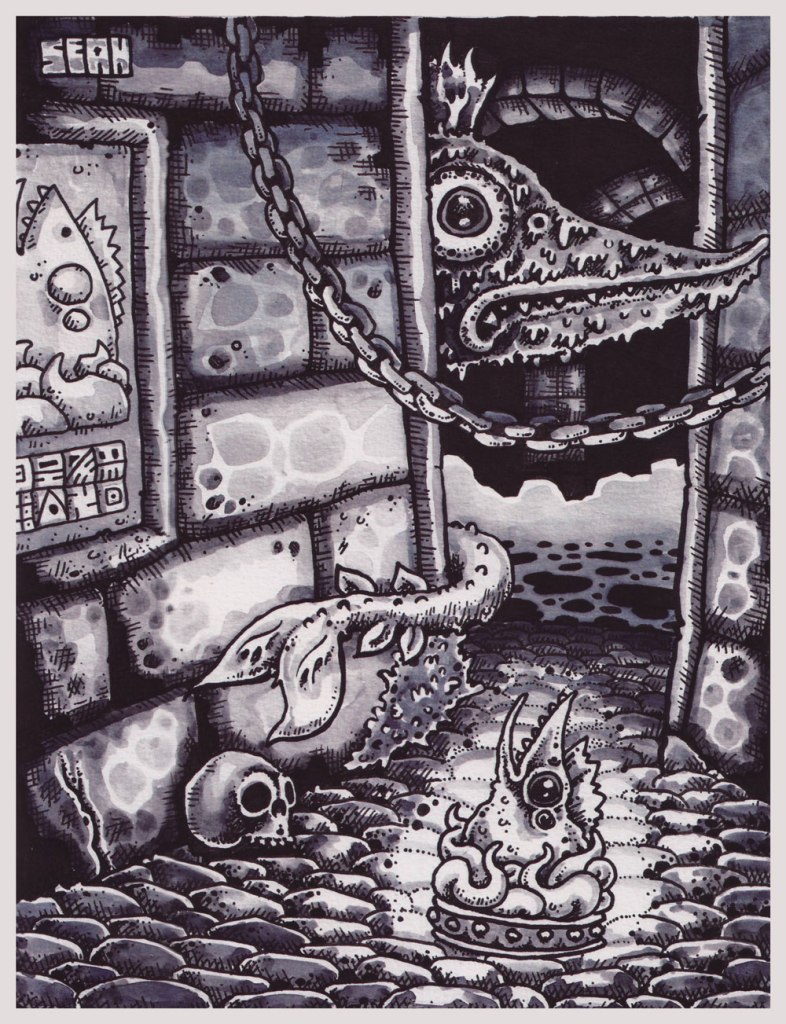
A cutie pie! Scanned from Acid Vomit! The Art of Sean Äaberg (Gingko Press, 2012).
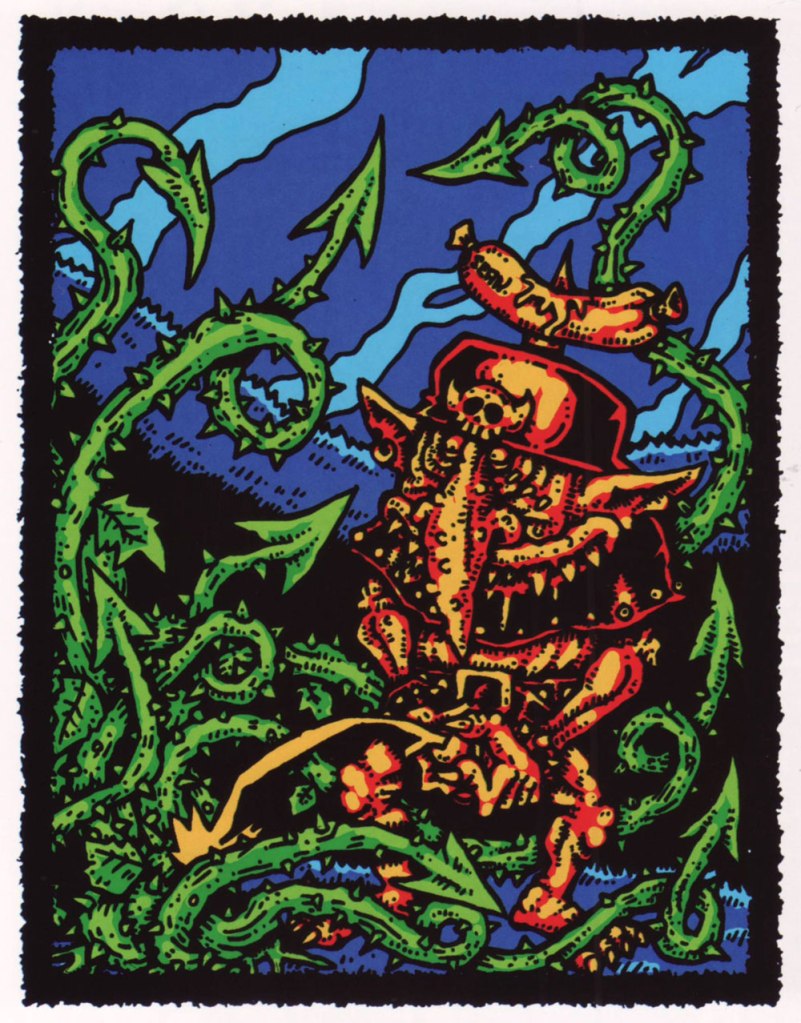
Some classic plant tentacles. Scanned from Acid Vomit! The Art of Sean Äaberg (Gingko Press, 2012).
Did you hear the joke about fungus? You won’t like it, but it will grow on you.
As promised – though you folks may by far prefer tentacles to mushrooms – I am delighted to present this post about mushrooms both real and imaginary.
First of all why mushrooms? Those who know me are aware of my passion for fungus – it’s a gastronomic interest, as both co-admin RG and I love to cook with them, and also a platonic one, an admiration for their beauty and adaptability. In terms of aliens-on-earth, fungus is surely up there with the extraterrestrial octopus. We are currently on vacation, so this is the perfect moment to both admire some of our finds, and rediscover mushrooms in comics.
Usually people react in one of two ways to mentions of gathering wild mushrooms – ‘but how do you know you won’t poison yourself?‘ or ‘magic mushrooms! yeah!‘ The first question is pertinent, although there’s no need to take that horrified tone, and the second reaction is more than slightly one-track-minded.
Just like in real life, comics fungi come in all shapes and sizes: from cute appearances in the background of a cartoony comic, to psychedelic manifestations of the underground, to horror stories peppered with a slice or two of the deadly toadstool, and everything in between! I’ve tried to go for maximum contrast in this post, and include a little bit of everything. Dive in, like we dove in yesterday into our hedgehog-and-honey-mushrooms-pasta yesterday 😉
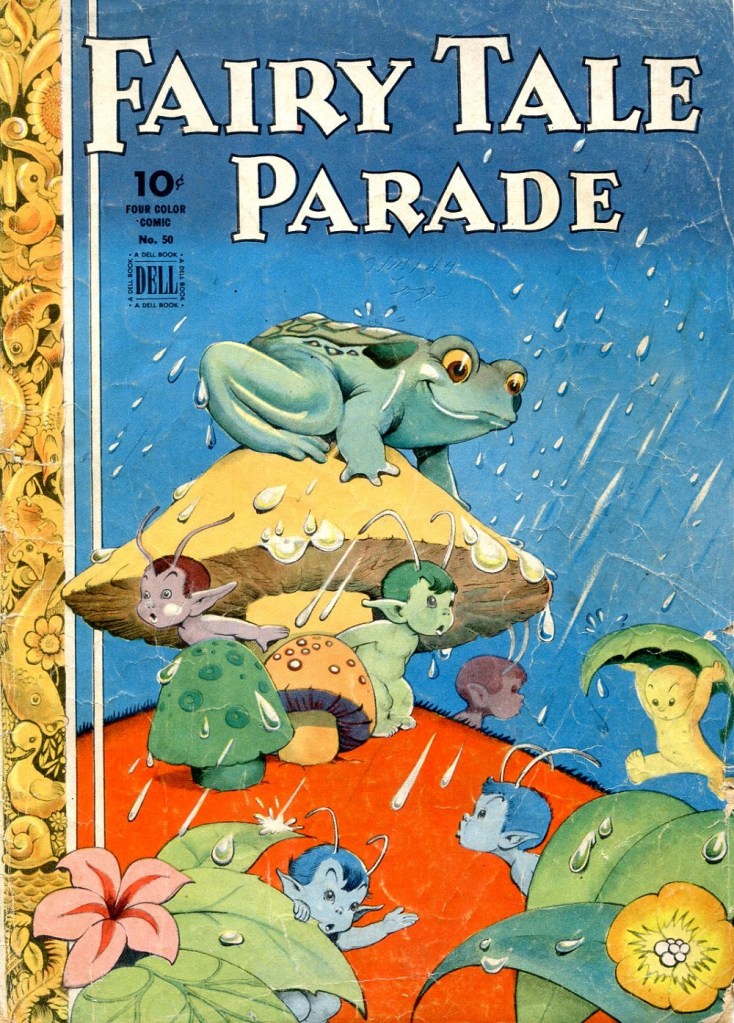
Four Color no. 50– Fairy Tale Parade (1944-1945, Dell). Cover by Walt Kelly. This is kind of an anonymous mushroom of indeterminate species.
A cartoon by Emile Mercier, Australian cartoonist who is best remembered for his work for the Sydney Sun between 1949 and 1968. This particular piece hails from the late ’50s.
Speaking of Mercier, I love this anecdote: « One day, Claude McKay, the editor-in-chief of Smith’s Weekly, took a dim view of an X Emile Mercier had drawn under the upwardly extended tail on a cat. After a few stern words about “dirty gimmicks in cartoons”, the grim-faced McKay instructed Mercier to get rid of the cross.This presented Mercier with a challenge. He was someone who used to say you “have to think funny as well as draw funny” and he was not keen to let McKay’s prudish approach to his cat go unchallenged. Mercier’s solution was to draw a miniature roller blind under the cat’s perpendicular tail. He was in no doubt the blind would draw more attention to the cat’s anus than the X had. Fortunately for him, McKay saw the funny side of the addition and let the cartoon run. Not a man to push his luck too far, Mercier drew all future cats without an X at the base of their tails. »
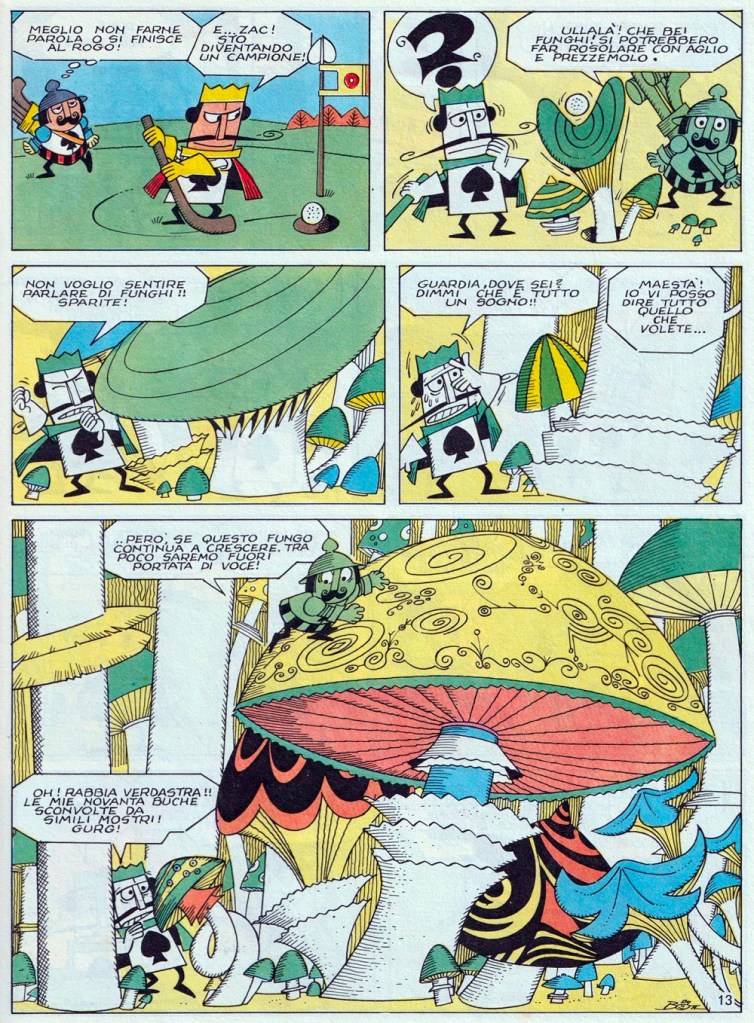
A page from Re di Picche no. 1 (AGIS, 1969), an Italian comics series created by Luciano Bottaro. Re di Picche means ‘king of spades’, and refers to the protagonist of this series (also the title of the magazine it was published in). Inspired by Alice in Wonderland? You bet! This mushroom appears to be some type of Amanita, a mostly deadly but handsome family of ‘shrooms.
The Plot to Destroy Earth, scripted by Dave Wood and illustrated by Jim Mooney, was published in Strange Adventures no. 183 (December 1965, DC). A man who refers to what is very obviously a mushroom as a ‘crazy-looking plant’ won’t impress anyone with his knowledge of nature… but this fungus-as-parachute interlude is entertaining.
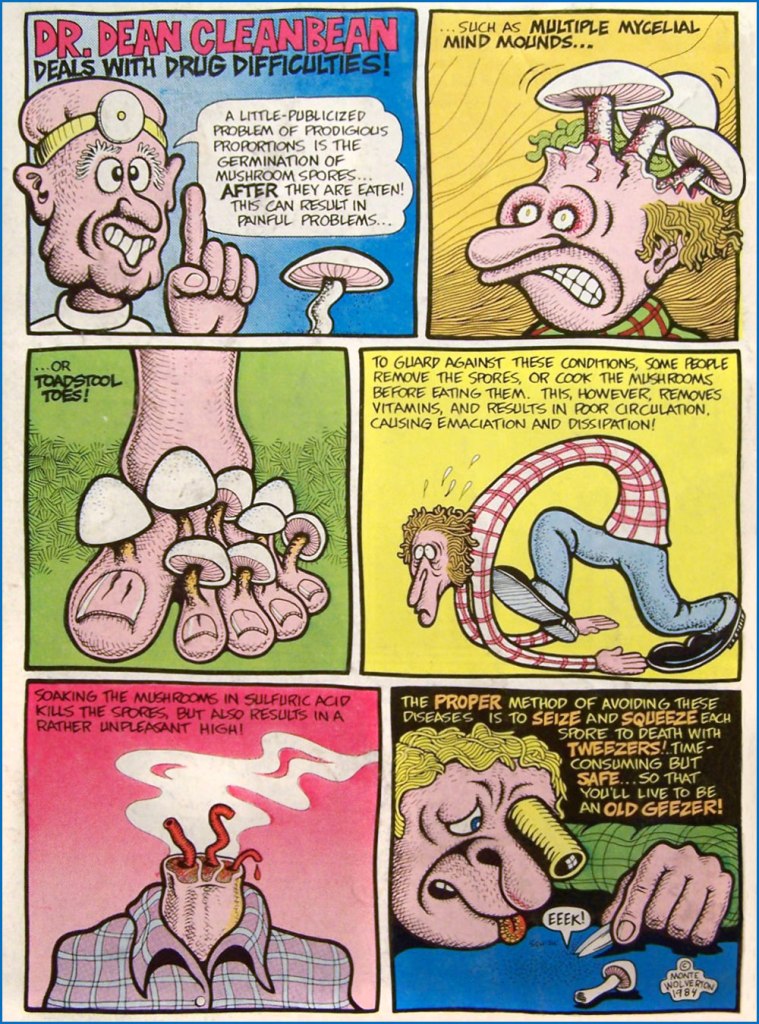
Dr. Dean Cleanbean Deals with Drug Difficulties, scripted and illustrated by Monte Wolverton (Basil Wolverton‘s son!), was the back cover of Dope Comix no. 5 (January 1984). Here we have the very prototypical magic mushrooms, which comes as no surprise.
I promised horror, didn’t I? This is a page from Chapter One, scripted by Mike Mignola and illustrated by Guy Davis, and published in B.P.R.D.: Plague of Frogs no. 1 (February 2011, Dark Horse).
A splash page from The Mushroom Fan Club by Elise Gravel (2018, Enfant – Drawn & Quarterly’s children’s imprint). I wholeheartedly agree with Gravel – mushrooms come in such a variety of shapes and sizes, that it’s crazy to even consider them as the same thing. Note the mischievous bolete (center, brown cap), probably the King Bolete, a.k.a. Penny Bun – it has a feeling of superiority, and we agree.
Some of our mushroom crop this week. In the usual clockwise order: Lactarius Deliciosus; various Leccinums (or Bolete); Armillaria gallica (Honey mushrooms) and Hydnums (Hedgehogs).
Today’s Tentacle Tuesday is going to be succinct, as I have traded tentacles for mushrooms this week! Keep an eye on Friday 😉
I am planning a separate post about Marc Hempel (and his Tug & Buster!), but in the meantime, here is an Illustration by him – visit his website here, or buy this design on a t-shirt from his store on Redbubble.
A poster by illustrator Michael Hacker, created for the High On Fire show that took place in Vienna on June 2015.
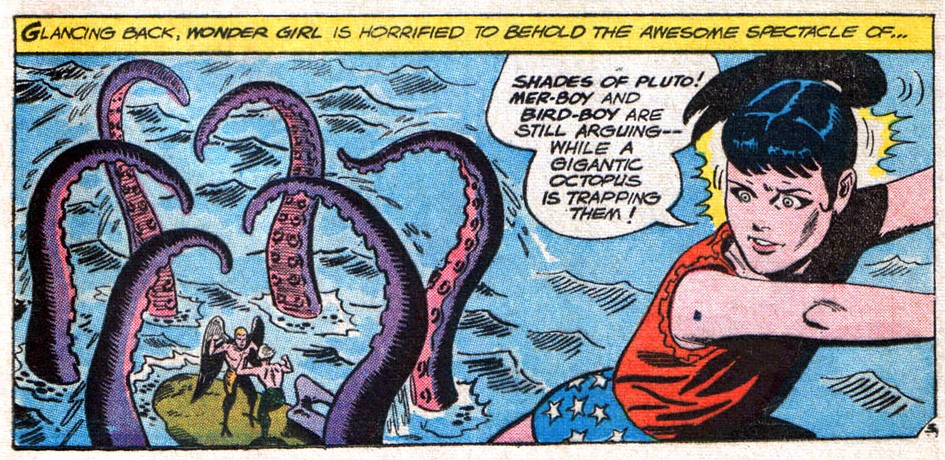
We begin with a page (and a panel) of The Phantom Fisher-Bird!, published in Wonder Woman no. 150 (November 1964):
I’ve never heard of an octopus using its tentacles by sticking them out of the water and forming a cage, but I suppose that’s the least of our worries.
I say, let ’em die! At least the octopus won’t have to decide whether to have fish or fowl for dinner.
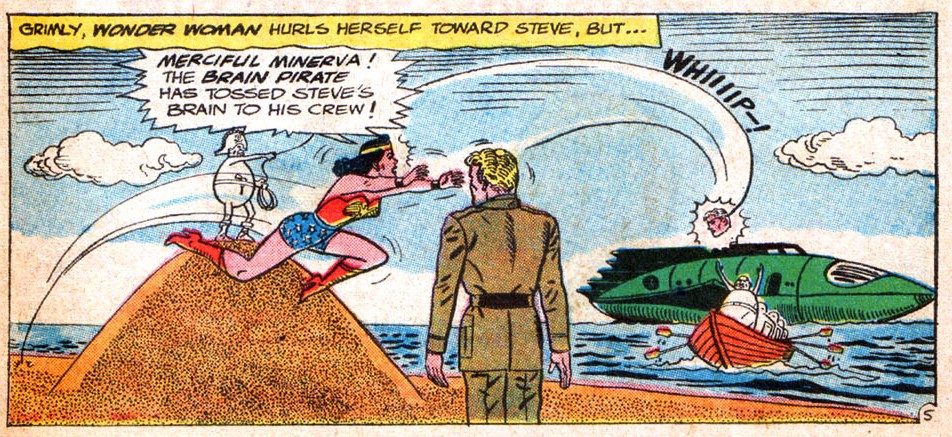
Two panels from Battle of the Boiling Man, published in Wonder Woman no. 154 (May 1965):
This octopus is incidental, but handsome!
That’s ‘Gesundheit’ with an S, thank you.
Page from I Married a Monster, published in Wonder Woman no. 155 (July 1965):
I really enjoy the madcap world of Golden Age funny animal comics, and they’ve often made it into various Tentacle Tuesdays. Yet not everything fits into the somewhat narrow scope of tentacles (shocking, I know!), so I am pleased to take this fun gallop through some favourite covers that are quite devoid of cephalopods. Doing so involves going back some seventy, eighty years… a difficult to grasp concept for those of us who were not around back then.
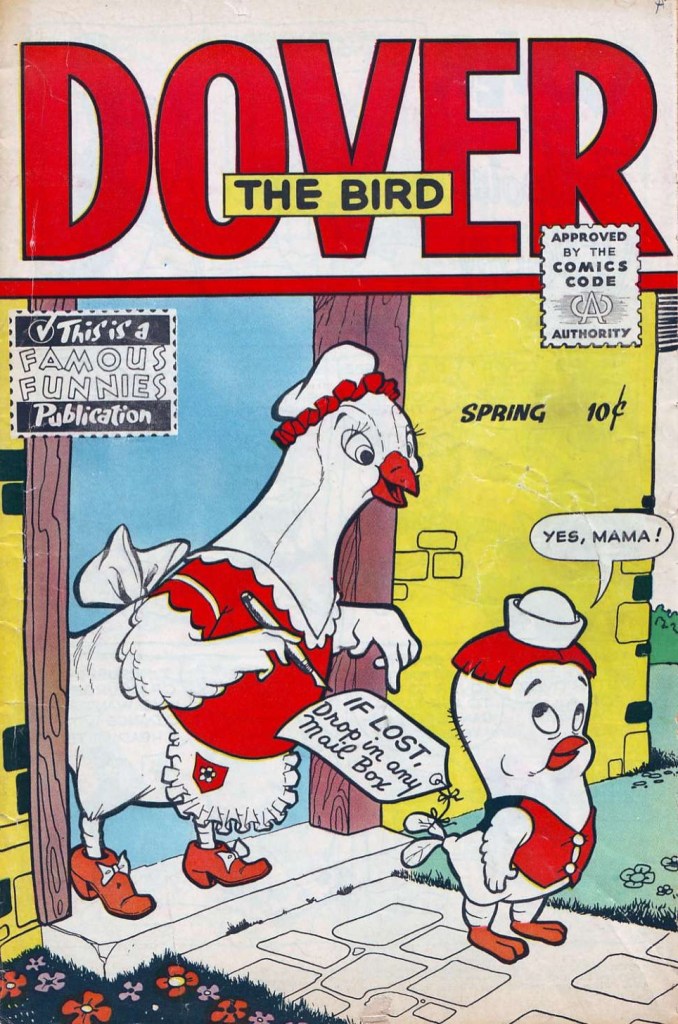
This one-shot comic from Famous Funnies featuring a sweet cover by Dave Tendlar may not be-laugh-out-loud funny, but makes up with charming innocence what it lacks in the hilarity department. This is Dover the Bird no. 1 (Spring 1955, Eastern Color Printing).
My thirty-something colleagues consider movies from the late 90s to be ‘ancient’, so I can just imagine what their reaction would be to a comic from, say, 1942! Yet I feel emotionally close to these covers (whether artistically accomplished, entertainingly weird or just plain drugged-out) – humanity has not changed nearly as much as we tend to assume, and albeit some sources of humour require an historian’s explanation, others are every bit as funny and entertaining now as they were back then. As for talking animals, that goes back to the dawn of human history (Aesop’s fables readily come to mind, and Aesop was surely not the inventor of this concept!)
One could dedicate a whole lifetime to digging through this particular slice of history – I’ve tried to go for some variety in this post, but of course I am (happily) constrained by my own tastes in the matter. Here, then, are some Golden Age covers featuring funny animals that have amused, entertained or puzzled me.
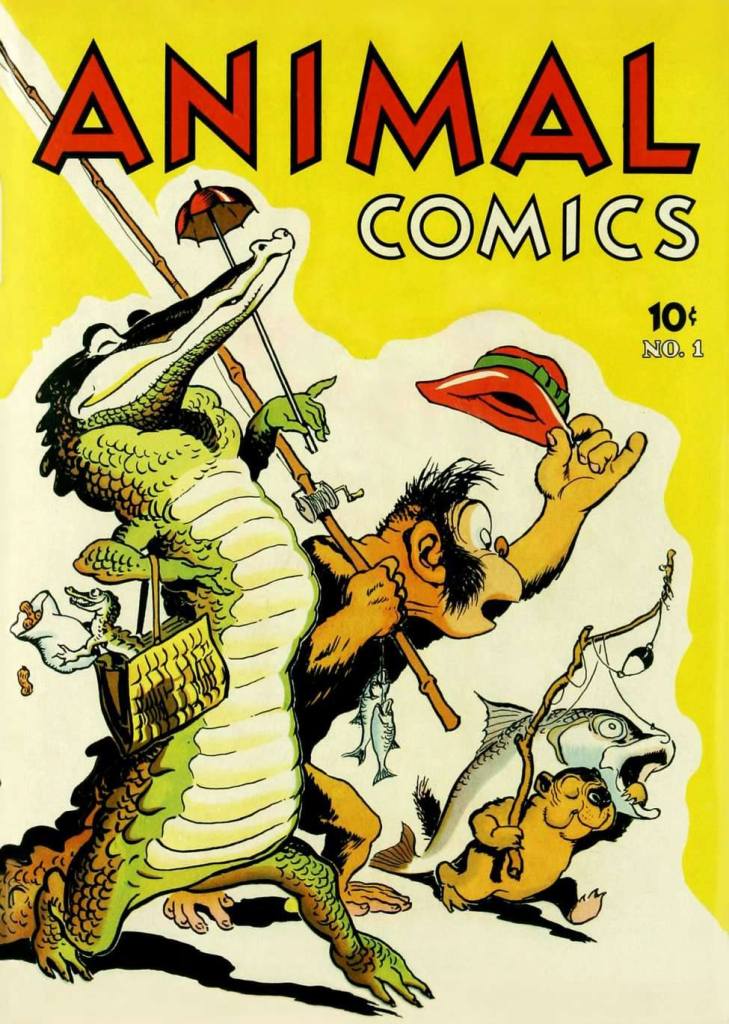
Animal Comics no. 1 (December 1942, Dell), with a cover by H.R. McBride, is an amalgam of details both adorable and creepy – the harrowing expression of the fish contrasts wildly with Madame Crocodile’s peanuts-pilfering offspring and her flirty cocktail parasol, while her crocodile-skin purse makes me think of Disney’s Three Little Pigs cartoon (1933, Silly Symphonies). In case you’ve never noticed it, the third pig, the one with the brick house, has family pictures on his wall… for example, a string of sausages labelled “Father”. Black humour, indeed. Animal funnies are often dusted with a good sprinkling of the gruesome, as when a talking duck eats chicken legs for dinner.
The insides have two Walt Kelly stories, including the first appearance of Pogo Possum and his friends!
Fast forwarding four years, we fall into pleasantly loopy territory of Fox Features’ Nuttylife no. 2 (Summer 1946, Fox Comics). Despite it being number two, this is technically the only issue, issue number 1 having appeared as Krazy Life, and issue number 3 and onward becoming Wotalife Comics. I can’t find credits for the cover, but the insides contain Pat Adams with Ellis Chambers (“One day a little goil went to her Grandma’s joint…”), Tim Howe and Cy King. Ellis Chambers by himself definitely deserves a separate post – take a glimpse at Eddie Elephant – 1946 Hallucinogenic Funny Animal Comix by Ellis Holly Chambers, for example.
I couldn’t very well leave Felix the Cat out of this post! I won’t go into the complex history of this character, but suffice it to say that this is one gorgeous cover. Clearly I’m not the only one to admire this image, as it was used for the cover of Craig Yoe‘s wonderful anthology Felix the Cat – Greatest Comic Book Tails (2011, IDW), which I highly recommend. This is Four Color no. 135 (February 1947, Dell Comics), with a cover by Otto Messmer.
The American Comics Group is responsible for many a goofy plot, source of my long-lasting affection for some of their titles (see Tentacle Tuesday: ACG’s Adventures Into the Tentacles). ACG’s Ha Ha Comics are a riot, all right, but I have two favourites among the 88 issues released. The first is Ha Ha Comics no. 11 (August 1944), with a cover by Ken Hultgren. A joke doesn’t have to be elaborate to be funny – something about the expression of the indignant man-eating lion and his wild mop of hair cracks me up!
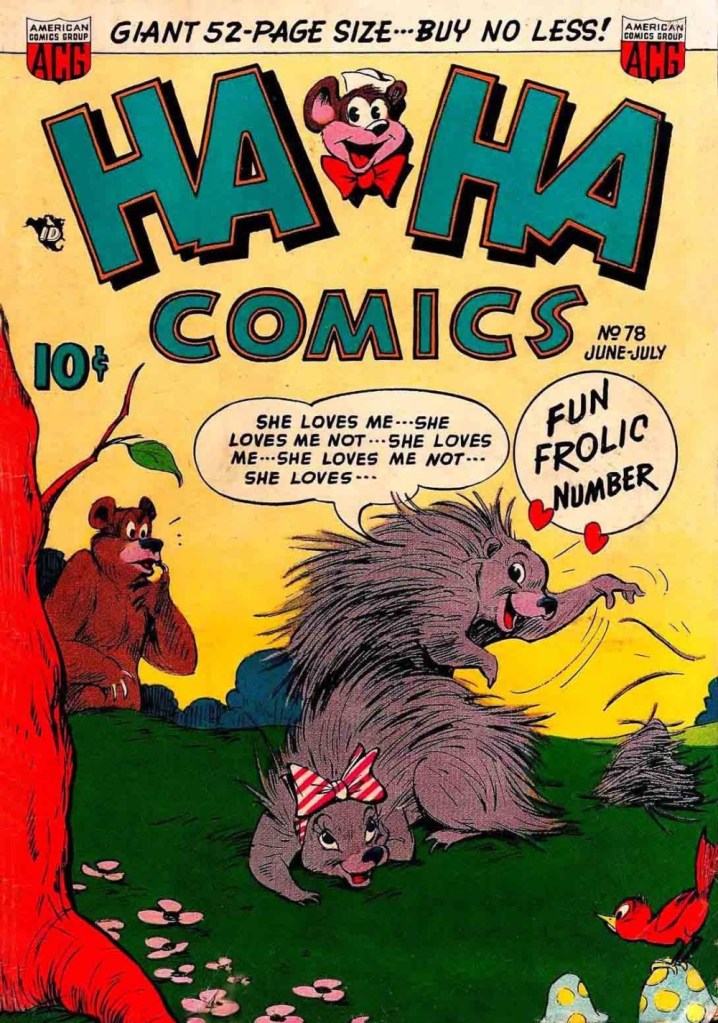
The second is Ha Ha Comics no. 78 (Dec-Jan 1951), cover artist unknown. I like porcupines in general, but here we are presented with a truly bizarre situation – a porcupine who tears out his sweetheart’s quills one by one to figure out whether she loves him… (unless she’s just a friend helping out, and he’s in love with some other porcupine). Kinky, whichever way you look at it.
Going a few years back, we take a little inter-planetary voyage with Coo Coo Comics no. 38 (March 1948, Pines/Standard Comics), with a cover by (possibly)Vince Fago. I am very fond of this purple-green monster who looks like he’s suffering from a bad hangover (or terminal cretinism). Coo Coo Comics is credited with having introduced the first funny animal superhero (in its very first issue, published in October 1942). That little guy was Supermouse…
The insides contain some Frank Frazetta stories, in case anybody is interested.
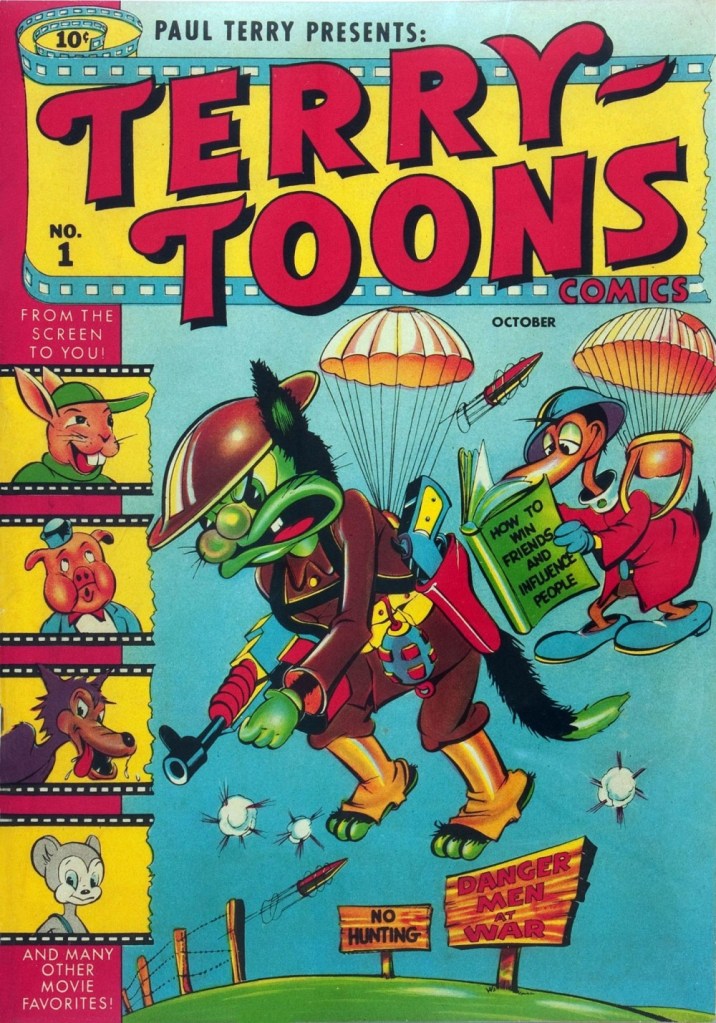
… but the other contender for this title was Terrytoons’ Mighty Mouse, also introduced in October 1942 (under the name of ‘Super Mouse’) in the theatrical short The Mouse of Tomorrow. That’s enough to get anybody confused in all these mice! This is Terry-Toons Comics no. 1 (October 1942), with an Ernie Hart cover that hints at the influence that funny animal comics had on the underground comix artists:
Today’s Tentacle Tuesday is a really fun one, given that its focus is the snazzy art of Richard Sala (1954-2020), deceased, alas, far too soon at 65, when he was about to launch a new webcomic.
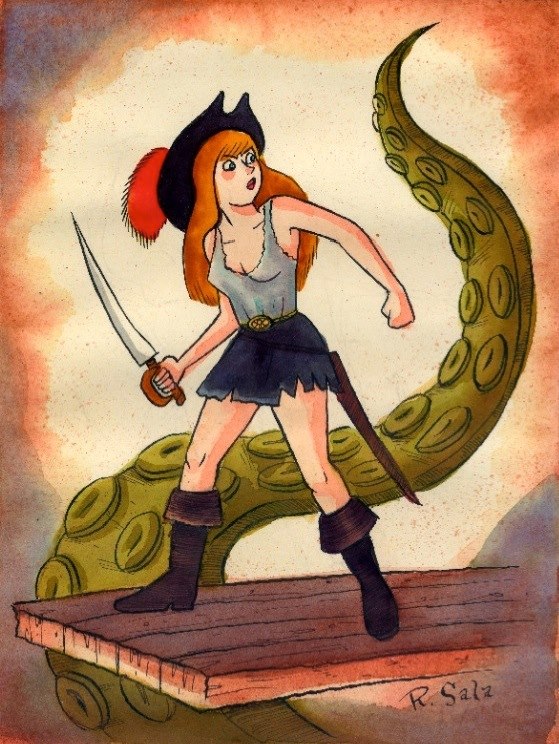
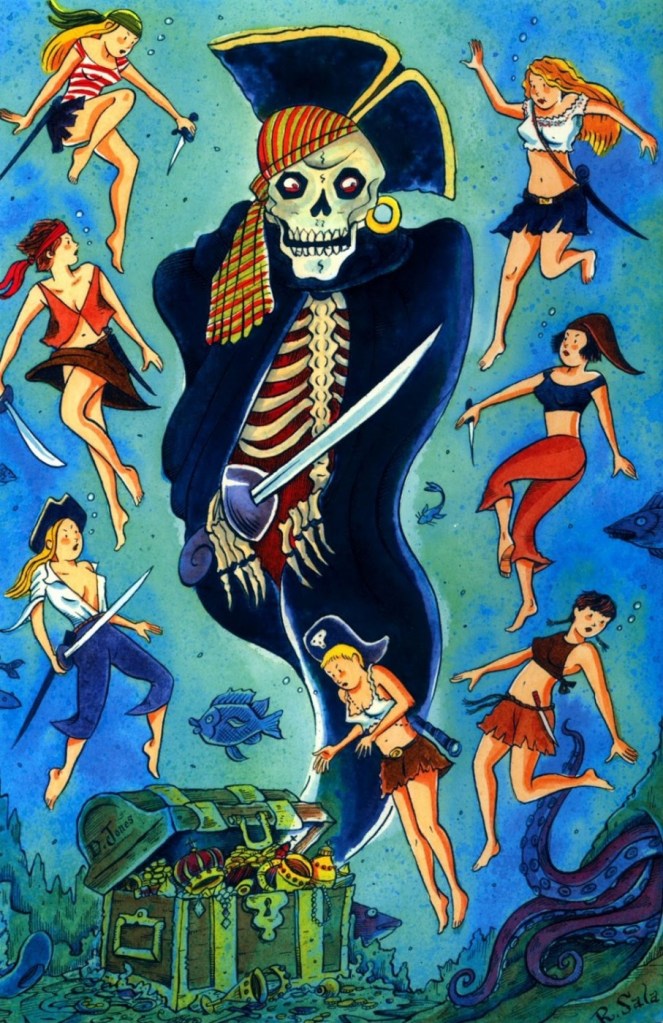
Granted, perhaps the plots of his stories often don’t make that much sense. But! they’re awash in half-naked damsels, sad-eyed defeateds, vampires and ghouls of all kinds, a mad scientist or two, dark alleys and schoolgirl academies and strangely ominous museums and… all of this drawn in Sala’s easily recognizable, deliciously scary style. Peculia is definitely involved in this post (see co-admin RG’s Hallowe’en Countdown IV, Day 17), but so is Judy Drood, girl detective, plucky heroine and first-rate fighter… and a host of other characters! So follow me as I kick things off with some beautifully painted Evil Eye covers (and backs!) – Sala had an impeccable sense of colour.
Back cover of Evil Eye no. 2 (October 1998). An actual octopus and reasonable-cause-for-belief plant tentacles!
Evil Eye no. 4 (August 1999, Fantagraphics). Perhaps it’s a bit of a stretch to call these arms ’embracing’ Peculia tentacles, yet there’s always room for poetic licence.
The back cover of Evil Eye no. 8 (September 2001, Fantagraphics).
Back cover of Evil Eye no. 9 (July 2002, Fantagraphics). Judy is caught between a rock and a hard place, as usual, but fear not! She’ll bash her way out, sooner or later.
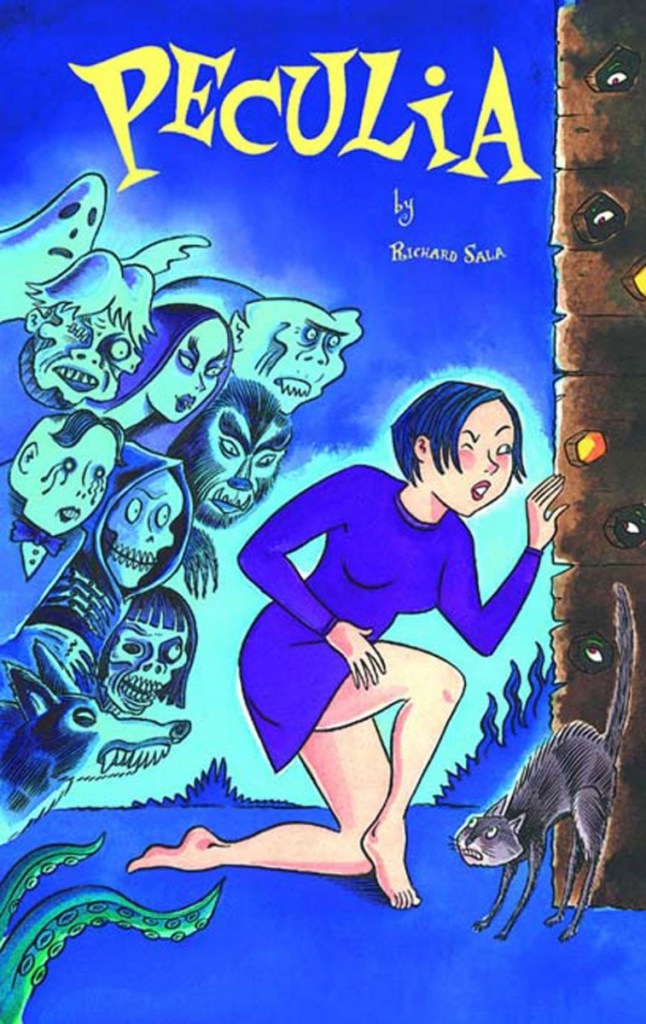
Peculia, a 2002 collection of the titular heroine’s strips (published by Fantagraphics, as usual).
I complimented Sala’s beautiful colour work earlier (and hopefully demonstrated this point!), but Sala’s black-and-white work is equally satisfying. Shall we have a look-see?
Some plant tentacles make an appearance in Peculia and the Groon Grove Vampires (2013, Fantagraphics):
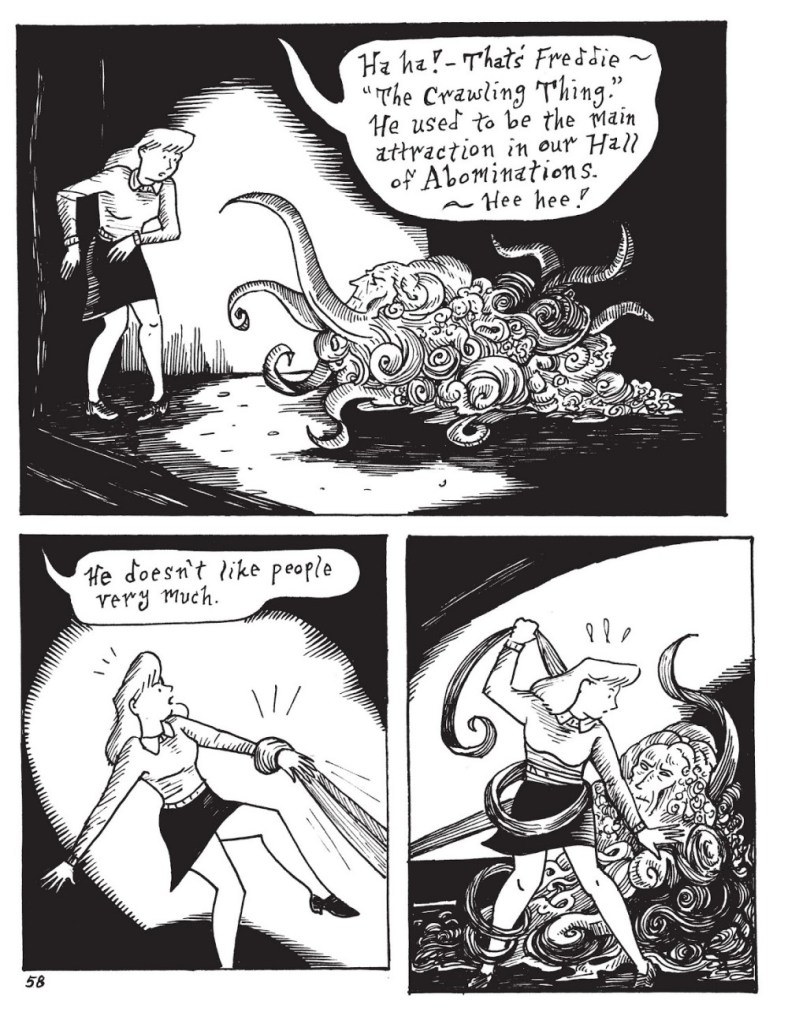
The Grave Robber’s Daughter (2007, Fantagraphics) spins the yarn of what happens when Judy Dredd is stranded in a strangely empty town… empty until the clowns come out, that is. I really enjoyed this 96-page tale (read it here), with its quick-paced, cohesive plot, top-notch art and of course a good dose of Coulrophobia. I don’t like clowns, either. Here are two pages highlighting Freddie, ‘the Crawling Thing’, and his manifold tentacles:
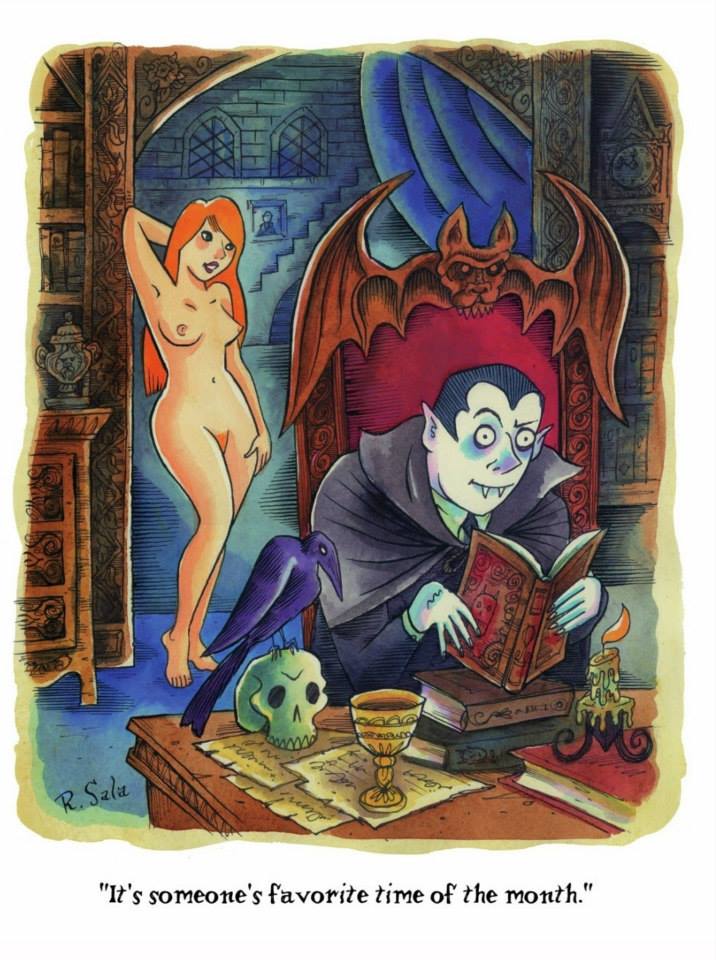
Finally, as a little bonus, I am including a pin-up that doesn’t have any tentacles to recommend it, but is otherwise perfectly appropriate to this not-quite-end-of-September. Co-admin RG has plenty up his sleeve with his upcoming Hallowe’en count-down, but I am allowing myself just one furtive foray into vampire territory…
This sweet, lovingly-coloured gag cartoon was created in 2013 and intended for Playboy (but unfortunately never published).
Sala explains: « According to the editor, I was one of only a few of the cartoonists asked to submit ideas whose submissions were ‘sex positive’. That is, according to him, most of the submissions by younger cartoonists were more in line with the kind of scatological, angry, ‘gross-out’, excretion-happy humor more typical of today, or focused on the adversarial relationship between men and women. My somewhat sweet oral sex joke seems pretty quaint in comparison, I guess. »
Hello, cephalopod aficionados! I have some lovely tentacles for you today, all wrapped around voluptuous women (my favourite kind of cephalopod content, I admit). There is a lot of ‘that kind of thing’ going on in the rivers of the comic kingdom, but most of it, alas, is distinctly ugly. I have accumulated a few covers not suffering from that particular scourge (quite by accident, most of them use a green-and-red palette), and I invite you to enjoy them with me!
The first is a Judge Dredd cover that had somehow previously escaped my attention, despite WOT’s affection for the former and my personal affection for Judge Anderson (lackaday, ill-handled once out of the hands of creator John Wagner and writer Alan Grant – and preferably drawn by Brian Bolland, of course).
Judge Dredd no. 28 (February 1986, Eagle Comics). Cover by Brian Bolland, a Tentacle Tuesday master. Note that in Bolland’s care, she looks like a determined, intelligent woman in full possession of her faculties, as opposed to this sort of nonsense.
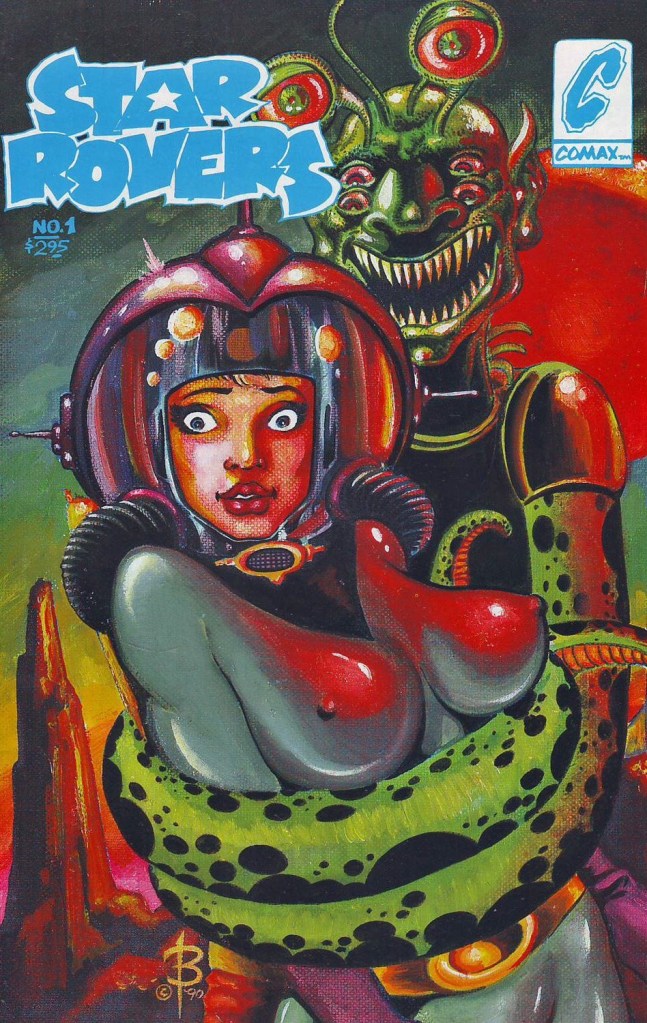
The following cover presumably has something to do with DC’s Star Rovers series, which ran between 1961 and 1964, but I wasn’t able to find more about this particular comic, the company that published it (Comax), or the equally mysterious cover artist, Butch Burcham. A comic-savvy friend described the latter as ‘a low rent Frazetta knock-off artist‘. I have no opinion about that part, but I do like this cover and its lushly coloured maiden with her completely impractical suit.
Star Rovers no. 1 (1990, Comax). Cover by Butch Burcham.
Next up a contribution from Dan Brereton, whose work has already been part of several previous Tentacle Tuesdays.
L.E.G.I.O.N. ’92 no. 41 ( July 1992, DC). Cover by Dan Brereton.
In a ‘something completely different‘ vein, I’d much rather get Red Sonja drawn in a very cartoony style, rather than in a ‘realistic’, trying-to-show-boobs-and-ass-simultaneously one. (I dig voluptuous women, but not. ones.with.a.spine.deformation.) For instance…
Red Sonja no. 12 (September 2014, Dynamite). This variant cover is by Stephanie Buscema, an American illustrator specializing in Hallowe’en art.
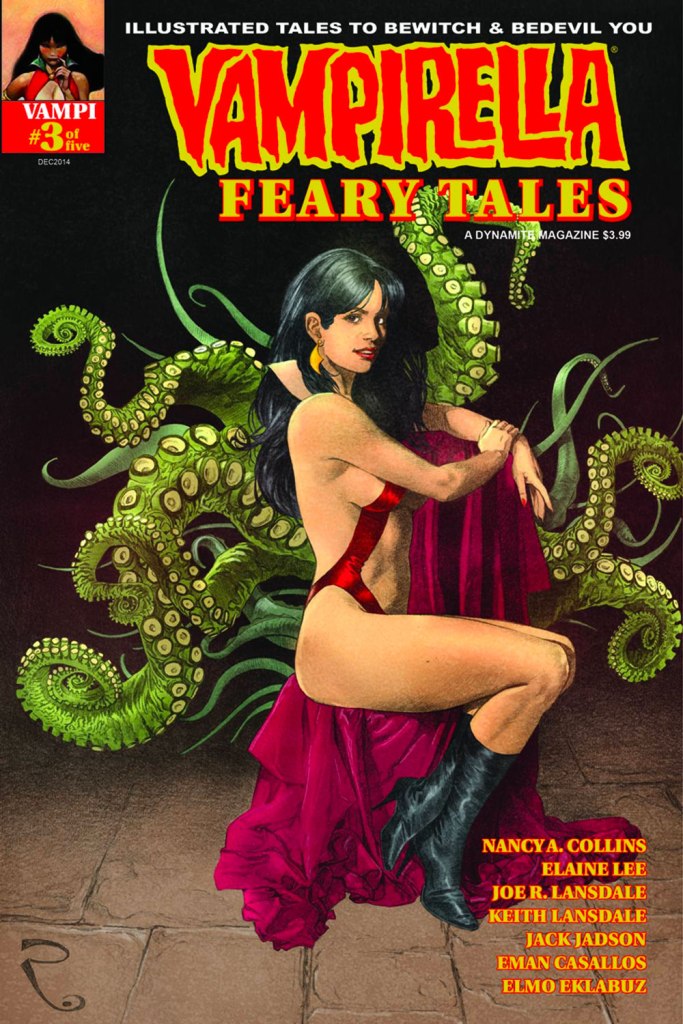
Finally, we have a surprisingly tasteful (albeit a bit stiff – so would you be, barely perching at the very edge of a chair like that), girl-next-door Vampi cover. And look, she actually has enough space for internal organs! I like that the tentacles seem like a friendly presence, almost guarding her (as opposed to getting a quick grope in). In case you want more Vampirella, head over to Tentacle Tuesday: Warren and Its Many Tentacles, Part II.
Vampirella: Feary Tales no. 3 (December 2014, Dynamite). Variant cover by David Roach.
Pip pip cheerio and toodle-loo, and see you next week!
The source of tentacles in Golden Age comics seems inexhaustible – every time I think I have reached the bottom of the well, I find myself awash in cephalopods. That being said, a lot of these octopusoid appearances are one-panel cameos, and even when the tentacles linger for a few pages, the shitty printing, questionable scans or bare-bones art don’t exactly incite me to use this material in a Tentacle Tuesday. Today’s crop is all Golden Age, running the gamut from 1939 to 1952, and composed of pages/covers I can enthusiastically endorse.
George (of Harry J. Tuthill’sThe Bungle Family, ‘one of the most under-rated comic strips in the history of American cartoonery’ according to Art Spiegelman,‘one of the top hundred comics of the 20th century‘, according to The Comics Journal) may be thoroughly bundled up in tentacles, but he still keeps a sort of prosaic calm that I admire.
Feature Comics no. 23 (August 1939, Quality Comics). Cover by Ed Cronin. As for Charlie Chan, he was originally a private detective in a series of novels by Earl Derr Biggers, from which a number of movies were made. Opinions are divided about whether he was a breakthrough Asian character (tired of Yellow Peril stories, Biggers conceived him specifically as an alternative to stereotypical, ‘sinister and wicked‘ Chinese) or perpetuated a lot of the same preconceived notions that were circulating at the time (and, alas, are still with us today).
Just look at the canines the red devil is ready to plunge into Black Hood’s leg! Throw in a fanged octopus, and this cover has as much action as one would possibly want. Sadly, nothing of the sort actually goes on in this issue.
Top Notch Comics no. 16 (June 1941. Archie Comics). Cover by Al Camy.
Page from Fisherman’s Luck, published Star-Spangled Comics no. 41 (February 1945, DC).
This page from Boy Meets Robotdog was printed in Star-Spangled Comics no. 75 (December 1947, DC). I would certainly come to this house!
We really like Howard Nostrand at WOT, though so far he has been woefully under-featured in our posts!
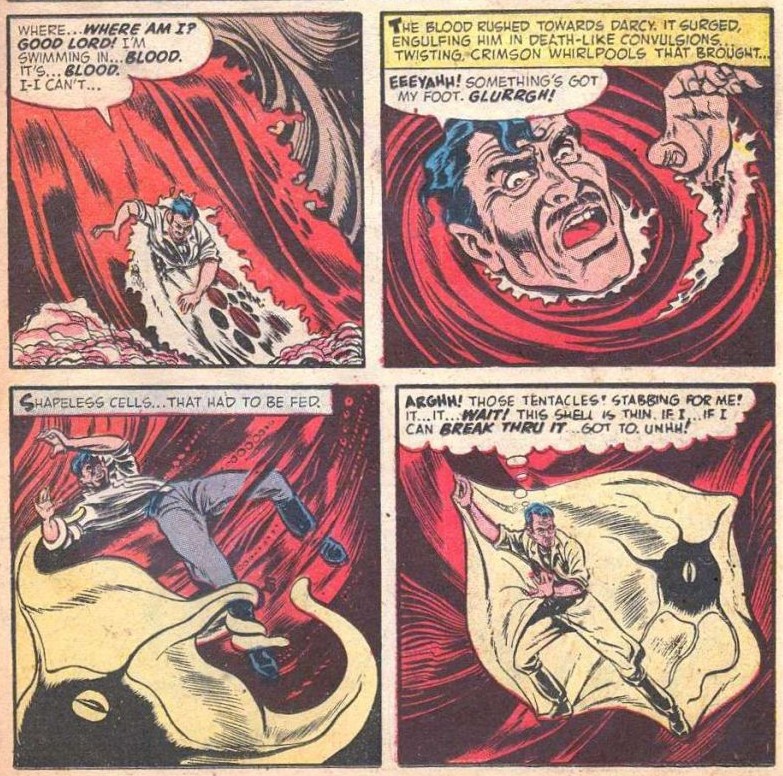
This page is from The Man Germ, scripted by Nan Barnett and illustrated by Howard Nostrand. This story was published in Chamber of Chills Magazine no. 13 (October 1952, Harvey Comics).
Finally, I have a soft spot for these tiered layouts that Rugged Action employs… especially when an octopus with tender, moist eyes is moonlighting in one of them.
Rugged Action no. 1 (December 1954, Marvel). Cover by Carl Burgos.
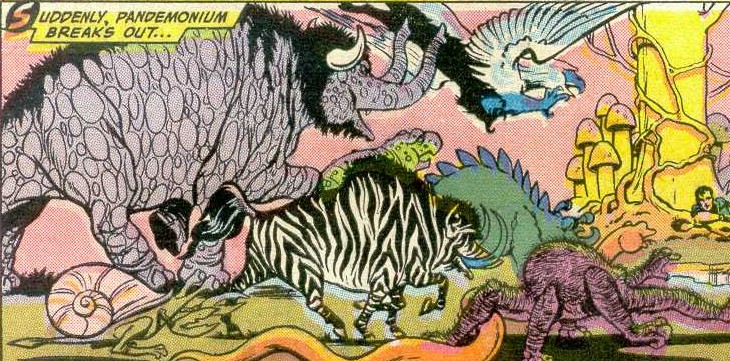
DC’s Tales of the Unexpected offer quite a ménagerie of strange looking creatures! Any peculiar combination of animals you can think of, you’ll find somewhere within the pages of this series. This possibly deserves its own post, as it’s quite entertaining to see artists combining, say, an elephant with a tiger. That being said, I tend to get annoyed at artists who can’t visualize anything truly alien-looking, thus resorting to carving up earth animals and stitching different body parts together… but that’s a different conversation.
Art by Lou Cameron.
Occasionally the artists will also add tentacles, a sure shortcut to make something mundane look properly alien, and this is today’s area of interest! For more questionable monsters, have a gander at Tentacle Tuesday: Convoluted Critters.
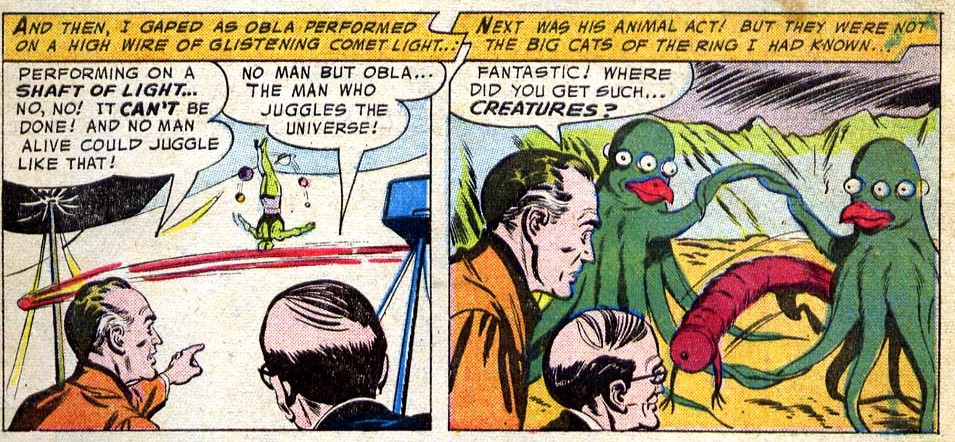
And now, onto ‘unexpected’ tentacles, even if the result of this ends up looking like badly-made puppet with a tacked-on beak…
The Strangest Show on Earth, illustrated by Jim Mooney, was published in Tales of the Unexpected no. 10 (February 1957).
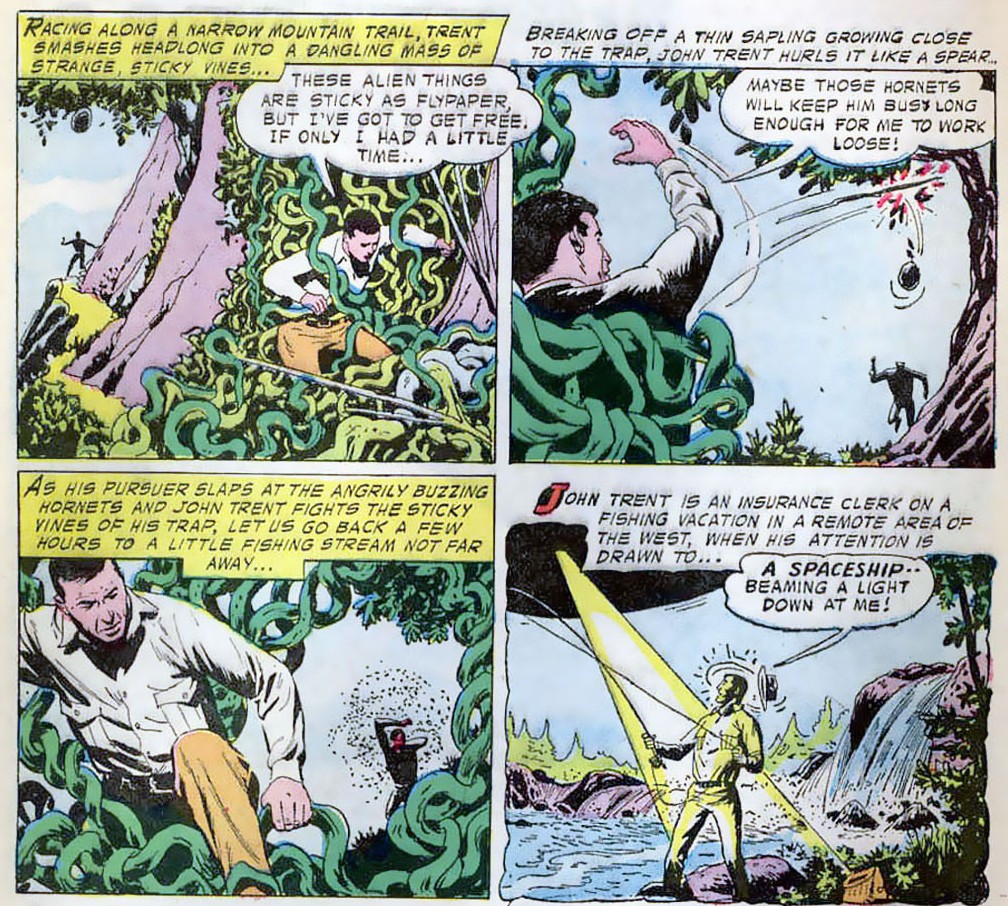
Of course one can’t discount the lasting power of classic vine-tentacles.
The Earth Gladiator, illustrated by Nick Cardy, was published in Tales of the Unexpected no. 20 (December 1957).
Whereas these mini-planets gone bonkers with tentacles-cum-hair bring to mind, but anticipate, something by Junji Ito.
The Alien Earthmen, illustrated by Ruben Moreira, was published in Tales of the Unexpected no. 62 (June 1961).
The idea of an interplanetary veterinarian makes little sense for its assumption that life on other planets would have similar physiology to ours (even limiting the scope of action to only planet earth would be too ambitious – ask a doctor to treat a sick jellyfish and see how well he would do), but here we have the satisfaction of a sweet little scene of inter-species succor.
Creature Doctor of Space, illustrated by George Roussos, was published in Tales of the Unexpected no. 63 (July 1961).
Some 30 issues later, we have another case of rabid tree-tentacles… this time composed of rubber (or something that behaves like rubber, at any rate).
Prisoners of Hate Island, illustrated by George Roussos, was published in Tales of the Unexpected no. 93 (Feb-March 1966).
Finally, this tentacled purple gorilla (so his tail is more dinosaur than gorilla, so what?) will no doubt please a regular reader of this blog!
Tales of the Unexpected no. 71(June-July 1962). Cover by Bob Brown.
I was startled to discover that after several years of WOT blogging, we still have no post dedicated to Sergio Aragonés. Perhaps this is in part because his art is ubiquitous – throughout his long career, he has contributed manifold pages to various DC publications, created an enduring barbarian parody, scripted and drawn (mostly solo but also in collaboration) an impressive number of mini-series published by Fantagraphics, Dark Horse and Bongo Comics, produced various comic-con paraphernalia, etc. And this is not to mention his lasting contributions to Mad Magazine (which I did discuss, though not at length, in A MAD dash… inside) – something in the magnitude of twelve thousand gags spread over 57 years and 491 issues of Mad.
A sequence from A Mad Look at Sharks from Mad no. 180 (January 1976, EC).
He’s also a charming, universally-liked man whose bigger-than-life persona has ensured that his participation in anything is always surrounded by fun anecdotes. It is my great pleasure to share this abridged compendium of Aragonés tentacles, of which there are many, as he enthusiastically added them into doodles and margins with great glee (and, as we know, « he has quite literally drawn more cartoons on napkins in restaurants than most cartoonists draw in their entire careers *», so just imagine how many tentacles are scattered throughout his work).
Room 13 one-pager, scripted (and edited) by Joe Orlando. This was published in House of Mystery no. 190 (Jan-Feb 1971, DC).
Incredibly, we still haven’t written a post dedicated to the great Plop! (this post is starting to sound like a to-do-in-the-nearest-future list), though Hallowe’en Countdown III, Day 30 did include a story from number 1. Plop!, “The New Magazine of Weird Humor!“, certainly included a lot of cephalopods in its 24 issues and I will doubtlessly get around them one of these days. In the meantime, here’s a very appropriate page from Plop! no. 16:
This closing page of Plop! no. 16 (September 1975, DC) was scripted by Steve Skeates.
Galloping forward through some twenty years, we briefly land at Marvel, namely these two pages from Groo the Wanderer no. 98 (February 1993, Marvel), co-plotted and scripted by Mark Evanier.
Sergio Aragonés Funnies, published between 2011 and 2014 by Bongo Comics, boast 12 issues of really enjoyable, remarkably varied material. For those who may think that Aragonés is one-trick pony who can only do ‘silly’ humour, this series offers many auto-biographical stories, some of them surprisingly poignant and heart-felt. Not to say that it’s not devoid of humour – the more serious stuff (including social criticism in the form of animal parables) is nestled among pages of slap-stick humour and imaginative goofiness, from one-pagers to longer stories that take most of an issue to develop. Aragonés also shares some background on his approach to stories, allowing us to peek into his imagination and possibly answer that hackneyed question that plagues all manner of writers, ‘where do you get your ideas from?’ If an anthology of Funnies is ever published, I’ll happily purchase it.
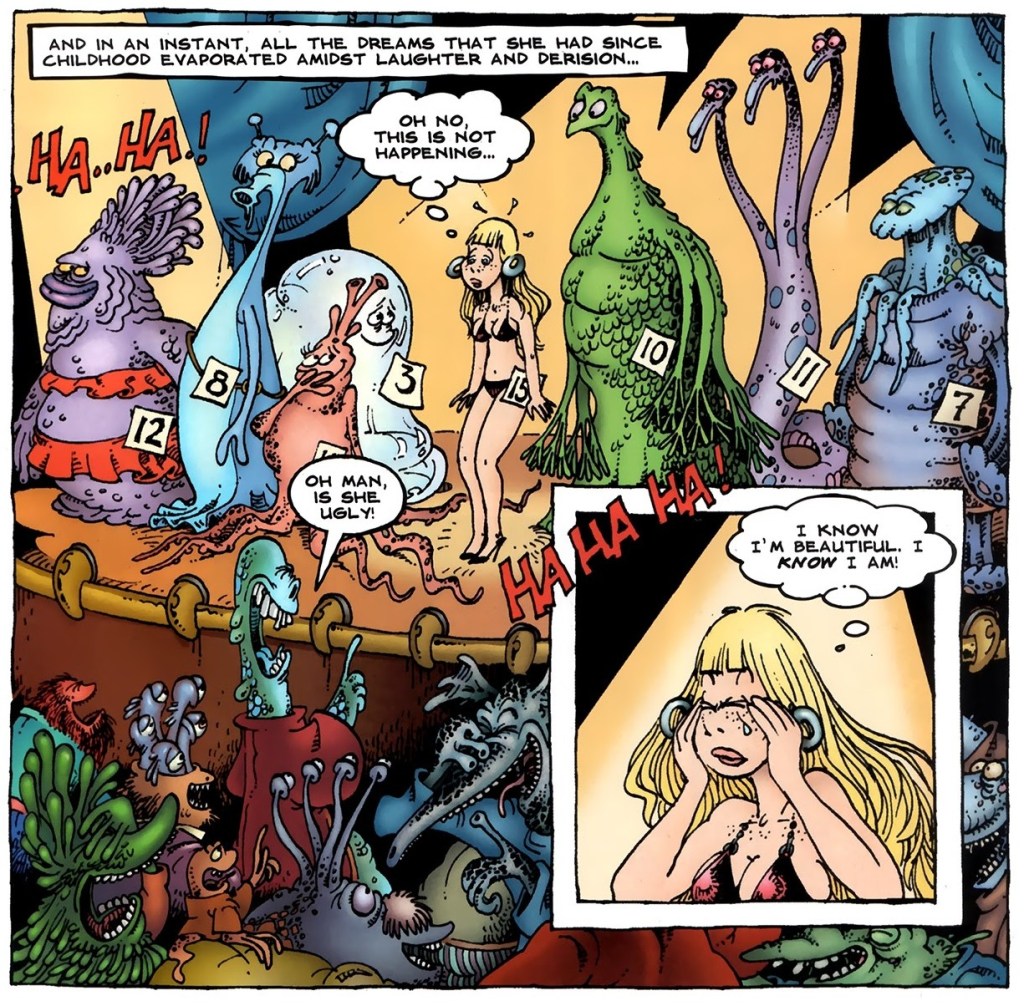
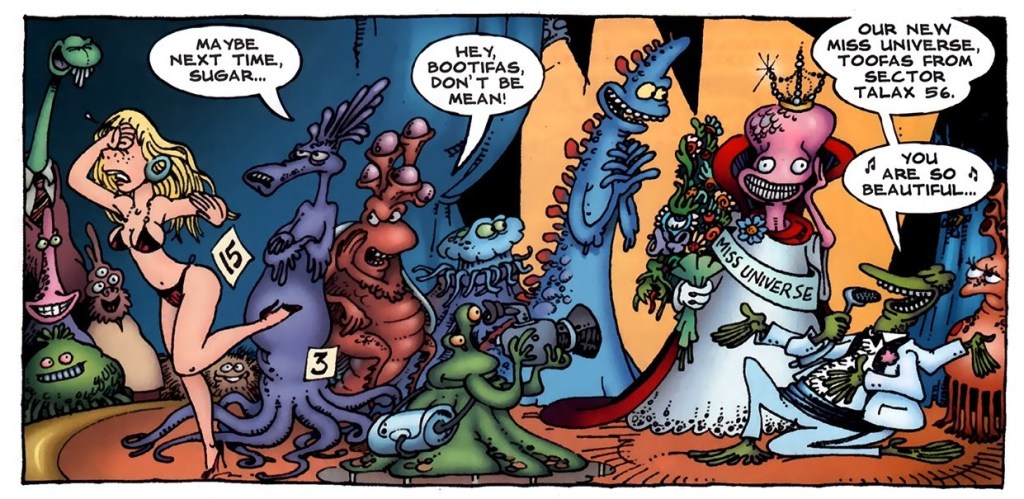
Excerpts from Kira and the Beauty Contest, published in Sergio Aragonés Funnies no. 2 (August 2011, Bongo Comics):
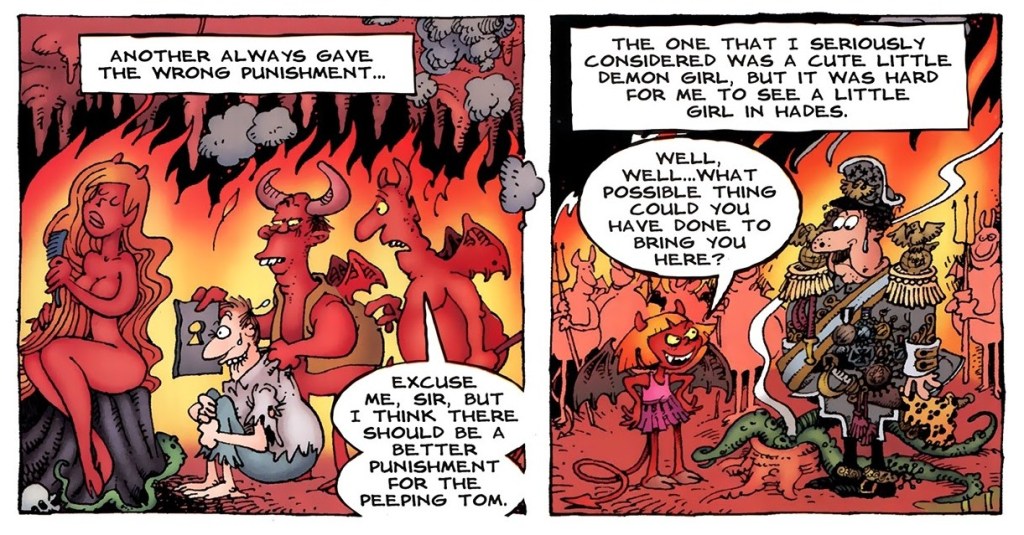
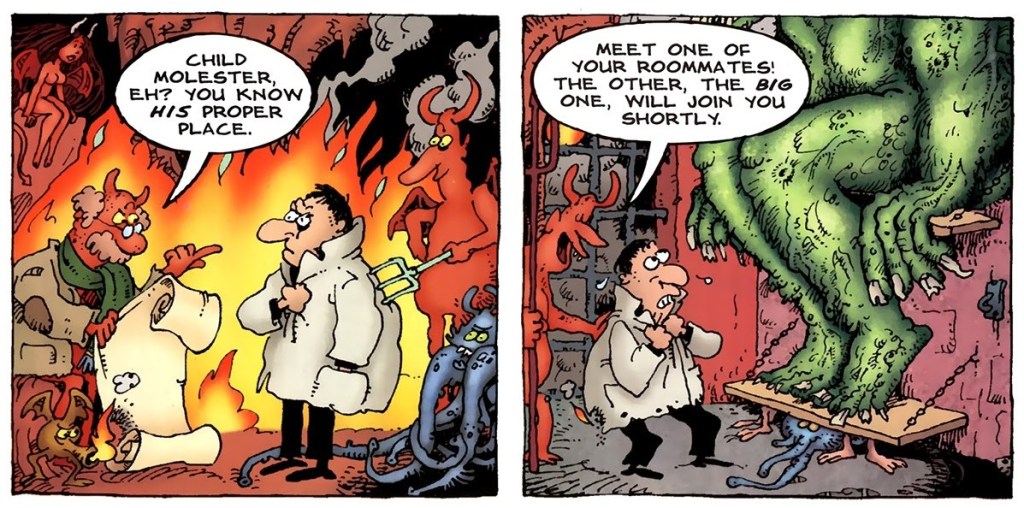
Panels from Sergio’s Inferno, published in Sergio Aragonés Funnies no. 3 (September 2011, Bongo Comics):
Finally, a panel from the back cover of Sergio Aragonés Funnies no. 10 (October 2013, Bongo Comics). Nevermind what the joke is, I just really like that octopus (as well as his other sea friends).
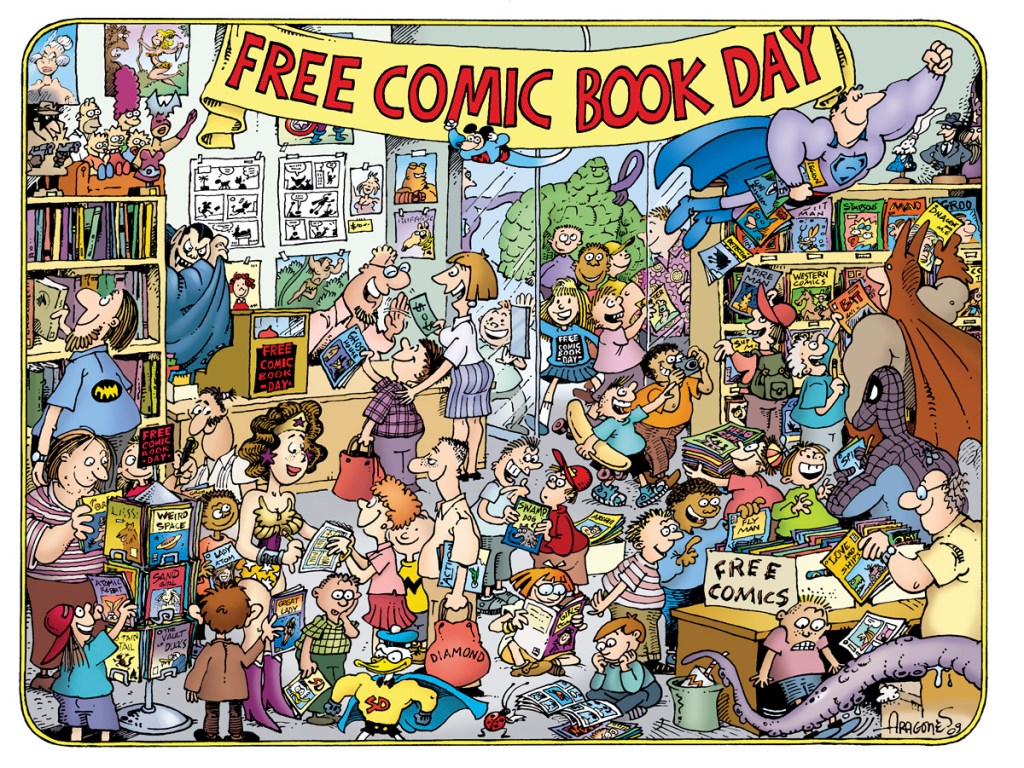
I mentioned materials related to Comic-Cons, so I would be amiss to not include at least one image of something vaguely related!
This design was created for the ‘Free Comic Book Day Commemorative Artist T-shirt’ in 2010.
I’ll end this post with a classic Aragonés anecdote, as told by Mark Evanier. This happened while these two were participating in filming The Half-Hour Comedy Hour television show for NBC in 1983, on which the model Jayne Kennedy was a guest. [source]
« This was one of the most beautiful women in the world. And she wore this dress that was very revealing, so much so the censors wouldn’t let us put her on the air in it without adding some material. So we’re all talking to her, the writers and whoever, just in awe of this woman. And Sergio comes walking in looking like a homeless person, carrying his portfolio. And Jayne sees him and she shouts, ‘Sergio!’ and she runs over and starts kissing him passionately.
They’d worked together before, it turned out. But Johnny Carson comes walking out into the hallway and he thinks Jayne Kennedy is being sexually assaulted by a homeless person in the NBC hallways. He came over to make sure she was okay. She said it was fine, that she knew him, and I said, ‘It’s okay, he’s a cartoonist.’
So Johnny gives that classic look and he says, ‘I knew I should have taken up drawing.’ »




























 Who's Out There?