Fungus Friday: Ah, the Bohemian Life

« Parmi les champignons se cachent d’ignobles individus, des espèces savoureuses et des sujets tout à fait pacifiques… »

December may not be exactly the month one associates with mushrooms, but that is precisely when mycophiles get broody and start cataloguing (mentally or otherwise) new species encountered during the warmer months*, dreaming about spring and its new flush.

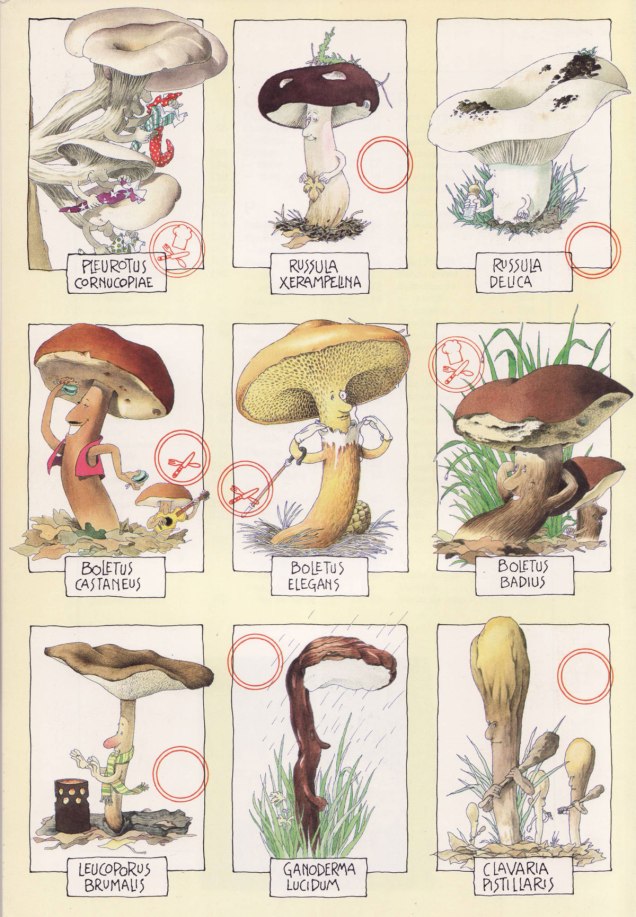
Here’s a selection of mushroom portraits taken from Le gratin des champignons by Roland Sabatier, an outstanding artist previously featured by co-admin RG in « Pépin le Long, You’re Fired! » (and, need I mention, a member of the Mycological Society of France). The second reaction I had upon leafing through this volume’s pages (the first was to squeal delightedly) was stunned admiration regarding the level of detail with which each mushroom is illustrated. I am by no means the first to note this (in his outstanding introduction, Georges Becker**, co-author of this tome, makes much the same point in far more eloquent prose), but it bears mentioning that while Sabatier may have transformed mushrooms into wonderful characters with their own games and stories, he managed to so very rigorously observe and illustrate their characteristics that one could actually use this book as a mushroom guide and not get, you know, poisoned.

Let’s get cooking!

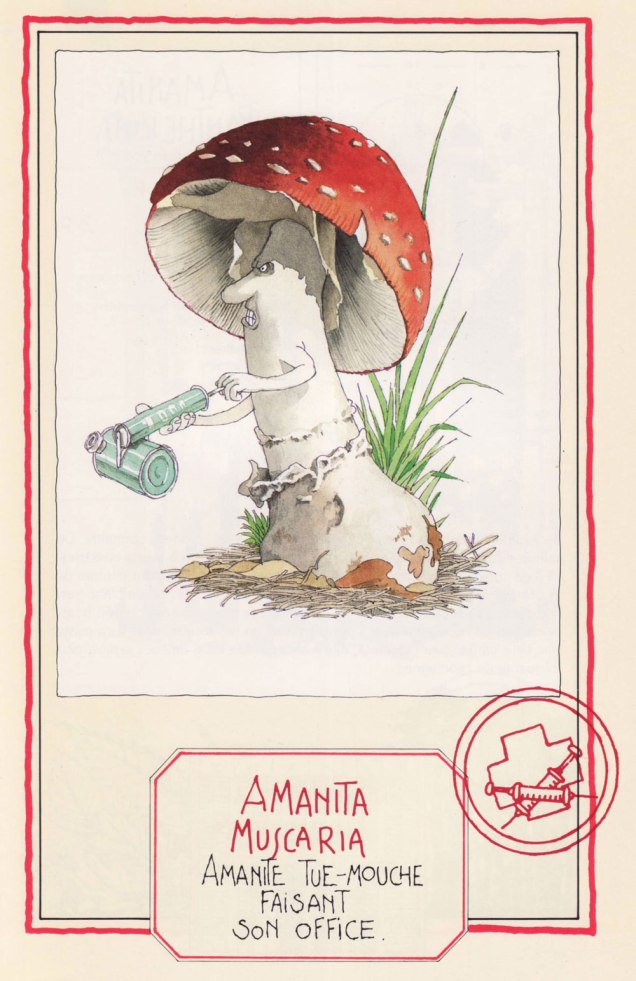
Speaking of getting poisoned, meet four Amanitas, a most deadly genus… with a few delicious, choice morsels thrown in to keep us on our toes:
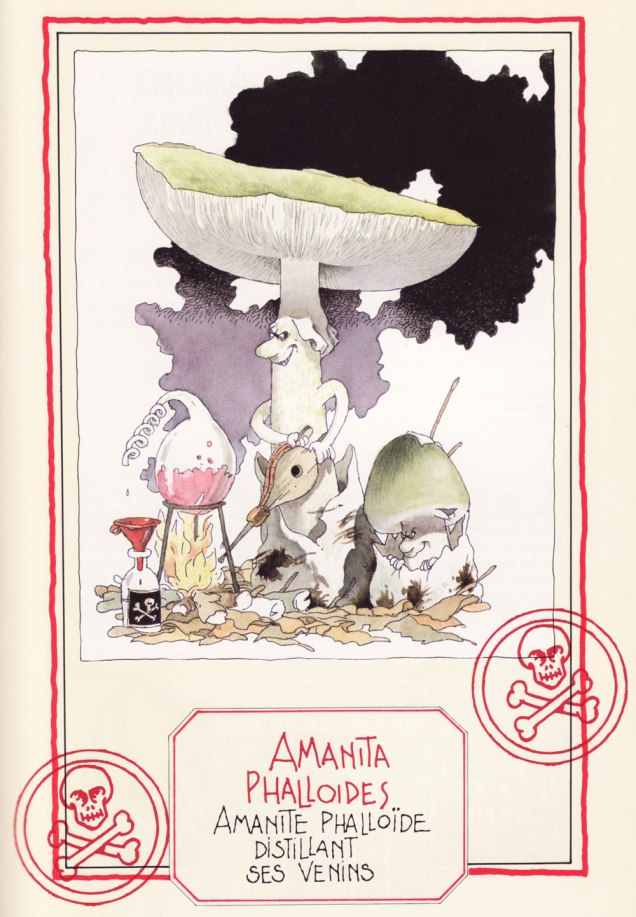
The Death Cap… distilling its own venom. A most lethal animal.
The Fly Agaric, probably the most depicted mushroom in the arts, ‘performing its function‘. Despite its reputation, it is not deadly per se, as alluded to in a previous post (Fungus Friday: Amanita New Year (To Get Over This One)).
The Blusher, so called for its propensity to blush a pink hue when bruised (or embarrassed, one presumes). These wino amanitae exiting the tavern definitely look sloshed.
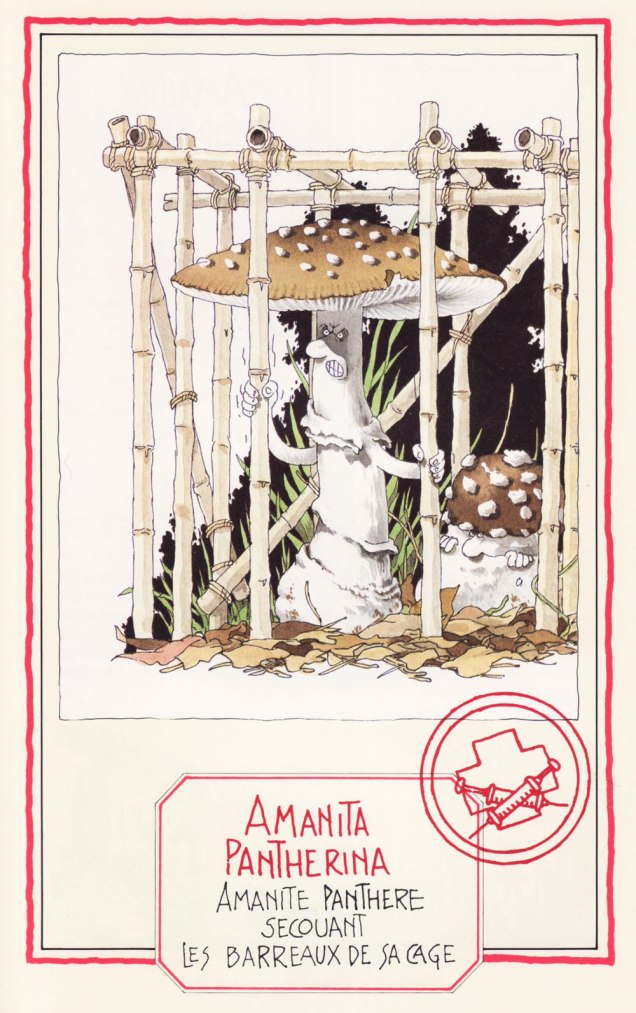
The handsome Panther Cap, shaking the bars of its cage. Like its Fly Agaric cousin, it’s not deadly as such, and has some psychoactive components. Admire its striking looks here.

Now we move on to more traditionally edible characters —

The Banded Agaric is also known as ‘Pavement mushroom’, which explains this fur-foxed lady showing her goods… walking the beat, as it were. This lady is tough as nails, and has been known to burst right through the pavement. Is she edible? You bet! ***
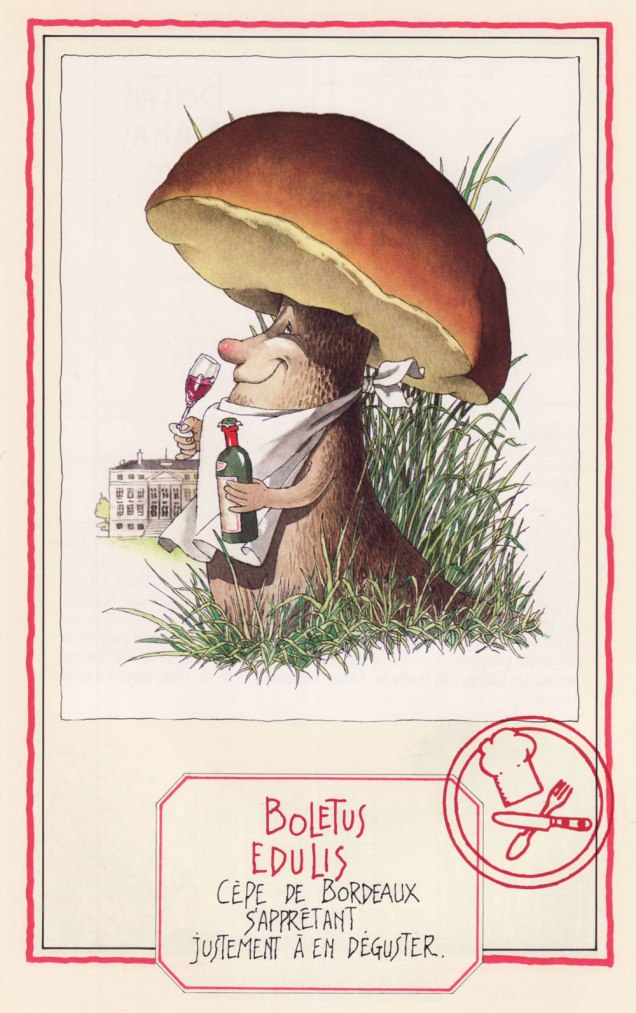
Ah, mushroom of many names (does this make it the rose of mushrooms?) – Penny Bun, Porcino, Cep, call it what you will… highly prized throughout cultures, fragrant à souhait. Here the cèpe de Bordeaux is about to savour some Bordeaux wine.
A favourite of WOT admins, the Fairy Ring Mushroom, saddled with an unfairly gloomy Latin name (‘marasme’ comes with an etymology of ‘wasting away’ or ‘decay’), dancing a ronde. Undemanding and widely spread, this mushroom dries most excellently (sometimes right on the very lawn it grows upon) and enlivens soups and stews throughout winter.
Another well-known mushroom, the Golden Chanterelle, as beautiful as it is fragrant. Will I picture these playing tiny little violins every time I find them in a forest? Absolutely.
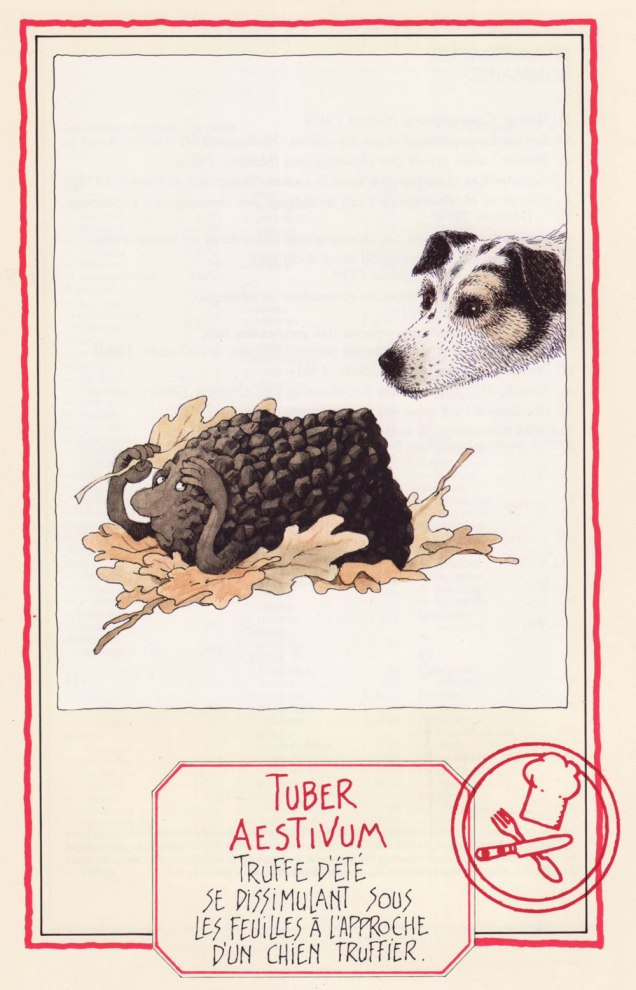
We couldn’t resist adding this scene depicting the Summer Truffle trying to camouflage itself as a truffle-sniffing dog approaches. I love the inquisitive gleam in the doggo’s eye.
We wrap up with, well… I trust you can interpret the Latin well enough without me. The Common Stinkhorn (‘stinky satyr indulging in his depravity‘) is actually edible, though not nearly as popular (or tasty) as another member of its family, the pretty Veiled Lady. Whether you would actually want to eat it is another question.

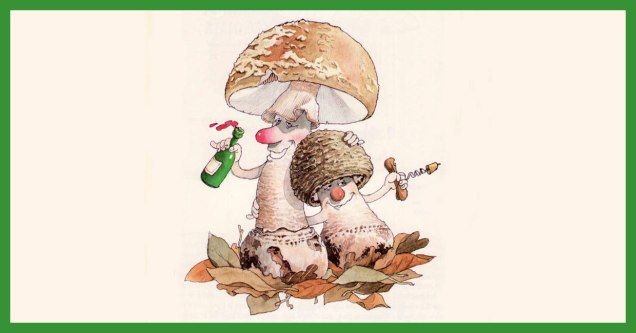
First published in 1986, this book has known several editions to update nomenclature (some mushroom families and names have changed considerably in the last 40 or so years, which is its own topic). We have the 1991 edition, published by Glénat. Sabatier had so many favourite mushrooms he illustrated, they didn’t even all make it into the book officially… which is truly a crime. Take a peek at some other of his mushroom people, only included on the inside of the book’s cover (but at least included in that smaller capacity!):
~ ds

* Technically one can find some mushrooms during winter, but that is not my area of expertise (at least as yet).

** French mycologist of renown (1905-1994), as well as writer, politician and apparently even musician (piano).

*** I’m actually not a big fan. This Agaricus tastes too much like the ‘champignon de Paris’ mushrooms sold in supermarkets to be of much interest.
We All Scream for Aisukurīmu

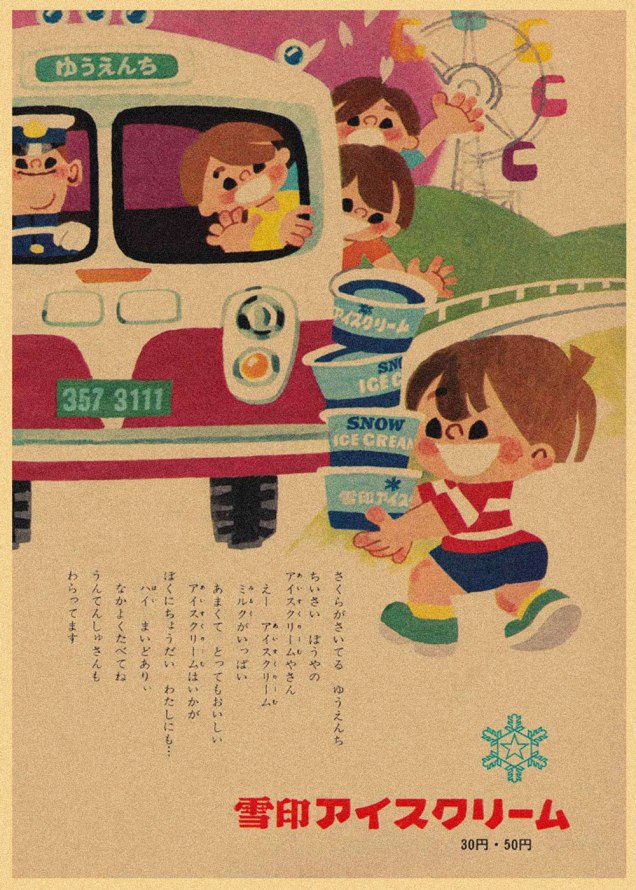
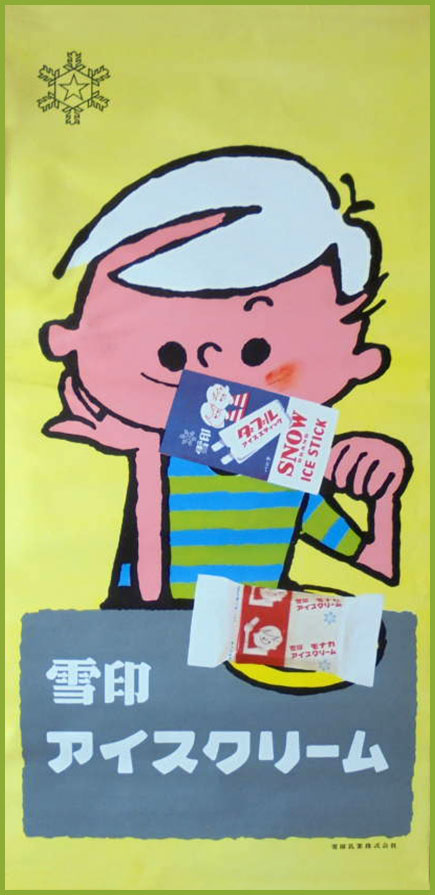
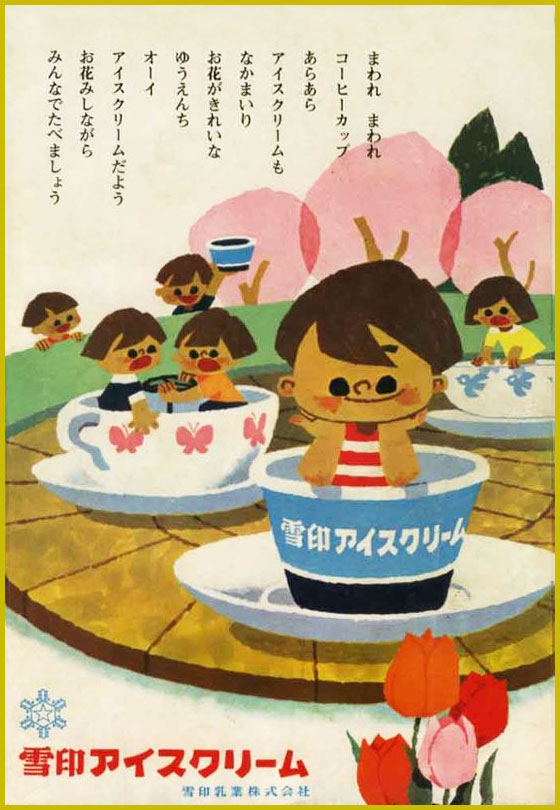
The mild case of writer’s block co-admin RG referred to in his latest post is still with me, and has perhaps even graduated from ‘mild’ to ‘pronounced’. Still, the Venn diagram overlap of spring gradually unfurling its petals and an upcoming trip to Japan smoothly leads me into today’s topic — Japanese ice cream ads from the 1960s, a glorious injection of the cute and the colourful. While you shouldn’t expect a high level of historical detail about the following images (especially given my purely utilitarian ‘where is the toilet?’ level of Japanese), you can hopefully enjoy this little detour. Don’t forget to have some ice cream today.

Most of these are ads from the Snow Brand, which by now has become Megmilk Snow Brand, one of the largest dairy companies in Japan.

On a far more disquieting note, I’ll wrap up with this USSR ice cream ad from 1937:

‘Ice cream – the best, the tastiest, sold by us’… maybe with the addition of some special powder.

~ ds

Maxine Always Has Her Mouth Open

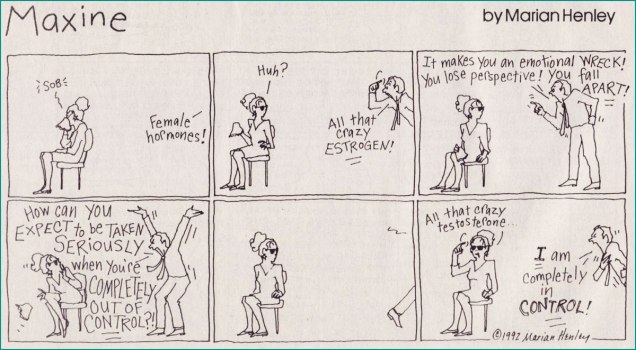
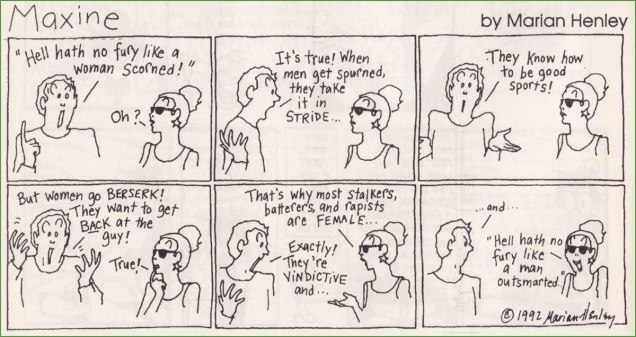
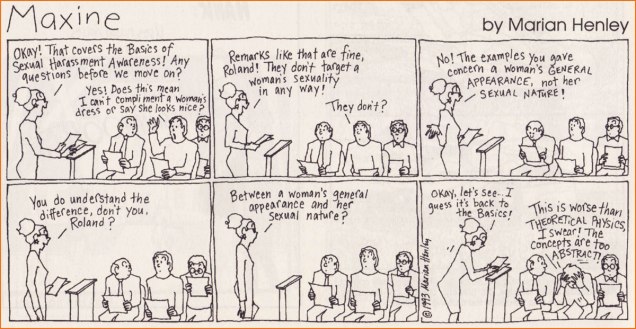
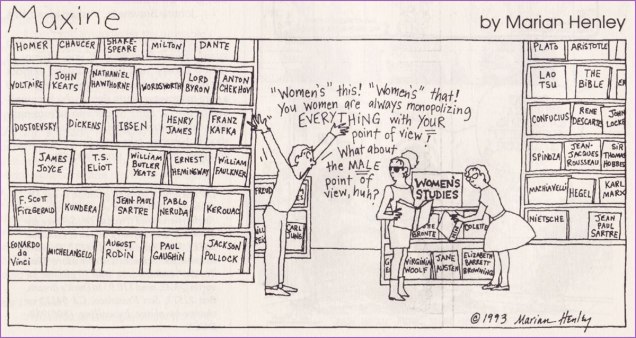
« From October 1981 until December 2002, Maxine appeared in a head-scratching combination of publications such as San Francisco Chronicle, Heavy Metal, MS, Glamour, Austin Chronicle, LA Weekly, Utne Reader, Asbury Park Press, MAD, Funny Times, and even a newsletter for Hawaiian polygamists. »

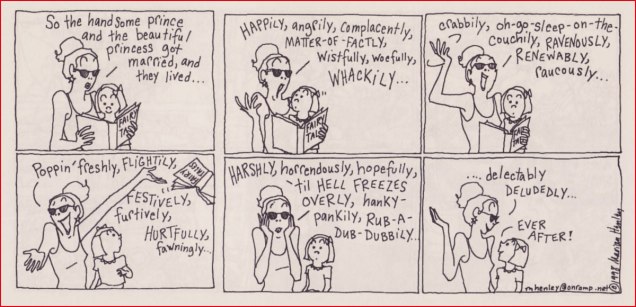
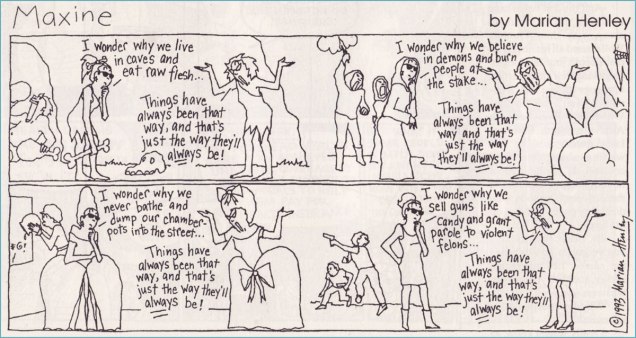
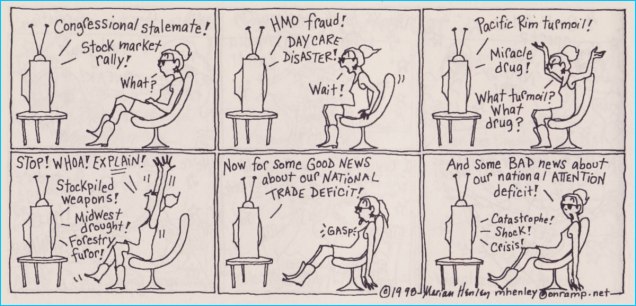
Marian Henley‘s Maxine naturally brings Nicole Hollander’s Sylvia to mind – two contemporary women cartoonists and their outspoken alter egos, both drawn in an idiosyncratic style that I imagine some found too sketchy, or too much of an acquired taste… to these imaginary straw men I’d recommend taking a closer look – Henley’s anatomy is impeccable, every character imbued with dynamic movement. Where Sylvia is a sort of seer, always at somewhat of a remove from emotional entanglements, Maxine is right in the middle of them like a cat tangled up in yarn, muddling through life’s chaos on her own terms (though sometimes dispensing advice to friends — ‘do as I say, not as I do!’)

A ‘Best Of’ collection of Maxine, published in 2002 by Taylor Trade Publishing. Hilariously, some have confused it with John Wagner’s Maxine, with much disappointment resulting. I guess these two target audiences have very little overlap. I also found myself counting Henley’s fingers — I think semi-unconscious defenses against AI are kicking in.

Maxine is a recent visitor to my brainscape – co-admin RG dragged out stacks of Comic Relief (‘The lighter side of life. Fewer calories than a newspaper, more laughs per pound.’, a monthly magazine published by Page One Publishers & Bookworks in California) from the 90s to look for something else, and that’s where the lovely choppiness of Henley’s art was pointed out to me. Sylvia is in too, incidentally. Here are some selections from 1991-1998. Crazy to contemplate that this was some 30+ years ago, yet the concerns expressed could have easily been a reaction to any recent morning’s news. Plus ça change, plus c’est la même chose….

Like any woman cartoonist worth her ink, Henley is into cats. In case this is news to some of other readers, men disliking cats out of all proportion is a waving red flag.

And the subsequent batch of strips feel so relevant to today that it pains me:

To wrap up on a more positive note (something sorely needed right now) —

This one is a sincerely sweet strip, a rarity in Maxine’s world.

~ ds

A Smutty Little Holiday

Holiday,
Oh what a lovely day today,
I’m so glad they sent me away,
To have a little holiday
.*

Today we embark on a V̶i̶c̶t̶o̶r̶i̶a̶n̶ r̶o̶m̶a̶n̶c̶e̶** romance set in 1889, seasoned with more than a dash of steampunk, all in the name of sweet (and currently very much needed) escapism. Expect NSFW, in case it matters.

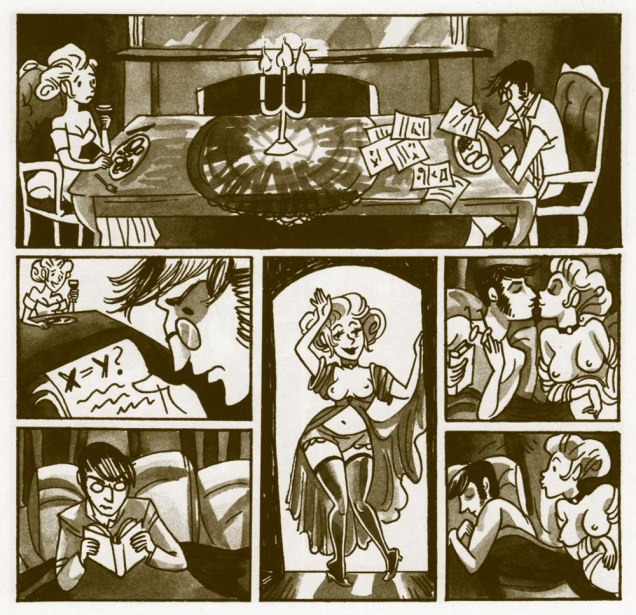
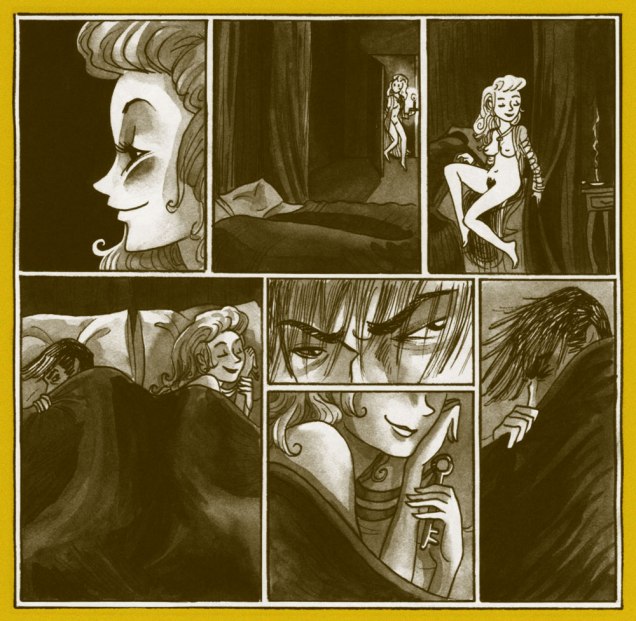
Chester 5000 (Top Shelf, 2011) is a typical love story: boy meets girl, boy loses interest in girl sexually and so builds her a sex robot, girl falls in love with robot, boy gets jealous. The mechanical turn of the plot does in no way impede the emotional progression and, as a matter of fact, one finds oneself distinctly rooting for the very sweet Chester. Really, the fact that he’s a robot only comes into play to show off his many pleasure-centred tool attachments, not to mention his ability to hold a lover in mid-air for extended periods of time.

This comic is entirely mute, told in little vignettes which make it quite clear how the characters are feeling. American cartoonist Jess Fink has been singled out for her titillating talent of depicting luscious breasts, and I quite agree (and extend that compliment to the rest of female anatomy). Here are a few of the tamer scenes —

« Jess Fink’s “erotic, robotic Victorian romance” Chester 5000 XYV, an ongoing Web comic that’s recently been collected into a graphic novel by Top Shelf, is utterly of the zeitgeist. It has enough gadgets to entice the steampunk crowd, enough heat (tempered by romance) to seduce the yaoi*** crowd, enough sex-positivity for the feminist crowd, and enough craft for any “but girls can’t draw” naysayers. » (source: TCJ)

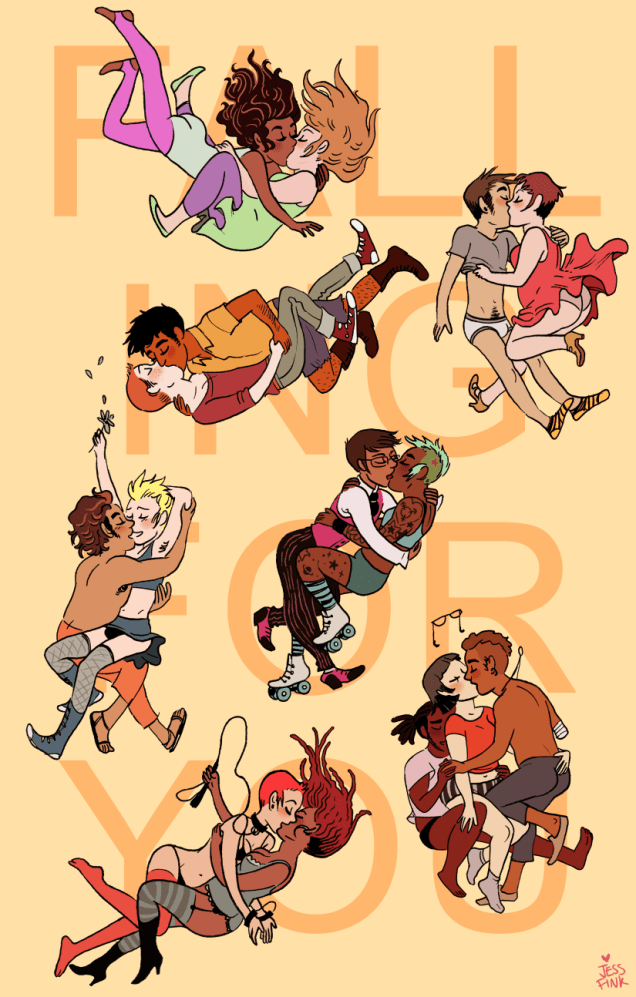
One might say this graphic novel is part of a wave of woman-penned, sex-positive, body-diverse comics — and indeed, Fink has several contributions to the anthology Smut Peddler. As for the anthology, I respect it as an admirable initiative, but is not something I collect because sadly most art within rubs me (ha, ha) the wrong way. I had purchased the 2014 edition because of Fink’s How You Gonna Keep ‘Em Down on the Farm story, but I gave it away to a rather stunned older man who came to pick up a box of random books I no longer wanted. Well, he said he wanted to read something new for a change (while his eyes goggled) — I hope he enjoyed it.

~ ds

*Holiday

** Co-admin RG would like to point out that this isn’t really Victorian other than in costume, and so objects to that categorisation. I’ll leave the reader to decide whether works of fiction set in a specific period (well before the author’s lifetime) deserve that era’s label or not. The Professor’s Daughter (discussed in Félicitations, Emmanuel Guibert!) was described in a review as ‘a love letter to Victorian London’ despite having been brought to life by two men from the late 20th century, but it was better researched than Chester 5000 — though the latter still has historical details, especially in the second volume, and Fink clearly knows a lot about Victorian costumes, as evidenced by this fun interview. If you want smut from the actual Victorian era, I’d like to point you in the direction of Victerotica – A Carnal Collection, volumes 1 and 2. RG also points out a certain plot similarity to La poupée sanglante, a 1923 novel by Gaston Leroux (author of Le fantôme de l’opéra).
***Speaking of yaoi, volume 2 of the series, Chester 5000 book 2: Isabelle & George (also published by Top Shelf), has some nice mann-gegen-mann action.

Riddles & Bears: Meet Victor Chizhikov

I grew up on the illustrations of Soviet illustrator/cartoonist Victor Chizhikov (1935-2020). I’m not sure whether I’m from the last generation that remembers his work this well — on a similar topic of ‘boy, we’re old’, older non-Slavic readers might be familiar with Misha, the mascot that Chizhikov designed for the 1980 Moscow Olympic Games.

Chizhikov with his creation Misha (both a nickname for Mikhail, and a contraction of ‘bear’).

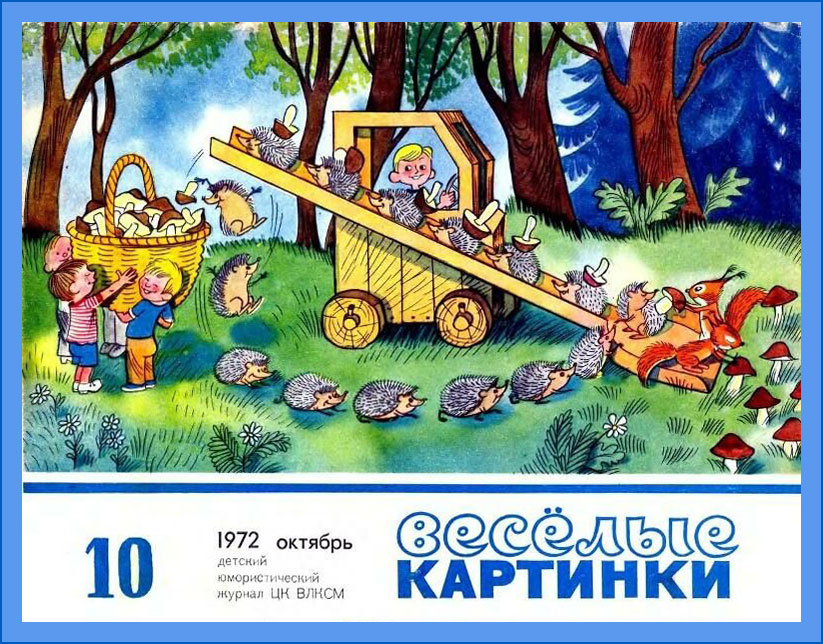
In 1955, Chizhikov started contributing illustrations and caricatures to Krokodil, a publication I was born too late to be personally familiar with (though I did write a post about it). While he has definitely drawn a number of ‘adult’ cartoons in his life, it’s his cheerful anthropomorphic animals, mushroom-studded landscapes and gently roguish children that linger in people’s minds, and those appeared from 1956 and onwards, frolicking through the pages of Весёлые картинки (Merry pictures), a publication aimed at children between 4 and 11. In 1958, Chizhikov also joined the staff of Мурзилка* (Murzilka), a magazine for the 7 to 13 year old crowd. I had subscriptions to both as a child. My grandfather was especially keen on giving me a well-rounded education, though he needn’t have worried, as I come from a family where nearly everybody was a voracious reader, albeit occasionally disagreeing on genre. I used to have a stack of Весёлые картинки somewhere, but I got rid of it at some point with the impetuousness of a young adult, alas.

An issue of «Мурзилка» from 1968.
A page from a 1965 issue of «Мурзилка» depicting scenes made up of palindromes.
Original art for an illustration created for a 1975 issue of «Мурзилка».
Page from a 1966 issue of «Весёлые картинки» — ‘Petrushka in the land of fairytales‘ was a recurring feature. Chizhikov had a most fluid line when needed.
The October page from a 1972 calendar published in «Весёлые картинки».
An issue of «Весёлые картинки» from 1982.

Interestingly, Chizhikov was daltonic, something one would never be able to guess from his illustrations. It is said that his wife would label pots of paint and pencils to help him out, but I don’t know what variant of colour blindness he was stricken with. A critic once described his characters as having a ‘mischievous squint, as if they live in an eternal summer in the bright sun‘ — maybe they were just squinting trying to discern the nuances between colours?

‘The Lamplighter Ant’
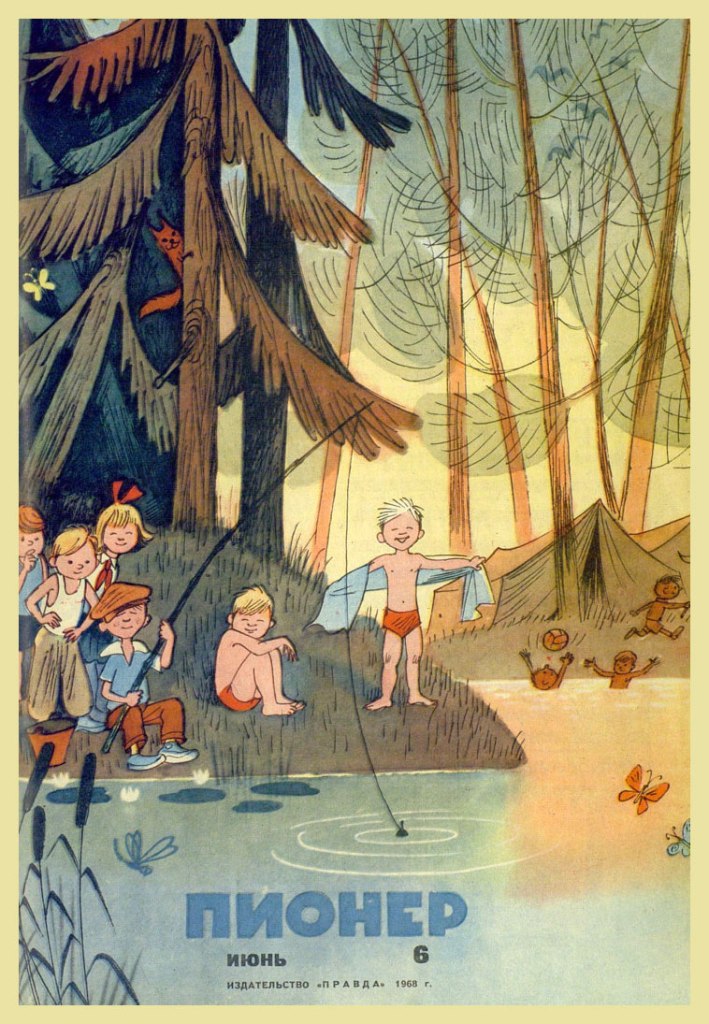
Issue of «Пионер» from 1958 — this was a magazine for 10 to 14 year-olds, but I don’t remember ever encountering any issues in the wild (possibly because my family objected to buying something called ‘Pioneer‘).

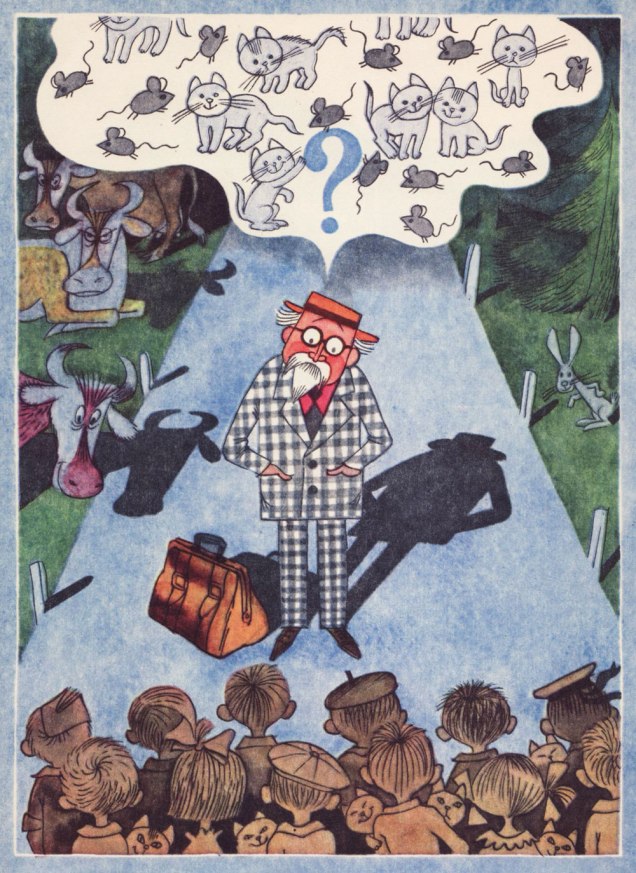
I owe this trip down memory lane to a friend who gave me a 1971 edition of 25 загадок — 25 отгадок (25 riddles — 25 answers) written by the immensely energetic and thus ubiquitous Korney Chukovsky** and illustrated by Chizhikov. Many thanks, Drew!

« Two stallions I have, they carry me on water. The water is tough, as if it were a stone. »
« If pine trees knew how to run and jump, they would flee from me to never cross my path again, because I am very steely, mean and toothy. »
« Small houses are running down the street, carrying little girls and boys. »
« Kondrat was walking to Leningrad, and coming towards him were twelve kids, each with three baskets, with a cat in each basket, and each cat having 12 kittens, each kitten holding four little mice. How many kittens and mice are the kids carrying to Leningrad? »
Cover of another book by Chukovsky, the ever-popular Doctor Aybolit, whose name translates literally to something like ‘Doctor Ouchithurts’. This character was loosely based on Hugh Lofting’s Doctor Dolittle, as well as Chukovsky’s friend Zemach Shabad, known for treating not only sick children, but also the equally ailing animals the children would bring along to their appointments.

~ ds

* Мурзилка is still around today, and given that it began publication in 1924, it is now listed in Guinness Worlds Records as the longest running children’s magazine in the world.

** 1882-1969, author of innumerable absurd ditties, rhymes and poems so well remembered and loved that many got incorporated into Russian as idioms; brilliant translator of English novels, stories and poems, making them accessible to a Russian-speaking audience for the first time; dissenter of governments, be it Soviet or Russian.

A Very Langridge Christmas

Speaking of festive mayhem, there is none better than penned (imagined, executed!) by Roger Langridge. Over the scope of his long (and ongoing!) career, the whole ‘rocking around the Christmas tree’ thing has shown up at least a couple of times — you may not have snow where you live, but take a gander at these and watch your holiday spirits soar (especially if bolstered by a bit o’ tipple).

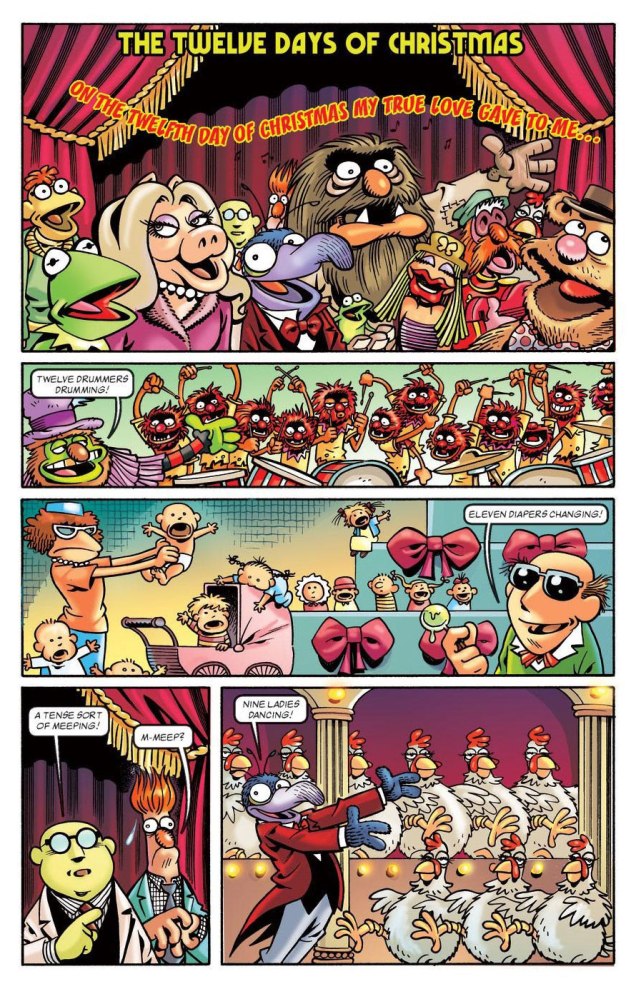
Here’s are some merry excerpts taken from The Four Seasons: Winter storyline printed in Muppets: The Four Seasons (2012, Marvel) for your enjoyment:

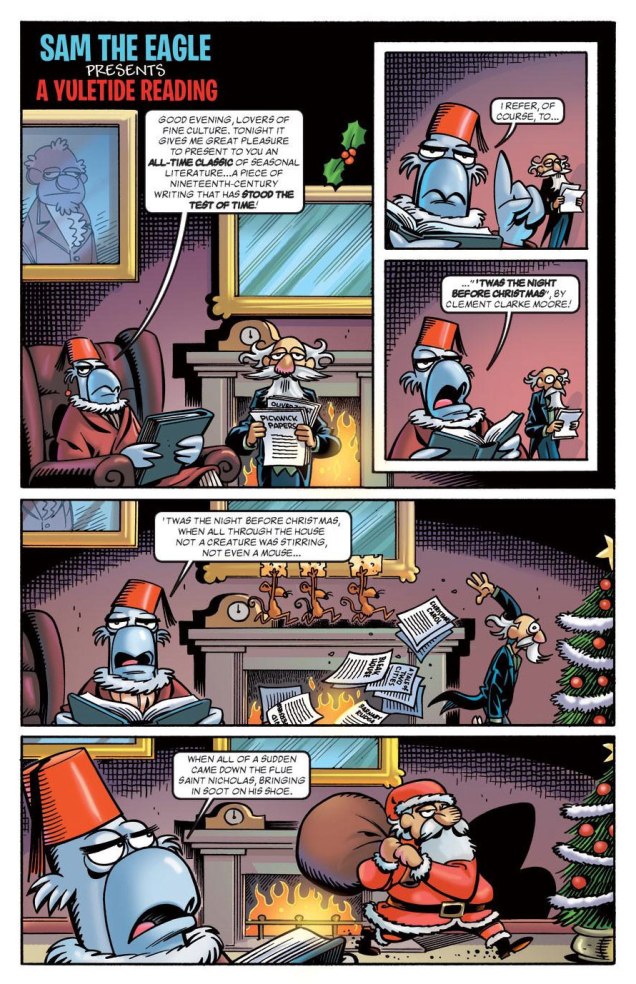
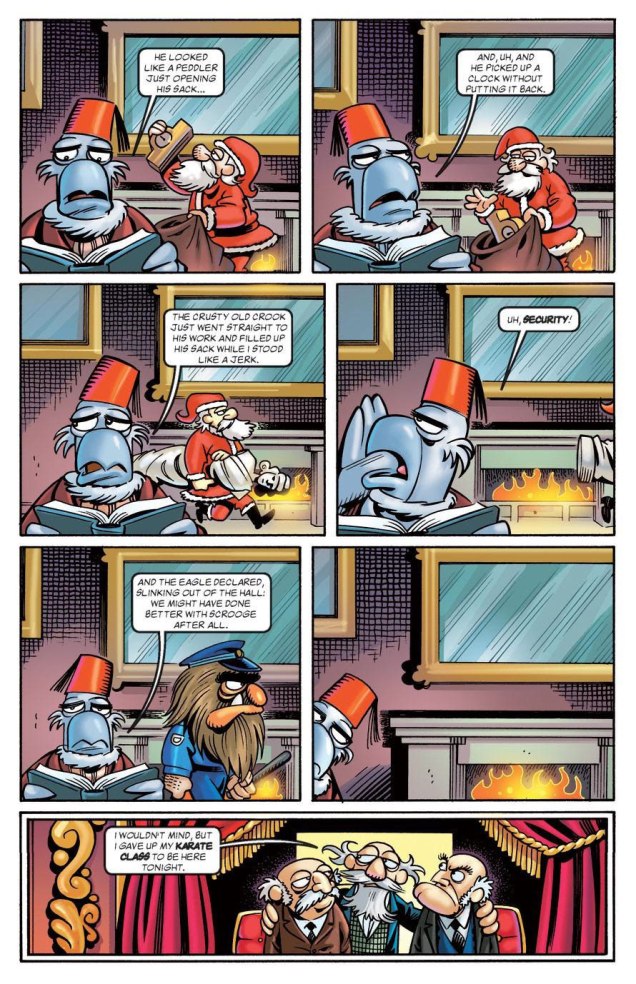
From the same issue, in this two-page digression (though what is The Muppets if not a series of glorious digressions), Sam narrates Dickens’ magnum opus… oh, nevermind.

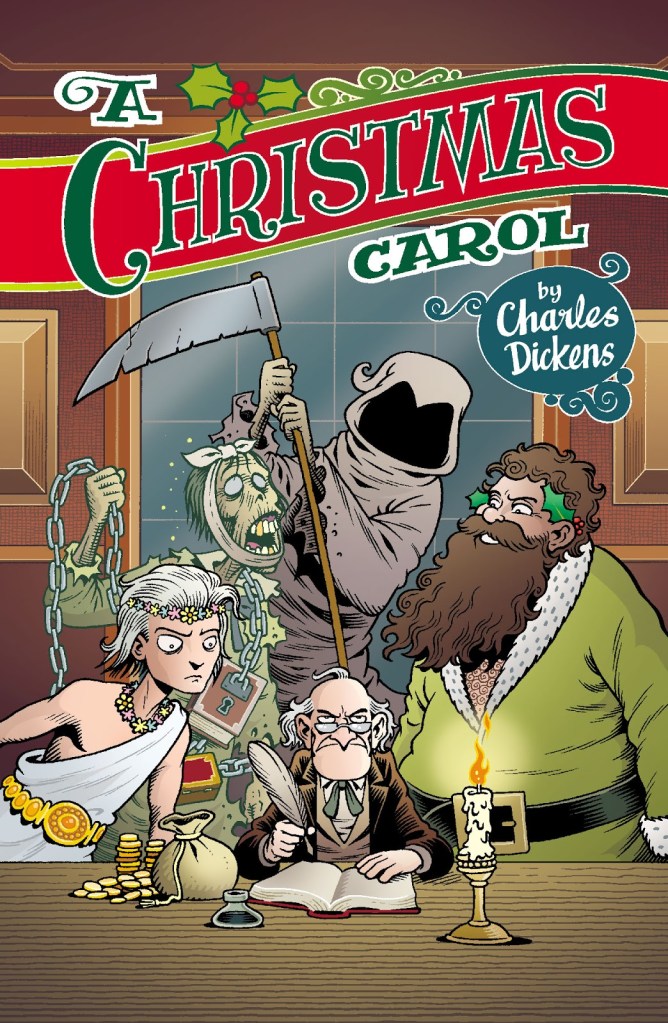
Speaking of Dickens, though, he did not go un-Langridged, happily:

A Christmas Carol (2013, St Mark’s Press)

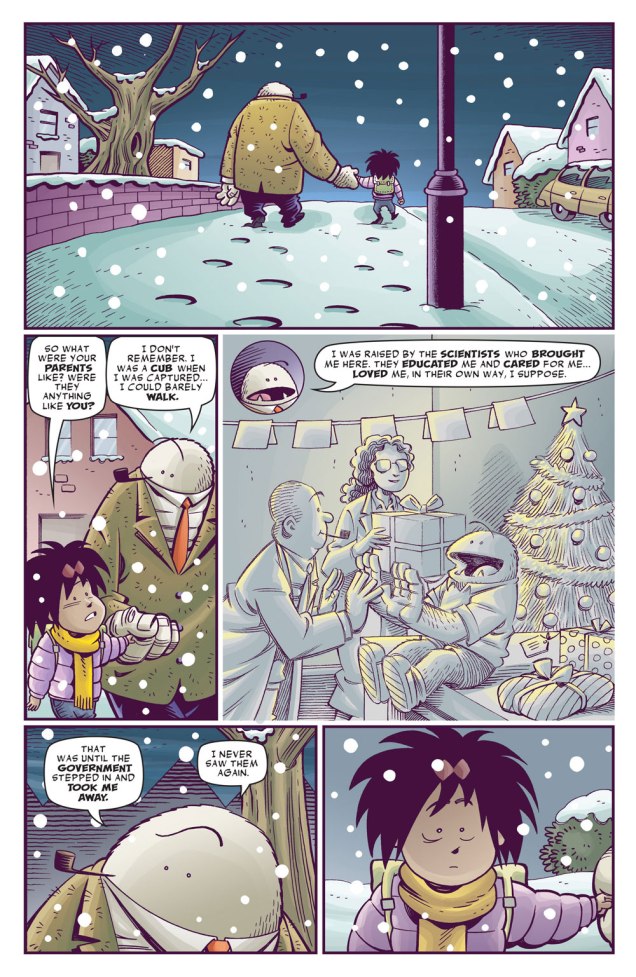
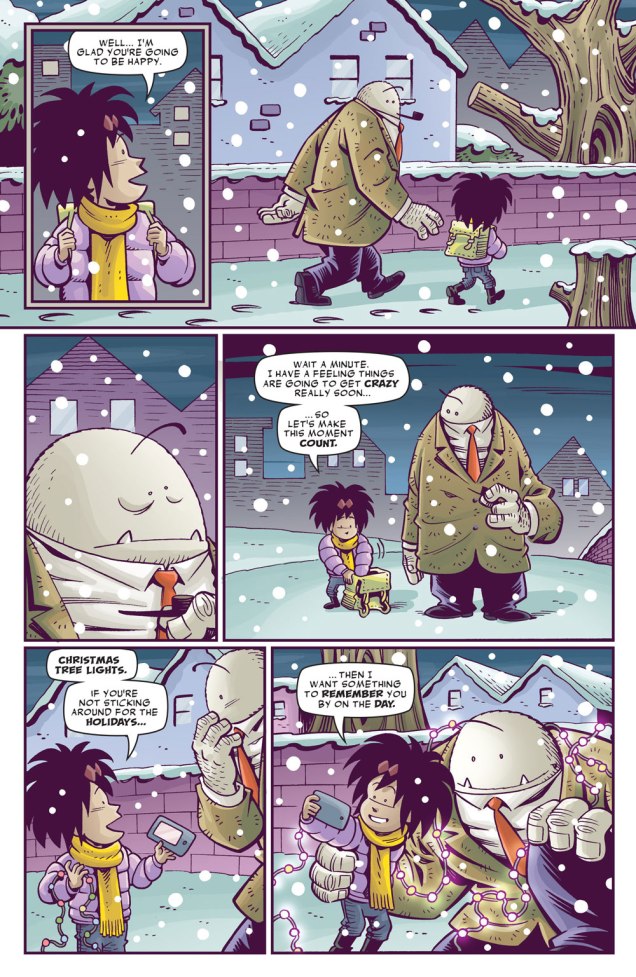
To further your cheer, a few more pages from Langridge’s Abigail & The Snowman (2016, KaBOOM!). This decade sure is a depressing one for all artistic professions — current active cartoonists seem to be mostly doomed to juggling thankless jobs for corporate giants such as Disney-slash-Marvel while defending their right to be (and to own their work) from AI pilfering (although ‘pilfering’ is too cute a word for it). Even such pundits as RL can rarely afford to work on what’s actually dear to their hearts. In that context, the sweet (and thoughtful) story of Abigail and her snowman friend was a very welcome addition to Langridge’s career, lodged as it was between two extremely underwhelming Dynamite-published affairs where he acted as the writer, namely King: Mandrake the Magician (2015) and Betty Boop (2017). I’m now convinced that Langridge’s art can save a poor script (thanks to jokes and beautifully non-sequitur asides inserted into the art), whereas a flat artist can ruin a plot faster than you can shout ‘Gisele Lagacé‘.

Langridge has been drawing daily cartoons based on his life for around 5 years now. This is the strip’s final week, as he has decided that it’s time to move on to something else, so I wanted to mention it before it’s too late — especially since it’s perfectly relevant to the season.

Strip from December 21, 2023

And a merry Christmas to all! We’ll see you again before the New Year.

~ ds

It Must Be True — It Was in All the Papers

« Save time and cut fingers with a parsley mincer. »

It seems that oodles of my posts start with ‘I found this book randomly in a second-hand bookstore…’, when ‘retrieved from the bottom of a dusty chest in a forgotten attic’ would make for a much more enthralling story. Alas, I am bound to truth… as is Can It Be True? (originally published in 1953 by MacDonald and Co; I have the 3rd edition from 1954), which was priced one measly buck despite its generally excellent condition and venerable age.

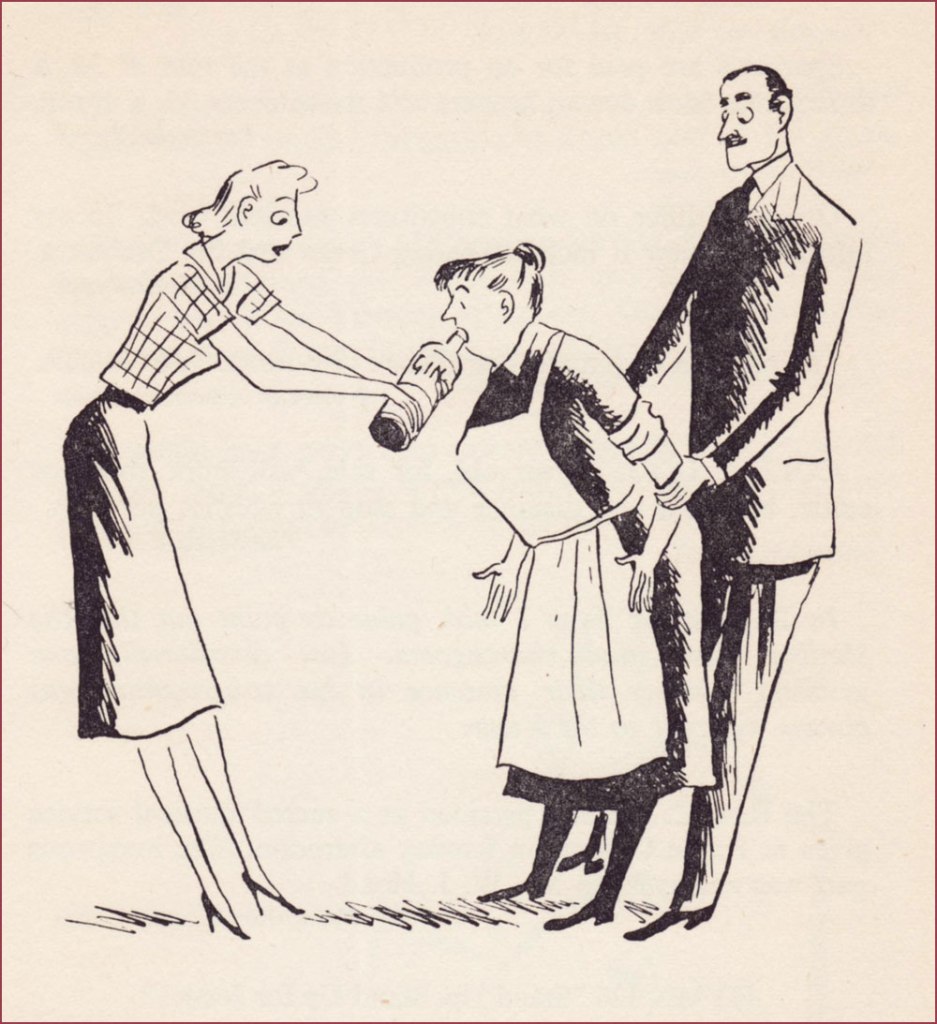
It consists of a collection of misprinted and typo’d quotes drawn from newspaper clippings, magazine articles and other paraphernalia, expertly gathered and compiled into a thin volume by Denys Parsons. This by itself makes for an amusing read, but the cherry on the cake is the occasional illustrations by blog favourite Anton (see Anton’s Spivs and Scoundrels, Baronesses and Beezers, if you’re not sure whom this nom de plume conceals).

As seen from a panel inside the book, the man is holding a poster that reads’ SHRDLUS AT IT AGIAN – Evning Srta’
« ... Spread around her was a sun-flooded valley where buttercups nodded lazily in the summer breeze and tranquil cows chewed solemnly at her elbow. » – Western Family Magazine
« Para. 27B. Men employed on quasi-clerical nature should not be provided with any clothing. » – Post Office Magazine
« The best plan is to hold the bottle firmly and remove the cook as gently as possible. » – Woman’s Paper
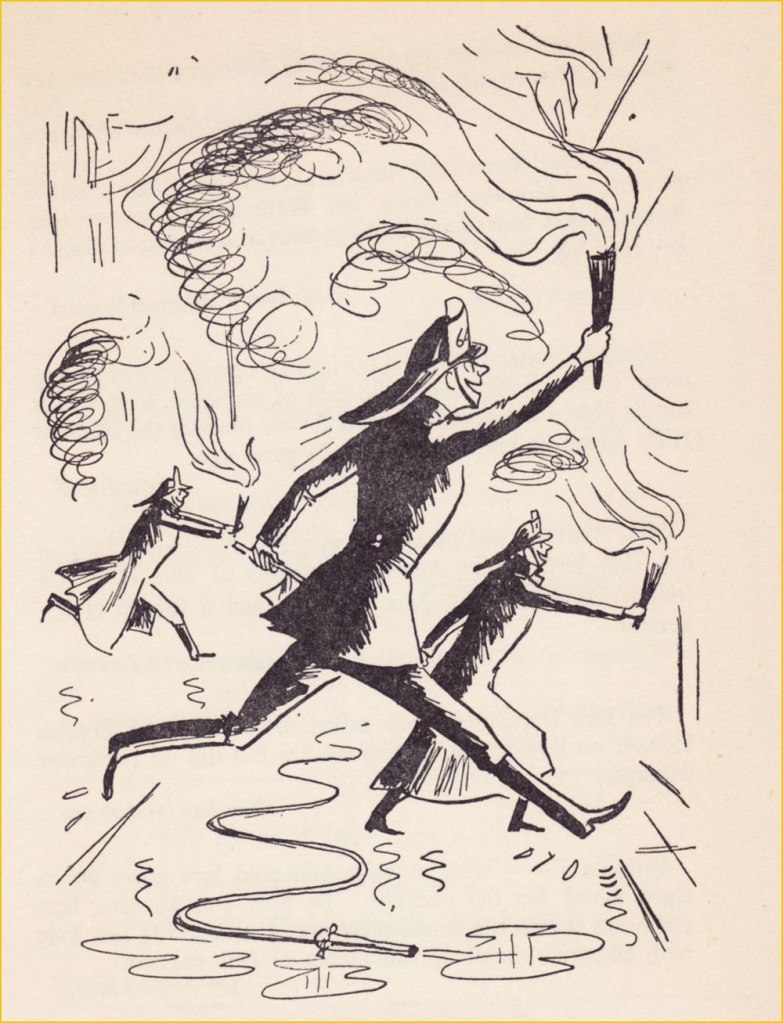
« The flames starting on the third floor of the midwest Salvage Co. spread so rapidly that the first firemen on the scene were driven back to safety and leaped across three streets to ignite other buildings. » – Cincinnati Times Star
« The word lawyer, he argued, was a general term, and was not confined to solicitors, but anybody who practised any breach of law. » – Cambridge Paper
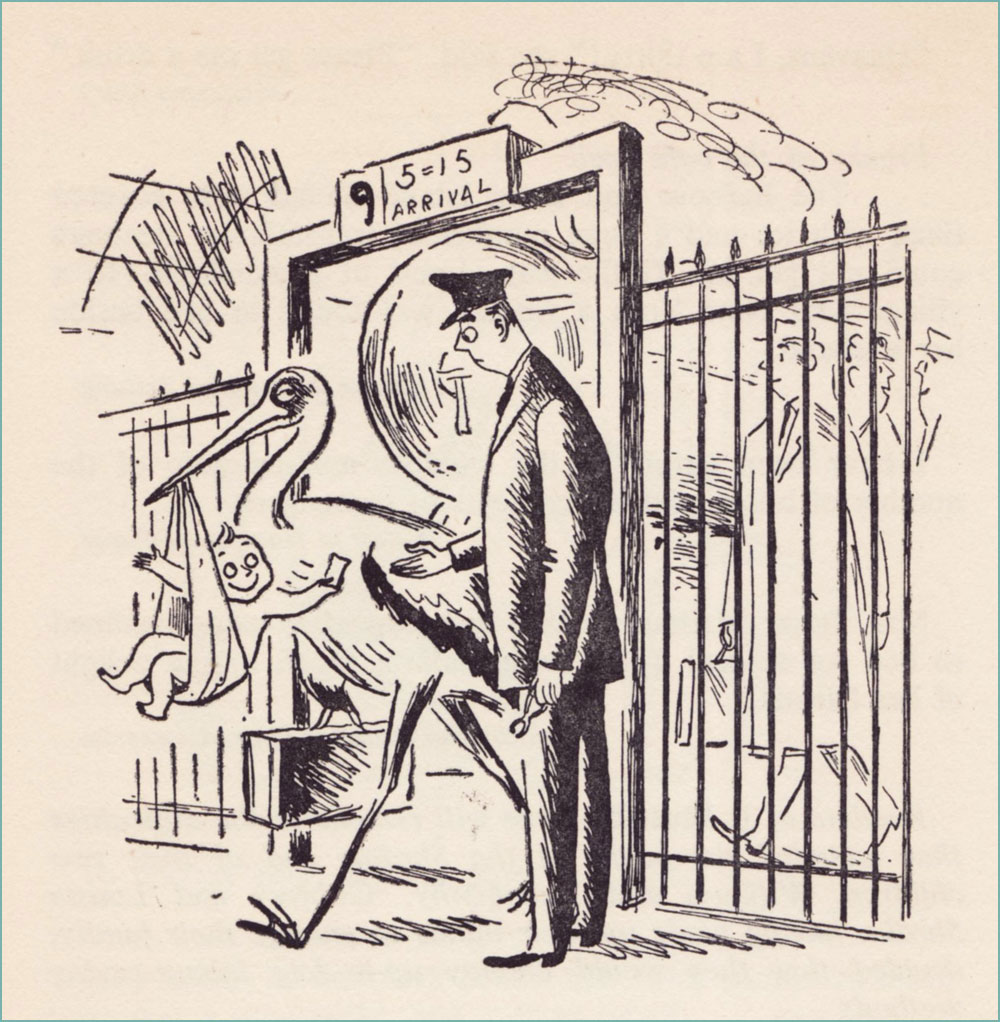
« Mr. and Mrs. Benny Croset announce the birth of a little son which arrived on the 5.15 last Thursday. » – West Union (Oregon) People’s Defender

Denys Parsons, ‘the undisputed king of the misprint’, has a few more books I’m interested in, including another volume of It Must Be True (this one illustrated by Ronald Searle), as well as Many a True Word (another Anton volume!) and All Too True (with drawings by Peter Kneebone). Perhaps another time, another p̶l̶a̶c̶e̶ used bookstore…

~ ds

Hallowe’en Countdown VIII, Day 30

« New mysteries. New day. Fresh doughnuts. »David Lynch

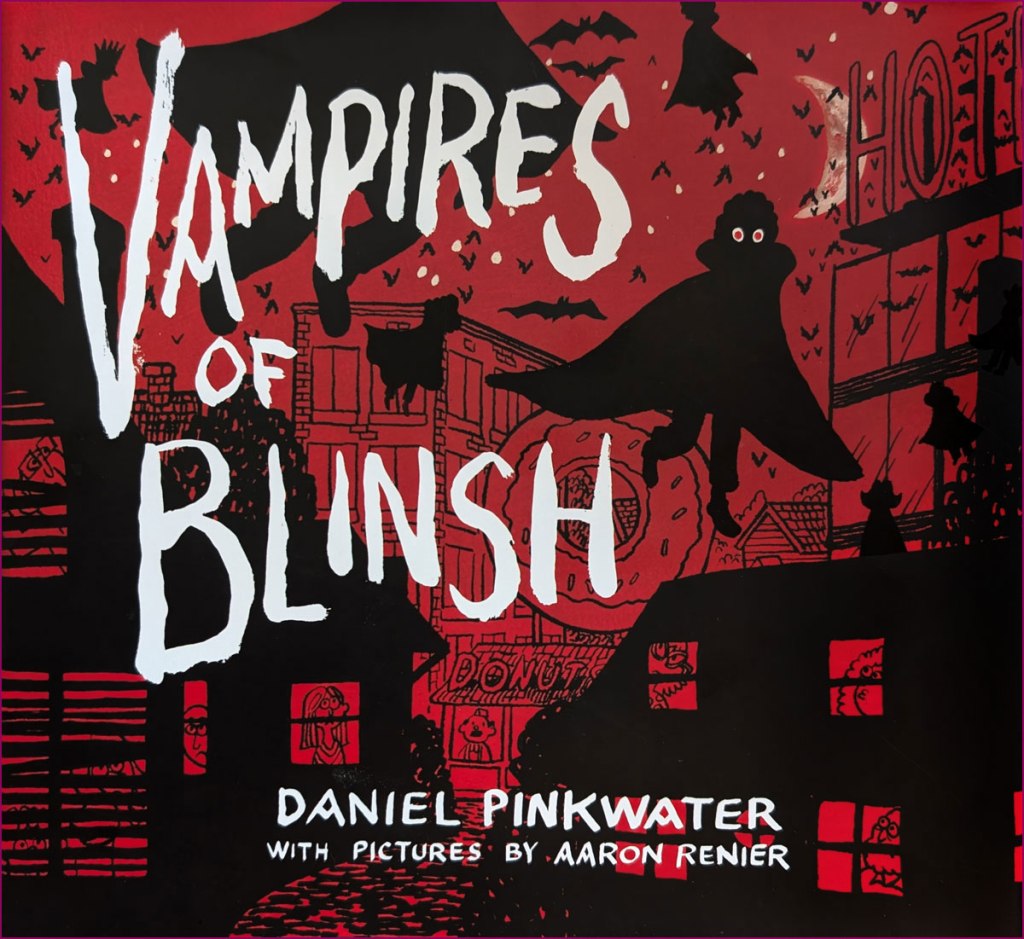
Welcome to the bewitching burg of Blinsh, Pinksylvania, where vampires peacefully coexist with ‘normal-type Blinshites’, though the latter do exhibit a touch of grumpiness when suddenly bitten by their fanged neighbours. Put on your cape (surely you own a cape?) and follow us to this land of boiled turnip and sauerkraut doughnuts… but I would recommend not going on an empty stomach.

The pages of Vampires of Blinsh (Sept. 2020, Abrams Books for Young Readers) are positively overflowing with jolly vampires, promenading chickens, sneaky racoons, people tripping over bikes, floating basketball players, children munching doughnuts, janitors in eyepatches, and so on. In short, a typical Daniel Pinkwater creation, and I say this with the utmost delight.

This book was illustrated by Aaron Renier, whom I already knew from his young readers series The Unsinkable Walker Bean. The latter definitely has its heart in the right place, but failed to fully capture my interest, though I can confirm the art was great, so I was happy to see Renier’s drawing talent matched up with a story I could really sink my fangs* into. Not that Vampires of Blinsh has a story, per se – which seems to have baffled a few readers, some of whom, judging by their reviews, found it confusing and indecipherable. VoB is more of a quick dip into the non sequitur, somewhat absurd, always charming world of Pinksylvania, as readers are taken on a quick tour of Blinsh, its twin sister city Blorsh, as well as the capital of Pinksylvania, Farshningle. Many potential storylines are hinted at, but none are lingered upon, as Pinkwater effortlessly flings ideas (of which he clearly has an abundance) around and pirouettes on to the next vignette.

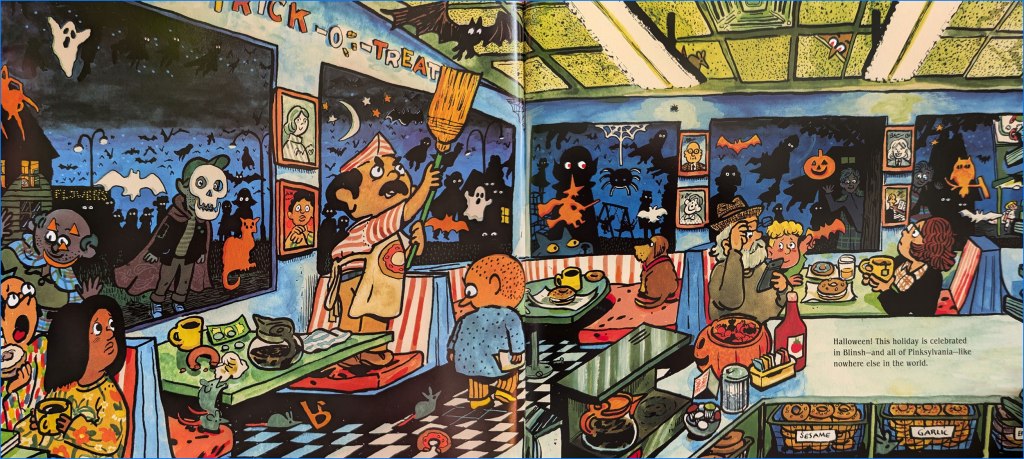
Hallowe’en in Blinsh!
« But there is no place like home, which is to say there is no place like Blinsh. »

It actually turns out that this book was in no way the result of a straightforward collaboration between artist and writer. Co-admin RG got the story from the horse’s mouth (the horse, naturally, being DP), and here I quote Pinkwater’s anecdote**:

« The book had a completely different text. It was one of those cumulative counting stories. […] The book was written before Covid, the illustrator did his thing, with no input from me at all. And when it was ready for publication, the editor, the illustrator and I all realized it would seem we were making sport of something that looked like going to be a worldwide catastrophe…making sport or trying to capitalize on an event that would cause millions of deaths. People would break our windows. So we decided to kill the book. For all I know the bound copies, (which may have already been on the boat), were dumped into the sea. I own two sets of proofs. I asked my colleagues if I could try to come up with a new text, not a single drawing to be changed. They let me do it. It was printed with my new words, and that’s the book you have. The three of us promised each other we would never tell the story I’ve just told you– (I am not to be trusted). Now I wish we had let the original version be published. We could have sent a copy to Donald Trump. If someone read it to him, he might have understood the nature of a pandemic, and lives could have been saved. »

Were Blinsh and Blorsh even part of the original tale? Who knows. Let’s chalk it all up to serendipity and wander off to procure Kat Hats (Sept. 2022, Abrams Books for Young Readers), another Renier-Pinkwater collaboration .

~ ds

* I used to have pointy canines, until my orthodontist decided to file them down without asking for my opinion first – and this is by no means a unique experience, as is evidenced from any discussion on social media about the delights of orthodontistry. Some of those ‘professionals’ are true ghouls.

** Pinkwater’s Anecdote is less known than, say, Occam’s Razor, Chekhov’s Gun or Russell’s Teapot, but maybe we can squeeze it into the pantheon of eponymous principles anyway, something like ‘entertaining stories can be found wherever Pinkwater goes‘.

Hallowe’en Countdown VIII, Day 27

Today’s offering features plenty of colour… which in my humble opinion does not detract in the slightest from a sombre, autumnal atmosphere with chills as palpable as thick mist. While you would not be amiss in deciding that this art comes from a European hand, it’s not a French one, despite the language most of the following pages are in.

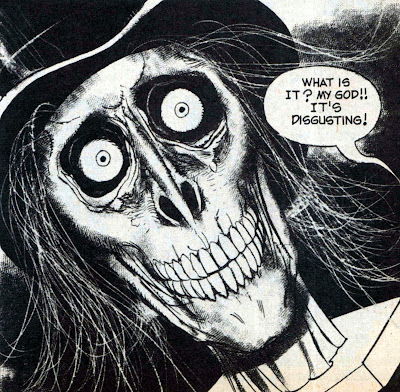
Josep Maria Beà i Font, usually shortened to and credited as José Beá, is a Spanish comics artist — born in 1942 — who’s happily still with us. Fans of Warren-published comics may recognize his distinctive style, as he wrote *and* illustrated quite a few (around thirty) stories published in Vampirella, Creepy and Eerie, starting with The Silver Thief and the Pharoah’s Daughter published in Vampirella no. 13 (Sept. 1971). It seems that he is another of those love-’em-or-hate-’em artists, as while doing some research for this post, I stumbled upon more than one instance of opinions such as ‘my least favourite Warren artist‘ or ‘passable art‘. This is fortunately balanced out by those who seek out Beà’s stories, going as far as delving into Spanish comics while not being able to speak the language.

A panel from the terrifically gruesome story Head Shop, illustrated by Beá and written by Don Glut and published in Eerie no. 39 (April 1972)

Beá’s collaboration with Spanish publishing house Buru Lan Ediciones starting in 1970 marked his return to comics after a 8-year break taken to focus on his painting. Specifically, it’s within the pages of its anthology Drácula that Beá started first scripting his own stories. These became available to an anglophone audience when The New English Library reprinted a number of its issues under the name Dracula (now there’s an easy translation).

The cover of a Dracula Annual from 1973, published by The New English Library. I found this image on the lovely When Churchyards Yawn blog, go pay their post a visit! The illustration is by Esteban Maroto, a frequent face at Warren in the 1970s.

A post from Very Creepy Blog explains:

« New English Library issued 12 English-language versions of the publication, which was originally produced by Buru Lan in Spain.  The New English Library publication ended after 12 issues, although it continued for many issues afterwards in Spain. Only the first 6 issues were included in the Dracula book produced by Warren, but one can probably track down the remaining 6 English language issues if they try hard enough. »

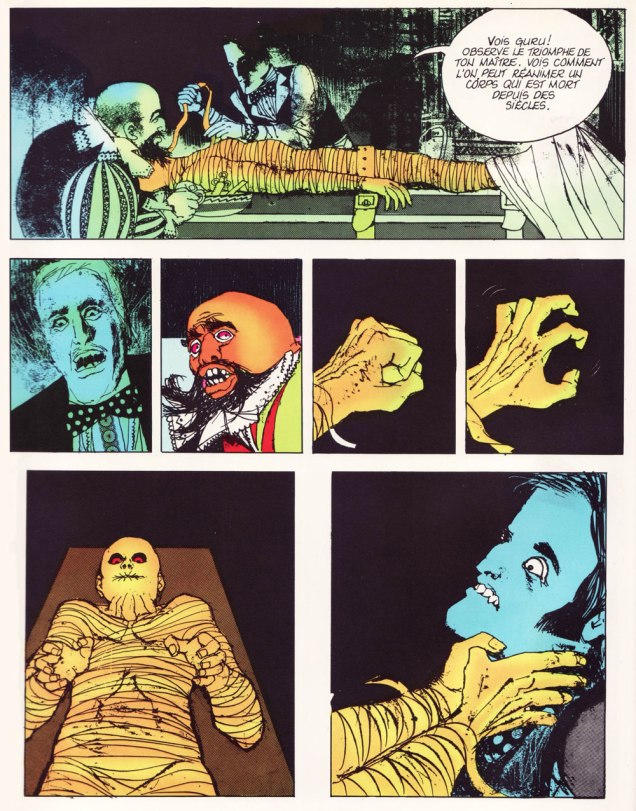
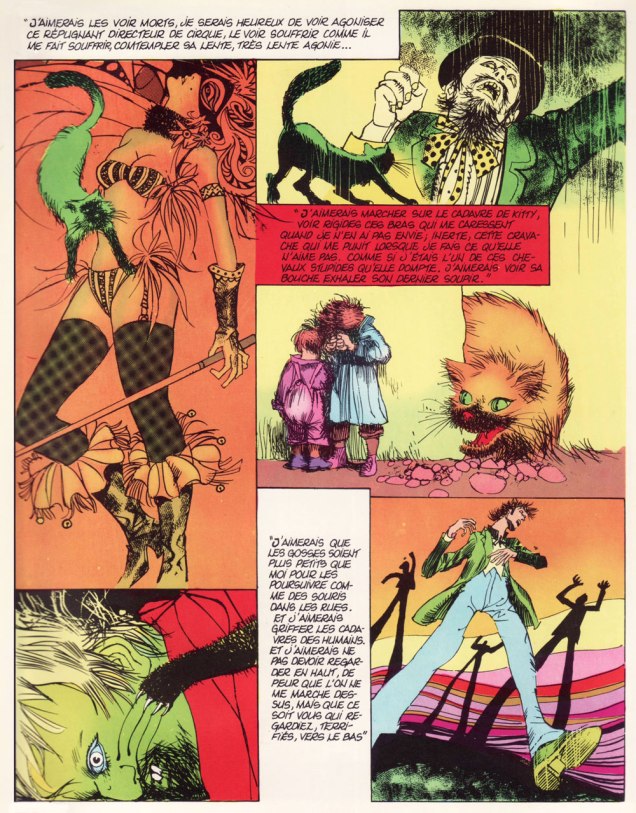
The following pages are taken from a French-reprint collection title Les nuits de l’épouvante, published by Dargaud in 1973 (I stumbled upon it years ago in a used bookshop, and instantly took to the art despite having no idea who Beá was). The dates I provide for their publication in English are from The New English Library’s Dracula, not the Spanish Drácula.

The following two pages are taken from Le serpent (written by Beà and Sadko*, illustrated by Beà), or The Snake, originally published in Dracula no. 3 (Oct. 1972):

La momie (written by Maroto, illustrated by Beà), or The Mummy, published in Dracula no. 4 (Nov. 1972) features some more memorable strangling scenes:

Finally, I would be remiss not to include some pages from Beà’s Sir Leo series, originally created for Drácula. Handsome Sir Leo is an English aristocrat who, in typical fashion, has walked away from his birthright… and walked into the arms of the supernatural, many dangerous adventures ensuing. The following two pages are from Sir Leo – le chat (written by Luis Vigil, illustrated by Beà), or The Cat, originally published in Dracula no. 8 (Dec. 1972). Read it here.

~ ds

* Amusingly, ‘Sadko’ is the name of a medieval minstrel in Russian lore, but in this case it’s actually the nom de plume of Luis Gasca.

Hallowe’en Countdown VIII, Day 22

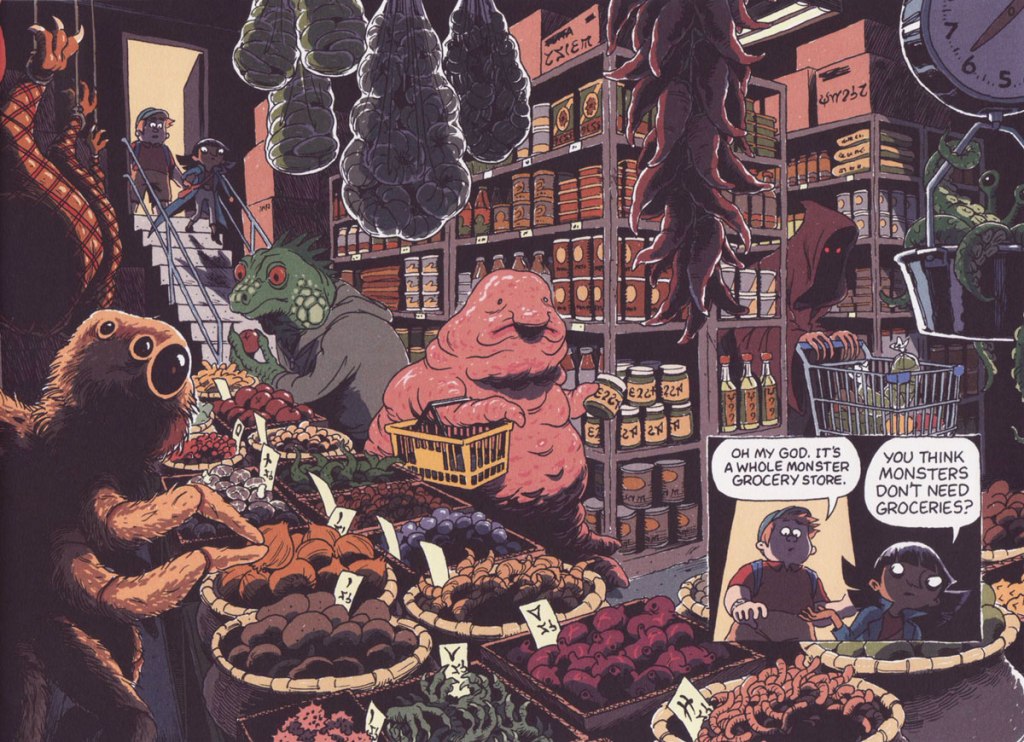
What’s an enterprising kid to do when he’s plucked out of his small home town and dropped into a big city? Worry about getting mugged, first of all, then dodge his hippy-ish parents’ attempts to make him eat big-city-weird-food (kimchi or paneer spinach? ew*)… but eventually get his bearings and go exploring. Our intrepid protagonist Charles fancies himself a reporter, so when he’s surprised by a monster at night (‘huge! fangs! hair!’), he heads out to investigate and eventually runs into Margo Maloo, ‘monster mediator’. Surely she needs a sidekick… or does she?

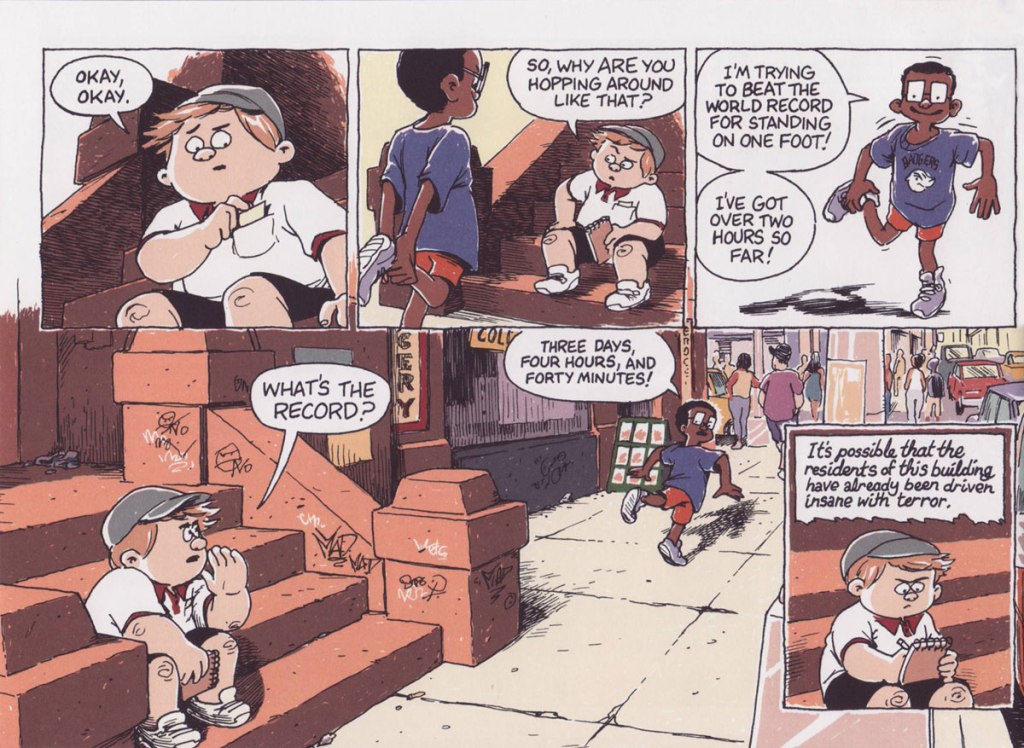
The Creepy Case Files of Margo Maloo, a webcomic by American cartoonist Drew Weing, has so far been collected in 3 volumes, although I didn’t even know it was a webcomic until writing this post, having come directly to the printed books by way of Weing’s debut graphic novel Set to Sea (Fantagraphics, 2014). No regrets at all — Margo Maloo’s adventures bundle up my favourite elements (teamwork and friendship, to name a few) into an alluringly drawn and coloured package. Weing’s writing is smart; while his kids function as archetypes of specific personalities, this does not feel constraining or predictable; on the contrary, they feel like real people that one would like to hang out with. It also helps that they traipse around a fully-fleshed out city that’s more than just a static background.

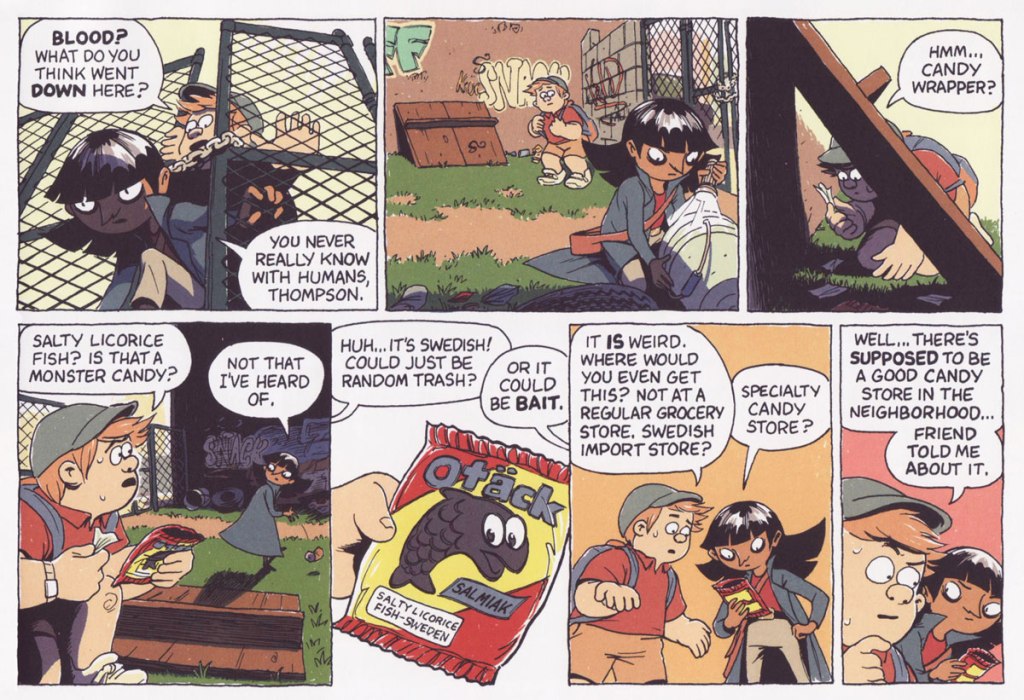
Chubby Charles reads like a Daniel Pinkerwater character, given his obsession with junk food and an immense curiosity about the world that overrides his fears. This is high praise indeed, as both admins here are enthusiastic DP fans.

The salty licorice fish is an actual thing. I’d be curious… if licorice wasn’t pretty much the only flavour I can’t stand.

You can start reading the adventure here.

~ ds

* Let it be known I’m actually a big fan of kimchi and spinach (paneer, considerably less so).