Hot Streak: Nick Cardy’s Aquaman

« Who’s Aquaman? I never heard of him! »
« He’s one of the super-beings from the place called Earth! He lives at the bottom of the ocean! » —  Steev & Jimm, rubberneckin’ in Aquaman no. 51

Some may have wondered at the deep, abiding affection held, by a certain savvy contingent of comics aficionados, for sea king Aquaman. After all, he’s a bit of a second-stringer, and he’s had a pretty spotty record for decades. Well, I’d say one has to have encountered the erstwhile Arthur Curry at his peak, in the hands of the Stephen Skeates, (writer) Jim Aparo (penciller-inker-letterer), Dick Giordano (editor-poacher), Nick Cardy (cover artist), Carmine Infantino (editor-in-chief/art director), Jack Adler (colourist) and Gaspar Saladino (cover letterer) set.

Fond as I am of Nick Cardy and Ramona Fradon‘s work, the series’ Skeates-Aparo period is more my speed. I can’t quite put my finger on it. There’s a whiff of the end of the world, something ominous and immediate about it, despite the fanciful settings. I guess it was « relevance », but with a lighter touch and without the cringe-inducing bathos of the concurrent Green Lantern-Green Arrow series. Because of Aquaman’s aquatic nature, environmental doom seldom seems far. The Skeates-Aparo rampage lasted from issue 40 (June 1968) to number 56 (April 1971). Aparo returned to the character just a few years down the road (Adventure Comics no. 441, Sept. 1975), but by then, he’d already begun his long, painful artistic deterioration.

WhoThereLogotype

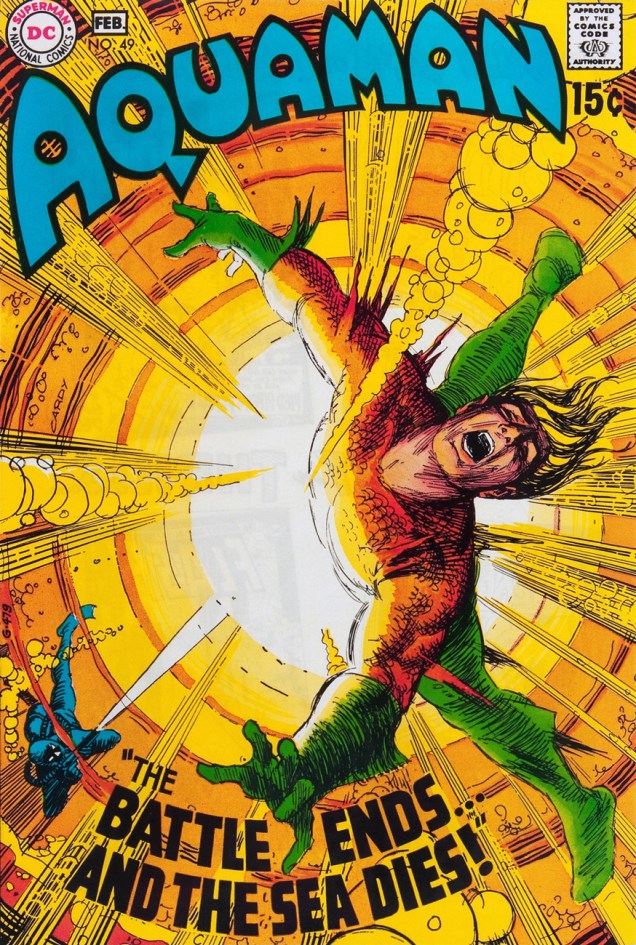
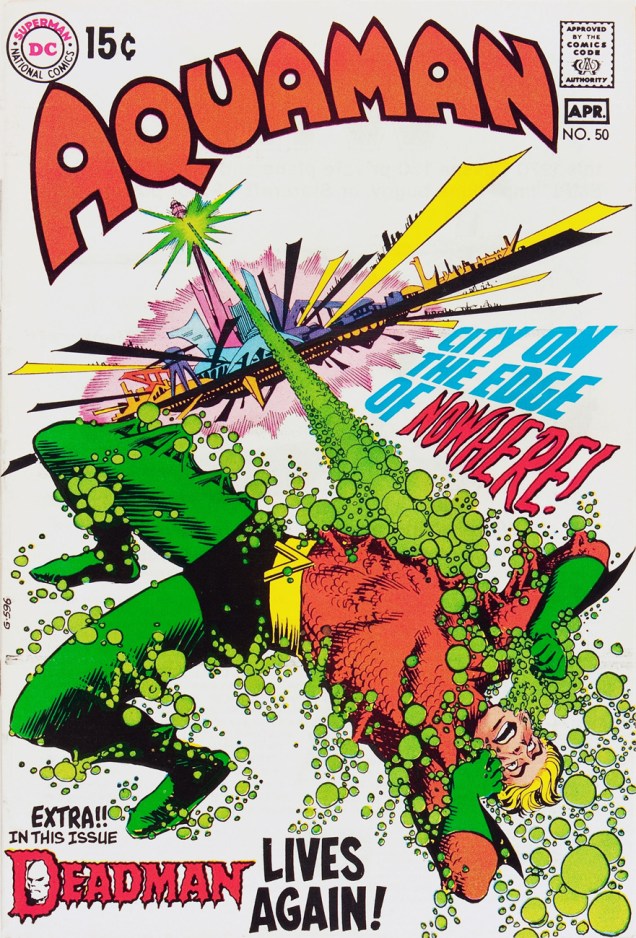
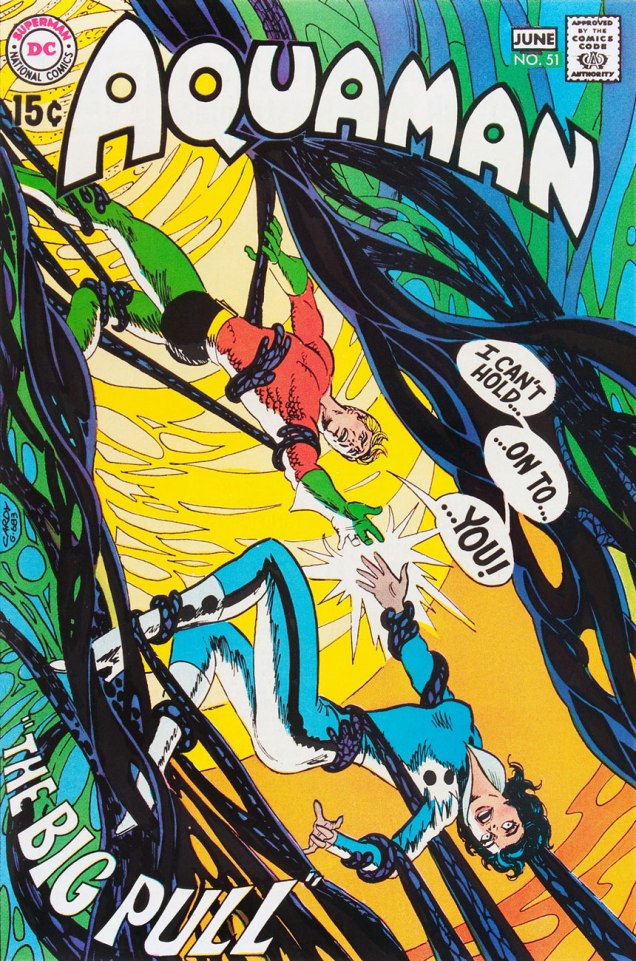
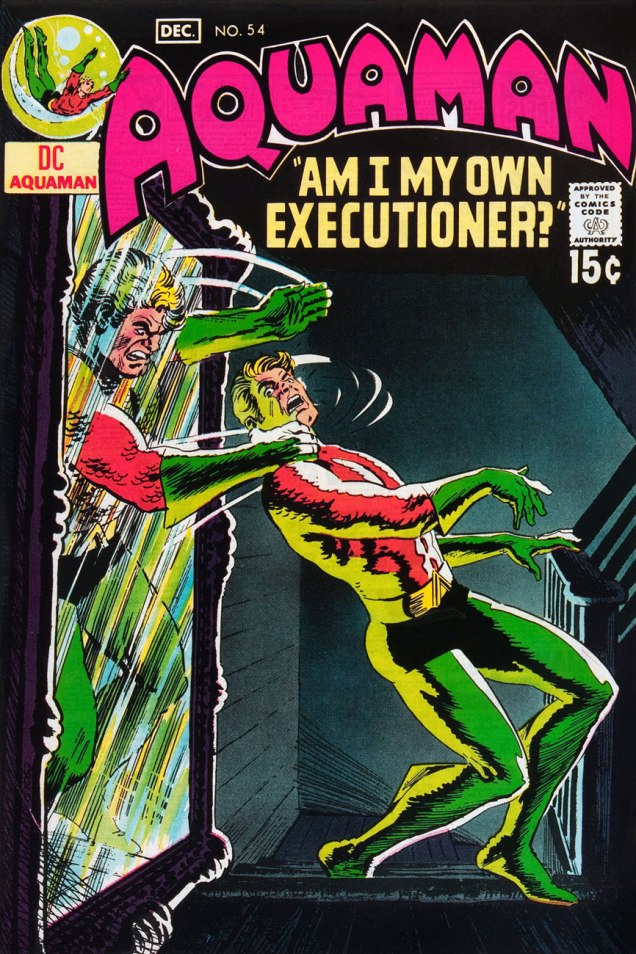
But back to the covers: this represents, in my view, Cardy’s second hot streak on this title. From the beginning of his career (in 1940 with the Iger/Eisner shop!) Cardy had always been a reliably competent artist, but rarely a very exciting one. That all changed in the mid-Sixties when newly minted art director/editor-in-chief Carmine Infantino made him his right-hand man and co-designer of DC’s covers. This greater latitude gave Cardy wings. Cardy’s first Aquaman hot streak opens on issue 37 (Jan.-Feb. 1968) and closes with issue 45 (May-June 1969). Issues 46 to 48 are nice enough, but short of transcendence… beyond that bump in the road, we’re set for a smooth run of splendid covers.

CardyAquaman49A
This is Aquaman no. 49 (Jan.-Feb. 1970). Cover pencils and inks by Cardy, colours by Jack Adler, Aquaman logo by Ira Schnapp, title lettering by his worthy successor, Gaspar Saladino. Edited by Dick Giordano, directed (and likely laid out) by Infantino.
CardyAquaman50A
This is Aquaman no. 50 (Mar.-Apr. 1970), sporting a Cardy cover that couldn’t have been more evidently designed by Carmine Infantino, with more Saladino magic on the titles and Deadman logo. Gestalt: it’s what great collaboration is all about! It seems fair to assume that the title is a nod to the Harlan Ellison-scripted 1967 Star Trek episode, The City on the Edge of Forever.
CardyAquaman51A
This is Aquaman no. 51 (May.-June 1970). I don’t usually pilfer Tentacle Tuesday material… but I’m inclined to make an exception for a (sea) worthy cause. Design-wise, Infantino and Cardy took full advantage of the aquatic action settings. Up, down, sideways — anything goes!
CardyAquaman52A
This is Aquaman no. 52 (July-Aug. 1970). A wistful, disorienting experiment in colour and design economy. You’d never see such a *hushed* cover chez Marvel.
CardyAquaman53A
This is Aquaman no. 53 (Sept.-Oct. 1970). A fine instance of the notorious “Infantino tilt”. Michael Kaluta on Infantino’s cover design input: « My approach to a cover, when I got to do my own ideas, was to show the picture straight on, staged, unless it was a dramatic perspective view. Almost every time I’d bring one of these sketches in to Carmine he’d turn the paper about 30 degrees to the right and demand that that made the composition 100% stronger, more “grabby”… and I’d have to agree about 50% of the time… »
CardyAquaman54A
This is Aquaman no. 54 (Nov.-Dec. 1970). Did I mention that DC’s books of the early ’70s had a general predilection for the macabre and the moody? Fine by me, then and now.
CardyAquaman55A
This is Aquaman no. 55 (Jan.-Feb. 1971). The fact that this complex idea works so well on the page is evidence of some first-rate design work, with some heady colouring mojo sealing the deal.
CardyAquaman56A
This is Aquaman no. 56 (Mar.-Apr. 1971). Would you believe that this story was continued over three years later in Marvel’s Sub-Mariner no. 72 (Sept. 1974). Seems sneaky Steve Skeates slipped something past sleepy editor Roy Thomas. In an interesting bit of coincidence, it was each of the competing oceanic monarchs’ final issue. On another note, I presume that the title is a takeoff on Norman Greenbaum‘s 1967 song The Eggplant That Ate Chicago (popularized by Dr. West’s Medicine Show and Junk Band), itself likely an homage to Arch Oboler‘s infamous 1937 Lights Out radio episode, The Chicken Heart (That Ate the World). Phew!

Under normal circumstances, this run of covers would have turned out quite differently for, as Steve Skeates told me a few years ago, « The only reason Jim [Aparo] didn’t do the covers was that he lived out of town, couldn’t come in for cover conferences! »

-RG

Mind the Quirks and Glitches: Petrucha & Sutton’s Squalor

« I, I know this place. I’ve been here when I’m wasted. » « Sure, and a man who drives his car off a cliff knows what it’s like to fly. » « He does if he’s headed DOWN. » — Squalor and Todd debate the nature of reality

Compared to his 1970s, the ensuing decade was surely no picnic for Tom Sutton (1937-2002). After producing a massive body of work for Warren, Skywald, Marvel, Charlton and DC by the late Seventies, the mid-1980s found Sutton trudging through a long run (« It lasted hundreds of years. ») of abysmal Star Trek comics to put food on the table. This was the movie franchise Star Trek, with Bill Shatner’s permed hairpiece and those atrocious red velour outfits. Worst of all, inker/saboteur Ricardo Villagrán dogged his every move, casually pulling a Colletta on him*.

Oh, Sutton did work for other publishers in the 80’s, mainly the once-promising upstart First (1983-91), but the rote fantasy of The Black Flame and the hollow tough-guy posturing of Grimjack (coming soon to a screen near you, apparently) didn’t offer much of substance as alternatives to the Big Two’s sludge.

Still, First merits full credit for green-lighting the last great Sutton project, Squalor (1989-90). It was part of a line called First Fiction**, which looked like an eleventh-hour push to get into mainstream bookstores without quite committing to the graphic novel format and its price tag. Cardboard covers, full colour, slick paper; certainly more durable than the average comics pamphlet. Let’s take a look, shall we?

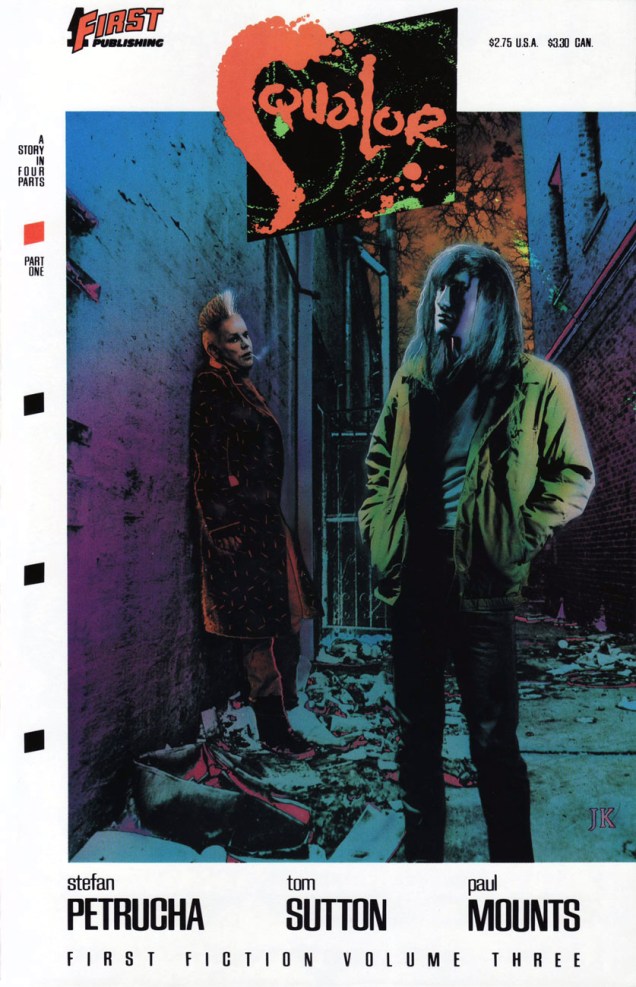
PotterSqualor01CoverA
The inspired choice for the series’ covers was photo-montage artist J. K. Potter., whose work I recalled from Twilight Zone and Night Cry magazine covers, as well as a clutch of memorable paperback covers. Joe R. Lansdale‘s By Bizarre Hands comes to mind. Now remember, young Photoshop pups, these had to be created the hard way.

SuttonSqualor01_06A

SuttonSqualor01_07A
Since you asked, panel four refers to the inevitable American Bandstand teenybopper analysis.
SuttonSqualor01_15A
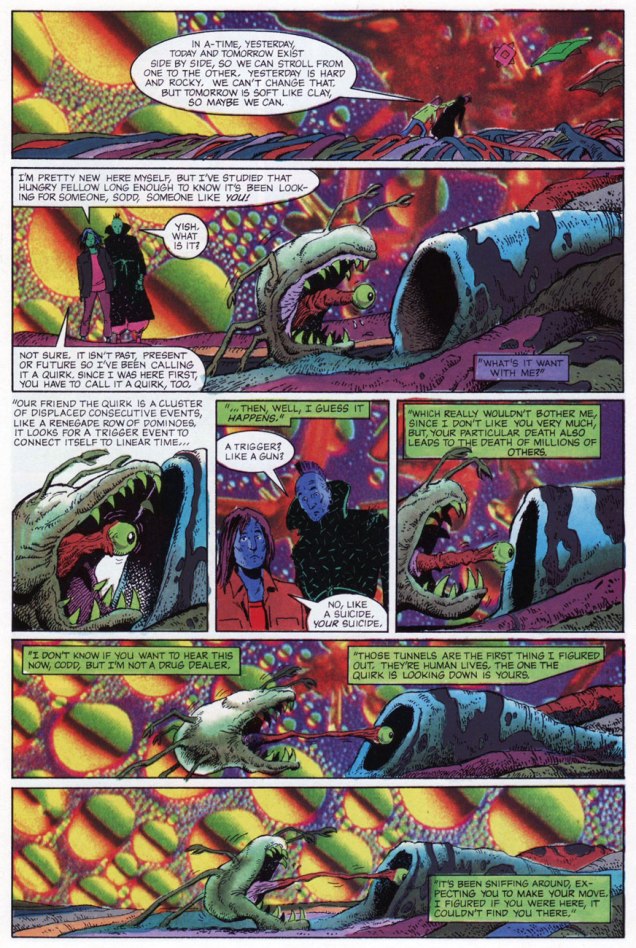
« Welcome to A-Time… not another dimension, not a parallel world, but your very own neighborhood bereft of linear time. In A-time, past, present and future merge like expressway off-ramps, six-legged quirks hunt the time trails, and archetypes leave footprints. »

SuttonSqualor02_42ASuttonSqualor03_63ASuttonSqualor04_95A

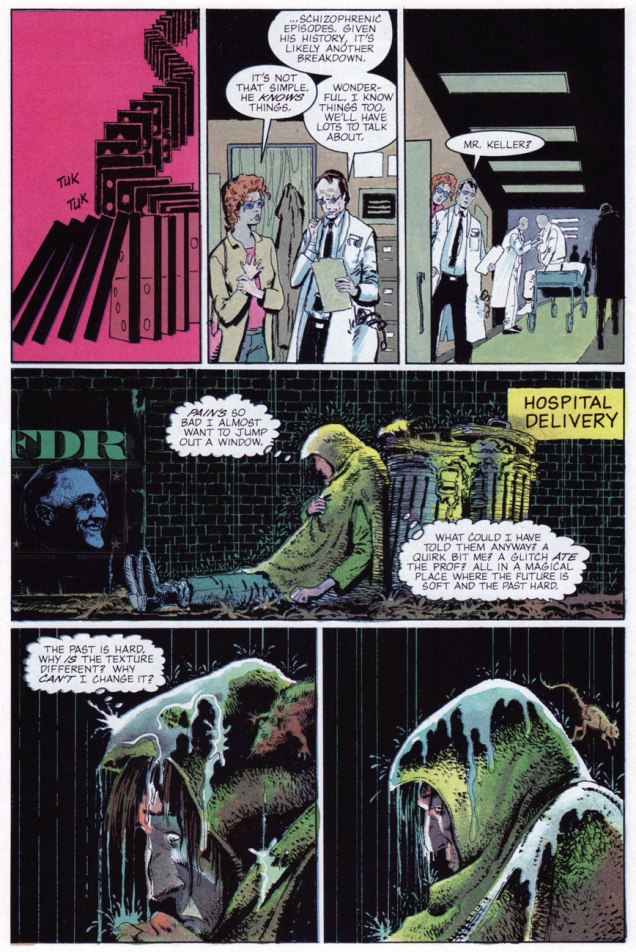
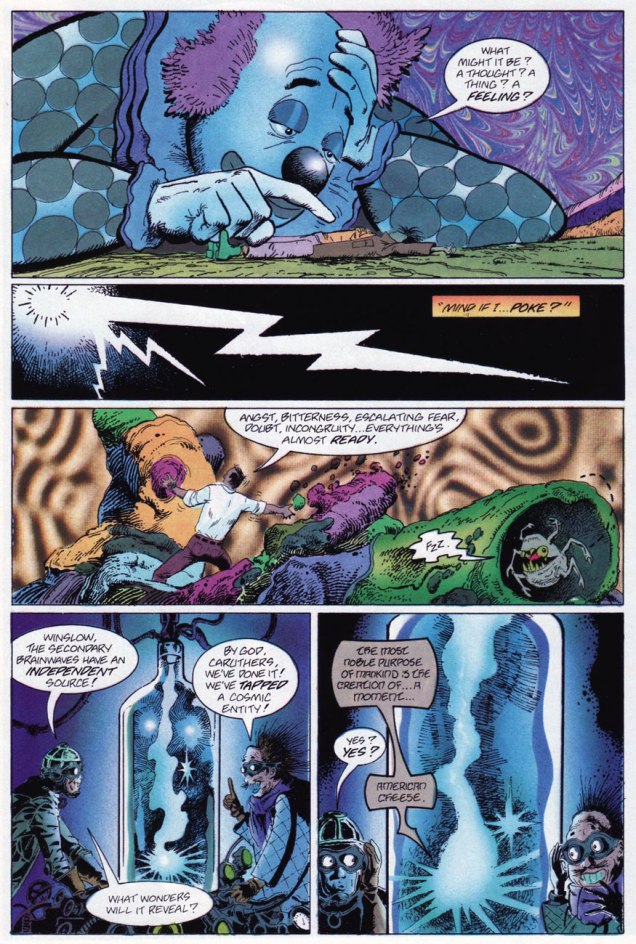
So yes, we have an accomplished illustrator on board… but do we have a proper story to hang the visuals upon? What do you know, we do! In a freakish bit of convergence, a newcomer to comics, Stefan Petrucha, then a freelance technical writer, happened along with a fully fleshed-out, unconventional concept, one ideally suited to Sutton’s strengths. And then someone fished it out of the slush pile.

So what’s Squalor about? It’s a bitch to summarize, but it involves alternate time streams, the oft-elusive nature of genius, conspiracy theories, synchronicity, archetypes, and the road map of reality. Fair enough? I surmise that we have Mr. Petrucha’s experience as a technical writer to thank for his capacity to hold his magic bus to the right side of the road through to the end of the journey.

PotterSqualor03CoverA
This is Squalor no. 3 (July, 1990) J.K. Potter does the cover honours again.

Petrucha wrote, in Squalor no. 4‘s concluding notes: « Personally, I would love to write more Squalor. In fact, I have a few document files chock full of plot ideas. We’ve seen quirks, glitches, and an archetype up close, but what about paradigms, totems, and babblers? I’d also like to write a graphic novel about Todd Penderwhistle’s coat. Maybe that’s why I’ve had so much trouble breaking into this business. »

While he did break into the business, he’s never again been afforded the chance to handle such a personal project. Squalor was Tom Sutton’s final such endeavour***, though I can’t help but think that he was more than a bit broken by his Star Trek stint.

In 2016, Squalor was at long last collected as a graphic novel by Caliber Press, to what I presume was general indifference. As for the original issues, one can still get copies online for less than the original cover price, which is a bargain and a golden opportunity, but rather bittersweet.

SqualorButton
I still have my Squalor pin-back promo button (logo designed by art director Alex Wald) from ’89. Whee.

-RG

*From Gary Groth‘s definitive interview with Sutton (The Comics Journal no. 230, Feb. 2001) ): « No, I did not ink this thing. This was inked by a fellow who I was told inked in bed watching television. The enthusiasm of this man was evident. He was a pro. Oh, he was very slick. He was very, very good. It was exactly what the book didn’t need. What the book needed was Mœbius. Hear what I’m saying?

This will sound really dumb, but even after all of that crap I had gone through I went into this thing and I said, This is going to be fun. This is going to be creative work. I worked like hell on the thing. I penciled backgrounds you wouldn’t believe, with all the scopes and all of those things. I thought I was Wally Wood. I forgot that Wally inked his stuff himself. I had to leave it up to Ying Yang watching TV or something. They actually took your backgrounds out and erased them. I never realized it until I saw the fucking comic book and I said, I drew something there. A large something. A complex something. »

GROTH: « And this would have been for sheer expediency’s sake? »

SUTTON:  « I suppose so. Because he knew he could get away with it. He knew something that I didn’t realize until later, that that book had a special job. And that job was to promote movies. » [ source… well worth your time! ]

**The other “volumes” of First Fiction were nothing special, to put it kindly.

*** Unless you wish to count his pseudonymous (as Dementia) late ’90s, er, erotic comics, such as The Crypt of Cum!, The Vault of Whores! or Bustline Combat! He certainly gave them his all.

Let’s Hear It for Bobby Sherman!

« You’ve got his likeness
emblazoned onto
the top of a tin box

Perfect big heart
perfect blue eyes
perfect teeth and
perfectly 
flowing locks » — The Motorz, ‘Bobby Sherman Lunchbox’

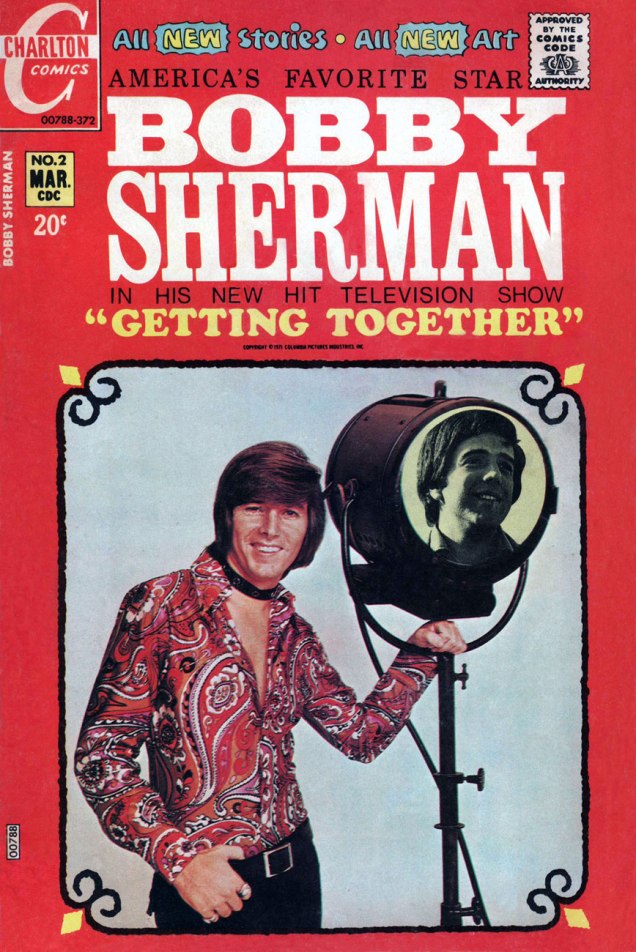
It’s birthday number seventy-six for singer, actor, songwriter, Charlton comics star and all-around swell guy Robert Cabot “Bobby” Sherman, Jr. (born July 22, 1943).

BobbySherman1A
This is Bobby Sherman no. 1 (Feb. 1972). Story and art by the much-maligned Tony Tallarico. You know what, though: he’s alright in our book. One of these days, we’ll make our case.

His Getting Together co-star, Wes Stern, also celebrates his birthday this Thursday, July 25. He’ll be seventy-two. You may remember Wes from his recurring rôle as Brenda Morgenstern’s shy, foot-fetishist beau Lenny Fiedler on Rhoda (early on, before the show utterly went South).

BobbySherman02A
This is Bobby Sherman no. 2 (Mar. 1972). Story and art by Mr. Tallarico.

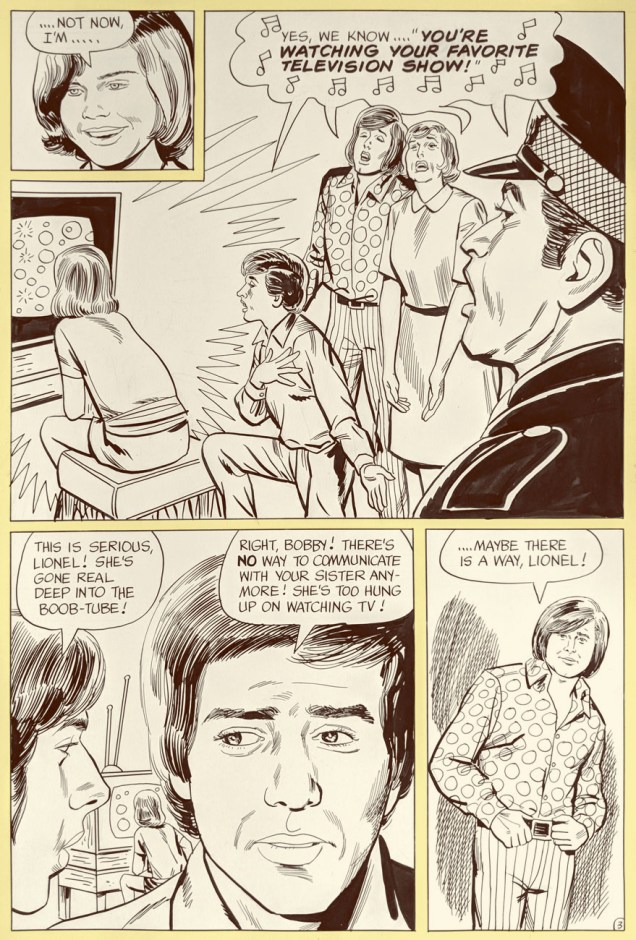
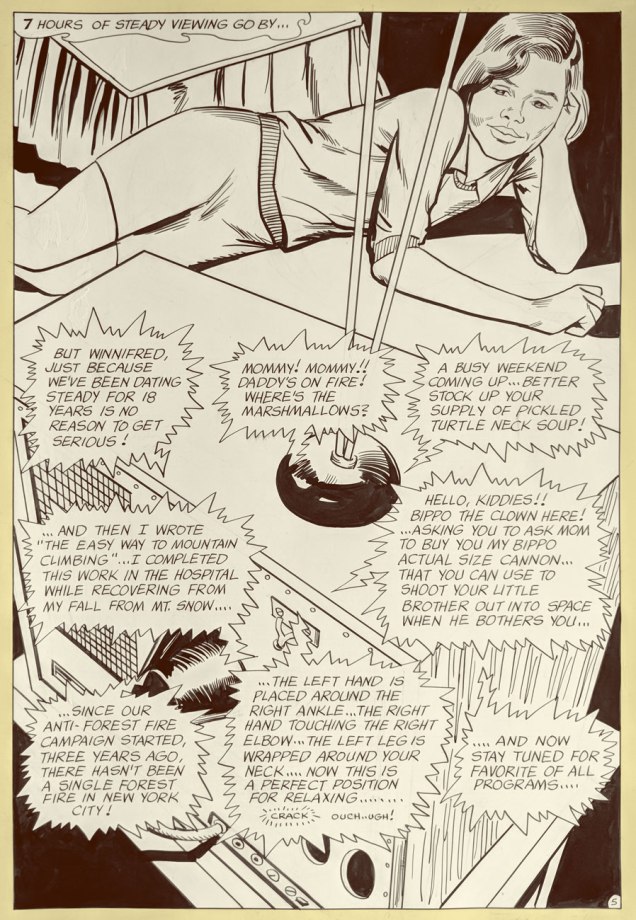
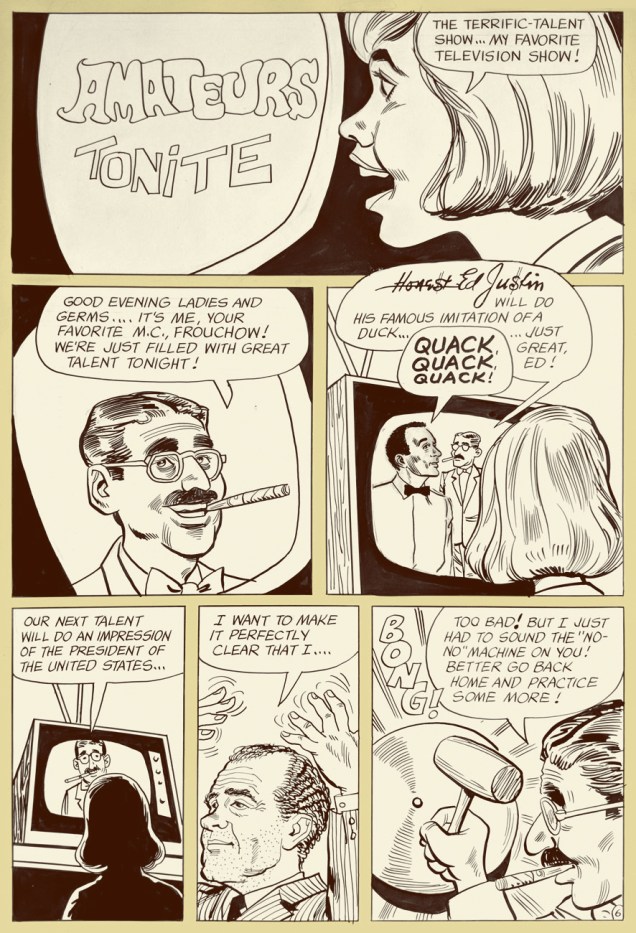
Bobby and Wes had the singular honour of starring in seven issues of their own Charlton comic book (February to October 1972). Our excerpt is number 2’s « A Guide to TV? », written and illustrated by Tony Tallarico and shot from the original art. Good-natured fun, especially when the Getting Together cast of characters is around. In the 1971 Fall season, the snappy little show was off to a promising start, but found itself, in the eleventh hour, scheduled against the powerhouse tv hit of 1971, Norman Lear’s abrasive All in the Family, and that was all she wrote.

BobbyShermanTV01ABobbyShermanTV02ABobbyShermanTV03ABobbyShermanTV04A

BobbyShermanTV05A
Ah, back in those innocent days when watching seven hours of TV was the stuff of humorous exaggeration. Now (depending on how it’s defined and whom you ask) it’s *below* the daily average.
BobbyShermanTV06A
Inside joke alert: “Honest Ed Justin” alludes to one of Bobby’s songwriting partners, Ed Justin. Here’s one of their musical collaborations. And, hey, two posts in a row featuring Tricky Dick cameos… I’m on a roll! Incidentally, ‘Amateurs Tonight” predates The Gong Show by nearly half a decade. Was Chuck Barris perchance a Charlton reader?

BobbyShermanTV07ABobbyShermanTV08A

But that’s all water under the bridge. By the mid-70s, Bobby basically walked away from the grind of public life, and the odd tour or charity event aside, he’s been volunteering with the LAPD, training recruits in first aid, CPR, and so forth. A solid citizen, no irony or sarcasm intended.

One more?

BobbySherman4A
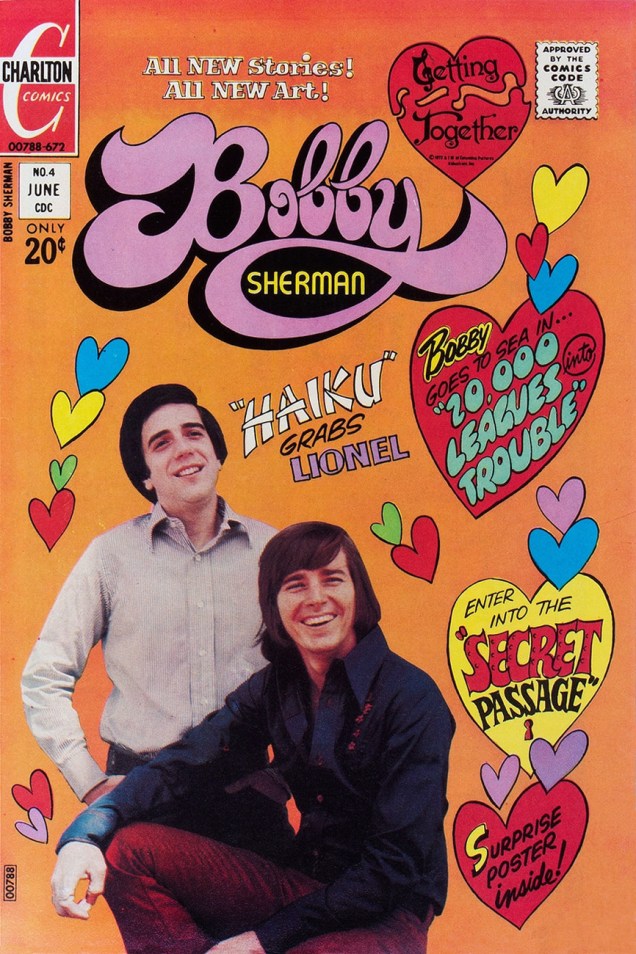
This is Bobby Sherman no. 4 (June, 1972). M. Tallarico strikes again!

Once again, we wish the most joyous of birthdays to Bobby and Wes! 

-RG

Treasured Stories: “Happy Deathday, Sweet 16” (1972)

« Mom, my teacher, Mrs. White, has invited me to a slumber party at her house this weekend. She’s really nice. Can I go? »
« Sure, why not? »  —  from a Jack Chick tract, The Poor Little Witch (1987)*

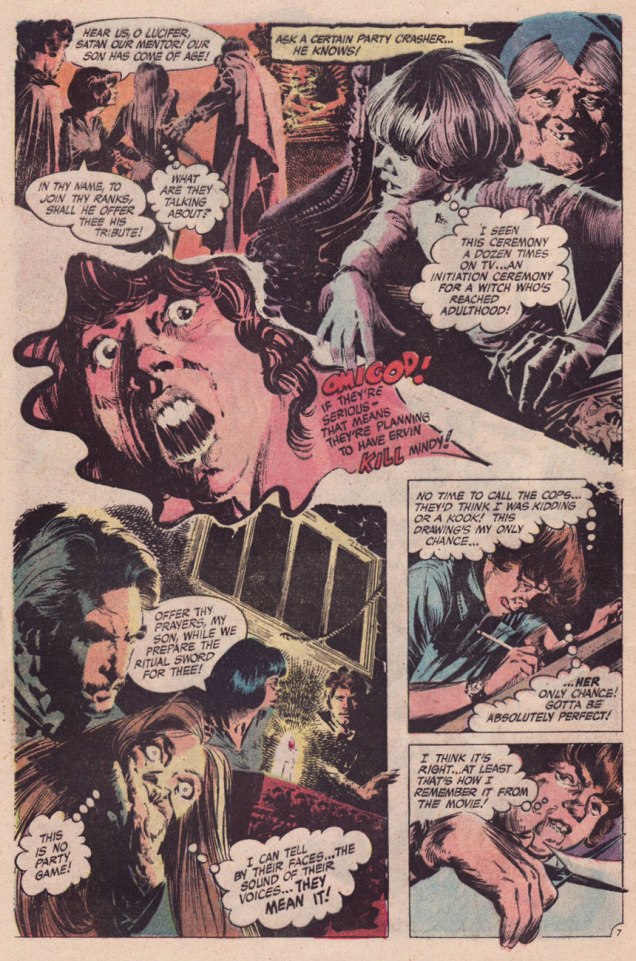
Today, we part the curtains and peek at the fair bosom of suburbia, circa 1972. In those gentle times of satanic panic, Tricky Dick’s political shenanigans, the oil crisis and all-around grooviness, the Manson ritual murders were recent history, Anton LaVey‘s The Satanic Bible (1969) and its sequel, The Satanic Rituals (1972) were all the rage, not to mention William Peter Blatty‘s The Exorcist (1971… the film another year away) and Ouija boards. DC Comics’ The Witching Hour (85 issues, 1969-1978) was well in keeping with the vibe of the times, and offered girls somewhat of an alternative to Archie, Little Dot and Young Romance. In fact, my recollection (and I’d welcome yours!) was that ghost and mystery comics overwhelmingly found favour with the ladies.

I’ve perhaps said it before, but DC’s mystery books were mostly well-drawn but mind-numbingly formulaic… but exceptions now and again slipped in.

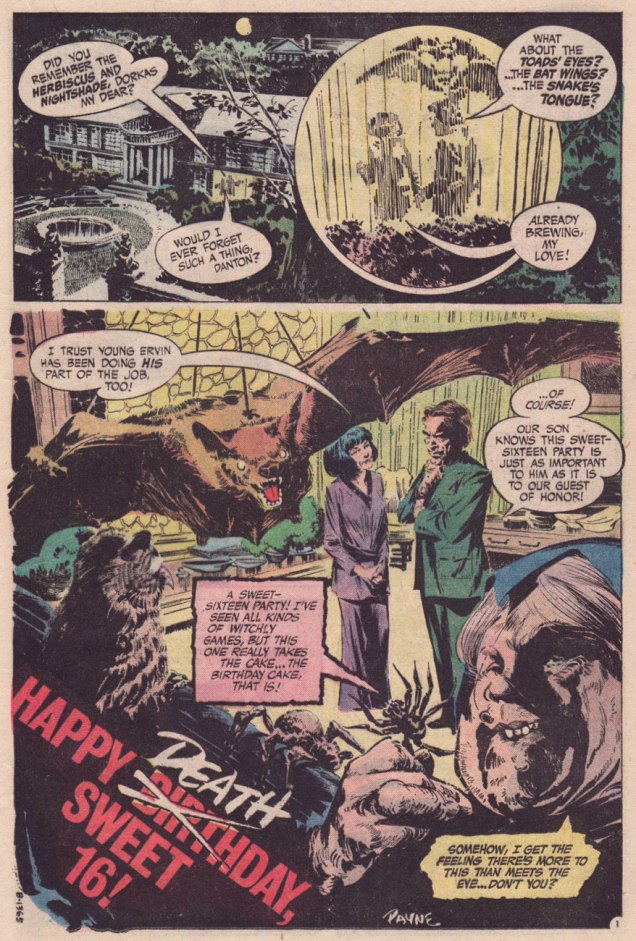
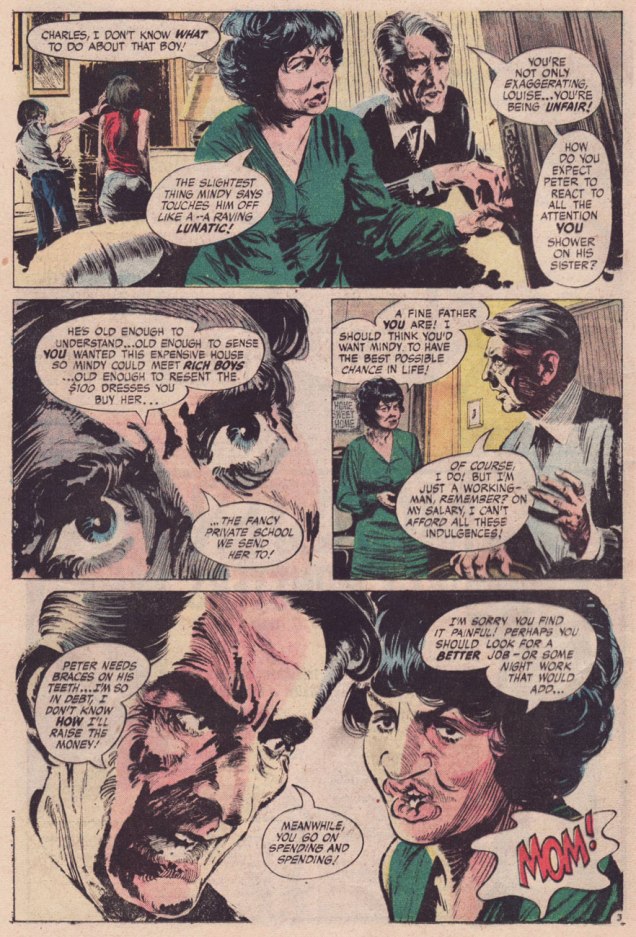
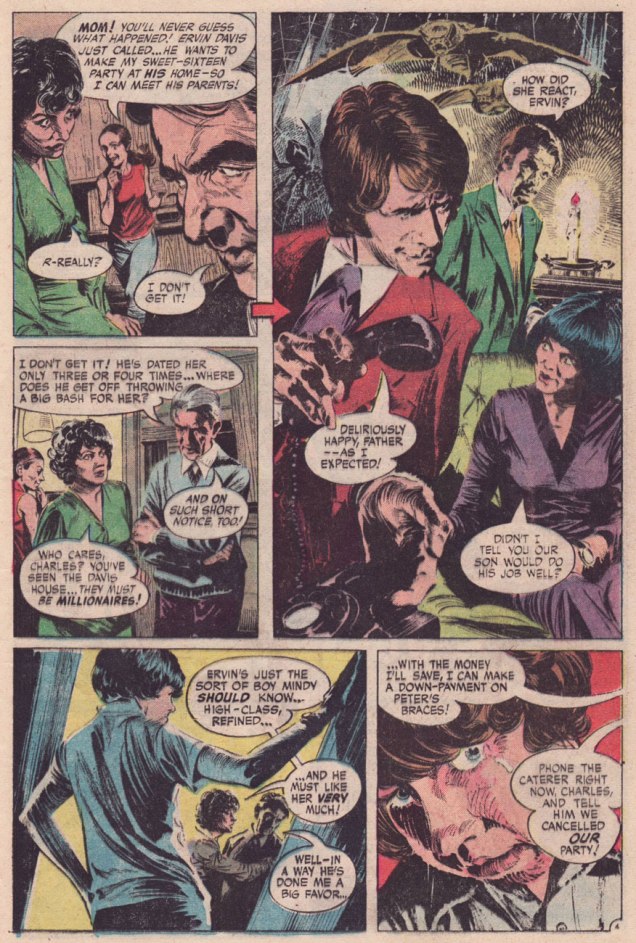
PayneSweetSixteen01APayneSweetSixteen02APayneSweetSixteen03APayneSweetSixteen04APayneSweetSixteen05APayneSweetSixteen06APayneSweetSixteen07APayneSweetSixteen08APayneSweetSixteen09A

Happy Deathday, Sweet 16! was a bit of lightning in a bottle. It was illustrated by the hardly-prolific Canadian Bill Payne, who drew a dozen or so jobs for DC’s mystery and war titles, lettered a few more, then vanished. I suspect he had a day job in some advertising agency and did a bit of comics work on the side for kicks. If that’s the case, he certainly applied himself, bringing actual realism and a bit of the old ‘Ghastly’ Ingels grotesqueness to the table. The writer, however, is uncredited. The writing doesn’t quite feel like the work of any of DC’s workhorses… it’s markedly better, rising beyond the stock situations and packing in plenty of credible detail to flesh out the players in its scant eight and a half page allotment. Sibling rivalry, social aspirations**, marital and parental discord, class warfare… Lucky Peter, though: he somehow seems to have continual access to Shock Theater; for me, that’s the main cause for suspension of disbelief.

CardyWitchingHour25A
Nick Cardy‘s sweet ‘n’ sassy cover for The Witching Hour no. 25 (Nov. 1972). It’s fun to see one of his winsome romance cover girls put in a rather… perilous cross-genre appearance.

These days, I suppose the fundamentals haven’t changed, though with so-called Christians behaving in most unchristian fashion, and Satanists displaying a puckish (honestly, kind of adorable) sense of humour, things are… interestingly confusing.

-RG

*Read it here; but remember, it’s “available only in multiples of 10,000 at half-price.
** Let’s keep in mind that, as Lori Loughlin has pointedly pointed out, “Any mother would have done the same if they had the means to do so.”  

Will Eisner’s The Spirit at Kitchen Sink (pt. 2)

« Three A.M. The radiators in Commissioner Dolan’s office had long ago conked out… and those of us who could not go home waited… tried in various ways to ignore the damp cold made even more unbearable by the January rain. » — The Spirit, Jan. 8, 1950

Welcome back! Today, we wrap up Kitchen Sink Press’ experimental continuation of Warren Magazines’ run of The Spirit. By now, Denis Kitchen was probably coming to terms with the fact that building upon Warren’s non-system of random Spirit reprints was not only a dead end, but one with mercilessly diminishing returns, even with so deep and rewarding an archive as Will Eisner’s.

Still, don’t worry, we’re hardly running out of dazzling visuals to tickle your eyeballs with.

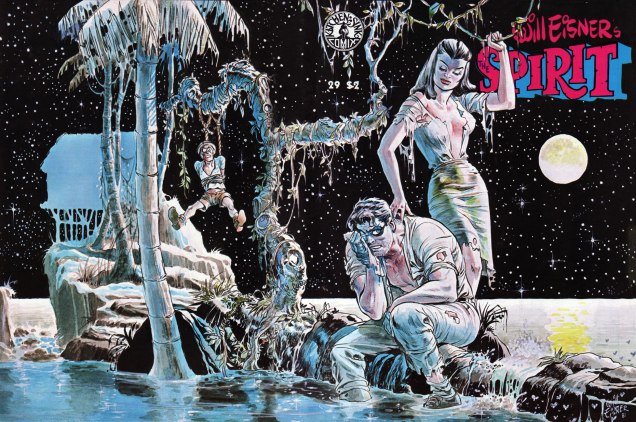
Spirit29A
This is The Spirit no. 29 (June, 1981), featuring a mere four Spirit tales, namely: “Framed” ((Nov. 24, 1940); “Sasha’s Sax” (June. 28th, 1942); “Blood of the Earth” (Feb. 26, 1950); cover-featured “The Island” (March 26, 1950) , as well as plenty of fine new material by Eisner.
Spirit31A
This is The Spirit no. 31 (Oct. 1981), featuring four Spirit tales: “Wanted for Murder” (Feb. 5, 1942); “The Siberian Dagger” (Jan. 27, 1946); “Just One Word Made Me a Man!” (Jan. 18, 1948); “The Barber” (Oct. 22, 1950), some new Eisner material and the second instalment of “Shop Talk”, in which Eisner interviews one of his peers. This time out: Harvey Kurtzman.
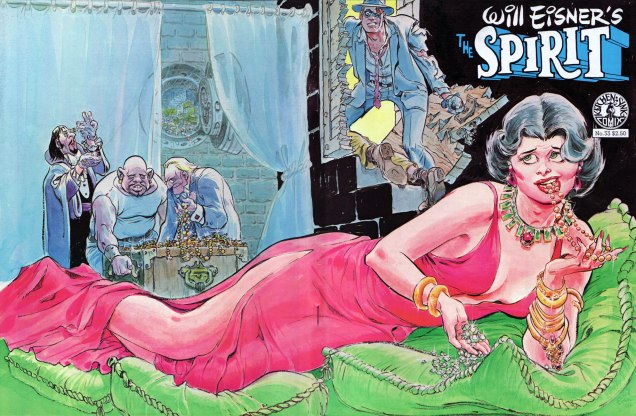
Spirit33A
This is The Spirit no. 33 (Oct. 1981), featuring a quartet of Spirit tales: “The Haunted House” (Dec. 8, 1940); “Slim Pickens” (Dec. 15, 1940); “The Portier Fortune” (Dec. 1, 1946); “Dolan Walks a ‘Beat’!” (Apr. 17, 1949), an Eisner tutorial and a look at Eisner’s P*S Years.
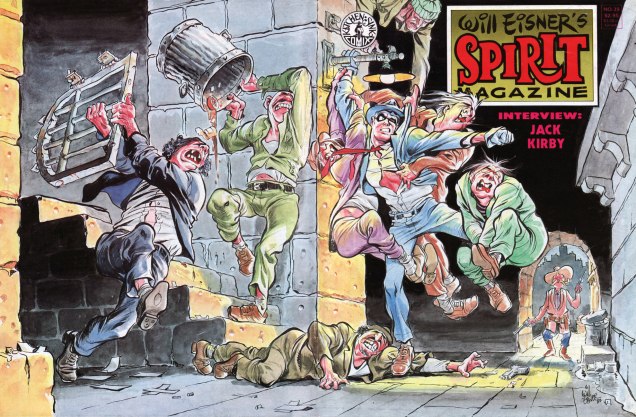
Spirit39A
This is The Spirit no. 39 (Feb. 1983), featuring five Spirit adventures: “Dead Duck Dolan” (Mar. 2, 1941); “Tarnation” (Mar. 3, 1946); “Voodoo in Manhattan” (June 23, 1940); “The Van Gaull Diamonds” (Dec. 15, 1946), “Veta Barra” (July 29, 1951), and a 12-page Shop Talk with Jack Kirby!
Spirit30A
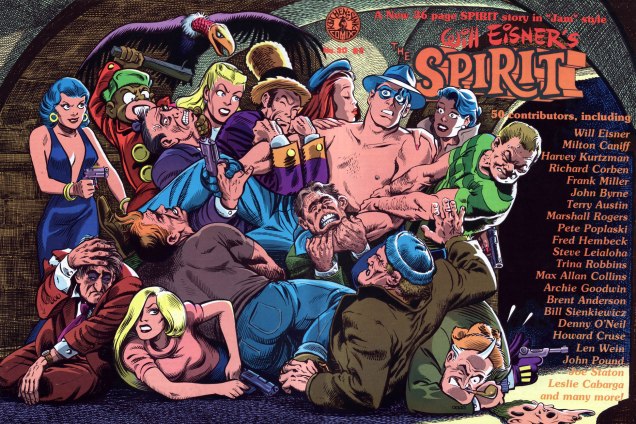
As a bonus, here’s the cover of The Spirit no. 30 (July, 1981), which features an amusing, but understandably uneven brand-new 36-page Spirit jam calling upon a whopping fifty pairs of paws. If only this had been the only time Frank Miller tried his hand at Will’s creation… The issue also features pair of vintage yarns: “Army Operas No. 1” (Dec. 21, 1941) and “Beagle’s Second Chance” (Nov. 3, 1946). Can you identify all the cover jam contributors? Beware, though: that Pete Poplaski is a redoubtable stylistic chameleon.
SpiritJamKeyA
Here’s the key.

After 25 issues of The Spirit magazine (on top of Warren’s run), Denis Kitchen and Will Eisner would press the reset button and begin again in the comic book format. In part three, we’ll see how that endeavour fared.

If you’ve just joined us mid-programme, fret not: simply rewind to our earlier instalments, if you will:

… or simply click on its general category, That’s THE SPIRIT!, and find yourself with everything at your purple-gloved fingertips (don’t think you fooled us, Octopus!)

-RG

Sweepin’ the clouds away: Jack Davis’ Sesame Street

« Until now Mr. Cookie Monster refused to talk about the matter because his mouth was full, and it’s not polite to talk with your mouth full. » — Guest Star Robert McNeil

With the venerable MAD Magazine (1952-2019) bowing out after sixty-seven years, and kid’s educational show Sesame Street (singalong time!) about to hit the half-century mark, it seems à propos to salute one of the geniuses their respective histories share, Jack Davis (1924 – 2016)… rather than mire ourselves in the inevitable stack of lachrymose paeans to Harvey Kurtzman’s long-lost progeny.

So, are you in need of a bit of cheering up after a down-in-the-dumps day? Take a stroll down friendly Sesame Street with sweet Mr. Davis! Now isn’t this a place where you’d care to linger a spell?

DavisCookieRemember1A
A lovely excerpt from the Sesame Street Annual (1972, Dell); according to the table of contents, it teaches ‘Planning’. Don’t worry, I won’t leave you in the lurch: the answers are at the end of this post. You’re welcome!
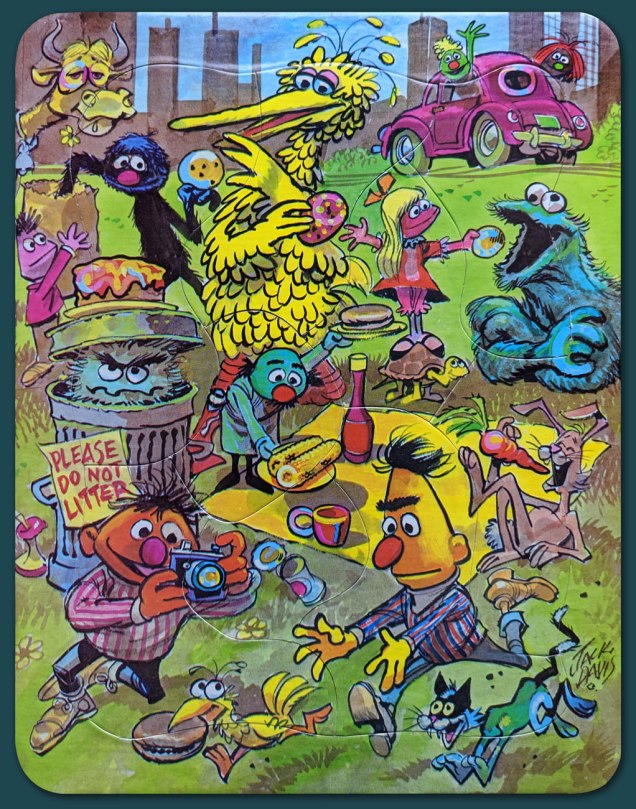
DavisHemlockPuzzleA
It’s a sunny day indeed when genial Jack Davis’ long legs come striding down Sesame Street! The series was called Sherlock Hemlock’s Hidden Answer Jigsaw Puzzles, and this is number one, The Puzzle of the Hidden C’s. Well, don’t just stand there gaping, how many can *you* spot, wise guy?
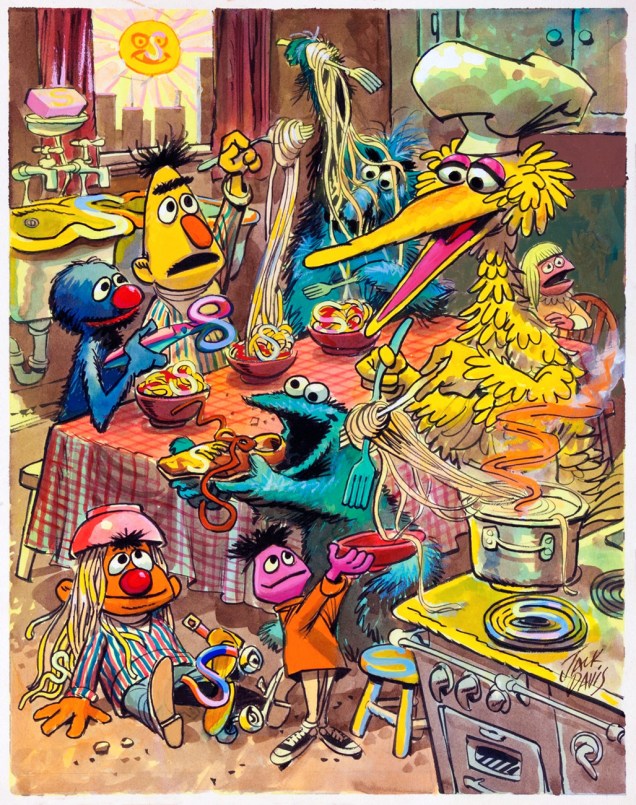
SherlockHemlockA
Spaghetti and chaos are on the menu in this scene that Davis was commissioned to create in 1971, early in the rise of the Muppet empire. This is number 2, The Puzzle of the Hidden S’s.
SherlockHemlock4A
This is number 3, The Puzzle of the Hidden Numbers. Each puzzle was packaged with a blue transparency “looking glass”, which could be used to discover hidden shapes in the picture. I’m afraid I don’t have one to spare, so you’ll have to procure your own.
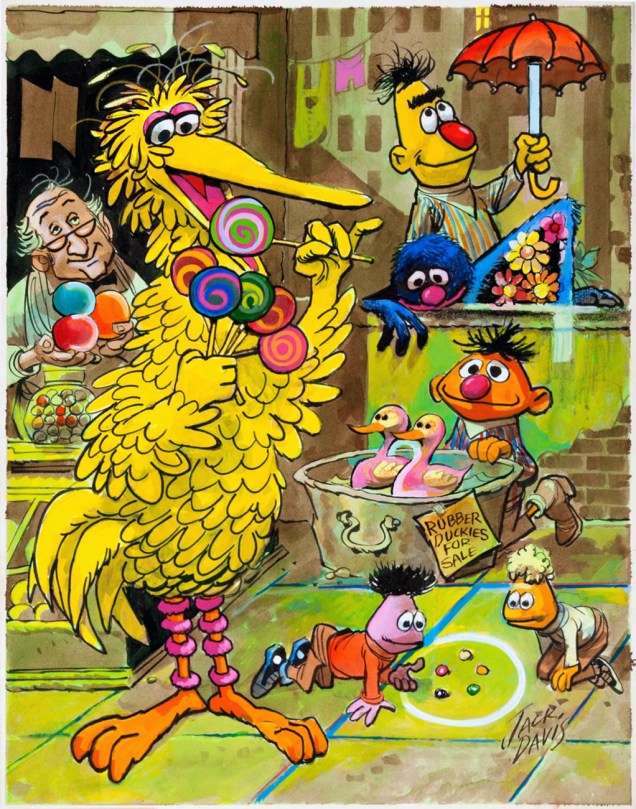
DavisHemlockStreetA
And here’s number four of the puzzle illustrations Mr. Davis created for Educational Toys’ Sherlock Hemlock’s Hidden Answer Puzzle series. This is número 4, The Puzzle of the Hidden Shapes… you know what to do next!

BlueLookingGlassA
Here’s the aforementioned [Yves Klein] blue looking glass you’ll need.
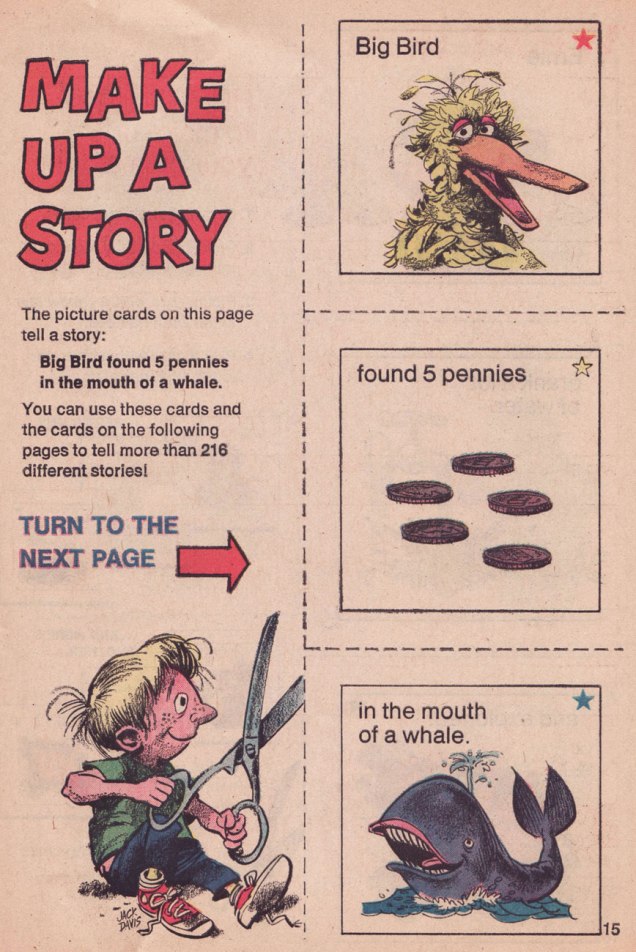
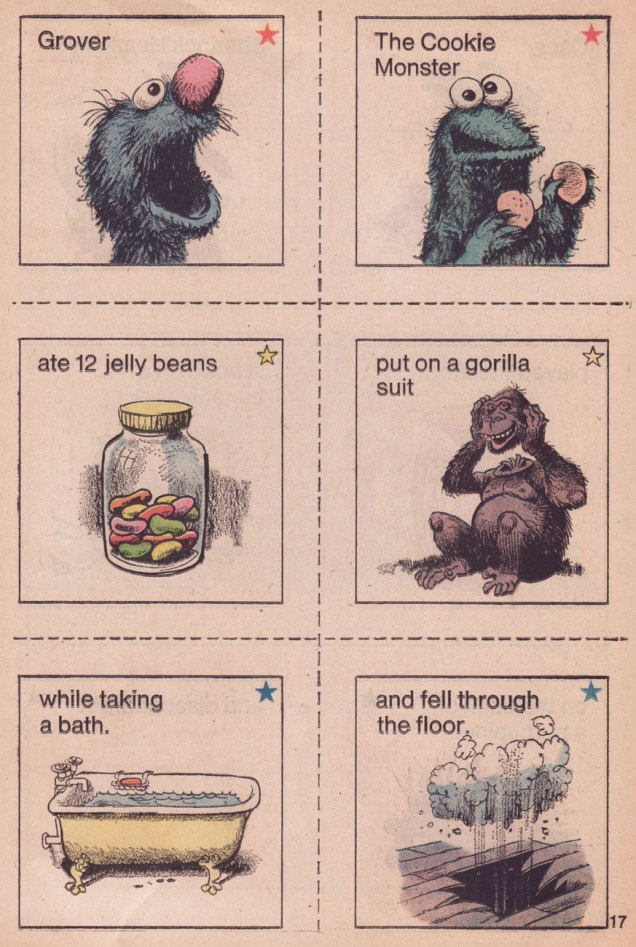
DavisMakeUpStory01ADavisMakeUpStory02ADavisMakeUpStory03A

DavisMakeUpStory04A
Another Davis-illustrated exercise in fun from the 1972 Sesame Street Annual, which also features some gorgeous contributions from Mel Crawford and Davis’ fellow Usual Gang of Idiots member, Al Jaffee. This one teaches, again according to the “Parents’ Guide to Contents”, “Pre-reading skills”.
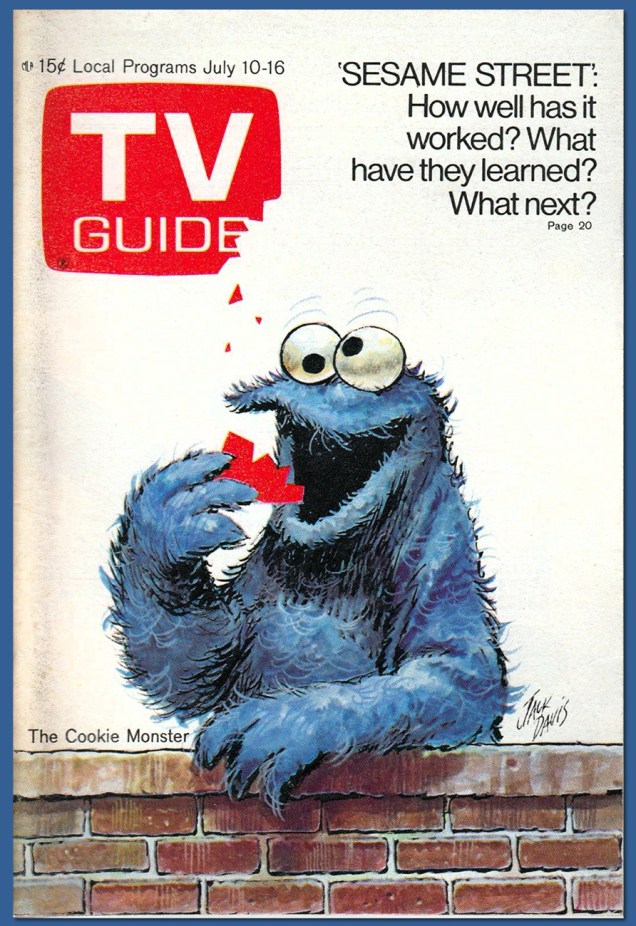
TVCookieA
As one of America’s most distinctive and deservedly successful illustrators, Davis created scores of splendid TV Guide covers, and he was uniquely well suited for this one. This is the July 10, 1971 issue. I never would have figured the mag’s logo to be edible, but then the Cookie Monster’s idea what’s fit to eat is pretty liberal.
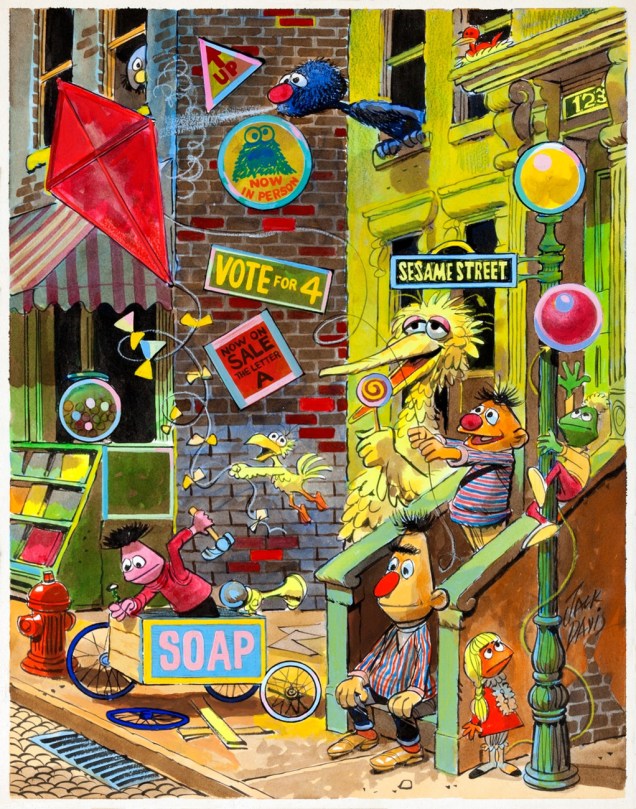
SesameStreetPosterA
A very early Davis Sesame Street illustration initially used in The Sesame Street Learning Kit (Children’s Television Workshop, 1969); the show made its début on November 10, 1969, on the about-to-expire National Educational Television network. A merger soon turned the NET into the Public Broadcasting Service, which Sesame Street, now in its 49th season, calls home to this day.
DavisCookieRemember2A
And here’s your answer. Thanks for playing along!

In case one of you experts is wondering, I did leave out, deliberately, Davis’ single meatiest contribution to the show’s canon: The 1972 Sesame Street Calendar (which I look forward to reusing in 2028), twenty-five pages of pure Davis, including thirteen particularly lush watercolours. In order to do it justice, it’ll require at least one post of its own.

And as we’re on the topic of Sesame Street’s seemingly boundless creativity, I can’t recommend enough this recent profile of the enduring friendship of a pair of the show’s most pivotal songwriters.

« Never refer to me as an item. I’m a bird. » — Big Bird

– RG

Treasured Stories: “The Price” (1974)

« Apparently he had never learned that a white man’s foot, though it wabble ever so, is given him wherewith to kick natives out of the road. » — John Russell

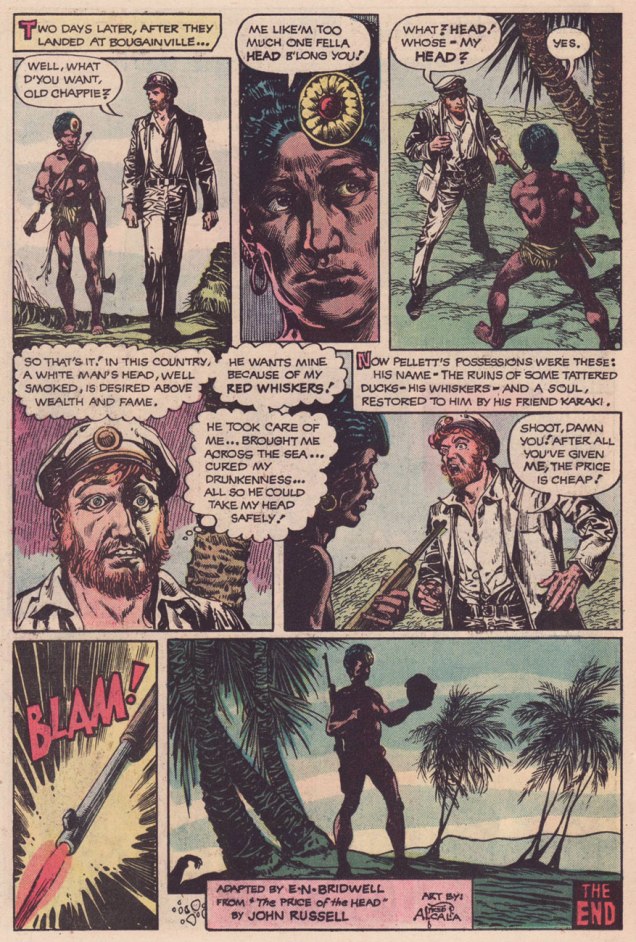
Welcome to another installment of Treasured Stories! This one’s a bit of a sequel, or rather a companion piece to an earlier entry, August Heat (from just about a year ago) as we’re featuring two of the same creators, namely scripter E. Nelson Bridwell (1931-1987) and penciller-inker Alfredo Alcala (1925-2000).

In this instance, we can surely witness judicious editorial sense at work, in terms of matching material to talent. While Bridwell likely selected the story, and though they’d worked together before, Alcala was a flawless choice to bring it to full visual bloom. A tale of the Pacific Islands illustrated by a Pacific Islander, and a masterful one at that… on both counts. Alcala’s expertly-paced, limpid, deliberate storytelling is a natural fit.

AlcalaPrice01AAlcalaPrice02AAlcalaPrice03AAlcalaPrice04AAlcalaPrice05AAlcalaPrice06AAlcalaPrice07AAlcalaPrice08A

It’s easy to underestimate how daunting a challenge, in most cases, is the effective transition of material from medium to medium. In this instance, the source is a much-anthologized short story by John Russell, originally published in Collier’s, May 20, 1916. You can judge for yourself after reading the original text here.

Russell’s stories sharply veer from the usual civilisation vs savages colonialist tripe of the era in that the natives are depicted as oft-complex but subtle beings and the whites, as often as not, as pompously delusional savages; one sees the pattern emerge upon reading a few of Russell’s South Pacific tales (collected in Where the Pavement Ends, 1921); in my own case, I found a trio of these in Dennis Wheatley‘s excellent anthology Shafts of Fear (1964), an update and expansion of his earlier A Century of Horror (1935).

Still, I strongly suspect that Bridwell’s exposure to The Price of the Head came not from books, but rather from a radio play, as all three of his DC short story adaptations (TPOTH, August Heat and The Man and the Snake had received that particular treatment. To his credit, Bridwell went back to the source for his version.

The Price of the Head was adapted several times for radio:
Listen to The Man in Black version (February 2, 1952)
Listen to Escape (version 2) from August 7, 1954

You’ll note that the racism so refreshingly absent from Russell’s story has been painstakingly restored for the radio programmes. Now that’s dedication!

Quite recently, I was delighted to hear that Mr. Bridwell has not entirely been forgotten; indeed, he is to be bestowed, though posthumously of course, the Bill Finger Award for Excellence in Comic Book Writing on Friday, July 19 2019, during the Eisner Awards ceremony at this summer’s Comic-Con International in San Diego, CA. Bravo!

Read all about it on Mark Evanier’s fine blog. And thank you, Mark!

-RG

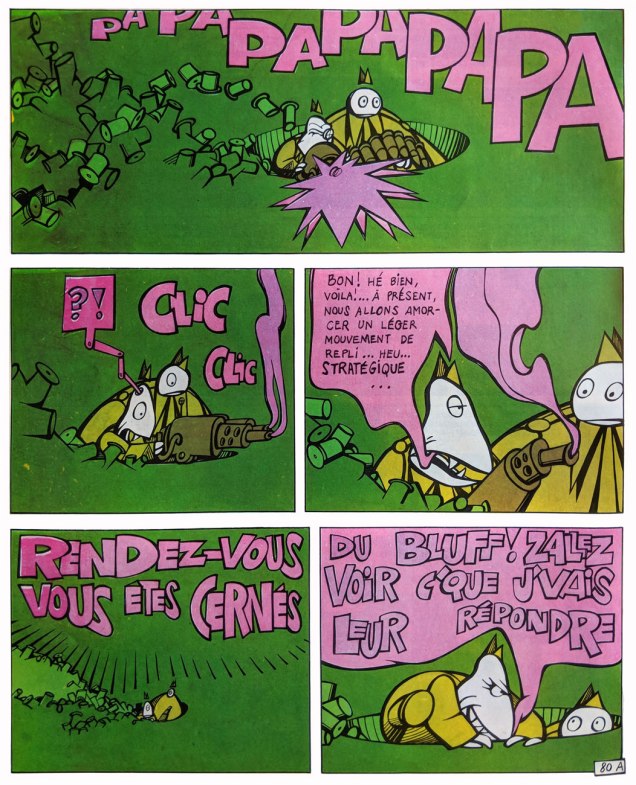
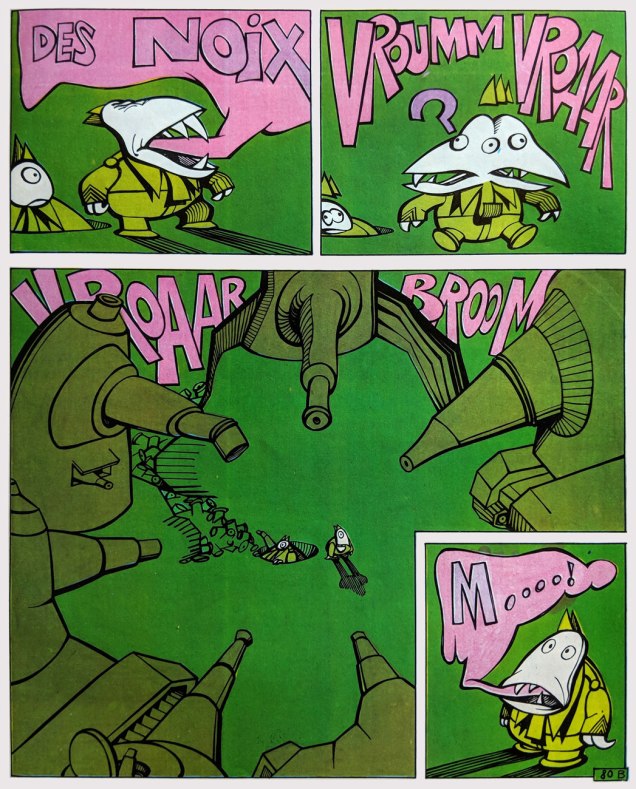
Barracks Life With Le Sergent Laterreur

« Le sergent Laterreur resembles no-one. It’s impossible for anyone to be so ignoble, so sinister, so cruel. One feels that the two poor bastards that created him are exacting their revenge for all the humiliations suffered at the hands of the strong. One wouldn’t have been surprised to discover that the authors of Sergent Laterreur were Jewish, Black, Irish or Czech. They’re Belgian. » — Georges Wolinski

“Le Sergent Laterreur” is a strip that ran in the fabled bédé weekly Pilote from February 1971 to December 1973.

This vitriolic lampoon of military life (no Beetle Bailey this) was the brainchild of Belgians Touïs ( Vivian Miessen, b. 1940) and Gérald Frydman (b. 1942).

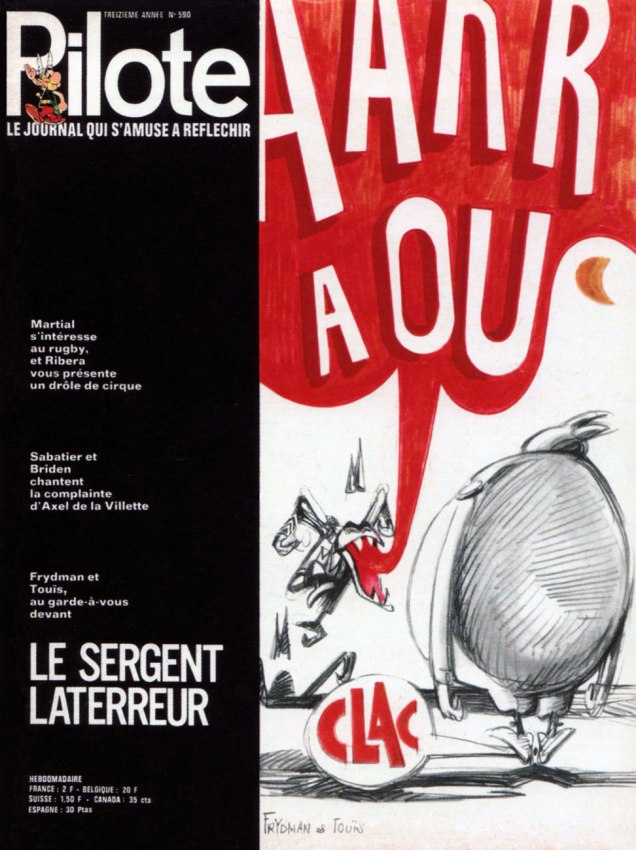
Pilote590A
Pilote no. 590 (February 21, 1971, Dargaud), the Sergent’s third appearance in the magazine and his first (of two) on the cover.

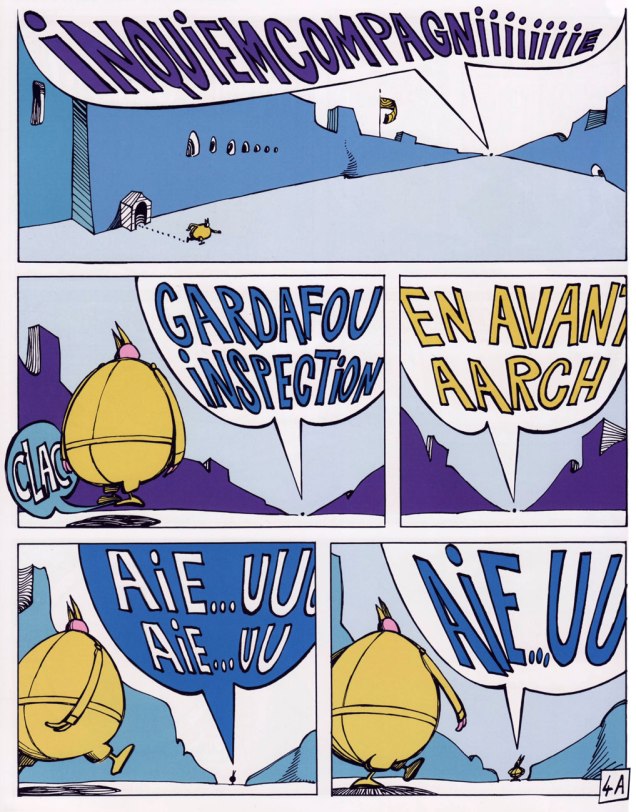
Laterreur4A

Laterreur4B
Episode 4: Flower Power

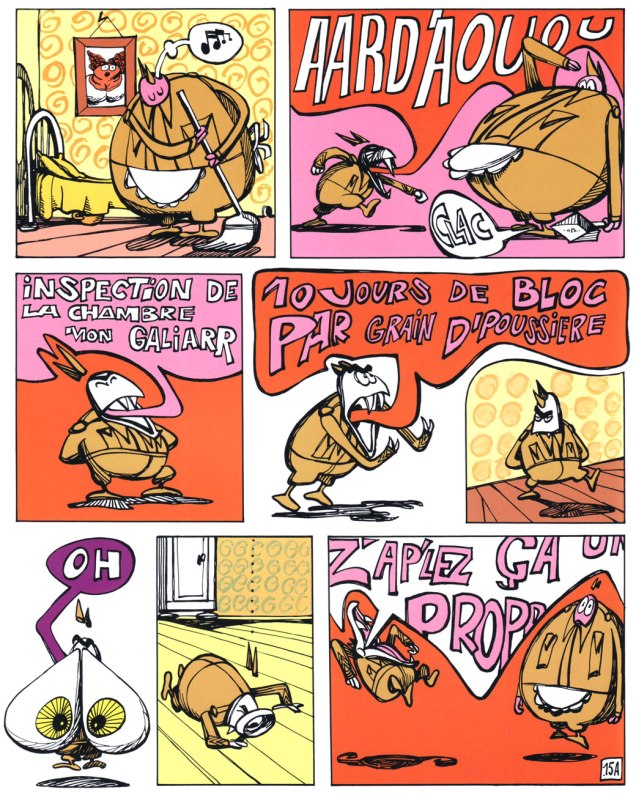
Laterreur15A

Laterreur15B
Episode 15: « Et tu retourneras les poussières ». The Sergent’s immortal maxim: « Don’t forget that dirt is our worst enemy! »

Laterreur80A

Laterreur80B
Episode 80: Les mots historiques. Laterreur thought the enemy was bluffing.

Miessen produced a few more comics during the 70s, and made a notable comeback contribution to L’Association‘s massive anthology Comix 2000, but he chiefly worked in animation. Frydman mostly pursued projects in photography and film, directing several short subjects.

Laterreur’s full effect is best experienced in massive doses, and L’Association, fully cognizant of that fact, issued a splendid Le Sergent Laterreur omnibus in 2006. An obscure creation, it remains obscure, but at least it’s available if you seek it out.

Laterreur85A

Laterreur85B
Episode 85: Du gâteau. A fitting way for a dotty old general to blow out his birthday candles.

Laterreur108A

Laterreur108B
The finale, Episode 108: Tapage nocturne. Now you know how it goes down, so to speak.

Fun factoid: The strip’s name presumably comes from the French title of a USA “boot camp” Korean War propaganda film from 1953, “Take the High Ground!“, directed by Richard Brooks. and starring Richard Widmark and Karl Malden.

– RG

The Batman’s First True Auteur

« In almost every picture, Batman looks as if he has spent the day greasing the Batmobile and didn’t bother to clean up afterwards. There is a difference between shadowing and what looks like globs of dirt and grime. » — letterhack Bob Rozakis (Detective 420, Feb. 1972), as astute an art critic as he would prove a writer.

Think about it: from his initial appearance in 1939’s Detective no. 27, the Batman was always a bit of a shop product. While notorious deceiver and glory-hog Bob Kane ( Kahn, 1915-98) loved to slap his name on anything and everything, his principal talent was self-promotion. Kane’s Batman was mostly the work of far more talented ‘ghosts‘ such as Jerry Robinson, Dick Sprang, Bill Finger, George Roussos, Jack Burnley, Win Mortimer… and so on, for decades. It’s unlikely that anyone ever produced the artwork for a Batman story on their own (well, professionally), let alone wrote *and* drew one. In a nutshell, that’s the assembly-line style US funnybook industry.

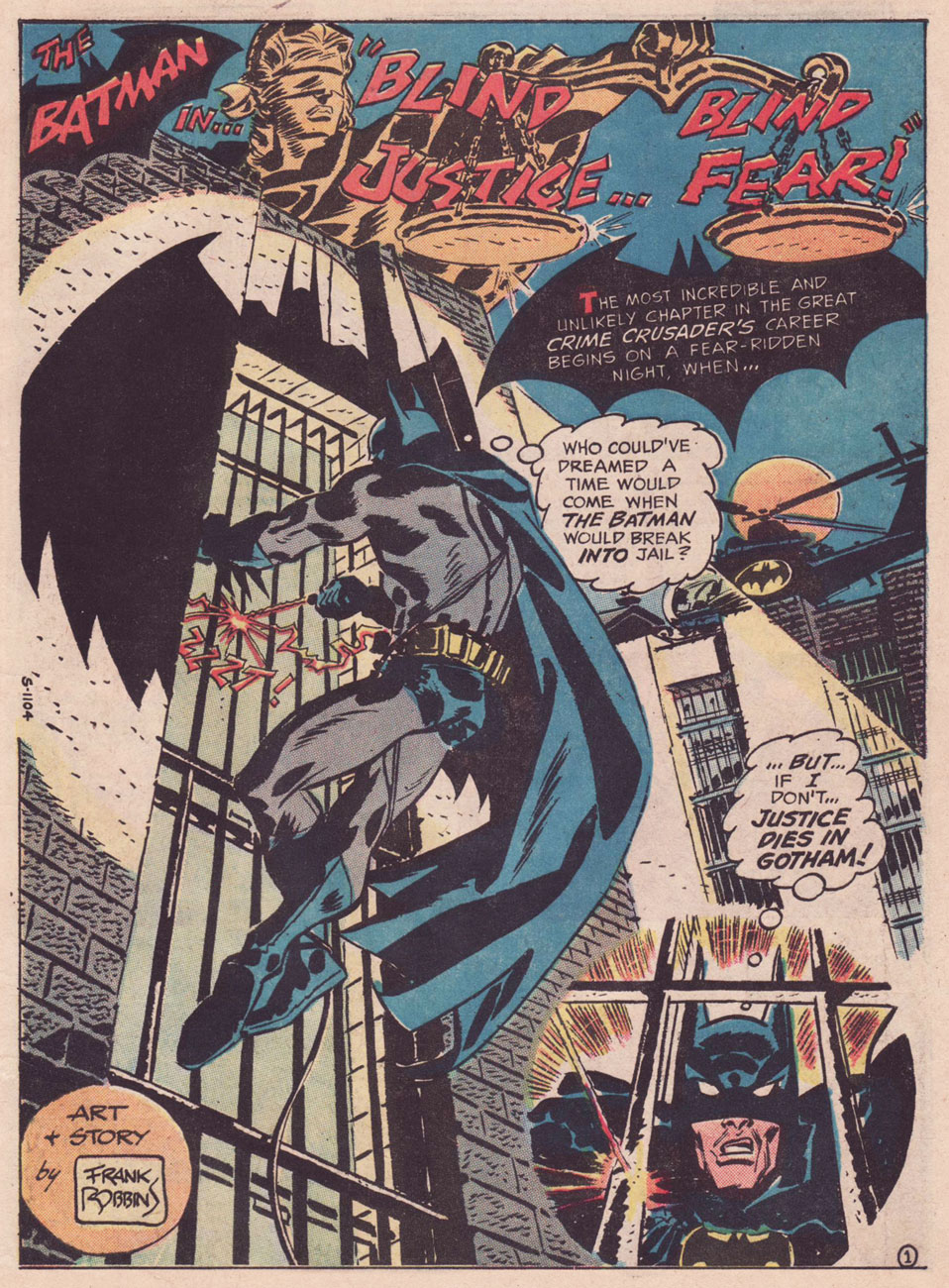
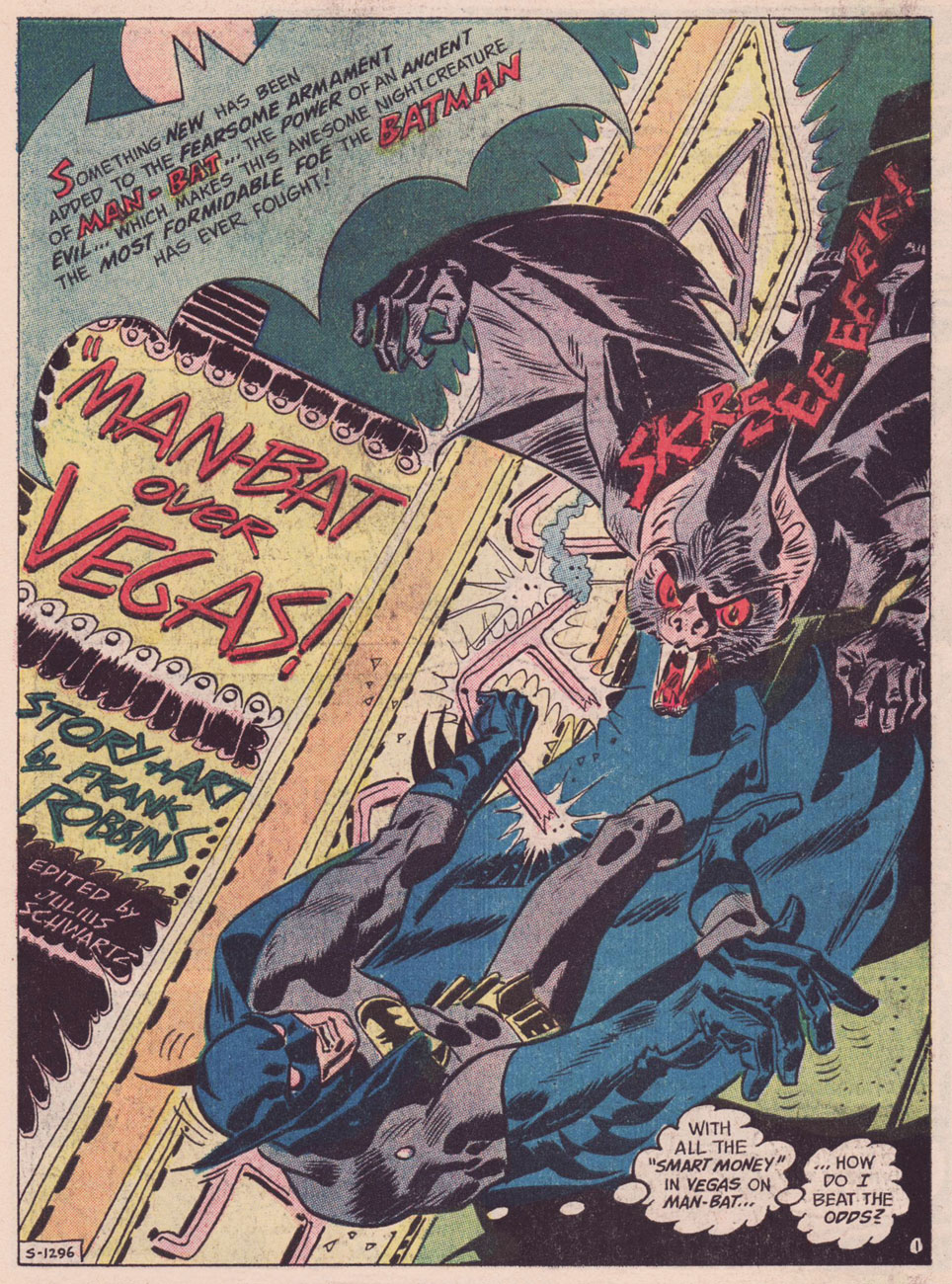
As far as the caped crusader is concerned, that state of affairs would briefly change with Detective no. 416 (cover-dated October, 1971): under a particularly clumsy Neal Adams cover, the lead story, Man-Bat Madness!, was scripted, pencilled, inked *and* lettered by Frank Robbins. He would produce four more solo Batman adventures: Forecast for Tonight — Murder! (Detective Comics no. 420, Feb. 1972); Blind Justice — Blind Fear! (Detective Comics no. 421, March 1972), Killer’s Roulette! (Detective Comics no. 426, Aug. 1972) and Man-Bat Over Vegas! (Detective Comics no. 429, Nov. 1972).

RobbinsMadnessA
A sample from the first one-man Bat-Adventure, Detective no. 416‘s Man-Bat Madness! Robbins’ expertly fluid storytelling and confident spotting of blacks are well in evidence here.
RobbinsBlindJustice01A
Opening splash from my pick of the solo Robbins Batman, Detective no. 421‘s Blind Justice — Blind Fear! [Psst! Read it here.]
RobbinsBlindJustice02A
Those were the days of “relevance” in comics. The Attica Prison Uprising had just occurred…

Robbins had been scripting for DC since 1968 (starting right after the ignominious firing of many of their most seasoned writers… for presuming to request some social benefits after decades of loyal, and often forcibly exclusive, service*), but he didn’t get his brushes out until 1971, presumably wanting to draw his then-recent creation, Man-Bat** (Detective no. 400, June 1970).

After a final hurrah (script-only) with Batman 254‘s King of the Gotham Jungle! (Jan.-Feb. 1974), he was off to Marvel, where he did no writing, but illustrated tales of Morbius The Living Vampire, Dracula, Ghost Rider, The Legion of Monsters, Captain America, The Invaders, the Man From Atlantis, The Human Fly, Daredevil… generally while paired with inkers ranging from the decent (Frank Giacoia, D. Bruce Berry), to the inappropriate (Frank Springer) to the dismal (Frank Chiaramonte and… hello again, Vinnie). He walked away from the industry in the middle of a cliffhanger, after Daredevil no. 155‘s The Man Without Fear? (Nov. 1978). Beyond that, having endured far more than his share of fanboy sniping and editorial meddling, Robbins left comics forever, going off to paint in México. Wise man.

Robbins, as you may or may not know, was a truly polarising figure in 1970s comics. He was the bane of house-style loving fanboys, and it seems that anyone savvy enough to appreciate him at a tender age later became a cartoonist. The ample evidence (meaning far too much) witnessed on FB comics groups has led me to shrugging acceptance that most fanboys’ aesthetic sensibilities haven’t shifted an iota from when they were twelve… and won’t now or ever.

Another dodgy character encountered in recent years is the annoyingly common “I hated Robbins then, but I totally get him now” git, which brings to mind a certain science-fiction cliché.

ChastenedHumanityA
« Yeah, we burned down his house, tarred and feathered him and ran him out of town… but looking back, he was a pretty swell guy! »  Which stories are these? Find out at the end of the post.

Back to our regularly scheduled train of thought…

RobbinsForecastA
A sample from Detective Comics no. 420‘s Forecast for Tonight — Murder! Read it here, while you can.
RobbinsRouletteA
A moody teaser from Detective Comics no. 426‘s Killer’s Roulette! Peruse it here .
RobbinsManbatVegasA
The precarious opening splash from Detective Comics no. 429‘s Man-Bat Over Vegas! Play the odds right… here.

How I wish he’d gotten to illustrate his moody script for The Spook’s Master Stroke! (Batman no. 252, Oct. 1973), introducing my favourite Bat-villain, seldom-seen The Spook. He was difficult to write, so they killed him off after a handful of appearances.

While Robbins wasn’t my very favourite Bat-writer, (that honour goes to… David V. Reed), he generally delivered a solid tale… but when he was in full command, he was pretty top-notch.

-RG

*« Even though Fox has worked for several comic book publishers, he remains most associated with DC Comics, for whom he worked more than three decades. That collaboration came to an abrupt end in 1968. Fox had joined other comics writers like Otto Binder, John Broome, Arnold Drake, Bill Finger and Bob Haney, signing a petition to ask DC for more financial benefits, particularly regarding health insurance. Since the company regarded writers as expandable people they were all fired without mercy and replaced by more obedient newcomers. » [ Source ] (incidentally, Haney wasn’t fired… at least permanently)

**Neal Adams, having waited until everyone else in the room was dead (editor Julius Schwartz passed away in 2004), began to claim that Man-Bat had been his idea, with no-one’s help. Sorry, Neal, I think you’re a bit confused: you’re thinking of Valeria the She-Bat, and she’s all yours.

Mini-quiz answers: 1) Spores From Space (Mystery in Space no. 1, May 1951, DC); written by Gardner Fox and illustrated by… Frank Frazetta. 2) The Unknown Spaceman (Mystery in Space no. 11, Jan. 1953, DC); written by Gardner Fox and illustrated by Bob Oksner and Bernard Sachs; 3) I Created Sporr, the Thing That Could Not Die! (Tales of Suspense no. 11, Sept. 1960, Marvel); written by Stan Lee, art by Jack Kirby and Dick Ayers; 4) The Blip! (Tales to Astonish no. 15, Jan. 1961, Marvel); written by Stan Lee, art by Jack Kirby and Dick Ayers.

Treasured Stories: “Dragstrip Paved With Gold” (1968)

« Alcohol is for drinking, gas is for cleaning parts, and nitro is for racing! » — Don Garlits

At this time each year, Montréal is beset by its own plague of greedy locusts: it’s Formule 1 Grand Prix time! While our fair city offers other crowd-pleasing events (for instance le Festival international de jazz de Montréal and le Festival Juste pour rire / Just for Laughs), the most glaring distinction between the Grand Prix and the others is that it essentially draws just one type of visitor, a Las Vegas/Florida Spring Break/Nascar sort of randy, aggressive, would-be Alpha Male yob. Imagine hosting the Republican National Convention year upon year, and at eardrum-tormenting sonic levels. Time and time again, the newspapers run the same stories about rampant prostitution and criminal exploitation and how the event only benefits bar, hotel, restaurant and cab operators and variegated pimps… and shafts everyone else. The usual one-percenter bait-and-switch appeal to everyday avarice, it never fails.

Oddly enough, despite my distaste for racing culture proper, I’m paradoxically quite fond of hot rod comics. I was as surprised as anyone when I chanced, several years past, to read an odd issue of Drag n’ Wheels that had come into my possession decades earlier in the midst of an assorted lot (this was no. 46, April 1971)… and greatly enjoyed it. Gripping stuff, as it turned out!

Now, there’s no question that the number one driver of Charlton Comics’ hot-rod line* was Jack Keller (1922-2003), a Golden Age artist who found his true niche with car comics. Around 1967, he was offered an exclusive contract with Marvel to work on their western titles, but Keller declined in order to focus on his Charlton account, where he could write, pencil, ink and letter his own stuff… without having to redraw anything. Moreover, he claimed to favour horsepower over horses.

Keller’s car stories are often a delight, full of knowing detail, clever humour and plenty of thrills. However, if Keller had produced the entire line on his own (as he did, in fact, when it was whittled down to a pair of titles in its final years), the growing bleakness in his work could have become wearying. Drawing from his direct involvement in the racing scene, Keller packed his stories with pompous asses, dangerous egomaniacs, slimy backstabbers, sociopathic glory hogs, and other representatives of a bloodthirsty, mean-spirited mob.

Charlton’s main writer, Joe Gill, filled out the rest of the book, aided by a rotating crew of artists, among them Don Perlin, the tireless Charles Nicholas ‘n’ Vince Alascia duo, Tony Tallarico, Bill Montes, Dick Giordano, Bill Molno, et al.

But in the line’s peak years (1964-1969, also an aesthetic apogee in automotive design), the number two illustrator in Charlton’s racing stable was Edd Ashe (1908-1986), another journeyman from the Golden Age of comics.

Here, at last, are some actual comics. Dragstrip Paved With Gold appeared in Hot Rods and Racing Cars no. 90 (June 1968, Charlton Comics), and was written by Joe Gill, pencilled by Edd Ashe, and inked by the mysterious and likely pseudonymous T. Roots.

AsheDragstrip01AAsheDragstrip02AAsheDragstrip03AAsheDragstrip04AAsheDragstrip05AAsheDragstrip06A

It might be easy to miss some of the more unusual nuances of Gill’s tale. When faced with the daily task of coming up with material grounded in genres with a limited number of available plots (say, romance, war, horror, hot rods, sports), Gill kept the plot basic and tidy, but enriched his stories with unusual characterization, pertinent technical details, vernacular and jargon… and sometimes moral values quite at odds with the prevailing societal mores. In this story for instance, note that the ladies in Terry and Jim’s lives provide the voices of reason, prodding them gently away from blind ambition, excessive materialism and showboating and toward self-preservation and enlightened self-respect. Dead men can’t keep up with the Joneses… or rather ahead, in this case.

WhoThereLogotype

As a bonus, I’ve compiled a complete-as-far-as-I-know bibliography of Mr. Ashe’s contributions to Charlton hot rod comics (1964-1969); wherever available**, follow the links to read the issue on comicbookplus.com!

Hot Rod Racers 1 : Local Champ / The Compact Cavaliers / Back-Road Champ
Hot Rod Racers 2: The Avenger / Joe’s Jalopy / The Driver, not the Car
Hot Rod Racers 10: Quarter King
Hot Rod Racers 11: Fast Loser
Hot Rod Racers 12: Wrecks to Riches
Hot Rod Racers 13: The Spoiler
Hot Rod Racers 14: The Day the Creampuff Won
Hot Rod Racers 15: You Never Know!

Grand Prix 16: Bossin’ the Turns
Grand Prix 17: Twins’ Trouble / Constant Loser
Grand Prix 18: Gentleman Driver
Grand Prix 19: The Eagles Scream
Grand Prix 20: For Money or Marbles
Grand Prix 21: The Town Wreckers

Drag-Strip Hotrodders 2: Tamed Tiger / Falcon Flyer / Little Eliminator
Drag-Strip Hotrodders 3: English Cousin / 1320 in 13.20 / S/S King
Drag-Strip Hotrodders 5: Great Moments in Racing History: “Rods Across the Sea”
Drag-Strip Hotrodders 10: The Furious 40! / 200 Plus!
Drag-Strip Hotrodders 11: Match Champ
Drag-Strip Hotrodders 12: I’m a Lemon (A Car’s Own Story)
Drag-Strip Hotrodders 13: Speed in All Seasons
Drag-Strip Hotrodders 14: Playin’ the Role!
Drag-Strip Hotrodders 15: “Mighty Mustang”
Drag-Strip Hotrodders 16: Speed at Any Price

World of Wheels 17: Modified Madness
World of Wheels 18: The Astro Rod
World of Wheels 19: “Speedy”
World of Wheels 20: Beast From the East
World of Wheels 21: The Rat Pack
World of Wheels 23: The Wild Ones (Parents)
World of Wheels 27: The Sissy Wagon
World of Wheels 28: Home Town Driver / Lemon at Le Mans (Vince Colletta inks)

Hot Rods and Racing Cars 70: Nightmare at Le Mans
Hot Rods and Racing Cars 72: Farmboy at Le Mans
Hot Rods and Racing Cars 73: Outlaw Hot-Rod / 300 MPH Flying Jet / The Novice / Hold It!
Hot Rods and Racing Cars 74: Final Test (Colletta inks)
Hot Rods and Racing Cars 75: Great Moment in Racing History: “Race to the Sky”
Hot Rods and Racing Cars 78: Great Moment in Racing History: Sebring ’65
Hot Rods and Racing Cars 79: Mille Miglia of 1952
Hot Rods and Racing Cars 80: Great Moment in Racing History: The Vanderbuilt Cup Race of 1937
Hot Rods and Racing Cars 83: The Digyard Demon
Hot Rods and Racing Cars 85: Fast and Furious
Hot Rods and Racing Cars 86: Backyard Grand Prix
Hot Rods and Racing Cars 87: The Pigeon / Just a Country Boy
Hot Rods and Racing Cars 88: Wild Willie & the Black Baron
Hot Rods and Racing Cars 89: The Mighty Midgets
Hot Rods and Racing Cars 90: Dragstrip Paved With Gold
Hot Rods and Racing Cars 91: Piston Head
Hot Rods and Racing Cars 92: Dirt Track Digger
Hot Rods and Racing Cars 93: Tomboy Tornado
Hot Rods and Racing Cars 94: A Friendly Little Car
Hot Rods and Racing Cars 99: The New Breed

Teenage Hotrodders 15: Great Moment in Racing History: The World 600
Teenage Hotrodders 16: Great Moment in Racing History: The Detroit Special
Teenage Hotrodders 17: Great Moment in Racing History: Le Mans 24 Hour Race 1959
Teenage Hotrodders 21: His Big Dream
Teenage Hotrodders 23: Flying Failure

Top Eliminator 25: The Pigeon
Top Eliminator 27: RedLight Express / Mad for Matches
Top Eliminator 28: Blow-Up
Top Eliminator 29: Scarface and the Get Away Gasser

Drag ‘n’ Wheels 32: Weird Willy’s Wild Wagen
Drag ‘n’ Wheels 33: Smoked In
Drag ‘n’ Wheels 34: Wastin’ Time
Drag ‘n’ Wheels 35: The Firecracker 500

– RG

*These were Hot Rods and Racing Cars (1951-1973); Speed Demons (1957-58); Dragstrip Hotrodders / World of Wheels (1963-1970); Teenage Hotrodders / Top Eliminator / Drag ‘n’ Wheels (1963-1973); Hot Rod Racers / Grand Prix (1964-1970); and Surf ‘n’ Wheels (1969-1970).

**Until they wised up sometime in 1968, Charlton didn’t bother to copyright their publications; therefore, they wound up in the Public domain.