« The world dies over and over again, but the skeleton always gets up and walks. » — Henry Miller
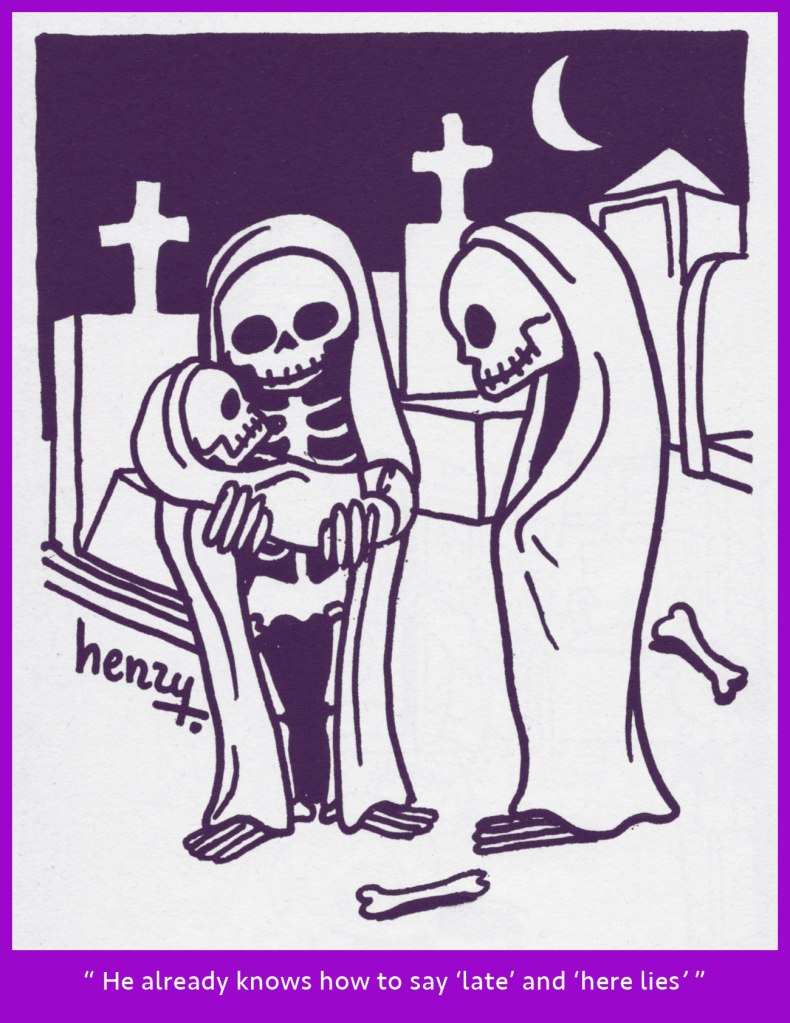
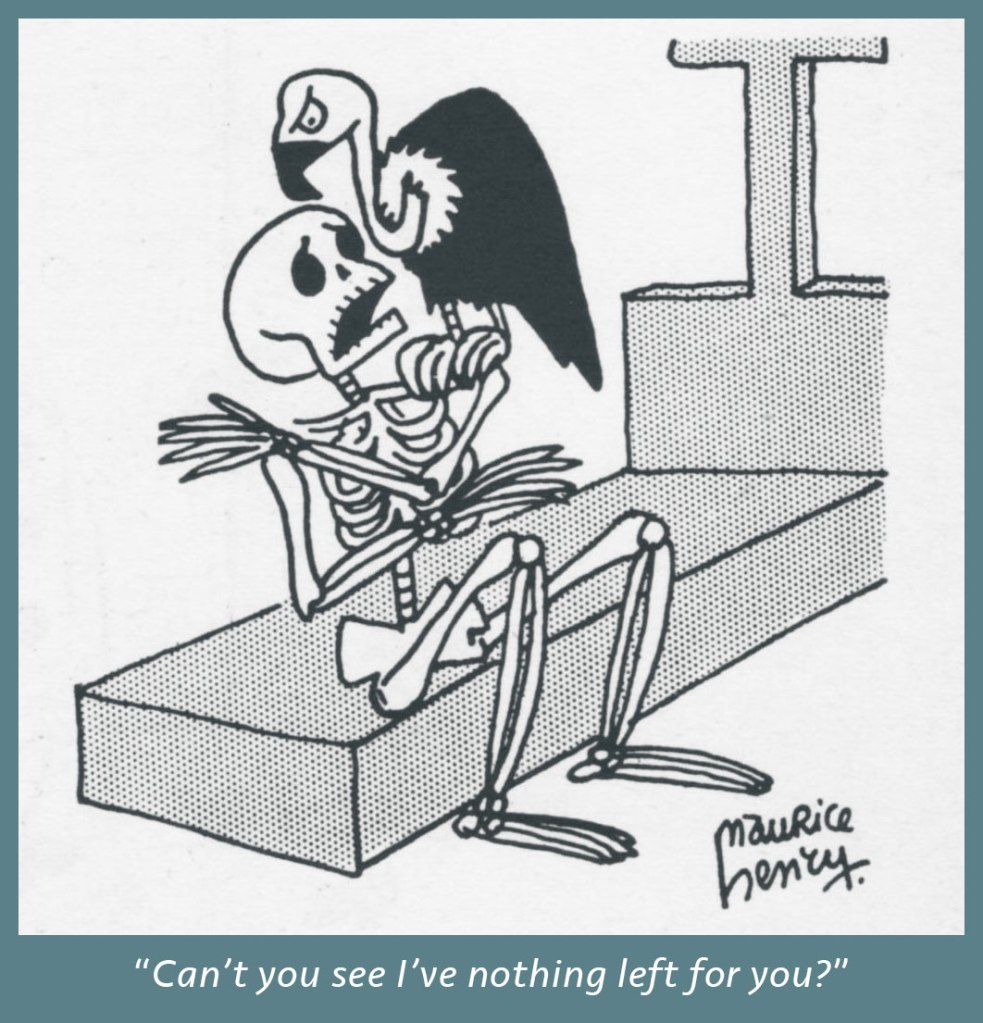
A few months back, while assembling a post about polymorphic French surrealist Maurice Henry (1907-1984), I marvelled and chuckled at his multitude of skeleton-themed cartoons. I made a mental note to devote a Hallowe’en post to them… and that memo only floated to the top of my consciousness a couple of days ago. Just in time!
(1935)
(1936)
(1938)
(1940)
(1941)
(1947)
(1950)
(1950)
(1958)
This one doesn’t feature skeletons, but I had to include it, given how stunningly *dark* it is for its (or any) era… can you imagine something like this published in the USA in… 1935? For more context, here’s the Bluebeard ditty.
In closing, and just for kicks: sixteen faces of the playfully photogenic Monsieur Henry. This one-man assembly featured on the back cover of Maurice Henry 1930-1960 (1961, Jean-Jacques Pauvert), a remarkable collection.
Trust me, I’m only scratching the surface of this man’s genius. If you’ll bear with me, we’re not done with him.
« No — I’m not alive! But we’ll have time to talk about that later! » — the accident-prone stranger
On the magazine front, Scholastic hit its peak in the mid-to-late 1970s with Dynamite (1974-92) Bananas (1975-84) and sundry periodicals aimed at various reading levels. Always comics-friendly, they struck a fruitful alliance with the fledgling Joe Kubert School of Cartoon & Graphic Art, thus granting precious early exposure to some of the institution’s promising early alumni, such as Stephen Bissette, Rick Veitch and John Totleben.
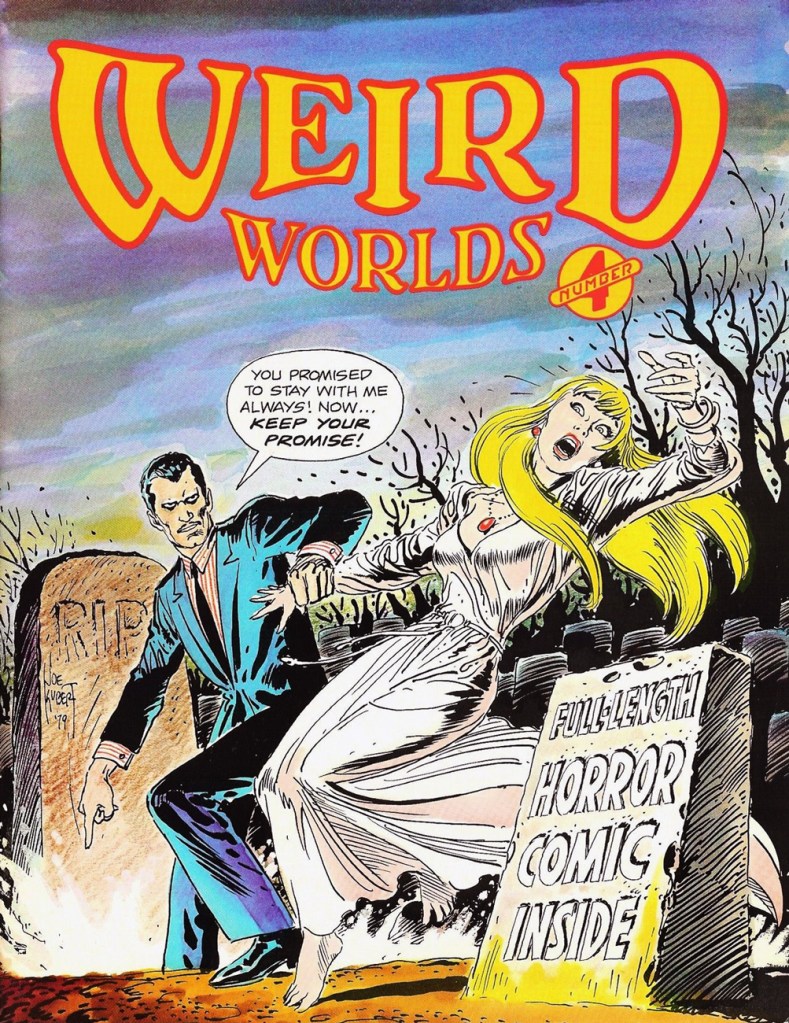
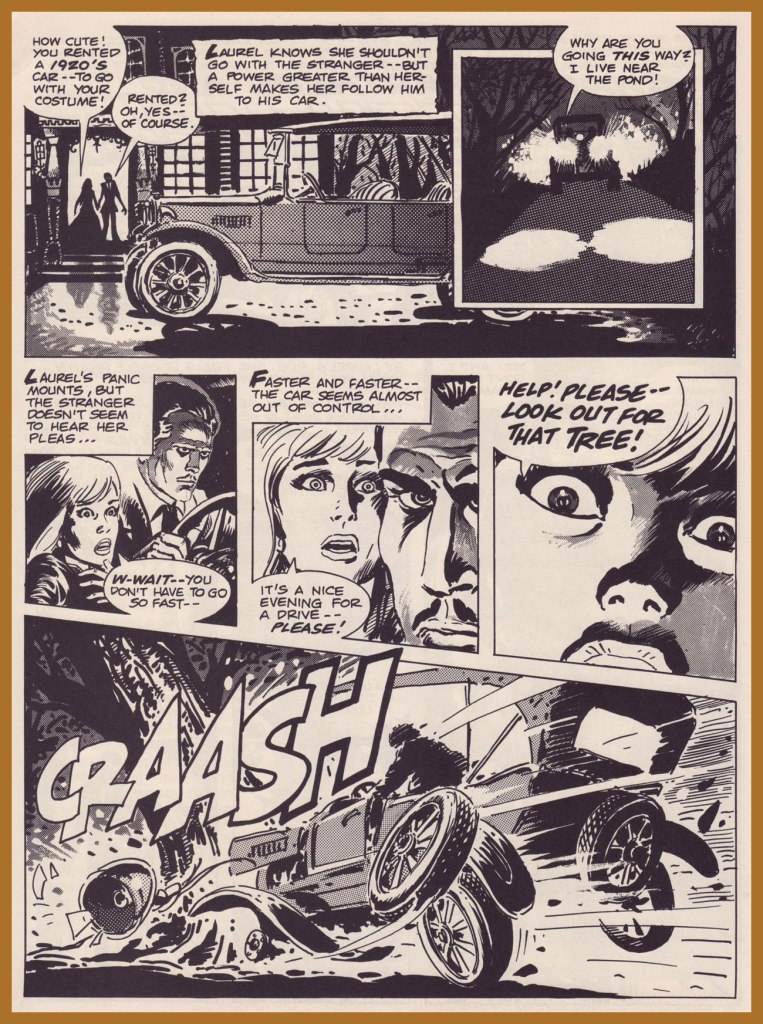
This is Weird Worlds no. 4 (1980, Scholastic). Cover by Joe Kubert. By ‘full-length’, they meant ‘four pages long’. Oh well.
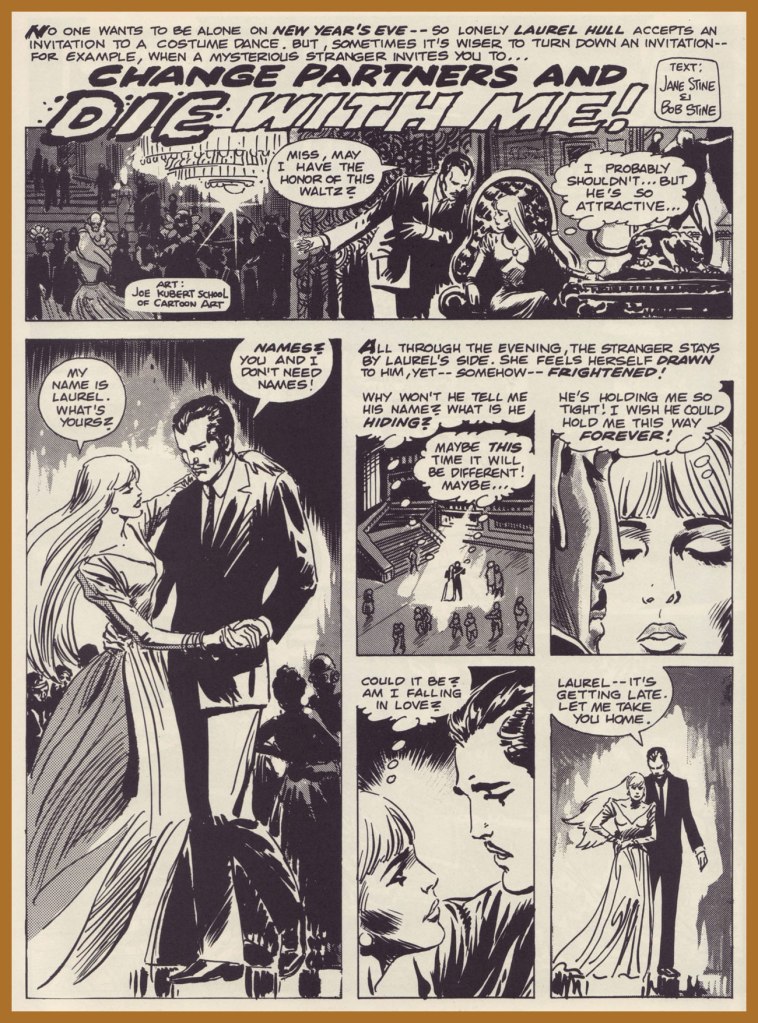
Professorial Joe Kubert leads his students into a moody collaboration with the guiding lights of Dynamite, namely the husband-and-wife team of Jane Stine and ‘Jovial’ Bob Stine (of later R.L. Stine fame and fortune).
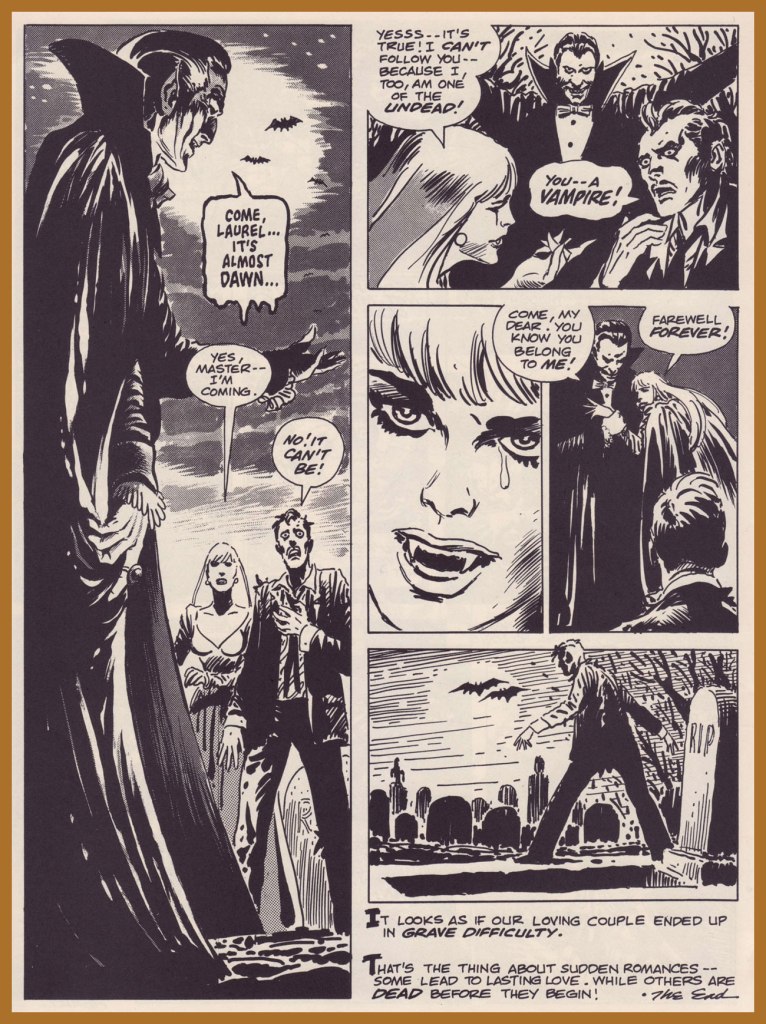
Well, Laurel could have fared far worse: her ‘Master’ is squarely in the then-fashionable Frank Langella / George Hamilton leading man mould. There was another alternative, of course:
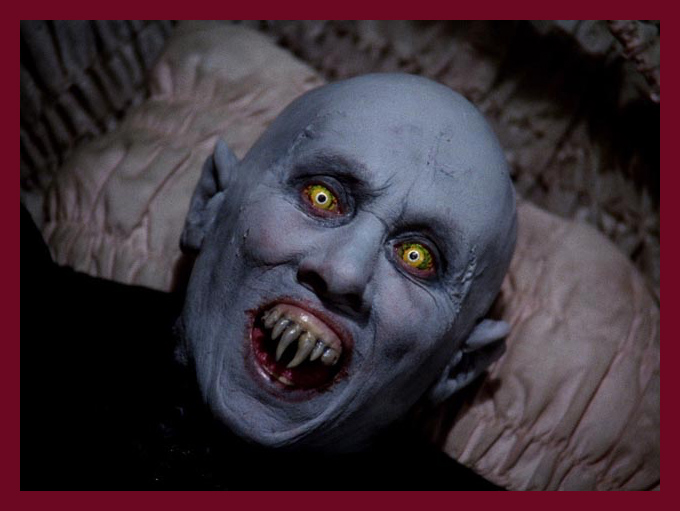
You’ll enjoy Mr. Barlow. And he’ll enjoy you.
Weird Worlds didn’t set this world afire, enduring but eight issues. Still, Scholastic would return to mine the teenage affinity for all things spooky and on that occasion (and further ones) strike gold and raise goosebumps.
« … a radical series of crappy jokes & trashy art mopped out of the Bowery’s least washed lavatories. Fueled on bologna sandwiches, black coffee & cheap cigarettes, these are the ugly buttons that scream ‘America‘ to an America that has forgotten itself. » — a tasty bit of hype from Goblinko
Fabled pulp illustrator Norman Saunders (a definite favourite around these parts) is legitimately appreciated for his body of work, but I do believe he isn’t sufficiently lauded for his humorous work. After all, he could hold his own against the likes of Basil Wolverton and Wally Wood, and how many of his peers could lay claim to such a lofty achievement?
A passage from his son David’s definitive monograph, the simply and fittingly titled Norman Saunders:
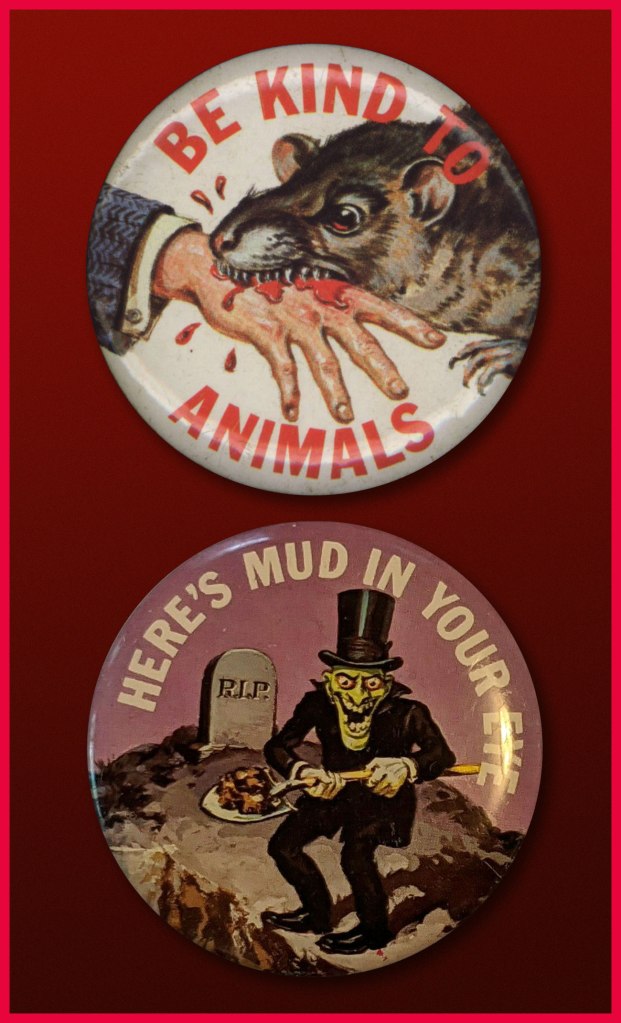
Ugly Buttons came out in 1967 to exploit the popular trend of protest buttons with witty sayings. The macabre humor of Ugly Buttons reflects their Halloween release date as well as the morbid comedy of popular TV shows like The Addams Family and The Munsters. Norm Saunders created half [ eleven, actually ] of the twenty-four images in this set, while Wally Wood created the other half.
A sample of the original packaging…
I’m sorry… but that bat is just so adorable…
You can see why these are perfect Hallowe’en fodder!
Macabre, and with a tidy moral to boot! At a nickel apiece, an undeniably excellent value.
Well, perhaps not *strictly* altogether moral.
The final Saunders button, shot from the original art. This looker was entitled Peek-a-Boo.
One of the original boxes, which held 24 packs. Featured buttons Here’s Looking at You and I’m a Cool Ghoul were designed by Wally Wood.
Collectors find this set very difficult to complete. Although the series was a popular success in 1967, the buttons appear to have rarely survived. This is perhaps attributable to the design of the tin back pin, which was made in Japan with a hair-trigger clasp that instantly popped open and fell off.
Here’s one of the underperforming bad boys in question. To be fair, this one’s still holding together, which surely has earned it some kind of goodwill, a half-century hence. Those old enough (enough, enough!) will recall when ‘Made in Japan’ was an indicator of shoddy goods. All that’s been turned on its head since, interestingly. The Japanese people have admirably overcome much adversity, that’s evident.
By the way, I don’t know just how sanctioned these reissues are, but the cool cats at Goblinko have made these lovely buttons available once more, presumably sturdier and certainly at a perfectly reasonable price (forty times the original, I’ll grant you… but you do get to pick).
« He was offered a sloe gin fizz in a pink frosted glass by a young woman who removed her glass eye and sucked on it while discussing the moral imperatives of the sponge boycott in Brooksville, Florida. » — Harlan Ellison, ‘Neon’.
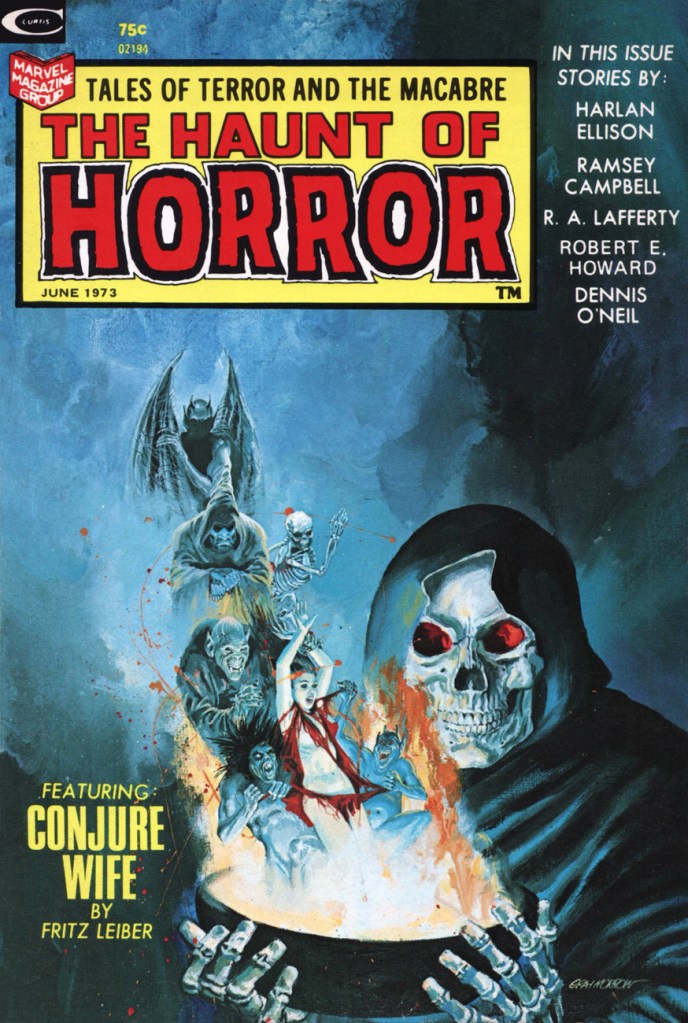
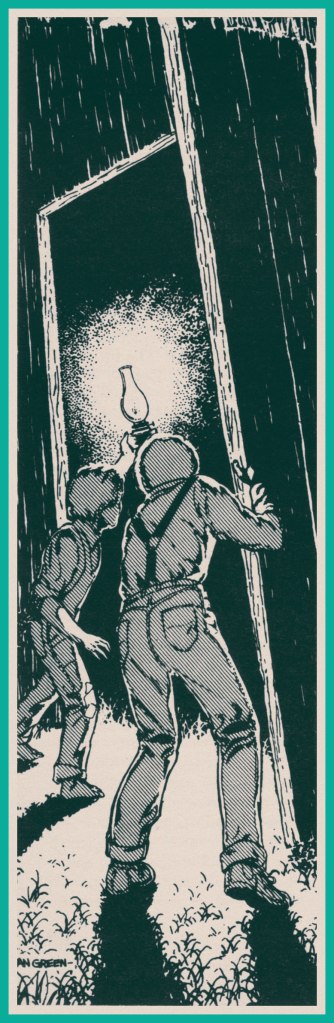
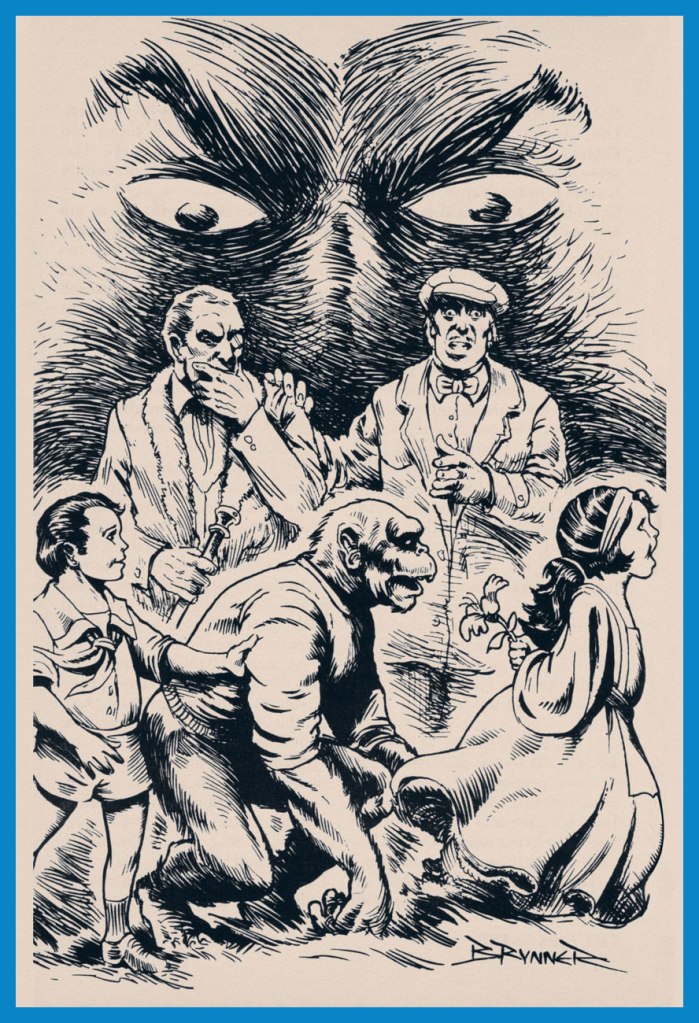
In 1973, Marvel was trying all sorts of things to bolster its market presence. They even dared to tread where even the venerable Weird Tales had never quite succeeded. The Haunt of Horror was a prose fiction digest that strongly showed its comics roots. It offered a mixture of classic material (Fritz Leiber’s Conjure Wife, a piece by Robert E. Howard) and of contemporary genre practitioners: Harlan Ellison, Ramsey Campbell… featuring a score of illustrations slapped together by Marvel’s less superhero-limited alumni, namely Gene Colan, Mike Ploog, Frank Brunner, Walt Simonson and Dan Green. After two issues, Marvel called the whole thing off, licking its wounds, but soon revived the title as a b&w comics magazine, this time eking out five issues (May 1974 – Jan. 1975) plus a 1977 issue of Marvel Preview.
This is The Haunt of Horror no. 1 (June, 1973), edited by Gerry, no, make that *Gerard* Conway (in full ‘take me seriously, I’m not just a hack comics writer!‘ mode), with a striking cover by Gray Morrow.
As for me, I picked it up for the rare short story by the nonpareil R. A. Lafferty, Ghost in the Corn Crib.
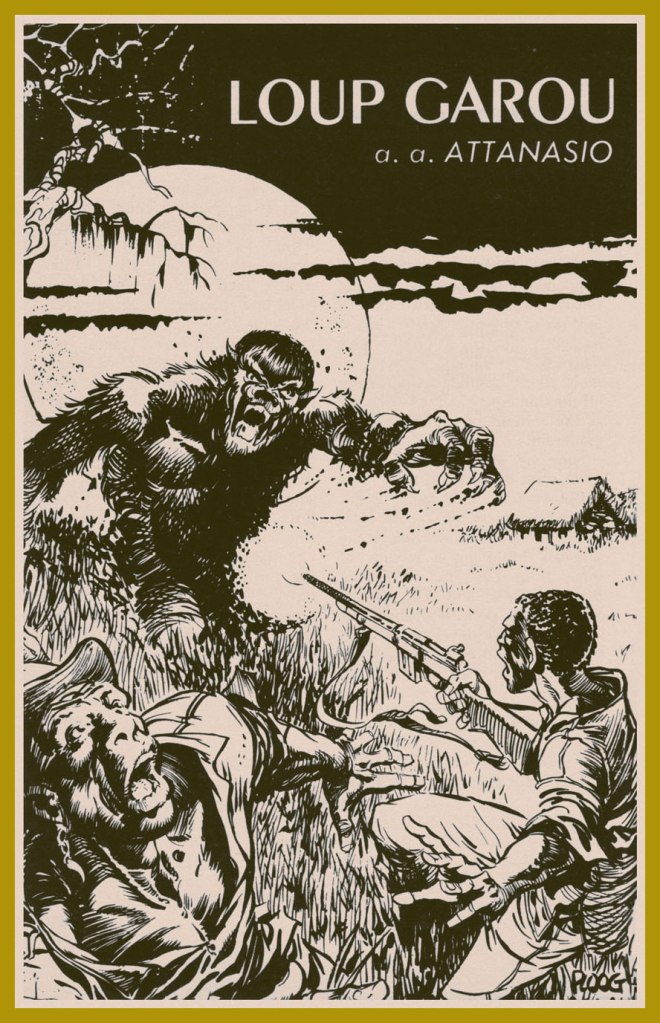
Werewolf by Night originator Mike Ploog didn’t have to stretch far beyond his comfort zone for this illustration for Alfred Angelo Attanasio‘s Loup Garou (french for Werewolf, if you still feel the need to ask).
It’s nigh-impossible to fully scan some these images without destroying the source document, but here’s the opening splash for Haunt of Horror’s publication of Fritz Leiber’s 1943 classic Conjure Wife, adapted in the movies as Night of the Eagle (in the UK) and Burn, Witch, Burn (in the US). Here, a fine, committed but uncredited Gray Morrow pebble board illustration is ‘corrected’ by Marvel’s number two Yes Man (Consulting Editor Rascally Roy Thomas would surely be numero uno), who replaces whichever figure Gray had drawn by an image of Mary Jane Watson, not even bothering with the slightest effort to match the style. John Sr. had gotten plenty of practice ‘fixing’ Kirby and Ditko, so Gray Morrow was just ‘all in a day’s work‘.
Gene Colan was called upon to whip up a few quick pieces for the rest of the feature.
The Haunt of Horror ran just one more issue, graced by a lovely, quite pulpy cover by the nonpareil Frank Kelly Freas, whose efforts Romita Sr. has also seen fit to ‘fix’. See Unknown World of Science-Fiction no. 1 (Jan. 1975). This, however, is The Haunt of Horror no. 2 (Aug. 1973, Marvel). Come to think of it, that evil priest kind of anticipates a latter-day Nicolas Cage, doesn’t he?
In the end, you might say that this short-lived publication is best known for a screwup: indeed, the notoriously disorganized Marvel Bullpen messed up the page order of Harlan Ellison‘s contribution to the first issue, Neon. Never one to let such things slide, Harlan made sure that a correct version was printed in the second issue. Score one for the good guys.
« Catholicism is not a soothing religion. It’s a painful religion. We’re all gluttons for punishment. » — Madonna Ciccone
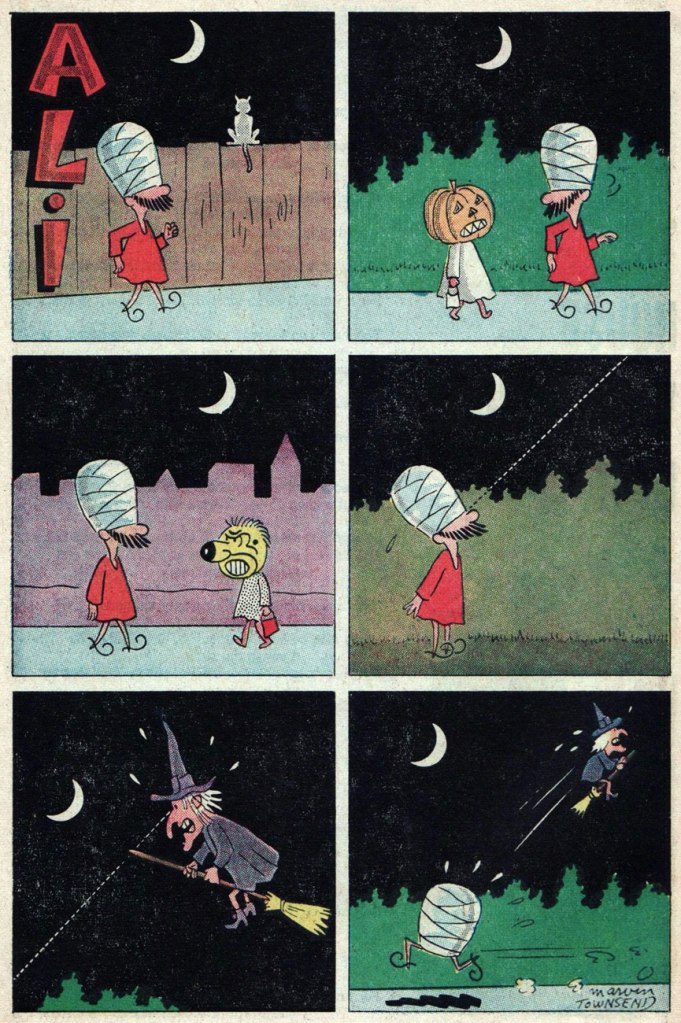
Here’s a seasonal goodie from gag cartoonist Marvin Townsend (1915–1999) and his adorable “Ali” pantomime strip, which appeared, beginning in 1962 in, of all places, the Catholic comic book anthology Treasure Chest of Fun & Fact (Geo. A. Pflaum Publisher), distributed to parochial school students between 1946 and 1972.
Originally published in Treasure Chest vol. 21, no. 4 (Oct. 21, 1965). For more Townsend in a spooky vein, look no further than this post from our previous countdown.
Denominational and religious concerns aside, Treasure Chest of Fun and Fact, a publication generally avoided like any of the Ten Plagues of Egypt by your average comic book fan, was, wouldn’t you know it, chock full of excellent work by the likes of Bernard Baily, Fran Matera, Bob Powell, Reed Crandall, Joe Sinnott, Graham Ingels, Joe Orlando, Murphy Anderson, Jim Mooney, Paul Eismann… and these are some of the artists. The material was also engagingly written and often truly captivating. And they weren’t above paying a bit of lip service to that ol’ Pagan Holiday, Hallowe’en.
This was one in a highly-entertaining series of studies of classroom “types” by Frank Huffman. It appeared in Treasure Chest vol. 22, no. 12 (Feb. 9, 1967).
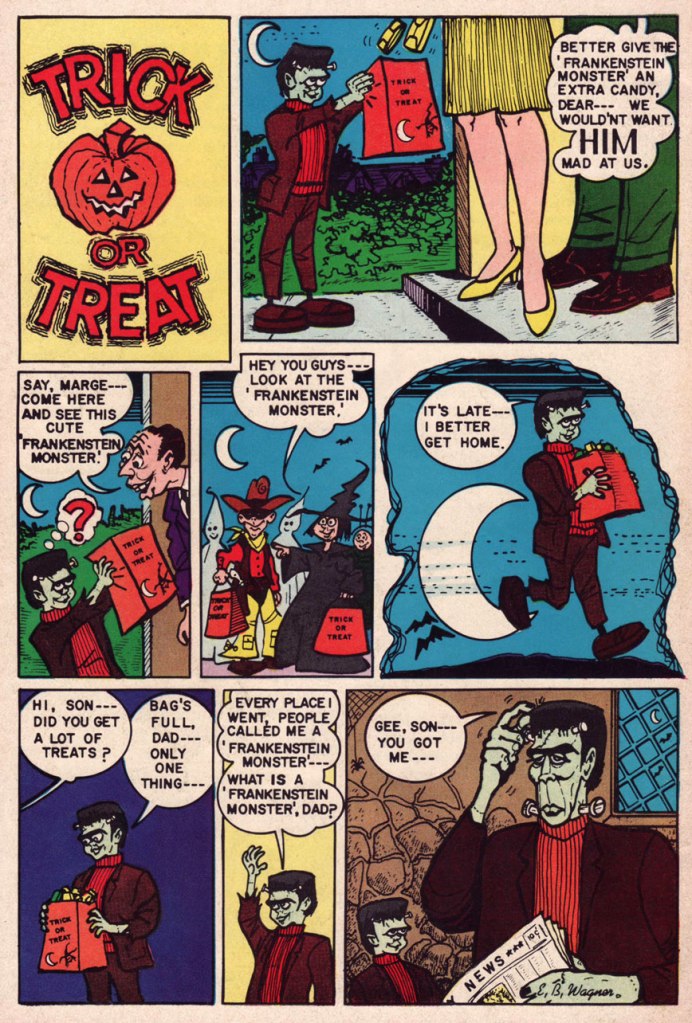
A piece by E. B. Wagner, this one saw print in Treasure Chest vol. 23, no. 4 (Oct. 19, 1967). Note the Leroy Lettering!
The back cover of Treasure Chest vol. 22, no. 4 (Oct. 20, 1966,Geo. A. Pflaum). Artist unknown, regrettably. Love that stylish auto-gyro witch!
« A detective sees death in all the various forms at least five times a week. » — Salvatore Albert Lombino, aka Ed McBain, aka Evan Hunter
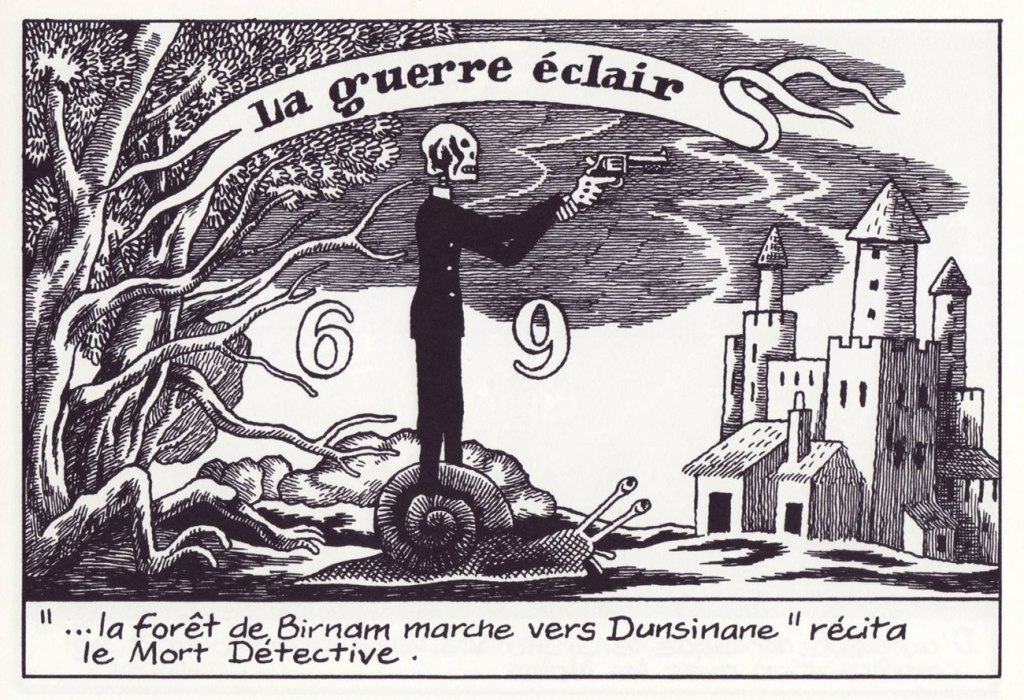
Spanning nearly a full century since yesterday’s instalment, we now move ahead to a recent work from my favourite European bédéiste of the past quarter-century, David Beauchard, better known as David B. (b. 1959).
Among the traits I most admire in Monsieur Beauchard are his artistic integrity and his explorative drive. To wit, here he evokes the grimy spirit of late 19th century feuilleton serials, providing a narrative consisting of illustrated chapter headings… devoid of the main text. The reader is left to fill in the narrative gaps, enlisted in a bold compact with the artist and required to draw upon his own imagination.
A few choice excerpts (I left out the bits with tentacles… it’s not my department, after all!):
Le mort détective was issued just last year (yes, roughly an eternity ago) by rightly-celebrated French publisher L’Association.
So it begins… with the title page, naturally.
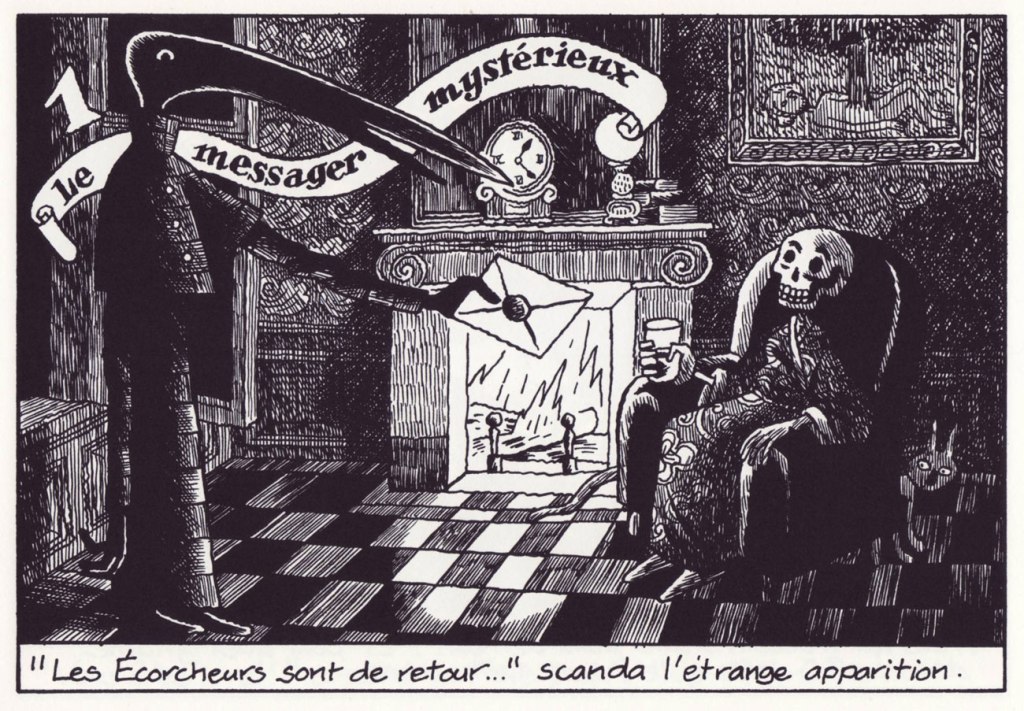
1 – The mysterious messenger: “The Flayers have returned…‘ chanted the strange apparition”.
2 – The skinned dwarf: “But who needs a dwarf’s skin… and to what ignoble purpose?“, panted the Dead Detective…
6 – The dwarf-skin coat: “The Great Old Man is a priest of the Yellow Dwarf God‘, murmured the Dead Detective to the Girl of a Thousand Daggers…”
10- The macabre post: “The Bad Postman distributes mysterious mailings.”
11- The word from the Hereafter: “The severed head exhaled a terrifying prophecy.”
22- The mass grave: “The Girl of a Thousand Daggers has sent a bouquet.“, he said in a dying voice.
41 – “The altar of fear: “Let’s flee!‘, exclaimed the Girl of a Thousand Daggers.”
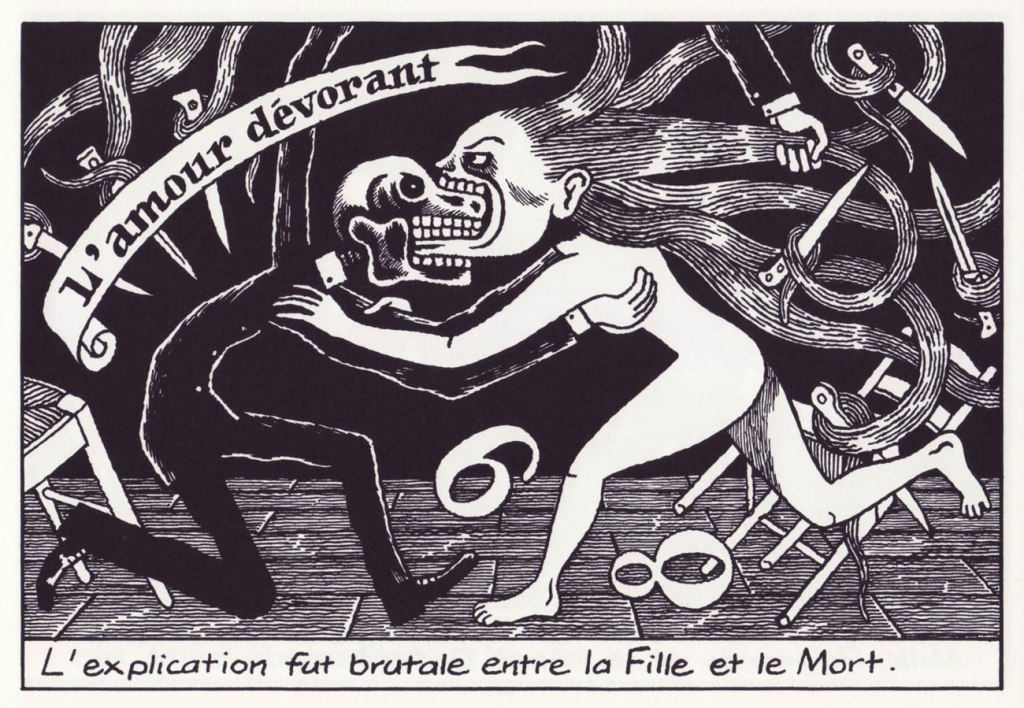
68 – “The Devouring Love: Explanations were brutal between the Girl and the Dead One.”
69 – “The Flash War: … ‘Birnam Forest walks towards Dunsinane‘, recited the Dead Detective.”
« I have stuck to my simple art style while the smart illustrative men were snapping in their shadows all around me, because I believe that my story is more clearly told with a minimum of picture distraction. » — the wise, but absurdly humble Frank King (1959)
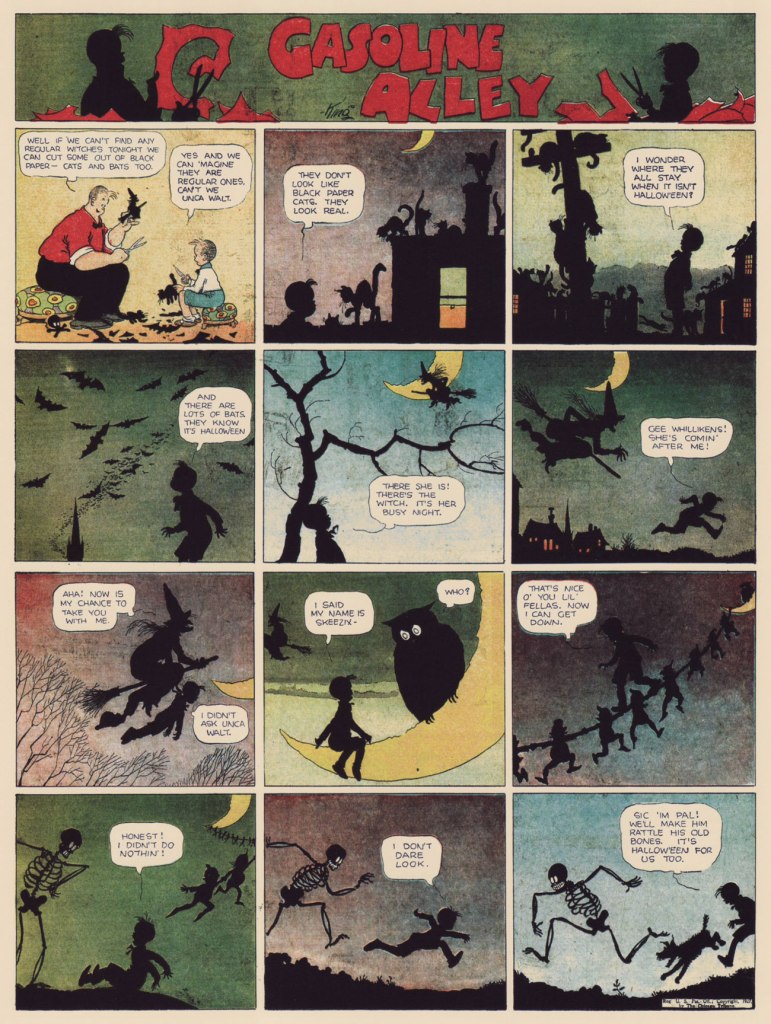
Gasoline Alley (1918-) is the second longest-running comic strip of them all. The Katzenjammer Kids (1897-2006) still tenuously clings to first place, but Gasoline Alley, boasting the advantage of still being around, should overtake it by 2027. Of course, that’s all academic and fairly irrelevant to us, because the strip’s originator, Frank Oscar King (1883-1969), is no longer guiding its destiny.
The collective memory being woefully short, if Gasoline Alley is likely to be remembered, it will be for its central innovation: characters age in real time, growing up and old and passing away, its cast and its world ever changing and evolving, in a small-town America sort of fashion. However, the strip’s original star, Walt Wallet, is still around, well into his second century.
Today, we’re digging deep, returning to those long-ago dinosaur days when newspapers were gigantic and so were the comic strips they featured, particularly on Sundays. And the Sunday Gasoline Alley was indeed something special.
I couldn’t possibly put it better than Chris Ware did in 2000, in tribute to King:
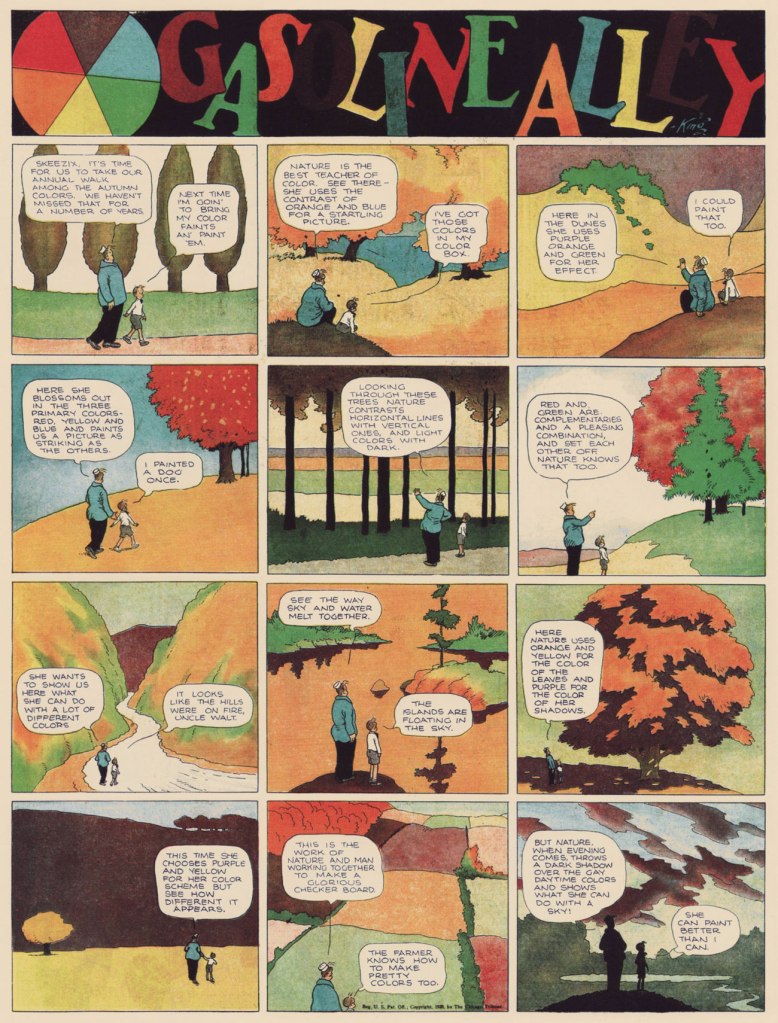
« Reserving his five daily strips for more complicated storylines, King’s full-color Sunday pages often presented Walt and Skeezix simply wandering the countryside of America, idly remarking about natural landmarks, the quality of the sky, or the colors of the seasons.
Frequently, these pages were richly-textured experiments in form and style, often having no joke or ‘punchline’ at all, only a quiet, sustained tone of serenity and gentleness. »
Halloween 1928!
Halloween 1931.
Halloween 1933.
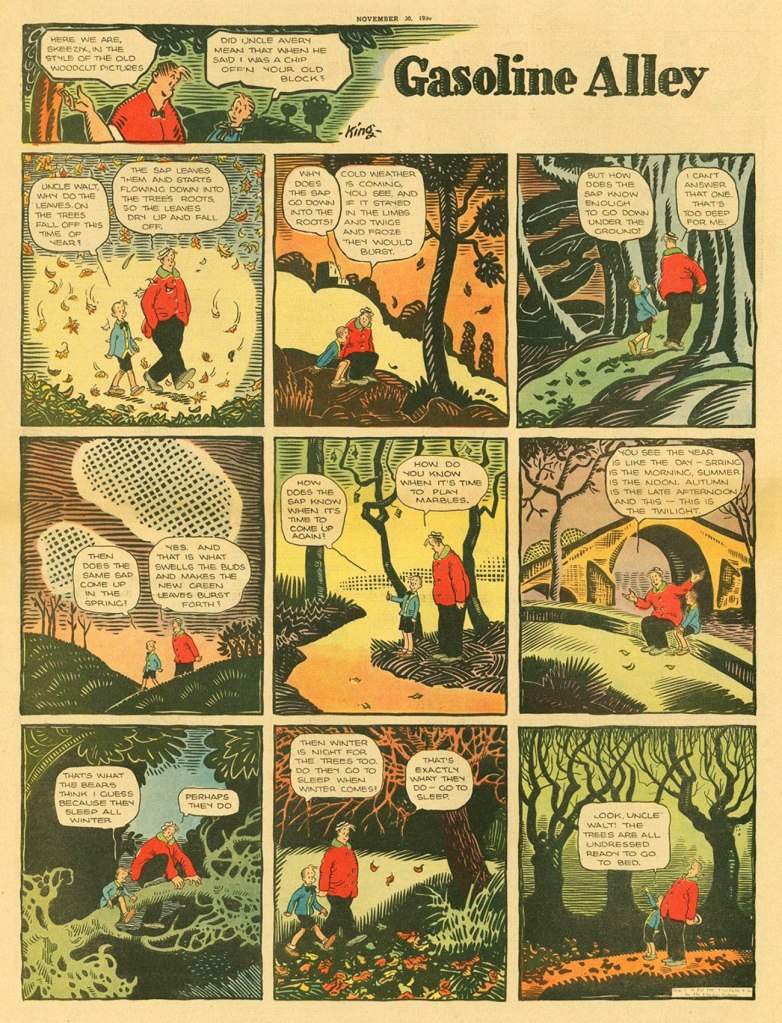
And you know, since these are so gorgeous and just as seasonal, let’s be indulgent, broaden our scope the tiniest bit and take in some of King’s paeans to sweetest Autumn.
Autumn, 1926. Pro-squirrel, too. Good man!
Autumn, 1928.
And finally, the Autumn of 1930. Phew!
Incidentally, a lovely collection (designed by Mr. Ware!) of King’s finest Gasoline Alley Sundays from the strip’s first fifteen years was published a couple of decades ago: Sundays with Walt and Skeezix (2000, Sunday Press)… and, wonder of wonders, it’s still available from the publisher.
« Listen, youse guys — we’ve had enough of dis horsin’ around! When do we grab the dough? » — a hood craves action, from Haunted Halloween! (Flash Comics no. 78)
Superheroes, back when they weren’t all wrapped up in their grimness and grittiness, took a bit of time to properly enjoy the holidays.
This is Flash Comics no. 78 (Dec. 1946, All-American Comics), featuring Haunted Halloween!, scripted by Gardner Fox and illustrated by Everett Edward Hibbard… plus four more stories for your dime. Edited by Sheldon Mayer, with a cover by Hibbard.
And here’s All-American Comics no. 61 (Oct. 1944, All-American Comics), featuring The Green Lantern (and Doiby Dickles!) squaring off against a gruesome new foe, Solomon Grundy, in a tale entitled Fighters Never Quit!, written by none other than Alfred Bester (later the author of The Demolished Man andThe Stars My Destination) and illustrated by Paul Reinman. Edited by Sheldon Mayer, with a Reinman cover.
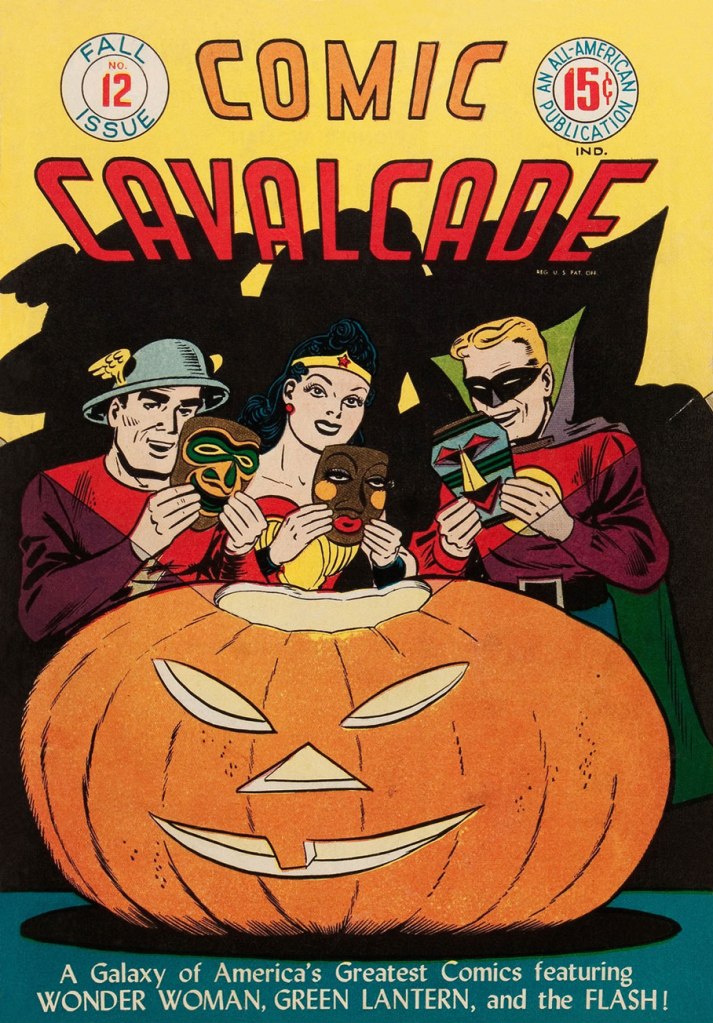
And this is Comic Cavalcade no. 12 (Fall, 1945, All-American Comics), where we catch both The Flash and Wonder Woman about to indulge in some blackface. Edited, you guessed it, by Sheldon Mayer. Cover by E. E. Hibbard (The Flash), H.G. Peter (Wonder Woman) and Martin Naydel (Green Lantern).
« When the mind is thinking, it is talking to itself. » — Plato
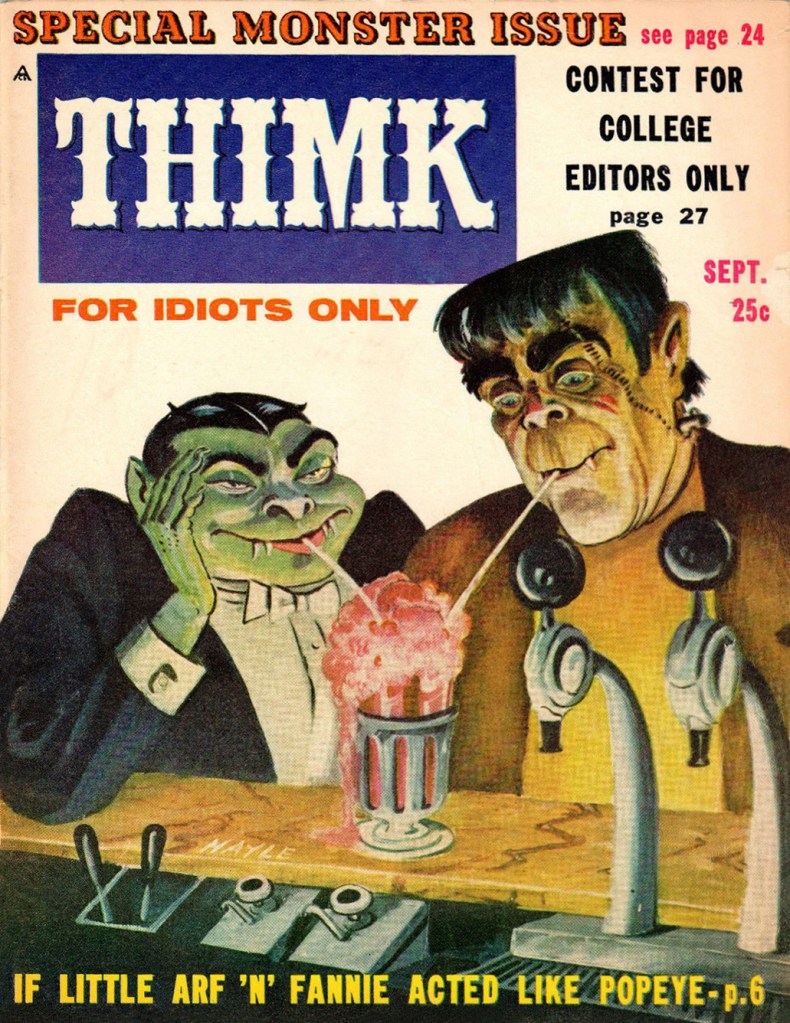
The waning years of the 1950’s marked the beginning of the monster craze, which coincided with Mad Magazine’s ripest period of influence. Here, then, is a publication that sought to capitalize on both occurrences. Alas, chasing fads too eagerly always did land you all-too-promptly in the cultural ditch. Still… Thimk had its moment.
This is Thimk no. 3 (Sept. 1958, Counterpoint). Edited by Alan Whitney, cover by Sam Hayle (1911-1996), who later did a bit of work for Cracked.
This is Thimk no. 4 (Dec. 1958, Counterpoint); cover by Sam Hayle. Elvis finds out first hand how fickle teenyboppers can be, and how a two-year army hitch might as well be an eternity, as far as they’re concerned. Uneasy lies the head that wears a crown!
Thimk was a short-lived (6 issues, 1958-59) would-be Mad, also in the black and white magazine format.
One holiday gleefully bleeds into another… this is Thimk no. 5 (Feb. 1959, Counterpoint). “Free… for 25 cents!”
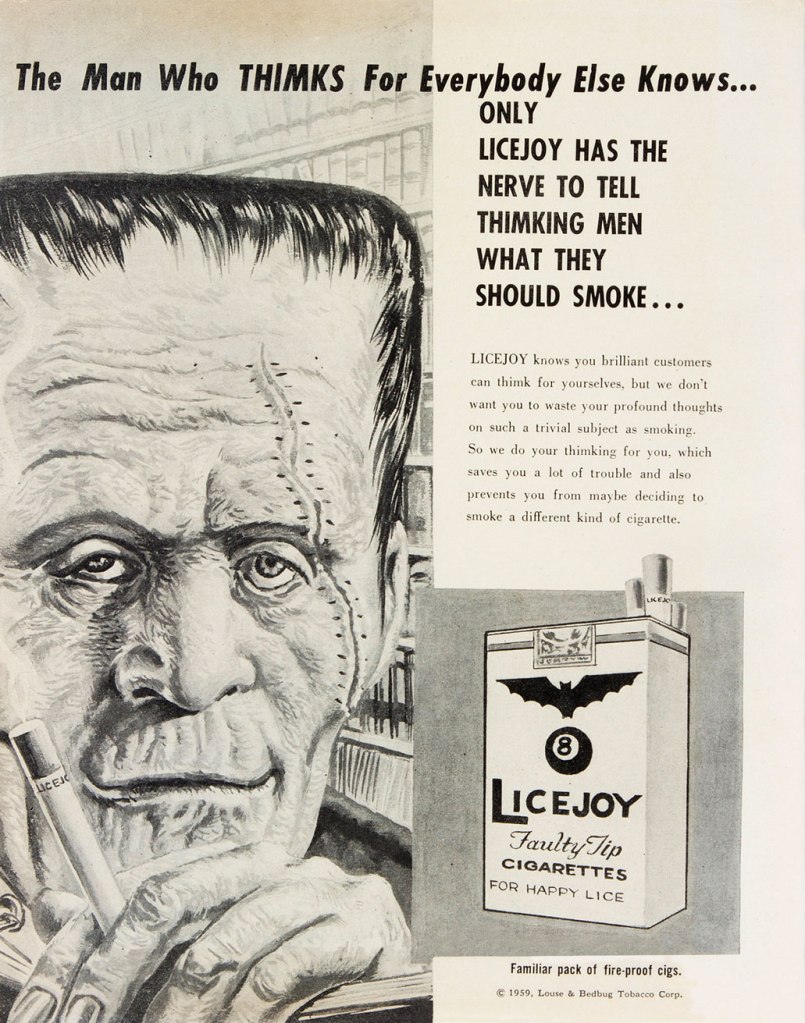
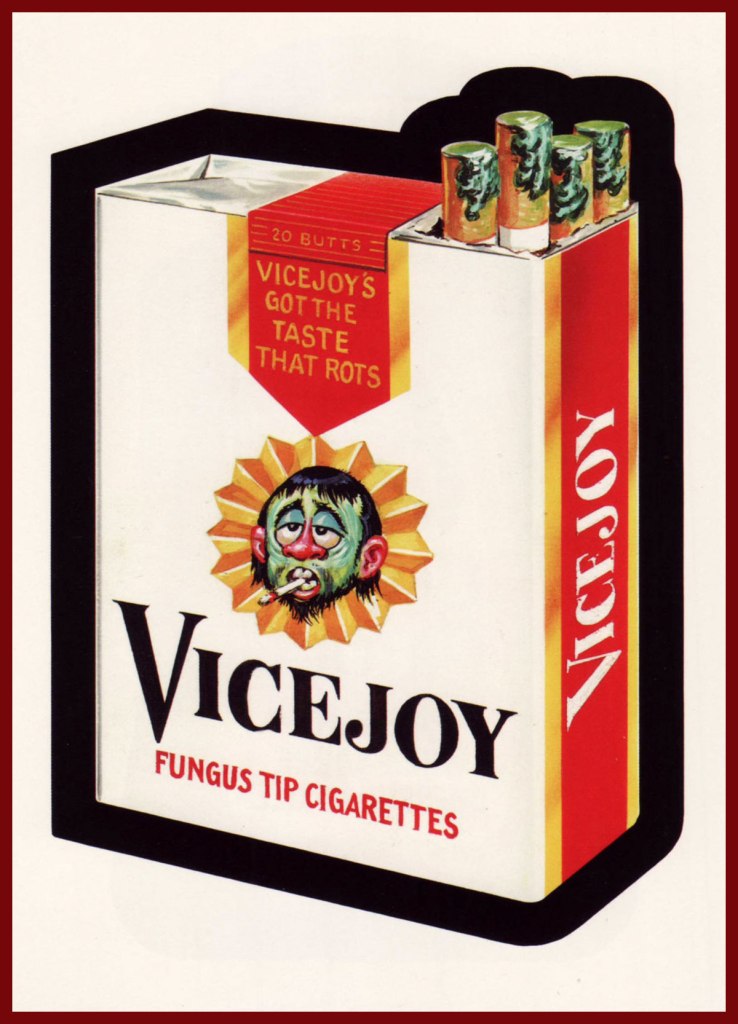
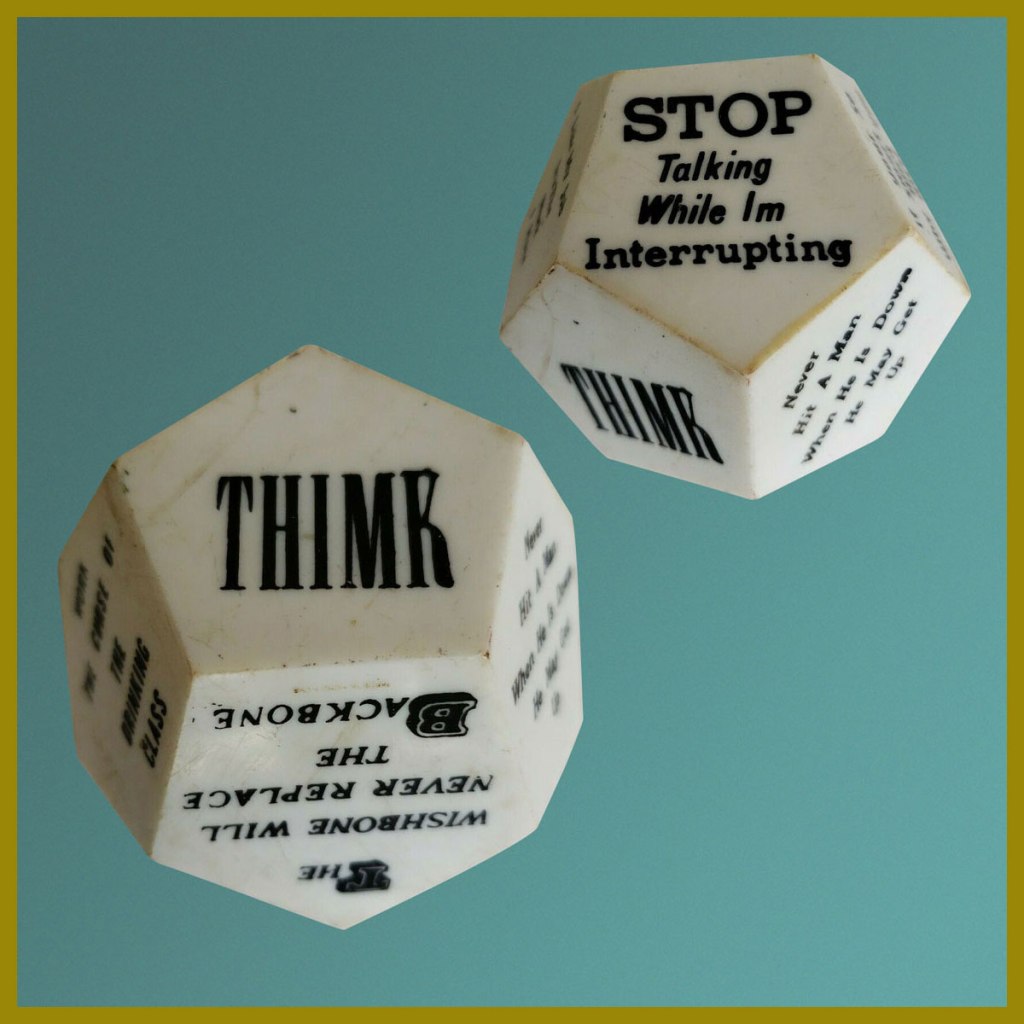
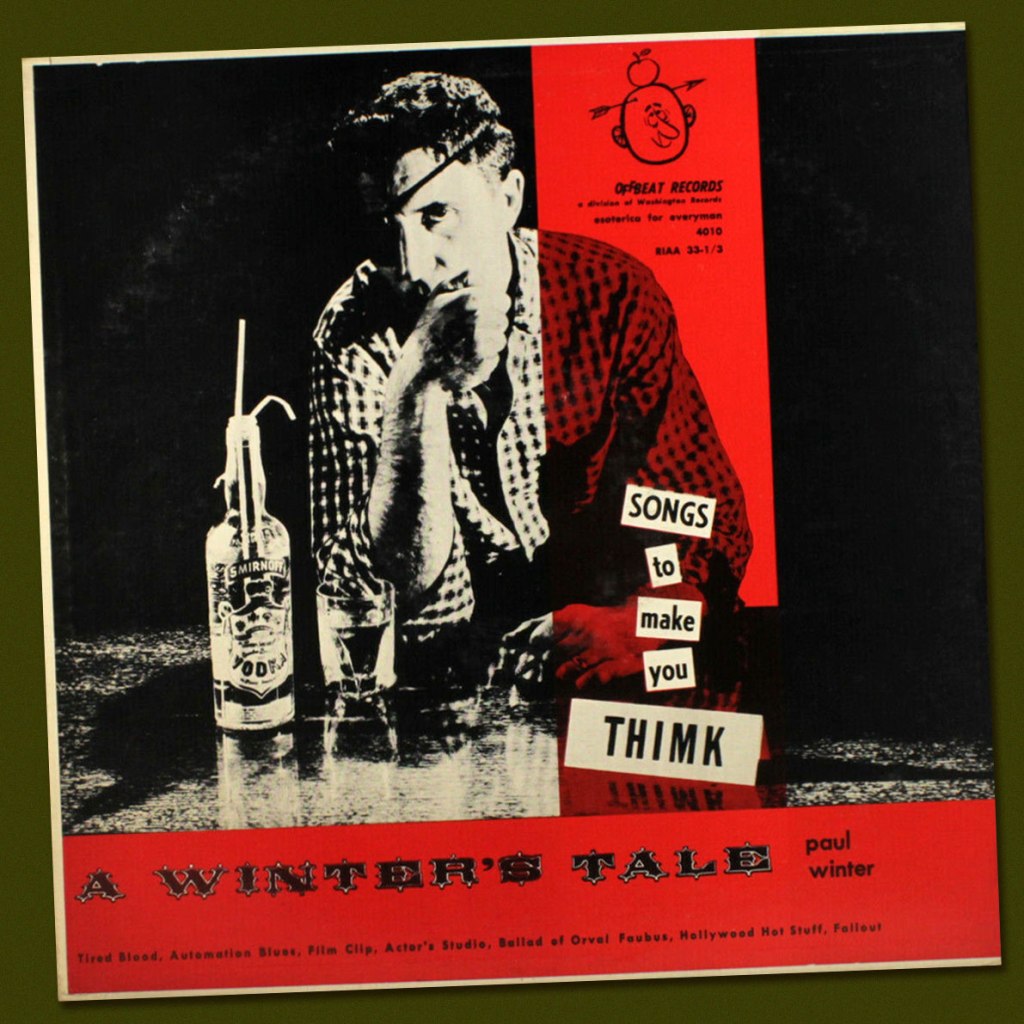
Thimk no. 5‘s back cover… a well-aimed barb at Viceroy Cigarettes.And some samples (there were many, many more!) from the object of parody, Viceroy’s The Man Who Thinks for Himself ad campaign. Lookit all them deep thinkers! (Martin Fry, cancer survivor, bottom left).And it wasn’t to be the last Viceroy parody, either: the brand was also an early Wacky Packages target. This entry hails from Series 1, featuring a rough concept by Art Spiegelman painted by Norman Saunders (1973, Topps). Heads up, Marlon… some… thing is about to cut in for a dance. Is his date dismayed or delighted? Last call: Thimk no. 6 (May 1959, Counterpoint) was the final issue. Cover art, again, by Sam Hayle.From Think to Thimk in one easy step. What began as a ubiquitous IBM slogan soon, inevitably, led to parodic counterpunches.During the late 50s, it spread seemingly everywhere.Legendary Detroit DJ Paul Winter (station WXYZ) got in on the act early (1957). Here’s a sample, Fallout, featuring Charlie Byrd on guitar!And of course, the great Steve Ditko took the slogan to heart (and mind), famously making his own sign. I wonder where it is now.
«I think it’s safe to surmise that Mr. Church viewed his comics as his own private passion, and wanted to share them with no one. Is it any wonder that his heirs didn’t show any fondness for them? » — Charles ‘Chuck’ Rozanski
Let’s give a little love and a spooky cheer to the greatest comics collector of them all, Coloradoan Edgar Church (1888 – 1978), who also happened to be a pretty terrific illustrator. When he passed away, it turned out that his collection comprised a whopping 18 to 22 thousand comics books, mostly in the high grades. Ouch.
With that out of the way, let’s take a step back and admire some of the man’s halloween-themed illustrations over the years.
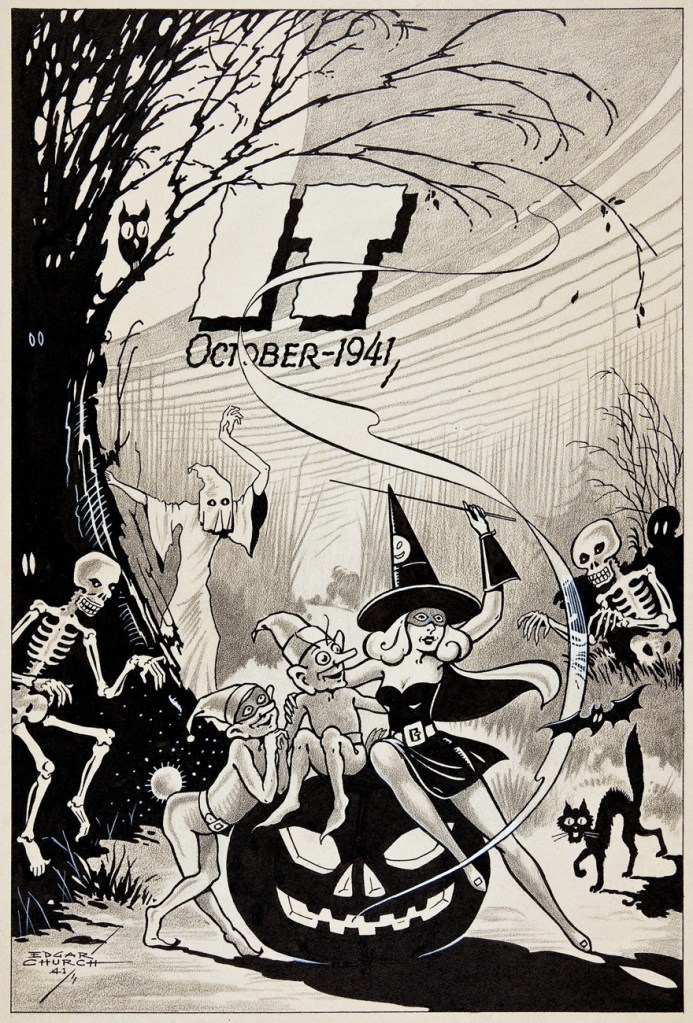
As it plainly states, this piece was created to commemorate 1941’s eeriest holiday. Isn’t “IT” a beauty?
Another IT peace from the same era, which I admit to colouring a bit, in what I like to consider good taste and restraint. « Not only was Church an important collector of first-generation comic books — he also ran a busy advertising-design studio in Denver and served as an illustrator for that city’s Smith-Brooks Printing Co. A marginal note identifies this splendid composition as an inside-back cover — likely for a Smith-Brooks magazine called It, to which Church was a frequent contributor. »
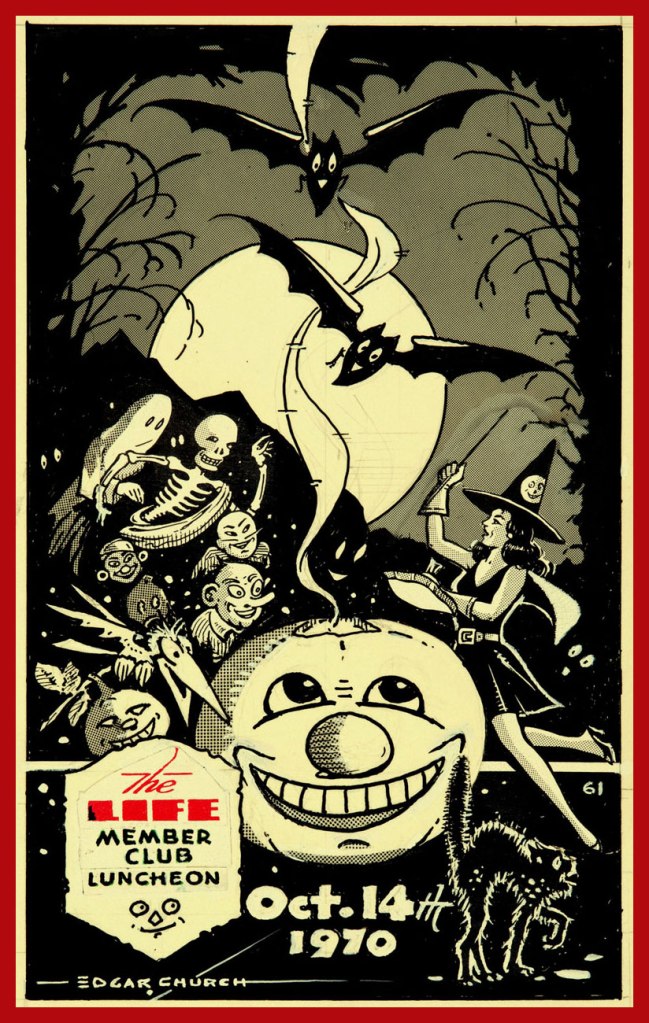
If those Life Member Luncheons were half a fun as Church’s ads made them seem, they must have been the highlight of Denver’s social season.
Featuring a wee bit of recycling, Church’s ad for the 1970 do. Interestingly, these shindigs were held on Wednesday nights, so they may not have been quite as debauched as one might have expected.






























 Who's Out There?