When Rosy Baffled the Kids

« I believe that the Belgians do possess some surrealistic gene. » — Eddy de Clercq

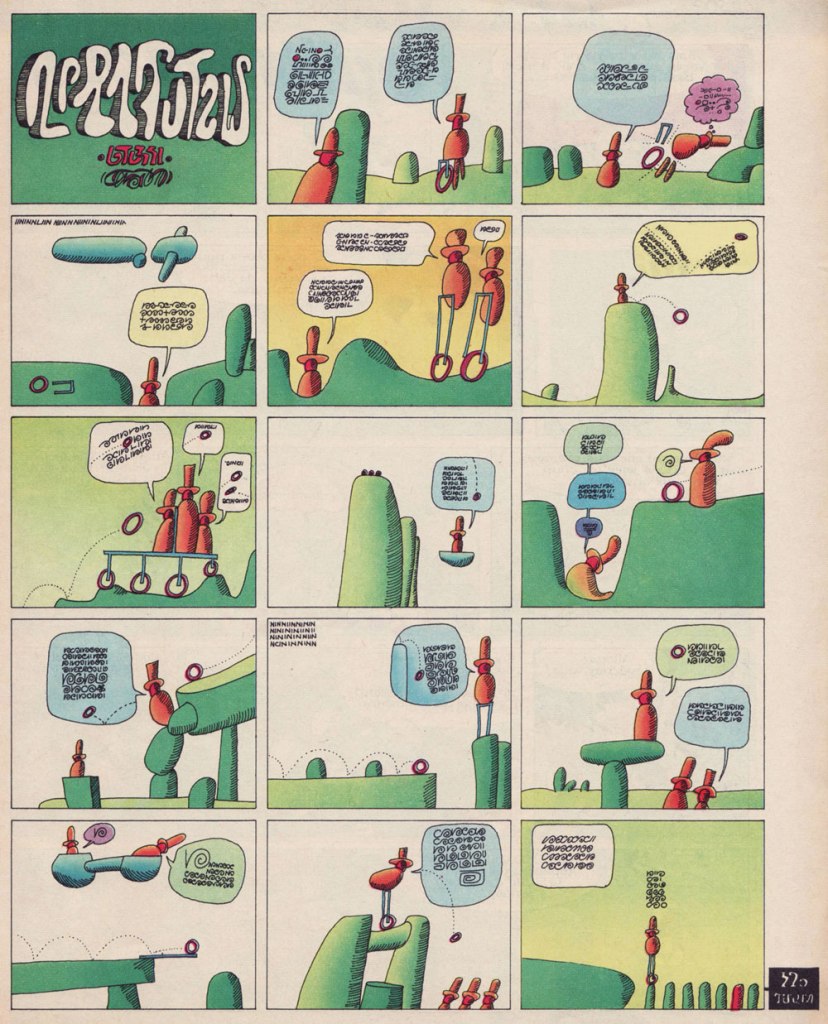
I’m afraid we’re back into surrealism territory, folks. Our focus today is on a single piece by polymath Maurice Rosy (1927-2013, Fontaine-l’Évêque, Belgium), published in bédé weekly Spirou in 1966, in the midst of Rosy’s tenure as the magazine’s co-art director (with Yvan Delporte) and boundless idea generator (1956-73, for the record… the period widely hailed as Spirou’s golden age).

As for the story in question… it was, shall we say, ahead of its time. And still is.

Nonetheless, its value was recognized almost immediately (less than one year on, for the record) by connaisseurs Jacques Sternberg, Michael Caen (co-founder of the epochal Midi-minuit fantastique) and Jacques Lob‘s essential Les trésors de la bande dessinée (1967, Éditions Planète), wherein they wrote:

Intrigued by oriental philosophies and General Semantics*, jazz pianist in the modern idiom, art director of the publishing house that produces Spirou, hilarious storyteller, Rosy has had drawings published in Paris-Match and Adam, all the while crafting (with Pol Deliège) tales of Bobo. He is also the author of the most bizarre story ever to appear in a kids’ magazine, which earned its publisher and author an especially venomous stream of insulting letters. Geniuses are always unsung.

Rosy has the sharp smile of a Steve McQueen and a picturesque language all his own.

You be the judge, He looked winningly impish, all right!

And now, the item in question:

From the next page over, a detail from more typical fare, namely Peyo’s La Schtroumpfette. Rosy, art director to the hilt, had opted to further mess with the readers’ minds by tampering with the magazine’s standard À suivre (to be continued) box.

When Rosy was interviewed for a deluxe, 16-volume reprinting (begun in 2007) of the adventures of Tif et Tondu (with Will as illustrator, Rosy served as writer/metteur en scène on the feature for many of its glory years, 1954-67), the notorious one-shot was touched upon:

In 1966, you created a strip with an unreadable, and therefore unpronounceable name, which even made it onto the magazine’s cover: are we deep into Herriman* territory?

Rosy: That’s weird, people say that, but at the time, there was no such conscious homage. It was rather a reflection of the state of mind that I was in. I was increasingly bearing the marks of (and anguished by) the absurdity of certain facets of life.
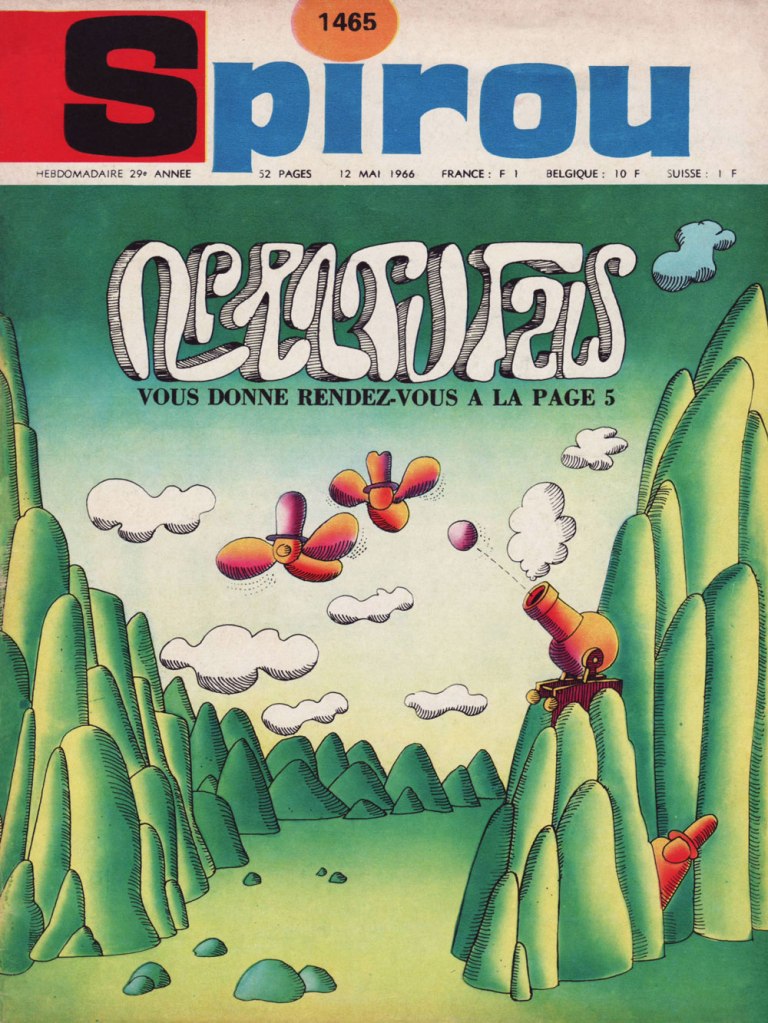
«… awaits you on page 5. » Rosy’s cover for Spirou no. 1465 (May 12, 1966, Éditions Dupuis).

-RG

*Philosopher Alfred Korzybski‘s General Semantics, that is; most famous for its premise that « the map is not the territory ».

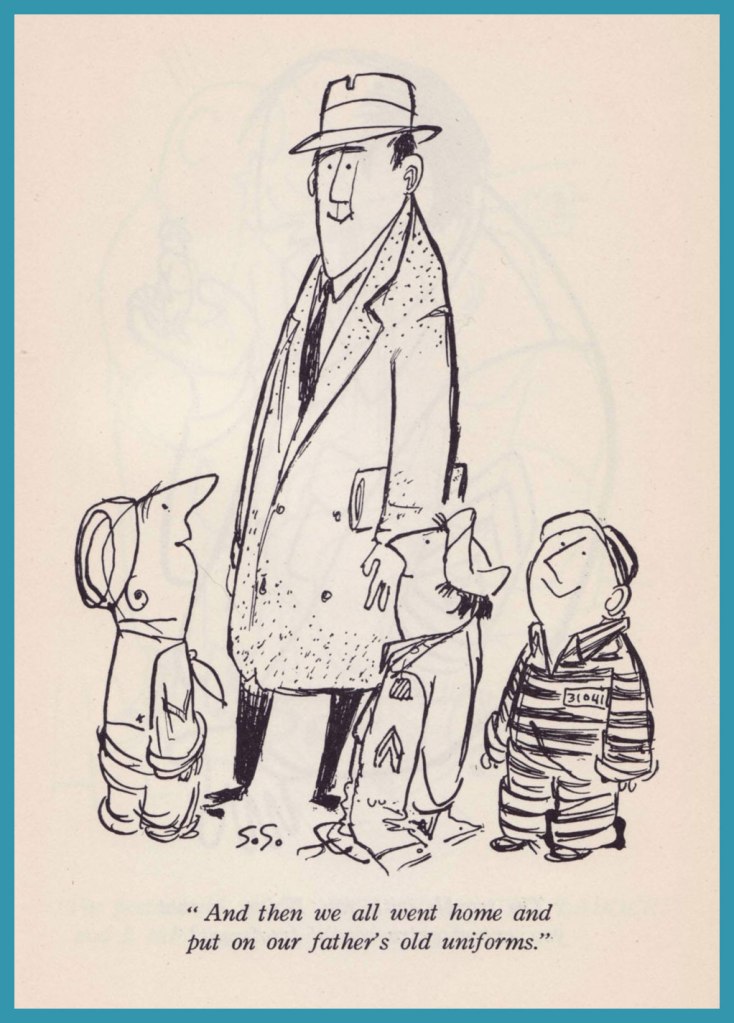
**In the same way that people with an insufficient frame of reference wrongly compare every musician they hear to The Beatles, the under-informed tend to ascribe any sign of whimsy or absurdity in the comics medium to Krazy Kat progenitor George Herriman. Yes, both were deeply influential, but come on, there are limits. In Rosy’s case, I’d posit that, if there was influence at work there, it was more likely that of the mighty Saul Steinberg.

Treasured Stories: “Smalltown Stardom” (1999)

« I’m going down to the Dew Drop Inn / See if I can drink enough / There ain’t much to country living: sweat, piss, jizz and blood » — Warren Zevon, Play It All Night Long

Kevin Nowlan (b. 1958, Chandron, NE) is one of those artists whose style I’ve always admired, and I’m far from alone in this sentiment. However, when it comes to what I think he should be applying his tremendous talent to, I’m squarely in the minority. Most people would evidently have him drawing Batman or the X-Men or other spandex fanboy favourites… but I feel there’s far more to him. He’s too good for the mainstream comics industry as it exists.

Always a meticulous artist he’s slow as (anti-gravity?) molasses in February, but while that’s led to a relatively modest body of work, it’s all solid. Even early in his career, his path was set, as evidenced by this bit of biography that appeared along with the opening instalment of his short-lived fantasy series, Grimwood’s Daughter (written by Jan Strnad) in Dalgoda no. 2 (Dec. 1984, Fantagraphics):

He discovered that working as gun-for-hire, illustrating scripts for which he had no respect, turning out more art than he could comfortably (and conscientiously) handle, and being forced by publishing schedules to allow as four artists to ink a single story, was artistically debasing and depersonalizing.

Like other creators (say, Adam Hughes and Frank Frazetta, for instance) of the popular but leisurely persuasion, he’s got imitators that can produce at five times his rate of speed. Good; let them take care of the superhero stuff.
Nowlan’s always possessed a sure hand with wry understatement, but he’s not a writer, and that’s a thorny problem when lacking a reliable accomplice to handle that part of the equation. So Nowlan’s done more than his share of covers, pinups and inking jobs.

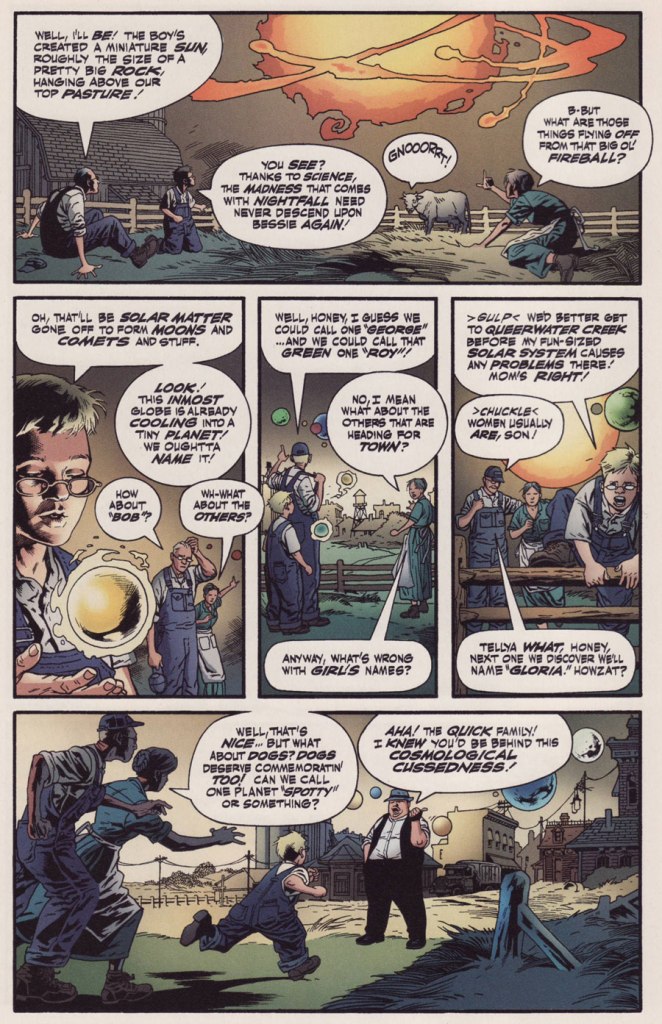
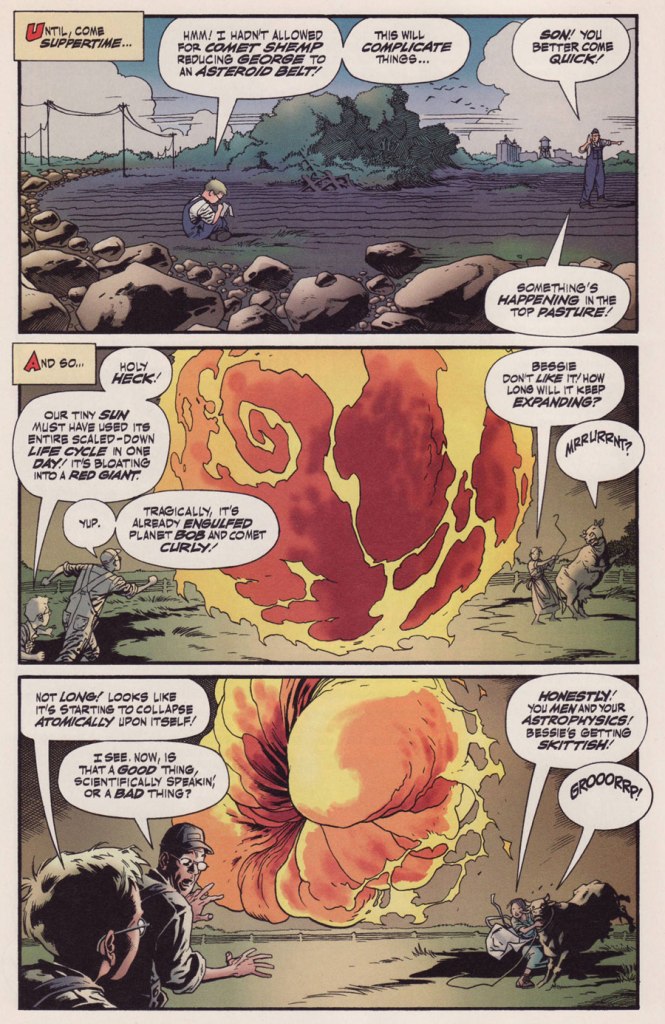
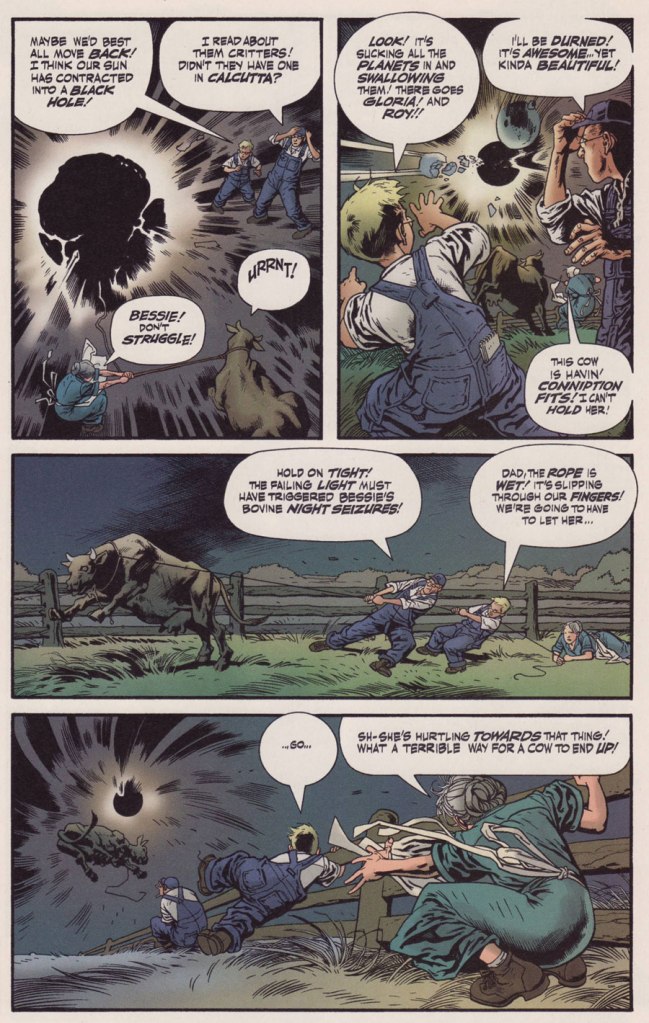
Ah, but then along came Alan, whom you’ve all met. That hirsute prankster from Northampton understood. He had in his mind’s eye just what Mr. Nowlan needed to truly stretch out and shine, the absurd deeds of Jack B. Quick, Boy Inventor.

JBQ was supposed to be one of a quartet of regular features appearing in the Moore-scripted anthology title Tomorrow Stories, but Nowlan didn’t last long on a schedule, and there are but a handful of JBQ tales, all excellent, capped by the fitting double-length finale, I, Robert. (Tomorrow Stories Special no. 1, Jan. 2006). The feature was (for the most part) replaced by an unfunny waste of Hilary Barta‘s talent, a woeful would-be Plastic Man ersatz, Splash Brannigan. Alan Moore can wring humour out of nearly anything, but as Splash and (even worse) The First American show, superhero parodies are his Waterloo.

JBQ, on the other hand, provides values rarely encountered, let alone appreciated, in mainstream American comics: deadpan, understated humour, surreal but non-cloying whimsy, and a rigorous, steadfast adherence to the mechanics of internal logic, no matter how outlandish things get. In prose, one might chance upon that sort of approach in the works of Marcel Aymé or R.A. Lafferty. But even there, it’s hardly routine. Oh, and given that it’s Alan Moore we’re dealing with, it’s a huge bonus that the JBQ stories are quite rape-free!

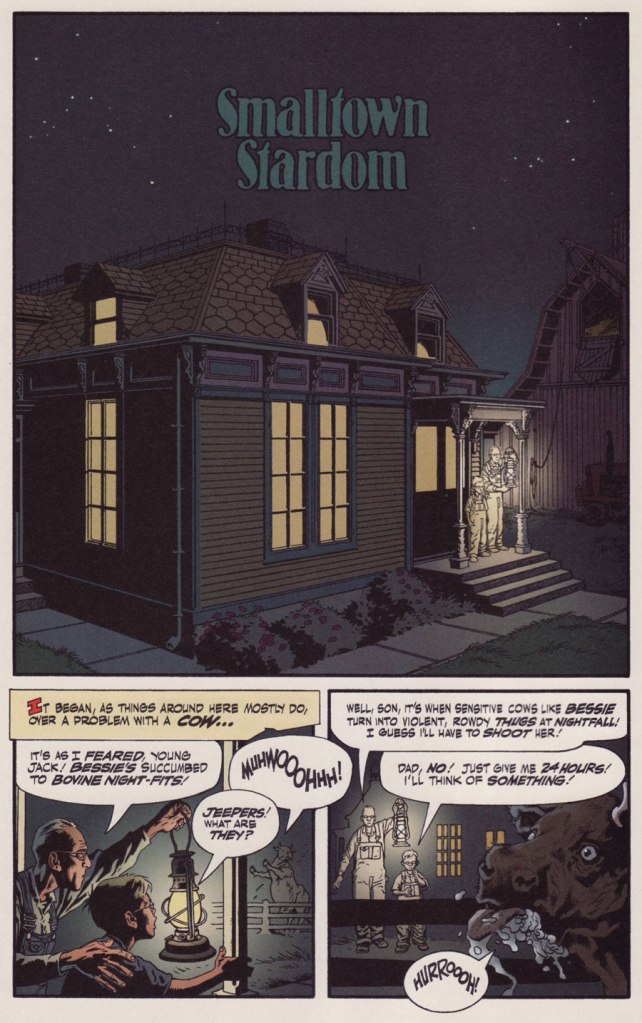
But let’s commence from the top, with the dizzying tale of Smalltown Stardom (Tomorrow Stories no. 1, Oct. 1999, America’s Best Comics). No need to shove, there’s plenty of room at the trough!

Find out more about the infamous Black Hole of Calcutta!

Is it just me, or can you also picture Thomas Dolby as a grown-up Jack?

-RG

Behold… the Great Shnozzola!

« That’s the conditions that prevail! » — Jimmy Durante

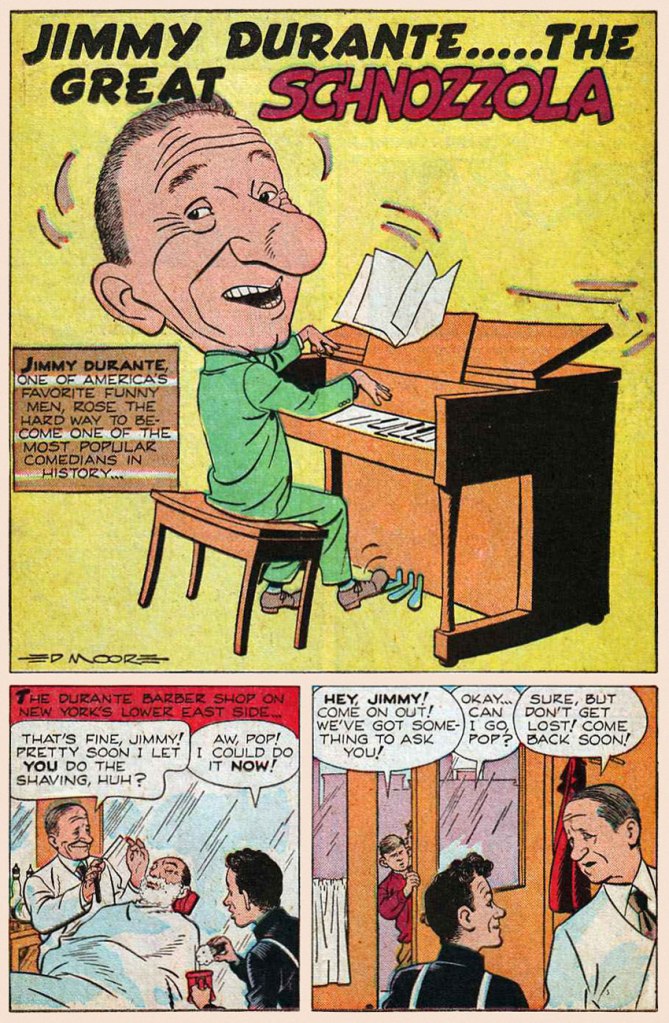
Today, we salute noted vaudevillian, piano player, comedian, singer, film and radio star, raconteur and unlikely comics legend James Francis “Jimmy” Durante, born on this day, February 10, in 1893 (as it was a Friday, the family presumably fasted or had fish for dinner). He truly was a master of all media, as you’ll witness.

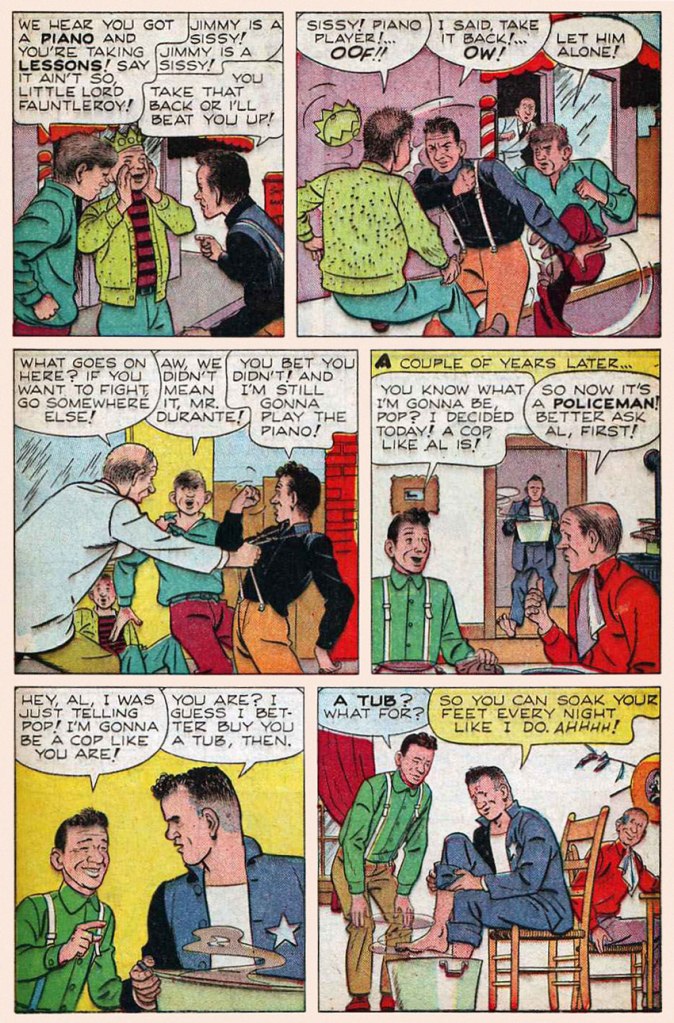
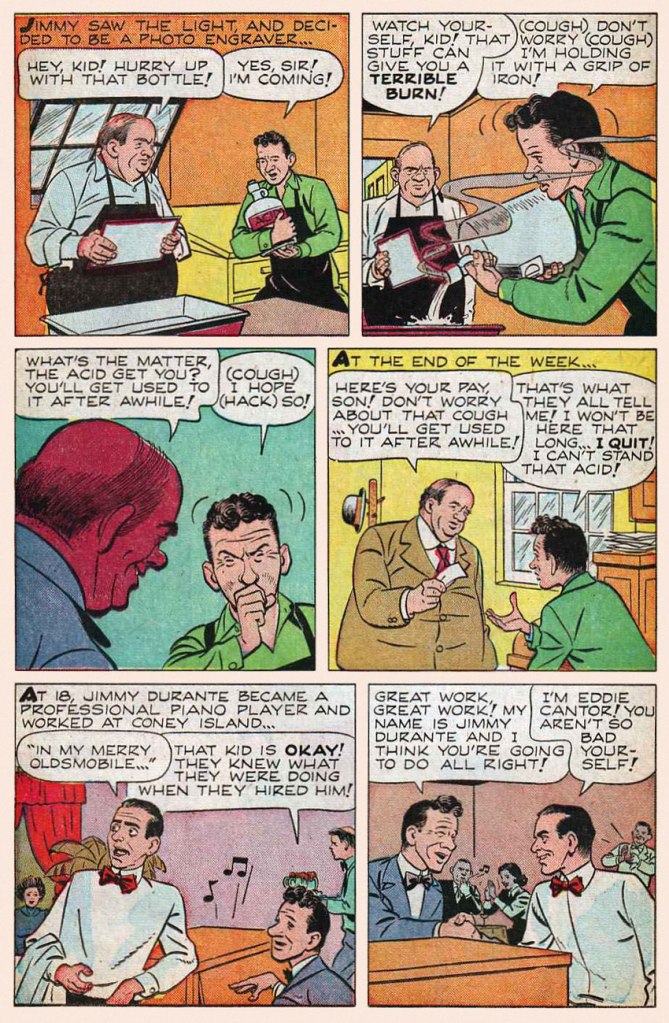
This early bit of biography appeared in Juke Box Comics no. 4 (Sept. 1948, Eastern Color); it was illustrated by Ed Moore. Hear Cantor and Durante reminisce about their early days on this 1947 episode of The Jimmy Durante Show.
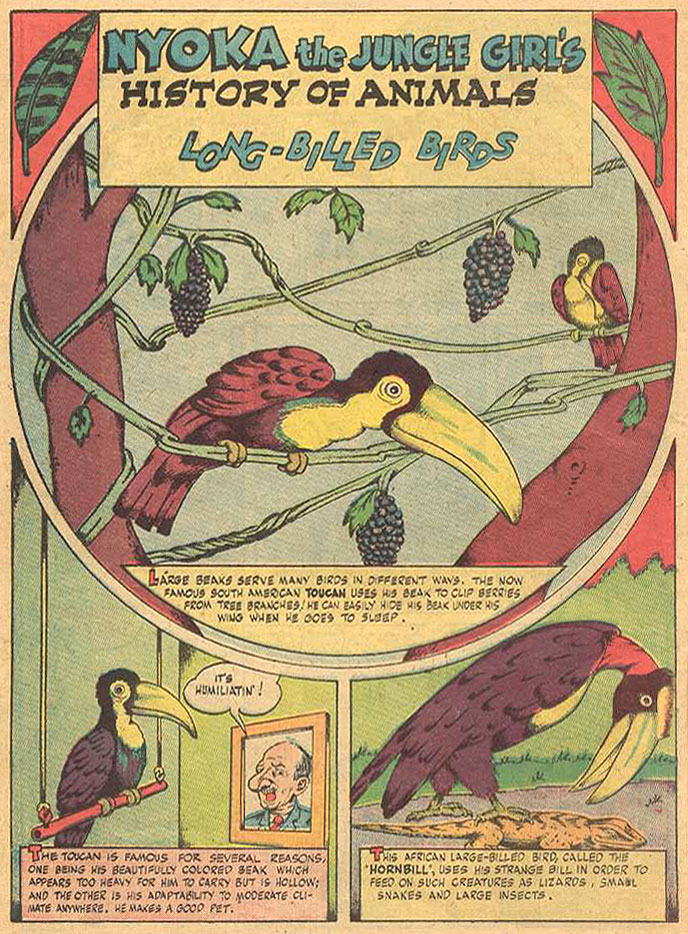
A passing mention of old Jimmy, from Nyoka the Jungle Girl no. 24 (Oct. 1948, Fawcett). Writer and artist unknown.
An early cover by Dick Ayers (1924-2014), this is Jimmy Durante Comics no. 1 (Oct. 1948, Magazine Enterprises).
The second and final issue of Jimmy Durante Comics (Winter 1948-49, Magazine Enterprises).
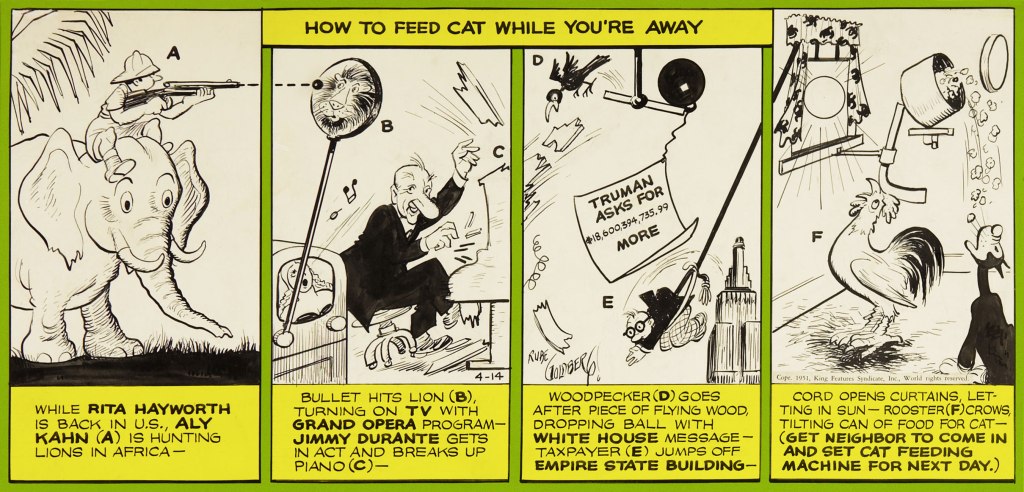
Mr. Durante rates a smashing musical appearance in this Rube Goldberg Device daily strip (Apr. 14, 1951, King Features Syndicate)… by Rube Goldberg, naturally.
And here’s the Shnozzola in the midst of a carnal melée of his fellow Old Hollywood legends (can you name them all, cinephiles?) This is Bill Griffith‘s cover for The Tiajuana Bible Revival Volume Two: Under the Stars in Hollywood (1977, Hooker, California: Paramounds Prod.). This was « An anthology reprinting 1930’s Tijuana Bibles, some of which were obscene parodies of popular newspaper comic strips of the day. Others made use of characters based on popular movie stars and sports stars of the day, such as Mae West and Joe Louis, sometimes with names thinly changed. Before the war, almost all the stories were humorous and frequently were cartoon versions of well-known dirty jokes that had been making the rounds for decades. » [ source ]
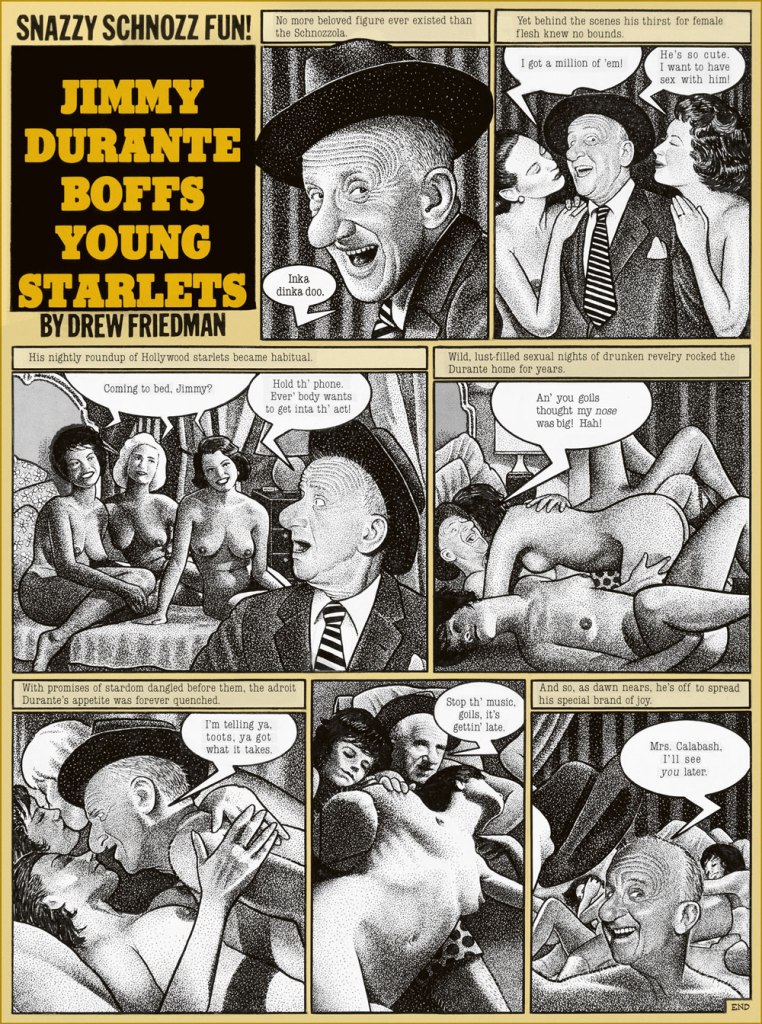
Pointillist-satirist Drew Friedman‘s immortal Jimmy Durante Boffs Young Starlets first saw print in National Lampoon vol. 2 no. 78 (Jan. 1985).
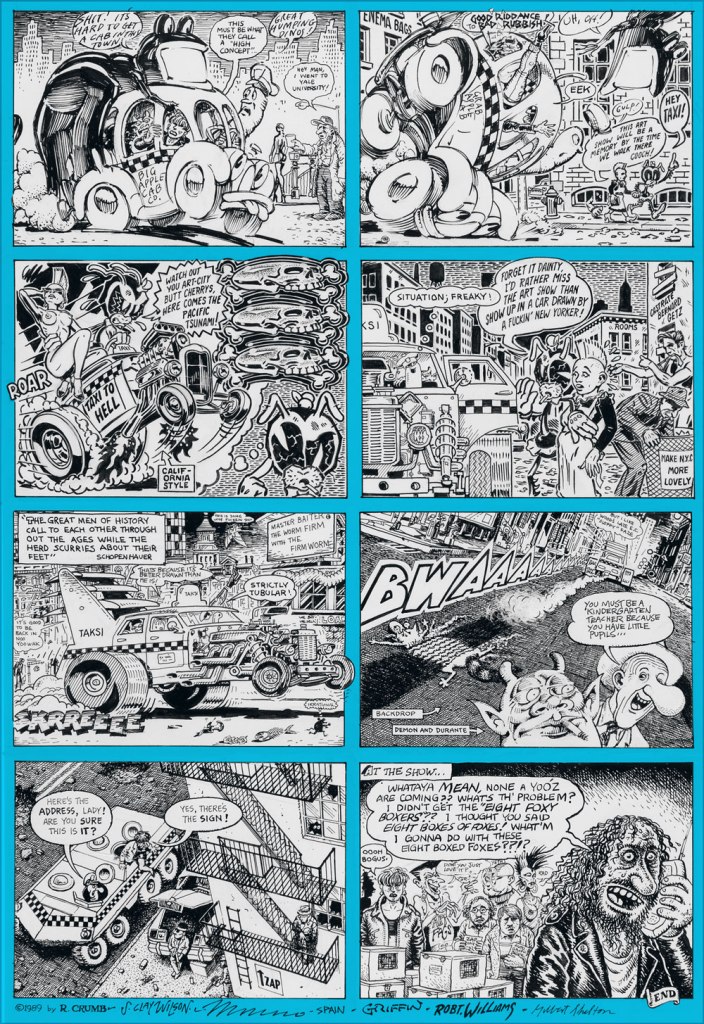
Durante briefly pops up (with the Checkered Demon!) in the second half of a truly all-star underground comix jam involving R. Crumb, Steve Clay Wilson (1941-2021… he left us just three days ago, aged 79… RIP), Victor Moscoso, Spain Rodriguez, Rick Griffin, Robert Williams and Gilbert Shelton. It appeared in Zap Comix no. 12 (1989, Last Gasp). Cartoonists are generally fond of the Schnozzola, but Underground cartoonists are just mad about him.
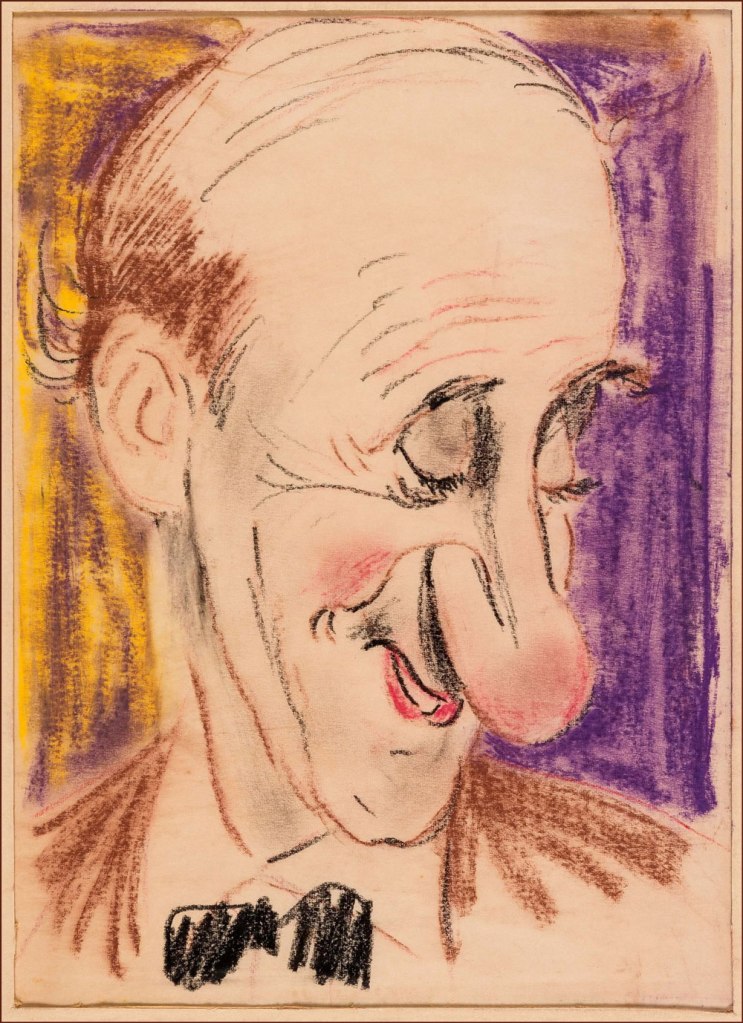
And finally, on a gentler note… here’s a clearly affectionate caricature (a preliminary sketch) of the esteemed Signor Durante (aw, he’s blushing!) by the amazing Sam Berman (crayon on onionskin paper, 1947). Berman (1907-1995) was, deservedly, quite a big deal in his day; as the erudite Drew Friedman told Print Magazine in his quality of co-curator of the 12 Legendary Caricaturists You’ve (probably) Never Heard Of exhibition at NYC’s Society of Illustrators, Berman « was indeed famous and celebrated in his day. Beginning his career in the late 1930s, he created iconic sculpted caricature covers for Esquire featuring their new mascot “Esky” (created by Berman) for an entire year. He created the sculpted caricatures of the leading actors (Fredric March, Carole Lombard, etc.) for the opening titles of the 1937 classic screwball comedy Nothing Sacred, did huge amounts of work for all the top magazines and newspapers of the day, including for Mark Hellinger’s popular column, created close to 60 amazing full-color portraits for the 1947 booklet The NBC Parade of Stars, drew children’s books, and arguably his most famous creation, the opening caricature of Jackie Gleason rising over Brooklyn for “The Honeymooners,” although he was never credited on the show for drawing that image, nor in any books. He then inexplicably went into map-making and faded quietly into obscurity. »

To wrap things up, here’s Jimmy D. and Frankie S. duetting in Russian. And why not? Happy birthday, Jimmy, wherever you are (and do say hello to Mrs. Calabash!)

-RG

A Secret, Silken World: Max Andersson’s “Lolita’s Adventures” (1995)

« Most of us will still take nihilism over neanderthalism. » — David Foster Wallace

It’s become so quiet” “Yes“; from Galago no. 40 (1994, Atlantic Förlags AB)

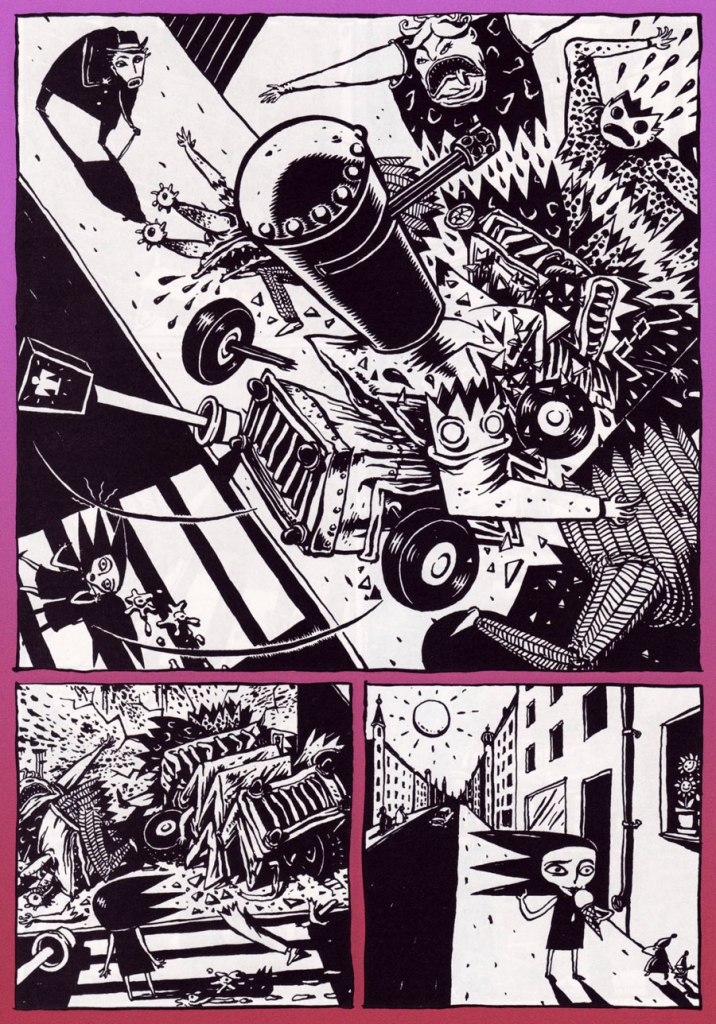
Today, let’s dip a toe (at the risk of losing it) into the midnight domain of Swedish cartoonist and filmmaker Max Andersson (b. 1962). It’s a relentlessly-perilous scene, but like Kaz’s Underworld comic strip or Arnt Jensen‘s Limbo video game, I find it unexpectedly comforting in spite of (and thanks to) all the darkness, both thematic and in density of ink. In Andersson’s case, might it be owing to the author’s kindness to his protagonists? That’s a factor with odds I rather favour.

I don’t doubt that certain readers of a more sensitive cast will differ, but I posit that the cheerful lack of clemency the artist affords the callous, the cruel and the pernicious makes Andersson’s universe a profoundly moral one. Contrary to, say, your average American action blockbuster, such a purge of the villainous doesn’t restore the status quo… because here, malevolence is the status quo. Andersson’s put-upon little people are true outsiders, and his stories feel like Kafka, but blessed with dénouements far merrier yet merited.

Jolly carnage! Lolita’s Adventures appeared in the third issue (July, 1995) of Fantagraphics’ outstanding anthology title Zero Zero (27 issues, 1995-2000).

See? A happy ending and all, and even a rare glimpse of daylight.

Soon after he began to publish his work, Gary Groth spoke with Andersson (The Comics Journal no. 174 (Feb. 1995, Fantagraphics):

Groth: What would you point to as your defining influences? How did you develop this approach, style and point of view?

Andersson: What I always have in my backbone is the style of classic comics, the stuff I read when I was a kid.

G: I don’t see much Tintin.

A: No, but it’s there if you look closely. The basic technique of how to tell a story well. I try to do that because I want the storytelling to work, to be easy to read.

G: Were you influenced by sources outside of comics — film, literature?

A: Yeah, more of those than comics. The German Expressionist movies of the ’20s, Nosferatu; and artists from the period, like George Grosz.

And don’t leave out old cartoons! Andersson’s thoroughly animist way dovetails neatly with early animation’s unhinged, anything-can-happen mode. By which I mean that anything and everything possessed motion and sentience, be they boulders or pebbles, thunderclouds, petals or creepers, sparks or flames, pantaloons or braces, blunderbusses or bassoons…

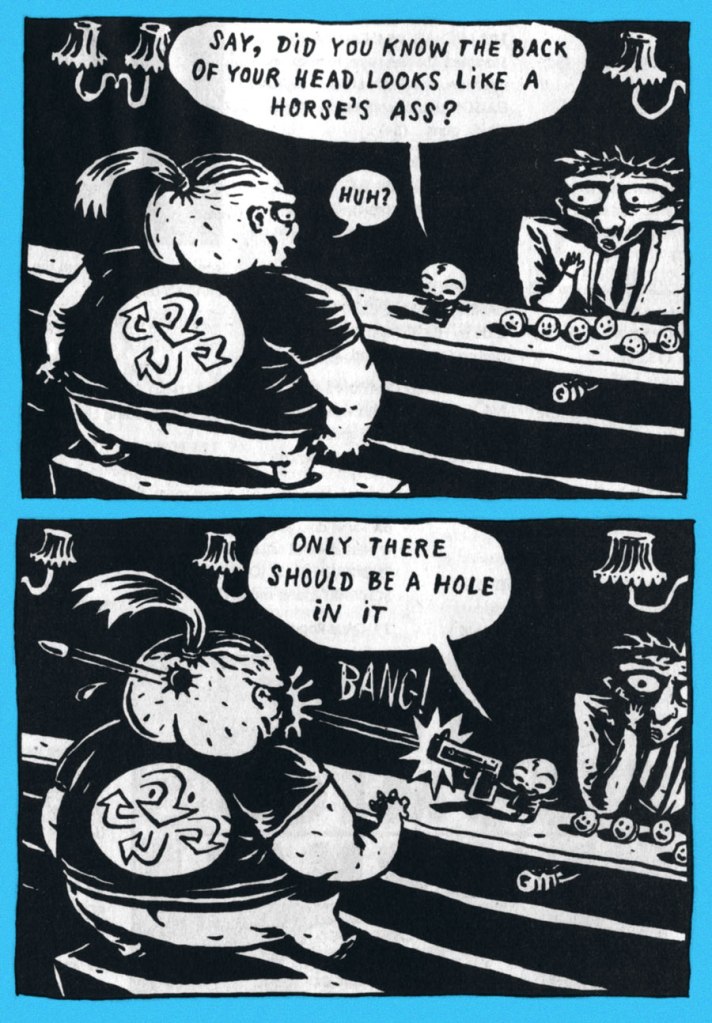
As a bonus, a sequence from Andersson’s breakthrough work, Pixy (1993). The title character is the fœtus with a pistol, and the happy little fellows on the counter are units of money. Highly recommended, and likely available in the language of your choice.

About Pixy, fellow dweller-in-darkness Charles Burns exulted: « So you think it’s a cold, creepy, world out there, huh? Hah! Just wait’ll you get a load of Max Andersson’s Pixy… safe sex suits, buildings that eat people, drunken fœtuses with bazookas, money that shits on you, recyclable bodies… hey, wait a minute, that’s not creepy, that’s fun. MY kind of fun. »

For more dope on this important creator’s endeavours, do sidle over to his official website!

-RG

Take Ten With Shel Silverstein

« Join the army and see the next world. » — Dylan Thomas

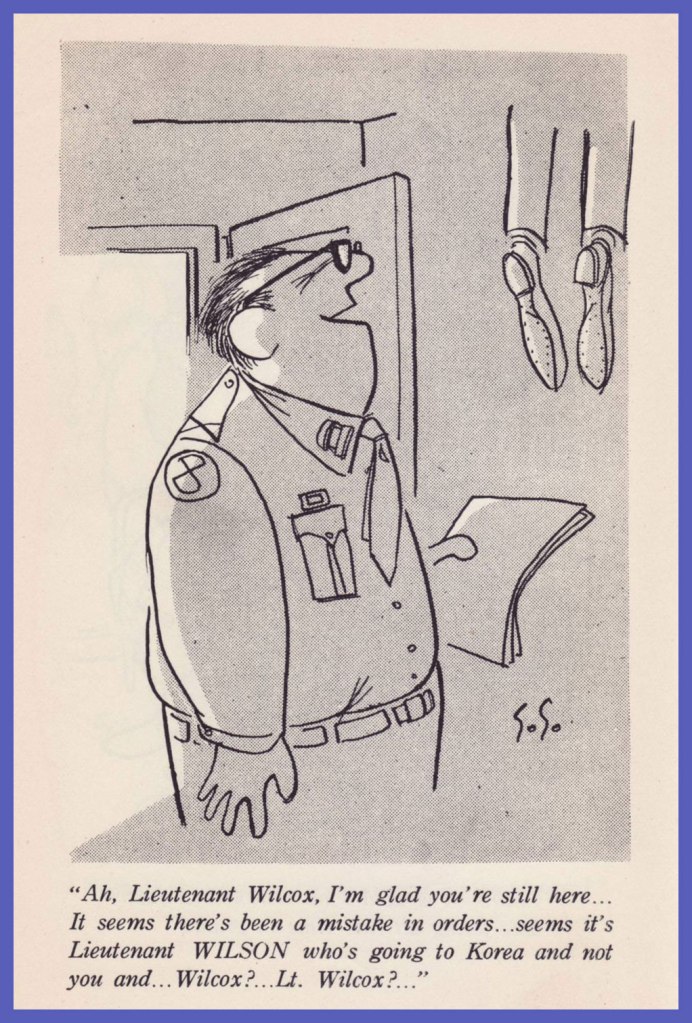
A couple of eternities ago, in Shel Silverstein: Without Borders, we profiled you-know-who and showcased the travel cartoons he produced for Hugh Hefner and Playboy Magazine. Now, we reach back even earlier, to his first stirrings as a professional cartoonist… and a lifelong rover. As it would turn out, Shel truly was a free spirit.

A little bit of biography to set the stage… circa 1955. I can just about hear him, in that distinctive voice of his, hawking hot dogs at Comiskey Park!
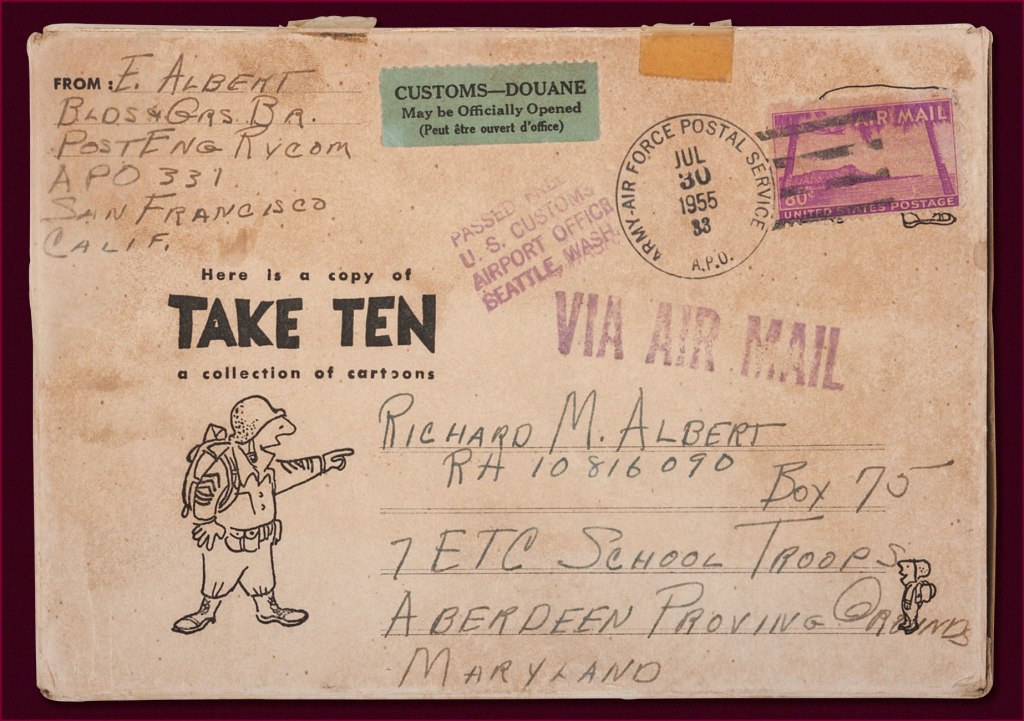
« In 1955, Stars and Stripes published Take Ten, a book collection of his cartoons that was sold through military PXs et commissaries. » And also by mail!
« Here they are… the Centaurs and Bird men… the Geniis and Cobras… the fifteen-foot PFC’s and two-inch E-1’s. Here is TAKE TEN, the first collection of Shel Silverstein’s cartoons, taken from Pacific Stars and Stripes, Army Times and his untapped top drawer. Here is a pocket-full of cartoons that will make you smile and chuckle and laugh out loud. »

Lisa Rogak writes, in her A Boy Named Shel (2007, St. Martin’s Press):

Once he arrived in Tokyo, Shel was assigned to the Pacific Stars and Stripes to past up stories and photo features for the paper. When his work was done — which he performed as quickly as possible — he turned his attention to drawing cartoons using the material that was right in front of him: the military. Shel roamed the streets of Shinbashi, a neighborhood that GIs frequented that once served as the end of the line of Japan’s first railroad. He spent hours each day wandering the streets taking note of the activities of his fellow soldiers, which would invariably end up in one of his cartoons.

He initially did it for his own amusement, through within a few weeks, the paper began to print his work. After spending six months juggling newspaper paste-up with cartooning, he convinced his editors to take him off layout duties and allow him to wander the Far East and send back reports in the form of one-panel cartoons. They agreed.

Evidently, Mrs. Silverstein’s boy was a most charming and persuasive fellow. He would soon pull the same stunt on Hugh Hefner… but none can claim, in either case, that he failed to deliver on his lofty promises!

Here’s a little bit of background on that famous old General, should you need it.
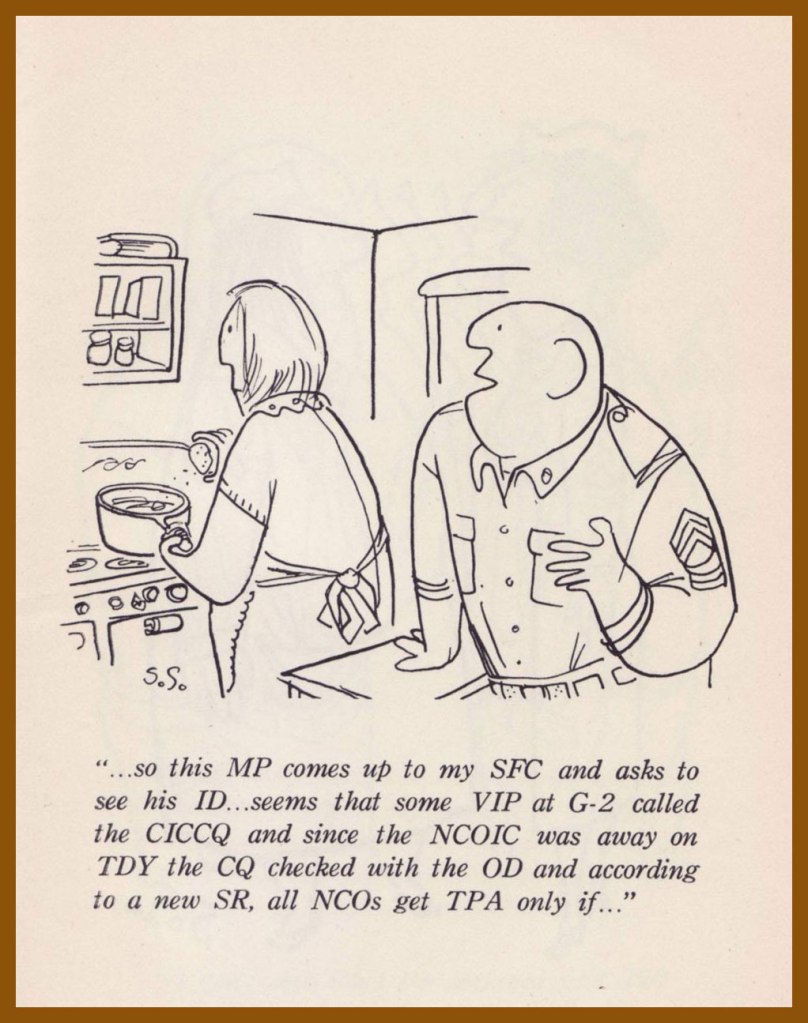
Here’s a helpful guide to US Military acronyms. Who knows, it might spare you some confusion one day.

Even with his freedom, Shel had a hard time dealing with the restraints of army protocol. Corky Alexander, the late editor of the English language Tokyo Weekender, first met Shel at Stars and Stripes. “He was an army corporal and was perhaps the worst soldier in the history of armed might, down through the ages,” he said.

His technique followed a simple pattern. First he thought of an object — say, his first sergeant. He’d concentrate until he would come up with 20 or 30 gags on the one subject. Out of it came situations peopled by his long-nosed characters, his little men, his giants, the animals and the strange creatures for which he has a special affection.

His favorite overall targets were the officers. “They even made zebras off-limits to me because they had stripes,” Shel said.

Old habits die hard. An occupational hazard, you might say.
This, er.. pet might be an early prototype of Shel’s mythic Floobie Doobie Doo.
Now what is that?
It ain’t no dog and it ain’t no cat.
It’s nine feet tall with eyes of blue.
I never seen such a thing
As a thing called a Floobie Doobie Doo.
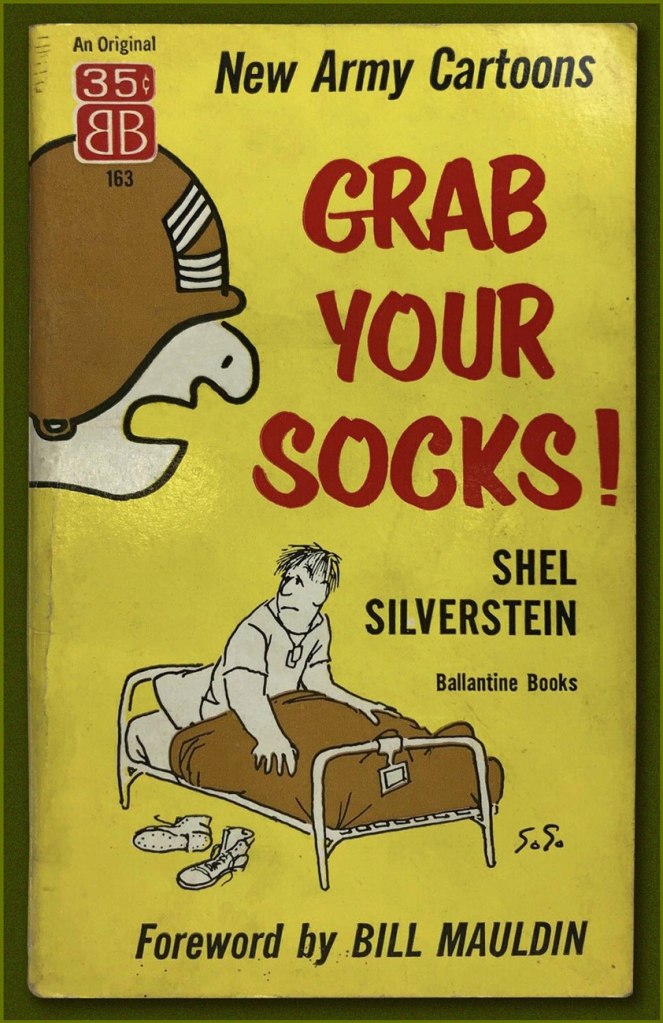
« Shel’s humor had struck such a nerve, and soldiers based in the Pacific shared his cartoons with their families and other civilians to show them what life in the military was really like, that a larger audience for his work was a natural consequence. In 1956, Ballantine Books published a thirty-five-cent mass market paperback edition of Take Ten called Grab Your Socks! »

In his foreword to Take Ten, Shel’s good buddy and PS&S colleague Bob Sweeney recounts:

In a letter to the home office, Bob Brown of the S&S Seoul Bureau wrote:
He stays up all night chewing pencils, drawing cartoons and writing ideas on little scraps of paper he never finds again. In the first twenty minutes he was here he had our little office more cluttered than the convention hall in his native Chicago.”

But,” added Brown, “he knows the people he draws. He’s lived through the same experiences and heard the same lines.

Here then are the simplicities as well as the subtleties — the obvious and the obtuse — the wonderful conglomerate of a man who loves to write, to draw, to create — and best of all — who loves to laugh.

-RG

Off to the Isle of Cats — and Back by Teatime!

« It’s no good trying to teach people who need to be taught. » — Aleister Crowley

You may have happened across our earlier post on that astounding but tragically short-lived touche-à-tout, Gerard Hoffnung (1925-59). Well, here’s a look at another facet of the man’s work, crafted this time in tandem with, of all people, the definitive-but ambivalent biographer of opprobrious occultist and Ozzy song subject Aleister Crowley, namely the intriguing John Symonds (1914-2006). Come to think of it, the affiliation makes impeccable sense, and it proceeds swimmingly.

In an era where it often seems that those rare adults who yet read do so at toddler-ish levels, it’s easy to forget how many so-called children’s books of yore had plenty to offer the refined adult mind. Here, then, are some highlights from Messrs. Hoffnung and Symonds’ 1955 opus, The Isle of Cats.

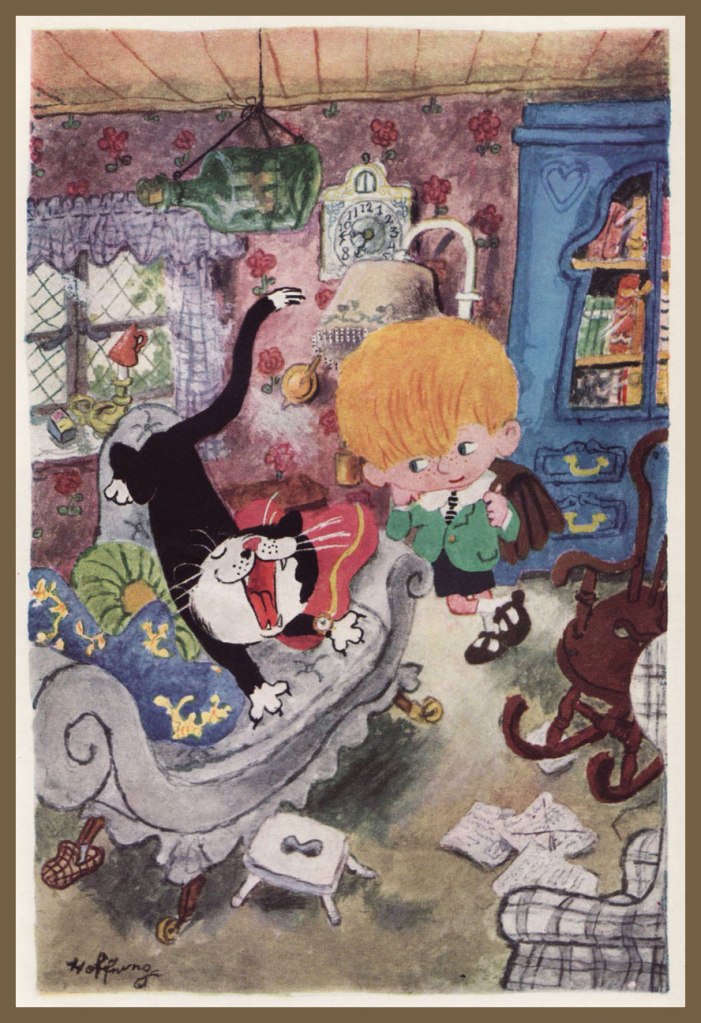
« He closed his eyes, yawned, arched his back and began to dig his claws in and out of the sofa. Uncle Tom was no ordinary cat, for he could tell the time, look through a telescope (keeping one paw over the other eye, of course), beat up an egg, steer a raft, smoke a pipe and do many other things. »
« He’s the Mayor, » whispered Uncle Tom to Gabby, « so be nice to him. »
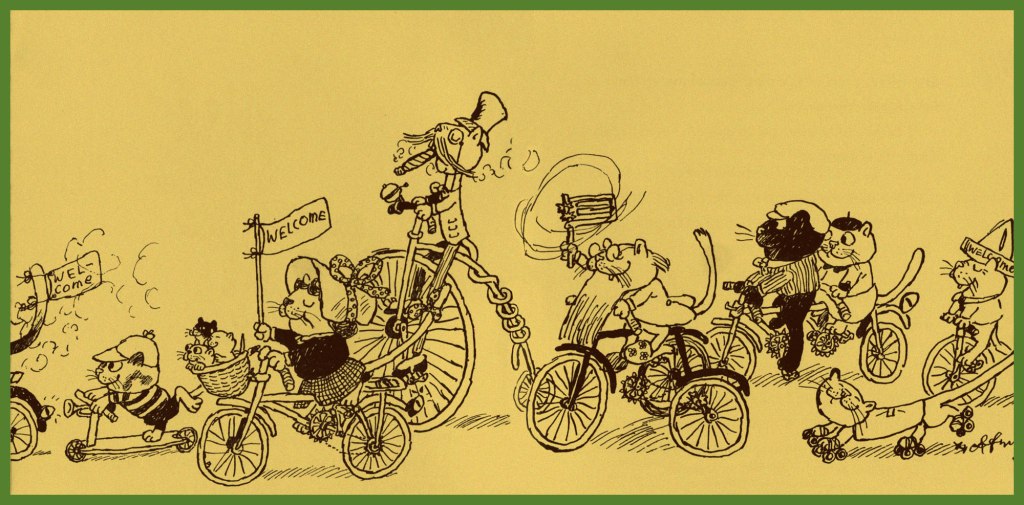
« He was still saying thank you as he and Uncle Tom were being driven away in the Mayor’s car, followed by various cats on bicycles, tricycles and penny-farthings. »
The wrestling bout pitting Tim the Terror (left) against The Furry Fury (right). Things end with a crash when Tim lets go.
« The Hall of Fame contained the portraits of the island’s most celebrated cats. »
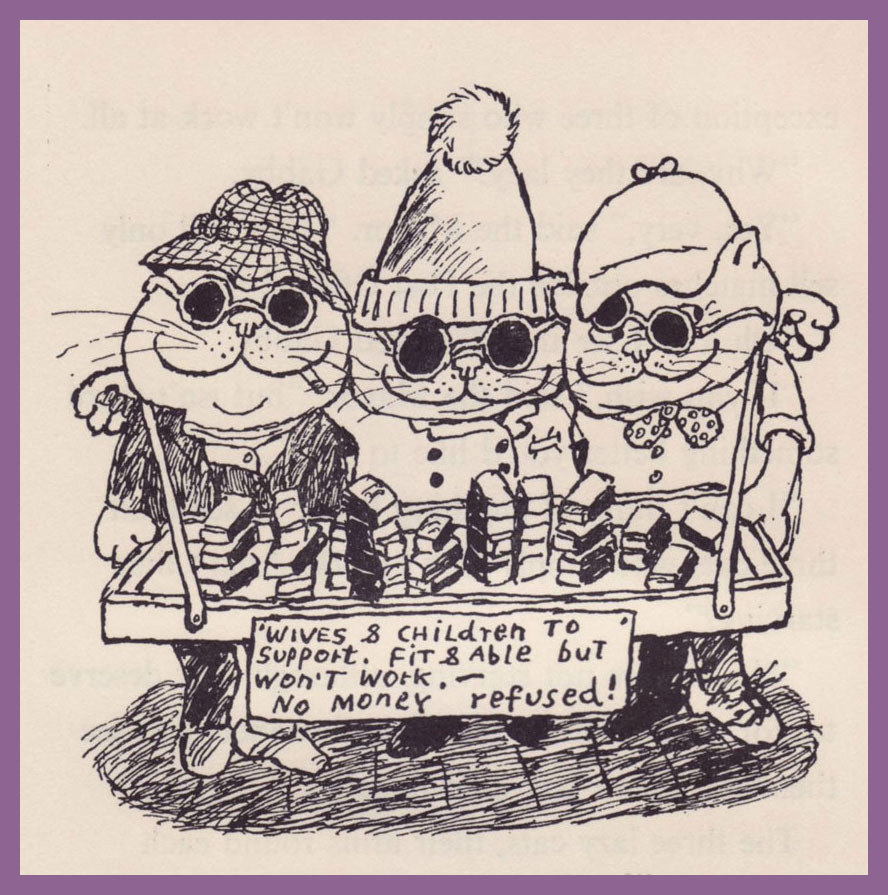
« There were portraits of lots of other famous cats, including Martha who had seven hundred and forty nine children, six hundred and eighty three of whom survived, and were now working hard as tram-drivers, crossing-sweepers, lamp-lighters, pastry-cooks and so forth, with the exception of three who simply won’t work at all. »
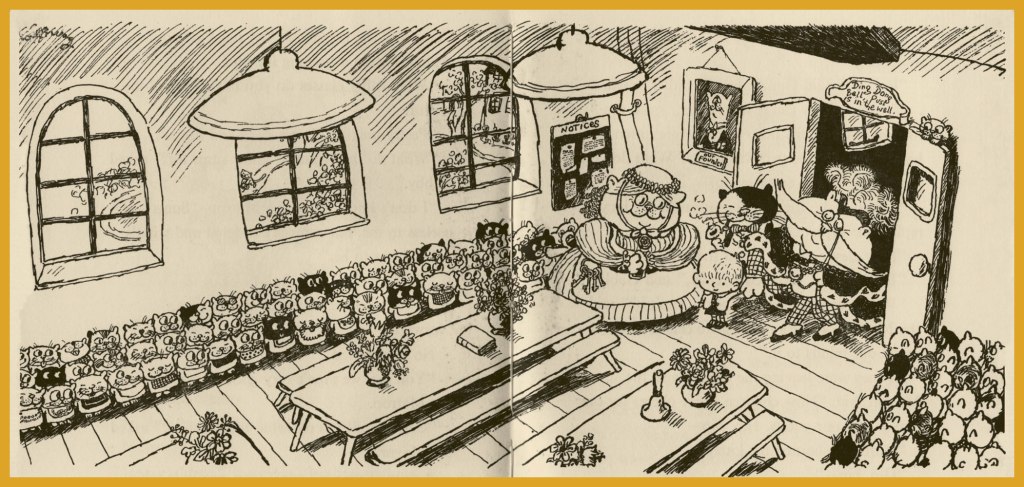
« At the Orphanage, all the kittens were lined up on either side of the Great Hall, looking as good as gold, their hankerchiefs sewn to their shirts, close enough to their noses to blow into them. »
« Just then they sailed over the madhouse and saw some cats standing on their heads, waving their legs in the air. »
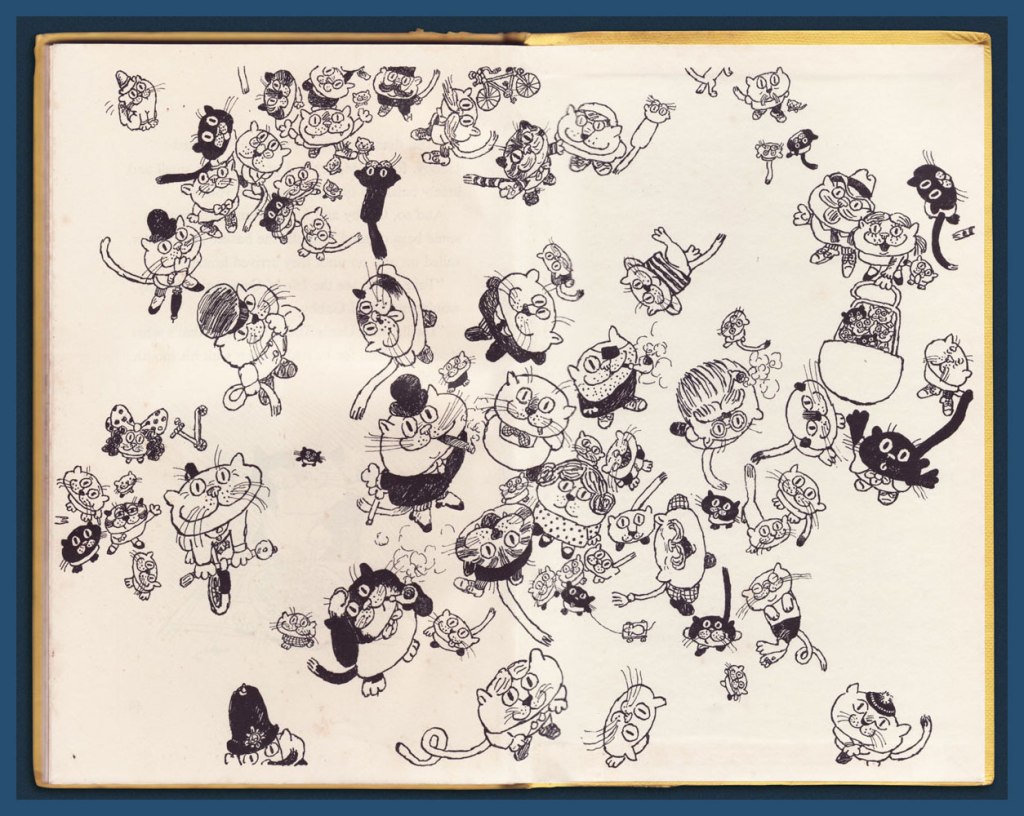
The book’s endpapers illustration, granting the reader a lofty view from the Mayor’s hot air (of course) balloon.

As a bonus, for the finale, here’s the poster Hoffnung was commissioned to illustrate for the classic, Brexit-anticipating 1949 Ealing Studios comedy Passport to Pimlico. [ watch the trailer! ]

Hoffnung’s loving widow, Annetta, wrote, in her 1988 biography of Gerard: « As he sat at his drawing board, increasingly involved and complicated fantasies tumbled from Gerard’s pen onto the paper. In 1949 came perhaps the most intricate of all, a drawing for the poster advertising a popular film of the day, Passport to Pimlico. I do not have the original design but it is unlikely to have been larger than 12″ x 15″, and to squeeze so much into so little space is no mean achievement. » I couldn’t find a trace of this image online, so I’m providing a nice ‘n’ large scan for you. Eat your heart out, Will Elder!

-RG

Treasured Stories: “Tee for Three” (1975)

« Coming to play golf is not what I would consider to be an essential purpose. » — Nicola Sturgeon

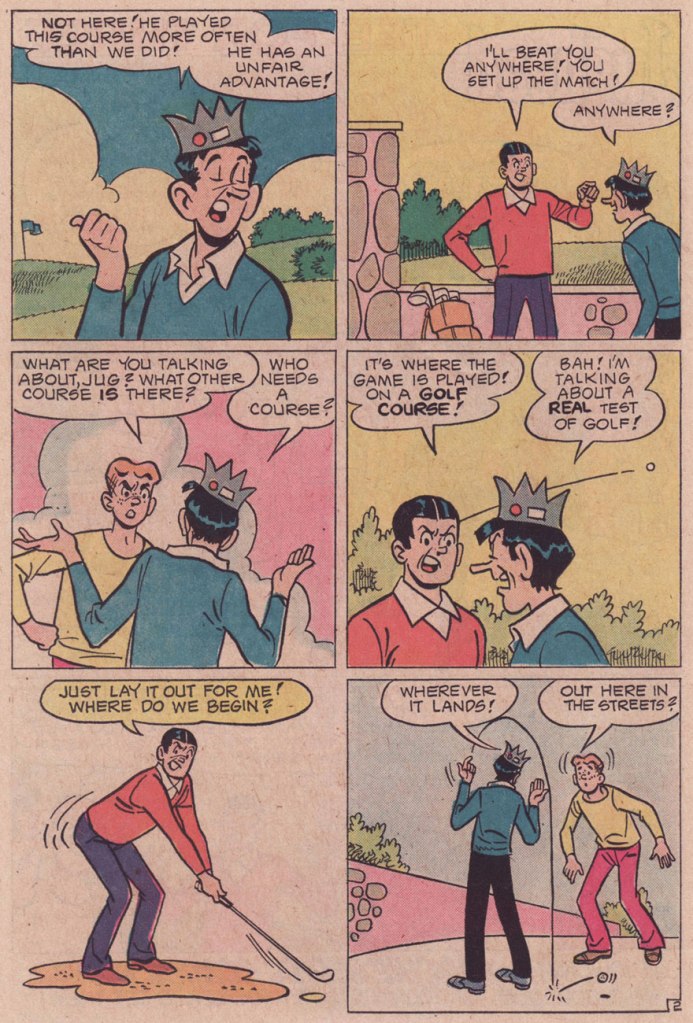
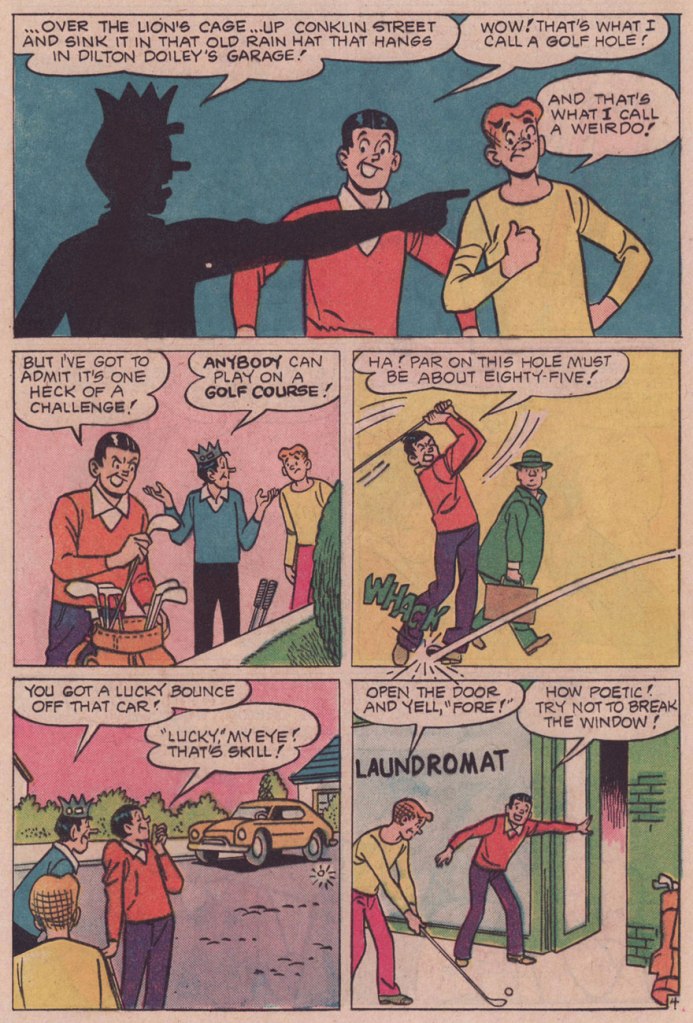
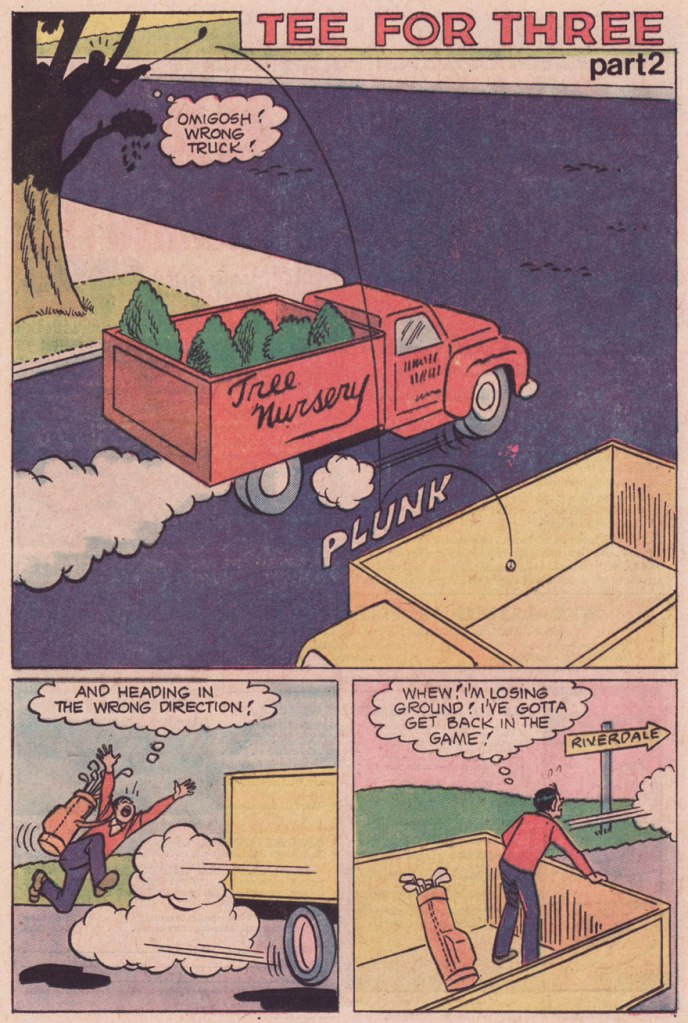
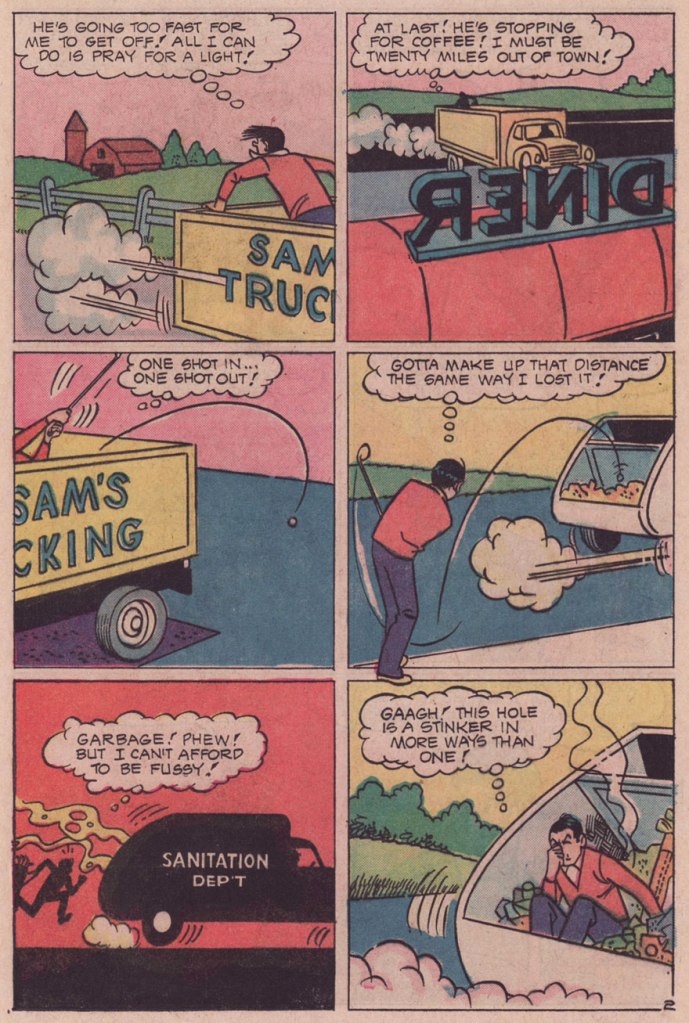
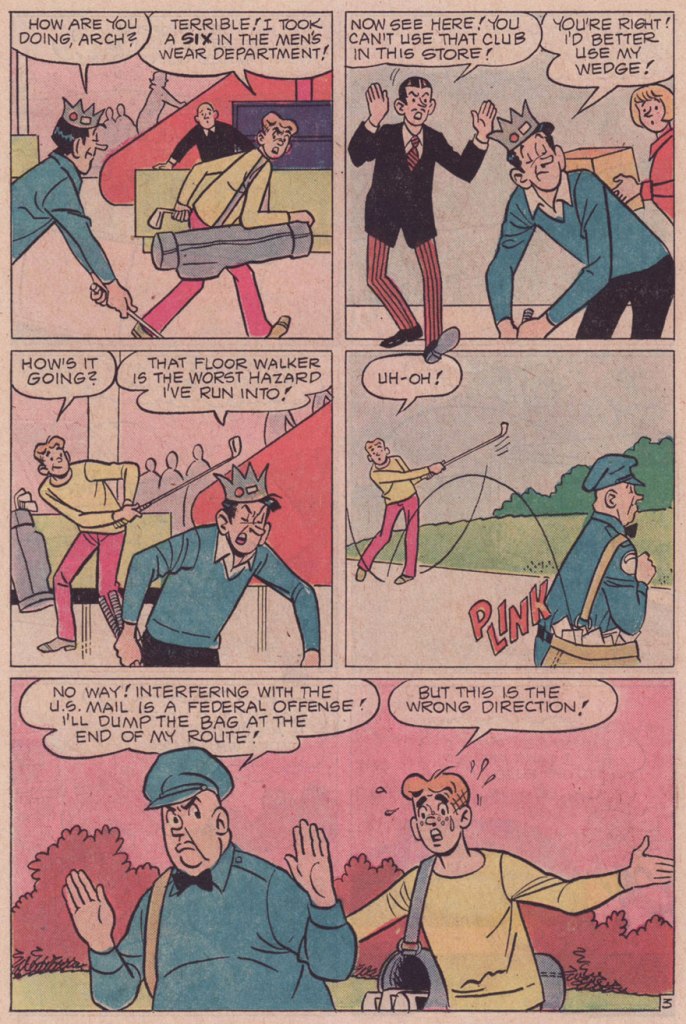
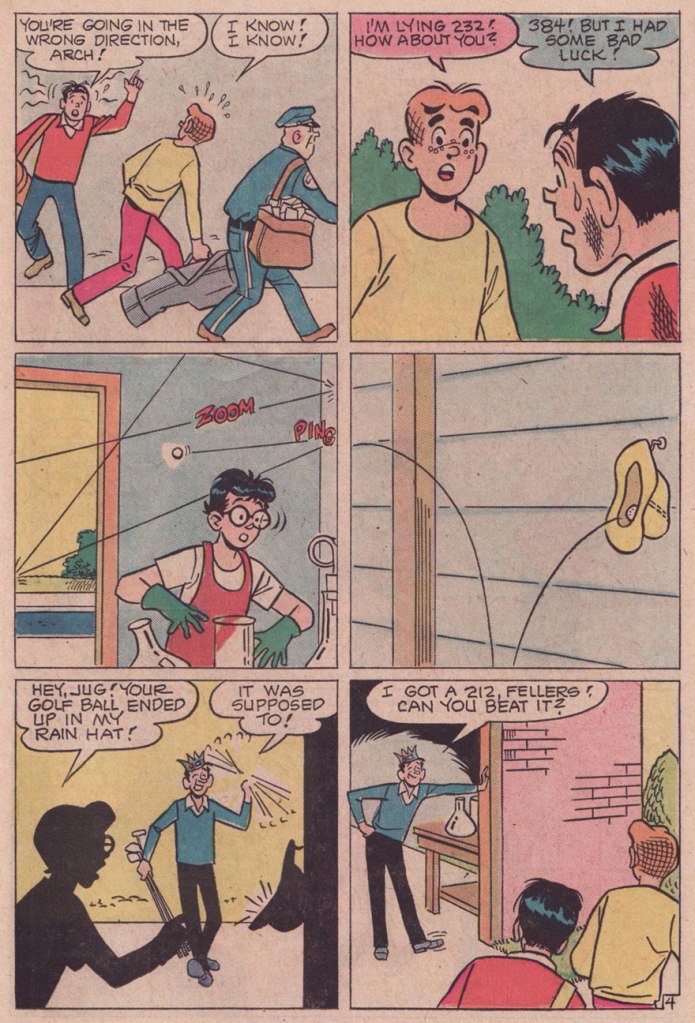
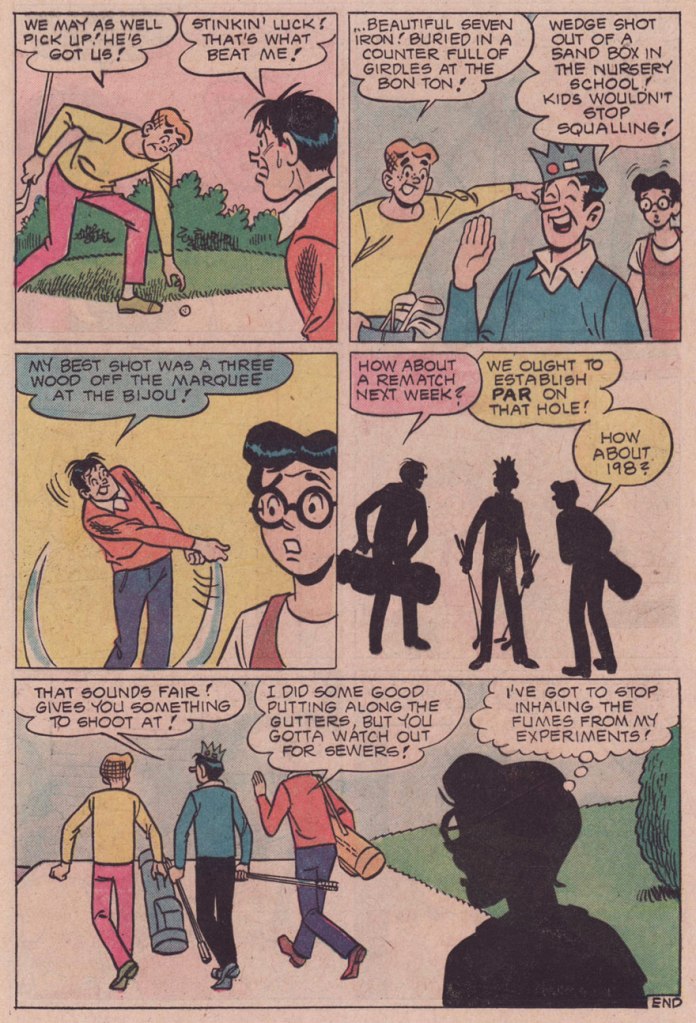
I’ve long wanted to showcase one of Samm Schwartz‘s Jughead stories on this blog, but always hit the same snag: which one? Not too long ago, while revisiting my trove of 1970s issues, I came upon just the specimen. Tee for Three appeared in Jughead no. 247 (Dec. 1975, Archie). I’ll spare you the hideous-as-usual Stan Goldberg cover.

While we know the story was illustrated by Samm Schwartz, the writer’s identity remains unknown. Schwartz usually took a hand in the scripting, but he didn’t really ever work alone. The likeliest miscreants are his usual accomplices, Frank Doyle and George Gladir.

Why this one among hundreds of others, then? For one thing, it’s longer; at eleven pages long, it’s a towering freak amidst the customary five-or-six pagers.

But that’s not all: Tee for Three also boasts an unconventional plot, one that cried out for (and received) a more leisurely deployment. Its tone is also surprising: it’s quite deadpan and sanguine in its absurdity.

For once, you can envision why these three, despite being frenemies or plain rivals, would actually hang out: they challenge and entertain one another. And even collaborate when the occasion calls for it. In this case, Jug, Archie and Reggie are so bonded in their good-natured folie à trois that the rest of the world doesn’t have a clue and hardly stands a chance.

While such a golf contest would surely result in much injury, property damage and litigation in the ‘real’ world, it sure seems like a rollicking bit of sport here, and isn’t that what good fiction is for(e)?

-RG

Nomenclature, or How to Tell Your Thingamajig From Your Whatchamacallit

« The beginning of wisdom is to call things by their proper name. » — Confucius

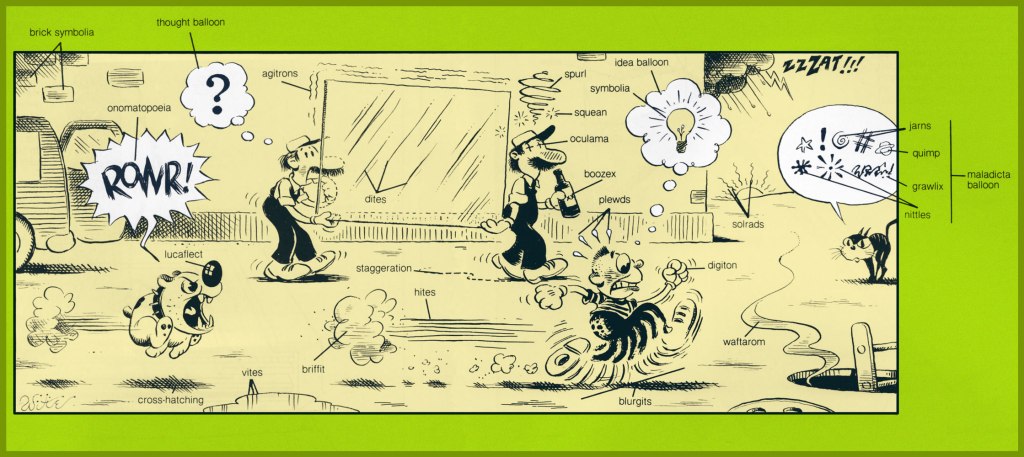
To a bibliophile, shelf space is precious. In recent years, I’ve happily purged my library of many a bulky and obsolete reference tome. With the sheer mass of information that’s migrated online, it’s frequently far simpler to tap a few key words than to scan the shelves in order to pull out and peruse some quaint and curious volume of forgotten lore. Frequently — but not always. One significant exception is my copy of What’s What, accurately touted as « a visual glossary of everyday objects — from paper clips to passenger ships ». Obviously, it covers the expected doohickeys and other dinguses, contraptions and doodads, esteemed constituents of our flora and fauna… but, on occasion, it drifts deep into left field, and that gives it spice. To wit, its entry on cartooning:

Cartooning: Many one-panel cartoons use captions or labels below the illustration for dialogue or explanation. Those appearing on the editorial pages of newspapers are called editorial or political cartoons and usually feature an exaggerated likeness, or caricature, of some well-known figure, as the main character. Comics, or comic books, use cartooning throughout. A complete shericasia, or shallop, is used by a cartoonist to depict a complete swing at an object, be it a golf ball or another person.

This most edifying illustration was the work of Mike Witte (b. 1944), who later chucked this charming infusion of the old ‘big foot’ school of cartooning to settle into an in-demand but pasteurised version of Ralph Steadman‘s style (itself, I would argue, a more grotesque version of Ronald Searle‘s approach). Still, bully for him — it’s a hard business to earn a proper living in. Sure, the classic big foot tradition already had a modern master in Elwood Smith… but the more the merrier! (and speaking of Onomatopeia…)
Mort Walker‘s Beetle Bailey Sunday strip from July 9, 1978, a most judicious choice, was dissected.
Here’s my well-thumbed, yellowing copy of What’s What: it’s the first book trade edition (Nov. 1982, Ballantine), copies of which, or the updated edition, circa the early 1990s, can still be obtained dirt cheap. And “Nose leather?” Awww.

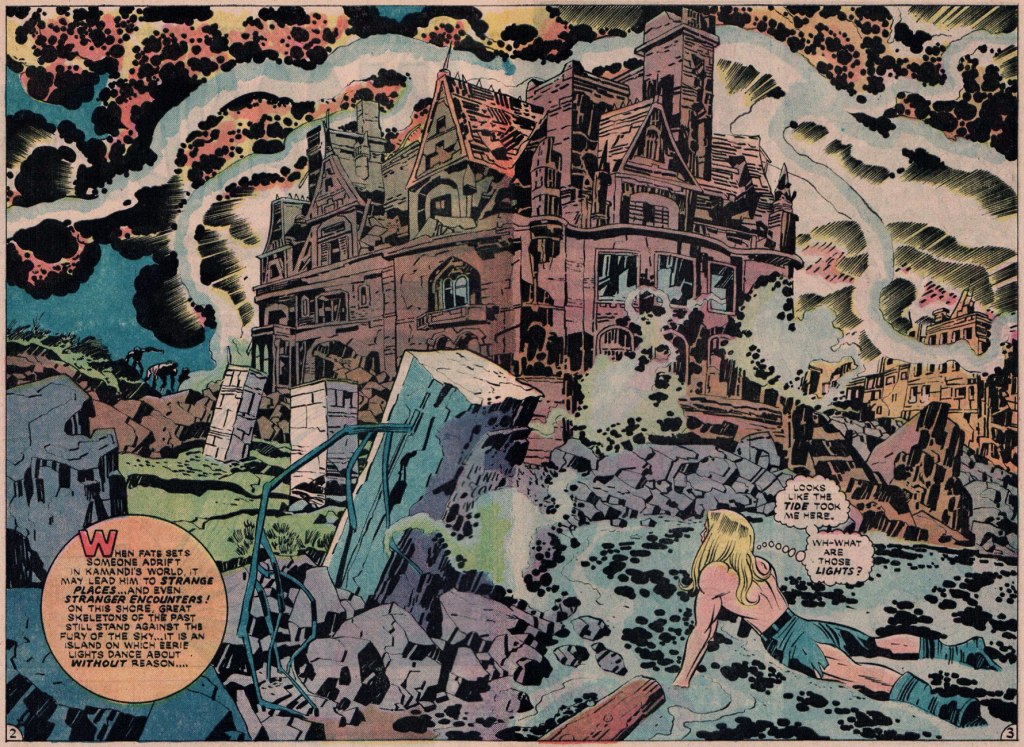
To this array of clever cartooning terms, we simply must remedy one omission, and it’s a crucial one: Kirby Krackle!

A page from Nazi “X” (Captain America no. 211, July 1977, Marvel) with the wild and wooly Arnim Zola – the Bio-Fanatic – flexing his mental muscles. Written, pencilled and edited by Jack Kirby, inked and lettered by our dear Mike Royer, and coloured by Glynis Wein.
Another example, to make sure everyone gets it straight? The sky’s ablaze with Kirby Krackle in this ominously magnificent splash from Kamandi no. 24 (Dec. 1974, DC) and its tale of The Exorcism! Written, pencilled and edited by Jack Kirby, inked and lettered by Douglas Bruce Berry, and most likely coloured by Jerry Serpe.

-RG

Archie Goodwin’s “Sinner” (1966)

« If you’re going to be a sinner, be the best sinner on the block. » — Anton Szandor LaVey

I’m afraid the appeal of Archie Goodwin’s (1937-1998) writing has always escaped me. As you’d expect with a career as busy and prolific as his was, there are notable exceptions*. But I think, as is often the case in comics, he gets a lot of credit for tepid, formulaic writing that happens to be masterfully illustrated. You know, like just about every story from the early Creepy and Eerie (Goodwin was editor and principal writer of the Warren line for its first four years or so) with their groan-inducing ‘shock’ endings: “But I’m a vampire, and we don’t like competition around here!” or “We ghouls don’t cotton much to werewolves!” or “You’ve guessed my secret too late — I’m a witch!” or “For I am… Death!

On the other hand, he was a fine editor and, by all accounts, a terrific human being. In 2013, Mark Evanier put it this way: « At a time when some editors in comics were notorious for treating their freelancers with disrespect and yelling, Goodwin had a sterling reputation. He always would. Archie was nice. He was honest. »

It is to his great distinction that even such divisive, eternally-acerbic figures as Jim ShooterFirst and foremost, everyone loved Archie. Archie had a manner about him that you just couldn’t not like him. While he was tough as nails, and he was probably the best that passed through this business, he managed to do it without offending anyone. He managed to be respected and remain friends with everyone and do his job. ») and Alex TothNone of us were working there [at Warren ] for the money, because there wasn’t much. We were working there to work with Archie. ») reserved naught but effusive praise for the man.

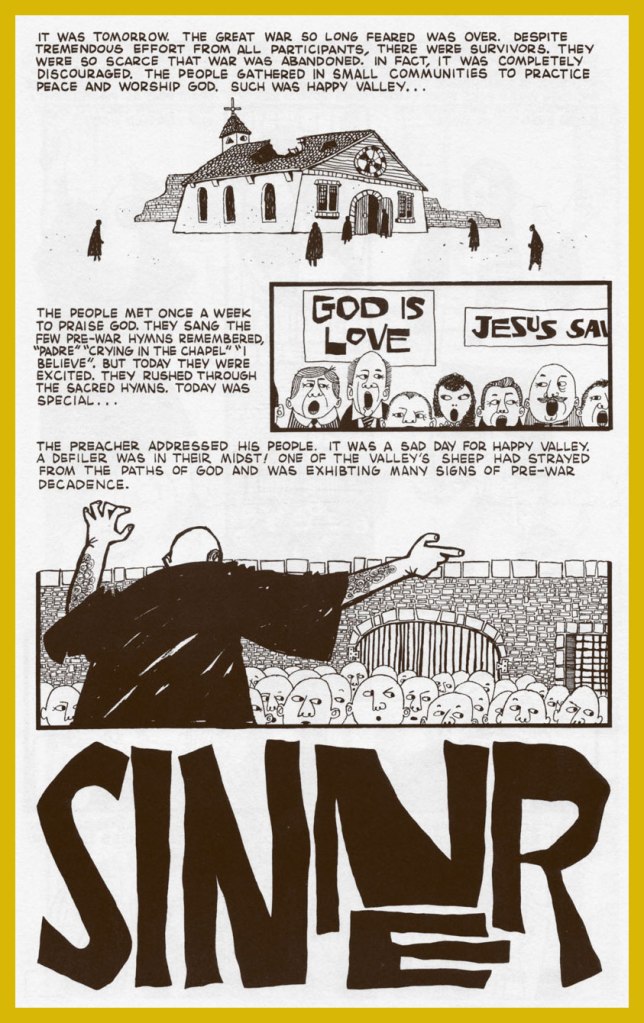
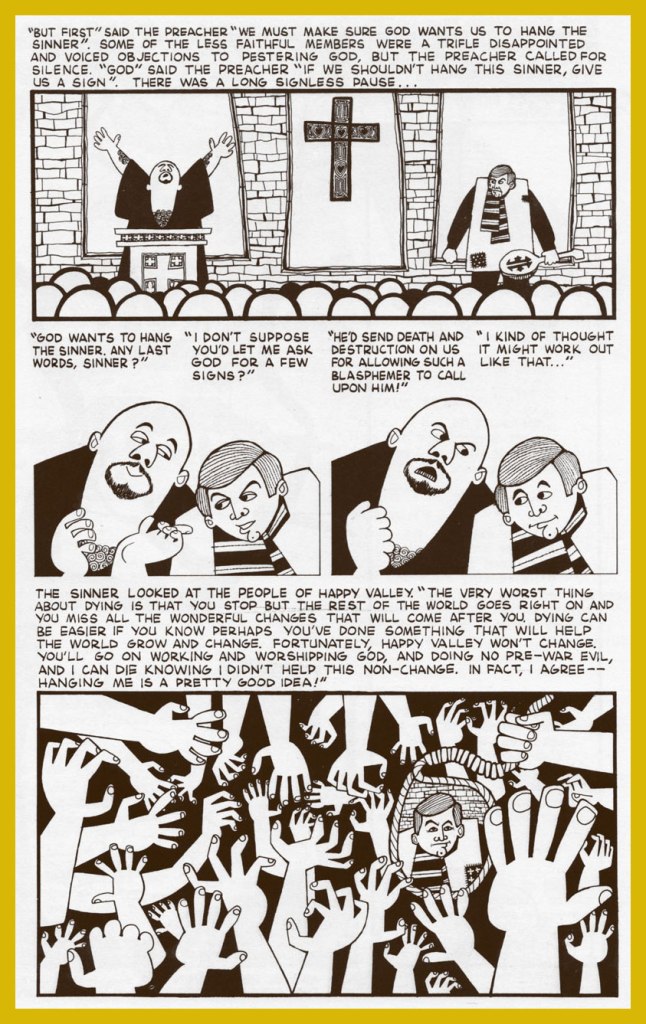
But you know what I really like about Archie? His drawing, which was all-too-rarely showcased. While he did adjoin thumbnails layouts to his scripts, Goodwin’s drawings rarely appeared in print, aside from some jokey editorial asides at Marvel in the 1980s. Here’s Sinner, written and illustrated by Goodwin, from Wally Wood’s prozine Witzend no. 1 (Summer 1966).

Sinner would be reprinted a few times, notably in the second issue of Marvel’s Heavy Metal knockoff Epic Illustrated (Summer, 1980), edited** by Goodwin. Marvel had passed on the Métal Hurlant licensing rights and, when Heavy Metal proved a smash hit, launched their ersatz. Such is the way of Marvel.
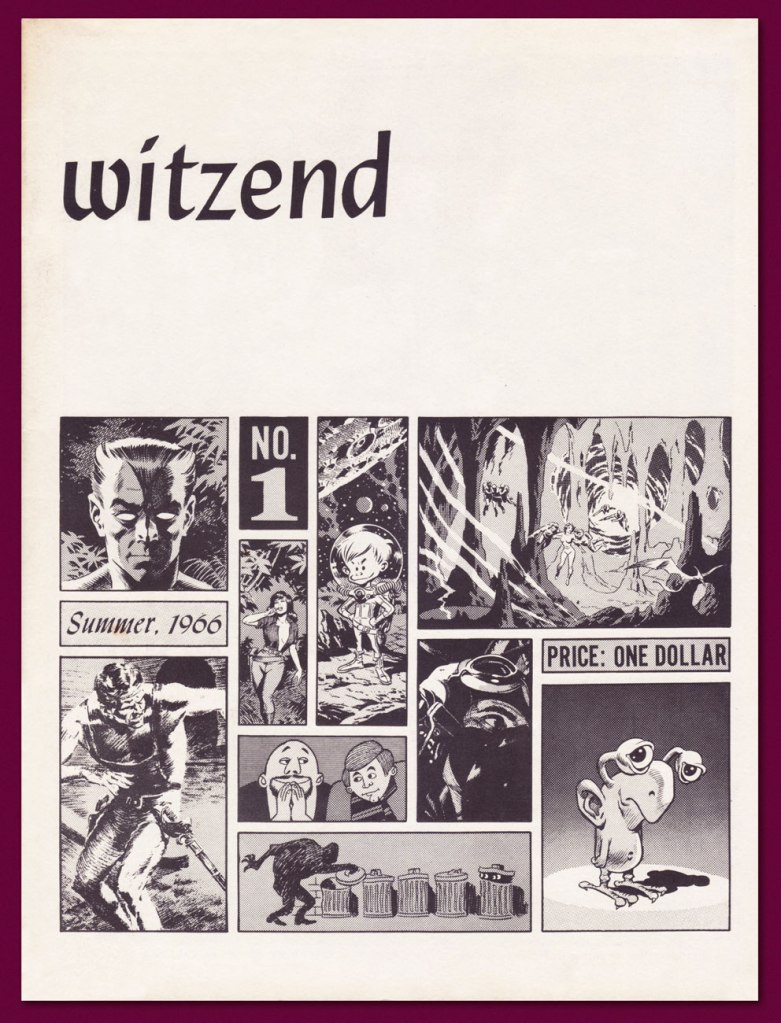
This is Witzend no. 1, featuring a splendid cover layout by Goodwin…. it’s harder than it looks, especially when it looks this good… and given the relatively primitive means employed. I tell you, Archie missed his calling.
Goodwin’s, adobe, clean line and silhouette graphic approach has always reminded me of this fine album cover from a few years earlier, which is to say 1963. It was designed by A&M Records art director Peter Whorf (yes, the legendary Whipped Cream & Other Delights cover was also one of his).

Despite all this, Archie Goodwin’s greatest claim to fame simply has to be the tremendous legwork he did as Nero Wolfe’s assistant.

« Archie Goodwin’s first prose story was published by Ellery Queen’s Mystery Magazine, which warned him he could not use Archie Goodwin as a pen name because it was a Rex Stout character in the Nero Wolfe books. According to Goodwin’s wife Anne T. Murphy, the magazine’s editors ‘then were so delighted when he wrote back to say that it was his real name that they used the anecdote as the introduction to the story, which ran in the July 1962 issue.’ »

-RG

*Notable exceptions: The Success Story, with art by Al Williamson (Creepy no. 1, 1964) has actual bite. Despite its rote-EC-revenge-from-beyond-the-grave finale, it’s a bitter parody of real-life comic-strip parasites such as Don Sherwood (Dan Flagg, The Partridge Family) and Alfred Andriola (Kerry Drake). There’s the tragically moving Island at World’s End, illustrated by Gray Morrow (Eerie no.4, July 1966). And a handful of inspired little tales that truly fired up the creativity of a freshly-emancipated Steve Ditko: Collector’s Edition (Creepy no. 10, Aug. 1966); Second Chance! (Creepy no. 13, Feb. 1967); Deep Ruby! (Eerie no. 6, Nov. 1966); and my very favourite, Room With a View (Eerie no. 3, May 1966… their first collaboration!). If anyone’s interested, the Goodwin-Ditko outings have been handsomely collected in Creepy Presents: Steve Ditko (2013, Dark Horse).

It must be said that Goodwin knew how to match a plot with the proper illustrator. As he explained, « I always tried to write the stories for individual artists. Sometimes, I’d ask them if there was a certain setting or a certain kind of story they were interested in, and I also knew what they did best. » It’s a shame that, overall, the stories themselves were so timid and unambitious, so mired in the glories of the past. Some people can’t help pulling their punches, I suppose.

**To give you a fair idea of Marvel’s delusions of corporate grandeur at the time, Epic Illustrated no. 2‘s convoluted and deceptive editorial credits read thus: Stan Lee (editor); Archie Goodwin (editorial director); James Shooter (consulting editor); Marian Stensgard; Louise Jones; Larry Hama; Ralph Macchio (editorial); Roy Thomas (contributing editor); Maggie Thompson (contributing editor); Don Thompson (contributing editor). Dollars to doughnuts that Goodwin and Louise Jones did all the actual work.

Rick Geary and The American Bystander

« You better watch out, you better not cry, better not pout, I’m telling you why —Santa Claus is coming to town. » — Haven Gillespie

Taking stock, I can’t help feeling that the singular Rick Geary (b. 1946) is a creative force that’s taken for granted. He’s been consistently chugging along at a dizzyingly high level of erudite inspiration and craft since the mid-70s. His work has been recompensed and saluted several times (an Inkpot from the San Diego Comic-Con in 1980; a Magazine and Book Illustration Award in 1994 and a Graphic Novel award in 2017, both from the prestigious National Cartoonists Society…) yet he’s remained kind of a well-kept secret, a cartoonist’s cartoonist. Even as he turned up in countless anthologies, in most cases, it felt as if he didn’t quite belong, didn’t exactly jibe with the respective audiences of, say, Dark Horse Presents or Pulse (on the other hand, High Times wasn’t a bad fit!).

Still, it’s fair to say that his following is one quite discrete from the comics mainstream. The Geary devotee must ever remain vigilant, for one never can anticipate his next move.

Which brings me to The American Bystander, which Newsweek deemed « The last great humor magazine », and to which Geary has been contributing since its second issue… and for once, it feels like home.

The Bystander, according to Wikipedia…

… features contributions from many notable comedy writers, illustrators and cartoonists. The Bystander is designed to provide a classic print humor magazine experience similar to that delivered by National Lampoon, SPY, Harold Hayes-era Esquire and many others in the pre-internet era. Yet according to The New York Times, The American Bystander “does not just belong to the tradition of defunct magazines like The National Lampoon and Spy. Its nostalgic, lightly witty style evokes influences that have been dead even longer, like the raconteur Jean Shepherd and the sophisticated stylist Robert Benchley.”

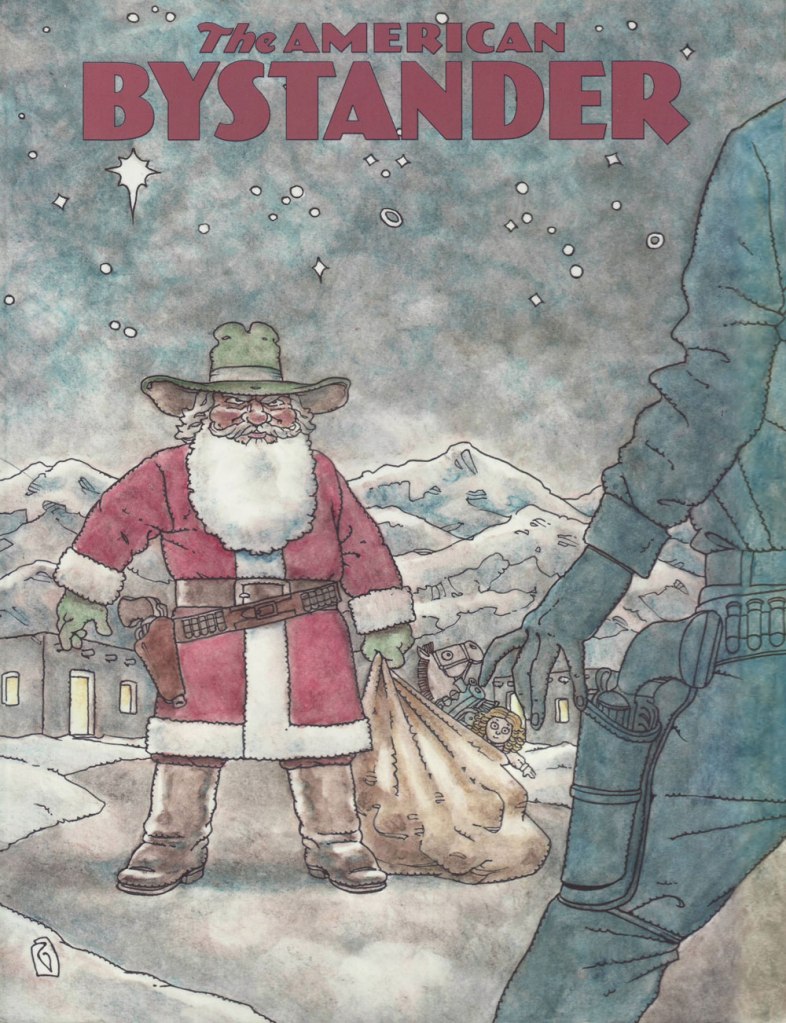
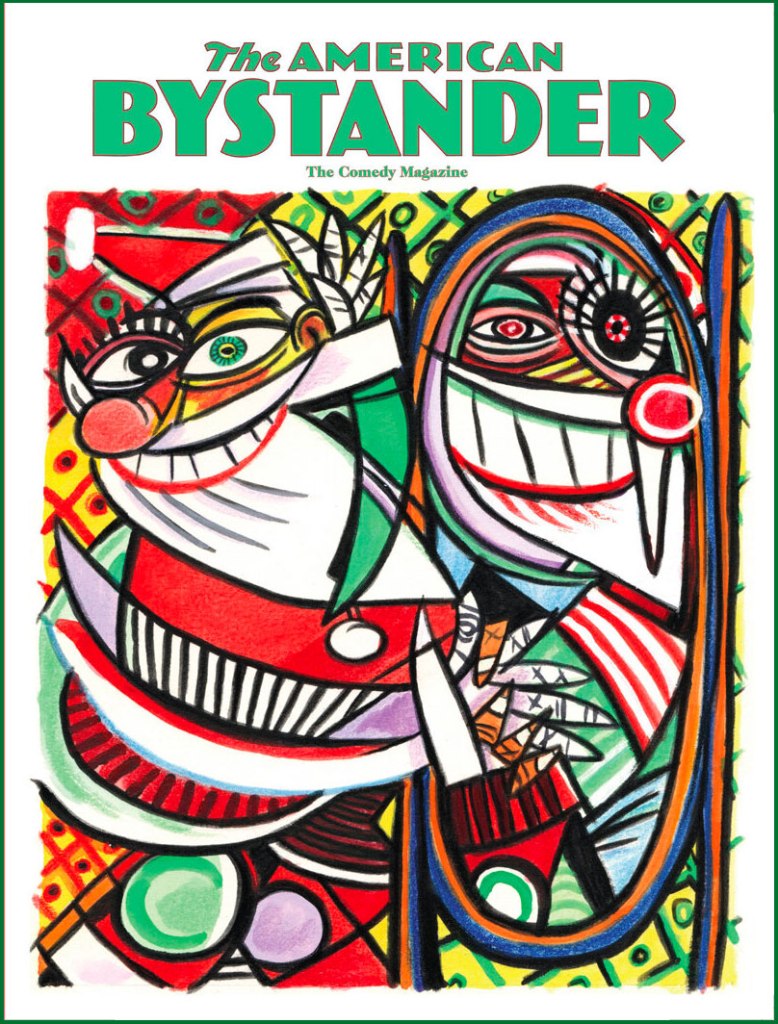
Mr. Geary’s magnificent cover for The American Bystander no. 9 (Fall, 2018). « Have Gun, Will Travel — Wire Santa, North Pole »

The Bystander‘s editor-publisher, Michael Gerber, exults: « In addition to his civilian fans, Rick Geary is one of those illustrators that other illustrators love, and I am with them all 100%. This drawing, entitled ‘New Mexico Christmas’, appeared in my inbox mere moments after I’d given Rick the assignment — which is why editors love him, too! »

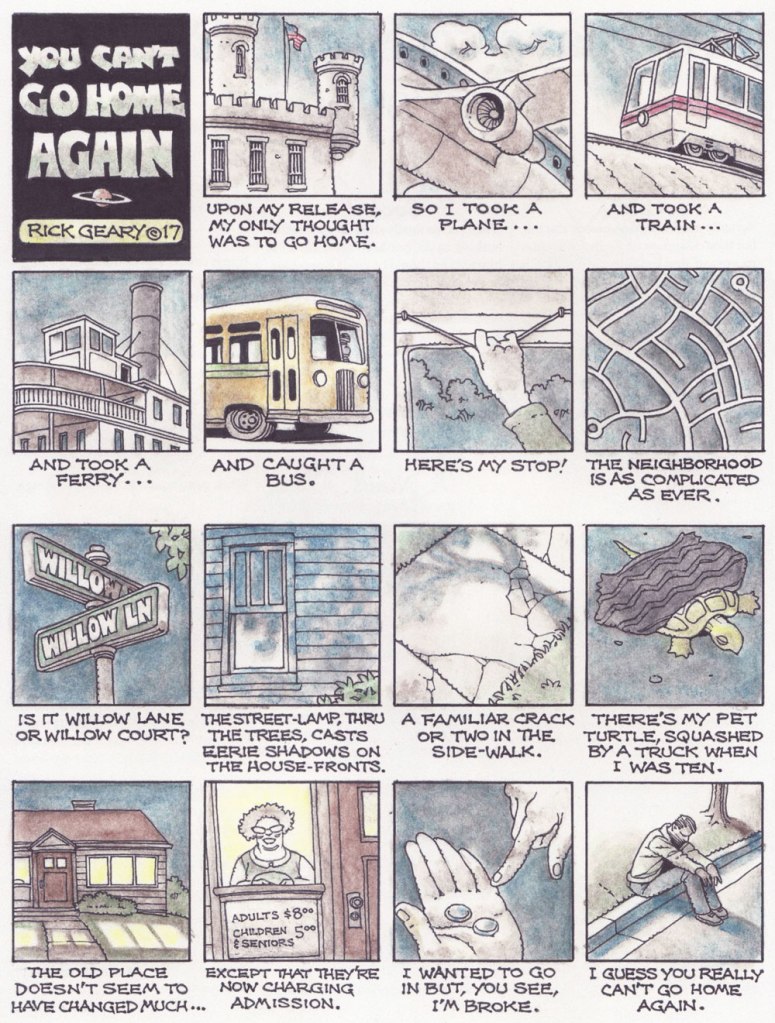
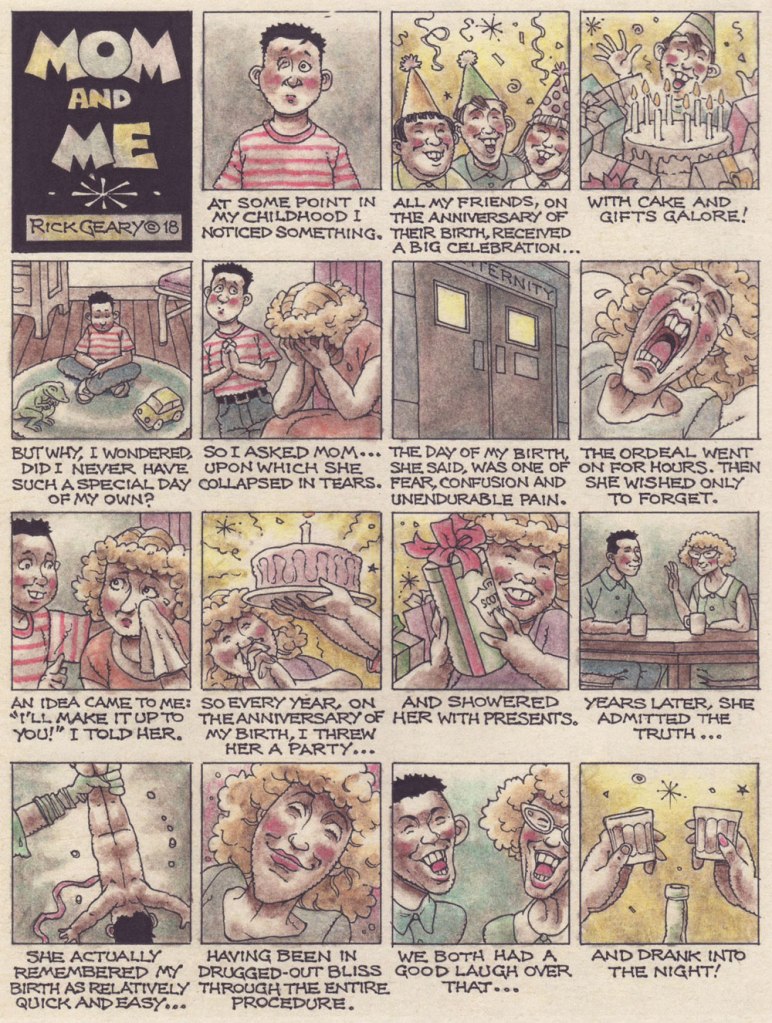
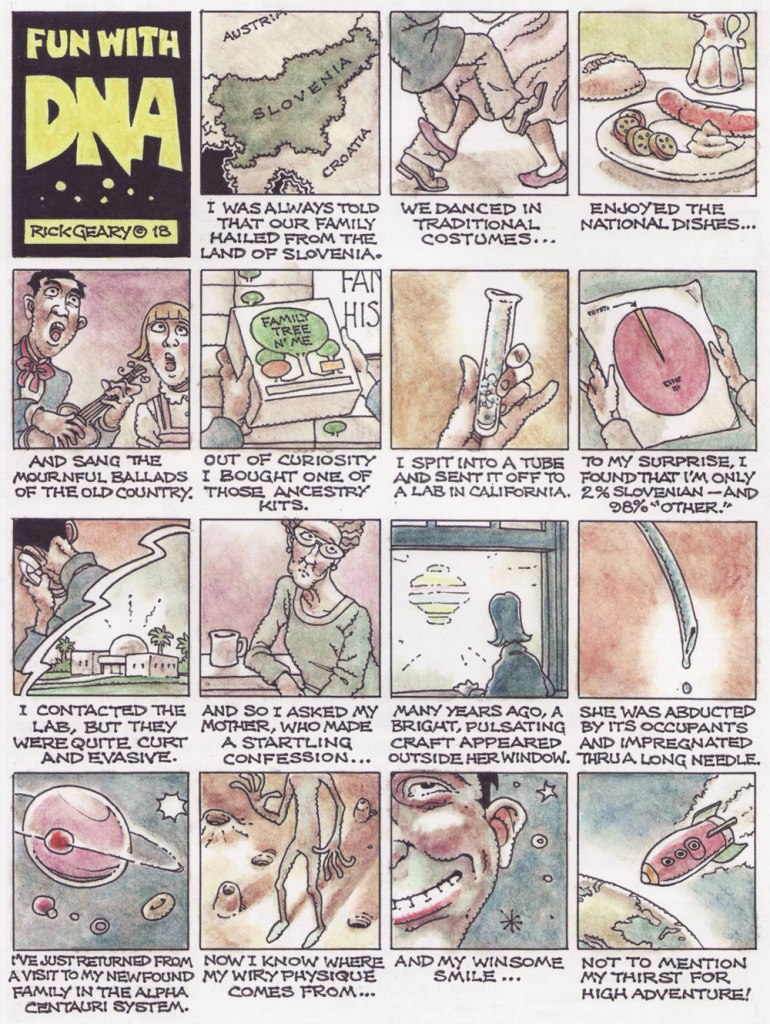
While this ever-industrious auteur has produced graphic novels galore in the glorious Geary fashion, I remain fondest of his short-form pieces. Here’s a choice handful plucked from Bystander issues.

From The American Bystander no. 7 (Winter 2017).
From The American Bystander no. 8 (Summer 2018).
From The American Bystander no. 9 (Fall 2018).
From The American Bystander no. 10 (March 2019).

And while ’tis the Season, I would be remiss in neglecting to mention that TAB’s latest issue no. 18, is hot off the presses. More details here. And should you crave to sample the goods… gratis — that option’s on the table as well!

This is The American Bystander no. 18, boasting this festive cover by Rick Meyerowitz.

That said, Happy Holidays, everyone. Be merry but above all be safe!

-RG