Corto Maltese, the Consummate Cosmopolitan Adventurer

« The poet is a madman lost in adventure. » — Paul Verlaine

Today, we’ll examine the early history of Italian fumetti maestro Ugo Eugenio Prat’s (aka Hugo Pratt, 1927-1995) most famous personage, Corto Maltese.

Maltese (named, indeed, after Dashiell Hammett’s famous novel… or rather its John Huston-helmed cinematic adaptation) created in 1967 for the Italian magazine Sgt. Kirk… saddled with a modest print run of 3000… and rather soon cancelled owing to low sales! There, Corto turned up — as a minor player — in a tale entitled Una Ballata del Mare Salato (“A Ballad of the Salt Sea”). Corto’s peregrinations then followed their tortuous course in French bédé weekly Pif Gadget from 1970-73, where the strip mostly baffled — or even enraged — readers but was tirelessly championed by the enlightened editorial team. In his Prix Goncourt-winning biography*, Hugo Pratt, trait pour trait, Thierry Thomas states: « With each new episode, the magazine received letters from readers who couldn’t make head nor tail of it, and demanded Rahan, nothing but Rahan. » Clearly, the world wasn’t ready for Corto… but that acceptance would gradually arrive, at least in the non English-speaking world**.

While the Corto saga has been made available over the years in several fine editions in most of the European languages, it took a long time for English to be added to the roster. In the USA, IDW has managed the fairly monumental but inarguably laudable task; I only wish the covers weren’t so ill-conceived, sadly a feature, rather than a bug, of editor-designer (and translator!) well-meaning Dean Mullaney‘s reprint collections at IDW**.

This presentation by Pif Gadget’s editor-in-chief, Georges Rieu, ran on the inside front cover of the magazine’s 59th issue, between Corto’s first and second appearances:

« You’ve met him while leafing through your PIF, last week… you may have deemed him, at first glance, cynical and cold… but you quickly realised that this nonchalance was but an appearance: Corto Maltese is a kind-hearted adventurer and his attitude serves only to mask a generosity that pulls him into adventures he’d rather avoid… adventures that drag him to the four corners of Central America, from Chile to the Caribbean, in savage lands where magic and ancient superstitions yet reign… in a search for lost civilisations and treasures.

Our friend, artist Hugo Pratt, has spent nearly ten years in patiently piecing together the history of Corto Maltese… in gathering all the documents that speak of these vanished worlds, in questioning the old sailors of the ports along the coasts of the Atlantic and of the Caribbean Sea…

Today, he reveals to us the fruit of his research… adventures that, we are sure, will enthral you. Hurry over to page 11 and join Corto Maltese and his friends aboard their boat. »

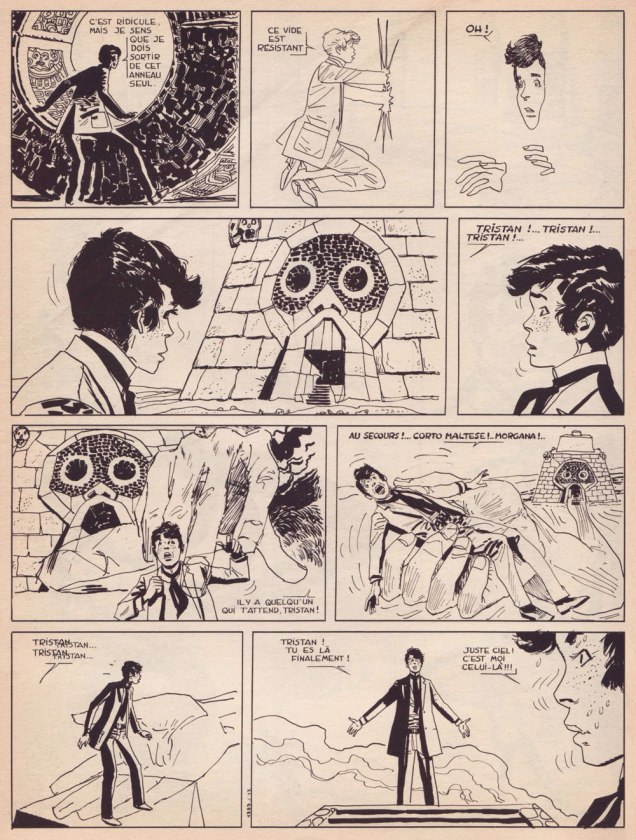
Corto’s young friend, Tristan Bantam, has some interesting visions in a sequence from Rendez-vous à Bahia (“Rendezvous in Bahia”… of course), Corto’s second solo tale, first published in Pif Gadget no. 59.

Rieu’s successor as Pif’s editor-in-chief, Richard Médioni, wrote: « In brief, in the Fall of 1969, Hugo Pratt found himself out of work. » After Pratt is crowned, that year, Best Italian Cartoonist at the Salone Internazionale dei Comics in Lucca (Europe’s oldest comics festival)… « It was expected that all publishers (French, Italian, and others, all present at the Salon) would push and shove their way to Hugo Pratt to propose a collaboration… but no such thing happened. Only Pif Gadget showed interest. »

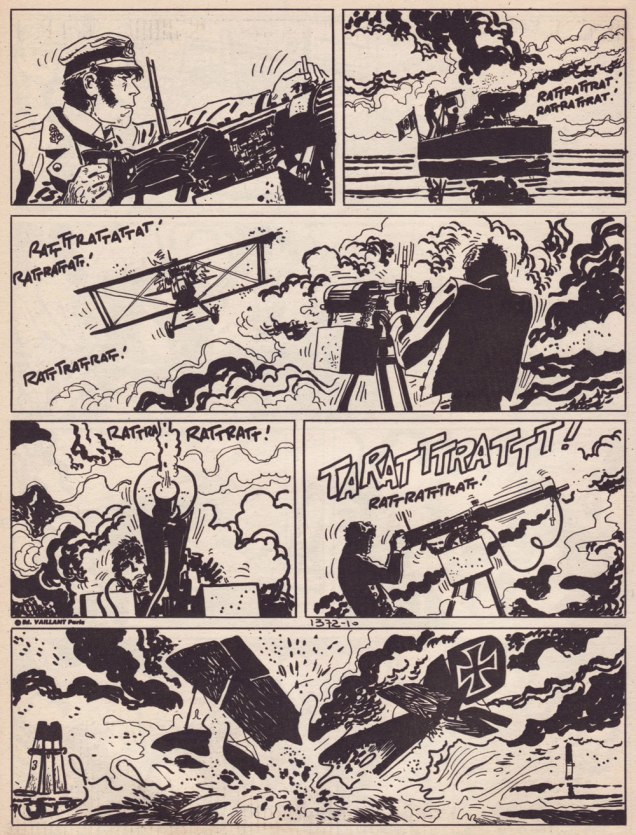
High drama and ace storytelling from À cause d’une mouette (“Because of a Seagull”), from Pif Gadget no. 89 (Nov. 1970, Vaillant).
Corto is forced to take a hand in a skirmish in L’ange à la fenêtre d’Orient (“The Angel at the East Window”), first published in Pif Gadget no. 135 (Sept. 1971, Vaillant).

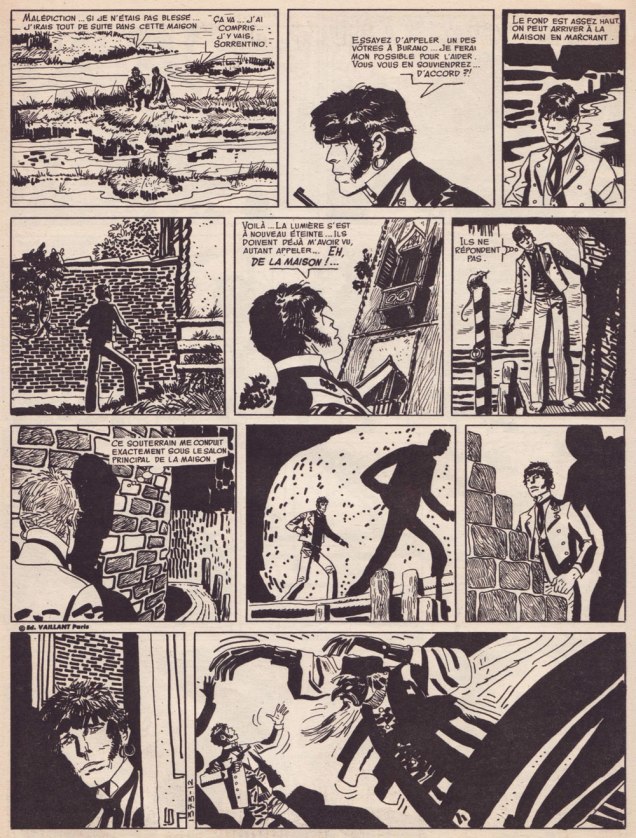
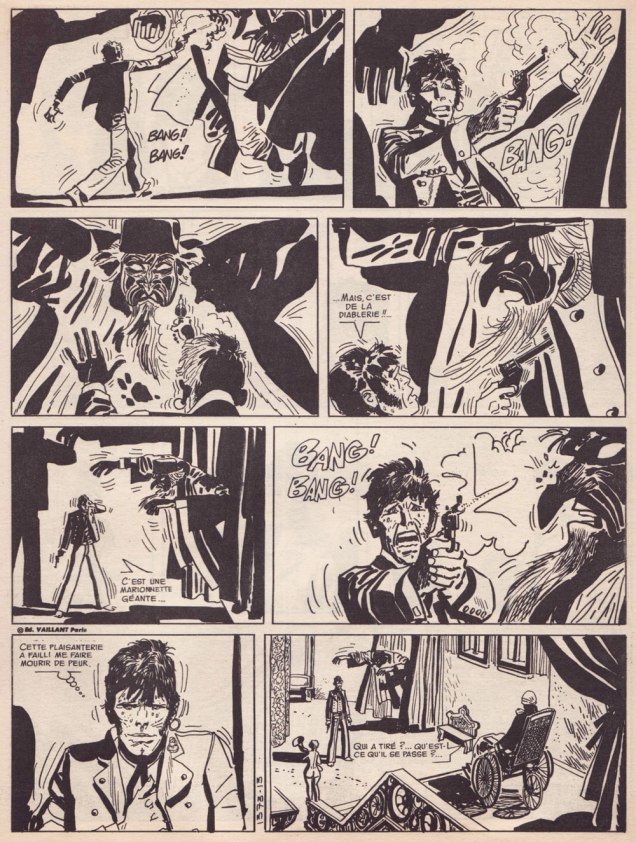
The usually unflappable Corto gets the fright of his life in this bravura sequence, also from L’ange à la fenêtre d’Orient.

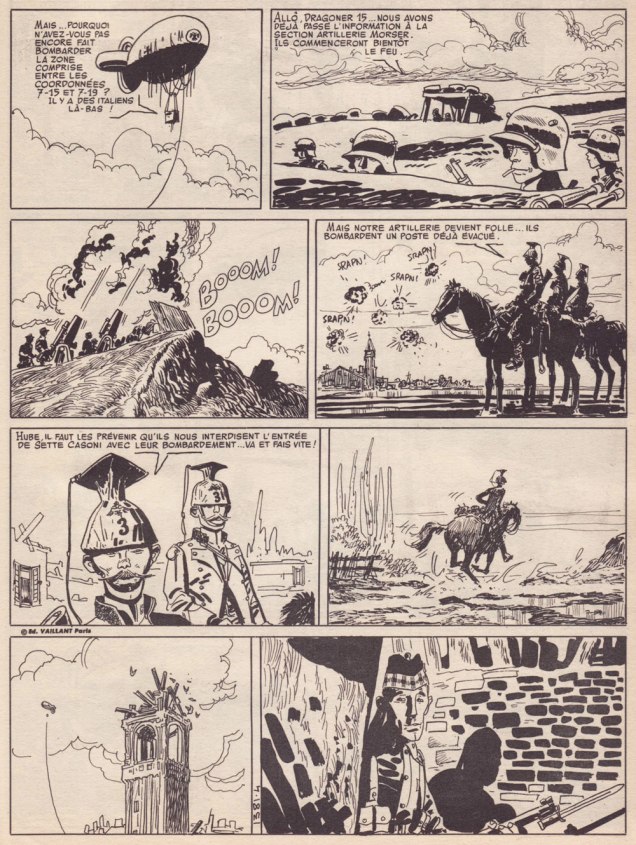
Two pages from Sous le drapeau de l’argent (“Under the Banner of Money”), my initial encounter with Signor Pratt’s world. Published in Pif Gadget no. 143 (Nov. 1971, Vaillant).
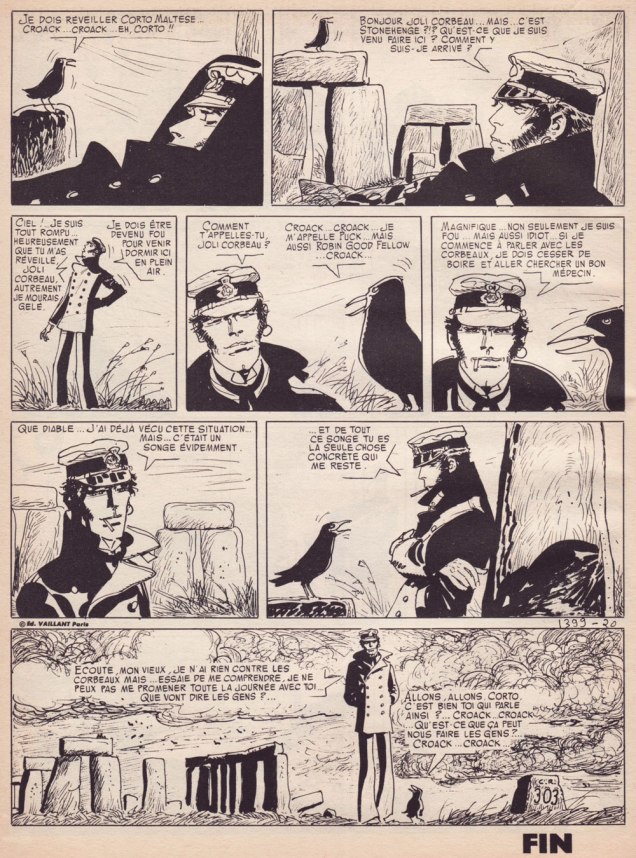
The quiet coda of Le songe d’un matin d’hiver (“A Winter Morning’s Dream“), set in Britain and plunging the reader into a dazzling brew of magical realism and English mythology from Pif Gadget no. 161 (March 1972, Vaillant). The featured crow is of course Puck, aka Robin Goodfellow, which you may recall from Will Shakespeare’s A Midsummer Night’s Dream. One might say it’s a bit like The Sandman, but without all the preciousness, not to mention having to deal with Neil Gaiman.

Bonus factoid: Hugo Pratt was related to another artistic giant, William Henry Pratt, aka Boris Karloff!

-RG

*Imagine, if you will, a biography of, say, Will Eisner winning a Pulitzer.

**According to his biographer, one of Pratt’s eternal regrets is that his work never broke through in America, land of his childhood cartooning heroes George Herriman, Milton Caniff, Alex Raymond and Burne Hogarth.

***One need only look at Mullaney’s Rip Kirby, where a blobby, lazy Photoshop shadow directly contradicts the light source indicated by Alex Raymond, a guy you’d assume it would be unwise to second-guess.
We All Scream for Aisukurīmu

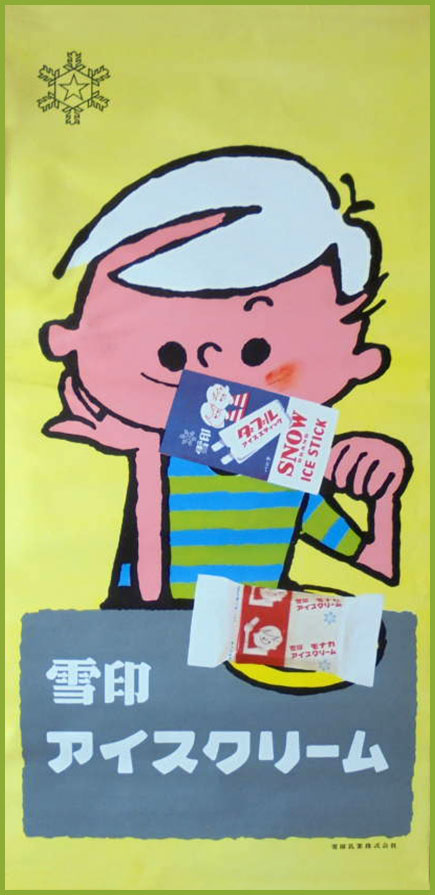
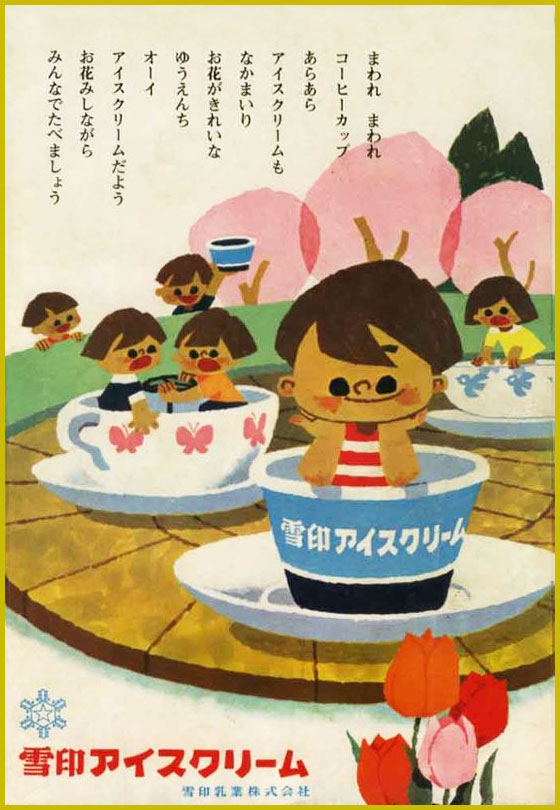
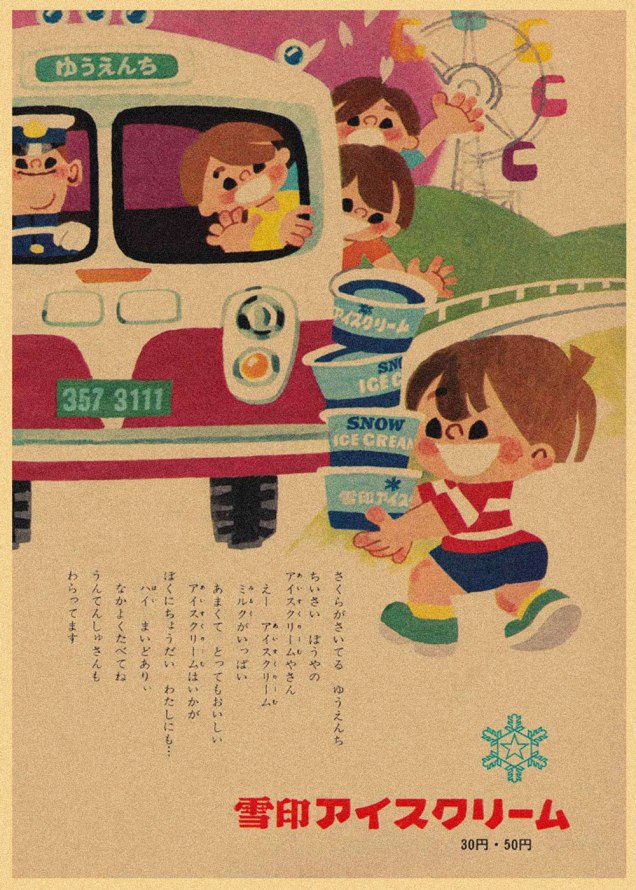
The mild case of writer’s block co-admin RG referred to in his latest post is still with me, and has perhaps even graduated from ‘mild’ to ‘pronounced’. Still, the Venn diagram overlap of spring gradually unfurling its petals and an upcoming trip to Japan smoothly leads me into today’s topic — Japanese ice cream ads from the 1960s, a glorious injection of the cute and the colourful. While you shouldn’t expect a high level of historical detail about the following images (especially given my purely utilitarian ‘where is the toilet?’ level of Japanese), you can hopefully enjoy this little detour. Don’t forget to have some ice cream today.

Most of these are ads from the Snow Brand, which by now has become Megmilk Snow Brand, one of the largest dairy companies in Japan.

On a far more disquieting note, I’ll wrap up with this USSR ice cream ad from 1937:

‘Ice cream – the best, the tastiest, sold by us’… maybe with the addition of some special powder.

~ ds

Treasured Stories: “Sorry, Wrong Dimension” (1965)

« All realities, all dimensions are open to me! » — Prince

Growing up, Lee Elias (1920-1998) never was a particular favourite of mine. A handful of stories in DC’s mystery titles aside — and I’ve grown to love those — I probably came across his work for Marvel’s Human Fly series, and I was always disappointed when Elias, not my beloved Frank Robbins, turned up in the credits. For the record, Elias drew ten of the nineteen HF issues, and Robbins drew six, plus five covers.

Over time, I noticed his gloriously gruesome cover work with art director-designer Warren Kremer for Harvey’s Pre-Code Horror titles of the early 1950s. His work on DC’s Adam Strange in the mid-1960s is best forgotten — there is only one Adam Strange, and it’s Carmine Infantino‘s (with trusty inker Murphy Anderson along for the Zeta Beam ride, of course). However, I adore Elias’ brief run (with writer Dave Wood) on Ultra the Multi-Alien, the splendidly wacky feature that replaced Adam Strange in Mystery in Space (issues 103 to 110, 1965-66).

As a treat, here’s one of those Ultra covers.

This is Mystery in Space no. 108 (June 1966, DC), illustrated by Murphy Anderson. On this cover, Ultra has always reminded me of Men Without Hats‘ main man, Ivan Doroschuk. Well, Pop Goes the World!
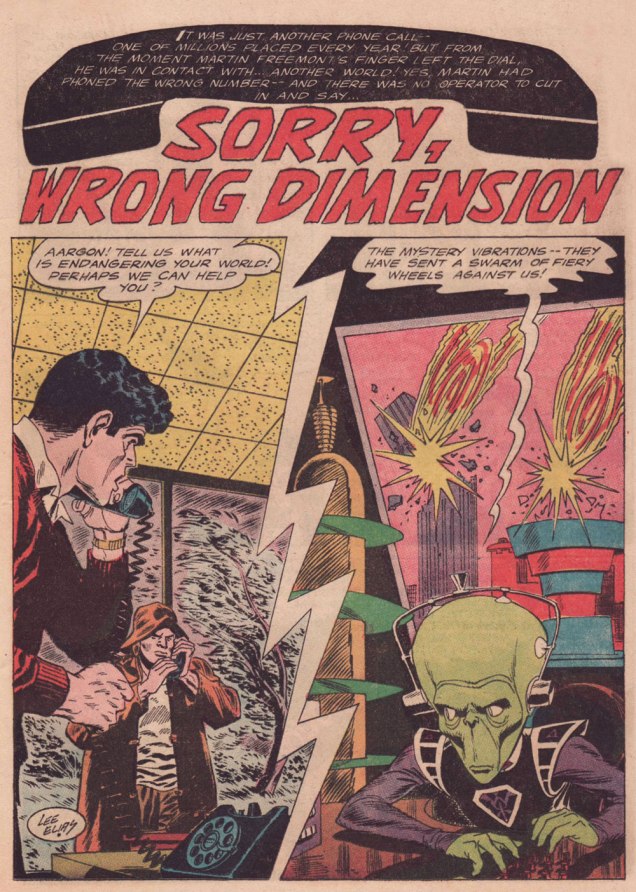
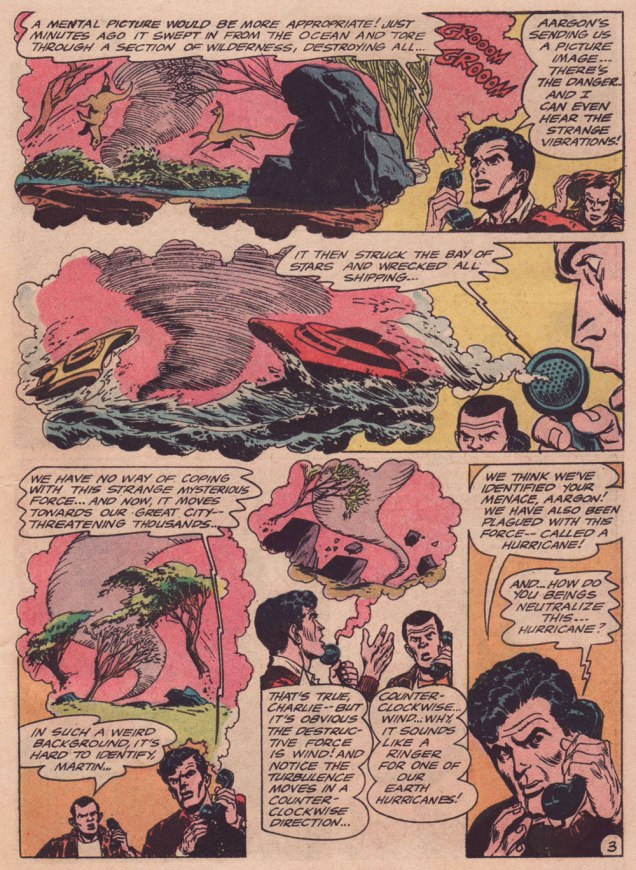
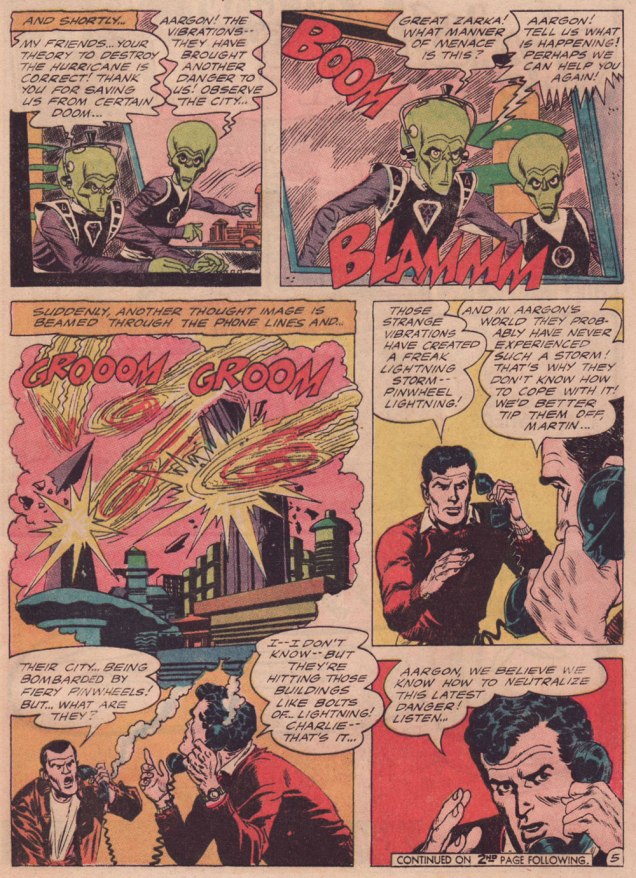
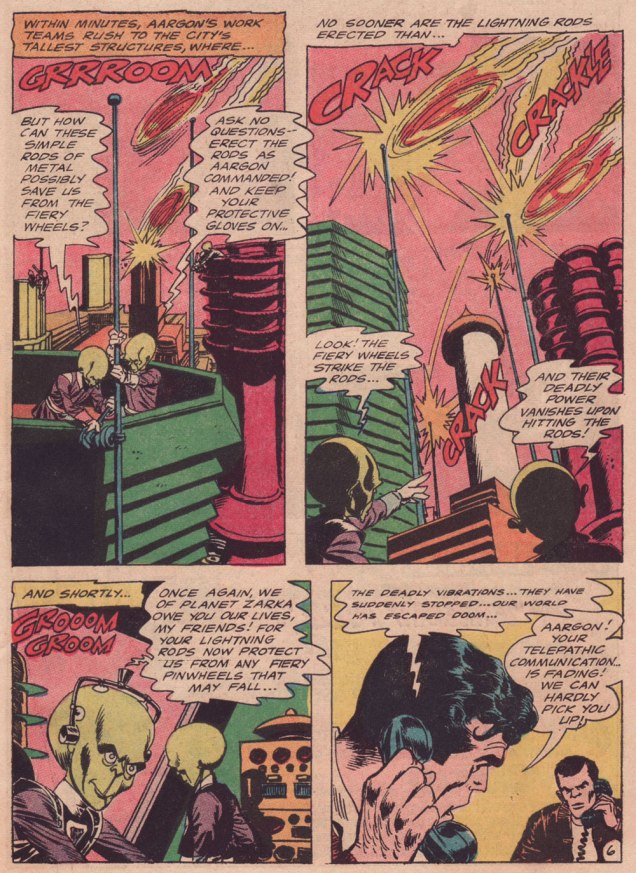
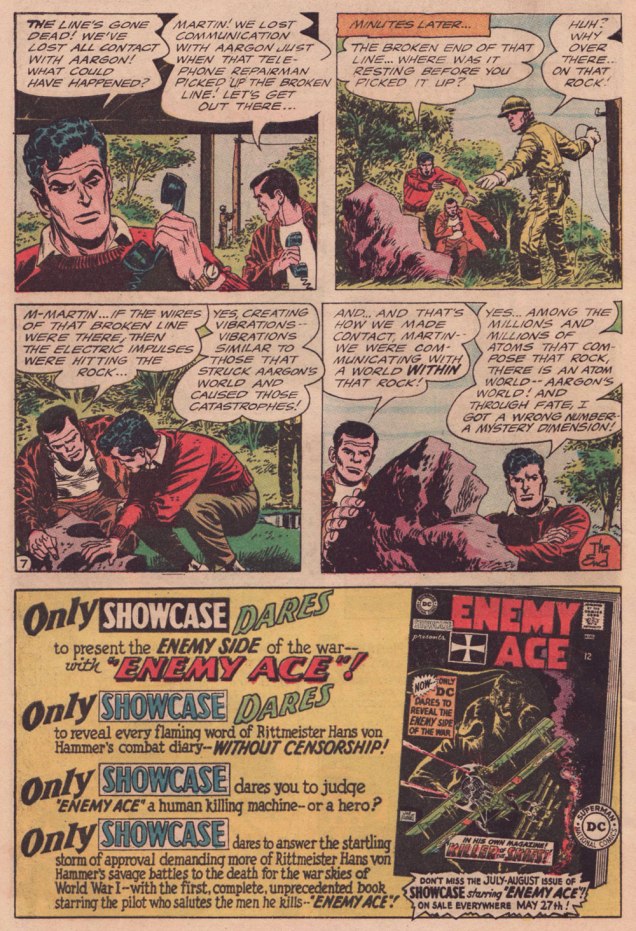
Originally published — writer uncredited — in Strange Adventures no. 178 (July 1965, DC). Its title is a clever twist on Lucille Fletcher‘s 1943 radio play — and Agnes Moorehead tour de force — ‘Sorry, Wrong Number‘, which Orson Welles praised as “the greatest single radio script ever written“.

I’ve left in the ad, because… Enemy Ace, Robert Kanigher and Joe Kubert‘s finest hour!

Why am I so fond of this particular story? It’s the little things: for once, a story in a Jack Schiff-edited title makes some semblance of adhering to scientific — or at least science-fictional — principles; here, Elias designed an alien race that, given their grumpy, unprepossessing mugs, would typically have been cast as villains, but instead turn out perfectly honourable; the story’s human protagonists give aid to strangers in need, never asking for a thing in return: no Zarkan mineral rights, no salacious dirt on J’onn J’onzz, just selfless dedication to doing the right thing and the satisfaction of averting a crisis. How refreshingly old-fashioned, a cooling balm for these harrowing times.

-RG

p.s. my partner ds should return to our blog soon… she’s at present battling a mild case of writer’s block, so I’m filling in.

Hey Kids — Tea Party Comics!

« Well, that was the silliest tea party I ever went to! I am never going back there again! » — Lewis Carroll

One more item unearthed while rummaging through my unsorted boxes: a couple of back issues of The Funny Times, one from 2010, the other 2013. The former held a fascinating exercice by Herblock prize winning cartoonist Ward Sutton, skewering and subverting the conservative ‘mindset’ from within. Not an easy trick to pull off convincingly, I would think; yet it’s one of Sutton’s specialties, having honed it to perfection — of a sort — as The Onion‘s longtime political cartoonist (since 2006), fictive curmudgeon “Stan Kelly”. Here’s a trove of Kelly pieces, which The New Yorker deemed “brilliantly terrible”.

Given the recent rash of controversies — in a long row of such skirmishes — regarding cartoonists’ freedom of expression, this piece sadly remains pertinent.

Remember the Tea Party?
Of course, B.P. barely feels like parody, given B.C. creator’s Johnny Hart mesolithic views. A couple of samples from a 1999 interview: « Jews and Muslims who don’t accept Jesus will burn in hell », « Homosexuality is the handiwork of Satan ». [ source ]
Ah, yes — that nonsense about Obama’s birth certificate, another MacGuffin in a seemingly endless parade of conservative bugaboos.
By most accounts, Herbert Hoover was a pretty lousy president, though everything’s relative.
Another fine myth, that of a liberally-biased media.
Teanuts goes right back to the first Peanuts strip (Oct. 2, 1950) for its inspiration (though not its aspect ratio, for some reason).
Here’s a pearl: « simply, homosexuality can be healed. That is, a homosexual can become a heterosexual; the homosexual orientation can be changed through prayer for inner healing and the power of the Holy Spirit. ». [ source ]
Again, Diligent-Bert hews so close to its model that it might easily pass for an actual Dilbert strip.

Incidentally, “Tea Party Comics”, commissioned by The Boston Globe, hardly passed unnoticed: it reaped a gold medal from the Society of Publication Designers.

The feature was accompanied by this deadpan caveat: « EDITOR’S NOTE: Ward Sutton, an elitist who lives in the elitist New York area, is a cartoonist, illustrator, animator and painter who has recently been lurking about the back of Tea Party gatherings, stuffing his pockets with American flag cookies, and brochures for camouflage underwear and mail-order ammo. Superpatriot and regular guy cartoonist Joe Smith disavows any knowledge of Mr. Sutton and his ilk. Need I say more? »

-RG