Roaming the Snowy Trails With Gité

« Silence is a still noise. » — Josh Billings

Given the context of pointless and (self-) destructive trade wars currently raging, I thought I’d focus on a topic closer to home, and befitting the season: we’ve received some 85 cm (33 inches) of snow in the past week or so, which makes it ideal snowmobile weather, as these things go.

While there’s been a vibrant comics scene in Québec for just about as long as there have been comics, financial viability has always been a problem. Magazines would pop up like mushrooms after a rain, only to vanish just as suddenly after a few issues. It probably didn’t help that Québécois bédéistes were generally far less interested in producing the next Blondie than they were longing to be the next Crumb.

And so, the best gig around turned out to be Perspectives, a general interest magazine (1959-1982) bundled into weekend editions of several of Québec’s major newspapers (La Presse, Le Soleil, Dimanche-Matin…) in largely distinct versions, which makes collecting them a most daunting task. It’s worth noting that the editorial content, not merely the cartoons and comic strips, were of a very high calibre. After profiling his colleague and predecessor André Montpetit a while back, it’s now time to turn the spotlight upon Gité, born Jean Turgeon (1952-2014).

Do you Snowmobile? « I snowmobile! »; If this traditional wintery scene evokes for you peace and serenity, then you’ve never seen… a snowmobile! This simple machine possesses the gift of turning the quietest of areas into a noisy corner of hell. Unless you can’t bear the silence of our countryside…; In that case, become a snowmobiler… you only need a little snow… not *too* much, though!
You have chosen your snowmobile… and your outfit… think of the essentials.; Stop, listen, look.; Don’t neglect the comfort of your passagers: « Darling, I’m falling! Hiiiik! »; Have you properly read the repair manual?
Beware of the frost. « Say, daddy! How come it’s frozen solid in mid-air… it defies the law of gravity! » « The law of gravity? That must also be frozen! »; … and of the thaw. « Where am I? »; Especially if you’re an inveterate daredevil!; while the more sedentary type…; And if it breaks your heart to put away your snowmobile for the summer…; « And so long live the snowmobile! As for me, I’m off to Miami... »

It seems to me that making a lot of noise and hitting absurdly excessive speeds are the prime draws of their ‘sport’ to a significant portion of fervent snowmobilers. Back in the 1970s, these vehicles were rather comically wheezy, but now can reach speeds far in excess of what a regular automobile can legally — or otherwise — hit on the highway, never mind the Autobahn. I remember one holiday season, not so long ago, when one of my clients topped himself on his snowmobile, leaving behind a tearful wife, three young children, and a couple of rudderless businesses. While someone *did* think of electric — and therefore quieter — snowmobiles (and Jet-skis), they pulled the now-usual arrogant move (think OceanGate and SpaceX) of paying plenty of attention to investors and waving off due process, the scientific method and their engineers, leading to a predictable fiasco.

A note on Gité’s technique, as he recounts it in an interview conducted — in the nick of time! — for Jean-Dominic Leduc and Michel Viau‘s Les années Croc (2013):

« I had developed a technique, during the Perspectives era, that I was probably the only illustrator to use. I first created an illustration in pencil, which I then photographed on a giant machine, as a photostat. I then applied colours in markers with my fingertips, which created a sort of stained glass effect in terms of luminosity. Sometimes you can even see my fingerprints… That technique was not only arduous, but also dangerous. It was really toxic, I was literally ripping off the skin of my fingers. No wonder I got sick a few years later! That method left no room for error. »

Here are a couple more Gité strips from the pages of Perspectives:

« Not so Dumb », from Perspectives vol. 16 no. 37 (Sept. 14, 1974); the sign reads “Mean Dog”.
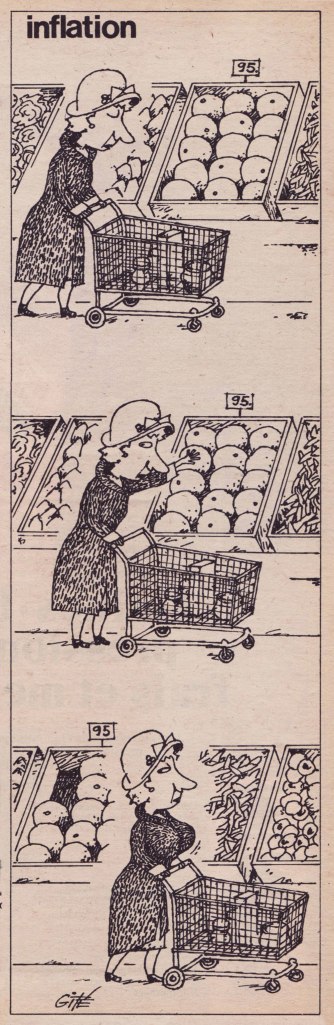
« Inflation », a forever relevant strip that appeared in Perspectives vol. 17 no. 7 (Feb. 15, 1975).
A sample Perspectives cover, this one featuring national treasure Robert Charlebois, at the time but a single decade into his spirited musical career.

Then came Croc, handily Québec’s most accomplished and successful humour mag (1979-1995, 189 issues), more National Lampoon than Mad, at least in the beginning. Gité produced quite a score of tremendous Croc covers — possibly the epitome of his œuvre — and I was planning on devoting a post to that lovely lot… but discovered that Gité’s colleague and close friend Guy Badeaux, aka Bado, had beaten me to the idea by over a decade. Feast your peepers on his savvy selections!

Ah, but he missed this one, Gité’s first! This is Croc no. 4 (Jan. 1980); despair not, doomsayer: the end may *yet* be nigh!

-RG

Maxine Always Has Her Mouth Open

« From October 1981 until December 2002, Maxine appeared in a head-scratching combination of publications such as San Francisco Chronicle, Heavy Metal, MS, Glamour, Austin Chronicle, LA Weekly, Utne Reader, Asbury Park Press, MAD, Funny Times, and even a newsletter for Hawaiian polygamists. »

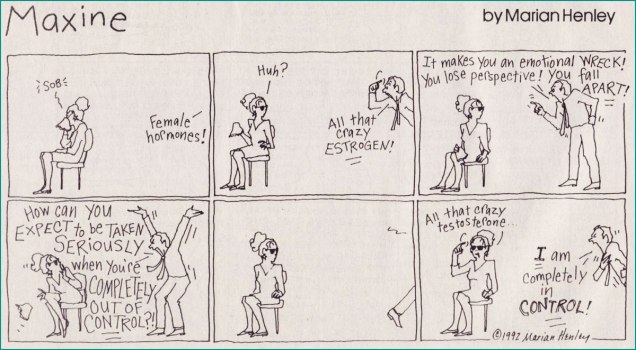
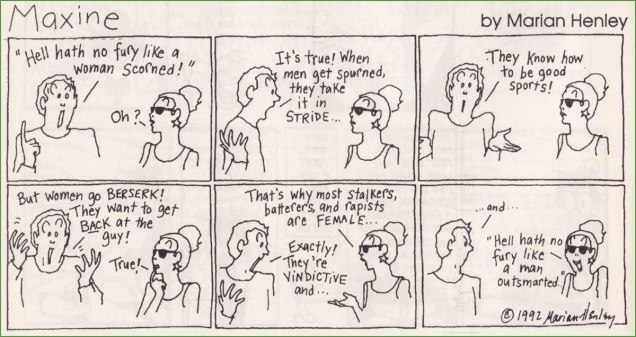
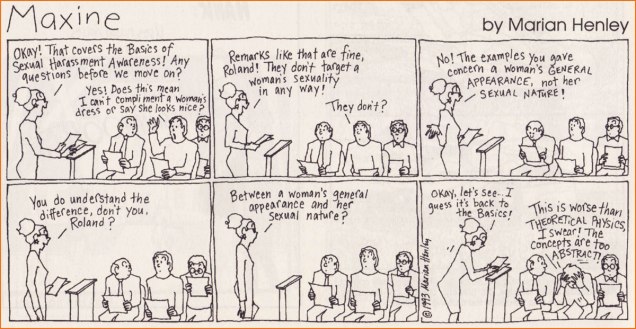
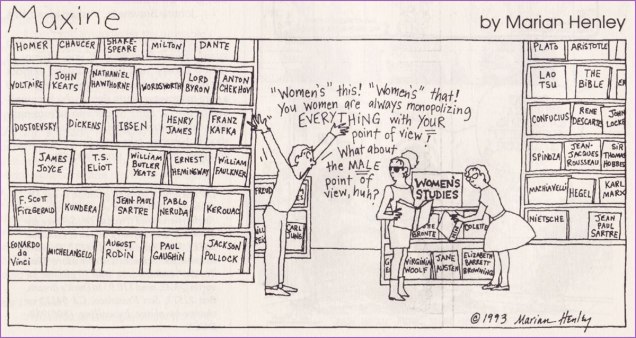
Marian Henley‘s Maxine naturally brings Nicole Hollander’s Sylvia to mind – two contemporary women cartoonists and their outspoken alter egos, both drawn in an idiosyncratic style that I imagine some found too sketchy, or too much of an acquired taste… to these imaginary straw men I’d recommend taking a closer look – Henley’s anatomy is impeccable, every character imbued with dynamic movement. Where Sylvia is a sort of seer, always at somewhat of a remove from emotional entanglements, Maxine is right in the middle of them like a cat tangled up in yarn, muddling through life’s chaos on her own terms (though sometimes dispensing advice to friends — ‘do as I say, not as I do!’)

A ‘Best Of’ collection of Maxine, published in 2002 by Taylor Trade Publishing. Hilariously, some have confused it with John Wagner’s Maxine, with much disappointment resulting. I guess these two target audiences have very little overlap. I also found myself counting Henley’s fingers — I think semi-unconscious defenses against AI are kicking in.

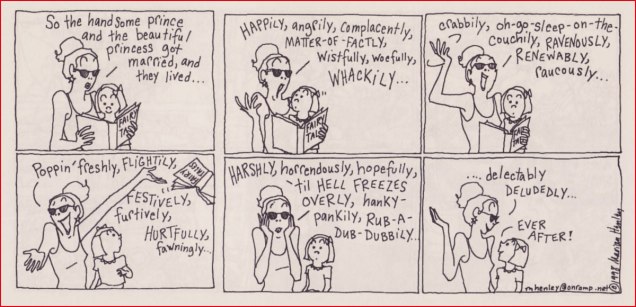
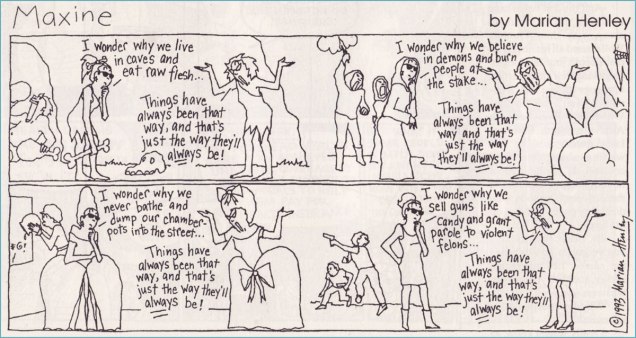
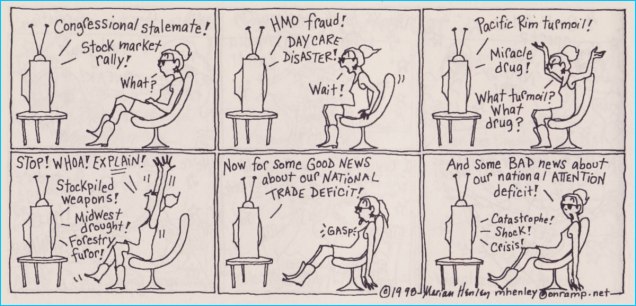
Maxine is a recent visitor to my brainscape – co-admin RG dragged out stacks of Comic Relief (‘The lighter side of life. Fewer calories than a newspaper, more laughs per pound.’, a monthly magazine published by Page One Publishers & Bookworks in California) from the 90s to look for something else, and that’s where the lovely choppiness of Henley’s art was pointed out to me. Sylvia is in too, incidentally. Here are some selections from 1991-1998. Crazy to contemplate that this was some 30+ years ago, yet the concerns expressed could have easily been a reaction to any recent morning’s news. Plus ça change, plus c’est la même chose….

Like any woman cartoonist worth her ink, Henley is into cats. In case this is news to some of other readers, men disliking cats out of all proportion is a waving red flag.

And the subsequent batch of strips feel so relevant to today that it pains me:

To wrap up on a more positive note (something sorely needed right now) —

This one is a sincerely sweet strip, a rarity in Maxine’s world.

~ ds

Jack Kirby’s ‘I Died a Thousand Times’

« Great Scott! What a mess! Did we walk away from that? » — Rocky Davis

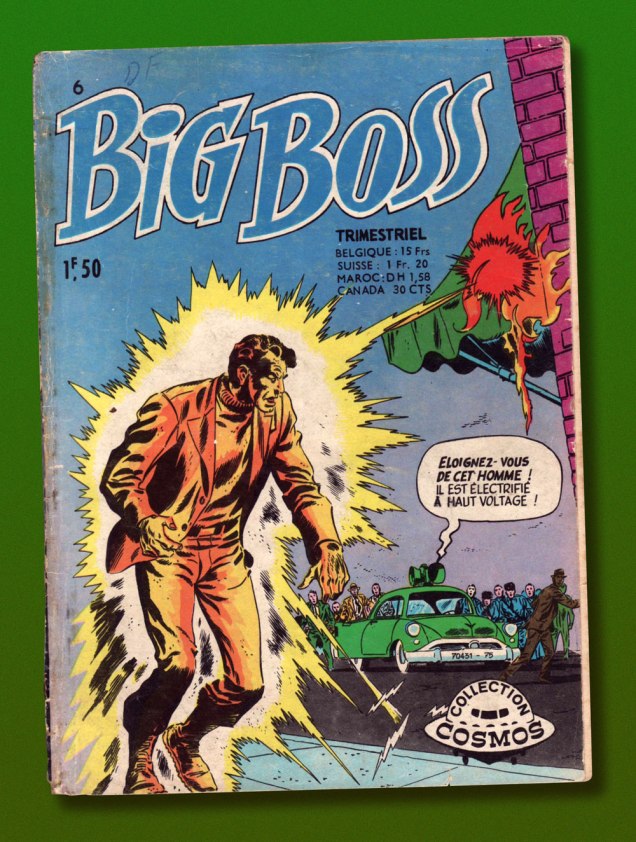
A couple of years after our big move, I’m still going through boxes, here at WOT? Headquarters. The other day, I came upon a stack of the long-running French anthology digest Big Boss (and its sidekick series, ‘Big Boy’), acquired who knows when and where… but surely for a song. Big Boss and ‘Big Boy’ (the quotation marks were part of the title!) were a most affordable source of vintage second-tier DC material like Roy Raymond, TV Detective; J’onn J’onzz, Martian Manhunter; Detective Chimp… and standalone tales from My Greatest Adventure, Tales of the Unexpected, House of Mystery and House of Secrets… essentially infamous editor Jack Schiff‘s row to hoe in the DC plantation.

This is Big Boss no. 6 (Oct. 1971, Arédit-Artima); cover by Ruben Moreira.

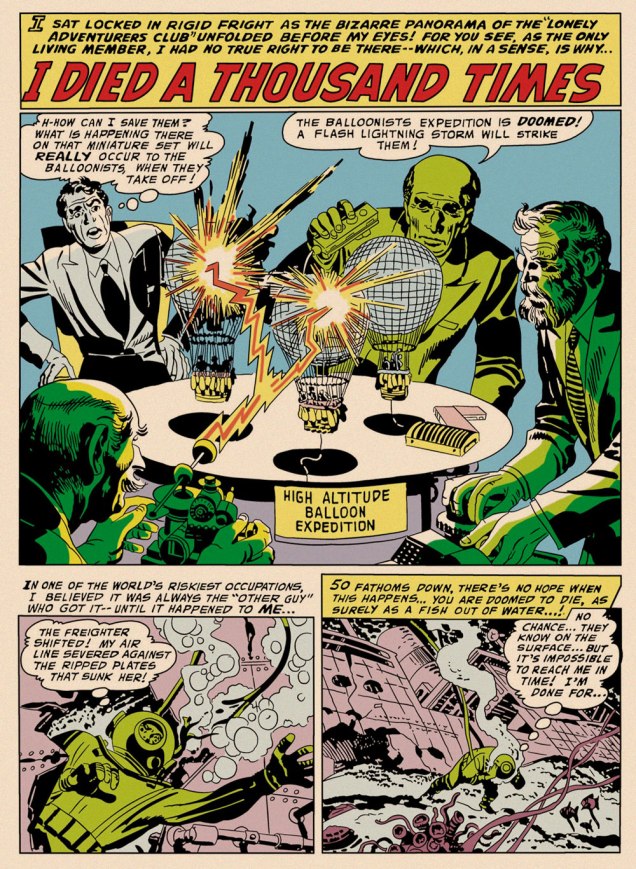
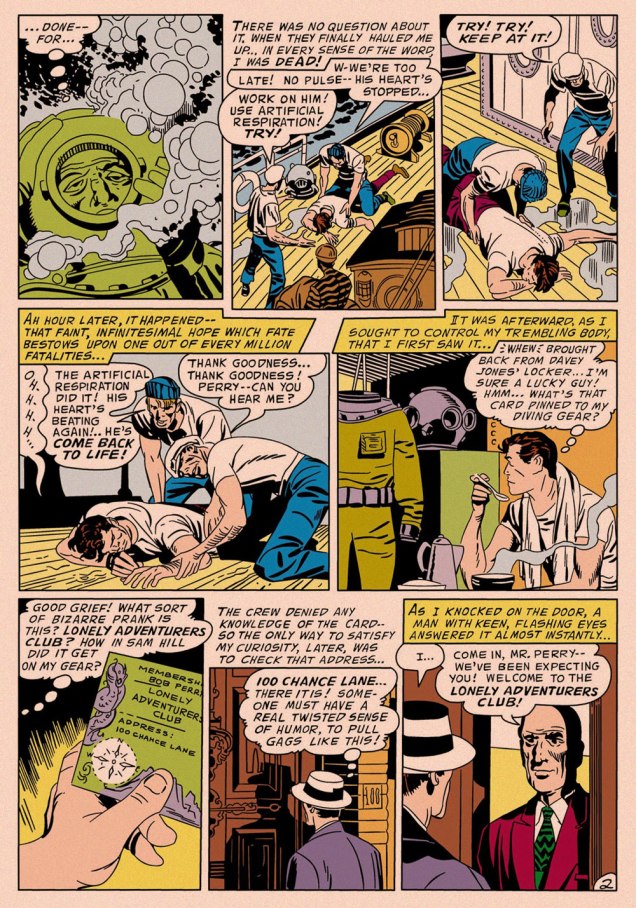
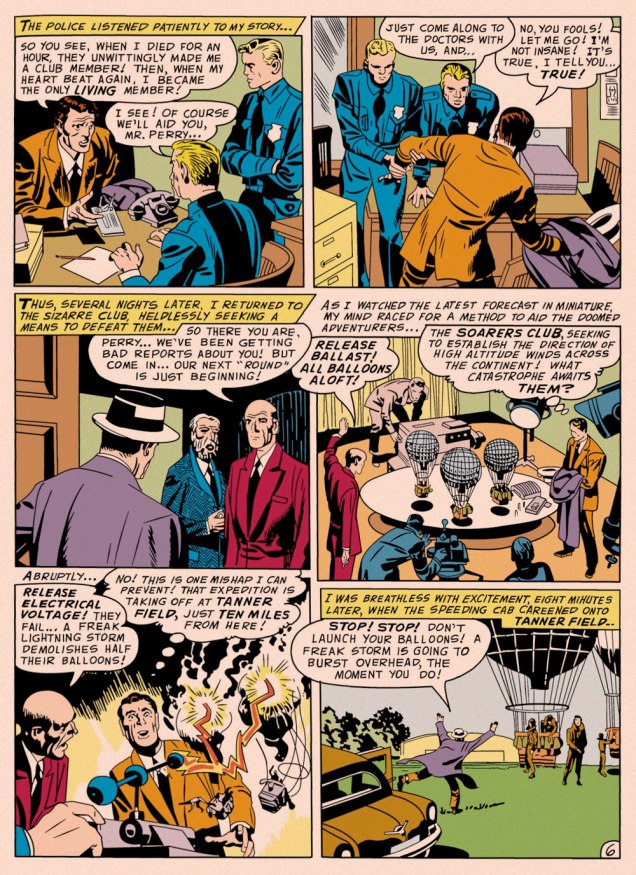
One might be inclined to say that, with its themes of adventurers cheating death or living on borrowed time, I Died a Thousand Times inspired Kirby’s Challengers of the Unknown, except that Ace, Rocky, Prof and Red had burst into print a few months earlier. Suffice it to say that they sprang from the same fertile well. It’s always intriguing to observe how the particular seed of an idea can be grown in a myriad of directions.

If you’ll forgive me the intrusion, this is how the opening panel appeared in the Big Boss reprint. In order to make things more readable in the digest format — and in black and white — Arédit‘s in-house art department routinely reframed and even augmented the artwork, with varying degrees of competence and success. This is one of the more accomplished efforts.

The story’s writer is unknown (though it features a most Kirbyesque plot); it was pencilled and likely inked by King Kirby, and originally appeared in My Greatest Adventure no. 16 (July-Aug. 1957, DC); edited by Whitney Ellsworth; Jack Schiff; Murray Boltinoff and George Kashdan… let’s just say DC *was* a tad heavy on the management side in those days.

Though Kirby’s standalone short stories of this period are as charming and inventive as you’d expect, this modest trove of material has by and large been neglected. While a handful of these tales (The Thief of Thoughts; The Creatures from Nowhere!; The Cats Who Knew Too Much!; The Man Who Betrayed Earth; The Negative Man; and The Stone Sentinels of Giant Island) were semi-randomly reprinted in the early 1970s when DC had lots of pages to fill, this one didn’t resurface in North America until 2011’s pricey-then-and-pricier-now hardcover Jack Kirby Omnibus no. 1.

– RG