The Spirit in “The Tale of the Dictator’s Reform” (1941)

« Fascism will come to America wrapped in a flag. » — Sinclair Lewis

With the exception of its daily strip incarnation (1941-44), principally ghosted by Jack Cole, the early years of Will Eisner’s The Spirit never drew me in. Next to the work Eisner produced upon his return from WWII, the first years seemed tentative and inchoate. It didn’t help that the original artwork — or even quality photostats — of the material had not survived, and so reprints were consequently hobbled by dodgy reproduction.

The other day, a most generous friend presented me with the second volume of Will Eisner’s The Spirit Archives — he had a spare copy — and, not wishing to look a gift horse in the mouth, I duly proceeded to read it. I should state that DC Comics’ complete reprinting of Eisner’s magnum opus is a definitive one, so the pill was far easier to swallow this time.

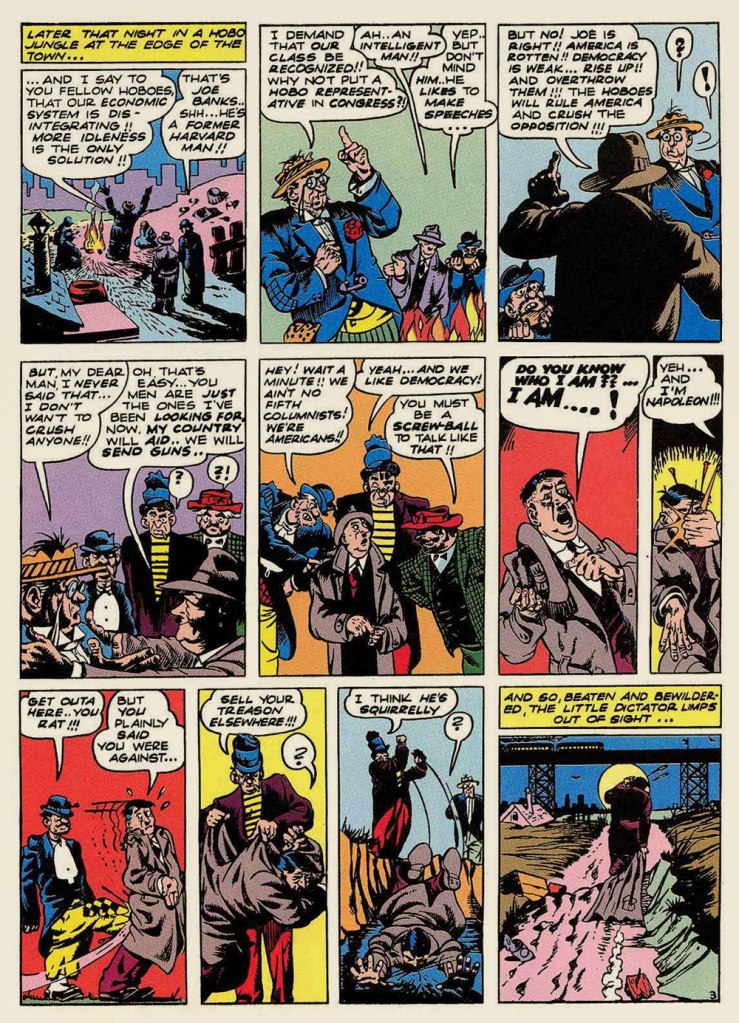
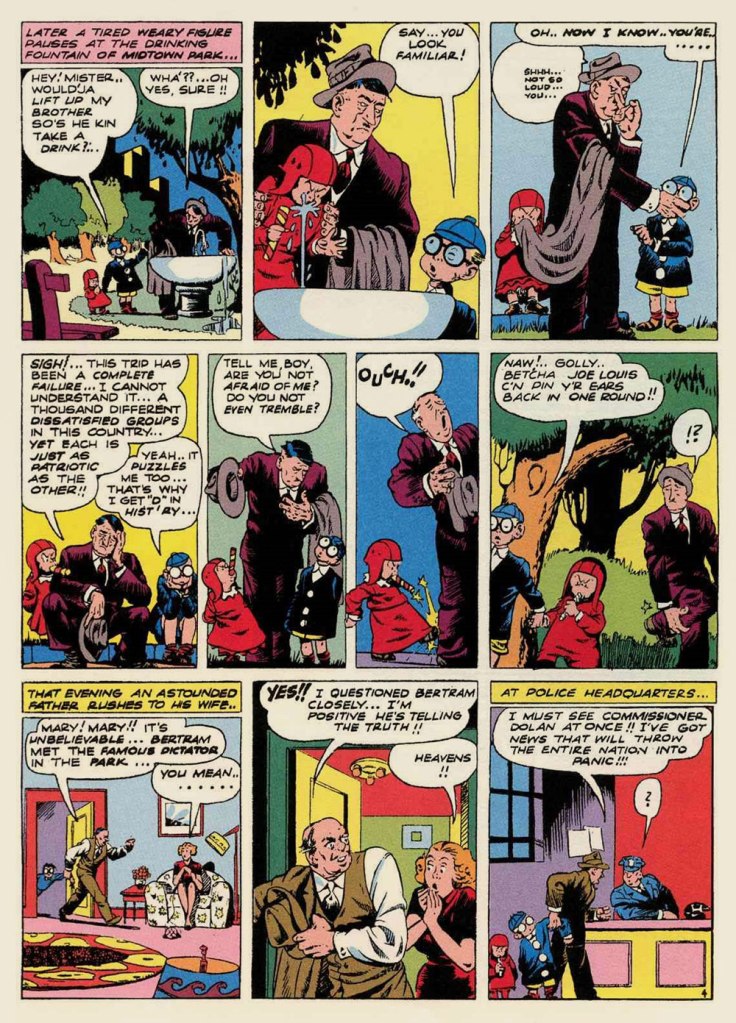
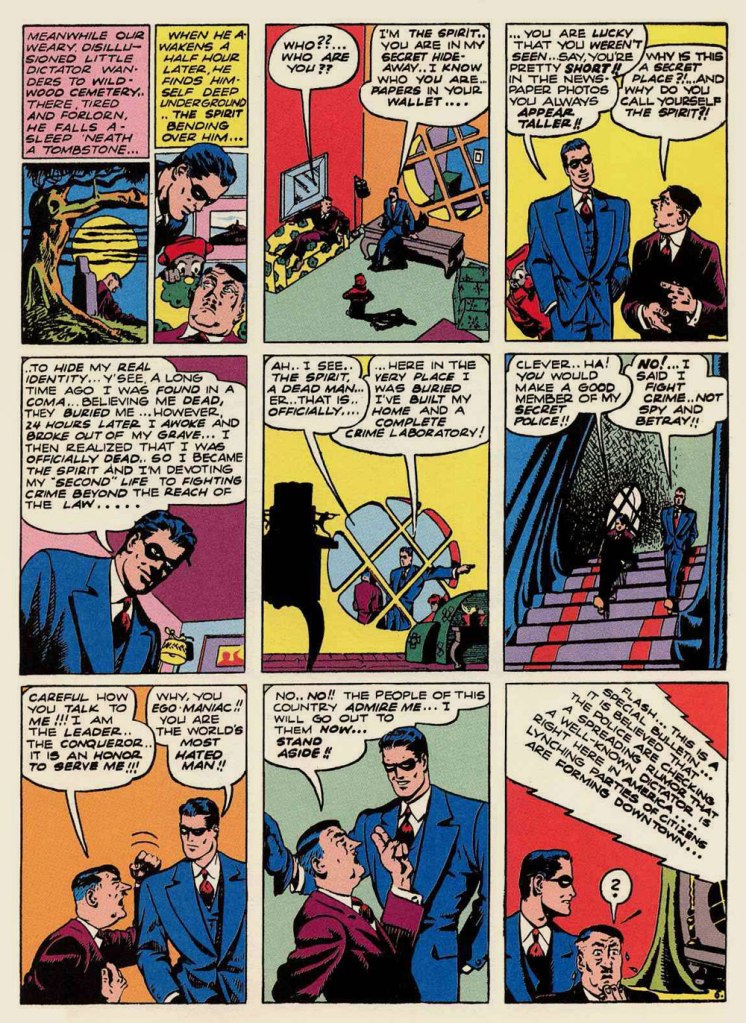
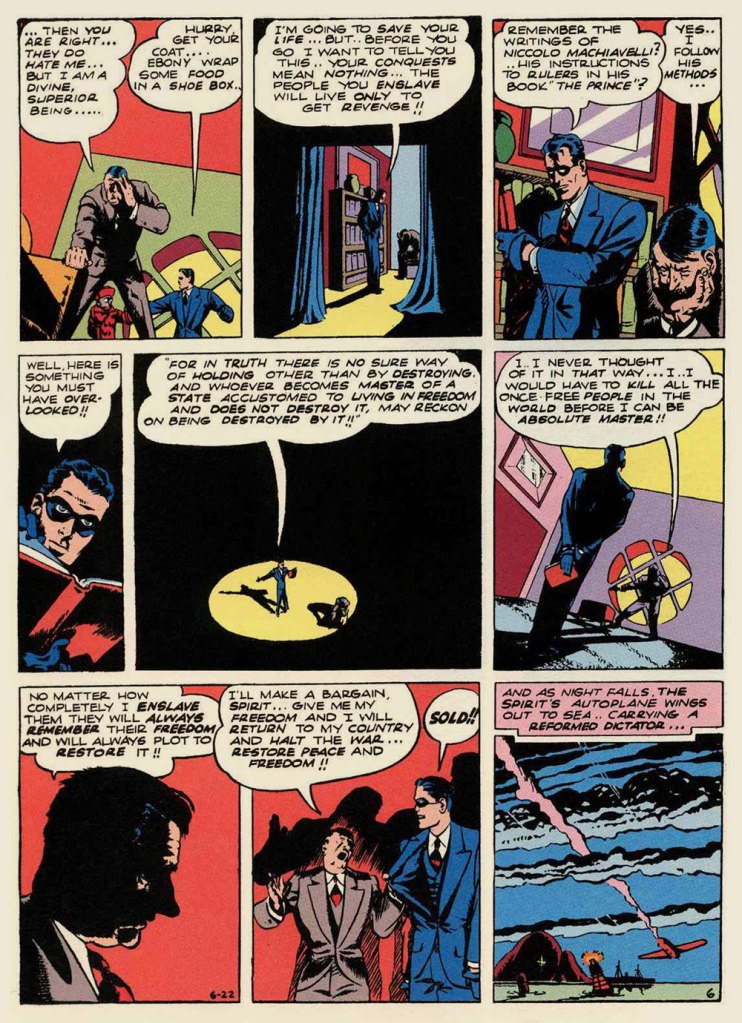
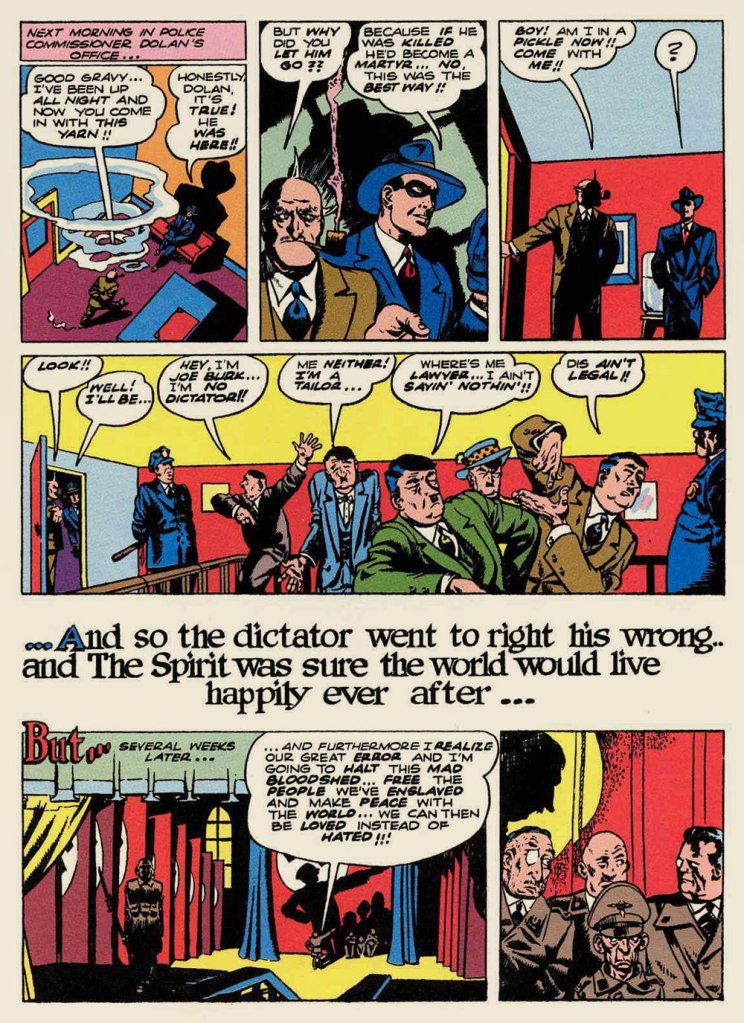
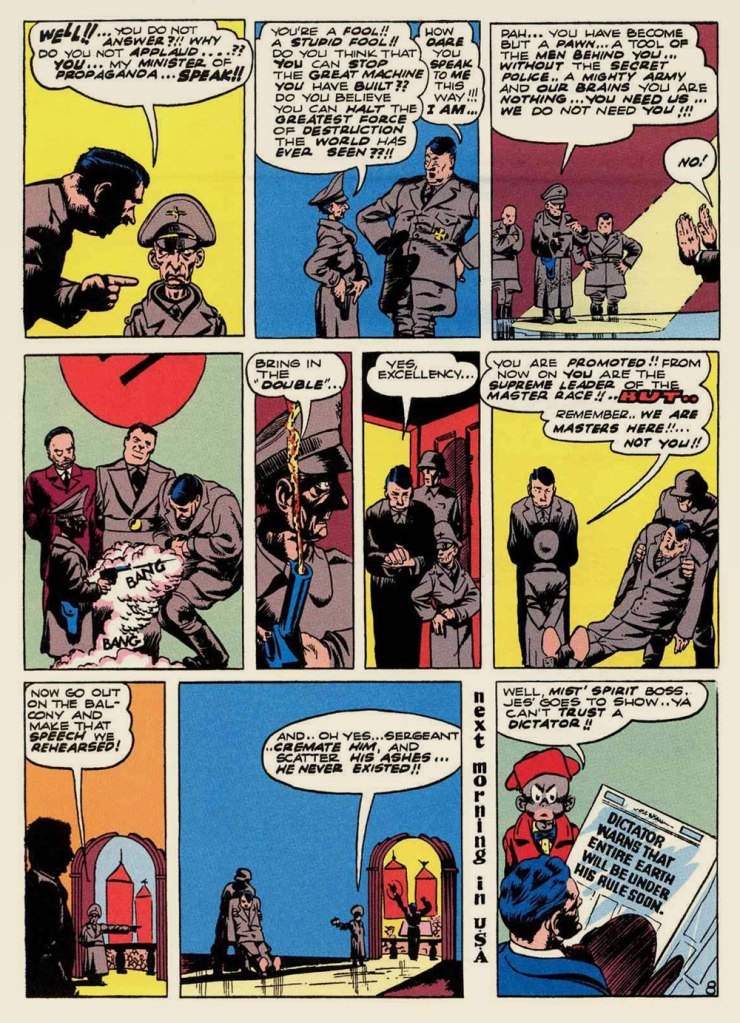
I was particularly taken with one gem near the end of the volume. And since America is currently awash in fascists and Brownshirts, Eisner’s political parable seems unnervingly apropos. See what you think!
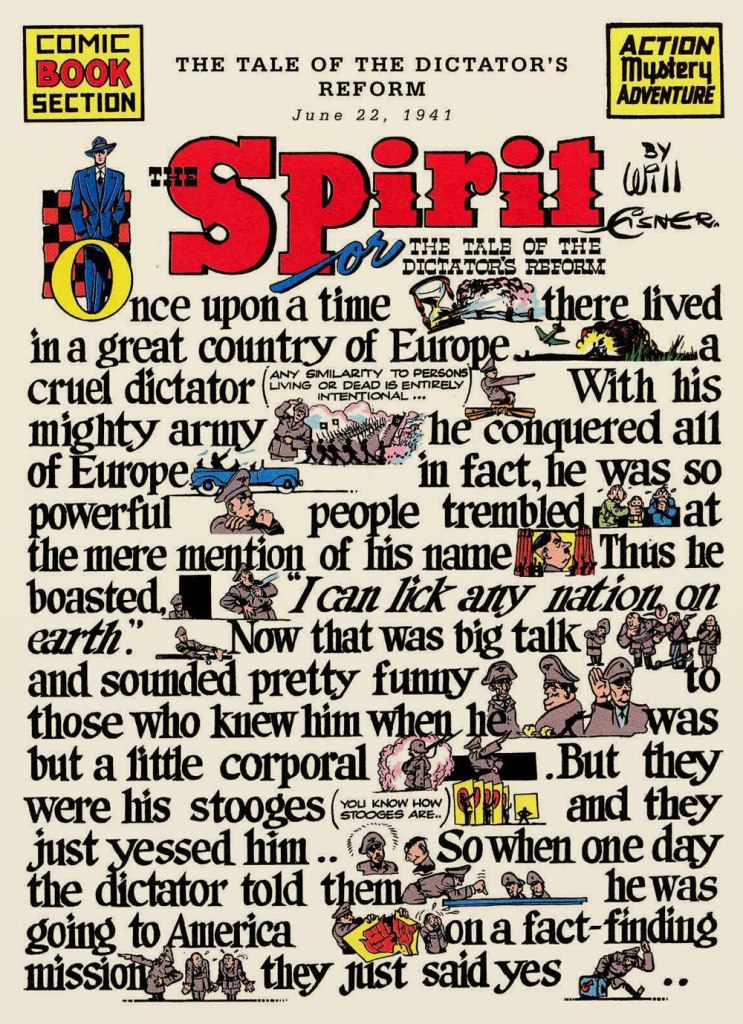
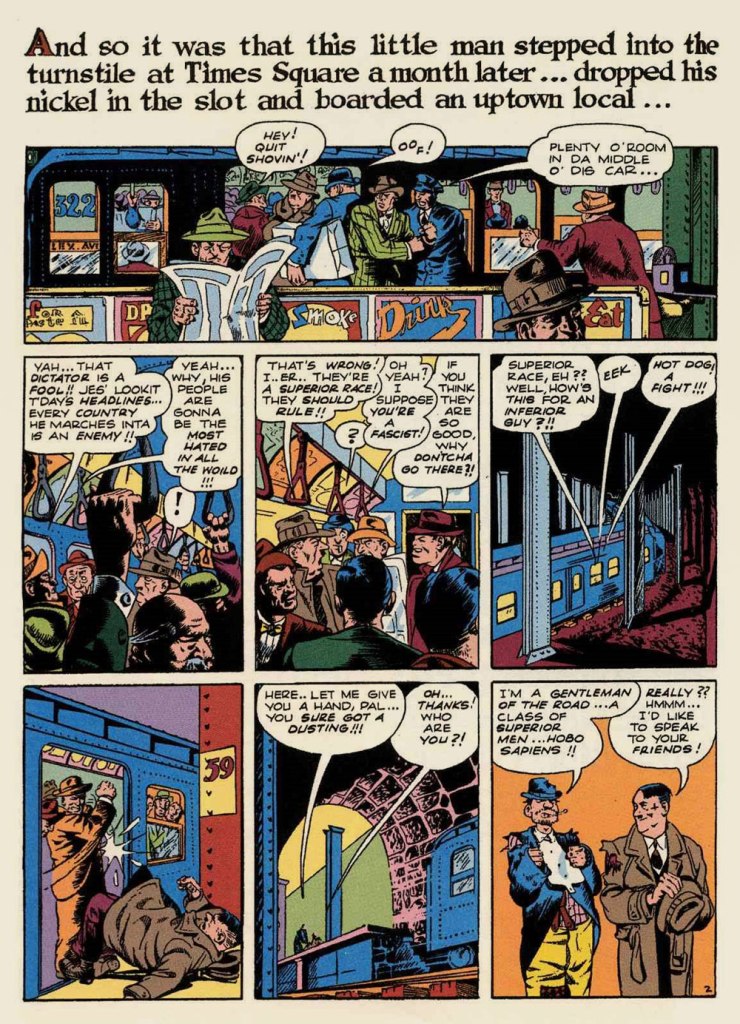
Like it says at the top of page one, The Tale of the Dictator’s Reform was originally published on June 22, 1941. The United States’ December 9th entry into the war was still several months away.

This episode was cited as a solid favourite of his lone surviving The Spirit assistant*, the mighty Jules Feiffer (born 1929) in his pioneering work of comics history, 1965’s The Great Comic Book Heroes. Mr. Feiffer wrote: « Eventually, Eisner developed story lines that are perhaps best described as documentary fables — seemingly authentic when one reads them, but impossible, after the fact. There was one about Hitler walking around in a Willy Lomanish middle world: subways rolling, Bronx girls chattering, street bums kicking him around. His purpose in coming to America: to explain himself, to be accepted as nice guy, to be liked. Silly when you thought of it, but for eight pages, grimly convincing. »

When the story finally was reprinted — some sixteen years after Feiffer’s tantalising plot summary — in Will Eisner’s The Spirit no. 32 (Dec. 1981, Kitchen Sink), associate editor Cat Yronwode added: « Indeed, the story is all that Feiffer said of it and more. He forgot to mention that The Spirit fixed Der Fuehrer a nice bag lunch, for instance, and obligingly flew him home after his American sojourn. It’s been a long time coming, but at last we can proudly bring you this little gem, possibly the most eccentric political homily ever produced in the comics form. Enjoy it, but don’t ask for more of the same. It’s unique. »

-RG

*the next-to-last Spirit assistant, Don Perlin, passed away earlier this month. He had pencilled three stories over Feiffer’s layouts in 1951, late in The Spirit’s run.
Nature Always Wears the Colours of the Spirit: Roy Raymonde

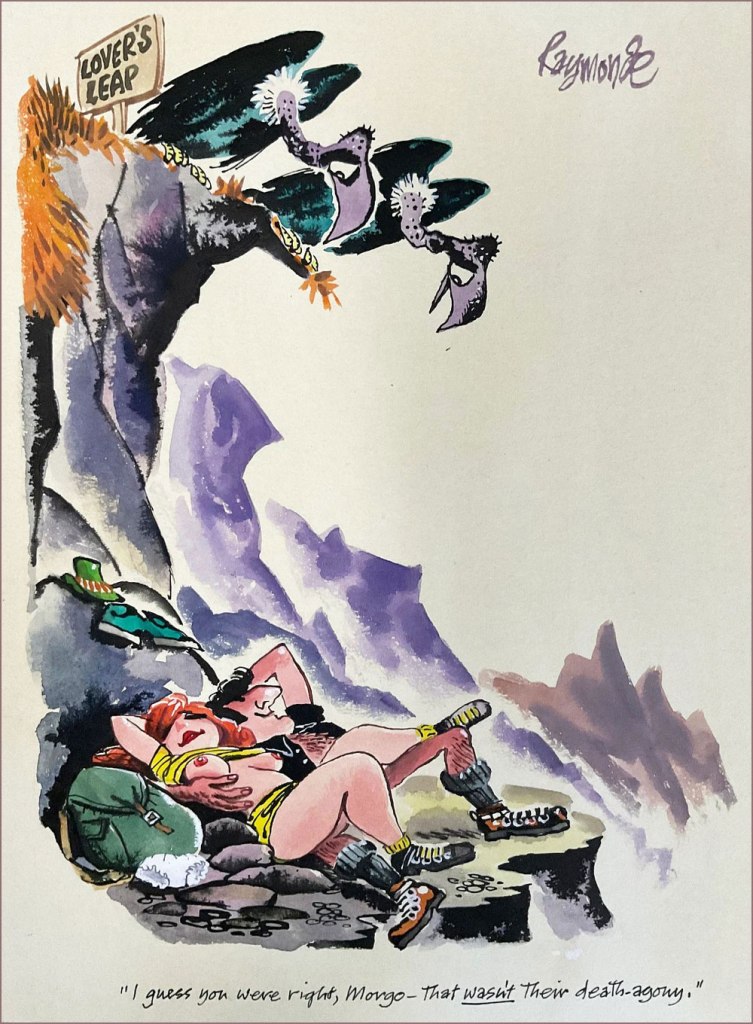
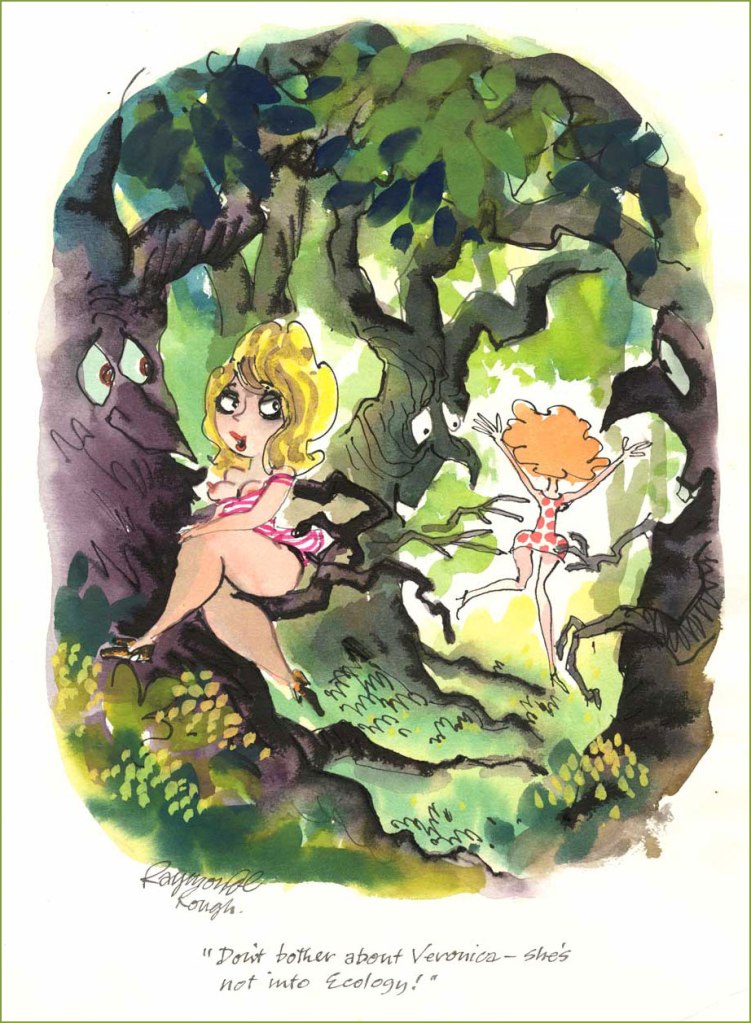
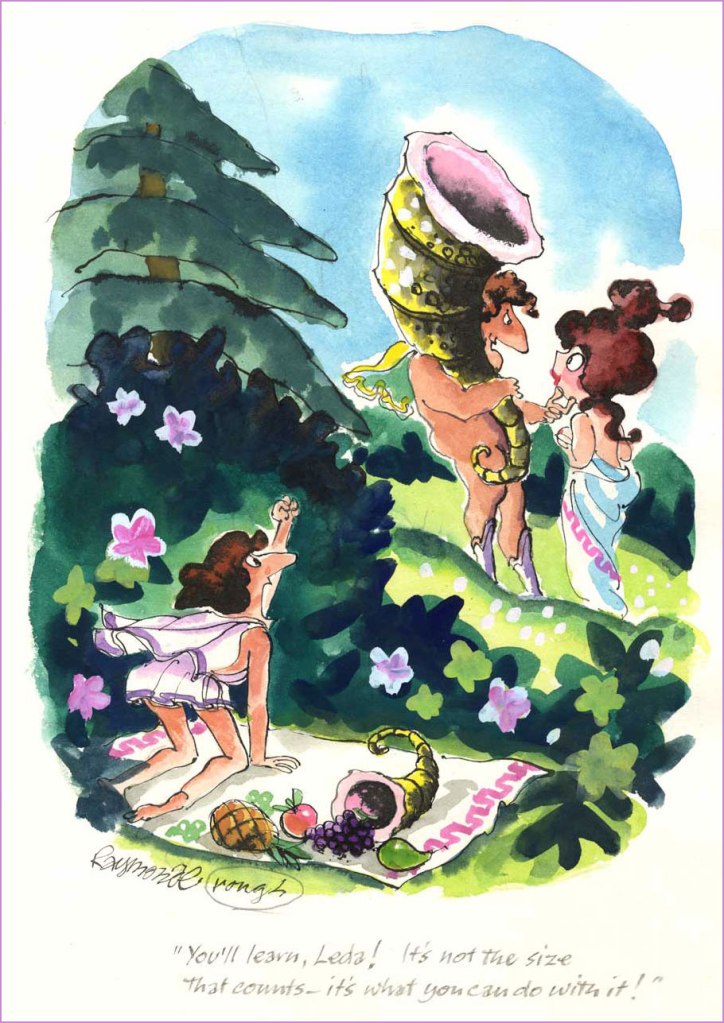
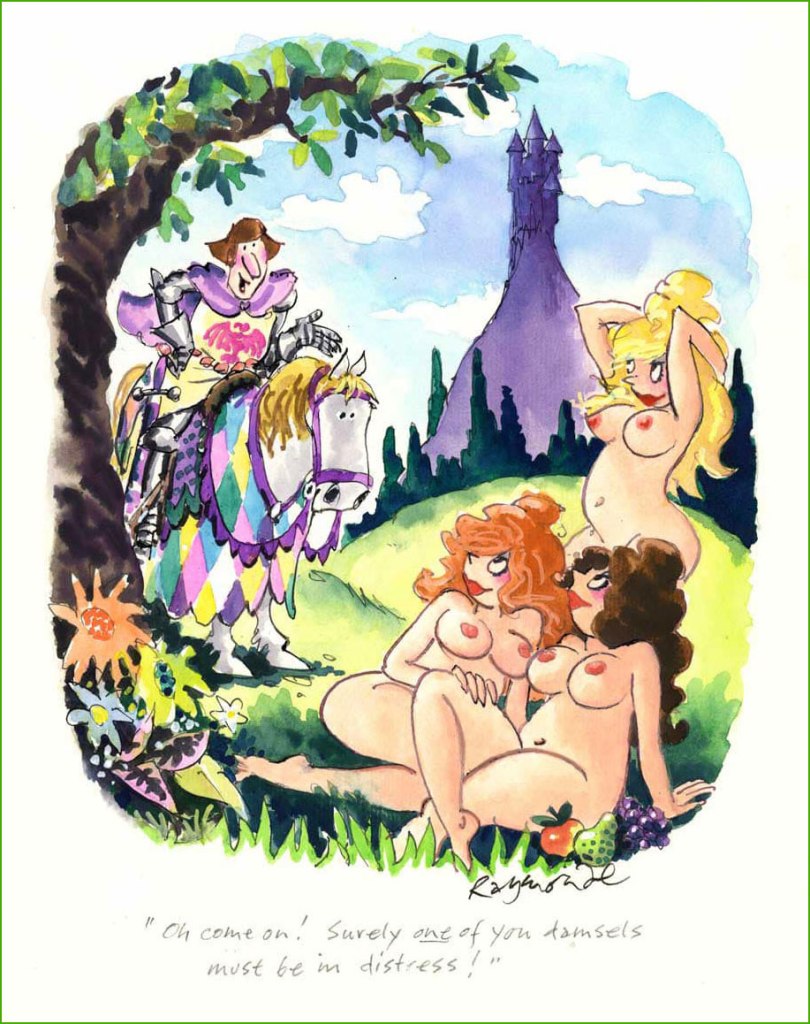
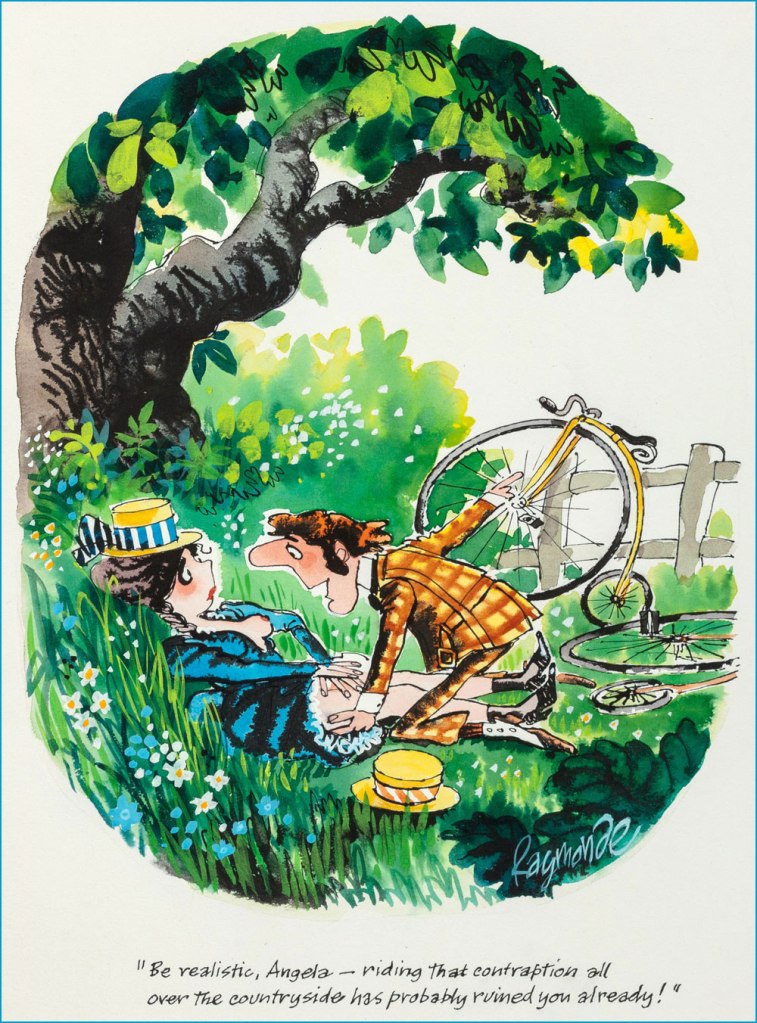
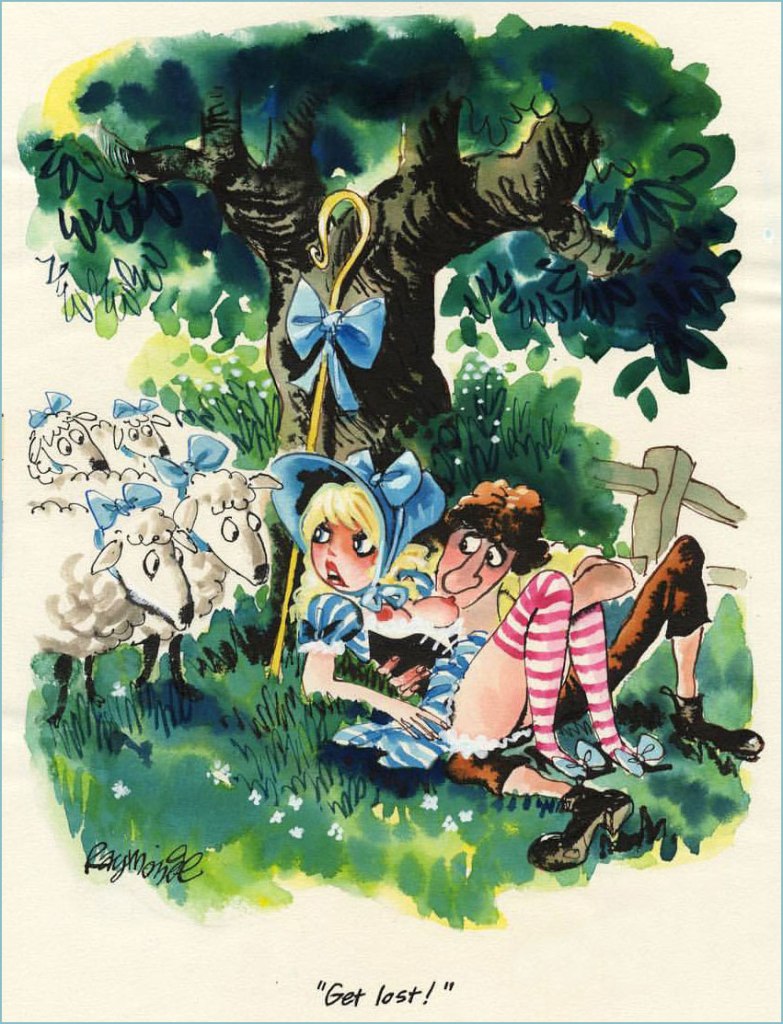
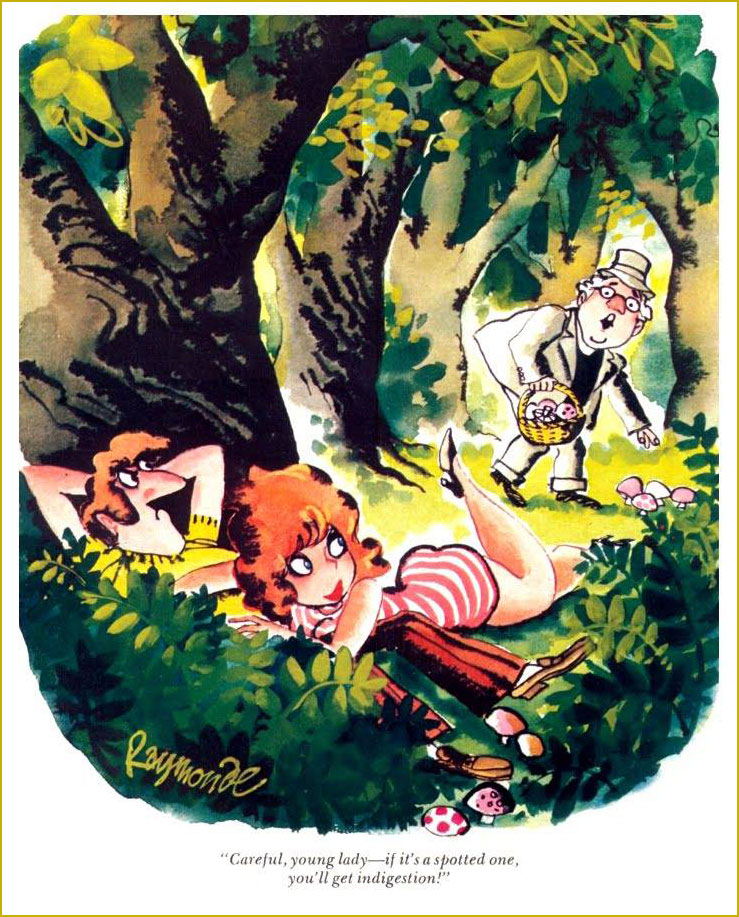
British cartoonist Roy Stuart Raymonde, who died in 2009 at 79 years old, first intrigued me with vivid watercolours and episodes oftimes set in mushroomy forests or secluded glens dotted with babbling brooks. Our anglophilically-minded readers may recall his work for Punch Magazine, and the rest of us will recognize him from the pages of Playboy, to which he contributed a monthly full-colour page for some 30 years.

The rambunctious Raymonde started out in advertising, cushioning his finances by freelancing as a cartoonist, mostly notably for Tit-Bits, a British tabloid-type magazine with an amusing name which reminds me of this George Carlton sketch. By 1960, Raymonde had amassed enough contacts to become a full-time cartoonist.

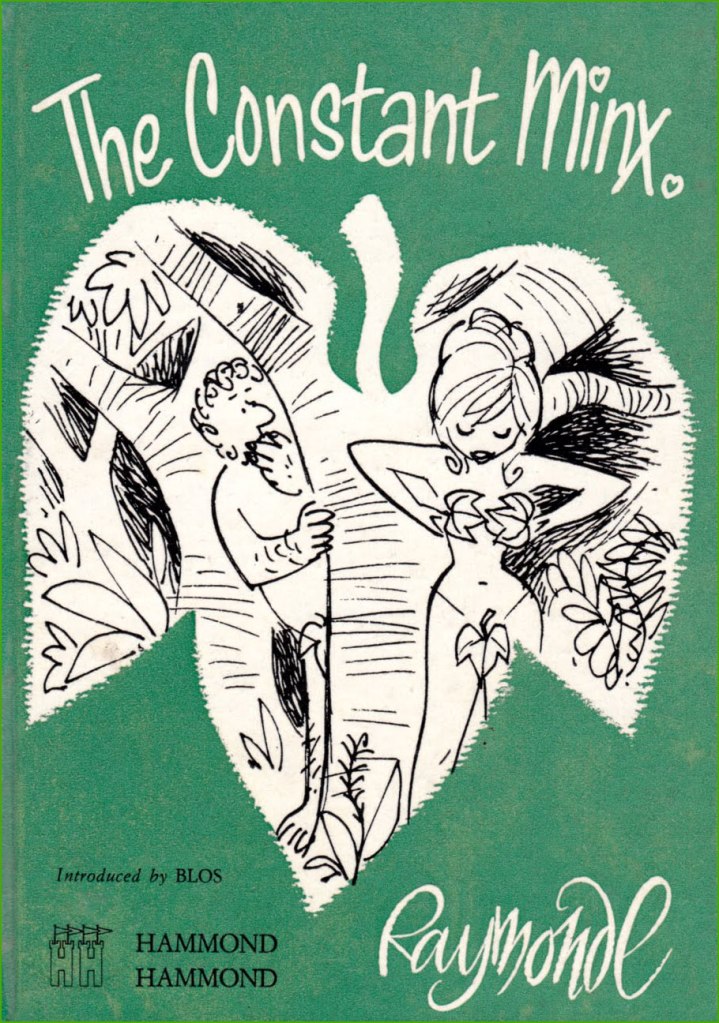
A collection of Raymonde cartoons published in 1961. Head over here to see some of the insides.
July 1974. This is the cartoon that first attracted my attention… with mushrooms, naturally.

I didn’t know this until writing this post, but delightfully Raymonde was friends with WOT favourite Gerard Hoffnung (see co-admin RG’s posts Gerard Hoffnung’s Constant Readers and Off to the Isle of Cats — and Back by Teatime!), whom he met at the Harrow School of Art (a subdivision of University of Westminster) in 1944, when RR was but 15. The two became lifelong friends, with Hoffnung, then a junior tutor (on his way to becoming a schoolmaster) a mere four years his senior, playing the role of Raymonde’s mentor. This friendship was cut abruptly short by Hoffnung’s premature death, so they were not able to re-enact Simon & Garfunkel’s Bookends, alas. I wasn’t able to find the exact source of this quote, as various websites just parrot the same paragraph over and over, but it seems that Raymonde was nearly expelled after adding funny captions to one of Hoffnung’s instructional drawings, a story hopefully as true as it is hilarious. Hoffnung (never bereft of a sense of humour) came to his defense and argued that this act was a sign of talent.

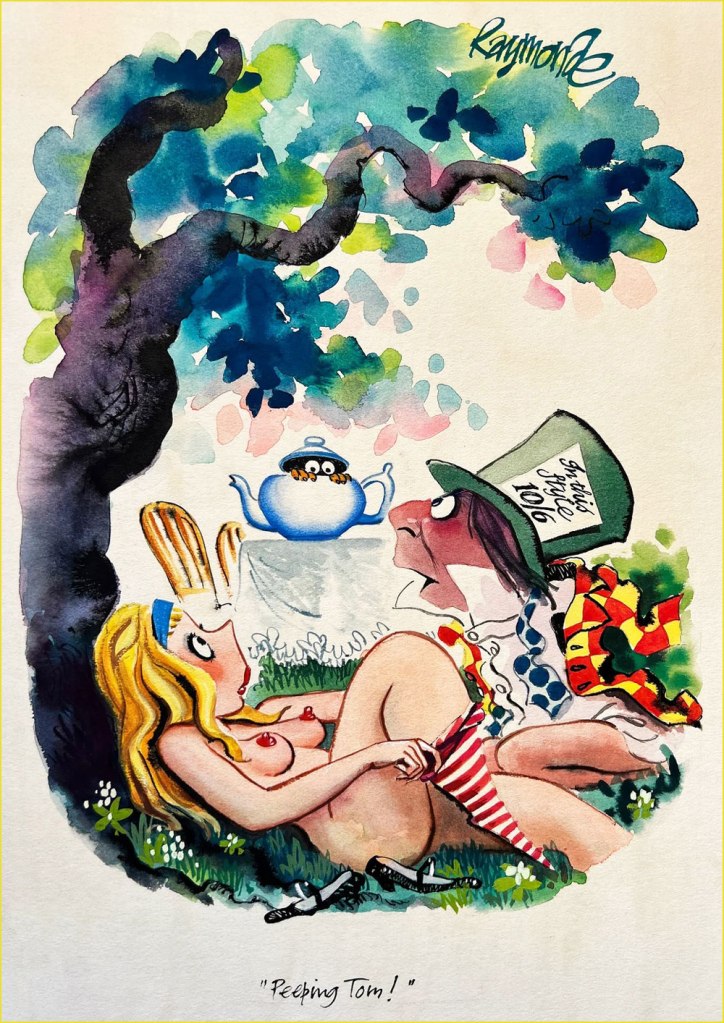
September 1972. What kind of Brit cartoonist worth his Yorkshire Pudding hasn’t spoofed Alice in Wonderland?
1973.
Preliminary sketch of unknown vintage.
Another preliminary sketch.

Given his evident love for the outdoors, I wasn’t surprised to find out that Raymonde bought a thatched cottage at the age of 34 and lived there for the rest of his life, voyages to Japan (where his work was very appreciated, to the point of winning the Gold Prize at the Kyoto International Cartoon Festival in 1996) and such notwithstanding.

1997.
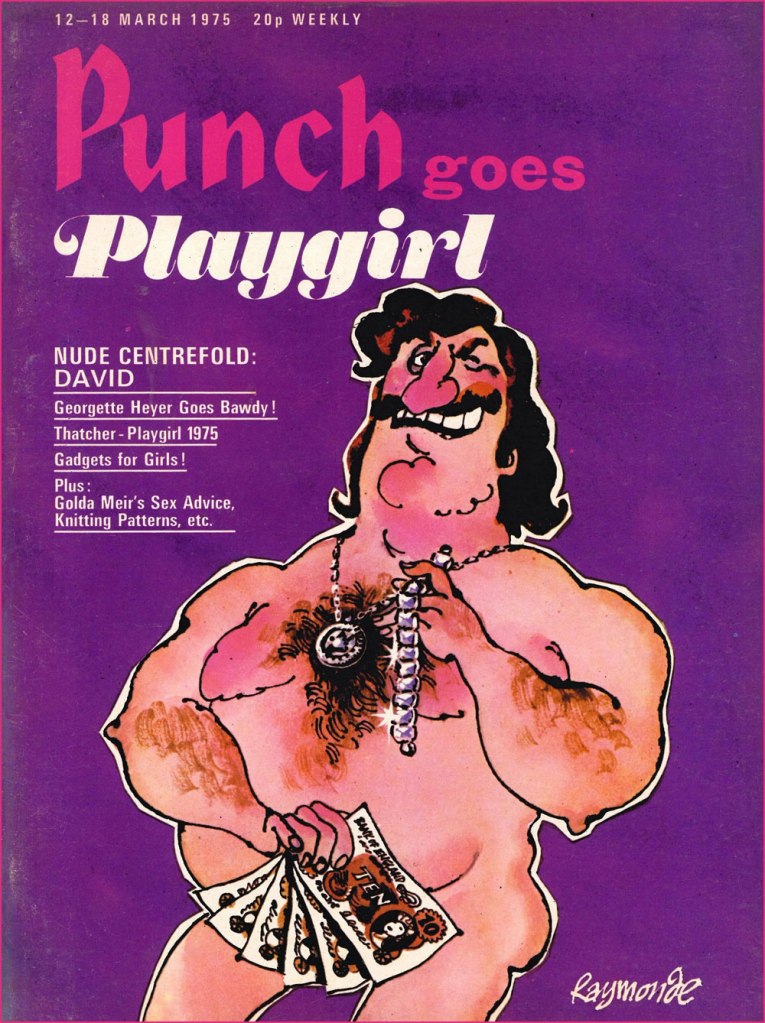
Punch Does Playgirl, March 1975. Raymonde created quite a few covers for Punch… as to the guy depicted, he’s like something out of a Charles Rodrigues sketchbook (see Charles Rodrigues’ Pantheon of Scabrous Humour).
July 1974.
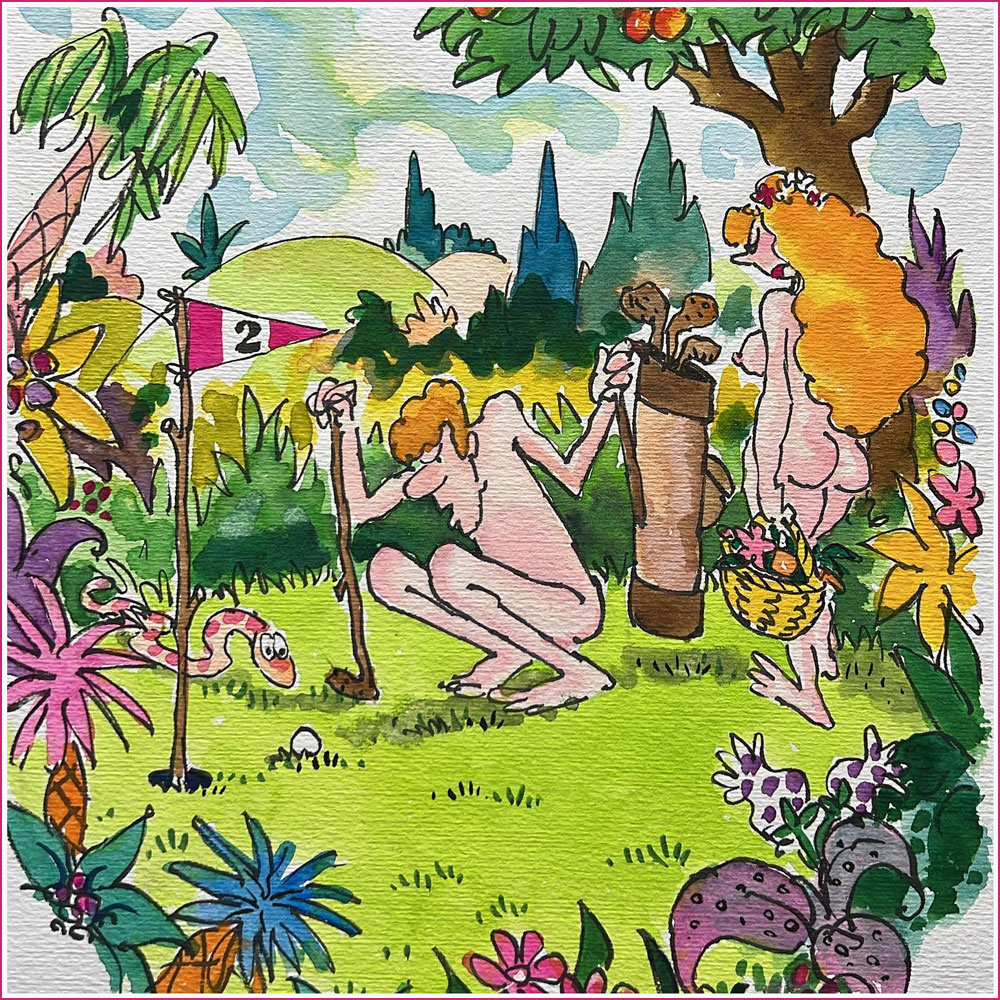
A cartoon used in Fore Play: The Very Best of Playboy’s Classic Golf Humor Paperback (January 1, 1995).

Want to see more? Head over here… and don’t forget to rest your weary head in some spring grass while you’re at it (perhaps with a friendly companion).

~ ds

Gardening for Victory With Nancy and Sluggo

This time of the year is special (and harried) for would-be gardeners – plants carefully nurtured from seed are carefully hardened off (or being plonked into the outdoors soil, for those in the warmer regions), which involves a lot of running back and forth clutching pots and bags of soil, and brandishing favourite raking and digging implements.

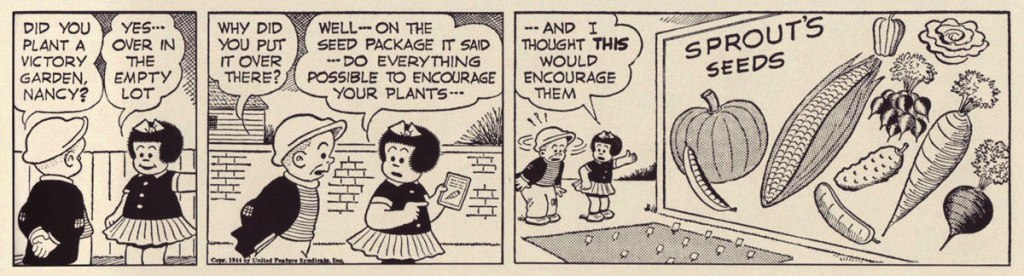
I was spoiled for choice when it comes to strips featuring gardening front and centre, so this theme shall be broken up into several installments. Part I: Nancy! We’ve mentioned Nancy a few times… sort of — see here, except that this John Stanley’s Nancy, and here, a post about an unexpected gem co-admin RG dug up from Nancy creator Ernie Bushmiller. Speaking of co-admins, thanks to the aforementioned RG for locating and scanning these strips. Frankly, my arms are elbow-deep in soil and I’m (w)ra(c)king my brain trying to remember what I planted and where, so mental capacity is sorely depleted.

Strip from May 17th, 1944.

In case the term is new to you, victory gardens were encouraged by the government during wartime — to supplement rations, but mostly boost civilian morale. While the intention was a bit manipulative, surely most would agree that growing one’s own food is immensely rewarding, which reminds me of this meme:

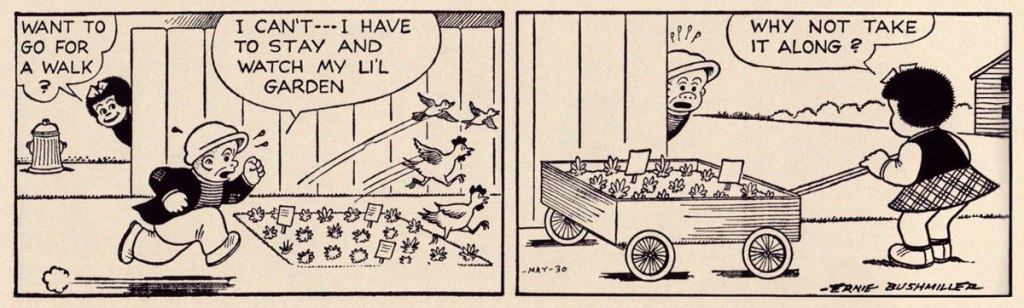
Strip from May 30th, 1950. Given concerns about going away for even a few days (‘who’s going to mind the plants?!’), Nancy’s plan sounds good to me.
Strip from June 15th, 1951.
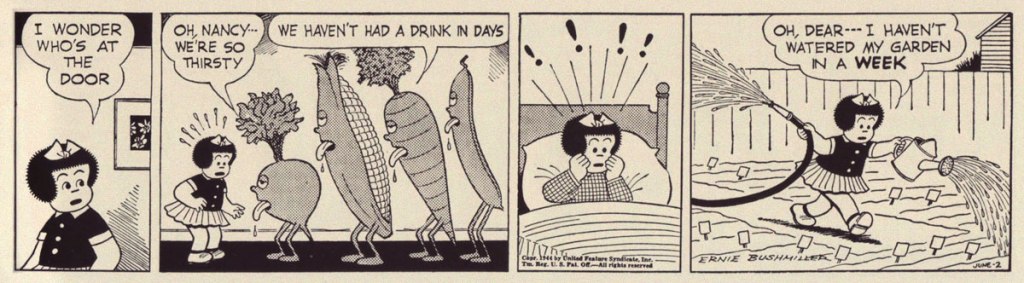
Strip from June 2th, 1944. I wondered why Nancy was planting sausages in her garden, when I realized that’s probably a green bean…
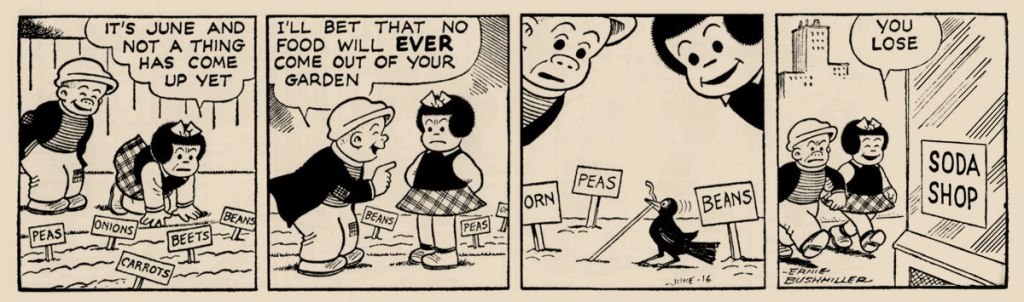
Strip from June 16th, 1948.
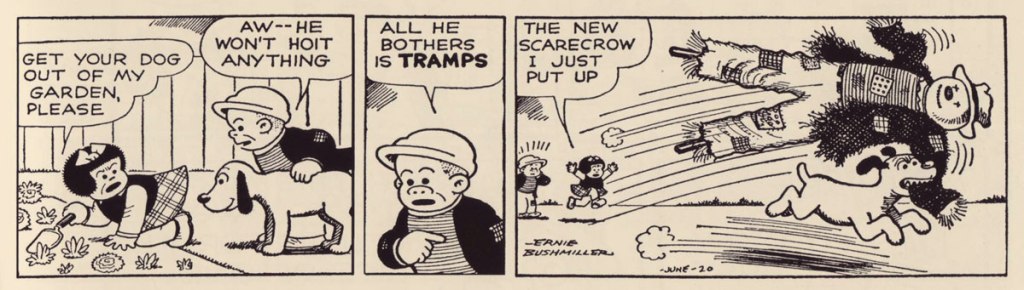
Strip from June 20th, 1951.
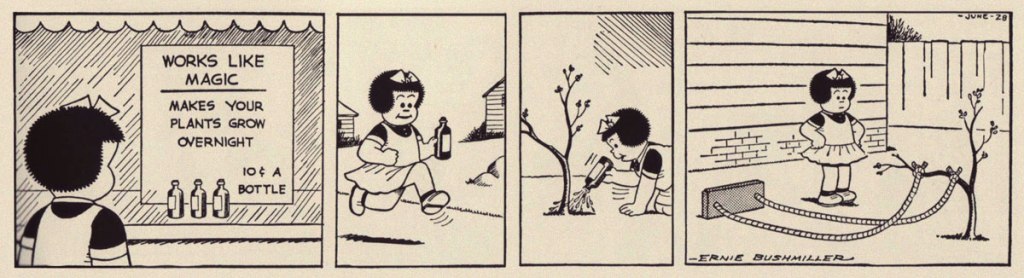
Strip from June 28th, 1943.
Strip from July 2nd, 1945. The size of the foliage does not hint at the size of the carrot 😉

May your seedlings grow strong!

~ ds