« I wish I could blend into the background / I’ve no excuses for my lack of guts / What is it about me that draws attention? » — Kevin Godley & Lol Creme, Punchbag
Today, let’s delve into the little-frequented wilds of that underrated little publisher that could, American Comics Group (ACG), 1943-67. The brand is chiefly recalled today for a pair of notable features: ACG pioneered the ‘horror’ anthology comic book with its Adventures Into the Unknown (1948-1967, 174 issues) and, in 1958, brought Herbie Popnecker, Richard Hughes and Ogden Whitney‘s ‘little fat nothing‘ to an unwary and undeserving world. ACG was co-founded and, briefly, co-owned by one of the field’s great villains, Harry Donenfeld.
But that’s all trivia in the end. ACG’s special appeal rests for the most part on the shoulders of one man of many monikers: writer-editor Richard E. Hughes (1909-1974).
I’ve already enumerated the man’s bona fides a couple of years back, when I featured one of his most celebrated (by ACG readers) tales, The People Versus Hendricks!, so I refer you to that particular entry.
As Hendricks’ tale was a rather tragic one, and since his dry wit ranked high among Hughes’ preeminent attributes, what do you say we set him loose for a demonstration of said lighter side?
Though many a notable illustrator passed through ACG’s doors — under his given name or otherwise — it’s undeniable that Hugues’ most consistently effective comrade-in-arms was the forenamed Mr. Whitney. Don’t let his low-key, ‘square’ approach deceive you: here’s a master storyteller at play.
Read on, febrile friends of ol’ Faust!

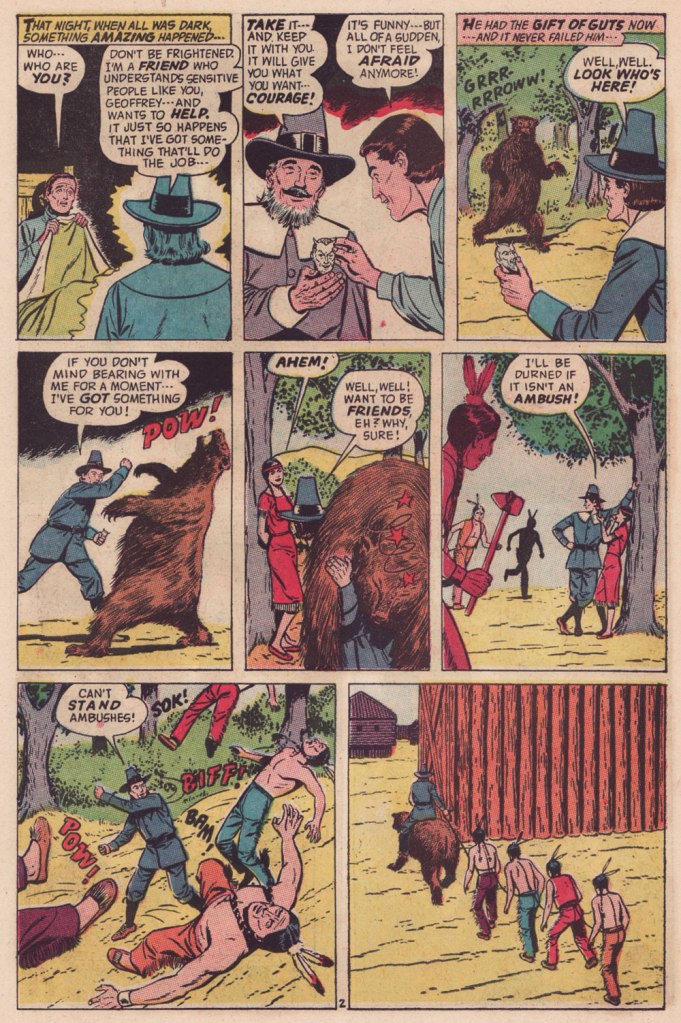


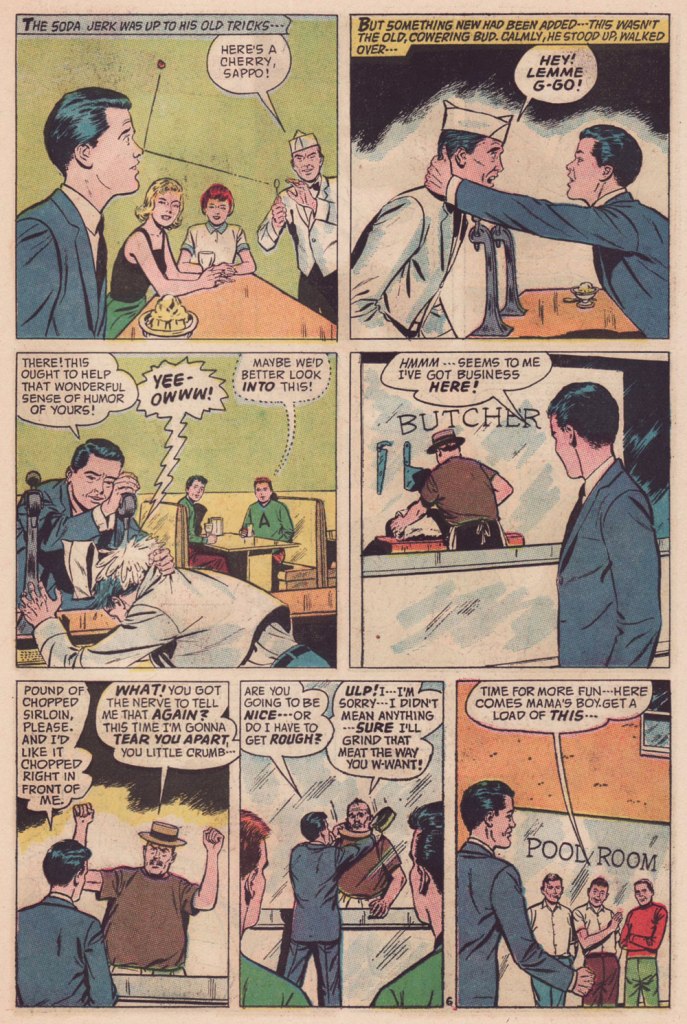
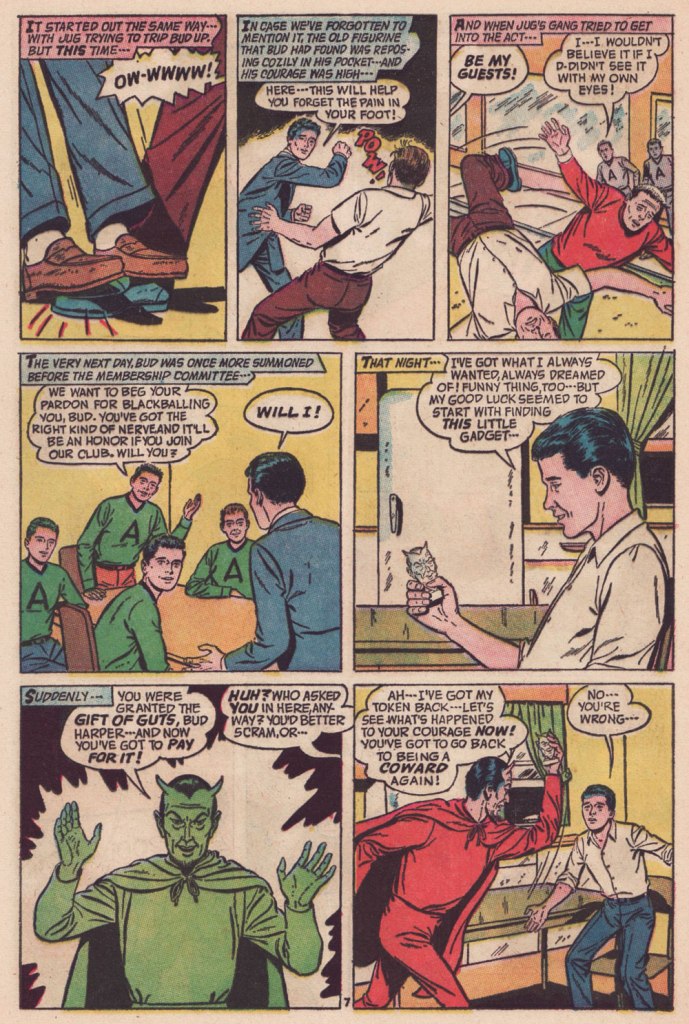
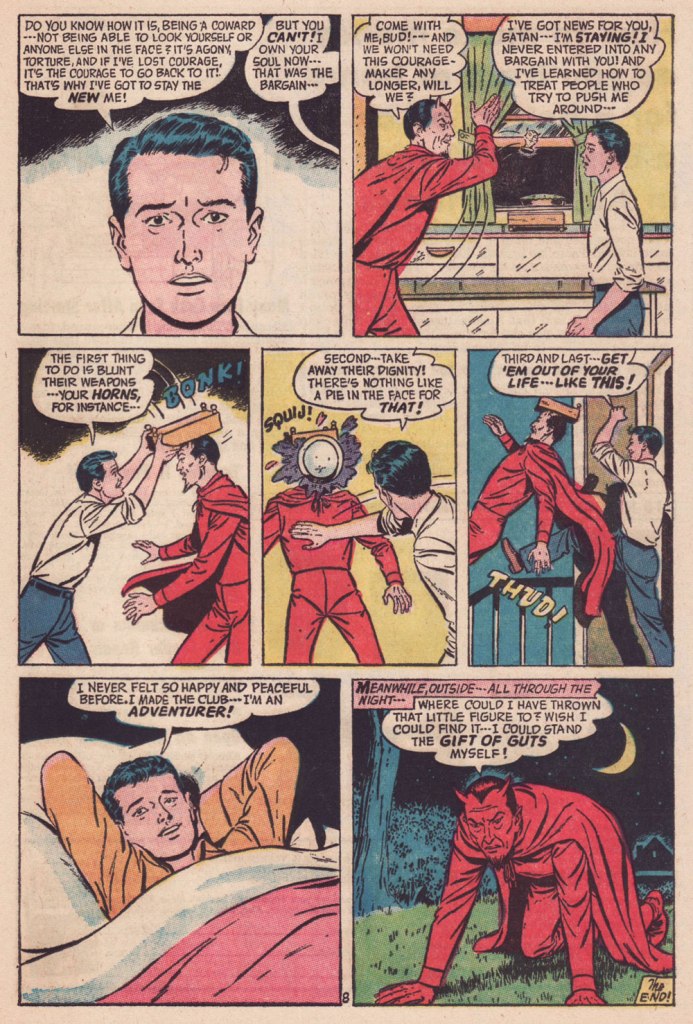
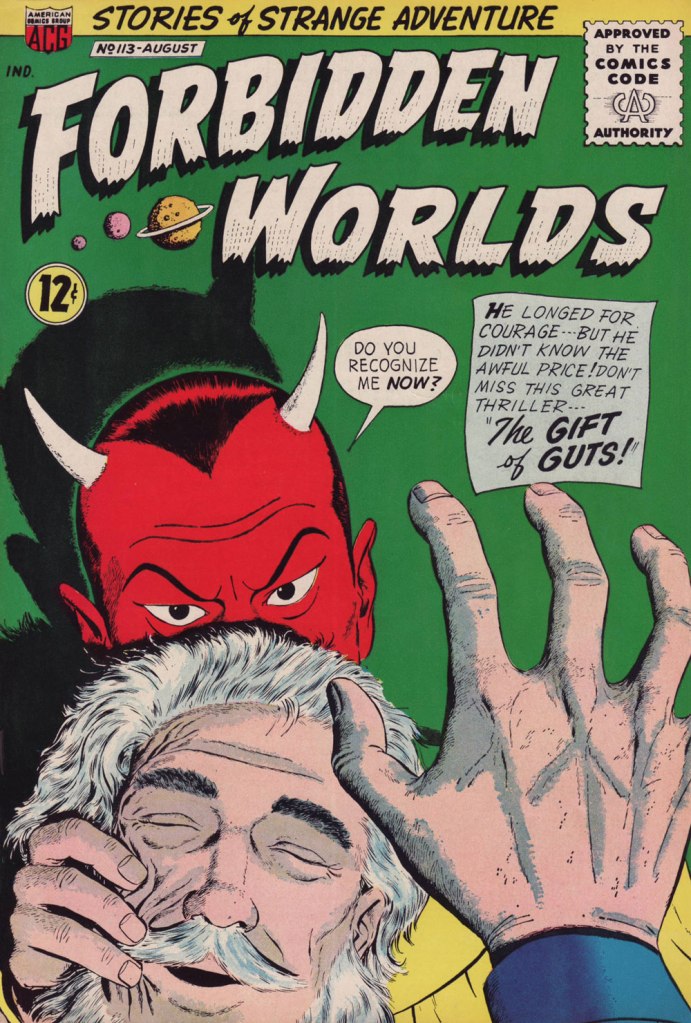
-RG
 Who's Out There?
Great stuff, as usual. The robot story is prescient for our ChatGPT age and evokes novels like Ian McEwan’s Machines Like Me. It has subtle and moving plot twists.
The courage story is great and must have struck a cord with thousands of comic-reading boys – I would have been among them had I been a bit older. Perhaps, thinking of those tough settlers, some of them signed up for service in SE Asia a few years later.
Interestingly, the panel showing Bud kicking a stone in helpless frustration seems to echo the famous and ubiquitous panel of ‘Mac’, the scrawny kid who has sand kicked in his face at the beach, kicking a book in anger, before taking a body-building course by Charles Atlas… and becoming the hero of the beach.
A course, btw, that I signed up for at 15, and wound up putting on 20 lbs lifting weights in my basement!
LikeLiked by 1 person
Thanks, Steve! I must say that “Great stuff, as usual” is a lot to live up to, though!
It seems to me that ACG’s niche was more writing-focused comics than anyone else in the industry. Hughes was a singular talent and certainly deserves to be remembered.
Glad to hear that the Atlas course/method was not rip-off and that its adherents benefitted… provided they put in the work! I also packed on some muscle at fifteen, working out in the basement. Must be a rite of passage for the more resolute among us.
LikeLike
I also ordered that Atlas course, but was disappointed that I still couldn’t tear a phone book in half after a mere week. 😉
LikeLiked by 1 person
HA! What a putz Satan ends up, misplacing his talisman left & right! And is that a Nylarlathotep-inspired mask he’s sporting? This story has the flavor of Rod Serling’s funny episodes of the Twilight Zone, don’t you think?
There’s plenty of punching in this one, but typical comic book action/violence or not, Richard E. Hughes stories are nearly inflallibly incident-rich with a lot of twists & turns. This is essentially two different stories shoved together plus the Satan-as-putz twist ending.
Though Hughes was a credit hog in his letter columns (strangely through his plethora of pseudonyms), he was good about letting artists be who they were and not insisting on some house style. I think John Buscema’s handful of stories for him look great and Johnny Craig got to hold on to his style a while longer before both of them having to go Marvel at Marvel. Beside Ogden Whitney, Paul Reinman was another idiosyncratic artist who could breathe free at ACG. I do find it weird that reportedly Hughes would complain about Sal Trapani using a ghost when that ghost was Steve Ditko, but he did credit both of them for at least their later collaborations.
LikeLike
Hi Eric — what a delight to encounter someone who really knows his ACG! Your point about Hughes not imposing a house style is an excellent one. Perhaps he figured that with a great diversity in art styles, his own writing would benefit, and the tracks of his many-named sole authorship be better covered.
« Breathe free » is a beautifully apt way of putting it. I, too, far prefer artists to be themselves — as obvious as that might be, it’s generally not seen as being in the best corporate interests. ACG was a much-needed oasis, and it was a great loss to the field when it shuttered its operations and the desert took over.
I quite agree about the Serling comparison — both men’s writing is just brimming with humanity, whether in a funny vein or a more sombre one.
LikeLike
*Though I’m sure it matters to no one else, it’s been bugging me from where I got my Hughes/Trapani/Ditko factoid (in the sense that it’s like a fact, but NOT a fact) and I finally refound it here [http://martinohearn.blogspot.com/2014/06/an-inadvertent-ghost.html?m=1] particularly this misremembered–and edited–conflation:
SangorShop June 29, 2014 at 6:29 AM
Williamson has stated that the last story he did for ACG, Hughes told him that when they bought art from Al Williamson that they would like the work to be by Al Williamson. While I can’t recall the exact language Williamson used – but he was too embarrassed to go back and get another assignment.
Martin OHearn June 29, 2014 at 10:15 AM
SangorShop, I pictured Hughes saying the same thing to Sal Trapani after his first job for ACG. It doesn’t look as if Trapani was embarrassed, though–he just let Ditko get proper credit after that. But Hughes didn’t credit Trapani’s other ghosts later.
LikeLike
Hi Eric! You’re not alone in this — these things do matter to me (for what it’s worth).
And Mr. O’Hearn is as trustworthy a source as it gets. If he says so, I believe it. A man of remarkably keen eyes, ears and mind.
I guess Ditko was too distinctive to hide. Still, Trapani-Ditko is a pretty terrible match. If you can make 1966-vintage Ditko look drab — as he did, at ACG, DC and Dell — you’re… well, you’re Sal Trapani. 😉
LikeLike