« You really saw that things were not at all what was portrayed in the mass media… at least not in our neighborhood. It was just a conclusion that most of the kids of that age came to, that things were extremely corrupt. » — Spain Rodriguez
While plenty of cartoonists trod the path of autobiography before him, it took Manuel ‘Spain’ Rodriguez (1940-2012) to truly show how it should be done: here at last was a genuine full-blooded practitioner, hardly content to merely observe from the sidelines, blending with the wallpaper. Lover, brawler, consummate graphic storyteller: a scarce combination indeed.
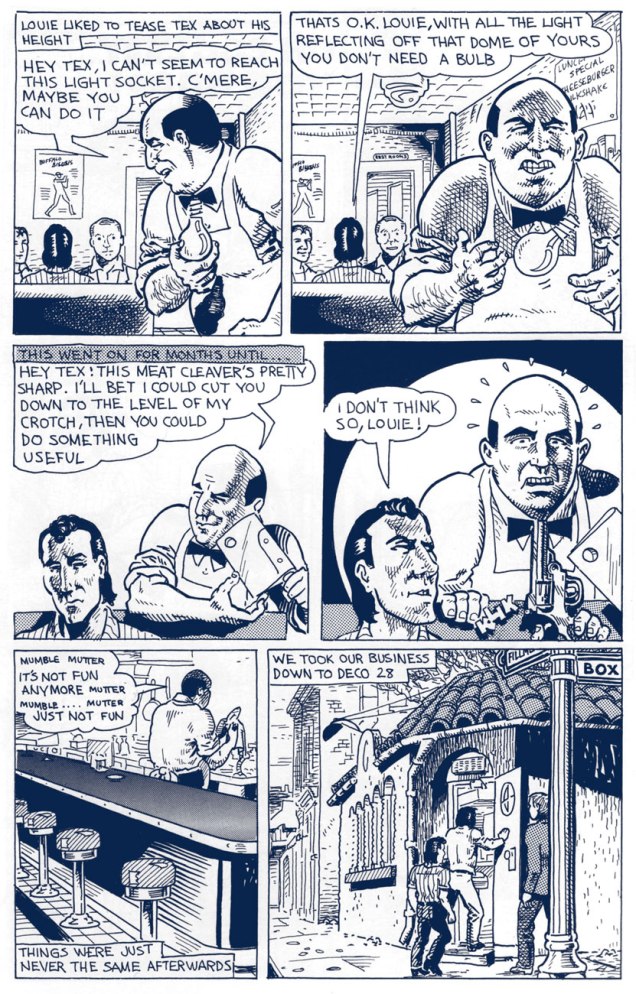
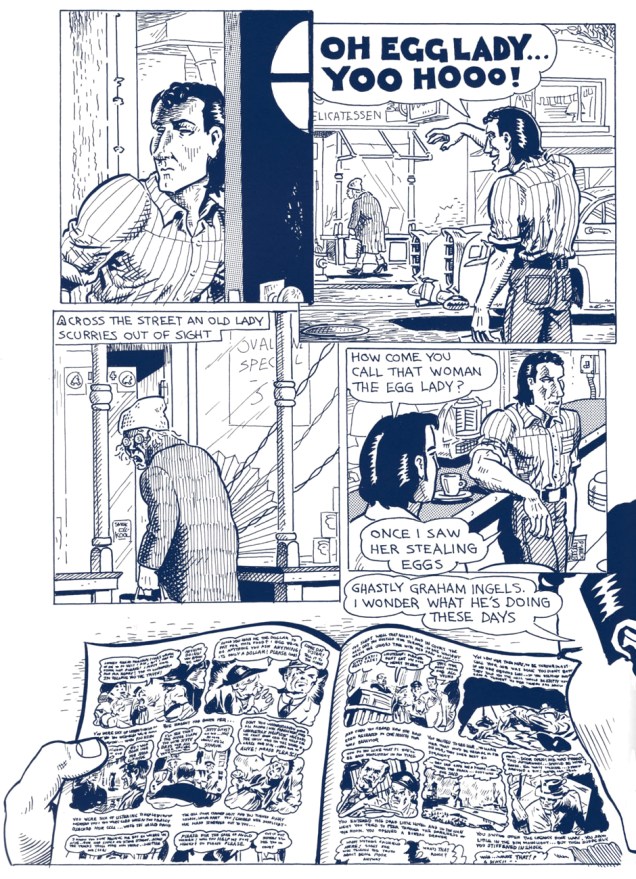
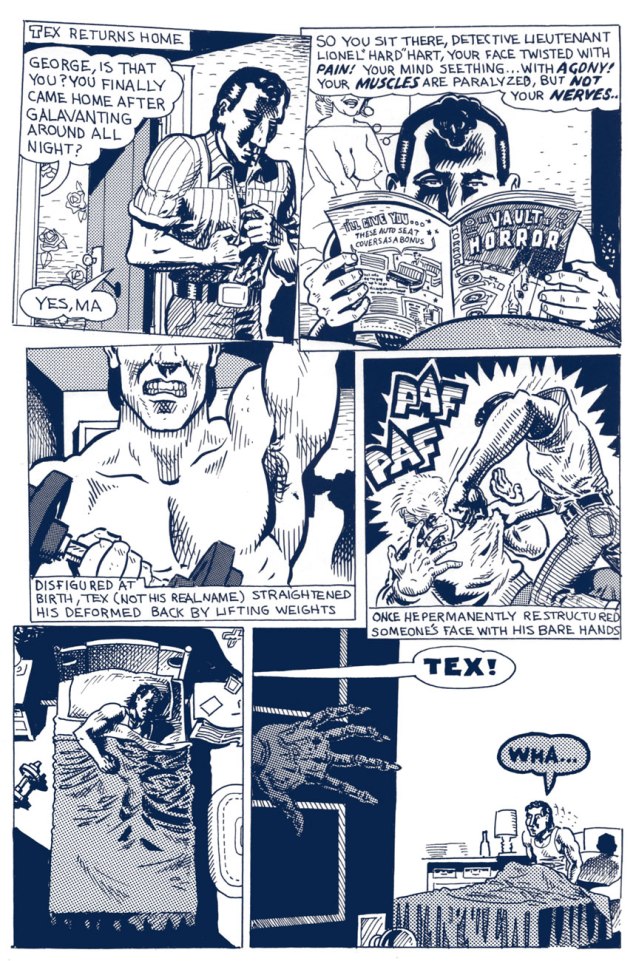
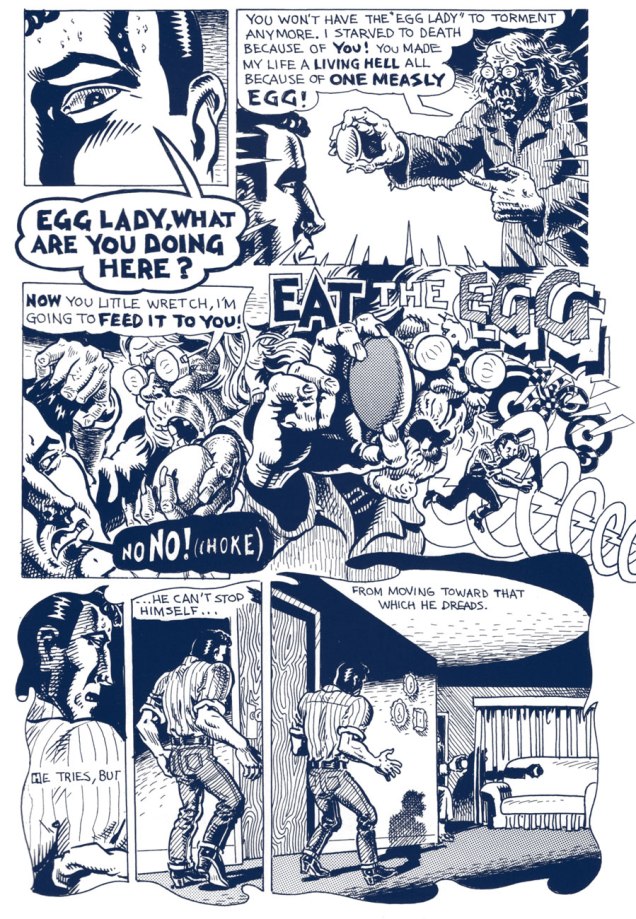
The following tale belongs to a cycle recounting the exploits and insights of The North Fillmore Intelligentsia, Spain’s closest compadres in Buffalo of the 1950s. Tex’s Bad Dream… originally appeared in Blab! No. 3 (Sept. 1988, Kitchen Sink Press); indeed, Spain’s recollections became, over time, the sole reason to purchase the once-excellent Blab! Mercifully, most of these were collected, in their usual exemplary fashion, by Fantagraphics, as Cruisin’ With the Hound (2012). You’ll still be lacking the mysteriously-omitted, quite essential « How I Almost Got Stomped to the “Still of the Night” by the “Five Satins » (Prime Cuts No. 2, Mar. 1987, Fantagraphics), which you can find in another Spain anthology, My True Story (1994, Fanta again).
In the meantime, enjoy, with my compliments, this true-life tale of original EC Fan-Addicts, facial restructuring, cautionary dreams, isometrics and pork sandwiches.
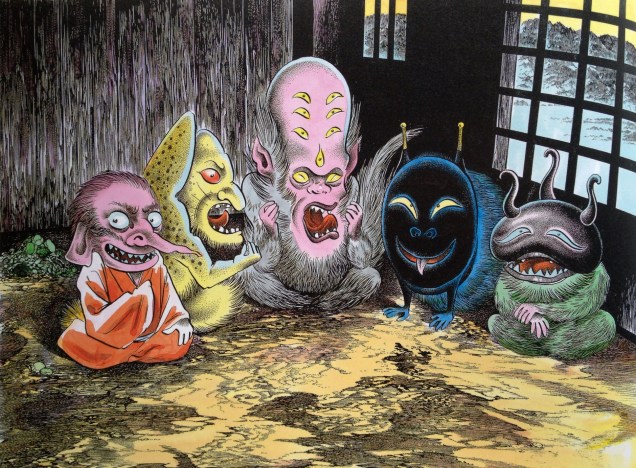
Shigeru Mizuki, Japanese comics artist and historian, is probably one of the best-known manga authors. A lot of his stuff has been translated into English, so when I started my timid forays into manga, his name instantly popped up. Mizuki’s area of interest (and expertise) was the Yōkai, or Japanese monsters, ghouls, goblins and other assorted bogeymen – right up my street, I thought!
Despite my interest in Japanese monsters, the first Mizuki book I picked up, NonNonBa, failed to capture my interest. Since then, I’ve tried looking through a few others I’d spot in bookstores… and I’ve resigned myself to the fact that Mizuki is just not my thing, whatever other people may see in his work.
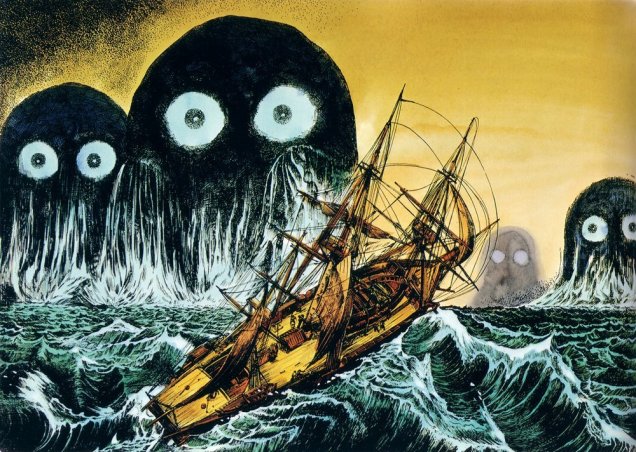
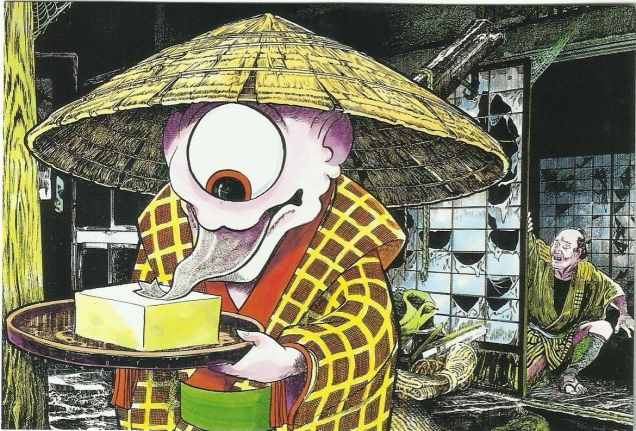
That being said, I still really enjoy some of his illustrations, especially if they’re in colour – and I love the way they give us a peek into the rich (and quite scary) world of Japanese folklore.
Gods of Pestilence or cute pets? Your choice.Hiratsuka-juku is a post station in Tōkaidō. A famous painting by Andō Hiroshige depicts a part of the road that leads to it. Mizuki took the painting as a basis and added a « small » detail: a Gashadokuro, one of my favourite Yōkai (and man, there’s a lot of cool Japanese monsters to vie for that spot). The Gashadokuro, literally « starving skeleton », is a gigantic pile’o’bones held together by sheer malevolence, created from skeletons of people who died of starvation. It starts its rounds after midnight… and is invisible until it bites your head off. If you ever hear bells ringing in your ears, congratulations, you’ve about to be eaten by a Gashadokuro!« Umibozu », from Graphic World of Japanese Phantoms, 1985. These ‘sea monks’ seek to destroy ships and won’t rest until the crew is at the bottom of the ocean.Is this a Akaname, the filth licker? Readers versed in Yōkai, please let us know!
A Suiko, or ‘water tiger’, although this one looks more like a balding dinosaur.
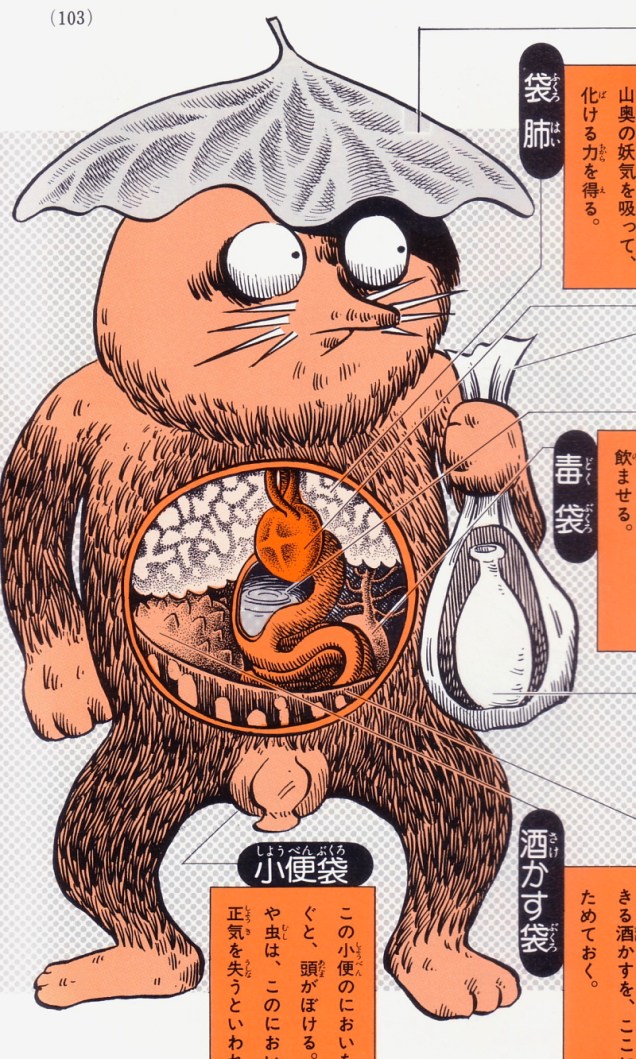
In the 1960s, Shigeru Mizuki released Yōkai Daizukai, an anatomically-oriented guide to traditional monsters from Japanese folklore. I don’t think it’s ever been released in English, but a French version came out in 2018 (and I fully intend to purchase it when I come across it).
A Kuro-Kamikiri, or hair cutter, which doesn’t sound so terrifying… unless you live in a society where long hair is a status symbol and loss of it means disgrace.A Fukuro-sage, a type of Tanuki (or Japanese raccoon dog), who has the ability to transform itself into a bottle of sake. «The Fukuro-sage usually wears a large potato leaf or fern leaf on its head and carries a bag made from human skin. The bag contains a bottle of poison sake. Anatomical features include a stomach that turns food into sake, a sac for storing poison that it mixes into drinks, and a pouch that holds sake lees. The Fukuro-sage’s urine has a powerful smell that can disorient humans and render insects and small animals unconscious.»The pillow-flipper or Makura-gaeshi move pillows about, occasionally suffocating people with them or even stealing their souls.
There are places and situations where one definitely expects to run into octopuses – in seas and oceans, on other planets, in brothels and harems (much like one can put a box in the middle of the room and a cat will suddenly appear to sit in it, even when one does not own a cat, a nearly-naked woman is almost guaranteed to summon an octopus). But sometimes the presence of tentacles is quite unexpected. Just when you think you’re safe – no, oops, a touch of the cephalopod springs abruptly into your life.
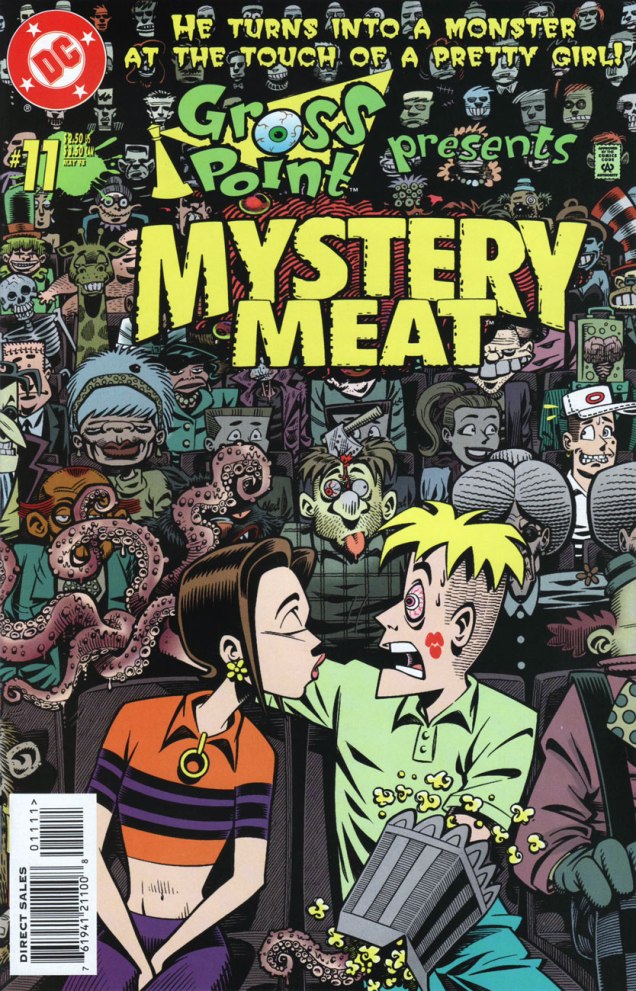
Tentacles at the cinema? No way. What would they be doing there?
« He turns into a monster at the touch of a pretty girl! » Say, that sounds familiar… This is Gross Pointno. 11 (May 1998), cover by Roger Langridge. This nearly-forgotten comic (so forgotten, in fact, that Google will try to correct you if you look its title up) is a delight for those of us who like to bask in a Halloween mood year-round. The plot is not exactly original, yet beautiful art by Roger Langridge makes it a very enjoyable read, especially given the latter’s propensity to add little jokes to the script. Unfortunately, too many issues are sloppily pencilled by Joe Staton, whose art cannot be entirely redeemed, even by Langridge inking it.
Because I’m nice and this January 1st, here’s a link to all the issues of Gross Point, to save you the trouble of hunting them down.
A page from “Welcome to Gross Point”, pencilled by S.M. Taggart and inked by Roger Langridge.
Or you purchase a box of doughnuts and then…
Wacky Packages no. 17 (All-new Series 7), 2010. Art by David Gross, I believe.
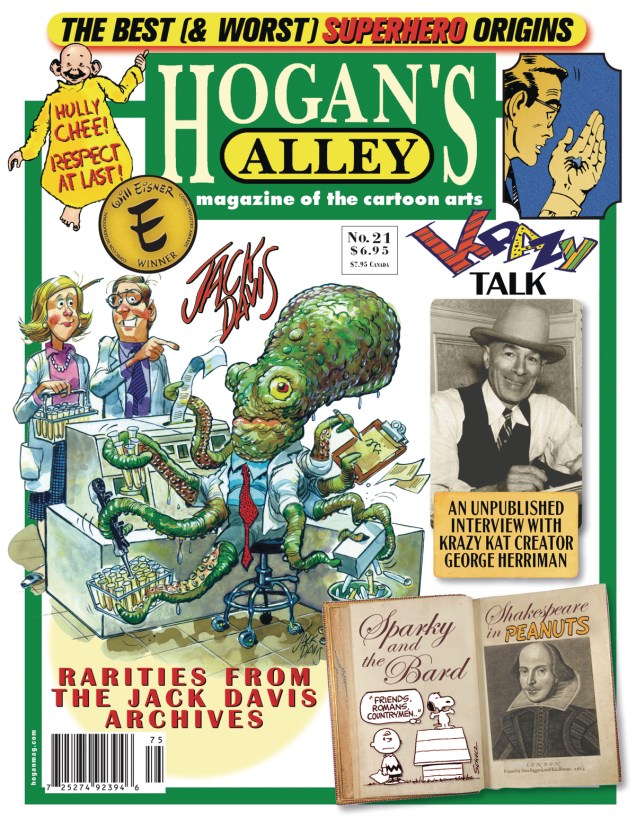
How would you feel about going back to the office after the holidays and finding a multi-tasking octopus taking over your duties?
Hogan’s Alleyno. 21, February 2017. The hard-working octopus (it must have been hard to find pants that fit him, but octopuses are dedicated workers!) is drawn by Jack Davis, of course.
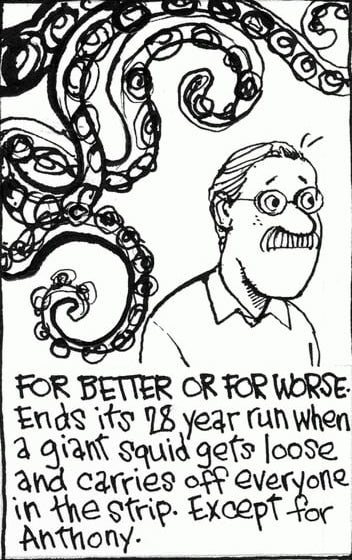
I’d say the most unexpected tentacles of all would be found in a For Better or For Worse strip. There’s no way that would happen.
« When comics came along in the 1930s there was a talent pool waiting. And one reason is so many areas were closed to Jews. Colleges, advertising agencies, many of the corporations – the doors that were closed led to the one that was open. » — Jerry Robinson
It’s New Year’s Day, which means it’s also the titanic Sherrill David ‘Jerry’ Robinson‘s birthday. Born on the first of January in 1922, he left us not so long ago, on December 7, 2011. He played at the very least a strong rôle in the creation of Batman’s sidekick Robin, his foes the Joker and Two-Face, his butler Alfred Pennyworth… and much more. Naturally, since we’re entering the murky world of Bob Kane, the whole process is mired in controversy, conflicting accounts and perhaps a little fibbing from certain parties.
We won’t limit ourselves to the obvious Bat-imagery, which was mostly studio work anyway. Here, for instance, is a more obscure but purer œuvre, both pencilled and inked by Robinson: the original art from « Behind the Mask », page 2, originally printed in Atlas’ Marvel Talesno. 103 (Oct. 1951). Writer unknown.My earliest encounters with Mr. Robinson’s work were through a pair of books for young readers he illustrated in the late 1950s, in a beautifully free and expressive styles. Here’s the cover and one interior vignette from The Phantom Brakeman (1959, Scholastic), written by Freeman Hubbard, then editor of Railroad Magazine.
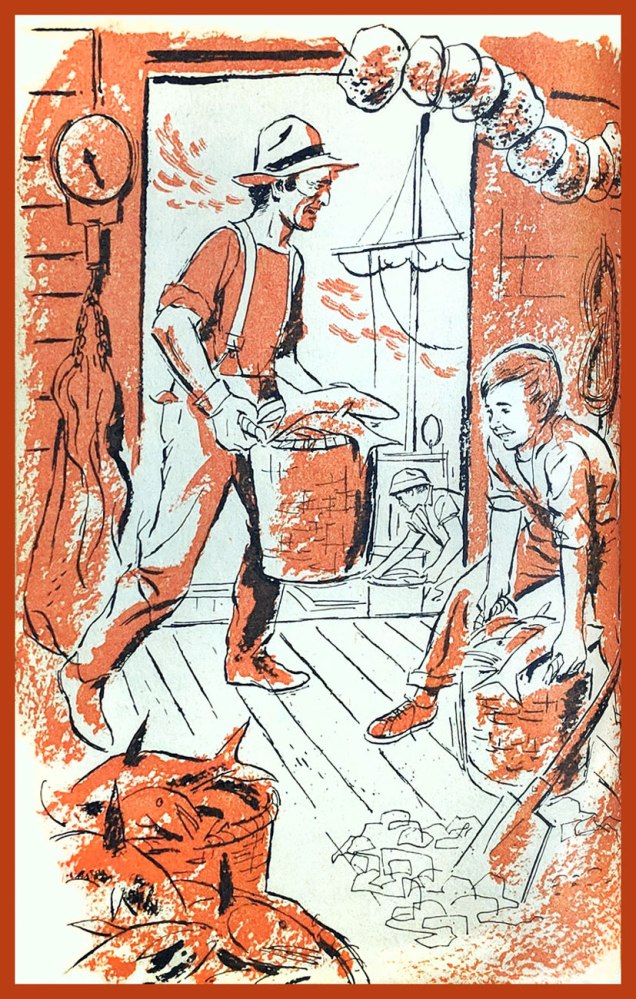
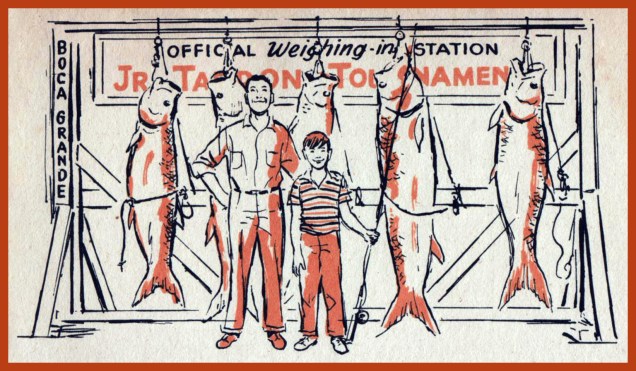
The following two pieces belong to Hurricane Luck (1959, Scholastic), written by Carl Carmer.Spoiler alert: Peter does, in the end, win the Tarpon fishing contest.
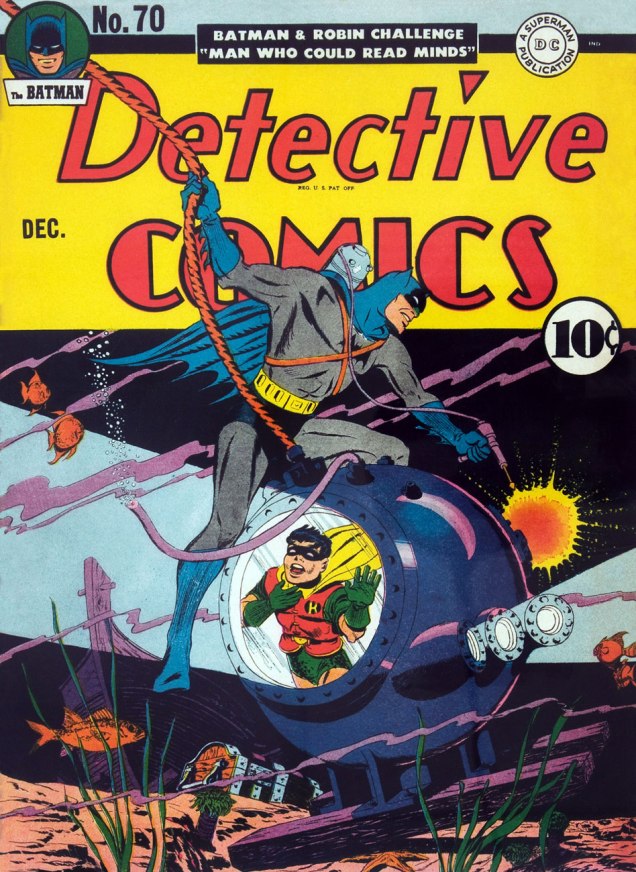
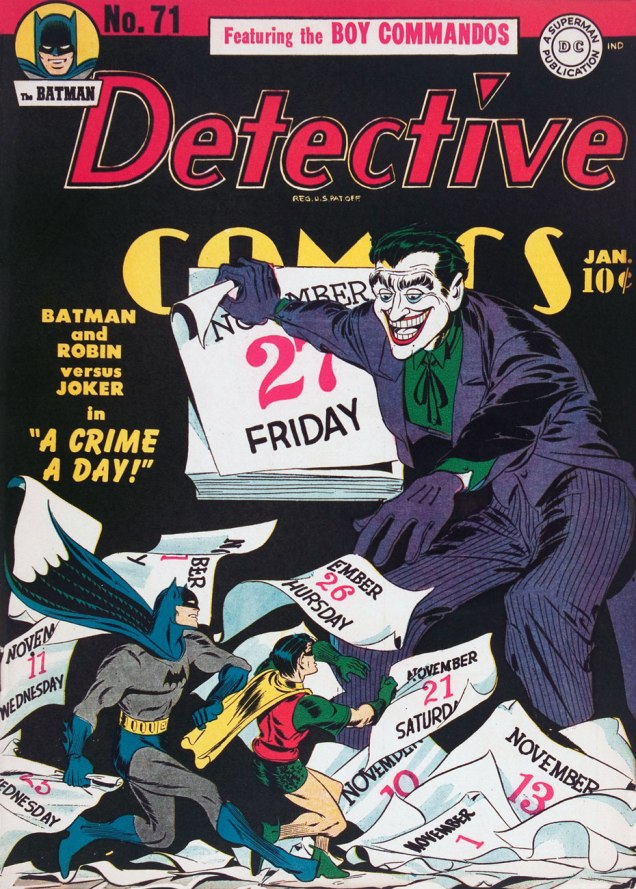
« What about Batman? », you might say. Okay, I admit I don’t have a prayer of getting away with a Jerry Robinson tribute devoid of the caped crusader and his trusty bird-themed sidekick, so here goes!
Detective Comics no. 70 (Dec. 1942). Pencils and inks by Robinson.Detective Comics no. 71 (Jan. 1943). Pencils and inks by Robinson.













 Who's Out There?