Purple Tentacle Tuesday

Greetings. Today’s theme: purple tentacles! (No, that’s not a euphemism.)

First up on our list is this beauty of an octopus, the Octo Rod.

This intrepid purple fella is part of Topps’ 1980 series, Weird Wheels, which had 55 cards in all. The credit for the gorgeous artwork is split between Norman Saunders and Gary Hallgren; nobody’s quite sure which artist worked on which card, and whether Saunders actually painted the images himself, or just retouched paintings by somebody else.

Sadly, Weird Wheels just didn’t sell all that well, so you can still purchase them for fairly cheap today. You can see the whole set here (and please do feast your eyes on them, they’re quite stunning).)

OctoRod21Hallgren
Octo Rod is no. 21, 1980. The art is by Gary Hallgren, at least according to David Saunders, Norman Saunders’ son.

Speaking of David Saunders and his dad, here’s a quote from “Norman Saunders” (a book written by David in 2009):

« In 1980, at the age of 73, with failing eyesight, cataracts, and advanced emphysema, Norman Saunders defied doctor’s orders and went back to work on one last card set. Weird Wheels are painted with full control of his creative powers, but with a morbid humor that reflects his attitude towards mortality. When reprimanded by his son for risking his life on low paying work, the artist said, ‘It’s fun! I gotta keep working! What the hell else am I gonna do?!‘ »

Saunders passed away in 1989, at 82, after a remarkably prolific and varied career.

Moving on, here’s a thrilling scene of purple tentacles vs Nemesis:

AdventuresIntoTheUnknownTentacles
This is ACG’s Adventures Into the Unknown no. 157 (June-July 1965). The cover is by Kurt Schaffenberger (who signed as Jay Kafka here). “Case of the Tittering Texan” sounded intriguing – I figured that the Texan was being tickled by a tentacle – but no, he’s just a stuttering, crazy, power-hungry villain in a cowboy hat and spurs. Same old, same old…

I would also like to mention that Nemesis *is* wearing pants (well, shorts, at any rate), but his costume is still gosh-darned stupid. You try wearing a hood under water and see how far it gets you. I’m normally a fan of ACG‘s Adventures, but Nemesis is by no means a favourite character of mine.

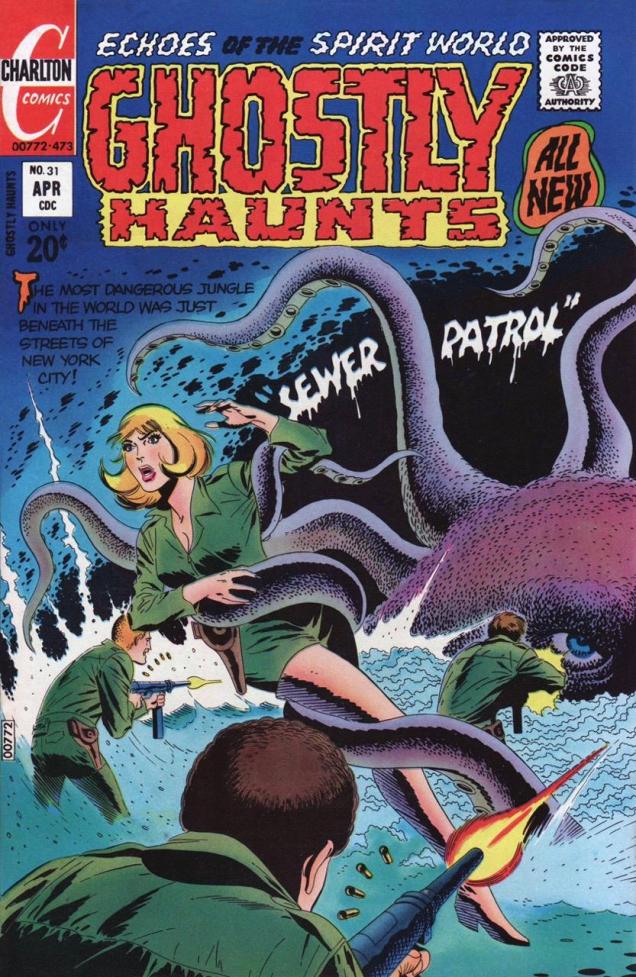
Further developing the theme of violaceous violence, here’s another:
GhostlyHaunts31
« Giant squid, giant water rats! Are we in New York, or are we on Mars? Down here, it’s hard to tell! » Ghostly Haunts no. 31, April 1973, cover by Jack Abel.

“Sewer Patrol”, the cover story, is also illustrated by Abel, with an excellent script by Nicola Cuti – it’s a story about people who dump their pets (and still-alive food) when they don’t want them anymore… and where and how these pets end up. (The answer to that, of course, is “mutated, gigantic and in the sewers.”)

~ ds

Remembering Don Newton (1934-1984)

« Herbal tea. My own recipe.
It’s added years to my life.
May I offer you a cup? »

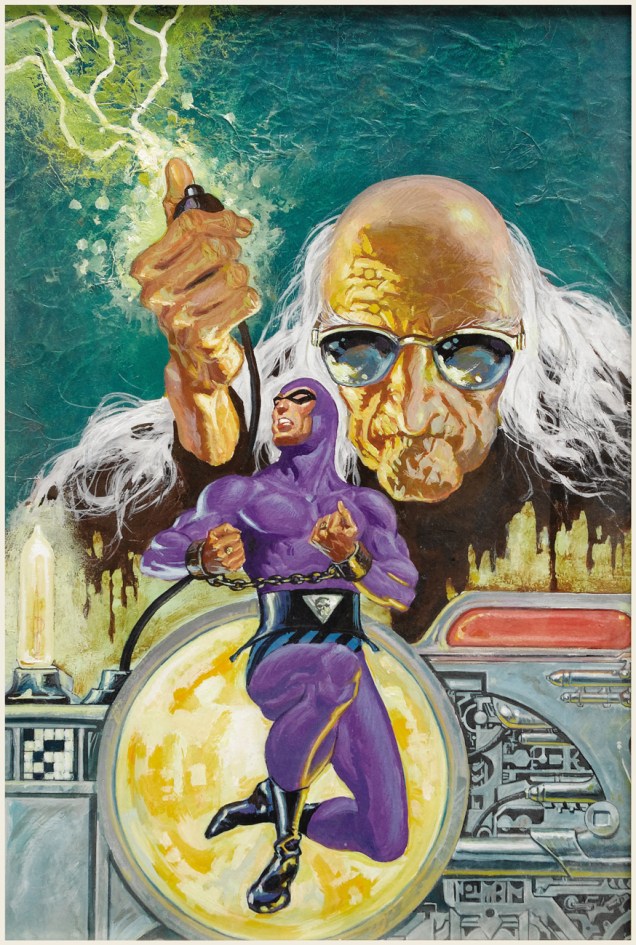
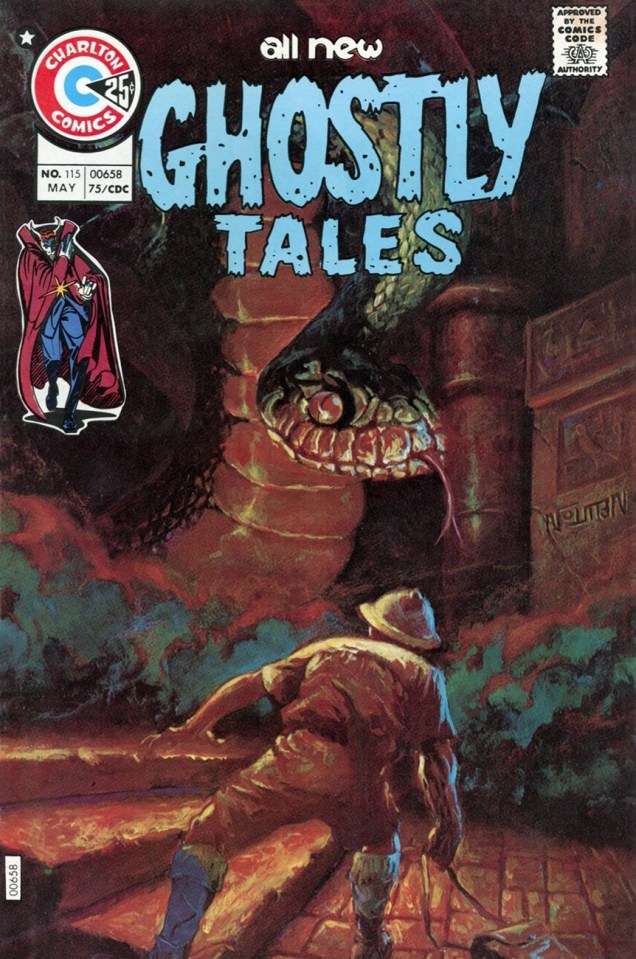
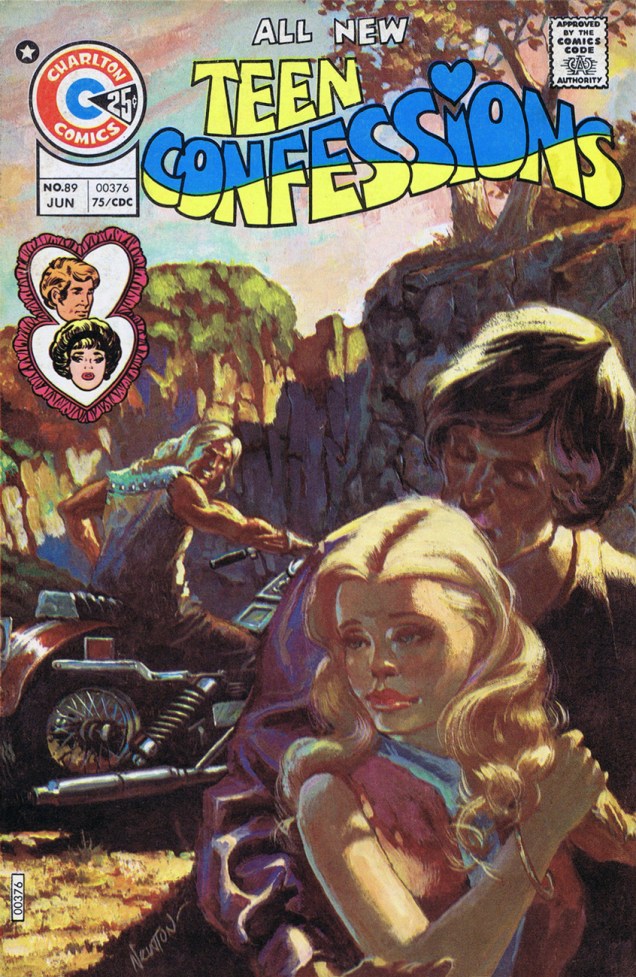
After producing some exceptionally solid fan art (chiefly for the long-lived Rocket’s Blast Comicollector (153 issues, 1961-1985), Arizona art teacher Don Newton made his jump into the pro leagues in 1974 with Charlton, where he got his chance to show off his considerable painting skills. After a handful of mystery stories, he took over Charlton’s version of Lee Falk and Ray Moore‘s The Phantom, which he drew for six issues (and one cover) before the title was cancelled… along with the rest of Charlton’s original comics line, really.

Phantom68ORIG_A
Newton’s original cover painting for issue 68 (December, 1975, Charlton) of The Phantom, illustrating the tale of The Beasts of Madame Kahn by Nicola Cuti and Newton.
NewtonPhantom73A
Newton’s cover painting (in acrylics, if you must know) for the penultimate issue of The Phantom’s Charlton run, no. 73 (October, 1976), “The Torch”, written by Ben S. Parillo (alias Bill Pearson), pencilled and inked by Don Newton. The wizened mastermind is a fella who simply goes by the name of ‘Raven’.
GhostlyTales115A
« How could a snake be alive here, buried deep in the earth for thousands of years? » Don Newton’s painting (Ghostly Tales no. 115, May, 1975) depicts a scene from Joe Gill and Steve Ditko’s “Wings of Death!”
TeenConfessions89A
« Turn her loose, Pike… I want to road-test the new talent! » Mr. Newton illustrates the Unknown Scribe and Demetrio Sánchez Gómez‘s biker operetta “Running Wild!”, from Teen Confessions no. 89 (June, 1975, Charlton.)

Newton would go on to DC (and a couple of brief dalliances with Marvel), illustrating Batman, Captain Marvel (er, “Shazam!”), Aquaman, Star Hunters, and The New Gods for DC, before being, all too soon, felled by a heart attack at the age of 49. Most of the time, though, he provided great art to ho-hum stories.

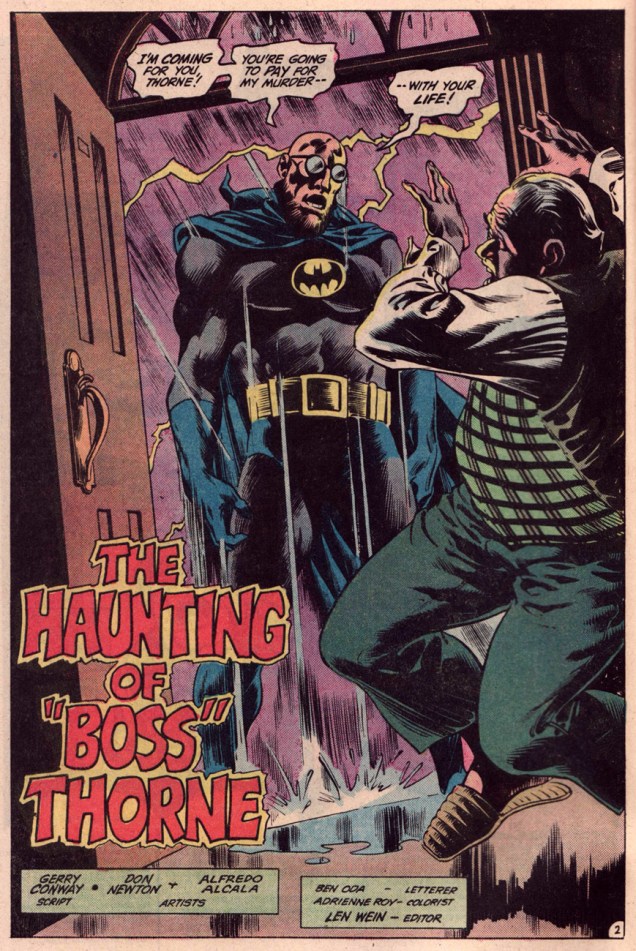
Against all odds, around 1982, scripter Gerry Conway, a name synonymous with half-assed, content-free hackwork since the early ’70s, actually blossomed into a decent writer. Fortuitously, while assigned to pencil Batman’s adventures in Detective Comics, Newton was paired with prolific* Filipino legend Alfredo Alcala, and the stars were in proper alignment. You won’t have to take my word for it, however. Feast your eyes on the palpable ambiance from the Conway-Newton-Alcala trio.

NewtonHugo1A
Picking up strands from Steve Englehart‘s  run on the book (nos. 469–476, in 1977-78), creepy-but-buff scientist Hugo Strange returns to pester his murderer, crooked politician Rupert Thorne. Colourist Adrienne Roy’s hand is betrayed by the 100% magenta/30% black mix.
NewtonHugo2A
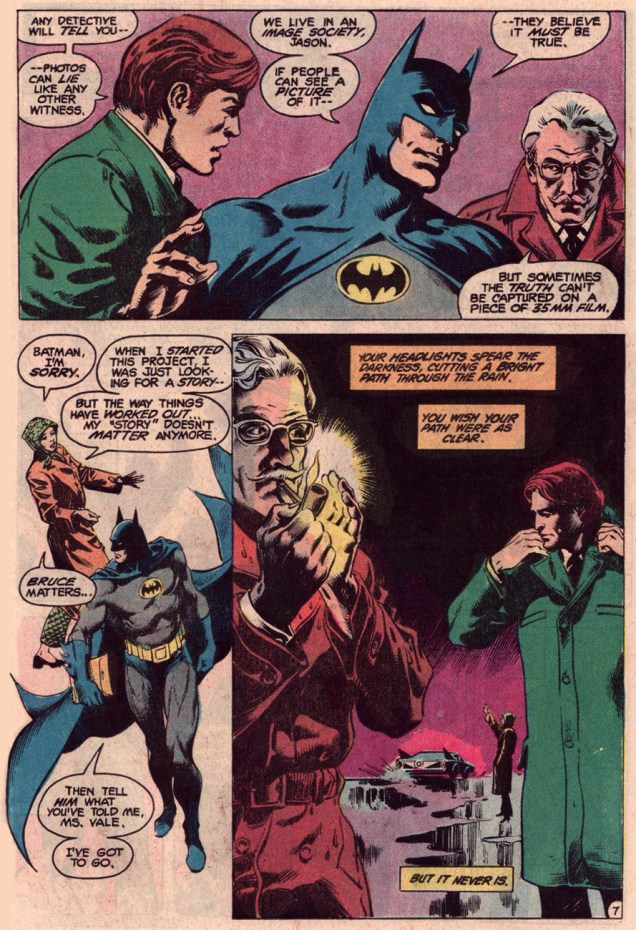
Well, I have to show Newton’s actual Batman, don’t I? His was one of the few characterizations that were physically believable. You could buy this guy as an acrobat, as a fighter *and* as detective. Alcala often overwhelms whomever he’s inking, but since Newton’s pencils were probably tight as a camel’s ass in a sand storm, both men’s contributions mesh splendidly with no loss of identity. Pages 2 and 7 from Detective no. 520 (Nov. 1982).

– RG

*How prolific was Alcala? « It is said that his fastest page rate was twelve pages in a nine-hour sitting. » And the scary thing is that it hardly ever looked rushed or less than committed, unlike the work of some other inkers we could name. What a guy.

On a Quest for an Original Tattoo

Looking for a one-of-a-kind tattoo, now that everyone has ’em?

I bet you didn’t think of hiccups as a possible solution, but anything’s worth a try at least once. So keep in mind these handy tips for inducing hiccups: have a large meal; do something really exciting (like buying a new comic, for instance); forget to breathe properly while laughing (which can also be achieved by buying a new comic, as long as it’s funny); swallow your food whole like an owl, or drink water like you’re a cow in hot weather (76 litres a day!) Is it working yet?

CharlesRodriguezBoobs

This Charles Rodrigues cartoon comes from a nifty little collection titled Spitting On the Sheriff and Other Diversions, first published in 1966. “Do you dig“, it asks the potential reader, « Crazy graveyards? Hilarious hangings that really swing? Sick medical humor? Screamingly funny torture-chamber gags? » What kind of stupid questions are those? Of course we dig!

If you’re hungry *hic* for more material from this collection without having to actually hunt it down, this blog has twenty or so other examples of Rodrigues’ sick, sick sense of humour.

http://learning2share.blogspot.ca/2009/01/more-cartoons-by-charles-rodrigues.html

~ ds

Add Vice for Children

« It’s kind of like a spider web, only sweeter, and also it’s more pink »

Today would have been the 91st birthday of the great Jack Mendelsohn (1926-2017), who passed away last January, leaving behind a life well-lived and a sumptuous, if often unsung or anonymous, legacy.

Yet Mendelsohn will be no stranger to those accustomed to reading the small print and staying for the credits crawl: he co-wrote Yellow Submarine (the film, and got credit for it, unlike Donovan for the song), episodes of Laugh-In, The Carol Burnett Show, then decades of soul-killing animation scripting, not to mention, er… Three’s Company.

Ah, but today we salute him for his greatest triumph, though probably not the one his fans brought up when they met him*: the short-lived Sunday-only King Features comic strip Jackys Diary** (1959-61). In 1960, Dell Comics (were good comics, so they said) in a fit of mad inspiration, issued a one-shot (Four Color 1091, April-June 1960) drawing from the strip’s run… a flashback to the early practices of the comic book industry, when its product consisted of repackaged comic strip reprints.

JackysProverbsA
Jackys Diary, October 30, 1960.

For a more comprehensive sample, hunt down the comic book, or Dan Nadel’s excellent Art Out of Time (2006, Abrams), which may just turn you on to further neglected but worthy visions. Or get thee hence swiftly to Sam Henderson‘s wonderful blog, The Magic Whistle. Sam saved me a lot of work (and stole my thunder) by graciously providing top-quality scans of the entire Dell comic book.

Then, if you’re good and hooked, you’ll be chuffed to hear that a complete collection of the strip’s run was miraculously assembled and published a few years ago, and finer than even the most fervent optimist could have envisioned. Once again, international treasures Craig Yoe & Clizia Gussoni and their crack production team have delivered a dream.

Produced with utmost attention to detail, as well as the full and clearly enthusiastic coöperation of the auteur himself, this handsome tome boasts, in addition to the full complement of excellently-reproduced strips, a fascinating and richly-illustrated retrospective article by Mendelsohn and a fondly witty foreword and backword by colleagues and accomplices Mort Walker (then 90 1/2) and Mell Lazarus (then 86 1/2). As they say, get yours now!

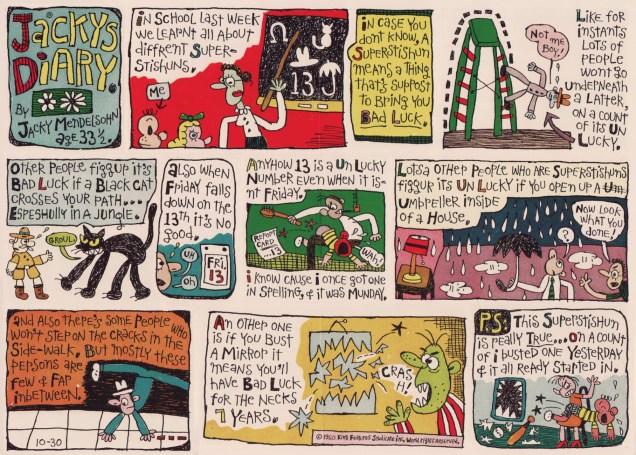
JackysSuperstitionA
Jackys Diary, August 6, 1961.

*On that very topic, from his interview with John Province, published in Hogan’s Alley no. 10 (2002): « What fans? I have no fans! Why do you think I’m clinging to you? »

**that’s how it was intentionally spelled, for effect. Unlike spelling nowadays…

-RG

Tentacle Tuesday goes “blub, blub”

Today’s Tentacle Tuesday features octopuses in water where, after all, they generally belong.

We open the festivities with a scene from Japan, the undisputed motherland of all things tentacular. As a bit of an aside, for those wondering what’s up with up with Japanese tentacle porn, there’s an interesting theory that suggests that the latter was just a way to avoid censorship and obscenity charges when drawing erotic manga.

According to hentai artist Toshio Maeda talking about his experience in the mid-80s, “At that time pre-Urotsuki Doji, it was illegal to create a sensual scene in bed. I thought I should do something to avoid drawing such a sensual scene. So, I just created a creature. His tentacle is not a penis as a pretext. I could say, as an excuse, this is not a penis; this is just a part of the creature. You know, the creatures, they don’t have a gender. A creature is a creature. So it is not obscene – not illegal.”

For now we’ll stick with this G-rated page from Panorama Island.

PanoramaIslandTentacles
From The Strange Tale of Panorama Island, a graphic novel by Suehiro Maruo, based on the novella by Edogawa Rampo, the Japanese Edgar Allan Poe and godfather of Japanese detective fiction.

Don’t worry – the characters are in an underwater tunnel with transparent walls, so the girl is perfectly safe (for now). Read an interesting review of this manga here: http://goodokbad.com/index.php/reviews/strange_tale_of_panorama_island_review

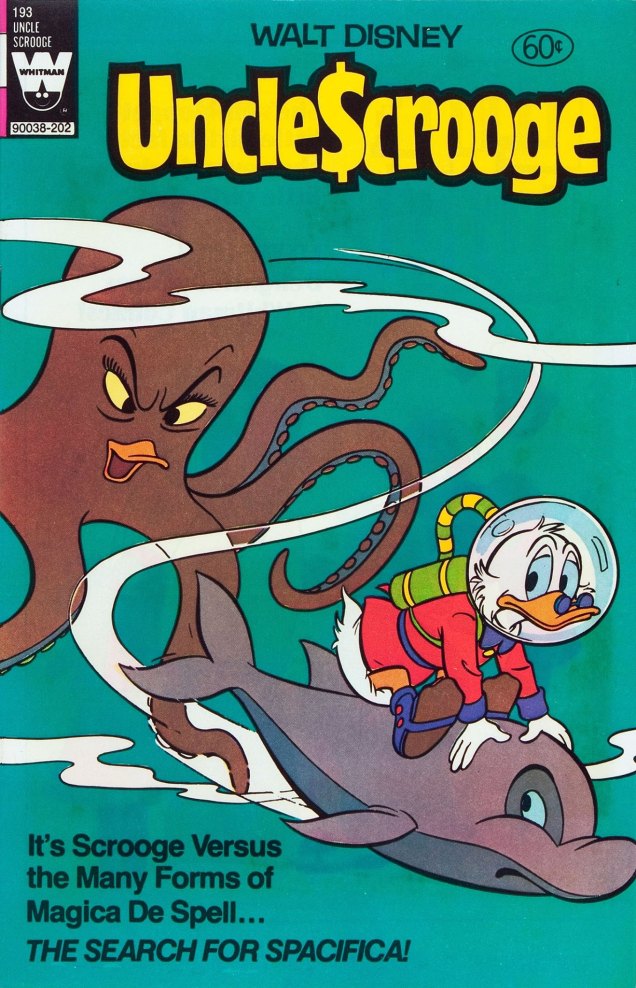
Next in line is this cantankerous beak-mouthed octopus, actually Magica De Spell transformed (which explains why the creature appears to be wearing mascara – waterproof mascara, of course).

UncleScrooge193
Uncle Scrooge no. 193, February 1982. Pencils by Pete Alvarado, inks by Larry Mayer. (This one’s a variant cover with a white Whitman logo.)

The last of Tentacle Tuesday for this week: a snippet of a rather gruesome story, in which a scientist transforms a poor, city aquarium-dwelling octopus who was minding his own business into a terrifying man-octopus creature who runs amok. In the end, the octopus reverts to his normal form and kills the scientist. (Justice, if not particularly poetic.)

1025-octoman
The first panel of “Arms of Doom” from Harvey‘s Black Cat Mystery no. 32, 1952, drawn by Rudy Palais. So… how exactly is he going to destroy an entire city? He has 6 arms, all right, but he’s only human-sized, if a bit stronger than a normal man.

You can read the whole riveting tale here: http://pappysgoldenage.blogspot.ca/2010/10/number-821-octoman-is-here-let-it-be.html

~ ds

Edgar wakes up while snakes eat oatmeal

B. Kliban may not be a name that’s familiar to many (unless you’re one of those people who pays attention to the signature beneath a painting), but his cats will certainly ring a few bells, so to speak. They can be found on stickers and greeting cards, mugs and t-shirts, and, above all, calendars. Kliban’s Cat, a collection of cat cartoons that was published in 1975, was an instant hit, and its popularity hasn’t waned since.

KilibanMousies
One of the felines inhabiting the original Kliban’s Cat. Catchy little ditty, isn’t it? The official B. Kliban website is http://www.eatmousies.com/ – which is a very cute move.

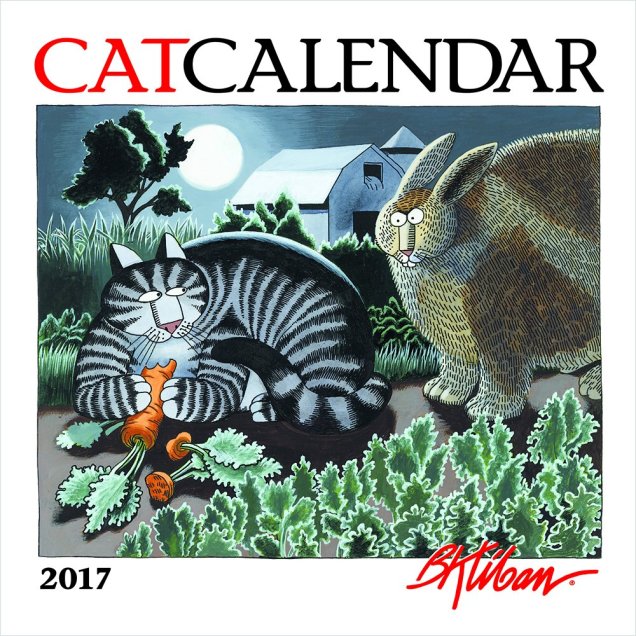
One would expect something that’s been around for so long to be terrible and generic and banal (just think of Garfield merchandise – yuck!), yet each year a new calendar comes out, and each year it’s still stunningly beautiful. Kliban lamentably and tragically died in 1990, at only 55. Either he left behind an impressive number of cat paintings, or his ghost still comes out from retirement from time to time to continue the tradition. I mean, look:

KlibanCats2017

« People assume I’m gaga about cats. I like them, but I’m not silly about them. Cats look like cartoons. There’s something funny and vulnerable and innocent about them. » (from a 1978 interview.)

Kliban2018
Okay, the late 2010s seem to have some sort of carrot theme…

Maybe these images are created by a dedicated team of artists hell-bent on imitating Kliban’s style as closely as possible, adroitly channeling his absurd sense of humour, dressing in the Kliban uniform (jeans and sandals) to increase their precision. After all, if talented art forgers can copy a Vermeer or Picasso so meticulously that it confuses the experts…

As lovely as his felines are, it’s too really too bad that Kliban’s other books (most of them published by Workman Publishing) have been swallowed by the hungry maw of obscurity. His peculiar sense of humour, his love of puns and his unorthodox approach to everything from relationships to kitchen implements wonderfully combine with stylish art to create a glorious mindfuck in cartoon form. His books – Never Eat Anything Bigger Than Your Head, and Other Drawings (1976), Whack Your Porcupine, and Other Drawings (1977), Tiny Footprints, and Other Drawings (1978), Playboy’s Kliban (1979), Two Guys Fooling Around With the Moon (1982) and Luminous Animals (published by Penguin Books in 1983) – will make you wonder if Kliban ever underwent psychoanalysis, whether his doctor managed to hold on to *his* sanity after their sessions, and whether you should get psychoanalysed, too, because why else would you be enjoying these cartoons so much? The NY Times did a tribute to Kliban when he died in 1990, and all the author of the piece could say, somewhat diplomatically, is that « the books that followed Cat consisted mostly of extremely bizarre cartoons that find their humour in their utter strangeness and extremely unlikely environments. »
« Please », the journalist seemed to be saying, « can I go back to talking about cats already and skip over the weird shit? »

So here’s an example of some pleasurable weirdness:

EstherSleepsKliban
Edgar Asleep has been scanned from Luminous Animals and Other Drawings (1983).

Kliban’s other work has certainly been overshadowed by cats, but at least it gave him financial security… and a life full of cats, drawn and otherwise, which is not that bad a thing.

KlibanMonsters
« I spend twenty seven years making monsters and what does it get me?… A room full of monsters! » (Playboy, June 1972)

~ ds

Happy 90th birthday, Mr. Ditko!

« Don’t be so sure! A guy that popular — he’d be a fool to fold up his act while he’s such a hot item!* »

I’ve been a Steve Ditko fan for as long as I can remember. In fact, I was a fan even before I actually saw his work. “How’s that even possible?”, you may ask. Well, when I was five, this neighbour from across the street was showing off a comic book he had just picked up, which was Teen Titans no. 29**. I was instantly captivated by two costumes on the cover: Hawk and Dove’s, designed by Ditko a couple of years earlier.

I do believe I had encountered a Ditko comic book just a bit earlier, a copy of The Many Ghosts of Doctor Graves no. 20 (June, 1970), acquired by my brother en route to the family vacation on Prince Edward Island. But that one had a (fine) cover by Pat Boyette, and I don’t recall the Ditko story within, « An Ancient Wrong ».

The bottom line is that Ditko’s been a precious part of my life for a spell. It would be easy to take him from granted, so let’s not, if you don’t mind.

Which brings us to our little tribute: running ninety covers covers would be about as practical as ninety candles on our birthday boy’s cake, so I’ll just drop a decimal and stick to a more manageable nine… I won’t even give a nod to such fickle and hollow notions as popularity, historical importance, or iconicity. I’m going with my favourites. That’s the way Steve would do it… and even if he wouldn’t, I’d still go this route.

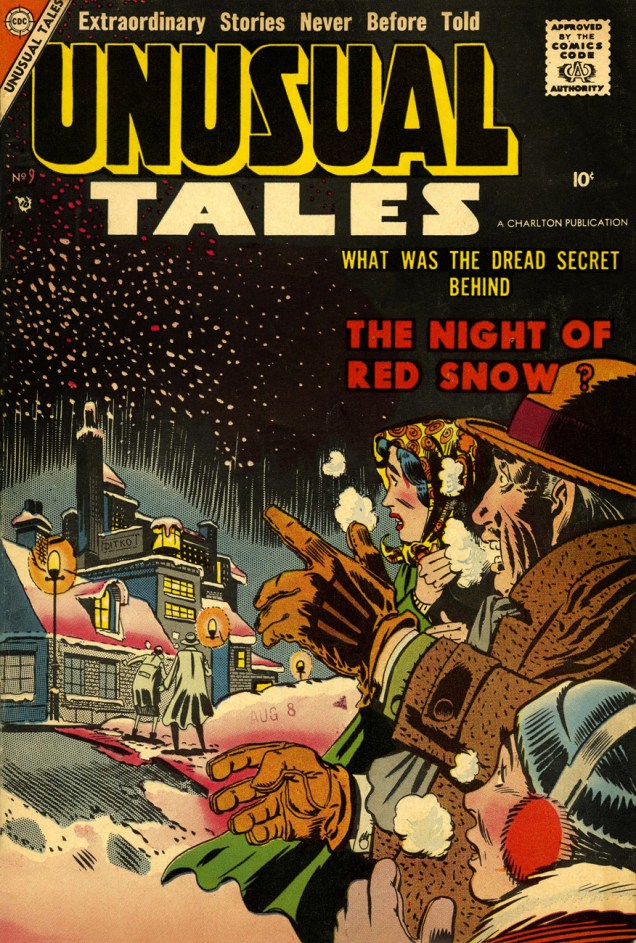
UnusualTales9A
« Nobody here in Crestville will ever forget that night! »
A tiny reproduction of this cover, that of Unusual Tales no. 9 (Nov. 1957, Charlton), in some late-70s edition of the Overstreet Comic Book Price Guide hooked me, and still grabs me. In the post-code era, particularly in its early days, you had to be mighty resourceful to fruitfully mine the mystery genre, what with all the verboten topics and tropes. The issue holds a whopping four, 1957-vintage Ditko stories, including the title piece, which you can read here:
http://ditko.blogspot.ca/2012/01/unusual-tales-night-of-red-snow.html
ASM2A
The Amazing Spider-Man no. 2 (May 1963, Marvel). Beyond Ditko’s departure (no. 38 was his final contribution), I have no further interest in Peter Parker and his costumed alter-ego.
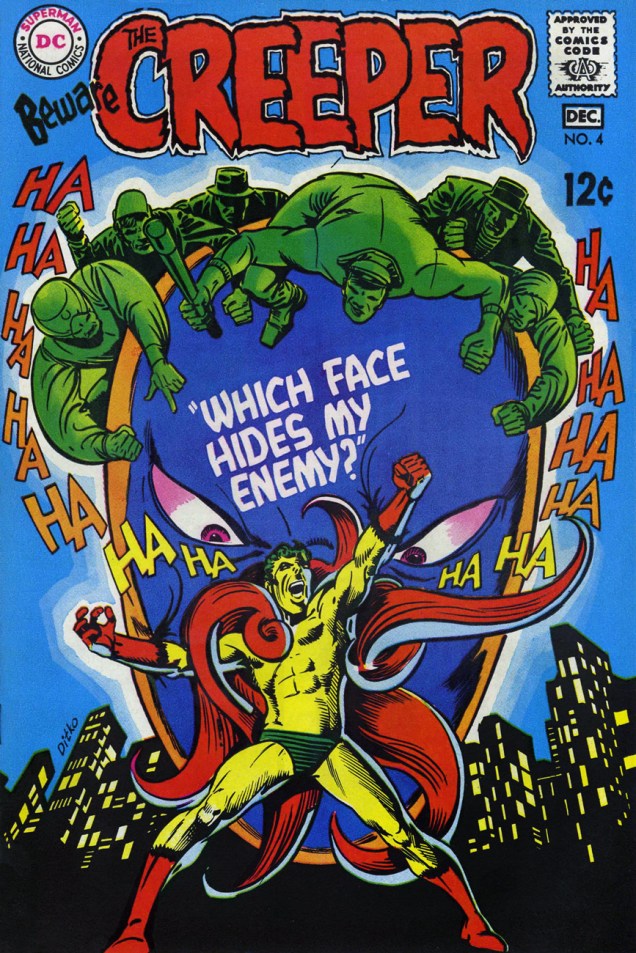
Creeper4A
« Name’s Bulldog Bird! This is Sumo! We’re secret agents from the sovereign kingdom of Offalia! »
For most of the brief run of his book (issues 2 to 6), the Creeper had to contend with a faceless enemy, Proteus, who turns out to be someone very close to him. It was as though Ditko felt the need to replay the Spider-Man – Green Goblin secret identity dynamic, not the way *he* had envisioned it (which was to make the Goblin a total stranger, a situation he’d meticulously set up in the background), but the way Lee had, as if to show his former editor how to do it properly.
This is Beware the Creeper no. 4 (Nov.-Dec. 1968, DC), “Which Face Hides My Enemy?” Pencils and inks by Steve Ditko, plot and dialogue by Dennis O’Neil
Hawk&Dove2A
« You’re still wasting your time reading! Why don’t you build up that sickly body of yours? »
DC’s Hawk and Dove (introduced in Showcase no. 75, June 1968, DC) was, as its title and covers amply make clear, a study in contrast and opposition: aggression vs pacifism, the letter of the law vs the spirit of the law, Steve Ditko vs Steve Skeates…
The concept may have been of its time, but the industry as it stood wasn’t ready to explore the issues without stacking the deck. This was still, after all, a mainstream superhero comic book of the Sixties. This is issue 2, “Jailbreak!” (Oct.-Nov. 1968), Ditko’s third and final issue with his creations. As for Ditko’s abrupt departure from DC is concerned, the reason cited at the time was a relapse of tuberculosis, a disease that had plagued Ditko in his youth. Others have invoked more political explanations, but Ditko *was* out of the game for several months, which fits the convalescence scenario. His absence until 1975 from DC fits the politics one. Why credit one single factor when several, taken together, are more plausible?
GhostManor5A
« Come off it, yer Lordship! This ain’t no blinkin’ time ter do the art connoisseur bit! »
The rakish 14th Lord Garland proves a bit of a disappointment to his forebears. Sir Steve Ditko’s cover proffers a scenic victim’s perspective… but who’s the hazy, phosphorescent figure shambling down the stairs to meet us?
This is Charlton Comics’ Ghost Manor no. 5 (second series, June 1972, Charlton). Inside, you’ll find a trio of Joe Gill chillers: “Dead Man’s Eyes”, illustrated by Joe Staton; “Devils at My Door”, illustrated by Charles Nicholas and Vincent Alascia, and of course, the pièce de résistance, “The Last Garland”, brought to you in panoramic Ditko-vision.
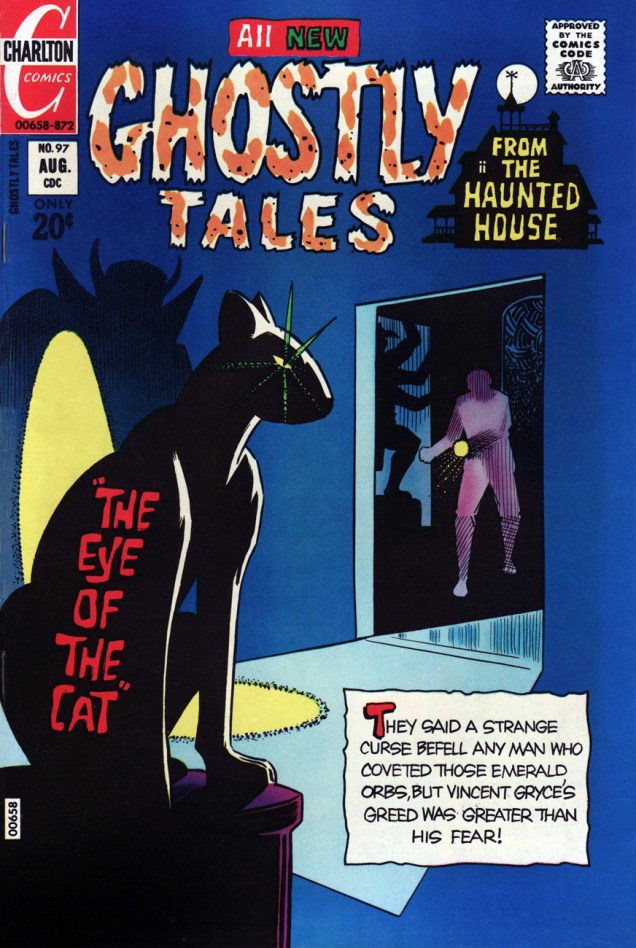
GhostlyTales97A
Ah, the largely lost art of the *soft* sell. Charlton’s cadre of artists hewed much closer to the ambience favoured by aficionados of the spectral than did the esteemed competition. You know, more Montague Rhodes James than, say, Rob Zombie.
Here, Ditko demonstrates how (dis)quiet and mystery is evoked. Dignified silence can be very attractive when everyone around is shouting. Ghostly Tales no. 97 (August 1972, Charlton) features “The Eye of the Cat”, actually handled by Don Perlin, while Ditko delivers visuals for Joe Gill’s “Journal of a Hanged Witch”. The issue also features “Poltergeist”, an effective collaboration between Creepy Magazine founder Russ Jones and the multitalented Bhob Stewart.
Haunted16A
My particular favourite among Ditko’s covers for Charlton’s Haunted (75 issues, 1971-84.) The merrily saturated colour scheme, the composition and its geometric simplicity, that well-chosen angle… the contagious joy of a master at play. This be Haunted no. 16 (June 1974, Charlton.)
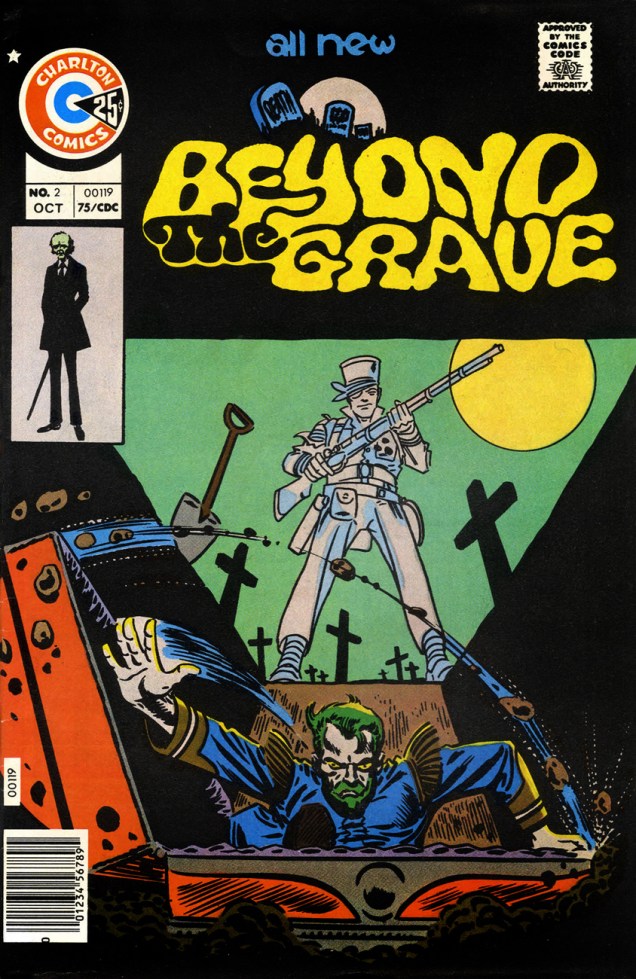
BeyondtheGrave2A
« If you visit that grave on a dark night, you may be surprised… for there is a sentry stationed there…to honor the dead? Or to make sure that General Kugar never leaves his grave? »
Here’s a cover showing the sort of solemn dignity and restraint that made Charlton’s line of ghost books so attractive to me right off the (vampire) bat. No one’s shouting deceptive hype or explaining the action; the elusive allure is undisturbed, unlike the sanctity of the tomb. 
DC, under Infantino and Cardy, generally understood this, but Marvel virtually never did or cared to. But hey, what sold and what I liked rarely sat at the same table.
Beyond the Grave no. 2 (Oct. 1975, Charlton).
Shade3A
Ah, Shade. Ditko’s last great creation, cut off in its prime by the Great DC Implosion of ’78. Later misunderstood and corrupted by hacks. Finally reprinted, including formerly unpublished issue 9, in volume 1 of The Steve Ditko Omnibus (2011). It’s still a frustrating experience, but at least issue 8’s cliffhanger has been resolved, and what happens in the Zero Zone doesn’t stay in the Zero Zone, if you know what I mean. This is Shade the Changing Man no. 3 (Oct.-Nov. 1977, DC)

*Jack Ryder (aka The Creeper)’s closing quip from “The Coming of the Creeper!”, plot and art by Steve Ditko, script by Don Segall (Showcase #73, Mar.-Apr. 1968, DC)
**Since it played such a crucial rôle in my Ditko inculcation, here’s the Teen Titans issue in question.

TeenTitans29A
Teen Titans no. 29 (Sept./Oct. 1970, DC) Cover by Nick Cardy (likely co-designed by Carmine Infantino and coloured by Jack Adler), illustrating “Captives!”, written by Hawk & Dove scenarist Steve Skeates and illustrated by Nick Cardy.

– RG