« I read some of my stories recently and thought, ‘How in the hell did I get away with that?’ I had some really raw cynicism in some of them… » – Carl Barks
Like so many kids, I owe a lot of my interest in comics to Carl Barks, even though at the time I had no idea who he was – embarrassingly, up until today I’m not great at spotting his art. So much depends on what is available when one is growing up – and I used to enthusiastically dig through discarded piles of books at garage sales and whatnot, in quest for (among other things) for issues of Super Picsou Géant. Picsou is Uncle Scrooge’s French name, meaning something like “penny pincher”. These (true to their name) giant anthologies, just like pocket-book sized Archie compendiums, offered their readers pêle-mêle reprints of comic book stories both relatively new and also quite old, mixing prime Barks material with shitty European knock-offs with offerings by decent Barks disciples (see co-admin RG’s take on the latter).
Just like a Picsou Géant, this post has a few Barks covers and stories, and a few submissions by other folk… all viewed through my usual tentacle-specific lens. Dive in!
Donald Duck no. 109 (September 1966), cover by Larry Mayer. Minimal tentacles, but that clock was just too cute not to share.Uncle Scrooge no. 68 (March 1967), cover by Carl Barks.Hall of the Mermaid Queenis by Carl Barks.
Somewhat off topic, but I was quite amused by the ending of this story. Is this was Barks meant when he talked about raw cynicism? 😉
Uncle Scrooge no. 70 (July 1967), cover by Carl Barks.The Doom Diamond, the cover story, is also by Carl Barks.
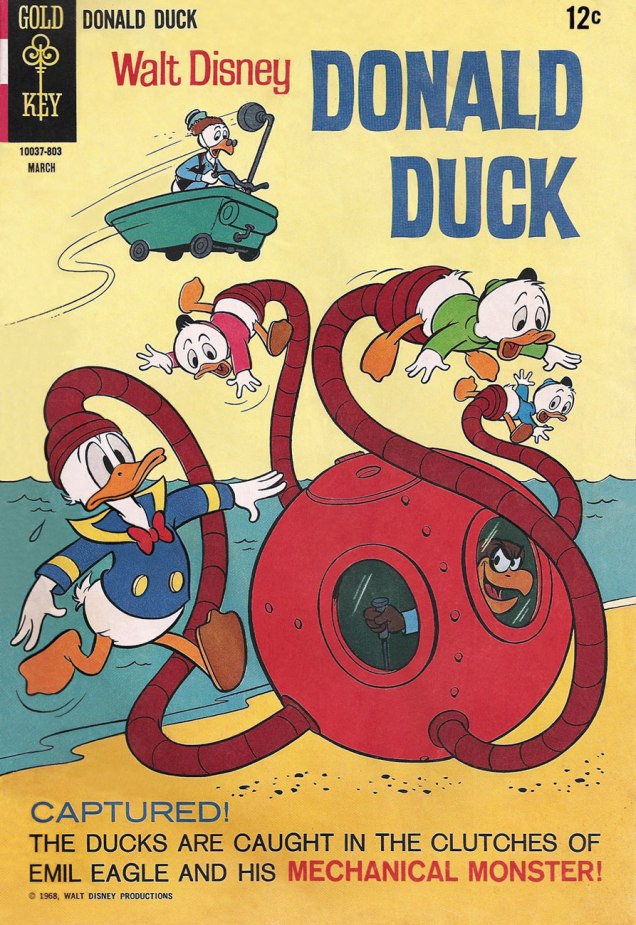
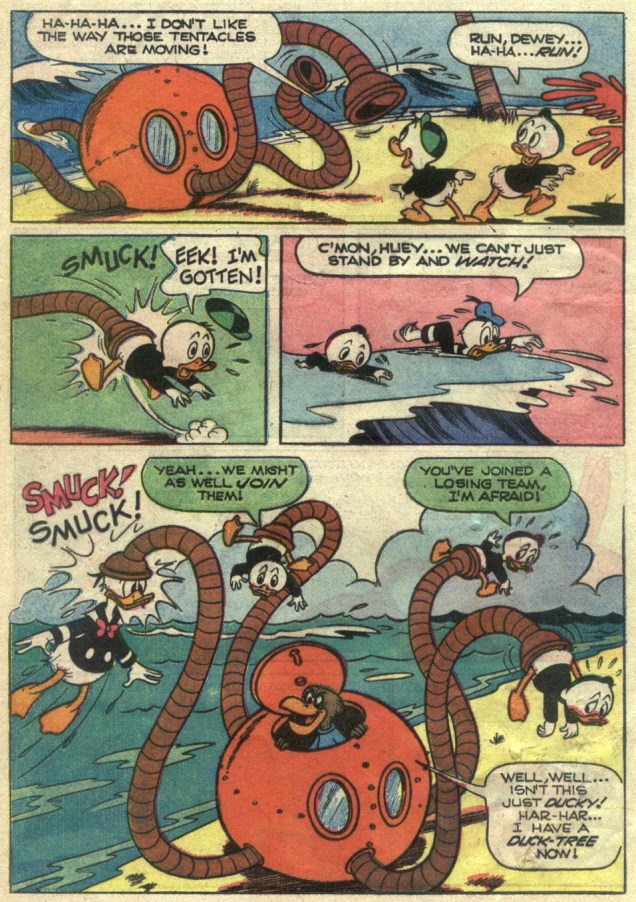
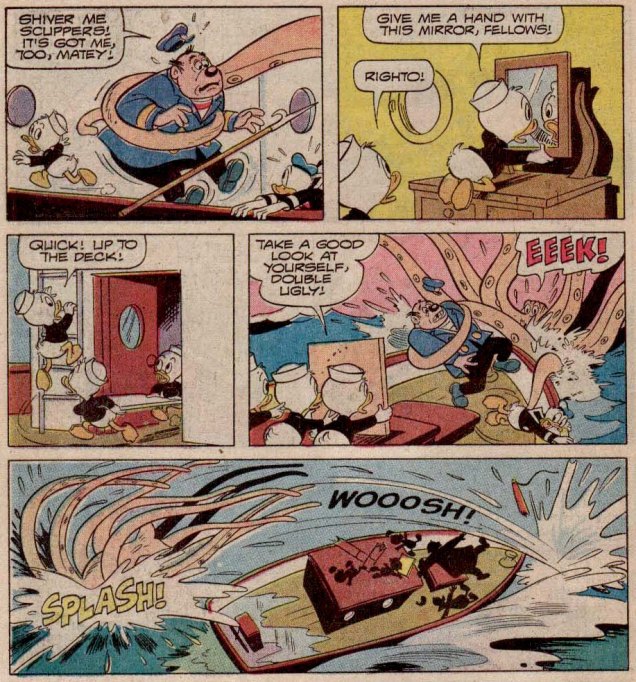
Donald Duck no. 118 (March 1968), cover by Tony Strobl on pencils and Larry Mayer on inks.The Mechanical Monster is scripted by Vic Lockman, which is almost an iron-clad guarantee of inventive goofiness. Penciled by Tony Strobl and inked by Steve Steere.
Donald Duck no. 141 (January 1972), cover by Larry Mayer.The Tall-Tale Trail is penciled by Tony Strobl and inked by Larry Mayer.
For this post, I wanted to concentrate on Gold Key publications, but at a later date there will be a follow-up post covering some other material.
Country Boy: What are you doing? City Boy: Drawing. Country Boy: Where are your guns? — Submitted by Steven Feinstein, 7, Philadelphia, PA (circa 1965)
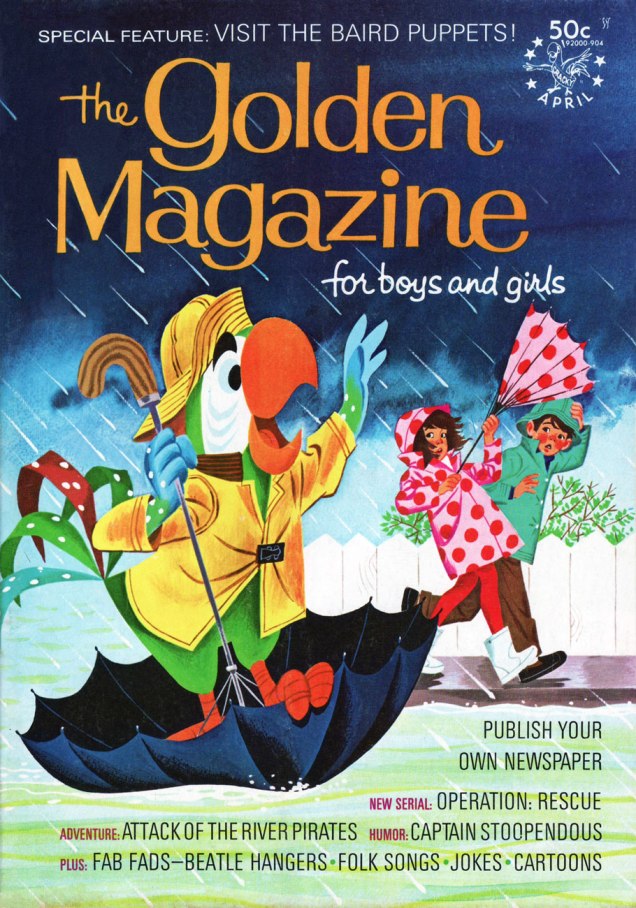
Cracky the parrot was introduced in the role of mascot for Western Publishing‘s general-interest kids’ mag The Golden Magazine (1964-71), which heavily drew upon the successful Jack and Jill (published since 1938 by The Saturday Evening Post Society) formula.
For much of its existence, The Golden Magazine thrived, having access to top creative talent from the Western publishing empire (Whitman, Gold Key, Golden Press, Golden Book Encyclopedia…)
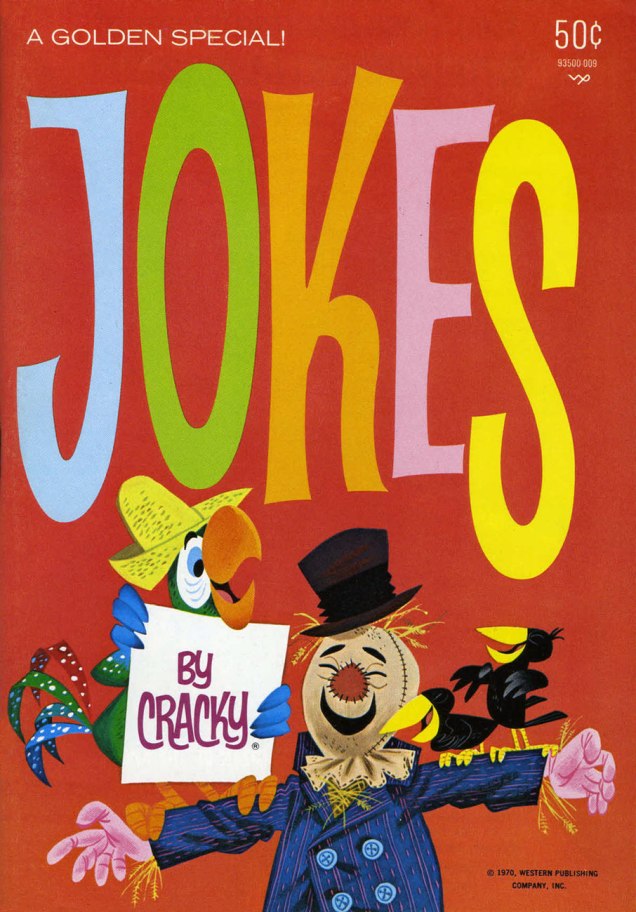
At first, Cracky stuck to sharing reader-submitted jokes. Then, around 1968, he began to show up on covers, generally depicted by versatile Canadian illustrator Mel Crawford (1925-2015). This is one such case, from April, 1969.In 1970, Cracky saw his old job expanded, branching out into two titles, Jokes by Cracky and Pencil Puzzle Fun, the latter outlasting its parent, The Golden Magazine. This is Jokes by Cracky no. 2 (1970); Cover art by Mel Crawford.Then, in 1972, it gets interesting: the lowly parrot mascot broke into comics.
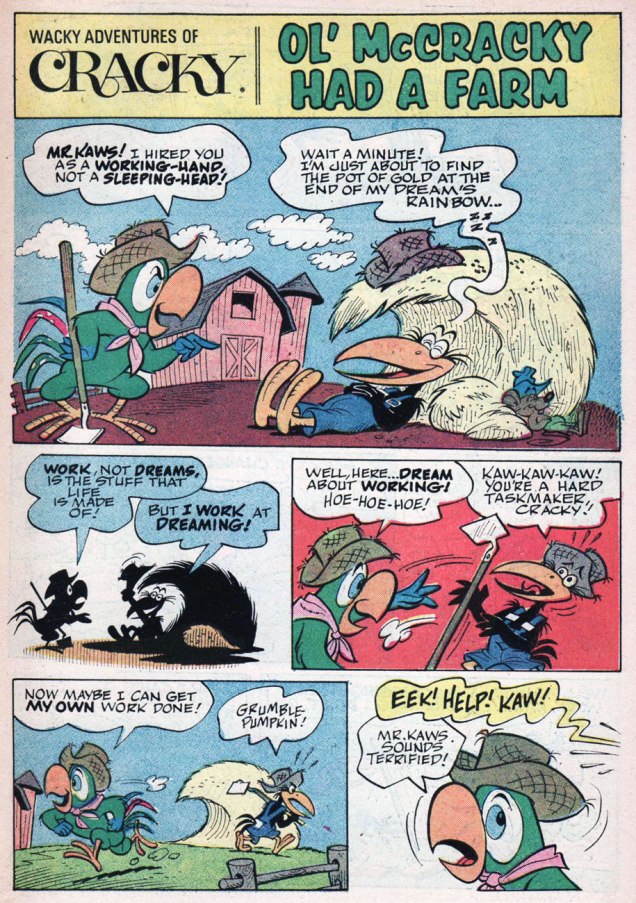
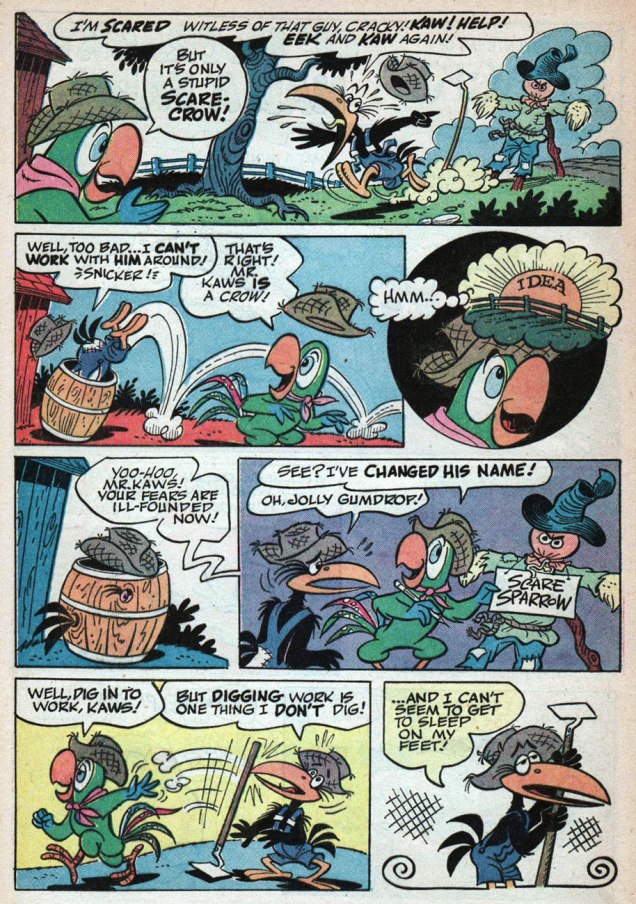
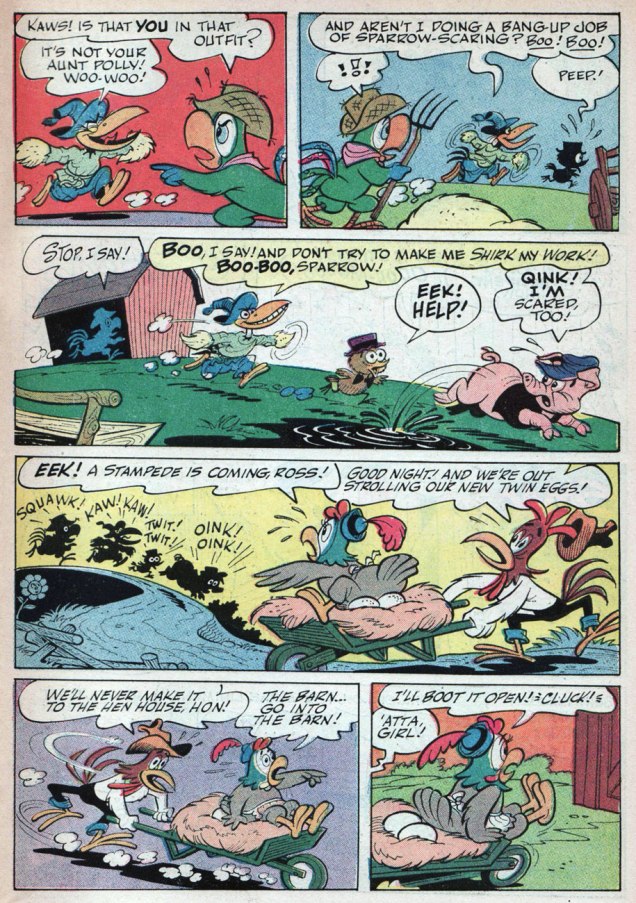
As Archie Comics had their Christian-zealot madman in Al Hartley, so did Western in the person of Vic Lockman. A significant difference, however, is that Hartley, despite quite stiff competition, is arguably the very worst Archie artist; he’s certainly got my vote [Seconded! ~ ds]. Lockman (1927-2016), a prolific but often terrible scriptwriter, was a terrific cartoonist, blessed with a gorgeously fluid line and exemplary design sense, lively and detailed. Here, then, is a story from Wacky Adventures of Cracky no. 3 (June, 1973). Script and art, including his distinctive lettering, by Mr. Lockman.
During the run of his comic book, Cracky (and sidekick Mr. Kaws) wore many hats: detective, inventor (presumably giving Lockman the chance to recycle some of his rejected Gyro Gearloose scripts), ship’s captain, escape artist, sheik… And yes, he did encounter some choice tentacles, but I leave it to my partner to conduct her own investigation. Lockman beautifully handled the first ten issues of WAOC; the instant he stepped away, the thing dissolved into tripe. Avoid accordingly.
Lockman, who seemed a loveable, well-meaning coot, was also twelve kinds of batty. Biblical Economics, anyone? For as full a picture as can be reasonably assembled, read Mark Evanier‘s fine, thoughtful obituary of Lockman.
Lockman was also among those sadly deluded souls (hello, Chuck Dixon) who tried to lay claim to the title of most published comics writer. Let’s face it: the most likely contenders (Joe Gill, Paul S. Newman, Gaylord DuBois) toiled in anonymity for most of their long careers.
In 1971, The Golden Magazine was sold (to The Saturday Evening Post Company!) and renamed, becoming Young World in 1972. Young World, in turn, got incorporated into Child Life in 1979, but that’s a story for another day. Many of TGM’s features were retained but slightly… tweaked. For instance, see who inherited Cracky’s old desk?











 Who's Out There?