Spending Some Quality Time With Barbara Shermund’s ‘New Woman’

Although it’s tempting (but lazy) to assume so, men didn’t *altogether* corner the risqué cartoon niche.

It would be quite an injustice to count out the magnificent Barbara Shermund (1899-1978), prolific contributor to The New Yorker (including eight covers) and Esquire magazines, and so much more.

Far too little is known about this pioneering artist, but here’s an insightful piece aiming to rectify the situation, at least a little, written by Caitlin McGurk:

https://library.osu.edu/blogs/cartoons/2012/03/27/womens-history-month-barbara-shermund-1899-1978/

ShermundVersatile
Nothing new under the sun! Frankly, that situation hasn’t gained a wrinkle since this cartoon’s appearance in The New Yorker‘s July 21, 1928 edition.
NewYorker1935A
One of Ms. Shermund’s aforementioned New Yorker covers, from the June 29, 1935 edition.
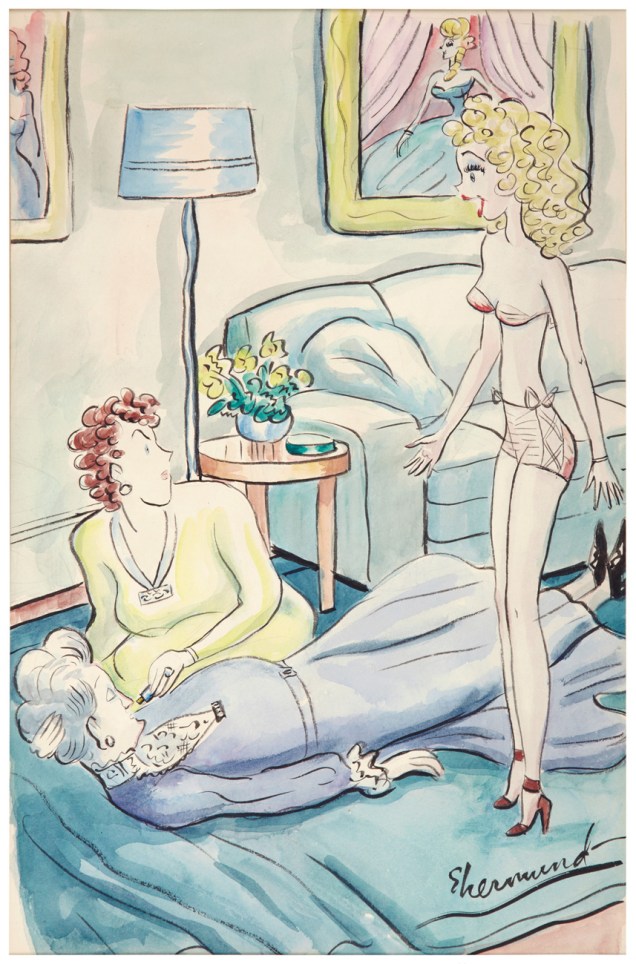
ShermundGrannyFaintA
« All I said was, ‘Granny, how do you like my new bathing suit?’ » Undated piece in ink and watercolour.
ShermundLostA
« She’s lost! » Esquire, 1944. Ink and watercolour.
ShermundTunnelA
« Mr. Dillon, I’d like to ask your daughter’s hand in marriage. » (1953, ink and watercolour.)
ShermundApeA
« Who was that fellow I saw you with at Ciro’s last nite? » (Cheering Section, 1955. Ink and watercolour.)
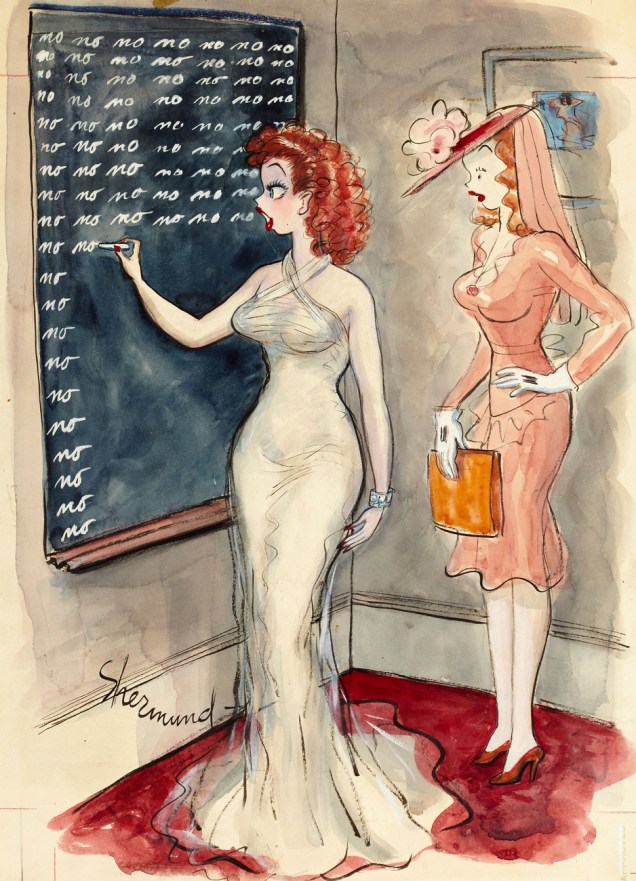
BarbShermundNoA
« Mother always makes me write it five hundred times before I go out with Mr. Parker » Esquire, publication date unknown, ink and watercolour.
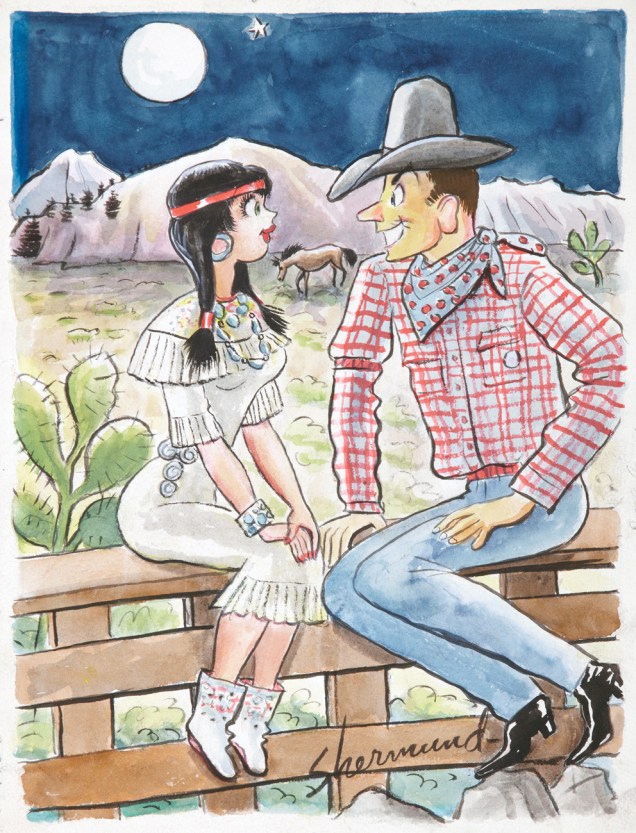
ShermundCowboyIndianA
« Let’s play cowboy and indian! » (Cheering Section, 1959. Ink and watercolour.)

I can’t help but be reminded, by that final piece, of Jack Cole‘s rather more trenchant take on a similar power imbalance, published a year earlier.

ColeUncleSamMaidenA
« Well, there’s history repeating itself. » (Jack Cole, from Playboy, January, 1958.)

A postscript: in March, 2022, Ms. Shermund was the subject of an article in the New York Times’ ‘Overlooked No More’ series, comprising belated obituaries for notable folks whose departure flew under the radar, so to speak. In this case, we learned that:

« Shermund lived out her last years drawing at her home in Sea Bright, N.J., and swimming at a beach nearby. She died on Sept. 9, 1978, at a nursing home in Middletown, N.J.

In 2011, a niece, Amanda Gormley, decided to research her family’s history and was surprised to find that Shermund’s ashes had been left unclaimed in a New Jersey funeral home since 1978.

In May 2019, Gormley raised money through a GoFundMe campaign and, with the contributions of many artists and cartoonists, saw to it that Shermund’s ashes were buried alongside her mother’s grave in San Francisco. »

– RG

Steig Swoops In: The ‘Epic in Jazz’ Cat Sextet

« The only escape from the miseries of life are music and cats » – Albert Schweitzer

In the mid-50s, New Yorker cartoonist (and children’s book author, sculptor and Orgone Box owner) William Steig (1907-2003) was called upon to throw together some illustrations for Epic Records’ “Epic in Jazz” LP series, which featured classic 30s recordings from the likes of Johnny Hodges, Chu Berry, Count Basie, Barney Bigard and Cootie Williams. One might safely opine that the good Mr. Steig outdid himself. You be the judge.

HodgePodgeA
John Cornelius “Johnny” Hodges (1906 – 1970) was a saxophone giant of the big band era, and closely associated to Duke Ellington’s band. This 1955 compilation gathers some key recordings from the mid-to-late 30s, including Rent Party Blues, Skunk Hollow Blues and Dooji Wooji.
SteigHackettHornA
Bobby Hackett (1915-1976) was a trumpet, cornet and guitar player who performed with Benny Goodman and Glenn Miller’s bands. Among my very favourite of his recordings are some he made in the 1950s with trombonist supreme Jack Teagarden. There was tremendous musical and personal camaraderie between these two.
SteigBeriganA
Trumpeter Roland Bernard “Bunny” Berigan (November 2, 1908 – June 2, 1942) had, according to Al Rose, the custom of carrying « several packages of chewing gum in his pocket, not because he was addicted to the vigorous mastication of chicle. He had an even more practical use for the stuff. He’d put three or four sticks of gum in his mouth as we approached a boîte with liquor in mind. Once inside, we’d sit at the bar and order our drinks. Then he’d excuse himself, promising to come back in a moment. He would walk purposefully off, to the men’s room I assumed incorrectly. Early on I discovered that what he was doing was finding the jukebox, putting a wad of Wrigley’s Doublemint through the coin slot, then pushing the slide in to assure the device’s inoperability for at least as long as we’d be there enjoying our drinks. He’d return to the bar secure and relaxed in the knowledge that our ears wouldn’t be assaulted by bad music. »
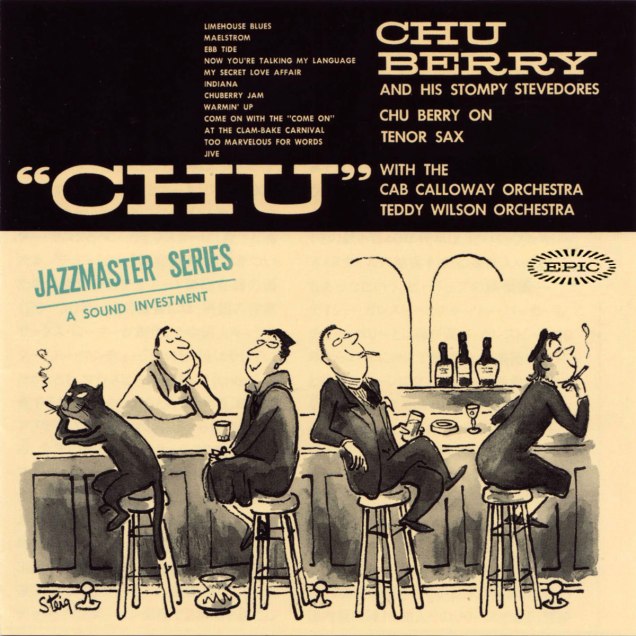
Chu!A
The great Rex Stewart recalls Chu: « Chu Berry was a big bear of a man and, as a matter of fact, he resembled a great big teddy bear. He was always in good humor and never had an unkind word to say about anyone. His given name was Leon Berry, his home town was Wheeling, West Virginia, and he hove onto the Harlem scene with his tenor saxophone. While he lived, he loved the life of a musician, late to bed and even later to rise. His favorite hangouts were Tillie’s Chicken Shack on Lenox Avenue and the Victoria Cafe on Seventh Avenue, where they used to serve good barbecue. Later he’d frequent the Woodside Hotel along with the fellows with Count Basie’s band when they lived there. Chu loved to talk, drink and eat, and if he could do all three while playing he was in his particular seventh heaven. »
SteigDukesMenA
« Probably no other band has brought such fame to sidemen as the Duke Ellington band », sagely states Shirley Hoskins Collins in the liner notes of this peerless LP showcasing four of the Duke’s finest acolytes: Barney Bigard, Rex Stewart, Cootie Williams and Johnny Hodges.
SteigLesterLeapsInA
If I need to tell you who Count Basie and Lester Young are, you need to treat your ears to some fine vintage jazz, pronto.

These sets were reissued over the years, often with bland photo covers (oh, the infamy!), but Sony Japan has done right by the series a few years ago, reissuing it on cd while retaining the essence of its visual allure and, in most cases, adding four tracks of the same calibre and vintage to each disc.

Did I mention that Cab Calloway and Dizzy Gillespie are also in attendance? Sorry, it must have slipped my mind, what with all the excitement and bathtub gin.

« My neighbours listen to good music whether they like it or not. » – Unknown

– RG

Hallowe’en Countdown, Day 28

« I hope I will not be accused of undue vanity if I publicly thank Mr. Addams for immortalizing me in the person of the witch’s butler, to say nothing of the rather hairy gentleman whose clothes are strangely cut and who appears to subsist on a diet of bananas. » — Boris Karloff, from his foreword to the Addams collection Drawn and Quartered (Random House, 1942)

At the risk of being obvious, the ghoulish wit of Charles Addams brings us Hallowe’en on any old day of the year… but it’s no reason to take him for granted when the proper season slinks into view. Here’s a small selection of favourites. I’ve noticed that many latter-day collections have been plagued by terrible reproduction (heads should roll for that particular crime against art!), so I’ve gone back to the original collections in my library. Enjoy, fiends!

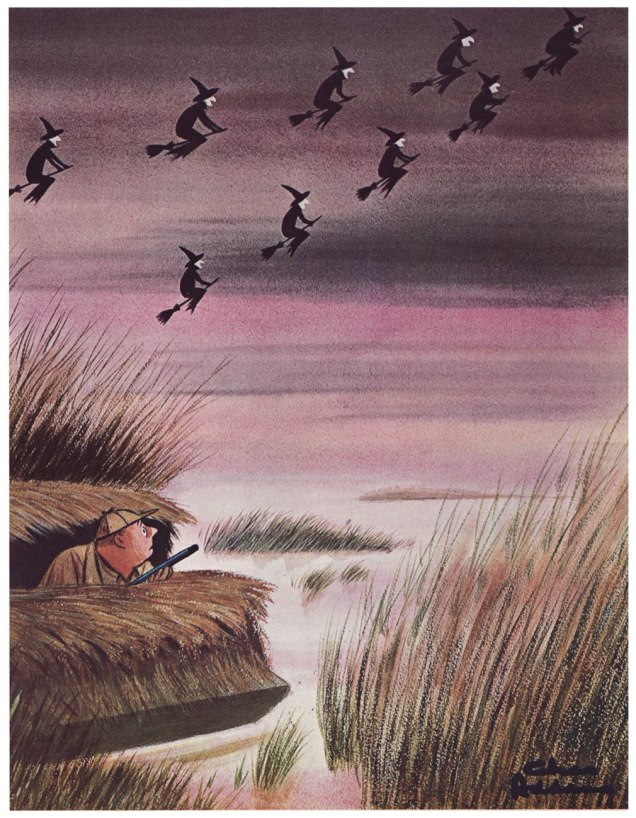
AddamsWitchesA
A lovely piece originally featured on the cover of The New Yorker‘s November 2, 1963 issue. This logo-free version was reprinted in The Groaning Board (Simon and Schuster, 1964.)
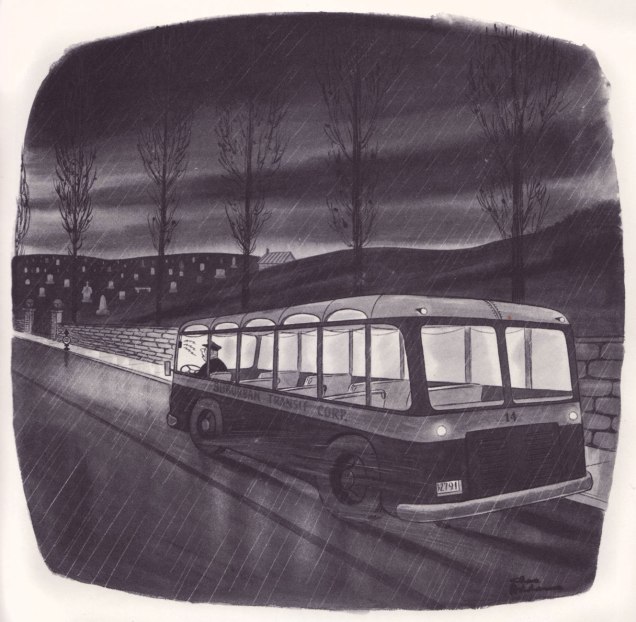
AddamsBusA
Addams at his understated best. A 1953 cartoon collected in Homebodies (1954, Simon and Schuster.)
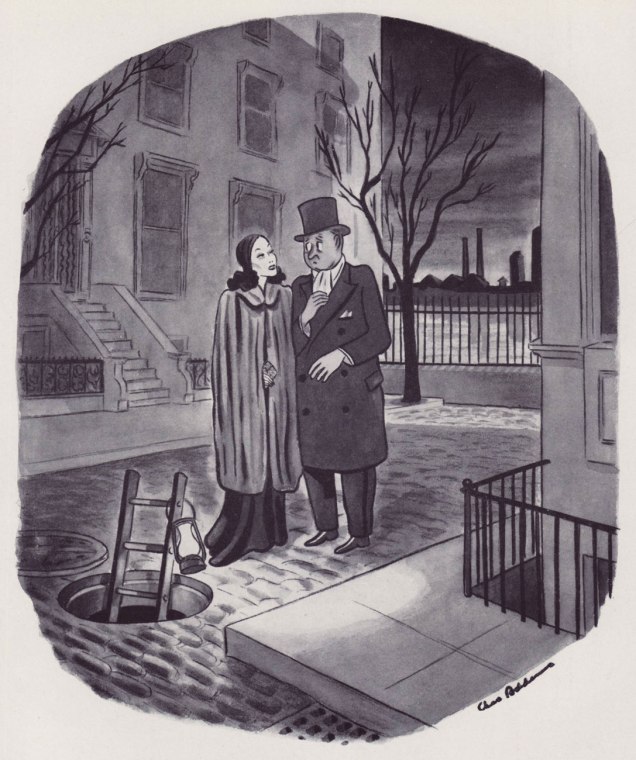
AddamsSewerA
« Well, here’s where I say good night. » A Morticia prototype from an undated cartoon collected in the first Addams collection, Drawn and Quartered (Random House, 1942.)
AddamsSqueakyA
« While you’re here, there’s a squeaky trap-door I’d like you to look at. » That’s the Morticia we’ve come to know. Also reprinted in Drawn and Quartered (Random House, 1942.)

-RG

Hallowe’en Countdown, Day 20

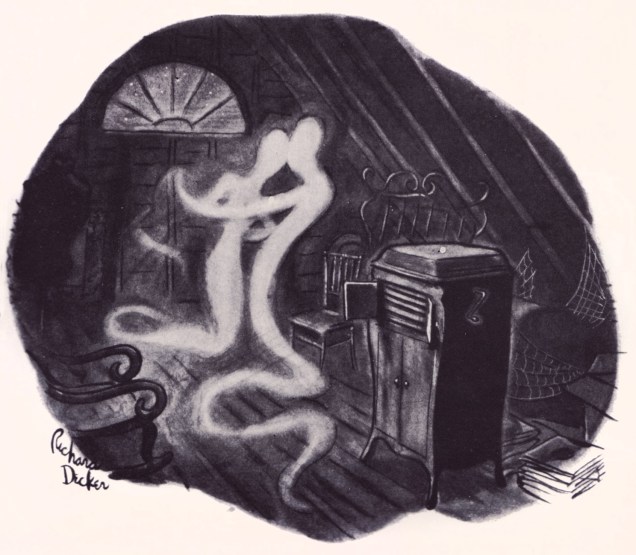
On a damp and chilly night, is there a finer way to keep warm than huddling with your beloved?

DeckerGhostsA
From The New Yorker 1955-1965 Album, published by Harper & Row.

Richard Decker, (b. Philadelphia, PA, May 6, 1907, d. November 1, 1988) fruitfully spent four decades as a contract cartoonist for the New Yorker. His association with the magazine began in 1929.

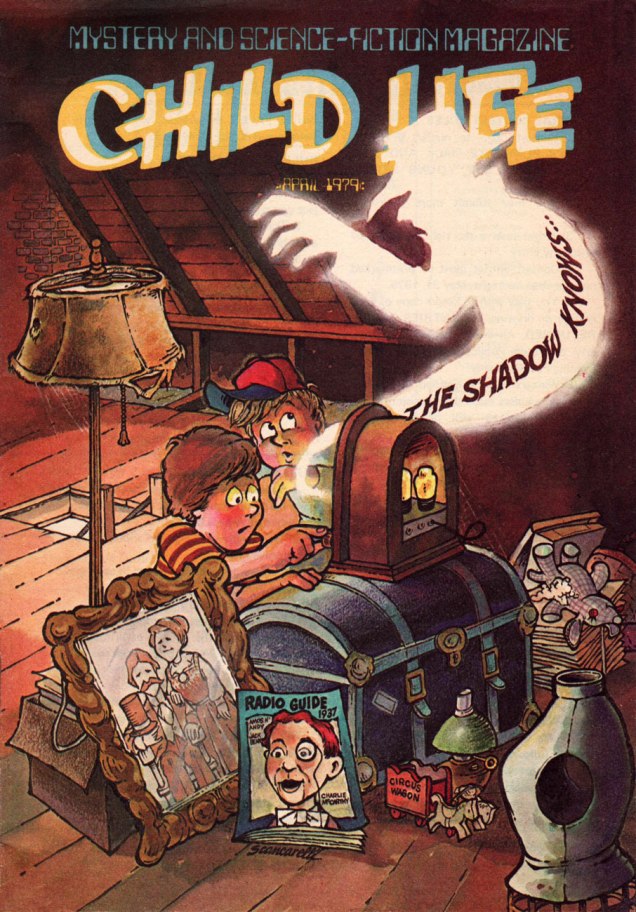
Along the same ordre d’idées, here’s a bonus piece about the evocative magic of old time radio, by long-time Gasoline Alley cartoonist (and bluegrass fiddler) Jim Scancarelli (b. 1941), from the April, 1979 issue of Child Life Magazine.

ShadowKnowsA

Care to fully capture and bask in this delicious melancholy? Go ahead, pour yourself a snifter of your favourite poison, hunker down in your coziest chair, and enjoy an episode or three of the classic The Shadow radio show, starring Orson Welles.

– RG