Happy 90th birthday, Mr. Ditko!

« Don’t be so sure! A guy that popular — he’d be a fool to fold up his act while he’s such a hot item!* »

I’ve been a Steve Ditko fan for as long as I can remember. In fact, I was a fan even before I actually saw his work. “How’s that even possible?”, you may ask. Well, when I was five, this neighbour from across the street was showing off a comic book he had just picked up, which was Teen Titans no. 29**. I was instantly captivated by two costumes on the cover: Hawk and Dove’s, designed by Ditko a couple of years earlier.

I do believe I had encountered a Ditko comic book just a bit earlier, a copy of The Many Ghosts of Doctor Graves no. 20 (June, 1970), acquired by my brother en route to the family vacation on Prince Edward Island. But that one had a (fine) cover by Pat Boyette, and I don’t recall the Ditko story within, « An Ancient Wrong ».

The bottom line is that Ditko’s been a precious part of my life for a spell. It would be easy to take him from granted, so let’s not, if you don’t mind.

Which brings us to our little tribute: running ninety covers covers would be about as practical as ninety candles on our birthday boy’s cake, so I’ll just drop a decimal and stick to a more manageable nine… I won’t even give a nod to such fickle and hollow notions as popularity, historical importance, or iconicity. I’m going with my favourites. That’s the way Steve would do it… and even if he wouldn’t, I’d still go this route.
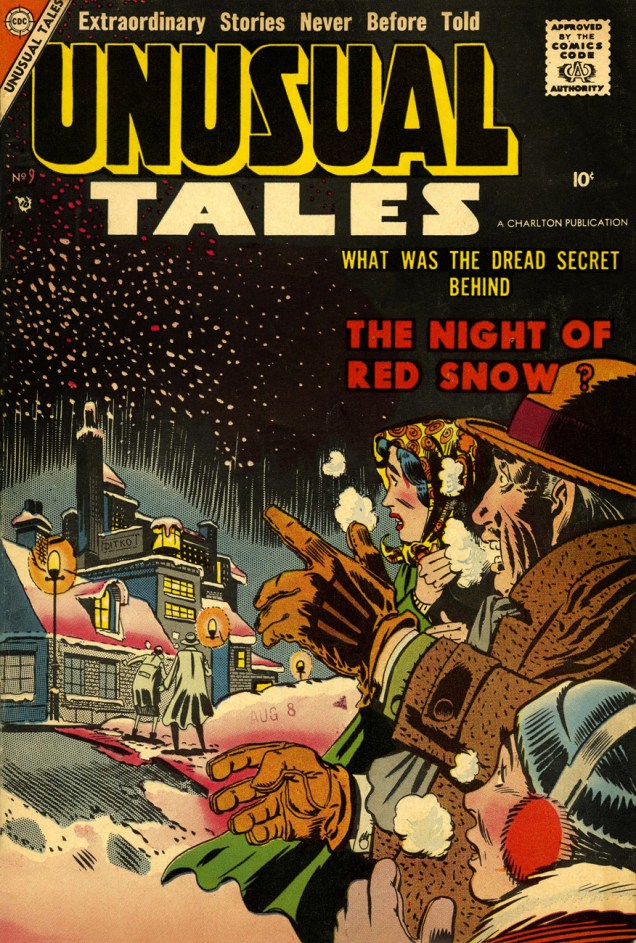
UnusualTales9A
« Nobody here in Crestville will ever forget that night! »
A tiny reproduction of this cover, that of Unusual Tales no. 9 (Nov. 1957, Charlton), in some late-70s edition of the Overstreet Comic Book Price Guide hooked me, and still grabs me. In the post-code era, particularly in its early days, you had to be mighty resourceful to fruitfully mine the mystery genre, what with all the verboten topics and tropes. The issue holds a whopping four, 1957-vintage Ditko stories, including the title piece, which you can read here:
http://ditko.blogspot.ca/2012/01/unusual-tales-night-of-red-snow.html
ASM2A
The Amazing Spider-Man no. 2 (May 1963, Marvel). Beyond Ditko’s departure (no. 38 was his final contribution), I have no further interest in Peter Parker and his costumed alter-ego.
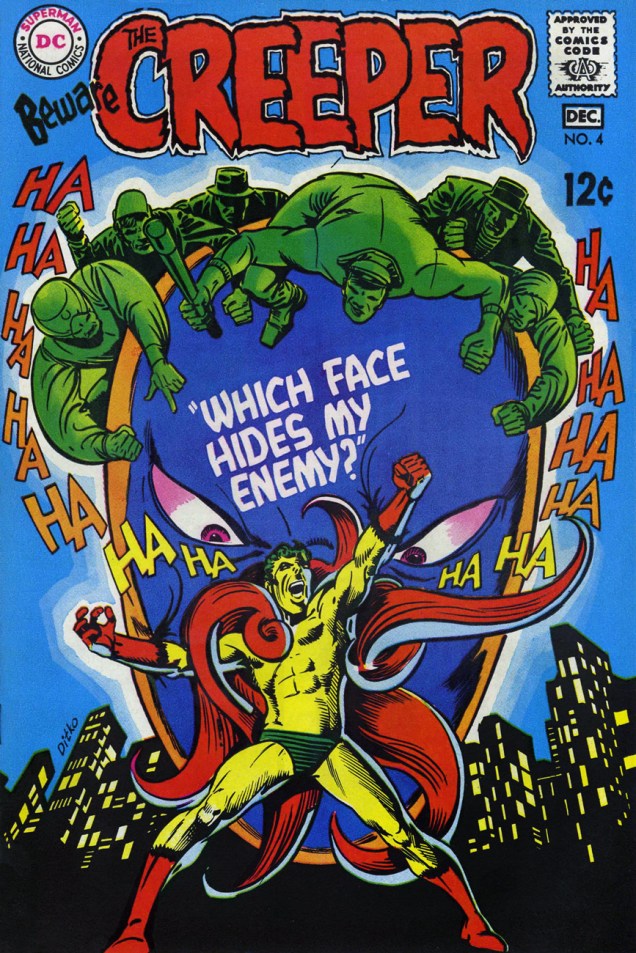
Creeper4A
« Name’s Bulldog Bird! This is Sumo! We’re secret agents from the sovereign kingdom of Offalia! »
For most of the brief run of his book (issues 2 to 6), the Creeper had to contend with a faceless enemy, Proteus, who turns out to be someone very close to him. It was as though Ditko felt the need to replay the Spider-Man – Green Goblin secret identity dynamic, not the way *he* had envisioned it (which was to make the Goblin a total stranger, a situation he’d meticulously set up in the background), but the way Lee had, as if to show his former editor how to do it properly.
This is Beware the Creeper no. 4 (Nov.-Dec. 1968, DC), “Which Face Hides My Enemy?” Pencils and inks by Steve Ditko, plot and dialogue by Dennis O’Neil
Hawk&Dove2A
« You’re still wasting your time reading! Why don’t you build up that sickly body of yours? »
DC’s Hawk and Dove (introduced in Showcase no. 75, June 1968, DC) was, as its title and covers amply make clear, a study in contrast and opposition: aggression vs pacifism, the letter of the law vs the spirit of the law, Steve Ditko vs Steve Skeates…
The concept may have been of its time, but the industry as it stood wasn’t ready to explore the issues without stacking the deck. This was still, after all, a mainstream superhero comic book of the Sixties. This is issue 2, “Jailbreak!” (Oct.-Nov. 1968), Ditko’s third and final issue with his creations. As for Ditko’s abrupt departure from DC is concerned, the reason cited at the time was a relapse of tuberculosis, a disease that had plagued Ditko in his youth. Others have invoked more political explanations, but Ditko *was* out of the game for several months, which fits the convalescence scenario. His absence until 1975 from DC fits the politics one. Why credit one single factor when several, taken together, are more plausible?
GhostManor5A
« Come off it, yer Lordship! This ain’t no blinkin’ time ter do the art connoisseur bit! »
The rakish 14th Lord Garland proves a bit of a disappointment to his forebears. Sir Steve Ditko’s cover proffers a scenic victim’s perspective… but who’s the hazy, phosphorescent figure shambling down the stairs to meet us?
This is Charlton Comics’ Ghost Manor no. 5 (second series, June 1972, Charlton). Inside, you’ll find a trio of Joe Gill chillers: “Dead Man’s Eyes”, illustrated by Joe Staton; “Devils at My Door”, illustrated by Charles Nicholas and Vincent Alascia, and of course, the pièce de résistance, “The Last Garland”, brought to you in panoramic Ditko-vision.
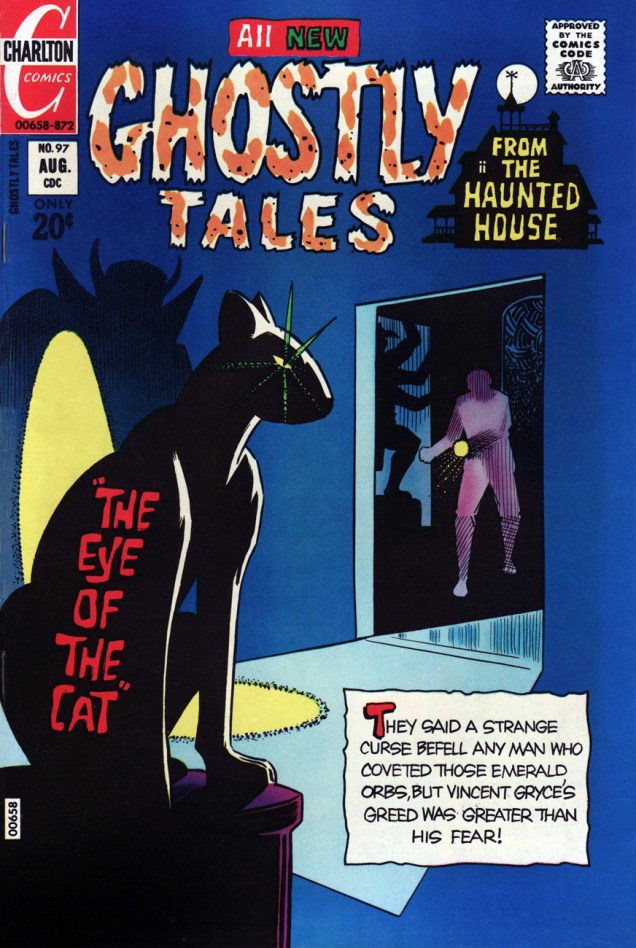
GhostlyTales97A
Ah, the largely lost art of the *soft* sell. Charlton’s cadre of artists hewed much closer to the ambience favoured by aficionados of the spectral than did the esteemed competition. You know, more Montague Rhodes James than, say, Rob Zombie.
Here, Ditko demonstrates how (dis)quiet and mystery is evoked. Dignified silence can be very attractive when everyone around is shouting. Ghostly Tales no. 97 (August 1972, Charlton) features “The Eye of the Cat”, actually handled by Don Perlin, while Ditko delivers visuals for Joe Gill’s “Journal of a Hanged Witch”. The issue also features “Poltergeist”, an effective collaboration between Creepy Magazine founder Russ Jones and the multitalented Bhob Stewart.
Haunted16A
My particular favourite among Ditko’s covers for Charlton’s Haunted (75 issues, 1971-84.) The merrily saturated colour scheme, the composition and its geometric simplicity, that well-chosen angle… the contagious joy of a master at play. This be Haunted no. 16 (June 1974, Charlton.)
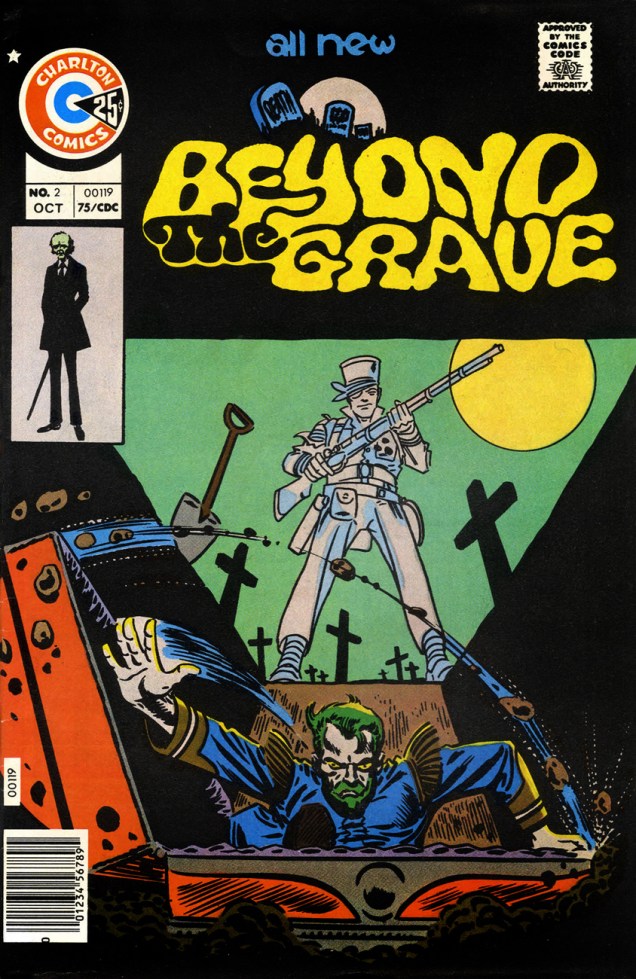
BeyondtheGrave2A
« If you visit that grave on a dark night, you may be surprised… for there is a sentry stationed there…to honor the dead? Or to make sure that General Kugar never leaves his grave? »
Here’s a cover showing the sort of solemn dignity and restraint that made Charlton’s line of ghost books so attractive to me right off the (vampire) bat. No one’s shouting deceptive hype or explaining the action; the elusive allure is undisturbed, unlike the sanctity of the tomb. 
DC, under Infantino and Cardy, generally understood this, but Marvel virtually never did or cared to. But hey, what sold and what I liked rarely sat at the same table.
Beyond the Grave no. 2 (Oct. 1975, Charlton).
Shade3A
Ah, Shade. Ditko’s last great creation, cut off in its prime by the Great DC Implosion of ’78. Later misunderstood and corrupted by hacks. Finally reprinted, including formerly unpublished issue 9, in volume 1 of The Steve Ditko Omnibus (2011). It’s still a frustrating experience, but at least issue 8’s cliffhanger has been resolved, and what happens in the Zero Zone doesn’t stay in the Zero Zone, if you know what I mean. This is Shade the Changing Man no. 3 (Oct.-Nov. 1977, DC)

*Jack Ryder (aka The Creeper)’s closing quip from “The Coming of the Creeper!”, plot and art by Steve Ditko, script by Don Segall (Showcase #73, Mar.-Apr. 1968, DC)
**Since it played such a crucial rôle in my Ditko inculcation, here’s the Teen Titans issue in question.

TeenTitans29A
Teen Titans no. 29 (Sept./Oct. 1970, DC) Cover by Nick Cardy (likely co-designed by Carmine Infantino and coloured by Jack Adler), illustrating “Captives!”, written by Hawk & Dove scenarist Steve Skeates and illustrated by Nick Cardy.

– RG

Return of the Tentacles

Once upon a time (or, more precisely, a handful of years ago), we started a little weekly celebration of tentacle glory in comics and called it Tentacle Tuesday. (My husband came up with that alliteration; I hope he’s willing to share the credit for this pithy little phrase with others, as I honestly don’t know whether he was first to dream it up. By now, #tentacletuesday is a hashtag and there’s a Facebook page with that title). Yet “real life” (read: “a sad existence tragically devoid of octopuses”) got in the way, and although we’ve often thought about Tentacle Tuesday, no offerings were made at the Octopoda altar. We’d spot some glorious tentacles while reading comics, and wistfully dream of sharing them with a like-minded audience, but the impulse would pass, leaving behind vague but lingering regrets.

Well, we are back. Let’s keep Tentacle Tuesday going strong, for after all, comics and tentacles are among the universe’s greatest achievements. Let the cephalopod fiesta begin – we welcome you to this blog’s first-ever installment of Tentacle Tuesday!

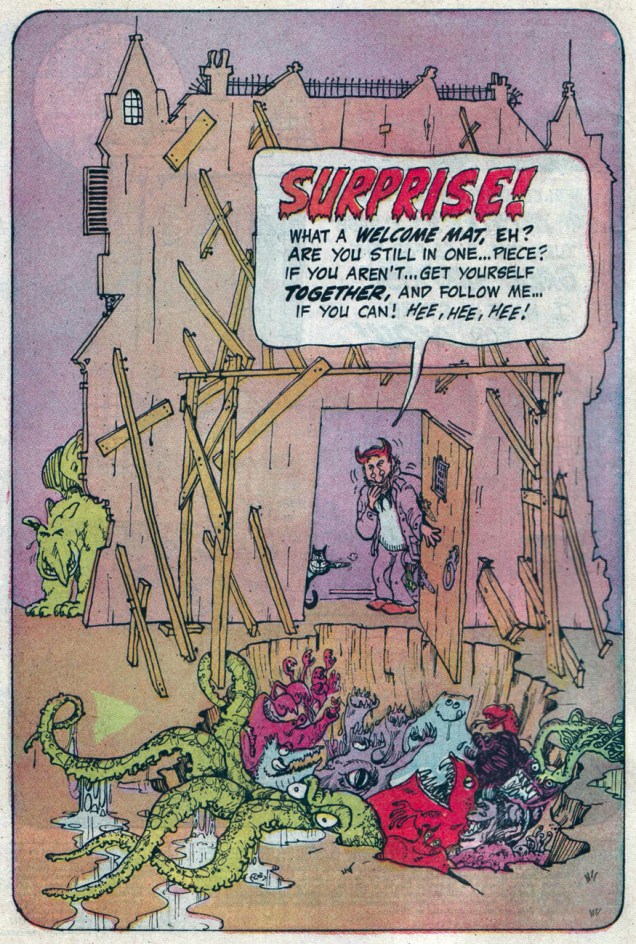
Our first offering features, quite naturally, a Welcome Mat leading to a trapped, angry octopus, who seems to be indignant about being stuck in a pit with a bunch of uncouth, plebeian imaginary monsters. Claws, pincers, and talons, razor-sharp teeth and dendritic horns? Ha, *he* has tentacles! And if the other denizens of this trap are purely monster-under-the-bed material and act as if they’re drunks at a party, Mr. Octopus here is a professional who takes his job of being terrifying seriously.

CainTentaclesA

This is a pin-up, if I may call it that, by the easily identifiable Sergio Aragonés, scanned from DC’s House of Mystery no. 189 (Nov./Dec. 1970). The giggling guy is Cain, the so-called host of the House of Mystery, and is every bit inclined to betray and double-cross as his Biblical namesake. Incidentally, number 189 is an excellent issue: Eyes of the Cat, with art by Jerry Grandenetti and Wally Wood, is both gorgeous and scary, with bonus points for prominently featuring a black cat (which Neal Adams made look like a rat on the cover – if you don’t believe me, try http://pencilink.blogspot.ca/2008/05/house-of-mystery-189-neal-adams-cover.html ) It is followed by The Deadly Game of G-H-O-S-T by Leonard Starr, and the issue wraps up elegantly with The Thing in the Chair with art by Tom Sutton.

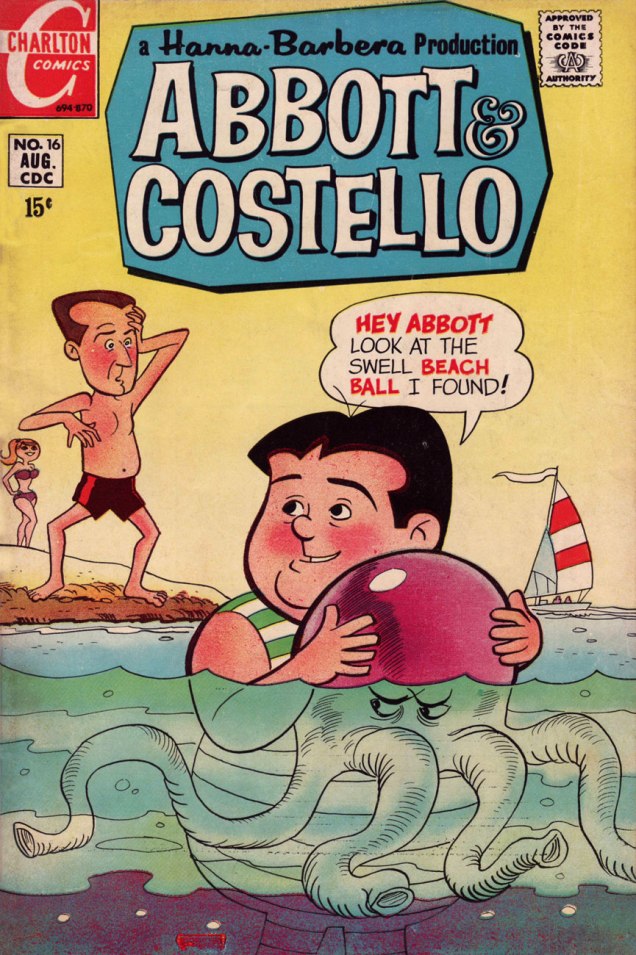
In a slightly different vein, but equally lighthearted, is this cover of Abbott & Costello no. 16 (Aug. 1970, Charlton). I hope our readers shall be too polite to point out that Tony Tallarico, the artist, made tentacles look more like elephant trunks, or that this… creature… has but four of them, which would make him probably the only quadripartite octopus in existence (they’re supposed to have 8, for those of us who are a little hazy on the specifics). Now, if only Charlton paid by the tentacle rather than by the page…

AbbottCostello16A

This comics series was of course based on the American comedy duo of Bud Abbott and Lou Costello, of early 40s and 50s fame. Fast-forward to 1967, and with Costello having long passed on (in 1959), the pair was miraculously given a new, two-dimensional lease on life (hey, you take what you can get… comedy’s a vicious game!) through the auspices of Hanna-Barbera Productions, and Charlton landed the comics licence and ran with it… for a healthy twenty-two issues. The first eight or nine of these, featuring the madcap talents of artist Henry Scarpelli and (especially) scripter Steve Skeates, are the ones to seek out. You have been warned!

~ ds