André Franquin: a Centenary in Ten Images

« The first hundred years are the hardest. » — Wilson Mizner

Having just learned this morning that today marks a century since the birth of André Franquin (1924-1997), I again pushed my planned post to the back burner. So, instead of writing about a celebrated Belgian genius, I’ll write about *another* celebrated Belgian genius.

Spirou’s ‘Albums’ were a handy way to dispose of unsold copies of the weekly magazine by collecting a trimester’s worth of issues in an attractive hardcover format. This one’s from March 1948, just to give you an idea of Franquin’s early style.
A panel from Le dictateur et le champignon (1953). The ripe banana-coloured critter with the long tail, if you don’t already know, is Le marsupilami, Franquin’s homage to Elzie Segar‘s Eugene the Jeep (introduced in 1935 and known as ‘Pilou-Pilou’ in French Europe).
This panel took my breath away as a kid when I first saw it, and it still does. It’s from Spirou et Fantasio no. 8, La mauvaise tête (1954). How many contemporary artists could pull off such a scene — let alone the entire sequence, wherein Fantasio ends up winning the race cycling backwards — at all convincingly?
I’ve been reading, for the first time, Franquin’s collected Modeste et Pompon (1955-59). After Franquin was tricked into surrendering his creation to Tintin magazine publisher Les Éditions du Lombard, M&P became just another long-running mediocre domestic strip in many successive pairs of (necessarily) lesser hands… but seeing Franquin bring it to life is a most refreshing pleasure.
A dynamic Modeste et Pompon sample from near the end of Franquin’s run. During Franquin’s relatively brief passage at Tintin magazine, he set a new standard of graphic freedom, opening a breach for his successors that Georges “Hergé” Rémi himself did *not* welcome. Tintin’s papa, in fact, deemed Franquin’s supple and organic line ‘vulgar’.
Album Spirou no. 70 (March 1959, Dupuis), gathering issues 1081 to 1091 and depicting a scene from Le Prisonnier du Bouddha.
Album Spirou no. 96 (April 1965, Dupuis), collecting issues 1395 to 1407. Gaston Lagaffe*, like Le Marsupilami before him, was a minor character introduced by Franquin to relieve the tedium of setting down the adventures of Spirou et Fantasio. The popularity of both these would-be background creations wound up dwarfing that of the intended protagonists.
Franquin’s original painted artwork for the cover of Album Spirou no. 100 — well, duh — (March 1966, Dupuis), containing issues 1447 to 1459.

In 1977, a depressed yet inspired Franquin, suffocating within the confines of his much-imitated (at his publisher’s clueless insistence) style, created — with kindred confederate Yvan DelporteIdées noires (Black, or perhaps more fittingly Bleak notions) as an outlet. It first appeared in the short-lived* Spirou mag supplement Trombone illustré, then moved to the more welcoming pages of Fluide glacial. An English-language edition, entitled Die Laughing, was published by Fantagraphics in 2018. Check it out here.

Here are a couple of Idées noires punchlines, which should give you an idea of their tone.

Marcel Gotlib wittily hijacked/paraphrased Sacha Guitry‘s bon mot about Beethoven : « After reading a page of Idées noires by Franquin, we close our eyes, and the darkness that ensues is still Franquin’s. »
In countless instances, Franquin even used his signature to expressive comic effect.

-RG

*These days, thinking about Gaston Lagaffe puts me in an ugly mood, I’m afraid. Franquin had expressly, and all along, requested that his creation be put to rest with him. But did his publisher – having built an empire upon Franquin’s creations — honour his wishes? No more than usual. Another arrogant slap — post-mortem this time — in the face of a genius exploited and mistreated his entire adult life. In this world, the interest of the characters… oops, pardon my French, ‘properties’ obviously trumps that of the flesh-and-blood creators. Every time. For there’s always some scab hack or other backstabber (and they *always* claim to be huuuge fans, as Miller said to Eisner, betraying him with a kiss) to aid and abet venal publishers. That’s how we got a pointless Sugar and Spike revival and all those Watchmen prequels. Hopefully, Monsieur Franquin’s daughter will prevail in her lawsuit against Dupuis to settle the matter in a just and fitting manner. [ Update: it didn’t end well. The suits won. ]

**« It is upon the publication of a Franquin article that the supplement is cancelled. In his piece, the fervently antimilitarist Franquin takes to task Thierry Martens, Spirou’s then editor-in-chief, for running articles about Nazi war plane models. » (translated quote from L’histoire de la bande dessinée pour les débutants by Frédéric Duprat, p. 131, Jan. 2011)
Tentacle Tuesday: le mardi des tentacules, parbleu!

In my ceaseless quest for tentacles, once in a while, I return to a previous theme – in this case, the Franco-Belgian tradition of comics. To start at the beginning, visit Tentacle Tuesday, Franco-Belgian edition parts 1 and 2, and Tentacle Tuesday: Tentacules à la mode.

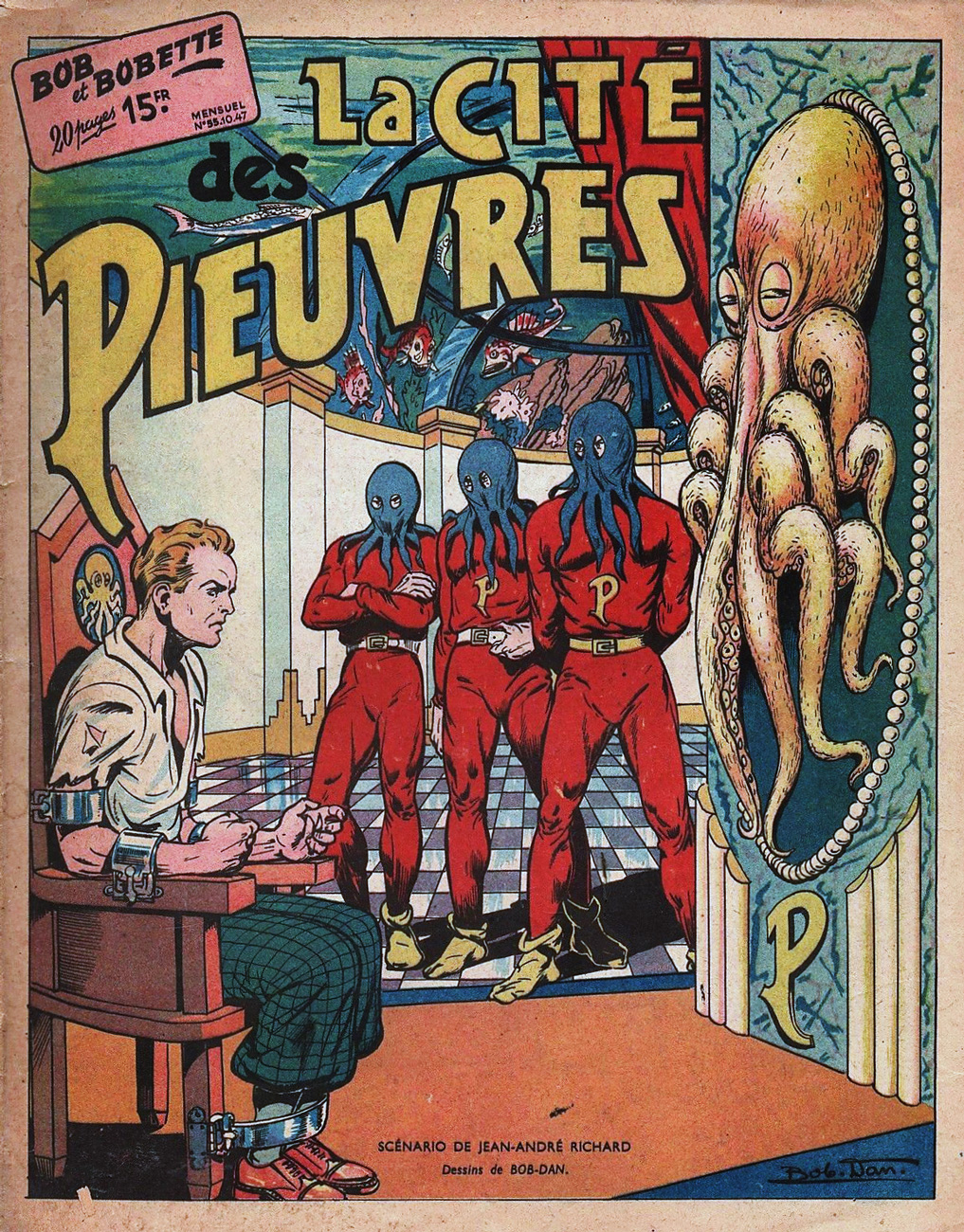
We start some 70-some years ago, with an issue of Bob et Bobette, a Belgian feature created by Willy Vandersteen in 1945. Well, to be more precise, the latter created Suske en Wiske — when the strip became popular in its native De Standaard (a Flemish daily newspaper), it was picked up by Tintin magazine, after Vandersteen agreed to modify it somewhat according to Hergé (who was the magazine’s artistic director) and his Ligne claire guidelines. The main characters were renamed – far from the last time that happened: in Britain, they were known as Spike and Suzy, and as Willy and Wanda in the United States.

BobetBobette-Lacitédespieuvres
Bob et Bobette no. 55: La cité des pieuvres (1947). Scripted by Jean-André Richard and illustrated by Robert Dansler, who was often known as Bob Dan. That lovely sepia paper… I can just smell it.

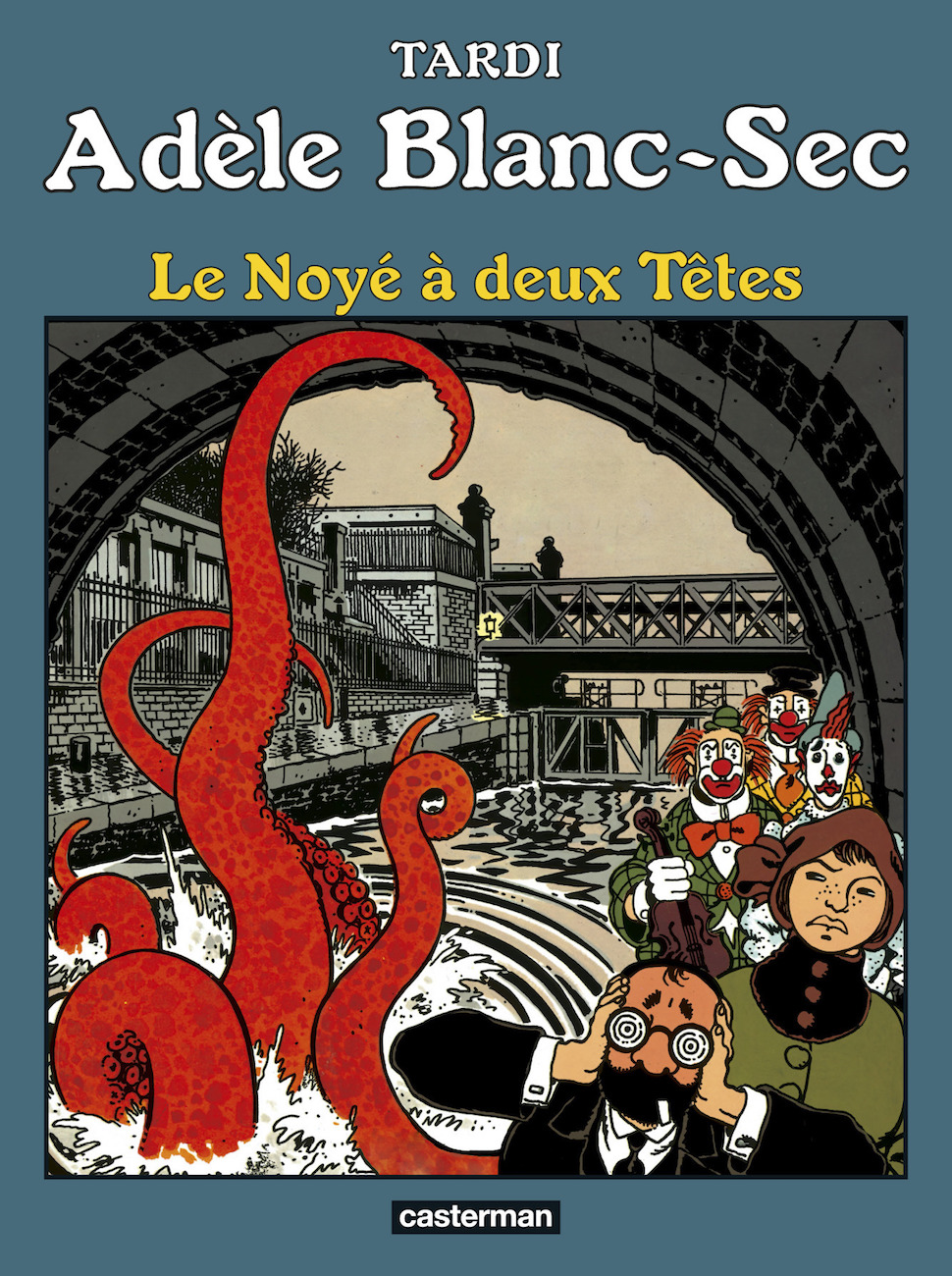
I’ve never read a whole album of The Extraordinary Adventures of Adèle Blanc-Sec, though I like its premise (an intrepid, independent héroïne? yes, please) and Jacques Tardi‘s art (depending; sometimes I love it, sometimes I’m indifferent, but it’s certainly good enough for purposes of following a story). Chalk it down to something I never got around to, I guess. Irritatingly, in 2010 we have been *ahem* ‘blessed’ with a movie based on this comic, directed by the ever sharp-witted Luc Besson (who royally fucked up a movie adaptation of Valérian et Laureline in 2017, so he seems to be making this into a specialty).

French-Tardi-lenoyeradeuxtetes
Le Noyé à deux têtes is the sixth volume of Les Aventures extraordinaires d’Adèle Blanc-Sec, a series by Jacques Tardi. In 1984, it was serialised in À suivre, a Franco-Belgian magazine, and collected as an album a year later (both by Casterman).

French-Tardi-lenoyeradeuxtetes-tentacules
A peek at the tentacles within.

I mentioned the comics magazine Le journal Tintin earlier – here’s a cover from its competitor, Spirou (Le journal de Spirou), published by Éditions Dupuis since 1938. The respective publishers (Raymond Leblanc for Tintin, and Charles Dupuis for Spirou) of these magazines had a gentleman’s agreement: an artist’s work could only be published in one or the other, never both. Incidentally, there was an interesting exception in the case of André Franquin, who moved his wares from Spirou to Tintin after a quarrel with its editor – and, contractually obligated to work for Tintin for five years, simultaneously continued to provide Spirou with stories.

Spirou1771BriceBoltA
Spirou no. 1771 (march 23rd, 1972), art by Puig. Brice Bolt, a feature launched in 1970, was soon abandoned after but two episodes (although to be fair, they were lengthy – the strip lasted until 1972)… from the sound of it, for being a little too modern for its time. After the publication of the first chapters, letters came in complaining that the story was too scary, the animals too monstrous, the illustration style too realistic. The “monstrous animals” included an army of giant crabs, a behemoth squid (just up our street!), colossal vampire bats, and ginormous Komodo dragons.

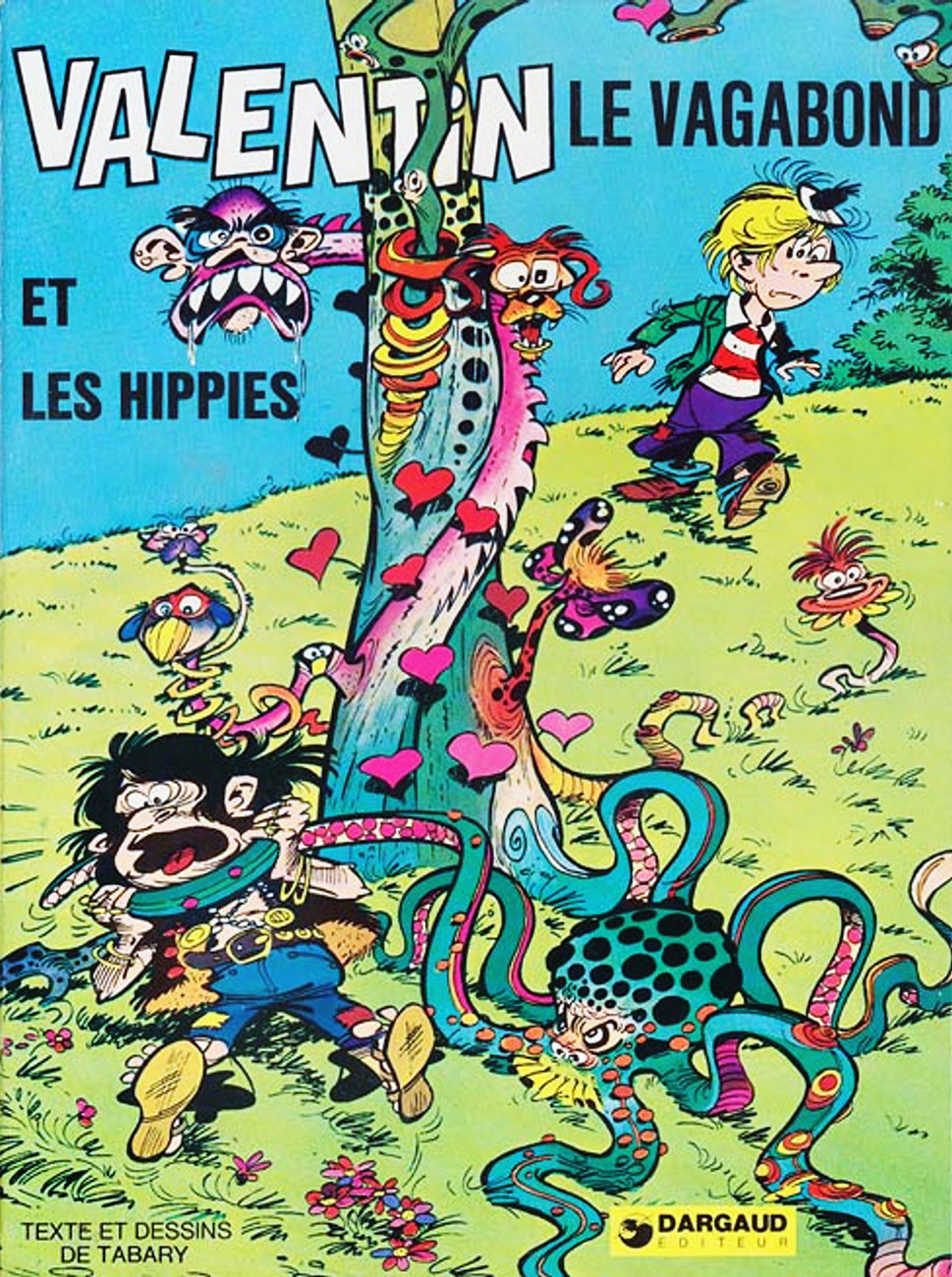
Valentin le vagabond was created by René Goscinny et Jean Tabary in 1962 for publication in Pilote. After 1963, Tabary carried on alone, scripting and illustrating all by his lonesome, Goscinny having his hands full with other projects. Valentin le vagabond et les hippies is the final story of this series, originally serialised in issues 709 to 719 in 1973.

Valentinlevagabond-Valentinetleshippies
Valentin le vagabond: Valentin et les hippies (Dargaud, 1974). Story and art by Jean Tabary.

ValentinHippiesA
An excerpt from Pilote no. 719 (1973). The tree is a hippie tree, as it was treated with LSD… now it’s got tentacles. Naturally.

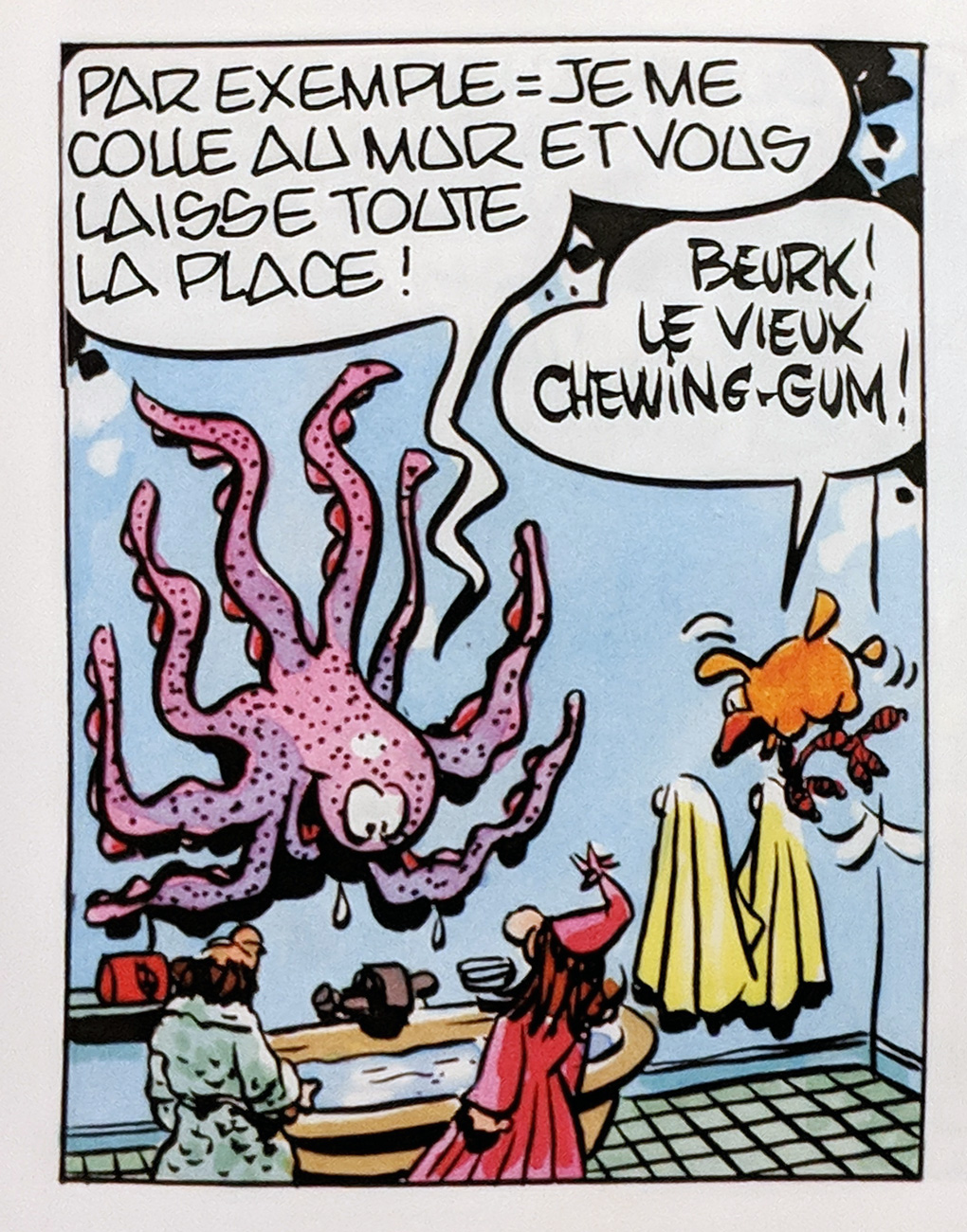
The French are surely not immune from scatological humour. The Kaca fairy (I’ll give you three guesses for what “kaca” means in French) is a rather inept witch. She accidentally conjures up an octopus who’s a little too intent on being liked, and the rest of the comic deals with the attempts to whisk him away again.

FeeCaca-1
« Hurry up and make this monstrosity disappear! » « Yes, yes, I’m looking, but nothing works! » Panels from La fée Kaca (Humanoïdes Associés, 2007) by Florence Cestac.

FeeCaca-2
The octopus tries to convince everybody that they should allow him to stick (ha, ha) around – « for instance, I stick myself to the wall and leave you with all the room you need! ».

~ ds

Charles Bronson’s Paper Doppelgängers

« I guess I look like a rock quarry that someone has dynamited. » — Charles Bronson

Welcome to our 400th post! I suppose a Steve Ditko birthday post would have been more momentous, but I did that already a couple of years ago, while he still drew breath.

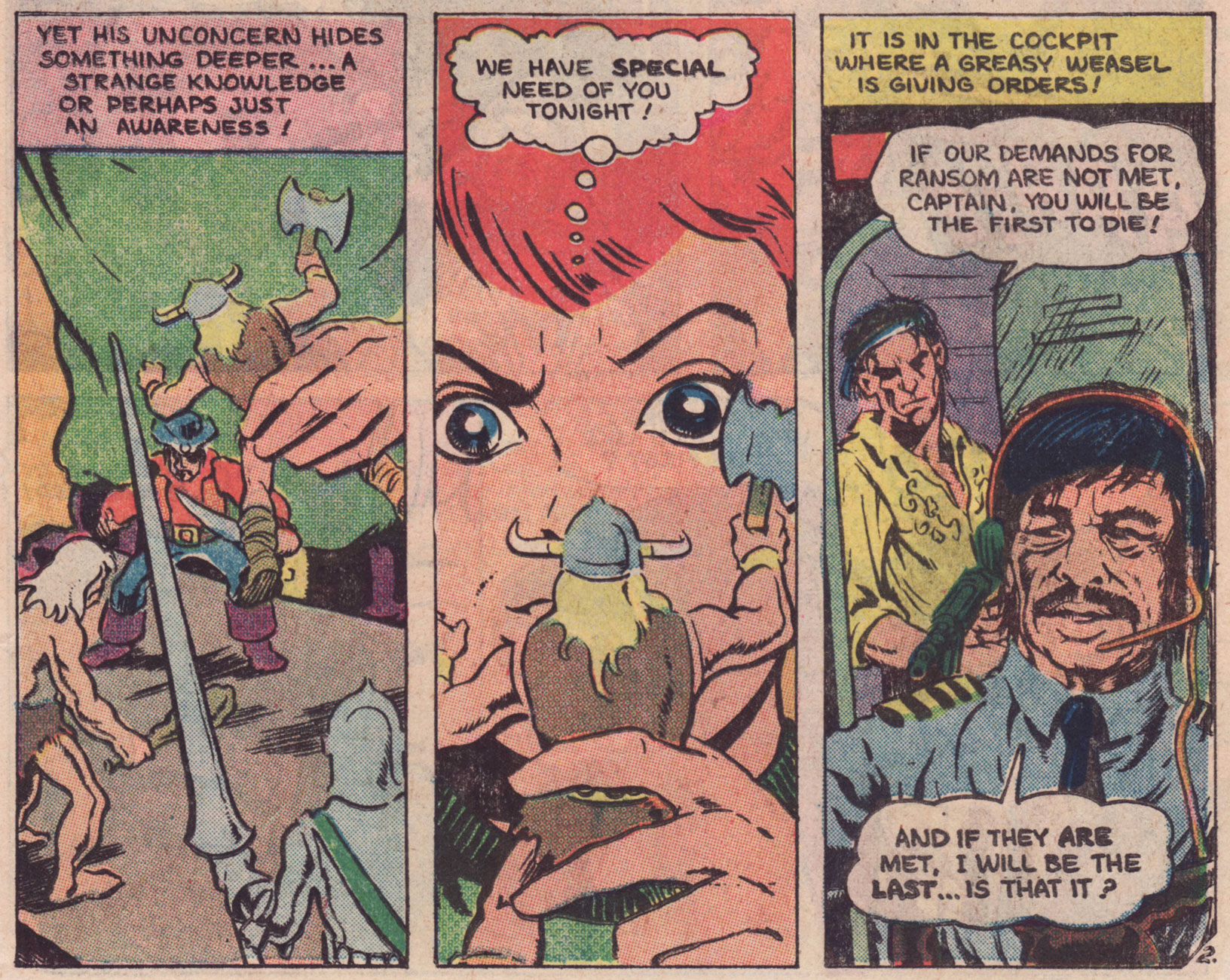
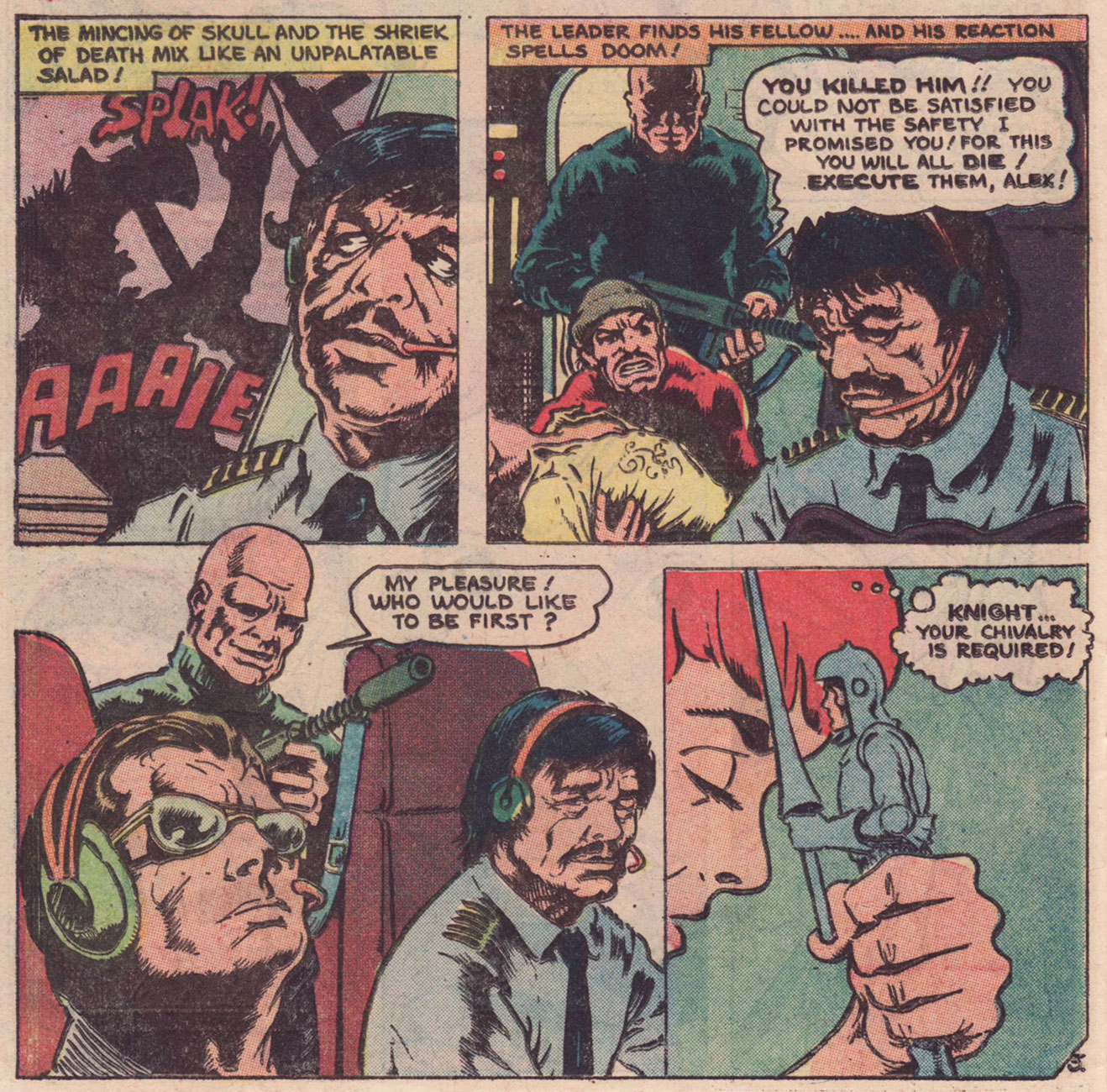
Today, our man Charles Dennis Buchinsky, aka Charles Bronson (1921 – 2003… he would have turned 98 today — picture that!) squeezes in a rather routine bit part (merely credited as « The Pilot ») in Joe Molloy and Mike Zeck’s nonsensical hijacking melodrama Only a Toy. Heck, read it here if you don’t believe me.

Oddly enough, this expanded cameo came about just a year after Bronson’s megahit Death Wish, as Bronson reached the pinnacle of his earning power (in inverse proportion to the quality of his output, thanks to his long association with the shady Cannon Group). Presumably, he was just doing a favour for his old pal Zeck.

ZeckBronson01A

ScaryTales2Bronson02A
« Like an unpalatable salad » indeed; a word salad. Published in Charlton’s Scary Tales no. 2 (October, 1975). Edited by George Wildman.

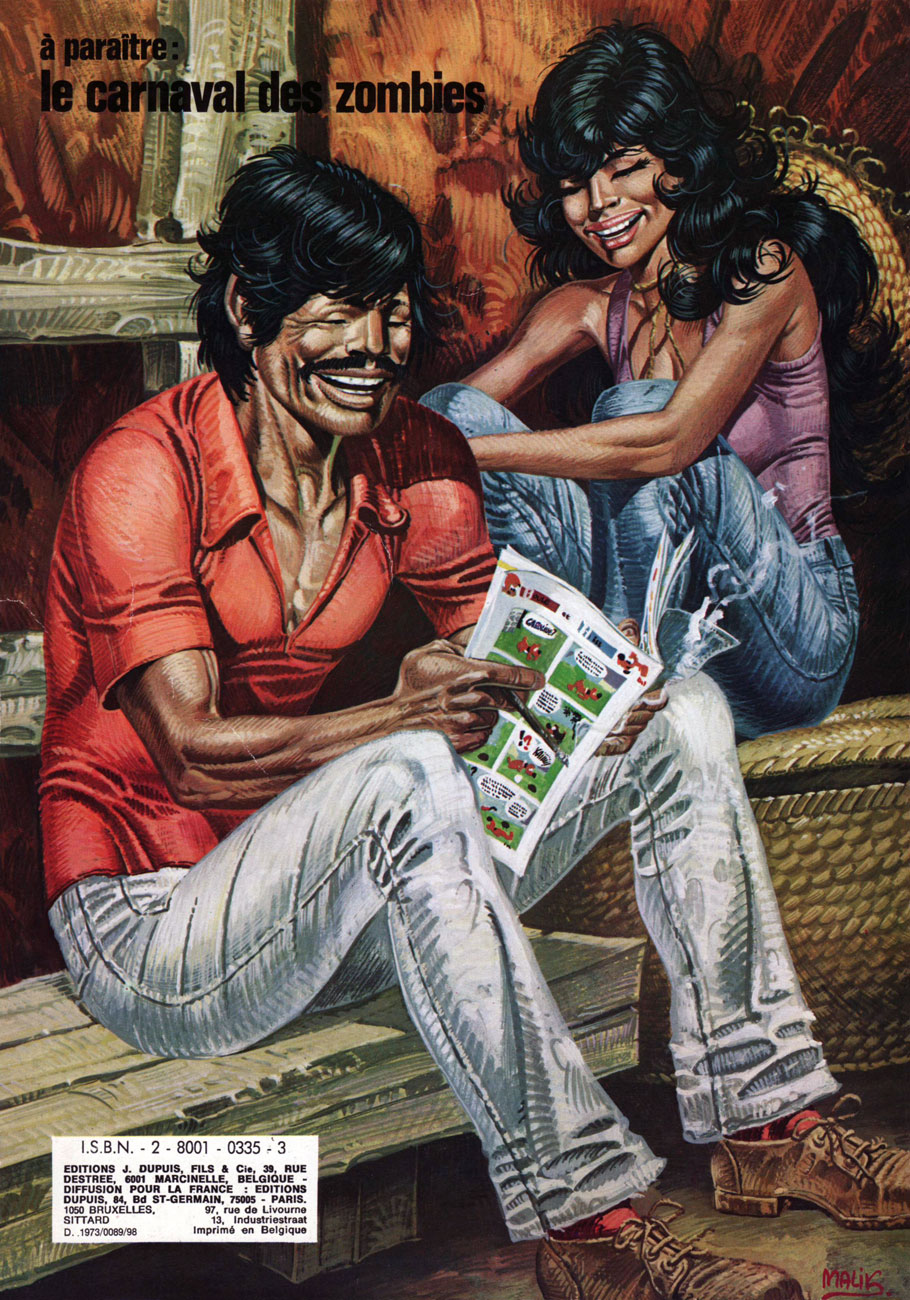
Ah, but this wasn’t the first time cartoonists had paid such tribute to Bronson: in 1971, writer Jean-Marie Brouyère and artist William Tai (aka Malik) created the South-America set Archie Cash series for Belgian bédé weekly Spirou. The series had a healthy run of 15 albums (what one would call a graphic novel over in North America) between 1973 and 1988.

ArchieCashRectoA

ArchieCashVersoA
Front and back covers of Archie’s début, Le maître de l’épouvante (1973).

ArchieCashMaître05A
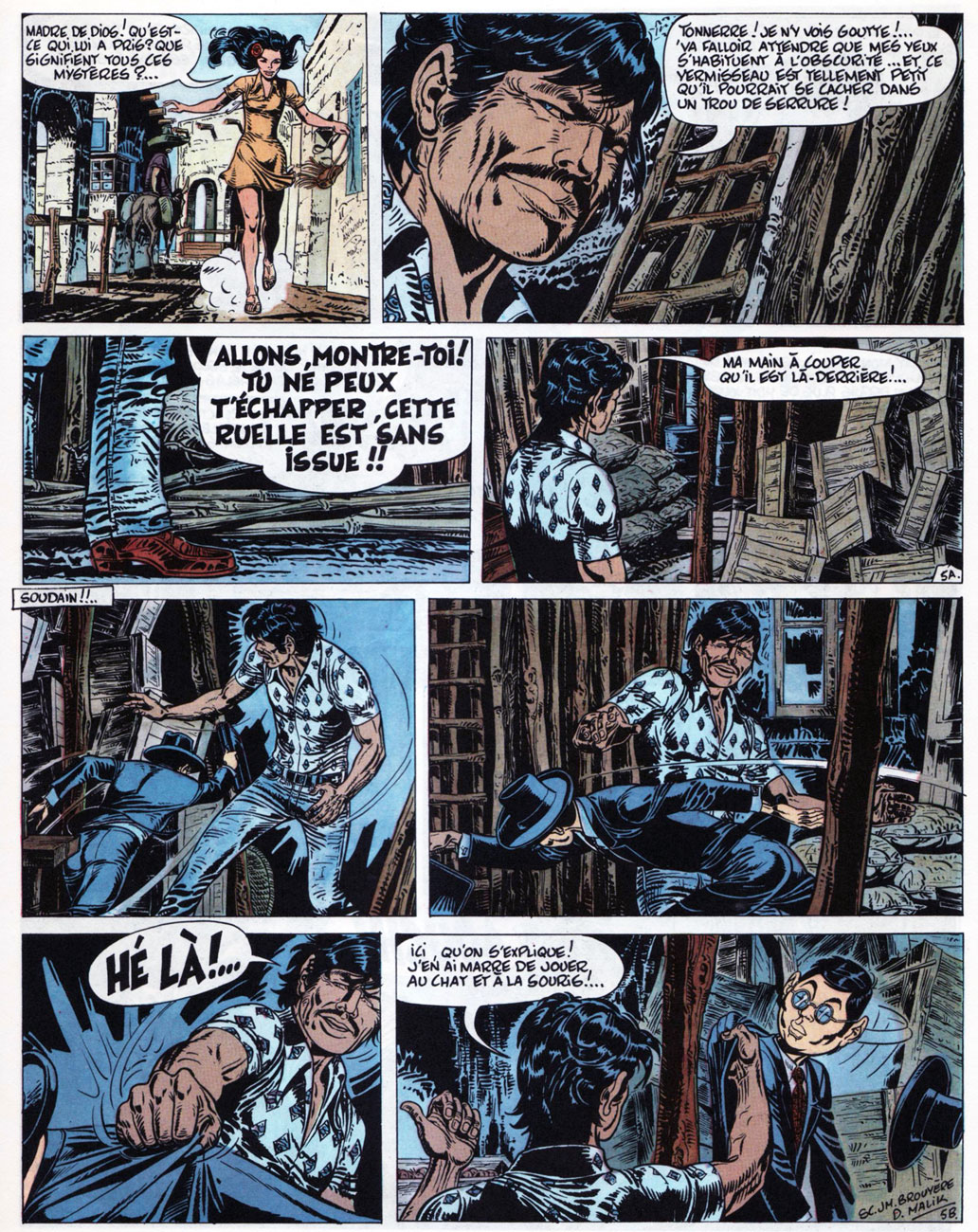
And to give you a sense of the series’ narrative texture, page five from Le maître de l’épouvante; when it debuted in the fall of 1971, the series brought a welcome griminess and ethno-social realism to the squeaky-pristine pages of Spirou.

The Italians would then follow suit, “borrowing” Jean-Paul Belmondo‘s likeness for their Goldrake series around 1972, followed by Alain Delon‘s looks for Playcolt, and more exploitively, Ornella Muti‘s charms for Sukia. Mind you, all these liberties with celebrity likenesses don’t make Brian Hitch‘s laziness and lack of imagination any less reprehensible.

Anyway, back to our birthday boy: if you want to see Bronson at his finest, I recommend his early, pre-moustache TV showcase Man With a Camera (1958)… the 29-episode boxed set’ll cost you peanuts and it’s great value. Then, from his European period, you can’t go wrong with 1968’s Adieu l’ami (Farewell, Friend), co-starring the aforementioned Mr. Delon; 1970’s gloriously weird Le passager de la pluie (Rider on the Rain), 1971 winner of the Golden Globe for Best Foreign Film, and co-starring creepy Eva Green‘s mom (or should that be “mum”?), Marlène Jobert. And of course 1971’s Soleil rouge (Red Sun), co-starring, this time not only Delon, but none other than Toshirô Mifune!

Happy birthday, Mr. Buchinsky!

– RG

Faites gaffe, monsieur Franquin!

Ninety-three years ago today (January 3, 1924, that is), master bédéiste André Franquin was born in Etterbeek, Belgium.

His œuvre is an embarrassment of riches, but heck, here’s a diabolically ingenious Gaston Lagaffe strip whose mise-en-scène is so solid and visually limpid that the only dialogue needed to truly “get it” is the punchline: « Never seen such a tough nut… »

GastonNoixA
Originally published in Spirou no. 1599 (Dec. 5, 1968, Éditions Dupuis.)

It would be unfair and inaccurate to single anything out as André Franquin’s «masterpiece», given the consistently high calibre of his output. Let’s settle for stating that Gaston was in all likelihood his most popular creation, as luck would have it.

The legendary gaffeur first messed up in a two-panel cameo in the Spirou et Fantasio adventure Le voyageur du Mésozoïque in 1957. Later S&F tales were dotted with Gaston cameos, and the accident-prone office boy soon (crash-) landed his own half-page strip, which ran from the late 50s to the late 90s, though mostly consisted of reprints after the early 80s.

GaladeGaffes
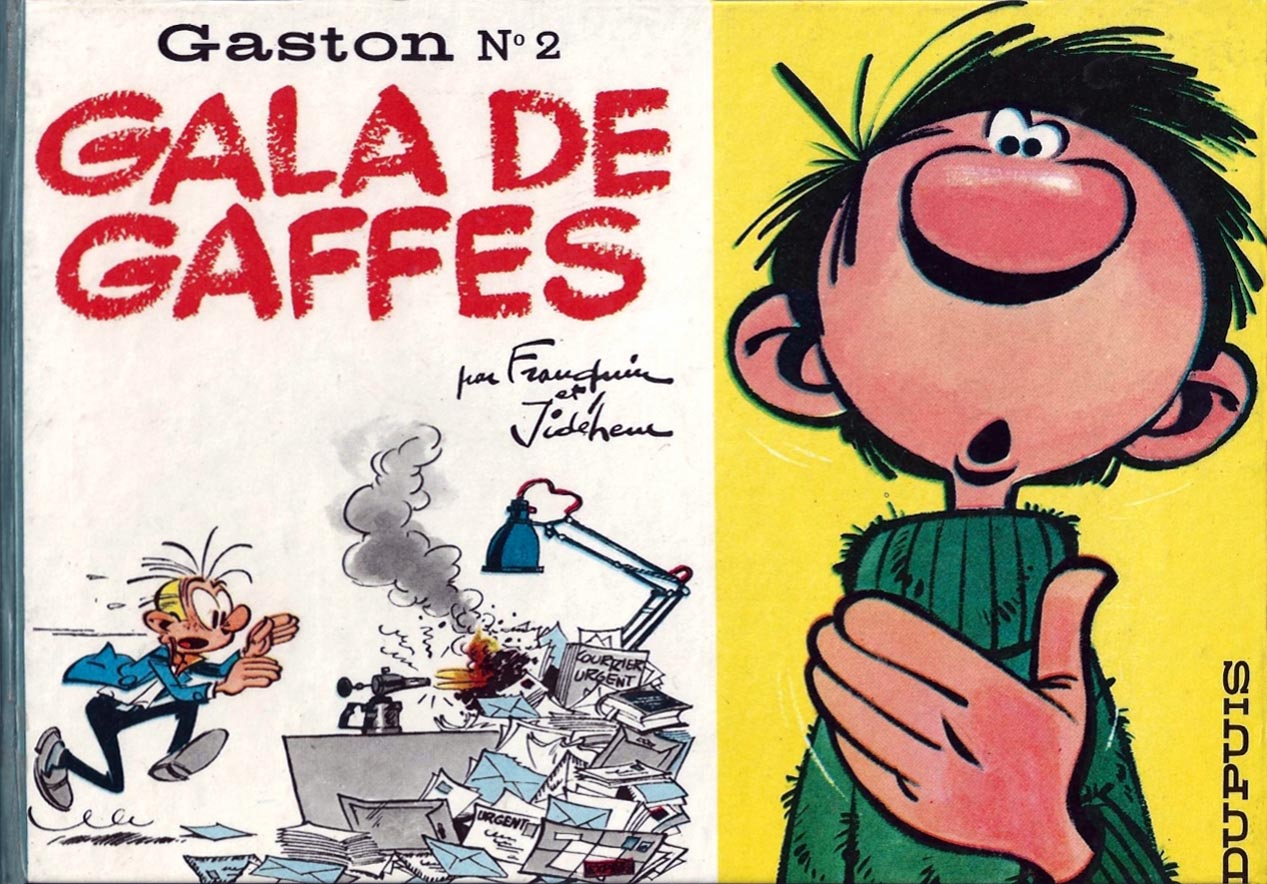
Gaston’s second strip collection, issued in 1963 in the original “landscape” format, deemed an oddity at the time.

As for translations, Gaston’s popular in a bevy of languages, but not, of course, in English. Fantagraphics’ Kim Thompson was a huge fan, and translated a handful of strips, which were published (as Gomer Goof) in issues of the anthologies Prime Cuts and Graphic Story Monthly.

Speaking of Gomer, Anglophone readers are in for a treat: UK publisher Cinebook has, just last October, issued a collection (only 48 pages, but you have to start somewhere… and perhaps small) entitled Mind the Goof! Check it out here.

-RG